Chloë Bass: Wayfinding is located throughout the Pulitzer Arts Foundation’s campus. The maps on the previous and upcoming pages will help you find the sculptures, which vary in size. Explore on your own terms; there is no particular order to the exhibition. A wheelchair accessible path through the exhibition is outlined on the map. There is also an audio artwork to accompany your experience.
Audio Artwork
Access the free, site-specific audio artwork by calling 314.384.5148, using the QR code to the right, or visiting our website at pulitzerarts.org using your mobile device and our free Wi-Fi: Pulitzer Public. A transcription is available on our website and at the information desk during the museum’s open hours; please request your copy from the museum staff.
Large Print Exhibition Guide
A large print version of this text is available at the information desk during the museum’s open hours.
For More Information
Email info@pulitzerarts.org to hear from our team about this exhibition, or visit pulitzerarts.org for more information on upcoming exhibitions and programs.
Chloë Bass: Wayfinding
Chloë Bass (b. 1984) created Wayfinding, an installation of sculptures inspired by public wayfinding signage. Bass designed a set of more than thirty signs placed throughout the Pulitzer’s outdoor spaces. These works are organized into four sections. Each is anchored by a billboard posing a question that explores human emotions ranging from compassion and desire to anxiety and loss. Accompanying sculptures include archival images and statements written by the artist that encourage private reflection in public space, intensifying everyday moments.
Wayfinding also includes a site-specific audio artwork narrated by the artist and local collaborators. This component of the exhibition draws from several sources: quotes from the City of St. Louis’s Mow to Own Program (a program where citizens can acquire properties adjacent to their own by caring for the site for two years), Google and Yelp reviews of the Pulitzer, reports on aging and disorientation from the National Institutes of Health, landscape architecture teaching guides, and the artist’s personal narrative. It also incorporates many of the phrases written on the sculptures. Alongside Bass, the audio artwork is read by artist Damon Davis; poet, storyteller, and podcaster Cheeraz Gormon; and theater artist Ron Himes.
Chloë Bass is a New York–based artist who works in performance, publications, installation, and social spaces. She uses daily life as a subject for deep research into scales of human intimacy. Wayfinding is a sub-project of Obligation To Others Holds Me In My Place, a poetic investigation of intimacy within the immediate family. Bass has held numerous national fellowships and artist residencies. She is an Assistant Professor of Art at Queens College, CUNY, where she co-runs Social Practice Queens.
Washin g ton Blvd
How much of care is patience?, 2019. Mirrored stainless steel with frosted vinyl lettering, 120 × 48 inches (304.8 × 121.92 cm)
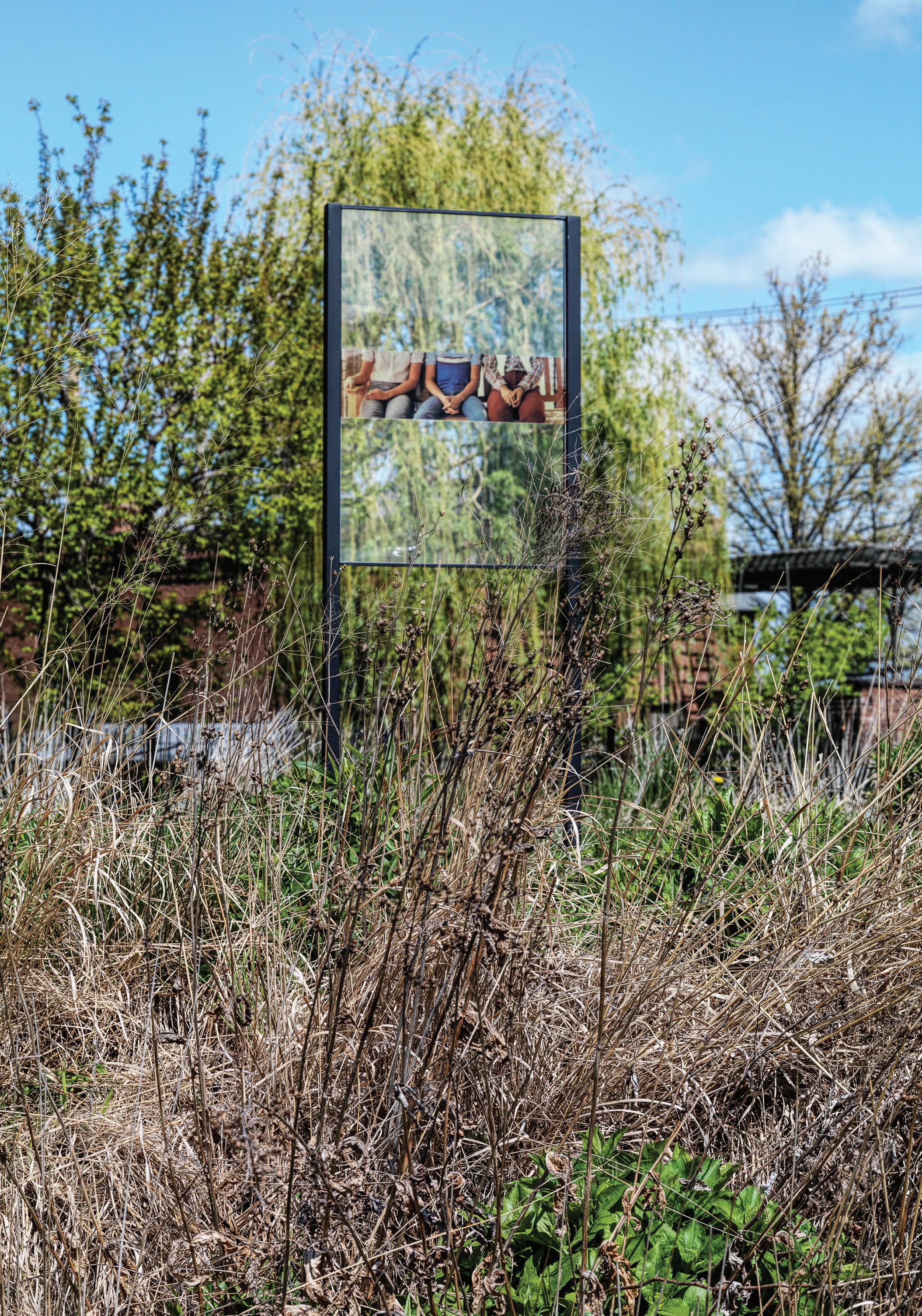
I want to believe that approaches can be different without being threatening. The part of you that says “I can share myself with another.”, 2019. Double-sided frosted stainless steel sign with mirrored lettering, 24 × 36 inches (61.96 × 91.44 cm)
There are times when I have agreed with you only in order to go to sleep. In the absence of language, a minute can stretch to contain a thousand thoughts., 2019. Double-sided
The unsettling sympathy and grace of someone who hands you the thing you need the second before you remember its name., 2019. Engraved aluminum, 8 × 5 inches (20.3 × 12.7 cm)
So much of desire seems predicated by absence. The things that keep someone a mystery keep the want sharp., 2019. Engraved aluminum, 8 × 5 inches (20.32 × 12.7 cm)
Every time I’ve nearly been killed I’ve survived it, but that doesn’t mean I’m out looking for more devastation in order to prove a point., 2019. Engraved aluminum, 8 × 5 inches (20.32 × 12.7 cm)
In the annals of history, most of the things that made you cripplingly anxious for a brief period of time will probably go unrecorded., 2019.
Engraved aluminum, 8 × 5 inches (20.32 × 12.7 cm)
How much of life is coping?, 2019. Mirrored stainless steel with frosted vinyl lettering, 120 × 48 inches (304.8 × 121.92 cm)
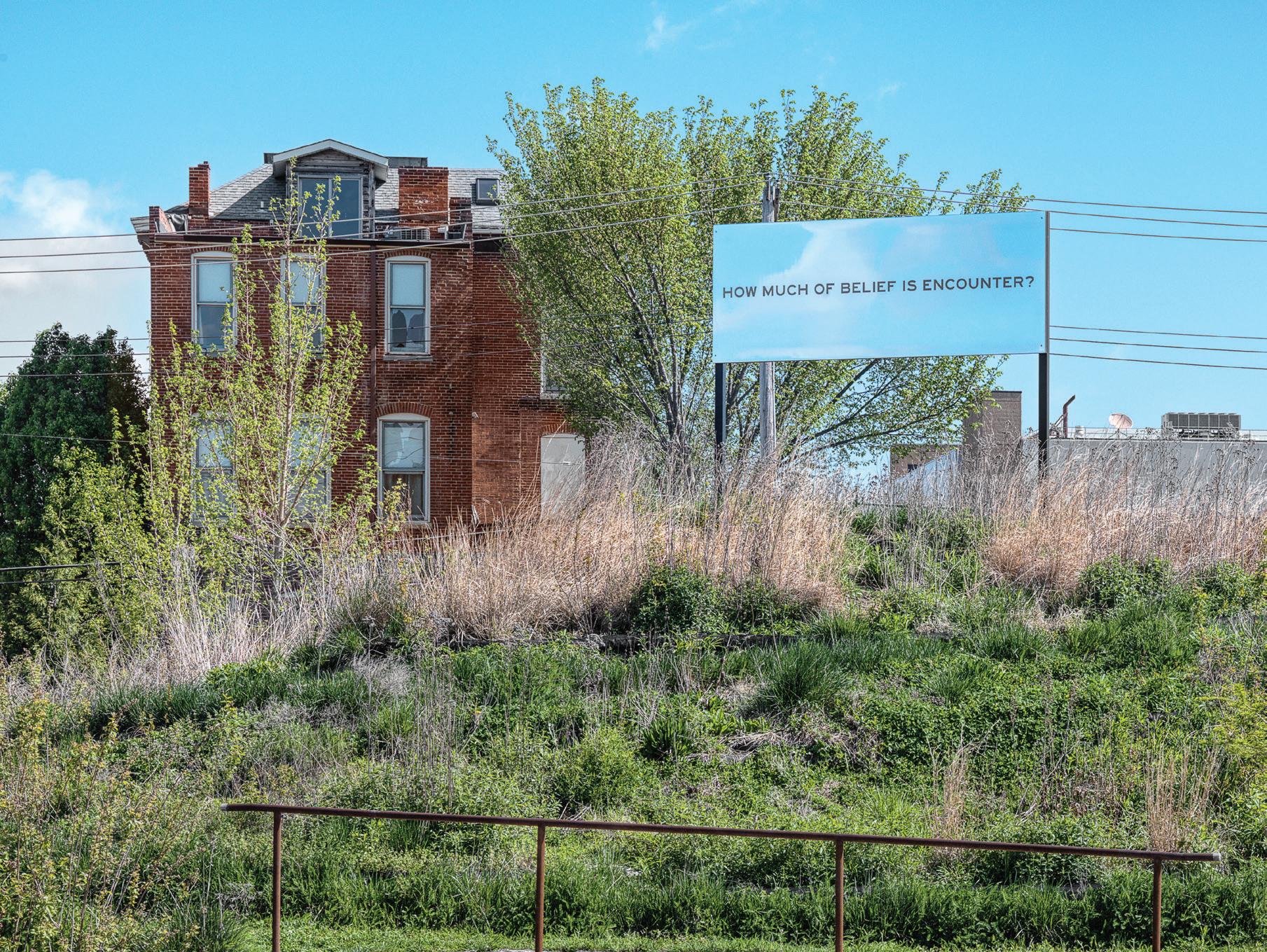
How much of belief is encounter?, 2021. Mirrored stainless steel with frosted vinyl lettering, 120 × 48 inches (304.8 × 121.92 cm)
I want to believe that interpretations can be different without being threatening. The part of you that says “I can share myself
with strangers, but not with family.”, 2019. Double-sided frosted stainless steel sign with mirrored lettering, 24 × 36 inches (61.96 × 91.44 cm)
There are times when I have agreed with you only in order to stay alive. In absence of perspective, a minute can stretch to contain innumerable fears., 2019. Double-sided frosted stainless steel sign with mirrored lettering, 24 × 36 inches (61.96 × 91.44 cm)
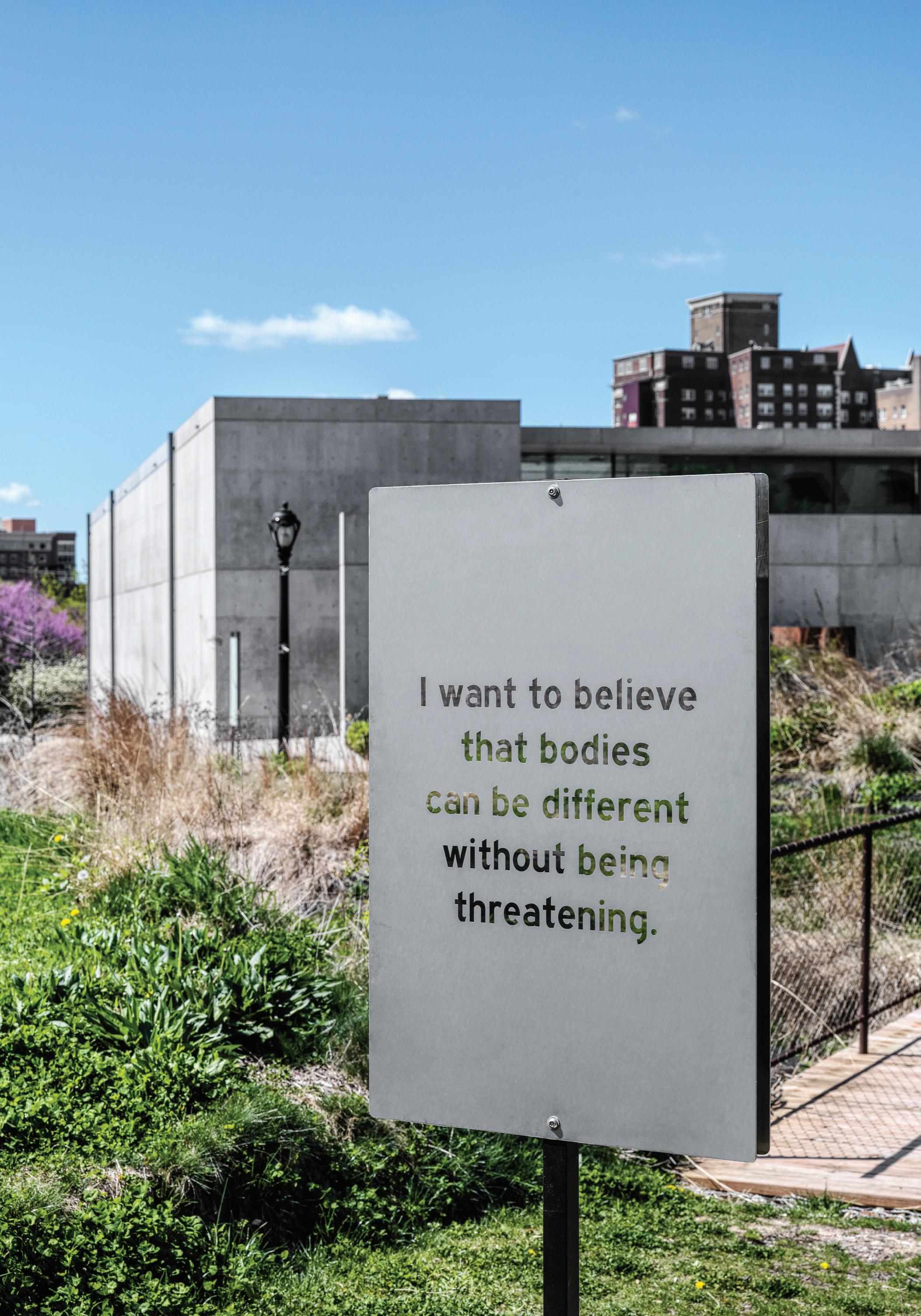
I want to believe that bodies can be different without being threatening. The part of you that says it cannot be shared., 2021. Double-sided frosted stainless steel sign with mirrored lettering, 24 × 36 inches (61.96 × 91.44 cm)
There are times when I have agreed with you only in order to find myself. In the absence of contact, a minute can stretch to contain countless ghosts., 2021. Double-sided frosted stainless steel sign with mirrored lettering, 24 × 36 inches (61.96 × 91.44 cm)
Of this time, I offer a future apology: we answered every question that was answered, but stayed mute on what was never asked., 2021. Engraved aluminum, 8 × 5 inches (20.32 × 12.7 cm)
The unparalleled mix of emotions when someone who loves you calls to say: rest. I see what you’re doing, and the world needs you to be well. Joy, sorrow, and a relief so profound it’s almost bitter., 2019. Engraved aluminum, 8 × 5 inches (20.32 × 12.7 cm)
A song you know by heart that brings no consolation., 2021. Engraved aluminum, 8 × 5 inches (20.32 × 12.7 cm)
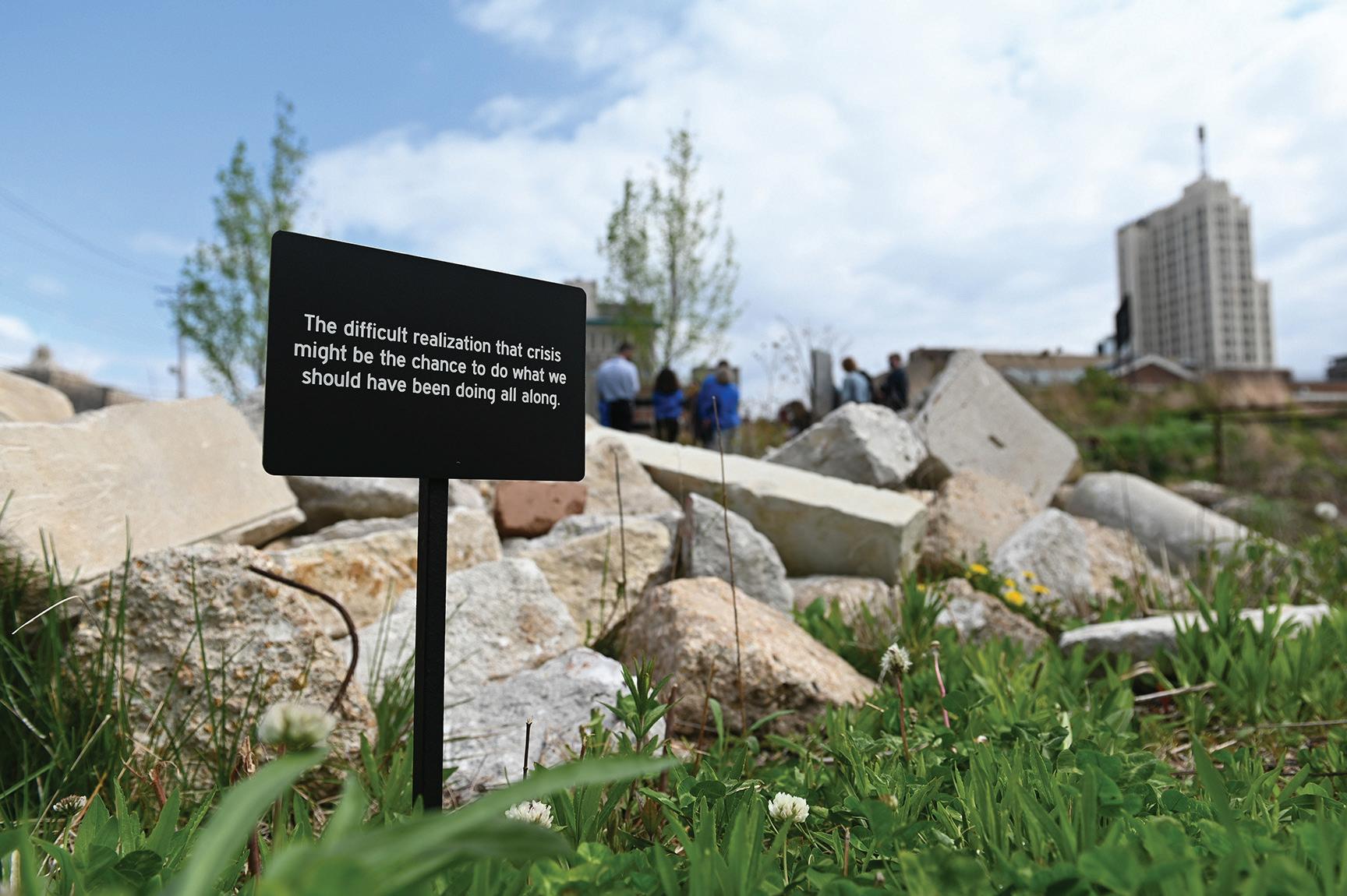
The difficult realization that crisis might be the chance to do what we should have been doing all along., 2021. Engraved aluminum, 8 × 5 inches (20.32 × 12.7 cm)
There is a kind of impatience that in a certain light can be misplaced for eagerness., 2019. Engraved aluminum, 8 × 5 inches (20.32 × 12.7 cm)
A single instance is an example of nothing. The minimum to define a pattern is three. Yet somehow we are primed to recognize exceptionalism and struggle to see at the level of daily behavior., 2019. Engraved aluminum, 8 × 5 inches (20.32 × 12.7 cm)
Tree Grove
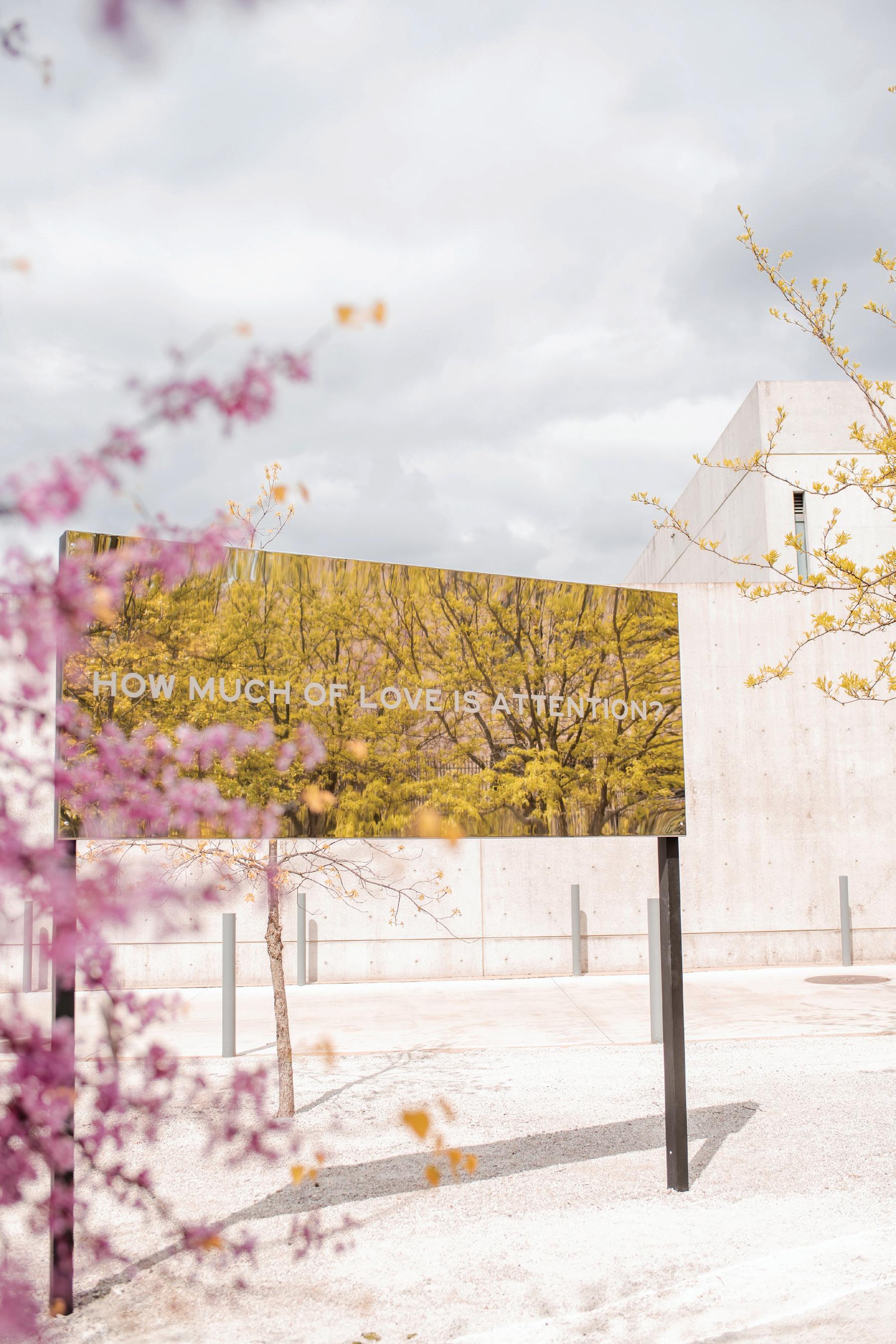
How much of love is attention?, 2019. Mirrored stainless steel with frosted vinyl lettering, 120 × 48 inches (304.8 × 121.92 cm)
I want to believe that desires can be different without being threatening. The part of you that says “I can share myself with strangers.”, 2019. Double-sided frosted stainless steel sign with mirrored lettering, 24 × 36 inches (61.96 × 91.44 cm)
There are times when I have agreed with you only in order to cast relief. In the absence of understanding, a minute can stretch to contain unlimited observations.,
Some days you call out to the world and all that echoes back is your own emptiness., 2019. Engraved aluminum, 8 × 5 inches (20.32 × 12.7 cm)
You might want so much more than you know., 2019. Engraved aluminum, 8 × 5 inches (20.32 × 12.7 cm)
It doesn’t take a genius to know that repetition is a very different thing from sentiment., 2021. Engraved aluminum, 8 × 5 inches (20.32 × 12.7 cm)
Perhaps the problem is that I find so many things perfectly revealing just as they are., 2019. Engraved aluminum, 8 × 5 inches (20.32 × 12.7 cm)
You’ll have to trust me when I say that many of the things I appear to know most deeply, I feel I know by accident., 2019. Engraved aluminum, 8 × 5 inches (20.32 × 12.7 cm)
Good days are easier to describe than to interpret. Maybe that’s the point of happiness: it isn’t symbolic. It’s just a real thing, and then it passes., 2019. Engraved aluminum, 8 × 5 inches (20.32 × 12.7 cm)
The following essays are companion pieces to Chloë Bass: Wayfinding. Bass invited art historian Linda Earle and writer and art critic Jessica Lynne to respond to the exhibition.
“Reflections on Unbuilt Space” by Linda Earle discusses Bass’s artistic practice at large, positioning the exhibition in art historical, cultural, and political contexts. It also speaks to the experience of encountering and interpreting Wayfinding. Earle is a Professor of Practice and Associate Graduate Director for Arts Management in the Department of Art History at the Tyler School of Art and Architecture at Temple University.
“a practice in accompaniment” by Jessica Lynne is a personal and poetic reflection. It is organized into sections that include a heading and quotation from Bass’s audio artwork followed by an intimate investigation by Lynne. Jessica Lynne is a founding editor of ARTS. BLACK, an online journal of art criticism from Black perspectives.
Reflections on Unbuilt S p
by Linda Earle
For years an image from César Aira’s improbable, brilliant novel Ghosts has lodged itself insistently in my mind— an image with which I’d been fascinated, but that I’d not entirely understood until it emerged more fully for me in Chloë Bass’s work. Aira’s novel takes place during a single day and documents a construction worker’s family living surreptitiously on the site of a future skyscraper. The family’s lives are organized by routine, daily labor, and the habits of survival, but the temporal and spatial planes of their existence are disrupted by a band of revenants who have also come to occupy the half-built space. The daughter of the family can see them, and as they beckon her to join their legion she has a vision of the building in the present—under construction—in conjunction with another image that Aira describes as “a reciprocal mirroring of what has already been built and what will be built eventually. The all-important bridge between the two reflections was provided by a third term: the unbuilt.”1
Chloë Bass’s conceptual project occupies this unbuilt space, generating what she has called “souvenirs for feelings you haven’t had yet.”2 The substance and strategies of Wayfinding prompt recognition and memory in the moment, as well as responses whose meaning and implications for how you live in the future will truly unfold over the as yet unknown territory of your experience.
Wayfinding is a part of a practice built across performance, publication, social practice, sculpture, and architecture. The works have different trajectories within Bass’s conceptual terrain, but all are informed by the extraordinary quality of her attention to the ways in which shifts of emotion and consciousness, rooted in the everyday, have consequence and resonance in the public/
social sphere. This intention is never on the surface of the projects; the viewer is instead beckoned to pursue meaning and significance as a personal project.
In The Bureau of Self-Recognition (2011–13), Bass performs the familiar ritual transactions and protocols of banking that may naturally instigate questions about our political economy and how it is institutionalized in terms of power and control, but which relate more fundamentally to implications of the deeply personal formation of self-worth, self-regard, and trust. She transforms this interaction by offering, in effect, genuine forms of customer service and what is literally personal currency (your face on the dollars). The Book of Everyday Instruction (2015–18) was anchored in one-on-one research, probing behaviors of aloneness and togetherness. Bass undermines the subject/ object paradigm of research through conversation and with the compassion and empathy inherent in attention to the ordinary moments that ultimately shape our lives.
With Wayfinding Bass has found a particularly elegant and unified strategy in the way she adapts and subverts the instructional and locational expectations of standard wayfinding systems. The language of the central signs is interrogative—tricks of light play on the reflective surfaces, which can appear to be transparent or refractive depending on the ambient light, where you’re standing, or if glimpsed from the corner of your eye. Legibility is fleeting and evanescent. The emergent emotions, memories, and associations that these signs evoke can also be fugitive and gently unsettling.
Although this installation is on the grounds of an art museum, in the context of Wayfinding I think of Bass as a writer above all else. Attempts to describe the interplay of the text and material elements of the work evoke literary analogs. I think of the clear surface of a well-wrought essay
that allows you to see more deeply into the currents that run underneath it; there is a narrative you can construct from a dialogue between the four central questions on the reflective billboards and the confessional asides and observations planted in the ground in the manner of didactics in a botanical garden. One of them—“Every time I’ve nearly been killed . . .”—is in itself a short story with a long tail, so to speak. Bass’s work combines the economy and heft of recognition offered by poetry, and Wayfinding in particular invites this kind of rumination. Because it resides both outside the walls of the museum and outside of interpretive directives, you may navigate it with a different kind of attention, carrying just below your conscious engagement with the text the residue of dreams, to-do lists, lost keys . . .
So far, I have been thinking of the experience of the installation as a reader, a solitary walker. In fact, it is likely that the piece starts significant conversations and affects the emotional dynamic among pairs and groups. But, as with any shared experience, there are individual “souvenirs” as well.
Bass’s uniquely faceted body of work resists neat art historical mapping. Her practice embodies multiple artistic and philosophical currents, but I am struck by her interest in Adrian Piper’s work, particularly My Calling Card #1 and #2 (1986–90). Although Wayfinding and Piper’s calling cards have distinctly different intentions, they share a framework of attention to the commonplace and the ways in which social mechanisms reside in individual behaviors. Piper’s intention with the calling cards was specifically directed toward the ubiquity and pervasiveness of racism. In text and performance—at once decorous and confrontational—she constructs the terms of her visibility one by one as she passes cards to people who “made/ laughed at/agreed to [a] racist remark. . . . I regret any
discomfort my presence is causing you, just as I am sure you regret the discomfort your racism is causing me.”3
Bass’s work is rarely that frontal, but it does have political resonance. Her pedagogical model offers ways of aligning awareness and empathy to figure things out for oneself, encounter by encounter. I find this akin to expressions of protest after Breonna Taylor’s murder that were anchored in saying her name, saying who she was as a daughter and a friend, what she wore, what she loved, what she dreamed, and asking us to think of who we are if we tolerate her abduction from that everyday substance of her life. Where the appreciation of that fundamental commonality doesn’t exist, there is no justice. As the viewer metabolizes Wayfinding, the need for both reflection and connection emerges.
Inevitably the news and current events of the time will attach themselves to the awakening experience of Wayfinding as it travels from a park in Harlem to St. Louis through lockdown, calamity, and relief. But wherever it is, the souvenirs it imparts will include the piece’s interaction with its surroundings. A landscape carries its own narratives and implies social arrangements as the contours of the natural are accommodated or erased—the strictness of its paths, its signage and wayfinding devices, the presence or absence of others. Somewhere down the road, your memory will perhaps orchestrate all of this with the reverberant questions of Wayfinding that have unfolded from where you are now into an unbuilt space and its asyet-unshaped, unnamed possibility.
Notes
1. César Aira, Ghosts, trans. Chris Andrews (New York: New Directions, 2009), 57.
2. Chloë Bass, “Wayfinding: A Conversation with Chloë Bass,” interview by Helen Hy Kim, Aster(ix), June 11, 2020, https://asterixjournal.com/wayfindingchloe-bass/.
3. Adrian Piper, My Calling Card #1 and #2 (1986–90). Mixed media.
by Jessica Lynne
WAYFINDING, ONE: PATHS, CIRCULATION
“Topography, noun: a detailed description or representation on a map of the natural and artificial features of an area; a set spatial moment meant to represent a landscape that is otherwise moving; a snapshot. See also: family photographs.”
When you are young and trying to ascertain the limits of your world, the task feels herculean. There are places that you know are not your places, the not here, and yet rendering them beyond the abstract leaves you with an interesting conundrum. To whom might these other places belong? What are the conditions of their universe? Are those people, where they are, thinking about you?
In my own mind, as a child, this curiosity—of place defined by a present tense—led me to the pasts of people who were charged with my care. I wanted to see and hear and know those geographies that had given them shape, the shapes that I could now touch and hold onto while walking in the park or reading together at night or line dancing at a birthday party. How had they imagined this now?
WAYFINDING, FOUR: AMNESIA
Maybe this story is hard for you to imagine because you’re not me.
Is this imagining connected to a sense of foresight? Maybe that’s not the best question. Perhaps I should ask: is it an act of love to dream of a beyond, one outside of the place and time that is immediately tangible?
WAYFINDING, THREE: NODES
“A node is a point at which subsidiary parts originate. People make decision points at nodes in paths. As a result, nodes should contain graphic and architectural information to assist with those decisions.”
Jamaica Kincaid’s novel The Autobiography of My Mother opens this way:
My mother died at the moment I was born, and so for my whole life there was nothing standing between myself and eternity; at my back was always a bleak, black wind.
This is not a sentiment of hope or forlornness or even despair. For Kincaid’s protagonist, Xuela, this is just a matter of fixed position. A node from which she shall move forward, this recognition brings with it sets of decisions that route Xuela’s way from childhood to old age. She negotiates the parameters of her life on a small island, first defined for her by an inattentive father and later renegotiated by Xuela herself for her own survival. She marks her way in the world by the horizon line or the distance from her father’s house to the mouth of the river or by the quiet that settles in Roseau on a Sunday morning during church hours.
This novel is the last book I read in 2020, and I am writing about it here, in 2021, because I have returned to the place of my childhood only to be slightly disoriented by all that I had forgotten about this location. I have since begun to guide myself by the memories assigned to the many places where I once clung to the shapes of those previously charged with my care, places where I decided to release my grip. These are becoming my nodes.
WAYFINDING, TWO: MARKERS
“In wayfinding, a marker is an object that marks a locality. Markers such as arches, monuments, building entrances, kiosks, artwork, and natural features give strong identity to various parts of a site or building. They act as mental landmarks in the wayfinding process and break a complex task into manageable parts.”
There is the former church on Warwick Boulevard whose congregation has ballooned so much that the building where I first questioned the terms of my faith is no longer the building where the church even meets. There is the park near the air force base where I first realized what it meant to be disappointed by the fragile humanity of your parents. There is the water, at whose edge I stood desperately trying to see to the other side. To those other universes.
WAYFINDING,
FIVE: AGNOSIA
I’ve been aiming towards a certain type of perfection . . .
This is to say that my present now belongs to a place that does not quite seem entirely like a place that was once my place. This is neither bad nor good—it simply is what it is. There are new points that dot this landscape in flux, and in this moment I am only dreaming of, hoping for, steadiness.
Exhibition
Chloë Bass: Wayfinding is organized for the Pulitzer Arts Foundation by Kristin Fleischmann Brewer, Deputy Director, Public Engagement, and Joshua Peder Stulen, Assistant Curator of Public Projects and Engagement.
Chloë Bass: Wayfinding was first organized by Legacy Russell, Associate Curator, Exhibitions at The Studio Museum in Harlem as part of Studio Museum’s inHarlem initiative and in partnership with St. Nicholas Park, Harlem and NYC Parks. The Studio Museum in Harlem’s inHarlem program is made possible thanks to Citi; the William R. Kenan Jr. Charitable Trust; and The Shelley & Donald Rubin Foundation. For more information on the Studio Museum and its inHarlem program, visit studiomuseum.org.
Page 11: Chloë Bass, The difficult realization that crisis might be the chance to do what we should have been doing all along., 2021. Engraved aluminum, 8 × 5 inches. Courtesy the artist. Photograph by Michael Thomas
Page 22: Chloë Bass, How much of love is attention?, 2019. Mirrored stainless steel with frosted vinyl lettering, 120 × 48 inches. Courtesy the artist. Photograph by William Mennerick
Thank You
Thank you to artist Chloë Bass and the collaborators who supported the creative production of Wayfinding in St. Louis. Special thanks to Legacy Russell and the staff at The Studio Museum in Harlem, contributing writers Jessica Lynne and Linda Earle, and audio artwork readers Damon Davis, Cheeraz Gormon, and Ron Himes. Editorial assistance by David B. Olsen. Production and installation support by Mike O’Toole at Dash 7 Design, Engraphix, Griffin Editions, Stone Effects, All Seasons Landscape, and Shock City Studios.
Thank you to the Board of Directors and staff at the Pulitzer Arts Foundation.
We’re Listening
We’d love to hear your thoughts! Visit pulitzerarts.org/survey or follow the QR code below to access a brief survey about your visit. Complete the survey and be entered to win a prize.