Dear Passengers, With 2026 well underway, there’s renewed momentum in the air at Rex, and opportunities abound in the year ahead.
As we move into the autumn months, there’s a noticeable shift across regional Australia – cooler mornings, golden landscapes and ideal conditions for travel.
In this issue, we explore the Macleay Valley Coast and Coffs Harbour, venture into Outback Queensland and the Savannah Way, and discover the food, fine wine and historic charm of the Adelaide Hills. We also savour Tasmania’s distinctive whisky experiences, and experience the breathtaking natural beauty of Albany in Western Australia.
February was a particularly significant month for the Rex team as we welcomed our new owner,
Air T, to Australia. The visit marked an important milestone in our journey to reinforce the classic Rex you know and trust – strengthening relationships, fostering alignment on our shared vision, and reaffirming our commitment to delivering safe and reliable air services to the regional and remote communities we proudly serve.
We’re very pleased to share more about this visit in this great edition of TrulyAus
Thank you for your continued support and for choosing to fly with Rex. We look forward to welcoming you onboard throughout 2026, and to being part of your next journey.
Printcraft 37 College Street, Hamilton, Qld 4007 printcraft.com.au
Truly Aus is published by AusBiz Pty Ltd, (ABN: 78 621 375 853 ACN: 621 375 853) Level 1, 3 Westleigh Street, Neutral Bay, NSW 2089 ausbizmedia.com
The reproduction of any content, in whole or part without prior written permission by the publisher is strictly prohibited. Opinions expressed in the content are those of the contributors, and not necessarily those of the publisher. All information in this magazine was believed to be correct at the time of publication, and all reasonable efforts have been made to contact copyright holders. Ausbiz Pty Ltd cannot accept unsolicited manuscripts or photographs. If such items are sent to the magazine, they will not be returned. We apologise if we don’t get back to your email, as we do receive a large volume of communication via various online channels. Some images used in TrulyAus are from iStock and Getty Images, and we make every effort to credit all contributors.
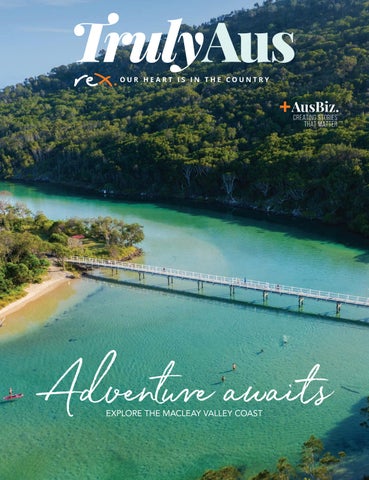
Cover photo by Zane Wilson
Discover
36.
Inside TrulyAus
20. Macleay Valley Coast wanderings
Soak up Kempsey and its surrounds with this locals’ guide to the best coastal trails, art galleries and waterways in the region.
26. Coffs Harbour: beyond the beaches
Coffs Harbour is home to immersive art, world-class Botanic Gardens, top dining and incredible beaches.
30. Explore The Savannah Way
Now the wet season is over, it’s the perfect time to get out and explore the Gulf’s beautiful Savannah Way.
38. Embrace luxury in the Adelaide Hills
From boutique retreats to personalised wine tours and romantic horse rides, discover the luxury of the Adelaide Hills wine region.
AusBiz.
The home of real Australian stories
62. BUSINESS
Abby Crawford reflects on how good businesses can make meaningful contributions to industries and the world.
64. TECHNOLOGY
While AI is transforming the financial guidance industry, consumer comfort is not rising at the same rate.
44. A Pacific Islands holiday
In the Solomon Islands, time moves slowly and people live much as they did thousands of years ago.
48. Gin and whisky tours in Tassie
Make your own whisky and sample top drops straight from the barrel with these experiences in Tassmania.
68. NATURE
Three new discoveries have shed light on Australia’s strangest aquatic creatures.
72. CHARITY
Explore three incredible Aussie charities building a brighter tomorrow.
80. LAST WORD
A recent project aims to conserve the Nangur spiny skink population – one of Australia’s engangered species.
AMAZING ALBANY
how to experience the very best of nature in Albany!
26. Coffs Harbour jetty
Someone asked me recently – because I ‘ve been writing about Australian places for more than two decades – if I ever run out of new places to cover. I laughed and replied –‘Definitely not, and I don’t think I ever will.’
The question encouraged me to pull out a map of Australia and add dots to everywhere I’ve been, and I have to say, Queensland, New South Wales and Tasmania were heavily speckled, but there were still plenty of areas left to explore. And there were huge expanses in South Australia, Victoria, Western Australia and the Northern Territory severely lacking in dots. Let’s just say that I have a lot of exploring to do in this country, so the stories will keep flowing.
For this issue of TrulyAus, I filled in more of the NSW gaps, heading up to Coffs Harbour for the first time in decades. I checked out the local art and dining scene and hiked Muttonbird Island Nature Reserve. At the summit, it feels as though you’re on the edge of the world.
I also explored our cover star – the Macleay Valley Coast, and now understand why so many people are drawn to lovely Crescent Head, Gladstone and Hat Head. They’re relaxed, magical places where the locals are so friendly and the often deserted beaches are glorious.
Closer to home, I spent a couple of days counting the local wildlife at the OG of glamping retreats: Paperbark Camp, while our Deputy Editor Matilda visited the Adelaide Hills for the first time, discovering that the region is brimming with fine food, great wine, and soul-soothing experiences in the great outdoors.
Speaking of the great outdoors, Queensland’s wet season is once again behind us, and it’s the perfect time to journey along the remarkable Savannah Way in stunning Gulf country. The region is home to some jaw-dropping natural phenomenona such as the 190,000-year-old lava tubes, and ancient gorges where you can cruise between towering red sandstone cliffs.
We also give you a bucket list of things to do in Outback Queensland that might not have crossed your travel radar – such as following a dinosaur trail – and head way over West to share some of the wild wonders of Albany, which is famed for its rugged beauty.
In AusBiz, we look into the research that shows the psychological toll of taking the human element out of financial decisions by adding AI to the mix. And as we love a great environmental story, we’ve delved into three groundbreaking discoveries related to four water-dwelling creatures native to Australia – frogs, lampreys, crabs and deep sea sharks. Enjoy the read, and your travels. Start dotting that map and exploring more of your country, as one thing that’s as sure as the day is long: you will never regret it.
MICHELLE HESPE AND THE TEAM AT TRULYAUS
Yala Yallingup is a secluded sanctuary set among tranquil pastures, vineyards, and native bushland between Yallingup and Dunsborough. With stylish, boutique accommodation, a luxury day spa, and heartfelt hospitality, every detail is designed to help you slow down, reconnect, and explore the South West at your own pace.
Our welcoming, knowledgeable team is at the heart of every stay, sharing insider tips, guiding you to hidden local gems, and delivering personalised spa experiences to make your visit truly memorable. Yala was awarded a 2025 Michelin Key.
As you sit back in comfort en route to your destination, the Rex crew hope you enjoy this entertaining and informative light reading.
Q. Why do the flight attendants insist that all window blinds be up for take-off?
A. The most critical phases of a flight are the take-off and landing. In the most unlikely event of a situation that requires an emergency evacuation, it is important that crew and passengers are able to have a clear view of the outside conditions in case of obstructions. For example, before exits are opened, staff must check for fire or other obstacles that may present potential hazards during the evacuation.
Q. Why do I have to stow my hand luggage in the overhead lockers, under the seats or in the seat pockets for take-off and landing?
A. Flight crews are required by Civil Aviation Regulations to secure the cabin as well as possible for take-off and landing. As mentioned, these are the most critical phases of the flight, and securing as much hand luggage as possible ensures that, in the unlikely event of an emergency, the exits and aisles stay as clear as possible, in case evacuation is necessary. It is also important to keep hand luggage secure whenever possible to ensure heavier items do not become airborne within the cabin. This is especially important when the aircraft is experiencing turbulence.
Q. Why do I feel so tired from flying?
A. As the aircraft altitude increases, air pressure decreases. As the pressure decreases, the body absorbs less oxygen than it would at sea level – so, it must work harder to supply oxygen to the body’s cells. As the body is working harder, it becomes more tired.
Q. Why do I sometimes feel pain in my ears or sinuses during ascent or descent?
A. The sinuses and middle ear are air-containing cavities that connect with the nose via narrow channels. As aircrafts ascend and cabin pressure drops, air passes out of these cavities (without any effort from the passenger) to balance the cabin pressure. It is a different matter during descent, as the cabin pressure increases. The channels close down and must be actively opened by holding the nose and blowing to inflate the cavities. Facial and ear pain can occur during descent if re-inflation does not occur, and this is much
INFLIGHT INFORMATION
more likely if the passenger has nasal congestion. If you must fly with hayfever, use a decongestant nasal spray before descent and buy some ‘ear planes’ to plug your ears.
(Information contributed by Dr Daniel Hains, ENT surgeon.)
Q. When can electronic equipment such as laptops, iPods and mobile phones be used?
A. All Personal Electronic Devices (PEDs) must be placed in flight mode if access to the tarmac (including by bus) is required during boarding or disembarkation, and when instructed to do so by the cabin crew. Small handheld PEDs weighing less than 1kg, such as mobile phones, can be used in flight mode during all stages of flight. PEDs over 1kg, such as laptop computers, must be stowed appropriately for taxi, take-off and landing, and are permitted to be used only during cruise when the ‘Fasten Seatbelt’ sign is switched off. PEDs cannot be used while crossing the tarmac.
Q. What is the average speed of the aircraft when cruising in flight?
A. Our Saab 340 has an average cruising speed of approximately 500 kilometres per hour.
Q. Why do I have to get permission from the Captain to move to a vacant seat?
A. The aircraft’s take-off speed is calculated by the weight and balance of the aircraft, and many factors need to be considered for a successful take-off. Factors include the weight of passengers and where they are seated, the weight of cargo, freight and fuel, the distance available on the runway, etc. For example, if there are 100 or more kilograms of freight in the cargo, the balance of the aircraft will be better maintained if passengers are seated in the forward rows.
AIR TURBULENCE
Q. Aircraft often experience air turbulence, but what causes it?
A. Imagine the air around the aircraft is water in a stream. We can see how water is disturbed around rocks or when two streams converge. Turbulence in the air is
similar: as the aircraft passes through cold air or in the vicinity of terrain that has disturbed the airflow – often incorrectly referred to as ‘air pockets’ – the aircraft climbs and descends in the same way that a boat moves on water. Though turbulence can be uncomfortable, it poses no threat to the aircraft and is akin to driving on a rough or unsealed road. More severe turbulence can be associated with developing thunderstorms. Aircraft have a sophisticated weather radar that pilots use to avoid these areas. Occasionally, a flight attendant will discontinue serving passengers in turbulent conditions; this is a precaution to ensure everyone’s safety.
Q. Why should I keep my seatbelt fastened even when the ‘Fasten Seatbelt’ sign is switched off?
A. On occasion, the flight crew cannot foresee turbulence or it is not picked up on the flight-deck radar. Because of this, we could unexpectedly experience turbulence at any time. Rex recommends that you always keep your seatbelt fastened while you are seated – for your safety, just in case unexpected turbulence is encountered.
ENGINE NOISES
Q. Why do the aircraft’s engine noises change during the flight?
A. Aircraft need more power to climb than to descend, in the same way that a car needs more power to go up a hill than down one. Rex aircraft have more than enough power to climb, so shortly after take-off you will notice a change in noises as the power is reduced. The pilots also control the pitch angle of the propellers for various stages of the flight, and as they ‘change gears’ this can also be heard in the cabin.
Q. What should I do if I see or hear something that does not look or sound right?
A. Please advise your flight attendant. The flight attendant may be able to answer your query and allay any fears. If not, the flight attendant will contact the flight deck and advise the pilots of anything unusual. Rex encourages open communication and will always treat a passengers’ concerns with the utmost seriousness.
CHECK-IN
Online check-in
You can check-in online through the Rex website, rex.com.au, on your desktop or mobile devices between 48 hours and 60 minutes prior to the scheduled departure time of your flight.
Airport check-in
If you have checked baggage, we recommend that you arrive at the airport for check-in at least 60 minutes before the scheduled departure of your flight at all airports except Burketown, Queensland (90 minutes before).
Rex check-in closes:
• 60 minutes prior to scheduled departure time at Burketown airport.
• 30 minutes prior to scheduled departure time for domestic and regional flights (with the exception of Burketown above).
Special requirements:
Passengers with special requirements must check-in at the airport (online check-in is not available) no later than:
• 90 minutes prior to departure for domestic flights and flights departing from Burketown, QLD.
• 60 minutes prior to departure for all regional flight departures except Burketown, QLD.
Passengers with international connections (within 24 hours) are permitted a 23 kilogram baggage allowance upon presenting a valid itinerary or ticket.
Please refer to rex.com.au for more baggage allowance information.
Excess baggage
Additional checked baggage allowance may be purchased during booking.
For baggage presented at check-in which is over the baggage allowance, excess baggage is subject to capacity and a surcharge of $5.50 (incl GST) per kilogram is applicable.
BAGGAGE
Carry on baggage
Checked baggage
REX SAAB 340 AIRCRAFT FACTS
UP, UP AND AWAY!
Rex: Our heart is in the country
Members of the Rex Group
Carnarvon
Gulf Savannah sets sail on cruise opportunity
Rex does more than get passengers from A to B. Stronger connections are helping communities grow and shape new economic futures.
January 2026 marked an exciting milestone with Rex supporting Gulf Savannah Development to host the inaugural Gulf Cruise Forum in Karumba – a gathering focused on exploring the region’s emerging cruise potential.
The forum brought together 25 representatives from local councils, Traditional Owners, the cruise sector, tourism operators, regional stakeholders and senior government officials to focus on unlocking opportunities across the Gulf of Carpentaria – from expedition cruising and cultural tourism to nature-based shore experiences.
Surrounded by sweeping tidal landscapes, rich Indigenous heritage and access to regional icons such as
by Stephanie Toy
The region is full of experiences that many people don’t yet know about, such as wandering through rare geological landscapes, chasing barramundi by boat or helicopter, drifting over vast coastal salt pans in a hot-air balloon, watching brolgas dance at sunset, hearing stories shared by Traditional Owners and finishing the day with local seafood and the best homemade vanilla slice.
The forum marked an important step in bringing everyone to the table to start a more coordinated approach toward regional planning, ensuring that future cruise development strengthens local communities while showcasing one of Australia’s most extraordinary frontiers.
Photo Credit:
coastal Gulf wetlands, Cobbold Gorge, Undara Lava Tubes, Boodjamulla National Park and Riversleigh Fossil Fields, the Gulf Savannah offers cruise visitors something rare.
Photo
New beginnings as Air T visits Rex
In February we welcomed Air T, Rex’s new owner, to Australia – marking the beginning of an exciting new chapter for the airline.
Chairman and CEO of Air T, Nick Swenson, was joined by members of the Air T executive team and the Rex Board.
During their time in Australia, the delegation met with Rex Management and teams across the network to better understand the breadth of our operations and the vital role that Rex plays in connecting regional and remote communities across the country.
The visit reinforced a shared commitment to maintaining reliable regional air service and investing in a strong, sustainable future for Rex.
In Canberra, Swenson and Rex CEO Neville Howell met with the Prime Minister, The Hon Anthony Albanese MP, and The Hon Catherine King MP, Minister for Infrastructure, Transport, Regional Development and Local Government, to discuss the importance of regional aviation and the critical role Rex plays in supporting regional and remote communities across Australia.
Beyond the capital, the team travelled across the Rex network, meeting staff, local stakeholders and dignitaries from state governments. They were impressed by the professionalism, passion and hospitality of all Rex staff, leaving confident in the strength of the team, and energised about the journey ahead.
As we move forward together, the message is clear: we all need to build on Rex’s proud legacy while continuing to deliver safe and reliable air services to customers and regional and remote communities.
Explore regional Western Australia with
From whale spotting off the majestic coastline in Albany, Esperance’s famous white beaches, to Australia’s first Satellite Earth Station at the Carnarvon Space & Technology Museum and world-famous dolphin experience at Monkey Mia, Western Australia offers bucket-list adventures and breath taking landscapes. s
Explore Western Australia at rex.com.au.
CARNARVON
MONKEY MIA
Left to right: The Hon Catherine King MP, Minister for Infrastructure, Transport, Regional Development and Local Government; Nick Swenson, Chairman & CEO, Air T; Neville Howell, CEO, Rex; The Hon Anthony Albanese MP, Prime Minister of Australia.
Get refreshed at Brisbane Airport Hotels with a Day-Use Stay
Whether you’re travelling with family, flying solo, or squeezing in an important business trip during the festive rush, a calm place to reset can make all the difference.
This holiday season, the Brisbane Airport Hotels Group is making travel easier with convenient Day-Use packages across ibis, Novotel and Pullman Brisbane Airport Hotels. Located minutes from both the international and domestic terminals, the hotels offer a comfortable space to unwind, recharge, or simply escape the airport crowds.
A STRESS-FREE BREAK BETWEEN FLIGHTS WITH A DAY-USE STAY
The festive season often means early flights, long layovers and late arrivals. A Day-Use stay (available daily from 9am to 5pm) gives you a private, air-conditioned room to rest, shower or catch up on emails. With fast Wi-Fi, on-site dining and access to selected amenities, you’ll have everything you need to reset before your next flight.
It’s a simple and flexible option for anyone wanting a breather between
journeys, parents needing space for kids to nap, remote workers looking for a quiet environment, or travellers seeking comfort after a tiring longhaul flight.
The Brisbane Airport Hotels Group offers three Day-Use Stay options to suit every traveller and every budget.
ibis Brisbane Airport: from $165:
Affordable, convenient and familyfriendly, ibis offers a relaxed place to unwind before your next flight. Enjoy easy access to the popular Cribb Island Beach Club for casual
bites and refreshing drinks, perfect for holiday travellers wanting a cosy treat.
Novotel Brisbane Airport: from $175:
A step up in comfort, Novotel provides spacious rooms ideal for work or some relaxation. Guests can dine at the lovely Catalina Bar & Restaurant and make use of facilities such as the gym and sauna. It’s a great option for holidaymakers needing a productive pause.
Pullman Brisbane Airport: from $195: For those wanting a premium escape, Pullman delivers a sophisticated Day-Use
experience with access to the Apron Bar & Restaurant, the Executive Lounge, and a gorgeous resort-style pool. This is the perfect choice for those wanting to elevate their travel experience with luxurious offerings.
Day-Use Stay rooms book quickly during the holiday period, so it’s best to reserve your spot early. Whether you’re arriving ahead of schedule, leaving late or needing a peaceful break between flights, a Day-Use Stay
at Brisbane Airport Hotels helps keep your journey smooth and stress-free. Start your holiday feeling refreshed, not rushed.
Book now: (07) 3139 8112. Or visit us at: bneahg.com.au/
Compiled by: matilda meikle
March 13-15
ECHO festival
Swansea, Tas
Just 1.5 hours from Hobart on a historic farm, join a celebration of harvest and the east coast lifestyle with food, wine and live music all weekend long. echofestival.com.au
March 13-15
Blue Mountains Music Festival
Katoomba, NSW
More than 100 folk, roots and blues performances from top Australian and international artists, all within walking distance of each other. bmff.org.au
March 14-29
Newcastle Fringe F
Newcastle, NSW
A celebration of wild and independent art, spanning everything from comedy to cabaret and choirs. Over three weekends, explore experimental shows from near and far. newcastlefringe.com.au
March 17
Charleville Triathlon
Charleville, Qld
A popular yet challenging triathlon in the red Outback, with additional races for children and teams, with all events raising money for the local Ambulance Committee. charlevilletriathalon.com
March 19-20
Albury Gold Cup
Carnival
Albury, NSW
With more than 10,000 annual attendants, the Gold Cup is a premier country racing event featuring intense races, major prizes, local food and drink vendors, and accomodation packages for visitors. alburyracing.com.au
March 20-29
Orange FOOD Week
Orange, NSW
Australia’s longest running regional food festival returns for almost 100 events spotlighting local chefs, growers and winemakers. orangefoodweek.com.au
March 20-22
CMC Rocks Qld
Ipswich, Qld
An unmissable country music festival with previous headliners including Luke Combs and The Chicks, and events such as line dancing, songwriting shows and live band karaoke. cmcrocks.com
March 20-29
Melbourne Food and Wine Week
Melbourne, Vic
Australia’s biggest food and drink festival presents the world’s longest lunch, a cake picnic, and plenty of exciting workshops from your favourite chefs. melbournefoodandwine.com.au
March 21
AFC Women’s Asian Cup Final
Sydney, NSW
After several rounds of major competition, the Women’s Asian Cup will be decided in an exhilarating Sydney game. Who will win the trophy? ticketmaster.com.au
March 25 – April 19
Melbourne International Comedy Festival
Sydney, NSW
One of the three largest comedy festivals in the world, with standup, comedy, cabaret, theatre and more from internationally-renowned performers. comedyfestival.com.au
March 27-29
Kunanyi Mountain Run
Parkes, NSW
A three-day trail festival that invites runners to scale Kunanyi while celebrating the diverse landscape, with fun runs and kids’ runs too. kunanyimountain.run
April 2-13
Sydney Royal Easter Show
Sydney, NSW
Attracting over 828,000 visitors, the Easter Show celebrates Australian rural culture with agricultural demonstrations, rides, games and competitions. eastershow.com.au
April 3-6
Fremantle International Street Arts Festival
Fremantle, WA
Fremantle’s streets and laneways will transform into hubs of open-air performance, family shows and incredible food. streetartsfestival.com.au
April 10-12
TrailGraze
Devonport, Tas
An exclusive food and drink event featuring grape stomping, tastings, workshops and tours celebrating Tasmania’s freshest produce. trailgraze.com
April 13-17
Sydney Comedy Festival
Sydney, NSW
Australia’s best comedians and rising stars deliver sketches, theatre shows and musicals in some of Sydney’s most iconic venues. sydneycomedyfest.com.au
April 17-19
Outback River Lights
Cunnamulla, Qld
A lights festival honouring Cunnamulla’s community and culture, with live music, food stalls, workshops and dazzling light shows that the whole family will love. cunnamullatourism.com.au
Sydney Royal Easter Show
Tasting Sydney
Sydney
is one of the world’s most exciting culinary playgrounds. These new openings and beloved venues with fresh additions are enticing reasons to book.
WORDs: Michelle Hespe
SHARING THE LOVE AT SAHTEIN IN THE ROCKS
Channeling the warmth and generosity of Beirut, Sahtein is led by Executive Chef Mike Flood, whose career spans Felix Bistro & Bar, Firedoor and Quay in Sydney, as well as Petrus and Maze by Gordon Ramsay in London. He’s joined at Sahtein by Head Chef Rifat Katranci, formerly of Jimmy’s Falafel and the hugely popular nearby steak restaurant, The Cut Bar & Grill.
Beirut cooking is a vibrant mix of traditional Levantine flavours and modern, cosmopolitan influences, with a focus on fresh, quality ingredients such as olive oil, lemon, garlic and herbs. From the breads, dips and pickles to mezze such as loubieh bi zeit (a nourishing vegetarian stew), falafel, and chicken livers with mulberry
molasses, Sahtein captures this, and the menu is designed for sharing.
The hummus and baba ghanoush are tongue-tingling perfection, and the garlic chicken drizzled with Aleppo (a kind of pepper) honey has me booking another dinner in my head as I swoon over the sweet, tender strips.
Charcoal-grilled skewers and a signature seven-spice lamb neck anchor the mains, and the Ossmaliyyeh (a pastry with nuts and rose syrup) and orange blossom ice-cream with halva offer a perfectly sweet, crumbly finish.
Speaking of sweet, as Lebanon is a major producer of cherries, and dining here deserves a dramatically theatrical finale, Sahtein has a tableside cocktail experience that you won’t find elsewhere. A mixologist creates a Manhattan-style cherry-based cocktail
in front of guests, with cherries and spirits poured into a bulbous glass chamber at the top, from which it spirals down through a series of glass vestibules to become a light, sweet cocktail. It’s another reason why this has to be one of the most exciting Lebanese food experiences in the city.
AUSSIE BEEF TAKES THE STAGE AT ROCKPOOL
Local institution Rockpool Bar & Grill
Sydney has introduced a five-course beef tasting menu celebrating Australia’s finest beef producers. Priced at $195 per person ($120 extra with wine pairing), the menu showcases David Blackmore mishima, full-blood Wagyu, Cape Grim black angus and Rockpool Reserve F1.
CLOCKWISE FROM THIS IMAGE: Creation of a Manhattan-style cocktail at Sahtein; Sahtein’s half chicken with garlic and Aleppo honey; Beef tasting menu at Rockpool. @Steven Woodburn
Guided by Executive Chef Santiago Aristizabal’s Southern American influences, the journey moves from Peruvian-inspired bites to the bold flavours of Argentina, Mexico and Colombia. Each course highlights a different cut and technique, with the spotlight firmly on provenance, marbling and flavour. It’s a refined, fire-driven experience for serious meat lovers, and although the dishes are the stars of the show, Rockpool
will always be one of Australia’s most beautiful dining rooms. With its soaring cathedral-like ceilings, grand marble columns and leather-clad banquettes, the American-style art deco skyscraper is something to behold.
That’s if you can bear to tear your eyes away from incredible meals being presented by some of the most attentive, knowledgeable hospitality staff in Sydney. Simply superb.
A NEW LOOK FOR THE CAPTAIN COOK HOTEL
The Captain Cook has been part of Paddington’s social fabric since 1882, and I, like many, have spent many a night in its cavernous rooms. Rebuilt in 1914 to a design by architect John Burcham Clamp, the pub has now returned to its neighbourhood roots under a thoughtful restoration by the Bird & Bear group, and it’s light, bright and buzzing with new life.
Original features, including the central round bar, remain, while
CLOCKWISE FROM LEFT:
Rockpool Bar & Grill’s dining room; Crepes Suzette from Bouillon L’ Entrecôte; Wagyu steak sandwich in a baguette with fries from Boullion L’Entrecôte; The courtyard at Captain Cook Hotel; Romaninspired Pinsa at Captain Cook Hotel.
upgrades have revitalised the sports bar and bistro. The former pokies room is now Joe’s Kitchen – a lightfilled Italian-inspired space serving Roman-style “pinsa”, which is a light, airy flatbread created using traditional techniques and Australian flour.
Fronting Josephson Lane, the leafy, dog-friendly beer garden is a great people-watching spot while you enjoy a classic burger and a refreshing drink.
MORE SPACE AT ICONIC BOUILLON L’ENTRECÔTE
Bouillon L’Entrecôte in Circular Quay has unveiled a 30-seat extension on Quay Quarter Lanes, just steps from Sydney Harbour. The expansion coincides with new menu additions, including the L’Entrecôte Mitraillette – a wagyu steak frites baguette layered with the restaurant’s signature sauce, that’s only on the lunch menu.
My partner and I began our Parisian banquet with a passionfruit martini, followed by entrées of perfectly seared scallops with foie gras mousse and onion jam on a beautifully flaky pastry base, alongside one of the most indulgent Gruyère-laden traditional French onion soups I’ve ever tasted.
For mains we enjoyed the charcoalgrilled sirloin with the secret sauce and fries, and a crispy skinned salmon with a side of creamy leeks. For desert, the flambéed crêpe Suzette stole the show. They say Paris is the city of love. Well, I’m now head over heels in love with Boullion L’Entrecôte. TA
Paperbark Camp where nature reigns supreme
At Paperbark Camp near Jervis Bay, nature isn’t a backdrop for Australia’s original glamping retreat –it’s the main event.
WORDs: Michelle Hespe
Mornings at Paperbark Camp in Woollamia begin with magpies warbling and kookaburras laughing, native grasses whispering and kangaroos bounding through their bushland home. To this quintessentially Australian soundtrack, a woman walks quietly along the trails connecting the 13 safari-style tents, depositing thermoses of hot water on the steps of each, so that guests can rise in their own time and make a cup of tea. I love counting how many types of wildlife I meet on a getaway, and the OG of Australian glamping is set to impress. As I relax on one of the deck’s loungers sipping my cuppa, a wedgetailed eagle circles overhead, and I spot a lace monitor climbing a paperbark tree with unhurried grace. I’d been sitting in the same spot the evening before, when a pink-nosed possum emerged from the shadows, its eyes glinting with mischief.
Kangaroos, wallabies, kookaburras, magpies, goannas, eagles, possums. Seven so far, I think to myself.
The heart of Paperbark is the treetop Gunyah restaurant, raised on stilts and flanked by the silvery greens of the native bushland. There’s a warmth to the space that comes from two decades of thoughtful stewardship. Timber, canvas and soft lighting work together to create an atmosphere that’s both relaxed and refined.
With a focus on seasonality and sustainability, the menu celebrates local produce and native ingredients – a nod to the deep Indigenous heritage of this region where the Yuin Nation people are the traditional custodians.
Breakfast begins with a platter of seasonal fruits, dishes of acai porridge, fresh juices and generous
READ IT ONLINE
THIS PAGE, TOP TO BOTTOM: The stars at night at Paperbark Camp are dazzling; Enjoying the native bushland from the front deck of a safari-style tent.
portions of brekkie classics such as omlettes and avocado on toast.
The accommodation continues the theme of understated luxury. The glamping tents are tucked deep within the trees, offering privacy without disconnecting us from the landscape. At night, as the forest settles into its nocturnal rhythm, staff draw the mosquito netting around our beds.
Each tent has a bath on the rear deck, perfectly positioned for a soak beneath the open sky. On our second night I slip into warm water scented with natural bath salts and look up: the stars are scattered wildly above me like a scarf made of a million diamonds.
As I lie there, the distinctive yappy barking of sugar gliders chatting to one another ricochets across the bush. I decide that even though I can’t see them, this takes me to eight.
Days can be as active or as restful as you choose at Paperbark. I take a
leisurely kayak on Currambene Creek – only a short wander from our tent, and explore the property’s walking paths. I come across ducks, fairy wrens and a lone currawong giving me the side eye. I’ve hit 11.
As Gunyah is only open for breakfast and dinner, my partner and I visit the nearby Jervis Bay Brewing Co. for some oysters and a charcuterie board from the on-site 5 Little Pigs Food Truck. There are plenty of dogs lolling about under tables. That’s 12.
We wrap our long weekend with a walk along Hyams Beach, which is globally renowned as having some of the whitest sand in the world, and head to Booderee National Park for some snorkelling in the famously crystal-clear waters. While we’re body surfing, two dolphins join us, frolicking in the waves only metres away.
Lucky 13. Nature really does reign supreme in these parts. TA paperbarkcamp.com.au
CLOCKWISE FROM TOP LEFT: Enjoying a meal at Gunya restaurant in the treetops; A friendly possum appears at dusk; The lovely lounge area in Gunya; A bath surrounded by nature.
A LOCAL’S GUIDE TO THE SUNNY
MACLEAY VALLEYCoast
With more than 100 kilometres of untamed coastline, hinterland villages where time moves gently, and national parks that tumble from rainforest to sea, on the Macleay Valley Coast you can dive right into nature.
WORDs: Michelle Hespe photography: Wilson Visuals/Zane wilson
THE MACLEAY Valley Coast is a place of salty hair, sunhats and sandy feet. You can pack your hiking boots too, and something fun and inflatable for floating down creeks and rivers.
If you’ve got a weekend, or even better, a long one, here’s how to soak things up like a local, plenty of whom you’ll meet at the end of sunny days on the wide verandas of pubs or in sun-dappled café courtyards.
STEP IT UP ON THE MULUMUN TRAIL
There’s something quietly energising about hiking up a trail that snakes along clifftops high above the ocean, and it’s even better when jaw-dropping views span out everywhere you look.
The Mulumun Trail is an evolving coastal walk linking South West Rocks to Point Plomer, and when complete, it’ll connect four Macleay Valley Coast national parks and five headlands through to Grassy Head. The sweeping Pacific Ocean views, rugged cliff edges, and vast pockets of dense bushland alive with birdsong and shrieking cicadas in the summer give it that quintessential Aussie beauty that’s enough to bring a smile to anyone’s face.
The recently completed section between Big Nobby and Goolawah Beach is a 636-metre stretch of elevated trail that meanders above the coastline. Built carefully with small plant machinery and hand tools to protect the surrounding environment, it’s a reminder that progress and preservation can walk hand in hand, and it’s a top spot to let your furry friend come along.
THIS PAGE: Floatie fun in the sun on the Macleay River in Bellbrook.
HONOURING LOCAL LEGEND, SLIM DUSTY
To understand the Macleay Valley Coast, you need to understand its country soul, and the locals will tell you that means paying tribute to Slim.
The Slim Dusty Centre in Kempsey celebrates the life and legacy of Australia’s King of Country, whose songs captured the grit, humour and heart of regional Australia.
With more than 7 million records sold, a first-ever Australian gold record in 1958, and classics such as A Pub With No Beer, Slim's music is part of our nation's soundtrack.
Inside the strikingly modern centre, the story of Slim and wife Joy unfolds through personal artefacts, rare photographs and memorabilia from the Kirkpatrick family archive. There’s "Old Purple", the famous touring car, hitched up to Slim and Joy’s final caravan, and a wall shimmering with gold and platinum records.
On-site, the Nulla Nulla Regional Gallery showcases touring and local exhibitions, while the café is a cosy spot for coffee and cake before you continue exploring.
ART AND CULTURE IN DOWNTOWN KEMPSEY
Set on the banks of the Macleay River, Kempsey began as a timber and dairy town, but today its artsy side is also proudly on display.
Start in the laneways, where colour and bold compositions explode across brick walls as part of the From the Mountains to the Sea project. Ten artists have transformed the town centre into an open-air gallery, capturing its people, wildlife and stories in untamed brushstrokes.
On Savages Lane, Brisbane muralist Ash Taylor has reimagined the mighty Macleay River in a flowing abstract form, weaving in native species such as the spider orchid and the green and golden bell frog.
Just metres away, the Community Healing mural honours the Dunghutti
Nation, with winding river imagery and symbolic footsteps representing generations to come.
For deeper connection, step inside the Dunghutti-Ngaku Aboriginal Art Gallery. This not-for-profit space showcases works by local Aboriginal artists, with stories shared generously by staff who understand the cultural significance behind each piece.
SOAK UP THE CHARM OF TINY TOWN, BELLBROOK
the road begins to wind, the air cools, and you’ll find yourself cruising across rolling green hills into the tiny town of Bellbrook, which was Slim Dusty’s childhood home. You can still visit the modest house where the country legend was born, and the population hasn’t grown much – still only nudging 340 residents.
Forty-five minutes west of Kempsey,
But it’s the Macleay River that really steals the show in these parts. At Bellbrook Bridge, locals gather with floaties, kayaks and fishing rods. Kids leap from the banks, bass ripple
CLOCKWISE FROM TOP LEFT: Bold murals in Savages Lane; Stand-up paddleboarding down Korogoro Creek; Fun on floaties in the Macleay River at Bellbrook; Catch-and-release fishing; The Slim Dusty Centre.
beneath the surface as kayaks glide past. It’s all about simple, oldfashioned summer fun in Bellbrook, and there’s always a friendly local to give you the best fishing tips.
Nearby Blackbirds Flat has top spots for riverside picnics, and plenty of space to set up for some relaxed car-camping on the riverbank.
Or enjoy a cold beverage and great food at the UNESCO heritage-listed Bellbrook Hotel, built in 1913 from red cedar milled along Nulla Nulla Creek.
Step inside Slim’s old local and you’ll be met with creaking floorboards, weathered photos and walls that hold a century of local stories. Some signature dishes that the locals swear by are the Southern chicken burger or the steak sanger, and Happy Hours and live music keep the punters rolling in.
There’s an on-site general store and café if you need to stock up on supplies or grab a cuppa, and right next door, Bellbrook Cabins offer cosy timber stays if one afternoon turns into another relaxing day in this charming hamlet.
DIVE INTO THE BEAUTY OF HAT HEAD
Half an hour east from Kempsey and the landscape shifts again – dunes rise, the horizon opens, and Hat Head greets you with 12 kilometres ofuninterrupted beachfront.
Hat Head Creek is a local hotspot for snorkelling. Time your swim for just before high tide and you’ll glide over hermit crabs, mullet and the occasional octopus in water so clear it feels tropical. Venture further out and you might spot a stingray resting on the sandy floor.
Hat Head National Park is where the rainforest meets the golden sands. Bushwalk through headlands to panoramic lookouts along the three-kilometre Korogoro (Green
CLOCKWISE FROM LEFT: Part of the Mulumun Trail; Camping on the banks of the Macleay River; Beers at Bellbrook Hotel; Hat Head from above; Snorkelling at Hat Head.
Island) track, which is an amazing vantage point for spotting migrating whales and soaring sea eagles.
And then there’s Smoky Cape Lighthouse, which was built in 1891 and (fun fact) is the highest lighthouse in New South Wales.
Join a ranger-led tour and climb the narrow spiral staircase to the balcony, where you can see the Pacific Ocean stretching endlessly in every direction.
If you want to extend your stay, book a night or two in the old keeper’s cottage and fall asleep to the sound of waves crashing far below.
DINE ON THE MACLEAY VALLEY COAST
Good food tastes better after a morning spent in the great outdoors.
In Gladstone, Bills on Macleay has quickly become a local favourite –nothing on the menu tops $20, and the vibe is relaxed and welcoming.
Think freshly roasted strong coffee with house-baked raspberry and white chocolate muffins, or smashed
avocado and ricotta on sourdough, bacon and egg rolls done right, and one of the tastiest chicken burgers you'll find on the coast.
Outdoor tables, murals on the walls, and plenty of dogs underfoot make it the kind of place where breakfast easily rolls into brunch.
On weekends, the Fredo Pub draws a lively crowd for its Friday night bistro and Saturday lunch in the beer garden. Or, if you're looking for a fun activity, head to Frederickton Golf Course and play a casual round on the nine-hole course (green fees are refreshingly affordable) then settle in for a classic clubhouse meal or a sausage sizzle after a social competition. It’s not flashy, but like so many of the eateries in these parts, that’s exactly the point.
Everything and everyone on the Macleay Valley Coast is relaxed and sun-kissed, and with this much to explore at a gentle pace, there’s no wondering why. TA
flies to Coffs Harbour
CLOCKWISE FROM TOP LEFT:
The wonderfully green countryside of Bellbrook; Taking in the views en-route to Bellbrook; Hitting the links on Frederickton Golf Course; Burger and smashed avo on toast at Bills on Macleay; Sunrise over Hat Head Bridge.
Coffs Harbour:
BEYOND BANANAS AND BEAUTIFUL BEACHES
The Big Banana and beautiful beaches still draw people to Coffs, but add interesting art and design, relaxed waterside dining and natural marvels to the mix, and you’ve got a cultural adventure.
WORDs: Michelle Hespe
MY FIRST memories of Coffs Harbour are from the '80s – my parents in our Datsun 200B, driving past the iconic Windmill Motel and then enjoying a chocolate-coated banana at the Big Banana. We’d all pile on to the quaint "Plantation Tours" monorail and listen to a tape recording of the life cycle of a banana tree. Exciting stuff.
Back then, bananas were a mainstay of the region and Coffs Harbour was the country’s biggest producer, but these days more blueberries are produced in the region.
Fast forward a few decades and I’m heading to Coffs Harbour’s Yarrila Arts & Museum (YAM) to learn about the roots of this working-class city that sprang from beachside shanty towns, with locals growing food, fishing and adopting a more alternative lifestyle.
There’s an entire section dedicated to the Big Banana, including a range of the endearingly retro souvenirs.
The interactive museum covers the rich Indigenous heritage of Coffs Harbour – known as Garlambirla by the traditional owners, the Gumbaynggirr people – and there are always interesting travelling exhibits to be explored.
Don’t get me wrong, droves of tourists still visit the Big Banana and grab the obligatory Big Thing selfie out front, but Coffs Harbour has gone through quite the re-invention of late, and many now head to this charming Mid North Coast city for a host of other reasons.
EXOTIC WONDERS AND A 500-YEAR-OLD TREE
A 10-minute walk from the museum has me wandering through the enchanting eco-accredited North Coast Regional Botanic Gardens. Covering 20 hectares, it's home to rainforest gullies, open, arid lawns, curated gardens and an entire section for rare and endangered species. Surrounded on three sides by the tidal, mangrove-lined estuary of Coffs Creek, it’s got to be one of the most impressive, peaceful botanic gardens in regional Australia.
The on-site Leaf and Bean Café is a cheerful place, the lime green chairs on a shaded terrace area filled with visitors getting a morning fix. I grab a coffee and download the Coffs Coast Explorer app, that will not only assist with my garden exploration, but be a trusty guide for the rest of my stay.
There’s a series of walks to choose from, including The Botanists Walk and a Journey into the Subtropics, but I choose the Nature Trail and the Our Habitat, Our Home circuit walk, which includes a stop at an awe-inspiring 500-year-old pink bloodwood tree.
Native flora thrives alongside masses of exotic species, and I pass towering figs and fragrant frangipanis, colourful heliconias and scribbly gums, all the while keeping an eye out for the elusive powerful owls and resident koalas. Other wildlife is abundant; lorikeets flash overhead,
kookaburras cackle, and water dragons sun themselves on the creek's edge.
Stepping into the garden’s impressive, steamy glasshouse, I’m surrounded by orchids, bromeliads, ferns and other plants in need of special conditions to flourish.
Having built up an appetite, I head to local haunt Stef & Co, which was established by three local Italian friends on a mission to share their passion for Italian food and drinks.
On the edge of the gardens, rising from the banks of Coffs Creek, the venue is spread across two storeys and is home to a café and bakery dishing up awesome pastries with excellent coffee, a pizzeria cocktail bar for fun times and laidback vibes, and Osteria – a modern Italian restaurant that offers fine dining.
The staff welcome me like an old friend, and I opt for a Caesar salad and a zesty Amaretto sour, which is the perfect combo for some waterfront indulgence in the early arvo sun.
FRESH AIR, KANGAROOS & MUTTONBIRD ISLAND
After lunch it’s time for a hike with a view, so I head to the Muttonbird Island Nature Reserve, which starts at the end of the Coffs Harbour Marina’s walkway atop a break wall. The sealed path climbs gently to the summit, where there’s ample seating to enjoy sweeping views across the marina, city centre, the green hinterland and the golden curve of the coastline.
TOP, THEN LEFT TO RIGHT: Coffs Harbour Marina; Yarrila Arts & Museum; Latitude 30 deck; North Coast Regional Botanic Gardens; Taking in ocean views; Coffs Harbour Jetty.
From May to November, migrating humpback whales are often spotted off-shore, breaching and tail-slapping in full view.
The island is also an important seabird nesting site, and during breeding season shearwaters (known locally as muttonbirds) return after dark, filling the air with their calls. I keep going past the summit, and the path leads all the way over to the other side of the island, where I stand on the edge of the cliffs and look down into the jagged rock chasms – the ocean roaring and crashing into the rocks far below. It’s like being on the edge of the world.
Less than a kilometre walk from the marina has me on the famous Coffs Harbour jetty. Stretching out into the Pacific since the late 1800s, it was once a working port built to load timber onto coastal steamers.
Locals and visitors carrying icecreams, coffees and paper bundles of fish and chips from The Fishermen's Co-op stroll along the jetty as anglers cast for bream and mackerel. Kids
scooter along the timber planks, pelicans patrol for dropped chips below, and dogs bound about by their owners. From the jetty's end, I drink in the beautiful ocean views, totally understanding why this is one of the most popular places to take a relaxing stroll and get some steps in.
There are so many beaches in the area that it’s tough choosing which ones to enjoy. To snap an Insta-worthy pic of kangaroos on the headlands, I head over to Emerald Beach.
Charlesworth Bay in Coffs Harbour is a peaceful, relatively protected north-east facing beach about 500 metres long, tucked between Diggers Head and Fowlers Head headlands. Its calmer waters and quieter vibe make it ideal for gentle swims, rock-platform exploring, picnics and beach strolls, rather than being a big surf spot.
WORKING UP A THIRST FOR THE ARTS
Keen to get a taste of the Coffs Harbour arts scene, I walk through the laneways and city streets that are
plastered with bold murals, quirky installations and stories drawn from sea, land and local life. From marineinspired pieces to cheeky koalas, bold tags of creators, crazed critters and a retro-style Welcome to Coffs mural that's an ideal spot for a selfie, the trail is a great place to take photos and is a bright snapshot of Coffs Harbour's ever-evolving identity.
Plus, part of the trail leads you straight into King Tide Brewing – a local favourite tucked into Studio Lane that has more art adorning its walls.
The brewery pours a diverse range of beers – from crisp lagers to hazy pales and rich stouts – but I can’t go past one of its best sellers that celebrates a local industry: blueberry
CLOCKWISE FROM TOP LEFT: Forest Sky Pier; Critters Distillery; Kangaroos at Emerald Beach; Picnic at Charlesworth Bay Beach.
cider. It's so refeshingly delicious that I buy a six-pack to share with friends.
There’s also the Woolgoolga Brewing Co and Mogul Beer offering beachy vibes and experimental small-batch brews, while Critters Distillery crafts paddock-to-glass spirits with sustainable flair in a cool warehouse-style space bursting with greenery.
Another popular venue is Latitude 30, which is a stylish waterfront restaurant with stunning Pacific Ocean and marina views that’s perfect for lunch, dinner or a special occasion. Championing fresh, locally sourced ingredients, it has beautifully off-thetrawler seafood and hearty mains, all served with super friendly service.
For an early dinner as the sun sets over the busy marina, I sit outside on the deck and enjoy the restaurant's signature seafood chowder with
smoked cod and sweetcorn, prawns, scallops, local fish and toasted sourdough, paired with a crispy Tumbarumba chardonnay. The ocean views and the food are both superb.
The Jetty Pavillion is another go-to for locals, dishing up great food, specialty coffee and top-notch drinks. Robert Irwin recently had the place in the news when he accidentally did a dine-and-dash.
Like everything from Coffs, the art, beer, eateries and activities are unpretentious, often unexpected and packed with coastie vibes. By the time I’m posing in a departure selfie at the Big Banana with a fridge magnet stuck on my bag strap and a for-old-time'ssake chocolate banana in one hand, I’m already planning another visit. TA
flies to Coffs Harbour
A NEW WORLD RISES AT YARRILA ARTS & MUSEUM
If you are in Coffs Harbour between March 28 and July 19, YAM is hosting RELICS – A New World Rises, which is an exhibit created by Perth duo and LEGO Masters winners Jackson Harvey and Alex Towler. Coffs Harbour is the first regional town to host it. Set in the year 2130, the show envisions Earth long abandoned by humans after exhausting its resources. Within relics like vintage refrigerators, typewriters and even old cars, crazily complex LEGO communities have adapted and flourished, turning each object into a tiny city, newsroom or cryogenic resort. The playful, thought-provoking scenes invite visitors to explore layered narratives, find hidden details and reflect on consumerism, sustainability, and our relationship with material culture. The experience is designed for all ages –kids will be dazzled by the tiny scenes, while adults will appreciate the nostalgic nods and deeper themes. Interactive elements such as LEGO building zones and scavenger hunts add to the fun, making RELICS more than just an exhibit.
There are some great packages available if you want to stay a few days, see the exhibition and then explore the city as I did.
There’s the Coffs Coast BIG 4 Park Beach deal priced at $412, which includes two nights’ accommodation in a villa, and a family pass to RELICS.
For couples, there’s a luxurious stay at The Observatory, valued at $595, which includes two nights’ accommodation in an Ocean View Studio apartment. You’ll receive two adult tickets to RELICS, and a $70 breakfast or dinner voucher for Stef & Co.
CLOCKWISE FROM TOP LEFT: King Tide Brewery; Waterside dining at Latitide30; Welcome to Coffs Harbour mural.
A ROAD LESS TRAVELLED:
The Savannah Way
Driving along the Savannah Way, there’s a moment when the road narrows and the horizon widens – and before you stretches a remarkably wild frontier of Australia that should be on every adventurer’s bucket list.
WORDs:
Michelle Hespe
SNAKING LIKE a Dreamtime serpent from Cairns across Queensland’s Gulf Country, and then west towards the Northern Territory and across to Broome in Western Australia, The Savannah Way is like no other road in Australia. For many, it’s a rite of passage that includes geological phenomena seen nowhere else, such as lava tubes that exploded into existence 190,000 years ago, towering sandstone gorges that wouldn’t look out of place in Utah, and salt pans like eerily empty moonscapes.
After the wet season, there’s also wild wetlands bursting with wildlife aplenty, and lush cattle country adjoining ancient fossil beds. It’s a magical place where brolgas dance along the dusty red roadside, and the fishing tales told around campfires are so epic, most of the time it’s hard to believe they’re true.
THE SAVANNAH WAY IS OPEN FOR BUSINESS
The wet season is always a reminder that Mother Nature calls the shots, and afterwards, in this part of Australia, the annual reset is dramatically spectacular. The floodwaters have come and gone, rivers have swelled, burst their banks and brought forth more life than you think is possible, and the land is like soft blankets of verdant green, clear streams of water cutting through the landscape and mirroring the vast blue skies.
The Savannah Way is open for business, and if adventures in the outback are what float your boat, it’s calling your name. Now is the time to take the road less travelled.
At Cobbold Gorge, you can drift silently between towering sandstone cliffs aboard a boat, the water below dark and glassy, the walls rising in honeyed layers above. For a different perspective, step onto the soaring glass bridge that arcs across the gorge
– Australia's first fully glass-floored bridge that's suspended 17 meters above the gorge floor. You can do a three-hour guided Cobbold Gorge Tour, which includes the boat cruise.
Getting to this part of the country is part of the magic. The Savannahlander (aka the Silver Bullet train) rattles through outback towns and cattle stations between Mareeba and Forsayth, revealing wide horizons and big-sky country that feels unchanged for generations.
Not far away, the ancient lava flows of Undara Lava Tubes have created enormous subterranean chambers, cathedral-like in scale and atmosphere. Walking through them is humbling; you’re tracing the path of molten rock that surged through 190,000 years ago when a massive volcano erupted.
Fishing enthusiasts will find their own kind of paradise in the Gulf. Cast a line in a quiet waterway, or head out with Kerry D Fishing Charters.
A flight to Sweers Island Resort with Savannah Aviation turns the experience into something unforgettable – stay a few nights and be spoilt with endless big fish opportunities and some of the best sunsets in the country.
In Karumba, evenings unfold in blazing streaks of orange and crimson across the Gulf waters. Fresh seafood is hauled in daily, and stories are shared on pub decks over a cold one.
Further west in Boodjamulla National Park is an emerald oasis weaving its way through stunning red sandstone ranges. It’s one of Australia’s most extraordinary inland landscapes.
If you’re around in spring, don’t miss the Outback by the Sea Festival that runs from September 26 through to October 4. It’s the Gulf’s biggest annual celebration in Karumba, bringing together fishing, food, music and community spirit against the stunning Gulf of Carpentaria backdrop.
Boodjamulla (Lawn Hill) National Park, located in remote North West Queensland near the NT border.
10 EXPERIENCES THAT YOU’LL NEVER FORGET
1. Get up close to native and farm animals
At Tirranna Springs Roadhouse, hospitality comes with hooves and webbed feet. This character-filled stop is famous for its eclectic menagerie. With emus, donkeys, pigs, poddy calves, and many feathered friends, make it more than a fuel stop.
2. Camp beside the Gregory River
In the tiny settlement of Gregory, camping along the river is free. Cool clear water, shady river gums, star-filled skies and no crowds: just the sound of flowing water and fish regularly breaking the surface. Throw a line in and relax.
3. Feel the dust fly at a Gulf rodeo
Annnual rodeos in Einasleigh, Forsayth, Georgetown, Normanton (this year marks its 50th anniversary celebration), Burketown and Doomadgee are raw, real and unforgettable. It’s all about the
broncs, bulls, boots, and big-hearted Gulf hospitality.
4. Walk with dancing brolgas
In Karumba, sunset comes with performances by brolgas – the tall, elegant and unmistakable birds of the Gulf. They gather and dance in open paddocks and along the beach in theatrical displays.
5. Discover Mutton Hole Wetlands
Near Normanton, the Mutton Hole
Wetlands come alive after the rains. Pelicans, jabirus, magpie geese and countless migratory birds turn the floodplains into a wildlife show. It’s a twitcher’s paradise bursting at the seams with feathers and birdsong.
6. Easter at Cobbold Gorge
The Easter weekend at Cobbold Gorge has become a bucket-list tradition for locals and travellers. Warm days, cool nights and the gorge at its most photogenic: it’s the perfect shoulder-season escape.
7. Canoe through Boodjamulla Paddling between the towering red walls of Boodjamulla National Park is surreal. Emerald water, pandanuslined banks and ancient rock formations create an extraordinary inland experience.
8. Our least-known World Heritage site Riversleigh Fossil Fields are part of the Australian Fossil Mammal Sites World Heritage listing. It tells the story of ancient megafauna and rainforest ecosystems dating back millions of years. David Attenborough calls this one of the greatest paleontological wonders of the world, and it’s in our backyard! Few Australians have been, and even fewer realise it’s in Queensland's Gulf Savannah.
9. Eat your way across the Gulf
Tuck into a homemade vanilla slice at Hells Gate Roadhouse, which has developed a cult status among road trippers. In Karumba, eat fresh Gulf prawns and arguably the best fish and chips in the north at Ash's Café. Grab a true blue paddock-to-plate steak at Latara Motel in Georgetown.
10. Float above the salt pans
With Balloon Aloft, drift above Burketown’s vast coastal salt pans and tidal country as the Gulf lights up in gold. It’s a perspective few Australians ever see, and an experience you’ll never forget.
GETTING THERE IS EASIER THAN YOU THINK
Access to the Savannah Way is surprisingly simple.
FLY: Rex airlines flies from Cairns or Mount Isa to the Gulf gateways of Normanton, Mornington, Burketown and Doomadgee, linking seamlessly with Townsville and Brisbane.
Arriving by air, the first glimpse of the shimmering plains from above hints at something uniquely Australian: scale, resilience, and the sense that this northern frontier is only just beginning to realise its potential. Hire a vehicle and let the adventure unfold at your own pace.
DRIVE: From Cairns, head west over the Great Dividing Range, then drive through the Atherton Tablelands, and you'll find yourself on The Savannah Way.
RIDE: The Savannahlander heritage train is an iconic Gulf Savannah experience. It’s a slow journey along The Savannah Way through parts of Savannah Country that can't be experienced any other way.
WHY EXPERIENCE THE SAVANNAH WAY NOW?
In the Gulf Savannah, the wet season replenishes rivers, revives wetlands and resets the landscape. Roads reopen, communities come together, and the welcome is as warm as ever.
Now is the best time to experience the Gulf Savannah region in all of its blazing glory, including the Plains of Promise, which are vast floodplains fringing the southern part of the Gulf of Carpentaria.
This part of the country is also home to rich pastoral and cultural heritage, and the "promise" lies in the many ways that friendly locals create, embrace and share the rare combination of natural abundance and endless opportunity.
Travelling in this region isn't just about enjoying the spectacular natural beauty. It's also about supporting small communities, family-run businesses while having experiences you simply won’t find anywhere else.
has numerous flights across Outback Queensland.
CLOCKWISE FROM LEFT: The Savannahlander; Sweers Island; Fish and chips in Karumba.
4 EXPERIENCES YOU NEVER KNEW EXISTED IN OUTBACK QUEENSLAND
Outback Queensland is known for its landscapes, country pubs and a classic local larrikin in most towns. There is however, so much more to explore in Outback Queensland.
FROM BESPOKE bathhouses to prehistoric discoveries, here are four unforgettable experiences that you never knew existed in Outback Queensland.
1. BUCKET LIST BATHHOUSES
Outback Queensland is home to mineral rich artesian waters, accessible via natural springs, pools and bespoke bathhouses. Here you can soak, sip and stargaze in some of Australia’s most unforgettable locations.
Cunnamulla’s Hot Springs is a highlight. Swim in tiered thermal pools in a stunning location beside the Warrego River.
2. DIG FOR DINOSAURS
Outback Queensland is home to fossil-rich landscapes, and boasts a rich catalogue of marine, dinosaur and megafauna fossils.
From Muttaburra and Mount Isa, all the way to Eromanga, Outback Queensland provides bucket-list opportunities to see life-sized dinosaur replicas, a working fossil laboratory and dinosaur footprints. You can even get your hands dirty by joining a real dinosaur dig.
3. A TOP TIPPLE IN THE OUTBACK
Roma’s Western Queensland Spirit is Outback Queensland’s one and only gin distillery. Visitors can enjoy private tastings, take part in a workshop or enjoy locally crafted
spirits and a grazing platter in the property’s gardens. Sample the distillery’s award-winning and globally recognised Outback Gin.
4. DISCOVER WORLD WAR II SECRETS
Uncover a hidden chapter of Australian history at Charleville’s WWII Secret Base. Explore state-of-the-art interactive exhibitions featuring classified missions, wartime romances and the secret lives of the United States Army Force personnel who were secretly stationed in the town during the 1940s. TA flies to Outback Queensland
BACK TO NATURE IN Albany
Albany is a place where towering granite cliffs meet the roaring Southern Ocean, ancient forests shelter hidden paths, and every lookout feels like a chance to encounter something that’s bigger than yourself. WORDs: Rachel Laux
STRETCHING ACROSS almost 4000 hectares on the rugged Torndirrup Peninsula is Torndirrup National Park. The dramatic coastline here showcases the power of nature on an impressive scale, with some of the oldest rocks on Earth having been shaped into granite outcrops by relentless ocean wind and swell over the last 1800 million years.
Carved out by the crashing waves, The Gap is a divide in the granite where the ocean surges up beneath. A viewing platform stands about 40 metres above the sea, giving visitors a thrilling perspective over the Southern Ocean and headlands. The lookout is accessible for wheelchairs, and nearby there's a carpark and a lovely picnic area.
Further along, another sculpted rock formation known as the Natural Bridge offers a slightly more gentle –but equally beautiful – view.
The Blowholes are another popular stop at Torndirrup National Park. When waves crash into the crevices in the granite, air and water spray
upwards to create a whooshing sound. This phenomenon is most common when the ocean swell is high, and there's an easy 1.6-kilometre walk leading to the ongoing display. Close to both the Gap and Natural Bridge, the Blowholes offer fantastic views of Bald Head and the Southern Ocean.
If you’re after an all-day experience at the park, the Bald Head walk is a 12.6-kilometre trail threading along the peninsula’s rugged edge. Walkers are met with magnificent views of the headland and sweeping ocean panoramas along with seasonal patches of wildflowers.
It's $17 per vehicle to access the park for a day, and you’ll be nothing short of stunned when you leave.
PRISTINE BEACHES & WILDLIFE AT TWO PEOPLES BAY
Roughly 35 kilometres east of Albany, Two Peoples Bay Nature Reserve is a sanctuary of pristine white beaches that's abundant with wildlife. The most popular spot here is Little Beach, which is celebrated for its strikingly clear waters and peaceful setting.
The reserve is also home to a number of endangered animals,
including the Gilbert's potoroo and the noisy scrubbird. In fact, both creatures were thought to be extinct until they were rediscovered here in the 1900s. To learn more, make sure to stop by the visitors centre, where you can learn about the important recovery programs.
There's a $17 entry fee per vehicle, giving you all-day access.
TRAILS, LANDFORMS & HISTORY AT ALBANY HERITAGE PARK
Spanning 250 hectares of bushland rising from the town centre, Albany Heritage Park blends nature with heritage. With a large variety of different walking and bike trails, traversing forests, historic lookouts, and coastal escarpments, the Park offers plenty of unique experiences, all connecting the region's cultural history with stunning natural scenery. Views from elevated points reward walkers with sweeping panoramic views across King George Sound.
Inside the park, you'll find the National Anzac Centre. This important building overlooks the location where 41,000 Australian and New Zealander soldiers departed for World War I, and it is part of the Princess Royal Fortress. In fact, the fortress is one of only two pre-federation fortresses built to protect intercontinental trade routes.
The Desert Mounted Corps Memorial is located on the summit of Mt Clarence, and is a recast of the original statue erected in the Suez in 1932 to honour the troops who sailed from Australia in 1914. The granite blocks beneath the statue are the originals from Suez.
A DOG-FRIENDLY COASTAL TRAIL AT THE ELLEN COVE TO ALBANY PORT WALK
If you’ve brought your pup along with you to experience the great outdoors in Albany, hit the walk from Ellen Cove. This 6.1-kilometre stroll follows the shoreline and is ideal for a relaxed morning or sunset walk with your furry
friend. Along the way you'll find interpretive signs and memorials to past leaders who have shaped the Albany region.
The trail passes several historic buildings, including the lighthouse and bunkers where Aussie troops once kept watch over King George Sound and Princess Royal Harbour. During whale season (late May until early October), you might spot a Southern right or rare blue whale.
With so much walking, you're bound to work up an appetite. Three Anchors is a charming restaurant with outdoor seating, where every dish is designed to celebrate fresh local ingredients, and there's a dedicated kids’ menu. For breakfast, relax with a baristamade coffee and waffles, or tuck into
pork bao buns, prawn toast and chicken burgers for lunch. As evening falls, sip on a cocktail while soaking up an incredible sunset.
WAVES, WHALES & A WIND FARM
On the grassy cliffs east of Albany, the Albany Wind Farm sprawls far and wide, producing 80 per cent of Albany’s electricity.
The Sand Patch Coastal Platform and boardwalks are excellent vantage points for spotting Southern right and humpback whales during migration time. The powerful winds and ocean views make this area popular with both surfers and photographers. TA
flies to Albany
TOP TO BOTTOM: Albany Wind Farm at sunset; The Granite Skywalk in Porongurup National Park. Photos courtesy of Tourism WA
THIS PAGE: Unwind in the spring-fed artesian hot pools at Sequoia Lodge.
HEADING FOR THE HILLS, STYLE South-Australian
Adelaide is famous for its festivals, gardens and churches. But head 20 minutes out of town, and you’ll find yourself immersed in the world-class wineries, fine food and luxurious lodgings of Adelaide Hills.
WORDs: Matilda Meikle
THE MOUNT Lofty Ranges stretch for over 300 kilometres from the southernmost point of the stunning Fleurieu Peninsula at Cape Jervis, to just north the historic railway town of Peterborough. Adelaide Hills is the part of the ranges closest to South Australia’s capital city, and it's home to the highest point of the entire domain. Stretching 710 metres above sea level, it’s an ideal place for visitors to stop and admire sweeping views of the city and its surrounds.
A LOFTY PAIR OF LODGINGS
Perched atop stunning Mount Lofty, with views across the pretty Piccadilly Valley, are two 5-star retreats on one incredible estate.
These adults-only retreats, flanked by steep, terraced vineyards producing premium Pinot Noir, Chardonnay, and sparkling wines, set the scene for a gastronomical getaway.
setting blends seamlessly into the Adelaide Hills Botanic Gardens.
My partner and I enjoy a refreshing complimentary drink upon arrival, before being shown to our suite. Designed by the lodge’s owner David Horbelt, each room boasts bespoke wooden cabinetry made from softly textured Australian timbers, a stoneclad fireplace, and an elegant sunken lounge complete with a large leather couch and a mini-bar.
Each suite also features an original oil painting by resident artist Stephen Trebilcock, who’s renowned for capturing unique native florals in shimmering colours. Our room is graced with a canvas of arum lilies.
Our king-sized bed is framed by a warmly lit 60s-style wood-panelled wall, and looks up at a large "moon" window for stargazing in the evening.
The bathroom is an experience in itself, with switchable privacy windows (now you see me, now you don’t), a multi-directional shower, and luxury, sustainably made toiletries from iconic South Australian skincare company Jurlique.
daybed with a glass of bubbles.
Sequoia introduces guests to the abundance of Adelaide Hills by inviting them to partake in some of the 32 signature offerings. We join others for morning yoga on the grass, enjoy daily breakfasts in the lounge, take dips in the spring-fed artesian hot pools, sample local spirits in a mixology class, and try our hand at beekeeping on a guided tour.
There are also plenty of exciting off-site experiences, where guests can go behind-the-scenes with luxury brands and explore untouched landscapes. Drive a supercar past gullies, creeks and vineyards, or charter a helicopter and whizz across the valley to meet award-winning winemakers at their cellar doors.
Dining at Sequoia is all about celebrating local produce, from organic duck breast served with pomme dauphine, roasted rainbow carrot and Penfolds Grandfather jus, to house-made gnocchi with Section 28 cream cheese, roasted macadamia and pear.
The 14-suite Sequoia Lodge is on a 30-acre property peppered with towering sequoia trees that lend the luxury lodge its name. The world’s largest and tallest trees, these beauties only grow in California and Australia. Below them, the naturally colourful
As the sun sets across the stunning vista, we step outside onto our private east-facing balcony and relax on the
The wine list is as superb as the culinary delights, with friendly, knowledgeable staff always at hand to recommend perfect pairings.
CLOCKWISE FROM TOP LEFT:
The heritage facade of Mount Lofty House; Enjoy a game of chess in the Mount Lofty Library; Our room complete with 19th-century furnishings; Share a bottle of wine with friends at Cobbs Hill Estate; The rolling vineyards at Nepenthe Wines; Relax in the Sequoia Lodge lounge.
You can choose to enjoy dinner in the comfortable lodge lounge, on-site restaurants, or in your suite.
GET YOUR GATSBY ON AT MOUNT LOFTY HOUSE
At the other end of the estate is the legendary Mount Lofty House, which was built by British-born barrister, pastoralist and politician Arthur Hardy in 1852. He was known to host many extravagant soirees for Adelaide’s elite, each infamous for being wild and indulgent.
The grand house later served as a commune, before sadly burning to the ground during the fires of Ash Wednesday in 1983. Thankfully, it was rebuilt in all of its Gatsby-esque splendor, and now offers guests a luxurious experience that British royalty would readily embrace. It would be easy to stay in our beautiful suite with its four-poster bed and 19th century furnishings, including green velvet arm chairs and thick drapes, but there’s also a library, lounge room, billiard room and whisky bar to visit, as well as a gallery for more of Stephen Trebilcock’s work.
Like its sister lodge, Mount Lofty House has 21 immersive experiences for us to choose from, including tours of the 175-year-old wine cellar,
As the sun sets across the stunning vista, we step outside onto our private east-facing balcony and relax on the daybed with a glass of bubbles.
relaxing walks through the adjoining Mount Lofty Botanic Gardens, and daily drinks in the whisky bar.
The hotel is also home to Hardy’s Verandah Restaurant – a three-hat restaurant renowned for its delightful degustations. Our table looks out over Piccadilly Valley, and we watch the sky change from blue to pink as each of our seven courses is brought out by servers who explain the chef’s vision. Think bluefin tuna with a sorrel emulsion, roast aged duck with sour plum compote and emu bush oil, and muntari berry sorbet with ricotta and fennel pollen. Dishes can be matched with wines, but we spend our time selecting a wine from more than 1300 bottles lining the historic 1852 wine cellar.
If you have a sweet tooth, Hardy’s Verandah also has a wonderful high tea experience, and Martha Hardy’s Restaurant offers two- or three-course dinners from an a à la carte menu.
The estate is also home to Gatekeeper’s Day Spa, which is housed in a heritage-listed cottage
complete with a white picket fence. Here, guests can indulge in full-body Swedish massages, premium facials, or signature full-body treatments, and then enjoy the hot and cold therapies including ice baths, a sauna and spa.
For those who want to get their adrenalin pumping in style, there’s an on-site tennis court, gym, and large pool to dive into.
A WINE TOUR LIKE NO OTHER
The Adelaide Hills wine region is home to more than 90 wine labels and 50 cellar doors. With some vineyards perched up to 650 metres above sea level, cool climate drops are a specialty in these parts. In fact, Adelaide Hills is renowned for cool climate chardonnay and pinot noir, as well as exemplary sparkling wines produced using traditional method (méthode traditionnelle) techniques.
To learn as much as we can while enjoying a tipple, we join a tour hosted by Experience SA. Owner and local wine expert David James picks us up from the hotel in his air-conditioned car, and takes us on a tour of the region while sharing fast facts about the winemaking process and discussing his own collection of more than 1300 fine wines.
Each of the company’s drivers has undergone internationally recognised certification, meaning they can offer fascinating insights and behind-thescenes details about the entire winemaking process from grape to bottle.
Experience SA has close relationships with a selection of family-owned wineries and cellar doors chosen for their friendly atmosphere, top-quality wines, and exceptional hands-on
THIS PAGE: Move between the sunken lounge and king-sized bed in your Sequoia suite.
Untamed. Unfiltered. Unforgettable THE SAVANNAH WAY IS OPEN FOR ADVENTURE
Catch the end of the green season and the Gulf Savannah at its most spectacular. A warm welcome awaits on the road less travelled.
No matter what varietals you prefer, the team will curate a perfect experience, including a platter of delicious local produce for lunch.
experiences. No matter what varietals you prefer, the team will curate a perfect experience, including a platter of delicious local produce for lunch.
We stop at Nepenthe, Cobbs Hill and Pike & Joyce. At each cellar door we’re greeted by passionate staff who learn about our wine preferences and design a guided tasting to share the best drops for our palates. We’re overwhelmed by the generosity of the locals, and leave feeling like part of the family.
With Experience SA, you can also tour the Barrosa, McLaren Vale, Clare Valley, Eden Valley and Langhome Creek.
TRAIL RIDES AND TASTINGS
The next morning we drive 20 minutes from Mount Lofty House to Petaluma Wines, which is renowned for its cool-climate chardonnay and picturesque setting.
Amongst rows of grape vines on slopes up to 550 metres in altitude, we join a horse trail ride and wine tasting experience run in collaboration with the husband-and-wife duo from Hallmark Farm – Megan Jones and James Deacon. Megan is a dual Olympian and Equestrian Hall of Fame member, and James and the team are
also expert riders. On their farm, the couple rehabilitate and care for their many beloved horses, with a special focus on retired racehorses.
We get to know our horses on a 45-minute trail ride. I straddle a calm and gentle ex-hunting horse called Cappuccino, and my partner rides a retired pony known as Tiny, which is an apt name for his size.
As we ride, James shares how he came to own each horse, and spins fascinating stories about the rides, competitions and hardships that have defined his career.
Guests can also sign up for a Romantic Trail Ride, where couples ride through the vineyards and then wrap up with a wine tasting and a platter of delicious treats for two, or the Morning Horse Ride & Brunch, which includes croissants and a tasting of Croser sparkling wines.
For horse fanatics, the VIP Trail Ride & Lunch includes a trail ride hosted by Megan, followed by a private lunch where you can hear all about her Olympic experiences.
At the end of our tour, we return to the cellar door for a refreshing wine tasting, a cheese platter, and a chat with other visitors in the welcoming, open-plan cellar door located inside a renovated farm shed.
Enjoy signature inclusions such as guided nature walks; Explore amongst the vines on a Hallmark Farm trail ride; Relax at the Petaluma cellar door with a crisp chardonnay; Your trail
As I sip on a crisp chardonnay, I look around and think: what a perfect way to sum up our getaway in the Hills –fine food, exceptional wine, and tailored experiences that you won’t find elsewhere in the country. TA flies to Adelaide
TOP TO BOTTOM:
ride host will snap photos along the way.
Simply the Solomons
There are few places around the globe where people live much as their ancestors did thousands of years ago. The beautiful Solomon Islands is one of them, and being there makes you think about the world and life differently.
WORDs: MICHELLE HESPE
FLYING INTO the Western Province of the Solomon Islands has me thinking about how Pantone has around 1800 shades of blue across its library. Looking out across the dazzling archipelago that I’m descending into after a three-hour flight from Brisbane, I swear that most of them are featured around the 992 islands scattered as far as I can see.
My plane lands at a freshly renovated Munda International Airport and the first thing I notice when I step onto the tarmac is the air – it wraps around me in a heady embrace of woodsmoke and sea.
Solomon, owner of Qua Roviana guest house, greets me with a huge grin and places a floral lei around my neck. His homely hotel is only a five-minute walk from the airport, but he drops me off and takes me to my lovely air-conditioned room.
Eager to explore, I leave my luggage and head into town, which is gearing up for the Roviana Lagoon Festival set to happen in a few days. The excitement is palpable.
RETREATING INTO THE BIG BLUE
The next day I board a small plane for the town of Gizo, where I’m met by my guide for the next week, Brenden. He ushers me out of the shed-like airport, and we head off to the local markets.
Gizo curves around a sheltered harbour backed by low-lying forested hills. Boats skim across the water –some fibreglass with outboards, others traditional, narrow wooden dugouts. Town is unassuming: rows of shops, meandering pedestrians, children darting along the shoreline, and a busy market that is the pulsing heart of it all.
Women in bright island dresses sell sweet potatoes, all manner of greens and handmade pastries under umbrellas, while men unload sacks of rice from skiffs and make neat rows of fish straight off the boats. The sound of water is everywhere – lapping against jetties, slapping gently at hulls. I buy some banana bread made from ripe bananas and coconut milk, wrapped in a palm leaf. It's deliciously sweet and gooey.
A 10-minute boat ride later and I’m stepping into the restaurant and bar of Fat Boys Resort, where timber bures stand on stilts above the beach, flanked by a rainforest humming with birdsong. Beneath the restaurant floorboards, reef fish gather in shifting schools, flickering in clouds of silver and blue.
I check into my wooden bure that's perched above a white-sand beach, tucked into the lush gardens. It has a large main room with a four-poster bed surrounded by a mosquito net,
an area for a fridge and a tea station, and a private deck where I know I’ll be relaxing regularly with a gin and tonic or a hot cuppa in hand.
The days drift by in a beautiful blur of sunrises and sunsets, kayaking, jungle walks and swims in the ocean in front of my deck. At dinner I dine on heaped buffets of typical island offerings such as baked chicken and fish, shellfish, lobster, vegetables, tropical fruits and rice, all the while peering down between the planks to watch fish and reef sharks glide in and out of the shadows.
I spend my time snorkelling above coral gardens where giant clams pulse in neon hues, sweetlips follow me like excited puppies and parrotfish crunch on coral. Reef sharks cruise gracefully by at a respectable distance and schools of angelfish flash stripes so vivid they seem to be competing for attention.
Then there’s the abundance of relics that draw in divers from around the world – rusting reminders of the Solomon Islands Campaign during World War II in which American and Australian troops fought alongside locals to stop Japan from taking over the region. They’re scattered across the seabeds as ghostly reminders of the deaths of more than 10,600 allied troops and 80,000 Japanese.
LEFT TO RIGHT: A local bride wears red feather money, and shell money; Fat Boys Resort; The Capital of the Western Province, Gizo.
CELEBRATING THE LAGOON & LIFE IN THE SOLOMONS
When the Roviana Lagoon Festival kicks off, Munda is swarming with people from across the entire region, ready to compete in traditional canoe races, swimming competitions, singing pageants and more.
The revered war canoes are long and exquisitely carved, cutting across the water in tight formation, paddlers chanting in rhythm as hordes of spectators cheer them on.
On the lagoon’s edge, I watch warrior dancers with white face paintings chant and thump their feet in harmonised rows – elders and children dancing side by side, faces sternly set. An elder points me out, insisting that I join in. I do my best to mimic the troupe, but end up looking like a crazy white bird after too much betel nut, which has the dancers and the ever-growing crowds in hoots of knee-slapping laughter.
As the festival rolls on, I explore Munda’s back streets, meet friendly locals, watch more boat races, dine at Agnes Restaurant & Bar (which is surrounded by all the action), and marvel at the way everyone is having the time of their lives, with barely a mobile phone in sight.
I am quite literally seeing what living in the moment means, and it has me pining for a more simple life.
While attending the festival, I stay at Zipolo Habu Resort on Lola Island,
which is where fishing enthusiasts have been staying since the 1970s. Bungalows on stilts are like sentinels on the beach, and inside they’re like spacious apartments with a lounge area, kitchens and large wooden decks to take in views of the lagoon, wetlands and swathes of jungle.
SKULLS, HEAD HUNTING & KENNEDY ISLAND
I vividly remember being engrossed in a primary school assignment on New Guinea headhunters, many of whom later settled in the Solomon Islands. So one thing that lured me to the region was Skull Island, which is known locally as Nusa Kunda. As the name suggests, it's home to the skulls of warriors who once roamed the islands, defending their people.
As fate would have it, a thunderous storm rolled in as a guide from Zipolo Habu took me to Skull Island on a
small boat. Lightning cracked the quickly darkening morning sky open and rain pelted down.
From a distance the tiny island looked no different to many others, with palms leaning toward the water and coral encircling its edges. But while stepping ashore after a blessing from my guide, with the rain driving down in fat slaps on thick leaves, what lay before me was a sombre reminder of the period in the 19th century before the arrival of missionaries, when headhunting was prevalent.
Beyond an old picket fence are stone shrines filled with human skulls covered in moss, some with spear holes in them. My guide explains that they’re not trophies in the simplistic
FROM FAR LEFT, THEN CLOCKWISE:
A barbecue on Kennedy Island; Men and women in traditional dress; A bride adorned in shell money; A typical meal of chicken, fish, rice and vegetables; Warrior dancers
sense outsiders might imagine, but rather proud symbols bound to warfare, spirituality, and status.
Local elders protect the skulls, and descendants visit the shrines with offerings of money made from shells, in the hope of good things happening, such as a prosperous fishing excursion or the arrival of a child. Or they seek out advice from the former warriors who are still very much alive in spirit.
The rain clears and we head to another island also rich in history.
Kennedy Island (once called Plum Pudding Island) is barely more than a green rise from the reef, but in 1943, it became a refuge for a young naval officer named John F. Kennedy, years before he became the 35th President of the United States.
After his patrol torpedo boat, PT-109, was rammed by a Japanese destroyer, Kennedy and his surviving crew swam for their lives through dark, open water. Kennedy famously towed an injured crewman by gripping the man’s life jacket strap in his teeth. They reached this island exhausted and survived on coconuts until local Solomon Islanders helped carry a rescue message carved into a coconut shell.
I wander around the small island, check out the monument to JFK, and enjoy a delectable barbecue of seafood, chicken and vegetables, before snorkelling in another kaleidoscopic universe of marine life.
THE CURRENCY OF FEATHERS & SHELL
I spend a night in Honiara, the capital of the Solomon Islands, at the grand Heritage Park Hotel, which has a lovely open-air restaurant in the flower-filled gardens, and a beautifully kept pool with a bar and café for snacks.
I’ve heard about the traditional currency of the islands – red feather money and shell money – and so walk to the National Museum of Solomon Islands to find out more.
In some of the many glass cases are thick, luminous coils made from thousands upon thousands of tiny, soft, bright red feathers plucked from the scarlet honeyeater. The birds are released after the feathers are taken, and I’m astounded to learn that it takes 300 to 600 birds and 500 to 600 hours to make one coil. The coils were used to purchase big ticket items such as land, a house, or a bride.
Nearby lay strings of shell money,
thousands of polished discs threaded carefully into long strands, and some large, hefty discs also made from shells. One ghastly, intricately laced strand has both shells and a long, neat row of human teeth.
Both types of currency are still used in ceremonies, marriages and reconciliation today, and it makes me realise that to islanders, wealth isn’t an abstract thing such as a number on a screen. It’s tangible masterpieces crafted by highly experienced craftsmen, representing obligation, connection, stories and local lore.
In the Solomon Islands, history is everywhere: beneath and on the clear waters, in the jungles and the villages. It’s also embodied in the people themselves, and I can see how it shapes the way of life, with people living much like their ancestors did. Every person I met knows how lucky they are to call the Solomon Islands home, and I hope it remains a nation with old-fashioned values and a more simple, enchanting way of life. TA
at the Roviana Lagoon Festival; Shrines of warrior skulls on Skull Island.
TOP SHELF WHISKY
AND GIN
EXPERIENCES IN TASMANIA
TASMANIA IS a naturally beautiful island state known for its unique wildlife, rugged wilderness and world-class whisky and gin.
Tassie is home to more than 90 distilleries producing around 3.2 million litres of spirits each year. Thanks to the state's clean air, pure water and ideal grain-growing conditions, as well as passionate distillers who have set up shop in every corner, the spirits created here continue to scoop up awards.
There’s no better place to go behind the scenes and discover the wonderful world of whisky and gin. From distillery tours to tailored tastings, and workshops by masters of their craft, here are some of the best experiences.
WAUBS HARBOUR
Once an old oyster hatchery, Waubs Harbour is now a family-owned distillery producing award-winning single malt whisky.
The name Waubs Harbour comes from the former name of the fishing town of Bicheno, where the distillery is located. It is also the name of Aboriginal woman Wauba Debar, who rescued two men from a sinking boat offshore and was known as the "heroine of the sea". When she died in the early 1800s, Wauba had the only known gravestone erected to a Tasmanian Aboriginal person during the 19th century. The distillery’s owners draw on their own Aboriginal heritage in every part of their business.
WORDs: Matilda Meikle
When visiting the distillery, you can go behind the scenes and learn about the whisky-making process on a guided tour.
Starting in the production building, you’ll discover how the equipment is cooled by the ocean during distillation, step inside the salt-laden barrel rooms, and finish up with a guided tasting overlooking the sea.
Or, jump straight to the end for a tasting of Waubs Harbour flagship and limited release drops. Make sure to try the Founder’s Reserve, a big, bold cask strength whisky matured in ex-Tawny Port casks for a rich and oily taste. As a small-batch distiller, Waubs Harbour produces around 600-700 bottles per batch, making each purchase unique.
ALCHYMIA DISTILLERY
In 2013, Alchymia Distillery owners Matt and Sarah left their corporate jobs to persue their passion for single malt whisky.
The name Alchymia is inspired by 17th century alchemists, who tried to turn base metals into gold using heat and water. Like those scientific sorcerers, Sarah and Matt add heat and water to barley and yeast to create their own liquid gold – whisky.
On a stunning property in the Table Cape region, you will find the distillery inside a beautiful 150-year-old converted shed.
Everything here is small batch, meaning the team only produce 100 litres of new spirit for whisky each month. The whole process is done by hand, from sorting the barley and removing foreign seeds to fermenting, distilling and bottling.
Alchymia Distillery only produce single malt single cask whisky – no blending. There are now more than 90 casks filled with 25 different types of whisky, many ready and on pour. They handcraft other spirits, including gin, vodka and liqueurs, using fine ingredients and botanicals, many of which are grown on site.
THIS PAGE:
The Waubs Harbour cellar door has stunning views of the Tasman Sea.
At the tasting room, you can join a behind the scenes tour with co-owner and head distiller Matt, make your own cask of whisky or bottle of gin, enjoy a guided tasting overlooking the Bass Strait, or relax in the beautiful garden with a delicious cocktail.
CALLINGTON MILL DISTILLERY
The Callington windmill was built by entrepreneur John Vincent in 1837. At the same time he established a mill to produce flour for the local Oatlands community and (despite it being illegal at the time), decided to create a distillery on the side.
John was a regular at several pubs and hotels, supplying them with his illegal alcohol.
Today, history buffs and spirit lovers can visit the heritage mill precinct, which has been transformed into an interactive tourist experience using video and audio presentations to share the unique stories of the people who lived and worked in the area.
Once you’ve seen the grounds, make sure to head to the cellar door for a guided tour of the distillery, where you’ll trace the process from milling to barrelling. You can also sign up for the Serendipity Experience, where you will taste five premium cask strength raw whiskies, before creating your own unique single malt whisky and personalising the label.
For a more relaxed experience, sit back and sample four single malt whiskies on a tasting. The Amphora Whisky is aged in a selection of sherry, tokay and brandy casks, before being transferred into three handmade clay Amphora and left undisturbed for two years. What results is a smooth, grounded drink drawing on techniques of the past.
Callington Mill Distillery also produces a small range of gins.
MCHENRY DISTILLERY
The southernmost distillery and brewery in the world, McHenry Distillery can be found in the Tasman
Peninsula near the Port Arthur Historic Site. The five pristine natural springs flowing through the property are used as the foundation of the distilling process, creating a wash (or fermented, beer-like liquid) in the brewery that serves as the raw material for the first distillation.
At the family-owned business, every batch of whisky and gin is handcrafted, and supported by the ocean-cooled climate for ideal conditions similar to those in Scotland.
When visiting, you can enjoy a guided whisky and gin tasting, elevated by a cheese board full of locally sourced ingredients. Make sure to try the 10-year-old American Oak Whisky, with a buttery and smooth feel and tasting notes of banana bread, caramel and vanilla, as well as the whisky liquor which is best enjoyed over ice. Families are welcome to come along for the day, and bring their dog too, to experience the beautiful natural surroundings.
CLOCKWISE FROM TOP LEFT:
Alchymia co-owners Sarah and Matt; Heritage Mill at Callington Mill Distillery; McHenry Distillery; Alchymia co-owner Sarah making whisky.
Taste single malt whisky in its purest form, with casks producing unique, unrepeatable whiskys.
As well as distillery tours and tastings, distillers Matt and Sarah have designed experiences that invite guests to come behind the scenes for an intimate look at how they create their beautiful spirits onsite.
At night, the team set up professional telescopes for an evening of stargazing, with the chance to spot constellations, planets, and maybe even the Aurora Australis. If you’re hoping to stay a little longer, there are two luxury accommodation options on the property. Both cabins are selfcontained, with incredible views towards the Hartz Mountains and cosy fireplaces to warm up in the colder months. You can even choose to bake your own croissants in the morning, and enjoy with butter and raspberry jam.
KILLARA DISTILLERY
Kristy Lark, second-generation distiller and daughter of the power couple behind LARK Distillery, owns and operates her own distillery in Richmond, producing incredible whisky and gin.
At the cellar door, you can embark on a guided tasting to sample a variety of whiskies, Apothecary Gins and seasonal spirits. The Apothecary
Gin is produced using 10 botanicals individually distilled in small copper pots and then blended together for a delicious dry-style drop. Those after a smokier flavour can also try the Barrel Aged Apothecary Gin, which sits in single malt whisky barrels for six months before bottling. Killara also produces whiskies, vodkas and liqueurs. This year, its tenth anniversary will be celebrated with a limited-edition whisky in August.
For a unique cellar door experience, sign up to be a distiller for the day and immerse yourself in the world of spirits. This seven-hour experience takes you behind the scenes as you work with the team throughout the process from still to bottle.
If you’re interested in learning more about the art of distillation, or even thinking of opening your own distillery, the two-day Distillery School is a masterclass in brewing and distilling. You will gain hands-on distilling practice and learn everything from recipe development to achieving distillery compliance.
EXPERIENCE TASMANIAN WHISKY WEEK
With so many incredible distilleries and cellar doors on offer in Tasmania, it can be hard to know where to start. Luckily, Tasmanian Whisky Week runs from August 1 to August 9, 2026, and is the perfect place to sample them all.
The Meet the Maker event is like speed dating for spirit lovers, where visitors will move from table to table to sample drops from award-winning makers, ask burning questions, and sit down for a three-course dinner. Other popular offerings include distillery tours, blind tastings, whisky cruises and the Tas v Scotland tasting night.
The highlight of the event, however, is the Tasmanian Spirit Showcase, where over 40 local distillers meet under one roof to offer tastings of more than 150 spirits, including limited-release, special edition and festival exclusive drops.
Make sure to also check out the cocktail bars, food plaza and live music dotted all around the venue. Each ticket comes with tasting tokens, a whisky glass, and a commemorative lanyard. taswhiskyweek.com TA
flies to Tasmania
TOP TO BOTTOM: Gin tasting at Killara Distillery; Tastings at Tasmania Whisky Week.
Garden to Glass.
Distilled with Intention
Explore a range of handcrafted single malt whisky, Apothecary Gin and seasonal liqueurs all distilled with intention from the purest locally grown Tasmanian ingredients.
Continuing the family legacy of award-winning single malt whisky, gins and spirits, Killara's products are intentionally crafted with the knowledge that comes from 25+ years in the industry. Visit Killara and enjoy a guided tasting, or join us for one of our many distillery experiences.
Hours: Tues to Fri: 10-4pm, Sat: 11-4pm, Sun to Mon and Public Holidays: Closed
Crafted with care: the story behind
DAPPER DREAMWEAR
ON ANY given weekday in Dubbo, Jennie Tylee-Porter runs a busy dental practice. But when the day winds down, she’s had time with her son, and the house grows quiet, another rhythm begins. The steady hum of vintage knitting machines replaces the whirr of dental drills, and merino wool –soft, natural and beautifully tactile –is transformed into coveted baby blankets and beanies.
Dapper Dreamwear didn’t come from a grand business plan, but instead grew from something far simpler: the need to balance a structured professional life with creativity.
“I love my work in oral healthcare,” she explains, “but I’ve always needed a creative outlet.”
The slow, hands-on process of machine knitting in the traditional way became that outlet, as it offered creativity alongside a sense of calm, with Jennie's perfectionism shining through in the final products.
Her love of natural fibres soon became central to the vision, and she decided to work with Australian merino wool as the fibre is known for its softness, breathability and ability to regulate temperature naturally. It’s gentle on babies’ skin, practical for families, and undeniably luxurious. From that foundation, Dapper Dreamwear evolved into a collection of heirloomquality blankets and beanies designed to be gifted, treasured and passed down through generations.
Jennie Tylee-Porter is a dental hygienist by day and a dreamer and knitter by night. Living in Dubbo, she’s found the perfect balance of business, creativity and life on the land.
WORDs: Michelle Hespe
Jennie and her son in one of her blankets.
Knowing my blankets are becoming part of family keepsakes makes all the work worthwhile
The name itself carries a deeply personal thread, as Dapper Dreamwear is inspired by Jennie's son, whose middle name is Dapper.
SLOW CRAFTING IN A FAST-PACED WORLD
Before unveiling the first collection, Jennie sampled yarns, tested quality and refined her designs until they met her high standards. Already running a dental practice meant she approached the business side with confidence and structure, but creatively, she allowed herself time to experiment.
Jennie’s workspace reflects that balance: it’s a calm, home-based studio centred around the vintage knitting machines. Each piece is slow-crafted, with care given to every stitch. “It’s quiet, hands-on, and slow in the best way,” she says.
That sense of intentional slowness sets Dapper Dreamwear apart. In a world of fast fashion and mass production, the gorgeous blankets and beanies are created one at a time, and the use of Australian merino wool puts them on another level. Unlike coarser wools, merino is fine and non-itchy, breathable yet warm, making it ideal for newborns.
THREADS OF TRADITION
Although Jennie doesn’t have a formal background in fashion, knitting runs in the family. Her mother and grandmother were both skilled knitters, and from
them she inherited not just technique, but an appreciation for good yarn and natural fibres.
Launching her first full collection was significant, but what truly moves Jennie is when families return for their fifth or sixth order. “Knowing that my blankets are becoming part of family keepsakes makes the work worthwhile,” she says.
A COMMUNITY WRAPPED AROUND HER
Dubbo itself plays an important role in the story. Jennie describes the town as a small but creative community, and a place where it’s easy to connect with like-minded people. Her local yarn shop for instance, isn’t just a supplier, but a source of inspiration and friendship.
The support from the community has been heartfelt, and occasionally surprising. In one case, for instance, a patient gifted Jennie the fleece from their newly shorn alpaca to transform into a garment. “That was incredibly special,” she says.
Jennie loves seeing local orders pop up on her website, knowing she can hand-deliver them. The face-to-face exchanges reinforce what Dapper Dreamwear is truly about: connection. For her, buying Australian-made is about more than quality, although Australian merino is widely regarded as some of the finest in the world. It’s about supporting families, communities and small businesses. “When people
shop locally, they’re supporting someone's story,” she explains.
GROUNDED IN THE EVERYDAY
Life, like Jennie’s brand, is built around simple rituals. A strong cup of tea in the morning, time in the garden with her chickens, evening cuddles and stories with her son, and then knitting to unwind. These day-to-day activities keep Jennie balanced between two very different worlds, as a healthcare professional by day, and knitter and designer by night.
Jennie and her son also love walking and cycling around Taronga Western Plains Zoo, which is right on her doorstep. "It's incredibly tranquil, and the best place to unwind and connect with nature."
Running a business has taught Jennie that passion alone isn’t enough. “Planning, patience and perseverance are equally important, and machine knitting comes with a steep learning curve,” she says. But like any craft, mastery comes through persistence.
Jennie’s advice to others thinking of starting a creative business is refreshingly straightforward: “Do what you love, surround yourself with positive people, and don’t wait for perfect timing, as it rarely arrives.”
In Dubbo, as daylight fades and Jennie's vintage machines are spurred into action, Dapper Dreamwear continues to grow, one carefully crafted stitch at a time. TA
Aussie made products for Autumn adventures
Compiled by: Matilda Meikle
1. Overland Ultralight Hiking Pack – Whippa
Since 1981, Whippa has been manufacturing outdoor adventure equipment in the Blue Mountains. The Overland Hiking Pack is a perfect mix of durability and comfort, featuring a fully mouldable frame sheet, an optional expedition hood, large side pockets, and completely waterproof material. whippa.com.au
$629
2. Calming Cleansing Balm Skin Juice
Skin Juice is a family-owned business producing scientifically backed skincare products biocompatible with your skin. The Smudge Budge Balm uses healthy oil to target irritation and dehydration, to lift away impurities and replenishing nutrients. It is suitable for most skin types. skinjuice.com.au
$45
3. Tropical Chocolate Selection – Charley’s
Charley’s creates tree-to-bar chocolate on its 160-hectare property in Far North Queensland, using single origin beans grown on its own plantations. The Tropical milk chocolate selection includes three of the most popular bars, including a delicious combination of chocolate and tropical pineapple. charleys.com.au
$35
4. Figaro Bracelet –Alana Maria
Each piece at Alana Maria Jewellery is handmade and designed by founder Alana Ellis using premium solid gold and sterling silver. The Figaro Bracelet radiates sophistication and elegance with its unique link pattern, clasp closure and water and tarnish resistant finish. It is available in both gold and silver. alanamariajewellery.com
$169
5. A5 Notebook Earth Greetings
All products from Earth Greetings are 100 per cent recycled and carbon neutral. With every order, the company plants one tree and donates 10 per cent of profits to wildlife in need. The A5 notebook features illustrations of native flora and fauna by local artist Negin Maddock. earthgreetings.com.au
$15.95
6. K9 Boot Mongrel Boots
Since 1930, Mongrel Boots has been manufacturing footwear in Australia with the goal of delivering a perfectly fitted boot for every job. The K9 is a premium leather shoe featuring an AirZone Comfort System, OrthoTec Life footbed, and a slip, oil and fat resistant sole. The elastic-sided boot is comfortable and versatile for all-day wear. mongrelboots.com.au
$179.95
7. Ella Shorts – Frske
At Frske, all womenswear is made with the belief that clothes should be comfortable and environmentally conscious. The Ella Shorts are lightweight, cool, and require no ironing. Made from premium linen, they include a contrasting top stitch, four large pockets, and a generous hem allowance frske.com
$185
10. ORIGIN R – ITSKINS
ITSKINS is an Australian-owned brand making its traditional phone case on home soil. Made from 100 per cent recycled materials, the case can drop safely from up to two metres, features responsive tactile buttons and raised edges for screen protection, and includes built-in magnets to allow for convenient wireless charging. itskins.com.au
$49.95
8. Clean Classics Bundle Seadrift Distillery
Seadrift Distillery uses fresh-cut botanicals from NSW farms to distill non-alcoholic spirits with fresh, crisp flavours. Every spirit undergoes small-batch, copper pot distillation to embrace the time-honoured distillation process and ensure balanced flavours. Try two of the most loved spirits with the Clean Classics Bundle. seadriftdistillery.com
$109.90
11. Merino Nightie – Sleepy Merino
Crafting every item of clothing from the wool of merino sheep on its 2000-hectare farm, Sleepy Merino specialises in sleepwear for women. The flutter sleeve nightie is soft on skin and temperature regulating, making it ideal for menopause relief. The 100 per cent pure merino also means it is machine washable and compostable. sleepymerino.com.au
$159
9. Organic Full Bodysuit Kit & Cradle
Featuring hand drawn Australian flora patterns, the organic full bodysuit from Kit & Cradle is an essential part of your baby’s wardrobe. Each piece is made from 100 per cent organic cotton and includes a diagonal shoulder zip design for ease. Pair with other Kit & Cradle products for adorable matching sets your baby will love. kitandcradle.com.au
$59
12. Ceramic Mug – Mud
Mud is a climate neutral business creating colourful porcelain homewares. Its mugs are handmade in the Sydney studio and finished with an even glaze, and slight irregularities reflect the artisan nature of the products. There are 19 colours to choose from, so you can personalise your drinkware to match any vibe mudaustralia.com
$78
Dapper Dreamwear blankets and beanies are designed and created in Dubbo, NSW, using the finest Australian merino wool. Each piece is carefully crafted on a vintage knitting machine to be treasured for a lifetime and handed down to the next generation.
New customers receive 10% off their first order.
Simply mention TrulyAus
“These are the softest, most beautifully made baby blankets I have ever come across. My baby Oliver goes to sleep as soon as I tuck him in,” Emily Jackson.
merinomana.com.au | info@merinomana.co.nz
p.62 Australian power equipment makes a difference
P.64 hidden stresses behind financial AI
P.72 three incredible aussie charities
P.76 the churchie boarding difference
p.80 new project to save nangur spiny skinks
68. THREE INCREDIBLE ANIMAL DISCOVERIES
A 230 MILLION-YEAR-OLD DISCOVERY
An exciting fossil discovery has proven that dinosaurs roamed Australia much earlier than previously thought.
In 1958, teenager Bruce Runnegar found an 18-centimetre fossilised footprint at Petrie’s Quarry in Brisbane. He went on to become an expert palaeontologist, and recently had his find formally documented.
Now, more than 60 years after its first discovery, the footprint has been dated back to the earliest part of the Late Triassic period, more than 230 million years ago. This makes it the oldest dinosaur fossil in Australia to date.
Dr Runnegar and his team found that the footprint was made by a small two-legged dinosaur known as a sauropodomorph, which is an early relative of later longnecked dinosaurs. Due to the size of the print, they believe it was only 75 to 80 centimetres tall at the hip, and weighed around 140 kilograms.
“This is the only dinosaur fossil to be found in an Australian capital city and shows how globally significant discoveries can remain hidden in plain sight,” says Dr Anthony Romilio from the University of Queensland’s Dinosaur Lab.
“It’s likely the dinosaur was walking through or alongside a waterway when it left the footprint, before it was then preserved in sandstone, which was cut millions of years later to construct buildings across Brisbane.
“Without the foresight to preserve this material, Brisbane’s dinosaur history would still be completely unknown.”
The fossil is being kept in the Queensland Museum for continued research.
Victoria to welcome new AI infrastructure
Victoria’s Gippsland region will soon welcome a $10 billion data centre to support the artificial intelligence boom.
Singaporean operator Keppel Ltd announced earlier this year that it would construct a 720-megawatt data centre at a 123-hectare site in Victoria’s east. Located in the heart of the coal mining region in Hazelwood,
the site was a popular choice due to its closeness to one of the state’s biggest electricity nodes.
Artificial intelligence infrastructure is currently in high demand, with an estimated 4000 data centres in operation globally. According to Fortune Business Insights, the industry will grow from US$269 billion in 2025 to US$584 billion by 2032.
These data centres operate as a large warehouse of computers that
power artificial intelligence, and can use up to 10 megawatts of power or as much energy as 3000 houses. To run these centres, large amounts of energy and water are needed to cool the systems. How much water a data centre uses is based on how it manages heat production. According to a study from the World Economic Forum, data centres using traditional cooling methods can consume up to 26 million litres of water each year.
However, many data centres have committed to working towards 100 per cent renewable energy through a mix of large scale wind and solar projects, batteries, and other methods. It remains to be seen whether these initiatives will be enough to offset the environmental challenges caused by these centres.
Additionally, data centres have created around 9600 full-time jobs in Australia. It is estimated that this workforce will need to double by 2030, with opportunities spanning from electricians to engineers and IT professionals.
GIVE TO GAIN: THE POWER OF GIVING IN BUSINESS
Ahead of International Women’s Day, co-director of Australian Power Equipment Abby Crawford reflects on what business is truly about, and how giving helps individuals and organisations to create meaningful contributions to industries, and the world around us.
There is a common misconception in business that success is something you “grab”. Revenue, market share, recognition – all framed as things you “hustle” to acquire. But over time, I’ve learned that the most meaningful and enduring success rarely comes from what you take. It comes from what you give.
This year’s International Women’s Day theme, Give to Gain, resonates deeply with me, not just as a female business owner, but as someone whose career has been shaped by the generosity of others.
When I entered the high-voltage electrical sector, I did not come from an engineering background. It was unfamiliar territory, and at times, intimidating. What made the difference was not formal pathways, but people – individuals who gave their time, their knowledge, and their trust. They gave introductions, shared decades of experience, and created space where I might otherwise have remained on the outside.
Those acts of investment and mentorship changed the trajectory of my career.
RECOGNITION,
VISIBILITY & SPONSORSHIP
What I have come to understand is that giving in business is not an act of charity. It is an act of leadership.
Giving visibility to someone’s work builds confidence. Giving credit strengthens trust. Giving mentorship accelerates growth. Giving opportunities unlocks potential that may otherwise remain unseen. These actions create momentum – not just for individuals, but for organisations and industries.
“I am deeply grateful to those who gave me a chance, shared their knowledge, and helped open doors I didn’t even know existed.”
ABBY CRAWFORD, CO-DIRECTOR OF AUSTRALIAN POWER EQUIPMENT
In 2025, I was deeply honoured to be named a finalist in the Women in Industry Awards. That recognition was not just a personal milestone, but a reflection of the people who had invested in me along the way. It reinforced how powerful it is to be seen and supported. In 2026, Australian Power Equipment will proudly sponsor the Women in Industry Awards – a meaningful way to give back and help ensure more women are recognised, supported, and encouraged to step forward.
Because recognition, visibility and sponsorship all matter.
Giving also builds stronger organisations. Businesses are ultimately networks of people, and when those networks are built on mutual respect and shared investment in one another’s success, they become more resilient and more capable of navigating change.
At Australian Power Equipment, this philosophy extends beyond our internal team. It shapes how we work with our global partners and the broader communities we are connected to. In industries that have traditionally been male-dominated, we believe that long-term success is built on fairness, equality and shared growth. It means ensuring women are visible, heard, and supported.
It means expanding upon what leadership looks like, and that extends beyond business.
RESPONSIBILITY, STEWARDSHIP & CONTRIBUTION
From the beginning, we made a conscious decision that our company’s growth would also contribute to something larger than ourselves.
As a primary sponsor of Taronga Zoo and our partnership with Aussie Ark, we support the protection and recovery of endangered Australian Wildlife. These initiatives are not directly connected to the products we supply, but they reflect the values
we believe business should represent – responsibility, stewardship, and contribution.
Some of the most capable leaders I have met did not begin with perfect confidence, but rather, with someone who believed in them.
There is a powerful multiplier effect to giving. When someone is supported, they go on to support others. When someone is trusted, they learn to trust. When someone is given a voice, they help amplify the voices of others. This is how industries evolve.
International Women’s Day is an important moment to celebrate progress, but meaningful change happens in everyday actions –giving time, giving encouragement, opportunity, and recognition.
Looking back, I am deeply grateful to those who gave me a chance, shared their knowledge, and helped
open doors I didn’t even know existed. Their investment made my journey possible. And as a business owner and a mother, I’m conscious that the example we set today shapes what others believe is possible tomorrow.
If I can help create opportunities, build confidence, or open doors for others in the same way others once did for me, then that is the most meaningful success I could hope to achieve.
When we give, we don’t lose anything. We build something far greater than ourselves.
Abby Crawford is Co-Director of Australian Power Equipment, a Newcastle-based supplier of highvoltage infrastructure solutions supporting mining, renewables, and industry across Australia and internationally.
THE HIDDEN STRESS BEHIND AUSTRALIA’S AI MONEY REVOLUTION
words: Dr Farida Akhtar
New Macquarie University research shows the psychological toll of taking a human element out of financial decisions is rising.
Artificial intelligence is rapidly transforming the way Australians manage their money. From superannuation platforms using algorithms to optimise portfolios to robo-advisers offering investment recommendations in seconds, digital finance tools promise convenience, speed and lower costs.
And their growth is accelerating dramatically. The Deloitte Centre for Financial Services forecasts that generative AI-enabled advisory tools will surge from virtually zero penetration in 2023 to 78 per cent of the retail investor market by 2028. Deloitte also predicts that financial services not incorporating generative AI – including human advisers – will decline sharply from 2026.
It’s a structural shift suggesting most Australians will soon receive financial guidance primarily from AI.
But new research from Macquarie Business School shows that while adoption is rising, consumer comfort is not.
THE HIDDEN STRESS BEHIND DIGITAL CONVENIENCE
The study identifies "technostress", which is the psychological burden triggered by navigating complex digital systems, as a growing barrier to the use of AI-driven financial tools.
Technostress manifests in five forms: techno-overload, technoinvasion, techno-complexity, techno-insecurity and technouncertainty. These stressors can produce anxiety, decision fatigue, a loss of confidence and a diminished sense of control when interacting with automated service and advice platforms.
Complex interfaces and opaque algorithms often leave users feeling unsure, overwhelmed or sceptical about whether they understand the advice being presented.
“Unless robo-advisers tackle technostress head-on, the promise of accessible, AI-driven finance risks becoming another source of anxiety for the very people it aims to empower,” says Dr Farida Akhtar, lead author of the study.
“Complex interfaces and opaque algorithms often leave users feeling unsure, overwhelmed or sceptical about whether they understand the advice being presented.”
“Without guardrails, AI tools may inadvertently widen existing gaps, especially for older Australians, women with less investment experience, and communities with limited digital access.”
MORE RESPONSIBILITY, NOT LESS
Despite promises of simplicity, AI advisory platforms can unintentionally shift more responsibility onto consumers, who must interpret algorithmic recommendations without knowing how they were generated.
This can be especially taxing in emotionally charged scenarios such as market downturns, superannuation decisions, or shifts in risk tolerance, where uncertainty is already high.
“Robo-advice should not quietly push risk onto less financially or digitally literate consumers at the very moments they are most vulnerable,” says Dr Akhtar. “Sharing responsibility in high-stakes decisions is how providers build trust and enduring engagement with users.”
When users feel under-informed or overwhelmed, they are more likely to
disengage, delay action or abandon the technology altogether.
THE AUSTRALIAN PROBLEM
With the financial sector moving quickly toward AI-led advice and human advisers expected to decline, technostress presents a major challenge for digital inclusion.
Australia’s population is diverse in digital literacy, age, financial experience and cultural attitudes to risk. Without guardrails, AI tools may inadvertently widen existing gaps, especially for older Australians, women with less investment experience, and communities with limited digital access.
“Without strong guardrails, Australia’s move to AI-led advice could lock in today’s advice gap as a deep digital divide, leaving older
Australians, less experienced women investors and communities with poor digital access furthest behind,” adds Dr Akhtar.
DESIGNING SUPPORTIVE AI
The researchers argue that Australia’s next generation of robo-advisers must prioritise user-centric design, including clearer explanations of how recommendations are generated, more intuitive and less cluttered interfaces, options for hybrid human–AI support, and features that reduce cognitive load rather than add to it.
They also call for more research into how technostress interacts with trust, autonomy and long-term engagement – key factors in sustaining the shift toward AI-driven financial services.
“AI-led advice succeeds when it doesn’t overwhelm. Transparency, simplicity and human back-up are what turn robo-advisers from black boxes into trusted partners,” says Dr Akhtar.
This story was originally published by The Lighthouse.
THIS PAGE: THE GREEN AND GOLDEN BELL FROG IS BEING BROUGHT BACK FROM THE EDGE OF EXTINCTION.
THREE UNUSUAL ANIMAL DISCOVERIES
Words: Matilda Meikle
Scientists have made groundbreaking discoveries about four water-dwelling creatures native to Australia.
In three unique studies, experts have been able to identify, redefine and save aquatic animals. Each is a testament to the pioneering steps being taken in the bioscience industry, giving us new insight into the flora and fauna of our beautiful country.
THE FUTURE OF FROGS
Scientists have released 25 green and golden bell frogs, extinct in the Australian Capital Territory for over four decades, back into their local habitat.
The green and golden bell frog population has been devastated by the deadly chytrid fungal disease, responsible for wiping out 90 amphibian species over the last 50 years. While the species is still found in northeastern Victoria and coastal New South Wales, numbers have steadily declined due to infection.
The frog can grow up to 8.5 centimetres in length, and is known for its bright green colour and gold patches, although it can become almost entirely brown when cold. It often swims in mid-depth and surface water, and takes between three and 11 months to develop from tadpole to frog.
“One female can have up to 8000 eggs, so their population growth should start really rapidly if our interventions against chytrid are helping those initial founders survive and reproduce.”
THIS PAGE: LAMPREYS ARE ANCIENT FISH DATING BACK TO THE PRE-DINOSAUR AGE.
The recent cohort of frogs released in Canberra is the first of 15 releases scheduled for all around the city, totalling around 375 frogs. Every frog has been immunised against chytridiomycosis, and microchipped so experts can continue their studies. The volunteer team has even named the adorable creatures, with creative suggestions including James Pond and Dua Leaper.
To give the amphibians the best chance at survival, scientists have dug 60 “frog spas” and installed 180 “frog saunas” at the wetland sites where the frogs will be released. The spas and saunas are intended to provide shelters from disease. The saunas are perspex pyramids surrounding a three-level tower of bricks which heat the frogs at a temperature lethal to the chytrid fungi, while the spas have a high salt concentration that negatively impacts the fungi without hurting the frogs.
“Prior to their findings, lampreys were thought to be anti-tropical, and now researchers hope to develop a better understanding of where they live.”
The goal of the project is to build frog populations of around 200 at each of the sites. Dr Jarrod Sopniewski, a postdoctoral research fellow at the University of Canberra, says “one female can have up to 8000 eggs, so their population growth should start really rapidly if our interventions against chytrid are helping those initial founders survive and reproduce.”
LOCATING ANCIENT LAMPREYS
Further north, researchers have identified an endangered species of lamprey outside its usual habitat range, offering new insight into the best ways to protect this unique animal.
A lamprey is an ancient fish dating back to the pre-dinosaur era. The eel-like creature has no jaw or scales, replacing a "normal" mouth with a sucker-like disc lined with sharp teeth used to feed on the blood and tissue
of other fish. While they may look scary, these strange aquatic animals only feed as juveniles, then stop eating entirely as adults.
There are five species of lamprey in the southern hemisphere. The Australian brook lamprey, also known as "vegan dracula" as it doesn’t feed on other fish, is currently listed as endangered. However, Griffith University aquatic ecologist, Dr. Luke Carpenter-Bundhoo, recently noticed this particular species in K’gari (formerly known as Fraser Island), almost 1400 kilometres away from the area it was originally found in.
“After sampling this type of habitat for a few years, I was pretty confident in my knowledge of fish species on K’gari, and then suddenly a species popped up that I had never seen before,” Dr Carpenter-Bundhoo says. “I knew it was a lamprey, but I had no idea what kind, or that they even occurred at these latitudes.”
After learning that another scientist, David Moffatt, had also found lampreys in Queensland, the pair decided to team up and study the unique sightings of these ancient aquatic creatures.
Prior to their findings, lampreys were thought to be anti-tropical, and now researchers hope to develop a better understanding of where they live. They believe this will help to protect the endangered species, since rising sea levels mean the coastal streams it calls home may become saltwater habitats in the future.
“This is not an opportunity we often get as conservationists, and certainly not one to be wasted,” Dr CarpenterBundhoo concludes.
DEEP-SEA DISCOVERIES
Moving from shallow streams to deep-sea habitats, another group of Aussie researchers have discovered two new species off the coast of Western Australia. With the help of specimens collected on a CSIRO-led voyage in 2022, on the research vessel Investigator, the team have identified a new type of lanternshark and crab.
Six shark specimens were collected at depths of 610 metres in the Gascoyne Marine Park. With the help of Dr Will White from the CSIRO Australian National FIsh Collection, the team were able to identify them as a new type of lanternshark.
The West Australian Lanternshark is a small animal, with the largest specimen growing to only 407 millimetres. The sharks have large eyes to help them see at great depths, slender bodies, and a sharp spine. These incredible creatures can glow in the dark, producing photophores on their belly and flanks.
Experts have also announced a new species of porcelain crab, known as Porcellanella brevidentata. Stretching 15 millimetres in length, the opalescent white and yellow crabs are filter feeders, using mouths with long hairs to sweep the water for food. They were found during a survey of the Ningaloo coast, at a depth of 122 metres.
According to Dr Andrew Hosie, curator of Aquatic Zoology from the Western Australian Museum, “the new species of porcelain crab lives a symbiotic life with sea pens, which are a group of soft corals related to sea fans, where they will hide among the ‘leaves’ of the host.”
So far, specimens from the Investigator voyage have contributed to the identification of nearly 20 new species, with researchers estimating there could be another 600 species still waiting to be studied. The deep sea remains mostly unexplored, so these biodiversity surveys are crucial to developing our understanding of this rich terrain.
“These incredible creatures can glow in the dark, producing photophores on their belly and flanks.”
THREE AUSSIE CHARITIES BUILDING A BRIGHTER
Words: Matilda Meikle
Whether it’s supporting young carers, finding new homes for abandoned pets or offering crisis housing to women escaping violence, these three Aussie charities are making our world a better place.
Discover how you can make a difference and donate to these wonderful organisations.
LITTLE DREAMERS
Little Dreamers is a notfor-profit organisation supporting young people between the ages of four and 25 who provide unpaid care for a family member affected by disability, mental illness or substance use.
It’s estimated that one in 10 young Aussies care for a family member in need. Sadly, these young carers are two times more likely to disengage from work or study, and report higher rates of poverty, while two out of three face mental health challenges.
In response to these statistics, Little Dreamers has developed a comprehensive suite of online and in-person programs targeting five main areas: education, employment, mental and physical health, social wellbeing, and financial literacy.
Big Dreamers is a five-month development program in which young carers engage in monthly workshops, overnight retreats and mentoring sessions to build new skills and connect with others in similar situations. It was co-designed with young carers to ensure it catered to their needs.
The Dream Experience program is another major initiative, seeking to celebrate young carers who are often overworked and undersupported. Whether it’s meeting a sports idol, attending a concert or taking a trip to a wildlife park, the Little Dreamers team organise a dream opportunity to acknowledge all of the young carer’s hard work.
Other charity initiatives include a counseling program using therapeutic approaches to help young people
CLOCKWISE FROM TOP: LITTLE DREAMERS SUPPORTS YOUNG PEOPLE PROVIDING UNPAID CARE; THE LOST DOGS' HOME VET HOSPITAL OFFERS MUCH-NEEDED MEDICAL ASSISTANCE; LITTLE DREAMERS RUNS EXCITING HOLIDAY PROGRAMS FOR YOUNG PEOPLE.
process complex emotions, manage stressful situations, and prioritise their overall wellbeing, and school holiday programs designed to offer a muchneeded break. Young carers are invited to attend full-day sessions with trips to the movies, arts and craft workshops, theme parks, aquariums and more.
In 2024 alone, Little Dreamers provided 16,908 hours of support to 1761 young carers across Queensland, New South Wales and Victoria.
THE LOST DOGS' HOME
The Lost Dogs' Home is an organisation dedicated to animal welfare. It takes in lost dogs, cats and other companion animals to offer shelter, veterinary care, adoption,
fostering and reunification services. Each year, the team provides care to more than 18,700 lost, stray and unwanted pets – that’s roughly 51 animals every day.
The charity’s major program is the Lost Dogs’ Home Vet Hospital, which provides a range of health services including routine checks, vaccinations, desexing and surgeries for pets.
The dedicated shelter medicine team ensures animals in permanent care are well looked after, while the primary care team works with sick or injured animals and their families.
The Home Together program delivers short-term support to pet owners experiencing hardship, ensuring that both humans and pets are safe. This can take the form of housing assistance for pet-friendly
emergency shelters, navigating grants and loans, emergency pet care, or emotional support.
The Lost Dogs' Home also provides digestible and accessible information about pet care, adoption, and behaviour management on its website. Animal training and consultations are available for new pet owners struggling to adjust, and the Adoption Ambassador Program is a first-of-itskind initiative allowing people to adopt directly from specially trained foster carers to give pets a better chance of finding a forever home.
WOMEN’S AND GIRL’S EMERGENCY CENTRE
The Women’s and Girl’s Emergency Centre (WAGEC) is a grassroots feminist organisation supporting women and families in crisis. Each day, the centre provides care to 200 women and children impacted by homelessness, domestic violence or disadvantage through material aid, care management, accommodation and crisis response.
WAGEC operates short-term accommodation for women and
families in Sydney, with 90 beds available on any given night. This includes 45 transitional properties for families and a 10-bed property for single women. Medium-term housing is also available for women and families who need a safe transitional space while getting back on their feet.
The charity focuses on crisis support for women, children and non-binary individuals with after-hours services available every day of the week. A series of more structured programs build on the strength and resilience of clients to end cycles of disadvantage and trauma in Australia.
THIS PAGE: WAGEC SUPPORTS WOMEN AND FAMILIES IMPACTED BY HOMELESSNESS AND DOMESTIC ABUSE.
complete online sessions to build self esteem and confidence, and attend holiday programs to connect with other kids in similar situations and find a sense of belonging.
The Access Program is a free scheme for women 18 years and older, either in person or online, for six months. Participants are matched with a mentor for the duration of the program, who helps them to work towards long-term goals including work, training and education.
The Helping Children Heal program offers tailored and free support to young people who have witnessed or been directly affected by abuse. Child specialists deliver a variety of therapeutic initiatives including health care, psychology and learning support while children recover. Kids can also
Other WAGEC schemes include All In – a gender-based violence prevention program delivering tools and training to early childhood educators and primary prevention practitioners, and From Now, a new program offering stable housing to women exiting prison.
WAGEC acknowledges that women exiting prison, especially pregnant women and those with children, face significant adversity while trying to reintegrate. With intensive case management, education and employment pathways, the program helps incarcerated women get back on their feet.
EXPERT CARE AND SUPPORT FOR YOUNG BOARDERS
Beginning boarding is a significant step, and at Anglican Church Grammar School (commonly known as Churchie), the experience is shaped by warmth, routine and genuine care.
Resident Master Troy Looms and Houseparent Bobby Looms joined the school in early 2025 after many years working in boarding communities around the world. Their move to Churchie was driven by a desire to be closer to family and to support Year 7 boarders during one of the most important transitions of their school lives.
Troy believes firmly in creating an environment where boys feel safe to grow. Many of the boys are living away from home for the first time, so helping them feel settled quickly is essential. Troy says, "We create an environment where boys feel not just physically comfortable, but also emotionally supported and genuinely at home in their new boarding life."
To build connections among the boys, Troy has introduced activities that encourage self-expression. These include sessions where they can share their goals, likes, dislikes, and the
people who inspire them. "These activities are powerful because they allow the boys to learn about each other on a deeper level, fostering empathy and a sense of shared experience," Troy says.
A nurturing presence in the house, Bobby focuses on building trust through meaningful daily interactions. "My approach focuses on active presence and genuine connection, which are essential for helping the boys feel secure and open to sharing," Bobby says. "A key strategy is to dedicate time to one-on-one conversations and to chat with each boy about their interests, family, hobbies and sports. It’s about showing them that we care about who they are beyond just being a boarder."
Weekends provide another opportunity for connection. Whether the boys are on an organised outing or simply spending time together in the boarding house, Bobby says
these shared experiences "create a relaxed environment where boys can build friendships and feel more at ease." She pays close attention to small cues, explaining, "If a boy seems a bit quieter than usual, or if there’s a change in their routine, I’ll subtly check in." Celebrating kindness and effort is equally important to her.
Together, Troy and Bobby see the boys' growth as the most rewarding part of their role. "It’s incredibly fulfilling to see them arrive as somewhat shy or uncertain Year 7s and then watch them blossom into confident, wellrounded young men by the time they leave," Bobby says. "Knowing you’ve played a part in shaping their character and preparing them for the next stage of their lives brings me so much joy."
Families interested in learning more about Churchie Boarding can visit churchie.com.au/boarding, contact the admissions team at admissions@ churchie.com.au, or call 07 3896 2200.
BOBBY AND TROY LOOMS
EMPOWERING BOYS TO THRIVE
At St Joseph’s Nudgee College, founded on the Catholic faith, students are supported in discovering their passions and preparing for life beyond the classroom.
Choosing the right school is about more than academic results; it’s about finding a place where boys can explore their interests, build confidence, and grow into capable young men.
Nudgee offers Brisbane’s widest curriculum, providing a rigorous yet flexible academic program that caters to diverse interests and aspirations.
Whether students are pursuing university pathways, vocational education or hands-on careers, they can tailor a program that aligns with their goals.
From sciences and engineering to agriculture, business, and the arts, boys are encouraged to explore their
strengths while developing essential learner attributes for future success.
Beyond academics, Nudgee provides extensive co-curricular opportunities. With outstanding sporting facilities and coaching, students participate in a wide range of team and individual sports, building resilience and teamwork.
The performing and visual arts programs further nurture creativity and self-expression.
Supported by dedicated staff and a culture grounded in kindness and respect, boys are empowered to thrive academically, socially, and personally.
Discover the Nudgee College difference at our Open Day on Saturday, May 9, 2026. Experience first hand the warmth of our community and meet the dedicated staff who shape our students’ lives. Register now at nudgee.com
SAVING OUR SPINY SKINKS
Words: Matilda Meikle
One of Australia’s most endangered reptiles is the subject of a new program aiming to increase population size and diversity.
Nangur spiny skinks are found only in South East Queensland, in the country of the Kabi Kabi and Wakka Wakka people. They were first discovered in Nangur National Park in 1992, and since then extensive surveys have estimated that roughly 1000 adult skinks exist in an area of around 850 hectares.
The skinks are an important part of their ecosystem. As prey, they serve as a valuable food source for native predators. As predators, they feed on insects and keep the population in balance. They also live in small burrows, turning over the soil
as they dig and promoting healthy ecosystems.
Sadly, these small creatures are threatened by introduced animals including cats, foxes and cane toads, as well as habitat loss and climate change. This has resulted in the Nangur spiny skink becoming one of Australia’s most endangered reptiles. In fact, there was a 60 per cent decline in population between 2015 and 2019, with experts now estimating that only 50 individuals remain in Nangur National Park, one of their main habitats.
In response to this alarming fact, the Foundation for Australia’s Most Endangered Species has partnered with the Queensland Department of Environment and Science to introduce a captive breeding program.
At the end of 2025, 10 skinks were translocated from Oakview National Park to a new facility in Wratten’s National Park. The aim was to reduce inbreeding and maximise long-term resilience. Already, several juvenile skinks have been born from natural breeding, suggesting that a population can be established with support.
The project is scheduled to take place across three years, with research, monitoring and translocation efforts to continue as the population builds resilience. Most recently, scientists moved 35 skinks between different genetic clusters to slow genetic decline. The team is also trying to develop vital disease surveillance to create an early warning system against fungal threats.
THIS PAGE: THE NANGUR SPINY SKINK IS ONLY NATIVE TO ONLY SOUTH EAST QUEENSLAND.
DAY STAY & REFRESH
Make the most of your time in this holiday season with our offer. The perfect mix of relaxation, comfort, and calm before you continue your journey.
Starting from $165, unwind between 9am–5pm with poolside relaxation, delicious dining and a tranquil private space to refresh and recharge.