Directors: Chase Corbridge,Tony Fendick, Pete Paulus, Kathryn Rocha, Reade Roselles, NORTHWEST 1/4 COLORADO LAND SURVEYORS
President: Brian T. Kelly
Treasurer/VP, AJ Summers; Secretary, Walter Magill
Directors: Thomas H. Effinger, Gordon Dowling
Skidge Moon, Lloyd Powers, Michael Fraher, Tom Kelly, Bill Baker
Past President: Gordon Dowling
SOUTHERN COLORADO PROFESSIONAL LAND SURVEYORS
President: Don R. Hulsey
Vice President: Mark Johannes; Secretary: Secretary/Treasurer: Steven Parker
Directors: Joseph Alessi III, Dennis Craig, Steve Rutzen, Jon Tessin, Eric White, Honorable Lifetime: Nathan Lira, PLS
SOUTHWESTERN CHAPTER - PLSC, INC.
President: Justin Bonnell
Vice President: Keith Nicovich; Secretary: Max Ponce; Treasurer: Conner Mahoskey
WESTERN COLORADO LAND SURVEYORS
President: Sean Mullen
Vice President: David Holmes; Secretary-Treasurer: James Combs
Directors: Brian Bowker, Trent Howell, Ted Juntilla, Renee Parent, Kurt Shepherd, Alec Thomas, Tom Sylvester
Side Shots is the official publication of the Professional Land Surveyors of Colorado, Inc. and is published quarterly for the betterment of the surveying profession.
Brian Dennis President
For Editorial Correspondence, contact: Laine Landau sideshots@plsc.net
This publication is not copyrighted and articles may be reprinted with due credit. Statements made and opinions expressed are from the contributors and do not necessarily express the official views of the Professional Land Surveyors of Colorado, Inc. Deadlines for editorials, articles, pictures and advertising are January 1, April 1, July 1 and October 1. Publication is February, May, August, and November Material received after the current deadline will appear in the next issue of Side Shots.
We would like to invite anyone who is interested to advertise in Side Shots. Do you have something you want to
BRIAN DENNIS PRESIDENT C: (719) 337-1262 president@plsc.net
DIRECTORS (2025-2026)
TOM SYLVESTER
O: (970) 255-7386
TODD JOHNSTON
O: (970) 769-8751
CHASE CORBRIDGE O: 970-800-3300
RYAN SWINGLEY O: 317-306-0158
ROB TRUDEAUX O: 970-247-175 x01
DIRECTORS (2023-2026)
SCOTT THOMPSON O: (970) 244-1821
DENNIS MOULAND
O: (928) 460-0230
STEVE PARKER
C: (719) 641-3355
WFPS DELEGATES (2024-2025)
TODD BEERS (O): (303) 353-3528
RAFAEL BOMBACINI C: 719-440-3763
NSPS DIRECTOR (2022-2023)
TODD BEERS (O): (303) 353-3528
STEVE PARKER
Alternate C: (719) 641-3355
PROFESSIONAL LAND SURVEYORS OF COLORADO, INC. PO Box 441069, Aurora, CO 80044
AFFILIATE – NATIONAL SOCIETY OF PROFESSIONAL SURVEYORS MEMBER- WESTERN FEDERATION OF PROFESSIONAL SURVEYORS
OFFICERS (2025-2026)
HEATHER LASSNER VICE PRESIDENT C:970-310-4089 hmlassner@gmail.com
Fellow Members;
RALPH PETTIT PAST PRESIDENT C: (720) 400-3723 ralph.pettit@denvergov.org
BECKY ROLAND EXECUTIVE DIRECTOR O: (303) 551-3266 broland@plsc.net
I always enjoy the first President Letter of each year. This is the time to reflect on the PLSC accomplishments of the past year for the membership and share continuing efforts and new agenda items. The Board and Committees are always working to better our profession. In 2025 we accomplished quite a few agenda items. There are more accomplishments than I could fit into a short letter, but I do want to highlight a few.
1. Our Continuing Education requirement bill passed and the PLSC worked with the AES Board to develop the details of the requirements for 2027 license renewal.
2. PLSC hosted its first workshop specifically designed to meet the new Continuing Education CEU/PDH requirement with Gary Kent. Gary outlined the new 2026 ALTA/NSPS Land Title Survey Minimum Detail Requirements. This was a live workshop and we had great attendance. In addition, the PLSC will be providing the recorded workshop online through our website for those that could not make the live version or want to refresh the material.
3. The PLSC Board created a working group to review statutes and rules for recommendation to the Legislative committee. This was a much-needed working group to take pressure off of the Legislative Committee. Scott Thompson has done a fantastic job with the Legislative Committee, and we need to help him as much as possible.
4. PLSC created and opened an E-Store on our website, www.PLSC.net. The E-store currently has equipment for sale/auction, we now have books listed and we will be continuously adding new books to the store. We also have notification door hangers for the field crews. If you have ideas and recommendations for other items to list on the E-store, please reach out to any of the PLSC Board members with your thoughts.
For 2026, we have already started working for our members:
1. PLSC has submitted a bill with our Lobbyist with two (2) major items. First involves the safety of our fellow surveyors in the field. This bill would allow witness or reference corners to be set in leu of the actual corner monument for heavy traffic roadways. Second, the ability to submit monument records electronically. I think we all are excited for this one.
2. We are working with NSPS to offer training classes for a Certified Floodplain Surveyor certificate. This will be a certification thru NSPS directly and provide the training to better complete Elevation Certification Letters, LOMA, LOMR, CLOMR, ect forms and documents, which allows for a more fluid process with FEMA and better service to our clients.
3. The PLSC is organizing quarterly workshops to allow folks to obtain additional CEU’s in addition to our annual conference. Details are coming for the next workshop.
4. As a membership benefit and a cost-saving measure, the 2026 PLSC conference has been moved to Colorado Springs. The PLSC will be moving the conference around the state to allow for better access to our membership and potentially out-of-state attendees. The conference will remain mostly in the Denver area but at least every 4 years we will move to other areas of the state as well.
Brian Dennis, PLS, PLSC President
FROM THE EDITORIAL COMMITTEE
Thank you for the outpouring of articles and article ideas. I wish now that I’d been able to offer continuing education credits in the past! Please review the criteria for continuing education credits on page 35. Articles should cover the topics stated to ensure any audit would find your article compliant. Keep the articles coming and send cover-worthy photos!
I will be attending an 811 Expo to see what the post-SUE 811 looks like up-close. I will fill you in on the details next quarter. My main question is how engineering locate requests are being handled for design and ALTA surveys.
The Northern Chapter PLSC sandbox shared space with CSU’s Construction Engineering,Civil and Environmental Engineering department at Construction Con 2025 on October 15 th , 2025. The event is put on by the Northern Colorado Construction Sector Partnership. I was impressed with the CSU students as well as the 800 or so Northern Colorado high school attendees. It was amazing to see bored “too cool for school”
expressions turn to interest and enthusiasm. Please let me know if you have an upcoming Northern Colorado event, a “champion” willing to learn how to operate it, and I’ll see if we can make the sandbox available. Our next scheduled demonstration is for the Poudre School District “STEM-finity” event for 6 th grade girls on February 12 th at the Foothills Mall in Fort Collins. For events in other areas of the state, please contact Becky Roland at broland@plsc.net
Please review the proposed Bill PLSC is sponsoring on page 8 and the related letter to the editor on page 27. Scott Thompson said the Second Regular Session convened on January 14, 2026 and this Bill should be moving forward in the current session. This is a reminder that our laws and rules do not stay static, and it is important to keep our knowledge up to date. Towards that end – register for RMSS 2026 in Colorado Springs! I hope to see you there.
Laine Landau
1. Call to Order
Meeting Agenda
Meeting Minutes December 2, 2025 4:30PM
December 2, 2025 • 4:30 p.m.
Dennis
Name Position Chapter Attending?
Brian Dennis President Southern x
Heather Lassner Vice President Northern x
Chase Corbridge Secretary/Treasurer Northern x
Becky Roland Executive Director n/a x
Rafael Bombacini Director Southern x
Ryan Swingley Director At-Large x
Rob Trudeaux Director Southwestern x
Steve Parker Director Southern x
Tom Sylvester Director Western x
Scott Thompson Director Western, Legislative Co-Chair x
Dennis Mouland Director Northern Chapter
Ralph Pettit Ex-Officio Central
Todd Beers Non-Voting NSPS/WFPS Delegate
Guests:
John Hunter Geo-Coordinator
Laine Landau Side Shots Co-Editor x
Jim Lynch Central Chapter
Celine Bromley Northern Chapter x
Brian Kelly NW ¼ Chapter
Brian Shaw NOAA/NGS
James Combs YSN
Cole Conger YSN
Justin Scheitler CCPS
Tim Coleman Lobbyist x
Steve Balocerovich Lobbyist x
Determined Quorum (6 voting), Corbridge
VOTING ITEMS
2. October 2025 BOD Meeting Minutes
MOTION: To approve the October 2025 Board Meeting Minutes as presented. (ST/SP) Approved unanimously
3. Financial Report
a. Discussion with Lobbyists on Services Provided, All
i. Lobbyists did introduction and presentation on work done for PLSC
1. Find legislators that have understanding of land surveying or have experience in a related field
2. Give contributions to legislators that support our issues
DEDICATED TO THE IMPROVEMENT OF LAND SURVEYING EDUCATION AND PRACTICE
3. Organize coffee at the Capitol (25-30
legislators attend – plus their staff)
4. Find bill sponsors
5. Work with drafters for bill language draft
6. Ran 4 bills last session
a. 3 passed and one was resolved without a bill
7. Encouraged everyone to know who their legislator is https://leg.colorado.gov/find-my-legislator
8. Monitor bills (average of 700 bills introduced each year)
9. Ways PLSC can assist
a. Increase attendance at coffee (requesting January 22, 2026 – waiting for confirmation)
b. Keep open communication with other groups – engineering, architects, county clerks
i. Consider a proactive approach to staying up to date with ACEC and other organizations’ legislative efforts
c. Provide legislation needs by August 1 each year (but prefer as early as June)
d. Have lobbyists present at least annually and invite membership (within a month after legislative session ends and again just before (Dec)) to presentation
10.Ask for Legislative Report from Lobbyists for Side Shots (ST will ask)
MOTION: To approve lobbyist funding for 2026 at the requested level of $4,600/quarter or $18,400/year. (HL/RS)
Approved unanimously
b. Financials/Treasurer’s Report, Corbridge/Roland i. Balances
1. Checking: $16,509.55
2. Savings: $25,320.19
3. Investments: working on online access –last balance $132,013.13 in July 2025
c. Routledge Book Discount for Van Sickle Books
Roland
i. Consider bundle of books that every surveyor needs for office and for studying for licensure exam
1. Offer at RMSS to gauge interest
2. Start with 6 sets plus 4 individual copies of each book to sell separately
3. BOD is asked to send their top 5 books to BR. BR will work with BD/HL/CC to develop the set.
REPORTS
4. NSPS Certified Floodplain Surveyor (CFS), Roland
a. Call December 11 with NSPS
5. CE Survey Results, All
a. Results provided for Board review
6. Side Shots, Landau
a. August issue posted
b. November issue coming soon
7. Chapter Reports, Chapters
a. Central
i. Board election, ballots going out on December 11
8. Next Meeting
a. Working Group – Continuing Education – TBD
b. BOD Meeting - Jan 6
9. Adjourn HL/SP
Second Regular Session
Seventy-fifth General Assembly
STATE OF COLORADO
LLS NO. 26-0215.01 Sam Anderson x4218
SENATE SPONSORSHIP
Rich,
HOUSE SPONSORSHIP (None),
SENATE BILL
Senate Committees House Committees
BILL TOPIC: Monument Records Placement Submission Maintenance
A BILL FOR AN ACT CONCERNING LAND SURVEY MONUMENTATION. 101
Bill Summary
(Note: This summary applies to this bill as introduced and does not reflect any amendments that may be subsequently adopted. If this bill passes third reading in the house of introduction, a bill summary that applies to the reengrossed version of this bill will be available at http://leg.colorado.gov.)
The bill permits setting reference monuments where a monument or marker is impractical or unsafe due to location in a traveled road within a federal, state, or other public right-of-way. The bill also requires land surveyors to submit monument records in electronic format and allows counties to maintain monument records in electronic format.
Be it enacted by the General Assembly of the State of Colorado: 1
Shading denotes HOUSE amendment. Double underlining denotes SENATE amendment. Capital letters or bold & italic numbers indicate new material to be added to existing law. Dashes through the words indicate deletions from existing law.
SECTION 1. In Colorado Revised Statutes, 38-51-104, amend 1
(3) (a) as follows: 2
38-51-104. Monumentation of land surveys.
(3) (a) If the monuments or markers required by subsection (1) of
this section cannot practicably be set because of steep terrain, water,
marsh, or existing structures; they would be lost as a result of proposed
street, road, or other construction; OR THE POSITION IS ON A TRAVELED
ROAD WITHIN A FEDERAL, STATE, OR OTHER PUBLIC RIGHT-OF-WAY, one
or more reference monuments shall be set.
SECTION 2. In Colorado Revised Statutes, 38-51-105, amend
(7) (a) as follows:
38-51-105. Monumentation of subdivisions.
(7) (a) If any monuments or markers required by subsection (1),
(2), or (3) of this section cannot practicably be set because of steep
terrain, water, marsh, or existing structures; they would be lost as a result
of proposed street, road, or other construction; OR THE POSITION IS ON A
TRAVELED ROAD WITHIN A FEDERAL, STATE, OR OTHER PUBLIC
RIGHT-OF-WAY, one or more reference monuments shall be set.
SECTION 3. In Colorado Revised Statutes, 38-50-103, amend
(2) (b) as follows:
38-50-103. Public records - monument records.
(2) (b) Each county clerk and recorder shall maintain copies of
monument records in a county record-keeping and indexing system and,
upon receipt of each monument record provided pursuant to paragraph (a)
of this subsection (2) SUBSECTION (2)(a) OF THIS SECTION, shall list it in
the system.
AND RECORDER MAY MAINTAIN COPIES
SECTION 4. In Colorado Revised Statutes, 38-53-104, amend 1 (1) (a) and (1) (b) as follows: 2
38-53-104. Submission of monument record required.
(1) (a) If a professional land surveyor conducts a survey that uses
any monument representing a public land survey monument location,
quarter section corner, sixteenth section corner, government land office
or bureau of land management (government) lot corner as defined by the
nomenclature of the United States public land survey system, or any
United States geological survey or United States coast and geodetic
survey, also known as the national ocean service/national geodetic survey,
monument as a control corner, the professional land surveyor shall submit
a monument record IN ELECTRONIC FORMAT describing such monument
with the board if the monument and its accessories are not substantially
described in an existing monument record previously submitted pursuant
to this section or its predecessor.
(b) If a professional land surveyor establishes, restores, or
rehabilitates any public land survey monument corner location or section
corner, quarter section corner, or sixteenth section corner as defined by
the nomenclature of the United States public land survey system, the
professional land surveyor shall submit a monument record IN
SECTION 5. In Colorado Revised Statutes, amend 38-53-106 as
38-53-106. Form of monument records - prescribed by board.
The board shall adopt and revise as necessary the form and
technical specifications for submission of monument records, including
the information to be included with, or as part of, the records. T HE BOARD
SECTION 6. Act subject to petition - effective date. <{Would
you prefer a different effective date and/or a specific future effective
date, e.g. September 1, 2026 would clarify when the electronic filing
requirements go into effect }> This act takes effect at 12:01 a.m. on the
day following the expiration of the ninety-day period after final
adjournment of the general assembly (August 12, 2026, if adjournment
sine die is on May 13, 2026); except that, if a referendum petition is filed
pursuant to section 1 (3) of article V of the state constitution against this
act or an item, section, or part of this act within such period, then the act,
item, section, or part will not take effect unless approved by the people
at the general election to be held in November 2026 and, in such case,
will take effect on the date of the official declaration of the vote thereon
by the governor.
ROCKY MOUNTAIN
www.rockymountainsummit.net
MESSAGE
PRESENTATIONS
T u e s d a y - F e b r u a r y 2 4
7 : 3 0 A M - 1 1 : 3 0 A M
O r i g i n a l M o n u m e n t a t i o n , N o n - o r i g i n a l M o n u m e n t a t i o n , P i n c u s h i o n s
a n d P a p e r P i n c u s h i o n s , a n o p e n d i s c u s s i o n - E a r l H e n d e r s o n ( 3 . 7 5
h o u r s )
J o i n t h i s l i v e l y p r e s e n t a t i o n a n d d i s c u s s i o n ! E x a m p l e s , s t a t u t e s a n d
p r e c e d e n t s w i l l b e p r e s e n t e d f o r a t t e n d e e d i s c u s s i o n .
1 P M - 5 P M
L a n d T i t l e A s s o c i a t i o n o f C o l o r a d o P r e s e n t a t i o n - J o e B e l o n g i a ,
F i d e l i t y N a t i o n a l T i t l e ( 3 . 7 5 h o u r s )
D o y o u k n o w a l l t h e p i e c e s o f a l a n d t i t l e c o m m i t m e n t ? H o w a b o u t t h e
d i f f e r e n c e s b e t w e e n a r e p o r t , c o m m i t m e n t , a n d b i n d e r ? T h i s
p r e s e n t a t i o n w i l l r e v i e w t h e s e t o p i c s , p l u s s o m u c h m o r e .
7 : 3 0 A M - 5 P M
C F e d S a n d t h e P a r c e l F a b r i c - G l e n T h u r o w a n d T a s h a H u h t a ( 8 h o u r s
a n d a l s o e l i g i b l e f o r C F e d S C E c r e d i t )
T h e p a r c e l f a b r i c i s a r e c o r d - d r i v e n s y s t e m . T h e p a r c e l f a b r i c
o r g a n i z e s p a r c e l d a t a b a s e d o n t h e f o r m i n w h i c h i t w a s o r i g i n a l l y
r e c o r d e d . P a r c e l d a t a i s r e c o r d e d w i t h r e c o r d s s u c h a s p l a n s , p l a t s ,
d e e d s , a n d r e c o r d s o f s u r v e y . I t s o r i g i n a l f o u n d a t i o n i s d a t a f r o m t h e
G e o g r a p h i c C o o r d i n
T h i s C F e d S c o n t i n u i n g e d u c a t i o n c o u r s e w i l l e x p l o r e t h e b a s i c
f u n c t i o n a l i t y o f t h e s y s t
i n f o r m
a r c e l F a b r i c a n d i t
PRESENTATIONS
W e d n e s d a y - F e b r u a r y 2 5
7 : 3 0 A M - 1 1 : 3 0 A M
5 0 W a y s t o M a k e Y o u r S u r v e y s B e t t e r a n d L i f e
E a s i e r - R i c h a r d E l g i n ( 3 . 7 5 h o u r s )
F r o m t h e o w n e r o f a s u c c e s s f u l s u r v e y i n g a n d
m a p p i n g - o n l y b u s i n e s s , h e l p f u l , t e s t e d o f f i c e ,
f i e l d a n d b u s i n e s s p r a c t i c e s : P r i c i n g , g e t t i n g
p a i d , Q A / Q C , m a r k e t i n g , g o a l s , e t c .
1 P M - 5 P M
W r i t i n g B o u n d a r y D e s c r i p t i o n s … R u l e s ,
S u g g e s t i o n s , S p e c i f i c a t i o n s a n d E x a m p l e s -
R i c h a r d E l g i n ( 3 . 7 5 h o u r s )
T h e b o u n d a r y d e s c r i p t i o n m u s t s u c c i n c t l y ,
c l e a r l y , w i t h s p e c i f i c i t y a n d c e r t a i n t y d e s c r i b e
o n l y o n e t r a c t t h a t n e i t h e r c a u s e s n o r c r e a t e s
g a p s o r o v e r l a p s . T h i s i s a h i g h s t a n d a r d . I n t h i s
p r e s e n t a t i o n t h e r u l e s , s u g g e s t i o n s ,
s p e c i f i c a t i o n s a n d b e s t p r a c t i c e s f o r b o u n d a r y
d e s c r i p t i o n s a r e g i v e n , a l o n g w i t h e x a m p l e s .
7 : 3 0 A M - 5 P M
C S T P r e p C o u r s e - M i k e M i n c i c , T r i s h a L u n d a n d
S t e v e P a r k e r ( 7 . 5 h o u r s )
T h i s c o u r s e w i l l h e l p w i t h p r e p a r i n g f o r t h e
C e r t i f i e d S u r v e y T e c h n i c i a n e x a m . C o u r s e w i l l
i n c l u d e c a l c u l a t i o n s , t e s t p r e p a r a t i o n a n d r e v i e w
o f t o p i c s i n c l u d e d i n e a c h C S T l e v e l .
PRESENTATIONS
T h u r s d a y - F e b r u a r y 2 6
7 : 3 0 A M - 1 1 : 3 0 A M
C i t y / C o u n t y S u r v e y o r P a n e l : R e s o u r c e s a n d
I n f o r m a t i o n f o r F i l i n g a n d R e s e a r c h - ( 3 . 7 5 h o u r s )
L e a r n a b o u t r e s o u r c e s a n d i n f o r m a t i o n a v a i l a b l e
f o r f i l i n g a n d r e s e a r c h . C u r r e n t P a n e l i s t s a r e M e s a
a n d A d a m s C o u n t y , w i t h m o r e p a n e l i s t s b e i n g
a n n o u n c e d s o o n .
1 P M - 5 P M
D O R A a n d C o n t i n u i n g E d u c a t i o n U p d a t e ( 3 . 7 5
h o u r s )
T h i s i s o n e o f t h e m o s t i n f o r m a t i v e a n d i m p o r t a n t
p r e s e n t a t i o n s o f t h e S u m m i t . H e a r d i r e c t l y f r o m
D O R A o n r e c e n t s t a t u t e a n d r u l e s u p d a t e s ,
i n c l u d i n g t h e n e w c o n t i n u i n g e d u c a t i o n
r e q u i r e m e n t f o r l i c e n s u r e r e n e w a l .
R e g i s t r a t i o n a n d B r e a k f a s t s t a r t a t 6 : 3 0 A M .
D o u b l e T r e e b y H i l t o n C o l o r a d o S p r i n g s
1 7 7 5 E C h e y e n n e B l v d . , C o l o r a d o S p r i n g s
S p e c i a l R a t e : $ 1 3 4 / n i g h t
G o t o w w w . r o c k y m o u n t a i n s u m m i t . n e t a n d c l i c k o n
t h e h o t e l b o o k i n g l i n k .
VENDORS
O n e o f t h e b e s t p a r t s o f t h e
S u m m i t i s v i s i t i n g o u r v e n d o r s .
T h e e x h i b i t a r e a w i l l b e o p e n
t h r o u g h o u t t h e e v e n t , a n d t h e
e x h i b i t a r e a w i l l b e o p e n t o a n y o n e
t h a t w o u l d l i k e t o a t t e n d f r e e o f
c h a r g e !
E m a i l b r o l a n d @ p l s c . n e t i f y o u r
c o m p a n y w o u l d l i k e t o b e a p a r t o f
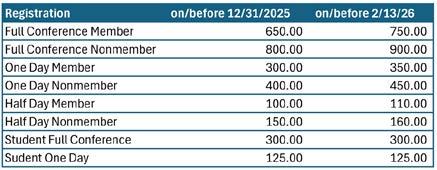
t h e 2 0 2 6 e v e n t ! SAVE ON REGISTRATION PRICING THROUGH 12/31/2025
CHAPTER NEWS
CCPS
2026 is upon us. The Central Chapter wrapped up 2025 with a social event in November and an election in December.
About thirty members and friends gathered at the Breckenridge Brewery in November for food, drink, chapter updates and prizes, all courtesy of the Central Chapter. It was a fun night and great to see old friends and new faces!
The 2026 Board election is going on at the time of this update; results will be reported in the next issue of Side Shots. Thanks to the nominees for their commitment to betterment of the surveying profession in Colorado.
We are looking forward to a big turnout at the Surveyor’s Summit in February; thank you to the PLSC for their ongoing stewardship of the annual event, and for their time and effort organizing the conference.
On a personal note: it has been an honor to be president of the Central Chapter for 2025. We have a great group of officers and directors, and I would like to thank them for making my time as president a satisfying and productive 12 months. Thank you.
Jim Lynch, PLS 2025 CCPS President
Northern Chapter
Happy New Year PLSC Members,
We returned from our Summer hiatus in September with a mission to address the new continuing education requirements for licensed surveyors. We committed to offer a total of 6 annual continuing education credits through the free presentations we have at our monthly meetings; usually one credit per presentation (i.e. meeting). We have successfully had two presentations count for continuing ed credits. As our first continuing ed presentations we had the privilege of having John Von Nieda, Chief Surveyor at the City of Fort Collins, present their GIS-based Plat Database and spreadsheet in November and Brian Shaw, with the National Geodetic Survey present the Modernized NSRS and New NGS Tools in December. Plans are in the works for a spring seminar (post-RMSS date) to offer additional continuing education credits for a fee; this will most likely be a half-day presentation (4 credits) separate from our monthly meetings. We decided to postpone our holiday Eagles ice hockey game get together to 2026 and tentatively have it slated for February 6, 2026 so keep your eyes peeled for an email to sign up as there are limited spots available. We are also in the process of sprucing up our Northern Chapter logo for future swag.
We also acquired the Lambert Family Education Fund that awards $1000 per year to up an coming surveyors that are taking classes in a land survey curriculum with the
intent of becoming a licensed land surveyor in the Colorado preferably from the PLSC Northern Chapter area.
Our next monthly presentation will be on February 4th at 6pm at the Larimer County Administrative Offices building (200 West Oak Street, Fort Collins) given by Wally Muscott on writing legal descriptions. Please RSVP to the email invite or to northerncoloradoplsc@gmail.com.
I look forward to seeing you in the flesh at the RMSS down south at the end of February!
Céline M. Bromley, PLS President-Elect, Northern Chapter PLSC
Northwest 1/4
Throughout the Intermountain West and Western U.S., there is a paucity of snow such as have not seen in over 40 years. This, combined with average temperatures in December 2025 setting a record high has led the surveyors in Northwestern Colorado to continue surveying with little impediment from snowpack. We have already been setting rebar this year without digging down a minimum of three feet in snow to do so.
Unfortunately, as of this writing, there is little change in the forecast. Grand, Moffat, Rio Blanco and Routt Counties are the headwaters of the Colorado, White and Yampa River. Let us hope this changes.
All of us have started tracking and filing our Continuing Education hours as we accrue them. We keep reinforcing that with each other to make it a habit.
Routt County Planning is about to start public processing of the Stagecoach Mountain Ranch near Oak Creek and Stagecoach Reservoir State Park. This is unquestionably the largest potential project Routt County has seen in forty years and will have significant impacts if sizable portions of it are approved, including the surveying and engineering professions.
We will be meeting sometime again in February or early March.
Respectfully submitted, Brian T. Kelly, President, NW 1/4
Southern Chapter
Fellow Surveyors,
I am excited to see everyone at the Rocky Mountain Surveyors Summit in a few weeks, and even more excited that it will be held in Colorado Springs this year! Hopefully this will bring more Southern Surveyors to meet and hang out with.
We have been having our Chapter meetings in the conference room where Steve Parker spends his day. The El Paso County Department of Public Works on Akers Drive. We have a large conference room and table to spread out all the
CHAPTER NEWS
good food that is provided. A good meeting always goes well when all the surveyors are fed well. Thank you, Steve for the hospitality!
Our annual Christmas Party was at the "Flying W Ranch" in Colorado Springs. Leigh Ann Wolfe the owner of The Ranch puts on one heck of a show. We ended up with about 20 surveyors and their wives. It was also Day 1 of the Christmas Jubilee. The Flying W Wranglers were awesome with their musical instruments and storytelling. I got to witness one of the best fiddle players ever. And their performance of "Trans-Siberian Orchestra" was a big bonus. Everyone was in AWE during the entire performance. I went back for seconds on the steak and left full of food & drinks.
My current employer, Compass Surveying & Mapping completed all the design surveying, platting and construction staking to bring the ranch back to life 8 years after the "Waldo Canyon Fire" of 2012 destroyed all the buildings.
Everyone is welcome to our monthly Chapter Meetings every 3rd Tuesday of the month.
See you soon at the RMSS.
SWC-PLSC
Don R. Hulsey - President
Southwest PLSC Chapter Meeting: A Night of Celebration and New Beginnings
On December 16, 2025, the Southwest PLSC Chapter gathered for our regularly scheduled meeting, which turned into an evening of camaraderie, delicious appetizers, and refreshing drinks. It was an excellent opportunity to connect with fellow members and local surveyors, fostering an environment of warmth and welcoming conversation. The event attracted several new faces, sparking interest and potential involvement from those who attended.
We kept the agenda light to focus on meeting and greeting and reflecting on the milestones of 2025. Conversations naturally flowed into discussions about the new continuing education requirements and updates to our local Chapter bylaws. This was not just a meeting but a celebration of our community’s growth and achievements.
The highlight of the evening was the election of our new officers for the 2026-2028 term. It was refreshing to see numerous volunteers eager to embrace the challenge and support the chapter. Justin Bonnell, who has served as an officer for several years, was elected as the new President, bringing his wealth of experience to this important role. Keith Nicovich, a regular participant over the past few years, was elected Vice President, bringing fresh energy and insight.
Conner Mahoskey, a returned chapter member who previously served as Secretary, was welcomed back as the new Treasurer after his surveying endeavors in Alaska.
Despite being under the weather and unable to attend the meeting, Max Ponce graciously accepted his nomination and was elected as the Chapter Secretary.
We are incredibly grateful for these individuals and their unwavering support and dedication to our chapter. As the evening wound down, we enjoyed each other’s company, indulging in delicious food and heartfelt conversations.
I extend my deepest gratitude to all who attended, especially those from neighboring counties who made the journey over the hills, navigating wildlife, to be with us.
Thank you all for your continued support and enthusiasm.
Warm regards, Brian M. Boniface, PLS Former SW Chapter PLSC President
WCLS
The September chapter meeting was canceled due to the Fall Seminar, which took place in late August. Training certificates were sent to participants in October and November. If you did not receive your certificate, please contact the Secretary/Treasurer at westerncoloradolandsurveyors@gmail.com.
The most recent chapter meeting was held on November 19 at the Mesa County Central Services building in Grand Junction. Reports were submitted by the City of Grand Junction, CDOT, and Mesa County. Members also engaged in robust discussions regarding the Fall Seminar, the status of continuing education requirements, upcoming elections, and the holiday party. Additionally, Ron Rennke delivered an engaging presentation on the use of drones in Search and Rescue. A huge thank you to Ron for sharing his expertise and for his service to the local community.
In other news, ballots for officers, directors, and a proposed amendment to the chapter’s Constitution and Bylaws were sent out recently. The results will be announced at the next chapter meeting, which will be held at the Goat and Glover Tavern on Thursday, January 22, from 6–8 p.m. We look forward to seeing everyone there.
Respectfully submitted Sean Mullen, WCLS President
Fences are Fences, Boundaries are Boundaries
by Scott Thompson, PLS, Mesa County Surveyor
As a County Surveyor and a reviewer of subdivision plats, I have somewhat frequently commented on fences as they may relate to the boundary of a proposed subdivision. I offer here a couple of examples of problem fences and the resulting solutions.
EXAMPLE 1 - A subdivision plat and an Improvement Survey Plat (ISP) were submitted for a rural subdivision in 2022. The ISP indicated a fence running parallel and approximately 18 feet north of the southern boundary, an aliquot line, for the entire distance of a half mile. The subdivision plat showed the boundary as common with the aliquot line without mention of the fence. When I commented that I perceived a potential boundary conflict which required resolution, I was taken to task by the planner consultant. He was upset that my comment was causing a delay in the project approval and stated that for thirty years Surveyors had told him, “Fences are fences and boundaries are boundaries.” Despite his contention I informed him that the possible conflict must be resolved before the plat would be approved. I suggested a Boundary Line Adjustment, a Quiet Title action, or, in a best-case scenario for the project, a recorded letter from the adjoining owners acknowledging the fence did not represent the boundary. The planner was very reluctant to pursue the letter, suggesting that “would open a can of worms.” I believe this was an admission on his part that he recognized there may be an issue.
As I pondered his “fences are fences” statement, I went on a search of Colorado court cases regarding fences. In the Land Surveyors Guide to the Supreme Court of Colorado, by Brian Portwood, I found approximately twenty-five cases which involved fences as boundary evidence. As I read the summaries and some of the decisions I found in all of the cases except one, a fence was held as the boundary. In the exception case, the fence was not held as the boundary as the properties on both sides of the fence were held in common ownership only fourteen years prior to the allegation of adverse possession.
A couple of those cases are summarized by Mr. Portwood in the following two statements:
Forristall v Ansley (1969) “By the close of the seventh decade of the Twentieth Century it was becoming very clear that the Court was highly inclined to afford strong protection to physically established boundaries, and as a result some particularly observant Colorado surveyors came to appreciate the value of fences as legitimate boundary evidence, especially in the PLSS context…”
Niles v Churchill (1971) “Thus the COA faithfully followed in the footsteps of the Court, holding that boundary fences which have stood for a length of time that exceeds the maximum statutory period must be honored as established boundaries, regardless of the origin of the fence or the correctness of the position in which it stands…”
Before I was able to compile my rebuttal statement to the planner, I was informed by him that the adjoining property owners had signed a letter of agreement that the fence did NOT represent the boundary between the properties. The letter and the subdivision plat were accepted, and both were recorded.
Despite the initial reluctance to pursue this path, it resulted in the best possible solution to the problem.
EXAMPLE 2 – Very similar to the above case, a subdivision plat was submitted in 2019 to subdivide a vacant parcel adjacent to a previous subdivision. An examination of aerial photos in the GIS indicated a very obvious encroachment by the neighboring subdivision properties into the proposed subdivision boundary. The surveyor was questioned about this fence, and while acknowledging the existence and the encroachment stated something to the effect that the owner did not want to address it with the adjoining property owners. My response was that it was required as conflicting boundary evidence. Mesa County Plat requirements also reserve the right to require that such conflicts be resolved.
A revised plat was submitted that now indicated a fence of about a quarter mile length, encroaching from about 6 feet on the north and 17 feet on the south. A note was added stating that the improvements constructed by the adjoining owners were encroaching, but nothing was really
resolved. The plans for the subdivision included an easement and drainage facility in the western 10 feet of the lots, the majority of that easement being within the area occupied by the adjoining owners.
The adjacent plat was recorded in 1977, and construction of homes proceeded shortly thereafter. Homes were constructed on most of the ten adjacent lots in the 1970’s; a couple were built on later, the latest being 1992. Even though the lots were monumented, by examination of historical aerial photos, it appears the majority of parties accepted the existing fence as the boundary and improvements developed up to that existing fence.
With the subdivision still not approved, the developer showed up with equipment and stated his intention to remove the encroaching fences, sheds and other improvements. The adjoining property owners proceeded to call the Sheriff, the County Surveyor (me), and of course their attorneys. Due to the reluctance of the surveyor and the developer to address this issue, this project suffered
through seven review cycles, taking over a year. Eventually all was resolved with recorded documents and infrastructure redesign, but the delay and the costs in developing the lots were significant. With proper recognition by the Surveyor of the potential Adverse Possession, and educating the developer, this may have all been avoided, and perhaps in a timelier manner.
In summary, we should learn from these examples that fences must be taken seriously in performing any boundary survey. Some of the court cases referred to regarding fences and adverse possession involve very small differences in fence and deed line location, yet they were litigated to the higher courts. My time in office as a County Surveyor has convinced me that property owners take their boundaries, real or perceived, very seriously. It is our professional obligation to protect all property rights, not just those of our clients. For all parties involved, fence problems are better addressed at the beginning of any project. And sometimes the solution is easy to come by if you just ask.
Safety is an Illusion
by Brian K. Bowker, P.L.S.
I started this article a year ago, struggling with the events that unfolded in 2024. Publishing only now due to the yearlong litigation.
It is 2:00 a.m. and I find myself staring at my ceiling unable to sleep. My mind weighing heavy on the thought, “safety is an illusion”.
I have accumulated more than 30 years of experience in Land Surveying with much of this time in the construction industry, a touch in oil and gas, and for the past nine years with the Colorado Department of Transportation (CDOT). I understand the dangers of working in and around traffic, and heavy equipment, to a certain degree.
About five years ago I began training in the local CDOT maintenance section with the end goal to help with snowplowing during the winter season. At the time, CDOT needed snowplow operators. I still had my full-time position and duties as a Professional Land Surveyor working in the Region 3 (northwestern Colorado) Right-of-Way group. I would help Maintenance when I was available. I spent one year, when time allowed, training to get my Commercial Driver’s License and to operate a snowplow.
For the last four seasons I have been assigned to the team at Patrol 1 in Grand Junction. Patrol 1 is a group of several members who are responsible for maintaining and sustaining traffic flow on part of I-70 and US 6 in Mesa County. Even with the knowledge that traffic was going to be a concern, it was an eye-opening experience for me.
I now have greater appreciation for those who work in our Maintenance Department or anyone whose job requires them to work near live traffic on a regular basis. I enjoyed coming to work at Patrol 1 and getting to know the people working there, including those at Patrol 11 next door to us, and the management team at the G Road facility in Grand Junction.
In Surveying, you may spend a limited amount of time working around traffic or heavy equipment. In Maintenance, this is a daily task of utilizing safety standards to try and minimize the risks of working on our roadways using items such as, but not limited to, signs, cones, and personal protective equipment (PPE).
We are never 100% free of the dangers of working near traffic, heavy equipment, etc. Whether you are operating a
vehicle or standing on the side of the roadway, you never know when you might be involved in a devastating, yet preventable, event. All we can do is mitigate those dangers and inform people.
This became all too clear in September of 2024 when Patrol 1 lost two individuals, Nathan ‘Nate’ Jones and Trenton ‘Trent’ Umberger. They were working alongside US 6 near Palisade in a 50-mph zone when they were struck by a vehicle with two occupants. Both were off the roadway and on the shoulder along a seemingly unassuming straight stretch of highway. They did all the right things; wearing their reflective gear, their vehicle was completely off the roadway, and they had an illuminated, flashing CDOT sign alerting traffic. The police reported that the driver had THC in his system. In total, three lives were lost that day, including the driver’s wife, Kathi Wallace - a tragic event that has touched many.
I didn’t get a chance to know Trent, as he would go up to I-70 Vail Pass on Joint Operations Area (JOA), performing snow plowing and other maintenance duties along I-70 at Vail Pass. Even though it was on a limited basis, I did get to work with and get to know Nate. While he was an apprentice in the maintenance section, I found myself also learning from him. Nate
Nate Jones.
Photo courtesy Wendy Jones
was interested in auto mechanics, and he was always positive. It was tough the first time I walked into Patrol 1 barn’s office and saw an empty desk and chair where Nate would have been sitting. I didn’t have the words then, and I still don’t.
What I saw and experienced at Patrol 1 and the G Road facility was, and still is, a strong sense of safety, where they would watch out for each other. I have learned a lot from them and continue to do so. What can be done about the risks of working in the Right-of-Way is to follow the Manual on Uniform Traffic Control Devices (MUTCD), company rules, and safety standards.
Working in Maintenance, or Surveying for that matter, it is just not possible to always keep an eye on traffic. And as we learned with Nate and Trent, doing everything right –using every tool and following every standard – still doesn’t guarantee our safety.
As a manager, I want my personnel to make it home safely at the end of each day, but I realize that ultimately, I have no control over the distracted or impaired driver. Since we cannot physically control the vehicles passing us, we must instead focus on educating the people driving them.
This begins by championing the laws designed to protect those working on our roadways. First, the “Move Over, Slow Down law”.
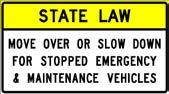
MOVE OVER – SLOW DOWN
It’s the law
C.R.S. 42-4-705
The Colorado “ Move Over, Slow Down” law requires drivers to change lanes or reduce their speed when passing a
stationary vehicle on the roadside with its flashing lights on, or when encountering any vehicle on the side of the road. The law was expanded to include any stationary vehicle on the highway, not just emergency vehicles, and it was enhanced to protect everyone on the roadside. But complying with that law requires your full attention, which is why the “Hands Free - Phones Down” law (effective January 1, 2025) is so critical. We have all been guilty of driving distracted or failing to move over at some point, but that complacency can no longer continue. The stakes are simply too high to let a moment of distraction take a life.
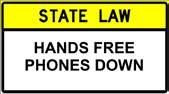
HANDS FREE – PHONES DOWN
It’s the law
C.R.S 42-4-239
The “Hands Free - Phones Down” law prohibits drivers from holding or using electronic devices while driving.
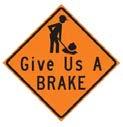
I challenge you to spread this information and influence the culture of how we drive on our highways. Let’s not let this tragedy fade into just another statistic; let it be a reminder that our co-workers, friends, and family are out there trying to improve our roads for everyone. Remember the “Give ‘em a Brake” signs? We all need to go home safely.
Be safe and be diligent. There is nothing more important than the life you may save; be it yours or someone else’s. The ripple effect of a tragedy reaches far and wide…
A Patrol 01/11 snowplow with lights on at the P01/P11 Plow Port.
Photo by Brian Bowker
A Patrol 01/11 snowplow with lights on at the P01/P11 Plow Port.
Photo by Brian Bowker
Trent Umberger with his family. Photo courtesy the Grand Junction Daily Sentinel.
For additional information on the top five rules to live by to prevent collisions with roadside vehicles, click this link:
The views and opinions expressed in this article are those of the Author and do not necessarily reflect the official policy or position of CDOT, or any other agency.
The Author reserves the right to re-publish this article in any media format.
*SEE NEXT PAGE FOR THE COLORADO STATE STATUTES RELATING TO THIS ARTICLE
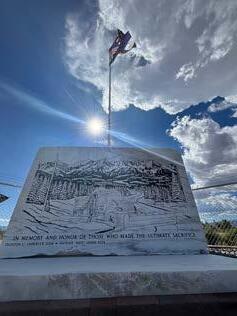
The memorial erected September 2025 at the CDOT G Road facility. Photo courtesy Joe McQuiston.
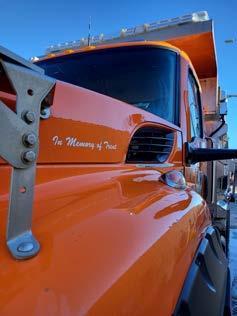
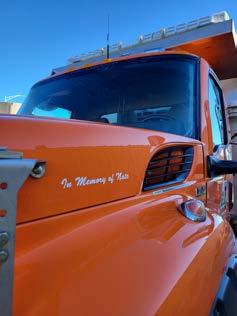
Patrol 01 snowplows carry the names of Trent and Nate.
Photo by Brian Bowker
42-4-705. Operation of vehicle approached by emergency vehicle - operation of vehicle approaching stationary emergency vehicle, stationary towing carrier vehicle, or stationary public utility service vehicle.
(1) Upon the immediate approach of an authorized emergency vehicle making use of audible or visual signals meeting the requirements of section 42-4-213 or 42-4-222, the driver of every other vehicle shall yield the right-of-way and where possible shall immediately clear the farthest left-hand lane lawfully available to through traffic and shall drive to a position parallel to, and as close as possible to, the right-hand edge or curb of a roadway clear of any intersection and shall stop and remain in that position until the authorized emergency vehicle has passed, except when otherwise directed by a police officer.
(2)
(a) A driver in a motor vehicle shall exhibit due care and caution and proceed as described in subsections (2)(b) and (2)(c) of this section when approaching or passing:
(I) A stationary authorized emergency vehicle, including a port of entry vehicle, that is giving a visual signal by means of flashing, rotating, or oscillating red, blue, or white lights as permitted by section 42-4-213 or 42-4-222;
(II) A stationary towing carrier vehicle that is giving a visual signal by means of flashing, rotating, or oscillating yellow lights;
(III) A stationary public utility service vehicle that is operated by a public utility, as defined in section 39-4-101 or 40-1-103, or an authorized contractor of the public utility and that is giving a visual signal by means of flashing, rotating, or oscillating amber lights; or
(IV) A stationary motor vehicle giving a hazard signal by displaying alternately flashing lights or displaying warning lights.
(b) On a highway with at least two adjacent lanes proceeding in the same direction on the same side of the highway where a stationary vehicle described in subsection (2)(a) of this section is located, the driver of an approaching or passing vehicle shall proceed with due care and caution and yield the right-of-way by moving into a lane at least one moving lane apart from the stationary vehicle described in subsection (2)(a) of this section unless directed otherwise by a peace officer or other authorized emergency personnel. If movement to an adjacent moving lane is not possible due to weather, road conditions, or the immediate presence of vehicular or pedestrian traffic, the driver of the approaching motor vehicle shall proceed in the manner described in subsection (2)(c) of this section.
(c)
(I) On a highway that does not have at least two adjacent lanes proceeding in the same direction on the same side of the highway where a stationary vehicle described in subsection (2)(a) of this section is located, or if movement by the driver of the approaching motor vehicle into an adjacent moving lane, as described in subsection (2)(b) of this section, is not possible, the driver of an approaching motor vehicle shall reduce and maintain a safe speed with regard to the location of the stationary vehicle described
in subsection (2)(a) of this section; weather conditions; road conditions; and vehicular or pedestrian traffic and proceed with due care and caution, or as directed by a peace officer or other authorized emergency personnel.
(II) For the purposes of this subsection (2)(c), the following speeds are presumed to be safe unless the speeds are unsafe for the conditions as provided in section 42-4-1101 (1) and (3):
(A) If the speed limit is less than forty-five miles per hour, twentyfive miles per hour or less; or
(B) If the speed limit is forty-five miles per hour or more, twenty miles per hour less than the speed limit.
(2.5)
(a) A driver in a vehicle that is approaching or passing a maintenance, repair, or construction vehicle that is moving at less than twenty miles per hour shall exhibit due care and caution and proceed as described in paragraphs (b) and (c) of this subsection (2.5).
(b) On a highway with at least two adjacent lanes proceeding in the same direction on the same side of the highway where a stationary or slow-moving maintenance, repair, or construction vehicle is located, the driver of an approaching or passing vehicle shall proceed with due care and caution and yield the right-ofway by moving into a lane at least one moving lane apart from the vehicle, unless directed otherwise by a peace officer or other authorized emergency personnel. If movement to an adjacent moving lane is not possible due to weather, road conditions, or the immediate presence of vehicular or pedestrian traffic, the driver of the approaching vehicle shall proceed in the manner described in paragraph (c) of this subsection (2.5).
(c) On a highway that does not have at least two adjacent lanes proceeding in the same direction on the same side of the highway where a stationary or slow-moving maintenance, repair, or construction vehicle is located, or if movement by the driver of the approaching vehicle into an adjacent moving lane, as described in paragraph (b) of this subsection (2.5), is not possible, the driver of an approaching vehicle shall reduce and maintain a safe speed with regard to the location of the stationary or slow-moving maintenance, repair, or construction vehicle, weather conditions, road conditions, and vehicular or pedestrian traffic, and shall proceed with due care and caution, or as directed by a peace officer or other authorized emergency personnel.
(2.6) A driver in a vehicle that is approaching or passing a motor vehicle where the tires are being equipped with chains on the side of the highway shall exhibit due care and caution and proceed as described in subsection (2) of this section. The driver of a motor vehicle that is being equipped with chains shall give a hazard signal by displaying alternately flashing lights or displaying warning lights.
(3)
(a) Any person who violates subsection (1) of this section commits a class A traffic infraction.
(I) Except as otherwise provided in subsections (3)(b)(II) and (3)(b) (III) of this section, any person who violates subsection (2), (2.5), or (2.6) of this section commits careless driving as described in section 42-4-1402.
(II) If the person violates subsection (2) of this section and the person’s actions are the proximate cause of bodily injury to another person, the person commits a class 1 traffic misdemeanor.
(III) If the person violates subsection (2) of this section and the person’s actions are the proximate cause of the death of another person, the person commits a class 6 felony and shall be punished as described in section 18-1.3-401.
2025 text from Lexis Nexis (PHONES DOWN):
42-4-239. Use of a mobile electronic device - definitions - penalty.
(1) As used in this section, unless the context otherwise requires:
(a) “Emergency” means a circumstance in which an individual:
(I) Has reason to fear for the individual’s life or safety or believes that a criminal act may be perpetrated against the individual or another individual, requiring the use of a mobile electronic device when the individual is driving a motor vehicle; or
(II) Reports a fire, a traffic accident in which one or more injuries are apparent, a serious road hazard, a medical or hazardous materials emergency, or an individual who is driving in a reckless, careless, or unsafe manner.
(b) “First responder” means:
(I) A peace officer, as described in section 16-2.5-101;
(II) A firefighter, as defined in section 29-5-203 (10);
(III) A volunteer firefighter, as defined in section 31-30-1102 (9)(a);
(IV) An emergency medical service provider, as defined in section 25-3.5-103 (8); or
(V) Any other individual who responds in a professional capacity to a public safety emergency.
(c) “Hands-free accessory” means an accessory with a feature or function that enables an individual to use a mobile electronic device without using either hand, except to activate, deactivate, or initiate the feature or function with a single touch or single swipe.
(d)
(I) “Mobile electronic device” means a handheld or portable electronic device capable of providing voice communication between two or more persons, amusement, or the wireless transfer of data.
(II) “Mobile electronic device” does not include:
(A) A radio, citizens band radio, or citizens band radio hybrid;
(B) A commercial two-way radio communication device or its functional equivalent;
(C) A subscription-based emergency communication device;
(D) A prescribed medical device;
(E) An amateur or ham radio device; or
(F) Systems that are designed for and installed within the vehicle’s electronics, such as an in-vehicle security, navigation, communications, or remote diagnostics system.
(e) “Operating a motor vehicle” means driving a motor vehicle on a public highway. “Operating a motor vehicle” does not include maintaining the instruments of control of a motor vehicle while the motor vehicle is at rest in a shoulder lane or lawfully parked.
(f) “Use” or “using” means:
(I) Physically holding a mobile electronic device in the driver’s hand or pinning a mobile electronic device to a driver’s ear to conduct voice-based communication; except that an individual may use a speaker or other listening device that is built into protective headgear or a device or portion of a device that only covers all or a portion of one ear and that is connected to a wireless, handheld telephone as provided in section 42-4-1411;
(II) Watching a video or movie on a mobile electronic device, other than watching data related to the navigation of the motor vehicle; or
(III) Writing, sending, or reading text-based communication, including a text message, instant message, e-mail, or internet data, on a mobile electronic device; except that text-based communication does not include:
(A) A voice-based communication that is automatically converted by the mobile electronic device to be sent as a message in written form; or
(B) Communication concerning the navigation of a motor vehicle.
(2) Except as specified in subsection (3) of this section, an individual shall not use a mobile electronic device while operating a motor vehicle.
(3) It is not a violation of subsection (2) of this section to use a mobile electronic device:
(a) To contact a public safety entity;
(b) During an emergency;
(c) When an employee or contractor of a utility is acting within the scope of the employee’s or contractor’s duties when responding to a utility emergency;
(d) When an employee or contractor of a city or county is acting within the scope of the employee’s or contractor’s duties as a code
enforcement officer or animal protection officer; or
(e) During the performance of a first responder’s official duties.
(4)
(a) Except as provided in subsection (4)(b) of this section, an individual who violates this section commits a class A traffic infraction, and the court shall assess a penalty as follows:
(I) A fine of seventy-five dollars and a surcharge of ten dollars for the first offense within the immediately preceding twenty-four months;
(II) A fine of one hundred fifty dollars and a surcharge of ten dollars for the second offense within the immediately preceding twentyfour months; or
(III) A fine of two hundred fifty dollars and a surcharge of ten dollars for the third or subsequent offense within the immediately preceding twenty-four months.
(b)
(I) An individual charged with violating subsection (2) of this section shall not be convicted if the individual:
(A) Produces a hands-free accessory or proof of purchase of a hands-free accessory; and
(B) Affirms under penalty of perjury that the individual has not previously had a charge dismissed under this subsection (4)(b).
(II) The court clerk may dismiss the charge if the clerk verifies that the individual has complied with both subsections (4)(b)(I)(A) and (4)(b)(I)(B) of this section.
(c) If the individual’s actions are the proximate cause of bodily injury to another, the individual commits a class 1 misdemeanor traffic offense and shall be punished as provided in section 42-41701 (3)(a)(II).
(d) If the individual’s actions are the proximate cause of death to another, the individual commits a class 1 misdemeanor traffic offense and shall be punished as provided in section 42-4-1701 (3) (a)(II).
(5) This section does not apply to an individual with a commercial driver’s license who is operating a commercial vehicle.
(6) An individual operating a motor vehicle shall not be cited for a violation of subsection (2) of this section unless a law enforcement officer saw the individual use a mobile electronic device in a manner that caused the individual to drive in a careless and imprudent manner, without due regard for the width, grade, curves, corners, traffic, and use of the streets and highways and all other attendant circumstances, as prohibited by section 42-4-1402.
(7) This section does not authorize the seizure and forfeiture of a mobile electronic device, unless otherwise provided by law.
December 30, 2025
To the Editor of Sideshots,
SURVEYING & MAPPING, LLC Boundary, Mapping, ALTA Surveys
I am writing to raise an issue that I encounter all too frequently regarding Monument Records.
I have repeatedly reviewed monument records prepared for set monuments that do not state how the position of the corner was established. I recognize that the current monument record form does not require this information; however, including it would greatly assist future surveyors in accurately retracing the work.
A common response I hear is that one must “look at the plat” to obtain that information. Unfortunately, the plat often does not contain sufficient detail to understand how the monument’s position was determined.
Consider the following example I recently encountered. In 2000, as part of a subdivision, Surveyor A recovered a capped rebar at a 16th corner, upgraded it accordingly, and filed a monument record. In 2021, while retracing an adjacent property, Surveyor B reported that he did not find a monument at the same 16th corner, set a monument, and filed his own monument record.
Both monument records show fences; however, the relative location of the corner to the fence differs significantly. Surveyor A shows the monument west of the fence, while Surveyor B shows it east of the fence. Was the fence relocated in the intervening years? Were the monuments set in different locations? The available records provide no way to determine this.
Neither Surveyor B’s monument record nor his survey makes any reference to the previously established 16th-corner monument from 2000, nor to Surveyor A’s subdivision plat. As a result, one is left to wonder whether the monument placed by Surveyor B occupies the same position as that monumented by Surveyor A.
Of course, contacting the surveyor(s) to discuss the situation is often necessary. However, in cases where the surveyor is retired, deceased, or otherwise unavailable, one is left with only the documents of record.
Regardless, sufficient information should be shown on the plat to allow those who follow to understand how the surveyor arrived at their conclusions. I believe the survey plat should, as much as practicable, provide enough information to clearly spell out the surveyor’s methods, evidence, and reasoning.
Having surveyed in Minnesota, I am familiar with what is known as a Certificate of Location of Government Corner, which is similar in purpose to a monument record. One requirement of the Certificate is to document the history of the monument a “chain of custody,” if you will. These Certificates often
COMPASS
SURVEYING & MAPPING, LLC Boundary, Mapping, ALTA Surveys
contain a detailed history extending from the original GLO establishment through subsequent surveys, thereby establishing the monument’s provenance.
I recognize that, with the current monument record form, it can be difficult to fully document the history of a monument or all available evidence. However, at a minimum, referencing prior monuments and monument records would be extremely helpful, as would stating how the position was established (for example, by proportionate measurement, reliance on adjacent subdivisions, testimony of landowners, or reference to previous surveys).
The goal is to provide clarity in cases where multiple positions may exist for a particular corner. In such situations, the monument record should note prior monument records and clearly state whether the position perpetuates an earlier location or, if better evidence was found, why that location was rejected.
Any such information would greatly assist future surveyors in understanding the history of a monument and the rationale behind its position.
Sincerely,
Mark Johannes, PLS, CFedS Compass Surveying and Mapping, LLC
CITY/COUNTY of DENVER CERTIFICATION: M/WBE, DBE, EBE, SBE
We pride ourselves in providing professional services in:
• Subsurface U�lity Engineering Locates
o ASCE Standard 38-02 Quality Levels D, C, B Locates
• Private U�lity Locates
o Residen�al and Commercial loca�ng for private u�li�es.
• Potholing (Quality Level A) & Core Drilling
o process of loca�ng u�li�es or pipelines (exposing them to daylight) to visually confirm exis�ng infrastructure.
• U�lity Mapping (Quality Level D)
• Drone Mapping Services
o Part 107 Cer�fied UAS Pilots – Commercial Drone Insurance
• Sanitary/Storm Camera Locates
o CATV Scoping & Locates of Sanita�on and Storm lines.
NAICS CODES:
561990 Loca�ng underground u�lity lines prior to digging.
238990 Special Trade Contractors (Potholing) –Nondestruc�ve excava�on using high-pressure water or air to expose u�li�es without damage. (Sani/Storm Scoping) – CCTV inspec�on of laterals, manholes, and pipelines
Tom Richardson – Sales/Es�mates/VP Opera�ons M: 303-356-2193 Tom@tomrichardsonllc.com Brandon Francis – Sales/Potholing/Drone Informa�on M: 720-951-0418 Brandon@tomrichardsonllc.com
Trimble Dimensions 2025: A Surveyor’s Take from the Venetian
by Dustin Hoaglin, Aztec Consultants
Trimble Dimensions has been part of my professional calendar for a long time. This year marked my sixth Dimensions as an instructor, and somewhere in doubledigits as an attendee over the last 15+ years. The 2025 conference was held November 10th – 12th at the Venetian in Las Vegas, and it’s clear that Trimble is positioning Dimensions as their flagship “power of connection” event heading into 2026.
Attendance felt strong. I was told the number landed around 4,800–5,000 people, which squares with the crowds I saw in sessions and the hallways. That’s a healthy size for a user conference that still feels like a community rather than an anonymous trade-show mob.
A NOTICEABLE FORMAT SHIFT: SOFTWARE CENTER STAGE
If you’ve been to Dimensions before, you would’ve felt the shift immediately. Trimble leaned hard into a software-first year. The off-site machine control construction yard, usually full of heavy iron and hands-on demos, was absent. In its place was a tighter, more indoors-focused program centered on workflows, data integration, and office-to-field software ecosystems. Trimble has said it plans to rotate software emphasis for one year, hardware emphasis the next, with the construction yard returning in 2026.
Personally, I didn’t hate it. Hardware is fun to look at, but software is where most of us win or lose time and accuracy every single week. This year’s structure forced the conversations into the “how” instead of the “wow.”
KEYNOTE: AI, BUT WITH PRACTICAL INTENT
The conference opened with a genuinely entertaining keynote from Trimble CEO Rob Painter and comedian/ filmmaker Tripp Crosby. The humor landed, and the message was straightforward: Trimble is investing heavily in AI now so users can realize productivity gains tomorrow. Trimble framed AI as a “force multiplier” to break down data silos and automate complex workflows, not as a shiny toy.
As a surveyor who’s watched plenty of tech fads come and go, I appreciated that they kept pointing back to real, measurable work outcomes, less rework, cleaner handoffs, and faster decisions. If Trimble follows through on the
“agentic AI” approach they previewed, it could be a big deal for both construction and geospatial users.
TEACHING IN THE TBC LABS
For me, the highlight was teaching two TBC computerlab workshops on static baseline processing. The TBC labs at Dimensions are always one of the best learning environments. Trimble provides real datasets, real workflows, and instructors who do the work in the wild.
What stood out this year was the audience mix. I had experienced surveyors wanting to refine baseline QA/QC, and younger field folks trying to understand why static still matters in a world of fast RTK. Those are the conversations Dimensions is uniquely good at creating: not just “Click Here,” but “Here’s what this means for your control and your Liability.”
EXPO HALL: SMALLER FOOTPRINT, STILL WORTH THE LAPS
Because the heavy construction displays weren’t there, the expo hall felt a bit trimmed down. But it was far from empty. The focus shifted to software partners, data platforms, UAV mapping, and integrated workflows. Trimble’s sponsor list this year reinforces that tilt: more digital solutions, fewer hulking machines.
Two crowd-pullers stood out. First was the WingtraRAY, Wingtra’s new survey-specific drone. It’s designed for higheraccuracy mapping with hot-swap sensors and operational flexibility that surveyors care about (including easier operations over people). If you’re doing corridor work or bigarea topo, this platform is aimed squarely at you.
Second was the Trimble-sponsored RFK Racing NASCAR on the show floor. I’ll admit, I’m not a huge NASCAR guy, but seeing Trimble connect precision positioning and performance teamwork to motorsports was a clever way to make “accuracy under pressure” feel tangible. Trimble and RFK have been building this partnership through the 2025 season, and it drew people in who might otherwise have walked past another booth of monitors.
CLOSING NIGHT AT AREA15: DIMENSIONS GOES OUT LOUD
Wednesday night’s closing party at Area15 was pure Trimble. When they finish a conference, they finish it Trimble rented out the entire complex and bused attendees over from the Venetian, turning the night into a full-scale takeover. If you’ve never been to Area15, it’s part immersive art playground, part futuristic carnival, and it fits the Dimensions crowd perfectly. Between the installations, music, and wide-open spaces to roam, it felt less like a corporate event and more like a celebration of the community Trimble has built. After three days of heavy learning and nonstop sessions, it was the right kind of exhale and a memorable way to close the week with a bang.
TAKEAWAYS FOR COLORADO SURVEYORS
So, what should a Colorado land surveyor care about from Dimensions 2025?
1. AI is moving from buzzword to workflow. Trimble is putting serious weight behind AI features that automate routine processing and connect data
across tools. Whether you love the idea or not, this train is leaving the station.
2. Software depth is becoming the differentiator. With Trimble rotating conference focus and clearly betting on platforms like TBC and cloud collaboration, the survey firms that invest in software competency will outcompete those that treat it as an afterthought.
3. Integration is the long game. The loudest theme across sessions and booths was reducing friction between field capture, office processing, and downstream design/construction. The Tech is ready; the question is whether we are.
Dimensions 2025 didn’t try to be everything for everyone. It picked a lane, Software, Data, AI, Workflows, and drove it hard. Next year, when the iron and machine control yard comes back, we’ll get the other half of the story. But for 2025, Trimble delivered a conference that was more about how we work than what we buy, and that’s a rotation I’m happy to see.
MASTER FEDERAL BOUNDARIES
Conquer Every Coordinate
At Valhalla Instruments, precision is our craft. In partnership with Tersus GNSS, we provide cutting-edge surveying and mapping solutions built for accuracy, reliability, and real-world performance. From the rugged Oscar Ultimate and Oscar Trek to the lightweight Luka, every receiver is engineered to help professionals capture every point with confidence.
Year-End Tersus GNSS Promotions
Save up to $1,000 and maximize your 2025 tax benefits
Now through December 31, 2025, upgrade your GNSS equipment and take advantage of exclusive Valhalla incentives.
Trade in any qualifying GNSS receiver and receive $1,000 off a new Tersus Oscar Ultimate, Oscar Trek, or Luka.
No trade-in? Save $750 per receiver with a direct purchase.
Includes a 6-month TAP Real-Time Corrections subscription.
Qualify for Section 179 tax benefits and request a quote to lock in savings before year-end.
See the Technology in Action. Ready to experience precision that performs? Send a Raven.
Visit valhallainstruments.co or contact Jason Dysthe, owner of Valhalla Instruments, at jason.dysthe@valhallainstruments.co to schedule a demo or request a quote.
Celestial Observation Basics Part II
by Thomas W. Sylvester, P. E. & P. L. S.
When we are making celestial observations to determine our location or bearings of lines, we are shooting at moving targets (the sun or stars) since the earth is spinning on its axis. I’ll use the term stars to include the sun since it is a star and differentiate only if I am discussing the nuances of dealing with the sun. If we know the instant in time that the shot is made, using ephemerides or star charts, and some astronomical theory, we can calculate where that star is at the time we make the shot.
As we refer to the skies, the same spherical trig principles apply.
However, instead of treating the earth as a sphere, we will treat the skies as a sphere extending outward to the heavens at an infinite radius. I’ll go into a lot more detail in Part III in the future about this, but we have similar elements when we refer to the celestial sphere as we do the theoretical sphere approximating the earth. For this discussion, I will refer to this theoretical sphere approximating the earth’s shape as the earth’s sphere. The celestial sphere has two poles with the same designation as the North Pole and South Pole created by the extension of the earth’s axis to the celestial sphere. There is a celestial equator directly above the earth’s equator. This celestial sphere is relatively stable and permanent, and we, on earth, and the other planets move about within this sphere. However, to make sense of it all, we typically think of ourselves and the earth as relatively stationary, and the sun, planets, and stars move around us. The prime meridian running through Greenwich England is one of the main reference points on earth’s sphere. We locate where the stars are in reference to a plane passing through this meridian, and a plane passing through the equator.
When we are stationary, we refer to our position and any other position on the earth’s surface by our latitude as an angular measure of our position measured from the equator in the plane through the poles (on a meridian). This is our north-south position. Our longitude (or east-west position) is the angular measure east or west along the equator from the Greenwich Meridian to the meridian of our location. Hence, we call our position a Latitude and Longitude which stays fixed (for this discussion) on the earth’s sphere. The stars and other celestial bodies are referenced by a declination measured north and south of the equator akin to latitude. Since the sky appears to be moving around us, we refer to the instantaneous position east-west as the Greenwich Hour Angle as an angular measure westerly along the equator from the Greenwich Meridian. These positions are time dependent so the term “hour” designation is used. However, typically the GHA is measured in degrees or degrees, minutes, and seconds rather than time units. The relation of that celestial body to our position is called the Local Hour Angle
and is measured with a westerly angle at the equator from the meridian of our position to the instantaneous meridian of the celestial body. That celestial body then has coordinates of LHA and Declination.
This Part II will assume we have determined where a particular star is located in the sky in relation to us on the earth. We will then calculate the bearing from us (instrument) to the star at that time using spherical trig. In essence, we can create a spherical triangle with the pole, our position, and the star’s position as the three vertices of the spherical triangle, with the sides opposite them measured in angular measurements. This is often referred to as the PZS triangle of Pole, Zenith above us, and the Star. Since our position has a latitude measured from the equator, the angular distance from our position to the pole is referred to as the co-latitude and is 90° - latitude. The star also has a similar angular position of declination measured from the equator. The angular distance from the star to the pole is called the co- declination and is 90° - declination. The angular distance from our position to the star’s position is the zenith angle we would measure from a point directly above us to the star. In earlier days, we normally measured up from the horizon and called this angle, the height. Note that the zenith angle is 90° - height. The angle at the pole between the two sides is the difference in “longitude” between the star and our station and can be calculated from our longitude and the LHA of the star. The angle at our station between the pole (along our meridian) and the star is the “bearing” or “azimuth” to the star. Using our formulas, we sometimes get counterclockwise rotations, or rotations greater than 90°. As such, we have to inspect our triangle to determine what our actual bearing or azimuth is following surveying conventions. The angle at the star can also be calculated, but we don’t often use it, so we don’t have an official designation for it.
Some like to then relabel the triangle using these terms of co-latitude, co-declination, co-height or co-altitude, and LHA. I prefer to draw the picture with the same A, B, C vertices and a, b, c, sides as I have in the spherical trig handout, with secondary labels designating the appropriate astronomical names. This allows me to easily refer to the spherical trig formulas as I look for solutions. My convention calls the Pole vertex A, the station vertex B, and the star vertex C. Then side a will be opposite A and be the same as my zenith angle or the co-height, side b will be opposite B and be the co-declination of the star, and side c is opposite C and is the co-latitude of our station. This makes it easier for me to put my vertex angles of A in register 4 of my calculator, B in register 5, and C in register 6. I then put my sides of a in register 1, b in register 2, and c in register 3. It makes it much easier as I am recalling data to apply the appropriate trig function as I am solving the spherical calculations.
The attached pages assume we have already done all of the calculations to determine the instantaneous position of the star to solve our triangle. The first problem is simulating a solar shot in midafternoon at a station near where we were camping on the afternoon of September 9, 2023. The next example is simulating a polar shot about an hour after sundown from the same location.
As you can see, we are working backward from the spherical trig theory to the spherical trig used to solve for the bearing of the sun or the north star, then to figuring out where those stars are in future presentations. I think this is the simplest way to visualize this process for the first time.
When we actually do the celestial observation, we, of course will need to figure out where we are (possibly from a topo map), take our angular and time measurements as we shoot from our baseline to the respective star, then using that information (primarily the time information) to determine where the star is located for our average shot, to then solve the spherical trig problems to determine the bearing to the star, then once that is obtained, back to our horizontal angle to calculate the bearing of our base line, the permanent monumentation resulting from our shots on a moving star.
PLEASE USE THE LINK BELOW OR SCAN THE QR CODE TO SEE THE REFERENCED PROBLEMS AND NOTES.
Northwest Colorado, particularly Routt County, has sadly lost one of the most prolific surveyors in recent history. Skidge Moon passed away quietly at home in Steamboat Springs in the early morning hours of Sunday, October 12th, 2025 after a brief illness and hospitalization in Fort Collins. It would be an understatement to say Skidge was instrumental to laying out, surveying, and platting modern day Steamboat Springs outside of “Old Town” Steamboat over his 54-year uninterrupted career; extending his skills, counsel and inherent knowledge to the Steamboat Ski Corp, Routt County Engineers, Planners, Commissioners, town trustees & councils of Steamboat Oak Creek, Hayden, Yampa, Toponas, and Clark. Included in his counsel and many deliverables are the Department of the Interior/BLM, USFS, CDOT, Tri-State T&G, YVEA, Upper Yampa Water and Conservancy District, and numerous other Routt County Utilities over the decades. Skidge was until recently a 7 days a week, 364 days a year owner and employee of D&D Inc in Steamboat Springs, until his transition in 2022, remaining on board, still 7 days a week, as a part time practitioner of the art, science, and craft he loved so dearly. Skidge loved Routt County and rarely left it.
Skidge, a native of Middletown Township New Jersey, arrived in Steamboat as a young 23 year old freshly minted BS Mathematics graduate of Waynesburg College (PA) (’71) in that summer, meeting Morton Dismuke (RLS#7736) of the Steamboat firm Dismuke and Dismuke (D&D), and went immediately to work in the field as a survey assistant, quickly catching onto the math, procedures, and mechanics of the trade. Skidge was promoted rapidly to Director of Survey Operations, becoming Vice President in 1975 upon receipt of his professional Colorado license RLS#13221, eventually a shareholder and President of the Surveying Division at D&D’s peak of 80 employees. At D&D’s peak of engineering and surveying Steamboat and Routt County, Skidge oversaw a survey and drafting divisional staff of about 40, including
managing 3 additional Registered Land Surveyors, with 14 field crews daily, ensuring completion of the following career highlights:
In 1987, Dismuke and Dismuke (then dba D&D Consultants) reorganized upon the retirement of Morton Dismuke, and Skidge acquired 100% of the Surveying business unit, forming D&D Inc and continued the business forward through the decades.
Skidge saw the full gamut of Surveying technology- Starting out in 1971 with the Dumpy Level, Transit, Theodolite, plumb bob, trig tables, Steel Tape and Gunter’s chain and ending with Robotics and GPS.
Skidge was the “Surveyor’s Surveyor” – having been elected and having served as the Routt County Surveyor from 1998 through 2014; becoming a founding member and President of the PLSC NorthWest ¼ Chapter. Many still current and past surveyors in Northwest Colorado worked directly for Skidge; most of the local long-time attorneys, developers, city council members, commissioners all sought his counsel on matters of boundary control and re-tracement issues.
Along with Skidge’s mentorship, public service, and counsel will be missed by all of us in Northwest Colorado, but his legacy continues on.
Respectfully submitted, Brian Kelly, President Tom Kelly, Director
To: Professional Land Surveyors of Colorado, Inc.
Date: 01-06-26
From: Warren D. Ward, PLS, CO, OK
Dear PLSC:
Some of us may remember a past member of the State Board, Jill Tietjen, P.E.
During my tenure as president of PLSC, 1998 to 2002, Jill, an electrical engineer, showed active involvement in the various issues of interest to the profession of land surveying.
I handed her the “Citizen Surveyor” award at 2002 PLSC Banquet.
This is to inform our members of her further accomplishments:
She was inducted into the Colorado Womens Hall of Fame in 2010, and the Colorado Authors Hall of Fame in 2019.
She is currently the CEO of “The National Museum of Women in History”.
This is a very short list of her accomplishments, and I hope that we can all find some sense of pride in her career!
Here is an unofficial list of her inspirational books:
- Duty Calls
- Keys to Engineering Success
- Hollywood – Her Story
- Women in Power
- Women in Renewable Energy
- Women in the National Inventors Hall of Fame
- Women in Infrastructure
- Her Story, A Timeline of the Women Who Changed America
- Women in Engineering
- Scientific Women
- Engineering Women
- Inspiring Women of the National Women’s Hall of Fame
Continuing Education Requirements
for Professional Land Surveyors
from the Office of the Board of Licensure for Architects, Professional Engineers, and Professional Land Surveyors
On June 20, 2024, Governor Jared Polis, signed House Bill 1329. This law requires all Colorado-licensed Professional Land Surveyors (PLS) to complete continuing education (CE) in order to renew their licenses. Below is a simple overview of what you need to know, based on Colorado Revised Statutes section 12-120-104(3)(c) and Board Rule 1.4(I)(3)(b).
1. Required Hours
● Each licensed PLS must complete 30 hours of continuing education every two years.
● You may carry over up to 15 extra Continuing Education Hours (CEH) into the first year of your next two-year cycle.
● Licenses expire October 31 of odd-numbered years.
● The first renewal that requires completion of CEH is October 2027.
● You should start earning your CEs beginning November 2025.
2. Acceptable CE Activities
It’s up to you, the licensee, to choose activities that meet the Board’s standards. Activities must be related to land surveying and may include topics such as:
● Boundary law
● Land description writing
● Public Land Survey System (PLSS)
● Surveying sciences and technology
● Ethics and professional conduct
Examples of acceptable activities:
● Attending courses, workshops, or seminars on surveying topics
● Teaching a course or seminar (credit allowed once per topic per renewal period)
● Publishing papers, articles, or books in land surveying
● Active participation in professional or technical societies (limited hours apply)
● Completing relevant college or university courses beyond those required for licensure
● Self-directed study using the Board’s structured report process
3. Reporting & Auditing
● When you renew your license, you will need to attest, under penalty of perjury, that you have completed the required CEH.
● If selected for an audit, you will need to provide proof of your CE activities.
4. Documentation & Record Keeping
Keep records of all CE activities for six years. Acceptable proof includes:
● Certificates of completion
● Transcripts
● Board structured reports
5. Exemptions.
You may qualify for an exemption from CE requirements in certain cases:
● New licensees by exam: exempt for the first renewal
● Inactive license holders: exempt while inactive, but CE hours required when reactivating,
● Military service: serving 120+ days during a renewal period
● Hardship exceptions: may be granted for health or other serious reasons (not available for two renewal periods in a row, except for military service). Requests for exemptions must be made in writing to the Board. Include detailed evidence and explanation showing why you cannot meet the requirement and why your license should remain active during the exemption.
Questions?
Please review more detailed information (available Oct 1st) on the Board’s Continuing Education webpage for complete details.
For additional help, contact the Board office: dora_aesboard@state.co.us
*PUZZLE PAGE*
PROFESSIONAL LAND SURVEYORS OF COLORADO
Across:
SIDE SHOTS SPRING 2026 EDITION 1
1.Shape, or “_____ over function…”
3.1/100th of U.S. Survey chain
5.10,000 square meters
8.39.37 inches
9. Typ. one GPS observation time
11. A/K/A “the law”
14.Rapid, short Duration
16.e.g. Warranty, Quit Claim
17.Highly educated one (abbrev.)
19.Nil, null, naught, nothing
Down:
1.Base U.S. dist. measurement
2.= 5,280 U.S. survey feet
4.A V-shaped indentation
5._____ Entry Survey
6.Opposite of “fill”
7.43,560 sq. ft.
10.66 US Survey Feet (unit)
12.Deepest part of a stream
13.Mathematical formula
15.Area of monarch’s rule
18.Rise over ___
NOVEMBER 2025 PUZZLE PAGE ANSWERS:
A: 4 (units of choice, as none specified) ...
B: 7.14 (units of choice, as none specified) ... 7.1 accepted
C: 1.99 (units of choice, as none specified) ... 2.0 accepted
D: 1.72 (units of choice, as none specified) ... 1.7 accepted
sustaining members
ALPINE NAVIGATION LLC
David Mollenberg
3070 I-70 Business Loop Unit B-1 Grand Junction, CO 81504 970-236-2307 dave@alpinenav.com
ASSURANCE RISK MANAGERS, INC.
Lisa Isom 10651 E. Bethany Drive, Suite 300 Aurora, CO 80014 303-454-9562 lisom@arm-i.com
CARLSON SOFTWARE
Jim Reinbold
Regional Sales Director 1412 W Powder Ct. Eagle, ID 83616 303-482-1836 jreinbold@carlsonsw.com
DIVERSIFIED UNDERGROUND INC.
Richard Chuapoco
2851 S. County Rd. 137 Bennett, CO 80102 720-490-1321 richard@diversifiedunderground.com
ECAD
Kelly Marrill 12130 N. Pennsylvania St. Thornton, CO 80241 303-427-2231 Kmarrill@cad-1.com
FLATIRONS SURVEYING, INC.
Tom Willis 3825 Iris Ave., Ste. 395 Boulder, CO 80301 303-443-7001 twillis@flatsurv.com
FRONTIER PRECISION INC.
Mel Philbrook 5480 W 60th Ave., Unit A Arvada, CO 80003 720-214-3500 mel@frontierprecision.com
GALLOWAY
Brian Dennis 1155 Kelly Johnson Blvd., Ste. 305 Colorado Springs, CO 80920 719-900-7220
briandennis@gallowayus.com
GEOSHACK
Thad King 7000 E 47th Ave., Ste. 900 Denver, CO 80216 303-853-0311 tking@geoshack.com
HIXON MFG. & SUPPLY CO.
Ken Perry 1001 Smithfield Dr. Fort Collins, CO 80524 970-482-0111 and 7154 Dillon Ct. Englewood, CO 80112 303-694-0012 ken@hixonmfg.com
INFINITY SOLUTIONS INC.
Joe Jimenez 10465 Melody Dr., Ste. 225 Northglenn, CO 80234 303-229-6885 jjimenez@infinitysurvey.net
JACOBS
Robert Boehm, 9191 S Jamaica St Englewood CO 80112 720.286.2914 robert.boehm@jacobs.com
EUGENE LYNNE
HEATH HILDEBRAND PO Box 27691 Denver, CO 80227 720-361-2475 ahildebrand@eugenelynne.com
MERRICK & COMPANY
Todd Beers Survey Project Manager 8051 E. Maplewood Ave, Ste. 300 Greenwood Village, CO 80111 303-751-0741 todd.beers@merrick.com
RJM PRECISION INSTRUMENTS
David Moss 5007 Pacific Hwy. E, Ste. 19 Fife, WA 98424 602-462-3990 davidmoss@rjmprecision.com
SKLD INFORMATION SERVICES
Kelly Mulé
Sales Representative 9540 East Jewell Ave Suite A Denver, CO 80247 (303)695-3850 kmule@skld.com
SURVEYING AND MAPPING, LLC (SAM)
Mark Hall 555 Zang Street #210 Lakewood CO 80228 303-988-5852 Mark.hall@sam.biz
SYNERGY MAPPING, INC.
Travis Kent 11027 S Pikes Peak Dr. #203 Parker, CO 80138 303-663-4483 tgkent@synergymapping.com
TERRAMETRA RESOURCES
Lynn Patten 2919 Bryn Mawr Place Longmont, CO 80503 303-909-5106 terrmetra.lynn@gmail.com
TOM RICHARDSON LLC
41255 Dublin Dr. Parker, CO 80138
303-699-3524
Gwen@TomRichardsonLLC.com
TOPO MATTERS LLC
Brian Yohn 36508 County Rd. 371 Buena Vista, CO 81211 719-398-0020
Brian.yohn@topomatters.com
TOPOGRAPHIC LAND SURVEYORS
S. Erik Dumas 12265 W Bayaud Ave., Ste. 130 Lakewood, CO 80228 303-989-1461 erik.dumas@topographic.com
UNDERGROUND CONSULTING SOLUTIONS
Kelly Goff 2701 W. Oxford Ave., Suite 6 Englewood, CO 80110 303-904-7422 ucs@totalspeed.net
VECTORS, INC
Chuck Hutchins Sales 10670 E Bethany Dr. Bldg. 4 Aurora, CO 80014 303-283-0343 chuckh@vectorsinc.com
These firms support our organization. Please show them your appreciation with your patronage. To become a Sustaining Member, please contact Becky Roland at broland@plsc.net, or 303-551-3266.