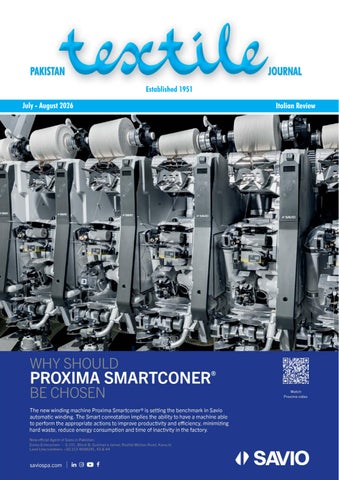
Established 1951 July - August 2026
Italian Review
Calendar of Events
DPS World Pakistan 2026 Dates: August 21th to 23th 2026. Venue: Lahore Expo Centre.
ITMA ASIA + CITME 2026 Dates: November 20th to 24th, 2026. Venue: NECC, Shanghai, China.
ITMA 2027 Dates: September 16th to 22nd, 2027. Venue: Hanover, Germany.
Intertextile Shanghai Apparel Fabrics th
th
Dates: August 25 to 27
2026.
Heimtextil 2027 Dates: January 15th to 17th, 2027 Venue: Frankfurt am Main.
Venue: Shanghai, China.
DOMOTEX Hannover 2028 Dates: January 17th to 20th 2028. Venue: Hannover, Germany.
Texworld Apparel Sourcing Paris
VIATT 2027
Dates: August 30th to Sep. 2nd, 2026.
Dates: February 24th to 26th, 2027.
Venue: Paris
Venue: Ho Chi Minh City, Vietnam.
Techtextil and Texprocess 2028 Dates: April 4th to 7th, 2028 Venue: Frankfurt, Germany.
FESPA Middle East 2027
CAITME 2026 Dates: September 8 to 10 , 2026.
Dates: April 27th to 29th 2027.
Venue: Tashkent, Uzbekistan.
Venue: Dubai Exhibition Centre.
th
th
FESPA Global Print Expo 2027 Dates: April 6th to 9th 2027. Venue: Munich, Germany.
IGATEX Pakistan 2026
DOMOTEX asia/CHINAFLOOR 2027
Dates: October 15th to 18th 2026.
Dates: May 26th to 28th 2027.
Venue: Expo Centre, Lahore.
Venue: NECC, Shanghai, China.
ITM 2028 Dates: June 13th to 17th, 2028. Venue: Istanbul, Türkiye.
Textile Asia 2026, Karachi Dates: December 05th to 07th 2026. Venue: Expo Centre, Karachi.
Textile Asia 2026, Faisalabad Dates: December 11th to 13th 2026. Venue: N.T.U., Faisalabad
2
PAKISTAN TEXTILE JOURNAL - July - August 2026
66th Dornbirn-Global Fiber Congress
HIGHTEX 2026
Dates: September 15th to 17th 2027.
Dates: June 13th to 17th, 2028.
Venue: Dornbirn, Austria.
Venue: Istanbul, Türkiye.
Vol. LXXV No. 07 July-August 2026
Founded in 1951 by Mazhar Yusuf (1924-2009) Publisher Nadeem Mazhar
Rs. 685.00
EDITOR’S PAGE . . . . . . . . . . . . . . . . . . . . . . . . . . .7 Italy and Pakistan: A partnership built over generations
Editor in Chief Amina Baqai
TEXTILE BRIEFS . . . . . . . . . . . . . . . . . . . . . . . . . . .8
Associate Editor Nimrah Nadeem
NEWS & VIEWS . . . . . . . . . . . . . . . . . . . . . . . . . .10
Associate Editor Minhaj Ali
AROUND THE WORLD . . . . . . . . . . . . . . . . . . . . . .14
Production Manager Mazhar Ali Layout & Design Noor M. Jaan
CORPORATE NEWS Italy Strengthens Textile Technology Presence in Mongolia . . . . . . . . . . . . . . .18 Itema reaffirms its commitment to the Syrian textile industry at NasTex . . . . .19 James Heal hosts ASBCI technical visit at Halifax facility . . . . . . . . . . . . . . . . . . .20 Outlast brings fresh2SKIN® cooling technology to cotton and viscose . . . . . . . .21 When AI becomes wearable with Google and Mimaki DTF technology . . . . . . . . . .22
Hony-Editorial Board Dr. Hafizur Rehman Sheikh Ph.D (UK) F.T.I. (UK)
Syed Mahfooz Qutab C.TEX, F.T.I (U.K), B.Sc. Fellow I.C.T.T Atlanta, GA; (USA)
PhD (Textiles), CText ATI
19
Editorial & Advertising Office
PERSONALIA
Dr. Zubair Bandukda
20
Lenzing AG appoints Georg Kasperkovitz as Chief Executive Officer . . . . . . . . . . .24
B-4, 2nd Floor, 64/21, M.A.C.H, Miran M. Shah Road, Karachi - Pakistan Tel: +92-21-34311674-5 Fax: +92-21-34533616 Email: info@ptj.com.pk URL: http://www.ptj.com.pk
DYES AND CHEMICALS DyStar releases FY25 sustainability report, marking a new milestone towards its 2030 targets . . . . . . . . . . . . . . . . . . . . . . . . . . . . . . . . . . . . . . . . . . . . . . .25
PTJ Europe Ltd.
Sustainability becomes a Management Tool at the CHT Group . . . . . . . . . . . . .26
Registered Office: Dairy House, Money Row Green, Holyport, Maidenhead, Berkshire, SL6 2ND, United Kingdom. Registered no. 09141989 Tel: +44 792 2228 721
FAIRS AND EXHIBITIONS
Available on Gale and Factiva affiliated international databases through Asianet Pakistan
Global carpet industry smartly connected: Heimtextil 2027 sharpens Carpets & Rugs with new structure and premium segment . . . . . . . . . . . . . . . . . . . . . . . . . . . . .27 Econogy Hub spotlights sustainable material innovation amid evolving sourcing priorities at Intertextile Apparel . . . . . . . . . . . . . . . . . . . . . . . . . . . . . . . . . . . .28 ITM 2026 concludes with strong visitor interest and robust trade volume despite
Printed at: Color Plus Korangi, Karachi. Published by Nadeem Mazhar from D-16, K.D.A. Scheme No.1. Karachi.
global uncertainties . . . . . . . . . . . . . . . . . . . . . . . . . . . . . . . . . . . . . . . . . .30 ITMA 2027 gains strong momentum . . . . . . . . . . . . . . . . . . . . . . . . . . . . . . . . . .32
32
40
33
FEATURES Less hairiness, stronger yarn: Ibrahim Fibres boosts performance with Suessen’s COMPACTeasy . . . . . . . . . . . . . . . . . . . . . . . . . . . . . . . . . . . . . . . . . . . . . .33 Nature meets performance: iTextiles® & AGS launch BIOPURE® plant-based technologies in Pakistan . . . . . . . . . . . . . . . . . . . . . . . . . . . . . . . . . . . . . . .34 Sustainable softness, moisture management & global certifications: now in Pakistan
U.S. Cotton Trust Protocol launches forensic analysis with Oritain to establish
36
Physical Assurance Program and scientifically verify U.S. cotton origin . . . . . . .35 Ibrahim Fibres and Trützschler: A strong partnership enters its next phase with the TC 30Si . . . . . . . . . . . . . . . . . . . . . . . . . . . . . . . . . . . . . . . . . . . . . . . .36 Barmag Fuzhou Customer Day concludes successfully, boosting high-quality chemical fibre growth in Fujian and Guangdong . . . . . . . . . . . . . . . . . . . . . . . . . . .38
ITALIAN REVIEW Italy and Pakistan: A partnership built over generations . . . . . . . . . . . . . . . . .40 ITALY: A reliable partner for Pakistan . . . . . . . . . . . . . . . . . . . . . . . . . . . . . .41
51
by The Consul of Italy in Karachi, Mr.Fabrizio Bielli
Bridging Markets: Salvatore Parano, Italian Trade Commissioner, on Italy’s Strategic Textile Partnership with Pakistan . . . . . . . . . . . . . . . . . . . . . . . . . . . . . . . . .44 by Salvatore Parano, Italian Trade Commissioner
ITA Karachi’s Role . . . . . . . . . . . . . . . . . . . . . . . . . . . . . . . . . . . . . . . . . . . .45 by A.R. Daudpota
Pakistan and Italy continue to share strong bilateral relations during FY25 . . . .46 Italian Development Committee: The Business Bridge . . . . . . . . . . . . . . . . . . .47 by Aarij Iqbal, President IDC
Performance of Italian textile machinery sector during FY25 . . . . . . . . . . . . . .48 by Nadeem Mazhar, Managing Editor, Pakistan Textile Journal.
53
“Italian technology is ready for Pakistan’s next phase of growth” . . . . . . . . . .50 by Giorgio Calculli, Director, ACIMIT
Pakistan Ambassador Receives President ACIMIT . . . . . . . . . . . . . . . . . . . . . . .51 Italian technology and Pakistan: building the next chapter together . . . . . . . . .52 by Marco Salvadè, President, ACIMIT
Pakistan–Italy Textile Technology Cooperation Gains Momentum . . . . . . . . . . . .53 Italian Technology Leaders Look to Pakistan . . . . . . . . . . . . . . . . . . . . . . . . .57 Factory Visits: Italian Technology in Action . . . . . . . . . . . . . . . . . . . . . . . . . .63 Pakistani delegates in Milan . . . . . . . . . . . . . . . . . . . . . . . . . . . . . . . . . . . . .66 A breakthrough innovation for diaper manufacturers: MESDAN’s all-new Loop knotter type 093E . . . . . . . . . . . . . . . . . . . . . . . . . . . . . . . . . . . . . . . . . . .69
70
Savio Macchine Tessili: Innovation, intelligence and a long-term commitment to Pakistan . . . . . . . . . . . . . . . . . . . . . . . . . . . . . . . . . . . . . . . . . . . . . . . . . .70 Loptex: High-technology solutions for Pakistan’s spinning industry . . . . . . . . . .72 Ferraro & Cibitex: A stronger future together . . . . . . . . . . . . . . . . . . . . . . . .74 Ferraro reaffirms its long-term commitment to Pakistan's textile industry . . . .76 EFI Reggiani and Danitech Group announce strategic multi-year agreement for Mezzera textile finishing machinery . . . . . . . . . . . . . . . . . . . . . . . . . . . . . . .77 CORINO MACCHINE: Italian innovation at the heart of textile finishing . . . . . . .78 Biancalani: Finishing solutions for automotive textiles . . . . . . . . . . . . . . . . . .79
74
EDITOR’S PAGE
Italy and Pakistan: A partnership built over generations Italy has occupied a special place in the international journey of Pakistan Textile Journal almost from the beginning. In 1955, only a few years after the Journal was established, PTJ participated in the international textile exhibition at Busto Arsizio. Three years later, in 1958, PTJ’s founder, Mazhar Yusuf, organised the Pakistan Pavilion at the 19th Bari Fair, where he had the privilege of showing Italian President Giovanni Gronchi around the pavilion.
Established 1951 July - August 2025
Italian Review
More than seven decades later, those early encounters have developed into a relationship extending across trade, industry, technology and culture. This July/August Italian Review reflects both that history and the continuing importance of Italy to Pakistan. The economic relationship is substantial. Bilateral trade reached approximately US$1.67 billion during FY2024-25, with Pakistan exporting US$1.132 billion to Italy and importing US$538 million, resulting in a trade surplus of almost US$600 million in Pakistan’s favour. Textiles and apparel remain an important component of Pakistan’s exports to Italy, making the relationship particularly relevant to our industry.
June 2026
The wider partnership is explored in our interview with Mr. Fabrizio Bielli, Consul of Italy in Karachi, whose engagement across Sindh and Balochistan encompasses business and industry as well as culture and people-to-people relations. Mr. Salvatore Parano, Italian Trade Commissioner for Pakistan, discusses opportunities for expanding trade and investment, while we also examine the role of the Italian Development Committee in strengthening business links. For Pakistan’s textile sector, Italy’s importance is particularly evident in machinery and technology. Italian textile machinery exports to Pakistan reached approximately €53 million in 2025, with finishing machinery accounting for almost half of the total. Italian technology has been present in Pakistani mills for generations, and this partnership is evolving as manufacturers increasingly focus on productivity, automation, energy and water efficiency, sustainability and total operating costs.
Marzoli advertising October 1966.
Our machinery report examines these developments, while Mr. Marco Salvadè, President of ACIMIT, and Mr. Giorgio Calculli, Director of ACIMIT, share their perspectives on Pakistan as a strategic market. A major part of this Review is devoted to the ACIMIT Incoming Mission to Italy in June 2026, in which PTJ participated alongside senior representatives from across Pakistan’s textile industry. More than 200 B2B meetings, technology presentations and factory visits brought Pakistani manufacturers into direct contact with Italian technology providers. The interviews, company profiles and visits that follow demonstrate the breadth of Italian expertise across the textile value chain and the potential for deeper technological cooperation. From Busto Arsizio in 1955 and Bari in 1958 to the Pakistani textile delegation travelling through Italy in 2026, there is remarkable continuity. Technologies and markets have changed enormously, but relationships between people and industries remain fundamental.
Savio advertising March 1991.
The foundations of the Italy–Pakistan partnership were built over generations. The opportunity now is to build its next chapter.
7
Textile Briefs National Pakistan’s textile
1
International Apparel
progressing, processed tex-
port export-oriented textile
exports reached
Federation (IAF), becoming
tiles are among the sectors
operations.
USD17.93 billion in
the first Pakistani apparel
expected to benefit from
FY2025-26, showing mar-
manufacturer to hold the
improved market access,
ginal growth despite global
position. The appointment
greater tariff concessions and
market pressures.
marks a major milestone for
enhanced export opportuni-
5
Readymade garments, cotton
Pakistan’s apparel sector,
ties.
Textile University have
yarn and other textile materi-
strengthening its global rep-
als recorded positive growth,
resentation and reflecting
while several categories
growing recognition of the
experienced declines. The
country’s value-added textile
driven mainly by higher raw
partnerships. The collabora-
sector remained a key export
industry.
cotton purchases to support
tion will focus on joint
Pakistan’s expanding
research, student and faculty
trade relationship with
Imports of raw cotton, syn-
China is expected to
thetic fibres and yarn all
lighted continued challenges
3
manufacturing activity.
create new opportunities for
recorded growth, reflecting
facing Pakistan’s external
textile exporters as bilateral
continued demand for pro-
trade position.
commerce strengthens under
duction inputs. Industry
Ijaz A. Khokhar has
the China-Pakistan Free
observers highlighted the
knowledge sharing and inno-
been elected Vice
Trade Agreement. With
importance of securing stable
vation between universities in
President of the
CPFTA Phase III negotiations
raw material supplies to sup-
both countries.
contributor, although weaker June performance and a widening trade deficit high-
2
Pakistan’s textile
4
Pakistan’s Higher Education Commission and China’s Wuhan
agreed to expand academic
imports increased sig-
and research cooperation
nificantly in June 2026,
through new institutional
exchanges, postgraduate supervision, technical training and textile-related education initiatives to strengthen
Textile Briefs International Brazil will host interna-
1
ers faced pressure from
tional textile and
higher energy and raw mate-
A new partnership
recorded growth, the indus-
Tactics and the Textile
try is focusing on higher-
expenses, declining prof-
4
and accessory exports
between Tactical
apparel representatives
rial costs, increased freight
through the Cotton Brazil
and Apparel Technical Centre
value production,
Dialogues initiative, showcas-
itability and intensified com-
aims to help manufacturers
sustainability, digital transfor-
ing its sustainable cotton pro-
petition despite continued
expand into North American
mation and market diversifi-
duction, traceability systems
demand from domestic and
markets by moving beyond
cation to achieve its annual
and advanced farming prac-
international markets.
subcontracting towards
export target.
tices. The programme will
launched a digital
development, certification,
regions, allowing global
3
value-added production. The
transformation roadmap
quality improvement and
cotton-textile industry,
stakeholders to explore
aimed at creating a more
stronger connections
including cultivation subsi-
Brazil’s quality standards, sus-
competitive, transparent and
between Moroccan suppliers
dies, assistance for advanced
tainability measures and
sustainable sector by 2035.
and buyers in the United
dyeing projects and faster
supply chain capabilities.
Developed with input from
States and Canada.
VAT refunds for eligible com-
include technical visits across major cotton-producing
8
Europe’s textile and apparel industry has
initiative will support product
China’s printing and
2
more than 100 experts, the
dyeing industry main-
strategy focuses on digital
tained stable produc-
infrastructure, artificial intelli-
tion and export growth in the
Uzbekistan has intro-
6
duced new support measures for its
Vietnam’s textile and
reduce financial pressures,
reached USD22.2 bil-
encourage value-added pro-
gence, supply chain trans-
5
panies. The initiatives aim to
garment exports
lion in the first half of 2026,
cessing, improve business liq-
first quarter of 2026, with
parency, data sharing and
increasing 1.7 percent year-
uidity and strengthen the
fabric exports rising 2.91 per-
compliance with EU sustain-
on-year despite weak global
competitiveness of the coun-
cent. However, manufactur-
ability regulations.
demand. While fibre, fabric
try’s textile sector.
PAKISTAN TEXTILE JOURNAL - July - August 2026
News & Views Pakistan’s textile exports reach USD 17.93 billion during FY2025-26 despite global market challenges Pakistan’s textile sector maintained its position as the country’s leading export industry during the fiscal year 2025-26, with textile exports reaching USD 17.93 billion, reflecting a modest increase of 0.26 percent compared to USD 17.88 billion recorded in the previous fiscal year. According to the provisional figures released by the Pakistan Bureau of Statistics (PBS), the sector continued to demonstrate resilience amid a challenging global trading environment, supported by encouraging growth in several valueadded and cotton-based export categories. Among the strongest performing segments, readymade garments continued to lead the country’s textile exports, registering a 3.87 percent increase to USD 4.288 billion compared to USD 4.13 billion during FY2024-25. Cotton yarn also delivered an impressive performance, with exports rising by 12.40 percent to USD 765 million from USD 680.7 million in the corresponding period. Other textile materials witnessed healthy growth of 8.67 percent, reaching USD 790.86 million, while raw cotton exports recorded a significant increase of 199.20 percent, climbing to USD 2.6 million from USD 0.871 million a year earlier. Despite the overall stability in export earnings, a number of textile categories experienced slight declines during the fiscal year. Knitwear exports eased by 0.88 percent to USD 4.966 billion, while bedwear exports remained largely stable at USD 3.112 billion. Towel exports declined by 1.93 percent to USD 1.06 billion, whereas exports of made-up textile articles, excluding towels and bedwear, slipped marginally to USD 770.3 million. Cotton cloth exports recorded a comparatively larger decrease of 7.55 percent to USD 1.672 billion, while exports of tents, canvas and tarpaulin declined by 3.81 percent to USD 120.11 million. The provisional statistics also highlighted a slowdown in export performance during June 2026. Textile exports for the month stood at USD 1.267 billion, representing a 16.71
10 PAKISTAN TEXTILE JOURNAL - July - August 2026
percent decline compared to USD 1.521 billion recorded in June 2025. Overall national exports for June were reported at USD 2.252 billion, reflecting both a month-on-month and year-on-year decline as international demand and market conditions remained under pressure. According to the PBS, Pakistan’s total exports for FY2025-26 amounted to USD 30.139 billion, compared with USD 32.040 billion during the previous fiscal year, while imports increased by 8.14 percent to USD 69.761 billion. Consequently, the country’s cumulative trade deficit reached USD 39.622 billion during the fiscal year, with the June trade deficit recorded at USD 4.679 billion based on provisional estimates. Industry observers believe that the encouraging performance of value-added textile segments, particularly readymade garments and cotton yarn, reflects the industry's continued emphasis on improving product diversification and enhancing competitiveness in international markets. They note that sustained investment in technology, productivity improvements and greater market access will remain essential for strengthening Pakistan’s textile exports and supporting the country's long-term foreign exchange earnings.
Ijaz A. Khokhar elected Vice President of International Apparel Federation in a historic first for Pakistan Pakistan’s value-added apparel industry has achieved a landmark
international recognition as former Chairman of the Pakistan Readymade Garments Manufacturers and Exporters Association Mr. Ijaz A. Khokhar Chairman, PRGMEA and (PRGMEA), renowned apparel Vice President IAF. exporter and industrialist Ijaz A. Khokhar has been elected Vice President of the International Apparel Federation (IAF). The appointment marks the first time in the federation’s history that a Pakistani apparel manufacturer and exporter has been elected to this prestigious global leadership position, highlighting the growing international standing of Pakistan’s textile and apparel sector. The announcement was made by IAF President Stefano Festa Marzotto, who nominated Mr. Khokhar in recognition of his longstanding Mr. Stefano Festa association with Marzotto; President of IAF. the federation and his valuable contributions towards the advancement of the global apparel industry. The nomination received unanimous approval from the IAF General Assembly, with members acknowledging his extensive experience, industry leadership and continued efforts to strengthen international cooperation within the apparel sector.
News & Views The achievement has been warmly welcomed by PRGMEA, textile and apparel associations, chambers of commerce and the wider business community, who described the appointment as a significant milestone for Pakistan’s export-oriented textile industry. Industry stakeholders believe Mr. Khokhar’s elevation to one of the federation’s highest offices will further strengthen Pakistan’s representation within the global apparel community, while creating new opportunities to promote international trade, investment, market access and strategic collaboration with leading apparel-producing nations. Established in 1972, the International Apparel Federation is the world's leading organisation representing apparel manufacturers, national associations and allied industries across more than 40 countries. Collectively, its members represent over 100,000 companies employing in excess of 20 million people worldwide. The federation plays a leading role in promoting sustainable supply chains, technological innovation, international trade, knowledge sharing and the harmonisation of global industry standards. Mr. Khokhar has maintained a distinguished association with the International Apparel Federation for many years, previously serving as an Executive Board Member and Regional President. Throughout his tenure, he actively advocated stronger cooperation among apparel-producing countries while promoting greater participation of developing economies in international trade and global policy discussions. A pioneer of Pakistan’s martial arts garments industry, Mr. Khokhar leads Ashraf Industries (Pvt.) Ltd., Sialkot, a globally recognised manufacturer and exporter of martial arts uniforms since 1969. Under his leadership, the company has established a strong international reputation for quality, innovation and export excellence, successfully competing in major global markets for several decades. Over the course of his career, Mr. Khokhar has served multiple terms as Chairman of PRGMEA and currently holds the position of Chief Coordinator of the association. He is also a founding Executive Board Member of the Asian
Apparel Federation (AAF), a lifetime member of the Federation of Pakistan Chambers of Commerce and Industry (FPCCI) and the SAARC Chamber, as well as a Trustee of the Sialkot Dry Port Trust. His continued efforts to strengthen regional cooperation have played an important role in promoting Pakistan’s value-added apparel exports across international markets. In recognition of his outstanding contribution to Pakistan’s economy and export sector, Mr. Khokhar was awarded the Sitara-e-Imtiaz in 2007, one of the country's highest civilian honours. He has also received the Businessman of the Year Gold Medal from the Prime Minister of Pakistan, while Ashraf Industries earned the FPCCI Export Trophy for 25 consecutive years, reflecting the company's consistent excellence in export performance.
Pakistan anticipates welcome increase in textile export opportunities as bilateral trade with China continues Pakistan’s growing trade relationship with China is expected to create fresh opportunities for the country’s textile sector as bilateral trade continues to strengthen under the China-Pakistan Free Trade Agreement (CPFTA). According to the latest data released by China’s General Administration of Customs (GACC), Pakistan’s exports to China surpassed USD 1.55 billion during the January–May period of 2026, registering a robust 48.7 percent increase compared with the corresponding period last year,
reflecting the expanding commercial ties between the two countries. While copper products remained the largest contributor to Pakistan’s exports during the period, industry stakeholders believe the continued expansion of bilateral trade provides encouraging prospects for Pakistan’s value-added textile industry, particularly as both countries work towards further deepening economic cooperation under the CPFTA framework. The ongoing negotiations for Phase III of the China-Pakistan Free Trade Agreement are expected to be particularly significant for Pakistan’s textile exporters. The proposed expansion of the agreement will cover approximately 700 additional tariff lines, with processed textile products identified among the sectors expected to benefit from enhanced market access. The initiative is anticipated to improve the competitiveness of Pakistani textile manufacturers in one of the world's largest consumer markets while creating new opportunities for export diversification and long-term industry growth. The strengthening trade partnership is also supported by the continued utilisation of preferential tariff arrangements under the existing free trade agreement. During the fiscal year 2024-25, Pakistani exports worth approximately USD 2.16 billion entered the Chinese market under CPFTA concessions, demonstrating the growing importance of the agreement in facilitating bilateral commerce and supporting export-oriented industries.
11
News & Views China remains one of Pakistan’s most important trading partners, and the continued expansion of commercial relations is expected to encourage greater collaboration across key manufacturing sectors, including textiles and apparel. Improved market access, combined with increasing demand for quality textile products, is expected to provide Pakistani exporters with additional opportunities to expand their presence in the Chinese market while strengthening the country's foreign exchange earnings. Industry experts believe that the successful conclusion of CPFTA Phase III could further enhance Pakistan’s position as a competitive supplier of value-added textile products to China. With greater tariff concessions and expanding bilateral cooperation, the textile sector is well positioned to benefit from increased exports, improved market penetration and stronger long-term trade relations between the two countries.
Pakistan’s textile imports increase during June 2026 amid higher raw material demand Pakistan’s textile imports recorded a notable increase during June 2026, reflecting rising demand for industrial raw materials and production inputs as the country’s export-oriented textile sector continued to prepare for future manufacturing requirements. According to the latest provisional figures released by the Pakistan Bureau of Statistics (PBS), the overall textile import bill increased by 36.06 percent on a month-on-month basis, reaching Rs180.47 billion compared to Rs132.61 billion recorded in May 2026. In dollar terms, textile imports stood at USD 647.44 million, representing a 37.11 percent increase over the previous month’s import value of USD 472.22 million. The substantial growth in textile imports was primarily driven by higher purchases of raw cotton, highlighting the industry's continued efforts to secure adequate supplies of essential raw materials. During June 2026, Pakistan imported 132,321 metric tonnes of raw cotton valued at Rs61.38 billion, equivalent to USD 220.18 million. Compared with May, raw cotton import volumes increased by 71.03 percent,
12 PAKISTAN TEXTILE JOURNAL - July - August 2026
while the import value rose by 68.66 percent in rupee terms and 68.84 percent in dollar terms. On a year-on-year basis, the quantity of raw cotton imports also increased by 11.69 percent, demonstrating sustained demand from domestic spinning and textile manufacturers.
increases in both quantity and value compared with the corresponding month of last year. Meanwhile, imports classified under other textile items amounted to Rs58.87 billion, or USD 211.19 million, recording strong month-on-month growth despite remaining below the levels observed during June 2025.
Synthetic fibre imports also witnessed healthy growth during the month, with Pakistan importing 48,547 metric tonnes valued at Rs19.35 billion, or USD 69.40 million. Import volumes increased by 22.56 percent compared to May, while the corresponding value rose by more than 21 percent in both rupee and dollar terms. Compared with June 2025, synthetic fibre imports also recorded steady growth in both quantity and value, indicating continued expansion in the use of man-made fibres across the textile industry.
Industry observers believe the increase in textile imports, particularly raw cotton and synthetic fibres, reflects improving manufacturing activity and the industry's continued focus on maintaining uninterrupted production to meet export commitments. They note that securing a stable supply of quality raw materials remains essential for supporting valueadded textile manufacturing, improving international competitiveness and strengthening Pakistan’s position in global textile markets.
Similarly, imports of synthetic and artificial silk yarn reached 42,498 metric tonnes during June, with a total value of Rs24.53 billion, equivalent to USD 88 million. The category registered doubledigit month-on-month growth in both import quantity and value and also maintained positive year-on-year performance, reflecting sustained demand from Pakistan’s textile manufacturing sector for specialised production inputs.
HEC and Wuhan Textile University agree to expand Pakistan-China academic and research collaboration
Among the various textile categories, worn clothing recorded the strongest annual growth. Imports reached 120,758 metric tonnes valued at Rs16.35 billion, or USD 58.67 million, posting significant
Pakistan and China have taken another significant step towards strengthening educational and research cooperation as the Higher Education Commission (HEC) of Pakistan and China's Wuhan Textile University (WTU) agreed to facilitate new institutional partnerships aimed at enhancing academic collaboration between universities of the two countries. The understanding was reached during a high-level meeting held in Islamabad,
reaffirming both sides' commitment to promoting knowledge exchange, innovation and capacity building through higher education. The meeting was led by HEC Executive Director Dr. Zia Ul Haq, who welcomed a delegation from the School of Biomedical Engineering at Wuhan Textile University. During the discussions, both sides agreed on a framework under which HEC will identify Pakistani universities interested in establishing undergraduate academic collaborations with WTU. The selected institutions will subsequently formalise their partnerships through Memoranda of Understanding (MoUs), paving the way for long-term cooperation in academics, research and institutional development. The proposed collaboration will encompass a wide range of initiatives, including joint research projects, faculty and student exchange programmes, joint supervision of postgraduate students, sandwich programmes and undergraduate-level academic cooperation. These initiatives are expected to strengthen institutional linkages while providing students and researchers with greater opportunities for international exposure and collaborative learning. Speaking during the meeting, Dr. Zia Ul Haq reaffirmed HEC's commitment to expanding strategic international partnerships that contribute towards academic excellence, research advancement, institutional capacity building and knowledge sharing. He emphasised the importance of Prof. Dr Zia Ul Haq; fostering closer ties between Executive Director HEC Pakistani and Chinese universities to support innovation and develop a highly skilled workforce capable of meeting future technological and industrial demands. The Wuhan Textile University delegation highlighted the institution's academic expertise in textile and fibre technology, sensor technology and genetic engineering. The delegation also shared details of WTU's existing collaborations with the National University of Technology (NUTECH) and the Institute of Space Technology (IST), while expressing keen interest in extending similar partnerships to additional higher education institutions across Pakistan. The Chinese delegation further proposed expanding Chinese language programmes at Pakistani universities to improve students' access to undergraduate education opportunities in China and enhance their employability in an increasingly interconnected global economy. Both sides also agreed to explore faculty exchange initiatives, collaboration on Chinese language education, including potential cooperation with the National University of Modern Languages (NUML), as well as the introduction of short-term certification courses and specialised technical training programmes for university technicians.
Around the World BRAZIL Brazil to host global textile delegates for Cotton Brazil Dialogues to showcase sustainable cotton production Brazil is set to welcome representatives from the international textile and apparel industry as part of the Cotton Brazil Dialogues, a global initiative designed to strengthen collaboration across the cotton and textile value chain while highlighting the country's advancements in sustainable cotton production. Organised by Cotton Brazil and the Brazilian Cotton Growers Association (Abrapa), the programme will take place through two field visits scheduled from 27–31 July and 17–21 August 2026, with each session following the same technical agenda while hosting separate international delegations. As the world's largest cotton exporter and third-largest cotton producer, Brazil continues to strengthen its position as a leading supplier of sustainable and traceable cotton to international markets. The Cotton Brazil Dialogues initiative aims to provide textile manufacturers, apparel brands, non-governmental organisations, industry experts and other stakeholders with first-hand insight into Brazil's cotton production practices while promoting long-term cooperation throughout the global textile supply chain. Speaking on the initiative, Abrapa President Gustavo Piccoli said the programme reflects Cotton Brazil's commitment to strengthening
engagement with stakeholders across the textile industry. He noted that by welcoming international participants to Brazil, the initiative seeks to demonstrate the quality, sustainability and traceability standards that have become defining characteristics of Brazilian cotton production while encouraging greater collaboration with global manufacturers and brands. During the immersive programme, participants will gain comprehensive exposure to every stage of the cotton value chain, beginning with cultivation and harvesting and continuing through ginning, fibre classification, quality assurance and traceability systems. The agenda also includes technical workshops led by Abrapa and industry partners covering key topics such as regenerative agriculture, environmental and social certification, carbon emissions, technological innovation, sustainability practices and global cotton market trends.
The technical itinerary will begin in Mato Grosso, Brazil's largest cottonproducing state, where delegates will visit cotton farms and ginning facilities and attend the first session of the Perspectives on the Brazilian Cotton Sector workshop. The programme will then continue in Bahia, where participants will visit farms, ginning facilities and the laboratory of the Bahia Cotton Growers Association (Abapa) to gain deeper insight into fibre classification and quality management systems. The programme will conclude with a second workshop session exploring sustainability, certification, innovation, traceability and the future of Brazilian cotton within the international textile market.
CHINA China’s printing and dyeing industry maintains export growth despite mounting cost pressures China’s printing and dyeing industry recorded stable production and export growth during the first quarter of 2026 despite an increasingly challenging global business environment. While improving domestic consumption and resilient overseas demand supported manufacturing activity, rising production costs and intense market competition continued to weigh on the sector’s overall financial performance. According to the National Bureau of Statistics, output of printed and dyed
14 PAKISTAN TEXTILE JOURNAL - July - August 2026
Around the World fabrics by the enterprises increased by 4.24 percent year-on-year during January–March 2026. The industry benefited from stronger domestic textile and apparel demand, with household spending on clothing rising by 5.6 percent, retail sales of clothing and related products increasing by 9.3 percent, and online apparel sales recording double-digit growth during the period. Exports also remained resilient despite geopolitical tensions and continued uncertainty in global trade. According to customs data, China’s exports of printed and dyed fabrics reached USD 16.43 billion during the first quarter, representing year-on-year growth of 2.91 percent. Export volumes of both woven and knitted fabrics increased, although average export prices declined amid heightened international competition. Stronger shipments to markets including Russia, Pakistan and India helped offset weaker demand from several traditional export destinations. Despite positive production and export figures, the industry's profitability came under considerable pressure as manufacturers faced rising energy prices, higher raw material costs, increasing freight charges and stronger competition. Official statistics showed that operating revenue of above-designated-size printing and dyeing enterprises declined by 2.62 percent year-on-year during the first quarter, while total profits fell by 16.10 percent. Rising prices of dyes, auxiliaries and petroleum-based inputs further increased production costs, while weak market demand limited manufacturers' ability to pass these higher costs on to buyers. Operational efficiency also weakened during the period as higher expenses and
supply chain disruptions affected business performance. The industry's expense ratio increased, while inventory turnover, accounts receivable turnover and total asset turnover all declined compared with the same period last year. Among the 2,036 above-designated-size printing and dyeing enterprises, 895 reported losses during the first quarter, underlining the financial challenges facing manufacturers despite stable production levels and continued export growth.
EGYPT Chinese firm to invest USD 20 million in Egypt’s Qantara West textile manufacturing project Egypt continues to strengthen its position as a regional textile manufacturing hub as the General Authority for the Suez Canal Economic Zone (SCZone) signed an agreement with Chinese company Zhejiang Hongda to establish a new textile manufacturing and processing facility in the Qantara West
Industrial Zone. The project, valued at USD 20 million, is expected to enhance the country's textile production capacity, support export growth and generate significant employment opportunities. The agreement was signed at the SCZone headquarters in the New Administrative Capital by SCZone Vice Chairman for Investment and Promotion Mostafa Shekhoun and Zhejiang Hongda representatives Maliang Lin and Abdel Malek Al-Dhabi, in the presence of SCZone Chairperson Walid Gamal El-Din. The new manufacturing facility will be developed over an area of 60,000 square metres and is projected to create approximately 500 direct employment opportunities upon completion. Designed with a strong exportoriented focus, the textile facility is expected to export around 70 percent of its total production, further supporting Egypt's ambitions to expand its presence in international textile markets. The investment also reflects growing confidence among international manufacturers in Egypt's industrial infrastructure and its strategic location as a gateway to regional and global markets. Speaking during the signing ceremony, SCZone Chairperson Walid Gamal El-Din highlighted the rapid development of the Qantara West Industrial Zone, noting that it continues to attract increasing levels of foreign direct investment across priority sectors including textiles, ready-made garments, food industries and logistics services. He emphasised that the zone has become an important destination for international investors seeking competitive manufacturing opportunities.
15
Around the World According to SCZone, the Qantara West Industrial Zone currently hosts 53 industrial, service and logistics projects with combined investments amounting to approximately USD 1.48 billion, reinforcing the zone's growing role in Egypt's industrial development. Mr. Gamal El-Din further stated that each new investment within the targeted manufacturing sectors contributes towards reducing import dependence, increasing exports and meeting the growing demand of both domestic and regional markets. He reaffirmed the authority's commitment to providing investors with comprehensive support while ensuring the timely completion of infrastructure and utility projects across its industrial zones and maritime ports.
EUROPEAN UNION European textile industry unveils digital transformation roadmap to strengthen competitiveness and sustainability Europe’s textile and apparel industry has taken a major step towards accelerating digital innovation with the launch of a comprehensive roadmap designed to guide the sector’s transformation over the coming decade. The strategy, titled The Digital Transformation of the European Textile and Apparel Industry, was presented during the 20th Textile ETP Annual Conference in Amsterdam and outlines a long-term vision for building a more competitive, transparent and sustainable textile ecosystem by 2035. Developed through the collaborative efforts of more than 100 industry experts over a six-month period, the roadmap provides a strategic framework to help European textile manufacturers adapt to rapidly evolving technologies, changing market demands and upcoming regulatory requirements. The initiative highlights digitalisation as a key driver for improving productivity, strengthening supply chain resilience and enhancing the global competitiveness of the European textile and apparel industry. According to the roadmap, three major factors are accelerating the
16 PAKISTAN TEXTILE JOURNAL - July - August 2026
industry's digital transformation. These include the need to remain competitive in an increasingly dynamic international marketplace, compliance with forthcoming European Union regulations such as the Digital Product Passport (DPP) and the Corporate Sustainability Due Diligence Directive (CSDDD), and the growing data requirements associated with circular economy and service-based business models. Textile ETP President Marina CrnojaCosic emphasised that integrating traditional textile manufacturing with advanced digital technologies represents a significant challenge but is essential for the industry's future. She noted that combining manufacturing expertise with digital innovation, data-driven decisionmaking and sustainability objectives will enable European textile companies to improve competitiveness while meeting the European Union’s ambitions for a more sustainable and circular textile sector. The roadmap establishes an ambitious target of creating a fully digitally integrated and transparent European textile industry by 2035. To achieve this vision, the strategy identifies four critical areas requiring continued investment and development: robust data infrastructure, digitised manufacturing equipment, interoperable software solutions and effective collaboration between human expertise and artificial intelligence. The roadmap also presents ten recommendations for policymakers, prioritising stronger links between sustainability and digitalisation, open digital standards, the creation of a European Textile Data Space and support for a harmonised Textile Data Ontology.
EURATEX President Mario Jorge Machado stressed that successful implementation will be essential to ensuring digital technologies deliver practical benefits for textile manufacturers. He highlighted the importance of making digital solutions accessible, affordable and relevant for businesses, enabling the sector to build a more competitive, resilient and circular textile ecosystem without creating unnecessary complexity for manufacturers. Textile ETP said detailed implementation plans will be developed during the second half of 2026. The programme is coordinated by Textile ETP, EURATEX and Lectra with support from leading research institutions and technology partners.
MOROCCO Morocco strengthens textile export strategy to expand presence in North American markets Morocco is intensifying efforts to strengthen its textile and apparel industry by expanding its presence in the North American market through a new strategic partnership aimed at enhancing valueadded manufacturing and improving international competitiveness. As part of this initiative, business development agency Tactical Tactics and the Textile and Apparel Technical Centre (CTTH) signed a cooperation agreement in Casablanca to support Moroccan textile manufacturers in accessing new business opportunities across the United States and Canada.
Around the World The partnership reflects Morocco’s broader strategy of transforming its textile sector from a traditional subcontracting industry into a producer of finished, value-added apparel products capable of meeting the evolving requirements of international buyers. By combining CTTH’s technical expertise with Tactical Tactics’ commercial network in North America, the initiative seeks to strengthen Morocco’s position in two of the world's largest apparel import markets. Under the collaboration, the Textile and Apparel Technical Centre will provide manufacturers with support in research and development, product quality enhancement, certification, testing and workforce training. These initiatives are expected to help Moroccan exporters comply with international quality standards while improving product innovation and overall competitiveness in global markets. Tactical Tactics will focus on strengthening commercial linkages between Moroccan manufacturers and buyers, retailers and distributors across the United States and Canada through its Delivered Duty Paid (DDP) business model.
Speaking on the country's evolving textile industry, Tactical Tactics Chief Executive Dikra Aït Nacere highlighted Morocco's transition towards valueadded manufacturing, stating that the country is increasingly positioning itself as a supplier of finished textile and apparel products ready for international markets. North America represents a significant growth opportunity for Morocco's textile exports. The United States imported approximately USD 83.7 billion worth of clothing and apparel in 2024, while
Canada imported nearly USD 11 billion, offering considerable potential for Moroccan exporters. The textile and leather industry remains one of Morocco's leading manufacturing sectors, generating around USD 3.9 billion in apparel exports during 2024. Industry stakeholders believe greater emphasis on value-added production and export diversification will strengthen Morocco's competitiveness in international textile markets.
Corporate News
Italy Strengthens Textile Technology Presence in Mongolia The workshop dedicated to Italian textile technologies kicked off in Ulaanbaatar from 21 to 23 June 2026. Focused on the most advanced innovative solutions for the textile industry, the initiative brought together 13 Italian textile machinery manufacturers, confirming the growing interest in strengthening industrial cooperation between the two countries and highlighting Mongolia’s strategic importance for Italian textile machinery producers. The Italian textile machinery industry is internationally recognised as a leading benchmark for technology, innovation, and quality. Italian companies in the sector stand out for their ability to provide flexible, versatile, and customised solutions capable of responding rapidly to customer needs and creating high valueadded market niches. During the workshop, particular emphasis was placed on supporting the Mongolian textile industry in its transition toward efficient, premium-quality production. Italian technology can make a tangible contribution to the country’s industrial modernisation and sustainability efforts. The technological partnership between Italy and Mongolia is rooted in Italy’s excellence in cashmere and wool processing, two raw materials of strategic importance to the Mongolian economy. According to data compiled by ACIMIT, the Mongolian market has demonstrated significant dynamism in recent years, with the overall trend pointing to a steady expansion of trade cooperation between the two countries. The technologies most in demand among Mongolian operators are primarily those related to spinning, which accounts for 35% of total Italian exports to the country, followed by laundry machinery (21%), accessories (19%), finishing equipment (14%), and weaving machinery (11%). “Mongolia represents a highly promising market for our industry,” said Marco Salvadè, President of ACIMIT. “The participation of Italian companies in
18 PAKISTAN TEXTILE JOURNAL - July - August 2026
the Ulaanbaatar workshop demonstrates a strong commitment to consolidating a long-term technological partnership. Marco Salvadè, President of Our highly ACIMIT specialised and flexible technologies are ready to support local operators in upgrading their production processes and increasing the added value of their textile exports. The workshop in Mongolia is also part of a broader program of initiatives aimed at promoting the Italian presence at ITMA Hannover 2027, the world’s leading exhibition for textile and garment technologies, where Italian companies will once again showcase the very best of textile machinery innovation.”
Biancalani, Bianco, Color Service,
The initiative, promoted by the Italian Trade Agency and ACIMIT, with the valuable support of the Embassy of Italy in Mongolia, featured participation from the following Italian companies:
categories: Spinning, Weaving, Knitting,
Cormatex, Fadis, Lawer, Mesdan, Cosmatex, Pinter Caipo Italia, Proxima, Stalam, Tecnomeccanica Biellese, Ugolini. ACIMIT (the Association of Italian Textile Machinery Manufacturers) was founded in 1945 with the primary objective of promoting the Italian textile machinery industry by supporting its activities both in Italy and abroad. As a non-profit organisation, it currently brings together around 200 textile machinery manufacturers, representing 85% of the sector’s total turnover in Italy. This accounts for a total value of approximately 1.9 billion euros, of which about 86% is exported to 130 countries worldwide. The technologies produced are divided into different reference Finishing, Other machinery. Creativity, sustainable technology, reliability, and quality are the hallmarks that have made Italian textile machinery a global leader.
Itema reaffirms its commitment to the Syrian textile industry at NasTex From 18th to 21st July, 2026, Itema will exhibit at NasTex at the Damascus Fairground (Hall 11 – Stand C02), marking its return to one of the Middle East’s historically significant textile markets. Itema will showcase advanced weaving technology designed to support the competitiveness and technological evolution of Syrian manufacturers and announces a new partnership with Growfast Agency as the sole agent of Itema in Syria. Syria has historically been recognised for its textile expertise and manufacturing tradition across multiple segments, including home textiles, denim and silk fabrics. As industrial activity resumes, NasTex represents a key opportunity to reconnect with the market and local producers, and contribute to its modernisation through reliable and highperformance weaving solutions. “Initiatives such as NasTex play a crucial role in fostering industrial dialogue and supporting the modernisation of textile production,” said Matteo Mutti, Itema Group Chief Sales and Service Officer. “Itema’s participation with three dedicated weaving solutions for denim, terry, and silk reflects our confidence in
the market’s potential and our commitment to providing reliable, highperformance weaving solutions tailored to its needs.” “The market is showing clear signs of reactivation, with manufacturers ready to invest again in advanced production solutions,” said Fadi Alahamad, CEO of Growfast Agency. “There is strong interest in reliable, high-performance weaving technology, and Itema’s return to NasTex is particularly meaningful in this industrial recovery phase.”
At its booth, Itema will exhibit:
R9500EVOdenim In weaving width 2,200 mm and equipped with a dobby shedding machine, the R9500EVOdenim is specifically designed for denim applications, ensuring fabric quality and consistent performance in demanding denim manufacturing environments. R9500terry In weaving width 2,600 mm and jacquard shedding machine configuration, the R9500terry represents a worldwide reference solution for terry fabrics. The machine ensures precision in pile formation, reliability and
production efficiency, meeting the requirements of high-quality home textile manufacturing. In addition, within the “Silk Journey” Hall, Itema will present: GalileoRX Featuring a 1,900 mm weaving width and jacquard shedding machine, the GalileoRX offers precision and versatility in silk fabric weaving, enabling the production of refined, high-value fabrics that require advanced design capabilities and weaving accuracy.
Visitors are invited to discuss tailored technological solutions for the evolving needs of the Syrian textile market at Hall 11 – Stand C02.
19
Corporate News
James Heal hosts ASBCI technical visit at Halifax facility James Heal recently welcomed members of the Association of Suppliers to the British Clothing Industry (ASBCI) to its Halifax facility for a technical visit, offering industry professionals an opportunity to gain first-hand insight into the design, manufacture and application of advanced textile testing instruments. The visit included a guided tour of James Heal's production facility, where delegates observed the manufacturing processes behind the company's physical properties testing equipment. This was followed by a series of live laboratory demonstrations and technical sessions showcasing the practical application of textile testing technologies. During the demonstrations, attendees saw a range of James Heal instruments in operation, including the Martindale Motion Abrasion and Pilling tester, WickView Moisture Management Tester, ProDry Drying Rate Tester and other solutions from the company's Performance Testing range. The sessions highlighted the importance of textile testing and internationally recognised standards, demonstrating how test results can provide valuable insights into product performance while emphasising the role of quality consumables in delivering accurate, reliable and repeatable results. The technical sessions encouraged lively discussion, with participants raising a wide range of questions on testing
methodologies, standards and practical industry applications. The exchange of knowledge and experience reinforced the importance of collaboration in supporting innovation, product quality and continuous improvement across the textile and apparel sector. James Heal thanked ASBCI for its continued commitment to promoting technical learning and industry collaboration, and expressed its appreciation to all delegates for their enthusiastic participation. The company looks forward to welcoming further industry groups to its Halifax facility for future technical visits and knowledgesharing events.
20 PAKISTAN TEXTILE JOURNAL - July - August 2026
Corporate News
Outlast brings fresh2SKIN® cooling technology to cotton and viscose Outlast Technologies has expanded its fresh2SKIN® cooling technology to cellulose-based fibres such as cotton and viscose, enabling brands to combine natural materials with a refreshing cooling effect and long-lasting thermal comfort. The latest development allows fresh2SKIN® to be applied while maintaining an exceptionally natural and soft handfeel. The finish is virtually imperceptible on the textile, preserving the smooth, flexible character that consumers expect from cotton and viscose fabrics. What consumers experience instead is the benefit: an immediate, pleasantly cool sensation when the fabric touches the skin. This instant sensory effect can create a strong purchase impulse at the point of sale. Unlike many textile technologies that remain invisible to the consumer, fresh2SKIN® provides a cooling experience that can be felt immediately,
for example when trying on a T-shirt equipped with the technology. fresh2SKIN® combines instant freshness with lasting comfort. While the textile delivers an immediate cooling sensation upon skin contact, integrated microcapsules containing natural wax help absorb excess body heat and release it again when temperatures drop. This supports a more balanced microclimate and can help reduce sweating during the day or night. “Achieving this exceptionally natural handfeel on cellulose-based fibres such as cotton or viscose was a key objective for our development team,” says Volker Schuster, Head of Research & Development at Outlast Technologies. “Our goal was to integrate the fresh2SKIN® functionality without compromising the authentic character of these materials. The result is textiles that feel completely natural while delivering an immediately noticeable cooling effect.”
Volker Schuster, Head of Research & Development at Outlast Technologies.
The development opens new opportunities for next-to-skin applications, including T-shirts, underwear, activewear, sleepwear, and bedding textiles.
About Outlast Outlast Technologies is the Temperature Specialist for textiles and develops advanced solutions for temperature regulation, cooling, and high-performance insulation for apparel, footwear, bedding, and technical applications.
21
Corporate News
When AI becomes wearable with Google and Mimaki DTF technology At Google Cloud AI Live Milano 2026, Mimaki’s direct-to-film (DTF) technology helped transform AI-generated designs into personalised T-shirts printed on demand Artificial intelligence is changing the way ideas are created and digital print is changing how quickly those ideas can become real. At Google Cloud AI Live Milano 2026, held on 21st May at CityOval Milano, the two came together in a live personalisation experience powered by AI and enabled by Mimaki’s DTF technology. As part of the event, participants were invited to create unique Gemini AIgenerated visuals and see them transformed into custom T-shirts produced on demand, using a Mimaki TxF300-75 DTF printer. These printed Tshirts are a clear demonstration of how AI-driven creativity and professional digital print can work together to deliver immediate, personalised and high-quality experiences.
From AI-generated design to finished garment The activation showed how artificial intelligence and on-demand textile decoration can work together. Each design started as a digital concept generated through AI, then Mimaki’s DTF technology enabled that concept to be transferred onto a T-shirt, creating a personalised garment in real time.
For visitors, it was an engaging and tangible way to experience AI. For brands, events and creative businesses, it highlighted a much broader opportunity: turning digital interaction into physical products, quickly and at scale.
Why DTF technology makes the difference Live personalisation needs more than just creativity. It also requires digital printing technology that is flexible, reliable and consistent. At the event, the personalised T-shirts were produced by the Mimaki TxF300-75, part of the TxF Series developed for professional directto-film production. The TxF Series enables high-quality decoration on a wide range of materials, including cotton, polyester, blended fabrics and performance fabric, using a heat press making it a strong solution for T-shirt printing as well as event merchandising, promotional products, fashion, sportswear and branded items. In an environment where every design can be different, production consistency becomes essential. Mimaki’s DTF workflow includes the TxF Series printer technology suited for individual needs, from compact (TxF150-75) to high productivity models (TxF300-
22 PAKISTAN TEXTILE JOURNAL - July - August 2026
75Plus). Combined with genuine PHT50 pigment inks, RasterLink RIP software and application know-how, users can produce repeatable quality, vivid colours and professional results.
A new space for print in AI-driven experiences The Google Cloud AI Live Milano activation also points to a wider shift in the role of print. As AI makes it possible to generate unique content instantly, digital print becomes the link between the virtual design process and real-world application. It gives form to ideas that would otherwise remain on screen. For Mimaki, this is where the value of DTF technology becomes especially clear: enabling businesses to respond to new expectations around personalisation, speed and experience without compromising on print results. From live events to retail activations and from limited-edition merchandise to custom T-shirts, the combination of AI and digital print opens new possibilities for brands looking to create more engaging and memorable customer interactions. At Google Cloud AI Live Milano 2026, Mimaki helped demonstrate what the future of print personalisation looks like.
Personalia
Lenzing AG appoints Georg Kasperkovitz as Chief Executive Officer The Supervisory Board of Lenzing AG has appointed Georg Kasperkovitz, currently a member of the Management Board and Chief Operations Officer (COO), as Chief Executive Officer (CEO) of Lenzing AG, effective June 1, 2026. He will continue to serve as COO alongside his new responsibilities. Kasperkovitz joined the Management Board of Lenzing AG as COO in June 2025. In this role, he has been responsible for the Fiber Division, including sales, production and supply chain, as well as the further development and implementation of the company’s performance program. During his tenure, he has made significant progress in operational excellence and improving the profitability of Lenzing’s fiber production sites. As CEO, Kasperkovitz will retain responsibility for the company’s global fiber production sites while also assuming overall responsibility for fiber sales, supply chain and human resources. His mandate as CEO runs for three years, until May 31, 2029.
Supervisory Board Emphasizes Continuity and Performance Patrick Lackenbucher, Chairman of the Supervisory Board of Lenzing AG, commented: “Over the past months, the Supervisory Board has intensively addressed the appointment of the CEO position and evaluated both internal and external candidates. It became clear that the current Management Board works very effectively together and that Georg Kasperkovitz manages his areas of responsibility extremely successfully. He has achieved measurable progress in operational performance and profitability.
24 PAKISTAN TEXTILE JOURNAL - July - August 2026
His appointment as CEO is therefore a logical step that ensures stability and execution strength, particularly in challenging marketenvironments. The Management Board will continue to consistently focus on structural profitability and strengthening competitiveness, with the aim of further expanding Lenzing’s position as a leading integrated premium supplier of regenerated cellulose fibers.” The Management Board remains unchanged and consists of Georg Kasperkovitz (CEO), Mathias Breuer (CFO), and Christian Skilich (CPO/CTO). The six-member extended Executive Committee will also remain unchanged.
Focus on Transformation, Profitability and Growth Georg Kasperkovitz said: “I would like to thank the Supervisory Board for their trust and for appointing me as CEO, and I am very much looking forward to actively shaping Lenzing’s future. A clearly prioritized strategy focused on premium products, the consistent execution of our performance program, and a strong leadership team are key drivers of Lenzing’s continued transformation. We will drive sustainable growth in high-margin market segments, such as nonwovens applications in hygiene and filtration, while further advancing nextgeneration technologies such as Tree-to-Textile. At the same time, we will consistently implement measures to further strengthen our cost position and global competitiveness. Our goal is to unlock the company’s full value-creation potential.”
About Georg Kasperkovitz Georg Kasperkovitz holds a PhD in Mechanical Engineering from Vienna University of Technology and an MBA from Harvard Business School. He has over 15 years of international management experience across Europe, North America, Asia, and China, Lenzing’s key production regions and markets. Before joining Lenzing, Kasperkovitz served as Business Unit CEO at the international packaging and paper company Mondi plc (2016–2019) and as CEO of Rail Cargo Austria AG (2012– 2016). Earlier in his career, he worked as a partner at the global consulting firm McKinsey & Company.
About the Lenzing Group The Lenzing Group is a leading producer of specialty and premium regenerated cellulose fibers for global textile and nonwoven manufacturers. Its innovative fibers serve clothing, home textiles and hygiene applications, including TÜV-certified biodegradable and compostable products. Lenzing works with partners across the value chain to develop innovative products and support the textile industry’s transition to a circular economy. The company is committed to reducing greenhouse gas emissions across Scopes 1, 2 and 3 by 2030 and achieving net-zero emissions by 2050.
Dyes and Chemicals
DyStar releases FY25 sustainability report, marking a new milestone towards its 2030 targets
DyStar, a leading specialty chemicals company with more than a century of expertise in product development and innovation has announced the release of its FY25 Sustainability Report, marking a significant milestone in its sustainability journey and reinforcing its commitment to long-term value creation.
81% reduction in water consumption
As DyStar steps into 2026, the company reflects on five years of transformation, resilience, and progress amid a challenging global landscape. Despite geopolitical tensions, supply chain disruptions, and inflationary pressures, DyStar has continued to strengthen its global operations, advance innovation, and deliver on its sustainability commitments.
Driving Accountability and Continuous Improvement
Strong Performance Against 2025 Sustainability Targets The report highlights DyStar’s achievement of several key environmental targets: 51% reduction in emissions intensity compared to the 2011 baseline.
intensity, demonstrating strong resource efficiency. 58% reduction in wastewater intensity, reinforcing environmental stewardship. These results underscore DyStar’s disciplined approach to sustainability, driven by innovation and operational excellence across its global footprint.
DyStar remains transparent about areas requiring further attention. Challenges in waste production and packaging intensity, partly linked to plant closures and resource redeployment, continue to be addressed. Energy intensity also approached target levels despite ongoing efforts to reduce reliance on non-renewable sources. These insights reflect DyStar’s commitment to continuous improvement and accountability. DyStar Group Managing Director, President and CEO, Xu Yalin, said: “Our progress reflects the collective strength of our people and partners. Together, we
have demonstrated that resilience, responsibility, and innovation can drive meaningful change. As we move forward, we remain committed to accelerating our 2030 goals while building a future where sustainability and digital excellence go hand in hand.”
DyStar 2030 Sustainability Goals The 2025 milestones provide a strong foundation for DyStar’s next phase of growth. The company is accelerating its 2030 sustainability goals, with a focus on: Expanding renewable energy adoption Advancing resource efficiency Strengthening responsible supply
chain practices This forward-looking strategy reinforces DyStar’s position as a trusted partner in the global textile and chemical industries. Guided by purpose and empowered by innovation, DyStar will continue to deliver sustainable solutions that create long-term business value while contributing positively to society and the environment.
25
Dyes and Chemicals
Sustainability becomes a management tool at the CHT Group The 2025 Sustainability Report documents measurable progress in climate protection, transparency, and social responsibility.
In fiscal year 2025, the CHT Group further established sustainability as an integral part of its corporate management. The latest 2025 Sustainability Report shows how environmental, economic, and social goals are increasingly being made measurable and integrated into processes, decisions, and product development. A major success the was the award of the German Sustainability Award 2026 in the product category to the innovative PIGMENTURA dyeing process. The technology combines resource conservation with tangible customer benefits and underscores the CHT Group’s innovative strength. Independent assessments also confirm the company’s sustainable development: With an EcoVadis rating of 81 points and Gold status, the CHT Group ranks among the top five percent of companies in its industry worldwide. In addition, it was awarded “Best Managed Company
26 PAKISTAN TEXTILE JOURNAL - July - August 2026
2026” as part of a program organised by Deloitte Private, UBS, the Frankfurter Allgemeine Zeitung, and the Federation of German Industries (BDI). A key focus was on further developing sustainability management. By aligning its reporting with the requirements of the European Sustainability Reporting Standards (ESRS), the CHT Group is enhancing the transparency and comparability of its sustainability performance.
measures are complemented by projects such as the biomass-based heating system at the Dußlingen site. To ensure greater transparency along the value chain, the CHT Group has also introduced automated calculation of the Product Carbon Footprint. This enables product-specific emissions to be analysed and reduced in a targeted manner.
Similarly, in 2025, a global climate risk and water risk analysis was conducted for all CHT sites worldwide, and measures were identified to further reduce these risks.
Progress has also been made in the social sphere: Already today, more than 95% of CHT employees worldwide receive compensation above the respective living wage level. By 2030, this is expected to apply to all CHT employees.
At the same time, concrete climate protection measures were implemented. These include the switch to renewable electricity at the sites in the United Kingdom, Brazil, and Shanghai, as well as the investment in the company’s own photovoltaic system in Torreón. These
Developments in 2025 illustrate that sustainability at the CHT Group is increasingly becoming a measurable and manageable system. At the same time, it remains a key driver of innovation, competitiveness, and the company’s long-term development.
Fairs and Exhibitions
Global carpet industry smartly connected: Heimtextil 2027 sharpens Carpets & Rugs with new structure and premium segment Even more efficient, more targeted and closer to the market, Heimtextil 2027 strengthens its position as the leading meeting place for the global carpet industry and further expands Carpets & Rugs in line with market needs. With a stronger focus on distribution channels, the segment integrates into Heimtextil’s product worlds. Manufacturers, retailers, industry and contract business benefit from additional business opportunities, new contacts and efficient sourcing of holistic interior solutions. With Carpets & Rugs Excellence, Heimtextil also introduces a premium segment for selected volume manufacturers for the first time. Numerous key players have already confirmed their participation for 2027. Heimtextil 2027 once again brings together the global carpet industry in Frankfurt. With a new structure, Carpets & Rugs responds directly to current market requirements and strengthens networking across purchasing and distribution channels. The segment strategically integrates carpet suppliers into Heimtextil’s product segments, combining holistic interior concepts for specialist retailers, solutions for hospitality and contract projects, and offerings for the international volume business. Manufacturers benefit from additional business opportunities and new contacts. Buyers gain direct access to complete interior solutions. “Our aim is to reflect the needs of the entire carpet market as effectively as possible. Together with the industry, we continuously develop Carpets & Rugs and create an even more targeted business platform for manufacturers, brands and buyers worldwide,” says Bettina Bär, Director Heimtextil. “The strong participation once again confirms Heimtextil’s relevance as the home of the global carpet industry in Frankfurt.”
New business opportunities and strong international participation Machine-made carpets as well as suppliers of fibres, yarns and technologies showcase their products in Hall 3.1 alongside Decorative & Furniture Fabrics with direct access to specialist retailers and contract business. In Hall 3.0, handknotted one-off pieces, premium doormats and flooring solutions expand the area Interior Design Concepts: Windows, Wall & Floor with holistic interior concepts. Halls 11.0, 12.0 and 12.1 serve as the meeting place for volume manufacturers and major buyers from around the world, complementing the offering with handwoven and machine-made carpets. Numerous market leaders and renowned brands have already confirmed their participation, including Agnee Innovates, Balta Industries, Bhadohi Carpets, Choudhary Exports, Fibre World, Hafizia Arts & Crafts, Heritage Overseas, Jaipur Rugs, Looms & Knots, Merinos, Oriental
Weavers with EFCO and MAC, Qayyum Exports, Ragolle Rugs, Rudra Rugs, Rugs INC., Unlimited Style Rugs, Teppich de Orienta and Verbatex.
Quality at every scale: new Carpets & Rugs Excellence area With Carpets & Rugs Excellence, Heimtextil 2027 introduces a premium segment in Hall 11.0 featuring selected international volume manufacturers from the carpet industry for the first time. Chosen by an independent jury of experts, these companies stand for highquality products, excellent workmanship and manufacturing expertise. The new area creates a central meeting point for buyers from retail, hospitality and contract business looking for qualityfocused carpet suppliers capable of handling order volumes of every scale. The curated segment provides guidance for global sourcing decisions and underlines Heimtextil’s commitment to quality.
27
Econogy Hub spotlights sustainable material innovation amid evolving sourcing priorities at Intertextile Apparel Intertextile Shanghai Apparel Fabrics will return from 25 – 27 August at the National Exhibition and Convention Center in Shanghai, continuing to serve as a key sourcing platform for the global apparel textile industry. Yet this sector is one that is consistently changing with the times. Against a backdrop of shifting energy markets and evolving sustainability priorities, the Autumn Edition’s dedicated Econogy Hub will spotlight next-generation natural, bio-based, and recycled textile solutions that support the industry’s long-term development. Across the value chain, manufacturers and brands are reassessing raw material strategies and expanding the integration of renewable and recycled inputs into mainstream production. With synthetic fibres accounting for around 60% of global fibre consumption, diversification and material innovation are becoming central to sourcing decisions. The industry is entering a phase characterised by upgrading, with greater emphasis placed on performance, differentiation, and supply stability.
providers, the zone highlights scalable solutions aligned with recognised sustainability frameworks. Sustainability as a concept is increasingly linked not only to environmental responsibility, but also to operational efficiency and longterm economic viability – principles reflected across the zone’s cross-sector exhibitor showcase.
Within this landscape, the Econogy Hub serves as a focused platform responding to the industry’s evolving priorities. Bringing together certifiers and standards organisations, fibre producers, manufacturers, mills, and technology
The Econogy Hub underscores the connection between ecological responsibility and economic performance, highlighting how material innovation supports both environmental progress and commercial success. Structured to
28 PAKISTAN TEXTILE JOURNAL - July - August 2026
facilitate direct exchange between exhibitors and sourcing professionals, the Econogy Hub forms part of Intertextile Apparel’s broader sustainability framework. Previous editions have featured innovations such as bio-based dyes, waterless dyeing technologies, advanced cellulosic fibres, bio-based leather alternatives, and high-performance recycled yarns from established international companies including Birla, Hyosung, Lenzing, LYCRA, Nilit, and Unifi. With its open-structured layout, dedicated seminar space, and eco-
Fairs and Exhibitions focused display areas, the Econogy Hub is designed to facilitate direct exchange between exhibitors and buyers, and forms part of the fair’s broader sustainability framework. At the upcoming edition, the zone will once again feature a strong lineup of exhibitors, including: Haelixa AG (Switzerland): a provider of DNA-based traceability solutions enabling textile brands to verify material authenticity from fibre to finished garment. Using natural DNA markers, Haelixa supports transparent supply chains for fibres such as organic cotton and cashmere. Its technology is used by international brands including C&A, OVS and Hugo Boss, with over 30 million garments traced in 2024. Hong Kong ZAKER New Material Technology: specialising in advanced material innovation, the company has developed the Rborne polyurethane platform, engineered for scalable, high-performance plant-based leather applications. The solution is designed to support the transition toward bio-based alternatives while maintaining durability and production efficiency for commercial use. Sustainability as a sourcing requirement gains more prominence with each passing season. This is why sustainable exhibitors across the fairground can be identified through the Econogy Finder initiative, with the number of approved suppliers increasing year on year to reach over 100 in the upcoming edition. The programme enhances transparency and sourcing efficiency, enabling buyers to identify verified sustainable enterprises across product categories.
Also within the fair’s green framework, an Econogy Tour will guide visitors to selected exhibitors aligned with evolving material and compliance priorities, while Econogy Talks will offer a series of forums and seminars for industry experts to exchange insights on related developments. In addition, the Econogy Hub Display Area will spotlight selected sustainable products, providing a
consolidated overview of material innovations presented at the fair. Beyond the Econogy Hub, Intertextile Apparel will present a comprehensive portfolio of specialised zones addressing diverse sourcing needs. In response to growing interest in material diversification, the Premium Wool Zone will highlight high-quality wool fabrics valued for their natural performance characteristics and versatility, particularly in suiting applications. Additional featured zones – including Accessories Vision, Beyond Denim, Essential Suits & Shirts, Functional Lab, the Innovation & Digital Solutions Zone, SalonEurope, and Verve for Design – will collectively reflect the breadth of today’s apparel textile market. The fair is co-organised by Messe Frankfurt (HK) Ltd; the Sub-Council of Textile Industry, CCPIT; and the China Textile Information Center. It will take place alongside Yarn Expo Autumn, CHIC and PH Value at the National Exhibition and Convention Center (Shanghai), with the venue playing host to the entire apparel textile value chain. For more details on this fair, please visit: www.intertextileapparel.com.
29
ITM 2026 concludes with strong visitor interest and robust trade volume despite global uncertainties ITM 2026, one of the world's most prestigious exhibition in the field of textile technologies, concluded with remarkable success. Held during a period of global economic fluctuations, regional uncertainties, and postponed investment decisions, ITM 2026 once again demonstrated the strength and future-oriented spirit of the textile technology sector. Welcoming 48,257 professional visitors and investors from 105 different countries, ITM 2026 provided momentum to the textile sector as an event where billions of euros worth of machinery sales and significant business collaborations were realised. ITM 2026 International Textile Machinery Exhibition, which was held in partnership with Tüyap Tüm Fuarcılık Yapım Inc. and Teknik Fairs Inc. and in cooperation with Textile Machinery and Accessories Industrialists Association (TEMSAD), was held at Tüyap Fair and Congress Center between 9-13 June 2026. Held simultaneously with HIGHTEX 2026 International Technical Textiles and Nonwovens Exhibition in an area of 110,000 square metres and 11 halls, ITM
30 PAKISTAN TEXTILE JOURNAL - July - August 2026
2026 Exhibition hosted leading manufacturers of textile technologies. With the participation of more than 1,000 companies and company representatives from 59 countries, the exhibition once again demonstrated its international stature by attracting 48,257 professional visitors from 105 countries, of whom 53% were domestic and 47% were international visitors.
Visitor Influx from Diverse Regions, from Rwanda to Tuvalu Istanbul's strategic location, transportation advantages, and lack of visa barriers were among the key factors that enhanced ITM 2026's global appeal. Industry professionals from Europe, Asia, Africa, America, and the Middle East gathered in Istanbul to explore new technologies and evaluate investment opportunities. Many investors and industry representatives, particularly those facing difficulties attending exhibitions in Europe due to visa issues, viewed ITM 2026 as a crucial platform for establishing international business connections.
Professional visitors from diverse regions of the world, ranging from Rwanda and San Marino to Chile, Tuvalu, Svaziland and the Comoros, attended the ITM 2026 Exhibition. The countries from which the visitors came are as follows: Afghanistan, Albania, Algeria, Andorra, Armenia, Austria, Azerbaijan, Bangladesh, Belarus, Belgium, Bosnia and Herzegovina, Brazil, Brunei Darussalam, Bulgaria, Canada, Central African Republic, Chile, China, Colombia, Comoros, Croatia, Czech Republic, Denmark, East Timor, Egypt, Eritrea, Estonia, Finland, France, Georgia, Germany, Greece, Hungary, Iceland, India, Indonesia, Iran, Iraq, Italy, Japan, Jordan, Kazakhstan, Kosovo, Kuwait, Kyrgyzstan, Lebanon, Libya, Lithuania, Macedonia, Madagascar, Malaysia, Mauritius, Mexico, Moldova, Morocco, Namibia, Netherlands, Nigeria, Norway, Oman, Pakistan, Palestine, Peru, Poland, Portugal, Romania, Russia, Rwanda, San Marino, Saudi Arabia, Senegal, Serbia, Seychelles, Sierra Leone, Singapore, Slovakia, Slovenia, South Africa, South Korea, Spain, Sri Lanka, Sudan, Eswatini,
Fairs and Exhibitions Sweden, Switzerland, Syria, Taiwan, Tajikistan, Tanzania, Thailand, Togo, Tonga, Trinidad and Tobago, Tunisia, Turkish Republic of Northern Cyprus, Turkmenistan, Türkiye, Tuvalu, Ukraine, United Arab Emirates, United Kingdom, United States of America, Uzbekistan, Vietnam, Yemen.
Participants Particularly Pleased With Qualified Visitor Profile One of the most striking aspects of ITM 2026 was not only the number of visitors, but also the fact that they had strong investment potential and consisted of decision-makers. Throughout the exhibition, a significant portion of those visiting the stands were factory owners, senior executives, investors, and professionals who play an influential role in purchasing decisions. Participating companies stated that they had the opportunity to make direct contact, especially with businesses planning new investments, and that the majority of these meetings resulted in concrete projects and acquisition processes. Many companies emphasised that the quality of visitors was higher than in previous years and that the exhibition was extremely productive from a commercial perspective.
The Foundations for New Investments Laid with International Purchasing Delegations ITM 2026 transcended being merely an event showcasing technologies, becoming a prominent business platform
where significant commercial deals were concluded. From the very first day, many participating companies began selling machinery, and the meetings held over the five days resulted in new investment decisions and long-term collaborations. In particular, the presidents of leading textile companies from Syria, Egypt, India, and Russia, along with their purchasing delegations, visited ITM 2026 and made machinery purchases. Solutions for all textile production processes, including weaving, knitting, spinning, finishing, garment manufacturing, denim, and digital printing technologies, were met with intense interest from investors. Participants stated that despite current economic conditions, investment appetite
persists, and the exhibition, where billions of euros worth of machinery sales took place, provided significant motivation for the sector.
Future Technologies Attract Great Interest Throughout ITM 2026, sustainability, energy efficiency, digitalisation, automation, and AI-powered manufacturing technologies were among the areas that attracted the most attention from visitors. Technology launches and live machine demonstrations by leading global manufacturers guided investors in their future production plans. Industry professionals visiting the exhibition had the opportunity to examine firsthand technologies that will reduce production costs, increase efficiency, and support sustainable production.
High demand already for ITM 2028 The strong commercial activity and high visitor satisfaction at ITM 2026 have already generated significant interest in the next edition of the event. Following the successful conclusion of the exhibition, many participating companies have already requested exhibition space for ITM 2028, which will take place from June 13–17, 2028. As a result, prereservations have reached remarkable levels, underscoring the industry's strong confidence in the event.
31
ITMA 2027 gains strong momentum Emerging innovators find a global launchpad at ITMA 2027
In line with the theme "Co-creating the future of textiles", ITMA continues to strengthen its support for start-ups, recognising their role in driving innovation and shaping the future of textile and garment manufacturing. Through the Start-Up Valley, emerging companies gain access to a global marketplace where they can connect with industry leaders, potential partners, investors and customers. "Start-ups are an essential part of cocreating the future of textiles," said Alex Zucchi, President of CEMATEX. "By bringing together innovators and industry leaders, ITMA provides the environment and opportunities needed to accelerate innovation and help promising ideas evolve into viable business ventures." Since its debut at ITMA 2023, the Start-Up Valley has attracted growing interest from entrepreneurial ventures worldwide. Applications for ITMA 2027 have nearly doubled compared with the previous edition, reflecting strong demand and reinforcing ITMA's position as the world's leading marketplace for textile and garment technologies. As preparations progress, sector planning will move into the next phase following the close of stand space applications on 8 July 2026. Companies which submit their applications early will have greater assurance of securing
32 PAKISTAN TEXTILE JOURNAL - July - August 2026
exhibiting space within their relevant product sector before detailed planning gets underway. Charles Beauduin, Chairman of ITMA Services, organiser of ITMA, said “In an era of rapid technological change, sustainability imperatives and increasing market volatility, no single organisation can shape the future alone. Industry leaders, innovators, researchers and manufacturers must come together in Hanover to collaborate, share expertise and develop solutions that will drive the next chapter of sustainable textile manufacturing. Such collective action is particularly important as geopolitical tensions and economic uncertainties continue to challenge global trade and investment.” Regular ITMA participant Woolmark sees ITMA as an important platform that aligns with its focus on innovation, sustainability and collaboration. “ITMA brings together the full textile value chain. For Woolmark, it's a significant industry event that connects us with technology leaders, manufacturers and innovators shaping high-performance natural fibre production, and an opportunity to showcase the possibilities of Merino wool innovation as solutions for the journey towards a nature-positive future,” said Julie Davies, General Manager, Industry Development, Woolmark.
Visitor interest is also expected to be strong, as textile and garment manufacturers look to ITMA 2027 to discover technologies, exchange ideas and identify solutions that can support their future business priorities. “ITMA is where we can see the direction of the textile industry first-hand. We look forward to visiting ITMA 2027 in Hanover, where industry and textile research come together. In doing so, the trade fair creates the conditions for translating new ideas into practical applications more quickly. For Europe – and Germany in particular – as a textile hub, ITMA serves as a key driver for the transformation of the entire value chain,” said Johannes Diebel, Managing Director Forschungskuratorium Textil e. V. Taking place from 16 to 22 September 2027 at Messegelände Hannover, Germany, ITMA 2027 will continue to spotlight innovation across the entire textile and garment manufacturing value chain, with a focus on advanced materials, automation and the digital future, sustainability and circularity, and human-centric manufacturing. The last ITMA exhibition was held in Milan in 2023. It featured 1,709 exhibitors from 47 countries and welcomed more than 111,000 visitors from 143 countries.
Features
Less hairiness, stronger yarn: Ibrahim Fibres boosts performance with Suessen’s COMPACTeasy Ibrahim Fibres Limited, one of Pakistan’s leading producers of polyester staple fibre, operates more than 240,000 spindles. Aiming to boost yarn quality while keeping operational costs in check, the company upgraded several existing ring spinning machines with Suessen’s COMPACTeasy system. The upgrade brought about impressive results for yarn hairiness, strength and overall process efficiency. Ibrahim Fibres Limited operates four highly automated spinning plants focusing on fine counts of blended and pure synthetic yarns. With strong demand from international customers and increasing quality expectations, Ibrahim Fibres Limited needed a compacting solution that would be robust, easy to handle and cost-efficient – particularly for synthetic and blended yarns, where hairiness is a persistent challenge.
Selecting a simple, reliable and energy-efficient compacting solution Ibrahim Fibres Limited was searching for a compacting system that fulfils three essential requirements: very low investment, minimal operational cost and significant reduction of yarn hairiness. After an initial trial installation, the team quickly recognized that COMPACTeasy not only met but exceeded all expectations. Today, around 17,700 spindles equipped with COMPACTeasy are already running successfully at Ibrahim Fibres Limited, with a further 11,456 spindles ordered and planned for installation in 2026. Like many customers around the globe, Ibrahim Fibres Limited benefits from the core strengths of COMPACTeasy – a mechanically stable compacting zone, no additional energy consumption, easy handling and extremely low maintenance. This makes COMPACTeasy the ideal choice for mills seeking improvement without added complexity.
Fig. 1: Improved yarn quality. Same energy use. That’s COMPACTeasy – prefered by Tariq Nazir, Ibrahim Fibres Limited.
Improved yarn quality and measurable production benefits With COMPACTeasy in operation, Ibrahim Fibres Limited reports clear improvements that are consistent across all upgraded spinning positions: hairiness reduced by around 10%, tenacity increased by around 5%, no rise in machine energy consumption thanks to the purely mechanical, energy-free compacting principle. These enhancements directly translate into better downstream performance, more stable processes – including fewer warping breaks and higher loom efficiency – and higher customer satisfaction. This is particularly important for synthetic and blended yarn applications, where hairiness reduction plays a critical role.
Convinced by zero maintenance and improved yarn quality “We bought COMPACTeasy and are happy with this decision because it offers zero maintenance and significantly improved yarn quality while keeping energy consumption unchanged. We are in close contact with Suessen and even cooperating with them on several new products. We are also satisfied with the services delivered by Suessen and their local agent – their response is fast and very professional,” says Zafar Iqbal,
Fig. 2: Zafar Iqbal, General Manager (New Projects) at Ibrahim Fibres Limited, values the reliable services delivered by Suessen and their local agent
General Manager (New Projects), Ibrahim Fibres. Endorsements like this confirm the high reliability and customer satisfaction consistently echoed by other COMPACTeasy users across the region.
Strengthening competitiveness today and in the future The compacting upgrade delivers – without energy consumption, without complexity, and without additional maintenance. With its substantial quality improvements and a strong return on investment, COMPACTeasy has become a key factor in reinforcing Ibrahim Fibres Limited’s competitiveness in a demanding global market. Suessen’s compacting technology supports Ibrahim Fibres Limited in continuing to meet international standards while maintaining the high level of automation and efficiency for which the company is known.
33
Features
Nature meets performance: iTextiles® & AGS launch BIOPURE® plant-based technologies in Pakistan Sustainable softness, moisture management & global certifications: now in Pakistan Pakistan’s textile industry is embracing sustainable chemistry without compromising performance. In a strategic partnership, iTextiles® and AGS Group, Inc. have introduced BIOPURE® plantbased technologies to local mills, brands, and manufacturers. This collaboration brings two advanced finishing agents, BIOPURE® HS5 and BIOPURE® MM1, designed to enhance textile functionality while reducing environmental impact.
BIOPURE® HS5 – Hydrophilic Softening Agent Derived from coconut oil, BIOPURE® HS5 delivers exceptional penetrating softness, silk-like smoothness, and moisture wicking performance. It works across all major fibre types including cotton, linen, wool, polyester, lyocell, and blends. Key Features: Plant-based, Soft Touch, Silk-like Smoothness, Moisture Wicking
BIOPURE® MM1 – Moisture Management Finishing Agent
Key Features: Plant-based, Moisture Wicking, Quick Drying, Cooling Effect
Built on Sustainability & Performance
Globally Certified for Trust
Both technologies are rooted in Functional Comfort, keeping fabric soft, dry, fresh, and responsive. They offer Durable Performance through repeated washing and daily wear.
BIOPURE® technologies come with independent certifications that give mills and brands a competitive edge: ZDHC Level 3 – Zero Discharge of Hazardous Chemicals USDA Certified Biobased – Verified plant-based content Global Recycled Standard (GRS) GOTS – Global Organic Textile Standard OEKO-TEX® EcoPassport certified
Sustainable Design highlights: ®
Derived from castor oil, BIOPURE MM1 provides rapid moisture wicking, quick drying, and an instant cooling effect, a claim used by brands like Levi’s®. It forms strong bonds deep within the fibre at a low drying temperature of 75 °C, saving energy during processing.
advanced solutions remain accessible without exceeding cost targets.
Plant-based raw materials Low drying temperature (75 °C) reducing energy use Compatible with renewable energy and zero liquid discharge Reduces waste and emissions Cost Optimisation ensures these
A Strategic Partnership for Pakistan This collaboration between iTextiles® and AGS Group, Inc. brings ecoconscious chemistries to Pakistan’s textile value chain, helping local manufacturers compete in international markets where sustainability is increasingly demanded. For more information on BIOPURE® HS5 and BIOPURE® MM1, including technical data sheets, trial support, and pricing, contact at info@itextiles.com.pk, +9221-35147784-88, or visit www.itextiles.com.pk
34 PAKISTAN TEXTILE JOURNAL - July - August 2026
U.S. Cotton Trust Protocol Launches Forensic Analysis with Oritain to Establish Physical Assurance Program and Scientifically Verify U.S. Cotton Origin The U.S. Cotton Trust Protocol today announced the implementation of forensic verification to establish a new Physical Assurance Program, implementing forensic isotopic analysis, to validate the origin of U.S. cotton. The program launched, following a successful pilot with Oritain, global leaders in forensic origin verification, will provide an additional layer of assurance through physical verification, strengthening supply chain integrity, confidence, and trust among its members. Key benefits include: Providing Physical Scientific
Assurance: Using forensic science to independently verify the physical products moving through the supply chain are made with U.S. cotton. Strengthening Supply Chain Integrity: Offering a new layer of assurance, transparency and confidence for all
Trust Protocol members, from mills to retailers. Enhancing Credibility: Delivering verified, data-backed evidence that supports origin claims made by members. “Assurance is a key element of the Trust Protocol, and this program is intended to introduce an additional layer of confidence for our members and their customers,” said Gary Adams, President of the U.S. Cotton Trust Protocol. “While our digital traceability system provides important transparency, we are incorporating forensic analysis of selected products at certain stages of the manufacturing process. Given cotton from different regions carries distinct forensic characteristics, our partnership with Oritain is intended to help inform and support U.S. origin declarations through independent scientific analysis. This sample-based approach is designed to complement our traceability platform by offering additional perspective on
supply chain performance and by encouraging ongoing attention to chainof-custody practices across the system.” Beginning in May, a randomized sampling of supplier members will be requested to provide representative material samples, such as yarn or fabric, for testing. Oritain will independently analyze these samples to validate their claimed origin. The results will be shared back with both the Trust Protocol and the member. “Physical verification is the missing layer in many traceability systems today,” said Gemma Lynch, Chief Customer Officer at Oritain. “Existing traceability gives important visibility, and forensic isotopic analysis combined with proprietary data modelling goes further, validating origin claims at the product level and ensuring source materials are exactly what they’re claimed to be. It’s about strengthening trust through independent, data-backed proof of origin.”
35
18 TC 30Si cards are installed at Ibrahim Fibres.
Ibrahim Fibres and Trützschler: A strong partnership enters its next phase with the TC 30Si For more than two decades, Ibrahim Fibres and Trützschler have grown side by side, driven by a shared ambition to continuously improve spinning performance, strengthen technology leadership and set new benchmarks in the textile industry. Today, Ibrahim Fibres is a leading yarn and polyester staple fibre manufacturer in Pakistan. The company operates the largest number of Trützschler cards in the country, with more than 200 machines running across its mills in Faisalabad, and plays an important role in one of Asia’s largest textile industries. As part of its ongoing drive toward future-oriented manufacturing, the company has now taken the next step by successfully integrating the latest generation of Trützschler carding technology: the TC 30Si, specifically designed for man-made fibre applications. 36 PAKISTAN TEXTILE JOURNAL - July - August 2026
Outstanding Production Results: Higher Output, Better Quality The TC 30Si delivers a clear performance leap for Ibrahim Fibres. Recent data collected during ongoing operation clearly demonstrate the major advantages compared to the previous card models. In a ring spinning application, Ibrahim Fibres produced a yarn (Ne 36) from an 80% polyester / 20% viscose blend with a fibre length of 51 mm. The TC 30Si more than doubled the production rate, while improving quality at the same time. In addition to the strong productivity increase, the TC 30Si significantly improved energy efficiency. It reduced energy consumption per kilogram by a total of 68%, supporting more sustainable and cost-efficient production.
Similar results were achieved across other processing setups with both higher and lower yarn counts. In all tested configurations, the Tariq Nazir, General TC 30Si delivered Manager of Ibrahim substantial increases Fibres’ Textile Plant 1 in production rate for polyester viscose blends, combined with improved IPI values and reduced energy consumption per kilogram. These performance gains fully align with the experience of the operating team. Tariq Nazir, General Manager of Ibrahim Fibres’ Textile Plant 1, summarises the impact: “We are very satisfied with the TC 30Si. Our output has nearly doubled – from 30–35 kg/h to 70 kg/h – and the quality is even better
Features at these higher production levels.” The improved quality is also well received on the market: “Our customers are very happy with the results we achieve with the TC 30Si,” he adds.
Looking Ahead: A Partnership That Continues to Grow The successful integration of the TC 30Si marks another key milestone in a long-standing collaboration between Ibrahim Zafar Iqbal, General Manager (New Projects) Fibres and at Ibrahim Fibres Limited Trützschler. Zafar Iqbal, General Manager New Projects, reflects: “Our two-decade partnership with Trützschler has evolved into a strong, trust-based collaboration. We have operated multiple generations of Trützschler carding technology – from the TC 03 to the latest TC 30Si – which underlines our confidence in Trützschler’s ability to meet our growing requirements.” The TC 30Si also supports Ibrahim Fibres’ strategy for more efficient and future-ready spinning operations. As Zafar Iqbal explains: “The TC 30Si truly embodies our Industry 4.0 principles. It combines smart automation, digital connectivity and advanced monitoring features that help us modernise and optimise our production processes.”
Left to right: Anwar Kamal (Area Manager TP1), Zafar Iqbal (Assistant General Manager of Spinning unit TP-4), Markus Wurster (Director Group Sales & Marketing), Alexander Stampfer (CSO), Zafar Iqbal Rana (General Manager R&D and New Projects), Muhammad Tariq (Sales Agent Machpart), Bettina Temath (Head of Global Marketing), Thami Berrada (Area Sales Manager TCC), Gerold Gonska (Regional Sales Manager), Naeem Afzal (Assistant General Manager HR & Admin).
Shaping the Future Together As Ibrahim Fibres continues to expand its capabilities and prepare for future industry demands, the TC 30Si provides a powerful technological foundation to stay ahead – today and in the years to come.
About the Trützschler Group The Trützschler Group SE is a German textile machinery manufacturer headquartered in Mönchengladbach, Germany. The company is divided into three business units: Spinning, Nonwovens and Card Clothing. Trützschler Spinning is the global technology and market leader in spinning preparation in the cotton and man-made fibre sector. Trützschler Card Clothing is the global market leader in the
production of high-performance card clothing for cards and roller cards. Trützschler Nonwovens is a leading supplier of complete production lines and machinery for needle-punched, hydroentangled (spunlaced), through-air and chemical bonded nonwovens. Trützschler machines, installations and accessories are developed and produced in nine locations worldwide. This includes four locations in Germany (Dülmen, Egelsbach, Mönchengladbach, Neubulach), as well as sites in China (Jiaxing and Shanghai), India (Sanand), the USA (Charlotte) and Brazil (Curitiba). Local service companies in Türkiye, Mexico, Uzbekistan and Vietnam and local service teams in Pakistan, Bangladesh and Indonesia provide customer proximity in key regions for the textile processing industry.
The TC 30Si is specifically designed for man-made fibre applications.
37
Barmag experts with guests at the event.
Barmag Fuzhou Customer Day concludes successfully, boosting high-quality chemical fibre growth in Fujian and Guangdong Barmag hosted its Customer Day themed “A New Era. Powered by Innovation.” in Fuzhou on June 28, welcoming nearly one hundred invited customers from Fujian and Guangdong provinces. Georg Stausberg, CEO of Barmag Group, attended alongside the sales and R&D expert China team to jointly present integrated solutions covering the entire man-made fibre value chain. A New Era. Powered by Innovation. Centred on the theme “A New Era. Powered by Innovation.” the event targeted Fujian and Guangdong, China’s two major polyamide manufacturing hubs. It served as a communication platform for key regional clients to deepen strategic local cooperation and jointly explore pathways for the high-end and sustainable transformation of chemical fibre production.
Dr. Wolfgang Ernst, CSO of Barmag, analysed the current landscape, opportunities and challenges facing the man-made fibre industry amid a volatile global marketplace. Upholding its customer-first philosophy, the Group adapts proactively to market shifts while executing steady global expansion strategies.
Georg Stausberg, CEO of Barmag, delivered the opening speech and elaborated on Barmag’s strategic roadmap following its integration into the Rieter Group. Both parties will deepen crossbusiness synergy, capitalise on complementary strengths and co-create end-to-end integrated solutions for the full textile industrial chain.
Richard Wang, General Manager of Barmag Suzhou, delivered the closing speech for the Customer Day, outlining promising prospects for deeper regional strategic collaboration.
Jochen Adler, CTO of Barmag, shared cuttingedge trends in textile machinery manufacturing. He explained that sustainability sits at the core of the company’s R&D agenda, enabling Barmag to keep pace with industrial shifts and continuously pioneer technological advancement within the spinning machinery sector.
The event welcomed a distinguished senior delegation: Georg Stausberg, CEO of Barmag; Jochen Adler, CTO of
38 PAKISTAN TEXTILE JOURNAL - July - August 2026
Features
Barmag; and Dr. Wolfgang Ernst, CSO of Barmag, accompanied by core teams based in Beijing, Suzhou, Shanghai and Yangzhou. Attendees represented all key functional divisions, including management, sales, project execution and after-sales service. Representatives from SSM and Temco, sister brands within the Rieter Group, also participated as “new colleagues”. Their presence underscores Rieter’s strategic ambition and comprehensive capabilities to develop integrated full textile chain solutions following its acquisition of Barmag. Specialists from Sales, Project and Service divisions delivered in-depth briefings to attendees on complete technical solutions from melt to yarn, fully demonstrating Barmag’s comprehensive capability to deliver highefficiency integrated technical services. During the afternoon session, the Barmag team accompanied all guests on a guided tour of Fujian Eversun Jinjiang’s production facility. As Barmag’s largest polyamide customer worldwide and a core strategic partner, Eversun Jinjiang has maintained long-standing, intensive collaboration built on complementary strengths. “Customer oriented” has long stood as Barmag’s principle, with sustainable development embedded into every stage of technology R&D. In future, Barmag will continue to leverage its global R&D network, comprehensive local service infrastructure and integrated technical know-how to increase value for customers.
The Barmag team toured Fujian Yongrong Jinjiang’s production plant alongside event attendees.
39
Italian Review
Italy and Pakistan: A partnership built over generations Pakistan Textile Journal's association with Italy goes back almost as far as the Journal itself. Over more than seven decades, PTJ has documented the contribution of Italian technology and enterprise to Pakistan's textile industry and the steadily expanding relationship between the two countries. That history includes PTJ's participation in the 1955 textile machinery exhibition at Busto Arsizio and, two years later, the Pakistan Pavilion organised by PTJ founder Mazhar Yusuf, where Italian President Giovanni Gronchi was among the distinguished visitors. These early encounters reflected a relationship that would grow substantially as Italian textile machinery became an important part of Pakistan's industrial development. Today, the partnership extends far beyond machinery. Trade and investment remain fundamental, but cooperation increasingly encompasses sustainability, automation, innovation, skills and education, design and culture, supported by strong institutional and people-topeople connections.
Giovanchi Gronchi, President of Italy being given a tour of the Pakistan Pavillion at 19th Bari Fair in 1958 by Mazhar Yusuf, Editor in Chief and Publisher, Pakistan Textile Journal
A major part of the Review documents the June 2026 Incoming Mission to Italy, where senior representatives of Pakistan's textile industry engaged directly with Italian machinery manufacturers through presentations, more than 200 B2B meetings and factory visits. The interviews and reports that follow capture the technologies, conversations and relationships developed during those five intensive days.
This Italian Review brings these different strands together. Mr. Fabrizio Bielli, Consul of Italy in Karachi, opens the Review with a wide-ranging perspective on Italy–Pakistan relations and his engagement across Sindh and Balochistan. Italian Trade Commissioner Mr. Salvatore Parano From the first encounters recorded by examines opportunities for expanding PTJ more than seventy years ago to today's commercial and industrial cooperation, cooperation in advanced textile technology, while ACIMIT Director Mr. Giorgio Calculli the relationship has continued to evolve. Year 1955: Pakistan Textile Journal stand at Va and President Mr. Marco Salvadè discuss Mostra Internazionale Del Cotone E Delle Fibre This Italian Review celebrates that history Pakistan's importance to Italy's textile Artificiale E Sintetiche Chimica E Macchine Tessili while looking firmly towards its next machinery industry and the technologies exhibition at Busto Arsizio, Italy. chapter. (24 September - 9 October 1955) shaping its future.
Continuing the conversation for a more innovative, sustainable and prosperous future. Pakistani delegation with Italian counterparts during the AcIMIT Incoming Mission, June 2026
40 PAKISTAN TEXTILE JOURNAL - July - August 2026
Italian Review
ITALY
A reliable partner for Pakistan Economic cooperation, innovation, education and stronger human connections could create new opportunities for a deeper bilateral partnership The Consul of Italy in Karachi, Mr.Fabrizio Bielli As the Consul of Italy in Karachi, Mr. Fabrizio Bielli has pursued wide-ranging engagement across Sindh and Balochistan, encompassing trade and industry as well as people-to-people relations. Through business engagement and initiatives promoting Italian cuisine, design and cinema, he is helping strengthen the many dimensions of Italy–Pakistan relations with a direct personal approach. In this wide-ranging interview with Pakistan Textile Journal, Consul Bielli shares his perspectives on the many facets of the relationship and the opportunities for an even stronger partnership between Italy and Pakistan. 1. Pakistan and Italy have enjoyed warm diplomatic and economic relations for decades. How do you assess the current state of bilateral relations, and what developments encourage you most? The current bilateral relationship between Pakistan and Italy is mature and increasingly active from an economic and commercial point of view. Our commercial metrics strongly validate this trajectory. Pakistan's overall exports to Italy reached approximately $969.4 million, while the country recorded a goods and services trade surplus for the first ten months of the fiscal year (July– April). While textiles continue to form the backbone of this bilateral trade, considerable headroom remains for diversification and growth. Most encouraging is the proactive approach of the Italian representatives in Pakistan the Embassy of Italy in Islamabad, the Consulate of Italy in Karachi, the Italian Trade Promotion Section, the Italian Development Committee (IDC), and all the Pakistani
companies already involved with the Italian side in identifying new opportunities and alternative sectors, as well as energy, infrastructure, agribusiness, textiles and technology as priority areas, and committing to direct coordination between the Italian institutions mentioned above. The commercial intermediaries linking Pakistani exporters with Italian buyers can be considered a vital operational synergy. While political goodwill is also essential, it requires practical mechanisms like tradeagency coordination to truly advance a commercial relationship.
2. Pakistan Textile Journal recently had the privilege of joining the ACIMIT delegation to Italy, where Pakistani textile leaders visited more than forty leading Italian textile machinery manufacturers. How important are such initiatives in strengthening industrial and commercial ties between our two countries? Initiatives of this nature are, in many ways, more critical than static trade
statistics. While data reflects past performance, high-level delegations like the ACIMIT tour signal the future economic trajectory. When Pakistani textile executives engage directly with over forty leading Italian machinery manufacturers, they are doing much more than evaluating equipment. They are establishing the technical trust and relationships that drive long-term capital investment and technology transfer, far exceeding the impact of a single transactional purchase. Currently, the Pakistani textile sector faces significant pressure to modernize, upgrade its value chain and comply with global sustainability standards to remain competitive regionally. Because Italy is a global pioneer in textile technology, this sustained engagement is basic and crucial. It creates the “soft infrastructure” necessary to convert political goodwill into tangible commercial outcomes. Moving forward, I do hope to see an increase in these exchanges, particularly through reciprocal and different types of approaches from both sides.
IDC and the Consul General in engagement with Pakistan’s denim and apparel industry
41
Italian Review 3. Italy is internationally recognised for innovation, engineering excellence, design and sustainability. What makes Italian industry a preferred partner for countries like Pakistan? I think what makes Italy such a preferred partner comes down to a unique blend of engineering, design and a genuine willingness to collaborate. On the technical side, our leadership in precision machinery, especially in textiles is world-class. But what people often underestimate is the design sensibility of Italian companies. They do not just build a machine or a product; they think about how it positions you in the global market. Then you have sustainability. For Italian companies, eco-compliance is not a marketing gimmick; it is engineered into what they do. For Pakistani exporters trying to enter and be part of European supply chains, meeting standards like GOTS or OEKO-TEX is a great ticket to the game, and Italy helps them to get that ticket. The real secret weapon is that Italian industry is built on a network of specialized, medium-sized businesses. They are highly approachable. They look at Pakistan as real partner. If we want to stop competing purely on price and start moving up the value chain, Italy is the perfect fit.
4. Economic cooperation today extends well beyond trade. In which areas do you see the greatest opportunities for collaboration between Italy and Pakistan in technology, education, research and skills development? There are two main areas where I see real momentum, and in each of them Italy brings something distinct to the table that Pakistan is actively seeking to build on. First, technology and process transfer in manufacturing, especially textile machinery, where Italian engineering sets the global benchmark. The ACIMIT delegation we discussed earlier is a clear example of Pakistani industry coming to adopt that expertise. Second, sustainability and compliance. Standards like GOTS, OEKOTEX and GRS are largely shaped by European and Italian industry practice,
42
PAKISTAN TEXTILE JOURNAL - July - August 2026
and they have become the entry price for any exporter wishing to access EU markets, which gives Italy real influence over how Pakistani manufacturing modernizes. The ground reality is straightforward: Italy leads on technology, standards and market access; Pakistan brings scale, costcompetitiveness and a young, ambitious workforce. That asymmetry is not a flaw in the relationship, it is the very thing that makes it valuable to both sides, and I believe it is what will keep this partnership deepening in the years ahead.
Italian companies can offer their incredible design heritage as partners helping the Pakistani side to reshape the entire production lifecycle towards higher value addition.
5. Pakistan's textile industry is investing in greater productivity, sustainability and value addition. How can Italy contribute to this transformation in the years ahead? I see Italy playing a massive role in Pakistan's textile upgrade, specifically across three areas: First, it is about the technology. As our industry pushes for greater productivity and automation, Italian machinery is the gold standard we need. Second comes sustainability. Meeting European compliance rules like GOTS or OEKO-TEX is a huge challenge for Pakistani mills. In fact, Italy has already figured this out for its own supply chains, so they have the perfect blueprint to help Pakistani partners transition. The most exciting area is design and value addition. Right now, Pakistan exports a lot of raw and semi-processed material, but they want to move into high-margin, finished goods. Who better to learn from than Italy?
Through appropriate and specific training, but also through joint cooperation, Italian companies can leverage their incredible design heritage. Italy is not just a buyer anymore; Italy can be a partner helping the Pakistani side to reshape how they think about the entire production lifecycle.
6. Pakistan is home to one of the world's largest textile industries and a young entrepreneurial population. What message would you like to convey to Italian companies considering Pakistan as a destination for business and investment? If I were speaking directly to Italian executive entities, I would tell them to look at this opportunity as a perfect convergence of two unique industrial traditions. Italy and Pakistan both have exactly what the other needs. Think about it: Pakistan has the industrial scale, the competitive edge and a young population hungry for opportunity. Italy has the technical pedigree, the machinery and the design mastery. It is a beautifully balanced relationship. We are not just starting from scratch, either. The infrastructure is already there with GSP Plus market access into Europe, a serious push toward global sustainability standards and very investor-friendly policies. My main message is that we can consider the doors of the two countries wide open, so the Italian and Pakistani companies that step through them today are going to help write the next major chapter in bilateral trade, for sure!
7. Diplomatic relations are strengthened not only through trade but also through education, culture and peopleto-people exchanges. How important are these connections in building lasting partnerships between Italy and Pakistan? While the primary focus of the Consulate of Italy in Karachi under my mandate remains the Consular aspects of course, commercial, economic diplomacy, cultural and people-to-people engagement that could be part of, and components of, the strategy. These human connections are the true foundation of everything else. Trade cycles fluctuate with tariffs and currencies,
Italian Review 10. Finally, what message would you like to share with Pakistan's textile entrepreneurs, industrialists and the younger generation of engineers who look to Italy for technology, innovation and inspiration?
but a friendship built on thousands of Pakistanis living, working and studying in Italy does not change. While commerce is transactional, these relationships create real kinship. They shape how an entire generation sees the other country, building a deep reservoir of trust. To build these deeper ties, the Consulate of Italy in Karachi spearheads numerous bilateral initiatives. These include Italian Cuisine Week, Italian Design Day and our annual institutional Iftar dinner. Furthermore, last year, we also participated in the MOFA diplomatic bazaar to promote Italian cuisine and culture. Recently, the Consulate also organized the event: ‘Fare Cinema’, the Italian movie screenings by collaborating directly with local stakeholders in Karachi, showcasing two movies of the famous director Ettore Scola: The Family and The Dinner. All of these cultural touchpoints keep the bilateral energy high. They pave the way for substantive, long-term economic and commercial partnerships down the road.
8. The Consulate General has actively supported business delegations, cultural initiatives and economic cooperation. How do you see the role of the Consulate evolving as relations between Italy and Pakistan continue to expand? I see the Consulate’s role evolving from an administrative office into a strategic architect. We are moving away from just processing paperwork to actively engineering the future of this partnership. We need to build on the momentum of successful delegations, like the ACIMIT tour, and turn them into permanent, sector-specific channels. That means tighter coordination with the Italian Trade Agency, under the umbrella of the Embassy of Italy in Islamabad, structuring pipelines for machinery and design, and also bringing business chambers directly to the same table. As our relationship matures, the Consulate’s role becomes foundational of course for Sindh and Balochistan. We are building the quiet infrastructure that
To the Italian and Pakistani entrepreneurs, industrialists and young engineers, I would like to say that my dream is to see the industry leaders and young engineers in Pakistan know that Italy is not out of reach.
allows relations, trade and culture to advance together as a single, powerful force.
9. Looking ahead, what opportunities do you believe will define the next chapter of Italy–Pakistan cooperation? It will be defined less by trade and migration alone, and more by converting existing goodwill into lasting institutional structures. Three threads stand out: Industrial modernization, where Italian machinery and expertise meet Pakistan's push toward automation and sustainability compliance. Expanded vocational mobility, building new partnerships and, at the same time, making the existing partnerships already in place stronger with technical interventions by experts in the field, specific and targeted, taking into consideration Italy's own demand for skilled talent. A genuine move toward value addition, with Pakistani manufacturers partnering alongside Italian design houses to capture more of the finished product's worth. Underpinning all three is a broader institutional maturing. Our Embassy in Islamabad, along with the Consulate in Karachi, Trade Agency, trade bodies and other local institutions, can work as one coordinated “ecosystem” marking a shift from a relationship sustained by goodwill and high-level visits to one sustained by durable institutions generating value on their own momentum.
Through delegations and specific partnership, I want to underline to all of them that the existing partnership is already alive. The Pakistani side should not just try to imitate Italian engineering; both sides need to collaborate with each other to close the gap. What Italy brings to the table whether it is precision machinery, green tech or world-class branding, is a roadmap for Pakistan as a country to transition from being a low-cost sourcing hub to a producer of finished excellence. To the younger generation: you already have the scale and the drive. The horizon is right there, and this relationship is perfectly positioned to help you reach it.
11. If you were to identify three priorities that should shape Italy–Pakistan relations over the next five years, what would they be, and how can governments, industry and institutions work together to achieve them? Over the next five years, our bilateral focus must center on three core pillars: one, strengthening economic cooperation; two, investing in skill development and innovation; and three, deepening people-to-people ties. Achieving these goals extends beyond state-level diplomacy. It requires an integrated approach where governments first, businesses, all public and private entities, together with civil society, work in concert. This shared institutional commitment is essential to building an economic partnership that is structurally resilient, innovative and forward looking.
43
Italian Review
Bridging Markets: Salvatore Parano, Italian Trade Commissioner, on Italy’s Strategic Textile Partnership with Pakistan Italy and Pakistan enjoy longstanding commercial relations, with industrial technology and textiles playing an important role in bringing companies from the two countries together. As Italian businesses explore opportunities in Pakistan and Salvatore Parano, Italian Trade Commissioner Pakistani manufacturers invest in modernisation, sustainability and higher-value production, the Italian Trade Agency is working to strengthen direct commercial and industrial engagement. As Italian Trade Commissioner for Pakistan, Salvatore Parano is closely involved in promoting Italian expertise and developing new opportunities for trade and investment. In this interview, he discusses the potential for deeper economic cooperation and the role of technology, innovation and direct business engagement in strengthening Italy–Pakistan relations. 1. How do you assess the potential for further growth in commercial and industrial relations between Italy and Pakistan? The Italian Trade Agency has detected strong interest among Italian entrepreneurs in expanding their presence in the Pakistani market. For several decades, Asia has developed into the primary global production hub for textiles and apparel, although different development strategies can be seen across the continent. Italian technology providers are successfully collaborating with numerous Asian and Pakistani manufacturers that are investing in higher-quality production processes, digitalisation, energy efficiency and environmental protection. These developments create significant opportunities for continued cooperation between Italian companies and Pakistan’s textile industry.
2. What role does the Italian Trade Agency play in bringing Italian companies and Pakistani industry closer together? The Agency’s role is primarily to support the internationalisation of the Italian business community. In Pakistan, we work closely with industry associations such as ACIMIT to identify promotional initiatives that
44 PAKISTAN TEXTILE JOURNAL - July - August 2026
respond both to the requirements of Pakistani entrepreneurs and to the capabilities offered by Italian industry. The presence of the Italian Trade Agency in Pakistan, through its offices in Islamabad and Karachi, also helps Pakistani companies identify Italian technology suppliers capable of responding to their particular production requirements. Our objective is to create opportunities for direct engagement between companies and to establish relationships capable of developing into long-term industrial cooperation.
3. The recent ACIMIT Incoming Mission brought together 45 leading Italian textile machinery manufacturers and representatives of Pakistan’s textile industry. What were the principal objectives of the Italian Trade Agency in supporting this initiative? The primary objective was to create a structured meeting place between leading Italian textile technology companies and major Pakistani groups operating throughout the textile-apparel supply chain. ACIMIT represents more than 300 companies offering advanced solutions across the textile value chain, from spinning and weaving to finishing and technical textiles.
Collaboration between the Italian Trade Agency and ACIMIT is well established, and we have been organising joint initiatives for several decades. Visits to Italy by carefully selected international groups are a well-tested format. They allow participating companies to visit Italian production facilities directly, understand the capabilities of individual manufacturers and discover innovations that may not previously have been presented at international exhibitions.
4. The programme included company presentations, factory visits and more than 200 B2B meetings. What were the most significant outcomes? The programme met and exceeded the organisers’ expectations. Italian companies appreciated the expertise of the Pakistani delegates and gained a better understanding of the diverse technological requirements of Pakistan’s leading textile manufacturers. This knowledge will help Italian companies develop and propose solutions tailored more closely to the specific needs of their Pakistani counterparts. At the same time, the Italian Trade Agency received very positive feedback from the Pakistani delegation, together with encouraging indications of negotiations already taking place for the purchase of new machinery.
Italian Review 5. Italian textile technology is internationally recognised for innovation, quality and sustainability. Which technological developments do you believe will have the greatest impact on textile manufacturing in the coming years? The technological developments affecting Pakistan cannot be considered separately from the wider transformation taking place throughout the global textile industry. Continuous innovation is being driven by changing global demand, the need to conserve energy and respond to climate change, new regulatory regimes and standards in major markets, and the increasing integration of digital technologies and artificial intelligence into different stages of production. The demands of large international retail chains and global fashion brands are also creating new challenges for Pakistani textile manufacturers. These companies increasingly require rigorous supplier controls and traceability throughout every stage of production. At the same time, they expect very high quality standards and increasingly rapid delivery. Our collaboration with ACIMIT and other industry organisations helps us create promotional initiatives through which Pakistani manufacturers can see these technologies and discuss their requirements directly with Italian suppliers. The recent mission to Italy created the conditions for more than 200 B2B meetings and laid the foundation for further activities that we intend to
develop in the coming years. Participants were able to see digitalisation tools in operation that can improve process efficiency and connectivity; automation systems designed to support smarter production, and technological innovations capable of reducing environmental impact.
Italian companies are ready and willing to work closely with Pakistani textile manufacturers and develop long-term partnerships.
6. Looking ahead to ITMA Asia + CITME 2026, how important will the exhibition be for Italian companies and for further cooperation with Asian textile manufacturers? Italian companies consider ITMA ASIA + CITME 2026 a leading strategic business platform and an important gateway to the Asian market, which absorbs more than half of global Italian textile machinery exports.
The choice of Shanghai will allow a strong group of Italian exhibitors to engage not only with the Chinese market but also with companies from other fastgrowing textile-producing countries. The exhibition therefore provides an important opportunity to strengthen existing relationships and develop new commercial and technological partnerships.
7. Finally, what message would you like to convey to Pakistan’s textile manufacturers regarding future collaboration with Italian technology suppliers and the Italian Trade Agency? The Italian Trade Agency is present in Pakistan to help Pakistani companies identify Italian suppliers capable of meeting their specific technological requirements. We would particularly like to draw the attention of entrepreneurs throughout Pakistan’s textile supply chain to Italy’s leadership in sustainable technologies. Italian manufacturers offer machinery designed to optimise the use of energy and water, improve efficiency and respond to the changing requirements of international markets. Most importantly, Italian companies are ready and willing to work closely with Pakistani textile manufacturers and develop long-term partnerships. “Italian companies are ready and willing to work closely with Pakistani textile manufacturers and develop longterm partnerships.”
A.R. Daudpota on ITA Karachi’s Role The Italian Trade Agency’s Karachi office plays an important role in connecting Italian companies with Pakistani industry, supporting market entry, identifying opportunities and developing commercial relationships beyond exhibitions and trade missions. A.R. Daudpota, Deputy Italian Trade Commissioner, works closely with Khurram Mumtaz, Trade Analyst, in supporting these activities and maintaining engagement with Pakistani industry.Mr. Daudpota says the real value lies in sustained follow-up and direct
contact between companies. “The first meeting is only the beginning. Our role is to keep the dialogue moving, help companies understand each other’s requirements and create the conditions for practical business cooperation.” He adds that Pakistan offers significant opportunities where manufacturers are seeking advanced technology, energy efficiency, sustainability and higher-value production. “Pakistani companies are increasingly looking for specialised solutions rather than simply machinery. Italian suppliers
A.R. Daudpota, Deputy Italian Trade Commissioner
are strong in this area because they combine technology with technical support, flexibility and long-term relationships.”
45
Italian Review
Pakistan and Italy continue to share strong bilateral relations during FY25 Pakistan and Italy enjoy strong and longstanding relations, with cooperation spanning both development and commercial sectors. These ties have continued to strengthen over the years, with Italy maintaining a keen interest in the Pakistani market and steadily expanding its presence. Today, Italy ranks among Pakistan’s top ten global trading partners and is its secondlargest trading partner within the European Union, with bilateral trade exceeding US$1.6 billion in 2025. Over the years, Italian companies have shown growing interest in Pakistan as a destination for trade and investment. While energy remains the most significant sector, alternative energy sources, including solar, wind and biogas, are assuming an increasingly important role in bilateral commercial relations. The pharmaceutical sector also maintains a strong position, with several of Italy’s leading companies having operated in the Pakistani market since the 1980s. The automotive sector continues to play a prominent role, followed by textiles, where Italian machinery remains the preferred choice for many of Pakistan’s spinning mills.
Pak-Italy Trade Pakistan represents one of the most historically important and strategic 136
Table 1: Pak - Italy Trade Balance (US$ Million) Year
Exports
Imports
Total Trade
Trade Balance
2020-21
730
461
1,191
+269
2021-22
1,087
770
1,857
+317
2022-23
1,151
527
1,678
+624
2023-24
1,122
503
1,625
+619
2024-25
1,132
538
1,670
+594
Source: State Bank of Pakistan -Annual Reports.
markets for the Italian textile machinery sector, with Italy consistently recognised as a premier technology provider for Pakistani textile manufacturers. Over the years, the partnership between the two industries has built a strong foundation of trust and technical cooperation, positioning Italian suppliers as key partners in advancing Pakistan’s textile manufacturing capabilities.
Cotton fabrics and yarn, ready-made garments, towels, hosiery, bedding, carpets and rugs, cotton, leather, sports goods and surgical instruments are the major items exported from Pakistan to Italy.
The exports from Pakistan to Italy have increased under Generalised Scheme of Preferences Plus (GSP+). In recent years trade between Pakistan and Italy has increased but the rise in exports has been greater than the rise in imports. However, the balance of trade in favour of Pakistan decreased slightly to US$ 594 million in 2025 compared to US$ 619 million in 2024. Pak-Italian trade details are given in Table 1.
Textile machinery, general industrial machinery, power generating machinery, petroleum products, transport vehicles, iron and steel, pharmaceuticals, acrylic fibre, chemicals and paper and paperboard are the main items imported to Pakistan from Italy.
Italian Textile Machinery Exports to Pakistan (Million Euro) 92
54
53
2024
2025
45
2021
2023
2022
Source: ACIMIT
46
PAKISTAN TEXTILE JOURNAL - July - August 2026
Exports of textile and other items from Pakistan to Italy remained stable at US$ 1,132 million in FY25 compared to last year’s US$ 1,122 million.
Imports of Textile Machinery Pakistan’s textile industry is the country’s single largest industry. Yet it is totally dependent on imported machinery, equipment, accessories and spares. The local facilities for manufacturing textile machinery items practically do not exist. The modernisation of Pakistan's textile sector has become increasingly important as manufacturers seek to improve productivity, reduce energy consumption, comply with international environmental standards, and produce higher-value textile products. In this context, advanced machinery plays a critical role in enhancing production efficiency, minimising waste, and enabling manufacturers to meet the stringent quality requirements of global buyers. Consequently, the demand for
Italian Review technologically advanced textile machinery is expected to remain resilient over the medium to long term.
Italian Textile Machinery Exports To Pakistan By Categories 2025
Italian textile machinery imports in Pakistan amounted to 53 million euros during FY25, showing a minimal decrease of 1% compared to 54 million euros in FY24. The most imported Italian machines were finishing machinery (49%), followed by knitting machines (23%) and accessories (17%) in FY25.
Iaundry m. 3%
Accessories m. 17%.
Spinning m. 7%. Weaving m. 1%.
Future Outlook Following a remarkably solid performance in 2025, where exports to Italy stabilised at a high value of US$ 1,132 million, fully consolidating the impressive +48% growth achieved in 2022. However, the textile machinery market entered a period of temporary calibration in the first quarter of 2026, registering US$ 9.2 million in sales exports to Pakistan. Despite short-term fluctuations, Pakistan remains a vital and strategic hub within the global landscape for Italian textile machinery manufacturers, who continue to view the market with strong commitment and optimism. The ongoing preference of Pakistani textile companies for high-end Italian technology is particularly evident in highvalue-added segments. In the first quarter
Knitting m. 23% Finishing m. 49%
Source: ACIMIT.
of 2026, finishing machinery represented the core focus of Pakistani investments, accounting for an outstanding 70% of total Italian exports to the country. The remaining demand was spread across strategic categories, with accessories taking a strong 20% share, followed by spinning machinery at 6%, weaving machinery at 3%, and laundry machinery at 1%. This distribution underscores the
confidence Pakistani mills place in Italian innovation to enhance their finished fabric quality and operational efficiency.
References 1. 2. 3.
Association of Italian Textile Machinery Manufacturers (ACIMIT) State Bank of Pakistan Trade Development Authority of Pakistan.
Italian Development Committee: The Business Bridge The Italian Development Committee (IDC) is a trade development association established in 2009 under the patronage of the Embassy of Italy and the Consulate in Karachi, IDC is committed to promoting bilateral trade and investment between Italy and Pakistan, encouraging Italian and Pakistani businesses and industries to expand trade, commerce and industrial cooperation between the two countries. It supports enterprises, develops economic relations and promotes opportunities for collaboration between entrepreneurs in Italy and Pakistan. Syed Aarij Iqbal, is the President of the organisation.
IDC works closely with Italian institutions in Pakistan and the business community to encourage greater commercial and institutional engagement. IDC supports sectorfocused engagement between Italy and Pakistan across diverse strategic sectors, including medical equipment, pharmaceutical production, oil and gas, textiles, denim and apparel. Such activities provide opportunities for Italian and Pakistani businesses to strengthen contacts, explore areas of cooperation and develop closer commercial relationships.Through these initiatives, the Embassy of Italy in
Aarij Iqbal, President IDC
Islamabad, the Consulate of Italy in Karachi, together with Italian Trade Promotion Section (ICE) and IDC continue to act as a business bridge between Italy and Pakistan, bringing institutions, businesses and entrepreneurs from the two countries closer together.
47
Italian Review
Performance of Italian textile machinery sector during FY25 by Nadeem Mazhar, Managing Editor, Pakistan Textile Journal. The economy of Italy is the third-largest national economy in the Eurozone, the eighth-largest by nominal GDP in the world, and the thirteenth-largest by GDP (PPP). Italy is the fourth largest exporter in the world with total merchandise exports reaching approximately US$ 726.75 billion in 2025. This reflects a 7.8% increase compared with US$ 673.90 billion in 2024. In 2025 the main destination of Italian exports of textile machines was Asia (40%), followed by the European Union (24%) and European extra EU (11%). The biggest contribution to the Italian exports of textile machinery came from India. In the year 2025, Italian sales to the Indian market amounted to a value of 176 million euros. Other main markets are China, Germany and the United States of America. The textile machine market consists of players that manufacture basic machines for labour-intensive textile manufacturing countries and machines for advanced and developed countries producing textile products, where labour is expensive. Automation just like in any other industry, helps in bringing down the operation costs and provides better products. Today, Italy is one of the main producers and exporters of textile machinery in the world. The Italian textile industry still plays an important role in the fashion sector and the entire national
48 PAKISTAN TEXTILE JOURNAL - July - August 2026
Table 1: Italian Textile Machinery Sector (Million Euro) 2022
2023
2024
2025
2024/25 Change
Production
2,751
2,323
2,125
1,940
-9%
Export
2,372
2,009
1,817
1,675
-8%
Import
610
546
433
492
+14%
Source: ACIMIT
manufacturing sector, although significantly resized compared to the first half of the last decade. On the European scale, Italy stands on the podium of the main producers with a high level of specialisation in the different stages of the value chain. There are approximately 300 companies that produce textile machines and related accessories for a total of about 12,500 employees. A majority of Italian manufacturers are actually small to medium-sized enterprises that provide custom-made spinning, weaving, knitting, finishing, laundry and dry cleaning machines to the market. These machines are designed to process natural as well as man-made fibres, in order to provide the right solution for their global customers. According to the Association of Italian Textile Machinery Manufacturers (ACIMIT), creativity, sustainable technology, reliability and quality are the characteristics which have made Italy a leader in the manufacturing of textile machinery. Currently, Italy holds a strong position as one of the main suppliers of textile machinery in the world.
Among the top producers of textile machinery in Europe, Italy holds second place after Germany and the technological level of its production is considered of the highest standard even by their competitors. The production of Italian textile machinery decreased from Euro 2,125 million in 2024 to Euro 1,940 million in 2025, thus showing a decrease of 9%. According to ACIMIT, the orders index for textile machinery for the period of 2025 showed a 22% decrease compared to the same period for 2024. On the other hand, exports of Italian textile machinery also decreased from Euro 1.8 billion in 2024 to Euro 1.6 billion in 2025, thus showing a decrease of 8%. The wide supply of Italian textile machinery manufacturers enables them to meet the needs of all potential customers. Exports represent 86% of total sales, realised in about 130 destination countries. This process of internationalisation, together with the vocation for innovation in the sector, allowed Italian companies to consolidate and further improve the leading position
Italian Review held by the Italian textile machinery industry all over the world. Production and exports of Italian textile machinery for the past four years are given in Table 1.
Table 2: Italian textile machinery exports (Main Countries) Value: Million Euro
The supply of Italian manufacturers covers all the classic sectors into which textile machinery can be divided. Italian sales abroad are divided among the following main sectors: 30% finishing machines, 23% accessories, 22% spinning machines, 7% knitting machines, 8% weaving machines and 9% other machines. In 2025, Italian exports of textile machines were divided as follows: Asia (40%), followed by the European Union (24%), Europe extra EU (11%), North America (10%), Latin America (8%) and Africa (7%).
Countries
2022
2023
2024
2025
China Turkey India United States of America
296 309 200 164
222 183 154 111
206 141 132 112
153 87 176 114
Germany Bangladesh Pakistan All others Total Source: ACIMIT
76 113 92 1,087 2,337
106 86 44 1,057 1,963
89 60 54 989 1,782
88 71 53 933 1,675
Italian Textile Machinery Exports by Area -2025 (Million Euro) Asia
The biggest contribution to the Italian exports of textile machinery came from India. In 2025, Italian exports to the Indian market amounted to a value of Euro 176 million. Other markets are China, Germany and the USA.
EU Europe extra EU North America
Future prospects Latin America
Italian textile machinery manufacturers have long been committed to providing sustainable technologies that address both environmental and economic challenges. This commitment has been reinforced since 2010 through the “Sustainable Technologies” project, which focuses on developing solutions that reduce resource consumption and production costs while improving overall efficiency.
Africa Source: ACIMIT
The digitalisation of production processes in the textile sector is an indispensable response to new trends requiring shorter time-to-market and justin-time production.
Italian Textile Machinery Exports to Main Countries 2025 (Million Euro) 176 (+28%)
India China
153 (-27%)
USA
114 (-14%)
Germany
88 (-15%)
Turkey
87 (-40%)
Egypt
72 (-22%)
Bangladesh
Italian textile machinery manufacturers aim to provide suitable solutions for clients facing the challenges of developing new production processes and business models within the textile industry. In response to these evolving demands, Italian product ranges are increasingly incorporating and complying with Industry 4.0 technologies. Among these 4.0 technologies, the intelligent management platforms, onboard machine sensors for data acquisition that allows monitoring of both machines and products, predictive maintenance for a reduction in costs through less downtime, and augmented reality applications supporting the operator in the various production phases are quite popular and in demand globally.
71 (+17%) References
France
56 (-14%)
Pakistan
53 (-1%)
Brazil
48 (-8%)
1.
Source: ACIMIT
2. 3.
Association of Italian Textile Machinery Manufacturers (ACIMIT) State Bank of Pakistan Trade Development Authority of Pakistan.
49
Italian Review
“Italian technology is ready for Pakistan’s next phase of growth” Giorgio Calculli, Director, ACIMIT Giorgio Calculli, Director, ACIMIT, discusses Pakistan’s importance to the Italian textile machinery industry, the outcome of the June 2026 Incoming Mission and the technologies shaping future competitiveness. Pakistan has long been an important market for Italian textile machinery, with manufacturers investing in advanced technology to improve productivity, quality and sustainability. The recent ACIMIT Incoming Mission brought leading Pakistani textile companies into direct contact with Italian machinery manufacturers through presentations, B2B meetings and factory visits. Giorgio Calculli, Director of ACIMIT, discusses the outcome of the mission, emerging technology priorities and opportunities for deeper cooperation between the two industries.
1. Pakistan has consistently remained among the leading export markets for Italian textile machinery. What makes Pakistan such an important strategic market? Pakistan has historically been a very important commercial partner for the Italian textile machinery industry and remains one of our leading international markets. In 2025, Italian textile machinery exports to Pakistan amounted to €53 million. The importance of Pakistan lies in the scale and dynamism of its textile industry and in the willingness of manufacturers to invest in technologies that can improve efficiency, quality and competitiveness. The Incoming Mission, organised in close cooperation with the Italian Trade Agency and the Italian Ministry of Foreign Affairs and International Cooperation, was intended to create a direct and concrete channel between Pakistani textile manufacturers and Italian technology suppliers. It allowed participants to experience Italian
50 PAKISTAN TEXTILE JOURNAL - July - August 2026
technological excellence firsthand while enabling our member companies to present their latest solutions directly to an important market.
manufacturers to achieve greater consistency, optimise production, reduce waste and respond more rapidly to changing customer requirements.
2. How satisfied are you with the outcome of the mission?
Artificial intelligence and intelligent production systems will increasingly complement these technologies, particularly in process control, monitoring, predictive maintenance and production optimisation. The objective is not simply to produce more, but to produce more efficiently, consistently and sustainably.
We are extremely satisfied. During an intensive week, the Pakistani delegation met representatives of 45 Italian textile machinery companies. More than 200 B2B meetings were held at ACIMIT headquarters, together with five company visits in Lombardy and Veneto, two important textile machinery manufacturing regions. What particularly impressed us was the quality of the discussions and the strong interest shown by Pakistani companies in advanced, high valueadded technologies. Finishing machinery continues to be the largest category of Italian textile machinery exports to Pakistan. The strong interest in this area confirms that Pakistani manufacturers are increasingly focused on improving quality, efficiency and value addition to compete more effectively in international markets.
3. Which technological developments do you believe will have the greatest impact on the future competitiveness of Pakistan’s textile industry? Energy efficiency and process automation will be among the most important factors. Technologies that reduce the consumption of energy, water and chemicals can have an immediate impact on operating costs. At the same time, digitalisation and advanced automation allow
4. Rising energy costs and sustainability requirements are major challenges for textile manufacturers. How are ACIMIT member companies helping mills respond? Sustainability is now a central part of machinery development. One of ACIMIT’s most important initiatives is the Sustainable Technologies project, which includes the CLIMA, Committed to Low Impact Machinery label. This is a voluntary declaration developed by Italian manufacturers and verified by the independent certification body RINA. The purpose is to make the energy and environmental performance of machinery transparent and measurable. More than 40 ACIMIT member companies currently participate in the project. For textile manufacturers, these technologies can contribute to lower energy and resource consumption, improved monitoring of environmental performance and greater compliance with international sustainability requirements, while supporting productivity and profitability.
Italian Review 5. Pakistani manufacturers are increasingly moving towards technical textiles, functional fabrics and higher-value apparel and home textiles. Where do you see the greatest opportunities for Italian technology? Italian machinery manufacturers are particularly strong in responding to specialised production requirements. Close cooperation with textile producers allows our companies to develop machinery and solutions tailored to changing market needs. Finishing remains a major area of opportunity and is already the largest category of Italian textile machinery exports to Pakistan. At the same time, we see considerable potential in knitting, spinning and weaving. Italian technology in these sectors is characterised by flexibility, versatility and a high degree of engineering specialisation. These capabilities are increasingly important for manufacturers producing technical textiles, functional fabrics, premium apparel and highervalue home textiles.
6. Italian machinery suppliers are known for their long-term relationships with customers. How important are technical support, training and after-sales service? They are fundamental. The Italian textile machinery industry is largely made up of specialised companies located within long-established textile and engineering clusters. This structure gives manufacturers considerable flexibility and allows them to work closely with individual customers. For Pakistani manufacturers, choosing Italian technology is not simply the purchase of a machine; it means entering a genuine, long-term strategic partnership. Technical support, workforce training and efficient after-sales service help ensure that machinery continues to operate at the highest possible level throughout its working life. This protects the customer’s investment and supports long-term competitiveness.
7. How do you see cooperation between ACIMIT and Pakistan developing in the coming years? We expect the relationship to become even stronger, with greater emphasis on technology transfer, digitalisation and sustainable manufacturing. ACIMIT will continue to support this relationship through exhibitions, technical initiatives, industry engagement and incoming missions that bring manufacturers from both countries into direct contact. My message to Pakistani textile manufacturers is clear: the Italian textile machinery industry is an ideal partner for the next stage of Pakistan’s textile development. Italian technology combines engineering quality, production flexibility and an increasing focus on sustainability and digitalisation. We believe these strengths are closely aligned with the future requirements of Pakistan’s textile industry, and we look forward to continuing to build this relationship.
Pakistan Ambassador Receives President ACIMIT Ambassador Ali Javed welcomed Marco Salvade, President Association of Italian Textile Machinery Manufacturers (ACIMIT) assisted by Director Giorgio Calculli, and Ermanno Sperduti Institutional Relations. The 45 minute interaction was organized by Yasir Hussain Khokhar, Trade & Investment Counsellor. Underscoring depth & dimension of Pak-Italy strategic cooperation, Ambassador expressed satisfaction at bilateral trade recorded over $1.5 billion for 7 consecutive years of which textiles exports to Italy stood in excess of $750 million for 5 years running. Ambassador praised 2020 establishment of ‘Italy-Pak Centre for Textile’ at Nat’l Textile University Faisalabad as success story and appreciated ACIMIT and Italian Trade Agency (ITA) for the initiative which has contributed to product diversification and competitiveness which ultimately led to increased exports. Ambassador highlighted ‘Italy-Pak Footwear Centre’ at Lahore also since 2020 as another success story and expressed confidence that such Centers for Dairy, Marble, Citrus and Olive Oil Extraction, already under active consideration of both sides, shall be brought to fruition through relevant Associations & Departments to unlock Pakistan's true export potential in the stated Sectors.
President ACIMIT reaffirmed commitment to deepening bilateral cooperation and accorded briefing on incoming delegation of 21 Textile companies’ representatives from Pakistan to Milan from 15-19 June 2026, and added that ‘250’ B2B interactions had been planned during 5 days with over 50 Italian companies Ambassador Invited ACIMIT to join next Session of PakItaly Joint Economic Commission in Islamabad in the last quarter of 2026. He termed ACIMIT initiative as timely and substantive and assured full support from Consulate General of Pakistan in Milan. The last time such a delegation visited Italy in December 2023.
51
Italian Review
“Italian technology and Pakistan: building the next chapter together” Marco Salvadè, President, ACIMIT Marco Salvadè, President of ACIMIT, welcomes Pakistan’s textile industry to Italy and highlights the role of Made in Italy technology in productivity, sustainability and future competitiveness Marco Salvadè, President of ACIMIT, views the growing relationship between Italy’s textile machinery industry and Pakistan as part of a broader partnership built on technology, innovation and long-term industrial cooperation. Welcoming the high-level delegation of Pakistani textile manufacturers to Italy, Salvadè underlined the importance ACIMIT attaches to direct engagement with textile-producing countries. For more than 80 years, the Association has promoted Italian textile machinery worldwide through exhibitions, technological seminars and incoming missions that bring textile manufacturers into direct contact with Italian technology suppliers. Pakistan holds an important place in this international outlook. With one of the world’s most complete textile manufacturing chains — spinning, weaving, knitting, processing, home textiles, denim and garments — the country offers significant opportunities for Italian machinery manufacturers across a wide range of technologies.
Made in Italy: technology, quality and partnership The strength of Made in Italy, Salvadè emphasises, lies in the combination of engineering expertise, manufacturing quality, innovation and the ability to work closely with customers to develop solutions for their specific production requirements. Today, textile manufacturers face increasing pressure to improve productivity while reducing energy, water,
52 PAKISTAN TEXTILE JOURNAL - July - August 2026
chemicals and waste. Investment decisions therefore need to look beyond the initial cost of machinery and consider efficiency, reliability, automation, maintenance and operating costs throughout the equipment’s working life.
Made in Italy combines technology, quality and innovation with the ability to work closely with textile manufacturers and their individual requirements.
Italian textile machinery manufacturers have responded by investing heavily in technologies that combine higher productivity with more efficient use of resources. Digitalisation and automation play a growing role, enabling manufacturers to exercise greater control over production, improve consistency and respond more rapidly to changing market requirements.
Direct engagement creates lasting value For Salvadè, direct interaction between machinery manufacturers and textile producers remains essential. Incoming missions provide an opportunity not only to present technology but also to understand customers’ requirements,
exchange technical knowledge and develop relationships that continue well beyond the mission itself. The presence in Italy of senior representatives from some of Pakistan’s leading textile groups therefore represented a valuable opportunity for both industries. Through company presentations, individual meetings and visits to Italian manufacturing facilities, Pakistani delegates were able to see technologies in operation and engage directly with the people behind their development. For ACIMIT and its member companies, the mission also provided a deeper understanding of the changing priorities of Pakistan’s textile industry and the areas where Italian technology can contribute to greater competitiveness, sustainability and value addition.
Looking ahead together Salvadè welcomed the Pakistani delegation on behalf of ACIMIT and expressed confidence that the relationships developed during the visit will contribute to a new phase of technological and commercial cooperation between the two countries. ACIMIT remains committed to supporting its member companies in meeting the needs of Pakistan’s textile industry through continuous innovation, high-quality manufacturing and longterm partnerships. Made in Italy combines technology, quality and innovation with the ability to work closely with textile manufacturers and their individual requirements.
Incoming Pakistani delegation with ACIMIT members
Pakistan–Italy Textile Technology Cooperation Gains Momentum ACIMIT Incoming Mission brings senior Pakistani textile manufacturers into direct engagement with more than 40 Italian technology providers through presentations, over 200 B2B meetings and factory visits. Italy remains one of the world’s leading textile machinery manufacturing countries, with an industry comprising approximately 300 companies employing around 12,500 people. In 2025, Italian textile machinery production amounted to approximately €1.94 billion, of which €1.675 billion was exported to markets around the world. Within this global network, Pakistan continues to be an important market for Italian textile machinery. Exports to Pakistan reached approximately €53 million in 2025, with finishing machinery accounting for 49% of the total, followed by knitting machinery at 23%, accessories at 17%, spinning machinery at 7%, laundry machinery at 3% and weaving machinery at 1%. The figures
reflect both the established presence of Italian technology in Pakistan and continuing investment requirements across the country’s textile value chain. Against this background, the ACIMIT Incoming Mission held in Italy from 14– 21 June 2026 brought a senior delegation representing Pakistan’s textile industry into direct contact with more than 40 Italian textile machinery manufacturers. Organised by ACIMIT in collaboration
with the Italian Trade Agency (ITA), the programme combined technology presentations, more than 200 structured B2B meetings, technical discussions and visits to Italian manufacturing facilities. The Pakistani delegation represented a broad spectrum of the industry, including spinning, weaving, denim, apparel, home textiles, dyeing and finishing, together with academia and Pakistan Textile Journal. This cross-sector
53
Italian Review processes, while processing companies showed interest in spinning, winding, weaving, automation and quality-control solutions. This cross-sector engagement reflected the increasingly integrated nature of textile manufacturing, where improvements in one stage of production can have a direct impact on quality, efficiency and cost throughout the value chain. Most importantly, the B2B programme established direct communication between technology providers and prospective customers, creating a basis for technical follow-up and potential commercial cooperation after the conclusion of the mission.
Factory Visits Demonstrate Italian Manufacturing Capabilities representation was particularly relevant at a time when investment decisions increasingly involve productivity, resource efficiency and technologies extending across the complete textile manufacturing process.
Factory visits provided delegates with first-hand exposure to the engineering and manufacturing capabilities behind Made-inItaly textile technology.
Technology Presentations Highlight Changing Industry Priorities Presentations by participating Italian companies demonstrated the breadth of technology available across spinning, winding, weaving, knitting, dyeing, printing and finishing, as well as laboratory testing, quality control, automation, material handling and specialised textile processes. A consistent emphasis throughout the presentations was on improving productivity while reducing the resources required for textile manufacturing. Energy efficiency, lower water and chemical consumption, automation, digitalisation and improved process control featured prominently. These priorities have particular relevance for Pakistan. Manufacturers face the simultaneous challenge of controlling production costs, improving productivity and meeting increasingly demanding international requirements for quality and environmentally responsible production. For the Pakistani participants, the presentations provided a concentrated overview of technological developments across different stages of textile manufacturing. For the Italian companies, the programme offered direct access to senior industry decision-makers and an opportunity to better understand Pakistan’s current investment requirements.
More Than 200 B2B Meetings The structured B2B programme formed a central component of the Incoming Mission, generating more than 200 meetings between Pakistani manufacturers and Italian technology providers. The meetings enabled participants to move beyond general technology presentations and discuss individual production requirements, machinery modernisation, process improvements and potential investment projects. Many discussions became detailed technical and commercial exchanges, with some continuing beyond the allocated meeting periods. The breadth of the Pakistani delegation also encouraged interaction beyond traditional sector boundaries. Representatives from spinning companies examined technologies for dyeing, finishing and other downstream
54 PAKISTAN TEXTILE JOURNAL - July - August 2026
During the mission, the Pakistani delegation visited Fadis, Lafer, Color Service, Santoni and MS Dover, representing different areas of textile machinery and process technology. The visits enabled participants to observe manufacturing environments, machinery assembly and technological demonstrations while interacting directly with engineers and technical specialists. This provided a perspective that cannot easily be obtained through exhibitions or presentations alone. Delegates could examine equipment at close range, discuss applications relevant to their own production environments and gain a better understanding of the engineering and manufacturing processes behind the finished machinery.
Italian Review
The visits also highlighted an important characteristic of the Italian textile machinery industry: specialised engineering expertise combined with the flexibility to develop solutions around individual customer and production requirements.
Technology Across the Textile Value Chain The diversity of participating Italian companies demonstrated the breadth of technological solutions available to Pakistan’s textile industry. Of particular significance was the increasing integration of sustainability with productivity and operating efficiency. Lower energy consumption, reduced water and chemical use, greater process accuracy, automation and improved production efficiency are no longer separate environmental objectives. They are becoming fundamental components of commercially competitive textile manufacturing. This shift is also changing the way machinery investments are evaluated. Initial capital cost remains important, but manufacturers are increasingly considering energy and utility consumption, productivity, maintenance, process consistency and total operating cost over the working life of equipment.
For Pakistan, where manufacturers must control production costs while meeting demanding international standards, these developments have considerable significance. Modernisation therefore increasingly involves evaluating the complete production process rather than individual machines in isolation.
Supporting Pakistan’s Next Phase of Modernisation Italian textile machinery has played an important role in Pakistan’s textile industry for generations. The requirements of the market, however, are changing. Greater automation, digitalisation and process control are becoming increasingly important as manufacturers seek consistent quality and higher productivity. At the same time, the cost and availability of energy and water are placing greater emphasis on resource-efficient technologies. Export manufacturers must also respond to international customers seeking improved traceability, environmental performance and responsible production. The mission demonstrated how Italian technology providers are addressing many of these requirements across different stages of production. It also gave Italian manufacturers direct insight into the operational and investment priorities of Pakistani textile companies. The opportunity therefore extends beyond machinery sales. Technology transfer, technical support, training, modernisation and long-term cooperation can play an increasingly important role as Pakistan seeks to improve productivity and move towards higher-value textile manufacturing.
Strengthening Pakistan–Italy Industrial Cooperation The significance of the Incoming Mission can ultimately be assessed by the quality of industrial engagement it generated.
55
Italian Review Italian manufacturers gained direct access to senior representatives from a broad cross-section of Pakistan’s textile industry, while Pakistani delegates gained first-hand exposure to Italian engineering and an opportunity to evaluate technologies relevant to their future investment requirements. The programme also reinforced the value of direct contact between machinery manufacturers and textile producers. Major technology investments frequently develop into relationships extending over many years through installation, training, technical service, spare parts and subsequent modernisation. With approximately €53 million of Italian textile machinery exported to Pakistan in 2025, an established installed base and continuing requirements for technological upgrading, there is considerable scope to further strengthen this industrial relationship.
56 PAKISTAN TEXTILE JOURNAL - July - August 2026
Cooperation Behind the Mission The successful execution of the Incoming Mission reflected close cooperation between ACIMIT and the Italian Trade Agency teams in Italy and Pakistan. Pakistan Textile Journal would particularly like to acknowledge Mr. Giorgio Calculli, Director of ACIMIT, and Ms. Valentina Butera of ACIMIT, for their coordination and engagement throughout the programme. Special appreciation is also extended to Ms. Cinzia Nannipieri and Mr. Ermanno Sperduti of the Italian Trade Agency in Italy, whose contribution to the organisation and execution of the mission helped ensure an intensive and productive programme for the Pakistani delegation. In Pakistan, Mr. Salvatore Parano, Italian Trade Commissioner, together with Mr. A.R. Daudpota, Deputy Italian Trade Commissioner, and Mr. Khurram Mumtaz, Trade Analyst, of the Italian Trade Agency in Karachi, played an
important role in coordinating with Pakistan’s textile industry and facilitating participation in the mission.Their collective efforts brought together Italian technology providers and senior representatives from across Pakistan’s textile value chain and contributed significantly to the technical and commercial interaction achieved during the programme. For Amina Baqai and Nadeem Mazhar of Pakistan Textile Journal, accompanying the delegation provided an opportunity to document the technologies, companies and discussions at first hand. The Incoming Mission ultimately demonstrated that the longstanding Pakistan–Italy textile relationship is continuing to evolve. As Pakistan’s textile industry addresses the challenges of productivity, resource efficiency, sustainability and higher-value manufacturing, direct technological and industrial cooperation with Italy can play an important role in supporting its next phase of development.
Italian Review
Italian Technology Leaders Look to Pakistan The ACIMIT Incoming Mission brought together leading Italian textile machinery manufacturers and senior representatives of Pakistan’s textile industry for an intensive programme of technology presentations, B2B meetings and factory visits. Representing different stages of the textile value chain, the participating Italian companies presented solutions ranging from spinning, knitting and textile finishing to digital printing, dyeing, laboratory systems, automation, material handling and emerging technologies for recycling and nonwovens. Throughout the programme, Pakistan Textile Journal spoke with representatives of the participating companies about their technologies, their experience in the Pakistani market and the changing requirements of the country’s textile manufacturers. Many highlighted long-established relationships with Pakistan, while others identified new opportunities as mills increasingly focus on productivity, automation, energy and resource efficiency, consistent quality and higher-value production. The discussions also demonstrated the importance of direct interaction between technology suppliers and textile manufacturers. Beyond presenting machinery, the mission provided an opportunity to exchange technical knowledge, understand individual production requirements and explore areas for future investment and cooperation.The interviews that follow capture these perspectives from across the Italian textile machinery industry. Together, they reflect the breadth of Made-in-Italy textile technology and a shared confidence in the potential for stronger technological and commercial cooperation with Pakistan. For detailed video interviews please visit ptj.com.pk
Pietro Prosino, Managing Director, Prosino Pietro Prosino presented Prosino S.r.l., formerly Borgosesia Rings, the Italian manufacturer of premium spinning rings and components. He described Pakistan as a particularly important market, where demanding spinning conditions and highquality mills create strong appreciation for reliable, premium products. During the ACIMIT Incoming Mission, Prosino welcomed the opportunity to reconnect with established customers while meeting new textile manufacturers. He praised the value of factory visits and face-to-face technical discussions in building lasting relationships and thanked ACIMIT and the Italian Trade Agency (ITA) for bringing leading Pakistani textile manufacturers to Italy.
Jacopo Denti, Unitech Industries Jacopo Denti presented Unitech Industries, the Prato-based Italian manufacturer of textile machinery with installations in markets around the world. Responsible for the Pakistani market, Denti expressed strong confidence in the country's future potential. Unitech already works with a number of major Pakistani textile manufacturers and sees considerable scope to expand these relationships further. He described the ACIMIT Incoming Mission as an important opportunity to meet leading companies directly, discuss new possibilities and strengthen Unitech's position in the market. He thanked ACIMIT for facilitating the meetings and expressed optimism about opening a new phase of development for the company in Pakistan.
Nadia Ugolini, Chairperson, Ugolini Nadia Ugolini highlighted Ugolini's longstanding relationship with Pakistan, where the Italian manufacturer has been present for around two decades. She emphasised the importance of investing in quality machinery that provides reliable performance over many years rather than focusing solely on the lowest initial investment. As an example of Ugolini's commitment to customers, she noted that the company continues to maintain spare parts for machines manufactured almost 30 years ago. Describing Pakistan as a growing and quality-conscious market, she spoke warmly of the company's strong relationships with Pakistani customers and looked forward to returning to Lahore and Karachi.
Mirko Franzan, Asia Sales Director, MCS Mirko Franzan presented MCS, which has more than 60 years of experience in dyeing, washing and preparation machinery. Together with Termoelettronica, the Group also provides fully automatic dosing and dispensing systems, while its own dye house and R&D facilities enable new technologies and prototypes to be tested under actual production conditions. Franzan described Pakistan as one of MCS's major markets, with numerous installations covering specialised dyeing and washing applications. During the Incoming Mission, he was pleased to reconnect with long-standing customers while also meeting prospective new partners, expressing confidence in the continued growth of MCS's relationship with Pakistan.
57
Italian Review Gianluca Macchi , Sales Manager, IJ Textile, Konica Minolta Business Solutions Italia Gianluca Macchi presented Konica Minolta’s integrated digital textile printing solutions, encompassing printheads, printing machines, inks and workflow software. With nearly three decades of textile experience, the company offers both scanning and single, pass digital printing technologies. Macchi considers single, pass technology particularly relevant to Pakistan’s expanding textile printing industry. He praised the technical knowledge and professionalism of the Pakistani delegation and welcomed the opportunity to exchange ideas with leading manufacturers interested in the latest developments in digital textile printing.
Lorenzo Marsiglio, Director, Tecnorama Lorenzo Marsiglio presented Tecnorama, the Italian specialist in laboratory dyeing, dispensing and colour, management systems. Its technologies, including Dose & Dye and advanced multi, pipette dispensing solutions, are designed to improve accuracy and repeatability between laboratory recipe development and industrial production while reducing contamination and costly corrections. Marsiglio welcomed the opportunity to present these solutions directly to Pakistani manufacturers during the Incoming Mission and sees considerable potential for further development as Pakistan’s dyeing and finishing sector pursues greater process control, consistency and efficiency.
Giorgio Saleri, Sales Manager, Marzoli Giorgio Saleri highlighted Pakistan as one of Marzoli’s most important international markets and reaffirmed the company’s longstanding commitment to its spinning industry, supported locally by Acmatex Corporation. Against challenging global market conditions, he emphasised opportunities not only through new machinery but also through modernisation programmes that give existing equipment a “second life”. Such upgrades can improve yarn quality and productivity while reducing maintenance and production costs. Saleri welcomed the opportunity to discuss these solutions directly with leading Pakistani textile manufacturers.
Mario Bruno, Sales Director, Salvade
Giuseppe Benini, Sales Director, Bianco
Mario Bruno, Sales Director of Salvadè, presented the Italian company’s expertise in textile machinery, particularly printing and finishing, including steaming and drying solutions. Founded in 1967, Salvadè has developed a broad Made-in-Italy machinery portfolio for international textile markets.
Giuseppe Benini presented Bianco's extensive portfolio for textile finishing, inspection, packaging and material handling. The company's technologies cover applications for knitted, woven and tubular fabrics and increasingly incorporate automatic inspection, cutting, packaging and robotic roll handling. Bianco's official ACIMIT profile records more than 40,000 installations worldwide.
Michele Gabarra highlighted Biancalani's longstanding presence in Pakistan, where the company's preparation, washing and finishing technologies are installed at a number of leading textile manufacturers. Among its best-known technologies is the distinctive Airo®24 finishing machine. Biancalani has more than 60 years of experience in fabric preparation and finishing and over 50 international patents.
Benini noted that Bianco has supplied machinery to Pakistan for more than 50 years, making it one of the company's most established markets. He welcomed the enthusiasm of the Pakistani delegation and emphasised the importance of bringing customers to Italy, where direct factory visits and technical discussions provide a deeper understanding of Italian manufacturing capabilities.
Gabarra described Pakistan as a particularly important market, noting recent machine sales despite challenging international conditions. He was impressed by the enthusiasm of the delegation, including participants who were not existing customers but showed genuine interest in new finishing technologies. He thanked ACIMIT and the Italian Trade Agency for organising the programme.
He was particularly impressed by the calibre of the Pakistani delegation, representing some of the country’s leading textile companies. Drawing on his long experience with Pakistan, Bruno noted that manufacturers are increasingly evaluating machinery not only on purchase price but on total running cost, with energy and utility costs becoming increasingly important. He sees this shift toward lifecycle efficiency as a positive development and an important factor in future investment decisions.
58 PAKISTAN TEXTILE JOURNAL - July - August 2026
Michele Gabarra, Biancalani
Italian Review Matteo Pozzi & Pier Lorenzo Bowe, Pozzi Leopoldo
Matteo Pozzi and Pier Lorenzo Bowe presented Pozzi Leopoldo, the Italian family-owned manufacturer of specialised textile process equipment, including heat exchangers, conditioning systems, dyeing machinery and automatic dosing and dispensing solutions. They welcomed the opportunity to reconnect with established Pakistani customers while meeting new manufacturers during the Incoming Mission. Both emphasised the importance of face-to-face interaction and factory visits, which allow customers to better understand a supplier’s engineering expertise, manufacturing capabilities and technologies while building stronger long-term business relationships.
Massimo Tartaro, CEO, Dante Bertoni Massimo Tartaro presented Dante Bertoni, the longstanding Italian supplier of cans, trolleys and accessories for spinning mills. He described Pakistan as one of the company's most important markets and welcomed the presence of senior representatives from the country's spinning industry. Tartaro was particularly impressed by the technical quality of the discussions during the ACIMIT Incoming Mission. The Pakistani delegates asked detailed questions concerning product quality, characteristics and the requirements of modern spinning mills, resulting in a substantive exchange rather than a conventional presentation. He thanked ACIMIT and the Italian Trade Agency for organising the programme and for bringing leading Pakistani textile producers to Italy for direct technical discussions.
Rammy Kassem, Area Manager, LAIP S.r.l Rammy Kassem presented LAIP S.r.l., the Prato, based Italian manufacturer with nearly 70 years of experience in dyeing machinery and accessories for fibres, yarns and fabrics. During the ACIMIT Incoming Mission, he welcomed the opportunity to discuss both technical and commercial requirements with representatives of Pakistan’s textile industry. Kassem described the meetings as highly productive and believes the dialogue established during the programme can strengthen relationships between Italian machinery manufacturers and Pakistani textile producers and create opportunities for further technological cooperation.
Michele Elia, Area Manager/Sales Department, Itema S.p.A. Michele Elia highlighted Itema's exceptionally long relationship with Pakistan's weaving industry, extending back more than 60 years through the technologies and companies that today form part of Itema. He welcomed the opportunity provided by the ACIMIT Incoming Mission to meet established customers while developing new opportunities in the Pakistani market. Elia was particularly encouraged by the strong interest shown in Italian textile technology and know-how and noted that some delegates would also visit Itema's facilities in Bergamo. He thanked ACIMIT and the organisers for bringing together Pakistani manufacturers genuinely interested in developing closer cooperation with Italian technology suppliers.
Danja Vighini, Sales & Marketing Manager, WaterNext Group Danja Vighini presented WaterNext's wastewater treatment and recovery technologies for the textile industry, including systems capable of recovering a substantial proportion of process water and moving plants towards Zero Liquid Discharge. She highlighted the company's biological treatment technology and the use of CO2 recovered from boiler flue gases for pH neutralisation, reducing both chemical consumption and atmospheric emissions. Vighini sees considerable potential in Pakistan as textile manufacturers respond to water scarcity, rising chemical costs and increasingly stringent sustainability requirements from international buyers. She was encouraged by the technical awareness and strong interest shown by the Pakistani delegation in advanced wastewater recovery solutions.
Andrea Barbiani, Founder & CEO, MAS Andrea Barbiani presented MAS, his new venture in digital textile printing machinery, established with the objective of bringing further innovation, speed, reliability and new technological solutions to the sector. Drawing on his extensive previous experience in digital printing, Barbiani described Pakistan as one of the world's most important textile printing markets. He recalled developing numerous digital printing solutions for Pakistani customers and expressed strong interest in introducing MAS technology to the country. He was impressed by the calibre of the delegation assembled in Milan and praised ACIMIT for bringing together many of Pakistan's leading textile manufacturers, providing an excellent platform for MAS to renew its engagement with the market.
59
Italian Review Giuseppe Bolzoni, Managing Director, Cubotex Giuseppe Bolzoni presented Cubotex, which has manufactured textile dyeing machines and dryers since 1985 and has supplied approximately 2,500 machines to customers in 45 countries. Cubotex has been present in Pakistan for around 25 years, particularly with yarn and fibre dyeing machinery. Bolzoni highlighted a recently patented yarn-dyeing system designed to provide greater flexibility in machine loading. After a period of reduced activity in Pakistan, he sees the Incoming Mission as an opportunity to renew the company's engagement with this promising market. He praised the organisation by ACIMIT and the Italian Trade Agency and expressed confidence that the meetings would create new opportunities for future business.
Gabriele Alessandro Pezzotta, Sales Director & Member of the Board, Erhardt + Leimer Gabriele Alessandro Pezzotta highlighted Erhardt + Leimer's longstanding relationship with Pakistan, built over more than 25 years. The company supplies advanced web guiding, sensing, weft straightening and process-control technologies for textile manufacturing. Pezzotta particularly values the honest technical feedback received from Pakistani customers, explaining that experience under actual mill conditions helps technology suppliers improve their solutions. He was therefore impressed, but not surprised, by the technical calibre of the Incoming Mission delegation and the detailed questions raised concerning sensors, cleaning and measurement applications. He described such exchanges as a learning opportunity for both sides and praised ACIMIT and the Italian Trade Agency for bringing together highly knowledgeable textile professionals.
Michael Casali, Sales Manager, PLM Impianti Michael Casali presented PLM Impianti's solutions for textile quality control, packing, roll handling and palletisation, with particular emphasis on achieving high levels of automation. He described the Incoming Mission as an opportunity not only to develop new commercial relationships but also to exchange ideas with experienced textile manufacturers. Casali believes technological progress is driven by interaction between machinery manufacturers and the people who use their equipment in actual production. He therefore welcomed the discussions with the Pakistani delegation and thanked ACIMIT and the Italian Trade Agency for creating a platform where technology suppliers and textile producers could jointly explore future requirements.
Luca Lalevich, Sales manager, Mesdan Marino Bazzoni & Arbab Sikandar, EFI Reggiani Mr. Marino Bazzoni of EFI Reggiani said the Pakistani delegation showed strong interest in the company’s machinery, technologies and latest developments. He highlighted particular interest in pigment printing, pigment printing applications for denim and digital dyeing. Mr. Bazzoni appreciated the opportunity to meet the Pakistani textile executives directly and discuss technologies relevant to their production requirements and future development. Mr. Arbab Sikandar, responsible for the Pakistan market at EFI Reggiani for the past two years, welcomed the Pakistani textile delegation and expressed pride in receiving representatives of some of Pakistan’s leading textile companies. He noted the strong technical expertise of the participating delegates and appreciated the opportunity to discuss their requirements and present EFI Reggiani’s latest innovative technologies. Mr. Sikandar said the mission provided a useful platform for developing relationships with Pakistani manufacturers. He emphasised that continued follow-up after the delegation returned to Pakistan would be important in converting the discussions and interest generated during the programme into future business opportunities.
60 PAKISTAN TEXTILE JOURNAL - July - August 2026
Luca Lalevich, Salees Manager, presented Mesdan, internationally recognised for yarn knotting, air-splicing and textile laboratory equipment covering quality control from fibre and yarn through to finished fabrics. Part of the Vandewiele Group, Mesdan has worked successfully in Pakistan for several decades through its representative, Madani Associates. Lalevich described Pakistan as one of the company’s important international markets and welcomed the opportunity provided by the Incoming Mission to meet senior textile executives and explore new opportunities for cooperation.
Italian Review Roberto Degrandi, Regional Sales Director
Antonio Danti, Managing Director,
Woollen, Worsted & Nonwovens Technology
Danti Paolo
Roberto Degrandi presented Autefa Solutions, a leading supplier of complete production lines for nonwovens, covering fibre preparation through to finished products for automotive, hygiene, filtration and technical textile applications. Having worked with Pakistan’s textile industry for more than 15 years, he sees growing potential for nonwoven technologies as well as Autefa’s finishing solutions for the country’s strong home textile sector. He welcomed the opportunity provided by the ACIMIT Incoming Mission to better understand manufacturers’ requirements and develop future cooperation.
Antonio Danti presented Danti Paolo, a family, owned Italian manufacturer with more than 90 years of experience in textile finishing machinery, specialising in raising, shearing and sueding technologies. Pakistan has been an important market since the early 2000s, supported locally by Acmatex. During the Incoming Mission, Danti introduced the company’s latest sueding technology for advanced finishing effects on knitted fabrics. He welcomed the opportunity to meet senior Pakistani textile executives and strengthen relationships with both established and prospective customers.
Giulio Garito, Area Sales Manager, Lawer Giulio Garito presented Lawer's automatic dosing and dispensing technologies for chemicals and other products used in textile dyeing and finishing. The systems are designed to improve accuracy and repeatability while reducing manual intervention, production time and operating costs. Responsible for Pakistan among his key markets, Garito has travelled extensively in the country and expressed strong confidence in its textile industry. He welcomed the opportunity to meet Pakistani manufacturers during the ACIMIT Incoming Mission and described direct technical interaction as particularly valuable for understanding customer requirements. He looked forward both to welcoming Pakistani customers to Italy and to returning to Pakistan to continue developing these relationships.
Luigi Rillosi, Area Sales Manager, IMA Luigi Rillosi presented IMA's complete cuttingroom solutions, ranging from automatic loading and spreading systems through tables and material handling to automatic cutting machinery. Having visited Pakistan earlier in the year, Rillosi welcomed the opportunity to meet Pakistani customers again in Italy and introduce IMA's latest developments. He described the ACIMIT Incoming Mission as another well-organised initiative that enabled direct interaction with manufacturers already using the company's technology as well as potential new customers. He thanked ACIMIT and the Italian Trade Agency for organising the programme and providing Italian manufacturers with an effective platform to strengthen their presence in Pakistan.
Gigi Ubiali, Dyeing & Finishing Machinery, Danitech Gigi Ubiali presented Danitech, the Italian manufacturer of machinery for textile dyeing and finishing. He was encouraged by the quality of the Pakistani delegation and the strong interest shown in the company’s technologies. While the limited B2B meeting time made detailed technical discussions difficult, he regarded the mission as a valuable introduction to leading Pakistani manufacturers. Ubiali looks forward to visiting Pakistan to continue discussions directly with customers, better understand their individual production requirements and develop new business opportunities.
Christian Galli, Technical Application & Service Engineer, Salmoiraghi Automatic Handling Christian Galli presented Salmoiraghi Automatic Handling, the Italian specialist in automated materialhandling and transport systems for textile manufacturing. Its technologies automate the movement of materials through production, helping mills improve efficiency and reduce manual intervention. Despite challenging conditions in the global textile industry, Galli remains optimistic about Pakistan and the growing interest of manufacturers in advanced automation. He welcomed the Incoming Mission as an opportunity to establish new contacts, understand customer requirements and identify future areas of cooperation with Pakistan’s textile industry.
61
Italian Review Fabio Monti, Managing Director, Monti-Mac Fabio Monti presented Monti-Mac's automation technologies for fabric preparation, digital printing and textile finishing. He praised the professionalism of the Pakistani delegation and the detailed technical interest shown during the company's presentation. Describing Pakistan as an important market, Monti encouraged manufacturers to complement investment in major production machinery with greater attention to automation and processsupport equipment. Such technologies, he explained, can improve quality and reliability while reducing waste, operating costs and environmental impact. He believes increasing automation will play an important role in Pakistan's textile industry's future competitiveness and thanked ACIMIT and the Italian Trade Agency for creating an effective platform for technical exchange.
Enrico Zanini, Sales Manager, A. Piovan Enrico Zanini presented A. Piovan, manufacturer of rubber rollers and technical components with almost 50 years of experience. The company has developed particular expertise in rubber belts for sanforising applications, an area in which it has specialised for the past 15 years. The ACIMIT profile identifies sanfor rubber belts as a core product range. Zanini described Pakistan as an important textile market and expressed confidence in the potential for future cooperation. He praised the organisation of the Incoming Mission, from company presentations through to the B2B meetings, and welcomed the opportunity to introduce Piovan's specialised products directly to leading Pakistani manufacturers.
Eng. Marco Riccioni, Director, FASI Group/Ramallumin Eng. Marco Riccioni presented Ramallumin's technologies for textile preparation before weaving, particularly warping and sizing machinery. The company's wider manufacturing capabilities include specialised cylinders for textile, paper, rubber and tyre applications, together with coating machinery for geotextiles and technical textiles. Riccioni was impressed by the calibre of the Pakistani companies participating in the Incoming Mission and described the meetings as highly valuable for establishing contact with important industry decision-makers. He welcomed the strong interest shown in Ramallumin's technologies and thanked ACIMIT and the Italian Trade Agency for bringing together Italian manufacturers and leading Pakistani textile companies in an environment conducive to technical discussion and future cooperation.
Alessandro Cambi, Area Sales Manager, Pugi Group Alessandro Cambi presented Pugi Group, a fourthgeneration Italian company celebrating its 70th anniversary and specialising in fabric sewing and preparation machinery used before dyeing. Its technologies include the patented PTT 200 tubular fabric sewing machine, with around 400 installations worldwide, and a patented vertical bagging system. Cambi described Pakistan as an important growth market, where Mustex Corporation has recently been appointed as Pugi Group’s representative. He welcomed the opportunity to renew contacts with leading Pakistani textile manufacturers.
Renato Gerletti, Loptex Mr. Renato Gerletti of Loptex highlighted the company’s longstanding relationship with Pakistan, where more than 300 Loptex systems are installed in textile mills.He said Loptex specialises in electronic systems for yarn quality control and contamination detection, helping manufacturers improve quality and production efficiency. He described Pakistani textile `professionals as highly specialised and technically knowledgeable. Mr. Gerletti also sees growing opportunities in textile recycling and nonwovens, where advanced quality-control technologies will become increasingly important, and appreciated the opportunity to strengthen Loptex’s engagement with the Pakistani textile industry.
62 PAKISTAN TEXTILE JOURNAL - July - August 2026
Stefano Bonaiti, Area Sales Manager, ROJ S.r.l. Stefano Bonaiti presented ROJ S.r.l., the Italian specialist in advanced yarn feeding systems and textile automation. Founded in Biella in 1965 and part of the Vandewiele Group since 2000, ROJ brings more than six decades of experience to the international textile industry. Bonaiti was encouraged by the interest shown in the company’s technologies during the ACIMIT Incoming Mission and welcomed the opportunity to establish new relationships. He looks forward to continuing discussions with Pakistani manufacturers and developing future business opportunities.
Italian Review
Factory Visits: Italian Technology in Action During the Italian Textile Machinery Industry Incoming Mission from Pakistan, the delegation had the opportunity to move beyond formal presentations and B2B meetings and visit a number of Italian textile machinery companies at their production facilities. The factory visits provided a valuable first-hand view of the engineering, manufacturing and R&D capabilities behind Italian textile machinery. They also demonstrated how strongly the sector is now focused on automation, digitalisation, sustainability, resource efficiency and specialised solutions for increasingly demanding textile applications.Among the companies visited were Lafer, Fadis, Color Service, Santoni and MS Printing Solutions, covering a broad spectrum of textile technology — from finishing and precision winding to automated chemical dispensing, seamless knitting and industrial digital textile printing.For the Pakistani delegation, these visits were particularly useful because they allowed direct interaction with technical teams, closer examination of the machinery and processes, and a better understanding of the technologies relevant to Pakistan’s own textile manufacturing and value-addition requirements.
Fadis: Precision winding and yarn preparation The Pakistani delegation was welcomed to Fadis by Dr. Raffaella Carabelli, Sales Director and former President of ACIMIT, a well-known figure within Pakistan's textile industry. During the factory visit, Fadis presented its Made-in-Italy approach to winding technology, automation and sustainable manufacturing. The family-owned company manufactures its machinery in Italy and has invested extensively in automated production, warehousing and digital systems. Particular attention was given to precision winding, electronic yarn-guide technology and solutions designed to reduce energy consumption while improving package consistency and dyeing performance. The visit provided delegates with an opportunity to see Fadis technology and manufacturing capabilities first-hand and discuss applications relevant to Pakistan's yarn industry.
63
Italian Review
Color Service: Automation in dosing and dispensing Color Service has specialised in automatic dispensing systems since 1987 and was the first company to introduce an automatic powder dyestuff dosing system for the textile industry at ITMA 1987. Today its technology covers automatic dosing of liquid auxiliaries and powder dyes for both production and laboratory applications, as well as systems for dyeing and printing houses and the automatic management of continuous dyeing and finishing processes. The visit demonstrated how automated chemical and colour dispensing can improve accuracy, repeatability, safety and process control while reducing dependence on manual operations.
Santoni: Seamless knitting technology Santoni, established in 1919 and part of the Lonati Group since 1989, is one of the best-known names in circular knitting technology. Over the past two decades, the company has developed its electronic Seamlesswear machines into a major global technology platform. Originally associated mainly with underwear, seamless knitting has expanded into sportswear, activewear and other applications. Santoni has also developed machinery for seamless uppers, with reduced material waste as an important sustainability benefit. The visit gave the delegation an opportunity to see how seamless technology is opening new possibilities in performance and value-added knitted products.
64 PAKISTAN TEXTILE JOURNAL - July - August 2026
Italian Review
Lafer: Advanced finishing technologies Lafer specialises in textile finishing machinery for knitted and woven fabrics, including raising, shearing, compacting, sueding and a range of wet-finishing processes. Particularly interesting during the visit was Lafer’s liquid ammonia mercerising technology, available for both knitted and woven fabrics. The company also offers wet sueding, open-width enzyme treatment and closedloop waterless scouring for synthetic stretch fabrics. Lafer’s approach places strong emphasis on precise fabric tension control, finishing parameters and fabric transport in order to achieve consistent quality and specialised finishing effects.
MS Printing Solutions: Industrial digital textile printing MS Printing Solutions, part of Dover Industries Italy, specialises in industrial digital textile printing systems, including both scanning and single-pass technologies. The company has built its reputation around combining high-speed production with print quality, reliability and increasing attention to environmental performance. Its digital platforms are designed to support shorter production cycles, faster speed to market and a wider range of applications across textile and other printable substrates. The visit offered the delegation a closer look at the scale and sophistication of modern industrial digital printing and its growing role in flexible, responsive textile manufacturing.
65
Italian Review
Pakistani delegates in Milan The ACIMIT Incoming Mission brought together senior executives and technical professionals representing a broad cross-section of Pakistan's textile industry, from spinning, weaving and denim to processing, finishing, garments and home textiles. During an intensive programme of meetings and company visits, the delegation was introduced to the latest developments in Italian textile machinery and had the opportunity to exchange views directly with manufacturers and technology specialists. For the Pakistani participants, the mission offered more than an introduction to new machinery. The diversity of the delegation encouraged interaction between professionals from different sectors of the textile value chain, while visits to Italian companies provided first-hand insight into research, automation, sustainability, process efficiency and emerging production technologies. PTJ spoke with members of the delegation about their impressions and the technologies that attracted their attention. Selected comments are reproduced below. Detailed interviews with Pakistani delegates can be viewed at ptj.com.pk.
Ghulam Ghous Amjad, Chief Operating Officer, Artistic Fabric Mills Limited
Muhammad Zafar Iqbal Rana, Ibrahim Fibres Limited Coming from a spinning background, Mr. Muhammad Zafar Iqbal Rana initially wondered how relevant the wider programme would be to his work. Instead, he found the exposure to downstream processes one of the most valuable aspects of the mission. Among the developments that particularly attracted his attention were waterless scouring, ammonia mercerising and double-sided digital printing. He also valued exchanging knowledge with Pakistani colleagues from dyeing, printing and weaving, describing the interaction as an opportunity to broaden his understanding beyond spinning and gain insight into other stages of textile manufacturing.
Hafiz Kashif, Artistic Milliners Limited Mr. Hafiz Kashif highlighted the relevance of the programme to Artistic Milliners' vertically integrated operations in spinning, denim fabric and garment manufacturing. The company produces approximately 9.5 million metres of fabric and 3.5 million garments per month. During meetings with Italian machinery companies and factory visits, he was particularly interested in new finishing concepts, cutting parameters and technologies for controlling consumption. He said the mission provided useful exposure to developments directly applicable to denim manufacturing and thanked the Italian Trade Agency and ACIMIT for organising the programme.
Mushahid Ali Mekotex Limited Mr. Mushahid Mian of Mekotex Limited described the ACIMIT Incoming Mission as a learning experience for both Pakistani textile manufacturers and Italian machinery companies, and said that the Pakistani delegation gained valuable insight into the latest Italian technologies, while the discussions also gave participating manufacturers a clearer understanding of the product-development requirements and technical challenges faced by mills in Pakistan. He noted that, for investment to remain efficient and commercially viable, suppliers need to pay attention to reducing electrical consumption and adapting solutions specifically for the Pakistani market. Mr. Mian appreciated the efforts of ACIMIT and the Italian Trade Agency for impeccable organisation of the delegation.
66 PAKISTAN TEXTILE JOURNAL - July - August 2026
For Mr. Ghulam Ghous Amjad, the breadth of technologies presented during the mission was particularly relevant to Artistic Fabric Mills as a vertically integrated denim manufacturer. He appreciated the opportunity to examine technologies covering the textile production chain from yarn through processing to finishing. This broad exposure, he said, made the programme useful for evaluating developments relevant to the different requirements of an integrated mill. He also acknowledged Mr. A.R. Daudpota, Mr. Khurram Mumtaz and ACIMIT for organising the programme and facilitating direct interaction with Italian machinery manufacturers.
Aamir Ansari Feroze1888 Mills Limited Mr. Aamir Ansari of Feroze1888 Mills Limited described the ACIMIT Incoming Mission as well organised, well balanced and professionally delivered. He thanked the organisers for their hospitality and for successfully bringing together a diverse group of Pakistani textile professionals during the five-day programme. Mr. Ansari congratulated the organising teams on the quality of the arrangements and encouraged them to continue such initiatives in the future.
Italian Review Participating Companies from Pakistan AFROZE TEXTILE INDUSTRIES LIMITED
INDUS DYEING LIMITED
PAKISTAN TEXTILE JOURNAL
AL KARAM TOWEL IND. PVT. LTD.
INTERNATIONAL TEXTILE LIMITED
RELIANCE SPINNING LIMITED
ARTISTIC FABRIC MILLS LIMITED
LUCKY TEXTILE MILLS LIMITED
SAPPHIRE FIBRES LIMITED
ARTISTIC MILLINER LIMITED
MAHMOOD GROUP
SIDDIQSONS GROUP OF COMPANIES
COMBINED FABRIC LIMITED
MEKOTEX LIMITED
UNITED TOWEL EXPORTERS LIMITED
FEROZE 1888 MILLS LIMITED
NATIONAL TEXTILE UNIVERSITY
ZAMAN TEXTILES MILLS
IBRAHIM FIBRES LIMITED
NAVEENA DENIM MILLS LIMITED
INDIGO TEXTILE
NISHAT DYEING & FINISHING
Atif Ahmed, Chief Operating Officer, Afroze Textile Industries Ltd For Mr. Atif Ahmed it was a unique experience having attended international events for some 25 years. He particularly valued bringing together decision-makers from spinning, weaving, processing, finishing and stitching within one delegation. He said this cross-sector interaction, combined with direct exposure to new Italian machinery developments, gave participants an opportunity to consider technologies capable of improving product quality, efficiency and overall manufacturing performance. He also acknowledged ACIMIT, Mr. A.R. Daudpota and Mr. Khurram Mumtaz for the organisation and hospitality.
Dr. Tanveer Hussain, Professor of Textile Engineering, National Textile University, Pakistan Dr. Tanveer Hussain highlighted sustainability, digital transformation and resource efficiency as key drivers of future textile manufacturing. According to Dr. Hussain, Pakistan needs to upgrade its machinery to improve productivity, innovation and value addition. During the mission, he was particularly interested in technologies focused on lower energy and water consumption, greater automation and improved precision. Dr. Hussain also appreciated the breadth of Italian textile machinery, covering the full value chain from fibre and yarn to knitting, dyeing, printing and finishing. He thanked ACIMIT and the Italian Trade Agency for providing the delegation with this valuable exposure.
Hanif Bawa Chief Executive Officer, Al-Karam Towels CEO, Al-Karam Towel Industries, Mr. Hanif Bawa described the ACIMIT Incoming Mission as a valuable learning experience, particularly through the factory visits and exposure to new Italian technologies. He said digital printing was of particular interest as Al-Karam is exploring printed towels, while the company is also looking at Italian technology for its weaving requirements. The visit to FADIS, along with other Italian manufacturers, provided useful insight into new developments and future investment possibilities. He also expressed particular appreciation for the care and consideration shown to him throughout the programme, having undergone heart surgery only a few months earlier.
Farrukh Bashir Sapphire Fibres Limited, Pakistan
Syed Asghar Ali International Textile Limited
Mr. Farrukh Bashir of Sapphire Fibres Limited said the Incoming Mission provided valuable exposure to the latest developments in Italian textile machinery.
Mr. Syed Asghar Ali regarded the mission as a valuable opportunity to engage directly with leading Italian textile machinery manufacturers and identify technologies relevant to future investment in Pakistan.
Coming from a spinning background, he appreciated that the programme covered technologies beyond spinning and introduced delegates to machinery from several areas of textile manufacturing. This is particularly interesting for a vertically integrated group such as Sapphire. Mr. Bashir said the presentations were highly useful for future development and thanked the Italian organisers and the Italian Trade Agency for arranging the programme.
International Textile is a major producer of towels and polyester fabrics, exporting towels, napkins, table covers and aprons. Mr. Ali said direct exposure to Italian machinery and technical developments provided Pakistani manufacturers with a useful resource when evaluating future investments, modernisation and improvements in production capabilities.
67
Italian Review Faraz Qamar, Head of Quality, Naveena Denim Mills Mr. Faraz Qamar said the five-day ACIMIT programme provided valuable exposure to the latest developments in textile machinery and production technology. Representing Naveena Denim Mills, which has production units in Karachi and Lahore with a combined denim fabric capacity of around 3.6 million metres per month, he participated in technical discussions, seminars and workshops with Italian machinery suppliers. He particularly appreciated the opportunity to learn about current technologies and innovations directly from manufacturers and principals. Mr. Qamar also noted the strong relationship between Pakistan and Italy in textile machinery, with Italian technology already widely used across Pakistan's textile sector.
Wayne Anthony Jansz, CEO, Garments Division, Siddiqsons Limited Mr. Wayne Anthony Jansz described the ACIMIT Incoming Mission as an excellent opportunity to meet leading suppliers of Italian textile technology and gain first-hand exposure to new developments. He said the company visits were particularly interesting and provided a valuable learning experience, giving delegates a better understanding of technologies that could support future investment decisions. Mr. Jansz also praised the organisation of the programme, from the delegation’s arrival and hotel arrangements to the meetings, travel and factory visits. He particularly acknowledged Mr. A.R. Daudpota, Mr. Khurram Mumtaz and the Italian Trade Agency team for their coordination and support throughout the visit.
Danesh Ahmad Zaman Textile Mills Mr. Danesh Ahmad said Zaman Textile already has extensive experience with Italian machinery and expressed strong satisfaction with the technology operating at the company. During the five-day programme, he particularly appreciated learning about the latest research and development, technical improvements and new technologies being introduced by Italian manufacturers across processes from spinning to dyeing and finishing. He also valued the two-way exchange, which allowed Pakistani manufacturers to discuss their own requirements with machinery suppliers. Mr. Ahmad thanked ACIMIT, the Italian Trade Agency, Mr. A.R. Daudpota and Mr. Khurram Mumtaz for providing the opportunity.
M. Jawad Mushtaq Mahmood Group,
Khalid Mahmood, Nishat Dyeing & Finishing
Mr. M. Jawad Mushtaq of Mahmood Group described the company as a vertically integrated textile group operating from farm to garment. He said the ACIMIT Incoming Mission provided a valuable opportunity to interact not only with Italian textile machinery manufacturers, but also with Pakistani professionals representing different technologies and segments of the textile industry. Mr. Mushtaq said the discussions were useful in examining current industry challenges, exploring possible solutions and considering future directions for textile manufacturing.
Mr. Khalid Mahmood of Nishat Dyeing & Finishing described the ACIMIT Incoming Mission as a highly useful and informative programme for Pakistan’s textile industry. He said the delegation met around 45 Italian companies, including both existing partners and new contacts. Nishat already works with roughly half of the companies encountered during the visit, making the programme valuable both for strengthening established relationships and exploring new ones. Mr. Mahmood particularly appreciated the opportunity to exchange professional and technical knowledge with Italian machinery manufacturers and fellow delegates.He thanked ACIMIT and the Italian Trade Agency for organising what he described as a very worthwhile and well-coordinated visit.
Mr. Mushtaq regarded the programme as an excellent platform for exchanging ideas and developing a clearer view of the technologies and investments that could support the future growth of Pakistan’s textile sector.
68 PAKISTAN TEXTILE JOURNAL - July - August 2026
Naeem Sardar General Manager Processing, Combined Fabrics Limited, Mr. Naeem Sardar described Combined Fabrics as a vertically integrated knitwear manufacturer in Lahore, producing around 2 million garments per month and a major supplier to Levi’s. He said Combined Fabrics already works with around 16 to 17 Italian textile machinery manufacturers, giving the company considerable experience with Italian technology. Mr. Sardar described the ACIMIT Incoming Mission as a highly informative platform that enabled him to strengthen existing relationships while meeting additional Italian manufacturers and discussing new technologies and requirements.He regarded the visit as mutually beneficial for Combined Fabrics and the participating Italian machinery companies, particularly through the opportunity for direct and detailed technical discussions.
A breakthrough innovation for diaper manufacturers: MESDAN’s all-new Loop knotter type 093E Developed and manufactured by MESDAN/Italy, 093E is a special version of the well-known Loop knotter, specifically designed to join hygienegrade spandex yarns, used in the personal care industry. The knotter was developed in cooperation with leading manufacturers of spandex and with the collaboration of the producers of the tension devices used on the diaper manufacturing creels. The hand-operated knotter brings greater efficiency and reliability to diaper manufacturing operations by eliminating manual knot tying. Operators will no longer have to tie together ends of spandex packages, an error-prone process that can cause production line interruptions. The type 093E knotter produces consistent knots, leading to reduced downtime. Its main application is the tailto-top transfer on creels used in diaper production. The knotter 093E can be easily moved, directly clamped to the creel structure, and fixed at preset positions thanks to special brackets.
About Mesdan S.p.A.
textile as well), and also for the colour fastness and the dyeing assessment and formulation. All equipment is designed and manufactured to meet the international testing methods and can be supplied with official calibration reports.
Founded in 1952, based in Italy, Mesdan offers complete laboratory solutions for all textile plants: spinning, weaving, knitting, dyeing and finishing mills. Equipment for testing the physical properties of fibres, yarns, fabrics and finished products (including technical
Additionally, Mesdan is the leading manufacturer of all types of yarn joining devices like mechanical knotters, automatic splicers for the Savio winders, and the hand-operated splicers for other winders, the doubling and twisting machines and for knitting and weaving applications (creels and looms).
Loop knotter type 093E is sold through the official MESDAN sales network, which is thrilled to be able to offer this unique solution to the personal care and disposable care industry.
69
Savio Macchine Tessili: Innovation, intelligence and a long-term commitment to Pakistan An interview with Mauro Moro, Chief Executive Officer, Savio Macchine Tessili S.p.A. For generations, Savio Macchine Tessili has been recognised as one of the world's leading innovators in yarn winding technology. From the early generations of automatic winders to today's intelligent, digitally integrated solutions, the company has consistently helped shape the evolution of modern spinning. Few Italian textile machinery manufacturers have enjoyed a longer association with Pakistan Textile Journal. Our relationship with Savio dates back to 1979, and over the decades we have had the privilege of following the company's technological progress through numerous editorial features and advertisements, including memorable PTJ covers in 1991, 1992 and 2009. These archives reflect not only Savio's continuous innovation but also its enduring commitment to the Pakistani textile industry. Pakistan has been an important part of that journey. Savio has supplied technology to the country's spinning industry for decades, working alongside many of Pakistan's leading textile groups as they have modernised their operations and strengthened their competitiveness in international markets. Today, as part of the Vandewiele Group, Savio continues to invest in advanced automation, digitalisation and next-generation spinning technologies. During ITM 2026 in Istanbul, Pakistan Textile Journal had the pleasure of meeting Mr. Mauro Moro, Chief Executive Officer of Savio Macchine Tessili. In our conversation, we discussed the company's innovation strategy, the future June 1999 of spinning technology and the special importance that Pakistan continues to hold for Savio's global business. For that reason, we continue to invest become even more important in the years PTJ: Savio has long been recognised as one of the industry's technology leaders. ahead. The real difference between textile significant resources in research and How do you see textile machinery evolv- machines will increasingly be the technol- development. Our objective is to keep our products continuously updated and ogy embedded inside them. Mechanical ing, and where is the company focusing adapted to the increasingly demanding performance alone is no longer sufficient. its efforts today? requirements of textile manufacturers. Today's customers expect machines that The industry is evolving rapidly, and our are more intelligent, more connected and Mauro Moro: Innovation has always been capable of delivering higher levels of effiresponsibility is to ensure that our technology evolves with it. ciency and performance. at the heart of Savio, and I believe it will
70 PAKISTAN TEXTILE JOURNAL - July - August 2026
Italian Review Our latest developments, including the Proxima Smartconer® automatic winding machine and the LYBRA Smartspinner® air-jet spinning machine, reflect this philosophy. They represent our continued commitment to developing technologies that help customers improve productivity, quality and operational performance.
PTJ: Savio has enjoyed a close relationship with Pakistan for many decades. How important is the Pakistani market to the company? Mauro Moro: We have been in Pakistan almost forever, dating back to the days of the Espero winding machines. During that time we have seen tremendous progress, not only in the development of our own products but also in Pakistan's textile industry. Today I consider Pakistan to have one of the most technologically advanced textile industries in the world. We have great confidence in the technical capability of Pakistani textile manufacturers and engineers. They have consistently demonstrated their ability to understand, adopt and successfully operate advanced textile technologies. Pakistan is therefore much more than an important commercial market for Savio. It is one of our reference markets for testing our latest technologies. The experience and feedback we receive from customers here are extremely valuable because they help us continue improving our products and adapting them to the real needs of modern spinning mills.
Eva Babbo, Mauro Moro and Davide Mercuri
May 1979
June 1991
dedicating our time, our resources and our technology to helping our customers remain competitive in an increasingly demanding international market.
August 2009
Innovation has always been our driving force, and we look forward to continuing this partnership with the Pakistani textile industry for many years to come.
PTJ: Looking ahead, how do you see the future of Pakistan's textile industry, and what message would you like to share with your customers in the country? Mauro Moro: I remain optimistic about Pakistan's future. The country has a long textile tradition, a strong industrial base and highly capable technical professionals. I believe Pakistan will continue to play an important role in the global textile industry. Savio has always valued its relationship with Pakistan, and we remain committed to supporting the industry's continued development. We will continue
71
Italian Review
Loptex: High-technology solutions for Pakistan’s spinning industry With more than 300 systems installed across Pakistan, Loptex S.r.l. has built a strong and enduring relationship with the country’s textile industry. During the ACIMIT Incoming Mission, Mr. Renato Gerletti, spoke about the technical expertise of Pakistani textile professionals, their continuing interest in advanced technology and Loptex’s commitment to the market.
Renato Gerletti, Commercial Director & Partner, Loptex
A valued advertiser in Pakistan Textile Journal since 2001, Loptex has worked closely with Pakistan’s spinning industry for more than two decades. Mr. Gerletti described the Pakistani delegation as an excellent representation of the country’s textile sector, praising the professionalism, experience and technical understanding of the participating companies.
He also noted the strong interest shown by the delegation in recycling technologies and believes this field will become increasingly important as Pakistani manufacturers respond to sustainability requirements and explore greater recovery and reuse of textile waste. Nonwovens, while still a developing sector in Pakistan, also offer longer-term opportunities.
He said the continuing interest in new technology, despite periods of economic and investment difficulty, reflects the highly specialised character of Pakistan’s textile industry.
Mr. Gerletti confirmed that he will return to Pakistan for IGATEX 2026, where Loptex will meet existing customers and present its latest solutions to the market.
“Pakistani textile experts are highly specialised professionals, and they have always looked for the best technology available in the world,” he observed. “Even during difficult periods, textile manufacturers continue to prepare themselves to meet new challenges.”
Concluding, he thanked ACIMIT, the Italian Trade Agency and the organisers in Pakistan for the Incoming Mission and the opportunity to strengthen relationships with both long-standing and new customers.
Mr. Gerletti noted that Pakistani textile professionals have traditionally placed strong emphasis on quality, innovation and practical performance. This is particularly important in spinning, where margins are often narrow and mills must maintain close control over raw materials, contamination, waste and yarn quality. “Pakistani textile manufacturers are not simply looking for machines. They are looking for solutions. They expect high technology to provide practical answers to their production and quality challenges.”
“ Loptex in discussion with Pakistan delegation at ACIMIT office, Milan
72 PAKISTAN TEXTILE JOURNAL - July - August 2026
Pakistani textile manufacturers are not simply looking for machines. They are looking for solutions. They expect high technology to provide practical answers to their production and quality challenges.
”
Roberto Gorri and Simone Ferraro
Ferraro & Cibitex: A stronger future together Simone Ferraro and Mr. Roberto Gorri discuss the strategic integration of Ferraro and Cibitex and the opportunities for Pakistan’s textile industry. The integration of Ferraro and Cibitex marks an important development for the Italian textile machinery industry, bringing together two respected companies with complementary strengths in textile finishing. While Ferraro has long been recognised for its leadership in knitted fabric finishing, Cibitex has built an outstanding reputation in denim finishing technologies and enjoys a strong presence in Pakistan. During a visit to Ferraro's headquarters in Italy, Pakistan Textile Journal spoke with Mr. Simone Ferraro, Chief Executive Officer of Ferraro S.p.A., and Mr. Roberto Gorri, Ferraro–Cibitex Sales Manager, about the strategic vision behind the integration, the opportunities it creates for customers worldwide, and their outlook for the Pakistani textile industry. PTJ: Congratulations on bringing Ferraro and Cibitex together. Having known both companies for many years, I was gen74 PAKISTAN TEXTILE JOURNAL - July - August 2026
uinely pleased to see two respected Italian textile machinery specialists joining forces. What made this integration possible, and what opportunities does it create? Simone Ferraro: Thank you. We are also very pleased with this development because it represents an important strategic step for both companies. For many years Ferraro has been recognised worldwide for its expertise in textile finishing, particularly in the knitted fabric sector. However, entering the denim finishing market was always difficult because there were already wellestablished names with a strong reputation in that segment. By bringing Cibitex into the Ferraro family, we immediately fill that gap. Cibitex has decades of experience in denim finishing technologies and an excellent reputation in markets such
as Pakistan, Bangladesh and many other important textile-producing countries. Together we can now offer a much broader portfolio while strengthening our position in both knitted and woven finishing. PTJ: What does becoming part of Ferraro mean for Cibitex? Mr. Roberto Gorri: It gives us much greater commercial strength. Cibitex has always been a highly specialised company with strong technology, but we were relatively small. Through Ferraro’s worldwide organisation, we can now support customers in many more markets with greater efficiency and stronger after-sales service. For our existing customers, nothing changes in terms of technology or engineering expertise. Instead, they gain access to the wider resources and international presence of Ferraro.
Italian Review PTJ: The global textile industry continues to face uncertainty. Does this integration also strengthen your ability to deal with increasingly competitive market conditions? Simone Ferraro: Certainly. The textile machinery industry has become much more competitive, particularly with growing pressure from lower-cost manufacturers. By combining our expertise we become stronger technically, commercially and operationally. At the same time, we continue to manufacture almost everything ourselves, from mechanical components to electrical cabinets and final assembly, which allows us to maintain complete control over quality while optimising production costs. This combination gives us a stronger platform for future growth. PTJ: Which technologies do you believe will benefit most from this combination? Simone Ferraro: One excellent example is Cibitex’s denim singeing technology. We believe singeing has tremendous potential because textile manufacturers are increasingly working with more economical yarns that require improved surface quality. Mechanical singeing provides an environmentally responsible solution by reducing dependence on chemical treatments and enzyme processes. It improves fabric appearance while reducing chemical consumption, water usage and processing costs. These are precisely the sustainability objectives that many international brands are now demanding. We have also developed singeing solutions for knitted fabrics, opening additional opportunities beyond denim. PTJ: Sustainability has become one of the industry's major priorities. How does this technology contribute to more sustainable textile production? Mr. Roberto Gorri: Sustainability today is no longer simply about reducing costs. Customers want technologies that reduce chemicals, minimise water
Left to right Roberto Gorri – Ferraro–Cibitex Sales Manager Simone Ferraro - Managing Director, Ferraro Alex Zucchi – President, Ferraro
consumption and improve overall production efficiency. Although a singeing machine requires energy, its productivity is extremely high, allowing manufacturers to process very large quantities of fabric efficiently. When viewed across the complete production process, the environmental and economic benefits are significant. PTJ: Pakistan has always been an important market for both Ferraro and Cibitex. How do you view its future? Mr. Roberto Gorri: Pakistan has been one of our most important markets for many years. The market has allowed Cibitex to grow significantly because Pakistani manufacturers appreciate customised engineering solutions rather than standard machines. We have supplied many important projects, including widewidth sanforising ranges and highly specialised double-sanforising installations for leading companies such as US Denim. These projects demonstrated both the technical capability of Pakistani manufacturers and their willingness to invest in advanced technology. Pakistani customers have strong technical knowledge and demand high-performance machinery. Working with them is always rewarding because discussions are based on engineering rather than simply price.
PTJ: During the recent Italian textile technology delegation, I noticed spinning companies showing great interest in dyeing and finishing technologies, while finishing companies were equally interested in spinning automation. Do you see this as an important trend? Simone Ferraro: Absolutely. Manufacturers are increasingly looking beyond their traditional sectors to create greater value. Many spinning companies now recognise that long-term profitability depends upon moving closer to finished products and higher value-added manufacturing. This creates new opportunities for advanced finishing technologies, and we believe the market will continue moving in this direction. PTJ: Finally, what message would you like to give to your customers in Pakistan? Simone Ferraro: Pakistan remains one of our most important markets. By bringing Ferraro and Cibitex together, we are combining complementary technologies, greater engineering resources and stronger customer support. Our objective is to continue helping Pakistani textile manufacturers improve quality, efficiency and sustainability while maintaining the close relationships we have built over many years. 75
Italian Review
Ferraro reaffirms its long-term commitment to Pakistan's textile industry Leo Petruzio outlines Ferraro's technology, sustainability vision and confidence in Pakistan Founded in 1951, Ferraro S.p.A. has established itself as one of Italy's leading manufacturers of textile finishing machinery, supplying innovative solutions to textile mills worldwide. The company offers a comprehensive range of finishing technologies for knitted, woven, denim and technical textiles, combining high productivity, superior fabric quality and environmentally responsible manufacturing. Pakistan has long remained one of Ferraro's most important international markets, where its machines are successfully operating in many of the country's leading textile mills. Welcoming one of the largest Pakistani textile delegations ever hosted by Ferraro during the ACIMIT Incoming Mission, Leo Petruzio, Executive Director of Ferraro S.p.A., expressed his pleasure at receiving representatives from virtually every segment of Pakistan's textile industry. Petruzio noted that Pakistan occupies a special place in Ferraro's international business. Over the years, Pakistani textile manufacturers have consistently demonstrated their commitment to producing high-quality products while continuously investing in productivity, automation and, more recently, sustainable manufacturing. These priorities, he observed, closely reflect Ferraro's own philosophy of combining innovation, performance and environmental responsibility.
Leo Petruzio, Executive Director, Ferraro
During his presentation, Petruzio introduced Ferraro's extensive portfolio of textile finishing machinery, including compacting ranges, sanforising systems, squeezing units, slitting machines, oil removal systems and other advanced finishing technologies developed to improve fabric quality, production efficiency and process reliability. He explained how these solutions enable textile manufacturers to optimise productivity while reducing operating costs and environmental impact.
Left to Right: Zafar Iqbal Rana; Ibrahim Fibres, M. Jawad Mushtaq; Mahmood Group, Leo Petruzio; Ferraro, Mushahid Ali; Mekotex and Hafiz Kashif; Artistic Milliner.
76 PAKISTAN TEXTILE JOURNAL - July - August 2026
The presentation generated considerable interest among the Pakistani delegates, leading to lively technical discussions and productive B2B meetings with both long-standing customers and prospective partners. Petruzio said he was encouraged by the strong response and looked forward to further strengthening Ferraro's presence in Pakistan. He also underlined the importance of initiatives such as the ACIMIT Incoming Mission, which allow international textile manufacturers to experience Italian engineering, manufacturing capabilities and technological innovation first-hand by visiting production facilities and interacting directly with company specialists. Concluding his presentation, Petruzio thanked ACIMIT, the Italian Trade Agency (ITA) and the organisers in Pakistan for arranging another successful Incoming Mission. He expressed confidence that such initiatives continue to strengthen the long-standing partnership between Italy's textile machinery industry and Pakistan's textile sector while creating new opportunities for future collaboration.
Italian Review
EFI Reggiani and Danitech Group announce strategic multi-year agreement for Mezzera textile finishing machinery Electronics For Imaging, Inc. (EFI), through its subsidiary EFI Reggiani (Reggiani Macchine S.p.A.), together with Danitech Engineering and Solutions Srl (Italy) and Suzhou Danitech Intelligent Technology Co. Ltd (China), announces a multi-year license and manufacturing agreement covering the Mezzera and Jaeggli textile finishing machinery portfolio. Mezzera’s legacy is built on over a century of technological excellence, combining deep-rooted heritage with continuous innovation to deliver superior performance, trusted reliability, and outstanding customer satisfaction across the global textile finishing industry. The agreement grants the Danitech Group global rights to manufacture, commercialise, sell, install and service the entire Mezzera product range. The portfolio includes advanced solutions such as Mezzera washing and bleaching lines, singeing machines, jiggers and Jaeggli yarn mercerising lines. EFI Reggiani will continue to provide after-sales support and service as well as spare parts for the existing installed base. For all “Mezzera by Danitech” machines, Danitech will manage full lifecycle aftersales support, backed by a dedicated long-term original spare parts supply chain with reserved volume pricing for the Group throughout the whole agreement period. By appointing Danitech as its global manufacturing partner for the Mezzera product line, EFI Reggiani strengthens the Mezzera brand’s globally recognised quality standards while increasing competitiveness and shared market potential for both partners. The agreement will enable partners to expand market reach and maximise customer value under the brand “Mezzera by Danitech”, particularly in high-growth regions such as Asia, by leveraging both global sales networks, and at the same time increase competitiveness for the product line thanks to design and technological continuity.
Vincenzo Marino, VP and GM Textile, EFI Reggiani
Danilo Cagnazzi, General Manager, Danitech Engineering and Solutions Srl
“Our selection of Danitech as a global manufacturing partner for the Mezzera range reflects our commitment to safeguarding the brand’s longstanding reputation for quality and performance”, said Vincenzo Marino, VP and GM Textile, EFI Reggiani. “The comprehensive technical handover ensures that every “Mezzera by Danitech” machine fully complies with our original engineering specifications and quality standards.”
now able to offer a comprehensive portfolio of high-performance, environmentally responsible textile finishing technologies meeting the most demanding global standards,” said Danilo Cagnazzi, General Manager, Danitech Engineering and Solutions Srl.
This partnership represents a cornerstone of Danitech’s long-term strategy to expand its position in integrated textile finishing solutions and strengthen its portfolio in the high-end machinery segment, supporting the Group’s goal to consolidate its global footprint in sustainable textile finishing technology. “This partnership marks a major milestone in Danitech’s growth. By combining our manufacturing strength, leveraging both our Italian and Chinese plants, and sustainable solutions with Mezzera’s century-long heritage, we are
By combining Mezzera’s heritage and technical excellence with Danitech’s engineering and manufacturing capabilities, the Group will deliver highperformance, end-to-end finishing solutions that enhance textile substrate quality for customers while reducing environmental impact through sustainable technologies. “With full sales rights in Greater China, we are well positioned to meet the region’s growing demand with localised production, installation, and fast aftersales service—while maintaining the premium quality that defines the Mezzera brand”, said Yin Jie, CEO, Suzhou Danitech Intelligent Technology Co. Ltd.
77
Italian Review
CORINO MACCHINE: Italian innovation at the heart of textile finishing Founded in 1983 by Mr. Roberto Corino, CORINO MACCHINE has grown to become a global benchmark in the dyeing and finishing sector. From its origins in Italy, the company has revolutionised fabric handling and treatment with ground-breaking technical solutions, earning its reputation as a pillar of excellence in textile machinery. What sets CORINO MACCHINE apart is its ability to blend innovation, reliability, and performance in every product. Its iconic machines, such as the SUPER N pin wheel weft straightener, as well as essential devices like the detwister and slitting basket, have become indispensable to textile manufacturers across the world. These technologies have redefined how fabric is processed, helping to streamline production while preserving fabric quality. Staying true to its roots, all Corino machinery is 100% made in Italy, combining high craftsmanship with advanced engineering. This commitment to quality, coupled with an unwavering focus on client needs, has helped the company achieve a position of undisputed leadership, one that is reaffirmed by its broad and loyal global customer base.
A Comprehensive Product Portfolio CORINO MACCHINE offers one of the most complete ranges in the industry, spanning from basic components, such as fabric expanders and centering systems, to complete, turnkey lines. Notable among these is the SUPERSLIT line for opening and slitting, and the ST4 tubular squeezer, both designed to optimise fabric processing at every stage.
Paolo Corino with Yasir Iqbal (L) and Aarij Iqbal (R) CEO of TEP
Importantly, Corino’s machines are engineered to handle a vast array of fabric types, from knitted and woven to technical and non-woven materials, ensuring flexibility for a wide spectrum of textile operations.
Spotlight on the SUPERSLIT: Over 30 Years of Leadership The SUPERSLIT system stands as a hallmark of Corino’s expertise. For over three decades, it has been the global standard for the opening and slitting of knitted fabrics. Built with a modular construction, it adapts to varying production needs, offering the highest productivity with minimal tension and fabric elongation, key concerns in modern textile processing.
Key SUPERSLIT Components Hydrotable: Turntable with Hydraulic Control that is designed for stability and flexibility, the external hydraulic system ensures smooth and safe operation across processes. Rope Squeezer: Reduces excess liquid from fabric post-dyeing or washing, ensuring efficient feeding into the rope opener and preventing water spillage during the slitting process.
Fabio Melis, Area Sales Manager
Corino De-Twister: A cornerstone of the Corino opening systems, it identifies and eliminates rope twists with unparalleled sensitivity. Made of stainless steel, it minimises maintenance downtime. LT07 Rotating Basket: Featuring suction-based tube guidance, this system remains unmatched in its ability to handle tubular fabrics with precision. Quadratex: Ensures perfect alignment of wales in knitted fabrics, supporting consistent fabric quality. Antipilling Tank: Engineered for post bio-polish enzyme treatment, this dualcompartment tank ensures deep cleaning through a continuously circulating bath and spraying nozzles. Foulard - FC Due: A high-efficiency two-roller foulard system that minimises residual moisture. Equipped with advanced fabric spreading devices, it is entirely made of stainless steel and designed for low maintenance and high performance.
Fabio Melis, Area Sales Manager with Pakistani delegates at ACIMIT
78
PAKISTAN TEXTILE JOURNAL - July - August 2026
With its unwavering dedication to technological evolution and customer satisfaction, CORINO MACCHINE remains not just a manufacturer, but a strategic partner for textile companies worldwide.
Italian Review
Biancalani: Finishing solutions for automotive textiles AIRO 24 and AQUARIA address growing demands for comfort, stability and sustainable processing. Automotive textiles are evolving as manufacturers seek lighter materials, greater comfort and improved environmental performance. Recycled polyester and advanced technical fabrics are gaining ground in seats, door panels, headrests and interior linings, placing greater demands on fabric preparation and finishing. The transition to electric vehicles adds further requirements. Quieter interiors make rustling, vibration and resonance more noticeable, increasing the importance of acoustic insulation. Weight reduction also supports vehicle efficiency, while fabrics must retain their appearance, shape and performance throughout prolonged use. For textile producers, the challenge is to achieve softness without compromising mechanical strength, dimensional stability or formability. Reducing chemical softeners and water consumption is another priority. Biancalani addresses these requirements through its AIRO 24 mechanical finishing technology and AQUARIA continuous washing system.
AIRO 24: Softness through Mechanical Action AIRO 24 combines continuous openwidth tumble drying with controlled, high-speed airflow. Particularly suited to polyester and recycled polyester
automotive fabrics, its mechanical action develops softness and volume while significantly reducing the need for chemical softeners. The treatment releases residual tensions and helps produce a more uniform, dimensionally stable surface. These properties are valuable during cutting and shaping, when fabrics must conform to complex contours without losing integrity. Applications include seat upholstery, headrests and door panels, where consistent handle and resistance to distortion are essential. According to Biancalani, SAGE Automotive Interiors already uses AIRO 24 for fabric finishing, providing an established reference in the automotive interior textiles sector.
AQUARIA: Preparation with Reduced Water Consumption
open-width treatment designed to work gently on the fabric structure. Uniform processing across the full width supports consistent preparation for subsequent operations. The system incorporates processwater reuse to reduce consumption and avoids aggressive chemical agents. It can also be integrated into existing production lines without structural modifications, helping producers improve preparation while retaining their current manufacturing arrangements.
Supporting a Changing Market Asia remains an important market for automotive textiles, with China, India and Japan driving demand for technical materials and advanced processing. Biancalani has active installations in the
For fabrics requiring washing before finishing, AQUARIA provides continuous
region, with Japan an established market for AIRO 24 in high-performance technical fabrics. Designing and manufacturing textile finishing machinery in Italy since 1957, Biancalani serves woven and knitted fabric producers across a wide range of applications. For automotive textile manufacturers, the company offers technical assessments using actual fabric samples to identify suitable preparation and finishing conditions.
79
Classified
ADVERTISERS INDEX JULY - AUGUST 2026
Chhipasons.................................................................80 Ferraro SpA ................................................................BC IGATEX Pakistan 2026 ..................................................9 International Rubber Industries..............................3&80 ITMA ASIA + CITME 2026 ...........................................6 ITMA 2027 ...............................................................IBC iTextiles ........................................................................1 Loptex SRL .................................................................73 Mesdan SpA...............................................................17 Pakistan Solar Solutions ..............................................80 Rastgar .................................................................23&80 Savio .........................................................................FC Suessen .....................................................................13 Zhejiang Rifa .............................................................IFC