M TTERS
PSPA
EDITION 3 / 2026
Information, support and inspiration for the PSP & CBD community
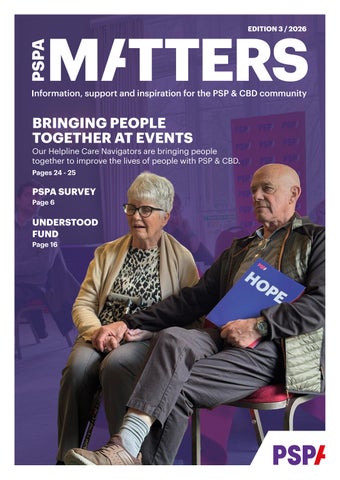
BRINGING PEOPLE TOGETHER AT EVENTS
Our Helpline Care Navigators are bringing people together to improve the lives of people with PSP & CBD. Pages 24 - 25
PSPA SURVEY
Page 6
UNDERSTOOD FUND
Page 16
HELPLINE CARE NAVIGATORS
HERE FOR YOU Our Helpline Care Navigators are here to support everyone affected by PSP & CBD. Each Helpline Care Navigator has a designated area (see map) where they provide proactive support, including: • Information on all aspects of living with PSP & CBD, such as symptom management, benefits and entitlements and everyday living • Emotional and practical support • Contact details for local support, which may include Support Groups • Information about how PSPA can support you • Information about health and social care and how to access these services • Signposting to other sources of information • Referral for non-means tested benefits applications via Department of Work and Pensions (DWP) home visiting service • Supporting evidence about PSP & CBD for Blue Badge applications and Continuing Healthcare applications
AMANDA POTTAYYA
• Provide specific information written for health and social care professionals and access to Education Volunteers.
ALEXANDREA WUSU
Our Helpline and information service is available Monday to Friday 9am to 9pm. Tel: 0300 0110 122 or email helpline@pspassociation.org.uk
DEB RUDDOCK DIONNE WARD
PSPA Margaret Powell House, 415a Midsummer Boulevard, Milton Keynes, MK9 3BN Registered charity number England and Wales 1037087 and Scotland SCO41199.
2
HELPLINE 0300 0110 122
KAYSHA MARLOW
WELCOME TO PSPA MATTERS
WHY YOU MATTER Hello and welcome to our new look magazine! We hope you like the new design and a massive thank you to everyone from our community who worked with us to improve the magazine. It’s important to us that we create a magazine that’s engaging and informative. Recently we received our Investing in Volunteers accreditation. The accreditation recognises the incredible work of our volunteers and once again shows that we provide high standards of support.
by Dr James Cusack Chief Executive
to announce, we have already raised more than £84,000 through the virtual challenge and are confident, thanks to your efforts, we will reach our target of £100,000. In the magazine I’ve written a piece on our new strategy on page 32, setting out why our brilliant community is a core part of who we are and why we will be becoming bolder and more focused as an organisation. I’m now nine months into the role, and while I am so proud of the support we provide, I want us to go further to improve health and social care for our community, and to ensure that we are kickstarting more research that will find us the new treatments and diagnostics that our community desperately need.
Also, our amazing community has come together and walked the Pathway to Progress over the summer. We are pleased
Edition 3 / 2026
INSIDE THIS EDITION 4
PSPA News
31
6
PSPA Survey
32 Building Our Next Chapter
9
The Power Of Your Stories
34 Passing The Baton
Masterclass
12 Understanding Depression, Anxiety And Apathy
36 Remembering My Vivienne
15
Make Your Free Will
16
Understood Grants
38 Thank You
20 Creating Hope 22 Miles Walked And Pounds Raised 24 Helpline Care Navigators 26 Community Taking Action 28 Improving Diagnosis
37 In Loving Memory 39 Christmas Order Form READ & LISTEN ONLINE Scan the QR code to read and listen to PSPA Matters articles online.
3
PSPA NEWS NEW LOOK PSPA MATTERS We’ve given PSPA Matters a new look, shaped by feedback from people affected by PSP & CBD. The font is bigger, the amount of text has been reduced and sections are colour coded to make the magazine easier to navigate. We’ve also made it clearer when an article continues across multiple pages. These changes are to make PSPA Matters more accessible and ensure people affected by PSP & CBD have the knowledge needed to live as well as possible with both conditions.
The cost of one cup of coffee could turn a small daily expense into POWERFUL CLARITY
REGULAR GIVERS MAKING A MONTHLY DIFFERENCE Our regular givers are making a real difference to people affected by PSP & CBD. As of July 2026, 369 supporters are giving regularly each month, helping us raise an incredible £48,280 so far this year. Regular giving provides us with a reliable source of income, helping us continue to develop our trusted information guides and run our Helpline.
Give £3 a month to help provide Red Flag information to help GPs diagnose PSP or CBD faster.
READ MORE Scan the QR code to visit our Regular Giving webpage
PSPA is a registered charity in England and Wales (1037087) and in Scotland (SC041199).
THANK YOU TEAM PSPA We’d like to thank our 24 PSPA runners who completed this year’s Great North Run. At time of print, together, they had raised over £10,000. An incredible achievement! We’re hoping to have the largest ever Team PSPA at next year’s event. We are looking to secure even more charity places, and we encourage all those interested to sign up for the ballot reminder and enter when it opens as well. Watch this space!
4
LET US KNOW WHAT YOU THINK!
OVER £10,000 RAISED!
SO FAR THIS YEAR WE’VE RAISED £48,280
PSPA NEWS
NEW PODCAST AVAILABLE!
NEW PODCAST ON FOOD AND NUTRITION The latest episode of our PSPA Podcast explores food and nutrition for people living with PSP & CBD. The episode features Rhiannon Hinstridge, Lead Dietitian for Neurology at Hertfordshire Community NHS Trust, who discusses how digestion can change as PSP & CBD progress, as well as changes to swallowing, what varying textures of food mean, and tube feeding. Listen to the latest episode, along with previous episodes on our website or by searching for PSPA Podcast on Spotify. LISTEN ONLINE Scan the QR code to access our podcasts on the PSPA website.
RHIANNON HINSTRIDGE
LISA SHORTLISTED FOR CARER OF THE YEAR AWARD Congratulations to Lisa Silcock, whose nomination for Carer of the Year at the Carers UK annual awards has been shortlisted. Lisa and her husband Colin will attend the awards ceremony in October. A huge congratulations to Lisa on this fantastic achievement and we wish her the very best of luck for the awards ceremony.
GOOD LUCK LISA! LISA WITH HER HUSBAND COLIN
5
SURVEY REVEALS IMPACT OF PSP & CBD PSPA’s Survey Report findings reveal the impact of PSP & CBD, from delayed diagnosis to daily struggles and caring pressures.
Our latest survey, completed by 650 people affected by PSP or CBD, reveals a stark picture of delayed diagnosis, fragmented care and growing pressure on families. The findings show that 67% of people waited two years or more for an accurate diagnosis, while 58% were initially misdiagnosed with another condition.
6
One in three turned to private healthcare in the hope of getting answers sooner. The survey also highlights how profoundly PSP & CBD affect everyday life. Nine in ten respondents said they had lost independence because of their condition. Yet coordinated support remains inconsistent.
AWARENESS
Only 38% of respondents said they had a named healthcare professional coordinating their care, while 36% said they would like one but did not have one. For families this can mean repeating their story to multiple professionals, chasing referrals and trying to anticipate needs before a crisis arrives. The emotional and financial impact is equally significant. Six in ten people living with PSP or CBD said they regularly experience depression, anxiety, frustration or stress linked to their condition. Nearly two-thirds reported new costs associated with their illness, including equipment, home adaptations, travel and care.
6 in 10 people living with PSP or CBD said they regularly experience depression, anxiety, frustration or stress linked to their condition.
As PSP & CBD progress, the pressure intensifies. Among people diagnosed three to five years ago, 84% said the impact on their life was severe and 75% said every day was challenging. The effect on carers is also considerable. Our survey found that 63% of carers provide 50 hours or more of care each week, while 75% said caring had negatively affected their own wellbeing. Nearly half had not received a Carer’s Assessment from their local authority. For Jane, these findings reflect her own experience of PSP. When Jane first began to experience unexplained falls, her GP referred her to Ear, Nose and Throat specialists, then Podiatry, and later to Neurology when professionals suspected Parkinson’s. Each time she was referred to a new service, she faced a waiting time of around seven months.
CONTINUE READING THIS ARTICLE ON THE NEXT PAGE...
7
AWARENESS Frustrated by the delays, Jane decided to seek a private consultation. She secured an appointment with a private neurologist within a week, a stark contrast to her previous NHS waits. In 2025 she was diagnosed with Parkinson’s and, at first, felt hopeful that medication might help her regain some of the independence she had lost. But the treatment made no difference. After 18 months of uncertainty, referrals and further investigations, Jane was finally diagnosed with PSP in February 2026. “It’s quite a frightening diagnosis to receive, especially when you live alone,” she says. “Within a relatively short period of time, I’ve gone from being very independent and active to relying on family and friends for support.”
One of the hardest losses has been giving up the freedom to enjoy her daily walks. After her husband died, walking had become therapy, a reason to get out and talk to people. Now, she says, there are days when the sun is shining but she cannot go out without help. “Adapting to needing support with so many parts of my life is difficult,” Jane says. “And knowing there isn’t anything that can improve my condition, it’s a lot to take in and deal with alone.” Our survey highlights the urgent need for action. We are calling for faster and more accurate diagnosis, better coordinated care, stronger mental health and financial support, earlier planning as needs progress, and greater recognition and support for carers.
67%
58%
1 in 3
waited two years or more for an accurate diagnosis.
were initially misdiagnosed.
turned to private healthcare to help secure a diagnosis.
9 in 10
38%
84%
experienced a loss of independence.
have a named healthcare professional coordinating their care.
of people diagnosed three to five years ago said the impact on their life was severe.
65%
63%
75%
reported new costs related to PSP or CBD.
of carers provide 50 hours or more of care each week.
of carers said caring has negatively affected their wellbeing.
JOIN OUR CAMPAIGNING NETWORK Scan the QR code to join our Campaigning Network. Your voice could make a real difference and help people with PSP & CBD get the timely, joined-up support they deserve. 8
PERSONAL EXPERIENCE
THE POWER OF YOUR STORIES By sharing their experiences, people affected by PSP & CBD are helping to raise awareness and strengthen the call for better support.
JOHN MANITARA WITH HIS WIFE GILLY
PSP & CBD Awareness Week is an opportunity to shine a light on two little-known conditions that have a devastating impact on the lives of those affected. Raising awareness helps more people learn about PSP & CBD, and understand why support for those living with the conditions needs to be improved. Throughout Awareness Week, which ran from 22-28 June, PSPA shared experiences from the PSP & CBD community alongside insights from our third annual survey, published as part of the new State of PSP & CBD report. The findings, featured on page 6, give a clear picture of the challenges people face today.
Statistics are vital because they show the scale of the issue. They help politicians see patterns, gaps and inequalities. But stories make people realise the true impact of both conditions, not just on the person diagnosed, but on their carers and loved ones too. By sharing their story, John and Gilly Manitara helped to build understanding of PSP. CONTINUE READING THIS ARTICLE ON THE NEXT PAGE...
9
JOHN CHOSE TO SPEAK PUBLICLY TO IMPROVE UNDERSTANDING OF PSP AND HIGHLIGHT MANY OF THE CHALLENGES FACED BY FAMILIES.
JOHN AND GILLY AT A BUCKINGHAM PALACE GARDEN PARTY AS GUESTS OF PSPA
Their story was first featured in the media in May, with further coverage continuing during and after PSP & CBD Awareness Week. Alongside caring for his wife, Gilly, and running two youth charities full-time, John took part in interviews with The Mirror, The Sun, OK Magazine, BBC Look East, BBC Essex Radio, BBC Five Live and BBC Online. Each feature introduced thousands of people to a condition they may never have heard of and helped them understand what life with PSP is really like. John chose to speak publicly to improve understanding of PSP and highlight many of the challenges faced by families, from delays in diagnosis to the struggle to access equipment, benefits and care. John and Gilly met at university and have been together for more than 44 years. 10
Like many couples, they had imagined a different future. They had raised their family, watched their children build lives of their own, and looked forward to travelling and enjoying retirement abroad. But in 2023, after Gilly began experiencing personality changes and frequent falls, she was diagnosed with PSP at Addenbrooke’s. “We had never heard of the condition before,” John says. “Hearing it was terminal was a shock.” Since then, Gilly’s condition has progressed quickly. She now needs round-the-clock care and has lost much of her speech and mobility. For John, the loss is felt not only in the retirement they had planned, but also in the everyday moments they once shared, like conversations over a cup of tea, daily routines and simply spending time together.
PERSONAL EXPERIENCE His experience reflects many of the issues highlighted in our survey. Families face delays in diagnosis, limited understanding from healthcare professionals and challenges accessing equipment, benefits and care. John describes the administrative burden as “a mountain”, with families forced to chase essential support at precisely the time they most need to focus on each other. “The delays in diagnosis and the constant chasing of services take away the one thing we don’t have enough of, time,” he says. “Every hour spent on the phone chasing a recliner chair or another item of equipment is an hour I could be spending with Gilly.” By sharing their story, John and Gilly have helped thousands more people understand the realities of living with PSP. Awareness doesn’t end when Awareness Week is over. Our work raising awareness continues and is boosted every time someone shares a post, speaks to a journalist, talks to a local group or helps a friend understand what PSP or CBD really means.
By continuing to share these stories, our community can build understanding and help make sure everyone affected by PSP or CBD gets access to the best possible care and support.
VIEW THEIR STORY Watch John and Gilly on our PSPA YouTube channel by scanning this QR code. If you would like to share your experiences of PSP or CBD please email communications@pspassociation.org.uk
11
UNDERSTANDING DEPRESSION, Dr Susan O’Connell is a Clinical ANXIETY AND Psychologist specialising in movement disorders. Here, she shares how she APATHY supports people and their families. “Part of my role is working alongside our multidisciplinary team to help develop our atypical movement disorders clinic to better meet the needs of people with complex conditions. DR SUSAN O’CONNELL Patients with atypical Parkinsonian disorders, such as PSP & CBD, really benefit from a multidisciplinary approach, and the clinic allows us to provide more coordinated care.
“The assessment can provide an opportunity to talk through any cognitive symptoms the person or their family have noticed and explain how these relate to the diagnosis. Answering the question of why these changes are happening can be incredibly reassuring for families and helps them make sense of what they are experiencing. From there, we can work together to develop practical strategies that minimise the impact of cognitive changes on everyday life and help both the person and their family feel more prepared and supported.
“The second part involves supporting people who already have a confirmed diagnosis of PSP or CBD. My role here can be varied. I might assess their cognitive abilities to establish a baseline and identify any areas of difficulty. This helps us understand how their thinking, memory or behaviour may be affected now and how this may change over time.
whereas anxiety is often driven by fear. Both are understandable responses to the huge changes people experience, but it’s important people know they don’t have to tolerate these feelings as part of their condition. Support is available.
“I also provide psychological support. A diagnosis of PSP or CBD can lead to significant changes to people’s lives. There is the physical impact of the condition, but there is also the emotional adjustment of living with a diagnosis that can affect “There are two aspects to my role within our people’s independence, relationships, clinic. The first is supporting the diagnostic process. Sometimes there’s uncertainty about work and identity. exactly which condition a person has. I may “Depression and anxiety can be part of the be asked to carry out a cognitive assessment condition itself because of changes in the to help the neurologist build a clearer picture brain, but they can also develop as people of the person’s symptoms and contribute to adjust to the impact of their diagnosis. making an accurate diagnosis. Depression is often linked to a sense of loss,
12
INFORMATION AND SUPPORT
“A big part of my role is helping people and their families develop an understanding of what is happening. Every person is different. Two people may both have anxiety, but the reasons behind it may be completely different, so the support we offer needs to be individualised. “Psychological therapies can include approaches such as cognitive behavioural therapy, but this is not always the best fit for everyone. With PSP & CBD, people are often dealing with very real losses that cannot simply be challenged or changed. Compassion-focused or values-based approaches can be particularly useful because people can develop strategies to help them respond to difficult emotions and experiences.
“It’s also important to recognise the difference between apathy and depression. Apathy is a very common non-motor symptom, particularly in PSP, and it can have a huge impact on the person and those around them. It is not that someone does not care anymore or is choosing not to engage. The changes happening in the brain can affect motivation, initiation and drive. It differs from depression because someone who is apathetic, does not have a mood disorder. “Families can find apathy particularly difficult because it can feel personal. They may think ‘they don’t want to do things with me anymore’ or ‘they don’t care’, and that can create frustration and distress within relationships. Helping families understand that apathy is a symptom, rather than a choice, can make a real difference.
“A BIG PART OF MY ROLE IS HELPING PEOPLE AND THEIR FAMILIES DEVELOP AN UNDERSTANDING OF WHAT IS HAPPENING. EVERY PERSON IS DIFFERENT.”
CONTINUE READING THIS ARTICLE ON THE NEXT PAGE...
13
INFORMATION AND SUPPORT
“Once families understand what is happening, we can look at practical strategies. Instead of asking ‘Do you want to go for a walk?’ which requires someone to initiate the activity, it may be more helpful to provide structure and prompts: ‘Let’s go for a walk at 10 o’clock.’ Creating routines and external cues can help when apathy is present and motivation lowers. “Looking after mental wellbeing does not always require big changes. When something significant happens, people often think they need a big solution, but sometimes returning to the basics is really important. Are you sleeping as well as you can? Are you eating properly? Is pain being managed? Are there things you used to enjoy that you have stopped doing? “People may need to adapt old coping strategies. Someone may no longer be able to go for a run, but perhaps they can still get outside for fresh air or have time to
themselves. It is about understanding what that activity gave them – was it social connection, relaxation or a sense of achievement? Then we can look for new ways to meet that need. “I would always encourage people to talk about their emotional wellbeing with their healthcare team. Anxiety, low mood and changes in motivation are important parts of the overall picture, and your medical team wants to understand how you are coping. “Families and carers are also an important part of this support. Helping them understand cognitive changes, apathy and emotional changes means they can provide the right support and become part of the solution. “There is no one-size-fits-all approach. My role is about listening, understanding each person’s experience and working together to find strategies that help them and their families live as well as possible.”
DR O’CONNELL’S TIPS FOR MANAGING MENTAL WELLBEING • Talk about how you are feeling. • Don’t be afraid to raise anxiety, low mood or changes in motivation with your healthcare team. • Understand the ‘why’. • Knowing why symptoms are happening can reduce frustration and help you find the right strategies. • Keep doing what matters to you. • Adapt activities where needed, rather than giving up the things that bring enjoyment or connection. • Focus on the basics.
14
• Sleep, nutrition, pain management and social contact all play an important role in wellbeing. • Remember apathy is a symptom. • A lack of motivation is not the same as not caring. Understanding this can help reduce frustration for both the person and their family. • Involve your family and carers. • Sharing information and strategies helps everyone understand the changes and work together.
FUNDRAISING
MAKE YOUR FREE WILL THIS AUTUMN Once you have looked after your family and friends, leaving a gift in your Will can be a powerful way to leave a lasting legacy.
Gifts left by supporters help ensure people living with PSP & CBD can access practical and emotional support, while also enabling PSPA to invest in vital research. This autumn, our supporters can make or update a simple* Will for free through our partnership with the National Free Wills Network. From September to November, you can arrange an appointment with a participating local solicitor. There’s no obligation to leave a gift to PSPA, but once you have taken care of those closest to you, we hope you might consider remembering PSPA in your Will. Last year, gifts to PSPA helped us to provide 314 support group meetings, 9,984 Helpline calls, dedicated education sessions to 1,032 healthcare professionals and funded various research projects to advance our understanding of PSP & CBD. Janet Cameron decided to leave a gift in her Will following her brother’s diagnosis of PSP. She said: “It’s a comfort to know that my gift will help fund vital research. I hope that people diagnosed in the future are given more treatment options and therefore more hope than my brother had.”
WHAT COULD YOUR GIFT ACHIEVE? £300 could provide a carer with a one-off grant to help them access respite or support so they stay connected to their family, friends and interests. £1,000 could fund vital counselling for a carer in crisis, helping them process their feelings and build resilience for the future. £10,000 could help to fund approximately 20 MRI scans to aid research designed to improve faster diagnosis. £30,000 could help a research assistant use early findings to deliver a year long study that supports the development of national care standards for PSP & CBD.
WRITE YOUR WILL FOR FREE IN THREE SIMPLE STEPS 1. S can the QR code to request your Free Wills Pack, or call 01327 322414 2. Choose your preferred solicitor from the list and arrange an appointment. 3. Meet with your solicitor to write or update your simple single or mirror Will.
* This free Will-writing offer applies to simple single or mirror Wills. If your Will is more complex, your chosen solicitor will explain any possible costs to you in advance, so there are no unexpected charges. For full details of our Will-writing offer visit www.pspassociation.org.uk/fundraising/legacy
15
"PSPA’S GRANT IS ENABLING US TO COLLECT BIOLOGICAL SAMPLES FROM PEOPLE AT THESE VERY EARLY STAGES."
PROFESSOR HUW MORRIS
UNDERSTOOD GRANTS POWERING PSP & CBD RESEARCH Our two largest Understood grants have been awarded to Professor Karen Duff and Professor Huw Morris, both at UCL. Here they talk about how the grants are supporting their research.
16
BUILDING THE FOUNDATIONS FOR EARLIER DIAGNOSIS Professor Huw Morris, Professor of Neurology and Neurogenetics at UCL, has spent more than a decade leading research to improve the diagnosis of PSP and related conditions. With support from PSPA’s Understood Fund, his latest project is helping to build the foundations for earlier diagnosis and more effective clinical trials. “Over the last 11 years, through PROSPECT we’ve learned a great deal, but people are still being diagnosed far too late. By the time people receive a diagnosis, the disease has already progressed significantly. “New treatments are more likely to be effective if we can identify and recruit people to trials earlier. If we want future clinical
RESEARCH
PROFESSOR HUW MORRIS
trials to slow or stop disease progression, we probably need to recruit people earlier in the course of their condition. “Thanks to pilot funding from the Medical Research Council, we’ve launched the ExPRESS study, which aims to create a network that can identify people with PSP and related conditions much earlier. Through this programme, we’ve continued working with more than 20 PROSPECT sites across the UK and are recruiting people when they first come into contact with specialist services or within a year of diagnosis. We’re also including people whose diagnosis is still uncertain because understanding those early stages is incredibly important. “PSPA’s grant is enabling us to collect biological samples from people at these very
early stages. We’re analysing blood samples by separating the different components and looking for chemicals and proteins that could act as biomarkers. We are also taking spinal fluid from patients so that we can study the fluid that circulates around the brain and spinal cord. “By analysing both blood and spinal fluid, we hope to identify biological markers that will allow us to diagnose PSP & CBD earlier and with much greater accuracy. That’s exactly what this funding is helping us achieve by supporting the development of new technologies. CONTINUE READING THIS ARTICLE ON THE NEXT PAGE...
17
“Some of these technologies allow us to analyse hundreds or even thousands of proteins at the same time. Different neurological conditions have distinct protein patterns. Those patterns create a kind of biological fingerprint that could help us distinguish between these conditions much earlier than we can today.
“There are several steps involved. First, we need to identify molecules that can act as this glue. To do that, we study the structure of both TRIM11 and tau. Using molecular modelling, we can see how the proteins fit together and identify where a small molecule might help them bind more tightly and for longer.
“Within the next two years, we hope to have a much clearer picture of the protein signatures associated with PSP. We believe these discoveries could be incorporated into clinical trials from 2028 onwards. A lot of research is exploratory, but this work has real potential to make a difference in the relatively near future.
“This work is being carried out in collaboration with drug discovery experts who have extensive experience in turning laboratory discoveries into real treatments. Their expertise is helping us identify potential molecules and optimise them so that one day they could become therapies for patients.
“Ultimately, what everyone wants is a treatment that stops these diseases from getting worse. We hope this research will become one important piece of the jigsaw that helps make that possible.” HARNESSING THE BRAIN’S OWN DEFENCES AGAINST PSP With funding from PSPA, Professor Karen Duff and her team are developing an innovative approach to remove tau and slow disease progression, as she explains here. “Our research is focused on getting rid of the toxic tau protein that causes PSP. We’ve been working on a system that already exists in the brain. It involves a protein called TRIM11, which can help remove harmful proteins. We know that TRIM11 can break down toxic tau, but what we need to do now is boost its activity and make it much more effective. “With PSPA funding, we want to create what is known as a ‘molecular glue’ that encourages TRIM11 and tau to come together more often. The more frequently they interact, the better chance TRIM11 has of destroying the toxic tau and clearing it from neurons.
18
“Once we have candidate molecules, we test them using techniques that allow us to visualise exactly how TRIM11 and tau interact. This helps us refine and improve the molecular glue until we have the strongest and most effective version possible. “Once this project is complete, the next stage is to test these optimised molecules in human neuron cultures and then in mouse models of PSP. This will tell us whether the approach works in living systems and whether it can successfully remove tau from the brain. Although this is a new strategy, similar approaches have already shown promise in other diseases. “Within the next two to three years, we expect to know whether this approach is effective in our model systems. Moving into patient trials will require pharmaceutical partners, but we are already seeing strong interest from them which is encouraging.”
RESEARCH
“ULTIMATELY, PROGRESS DEPENDS ON THE ENTIRE PSP COMMUNITY. RESEARCHERS, CLINICIANS, CHARITIES AND, CRUCIALLY, PEOPLE LIVING WITH PSP ALL HAVE A ROLE TO PLAY."
PROFESSOR KAREN DUFF SPEAKING AT THE TAU GLOBAL CONFERENCE
Photo courtesy of Paul Clarke
19
CREATING HOPE THROUGH RESEARCH, FUNDRAISING AND AWARENESS Living with PSP has shrunk Rona Stewart’s physical world, but she’s found a new purpose by taking part in research, as she explains.
“I can no longer do anything for myself and rely entirely on my husband, Glenn, who has become my full-time carer, alongside my family and homecare nurses. “As my physical world has shrunk, it’s perhaps strange to say, that my purpose has grown. Over the last six months, through a combination of taking part in research, appearing on national TV, and a wonderfully stubborn community effort, we’ve managed to raise £8,400 for PSPA, with the final total expected to reach almost £10,000. “My PSP journey began in 2020. I started having trouble with my speech, and my balance began to fail. I’m sure many people who saw me stumble thought I’d simply had one or two too many gin and tonics! “It took three years of continuous tests, scans, and uncertainty to get a real answer. Finally, just a few days before Christmas in 2023, I was told it’s 100% PSP. Hearing those words was difficult. Neither Glenn nor I had ever even heard of PSP. But alongside the shock, there was a strange sense of relief. We finally had a name for the monster. “Driven by my own desire to help find a cure, I registered with Neuro CARE at The Anne 20
RONA AND GLENN
Rowling Regenerative Neurology Clinic in Edinburgh, a state-of-the-art facility founded by J.K. Rowling in memory of her mother. “Researchers collected several vials of my blood to study the pathology of the disease. Through the study, my consultant, Dr. Breen, and Professor Tara Spires Jones published a major scientific breakthrough showing exactly how PSP damages the brain. Their study proved that a toxic, oligomeric version of a protein called TAU directly invades and destroys synapses, the vital communication links between brain cells. “Because of my participation in this research, Dr. Breen asked me to be interviewed on STV News. The reporters and film crew spent an hour and a half at my home recording. It was a daunting experience, but luckily, they only needed one take! “Seeing myself on TV was surreal, but the impact was immediate. Not only did it broadcast the reality of PSP to households across Scotland, but it also rekindled contact with several long-lost friends. “With the momentum from the TV broadcast, Glenn and our children, Cara and Ben, encouraged me to open a JustGiving page
PERSONAL EXPERIENCE
to raise funds for PSPA. The charity has been our absolute lifeline. Early on, Glenn’s online research led him to the Helpline Care Navigator in Scotland, who guided us through the darkest initial days. PSPA’s East Central Scotland Support Group provided one-on-one befriending, and we received outstanding support from the NHS and my local hospice. And now we all felt that it was our time to give something back. “Unexpectedly, after we emailed our connections, people rallied around. Donations poured in online from family, friends, and their wider networks. But the fundraising really took on a life of its own through local, hands-on kindness. “In November 2025, a dear friend invited me and Glenn to share a stall she was running at a Christmas Fair at St Kentigern’s Church
in Parkgrove, Edinburgh. She was selling beautiful, hand-crocheted items. “Because it was short notice, we couldn’t get official PSPA banners in time. Glenn saved the day by crafting a brilliant, makeshift banner using art supplies and a Tesco paper tablecloth. The community’s generosity was overwhelming. That single afternoon raised over £600 plus Gift Aid. “I know I cannot change my diagnosis, but together, as a community, we can help to change the future for the next person who sits in a clinic waiting for answers. Your support and your donations fund the research needed to help establish diagnostic tools and work towards a treatment that could potentially slow the progression of PSP. “Thank you for standing with me, for listening to my story, and for helping us fight PSP.”
“I KNOW I CANNOT CHANGE MY DIAGNOSIS, BUT TOGETHER, AS A COMMUNITY, WE CAN HELP TO CHANGE THE FUTURE FOR THE NEXT PERSON WHO SITS IN A CLINIC WAITING FOR ANSWERS.” RONA AND GLENN ON HOLIDAY
21
MILES WALKED AND POUNDS RAISED FOR PATHWAY TO PROGRESS
Over twenty events, hundreds of miles travelled and thousands of pounds raised from this year’s Pathway to Progress. Our Pathway to Progress challenge has brought the PSP & CBD community to walk, run and cycle in support of PSPA. So far, supporters have organised 24 events raising an incredible £40,000, with more events still to take place. Once again, our generous donor will match every pound raised up to £40,000, meaning our true total stands at over £80,000. This money will enable PSPA to continue providing vital support, information and funding research next year. Here, two supporters share why they wanted to be part of Pathway to Progress.
WALKING FOR SARAH In honour of her close friend Sarah, who is living with CBD, Isabel Jones walked 65 miles in May, raising £1,300. “Sarah is one of my oldest friends. When Sarah was diagnosed in 2022, we didn’t know anything about CBD. Learning about it also meant learning about PSPA. Sarah and I attend the monthly support calls. It’s been good for Sarah to connect with other people in similar situations. “Through the website and the support calls, I heard about the Pathway to Progress challenge. What I liked about the challenge was that people could set their own goal. My niece suggested walking 65 miles during May because Sarah and I both turn 65 this year. It felt like the perfect number. “Throughout May, I walked my miles wherever I could fit them in, before work, during lunch breaks, or in the evenings. When I went on holiday to Italy, I clocked up some miles there
22
ISABEL WITH HER FRIEND SARAH
too. Every time I felt tired or didn’t want to go out, I thought about Sarah and reminded myself why I was doing it. Watching her decline is difficult, especially knowing things will get harder. How Sarah has dealt with it is incredible. She really is amazing.”
FUNDRAISING
POWERED BY PATHWAY TO PROGRESS... CARERS SUPPORT GROUPS
AWARENESS AND EDUCATION
HELPLINE CARE NAVIGATORS
PSPA MATTERS MAGAZINE
Raising £10,000 could help us to reduce isolation and increase support for carers with regular support groups and information each year.
Raising £20,000 could help us to improve awareness and understanding of PSP & CBD with campaigns and education for healthcare professionals.
Raising £30,000 can help to provide tailored support and information for a year via one of our Regional Helpline Care Navigators.
Raising £40,000 could help to keep members of the PSP & CBD community connected and informed with four copies of PSPA Matters each year.
I DID IT FOR DAD For Louise McLeod, taking part in Pathway to Progress was a way of supporting the charity that has helped her family since her dad was diagnosed with PSP. She challenged herself to walk 100 miles during May and finished the month having completed 106 miles, raising more than £1,300.
LOUISE WITH HER DAD
“Dad has no mobility, carers come in four times a day, and he doesn’t speak. It’s been especially tough for Mum who cares for him. PSPA has been a great help, so I wanted to do some fundraising. I also feel this condition needs more awareness to receive more funding for research. “When I read about Pathway to Progress, I thought this is something I can fit around work and family life. I decided to commit to 100 miles in May. At first, I wondered if I’d manage it, but the walks became a nice part of my day where I could escape from daily life. “Most of my walks were with our dog, Belle. We explored the beaches, harbour and beautiful countryside around Aberdeenshire. She was a tired dog by the end of the month. I couldn’t believe I raised over £1,200. On my final walk, I put on my PSPA t-shirt and finished at Mum and Dad’s house. Dad smiled when I got there. He doesn’t often smile anymore so that felt very emotional. It felt like the perfect way to finish.” 23
HELPLINE CARE NAVIGATORS BRINGING PEOPLE TOGETHER Our Helpline Care Navigators are bringing people together through awareness events, sharing knowledge and helping to improve access to specialist care for people with PSP & CBD. specialist PSP & CBD clinics, one in Newport, led by Dr Alistair Church, and another in Swansea, led by Dr Richard Bevan-Jones. These clinics are an important step towards improving access to specialist care closer to home.
DIONNE WARD
Here, Dionne Ward in Wales and Amanda Pottayya in Scotland share what they’ve been working on over the past few months.
“Another recent highlight was hosting our first PSPA Wales Awareness Day with an amazing team of volunteers. The event brought together families, clinicians and Health and Social Care Professionals (HSCPs) to share knowledge, hear from expert speakers and strengthen the growing network of support across Wales. We’ve already seen an increase in referrals to PSPA, and I hope that’s a reflection of the awareness we’re continuing to build.”
INSPIRED BY PEOPLE WITH PSP & CBD Dionne said: “Meeting people with PSP & CBD has inspired me to do something a little out of the ordinary. Every conversation reminds me why our work matters so much, so I decided to take on a fundraising challenge that’s definitely outside my comfort zone, bog snorkelling! It’s something I never imagined I’d be doing, but I can’t think of a better cause to be getting wet and muddy for! “Back to my job, I’m continuing to raise awareness of PSP & CBD across Wales and work alongside NHS colleagues to improve support for families. I’ve helped establish two
24
AWARENESS EVENT IN SCOTLAND
INFORMATION AND SUPPORT
UNIVERSITY OF EDINBURGH LABORATORY TRIP
AMANDA POTTAYYA
“IN JUNE, WE JOINED A SMALL GROUP OF SUPPORTERS FOR A FASCINATING VISIT TO TWO LABORATORIES AT THE UNIVERSITY OF EDINBURGH.”
STRENGTHENING SUPPORT THROUGH COLLABORATION IN SCOTLAND Amanda said: “One of my priorities has been supporting specialist atypical Parkinsonism clinics as well as joining multidisciplinary team meetings to ensure PSPA remains part of each person’s support network. “In June, we joined a small group of supporters for a fascinating visit to two laboratories at the University of Edinburgh. One was led by Dr Kat Bowles whose work focuses on growing different brain cells that contain tau. We saw how these cells are used to test thousands of different existing drug compounds to see if they can rescue any of the connections between cells that are affected in PSP & CBD. We also visited the Brain Bank and learned how vital brain donation is.
“The next day we held our second Scotland Awareness Day in Stirling, bringing together families, volunteers, researchers and HSCPs. The event highlighted the differences in access to services across Scotland and reinforced how important it is that we continue working together to reduce inequalities in care. Alongside these larger events, I’m developing relationships with HSCPs across the Lothians, delivering education sessions and exploring opportunities for another collaborative clinic. Our online support group also continues to grow, with members telling us how valuable it is to connect with others who truly understand.”
25
COMMUNITY TAKING ACTION Across the country, our PSPA community are taking action to raise money to support people affected by PSP & CBD and invest in research. Every fundraiser, big or small, makes a difference. For many, fundraising is a way of taking action after the diagnosis of someone they love.
SUE AND SANDRA’S GOLFING FRIENDS STEP UP
SUE AND SANDRA’S GOLFING COMMUNITY Friends Sue and Sandra decided to take action when Sue’s husband Ian was diagnosed with PSP. Sue said: “When my husband Ian was diagnosed, I shared the news with my friends at Fairfield Golf Club. Sandra had just become Lady Captain and asked if she could choose PSPA as her Charity of the Year. “Together we organised raffles, auctions, garden parties, handmade golf shoe bags and even a Stars in Their Eyes evening. I was so pleased Sandra chose PSPA because, through all that fundraising, so many more people now understand the challenges faced by people living with PSP and those who care for them.” 26
SISTERS EMILY AND HARRIET’S FUNDRAISING EVENING
EMILY AND HARRIET’S CREATIVE COMMUNITY “When our dad was diagnosed with PSP there was a feeling of helplessness. Fundraising gave my sister and I something positive to focus on. We’re a creative family living in a wonderful community of artists and makers, so we decided to play to our strengths. We organised a raffle and were blown away by the generosity of local independent creatives who donated incredible prizes. “We brought everyone together for an evening with food, music and lots of conversation. The intention was to create a relaxed and fun environment where Dad could spend time with some of his best friends. To see Dad enjoying himself was very special.”
INFORMATION AND SUPPORT
ED’S QUIZ FOR JANE “When Jane was diagnosed with PSP, we wanted to do something for her. A friend mentioned organising a quiz. Local families and businesses donated towards the meal, as well as prizes for the quiz. Thanks to ticket sales and donations from friends and family, we’ve raised an amazing £37,800 for PSPA.” The quiz also launched a summer of sporting challenges for the family. Ed and Jane’s son Ollie is running the Manchester Marathon, and his brother Toby is taking on a half marathon, while Ed will be completing 22 holes of golf. Ed said: “The challenges are our way of doing something for Jane and raising awareness of this horrible condition.”
JANE, OLLIE AND TOBY
CERI’S BIG BEDFORD SWISH “PSPA has been an incredible source of support for our family since my dad was diagnosed with PSP, so I wanted to do something for the charity. Rather than simply asking people to donate money, I wanted to create an event where people could have fun, meet new people and leave with something they loved while supporting an important cause. “The Big Bedford Swish brought together hundreds of donated clothes, shoes and accessories, and raffle prizes from local businesses. Seeing so many people come together to support PSPA, was incredibly moving.”
CERI’S CLOTHES SWISH
MAKING A DIFFERENCE Thank you to everyone who has organised an event, taken on a challenge or supported a fundraiser. Every pound raised and every conversation started helps make a difference for people living with PSP & CBD. If you would like to organise a fundraising activity, email fundraising@pspassociation.org.uk
27
IMPROVING DIAGNOSIS Research coordinator and PhD student Riona Giulia Fumi shares how her research is aimed at improving diagnosis for people with PSP & CBD.
"A MAJOR FOCUS OF MY PHD IS UNDERSTANDING WHY THESE CONDITIONS ARE SO OFTEN MISDIAGNOSED. MANY PATIENTS INITIALLY PRESENT WITH SYMPTOMS THAT OVERLAP WITH PARKINSON'S DISEASE."
28
RESEARCH
“For the past four years, I’ve worked as Research Coordinator for the PROSPECT study, working with a dataset of more than 1,900 participants and gaining invaluable research experience. Alongside this role, I’m completing a PhD under Professor Huw Morris, focusing on improving the early and accurate diagnosis of PSP & CBD. “A major focus of my PhD is understanding why these conditions are so often misdiagnosed. Many patients initially present with symptoms that overlap with Parkinson's disease, making it difficult to distinguish atypical Parkinsonian disorders like PSP & CBD in the early stages. Unfortunately, this often means people face years of uncertainty before receiving the correct diagnosis. “One of my PhD projects examines the first 100 participants in the PROSPECT study who have pathological confirmation of their diagnosis following brain donation and post-mortem examination. Pathological confirmation is considered the gold standard for diagnosis, allowing us to accurately assess how well clinical diagnoses matched the underlying disease. “Using the PROSPECT data, I investigated how diagnoses changed over time. We looked at patients' first diagnosis, their diagnosis when they entered PROSPECT, their final clinical diagnosis, and finally the pathology-confirmed diagnosis. This allowed us to identify where misdiagnoses occurred and how diagnostic accuracy improved throughout a patient's journey. Understanding this diagnostic pathway is crucial because it highlights where opportunities exist to identify patients earlier. “To explore this further, I used machine learning techniques to identify which clinical features best predicted underlying PSP pathology. By combining demographic information, patientreported symptoms, motor and non-motor scores, and cognitive testing data, we were able to determine which features were most strongly associated with PSP. The goal is to identify practical clinical "red flags" that can help clinicians recognise these conditions sooner. “This work forms an important chapter of my PhD and supports the long-term aims of the PROSPECT study. In the ExPRESS arm, we recruit people within 12 months of attending a hospital appointment related to their parkinsonism symptoms, helping us study the earliest stages of disease. We also provide information about brain donation so participants can learn more about how their contribution could support future research.
CONTINUE READING THIS ARTICLE ON THE NEXT PAGE... 29
RESEARCH “My second major project focuses on patients who are initially diagnosed with Parkinson's disease but are later diagnosed with an atypical Parkinsonian disorder such as PSP & CBD. Using data from two large observational Parkinson's studies, we have investigated which early clinical features and biomarkers predict this diagnostic change. One particularly promising biomarker is neurofilament light chain, a protein that has been shown to be elevated in PSP & CBD compared with Parkinson's disease. “Ultimately, both projects share the same goal to improve earlier and more accurate diagnosis. Earlier diagnosis means earlier access to specialist care, specialist support and clinical trials. Many experimental treatments are most likely to be effective during the early stages of disease, but patients often become diagnosed only after that therapeutic window has passed.
“What motivates me most is the opportunity to work directly with patients and families. Through PROSPECT, I regularly hear about the challenges people face during their diagnostic journey. Those conversations are a constant reminder of why this research matters. Every improvement in diagnosis has the potential to make a meaningful difference to patients' lives. “Thanks to support from the PSPA Understood Fund, we are now expanding both the ExPRESS study, opening new study sites in London, Swansea and Edinburgh and increasing our collection of blood, cerebrospinal fluid and skin biopsy samples. These resources will be essential for developing the next generation of biomarkers and bringing us closer to earlier, more accurate diagnoses for people affected by these rare neurological conditions.”
"EVERY IMPROVEMENT IN DIAGNOSIS HAS THE POTENTIAL TO MAKE A MEANINGFUL DIFFERENCE TO PATIENTS' LIVES."
30
INFORMATION AND SUPPORT
THE IMPORTANCE OF IMPROVED DIAGNOSIS
DENISE HUNT
Former carer Denise Hunt spoke to 125 healthcare professionals at our recent educational masterclass aimed at improving diagnosis for people with PSP & CBD.
BOOK ONLINE Our next Masterclass on communication and swallowing will be online on 7 October at 6:30pm. Scan the QR code to book.
In July we hosted our second online Masterclass of the year, dedicated to deepening healthcare professionals understanding of PSP & CBD and improving the recognition, diagnosis and support that is available to their patients and families. The masterclass featured expert clinical insight from Dr Boyd Ghosh, Consultant Neurologist at the Wessex Neurological Centre, Southampton, alongside the real life experience shared by Denise Hunt. Denise told the professionals about her mum’s delayed diagnosis and the impact it had, not just on her mum but the whole family. Denise said: “For mum, earlier diagnosis would have meant fewer referrals, less appointments and more time for us to spend together. Time that would have enabled us to have built lasting memories before mum’s mobility became too poor and she had to move into a care home to meet her changing needs.
“Sadly mum is no longer with us, but by talking at events like this, I feel I’m part of a collective effort to create a better future for people diagnosed in the future.” During the event, the professionals explored the early clinical indicators of PSP & CBD, and discussed how to distinguish these conditions from other neurodegenerative disorders. The programme also focused on supporting meaningful conversations with patients and families, strengthening referral pathways and promoting multidisciplinary collaboration. The strong turnout and feedback demonstrate the increasing appetite for high-quality education in rare neurological conditions. Events like this play a crucial role in equipping healthcare professionals with the knowledge, confidence and practical skills needed to identify symptoms earlier and support patients more effectively. 31
BUILDING OUR NEXT CHAPTER BY JAMES CUSACK, CHIEF EXECUTIVE
As PSPA’s new CEO, my first big job has been to think about the future of PSPA as our current organisational strategy comes to an end this year.
“WE ARE THE CHARITY THAT IS THERE EVERY STAGE OF THE ILLNESS, MAKING SURE NOBODY FACES PSP OR CBD ALONE. THAT WILL NEVER CHANGE.”
32
OUR STRATEGY
STARTING WITH HONESTY I believe you should always start with the truth. For our community, that picture is stark. PSP & CBD are frequently misdiagnosed or diagnosed far too late or completely missed. Awareness remains low among the public and more worryingly, among health and social care professionals. Social care is in a mess, not just for our community but across the whole of the UK. There are plenty of problems to solve, and we are essential as a charity. It’s not all doom and gloom, though. Since I’ve joined, it has been clear to me that our greatest strength is you: our community, our volunteers, and the human, empathetic way this organisation works. We are the charity that is there every stage of the illness, making sure nobody faces PSP or CBD alone. That will never change. But we also need to look at where we can develop and make progress. That is why we are looking at how we can be bolder, clearer about what we’re trying to achieve, and more deliberate about building the relationships that create change. We are still testing ideas at this stage, but I thought I would share some of our early thinking with you all. Nobody faces PSP or CBD alone. We are looking at how we can strengthen our already fantastic Helpline and support services, deepen our focus on mental health, grow our volunteer community, and do more to advocate for people navigating the system so that going forward we do not just provide support, we unlock it. A bolder voice. We want to improve understanding among the professionals who matter most so more people get the support they need sooner. We are looking at innovative ways of improving regional care, and how we can work in partnership with others to push for better health and social care.
Game-changing science. We do not have enough money to do it all ourselves, but we can act as a catalyst for research: supporting clinical trials, backing the search for a diagnostic biomarker, and finding innovations for care. BEING BOLD, BUT REALISTIC Part of a good strategy is also deciding what not to do. That is hard, because we want to do it all, but realism is key. That is why we won’t try to do everything alone where partnership achieves more. We won’t fund research without a clear route to impact or deliver services that don’t make a meaningful difference to people’s lives. With limited resources, focus is how we make the biggest difference. We also can’t make big promises that we can’t match. That means that we are aiming for sustainable growth, not overnight growth, and a gradual and focused change in awareness and understanding. We also won’t shy away from embracing new tools, including AI, to work more efficiently behind the scenes, but never at the expense of what makes us special – which is our community and the human interactions we have every day.
WHAT HAPPENS NEXT? The strategy is still in development, and I will be looking to engage more with our community, our board and our team, before we share it fully with you all. After all, this strategy belongs to all of us.
33
PASSING THE BATON ON After more than a decade supporting families affected by PSP & CBD in Woking, Trevor Deacon is preparing to step down as a Volunteer Group Coordinator and hopes others will step forward to continue the group.
“WE HAVE ALWAYS BELIEVED ONE OF THE MOST IMPORTANT THINGS THIS GROUP OFFERS IS SUPPORT FOR CARERS.”
The Woking Support Group was set up 11 years ago by Betty Peers after she realised there was no local support available for people affected by PSP. Her husband Steve had received a diagnosis of PSP and the couple were keen to speak to others living with the condition. She said at the time of setting up the group, “After speaking to PSPA, it seemed the main requirements for starting your own local group were finding a venue and the ability to make tea. This I could do I thought. The first meeting of the Woking group was held in the summer of 2015, a year after my husband was diagnosed.”
34
Betty and Steve’s friends, Trevor Deacon and his wife, Dalis, attended the group’s second meeting to support the couple. When Stephen died and Betty stepped back from the group, Trevor took it on, so that people could still access support locally. Now, as he prepares to step down this Christmas, he shares his hopes that the group will continue to run. “My wife, Dalis, and I knew Betty and Steve through our local church. We saw the challenges they faced and the extraordinary strength that caring demanded. We attended the second meeting and have been part of it ever since.
VOLUNTEERING
“Over time, Steve’s condition worsened and eventually he died. Betty continued to run the group for some time after his death, but after years of caring for Steve and then supporting so many others, she felt she needed to focus on a new chapter. When Betty decided to retire, no one came forward to take over. So Dalis and I stepped in. “Apart from Steve, we had no previous experience of PSP, but what quickly became clear was the enormous need there was for families affected by PSP & CBD to get together and share experiences, as it can feel incredibly isolating. “Sometimes the greatest help comes from being in a room with people who understand. The group meets on the first Tuesday afternoon of each month. Sometimes we invite guest speakers. Other times we organise quizzes or simple games designed so everyone can join in, including those living with PSP or CBD.
COULD YOU HELP START A LOCAL SUPPORT GROUP? We’re keen to expand our network of local support groups and, due to growing demand, we’re looking for volunteer Coordinators and Helpers to help establish and run regular meetings in the following areas: • Cambridgeshire • Lincolnshire • Hertfordshire • Northern Ireland • Cardiff and the surrounding area (location can be flexible depending on where volunteers are based) If you are interested in setting up a support group in your local community, please get in touch at volunteering@pspassociation.org.uk
“It’s a great group and we usually get over 30 people at every meeting, and we have wonderful helpers. Outside of the meetings, we have a WhatsApp group where people ask for help and give tips and advice. “But time catches up with all of us. I’m now 80, and both Dalis and I are feeling the impact of age and health challenges. My own health has made it increasingly difficult to plan and coordinate meetings. After much thought, we have decided to continue until Christmas, when I will step down as coordinator. “This decision has not been easy. I really do hope the group continues. We need one or more people willing to take on the coordinator role. There is excellent support available from the PSPA, and Dalis and I are not disappearing. If the group continues, we fully intend to remain involved and help wherever we can.” 35
FUNDRAISING
REMEMBERING MY VIVIENNE When John Tompkins’ beloved wife, Vivienne, died from PSP, he set up a tribute page. Here, John explains why he wanted to do something in her name that would help others. “After 61 years together, it’s been incredibly difficult to get used to Vivienne not being here. I try my best to keep her memory alive and I talk to her regularly. “After Vivienne died in August 2025, my daughter, Rachel, suggested setting up a MuchLoved tribute page. We could share photos and provide space for others to share memories and donate to PSPA. “Vivienne was well known in our community. Everyone rallied around us when she became ill. We had wonderful support from Parkinson’s nurses, carers, family, and neighbours. Sadly, after a fall in July, Vivienne was hospitalised and never returned home. She died with her family by her side on 10 August 2025.
“WE’VE BEEN SO PLEASANTLY SURPRISED BY HOW MANY PEOPLE HAVE ADDED ENTRIES AND DONATED TO HELP RAISE AWARENESS OF PSP IN HER MEMORY. “
36
“We got the MuchLoved tribute page up quickly after her death, hoping we might raise a few hundred pounds around Vivienne’s funeral. We’ve been so pleasantly surprised by how many people have added entries and donated. Currently, we’ve raised more than £5,500. “Our local community support also inspired us to organise a Pathway to Progress event. We’re not done yet. I have a fundraising figure in mind and I’m using every avenue to get there. I regularly sell coins and add those proceeds directly to her tribute page. Plus, we’ve agreed that if we ever get a win on Vivienne’s Premium Bonds, that money is going straight onto her page, too. I will keep writing tributes, raising funds, and sharing her story until we hit our goal.” TRIBUTE FUND Scan the QR code if you would like to honour a loved one and set up a tribute fund like John. Once your tribute page is created, you can share it with family and friends who can add their own memories and make a donation to honour your loved one.
TRIBUTES
IN LOVING MEMORY Our supporters suggested we occasionally include a dedication page in PSPA Matters. Here’s a small selection of dedications from our online Memory Wall, celebrating the lives and memories of loved ones.
ALEC JOHN OLAH We love you and miss you. One of a kind and never forgotten.
LOUISE AVERY In memory of a loving, kind and generous Mam and Wife who was taken far too soon on the 5 February 2026, by this awful condition. She will live on in our hearts. Love and miss you Mam xxx
THOMAS ANTHONY DOYLE So young to have suffered such a cruel disease but you bore it without complaint and with dignity and grace. May you rest in peace now. Sticky toffee pudding will always remind us of you!
KATE KERRIGAN PSP is ghastly and you were a true warrior! It gave you a rotten last couple of years and then stole you from us far too soon - we all miss you terribly but love you for ever and think of you often Big Hugs Mumma (and Granny Kate) xxxxxxx
JOHN MALCOLM EDWARDS In memory of John who was a devoted husband to Audrey for 52 years, much loved Dad to Gillian and John and fatherin-law to Ian. We were heartbroken to lose you but understand the battle of CBD was just too much. We pray that research, awareness & education into CBD & PSP moves forward to help others in the future. We love and miss you every day and you are never far from our thoughts. Thank you to all who contributed to this donation at your service, in your memory.
MEMORY WALL If you would like to add a dedication to your loved on our online Memory Wall, scan this QR code.
37
FUNDRAISING
TO ALL OUR SUPPORTERS! £4,000
OFF TO A TEE Nineteen teams took to the fairways for the annual PSPA Golf Day, raising an impressive £4,000 for PSPA. A huge congratulations to the winning team, Two Putt Shakur! Photo courtesy of Anna Rainbow
MANCHESTER MARATHON Gary Sullivan Redpath ran the Manchester Marathon for his father-in-law Keith, who was diagnosed with PSP three years ago. He completely smashed his target of £2,000, raising an incredible £10,500.
£10,500
£1,600 MEMORIES OF MUM Christopher Crane ran and walked 70km in memory of his mum, Margaret, to mark what would have been her 70th birthday. Following a route through Peterborough that included places special to her, he raised an incredible £1,600 for PSPA after Margaret sadly died from PSP.
£1,250
£3,800
COMMUNITY THAT CARES Markfield Court Retirement Village in Leicester Resident’s Committee selected PSPA as its charity to support last year. Residents Janice and Denise both lost their husbands to PSP and have been big advocates for research and awareness ever since.
TEAM MUM AND SON Natalie Smith, one of our Kent Support Group Helpers and her son Bailey ran the London Landmarks Half Marathon in memory of their mum and grandma, who died from PSP in 2023. They went above their £1,000 target, raising an incredible £3,800.
38
PSPA CHRISTMAS 2026 ORDER FORM POSTAGE AND PACKING COSTS: (UK ORDERS ONLY)
Delivery and contact details (Please complete in BLOCK CAPITALS) You can also order items at pspassociation.org.uk/fundraising/shop Name:
Orders up to £10 £3.50 Orders over £10 £5.50 Orders over £50 £8.50
Address: Postcode:
Email:
Telephone:
We greatly appreciate your support and would like to keep in contact with you about our news including stories and information about our supporters, research projects, volunteering, fundraising activities and appeals. Please select all the ways you would like to be contacted below: Email
DELIVERIES: Deliveries are normally despatched within seven working days.
Post
Phone
PSPA will use your personal information only for the purposes for which you have given us consent. We will keep your data confidential and safe, and will never swap or sell it and you can always withdraw your consent at any time by emailing info@pspassociation.org.uk or calling 01327 322410. You can see our privacy statement at pspassociation.org.uk/home/privacy-policy which explains how we collect, store, manage and use your personal information.
CODE
ITEM
PRICE
COLOUR
2026/001
Hummingbird ornament
£5 each
2026/002
Christmas Choir
£5 per pack of 10
2026/003
Farmyard Friends
£5 per pack of 10
2026/004
Merry Christmas Stockings
£5 per pack of 10
2026/005
Postbox Robins
£5 per pack of 10
2026/006
Santa’s Car
£5 per pack of 10
2026/007
Whilst Shepherds Watched
£5 per pack of 10
2026/008
Season’s Tweeting Snowman
£5 per pack of 10
2026/009
Village Carols
£5 per pack of 10
2026/010
Snowy Cycle
£5 per pack of 10
2026/011
The Saviour is Born
£5 per pack of 10
QUANTITY
£
p
Total order: £
For payment by credit/debit card please complete the form below. For order queries please email shop@pspassociation.org.uk or call 01327 322414
Plus postage and packing: £ In addition, I would like to make a donation to PSPA: £ I enclose a cheque to PSPA, of the total vale: £
PSPA CHRISTMAS 2026 PAYMENT FORM (Please complete in BLOCK CAPITALS) I WOULD LIKE TO PAY £
BY CREDIT/DEBIT CARD
Card Details: (please select) Visa
Card Number: Cardholder’s name:
CVV:
MasterCard
Valid From:(M/Y)
/
Visa/Mastercard Debit Expiry Date:(M/Y)
/
Tel number:
Billing address for card account (UK card holders only) House number/name:
Postcode:
Signature:
Date:
Thanks to the Gift Aid scheme, PSPA can reclaim 25p for each £1 you give, increasing its value to £1.25. In order to Gift Aid any donations given in addition to your order, please ensure you tick the box below: I want to Gift Aid my donation and any donations I make to PSPA in the future, or I have made in the past four years. I am a UK taxpayer and understand that if I pay less Income Tax and/or Capital Gains Tax than the amount of Gift Aid claimed on all my donations in that tax year it is my responsibility to pay any difference. Gift Aid is reclaimed by the charity from the tax you pay for the current tax year. Your address is needed to identify you as a current UK taxpayer. Please notify us if you wish to cancel this declaration, change your name or home address, or if you no longer pay sufficient Tax on your income and/or Capital Gains to cover the amount of tax claimed. Just call 01327 322410 or email info@pspassociation.org.uk
Date:
/
/
I am not a UK taxpayer.
Please do not send cash or postal orders. If your selection is not in stock PSPA reserve the right to substitute an alternative.
PLEASE RETURN THIS ORDER FORM TO: FREEPOST PSPA When using our freepost address, just write FREEPOST PSPA – we promise it will get to us! Please note, writing our full address when using our freepost address can cause processing delays for Royal Mail and extra charges for PSPA of up to £2 per letter.
Margaret Powell House, 415a Midsummer Boulevard, Milton Keynes MK9 3BN 01327 322410 | info@pspassociation.org.uk | pspassociation.org.uk Registered charity number England and Wales 1037087 and Scotland SCO41199.
2026 CHRISTMAS COLLECTION ALL CARDS ONLY £5 PER PACK OF 10
Message in all cards: “With best wishes for Christmas and the New Year”
HUMMINGBIRD ORNAMENTS
Available in the following colours:
Copper with Glitter
Clear/ Gold
Silver with glitter
CHRISTMAS CHOIR Size: 126mm x 126mm
MERRY CHRISTMAS STOCKINGS Size: 126mm x 126mm
THE SAVIOUR IS BORN Size: 126mm x 126mm
FARMYARD FRIENDS Size: 126mm x 126mm
POSTBOX ROBINS Size: 126mm x 126mm
SNOWY CYCLE Size: 126mm x 126mm
SANTA’S CAR Size: 126mm x 126mm
SEASON’S TWEETING SNOWMAN Size: 126mm x 126mm
WHILST SHEPHERDS WATCHED Size: 126mm x 126mm
VILLAGE CAROLS Size: 100mm x 152mm
Fill in the order form or buy online by scanning the QR code or visit
PSPASSOCIATION.ORG.UK/FUNDRAISING/SHOP All proceeds go to PSPA