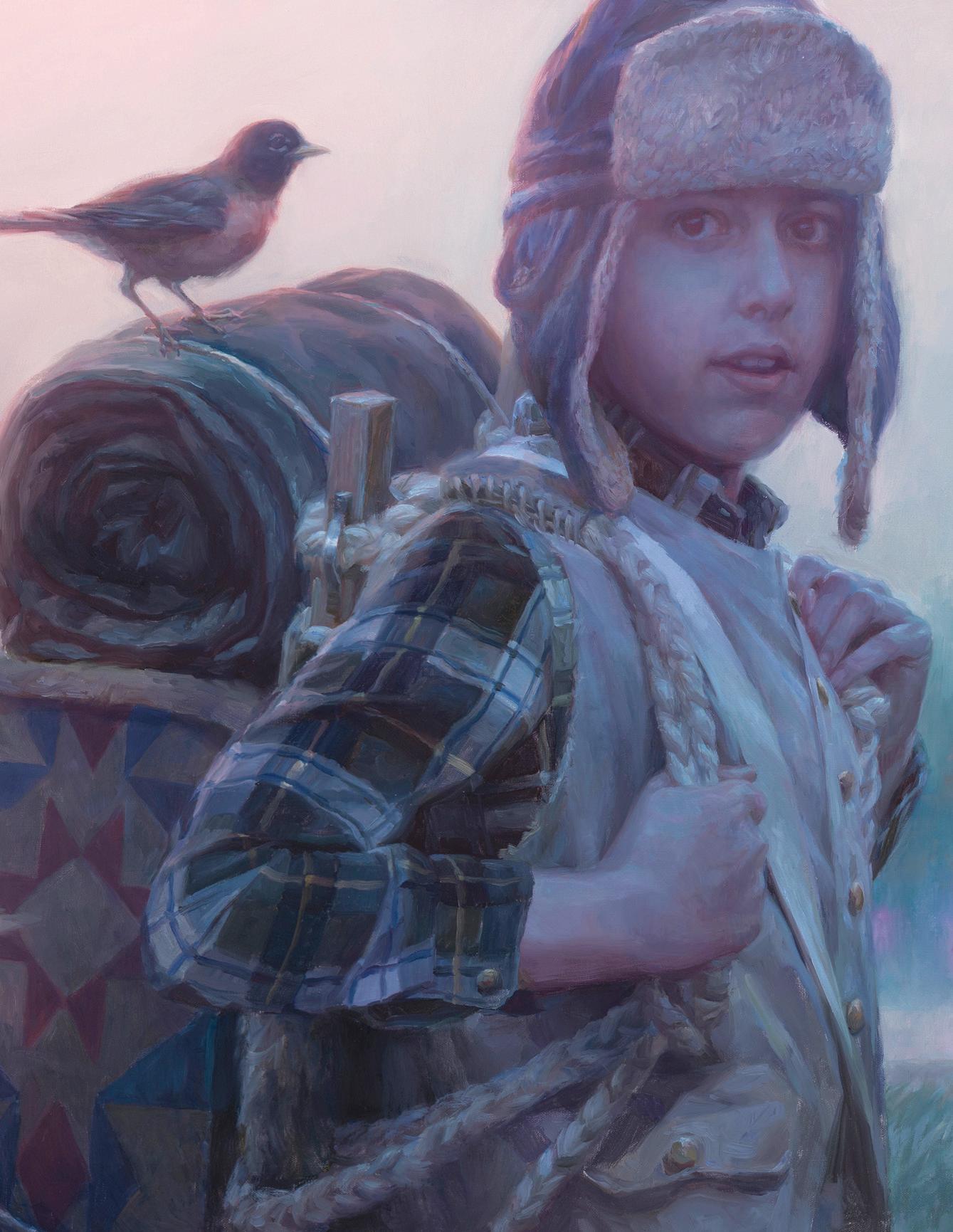
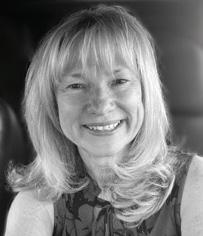
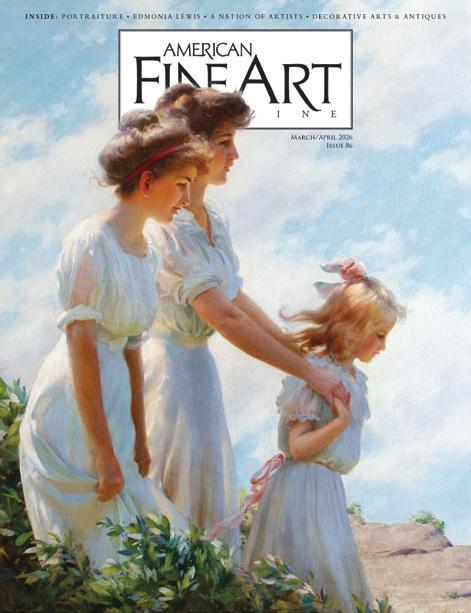
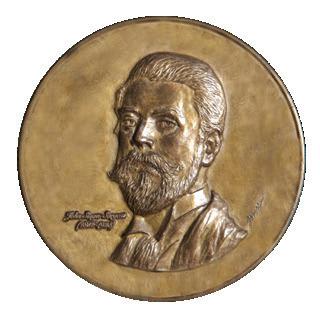
In a recent issue of American Fine Art, the editors invited me to introduce a section titled Collector’s Focus: Portraiture. I began with my long-held conviction: portraiture is one of the most important branches of fine art, not only for its aesthetic merit, but for its historical significance to humankind.
I also included these thoughts about portraiture that I thought I would share with you. Over the centuries, portraiture has preserved the faces of rulers, cultural icons, revolutionaries, and private citizens, shaping how we understand history and identity. Our perception of figures as distant as Nefertiti or as familiar as Marilyn Monroe is inseparable from the artists who captured their likenesses in paint and stone. If asked to name the most famous painting in the world, many would point to Leonardo da Vinci’s Mona Lisa, a portrait.
FROM THE DESK OF CHRISTINE
Though portraiture has at times been dismissed as commercial, its purpose is neither trivial nor secondary. As Dr. Samuel Johnson observed, portrait painting is “a reasonable and natural consequence of affection.” Portraits arise from admiration, remembrance, and esteem; to commission one is an act of recognition and legacy.
In addition, portrait artists have, historically, done far more than record appearances; they have shaped cultural memory. From Velázquez at the court of Philip IV, to Van Dyck defining the image of Charles I, to Jacques-Louis David chronicling revolution, portraiture has documented power, upheaval, and transformation. In America, Gilbert Stuart’s image of George Washington and John Singer Sargent’s portrait of Theodore Roosevelt show how a single work can define a public figure for generations.
Fast forward to today, in an era saturated with photography and AI-generated imagery, the hand-crafted portrait carries renewed meaning. Contemporary commissions extend well beyond heads of state to include entrepreneurs, scientists, families, and private individuals marking milestones and preserving legacy. The disciplined study of the human face and figure remains foundational to artistic excellence.
Some may regard portraiture as a luxury. I believe it is essential: a record of who we are, how we see one another, and what we choose to remember. From royal courts to modern studios, portraiture continues to affirm the enduring value of human presence rendered by a human hand. In other words, portraiture is alive and well!
The Art of the Portrait® Newsletter is published quarterly by the Portrait Society of America. All contents copyright Portrait Society (unless otherwise noted). No
Design
PHOEBE STEWART CARTER
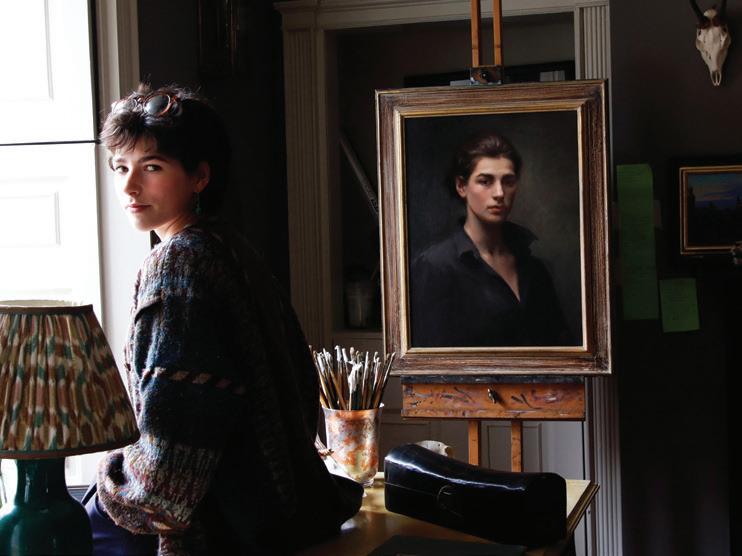
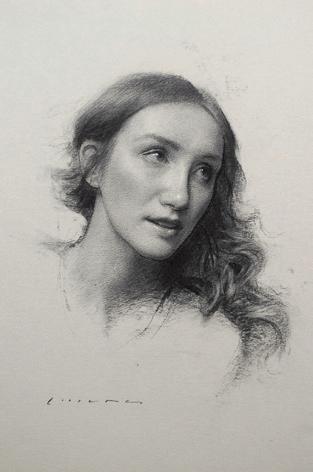
Phoebe Stewart Carter is an award-winning artist based in Gloucestershire, England, who has had a prolific early career marked by exhibitions and travels across the world. I had the pleasure of meeting Phoebe a few years ago at a Portrait Society conference and was struck by her warmth and sincerity.
Phoebe took the time to answer questions and share stories about her journey and work with me, and I know you’ll find these as fascinating and inspiring as I did.
You studied at the Florence Academy of Art, and it’s amazing to see how your art developed during and after that time. Could you describe your mindset and experience there?
I was inspired to attend the Florence Academy of Art while looking for art universities after high school. While most art-oriented further education seemed to focus on teaching concept, I could only find a few schools that taught craft, with the FAA being one of them.
Being very eager to hone skills and master a craft, my time was purely focused on studying and practicing the 19th century academic method being taught. The course itself is very intensive, and there was always an air of competition between the students. Late nights and weekends at the Academy were spent finishing projects and creating extra work.
That time in my life, surrounded by like-minded people where all efforts were dedicated to learning and practice, helped me develop work ethic, skill, and most importantly, a real passion for painting and drawing - something I didn’t realize I was lacking.
Your art has a distinctive style; a beautiful, compelling dynamic between soft and bold strokes, with darker, muted colors. What are your choices behind this visual?
2
By Kate Orr
I have often thought, especially coming from an academic school, that artists can’t change the “handwriting” of their paintings so easily. I have witnessed groups of artists painting the same model in the same lighting with the same colors and brushes under the same tutelage, and still every painting has different mark makings and individual decisions (subconscious and conscious).
The muted tones in my work stem from my time learning with limited palettes and thinking heavily about unifying and balancing color. My favorite works have tended to be solemn compositions, like the etchings of Kathe Kollwitz or compositions by Ilya Repin, like the ‘Boat-Towers’.
My obsession with 19th-century paintings probably explains my bolder mark making. I love the dramatic strokes of Sargent, and the confidence in Repin’s marks, but I also love the softness and thoughtfulness in 17th-century works such as those by Velasquez and Van Dyck.
You’ve travelled to so many places for your art. Could you share an impactful memory from one of these trips?
Travelling was one of my main motivations for becoming an artist. A career in art enables me to work anywhere and draw inspiration from anything. I have travelled to various places for personal work and my own curiosity but also to meet clients and colleagues for commissioned work.
Every journey, meeting new and different people for commissions, has affected the way I view my work and the new work I will create with those experiences. The most impactful trips were the ones planned around a motivation to create a specific body of work.
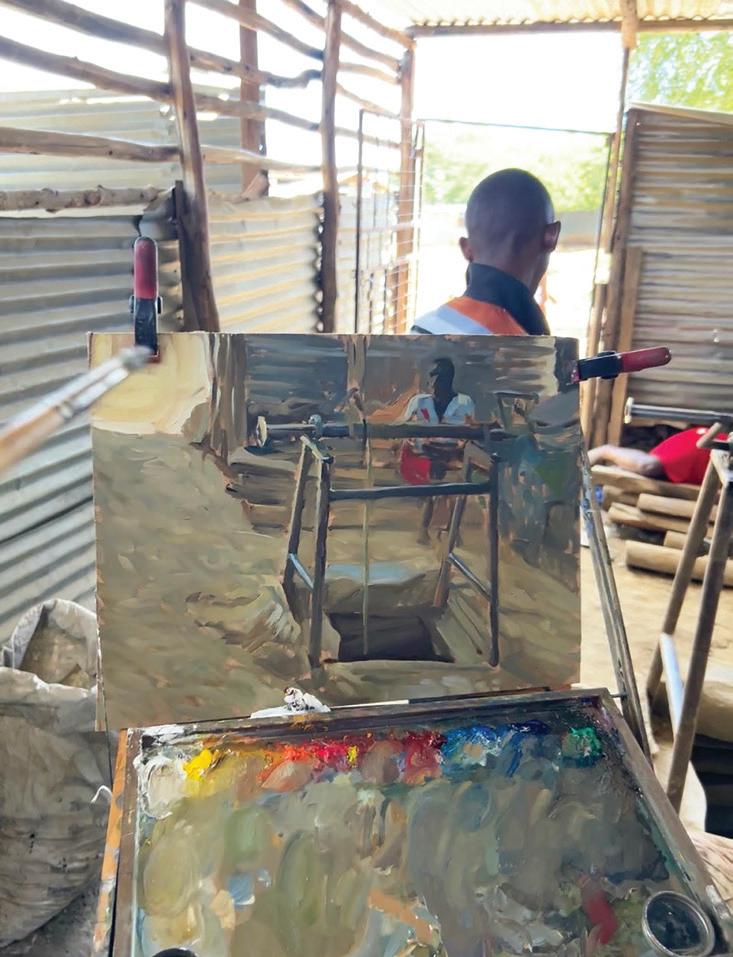
In 2023 I travelled to Kenya to explore the topic of smallscale gold mining - a project I am still working on. Witnessing
a completely different lifestyle and meeting people from varying cultures sparked a tremendous amount of curiosity and creativity. What a privilege it was to learn more about this small yet internationally relevant sector and incorporate it into my work.
Your portrait commissions seem to faithfully represent both your subject and yourself as the artist. Could you share some key points you’ve learned through your experiences painting commissions?
Every commission has been a learning process. Commissions come with compromises, and being a slightly stubborn person, I have found it a challenge to meld my own ideas with those of the client. I have learned to be more flexible.
A portrait is generally what the artist sees and experiences of that person and how the artist chooses to translate that into an artwork. As portrait painters, we all have to remember that this is our profession, and when it comes to painting and drawing, we do usually know better than the client!
However, what I have come to learn is the artist does not usually know this person best, and whenever a suggestion has been made about a commissioned work, I’ve learned a little bit more about my sitter, regardless of whether or not this suggestion was incorporated. Often those additions made the portrait much better!
3 4 5
This is why it is so important to paint and take studies from life, not only to observe light and color, but also to fully meet and spend time with your sitter and understand their character. There is only so much a photograph can give you, just as there is only so much you can know about a person from one or two meetings.
Phoebe’s dedication to art is exciting to witness, and her appreciation for classical technique and endless curiosity is laudable. I hope we can all continue to seek further learning and take inspiration from the world around us.
1. Studio shot by Fergus Devli
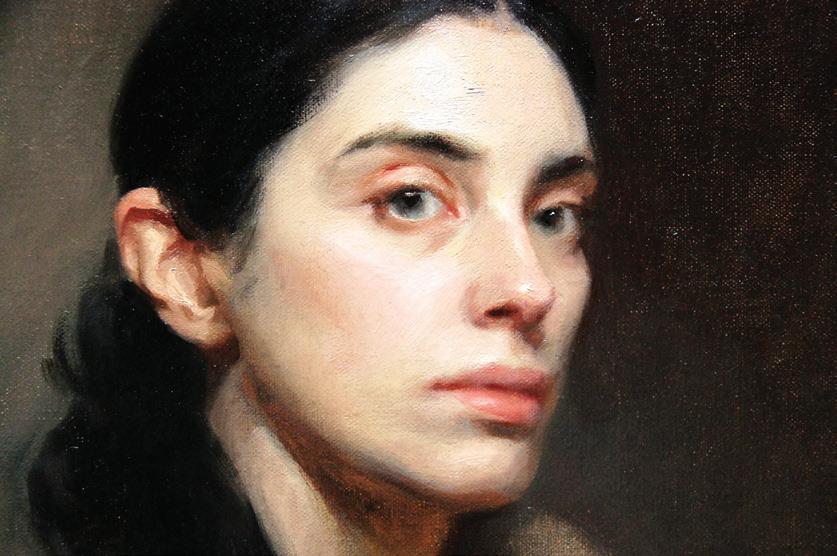
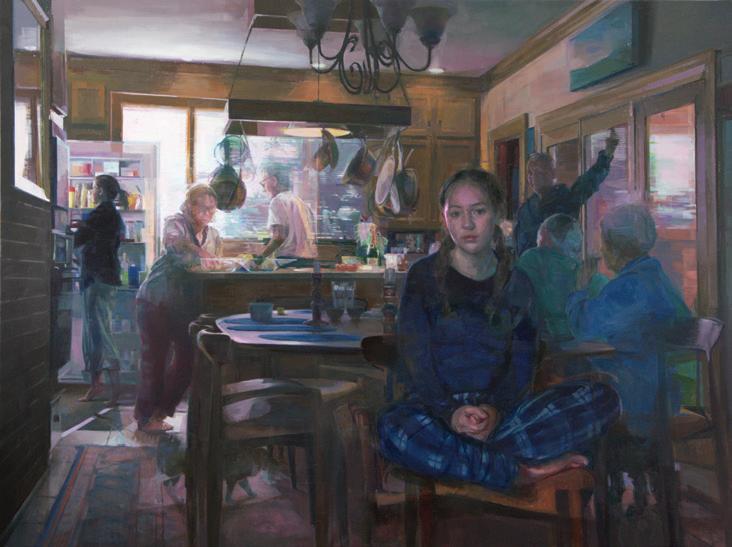
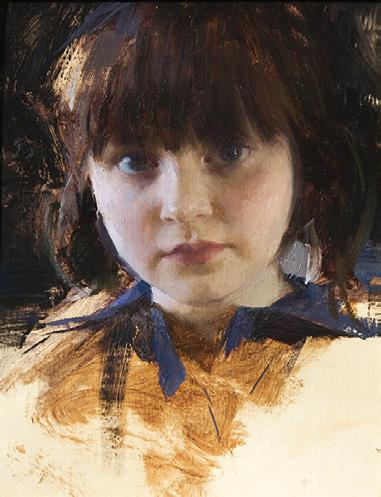
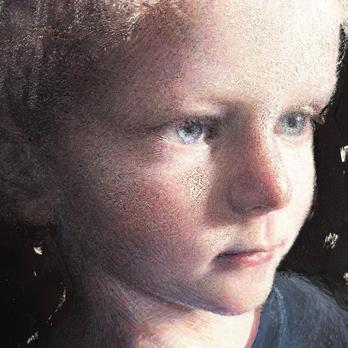
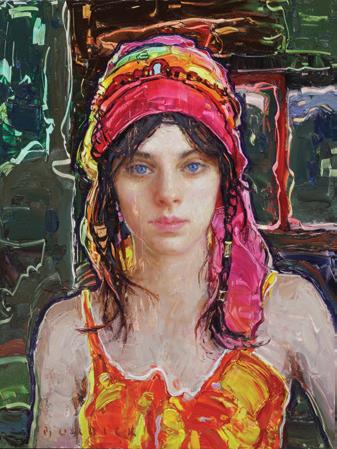
2. Detail of Giulia, 2022
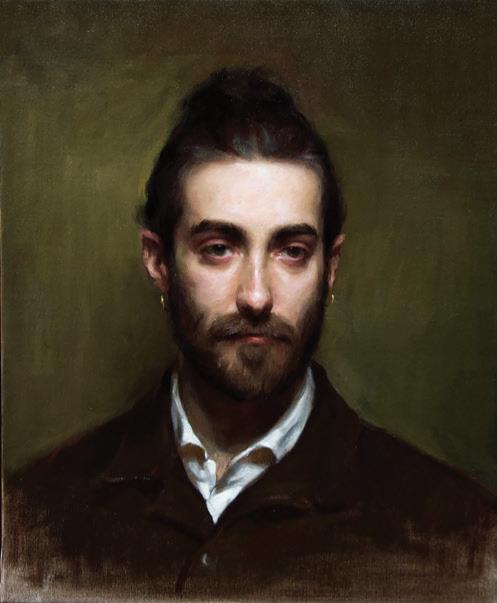
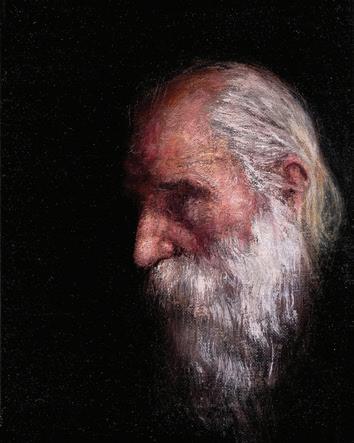
3. Alberto, 2025
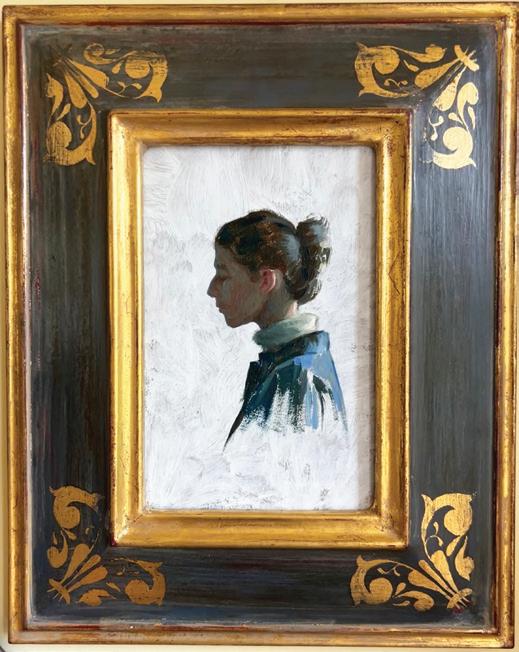
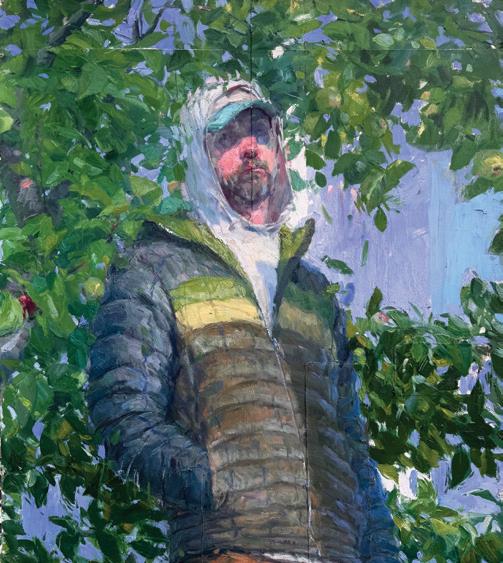
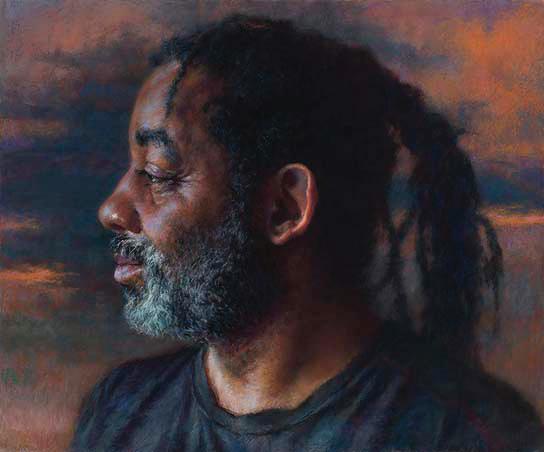
4. Self Portrait in Profile, 2025
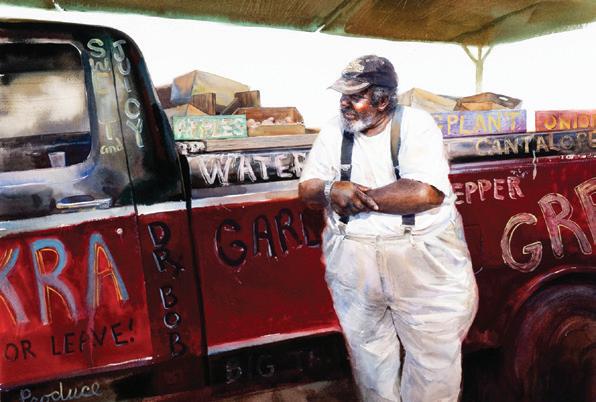
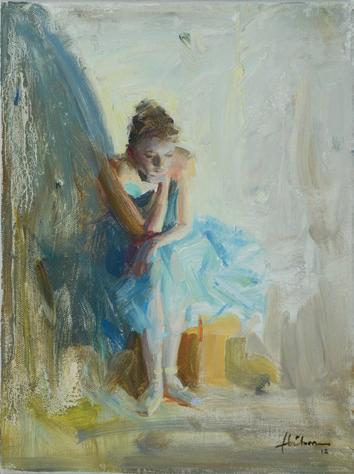
5. Painting from Kenya, 2023
WHERE ARTISTS GATHER
I joined a local artist organization a couple of weeks ago. I attended their first monthly meeting of the year the following week. This group hosts a great studio tour for their members in May. They also have a small gallery space as you drive onto the island near my home. I enjoy these small groups of artists. It gives me an incentive to paint more, but more importantly, every so often, I get to be the first person to see a transcendent new painting that can launch an artist’s journey higher. I am happy to report this happened during this artist meeting. I get such a thrill out of those moments.
I have joined half a dozen local and regional art groups. I am also a huge fan of multiple national art organizations. I attend meetings, conferences, shows, and I give presentations. I attend anywhere artists gather. I have eleven of these gatherings on my calendar between now and the end of June. Granted, I love to travel.
I have flown a couple million miles in my lifetime, mostly for business, with high pressure meetings upon arrival. Flying or driving to an art conference or art show is a whole different thing for me. I relish being where artists gather.
Why? I admit that I have taken four or five tests during my lifetime all showing that I am an introvert. I prefer to watch interactions and weigh the ideas of others. The last thing I wanted to do as CEO was dictate and dominate what happened in the conference room. When I attend these artist gatherings, I watch.
I watch artist interactions. I watch the reaction and response of an artist to another artist’s work. I watch critiques given and the response to them. I watch mentoring relationships begin and strengthen. I watch how artists take feedback and implement it to better themselves. I watch with amazement at how giving most artists can be.
I watch the reactions of people viewing art. They are art appreciators even if they do not define themselves as such. I want them to know their appreciation of art is important.
By Scott Jones
I watch gallery owners, art dealers, show curators, judges, awards presentations, and the like. I glean something from their comments and reactions even if I may not necessarily agree. I share my insights and earnest recommendations.
I watch for the zeal, ambition, drive, willingness to accept a critique, respond to rejection, and the passion required for an artist to improve and evolve. I watch for those transcendent pieces.
I first attended the Portrait Society’s National Conference in 2012. I would now never dream of not attending. I do not know how, in only a sentence or two, to describe the magical moments I have seen impacting the lives of artists in attendance. I wish more avid collectors and galleries could experience all of this.
My message today is to get out of the studio. Join in with your local art organizations. Find a life painting group to join. Get a critique group of three or four artists together. Stretch into a new medium or subject. Watch for plein air groups to paint with. Organize or join a studio tour in your area. Go on an art walk. Look for local businesses that encourage displaying artwork. Watch online demonstrations. Take a workshop. Give a workshop. Enter an appropriate art competition. Show up at that next meeting. You do not know who you just might meet.
The Portrait Society has a special place in my art heart. Whether giving a presentation, being part of a panel, sitting for an artist in a breakout session, having conversations with artists drawing me in the hallway, or an artist warming up for a painting demo in their room, I have great memories of each conference I have attended. Last year, Catherine Hafer reached out to me before the conference. She had a commission to do a Santa painting. She asked if I would be willing to don a Santa hat for her. Of course, I said yes. I agreed again at the conference when she mentioned the idea of ordering a complete Santa suit for the photo session. I found myself walking through the hotel lobby at 5:45am Monday morning before my flight, dressed as Santa. I will cherish the experience with her, and I definitely admire the painting she completed. Check out the whole story about the painting on her social media. Other artists also joined in the fun and sent me photos. When I showed the painting to my art-appreciating three-year-old granddaughter, she examined it and said, “That’s you, Papa, playing Santa!”
Scott Jones has been a passionate art collector since the age of 16 and shifted his focus to selling art nearly 20 years ago. While having retired this year from the gallery world, he remains committed to the success of artists. He serves as State Ambassador of Washington for the Portrait Society.
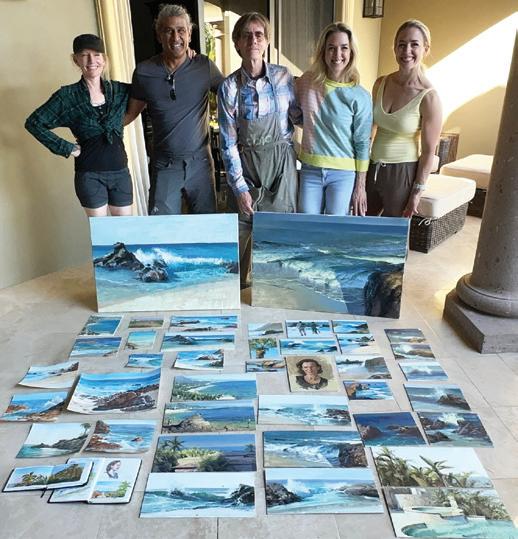
Jen Starling, Raj Chaudhuri, Daniel Sprick, Anna Rose Bain, and Emily Olson painting together in San José del Cabo, Mexico
A GLOBAL MISSION, A LOCAL TOUCH
As the Portrait Society of America’s Ambassador Program expands alongside our worldwide membership, we want to pause and extend our deepest gratitude to those making this growth possible. Your dedication is the heartbeat of our Society.
While Chinese ambassador Hongbin Zhang continues his vital work bridging the gap between East and West, our Ambassadors are busy laying foundations in new countries and across American soil. This dual focus allows us to maintain a global perspective while staying rooted in the needs of the individual artist. We recognize that while our mission is universal, support is most impactful when it is local. Our Ambassadors understand the unique challenges of their regions; when artists gather, share, and grow together, real connections deepen and our community thrives.
Deborah Broach (Jacksonville, FL)
said The Art Guild of Orange Park (AGOP) announced the long-awaited public art gallery in Clay County, Florida.
Katherine Cook (Central Florida) just unveiled a new Atelier designed for aspiring artists in their teens at her Selah Ranch in Umatilla, FL.
Li Volk (Southwest Florida) invited Mary Qian to do a live portrait demonstration for members and the public hosted by Katie Dobson Cundiff studio in Sarasota. Li met with members to travel to the Rembrandt exhibition at the Norton Museum, West Palm Beach, in March.
Artwork by members in Wisconsin hung at the Richeson Gallery in January-February 2026.
We welcome a new co-ambassador, Calista Ward for Idaho, along with Deborah Gill. Cali will cover Pocatello and Northern Idaho/Wyoming. Anne Maree Healy is the new co-ambassador for Massachusetts and New Hampshire with Mary Lazar. Taléta Willer is the new European co-ambassador covering The Netherlands. Fio Lombardi will be the new co-ambassador in Washington with Scott Jones.
Hongbin Zhang (China) is currently working on a regular bi-monthly "Portrait Society of America Activity News" for Chinese members. This will streamline the flow of information regarding competition updates, member stories, event calendar and member services such as benefits. Additionally, it will be in their native language of Chinese.
Janelle Hatherly (Australia/New Zealand) has initiated a WhatsApp group for members. She is collaborating with members on more in-person get-togethers in the near future.
Andrea Steinbauer (Europe/UK) acknowledged the European members were very successful in the 2025 Members Only competition (13 awards), and Frances Bell (UK) received Signature Status. Andrea published the No. 5 issue of the European Members Newsletter in March and will host the next Zoom meeting in April.
Jeanine Jackson (Connecticut) said portrait artists still met monthly via Zoom despite the cold weather. Watch for several new events this summer.
Crystal DeSpain and Lisa Manzo (Colorado) said the popular studio visits will continue in the near future. Watch for a retreat opportunity with the Grand Lake Arts District for October. Sherry West (California) is working to encourage artists to participate in a worldwide event focused on viewing art slowly. Sunnyland's Center & Gardens in Rancho Mirage, CA will host Slow Art Day, April 4, 2026, from 9 am to 2 pm.
Kim Abbati (Illinois) announced the next IL Member Show is set for May 29-June 7, 2026 at the Palette and Chisel Academy of Art.
Simona Buna (Indiana) is currently organizing the "A Face of Radio" event for 2026.
Melanie Harding Bates (Kentucky) hosted artists in her home studio to paint from the live model. She is working on a Zoom meeting with members featuring a guest, soon to be named, regarding the art of doing business.
Armando Gutiérrez G (Minnesota) is now planning for an exhibition to be held for Minnesota members in 2026.
Libbie Patterson (Mississippi) partnered with the Alabama ambassador to do a member outing to the museum in Holly Springs.
Rachel Mindrup and Littleton Alston (Nebraska) look forward to announcing a workshop for students and members in the Fall of 2026.
Nicole Troup (Pennsylvania) continues to host bi-monthly Zoom meetings which are still quite popular for members spread out across the state this winter.
Len DeAngelis’ (Rhode Island) Zoom meetings with members continue to be an inspiration to members.
Robin Williamson (Texas) is organizing a Face-Off for early Summer in the Houston area.
Carol Fairlie (West Texas/New Mexico) is planning a FaceOff next September in conjunction with the Museum of the Big Bend's "Trappings of Texas" Exhibition.
Kathie Wheeler (Wisconsin) hosted the Wisconsin Member show at Richeson Gallery in Kimberly, WI. She is also working on an event for this summer at Richeson’s that will involve a hanging show, a face-off and mini workshops for the months of June and July.
Kerry Vosler National Coordinator
HOW CAST STUDIES BENEFIT
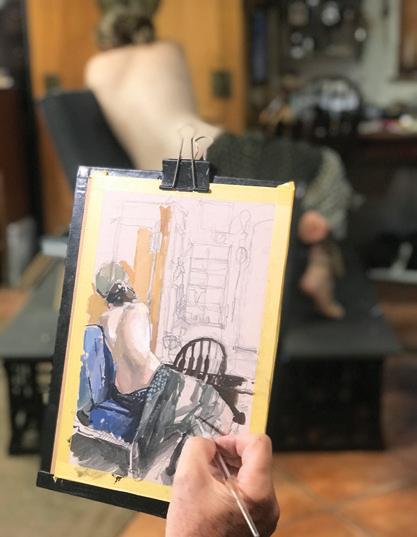
I’ve been a practicing artist for over 40 years, and throughout that time I have also devoted myself to teaching workshops and short courses, particularly in portraiture. What I have observed on almost every occasion is a weakness in students’ draughtsmanship skills. Far too often, there seems to be a race toward applying colour and becoming absorbed in details before truly seeing the whole or establishing accurate fundamental proportions. Without correct foundations, no matter how much effort is applied later, the structure will fail much like a house built without sound footing.
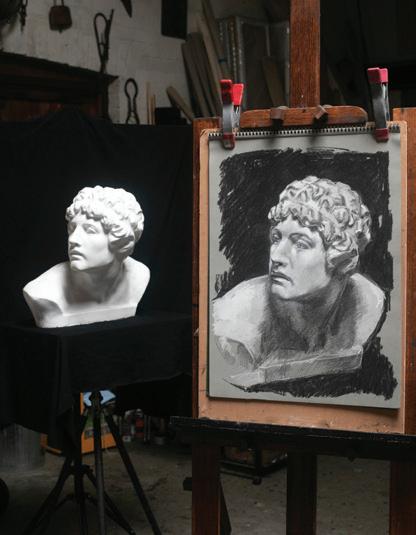
Cast drawing has largely fallen out of fashion. Contemporary approaches often prioritize concept and personal expression over structural discipline. While these aspects are important, they should not replace foundational training. An overreliance on photographic reference further compounds the problem. A photograph flattens form into a two-dimensional image, reducing depth to tonal illusion. A cast, on the other hand, is three-dimensional. It allows the student to physically approach the form, to walk around it, observe it from multiple viewpoints, and even run their fingers gently over the planes of the nose, forehead, or cheek. This tactile engagement helps the student to truly feel the volume, to understand where planes turn, and to observe precisely how light falls across those surfaces. This physical interaction reinforces the translation of three-dimensional reality into two-dimensional representation and greatly enhances the communication of depth.
The cast teaches artists to truly see, to observe from life rather than from a mechanical reproduction. Because the cast is white, there are no distracting colours; attention is focused purely on form, value, and structure. Most importantly, the cast remains completely stationary. Unlike a live model, it does not move or shift. Students can return to the exact same position and lighting conditions repeatedly, allowing for sustained study and careful correction. This consistency makes cast drawing one of the most powerful tools for developing observational accuracy.
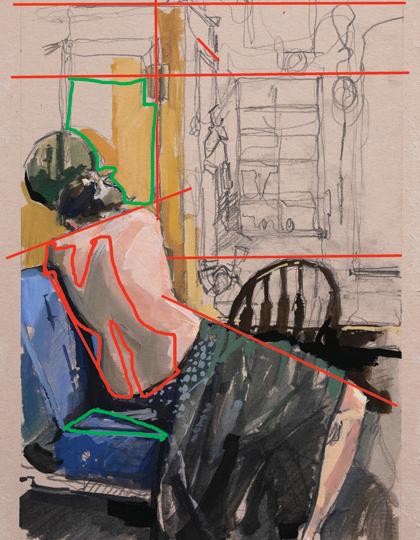
Alongside head casts, larger casts of the full figure provide invaluable training in proportion, measurement, and spatial organization. Students learn to measure comparative lengths, assess angles, map key structural points, and understand how the cast occupies space within the composition. Because casts clearly articulate form, they also reveal what I refer to as “jigsaw pieces,” which are distinct interlocking shapes. These internalized shapes must be accurately observed and placed in correct relation to one another in order to construct the whole image successfully. Seeing the figure as a series of connected shapes prevents students from drawing “around the perimeter” and to start working from “the inside out,” encouraging structural unity.
Equally important are the distinct negative spaces formed between the cast and the strong vertical and horizontal boundaries of the paper. These negative shapes are not empty or incidental; they are active design elements that help anchor the figure within the composition. By carefully observing and drawing these surrounding spaces, students improve proportional accuracy and strengthen compositional balance. Training the eye to see both positive and negative shapes develops a more objective, analytical approach to drawing.
There are several foundational tools I use to support students in developing their ability to navigate a cast and, more importantly, to isolate what to see. In the early stages of learning, students often struggle because they are overwhelmed by visual information. These tools help train selective observation and simplify what initially feels complex.
By Evert Ploeg
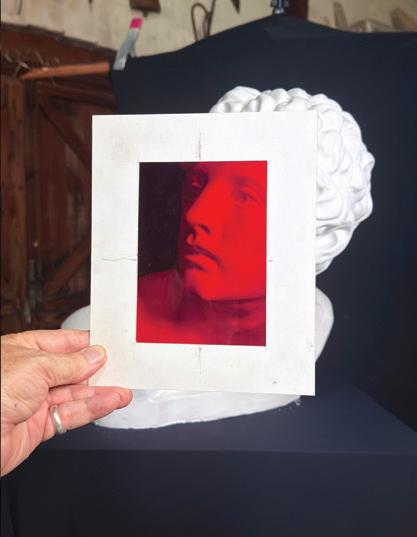
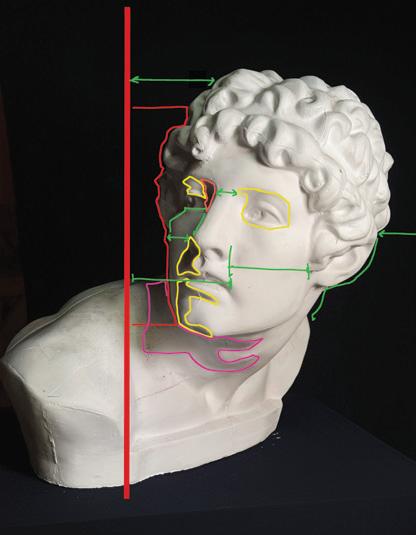
One of the primary tools I provide is a viewfinder, which includes a red photographic film gel. The viewfinder itself serves as a framing device. By isolating a specific portion of the visual field, it helps students focus on composition, proportion, and spatial relationships without being distracted by surrounding elements. It allows them to clearly observe negative spaces, the shapes around and between objects, which are often easier and more accurate to measure than the objects themselves. Seeing and drawing negative space helps ground the composition. The addition of the red photographic gel is particularly helpful in simplifying tonal values. The red filter reduces visual information by muting some of the detail and compressing value shifts. By limiting the value range visually, students can more easily identify dominant tonal shapes and establish a strong value structure early in the drawing process. This is crucial for both accurate proportion and compositional clarity.
Establishing a true vertical line is another essential early step. I emphasize identifying a reliable vertical reference, often the edge of a wall, a door frame, or another architectural element within the chosen composition. This vertical becomes an anchor line from which all measurements and mapping points can be gauged. Students use it to compare angles, distances, and alignments throughout the drawing.
In some cases, a simple plumb line is also introduced. The plumb line reinforces the concept of gravity-based verticality and helps students verify whether elements in their drawing align correctly with observed vertical relationships. This tool is especially useful when working from observation in space, as it allows students to check the alignment of features, edges, and proportional intervals against a consistent vertical reference.
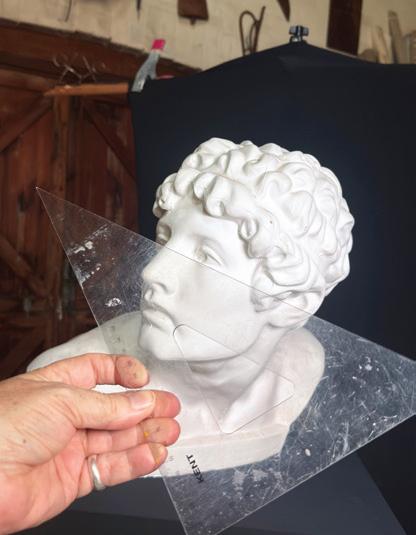
Another tool I recommend is a simple Perspex set square. Unlike a ruler or even a pencil held up for measuring, the clear Perspex does not obscure the viewing angle. Students can hold it at arm’s length with their hand positioned well back, allowing them to see both the subject and the desired angle clearly and simultaneously almost as if referencing a picture image. Because it is transparent, it enables accurate angle comparison without blocking key visual information. This makes it particularly effective for assessing diagonals, structural lines, and compositional direction early in the drawing process.
Together, these tools—the viewfinder with red gel, the focus on negative space, the establishment of a true vertical or plumb line, and the use of a transparent Perspex set square—form a structured approach to early proportion and composition. They train the eye to simplify, measure, and map accurately before detail is introduced. By learning to isolate visual information and establish stable reference points, students build a strong foundational framework for more confident and precise observational drawing. I must also say that working on a toned grey paper and keeping to simple graphite/charcoal and white chalk will be so much easier to make corrections.
In essence, cast drawing builds discipline, patience, and visual intelligence. It trains the artist to measure before marking, to observe before interpreting, and to construct before embellishing. Once these foundations are secure, colour and expressive detail can be applied with confidence and authority. Without them, however, even the most ambitious work will lack structural integrity.
With seven major works in the National Portrait Gallery, Evert Ploeg’s work has garnered honours nationally and abroad including two Archibald People’s Choice Awards in Australia. Signature Member of the Portrait Society of America, he is a five-time Certificate of Excellence honouree and Best of Show winner in the International Competition, and two-time First Place recipient in Members Only, along with multiple finalist placements. Evert teaches regularly at the Royal Art Society in Sydney, Australia. 4 5 6
1. Drawing and painting from the live model
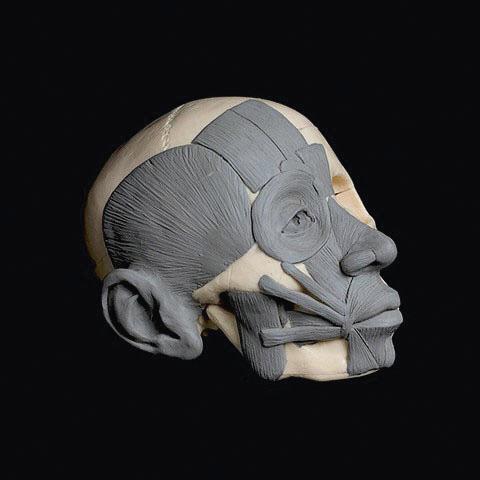
2. Cast Drawing
3. Shapes and Angles in the Composition
4. Viewfinder
5. Vertical Map Points
6. Set Square
MEMBERS ONLY COMPETITION WINNERS FOR 2025
For 21 years, the Portrait Society has hosted a members-only art competition. This year, we received an impressive 1,039 entries, with the overall quality reaching new heights. Our judges evaluated each piece using a set of clear criteria, including fundamental skill development, technical mastery within the possibilities of the medium, originality and creativity in concept and design, and overall aesthetic sophistication.
The following pages showcase this year’s award winners—a celebration of talent and imagination. Thank you to all our members who participated and contributed to another extraordinary collection of artwork.
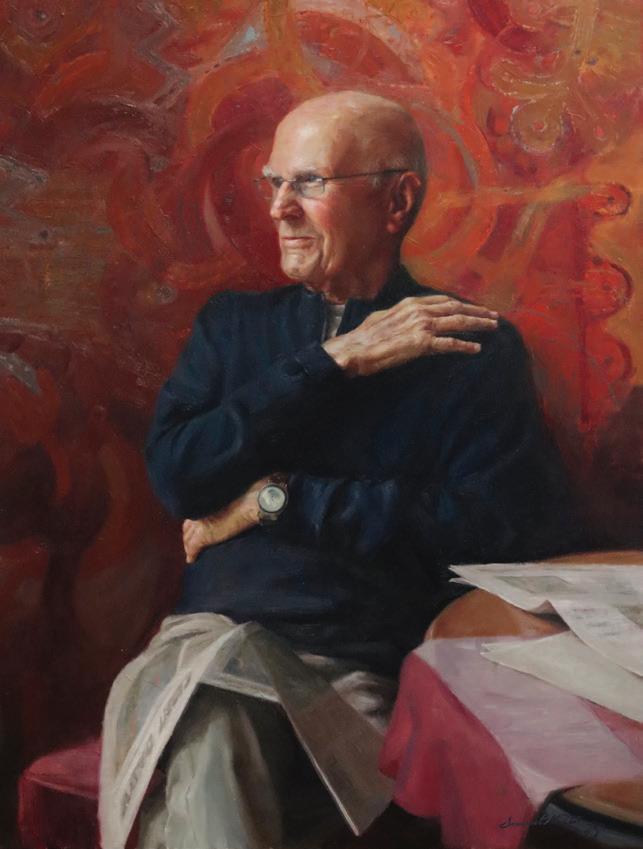
1st Place: Joseph Daily Milo E. Riverso, 29x38”, oil
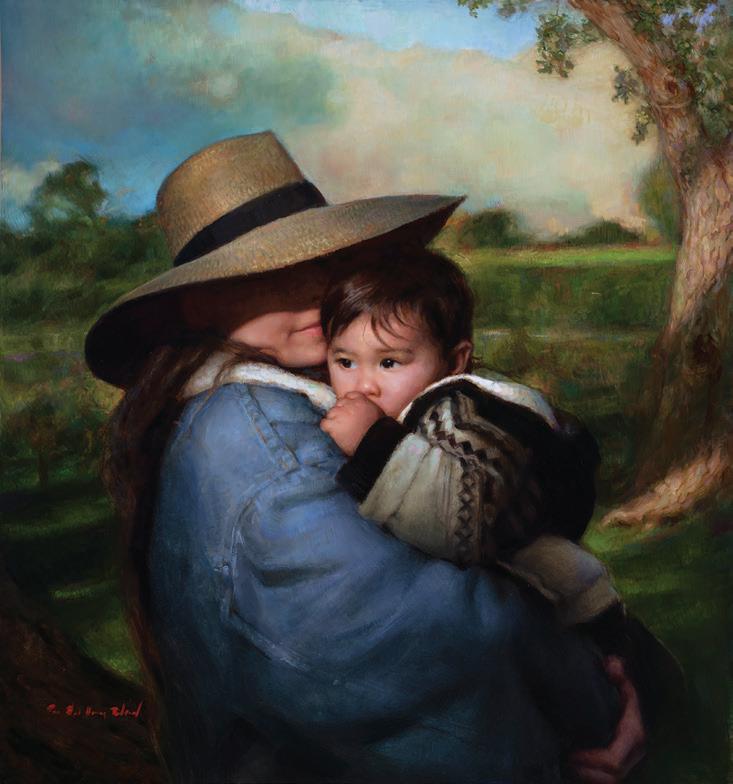
2nd Place: Per Elof Nilsson Ricklund Mother and Son, 24x22”, oil on canvas
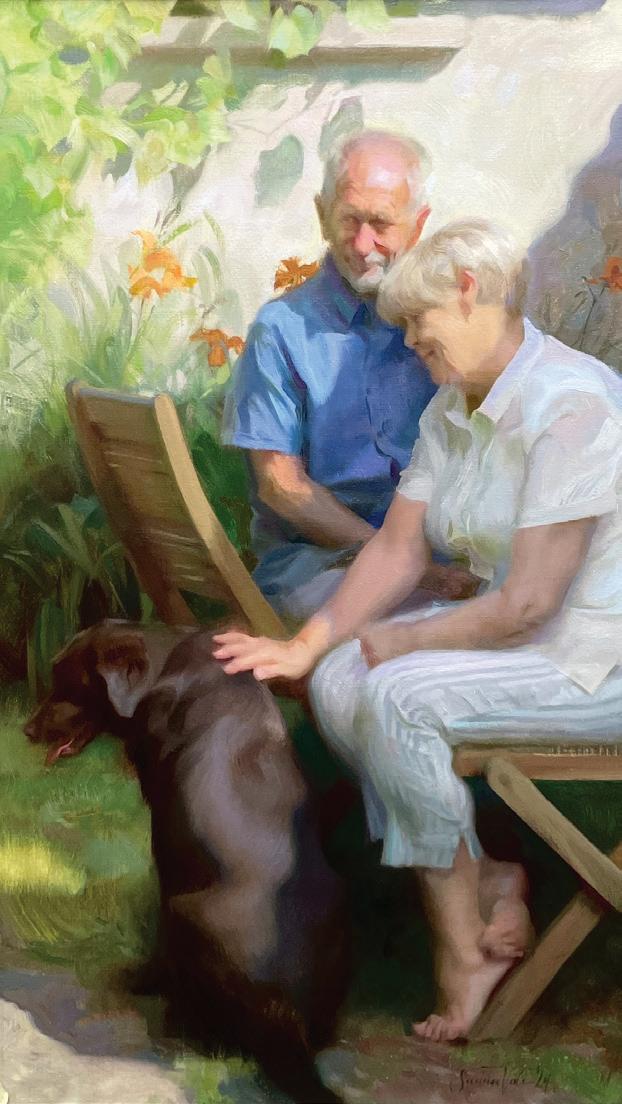
3rd Place: Saara Väli Family Portrait, 25.6x15.8”, oil
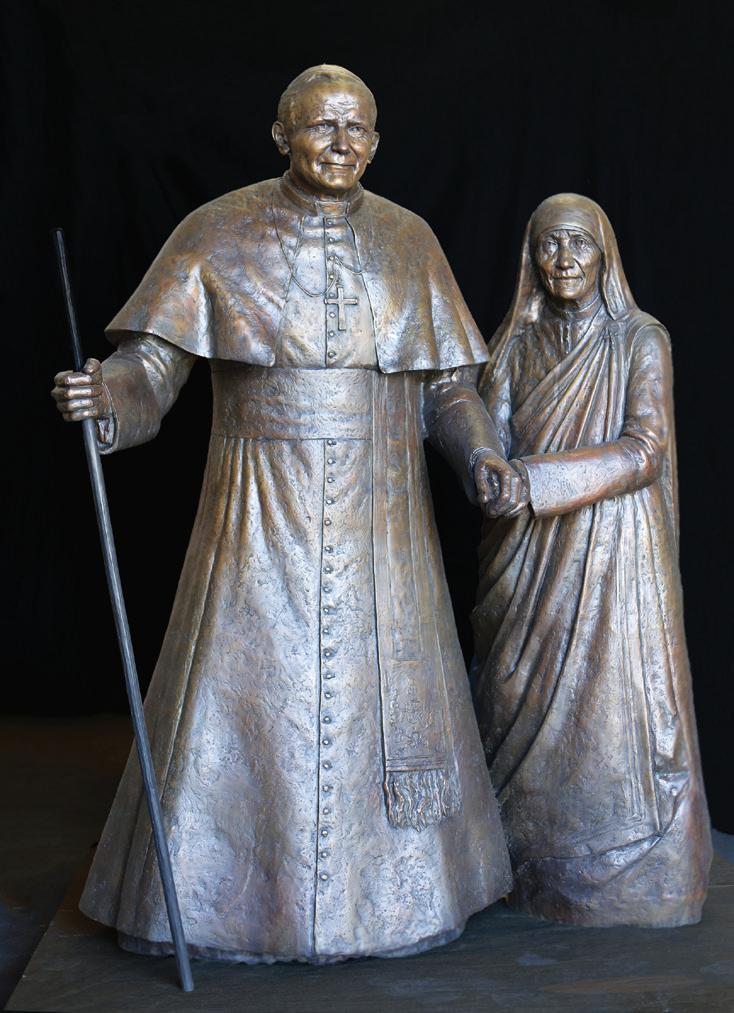
4th Place: Louise Solecki Weir Two Saints, 84x64x26”, original clay for bronze
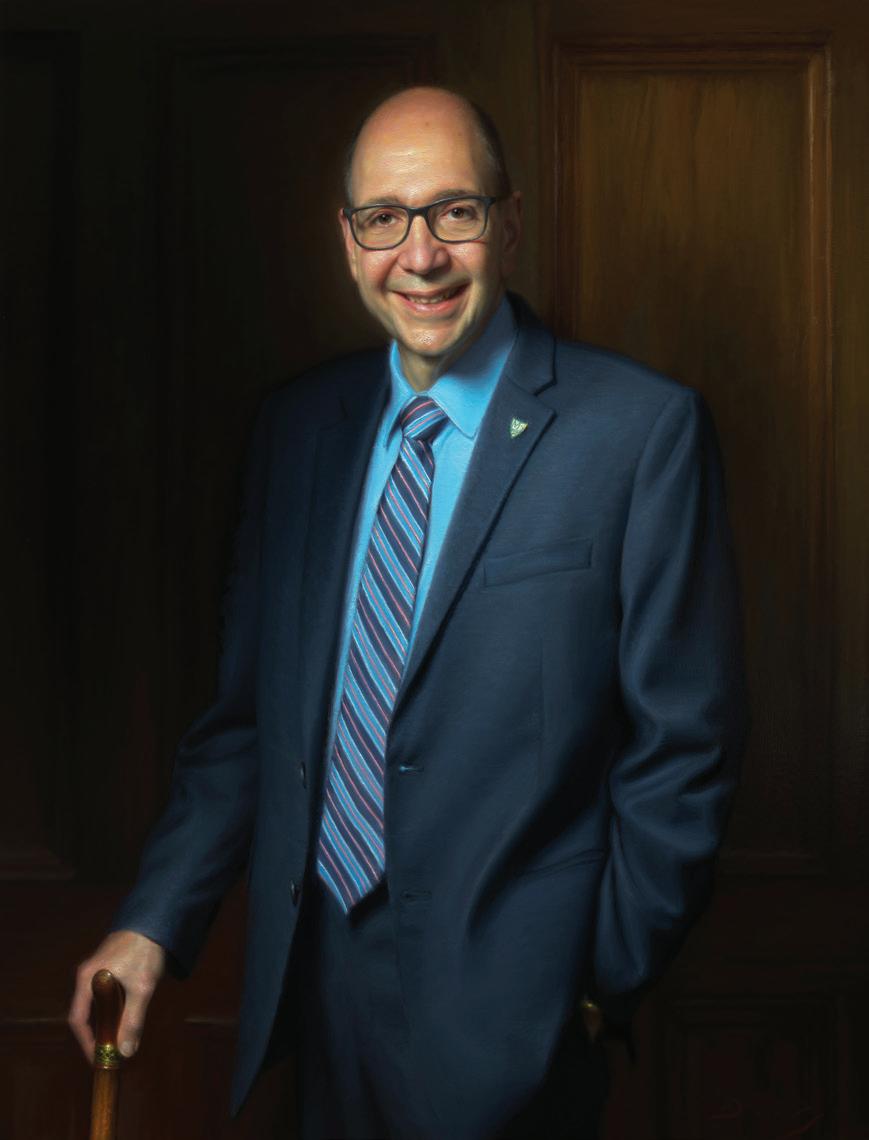
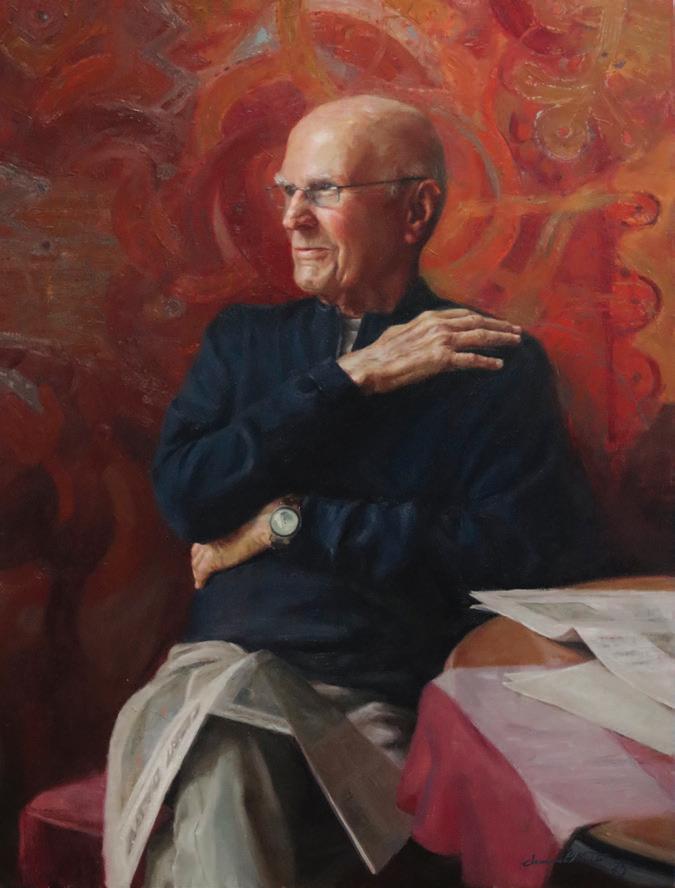
5th Place: Samuel Walter Mr. McConnell, 34x44”, oil
6th Place: Oliver Sin
7th Place: Christopher Estes
8th Place: Ruth Fitton
9th Place: Yanling Chen
10th Place: Teresa Mattos
Finalists (alpha order): Ronilo Abayan, Anna Rose Bain, Maria Battista, Stephen Bush, William Chambers, Connie Erickson, Thomas Caleb Goggans, Shaoli Huang, Bart Lindstrom, Susan ONeill, Susan Patton, Aapo Pukk, Richard Rumball, Sharon Sprung, Chantal Sulkow, Nicholas Thorp, and Thomas Wharton
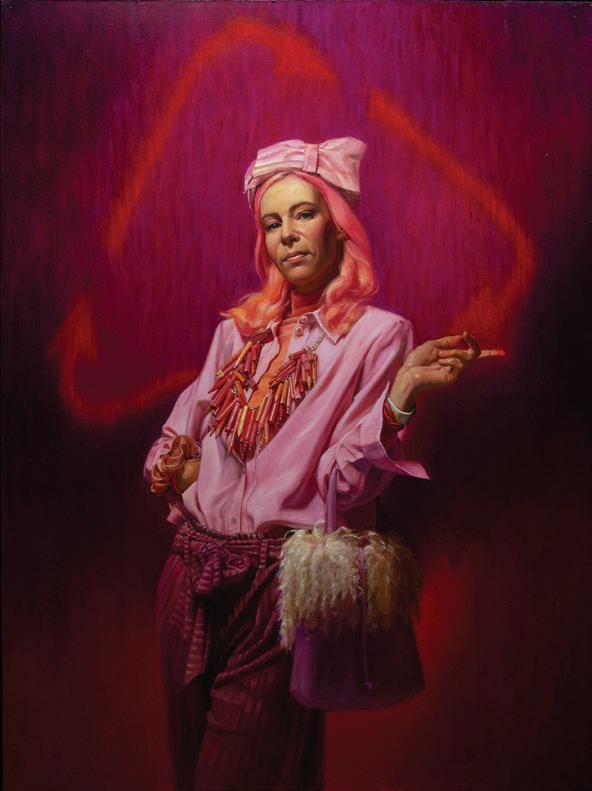
1st Place: Sally Ryan
Fifty Shades of Pink, Annette Innis, 47.2x35.4”, oil on board
2nd Place: David Vegt
Sonia and Fando, 18x24”, oil on aluminum
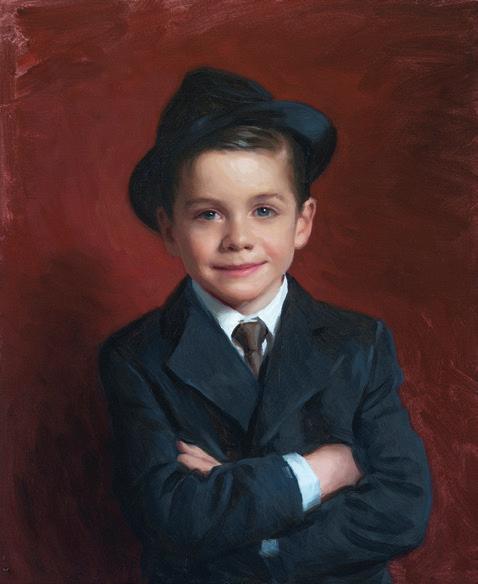
3rd Place: Paul Newton
Matty Matt, 23.75x19.5”, oil on canvas
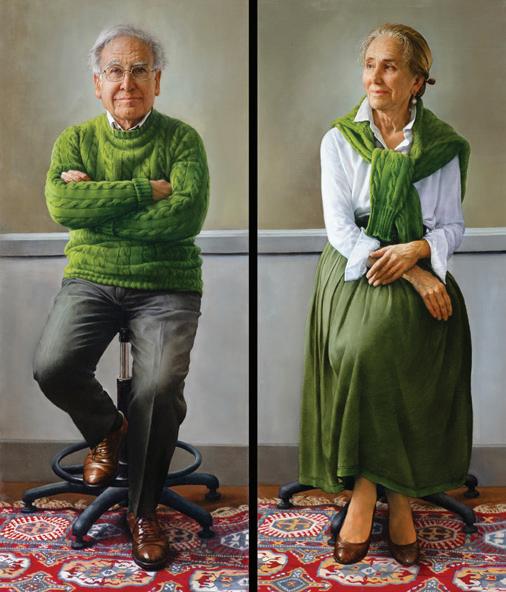
4th Place: Alessandra Marrucchi
Our Golden Wedding, 23.6x27.5”, oil on linen canvas
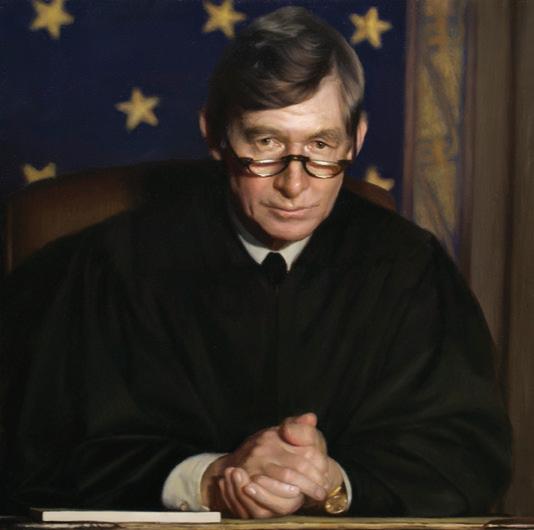
5th Place: Phoebe Delaney
Judge Frank Minis Johnson Jr., 18x18”, oil
Finalists (alpha order): John Borowicz, Whitney Brock, Stephen Cefalo, Liz Harris, Margi Hopkins, George Ianaki, Florentino Jr Impas, Rima
Jabbur, WanNing Liao, Charles Moxon, Mario Panis, David Sandell, Svetlana Semenova, Oliver Sin, Peter Smeeth, Jen Starling, Tanner Steed, Carlandrea Tortorelli, Saara Väli, and Kathie Wheeler
6th Place: Wendi Zlamal
7th Place: Andreas Muscat
8th Place: Emily Anderson
9th Place: Carla Paine
10th Place: Alexandrea NicholasJennings
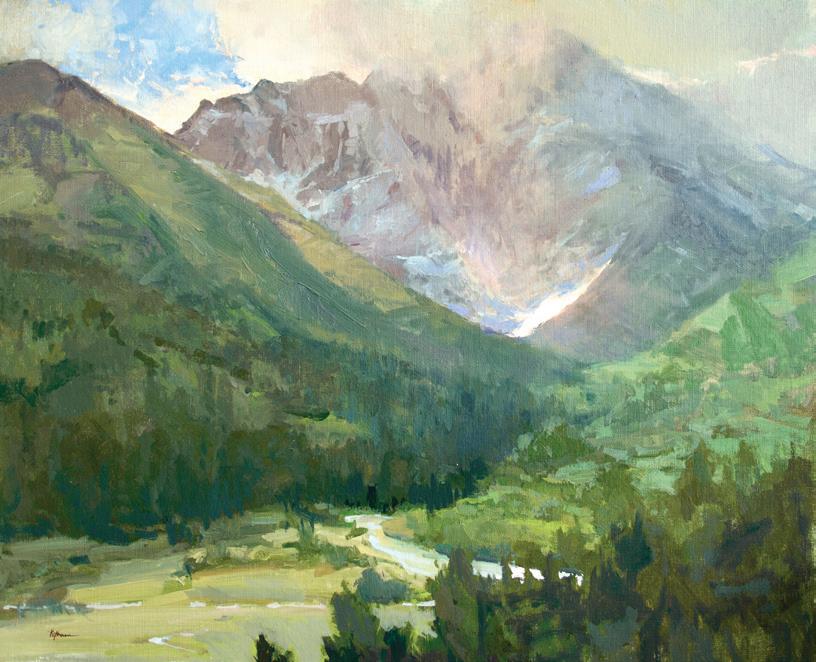
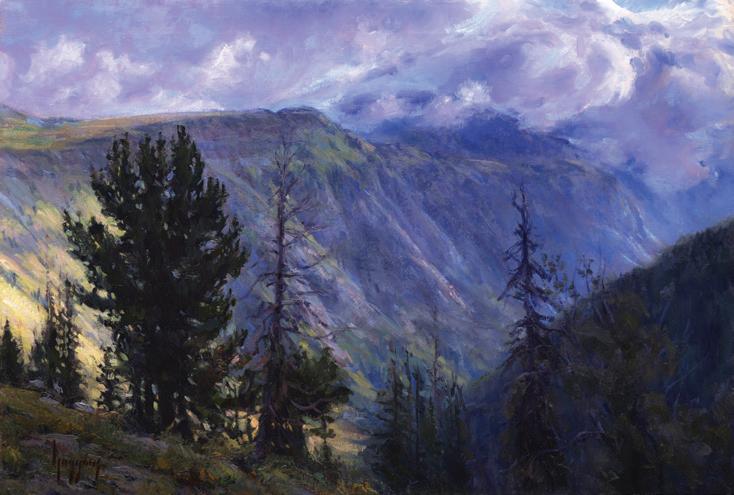
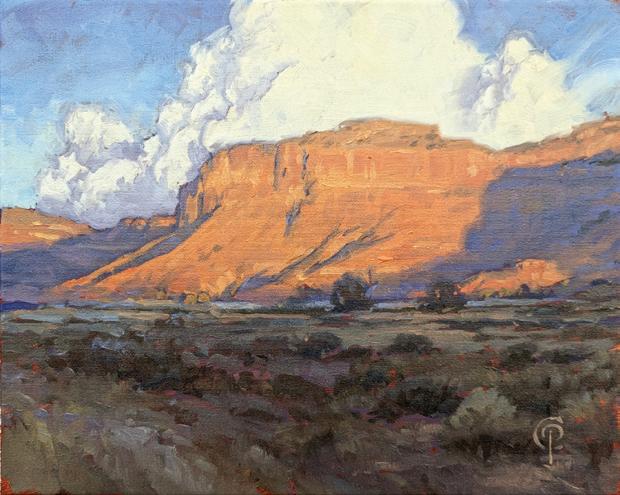
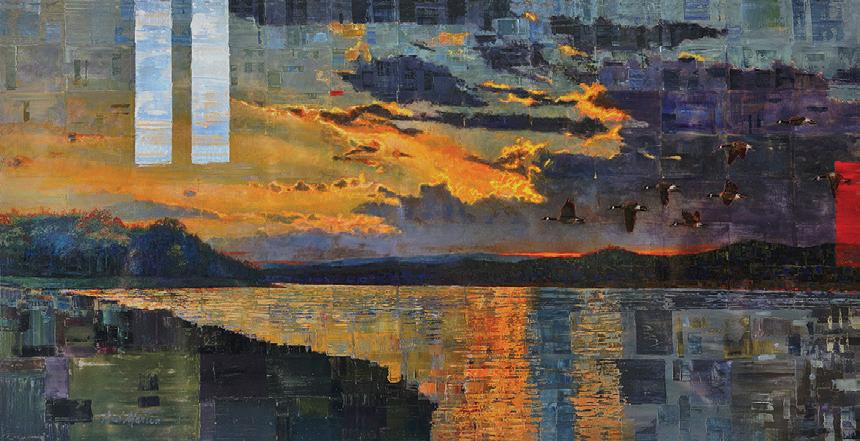
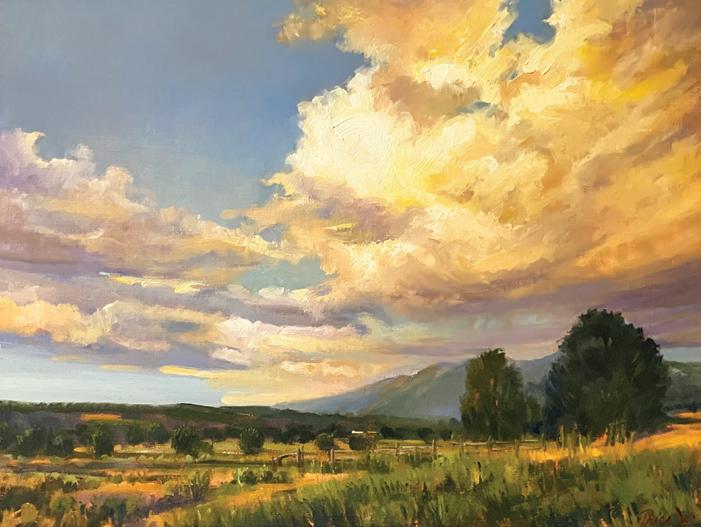
1st Place: Lori Putnam Spring Morning, 30x36”, oil
2nd Place: Thomas Caleb Goggans Through the Breach, 21x31”, oil on linen
5th Place: Virginia Price Johnson Mountain View, 18x24”, oil
6th Place: Thomas Wharton
7th Place: Bradley Giles
8th Place: Aapo Pukk
9th Place: Robert Johnson
10th Place: Karen Crenshaw
2 3 4 5
Finalists (alpha order): Ronilo Abayan, Jason Bailey, Stacy Barter, Carol Berning, Sue Braswell, Robin Cole, Steve Farrar, Cynthia Hamilton, Laura Krusemark, Heather McLeod, Patricia Rice, Jairid Rossow, Patricia Schappler, William Schneider, Ekaterina Stolyarova, Wenming Tao, Kerry Vosler, Susan Waters, Kathie Wheeler, and Jiaxuan Yi
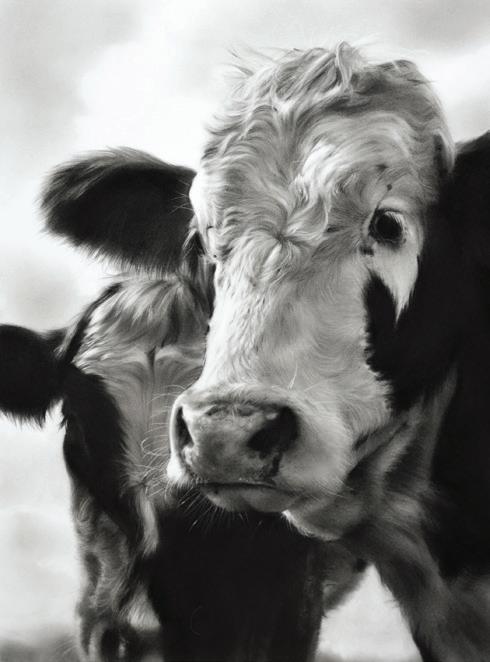
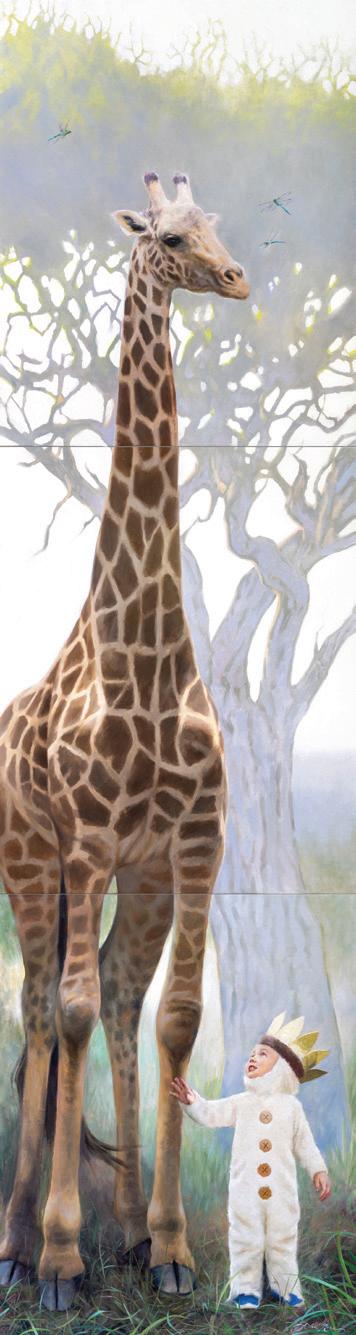
4th Place: Anna Bain His Highness, 90x24” triptych, oil
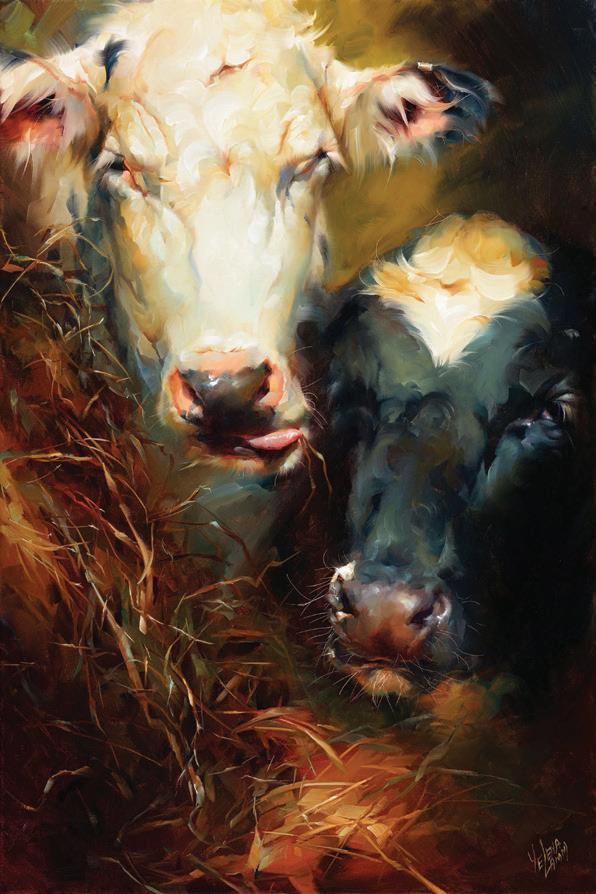
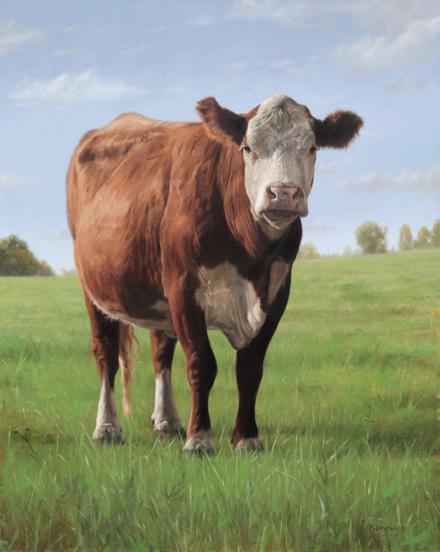
5th Place: John Borowicz Jordan Farm Cow, 60x48”, oil on canvas
6th Place: James Swanson
7th Place: Alexandra Telgmann
8th Place: Scott Royston
9th Place: Elise Broadway
10th Place: Chelsea Lang
Finalists (alpha order): Olena Burykina, Mary Carroll, Jamie Cassaboon, Raj Chaudhuri, Sandra T. Colquitt, Robin Damore, Crystal DeSpain, Alex Faudé, Sherrie McGraw, Atanas Mihaltchev, Ginny Page, Craig Pursley, Lori Putnam, Patricia Rice, Kate Scalf, Andrea Steinbauer, Joanne Tompkins, Ann Kraft Walker, and Jiaxuan Yi
Finalists (alpha order): J. Susan Aitken, Crystal DeSpain, Denise Fulton, David Goatley, Jean Hildebrant, Ned Martin, Heather McLeod, Per Elof Nilsson Ricklund, Brooke Olivares, David Pagani, Richard Parker, Evert Ploeg, Denise Pollack, Aapo Pukk, Terry Strickland, Chantal Sulkow, Anna Toberman, Pamela Wilde, Hayley Williams, and Sara Zak
2 3 4 5
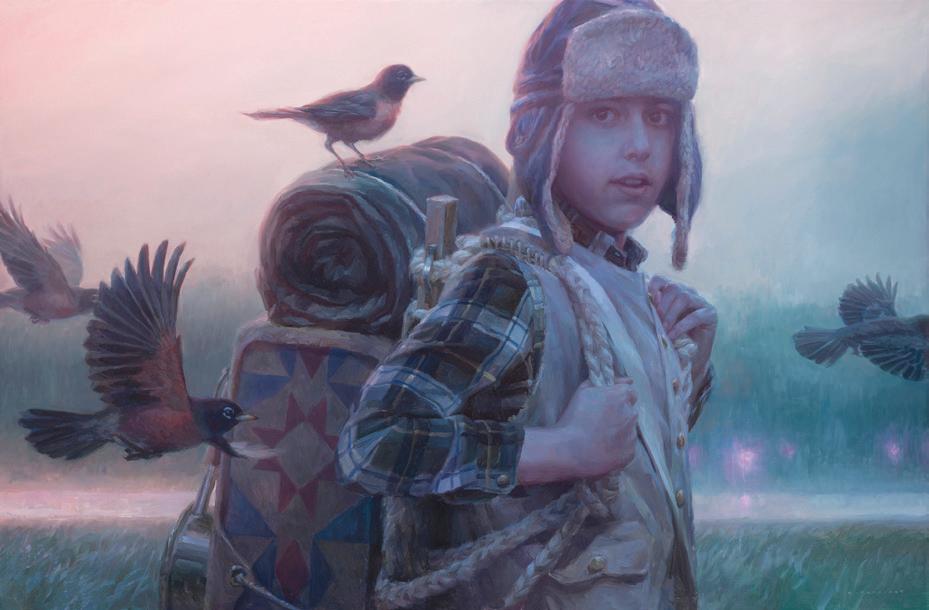
1st Place: Ryan Pancoast Waking World, 24x36”, oil
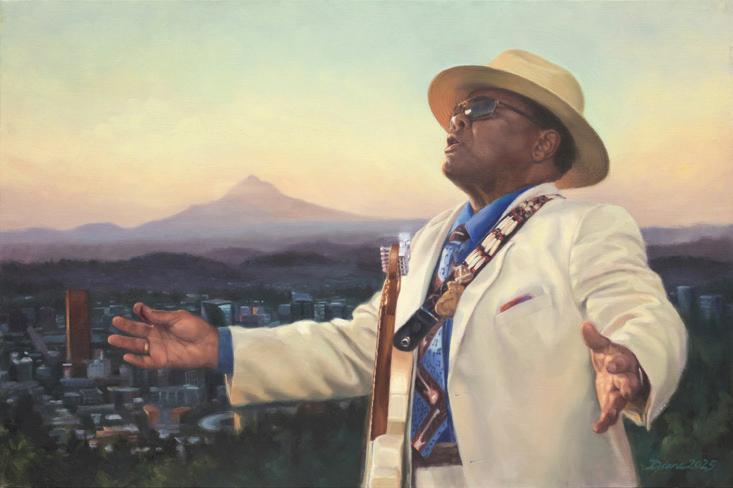
2nd Place: Diane Russell Rose City Blues, 24x36”, oil
3rd Place: David Pettibone Under the Apple Tree, 35x39”, oil on paper
4th Place: Olena Burykina Morning Before Christmas, 36x48”, oil
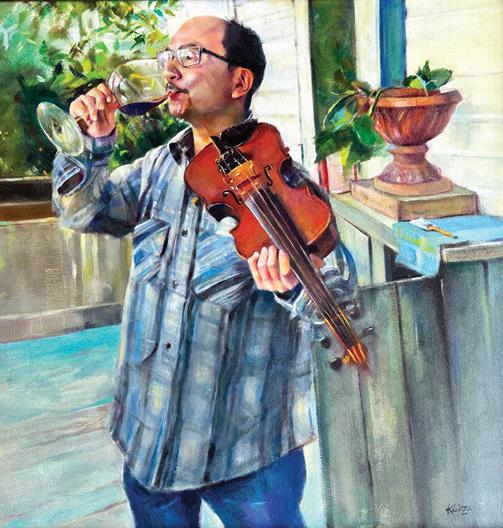
5th Place: Marcia Klioze Will Play for Wine, 24x24”, oil
6th Place: Candance Parton
7th Place: Denise Dambrackas
8th Place: Gayle Madeira
9th Place: Tanja Gant
10th Place: Diana Unrein
A DAY IN THE LIFE: MARY WHYTE
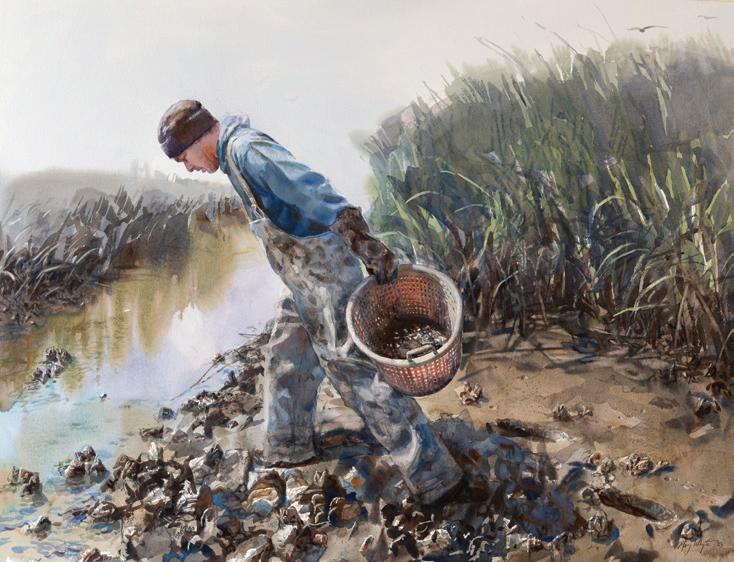
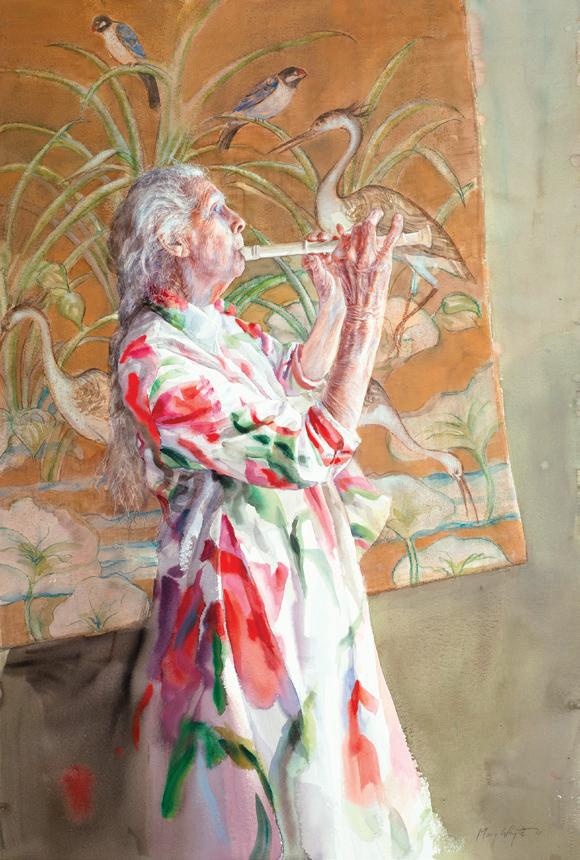
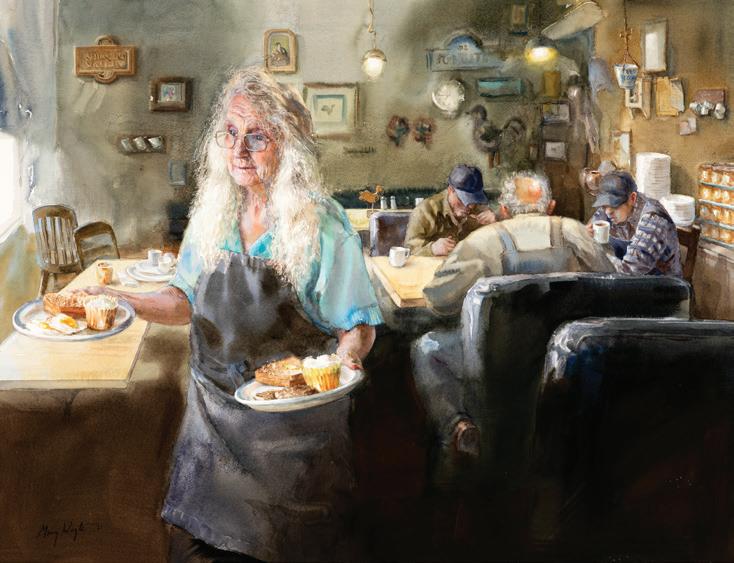
Strong composition, vibrant color and a variety of brushwork arranged from bold strokes to fine detail, emphasize the liveliness of master watercolor artist Mary Whyte’s portraits. Her sitters are not members of the social elite or distinguished dignitaries, but rather ordinary people in scenes of their everyday lives. Mary Whyte’s subjects are depicted in a way that is full of emotional expressiveness that instantly captivates the viewer’s interest.
An image of a flute player, completely focused on her task, not making eye contact with the observer, immediately evokes the expectant feeling of listening to a melodious concert. The bright red accents in the drapery of the musician’s dress convey passion and vitality, while giving the impression that the rhythm of the music is transferred to the rhythm of the painting’s composition.
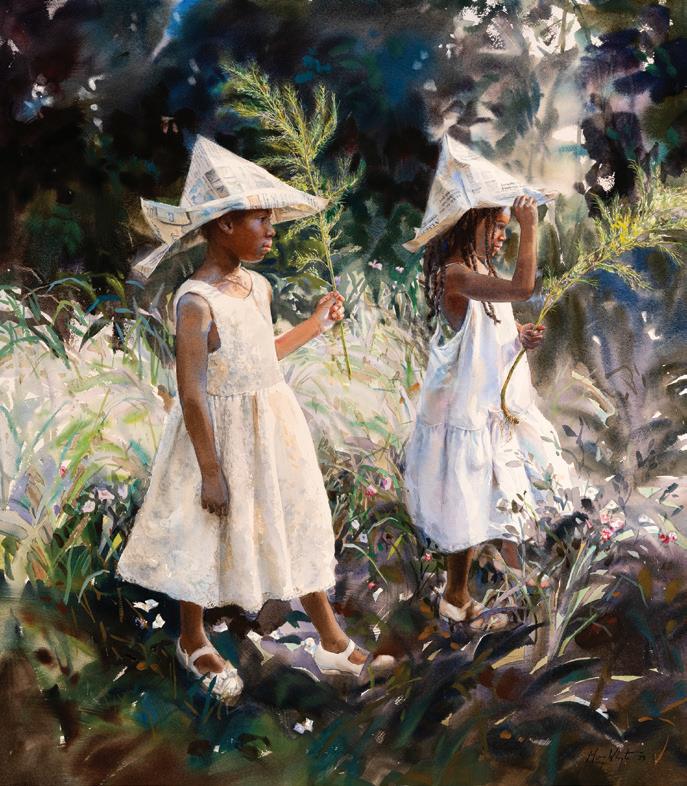
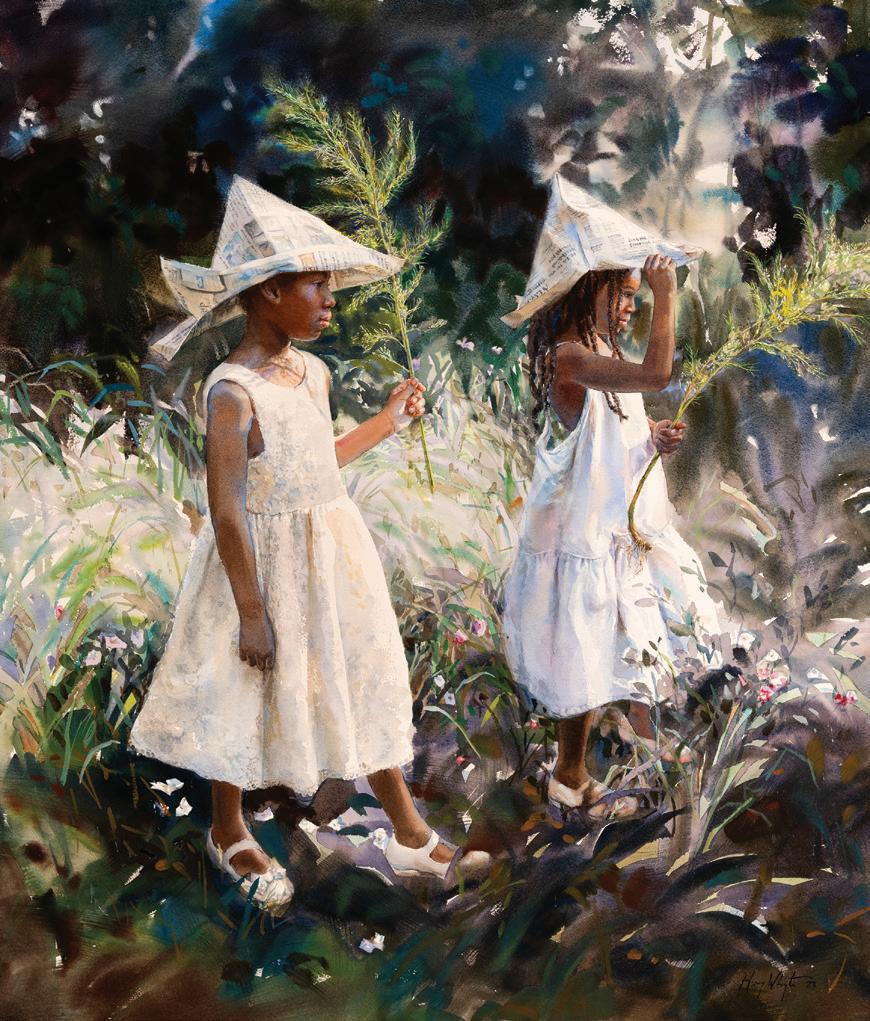
In a similarly skillful manner, Whyte guides the viewer through her painting of two girls with hats made out of newsprint in a dynamic composed landscape. A worker in a stooped position collects oysters, and the waitress in a café balances the plates in her hands. Whyte portrays more than just a likeness of her models – she is a storyteller using watercolor to capture a narrative.
By Andrea Steinbauer
The recipient of numerous awards, Mary Whyte was honored in 2016 by the Portrait Society with the Gold Medal. As a teacher and author of several books, Whyte shares her knowledge and experience with other artists
In April of 2026, Mary Whyte will be a faculty artist at the 28th annual The Art of The Portrait Conference in Atlanta, Georgia, and attendees will have the chance to learn from her.
Can you walk us through a typical day in your studio?
What does your daily routine look like?
I usually start the day with a good workout, followed by reading scripture. After checking my emails for any “code red” messages from my manager, Sharon, I move on to painting. Generally, I paint until three or four in the afternoon and then turn my attention to the business part of being an artist. I answer emails, schedule visits with collectors, and oversee social media and writing.
How do you balance studio time with other aspects of your life, like family or personal commitments?
Balancing home and studio is a constant wrestling match for any artist. I prioritize evenings and weekends for family and friends, and the rest of the time is devoted to my work. Of course, not every day goes to plan. Unscheduled events happen; a tire goes flat or the plumbing blows up. It’s all part of life as an artist.
Is there a time of day you feel most productive or inspired to create, and how do you make the most of that time?
I like painting using as much natural light as possible, so my most focused time is generally morning and early afternoon, before the light and my energy begin to wane. I like to end my day by sketching out ideas for future paintings. The excitement of imagining is what drives me back into the studio every morning.
How do you handle creative blocks or days when inspiration is harder to find?
Creative blocks are rarely caused by a lack of ideas. Often the paralysis an artist may experience is from fear; fear of trying something new, fear of failure, fear that your next work won’t be as good as the last. For some, too, it is actually laziness or procrastination that masquerades as a creative block. To combat a perceived stalemate, I have found that one of the best solutions is to simply get back into the studio. As Henri Matisse said, “Don’t wait for inspiration. It comes while working.”
Are you currently teaching, and how do you incorporate that into your schedule?
I teach both online and in-person. I offer an online course and an advanced mentorship program through Terracotta, which I have found to be especially rewarding. A few times a year I give in-person workshops in various locations around the country as well as internationally, including a week-long excursion this October in Sicily.
What do you find most fulfilling about your day-to-day life as an artist?
Art has the capacity to engage us, expand us, and inspire us. Whether we are the makers of art or the spectators, there is ample evidence proving that participating in creative expression increases brain function, decreases stress, and promotes our ability to experience true compassion and joy. It’s one of the reasons I started the Patriot Art Foundation, where we give veterans all across the country a means of expression and connection through art.
What projects are you currently working on?
Many! I’ve just released my eighth book called An Artist’s Life: Unlocking Creative Expression, and I am in the middle of a book tour. I am also just finishing twenty-six works (some very large) for an exhibition opening May 22nd at the Gibbes Museum of Art in Charleston, South Carolina, as well as a collaboration of images and music with the Charleston Symphony March 20th and 21st. The events mark America250, celebrating the 250th year of our nation’s constitution, and will run concurrently with another solo exhibition of mine at the Grohmann Museum in Milwaukee, Wisconsin called We the People: Portraits of Veterans in America.
With “We the People: Portraits of Veterans in America,” you have created a remarkable series of portraits. What was your inspiration, and how did you realize this ambitious project?
We the People: Portraits of Veterans in America was a seven-year project that took me to all fifty states, painting one veteran from each state. My goal was to create a true, unvarnished portrait of America showing our diversity. The fifty paintings portray veterans of all ages and backgrounds in current day life, such as a dairy farmer, coal miner, ferry boat operator, tattoo artist, astronaut and a homeless man. The exhibition has been touring to museums across the country for the last six years.
What motivated you to choose watercolor as your medium?
Although in art school I was trained in oils, I have always preferred watercolor. I love its speed and flow. Watercolor is the only medium that relies strictly on timing, which is also what makes it so interesting and so challenging. John Singer Sargent best summed up working in watercolor as “making the most of an emergency.”
Compared to oil painting, the possibilities for corrective actions are limited in watercolor. How do you handle this?
It’s just as easy to overwork an oil painting. However, in watercolor, there is no hiding correction, as every alteration steals from the painting’s freshness. If I have too many second guesses the whole thing turns to mud. To avoid ruining a painting by overworking it, I try to work out as much as I can in advance by making thumbnail sketches. Planning the image’s composition, values, and shapes up front makes for more fluid, purposeful and confident painting later.
1. Eden, 32x28”, watercolor on paper
2. Oyster Bank, 29.75x38”, watercolor on paper
3. Coming to Camelot, 36x24”, watercolor on paper
4. Red Rooster Café, 24x31”, watercolor on paper
STEP BY STEP
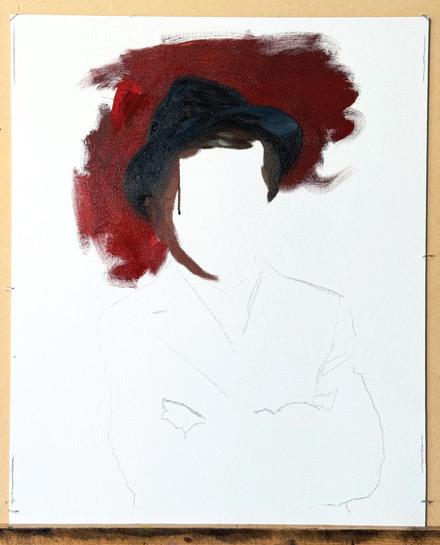
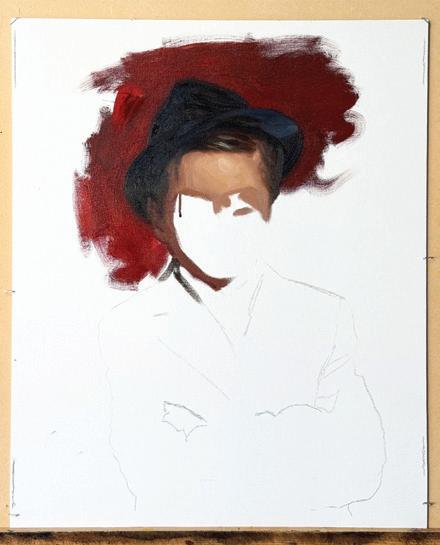
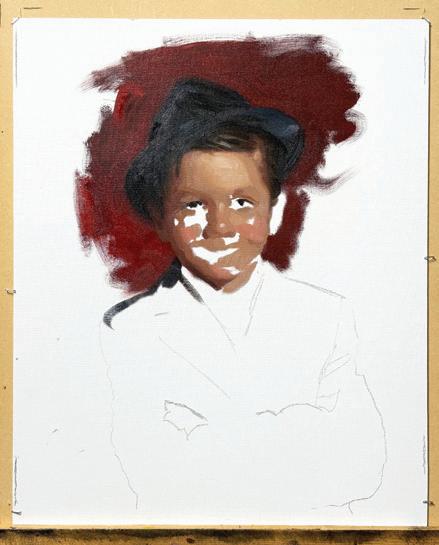
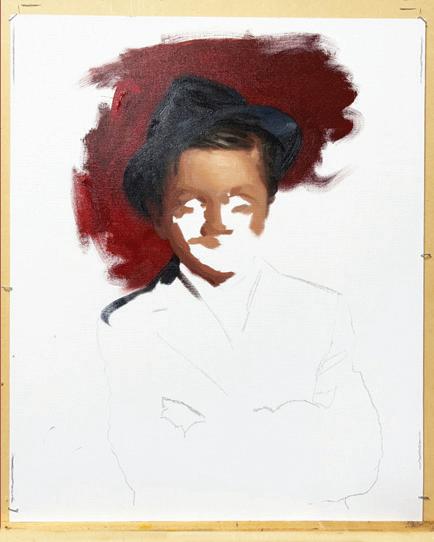
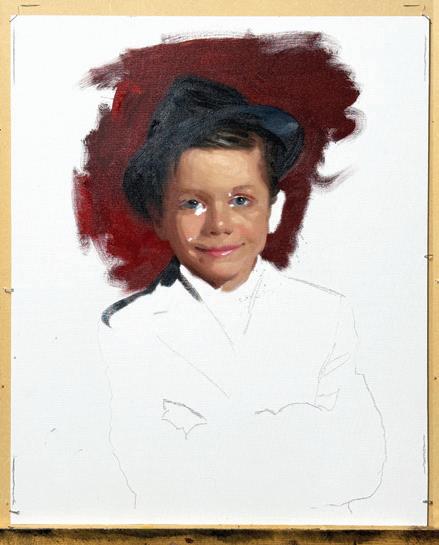
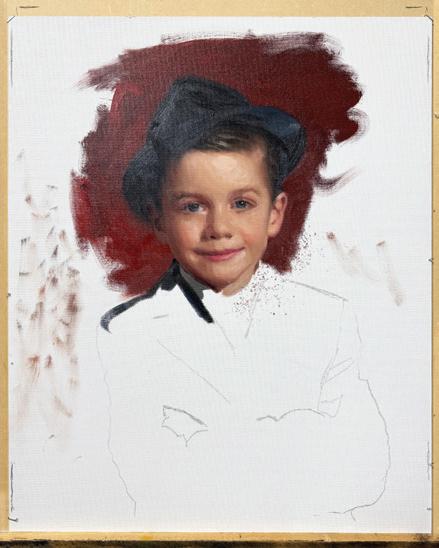
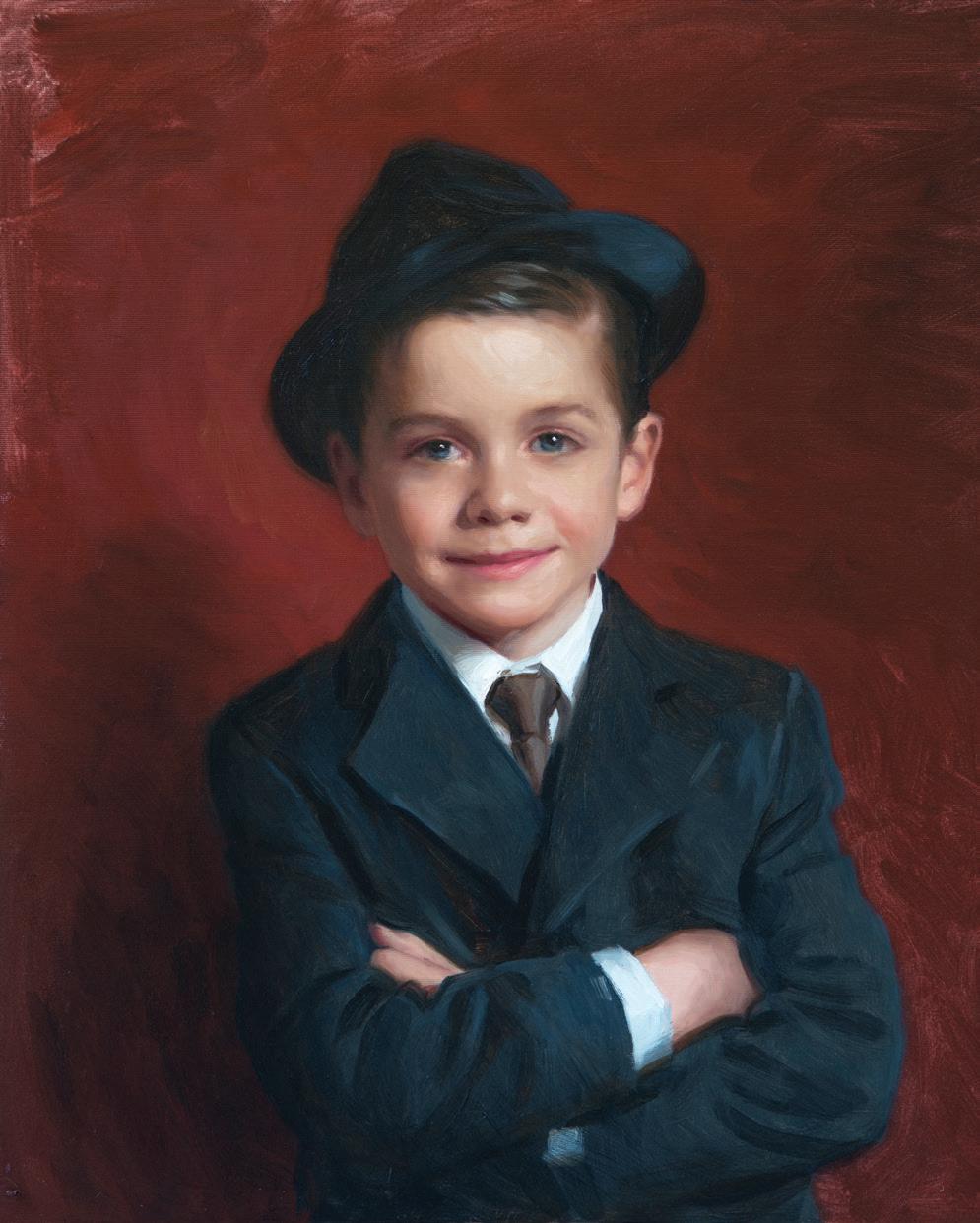
This is a portrait I painted recently of my son Matt, based on photos I took of him when he was 4 years old, around 20 years ago! At the time, Matt loved to dress up in a suit and hat, which definitely had Frank Sinatra vibes.
STEP ONE: After roughly sketching in the position of Matt’s figure on the canvas, I started painting his head, beginning with the darks: his hat and the red background.
STEP TWO: To paint the hat and jacket, I used a combination of Burnt Sienna and Ultramarine Blue. I used the same colour combination for Matt’s hair, with the addition of Titanium White. For the red background I used Cadmium Red, muted with Ivory Black and a dash of Alizarin Crimson.
STEP FOUR: My general colour mixture for midtones is red, yellow, black and white, which is similar to the Zorn palette. Unlike Zorn, I mostly use Alizarin Crimson as my red. Additionally, I’ve used Cadmium Red Light to accentuate the warmth of the cheeks, chin, etc. In general I use two yellows (Yellow Ochre and Cadmium Yellow) and two reds (Alizarin Crimson and Cadmium Red Light).
By Paul Newton
STEP THREE: In the darks of the face, I used a mixture of Alizarin Crimson and Chromium Oxide Green, with a touch of Yellow Ochre and Cadmium Red Light. I’m essentially painting from dark to light.
STEP FIVE: In the areas where the flesh colour is cool, I normally just increase the proportion of Ivory Black in my colour mix, rather than adding blues or greens. The reason for this is that black mutes the overall colour mixture without making it dirty or discoloured. However, in a few of the light areas, such as around the mouth and on the neck, I added a touch of Viridian.
STEP SIX: When painting flesh tones, I try to ensure that the darkest recesses of the face are kept warm, such as the corners of the mouth and nostrils. I focus a lot on edges, and I like to paint one form into another, keeping the transition edges generally soft.
At this stage I’m trying to make small adjustments and refinements, hopefully without overworking the painting. As far as possible, I try to complete the head in one go rather than in layers. However, I rarely manage to achieve that, and I usually have to make small adjustments once the first paint layer is dry.
STEP EIGHT: The strong red background adds a theatrical note to the composition, and I think it resonates with the outfit Matt is wearing as well as his pose. Its intensity brings energy and focus, complementing the portrait in a way that draws the viewer in.
Paul Newton is an Australian artist who studied science at the University of Sydney before pursuing painting at the Julian Ashton Art School. A seventeen-time finalist in the Archibald Prize, he has also received multiple placements in the Portrait Society of America’s International Portrait Competition, including the Grand Prize in 2023. His work is held in collections worldwide, including 32 commissioned works on the history of Catholicism in Australia for the Domus Australian chapel in Rome.
Matt Newton – 2025, 23.75x19.5”, oil
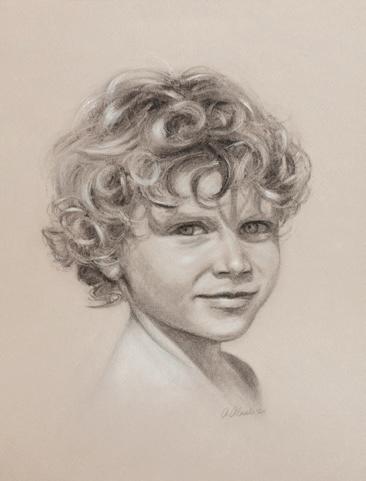
1. Annette Alessi’s portrait Silas, charcoal, 12x9”, received the Artistic Recognition award in the 2025 Portraits competition with Art and Color Magazine 365, Fall 2025 issue.
2. Frances Bell received the 1st Place Portraiture award for her portrait, Among Her Thoughts, 27.5x25.5”, oil on canvas, in the 18th International ARC Salon.
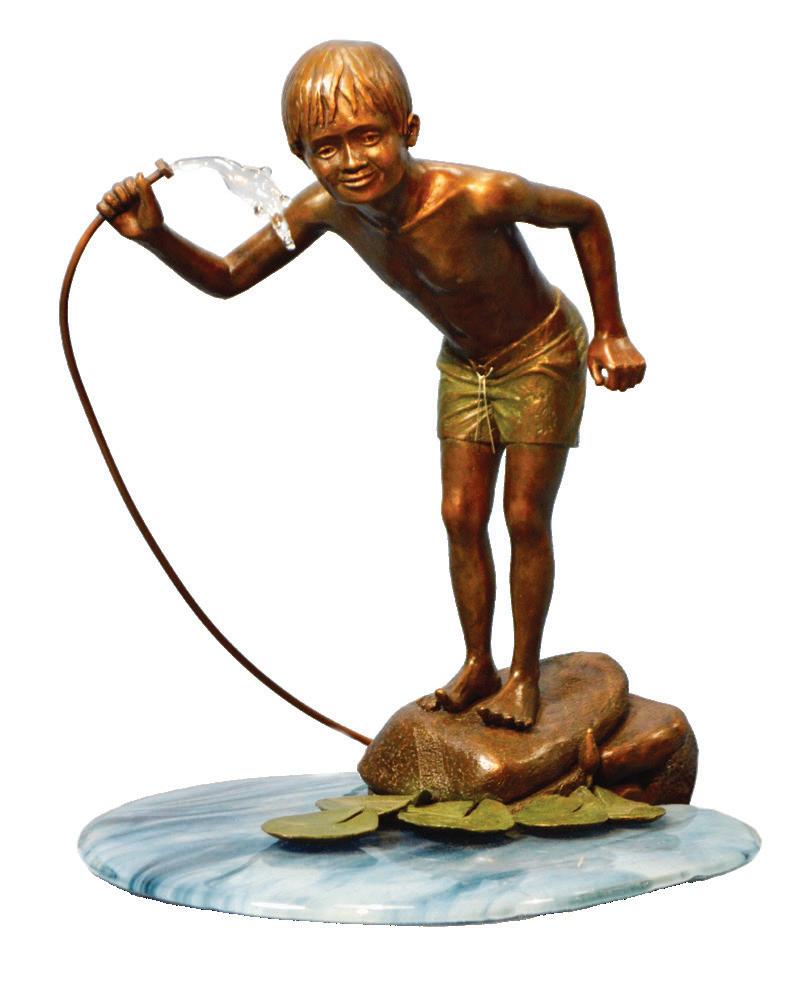
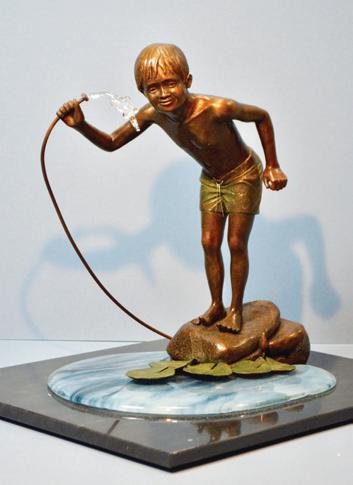
3. Donna Catotti’s bronze and glass sculpture Hot Summer Day received an Award for Excellence in Figurative Sculpture from the Council of American Artist Societies at the Catharine Lorillard Wolfe Art Club 128th Open Exhibition at the Salmagundi Club in NYC, Fall 2025.
4. Tina Garrett’s painting Ever After was awarded 1st Prize in the Oil Painters of America Fall Online Showcase.
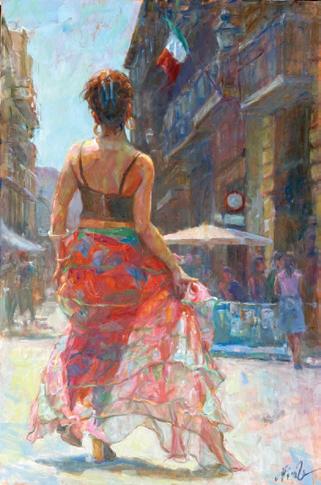
5. Nicole Kennedy’s painting The Beauty of Palermo, 36x24”, oil on canvas, received the Best in Show Award at the American Impressionist Society Annual All Members online juried exhibit in 2025.
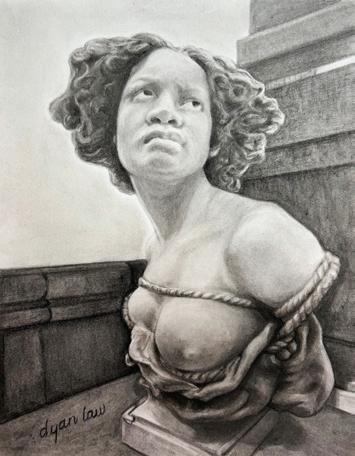
6. Dyan Law’s painting was accepted for participation in the 2026 National Conference of Artists, Martin Luther King Jr. Commemorative Art Exhibition. It’s the 30th Year Anniversary Exhibition and was on view January-March 2026 in New Orleans.
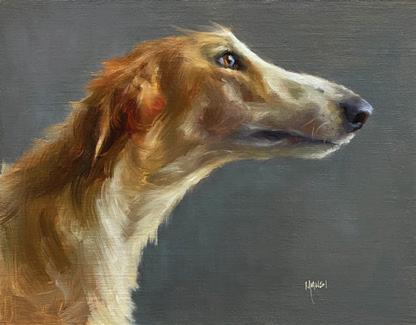
7. Johanne Mangi has been accepted as a Signature Member of The Society of Animal Artists which promotes excellence in animal art. SAA can now be added alongside the artist’s signature.
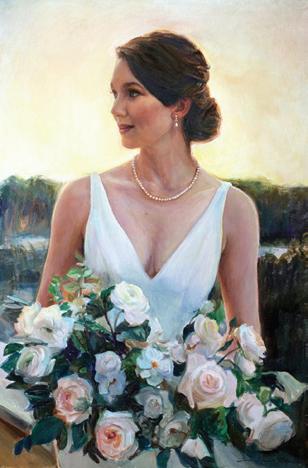
8. Linda Harris Reynolds received an Honorable Mention for her painting The Bride in the NTDTV’s International Painting Competition, a four-day event held at the Salmagundi Club in NYC.
9. Li Volk’s portrait, Megan Howell, 25x30”, oil on linen, was awarded Finalist in the 18th International ARC Salon competition.
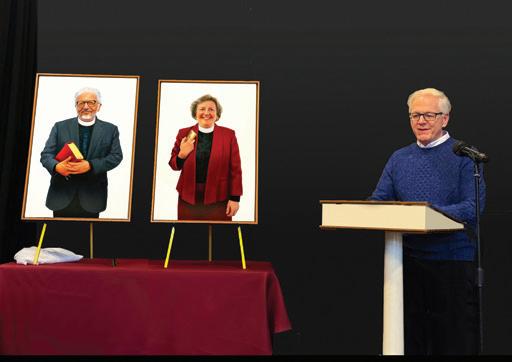
10. Thomas Wharton recently unveiled two portraits for the Church of St. Luke in the Fields in New York City of the current and former Rectors. The paintings are set to be in the newly redesigned Parish House. 1 2 3 4 5 6 7 8 9 10
exhibitions
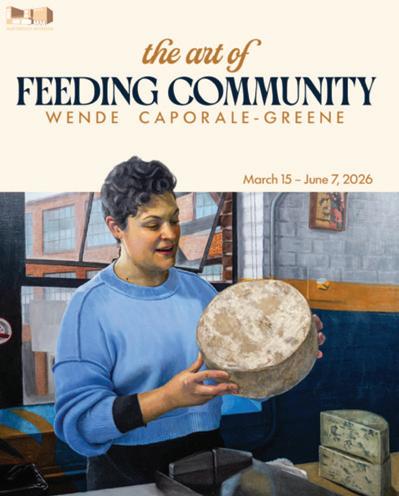
1. Wende Caporale-Greene’s newest solo exhibition, “The Art of Feeding Community,” features paintings of local cheesemongers, harvesters, farmers, lobstermen, and others working behind-the-scenes in our local food systems. Don’t miss it on display at the Mattatuck Museum, March 15 - June 7, 2026. For more info, visit www.mattmuseum.org.
2. Jeremy Lipking’s Retrospective showcasing over 40 significant works spanning from 1996-2026 will be on display from April 11-August 16 2026, at the Booth Western Art Museum in Cartersville, GA. For more info, visit boothmuseum.org.
3. Mary Whyte’s newest exhibition of figurative watercolors, SALT OF THE EARTH, will be on display May 22-September 27, 2026, at the Gibbes Museum of Art in Charleston, SC. This exhibition gives us a moving glimpse into the heart and soul of everyday Americans. For more info, visit www.gibbesmuseum.org
workshops
4. Anna Rose Bain will be leading a weeklong retreat, “The Portrait and Beyond,” June 5-12, 2026, at the luxurious Hotel Leone in Le Marche, Italy. Bring an artist friend or a nonpainting partner. The retreat is all inclusive. For more info on the venue and workshop, visit the Hotel Leone website: hotelleonemarche.com.
5. Casey Childs has several upcoming workshops including a 2-Day Drawing Workshop, June 22-23, 2026, and a 4-Day Oil Painting Workshop, June 24-27, 2026, both at Casey’s Studio in Salem, UT. Learn more and register at caseychilds.com/workshops.
6. John Darley is teaching an Oil and Tempera workshop at Scottsdale Artists’ School on May 4-7, 2026. In this workshop, students will learn a layered approach to portrait painting using both tempera and oil to achieve depth, luminosity, and expression. Register online at www. scottsdaleartschool.org.
7. Huihan Liu is giving a free demonstration on May 1 from 12pm-4pm, at Art Avenue Gallery in Sarasota, FL. The following day, Huihan will teach a painting workshop, May 2-6, 2026, also at the Art Avenue Gallery in Sarasota. For more info, visit www.livolkart.com/ workshops.
8. Robert Dale Williams will be offering a “Portraits From Life” workshop on Saturday, May 16, 2026, at the Yocum Institute for Arts in Reading, PA. This beginnerfriendly workshop introduces the process of observing, measuring, composing, blocking, and rendering portrait drawings or paintings from observation. For more info, visit www. yocuminstitute.org. 1 2 3 4 5 6 7 8
renewals & new members
RENEWING MEMBERS
We gratefully acknowledge all members who renewed in December, January, and February. Your ongoing support sustains the Portrait Society’s mission.
Welcome to all who joined in December, January, and February! We’re excited to have you as part of the Portrait Society community.
DECEMBER
Patron
Tamara Hutchinson, DE
Skylar Megan Leary, WI
General
Nancy Ellen Allen, OR
Barbara Anna, SC
Gerri C Browning, IN
Bridgett Ertelt, MN
Aina Ferrer Clotas, CA
Shelley K Frihauf, CO
Brand Griffin, AL
Michael Halbert, MO
Clint Daniel Hidinger, TN
Susan Grill Joss, GA
Anthony LeTourneau, MN
Mike McMillen, IL
Kathleen Millikan, NC
J. Mosby, GA
Mark Allen Nussbaum, SC
Sara Pendergast, WA
Kurt Donald Pfaff, PA
Debbie A Powell, GA
Laura Salafia, MA
Keri Adair Tope, GA
Corporate
George Timothy Liddle, TN
Moises Menendez, AR
Visionary
Helen Yang, CA
International
Silvia Bignami, Italy
Bada Dzurjanik, Slovakia
Pedro ElÃo, Mexico
Alvin Montano, Philippines
Kazuya Ushioda, Japan
Sandra E Wong, Canada
Student
Lucas Briscoe Guo, NY
JANUARY
Patron
Patricia Parcell, NJ
Kendra Pearl, PA
General
Armando John Aguilar, CA
David Lloyd Bradley, AZ
Simon E Brown, NY
Lauren Browning, CO
Doug A Bulleit, GA
Dennis Deaton, TN
Nadine Dodd Deschene, GA
Marco Di Lucca, CO
Andy Dix, CO
Patricia Beth Felder, NC
Sam S Fielding, NY
Miwa Maryanne Gardner, WA
Barbara Sue Gomez, AZ
Brook McClintic Griese, CA
Lakshmikant Gupta, VA
Evonne Hatton, UT
john hershey, OH
Forrest A Hill, GA
Miriam Hoffmann, GA
Betty Hudson, VA
Averill Johnson Jones, GA
Julia Jones, OH
Cindy Kelly, GA
Paul David Kramer, OR
Lesley Susan Kutinsky, MI
Thomas O Lampson, WA
Jess Lau, CO
Richard M Levy, RI
Bo Li, TX
Marie Lo, OR
Holly Lowery, AL
Jennifer Megumi
MacEanruig, WA
Denise Rhea Malm, TX
Katherine Mialkowski, GA
Savannah Hope Miller, GA
Mark A Olivero, SC
Stacy Jo Peterson, TX
Joseph Piven, NC
Susan Carol Raine, TX
Mary Ann Reames, SC
Nicole Risner, TN
Bill Robertson, OH
Donald P. Rowland, OH
William Josh Ryhal, OH
Kim Schleicher, WI
Stephanie Shifflett, VA
Jesseca Smith, TX
Judy Sprague, CO
Barbara DesNoyer
Stackhouse, WA
Jessie Kennedy Steinberg, TX
Tamera Trotter, UT
Nancy Katherine Von der Launitz, CA
Martha Melrose Waddell, CO
Visionary
Carol Colquitt Austin, GA
International
Zora Helene Kastner, Canada
Student
Lauren C. Blank, KY
Claire Jane Congdon, MN
Emma Earle, UT
Eliot Maxfield, UT
Mesoma Hammida Onyeagba, NY
FEBRUARY
Patron
Mary Sharon Knoska, GA
Patricia Parcell, NJ
General
Catherine P Bateman, PA
William Belcher, AZ
Youming Cate, CA
Catherine L Chrisler, MO
Carol Walker Dallas, CO
Denny Fanaro, SC
Marcel Franquelin, SC
Lisa D Fuller, FL
Sharon Lee Hill, NC
Julia Jones, OH
Scott Myers, TX
Jaceena Shepard, AL
Kayley Anne Smith, AK
Lisa Temple, TX
SARGENT CIRCLE MEMBERS
In 2023, The Portrait Society of America established the Sargent Circle, and we want to thank these members who have made a generous donation and sustaining commitment to our mission. Their exceptional gift reflects their commitment to art education and preserving the legacy of fine art portraiture and figurative works.
Platinum Members
Susan Basham
Bryan and Alice Essary
Sandra Murzyn
Michael Shane Neal
Leslie Nordness
Sarah Perot
Brant and Joelle Phillips
Trish Savides
Henry Garth Smith, MD
Mary Whyte
Gold
Aida and Kevin Garrity
Barbara Greco
Hope and Billy Reis
Teresa Spinner
Louis and Jessica Sterchi
Silver
Melinda and Jeff Balser
Peggy Kinstler
Jerry Williams
Sheila Wolfe
Carol and Darryl Yochem
The Portrait Society of America
P.O. Box 11272
WEDNESDAY WEBINARS
Connect – Inspire – Educate
In support of the Portrait Society of America’s mission, we’re excited to present our Wednesday Webinars. Each session includes a live Q&A with the artist. Cost is $39-$49 and includes a link to view the webinar for 30 days. For more information and to register, please visit www.portraitsociety.org or call toll-free 1-877-772-4321.
June 17, 2026
SCOTT BURDICK
Expressive Painting Through Experimentation
July 8, 2026
MELINDA WHITMORE
Constructing the Face: Structure, Proportion, and Likeness