Permission must be obtained from Psi Chi to reprint or adapt a table or figure; to reprint quotations exceeding the limits of fair use from one source, and/or to reprint any portion of poetry, prose, or song lyrics. All persons wishing to utilize any of the above materials must write to the publisher to request nonexclusive world rights in all languages to use copyrighted material in the present article and in future print and nonprint editions. All persons wishing to utilize any of the above materials are responsible for obtaining proper permission from copyright owners and are liable for any and all licensing fees required. All persons wishing to utilize any of the above materials must include copies of all permissions and credit lines with the article submission.
Advertisements that appear in Eye on Psi Chi do not represent endorsement by Psi Chi of the advertiser or the product. Psi Chi neither endorses nor is responsible for the content of third-party promotions.
PSI CHI Board of Directors
SOCIETY PRESIDENT Jason Young, PhD president@psichi.org
PAST-PRESIDENT Susan Becker, PhD pastpresident@psichi.org
PRESIDENT-ELECT Darren Bernal, PhD presidentelect@psichi.org
EASTERN REGIONAL VICE-PRESIDENT Ingrid Tulloch, PhD easternvp@psichi.org
One Society, Many Chapters, Shared Possibilities: Introducing the Chapter Support Advisory Committee
Shawn R. Charlton,
Want to Know Psi Chi? Look at Our Values—and How We Live Them
Marianne Fallon, PhD Psi Chi Executive Director
Why should I join Psi Chi? How is Psi Chi relevant? I hear these questions often. I could list member benefits, recite our timeless mission, share our aspirational vision… but the best answer to these questions is Psi Chi’s values and how we live them.
Scholarly Excellence and Integrity
Recognizing and promoting the highest standards in psychological science and application.
• Chapters who have been granted a Psi Chi charter operate at accredited institutions of higher education with high-quality psychology programs.
• With the help of faculty advisors, Psi Chi members have academic credentials that reflect excellence among peers.
• Psi Chi strives to advance psychological science through embracing open science practices; offering opportunities for scholarly, peer-reviewed publication; and supporting excellent research through our grant programs.
• Psi Chi scholarships recognize academic excellence and potential for impact to the profession.
Equity and Accessibility
Removing barriers to recognizing academic excellence and celebrating diverse voices.
• Psi Chi works to minimize financial barriers so that every academically qualified student across the globe who wants to join our Society can do so.
• Scholarly research focusing on diversity is recognized with a special badge in our journal and awards elevate excellent research and writing.
• High-quality regalia is offered at a fair price to help students celebrate their achievement at graduation.
• Psi Chi offers inclusive programming at conventions, and creates and shares resources containing diverse perspectives.
Professional Development and Personal Growth
Providing meaningful experiences to advance members’ education and career path.
• Members develop leadership skills through service as chapter officers, faculty advisors, and Board members.
• Publications and webinars assist in career preparation and furthering members’ education.
• Chapter activities help members prepare for next steps in their educational and professional journeys.
• Travel grants support members’ convention attendance to present research and broaden professional networks.
Calling and Connection
Fostering meaningful relationships fueled by shared passion for psychology.
• Chapter activity grants help build vibrant local chapters that create belonging and engagement.
• Social media and intentional programming facilitate networking across all our members—students, faculty, and alumni.
• Psi Chi encourages collaboration between our chapters and our sister organizations Psi Beta and Psi Alpha.
• Convention programming and publications promote an interconnected, global psychology.
Service and Social Responsibility
Using psychological science to make a difference in local communities and beyond.
• We embrace a culture of philanthropy—or love of humankind—that values the contributions of all Psi Chi members and supporters.
• Our members contribute thousands of hours annually serving as chapter officers, faculty advisors, committee members, Board members, and reviewers for manuscripts and awards, grants, and scholarships.
• Chapters engage in service-oriented activities to positively impact their campus and local community.
• Psi Chi partners with mission-aligned professional organizations (e.g., regional associations) that advance academic excellence and science, and that apply knowledge in service of the common good.
Stewardship and Sustainability
Responsibly managing resources to ensure long-term stability and strength, benefitting future members.
• Board members ensure the Society is resilient and has the resources needed to advance our mission, purpose, and vision.
• Funds support meaningful programs and operations that
best serve our members and the psychological community.
• Psi Chi continually improves organizational infrastructure and governance to better serve our Society.
• Psi Chi cultivates relationships to ensure that our Society remains credible, trustworthy, and impactful for future members
Brené Brown (2018) defines value as “a way of being or believing that we hold most important” (p. 186). In other words, values capture our identity. Psi Chi’s values and—more importantly— how we practice them reflect an identity rooted in excellence, connection, inclusion, growth, responsibility, and stewardship.
Reference
Brown, B. (2018). Dare to lead . Random House.
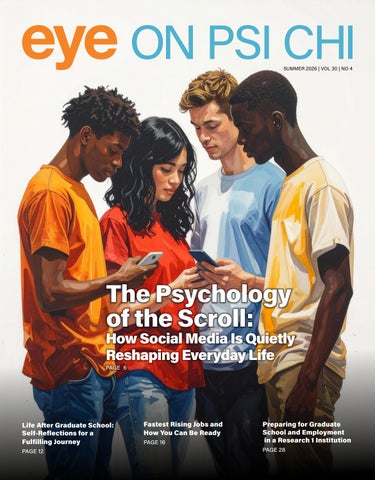
The Psychology of the Scroll: How Social Media Is Quietly Reshaping Everyday Life
Shawn R. Charlton, PhD University of Central Arkansas
ATrantham University of Central Arkansas
re you on social media?” really isn’t a meaningful question. For most people, social media is a condition of modern life and an environment woven into how we form relationships, develop identity, and experience the emotional tone of the world around us. Our friendships, self-concepts, and collective conversations now unfold in digital spaces engineered to connect, amplify, and reward attention at unprecedented scale and speed. These platforms offer real benefits: access to community, visibility, and belonging that were previously out of reach for many. At the same time, they introduce new psychological pressures, including constant comparison, heightened visibility, and an “always on” social presence that blurs the line between connection and performance. To understand social media’s impact, then, we must move beyond simple judgments and instead ask how these environments shape our minds, our relationships, and our shared emotional lives. This reframing is consistent with current research suggesting that social media effects are person-specific rather than universal, shaped by individual vulnerability, developmental timing, and patterns of engagement rather than overall exposure (Fassi et al., 2025; Valkenburg et al., 2021).
Social Relationships
Social media can increase access to social support and connection, especially for people who are geographically isolated or exploring their identity. Classic developmental questions—Who am I? Where do I belong?—now play out in networked spaces where sharing and feedback feel easier and more immediate than face-to-face conversations.
But the same features that increase contact also intensify peer dynamics. Nesi (2018) describes social media as transforming peer relationships by increasing how often people interact, how quickly they respond, and how visible social activity becomes. Popularity can now be counted. Group interactions are persistent. Social moments leave digital traces.
Self-Concept
Psychologists have long known that people judge themselves through social comparisons (Festinger, 1954). However, unlike offline comparison, social media comparison is increasingly algorithmically amplified, repeatedly exposing users to content optimized for engagement rather than representativeness (Ryding
Julia
et al., 2025). Social media turns that tendency into a constant background process. Research shows that appearance-focused social media use is linked to body image concerns, largely because it increases upward social comparison (Fardouly & Vartanian, 2016). When people repeatedly see idealized images, the gap between who they are and who they feel they should be can become emotionally charged, consistent with Higgins’s (1987) self-discrepancy theory.
More broadly, how people use platforms matters more than how long they use them. Among adolescents, social comparison and feedback-seeking online predict later depressive symptoms, suggesting that certain patterns of engagement are especially risky (Nesi & Prinstein, 2015).
Mental Health
Public debate often frames social media as either a mental-health crisis or harmless hype. Research points to something more complicated. Recent work increasingly emphasizes mechanistic pathways—including disrupted sleep, emotion dysregulation, social evaluation, and reinforcement learning—over broad claims about mental health outcomes (Krok & Półtorak, 2025). This emphasis shifts the focus to personal vulnerability, life circumstances, and how platforms are used (Odgers & Jensen, 2020). For some, social media can support connection and identity. For others, it may intensify stress, comparison, or loneliness.
Several studies suggest plausible causal pathways. Facebook use has been linked to later declines in moment-to-moment well-being (Kross et al., 2013). Passive scrolling tends to predict worse moods than active interaction (Verduyn et al., 2015). In a randomized study, students who limited social media use reported less loneliness and depression (Hunt et al., 2018).
Taken together, the evidence suggests that certain experiences— constant comparison, public evaluation, and disrupted sleep—may drive much of the risk, rather than social media use itself.
Collective Psychology
Social media is also a shared emotional space. What people see influences what feels normal, urgent, or emotionally charged. A large-scale experiment found that emotional tone in Facebook feeds influenced users’ own posting, consistent with emotional contagion (Kramer et al., 2014). Although that study sparked ethical debate, the broader point stands: Platforms shape the emotional climate people experience.
At the group level, algorithms and networks influence what information people encounter. Research shows that both personal networks and platform ranking affect exposure to different political views (Bakshy et al., 2015). Other work documents how misinformation spreads easily when content is emotionally engaging and financially profitable (Allcott & Gentzkow, 2017). Rather than functioning as a neutral tool, social media increasingly operates as a psychological environment that adapts to what captures attention. Increasing attention is being paid to recommender systems, which may normalize emotional intensity, controversy, or distress by disproportionately promoting content that captures attention, particularly among younger users (Regehr et al., 2025). Together, these findings suggest that platform effects emerge not accidentally, but through design choices that shape attention, reward, and visibility over time.
Where Will This Column Take Us Next?
Taken together, research suggests that social media reshapes psychological experience in three fundamental ways: (a) by directing what we pay attention to, (b) defining what gets rewarded, and (c) shaping who we compare ourselves to. These shifts influence how people relate to others, how they see themselves, and how groups feel and function over time. Framing social media as either harmful or harmless misses the more important point: social media’s effects depend on specific features, patterns of use, and moments of development.
The most useful questions are not Is social media good or bad? But which platforms? Which habits? For whom? And at what psychological cost or benefit?
That perspective sets the foundation for the essays that follow. Facebook, YouTube, TikTok, and Instagram all create their own psychological climate, shaped by design choices, social norms, and algorithmic incentives. Understanding these differences is not about fear or nostalgia for a predigital past; it is about learning how to live well in a social world that is no longer just offline or online, but both at once. With clarity, intention, and informed engagement, the same tools that shape us can also be shaped—allowing us to create space for healthier connections, more honest self-expression, and communities that support rather than undermine psychological well-being.
References
Allcott, H., & Gentzkow, M. (2017). Social media and fake news in the 2016 election. Journal of Economic Perspectives, 31 (2), 211–236. https://doi.org/10.1257/jep.31.2.211
Bakshy, E., Messing, S., & Adamic, L. A. (2015). Exposure to ideologically diverse news and opinion on Facebook. Science, 348 (6239), 1130–1132. https://doi.org/10.1126/science.aaa1160
Fardouly, J., & Vartanian, L. R. (2016). Social media and body image concerns: Current research and future directions. Current Opinion in Psychology, 9 1–5. https://doi.org/10.1016/j.copsyc.2015.09.005
Fassi, L., Ferguson, A. M., Przybylski, A. K., Ford, T. J., & Orben, A. (2025). Social media use in adolescents with and without mental health conditions. Nature Human Behaviour, 1283–1299. https://doi.org/10.1038/s41562-025-02134-4
Festinger, L. (1954). A theory of social comparison processes. Human Relations, 7 (2), 117–140. https://doi.org/10.1177/001872675400700202
Higgins, E. T. (1987). Self-discrepancy: A theory relating self and affect. Psychological Review, 94 (3), 319–340. https://doi.org/10.1037/0033-295X.94.3.319
Hunt, M. G., Marx, R., Lipson, C., & Young, J. (2018). No more FOMO: Limiting social media decreases loneliness and depression. Journal of Social and Clinical Psychology, 37 (10), 751–768. https://doi.org/10.1521/jscp.2018.37.10.751
Kramer, A. D. I., Guillory, J. E., & Hancock, J. T. (2014). Experimental evidence of massive-scale emotional contagion through social networks. Proceedings of the National Academy of Sciences, 111 (24), 8788–8790. https://doi.org/10.1073/pnas.1320040111
Krok, D., & Półtorak, M. (2025). Social media mindsets and well-being in emerging adults: A serial mediation of Facebook addiction and stress. Brain Sciences, 15 (3), 301. https://doi.org/10.3390/brainsci15030301
Kross, E., Verduyn, P., Demiralp, E., Park, J., Lee, D. S., Lin, N., Shablack, H., Jonides, J., & Ybarra, O. (2013). Facebook use predicts declines in subjective well-being in young adults. PLOS ONE, 8 (8), e69841. https://doi.org/10.1371/journal.pone.0069841
Nesi, J. (2018). The transformation of adolescent peer relations in the social media context: Part 1—A theoretical framework and application to dyadic peer relationships. Clinical Child and Family Psychology Review, 21 (3), 267–294. https://doi.org/10.1007/s10567-018-0261-x
Nesi, J., & Prinstein, M. J. (2015). Using social media for social comparison and feedback-seeking: Gender and popularity moderate associations with depressive symptoms. Journal of Abnormal Child Psychology, 43 (8), 1427–1438. https://doi.org/10.1007/s10802-015-0020-0
Odgers, C. L., & Jensen, M. R. (2020). Annual research review: Adolescent mental health in the digital age: Facts, fears, and future directions. Journal of Child Psychology and Psychiatry, 61 (3), 336–348. https://doi.org/10.1111/jcpp.13190
Regehr, K., Shaughnessy, C., Zhao, M., Cambazoglu, I., Turner, A., & Shaughnessy, N. (2025). Normalizing toxicity: The role of recommender algorithms for young people’s mental health and social wellbeing. Frontiers in Psychology, 16 1523649. https://doi.org/10.3389/fpsyg.2025.1523649
Ryding, F. C., Harkin, L. J., & Kuss, D. J. (2025). Instagram engagement and well-being: The mediating role of appearance anxiety. Behaviour & Information Technology, 44 (3), 446–462. https://doi.org/10.1080/0144929X.2024.2323078
Valkenburg, P. M., Beyens, I., Pouwels, J. L., van Driel, I. I., & Keijsers, L. (2021). Social media use and adolescents’ self-esteem: Heading for a person-specific media effects paradigm. Journal of Communication, 71 (1), 56–78. https://doi.org/10.1093/joc/jqaa039
Verduyn, P., Lee, D. S., Park, J., Shablack, H., Orvell, A., Bayer, J., Ybarra, O., Jonides, J., & Kross, E. (2015). Passive Facebook usage undermines affective well-being: Experimental and longitudinal evidence. Journal of Experimental Psychology: General, 144 (2), 480–488. https://doi.org/10.1037/xge0000057
Scrolling for Stability: How Facebook Shapes Emotional Regulation and Well-Being
Tya Arnold, Lauren Hamilton, SaRai Shepherd, and Noah Tindall University of Central Arkansas
Mark Zuckerberg, founder of Facebook, says Facebook’s mission is to “bring the world closer together” (Zuckerberg, 2017). By bringing people closer together, happiness is intended to follow. Studies reveal that people use Facebook with the goal of happiness, but feel the opposite (Ozimek et al., 2020). Doral Health and Wellness writes about social media and increased struggles with self-esteem, body-image, anxiety, and depression (Doral Health and Wellness, 2025). Research suggests that excessive time on Facebook can lead to negative emotions (Krok & Półtorak, 2025). Facebook's influence on adolescent communication has raised concerns for emotional regulation skills. Because adolescence is fertile ground for emotional development, excessive Facebook use can interfere with their ability to effectively regulate their emotions (Piccerillo & Digennaro, 2024). Facebook use exposes adolescents to ongoing social comparison through peers’ posts and comments, which is associated with negative mood and emotional dysregulation (Fassi et al., 2025).
Researchers suggest Facebook use is associated with difficulties in desired thinking, justifying the positive reasons or consequences of using Facebook (Marino et al., 2019). Individuals who justify using Facebook for reasons such as happiness or emotional regulation are linked with chronic use (Marino et al., 2019).
Facebook affects users’ behavior by interacting with their emotional regulation needs. Behaviors meeting specific criteria can be defined as addiction (Rogier et al., 2024). Facebook addiction is linked to emotion regulation problems, interpersonal difficulties, and personality disorder characteristics (Rogier et al., 2024). This implies that compulsive Facebook use is more common among emotionally dysregulated individuals. Krok and Półtorak (2025) suggest that the relationship between Facebook addiction and perceived stress links social media attitudes to psychological well-being. Collectively, these findings suggest that Facebook’s
design and social feedback mechanisms can intensify emotional dysregulation, leading to addiction, stress, and reduced well-being. Facebook plays a significant role in college students’ emotional regulation by shaping how emotions are interpreted and expressed online. Students experiencing psychological distress tend to post more negative content. The nature and quality of SNS interaction may be more predictive of mental health (Bazarova et al., 2017). Facebook is widely used to regulate mood, and preference for online social interaction is linked to deficient self-regulation (Moretta et al., 2018). Therefore, relying on Facebook to manage emotions can contribute to negative outcomes in mental health. Facebook as a mood regulator may be misleading, with research linking Facebook to stress, emotional dysregulation, and addictive patterns of use. There's a need for a better understanding of media’s effects, emotional regulation skills, and how media platforms can support users’ psychological well-being.
References
Bazarova, N. N., Choi, Y. H., Whitlock, J., Cosley, D., & Sosik, V. (2017). Psychological distress and emotional expression on Facebook. Cyberpsychology, Behavior, and Social Networking, 20 (3), 157–163. https://doi.org/10.1089/cyber.2016.0335
Fassi, L., Ferguson, A. M., Przybylski, A. K., Ford, T. J., & Orben, A. (2025). Social media use in adolescents with and without mental health conditions. Nature Human Behaviour, 9 (6), 1283–1299. https://doi.org/10.1038/s41562-025-02134-4
Krok, D., & Półtorak, M. (2025). Social media mindsets and well-being in emerging adults: A serial mediation of Facebook addiction and stress. Brain Sciences, 15 (3), 301. https://doi.org/10.3390/brainsci15030301
Marino, C., Caselli, G., Lenzi, M., Monaci, M. G., Vieno, A., Nikčević, A. V., & Spada, M. M. (2019). Emotion regulation and desire thinking as predictors of problematic Facebook use. Psychiatric Quarterly, 90 (2), 405–411. https://doi.org/10.1007/s11126-019-09628-1
Moretta, T., & Buodo, G. (2018). Modeling problematic Facebook use: Highlighting the role of mood regulation and preference for online social interaction. Addictive Behaviors, 87 214–221. https://doi.org/10.1016/j.addbeh.2018.07.014
Ozimek, P., Bierhoff, H.-W., & Hamm, K. M. (2020). How we use Facebook to achieve our goals: A priming study regarding emotion regulation, social comparison orientation, and unaccomplished goals. Current Psychology, 41(6), 3664–3677. https://doi.org/10.1007/s12144-020-00859-1
Piccerillo, L., & Digennaro, S. (2024). Adolescent social media use and emotional intelligence: A systematic review. Adolescent Research Review, 10 (2), 201–218. https://doi.org/10.1007/s40894-024-00245-z
Rogier, G., Beomonte Zobel, S., Tosi, S., Tambelli, R., & Velotti, P. (2024). Personality disorders traits, interpersonal problems, and emotion dysregulation as predictors of Facebook addiction. Journal of Substance Use, 29 (4), 572–578. https://doi.org/10.1080/14659891.2023.2194418
The psychology of the scroll: How social media quietly rewires your mood, focus, and self‑worth. (2025, December 23). Doral Health & Wellness. https://doralhw.org/the-psychology-of-the-scroll-how-social-media-quietly-rewires-your-mood-focus-and-self-worth/ Zuckerberg, M. (2017, June 22) [Facebook post]. Facebook. https://www.facebook.com/story. php?story_fbid=10103818116031661&id=4&mibextid=wwXIfr&rdid=GbDUuMkgj0TUIe1m
When Likes Are Public: Identity, Visibility,
and
Social Comparison on Instagram
Brooke Jones, Ashlin Sellers, and Emmie Tidwell
University of Central Arkansas
Instagram’s new “With Friends” feature is struggling to gain traction, suggesting that how we present ourselves online still deeply matters. This feature makes users’ likes, comments, and reposts visible in a separate tab, allowing others to see the type of content their friends interact with (McCarthy, 2025). Psychology Today reacts to the development, stating that the new update serves as an “intimacy surveillance device” (O’Donnell, 2025). Similarly, Fast Company believes the new feature can “expose your embarrassing habits” (Upton-Clark, 2025). Although Instagram presents the design shift as a way to boost connection, the feature highlights a major facet of Instagram: shaping identity through curated self-presentation.
This feature perpetuates many concerns that have long been raised with Instagram (Ahmad et al., 2024; Wong & Hamza, 2025). Instagram allows users to present inauthentic versions of themselves without accountability for the accuracy of these self-presentations. This lack of authenticity can contribute to adverse effects on mental health, such as appearance anxiety (Ryding et al., 2025). Another study found that individuals who create inauthentic and false versions of themselves online suffer more depressive symptoms and confusion in self-concept compared to those who present an honest version of themselves online (Wong & Hamza, 2025).
Instagram allows users to construct a carefully curated and idealized digital self (Bluteau, 2025; Schlosser, 2020; Wong & Hamza, 2025). Although social media connects users, its anonymity encourages self-disclosure by creating a safe environment to reveal potentially negative aspects of oneself (Harris & Bardey, 2019). The “With Friends” feature attacks anonymity by displaying all
content interactions. Carl Festinger’s social comparison theory may provide insight into this, suggesting that individuals evaluate themselves in comparison to others to establish social identity (Ahmad et al., 2024; Festinger, 1954). Because users now see what others are interacting with, they are less likely to engage with dissimilar content to uphold their social identity, often because these engagements threaten user self-worth, leading to negative feelings like anxiety (Kohler et al., 2021; Yau & Reich, 2019).
The shift towards greater visibility of content interactions intensifies mental health concerns on Instagram. Although this feature was developed to increase connectivity among users, as the public generally receives more honest online self-presentation more positively, the loss of anonymity seems to raise greater concern (Harris & Bardey, 2019). This suggests that involuntary authenticity actually has opposite effects, ultimately increasing inauthenticity on the platform and exacerbating potential mental health consequences of social media use.
References
Ahmad, R., Hassan, S., Ghazali, N. N., & Al-Mashadani, A. R. F. S. (2024). The Insta-comparison game: The relationship between social media use, social comparison, and depression. Procedia Computer Science, 234 1053–1060. https://doi.org/10.1016/j.procs.2024.03.099
Bluteau, J. M. (2025). Crafting the digital self: Exploring Instagram self-portraiture as an anthropological endeavor. Journal of Contemporary Ethnography, 54 (4), 506–533. https://doi.org/10.1177/08912416251339677
Festinger, L. (1954). A theory of social comparison processes. Human Relations, 7 (2), 117–140. https://doi.org/10.1177/001872675400700202
Harris, E., & Bardey, A. C. (2019). Do Instagram profiles accurately portray personality? An investigation into idealized online self-presentation. Frontiers in Psychology, 10 871. https://doi.org/10.3389/fpsyg.2019.00871
Kohler, M. T., Turner, I. N., & Webster, G. D. (2021). Social comparison and state–trait dynamics: Viewing image-conscious Instagram accounts affects college students’ mood and anxiety. Psychology of Popular Media, 10 (3), 340–349. https://doi.org/10.1037/ppm0000310
McCarthy, K. (2025). New Instagram “With Friends” feature shows what your friends like and share . ABC News. https://abcnews.go.com/GMA/Living/new-instagram-map-repost-share-location-friends/story?id=124442765
O’Donnell, N. (2025). On Instagram, we should all know less about each other. Psychology Today. https://www.psychologytoday.com/us/blog/digital-health-and-well-being/202506/ on-instagram-we-should-all-know-less-about-each-other
Ryding, F. C., Harkin, L. J., & Kuss, D. J. (2025). Instagram engagement and well-being: The mediating role of appearance anxiety. Behaviour and Information Technology, 44 (3), 446–462. https://doi.org/10.1080/0144929x.2024.2323078
Schlosser, A. E. (2020). Self-disclosure versus self-presentation on social media. Current Opinion in Psychology, 31, 1–6. https://doi.org/10.1016/j.copsyc.2019.06.025
Upton-Clark, E. (2025, January 23). A new Instagram feature might expose your embarrassing habits. Fast Company.
The Dark Side of YouTube: How It Affects Kids and Teens
Gracie Clark, Morgan Harrison, and Kelsey Hernandez University of Central Arkansas
With the rise in popularity of YouTube, researchers and media alike have raised concerns about how excessive use of the app may influence the attention span, emotional regulation, and overall mental health of young viewers (Balcombe & De Leo, 2023; Divvi & Kengadaran, 2025). The constant stream of content can lead to a sense of information overload and anxiety. Balcombe and De Leo (2023), a media outlet reporting on research, suggested that YouTube use was associated with elevated stress, particularly among younger users. YouTube's short-form video “doomscrolling” is a growing behavioral concern, especially among adolescents, due to its engaging nature (Divvi & Kengadaran, 2025).
Despite a social media addiction disorder remaining unrecognized by the DSM-5, many adolescents and adults exhibit patterns of dependence on social media platforms, including YouTube (Mahendran et al., 2024). This dependence can lead to significant disruptions in daily life and well-being. Notably, YouTube’s structure follows the same intermittent reinforcement schedule observed in gambling. Because reinforcement is unpredictable, the user anticipates their next rewarding video, which increases the likelihood of doomscrolling (Clark & Zack, 2023). According to the law group Motley Rice, some recommended videos, although intended for the young viewer, contain content that may not align with age-appropriate material (Haileselassie, 2026).
In addition to recent news reports, peer-reviewed articles have also examined the negative effects YouTube has on youth. Among adolescents, excessive YouTube use has been associated with declines in academic achievements and interpersonal relationships, sleep quality, and higher levels of depression and anxiety (Divvi & Kengadaran, 2025). Charmaraman et al. (2025) further found that disrupted sleep patterns and mental deficits may occur even in settings where adult supervision is present.
While many studies focus on the overuse of YouTube, the effects of its algorithm system warrant attention as well. YouTube’s algorithm structure may prioritize emotionally driven content, enhancing heightened distress among youth (Regehr et al., 2025). Furthermore, YouTube’s algorithm may also influence adolescents' self-perception over long periods of time. This can ultimately lead to self-comparison, reduced focus, and difficulty regulating emotions (Gamboa et al., 2025).
These findings indicate that both the quantity and structure of YouTube may be linked to psychological risks during crucial developmental stages. This evidence substantiates the need for interventions to address unhealthy digital habits. Parents may reduce potential risks by monitoring content and limiting exposure, particularly before bedtime. Additionally, parents can promote the platform’s use as not only a source of entertainment but also a tool for educational development.
References
Balcombe, L., & De Leo, D. (2023, July 11). Scientists uncover startling impacts of excessive YouTube on loneliness and mental health. SciTechDaily. https://scitechdaily.com/ scientists-uncover-startling-impacts-of-excessive-youtube-on-loneliness-and-mental-health/ Charmaraman, L., Smucker, R., Theran, S. A., Dam, S., & Anthony, J. (2025). The benefits and challenges of the parental monitoring of YouTube in adolescents' lives: A qualitative study of emotion and sleep regulation. Behavioral Sciences (Basel), 1 5(6), 805. https://doi.org/10.3390/bs15060805
Clark, L., & Zack M. (2023). Engineered highs: Reward variability and frequency as potential prerequisites of behavioural addiction. Addictive Behaviors, 140, Article 107626. https://doi.org/10.1016/j.addbeh.2023.107626
Divvi., A., & Kengadaran, S. (2025). Addressing the impact of YouTube short video addiction on adolescents–a growing public health concern. Journal of Family Medicine and Primary Care, 14 (7), 3055–3056. https://doi.org/10.4103/jfmpc.jfmpc_1925_24
Gamboa, Y. H. N., Jaboli, N. N. A., Pica, N. A. L., Rosales, L. J. D., & Lazaro, B. L. G. (2025). Long-term effects of algorithmdriven content consumption on youth development and psychological perceptions. International Journal of Advanced Multidisciplinary Research and Studies, 5(3), 204–238. https://doi.org/10.62225/2583049X.2025.5.3.4217
Haileselassie, J. A. (2026). YouTube Lawsuit. Motley Rice https://www.motleyrice.com/social-media-lawsuits/youtube
Mahendran, R., Abiharini, S., & Subbaraj, A. (2024). Unveiling the YouTube addiction: Understanding the spectrum of digital dependency. Journal of Family Medicine and Primary Care, 13 (11), 5265–5269. https://doi.org/10.4103/jfmpc.jfmpc_1107_24
Regehr, K., Shaughnessy, C., Zhao, M., Cambazoglu, I., Turner, A., & Shaughnessy, N. (2025). Normalizing toxicity: The role of recommender algorithms for young people's mental health and social wellbeing. Frontiers in Psychology, 16 1523649. https://doi.org/10.3389/fpsyg.2025.1523649
The Self-Esteem Impacts of TikTok: An
Accidental or Intended Consequenceof Social Media?
Kaylee Gilson, Harrison Lee, and Olivia McCoy University of Central Arkansas
In January 2026, CNN reported that TikTok, along with other social media platforms, were headed to trial to determine if they deliberately affect user self-esteem. TikTok, though, settled before the trial began. With enough evidence for trial, it is apparent that there is scientific data suggesting that TikTok affects user self-esteem.
There is evidence that links TikTok use to changes in self-esteem. It suggests that problematic or compulsive TikTok use is associated with lower self-esteem and greater mental health difficulties (Jain, 2025; Jing, 2025; Katsiroumpa et al., 2025). One possible reason for this relationship is social comparison. Repeated exposure to content that presents unrealistic standards may lead viewers to compare themselves more harshly with others (Nasisi, 2024). However, research also suggests that TikTok does not have the same influence on each user.
One way that TikTok may influence self-esteem is through addictive or compulsive use. Frequent TikTok use is linked to higher levels of anxiety and depression and has been compared to addiction-like behavior due to its algorithm encouraging continued scrolling (Jain, 2025). Cumulative evidence of adolescent TikTok use also shows an association between excessive scrolling and mental health concerns (Conte, 2025). When use becomes habitual and is caused by seeking validation, self-esteem can shift from internal grounding to external dependence.
However, TikTok’s impact is not always harmful. Some studies suggest that social media may have little or even positive effects on self-esteem, depending on how individuals interact with the content (Valkenburg, 2021). For example, TikTok has been associated with increasing confidence in some university students, especially when use is associated with building a community or self-expression (Baothongchan, 2024). Adolescent research has also found a correlation between TikTok use and self-esteem that varies by individual and context (Savira et al., 2022).
The impact of this shift remains debated. Researchers argue that social media has little effect on self-esteem and may even have positive effects depending on use (Valkenburg, 2021). Conversely, other empirical findings indicate that TikTok use may contribute to lower self-esteem, especially among users who are highly sensitive to social evaluation (Jing, 2025; David & Roberts, 2024).
While TikTok presents both positive and negative effects on user self-esteem, the app’s impact depends on how and why people use it. It may help users feel confident and connected, but it can also promote insecurity through comparison and validation-seeking. Thus, frequent or unhealthy use is more often linked to lower self-esteem, anxiety, and depression. Understanding these effects shows the importance of using TikTok in a balanced and mindful way.
References
Baothongchan, W. (2024). The role of TikTok in enhancing university students’ confidence and self-esteem. The New English Teacher, 18 (2), 29–37. Conte, G., Di Iorio, G., Esposito, D., Romano, S., Panvino, F., Maggi, S., Altomonte, B., Casini, M. P., Ferrara, M., & Terrinoni, A. (2025). Scrolling through adolescence: A systematic review of the impact of TikTok on adolescent
mental health. European Child and Adolescent Psychiatry, 34 (5), 15111527.
https://doi.org/10.1007/s00787-024-02581-w
David, M. E., & Roberts, J. A. (2024). Me, myself, and I: Self-centeredness, FOMO, and social media use. Canadian Journal of Behavioural Science / Revue Canadienne Des Sciences Du Comportement, 56 (4), 345–353. https://doi.org/10.1037/cbs0000382
Duffy, C. (2026, January 27). Meta and YouTube head to trial to defend against youth addiction, mental health, harm claims CNN. https://www.cnn.com/2026/01/26/tech/social-media-youth-mental-health-trial Jain, L., Velez, L., Karlapati, S., Forand, M., Kannali, R., Yousaf, R. A., Ahmed, R., Sarfraz, Z., Sutter, P. A., Tallo, C. A., & Ahmed, S.(2025). Exploring problematic TikTok use and mental health issues: A systematic review of empirical studies. Journal of Primary Care and Community Health, 16 21501319251327303. https://doi.org/10.1177/21501319251327303
Jamali, L. (2026, January 27). TikTok settles just before social media addiction trial to begin BBC. https://www.bbc.com/news/articles/c24g8v6qr1mo Jing, Z., Yang, W., Lei, Z., Junmei, W., Hui, L., & Tianming, Z. (2025). Correlations between social media addiction and anxiety, depression, FoMO, loneliness and self-esteem among students: A systematic review and meta-analysis. PLOS ONE, 20 (9), Article e0329466. https://doi.org/10.1371/journal.pone.0329466
Katsiroumpa, A., Katsiroumpa, Z., Koukia, E., Mangoulia, P., Gallos, P., Moisoglou, I., & Galanis, P. (2025). Association between problematic TikTok use and procrastination, loneliness, and self-esteem: A moderation analysis by sex and generation. European Journal of Investigation in Health, Psychology and Education, 15 (10), 209. https://doi.org/10.3390/ejihpe15100209
Nasisi, Q., Ahmad, M. S., Hassan, I., & Abubakar, A. M. (2024). TikTok usage, social comparison, and self-esteem among youth: The moderating role of gender. Galactica Media: Journal of Media Studies, 6 (1), 1–19. https://doi.org/10.46539/gmd.v6i2.467
Savira, R., Rifai, M., & Wahyunengsih, W. (2022). Correlation between TikTok use and teenagers' self-esteem. Indonesian Journal of Learning Studies (IJLS), 2 (1), 19–24. https://dmi-journals.org/ijls/article/view/215
Valkenburg, P. M., Beyens, I., Pouwels, J. L., van Driel, I. I., & Keijsers, L. (2021). Social media use and adolescents’ self-esteem: Heading for a person-specific media effects paradigm. Journal of Communication, 71 (1), 56–78. https://doi.org/10.1093/joc/jqaa039
Questions (and Answers) About Life After Graduate School: Self-Reflections for a Fulfilling Journey
Julie Radico, PsyD, ABPP
Radico Psychological and Consultation Services, LLC
Jocelyn Turner-Musa, PhD
Morgan State University (MD)
Mitch Prinstein, PhD, ABPP University of North Carolina–Chapel Hill
Starting your career after graduate school is not just about finding the right job; it’s also about understanding yourself and your aspirations. Do you have questions about personal growth, self-discovery, and how to align your career with your values and goals? In this edition of our Three Heads ARE Better Than One series, our experts will reflect on their personal journeys—both what went right and what could have gone better!—to guide you toward a fulfilling career.
What surprised you the most about finding and acclimating to a new job after graduation?
Radico: I benefited from completing a postdoctoral fellowship. Building on my practicum and internship experiences, my postdoc gave me the hands-on experience that set me up for success in working as a behavioral health faculty member in a family medicine residency for 8 1/2 years. I had many growth opportunities while working in a family medicine department, even just the fact that I needed to learn a whole new language of medical jargon and translating psychological jargon for medical providers in a way that was different from translating it to the patients that I saw. This reinforced for me how important it is for there to be interdisciplinary care in medical settings and that the ideal is that you have a team comprised of many different professionals (nurses, pharmacists, social workers, psychologists, physicians, speech therapists, occupational therapists, etc.) caring for the same patient.
Turner-Musa: I worked as a research associate while in graduate school and upon receiving my PhD, I was offered a position as an assistant research professor and program director at my place of employment. Because I was already working in the organization, what surprised me most was having to supervise colleagues I worked with as a research associate. This was a bit challenging for
me. Luckily, the organization offered supervisory training and other resources to aid in acclimating to this new position.
Prinstein: Positions in the tenure track usually have a 5–6 year period before faculty are evaluated for tenure. That’s because much of what you do in these roles was not a part of your training, and no one expects you to know how to run a lab, balance your budget, prep multiple courses, or do hiring and admissions interviews the day you arrive. Think of those first 6 years as a professorship-in-training program, and allow yourself to make mistakes and focus on learning.
In what ways did your graduate program prepare you (or not) or your current role?
Radico: My graduate program provided training on integrated healthcare. It also provided training that has benefited me in running an independent practice.
Turner-Musa: I am currently the chairperson of the Department of Psychology at Morgan State University. Graduate school prepared me for this position by providing the requisite knowledge needed to teach and do research in psychology. However, much of what I learned related to my current job was not necessarily learned in graduate school but rather through various work experiences I had during and after graduate school. Prior to my current job, I worked as a research assistant/associate in various organizations, I had managerial experiences, I taught as a visiting professor and adjunct professor, and I worked on several grants. I believe these cumulative experiences prepared me for my current role.
Prinstein: I felt prepared to conduct and publish research, teach, and see some clients. That’s a lot after just a few years of training, and I can’t imagine much more room in graduate school to learn more. I was grateful to have amazing mentors and peers to guide me every
step of the way, because there is a lot that we learn on the job and it changes all the time!
What skills do you wish you had developed earlier?
Radico: I think all graduate programs should provide increased training on the practicalities of negotiation, billing and coding, retirement planning, etc. I think all psychologists should have training on the business aspects of being a psychologist, no matter which area of the profession you’re working in.
Turner-Musa: I wish I had developed my management/leadership skills much earlier in my career. While I was given the opportunity to serve as a supervisor after receiving my doctoral degree, it was for a short period of time, and I could have benefited from more training. It wasn’t until many years later after becoming a chairperson, that I received leadership training via the APA Leadership Institute for Women in Psychology and the American Association of Colleges & Universities STEM Leadership Institute. Having done this training earlier would have prepared me for my current role. I would encourage you to consider management/leadership training as it may benefit you in the future.
Prinstein: Career–life balance. The publish or perish track comes with no boss to tell you to work harder, but that also means no one to tell you that you have done enough. It is easy in academia to do more and more, and good work often is rewarded with more work. Setting boundaries and learning how to stop oneself from working too hard is a skill that takes practice.
Looking back, what advice would you give to students about setting realistic salary expectations and negotiating their first job offer?
Radico: Depending on what specialty area you are looking to work in, there may be publicly posted data or data that you can ask your institution’s library to look up for you about salary ranges. It’s critically important to have information about the salary range for your area of the United States in your specialty when you are going into a salary negotiation. It’s also really important to do the math to figure out what can you actually afford to live on. Also consider what else you could negotiate for. If they can’t increase the salary, can they provide you with continuing education credits, pay for your license renewal, increase your paid time off, let you work remotely, or give you office space, etc. Consider the potential costs you will be facing and see if you can negotiate around those.
Turner-Musa: Do your homework. Find out about the median salary for similar jobs in the geographic regions you are interested in. The U.S. Bureau of Labor Statistics provides statewide salary data for psychologists. Ask colleagues, former faculty, and mentors for assistance and strategies for negotiating. As Dr. Radico mentioned, if the salary is a little lower than expected, you may be able to negotiate other things, such as conference travel, professional organization membership fees, or professional development workshops.
Prinstein: I have taken pay cuts to be happier and never regretted it once. If you can negotiate another $10–15K in your salary, you absolutely should! But after taxes, it is sometimes the case that what you will gain in salary does not amount to a meaningful change in lifestyle. So, do your research and ask for what you are worth! But
then make a decision that will make you (and not just your bank account) happy.
How important are networking and professional connections after graduate school, and what strategies worked best for you?
Radico: Networking and your warm connections are the life blood of your career. We don’t get anywhere alone. From undergraduate through your graduate training, you are sitting next to colleagues who can be your professional support, consult when you have a difficult case, reference for a job, letter writer for when you’re going for promotion, or connection to a company. I think the important factor is that these relationships need to be genuine, reciprocal, and not treated just in the value that they may bring to you. You need to be willing to support them and the ways that you are asking to be supported.
Turner-Musa: Very important. When you hear the phrase “It’s a small world” it really is. Not only are networking and professional connections after graduate school important, but maintaining and fostering connections with your undergraduate professors, graduate professors, and colleagues is also important. These connections can serve you in many ways. They can assist you in finding a job, write letters of recommendation, serve as research collaborators, and provide socioemotional support just to name a few. In terms of strategies, more recently I’ve used social media to connect and reconnect with professional networks. I’ve found LinkedIn to be especially helpful.
Prinstein: Get involved in professional service, whether in an APA division or a professional society that is related to your work. The activities are extremely gratifying, and the people you meet are often leaders in the field in your area who can advise and coach you in so many helpful ways!
Julie Radico, PsyD, ABPP, is a Pennsylvania licensed clinical psychologist, board-certified in clinical health psychology. She has extensive experience in multidisciplinary patient-centered clinical care, education, research, wellness, and leadership. She earned her doctoral degree in clinical psychology and master’s degrees (clinical psychology & counseling and clinical health psychology) at the Philadelphia College of Osteopathic Medicine. Dr. Radico completed her postdoctoral fellowship in the department of Family Medicine at the University of Mississippi Medical Center. Dr. Radico serves in leadership positions for the American Psychological Association, Pennsylvania Psychological Association, American Academy of Clinical Health Psychology, APA Society for Health Psychologists, and the Society of Teachers of Family Medicine (STFM).
Jocelyn Turner-Musa, PhD, is a professor and chairperson of the Department of Psychology at Morgan State University (MSU) in Baltimore, MD. She is the director of student training in the MSU ASCEND Center for Biomedical Research, funded by the National Institutes of Health. She is also a member of the American Psychological Association and is Past-President of Division 1, The Society for General Psychology. Her research focuses on understanding the role of psychological and social factors on disease management and health promotion. Dr. Turner-Musa has received numerous awards including an American Fellows Award from the American Association of University Women.
Mitch Prinstein, PhD, ABPP, is the Chief Science Officer of the American Psychological Association and the John Van Seters Distinguished Professor of Psychology and Neuroscience at the University of North Carolina at Chapel Hill. He has published over 150 peer-reviewed papers and nine books, including The Portable Mentor: Expert Guide to a Career in Psychology.
One Society, Many Chapters, Shared Possibilities: Introducing
Shawn R. Charlton, PhD
the Chapter Support Advisory Committee
University of Central Arkansas
Psi Chi was founded on a powerful and enduring idea: that psychology thrives when people come together in a community grounded in scientific curiosity, shared purpose, and mutual support. As the Society approaches its 100th anniversary and the induction of its millionth lifetime member, we celebrate a legacy defined by connection, opportunity, and growth. That legacy lives through the students, advisors, and institutions who sustain Psi Chi chapters as spaces of belonging, leadership, and professional identity.
Over nearly a century, Psi Chi’s success has been shaped by listening and intentional adaptation. The Society has grown alongside the discipline of psychology and within an evolving educational landscape by staying grounded in its mission while remaining responsive to member experiences. From expanding global engagement to investing deeply in student development and leadership pathways, Psi Chi’s history reflects a consistent commitment to learning from its members and evolving thoughtfully over time.
Today, that commitment matters more than ever. Higher education continues to change in visible and meaningful ways. Student pathways are increasingly diverse and non-linear. Engagement
occurs across in-person, virtual, and hybrid spaces. Faculty roles and institutional expectations continue to evolve, while technology, social media, and artificial intelligence reshape how people learn, work, and connect. Attending thoughtfully to these shifts highlights the value of listening carefully to how chapters experience community and opportunity in the present moment. In this context, Psi Chi leadership has embraced the opportunity to enhance how the Society listens, collaborates, and moves forward. It is within this spirit that the Board of Directors established the Chapter Support Advisory Committee (CSAC) as an advisory body to recommend opportunities for the Board’s consideration to strengthen chapter support across the society. The committee is a continuation of Psi Chi’s longstanding values and an expansion of the Society’s ability to hear and learn from its chapters as Psi Chi enters its second century.
A Year Focused on Listening
During its first year, the Chapter Support Advisory Committee is intentionally focused on listening to the lived experiences of chapters across regions, institution types, and chapter sizes. Through conversation, reflection, and data-informed inquiry, the goal is to identify
and share with the Board for their deliberation and decision-making shared themes, emerging needs, and opportunities for growth that can inform future efforts of the Board and Headquarters.
This listening-centered approach reflects one of Psi Chi’s deepest and most enduring values: that members and chapters are the heart of the Society, and that their experiences matter. Community and opportunity are built through attention, respect, and dialogue. When members feel heard, trust grows. When trust grows, collaboration becomes possible. When collaboration is grounded in shared understanding, informed action can follow.
This work is a purposeful extension of Psi Chi’s existing listening efforts. Psi Chi’s Headquarters staff already work with exceptional dedication to support chapters, respond to member needs, and steward the Society’s mission with care and professionalism. The Chapter Support Advisory Committee exists to provide additional information that the Board and Headquarters can use to support their ongoing and strategic efforts.
Listening in Practice
Guided by a strong commitment to listening and continuous improvement, the Chapter Support Advisory Committee focuses on gathering insight to inform the Board of Directors about actions it may consider to strengthen and support chapters. Some of these initial listening efforts were piloted throughout the spring and, with the approval and guidance of the Board of Directors, will continue to be refined and expanded in the coming year. Centered on deep engagement and thoughtful inquiry, this work reflects the belief that chapters themselves hold essential insight into what enables their success. The Committee remains dedicated to elevating chapter voices and generating data-informed recommendations to inform strategic decision-making by the Board of Directors and support the Society’s long-term growth.
Connection as the Foundation for Opportunity
When we talk about chapter support, we are ultimately talking about connection. Connection to psychological science, connection among peers, connection between students and mentors, and connection to a broader community that values learning, leadership, and service. These forms of connection have long been central to the Psi Chi experience and to the opportunities that grow from membership in the Society.
Opportunity flourishes where connection is strong. It grows when members experience belonging, when voices are valued, and when collaboration is encouraged. By listening closely to chapters, the Chapter Support Advisory Committee seeks to identify insights and recommend to the Board opportunities to further strengthen these vibrant connections and support Psi Chi’s ongoing commitment to ensuring that opportunities remain accessible, meaningful, and responsive to members’ experiences.
Chapters across the Society bring creativity, resilience, and insight to their work. Whether building on recent momentum or exploring new directions within longstanding traditions, each chapter offers valuable perspective. The Committee’s role is to support a structured, Society-wide listening approach that elevates these perspectives and ensures they inform the Board’s understanding of chapter experiences. Through this work, the Committee seeks to inform efforts that strengthen connection across the community and reinforce a culture in which chapters are heard, valued, and supported as the Society continues to learn and grow together.
Who We Are
The Chapter Support Advisory Committee brings together faculty advisors and student members who share a common commitment to strengthening chapters in ways that advance Psi Chi’s mission and support member growth. In accordance with committee guidelines, the group includes faculty with advising experience, students with lived chapter perspectives, and representation from across regions. This collaborative composition reflects Psi Chi’s belief that the strongest outcomes emerge when diverse voices contribute their experience and insight in service of the Society’s shared goals.
Committee members include:
• Alison Martingano, University of Wisconsin–Green Bay
• Deborah Harris-O’Brien, Trinity Washington University
• Jennifer Frisk, California State University, Stanislaus
• Keely Cline, Northwest Missouri State University
• Lisa Hagan, Metropolitan State University of Denver
• Shawn R. Charlton, University of Central Arkansas, Chair
The committee members are united by a commitment to collaboration within the group and across the broader Psi Chi community. The work is designed to complement and enhance the exceptional efforts already underway at Psi Chi Headquarters by supporting structured pathways for insight, connection, and shared learning. Through partnership with Headquarters and in service to the Board of Directors, the Committee gathers perspectives and advances recommendations that help inform strategic priorities and the Society’s future direction.
Building the Next Century Together
As Psi Chi approaches its centennial, it invites both celebration and reflection. The Society was built by generations of students, advisors, scholars, and leaders who believed that psychology thrives when people come together around shared purpose. That belief continues to guide Psi Chi today.
Through active listening, the Chapter Support Advisory Committee seeks to provide information to Psi Chi’s Board of Directors that will support them in making decisions that sustain and strengthen the chapter experience. Together, Psi Chi’s members, volunteer leaders, Headquarters staff, and chapters will continue building a Society defined by connection, opportunity, and growth.
Thank you for the countless ways you support your chapters, your students, and Psi Chi’s mission. We look forward to listening, learning, and growing together as we build the next century of Psi Chi.
Shawn Charlton, PhD. When Dr. Charlton graduated high school (St. Anthony, Idaho, United States; 1996), he was certain that he would be a computer engineer and would never be a teacher, like his mom, or in psychology, like his dad. Twenty years into his career as a teacher of psychology (and 0 years as a computer engineer), he is delighted that he got that one wrong! He attributes the change in life direction to experiences working in Santiago, Chile, (1997–1999) where he first saw the beautiful diversity of influences that shape individuals. This passion for understanding individuals led him to a Bachelor’s degree at Utah State University (2001), PhD in experimental psychology at the University of California San Diego (2006), and a faculty position in psychology at the University of Central Arkansas (2007–present). Dr. Charlton conducts research on factors that influence decision-making, the professional development of psychology majors, and the future of undergraduate studies in psychology. Together with Ken and Susan Sobel, he coauthored the textbook (Fountainhead Press, 2020). Dr. Charlton currently serves as director of the undergraduate psychology programs at UCA. He has served Psi Chi as chapter advisor for the UCA Chapter (2007 to present); as a reviewer for various grants and awards, and for the Psi Chi Journal of Psychological Research; the editor of the Psych in the Headlines column in the Eye on Psi Chi; member of multiple committees; and as Vice-President of the Southwest Region for four years.
Fastest Rising Jobs and How You Can Be Ready for Them
Diane A. Safer, PhD Albert Einstein College of Medicine (NY)
What do you want to be when you grow up? Chances are you didn’t say, AI Consultant, AI Engineer, or AI Strategist. They most likely weren’t even on your list. That’s because those jobs didn’t even exist a few years ago. And the job you’ll get after you graduate might not even exist right now. What does this mean for today’s undergraduate who looks forward to a career after college or for someone who is considering looking for new job opportunities? It means focusing less on predicting the future and more on building the skills that prepare you for any future and growing the skills that will help you the most, no matter what career path you take.
The 25 Fastest-Growing Roles in the United States
LinkedIn’s Jobs on the Rise 2026 report analyzed millions of U.S. job postings and hires since early 2023 to identify the fastest-growing roles (LinkedIn News, 2026). The list provides the top 25 “fastest growing roles,” and dominating the top of the list are roles for professionals with expertise in artificial intelligence (AI). A second category at the top of the list is Information Technology (IT). IT skills and expertise were listed as needed by 18 of the 25 fastest-growing roles.
But it’s not just roles that require a high level of AI experience or technology expertise that are growing. Roles such as new home
sales specialists, fundraising officers, psychiatric nurse practitioners, public affairs specialists, and more are also on the rise. It’s tempting to read this kind of report as a to-do list: Develop these skills and aim for these jobs. However, that would not be the best approach. Job lists are temporary snapshots in time. The list of fastest growing roles is dynamic and constantly changing with technology, the economy, global events, and many other factors. What is growing and rising right now might not be as in demand later. Instead of focusing on job titles, the key is to think about the skills and habits that make someone employable across many roles.
Think Beyond the Title
Students often ask, “What job will I get with this major? ” (Their parents may be wondering about this as well!) Job seekers often focus on landing a specific job or think about careers in terms of job titles. But employers aren’t hiring majors or titles. Of course, employers are looking for qualified candidates, so knowing the tools and technologies of the job is important, but employers also look for skills that show employability. They are looking for people who can learn quickly, solve problems, communicate clearly, and bring good judgment to unfamiliar situations. So the better question is, What skills will make me valuable? Your goal should be to build the abilities that help you contribute and be hired again and again. Preparing for a career today means developing the skills that remain relevant even as jobs change.
Seeking Adaptability
Here’s the inside scoop: What matters most now, and really always, is adaptability. The people who do well are adaptable. They’re the ones who adjust, learn, and respond effectively when things change.
McKinsey & Company describes adaptability as “the ability to learn flexibly and efficiently and to apply that knowledge across situations” (Brassey et al., 2021). Adaptability is a set of habits that impact how you respond to change, how you make decisions when the path isn’t clear, and how you move forward when events shift. The good news is that adaptability skills can be learned.
But keep in mind, employers don’t hire people who just “say” they are adaptable. They look for examples of how someone demonstrates it, such as curiosity (learning new tools or skills because you’re inquisitive, not because you’re told to), problem solving (how you respond when things don’t go as planned), taking initiative (asking questions to keep moving forward when directions aren’t clear), and volunteering (asking for projects outside your usual role). These experiences demonstrate adaptability much more than a bullet point simply saying you are adaptable.
So if adaptability is so important and can be developed, how do you do that?
Below are several practical ways you can develop and strengthen your adaptability skills so you’re prepared for anything, from your first job to the many job adventures ahead of you.
• Build skills and keep updating them. Knowing how people think, behave, learn, and change is a skill that matters in all fields. Think about skills like communication, empathy, problemsolving, understanding people, making decisions with incomplete information, and learning new tools quickly. These are the kinds of skills that employers rely on no matter what the industry or the job title.
Put into practice by joining a club, lab, job, or volunteer role to work and collaborate with all different kinds of people. Make sure to take on responsibilities that require communication (writing an update, presenting findings), problem solving (breaking down a problem, proposing solutions), and even leadership (overseeing a team, running a meeting).
• Learn new things. Work is constantly changing, and the roles growing the quickest are doing so because new tools and technologies keep reshaping what jobs look like. That pace isn’t slowing down, so now it’s a matter of how you respond when what you know is no longer enough. People who can pick things up quickly, ask good questions, experiment, and teach themselves are needed. If you can keep learning, you’ll stay employable, even as jobs change.
Learning new things requires curiosity and a growth mindset, which is the “belief that a person’s capacities and talents can be improved over time” (Psychology Today: Growth Mindset., n.a.). Carol Dweck, author of Mindset: The New Psychology of Success (Ballantine Books) and professor of psychology at Stanford University in California, says that growth mindset reflects a belief in yourself, but it also requires effort, such as trying new strategies or asking for help when stuck (Dweck, 2015). Learning also requires some discomfort. Being new at something can feel awkward so get comfortable being a beginner (again) at something.
Put into practice by signing up for in-person, online training or teaching yourself how to use new technology or tools, taking on projects that stretch a new skill, and continuing to look for opportunities to grow.
• Learn to work with technology. As anyone working in AI would tell you, AI isn’t replacing people or replacing the need for thinking. And it is here to stay. Employers need people who can combine human insight with technological tools to interpret and apply results, consider tradeoffs, connect data to realworld decisions, and most importantly ask even better questions. Instead of treating technology as something to avoid or worry about, think of it as a work partner. How can you use it to make your work better, faster, or easier?
Put into practice by experimenting with several new technologies to see what works best for you or comparing your own work to an AIgenerated version to see where your human judgment adds value.
• Learn to explain what you do. A major part of building a career is learning how to communicate your value. Employers hire people who can explain how their skills make a difference. You should be able to clearly share why your background matters, how your experiences fit together to benefit them, and what kinds of problems you’re good at solving.
If you don’t tell your story and share all the reasons why you’d excel at a job, who will? Employers can’t always infer what you bring to the table, so connect the dots for them and help employers see where you fit and why you stand out.
Put into practice by considering which of your experiences or skills you feel would be useful to a team or that you’d want an employer to know about you? For each, envision a specific example to create a story that highlights these experiences and skills. Use this as an opportunity to create your professional narrative.
• Get feedback. In college, grades provide constant feedback about how you are doing. After college, however, there are fewer opportunities for clear and direct feedback. A useful habit you can build now is to get feedback. Consider where you need feedback most. Then ask for input from others. Combine this with honest selfassessment to grow faster.
Put into practice by reflecting on your own progress. Consider a recent project. What do you think you did well? What could have used improvement? Then ask for specific feedback from others, such as your boss, teammate, or collaborators. When asking for feedback it’s important to be specific. Ask direct
questions, such as “What’s one thing I could improve about how I presented that data?” or “I’ve been working on clearer presentations, was mine easy to follow?”
Expect Careers to Be Less Linear
One of the biggest insights from the LinkedIn list is that careers today rarely follow a straight line. Traditional jobs are still around, but careers aren’t as tidy or predictable as they used to be. You may move sideways. You may take a role that isn’t perfect but teaches you something important. You may pivot more than once. What matters is what each experience gives you in terms of skills, perspective, relationships, and opportunities to grow.
Instead of climbing a single ladder, many people are building what is called a portfolio career. This just means that your experiences might be a mix of roles, projects, skills, and experiences collected over time. You might combine fulltime jobs with internships, contract work, consulting, or shortterm projects. The measure of success is shifting from climbing upward to moving forward in ways that build capability and range.
Adaptability doesn’t mean saying yes to everything or reinventing yourself all the time. It means knowing what you’re aiming for and being willing to adjust how you get there. In a world where technology keeps reshaping work, your values and sense of purpose act as your anchor.
Final Thoughts
LinkedIn’s Jobs on the Rise list isn’t a roadmap. It’s a signpost. It’s useful information about where the job market is moving, not a set of instructions about what you should be doing.
The takeaway is straightforward: Your value comes from how well you understand people, how you think, and how you keep improving as the work around you changes. Your success lies in your ability to adjust when things shift and your clarity to keep sight of what you’re aiming for. The people who will thrive are the ones who can respond to change and keep moving forward. Jobs will change. Tools will change. Your ability to adapt is what stays with you.
References
Brassey, J., Smet, A. D., Kothari, A., Lavoie, J., Mugayar-Baldocchi, M., & Zolley, S. (August 2021). Future proof: Solving the ‘adaptability paradox’ for the long term https://www.mckinsey.com/capabilities/people-and-organizational-performance/our-insights/ future-proof-solving-the-adaptability-paradox-for-the-long-term Dweck, C. (2015). Carol Dweck revisits the ‘growth mindset. Education Week Online. h ttps://www.edweek.org/leadership/opinion-carol-dweck-revisits-the-growth-mindset/2015/09 LinkedIn News (2026). LinkedIn jobs on the rise 2026: The 25 fastest growing roles in the U.S https://www.linkedin.com/pulse/linkedin-jobs-rise-2026-25-fastest-growing-roles-us-linkedin-news-dlb1c/ Psychology Today (n.a.). Growth mindset Psychology Today.
Diane A. Safer, PhD, is the inaugural director of career and professional development for graduate students and postdocs and an assistant professor in the Department of Psychiatry and Behavioral Services at Albert Einstein College of Medicine in the Bronx, NY. A former business professional with more than 20 years of experience in PR firms serving healthcare/biotech companies, Diane ran her own information consulting company for 10 years before moving to career and professional development. Dr. Safer is actively engaged with national organizations that support graduate education, research training, and career development, including the AAMC Graduate Research Education and Training (GREAT) Group, the Graduate Career Consortium (GCC), and the National Postdoctoral Association (NPA). Diane completed her BA in psychology at the University of Wisconsin-Madison and earned her MA and PhD in social psychology at Columbia University in New York, NY.
Inside the Mind of an Adolescent:
Social and Emotional Development in Inside Out 2
Adolescence, usually defined as ages 13 to 18, is a transitional period marked by significant social and psychological changes as children transition toward adulthood (Adolescence, 2020). During this period, development centers on forming a personal identity and moral framework, building and sustaining relationships, managing emotions, increasing responsibility, and developing a sense of significance and purpose (Bishop, 2023). The 2024 Pixar film Inside Out 2 brings the developmental stage of adolescence to life by portraying the inner world of 13-year-old Riley Andersen through her personified emotions (Mann, 2024). Building on the original Inside Out movie (Docter, 2015), which introduced 11-yearold Riley and her five core emotions (joy, sadness, anger, fear, and disgust), the sequel expands Riley’s “mental headquarters” by adding envy, embarrassment, anxiety, and ennui. These new emotions
symbolize Riley’s shift into adolescence and work alongside the original five to illustrate the complexity of human development.
Peer Relationships and Social Status
Peer relationships are particularly important during adolescence as healthy friendships can positively impact psychological well-being, allow for shared experiences/feelings, foster a sense of belonging, improve social interaction skills, and academic achievement (Tomé et al., 2012; Vaquera & Kao, 2008). On the other hand, adolescents without friends are at heightened risk for social isolation and very limited social interaction, whereas having friends who are unsupportive or unhealthy may be linked to poorer overall well-being (Låftman & Östberg, 2006). Taken together, peers play a crucial role in adolescent well-being, or lack thereof. During adolescence, there is a dramatic shift from parental influence to
Jill Swirsky, PhD Holy Family University (PA)
Faith Miller Holy Family University (PA)
peer influence due to selection similarity as adolescents attempt to build autonomy (Laursen & Veenstra, 2021). A great example of this shift occurs during Inside Out 2 in the way “Friendship Island” and “Family Island” are portrayed. While Family Island is large and prominent during the original Inside Out movie, teenage Riley’s Family Island is dwarfed in comparison to the bright and bustling Friendship Island. This detail is actually a clever metaphor for the way teenagers perceive the role of family versus peers. And it’s not just about having friends, having the right friends is extremely important. Within the peer network, social status becomes a central concern during adolescence, often taking precedence over many other developmental goals such as academic achievement or emotional well-being (LaFontana & Cilleseen, 2010). Social status refers to an individual’s position or rank within the peer group, often determined by factors like popularity, likability, and perceived influence among peers (Berger, 2020). Adolescents are especially attuned to how they are perceived by their peers, as popularity and acceptance serve as key markers of social success (Schlichter, 2024). Like many teenagers, Riley faces the powerful temptation of social status when she is invited to join the popular group of older girls on the Firehawks hockey team. But as is common among adolescents, the quest for status comes at a significant cost—for Riley, this means the (temporary!) loss of her long-time friends, Bree and Grace, who feel pushed aside as Riley prioritizes fitting in with the popular group. Ultimately, Inside Out 2 clearly illustrates how adolescents often prioritize peer acceptance over authenticity, even at the cost of their emotional well-being. Don’t worry—in the end, Riley remembers who her true friends are.
Erikson’s Stage of Identity vs. Role Confusion
In Inside Out 2, the newly adolescent Riley navigates Erik Erikson’s fifth psychosocial stage, identity vs. role confusion, where adolescents explore roles to forge a coherent self amid growing responsibilities, or risk experiencing confusion if they fail to do so (Erikson, 1968). Erikson’s lifespan theory outlines eight stages, each with a crisis that must be resolved for ideal development. Riley exemplifies identity exploration in the film, grappling with who she wants to be, her choice of friends, her high school role, others’ perceptions of her, and more—all of which are key steps in figuring out who she wants to be. Each stage of Erikson’s theory features a specific virtue (or strength) that emerges when the stage’s central crisis is successfully resolved, promoting healthy growth across the lifespan; these virtues build progressively to help navigate future challenges (Erikson, 1968). In the fifth stage, the key virtue is fidelity (loyalty to one’s evolving sense of self), which aligns perfectly with Riley’s journey throughout the movie (McLeod, 2025). When she learns that her childhood friends (Bree and Grace) will attend a different high school due to redistricting, Riley at first responds by pushing them away, but she ultimately rebuilds fidelity by recognizing her problematic behavior and recommitting to her friends.
As discussed earlier, Riley chooses to hang out with the popular girls, rather than sticking with her friends Bree and Grace. This is a turning point for Riley’s identity exploration as she is forced to choose between the lure of social status and the comfort of her tried-and-true friends. Like many teenage girls, Riley constantly worries about what things to say to the “popular” girls, how she can
play hockey better to impress her new friends and the coach, and even attempts to change her personality, appearance, and hobbies to fit (Barker, 2024). As Anxiety drowns out her other emotions, Riley’s healthy sense of self distorts into a twisted mess of negative self-talk until she melts down into an anxiety attack during a hockey game (Mann, 2024, 1:13:55). Overall, Riley’s role confusion highlights one of the common challenges of adolescence.
Marcia’s Identity Statuses
Another facet of identity adolescent development is James Marcia’s identity statuses. Expanding from Erikson’s model, Marcia identified four major identity statuses regarding the process of how teens explore, and ultimately commit to an identity (Marcia, 1966): diffusion (low exploration, low commitment), foreclosure (high commitment, low exploration), moratorium (high exploration, low commitment), and achievement (high exploration, high commitment: the ultimate goal; Meeus et al., 2011). These statuses are not linear; rather, they are fluid, as adolescents may move back and forth among them depending on life experiences, contextual influences, and ongoing self-reflection.
In the first Inside Out movie, Riley demonstrates identity diffusion, as she appears uncertain about who she is or what she values. For instance, after moving to a new city, she withdraws from her friends, loses interest in her hobbies, and struggles to connect her emotions to a coherent sense of self—all signs that she has not yet begun actively exploring or committing to an identity. In Inside Out 2, Riley experiences foreclosure when she first arrives at hockey camp and quickly aligns herself with the popular older players, eagerly adopting their attitudes and suppressing parts of herself (like her goofy sense of humor) to gain acceptance (Foss, 2024). These behaviors show commitment without true exploration. Later on, Riley experiences moratorium as Anxiety takes control. She begins questioning her abilities, friendships, and self-worth, torn between who she was and who she thinks she must become. This uncertainty (illustrated in scenes where her “sense of self” crumbles under emotional conflict) captures active exploration without firm commitment. Finally, identity achievement emerges in the film’s climax when Riley reconciles her competing emotions, acknowledges both her fears and strengths, and chooses to play hockey authentically rather than for approval. In doing so, she demonstrates a coherent and self-defined identity, embodying Marcia’s highest status of identity development.
Kohlberg’s Stages of Moral Development
Another major area of growth during adolescence is the development of one’s sense of morality, which refers to the principles and values that guide decisions about right and wrong (Morin, 2025). Morality involves not only understanding ethical rules but also internalizing them, learning to apply abstract principles such as fairness, justice, and empathy in real-world contexts. Lawrence Kohlberg proposed a theory of moral development consisting of three major levels (preconventional, conventional, and postconventional) each with two stages that reflect increasing sophistication in moral reasoning. During adolescence, most individuals operate within the conventional level, particularly the “good interpersonal relationships” and “maintaining social order” stages (Kohlberg, 1981). At this level, moral thinking is shaped by social expectations, approval from others, and adherence to
rules or laws. However, some older adolescents begin transitioning toward postconventional reasoning, questioning societal norms and developing personal moral principles that may go beyond conformity. This shift reflects the growing cognitive and emotional maturity characteristic of adolescence.
As expected, Riley demonstrates the conventional stage of morality throughout the movie. She repeatedly reminds herself, “I’m a good person,” reflecting her desire to maintain a positive self-image and be seen as likable by others. However, this desire leads her into several moral conflicts; for example, she becomes envious of the older girls, distances herself from her best friends to fit in with the popular Firehawks team, and even compromises her integrity by lying about her interests and mocking the band she once loved. When she shoves a teammate to steal a goal or laughs at her friends to avoid embarrassment, Riley’s moral judgment is shaped more by the need for acceptance than by abstract ethical principles. Another notable example of Riley’s moral conflicts is when Riley decides to break into her coach’s office to read her notebook after being told by teammates that the coach writes down everything she thinks about each player (Mann, 2024, 00:57:48). Regardless of Riley knowing this action is wrong and invasive, she does it anyway as she slowly is losing her sense of self and guides her decisions based on social acceptance. As her anxiety intensifies and self-doubt grows, she begins to see that these actions conflict with who she truly wants to be. These moments of moral tension mark key steps in Riley’s moral development, illustrating the adolescent struggle to balance belonging with authenticity.
Conclusion
In conclusion, Inside Out 2 cleverly and realistically depicts key aspects of adolescent development (e.g., peer relationships, social status, Erikson’s identity vs. role confusion stage, Marcia’s identity statuses, and Kohlberg’s moral development stages) while personifying complex emotions like Anxiety and Envy as active influencers in Riley’s internal conflicts. Through 13-year-old Riley’s journey as she navigates friendships, autonomy, identity formation, and moral choices amid these emotional tensions, the film offers vivid, real-world illustrations of psychological growth, making it an ideal lens for discussing adolescent development.
References
Adolescence. (2020, December 29). Psychology Today. https://www.psychologytoday.com/us/basics/adolescence Barker, H. (2024). Inside Out 2: The adolescent mind and the role of anxiety–Psychiatry in movies. The British Journal of Psychiatry, 225 (5), 516. https://doi.org/10.1192/bjp.2024.206
Berger, K. S. (2020). The developing person through childhood and adolescence (12th ed.). Macmillan Learning. Bishop, P. A. (2023). Young adolescents’ perspectives on peers’ social and emotional competence. RMLE Online, 46 (7), 1–14. https://doi.org/10.1080/19404476.2023.2236347
Docter, P. (Director). (2015). Inside Out . [Film]. Pixar Animation Studios. Erikson, E. H. (1968). Identity youth and crisis. W. W. Norton & Company. Foss, K. F. (2024, June 19). 5 reasons everyone with anxiety should see Inside Out 2. Psychology Today. https://www.psychologytoday.com/us/blog stronger-than-fear/202406/5-reasons-everyone-withanxiety-should-see-inside-out-2
Kohlberg, L. (1981). Essays on moral development: Vol. 1: The philosophy of moral development Harper & Row. LaFontana, K. M., & Cillessen, A. H. (2010). Developmental changes in the priority of perceived status in childhood and adolescence. Social Development, 19 (1), 130–147. https://psycnet.apa.org/doi/10.1111/j.1467-9507.2008.00522.x Låftman, S. B., & Östberg, V. (2006). The pros and cons of social relations: An analysis of adolescents’ health complaints. Social Science & Medicine, 63 (3), 611–623. https://doi.org/10.1016/j.socscimed.2006.02.005
Laursen, B., & Veenstra, R. (2021). Toward understanding the functions of peer influence: A summary and synthesis of recent empirical research. Journal of Research on Adolescence, 31 (4), 889–907. https://doi.org/10.1111/jora.12606 Mann, K. (Director). (2024). Inside Out 2. [Film]. Pixar Animation Studios. Marcia, J. E. (1966). Development and validation of ego-identity status. Journal of Personality and Social Psychology, 3 (5), 551–558. https://doi.org/10.1037/h0023281
McLeod, S. (2025, October 15). Erikson’s stages of development. Simply Psychology. https://www.simplypsychology.org/erik-erikson.html
Meeus, W., Van De Schoot, R., Keijsers, L., & Branje, S. (2011). Identity statuses as developmental trajectories: A fivewave longitudinal study in early-to-middle and middle-to-late adolescents. Journal of Youth and Adolescence, 41 (8), 1008–1021. https://doi.org/10.1007/s10964-011-9730-y
Morin, A. (2025, November 8). What is morality? Verywell Mind. https://www.verywellmind.com/what-is-morality-5076160
Schlichter, H. L. (2024, February 5). The illusion of popularity Psychology Today. https://www.psychologytoday.com/us/blog/helping-youth-in-crisis/202402/the-illusion-of-popularity
Tomé, G., Matos, M., Simões, C., Diniz, J. A., & Camacho, I. (2012). How can peer group influence the behavior of Adolescents: Explanatory model. Global Journal of Health Science, 4 (2), 26–35. https://doi.org/10.5539/gjhs.v4n2p26
Vaquera, E., & Kao, G. (2008). Do you like me as much as I like you? Friendship reciprocity and its effects on school outcomes among adolescents. Social Science Research, 37 (1), 55–72. https://doi.org/10.1016/j.ssresearch.2006.11.002
Jill Swirsky, PhD is currently an Assistant Professor of Psychology at Holy Family University in Philadelphia, PA. Her research interests include peer relationships and social dynamics among early adolescents (e.g., aggression, victimization, and popularity) as well as the role of social media behaviors in adolescent development and adjustment. She is also an avid lover of musical theater, fantasy novels, and all things fandom. In her (admittedly extremely limited) free time, Dr. S enjoys binge-watching Netflix with her partner (Mike) and cats (Newt and Copper), crafting, and writing snail-mail letters to her Follow her on LinkedIn or email her at jswirsky@holyfamily.edu
Faith Miller is currently a senior criminal justice major planning to graduate May 2026 at Holy Family University in Philadelphia, PA. After graduation, she plans on attending law school and ultimately working her way up to become a defense attorney. When not at work or school, Faith enjoys watching football (Go Eagles!), cars, hanging out with friends and family, and especially her coffee trips.
Culture Corner Series
your very own backstage pass to uncover and apply psychology principles in your favorite films, TV shows, and plays.
Check out the full series: https://www.psichi.org/page/popculturecorner
Have a great idea for an article?
Submissions are typically 800–1,500 words and are open to anyone as long as at least one author is a Psi Chi member. See submission guidelines: https://www.psichi.org/page/Ology_0102_Submit
Psychopharmacology…or How to Jam Up a Neurotransmitter Receptor
Hi, my name is Ethan, and I use drugs. My preferred drug is an “upper.” It gives me energy. I take it every morning. I consume it before lunch. Sometimes, I’ll have a bit before going to the gym in the evening. How does it work? You ingest it, usually with a food or drink product. Once consumed, it makes its way to the central nervous system and, most directly, blocks adenosine receptors. Yeah, like gum in a door lock. Without the adenosine, I feel less sleepy, but there are other effects too. A lack of adenosine temporarily increases the release or activity of other neurotransmitters (such as dopamine, serotonin, and norepinephrine) that increase my arousal, alter my mood, and change my sensitivity to rewards. As long as I don’t have too much, I feel good, and it helps me get through my day. Perhaps you are now concerned. Perhaps you are thinking to yourself “… people shouldn’t use drugs just to get through the day…” I don’t know about that. But, there is one thing I do know, and that is that I will never give up good coffee. Never, ever… ever, ever, ever. I just had a cup. It was chock full of caffeine (i.e., my drug of choice), and my adenosine receptors are all gummed up. Feel-good neurotransmitters are flowing. I am ready to write. Are you ready to read?1
All drugs exert their effects by altering activity in the nervous system. Consider that for a second… the acute effects of drugs, from the most subtle to full-on multiday hallucinations, are the result of fiddling with brain chemistry. The effects of cocaine? They are largely the result of the drug interacting with your dopamine system.2 Why do people get clumsy when drinking alcohol? Because alcohol disrupts neural transmission in cortical areas associated with motor functioning (by increasing GABA and decreasing glutamate, among other neural mechanisms). But, not all drug effects lead to problematic outcomes. For example, selective-serotonin reuptake
1This paragraph was designed to be provocative, rhetorical, and to get the reader’s attention. I don’t condone or advocate for the use of illicit substances. Nor does my editor or anyone else at Psi Chi. Just to be clear…
2This is an oversimplification of the neurological effects of cocaine consumption. The full neurological effects of any consumed substance are exceedingly complex and often not fully understood.
inhibitors (SSRIs), drugs commonly used to treat depression, operate by increasing available serotonin. In fact, it seems that some drugs have salubrious effects, and we can use this knowledge to treat mental illness (i.e., psychopathology). If only there was a field dedicated to understanding how drugs interact with the nervous system. If so, we could use the knowledge generated by that field to treat mental disorders with an appropriately sized dose of whatever chemical substance happens to fit the bill. As it happens, there is just such a field. That field is psychopharmacology.
Searching for the Perfect Drug
Psychopharmacology is the scientific study of how drugs affect the mind, behavior, and mental processes, with a major applied focus on using medications to treat mental disorders. It examines how psychoactive substances interact with the nervous system to influence mood, perception, thinking, and behavior; and it integrates knowledge from psychology, neuroscience, pharmacology, and psychiatry to understand and optimize medication treatment for mental health conditions (Piotrowski & Karow, 2024).
Drugs… Not Just for Going to Sleep
Premodern psychopharmacology grew out of 19thcentury advances in organic chemistry and the isolation or synthesis of drugs like morphine, bromides, chloral hydrate, and paraldehyde, which were used as sedatives and hypnotics (Shorter, 2019). These drugs mainly sedated patients with conditions such as insomnia and anxiety. In the early 20th century, the introduction of barbiturates provided more potent sedative–hypnotic options and became widely used for anxiety and sleep problems3. Around the same time, stimulants such as amphetamine were observed to 3Certain types of barbiturates, sodium amytal for example, were also used to elicit sensitive information in interrogations. These powerful sedatives reduce inhibitions, and it was believed that they could be used to get truthful statements from those who would otherwise keep information quiet. You have probably seen this. “Truth serums” have been made famous in movies and other media. Unfortunately, those on barbiturate are also prone to fantasy and confabulation, making them unreliable providers of information, and sadly there is no such thing as actual truth serum.
Ethan A. McMahan Western Oregon University
improve behavior and concentration in children, foreshadowing later treatment of attentiondeficit/hyperactivity disorder (ADHD).
Most historians date the beginning of modern psychopharmacology to the early 1950s with the synthesis and clinical use of the antipsychotic chlorpromazine. Unlike earlier sedatives, chlorpromazine appeared to reduce psychotic symptoms rather than simply sedating patients. The 1950s and early 1960s were the “golden age,” when major classes of psychotropic drugs were discovered, including typical antipsychotics, early antidepressants, lithium for mania, and early anxiolytics4. By the late 20th century, secondgeneration (atypical) antipsychotics, selective serotonin reuptake inhibitor (SSRI) antidepressants, and newer mood stabilizers and anxiolytics reflected a shift toward drugs designed around specific neurotransmitter systems and receptor targets.
Major current work in psychopharmacology spans basic neuroscience, new drug development, precision medicine, and clinically focused prescribing and monitoring. A core research area is neuropsychopharmacology, which studies how drugs act on specific brain circuits, receptors, and neurotransmitters to alter mood, cognition, and behavior. Researchers are also developing and testing new agents and mechanisms, such as rapidacting antidepressants5 and novel antipsychotics, that target different receptors or pathways. It’s not all about making drugs, however, as technology is increasingly being used for digital therapeutics, smartphone apps, wearables, and remote monitoring to support adherence, track symptoms, and refine medication regimens. On the applied side, clinical psychopharmacology focuses on evidencebased prescribing for conditions such as depression, anxiety, bipolar disorder, schizophrenia, ADHD, and PTSD.
Professional Drug Development, Manufacturing, and Distribution
Education and training in psychopharmacology depend on what one wants to become when they grow up. Do you want to be a doctor? How about a scientist? Typical relevant areas that folks want to go into are psychiatry or medicine, psychology, pharmacy or neuroscience research, or related mentalhealth roles that emphasize medication knowledge6 .
Concerning psychiatry or medicine, one typically needs a bachelor’s degree (often in biology, psychology, or related field), then an MD or DO, followed by psychiatry residency that focuses on the diagnosis and treatment of mental disorders. Those wanting to be a psychologist will need a doctoral degree in clinical, counseling, or school psychology (PhD or PsyD), state licensure as a psychologist, then additional training and prescriptive authority. To be a neuroscientist/pharmacologist focusing on psychopharmacology, you will often need a bachelor’s in a life science, then MS/PhD in neuroscience, pharmacology, or related fields that focus on how drugs act on the brain and/or developing treatments.
4“Anxiolytic” is just a five-dollar word for drugs that reduce anxiety. The term literally refers to loosening or dampening anxiety.
5…ketamine being one of the more well-known of these substances. These drugs are administered in medical settings to address treatment-resistant depression and cases of acute suicidal ideation.
6This is a good point to remind the reader that the difference between a psychiatrist and a clinical psychologist is that a psychiatrist is a medical doctor who focuses on treating mental illness while a clinical psychologist is… a psychologist who focuses on treating mental illness. Their jobs are similar, but their professional training and correspondingly their approach to treating mental illness are often different.
Overall, the most medicationcentered careers are psychiatrist, psychiatric pharmacist, prescribing psychologist, and neuroscience/ pharmaceutical researcher, each built on a different core professional degree, noted above, plus specialized psychopharmacology training. Once out in the work world, one could find themselves working in hospital and community psychiatry (e.g., inpatient units, outpatient clinics, integrated primarycare settings) where medication management is central. One can work in academic medical centers and universities conducting psychopharmacology research and clinical trials, or perhaps a pharmaceutical or biotech company working on psychotropic drug discovery, clinical development, and medical affairs is more your speed. Another option is private practice and telehealth, especially for psychiatrists and prescribing psychologists managing longterm psychotropic treatment. In any environment where psychological symptoms are being managed via drugs, a psychopharmacologist is there.
Withdrawal
I haven’t had a cup of coffee in three hours. The little remaining caffeine in my system is no longer gumming up my adenosine receptors. Adenosine is coursing through my body, and now I am drowsy. Without my drug of choice, I am tired and less motivated to write more. I will quickly note however that psychopharmacology is a field that will enjoy much growth in the near future (Schulz, 2019). The professional opportunity is great. Now, one might be concerned about the amount of education required to become a professional in this area (e.g., a PhD, MD, etc.). But, if so, don’t worry. For long nights studying and early mornings in class, I have the perfect prescription to carry you through…
Resources and Further Reading
American Psychological Association, Division 55, Society for Prescribing Psychology (website) https://www.apa.org/about/division/div55 American Society of Clinical Psychopharmacology (website) https://ascpp.org/ Evans, S. M., & Carpenter, K. M. (2019). APA handbook of psychopharmacology (pp. xxvi–746). American Psychological Association.
References
Braslow, J. T, & Marder, S. R. (2019). History of psychopharmacology. Annual Review of Clinical Psychology, 15 , 25–47. https://doi.org/10.1146/annurev-clinpsy-050718-095514
Piotrowski, N. A., & Karow, A. M. (2024). Psychopharmacology In EBSCO Research Starters: Pharmacy and Pharmacology. EBSCO Information Services. https://www.ebsco.com/research-starters/pharmacy-and-pharmacology/pharmacology
Schulz, P. (2019). Opportunities and challenges in psychopharmacology. Dialogues in Clinical Neuroscience, 21 (2), 119–130. https://doi.org/10.31887/DCNS.2019.21.2/pschulz
Ethan A. McMahan, PhD, is a professor in the Department of Psychological Sciences at Western Oregon University where he teaches courses in research methods, advanced research methods, and positive psychology. He is passionate about undergraduate education in psychology and has served Psi Chi members in several ways over the last few years, including as a faculty advisor, Psi Chi Western Region Steering Committee Member, Grants Chair, and most recently, as the Western Regional Vice-President of Psi Chi. His research interests focus on the relationship between nature and human well-being. His recent work examines how exposure to immersive simulations of natural environments impact concurrent emotional state and, more broadly, how regular contact with natural environments may be one route by which individuals achieve optimal feeling and functioning. He has published in the Journal of Positive Psychology, the Journal of Happiness Studies, Personality and Individual Differences, and Ecopsychology, among other publications. He completed his undergraduate training at the University of Colorado at Colorado Springs and holds a PhD in experimental psychology from the University of Wyoming.
Take Advantage of Summer to Recharge and Refocus
Ronald Stolberg, PhD Alliant University
Congratulations on finishing another year of college. If it was your first year, you probably had to make a lot of significant life adjustments but also got to have some remarkable new experiences. If you are finishing your second or third year of school, it was probably a little more straightforward, but I am sure you had some challenges to overcome. Picking a major, taking advanced classes, getting an optimal schedule, and finding time to be social and healthy still takes a lot of effort.
Have you thought about what you are going to do for the summer break? While you were working hard to study for exams and finish up papers and projects, you were probably fantasizing about the end of the school year. But what did you fantasize about? Was it a tropical beach, swimsuits, and fruity drinks? Or was it long, slow,
family meals and lots of home cooking? Maybe it was simply the opportunity to turn your brain off and catch up on sleep. Whatever you dreamt of, I hope you get to experience some of it. The following are some of the most common goals that students have for the summer break. You don’t have to follow any of the suggestions, but you may find a few things here that will make your summer break a little more pleasurable and productive.
Reconnect with your people. You have probably made new friends, worked with fellow students on group projects, have roommates and close neighbors who you are friendly with but maybe they are not “best friends.” There are people everywhere, but overwhelmingly, they are not “your people.” While school is out and your time demands greatly lessen, be sure to try to reconnect with the people
in your life that are the most important and that you miss the most. Maybe it is a best-friend, or even a close group of friends that were separated because of school commitments. Maybe it is family members that you only got to see at holidays or special occasions. Either case, be sure to set aside real time to reconnect with the people that mean the most to you. These are the people who unconditionally love you and have supported your college dreams. They too made sacrifices while you were focused on college and had to share you with your new support group and commitments. You will definitely regret it if you don’t make an effort to reconnect with those you missed the most.
Stay connected with your new support group too. Just as important as reconnecting with old friends it is equally important to try to stay connected with the new friend group too. When summer is over and you return to campus, it will be much easier if you have stayed in touch with your new school friends. Showing good social skills in this way is easy with all the technology today. A simple text, call, video call, etc., to let someone know you miss them and are thinking about them goes a long way when you reconnect. Charge your battery. No, not those batteries. Over the past school year, you probably sacrificed some sleep and down time. These things are part of your essential foundation. Staying up late and getting up early is manageable for a short period of time. Equally as important as sleep is time throughout a day where you don’t have to be fully focused. A lack of sleep and a lot of brain energy can significantly deplete your reserves. When you get the opportunity, such as a nice long summer break, be sure to recharge. Occasionally going to bed early and sleeping in is a gift you can give yourself. You will feel focused and alert and your brain will love you for it. What did you miss the most? Go there, do that. While you were overscheduled and focused on school, there were things you definitely missed. Maybe it was a park, beach, lake view or some other outdoor space that warms your heart and calms your mind. Or maybe it was a special meal where the flavors and smells alone are intoxicating. If you found yourself talking about something you missed or fantasized about going back to, be sure and schedule it into your summer break. I promise you won’t regret it.
Have you been dreaming about a new hobby or missing the ones you already have? Your hobbies miss you. Be sure to set some time aside to do the things that bring you joy and happiness. Hobbies are a way to disappear from the world for a few hours here and there. If you have been thinking about some new activity or hobby that intrigues you, a summer break may be the perfect time to look into it. It doesn’t matter if it is learning to play the guitar, crocheting a new cap, or taking pictures of birds, hobbies are good for you. Hobbies improve mental health, calm the mind, and reduce stress. No matter how many things interest you, we can all use a new hobby, and you may not get this much free time again for years. Will taking a summer class improve your fall or spring? If getting required classes is difficult or you are looking at having to take several difficult courses at the same time, you might consider taking a summer class to lessen your future burden. A little planning ahead may make life easier down the road. Taking a single class over summer is usually pretty easy on your time requirements and brain energy. If it feels like it can make life easier in the future, then consider taking a summer class.
We all need money. Will a little more spending money come in handy? Would it be nice to be able to treat yourself to something special every now and then? Of course it would. One way to take some pressure off of your school year finances is to work over summer. For many of us, working during the school year is a big inconvenience and may actually impact grades and learning. An easier way to ease your financial burden is to work when you have the free time, and summer is a big chunk of free time.
Summertime can be a magical opportunity to take a short break from the stress of a rigorous education. It takes a lot of effort emotionally, intellectually, and physically to be successful in college. When you get the opportunity to rest your mind and soul, you need to take advantage of it. So be sure to reconnect with your support group, keep in touch with your new friends, and revisit hobbies new and old. It is also important to reconnect with the things you missed the most while focusing on your studies. And finally, consider taking a class or finding a part-time job to make things easier on you during the next school year. A summer break can be a well-earned rest, be sure to take advantage of it.
Ronald A. Stolberg, PhD, is a professor and associate program director for the Clinical PsyD doctoral program at the California School of Professional Psychology at Alliant University in San Diego. In addition, he maintains a private practice focusing on family therapy with adolescents and young adults. His favorite work is helping students and their families with the transition from high school to college.
Finding Authenticity Through Psychology:
An Interview With DeMonta Whiting, LMFT
Elisabeth Barrett Psi Chi Headquarters
For many students, joining Psi Chi represents an academic milestone. For DeMonta Whiting, LMFT, it also symbolized something deeply personal—proof that he had discovered both his academic potential and a career path aligned with his life experiences. Whiting joined Psi Chi while pursuing a master’s degree in clinical psychology at Pepperdine University. Today, Whiting is a licensed marriage and family therapist in California and the founder of his own private practice. Although his license allows him to work with couples and families, his professional focus has evolved in a different direction.
A Path Toward Individual Therapy
California offers several graduate-level pathways for those interested in practicing therapy. Whiting chose the marriage and family therapy (MFT) route because it allowed him to focus on the clinical side of psychology while still practicing at the master’s level. “I wanted to focus specifically on clinical psychology,” he said. “That’s what drew me to the MFT path.”
Over the course of his career, Whiting has worked in many settings, including agencies serving children and families, forensic departments, and rehabilitation programs. These experiences helped him discover the population he felt most connected to serving. Today, his private practice focuses primarily on high-achieving adults between the ages of about 35 and 50.
Many of his clients struggle with challenges that often remain hidden behind professional success. “They deal with things like imposter syndrome, work–life imbalance, and trust issues,” Whiting explained. “A lot of people who are high achievers are functioning well on the outside, but internally there’s a lot of pressure.” His practice allows him to tailor his work toward the clients he feels best equipped to help. “The cool thing about the field is that once you’re licensed, you can shape your career the way you want,” he said.
Early Signs of a Calling and Lessons From Adversity
Whiting’s interest in helping others began long before graduate school. Even as a teenager, he noticed that people often sought him out for advice and support. “People told me I had an old soul,” he said. “Older people would gravitate toward me and talk to me about their lives and relationships.” At first, he imagined becoming a psychologist in the traditional academic sense. Over time, however, he realized what truly drew him to the field was the opportunity to connect directly with people through conversation and support. He said, “School taught me how to label techniques that I was already practicing.” This helped Whiting direct those skills in a way he found more appropriate and beneficial for people. But another life experience played an equally powerful role in shaping his perspective as a therapist.
In 2000, Whiting was diagnosed with cancer and spent nearly a year in the hospital. The experience guided him to confront patterns in his own life that he had previously overlooked, particularly a tendency toward people-pleasing and neglecting his own needs. “When I was battling the illness, I realized I had to start focusing on myself and making sure I was okay,” he recalled. “It’s really difficult to do for others if you’re not doing for yourself.”
That period of reflection changed how he approached both life and his future career. Whiting began thinking about how people often reach a breaking point before learning to advocate for themselves or value their own needs. “I remember thinking that if I ever got out of that hospital, I wanted to help people learn those lessons without having to go through what I went through,” he said. This philosophy now underlies much of his therapeutic work, as he encourages clients to develop authenticity and self-understanding so they can build healthier relationships with themselves and others.
Understanding the Barriers
Whiting emphasized that therapy is rarely about “fixing” people. Instead, he views many challenges as the result of learned beliefs and experiences that once made sense in a particular environment but may no longer serve someone later in life. “When you enter the world, you’re kind of a blank slate,” he explained. “A lot of what you learn comes from your experiences in a very small environment.” Those early experiences shape how people interpret relationships, success, and personal value. Sometimes those interpretations persist long after the original environment has changed. For example, Whiting provided a scenario of a child whose parents place heavy emphasis on academic success. This child might be inclined to internalize the belief that love and acceptance is dependent on being perfect. As an adult, that belief can manifest as anxiety, perfectionism, and relentless pressure to succeed.
“What they learn at home might make sense in that environment,” Whiting said. “However, when they leave that environment and try to apply it elsewhere, it can cause problems.” In therapy, his goal is to help clients identify those beliefs and understand where they originated. Much of his work is grounded in cognitive behavioral therapy (CBT), which focuses on the relationship between thoughts, behaviors, and emotional outcomes. “When people start to understand why they think the way they do, it becomes easier to make changes,” he said. “If you change what you believe, you often change how you behave.”
Mentoring the Next Generation
Although Whiting works primarily in private practice, he remains connected to the broader psychology community through Psi Chi chapter mentoring. As an alumnus, he values the opportunity to stay connected with others in the field and to give back through mentorship.
“I do a lot of solo work in private practice,” he said. “So, it’s nice to have that connection to a larger organization.” He mentors students
and early-career professionals from across the United States. Some are interested in pursuing doctoral degrees, while others hope to follow a path similar to his own. While licensing criteria varies by state and can limit the specific guidance he can offer, Whiting said he focuses on supporting mentees through the general challenges of navigating the psychology profession. “I can help with the process of going from undergrad to graduate school and the determination it takes to keep going,” he said. For him, mentoring is one of the most rewarding ways to give back, emphasizing that he feels good helping other people succeed.
Advice for Future Psychologists
Looking back on his career, Whiting described the field of psychology as both demanding and deeply meaningful. “The psychology field is not for everyone,” he said. “But if you feel a calling toward it, you should go down that path.” For those who do, he highlighted how the rewards can be profound. In his practice, Whiting often works with accomplished professionals; people whose work he personally admires. “To see them come to me for help is amazing,” he said. “I admire people who are the elite in their fields, and to see how much they value the work that we do together—that’s incredible.” Whiting finds the opportunity to support others in living more authentic lives is what makes the journey worthwhile.
Whiting’s journey reflects the power of turning personal insight into meaningful work that supports others. Through his practice and mentorship, he continues to help people better understand themselves and build lives that feel both successful and authentic.
DeMonta Whiting, LMFT, is a psychotherapist, leadership coach, and speaker who specializes in helping high-achieving professionals break the survival patterns that keep them successful on the outside but unfulfilled on the inside. He’s known for his direct, empowering approach. His work has been featured in Men's Insider, Shoutout LA, VoyageLA and the podcasts The Lived Experience, Pete Vs. Anxiety, and Work is Third.
STUDENT’S QUICK
GUIDE
Preparing for Graduate School and Employment in a Research 1 Institution
Monica K. Miller, JD, PhD University of Nevada, Reno
Deciding which graduate school to attend is not an easy feat. Deciding on a career path can be even more difficult. These two decisions obviously are intertwined, even more than most undergraduate students might realize. There are many types of graduate schools to choose from, and this choice can affect preparedness for various careers. The purpose of this article is twofold: first, to review some of the career options available to students who obtain PhDs; and second, to discuss how undergraduates can prepare for a PhD program and careers in a Research 1 institution. This article will focus primarily on “Research 1” (R1) institutions, whereas the first article in this series focused on teaching-focused graduate programs. Other articles in this magazine have focused on types of degrees in psychology and other types of institutions and opportunities, such as online graduate degree programs, study abroad opportunities, and internship opportunities. This article first discusses the various types of psychology graduate programs and then focuses on why a student might choose a Research 1 institution. It then discusses how to prepare for a research-based graduate program and a career in a Research 1 institution.
What Kinds of Jobs Can Students Get With a Graduate Degree in Psychology?
Many undergraduate psychology students think about continuing their education by getting a graduate degree in psychology —either a masters, a PhD, or a PsyD. All of these degrees offer greater flexibility and opportunities in the workforce compared to only a BA or BS degree. In general, a PsyD degree is a clinical degree with less focus on research than a PhD in clinical psychology. A PhD in psychology can mean many things depending on the specific area of psychology. For instance, a person with a PhD in clinical psychology will assess people who might have mental or behavioral disorders; a person with a PhD in educational psychology might design and assess effectiveness of a literacy program; a person with a PhD in organizational psychology might assess whether and why a corporation is having unusual employee
turnover; and a person with a PhD in health psychology might study whether there are racial disparities in healthcare access or quality. These are primarily research-based career examples, but there are many careers that are not research-focused. For instance, someone with a MA or PhD in any area of psychology could be an instructor at an institution of higher education; many psychologists work in human resources, social work, rehabilitation, or criminal justice fields. Other articles in this magazine have discussed the wide range of careers available to people with graduate degrees in psychology, such as marriage and family therapy, criminal justice, and even cyberpsychology
What Types of Graduate Programs Exist?
There are many types of graduate institutions that will prepare students for the various careers discussed in the last section.
• Many students wanting researchbased careers attend “Research 1” or “Carnegie Research Very High” institutions (visit this site for more on categories of research institutions). These institutions prioritize research, grants, and innovation. At these universities, professors have a relatively light teaching load (2–4 classes a year) so that they have ample time to conduct research with graduate students.
• “Research 2” and “Research Colleges and Universities” (RCU) institutions have somewhat less focus on research, but still provide students with enough knowledge and research experience to obtain some research jobs.
• A PsyD is a professional degree which prepares students to be mental health practitioners, but with less focus on research.
• Counseling psychology programs prepare students to provide therapy to clients, with little or no focus on research.
In general, students have to decide what specific area of psychology they want to study when they are applying to graduate programs. The American Psychological Association has 54 divisions (visit this link for a full list of divisions), which represent the various subfields of psychology (e.g.,
social, cognitive, developmental, clinical) and various areas of study (e.g., gender, law, policy). Becoming familiar with these areas is a good place for undergraduates to start to determine which program is best for them. Many APA divisions have websites and information on graduate schools that focus on areas that are relevant to that division. Next, it is important for students to determine their ultimate career goals. If a student wants to be a relationship counselor, then a master’s program in counseling or marriage and family therapy might be the best choice. If a student wants to be a professor at a “Research 1” institution, then they should attend a Research 1 institution for graduate school. If a student wants a career in research outside of academia, a Research 1 or 2 would be advisable to gain adequate research skills. If a student wants to be an instructor at a teaching institution (with little or no research required), then attending an RCU might be appropriate— or even obtaining a master’s degree. Although it is not necessary for students to know exactly what career path they want, at least understanding their broad goals will help them choose a graduate school that reflects their general interests (e.g., research-based career, clinical assessment). Although psychologists work in a variety of settings, this article focuses on research-based careers. These could include careers in consumer experience for companies such as Meta, AirBnB, Adobe, Uber, or insurance companies. It could include jobs in marketing, credit card risk, program evaluation, trial consulting, or government agencies (e.g., Department of Motor Vehicles, Department of Labor, or health programs). What do these all have in common? They require statistics, research methods, writing, and theory skills. To prepare for these jobs, students must gain a graduate degree. Students can learn research at most institutions, not just Research 1. However, if a student’s goal is a research-focused heavy, they should consider Research 1 institutions because they typically have more resources, money for research, and faculty advisor opportunities. Not all students who earn a research-heavy PhD choose a research career, however. If a student decides to choose a nonresearch career, they will generally not be at a disadvantage because they learned research.
Graduate schools are very competitive, and thus undergraduate students are wise to start preparing for graduate school—the sooner the better. If a student decides they want a research-based career, they should begin preparing as soon as possible. Students will need letters of recommendation from about three professors who can attest to their skills and preparedness for graduate school. Thus, an important first step is to make connections with professors. For instance, they can participate a lot in class, go to office hours to discuss the professor’s research, etc. Students should always attend class and arrive early. They should show initiative and critical thinking in their participation. They should do any optional activities and demonstrate the willingness to go beyond the minimum. Students can ask professors about careers and research opportunities. Most professors will welcome the opportunity to talk more about the field they are passionate about—and would love to discuss students’ ideas and inquiries about topics related to the professor’s expertise. Students should not be shy about approaching professors—conducting research with high-performing students is the best part of many professors’ jobs. Grades and class performance are of course important, but it is typically not
enough because most applicants to graduate school have high GPAs. Thus, students need to gain research and publication experiences that set themselves apart from other applicants. Undergraduates should get experience in research by reaching out to professors who do the types of research they are interested in doing (if possible). Volunteering is a good way to learn, and many professors are willing to teach students who can contribute to their research. Students should investigate whether their universities have undergraduate experiences; for instance some universities have special classes, programs, or grants to teach students how to conduct research. Students should try to learn and contribute enough to a research project to be an author on a conference presentation. Students can also conduct their own research, for instance doing an honors thesis. In such cases, the student could even present and/or publish their own research. The more students can do as undergraduates, the better prepared they will be for a PhD Program. Students who have little experience doing research might not be prepared for a Research 1 or research-based PhD program and thus might first have to earn a master’s degree to prepare them for the PhD.
How Graduate Students Should Prepare for a Career at
a Research 1 Institution
While in graduate school, students do more than just go to classes—they develop the skills that will be needed in a PhD level career. Students present at conferences, publish in journals and chapters, write grants, mentor undergraduate students, and learn to communicate orally (including by teaching classes and giving presentations). Because most PhD programs are five years long, students have five years to build a curriculum vitae (CV) that will demonstrate that they have these skills. Students who want to go into academia have only four years to build the CV because academic jobs accept applications starting as soon as August for jobs that begin the next July. This means that students will be applying for academic jobs at the end of the fourth year. This makes publications even more important because research-heavy academic jobs will expect
a CV with multiple publications—and the dissertation will not be completed yet. There are also skills students should develop that go beyond the entries on the Curriculum Vitae. Almost all job applicants will have a very good GPA and some publications and presentations, so what sets successful applicants apart from the rest? The power of letters of recommendation should not be discounted. Letter writers should be chosen carefully. Writers ideally should know the student for a long amount of time in multiple dimensions (e.g., employer, professor, director, coauthor). The writers should be able to discuss the student’s strengths including going above and beyond the minimum, demonstrating strong leadership, demonstrating growth and ability in writing and research, taking initiative, showing independence and self-discipline, and planning well.
Conclusion
Undergraduate students have many opportunities for future graduate school and careers. This article briefly reviewed some of the careers available to psychology students with master’s or doctorate degrees. The choice of career path can somewhat affect the graduate school that should be chosen. One path that will prepare students for most careers in psychology is attending graduate school at a Research 1 institution. Such institutions can prepare students for careers at nonprofits, government, industry, or education. Although a Research 1 education is not for everyone, it opens many doors, as discussed above. Ultimately, students should consult their advisors and professors who can help them navigate undergraduate experiences and graduate school choices. These experiences will help prepare students for a rewarding career.
Monica Miller, JD, PhD, is a foundation professor with a split appointment between the Department of Sociology and the interdisciplinary PhD program in Social Psychology. Miller received her Juris Doctorate from the University of Nebraska College of Law and her doctorate in social psychology from the University of Nebraska-Lincoln. Her interests involve the application of psychological theories and justice principles to laws and policies. Specifically, she is interested in how social cognitive biases (i.e., prejudice) and individual differences relate to moral and legal decisions. She also studies the well-being of those who interact with the legal system (e.g., use of therapy dogs).
Have you explored Psi Chi's diverse educational videos, which cover topics from mental health advocacy to career advice?
Watch Psi Chi's Webinars, Distinguished Lecturer sessions, and special Chapter Chats–all at no charge.
Visit https://www.psichi.org/learningresources
The Dynamic World of Rehabilitation Counseling
Julie Arroyo, CAGS, LRC, LMHS
Kerri Augusto, PhD
William James College
As a psychology undergraduate exploring career options, I took every opportunity to gain hands-on experience— internships, volunteer work, and part-time jobs. I was determined to understand how psychological principles translated into real-world impact. One of those experiences, however, would leave a lasting impression and ultimately shape the trajectory of my career.
“Isabel” (not her real name) was a young adult I met while interning at a community health clinic. Isabel had been the victim of interpersonal assault. But unlike other clients I had encountered, Isabel had a diagnosis of cerebral palsy that had rendered her nonverbal all her life. She had learned to communicate through assistive technology; however, few providers seemed equipped or willing to work with her. It wasn’t that they lacked compassion; they lacked knowledge on how to provide therapy to someone who could not speak in the traditional sense and whose facial expressions were unfamiliar.
Despite this barrier, it was evident that Isabel was an intelligent and multifaceted individual who had endured a deeply traumatic experience. She required psychological care and support as much as any other survivor of assault. However, the lack of tailored services for people like Isabel put her at risk of being overlooked. I soon recognized that the consequences of her situation extended well beyond her individual struggles, it deeply affected her family as well. Her parents, serving as her primary caregivers, frequently felt overwhelmed and powerless. This experience taught me an invaluable lesson early in my career: Rehabilitation extends beyond the individual and encompasses the entire support system surrounding them.
That experience fundamentally changed me. I had always been driven by the desire to serve underserved populations, but I had never considered how many people were excluded from mental health care and related services simply because they didn’t fit the conventional mold. This realization led me to explore a field I hadn’t heard much about: rehabilitation counseling, a profession dedicated to supporting individuals with disabilities, chronic illnesses, and other barriers to full participation in society. It was a field where psychology met advocacy, where therapy
met practical life skills, and where I could make a real impact.
As I grew more experienced, I became adept at identifying not just the needs of my clients but also those of their families. Offering counseling sessions for families, I facilitated discussions that helped them understand their loved one’s condition and the best ways to support their recovery. This holistic approach not only fostered better outcomes for my clients but also strengthened family bonds, something textbooks had only touched upon briefly.
Parallel to my professional growth, life threw a personal curveball. My daughter, a vibrant and curious child, was diagnosed with autism at 2 years old. Being in the field, I was familiar with the processes and services she required, yet I also faced challenges similar to those many of my clients’ caregivers faced.
Drawing from my professional reservoir, I stepped in to help my daughter adjust to each new challenge. During these personal sessions, I realized how my professional skills seamlessly transferred into my personal life. I used similar techniques and interventions and strategies with my daughter that I used with my clients, customizing activities that would suit her interests and abilities. This dual role of a professional and family caregiver was challenging yet enlightening. It taught me the delicate balance of empathy and practicality, how to be supportive yet realistic, kind yet firm. These experiences were invaluable, not just in navigating my daughter’s condition but in understanding the dynamics of familial support in rehabilitation.
Diverse Paths in Rehabilitation Counseling
For high-achieving psychology majors, career paths often seem to revolve around clinical psychology, counseling psychology, or research. However, rehabilitation counseling offers a lesser known but equally rewarding alternative. This profession integrates therapy, advocacy, and vocational assistance, helping individuals with disabilities achieve their personal, career, and independent living goals. Rehabilitation counseling is an ideal path for those who want to see real, positive changes in the lives of others. The work requires empathy, patience,
and creativity in solving complex human and systemic challenges. It requires an openness to see the world through multidisciplinary lenses, and a willingness to work “outside the box.” Psychology students are particularly well-equipped for this career, as their training provides a strong foundation in human behavior, psychological assessment, interpersonal communication, individual differences, and research methods. These skills are crucial in understanding clients’ needs, setting realistic goals, and implementing evidence-based interventions, tailored to the needs of an individual.
Rehabilitation counselors serve a diverse range of clients, including individuals recovering from physical injuries or chronic illnesses, people with developmental or intellectual disabilities, and those facing mental health conditions or substance use disorders, veterans coping with service-related disabilities, and individuals navigating workplace accommodations and employment barriers. This work is dynamic and varies greatly between clients, ensuring continuous professional growth and personal fulfillment.
The Role of Rehabilitation Counselors
Rehabilitation counselors work in a variety of settings, including state vocational rehabilitation agencies, nonprofit organizations serving individuals with disabilities, private practices offering specialized counseling, correctional facilities, hospitals and rehabilitation centers, schools and universities providing support for students with disabilities. In all settings, collaboration and the ability to assume a multidisciplinary lens of understanding is key. Rehabilitation counselors often work alongside occupational therapists, physicians, psychologists, and social workers to develop comprehensive care plans that address the whole person—not just their disability. They are trained in psychological counseling to address emotional, social, and mental health concerns; vocational assessment and career counseling to help clients find meaningful employment; assistive technology and strategies for promoting independence; and advocacy for accessibility, workplace accommodations, and equal opportunities.
The
Option
to Specialize
Rehabilitation counseling offers several specialization paths, allowing professionals to tailor their careers to their interests and strengths. One of the most compelling specializations for students majoring in psychology is the combination of rehabilitation and mental health counseling. This field integrates traditional rehabilitation counseling with mental health services, addiction treatment, and forensic rehabilitation. It prepares professionals to address the complex interplay between physical disabilities and mental health conditions.
To pursue this path, students typically earn a bachelor’s degree in psychology or a related field, complete a master’s program in rehabilitation counseling with a mental health focus, gain hands-on experience through clinical internships and supervised counseling hours, and obtain relevant licensure and certifications, such as the Certified Rehabilitation Counselor (CRC) credential and the Licensed Mental Health Counselor (LMHC) or Licensed Professional Counselor (LPC) credential.
Professionals with this specialization find opportunities in mental health clinics, rehabilitation hospitals, community counseling centers, and private practice. By blending rehabilitation and mental health counseling, practitioners can provide holistic care—helping clients manage their psychological well-being while also fostering their independence and vocational success.
Real-World Impact: A Personal Story
The real-world stories of Isabel, Ben, and my daughter intertwine around a
central theme: the extensive impact of rehabilitation needs on the individual and their support systems, illustrating a crucial lesson in the broad scope of rehabilitation counseling. Isabel’s case, in particular, exemplifies deficiencies in available services for those needing tailored psychological care, mirroring the complex cases of Ben and my own daughter, where standard approaches were insufficient. Each of these cases emphasizes the necessity for comprehensive and customized rehabilitation plans that consider not just the direct needs of individuals but also the broader context of their familial and social environments.
Just as with Ben and my daughter, working with Isabel reinforced the understanding that effective rehabilitation requires addressing the full spectrum of an individual’s life, including their families often overlooked emotional and support needs. Isabel’s parents’ feelings of being overwhelmed and powerless are common among caregivers, a sentiment I deeply understood while navigating the care for my daughter. These experiences underscore the dual necessity of empathy and practicality in professional practice and personal involvement.
These real experiences collectively demonstrate how rehabilitation counseling does not merely address the immediate physical or cognitive deficits but also engages with the emotional and systemic structures that support the individual. The holistic approach in rehabilitation counseling is the pillar upon which recovery, resilience, and empowerment for clients and their families are built. It teaches us that the ripple effects of trauma and disability extend beyond the individual, requiring us to consider the entire network of care
that surrounds them. This broader view is crucial not only for effective intervention but also for fostering a supportive environment that enables all involved to thrive.
Conclusion: A Career That Changes Lives
For psychology students seeking a versatile, impactful career, rehabilitation counseling presents an exciting and fulfilling option. Whether working with individuals recovering from injuries, people with disabilities, or those facing significant life challenges, rehabilitation counselors play a vital role in empowering clients to lead independent, meaningful lives. With rising disability rates and an increasing demand for skilled professionals, opportunities in this field continue to grow. Whether specializing in rehabilitation counseling alone or integrating it with mental health counseling, professionals in this field blend scientific knowledge with compassionate intervention.
For those driven by a passion for advocacy, inclusion, and real-world impact, rehabilitation counseling offers a career path that is both intellectually challenging and deeply rewarding. It is a profession that not only changes clients’ lives—but also transforms the lives of those who choose to pursue it.
Julie Arroyo, CAGS, LRC, LMHC is a licensed mental health counselor and licensed rehabilitation counselor who holds a Certificate of Advanced Studies in Rehabilitation Counseling. In 2016, Julie pioneered an in-home clinical support program tailored for adults with developmental, emotional, and behavioral challenges. Since 2021, she has also been providing social-emotional and behavioral counseling support in both public and private special educational settings. Currently, she is teaching faculty at William James College, maintains a thriving consultation practice, and is also deepening her expertise in educational leadership as a Doctor of Education candidate at Sacred Heart University.
Kerri Augusto, PhD, is a licensed clinical psychologist who has practiced in a variety of settings including a VAMC, college counseling center, MHC training clinic, and private practice. For over 35 years she has worked primarily as an educator, teaching psychology courses at the undergraduate and graduate level. She currently serves as Associate Professor and Director of Undergraduate Studies at William James College, where she also acts as the advisor to the Psi Chi Chapter.
Beyond Mentors:
Living the Hero’s Journey In and Beyond College and Career
Heather A. Haas, PhD1, and Steven V. Rouse, PhD2*
1Department of History, Philosophy, and Social Sciences, The University of Montana Western
2Department of Psychology, Social Sciences Division, Pepperdine University
The mentoring relationship has attained a near-mythic status in educational and professional culture, and anyone who has been mentored can testify to just how personally and professionally important that relationship can be. More than 20 years ago, the Psi Chi National President, Elizabeth Yost Hammer (2003) noted that many Eye on Psi Chi authors referenced mentoring, probably “because we all recognize in ourselves the incredible roles our own mentors have played and how important they have been, and continue to be, in our own professional development.” She went on to say, “I would not be where I am today without the support and guidance of my mentors,” and that is a sentiment many of us share.
A good teacher can help you succeed in a class, but a good mentor can set you up for success even after graduation. Given the powerful difference that a mentoring relationship can make, then, students are regularly encouraged to find mentors of their own (e.g., Appleby, 1999; Ritzer, 2018; Wang, 2010; Yost Hammer, 2003), people further down the road who can serve as guides for the journey. Our mentors are the wise voice of experience, the people who open doors to opportunities we might never otherwise have seen, the people who encourage us to step outside our comfort zones to become our best selves, our advocates, our defenders (Appleby, 1999), and those who will fearlessly “tell hard truths sometimes” (Ritzer, 2018, p. 21).
Lessons About Mentoring From The Odyssey
Many people who reference the importance of mentoring do so without ever really considering the mythological origins of the term. The idea that we might benefit from the involvement of a caring mentor who can help us navigate the transition from our family of origin into the wider world comes to us from Homer’s epic work, The Odyssey. In that work, Odysseus entrusts the well-being of his family—and especially his son Telemachus—to his old friend Mentor. What the glorification of mentorship misses, however, is that the literary Mentor actually proved to be a fairly hapless mentor. Instead, the vision most of us share of a mentor as a wise guide originates
in the fact that the goddess Athena intervened and took the form of Mentor so that she could provide the guidance Telemachus needed. To no small extent, then, our idealized model of a professional relationship is rooted in an ancient story about a goddess who disguised herself as a man to get her protégé to listen to her and to heed her advice.
It would be wonderful, of course, if we all had such a goddess intervening to make sure our lives and careers work out, but we don’t. Likewise, both personal experience and Gallup polls (Marken & Auter, 2018) tell us that not all college students have a mentor. For that reason, well-intentioned student services staff may try to orchestrate mentorship for students, but the “click” that characterizes the best mentoring relationships is elusive, so mentors can’t just be assigned (Ritzer, 2018). What’s more, even mentoring relationships that seem to start well may not always end well. Although mentors may be chosen because we admire them (Appleby, 1999) and because they inspire us (Ritzer, 2018), our real-world mentors are mere mortals, with their own very human failings and flaws, and so are we. As such, sometimes mentors may fall off the pedestals we created just for them, and sometimes we may fall from the grace of our mentors. In the end, then, our mentors may not be any more effective than the original all-too-human Mentor was before Athena came along to intervene. What then?
Lessons About the Importance of Fellowship from The Lord of the Rings
As important as mentoring relationships can be, so can other kinds of relationships. The absence or loss of a mentor no doubt makes things harder, but the glorification of mentorship as the idealized prototype for professional relationships may lead us to overlook the more ordinary kinds of allies and potential allies all around us. This emphasis on the importance of allies aligns with the perspective that argues that we are all on a “hero’s journey” (as described by Joseph Campbell, 1949). The Odyssey itself was a hero’s journey, but that same idea permeates many of our heroic tales, the tales in which ordinary people are called to a quest, confront challenges and tests, grow, and become extraordinary in ways that allow them to leave the world
better than they found it—just as we all hope to do. Research suggests, in fact, that seeing our own lives as a kind of hero’s journey can increase our perception that our lives are meaningful and have value (Rogers et al., 2023).
The hero’s journey is a personal journey, as it was for Odysseus, but it is also generally a shared journey. Many versions of the hero’s journey emphasize the roles played by the people who share the journey with us. That is true, for example, in J. R. R. Tolkien’s The Lord of the Rings. In that tale, the wise mentor Gandalf certainly provides Frodo with critical guidance, but Gandalf is just one ally in the “fellowship” of the ring; even when Gandalf isn’t present, Frodo is never truly all on his own.
Likewise, much as we value the guidance we receive from our mentors (or goddesses or wizards, when they happen to present themselves), those wise voices of experience who know exactly what to do aren’t always available, so we shouldn’t take for granted the significance of the plucky band of fellow travelers who join us on our own journeys, as our success is affected by the whole set of relationships we form “with multiple people who support and advance [our] personal and professional development” (Vandermaas-Peeler & Thurman, 2023). After all, “humans are such multifaceted beings that expecting one person to be the end-all, be-all for you… it’s just unrealistic” (student quoted in Vandermaas-Peeler & Thurman, 2023). As such, we should not underestimate the power of the people who share our journey and help us figure it out as we go. In fact, the presence of social support itself predicts greater perceived meaning in life (Rogers et al., 2023, p. 754), and certainly it makes the journey a lot less lonely and a lot more fun. Interestingly, the researchers who developed the Hero’s Journey Scale (Rogers et al., 2023) collapsed “friends and mentors” into a single component the authors termed “allies” (p. 756), an umbrella term for all the people who support us, who guide us, and who show up for us “in times of need” (p. 758).
In Tolkien’s The Lord of the Rings, Gandalf plays the role of wise mentor to Frodo, but Frodo is supported by a whole “Company” on his journey. Among these close allies, Samwise Gamgee seems at once to be the least important and the most important. In a letter to a real-life Sam
Gamgee who had heard a radio broadcast of The Lord of the Rings, Tolkien referred to Samwise as “a most heroic character” (reprinted in Carpenter, 2023, p. 352). Anyone familiar with the story will recognize that Samwise is not a traditional hero, but he is heroically loyal and steadfast.
Tolkien himself noted that Samwise was based, in no small part, on his memories of the enlisted men with whom he served in war (letter to H. Cotton Minchin in 1956, reprinted in Carpenter, 2023, p. 358). They were not the leaders, but they served bravely and well and sacrificed their own self-interest for the good of the group. They were the soldiers Tolkien “recognized as so far superior” to himself (letter to H. Cotton Minchin in 1956, reprinted in Carpenter, 2023, p. 358).
In similar fashion, at the end of The Lord of the Rings, it is faithful Samwise who accompanies—and eventually carries— Frodo up Mount Doom to destroy the One Ring. As one Tolkien scholar wrote: Throughout their journey, Sam has carried pots, pans, food, and supplies. He has additionally helped Frodo
carry psychological burdens by inspiring hope and courage. In doing so, Sam had been metaphorically carrying Frodo the whole way, culminating in this momentous scene in which he literally carries Frodo. (Shahan, 2021, p. 23)
In our own lives and journeys, we also often need a Samwise as much as we need a Gandalf. In fact, our close friends and colleagues can help us in much the same way that mentors do. Like mentors, our Samwise-like allies also believe in us, encourage us, challenge us, support us, open doors for us, and tell us the truth in ways that we can handle. Although Samwise lacks “the nobility of Aragorn, the grandeur of the Elves, the harsh wisdom of Gandalf, the missionary zeal of Frodo, and the other utopian virtues of the more idealized members of the novel’s community” (Rosenberg, 1978, p. 11), it is Samwise who ensures that Frodo sees the job through. Likewise, our very ordinary classmates, peers, and colleagues don’t carry quite the same sheen of mysticism that our mentors do, but relationships don’t have to
be magical to matter. Even very real and very messy humans can make our lives better and the work less arduous. When there is no goddess or wizard or mentor to intervene to make things right, we can still lend a hand to help each other. In the end, after all, Samwise and Frodo have saved each other—and the Shire too.
In a perfect world we would all always have a godlike mentor who could tell us exactly how to overcome the challenges that will inevitably arise, but when those people don’t present themselves, the next best thing is having someone alongside us who believes in us and in the value of our journey. We live in a world that extols the virtues of “thriving” apparently without considering that sometimes the first step to thriving is just putting one foot in front of the other, and friends like Samwise can help us do that. What’s more, when you are searching for hidden treasure, it is best to be surrounded by people you trust, and it is always wise to have a friend close by when one is trying to slay dragons. It is also likewise true that—in the humdrum everyday world in which most of us live our lives—it never hurts to have someone you can email to say, “Crap. Now what do I do?”
Beyond Mentors: Taking a Broader View of the People Who Matter
In recent years, we have been reminded of the difference between “résumé virtues” and “eulogy virtues” (Brooks, 2015). The résumé virtues may increase the likelihood of career success, but eulogy virtues may increase the likelihood of life success, inside and outside one’s career. The eulogy virtues include being “kind, brave, honest or faithful” (Brooks, 2015) and, interestingly, these are the virtues of a Samwise; these are the virtues of the people who “hold you up in times of challenge and push you toward the good” (Brooks, 2015). These virtues are also, really, the point of the hero’s journey. The quest does not end with the recovery of the treasure or the slaying of the dragon, after all; it ends when the hero returns to the everyday world, now changed for the better, and now able to change the world for the better.
Academic and career success is important to making a good living, but making a good living does not guarantee
making a good life. Although the résumé virtues require that we be "better than others" (Brooks, 2015), the eulogy virtues require that we be better for others. That journey can be challenging, though, and we won’t get there without tripping up a lot, so we journey together, and we pick each other up. That is why we all need a Samwise, and that is why we all need to aspire to be a Samwise—because everyone is on a journey, and they all need a Samwise too. There can be “joy in mutual stumbling” (Brooks, 2015), and we should do a better job of honoring this kind of mutual mentorship, just as we should do a better job of building our eulogy virtues as we build our résumé virtues.
Much as it might be comforting to believe that we have an Athena or a Gandalf who will provide personalized protection at every critical juncture of our career and life journeys, it would be a mistake to overlook the Samwise Gamgees who faithfully accompany us on the way. Those ordinary fellow travelers doing ordinary things can, in the end, make an extraordinary difference.
References
Appleby, D. (1999, Spring). Choosing a mentor. Eye on Psi Chi, 3 (3). https://doi.org/10.24839/1092-0803.eye3.3.38
Brooks, D. (2015, April 11). The moral bucket list The New York Times. https://www.nytimes.com/2015/04/12/opinion/Sunday/davidbrooks-the-moral-bucket-list.html
Campbell, J. (1949). The hero with a thousand faces Bollingen Series (XVII). Carpenter, H. (2023). The letters of J. R. R. Tolkien: Revised and expanded edition . HarperCollinsPublishers.
Marken, S., & Auter, Z. (2018, Oct. 30). Recent college grads say professors most frequent mentors https://news.gallup.com/poll/244019/ recent-college-grads-say-professors-frequent-mentors.aspx
Ritzer, D. R. (2018, Fall). Finding a mentor. Eye on Psi Chi, 23 (1), 18–22. https://doi.org/10.24839/2164-9812.Eye23.1.18
Rogers, B. A., Chicas, H., Kelly, J. M., Kubin, E., Christian, M. S., Kachanoff, F. J., Berger, J., Puryear, C., McAdams, D. P., & Gray, K. (2023). Seeing your life story as a Hero’s Journey increases meaning in life. Journal of Personality and Social Psychology, 125 (4), 752–778. https://doi.org/10.1037/pspa0000341
Rosenberg, J. (1978, May). The humanity of Sam Gamgee. Mythlore, 5(1), 10–11. https://www.mythsoc.org/mythlore/mythlore-17.htm
Shahan, S. (2021, Winter). The service of Samwise. Mallorn: The Journal of the Tolkien Society, 62 17–25. https://journals.tolkiensociety.org/mallorn/issue/view/63/71 Vandermaas-Peeler, M., & Thurman, S. (2023, Spring). Supporting students in uncertain times within a mentoring constellation model. Eye on Psi Chi, 27 (3), 28–31. https://doi.org/10.24839/2164-9812.Eye27.3.28 Wang, A. Y. (2010, Summer). Be Telemachus, Find Mentor. Eye on Psi Chi, 14(4), 4. https://doi.org/10.24839/1092-0803.eye14.4.4
Yost Hammer, E. (2003, Spring). The importance of being mentored. Eye on Psi Chi, 7 (3), 4. https://doi.org/10.24839/1092-0803.Eye7.3.4
Author Note
Heather A. Haas
Steven V. Rouse
We have no known conflict of interest to disclose. Correspondence concerning this article should be addressed to Heather A. Haas, University of Montana Western, 710 S. Atlantic St., Dillon, MT 59725. Email: heather.haas@umwestern.edu
Heather A. Haas, PhD, is a professor of psychology at The University of Montana Western. Dr. Haas earned a PhD in personality research at the University of Minnesota. Her primary research interests are in personality psychology, paremiology (the study of proverbs), and the intersections between those fields. In a two-person psychology program at Montana Western, Dr. Haas teaches Introduction to Psychology, Developmental Psychology, Personality Psychology, Social Psychology, Psychological Disorders, Behavior Modification, and special topics classes. She also works with students on individual projects, several of which have been published in Eye on Psi Chi
Special Author Note by Heather Haas*
Steve V. Rouse, PhD, was a professor of psychology at Pepperdine University (CA), where he received the Distinction in Diversity and Inclusive Excellence Award and the Howard A. White Award for Teaching Excellence. He taught in the areas of Personality, Psychological Testing and Assessment, Intermediate Statistics, and Psychology of Human Sexuality. He served as the Editor of the Psi Chi Journal of Psychological Research where he focused on implementing best practices for inclusion and transparency in the research process. He lived in Southern California with his wife, Stacy; they have two adult sons, Dom and Ian.
Steve Rouse was a reviewer, Associate Editor (2014–2021), and Editor (2021–2025) for the Psi Chi Journal of Psychological Research, and he was recently honored with the Psi Chi Distinguished Member Award—the highest honor awarded by Psi Chi—for his service to the organization. Steve was also my assigned office mate for my first year of graduate school, and our personal and professional relationship lasted roughly 30 years, ending when he died—far too soon—in February of 2026. Steve’s commitment to Psi Chi was so great that this year’s volume of the Psi Chi Journal is being dedicated to him.
Steve once told me that his true vocation—not just his career, but his calling—was mentoring. None of us would have guessed, at that point, that Steve would have less than 10 more years to invest in that pursuit. But Steve made better progress in that work in that decade than most of us make in a lifetime, in his mentoring of students, early-career researchers, future clinicians, new faculty members, and those who felt marginalized and alone and who were simply looking for a way forward.
For more than a decade, Steve and I exchanged thoughts about mentorship and talked about putting those thoughts to paper. Less than three months before he died, Steve and I talked again about writing that paper, but the time was not right for him. He encouraged me to write the paper though, explicitly encouraging me to do so in time to coincide with the release of The Odyssey this coming summer. Although it wasn’t the same to try to write this piece without Steve, I had to try, because when Steve encouraged me to carry on with this project, he said, “this is your Samwise talking…”
This is my best effort to do justice to the paper Steve and I had hoped to write together. As such, the thoughts presented here are as much Steve’s as they are my own, and many of these ideas were drawn directly from our email exchanges. Some of these words and phrases are mine and some are Steve’s, but really they are ours, and the authorship on this piece needed to reflect that. Obviously, the presentation of these thoughts would have been better—and the process of writing a lot more fun—had Steve and I been able to write this piece together, but although we didn’t get to write it together, we did get to live it together.
The first person to speak at Steve’s Celebration of Life service was not his mentor, but his college roommate. Likewise, Steve was not exactly a mentor to me either, but he was a trusted friend who helped me forge a professional life that was much better than it would have been without him, and I will miss Steve’s Samwiselike presence in my world very much.
THE PSYCHOLOGY OF Cults:
Recruitment, Abuse, the
Struggle to Leave, and After Effects
Youngjin Choi
University of Central Arkansas
Kyung-Eun Kim, PhD
Korea University of Technology and Education
Seungyeon Lee, PhD
University of Central Arkansas
On a quiet afternoon during his first semester back at college, Jonah was walking across campus with a close friend when two strangers approached them with an offer: a free personality assessment. Curious, Jonah agreed to try it.
Jonah had recently returned to school after completing his military service. As a passionate Christian, he felt excited to resume college life—but also uncertain about his future, relationships, and direction in life.
A few days later, the strangers contacted him again to share the results. To Jonah’s surprise, the results seemed to describe him almost perfectly. They also offered a free follow-up counseling session to help him with his current struggles, and soon after, Jonah joined a small Bible study group connected to them. The members listened carefully to his struggles, offered
encouragement, and told him he had a special purpose.
Over time, however, the atmosphere began to shift in subtle ways. The group gradually became a bigger part of his daily life, and members encouraged him to spend more time with them. As a result, he spent less time with friends outside the group. His schedule became increasingly busy with group activities, and he often felt exhausted. Questions about the group’s teachings were quietly discouraged. Relationships outside the group were described as spiritually dangerous. Members were told that leaving the group meant turning away from God. What began as support gradually became control.
Stories like Jonah’s are more common than many people realize. Similar experiences are frequently reported by former members of coercive religious groups. Many survivors later describe these experiences as psychological manipulation that gradually undermines confidence in their own perceptions and judgment.
The term gaslighting originates from Patrick Hamilton’s play Gas Light, in which a husband systematically manipulates his wife into doubting her perception of reality (Hamilton, 1938). Today, the term is widely used to describe patterns of psychological manipulation that cause someone to question their perceptions, memories, or judgment. While often discussed in the context of romantic relationships or family dynamics, similar tactics can also appear in certain religious environments— particularly in coercive groups that exert excessive control over members’ beliefs, relationships, and daily lives.
This possibility may seem surprising in today’s information-rich society. Many assume that increased access to information naturally protects individuals from manipulation. Yet religion remains a powerful force across cultures, providing meaning, belonging, and emotional structure. In several communities, religious involvement provides identity, moral grounding, and psychological comfort. Individuals, including those in leadership roles, sincerely use their faith to bring hope to others.
However, religion also has a shadow side. While the specific expressions of religious manipulation may vary across cultural contexts, research from North America, Europe, and Asia suggests that
many of the underlying psychological dynamics—such as social isolation, authority-based control, and emotional dependency—are strikingly similar across societies. In coercive contexts, spiritual language can be weaponized. Members may be pressured to surrender personal autonomy, silence their doubts, and unquestioningly obey cult leaders’ interpretations of doctrine. These groups—often referred to as cults in common language—enforce rigid social norms, regulate relationships, and use punishment or fear to discourage exit. The result is not just spiritual harm, but profound psychological injury.
South Korea has experienced several widely reported controversies involving coercive religious groups in recent decades, including high-profile cases such as Shincheonji and JMS that have drawn significant media and legal attention. Media investigations and court cases have described situations in which members cut off contact with their families or stopped attending school after being taught that fully devoting themselves to the group was part of God’s will and should take priority over other relationships or responsibilities. Some cases have involved allegations of sexual abuse by cult leaders, while others describe psychological manipulation that fostered deep dependence on the group. These events have led to public discussions about psychological manipulation, misuse of religious authority, and the vulnerability of young adults, although these risks are not limited to young adults. To understand how these dynamics unfold, it is important to examine what distinguishes a coercive religious group from other forms of religious community.
What Makes a Group “Coercive?”
The term cult has multiple meanings, but sociologist Benjamin Zablocki (1997) offers a helpful academic definition: A cult is an ideological organization sustained by charismatic authority and total commitment. In other words, the group’s emotional and psychological power rests not only in its doctrine but also in its relational structure—particularly in the authority of its leader.
In 2022, our research team (Choi & Kim, 2022) validated the Korean version of the Psychological Abuse Experienced in Groups Scale (K-PAEGS; the original
developed by Saldaña et al., 2017). This psychometric validation identified two major patterns of group-based psychological abuse as manifested in coercive religious groups in South Korea: forced ideological indoctrination and social and relational isolation (Kim & Choi, 2022). These mechanisms mirror the logic of gaslighting: reducing outside input, amplifying internal pressure, and persuading members that questioning the group means betraying themselves.
Why Do People Join?
Popular portrayals of coercive groups often rely on stereotypes, suggesting that members must be naïve, gullible, or deeply traumatized before joining. These assumptions can feel reassuring because they create distance between “us” and “them.” However, our qualitative research with former young adult members in South Korea reveals a far more relatable psychological reality. Many participants described becoming involved during periods of life transition when they were searching for belonging, purpose, and direction. Studies in other contexts have similarly found that coercive groups often attract young adults facing similar developmental uncertainties (Grant, 2022; Schwartz & Kaslow, 1979; Wright & Piper, 1986). Rather than stemming from personal weakness, their involvement often began during emerging adulthood (Arnett, 2000)—a developmentally transitional period many undergraduates are currently navigating. This stage is marked by identity exploration, academic and career uncertainty, financial instability, and anxiety about what comes next. In such contexts, coercive groups rarely appear dangerous. Instead, they appear supportive, meaningful, and stabilizing. Participants described being drawn in by experiences that many young adults actively seek: a sense of belonging, emotional validation, clear expectations, and a structured purpose. For individuals feeling lost, isolated, or overwhelmed, these groups offered community and direction at a critical moment. This initial warmth reflects a process known as “love bombing” (Singer & Lalich, 1995), in which intense care and affirmation are used to build trust and emotional attachment. This recruitment style has been documented in coercive groups across different countries,
including those that recruit college students (Pretorius, 2008), suggesting that these psychological dynamics are not limited to any single culture. Because early interactions feel positive—even empowering—later demands are often difficult to recognize as manipulative.
Over time, participants reported increasing pressure to conform, paired with growing fear of consequences for questioning or leaving. These fears were not always explicit; many became internalized beliefs such as, “If I leave, I will be punished,” or “Walking away means losing everything that gives my life meaning.” Members described fears of spiritual punishment, social isolation, or complete abandonment. Even when individuals recognized the psychological harm involved, these fears created deep ambivalence. Leaving meant not only rejecting the group, but also risking the loss of identity, community, and certainty. For undergraduates, these findings underscore a critical point: Vulnerability to coercive influence is not a personal failing, but a predictable response to unmet developmental needs—making awareness, connection, and critical reflection essential protective tools during the college years.
The Exit: How Do People Leave?
Contrary to popular belief, leaving a coercive group is rarely a sudden or decisive event. Rather than a single moment of realization, exit typically unfolds as a slow and uneven process. Because coercive environments gradually erode independent judgment, members often struggle to recognize contradictions in group teachings or fully acknowledge the harm they are experiencing. Participants in our study described a growing distrust of their own thoughts and emotions, accompanied by an increasing reliance on group authority for meaning and decision-making. Questioning was discouraged, doubts were reframed as personal weakness, and critical thinking was subtly redirected back toward group doctrine. Instead, the path toward exit was most often opened through intervention from trusted others—especially family members—and through increased exposure to doctrinal inconsistencies. Family-initiated exit counseling played a
critical role in helping participants regain perspective and reconnect with their own reasoning. Importantly, these interventions were not described as confrontational or forceful. This finding aligns with prior research demonstrating that direct attacks on a group’s beliefs often backfire, strengthening loyalty and deepening isolation (Rousselet et al., 2017; Yoo, 2021). In contrast, nonconfrontational support created psychological safety, allowing individuals to reflect rather than defend. For many participants, compassionate connection functioned as a lifeline. Being listened to without judgment or pressure made it possible to question previously unquestionable beliefs. Several described this period as the moment when gaslighting began to loosen its grip—when they slowly started to trust their own perceptions again. Over time, recognizing inconsistencies between group doctrine and lived experience helped restore a sense of agency. Leaving, then, was not an act of rebellion, but a gradual process of reclaiming autonomy, identity, and self-trust. These patterns carry important implications for college campuses. Because exit is often relational rather than confrontational in nature, campus mental health professionals, academic advisors, and trusted faculty members may play a crucial role in supporting students who are involved in—or questioning—their involvement in coercive groups. Counseling centers and advising offices can provide nonjudgmental spaces where uncertainty, doubt, and emotional distress are met with validation instead of alarm. Even brief, supportive conversations can help students begin to reestablish confidence in their own perceptions. Specialized expertise in coercive groups is not required for meaningful intervention. Awareness of warning signs—such as social isolation, rigid belief systems that discourage questioning or dissent, and fear-based compliance with group authority—can help campus professionals recognize and respond to coercive group involvement early and effectively (Sessions & Doherty, 2023). Approached with empathy rather than confrontation, these moments can open pathways to counseling services, peer support, or family involvement. For undergraduate readers, this underscores a key takeaway: Support, connection, and compassionate listening
are often the most powerful tools for helping someone find their way out.
Life After Leaving: The “In-Between” Phase
Leaving is not the end of the story. Rather, it is the beginning of the most painful stage. Hadding et al. (2023) describe a liminal period—an “in-between time”— marked by confusion, disorientation, and grief. Survivors are free, but not yet grounded. Psychologically, this period often includes: loss of identity and meaning, fear of the future without the group, shame, guilt, or spiritual confusion, and difficulty trusting others or themselves.
Our research shows that higher exposure to psychological abuse is linked to a more severely traumatized self-system, built on Harter (1999) and later conceptualized by Jang (2010). This system includes four interconnected injuries:
• Subjective self-injury (loss of personal identity and self-doubt),
• objectified self-injury (feelings of guilt, shame, and negative self-image),
• self-regulation injury (emotional extremes and self-destructive behaviors), and
• relational injury (fear of connection or replicating harmful dynamics).
These patterns are not merely emotional responses; this cluster of symptoms is often conceptualized as complex trauma (Herman, 1992). Unlike a single traumatic event, this stems from prolonged, inescapable relational control, resulting in deep developmental wounds that require specialized support.
What Supports Healing?
Recovery after involvement in a coercive group should not focus solely on “fixing symptoms” such as anxiety, social withdrawal, or emotional distress. While addressing these challenges is important, doing so in isolation can obscure a deeper and more foundational task: reclaiming personal agency and autonomy.
Qualitative research with former members describes a prolonged “in-between time” after leaving, in which individuals feel disconnected from both their former group and broader society, struggling to access their own values, feelings, and
decision-making processes (Hadding et al., 2023). Because coercive groups demand total dependency, healing requires reconstructing a sense of self that is defined by the individual rather than by an external authority. To support this agency-focused recovery, several protective factors are essential.
• Social and peer support: Connections with other former members can reduce shame (“I’m not crazy—this happened to others too.”), while nonjudgmental family support helps restore relational trust.
• Resocialization opportunities: Rediscovering personal interests is vital, but addressing practical realities is equally important. Many survivors face “resume gaps” or delayed education due to their time in the group. Vocational training and academic advising help bridge these gaps, rebuilding confidence alongside competency.
• Clinical intervention: Therapists should address not only trauma, but also spiritual grief, relational loss, and identity reconstruction. Because survivors often struggle to trust authority figures, the therapeutic relationship must be strictly egalitarian to avoid replicating dynamics of control.
For college students and young adults in particular, this approach has clear relevance. Recovery-focused support in campus counseling centers or advising contexts can help students reclaim their autonomy in ways that empower them academically, socially, and emotionally. By emphasizing agency rather than simply alleviating distress, interventions can foster resilience, restore a sense of control, and equip students with skills to navigate complex social environments—both within and outside of coercive groups.
A Final Reflection
Abuse in coercive religious groups is not only rooted in doctrine, but in relationships. The same desire that draws people in—the need for belonging—can also become the pathway that leads them out. Safety, connection, and compassionate support are central to healing. Understanding this issue matters not only
for psychologists and counselors, but also for families, educators, religious leaders, and the wider community. With greater awareness, empathy, and evidence-based intervention, recovery is not only possible—it can be transformative. Research, including ours, is just one step. The crucial next step is collective responsibility: learning, listening, and standing alongside those rebuilding their lives. To that end, we invite any current or former members who are seeking support or wish to share their experiences to reach out to us.
References
Arnett, J. J. (2000). Emerging adulthood: A theory of development from the late teens through the twenties. American Psychologist, 55(5), 469–480. https://doi.org/10.1037/0003-066X.55.5.469
Choi, Y., & Kim, K. (2022). Validation of the Korean version of the Psychological Abuse Experienced in Groups Scale (K- PAEGS). The Journal of Learner‑Centered Curriculum and Instruction, 22 (23), 487–503. https://doi.org/10.22251/jlcci.2022.22.23.487
Grant, S. (2022). The cultic lifecycle: A thematic analysis of fulfillment and fear in cult membership [Master’s thesis, John Jay College of Criminal Justice] CUNY Academic Works. https://academicworks.cuny.edu/jj_etds/265
Hadding, C., Semb, O., Lehti, A., Fahlström, M., Sandlund, M., & DeMarinis, V. (2023). Being in-between; Exploring former cult members’ experiences of an acculturation process using the cultural formulation interview (DSM-5). Frontiers in Psychiatry, 14 , Article 1142189. https://doi.org/10.3389/fpsyt.2023.1142189
Hamilton, P. (1938). Gas light [Play]. London, England. Harter, S. (1999). The construction of the self: A developmental perspective The Guilford Press.
Herman, J. L. (1992). Complex PTSD: A syndrome in survivors of prolonged and repeated trauma. Journal of Traumatic Stress, 5 (3), 377–391. https://doi.org/10.1002/jts.2490050305
Jang, J. Y. (2010). Traumatized self system in adults repetitively exposed to interpersonal trauma (Unpublished doctoral dissertation). Ewha Women’s University.
Kim, K., & Choi, Y. (2022). Examination of the mediating effect of traumatized self-system in the relationship between psychological abuse experienced in group and the impact of traumatic events: Focusing on the abusive religious group ex-members. Korean Journal of Counseling, 23 (5), 181–201. https://doi.org/10.15703/kjc.23.5.202210.181
Pretorius, S. (2008). Understanding spiritual experience in Christian spirituality: Acta Theologica, 28 (11), 147–165.
Rousselet, M., Duretete, O., Hardouin, J.-B., & Grall-Bronnec, M. (2017). Cult membership: What factors contribute to joining or leaving? Psychiatry Research, 257, 27–33. https://doi.org/10.1016/j.psychres.2017.07.018
Saldaña, O., Rodríguez-Carballeira, A., Almendros, C., & Escartín, J. (2017). Development and validation of the Psychological Abuse Experienced in Groups Scale. The European Journal of Psychology Applied to Legal Context, 9 (2), 57–64. https://doi.org/10.1016/j.ejpal.2017.01.002
Schwartz, L. L., & Kaslow, F. W. (1979). Religious cults, the individual and the family. Journal of Marital and Family Therapy, 5 (4), 15–26. https://doi.org/10.1111/j.1752-0606.1979.tb01263.x
Sessions, E. M., & Doherty, B. (2023). “Cults,” coercion, and control: Rhetoric, reality, and the return of “brainwashing”? Implicit Religion, 24 (2), 161–194. https://doi.org/10.1558/imre.23218
Singer, M. T., & Lalich, J. (1995). Cults in our midst . Jossey-Bass. Yoo, Y. G. (2021). Understanding of the adaptation process of the young adult seceders from New Heaven and Earth. Theology and Praxis, 74 359–386. https://doi.org/10.14387/JKSPTH.2021.74.359
Wright, S. A., & Piper, E. S. (1986). Families and cults: Familial factors related to youth leaving or remaining in deviant religious groups. Journal of Marriage and the Family, 48 (1), 15–25. https://doi.org/10.2307/352224
Zablocki, B. (1997). The blacklisting of a concept: The strange history of the brainwashing conjecture in the sociology of religion. Nova Religio: The Journal of Alternative and Emergent Religions, 1 (1), 96–121. https://doi.org/10.1525/nr.1997.1.1.96
Youngjin Choi, MDiv, MA, NCC, is a second-year doctoral student in counseling psychology at the University of Central Arkansas. His research examines religious and spiritual abuse in coercive religious groups, with a particular focus on post-exit recovery. He is especially interested in faith-related identity trauma, the experiences of second-generation members, and the effects of high-control religious environments on family systems. With an interdisciplinary background in psychology and theology, Youngjin seeks to develop culturally responsive counseling practices that promote survivors’ social reintegration and career adaptation. He welcomes connections with current and former members of high-control religious groups, as well as scholars and practitioners interested in spiritual trauma and recovery.
Kyung-Eun Kim, PhD, is an assistant professor of career and vocational counseling at the Graduate School of Techno HRD, Korea University of Technology and Education. She earned both her MA and PhD in educational counseling from Seoul National University. After completing her master’s degree, she worked at the Korea Youth Counseling and Welfare Institute, where she conducted research on youth counseling and related policies, developed counseling programs, and coordinated professional training for counselors. Dr. Kim is an active researcher, counselor, and educator dedicated to supporting individuals in making meaningful and satisfying career choices aligned with their personal values. Her primary research interests focus on career decision-making processes and outcomes within career counseling contexts.
Seungyeon Lee, PhD, is an associate professor of psychology at the University of Central Arkansas whose research focuses on generative artificial intelligence, compassion fatigue, decision-making, emerging adulthood, open science education, and innovative teaching pedagogy. She earned her PhD from the University of Kansas and is dedicated to integrating cutting-edge psychological science into her teaching. Her scholarship and educational contributions have been recognized with several honors, including the 2021 Academician Researcher of the Year Award from the Arkansas Psychological Association, the 2020 Early Career Achievement Award from the American Psychological Association, and the 2017 Regional Faculty Advisor Award from Psi Chi. Dr. Lee has also held prominent leadership roles, serving as Chair of the Mentorship of Teachers Award Committee for the Society for the Teaching of Psychology (APA Division 2) from 2019 to 2024, past President of the Southwestern Psychological Association, and Associate Editor of The Educational and Developmental Psychologist
Unfiltered Truths Everyone Should Know About
Algorithm-Mediated Social Learning:
An Interview With William Brady, PhD
Bradley Cannon Psi Chi Headquarters
If I scroll long enough on social media, it starts to feel like everyone is angry, extreme, and constantly fighting. But what if that’s not actually an accurate picture of the world—or even of the people I follow? Behind the scenes, are algorithms quietly reshaping what feels normal and what we believe others think, ceaselessly nudging us toward outrage and exhaustion?
In this interview, I asked Dr. William Brady to break down how algorithm-driven feeds reshape our understanding of politics, morality, and one another. Read along to discover why online spaces often feel unrepresentative of our own social experience, how human psychology and platform incentives interact, and what both tech companies and everyday users can do to make sense of, and push back against, the algorithmic forces shaping modern social life.
Training Data vs. Training You
With more new technologies on the rise than people can keep track of, I began the conversation with two simple, but highly important questions. First, what exactly is algorithm-mediated social learning?
Dr. Brady is an assistant professor of management and organizations at Northwestern University Kellogg School of Management and was recently invited as the Psi Chi Distinguished Lecturer at MPA 2026 to discuss AI at length. In response to my question, he explained, “The term algorithm-mediated social learning is a broad one that refers to anytime we glean social information from environments shaped by algorithms. For example, we learn about what is common, what we ought to be doing, or what is expected of our social group, and I’ll generally refer to these things as social norms moving forward.”
When algorithms make decisions about what to show you, these decisions do not necessarily support accurate social learning. Instead, Dr. Brady said, “These algorithms actually make decisions based on other goals that are in service to the social media platforms, such as increasing advertising revenue through engagement. Algorithm-mediated social learning is a concept that helps describe the consequences of learning about social norms in these information ecosystems that are governed by algorithms.”
Second, how are these systems different from large language model (LLM) environments like ChatGPT and Copilot? According to Dr. Brady, both systems can be broadly referred to as artificial intelligence (AI), because they learn on their own as a human would to optimize for a goal. However, in the context of social media, algorithms function to optimize engagement and time on their platform, which increases profits from advertisements and purchases; whereas ChatGPT and other LLMs have access to a huge amount of context and text so that they can give you the average answer that is most likely to be correct.
As an example, Dr. Brady said, “Let’s say you’re an 18-year-old, and it’s the first time you’re able to vote, so you want to learn about the opinions of the Democratic Party. ChatGPT is really good at giving you the average or modal response, right? But what it is bad at doing is giving you the true range of opinions. That turns out to be important if you want to understand the different beliefs a group might have. So here too, you get a biased output from the AI model, but for different reasons that stem from different sorts of optimization.”
The Problem of Unrepresentative Ecosystems
Diving deeper into the distortions created by these systems, I asked Dr. Brady to elaborate on the strengths and weaknesses of what he calls “unrepresentative information ecosystems.” In response, he used engagement-based algorithms on social media as a prime example. In these systems, algorithms prioritize content that is more likely to capture attention, amplifying certain types of information over others. Given the massive volume of content—hundreds of messages per second on some platforms—algorithms act as useful filters, effortlessly processing massive amount of information.
However, the trouble arises from human psychology’s built-in biases toward specific kinds of content, which were adaptive biases in our evolutionary history but become problematic when amplified online. Dr. Brady summarized these with a memorable acronym: PRIME information, standing for PRestigious, In-group, Moral, and Emotional content. Prestigious information, for instance, comes from
successful individuals, allowing us to learn efficiently without repeating others’ mistakes—like copying house-building techniques from an expert. Emotional and moral cues were crucial for survival, helping us spot threats or cheaters in the group to maintain cooperation.
“In the past, PRIME information was very functional,” Dr. Brady said. But on social media, algorithms exploit these biases, oversaturating feeds with PRIME content. In politics for example, this leads to feeds dominated by outrage and out-group attacks, fostering conflict rather than cooperation.
Crucially, amplified content often originates from a tiny minority. “Most PRIME information comes from a very small amount of highly motivated political actors,” Dr. Brady pointed out. “But when I log into a social media feed, I see that information as if it’s very common due to the amplification of the algorithms.”
Research from his lab and others shows that 5 to 10% of users produce most of the extreme PRIME content. And yet, people overestimate its prevalence dramatically. “And so, that’s the way in which algorithmmediated social learning taps into our natural biases, amplifies them, and makes it difficult for us to accurately learn about our social environment.”
Broader Impacts: Exhaustion, Extremism, and Eroded Connections
Thinking about Dr. Brady’s words took me down a frighting rabbit hole. Because if social media algorithms can skew our perception of social norms, then the addition of AI-generated videos on these platforms can now blur these lines even further, causing us to believe situations are common that are not only rare, but that might not have ever happened to a single living person. I couldn’t help wondering: What other impacts might algorithm-mediated learning have on users’ emotional states, tendencies toward extremism, and even social connections? After all, platforms like Facebook originally promised to build friendships, but do people even have as many genuine friendships as we did before its creation?
Dr. Brady agreed that many users reminisce about social media’s early days, when
it felt more about genuine connection, especially for millennials who adopted it during socially active college years. He said, “It does have the promise of connecting people, but in practice, often what happens is our feeds become full of more conflict than there actually is on average in the network.” Because algorithms amplify a vocal minority, surveys reveal a paradox: Most users report exhaustion and dissatisfaction with the flood of politicized content in their feeds, and yet it appears as it the majority of people are the ones producing it.
According to Dr. Brady, this leads to various effects. Some users disengage politically, feeling overwhelmed by perceived extremism. Others experience emotional fatigue, reducing their time on platforms. Over time, habituation sets in, and users adapt to high levels of emotionality and moralization, accepting it as normal.
“Many users get used to the emotionality and simply accept it as the status quo,” Dr. Brady explained. This shifts communication norms and can encourage conformity. His research shows that moderate users, rewarded with likes for expressing outrage, ramp it up over time.
On radicalization, Dr. Brady said there are still open questions but that research suggests it doesn’t happen randomly. In his words: “If you’re already doing your own searches into certain types of politics, it can slowly push you to a more extreme level, but if you’re looking up cat videos, it’s not going to randomly lead you into extreme political content. But personalization does narrow a user’s exposure, which can be problematic in certain contexts like political extremity.”
Another effect that Dr. Brady highlighted was unexpected correlations in recom-
mendations. For example, he warned, “There’s a correlation between men who are interested in things like exercise and fitness, and men who have been looking up topics like what is sometimes called the ‘manosphere,’ a fringe view that has developed on the internet that is basically a misogynistic internet culture where men blame women for their problems. Sometimes these correlations get the model thinking, ‘Well, if you’re a male of a certain age with certain other demographic characteristics like interest in fitness, then you might be interested in these other views too,’ right? And so that’s how the model can sometimes act as a gateway into more extreme content.”
Fixing the Algorithm: Human Psychology Meets Platform Design
I often hear social media users demand for companies to “Fix the algo!” Heck, I’ve posted about this myself! But taking a step back, are the algorithms entirely to blame?
To my fascination, Dr. Brady’s work points to more of a human–algorithm feedback loop, which begs the question: How much of the blame lies within algorithms, and how much lies with our own psychology? In other words, do we need to fix the tech, or work on ourselves?
After emphasizing that it’s a dual contribution and that human biases do exist offline, Dr. Brady said, “Amplification by an algorithm leads to things that wouldn’t have happened without the algorithm, so when anyone comes along and says, ‘Oh, our platform and the algorithm are neutral; they’re just learning human psychology,’ that is a false claim. We know that changing the algorithms could have beneficial effects.”
Even now, Dr. Brady’s lab is exploring alternatives beyond pure engagement optimization. He explained, “Let’s think about ways to still be engaging, but help us have a more accurate understanding of our social environment in terms of the norms and beliefs that people have. What we don’t want is an environment facilitated by engagement-based algorithms where the most extreme people appear to be the most prevalent, when in fact they’re not, so my lab is testing new algorithms that are trying to reduce the influence of extreme users.”
To do this, Dr. Brady and colleagues developed an algorithm for a study conducted during the 2024 U.S. election that reduced extreme users’ influence by downranking “super posters” who post excessively, use toxic language, and focus heavily on politics. “Ninety percent of the toxic content in our study was produced by 10% of the users,” he noted. “So it’s highly skewed, and they tend to talk about politics more too.” This new approach made feeds more representative of actual platform content, improving users’ accuracy in judging toxicity norms. While short-term engagement dipped slightly, overall user satisfaction rose, which suggests to Dr. Brady that social media companies have been narrowly focused on short-term engagement instead of pursuing engagement that facilitates long-term user retention.
Dr. Brady pointed to broader trends: 2025 marked the first global dip in social media use since its rise, signaling fatigue with engagement-driven algorithms. “What I think is happening,” he said, “is that people are realizing all the effects of how social media has been impacted by these engagement-based algorithms. When you look at the research for young teenagers, especially young women, they are more likely to be negatively socially impacted by heightened social media use. I think a lot of people, even young people, are getting tired of these problems, and they’re looking for alternative platforms. We’ve seen that, for example, when Elon Musk took over with X and tweaked the algorithm to allow more toxicity. After that, people left in droves. They’re looking for new platforms and new avenues to have social interaction without these engagement-based algorithms, especially those influenced by political agendas.”
Wrapping this all together, Dr. Brady made the following prediction: “I do think what’s coming is a backlash against the status quo of how algorithms impact our information and our social environment. That’s why I think being able to tweak the algorithms and reimagining what social learning and social environments look like online is going to be crucial, especially with the advent of AI that is now considered going toward ad-based models.”
Beyond Blame?
At this point in the conversation, I found myself pitching a flurry of seemingly
straightforward fixes. Why not limit monetized posts to just one per day per creator in order to reward thoughtful quality over relentless volume? Why not prompt users about their primary goals— whether staying connected with friends, catching up on news, or simply seeking entertainment—rather than endlessly tempting everyone with a broad range of low-effort, addictive content? Couldn’t platforms let users manually tweak or even upload their own algorithmic preferences for greater control?
As frustrated as I felt by how obvious these ideas seem, I had to wonder if I was missing something fundamental. So I turned to Dr. Brady with the question: Is improving the algorithm simply unappealing to platform creators who profit from doomscrolling and rage-baiting behaviors, or is algorithm-mediated social learning inherently more difficult to fix than most people realize?
Dr. Brady leaned toward the latter. “It’s hard for me to fully blame the creators, because they are simply responding to the ecosystem that social media is providing them,” he said. He cited rage baiting— Oxford’s 2025 Word of the Year—as a symptom. “Rage baiters are just trying to make money. And it’s really wild—they’ll just sit and talk about that openly. So, the fact that they’re able to authentically and disingenuously make a lot of money is the platform’s fault. The way the algorithm sees it, fighting and conflict is engagement.” This blurs fame and infamy, allowing riches from hatred.
“To your point of whether it is easy to fix—theoretically it is easy,” Dr. Brady said, “because you could change the incentive structure, and then content creators would adapt to whatever boosts revenue. The problem is that these companies don’t have very strong incentives to optimize for increasing accurate social learning. But like I said earlier, I think they’ll be forced into that at some point because people are getting tired of all the consequences of engagement-driven environments such as rage baiting.”
On increasing user choice, like customizing feeds, he saw value but caveats. Transparency about why content appears is key. Pure choice might still foster echo chambers and biases. “But at least that’s something you opted into,” he acknowledged.
Recommendations for Companies and Users
As we neared the end of our conversation, I asked for one evidence-based recommendation for social media companies and one for everyday users.
For social media companies: “Starting to care more about having algorithms that optimize for representative social information environments can really help prevent a lot of issues that we’ve seen,” Dr. Brady advised. This could curb conflict, extreme skews, and misinformation spread, addressing broader harms like incitement or exploitation.
For users: “Become a more informed user in terms of learning about the algorithm behavior and demographics of the platform that you use most, so you can be aware of the biases,” he said, “Crossreference anything that looks suspicious, especially if it upsets you—simply Google search or something to see if you can confirm that it is a real thing. Think before you share, and if everyone does that, users do have power to impact the system. These little things can add up.”
Conclusion: Reclaiming Digital Social Spaces
As our conversation revealed, algorithmmediated social learning isn’t just a tech glitch—it is a profound interplay between human instincts and platform profits, often distorting our sense of normalcy and community. And yet, Dr. Brady’s insights gave me hope for the future, and hopefully you felt that way too. Through adjusting algorithms and adopting mindful habits as users, we can foster healthier online environments. In an era of accelerating AI, reclaiming accurate social understanding may be key to preserving genuine connections and informed discourse.
William Brady, PhD, is an Assistant Professor of Management and Organizations whose research examines how human psychology interacts with AI-mediated social contexts to influence emotion and intergroup attitudes. Using behavioral and computational social science, he develops interventions to improve digital social interactions. His work appears in Science, PNAS, Nature Human Behaviour, and other leading journals, and has been featured in The New York Times and The Wall Street Journal He is a recipient of the APS Rising Star and SAGE Emerging Scholar awards.
Emotional Memory:
How Feelings Shape What We Remember
An Interview With Elizabeth Kensinger, PhD
Elisabeth Barrett Psi Chi Headquarters
Memory can feel precise and reliable, yet research shows that it is surprisingly flexible. A single experience can be remembered differently depending on attention, emotion, and even the conversations we have afterward. For Dr. Elizabeth Kensinger, questions about how memories form and change have guided decades of research. What began with an eye-opening classroom demonstration of false memories eventually grew into a career examining how emotion shapes the way experiences are encoded, retrieved, and shared with others. Her work reveals that memory is not a static recording of events, but an evolving process that continually reshapes how we understand our lives.
From False Memories to Emotional Memory
Imagine you listen to a list of related words. You hear “bed,” “rest,” “awake,” “tired,” “dream,” and maybe a few others. At the end, you’re asked if you heard the word “sleep.” Absolutely. You’re confident you did—except you didn’t. The words listed included “bed,” “rest,” “awake,” “tired,” and “dream”… But “sleep” was never actually said. It was a false memory. This is how Kensinger first became fascinated with memory; tracing her path into memory research back to a classroom moment. As an undergraduate, she participated in a false memory demonstration and felt certain she remembered words that had never been said by her professor. Reflecting on that experience, she recalled how, “I, like most of the other people in the class, had a false memory… and that just blew my mind.” This experience influenced a shift in her academic trajectory where, at the time, she was not majoring in psychology. Yet, she left that class knowing she wanted to study memory, fascinated that not only can memory fail, it can do so with confidence. The realization that memory is reconstructive rather than reproductive inspired the foundation for her later work on emotional memory. Initially, Kensinger’s research interests centered on aging and Alzheimer’s disease. However, during graduate training, she began to recognize how deeply emotion shapes memory. Working with individuals with Alzheimer’s and their caregivers
revealed that what families mourned most were lost emotional experiences. Kensinger specified how caregivers would describe the pain of losing shared moments, milestones, and relational memories. Around the same time, emotionally intense societal events prompted questions about why some memories feel indelible while others fade or distort. These converging influences led her to focus on how emotion transforms memory formation and retrieval across the lifespan.
Emotion as a Selective Filter and Collaborative Memory
Emotion does not uniformly strengthen memory; instead, it narrows and prioritizes. Kensinger specified, “Anytime that something is emotional, it seems to really focus us in on certain elements over others.” This narrowing occurs not only at the level of attention but also at the level of storage. Emotion “is selecting more narrowly what we are actually going to store in memory,” she said.
This selectivity applies across positive, negative, and mixed-valence experiences; however, valence influences how memories are stored. One of Kensinger’s earliest and favorite studies she conducted focused on how one experiences an event (positive or negative) based on their emotional lens. Kensinger shared her research on fans attending a Red Sox versus Yankees baseball game, where, she said, “Depending on your fan affiliation, this game was either really positive or really negative. If you’re upset about
the outcome, you’re more likely to store those details with more resolution and to remember them a little bit more vividly. Whereas, if you feel more positively about the event, you don’t store them in as much detail.” Going on to talk about valence differences in memory, she said “You also seem to store positive memories in an interestingly more associative way so that they cue you to think about other similar events. With negative memories, they stay more isolated and don’t expand out as much into an associative network.”
This selectivity does not end when the event itself is over. The details that are initially stored also shape how the experience is later recalled, discussed, and reinforced through social interaction. Emotional memories are often discussed with others, and those conversations reshape recall. Kensinger’s work on collaborative retrieval shows that “what happens in that conversation really can influence other people’s memories.” When individuals discuss shared experiences, their memories may grow more similar over time. Certain details become highlighted, while others fade.
Kensinger emphasized how important it is to keep in mind that the reason we have memory is to help us understand the present moment and to help us make accurate predictions about what’s going to happen. “It is definitely the case that the moment we choose to retrieve a memory, what also comes to mind from prior moments is what we’re using to help us think about the current moment, or to help us
make predictions,” she said. Kensinger also shared an example surrounding a restaurant experience, highlighting that if you’re someone who only remembers how expensive a meal was, you may never return to a restaurant, but if you remember how amazing the food was and how incredible the service was, you may choose to return. “It’s the same experience,” Kensinger said, “but it just depends what types of details you’re selecting.”
Understanding that memory retrieval is shaped by what we choose to recall has led Kensinger’s lab to examine how social interaction further guides that process. Currently, her lab is examining how social interaction shapes memory. By measuring brain-to-brain synchrony using electroencephalography during these discussions, researchers are exploring how neural alignment relates to later memory similarity. This line of work underscores that memory is socially constructed. The act of telling and retelling shapes not only interpretation but also the stored representation itself. Kensinger shared how data from labs is suggesting that retrieval is a very active process where we’re rebuilding a memory, choosing different elements, and putting those elements back together. “But then,” she said, “those often are the elements that are prioritized for getting restored and
for being more available to us the next time that we go back and rebuild that memory.”
Kensinger’s research combines behavioral methods with neuroimaging to determine when emotion exerts unique effects. Behavioral performance alone may appear similar across conditions, yet neural data reveal distinct processes. She said that looking in the brain allows researchers to see “what’s actually going on under the hood.” Neuroimaging studies demonstrate that positive and negative memories may engage overlapping but distinct neural networks. These findings clarify when emotion influences memory through specialized circuits and when it operates via more general cognitive mechanisms.
Thinking back to the restaurant example, Kensinger specified that if you continually think and talk about how expensive that meal was, that’ll be your primary association with the restaurant. But if you’re talking about the positive features, those will become the dominant associations you’re going to have with that restaurant. “The content that we’re bringing to mind at one moment really does have that ability to shape what content we’re going to remember in the future,” Kensinger said. “And it can, at the same time, actually make it harder for us to remember unrelated content that we’re not thinking about.”
Memory Retrieval and Harnessing Retrieval Patterns
Memory retrieval is not passive replay, but rather, it is active reconstruction. Kensinger described retrieval as “this very active process where we’re rebuilding a memory, choosing different elements, and putting those elements back together.” The elements selected during retrieval become prioritized for reconsolidation and are more likely to be accessible during future recall, which can create reinforcing cycles. Kensinger explained that repeated focus on particular aspects of an experience can shape future memory availability. She described the potential for vicious memory cycles or virtuous memory cycles, depending on which details are emphasized.
For example, she said, “Let’s say I’m giving a public speech, with moments of exhilaration, but also of nervousness. And so, if I choose to focus on how I didn’t respond well to a particular question or how nervous I felt when I walked on stage, that’s going to make those elements easier to come to mind the next time, and it actually might also be making it harder for me to remember the exhilaration that I felt at the end or what a great job I thought I did answering someone else’s question. Ultimately, by focusing on negative details, I may be making it harder for me to think about the positive details.”
Over time, these retrieval patterns can influence emotional tone. Memories may feel increasingly negative or increasingly positive depending on what is repeatedly reconstructed. Importantly, memory can also serve deliberate emotion regulation. Individuals may retrieve past successes to manage anxiety about future challenges. In such cases, memory becomes a tool for shaping present emotional states.
Elizabeth A. Kensinger, PhD, is a professor of psychology and neuroscience at Boston College, where she directs the Cognitive and Affective Neuroscience laboratory. Her research explores how emotion influences what we remember and forget, examining the cognitive and neural mechanisms that shape emotional memory across the lifespan. She was fortunate to work with outstanding mentors, including Dr. Daniel Schacter at Harvard University and Dr. Sue Corkin at MIT, whose guidance helped to shape her approach to studying emotional memory. Kensinger’s research has been supported by the National Institutes of Health and the National Science Foundation. She also is deeply engaged in teaching and mentoring, and she enjoys discussing the science of memory with everyone from elementary school students to school principals to judges to journalists.
Two Suggestions to Make the Most of Regional Conventions
As Psi Chi’s Distinguished Lecturer at the 2026 convention of the Eastern Psychological Association convention, Kensinger reflected on how meaningful the opportunity feels at this stage in her career. She described the experience as one of those rare moments that prompts reflection on how far one has come. Thinking back to attending her first conference as an undergraduate, she noted that she would not have believed she would one day be standing on the stage delivering a distinguished lecture. For students early in their academic journeys, she emphasized that such milestones are achievable, though they require time, persistence, and sustained effort. Many of the scholars who eventually give these talks, she suggested, likely once felt the same disbelief when they first entered the field. Kensinger offered two pieces of advice for students attending conferences.
1. She encouraged undergraduates and early-career researchers to introduce themselves to speakers whose work interests them, even if it feels intimidating. Faculty members, she noted, genuinely appreciate hearing from students who are still thinking about a talk or who have thoughtful questions afterward.
2. She also emphasized that conferences are an important place to build community within the field. By talking with peers, sharing research interests, and connecting with others studying similar topics, students can begin forming relationships that may shape their careers for years to come.
Reflecting on her own experiences, Kensinger highlighted current collaborations that began through early conference interactions with other student researchers. She shared how some of her latest research on sleep and memory was collaborated on with Dr. Jessica Payne, whom she first became acquainted with as students when their posters were repeatedly placed near one another at conferences due overlapping research interests. Over the years, those casual interactions developed into a friendship and eventually, a research collaboration. For Kensinger, this illustrates how conventions can help scholars “find their people.” There is a strong network of colleagues who share intellectual interests with great potential to become your future collaborators, peers, and even lifelong friends.
ADVERTISEMENT
Chapter Activities Submission Guidelines
With more than 1,100 chapters, Psi Chi members can make a significant impact in their communities. Reviewing Chapter
Activities in Eye on Psi Chi is a great way to find inspirational ideas for your chapter and keep in touch with your chapter after you graduate.
Activities are listed in the following categories:
• COMMUNITY SERVICE
• CONVENTION/CONFERENCE
• FUND-RAISING
• INDUCTION CEREMONY
• MEETING/SPEAKER EVENT
• RECRUITMENT
• SOCIAL EVENT
Share your chapter’s accomplishments with others in the next issue of Eye on Psi Chi! Chapter officers and advisors are encouraged to visit https://www.psichi.org/page/eye_activity
Submission deadlines*
Fall: June 30
Winter: September 30
Spring: December 15
Summer: February 28
*Reports received (postmarked) after the deadline will appear in the next issue of Eye on Psi Chi ABBREVIATIONS
EAST
Fordham-Lincoln Center (NY)
INDUCTION CEREMONY: Under Jamilla Perez-Hosein (president), the chapter hosted its fall induction ceremony with a new team of four faculty coadvisors: Drs. Karen Siedlecki, Dinesh Sharma, Kevin Ambrose, and Harold Takooshian. The chapter met with 13 psychology faculty in Fordham’s Graduate School of Education. Jacob Chen (vice-president) created a new
(Right) The Fordham-Lincoln Center (NY) Chapter hosted its fall induction ceremony, with a team of four faculty coadvisors this year.
(Middle) The Fordham-Lincoln Center (NY) Chapter met with 13 psychology faculty in Fordham’s Graduate School of Education, chaired by Professor Yi Ding.
(Below) On November 10, Dinesh Sharma chaired the 42nd FordhamLincoln Center (NY) Forum on Graduate School in Psychology.
6-minute video about the chapter. The chapter was featured in the campus newspaper (https://fordhamobserver. com/80370/recent/features/psi-chilincoln-center-who/).
MEETING/SPEAKER EVENT: In fall 2025, the chapter hosted a full program of six activities. Dinesh Sharma hosted the 42nd Fordham Forum on Graduate School in psychology, featuring six experts: Harold Takooshian, Karen L. Siedlecki, Racheal Wright, Sofia Lagoudi, Delasia Rice, and Leo Flanagan. Kevin Ambrose hosted a lecture by forensic
psychologist Jemour Maddux. Karen Siedlecki hosted a lecture on aging with Francesca Falzarano of USC.
MEETING/SPEAKER EVENT: Gevorg Gharibian from the Republic of Armenia spoke about child welfare in Yerevan. Ana Arveladze from the Republic of Georgia presented her work on sports psychology in Tbilisi. Margaret Brady-Amoon, president-elect of NYS Psychological Association, hosted a forum on “History of Psychology in New York City” with three speakers: Carolyn Springer, Harold Takooshian, and Phil Yanos.
Penn State University World Campus (PA)
MEETING/SPEAKER EVENT: The chapter gathered in February to enjoy an engaging discussion with Dr. Abigail Thorndyke Shonrock, assistant director of transplant psychology at the University of Florida. Dr. Shonrock took members through her journey of schooling, discovering her passion, what transplant psychology entails, its growing importance in both clinical practice and research, and the meaningful impact psychologists can have in transplant care. Based in a virtual
campus, each meeting is recorded (with consent) and distributed to our 75 members to watch at their convenience while the conversation continues on our private chapter Teams channel.
MIDWEST
DePaul University (IL)
SOCIAL EVENT: On November 12, 2025, the chapter hosted a “Pizza and Study Hall” social event welcoming all psychology majors to study for finals together and help each other when needed. The chapter
provided pizza for the attendees to enjoy. There was a large turnout for the event, and all attendees were productive in studying and socializing.
MEETING/SPEAKER EVENT: On January 21, 2026, psychology students and chapter members gathered for an informative presentation, led by chapter officers, about different psychology concentrations within the major. Cindy Ovide (president) welcomed attendees and introduced the industrial-organizational concentration. Ximena Rangel O’Donoghue (secretary) and Kate Fosco (president-elect)
presented on human development. Gavin Warner (treasurer) and Mairéad O’Carroll (webmaster) discussed cognitive neuroscience. The presenters gave a detailed account of why they chose their concentration, the required coursework, and the application process. Afterwards, attendees asked questions in an open Q&A, followed by informal networking over pizza and brownies.
COMMUNITY SERVICE: On February 11, 2026, the chapter hosted a Valentine’s Day card-making and trivia event. The chapter supplied attendees with all
(Top left) The Penn State World Campus Chapter enjoys an engaging conversation with Dr. Abigail Thorndyke Shonrock, assistant director of transplant psychology at the University of Florida.
(Top right) Graduating Northwest Missouri State University seniors (from left to right): Emma Straka, Anna Verhoff, and Genevieve Plum show off their blue hands after leaving their mark on the NWMSU Psi Chi Seniors board.
(Far left) Students from Northwest Missouri State University listen to Dr. Aarthi Ashok, professor at the University of Toronto-Scarborough, lecture about the importance of scientific literacy while watching films.
(Right) Members of Northwest Missouri State University Psi Chi show off the bracelets they made after the fall 2025 induction ceremony.
necessary materials to make homemade Valentine’s Day cards for seniors living in a nearby care facility, of which roughly 20 were made by members. Members also had the opportunity to play trivia games related to the holiday: a “guess the love song” quiz and a “guess the Valentine’s Day statistic” quiz. Food was provided by the chapter as well!
Northwest Missouri State University INDUCTION CEREMONY: For the fall 2025 induction, the chapter officer team wanted the opportunity for inductees
to bond with each other and other members after the ceremony. The officer team provided craft materials for all in attendance to make bracelets together. Additionally, cookies were provided for attendees to snack on during the bracelet-making process. This ended up being an incredibly fun experience where chapter inductees, existing members, and officers learned more about each other, shared jokes, and created a memento of their membership in Psi Chi.
of Toronto-Scarborough’s (UTSC) Chapter, where students learned about how psychology and scientific literacy could be applied to films. Dr. Chase O’Gwin, professor at NWMSU, gave a lecture about theories on the psychology of horror films. Dr. Aarthi Ashok, professor at UTSC, lectured on the importance of scientific literacy in media and showcased her in-progress database for documenting the accuracy of scientific claims in films. Following
SOCIAL EVENT: The chapter honored the hard work and dedication of graduating seniors by hosting a celebration for them! At the event, seniors shared their cherished memories and future plans, and decorated sugar cookies. They were also the first graduating year to take part in a new tradition: Those graduating from NWMSU in Psi Chi got to decorate a board with their handprints. Eventually, the board will be filled with a long line of NWMSU Chapter alumni.
(Right) Adams State University (CO) students completing community service at Alamosa Parks and Recreation.
(Far right (CO) students hosting trivia.
(Below left Psi Chi members made handmade cards for Letters of Love.
(Below right (AL) Psi Chi members with SpecialtyCare representatives during an intraoperative neuromonitoring demonstration.
ROCKY MOUNTAIN
Adams State University (CO)
FUNDRAISER: The chapter hosted a trivia and bingo event to raise funds for travel to the RMPA Annual Convention. Students crafted trivia questions, called bingo, and served a pancake dinner for the Adams State students and staff.
COMMUNITY SERVICE: The chapter completed a community service project
with Alamosa Parks and Recreation. Students from the chapter painted a wooden fence outside of the Alamosa Parks and Recreation facility.
SOUTHEAST
Auburn University (AL)
COMMUNITY SERVICE: The chapter hosted a joint service event with Auburn’s Neuroscience club to make cards for Letters of Love. Letters of Love is a service organization that collects handmade cards to send to children
in the hospital or on hospice care. The chapter, alongside neuroscience club, made more than 50 handmade cards to send to Letters of Love.
MEETING/SPEAKER EVENT: The chapter hosted representatives from SpecialtyCare, a healthcare provider company. These representatives presented on intraoperative neuromonitoring, and career opportunities for psychology and related majors within this field. Members learned the process of becoming a
IONM tech, growth opportunities within the career, and benefits of the position. Members were also able to observe a real demonstration of neuromonitoring on a human subject.
COMMUNITY SERVICE: The chapter supported the East Alabama Walk to End Alzheimer’s for their fall 2025 service event. They created a team to participate in the walk and fundraise to support Alzheimer’s research, support, and education. The chapter’s team raised $650 for the cause and hope to participate again in 2026.
(Top left) Officer and members of the University of Puerto Rico at Mayagüez Chapter participating in a memory game to demonstrate a role of the prefrontal cortex.
(Top right) The president and vice-president of the University of Puerto Rico at Mayagüez Chapter at the informative table.
(Left) Members of the University of Puerto Rico at Mayagüez Chapter taking a photo at the “Pórtico,” a historic and symbolic brand of the university.
University of Mary Washington (VA)
SOCIAL EVENT: The chapter hosted a fun and successful Valentine’s party that was open to everyone. Members played social trivia games related to the holiday and the winter Olympics on Blooket. Multiple people who showed up were Psi Chi members and psychology students who had lots of fun.
RECRUITMENT: The chapter officers identified 18 new eligible members to invite to join with the help of this chapter’s faculty advisor, Dr. Marcus Leppanen,
and created a “tapping” schedule to announce eligible inductees. Officers visited psychology classrooms and announced inductees to acknowledge and congratulate them on their successes. The inductees were given mugs with blue ribbons, candy, and a colorful pen, honoring their academic accomplishments as psychology majors. Seventeen students were inducted in a formal ceremony recognizing their achievements.
MEETING/SPEAKER EVENT: The chapter hosted a Career Readiness Workshop
organized by a member who is also a peer career consultant for UMW’s Center of Career and Professional Development. At this event, members were presented with information about UMW’s Center of Career and Professional Development, LinkedIn, and Handshake.
University of Puerto Rico, Mayaguez Campus
SOCIAL EVENT: On November 6, 2025, the chapter collaborated with the other psychology associations in an
interactive activity called “Route Across the Brain” to explore the structures and functions of the brain. The officers of the Mayagüez Chapter presented the prefrontal cortex station, where students learned about the role of this region. The initiative offered undergraduate students the instruments to understand the functions of different areas of the brain and connect with other members in an educational experience.
RECRUITMENT: On February 3, the chapter participated in the Student
(Right) Texas Tech University’s Psychology Hot Takes Recruitment.
(Below left) Texas Tech University’s Psi Chi Undergraduate Research Symposium.
(Below right) Texas Tech University’s Psi Chi Cookies and Crafts.
Association Fair of the Arts and Sciences Faculty. On this event, the student community had the opportunity to learn more about the chapter, key concepts of psychology, and explore interactive activities, such as creating their own Rorschach inkblots. The fair provided an opportunity for the chapter to connect with the campus community and engage students in hands-on learning experiences.
SOCIAL EVENT: On February 10, the chapter hosted its Annual Scavenger
Hunt, where the members engaged with other students to complete a series of photo challenges across the campus. The members had to take photos at different locations in the university, as well as with members of the directive board and students from other associations in order to complete the scavenger hunt. The activity promoted collaboration and communication among the members, while also interacting with the student community.
Virginia State University
SOCIAL EVENT: The chapter supported the monks’ Walking for Peace initiative by welcoming them with flowers and a handmade sign of encouragement. Members demonstrated psychology in action by promoting empathy, compassion, and collective wellbeing. Research in social and positive psychology highlights the mental health benefits of prosocial behavior and unity. Through this event, the chapter reinforced Psi Chi’s mission to apply psychological principles beyond
the classroom and foster a culture of peace and emotional wellness within the campus community.
COMMUNITY SERVICE: The chapter hosted a Helping Hands initiative in which members created Valentine’s Day cards for patients at Prince George Hospital in Petersburg, Virginia. Grounded in principles of positive psychology, the activity emphasized the impact of social support and kindness on emotional well-being. By crafting messages of encouragement, members applied psychological knowledge
(Left) Members of the Psi Chi Chapter at Virginia State University welcomed the monks participating in the Walking for Peace initiative with flowers and a handmade sign, demonstrating unity, compassion, and the practical application of psychological principles.
(Below left) Members of the Psi Chi Chapter at Virginia State University created Valentine’s Day cards for patients at Prince George Hospital in Petersburg, Virginia, applying principles of positive psychology and social support to promote emotional encouragement.
to promote hope and connection in healthcare settings. This initiative reflected Psi Chi’s commitment to service, scholarship, and advancing psychology as a tool for community healing and support.
Yerevan State University (Armenia)
MEETING/SPEAKER EVENT: On October 10–12, 2025, the chapter hosted its Tenth Global Conference on Psychology, with over 80 presenters from 12 nations (http://psyarm. com/). The chapter was one of seven
psychology groups that organized this conference, with many students presenting their research while also serving as hosts (www.ysu.am/ faculty/73/articles/88732). Chairperson Hrant Avanesyan presented a medal to Dr. Diana Sargsyan for moderating the chapter for its first five years since August 20, 2020.
MEETING/SPEAKER EVENT: The Armenian Behavioral Science Association gave a grant of 381,000 dram ($ 1,000 USD) to the chapter to
(Right) In October 2025, the Psi Chi chapter at Yerevan State University (Armenia) cohosted the Tenth Global Conference on Psychology.
(Below left) The Yerevan State University (Armenia) Chapter developed a new annual Gurgen Edilyan Award.
(Below right) In October 2025, leaders of the university in Ijevan discussed the launch of a new Psi Chi chapter with Yerevan State University (Armenia)
develop a new annual award named for Dean Gurgen Edilian (1885–1942), a student of Wilhelm Wundt who founded scientific psychology at Yerevan State University back in 1919.
RECRUITMENT: With two Psi Chi International Ambassadors from the USA (Ani Kalayjian and Harold Takooshian), chapter officers travelled 130 kilometers from Yerevan to discuss the launch a new Psi Chi chapter at the university in Ijevan.
CONVENTION/CONFERENCE: The chapter hosted its first-ever research symposium, inviting members and nonmembers alike to participate in presenting their research findings or ideas. Presenters showcased their psychology research through brief fourminute talks, providing undergraduates with a supportive,
low-stakes opportunity to build confidence speaking in front of a full audience, while also getting a chance to share their work.
FUNDRAISER: The chapter hosted a joint fundraiser and social where members were able to stop by and paint tote bags or picture frames, while enjoying homemade baked goods from the bake sale made by the officers. Psi Chi students loved spending the afternoon chatting with friends, listening to music, and painting their items!
RECRUITMENT: The chapter held a recruitment tabling event in the campus free-speech area, inviting passing students to share their psychology hot takes on a posterboard. The activity attracted both psychology and nonpsychology majors and helped interested undergraduates with a psych major or minor discover a new organization to join. The officers had a great time chatting with students about their psychology opinions and research ideas.
WEST
Pepperdine University Graduate School of Education (CA)
FUNDRAISER: On January 14, 2026, the chapter hosted a bake sale fundraiser at the West Los Angeles Campus. Nojheh Nahani (fundraising chair) and Angeliene Pangilinan (president) baked Rice Krispies Treats, glutenfree blueberry muffins, peanut butter cookies, and chocolate chip cookies. The chapter raised over $200, which
will be utilized towards our spring induction event. The graduate chapter is a combination of on-ground and online students, so it was beautiful to see this event bring students and faculty from both programs together to bake, sell, and raise funds.
University of Hawai‘i at Mānoa
FUNDRAISER: Throughout the month of February, the chapter partnered with The Cookie Corner, a local Hawai’i business established in 1981, for a joint fundraiser with Psi Sigma, a psychology
(Left) Pepperdine University
Graduate School of Education (CA) members working together.
(Below left) Pepperdine University
Graduate School of Education (CA) Angeliene (president) interacting with a customer.
(Below right) Pepperdine University
Graduate School of Education (CA) members and advisory board.
social club at the university! Members from both organizations collaborated to sell 240 bags of cookies, generating funds to support members from both clubs. One challenge encountered was underestimating demand for the triple chocolate chip flavor! This experience highlighted the need to order more triple chocolate chip cookies when the chapter runs the fundraiser again.
MEETING/SPEAKER EVENT: On February 12, the chapter and Psi Sigma, the psychology social club at the university, held an event at the UH Mānoa Children’s Center, a site where students, faculty, and community members can observe best practices in early childhood education and conduct research with parental permission. During the event, Dr. Lois Yamauchi (chair of the Department of
Educational Psychology), and Jeffrey Bock, MEd (director of the Children’s Center) shared information about the university’s BAM (Bachelor’s & Master’s) Pathway, highlighting opportunities for undergraduate psychology majors interested in pursuing an MEd in educational psychology.
COMMUNITY SERVICE: On February 27, chapter members volunteered at The
Pantry by Feeding Hawai‘i Together, Hawai‘i’s only e-commerce food pantry, which operates year-round to provide free, nutritious food to local families. Chapter members assisted by loading carts of food into recipients’ vehicles. Between 11:30 a.m. and 2:15 p.m., volunteers served 702 households and 1,900 individuals, helping address food insecurity across the island!
(Right) Dr. Lois Yamauchi, Jeffrey Bock, and student attendees pose for a group photo following University of Hawai‘i at Mānoa’s educational psychology event.
(Below left) Chapter members tabling at the University of Hawai‘i at Mānoa Campus Center for The Cookie Corner fundraiser.
(Below right) University of Hawai‘i at Mānoa Chapter volunteers pose while preparing to load food into recipients’ vehicles at The Pantry by Feeding Hawai’i Together.
University of Victoria (Canada) SOCIAL EVENT: Throughout the semester, the chapter hosts Global Cafés as a way to help international students feel welcome in a new country and meet others from various cultures. Because many students were not able to travel home during reading break, the chapter held a “Mixing Rice & Mixing Minds: A Psychological Global Community Dinner” where students
could come together and enjoy a hot meal. Altogether, this event successfully achieved its goal in bringing students together and creating new connections over dinner.
FUNDRAISER: The chapter (in collaboration with the University of Victoria’s Psychology Undergraduate Society) raised funds for their upcoming year-end banquet with Candy Grams for sale. Participants
could send personalized notes and candies to friends, family, and loved ones. The fundraiser was a success, with Psi Chi delivering over 50 candy grams and helping to spread the spirit of Valentine’s Day throughout the University of Victoria’s campus.
FUNDRAISER: In partnership with the University of Victoria’s Psychology Undergraduate Society, the chapter hosted a bake sale outside of the Petch
Fountain on campus to raise funds for their Making Waves Undergraduate Research Conference in early April. They had a wide variety of treats available, including cookies, loafs, and other culinary delicacies. This event provided passersby with great snacks while giving chapter members a chance to destress and practice their baking skills.
(Top left) The University of Victoria’s (Canada) Psi Chi and Psychology Undergraduate Society members raising funds through Candy Grams.
(Top right) The University of Victoria’s (Canada) Psi Chi and Psychology Undergraduate Society members hosting a bake sale.
(Below) Attendees from the University of Victoria’s (Canada) Chapter of Psi Chi’s “Mixing Rice & Mixing Minds: A Psychological Global Community Dinner.”