FALL 2026 | VOL 31 | NO 1
PS I
CH I
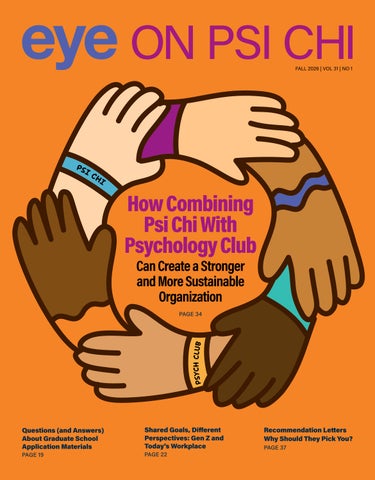
How Combining Psi Chi With Psychology Club Can Create a Stronger and More Sustainable Organization PSYCH CLUB
PAGE 34
Questions (and Answers) About Graduate School Application Materials PAGE 19
Shared Goals, Different Perspectives: Gen Z and Today's Workplace PAGE 22
Recommendation Letters Why Should They Pick You? PAGE 37
CONTENTS –––––––––––––––––––––––––––––––––––––––––––––––––––––––––––––––––––––––––––––––––––––––––––––––––––––––––––––––––––––––––––––––––––––––––––––––––––––––––––––––––––––––––––––––––––––––––––––––––––––––––––––––––––––––––––––––––––––––––––––––––––––––––––––––––––––––––––––––––––––––––––
WWW.PSICHI.ORG FALL 2026 | VOLUME 31 | NUMBER 1 EDITOR
Susan Iles susan.iles@psichi.org
Features
ASSISTANT EDITOR
Bradley Cannon bradley.cannon@psichi.org
34 · CHAPTER GROWTH
EDITORIAL ASSISTANT
Elisabeth Barrett elisabeth.barrett@psichi.org
How Combining Psi Chi With Psychology Club
DESIGNER
Janet Reiss janet.reiss@psichi.org
PS
IC
HI
Published by Psi Chi, the International Honor Society in Psychology. Founded September 4, 1929, at the Ninth International Congress of Psychology, Yale University, New Haven, Connecticut. Member of the Association of College Honor Societies. Eye on Psi Chi, ISSN 1092-0803 (print) and ISSN 2164-9812 (online), is published quarterly by Psi Chi, the International Honor Society in Psychology. All contents ©2026 by Psi Chi. The publication schedule follows the academic year: fall, winter, spring, and summer. All opinions expressed in signed articles are those of the author(s) and do not necessarily reflect those of the editors and/or Psi Chi. Psi Chi Headquarters Street Address: 808 Chestnut St PMB 55 | Chattanooga, TN 37402 Telephone: +1-423-756-2044 | Fax: +1-423-265-1529 Email: psichieye@psichi.org | Website: www.psichi.org Permission must be obtained from Psi Chi to reprint or adapt a table or figure; to reprint quotations exceeding the limits of fair use from one source, and/or to reprint any portion of poetry, prose, or song lyrics. All persons wishing to utilize any of the above materials must write to the publisher to request nonexclusive world rights in all languages to use copyrighted material in the present article and in future print and nonprint editions. All persons wishing to utilize any of the above materials are responsible for obtaining proper permission from copyright owners and are liable for any and all licensing fees required. All persons wishing to utilize any of the above materials must include copies of all permissions and credit lines with the article submission.
PSYCH CLUB
EDITORIAL OFFICE:
Can Create a Stronger and More Sustainable Organization Madelynn D. Shell, PhD Malin K. Lilley, PhD
37 · GRADUATE SCHOOL
Recommendation Letters Why Should They Pick You? Jason X. Ventura
Advertisements that appear in Eye on Psi Chi do not represent endorsement by Psi Chi of the advertiser or the product. Psi Chi neither endorses nor is responsible for the content of third-party promotions. PSI CHI Board of Directors SOCIETY PRESIDENT
Darren Bernal, PhD president@psichi.org PAST-PRESIDENT
Jason Young, PhD pastpresident@psichi.org PRESIDENT-ELECT
Leslie Cramblet Alvarez, PhD presidentelect@psichi.org
40 · CAREER PREPARATION
From Student to Specialist: Board Certification and the Path to Specialization Leonardo J. Caraballo, PsyD, ABPP, and J. Rick Day, MBA, PhD, PsyD, ABP
EASTERN REGIONAL VICE-PRESIDENT
Ingrid Tulloch, PhD easternvp@psichi.org
MIDWESTERN REGIONAL VICE-PRESIDENT
Marjorie W. Schaeffer, PhD midwesternvp@psichi.org
ROCKY MOUNTAIN REGIONAL VICE-PRESIDENT
Rona McCall, PhD rockymtnvp@psichi.org
SOUTHEASTERN REGIONAL VICE-PRESIDENT
Ivelina (Iva) Naydenova, PhD southeasternvp@psichi.org
SOUTHWESTERN REGIONAL VICE-PRESIDENT
Karenna Malavanti, PhD southwesternvp@psichi.org
WESTERN REGIONAL VICE-PRESIDENT
44 · PERSONAL GROWTH
Psychology Students “Hitting the Books”: Building a Psychology Book Club Morgan Dotseth, Victoria Hill, Gracie Fries, Heather A. Haas, PhD, and Elizabeth A. Bennett, PhD
Brittany Avila, PhD westernvp@psichi.org EXECUTIVE DIRECTOR
Marianne Fallon, PhD marianne.fallon@psichi.org
48 · CAREER PREPARATION ABBREVIATIONS APA APS EPA MPA NEPA RMPA SEPA SWPA WPA
American Psychological Association Association for Psychological Science Eastern Psychological Association Midwestern Psychological Association New England Psychological Association Rocky Mountain Psychological Association Southeastern Psychological Association Southwestern Psychological Association Western Psychological Association
2
EYE ON PSI CHI FALL 2026
The Nontraditional Psychology Major Journey: Tips for Students and the Faculty Members Who Support Them Chizara A. Jones, PhD
COPYRIGHT © 2026 PSI CHI
����������������������������������������������������������������������������������������������������������������������������������������������������������������������������������������������������������������������������������������������������������������������������������������� CONTENTS
Columns 4 · PSYCHOLOGY IN THE HEADLINES
When the World Watches: What the World Cup Reveals About Human Psychology Shawn R. Charlton, PhD, and Victoria Silva 10 · CONTEMPORARY PSYCHOLOGY
Human Factors: Preventing Human Stupidity With Good Design Ethan A. McMahan, PhD
14 · PERSONAL GROWTH
The Benefits of a Well-Organized Schedule Ronald Stolberg, PhD 16 · POP CULTURE
The Doctor Becomes the Patient: A Portrayal of Seizure Disorder in The Pitt
Laila Ashurst and Shlomit Flaisher-Grinberg, PhD 19 · THREE HEADS ARE BETTER THAN ONE
Questions (and Answers) About Graduate School Application Materials
Julie Radico, PsyD, ABPP; Jocelyn Turner-Musa, PhD; and Mitch Prinstein, PhD, ABPP 25 · DIVERSITY
The Weight of Words: Navigating the Language Used When Crafting Demographic Surveys
31 · ALUMNI ACHIEVER
From a White House Career to a Psychology Doctorate: An Interview With Patricia Parker, PhD Elisabeth Barrett
Departments 33
2026 Psi Chi Diversity Article Awards
54
Chapter Activities
Advertisements 13 13 18 24 30 32 43 47 82
Psi Chi Video Academy Psi Chi Chapter Activity Grants Pop Culture Corner Wright State University Psi Chi Blog Psi Chi Podcast Psi Chi Career Center Psi Chi eBooks Psi Chi Store
Rihana S. Mason, PhD, Gabrielle P. A. Smith, PhD, Jennifer L. Hughes, PhD, Melanie M. Domenech Rodríguez, PhD, and Brianna L. Gonzalez, PhD
22 · WISDOM FROM THE WORKPLACE
52 · CHAPTER GROWTH
Shared Goals, Different Perspectives: Gen Z and Today's Workplace
at Purdue University Northwest:
Diane Safer, PhD
COPYRIGHT © 2026 PSI CHI
Building a Thriving Psi Chi Community An Interview With Chapter President Skye Martin Elisabeth Barrett
FALL 2026 EYE ON PSI CHI
3
PSYCHOLOGY IN THE HEADLINES –––––––––––––––––––––––––––––––––––––––––––––––––––––––––––––––––––––––––––––––––––––––––––––––––––––––––––––––––––––––––––––––––––––––––––––––––––––––––––––––––––––––––––––––––––––––––––––––––––––––––––––––––––––––––––––––––––––––––––––––
When the World Watches:
What the World Cup Reveals About Human Psychology Shawn R. Charlton, PhD, and Victoria Silva University of Central Arkansas
4
EYE ON PSI CHI FALL 2026
Impact of Technology on the Psychological Experience The tournament introduced or promoted immersive technologies intended to enhance spectators’ experiences. For example, 3D mapping to create player avatars lets viewers see player movements more clearly and from more perspectives, such as during offsides analyses (Dilworth, 2026). Research on immersive spectatorship suggests that virtual reality and 3D viewing increase viewers’ sense of spatial, interpersonal, and temporal presence, making spectators feel more physically and socially present at the event (Frewen et al., 2024; Vincent & Frewen, 2023). These same gains in visibility have a cost. Caruso and colleagues (2016) showed that slow-motion replay increases perceptions of intent, heightening blame for controversial incidents, and football-specific research suggests that referees judge foul play more severely in slow motion, though the effect varies with context and expertise (Mather & Breivik, 2020; Spitz et al., 2018). Immersive and replay technologies, then, may improve the viewing experience while also amplifying subjective interpretations.
Impact of Expanded Gambling Opportunities on the Psychological Experience For many people, the World Cup has always been about passion, national pride, and the excitement of supporting a favorite team.
RETURN TO TABLE OF CONTENTS
COPYRIGHT © 2026 PSI CHI
Photo Credit: Vecteezy.com/LUGON STUDIO
D
uring the 1998 World Cup, I (Shawn) was walking through Villa La Reina, a neighborhood on the eastern edge of Santiago, Chile, while a match was being televised. Chile’s national team was not on the field, yet the neighborhood seemed to breathe with the game. People were in their own living rooms, but they were experiencing the same event, moving through the same emotional rhythms, in different languages and time zones, all at that same moment. Every four years, the World Cup creates a globally shared human experience. The athletic talent is impressive, but what this shared global event reveals about human psychology is even more impressive. The World Cup is more than a sports spectacle: It is a living demonstration of how people create meaning together. Fans attach personal stories to national teams, family histories to rituals, and moral hopes to athletes they will never meet. A match becomes a source of personal identity and shared community. In this sense, the World Cup is not just watched; it is psychologically constructed. The 2026 World Cup is distinctive not only because it is hosted by three countries, but also because several developments carry significant psychological implications: the increased use of immersive technology, the expansion of legal sports betting, and a growing investment in sport psychology at the elite level.
���������������������������������������������������������������������������������������������������������������������������������������������������������������������������������������������������������������������������������������������� PSYCHOLOGY IN THE HEADLINES
But the 2026 tournament may also highlight a growing part of the fan experience: sports betting. With betting apps now on smartphones, fans can wager before or throughout the game, on events as specific as the next goal, yellow card, or corner kick. The prospect of a reward can heighten arousal and engagement, potentially making fans feel more invested in each moment of the game (Bartlett, 2026), and as gambling becomes more closely woven into football, it may change how people experience the World Cup itself (Nemer, 2026). McGrane and colleagues (2026) examined the 2022 FIFA World Cup and found that exposure to televised gambling advertisements increased both the likelihood and frequency of football betting: participants were 22% to 33% more likely to place a bet, and betting frequency rose by 16% to 24% on channels carrying gambling ads. Guo, Peng, and Meyerhoefer (2026) reported that increased sports gambling is associated with increased food insufficiency in at least 9 states that have legalized sports betting. This research suggests that increased sports betting has consequences beyond the immediate gains and losses (Blasi, 2026). Concerns over the mental health impacts of expanded gambling access extend well beyond the World Cup (Ukhova et al., 2024), but they are strongly magnified by this global event.
Psychology and Elite Sports Performance The World Cup also offers a venue for highlighting the role of sports and performance psychology. Elite performance depends on more than physical ability and technical skill; players manage pressure, stress, confidence, and emotion under the microscope of millions of fans. After Brazil’s devastating 7–1 loss to Germany in the 2014 World Cup, many players struggled with confidence, yet the team competed in the next two World Cups without dedicated psychological support (Shabbar, 2026). For 2026, Brazil has taken a different approach, integrating a sports psychologist into the team’s daily routine to support athletes during training, media interviews, and their stay at the team hotel (Cassucci & Mota, 2026). This shift raises an important question: How much can a stronger mindset influence who wins? England manager Thomas Tuchel recently captured one of the qualities that make Lionel Messi so difficult to defend: Messi appears to “see stuff earlier than anyone else on the field” (Ogden, 2026). This ability to recognize developing patterns, anticipate what will happen next, and act before other players can respond illustrates the cognitive demands of elite football. Zillmer (2026) similarly argues that the world’s best players distinguish themselves through rapid decision-making and flexible problem-solving, particularly in crowded, unpredictable situations where they have only seconds to react. Sport and performance psychologists can play a vital role in helping athletes at all levels develop and refine cognitive skills such as anticipation and rapid decision-making (Silva et al., 2021; Zhu et al., 2024). A recent systematic review and meta-analysis found that psychological interventions, including skills training, mindfulness, and mental imagery, can improve athletic performance while also helping athletes regulate emotions, maintain focus, and perform more consistently under pressure (Reinebo et al., 2024). These findings support the growing investment elite teams are making in sport psychologists and reinforce the idea that mental training is essential to athletic preparation, not an optional resource.
COPYRIGHT © 2026 PSI CHI
The Headlines That Follow While the 2026 World Cup sets the context for this column, we are not writing about sports. We are writing about psychology, and about what a shared global experience can teach us about ourselves. In the Headlines that follow, we look at how events like the World Cup create belonging and identity, intensify collective emotion, generate stories that travel across cultures, and shape our judgments about fairness and blame. The World Cup gives us the stage, but the real subject is the mind at work when billions of people turn toward the same moment and make it personally felt and collectively meaningful. NOTE: This column was particularly interesting to write, as we worked on it while the World Cup was being played, with matches on in the background more than once.
References Bartlett, E. (2026, June 17). From FIFA World Cup™ wagers to the brain’s reward system, experts unpack the sports betting surge. Bryant News. https://news.bryant.edu/ fifa-world-cuptm-wagers-brains-reward-system-experts-unpack-sports-betting-surge Blasi, W. (2026, June 13). As the World Cup begins, researchers warn sports bettors may be gambling with their grocery money. MarketWatch. https://www.marketwatch.com/story/ sports-betting-is-taking-a-bite-out-of-gamblers-grocery-budgets-new-research-suggests-be741857 Caruso, E. M., Burns, Z. C., & Converse, B. A. (2016). Slow motion increases perceived intent. Proceedings of the National Academy of Sciences, 113(33), 9250–9255. https://doi.org/10.1073/pnas.1603865113 Cassucci, B., & Mota, C. (2026, June 9). Psicologia, não terapia: Seleção faz até adaptações no hotel e foca em saúde mental na Copa do Mundo. ge. https://ge.globo.com/futebol/copa-do-mundo/noticia/2026/06/09/psicologianao-terapia-selecao-faz-ate-adaptacoes-no-hotel-e-foca-em-saude-mental-na-copa-do-mundo.ghtml Dilworth, D. (2026, June 10). Lenovo aims to make the World Cup “the biggest event in the history of humanity.” Brand Innovators. https://brand-innovators.com lenovo-aims-to-make-the-world-cup-the-biggest-event-in-the-history-of-humanity Frewen, P., Vincent, A., Bell, S., & Lanius, R. A. (2024). Presence in time: Watching live and recorded sports in VR increases spatial, interpersonal, and temporal presence. Frontiers in Virtual Reality, 5, Article 1432888. https://doi.org/10.3389/frvir.2024.1432888 Guo, X., Peng, L., & Meyerhoefer, C. (2026). Wagering the bread money: Sports betting legalization and food sufficiency. NBER Working Paper 35305. https://doi.org/10.3386/w35305 Mather, G., & Breivik, S. (2020). Is the perception of intent by association football officials influenced by video playback speed? Royal Society Open Science, 7(6), Article 192026. https://doi.org/10.1098/rsos.192026 McGrane, E., Pryce, R., Field, M., Wilson, L., & Goyder, E. (2026). The effect of television advertising on gambling behaviour: A quasi-experimental study during the 2022 Qatar FIFA World Cup. Addictive Behaviors Reports, 23, 100666. https://doi.org/10.1016/j.abrep.2026.100666 Nemer, D. (2026, June 26). The next World Cup won’t be only about passion for soccer. It will also be about betting obsession. The Conversation. https://theconversation.com Ogden, M. (2026, July 14). Thomas Tuchel: England weighing man-marking plan for Lionel Messi. ESPN. https://www.espn.com/soccer/story/_/id/49363093 thomas-tuchel-england-lionel-messi-argentina-fifa-world-cup-2026 Reinebo, G., Alfonsson, S., Jansson-Fröjmark, M., Rozental, A., & Lundgren, T. (2024). Effects of psychological interventions to enhance athletic performance: A systematic review and meta-analysis. Sports Medicine, 54(2), 347–373. https://doi.org/10.1007/s40279-023-01931-z Shabbar, M. S. (2026, July 6). How Brazil’s FIFA World Cup campaign became a journey of healing. Dawn. https://www.dawn.com/news/2013178 Silva, A. F., Ramirez-Campillo, R., Sarmento, H., Afonso, J., & Clemente, F. M. (2021). Effects of training programs on decision-making in youth team sports players: A systematic review and meta-analysis. Frontiers in Psychology, 12, 663867. https://doi.org/10.3389/fpsyg.2021.663867 Spitz, J., Moors, P., Wagemans, J., & Helsen, W. F. (2018). The impact of video speed on the decision-making process of sports officials. Cognitive Research: Principles and Implications, 3, Article 16. https://doi.org/10.1186/s41235-018-0105-8 Ukhova, D., Marionneau, V., Volberg, R., & Wardle, H. (2024). The expansion of gambling across the Americas poses risks to mental health and wellbeing. Lancet Regional Health. Americas, 37, 100855. https://doi.org/10.1016/j.lana.2024.100855 Vincent, A., & Frewen, P. (2023). Being where, with whom, and when it happens: Spatial, interpersonal, and temporal presence while viewing live streaming of collegiate sports in virtual reality. Frontiers in Virtual Reality, 4, Article 1167051. https://doi.org/10.3389/frvir.2023.1167051 Zhu, R., Zheng, M., Liu, S., Guo, J., & Cao, C. (2024). Effects of perceptual-cognitive training on anticipation and decision-making skills in team sports: A systematic review and meta-analysis. Behavioral Sciences, 14(10), 919. https://doi.org/10.3390/bs14100919 Zillmer, E. A. (2026, June 18). How Messi, Mbappé and Haaland use their brains (as well as feet) to gain a psychological edge at the World Cup. The Conversation. https://doi.org/10.64628/AAI.fwt54ggds
RETURN TO TABLE OF CONTENTS
FALL 2026 EYE ON PSI CHI
5
PSYCHOLOGY IN THE HEADLINES –––––––––––––––––––––––––––––––––––––––––––––––––––––––––––––––––––––––––––––––––––––––––––––––––––––––––––––––––––––––––––––––––––––––––––––––––––––––––––––––––––––––––––––––––––––––––––––––––––––––––––––––––––––––––––––––––––––––––––––––
Kylie Wright, Mallori Marshall, and Edward Phillips University of Central Arkansas
Fans watching the World Cup scream at their screen in an empty room, feel a missed penalty like a blow to the stomach, and replay a last-minute goal as if they had scored it themselves. These reactions seem almost irrational. Why do the performances of players we will never meet come to feel like our own triumphs and defeats? For fans of the World Cup, their national jersey and team support often become a psychological signal announcing their “tribe.” Social identity theory (SIT; Tajfel & Turner, 1979) helps explain why sports fandom can become part of our identity. According to SIT, people naturally create ingroups (“us”) and outgroups (“them”). Team identity has been linked to belonging and emotional attachment within sporting communities (Inoue et al., 2022). Koo and colleagues (2025) argue that sports fans often incorporate their teams into their self-concept, making victories and defeats feel personally meaningful rather than simply entertaining. Likewise, supporters often experience wins as “personal triumphs” because they psychologically link their identity to the team’s success (The Economic Times, 2025). Swann and colleagues (2009) proposed that identity fusion occurs when personal identity and group identity become deeply intertwined. Koo and colleagues (2025) expanded on this by suggesting that identity fusion provides an important explanation for the extraordinary loyalty and emotional commitment displayed by many sports fans, particularly during global competitions like the World Cup. Because fans tie part of their self-worth to their team, they engage in behaviors that protect and reinforce that identity. When their team wins, they cheer, “We destroyed them!” even though their actual contribution was minimal, often just sitting 6
EYE ON PSI CHI FALL 2026
on a couch or at a pub. Cialdini and colleagues (1976) described this as “basking in reflected glory,” where individuals associate themselves closely with successful groups to enhance self-esteem. When their team loses, the language often changes to “they played terribly today,” creating distance between the self and the defeat. Sports fandom offers insight into a deep aspect of our psychology: the universal human need for identity and belonging. Being a fan may help to satisfy needs such as social connection, meaning, and belonging (Wann, 2024). Sports fandom creates opportunities to build friendships and communities through shared experiences, suggesting that being a fan can be genuinely good for our well-being (Rogers & Feldman, 2025). Because fandom can be so tightly tied to our identity, the World Cup is more than a sporting competition. It is a global opportunity for a shared sense of purpose and meeting that human desire to belong.
References Cialdini, R. B., Borden, R. J., Thorne, A., Walker, M. R., Freeman, S., & Sloan, L. R. (1976). Basking in reflected glory: Three (football) field studies. Journal of Personality and Social Psychology, 34(3), 366–375. https://doi.org/10.1037/0022-3514.34.3.366 Inoue, Y., Lock, D., Sato, M., & Funk, D. C. (2022). Psychological processes connecting team identification and social well-being for middle-aged and older adults: Moderated mediation of subjective and objective on-field performance. Sport Management Review, 25(2), 207–233. https://doi.org/10.1080/14413523.2021.1917246 Koo, T., Kwon, H. H., Shin, J., & Baeck, J. (2025). Is social identity theory enough to cover sports fans’ behavior?: Additional perspective from identity fusion theory. Frontiers in Psychology, 16, 1574520. https://doi.org/10.3389/fpsyg.2025.1574520 Rogers, T., & Feldman, A. (2025, September 4). Why all Americans should be football fans. TIME. https://time.com/7314403/football-fan-good-for-you/ Swann, W. B., Jr., Gómez, Á., Seyle, D. C., Morales, J. F., & Huici, C. (2009). Identity fusion: The interplay of personal and social identities in extreme group behavior. Journal of Personality and Social Psychology, 96(5), 995–1011. https://doi.org/10.1037/a0013668 Tajfel, H., & Turner, J. C. (1979). An integrative theory of intergroup conflict. In W. G. Austin & S. Worchel (Eds.), The social psychology of intergroup relations (pp. 33–47). Brooks/Cole. The Economic Times. (2025, June 15). Psychology behind why FIFA World Cup wins feel like personal triumphs and losses hurt worse than a breakup. https://economictimes.indiatimes.com/news/new-updates/psychology-behind-why-fifa-world-cup-winsfeel-like-personal-triumphs-and-losses-hurt-worse-than-a-breakup/articleshow/131780877.cms Wann, D. L. (2024). Perceptions of sport fandom as a means of meeting psychological needs. Findings in Sport, Hospitality, Entertainment, and Event Management, 4(1), Article 5.
RETURN TO TABLE OF CONTENTS
COPYRIGHT © 2026 PSI CHI
Photo Credit: Vecteezy.com/PEOPLE IMAGES
More Than a Game: How Sports Shape Identity and Belonging
���������������������������������������������������������������������������������������������������������������������������������������������������������������������������������������������������������������������������������������������� PSYCHOLOGY IN THE HEADLINES
The Emotional Ripple Effect: From the Stands to the Locker Room Christian Taylor, Shelby Bradford, and Tya Arnold University of Central Arkansas
Photo Credit: Vecteezy.com/ABDUL QAIYOOM
The World Cup creates an opportunity for shared global connection, and popular-press coverage highlights how fans across the world experience powerful collective emotions during major sporting events (Karamali, 2026). These shared moments cause emotions to rise and shift together, creating a sense of unity among people who may never meet. Psychological evidence suggests that emotions intensify when people experience events they interpret as part of a collective (Goldenberg et al., 2020; Gruev‑Vintila & Reicher, 2018; Smith & Mackie, 2021). People often take on the emotions of groups they identify with, and joint attention heightens reactions even without interaction, indicating that collective awareness deepens emotional processing (Shteynberg et al., 2014). When attention is directed toward the same moment, people assign more meaning to it because they know others are focused on it as well. Overall, these patterns show how global sporting events create shared emotional experiences that feel stronger, more meaningful, and more memorable when people experience them together. Sporting events and other shared group experiences, such as concerts and performances, can lead to an increase in social engagement and promote interpersonal relationships (Guo et al., 2024). Shared events can foster a positive impact on emotions through friendships, socialization, and the social resources gained through watching and participating (Park & Hinsz, 2015). As individuals become immersed in the group’s culture and shared identity, they may adopt similar attitudes, behaviors, and beliefs (Smith & Mackie, 2021). Group homogenization suggests that ideas and values become widespread within a group and can lead to conformity in shared group and communal events. Overall, shared social environments extend beyond the moment by creating opportunities for social connection, strengthening interpersonal
COPYRIGHT © 2026 PSI CHI
relationships, and influencing collective attitudes and behaviors, making them an important force in shaping both individual and community experiences. Spectators are not the only ones who are impacted by communal emotion. While players and performers often look calm and collected (except when yelling at officials), shared emotions play a very important role in shaping team identity and function. Fenton and colleagues (2025) state that sport organizations develop emotion norms/expectations about how athletes should manage and express their emotions. These norms help the overall culture of a team and affect how athletes interact and express emotion to one another. Emotions spreading through teams can also affect motivation, cohesion, and performance (Friesen et al., 2020; Campo et al., 2019). Effective emotional regulation requires psychological flexibility so that athletes can adapt their emotional responses to pressure while staying focused on the game (Vasconcelos-Raposo & Teixeira, 2025).
References Campo, M., Mackie, D. M., & Sanchez, X. (2019). Emotions in group sports: A narrative review from a social identity perspective. Frontiers in Psychology, 10, 666. https://doi.org/10.3389/fpsyg.2019.00666 Fenton, J. L., Wagstaff, C. R. D., & Hings, R. F. (2025). Navigating emotion norms in sport organizations. Journal of Sport Psychology in Action, 16(4), 343–356. https://doi.org/10.1080/21520704.2025.2472337 Friesen, A. P., Wolf, S. A., & Van Kleef, G. A. (2020). The social influence of emotions within sports teams. Feelings in Sport (pp. 49–57). Routledge. https://doi.org/10.4324/9781003052012-7 Goldenberg, A., Garcia, D., Halperin, E., & Gross, J. J. (2020). Collective emotions. Current Directions in Psychological Science, 29(2), 154–160. https://doi.org/10.1177/0963721420901574 Gruev‑Vintila, A., & Reicher, S. (2018, August 19). Can collective euphoria last? A month into France’s World Cup victory. The Conversation. https://theconversation.com/can-collective-euphoria-last-a-month-into-frances-world-cup-victory-101465 Guo, J., Yang, H., & Zhang, X. (2024). How watching sports events empowers people’s sense of wellbeing? The role of chain mediation in social interaction and emotional experience. Frontiers in Psychology, 15, 1471658. https://doi.org/10.3389/fpsyg.2024.1471658 Karamali, R. (2026, June 17). Why FIFA feels bigger than football. Psychology Today. https://www.psychologytoday.com/us/blog/the-mattering-lab/202606/why-fifa-feels-bigger-than-football Park, E. S., & Hinsz, V. B. (2015). Group interaction sustains positive moods and diminishes negative moods. Group Dynamics: Theory, Research, and Practice 19(4), 290–298. https://doi.org/10.1037/gdn0000034 Shteynberg, G., Hirsh, J. B., Apfelbaum, E. P., Larsen, J. T., Galinsky, A. D., & Roese, N. J. (2014). Feeling more together: Group attention intensifies emotion. Emotion, 14(6), 1102–1114. https://psycnet.apa.org/doi/10.1037/a0037697 Smith, E. R., & Mackie, D. M. (2021). Group-based emotions over time: Dynamics of experience and regulation. Personality and Social Psychology Bulletin, 47(7), 1135–1151. https://doi.org/10.1177/0146167220960557
RETURN TO TABLE OF CONTENTS
FALL 2026 EYE ON PSI CHI
7
PSYCHOLOGY IN THE HEADLINES –––––––––––––––––––––––––––––––––––––––––––––––––––––––––––––––––––––––––––––––––––––––––––––––––––––––––––––––––––––––––––––––––––––––––––––––––––––––––––––––––––––––––––––––––––––––––––––––––––––––––––––––––––––––––––––––––––––––––––––––
Emelia Belin and Rhyan Porchay University of Central Arkansas Every four years, the FIFA World Cup becomes a global phenomenon. The matches alone do not explain why even non-fans come to know the Cup’s major storylines. The tournament becomes a worldwide story because it produces narrative arcs that seem to resonate with something fundamental. The emotional experience plays a key role in the investment of these narratives (Reagan et al., 2016). Across just a few weeks, the World Cup generates underdogs and favorites, rivalries and redemptions, collapses and comebacks, all with real stakes and highly uncertain endings. Fans become emotionally invested in teams, athletes, and national storylines. NBC 4 Los Angeles captured the strength of these connections in a photo album devoted to fans’ colorful expressions of passion and national pride (Chavolla, 2026). Research suggests that the media shapes public interest, builds emotional connections, and increases participation in sports communities, making the World Cup not only a competition but a psychological and social phenomenon (Nassif & El-Khoury, 2026). While the players and teams create the stories, the media distributes them. Platforms like Instagram, Facebook, and TikTok draw viewers into the narrative by letting fans glimpse the lives of players. The power of social media to create more intimate experiences was evident as Swifties followed live videos of Taylor Swift’s tour dancers, gaining an inside view that made them feel part of the show (Maxwell et al., 2026). The World Cup works the same way. Clips of Scottish fans drinking Boston dry, the Japanese team trying Texas barbecue, and Norway’s team member Haaland wearing a cowboy hat and boots have gone viral (ESPN News Services, 2026; Yager, 2026). Even non-fans cannot help following 8
EYE ON PSI CHI FALL 2026
along. These small, human scenes are memorable because they attach a face and a feeling to a national storyline, and watching athletes and visiting fans makes distant viewers feel part of the same unfolding plot. Social media also empowers athletes to narrate their own arcs. Research from the 2023 FIFA Women’s World Cup found that players used these platforms to express gratitude, inspire supporters, and respond to the emotional highs and lows of competition, strengthening the bond between athletes and a global audience (Brice et al., 2025). The power of shared stories may be one reason why the World Cup is bigger than the sport and its fans. As the drama unfolds, individuals make meaning from competition, uncertainty, and shared emotions. The archetypes of sport—heroic performances, tragic losses, and victorious underdogs—give everyone a story worth telling, and those shared narratives harden into collective memory that expands beyond just the fans and lives longer than just the tournament.
References Brice, J., Thorpe, H., & McNamara, H. (2025). Sportswomen, social media, and gendered affective labor: An analysis of two teams at the 2023 FIFA Women’s World Cup. Sport Management Review, 28(5), 986–1008. https://doi.org/10.1080/14413523.2025.2532216 Chavolla, E. (2026). World Cup 2026 fans bring color, passion and pride to the Global Stage–NBC Los Angeles. NBC 4 Los Angeles. https://www.nbclosangeles.com/world-cup world-cup-2026-fans-bring-color-passionand-pride-to-the-global-stage/3906760/ ESPN News Services (2026, June 17). Scotland fans drink Boston dry as local bars run out of beer. ESPN. https://www.espn.com/soccer/story/_/id/49096272/scotland-fans-drink-boston-dry-local-bars-run-beer-world-cup Maxwell, L. C., Tefertiller, A. C., & Neese, C. (2026). “It’s you and me, there’s nothing like this”: Parasocial relationships, fear of missing out, and how fans consume the products in Taylor Swift’s media empire. Psychology of Popular Media, 15(1), 90–99. https://doi.org/10.1037/ppm0000588 Nassif, N., & El-Khoury, J. R. (2026). Understanding media’s leverage in the national elite sport ecosystems. Frontiers in Sports and Active Living, 8, 1788596. Reagan, A. J., Mitchell, L., Kiley, D., Danforth, C. M., & Dodds, P. S. (2016). The emotional arcs of stories are dominated by six basic shapes. EPJ Data Science, 5(1). https://doi.org/10.1140/epjds/s13688-016-0093-1 Yager, P. (2026, July 1). Erling Haaland’s Dallas Western Wear Purchase Goes viral. Fox 4 KDFW. https://www.fox4news.com/news/erling-haalands-dallas-western-wear-purchase-goes-viral
RETURN TO TABLE OF CONTENTS
COPYRIGHT © 2026 PSI CHI
Photo Credit: Vecteezy.com/MARCOS AZEVEDO
Shaping Global Stories: How the World Cup Captures Everyone’s Attention
���������������������������������������������������������������������������������������������������������������������������������������������������������������������������������������������������������������������������������������������� PSYCHOLOGY IN THE HEADLINES
One Call, Two Stories: Why World Cup Fans See the Same Game Differently
Marly Heidenreich, Marcus Norris, and Keshanti Pennington University of Central Arkansas
Photo Credit: Vecteezy.com/PEOPLE IMAGES
Sports fans often claim they are “watching the game together,” yet during events like the World Cup, controversial moments such as a penalty call, a VAR review, or a celebration after a goal can divide entire stadiums and online audiences in seconds. Fans watching the same replay often react with different certainty about what actually happened. A single moment can trigger cheering in one section of the crowd and outrage in another because fans bring different identities, expectations, and beliefs about fairness. Research done by Andrejević and colleagues (2020) found that people regularly update their moral judgments when given contextual information, while Sheehy and Maurice (2022) link team identification to dysfunctional fan behavior. Research on egocentrism also suggests that individuals evaluate fairness through their own perspectives and experiences (Bocian, 2020). Andrejević and colleagues (2020) suggest that moral judgment is flexible and context-dependent. Their study showed that participants changed their reactions after learning additional information, shifting from simple norms to more contextual judgments. According to Andrejević and colleagues (2020), “most participants flexibly switched from relying on context-independent norms to context-dependent norms as they integrated contextual information” (p. 1). Not all individuals adjust in the same way, as some maintain their original judgments even after receiving new information. Identity further complicates these judgments, especially during World Cup matches where outcomes affect advancement or elimination. In these moments, a referee’s decision isn’t experienced as neutral information, but as something tied directly to a team’s
COPYRIGHT © 2026 PSI CHI
fate. Sheehy and Maurice (2022) link team identification to dysfunctional fan behavior in emotionally charged settings, while Čater and colleagues (2026) demonstrate that strong social identity ties sustain fan loyalty during controversy. Warren (2025) similarly found that sports fans use different moral reasoning strategies when evaluating controversial associations. Fairness judgments are also shaped by outcomes. Sand and Klenk (2023) explain that “Killer seems more blameworthy than Merely Reckless,” despite differences in outcome occurring beyond either driver’s control (p. 1). Fans respond in similar ways when judging referees based on consequences rather than decision processes. Perceptions of fairness in VAR are also influenced by expectations and team identification (Deng et al., 2024). Malle (2025) further argues that blame is often shaped by emotion and bias rather than objective evaluation. Ultimately, fans are not simply debating a play; they are defending their identity and sense of justice.
References
Andrejević, M., Feuerriegel, D., Turner, W., Laham, S., & Bode, S. (2020). Moral judgements of fairness-related actions are flexibly updated to account for contextual information. Scientific Reports, 10(1), Article 15873. https://doi.org/10.1038/s41598-020-74975-0 Bocian, K. (2020). Egocentrism shapes moral judgements. Social and Personality Psychology Compass, 14(8), e12572. https://doi.org/10.1111/spc3.12572 Čater, T., Čater, B., & Ivašković, I. (2026). The social identity buffer: How cognitive, affective, and evaluative ties sustain fan commitment and loyalty amidst club controversies. Journal of Sport and Social Issues. Advance online publication. https://doi.org/10.1177/10616934261433626 Deng, P., Yan, W., Yu, Y., & Zhang, Y. (2024). The attitude of online fans: Perceived value, expectation, and identification on VAR satisfaction. Frontiers in Psychology, 14, 1288998. https://doi.org/10.3389/fpsyg.2023.1288998 Malle, B. F. (2025). Blaming badly, blaming well. In S. Latham (Ed.), Handbook of ethics and social psychology (pp. 130–144). Edward Elgar Publishing. Sand, M., & Klenk, M. (2023). Moral luck and unfair blame. Ethical Theory and Moral Practice, 26(2), 379–393. https://doi.org/10.1007/s10790-021-09856-4 Sheehy, T., & Maurice, S. (2022). Morality, dysfunction, and identification: An examination of collegiate football fans. Journal of Sport Behavior, 45(3), 75–90. https://journalofsportbehavior.org/index.php/JSB/article/view/147 Warren, S. (2025). Sports fan moral reasoning strategies in response to an athlete›s controversial political associations. Communication & Sport. Advance online publication. https://doi.org/10.1177/21674795251344047
RETURN TO TABLE OF CONTENTS
FALL 2026 EYE ON PSI CHI
9
CONTEMPORARY PSYCHOLOGY ––––––––––––––––––––––––––––––––––––––––––––––––––––––––––––––––––––––––––––––––––––––––––––––––––––––––––––––––––––––––––––––––––––––––––––––––––––––––––––––––––––––––––––––––––––––––––––––––––––––––––––––––––––––––––––––––––––––––––––––––––
Human Factors:
Preventing Human Stupidity With Good Design
I
t seems that, prior to 2024, nobody in Britain knew how to operate the “stop requested” buttons found on city busses and public transport.1 As I understand it, all but a few knowledgeable bus drivers and the most intelligent among us were unaware that you only need to push the button
once to inform the driver that you would like to get off at the next stop. Instead, most riders would push the button repeatedly, The following story is true, but I have embellished parts of it for entertainment purposes. The original story can be found here: Gilliver, L. (2024, April 27). Bus driver reveals mistake all passengers make when pressing button to get off. The Mirror. https://www.mirror.co.uk/news/weird-news/ bus-driver-reveals-mistake-passengers-32649208 1
10
EYE ON PSI CHI FALL 2026
assuming that the driver was not aware that they needed to stop. Imagine millions of Brits, fish and chips in hand, feverishly hammering away at the button. I can only assume that, given the number of people riding public transport in Britain and the amount of energy wasted by unnecessary button pushes, this must have cost British government a fortune. If it wasn’t for the efforts of one heroic bus driver and mother-of-two, the government might have sunk into bankruptcy, become nonfunctioning, and then been taken over by France. What did mum do, you ask? She posted a TikTok video explaining how the button works. Recognizing the important revelatory nature of this information,
RETURN TO TABLE OF CONTENTS
COPYRIGHT © 2026 PSI CHI
Photo Credit: PHOTO GENERATED USING ADOBE FIREFLY
Ethan A. McMahan, PhD Western Oregon University
������������������������������������������������������������������������������������������������������������������������������������������������������������������������������������������������������������������������������������������������� CONTEMPORARY PSYCHOLOGY
“What sets human factors apart from engineering or product design is its emphasis on the human experience within physical and cognitive systems.” the British public quickly took notice, with the video generating nearly 10 million views and almost 1 million likes within a few weeks of its posting. At the same time, uncontrolled button-mashing incidents on city buses decreased significantly. The British government has saved millions in energy costs, and social media has shown its usefulness yet again. Now, one might read the above story about the heroic TikTokposting mother and the incredible debt that the British public owes her and infer that there must be something wrong with British people. Perhaps you are surprised by this. “But, their accent is so sophisticated sounding,” you say. Well, you are right to be surprised. There is nothing wrong with British people, at least no more than any other people. This is not a story about problems with people. Instead, it is a story about a problem with design; the “stop requested” button system did not clearly communicate how it should be used. When many people repeatedly press a button, the issue is not user intelligence but poor feedback. The button lacked a signal that confirmed a successful press (e.g., a lit “stop requested” sign at the front of the bus), leaving riders uncertain whether their request registered. This is not good design. Good design anticipates user behavior and minimizes such ambiguity. Here, the design invites repeated action, increasing effort and inefficiency. To effectively anticipate user behavior and minimize ambiguity, one needs to know a little bit about humans. And, this is where the field of Human Factors (aka: Ergonomics) enters the story. Human factors/ergonomics is a rapidly evolving area of inquiry that sits at the intersection of psychology, engineering, and design. It involves the study of how humans interact with tools, machines, environments, and systems, with the goal of making those interactions safer, more efficient, and less errorprone (Elbert, 2025). Human factors professionals explore psychological and physiological phenomena related to attention, memory, perception, workload, fatigue, and decision-making as they apply to realworld tasks such as operating machinery, driving vehicles, managing medical equipment, or navigating complex control rooms. What sets human factors apart from engineering or product design is its emphasis on the human experience within physical and cognitive systems. It’s not just about the technical specifications of a device but about how people actually see, use, and react to it under realistic, everyday conditions. There are a number of interesting examples of design-related issues, and numerous other stories document the variety of ways humans are impacted by the design of everyday systems and equipment. In some cases, these stories illustrate the dangers of poor design, such as reports of medication errors caused by confusing drug labels (Rados, 2005) or airplane crashes linked to misread
COPYRIGHT © 2026 PSI CHI
instrumentation (see FAA, 2004). In other cases, the stories explain the seemingly inexplicable characteristics of items we use every day (e.g., the keyboard…wait, where’s the ‘V’?).2 The existence of these cases brings into relief the relevance of human factors to modern life. And, given this relevance, let’s talk a little bit about human factors, ergonomics, jobs, and how you can (for example) pursue a career designing intuitive layouts for smartphone apps.
System Transitions and Updates
Though the roots of human factors can be traced back to early industrial societies (e.g., the design of simple tools and work processes), the field began to coalesce in the early 20th century as machinery became more complex and working environments more industrialized (Guastello, 2023). The rise of assembly lines, mass production, and mechanized transport created new opportunities for fatigue, error, and injury, which in turn spurred systematic inquiry into how humans interact with machines. Early studies focused on topics like fatigue, reaction time, and workplace layout, often spurred by the need to improve efficiency and safety in factories and in the military. These laid the groundwork for understanding how physical and cognitive demands affect performance and introduced a variety of new concepts (e.g., cognitive load) which remain central to the field today. Through the mid to late 20th century, the emergence of aviation, nuclear power, computing, and later digital interfaces provided human factors with new and fertile ground for inquiry. Researchers began to examine cockpit design, medical device interfaces, and the layout of control rooms, exploring how design choices influence operator error, situational awareness, and overall safety. In recent years, the field has expanded even further to include autonomous vehicles, wearable technology, and the design of usercentric environments in healthcare, transportation, and consumer products. In one example that you will be intimately familiar with, a great deal of human factors work goes into designing smartwatches or fitness bands that count steps, monitor heart rate, and track sleep while also handling reminders, texts, and calendar alerts on the wrist. Human factors work shapes details like the size of the screen, vibration patterns, and simplified “glanceable” displays so wearers can check the time, see a reminder, or dismiss a notification quickly without disrupting other activities.
Career Task Analysis
As engineered systems have grown in complexity and integration, so too have the career opportunities within the field. Human factors professionals in industry, healthcare, government, and research, among other domains, are as we speak attempting to understand and shape how humans interact with machines, environments, and organizations. Many human factors specialists work in universities or research institutions conducting studies on topics like cognitive workload, situation awareness, and userperformance under stress. These roles typically involve designing and running experiments, analyzing data, and publishing papers or presenting at conferences. Automotive and aerospace companies (e.g., Boeing, Airbus, major car manufacturers) hire human factors engineers to design This comment concerns the ridiculous organization of the keys on keyboards. I will address this later on in this article. If you find the organization of the keys on keyboards as befuddling as I do, you should continue reading. 2
RETURN TO TABLE OF CONTENTS
FALL 2026 EYE ON PSI CHI
11
CONTEMPORARY PSYCHOLOGY ––––––––––––––––––––––––––––––––––––––––––––––––––––––––––––––––––––––––––––––––––––––––––––––––––––––––––––––––––––––––––––––––––––––––––––––––––––––––––––––––––––––––––––––––––––––––––––––––––––––––––––––––––––––––––––––––––––––––––––––––––
High-Leverage Summary
User-Centered Educational Design
Very broadly, becoming a human factors specialist typically requires a strong foundation in psychology, engineering, or design, followed by specialized training in how people interact with systems and environments. Getting a bachelor’s degree in psychology, industrial engineering, cognitive science, or industrial design is a common starting point. But a master’s or doctoral degree is usually required for advanced careers in human factors. Several universities now offer dedicated human factors or ergonomics programs (e.g., Virginia Tech, Northeastern University), though students can also pursue traditional engineering or psychology degrees with a systems analysis or design focus. In addition to discipline specific knowledge, aspiring human factors professionals benefit from cross-disciplinary knowledge in areas such as statistics and data analysis (for research roles), interface and product design (for industry jobs), and systems safety and ethics (for policy and public-facing roles). It should also be explicit that, because of the rapidly evolving nature of technology and automation, continued professional development is a requisite for success in the field.
12
EYE ON PSI CHI FALL 2026
Additional Reading and Resources
Human Factors and Ergonomics Society. (n.d.). What is human factors and ergonomics? Human Factors and Ergonomics Society. UX Magazine. (2021, January 19). Human factor principles in UX design. UX Magazine.
References
Elbert, K. K. (2025). Fitting the human: Introduction to ergonomics/human factors engineering. CRC Press. Federal Aviation Administration. (2004). Spatial disorientation: Visually induced illusions and instrument related errors. Pilot Safety Brochure (PS800028B). Federal Aviation Administration, U.S. Department of Transportation. https://www.faa.gov/pilots/training/media/visually_induced_illusions.pdf Guastello, S. J. (2023). Human factors engineering and ergonomics: A systems approach. CRC Press. Rados, C. (2005). Drug name confusion: Preventing medication errors. FDA Consumer, 39(4), 35–37. PMID: 16252400.
Ethan A. McMahan, PhD, is a professor in the Department of Psychological Sciences at Western Oregon University where he teaches courses in research methods, advanced research methods, and positive psychology. He is passionate about undergraduate education in psychology and has served Psi Chi members in several ways over the last few years, including as a faculty advisor, Psi Chi Western Region Steering Committee Member, Grants Chair, and most recently, as the Western Regional Vice-President of Psi Chi. His research interests focus on the relationship between nature and human well-being. His recent work examines how exposure to immersive simulations of natural environments impact concurrent emotional state and, more broadly, how regular contact with natural environments may be one route by which individuals achieve optimal feeling and functioning. He has published in the Journal of Positive Psychology, the Journal of Happiness Studies, Personality and Individual Differences, and Ecopsychology, among other publications. He completed his undergraduate training at the University of Colorado at Colorado Springs and holds a PhD in experimental psychology from the University of Wyoming. Feel free to confirm this by looking down at your keyboard right now … yep, there it is. 3
RETURN TO TABLE OF CONTENTS
COPYRIGHT © 2026 PSI CHI
Photo Credit: PHOTO GENERATED USING ADOBE FIREFLY
cockpits, control layouts, and invehicle interfaces that reduce pilot or driver error. These professionals ensure that instruments, displays, and alerts are intuitive, legible under stress, and adapted to human limitations. Some human factors specialists are involved in healthcare, where they redesign medical devices, electronic health records, and operatingroom workflows to reduce errors and improve patient safety. These human factors practitioners may analyze how nurses interpret alarms, how surgeons interact with robotic systems, or how clinicians navigate complex software under time pressure. Additionally, understanding how humans interact with built environments is invaluable in architecture and urban planning, so human factors professionals may work on the design of workplaces, control centers, or public spaces that support comfort, safety, and efficiency.
Human factors is, fundamentally, the study of designing systems that align with human capabilities and limitations. Rather than expecting people to adapt to poorly constructed tools and environments, the field emphasizes adapting those systems to better support human performance. This involves knowledge of both human nature and system functioning. For example, humans can move their fingers very fast, and this is part of our nature. To type documents back in the 20th Century, we used to have to use typewriters, a mechanical precursor to the computer. This gadget would often jam if the keys were pressed too quickly. To address this issue, intelligent keyboard designers decided to slow people’s typing down by placing the keys in a random order. So, instead of being logically arrayed in something like ascending order (e.g., Key A, Key, B, Key C, and so on), we have the now-ubiquitous and completely nonsensical qwerty organization. It is called the “querty” keyboard because the letters on the keyboard start with Q, then W, then E…and go from there.3 But, when the keys were organized this way, people did indeed need to slow down. Correspondingly, typewriters stopped jamming. Then, we never changed things, even after computers were invented and jamming typewriters were no longer a concern. The qwerty keyboard persists, an ostensibly ridiculous product of human nature and system limitations. As technology becomes more complex and embedded in daily life, the demand for intuitive, human-centered design will only grow. Because if British bus design teaches us anything, it’s that when a system is unclear, most people won’t pause to write an instructive essay about interface ambiguity. They’ll simply hammer the button more times than there are characters in this paragraph. You, dear reader, can save us from ourselves by going into Human Factors and designing the perfect system to compensate for all of our foibles.
ADVERTISEMENT
Psi Chi Video Academy
Learn From the Pros Have you explored Psi Chi's diverse educational videos, which cover topics from mental health advocacy to career advice? Watch Psi Chi's Monthly Webinars, Distinguished Lecturer sessions, and special Chapter Chats–all at no charge.
ADVERTISEMENT
COPYRIGHT © 2026 PSI CHI
RETURN TO TABLE OF CONTENTS
FALL 2026 EYE ON PSI CHI
13
PERSONAL GROWTH ––––––––––––––––––––––––––––––––––––––––––––––––––––––––––––––––––––––––––––––––––––––––––––––––––––––––––––––––––––––––––––––––––––––––––––––––––––––––––––––––––––––––––––––––––––––––––––––––––––––––––––––––––––––––––––––––––––––––––––––––––––––––––––––––––––––––
The Benefits of a Well-Organized Schedule
T
he start of a new semester brings with it hope, optimism, and some new responsibilities. There is one absolute truth that goes along with starting a new school year; everyone gets a fresh start. That’s really good news for most of us looking to make improvements or to achieve new things. A new semester brings with it a natural opportunity to start other new things as well. Maybe you are starting college for the first time, or maybe you just declared a new major or minor? What a great opportunity to start a new exercise regimen or commitment to eating and sleeping better. It is possible your priority is to make new friends or to find an internship that opens doors for you after graduation. Whatever your priorities are, the start of a new semester is a fantastic time to start new habits. Previously in this column, I have discussed the importance of numerous activities and how to make them a new “habit.” Things
14
EYE ON PSI CHI FALL 2026
like nutrition, sleep hygiene, exercise, socializing, reaching out to faculty for support, etc. This time I want to write about organizational skills, specifically creating and maintaining a defined schedule. Having a defined, organized schedule provides predictability that we thrive on. Our bodies react really well to patterns and predictability. For instance, there are health benefits to eating at nearly the same time every day, or waking up and having the same routine every morning. Having a well-organized and predictable schedule reduces stress, frees up all the energy you spend making decisions, and can boost production.
Strategies for Creating a Great Schedule and Routine
It doesn’t matter if you create your schedule on a “screen” or on a paper appointment calendar. Almost all phones, tablets, and
RETURN TO TABLE OF CONTENTS
COPYRIGHT © 2026 PSI CHI
Photo Credit: Zecteezy.com/ ALEKSANDR FILIMONOVI
Ronald Stolberg, PhD Alliant University—San Diego (CA)
����������������������������������������������������������������������������������������������������������������������������������������������������������������������������������������������������������������������������������������������������������������������� PERSONAL GROWTH
“Having a well-organized and predictable schedule reduces stress, frees up all the energy you spend making decisions, and can boost production.” laptops come with a built-in calendar app, and there are a lot of free ones available for download if you prefer a different format. There are also lots of old fashioned paper schedulers available inexpensively as well. Whatever seems to fit your style will be fine. The first step is to get a notepad or notes app open, and off the top of your head, put down all of your responsibilities that occur regularly each week. Start with class times, work schedules, and required meetings. Then look for gaps and openings that will give you opportunity to complete the other things you need to do (meals, study, socialize, visit family, etc.). Put all the activities into your schedule and try it out for a week or two. You will quickly discover what works and what doesn’t. Maybe you need more time for lunch? Or maybe you will discover that you forgot to put something important in the schedule. Maybe you will discover that 30 minutes to study before class is a great idea, or maybe for you it is a terrible one. Over the next few weeks, it will take some editing and playing with, but fairly soon you will develop a style and format that suits you, and you will find a pattern that is effective and frees up time and energy. The following are some of the core benefits of creating and following a schedule:
to be in the library to complete an assignment, try to look at your responsibilities and find any other tasks that require you to be in the same place and schedule them together. One visit to the library is much more effective than two. Finally, if you schedule things correctly, it reduces distractions and increases your effectiveness. You know you have the correct time set aside for the activity, so there is no need to rush or worry about your timing.
Better School-Life Balance
When you are in charge of your schedule, you have the opportunity to make sure you have time for a nutritious meal, exercise, and even socializing with friends. All of these things go into your schedule, guaranteeing that there is time for everything. If the schedule only had schoolwork and studying in it, the likelihood of you sticking with your schedule is minimal. However, if you make sure you put breaks and rewards into your schedule, it is reinforcing and keeps you focused. You may think that it takes extra work to create and maintain a schedule, but the truth is that it will free up your time because of the increased organization and reduction in stress. Be sure to get the things we forget about when we are anxious in the schedule too like meals, exercise, and time with friends. A well-planned out schedule may make a big difference in your life, so it is at least worth trying out to see if it works for you too. Ronald A. Stolberg, PhD, is a professor and associate program director for the Clinical PsyD doctoral program at the California School of Professional Psychology at Alliant University in San Diego. In addition, he maintains a private practice focusing on family therapy with adolescents and young adults. His favorite work is helping students and their families with the transition from high school to college.
Lower Anxiety
Photo Credit: Zecteezy.com/ ALEKSANDR FILIMONOV
In my psychology practice, I ask teens and young adults to tell me what is causing them stress and anxiety. It is usually some combination of upcoming tasks and their due dates (think exams, papers, study groups, interviews, etc.). My response is always the same: The best way to lower your anxiety is to complete the task that is making you anxious. We then look for opportunities to put the components of completing the activity or task into our calendar—schedule it. If it isn’t in the schedule, then there is a good chance it will not get completed in an organized fashion. From a physiological perspective, anxiety triggers stress hormones like cortisol. Having a plan and sticking to it reduces the activation of your physiology and results in no need for stress or panic responses. You will generally be more relaxed and sleep better when you have an organized schedule.
Increased Productivity When you maintain a schedule, it frees your mind up from having to hold all your responsibilities in short-term and long-term memory. A quick glance at the schedule will clarify your responsibilities and priorities for the day, freeing your mind up for other tasks. Another benefit of a well-organized schedule is that you can plan to complete similar tasks with fewer inconveniences. If you need COPYRIGHT © 2026 PSI CHI
RETURN TO TABLE OF CONTENTS
FALL 2026 EYE ON PSI CHI
15
POP CULTURE –––––––––––––––––––––––––––––––––––––––––––––––––––––––––––––––––––––––––––––––––––––––––––––––––––––––––––––––––––––––––––––––––––––––––––––––––––––––––––––––––––––––––––––––––––––––––––––––––––––––––––––––––––––––––––––––––––––––––––––––––––––––––––––––––––––––––––––––––––––
The Doctor Becomes the Patient: A Portrayal of Seizure Disorder in The Pitt Laila Ashurst and Shlomit Flaisher-Grinberg, PhD Saint Francis University (PA)
16
EYE ON PSI CHI FALL 2026
briefly drift off into space and disassociate, pausing in the middle of her sentence or failing to respond when someone says her name. The viewers, along with Dr. Robby, are left wondering what the cause of these episodes is. The answer, revealed in the penultimate episode (episode 14), explains that she is suffering from a seizure disorder with which she has lived for the last 35 years.
Seizure Disorders and How They Present
When thinking of seizure disorders (also known as epilepsy), one typically imagines a person lying on the floor unconscious and convulsing, unable to move or speak. However, various types of seizure can present very differently. A seizure occurs when there is a period of sudden, excessive activity of cerebral neurons (Carlson & Birkett, 2021). There are two main types of seizures, generalized and partial. Generalized seizures are widespread (involving many brain areas) and have no specific locus of onset. One type of such seizures includes tonic-clonic (or grand mal) seizures, during which the person’s muscles contract forcefully, followed by trembling and convulsive jerking (Carlson & Birkett, 2021). Another type of generalized seizures is an absence seizure (or petit mal), which is more common in children, and is signified by a period of time during which the inflicted person may stop what they are doing and stare off into the distance for a few seconds, often blinking repeatedly. The person is typically unresponsive during this time and may be unaware that the episode has occurred (Carlson & Birkett, 2021). Unlike generalized seizures, partial seizures have a definite locus, a brain area acting as the source of the seizure,
RETURN TO TABLE OF CONTENTS
COPYRIGHT © 2026 PSI CHI
Photo Credit: PHOTO GENERATED USING ADOBE FIREFLY
T
he Pitt is a popular new show available on HBO Max that began streaming in January 2025 and just finished its second season. Unlike many other popular medical dramas that follow characters over months to years, such as Grey’s Anatomy or The Resident, The Pitt is unique in that each episode is portrayed as a 1-hour shift at an emergency department (ED) in a hospital located in Pittsburgh, PA (nicknamed “The Pitt”). The show features an array of attending physicians, residents, medical students, nurses, and more. The first season’s main storyline portrays the way each main character deals with the consequences of a shooting at a nearby festival, “PittFest,” while in the second season, the hospital experiences a cyberattack, forcing all staff to revert to analog and paper charts. Alongside their effort to manage the large inflow of new, critical patients which results from the shooting incident, or the chaos created by the cyberattack, Pitt’s crew deals with their own personal struggles. For instance, the chief attending physician, Dr. Michael “Robby” Robinavitch, played by Noah Wyle, battles in Season 1 with mental and physical burnout demonstrated after the passing of a former coworker. At the start of Season 2 (set 10 months after the first season), Dr. Robby reveals that he will be taking a three-month sabbatical, during which he plans to take a cross-country motorcycle trip. A new character, Dr. Baran Al-Hashimi, played by Sepideh Moafi, is then introduced as his intended replacement. True to the nature of the show, it is hinted from the very beginning of Season 2 that Dr. Al-Hashimi is battling with an internal conflict of her own. Throughout the episodes, she is repeatedly shown to
������������������������������������������������������������������������������������������������������������������������������������������������������������������������������������������������������������������������������������������������������������������������������������ POP CULTURE
“Since absence seizures are brief, and are associated with no obvious physical symptoms, they can be difficult to notice and are easily mistaken for another condition.” typically due to earlier traumatic brain injury (TBI), a developmental abnormality, or another interruption to the integrity of the brain (Carlson & Birkett, 2021). There are two categories of partial seizures, simple and complex, with simple partial seizures causing changes in consciousness (but not a loss of consciousness), and complex partial seizures causing a loss of consciousness due to their particular location and severity (Carlson & Birkett, 2021). Although the show does not specify the type of seizures Dr. Al-Hashimi is suffering from, based on this information, it can be inferred that Dr. Al-Hashimi experiences absence seizures. This conclusion aligns with both the way Dr. Al-Hashimi experiences seizures and her medical history of early brain injury. In line with its rather truthful portrayal of absence seizures, The Pitt insightfully explores medical misdiagnosis, missed diagnosis, and the elusive nature of absence seizures. Specifically, since absence seizures are brief, and are associated with no obvious physical symptoms, they can be difficult to notice and are easily mistaken for another condition, such as Psychogenic Nonepileptic Seizures (PNES), which can closely resemble a seizure but lack abnormal electrical brain activity (International League Against Epilepsy, n.d.). Accordingly, the nature of Dr. Al-Hashimi’s condition remains a mystery until the very end of the season. For instance, Dr. Al-Hashimi’s first on-screen absence seizure is seen in the first episode of season two, as she is caring for a pediatric patient nicknamed “Baby Jane Doe,” who was abandoned at the hospital. Viewers may interpret this occurrence as the re-experiencing of traumatic memories related to posttraumatic stress disorder (PTSD), a theory further supported a few episodes later, when it is revealed that she previously worked in Kabul, Afghanistan, where she survived a terrorist attack on the maternity ward. However, while PTSD is a psychiatric condition that may occur in people who have experienced or witnessed a traumatic event or series of traumatic events resulting in symptoms of intense psychological distress (Carlson & Birkett, 2021), an absence seizure can be presented as a dissociation, rather than the re-experiencing of traumatic memories. Another theme thoughtfully depicted in the show is the shame some individuals may experience regarding their medical diagnosis. Research shows that individuals who suffer from neurological disorders may choose to hide them from people around them and even from their loved ones due to the stigma surrounding their disorder (American Psychiatric Association, n.d.). In accordance, it isn’t until episode 14 that Dr. Al-Hashimi pulls Dr. Robby aside and tells him (and the viewers) that she has been diagnosed with
COPYRIGHT © 2026 PSI CHI
a seizure disorder. When she eventually does share her secret, she chooses to reveal it in an indirect fashion. Initially, she is seen reading a patient’s chart on the computer, asking Dr. Robby for a second opinion on the case. As he begins to read aloud, he states, “Patient is a 40-yearold female with a history of seizure disorder for the past 35 years. She had no prenatal complications and was in excellent health until age 5, when she had the onset of seizure activity following prolonged illness with viral meningitis. … Altered mental status from the infection ….” He only then realizes that the patient was Dr. Al-Hashimi herself (Wyle, 2026, 40:09–40:30), and she explains that her doctors had thus far attempted every anti-seizure medication (ASM, also known as anticonvulsants) they could, but she would still have episodes every few months. Dr. Al-Hashimi adds that “no one has ever noticed before, they just think I’m thoughtful” (Gemmill, 2026, minute 1:40-1:58). When Dr. Robby asks if she was driving (as the experience of a seizure while driving can be life-threatening), Dr. Al-Hashimi answers that a combination of medications and left temporal lobe lesion ablation performed 12 years ago (explained below) has cleared her to drive, according to her neurologist. However, she suspects that the recent seizures experienced during her shift may signal the worsening of her condition and may be precipitated by stress or sleep deprivation, known to aggravate the condition (Gemmill, 2026). Interestingly, bacterial meningitis (a condition in which the membranes surrounding the brain and spinal cord become inflamed, which can become fatal if not treated quickly; Mayo Clinic, n.d.), indicated as the cause of Dr. Al-Hashimi’s condition, is a recognized common risk factor for seizures and acquired epilepsy, with approximately 20–40% of patients with bacterial meningitis experiencing seizures (Vezzani et al., 2016).
How Can Absence Seizures Be Treated?
Epilepsy is one of the most common neurological conditions, affecting more than 70 million people worldwide. At highest risk are infants, older age groups, and individuals with strong genetic predisposition (Thijs et al., 2019). ASMs, a common treatment, work by stabilizing electrical activity in the brain to prevent or control seizures. An example of such medication is Keppra, or levetiracetam (Dr. Al-Hashimi’s prescription). Keppra acts to prevent neuronal hyperexcitation and reduce the chances that a seizure is initiated. It does so by binding selectively to SV2A (synaptic vesicle protein 2A), which modulates neurotransmitter exocytosis, and calms hyperactive neural pathways. It also partially inhibits presynaptic voltage-gated calcium channels, thus decreasing the influx of calcium required for vesicles to release their excitatory chemicals (Drug Bank, n.d.). Unfortunately, the efficacy of ASMs is limited, as they suppress seizures in only two-thirds of all individuals, do not alter their long-term prognosis (Thijs et al., 2019), and carry various side effects (Chen et al., 2017). With advances in brain imaging techniques, structural and functional causes of seizures are better identified, and surgery is often the most effective way to achieve long-term seizure freedom (Thijs et al., 2019). In this context, Dr. Al-Hashimi’s absence seizures were treated with laser ablation (also known as laser interstitial thermal therapy, LITT) to her temporal lobes. LITT attempts to eliminate deep-seated lesions (structural abnormalities) that cause the seizures via a deliberate destruction of the seizure-initiating locus. Specifically, using magnetic resonance imaging (MRI) guidance to visualize the brain and a heated probe to target tissue,
RETURN TO TABLE OF CONTENTS
FALL 2026 EYE ON PSI CHI
17
POP CULTURE –––––––––––––––––––––––––––––––––––––––––––––––––––––––––––––––––––––––––––––––––––––––––––––––––––––––––––––––––––––––––––––––––––––––––––––––––––––––––––––––––––––––––––––––––––––––––––––––––––––––––––––––––––––––––––––––––––––––––––––––––––––––––––––––––––––––––––––––––––––
doctors destroy the site where the seizures begin (Johns Hopkins Medicine, n.d.). While this type of treatment avoids the neurological, neuropsychological, and procedure-related complications of an open-brain surgery, the success rate for LITT treatment of medial temporal lobe epilepsy is only 50–60% (Mayo Clinic, 2024). Referring back to Dr. Al-Hashimi’s case, her LITT targets the temporal lobe of the brain, which is involved in the processing of hearing, memory, language, and emotion, converting raw sensory inputs into meaningful, recognizable concepts and memories (Cleveland Clinic, 2023). We can thus assume that her seizures affect the way she senses, perceives, feels, and communicates about her internal and external world. During the same final episode, we learn that Dr. Al-Hashimi is concerned that her treatment with Keppra (and history of LITT) is not sufficient. She accordingly explains that she could increase the drug’s dosage, get a temporal lobectomy (removal of the anterior temporal lobe), or try a neuromodulation device (such as a vagus nerve stimulator, responsive neuromodulation system, or deep brain stimulator) that would sense and stop the seizure almost immediately (Gemmill, 2026, minute 2:33–3:00). She is aware that if she chooses temporal lobectomy, she could subsequently suffer from speech impairment (Cleveland Clinic, 2023). Specifically, since the temporal lobe is the residence of Wernicke’s area, a section of the brain that interprets language and forms meaningful sentences (Cleveland Clinic, 2023), Dr. Al-Hashimi could develop aphasia, an acquired language disorder characterized by difficulties in verbal or written expression, comprehension, or both (Le et al., 2024).
International League Against Epilepsy. (n.d.). Epilepsy imitators. https://www.epilepsydiagnosis.org/epilepsy-imitators.html#psychogenic Johns Hopkins Medicine. (n.d.). Laser interstitial thermal therapy. www.hopkinsmedicine.org. https://www.hopkinsmedicine.org/health/treatment-tests-and-therapies/laser-interstitial-thermal-therapy Le, H., Lui, F., & Lui, M. Y. (2024). Aphasia. In StatPearls. StatPearls Publishing. Mayo Clinic. (2024). Laser ablation: Expert minimally invasive treatment for epilepsy and brain tumors - Mayo Clinic. Mayoclinic.org. https://www.mayoclinic.org/medical-professionals/neurology-neurosurgery/news/ laser-ablation-expert-minimally-invasive-treatment-for-epilepsy-and-brain-tumors/mac-20532310 Mayo Clinic. (n.d.). Seizures. https://www.mayoclinic.org/diseases-conditions/seizure/symptoms-causes/syc-20365711 Thijs, R. D., Surges, R., O’Brien, T. J., & Sander, J. W. (2019). Epilepsy in adults. Lancet (London, England), 393(10172), 689–701. https://doi.org/10.1016/S0140-6736(18)32596-0 Vezzani, A., Fujinami, R. S., White, H. S., Preux, P. M., Blümcke, I., Sander, J. W., & Löscher, W. (2016). Infections, inflammation, and epilepsy. Acta Neuropathologica, 131(2), 211–234. https://doi.org/10.1007/s00401-015-1481-5 Wyle, N. (Writer), Briesenwitz, U. (Director). (2026). 8:00 P.M. (Season 2, Episode 14) [TV series episode]. In N. Wyle et al. (Executive Producers), The Pitt. Warner Bros. Television.
Laila Ashurst is currently a first-year graduate student in the Physician Assistant Science program at Saint Francis University in Loretto, PA. Her undergraduate degree is in Health Science with minors in biology and psychology. After graduation, she plans to work as a physician assistant. Outside of academics, Laila enjoys reading, exercising, and spending time with family and friends. Feel free to email her at lxa401@francis.edu with any questions!
Shlomit Flaisher-Grinberg, PhD, is a professor of psychology at Saint Francis University, where she also serves as the coordinator of the animal-assisted health and education minor and as a cocoordinator of the interdisciplinary neuroscience minor. Her research interests include the neurobiological mechanisms underlying mood and anxiety disorders, the mutually beneficial effects of the human-animal bond, and the impact of training on the adoption outcomes of shelter animals. She enjoys hiking and spending time with animals. Email her at sfgrinberg@francis.edu.
What Does This Mean for Dr. Al-Hashimi?
The season ends with a lot of uncertainty surrounding Dr. Al-Hashimi and her future in the ED. During the final episode, she argues with Dr. Robby about her capability to manage the emergency department while he is gone, but he insists that she cannot and should not be allowed to continue her work until she is seizure-free for 6 months. After her shift ends, she can be seen getting into her car, debating whether she should drive, starting to drive away but suddenly stopping. In a very emotionally charged final scene for her character, she breaks into tears, leaving the viewers to feel both sympathetic to her struggles and confused as to what will happen next. In addition, while Dr. Robby has displayed toxic and arguably misogynistic behavior all season, their argument does raise some ethical questions. Should Dr. Al-Hashimi be allowed to continue to work in spite of her seizure disorder (given that this is a very fast-paced and stressful environment)? Should she take the chance that a seizure will recur, possibly risking the well-being of a future patient? Should she undergo the surgery and risk her career or even her life? Hopefully, these questions will be answered in the next season of The Pitt, even though the return of her character is uncertain at this time.
References
ADVERTISEMENT
Let’s Get Popping!
Introducing Psi Chi’s
Pop Culture Corner Series
your very own backstage pass to uncover and apply psychology principles in your favorite films, TV shows, and plays.
Check out the full series:
American Psychiatric Association. (n.d.). Stigma, prejudice and discrimination against people with mental illness. https://www.psychiatry.org/patients-families/stigma-and-discrimination Carlson, N. R., & Birkett, M. A. (2021). Physiology of behavior (13th ed.). Pearson. Chen, B., Choi, H., Hirsch, L. J., Katz, A., Legge, A., Buchsbaum, R., & Detyniecki, K. (2017). Psychiatric and behavioral side effects of antiepileptic drugs in adults with epilepsy. Epilepsy & Behavior, 76, 24–31. https://doi.org/10.1016/j.yebeh.2017.08.039 Cleveland Clinic. (2023, January 8). Temporal lobe: What it is, function, location & damage. Cleveland Clinic. https://my.clevelandclinic.org/health/body/16799-temporal-lobe Drug Bank. (n.d.). Levetiracetam. https://go.drugbank.com/drugs/DB01202 Gemmill, R. S. (Writer), Wells, J. (Director). (2026). 9:00 P.M. (Season 2, Episode 15) [TV series episode]. In J. Wells et al. (Executive Producers), The Pitt. Warner Bros. Television.
18
EYE ON PSI CHI FALL 2026
RETURN TO TABLE OF CONTENTS
Have a great idea for an article? Submissions are typically 800–1,500 words and are open to anyone as long as at least one author is a Psi Chi member. See submission guidelines: https://www.psichi.org/ page/Ology_0102_Submit
COPYRIGHT © 2026 PSI CHI
������������������������������������������������������������������������������������������������������������������������������������������������������������������������������������������������������������������������������������ THREE HEADS ARE BETTER THAN ONE
✓ LOR ✓ STATEMENT of purpose ✓ WRITING samples ✓ OPTIONAL materials
Questions (and Answers) About
Graduate School Application Materials Julie Radico, PsyD, ABPP Radico Psychological and Consultation Services, LLC
Jocelyn Turner-Musa, PhD Morgan State University (MD)
G Photo Credit: Zecteezy.com/ WITH MERAKI
rad school applications come with a lot of moving pieces—and plenty of questions. How do you get a good letter of recommendation? What makes a personal statement stand out? Should you polish an old writing sample, and are “optional” essays really optional? In this edition of our Three Heads ARE Better Than One series, our experts break down the application materials that can make students feel stuck, offering practical tips to help you submit your strongest, clearest, most confident application.
What things do you look for in letters of recommendation (LOR)? How long are they usually, and how specific? Radico: LORs are especially helpful when they come from people who know the candidate well and can therefore speak to their
COPYRIGHT © 2026 PSI CHI
Mitch Prinstein, PhD, ABPP University of North Carolina–Chapel Hill
strengths and accomplishments from a personal perspective. After reading thousands of LORs over the years, the ones that rise to the top are those in which the LOR writer has had ongoing interactions with the candidate and is able to speak thoughtfully about their motivations, interpersonal skills, and how they compare to their peers. For length, LORs are usually 1 to 2 pages in length. If they are too short, that can seem like an indicator that the LOR writer does not know the applicant well. Turner-Musa: I typically look for LORs that speak to the applicant’s research and applied experiences, potential for success in graduate school, and evidence of skills and characteristics that prepare them for graduate-level work. It is also important that the recommender knows the applicant and can substantively evaluate their potential for handling the rigor of graduate school. Personal examples of interactions with the applicant provide details of the applicant’s academic and/or applied experiences. LORs should
RETURN TO TABLE OF CONTENTS
FALL 2026 EYE ON PSI CHI
19
THREE HEADS ARE BETTER THAN ONE –––––––––––––––––––––––––––––––––––––––––––––––––––––––––––––––––––––––––––––––––––––––––––––––––––––––––––––––––––––––––––––––––––––––––––––––––––––––––––––––––––––––––––––––––––––––––––––––––––––––––––––––––––––––––––––––––––––
be no more than 1 to 1 ½ pages as you don’t want to overwhelm the admissions committee. Remember each component of your application will be reviewed for approximately 1 to 2 minutes. Prinstein: To be honest, LORs are not that helpful these days. Almost everyone receives a glowing LOR or three and it is hard to discern who actually has the enthusiasm and competence needed to succeed in graduate school. LORs that include a true glimpse into the work style of the applicant can help fill in a picture and add some personality to what otherwise can be a somewhat impersonal application process.
Who should I ask for a LOR? Should it be professors only, or could I also ask an employer, youth minister, or close friend? Radico: Credentials aren’t everything; however, they do carry
weight in reference to LOR. It would likely be prudent to get LORs from faculty members who know the candidate well and can speak thoughtfully about their work and personality. In addition, it is usually welcome for candidates to submit LORs from professionals in different roles, who they have worked with closely. For example, the director of a local organization where the candidate volunteered for a period of time. These individuals may not hold a faculty role but they have seen the candidate perform in a professional setting and can expand on the aspects of the candidate’s qualities. Turner-Musa: Ideally LORs should be from individuals who most closely approximate the faculty with which you will be working. That said, I suggest that LORs come from professors, researchers, and clinicians that you have worked with and know you well. If you work in an applied setting relevant to your career interests, employers or internship supervisors who know you well and can speak to your potential for graduate school success might also serve as good recommenders. These are individuals who know your educational and career goals, can describe you and your work positively, and who have known you long enough to write with sincerity and authority. Prinstein: Professors (and their postdocs) only for sure. This is an application to become an independent scholar and perhaps also a clinician in training. It really takes someone who has been through it to know what to write and what is customary within this process. I have rarely ever seen a LOR from someone else add incremental value, and in some cases, it can backfire because it seems like perhaps the applicant has not developed connections with three professors to write the three LORs.
What should I say when requesting a LOR? Radico: Be clear and specific about the request. Candidates will
want to be sure to clearly and kindly ask the individual to write a LOR, while being clear about any specific requests regarding the LOR (e.g., “I am hoping you can highlight the work I contributed to in your research lab.”), how and where they can submit the LOR, and the deadline for the LOR. Along with this initial request, candidates should attach an up-to-date copy of their Curriculum Vitae (CV) and express that they will provide information to the LOR writer at their request. Of note, some LOR writers will ask you to create a draft LOR that they will then edit and add to, or to create several bulleted items of what you are hoping they will highlight. 20
EYE ON PSI CHI FALL 2026
Turner-Musa: If you are requesting a LOR from someone who knows you well, this shouldn’t be difficult. My preference is for students to schedule an appointment to discuss this. Emails are fine but may sometimes get overlooked. Also, timing is everything. Schedule an appointment for at least one month prior to the application due date. This gives the referee time to write the LOR. In terms of what to say, ask if they would be willing to write a strong LOR that highlights your strengths and ability to succeed in graduate school. You can specify that you will provide them with a copy of your CV, transcript, schools and programs applying to, personal statement, due date, format of LOR (i.e., electronic or hard copy), and any additional information they require. This shows your preparedness and thoughtfulness of the referee’s time. Prinstein: Definitely offer to send along a bulleted list of points that can go in the LOR, and most professors will be very happy for that help! Don’t send them your whole CV and your personal statement (unless they ask for it), as they may not have time to read all of that and decide what the main points of their LOR will be. Instead, help them help you by offering pretty specific talking points of what you wish they would say and what accomplishments or experiences you have had working with them, to help jog their memory. Many faculty are writing many LORs in this process, and the more you make it easy for them, the more accurately they can tailor your LOR.
If a program asks for both a personal statement and a statement of purpose, how should those two documents differ? Radico: Intentionally no response from Dr. Radico on this question. Turner-Musa: To my knowledge, most programs ask for one or
the other. However, if both are required, the biggest difference is that the personal statement allows you to make the connection between your personal interests and the program to which you are applying. It’s your personal journey and reflects how your experiences shaped your career decisions and trajectory. Conversely the statement of purpose focuses on specific experiences, events, and opportunities that have sharpened your focus and interests. The statement of purpose also addresses your “fit” with the program of interest. For example, you might mention specific faculty or labs in the graduate program that align with your goals. Prinstein: In my experience, that is just semantics. It is absolutely OK to use the same statement for both. However, it is critical that every statement is tailored to the school and lab you are applying to. Most often, this only affects the final paragraph as you tie the themes of your statement to the focus of a specific lab. But be careful that the last paragraph flows logically from the preceding sections of your essay. It should read like this is the logical conclusion of the themes you have mentioned in all of the paragraphs above. You don’t want the connection of a specific lab to read like a “surprise ending” to an essay that was addressing other topics altogether.
What should I know about submitting writing samples, especially if my strongest paper is not directly related to psychology? Radico: Read the instructions on the request for writing samples very closely. It may indicate the length, type, and purpose of
RETURN TO TABLE OF CONTENTS
COPYRIGHT © 2026 PSI CHI
������������������������������������������������������������������������������������������������������������������������������������������������������������������������������������������������������������������������������������ THREE HEADS ARE BETTER THAN ONE
the writing sample. There are times when the writing samples are the essays submitted in response to specific prompts from the program, and other times they may ask for candidates to submit something that they have previously written or published. Candidates will want to ensure as much alignment as possible between their writing sample and its relevance to the psychology profession and the faculty in each specific program. Turner-Musa: When submitting a writing sample, be sure to read and understand the type of writing sample required in the application. If none is specified, submit a sample that has been reviewed and approved by one of your professors. If you have a thesis or graded research/seminar paper, or other graded paper, this is appropriate. The goal for most writing samples is to evaluate critical thinking, writing quality, and readiness for graduate-level coursework. Prinstein: I am not familiar with many programs asking for these, but I suspect a psychology paper would be best to show you can synthesize research and write in a scholarly way.
If I submit a writing sample from a past class, is it acceptable to revise or polish it first? Radico: I believe this would likely depend on what the program
is asking for. If they are asking for a sample based off a paper that you previously submitted to a class, then seemingly they are wanting the paper to be submitted in its originally submitted form, not a re-edited paper. Turner-Musa: Sure. Think of it as revising and resubmitting a paper for publication. If you do this, be sure to ask a professor or perhaps someone in your university’s Writing Center to review it prior to submission. Prinstein: Sure.
What should I ask trusted reviewers to look for when reading my application materials? Radico: It’s important for each application to tell a story of who
the candidate is, why they are pursuing graduate school, and specifically why they are applying to that specific program. It would likely be helpful to ask for feedback on the clarity of writing and the clear expression of interest in that specific program. It can also be helpful to get feedback on general aspects of writing, such as grammar, punctuation, and flow. Turner-Musa: Ask them to review the application from the perspective of someone on the admissions committee. In terms of content, they should be familiar with the programs the applicant is applying to and review the application to ensure that all elements are included. The reviewer should also examine the student’s academic potential and readiness for graduate school, program fit, personal statement, and CV. For each of these documents, check for grammatical and typographical errors. Prinstein: Make sure you do not have typos and that your main points are stated super explicitly. Many may initially skim your application along with dozens or hundreds of others, so if you have something to say—say it strongly, clearly, and explicitly. Also be sure that you are not spending too much time making points that are similar to all other applicants (e.g., you are interested in psychology, you are excited to go to graduate school) and instead focus on what sets you apart and what will help you offer an important COPYRIGHT © 2026 PSI CHI
contribution as a member of a new scholarly community. Your ideas, your understanding of the literature, and your enthusiasm to study new hypotheses are specific to you!
How should I approach optional application materials or optional essays—are they truly optional? Radico: The more material a program has, the more comprehensive view it can have of the candidate’s ability and potential for growth. Providing additional materials can demonstrate the candidate’s willingness to put in time and effort to further express their interest and clarify their goodness-of-fit for that program. This may also provide an opportunity for the candidate to explain any gaps or discrepancies in their application materials. Turner-Musa: Optional is optional. Optional materials may provide additional information not addressed in the application. If there is something you’re especially proud of that highlights your achievements and preparedness for graduate school, then submit it. As always, ask one of your professors for their input and review of documents. Prinstein: These days, many of these may truly be optional. But if these options provide you with an opportunity to talk about your unique perspective, experience, and persona, then it is a great opportunity to bring your personality into the process. Reading these applications in the context of so many others is a challenge for faculty—there are so many highly qualified applicants, and it is so hard to decide who to select. Faculty want someone who will enrich the lab and move the field forward with exciting ideas. If the optional materials allow you a chance to show off your terrific mind and interesting take on the field, it can help your application a lot! Julie Radico, PsyD, ABPP, ACC, is a Licensed Clinical Psychologist, Certified Coach, author, and public speaker. She is the owner and Chief Executive Officer of Radico Psychological and Consultation Services, LLC where she provides one-on-one coaching, consulting, and therapy services. She has authored two books (You Will Get Through This: A Mental Health Toolkit and How to Understand and Deal With Anger) and cohosts a YouTube Channel focused on explaining mental health and coaching topics. Dr. Radico holds two master’s degrees in clinical psychology and clinical health psychology as well as her doctorate in clinical psychology from the Philadelphia College of Osteopathic Medicine. She completed her postdoctoral fellowship at the University of Mississippi Medical Center. Dr. Radico served as an associate professor in Behavioral Medicine at Penn State Hershey Medical Center Department of Family Medicine for 8 years and continues to hold an adjunct faculty appointment.
RETURN TO TABLE OF CONTENTS
Jocelyn Turner-Musa, PhD, is a professor and chairperson of the Department of Psychology at Morgan State University (MSU) in Baltimore, MD. She is the director of student training in the MSU ASCEND Center for Biomedical Research, funded by the National Institutes of Health. She is also a member of the American Psychological Association and is Past-President of Division 1, The Society for General Psychology. Her research focuses on understanding the role of psychological and social factors on disease management and health promotion. Dr. Turner-Musa has received numerous awards including an American Fellows Award from the American Association of University Women. Mitch Prinstein, PhD, ABPP, is the Chief Science Officer of the American Psychological Association and the John Van Seters Distinguished Professor of Psychology and Neuroscience at the University of North Carolina at Chapel Hill. He has published over 150 peer-reviewed papers and nine books, including The Portable Mentor: Expert Guide to a Career in Psychology.
FALL 2026 EYE ON PSI CHI
21
WISDOM FROM THE WORKPLACE –––––––––––––––––––––––––––––––––––––––––––––––––––––––––––––––––––––––––––––––––––––––––––––––––––––––––––––––––––––––––––––––––––––––––––––––––––––––––––––––––––––––––––––––––––––––––––––––––––––––––––––––––––––––––––––––––––––––––––––––
Shared Goals, Different Perspectives: Gen Z and Today's Workplace Diane A. Safer, PhD Albert Einstein College of Medicine (NY)
22
EYE ON PSI CHI FALL 2026
generation receives similar criticism from those who came before them, noting that other generations were also once criticized for lacking work ethic, discipline, or commitment. Complaints about “kids these days” seem to have been around forever.
The Psychology of the Generational Debate There have always been broad generational stereotypes. We frequently hear that Baby Boomers are rigid, Generation X is cynical, Millennials are entitled, and Gen Z is glued to their phones. One workplace researcher recently argued that generational stereotypes may be among the most persistent myths in organizational life (Kriegel, 2025). Stereotypes are “cognitive generalizations… about the qualities and characteristics of [others that] … simplify and expedite perceptions and judgments, but they are often exaggerated, negative … and resistant to revision” (American Psychological Association, n.d.).
RETURN TO TABLE OF CONTENTS
COPYRIGHT © 2026 PSI CHI
Photo Credit: Vecteezy.com/ BENIS ARAPOVIC
L
ast fall a Wall Street Journal article asked: “Is Gen Z Unemployable?” (Welch, 2025). As a career coach working closely with many students and postdoctoral fellows from Generation Z, generally defined as those born between 1997 and 2010, I found this headline surprising. The individuals I worked with were hardworking, ambitious, and eager to apply the skills they had worked so hard to develop. So, I wondered, where had this narrative come from? The article suggested that Gen Z was “unemployable” because Gen Z and employers’ values differed greatly. A survey had found that Gen Z prioritized self-care, personal fulfillment, and authenticity, while hiring managers focused on productivity, learning, and a strong work ethic. This mismatch in values led employers to feel Gen Z lacked the ambition and motivation needed to succeed at work. Not surprisingly, the article generated thousands of comments and intense disagreement. Some readers felt that young workers were entering the workplace unprepared. Others argued that every
���������������������������������������������������������������������������������������������������������������������������������������������������������������������������������������������������������������������������������������������� WISDOM FROM THE WORKPLACE
“When we only use narratives to define each generation, we reduce individuals to those narratives, and then, we stop seeing people as individuals.” Generational stereotyping is related to a well-known psychological concept: the fundamental attribution error. The fundamental attribution error occurs when we explain other people’s behavior primarily in terms of personality or character while overlooking situational influences (American Psychological Association, n.d.). Psychology encourages us to ask what situational factors may also be contributing. When we only use narratives to define each generation, we reduce individuals to those narratives, and then, we stop seeing people as individuals. Gen Z is the first generation to grow up entirely in a digitally connected world. Social media, smartphones, and global communication are normal parts of everyday life. In addition, most members of Gen Z spent critical developmental years during the COVID-19 pandemic. Many completed portions of high school or college remotely, and compared to previous generations, they have had fewer opportunities for face-to-face social interaction. And currently, this generation is facing increasing concerns about climate change, political polarization of our country, and an economic reality that includes rising housing costs, student debt, delayed home ownership, and an increasingly competitive job market. West (2026) argues that all of this makes situations such as impromptu meetings, difficult conversations, or receiving constructive criticism feel more stressful for Gen Z than they might have felt for previous generations. Researchers at McKinsey (Panas & Karlsson, 2025), who explore current trends on Gen Z in the workplace, suggest that all these experiences have contributed to a generation that places a high priority on mental health and work-life balance. They also suggest that Gen Z values organizations’ prospects for professional development and opportunities to do meaningful work. Gen Z’s emphasis on these things seems to reflect responses to their circumstances rather than a lack of ambition. From a psychological perspective, this reminds us that values do not develop in a vacuum. People’s priorities are often shaped by the opportunities and limitations they experienced in the environments in which they grow up. Psychologists distinguish this as a cohort effect. People are shaped by the unique historical circumstances of their generation. In other words, these experiences may influence workplace behavior; however, they do not reflect permanent personality characteristics.
professionals, business leaders, researchers, and technology experts to examine how artificial intelligence (AI) and other emerging technologies are shaping the future of coaching, leadership, and organizational development. At this conference much of the discussion focused on how organizations support employee well-being and create workplaces where employees can thrive. As I listened to these presentations and discussions, I was struck by how much overlap exists between what many employers are trying to create and what Gen Z values. Throughout the summit, companies described initiatives to support employee well-being, reduce burnout, develop leadership skills, provide coaching and professional development, and create healthy, collaborative workplaces. These priorities sound remarkably similar to what many members of Gen Z seek in their place of employment. As I thought about it more, it became increasingly difficult to see this as a true clash of values. Employers were not against employee well-being, work-life balance, or professional development. In fact, many organizations were investing considerable time and resources to create exactly those kinds of workplaces. Likewise, Gen Z is not rejecting hard work or career success. Rather, they want to achieve those goals within environments that also support their well-being and continued growth. Perhaps, then, the issue is not a values gap at all. Instead, it is a communication gap. Employers may interpret employees’ requests for work-life balance or mental health considerations as signs that young employees are less committed or less ambitious. At the same time, Gen Z may assume employers care only about productivity and overlook the many ways organizations now invest in employee development and well-being. In reality, both groups are often working toward the same goal: creating workplaces where people can contribute, grow, and succeed. Once we recognize that much of the disconnect comes from how these priorities are communicated rather than from different values, the goal is to figure out how each side can better understand the other. For Gen Z, that means learning how to communicate their readiness for the workplace in ways employers recognize. For employers, it means being more explicit about the opportunities they provide for growth, support, and career development.
Competencies Employers Seek in Their Employees
Employers are looking for people who can show they know how to contribute, communicate, work well with others, solve problems, and deal with change. According to the National Association of Colleges and Employers (Gray, 2024 ), employers are looking for specific competencies in new employees, including:
The Gen Z Cohort: Are Gen Z Values Really Different?
1. 2. 3. 4. 5. 6. 7. 8.
I recently attended the 2026 NYU Coaching and Technology Summit in New York, which is an annual conference hosted by the NYU School of Professional Studies that brings together coaching
Gen Z, who have missed out on face-to-face opportunities to develop these competencies, must realize that these skills are difficult to acquire solely through online interactions or coursework.
COPYRIGHT © 2026 PSI CHI
Problem-solving ability Teamwork Written communication Initiative Strong work ethic Verbal communication Adaptability and flexibility Analytical thinking
RETURN TO TABLE OF CONTENTS
FALL 2026 EYE ON PSI CHI
23
WISDOM FROM THE WORKPLACE –––––––––––––––––––––––––––––––––––––––––––––––––––––––––––––––––––––––––––––––––––––––––––––––––––––––––––––––––––––––––––––––––––––––––––––––––––––––––––––––––––––––––––––––––––––––––––––––––––––––––––––––––––––––––––––––––––––––––––––––
However, taking advantage of experiential learning opportunities can make a tremendous difference. Key competencies can be developed through internships, research experiences, campus jobs, leadership positions, volunteer work, and community service. These experiences can help Gen Z practice and develop the interpersonal skills that they may be missing but that workplaces require. Below are some practical strategies: 1.
Get involved. Join organizations, attend networking events, participate in class discussions, or present your work to gain communication skills and professionalism. The more experience you gain interacting with people outside your immediate social circle, the more comfortable and confident you will become.
2. Learn to identify your transferable skills. Many underestimate the value of their experiences because they focus on the activity rather than the skill. Instead of highlighting that you were a volunteer or an active club member, highlight the skills you developed in those roles. Did you solve problems? Manage projects? Analyze data? Communicate with diverse groups? Lead a team? The world of work is a skills market, and these are the experiences employers want to hear about. Learn to recognize these skills and articulate them clearly on your resumé and in interview responses. 3. Communicate your readiness for the workplace. Employers do not expect new graduates to know everything. However, they do want employees who are curious, adaptable, have initiative, and commit to growth. It’s important to communicate a willingness to learn. Demonstrating that mindset may matter more than having the perfect resumé.
development. Ultimately, the goal is not to decide whether Gen Z is employable at all, but to ensure that both recognize the strengths, expectations, and opportunities they already share.
References
American Psychological Association. (n.d.). APA Dictionary of Psychology. Retrieved Retrieved June 22, 2026, from https://dictionary.apa.org Gray, K. (2024, December 9) . NACEweb.org. https://www.naceweb.org/talent-acquisition/candidate-selection/ what-are-employers-looking-for-when-reviewing-college-students-resumes Kriegel, J. (2025). The myth of generational differences: Why it’s time to drop the labels. Forbes. https://www.forbes.com/councils/forbeshumanresourcescouncil/2025/02/06/ the-myth-of-generational-differences-why-its-time-to-drop-the-labels/ Panas, A., & Karlsson, A. (2025). Mind the Gap: Curated reads on Gen Z in the workplace. McKinsey & Company. https://www.mckinsey.org/~/media/mckinsey/email/genz/2025/01/2025-01-14b.html Welch, S. (2025). Is Gen Z unemployable? The Wall Street Journal. https://www.wsj.com/opinion/is-gen-z-unemployable-288d2ec9?msockid=0947bea63bdc603b391ea8113abd6124 West, T. (2026). A new lost generation: Why Gen Z is unprepared for the workplace [Lifestyle - Careers]. The Wall Street Journal. https://www.wsj.com/lifestyle/careers/gen-z-worker-skills-294463f6?msockid=0947bea63bd c603b391ea8113abd6124
Diane A. Safer, PhD, is the inaugural director of career and professional development for graduate students and postdocs and an assistant professor in the Department of Psychiatry and Behavioral Services at Albert Einstein College of Medicine in the Bronx, NY. A former business professional with more than 20 years of experience in PR firms serving healthcare/biotech companies, Diane ran her own information consulting company for 10 years before moving to career and professional development. Dr. Safer is actively engaged with national organizations that support graduate education, research training, and career development, including the AAMC Graduate Research Education and Training (GREAT) Group, the Graduate Career Consortium (GCC), and the National Postdoctoral Association (NPA). Diane completed her BA in psychology at the University of Wisconsin-Madison and earned her MA and PhD in social psychology at Columbia University in New York, NY. ADVERTISEMENT
4. Become comfortable with feedback. First and foremost, feedback is not a sign of failure. It is a normal part of professional growth, and an ability to receive constructive criticism is a key skill for any employee. Gen Z should learn to ask for feedback and then get into the habit of listening carefully to what they are told and making positive adjustments based on that feedback. Bridging this perceived communication gap is not solely the responsibility of Gen Z. Organizations and companies also have a role to play. Employers can communicate more clearly about what they expect of new employees, rather than assuming new graduates already know the “rules.” Further, employers who are making huge efforts to provide all employees with coaching and mentoring support need to explain what opportunities they offer for growth, well-being, and career development.
The Path Forward
Whether or not Gen Z differs from previous generations is ultimately less important than how Gen Z and employers learn to work together. The encouraging news is that they share many of the same goals: meaningful work, opportunities to learn and grow, healthy workplace cultures, and organizations where people can contribute and succeed. For Gen Z, the challenge is not abandoning priorities such as well-being or work-life balance. It is learning to communicate the skills, experiences, and mindset that employers associate with workplace readiness. Employers, in turn, can communicate their expectations more clearly while recognizing the strengths Gen Z brings to the workforce and the opportunities they provide for growth and 24
EYE ON PSI CHI FALL 2026
Earn your Psy.D. in clinical psychology at Wright State University—world-class educational opportunities and a welcoming campus culture. We live our values: • Integrity • Social justice • Excellence • Cultural humility Learn more:
wright.edu/PsyD
SCHOOL OF
PROFESSIONAL PSYCHOLOGY
COPYRIGHT © 2026 PSI CHI
�������������������������������������������������������������������������������������������������������������������������������������������������������������������������������������������������������������������������������������������������������������������������������������������� DIVERSITY
The Weight of Words:
Navigating the Language Used When Crafting Demographic Surveys Rihana S. Mason, PhD Georgia State University
Photo Credit: Zecteezy.com/ A.K FAHLEVI
W
Gabrielle P. A. Smith, PhD Texas Woman’s University
Jennifer L. Hughes, PhD Agnes Scott College
e have all seen a demographic questionnaire with a familiar set of checkboxes asking participants to describe who they are. These questions may appear straightforward, but the language they use reflects deeper assumptions about identity, power, and inclusion. As time passes and contexts evolve, psychologists are increasingly confronted with questions about how, and whether, certain demographic labels should be used in research. Social–ecological systems frameworks (Spencer, 2006; Spencer et al., 1997) remind us that individual experiences are shaped by layered sociocultural and political forces. From this standpoint, examining demographic language through a humanizing lens
COPYRIGHT © 2026 PSI CHI
Melanie M. Domenech Rodríguez, PhD Utah State University
Brianna L. Maven, PhD Farmingdale State College
becomes essential to ethical research and professional training. Language choices can support or undermine efforts to promote equity, diversity, and inclusion in science, particularly during periods of policy change and public debate (Chtena et al., 2025). Psychologists’ decisions about demographic language influence training guidelines, research practices, and institutional policies. This article explores these issues and provides guidance for navigating ethical obligations, legislative constraints, and scientific autonomy when reporting demographic data. This review focuses on the United States and selected demographic dimensions relevant to psychological measurement. We acknowledge that similar global challenges, while important, are beyond the scope of this article.
RETURN TO TABLE OF CONTENTS
FALL 2026 EYE ON PSI CHI
25
DIVERSITY –––––––––––––––––––––––––––––––––––––––––––––––––––––––––––––––––––––––––––––––––––––––––––––––––––––––––––––––––––––––––––––––––––––––––––––––––––––––––––––––––––––––––––––––––––––––––––––––––––––––––––––––––––––––––––––––––––––––––––––––––––––––––––––––––––––––––––––––––––––––––––––
Table 1
Historical Timeline of Federal and Institutional Policies Influencing Demographic Classification Category
1960s–1990s
2000s–Present
Race/ Ethnicity
Census racial categories imposed
1790–1900s
Immigration quotas tied to racialized interpretations of IQ testing.
1910s–1930s
Segregation persisted in law and social institutions.
1930s–1960s
Civil Rights Act influenced research sampling and reporting.
Changes to federal race/ethnicity standards and increasing debates about demographic data collection and diversity initiatives.
Citizenship
Naturalization laws restricted citizenship largely to “free White persons.”(e.g, Chinese Exclusion Act of 1882– first time immigration was significantly restricted to the U.S. and it was specific to an ethnic group)
Immigration quotas and nationality restrictions codified in federal law.
Wartime citizenship tensions and exclusion policies arose.
Immigration reform shifts legal pathways to citizenship.
Ongoing debates about immigration, citizenship status, and demographic reporting in federal data systems.
Language
English language is dominant; Indigenous languages were suppressed; assimilation of enslaved and immigrant populations occurred.
Assimilationist schooling and English-only instruction reinforced.
Bilingual communities persisted but were marginalized in institutions.
Bilingual education policies emerged in response to civil rights pressures.
English designated as the official language of the United States by executive order; debates continue regarding language access in federal services.
Religion
Protestant norms shape public institutions and civic life.
Religious minorities faced social exclusion and immigration suspicion.
Religious identities were present but rarely measured in federal data collection.
Growing legal recognition of religious pluralism in civil rights frameworks.
Expanded protections for religious expression alongside church– state debates.
Disability
Institutionalized segregation of disabled individuals.
Sterilization laws influenced by eugenics.
Diagnostic categories WHO disability formalized in education classification system and law. adopted.
Rosa’s Law (2010) updated statutory terminology.
Sexual Orientation
Same-sex behavior was criminalized.
Homosexuality was treated as a psychiatric disorder.
DSM-I classifies homosexuality as a disorder.
Homosexuality removed from DSM.
Marriage equality recognized with continuing legal and policy debates over protections and recognition.
Gender
Women excluded from civic participation, including voting rights.
Gender essentialism embedded in policy and social science.
Gender norms embedded in workforce policy.
Feminist reforms influenced policy and research.
Expanded nondiscrimination protections related to gender identity.
DSM-III introduces transsexualism and gender identity disorder of childhood as pathologies. Socioeconomic Status (SES)
Poverty was treated as a moral failing.
SES linked to assumptions of biological fitness.
SES minimally operationalized in federal data.
Increased economic data collection and inequality research.
DSM-5 replaces prior labels with Gender Dysphoria. Improved SES measurement frameworks emerged in social sciences.
Note. Historical milestones summarized from federal legislation, Supreme Court decisions, and U.S. Census policy changes (e.g., Civil Rights Act of 1964; Americans with Disabilities Act of 1990; Obergefell v. Hodges, 2015). The early 2020s represent an unsettled period marked by COVID-19 disruptions, evolving data practices on demographics, and intensified political and legal debates over how institutions recognize and measure social categories. The table therefore treats the current period as continuing rather than prematurely defining a new era.
26
EYE ON PSI CHI FALL 2026
RETURN TO TABLE OF CONTENTS
COPYRIGHT © 2026 PSI CHI
�������������������������������������������������������������������������������������������������������������������������������������������������������������������������������������������������������������������������������������������������������������������������������������������� DIVERSITY
History of Collecting and Reporting Demographic Data in Research
The collection and reporting of demographic data in the United States has long been recognized as essential for making socially, economically, and politically relevant decisions. Without it, findings could be misapplied and overgeneralized to populations beyond the scope of the research. Ensuring validity, transparency, and equity in scientific research with human participants (Hughes et al., 2022; Jessel et al., 2025) starts with collecting and reporting demographic data. Demographic labels have been shaped by fluctuating policies. Efforts to censor language/remove certain labels from demographic usage could reverse best practices for asking identity-based questions in ways that are both respectful and methodologically sound. These same efforts may repeat decisions made during several eras in history when inclusivity was not prioritized. Table 1 provides a historical timeline of events and activities related to querying identity-based demographic items for key domains, including race and ethnicity, citizenship, language, religion, disability, sexual orientation, gender, and socioeconomic status (SES). While each category has a distinct policy history, their collective histories are interrelated. Federal and institutional policies for categorizing race/ethnicity, disability, sexual orientation, gender, SES, and religion have evolved substantially from the 1790s to present. As reflected in Table 1, these domains followed parallel trajectories (Guthrie, 2004; Hughes et al., 2022; Kevles, 1985; Nielsen, 2012): • Early periods were characterized by externally imposed classifications such as race, ethnicity, citizenship, and disability • Early 20th-century policies formalized exclusion through scientific and legal frameworks, including IQ testing and eugenics • Mid-century practices reinforced segregation, marginalization, and standardization • Civil rights reforms introduced partial inclusion • Contemporary debates centered on self-identification, measurement precision, and political contestation As early as the 1790s, census categories for race/ethnicity were imposed without freedom of self-identification. For example, the earliest categories only included free White persons, other free persons, and enslaved persons1 (Parker et al., 2015). Similarly, these practices also established a template in which identity was defined administratively rather than experientially for citizenship and disability (Nielsen, 2012). Consistent with this pattern, same-sex behavior was criminalized and later pathologized within psychiatric frameworks, reflecting broader institutional control over sexual orientation (Kawa & Giordano, 2012). Dominant norms were used to suppress certain groups (non-English and Indigenous language speakers) or exclude persons (gender, SES, and religion). From the late 19th century through the early 20th century, assumptions about nonmajority groups were embedded directly Differences exist on whether to capitalize the letter W in White when the label refers to the racial/ethnic identity of persons. For example, the American Psychological Association (APA) guidelines use capitalization. The Associated Press does not. We followed APA style guidelines. 1
COPYRIGHT © 2026 PSI CHI
into psychological research. Early studies interpreted observed group differences through a hierarchical lens, even when findings contradicted deficit narratives. Cultural and racial meanings were imposed onto measures of reaction time, memory, and intelligence, transforming demographic categories into proxies for presumed biological inferiority (Winston, 2020). These interpretations informed how Black, Indigenous, immigrant, multiracial, and later LGBTQ+ individuals were classified and understood, long before demographic self-identification or cultural context were considered legitimate components of scientific measurement. During the eugenics era of the 1910s–1930s, psychology played a central role in formalizing demographic exclusion. Intelligence tests, developed within narrow linguistic and cultural frameworks, were used to support immigration restriction, forced sterilization, and educational tracking (Brumley et al, 2026). Intelligence and ability were treated as fixed and inheritable, allowing structural inequities to be reframed as individual or group deficiencies (Bache, 1895; Winston, 2020). Certain racial/ethnic communities, persons with disabilities, and certain social classes were disproportionately affected, as demographic labels became tools for limiting rights, mobility, and access to resources. Although later research adapted some instruments for disabled participants, these populations were rarely included in the design of the measures themselves, reinforcing epistemic exclusion. Homosexuality was included as diagnostic criteria for institutionalization (APA, 1952). Minoritized gender and religious groups were not taken into account for societal expectations and were not acknowledged in policies. Likewise, assimilationist cultures also existed for non-English speakers. From the 1930s through the 1960s, psychology solidified its professional identity in ways that maintained exclusionary structures. Psychological assessment and educational testing relied heavily on English-dominant, linguistically biased, culturally narrow, and ableist instruments, which led to the misclassification of Black, Brown, immigrant, bilingual, and differently abled individuals (Guthrie, 2004; Nielsen, 2012). Linguistic variation, including African American English and other nondominant language practices, was treated as evidence of deficiency rather than difference (Labov, 1970). Socioeconomic status was often reduced to crude indicators or ignored altogether, obscuring how material conditions shape psychological outcomes (APA, 2015). Diagnostic criteria for sexual orientation and policies for minoritized gender groups were maintained. Religious identity, when considered at all, was frequently framed as irrational or maladaptive, while “spirituality” was increasingly preferred as an individualized and depoliticized construct, marginalizing religion as a social and cultural identity (Zinnbauer et al., 1999). At the policy level, this period has also been marked by expanded legal protections for religious expression, even as debates over church–state boundaries and the role of religion in public institutions continue. The Civil Rights era of the 1960s–1970s was marked by intense contestation. Between the 1970s and 1990s, the APA (n.d.) introduced gender guidelines and multicultural frameworks, but these efforts remained largely advisory. Inclusion remained framed as a specialty, and research continued to create hierarchies privileging White, cisgender, able-bodied, heterosexual norms. Mainstream psychological research largely relied on institutionally sanctioned terms reflecting federal classifications and Eurocentric
RETURN TO TABLE OF CONTENTS
FALL 2026 EYE ON PSI CHI
27
DIVERSITY –––––––––––––––––––––––––––––––––––––––––––––––––––––––––––––––––––––––––––––––––––––––––––––––––––––––––––––––––––––––––––––––––––––––––––––––––––––––––––––––––––––––––––––––––––––––––––––––––––––––––––––––––––––––––––––––––––––––––––––––––––––––––––––––––––––––––––––––––––––––––––––
28
EYE ON PSI CHI FALL 2026
• Compliance with federal mandates vs. methodological integrity and data credibility • Usage of overly prescriptive demographic categories that may alienate participants vs. usage of more open-ended questions • Streamlined categories vs. the loss in precision to disaggregate, evaluate effectiveness, and make comparisons over time and borders Students learning research methods are encountering these tensions directly. Demographic questions are often presented as routine, standardized components of survey design, yet many students now express uncertainty about which identity-related terms are appropriate. As a result, some students avoid identity-related questions altogether, while others rely on oversimplified or outdated response options that feel “safer” but lack scientific precision. This uncertainty has important methodological consequences. Collapsed or absent demographic variables limit students’ ability to examine meaningful group differences, test moderation effects, or evaluate whether findings generalize across populations. This can
RETURN TO TABLE OF CONTENTS
COPYRIGHT © 2026 PSI CHI
Photo Credit: Vecteezy.com/MARIIA VITKOVSKA
research conventions rather than self-identification (Guthrie, 2004). Many identity-centered organizations emerged during this time period, often choosing naming conventions that reflected the communities they served rather than the demographic labels preferred by federal classification systems (Holliday, 2009). Sexual orientation followed a similar trajectory, with psychology relying on pathologizing institutional labels such as “homosexual” well into the late 20th century (Bayer, 1987). The 1973 removal of homosexuality from the Diagnostic and Statistical Manual of Mental Disorders (DSM) reflected growing recognition that diagnostic categories had conflated social stigma with pathology, yet demographic questions and research practices continued to lag behind community-based self-identification (Drescher, 2015). From the 2000s to the present, psychology has more openly acknowledged its historical complicity in systemic inequities, and the APA (2023) issued updated guidelines on inclusive language. During this period, disability terminology also underwent formal revision due to sustained advocacy. The passage of Rosa’s Law (2010) replaced the term mental retardation with intellectual disability in U.S. federal statutes, reflecting growing recognition that diagnostic language had functioned as a stigmatizing demographic label rather than a neutral descriptor. Psychology and related fields increasingly adopted person-first and disability-affirming language, though these changes often lagged in research instruments and institutional practice (The Arc, 2024). Notably, the reemergence of the term as a slur in contemporary public discourse, including its use by high-profile political leaders, has been widely condemned by disability advocacy organizations and underscores the fragility of demographic language reforms even after formal policy change. During this era, policy developments have included efforts to formalize English as the official language of the United States through presidential executive action (Trump, 2025), alongside ongoing debates over the terminology used in federal services and in research participation. Continued advocacy by underrepresented groups (Awad, et al., 2022) and the production of practice guidelines (APA, 2026) underscore ongoing gaps. Researchers and practitioners, therefore, continue to confront scientific categories and institutional policies
that do not always reflect lived realities. The tension between aspirational inclusion and parsimony highlights psychology’s ongoing struggle to reconcile its past with its pursuit of an equitable future. In parallel, SES measurement has become more refined in both policy and research contexts, with increased emphasis on multidimensional indicators of inequality and their implications for psychological outcomes. Recent guidance (Hughes et al., 2022; Paris et al., 2024) underscores the importance of asking participants about their multiple identities and other dimensions in a methodologically sound manner. Although, recent recommendations from U.S. government agencies (U.S. Senate Committee on Commerce, Science, and Transportation, 2024) have called for limiting or removing certain identity-related terms from research, we know of no such similar recommendations from research scholars. We expect researchers to maintain a focus and scholarly practices that are consistent with the best available evidence. For example, the reproducibility crisis has brought forth the importance of using scientific processes and tools that can improve the public’s trustworthiness in scientific knowledge (Grahe et al., 2020). A vulnerability factor is sample homogeneity, which threatens the generalizability of findings (Grahe et al., 2020; Henrich et al., 2010; Petrutiu et al., 2026). An approach to culturally responsive and scientifically responsible data collection practices is the RAIN approach (Mason & Bass, 2024), which considers Reach of your audience or groups served, Awareness of the goals for research, Inclusiveness of participants’ background, and Necessity of questions for the scope of research. Researchers and practitioners are faced with ethical decision-making dilemmas. The choice points are: Do we follow paradigms in which inclusive demographic practices are used? Or do we limit the use of terms and practices because they have been recently associated with “pseudoscience” and “woke ideologies?” Does the sociopolitical climate impact whether we view asking demographic survey items as a necessity or not? Researchers and practitioners have to navigate a dual responsibility: to uphold ethical and methodological standards while remaining mindful of the broader debates that shape public trust in science. What are we trying to balance?
�������������������������������������������������������������������������������������������������������������������������������������������������������������������������������������������������������������������������������������������������������������������������������������������� DIVERSITY
unintentionally normalize research practices that are underpowered to study diversity and context, despite psychology’s emphasis on both. Early training experiences also shape how future psychologists interpret the role of identity in research. When students learn to approach demographic questions with avoidance rather than care and rigor, they may internalize misconceptions about the value and purpose of these data. Eventually, this can lead to long-term consequences that will extend beyond individual projects to the broader knowledge base the field relies upon. The following are suggestions for the field to gather feedback and explore in empirical ways: • Review multiple-choice options and consider ways to give respondents autonomy (e.g., placing the option “I prefer not to answer” at the top of a long list). • Check the accuracy of questions and response options, ensuring they are aligned with global changes (e.g., Sudan is now split into two countries). • Consider the consequences of self-disclosure (e.g., citizenship status). • Recognize value in allowing respondents to distinguish between levels of dissonance (e.g., “I don’t know” vs. “I prefer not to answer”). • Offer multiple select options to capture multiple perspectives, identities, and lived experiences (e.g., select all that apply). • Balance inclusivity with methodological rigor. • Examine changes made to demographic survey items for longitudinal research projects, case histories, and program evaluations.
Helpful Links • Hughes et al. (2022) Demographics Editorial • Qualtrics 2022 Inclusive Demographics Questionnaire • Culturally Sensitive Language Podcast Episode • RAIN Approach • APA Inclusive Language Guide
Grahe, J. E., Cuccolo, K., Leighton, D. C., & Cramblet Alvarez, L. D. (2020). Open science promotes diverse, just, and sustainable research and educational outcomes. Psychology Learning & Teaching, 19(1), 5–20. Guthrie, R. V. (2004). Even the rat was white: A historical view of psychology (2nd ed.). Pearson/Allyn & Bacon. Henrich, J., Heine, S. J., & Norenzayan, A. (2010). Beyond WEIRD: Towards a broad-based behavioral science. Behavioral and Brain Sciences, 33(2–3), 111. Holliday, B. G. (2009). The history and visions of Black psychologists: An interview with Joseph L. White. Cultural Diversity and Ethnic Minority Psychology, 15(2), 109–118. https://www.apa.org/pi/oema/resources/african-american-psychology.pdf Hughes, J. L., Camden, A. A., Yangchen, T., Smith, G. P.A., Domenech Rodríguez, M. M. D., Rouse, S. V., McDonald, C. P., & Lopez, S. (2022). Guidance for researchers when using inclusive demographic questions for surveys: Improved and updated questions. Psi Chi Journal of Psychological Research, 27(4), 232–255. https://doi.org/10.24839/2325-7342.JN27.4.232 Jessel, J., Beaulieu, L., & Rajaraman, A. (2025). How to conduct more culturally responsive and trauma-informed functional assessment interviews: A tutorial. Behavior Analysis in Practice, 1–16. https://doi.org/10.1007/s40617-025-01047-y Kawa, S., & Giordano, J. (2012). A brief historicity of the Diagnostic and Statistical Manual of Mental Disorders: Issues and implications for the future of psychiatric canon and practice. Philosophy, Ethics, and Humanities in Medicine, 7(1), 2. Kevles, D. J. (1985). In the name of eugenics: Genetics and the uses of human heredity. Knopf. Labov, W. (1970). The logic of nonstandard English. Georgetown Monographs on Language and Linguistics, 1, 1–44. https://doi.org/10.1016/B978-0-12-754850-0.50014-3 Mason, R. S., & Bass, L. (2024). Culturally responsive coaching: Making supports RAIN at the systems level. In C. D. Haring & A. Rau (Eds). Coaching in home visiting: Supporting better outcomes for professionals and families (pp. 89–107). Brookes. Nielsen, K. E. (2012). A disability history of the United States. Beacon Press. Paris, S. E., Dinno, A., Marr, M. C., Link, A. R., Lentz, B. L., Setthavongsack, A., Espinosa, S. N., Shusterman, G., Abel, J., Harrison, K. M. K., Hook, J., Alvord, T. W., Richardson, D. M., Chase, K., & Marriott, L. K. (2024). Inclusive approaches for measuring demographics of underrepresented populations in STEM and biomedical research training programs. Journal of STEM Outreach, 7(2), 10–15695. https://doi.org/10.15695/jstem/v7i2.10 Parker, K., Horowitz, J. M., Morin, R., & Lopez, M. H. (2015). Race and multiracial Americans in the US Census. Pew Research Center. Petrutiu, L., Birney, M. E., Cooke, R., & Stewart, S. (2026). WEIRD but also inconsistent: An analysis of the reporting practices of participant samples across five areas of psychology. International Journal of Psychology, 61(2), e70168. Rosa’s Law, Pub. L. No. 111–256, 124 Stat. 2643 (2010). Spencer, M. B. (2006). Phenomenological and ecological systems theory: Development of diverse groups. In R. M. Lerner (Ed.), Handbook of child psychology (6th ed., vol. 1, pp. 829–893). Wiley. Spencer, M., Dupree, D., & Hartmann, T. (1997). A phenomenological variant of ecological systems theory (PVEST): A self-organization perspective in context. Development and Psychopathology, 9, 817–833. https://doi.org/10.1017/s0954579497001454 Trump, D. J. (2025). Designating English as the official language of the United States (Executive Order No. 14224). Federal Register, 90(FR), 11363. https://www.federalregister.gov/documents/2025/03/06/2025-03694/ designating-english-as-the-official-language-of-the-united-states The Arc. (2024). The R-word: Why language matters and how we can do better. https://thearc.org/blog/the-r-word-why-language-matters-and-how-we-can-do-better/ U.S. Senate Committee on Commerce, Science, and Transportation (2024, October). Division. Extremism. Ideology: How the Biden-Harris NSF Politicized Science. https://www.commerce.senate.gov/services/files/4BD2D522-2092-4246-91A5-58EEF99750BC Winston, A. S. (2020). Why mainstream research will not end scientific racism in psychology. Theory & Psychology, 30(3), 425–430. https://doi.org/10.1177/0959354320925 Zinnbauer, B. J., Pargament, K. I., & Scott, A. B. (1999). The emerging meanings of religiousness and spirituality: Problems and prospects. Journal of Personality, 67(6), 889–919. https://doi.org/10.1111/1467-6494.00077
• US Census Bureau Measuring Race & Ethnicity Across Decades • OSF Portal for Article
References
American Psychological Association. (n.d.). Ethnic psychological associations. APA Office of Ethnic Minority Affairs. https://www.apa.org/pi/oema/resources/associations American Psychiatric Association. (1952). Diagnostic and Statistical Manual of Mental Disorders. American Psychiatric Press. American Psychological Association. (2015). Measuring socioeconomic status and subjective social status. https://www.apa.org/pi/ses/resources/class/measuring-status American Psychological Association. (2023). Inclusive language guide (2nd ed.). https://www.apa.org/about/apa/equity-diversity-inclusion/language-guidelines.pdf American Psychological Association. (2026). APA professional practice guidelines. https://www.apa.org/practice/guidelines Awad, G. H., Abuelezam, N. N., Ajrouch, K. J., & Stiffler, M. J. (2022). Lack of Arab or Middle Eastern and North African health data undermines the assessment of health disparities. American Journal of Public Health, 112(2), 209–212. https://doi.org/10.2105/AJPH.2021.306590 Bache, R. M. (1895). Reaction time with reference to race. Psychological Review, 2(5), 475–486. https://doi.org/10.1037/h0070013 Bayer, R. (1987). Homosexuality and American psychiatry: The politics of diagnosis. Princeton University Press. Brumley, B., Brumley, L., & Morrison, D. (2026). Learning about the past to leave it behind: Eugenics & normreferenced educational & psychological testing. Critical Questions in Education, 17(1), 40–56. Chtena, N., Alperin, J. P., Morales, E., Fleerackers, A., Dorsch, I., Pinfield, S., & Simard, M. A. (2025). Towards an inclusive Open Science: examining EDI and public participation in policy documents across Europe and the Americas. Royal Society Open Science, 12(4), 240857. Drescher, J. (2015). Out of DSM: Depathologizing homosexuality. Behavioral Sciences, 5(4), 565–575. https://doi.org/10.3390/bs5040565
COPYRIGHT © 2026 PSI CHI
Rihana S. Mason, PhD, is a research scientist at the Urban Child Study Center and is the cofounder of the Academic Pipeline Project. Dr. Mason earned her doctorate in experimental psychology with an emphasis in cognitive psychology from the University of South Carolina, Columbia, SC, in 2004. Dr. Mason is the past President of the Southeastern Psychological Association (SEPA). She presently serves on the Executive Board of the Senior Society for Ford Fellows and as a member of Psi Chi’s Diversity Advisory Committee. She is also a proud alumna of Spelman College, where she was inducted into Psi Chi. Dr. Mason received a Presidential Citation during the 2019–20 academic year. Gabrielle P. A. Smith, PhD, is an experimental social psychologist and associate professor of psychology at Texas Woman’s University. Her research examines how intersecting social identities, particularly race, gender, and socioeconomic status, shape experiences of inequality, social perception, and psychological outcomes. Her scholarship has examined the experiences of African American women, women in the workplace, and Black immigrant populations in the United States, with broader interests in identity, belonging, and the impact of social categorization. She earned her PhD in experimental psychology, with an emphasis in social psychology, and MA degrees in women’s studies and experimental psychology from the University of Alabama, and her BA in psychology from Spelman College. She currently serves as Diversity Director for Psi Chi, the International Honor Society in Psychology.
RETURN TO TABLE OF CONTENTS
FALL 2026 EYE ON PSI CHI
29
DIVERSITY –––––––––––––––––––––––––––––––––––––––––––––––––––––––––––––––––––––––––––––––––––––––––––––––––––––––––––––––––––––––––––––––––––––––––––––––––––––––––––––––––––––––––––––––––––––––––––––––––––––––––––––––––––––––––––––––––––––––––––––––––––––––––––––––––––––––––––––––––––––––––––––
Jennifer L. Hughes, PhD, is the Charles A. Dana professor of psychology at Agnes Scott College. She earned her PhD in industrial and organizational psychology from Kansas State University and her BA in psychology from Auburn University. She was involved with the Psi Chi Journal of Psychological Research since 2002 and served as an Associate Editor for the journal from 2012–26. She also has served as Agnes Scott’s Psi Chi advisor for the past 28 years. She enjoys teaching, advising, and working with students on research projects. Her main research areas are the psychological and physical effects of commuting to and from work, positive psychology, and couples. Besides publishing her research on her own, she has coauthored research papers with 270 students. That work has resulted in 51 published journal articles, 194 presentations at national and regional conventions, and 187 presentations at Agnes Scott’s research conference. In addition, she has received several awards such as the Vulcan Materials Company Teaching Excellence Award at Agnes Scott, the Florence L. Denmark Faculty Advisor Award from Psi Chi, the Mentor Award from the Southeastern Psychological Association, and Psi Chi Distinguished Member. Finally, she is a past President of the Southeastern Psychological Association. Melanie M. Domenech Rodríguez, PhD, is a professor of psychology at Utah State University. She has an active program of research on evidencebased parenting interventions with particular focus on cultural adaptation and implementation of GenerationPMTO with Latinx families. She is a researcher and a licensed clinician. Dr. Domenech Rodríguez is also a passionate mentor. She has chaired 10 honors theses, 17 master’s theses, and 29 dissertations since 2005. She has supported 20 undergraduate students in obtaining $19,679 in grants including Psi Chi’s Undergraduate Research and Thelma Hunt Research Grants. Dr. Domenech Rodríguez has a long-term commitment to advancing the mission of Psi Chi. She served as advisor to the USU chapter of Psi Chi (2002–15). During that time the USU chapter invariable achieved Model Chapter status and received the 2012 Regional Chapter award. Dr. Domenech Rodríguez served Psi Chi as Rocky Mountain Regional VicePresident (2005–09), Diversity Director (2011–2012), and Editor of the Psi Chi Journal of Psychological Research (2011–16). During her editorship, the journal experienced important growth including: consistent on-time publication, increases in articles received and published, tracking impact
of articles, and moving to open access format. The journal editorship has been one of the most treasured professional activities of her career. Dr. Domenech Rodríguez was born and raised in Puerto Rico; she is bilingual and bicultural. These personal characteristics that have profoundly shaped her scholarship, her collaborative style of mentorship, her servant leader approach, and her passion for culture and context in psychology. Brianna L. Maven, PhD, is an assistant professor in the Psychology Department at Farmingdale State College, State University of New York. She earned her BS in psychology from the University of Florida and her MA in psychology and PhD in integrative neuroscience from Stony Brook University. Dr. Maven’s research examines the behavioral and cognitive processes involved in learning, memory, and decision making, with a particular emphasis on growth mindset and beliefs about learning. She is passionate about undergraduate teaching and mentorship and regularly involves students in psychological and neuroscience research. Dr. Maven serves as a faculty coadvisor for the Farmingdale State College chapter of Psi Chi and as a member of Psi Chi’s Diversity Advisory Committee. She was also recognized as the 2026 RAM Program Faculty Mentor of the Year for her commitment to undergraduate research mentorship. AI use statement Artificial intelligence tools (ChatGPT, Gemini, etc.) were used to generate article summaries, provide historical time periods relevant to the article. Author Note The first two authors and the fifth author are members of Psi Chi’s Diversity Advisory Committee. The third and fourth authors have served as Associate Editor and Editor, respectively, for the Psi Chi Journal of Psychological Research. The fourth author is also a Past President of Psi Chi’s Board of Directors. The opinions expressed in this article represent the perspectives of the authors and do not reflect the positions of their respective institutions. The authors wish to thank Marianne Fallon and other reviewers for their thoughtful suggestions. Keywords: systems, social forces. demographics, demographic questions, surveys, standards, writing
ADVERTISEMENT
THE OFFICIAL PSI CHI BLOG
The path to becoming a well-versed Psi Chi member starts here. Uncover how psychology
relates to major current events and pop culture. Gain insider knowledge about Psi Chi opportunities. Nourish your passion for psychology through personal stories written by students and faculty.
30
EYE ON PSI CHI FALL 2026
RETURN TO TABLE OF CONTENTS
COPYRIGHT © 2026 PSI CHI
��������������������������������������������������������������������������������������������������������������������������������������������������������������������������������������������������������������������������������������������������������������������������� ALUMNI ACHIEVER
From a White House Career to a Psychology Doctorate: An Interview With Patricia Parker, PhD Elisabeth Barrett Psi Chi Headquarters
E
ven after Patricia Parker, lifetime member inducted in 1977 became Director of Telecommunications for the Executive Office of the President, the desire to complete the doctorate she had started decades earlier never faded. After retiring in 2018, she returned to school, earned her PhD in developmental psychology from Walden University, and is now conducting new research, writing a book, and building organizations dedicated to improving wellness in underserved communities. Dr. Parker described retirement as the best time of her life, saying, “I’m retired, and I can create whatever I want to create. I’m not under any pressure in terms of career or money. I can create whatever this is going to become, and that’s what I’m enjoying so much.”
From Studying Psychology to Working at the White House
Dr. Parker’s interest in psychology began in high school and continued through her time at Howard University where she earned her bachelor’s degree in psychology with highest honors of summa cum laude and Phi Beta Kappa, before being warded a 4 year graduate doctoral fellowship to Princeton University to study with Dr. Curtis Banks. Princeton University’s doctoral program. She had planned to study under a notable social psychologist, Dr. Curtis Banks, but when he accepted another position before she arrived, Parker decided not to follow through with her enrollment. She detailed that, looking back, one of the most important lessons she understood was the importance of finding the right mentor. “The important thing about a graduate education is that you have to have that synergy—that relationship with your chair,” she said. “I wanted to work with Dr. Curtis Banks, and when that
COPYRIGHT © 2026 PSI CHI
wasn’t possible, I realized this wasn’t the right fit for me.” While it was a difficult decision for Parker and surprised many around her, she knew what felt right to her. Instead of committing to the four-year fellowship, Dr. Parker entered the telecommunications field, spending 17 years in private industry before joining the Executive Office of the President. Within three years, she became Director of Telecommunications, overseeing the White House’s unclassified communications network. “It was probably one of the most interesting, but at the same time, stressful, positions I’ve ever had,” Dr. Parker said. “I was directly responsible for the dial tone that rang on the President’s desk.” In that role, she oversaw the unclassified communications network serving the East Wing, West Wing, Executive Residence, and offices throughout the complex. She managed about 40 employees and worked under five presidential administrations—a few of which being the Bush, Clinton, and Obama administrations—during her 20 years as a career federal employee. While the position could seem to deviate from her background in psychology, Dr. Parker explained that her undergraduate background proved invaluable, saying, “My psychology education never left me. Whether you’re supervising people, resolving conflict, motivating employees, or understanding how people think and respond under pressure, you’re using psychology every day.” Looking back, Dr. Parker sees her telecommunications career as another way of putting psychological principles into practice. “I had the experience and the leadership to do this job,” she said. “It was an incredible responsibility, and I’m so proud of those 20 years of service.”
Finishing What She Started
Dr. Parker retired at age 62, and within three years of retirement, simply put, Dr. Parker was bored. When COVID hit, she found
RETURN TO TABLE OF CONTENTS
FALL 2026 EYE ON PSI CHI
31
ALUMNI ACHIEVER ––––––––––––––––––––––––––––––––––––––––––––––––––––––––––––––––––––––––––––––––––––––––––––––––––––––––––––––––––––––––––––––––––––––––––––––––––––––––––––––––––––––––––––––––––––––––––––––––––––––––––––––––––––––––––––––––––––––––––––––––––––––––––––––––––––––––––––
herself wondering why she wouldn’t go back to school. In 1985, during her time at the White House, she had completed her master’s at Johns Hopkins. So, she enrolled at Walden University in 2021 and mapped out every course, residency, and milestone before classes even began. At 68 years old, Dr. Parker’s goal was to make it through her PhD in four years. She finished in three and a half, earning her PhD in developmental psychology, in the process, being inducted into Walden’s Golden Key International Honor Society. Here, Parker also finally found her team of outstanding advisors in her disseration committee: Dr. Ethel Perry, Committee Chair and Dr. Michael Langlais, Committee Member, stating how they provided exemplary guidance and invaluable contributions to her scholarly growth. “I am a living testimony that you never, ever give up. If you have a dream, pursue your dream,” she said, reflecting on that moment. During the time of the interview in May 2025, Dr. Parker was transforming her dissertation into a book, The Weight We Carry, which explores the lived experiences of African American women over age 50 living with body image dissatisfaction and eating pathology. Through interviews with 15 women, she found that many had spent decades carrying emotional burdens while never sharing their stories. “I think this story needs to be told,” she said. “These women have carried this for so long, and many of them had waited their entire lives to tell someone… I want women to read these narratives and find themselves in them.” Dr. Parker went on to say she wants her readers to know, “It’s okay. You’re going to be all right. You just have to take better care of yourself and put yourself first.”
Creating What’s Next
After earning her PhD, she hasn’t slowed down in the slightest. Since her graduation, she has:
• founded the Soul Wellness Institute, LLC, • established a nonprofit honoring her parents’ legacy of lifelong learning, • continued conducting research with Walden University as an alumni research associate where her team is looking at a narrative project on the interpretive phenomenological analysis of fibromyalgia in people of color, • and hoped to become a certified grief counselor. Dr. Parker says every experience, from Howard to the White House to earning her doctorate, prepared her for this stage of life. “I’m letting it evolve organically,” Dr. Parker said. “I don’t feel any pressure. I have a plan, but I’m being very intentional because I don’t want it to feel like work. I want to continue to enjoy this and know that it’s going to make a difference in somebody’s life.” This sense of purpose is also what she hopes other Psi Chi members embrace. “You’re never too old to learn,” she said. “You’re never too old to push yourself. You’re never too old to create something meaningful.” Even today, Dr. Parker still applies her psychology background to continue understanding herself and the world around her. She cited that Erikson’s theory of psychosocial development, saying how she’s in the last stage, integrity versus despair, a stage that includes, “a retrospective accounting of one’s life to date; how much one embraces life as having been well lived, as opposed to regretting missed opportunities,” (Erikson, 1982, p. 112). Dr. Parker gave a nod to this stage in her life, saying “This is the most exciting time for me to be 69 years old and doing what I’m doing and just continue to push myself and to challenge myself and to grow and to continue to learn.”
Reference
Erikson, E. H. (1982). The life cycle completed. W. W. Norton & Company.
ADVERTISEMENT
Did you know Psi Chi has its own Podcast? I H ®
ET
I
CH
Y
PS
Tune in to PsychEverywhere, where notable guests talk about a broad range of topics to enrich your psychology knowledge.
ONOR SO
CI
Check out our latest podcast: Why Character Matters: The Science of Virtue With Dr. Sarah Schnitker Follow us on YouTube, Spotify, Apple Podcasts, Amazon Music, and iHeart Radio.
32
EYE ON PSI CHI FALL 2026
RETURN TO TABLE OF CONTENTS
COPYRIGHT © 2026 PSI CHI
���������������������������������������������������������������������������������������������������������������������������������������������������������������������������������������������������������������������������������������������������� PSI CHI AWARDS AND GRANTS
2026 Psi Chi Diversity Article Award Recipients Psi Chi Awards and Grants
Every year, Psi Chi recognizes two individuals for publishing the best diversity-related article in Eye on Psi Chi magazine and Psi Chi Journal of Psychological Research. Congratulations to the two latest recipients for their hard work publishing well-written, competent, relevant, original, and impactful articles! Below, the two recipients explain why writing their articles was important to them. Take a moment to reflect on their dedication to creating equality and helping people honor and celebrate their identities. If you would like to help create a more socially just world, consider submitting your own diversityrelated articles. Submissions are open year-round and are automatically eligible for consideration during next year’s Diversity Article Awards.
Read Kayla Neubert's Psi Chi Journal article:
Read Valerie Sorrentino's Eye On Psi Chi article:
"Higher System Justification Beliefs Predict Greater Acceptance of Economic Inequality Among University Students"
“The International Competences for Undergraduate Psychology: A Checklist to Help Make the Most of Your Degree Program”
Persistent and widening social disparities make it essential to center diversity in research on how individuals think about inequality and fairness. In this article, we examined how system justification—the motivation to view existing social arrangements as fair and legitimate—operates across social group memberships (e.g., race and gender) to shape how university students evaluate and explain economic inequality. These group memberships are not treated as peripheral variables; rather, they reflect structural differences in access to power and resources that influence whether inequality is perceived as unjust. Our findings show that men and White participants reported stronger system justification beliefs and, in some cases, evaluated inequality as more acceptable, suggesting that relative social advantage is linked to greater endorsement of the status quo. Participants with stronger system justification beliefs were also more likely to attribute both wealth and poverty to individual factors rather than structural constraints. Because these beliefs can minimize recognition of systemic barriers, they have important implications for the development of critical consciousness, particularly for whether people feel empowered to challenge inequality. By foregrounding diversity, this work highlights that perceptions of inequality are shaped by social position, with consequences for the maintenance or disruption of social disparities. Kayla Neubert is a doctoral student in developmental psychology at the University of Oregon. She received her BA in psychology and English from Furman University. Her research explores how children and adolescents reason about social disparities and develop critical consciousness—the ability to recognize and challenge inequality. She focuses on factors that support or hinder sustained civic engagement, including how social media contexts shape civic identity, attitudes, and behaviors. She employs qualitative and mixed-methods approaches, with a growing emphasis on Youth Participatory Action Research to center youth expertise, amplify marginalized voices, and foster feelings of agency.
COPYRIGHT © 2026 PSI CHI
Through my experiences working with the International Collaboration on Undergraduate Psychology Outcomes (ICUPO) project as a research assistant, I connected with psychology educators from 15 different countries and six continents. My perspective broadened as I worked with and learned from this international team on this project. I was exposed to the multitude of cultural perspectives that exist across diverse contexts, and I wanted to convey to other undergraduate psychology students my appreciation of cultural diversity that I developed through my experiences. Cultural diversity and responsiveness are central to the scientific study of the mind and behavior. As someone planning to pursue a future in psychology, I feel a sense of responsibility to contribute to the field by promoting more culturally responsive approaches and perspectives. By incorporating the International Competences for Undergraduate Psychology (ICUP) model into our academic, personal, and community lives, we may find ourselves becoming more culturally aware and responsive. These skills will then critically prepare us to fruitfully engage with the diverse world around us. Valerie Sorrentino is a senior at Seton Hall University (USA), pursuing a Bachelor of Arts in psychology and a minor in data analytics. She plans to pursue a PhD in clinical neuropsychology or a related field upon graduation. Her strong passion for research led her to join William Paterson University’s Neuropsychology Laboratory when she was a junior in high school. At Seton Hall, she joined the ICUPO laboratory and served as co-lab manager. Currently, she is working in Seton Hall’s Cognition and Neuroscience Laboratory, where she received the Dean’s STEM Connect Undergraduate Research Award to conduct her honors thesis.
RETURN TO TABLE OF CONTENTS
FALL 2026 EYE ON PSI CHI
33
PSI
CH I
From Forming and Storming to Norming and Performing:
How Combining Psi Chi With Psychology Club
H CLUB PSYC
Can Create a Stronger and More Sustainable Organization
34
EYE ON PSI CHI FALL 2026
that our institution is upper-level only (undergraduate students transfer in at least 30 credits from other institutions); we serve many nontraditional students who are also managing work, military, and family obligations; and our psychology program is online (although many of our students do live close to campus in Killeen, TX). This article describes the strategies that we developed to overcome recruitment and retention barriers to maintain an active organization and cultivate a sense
of belonging despite high turnover in membership. As we navigated the process of starting a new Psi Chi chapter over the past several years, we realized that our chapter experienced the classic stages of small-group development: forming, storming, norming, and performing (Tuckman, 1965; Tuckman & Jensen, 1977). Viewing this process through this perspective helped us see challenges and successes in the bigger picture, as our chapter transitioned from its infancy to a Psi Chi Model Chapter.
RETURN TO TABLE OF CONTENTS
COPYRIGHT © 2026 PSI CHI
Photo Credit: Vecteezy.com/FOXNDEER DESIGN
F
aculty at small institutions know there are limited students to go around. Since students need at least three semesters of college before joining Psi Chi, recruiting and retaining members can be a major challenge. When small departments also have a Psychology Club that is open to all students, it creates added competition for students’ time and energy. At Texas A&M University–Central Texas, this is made even more challenging by the fact
Madelynn D. Shell, PhD, and Malin K. Lilley, PhD Texas A&M University–Central Texas
CHAPTER GROWTH
The Challenge: How to Manage Two Closely Related Clubs Forming
When our Psi Chi chapter was first established in fall 2023, we were asked to be Psi Chi advisors but ended up also being responsible for the already active Psychology Club. Our early approach focused on encouraging the two clubs to work together; we scheduled back-to-back meetings, cohosted events, and encouraged officers to consult across the clubs. We had many faculty conversations about how the two clubs would work together and agreed that our primary goal was to increase student engagement across the program and ensure no one felt excluded. However, we did not spend a lot of time discussing our goals and the relationship between the two clubs with general members or with officers.
Storming
By the end of our first year as advisors, it was clear that parallel activities were not enough to create the environment we were hoping for. While we had a lot of engagement and activity in both clubs, there were some issues. Psychology Club students reported feeling left out of Psi Chi meetings and induction; events were cohosted by both clubs (a mouthful to say and confusing to attendees and club volunteers), and often members had to pick which club they were representing (for example when we had duplicate tables side by side at the same event). In addition, there was tension between officers across the two groups because the roles were unclear and the process for collaboration was not defined. Finally, the back-to-back meetings were largely repetitive and primarily consisted of announcements. Thus, we reconsidered our approach and came up with two options. 1. Split the group: Because we had two advisors, we could split up, each take on a club, and operate more independently by focusing on separate identities. 2. Create a unified identity: The groups were already working well and closely together, perhaps deeper collaboration and integrated activities could address the tensions. As we considered these options and reflected on the vision and goals of each club, we realized that their missions largely COPYRIGHT © 2026 PSI CHI
overlapped. In addition, we wanted to move away from ingroup-outgroup tensions, rather than reinforcing them by separating the groups. So, we entered our second year as advisors of Psi Chi and the Psychology Club with a renewed focus on collaboration over competition. We suspected that a shared identity and shared goals might improve cohesion within the group; thus we started the new year as a unified group with a shared name: Psy2. Although Psi Chi and Psychology Club were both official organizations within our university, Psy2 gave us an easily recognizable identity on campus, eliminated the need for separate meetings and volunteers having to choose which group they were representing, and generally created a positive and welcoming place for all psychology students. A unified Psy2 club meant that psychology students, regardless of academic standing, had a place to engage with other students. Thus, as an integrated group, we shifted from early group formation processes to norming and performing.
Norming
As Psy2 advisors, we try to be mindful that the norms that we set, including what happens in meetings, are consistent with our goals for the group. Our students are busy. If we want them to get involved and stay involved, we must make it easy for them to attend meetings and make it worth their while. To address accessibility, we offer meetings in hybrid format, with an intentional focus on making online attendance just as engaging as in-person attendance. At each meeting, typically half of students are online and the other half in person, but we’ve noticed that the same students don’t always attend the same modality. Because online attendance is more than passively watching the in-person group, even students who regularly attend online still feel a sense of belonging to the Psy2 community. Students who are local but whose work schedule requires online attendance at daytime meetings often join evening and weekend events in person. In addition, major events are planned to align with other campus activities, giving students multiple reasons to come in person. For example, we schedule our Psi Chi induction during a week of campus events, and immediately before a university-wide picnic. Students will travel (even from several hours away) to attend the induction, and then have additional on-campus activities to attend with fellow Psy2 members or friends and family. RETURN TO TABLE OF CONTENTS
“If we want them to get involved and stay involved, we must make it easy for them to attend meetings and make it worth their while.” We also try to increase the value of meetings, knowing that if students see the meetings as “worth it,” they will attend regularly. Looking at our goals as advisors, and the missions for each club, we identified that meetings should ideally include both social and learning activities. To provide opportunities for social engagement, each meeting includes an icebreaker or activity designed to promote engagement from members attending online and in-person. The goal is to get everyone, regardless of modality, to speak at least once. Sometimes it’s a game, an opening question, or a quiz or competition. Members may share a response with the whole group, or they may be put in smaller groups or partners (with breakout sessions for online attendees). This helps ensure that meetings give students an opportunity to engage with and get to know their peers. We have student involvement across a variety of degree programs (i.e., bachelor’s and master’s programs in psychology and therapy-related fields). In addition to general social support, these engagement activities provide an opportunity for students to learn from each other via informal peer mentorship. In this way, meetings became less a list of announcements, and more of an opportunity for meaningful engagement with peers and faculty. Each meeting also includes at least one learning activity that has informational or educational value to students. We invite guest speakers to do a short “ask me anything” (AMA) session (e.g., graduate students answer questions about grad school), or have a brief self-care activity (e.g., the “Planting Self-Esteem” activity). When possible, we tie the social and learning FALL 2026 EYE ON PSI CHI
35
CHAPTER GROWTH
activities to a theme based on what’s happening in students’ lives. For example, during the course registration window, the meeting opening activity was for everyone to share their favorite class and why. Then, an academic advisor did an AMA session and discussed advising advice as well as their own personal career trajectory. Finally, breakout rooms were used for students to ask faculty advising and registration questions. As we developed and practiced these norms, officers began planning farther ahead and more strategically across the semester, thus demonstrating that the norms were being formally adopted.
Performing
Leadership logistics. Creating a cohesive team of student leaders for Psy2 was one of the most important components in our transition from the early stages of group formation to norming and performing. When our parenting students must leave early to pick up a sick kiddo, our military-affiliated students end up with an unexpected drill, or a student gets called into work, having a team who is willing and able to fill in on short notice is essential. We have several overlapping positions on our leadership team and have established the clear expectations that officers work closely with their parallel peer (e.g., the Psi Chi president and Psychology Club president serve as copresidents of the larger Psy2 group). Given their other commitments, rarely are all members of the leadership team in attendance at any single meeting or event, but the redundancy, teamwork, and willingness to assist when needed have allowed us to have a consistently engaged presence as an organization. Given that about half of our officers either graduate or step back each semester, having a larger leadership team also means there is some continuity and institutional knowledge passed on from semester to semester. Charting a path. Having shared goals is essential to a successful leadership team. We start each fall and spring semester with an Officer Retreat—a half day where we take time to share food, play games, and get to know our new officers. After the fun, we talk about our shared mission, how we will support each other through the semester, and the importance of delegation. We also discuss logistics and work with officers to identify key events they want to do that semester. We try to balance campus events 36
EYE ON PSI CHI FALL 2026
(e.g., Fall Fest, Winter Wonderland) with our unique programming (e.g., Psych Socials or volunteer activities such as a hurricane relief donation drive). Sometimes we have so many great ideas that we have to discuss prioritizing and how to avoid burnout. Once we agree on the list of events for the semester, we save any ideas that haven’t made the cut for consideration in a future semester. Finally, we identify a point person for each of the events and discuss next steps to recruit assistance and start planning. Navigating the path. Once the semester kicks off, both students and faculty are busy with a variety of responsibilities. We found the easiest way to plan and be consistent with the meeting norms we established (i.e., social and learning activities in each meeting) is to have regular officer planning meetings with leadership. Psy2 meetings are biweekly, and the advisors and officers meet at the same time on off weeks for a planning meeting. Thus, we have contact with our officers every single week. At these meetings, we check in on the plan for the next week, any university-wide events that have been recently announced, and any upcoming events that were set at the start of the semester.
might not be something everyone desires, but from our perspective it makes advising such an active club much more manageable.
Two Advisors Are Better Than One
Tuckman, B. W. (1965). Developmental sequence in small groups. Psychological Bulletin, 63(6), 384–399. https://doi.org/10.1037/h0022100 Tuckman, B. W., & Jensen, M. A. (1977). Stages of small-group development revisited. Group & Organization Studies, 2(4), 419–427. https://doi.org/10.1177/105960117700200404
In our experience, having a colleague with whom to make these decisions makes the advisor role much more manageable and rewarding. Having a second opinion when solving club or student issues, reflecting on experiences, and making decisions together has been particularly helpful. Having two advisors also affords us the option to divide and conquer as we manage hybrid meetings, programming at varied times of the day and week, all while carrying heavy teaching and service loads. One advisor navigates the hybrid technology and the online chat while the other advisor facilitates setting up the room for in-person attendees. One advisor responds to emails early in the morning, the other in the evening. One advisor calculates Psi Chi eligibility, while the other manages the membership portal. Even when tackling separate tasks, we check in regularly and come together for activities like writing university-level award nominations for student leaders and supporting students experiencing challenges. This coordination requires a high level of collaboration that
RETURN TO TABLE OF CONTENTS
Takeaways
One of the most unexpected joys of being advisors is regular engagement with our leadership team. Most of our officers are in a leadership role for the first time, and this sometimes is even the first time that they have engaged in extracurricular activities. We watch them learn and grow as upcoming professionals and future colleagues. Getting to know them and working alongside them is a highlight of our jobs! Talking with fellow chapter advisors at conferences and Psi Chi advisor meet-ups made us realize that a lot of advisors, especially at smaller universities, face similar challenges. Although this has been and will likely continue to be a learning process for us, we wanted to share our experiences with fellow advisors and student officers as well. If you are currently in the forming or storming stages, know that that is part of the process, and we hope you find our story helpful as you move toward the norming and performing stages.
References
Madelynn D. Shell, PhD, is a professor of psychology at Texas A&M University– Central Texas. She earned her BA in psychology from McGill University, and an MA and PhD in developmental psychology from the University of North Carolina at Greensboro. Her research focuses on the role of social relationships, belonging, and mentorship in college student success. She has been a Psi Chi advisor or coadvisor for 13 years at two different institutions, and is a member of the Psi Chi Southwestern Regional Steering Committee. Malin K. Lilley, PhD, is an associate professor of psychology at Texas A&M University–Central Texas. She earned her BA in behavioral neuroscience with a minor in biology from Colgate University and her MA and PhD in brain and behavior science from The University of Southern Mississippi. Her research explores how students’ personal and professional goals are impacted by their social identity. Additionally, she studies marine mammal behavior and cognition, including the social development of beluga whales. She has been a Psi Chi coadvisor for 4 years at two different institutions.
COPYRIGHT © 2026 PSI CHI
RECOMMENDATION LETTERS
Why Should They Pick You? Recommendations and Introspective Items to Consider When Requesting a Letter of Recommendation Jason X. Ventura San Jose State University
Photo Credit: Vecteezy.com/ WITSANU SINGKAEW
F
or many graduate programs, recommendation letters carry as much weight as grades and test scores. They give admissions committees something your transcript cannot: insight into who you are as a student, colleague, and future professional. Long before you ask for a letter, you are already writing it through the relationships you build and the work you produce. Graduate programs are competitive! Universities take a select few students, and your recommendation letter is your introduction. In this article, my aim is to provide students with something to think about before they submit a request for a letter of recommendation. Recommendation letters are an important part of entering a graduate program, and requesting letters can be daunting. In my experience as a lecturer, you should consider these pieces of advice when requesting a recommendation letter.
COPYRIGHT © 2026 PSI CHI
Who Should I Ask for a Letter?
It should be someone that you have taken at least one class with and someone who can attest to your work. What type of relationship have you built with your instructors? Were you present during lectures? Did you participate in classroom discussions? How did you stand out from the rest of your classmates? Did you visit your instructors during office hours? During office-hour meetings, did you ask your instructors what their criteria are for writing a letter? Faculty members have different mentoring styles. Some are naturally outgoing, while others are more reserved. Don’t assume someone is not willing to help until you have introduced yourself and started a conversation. It takes courage! My advice is a simple introduction, make your intentions known by saying you believe in building community and that graduate school is something of interest
RETURN TO TABLE OF CONTENTS
to your future. These are items to consider during your time as an undergrad. If you are the type of student who shows up to class and just leaves, it may be difficult for the instructor to remember your contributions, participation, and dedication to the class. If you are in an online class and everyone has their camera off, it may be advantageous to have your camera on in order to stand out. You may be remembered as the “one student who had their camera on.”
Timing
Ask early! Faculty often receive dozens of recommendation requests each semester. Asking four to six weeks before the deadline demonstrates professionalism and gives your recommender enough time to write a thoughtful letter.
Presence Lends Conviction
To share a story with someone who asked me for a letter of reference, I had a former student contact me for a recommendation FALL 2026 EYE ON PSI CHI
37
GRADUATE SCHOOL
letter and my immediate response was “no!” What impressed me is what the student did afterwards. The student went to our department website, found out what classes I was teaching, what days and times they were held, and showed up after the class ended. The student then introduced himself, and I instantly remembered him. I just needed to put a face to the name, and he provided it. The individual did not email me to find out my days and times for classes … he did it on his own! I told this student that I was still considering who I want to write a letter for, and he showed up a week later to the same class and asked for an update. What started as a “no” turned into a recommendation letter. What impressed me was not persistence alone. It was initiative. The student found my office hours independently, introduced himself professionally, and demonstrated genuine interest in earning a strong recommendation. That initiative gave me confidence that I could write a meaningful letter. His presence sparked my memory, and I was so impressed with his approach that I reconsidered. I have had other students do the same with office-hour visits and conferences. Whether interactions happen in person
or virtually, genuine engagement helps faculty remember you. Students who participate thoughtfully, attend office hours, ask questions, or follow up professionally make it much easier for faculty to write detailed and enthusiastic letters. Presence lends conviction!
Professional Correspondence
When requesting a letter of recommendation, your email correspondence should sound professional, and you may want to start with an introduction, what classes you took with the recommender, which semester, and specify the grade you earned for the course(s). It is also wise to provide some attachments to your request that will enhance your point and possibly refresh the recommender’s memory. I recommend attaching a current résumé or CV, personal statement, and/or assignments from APA Style writing courses and research methods—something that shows your writing and research skills. Feel free to also use assignments from other classes that showcase your strengths, and provide a brief description of the attached documents. Be sure to include deadlines for the graduate program, and give your recommender time to meet with you in order to add content to your letter.
A Recommender Has Agreed to Write You a Letter
If someone agrees to write you a letter of recommendation, request a meeting with your recommender in order to discuss … you! Take an extra step and have these sets of questions answered, and also use it as a template to contemplate yourself. These questions will build confidence when entering into a rigorous graduate program. • What are your strengths? • What are your weaknesses? • What is your ultimate goal? • What aspects would you like your recommender to highlight in your letter? • What type of experience do you have?
Strengths
This is no time to be humble. This is an opportunity to shine and to “brag” about your accomplishments. You have worked hard for this, and it is time to showcase your accomplishments. Engage in self-reflection. Graduate programs are competitive, and they only take a select few. Why should they pick you? What type of experience do you have? “I want to help people” is cliché, and you need to support this statement with proof. What have you done? • Psi Chi • Research lab experience • Internships • Presentations at conferences • Clinical hours • Student assistant These are key components in wanting to help people. With this type of experience, you can say, “I want to help people, and this is what I have done to help them.” Additionally, leadership attributes are strong qualities in a recommendation letter. This is a time to introspect and to be humble. How can you “improve”? Strengths are our weaknesses, and weaknesses are our strengths: • Strengths are our weakness because we believe we have mastered something when it is wise to be a better version of ourselves each and every day. When we believe there is mastery, there is no growth.
38
EYE ON PSI CHI FALL 2026
RETURN TO TABLE OF CONTENTS
COPYRIGHT © 2026 PSI CHI
Photo Credit: PHOTO GENERATED USING ADOBE FIREFLY
Weaknesses
GRADUATE SCHOOL
• Weaknesses are our strengths because at least we know we need to work on something in order to improve. There is no mastery; there is growth.
Photo Credit: PHOTO GENERATED USING ADOBE FIREFLY
Ultimate Goal
Why are you doing all of this? What is your dream job? Think of someone who holds the position you aspire to and include that example in this response. A specific career target demonstrates focus and makes you sound more goal-oriented. What are some of the aspects that you would like your recommender to highlight? What type of narrative do you want your recommender to create? Do you want a focus on your academic achievements? Experience? Work ethic? Are you a first-generation student who is the first in your family to go to college? Are you passionate about serving/giving back to the community? How would you like the recommender to drive the point?
Experience
Notice that it says experience and not mastery. What type of software did you use in the classroom (e.g., SPSS, R, Python)? Do you currently use some type of data collection software in your current
COPYRIGHT © 2026 PSI CHI
position? Data collection and analysis are essential skills that employers want, and having experience will boost your chances. This is also the part where you need to include work/volunteer experience. If you worked as a cashier for a department store, you should leave it out of this section. Include academic experience only (e.g., clinical and lab experience, conference presentations). Provide specifics. What are your daily responsibilities? How does this experience relate to the field of psychology?
Remember to Say Thank You
After your recommender submits the letter, send a sincere thank you email or handwritten note. Later, let them know the outcome of your applications. Faculty appreciate hearing where their students end up, and maintaining those relationships can be valuable throughout your career.
Final Thoughts
These are suggestions for adding content to your letter, and each school has its own requirements. I recommend familiarizing yourself with each graduate program’s policy in order to present yourself in the most professional way. Following the program’s graduate requirements speaks to your character, and it shows that details matter.
RETURN TO TABLE OF CONTENTS
In this article, I have provided a template for thought in regard to requesting a letter and what type of content you should have ready when someone is willing to provide the letter. The template also allows time for introspection in order to prepare you and build confidence for a rigorous graduate program. You have worked hard for this moment, and it is time to showcase your accomplishments! Self-promotion will increase your chances of being accepted into a graduate program and prepare you for the workforce. Applying to graduate programs is no different than applying for your dream job. Lots of applicants—why should they pick you? Your letter will shine brighter if you go out and get some real-world experience. Back my words up with your experience! We can make the letter shine if you provide the content. Jason X. Ventura is a full-time lecturer in the Department of Psychology at San Jose State University. He teaches an APA Style writing course in addition to Psychology of Prejudice, Psychology of Personality, and Social Psychology. He is passionate about teaching and mentoring students to prepare them for diverse careers in their communities and practicing self-care.
FALL 2026 EYE ON PSI CHI
39
Board Certification and the Path to Specialization Leonardo J. Caraballo, PsyD, ABPP, and J. Rick Day, MBA, PhD, PsyD, ABPP American Board of Professional Psychology
40
EYE ON PSI CHI FALL 2026
RETURN TO TABLE OF CONTENTS
COPYRIGHT © 2026 PSI CHI
Photo Credit: PHOTO GENERATED USING ADOBE FIREFLY
From Student to Specialist:
CAREER PREPARATION
Photo Credit: Vecteezy.com/ KOSTIANTYN POSTUMITENKO
Credentialing Continuum
Becoming a psychologist is a long journey of continuous learning and professional development. Along that path is a series of milestones that document our progress, or the credentialing continuum. The continuum begins in graduate school and the awarding of the doctoral degree in psychology and culminates with board certification in specialized practice. The credentialing continuum also includes a predoctoral internship, postdoctoral residency (and/or formal supervised experience), and licensure as a psychologist at the independent level of practice. The process of board certification by the American Board of Professional Psychology (ABPP) confirms that a psychologist has demonstrated advanced competency in a specialty. It is a credential that is earned through peer review and examination to ensure that a psychologist meets qualifications beyond licensure to competently practice in their specialty. Board certification has become essential in healthcare and psychology. The exponential growth of psychological knowledge has intensified the need for specialization. The ever-increasing number of publications and new developments in the field makes it impossible for any individual to keep up with all areas of psychology. As psychological knowledge becomes outdated more quickly, the need to maintain competence will become even more important (Neimeyer et al., 2012). Work environments, colleagues, referral sources, and a competitive marketplace drive psychologists to specialize. Employers and professional settings, such as medical centers and hospitals, have increased the demand for psychologists to specialize. Many consumers of psychological services seek to know how to identify a psychologist claiming expertise in an area. ABPP board certification is a credential that demonstrates recognition of specialty competence for the public, colleagues, payors, and employers. The clear need for board certification is not new or unique to psychology. Medicine is a good example of a field that has evolved to include specialization and board certification. The American Board of Medical Specialties (ABMS) was established in 1933 and continues to increase its specialty and subspecialty areas. Medicine, being an older profession than psychology, has been engaged in specialty recognition longer than psychology. The medical community,
COPYRIGHT © 2026 PSI CHI
“ABPP board certification is a credential that demonstrates recognition of specialty competence for the public, colleagues, payors, and employers.” in large part due to privileging demands for hospital staff, has more rapidly and fully embraced specialization and board certification into its professional culture than has psychology. Although the numbers remain well below what we hope to be the case in the future, psychology has nearly doubled board certification rates over the last decade, with approximately 5% of licensed psychologists becoming board-certified specialists. Without the significant pressure of hospital privileging requirements that often drive board certification, psychology’s progress in this area has been slower to take hold. However, increased competition and the need to distinguish oneself in an increasingly crowded marketplace may push board certification in psychology even further. The American Board of Professional Psychology (ABPP) was established in 1947, and its mission is to serve the public by promoting the provision of quality psychological services through the examination and certification of professional psychologists engaged in specialty practice. Board Certification through ABPP provides peer and public recognition of demonstrated competence in its affiliated specialty areas.
RETURN TO TABLE OF CONTENTS
Additionally, Board Certification through ABPP provides the professional with increased opportunities for career growth, including employability, mobility, and financial compensation. Like ABMS, ABPP regularly recognizes new specialties and subspecialties in response to an ever-evolving profession. ABPP is currently composed of 17 specialties and two subspecialties with additional specialties in development. ABPP is charged with developing standards for specialty board examinations while ensuring that specialties continually assess and improve their examination procedures. Through periodic comprehensive reviews, ABPP ensures that specialties maintain the highest standards while adapting to changes in the profession.
Benefits of Board Certification The benefits of board certification in psychology can vary from psychologist to psychologist. There may be benefits to the board-certified psychologist, to an institution that employs board-certified psychologists, benefits overall to the profession, benefits to the consumers of psychological services, and to the public at large. Being ABPP board
FALL 2026 EYE ON PSI CHI
41
certified can increase one’s marketability as well as recognition in the field. Activities such as giving court or deposition testimony or being clearly recognized as a specialist when seeking consulting contracts often include questions about one’s competency and board certification. Obtaining board certification can provide greater credibility in a specialty while serving as a role model to students, trainees, and colleagues. As a board-certified psychologist, there is the potential for salary increases within some organizations such as the VA, military, and other government employers. Some employers hire psychologists who are not board certified but require that board certification be attained by a specified date in the future to maintain employment and/ or secure promotions. Additionally, if you seek a license in another state or jurisdiction, the process may be significantly facilitated because you are board certified through ABPP. The public increasingly expects verification of one’s competency and qualifications to practice in a specialty area (Rosen, et al. 2020). A parent looking for a physician for their child will likely look for a board-certified pediatrician. Similarly, that same parent will want to ensure that their child sees a board-certified psychologist. In both circumstances,
42
EYE ON PSI CHI FALL 2026
How should one decide which specialty board certification to pursue? One way to find the right specialty is to ask yourself how you self-identify. For example, if someone asks you what you do and you reply that you are a psychologist, and that person then asks, “What kind?” do you have an answer? Most of us do; and often, it reflects our self-identity as a psychologist. Alternatively, you may want to consider how others view your practice and consider how you want the public and other professionals to recognize you. Often, reflecting on these questions leads to an answer to the question about which specialty board certification to pursue. Another means to determine this is to look
closely at the “specialty-specific” requirements of each specialty board. Currently, a psychologist may pursue board certification in Addiction, Behavioral and Cognitive, Clinical Child and Adolescent, Clinical Health, Clinical Neuropsychology, Clinical, Counseling, Couples and Family, Forensic, Geropsychology, Group, Organization and Business Consulting, Police and Public Safety, Psychoanalytic and Psychodynamic, Rehabilitation, School, and Serious Mental Illness. There are also subspecialties in Pediatric Clinical Neuropsychology and Psychoanalysis and the development of a new specialty board certification in Psychopharmacological Psychology. It can be helpful to first narrow your selection to a few specialty areas and then review the requirements for those specialties. Once your specialties of interest have been identified, the next step is applying. For many students, predoctoral interns, and postdoctoral residents, the best option is to pursue the Early Entry Option application. The Early Entry Option provides students (or other prelicensure individuals) with a low-cost option to submit credentials (e.g., official transcript, internship certificate) as they complete each phase of training. A specific specialty area may be, but need not be, identified at the time of application; if a specialty is identified, that may be changed at a later date if so desired. The Early Entry Option is an ABPP and Association of State and Provincial Psychology Boards (ASPPB) Collaborative Project that allows for submission of an application to ABPP, and subsequent submission of supporting materials to ASPPB for primary source verification and storage/safe keeping in the ASPPB Credentials Bank. Once all ABPP-required materials are submitted and verified, the packet is delivered to ABPP for review and, on approval, an invitation to proceed through the board certification process. The ASPPB Credentials Bank is an important addition to this process in that safe storage of these materials precludes the need to “recollect” them at a future date if there is a desire to have them transmitted to another jurisdiction for licensing review. Other application options include an Early Career Psychologist application (discounted free), a regular application, a Senior Option (available for some specialties), and a Training Director Option (waived fee for training directors at APA accredited training programs). Once an application
RETURN TO TABLE OF CONTENTS
COPYRIGHT © 2026 PSI CHI
board certification provides consumer protection and assures quality of services. Institutions employing board-certified psychologists can clearly state the qualifications and competence of their practitioners and may be more readily recognized as providing quality services when seeking accreditation and/or other institutional recognition. Additionally, the profession of psychology benefits by more clearly articulating a means by which specialists competent in an area of practice can be distinguished while ensuring a clear recognition of specialization and reducing credential confusion.
Finding Your Specialty
Photo Credit: PHOTO GENERATED USING ADOBE FIREFLY
CAREER PREPARATION
CAREER PREPARATION
is submitted and approved, the next step is the Generic Credential Review (e.g., confirmation of licensure), SpecialtySpecific Credential Review (e.g., ensuring training and experience in the specialty), Written Examination (only for Clinical Neuropsychology and Forensic Psychology), Practice Sample (professional work samples), and finally the Oral Examination (collegial discussion of your practice with board-certified psychologists in your specialty).
Becoming a Specialist
True to most things worth doing, board certification does require effort. Though, many students and early career psychologists overestimate what the process requires. Early career psychologists (ECPs) often believe that their specialty requires decades of experience to be successful in achieving board certification. However, when comparing ECP to nonECP pass rates, there was either no statistically significant difference or even a higher rate for ECPs successfully becoming a board-certified specialist (Bordes Edgar et al., 2019). Regardless of career stage, an important resource to improve outcomes is accessing mentorship early. Specialty board mentoring may include answering questions, providing feedback, and discussing the
examination process. Mentors can be a valuable resource and a sounding board throughout the board certification process. Another resource is the ABPP Foundation, which provides a variety of scholarships to assist with board certification. What are the next steps if you are interested in the ABPP board certification process? Visit www.abpp.org and review the respective specialty board materials and contact ABPP with questions (office@ abpp.org). Talk with those you know who have gone through the process and you will discover that they found the process worthwhile, and even enjoyable. Dr. Russ Bent, when he was the Executive Officer of ABPP, highlighted that “it is not the exceptional specialist who should be board certified, but the specialist who is not board certified who should be the exception.”
References
Bordes Edgar, V., Holder, N., Cox, D. R., & Suris, A. (2019). Competence in psychology board certification: Unlike a good wine, it does not get better with age. Training and Education in Professional Psychology, 13(4), 264–269. https://doi.org/10.1037/tep0000246 Neimeyer, G. J., Taylor, J. M., & Rozensky, R. H. (2012). The diminishing durability of knowledge in professional psychology: A Delphi Poll of specialties and proficiencies. Professional Psychology: Research and Practice, 43(4), 364–371. https://doi.org/10.1037/a0028698 Rosen, G. M., Washburn, J. J., & Lilienfeld, S. O. (2020). Specialty certifications for mental health practitioners: A cautionary case study. Professional Psychology: Research and Practice, 51(6), 545–549. https://doi.org/10.1037/pro0000324
Leonardo Caraballo, PhD, ABPP, is President-Elect of the Board of Trustees of the American Board of Professional Psychology (ABPP). He is also the immediate Past-President and a Senior Examiner for the American Board of Clinical Psychology (ABCP). He has previously served as the Secretary and Early Career Psychologist Trustee of ABPP. Additionally, he has served as a reviewer for the ABPP/ Psi Chi Graduate Research Grant. He is the President of the Clinical Psychology Specialty Council, the Clinical Psychology Representative and Treasurer for the Council of Specialties in Professional Psychology and is board-certified in clinical psychology. J. Rick Day, MBA, PhD, PsyD, ABPP, is presently the President of JRDA, Inc, an international organization and leadership development consultancy. He also is a clinical psychologist in private practice. He has held executive positions in both health care and Fortune 500 companies. Dr. Day has also served as a faculty member at various graduate and postgraduate institutions as well as a frequent presenter at professional conferences. Dr. Day has consulted with as well as served as an officer on numerous boards. He is currently the Past President of The Society of Psychologists in Leadership, Past President of the Board of Trustees, American Board of Professional Psychology (ABPP) and is currently the Chairperson of the Board of Directors for the Foundation of Psychologists in Leadership. He is a board-certified psychologist in organizational and business consulting psychology as well as in clinical psychology.
ADVERTISEMENT
Find Your Next Job in Psychology Thousands of psychology-related jobs are available on Psi Chi's unique Career Center.
WHAT NEW OPPORTUNITIES WILL YOU FIND? Create an account to submit your resume for free feedback, and receive email alerts for relevant positions. Our Career Planning feature also lets you compare average career wages, job outlook, and skills needed.
®
COPYRIGHT © 2026 PSI CHI
RETURN TO TABLE OF CONTENTS
FALL 2026 EYE ON PSI CHI
43
Psychology Students
“Hitting the Books”: Building a Psychology Book Club Morgan Dotseth1, Victoria Hill1, Gracie Fries1, Heather A. Haas, PhD1, and Elizabeth A. Bennett, PhD2 1 The University of Montana Western 2 Idaho State University
44
EYE ON PSI CHI FALL 2026
RETURN TO TABLE OF CONTENTS
COPYRIGHT © 2026 PSI CHI
Photo Credit: Vecteezy.com/ TANYA ILLUSTRATIONS
W
hen people think of a book club, they might picture a room full of middle-aged women who spend more time sipping wine and gossiping than they do talking about a book they might or might not have read, but a book club can be anyone’s game. At the University of Montana Western (UMW), we created a book club for psychology students and for people who like to spend time with psychology students—a group that apparently includes biology majors, interdisciplinary studies majors, sociology professors, and counselors from the local community. Each semester for the last two years, book club has focused on a different book. To try to minimize conflicts with other commitments, book club met Friday afternoons, and the sessions generally lasted about an hour and a half. The discussions were largely unstructured; from time to time the professor would ask questions that would tie the day’s reading to content covered in other courses, but it was the students who mostly drove the discussion. The book club group consisted of an array of students that changed from one semester to the next. One of the psychology professors coordinated the sessions, and sometimes an extra professional joined us. For the first two semesters, book club was cofacilitated by a sociology professor. This allowed us to play “ask the sociologist,” which meant that we got a sociological perspective along with the psychological one. The third book club, in the fall of 2025, had a counseling theme, which was especially helpful as UMW does not offer a counseling course. For this semester, we brought in a practicing counselor from the community to join the discussion, because she could address ways her own experiences both were and were not like those the author described. From time to time, we also had upper division students come to talk about their experiences with internships, their career exploration journeys, and the graduate school application process. Book club soon took on a life of its own. In contrast to classes focused on content mastery, in book club no one was competing to respond with the right answer, because there was no right answer. Instead, the whole point was to consider the material the authors presented and think about how that material applied in the real world.
PERSONAL GROWTH
In that spirit, we present here six different perspectives on our book club experience. It has been said that necessity is the mother of invention, and that certainly is true of “book club.” Book club began because our program was, at the time, running short-staffed, so we just weren’t seeing as much of each other. Jonathan Haidt’s The Anxious Generation had just come out, and it seemed like the sort of thing I ought to be reading, but I knew that I probably wasn’t going to get it read without some compelling reason to do so. Book club gave me that reason, and that became one of the biggest benefits of book club for me. It got me outside my normal teaching and research activities, providing me with exposure to content that then informed my other work. Each book provided us with opportunities to review, reconsider, and reintegrate material that most students had already encountered in other courses. Likewise, the book club experience also encouraged—and sometimes even forced—us to take a more interdisciplinary approach to the text, integrating content from different areas of psychology and areas of study outside of psychology as well. Although we are a relatively small institution, our upper division courses regularly enroll 20 or more students, and that just doesn’t lend itself to seminar-style classes. Book club drew a smaller crew, though—usually five to ten students—and those numbers allowed for more meaningful participation and more student agency. What’s more, it was very evident to us all, I think, that book club allowed quieter voices to be heard and also allowed a very different subset of students to emerge as leaders. Most importantly, book club encouraged a culture of reading and participation, and that paid dividends in some unexpected ways. It not only built community within the book club meetings—as was evident when the students in the first book club crew chose to dress up as famous figures in psychology for Halloween to surprise me—but outside of class as well. It was affirming, for example, when a visiting Provost candidate referenced Jonathan Haidt’s work, and a book club member was able to engage him in a brief discussion of the book after his presentation. It was likewise affirming to learn that one former book club participant—one who started college sure that she was not a reader—has now started her own book club, bringing together friends from on and off campus.
COPYRIGHT © 2026 PSI CHI
When book club started, I made a real effort to try to find the “right” book, but ultimately I think we would all agree that the books we chose to read really weren’t the most important thing about book club at all. One day as I was closing the door at the start of the session, one of the younger students turned to me and said, “We have a lot to talk about!”—and when you get a group of interested and interesting people in a room together, it turns out that indeed we do.
nice to see my psych family every once in a while. — Morgan Dotseth, member of Every UMW Psychology Book Club (2024–26)
—Heather Haas, PhD, Professor of Psychology Victoria Hill (photo by Hillary Lowell)
Morgan Dotseth (photo by Hillary Lowell) I enjoyed book club because it invited discussion. I never thought I would like a discussion-based experience like this because I’m more introverted and I don’t speak up a lot in most of my classes, but book club brought me out of my shell a little. Book club also turned into a review of the information I had learned in previous classes, and it amazed me how well I could connect what we were reading to what I had previously learned. The discussions also opened my eyes to different ways of seeing things because everyone had different ways of looking at things. The people in my life outside of school don’t share my love of psychology, so it was nice to have an opportunity to talk about psychology with other people who share that interest. Even when I did not love the book we were reading, I still learned new things and could connect the reading both to what I had learned in the past and to my personal life. Book club also gave us more time to voice our opinions and discuss our experiences, and because we all put our phones away, we talked to each other more than I think we would have if phones were allowed. Sadly, in today’s world a lot of us are glued to our phones, me included. But in book club we had genuine conversations, and because of that we got to know each other pretty well. When my regular classes were outside of psychology, it was
RETURN TO TABLE OF CONTENTS
Book club improved my critical thinking skills and my social skills, and it provided me with a safe space to speak my opinions. Maybe partly for that reason, I made some of my best friends in book club. There was a feeling of camaraderie that I never found anywhere else. It gave students a reason to get together and simply chat about a book, which I honestly don’t think would have happened otherwise. There were some books that I enjoyed that changed my perspective. There were others that I didn’t enjoy as much, but even if I didn’t love the book, book club still gave me a chance to figure out what I didn’t like about it. In either case, the weekly meetings encouraged me to think about the book and its possible applications, and I deeply enjoyed hearing my classmates’ insightful comments and seeing things from new perspectives. In book club we also took all those perspectives we had learned in our regular classes and applied them to whatever book we were reading. Book club gave us the time and space to apply everything we’ve learned. —Victoria Hill, member of Every UMW Psychology Book Club (2024–26)
Desi Coombs and Victoria Hill dressed as Pavlov and one of his dogs as part of a special Halloween book club in fall 2025. (photo by Elizabeth Bennett)
FALL 2026 EYE ON PSI CHI
45
PERSONAL GROWTH
Gracie Fries (photo by Hillary Lowell) What purpose does the psychology book club serve? Book club was a place to connect with my peers and my mentors. Book club was a place to practice my psychology skills. Book club was a place to challenge my way of thinking. Now that I have completed four book clubs, I can genuinely say that I am a more confident and connected student. I started book club as a transfer student, and at the time I still felt pretty disconnected from my peers. I can't recall what my original intentions were when I decided to join that first book club, but whatever they were in the beginning, something shifted. Book club became our very own community. A community where we talked about psychology. A community where we had peaceful and constructive disagreements. A community where we celebrated each other’s birthdays and celebrated Halloween. I watched students cycle in and out of book club, and each time I watched as a new community formed—and when you feel like you are a part of something, it is a lot easier to be confident in your own voice. Even on the days I struggled—the days when book club was sandwiched in between an afternoon class that ran late and a shift at work that started early—I never dreaded going. Book club was always exciting. It was a place where I could walk into the room and not feel like a stranger. Book club made me a better student of psychology because it gave me more opportunities to practice being a student of psychology. More than anything, though, book club gave me a community and taught me the importance of listening to all the voices at the table. —Gracie Fries, member of Every UMW Psychology Book Club (2024–26)
46
EYE ON PSI CHI FALL 2026
Heidi Peterson (left end of the front row) and the Fall 2025 Psychology Book Club Dr. Heather Haas invited me, as a mental health professional, to participate in a book group in the fall of 2025 to review and discuss the book Maybe You Should Talk to Someone by Lori Gottlieb. It was apparent to me from the start that having this book group was a unique but valuable approach to the study of psychology. During our weekly meetings, the discussions were rich, and I took great delight in the enthusiasm and knowledge the students were able to share, connecting what they had learned in previous psychology courses to the book. They asked great questions of me as a practitioner, and the discussions were even more lively and relevant as many of them were considering careers in the mental health field. It was a fun and enlightening educational experience for us all. —Heidi Peterson, LCPC, guest expert for the fall 2025 UMW psychology book club
book clubs are more than an academic experience; they are a human experience. Attending a psychology book club as a sociologist allowed me the opportunity to provide a sociological perspective, but more importantly, it provided a space for students and faculty to step outside of their disciplinary silos. During book club, we did not view a book through a single lens. Rather, we examined and discussed and considered how the book would be interpreted by different theorists in different disciplines. One of the most notable parts of the book club was the community that was built out of it. As a sociologist, I often think of community, and the book club provided a place for students to build community. I watched as students grew comfortable with each other and discussed contentious topics with kindness and grace. —Beth Bennett, PhD, “Ask the Sociologist” expert for 2024–25 UMW psychology book clubs
Conclusion:
—Beth Bennett, PhD Spending Friday afternoons around a table of undergraduates taught me two things: (a) we need to spend more time around tables with students and faculty from outside of our fields and (b)
RETURN TO TABLE OF CONTENTS
Although we didn’t plan it that way, we discovered over the course of the last two years that many of the books we read shared a common theme, each referencing, at some point, the problems that arise from the lack of real connection with others. In their book Loneliness, for example, Cacioppo and Patrick (2008) wrote that “beneath the surface, we are the same vulnerable creatures who huddled together against the terrors of thunderstorms sixty thousand years ago” (p. 53). That need to huddle up with others in the face of existential threats is also an underlying theme in The Anxious Generation, in which Haidt (2024) reviews evidence suggesting that young people COPYRIGHT © 2026 PSI CHI
PERSONAL GROWTH
who spend more time with others in the real world have better mental health, while those who spend more time on social media seem to be at greater risk for anxiety and depression. Likewise, although Gottlieb (2019, p. 260) was writing about counseling and not writing about cell phones and social media per se, she noted a similar pattern, observing that “the second people felt alone… they picked up devices and ran away from that feeling” in a way that suggested that they might be “losing the ability to be with others and losing their ability to be with themselves.” Interestingly, book club itself provided at least a partial antidote to this problem, by giving us a chance to connect with each other in more authentic ways. Our experience suggests that book clubs can provide a sense of community that people might not find otherwise. That was certainly true in our case, anyway; book club provided an excuse to come together to have meaningful discussions about topics that are and will be relevant to our real lives. Book club was an unexpectedly important part of our college journey. The reality is that in that room, sitting around that table, we gained skills that will serve us for the rest of our lives. There is value in reading, in learning to understand what
you read, and being able to think critically about that, recognizing that no single source provides the absolute truth. There is value in finding the courage to voice your opinion, in having the diplomacy to disagree with someone without tearing them down, and in having the humility to admit when you are wrong. There is value in realizing that, although everyone wants to change the world, the only way any of us are going to do anything of significance is by noticing and appreciating the people sitting next to us at the table. In his book Stumbling on Happiness, Daniel Gilbert wrote that “mattering makes us happy” (2005, p. 24), and the best thing about book club was that everybody mattered.
References Cacioppo, J., & Patrick, W. (2008). Loneliness: Human nature and the need for social connection. W.W. Norton & Company. Gilbert, D. (2005). Stumbling on happiness. Vintage Books. Gottlieb, L. (2019). Maybe you should talk to someone: A therapist, her therapist, and our lives revealed. Houghton Mifflin Harcourt. Haidt, J. (2024). The anxious generation: How the great rewiring of childhood is causing an epidemic of mental illness. Penguin Random House.
Victoria Hill, Morgan Dotseth, and Gracie Fries are student authors of this article and are all graduating from The University of Montana Western with majors in psychology. Heather Haas, PhD, is a professor of psychology at the University of Montana Western. Beth Bennett, PhD, was a visiting instructor of sociology at Montana Western during the inaugural year of the psychology
Victoria Hill (Top); Morgan Dotseth (Center); Gracie Fries (Bottom). (photo by Hillary Lowell) book club; she is now an assistant professor of sociology at Idaho State University in Pocatello, Idaho. Dr. Bennett is herself an alumna of Montana Western, graduating with a major in psychology in 2017. Special thanks go to the UMW Foundation for a Fund for X1 grant that allowed us to pay an honorarium to the guest counselor who joined our discussions in fall 2025. We also owe a huge debt of gratitude to all the other students who participated in Psychology Book Club between fall 2024 and spring 2026. Not everyone could be included as an author on this piece, but book club wouldn’t have been the same—or been as good—without them. Correspondence concerning this article should be addressed to Heather Haas, HPSS/Psychology, The University of Montana Western, 710 S. Atlantic St., Dillon, MT 59725. Email: heather.haas@umwestern.edu
ADVERTISEMENT
Plan Your Next Step in Psychology! Applying to grad school or entering the workforce? Psi Chi eBooks offer clear guidance and tools to help you reach your goals.
COMING SOON! CONTEMPORARY FIELDS OF PSYCHOLOGY
COPYRIGHT © 2026 PSI CHI
RETURN TO TABLE OF CONTENTS
FALL 2026 EYE ON PSI CHI
47
The Nontraditional Psychology Major Journey: Chizara A. Jones, PhD Clayton State University (GA)
48
EYE ON PSI CHI FALL 2026
RETURN TO TABLE OF CONTENTS
COPYRIGHT © 2026 PSI CHI
Photo Credit: Vecteezy.com/ ANDRII ZORII
Tips for Students and the Faculty Members Who Support Them
CAREER PREPARATION
S
o, you have started your academic career in psychology. The field of psychology and the makeup of the psychology college student have evolved over time. According to the National Center for Education Statistics, over 74% of students surveyed endorsed at least one characteristic (being age 25 years or older, a full-time employee, a parent, first-generation, military veteran, or immigrant college student) that is associated with being a “nontraditional student” (University of Wisconsin–Madison Division of Continuing Studies, 2025). Many students who endorse one of these nontraditional characteristics may experience difficulties matriculating through a major psychology program or getting into graduate school in psychology, as they are more likely to have additional life responsibilities to navigate (Goncalves & Trunk, 2014). Some identified needs of this population might include financial assistance, community belonging, course advisement, and social support (Lavooy, 2014). The purpose of this article is to identify concrete tips students with nontraditional characteristics could use to make the most of their time in college to prepare for careers in psychology, while balancing current life commitments and academic goals. I will share experiences from my academic career and current role as assistant professor and Psi Chi advisor at a small teaching university that primarily serves nontraditional undergraduate and graduate students.
Photo Credit: Vecteezy.com/ SERHII HRYSHCHYSHEN
Map Out Your Academic and Career Goals
Often, nontraditional students at my institution not only have to juggle all their classes, but they also must navigate additional responsibilities, such as childcare and full-time work. For me, it is a privilege to serve students who are striving every day to improve their lives. While it may take more time to complete your degree, being intentional in the steps you take towards your academic and career goals will help the process. To map out your goals, first ask yourself, Why am I interested in psychology? Did you experience a situation or life event that has encouraged you to help others? Did you take a course that sparked your interest? Although I had wanted to be a psychologist since I was in sixth grade, I did not know what the coursework or content looked
COPYRIGHT © 2026 PSI CHI
“Over 74% of students surveyed endorsed at least one characteristic … associated with being a ‘nontraditional student.” like outside of mainstream media, until I took an AP psychology course. Taking Interpersonal Relationships and Abnormal Psychology courses as an undergraduate solidified my desire to continue in this field. I loved the content, and the engaging class discussions. What psychology classes are you currently taking that you enjoy or that you look forward to taking? As you consider your interests in psychology, take time to map out what you would like to accomplish after you graduate. What do you want to do with your undergraduate degree? What career options do you have with your undergraduate psychology degree? Do you want to go to graduate school in psychology or a related field (e.g., law, medicine, technology, social work)? As a faculty member who reviews applications for our master of clinical and counseling psychology program at my university, I am always interested in learning why applicants want to enter this field and the pathways that led them to apply to our graduate program. As you map out your academic and career goals, keep an open mind. Psychology is a vast field, and there are so many career opportunities that you can take with an undergraduate or graduate degree. You will need to identify what graduate programs align the most with your interests, goals, and current life responsibilities. It is never too early to start researching graduate programs that you might be interested in and the process for graduate admission. As you make a list of your goals, consider the process required to complete each of these goals. If you are set on a specific interest or a topic of psychology, once you get to graduate school, your interests might change, and it is okay to pivot. Initially, I was interested in child psychology, but upon starting graduate school in clinical psychology, I became more interested in working with adults. What skills do you need to prepare to become an experimental psychologist? Or a neuropsychologist? What experience do you need to be a competitive candidate for masters or doctorate programs? What
RETURN TO TABLE OF CONTENTS
are the top ten schools you would like to apply to and attend? Eye on Psi Chi magazine regularly publishes articles that showcase the different fields within psychology, the career opportunities that are available upon graduation, along with important information on how to get into graduate school and succeed in the field of psychology (Crespi, 2023; Del Chiaro, 2025; Miller, 2026; Safer, 2026).
Manage Your Time
How can you juggle the multiple obligations that you have while seeking higher education in psychology? On your academic journey, it is important for you to budget your time wisely and make the most out of the time you spend on campus. Although this is easy to suggest, what might that look like? Scheduling time while you are on campus to meet with faculty before or after class or attending campus events that align with your career interests are two examples of budgeting your time wisely. Here are some additional time management questions to consider. What is your current daily schedule? When do you have time to work, or spend time with your family and friends? How much time can
FALL 2026 EYE ON PSI CHI
49
CAREER PREPARATION
Get to Know Your Professors
Upon starting your psychology degree program, set aside time as early as you can to meet the faculty and staff in the psychology department at your institution. Consider talking to your professors about their academic experiences and their journey to becoming a professor. I am always happy to share with students what I did to become a licensed clinical psychologist and an assistant professor. Strong letters of recommendation from faculty members that can speak about your character, research skills, and academic achievement will enhance your graduate school application. Stay in contact with your professors and Psi Chi members once you graduate. One way to stay in contact with your professors and peers is to add them to your LinkedIn profile or stay in contact by sending annual email updates. As a faculty member, it is great to receive messages from students who have graduated and who share what they are doing within or outside the field.
50
EYE ON PSI CHI FALL 2026
Engage in Research
Another way to increase the competitiveness of your graduate application is to seek opportunities to conduct and present research. Engage in research opportunities as a participant and as a research assistant. A lot of students that I encounter are intimidated by the research process and might not know what they can do to get research experience outside of their research methods class. Participating in research opportunities on campus (e.g., completing surveys, signing up as a participant in a research study) can give you some insight into the data collection process of research. If you are at a smaller college or university, you might need to actively seek out research opportunities by meeting with faculty who are currently doing research, or who might be willing to mentor you in conducting your own research project. You can also schedule a time to meet with the chair of the psychology department to discuss any research options on campus. If your psychology major requires you to complete an internship class, consider asking your internship coordinator if you could conduct a research internship under a faculty mentor so that you can earn class credit while conducting a research project to enhance your graduate application. Taking a directed study elective class is also an option for you to conduct a
RETURN TO TABLE OF CONTENTS
research project under the supervision of a faculty member for class credit. Check to see if your Psi Chi chapter has any research opportunities. The Psi Chi chapter at our university, under the previous Psi Chi faculty advisor, created a Meditation Room in the psychology department, as there was a need in our building on campus for a quiet space for students to relax. Our Psi Chi student organization began an ongoing research project, collecting data, assessing the well-being of students, faculty, and staff who use the Meditation Room. Psi Chi students presented on the development and early findings of the Meditation Room at the 2025 Southeastern Psychological Association convention.
Join Psychology Club or Psi Chi and Become an Officer Check and see if your psychology department has an active psychology club or Psi Chi chapter that you can join. Although you might not be able to attend every event, consider identifying one event or activity you might be able to engage in. By participating in psychology department events, you can learn more about the field, share why you are interested in psychology, and learn about the interests of your fellow psychology majors and faculty members. For example, at my institution, faculty members held a Psychology of Superheroes
COPYRIGHT © 2026 PSI CHI
Photo Credit: PHOTO GENERATED USING ADOBE FIREFLY
you realistically devote to your classwork, or professional development activities such as engaging in research or working on your graduate applications? Thinking through these questions and scheduling time for work, play, family life, and professional development will help you progress towards your academic goals.
CAREER PREPARATION
and Psychology of Horror presentation series that was widely attended by students within and outside of the psychology major. Joining Psi Chi at your university is one of the best ways to get involved with like-minded students in your major. You can join Psi Chi as an undergraduate or even as a graduate student. Becoming an officer of Psi Chi is a fantastic way to enhance your curriculum vitae and increase your competitiveness for graduate school. At my university, the Psychology Club and Psi Chi presidents are student representatives who are invited to provide updates at the beginning of our psychology department faculty meetings on any interests, upcoming events, or concerns that the faculty should consider. It is also an opportunity for the faculty to share information with the student representatives that could be disseminated to the rest of the organization. For graduate students, even if you did not participate in Psi Chi as an undergraduate student, you can join Psi Chi once you successfully complete one full semester of your psychology graduate program. Several graduate students serve as officers of Psi Chi at my university, and they provide great perspectives on how the field is changing based on what they are learning at the graduate level.
Build Community and Belonging What can Psi Chi chapters and faculty do to support nontraditional students? For Psi Chi chapters, try to hold and attend regular meetings. Holding regular meetings as a Psi Chi chapter could allow you to create belongingness and community. Chapters could hold psychology career brainstorming sessions and discussions. The Psi Chi website has great chapter activity ideas that you can review. Some programs that our Psi Chi chapter has put together in the past include final study sessions, discussions on current events/ world topics, a psychology movie night/ lunch, and a psychology trivia game night. One way to increase accessibility for all students is to offer an in-person and online component to Psi Chi events so that students who are online, or who have additional responsibilities, might still be able to attend and participate. As psychology faculty members and advisors, consider what programming and university initiatives your department can
COPYRIGHT © 2026 PSI CHI
implement to support and encourage nontraditional students. For example, one of our psychology professors secured a federal grant to support students with children by providing childcare subsidies. Spagnola and Yagos (2021) suggest several strategies based on neuroscience to encourage and support nontraditional students: 1. build trust through connection, 2. develop holistic learning approaches in teaching and instruction, 3. create strong faculty–student relationships through coaching and conversations, 4. apply mindfulness by staying present with students, and
have student organizations specifically for nontraditional students? For example, our university has a student organization dedicated to university students with children called Parents Loch’d (Locked)-In. Lastly, consider reaching out to family members or friends who might be able to help you along your journey. Our university offers clothing and food assistance for students and the local community. Speak with your campus advisor or your student affairs office for any support resources that your college/university has to offer. As you navigate through your academic career, there are people along the way who are ready to support you; hopefully the tips in this article will help you take the first step.
5. create a network for student engagement.
References
Reach Out for Academic, Financial, and Personal Support
Crespi, T. D., & Amico, M. C. (2023, Winter). The online graduate PhD degree: Questions, answers, and case analysis. Eye on Psi Chi, 28(2), 28–33. https://doi.org/10.24839/2164-9812.Eye28.2.28 Del Chiaro, S. (2025, Winter). Mapping your future: An overview of psychology career paths. Eye on Psi Chi, 30(2), 36–39. https://doi.org/10.24839/2164-9812.Eye30.2.36 Goncalves, S. A., & Trunk, D. (2014). Obstacles to success for the nontraditional student in higher education. Psi Chi Journal of Psychological Research, 19(4), 164–172. https://doi.org/10.24839/2164-8204.JN19.4.164 Lavooy, M. (2014, Summer/Spring). Psi Chi: The key to community building among nontraditional students. Eye on Psi Chi, 18(3), 4. https://doi.org/10.24839/1092-0803.eye18.3.4 Miller, M. K. (2026, Summer). An undergraduate student’s quick guide to preparing for graduate school and employment in a research institution. Eye on Psi Chi, 30(4), 28–30. https://doi.org/10.24839/2164-9812.Eye30.4.28 University of Wisconsin-Madison Division of Continuing Studies. (2025, November 19). The rise of nontraditional students in higher ed. Lifelong Learner. https://dcs.wisc.edu/blog/ rise-of-nontraditional-students-in-higher-ed/ Safer, D.A (2026, Summer). Fastest rising jobs and how you can be ready for them. Eye on Psi Chi, 30(4), 16–17. https://doi.org/10.24839/2164-9812.Eye30.4.16 Spagnola, R., & Yagos, T. (2021). Driving out fear the nontraditional classroom: Five practical strategies from neuroscience to build adult student success. Adult Learning, 32(2), 89–95. https://doi.org/10.1177/1045159520966054
Websites such as the American Psychological Foundation, the American Psychological Association, and the National Science Foundation can assist you in identifying federal or state grants, scholarships, or research opportunities to apply towards completing your undergraduate degree or getting into graduate school. When I was seeking my undergraduate degree, I had the wonderful opportunity to participate in the McNair Postbaccalaureate Achievement Program at my institution, which is a federal program dedicated to underrepresented and first-generation students. This experience helped me to not only understand the process of getting into graduate school but also allowed me to be matched with a faculty mentor at my university who helped me develop research questions, engage in, and present and publish research before I graduated with my undergraduate degree. Unfortunately, grant programs often come and go over the years, so it is important to stay up to date on available opportunities in your area at the federal, state, and local level. Engage in self-care at each stage of your academic journey. Some questions to ask yourself are: What do you like to do to de-stress? When each week can you take time for yourself to relax? Do you have a support system to assist you along your academic journey? Who are the individuals, community resources, or programs that can support you? Does your university
RETURN TO TABLE OF CONTENTS
Chizara A. Jones, PhD, is a licensed clinical psychologist and currently an assistant professor of psychology at Clayton State University. She is the current advisor of the Clayton State University Chapter of Psi Chi, the International Honor Society in Psychology, and she was inducted into Psi Chi as an undergraduate member in 2008 while completing her BA in psychology and sociology at Georgia State University. Dr. Jones is the chair of the Alcohol and Drug Education and Prevention Team (ADEPT) at Clayton State. ADEPT is an institutional committee comprised of university administrators and staff tasked with the purpose of developing programming geared towards reducing problematic substance use and building community among Clayton State faculty, staff, and students. Dr. Jones’s research interests include predictors of risky behaviors among young adults, addictive behaviors, academic achievement, culture, and resilience among underrepresented populations. Email her at chizarajones@clayton.edu.
FALL 2026 EYE ON PSI CHI
51
Building a Thriving Psi Chi Community at Purdue University Northwest: An Interview With Chapter President Skye Martin Elisabeth Barrett Psi Chi Headquarters
W
hen Skye Martin was inducted into the Purdue University Northwest (PNW) chapter of Psi Chi,
she saw potential. The chapter had dedicated officers and hosted occasional volunteer activities, but student engagement was limited, and many eligible psychology students didn’t
52
EYE ON PSI CHI FALL 2026
even know what Psi Chi was. Rather than accepting the status quo, Martin and a team of motivated officers set out to transform the chapter into an active, visible community that would benefit current students and leave a lasting foundation for future members. “We wanted students to understand that Psi Chi is so much more than an honor society,” Martin said. “It’s a community.”
RETURN TO TABLE OF CONTENTS
Raising Awareness and Building a Community One of the leadership team’s first priorities was increasing awareness of Psi Chi. Martin discovered that many eligible students ignored their invitation emails simply because they didn’t know what Psi Chi offered. To address this, the officers created an engaging presentation highlighting membership benefits, scholarship
COPYRIGHT © 2026 PSI CHI
CHAPTER GROWTH
and research opportunities, and their own personal experiences. The officers presented in 18 psychology classrooms, introducing students to the Society and encouraging them to become involved long before they qualified for membership. Their efforts helped students view Psi Chi as a community they could aspire to join rather than some vague on-campus club. As campus awareness grew, so did opportunities for involvement. The officers expanded the executive board by creating new leadership roles, including social media, event coordination, and photography positions to better support chapter activities. They also established monthly officer meetings and began hosting regular programming throughout the academic year. Some of their events included CV and résumé workshops, mental health yoga sessions before midterms, article review discussions, induction ceremonies, officer interest meetings, and collaborative events with the Psychology Club. As Martin explained, these activities created consistent opportunities for members to connect professionally and socially.
Expanding Opportunities Through Service and Research The chapter also strengthened its commitment to service. Members collected pop tabs for Ronald McDonald House Charities, established partnerships with local community organizations, participated in high school career fairs, and supported psychology outreach events like Brain Day and Get Psyched. These initiatives introduced younger students to psychology while allowing chapter members to serve their community. Service opportunities were also meant to directly impact new members. For example, to decrease a financial barrier to entry, some of the chapter’s fundraising initiatives went to covering the one-time membership fee for new members. While some volunteer projects were still in development when Martin graduated, she emphasized the importance of creating sustainable partnerships that future officers could continue expanding. For example, she shared how the chapter made really good contacts at Harbor Women’s Shelter to be able to set up future volunteer opportunities for the next officers. COPYRIGHT © 2026 PSI CHI
Research also became a major focus of the chapter’s growth. The leadership team organized opportunities for members to gain research experience by assisting with ongoing projects, even if they could not commit full-time. Several members presented research at regional conventions, including the Midwestern Psychological Association convention, and chapter funding helped students attend professional meetings. Martin herself benefited directly from Psi Chi’s support through a Psi Chi Regional Travel Grant that helped fund travel to the Eastern Psychological Association convention, reinforcing the value of sharing these opportunities with prospective members. “When students realized that a relatively small membership fee could open the door to scholarships, grants, conference travel, and research opportunities, it really changed how they viewed Psi Chi,” she explained. She went on to say how she enjoyed sharing her personal experience with potential recruits, telling them, “I paid a one-time, lifetime membership fee, and I received $400 in assistance to travel to Boston for a convention, better my CV, gain experience, and, honestly, have fun.”
Building a Lasting Legacy
Over the past year, Martin and her fellow chapter officers strengthened the chapter’s future. Martin mentioned that, at one point, the chapter faced the possibility of not having enough officers lined up for the next year to receive campus funding. Through intentional outreach and leadership development, the officers recruited new leaders who are excited to continue building on the chapter’s momentum! While she graduated this spring, Martin has continued mentoring the incoming leadership team, helping them transition into their new roles while encouraging them to develop their own ideas for future activities and community service. “I hope they continue bringing in new members and expanding their community outreach,” she said. “There are so many ways Psi Chi can make a positive impact— both on campus and beyond.” Although Martin served as chapter president, she credited the chapter’s success to a highly collaborative officer team. Many officers also held leadership roles in the Psychology Club, making it easier to coordinate events, share resources, RETURN TO TABLE OF CONTENTS
Skye Martin, Psi Chi chapter president Purdue University Northwest
and reach more students. Martin said one of her biggest lessons as president was learning to delegate responsibilities and trust others’ strengths. “We all complemented each other really well,” she said. “Everyone brought something different to the table, and together we accomplished so much more than any one person could have done alone.”
A Community That Continues
Looking back, Martin described joining Psi Chi as both an honor and a turning point in her college experience. Originally, she expected to quietly attend classes and earn her degree. Instead, Psi Chi opened the door to leadership, research, service, professional development, and lifelong friendships. “I didn’t realize it would turn into all of this,” she reflected. “Being part of Psi Chi has been incredibly humbling. It’s a community that wants to support students, encourage research, and give back. I’m grateful I had the opportunity to be part of building that at Purdue Northwest.” Martin credited the chapter’s success this year to the “phenomenal job” her fellow officers put in, saying “I just want them to get all the recognition that they can.” Martin plans to remain involved as an alumna, continuing to support the chapter whenever needed, embodying how Psi Chi membership doesn’t end at graduation but rather marks the beginning of a lifelong commitment to leadership, scholarship, and service. FALL 2026 EYE ON PSI CHI
53
CHAPTER ACTIVITIES ––––––––––––––––––––––––––––––––––––––––––––––––––––––––––––––––––––––––––––––––––––––––––––––––––––––––––––––––––––––––––––––––––––––––––––––––––––––––––––––––––––––––––––––––––––––––––––
Chapter Activities Submission Guidelines With more than 1,100 chapters, Psi Chi members can make a significant impact in their communities. Reviewing Chapter Activities in Eye on Psi Chi is a great way to find inspirational ideas for your chapter and keep in touch with your chapter after you graduate.
EAST Bay Path University (CT)
MEETING/SPEAKER EVENT: On
March 18, 2026, the chapter hosted a hybrid panel event, “Multidisciplinary Approaches: Rehabilitation in Forensic Settings,” to showcase the diverse paths psychology and occupational therapy students can take with their degrees. The panel featured two professionals from Bridgewater State Hospital: Marjorie O’Reilly (assistant director of Programming and Rehabilitation at Bridgewater State Hospital and a board-certified music therapist with an MA in music therapy) and Stacie
Pierce (director of Programming and Rehabilitation and a registered occupational therapist with an MA in occupational therapy).
University’s annual Rose Ceremony. These ceremonies collectively honored and celebrated student excellence in scholarship and success.
INDUCTION CEREMONY: The chapter
Caldwell University (NJ)
conducted three induction ceremonies during the spring 2026 semester to recognize and welcome members from the graduate, traditional undergraduate, and the Bay Path Online undergraduate programs. The graduate program induction ceremony was held virtually on April 2, 2026. The traditional undergraduate induction and officer installation ceremonies were held on campus on April 14, 2026. The online undergraduate program ceremony was held on May 2, 2026, during Bay Path
INDUCTION CEREMONY: The chapter
welcomed 14 new inductees at its induction ceremony on April 29, 2026. The College of New Jersey
MEETING/SPEAKER EVENT: In April
2026, the chapter hosted a keynote on mental health featuring Joshua Rivedal, founder of the I’Mpossible Project (see Psi Chi Eye interview with Josh in 2012). In collaboration with the Psychology Department and
Activities are listed in the following categories: • COMMUNITY SERVICE • CONVENTION/CONFERENCE • FUND-RAISING • INDUCTION CEREMONY • MEETING/SPEAKER EVENT • RECRUITMENT • SOCIAL EVENT Share your chapter’s accomplishments with others in the next issue of Eye on Psi Chi! Chapter officers and advisors are encouraged to visit https://www.psichi.org/page/eye_activity Submission deadlines* Fall: June 30 Winter: September 30 Spring: December 15 Summer: February 28 Reports received (postmarked) after the deadline will appear in the next issue of Eye on Psi Chi.
*
ABBREVIATIONS ACHS APA APS EPA MPA NEPA RMPA SEPA SWPA WPA
Association of College Honor Societies American Psychological Association Association for Psychological Science Eastern Psychological Association Midwestern Psychological Association New England Psychological Association Rocky Mountain Psychological Association Southeastern Psychological Association Southwestern Psychological Association Western Psychological Association
(Top) Bay Path University (CT) Traditional Undergraduate Induction Ceremony. (Middle) Caldwell University’s (NJ) Psi Chi induction ceremony on April 2026. (Right) Wilkes University (PA) Psi Chi members taught middle schoolers about neurons.
54
EYE ON PSI CHI FALL 2026
RETURN TO TABLE OF CONTENTS
COPYRIGHT © 2026 PSI CHI
����������������������������������������������������������������������������������������������������������������������������������������������������������������������������������������������������������������������������������������������������������������������� CHAPTER ACTIVITIES
Counseling and Prevention Services (CAPS), the event encouraged open conversations about mental health, navigating grief, and seeking support. The speaker highlighted the importance of asking for help, breaking the stigma surrounding difficult topics, and becoming familiar with campus resources made available to students, in addition to a brief question-and-answer session at the end. The event allowed students to reflect on a more crucial effort to spread awareness about mental health to the campus community. Fordham University at Lincoln Center (NJ)
INDUCTION CEREMONY: Under chapter
officers Jamilla Perez-Hosein and Jacob E. Chen, the Fordham-Lincoln Center Chapter had another lively spring 2026. On April 7, it hosted its induction and a panel on student research with four speakers: Sarah Persad, Emma Eitmann, Clancy McCann, and Ethan Alcasid. The chapter elected and installed its new officers: president Jacob Chen, vice-president Maya Liriano, secretaries Gianluca Procaccini and Grace Stock, head of social media Amanda Fernandez, and Cerise Wang.
SOCIAL EVENT: On June 12, the chapter
hosted its annual alumni reunion where Jacob Chen screened his new six-minute video on the chapter.
Eastern University (PA)
MEETING/SPEAKER EVENT: This
year, the chapter collaborated with the campus Sigma Zeta (STEM honor society) and Delta Mu Delta (business honor society) chapters, and the Student Nursing Association of Pennsylvania (SNAP) to host a curriculum vitae (CV) and resumé building workshop. Professors from each organization presented relevant information for their respective fields and were able to give individualized help to students. Students who attended were able to polish their CVs and resumes to highlight their skills and stand out to future employers and graduate schools.
Pennsylvania State University at Harrisburg
CONVENTION/CONFERENCE: Presented
at the 2026 EPA in Boston (MA), Psi Chi at Penn State Harrisburg sponsored a research study investigating university students’ perceptions and reported use of AI, exploring relationships among personality traits, including the dark triad, academic enjoyment, and motivations for attending college. The project underscores the need for clearer definitions of the ethical use of AI while reinforcing academic integrity in higher education. This opportunity provided invaluable professional and academic experiences, as members connected with local institutions, gained new knowledge
(Top) On April 7, the Fordham-Lincoln Center (NJ) student research panel and induction of new members. (Middle left) Pictured left to right: the College of New Jersey Keynote on Mental Health: Deborah Barrera (treasurer), Kate Zydor (media coordinator), Keynote Speaker Joshua Rivedal, and Mia Ferreras (vice president). (Middle right) On June 12, the FordhamLincoln Center (NJ) alumni reunion. (Bottom left) The College of New Jersey Chapter hosted a Keynote on Mental Health featuring Joshua Rivedal as the speaker. (Bottom right) On April 7, installation of new Fordham-Lincoln Center (NJ) Chapter Officers.
COPYRIGHT © 2026 PSI CHI
RETURN TO TABLE OF CONTENTS
FALL 2026 EYE ON PSI CHI
55
CHAPTER ACTIVITIES ––––––––––––––––––––––––––––––––––––––––––––––––––––––––––––––––––––––––––––––––––––––––––––––––––––––––––––––––––––––––––––––––––––––––––––––––––––––––––––––––––––––––––––––––––––––––––––––––––––––––––––––––––––––––––––––––––––––––––––––––––––––––––––––––––––––––
from keynote addresses and insightful poster sessions, and networked with seasoned professionals in psychology.
COMMUNITY SERVICE: The chapter
collected toys for The Jared Box Project, a nonprofit organization that donates to children in local hospitals, emergency rooms, and clinics. All donations were assembled into boxes of toys and distributed to pediatric patients at the Penn State Health Children’s Hospital in Hershey, PA.
MEETING/SPEAKER EVENT: The
chapter sponsored world-renowned psychologist Dr. Richard G. Tedeschi, executive director of the Boulder Crest Institute for Posttraumatic Growth in Bluemont, Virginia. Dr. Tedeschi
elaborated on the familiar struggle with trauma and adversity, coining the term posttraumatic growth to describe the positive transformation that occurs after experiencing a traumatic event.
held a seminar with NOWCAN on RIT’s campus, highlighting topics in women’s health, history, and psychology— providing students who are closely connected to these topics a space to discuss, learn, and educate each other.
offer students the chance to receive professional-quality photos at no cost, helping them build a strong and polished online presence. By providing access to free professional attire and high-quality headshots, the event supported students in presenting themselves confidently to potential employers, enhancing their personal brand, and taking an important step toward career readiness and professionalism. These headshots are ready to use for LinkedIn and other professional profiles.
Southern Connecticut State University
Towson University (MD)
COMMUNITY SERVICE: The chapter
RECRUITMENT: At the beginning of the
Rochester Institute of Technology (NY)
COMMUNITY SERVICE: The chapter
hosted free professional headshots to
semester, the chapter participated in the
campus Involvement Fair to recruit new members and promote psychologyrelated opportunities. Chapter officers created an engaging table display, distributed informational flyers, and spoke with students about Psi Chi’s mission, membership requirements, and upcoming events. This event helped increase campus awareness of Psi Chi and encouraged students to become involved in psychology organizations, leadership roles, and academic development opportunities.
SOCIAL EVENT: In October, the
chapter hosted a pumpkin decorating social event to build community and strengthen connections among psychology students. Members
(Top left) Psi Chi members at Penn State Harrisburg present a research poster at the 2026 EPA in Boston, MA, investigating student perceptions and reported usage of AI and the association between personality traits. (Top right) Psi Chi members and faculty at Penn State Harrisburg invited worldrenowned psychologist Dr. Richard G. Tedeschi to discuss posttraumatic growth, a concept developed by Dr. Tedeschi and colleague Dr. Lawrence Calhoun, which describes the positive transformation. (Middle left) Psi Chi members at Penn State Harrisburg created boxes of toys for The Jared Box Project, donating them to pediatric patients in emergency rooms and clinics at the Penn State Health Children’s Hospital in Hershey, PA. (Middle right) University at Buffalo (NY) Psi Chi officers (left to right) Caleb Cudney, Amanda Fox, Katie Kremer, Liv Bylewski, and Gabi Filipski volunteering at Hearts for the Homeless, a local non-profit. (Bottom left) University at Buffalo (NY) Psi Chi members (left to right) Sanjay Raj Gunaravi, Taylor Hurrie, Maanya Misra, Katie Kremer, Amanda Fox, Leianni Byrd, and Caleb Cudney participating in an Earth Day clean-up event with a local town. (Bottom right) University at Buffalo (NY) students Jason Wyant (left) and Linus Robideau (right) at the 7th annual Western New York Undergraduate Psychology Conference.
56
EYE ON PSI CHI FALL 2026
RETURN TO TABLE OF CONTENTS
COPYRIGHT © 2026 PSI CHI
����������������������������������������������������������������������������������������������������������������������������������������������������������������������������������������������������������������������������������������������������������������������� CHAPTER ACTIVITIES
gathered to decorate pumpkins using paint and craft materials while engaging in casual conversation and bonding activities. The event created a welcoming environment for both new and returning members, encouraged student involvement, and supported chapter unity through a fun and relaxing seasonal activity.
an enjoyable and supportive social environment. By participating, Psi Chi members demonstrated the chapter’s commitment to service, compassion, and strengthening relationships within the local community.
COMMUNITY SERVICE: The chapter
participated in a STEM night at a local middle school to encourage children’s interest in science and to demonstrate that psychology is more than simply being a “feelings doctor.” They created a hands-on activity to teach 5th and 6th graders about neurons and the mindbody connection, helping students better understand how the brain
hosted a Bingo Night with senior citizens as a community service and outreach event. Members spent the evening engaging with older adults through games, conversation, and friendly interaction. This event promoted intergenerational connection and provided seniors with
Wilkes University (PA)
COMMUNITY SERVICE: Members
influences behavior. In preparation for the event, members worked together to design and pilot test the activity, gather supplies, develop a script so they felt confident in what they would teach the families, and created an interactive trifold poster.
valentine cards that were delivered to a local nursing home, where they were distributed to residents, helping to foster connection and bring a sense of joy to members of the broader community.
COMMUNITY SERVICE: Members
participated in preregistration advising events during both the fall and spring semesters. The purpose of the events was to help psychology majors, especially those in their first or second year, with their course schedules for the upcoming semester. The events were held before students met with their academic advisors. Members also provided help with the sequencing of courses and strategies for how to
organized a Valentine’s Day “makeyour-own valentine” station in the psychology department lounge to promote student wellness, build community, and engage in service. The activity provided a low-pressure opportunity for students to destress, connect with peers, and engage creatively during a busy time in the semester. Participants created
COMMUNITY SERVICE: Members
(Top left) Towson Univeresity (MD) Psi Chi members and officers recruited students and promoted Psi Chi at the campus Involvement Fair. (Top right) Towson Univeresity (MD) Psi Chi members hosted Bingo Night with seniors as a community service and outreach event. (Middle left) Towson Univeresity (MD) Psi Chi members participated in a pumpkin decorating social in October. (Middle right) View of photographer capturing headshots at Southern Connecticut State University. (Bottom left) Free blazers and business attire for Southern Connecticut State University students at the event. (Bottom right) View of professional camera shot at Southern Connecticut State University.
COPYRIGHT © 2026 PSI CHI
RETURN TO TABLE OF CONTENTS
FALL 2026 EYE ON PSI CHI
57
CHAPTER ACTIVITIES ––––––––––––––––––––––––––––––––––––––––––––––––––––––––––––––––––––––––––––––––––––––––––––––––––––––––––––––––––––––––––––––––––––––––––––––––––––––––––––––––––––––––––––––––––––––––––––––––––––––––––––––––––––––––––––––––––––––––––––––––––––––––––––––––––––––––
be successful in the major. The event helped students new to the major make better decisions about their course schedules and feel more confident navigating the curriculum. The events also fostered community by creating opportunities for peer mentorship, connection, and relationship-building among students in the program. University at Buffalo, SUNY
CONVENTION/CONFERENCE: The
chapter hosted the 7th annual Western New York Undergraduate Psychology Conference. There were 51 student posters and 4 oral presentations. More than 175 students, faculty, and guests from over a dozen different
institutions (Alfred University, Buffalo State University, Canisius University, Cornell University, D’Youville University, Daemen University, Hilbert College, Houghton University, Keuka College, Mercyhurst University, Niagara University, Rochester Institute of Technology, SUNY Binghamton, SUNY Fredonia, University at Buffalo, and University of Rochester) were in attendance!
COMMUNITY SERVICE: The chapter
participated in an Earth Day cleanup with the Town of Tonawanda Department of Youth, Parks, and Recreation. The local town organizes community members who volunteer to clean up trails, parks, and green spaces
of various locations. Chapter officers arranged rides between campus and the cleanup location, and members spent two hours picking up trash in their assigned area.
COMMUNITY SERVICE: Chapter officers
spent a day volunteering for Hearts for the Homeless, a local nonprofit that provides food and clothing to those in need. The officers spent their time in the kitchen cutting up food, cooking on the stove, preparing mashed potatoes and cheesesteak sandwiches, and washing dishes. University of the District of Columbia (DC)
SOCIAL EVENT: Psi Chi collaborated with Tau Sigma (Transfer Student
Honors Society) to conduct an Art Therapy Workshop with students at the University of the District of Columbia (UDC). Students free-painted for a couple of hours in the UDC Student Center. In addition, a staff member from the Counseling and Wellness Center shared some coloring books and other materials to help students with stress and other mental health issues. The event was open to all faculty and students. University of Mount Saint Vincent (NY)
INDUCTION CEREMONY: The
Department of Psychology at the University of Mount Saint Vincent proudly welcomed a new cohort of
(Top) 2026 University of Mount Saint Vincent (NY) Psi Chi inductees. (Row 2, left) Dr. Berger (professor of psychology) and her research assistants (members of University of Mount Saint Vincent [NY] Psi Chi). (Row 2, right) Carthage College’s (WI) Crafts for Nursing Home event. (Row 3, left) University of the District of Columbia (DC) Student Free Art during the workshop to alleviate stress before final exams. (Row 3, right) Art Therapy Workshop Flyer from University of the District of Columbia (DC) Psi Chi and Tau Sigma. (Row 4, left) Mental Health Exercise with the Counseling and Wellness Center at University of the District of Columbia (DC).
58
EYE ON PSI CHI FALL 2026
RETURN TO TABLE OF CONTENTS
COPYRIGHT © 2026 PSI CHI
����������������������������������������������������������������������������������������������������������������������������������������������������������������������������������������������������������������������������������������������������������������������� CHAPTER ACTIVITIES
students into Psi Chi, the International Honor Society in Psychology, during its annual induction ceremony. The event recognized students for their outstanding academic achievement, commitment to the discipline of psychology, and dedication to scholarly excellence. Family, friends, faculty, and fellow students gathered to celebrate the accomplishments of the inductees as they joined a global community of psychology scholars.
mentors on research projects presented at the convention, gaining valuable experience in psychological research and professional development.Their participation highlighted the department’s commitment to undergraduate scholarship and provided students with an opportunity to engage with the broader psychological community.
CONVENTION/CONFERENCE: Several
7, 2025, the chapter held a fan-favorite event—a professor debate. This debate included Dr. Thomas Daniel, a professor from the psychology department, and Dr. Claudia Ciano-Boyce, the department chair of psychology. During
Psi Chi members represented the University of Mount Saint Vincent at the EPA annual convention alongside other psychology students and faculty. Students collaborated with faculty
Westfield State University (MA)
MEETING/SPEAKER EVENT: On October
this debate, students learned about what is offered in a BS and a BA. In addition to the professors debating on the side they were defending, students asked insightful questions and offered their own opinions. The debate ended in a tie.
MEETING/SPEAKER EVENT: On
November 18, 2025, the chapter held a graduate school information session to inform students about graduate programs in psychology at Westfield State University. Drs. Joey Reyes and Nick Morrison both teach at the graduate and undergraduate levels. Kristen Tantillo, a graduate admissions counselor from Springfield College, also spoke to students about what their college has to offer for graduate studies
in psychology. Students learned about resources for the graduate programs, asked questions, and learned some tips on when applying to a program.
CONVENTION/CONFERENCE: The
chapter E-board, as well as other psychology students, attended the 2026 EPA convention. Samatha Brady, chapter president, presented her own research at the poster session. Drs. Summer Williams and Princy Mennella, psychology professors at Westfield State University, also presented their research. Both students and faculty attended seminars and poster presentations to support fellow researchers and continued to learn within the field.
(Above left) Westfield State University (MA) attends the EPA convention; pictured are Austin Sullivan (vice president), Kylie Turgeon (treasurer), Samantha Brady (president), and Sophia White (secretary and historian). (Above right) Pictured are Drs. Daniel and Ciano-Boyce, the two professors participated in the Professor Debate event at Westfield State University (MA). (Middle left) Pictured is Kristen Tantillo informing students about Springfield College graduate programs at the grad information night at Westfield State University (MA). (Middle right): Members of the Augustana College (IL) Psi Chi Chapter created holiday cards for local community organizations. (Below left) 2026 Augustana College (IL) Psi Chi officer Ella Check guided meeting attendees through a sheep brain dissection activity. (Below right): Guest speaker Dr. Anthony Barnhart talked to the Augustana College (IL) Psi Chi Chapter on the topic “The Royal Road to Psychology.”
COPYRIGHT © 2026 PSI CHI
RETURN TO TABLE OF CONTENTS
FALL 2026 EYE ON PSI CHI
59
CHAPTER ACTIVITIES ––––––––––––––––––––––––––––––––––––––––––––––––––––––––––––––––––––––––––––––––––––––––––––––––––––––––––––––––––––––––––––––––––––––––––––––––––––––––––––––––––––––––––––––––––––––––––––––––––––––––––––––––––––––––––––––––––––––––––––––––––––––––––––––––––––––––
MIDWEST Augustana College (IL)
COMMUNITY SERVICE: The chapter
hosted a holiday card-making service event open to the entire Augustana College campus to support local community organizations. Officers provided card-making supplies, decoration materials, and written prompts to guide participants. Members created cards for both The Arc of the Quad Cities (an organization that promotes and protects the human rights of individuals with intellectual and developmental disabilities), and
Friendship Manor (a continuing care community in Rock Island). The event included a hot cocoa bar and resulted in over 50 handmade holiday cards.
MEETING/SPEAKER EVENT: The
chapter hosted a speaker event open to the Augustana College campus featuring Dr. Anthony Barnhart, an Augustana alumnus, professional magician, associate professor, and interim department chair at Carthage College. Dr. Barnhart presented a talk titled “The Royal Road to Psychology,” which blended storytelling, professional development, and psychology-based insight. Members and attendees learned about Dr. Barnhart’s unique career path
and discussed the ways psychology can support diverse professional opportunities. The event encouraged strong student engagement and discussion.
SOCIAL EVENT: Psi Chi hosted a
hands-on Brain Day event, inviting all on the Augustana College campus. Officers provided five sheep brains along with printed brain diagrams to guide students through the dissection process. Members supported attendees in identifying key neuroanatomical structures and encouraged collaborative learning throughout the activity. The event offered an interactive way for students to connect with neuroscience
outside of the classroom in a relaxed setting. Brain Day was highly successful and attracted many new attendees, increasing chapter engagement and participation. Carthage College (WI)
COMMUNITY SERVICE: During the
holiday season, members collaborated with several campus clubs to create handmade crafts that were personally delivered to local nursing homes. This initiative helped spread joy to residents while fostering meaningful connections within the community. Through teamwork and service, the event created a welcoming and inviting
(Top) Grand Valley State University (MI) chapter members from left to right: Samantha Conn (social media officer and historian), Kayla Helferich (secretary), Nevaeh Hemmes-Palms (treasurer), Madelyn Howe (president), Karis Gillen (vice president), Madison Burns (help me - helped me officer), Dr. Naomi Aldrich (faculty advisor). (Middle left) Grand Valley State University (MI) chapter members from left to right: Navaeh HemmesPalms (treasurer & incoming president for 2026-27) and Kayla Helferich (secretary) unboxed items for care kits to YWCA. (Middle right) Indiana University Indianapolis Psi Chi president Blair Miller (second from right) enjoyed the talk with vice president Daniella Hagans (right), secretary Kelsey Ham (fourth from right) and Psychology Club student leaders (photo credit: Salsabil Qaddoura of The Campus Citizen). (Bottom left) Indiana University Indianapolis student leaders listened to Dr. Rubin’s suggestions (photo credit: Salsabil Qaddoura of The Campus Citizen). (Bottom right) Jaimie Rubin, PsyD, shared her path to sports psychology (photo credit: Salsabil Qaddoura of The Campus Citizen) with Indiana University Indianapolis.
60
EYE ON PSI CHI FALL 2026
RETURN TO TABLE OF CONTENTS
COPYRIGHT © 2026 PSI CHI
����������������������������������������������������������������������������������������������������������������������������������������������������������������������������������������������������������������������������������������������������������������������� CHAPTER ACTIVITIES
campus atmosphere that celebrated collaboration and holiday spirit. Governors State University (IL)
FUNDRAISER: Students were encouraged to stop and decorate ceramic lucky gnomes in creative ways at a local fundraiser event. They expressed enjoyment of the opportunity to relax, be creative, and interact with their peers. The event also featured a “Pot O’ Gold” guessing contest where students guessed how many chocolate pieces were in a pot. The contest generated excitement among participants throughout the day. The event also reflected the theme that individuals can “make their own luck.”
The fundraiser aimed to raise funds for the chapter while also providing students with a fun and relaxing activity during the semester.
another. The event offered students an opportunity to pause academic pressures and reflect on their mental well-being.
COMMUNITY SERVICE: The Mental
a social event that gave students the opportunity to show their talent and belt out their favorite songs. For this event, members collaborated with Psych Club to create a relaxing environment for students to gather around, have a break, and destress. Students from different majors were able to stop by for a slice of pizza and interact with peers. They were also able to have the local PFLAG chapter, the national organization dedicated to supporting friends and families of LGBTQ+
Health Matters event was an interactive initiative focused on promoting wellness, awareness, and peer support across campus. The event centered on assembling mental health goody bags, where students worked together to package items designed to provide comfort and encouragement. The space fostered a collaborative and welcoming atmosphere as participants engaged in conversations about stress, self-care, and the importance of checking in on one
SOCIAL EVENT: The Karaoke Break was
individuals, to be on site to share information and answer any questions. Grand Valley State University (MI)
COMMUNITY SERVICE: The chapter
organized a Domestic Violence Awareness and Care Kit Assembly Night held on February 26, 2026. After a presentation, The Psychology of Intimate Partner Violence by Dr. Tara Cornelius (GVSU), members came together to assemble 150 care kits (100 women, 25 younger children, 25 older children). Along with additional donated items, the kits were provided to YWCA West Central Michigan to support survivors of domestic violence.
(Top) Indiana University Bloomington Induction Ball. (Middle left) The Rat Pack playing at the Indiana University Bloomington The Mental Breakroom. (Middle right) Indiana University Bloomington international student info session. (Bottom left) Michigan School of Psychology research graduate assistant Nosa Obaseki and Head Librarian and Psi Chi Coadvisor Stephanie Swanberg. (Bottom right) Michigan School of Psychology Head Librarian and Psi Chi Coadvisor Stephanie Swanberg provided poster tips.
COPYRIGHT © 2026 PSI CHI
RETURN TO TABLE OF CONTENTS
FALL 2026 EYE ON PSI CHI
61
CHAPTER ACTIVITIES ––––––––––––––––––––––––––––––––––––––––––––––––––––––––––––––––––––––––––––––––––––––––––––––––––––––––––––––––––––––––––––––––––––––––––––––––––––––––––––––––––––––––––––––––––––––––––––––––––––––––––––––––––––––––––––––––––––––––––––––––––––––––––––––––––––––––
The event reflects the Grand Valley chapter’s commitment to community service, advocacy, and making a tangible impact beyond campus. Indiana University Indianapolis
the unique professional and ethical considerations that a mental health provider undertakes when assisting professional athlete clients. Thank you, Dr. Rubin, for your time and care!
MEETING/SPEAKER EVENT: In February,
Indiana University, Bloomington
the chapter, along with the Department of Psychology and Psychology Club, hosted Dr. Jaimie Rubin—director of Sport Psychology and Team Wellness for the Indiana Pacers and the Indiana Fever. Dr. Rubin holds a PsyD from Springfield College. She shared the educational and experiential path to this exciting career. Students and faculty had the opportunity to ask questions about
FUNDRAISER: On January 18, 2026,
the chapter transformed the treasurer’s basement into a music venue called The Mental Breakroom. The chapter hosted 4 talented local bands—The Rat Pack, Early Grey, Ensifera, and Blossom Rot— for one magical evening of community support and music. Psychology students, community members, and friends gathered
in the decorated basement to support these local musicians, and were given resources for community programs that offer mental health support on and off campus. One hundred percent of the money raised was donated to the American Foundation for Suicide Prevention; the chapter raised over $300 in total. INDUCTION CEREMONY: On March 10, 2026, the chapter hosted an Induction Ball on Indiana University campus. The evening was full of music, laughter, and a formal induction ritual. New members were made aware of upcoming chapter activities, scholarship deadlines, and opportunities to get more involved before signing the official chapter scroll.
MEETING/SPEAKER EVENT: On
February 17, 2026, the chapter hosted a professional development event for International Students. The chapter hosted Atina Kamasi, MEd, a career coach with the Walter Center for Career Achievement; social media influencer Tasneem Al Balushi; and two undergraduate international students in psychology named Anokhi Agarwal and Vidya Goel. The speakers provided valuable information to international students on campus while sharing their first-hand experience as international students. Michigan School of Psychology
CONVENTION/CONFERENCE: The
(Top) March 5, 2026 new inductees at University of Wisconsin, Green Bay. (Middle left) Psi Chi members from Purdue University Northwest (IN) hosted an outreach table featuring interactive psychology activities during a community career development event for K-12 students in Michigan City. (MIddle right) Psi Chi members from Purdue University Northwest (IN) attended the 2026 MPA convention. (Bottom left) Psi Chi members represent the Purdue University Northwest (IN) psychology community at a campus outreach event highlighting psychology careers and student involvement opportunities. (Bottom right) Voices From the Field: Social Work and Psychiatry event at Wesleyan University (IL) from left to right: Marie Nebel-Schwalm (Psi Chi faculty advisor), Alex Gohla (social worker), Jen LaFlamme (psychiatrist), Cadence Crull (vice president), and Grace Liszkiewicz (treasurer).
62
EYE ON PSI CHI FALL 2026
RETURN TO TABLE OF CONTENTS
COPYRIGHT © 2026 PSI CHI
����������������������������������������������������������������������������������������������������������������������������������������������������������������������������������������������������������������������������������������������������������������������� CHAPTER ACTIVITIES
chapter hosts an annual spring workshop titled “Developing a Conference Poster.” Presented on March 2, 2026, by Psi Chi coadvisors and MSP’s research graduate assistant, this workshop provided information for students on how to transform academic papers and/or research projects into an effective poster presentation. The workshop discussed the major components of a poster and reviewed past poster presentations for students to critique. Purdue University Northwest (IN)
in Michigan City designed to introduce elementary through high school students to careers in psychology. Chapter members facilitated hands-on activities that demonstrated psychological concepts and encouraged curiosity about the brain and behavior. The event also supported International Brain Awareness Day by providing age-appropriate educational materials about brain health and cognitive science. This outreach allowed members to strengthen science communication skills while promoting interest in psychology among younger students.
COMMUNITY SERVICE: The chapter
CONVENTION/CONFERENCE: Chapter
hosted a psychology outreach event
members attended the 2026 MPA
convention to engage with current psychological research and professional development opportunities. Students participated in poster sessions, networking events, and professional panels featuring researchers and practitioners from across the Midwest. Attendance allowed members to learn about graduate school pathways, research methods, and emerging topics in psychology while representing their chapter at a regional professional convention.
RECRUITMENT: Psi Chi members
collaborated with the Purdue University Northwest Department of Psychology to host an interactive
Explore Psychology table for prospective students. Chapter members discussed psychology career paths, research opportunities, and student involvement through Psi Chi and the Psychology Club. Interactive materials and activities were provided to engage attendees and spark interest in psychological science. The event helped promote psychology as a major while encouraging students to explore research and leadership opportunities within the department. Southwest Minnesota State University
MEETING/SPEAKER EVENT: On March
26, the chapter sponsored a Psychology
(Top left) Governor’s State University (IL) Psi Chi table at the welcome week block party. (Top right) PLAG tabling Governor’s State University (IL) chapter’s karaoke event. (Middle left) Governor’s State University (IL) chapter’s “Make Their Own Luck” Fundraiser. (Middle right) Metropolitan State University of Denver (CO) Psi Chi members played psychologyoriented board games. (Bottom left) Metropolitan State University of Denver (CO) Psi Chi members held a movie discussion while others created community care bags. (Bottom right) Metropolitan State University of Denver (CO) Psi Chi members created community care bags for those are experiencing homelessness.
COPYRIGHT © 2026 PSI CHI
RETURN TO TABLE OF CONTENTS
FALL 2026 EYE ON PSI CHI
63
CHAPTER ACTIVITIES ––––––––––––––––––––––––––––––––––––––––––––––––––––––––––––––––––––––––––––––––––––––––––––––––––––––––––––––––––––––––––––––––––––––––––––––––––––––––––––––––––––––––––––––––––––––––––––––––––––––––––––––––––––––––––––––––––––––––––––––––––––––––––––––––––––––––
Career Panel during Advising Day featuring professionals in clinical mental health, career services, social work, and violence prevention education. Panelists discussed their educational backgrounds, professional responsibilities, and experiences working in psychologyrelated fields while offering career advice to students. The event was available both in person and virtually to increase accessibility and encourage participation from students across majors interested in exploring careers connected to psychology. Wesleyan University (IL)
MEETING/SPEAKER EVENT: In February
2026, the chapter hosted the campus speaker event Voices From the Field: Social Work & Psychiatry, featuring Alexandria Gohla, LCSW, owner of Blue Bird Counseling, and Jen Laflamme, DO, a board-certified psychiatrist at A Ray of Hope. The speakers discussed their training, career paths, work-life balance, and daily responsibilities. They also covered differences in various work settings (e.g., schools, outpatient clinics), the pros and cons of providing telehealth, and specializing in trauma and perinatal care. Students participated in a Q&A session and learned about the professional challenges and rewards faced by each provider.
University of Southern Indiana
CONVENTION/CONFERENCE: The
chapter hosted the 3rd annual Undergraduate Psychology Research Conference. Every year, the number of presenters and attendees is increasing. The chapter had 11 oral presentations and 3 poster presentations.
MEETING/SPEAKER EVENT: Every
spring, the chapter hosts a monthly Journal Club where a faculty member shares their research and offers students opportunities to engage in research.
MEETING/SPEAKER EVENT: The chapter hosted monthly or bimonthly meetings that were either closed or open to
the public, depending on the topics discussed. University of Wisconsin, Green Bay
INDUCTION CEREMONY: The chapter
held its spring induction ceremony on March 5, 2026.
ROCKY MOUNTAIN HELP University (Malaysia)
MEETING/SPEAKER EVENT: Dr. Eugene Tee Yu Jin, professor of psychology at HELP University, was invited as the speaker for chapter’s workshop aimed
(Top) Participants and the speaker posed for a group photo following the successful completion of the workshop at HELP University (Malaysia). (Middle left) HELP University (Malaysia) participants exchanged ideas and reflections during the group discussion session. (Middle right) HELP University (Malaysia) chapter members delivered daily essentials to ZOMI Learning Centre, Rumah Kanak-kanak Triniti Children’s Home, Rumah Hope Children’s Home, Rumah Ozanam II, Trinity Community Children’s Home, and Praise Emmanuel Children’s Home. (Bottom left) Agnes Scott College (GA) students made gratitude cards for faculty and staff. (Bottom right) Agnes Scott College (GA) alums spoke about graduate school.
64
EYE ON PSI CHI FALL 2026
RETURN TO TABLE OF CONTENTS
COPYRIGHT © 2026 PSI CHI
����������������������������������������������������������������������������������������������������������������������������������������������������������������������������������������������������������������������������������������������������������������������� CHAPTER ACTIVITIES
to guide students in developing their thesis design thinking. Dr. Eugene provided valuable insights through introducing the student How to Conduct and Report Standout Research Studies. He also shared tips that students probably were not told in research methods classes or thesis briefings, along with his experiences in supervising over 400 undergraduates. The workshop received positive feedback. Most participants reported that they gained clearer direction on forming thesis ideas and practical advice to support their thesis journey.
COMMUNITY SERVICE: As part of a community outreach initiative, the
chapter collaborated with the Child Development Psychology Club at HELP University to organize a donation project. Overall, over 500kg+ worth of daily essentials, including body wash, shampoo, and hand soap, were collected and donated to several children’s homes: ZOMI Learning Center, Rumah Kanak-kanak Triniti Children’s Home, Rumah Hope Children’s Home, Rumah Ozanam II, Trinity Community Children Home (Sam McCoy house), and Praise Emmanuel Children’s Home. This initiative was aimed at providing essential daily necessities while promoting dignity and compassion for children in need, bringing warmth and caring to these
communities at year’s end.
SOCIAL EVENT: The chapter
collaborated with Tea Buddies at HELP University to bring students integrated academic reading into everyday life in a relaxed outdoor setting. Participants gathered in a park to enjoy tea, snacks, and reading materials while reconnecting with nature. The event concluded with a group discussion for participants to exchange insights and knowledge. By promoting mindful reading in a natural environment, members aimed to create a space where students could relax and perceive reading not as a demanding task but as a leisure activity. The event received
positive feedback. Most participants described the experience as enjoyable and refreshing. Metropolitan State University of Denver (CO)
COMMUNITY SERVICE: The chapter
had a combined Psi Chi Movie and Community Care Bag event. Members were encouraged, but not required, to bring a donation to include in a community care bag for those who are unhoused. They watched a psychologyrelated movie, ate pizza and popcorn, then had a lively discussion about the movie while packing community care bags. These bags included toiletries, snacks, and socks! Over 30 people attended.
(Top) Clayton State University (GA) spring 2026 induction ceremony and 20th year chapter celebration. (Middle) Drury University (MO) members participated in a street clean-up day. (Bottom) Charleston Southern University (SC) end-of-year party.
COPYRIGHT © 2026 PSI CHI
RETURN TO TABLE OF CONTENTS
FALL 2026 EYE ON PSI CHI
65
CHAPTER ACTIVITIES ––––––––––––––––––––––––––––––––––––––––––––––––––––––––––––––––––––––––––––––––––––––––––––––––––––––––––––––––––––––––––––––––––––––––––––––––––––––––––––––––––––––––––––––––––––––––––––––––––––––––––––––––––––––––––––––––––––––––––––––––––––––––––––––––––––––––
SOCIAL EVENT: The chapter hosted a
Psychology Board Game Night! They played Horrible Therapists, Psychopoly, Thoughts Confound Psychology, and more!
MEETING/SPEAKER EVENT: The chapter hosted an Anti-Human Trafficking training. Forty-four students attended from 11 different departments to learn about human trafficking, how to identify it, and how to help. Students earned a certificate for attending the workshop. Utah State University
SOCIAL EVENT: Psi Chi chapter
members and psychology students
were invited to attend a trick or treat activity where professors, research labs, graduate programs, and clinical services participated as exhibitors, offering treats and information about their classes, research, programs, and services. The USU Psi Chi Chapter officers also had a table as exhibitors for all psychology students interested in learning more about Psi Chi.
SOUTHEAST Agnes Scott College (GA)
MEETING/SPEAKER EVENT: The
chapter welcomed back three Agnes Scott College alums (Joey McKeon,
Aarti Kakkad, and Meredith Scafidi) to talk about applying to and being in graduate school. The department chair moderated the session and then Psi Chi members asked many additional questions. Afterwards, dinner was enjoyed by the speakers and Psi Chi members.
COMMUNITY SERVICE: Agnes Scott
College Psi Chi members gathered to write gratitude cards for faculty and staff at the College. The department provided craft supplies to make the cards. The faculty and staff expressed how nice it was to receive the cards from the Psi Chi members.
Belmont University (TN) FUNDRAISER: Belmont Psi Chi partnered with the Belmont Nu Rho Psi Chapter to fundraise for Kid S.M.A.R.T., a local nonprofit providing neuropsychiatric care to low-income children. The nonprofit was introduced to the chapter by Belmont psychology and neuroscience student Fiona Clements, who was interning with Kid S.M.A.R.T. and wanted to advocate its mission to other Belmont students. To encourage donations, the presidents of Belmont Psi Chi and Nu Rho Psi were pied with whipped cream by students who donated. This event successfully raised nearly $100 for Kid S.M.A.R.T.!
(Top) The 23rd annual Nova Southeastern University (FL) Psi Chi induction ceremony was held on April 17, 2026. (Middle left) On April 23, student researcher from Yerevan State University (Armenia) received the first Gurgen Edilyan Prize from Chairperson Hrant Avanesyane. (Middle right) Aram Melkonyan speaks at the Yerevan State University (Armenia) New Year’s party and induction. (Bottom) Utah State University psychology students gathered and talked with different people from research labs.
66
EYE ON PSI CHI FALL 2026
RETURN TO TABLE OF CONTENTS
COPYRIGHT © 2026 PSI CHI
����������������������������������������������������������������������������������������������������������������������������������������������������������������������������������������������������������������������������������������������������������������������� CHAPTER ACTIVITIES
Charleston Southern University (SC) SOCIAL EVENT: The chapter holds an end-of-the-year celebration each year. This year, the chapter celebrated winning Academic Club of the Year on campus. Students and faculty shared a meal and played cornhole and badminton. Graduating seniors were recognized for their accomplishments and received the chapter cookbook as a parting gift! Clayton State University (GA) INDUCTION CEREMONY: On April 16, 2026, the chapter held their spring induction ceremony and 20th year celebration as a chapter. Seven students
were inducted into Psi Chi in front of family, friends and faculty members. Past Clayton State Psi Chi faculty advisors and faculty members shared words of encouragement to the new inductees. Clemson University (SC)
INDUCTION CEREMONY: The chapter’s fall 2025 induction ceremony was a significant milestone that marked their 50th induction ceremony! The ceremony was held on October 16, 2025, and 31 new members were inducted.
INDUCTION CEREMONY: The chapter’s spring 2026 induction ceremony was
held on February 11, and 13 new members were inducted in the chapter.
COMMUNITY SERVICE: Letters Against
Isolation Event: This service event brought together over 30 Psi Chi volunteers who handwrote personalized and sentimental letters in the theme of Valentine’s Day. Letters were mailed to isolated senior citizens in upstate South Carolina. Coastal Carolina University (SC)
INDUCTION CEREMONY: The chapter
inducted 34 new members on February 25, 2026. The event was hosted by faculty advisors Terry Pettijohn and Melissa Baker.
COMMUNITY SERVICE: The chapter
participated in Relay for Life to raise money and awareness for cancer on April 11, 2026, in Conway, SC. Davidson University (NC)
COMMUNITY SERVICE: Davidson Psi
Chi members organized, advertised, and ran a Pie-a-Professor fundraiser to benefit Psychology for All, a Charlotte-based nonprofit dedicated to improving the emotional well-being of under-resourced adults in the greater Charlotte-Mecklenburg area who lack access to psychotherapeutic services. Students recruited faculty volunteers to take a pie—shaving cream or whipped
(Top left) Clemson University’s (SC) fall 2025 inductees. (Top right) Clemson University’s (SC) spring 2026 inductees. (Above) Clemson University (SC) Psi Chi members getting ready to write Letters Against Isolation. (Bottom left & right) Clemson University (SC) letter writing.
COPYRIGHT © 2026 PSI CHI
RETURN TO TABLE OF CONTENTS
FALL 2026 EYE ON PSI CHI
67
CHAPTER ACTIVITIES ––––––––––––––––––––––––––––––––––––––––––––––––––––––––––––––––––––––––––––––––––––––––––––––––––––––––––––––––––––––––––––––––––––––––––––––––––––––––––––––––––––––––––––––––––––––––––––––––––––––––––––––––––––––––––––––––––––––––––––––––––––––––––––––––––––––––
cream—to the face in exchange for a small donation. The event was entirely student-led and proved both fun and successful.
MEETING/SPEAKER EVENT: Each
semester, Davidson Psi Chi hosts Psych Night, where two upper-level students present their research—typically a senior thesis in progress. The talks count as a psychology department research credit and give first and second-year students a window into the kinds of work their peers are doing. This spring’s presentations captured psychology’s remarkable breadth: one student examined American Sign Language professionals through
qualitative research, while another explored the behavioral mechanisms behind the social enhancement of cocaine intake in rats—a striking reminder of the field’s diversity of topics and methods.
COMMUNITY SERVICE: Davidson Psi
Chi brought some much-needed stress relief to campus last fall by hosting a dog-and-donut event during one of the most demanding stretches of the semester. Students were invited to take a break from their coursework, enjoy free donuts, and spend time with friendly dogs—a combination that proved to be an instant mood-lifter. The event drew an enthusiastic crowd
and served as a reminder of Psi Chi’s commitment to supporting student well-being beyond the classroom. Drury University (MO)
COMMUNITY SERVICE: Nineteen Psi Chi
members and friends participated in a street clean-up near the Drury University campus in Springfield, Missouri. The Drury Psi Chi Chapter has officially adopted a street through the city of Springfield and schedules a clean-up day each semester. Lindenwood University (MO)
COMMUNITY SERVICE: The
Lindenwood students and faculty
proudly participated in the local Out of the Darkness Suicide Prevention Walk, coming together to raise awareness, honor lives lost, support survivors, and demonstrate a shared commitment to mental health advocacy, community connection, and hope together.
INDUCTION CEREMONY: On February
21, 2026, the chapter proudly inducted 27 new members, celebrating their achievements, leadership, and commitment. The ceremony highlighted academic excellence, service, and community, marking a meaningful milestone for our organization and welcoming these individuals into continued engagement and growth.
(Top left) Belmont University (TN) Psi Chi (right) and Nu Rho Psi (left) president after being pied. (Top right) Fiona Clements, Belmont University (TN) psychology and neuroscience student, in front of the Belmont Belltower, advocating for Kid S.M.A.R.T. (Middle) Northwest Missouri State University Psi Chi officers stopped to take a photo, celebrating the last day of the conference trip. (Bottom) Mr. Ibisi and Northern Kentucky University psychology students and faculty listen as Minerva Shakya described being a Youth Villages intern.
68
EYE ON PSI CHI FALL 2026
RETURN TO TABLE OF CONTENTS
COPYRIGHT © 2026 PSI CHI
����������������������������������������������������������������������������������������������������������������������������������������������������������������������������������������������������������������������������������������������������������������������� CHAPTER ACTIVITIES
Missouri State University SOCIAL EVENT: Brain Food is a longstanding Missouri State University Psychology Department and Psi Chi tradition designed to bridge the gap between undergraduate psychology students and faculty members. Held at the beginning of the semester, this year’s event featured an ice cream social that provided a relaxed environment for community building. Students and faculty participated in a “round-robin” style discussion, allowing undergraduates to learn firsthand about faculty research interests, course offerings, academic trajectories, and opportunities for deeper department involvement.
MEETING/SPEAKER EVENT: In My
Shoes: Domestic Violence Simulation & Awareness Event is held in partnership with Harmony House, a local shelter supporting survivors of domestic violence. This experiential event was designed to deepen student empathy and systemic understanding. Participants navigated comprehensive case studies based on the real-world experiences of shelter residents, confronting the complex decisions and long-term consequences associated with surviving abuse. The event concluded with a presentation by a Harmony House representative, who highlighted the shelter’s community impact, current
systemic needs, and actionable ways for students to contribute as future mental health professionals.
COMMUNITY SERVICE: In response to
the federal reductions in Supplemental Nutrition Assistance Program (SNAP) benefits implemented in late 2025, the chapter organized a targeted food donation drive to benefit the university’s on-campus food pantry, the Bear Pantry. Recognizing that a significant portion of college students rely on SNAP and face food insecurity, SNAP Advocacy & Bear Pantry Food Donation Drive served a dual purpose: raising critical awareness about the impact of low socioeconomic status
(SES) within the student body and mobilizing tangible support for a vital campus resource. The drive successfully channeled community donations directly to peers navigating systemic food instability. Northern Kentucky University
MEETING/SPEAKER EVENT: The
chapter hosted a meeting with Benedict Ibisi, MS in Education, director of the Dogwood Campus of Youth Villages—a residential program to help youth with emotional and behavioral disorders. Mr. Ibisi described the Youth Villages program, his career journey, and how students could become involved in
(Top) Coastal Carolina University (SC) Psi Chi Chapter Induction on February 25, 2026. (Middle left) Coastal Carolina University (SC) Psi Chi Chapter participated in Relay for Life on April 11, 2026, in Conway, SC. (Middle right) Coastal Carolina University (SC) Psi Chi Chapter participated in Relay for Life on April 11, 2026, in Conway, SC. (Bottom) Members listened as Shekinah Wu, career advisor at Texas State University Career Services, presented a graduate school PowerPoint presentation.
COPYRIGHT © 2026 PSI CHI
RETURN TO TABLE OF CONTENTS
FALL 2026 EYE ON PSI CHI
69
CHAPTER ACTIVITIES ––––––––––––––––––––––––––––––––––––––––––––––––––––––––––––––––––––––––––––––––––––––––––––––––––––––––––––––––––––––––––––––––––––––––––––––––––––––––––––––––––––––––––––––––––––––––––––––––––––––––––––––––––––––––––––––––––––––––––––––––––––––––––––––––––––––––
Youth Villages through internships. Minerva Shakya, a member of Psi Chi at Northern Kentucky University, also spoke about her experience as a Youth Villages intern. The event was both interesting and informative! Northwest Missouri State University
CONVENTION/CONFERENCE: Incoming Psi Chi officers at Northwest Missouri State University attended the 72nd Annual Nebraska Symposium on Motivation, which centered on the intersection of interoception, conditioning, and motivation on addiction, health, and well-being. Accompanying them were returning and graduating officers as well as
one of the Psi Chi chapter advisors, Dr. McCain. Students were given the opportunity to engage in meaningful teambuilding, observe keynote speakers, and network with other students and professionals within the field of psychology. Psi Chi officers acquired funding for this trip through Northwest’s Student Senate, receiving $500 in total to fund travel and conference fees. Nova Southeastern University (FL)
INDUCTION CEREMONY: The Nova
Southeastern University (NSU) Chapter of Psi Chi held its 23rd annual induction ceremony on April 17, 2026. Newly inducted students were
honored in the ceremony, after which they celebrated along with their family members, psychology/neuroscience faculty, and administrators. The keynote speaker was Dr. Rui Paulo, NSU professor and director of the Forensic Psychology Graduate Program. Dr. Paulo spoke about his research on eyewitness memory and investigative interviewing, as well as his training techniques for police departments, using science-based methods for interviewing eyewitnesses during criminal investigations. University of Missouri
SOCIAL EVENT: The chapter held a
social meeting in which club members
were able to set goals for the semester in a fun and creative way. This allowed students to socialize with members, as well as stay on track leading into finals week. This was done by creating goal punch cards to be mindful about managing their mental health and academic challenges using crafts.
COMMUNITY SERVICE: The chapter
got involved in the community by helping clean a local stream. The service chair coordinated with a local nonprofit to organize this event. This allowed members to get involved in the community and make a difference. Members walked alongside the stream picking up trash and making memories along the way.
(Top left) Dr. Linnea Ng from Davidson University (SC)—post-pie and still smiling. (Top right) Dr. Sockol took one for the team; Davidson University (SC) faculty volunteers got pied in the name of mental health access for all. (Bottom left) Good dogs and good donuts event was held in the fall of 2025 at Davidson University (SC). (Bottom right) Dr. Heloisa Campos, University of Central Oklahoma Psi Chi faculty advisor, participated in the plant sale.
70
EYE ON PSI CHI FALL 2026
RETURN TO TABLE OF CONTENTS
COPYRIGHT © 2026 PSI CHI
����������������������������������������������������������������������������������������������������������������������������������������������������������������������������������������������������������������������������������������������������������������������� CHAPTER ACTIVITIES
INDUCTION CEREMONY: The chapter
welcomed ten new inductees into the chapter’s honor society. After the ceremony, there were appetizers from a local restaurant. This allowed members to get to know one another, understand the expectations placed on them, and learn about the organization’s history. University of North Georgia
MEETING/SPEAKER EVENT: On
February 4, 2026, the Psi Chi chapter hosted an open discussion of some contemporary trends and controversies in psychology. Chapter officers prepared for the event by searching the popular website Reddit as well as other social media services to identify
trending/viral topics of conversation with a relationship to psychology. Examples included the use of AI for companionship and in therapy, the increasing prevalence of ADHD and autism spectrum diagnoses and what it means, and the loneliness epidemic. This was a very stimulating event; students and faculty had lots to share about these topics, and they ran out of time long before exhausting their list of topics! SOCIAL EVENT: On March 4, 2026, the Psi Chi chapter hosted its annual Lunch With the Professors, a social event that gives students an opportunity to mingle and network. Psychology students and professors were invited to gather for pizza and drinks, and students were encouraged to ask questions about
classes, opportunities for getting involved in research, internships, and other opportunities. CONVENTION/CONFERENCE: On April 1, 2026, the Psi Chi chapter hosted a poster presentation day for students who participated in undergraduate research over the prior year. Some of the posters had been previously shown at the annual meeting of SEPA/CEPO or other regional conferences; while others had data from their lab courses to show off. This event raises awareness of research within our department, provides students an opportunity to refine their presentation skills and encourages others to consider getting involved in research.
West Liberty University (WV)
CONVENTION/CONFERENCE: During
March of the spring semester, the chapter took eight undergraduate members to the 72nd Annual Meeting of the SEPA. While in attendance, the members were able to broaden both their connections and understanding within the field of psychology. As an additional honor, three of the members in attendance were chosen to present their research during the poster sessions. At the conclusion of the convention, four of the members participated in the trivia bowl and won first place in the vampire category.
RECRUITMENT: At the beginning of
(Top left) Missouri State University Psi Chi officers. (Top right) Missouri State University Psi Chi Brain Food event. (Middle left) Missouri State University Psi Chi Brain Food event. (Bottom left) Flier for the University of North Georgia Psi Chi Chapter February meeting. (Bottom center) Flier for the University of North Georgia Psi Chi Chapter March meeting. (Bottom right) Flier for the University of North Georgia Psi Chi Chapter April event.
COPYRIGHT © 2026 PSI CHI
RETURN TO TABLE OF CONTENTS
FALL 2026 EYE ON PSI CHI
71
CHAPTER ACTIVITIES ––––––––––––––––––––––––––––––––––––––––––––––––––––––––––––––––––––––––––––––––––––––––––––––––––––––––––––––––––––––––––––––––––––––––––––––––––––––––––––––––––––––––––––––––––––––––––––––––––––––––––––––––––––––––––––––––––––––––––––––––––––––––––––––––––––––––
the fall semester, the chapter held a recruitment meeting that provided information to undergraduate students about what Psi Chi has to offer. A wide range of information was provided, including the past service opportunities that the chapter participated in. Those who were interested were also provided with information about some of the resources that are available through a Psi Chi membership and what being an active member in the chapter looks like. All current officers and several members were present at the meeting to answer questions and provide any insight about their own experiences.
the Pie for a Purpose fundraiser. Five of the psychology faculty members were recruited to participate, and students were encouraged to donate money to the professor that they wanted pied. The professor who raised the most money, Professor Bassa, was pied during the Psi Chi Induction to show inductees how much fun Psi Chi membership can be. After the completion of the fundraiser, nearly one hundred dollars were raised and donated to the Christian Ladd Hall Scholarship for Mental Health Advocacy.
FUNDRAISER: Throughout the spring
chapter sponsored a trip for 14 University of West Florida (UFW)
semester, the chapter participated in
University of West Florida
CONVENTION/CONFERENCE: The
students to attend the 72nd Annual Meeting of SEPA. Through this sponsorship, the chapter encouraged students to engage with research, scholarship, and other psychology professionals. As a team, the UWF Chapter participated in, and won, the 3rd Annual Trivia Bowl at the 2026 SEPA convention.
FUNDRAISER: The chapter joined
the Student Organization Council in supporting a student-led fundraiser highlighting the passion, dedication, and accomplishments of UWF’s student organizations. The Student Annual Initiative Launch (SAIL) raised funds through alumni support, community outreach, and donor
generosity to support multiple student organizations on campus.
MEETING/SPEAKER EVENT: The chapter was proud to host UWF alumni and past Psi Chi leader Zoe McCurdy, BS in psychology. Ms. McCurdy is an IRB administrator and research associate at the Institute for Human and Machine Cognition. Ms. McCurdy gave a detailed presentation on current CV/Resume practices, graduate applications, and personal statements. Her presentation provided students with much needed information and input for next steps in education and the workforce. Yerevan State University (Armenia)
MEETING/SPEAKER EVENT: Formed
(Top left) Inductees to the Nevada State University Psi Chi Chapter with advisor Dr. Marshall and president Kevin Hernandez. (Top right) Psi Chi chapter president Kevin Hernandez and event coordinator Chaya Ross recruiting at Nevada State University. (Bottom left) University of Missouri Psi Chi new inductees for spring 2026. (Bottom center) University of Missouri Psi Chi members supported their community by picking up trash around the stream. (Bottom right) University of Missouri University of Missouri Psi Chi members at postcard creation event.
72
EYE ON PSI CHI FALL 2026
RETURN TO TABLE OF CONTENTS
COPYRIGHT © 2026 PSI CHI
����������������������������������������������������������������������������������������������������������������������������������������������������������������������������������������������������������������������������������������������������������������������� CHAPTER ACTIVITIES
in August of 2020 despite the global COVID crisis, the Yerevan State University (YSU) Chapter marked its fifth year in fall of 2025 with several activities. On October 16, 2025, the YSU Chapter held its World Mental Health Day forum. On December 12, YSU Advisor Diana Sargsyan drove 120 kilometers to speak about Psi Chi at the campus in Ijevan. On April 23, 2026, the YSU Chapter was one of 33 psychology groups and clinics that collaborated with the Union of Armenian Psychologists’ annual Vernissage Psy-Expo 26, where YSU officer Alina Grigorian headed a team of students that hosted a table to explain the history and benefits of joining Psi Chi.
INDUCTION CEREMONY: The New Year’s party and induction featured speaker Aram Melkonyan. On April 23, 2026, the YSU Chapter began awarding its new Gurgen Edilyan Prizes for outstanding student research to MA student Anahit Amijanyan and BA student Marine Manukyan. The Gurgen Edilyan Medal went to Professor David Hayrapetyan for his mentoring of experimental psychology, and recent article on Edilyan.
COMMUNITY SERVICE: In June,
psychologist Alvina Davtyan spoke about her latest self-help book Me and My Inner Self, which was discussed by a panel of four experts: Diana Sargsyan, Gor Karapetyan, Laura Avetisyan, and
Gor Harutyunyan. On June 20, 2026, Faculty Advisor Diana Sargsyan spoke about “Five Years of YSU Psi Chi” in a global webinar with the Armenian American Mental Health Association.
SOUTHWEST Texas A&M University–Central Texas
SOCIAL EVENT: The chapter kicked off
its Get Psyched social series with a fun twist on the Rorschach test. Twenty-two participants got together to look at inkblot cards and paint what they saw. It was a great way for everyone to hang out, get creative, and chat about how differently everyone interprets the same image. The night was a huge success
with a great turnout, and everyone enjoyed plenty of pizza while they worked on their masterpieces.
SOCIAL EVENT: For the second Get
Psyched social, the chapter hosted the Mind-Body Boogie to explore the link between our brains and how we move. The event brought in another group of twenty people who shared interesting brain facts before hitting the floor to learn some line dances. It was a highenergy way to show how learning new steps keeps the mind sharp. Between the dancing and the pizza, it was a perfect mix of learning something new and just having a good time together.
COMMUNITY SERVICE: To celebrate Earth Day, the chapter headed out
(Top) Officers and new members at West Liberty University (WV) attended their recruitment event. (Bottom left) West Liberty University’s (WV) vice president with Professor Bassa who raised the most money for Pie for a Purpose. (Bottom right) Students from West Liberty University (WV) attended a poster presentation from one of their own students at SEPA.
COPYRIGHT © 2026 PSI CHI
RETURN TO TABLE OF CONTENTS
FALL 2026 EYE ON PSI CHI
73
CHAPTER ACTIVITIES ––––––––––––––––––––––––––––––––––––––––––––––––––––––––––––––––––––––––––––––––––––––––––––––––––––––––––––––––––––––––––––––––––––––––––––––––––––––––––––––––––––––––––––––––––––––––––––––––––––––––––––––––––––––––––––––––––––––––––––––––––––––––––––––––––––––––
to Feed My Sheep Elizabeth Farm, which is a local site dedicated to fighting food insecurity and providing a peaceful community space. The group got their hands dirty planting a variety of trees and plants, including several fig trees, to help out the local farm. It was a rewarding way to spend time outdoors and give back to the community. Everyone walked away feeling a little more connected to the environment and proud of the new greenery they left behind. The event was even featured in a photo and article by KWKT–TV, highlighting the chapter’s commitment to community service and sustainability.
Texas Christian University
MEETING/SPEAKER EVENT: The chapter
organized a research lab fair to introduce ongoing work in psychology labs at Texas Christian University. Faculty members who lead the labs, along with graduate students, presented their research and shared information about current projects. They also explained application opportunities for undergraduate research assistant positions for the upcoming academic year. The event provided students with insight into different areas of psychology research and encouraged engagement with faculty-led research labs.
RECRUITMENT: The chapter attended a college club recruitment event at Texas
Christian University to introduce the organization and recruit new members. The event brought together various student organizations and provided opportunities for students to learn about involvement on campus. Chapter members shared information about Psi Chi, its goals, and the benefits of membership, and engaged with interested students to encourage participation in psychology-related academic and professional activities. Texas State University
MEETING/SPEAKER EVENT: On April
9, the chapter hosted their semi-annual Graduate School Workshop featuring informational tables with handouts on
psychology subfields, GRE preparation, statement of purpose examples, and mock interview strategies. Shekinah Wu, career advisor at Texas State University Career Services, presented on graduate school misconceptions, application strategies, and career planning. The event also included panelists from the MA in psychological research and MA in professional counseling programs, as well as specialist in school psychology (SSP) students, who shared insights on training experiences and career paths. University of Central Oklahoma
FUNDRAISER: In April, the chapter
hosted a plant sale to celebrate Earth Day and raise funds for future events. Plant-
(Top) University of California, San Diego Psi Chi Chapter’s beach bonfire social. (Middle left) University of West Florida’s Psi Chi winning trivia team posed with the trophy for 3rd Annual Trivia Bowl at SEPA 2026. (Middle right) University of West Florida’s Psi Chi leadership team posed in front of psychology artwork for Student Annual Initiative Launch (SAIL) fundraiser. (Right) University of West Florida’s Psi Chi leadership team posed in front of PowerPoint for CV/Resume workshop.
74
EYE ON PSI CHI FALL 2026
RETURN TO TABLE OF CONTENTS
COPYRIGHT © 2026 PSI CHI
����������������������������������������������������������������������������������������������������������������������������������������������������������������������������������������������������������������������������������������������������������������������� CHAPTER ACTIVITIES
enthusiastic faculty from the Department of Psychology at UCO donated plants, cuttings, propagations, and vases, and the chapter raised nearly $450.
WEST
California Lutheran University
INDUCTION CEREMONY: On Tuesday,
April 28, 2026, the chapter held its annual induction ceremony, where 19 new members were officially inducted. Attendees included faculty from the psychology department, Provost Dr. Leanne Neilson, California Lutheran University President Dr. John Nunes, as well as inductees’ family and friends. President Nunes gave an inspiring
opening speech in which he shared his favorite “four four-letter words”: read, heal, pray, and love. Inductees learned about the history of Psi Chi, participated in a traditional lightingof-the-candle ceremony, witnessed the passing of the torch to the new chapter officers, and enjoyed a catered reception. Congratulations to our newest members!
MEETING/SPEAKER EVENT: In March 2026, the chapter collaborated with Club Teach to cohost its first School Psychology Night. The event featured presentations by Dr. Alessandra Mittelstet, assistant professor of school counseling at California
State University, Channel Islands and former school psychologist; and Professor Homero Magaña, instructor in the Graduate Counselor Education Program at California Lutheran University and former school counselor. Both speakers discussed careers in school psychology and school counseling and answered questions from attendees. The event was a huge success and the chapter hopes to continue to host this event as an annual tradition.
SOCIAL EVENT: The chapter had fun
closing out the spring semester by discussing all things related to animals and psychology. Members learned
about the fields of animal behavior and comparative psychology, discussed the historical and ethical implications of the use of animals in psychological research, watched videos highlighting animals in clinical settings, and enjoyed plenty of animal-themed snacks—all while playing with and petting dogs! Overall, it was a paw-some night! California State University, Stanislaus
INDUCTION CEREMONY: In May 2026, the chapter hosted its second annual Psychology Celebration. The chapter has diversified its yearly induction ceremony to highlight events and individuals representing psychology at Stan State. Over 50 students, staff,
(Top) TrueMe and University of California, Los Angeles Psi Chi: Arts and Crafts Night. (Middle left) Texas A&M–Central Texas chapter members used colorful paints to interpret classic Rorschach inkblots during the first Get Psyched social. (Middle right) Texas A&M–Central Texas volunteers celebrated Earth Day by planting trees and crops at Elizabeth Farm. (Bottom left) Texas A&M–Central Texas members hit the floor for the Mind-Body Boogie, learning line dances and brain facts.
COPYRIGHT © 2026 PSI CHI
RETURN TO TABLE OF CONTENTS
FALL 2026 EYE ON PSI CHI
75
CHAPTER ACTIVITIES ––––––––––––––––––––––––––––––––––––––––––––––––––––––––––––––––––––––––––––––––––––––––––––––––––––––––––––––––––––––––––––––––––––––––––––––––––––––––––––––––––––––––––––––––––––––––––––––––––––––––––––––––––––––––––––––––––––––––––––––––––––––––––––––––––––––––
and faculty attended this celebration. New members were inducted and special recognition was given to the many accomplishments of Stan State’s psychology-related student and campus organizations.
COMMUNITY SERVICE: In October
2025, Stan State Psi Chi officers organized a team for the annual American Foundation for Suicide Prevention fundraiser Out of the Darkness, a suicide awareness walk. Through this initiative, the chapter raised over $1,000 for suicide prevention efforts while also sharing educational materials and resources that helped the campus and broader
community develop a deeper awareness about suicide prevention.
Eastern Oregon University
COMMUNITY SERVICE: In March
Oregon University (EOU), a rural and hybrid university in Oregon, received its Psi Chi charter in 1983; however, no records were found of a formal induction ceremony until January 22, 2026. As such, all of the current members went through their induction ceremony both in-person and online. The very first set of officers was officially sworn in and leis in the Psi Chi colors were given as symbols of their leadership positions. Lastly, the newest class of twelve members was formally inducted into EOU’s Psi Chi Chapter. Members throughout EOU,
2026, the chapter volunteered to host science-related activities at Stan State’s annual Science Day. Every year, the departments within the College of Science each coordinate separate activities to encourage community interest in the sciences. Psi Chi officers help develop and run the activities with the psychology department. Chapter members and officers interacted with hundreds of community members and families, highlighting the scientific principles behind the games and events.
INDUCTION CEREMONY: Eastern
including administrators, stood as spectators of this historic endeavor.
CONVENTION/CONFERENCE: Chapter
members presented at the 2026 WPA convention in Tacoma, Washington. Research including intergroup and leader behavior, attention and digital fatigue, risk and resilience, and psychedelic-assisted therapy were among the studies shared. The chapter was eager to communicate its findings and engage with other outstanding researchers from a wide variety of psychology backgrounds. Afterwards, the chapter celebrated its success and took pleasure in the connections they made with colleagues.
(Top left) Texas Christian University Psi Chi officers attended the college club recruitment event. (Top right) Dr. Brent Cooper and integrative physiology laboratory at Texas Christian University. (Bottom left) Texas Christian University Psi Chi board for recruitment. (Bottom right) Members listened as Shekinah Wu, career advisor at Texas State University Career Services, presented a graduate school PowerPoint presentation.
76
EYE ON PSI CHI FALL 2026
RETURN TO TABLE OF CONTENTS
COPYRIGHT © 2026 PSI CHI
����������������������������������������������������������������������������������������������������������������������������������������������������������������������������������������������������������������������������������������������������������������������� CHAPTER ACTIVITIES
SOCIAL EVENT: To conclude a sexual
assault awareness month-long campaign, the chapter brought Denim Day to campus. Throughout the month, the chapter partnered with Shelter from the Storm, a local IPV and sexual assault agency, and handed out denim squares in the quad. Students were encouraged to draw or write whatever they wanted about sexual assault awareness and Denim Day on the squares, which were sewn together into a Denim Day quilt. Throughout the day, the chapter helped spread awareness of what Denim Day is and about sexual assault in general. Students were encouraged to take sexual assault
awareness pins and coloring sheets to help spread awareness, along with drink covers and drink testers. Nevada State University
INDUCTION CEREMONY: The chapter
inducted six new members during its semiannual induction ceremony on April 16, 2026. Dr. Corey Fernandez, a neuroscientist, and Dr. Pete Martini, a social psychologist in the psychology and counseling department, both spoke about their research topics to encourage students to partake in research in the upcoming semesters. Dr. Shantal Marshall, chapter advisor and department chair, also addressed
attendees and spoke about Psi Chi and how our chapter is organized to encourage participation and use of the resources. The event featured food and drinks, an opportunity drawing for a chance to win Nevada State swag, and goodie bags for all who attended to make the event more welcoming.
RECRUITMENT: The chapter participated
in a multi-club event hosted by the school on campus on April 11, 2026. Chapter president Kevin Hernandez and event coordinator Chaya Ross accompanied and were the faces of the chapter’s table. They offered flyers detailing Psi Chi membership requirements and the application process, psychology-themed
stickers, and goodie bags that had fun fidgets and more information in them. The event targeted incoming freshmen who were not yet eligible to apply, but introduced them early to Psi Chi as a future opportunity. Pepperdine University–Graduate (CA)
SOCIAL EVENT: On Saturday, May
30, 2026, the Pepperdine University– Graduate Chapter held its biggest event of the year, the Annual Psi Chi GSEP Spring Banquet and New Member Inductee Ceremony. Over 110 guests attended and over 40 students participated in the new member inductee ceremony.
(Top) California Lutheran University’s 2026 Induction Ceremony. (Middle) Members of California Lutheran University’s Psi Chi Chapter and Club Teach posed with Professor Homero Magaña (center) during their School Psychology Night event. (Bottom) California Lutheran University Psi Chi members discussed animal psychology and hung out with a furry friend!
COPYRIGHT © 2026 PSI CHI
RETURN TO TABLE OF CONTENTS
FALL 2026 EYE ON PSI CHI
77
CHAPTER ACTIVITIES ––––––––––––––––––––––––––––––––––––––––––––––––––––––––––––––––––––––––––––––––––––––––––––––––––––––––––––––––––––––––––––––––––––––––––––––––––––––––––––––––––––––––––––––––––––––––––––––––––––––––––––––––––––––––––––––––––––––––––––––––––––––––––––––––––––––––
INDUCTION CEREMONY: The new
member induction ceremony is a part of the Pepperdine Annual Psi Chi GSEP Spring Banquet event. The President’s Awards were also a part of the banquet, recognizing all of the hard work, dedication, and leadership chapter members participated in when accomplishing the chapter’s goals for the academic year. University of California, Los Angeles
COMMUNITY SERVICE: The chapter volunteered with TrueMe, an
organization that combats loneliness among older adults by hosting social events with volunteers. This event was hosted at Belmont Senior Living, where the chapter worked with the TrueMe organization to host an arts and crafts night where Psi Chi members painted tote bags and chatted with the residents. University of California, Riverside
CONVENTION/CONFERENCE: In May
2026, the chapter hosted its 8th annual undergraduate research conference, R’PSYC. The conference featured over 100
presenters and welcomed more than 300 attendees. R’PSYC gives undergraduate psychology and neuroscience researchers a platform to present their research and network with faculty while fostering research excellence. The event was organized by Psi Chi’s incredible undergraduate teams, including R’PSYC cocoordinators, committees handling recruitment, advertising, and abstract review, plus featured speakers and faculty and graduate panelists. This year’s keynote speaker was University of California,
Riverside Professor John Franchak who gave a talk highlighting his research titled “Visual-Motor Exploration.” University of California, San Diego
SOCIAL EVENT: The chapter hosted a
beach bonfire social with free games and food at the start of the year, achieving the highest event attendance and club membership in the chapter’s history. New students found a welcoming community and became dedicated members. Many of them stepped up to become committee heads, received
(Top) California State University, Stanislaus Psi Chi Chapter Faculty Advisor Dr. Gary Williams and officers (pictured at left) inducted new members. (Bottom left) California State University, Stanislaus officers and chapter members volunteered at the university’s annual Science Day event. (Bottom right) California State University, Stanislaus Psi Chi officers and members formed a walking team to raise awareness and funds for suicide prevention efforts.
78
EYE ON PSI CHI FALL 2026
RETURN TO TABLE OF CONTENTS
COPYRIGHT © 2026 PSI CHI
����������������������������������������������������������������������������������������������������������������������������������������������������������������������������������������������������������������������������������������������������������������������� CHAPTER ACTIVITIES
highest accolades as a result of their involvement, and were elected to the following year’s board. University of Victoria (Canada) INDUCTION CEREMONY: University of Victoria Psi Chi held a spring induction ceremony to congratulate inductees on getting accepted into Psi Chi. They mentioned the various benefits that students receive as members, how their chapter fit into the ever-growing Psi Chi community, and various events that students could take part in. After
inductees received their certificates for joining Psi Chi, they were able to network with other inductees and board members over pizza and drinks. This event helped not only to introduce the benefits of being a member of Psi Chi, but also showed them the wonderful community that they are being welcomed into. FUNDRAISER: On April 1, University of Victoria Psi Chi held a fundraiser to support food security for students during the exam season. To encourage donations, contributors could use their funds to vote for one of five psychology
professors to receive a pie to the face. By the end of the day, both Drs. Steve Lindsay and Chad Williams were tied and subsequently got pied. Not only did this event help prevent students from going hungry during the exam period, but it also allowed students to get back at their professors in a fun way after a semester full of assignments. SOCIAL EVENT: At the end of the school year, University of Victoria Psi Chi hosted their annual banquet to celebrate the hard work that psychology students have undergone. This event was
meticulously planned throughout the year and required various fundraisers to help support it. Attendees enjoyed themselves with games of pool, a photo booth, a silent auction, and plenty of food and drinks. Ultimately, this event gave students the chance to network with their cohort, discuss summer plans, and have a great time celebrating the end of the school year.
(Top) Psi Chi members from Eastern Oregon University’s presented five different research projects and even won the Psi Chi travel grant. (Below left) Psi Chi at Eastern Oregon University’s collaborated with Shelter from the Storm on a month-long campaign on sexual assault awareness, concluding with Denim Day. Psi Chi Officers took a moment to take a selfie. (Below right) Psi Chi members, both in-person and remote, joined Eastern Oregon University’s first formal initiation hybrid initiation ceremony.
COPYRIGHT © 2026 PSI CHI
RETURN TO TABLE OF CONTENTS
FALL 2026 EYE ON PSI CHI
79
CHAPTER ACTIVITIES ––––––––––––––––––––––––––––––––––––––––––––––––––––––––––––––––––––––––––––––––––––––––––––––––––––––––––––––––––––––––––––––––––––––––––––––––––––––––––––––––––––––––––––––––––––––––––––––––––––––––––––––––––––––––––––––––––––––––––––––––––––––––––––––––––––––––
(Top) The University of Victoria’s (Canada) Psi Chi board members and new inductees posed for a photo at the Spring Induction Ceremony. (Middle left) The University of Victoria’s (Canada) Psi Chi e-board members, faculty advisor Dr. Jessica Rourke (assistant teaching professor in the Department of Psychology with a PhD in social personality psychology from the University of Victoria) and Dr. Steve Lindsay (professor and chair of the Department of Psychology with a PhD in cognitive psychology). (Right) From left to right, Dr. Chad Williams, (assistant teaching professor in the department of psychology with a PhD in neuroscience from the University of Victoria [Canada]) and Dr. Steve Lindsay.
80
EYE ON PSI CHI FALL 2026
RETURN TO TABLE OF CONTENTS
COPYRIGHT © 2026 PSI CHI
����������������������������������������������������������������������������������������������������������������������������������������������������������������������������������������������������������������������������������������������������������������������� CHAPTER ACTIVITIES
(Row 1, top) The Pepperdine University–Graduate (CA) Annual Psi Chi GSEP Spring Banquet concluded by acknowledging all of the hard work and dedication that were contributed by its 2025-2026 active chapter members. Left to right: Chapter members Mindy Hu, Scheilla Perez-Ramos, and Kevin Gollogly. (Row 2, middle left) Over 40 students were inducted to the Pepperdine University–Graduate (CA) Chapter on Saturday, May 30, 2026. (Row 2, middle right) Pepperdine University– Graduate (CA) President’s Awards Ceremony. Left to right: Chapter president Angeliene Pangilinan and award recipient, Outstanding Alumni Award recipient Scheilla Perez-Ramos, Outstanding Leadership Award recipient Nojheh Nahani, and Excellence in Service Award recipient Karina Xa. (Row 3, left) University of California, Riverside’s R’PSYC poster session. (Row 3, right) University of California, Riverside’s R’PSYC featured undergraduate talk. (Row 4, bottom) University of California, Riverside’s R’PSYC poster session.
COPYRIGHT © 2026 PSI CHI
RETURN TO TABLE OF CONTENTS
FALL 2026 EYE ON PSI CHI
81
s u p m a C l l a F s l a i t n e s Es
PSI CHI
Shop at Store.PsiChi.org Follow our social account for sales and special discount codes