Paul Hollick, chair, Association of Fleet Professionals
Why eVED should be delayed until 2030
The government’s consultation on the planned switch to electronic Vehicle Excise Duty (eVED) closed recently and, in response, the AFP has recommended a delay until 2030 to coincide with the UK ban on internal combustion engined car sales.
We believe the planned 2028 introduction would impact heavily on adoption of electric cars and, in its current form, create a wide range of difficulties for fleet managers. These include clarifying who is responsible for estimating mileage, complex calculations caused by the same vehicle being used by multiple drivers, defining the split between company and private mileage, possible benefit in kind taxation implications, difficulties around verifying mileage, how vehicle leasing companies are expected to recharge eVED, and the disproportionate impact on rural drivers. Instead, the government should examine ways of delaying and simplifying this proposal while reducing the burden on fleet operators. The electric car market is still stabilising and fleets remain negatively affected by residual value issues, Zero Emissions Mandate volumes and charging difficulties. Introducing eVED in 2028 is likely to slow adoption and increase costs. We believe moving its implementation to 2030 better aligns...
COMMERCIAL VEHICLES
More balanced zero-emission truck pathway needed
The government is being urged to develop a more balanced approach to achieving a zero-emission truck future, by permitting other low emission technologies to form part of the pathway. The call was made by the Society of Motor Manufacturers and Traders (SMMT), saying this approach will ensure HGV operators have access to every available technology to cut carbon emissions.
The latest data from SMMT reveals a sharp drop in zero emission vehicle (ZEV) adoption – falling to just 0.9 per cent of new HGV registrations this year, down from 1.4 per cent in 2025. The decline reflects the early nature of the HGV transition, which must accelerate rapidly to meet the UK’s ambition for a fully ZEV market by 2040.
Manufacturers already offer more than 40 ZEV models, years ahead of natural demand, covering a complex range of more than 70 different segments – from goods lorries and bulk tankers to concrete mixers, diggers, refuse trucks, tractors and ambulances. All must be decarbonised, compared with a more homogenous new car market.
However, the transition faces significant barriers, including the higher upfront cost of ZEVs and depot infrastructure upgrades, and the impact of rising energy prices on running costs. Infrastructure rollout is also a key challenge, with grid connection waits of potentially up to 15 years for the largest projects and just 10 public ZEV HGV charging stations nationwide.
With these barriers demanding substantial...
The AFP’s Paul Hollick
National Highways launches free post-collision response training for drivers
National Highways has launched new post- collision response training designed to support commercial drivers who may find themselves among the first on the scene following a road traffic collision.
The online training, which is free and takes less than an hour to complete, has been developed with medical trauma specialists and aims to help commercial drivers act in the critical moments following a vehicle collision.
There are more than five million vans on UK roads – with their drivers often some of the first people at the scene of a collision.
National Highways’ post-collision response training is designed to help commercial drivers take potentially life-saving steps before the arrival of emergency services.
The programme covers three 20-minute modules based around making a 999 call, dealing with danger and protecting yourself and the scene, and providing basic first aid.
The modules have been designed to provide practical advice on how to stay safe, reduce risk and avoid making the situation worse.
In 2024, 1,931 people were killed or seriously injured on England’s motorways and major A roads. Alongside efforts to prevent collisions from happening in the first place, improving what happens in the immediate moments after a serious incident forms...
The oil shock has rewritten the business case for EVs
The oil price shock caused by the Iran war has surely thrown many fleet managers’ budget calculations out of the window. The cost of running a medium-high mileage diesel van, for example, could easily be £4,000 more this year than its electric equivalent, at current diesel prices. Current prices may not persist, but at the time of writing the Brent crude price is hovering at around $100 a barrel, having peaked at close to $120 earlier this month.
According to the RAC, the retail prices of petrol and diesel in the UK have risen every day for more than 40 days in a row. While the conflict may be easing, there seems little prospect that oil prices will return to the level (around $60/bbl) seen at the start of the year.
The closure of the Strait of Hormuz in early March, triggered by the conflict, prompted the largest inflationadjusted quarterly increase in diesel prices since 1988 – a potent reminder that diesel (and petrol) costs can be volatile and are completely out of the control of UK authorities.
It’s no surprise, then, that interest in EVs is surging sharply. Octopus Electric Vehicles, for example, reported an 89 per cent increase in leasing orders in March compared with February. Online marketplaces in the UK, Germany, France...
Zemo Partnership’s Jonathan Murray
Jonathan Murray, acting managing director, Zemo Partnership
Plans to make on-street and cross-pavement charging easier
The government has announced new measures aimed at making it easier and more affordable for households, particularly renters and those without driveways, to switch to electric vehicles.
Part of the plan is upcoming legislation, expected this summer, that will introduce new permitted development rights to expand electric vehicle charging infrastructure.
These changes are set to allow crosspavement electric vehicle charging solutions and associated charging points, for households that lack off-street parking.
Alongside this, ministers will shortly launch a consultation on proposed updates to building regulations, including the introduction of a new “Ability to Charge” standard. The proposals are designed to boost EV charging provision in new developments and buildings undergoing significant renovations. They also aim to strengthen the rights of renters and leaseholders by making it easier for them to request and install charge points.
Vicky Edmonds, chief executive officer of EVA England, said: “Plans to introduce permitted development rights for EV charging and cross-pavement solutions are a major breakthrough for the millions without driveways who currently face a two-tier system of higher costs and fewer options. This is an area EVA England has consistently highlighted for reform, so it’s encouraging to see progress. Around half of drivers without off-street parking say they are paying more...
SHARED CHARGING
Welch Group shares depot charging with Openreach
Welch Group has opened up its depot charging, enabling other fleet operators, such as Openreach, to book sessions when there’s excess capacity.
Delivered through Voltempo’s Depot
Charging as a Service model and Corpay’s fleet payment platform, the solution integrates charging infrastructure, energy procurement and fleet payments into a single system.
Under the model, Welch Group retains full operational control while enabling secure, bookable access to excess capacity, allowing it to improve utilisation and generate new revenue. The approach illustrates how shared depot infrastructure can provide a commercially viable route to electrification across both smaller operators and large corporate fleets.
Openreach operates the UK’s second - largest commercial fleet and now has nearly 7,000 electric vehicles on the road. Openreach engineers already use a mix of home charging, public charging and chargers at operational sites, and this model adds further secure, bookable charging at operational sites for engineers who can’t charge at home.
Through Corpay’s fleet payment platform, Openreach engineers can pay for charging using existing EV charge cards, including Allstar Chargepass, within a single, streamlined billing relationship.
Voltempo and Corpay will also be looking to procure energy on behalf of Welch Group using a bunkering-style approach that improves cost certainty, resilience and overall total cost of ownership...
CONTINUE READING
Isuzu and Toyota plan hydrogen fuel cell light truck: READ MORE
Used EV sales rise sharply following start of Iran war : READ MORE
UK leasing fleet tops two million as EV shift drives growth: READ MORE
Concerns raised over vehicle software updates: READ MORE
Uptake of zero emission HGVs falls -16.5% in first quarter: READ MORE
AI set to transform fleet management in 2026, survey suggests TECHNOLOGY
New research has revealed that seven in ten (70%) fleet professionals believe 2026 will be the year artificial intelligence (AI) begins to fundamentally transform transport management.
The finding, based on a survey of 250 transport and logistics decisionmakers conducted by Microlise, highlights growing confidence that AI is moving from trial and experimentation into day-to-day operational use.
Just 14 per cent disagreed that 2026 would mark a step change for AI adoption, while 16 per cent said they were unsure.
From route optimisation and predictive maintenance to driver behaviour monitoring and compliance management, AI is increasingly being used to help operators reduce fuel consumption, minimise downtime and improve profitability.
In Microlise’s 2025 industry report, just 36 per cent of respondents believed that AI was being used to its fullest potential in the sector. The increase to 70 per cent in 2026 suggests confidence in AI’s role in fleet operations has almost doubled in the space of 12 months.
Microlise CEO Nadeem Raza said:
“This year’s findings show just how quickly attitudes towards AI...
Collaboration is essential to deliver a multimodal, low carbon future Logistics UK’s Alexandra Herdman
As the UK accelerates towards its net zero goals, logistics businesses are navigating both opportunity and uncertainty. Decarbonisation is no longer an abstract ambition; it is reshaping customer expectations, investment decisions, the regulatory landscape, and the long-term competitiveness of UK supply chains. However, the national conversation too often focuses narrowly on road transport.
Road freight is critical, moving around 80 per cent of domestic goods by volume, but the UK cannot reach net zero by concentrating on a single mode. As an island nation dependent on global trade, the logistics network is inherently multimodal. Maritime, aviation, rail and road each play indispensable and interconnected roles. Failing to support decarbonisation across all modes risks inefficiencies and bottlenecks that ultimately limit overall emissions reductions.
The UK’s freight story begins and ends at its ports and airports. Maritime moves around 95 per cent of imported and exported goods by volume; air freight supports time-critical and high-value trade; rail provides efficient long-distance transport; and road logistics connects the entire network.
For decades, policy and investment strategies have treated these modes separately. However, emissions do not respect modal boundaries. A sustainable supply chain is one where energy transitions are coordinated: where...
www.logistics.org.uk
£1 billion boost for trucks, vans and depot charging
The government has recently announced a £1 billion funding package to expand its van and truck grant schemes and continue its depot charging scheme until 2030. We explore the recent changes
The government has unveiled a major £1 billion funding boost to expand its grants for electric commercial vehicles, as well as continue its depot charging scheme for longer.
A central element of the package is the grants for electric trucks which offer substantial financial support depending on vehicle weight.
Now with different funding levels for more vehicle sizes, the heaviest trucks – those over 26 tonnes – can receive up to £81,000, covering as much as 40 per cent of the purchase cost.
Trucks between 18 and 26 tonnes are eligible for up to £52,000, while those between 12 and 18 tonnes can receive up to £37,000. Lighter trucks, weighing between 4.25 and 12 tonnes, can access grants covering 20 per cent of the vehicle cost, up to £15,000. To qualify, all vehicles must produce zero tailpipe emissions and be capable of travelling at least 60 miles without emitting CO2. Support for electric vans also continues under the scheme. Smaller vans weighing under 2,500kg are eligible for discounts of
up to £2,500, while larger vans between 2,500kg and 4,250kg can receive up to £5,000. As with trucks, eligible vans must produce zero tailpipe emissions and meet a minimum zero-emission range of 60 miles.
Depot Charging
Alongside vehicle funding, the government is investing £170 million in its Depot Charging Scheme so it continues to 2030. The scheme is designed to support fleet operators in installing charging infrastructure at depots, covering up to 70 per cent of installation and civil engineering costs. The programme will run from April 2026 through to 2030, with £66 million allocated across two application windows in its first year.
The first application window opened on 25 March 2026 and will close on 30 June 2026, or earlier if funds are fully allocated. Projects approved in this round must be completed by 31 March 2027, with funding capped at £1 million per organisation across all sites. A second application window will open in October 2026 for projects delivered in 2027/28.
Eligibility for depot funding requires organisations to operate in the UK, have been active for at least one year, and either already E
The heaviest trucks, those over 26 tonnes, can now receive up to £81,000, covering as much as 40 per cent of the purchase cost
F operate or plan to introduce batteryelectric vans, HGVs, or coaches. Applicants must also own or lease depot facilities and commit to using the infrastructure primarily for commercial vehicles.
Giving fleets confidence
Fleet professionals have broadly welcomed the announcement, viewing it as a key step in boosting confidence among fleet operators and accelerating decarbonisation.
Lee Holmes, transport and logistics Director at Wren Kitchens and Bedrooms, said: “Government investment gives businesses like Wren the confidence to accelerate fleet decarbonisation while maintaining operational stability, even in periods of economic uncertainty.
“With this support, we’ve brought a number of 44-tonne e-trucks into our fleet alongside a rapid charging infrastructure, reducing our reliance on traditional fuels and strengthening resilience and reliability against ongoing market volatility.”
Julian Bailey, head of group transport at M&S, said: “In 2021, we set ourselves the ambitious target of becoming a net zero business across our value chain by 2040.
Since then, we’ve made some great progress, which includes the onboarding of 24 battery electric vehicles across our transport fleet.
“We welcome this investment which serves as a reminder of the importance of the logistics sector in the UK and its role in decarbonisation.”
Further support needed
However, some in the industry have emphasised that further measures will be essential to fully unlock the transition at scale.
Mike Hawes, SMMT chief executive said: “Confirmed longer term funding for zero emission vans and trucks, along with support for depot charging, is hugely welcome. Transitioning this sector depends on operator confidence to invest and government support is the clearest sign that ZEVs are the right choice.
“To accelerate the transition, however, such that ambitious mandated van sales targets are met and the ZEV truck market moves beyond its infancy, these measures must be complemented by enablers such as grid connection prioritisation, dedicated commercial vehicle charging infrastructure and regulation that reflects the diversity of operators’ uses and requirements.”
Jarrod Birch, head of policy and public affairs, ChargeUK commented: “The direction of travel for trucks and vans is clear –electrification. We called for more enduring funding for electric trucks earlier this year and the government has delivered. Combined with the funding for depot charging this will really help to tackle businesses’ up-front costs when considering electrification.
“But running costs are just as important and government has yet to deliver a solution to the policy driven costs which inflate the bills to charge these vehicles. There is a real danger fleet owners will invest in electrification only to be crippled by high standing charges when they are well down the road.
“The market requires a dedicated HGV infrastructure fund and relief for standing charges on depot charging to bring down the total cost of ownership and speed up adoption of cleaner trucks and vans.”
Overall, the £1 billion funding package represents a significant and timely boost for the UK’s transition to zero-emission commercial transport, especially given the global fuel price uncertainty we are experiencing now during the conflict in Iran. L
The benefits of partnership
Although the electrification of your fleet might seem daunting, it’s worth remembering the following points. Firstly, focus on the potential benefits, such as cost savings, sustainability advances and public perception improvements. Secondly, that you don’t have to electrify your fleet overnight.
And finally, remember the support available from electrification partners to help plan your electrification strategy. This third point’s particularly important. Working with a partner can set you off on the right foot. They’ll help you understand your current energy set up and if you need any electrical upgrades. Data plays a key role, and a partner can help you make sense of what you have available to you. They can also help you plan what infrastructure is right for you, vehicles, practical considerations, health and safety and more. A partner will really understand your organisation’s requirements, challenges and pain points to ensure the best electrification strategy for your organisation. M
Rosario Surace,
We know that organisations are looking for a long-term partner to provide flexible, future-proofed, turnkey EV charging services. From assessment through to optimisation, we build a bespoke package to implement the best solution for your needs. Find out more energy.drax.com/ev
What fleets should consider when installing EV charging infrastructure?
As electric fleets move from future ambition to day-to-day operations, businesses are asking: what does it take to get EV charging right? The answer starts long before you install the first chargers. It begins with understanding your electrical foundations
top-ups when turnaround time is tight. These can range from 50 kW units to ultrarapid 480 kW or even higher, designed for heavy-use commercial vehicles. The right combination depends on your fleet: how long vehicles dwell, how far they travel, and how quickly they need to be back on the road.
A site assessment is the logical first step. Think of it as an energy health check. Your building or depot may already have enough electrical capacity to support multiple chargers –working with a trusted partner who has energy expertise ensures that you’re getting off to the right start. They’ll help you understand what’s possible and any solutions available to help you deliver what’s required. The key is planning with clarity from the outset.
Understanding your operational requirements is where a strategy truly becomes tailored to your organisation. Do your vehicles always return to depot? Do they run predictable routes or are they variable? Behind every fleet lies a pattern – and the smartest charging strategies are built to match your organisation’s needs. Some businesses benefit from slower, steadier charging overnight. Others rely on fast charging to maintain uptime. Many require a hybrid approach.
Once you have more information on your energy capacity and your operational requirements, you can start to plan what infrastructure’s right for you. Not all chargers – and not all fleets – operate the same. AC chargers (typically 7–22 kW) are ideal for vehicles parked for longer periods. They’re cost-effective and perfectly suited to returnto-base fleets that sit overnight. DC fast chargers, on the other hand, deliver rapid
Building your EV charging strategy isn’t just about installing hardware. It’s about designing an energy ecosystem that keeps your fleet and your operations running smoothly. A partner who can support you with electrical assessments, recommend the right charging strategy, and has a clear understanding of your fleet’s needs, will benefit you now and in the long-term. M
Rosario Surace, EV charging specialist, Drax Electric Vehicles
Power in partnerships: the rise of shared charging
With growing industry interest in shared depot charging and realworld collaborations already delivering results, shared charging infrastructure is fast emerging as a critical enabler to electrification, especially for commercial vehicles. So how does it work?
The concept of shared EV charging infrastructure has moved from a discussion point to a practical solution for fleet electrification. It is a topic that now surfaces at almost every GREENFLEET Roundtable, reflecting a shift in fleet thinking about how to electrify within infrastructure constraints. At the heart of this shift is a simple reality; charging infrastructure remains one of the most significant barriers to electrification.
According to a recent whitepaper by Dawsongroup vans, only 27 per cent of respondents have installed chargers on-site, despite 53 per cent stating that their premises are suitable for EV charging infrastructure.
Furthermore 47 per cent of respondents reported that their premises were either unsuitable for EV charging or were unsure about their suitability, suggesting that uncertainty and lack of clarity remain major barriers to progress.
Amongst these hesitations, research from the Association of Fleet Professionals (AFP) found that 58 per cent of van fleets would consider sharing their charging infrastructure, while 62 per cent are open to reciprocal agreements with other operators.
This growing openness reflects a broader recognition that the traditional approach to depot infrastructure may not be compatible with the pace and scale required for decarbonisation, particularly in sectors such as HGV logistics and blue light services, where operational demands are less flexible and public infrastructure is often unsuitable.
Benefits of shared charging
Shared infrastructure offers several immediate and tangible benefits. Perhaps the most significant is improved access to reliable charging in locations where public provision is either limited or impractical. For HGV operators,
in particular, the current public charging network often lacks both the physical space and the power capacity required. Collaborative depot access helps bridge that gap, enabling routes that would otherwise be unviable.
A clear example of this in action is the collaboration between Voltloader and Welch Group. By utilising Welch Group’s charging
Openreach sharing Welch’s depot charging
infrastructure, Voltloader was able to complete a job that would have been impossible within the constraints of battery range alone.
As Voltloader’s Bertie Steggles noted, access to a shared network of high-powered chargers is “crucial” for all-electric haulage operations. He said: “As an all-electric haulage business, having a shared network of high-powered chargers is crucial. This collaboration, along with our mission of opening more of our own shared charging sites, supports each other and the broader rollout of electric vehicles across the UK.”
Welch Group is now enabling other third party fleets to use its depot charging through an new booking system and has begun sharing it with Openreach.
Openreach has nearly 7,000 electric vehicles on the road and its engineers use a mix of home charging, public charging and chargers at operational sites. This model adds a further secure, bookable charging option for engineers who can’t charge at home. E
Shared infrastructure offers several immediate and tangible benefits. Perhaps the most significant is improved access to reliable charging in locations where public provision is either limited or impractical
Essex Police using high-power charging at First Bus’ Basildon depot
F Delivered through Voltempo’s Depot
Charging as a Service model and Corpay’s fleet payment platform, the solution integrates charging infrastructure, energy procurement and fleet payments into a single system.
Meanwhile, Welch Group retains full operational control while enabling excess capacity to be booked out, allowing it to improve utilisation and generate new revenue.
Extending useable infrastructure
Similarly, partnerships facilitated by Paua are helping to formalise and scale this approach. Collaborations with DAF dealerships Motus and Ford & Slater are opening up depotbased charging to third-party fleets across multiple UK locations. Crucially, these sites are brand-agnostic, supporting vehicles from any manufacturer and reinforcing the idea that shared infrastructure must be interoperable if it is to succeed. Paua has integrated both partners into its platform, enabling fleets to
access depot infrastructure using its EV charging payment and depot sharing capability.
Niall Riddell, CEO and Co-Founder of Paua, said: “By opening trusted depot infrastructure to other fleets, we can rapidly extend the usable charging network for electric trucks across the UK.”
Also opening up its charging depot, bus operator First Bus has commenced its ‘First Charge’ initiative, allowing its infrastructure to be used by businesses, fleet operators and, in some cases, the public. Its Caledonia depot in Glasgow now functions as a shared charging hub, supporting dozens of vehicles simultaneously and offering a range of access and payment options. This model is already supporting organisations such as DPD, Centrica, Openreach and Police Scotland.
Meanwhile, Essex Police is using high-power charging infrastructure at First Bus’s Basildon depot, highlighting the value of shared charging for emergency services that require
DAF dealerships Motus and Ford & Slater are opening up depot-based charging in partnership with Paua
dependable, high-capacity infrastructure to maintain operational readiness.
Jason Tyrrell, acting head of fleet at Essex Police, said: “Moving to electric vehicles is a key part of our sustainability journey, but access to suitable charging infrastructure is essential. Working with First Bus through First Charge allows us to support the expansion of our electric fleet using existing, highpower infrastructure, while maintaining the operational resilience our service requires.”
Opening up charging
For fleets considering opening their own infrastructure to third parties, however, the opportunity comes with a set of practical and operational considerations. Health and safety is often the first concern raised. Allowing external vehicles onto private sites introduces new risks, from traffic management to site security and liability. Clear protocols, physical design considerations and potentially even staffing requirements need to be addressed to ensure safe operations.
Access and interoperability represent another critical challenge. For shared depot charging to work effectively in a commercial context, fleets will need to consider whether to adopt roaming platforms, integrate with existing networks, or develop their own access solutions. The success of models like Paua suggests that aggregation platforms may play a key role in simplifying this complexity.
Cost, meanwhile, remains both a motivator and a potential barrier. Early adopters are already sharing their infrastructure, but pricing structures vary widely. For site hosts, there is a balance to strike between recovering investment and offering competitive rates that attract users. For visiting fleets, inconsistent pricing can complicate route planning and cost forecasting. Transparent, predictable pricing models will be essential if shared charging is to become a mainstream solution.
Despite these considerations, the appetite for shared depot charging is high. As Paul Hollick of the Association of Fleet Professionals has noted, “shared charging is increasingly seen as a viable way to overcome infrastructure limitations. The mechanisms for payment, booking and access are still evolving, but they are far from insurmountable”.
For fleets on both sides of the equation - those offering infrastructure and those seeking accessthe key takeaway is that collaboration is essential to make shared depot charging a success. L
Removing barriers for easier electric vehicle adoption
At Europcar we are on a mission to remove the barriers that hold motorists back from choosing environmentally friendly vehicles. We know cost, charging and lack of firsthand knowledge are still reasons not to switch, so we have tackled these issues head-on.
In 2025, we grew our EV fleet, introduced price parity for electrified vehicles, installed more chargers at our locations and added valuable tools to our online Knowledge Hub to help drivers get to know their electric vehicle and take to the road in confidence.
The numbers tell the story of how we are helping businesses and motorists switch to greener vehicles. Full battery electric vehicles accounted for more than 400,000 rental days in 2025, an increase of 88 per cent on the previous year. And it’s been an encouraging start to 2026, with January EV rentals 87 per cent ahead of the previous year. We are, therefore, well-positioned for another landmark year for EV adoption. M
Tom Middleditch, head of B2B marketing and sustainability spokesperson, Europcar Mobility Group UK
ELECTRIC VEHICLE HIRE, DELIVERED TO YOUR DOOR
Power your business with flexible EV hire - manage costs, cut emissions and drive towards a sustainable future, without the burden of long-term financial commitment.
Europcar explores how flexible rental is helping organisations scale electrification, manage costs and meet growing sustainability demands
The latest Europcar Sustainability Report, ‘Electrification reaches operational maturity’ highlights the significant changes that occurred across the industry in 2025, and the trends that are set to shape 2026 and beyond. Last year saw organisations make a decisive move from early-stage minimumcommitment electrification to full operational integration, with businesses embracing electrification at scale. Fleets also began to focus more broadly on optimising how EVs are deployed, charged and managed. And that’s where rental has become a fundamental tool.
Rental as a strategic tool
To avoid the high upfront costs and rapidly changing battery technology, many businesses are now using rental as a commitment free way to bring zero tailpipeemissions into their operations. And as a leading proponent of electric motoring, Europcar has led the way in delivering mobility solutions that enable organisations to operate efficiently, effectively and sustainably without being tied into long-term lease agreements or residual value risks of ownership.
In 2026, EV rental will deliver a number of critical functions for businesses with fleets:
Delivering Scope 3 emissions compliance
With many businesses now seeing Scope 3 emissions as a key criteria for contract awarding, EV rental enables organisations to demonstrate compliance without having to make long-term commitments to vehicle leasing or ownership. EV rental can be used to quickly and affordably help an organisation meet a customer’s Scope 3 requirements when a fleet is not compliant and there is a risk of missing out on a contract.
Scaling without commitment
Flexible rental allows businesses with seasonal demand or project-based work to add or remove EVs from their fleet as often as necessary. This avoids the costly financial implications of having an expensive asset sitting in a car park during quiet periods.
Tackling BIK
Giving the flexibility of rental with the vehicle model certainty of leasing, Flex Model Choice offers specific makes and models from Europcar’s comprehensive BEV and PHEV fleet. Available to book for a minimum of 3 months and up to 12 months at a fixed monthly rate, it means employers can accurately allocate vehicles and forecast Benefit-in-Kind tax expenses. M
FURTHER INFORMATION
To find out more about Europcar’s electric mobility solutions visit: www.europcar.co.uk
Advancing battery powered heavy goods vehicles
With decarbonisation targets approaching for HGVs, battery technology is fast becoming the defining factor, with advances in energy density, charging speeds and pack design improving range. Stephen Gifford and John-Joseph Marie from the Faraday Institution explore the progress to date and what still needs to happen
The HGV sector is a significant part of the UK’s economy, supporting thousands of jobs and contributing substantially to the logistics industry. However, it is also a major source of emissions, accounting for 16 per cent of carbon emissions in the transport sector. As such, the HGV industry is transitioning towards using new fuels and technologies, with battery electric HGVs, hydrogen fuel cell electric vehicles (FCEVs) and hydrogen-ICE (internal combustion engines) emerging as alternatives to traditional diesel engines.
Battery-electric HGVs are the most popular technology today for zero-emission HGVs, drawing on the advancements in battery technology deployed in passenger EVs, with their market share expected to continue to grow towards 2050.
Battery-electric HGVs
Battery electric HGVs demonstrate higher energy efficiency and lower operational costs, making them particularly competitive in applications with predictable routes and
frequent stops, such as urban deliveries. The IEA projects that as technology and infrastructure continue to develop, battery electric HGVs could account for around 20 per cent of European road transport electricity demand by 2030 and capture the largest share of new sales from around 2035.
However, the current limitations in battery energy density and range, particularly under heavy loads, remain significant challenges, underscoring the need for robust recharging infrastructure at operator depots and enroute hubs to enable widespread adoption.
Operational costs
Battery electric HGVs are widely projected to achieve lower total cost of ownership (TCO) than diesel trucks in the near future. Despite their higher upfront cost and additional infrastructure cost, battery electric HGVs benefit from significant fuel and maintenance cost savings, demonstrating the potential for battery electric HGVs to offer lower TCOs across a range of use cases. More recently, the Department for Transport projected that TCO parity will be achieved for small rigid battery electric HGVs in the mid-to-late 2020s and for the largest articulated HGVs in the first half of the 2030s.
Next-generation battery technologies with higher energy densities (including solid-state batteries, silicon anodes, and lithium metal anodes) could help meet the demands of long range and high payloads for HGVs
In addition to TCO parity, up-front cost parity is also expected to be achieved soon, driven by falling battery prices, simpler propulsion systems and the economies of scale shared with the passenger electric vehicle market.
Improving battery performance
The battery pack size and energy density of an electric HGV will have a significant impact on vehicle range and payload size. Increased battery weight typically reduces the payload capacity to 80 per cent of that of diesel trucks, with range also being affected. Recent advances in the energy density of lithium-ion batteries have significantly improved the range and operational viability of electric HGVs. In addition, pack design improvements from the automotive sector, including larger format cells and innovative strategies such as cell-to-pack, have contributed to significant performance gains that will benefit electric HGVs. A move from 400V to 800V pack architectures could also help reduce charging times by up to 50 per cent.
Next-generation battery technologies with higher energy densities (including solidstate batteries, silicon anodes, and lithium metal anodes) could help meet the demands of long range and high payloads for HGVs. Such advances will support heavier loads and long-haul operations by reducing pack sizes, as existing performance levels remain insufficient. However, these technologies will need to demonstrate higher energy densities and remain cost effective to ensure they do not negatively impact vehicle TCO.
Charging infrastructure
Recharging times for electric HGVs are much longer than diesel refuelling, introducing a key operational constraint for freight businesses unless fast and reliable charging infrastructure is available. E
F Depot-based charging will be a key strategy for battery HGVs, with 93 per cent of chargers anticipated to be depot-based. This allows vehicles to charge overnight or fast-charge during the day. Depot-based business models are also well-suited to early electrification, servicing consistent and shorter routes. Depot deployment will face challenges due to required grid reinforcement,
highlighting the need for a streamlined and consistent national framework to accelerate progress. Such challenges can be mitigated by deploying on site battery energy storage systems (BESS), a solution which companies such as Enough Energy are developing. Battery swapping at depots is emerging as a practical solution to enhance operational efficiency, reduce downtime and lower ownership costs. Already widely used in micromobility markets, it has become prominent in China: nearly half of the 30,000 electric HGVs sold in 2023 were classified as battery-swappable models. Battery swapping enables rapid refuelling, optimised charging schedules and the separation of vehicle and battery expenses. While depot-based charging will serve most battery-electric HGVs, a public network is essential to help support long-haul operations. High-powered chargers, for example 350 kW near warehouses and 1 MW at motorways, will enable efficient top-ups during breaks. In practice, most HGV movements are concentrated along key UK freight corridors, with modelling indicating that up to 80 per cent of public truck charging demand could be met by around 50 strategically located sites. However, it is important to note that in practice, electrified HGV fleets in Europe tend
Stephen Gifford (right) and John-Joseph Marie (left) from the Faraday Institution
to be sized for the most demanding days of operation, meaning that battery packs are often underutilised. The average depth of discharge from the trucks involved in the study was only 44 per cent. This should be taken into account when assessing the potential viability of electrifying a particular route.
Future developments
Battery electric HGVs are gaining in popularity, driven by cost reductions and efficiency improvements. The sharp decline in battery costs has already positioned electric HGVs as the most cost-effective alternative option to diesel in many applications when considering TCO, particularly in urban and short-haul duty cycles.
To support the transition to battery electric HGVs the following actions are recommended. Firstly, invest in the development of next-generation battery technologies and promote the UK production of HGVspecific battery systems, particularly highcapacity packs for long-haul vehicles.
We must upgrade and expand HGV-specific UK charging infrastructure, particularly
strategically located public charging points and depot-based solutions.
We must invest in grid capacity upgrades to ensure the charging network meets the demands of an electric HGV fleet as well as integrate renewable energy sources into charging infrastructure to reduce reliance on the grid and lower energy costs.
We must also strengthen collaboration among energy providers, policymakers and industry stakeholders to address technical and logistical challenges.
A number of government programmes, such as the Zero-Emission HGV and Infrastructure Demonstrator and the Depot Charging Scheme, are helping to address these challenges by supporting early uptake of battery electric HGVs alongside depot-based and public charging infrastructure. Market uptake is also supported through capital grants (such as the plug-in truck grant ) and initiatives from devolved administrations. M
www.faraday.ac.uk
Electric
Decarbonising commercial fleets: the data advantage
The UK has passed 1,000 zero emission HGV registrations. A milestone, but zero emission models still account for barely one per cent of new HGV sales. The challenge is moving faster
Heavy goods vehicles face structural barriers that cars and vans simply don’t: demanding duty cycles, variable payload requirements, and limited en-route charging for long-haul operations.
But does progress have to wait for perfect infrastructure?
Not if you have the right data. Geotab connects over 5.8 million vehicles globally, processing 100 billion data points every day. Across EMEA, fleets using Geotab telematics have achieved fuel economy improvements of 35 per cent and emissions reductions of 26 per cent, before switching a single vehicle to electric. For operators already transitioning, driver coaching through the platform has improved EV range by up to 19 per cent,
saving millions of litres of diesel annually and avoiding thousands of tonnes of CO2.
As ZEV mandate timelines tighten, the fleets moving fastest aren’t waiting. They’re already using their data, identifying which vehicles are ready to switch, where charging infrastructure is needed, and where driver behaviour changes can cut emissions now. Geotab gives fleet managers the clarity to act with confidence at every stage of the transition. M
Moving decisively towards HGV electrification
Using electric HGVs is a big operational shift that requires confidence both in the vehicles and in the charging infrastructure. Sam Clarke, head of eHGV at GRIDSERVE, explores how the Electric Freightway project is tackling these challenges to make zero-emission haulage a reality
Freight’s importance to the UK economy is matched only by its environmental impact. Heavy goods vehicles represent a relatively small proportion of vehicles on the road, yet they account for close to a fifth of domestic transport CO2 emissions.
At the same time, regulatory pressure is intensifying. The UK Government is preparing to phase out the sale of new non-zero emission HGVs up to 26 tonnes by 2035, and all new non-zero emission HGVs by 2040, while similar pressures are playing out across Europe.
Against this backdrop, the question is no longer whether the sector will electrify,
but how quickly it can do so without compromising operational performance.
For fleet managers responsible for keeping goods moving, the barriers to electrification are real and rooted in the practical realities of vehicle range, charging access, route planning and the cost implications of making that technology change. This is a big operational shift that requires confidence both in the vehicles and in the charging infrastructure.
The Electric Freightway was created to address those two major concerns. Funded through the Department for Transport’s Zero Emission HGV and Infrastructure Demonstrator (ZEHID) E
Electric Freightway Exeter
F programme and delivered in partnership with Innovate UK, it brings together more than 25 consortium partners, including hauliers, manufacturers and infrastructure specialists to showcase a cleaner way forward for freight.
That dual focus is already producing tangible results. Electric HGV (eHGV) uptake, while still small in absolute terms, is accelerating rapidly. The UK surpassed a symbolic milestone of 1,000 eHGVs registered last year, while registrations rose by 171 per cent year-on-year, with more than a quarter of those vehicles coming directly through the Electric Freightway programme.
Electric HGVs in action
Crucially, those vehicles are not sitting idle. Participating fleets, from Amazon to Iceland, have already recorded more than half a million zero-emission miles, providing a growing body of real-world data on performance, energy use and cost that was previously lacking and that hauliers can review.
Early analysis conducted by Hitachi ZeroCarbon also suggests that, under certain conditions - particularly high-mileage operations - cost parity between diesel and electric HGVs can be achieved within five years, while lifetime emissions from diesel vehicles can be up to three times higher than their electric counterparts. And as eHGV volumes increase and battery technology continues to improve, those cost of ownership calculations will continue to become more favourable and compress the timelines to cost parity.
Yet without reliable, accessible charging, even the most capable vehicles cannot be deployed effectively. This is where GRIDSERVE comes in. In the space of five
the fastest and most reliable chargers in the most convenient locations. Although the infrastructure is bigger, more expensive and more complex, the Electric Freightway is committed to doing exactly the same for electric trucks.
Depot charging infrastructure is a great starting point for fleets and a standout example has been the 10-bay shared charging facility we delivered at Nissan’s Sunderland plant. It has helped to decarbonise an entire supply chain and illustrates how electric trucks can be integrated into demanding logistics environments when charging is planned and scaled appropriately.
But working with the consortium, we’re also designing a public eHGV charging network that goes beyond the depot, focusing on motorway-based locations that can be both technically capable and operationally relevant.
Public HGV charging facilities
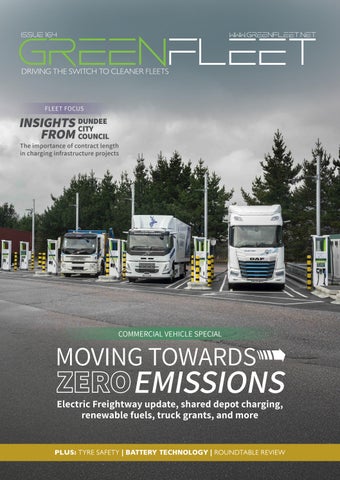
The first visible manifestation of that strategy came with the opening of the UK’s first public eHGV charging stations at Extra Baldock on the A1(M) and Moto Exeter on the M5 earlier this year. Both sites marked a defining moment and reflect a level of operational detail that fleet managers will recognise immediately. Baldock launched with six dedicated charging bays, while Exeter opened with four, each incorporating safety features such as wide walkways, lighting, sensors and CCTV to support driver movement around large vehicles.
In practical terms, these locations show that electric trucks can complete real routes, charge during mandated breaks and return to service without disruption. A DAF XF
Electric, International Truck of the Year 2026, recently reinforced that point, completing a journey between the two hubs to illustrate how strategic infrastructure will enable long-distance zero-emission haulage.
Momentum has continued to build since those first openings. As of March, four additional public eHGV charging hubs have been confirmed at Moto Knutsford North, Moto Medway East, Markham Vale Electric Forecourt and Stevenage Electric Forecourt. These locations will join the five eHGV hubs already under construction at Tamworth, Thurrock, Leeds, Chester and Strensham North, bringing the total pipeline to eleven locations.
Challenges to overcome
Of course, these sites are not without their ongoing challenges, particularly around grid connection timelines and energy capacity charges, both of which need to be urgently addressed by government. Infrastructure must continue to expand, vehicle supply must scale, and the energy system must adapt to support increased demand. But the trajectory is now established and as Daniel Kunkel, CEO of GRIDSERVE, has put it, zero-emission freight is no longer a future ambition, but a live, operational reality. The entire conversation has shifted from whether electrification is feasible towards how it can be implemented most quickly and effectively.
Participating fleets have already recorded more than half a million zero-emission miles, providing real-world data on performance, energy use and cost that was previously lacking and that hauliers can review
For fleet managers across both public and private sectors, there is now a clear choice. Those who engage early - testing vehicles, understanding infrastructure and adapting operations - will be best placed to navigate the transition. Those who wait may find that the pace of change, driven by regulation, economics and customer expectations, leaves little room to catch up. What the Electric Freightway ultimately aims to achieve is not just provide a network of ultrarapid chargers, but to help shift the UK mindset. By aligning infrastructure, vehicles and realworld operations, it is turning the electrification of freight from a strategic aspiration into a practical pathway. And for an industry built on reliability and efficiency, that may be the most important development of all. M
FURTHER INFORMATION
www.gridserve.com/electric-freightway
Baldock eHGV charging site opening
Electrification: A flexible approach
AA fleet director Duncan Webb explains why any approach to electrification should be deliberately flexible
Decarbonising commercial transport in the UK is rapidly gaining traction. But the pace and complexity of change varies wildly across different vehicle segments. While the milestone of 1,000 zero-emission truck registrations marks important progress, it also highlights the scale of the challenge ahead – and especially in the heavy goods vehicle (HGV) sector, where zero-emission models still represent only a small slice of new vehicle sales. There’s unfortunately no one-size-fitsall approach to electrification – no silver bullet solution to suit every business. Any approach taken – and I speak from experience – should be deliberately flexible.
Adoption complexities
The difficulty of scaling lies in the critical economic role HGVs play. Vehicles must travel long distances, carry heavy payloads, and keep going with minimal downtime. Current battery-electric technology, while improving, still presents limitations in range, charging time, and vehicle weight. Equally, the infrastructure needed to support large-scale electrification (particularly high-capacity depot and motorway charging) is woefully underdeveloped. Combined with high upfront costs, these barriers make widespread adoption slower and more complex than it need otherwise be.
Zero-emission vans are seeing more consistent growth, but fleet operators are still facing practical constraints. Vans are often central to time-sensitive operations, where reliability and flexibility are critical. Concerns around range, access to charging, especially for drivers without affordable home charging access, and the capacity of depots to support electrification are all contributing factors to the slower, more gradual transition we’re all witnessing. But this is where technology really comes into its own. Telematics, route analytics, and energy management platforms are enabling fleets to better understand how vehicles are used and where electric alternatives can be deployed most effectively. These tools help optimise charging schedules, monitor battery performance, and improve route planning, ensuring that EVs are used in the most efficient and practical way. Meanwhile, digital innovation is reducing the need for unnecessary journeys. Remote diagnostics and support allow many issues to be resolved without dispatching a vehicle or technician. At The AA, within our own operations, more than 120,000 remote fixes have already been delivered, cutting both emissions and operational costs while improving customer experience.
Duncan Webb, fleet director, AA
Alongside technology, investing in people is critical. As fleets transition, the need for EV skills and knowledge grows. Ensuring drivers, technicians, and support networks are properly trained builds confidence and capability across the ecosystem, helping organisations adopt new technologies more effectively and safely.
A single piece of the puzzle
But transitioning to zero-emission vehicles is only one part of the solution. A wholly effective decarbonisation strategy also focuses on how vehicles are used. Route optimisation, for example, is one of the most impactful ways to reduce emissions. By analysing journey patterns and improving vehicle deployment, fleets can reduce mileage, lower energy consumption, and increase productivity. Similarly, driver behaviour has a measurable impact. Training programmes that encourage smoother, more efficient driving can extend vehicle range and reduce overall energy use, such as the programmes and training offered by Drivetech, part of The AA.
Alternative fuels
Alternative fuels also have a role to play, particularly as a transitional solution. Options such as hydrotreated vegetable oil (HVO) can significantly reduce emissions compared with traditional diesel and can be deployed quickly within existing fleets. This allows organisations
to make immediate progress while longer-term electrification strategies are implemented.
Always ahead
Electrification will remain central, but it must be supported by smarter operations, alternative fuels, and continued investment in infrastructure and skills. By bringing these elements together, fleets can accelerate progress toward a lower-carbon future, while continuing to deliver the essential services that businesses and communities rely on every day.
At The AA, as an award-winning multi-service provider, we’re proud to support both drivers and businesses. Our intention is to keep them always ahead - wherever they are on the journey. M
FURTHER INFORMATION
For more information and to stay up to date with our latest insights and Yellow Papers, click here.
Why renewable fuels, and trust, must drive the UK’s HGV transition to net zero
Renewable fuels enable HGV operators to deliver major carbon savings immediately, without waiting for new vehicles or infrastructure. Yet not all renewable fuels deliver the same benefits, and not all claims are equally robust. Gloria Esposito, director of sustainable business at Zemo Partnership, explains how to make a genuine impact
The decarbonisation of the UK’s heavy goods vehicle (HGV) sector is entering a decisive phase. While electrification continues to dominate industry narratives, the operational realities of long-haul freight tells a more nuanced story. High payload requirements, long distances and tight delivery schedules make this one of the most difficult transport segments to decarbonise. In this context, renewable fuels are not a secondary option; they are a critical, immediate solution already delivering measurable impact across the UK.
Today, an estimated 12,000 HGVs are running on renewable alternatives such as hydrotreated vegetable oil (HVO), biomethane and highblend biodiesel. This is not a pilot phase; it is a growing movement within the logistics sector, cutting greenhouse gas emissions and supporting decarbonisation goals.
Greenhouse gas savings
These fuels deliver lifecycle greenhouse gas savings of more than 85 per cent compared to conventional diesel when derived from
Refuelling a Biffa Wasteater with HVO
waste-based feedstocks. That distinction is critical. The credibility of renewable fuels depends not just on the fuel itself, but on how it is produced and distributed to the end customers. Under robust assurance frameworks, these fuels are sourced from wastes and residues, ensuring emissions reductions are both significant and sustainable. Long-haul trucking amplifies the benefits of fuel switching. Vehicles in this segment consume large volumes of fuel over extended distances, so even small reductions in carbon intensity have an outsized impact. Renewable fuels therefore offer one of the fastest and most effective ways to reduce emissions from existing assets. They enable operators to act immediately, without waiting for new vehicles or infrastructure. In a sector where margins are tight and operational continuity is critical, that ability to decarbonise without disruption is a powerful advantage.
The importance of traceability
HVO is widely recognised as a drop-in diesel replacement, but its environmental value depends entirely on its feedstock. When produced from waste-derived materials such as used cooking oil and animal by-products, it can achieve life cycle greenhouse gas savings in excess of 85 per cent. These waste-based inputs avoid the land-use concerns associated with crop-based fuels and ensure that the carbon reductions are genuine. Assurance frameworks such as the Renewable Fuels Assurance
Scheme (RFAS) are critical for ensuring the traceability of waste-derived sources. For fleet operators, this provides confidence not only in performance, but in the integrity of the emissions savings being claimed.
Commercially, HVO offers a straightforward transition, requiring no vehicle modifications and enabling immediate deployment across existing fleets.
Biomethane provides a complementary route. Produced through the anaerobic digestion of organic waste, it captures methane that would otherwise be released into the atmosphere. Feedstocks include food waste, agricultural residues, slurry, manure and sewage sludge. The use of manure is particularly significant, preventing the release of a highly potent greenhouse gas while generating a renewable fuel. As a result, biomethane can, in some cases, deliver net-negative outcomes. It also offers potential cost advantages and greater fuel price stability, making it an attractive option for operators seeking both environmental and commercial benefits.
Together, these fuels deliver a rare alignment of environmental impact and operational practicality. They reduce emissions immediately while supporting cost control, energy resilience and continuity of service. For many fleets, they represent the most effective way to begin, and accelerate, the decarbonisation journey.
This immediacy is critical in the context of the UK’s net zero targets. Even with rapid progress in battery-electric technology, the transition of the HGV fleet will take time. Diesel vehicles entering service today may remain operational into the 2030s. Infrastructure constraints, grid capacity and cost considerations all point to a gradual transition rather than a sudden shift. Renewable fuels provide a bridge across this period, enabling emissions reductions now while longer term solutions develop.
At the same time, the economic realities of electrifying long-haul articulated HGV fleets remain challenging. Battery-electric trucks come with significantly higher upfront costs, often two to three times that of a diesel equivalent. For large fleets, this represents a substantial capital investment with uncertain short-term returns. Infrastructure adds further complexity. Depot charging requires highcapacity grid connections, which can involve long lead times and significant upgrades. The cost of installing chargers, redesigning depots and managing energy demand further increases this financial burden. E
F Operational challenges
Operational challenges compound the issue. Battery weight can reduce payload, affecting revenue on long-haul routes. Charging requirements can disrupt tightly optimised schedules, and public charging infrastructure for HGVs remains limited. For operators dependent on reliability and efficiency, these constraints are not minor; they are fundamental. While electrification will play a crucial long-term role, it is not yet a universal solution for all use cases. This reinforces a key principle: there is no one-size-fits-all pathway to decarbonising heavy transport. Electrification, hydrogen and renewable fuels each have a role to play. The priority must be reducing well-to-wheel emissions as quickly and cost-effectively as possible, using every viable solution available. Renewable fuels are central to this approach. They enable immediate emissions reductions across existing fleets, working in parallel with the gradual rollout of zero emission vehicles. Rather than waiting for a single, perfect solution, the industry can act now, cutting emissions today while continuing to invest in the technologies of tomorrow.
Independent assurance
As adoption grows, however, so does the need for transparency. Not all renewable fuels deliver the same benefits, and not all claims are equally robust. The sustainability of a fuel depends on feedstock origin and supply chain integrity. Without proper verification, there is a risk of overstated emissions savings and reduced trust. This is where RFAS plays a vital role. By providing independent assurance, it
ensures that renewable fuels meet strict sustainability criteria and are derived from traceable, waste-based feedstocks. It validates greenhouse gas savings claims and provides full transparency across the supply chain. In doing so, it gives fleet operators and their customers confidence that emissions reductions are real and defensible.
The development of RFAS Fleet extends this value further, particularly in the context of Scope 3 reporting. Transport emissions often represent a significant portion of a company’s indirect footprint, yet they have historically been difficult to measure accurately. RFAS Fleet enables verified GHG emissions savings to be allocated to specific transport activities, providing robust data that can be used in corporate reporting. This has important commercial implications. Operators using RFAS-assured fuels can offer verifiable low carbon transport, supporting customers’ sustainability goals and strengthening their own market position. At the same time, they reduce exposure to the risks associated with unverified environmental claims.
None of this diminishes the importance of electrification. Zero emission vehicles will be essential to achieving long-term climate goals. But the scale and cost of the transition, particularly for long-haul operations, mean it will take time. During that time, emissions must continue to fall.
As the UK moves forward, the focus must be on deploying solutions that deliver immediate impact. Renewable fuels, derived from waste and delivering life-cycle greenhouse gas savings of over 85 per cent, are among the most effective tools available today. When supported by robust assurance through RFAS, they provide a credible and scalable pathway to decarbonisation. Ultimately, the goal is not to champion a single technology, but to reduce emissions as quickly and cost-effectively as possible. In longhaul freight, that means recognising the complementary role of renewable fuels alongside electrification. By combining immediate action with long-term ambition, the sector can make real progress - cutting emissions now while building towards a zero emission future. M
FURTHER INFORMATION
www.zemo.org.uk/ work-with-us/fuels
Fuel solutions where downtime is not an option
In a market where reliability and sustainability must operate side by side, New Era Energy is one of the UK’s most advanced and accredited fuel partners, redefining modern energy supply
Built on operational excellence and engineering capability, New Era Energy delivers nationwide fuel supply, smart infrastructure, and renewable energy solutions to industries where downtime is not an option, from transport & logistics and construction to data centres, rail, & maritime.
At the core of the business is a clear commitment: performance without compromise. New Era Energy runs its entire delivery fleet on HVO demonstrating leadership in low-carbon operations while supporting customers to do the same. This renewable diesel alternative, produced from waste-derived feedstocks, can deliver up to 90 per cent lifecycle CO2 reduction while functioning as a drop-in replacement for diesel with no engine modifications.
New Era Energy’s integrated offering includes diesel, HVO, GTL, AdBlue®, & lubricants. It also offers
smart tank leasing, telemetry & fuel management systems, as well as tank cleaning, fuel polishing, inspection & compliance services. New Era Energy also delivers bespoke engineering solutions and emergency fuel delivery & rapid response vehicles.
Accreditations such as FORS Gold reinforce New Era Energy’s commitment to safety, sustainability and continuous improvement, while its 24/7 emergency delivery capability ensures fuel is always available when it matters most. M
FURTHER INFORMATION
Click here to contact New Era Energy
Securing the future of commercial vehicles: Rhino Products and Locks 4 Vans
By combining Rhino’s established expertise in storage and access with Locks 4 Vans’ security solutions, customers can now benefit from the strengths of two specialist businesses operating alongside each other
For UK and European van operators, the threat of theft is never far from mind. Tools disappear, locks are broken, and vehicles are damaged, creating disruption, lost productivity, and unnecessary waste. In a sector where efficiency and reliability are essential, businesses need practical solutions that protect both assets and operations. Rhino Products has spent nearly 25 years building a reputation for durable and innovative light commercial vehicle accessories. Best known for its roof storage systems, the company has steadily expanded its portfolio to
include rear steps, side steps, and internal van racking, providing practical solutions that help businesses make the most of their vehicles. Rhino’s commitment to quality and design has made it a trusted partner for commercial vehicle operators across the UK and Europe. Recently they welcomed Locks 4 Vans Ltd into the Rhino Products Group. Locks 4 Vans are specialists in LCV security with more than 20 years of experience designing locks and advanced security systems. Their addition extends Rhino’s offering into a critical area for operators: van and tool security.
Together, the two businesses provide a broader spectrum of solutions for customers seeking both convenience and protection.
Locks 4 Vans offers one of the most comprehensive ranges of LCV locking solutions across the UK and European markets. Their products do not just prevent theft; they help businesses avoid the ripple effects of crime, including operational disruption, financial loss, damaged vehicles, and unnecessary replacement of tools and materials. By combining Rhino’s established expertise in storage and access with Locks 4 Vans’ security solutions, customers can now benefit from the complementary strengths of two specialist businesses operating alongside each other.
Steve Egerton, Rhino’s founder and CEO, describes the arrival of Locks 4 Vans as a natural step in the Group’s growth. Both companies are leaders in their respective fields, and the move reflects a shared commitment to meeting the practical and security needs of commercial operators. In an industry where every minute counts and every tool is vital, solutions that protect vehicles and equipment are more important than ever.
Sustainability continues to be a key priority for Rhino Products. The company has achieved carbon neutrality across its UK sites and continues to meet ISO 9001 quality standards. Product innovation also supports environmental goals. The Kamm range, inspired by aerodynamicist Professor Wunibald Kamm, demonstrates how thoughtful design can improve aerodynamics, reduce wind noise, eliminate the need for additional
aerofoils, and improve fuel efficiency. These improvements deliver both practical and environmental benefits for van operators.
For customers, the integration of Locks 4 Vans into the Rhino family is seamless. Existing products, services, and support structures continue without disruption. Operators can now access the expertise of both companies, benefiting from high-quality storage solutions alongside specialist security systems while maintaining consistent service.
Welcoming Locks 4 Vans represents more than just an expansion of Rhino Products’ offering. It highlights a broader evolution in commercial vehicle solutions where security, performance, practicality, and sustainability are all priorities. Both companies continue to innovate, developing solutions that anticipate the changing needs of the sector and help businesses operate efficiently and safely. Ultimately, this development goes beyond business growth. By bringing Locks 4 Vans into the Rhino family, Rhino Products demonstrates how practical design, effective security, and sustainability can work together to support van operators. In a market defined by rising challenges, this combination delivers timely, essential solutions that help businesses protect their assets, reduce waste, and maximise efficiency. M
FURTHER INFORMATION
www.locks4vans.co.uk www.rhinoproducts.co.uk
Road Transport Expo is back
Get ready for the haulage sector’s must-attend summer tradeshow –because Road Transport Expo 2026 is set to raise the bar once again
Returning to the NAEC Stoneleigh, Warwickshire, the show will run from 30 June to 2 July, marking a significant milestone as RTX celebrates five years since its launch in 2022.
RTX 2026 promises three packed days of innovation, insight and handson experiences for anyone working across the road transport industry.
One-stop shop for industry professionals
Expect to find everything you need for your business, from workshop equipment, tyres, trailers and specialist bodies to tankers, technology providers and service partners – all brought together across several indoor halls and a buzzing outdoor display area.
Free to attend – register now!
Join us at the NAEC Stoneleigh from 30 June to 2 July 2026 for the road transport industry’s flagship summer event. Whether you’re returning to catch up on the latest tech or visiting for the first time, RTX is where you’ll want to be.
Entry is free, but don’t forget to register in advance at roadtransportexpo.co.uk.
Visitors to the show will be able to explore vehicles and technology from the major truck OEMs, with a broad mix of product launches, updates and demonstrations expected from hundreds of well-known international brands across the show.
Keeping you ahead of the curve
RTX 2026 will once again host a packed programme of seminars tackling the most pressing issues facing operators today.
Expect expert-led sessions on decarbonisation, fleet safety, new regulations, technology adoption, and emerging industry challenges and opportunities.
The Knowledge Zone and Talking Point stages will welcome a diverse roster of speakers –from leading fleet operators to enforcement bodies and forward-thinking technology specialists – offering practical guidance you can take straight back to your business.
What you thought
RTX 2025 delivered a record turnout, with more than 14,000 visitors heading to Stoneleigh. Post-event feedback showed that 97 per cent rated the quality and quantity of exhibitors as good or excellent, while 96 per cent said they were likely or very likely to attend again.
Try it out
Back by popular demand will be the Ride & Drive area, giving attendees the opportunity to get behind the wheel of the latest diesel, electric and alternatively fuelled trucks to experience them live and see how they handle.
If you’re keen to drive one of the test models at the show, make sure you bring your HGV driving licence details with you and our friendly team will help book you into a slot on the day.
Planning your visit
To make the most of your trip, explore the exhibitor directory at roadtransportexpo. co.uk. You can filter stands by company name, product category or area of interest to build your personalised ‘must-visit’ list.
On the day, clear signage, large site maps and a dedicated RTX app will help you navigate the venue and stay up to date with seminar timings, exhibitor alerts and live updates. E
F Looking ahead
“We’re incredibly proud of how Road Transport Expo has grown since its launch in 2022,” says Vic Bunby, RTX show director.
“The show continues to evolve to meet industry needs, balancing a highly professional exhibition environment with the informal, friendly atmosphere visitors really value. As we celebrate five years of RTX, what I’m most looking forward to is welcoming visitors back to what has become a real industry community event.
“RTX brings people together –operators, manufacturers, innovators and newcomers alike – and there’s a fantastic buzz the moment the gates open. I can’t wait for everyone to experience that atmosphere again this summer.” M
FURTHER INFORMATION
roadtransportexpo.co.uk
Explore: RTX spans several indoor exhibition halls and a vast outdoor exhibition space. Walking around the site you will find decarbonisation is a core focus for many show exhibitors and you’ll be able to explore the very latest ultra-low-carbon and zeroemission vehicle technology, from fullyelectric battery trucks and solar-powered refrigeration, through to biogas and HVO suppliers.
Insight: A comprehensive three-day conference programme is a popular feature of RTX, which will cover the key topics that matter to you – including several sessions focusing on the challenges, opportunities and success stories of fleet decarbonisation. Sessions are free to drop into and you can pick and choose those most relevant to your business. Speakers will be joining us from government departments, major OEMs, well-known fleet operators and industry technology experts.
Experience: RTX gives visitors the opportunity to take a spin in the latest HGV models through its Ride & Drive feature. If you hold the appropriate licence, you’ll be able to take a test drive of your chosen models or simply experience the technology as a passenger if you prefer. Trucks will include a range of fuelling options, including diesel, biogas and electric.
Decarbonisation in action at RTX
Safety a key priority to avoid unnecessary van downtime
Vehicle downtime poses a significant challenge for commercial vehicle fleets. Consequently, driver training has seen a notable increase in demand as businesses look to minimise time off road
“Even the smallest incident, such as a driver hitting a fixed object or damaging a wing mirror can result in a van being off road for extended periods of time,” said Lee Brown, Grosvenor’s managing director.
“By improving driving standards through risk assessments and training programmes, we can keep vehicles where they belong – on the road and earning their keep.
“Regular online driver risk assessments will identify potential areas of concern and tailor training accordingly. In-vehicle, onroad defensive driver training can further enhance skills, and drivers should also be trained in safe loading practices to avoid further vehicle damage and danger through
loads shifting in transit and impacting the safe handling of the vehicle.
“The number of electric vans being delivered is also on the rise, and we are seeing many drivers being given an EV having never driven one before. In fact, some have never even driven an automatic, and its vital to give them full training to avoid any incidents.”
www.grosvenor-leasing.co.uk
EV charging infrastructure with a long-term future
After electrifying more than a third of Dundee City Council’s 640-strong fleet, Fraser Crichton explains why long-term charging infrastructure contracts are the critical, often overlooked foundation for making the transition work that the charging infrastructure will be there, maintained, and upgraded for the full lifecycle of those vehicles. A refuse collection vehicle might be on our fleet for 10 to 12 years. If the infrastructure contract expires halfway through that vehicle’s life, we’re introducing uncertainty into a decision that should be straightforward. Third, it fragments the relationship. Every time a contract comes up for renewal, you lose continuity. The engineers who know your sites, the operators who understand your fleet patterns, the people who pick up the phone when something breaks at 6am before the bin lorries go out. That knowledge walks out the door and you start again.
Over a third of Dundee City Council’s fleet is now electric. That’s 232 vehicles out of 640: pool cars, vans, street sweepers and eight fully-electric refuse collection vehicles that were the first of their kind in Scotland. Since 2021 we’ve travelled 11.5 million miles on pure electric and saved an estimated 2295 tonnes of CO2 – equivalent to 13,800 trees. By 2035, we aim to have every vehicle in our fleet running on electricity. None of that happened just because we bought the right vehicles. It happened because we built the right infrastructure to support them, and then made sure that infrastructure had a long-term future. The vehicle purchase is the easy part. The harder question, and the one that many fleet managers and local authorities are overlooking, is: what does the contract behind your charging infrastructure actually look like, and is it long enough to deliver what you need?
The problem with five-year thinking Most local authority EV infrastructure contracts run for five-to-ten years. That might sound reasonable. But when you’re managing a fleet transition that will take a decade or more to complete, a five-year contract creates problems that aren’t immediately obvious. First, it limits what your operator will invest. If a company knows it has five years on a contract, it will install what’s needed to fulfil the minimum specification and no more. It won’t invest in solar canopies, battery storage or depot upgrades that only pay back over a longer horizon. Why would it? The asset might belong to someone else in six years. Second, it makes fleet planning harder. When we’re deciding which fleet vehicles to electrify over the next five years, I need to know
What a 20 year contract actually enables
Earlier this year, Dundee signed a 20-year partnership with Evolt Charging covering its entire public and fleet charging estate: 199 public chargers, six battery storage systems, and seven solar arrays across four rapid charging hubs. We also completed the migration of our entire network away from ChargePlace Scotland in two and a half weeks, with zero downtime for drivers. That speed wasn’t luck; it was the product of a relationship that has been building since 2011.
The 20-year commitment changes the calculus in ways that matter practically for fleet operations. Our operator can now justify investing in depot upgrades that support the next phase of fleet electrification, because they know they’ll be here to see the return. We’re planning a new rapid charging hub in the north of the city with eight ultrarapid chargers, solar canopies, and battery storage. That kind of capital investment doesn’t happen on a five-year contract.
The contract also includes a bi-yearly tariff review mechanism. For fleet managers, that’s critical. It means we can forecast charging costs with reasonable confidence over the lifecycle of the vehicles I’m buying today. The tariff isn’t fixed forever, but it’s reviewed on a schedule we can plan around, with both E
Most local authority EV infrastructure contracts run for 5-10 years. That might sound reasonable. But when you’re managing a fleet transition that will take a decade or more to complete, a five-year contract creates problems that aren’t immediately obvious
When we’re deciding which fleet vehicles to electrify over the next five years, I need to know that the charging infrastructure will be there, maintained, and upgraded for the full lifecycle of those vehicles
F parties at the table. That’s a fundamentally different offer to a short-term contract where pricing can shift dramatically at renewal.
And because all revenue generated through our charging network is reinvested back into the estate, the infrastructure improves over time rather than degrading. The incentives are aligned: better infrastructure means more usage, which means more revenue, which means further investment. On a short contract, that feedback loop never has time to develop.
The fleet reality that gets overlooked Fleet electrification isn’t a single decision, it’s a rolling programme that takes years. We started with Nissan Leafs in 2011. We moved into electric taxis in 2016. We introduced electric refuse vehicles in 2021. At each stage, we needed to know that the infrastructure would keep pace, that depot charging would be expanded, and that the people maintaining our chargers understood our operations.
That last point is more important than it might sound. Our charging hubs don’t just plug vehicles in. The Clepington Road hub integrates 600 kilowatt-peak of solar generation with 720 kilowatt-hours of second-life battery storage, using repurposed EV batteries. It captures excess solar energy and uses it to reduce grid demand at peak times. That’s not something you can hand over to a new operator every five years and expect to run smoothly. It requires deep technical knowledge of the specific installation, built up over time.
We’re also starting to explore the possibility of exporting surplus renewable energy from our hubs back into the national grid. If that works, our EV infrastructure becomes not just a cost to the council but a revenue generator. But developing that capability requires long-term thinking, long-term investment, and a long-term partnership that gives both sides the confidence to innovate.
The lesson for other fleet managers
Every Scottish local authority is now facing the same transition we’ve completed. ChargePlace Scotland is winding down, and councils are having to find private partners to run their charging networks. Some are making good decisions. Others may default to the shortest, cheapest contract they can find because that’s what procurement culture encourages.
My advice is to think about the contract the same way you think about the fleet plan. You wouldn’t buy a refuse vehicle and plan to replace it in three years. So why would you sign an infrastructure contract that doesn’t last as long as the vehicles it’s supposed to support?
We certainly didn’t get everything right the first time. Over the course of our electrification, every type of charger was trialled and tested, and we made our fair share of mistakes.
But the one thing we did get right, from the beginning, was building a relationship with our infrastructure partner that was long enough to learn from those mistakes and keep improving. That’s what 20 years gives you. And I’d argue it’s the most important decision any fleet manager will make in the next five years. L
Road-to-Zero Roundtable: North East
On 5 March, fleet operators and industry experts gathered at St James’ Park football stadium in Newcastle upon Tyne for GREENFLEET’s Roadto-Zero roundtable to discuss the practical realities of transitioning to zero-emission fleet operations
The discussion, which was hosted by sustainable transport expert Gill Nowell, highlighted that the pace of progress towards electrified fleets is being shaped by real-world infrastructure and operational constraints. A significant theme that was raised was the challenge of depot electrification. Participants described depot charging as both costly and complex, with grid connection timelines, planning requirements and available site capacity needing to be addressed far earlier in fleet transition planning. The importance of engaging with independent distribution network operators (iDNOS) and independent connection providers (ICPs) was also emphasised as a way of reducing delays in securing grid access, with
organisations such as Drax Electric Vehicles noted as useful sources of support.
Cost pressures remain another barrier, even as the total cost of ownership for electric vehicles continues to improve. High upfront vehicle prices and significant infrastructure investment requirements mean some operators are still navigating financial constraints when planning large-scale EV transitions.
Delegates also highlighted the need for greater capability funding to support the development of ready-to-submit grant applications, particularly for depot charging infrastructure. Tight funding windows were identified as a barrier for organisations without pre-prepared plans, limiting their ability to respond quickly to available support schemes. L
Why tyre safety is the blind spot costing fleets more than they think
Charity TyreSafe explores how poor tyre management quietly drives up costs, undermines efficiency and increases safety risks
Fleet operators are under pressure from every angle – rising costs, tighter regulation, and the shift to electric vehicles. Yet one of the biggest risks to safety, efficiency and cost control is still hiding in plain sight. Tyres. Often treated as a routine maintenance item, tyre safety is rarely given the strategic attention it deserves. But the data tells a different story.
An estimated one in three road traffic incidents involves someone driving for work. Every week in the UK, more than 200 people are killed or seriously injured in work-related road incidents – and tyre condition is frequently a contributing factor. Four small contact patches. That’s all that connects a fleet vehicle to the road. When they fail, everything else follows.
The hidden cost sitting on your fleet
Let’s be clear – tyre safety isn’t just about compliance. It’s about cost. Underinflated tyres quietly drain efficiency. Increase rolling resistance, and suddenly vehicles need more energy to do the same job.
The impact may seem marginal – around a three per cent drop in fuel efficiency from tyres just 20 per cent underinflated – but scale that across a fleet, and it becomes significant.
A single vehicle driving 20,000 miles a year could waste over £100 in fuel. Multiply that across 100 vehicles, and you’re looking at £10,000+ lost annually, without factoring in increased tyre wear, breakdowns or downtime.
In an industry focused on optimisation, this is low-hanging fruit.
Compliance is the floor, not the ceiling
Fleet operators already carry clear legal responsibilities. Under UK health and safety legislation, businesses must ensure vehicles used for work are safe and roadworthy.
Electric vehicles are heavier. Often by 200-400kg. That extra weight puts more strain on tyres, increasing wear and raising the stakes if something goes wrong
Failing to do so isn’t just risky, it’s expensive. Fines can reach £20,000, not to mention the reputational fallout of a serious incident. Drivers, too, are accountable. Illegal tyres can mean £2,500 and three points per tyre. But focusing purely on compliance misses the bigger point. The real question isn’t “are we meeting the minimum?” It’s “are we managing risk effectively?”
Electric vehicles change the game, and raise the stakes
The transition to electric fleets is accelerating, but it brings new tyre challenges that many operators are still catching up with. E
F EVs are heavier. Often by 200-400kg. That extra weight puts more strain on tyres, increasing wear and raising the stakes if something goes wrong. They also deliver instant torque. Great for performance but tougher on tyres. And with near-silent operation, tyre noise becomes far more noticeable, changing expectations around comfort.
This isn’t just a spec change, it’s a mindset shift. Fleet operators need to think differently about load ratings to ensure tyres can safely handle increased weight, as well as rolling resistance, balancing range with safety performance. Noise reduction meanwhile improves driver experience and reduces fatigue. Get it right and tyres can enhance EV performance. Get it wrong, and costs and risks climb quickly.
Small checks, big consequences
Here’s the paradox: the risks are high, but the fixes are simple. Basic tyre checks take minutes yet they can dramatically reduce incidents, costs and downtime. The fundamentals haven’t changed; you should check pressures regularly, monitor tread depth (not just legality, but performance), inspect for damage and wear, and maintain alignment and balance. For EVs, this becomes even more critical. Underinflated tyres can increase rolling resistance by up to 10 per cent, cutting range and accelerating wear. In other words, poor tyre maintenance
doesn’t just cost money, it undermines the entire efficiency case for electrification.
The real challenge: behaviour, not knowledge
Most fleet operators already know this. The real challenge is consistency. Tyre safety doesn’t fail because of a lack of policy, it fails because of gaps in behaviour, such as drivers skipping checks, not reporting issues and allowing small problems to become big ones. This is where simple, repeatable frameworks matter. Campaigns like TyreSafe’s ACT message (Air Pressure, Condition, Tread) work because they cut through complexity and make action easy. The goal isn’t more information. It’s better habits.
Why partnerships matter
Tyre safety isn’t something any one organisation can fix alone. That’s why collaboration is becoming central to progress.
TyreSafe is working with organisations such as Driving for Better Business to embed tyre safety into occupational driving standards, ensuring it’s treated as a core risk, not an afterthought.
At a regional level, partnerships with local authorities and blue light organisations are helping bring enforcement and education together, identifying unsafe vehicles while reinforcing behaviour change.
This is where real impact happens: not in strategy documents, but on roads, in depots, and in daily driver decisions.
A problem that shouldn’t exist
What makes tyre safety particularly frustrating is that it’s largely preventable. A few minutes of checks can reduce incident risk, cut fuel and energy costs, extend tyre life, and improve vehicle performance.
And yet, millions of vehicles on UK roads are still running on underinflated or poorly maintained tyres.
For fleet operators, the issue isn’t awareness. It’s execution.
From overlooked to operational priority
As fleets evolve to become more electrified, more data-driven, and more scrutinised, tyre safety needs to move up the agenda. It sits at the intersection of safety, cost control, and sustainability. Ignore it, and it quietly erodes all three. Prioritise it, and it becomes one of the simplest ways to improve performance across the board.
The bottom line
Tyres might not be the most exciting part of fleet management, but they are one of the most important.
They are where strategy meets reality. Where cost meets safety. Where small decisions have big consequences. For fleets serious about reducing risk, improving efficiency and protecting their people, tyre safety isn’t a maintenance task. It’s a business-critical priority. M
No trade-offs, no half measures. It’s the complete package. Fully electric, compliant and efficient, with all the payload, towing power and 4x4 performance you need.