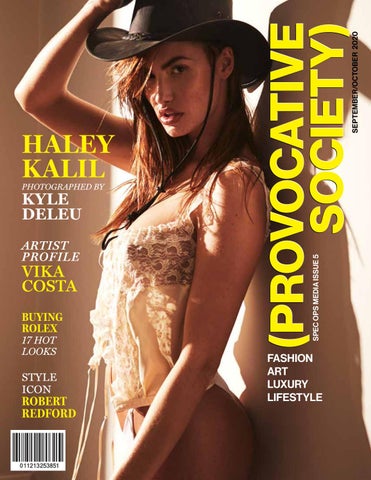
KYLE DELEU ARTIST PROFILE
VIKA COSTA BUYING ROLEX 17 HOT LOOKS
STYLE ICON
ROBERT REDFORD
SEPTEMBER/OCTOBER 2020
SPEC OPS MEDIA ISSUE 5
PHOTOGRAPHED BY
(PROVOCATIVE SOCIETY)
HALEY KALIL
FASHION ART LUXURY LIFESTYLE
FASHION
ART
LUXURY
LIFESTYLE
(PROVOCATIVE SOCIETY) SPEC OPS MEDIA ISSUE 5
SEPTEMBER/OCTOBER 2020
JADE AMBER
PHOTOGRAPHED BY
BARTLOMIEJ
ARTIST PROFILE
VIKA COSTA
ART BUYING
BUYING ROLEX
MR. HUSTLE
STYLE ICON
THE FUTURE IS HERE
17 HOT LOOKS
MARK KOSTABI
ROBERT REDFORD
ENDLESS LOVE
1PENEMY
MADONNA & BASQUIAT
THE UP & COMER
STREET ART WITH
ALEC MONOPOLY
FASHION
ART
LUXURY
LIFESTYLE
(PROVOCATIVE SOCIETY) SPEC OPS MEDIA ISSUE 5
SEPTEMBER/OCTOBER 2020
MADLENA KALINOVA PHOTOGRAPHED BY DAMON HALL BOOTH
ARTIST PROFILE
VIKA COSTA
BUYING ROLEX 17 HOT LOOKS
ENDLESS LOVE
MADONNA & BASQUIAT STYLE ICON
ROBERT REDFORD
ROMY DEGRIJFF
PHOTOGRAPHED BY
BELLEZZAMODAPH
STYLE ICON
ROBERT REDFORD BUYING ROLEX 17 HOT LOOKS
ARTIST PROFILE
VIKA COSTA
FASHION
MR. HUSTLE
MARK KOSTABI
ART
LUXURY
LIFESTYLE
(PROVOCATIVE SOCIETY) SPEC OPS MEDIA ISSUE 5
SEPTEMBER/OCTOBER 2020
FASHION
ART
LUXURY
LIFESTYLE
(PROVOCATIVE SOCIETY) SPEC OPS MEDIA ISSUE 5
SEPTEMBER/OCTOBER 2020
ARTIST PROFILE
VIKA COSTA
ART BUYING
THE FUTURE IS HERE STYLE ICON
ROBERT REDFORD
LEAH REYNOLDS
PHOTOGRAPHED BY
LOU D’AMATO ENDLESS LOVE
MADONNA & BASQUIAT BUYING ROLEX
17 HOT LOOKS
MR. HUSTLE
MARK KOSTABI
1PENEMY THE UP & COMER
(THE TEAM) PROVOCATIVE SOCIETY Vol. 1, No. 5 September/October 2020 Publisher Spec Ops Media Editor Dr. Nicholas Toscano Meredith Jacoby Design Jimmydog Design Group www.jimmydog.com Production Manager Stephanie Belcher 336-201-7475 • sbelcher@triad.rr.com Copy Editor Spec Ops staff Digital Conversion Spec Ops staff Internet Management Spec Ops staff Subscription Information: Annual rates as follows: Non-qualified individual: $99(USD) Institutional: $99(USD). For more information regarding subscriptions, provocativesociety@gmail.com Advertising Policy: All advertisements appearing in the Provocative Society must be approved by the editorial staff which has the right to reject or request changes to submitted advertisements. The publication of an advertisement in Provocative Society does not constitute an endorsement by the publisher. Additionally, the publisher does not guarantee or warrant any claims made by Provocative Society advertisers. For advertising information, please contact: provocativesociety@gmail.com
4
PROVOCATIVE SOCIETY September/October 2020
Manuscript Submission: For information contact Editor, provocativesociety@gmail.com Copyright © 2020 by Spec Ops Media. All rights reserved under United States and International Copyright Conventions. No part of this magazine may be reproduced or transmitted in any form or by any means, electronic or mechanical, including photocopying or any other information retrieval system, without prior written permission from the publisher. Photo submission guidlines: Please submit your photos for our digital print issues by sending us an email with your story in low resolution. A large edit of 15-20 images is preferred. The photos of the store need to be exclusice for Provocative Society magazine, meaning they have to be unpublished. • SIZE: A minimum of 2400 px in width is required for final images. • FORMAT: .jpg, .tif, .zip, Fropbox or WeTransfer links • RESOLUTION: 300 dpi • COLOR: sRGB-RGb (even if they are black/white). •C REDITS: PLease include (a simple file: .pdf, TextEdit or Word) complete and final credits for staff and everything we should include. You also should include the link to your website/portfolio and IG usernames for photographer and model/s. • IMPORTANT: Location and a short story (a simple file: .pdf, TextEdit or Word) about the shoot. • EMAIL: provocativesociety@gmail.com with the subject line Digital/Print Issues Conflicts of Interest: Authors submitting articles to Provocative Society must declare, in writing, any potential conflicts of interest, monetary or otherwise, that may exist with the article. Failure to submit a conflict of interest declaration will result in suspension of manuscript peer review. Erratum: Please notify Provocative Society of article discrepancies or errors by contacting provocativesociety@gmail.com Provocative Society is published on a monthly basis by Spec Ops Media, New York, NY.
(CONTENTS ) 6 Alec Monopoly: The Most Bankable Street-Artist Right Now! 10 Haley Kalil by Kyle Deleu 16 Artist Profile: Vika Costa 24 Jade Amber byBartlomiej 36 The 17 Most Expensive Rolex Watches Of All Time by Jonathan Parker 50 Madlena Kalinova by Damon Hall Booth 60 Romy Degrijff by Bellezzamodaph 70 Meet 1Penemy by Vicky Sidler
10
24
50
60
76 Leah Reynolds by Lou D’Amato 88 Style Icon: Robert Redford by India Gladstone 92 Stephanie Murone by Josh Ryan 104 The Love Story Of Madonna and Basquiat by Julieta Sanguino 108 Natalia LaLonde by John Jacobsen 122 Painter Mark Kostabi Is Still Hustling by Rene Chun 136 Carmella Rose by Kyle Deleu 140 The Future of Art Buying by Tracy Kaler
76
92
108
136 September/Octobe 2020 PROVOCATIVE SOCIETY
5
(ART)
I
Alec Monopoly: The Most Bankable Street-Artist Right Now!
t’s hard to tackle the scene of American street-art without mentioning Alec Monopoly, one of its most successful stars. Recognizable by its old-school top-hat, this anonymous New-Yorker collaborated with the finest celebrities of the star system : from the luxurious TAG Heuer watches, to the Justin Bieber’s Believe tourney, the W Hotels and a plethora of big names (Miley Cyrus, Avicii and Snoop Dogg among others). An ode to pop-culture Drawing from the respective universes of pop-culture and capitalism, Alec Monopoly’s works depict fictive rich characters in various colorful jet-set inspired sketches. If he mainly flourishes in canvas and graffitis, the artist is also known for using other formats. Sneakers, luxurious bags, Dark Vador’s and Stormtroopers’ helmets, skateboards, sculptures… A few months ago, he even unveiled his very first upscale toy : a “self-portrait” figurine inspired by Richie Rich, an
6
PROVOCATIVE SOCIETY September/October 2020
American comics characters. Coincidence or not, Alec began his career during the financial crisis of 2008.
Borrowing from Andy Warhol, Drella, Jean-Michel Basquiat and Keith Haring, Alec Monopoly has made the use of
(ART)
cheerful and bright colors a real signature. However, the common thread to all of his works is truly the extremely rich Uncle Pennybags from Monopoly: a character who often is in the middle of his works. “I was using it as a meta-narrative for what was going on on Wall St. and Bernie Madoff, he explained. It was kind of a negative connotation then. I changed the Monopoly Man from being a negative connotation to being a positive connotation of wealth and prosperity, and as I started September/October 2020 PROVOCATIVE SOCIETY
7
(ART)
I changed the Monopoly Man from being a negative connotation to being a positive connotation of wealth and prosperity
8
PROVOCATIVE SOCIETY September/October 2020
selling paintings more, I started living this life of the Monopoly Man, and now I’m almost consumed by the Monopoly Man. I’m living this life of almost a performance art version of him.” Some prestigious partnerships Unlike his counterparts, Alec avoids vandalism. The artist prefers to work on the grey walls of abandoned buildings or, sometimes, to collaborate with luxurious and sumptuous brands and celebrities. In 2015, Alec repainted Khloe Kardashian’s Hermès Birkin. Adorned with the inscription “Khlomoney”, the
green-colored bag depicts the Monopoly-Man on the run while holding a bag filled with money. Later, the artist gave a makeover to the Honk Kong tramcar with a fresh bright pink coat of paint and with the inclusion of his signature characters. More recently, TAG Heuer introduced the special edition Alec Monopoly for its Formula 1 and Carrera Heuer 01. On a white background, their dials were designed by the American artist. PS Reprinted with permission from themilliardaire.com
(ART)
September/October 2020 PROVOCATIVE SOCIETY
9
(FASHION)
HALEY KALIL Photographed by Kyle Deleu
@haleyybaylee Agency Wilhelmina NYC Kyle Deleu @kyleDeleu
September/October 2020 PROVOCATIVE SOCIETY
11
(FASHION)
12
PROVOCATIVE SOCIETY September/October 2020
(FASHION)
14
PROVOCATIVE SOCIETY September/October 2020
(FASHION)
September/October 2020 PROVOCATIVE SOCIETY
15
(ART)
Q & A WITH VIKA COSTA What’s your background? Originally I’m from Russia St.-Petersburg. Right now I live in New York City, for almost 10 years. I grew up in artistic family. Both of my grandfathers were artists from my mother family tree. Absolutely talented and creative, one was a writer and did sculptures, and another one was a professional painter and clothing designer. How have you developed your career? When I was 7 my mother sent me to art school, where I was studying basic panting techniques. After my graduation from high school I went to university of Art and Culture in Russia, were I was study history of classic and modern art for 5 years. I never thought I would be an artist, I just loved to draw, and living in NYC, in such artistic city, I’ve met a lot of incredible artist through the years and saw their work. I guess that got me inspired to paint myself. My professional career as an artist I started about 5 years ago, a friend of mine who had a gallery in NY saw some of my sketches and loved it, he inspired me to start working on bigger pieces and do my own art show. What’s your strongest memory of your childhood? I remember that I’ve always painted, on everything what was around me, wallpapers, furniture, face, I loved to draw since I was 2 years old when I learned how to hold a pencil. Passion, big imagination and creativity has been alway in me since I was a kid. 16
PROVOCATIVE SOCIETY September/October 2020
What is your biggest inspiration ? Since young age I was working in fashion industry as a model, my biggest inspiration i get from traveling, public figures and actors. I also love documentary movies about artist. Music has big impact, I can paint with my bare hands without brushes but I can’t work without music. My taste in music depends on what mood I am it can be hard rock one day and classic piano next.
(ART)
Also Pop art is one of my favorite styles in art, I love bright bold colors.
@vika_costa
Which artists are you most influenced by? Some of my favorite artistic influences include Salvador Dali, Vincent Van Gogh, Edvard Munch, Frida Kahlo. I’m also a huge fan of Basquiat, Andy Warhol PS September/October 2020 PROVOCATIVE SOCIETY
17
(ART)
18
PROVOCATIVE SOCIETY
(ART)
September/October 2020 PROVOCATIVE SOCIETY
19
20
PROVOCATIVE SOCIETY
September/October 2020
(ART)
September/October 2020 PROVOCATIVE SOCIETY
21
(ART)
22
PROVOCATIVE SOCIETY September/October 2020
(FASHION)
JADE AMBER Photographed by Bartlomiej
@jade_amber Agency: Elite Miami Bart Kurela @bartlomieJkurela 24
PROVOCATIVE SOCIETY September/October 2020
(FASHION)
September/October 2020 PROVOCATIVE SOCIETY
25
(FASHION)
26
PROVOCATIVE SOCIETY September/October 2020
(FASHION)
(FASHION)
28
PROVOCATIVE SOCIETY September/October 2020
September/October 2020 PROVOCATIVE SOCIETY
29
(FASHION)
30
PROVOCATIVE SOCIETY May 2020
(FASHION)
May 2020 PROVOCATIVE SOCIETY
31
(FASHION)
32
PROVOCATIVE SOCIETY
(FASHION)
September/October 2020 PROVOCATIVE SOCIETY
33
(FASHION)
34
PROVOCATIVE SOCIETY September/October 2020
(LUXURY)
The 17 Most Expensive Rolex Watches Of All Time
Discover the top 17 most expensive Rolex watches in the world today
BY JONATHAN PARKER
R
olex holds a special place in the world of high-end mechanical watches. It’s the most valuable luxury watch brand in the world. Rolex is also one of the most expensive watch brands. The Swiss manufacturer produces iconic models that have become a true status symbol. Owning a contemporary Rolex day-date or a vintage Submariner, for example, tells a lot about who you are and what you’ve accomplished in your life. What makes Rolex so special? The quality of 36
PROVOCATIVE SOCIETY September/October 2020
its designs. The rarity of its materials. And, most importantly, the brand’s impeccable production process that guarantees precise and accurate performances. All these fundamentals play an important role in Rolex’s prestige. But there is much more to the brand. Other watch manufacturers, such as Patek Philippe and Audemars Piguet are equally apt at producing sublime watches. Rolex, however, has a rich and varied history of innovation and leadership in watchmaking. Rolex watches have also been worn by global personalities from the worlds of sports, cine-
(LUXURY) ma, politics and business. Paul Newman, Steve McQueen, Elle Macpherson, Winston Churchill, Dr Martin Luther King, Che Guevara, John F Kennedy, Marlon Brando, Cristiano Ronaldo, and Victoria Beckham are just some of the most popular Rolex owners. To help you navigate the world of Rolex watches and understand the role that each of their models plays into the brand, we’re looking today at the 17 most expensive Rolex watches of 2020. Some of the most expensive models are historical pieces that took value thanks to their rarity or the fame of their previous owners. Others are contemporary pieces that you can purchase right now by just walking in a Rolex boutique. Their prices range from $13,337 to $17.8 million. If you’re interested in purchasing a Rolex but prefer vintage models or want to buy a high-quality secondhand, we recommend that you take a look at premium resellers like Bob’s Watches. Founded in 1999, the site has be-
come the ultimate destination for people looking to buy, sell, or trade certified pre-owned Rolex Watches. This is going to be an in-depth list so if you just want to know what is the most expensive Rolex on the market today, here’s the short version: • The Rolex GMT Master II Ice is the most expensive model range in the current collection with prices starting from $485,350.
• T he Paul Newman Daytona is the single most
expensive Rolex ever sold. It was purchased for $17.8 million during an auction in October 2017.
We’re starting our list with the least expensive Rolex watches. Those are contemporary models that you can buy today. As we go down in the list, you’ll discover unique historical models that only go on sale through private auctions. They were often the properties of celebrities and influential people or produced in unique materials.
September/October 2020 PROVOCATIVE SOCIETY
37
(LUXURY)
17
17
Rolex Submariner Date: price starts from $13,337 (2020) The classic Rolex Submariner starts our list with the date model of the watch. First launched in 1953, the Submariner was the first wristwatch that divers could take to a depth of 100 metres (330 feet). Made popular by the original James Bond movies, although without the date and on a NATO strap, the Rolex Submariner is now one of the brand’s most popular models. Prices for current Rolex Submariner line start from $13,337 and vary based on the material that you choose. Stainless steel, yellow gold and white gold are available
16
Sky-Dweller Oystersteel and yellow gold: price starts from $14,275 (2020) You don’t see many Rolex Sky-Dweller models around. The self-winding watch was originally designed for pilots and frequent travellers to keep track of two time zones at the same time on the 38
PROVOCATIVE SOCIETY September/October 2020
16
15
dial. The wearer of the watch can set the local time on the main dial with traditional hour, minute, and second hands. An additional smaller dial off-centred can be adjusted to keep track of a second time zone. That second dial provides a 24 hours display to easily distinguish day-time from night-time. Prices for the Rolex Sky-Dweller start from $14,275. You can choose from a combination of white gold, yellow gold and rose gold materials.
15
Cosmograph Daytona: price starts from $16,780 (2020) The mesmerising Rolex Daytona dial was introduced in 1963 to celebrate the high‑performance world of professional race car driving. The model rapidly gained popularity among movie stars and the grand public at large. The Cosmograph Daytona defined an entire watch category among sports chronographs. Its dial has become an icon often celebrated and reproduced by other watch brands.
(LUXURY)
14 Two small pushers on the right-hand side of the watch allow the wearer to activate the chronograph function. The pushers can be screwed down to guarantee waterproofness to 100 meters (330 feet).
14
Rolex Datejust: price starts from $17,000 (2020) The elegant Rolex Datejust was first introduced in 1945 to celebrate the company’s 40th anniversary. It has now become a predominant watch for business people around the world. The watch is so versatile that it can be worn both as part of a business casual or business professional outfit. It comes with a large selection of bracelets, dials, materials, and the option to have precious stones on the dial. The Datejust is available in sizes ranging from 31mm to 34mm, 36mm and 41mm. There is also a special 28mm Lady-Datejust. The watch is available in stainless steel, white gold, yellow gold, and rose gold.
13
13
Rolex Day-Date: price starts from $34,500 (2020) The Rolex Day-Date is arguably the pinnacle of status symbol. It’s one of the most expensive watches in Rolex’s current collection and was worn by countless leaders and heads of State across the world. The Day-Date first launched in 1956 as the first waterproof and self-winding chronometer wristwatch to offer a calendar with a day display in addition to the date. It was also the first watch to introduce the jubilee Rolex bracelet (sometimes called the President bracelet) that offers exceptional wear comfort on the wrist. The 2020 Day-Date comes with the calibre 3255 movement that offers superb reliability and performance in a case that is perfectly suitable to wear with a suit or formal attire. Price for the Day-Date starts from $34,500. The dial is available in 36mm and 40mm and comes in yellow gold, white gold, rose gold or platinum. September/October 2020 PROVOCATIVE SOCIETY
39
(LUXURY)
12
12
Rolex Pearlmaster collection: $87,000 (2020) The Rolex Pearlmaster tops our list of the most expensive Rolexes that you can buy today. The watch retails for $87,000 but its price might vary depending on the market price for diamonds at the time of your purchase. The watch comes in 34mm and 39mm cases and is exclusively available in yellow gold, white gold and rose gold (called Everose). The watch is a high-end customised version of the Rolex Datejust with finely carved diamonds and precious gems. Rolex had to develop high-end techniques to precisely align the height, orientation, and position of each stone on the dial. The Pearlmaster comes with three bracelet options, two of which include gemstones on the bracelet themselves. The watch is also waterproof up to 100 meters (330 feet) and has a 48 hours power reserve. From here on, every other Rolex watch on 40
PROVOCATIVE SOCIETY September/October 2020
11 our list except the GMT Master II Ice is a unique piece that was sold through a public or private auction. While you might be able to purchase one of them if they come back on the market in the future, they are not currently up for sale.
11
Steve McQueen’s 1967 Rolex Submariner: sold for $234,000 (2009) You could argue that Steve McQueen’s 1967 Rolex Submariner started the modern craving for vintage Rolex watches. The watch is the first in our list to be sold for a high price at an auction in 2009. Organised by Antiquorum, the auction closed at $234,000, which was the highest price ever paid for a vintage Rolex at the time. The watch itself is a classic Rolex Submariner from 1967. What makes it special, however, is that it was once owned by Steve McQueen. The legendary actor dubbed “The Kind
(LUXURY)
10 of Cool” was known in the 60s and 70s for being one of the highest-paid actors in Hollywood. His Rolex Submariner kept that reputation intact. The value of the Steve McQueen Submariner has surely increased over the past 10 years. A second Steve McQueen Submariner was meant to go on sale in December 2018 but the auction was cancelled at the last minute due to a dispute with the McQueen Estate. You can read all about it here and here.
10
Rolex Platinum Diamond Pearlmaster: sold for $277,850 (March 2011) Unlike its modern sibling, the Rolex Platinum Diamond Pearlmaster is based on the DayDate collection instead of the Datejust. The limited-edition watch is made from meteorite diamond and counts 42 diamonds on its custom bezel. The 39mm dial watch was first released in 2011 for $277,850.
9
9
James Bond’s 1972 Rolex Submariner: sold for $365,000 (November 2015) Yet another Submariner in our list of the most expensive Rolex watches ever sold. This one is the actual watch worn by Sir Roger Moore while playing James Bond in Live and Let Die in 1973. The watch was sold for $365,000 at a Phillips auction in Geneva in 2015. The watch was modified for the movie. In particular, the bezel was changed to look like a circular saw. It is used by James Bond in the movie to cut a rope. The watch’s “magnetic field” is also used to unzip Miss Caruso’s dress (played by Madeline Smith). The James Bond Submariner was so heavily modified for the movie that it doesn’t tell time anymore. The back of the watch, however, was signed by Roger Moore.
September/October 2020 PROVOCATIVE SOCIETY
41
(LUXURY)
8
8
Rolex GMT Master II Ice: $485,350 (2020) This Rolex GMT-Master Ice is the watch that football superstar Cristiano Ronaldo wore during the 14th Dubai International Sports Conference. It is the most expensive new Rolex you can buy. It retails for $485,350 but its price might vary depending on the market price for diamonds at the time of your purchase. The Rolex GMT Master II Ice is entirely covered in precious stones and made from white gold. The dial has an interesting wave pattern of diamonds and gold. The rest of the case hasn’t been compromised by the in-house customisation. You get all the same features and performance than the modern Rolex GMT II delivers, including a waterproof case up to 100 meters (330 feet) and 50-hours of power reserve. The dial featured the classic GMT second hand to set a second time zone.
42
PROVOCATIVE SOCIETY September/October 2020
7
7
Jack Nicklaus Rolex Day-Date: sold for $1.22 million (December 2019) Rolex gave this yellow gold Day-Date to legendary golfer Jack Nicklaus in 1967. He pretty much wore it every day since then. Jack Nicklaus, known as the Golden Bear, wore this Rolex when he won 12 of his record 18 professional major championship titles.The watch was also often photographed when Nicklaus hoisted the championship trophy following his victories. The yellow gold Day‐Date on a President bracelet is Rolex’s most prestigious model and one of the world’s most famous watches. “This is the very first watch I ever owned, and the only watch I wore for every professional tournament I’ve won throughout my career,” Jack Nicklaus said. “It has accompanied me at U.S. Opens, Masters Tournaments, PGA Championships, Open Championships and countless other events for over five decades, and has served me well at every step along the way.“
(LUXURY)
6 The watch sold for $1.22 million at a Phillips auction in December 2019. All of the auction proceeds went to Nicklaus’ charitable Foundation that cares for children in need around the world.
6
Eric Clapton’s Rolex “Oyster Albino” Cosmograph Daytona: sold for $1.4 million (May 2015) Eric Clapton’s Daytona, dubbed the Rolex “Oyster Albino” Cosmograph, sold not once but twice for substantial amounts during public auctions. The first time was in 2003 in New York where the watch was bought for $505,000 during an auction organised by Sotheby’s. Twelve years later, in May 2015, Eric Clapton’s Daytona was sold once more but this time for $1.4 million at a Phillips auction in Geneva, nearly three times its previous price. Besides its famous first owner, the Rolex “Oyster Albino” Daytona is special because only four pieces are available with the dial in a single
5 colour. The Daytona dial usually has two colours to make the chronograph totalisers contrast with the rest of the dial.
5
Marlon Brando’s Apocalypse Now Rolex GMT-Master: sold for $1.952 million (December 2019) This Rolex GMT ref. 1675 worn by Marlon Brando in the movie Apocalypse Now was sold for $1.952 million at a Phillips auction in December 2019. The auction, appropriately named the Phillips Game Changers event, saw the Rolex GMT-Master manufactured in 1972 sell well above the expected price. Marlon Brando, an Academy Award winner, wore the watch on a black strap with its bezel missing. Francis Ford Coppola had indeed asked Brando to remove the bezel as it would stand out too much in the movie. The watch is also unique because Brando carved his name on its back. It sold after 15 minutes of intense bidding. September/October 2020 PROVOCATIVE SOCIETY
43
(LUXURY)
4
4
Antimagnetique Reference 4113 from 1942: sold for $2.5 million (May 2016) The 1942 Antimagnetique Reference 4113 is the oldest Rolex on our list after selling for nearly $2.5 million during a Phillips’ auction in Geneva in 2016. It comes in an extraordinarily large case considering its production year, at 44 mm. It is in fact, the largest case ever built by Rolex. Only 12 examples of the Reference 4113 are known to still exist today. The watch was initially produced as a gift to celebrate the victory of a racing team. Interestingly, this particular model had been sold just three years before, in 2013, for $1.16 million at Christie’s. It’s another example of the steep price increase for rare Rolex models.
3
The Rolex Bao Dai: sold for $5.1 million (May 2017) The Rolex Bao Dai is unquestionably one of the most instantly recognisable models among
44
PROVOCATIVE SOCIETY September/October 2020
3
2
watch fans. Based on the Rolex reference 6062, this watch was initially sold to the last emperor of the Nguyen dynasty in Vietnam in 1954. At the time, this was the most expensive model in Rolex’s collection. The gold case and black dial were the rarest configurations available. Only three were ever produced, according to Hodinkee. And this piece is the only one of the three to have diamond markers on the even hours. The Rolex Bao Dai was sold for over $5.1 million at auction at Phillips in Geneva in 2017. The watch had already been sold through auction before. The Nguyen family first sold it for $235,000 in 2002, which was the highest price ever paid for a Rolex at that time.
2
The 1971 Rolex Daytona Reference 626 Unicorn: sold for $5.9 million (May 2018) Uniqueness and rarity explain the price of this 1970 Rolex Daytona that was sold for $5.9 million in 2018. The Reference 6265 is the
(LUXURY) 1
only model available in 18-karat white gold, hence it’s “Unicorn” nickname. The vast majority of Rolex Daytona produced at the time were in stainless steel. Beside its precious material, the story of the watch is itself interesting. Few people had ever heard of it until it was announced in 2013 that famous Rolex collector John Goldberger had acquired the watch (Auro Montanari of his real name).
1
Paul Newman’s Rolex Daytona: sold for $17.8 million (October 2017) Paul Newman’s Rolex Daytona is not only the most expensive Rolex ever sold, but it’s also the most expensive watch ever sold in the world. It easily beat the previous record set by a 1943 Patek Philippe perpetual calendar chronograph that sold for $11 million in 2016. The opening bid for Paul Newman’s Daytona started at $1 million but was immediately raised
to $10 million by the first bidder, stunning the entire auction room at Phillips. Only two bidders then fought for the watch to finally settle its price at $17.8 million. While relatively well preserved, this Rolex Daytona isn’t particularly rare nor made from precious materials. But its unique story is what watch collectors are most interested in. It was given to Paul Newman by his wife, Joanne Woodward, while he was playing in the movie “Winning”. Why are Rolex watches so valuable? People often wonder why Rolex watches are so expensive. What is so special about the Swiss manufacturer to explain the price of its highend mechanical watches? Beyond timekeeping, a Rolex watch is an object of desire and aspiration. A symbol of achievement and success. A gratifying luxury indulgence. September/October 2020 PROVOCATIVE SOCIETY
45
(LUXURY) Behind the brand, the Rolex company operates in a very different fashion from most of the other watch manufacturers in the world. The company is privately held and is set up as a charity.[3] Rolex is currently ranking number five on our list of the most popular luxury brands in the world. So what makes Rolex watches so expensive? In our opinion, it’s a combination of four different factors.
• Leading innovation
Rolex owns several labs at its headquarter offices in Geneva. Their in-house researchers work on new watches, of course, but also on new and more efficient manufacturing techniques.
• Rare and precious materials
Rolex produces its own steel, gold, and platinum in-house. They developed unique manufacturing processes to create stainless steel watches in 904L steel as it’s more robust and maintains its polish look over time. They also transform raw 24k gold plates into 18k yellow, white, or rose gold materials (called Everose gold). Rolex also has its own gemological department to buy, test, cut, and place diamonds and precious stones on its watches. Each stone is carefully hand-selected and hand-set using the same processes than the world’s most renowned jewellery brands.
• Outstanding manufacturing process
Rolex has perfected its watch manufacturing process to use both machines and human in the most efficient way possible. Every Rolex movements and bracelets are still assembled by hand, even though robots and machines are used along the way to assist technicians.
46
PROVOCATIVE SOCIETY September/October 2020
• Dedication, time and attention to details
From the production of raw materials to the assembly and testing, it takes about a year to make a single Rolex watch. Just take the dial creation as an example. After extensive testing, Rolex found that humans were better at positioning markers on a dial than robots. So every dial is still crafted by hand. The finished product is then dropped from 20 cm up in the air to ensure that everything is holding as expected. Considering the fact that Rolex sells about a million watches per year, the time they spend producing each watch is remarkable. Are Rolex watches a good investment? The price of some of the most expensive Rolex watches sold over the past five years is incredible. Especially when you consider the price that they were first bought at. Some collectors made it their speciality to invest in rare Rolexes to sell them back with a significant gain a few years later. Most contemporary Rolex models will probably not gain the same value in 50 years but they still maintain excellent resale value. The price of a second-hand Rolex watch with original papers and box is indeed very close to the original selling price. When looking at our list of the most expensive Rolex watches, it’s clear that four factors drive value and speculation: 1. Rarity of the watch design 2. Fame of its previous owner 3. Quality of its materials 4. O verall condition of the watch Casual observers might have the impression that the price of Rolex watches has also increased over the past few years. You might have heard that the original Submariners
(LUXURY)
didn’t cost more than $200 in the late 50s. But when taking into account the inflation over the past 60 years, we see that Rolex has maintained the price of its watches fairly stable. So, should you buy a Rolex as an investment? It depends on your investment goals, experience, and timeframe really. If you want a great watch that will maintain its value, a contemporary Rolex is a great option. As would a Patek Philippe or an Audemars Piguet, for example. If you only want to treat it as an investment, a historical piece will be a better fit but it’s a risky business. You’ll need to be able to distinguish an authentic vintage Rolex from the many fake that
are sold online. You’ll also need to have a good sense of what might increase in value over the coming years. And you’ll need to be able to time the resale to maximise your profit. It’s definitely doable if you have those skills but we wouldn’t recommend it to anyone. PS Reprinted with permission from luxe.digital
September/Octoberr 2020 PROVOCATIVE SOCIETY
47
(FASHION)
MADLENA KALINOVA Photographed by Damon Hall Booth @madlenakalinova Agency: Wilhelmina NYC Damon Hall Booth @damon_hall_booth
September/October 2020 PROVOCATIVE SOCIETY
51
(FASHION)
52
PROVOCATIVE SOCIETY September/October 2020
September/October 2020 PROVOCATIVE SOCIETY
53
(FASHION)
54
PROVOCATIVE SOCIETY September/October
(FASHION)
September/October 2020 PROVOCATIVE SOCIETY
55
(FASHION)
September/October 2020 PROVOCATIVE SOCIETY
57
58
PROVOCATIVE SOCIETY September/October 2020
September/October 2020 PROVOCATIVE SOCIETY
59
(FASHION)
60
PROVOCATIVE SOCIETY September/October 2020
(FASHION)
ROMY DEGRIJFF Photographed by Bellezzamodaph
@romydegrijff Agencies: Wilhelmina NYC The Syndical Miami Munich Models Germany Supreme Paris Ulla Models Holland
Bellezzamodaph @bellezzamodaph
September/October 2020 PROVOCATIVE SOCIETY
61
(FASHION)
64
PROVOCATIVE SOCIETY September/October 2020
September/October 2020 PROVOCATIVE SOCIETY
65
(FASHION)
66
PROVOCATIVE SOCIETY September/Octobe 2020
(FASHION)
September/Octobe 2020 PROVOCATIVE SOCIETY
67
(FASHION)
September/October 2020 PROVOCATIVE SOCIETY
69
(ART)
Meet 1Penemy aka Dr. Nicholas Toscano: The Up and Coming Street Artist Behind The SOHO Model Line UP 1Penemy is an upcoming street artist, who juxtaposes his edgy art style with the perceived glamour of the high fashion world to create a poignant message.
BY VICKY SIDLER
S
treet art – once an underground movement, limited to graffiti on busses, bridges, and buildings – can now be found in some of the world’s finest galleries. There’s often more to the pieces than meets the eye and sometimes the same can be said of the artists as well.
70
PROVOCATIVE SOCIETY September/October 2020
Street Art Start One such street artist is the up-and-coming 1Penemy, whose name stands for “number 1 public enemy.” His mug-shot styled portraits of famous models can be found wheat-pasted around New York City. The juxtaposition of his edgy art style with the perceived glamour of the high fashion world creates a poignant message – there’s always more going on than you think.
(ART)
September/October 2020 PROVOCATIVE SOCIETY
71
(ART) There’s a dichotomy in the expectations placed on women by a male-dominated society. Beauty and sexuality are simultaneously praised and derided, something sought after and also shameful, and the personality and intelligence of these women are very often overlooked. His art started with the models he grew up following, like Kate Moss, Cindy Crawford, and Stephanie Seymour, and now showcases contemporary models like Bella Hadid, Kendall Jenner, Helena Christensen, and Adriana Lima. Gaining Attention His initial plan was to keep his artistic street graffiti under the radar, but people spotted his work on the streets of SoHo and soon began posting pictures on social media, helping to grow his Instagram, @1Penemy. Many models have posed in front of his notable “Model Mayhem” works. As his work has gained more attention, including the approval of supermodel Cindy Crawford, so too has demand – he currently has more than 30 active commissions and is in talks with several galleries. More Than Meets The Eye What truly sets 1Penemy apart from other street artists is his alter-ego, the man behind the murals – celebrity dentist, Dr. Nicholas Toscano. It may seem illogical that a dentist should be an artist, but he’s quick to point out the artistry involved in creating his clients’ smiles. Heavily influenced by the many famous artists on his patient-list, including Bradley Theodore, Jeremy Penn, Layer Cake, Tripp Derrick Barnes, BY Flore, Producer BDB, and many others, he began creating street art in April of 2016.
72
PROVOCATIVE SOCIETY September/October 2020
Celebrity Clientele Dr. Toscano balances applied science with countless client-tailored artistic smile reconstructions, makeovers, and recreations. He is the official dentist for roughly 25 modeling agencies in NYC and LA, including Lions, Wilhelmina, One Model Management, Marilyn, Storm, Major models, Fusion, and others. His clients include some of the most famous models in the world, such as Victoria’s Secret models Candice Swanepoel, Helena Christensen, Jasmine Tookes, Romee Strijd, and Josephine Skriver. His smiles also include High fashion models Andreja Pejic, Vittoria Ceretti, Bambi North-
(ART)
wood Blyth, Greta Varlese, and other stars like Real Housewives of NYC, Sonja Morgan, and Countess Luann de Lesseps. Purposeful Plans Dr. Toscano has dedicated his life to helping others, through improving their health and helping them to live more confidently. Before becoming a successful periodontist, he served 13 years in the United States Navy, during which time he completed a General Practice Residency at Walter Reed National Military Medical Center in Bethesda, MD. During his time in the Navy, he was awarded three Navy and Marine Corps Achievement Med-
als, a National Defense Service Medal, a Global War on Terrorism Medal, and two Navy and Marine Corps Commendation Medals – one of which was for definitive life-saving treatment of a patient. Now, this humanitarian has discovered another way to reform others’ lives and wants to use his artwork to benefit more charitable causes. He plans to collaborate with some of his artist clients for a gallery show and intends to donate a portion of his profits to organizations like Model Alliance and the Me Too Movement, which help diminish women’s struggles. For more information on his future gallery show and sale, check his Instagram pages, @1penemy and @drtoscanodds. PS
@1Penemy @drtoscanodds September/October 2020 PROVOCATIVE SOCIETY
73
(ART)
74
PROVOCATIVE SOCIETY
September/October 2020
(FASHION)
LEAH REYNOLDS Photographed by Lou D’Amato
@leahreynoldsxo Agency: Elite NYC Lou D’Amato @louisdamato 76
PROVOCATIVE SOCIETY September/October 2020
(FASHION)
(FASHION)
September/October 2020 PROVOCATIVE SOCIETY
79
(FASHION)
80
PROVOCATIVE SOCIETY September/October 2020
(FASHION)
September/October 2020 PROVOCATIVE SOCIETY
81
(FASHION)
82
PROVOCATIVE SOCIETY
September/October 2020
(FASHION)
(FASHION)
PROVOCATIVE SOCIETY
85
(FASHION)
86
PROVOCATIVE SOCIETY September/October 2020
(FASHION)
September/October 2020 PROVOCATIVE SOCIETY
87
(FASHION)
The Style Lessons We Can Learn From Robert Redford
Redford: the gentleman who men wanted to be, and women wanted to be with
BY INDIA GLADSTONE
R
obert Redford: one of the most naturally and effortlessly stylish gentlemen on the planet. This is a man who could rock just about anything he wanted and get away with 88
PROVOCATIVE SOCIETY September/October 2020
this. Always with the right amount of confidence – never crossing the line to arrogance – Redford understood style and wore each outfit in a way that made men want to be him and women want to be with him. And boy, did he succeed.
(FASHION)
Never underestimate the white tee Every gentleman should have at least one white t-shirt in his wardrobe. The right tee is the ultimate basic; a piece that can be worn over and over again for each and every occasion. It often goes amiss, but for no good reason. Invest now and wear forever, gentlemen.
Never fear a hat A hat is a daunting accessory to try, we appreciate that, but it’s own worth wearing. Try a number of different styles, find one that works and let your confidence do the talking.
A watch is always a gentleman’s best accessory Whether your budget reaches a Timex or a Rolex, having a beautiful watch on your wrist is the easiest way to set you apart from the crowd. It’s also one of the best investments a gentleman can make; buying a classic timepiece will last you a lifetime and generations after you. September/October 2020 PROVOCATIVE SOCIETY
89
(FASHION) Don’t be afraid to try new trends Whether you’re going for a fedora, a slick pair of new trainers or something a bit more out-there, don’t be afraid to try new trends. Sticking to what you know will only mean you end up in a style rut – something that no gentleman wants to end up in.
Find a pair of sunglasses that suit you - and stick to them Finding the right pair of sunglasses for your face is difficult, but once you’ve nailed it, you need to stick to it. Don’t get on board with passing trends when it comes to eyewear – stick to the classics and let the rest fall into place. PS
Reprinted with permission from thegentlemansjournal.com 90
PROVOCATIVE SOCIETY September/Octoberr 2020
Want to be a part of
(PROVOCATIVE SOCIETY) We want you!
Please submit your photos for our digital print issues by sending us an email with your story in low resolution. A large edit of 15-20 images is preferred. The photos of the store need to be exclusice for Provocative Society magazine, meaning they have to be unpublished.
• SIZE: A minimum of 2400 px in width is required for final images.
• FORMAT: .jpg, .tif, .zip, Fropbox or WeTransfer links • RESOLUTION: 300 dpi • COLOR: sRGB-RGb (even if they are black/white). • CREDITS: PLease include (a simple file: .pdf, TextEdit
or Word) complete and final credits for staff and everything we should include. You also should include the link to your website/portfolio and IG usernames for photographer and model/s.
• IMPORTANT: Location and a short story
(a simple file: .pdf, TextEdit or Word) about the shoot.
• E MAIL: provocativesociety@gmail.com with the subject line Digital/Print Issues
(FASHION)
STEPHANIE MURONE Photographed by Josh Ryan
@stephmurone Agency: Lipps LA Josh Ryan @joshryanphotos
(FASHION)
September/October 2020 PROVOCATIVE SOCIETY
93
(FASHION)
94
PROVOCATIVE SOCIETY September/October 2020
(FASHION)
September/October 2020 PROVOCATIVE SOCIETY
97
(FASHION)
98
PROVOCATIVE SOCIETY September/October 2020
September/October 2020 PROVOCATIVE SOCIETY
99
(FASHION)
100
PROVOCATIVE SOCIETY September/October 2020
(FASHION)
102
PROVOCATIVE SOCIETY May 2020
(FASHION)
May 2020 PROVOCATIVE SOCIETY
103
(LIFESTYLE)
The Love Story of Madonna and Basquiat
BY JULIETA SANGUINO
“I
remember getting up in the middle of the night and he wouldn’t be in bed lying next to me; he’d be standing, painting, at four in the morning, this close to the canvas, in a trance. I was blown away by that, that he worked when he felt moved.” Perhaps it was the artistic impetus of Basquiat that propelled Madonna to finally comprehend the extremes one must go through to reach fame and success. 104
PROVOCATIVE SOCIETY September/October 2020
The relationship between them is now only a faint glimmer in the great annals of music and art. The outlandish photographs document this ephemeral love, which was ultimately enshrined in fame and glory. Madonna loved Basquiat, but this devotion wavered under the pressures of his heroin addiction. Basquiat was at the epicenter of the social and artistic elite, since he took the consumerist pop model of the time and transformed it into a social commentary that lashed out against systems of racism and power structures. Madonna was
(LIFESTYLE)
a step away from reaching stardom, and in the second year of their relationship, she released her album, which launched her career as one of the most influential pop figures in music. No one truly knows how this relationship started. While Basquiat reigned over the street art movement in Manhattan, Madonna was fashioning herself as the future queen of pop. They began to go out in 1982, and at that point Basquiat was profiled as a promising artist and was already deeply enmeshed in the world of heroin. New York became the capital of the entertainment world, a new Mecca that had supplanted Paris as the epicenter of art and culture. It was during those heady artistic years
that Basquiat became a vibrant and frenetic figure yearning to reach the pinnacle of success. He became known as the L’Enfant Terrible who would wear an Armani coat while he worked, and after finishing he would walk down the street with a spray of paint covering his clothes. Handsome, unapologetic, and fearless, he conquered Madonna or perhaps it was the other way around. The reputation of this seductive singer was beginning to grow and both seemed immutable to the rising wave of fame. By then Basquiat was living in a loft in Lower East Side. His place was covered with his work, and his clothes were scattered everywhere. A dark halo covered this enigmatic
September/October 2020 PROVOCATIVE SOCIETY
105
(LIFESTYLE)
artist, and in this chaotic little world Madonna accompanied him in silence, simply waiting for him to finish his next masterpiece. He introduced her to the highest artistic circles of the time, and Madonna became a new postmodern muse that both enlightened and created in equal measure. Fashion designers, artists, and other musicians gravitated towards her, towards Basquiat’s girlfriend, the future queen of pop. She dared to wear keys on hear breasts, copied the most fearless fashion trends of New York, and made references of her boyfriend using a can of spray and covering the genitals of greek sculptures with paint. 106
PROVOCATIVE SOCIETY September/October 2020
It was decades later that Madonna finally opened up and confessed that it was heroin created the rift between the couple. While she loved and respected his talent, his addiction to heroin was too much to bear. When the relationship ended, Basquiat asked for the paintings he had gifted back, and he covered them in black paint, never to be admired again. What was it like to be Basquiat’s lover? Suzanne Mallouk recalls, “He loved women. He loved sex. He always had a lot of women. The only time he was faithful to me was the first few months that I lived at the Crosby loft. He had many small relationships with many dif-
(LIFESTYLE)
ferent women. He would become bored quickly, though. That’s why I always had a problem knowing if I was really special to him. I still sometimes don’t know. Other people tell me I was. He once told me that the only women he had ever loved were me and Jennifer Goode.” His desires were never monochromatic; they were driven by the spirit. According to Suzanne, he was attracted to people who bore the same inner pain he could never escape from, “he loved people who were one of a kind, people who had a unique vision of things.” PS Reprinted with permission from culturacolectiva.com September/October 2020 PROVOCATIVE SOCIETY
107
(FASHION)
NATALIA LALONDE Photographed by John Jacobsen
@natalialalonde Agencies: New York Models, LA Models 108
PROVOCATIVE SOCIETY September/October 2020
(FASHION)
September/October 2020 PROVOCATIVE SOCIETY
109
(FASHION)
110
PROVOCATIVE SOCIETY September/October 2020
(FASHION)
September/October 2020 PROVOCATIVE SOCIETY
111
(FASHION)
112
PROVOCATIVE SOCIETY September/October 2020
(FASHION)
116
PROVOCATIVE SOCIETY September/October 2020
(FASHION)
September/October 2020 PROVOCATIVE SOCIETY
117
118
PROVOCATIVE SOCIETY September/October 2020
(FASHION)
September/October 2020 PROVOCATIVE SOCIETY
119
(FASHION)
120
PROVOCATIVE SOCIETY September/October 2020
(FASHION)
September/October 2020 PROVOCATIVE SOCIETY
121
(ART)
Michael Brennan/Getty Images
Decades after ’80s Art Stardom, Painter Mark Kostabi Is Still Hustling
Mark Kostabi in New York City, 1994.
122
BY RENE CHUN
T
he 1980s art stars of New York City are chiseled in the historical canon like lines on a tombstone, from Jean-Michel Basquiat (heroin overdose) to Keith Haring, David Wojnarowicz, Nicolas Moufarrege, Luis Frangella, and Martin Wong (AIDS).
PROVOCATIVE SOCIETY Septembe/October 2020
Not everyone died. Some East Village artists survived all the Club 57 bacchanals and Avenue B smack dealers. Most notably Jeff Koons, whose 12-foot balloon dog sculptures are priced like Lake Como real estate. Eric Fischl, David Salle, and Kenny Scharf, the elder statesman trinity, are still mounting exhibitions. Even more impressive, the
RoGallery
RoGallery
(ART)
careers of some women from this fertile post-abstraction period—Kiki Smith, Judy Glantzman, Marilyn Minter— have actually flourished. Then there’s Mark Kostabi, the former New York gossip column fixture and self-professed “con artist” who everybody remembers but nobody talks about. Christie’s and Sotheby’s have no comment. Neither does the MoMA, the Guggenheim, or the Met, despite the curious fact that they all have Kostabis in their permanent collections. As for quotes from some highfalutin critics expounding on the semiotics of cone hats,
cash registers, and the Sony Walkman in Kostabi’s work? Not a chance. That’s disconcerting, considering Kostabi’s place in the annals of contemporary art. Here was the brash kid who took Andy Warhol’s collaborative Factory business model and turned it into the kind of acrylic-on-canvas assembly line that made a mockery of the tortured artist trope. In the late ’80s, spurred by a Wall Street bull market, an original Kostabi sold for as much as $30,000. Not Warhol money, but enough to rise far above the paint-splattered rabble.
L-r: Mark Kostabi Hour Dimension, 1989 Mark Kostabi Lime and Lemon, 1991
Septembe/October 2020 PROVOCATIVE SOCIETY
123
Galerie AM PARK
Denis Bloch Fine Art
(ART)
L-r:: Giorgio de Chirico Gli Archeologi, 1970 Galerie AM PARK Femme Fleur Fernand Léger Femme Fleur, ca. 1950
124
This generated the cash flow to buy $3,000 Gaultier suits and Steinway pianos. It paid the tabs in fashionable restaurants like Indochine and covered the mortgage on a $1 million condo. Art is good, Kostabi thought, but money is better. Realizing that selling his paintings was both a legit business and a sucker’s game, he portrayed himself as a cross between a venture capitalist and a three-card Monte dealer. He posed for the paparazzi, courted reporters, and dropped catnip in their laps like “Branding will keep you standing” and “Buy now, before prices go down!” The nexus for all this unfettered
PROVOCATIVE SOCIETY Septembe/October 2020
commerce was Kostabi World: a threefloor, 15,000-square-foot mega-studio on West 38th Street, right in the heart of Manhattan’s garment district. Instead of producing suits and frocks, though, Kostabi was manufacturing paintings and prints. The thematic template was simple: faceless mannequins, trapped in a world defined by greed, ennui, and isolation. The painting style was simple, too: a mashup of signature elements—borrowed from Giorgio de Chirico, Fernand Léger, and René Magritte—that looked airbrush flat, but were executed using the classic paint-blending method known as
(ART) sfumato, a technique favored by Italian masters like Correggio and Leonardo da Vinci, who described it in the 15th century as “without lines or borders.” The technique may have been old school, but the execution was driven by modern efficiency models. The division of labor at Kostabi World was strictly regimented. The first floor, known as the “think tank,” was where the “idea people” conceived and sketched the high-concept tableaux that celebrity clients like Sylvester Stallone, Axl Rose, Domenico Dolce, and Stefano Gabbana clamored for. The best sketches were bumped up to the second floor, where “drawers” refined the images and traced them on canvas. On the top floor, product rolled off the line. This was the painter’s domain, the place where art academy grads, many from Russia and Eastern Europe, were paid around $5 an hour to copy these urban fables with acrylics in different colors and various formats. Along the way, the iconography was tweaked: remove this hat, fix that hand, add more dollar signs. After a painting had passed through all the inspections and filters, Kostabi would add his signature. The titles (also paid for, at $20 or $50 apiece) came later. The one that sums up the ’80s best still resonates today: Sadness Because the Video Rental Store Was Closed. Three decades later, the timing for a Kostabi revival seems ideal. Several ’80s art retrospectives have recently launched: New York’s Morgan Library is showing the work of East Village photographer Peter Hujar. There’s also
a Leon Golub exhibition at the Met and a Club 57 exhibition at MoMA. For those who crave more content, the Smithsonian’s Hirshhorn Museum in Washington, D.C., has shoehorned over 70 artists into a show titled “Brand New: Art and Commodity In the 1980s”; it features about 150 works by the likes of Koons, Richard Prince, and Cindy Sherman, but no Kostabis. Why was Kostabi excluded from such a large group show that so perfectly describes his career (from the Hirshhorn press release: “artists in 1980s New York who blurred the lines between art, entertainment and commerce”)? Curator Gianni Jetzer doesn’t make excuses about tight budgets, limited space, or promoting underappreciated talent. “Kostabi isn’t interesting or relevant,” he says bluntly. “The work just isn’t good enough.” Kostabi gets prickly when the art establishment criticizes his work. Calling from Italy, where he lives half the year, he explains why critics often respond so negatively to his paintings: “Sometimes it’s a knee jerk reaction: Anything that sells must be bad. Which is ridiculous because they probably love Picasso, who sold well. Sometimes it’s jealousy, the primal instinct of wishing ill on someone who is more successful than you are—they don’t even look at the art.” Kostabi equates American art criticism with graft and corruption. He insists he doesn’t take pundits seriously because they are easily bribed; he says he paid the late Glenn O’Brien and
“People enjoy art that isn’t a mystery. You look at it and know exactly what it’s about: anxiety, confusion, having a bad day.”
Septembe/October 2020 PROVOCATIVE SOCIETY
125
Courtesy of Mark Kostabi
(ART)
This page: Assistants painting in Mark Kostabi’s studio. Opposite page: Mark Kostabi, ASCENSION, 2016.
126
the artist and Artnet.com founder Walter Robinson $5,000 to pen catalog essays. “They always write what you want them to.” Asked if there are critics immune to such payola, Kostabi chuckles. “Even the New York Times gets bought,” he says dismissively. “The critic isn’t paid directly but the paper is paid by the gallery, which takes out ads in the Sunday Arts section every week.” He adds that certain European intellectuals whose opinions he does
PROVOCATIVE SOCIETY Septembe/October 2020
respect—art historians like Achille Bonito Oliva and Laura Cherubini—have championed his work over the years, which happens to be true. Oliva, a professor of the history of contemporary art at Rome’s La Sapienza University, used Kostabi paintings in several important shows he has curated, including one at the Galleria Nazionale d’Arte Moderna di Roma. And Cherubini, the vice president of the MADRE Museum in Naples and an art history professor at Milan’s Brera Academy, has devoted
(ART)
Courtesy of Mark Kostabi
a book of glowing criticism to the late-’90s Kostabi oeuvre. Kostabi is phoning from home. It’s quite a place: a sprawling floor plan and 15foot ceilings dripping with Murano chandeliers, the kind of la dolce vita digs where Fiat executives used to stash their mistresses. Overlooking Rome’s Piazza Vittorio, the apartment is tastefully decorated with a mix of antique Italian furniture and mid-modern pieces. On the walls and scattered about are—what else?—dozens of Kostabis. He may rent his Upper East Side townhouse (the latest incarnation of Kostabi World), but he owns this prime slice of shelter porn. If the dealers dropped him tomorrow, he could put it on the market and dodge the poor house. “Measured by financial security, I’m at the height of my career now.” When Kostabi says this, he sounds more relieved than prideful. “I wasn’t making more money in the ’80s. All I was doing was getting more press; I was on Lifestyles of the Rich and Famous but totally broke.” He pauses, as if stunned by his own life story. “Today I get less press, but I make more money.” Streamlining the Kostabi World staff from 40 to 10 Septembe/October 2020 PROVOCATIVE SOCIETY
127
Courtesy of Mark Kostabi
(ART)
Mark Kostabi, INTROSPECTION.
128
(nine in America, one in Italy) has bolstered the bottom line. Cutting out the expense account nonsense—the five-figure shopping sprees at Charivari, and greasing all the squeaky PR wheels—was also prudent. Art dealer and Kostabi confidant Bruce C. Loch confirms this reversal of fortune. As president of the Thurston Royce Gallery in Allentown, Pennsylvania, he
PROVOCATIVE SOCIETY Septembe/October 2020
does a brisk business in Kostabis that hit the secondary market. “I know Mark makes a good living because I’ve run the numbers,” he says. “Production is still 600 paintings a year, and the average price is $5,000. That’s $3 million gross. His costs are about $1 million to $1.5 million. The rest is profit. Not many artists make that kind of dough.” Then he adds this wild card to the ledger: “Most people don’t know it, but his big sculptures go for up to $300,000.” Art insiders are incredulous when they hear this number. An original Kostabi painting sells for as little as $2,000 on eBay today, and Loch says that he routinely snaps up Kostabi “masterpieces” in Florida for $3,000 and flips them in Europe for $12,000. Even with the increased labor and foundry costs associated with casting a life-size bronze ($20,000 to $25,000), the idea that there’s a market for $300,000 Kostabis is suspect. Martin Lawrence Galleries, which represents Kostabi exclusively in the United States (primary market), declined to provide sales figures. But it turns out that certain collectors actually might drop six figures on a large sculpture bearing Kostabi’s signature. One of them, a 1988 piece titled Climbing, was sold to a plastic surgeon through the Martin Lawrence Gallery in Las Vegas. The other, Eternal Embrace, was commissioned by the Hexbug mogul Tony Norman through the Martin Lawrence Gallery in New Orleans. Martin Lawrence has sold smaller versions of these sculptures for modest sums, but the prices that the big bronzes
Jeff Kravitz/FilmMagic, Inc.
(ART)
have fetched, according to Kostabi, are $295,000 and $265,000 respectively. Norman, however, claims that he paid “$300,000—before taxes” for his. The wealthy Texan adds that he’s pleased with the piece, which is one in an edition of three (plus one artist’s proof). Norman is no dilettante. He has the distinction of having amassed the largest collection of Kostabi paintings in the world (“57 or 58” at last count), most of which are hanging in his sprawling mansion, located outside Dallas. They’re in good company. His eclectic art collection also includes Warhols, Picassos, Harings, and a Rembrandt. “I get a lot of reactions from house guests,” the toy
magnate says about his private hoard of Kostabis. “They scream simplicity and elegance.” The appeal, he says, is simplicity. “People enjoy art that isn’t a mystery. You look at it and know exactly what it’s about: anxiety, confusion, having a bad day.” What about the $300,000 Eternal Embrace bronze? Norman seems bewildered by this inquiry. “I wanted a great sculpture for my backyard swimming pool,” he says with the kind of whatthe-hell attitude that convinces you he actually did pay $300,000 for a giant Kostabi lawn ornament. These big-ticket sales delight Kostabi. He monitors his art prices the way
Jennifer Tilly, Mark Kostabi and Robert Stack during a party for Kostabi in Beverly Hills, California, United States, 1988.
Septembe/October 2020 PROVOCATIVE SOCIETY
129
(ART) He compares Kostabi’s role to that of an art director who determines the overall look of a motion picture.
130
a CEO scrutinizes the trajectory of company stock. And if Kostabi World’s market value needs a boost, he will intervene. Like in June 2007, when he enlisted a friend to bid up and purchase a 1986 Kostabi painting titled Accumulation at a Phillips auction in Manhattan. The friend was successful, securing the lot for an impressive hammer price of $28,800 (on a presale estimate of $10,000 to $15,000). In a peculiar plot twist, that Kostabi sold at Phillips turned out to be a forgery. Rather than issue a complaint and demand a refund, the artist ate the loss. “It’s kind of poetic justice,” he says without rancor, as if getting burned buying the occasional fake Kostabi at auction is the cost of doing business. He emphasizes that the practice of artists manipulating auctions by bidding on their own work to prevent market fluctuations and maintain retail prices is “completely normal.” That’s an exaggeration, but not an outrageous one; some artists, dealers, and collectors have gamed the auction system in order to either increase market value or stabilize declining prices. “My auction price results are sometimes low,” he concedes. “But the fact that I have over 1,000 official auction sales results is proof that my work is liquid, unlike many artists who show in prestigious galleries but only have a handful of auction results.” Kostabi takes comfort in this “liquid artist” status, and insists it is no small accomplishment. “It’s easier for a dealer to artificially prop up an artist’s auction
PROVOCATIVE SOCIETY Septembe/October 2020
prices if there are only a few pieces in the artist’s auction history,” he says. “If there are over 1,000 results from multiple international auctions, you know it’s the real deal, unlike like 80 percent of the artists currently showing in Chelsea.” Art people don’t like this kind of loose-cannon chatter. The other thing they don’t like is social intolerance, especially homophobia. If Kostabi has a closet skeleton, this is it: In a 1989 Vanity Fair profile, he tossed off a bridge-burning invective that’s still smoldering. “These museum curators, that are for the most part homosexual, have controlled the art world in the ’80s,” he said. “Now they’re all dying of AIDS, and although I think it’s sad, I know it’s for the better.” To make sure there was no mistaking his position, he threw in the usual crime-against-nature indictment: “Because homosexual men are not actively participating in the perpetuation of human life.” Kostabi’s elevated mood abruptly changes when this subject is raised. It’s as if the Ghost of ’80s Past has decided to come calling after three decades of slumber. His response, tinged with equal parts fear and astonishment, is delivered in a measured tone that clashes with his off-the-cuff sound bites. “I wish I had never said that,” he says, summoning his best mea culpa voice. “The quote doesn’t reflect my real soul and being, so I don’t feel guilty—I just feel stupid.” (In his further defense, Kostabi also claims that this and other media interactions in the ’80s were merely part of an ongoing performance, of sorts.)
Courtesy of Mark Kostabi
(ART)
That Vanity Fair outburst may explain the New York art world’s reluctance to discuss Kostabi and his work. It also goes a long way toward explaining his conspicuous absence from the current crop of ’80s exhibitions on the 2018 calendar. Art people have long knives, and even longer memories. “When you mention ‘Kostabi’ it’s like mentioning the plague,” confirms art dealer Bruce C. Loch. “Mark was anti-everything in the ’80s—he was an angry guy. He couldn’t understand why [Warhol] and the other artists were so famous. He got angry at the art world, and people turned against him.” According to Loch, though, it isn’t all bad: “[Mark] has done some stu-
pid things in his lifetime, but he’s a great painter.” Correction: The people that Mark pays to paint his paintings are great painters. Kostabi’s longtime “idea person,” Mike Cockrill, insists that this outsourcing of labor is borne of necessity. “Mark’s too good of an artist to paint a Kostabi,” he says without a trace of irony. “His technique is too loose to render these precise forms.“ This sounds so preposterous that even Cockrill can’t help but laugh, but it’s true. In the 2010 documentary Con Artist, there’s a scene where Kostabi displays a rare canvas that he painted himself. Both amused and embarrassed by the results, he blushes and calls it
Mark Kostabi, A MATTER OF TASTE, 2017.
Septembe/October 2020 PROVOCATIVE SOCIETY
131
(ART) This guy has been viable for 30 years, which is admirable. He remains part of the conversation, and he deserves a major retrospective.”
132
“horrible.” Cockrill is quick to point out that the art-by-proxy system at Kostabi World is a non-issue: “The pictures that the staff paints and Mark signs are products that people like. Why should he paint them when somebody else can paint them even better?” Not all of these Kostabis are created equal. Loch claims that flaws and fullblown rejects can’t be avoided when an artist starts cranking out paintings like widgets on an assembly line. In Kostabi World, that’s just collateral damage. “Mark does turn out some crap,” Loch says without hesitation. “He has quotas he has to meet, like a factory manager. When Martin Lawrence wants to do a Kostabi show, they need 50 pieces, and he blows them out the door.” Cockrill can’t avoid using the C-word either. “A lot of crappy Kostabi paintings came out of Kostabi World in 1990,” he says with the conviction of somebody who was actually there. “Lazy assistants were just knocking pieces out with lots of weird colors and horribly drawn legs.” The production process that Cockrill describes makes the old guard squirm: “Mark doesn’t draw anything. He will email me a photo and say, ‘I like this image of a woman on her cell phone. Can you make it into a Kostabi?’ Or he might say, ‘I want a band: a drummer, two pianos, blah, blah.’ Then I’ll say, ‘Who’s in front?’ And he’ll say, ‘You decide.’ There’s a lot of latitude.” He compares his boss’s role to that of an art director who determines the overall look of a motion picture. “Mark
PROVOCATIVE SOCIETY Septembe/October 2020
may fix the perspective or add an element in the foreground if it’s too empty,” he explains. “I make the changes, but he suggests them; it always makes the paintings better.” Provided the picture doesn’t go over budget. “The changes are minor because adding elements increases labor costs,” says Cockrill, like an economist lecturing on cost-of-production theory. James Yood, a professor at the School of the Art Institute of Chicago, agrees with Cockrill’s assessment: “Critics say Kostabi just signs his paintings. So what? I’m wearing a Calvin Klein sweater right now. Mr. Klein didn’t design or knit the sweater, but it still has his name on it. That’s a sign of authorship. If it looked terrible, he wouldn’t have put it in the collection.” Professor Yood claims that, compared to his peers, Kostabi has been treated unfairly by American art critics. “There’ve been many ’80s retrospectives, and Kostabi wasn’t included in any of them. He’s not a one-hit wonder. This guy has been viable for 30 years, which is admirable. He remains part of the conversation, and he deserves a major retrospective.” At least one artist from the East Village days believes Kostabi is unfairly maligned. “The art world has this big fetish about novelty, and Mark’s work strikes a lot of people as commercial— they think it’s too conventional,” says the painter Walter Robinson. “Personally, I like these blank-faced androids. They represent the 21st-century Everyman character in a modern allegory play.” Bret Easton Ellis doesn’t think that
Kostabi has received his critical due, either. Fans of the 1991 Ellis novel American Psycho will recall that Patrick Bateman, the book’s deranged narrator, sent out Kostabi Christmas cards to his friends. That was more than just a throwaway line in a book about brands and bloodlust in the age of Gordon Gekko and Reaganomics. Ellis was immersed in the ’80s Manhattan club scene and socialized with the East Village artists on the guest lists. Heavily. “I remember doing coke with Basquiat at Odeon,” Ellis deadpans, like a witness giving testimony in court, the words candid and stripped of emotion. He was fascinated by Kostabi, a successful artist who frequented the clubs but snapped up business cards instead of free drugs. More than that, though, he marveled at Kostabi’s ability to generate press like a tabloid star: “I put Kostabi in American Psycho because he was controversial and of-the-moment,” says Ellis. An original Kostabi used to hang in the author’s New York apartment during the latter’s well-documented Brat Pack period. “The only furnishings in my place were patio furniture, a futon, a nice stereo, and a Kostabi,” says Ellis matter-of-factly. That particular piece, a Wall Street-themed engraving tilted Merger, is as much a talisman of the ’80s as Armani suits, tiramisu, and MTV. It’s the sort of artwork that Bateman would have charged on his Platinum AmEx at the Feldman Gallery in SoHo after butchering a fashion model in his high-rise
Courtesy of Mark Kostabi
(ART)
glass condo. “I thought it was beautiful,” he says of the monochromatic engraving. “It was very subtle. It didn’t announce itself like a lot of Kostabis do, and it fit in with my minimalist bachelor decor.” Kostabi, who has an ego as big as the Louvre, accepts this praise but refuses to be pegged as a nostalgia act. Like Muhammad Ali and Kanye West, he is convinced of his greatness. Asked to rate his artistic talent on a scale of one to ten, he doesn’t hesitate. The num-
Mark Kostabi, ASCENDING VOLUMES
Septembe/October 2020 PROVOCATIVE SOCIETY
133
(ART) Up is down, bad is good, and Kostabi is king. The Italians utter his name in the same breath as Haring, Basquiat, and Warhol.
134
bers he blurts out sound like a Richter scale reading: “9.73, going on 9.74—I’m not saying that I’m the best, but I’m getting there.” As if to prove this point, he starts to pick apart the artist who is arguably the world’s greatest Italian Baroque painter. “I’m critiquing Caravaggio’s paintings right now,” he says casually. “I know that sounds absurd, but I’m looking at details and the guy did have a few moves that I wouldn’t accept in my studio.” For instance? “The fingers on a certain painting in Rome are all wrong, and the notes he put on sheet music are so out of whack. The perspective is terrible.” Nobody knows this cocksure voice better than Molly Barnes. She’s the dealer who discovered Kostabi and helped launch his career. At the time, he was a 19-year-old art student at California State University, Fullerton. The Los Angeles gallerist sets the scene of their first meeting: She watched Kostabi, an awkward teenager with bad hair and a pink suit, peddle his quirky artwork door-todoor through L.A., like Tupperware. “He looked strange, but he had these great drawings,” she says with genuine excitement. “I said, ‘Leave them here,’ and sold them all that same day for $20 apiece.” The clients were Hollywood bigwigs like Aaron Spelling, Billy Wilder, and Norman Lear. Kostabi’s talent was raw, but undeniable. “He was too good for L.A., so I told him to go to New York,” recalls Barnes. “He said, ‘I can do that,’ bought a bus
PROVOCATIVE SOCIETY Septembe/October 2020
ticket, and became famous.” Asked who the real Mark Kostabi is, the veteran dealer and longtime friend struggles to come up with an answer. “Mark isn’t like a regular person,” says Barnes in a way that conveys both awe and pity. “He thinks more like a computer than a human. He doesn’t show any weakness. If you said, ‘I just broke up with someone,’ he wouldn’t understand what you were talking about.” Although Kostabi enjoys New York, it is Rome—the city of Titians, Michelangelos, and Raphaels—where the 57-year-old artist feels most welcome. This is Bizarro World for art: Up is down, bad is good, and Kostabi is king. The Italians utter his name in the same breath as Haring, Basquiat, and Warhol. Even though he has flooded the international market for several decades (an estimated 22,000 paintings, so far) and prices have declined over the years, collectors here still perceive the Kostabi brand as a great value and snap up the canvases as fast as the Kostabi World minions can churn them out. These clients don’t fly to Art Basel in Miami Beach, and most of them have probably never heard of Larry Gagosian or Arne Glimcher. They aren’t descended from wealthy Milanese and Roman families, either, and their closets aren’t stocked with Versace. They’re just ordinary Italians who want a Kostabi to hang above their red Cassina sofa. “I often will sell 100 paintings to an Italian dealer who will then sell them to 10 different galleries in small towns throughout the country,” says Kostabi,
like a middle manager bragging about his sales team. “Those small town galleries won’t show up on anybody’s radar screen, but they sell all their Kostabi inventory, and I keep resupplying them.” The ’80s icon finds none of this second-act success improbable or surprising. He has bigger things on his mind right now—like the deal he recently struck in a restaurant with the mayor of Aversa, a small market town about five miles north of Naples. Sometime later this year, an immense Kostabi sculpture will be placed on a marble pedestal in front of the Arco dell’Annunziata, the soaring brick tower that welcomes visitors to this scenic tourist destination. The job is pro bono, a gift to Italy. Sort of. Kostabi has waived his fee, and the mayor will pick up the foundry bill. “It’s free publicity and prestige,” writes Kostabi in an email. “Once the sculpture becomes a symbol of the city, I’ll sell miniature replicas like they do in New York at the Statue of Liberty.” It all sounds so Kostabi. “The idea is to sell large quantities, and generate millions in souvenir sales.” It’s easy to picture: mini Kostabi sculptures sold to German tour groups at nine euros a pop. And a large sign above the souvenir kiosk: Buy now, before prices go down! Some critics will dismiss this public art project as a vulgar money grab, something beneath the dignity of a serious artist. As Kostabi would say, that’s just a knee jerk reaction, the
Courtesy of Mark Kostabi
(ART)
misguided belief that anything that sells must be bad. And he’s right. In the 2009 documentary Con Artist, critic Donald Kuspit disparages Mark Kostabi’s artwork as “Applebee’s aspiring to be Olive Garden.” What Kuspit doesn’t understand is that lots of people really like Applebee’s. PS
Mark Kostabi, BEYOND TIME, 2017.
Reprinted with permission from artsy.net
Septembe/October 2020 PROVOCATIVE SOCIETY
135
(FASHION)
CARMELLA ROSE Photographed by Kyle Deleu
@carmellarose Agency: The Face Models Kyle Deleu @kyledeleu
136
PROVOCATIVE SOCIETY September/October 2020
(FASHION)
September/October 2020 PROVOCATIVE SOCIETY
139
(LUXURY)
The Future of Art Buying
Galleries Embrace Technology and Virtual Shopping BY TRACY KALER
W
hen galleries closed their physical locations several months ago, owners had to fine-tune how their clients purchase art. They approached business with a different perspec140
tive than pre-Covid-19, and online viewing rooms, digital exhibitions, and virtual tours began taking the art world by storm. With the future still uncertain and art fairs being postponed or canceled, galleries continue to boost their online presence, offering collectors the opportunity to
PROVOCATIVE SOCIETY September/October 2020
buy art from the comfort of home. “We have seen the online viewing room as a natural evolution for the gallery,� says Elena Soboleva, director of online sales at David Zwirner, a contemporary art gallery with locations in New York, London, Paris, and Hong Kong.
(LUXURY)
Launched in 2017, the gallery’s digital space was the first of its kind, and “has been vital for keeping our business moving forward and our community engaged,” Ms. Soboleva says. Once David Zwirner’s physical locations closed, the company generated well over $10 million in art sales through their online viewing room in just a few months. Those pieces include a $1.8 million Josef Albers Homage to the Square, 1959, and a $2.6 million Marlene Dumas
Like Don Quixote, 2002. Clients interested in a piece in the viewing room click the “Inquire” button on the gallery’s website, which leads to information on the work and the artist as well as a space to enter contact information. Based on geography and a client’s language, a sales associate will be in touch to discuss details about the piece, purchasing, and delivery options. On the West Coast, Traver Gallery in Seattle is placing their latest endeavor—new
Opposite page: Traver Gallery showcases the works of Dale Chihuly, DALE CHIHULY, GOLDEN ALABASTER CHANDELIER, 2020, MERLETTO BASKETS, 2019, AND ITALO MERLETTO DRAWINGS, 2019. TRAVER GALLERY, SEATTLE, INSTALLED 2020. CHIHULY STUDIO This page: The gallery is embracing the digital world. A decorative-arts exhibit from Gabriel & Guillaume is staged at Steinway Hall and pieces are available for delivery.
September/October 2020 PROVOCATIVE SOCIETY
141
(LUXURY) works by celebrated glass artist Dale Chihuly—in the digital arena. “Chihuly Merletto is our biggest show of the year, and we’re planning for most people to see [it] virtually,” says Sarah Traver, director of the gallery. Traver is offering myriad ways for guests to explore these new works—from online tours and 3-D digital renderings to Zoom gatherings and a video of Mr. Chihuly and his wife, Leslie Jackson Chihuly, talking about the work. The team works directly with clients to provide videos and photos of the artwork in situ in the gallery, additional information about the specific piece, and even mock-up images of the piece in their home, Ms. Traver says. Ms. Traver believes virtual gatherings and video exhibition tours have been instrumental in connecting collectors with artists. “You’ll definitely see more digital content and events from us, and most galleries, in the future,” she says. Rosenfeld Gallery—set originally in a space on Manhattan’s Upper East Side before relocating to the Miami Design District—is putting energy into promoting its exhibitions online to encourage sales 142
PROVOCATIVE SOCIETY September/October 2020
as they look toward reopening. The current virtual exhibit, Graffiti Innovators, features the daring work of Keith Haring, Jean-Michel Basquiat, and Kenny Scharf. Rosenfeld is expanding the company website to be more interactive, adding audio tours to works in virtual shows, and bolstering its social-media accounts. “Over the last six years, 30% of our overall sales have been conducted virtually from start to finish,” says Allison Rosenfeld, director of the gallery. “A collector may inquire as to the availability and price of a work. We will fashion them with full provenance, detailed images, a current-condition report, and auction comps if requested,” she explains. If they do make a purchase but aren’t satisfied once they receive the art, she says the gallery “will refund upon return of the piece.” And Gabriel & Guillaume—a traveling decorative-arts gallery with beginnings in Beirut and Paris—exhibits in pop-up spaces rather than traditional brick-and-mortar locations. Their latest exhibit is set in the penthouse of the landmarked Steinway Hall on West 57th Street in Midtown Manhattan. The exhibition shows off con-
temporary and vintage art and furnishings by the likes of Joaquim Tenreiro, Carlo Bugatti, Zaha Hadid, and Jean Prouvé. Since the soaring space had to close due to the city’s shutdown, the design exhibition went virtual and will remain online at least through the end of 2020. Buyers interested in purchasing from the online exhibition can contact the owners, after which the partners coordinate delivery from Steinway Hall. At the same time, with the cancellation of art fairs such as Art Basel and Frieze New York, galleries must find new and creative ways to connect with collectors. “Their absence for the foreseeable future demands that we are vigilant when reaching out and engaging that clientele independently,” Ms. Rosenfeld says. Ms. Traver thinks there’s a future for digital art fairs, which have already begun for Art Basel Hong Kong and Switzerland, and others. “One of the best things about fairs is that they allow you to see so much in one place,” she says. “They are opportunities to discover new work, new artists, and new galleries.” While attendees and exhibitors will miss the vibrant energy of art fairs, online
(LUXURY)
alternatives “will continue to spark conversations and interest, resulting in sales,” she explains. “I look forward to seeing how the art world can make these platforms reflect the brilliance of the creative people behind them.” Meanwhile, David Zwirner has recognized their online viewing room as a seventh exhibition space, in addition to the company’s six brick-and-mortar galleries. And with the possibility of increasing sales in the digi-
tal space, it makes sense for fine-art galleries to dedicate more energy to their online capabilities— yet not neglect in-person experiences—even post-pandemic. Ms. Soboleva expects to continue reaching “a very wide global audience through our online platform,” she says. “We see physical exhibitions and online-only exhibitions existing shoulder to shoulder.” PS
David Zwirner Gallery launched a first-of-its-kind digital space in 2017, offering buyers an opportunity to shop works on display-from home.
Reprinted with permission from mansionglobal.com
September/October 2020 PROVOCATIVE SOCIETY
143
FASHION
ART
LUXURY
LIFESTYLE
(PROVOCATIVE SOCIETY) SPEC OPS MEDIA ISSUE 5
SEPTEMBER/OCTOBER 2020
ARTIST PROFILE
IPENEMY STYLE ICON
ROBERT REDFORD BUYING ROLEX 17 HOT LOOKS
ENDLESS LOVE
MADONNA & BASQUIAT
FASHION
ART
LUXURY
LIFESTYLE
(PROVOCATIVE SOCIETY) SPEC OPS MEDIA ISSUE 5
ARTIST PROFILE
VIKA COSTA BUYING ROLEX 17 HOT LOOKS STYLE ICON
ROBERT REDFORD
SEPTEMBER/OCTOBER 2020
ALEC MONOPOLY’S STREET ART
ENDLESS LOVE
MADONNA & BASQUIAT MR. HUSTLE
MARK KOSTABI
FASHION
ART
LUXURY
LIFESTYLE
(PROVOCATIVE SOCIETY) SPEC OPS MEDIA ISSUE 5
SEPTEMBER/OCTOBER 2020
STEPHANIE MURONE PHOTOGRAPHED BY
JOSH RYAN BUYING ROLEX 17 HOT LOOKS STYLE ICON
ROBERT REDFORD ART BUYING
THE FUTURE IS HERE
ARTIST PROFILE
VIKA COSTA
MR. HUSTLE
MARK KOSTABI
1PENEMY THE UP & COMER
ENDLESS LOVE
MADONNA & BASQUIAT
ALEC MONOPOLY’S STREET ART
FASHION
ART
LUXURY
LIFESTYLE
(PROVOCATIVE SOCIETY) SPEC OPS MEDIA ISSUE 5
SEPTEMBER/OCTOBER 2020
NATALIA LALONDE PHOTOGRAPHED BY
JOHN JACOBSEN
ARTIST PROFILE
VIKA COSTA
BUYING ROLEX
ART BUYING
THE FUTURE IS HERE MR. HUSTLE
MARK KOSTABI
17 HOT LOOKS
ENDLESS LOVE
MADONNA & BASQUIAT STYLE ICON
ROBERT REDFORD
FASHION
ART
LUXURY
LIFESTYLE
(PROVOCATIVE SOCIETY) SPEC OPS MEDIA ISSUE 5
SEPTEMBER/OCTOBER 2020
CARMELLA ROSE PHOTOGRAPHED BY KYLE DELEU
ARTIST PROFILE
VIKA COSTA
BUYING ROLEX 17 HOT LOOKS
STYLE ICON
ROBERT REDFORD ENDLESS LOVE
MADONNA & BASQUIAT