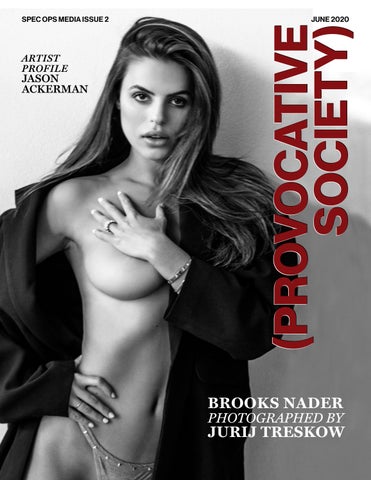
ARTIST PROFILE
JASON ACKERMAN
JUNE 2020
(PROVOCATIVE SOCIETY)
SPEC OPS MEDIA ISSUE 2
BROOKS NADER
PHOTOGRAPHED BY
JURIJ TRESKOW
(PROVOCATIVE SOCIETY) FASHION ART LUXURY LIFESTYLE
PHOTOGRAPHED BY
CORY EPSTEIN
DESTINY SIERRA DELISIO
FASHION
ART
LUXURY
LIFESTYLE
(PROVOCATIVE SOCIETY) BRITTANI BADER
VALENTINA FERRER PHOTOGRAPHED BY EDUARDO VON GARCIA
PHOTOGRAPHED BY
NATALIE WENTWORTH
(THE TEAM) PROVOCATIVE SOCIETY Vol. 1, No. 2 June 2020 Publisher Spec Ops Media Editor Dr. Nicholas Toscano Meredith Jacoby Design Jimmydog Design Group www.jimmydog.com Production Manager Stephanie Belcher 336-201-7475 • sbelcher@triad.rr.com Copy Editor Spec Ops staff Digital Conversion Spec Ops staff Internet Management Spec Ops staff Subscription Information: Annual rates as follows: Non-qualified individual: $99(USD) Institutional: $99(USD). For more information regarding subscriptions, provocativesociety@gmail.com Advertising Policy: All advertisements appearing in the Provocative Society must be approved by the editorial staff which has the right to reject or request changes to submitted advertisements. The publication of an advertisement in Provocative Society does not constitute an endorsement by the publisher. Additionally, the publisher does not guarantee or warrant any claims made by Provocative Society advertisers. For advertising information, please contact: provocativesociety@gmail.com
2
PROVOCATIVE SOCIETY May 2020
Manuscript Submission: For information contact Editor, provocativesociety@gmail.com Copyright © 2020 by Spec Ops Media. All rights reserved under United States and International Copyright Conventions. No part of this magazine may be reproduced or transmitted in any form or by any means, electronic or mechanical, including photocopying or any other information retrieval system, without prior written permission from the publisher. Photo submission guidlines: Please submit your photos for our digital print issues by sending us an email with your story in low resolution. A large edit of 15-20 images is preferred. The photos of the store need to be exclusice for Provocative Society magazine, meaning they have to be unpublished. • SIZE: A minimum of 2400 px in width is required for final images. • FORMAT: .jpg, .tif, .zip, Fropbox or WeTransfer links • RESOLUTION: 300 dpi • COLOR: sRGB-RGb (even if they are black/white). •C REDITS: PLease include (a simple file: .pdf, TextEdit or Word) complete and final credits for staff and everything we should include. You also should include the link to your website/portfolio and IG usernames for photographer and model/s. • IMPORTANT: Location and a short story (a simple file: .pdf, TextEdit or Word) about the shoot. • EMAIL: provocativesociety@gmail.com with the subject line Digital/Print Issues Conflicts of Interest: Authors submitting articles to Provocative Society must declare, in writing, any potential conflicts of interest, monetary or otherwise, that may exist with the article. Failure to submit a conflict of interest declaration will result in suspension of manuscript peer review. Erratum: Please notify Provocative Society of article discrepancies or errors by contacting provocativesociety@gmail.com Provocative Society is published on a monthly basis by Spec Ops Media, New York, NY.
(CONTENTS ) 4 The Top 10 Most Expensive Paintings in the World 12 Brooks Nador by Jurij Treskow 16 Jason Ackerman 22 Brittani Bader by Natalie Wentworth 28 10 Things You Didn’t Know About the Cartier Love Bracelet by Emily Selter 30 D estiny Sierra Delisio by Cory Epstein
12
22
30
40
58
70
36 T he Doorman at the Mudd Club Tells All by Steven Kurutz 40 Ana Tanaka by Natalie Wentworth 44 J emma Baines by Damon Hall Booth 50 The Top 10 Most Expensive Cars in the World 58 A mbra Battilana Gutierrez by Antoine Verglas 64 1 0 Famous Pop Art Artists You Should Know by Bob Lansroth 70 Desite Cordero by Manny Roman
44
May 2020 PROVOCATIVE SOCIETY
3
(ART)
The Top 10 Most Expensive Paintings in the World
Left to right NO. 5, 1948, JACKSON POLLOCK MASTERPIECE, ROY LICHTENSTEIN
H
ave you ever thought about how much is the most expensive painting in the world? There are many paintings with price tag over USD 1 million but there are paintings which are really expensive with a price starting from USD 100 millions for one painting. It is very difficult to really appreciate these masterpieces of world painting – almost all authors of the most expensive paintings ever sold have passed away and won’t be able to create something like this ever. And because of this the price of these paintings simply raise with time. So, we represent to
4
PROVOCATIVE SOCIETY May 2020
your attention the collection of TOP 10 most expensive paintings in the world. The history of art is long and extraordinary, ranging from classic to contemporary. The world knows many of the great masters such as Van Gogh and Picasso. The works of the greats continue to come up for auction every few years and set new records each time. With the demand for private ownership of classic art continuing to go up by leaps and bounds, the greatest paintings continue to reach stratospheric valuations whenever they change hands. Here are the top 10 most expensive paintings in the world.
(ART) Left: NU COUCHE, AMEDEO MODIGLIANI
10. NO. 5, 1948, JACKSON POLLOCK – $140,000,000
A drip picture, the no: 5, 1948 went for USD 140 million when it was sold by David Geffen to David Martinez in the year 2006. An artwork done on an 8 by 5 feet fibreboard, this piece embodies the unique dripping technique used by Pollock, one of the greatest painters in the abstract expressionist style. It is a typical Pollock piece, not very accessible in a mainstream way but seminal to the evolution of modern art. Pollock has been dubbed Jack the Dripper because of his unique painting technique in which after placing the canvas on the floor, he used to apply paint by having it drip from sticks, syringes and hard brushes.
9. MASTERPIECE, ROY LICHTENSTEIN – $165,000,000
Roy Lichtenstein is among the pioneers of the pop art culture that deflated the macho mystique image of American art and produced something that was more realistic and relatable. His best-known work- the Masterpiece (1962) features some classic elements of pop art like BenDay dots and speech balloons set in a comic-strip narrative. The painting was a part of Lichtenstein’s first exhibition at the Ferus Gallery, Los Angeles, featuring other works like the Drowning Girl and the Portrait of Madame Cezanne. Now, some critics have dismissed The Masterpiece as just another glossed-up and glamorous piece, others believe that the painting has some deeper meaning attached to it. And that is
what we are going to look into here. Masterpiece depicts a man (possibly the artist) and a blonde woman, looking at a canvas, the content which is not visible to the viewer. A speech bubble ensuing from her mouth shows that she is praising the “masterpiece” in question, even calling it something that would get “all of New York excited”. This artist-man Brad features in several other works of Lichtenstein (who believes the name is clichéd and heroic enough to be the perfect protagonist of Pop Art). Masterpiece is regarded as a tongue-in-cheek joke that reflects Lichtenstein’s artistic career. The stoic, solemn way Brad agrees to the blonde woman can also be seen as a satirical commentary on the “hot young artist” who’s known more for his looks and less for his work.
May 2020 PROVOCATIVE SOCIETY
5
(ART)
8. NU COUCHE, AMEDEO MODIGLIANI – $170,400,000
Nu Couché, aka the Red Nude or the Reclining Nude, is a 1917 oilon-canvas painting by the Italian Painter Amedeo Modigliani. Often considered to be the painter’s magnum opus, the Nu Couché is a seamless fusion of classical idealism and modern-day sensuality. The picture of the naked woman
6
PROVOCATIVE SOCIETY June 2020
lying on the couch looks erotically realistic yet has a surreal, almost sublime beauty that catches the viewer off-guard. There is nothing crass or vulgar about this “column of tenderness” (the woman as described by Modigliani). Instead, she comes across as a sensual, aroused woman in her prime who is not afraid to give and demand physical pleasure. The painting, though inspired by the Italian Renaissance depictions of Venus and
other female figures, has a modern twist to it. Unlike the depictions of classical artworks, where the nudity is not used as a metaphor or an allegory to establish the purity of the woman. Nu Couché highlights the nakedness of the female; her entire body is featured up-close from above and spans the entire canvas (only her hands and feet are not in the frame). The expanse of creamy skin glowing under the soft light is in stark contrast with the
(ART) crimson couch that further adds to the lady’s allure. The Nu Couché neither glorifies the female body nor belittles it – it simply presents it the way it is – caught up in the throes of passion- provocative, unapologetically bold, and carnal.
7. L ES FEMMES D’ALGER (VERSION O), PICASSO – $179,400,000
In the year 2015, the master’s Les Femmes d’Alger Version O sold for USD 179.4 million to set a then world record for the most expensive painting ever sold at an auction. This painting is the culmination of a series of 15 works on Women of Algiers completed by Picasso, inspired by the 19th century Spanish great Eugene Delacroix. This work perfectly exhibits Picasso’s tendency to produce work that is of vintage style, yet remaining completely fresh in approach and presentation. Equal parts kitsch, postmodern and classic, this piece is considered to be the most important Picasso in the hands of a private owner today. This brilliant canvas boats vibrant colours and had been created by Picasso in 1955 as the final work in series of 15 variations. This series was also conceived as an elegy to Picasso’s friend and rival Matisse who had passed away in 1954. With its play off cubism and bringing together of all of Picasso’s lifelong passions, this is truly a milestone in Picasso’s repertoire. It has been featured in Picasso’s retrospectives the world over.
6. NO:6 (VIOLET, GREEN AND RED), MARK ROTHKO – $186,000,000
Mark Rothko was a Russian born American painter and a pioneer of abstract expressionism. Rothko’s style is characterized by the use of large canvases and horizontal bands of bright colours. Violet Green Red
Opposite page from top left clockwise: LES FEMMES D’ALGER (VERSION O), PICASSO NO:6 (VIOLET, GREEN AND RED), MARK ROTHKO NO. 17A, 1948, JACKSON POLLOCK Above: NAFEA FAA IPOIPO (WHEN WILL YOU MARRY?), PAUL GAUGUIN
June2020 PROVOCATIVE SOCIETY
7
(ART)
is ambiguously named to allow viewers to form their own impressions. Here, Rothko uses a spartan palette with the darkest shades at the top, symbolizing the depression that plagued him. The use of vivid colours in a simple pattern exemplifies Rothko’s signature style of conveying an intimate message without the use of subjects. This piece was bought for USD 186 million by the Russian businessman Dmitry Rybolovlev from the Swiss art dealer Yves
8
PROVOCATIVE SOCIETY June 2020
Bouvier in the year 2014. While the purchase has subsequently got embroiled in legal disputes, this piece still remains one of the expensive pieces of art in the world.
5. NO. 17A, 1948, JACKSON POLLOCK – $200,000,000
Abstract expressionism was a post-WWII art movement that emphasizes on the subconscious and spontaneous creation. Jackson
Pollock’s artwork belonged to this school of painting- his dripping paint technique has its roots in the work of André Masson and Max Ernst etc. This piece of abstract work was created sometime in 1948 and was featured in the 1947 Life magazine article that made the painting a household name. Done on fibreboard canvas using just oil paints, Number 17A looks like a messy mirage of patterns and colors. However, a closer
(ART) Opposite page: THE CARD PLAYERS, PAUL CEZANNE This page: INTERCHANGE, WILLEM DE KOONING
4. NAFEA FAA IPOIPO (WHEN WILL YOU MARRY?), PAUL GAUGUIN – $210,000,000
look highlights several layers to the painting that were lost on the viewer at a glance. The name Number 17A is pretty formal and lacks creativity or uniqueness. Pollock intentionally deviates from naming his artwork as something fancy- this only shuns light on the radically unique nature of the painting. The random patterns don’t appear so vague once you observe it up-close. In fact, Pollock’s precise movement and artistic control can be tracked in the way the oil-dripping painting is structured. The title of the painting
Number 17A is in stark contrast with its content. While the name is bland, the patterns depicted in the painting are anything but ordinary. Critics had very mixed reactions to the painting; it was met with great public scrutiny and hence not valued much in the art world. It was only much later in 2016 when the piece was purchased by billionaire art collector Kenneth C. Griffin for approx. $200 million that Number 17A was revived as the fourth most expensive painting ever sold in history.
Paul Gaugin’s 1892 painting is currently the most expensive painting in the world. His painting of two Tahitian girls smashed the world record in February 2015 when it was bought by the Qatar museums from a private Swiss collector Rudolf Staechelin for an astounding USD 300 million! It depicts two women against a natural landscape, one in a native dress and another in a colonial style missionary dress symbolising the fusion of Polynesian and European cultures. This painting was completed by Gauguin at around 43 when he had gone to Tahiti to escape all that was conventional and artificial in Europe. This painting had been on loan with the Basel Art Museum for over 60 years before being withdrawn from display by the seller and sold. Seemingly unimpressive, this artwork illustrates the authenticity of a rooted culture in a bygone era.
3. THE CARD PLAYERS, PAUL CEZANNE – $250,000,000
This painting held the record for the most expensive one in the world June 2020 PROVOCATIVE SOCIETY
9
(ART) before the sale of When Will You Marry in 2015. The Card Players had been bought by the Qatari royal family from the Greek shipping magnate George Embiricos for a whopping USD 274 million in the year 2011. This painting is one of those classic images that you surely would not fail to recognize. It is an image that has been seen in coffee table books, luxury good magazines and art history curricula for many years now. It makes up one of 5 pieces painted by Cezanne as part of his post impressionist series completed between the early and the mid 1890s. This iconic image features two stony faced men sitting at a small wooden table playing cards. The painting style and the use of pastels is classic Cezanne with the subtle expressions on the faces beautifully conveying two players completely immersed in the game. A bottle of wine placed on the table adds to the impressive, yet subtle detailing. It may interest you to know that the two models used for the painting were Cezanne’s gardener and farmhand at his family estate! Read more at: https://www. beautifullife.info/art-works/top-10expensive-paintings-world/
2. INTERCHANGE, WILLEM DE KOONING – $300,000,000
Interchange or Interchanged is an oil-canvas painting by the Dutch-American painter William de Kooning who belonged to the school of abstract expressionism. The painting was the first of Kooning’s abstract landscapes that were completed in 1955 and was influenced by Franz Kline’s artistic style. Kooning
10
PROVOCATIVE SOCIETY June 2020
spends the better part of his career studying and reworking the abstract female figures. It was only later that he deviated from painting human forms and ventured into replicating abstract images of his surroundings in downtown New York. The interchange was created at a time when both the private sphere of the artist and the art community at large was undergoing a gradual but massive change. De Kooning was financially stable and had the opportunity to make new choices – both professionally and personally. He thus moves away from his spontaneous wild paintings to a more stable, sober and tamed landscape pieces. Like any abstract work of art, even Interchange appears to be vague and nonsensical at a glance. A closer observation reveals several layers to the painting. It symbolizes the transition that Kooning’s life was undergoing at that time. It took over 11 years for the change to completely manifest itself creatively; the Interchange was just the first of the many landscape portraits that followed. The Kooning who was known for violently attacking his canvases and vibrant colors was tamed to a gentler yet intuitive style. This aesthetic and textural shift that Kooning underwent in the mid-1950s also forms the foundation of surrealism that would later take the 21st century by storm.
1. SALVATOR MUNDI, ATTRIBUTED TO LEONARDO DA VINCI – $450,300,000
Salvator Mundi or Saviour of the World was supposedly painted by Leonardo da Vinci (many critics
believe otherwise). The painting presents Jesus Christ dressed in Renaissance garbs and bestowing benediction, his right hand raised with two fingers crossed while holding a crystal ball in his left hand. The glass globe in his hand symbolizes crystalline spheres of the heavens – Christ is shown to be the savior of the world and the master of the cosmos. Leonardo was a Roman Catholic but still deviates from the traditional images of the brass/golden globes with a crucifix to the crystal sphere. Some claim that it was a conscious attempt on his part to tie the physical and spiritual worlds together. Art enthusiasts claim that there are 20 different variants of the artwork, the original painting being lost. One such copy was recently restored and rediscovered to be the original work of da Vinci by many leading scholars. The argument that they present it that the golden hair ringlets, the knot-work crossing store, and the two fingers raised to bless mankind are all classic da Vinci and not found in the other copies of Salvator Mundi. Salvator Mundi has a rags-to-riches story that’s quite fascinating. The present owners of the painting acquired the piece is a very bad shape – the wooden panel was split into two and the canvas was reportedly repainted to hide the botched repair work! However, all said and done, Salvatore Mundi is notably the last of Leonardo’s works and hence very highly valued in the art community. PS
Reprinted with permission from beautiful life online magazine
(ART) Left: SALVATOR MUNDI, ATTRIBUTED TO LEONARDO DA VINCI
June 2020 PROVOCATIVE SOCIETY
11
(FASHION)
BROOKS NADER Women 360 NYC, Lions LA, Elite Miami Instagram @brooksnader
T
his wonderful model spent her youth in Baton Rouge, Lousiana. She is the little girl of Breaux and Holland Nader and has three sisters. In addition, this magnificence is the granddaughter of Louisiana State University Assistant Athletics Director Dr. Sam Nader. Sam has been associated with LSU’s football crew for around 44 years. During his residency, LSU had two national titles, 30 district titles, and six SEC titles. Since her youth, Nader she was an incredible athlete in sports and portrays herself as a Tomboy. Some time ago putting on cosmetics was comical for her and loved taking hip hop and boxing classes in NYC. She is a 2015 alumni from Episcopal High School. During her school times, she used to volunteer as a mentor, helping downtown understudies going to Baton Rouge’s THRIVE program and was accounting major at Tulane University. This highly successful model was discovered on Instagram and exploded in NYC getting signed by agencies such as Women 360 NY, Lions LA, and Elite Miami. Her Modeling career reached star status when she was selected by supermodel Christie Brinkley to highlight in Swimsuit Issue. Brooks Nader won the Sports Illustrated Swimsuit 2019 Model Search and has been chosen as the magazine’s “First Rookie of 2020”. PS
12
PROVOCATIVE SOCIETY June 2020
Photographed by Jurij Treskow Instagram @jurij.treskow Jirij is one of the top fashion photographer known world wide. He was Born in Belarus. At the age of 17 Jurij moved to Germany. In 2008 started doing photography in Berlin. In 2009 he settled in Paris to become a professional photographer. Treskow’s work is characterized by an intuitive sense of sexuality and attention to detail. In his mostly Black & White pictures, his favorite subject is a woman, a femme fatale – strong, confident and reckless. Jurij lives and works between New York City, Los Angeles, Berlin, Paris and Moscow.
(FASHION)
13
PROVOCATIVE SOCIETY June 2020
(ART)
JASON ACKERMAN
J
Jason Ackerman General Manager Tattooer SOHO INK 285 Lafayette St New York, NY 10012 (646) 370-3000 soho.ink instagram: @soho.ink
16
PROVOCATIVE SOCIETY June 2020
ason Ackerman primarily grew up between New Jersey and Texas. Throughout life he was always creative in one-way or another from music to writing to drawing and painting. Through addiction, he ended up in Florida where art took over his life through his mentor Dave “The Bastard” Archer. After a series of admittedly self-induced struggles in his life (including drug abuse, jail, and homelessness) art led him on a path of recovery introducing a positive outlet for internal and external reflection. Jason’s series where he discovered his style had themes that combined controversy and idols bringing them down from their pedestals by their most human of elements. The recurring use of tentacles symbolized the subject’s struggle with demons while mirroring his own. Jason’s art has progressed into a more relaxed style. Doing mash ups of celebrity caricatures with superhero bodies. Putting a lot of witty thought into which character is used with each person. This new style has gained him a Celebrity clientele that is truly a who’s who in the Hip Hop world. With the likes of Post Malone, Ty Dolla Sign, Tyla Yaweh, Lil Yatchy, Busta Rhymes, Nicky Jams, Tommy Lee, Jonah Hill, Tommy Vext, and the one and only Floyd Mayweather. Jason still remains humble and hard working even with his new found success. For better or worse, he provokes strong emotion within every viewer on a variety of topics in his unique signature “wet” style. He continually creates art that invites the viewer to think. PS
Theejasonackerman.com Instagram @jasonackermanart
June 2020
PROVOCATIVE SOCIETY
43
(ART)
18
PROVOCATIVE SOCIETY June 2020
(ART)
June 2020 PROVOCATIVE SOCIETY
19
(ART)
20
PROVOCATIVE SOCIETY June 2020
June 2020 PROVOCATIVE SOCIETY
21
(FASHION)
BRITTANI BADER Select Chicago Next Miami Instagram @brittanibader
Photographed by Natalie Wentworth Instagram @natalie_wentworth nataliewentworth.com Natalie Wentworth is a Los Angeles based photographer, specializing in fashion, portraiture, swim, lingerie, and lifestyle. Originally from San Diego, California, Natalie has been pursuing photography for about 6 years and started growing her portfolio once she moved to LA and began working with various modeling agencies and brands. Her work is mostly shot digitally, however has also recently begun to tap into film photography as well. She aspires to capture genuine beauty in her subjects, and is inspired by natural light, textures, and colors.
June 2020 PROVOCATIVE SOCIETY
23
(FASHION)
24
PROVOCATIVE SOCIETY June 2020
(FASHION)
26
PROVOCATIVE SOCIETY June 2020
(FASHION)
(LUXURY)
10 Things You Didn’t Know About the Cartier Love Bracelet
Legend has it that certain hospitals keep Love bracelet screwdrivers on hand, just in case.
This page above: The iconic Cartier Love Bracelet Opposite page from top to bottom: Yellow Gold Cartier Love Bracelet with Four Diamonds, $10,100 Small White Gold Cartier Love Bracelet, $4,350
BY EMILY SELTER
C
artier’s Love bracelet is one of the most iconic pieces of jewelry ever designed—and also one of the most popular: last year, it was the most Googled piece of jewelry in the world. While the bracelet has had a renaissance of late, thanks to fans like Kylie Jenner and Kanye West, the jewel has also had a long and surprising history. Here are 10 fascinating facts about the iconic piece.
1
The Love bracelet wasn’t designed at Cartier’s headquarters in Paris, but at the brand’s New York workshops in 1969.
2
The bracelet was designed in the shape of an oval in order to fit as closely as possible to a loved one’s wrist, and it was intended to be
28
PROVOCATIVE SOCIETY June 2020
worn by both men and women. They were referred to as ‘modern love handcuffs’ for the way in which they are secured using a screwdriver.
3
It was the first piece that the designer Aldo Cipullo created for Cartier. He went on to design the brand’s iconic Juste un Clou “nail” bracelets.
4
Cipullo’s design is often credited with revolutionizing the manner of wearing jewelry. During the era in which the Love bracelet was created, jewelry was often chosen specifically to match an outfit, but the Love bracelet wasn’t meant to coordinate with an outfit or to suit an occasion—it was worn day or night.
5
It is rumored that Cartier once had a policy prohibiting customers from buying Love bracelets for themselves—they could only be purchased by a couple.
(LUXURY)
6
The bracelets were originally made of silver and plated in gold, but the company soon started producing solid gold versions. The diamond-studded Love bracelet was first introduced in 1979.
7
The distinctive round screws that decorate the Love bracelet were inspired by the screws that are featured on the bezel of Cartier’s Santos watch.
8
When the bracelet was first launched, Cartier gave pairs of them to some of the most famous couples of the 20th century including the Duke and Duchess of Windsor, Elizabeth Taylor and Richard Burton, Ali MacGraw and Steve McQueen, and Sophia Loren and Carlo Ponti.
9
Love bracelets didn’t originally have serial numbers, but due to the large number of counterfeits that were created, the company began engraving each bracelet with a unique number that is kept on file.
10
Legend has it that some hospitals in New York City keep Love bracelet screwdrivers on hand in case they need to remove the pieces from patients in an emergency. PS
Reprinted with permission from townandcountrymag.com
June 2020
PROVOCATIVE SOCIETY
29
(FASHION)
DESTINY SIERRA DELISIO NewMark Models LA, instgram @destinydelisio Photographed by Cory Epstein instgram @epsteinla
June 2020 PROVOCATIVE SOCIETY
31
(FASHION)
32
PROVOCATIVE SOCIETY June 2020
Want to be a part of
(PROVOCATIVE SOCIETY) We want you!
Please submit your photos for our digital print issues by sending us an email with your story in low resolution. A large edit of 15-20 images is preferred. The photos of the store need to be exclusice for Provocative Society magazine, meaning they have to be unpublished.
• SIZE: A minimum of 2400 px in width is required for final images.
• FORMAT: .jpg, .tif, .zip, Fropbox or WeTransfer links • RESOLUTION: 300 dpi • COLOR: sRGB-RGb (even if they are black/white). • CREDITS: PLease include (a simple file: .pdf, TextEdit
or Word) complete and final credits for staff and everything we should include. You also should include the link to your website/portfolio and IG usernames for photographer and model/s.
• IMPORTANT: Location and a short story
(a simple file: .pdf, TextEdit or Word) about the shoot.
• E MAIL: provocativesociety@gmail.com with the subject line Digital/Print Issues
(LIFESTYLE)
Photo by Allan Tannenbaum
The Doorman at the Mudd Club Tells All
BY STEVEN KURUTZ
I
n the world of Manhattan night life, the doorman occupies the role of St. Peter. Heaven awaits inside, but to join the party you must first pass through the figure standing in judgment. To be rejected by the doorman is to momentarily feel as if your whole life has been lived in error. You have been judged unworthy. How almost heartening, then, to read Richard Boch’s new memoir, “The Mudd Club” (Feral House), and hear the author confess to feeling insecure and to wanting to join the cool crowd when he worked the door at the seminal punk rock club. Mr. Boch moved from his native
36
PROVOCATIVE SOCIETY June 2020
Long Island to New York City in 1976 to be an artist. He rented an apartment in Greenwich Village, and registered for graduate studies at New York University, but never attended. Instead, he did drugs, worked on his art and ran around with fellow artists and musicians downtown. In the fall of 1978, he made his way to the newly opened Mudd Club for the first time. Four months later, the owner, Steve Mass, hired him as a doorman there — a job that lasted 21 months but that seems to have resonated for a lifetime. He is known to many even today as “Richard from the Mudd Club.” “Everything about the Mudd
Above Richard Boch outside of the Mudd Club in 1979, in a photograph featured in his memoir, “The Mudd Club.”Credit...Allan Tannenbaum
Photo by Nathan Bajar for The New York Times
(LIFESTYLE)
Club washed off on me, it never really went away,” Mr. Boch said last month, in a booth at the Roxy Hotel in TriBeCa, not far from his old job site. Located at 77 White Street, in a six-story loft building owned by the artist Ross Bleckner, the Mudd Club was a dingy gray-and-black box inside, with a bar initially made out of folding tables and a bathtub behind them to chill the beer. The club’s self-mythologizing denizens were a mix of the famous (Debbie Harry, the Talking Heads), the soon-to-be famous (Jean-Michel Basquiat, Jeff
Photo by Bob Gruen
From top clockwise: The cover of Mr. Boch’s memoir. Mr. Boch in front of an apartment building that was once home to the Mudd Club. A crowd outside of the Mudd Club in 1979.
June 2020 PROVOCATIVE SOCIETY
37
Photo by Bobby Grossman
(LIFESTYLE)
Above: David Bowie, left, and Dee Dee Ramone at the Mudd Club in 1979.
38
Koons, Debi Mazar) and the famous-below-14th Street (Glenn O’Brien, Chi Chi Valenti). As Mr. Boch describes in short, vivid, diarylike entries, the clubgoers danced, drank, snorted coke, watched live rock bands and held theme parties like the Puberty Ball in an anything-goes environment that seems impossible to recreate today. Amos Poe, a filmmaker and a regular from the beginning, said of the place: “It was a dysfunctional circus that functioned. When Ronnie Cutrone said, ‘I want to put a cage in there and put women in the cage,’ there wasn’t a question about insurance problems. Steve would say, ‘Yeah, that’s great.’” Mr. Boch took his job as the gatekeeper to the show seriously. He described his process for assessing the crowd bunched out front on
PROVOCATIVE SOCIETY June 2020
a Saturday night: “If you started saying, ‘How long do we have to wait?’ that was a strike against you. If you said, ‘Is there a line?’ that was a strike against you. If you said to me, God forbid, ‘Studio 54 lets us in,’ that was the kiss of death.” In his book, Mr. Boch recounts how Mr. Mass told him to not let in limousine-riding hotshots like Mick Jagger and David Bowie. Rejecting the world’s most famous rock stars was a task the 25-year-old doorman was unable to do, he said, giving both men wide berth when they showed up. In atonement, he recalled how one night he turned away Meat Loaf. Mr. Boch elevated the doorman role to a performance. He exuded a “nervous energy of authority” and deployed “acid humor,” Mr. Poe said, to critique the crowd and play social
Photo by Kate Simon
(LIFESTYLE)
experiments. Mr. Poe recalled watching one night as Mr. Boch told a pretty young woman she could come in, but her Wall Street-looking boyfriend had to stay outside: a merciless test of her loyalties. In 1980, two and a half years before it closed, Mr. Boch quit the Mudd Club, partly out of self-preservation. “I was using a lot of drugs,” he said. “My next job was the Peppermint Lounge, where I lasted six months. I was fired. I was out of control.” He cleaned up and went on to work as a manager for various restaurants and clubs in the city. In 2004, he sold his loft in TriBeCa for a bundle and relocated upstate (he keeps an apartment on the Upper West Side). Unlike some of his friends, Mr. Boch didn’t emerge from the scene a famous artist.
His career got sidetracked after he became Richard from the Mudd Club. But Mr. Boch’s tenure as doorman may have been a creative endeavor itself. “Richard’s job was to collect stories,” Mr. Poe said. “He was a sponge soaking in that stuff, but eventually, you’re going to have to squeeze that sponge out.” Mr. Boch agreed. “When people would talk to me back then, I would always say, ‘Identify me as an artist first, who works the door of the Mudd Club.’ Because just being the Mudd Club doorman, I bristled at that,” he said. “Now I’ve written this book. Everything I’m doing, I’m identifying myself as ‘Mudd Club doorman.’ In retrospect, I’m incredibly proud of having that job.” PS
Above: From left, Andy Warhol, Allen Ginsberg and Victor Bockris at the Mudd Club in 1980.
Reprinted with permission fromnytimes.com June 2020 PROVOCATIVE SOCIETY
39
(FASHION)
ANA TANAKA
Photographed by Natalie Wentworth instagram@natalie_wentworth nataliewentworth.com
One.1 Models NYC, Nemesis Model London Founder of @WEKOKO and @eightcr8te Instagram @anatanaka 40
PROVOCATIVE SOCIETY June 2020
Natalie Wentworth is a Los Angeles based photographer, specializing in fashion, portraiture, swim, lingerie, and lifestyle. Originally from San Diego, California, Natalie has been pursuing photography for about 6 years and started growing her portfolio once she moved to LA and began working with various modeling agencies and brands. Her work is mostly shot digitally, however has also recently begun to tap into film photography as well. She aspires to capture genuine beauty in her subjects, and is inspired by natural light, textures, and colors.
(FASHION)
42
PROVOCATIVE SOCIETY June 2020
(FASHION)
JEMMA BAINES
Quarantine FaceTime shoot photographed by Damon Hall Booth New Icon NYC Two Managment LA Instagram @jemjellies Photographed by Damon Hall Booth Instagram @damon_hall_booths
W
ith the advent of Covid 19 and social distancing, photographers and models have had to get creative in doing shoots for companies such as Instagram. Here is one amazing shoot of model Jemma Baines shot by New York City Fashion Photographer Damon Hall Booth.
44
PROVOCATIVE SOCIETY June 2020
(PROVOCATIVE SOCIETY) FASHION ART LUXURY LIFESTYLE
JEMMA BAINES
PHOTOGRAPHED BY
DAMON HALL BOOTH
(FASHION)
June 2020 PROVOCATIVE SOCIETY
47
(FASHION)
48
PROVOCATIVE SOCIETY June 2020
(FASHION)
June 2020 PROVOCATIVE SOCIETY
49
(LUXURY)
The Top 10 Most Expensive Cars in the World
Above: The Ferrari Pininfarina Sergio – this luxury supercar was sold only to the clients chosen by Ferrari company.
50
M
ost expensive cars in the world – what are they and how much do they cost? We’ve gathered a collection from 10 most expensive autos all over the world – from Bugatti Chiron with price tag $2,7 million to Bugatti La Voiture Noire for $19 million. Some of them are impossible to buy even you have required amount of money. In the way it was happened with Ferrari Pininfarina Sergio – this luxury supercar was sold only to the clients chosen by Ferrari company. A car is not just a mode of conveyance, but also a piece of art cherished, often decades after its production. Big names
PROVOCATIVE SOCIETY May 2020
like Lamborghini, Aston Martin and of course, Rolls Royce often come at very high prices and are only meant for rich collectors as many of them are often sold out before they reach the public. While most of the cars listed here are wildly out of the reach for most, it is a sheer pleasure just to look at them. However, it is often difficult to prepare such a list because the manufacturers often keep the price under the wraps and preserve them for potential customers only. And it so happens that when they end up in auctions, their prices are set way above the original. So here you go with the most expensive luxury cars of 2020 existing at present. Have fun reading!
(LUXURY)
Above: PAGANI HUAYRA BC Right: FERRARI PININFARINA SERGIO
What is the most expensive car in the world? As in the case of the most expensive watches, one of the most important factors affecting the price of a car is the brand. Supercars from Bugati, Pagani, Ferrari, McLaren – always cost lot of money, even if we’re talking about standard models. But the most expensive cars are always have limited series. As a rule, auto brands make very limited (sometimes up to 10 cars) series of a cars with exclusive options – and these cars are the champions in price. 10. PAGANI HUAYRA BC – $2.8 MILLION Coming after the Pagani Huayra, the Pagani Huayra BC is the priciest Pagani car ever made. Named as a tribute to Benny Caiola, a noted Italian investor with probably the best
collection of Ferraris and a very close friend of Horacio Pagani, this car is a delight for the lovers of Pagani’s details. Debuting at the 2016 Geneva Motor Show, this car has a wider rear track, new side tracks, and many cool aero features. Like the earlier version, the 6.0 liter V-12 bi-turbo engine of the BC is sourced from AMG, and produces 790 horsepower and 811 lb-ft torque. This power is run to the rear wheels through the tripod drive shafts leveraging a 7-speed Xtrac transmission. And the most amazing bit is that the BC takes over the Huayra by changing the model’s standard 150 milliseconds to 75 milliseconds. At 2,685 pounds (1,218 kilograms), the BC also happens to be a lot lighter than the Huayra due to the extensive use of carbon fibres and other lightweight materials.
9. FERRARI PININFARINA SERGIO – $3 MILLION Originally introduced as a concept car in 2013 in memory of a deceased son of the founder of Pininfarina, the legendary Italian design house, only six of these cars have been made as of yet, thus becoming one of the most coveted cars. This is one of the costliest Ferraris ever made and is based on the Ferrari 458 Spider. Each of the handmade units has an all-carbon-fibre frame, and is an open air luxury car with two seats. Like the Ferrari 458, it has no roof, side windows and windshield, and is 330 pounds lighter than its ancestor. This makes it smarter and quicker, though it has the same naturally-aspirated 4.5 liter F136F V-8 engine, which sends 562 hp to the rear wheels. The renovated inteMay 2020 PROVOCATIVE SOCIETY
51
(LUXURY)
Above top to bottom: ASTON MARTIN VALKYRIE LIMITED EDITION BUGATTI VEYRON BY MASORY VIVERE
52
PROVOCATIVE SOCIETY June 2020
rior also comes with a host of interesting details like aerodynamic headrests built directly into the roll cage. The coolest fact about this car though is that the owners of each of the six models were chosen by the manufacturers themselves, making this one of the rarest of the rare invite-only vehicles.
8. ASTON MARTIN VALKYRIE – $3.2 MILLION While there has been no price announced for this car as of yet, expert estimates place it at around 3.2 million dollars. Built under Andy Palmer, the new president of Aston Martin committed to solvency and relevance with awesome cars, this model is a renovation of the old Aston Martin-Red Bull AM-RB 001. Legend has it that Palmer agreed to this car over a drink with Red Racing’s Adrian Newey and Christian Horner. Newey, renowned aerodynamicist behind Red Bull’s expensive and award-winning sports cars in the Formula 1 tracks, devised an aerodynamic scheme specifically for this car that pushes air via the chassis, resulting in downforce without using the wings. The 6.5 liter, naturally- aspirated V-12 designed specifically for the Cosworth, has a 1:1 power /weight ratio, and comes with a Rimac-built hybrid battery system coming with the engine which yields about a 1,000 horsepower. As of yet, 150 units of this model has been planned by the company, and the deliveries are expected to start 2019 onward. In addition, 25 track-only editions have been planned whose prices can only be spec-
(LUXURY) ulated at present. Read more at: https://www.beautifullife. info/automotive-design/top10-most-expensive-cars-inthe-world/ 7. L IMITED EDITION BUGATTI VEYRON BY MASORY VIVERE – $3.4 MILLION Upgraded four times since its releasze in 2005, the Mansory Vivere edition of the Bugatti Veyron is not only among the priciest cars of the world, but also one of the fastest. Modelled on the Grand Sport Vitesse Roadster, this German car has an awesome lacquered carbon-fibre body along with a new spoiler package providing new diffusers, a smarter cabin and front grill, larger side scoops, a shortened hood, and the like. The upgraded LED lights are everywhere – the headlight and taillight clusters, the cockpit. And for the aesthetically conscious, maps of history making events like the Targa Florio race and the like are laser etched into both the upholstered, carbon fiber interior, and the exterior. The 8.0 liter W16 engine of the car can produce 1,200 horsepower and 1,106 pound-feet of torque. The original version could reach up to 253 mph and was named the Car of the Decade 2000-2009.
6. L YKAN HYPERSPORT – $3.4 MILLION The headlights being made of, urm, 240 15-carat diamonds, is the price very surprising? And then there are the LED blades made of 420 15-carat diamonds. And all the gems are customizable. Looking like an armored car with scissor doors and an interior
Above top to bottom: LYKAN HYPERSPORT MCLAREN P1 LM
June2020 PROVOCATIVE SOCIETY
53
(LUXURY) straight out of a sci-fi movie, this featured in the ‘Furious 7′, and has actually been drafted by the Abu Dhabi police for patrol duty! Built by W Motors, based in Lebanon, this is the first Arab supercar. And it doesn’t fare badly when compared with the traditional European biggies. Apart from its awesome looks, the twin-turbo mid-rear mounted 3.8 liter flat-six boxer can produce 780 horsepower through the rear wheels, and a 708 pound-feet of torque. It can do a 62 in a mere 2.8 seconds, and can reach speeds up to 240 mph. 5. MCLAREN P1 LM – $3.6 MILLION Not a production car, this is more or less a street-legal version of the track-only McLaren P1 GTR. Converted by the British firm Lanzante, who bought the original P1 built by McLaren, it was made keeping in mind a select group of buyers in the U. S., Japan, U. K., and the UAE. This car has a lot in common with the P1 GTR and the legendary McLaren F1 road car. For example, the gold plating surrounding the engine bay with a 3.8 liter twin-turbo V-8. It is much smarter than the P1 GTR. Not only does it weigh 132 pounds (60 kg0 less than the P1 GTR, 54
PROVOCATIVE SOCIETY June 2020
but its modified rear wing and enlarged front splitter join with the dive planes to generate 40% increased downforce as compared to the P1 GTR. The awesomeness of the aerodynamics can be witnessed where it is made for- on track, where it can produce 1000 horsepower. As of yet, only five units have been built, all of them being sold.
Above top to bottom: LAMBORGHINI VENENO ROADSTER KOENIGSEGG CCXR TREVITA Opposite page: SWEPTAIL BY ROLLS ROYCE
(LUXURY)
4. LAMBORGHINI VENENO ROADSTER – $4.5 MILLION Built to celebrate the company’s 50th birthday, ‘Veneno’ literally means poison in Spanish, and well, the design does look deadly. Looking almost like an alien space capsule, this car can reach speeds that can give one of those a run for their money, literally. The 6.5 liter V12 with a seven-speed single clutch ISR automated manual transmission can spin at 8,400 rpm to yield 740 horsepowers and 507 pound-feet of torque, meaning that the car can do a 60 mph at 2.9 seconds! The monoque is heavily inspired by the LP700-4 Aventador, and is made of carbon fiber. The sprung portion is placed on the top of a pushrod-actuated suspension, and its total
dryweight of this carbon-fiber vehicle is a mere 3,285 pounds, although it is driven by a full all-wheel-drive system. Only 9 units being made, the biggets problem of these cars is their crazy resells ratesone was sold at $11 millions! It was the most expensive car in the world ever produced upon its introduction, and only three being available to customers in the first lot, there was a crazy scramble to get hands on the remaining ones. 3. KOENIGSEGG CCXR TREVITA – $4.8 MILLION The most expensive street-legal production car in the world, this is coated with real diamonds. Yes, you read that right. ‘Trevita’ is an abbreviation translating into ‘three whites’. The carbon fibers are indeed coated with a diamond
dust-impreganted resin, called the Koenigsegg Proprietary Diamond Weave. This technology transformed the fibres from the traditional black to shining, silvery white, making the bodywork of this car renowned throughout for its unique design and perfection. And that’s not all. Beneath the coating is a 4.8 liter, dual-supercharged V8 having a total output of 1,004 horsepower and 797 pound-feet of torque. This makes it well-equipped at overtaking semis in the freeway. This car comes with a one-of-its-kind dual carbon rear wing, iconell exhaust system, airbags, ABS powered carbon ceramic brakes, paddle-shift, infotainment system, chronometer instrument cluster, tires monitoring systems along with a hydraulic system. Only three cars of this model had been initially decided upon, before getting reduced to two, because the carbon fibre made it too difficult and time-consuming for regular manufacture. 2. S WEPTAIL BY ROLLS ROYCE – $13 MILLION Before you gasp at the price, do note that this car is off the markets. That’s because it was made on the recommendations of one specific customer June 2020 PROVOCATIVE SOCIETY
55
(LUXURY)
BUGATTI LA VOITURE NOIRE
whose name the company has refused to divulge. A company famous for its luxurious rollouts, there were only 4,000 Rolls Royce cars manufactured in 2016! This particular exclusive car comes with its custom coach work, reminiscent of the royal carriages of yore. Probably modeled on the Wraith, this car can seat only two people (see what they mean by being exclusive?). The sunroof is fully panoramic, tapering down sharply like those of the racing yachts, as per the orders of the customer. Something very cool about the interior handcrafted with wood and leather are the hidden attaché cases for holding 56
PROVOCATIVE SOCIETY June 2020
laptops behind each door. Not much else is available on this most expensive car in the world, except that it is based on the 1920s and 30s models, and looks like a yacht from the back. The owner does happen to be a collector of super-yachts and private planes. 1. BUGATTI LA VOITURE NOIRE – $19 MILLION Bugatti has unveiled the “La Voiture Noire” translated as “the black car” made entirely from carbon fiber. The first one of the Limited Edition car has been sold for $19 million to Ferdinand Piech, the owner of VW group. Designed by Salome Etienne, it is inspired
by its predecessors Veyron and Chiron and the pre-war Type 57SC Atlantic. Powered by an 8 liter, 16 cylinder engine that churns out a jaw-dropping 1,500 HP the car should be able to reach above 450 km/h. Bugatti has refused to reveal its performance specifications. The front is dominated by the trademark horseshoe-shaped Bugatti grill and blends into an aerodynamically sweptback design with sloping windscreen and wrap-around tail lamps. PS Reprinted with permission from beautiful life online magazine
Want to be a part of
(PROVOCATIVE SOCIETY) We want you!
Please submit your photos for our digital print issues by sending us an email with your story in low resolution. A large edit of 15-20 images is preferred. The photos of the store need to be exclusice for Provocative Society magazine, meaning they have to be unpublished.
• SIZE: A minimum of 2400 px in width is required for final images.
• FORMAT: .jpg, .tif, .zip, Fropbox or WeTransfer links • RESOLUTION: 300 dpi • COLOR: sRGB-RGb (even if they are black/white). • CREDITS: PLease include (a simple file: .pdf, TextEdit
or Word) complete and final credits for staff and everything we should include. You also should include the link to your website/portfolio and IG usernames for photographer and model/s.
• IMPORTANT: Location and a short story
(a simple file: .pdf, TextEdit or Word) about the shoot.
• E MAIL: provocativesociety@gmail.com with the subject line Digital/Print Issues
(FASHION)
AMBRA BATTILANA GUTIERREZ
M
y name is Ambra Battilana Gutierrez and I am a proud woman and model. I believe that every woman should feel free to show who she is, no matter how she feels. For me, every woman radiates sensuality, but when women show their sensuality openly in today’s world, it causes a big stir. When I first started modeling, I imagined a perfect environment where everything was all about looking beautiful, wearing amazing clothes from the world’s best designers, attending all of these amazing events and living in the present. Modeling certainly has these fun moments, but with time, I understood that modeling was more about expressing who I was, and that took a lot of hard work. The more time passed, the more I realized how important it was for me to learn how to be my true self and that, to be a good model, I had to feel and believe in everything
Photographed by Antoine Verglas Instagram @antoineverglas Photographer Antoine Verglas was born in Paris. He began his career on the other side of the camera, working as the host on a popular French television show after graduating from France’s prestigious E.S.C. school of Business. Verglas then had the idea that would be his entree to the fast paced world of fashion photography. It was then, in 1990 when Verglas moved to New York with his camera and his vision. Pluck and persistence paid off, with a documentary style photo series for French Elle which featured some of the top names in modeling. Shooting Stephanie Seymore, Linda Evangelista, Naomi, Claudia Shiffer and Cindy Crawford at home in very personal portraits just as they were reaching celebrity status was his big break, and indicative of the style which has become the Verglas signature. This intimate style of capturing the person behind the camera has led to the rapid pace of work Verglas now has shooting for the world’s top fashion magazines. His photographs have appeared in Elle, Esquire, GQ, Maxim, Sports Illustrated and Vogue.
58
PROVOCATIVE SOCIETY June 2020
I was representing. I had to interpret what I was wearing and find something inside myself that connected with what I had to wear and showcase. I found that my way of expression was sensuality and that I loved putting myself out there as a form of art. I feel Antoine Verglas’ photographs reveal an honest glimpse of my true self. I wish everyone could just let their sensuality be free instead of feeling like they’re violating some taboo—but sadly that is not the case today. For centuries, women have suffered social restrictions on their image. Women and women’s bodies have been demonized, and women’s movements around the world have faced slow progress in changing women’s roles and representations in different societies. Today, a woman who expresses her sensuality is still so often misunderstood. We tell her that if she poses naked or in lingerie, she is putting herself ‘out there’. If she wears a mini skirt or a revealing dress, she is inviting others to touch her rather than speaking her truth. Our tendency is to associate sexual expression with being an “easy target”, though if you actually think about it for a second, a woman who knows how to handle her body is even more able to say when she does or doesn’t like something and will avoid miscommunicating in situations with a sexual partner. We forget that nakedness is the focus of the most famous paintings and sculptures made by the biggest names in art. Do we sexualize the Venus from Botticelli or the David from Donatello? Do we cover our faces out of shock at seeing Adam standing naked in the Sistine chapel? No, we do not. We look at them in awe and recognize that it is merely a part of who these people are.
Model: One Management Instagram@ambrabgutierrez
(FASHION)
And yet, if a woman embraces her body, if she enjoys her body, or if she respectfully ‘shows’ her body--all because these things make her feel good—she is still seen as acting in the wrong. I believe every human being should feel free to talk about sex and feel free to express their own sensuality without fear of being considered “transgressive.” Just like our sexuality and sexual orientation, our sensuality is a natural and healthy component of who we are. Everybody has to be free to live their natural selves while respecting others. It is about living and exercising our freedom. I want to break down the barriers that old conservative societies have imposed on us. I am adamant about embracing our bodies to get in touch with our inner selves. I believe that only in the moment when we can embrace ourselves on our own and in our entirety, then and only then can we achieve greatness. PS
June 2020 PROVOCATIVE SOCIETY
61
(FASHION)
62
PROVOCATIVE SOCIETY May 2020
(FASHION)
(ART)
10 Famous Pop Art Artists You Should Know BY BOB LANSROTH
H The art movement aimed to elevate popular culture to the level of fine art, thus blurring the lines between high and low arts.
64
ow would you define what Pop Art is, and what does it represent for you? The international phenomenon that was Pop Art emerged in the mid-1950s and early 1960s. Some six decades later, the influence and mark of pop art artists can be seen in almost every aspect of our modern society. Considered by some as a direct descendant of Dadaism, regarding the way it mocked the established art world by appropriating images from the street, supermarket, mass media and presented it as art in itself, Pop Art focused on mass production, celebrity and the expanding industries of advertising, TV, radio and print media. Ultimately, it shaped a completely new cultural identity in the field of art and design. The art movement aimed to elevate popular culture to the level of fine art, thus blurring the lines between high and low arts. With one of the key principles being that there is no hierarchy of culture and that art should be able to borrow from any source, Pop Art challenged the traditions of fine art, questioned the established framework of creation
PROVOCATIVE SOCIETY May 2020
and introduced a whole new world of aesthetics. So, let us have a look at ten most famous Pop Art artists whose work generated, developed, influenced and formed the colorful and vivid world of Pop Art. Through their paintings, sculptures and images, these Pop Art artists left a significant mark on the world of art and captivated imaginations of generations to come, redefining our visual perspective of the popular culture around us. Roy Lichtenstein Revolutionizing Modern Art One of the first names in Pop Art to garner widespread renown, Roy Lichtenstein quickly became a leading figure of the movement. His work was mainly inspired by comic strips, and even though it often met with negative criticism of banality and lack of originality, it defined the basic premise of Pop Art through parody. The high-impact, iconic images of Lichtenstein have revolutionized Pop Art and Modern Art. By removing himself from the dominating Abstract Expressionism, which focused on the tragic themes of the artists’ souls, Roy found his inspiration in the surrounding culture, and
(ART)
not through exploration of the artist’s individual feelings. He built a significant body of work from mass-reproduced images, which provoked endless debates over the notions of originality, consumerism and explored the fine line between art and entertainment. This was exactly one of the highlighted principles of Pop Art which dwelled on an exploration of all forms of communication and messages through codes or language. Keith Haring Timeless Visual Language One of the most widely recognized visual languages of the 20th century came straight out of Pop Art, with Keith Haring being responsible for its creation. When you see his work, there are no mistakes about it, you instantly know whether it’s Haring or not, no need to second guess. His iconic characters and signature style are still very
much present and popular in today’s society. Haring was another leading figure in the effort to break down the barriers between high and low art, and create art that is for everyone. Aiming to make his art even more accessible to people, he opened up a retail store called the Pop Shop where he sold posters, T-shirts and other affordable Pop Art images featuring his signature designs. Even though his life abruptly ended due to AIDS-related complications, Haring left behind a highly prolific career of a groundbreaking artist whose work resonates decades later in the modern culture.
Above l-r: Roy Lichtenstein Keith Haring
Robert Rauschenberg Capturing the Visual Noise in a Framework of Ironic Allegory Radical blending of materials and methods brought Robert Rauschenberg to the forefront of several art movements, including Pop Art. Being May 2020 PROVOCATIVE SOCIETY
65
(ART)
Above top to bottom: Robert Rauschenberg Richard Hamilton Opposite page l-r: Andy Warhol David Hockney
66
PROVOCATIVE SOCIETY June 2020
one of the early innovators of silkscreen printing, Rauschenberg took advantage of new commercial printmaking processes of the time, thus transferring photographs and images to the canvas. The multiple reproducibility of images, which had been used only in commercial applications up until that point, became an innovative tool in the creative hands of Robert Rauschenberg. By combining oil painting with photographic silkscreen, he mirrored our experience of mass-media, capturing the visual noise in a framework of ironic allegory. Alongside of Jasper Johns, Rauschenberg would lay the foundations for the bridge between Abstract Expressionism and what would become American Pop Art. Richard Hamilton Playful and Bold, dDing Whatever He Felt Like We’re moving on to yet another famous Pop Art artist. Inspired by the vulgar and everyday, playful and influential Richard Hamilton was dubbed as the father of the Pop Art movement. According to some, Hamilton was even the original coiner of the term itself, saying that he first used Pop Art in a letter
to architects Alison and Peter Smithson regarding one of the exhibitions. Either way, Hamilton certainly remains one of the earliest and most influential artists of the movement. His 1956 collage named Just What Is It That Makes Today’s Homes So Different, So Appealing? featured a living space cluttered with a plethora of objects of desire such as the vacuum cleaner, TV set, tinned can, tape recorder, body-builder muscles etc. Although this consumer’s catalog displayed a certain level of playfulness, it also depicted an underlined level of horrible disquiet of that age. Phallic lollipops, pop-up toasters, recycled imagery of popular American magazines… these are just some of the symbols Hamilton boldly utilized in his ground-breaking artwork, and to best describe his career, and perhaps even the whole principle of art-making in general, we’ll leave you with one of Richard Hamilton’s quotes: People don’t seem to understand that an artist is free to do whatever he wants, and I’ve always relished that possibility. I do whatever I feel like.
(ART)
Andy Warhol Pioneering Beacon of Pop Art Of course, there can be no Pop Art discussion without inclusion of one of the most prolific and popular artists of his time, Andy Warhol. The superstar of Pop Art, Warhol broke into worldwide fame with his already legendary Campbell’s Soup Cans and Gold Marilyn Monroe. Among many groundbreaking things that are attached to this prolific Pop Art artist, he was also one of the first artists ever to exhibit video as an artwork. This may sound common and normal nowadays, but in the 1960s when Pop Art movement was blossoming, it was seen as almost revolutionary. Usually surrounded by celebrities, Andy Warhol was a prominent figure in the NY night-life scene, the famous
line used by many at the time stated that you knew you were at a good party in New York if Warhol showed up. As Pop Art played an important part in the breakdown between high and low art forms, Warhol’s work served as a pioneering beacon in these developments, and ultimately, his career has influenced countless other artists and remains an important factor even today. David Hockney Playboy of the Modern Art and a Pop Art Pioneer in the UK Taking it away from the US to the UK, David Hockney is considered to be a pioneering Pop Art artist in Britain. Even though Hockney personally rejects the labeling of his art as Pop Art, his
versatile work encompasses painting, photography, printmaking, stage designing and other spheres which dwell on a variety of influences, some of it deriving from Popular Art and culture. Often referred to as the playboy of the modern art, due to his lascivious relationships, Hockney has been a dedicated creator throughout his career. In 1963, the British artist fell in love with Los Angeles, consequently developing a sun-drenched palette which started his series of paintings based on his fantasies of homoerotic life in California. These paintings of Californian swimming pools have undeniably associated him with the Pop Art movement emerging in both the UK and US in the 1960s.
June2020 PROVOCATIVE SOCIETY
67
(ART)
Robert Indiana American Identity and the Power of Language A self-proclaimed ‘painter of signs’, best known for his pop word art, Robert Indiana used a unique vocabulary of highway signs and advertisement-style works to portray the culture of 1960s America. Eye-popping paintings of text, numbers and symbols that reflected the abstraction of the time, also contained political and social overtones and carried an underlined message. Few pieces of Pop Art images are more widely recognized than Indiana’s LOVE. Made in 1966, his signature image, which spelled quite simply the letters L O V E, has been replicate in countless different media and colors, becoming an icon of Pop Art. Robert Indiana focused on the reality 68
PROVOCATIVE SOCIETY June 2020
of American society, through the use of simple but visually bold compositions and shaped canvases which made him one of the most famous American Pop Art artists. James Rosenquist Billboard Artist Early descriptions of James Rosenquist often include the tag Pop Art, which the artist didn’t like. Alas, Rosenquist was definitely one of the seminal figures of the movement. Through complex layering of popular motifs such as Coca-Cola bottles, packaged foods, kitchen appliances and women’s lipsticked mouths and manicured hands, Rosenquist’s artwork embodied the dizzying omnipresence of the consumer world. His large-scale, fragmented Pop Art paintings transformed
the visual language of commercial work onto canvas. Having worked as a billboard painter, he often used the leftover paint to create small abstract paintings. Rosenquist explored the effects of using a billboard style of painting on smaller canvases, producing pieces which would play with shifts in scale and technique. Various pop images and symbols of the advertising language and pop culture ended up in his work. Rosenquist’s signature pieces include fragmented, odd images combined and overlapped with one-another in order to form a visual story on canvas. His references to mass-produced goods, magazines, films and other aspects of mass media made him one of the key figures in the development of Pop Art in the United States.
(ART) Alex Katz Anticipating Pop Art Another creator who wouldn’t describe himself as a Pop Art artist, yet undeniably influenced and further developed the movement of Pop Art, is Alex Katz. Granted, Katz started earlier and kept going afterwards, and generally his art seems subtler, quieter and friendlier than other artworks of famous Pop artists. His stylized, simplified technique was cut to please the eye, but at the same time it never fell into the trivial. Katz seemed to had found a particular level between pop and depth, where he used his signature style to create simple, yet impactful artwork. Early on, he embraced monochrome backgrounds, which would later become a defining characteristic of his style and anticipate Pop Art. Katz’s artwork bridged the gap between traditions of abstraction and figuration. The artist himself claimed that his art is about “surface”, perhaps referring to the fact that his imagery did not have any obvious psychological complexity. Taking cues from Cinemascope movies and billboards, it is safe to say his highly stylized pictures anticipated Pop Art.
Takashi Murakami Contemporary Heir to the Pop Art Movement The internationally prolific contemporary Japanese artist, Takashi Murakami, once said that an artist is someone who understands the borders between worlds and who makes an effort to know them. Murakami is a creator who is fully aware of the modern age he works and lives in, accepting the fact that all art today is for sale. He blatantly refuses to delude himself about inner depths and underlined messages, he even denies having them. Well known for blurring the line between high and low arts, Murakami’s oeuvre includes a wide range of mediums and is generally described as superflat, a term he coined. Incorporating motifs from Japanese traditional and popular culture and using flat/glossy surfaces, Murakami successfully created a style of his own. With recurring motifs and iconic characters, such as the smiling flowers, mushrooms and skulls, he even touches upon Buddhist iconography and the sexual complexes of otaku culture. Popping, candylike colors and anime-esque aesthetic make Murakami’s style instantly recognizable. Drawing inspi-
Above top to bottom: Alex Katz Takashi Murakami Opposite page l-r: Robert Indiana James Rosenquist
ration from Pop Art, the artist is considered as the heir to Warhol in his ability to appropriate commercial, popular images into high-quality pieces of fine art. PS Reprinted with permission fron Widewalls.
June 2020 PROVOCATIVE SOCIETY
69
(FASHION)
DESIRE CORDERO
One Management NYC, New Version Models Instagram @desirecordero
70
PROVOCATIVE SOCIETY June 2020
Photographed by Manny Roman Instagram @bymannyroman Manny Roman was born on July 20, 1978, in Miami, Florida to Puerto Rican parents. A portrait photographer based in New York, he is most known for his sexy beach images and portraits. His work has graced the pages of Cosmopolitan, Vanity Fair Italy and Spain, Ocean Drive, Maxim and People to name a few.
(FASHION)
(FASHION)
74
PROVOCATIVE SOCIETY June 2020
(FASHION)
June 2020 PROVOCATIVE SOCIETY
75
(FASHION)
76
PROVOCATIVE SOCIETY June 2020
(FASHION)
June 2020 PROVOCATIVE SOCIETY
77
PHOTOGRAPHED BY ANTOINE VERGLAS
AMBRA BATTILANA GUTIERREZ
(PROVOCATIVE SOCIETY) FASHION
ART
LUXURY
LIFESTYLE
(PROVOCATIVE SOCIETY) PHOTOGRAPHED BY
NATALIE WENTWORTH
ANA TANAKA
FASHION ART LUXURY LIFESTYLE
FASHION ART LUXURY LIFESTYLE
(PROVOCATIVE SOCIETY)
Desire Cordero PHOTOGRAPHED BY
MANNY ROMAN