FASHION
ART
LUXURY
LIFESTYLE
(PROVOCATIVE SOCIETY) SPEC OPS MEDIA ISSUE 3
JULY 2020
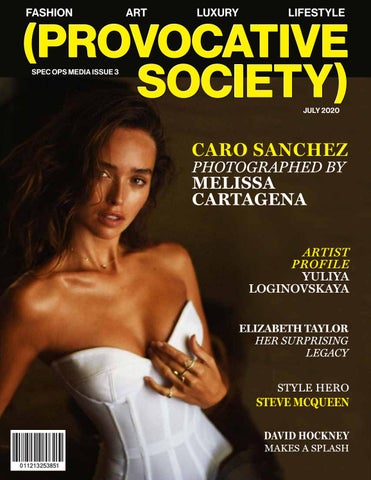
CARO SANCHEZ PHOTOGRAPHED BY
MELISSA CARTAGENA
ARTIST PROFILE YULIYA LOGINOVSKAYA ELIZABETH TAYLOR HER SURPRISING LEGACY STYLE HERO
STEVE MCQUEEN DAVID HOCKNEY MAKES A SPLASH
FASHION
ART
LUXURY
LIFESTYLE
(PROVOCATIVE SOCIETY) SPEC OPS MEDIA ISSUE 3
JULY 2020
ELIZABETH TAYLOR
HER SURPRISING LEGACY
DAVID HOCKNEY
MAKES A SPLASH
NICOLETA VACULOV
PHOTOGRAPHED BY
SARAH ORBANIC
ARTIST PROFILE YULIYA LOGINOVSKAYA
STYLE HERO
STEVE MCQUEEN
FERRARI
PASSION, PERFECTION & POWER
FASHION
ART
LUXURY
LIFESTYLE
(PROVOCATIVE SOCIETY) SPEC OPS MEDIA ISSUE 3
JULY 2020
ELIZABETH TAYLOR
HER SURPRISING LEGACY
ARTIST PROFILE YULIYA LOGINOVSKAYA
DAVID HOCKNEY
STYLE HERO
UNDER THE HAMMER
FERRARI
MAKES A SPLASH
ANDY WARHOL
ANNIE MORRISSEY PHOTOGRAPHED BY
BELLEZZAMODA
STEVE MCQUEEN
PASSION, PERFECTION & POWER
(THE TEAM) PROVOCATIVE SOCIETY Vol. 1, No. 3 July 2020 Publisher Spec Ops Media Editor Dr. Nicholas Toscano Meredith Jacoby Design Jimmydog Design Group www.jimmydog.com Production Manager Stephanie Belcher 336-201-7475 • sbelcher@triad.rr.com Copy Editor Spec Ops staff Digital Conversion Spec Ops staff Internet Management Spec Ops staff Subscription Information: Annual rates as follows: Non-qualified individual: $99(USD) Institutional: $99(USD). For more information regarding subscriptions, provocativesociety@gmail.com Advertising Policy: All advertisements appearing in the Provocative Society must be approved by the editorial staff which has the right to reject or request changes to submitted advertisements. The publication of an advertisement in Provocative Society does not constitute an endorsement by the publisher. Additionally, the publisher does not guarantee or warrant any claims made by Provocative Society advertisers. For advertising information, please contact: provocativesociety@gmail.com
2
PROVOCATIVE SOCIETY July 2020
Manuscript Submission: For information contact Editor, provocativesociety@gmail.com Copyright © 2020 by Spec Ops Media. All rights reserved under United States and International Copyright Conventions. No part of this magazine may be reproduced or transmitted in any form or by any means, electronic or mechanical, including photocopying or any other information retrieval system, without prior written permission from the publisher. Photo submission guidlines: Please submit your photos for our digital print issues by sending us an email with your story in low resolution. A large edit of 15-20 images is preferred. The photos of the store need to be exclusice for Provocative Society magazine, meaning they have to be unpublished. • SIZE: A minimum of 2400 px in width is required for final images. • FORMAT: .jpg, .tif, .zip, Fropbox or WeTransfer links • RESOLUTION: 300 dpi • COLOR: sRGB-RGb (even if they are black/white). •C REDITS: PLease include (a simple file: .pdf, TextEdit or Word) complete and final credits for staff and everything we should include. You also should include the link to your website/portfolio and IG usernames for photographer and model/s. • IMPORTANT: Location and a short story (a simple file: .pdf, TextEdit or Word) about the shoot. • EMAIL: provocativesociety@gmail.com with the subject line Digital/Print Issues Conflicts of Interest: Authors submitting articles to Provocative Society must declare, in writing, any potential conflicts of interest, monetary or otherwise, that may exist with the article. Failure to submit a conflict of interest declaration will result in suspension of manuscript peer review. Erratum: Please notify Provocative Society of article discrepancies or errors by contacting provocativesociety@gmail.com Provocative Society is published on a monthly basis by Spec Ops Media, New York, NY.
(CONTENTS ) 4 2 0 Facts About Jean-Michel Basquiat 10 Caro Sanchez by Melissa Cartagena 18 Artist Profile: Yuliya Loginovskaya 24 Nicoleta Vaculov by Sarah Orbanic 34 Warhol Under The Hammer: Top Ten Most Expensive Works Ever Sold 40 A nnie Morrissey by Bellezzamoda 48 T he 10 Most Desirable Ferraris of All Time by Aravind 54 Justi Pons by Husky
10
24
40
54
94
106
64 Elizabeth Taylor’s Most Enduring Legacy by Rachel Burrow 68 Chrissy Ionno by Alex Moore 74 Style Heroes: Steve McQueen 82 Kelsie Jean Smeby by 5Twenty1 88 Why David Hockney’s Pool Paintings Keep Making a Splash by Scott Indrisek 94 Marianne Fonseca by Holly Parker 100 10 Most Expensive Contemporary Artists 106 Rachel Vallori by Baldwin Cunnigham
68
82
July 2020 PROVOCATIVE SOCIETY
3
(ART)
20 Facts About Jean-Michel Basquiat
1
BY SOTHEBYS
Jean-Michel Basquiat was born on 22 December 1960, in Brooklyn, New York. His father, Gérard, was born in Port au Prince, Haiti, and his mother Matilde was a New York-native of Puerto Rican descent. In this multicultural home, the artist grew up speaking Spanish, French and English.
2
Basquiat became a junior member of the Brooklyn Museum, his favorite museum, at the age of six. In the spring of 2018, the museum hosted One Basquiat an exhibition devoted solely to the artist’s record-breaking Untitled (1982) which was purchased at Sotheby’s by Japanese collector Yusaku Maezawa for $110.5 million dollars — the most ever paid for an American artist at auction.
3
At eight-years-old, Basquiat was hit by a car while playing in the street and suffered a broken arm and severe internal injuries. While he was recuperating, his mother brought him a copy of the foundational medical textbook Gray’s Anatomy. The volume’s detailed anatomical drawings were eye opening to the young artist. Years later Basquiat named his industrial art noise band Gray (which counted actor Vincent Gallo as a member) in homage to this early influence.
4
His father threw him out of the house when he dropped out of school at the age of seventeen. The teenager scraped by – selling sweatshirts and postcards marked with his drawings, panhandling and crashing with friends. His impoverished diet consisted primarily of copious amounts of cheap red wine and 15¢ bags of Cheetos.
Above: PORTRAIT OF AN ARTIST, JEAN-MICHEL BASQUIAT Right: JEAN-MICHEL BASQUIAT, NEW YORK, 1985.
“Jean-Michel’s crown has three peaks, for his three royal lineages: the poet, the musician, the great boxing champion.” —Francesco Clemente
4
PROVOCATIVE SOCIETY July 2020
(ART) saintly stature. “Jean-Michel’s crown has three peaks, for his three royal lineages: the poet, the musician, the great boxing champion,” said his friend artist Francesco Clemente.
7 PHOTO BY EVELYN HOFER/GETTY IMAGES.
Basquiat became a regular on art writer Glenn O’Brien’s public access television program TV Party — first appearing on the live show in 1979 with his head shaved down the middle. Two years later he appeared in O’Brien’s film Downtown ’81 playing a nearly autobiographical character.
8
He produced a rap record with Rammellzee and K Robb titled Beat Bop (1983) and designed the cover for the single.
9
5
It was his graffiti tag “SAMO” (shorthand for “same old shit”) that first drew public attention. Basquiat created “SAMO” with his friend Al Diaz while the pair were in high school and the tag,which often featured the copyright symbol, cropped up on buildings throughout lower Manhattan and Brooklyn between 1977 and 1980. “It was supposed to be a logo, like Pepsi.” Basquiat later told writer Anthony Haden-Guest. The end of the collaboration was announced in 1980 through a slue of tags declaring, “SAMO is dead.”
6
The crown, Basquiat’s signature artistic motif, both acknowledged and challenged the history of Western art. By adorning black male figures, including athletes, musicians and writers, with the crown, Basquiat raised these historically disenfranchised artists to royal even
The limelight suited Basquiat. In 1980 he appeared in music video for Blondie’s song “Rapture.” It was lead singer Debbie Harry and her boyfriend Chris Stein who bought Basquiat’s first painting for a mere $200.
10
Basquiat gained momentum with his first exhibition —the landmark DIY Times Square Show which opened in June of 1980 in an abandoned massage parlor off Seventh Avenue. The pioneering exhibition also featured works by Keith Haring, Kiki Smith, Jenny Holzer and Kenny Scharf.
11
Along with Julian Schnabel, Kenny Scarf and Francesco Clemente, Basquiat was considered one of the leading figures of Neo-Expressionism, an art movement that reasserted the primacy of the human figure in contemporary art. In 1996 fellow Neo-Expressionist Schnabel directed a biopic of the artist’s tumultuous life with Jeffrey Wright starring as Basquiat and David Bowie as Warhol. July 2020 PROVOCATIVE SOCIETY
5
(ART) This page: AN-MICHEL BASQUIAT, UNTITLED, 1982. SOLD FOR $110.5 MILLION IN THE CONTEMPORARY ART EVENING AUCTION, MAY 2017. Opposite page: THE 1985 EXHIBITION POSTER FOR AN EXHIBITION OF ANDY WARHOL AND JEAN MICHEL BASQUIAT.
12
In 1982, at the age of 21, he became the youngest artist to ever exhibit at Documenta in Kassel, Germany, when nearly 60 of his paintings were featured at the esteemed exhibition.
6
PROVOCATIVE SOCIETY July 2020
13
He joined the Annina Nosei gallery in 1982, and had his first American one-man show in the spring of that same year. By 1984, Basquiat had left Annina Nosei for 1980s art-world powerhouse Mary Boone.
14
He met his lifelong friend and mentor Andy Warhol in 1981 at latenight hotspot Mr. Chow’s. Swiss dealer Bruno Bischofberger later suggested the two collaborate on a series of paintings, and between 1983 and 1985 the pair made works that layered Basquiat’s virtu-
(ART) osic graffiti scrawl over Warhol’s bright Pop imagery.
15
Madonna and Basquiat dated in 1982, while both were on the precipice of mainstream stardom.
16
That same year, Basquiat moved to Los Angeles where he lived with the gallerist Larry Gagosian as he prepared for an upcoming solo show at the gallery’s West Coast location. Madonna even joined them for a few months.
18
Both the Museum of Modern Art and the Whitney Museum of American Art rejected submissions of his work.
PHOTO COURTESY OF PVDE /BRIDGEMAN IMAGES.
17
With newfound commercial success he spent lavish amounts of money on Armani suits, expensive wines and the finest hotels. “From being so critical of the art scene, Jean-Michel was all of a sudden becoming the thing he criticized,” said Keith Haring, his longtime friend. But his libertine squanderings were marked by irreverence — he was know for painting over his designer suits, lending obscene sums of money, even throwing $100 dollar bills out of his limousine window to panhandlers.
19
Basquiat died of an accidental drug overdose on August 12, 1988, at his Great Jones Street studio. He was 27 years old. In the months preceding his death, the trou-
bled artist claimed to be using a hundred bags of heroin a day. Curator and gallerist Jeffrey Deitch delivered a eulogy during his burial at Green-Wood Cemetery in Brooklyn. July 2020 PROVOCATIVE SOCIETY
7
PHOTO BY LEE JAFFE/GETTY IMAGES.
(ART)
Above: JEAN-MICHEL BASQUIAT PAINTING IN ST. MORITZ, SWITZERLAND, 1983.
20
“I’m not a real person. I’m a legend,” Basquiat once claimed. His name and unique personal style have become frequent reference points in popular culture. Fellow Brooklyn-native Jay-Z, for instance,
famously paralleled himself to the artist in his 2013 song”Picasso Baby,” saying ”It ain’t hard to tell, I’m the new Jean-Michel.” PS Reprinted with permission from Sothebys.com
“I’m not a real person. I’m a legend.” —Jean-Michel Basquiat
8
PROVOCATIVE SOCIETY July 2020
Want to be a part of
(PROVOCATIVE SOCIETY) We want you!
Please submit your photos for our digital print issues by sending us an email with your story in low resolution. A large edit of 15-20 images is preferred. The photos of the store need to be exclusice for Provocative Society magazine, meaning they have to be unpublished.
• SIZE: A minimum of 2400 px in width is required for final images.
• FORMAT: .jpg, .tif, .zip, Fropbox or WeTransfer links • RESOLUTION: 300 dpi • COLOR: sRGB-RGb (even if they are black/white). • CREDITS: PLease include (a simple file: .pdf, TextEdit
or Word) complete and final credits for staff and everything we should include. You also should include the link to your website/portfolio and IG usernames for photographer and model/s.
• IMPORTANT: Location and a short story
(a simple file: .pdf, TextEdit or Word) about the shoot.
• E MAIL: provocativesociety@gmail.com with the subject line Digital/Print Issues
(FASHION)
CARO SANCHEZ
New York @suprememgmt LA @twomanagement Paris @ouimanagement Instagram @carosanchhez Photographed by Melissa Cartagena @perazna
10
PROVOCATIVE SOCIETY July 2020
(FASHION)
(FASHION)
12
PROVOCATIVE SOCIETY July 2020
(FASHION)
July 2020 PROVOCATIVE SOCIETY
15
(FASHION)
Want to be a part of
(PROVOCATIVE SOCIETY) We want you!
Please submit your photos for our digital print issues by sending us an email with your story in low resolution. A large edit of 15-20 images is preferred. The photos of the store need to be exclusice for Provocative Society magazine, meaning they have to be unpublished.
• SIZE: A minimum of 2400 px in width is required for final images.
• FORMAT: .jpg, .tif, .zip, Fropbox or WeTransfer links • RESOLUTION: 300 dpi • COLOR: sRGB-RGb (even if they are black/white). • CREDITS: PLease include (a simple file: .pdf, TextEdit
or Word) complete and final credits for staff and everything we should include. You also should include the link to your website/portfolio and IG usernames for photographer and model/s.
• IMPORTANT: Location and a short story
(a simple file: .pdf, TextEdit or Word) about the shoot.
• E MAIL: provocativesociety@gmail.com with the subject line Digital/Print Issues
(ART)
YULIYA LOGINOVSKAYA
Y
@loginowski_art @loginowski
18
PROVOCATIVE SOCIETY July 2020
uliya Loginovskaya was born in Kazakstan in 1992. She is coming from a Russian family that moved to Kazakstan due to the political situation. Her mom is a great Physician and Chiropractor and has helped thousands of people and gained big respect and love from the community. In 2013 Yuliya graduated from University of Economy and Business in Kazakstan. During her teenage years Yuliya was studying in art school for 5 years and graduated by the age of 15. In the next couple of years she started working with local artists by painting walls of residential buildings, shopping centers, also she assisted a famous artist in drawing walls in Orthodox Cathedral. In 2014 Yuliya was enrolled into an English program and moved to USA with a student visa. During these days she stopped drawing but couldn’t resist visiting art galleries, learning about modern art and even working in art gallery. Working in a gallery part time and doing runways, fashion photoshoots in weekends Yuliya became so inspired by art, fashion and music that she started creating her first art pieces in her own kitchen. Denim jackets and shorts, t-shirts and shoes with unique drawings of unicorns, Native American Indians, lions which gained lots of interest from New York and Miami fashionistas. Yuliya was signed with top model agencies in Miami such as MC2 and Front management. Her nickname Loginowski came from her last name since she became well known in Miami area for her modeling and art achievements.
(ART)
Loginowski believes that words aren’t enough to express herself , but art is... She started creating her own art pieces in her own unique style that attracted attention from others. First it was just for fun to play with acrylic and canvas while listening to her favorite music. “Art is like an air for me, endless source of inspiration and possibilities... art is the only thing that always keeps me happy...” Apparently her art made many other people happy as well who started buying her art pieces and placing orders for her new collections. The list of customers kept growing so fast. The biggest demand on Loginowski Art
came from sport fans that fall in love with her customized paintings of their favorite boxers, fighters, athletes. Loginowski has been working on her new art collection “Pop Icons” that is ready to launch in a few weeks. Due to COVID her first art show was postponed but she doesn’t lose inspiration and creates more and more art at home while on quarantine. “Quarantine gave everyone new perspective on life, helped us to realize what really matters...” It also helped me to realize how valuable for me to create art and see the happy faces of my customers. It became my automatic goal and my dream job. PS July 2020
PROVOCATIVE SOCIETY
19
(ART)
20
PROVOCATIVE SOCIETY July 2020
(ART)
July 2020 PROVOCATIVE SOCIETY
21
22
PROVOCATIVE SOCIETY July 2020
(ART)
July 2020 PROVOCATIVE SOCIETY
23
24
PROVOCATIVE SOCIETY July 2020
(FASHION)
NICOLETA VACULOV
@nicoleta_vaculov Photographed by Sarah Orbanic @sarahorbanicphotos
July 2020 PROVOCATIVE SOCIETY
25
(FASHION)
July 2020
PROVOCATIVE SOCIETY
27
(FASHION)
28
PROVOCATIVE SOCIETY July 2020
(FASHION)
30
PROVOCATIVE SOCIETY July 2020
(FASHION)
July 2020 PROVOCATIVE SOCIETY
31
(FASHION)
32
PROVOCATIVE SOCIETY July 2020
(ART)
Warhol Under The Hammer: Top Ten Most Expensive Works Ever Sold
Above: Silver Car Crash (Double Disaster), US $105,445,000 Opposite page left: Triple Elvis (Ferus Type) US $81,925,000 Opposite page right: Green Car Crash (Green Burning Car I) US $71,720,000
34
PROVOCATIVE SOCIETY July 2020
O
ne of the most influential and well-loved artists of the 20th century, Andy Warhol continues to inspire fans young and old. With numerous retrospectives of his work happening all over the world he also remains one of the most sought after artists on the market. Here we take a look at the top ten prices paid
for works by the father of Pop Art at auction, from $105 million for his Silver Car Crash in 2013 to $53 million for Double Elvis in 2019. Taken from his Death and Disaster series, the top price realised for Warhol at auction was achieved in 2013 for Silver Car Crash (Double Disaster). An undeniably powerful work, this monumental
(ART) painting bears witness to the circumstances of disaster and reflects on the long tradition of history painting in art from Géricault’s The Raft of the Medusa to Picasso’s Guernica. Here Warhol transforms a tragic scene, repeating it over and over again until it resembles frames from a film or animation, its black and white surface turned silvery for posterity. The work was made in 1963, a seminal – and somewhat melancholic – year for Warhol in which he also produced Suicides, Race Riots and Silver Electric Chair.
Having turned Marilyn Monroe’s iconic features into innumerable silkscreen prints it was only natural that Warhol should take Elvis as his subject in this 1963 painting. Repeating the figure of the singer in his dynamic cowboy stance as he draws his gun, the work takes on a cinematic quality that elevates the star’s image from pop icon to demigod. At the same time the background colour recalls the silver screen of Hollywood as well as the baroque ornaments of the catholic church Warhol grew up in, sur-
rounded by painted icons to be venerated and reproduced for the masses. Another significant work from Warhol’s Death and Disaster series, Green Car Crash (Green Burning Car I) made headlines when it sold for US$71,720,000 at Christie’s in 2007, a spectacular price for the time. Here again repetition plays a key part in transforming a tragic scene into a classic work of Pop Art which uses the industrial technique of silkscreening to reproduce a newsreel image over and over until the viewer becomes
July 2020 PROVOCATIVE SOCIETY
35
(ART) numb to its meaning. As Warhol said in an interview at the time, “When you see a gruesome image over and over again, it really doesn’t have any effect”, an idea that has worrying echoes in the 24 hour news culture of our present day. With this work Warhol demonstrated once again his enduring fascination with fame and celebrity, picking as his subject the talented actor Marlon Brando in the film The Wild One. Unlike previous silkscreen portraits, with Four Marlons Warhol chose to print Brando’s figure onto unprimed canvas, eschewing bright overlays or silver grounds to let the raw magnetism of the actor’s expression, pose and leathers do the talking. Painted in 1966 the work represents Warhol at the height of his powers, using the silkscreen technique to borrow from the worlds of advertising and Hollywood to come up with a whole new style of painting that broke from the canon as dictated by critic Clement Greenberg. Here Warhol was striking a new path, one that would eventually earn him his own fame and fortune, equalling and even perhaps surpassing that of his icons. 36
PROVOCATIVE SOCIETY July 2020
Men in Her Life, which sold for over $63 million in New York in 2010, is an homage to both film star Elizabeth Taylor and the American public’s fascination with her life and loves. Using an image taken from LIFE magazine, Warhol portrays Taylor with her third husband Mike Todd as well as another couple,
Above: Four Marlons, US $69,605,000 Opoosite page clockwise: Men in Her Life, US $63,362,500 Coca-Cola [3], US $57,285,000
(ART) Debbie Reynolds and Eddie Fisher. Though it seems like an innocent image of romance and friendship, the photograph actually foreshadows a disaster and a complicated love affair which caused Taylor to be vilified by the media and the public. Once again Warhol repeats his central motif to
liken the images to the frames of a film, bringing movement to a still. At the same time he retains the original black and white of the photograph, contrary to what we expect from his brightly coloured canvases from the same year. Perhaps one of Warhol’s more politically overt and
well known paintings, Race Riot reproduces a photograph from a civil rights march in Birmingham, Alabama in 1963. What was supposed to be a peaceful protest against the state’s segregation laws by the city’s African American community soon turned ugly when the police brought out
July 2020 PROVOCATIVE SOCIETY
37
(ART)
Above: Colored Mona Lisa, US $56,165,000 Opposite page: Double Elvis [Ferus Type], US $53,000,000
38
PROVOCATIVE SOCIETY July 2020
attack dogs and fire hoses to disperse the crowd. Making front page news all over the world, photographs of the riot by Charles Moore forced president John F Kennedy to make historic changes to the law and inspired Warhol to reproduce them, sharing in his way this portrayal of injustice and ensuring their place in art history. Painted in the last year of Warhol’s life, Sixty Last Suppers is testament to the artist’s enduring love for the old masters. That year Warhol also produced The Last Supper (Pink) and The Camouflage Last Supper which along with the current work were based on reproductions of a 19th century copy of the original painting by Leonardo da Vinci. By applying his silkscreen technique to a 16th century masterpiece and reproducing it into a monumental grid of repeated images Warhol was seen to be entering into a dialogue with the Western art historical canon before him, as well as referencing his own roots in the catholic church and perhaps questioning the value of a single image over many. As well as Campbell’s Soup cans and Brillo Boxes, Warhol was particularly fond of
(ART) reproducing Coca Cola’s iconic branding. From the swirly writing of the logo to the red and white labels and elegant glass bottles, Coke held a timeless appeal for the father of Pop Art who saw it as a great leveller thanks to its allround popularity and ubiquity. In his 1975 book, The Philosophy of Andy Warhol (From A to B & Back Again) he wrote, “What’s great about this country is that America started the tradition where the richest consumers buy essentially the same things as the poorest. You can be watching TV and see Coca-Cola, and you can know that the President drinks Coke, Liz Taylor drinks Coke, and just think, you can drink Coke, too. A Coke is a Coke and no amount of money can get you a better Coke than the one the bum on the corner is drinking. All the Cokes are the same and all the Cokes are good. Liz Taylor knows it, the President knows it, the bum knows it, and you know it.” This 1962 work strips the brand of its colour, offering a simple outline of the bottle and logo with the words ‘trademark registered’ clearly delineated, perhaps in a tongue in cheek reference to his own disre-
gard for copyright. In 1962 JFK visited France on a state visit during which his wife Jackie, who was adored by the press and public, managed to persuade the French president to allow the Mona Lisa to go on an unprecedented tour of the United States. The next year the painting crossed the Atlantic accompanied by a high-security convoy and extensive media coverage. As a result, thousands of Americans queued to see the masterpiece at its first stop, the National Gallery of Art in Washington before it travelled to the Metropolitan Museum of Art in New York where Warhol saw it. He began work on the silkscreen version the following spring, using a reproduction taken from a brochure by the museum. With this, he made three screens: one was a full-length version of the work, while another showed the Mona Lisa cropped to a bust, and the third was just a detail of the figure’s crossed hands. In this painting, which sold for US$56,165,000, all three come together in a vibrant display of colour and composition. Painted in the same year as Triple Elvis this work appeared to be slightly less popular on the market,
achieving $30million less than its counterpart when it was sold in New York in 2019. The work is no less iconic however, with Elvis’s classic features staring out at the viewer in determination, his gunslinger persona representing an homage to the American romance with the West and the enduring figure of the cowboy. Here the original publicity shot from the 1960 Western movie Flaming Star is doubled and reproduced to life-size resulting in an imposing work that remains a classic work in this luminous artist’s oeuvre. PS Reprinted with permission frommyartbroker.com
July 2020 PROVOCATIVE SOCIETY
39
(FASHION)
ANNIE MORRISSEY
@annie_Morrissey Agencies LA: @merakimodelmgmt London: @lenisagency Photographed by Bellezzamoda @bellezzamodaph
July 2020 PROVOCATIVE SOCIETY
41
(FASHION)
44
PROVOCATIVE SOCIETY July 2020
(FASHION)
46
PROVOCATIVE SOCIETY July 2020
(FASHION)
July 2020 PROVOCATIVE SOCIETY
47
(LUXURY)
The 10 Most Desirable Ferraris of All Time BY ARAVIND
B
eing huge fans of the Prancing Horse, we dedicate this article to the brand that has created and sold beautiful pieces of art that move on four wheels. With designs that emanate Italy’s passion for racing and 48
PROVOCATIVE SOCIETY July 2020
perfection, and power that not only is a source of melody but also the source of true Italian power, every Ferrari that has rolled-out of the Modena factory since its founding days have been well received by the discerning audience and stayed true to Enzo Ferrari’s philosophy “building the greatest cars in the world.”
Also not to be forgotten is Ferrari’s favorite design studio, Pininfarina, which was headed by the creative genius, Sergio Pininfarina. Held responsible for strengthening the partnership between Ferrari, which his father started, Sergio’s creative skills helped him find a stylistic key which has made Enzo Ferrari’s cars a unique
(LUXURY) phenomenon on the international manufacturing scene for over half a century. Designing almost every Ferrari that rolled-out from the Ferrari factory, from the Ferrari 250 GT to the unannounced Ferrari F70, one can compare today’s partnership between Ferrari and Pininfarina to the relationship between Apple iPhone and the AT&T — a partnership that is still strong today and will remain strong for the years to come. We decided to showcase the Top-10 Ferraris, designed by Pininfarina and his team, that have stood the test of time and still look very desirable. Feast your eyes on these beautiful models designed by Pininfarina’s studio. 2011 FERRARI 458 ITALIA The Ferrari 458 Italia is one of the very few cars in the world that delicately balances soulful design with precisely engineered aerodynamics. And no one can pull that off better than the Ferrari-Pininfarina duo. For the design of the 458, Ferrari not only wanted a beautiful car but also a car that was more aerodynamic and lighter than the outgoing Ferrari F430, without any bulbous additions. This resulted in a car that accentuates
true beauty without compromising aerodynamics. A much needed comeback by Ferrari after the slouching sales of the not-so-desirable F430 and the 360 Modena. This design also, in some ways, pays homage to the Ferrari Enzo, a flagship that truly revolutionized the supercar industry. So this junior Enzo, with its beautiful and clever design, and a powerful 4.5-liter V-8 engine, is a car that deserves the phrase “The Beauty and The Beast.”
Top: 2011 FERRARI 458 ITALIA Bottom: 1984 FERRARI 288 GTO
July 2020 PROVOCATIVE SOCIETY
49
(LUXURY)
From top left clockwise: 1987 FERRARI F40 1957 FERRARI 250 GT CALIFORNIA 1957 FERRARI 250 TR 2009 FERRARI 599 GTB FIORANO
50
PROVOCATIVE SOCIETY July 2020
1984 FERRARI 288 GTO Twenty-two years after their first GTO — the Ferrari 250 GTO — Ferrari unleashed its second GTO: the 288 GTO. A true Ferrari enthusiast would know that any Ferrari sporting the GTO badge was a very powerful one. In today’s world, the GTOs would be rather underpowered, with exception to the 599 GTO, but in their heyday, they were groundbreaking and put many supercars to shame. The 288 GTO was the first supercar where Ferrari forayed into the devel-
opment and production of parts made from composite materials. This resulted in a stronger chassis while keeping the weight low, which was reflected in its blistering performance for its era. The Ferrari 288 GTO was one of those cars that looked and performed costlier than its actual price tag. 1987 FERRARI F40 Being the last Ferrari developed under the influential leadership of Enzo Ferrari, the Ferrari F40 is a supercar that is highly revered by
(LUXURY) enthusiasts. The F40 was the result of a final wish made by Enzo Ferrari to “build a car that would be the best car in the face of the Earth,” and we truly believe that his wish stands true even through today. The Ferrari F40 was designed along the lines of the 288 GTO, which has speed and power written all over. The design was dominated by a tall spoiler that didn’t suit the sleek style of the car, but because of the limited technology and the 196 mph top speed, Ferrari had to install it to keep from heading skyward. This car is still considered to be “The True Supercar,” a rarity in a world where computer aids take over human interaction in any latest-gen supercar 1957 FERRARI 250 GT CALIFORNIA For wealthy people that wanted to enjoy the wind and soak up the sunshine in a Ferrari, the Ferrari 250 GT California was the car that answered their demands. It looked like a million dollars and was a car that commanded respect from any onlooker. Part of the famous 250 GT lineup, this car was powered by a 280-horsepower V-12 engine that promised track-
like performance, while not compromising on comfort when cruising the streets. It is one of the most desirable cars and collectors are always on the lookout for one in pristine condition.
From top: 1957 FERRARI 250 TR 2013 FERRARI F12 BERLINETTA
July 2020 PROVOCATIVE SOCIETY
51
(LUXURY)
From top: 2002 FERRARI ENZO 1962 FERRARI 250 GTO
52
PROVOCATIVE SOCIETY July 2020
2009 FERRARI 599 GTB FIORANO The Ferrari 599GTB simply stays true to Ferrari’s tradition of “beautiful cars that can smoke the competition with immense, passion fueled power.” With a design that Ferrari was proud of and power that shamed most supercars of its era, the Ferrari 599 GTB was launched to a huge group of salivating Ferrari enthusiasts at the 2006 Geneva Motor Show. It received positive
reaction from the audience and press alike, with people calling it the “Most beautiful Ferrari ever made.” With its stretched bonnet that harks back to the 1967 Ferrari Daytona and muscular curves, the car was instantly recognizable as a Ferrari that was no slouch. With the 6.0-liter V-12 from an Enzo, the car was the most powerful production car of its time: with an amazing 620 Italian horses powering the beast. As is Ferrari’s nature, the GTB Fiorano balanced power with exotic beauty. Overall, the Ferrari 599GTB simply stays true to Ferrari’s tradition of “beautiful cars that can smoke the competition with immense, passion fueled power.” 1957 FERRARI 250 TR The Ferrari 250 TestaRossa was a race car based on the Ferrari 250 lineup that won many races, including the ’56,’60 and ’61 Le Mans. The road version of the car was handcrafted by Ferrari’s favorite coach builder, Scaglietti, which is evident in the meticulous crafting of front fenders that separate from the bonnet, giving it a Formula One look and feel to the whole car. It was more
(LUXURY) like an F1 car that wealthy people can drive home or to work. The Ferrari 250 TR is currently the most desirable and sought after Ferrari after it snagged a $16.4 million bid at auction in 2011, a new world-record auction price for a car. So, is it a Beverly Hills villa or a Ferrari 250 TR? 1967 FERRARI 275 GTB The Ferrari 275 GTB revolutionized the Berlinetta series of GT cars from Ferrari. Designed by Pininfarina and precisely crafted by Scaglietti, the Ferrari 275 GTB spawned a new series of cars that are loved and respected by the Ferrari enthusiast, even in today’s world. Clearly the design of the 275 GTB is a source of inspiration for the Berlinettas of today. 2013 FERRARI F12 BERLINETTA The successor of the outgoing 599 GTB, the Ferrari F12 Berlinetta’s design clearly pays homage to the early 250 and 275 GT lineup of Berlinettas of the mid-20th century. The car is also another example of style mixed with precise aerodynamic proportions. This trait is seen in design elements such as the
carefully sculpted scoops and vents that channel out air while creating massive downforce. Even when it’s standing still, the F12 Berlinetta looks like its constantly moving at top speed. It snatches the title of “fastest production car by Ferrari,” from the 599 GTO. So, there is a beast lurking underneath beautiful body. But, nevertheless, its a car that can be driven on long trips with comfort and restrained power. A true Berlinetta from the House of Ferrari. 2002 FERRARI ENZO Named after the company’s founder, the Enzo was one of those cars that revolutionized Ferrari’s stance in the supercar segment. The car was dripping in F1 technology, from the carbon-fiber body to the F1-style paddle shift transmission to the Carbon ceramic composite disc brakes. Also debuted on the Enzo was active aerodynamics, which mechanically actuated the rear wing for downforce at speeds above 300 km/h (186 mph). The design of the car was just phenomenal. With a nose that is inspired by F1 design and gullwing doors, this was a car that boys would dream
about and glue posters of on their walls just to drool at. This car is still fast and desirable in today’s world, as people still think twice about whether to choose an Enzo or any other current supercar. Ferrari has indeed built a future-proof car since launch in 2002. 1962 FERRARI 250 GTO The last, but by no means the least, we come to the 1962 Ferrari 250 GTO. This is the case of “Save the best for last.” Only 39 examples of the 250 GTO were produced between 1962 and 1964, making it one of the rarest Ferraris. It doesn’t disappoint in the performance department either, having won 3 consecutive FIA world championships in its class. Performance aside, this car is a true object of lust, thanks to the designers at Pininfarina and the impeccable coachwork at Scaglietti. It was reported that one example of this angel fetched more than $31 million dollars in a private auction. PS Reprinted with permission from topspeed.com
July 2020 PROVOCATIVE SOCIETY
53
(FASHION)
JUSTI PONS @Justipons Agencies NYC: @geneticsmgmt Mexico: @theface.models Photographed by Husky @husssky
54
PROVOCATIVE SOCIETY July 2020
(FASHION)
56
PROVOCATIVE SOCIETY July 2020
(FASHION)
July 2020 PROVOCATIVE SOCIETY
57
(FASHION)
(FASHION)
July 2020 PROVOCATIVE SOCIETY
59
(FASHION)
60
PROVOCATIVE SOCIETY July 2020
(FASHION)
July 2020 PROVOCATIVE SOCIETY
61
(FASHION)
62
PROVOCATIVE SOCIETY May 2020
(FASHION)
May 2020 PROVOCATIVE SOCIETY
63
(LIFESTYLE)
Elizabeth Taylor’s Most Enduring Legacy May Surprise You
PHOTO BY MIRRORPIX GETTY IMAGES
The style icon’s jewely collection dazzles just as much as her remarkable career.
Above: Todd and Taylor at the 1957 Cannes Film Festival. Opposite page l-r: Lady Pamela Berry, Todd, and Taylor wearing her Cartier suite. Taylor’s ruby and diamond necklace from Todd.
64
PROVOCATIVE SOCIETY
July 2020
E
BY RACHAEL BURROW lizabeth Taylor’s most lasting legacy may be her consistent adoration—and collection—of stunning jewels, as well as her many marriages
and acting resume. Born in London in 1932 to American parents who were art dealers, Taylor and the family relocated to Los Angeles after the start of World War II. She first appeared on the silver screen in the 1942 film There’s One Born Every Minute at the age of 10; she became a household name at age 12 with 1944’s National Velvet, which grossed over $4 million. As much as Taylor earned fame for appearing in movies like Cat on a Hot Tin Roof and Butterfield 8, she was infamous for her scandalous love life. Taylor was notably quoted as once saying that in order to have a love affair, one had to get married—which she did: eight times. (And twice to Richard Burton, to be exact.) Thanks to these star-studded marriages, Taylor became the recipient of jewels worthy of royalty anywhere else, and she even penned a book on her plethora of beautiful gems and baubles.
PHOTO BY DEREK BERWIN GETTY IMAGES
PHOTO BY CYRUS MCCRIMMON GETTY IMAGES
(LIFESTYLE)
SHOP NOW She begin her sequences of marriages at age 17 to hotel heir Nicky Hilton. Taylor’s third marriage in February 1957 was to Mike Todd, the Hollywood producer who was best known for his Academy Award–winning Best Picture film Around the World in 80 Days. Todd gifted Taylor a tiara of diamonds that she wore to the Cannes Film Festival that year. Tiaras weren’t exactly en vogue at that time, but Taylor wore the diadem regardless, citing that she sported it because Todd was “her king.” Todd also gifted Taylor with a set of ruby-and-diamond earrings and its matching necklace, designed and created by Cartier, that she is seen wearing here
at the London premiere of Todd’s Around the World in 80 Days. The suite, which Todd presented to Taylor while she was in the pool at Cap Ferrat, so excited her that she supposedly flung her arms around her husband’s neck and pulled him into the pool with her. After Todd’s untimely death in 1958 in a plane crash and following a marriage to Eddie Fisher, Taylor starred in Joseph L. Mankiewicz’s Cleopatra, which pulled in almost $32 million and placed her in the vicinity of actor Richard Burton. The pair fell in love and were married in 1964 in Montreal, Canada. On their first wedding day, Taylor wore a Bvlgari emerald-and-diamond brooch Burton gifted her during
their engagement. This brooch fetched over $6.5 million during the Christie’s sale of Taylor’s jewelry in 2011. Another stunning emerald-and-diamond combination from Bvlgari—Taylor would collect many pieces from the Italian house over the years—came in the form of a cascading necklace that Burton gifted his wife on their wedding day. The necklace boasts 16 Colombian emeralds, each set off by a surround of pear-shaped and brilliant-cut diamonds, and eventually Taylor added her emerald brooch to the necklace as a pendant. In 1969, a 69.42-carat pearshaped diamond went up for auction in New York City. It was rumored that both Richard Burton and Aristotle OnJuly 2020 PROVOCATIVE SOCIETY
65
66
PROVOCATIVE SOCIETY July 2020
PHOTO BY RON GALELLA GETTY IMAGES
Reprinted with permission from Veranda.com
Taylor was notably quoted as that in order to have a love a to get married—which she di PHOTO BY ROB STOTHARD GETTY IMAGES
assis both had their eyes on the stone for their respective significant others, but in the end, Cartier won out with a bid of $1,050,000, just $50,000 over Burton’s ceiling price. Burton immediately went to Cartier after the sale and purchased the diamond for Taylor, which was eventually set in a ring and a necklace. The famous stone became known as the Taylor-Burton diamond. Burton obviously used any occasion to shower Taylor with jewels—she was known to have said that he would “...give me ‘It’s a beautiful day’ presents or ‘Let’s go for a walk’ presents.” On Taylor’s 40th birthday, Burton used that special occasion to present Taylor with a Bvlgari sapphire-and-diamond sautoir necklace. The iconic personal jewelry collection of Elizabeth Taylor is the stuff of legend and has captured the imagination of the American public for the last decade. In 2011, the sale of Taylor’s jewelry collection through Christie’s garnered almost $157 million. PS
PHOTO BY WILLIAM LOVELAC EGETTY IMAGES
(LIFESTYLE)
PHOTO BY WAXEL KOESTER GETTY IMAGES
(LIFESTYLE)
s once saying affair, one had id: eight times.
Opposite page top: Burton and Taylor at their first wedding in Montreal Opposite page bottom left: Taylor’s Bvlgari emerald and diamond necklace. Opposite page bottom right: Taylor and Burton at the 42nd Annual Academy Awards. This page top left: Taylor’s sugar-loaf sapphire-and-diamond necklace This page top middle: Taylor’s Daisy Parure set by Van Cleef & Arpels This page top right: Diamond pendant earrings gifted to Taylor by Todd This page middle: Taylor’s gold charm bracelet This page bottom left: Taylor’s Triphanes sautoir by Van Cleef & Arpels This page bottom middle: Taylor’s La Peregrina necklace by Cartier This page bottom right: Taylor’s Art Deco diamond brooch by Van Cleef & Arpels UNLESS OTHERWISE NOTED: ALL PHOTOS THIS PAGE COURTESY OF CHRISTIE’S IMAGES. July 2020 PROVOCATIVE SOCIETY
67
(FASHION)
CHRISSY IONNO
@chrissyionno Agencies Toronto @elitetoronto NYC @clickmodelny Photographed by Alex Moore @MoorePolaroids
68
PROVOCATIVE SOCIETY July 2020
(FASHION)
July 2020 PROVOCATIVE SOCIETY
69
(FASHION)
70
PROVOCATIVE SOCIETY July 2020
(FASHION)
July 2020 PROVOCATIVE SOCIETY
71
(FASHION)
72
PROVOCATIVE SOCIETY July 2020
(FASHION)
(LIFESTYLE)
Style Heroes: Steve McQueen Steve McQueen was the epitome of live fast die (relatively) young and he’s easily the most referenced style icon of all time who lived the American Dream.
I
llegally cool and unfairly stylish, Steve McQueen had swagger belonging to a bygone era. Even though his canon of work isn’t filled with much variety — he received one Academy Award nomination for Best Actor for his role in The Sand Pebbles (1966) — he’s rightly perceived to have been a formidable actor, expertly portraying the archetypal anti-hero with natural vulnerability. The screen wasn’t his first love, though, once stating: “I’m not sure whether I’m an actor who races or a racer who 74
PROVOCATIVE SOCIETY July 2020
acts.” While his skills on a motorbike were on an equal plateau to professionals, he was something else on screen, and his style is, perhaps, one of the most referenced of all time. Terence Steven McQueen was born on 24 March, 1930, in Indiana. From the get-go, his life was at full throttle, and it’s safe to say he had a fairly traumatic childhood that shaped his later life. Born into a working-class family, his biological father walked out on him at six months. He then moved around a lot with his mother and,
(LIFESTYLE)
Top row l-r: In his breakthourgh role in Wanted Dead or Alive, McQueen wears a hard-wearing overshirt as he tracks down criminals. Whether it was casual or formal wares, McQueen did both with relative ease. Here, he sports a pair of sneakers with a light tonal ensemble. 2nd row l-r: McQueen in his racing gear during filming of Le Mans, 1971. McQueen was a fitness fanatic who exercised for a minimum of two hours a day. 3rd row l-r: Throughout the Thomas Crown Affair, 1986, McQueen is exceptionally well dressed. This grey Prince of Wales check with hints of blue was created buy the famed Savile Row tailor, Douglas Hayward. McQueen in classic western, The Magnificent Seven, 1960, with Yul Brynner.
July 2020 PROVOCATIVE SOCIETY
75
(LIFESTYLE)
Above l-r: Wearing the iconic flight jacket in The Great Escape, 1963. McQueen sporting the classic Harrington jacket in The Thomas Crown Affair, 1968, with a pair of Persol sunglasses.
76
when she later remarried, his stepfather would frequently beat him. He left home at 15 and became a delinquent, committing petty crimes before being sent to a borstal. This helped him dramatically, as it gave purpose and meaning to a teenager who was filled with anger and disenfranchisement towards the world. He eventually enrolled into the United States Marine Corps, becoming a tank driver and a mechanic and reaching the rank of Corporal. He had a knack for fixing things and loved being around machinery – so much so that he reportedly destroyed a tank by trying to soup it up. From the marine corps to the Big Apple, McQueen pursued stardom and women via a career in film and television. His confidence, cheeky grin, chiseled bones and curly blonde hair helped get him on his way, and his first big break came with the hit TV series Wanted Dead or Alive (1958-1961). He played the protagonist Josh Randall, which was an easy role for McQueen as
PROVOCATIVE SOCIETY July 2020
they were both outcasts. He often wore a heavy overshirt in addition to denim and sturdy boots. In his breakthrough role in Wanted Dead or Alive, McQueen wears a hard-wearing overshirt as he tracks down criminals. So, in spectacular fashion, he staged a car crash that resulted in him receiving minor injuries, but allowed him to take part in the iconic western alongside Yul Brynner. Although he wasn’t the main character, McQueen stole the show, drawing attention to himself by playing with his hat or gun and, ultimately, upstaging Brynner. He looked the part, too, wearing distressed denim and collarless shirts, complemented with a bandana around the neck. His next big feature was in The Great Escape (1963), where he played the irrepressible Virgil Hilts. Either seen repeatedly throwing a baseball against a wall in ‘the cooler’ or on the outside evading Nazis on a motorbike, it’s one of the greatest films ever made. It
(LIFESTYLE)
wasn’t short of remarkable behind-thescenes trivia, too: the A1-jacket-wearing McQueen requested to add in the motorcycle scenes, which weren’t in the original script; he also didn’t perform the jump across the border fence, although he did try. When looking at McQueen’s body of work, The Great Escape is perhaps the most closely aligned to his real character: it seemed as if he wasn’t even in character during the bike scenes, and whenever he was being punished, he had a glimmer in his eye and a never-surrender attitude. And, as we’ve written before, McQueen also sported one of the most iconic outfits in cinematic history. Later came his most rakish role in The Thomas Crown Affair (1968), which is also one of his most interesting due to the stark contrast in character. Thomas Crown is a successful, well-educated and privileged millionaire, whereas McQueen came from a very different background. Utterly convincing as a suave, wealthy and cunning man, the film is also seminal in terms of style. It’s perhaps Persol’s greatest reference in popular culture, and it’s
hard to decide whether he looks better in a Prince of Wales check suit or a simple Harrington jacket. Either way, the clothes never wore the well-groomed McQueen – he always wore them. Bullitt (1968) soon followed, where McQueen again played a role with a striking resemblance to his own character: cool, slick and mysterious. The film is best known for having one of the greatest car scene chases, in which McQueen screeches around San Francisco in a Ford Mustang GT 390 Fastback, and the fact that he performed most of his stunts cements his moniker as ‘The King of Cool’. Stylistically,
Above l-r: On set with his first wife, Neile Adams, 1963. McQueen wearing a sharp pinstripe suit with a contrasting polka dot pocket square in The Thomas Crown Affair, 1968.
July 2020 PROVOCATIVE SOCIETY
77
(LIFESTYLE) From top clockwise: Sporting a navy rollneck beneath a tweed jacket and raincoat in Bullitt, 1968. Looking sharp in The Thomas Crown Affair, 1968, wearing a threepiece suit with a double-breasted waistcoat paired with a white spread collar shirt and polka dot tie. McQueen pictured with Faye Dunaway wearing a vintage cable knit sweater paired with his signature Persol frames in the The Thomas Crown Affair, 1968.
McQueen wears a herringbone tweed jacket for most of the film, paired with a navy roll neck and slim-fitting chinos. It’s an understated and nondescript look that’s effective and still very much current, which was often the case with McQueen and his wares. With his live-fast attitude, it perhaps came as no surprise that he died young – aged 50, to be precise – from a heart attack brought on by cancer. He was married three times, fathered two children and, following his death, much of his estate was auctioned off, including 130 motorcycles, several Rolexes, Porsches, Ferraris and his signature Persols. In a lot of ways, McQueen epitomised the American Dream. Born poor, he rose to reach stardom, amassed a fortune and picked up a knighthood of sorts along the way. He was nothing short of a complex character, whose vices – women, motors, cigarettes, drugs and alcohol – saw him go out in style. Long live the King. PS Reprinted with permission from The Rake.com
78
PROVOCATIVE SOCIETY July 2020
(LIFESTYLE)
Top: McQueen on set of Le Mans, 1971, which was one of his passion projects. Bottom: McQueen wears an olive corduroy jacket on set for Soldier in the Rain, with co-star Tuesday Weld, 1963.
July 2020 PROVOCATIVE SOCIETY
79
(LIFESTYLE) Steve McQueen’s Style: 12 of His Most Stylish Moments The all time best looks from the king of cool BY FASHIONBEANS EDITORS
S
tylish men come and go quicker than you can say ‘Bullitt’. It takes something extra to become a bona fide style icon and something truly unique to still be crowned the King of Cool half a century after heading off to the big race track in the sky. Steve McQueen’s inimitable style has often been imitated but never bettered. His all-American anti-hero persona favoured clothing with real purpose, be it motor racing leathers and black roll necks at the track, or timelessly slick, sharp suits for the red carpet. McQueen’s dedication to always dressing for the occasion meant he exuded levels of effortless masculinity and elegance that Hollywood stars and regular guys alike still try to match today. To glean even one per cent of McQueen’s star-spangled swagger would be a success, so to help we’ve revisited 12 of Bandito’s most iconic and influential looks. PS
From top left clockwise: On ‘Yer Bike The Getaway Yellow Bellied
Reprinted with permission from fashionbeans.com 80
PROVOCATIVE SOCIETY July 2020
Stripe For The Picking
Top row l-r: 9 To Drive,Knit Picking At Rollneck Speed 2nd row l-r: Trail Blazer, Polo Match Layer To Waist 3rd row l-r: Jean Therapy Dark That Thought
July 2020 PROVOCATIVE SOCIETY
81
(FASHION)
KELSIE JEAN SMEBY
@kjsmeby Agencies LA: @Lippsla @rebelsmgmt Milan: @selectmodelmilano London: @selectmodellondon 82
PROVOCATIVE SOCIETY July 2020
Photographed by 5Twenty1 @5Twenty1
(FASHION)
July 2020 PROVOCATIVE SOCIETY
83
(FASHION)
86
PROVOCATIVE SOCIETY July 2020
(FASHION)
July 2020 PROVOCATIVE SOCIETY
87
(ART)
Why David Hockney’s Pool Paintings Keep Making a Splash with Two Figures) from 1972 clocked $90.3 million at a Christie’s auction in New York; Hockney was knocked off his perch the following year by one of Jeff Koons’s sculptural bunnies. There are few motifs more closely associated with Hockney than the California swimming pool. Hockney’s own personal sales records are tied to pool-related works; the aforementioned Portrait of an Artist is his most expensive painting, while Piscine De Medianoche (Paper Pool 30) (1972) remains his priciest work on paper, having earned $11.7 million at Sotheby’s New York in 2018.
BY SCOTT INDRISEK
A
resident of the U.S. who wants a slice of the good life can have an in-ground pool installed in their backyard for as little as $20,000. But that same U.S. resident who merely wants a picture of poolside bliss—painted by no less than British art giant David Hockney—will need to have closer to $30 million in ready cash. There are few artists more in-demand than Hockney, who, for a buzzy moment in late 2018 and early 2019, held the title of the most expensive living artist. His Portrait of an Artist (Pool 88
PROVOCATIVE SOCIETY July 2020
David dives in Los Angeles is a city full of people who came from elsewhere, chasing a dream. Hockney was one of them—the artist arrived in 1964, when he was in his late twenties. “For Hockney, L.A. was a land of possibility, of mid-century modern architecture, beautiful people, and deep-blue pools,” said Emma Baker, Sotheby’s head of evening sales in London. She compared the works from this period to Paul Gauguin’s depictions of Tahiti, in that they share a similar “marked sense of the exotic.” Hockney’s first experiment with the swimming pool motif was painted in 1964. Picture of a Hollywood Swimming Pool is an interesting, almost minimalist take on the subject. The
PHOTO BY ANTHONY WALLACE/AFP VIA GETTY IMAGES.
(ART)
tangled designs on the bottom of the pool itself make it seem like its own abstract painting-within-the-painting. Everything else is spare, almost an afterthought: a potted plant; some foliage in the background; a blue lounge chair that seems slumped in drunken relaxation. For Hockney pool aficionados, it’s now a classic. While the work earned a relatively modest $610,750 when it sold at Sotheby’s New York in 2001, it ended up back on the block with the house in 2019—this time, racking up an astounding $7.2 million. Sometimes Hockney’s pool pictures have people in them; more often, they don’t. I’d argue that it’s the emptier compositions that are the more intriguing: all that sunny, cheerful am-
bience, yet oddly deserted. Works like The Splash and A Bigger Splash, of course, are presumably populated— it’s just that the people are underwater, hidden from view. Consider Rubber Ring With Swimming Pool, from 1971. We see the edge of the pool; the water, rippling with bubbles; and a bright, pared-down flotation device drifting across the surface. We’re no longer in the realm of lazy glamour. Ben Davis, in an extended appreciation of the work, compared it to a moment in the film The Graduate (1967), fraught with psychological baggage: “Hockney’s aqueous, sun-kissed world has become an image stared into so intensely that disassociation has set in,” Davis said.
Opposite page: David Hockney, The Splash, 1966. Courtesy of Sotheby’s. Above: Installation view of David Hockney, Portrait of an Artist (Pool with Two Figures), 1972.
July 2020 PROVOCATIVE SOCIETY
89
(ART)
Abovel-r: Olympische Spiele Muenchen 1972 (Diver) Steps with Shadow F (Paper Pool 2)
Dark waters Davis isn’t the only critic to plumb a certain unease in these pictures of watery leisure. Pace Gallery’s Douglas Baxter pointed to the writings of art historian Martin Hammer in Burlington Magazine, who connected Hockney’s interest in the swimming pool to its appearance in a wider constellation of fraught cultural references, from The Great Gatsby (1925) to Sunset Boulevard (1950). 90
PROVOCATIVE SOCIETY
July 2020
“I think David is a more complex artist than he is sometimes given credit for—there is, at the very least, ambiguity in the imagery,” Baxter said. “[In the ‘splash’ paintings] there’s no one there except someone who just disappeared into the water. There’s no chaise inviting you to relax by the pool. There are no trees, but there are what appear to be cacti.” The Splash might depict a laid-back utopia, or there could be more complicated emotions afoot.
(ART)
“It’s a clear and sunny day, but there is perhaps as much anomie as luxe, calme, et volupté,” Baxter added, meaning “luxury, calm, and voluptuousness”—a reference to the Henri Matisse painting that kickstarted Fauvism and the line from Baudelaire’s Les Fleurs du mal (1857) from which Matisse took the title. One of my favorite Hockney pool riffs is his Different Kinds of Water Pouring Into a Swimming Pool, Santa Monica (1965). This work turns the subject into
something of a cartoon diagram, with unrealistically shaded tubes and pipes moving liquid here and there. Sadly, collectors don’t seem quite as fond of this eccentric take as they are of Hockney’s more straightforward poolside scenes. The painting was bought in at Sotheby’s in 2018 on an ambitious estimate of £6 million to £8 million ($8.3 million to $11.1 million); it returned in 2019, and sold for a more modest £2.7 million ($4.4 million).
Above: Afternoon Swimming, 1979 Christie’s
July 2020 PROVOCATIVE SOCIETY
91
(ART)
Above l-r: A Bigger Splash, 2017 EHC Fine Art Gallery Auction Paper Pool, 1980 Kenneth A. Friedman & Co.
92
When Hockney’s pools are empty, they work as symbols. I can’t be the first to read an expansive poetry into the compositions, a metaphor for the creative process itself: an unbowed diving board waiting for someone to launch from its edge, to puncture the blank canvas of the water. With people involved, the vibe shifts into one of erotic voyeurism, which has its own appeal. Two Boys in a Pool, Hollywood (1965) is a good example, and a testament to a certain kind of decisive moment—when a tan-lined butt crests the pool’s still surface. What further complicates an easy reading of Hockney’s pool paintings is the fact that some were made using appropriated photographs as their
PROVOCATIVE SOCIETY July 2020
source material. The Splash and A Bigger Splash, for instance, both have their genesis in the cover of a 1959 book about swimming pools. “The wide border of The Splash, which echoes the square format and white frame of a Polaroid image, underlines the fact that this is a painting of a photograph, and not a work from life,” Baker noted. Rippling outward Beyond the white cube, Hockney’s depictions of poolside ease have sunk into our broader visual culture. “Before Hockney, there wasn’t really a defined image of Southern California, and his paintings of the mid-1960s utterly encapsulated the carefree Californian ideal,” Baker said. “It became part
of the whole swinging ’60s, and the California dreaming fantasy that lasted throughout the 1960s and into the early ’70s.” Hockney’s sunny visions, she said, have also cast a long influence on painters from Jonas Wood to Elizabeth Peyton and Shara Hughes. Ultimately, though, it would be a mistake to only appreciate the upbeat surface of these pool paintings (though one would imagine some collectors are drawn to precisely that surface). Hockney may have been conjuring a certain generational vibe and mood hanging in the Southern Californian air, but he was also working out some deeper, painterly concerns. “I think a lot of Hockney’s work from 1963 to 1967 is a critique of abstraction,” said Dr. Chris Stephens, current director of the Holburne Museum in Bath, who curated a major Hockney retrospective at Tate Britain in 2017. The strip of unpainted canvas surrounding the central image of The Splash and A Bigger Splash, he added, “emphasizes the fact that what you’re looking at is a made thing, not a view, not an illusion. The paint sits as a square pattern on the bare canvas, just as a Kenneth Noland abstract sits on the canvas. It’s like Hockney takes a cool abstract, turns bits of it into representational elements, and then subverts the whole thing by meticulously painting the splash.” The paintings, meanwhile, have a life beyond their critical praise and auction prices. They have graduated from masterpiece to meme, parodied by cartoons like BoJack Horseman or
from top: Mini French Open, 2012 Phillips Willoughby, 2018 P.P.O.W
Reprinted with permission from artsy. net deconstructed by younger artists like Ramiro Gomez, who rebooted Hockney’s iconography, adding in the poorly paid domestic laborers who make Californian life so easy for the wealthy. Regardless of how one interprets these iconic works, Hockney will surely remain forever linked to the pool in the public imagination. PS
Scott Indrisek is a contributing writer for Artsy.
July 2020 PROVOCATIVE SOCIETY
93
(FASHION)
MARIANNE FONSECA @marianne_fonseca Agencies NYC: @fordmodels LA/MIA: @nextmodels Italy: @fashionmodel.it Brazil: @waymodel Photographed by Holly Parker @hollyparkerphoto
94
PROVOCATIVE SOCIETY July 2020
(FASHION)
96
PROVOCATIVE SOCIETY July 2020
July 2020 PROVOCATIVE SOCIETY
97
(FASHION)
98
PROVOCATIVE SOCIETY July 2020
(FASHION)
July 2020 PROVOCATIVE SOCIETY
99
(ART)
C
10 Most Expensive Contemporary Artists
ontemporary art is all the rage right now. In recent times, this artistic genre has become known for more than its propensity to push boundaries and explore new mediums.
The contemporary art market has also reached record-breaking numbers in sales over the past few years. Here are the most expensive contemporary artists you need to know.
This page: ‘Torsion’ by Giovanni Anselmo, 1968. Opposite page: ‘Cloud Gate’ by Anish Kapoor
Giovanni Anselmo
Giovanni Anselmo is an Italian sculptor and member of the artistic movement of the ’60s and ’70s known as Arte Provera. The movement was popular in the country as Anselmo was 100
PROVOCATIVE SOCIETY July 2020
first starting out as an artist, and it was largely driven by the radical intent of deconstructing accepted cultural and institutional norms. Born in 1934, Anselmo began creating art after WWII. His 1968 work
Tosione sold for $6.4 million at Christie’s New York. The piece is made of metal and twisted flannel. Many of his works feature a myriad of different materials used in conjunction with one another.
Photo by © Robert Lowe/Flickr
(ART)
Anish Kapoor
Anish Kapoor is the most expensive contemporary artist from India. More specifically, Kapoor is a British-Indian sculptor. He is responsible for the ‘Cloud Gate’ sculptor in Chicago. Initially popular among European and American artists, his work has recently become a favorite of Middle Eastern collectors. His auction turnover is €12.3 million, and he ranked number 11 on Artprice’s Top 500 for the years 2012-13. He also broke the record for the highest auction price for a single piece in the Middle
East with his work Untitled in 2009. It sold for $1.595 million. Meanwhile, Kapoor’s highest auction price for a single piece was in 2008 when his work sold for £1.94 million.
Luo Zhongli
Luo Zhongli is another superstar of the contemporary art world in Asia. The Chinese artist is known for his portraits of farmers and paintings of rural scenery in his home country. He studied oil painting at the Sichuan Fine Arts Institute and the Royal Academy of Fine
Arts in Antwerp. The artist made Artprice’s Top 500 for grossing over €25 million at auction. In 2013, a single painting titled Spring Silkworms sold for $6.4 million at Christie’s of Hong Kong’s Era of Asia art sale. There is no doubt that Luo Zhongli is one of China’s premier realist painters of the contemporary era.
Brice Marden
Brice Marden is a painter whose work is difficult to classify into any one movement, though he is often deemed July 2020 PROVOCATIVE SOCIETY
101
part of the school of minimalism. Born in 1938, Marden earned his BFA at Boston University and his MFA from Yale School of Art and Architecture. During this time, he also became involved in the world of folk and lived at Joan Baez’s house for a time, ultimately marrying her sister, Pauline. Jasper Johns is often cited as one of Marden’s influences. One of his later paintings, The Attended earned $10.9 million at auction in 2013. Today, Marden is renowned for helping to re-popularize the classic medium of painting within the contemporary scene.
Zeng Fanzhi
Zeng Fanzhi is undoubtedly the king of the Chinese contemporary art scene. One of his recent paintings sold for almost €59.7 million at auction, and he was ranked at number four in Artprice’s Top 500. Even Fanhzhi’s early work was sold for stag102
PROVOCATIVE SOCIETY July 2020
gering amounts of money. In 2013, his Hospital Triptych No. 3 sold for $14.7 million, the most expensive sale at the auction. More recently, his The Last Supper set the world record for the most expensive piece of Asian contemporary art. It sold for $23.3 million alone. The work is based on Da Vinci’s classic painting of the same title except that Jesus and his 12 apostles are replaced with members of a young communist group called the Young Pioneers.
Peter Doig
Peter Doig is a world-renowned figurative painter from Scotland. His work contains pervading themes of magical realism, and many of his works feature canoes and scenes from nature. In 2007, his painting White Canoe broke the record for the highest price of a painting sold at auction in Europe. The paint-
Photo by © Honkadori/WikiCommons
Photo by © Mark Barry/Flickr
(ART)
ing sold at Sotheby’s in London for $11.3 million. In 2015, his 1990 painting Swamped brought in $25.9 million at auction in New York, setting another auction record for the most expensive painting by a Scottish artist. Today, Doig has relocated to the paradisaical Trinidad.
Christopher Wool
Christopher Wool is a contemporary artist whose work explores post-conceptual ideas. He was briefly trained as a painter in New York City, but subsequently dropped
(ART) out of school and became enthralled in the underground film and music scene in the city during the 1970s and ’80s. His most iconic work features black stenciled block letters on white canvas. One of these pieces called Apocalypse Now auctioned for $26.5 million in 2013. Before this, Christie had gained relative success with a previous auction record of $7.7 million, but it was his 2013 auction success that ultimately thrust him into artistic stardom.
Jasper Johns
Opposite page top: ‘Propitious Garden 3’ Brice Marden Opposite page bottom: Peter Doig This page: Christopher Wool at The Solomon R. Guggenheim Museum
Photo by © Jules Antonio/Flickr
Born in 1930, Jasper Johns is known for his rebelliousness in the face of the predominating abstract expressionist
art scene of his time. More specifically, Jasper Johns’ work depicts blatant and plain prints and paintings of signs, flags, numbers, and common symbols that already possess clear meaning. Johns’ most celebrated works are his paintings of the American flag. In fact, his best-selling work is titled Flag. This piece, painted between 1960-1966, sold for $28.6 million at Christie’s New York auction in 2010. Today, Jasper Johns is regarded as one of the greatest printmakers ever to live. He is also said to have had a prolific influence on the Conceptual Art and Pop Minimal movements that emerged in the 1960s and ’70s.
July 2020 PROVOCATIVE SOCIETY
103
Photo by © Dano/Flickr
(ART)
This page: ‘Map’ by Jasper Johns Opposite page top: ‘Balloon Dog (Blue), 1994-2000’ Jeff Koons Opposite page bottom: ‘Abstraktes Bild (Nº 635)’ Gerhard Richter
104
PROVOCATIVE SOCIETY July 2020
Gerhard Richter
Born in 1932, Gerhard Richter is a German contemporary painter. Much of his work is shaped by his experience growing up in Dresden during WWII and the following Cold War period. Originally trained in Socialist Realism, Richter eventually moved to Düsseldorf in the west and found his passion in avant-gardestyle art. According to Artnet, Gerhard Richter’s 1986 painting Abstraktes Bild sold for almost $46.4 million in 2015 at a Sotheby’s London auction. Most of his work is abstract,
but Richter has also created some photorealistic works. His predecessors Picasso and Jean Arp inspired this tendency in their own defiance of the notion that an artist must abide by a single style.
Jeff Koons
We couldn’t talk about the most expensive contemporary artists in the world without mentioning Jeff Koons. His work largely features three-dimensional reproductions of pop culture icons as well as mundane objects. Koons, an American artist, broke the record for the
(ART)
Photo by © Tom Ipri/Flickr
most expensive work of art by a living artist. His Balloon Dog (Orange) sold for $58.4 million at a Christie’s New York auction, beating out Gerhard Richter for the title. His gilded Michael Jackson and Bubbles also yielded a hefty $5.4 million at auction some years prior at Sotheby’s New York. More than 1,300 of Koons’ works have already been sold at auction so far in his career. PS
Photo by © Pedro Ribeiro Simões/Flickr
Reprinted with permission from theculturetrip.com
July 2020 PROVOCATIVE SOCIETY
105
(FASHION)
106
PROVOCATIVE SOCIETY July 2020
(FASHION)
RACHELL VALLORI
@rachellvallori Agencies NYC: @apmodels LA: @wilhelminamodels Miami: @nextmodelsmia Photographed by Baldwin Cunningham @baldwinner
July 2020 PROVOCATIVE SOCIETY
107
(FASHION)
108
PROVOCATIVE SOCIETY July 2020
(FASHION)
July 2020
PROVOCATIVE SOCIETY
109
(FASHION)
110
PROVOCATIVE SOCIETY July 2020
(FASHION)
112
PROVOCATIVE SOCIETY July 2020
July 2020 PROVOCATIVE SOCIETY
113
114
PROVOCATIVE SOCIETY July 2020
July 2020
PROVOCATIVE SOCIETY
115
SPEC OPS MEDIA ISSUE 3
JULY 2020
(PROVOCATIVE SOCIETY)
JUSTI PONS
PHOTOGRAPHED BY
HUSKY
STYLE HERO
STEVE MCQUEEN DAVID HOCKNEY
MAKES A SPLASH
FERRARI
PASSION, PERFECTION & POWER
FASHION ART LUXURY LIFESTYLE ARTIST PROFILE YULIYA LOGINOVSKAYA
SPEC OPS MEDIA ISSUE 3
JULY 2020
(PROVOCATIVE SOCIETY)
ELIZABETH TAYLOR
FASHION ART LUXURY LIFESTYLE
HER SURPRISING LEGACY
FERRARI
PASSION, PERFECTION & POWER STYLE HERO
STEVE MCQUEEN
VALENTINA FERRER
ARTIST PROFILE YULIYA LOGINOVSKAYA
PHOTOGRAPHED BY EDUARDO VON GARCIA
CHRISSY IONNO PHOTOGRAPHED BY
ALEX MOORE
DAVID HOCKNEY
MAKES A SPLASH
KELSIE JEAN SMEBY
PHOTOGRAPHED BY
STYLE HERO
STEVE MCQUEEN
5TWENTY1
ARTIST PROFILE YULIYA LOGINOVSKAYA
FASHION
ART LUXURY LIFESTYLE
(PROVOCATIVE SOCIETY) SPEC OPS MEDIA ISSUE 3
JULY 2020
FASHION
ART
LUXURY
LIFESTYLE
(PROVOCATIVE SOCIETY) SPEC OPS MEDIA ISSUE 3
MARIANNE FONSECA PHOTOGRAPHED BY
HOLLY PARKER
ARTIST PROFILE YULIYA LOGINOVSKAYA
DAVID HOCKNEY
MAKES A SPLASH
STYLE HERO
STEVE MCQUEEN
JULY 2020
FASHION
ART
LUXURY
LIFESTYLE
(PROVOCATIVE SOCIETY) SPEC OPS MEDIA ISSUE 3
JULY 2020
RACHELL VALLORI PHOTOGRAPHED BY
BALDWIN CUNNINGHAM ARTIST PROFILE YULIYA LOGINOVSKAYA
FERRARI
PASSION, PERFECTION & POWER
DAVID HOCKNEY
MAKES A SPLASH
VALENTINA FERRER PHOTOGRAPHED BY EDUARDO VON GARCIA