74 FEATURE Analytical checkpoints in sparkling wine production
78 FEATURE Quality, aroma capture at the forefront of new dealcoholisation technology
86 BEHIND THE TOP DROPS Thistledown This Charming Man Grenache
BUSINESS & TECHNOLOGY
89 FEATURE AI finds its place in wine
94 NZ Winegrowers shows support for “commonsense” licensing amendment bill
SALES & MARKETING
95 Wine producers celebrate Prosecco naming ‘win’, as EU trade deal to boost prospects for Aussie exporters
99 House of Arras named first Aussie sparkling wine producer with 100-points from Robert Parker Wine Advocate
Avoiding heat stroke in the vineyard
Understanding the neurological risks of extreme heat — and the policies and practices that can protect vineyard workers
AT A GLANCE
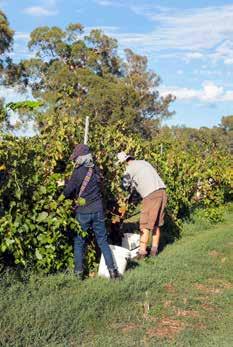
● Vineyard workers performing physically demanding tasks in extreme heat are at risk of environmental heat stroke.
● Heat stroke occurs when the body’s core temperature reaches 40°C or higher, causing central nervous system dysfunction.
● Research examining 1,049 heat stroke cases found all patients presented with acute neurological symptoms.
● Young, fit vineyard workers are not immune, particularly during prolonged outdoor labour such as pruning, canopy work or harvest operations.
● Motor dysfunction and coordination problems were common long-term neurological outcomes.
● Casual or seasonal vineyard workers may feel pressure to keep working during heatwaves, increasing risk.
● Employer heat policies, regular hydration, shaded breaks and active supervision can significantly reduce heatrelated illness during vineyard operations.
As heatwaves become more frequent across Australia’s wine regions, vineyard workers are increasingly exposed to dangerous levels of environmental heat. Drawing on medical research and conversations with clinicians, Paul Le Lacheur examines the serious long-term neurological risks associated with heat stroke and why education, workplace awareness and clear employer policies are becoming essential in modern viticulture.
Ascholarly paper examining environmental heat stroke, published by researchers at the Royal Adelaide Hospital in 2016, provides new insights for our industry into how a warming climate increases risks during vineyard work. More than a literature review, the study highlighted the need for viticultural workers to be protected through education, practical workplace policies, and behaviour modification. The research was conducted by Lawton, Pearce, and Gabb from the Department of Medicine at the hospital.
Here are just a few key points from the paper:
1. There are high rates of mortality and long-term neurological deficits associated with environmental heat stroke.
2. All individuals, including the young and healthy, are at risk of long-term negative outcomes.
3. Cerebellar injury is the predominant clinical picture in cases of persistent neurological dysfunction.
4. Exertion may contribute to the severity of environmental heat stroke.
5. Behaviour modification and occupational adaptation are crucial to reduce adverse outcomes.
Rising temperatures and growing health risks
Global temperatures are rising: extreme environmental heat can result in adverse health effects including heat stroke. Recently, I spoke at length to Dr. Genevieve Gabb, one of the principal co-authors of the paper. Dr. Gabb opened by explaining that the “acute effects of heat are well recognised, but there is less understanding of potential long-term adverse outcomes”.
“We focused on neurological outcomes in cases of environmental heat stroke. The size of the study was significant in reporting outcomes – 1,049 cases, 100 per cent of those presented with acute neurological symptoms.” Dr. Gabb said. Important findings included the fact that 23.3% of those who presented later died. Alarmingly for policy makers, 57.5% of the patients who had died or had a neurological deficit had no documented co-morbidities. The patterns of neurological deficits included a high
Research from a PhD student at the Adelaide University has found technology that removes alcohol from wine can be merged with traditional remediation techniques to alleviate smoke taint, diminishing its impact on wine’s sensory elements.
Spinning one column (SCC) distillation is a leading technology for dealcoholisation, used for creating no- and low-alcohol wine products. When combined with the use of activated carbon, which is traditionally used to remove impurities from wine, the Adelaide University found that SCC distillation “achieved a better overall outcome compared to the use of activated carbon alone”.
Professor Kerry Wilkinson, from Adelaide University’s School of Agriculture, Food and Wine, said that the global wine industry is navigating many climate-related challenges including smoke taint in vineyards after exposure to smoke from bushfires.
“As a commodity of international importance, global wine production was valued at US$333 billion (AU $485.6b) in 2023 and is estimated to reach US$379 billion (AU $552.5b) by 2029.
“Maintaining this value requires urgent solutions to manage the impacts of
global climate change on grape and wine production, including smoke taint.
“Adelaide University PhD student Ysadora Mirabelli-Montan’s research has shown that this combined treatment method remediated the impacts of smoke taint in wines while preserving desirable fruity characters in the end product,” she said.
SCC distillation works by utilising steam and centrifugal force to separate ethanol and aroma volatiles into a condensate, leaving stripped wine comprising of just water, acids, sugars, colour and tannins.
Professor Wilkinson said that when a smoke-affected wine is processed using SCC, most of the compounds associated with smoke taint remain in the stripped wine.
“We can then be more targeted, only applying activated carbon to the stripped wine without also stripping out desirable aroma compounds.”
The condensate and treated stripped wine were then combined once more, and the outcome was “improved fruit expression and less obvious smoke characters”.
Professor Wilkinson noted that there were “small but significant changes” in alcohol concentrations following the treatment, although this “didn’t impact the sensory perception of the wines”.
The trial found that the treatment also caused a major decrease in sulfur dioxide (a product stabiliser), although Adelaide University said that this can be “easily remedied post-treatment”.
Future trials at commercial scale could validate the findings of this small-scale trial, Professor Wilkinson said.
“We treated around 100 litres using our pilot-scale SCC distillation system, but the commercial scale systems used for dealcoholisation in industry can treat much larger volumes,” she said.
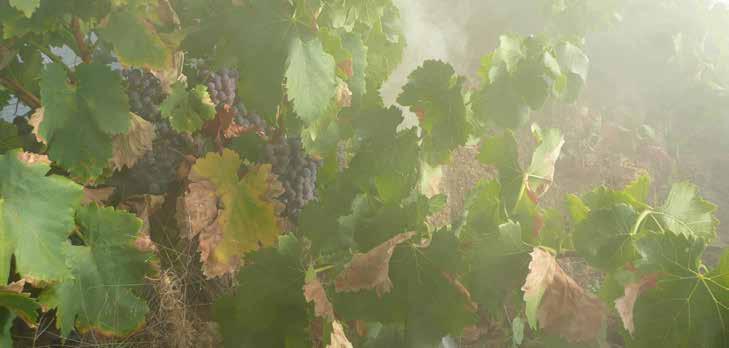
Smoke in a vineyard. Photo courtesy Adelaide University
Vineyard & Winery Technology
AI finds its place in wine
Artificial intelligence is increasingly finding its way into vineyards and wineries, from smart sensors and yield prediction tools to automated disease control and fermentation monitoring. Brendan Black explores how AI is being applied across the grape and wine sector, as well as the opportunities, limitations and questions it raises for growers and producers.
Artificial intelligence (AI) is influencing almost every industry where technology is used, such as telecommunications, finance and healthcare. So it’s no surprise that it’s also entered into the arenas of viticulture and winemaking. While some may welcome its introduction, others are more cautious, but there appears to be a fervent appetite to see what it can do – for better or worse.
AI became known to many people through films such as Star Wars, with the cheeky R2-D2 and pedantic C-3PO, or the more sinister and apocalyptic Terminator. Recent developments in
Depending on the platform, another failure of AI is what happens when it doesn’t know the answer to a question, leading to it ‘hallucinating’.
● AI is entering vineyards and wineries, from sensors to fermentation tools
● Smart sensors track sunlight, soil moisture, temperature and ripeness
● Machine learning helps predict yield and optimal harvest timing
● Autonomous vehicles can treat vineyard diseases with UV-C radiation
● AI tools assist winemakers in monitoring fermentation and maturation
● Limitations include “hallucinations” and inability to assess emotional quality
● AI augments human expertise — it doesn’t replace viticulturists or winemakers
● Initial costs can be high, but long-term labour and time savings are possible
robotics have shown positive progress (or negative, if you believe we’re headed more towards Terminator territory), although it’s likely that we won’t see androids meandering down vineyard rows and selecting the ripest, most disease-free bunches for a few years yet.
AI enters the vineyard
Nevertheless, AI has become more ubiquitous in vineyards and wineries over the last few years, with many companies endeavouring to meet the demand for new tools. One area showing lots of new development is that of smart
Wine producers celebrate Prosecco naming ‘win’, as EU trade deal to boost prospects for Aussie exporters
By Kyra Trussell
Australian wine exporters and domestic-focused wine producers are set to see changes through last month’s conclusion of negotiations on the Australia–EU Free Trade Agreement and a new Australia–European Union Wine Agreement.
Through the new Australia–EU Free Trade Agreement (A–EU FTA), import tariffs on Australian wine exports to the EU will immediately reduce to zero on entry into force, improving the sector’s competitiveness in those markets.
The A–EU FTA negotiations have also provided a resolution for Prosecco.
Australian wine producers will retain the right to continue to use Prosecco as the name of a winegrape variety within Australia’s domestic market. For exports, Australia will protect Prosecco as an EU geographical indication (GI), phasing out
the use on labelling over 10 years from the date the agreement enters into force.
The outcomes for Prosecco will be implemented through a proposed new Wine Agreement that builds on the 1994 and 2009 agreements between Australia and the EU.
Through the Wine Agreement, Australian wine exporters will see additional benefits. Importantly, the new agreement includes protections for Australian wine exporters that will allow all other existing grape variety names to
be used indefinitely, even if they become an EU GI in the future.
Australian wine exporters will also see access to simplified certification requirements, reduced analyte testing requirements, ‘most favoured nation’ treatment for export certification, and protection for seven additional Australian GIs and seven grape variety names.
Wine Australia CEO Dr Martin Cole said Wine Australia will provide comprehensive guidance to producers and exporters through the transition of changes from the agreements.
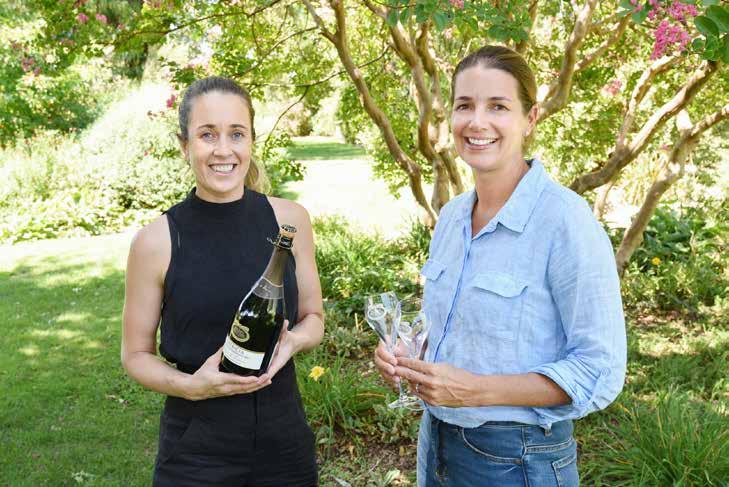
Brown Family Wine Group head of innovation Emma Brown, with luxury portfolio manager Katherine Brown (right)