Australian Forests & Timber News Jan | Feb 26

Page 1


Onet r ak

Call for science-based approach to fire management

Victoria must embrace a coordinated, science-based approach to fire management in the wake of the state’s largest major bushfires in years, which saw more than 400,000 hectares of forest and agricultural land burnt, destroying hundreds of structures, and claiming life during catastrophic fire conditions, according to Timber Towns Victoria.

TTV president Cr Karen Stephens said the fires reinforced what forest scientists have long understood — that prescribed burning and the strategic use of “good fire” must play a central role in reducing landscape scale risk.

“A coordinated proactive fire management approach, guided by scientific evidence, needs to be prioritised as a key method of reducing the future risk of catastrophic fires of this intensity,” Cr Stephens said.

At the height of the emergency, Victoria faced several major fires simultaneously, with data from emergency authorities showing more than 100 separate burnt areas since January 5. The Longwood and Walwa fires alone each exceeded 100,000 hectares, while many smaller ignitions were contained quickly.

HVP estimates its plantation damage to be in excess of 10,000 hectares, with the full extent of the impact still being assessed. It is

early days in what will be a long and complex recovery process.

Cr Stephens points to Forestry Australia’s Forest Fire Management Position Statement, released in June 2023, which stressed that fire is an inherent part of the Australian landscape and cannot be eliminated without consequences.

“It stresses that effective fire management must be grounded in decades of research, Traditional Owner knowledge, and coordinated action across all land tenures - public and private,” she said.

The statement, prepared by a number of Australia’s top forestry professionals and scientists, argues that prevention, and not just emergency response, must be prioritised, with yearround vegetation management, risk appropriate land use planning, and the

strategic use of prescribed burning, cultural burning and mechanical fuel reduction forming the backbone of resilient landscapes. In addition, it also highlights the importance of rapid detection, with shorter detection to response times significantly increasing the likelihood of containing new ignitions.

These principles have been thrown into sharp relief as the scale of the current disaster becomes clearer. The Mt Lawson–Walwa and Longwood fires have destroyed extensive areas of pine plantations, delivering the industry’s most significant plantation losses in years and placing pressure on regional communities, agriculture and the forestry supply chain.

According to the Victorian Forest Products Association (VFPA), losses in plantation losses has been substantial.

VFPA Chief Executive Officer Andrew White said the fires had damaged “critical parts of Victoria’s housing supply chain”, noting that softwood plantations underpin the manufacture of paper, packaging, framing, trusses and other essential building products.

“Our plantation sector is resilient and well established, and industry is working closely across the supply chain to manage the impacts of the fires while continuing to support housing delivery,” Mr White said.

Mr White nonetheless commended the “extraordinary efforts” of emergency services, particularly Forest Fire Management Victoria, the CFA and Forest Industry Brigades, which he described as “an integral part of Victoria’s fire response capability, bringing local knowledge, specialised equipment and experience in plantation fire behaviour”.

Cr Stephens highlighted

the dedication of the emergency response services

“We acknowledge and commend the outstanding efforts of fire fighters and all the emergency services personnel who have worked tirelessly to protect lives, landscapes and livelihoods,” Cr Stephens said

“This fire season must be a turning point. We call on government to listen, learn and lead.”

Page 10 – MY VIEW

● Timber Towns Victoria president Cr Karen Stephens.
● The fires in north central Victoria alone each exceeded 100,000 hectares. Picture courtesy Corryong Courier

37 Established 1991 News 3-16

My View 9-10 Fire safety 17

Conferences 18-19

Carbonizers 20-21

Forest transport 22-23

Mill Profile 24-25

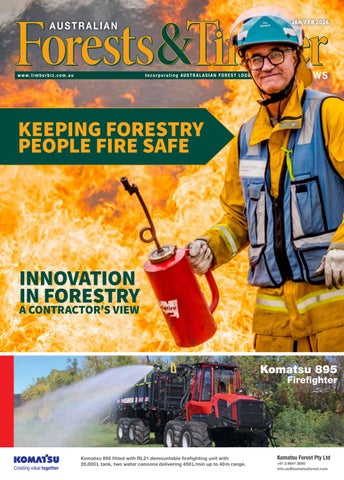
Front Cover:Richard Parker’s days revolve around keeping people safe and productive. The Bioeconomy Science Institute human factors scientist can usually be found on the front line of forestry research, collaborating with people to identify problems in their work environment.

Story Page 17

Publisher and Chief Executive: Hartley Higgins

General Manager: Robyn Haworth

Editor: Bruce Mitchell

b.mitchell@ryanmediapl.com.au

Adelaide Office: (08) 8369 9521

Advertising: Jamie Richardson

j.richardson@winetitles.com.au

Adelaide Office: (08) 8369 9514

Creative Services: Robyn Haworth

Trader classifieds:

Jamie Richardson

Adelaide Office: (08) 8369 9514

Subscriptions:

subs@forestsandtimber.com.au

Adelaide Office: (08) 8369 9500

Subcription rates

One-year (6 editions) $44.65

Two-years (12 editions) $77.65

Accounts: ar@winetitles.com.au

Adelaide Office: (08) 8369 9500

Postal Address: 630 Regency Road, Broadview South Australia 5083 Phone: (08) 8369 9500

Melbourne Office: Suite 2262, 442 Auburn Rd, Hawthorn VIC 3122

Phone: (03) 9810 3262

Website www.timberbiz.com.au

Printed by Lane Print, Adelaide, SA

Conditions

The opinions expressed in Australian Forests & Timber News are not necessarily the opinions of or endorsed by the editor or publisher unless otherwise stated. All articles submitted for publication become the property of the publisher. All material in Australian Forests &

Forestry minister demoted to ‘unwinnable’ election spot

South Australia’s Forestry Minister – and the State’s only regional minister - Clare Scriven has been dropped down the order of Labor’s upper house ticket to the almost unwinnable fifth spot for the March 21 state elections.

Ms Scriven, who also hold the Primary Industries and Regional Development portfolios has been relegated behind backbenchers Justin Hanson and Mira El Dannawi and newcomer Hilton Gumbys, a machinist and fitter with ties to the Australian Manufacturing Workers’ Union.

Infrastructure and Transport Minister Emily Bourke is top of the ticket, retaining the place she had on her election to the upper house in 2018.

Ms Scriven, who is from the South East and was at one time State manager for the Australian Forest Products Association, was elected from fourth on the ticket.

A senior Labor source told The Advertiser in Adelaide there was “no champagne being popped” at having Ms Scriven at fifth spot on the ticket, but that the order had come down to deals between Labor’s two major factions.

“Clare has done a really good job of listening and

getting involved in needs regionally,” the source said. “She campaigns very strongly in the South-East, so it actually contributes to hopefully strengthening our LegCo (Legislative Council) position.”

The Advertiser reports that Labor Unity and Labor Left were entitled to spots one and five and two and four respectively, with the outlier, the number three spot, determined by the Australian Workers’ Union, who backed incumbent Mr Hanson.

In October 2024, Ms Scriven unsuccessfully supported amendments proposed by Liberal MP Ben Hood

aimed at restricting lateterm abortions.

This stance put her at odds with many in her party and reproductive rights advocates.

It was widely reported at the time that her support underscored internal party divisions on the issue.

A senior government source told The Advertiser Ms Scriven was competent and a “team player” but conceded it would be a “hard task”, but “not insurmountable”, to win from No.5 on the ticket.

“There’s been more biosecurity incidents in the past four years than there have been in a very long time, all of which were out of the government’s control,” the source said.

The source said the optics of dumping the only regional minister had been “part of some discussions” but defended the government’s regional record over the past four years.

Labor state secretary Aemon Bourke told The Advertiser Labor was putting forward a “strong Legislative Council ticket” for the election.

“In 2022, the ALP secured the election of five Legislative Council members, and we are intending on yet again running a strong upper house campaign,” he said.

“Clare Scriven is a strong minister with a proven track record of delivering and the Labor team will be campaigning strongly to secure her re-election.”

Speaking on the placement for the ticket, Ms Scriven said Labor had a strong record in terms of what has been delivered for the state, particularly for regional areas.

“I have been a bit part of that as a Member of the Legislative Council for the past eight years and as the Minister for Primary Industries, Forest Industries and Regional Development,” Ms Scriven said.

“As a resident of Port MacDonnell myself, I have been very active in the Limestone Coast and as a government we have been able to deliver a number of significant projects for the region including the $24 million Mount Gambier Hospital upgrade, new TafeSA upgrade and the new Mount Gambier Technical College which will be opened this year.

“I am passionate about representing the community in the Legislative Council, with a strong focus on the Limestone Coast andI am looking forward to being able to continue to do that in the coming eight years if I am fortunate enough to be re-elected.”

Politics seems to come down to taking turns

Entering the world of government – be it at a federal, state, or even local level – can be very rewarding.

Being prepared to commit to do so much for so many – in some cases for very little return - is very altruistic with the thought of gaining nothing much more than the feeling of a job well done.

omissions,

Unfortunately, with government comes politics, and with politics come things like quotas, and even worse comes what can only be described as “muggin’s turn”.

It usually means that it’s not a case of the best or most qualified person being selected by a political party; rather it’s a case of which faction gets their candidate up because it’s “their turn”.

This brutal system rears it’s ugly head more often than not in the upper Houses; in the Legislative Councils and the Senate.

And it’s all about where

your name appears for your party on the ballot paper.

And so it goes that the Party says something like “Thank you for your services, your contribution has been invaluable, but we will be putting you sixth on the ballet paper”.

And that “sixth” – or whatever position – is always just one below the universally accepted winnable spot because it’s someone else’s turn to get a seat in parliament.

South Australia’s Forestry Minister – and the State’s only regional minister -

Clare Scriven has been dealt exactly that card for the upcoming State election.

Ms Scriven, who is from the South East and was at one time State manager for the Australian Forest Products Association, has more class than to complain about it.

She has been a valuable and powerful advocate for the Green Triangle and the timber industry as a whole. She can technically win from an unwinnable position, but if not then she will be another victim of “muggin’s turn”.

● South Australia’s Forestry Minister Clare Scriven.

Green Triangle forester recognised for post-fire recovery

Silviculture forester

Neil Turner as the 2025 recipient of Australian Bluegum Plantations’ John Kiely Award, recognising his outstanding leadership and perseverance in responding to one of the most significant environmental and production challenges faced by the business.

Established in 2024, the John Kiely Award honours an ABP staff member who demonstrates exceptional commitment to tackling difficult challenges while delivering strong environmental and commercial outcomes. The award is named in memory of industry champion John Kiely, a long serving ABP team member whose career exemplified innovation, determination and a willingness to rethink traditional approaches to achieve better operational results.

In its second year, the award recognises Mr Turner’s leadership following the devastating January 2022 fire at ABP’s Callendale Plantation in the Wattle Range area of south-east South Australia. The fire impacted more than 1000 hectares of plantation estate, creating unprecedented rehabilitation and reestablishment challenges.

proach that balanced immediate recovery pressures with longer-term landscape health. His leadership ensured environmental risks were effectively mitigated, new learnings were embedded into operations, and production objectives were maintained without compromising environmental values.

ABP CEO Russ Hughes said Neil’s work extended to establishing new fire water resources in the local drainage network to mitigate future fire risk.

we have staff, like Neil that are continuing John’s legacy and commitment,” Mr Hughes said.

“Neil’s leadership at Callendale set a new benchmark for how large-scale environmental rehabilitation can be delivered alongside commercial objectives.”

Mr Turner said he was “incredibly honoured” to be recognised with the award.

His response involved complex decision-making, including delaying planting in some areas and trialling new establishment tech-

Confronted with extensive fire damage, erosion risk and highly sensitive environmental conditions, Mr Turner led a reestablishment program that went beyond standard plantation silviculture practices.

niques in others to improve environmental outcomes while protecting long-term productivity.

Rather than defaulting to established practices, Mr Turner adopted a measured, evidence-based ap-

“Neil demonstrated exactly what this award stands for - innovation under pressure, perseverance through uncertainty, and the courage to challenge established approaches in pursuit of better outcomes.

This was John’s approach and I am very pleased that

“The work at Callendale was one of the most challenging projects of my career and it was only possible because of the support, trust and teamwork across the ABP team. I’ve always valued being part of an organisation that backs its people to innovate and look outside the box, even when the hard decisions take time,” he said.

Online survey seeking koala park feedback

The NSW Government is seeking community input to shape recreational opportunities in the proposed Great Koala National Park on the NSW Mid North Coast.

An online survey is now open on the NSW Have Your Say website to seek feedback on current use of the State forests and reserves within the planned area of the park.

The survey complements ongoing wider consultation with community groups who have so far provided more than 300 responses on what matters most to them when they visit these areas.

Input from 4WD clubs, mountain biking clubs, hiking/bushwalking and trail runners’ clubs, horse riding and trail riding clubs, archery and gun

clubs, sporting car clubs, local government, environment groups and Aboriginal communities is already feeding into the planning for future management.

The overarching park will comprise individual reserves, which will enable a range of different recreational activities. While legislation determines what activities are permissible in each reserve category,

we are looking to build the Great Koala National Park as a place where conservation is balanced with the community’s recreational needs.

“The Great Koala National Park will protect more than 100 threatened species, but it’s not just about conservation. The park will be a recreational hotspot for locals and visitors alike,” Acting Minister for the Environ-

ment, Steve Whan said.

“We want to hear from people who use and relax in the footprint of the forests and surrounding landscapes that make up the park.”

The Have Your Say survey is open until Sunday, 1 March and is available online: www.haveyoursay. nsw.gov.au/great-koala-national-park

● Australian Bluegum Plantations CEO Russ Hughes with John Kiely Award winner Neil Turner.
● The late John Kiely.

NSW in good shape to fight summer fires

Southern NSW’s primary industries are in good shape ahead of the summer season with millions of dollars in fire protection measures completed to help protect local communities and critical softwood plantation timber from bushfire threats.

The seven completed projects, valued at $3.2 million, are part of the NSW State Government’s $12.9 million Southern NSW Timber Plantations Fire Protection funding package.

While the projects will protect plantation resources, they also provide increased protection for residents and businesses in the area following the 2019/20 devastating bushfires and play a vital role in protecting the remaining critical timber supplies in the Murray region.

FCNSW regional manager Tumut, Roger Davies, said the projects represented a collaborative effort between local government, RFS, National Parks, Forestry Corporation, and private forestry companies, coordinated by the Softwoods Working Group.

Projects completed by FCNSW include the acquisition of a $1.5 million firefighting forwarder with high-flow pumped water distribution.

The vehicle will allow firefighters to reach areas which regular firefighting trucks are unable, enabling delivery of large volumes of water in difficult terrain and situations, and reducing exposure of firefighters to overhead hazards.

Additionally, FCNSW

“We can use the skills that are inherent to the logging industry to help with firefighting, and it’s also keeping people inside a cab, guarded, and improving safety outcomes,” he said.

“A falling tree limb that would be fatal for someone on the ground with a helmet on will bounce off the forwarder.

“The water tankers also increase our capacity to deliver bulk water. It’s about being able to get high volumes of water where you need it, to support fire tankers and other firefighting equipment.”

mountains – all this equipment will be deployed district-wide if the RFS call on it, and nothing’s particularly focused on one area - it’s spread right across the whole region.”

Mr Davies said collaboration was key to firefighting in the region, and one of the Snowy Valleys area’s strengths.

“It’s one of the real strengths of the region, that it’s very cooperative,” he said.

received $100,000 for the provision of two trailer mounted quick fill water pumps, which will facilitate rapid refilling of bulk water transport trucks and larger capacity fire tankers, and $456,000 for two semitrailer tankers for delivery of bulk water for firefighting operations undertaken by all agencies.

FCNSW stewardship and fire manager Tumut, Charlie Taylor, said the intent of the projects is to optimise

early attack.

“You can’t deploy the water transport equipment as quick as a fire tanker because they have to be moved with a low-loader truck and transported to the fire, but because of their allterrain capability they can access areas that can’t be accessed with fire tankers,” he said. Mr Davies said the new equipment gives FCNSW a bit to learn, but the advantages for firefighting in the region are immense.

Mr Taylor said FCNSW crews had been training with the new equipment during plantation burns and hazard reduction burns in native forestry areas, ensuring crews have the necessary experience when an emergency scenario presents itself.

“Funding has also helped us to upgrade fire trails and fire access roads within and adjacent to plantation areas,” he said.

“All these projects benefit anywhere between the Hume Highway and the

PF Olsen and Forest360 agree to merge

Two of New Zealand’s leading forestry businesses PF Olsen and Forest360 have announced their merger to create the largest independent forest management company in Australasia.

As part of the transaction, PF Olsen and Forest360 will bring on private investor Adamantem Capital

as an investment partner, alongside existing PF Olsen cornerstone shareholder Quayside Holdings to support the group’s next stage of growth. Combining decades of experience, complementary services and deep regional roots, the merger will make for a stronger, more resilient business for forestry

clients across New Zealand and Australia. Together, the group will manage approximately 480,000 hectares of forest and support more than 1000 clients, from major institutional investors to familyrun businesses and private landowners.

The merged group will be guided by shared values:

a commitment to trusted relationships, technical excellence, environmental stewardship and supporting the long-term productivity of New Zealand and Australian forests. These principles will underpin a platform focused on sustainable forestry solutions designed to help landowners realise the full potential and value of

“Rather than see a fire and ignore it, everyone will pitch in and help each other. In the last week we’ve deployed helicopters to fires, we’ve deployed a bulldozer, and tankers and support crews to assist.

“The majority of those fires weren’t in state forests but when they are, the RFS help us.”

Both Mr Taylor and Mr Davies from FCNSW said the projects all contributed to an ecosystem of projects funded by government to benefit the wider community, said they have come at a pertinent time.

- Tumut and Adelong Times

their land. Existing executives will lead the merged entity, with Forest360’s Managing Director Dan Gaddum being appointed Group CEO, PF Olsen’s CEO Ross Larcombe appointed Group Chief Commercial Officer and Forest360’s Marcus Musson appointed Group Chief Operating Officer.

● FCNSW fire and stewardship manager Tumut Charlie Taylor and operator Bradley Wilesmith.
● A new semi-trailer tanker and firefighting forwarder are among Forestry Corporation NSW’s new fire protection measures.

New partnership to accelerate carbon market leadership

SFM has entered a strategic partnership with leading Australian carbon platform Clima to enhance its carbon trading capability, ensure regulatory compliance, and support the growth of its plantation-based Australian Carbon Credit Unit (ACCU) program.

The partnership provides SFM with immediate access to Clima’s market infrastructure, licencing framework, and compliance systems—accelerating its ability to participate confidently in Australia’s evolving carbon market.

“Clima is a highly regarded platform with deep carbon market expertise and the regulatory credentials we need to trade responsibly and at scale,” said David Wise, SFM’s Managing Director of Strategy, Risk and Trading. “This is a practical investment in capability that enables SFM to efficiently deliver on its carbon strategy.”

Under the agreement, SFM—which currently

manages 30 per cent of Australia’s plantation carbon projects—will operate as a Corporate Authorised Representative (CAR). This removes the 12–24-month lead time typically required to secure an Australian Financial Services License (AFSL) independently and provides access to Clima’s established systems, market knowledge, and trading infrastructure.

Clima’s Managing Director & Head of Trading and Portfolio Management, Guy Dickinson describes Australia’s forestry carbon market as rapidly maturing, with growing demand for locally available, highintegrity plantation ACCUs.

“SFM is bringing a vertically integrated approach to this space, managing the carbon value chain from seedling to sale,” Mr Dickinson said.

“With the forestry market providing material supply over the next decade in the order of tens of millions of ACCUs, this partnership sets the tone for other na-

ture-based solutions in the Australian market.”

As regulatory oversight increases and ACCUs continue to evolve as financial products, the partnership ensures SFM is not only compliant but wellpositioned to scale. It also delivers a fully integrated back-office and reporting framework—reducing regulatory risk and supporting alignment with SFM’s existing client obligations.

SFM Managing Director Andrew Morgan said the partnership brings valuable market connectivity.

“Clima’s active role in the carbon market gives us access to structured contracts, pricing insights, and a network of major buyers. It supports our strategy to differentiate SFM’s plantation-based ACCUs as a premium carbon solution—underpinned by traceability, integrity and long-term environmental value.”

While each organisation brings different strengths and decades of experience in their respective fields,

the partnership reflects a shared commitment to quality, transparency and innovation in carbon project delivery.

“This is not about trying to do everything ourselves,” Mr Wise added. “It’s about partnering with trusted experts to move faster, reduce risk, and create long-

term value across the carbon supply chain.”

The agreement also supports future growth in land partnerships, ACCU offtake agreements and methodology development — reinforcing SFM’s position as a leader in plantation-based carbon projects.

New Chair, Director to lead next phase of growth

As demand for sustainable design materials accelerates, Tasmanian timber innovator Hydrowood has bolstered its leadership with the appointment of two high-calibre independent directors.

Dr Allison Anderson has been appointed as chair, and Radha Kuppalli as an independent director.

Both bring nationally and globally recognised expertise in regional development, sustainable forestry and nature-based investment—skills that will be critical as Hydrowood looks to grow its business and scale its impact in providing premium sustainable native timber products to a variety of commercial and bespoke architectural customers.

The appointments follow the conclusion of Paul

Viney’s tenure as chair, during which Hydrowood completed a successful crowd-sourced funding (CSF) raise, welcomed two cornerstone investors contributing $5 million in new capital, and embedded public-market-style governance.

“Paul played a key role in strengthening Hydrow-

ood’s governance through a period of rapid growth. We’re grateful for his commitment and steady leadership,” said David Wise, Hydrowood co-founder and director.

Incoming chair, Dr Allison Anderson is a seasoned director, strategy advisor, and sustainability advocate with deep experi-

ence across government, community and business.

A PhD holder and Graduate of the Australian Institute of Company Directors (GAICD), she also serves as Chair of the Northern Tasmania Development Corporation and is a member of the Parks and Wildlife Advisory Council.

“Allison’s strategic mindset, knowledge of regional development, and passion for environmental stewardship make her an exceptional Chair for our business,” said Mr Wise. “She understands the value of place, story and purpose, everything Hydrowood stands for.”

Radha Kuppall is a global leader in sustainable investment and natural capital finance with 25 years of experience including 17 years at New Forests. She holds Masters’ de-

grees from the Yale School of Management and the Yale School of the Environment and has helped shape carbon markets, ESG frameworks and forestry governance internationally.

“Radha brings deep experience in connecting capital with sustainability—her leadership in forestry, carbon, and ESG investment will be a major asset as we grow our influence in design and construction markets,” said Andrew Morgan, co-founder and Director. “We’re thrilled to have her at the table.”

Hydrowood’s board now comprises two independent directors and two executive founders, providing a balance of strategic oversight and deep operational experience in the timber sector.

● Clima’s Guy Dickinson with SFM’s Managing Director Strategy, Risk and Trading, David Wise.
● New Hydrowood independent director Radha Kuppalli.
● New Hydrowood Chair Dr Allison Anderson.

Forestry's overlooked potential

Australia stands at a crossroads in managing its vast and vital forests.

Concern about recent EPBC legislation changes have sparked debate, however these changes present an opportunity to re-evaluate our management approach for these essential ecosystems.

At the forefront of this change are our farmersthe ultimate conservationists. They manage the land not just for production, but to achieve sustainable environmental outcomes, all within a highly regulated framework. Their dedication is evident, with farmers proudly displaying their environmental credentials on their sleeves.

The significance of farmers in environmental stewardship is underscored by the roots of Landcare, Australia’s largest volunteer environmental organization,

which emerged from rural concerns to promote innovative production and conservation practices. Farmers, engaging in Landcare initiatives, have made significant strides in regional ecosystems’ management, proving that agriculture and environmental care can go hand in hand.

Managing over a quarter of Tasmania’s landmass, these farmers are the nation’s original stewards of the land. For too long, the narrative around for-

est management has been overly simplistic, often pitting conservation against economic interests.

However, a more nuanced understanding reveals that sustainable forestry practices can deliver both environmental, social and economic benefits. Instead of viewing our forests as either untouched wilderness or sources of raw materials for clear-felling, we need to embrace a model that emphasizes careful management, scientific understanding, and long-term thinking.

One of the most promising approaches is selective logging, a practice that involves carefully removing specific trees while preserving the integrity of the surrounding ecosystem. Unlike clear-cutting, which can decimate habitats and release vast amounts of stored carbon, selective logging minimizes disrup-

tion and promotes biodiversity. It allows sunlight to reach the forest floor, encouraging the growth of new trees and understory. But the benefits of selective logging extend beyond biodiversity conservation. It also offers a powerful tool for carbon sequestration. By maintaining a healthy forest structure, selective logging ensures that trees continue to absorb carbon dioxide from the atmosphere. Moreover, when timber from selectively logged forests is used in products like furniture and construction materials, the carbon stored in the wood is effectively locked away for decades, even centuries. In contrast, the current approach of locking up forests and walking away is not only economically unsustainable but also environmentally irresponsible. However, to realize the full potential of sustainable

forest management, we need a shift in mindset and policy. First, we must move away from the outdated mantra of “think global, act local” when it comes to timber.

Second, we need to embrace a science-based approach to forest management, one that incorporates both traditional ecological knowledge and contemporary research. Third, we will foster collaboration among all stakeholders, including government, industry, and local communities.

Finally, we need to recognize the economic opportunities that sustainable forest management can create. By investing in local processing and manufacturing, we can create jobs, boost regional economies, and reduce our reliance on imports.

MY VIEW Ian Sauer, TasFarmers President

Early detection, planning, partnerships critical

With fire season already upon us, the message is clear: preparation, partnership and early detection save lives, livelihoods and landscapes.

Forecasts point to warmer than usual summer temperatures, with the Bureau of Meteorology predicting an increased chance of unusually high daytime and night-time temperatures. For those of us who live and work in Tasmania’s forests, these are not abstract warnings. They are real and present risks that require co-ordinated action.

The forestry industry has long recognised the threat bushfires pose to our environment, regional communities and economy. We are custodians of working forests that underpin a $1.2bn sector and support more than 5000 Tasmanian jobs. Protecting those forests is not optional, it is fundamental to our businesses, our workforce and the communities that rely on us.

That is why the industry invests heavily in prevention, preparedness and rapid response.

Active forest management plays a critical role in reducing fire risk. Maintaining access tracks, managing vegetation and ensuring forests remain working landscapes all help lower fuel loads and improve the ability of firefighters to respond quickly and safely.

Just as importantly, forestry people and machinery are already in the landscape when fires ignite. Private forestry companies

$1.4m

Scollectively operate some of the largest, most coordinated firefighting resources in Tasmania. When a fire starts, our crews can move immediately to cut firebreaks, contain flareups and support emergency services on the ground.

The technology we use is now becoming just as vital as the traditional boots and machinery.

For example, the Tasmanian government’s recent $1.4m investment in an integrated fire detection camera network is a welcome and important step forward. Early detection is one of the most powerful tools we have to prevent small ignitions becoming major fires, particularly in remote or difficult terrain.

Camera networks, when combined with rapid response capability, can dramatically reduce response times, often making the difference between a contained incident and a large-scale emergency. This investment recognises what firefighters and land managers already know – the earlier we see a fire, the faster and safer the re-

sponse.

But fire does not recognise land tenure boundaries, and neither should our detection systems.

To truly maximise the value of this investment, Tasmania now needs a coordinated work plan between government and industry to expand fire detection cameras across all land tenures including large private forestry estates and other significant landholders.

Private forestry manages extensive areas of the landscape, often in highrisk regions. Integrating these estates into a single, connected detection network would strengthen coverage, close gaps and deliver a genuine whole-of-landscape solution. It would also leverage industry expertise, infrastructure and willingness to invest alongside the government while avoiding duplication and benefiting from strategic integration, coordination and shared responsibility.

Communication remains the lifeline of any fire response. The continued access provided to private forestry crews to the Tasmanian Government Radio Network (TasGRN) is another example of effective partnership in action. Secure, real-time communication improves safety, co-ordination and decision-making when minutes matter.

Together, these measures reflect a growing recognition that forestry is not only an economic contributor, but a frontline partner in protecting Tasmanian communities from bushfire.

The lessons from previous devastating bushfires remain stark. Conditions can escalate rapidly, and success depends on skilled crews, early detection, clear communications and co-ordinated response. Tasmanian foresters played a significant role in those efforts, bringing heavy machinery, local knowledge and rapid deployment capability that helped protect lives and property.

This summer will test us again.

The forestry industry is ready, with trained people,

specialised equipment, strong safety systems and a culture of prevention. What we now need is a clear, collaborative plan that brings together government, emergency services and major landholders to expand and integrate fire detection technology across the entire landscape.

Fire preparedness is strongest when it is shared.

If we work together across agencies, industries and land tenures we can better protect our forests, our communities and Tasmania’s future.

AI-enabled fire camera network for Tas

ustainable Timber Tasmania has received a $1.44 million grant to lead the creation of an Integrated Fire Camera Network, in collaboration with the Tasmania Fire Service and the Tasmania Parks and Wildlife Service, with Indicium Dynamics as delivery partner.

When completed, the network is expected to become Australia’s largest integrated bushfire detection camera system.

The project is funded by the Australian and Tasmanian governments through Round Three of the $1 billion Disaster Ready Fund (DRF), administered by the

National Emergency Management Agency (NEMA), as part of the commitment to reduce disaster risk and build resilience nationwide.

Cash and in-kind contributions from all three agencies will combine to give the project a $3.62 million value. The network

will form a broad-scale AIenabled fire detection network providing real-time monitoring and early bushfire detection—projected to become Australia’s largest integrated bushfire detection camera network. It will enhance crossagency coordination through a shared real-time

centralised fire management portal.

New 24/7 AI fire detection cameras will be installed across high-risk areas statewide, almost doubling the combined network to more than 30 cameras across the three agencies and integrating all feeds into a single, coordinated portal.

MY VIEW Nick Steel Tasmanian Forest Products Association
● The Tasmanian government’s recent $1.4m investment in an integrated fire detection camera network.

Timber processors disappointed in response to recommendations

TIMBER processors in the Green Triangle have expressed disappointment in the state government’s response to a number of recommendations.

The South Australian Government released its response to 17 recommendations made by the Select Committee on Matters Relating to the Timber Industry in the Limestone Coast and Other Regions of South Australia.

The committee was first established under the previous Liberal Government before a caretaker period prior to the 2022 election put a pause on its continuation. It was re-established under the current government with submissions heard and closed in 2023.

The recommendations

spanned from an examination by the auditor-general into the state’s contract of sale of forward rotations and plantation lease agreements to implementing and advocating for a code of conduct.

Other recommendations included making the definition of sawlog and pulplog consistent, as well as creating a committee to investigating water allocation planning for the state.

Kalangadoo Plantation

Treated Timber owner and operator Peter Badenoch said he was disappointed the state government was not prepared to “advocate and lobby” other jurisdictions to have a code of practice implemented.

“I have no current issues purchasing the fibre I need for my business and in the

last few years, the forest growers have all been good to deal with,” Mr Badenoch said. “My concern is that although the fibre I have needed in recent times has been available, when the Forest growers export again, as they inevitably will, prices recover as part of the cycle and the inability to purchase fibre will reoccur.”

Timber processing industry consultant David Quill said while the code of practice would be beneficial, he noted the recommendations were “null-and-void” due to being out of date.

Mr Quill said this was due to the previous government going into caretaker mode for the 2022 state election and during the years since, the forestry industry had adapted to the issues in

order to survive. This was done by either altering business models or selling the business altogether.

“The government believed the industry had changed to the extent the recommendations were ineffective… it was the lack of, to a significant extent, compliance with the condition of the lease agreement that has brought about the change to industry as we see it today,” Mr Quill said.

He said he also agreed there should be an investigation held into sales agreements and plantation lease agreements by an auditor-general.

“The plantation lease agreement is a public document, the sale agreement is a cabinet held document so nobody knows what is in that,” Mr Quill said.

“It is being guarded could mean there were significant breaches of that sales agreement but if there were it is too late so there is no point.”

He said since the committee was formed, there had been smaller processors who had sold and moved on with others still in the process of being sold.

“Other had to substantially modify the businesses where they may have been accustomed to a certain classification of material,” Mr Quill said.“They no longer have that material and they have had to make capital investment to modify the manufacturing process to use that class of material rather than what they were accustomed to.”

The Border Watch

Victoria’s bushfires show need coordinated approaches

Victorians are living through another black summer, with fires burning through more than 400,000 hectares of forest and farmland and leaving communities from Natimuk to Walwa confronting loss.

The scale of the damage underscores the need to continue evolving how we manage our landscapes to better prepare for fire.

Across my career one lesson has remained consistent: fire is an unavoidable part of Australian ecosystems, but the extent of its impacts is shaped by how we prepare for and manage it. Effective fire management requires coordinated action across all land tenures - public and private land. Prevention of damaging fire must be prioritised. We should not rely on emergency response and recovery as our primary fire management strategy. Vegetation management, appropriate building design and land use planning that reflects local risk can sig-

nificantly reduce exposure. This work should occur 365 days a year, long before a fire starts, giving communities a better chance of avoiding severe impacts.

The strategic use of “good fire” is also essential.

Prescribed burning, cultural burning led by Traditional Owners and mechanical fuel reduction, when applied appropriately in the right locations and at the right scale, can help reduce landscape risk. A substantial body of Australian research supports this.

For example, the former Bushfire and Natural Haz-

ards Cooperative Research Centre, a national research program funded by government, universities, CSIRO and fire agencies, produced extensive studies showing that well-planned prescribed burning reduces fire severity and improves suppression opportunities. Research from the University of New South Wales, the University of Melbourne and the CSIRO show that fuel reduction activities reduce the likelihood of fires escalating into uncontrollable events.

These treatments are most effective when coordinated across tenures. The Walwa fire, which has damaged farmland, timber plantation and public land, illustrates that fire does not recognise boundaries. As a result, a landscape scale approach is essential to prepare for and mitigate fire spread

Rapid detection and initial attack are critically important once a fire does start. Effective response systems, including pre positioned ground and aerial

detection resources, are vital to reducing the likelihood that a small ignition will become a major fire. Evidence from Australia and overseas shows that shorter detection to response times significantly improve the probability of containing new fires and that even short delays in response can materially change suppression outcomes.

Adaptive managementlearning from each season and new science and adjusting practice accordingly - must underpin all aspects of fire management. This includes integrating Traditional Owner knowledge, monitoring ecological outcomes and ensuring that treatments remain effective under a changing climate. Research from Charles Darwin University’s Fire and Savanna Research program and studies published in the International Journal of Wildland Fire highlight the value of adaptive programs that respond to shifting conditions. None of this is possible

without people who are connected to and in touch with the land. Our members in government agencies, forestry companies, volunteer brigades and communities contribute essential expertise to fire preparedness, response and recovery. Reducing resources in rural and regional communities combined with decisions that risk being viewed as Melbournecentric, undermine this critical expertise.

As Victoria faces challenging conditions, the focus must remain on evidence based approaches. Preparation and prevention activities year-round, continuously improving detection and response capability, and sustaining regional and rural capacity to deliver these actions will help reduce harm and strengthen resilience. Fire will always be part of Australia, but with a coordinated, science informed approach, its impacts can be better managed.

Three new faces join Forestry Australia board

Three new direc-

tors have joined the Board of Forestry Australia. They are Dr Lyndall Bull (as Vice President), Leon Holt and Anne Chuter.

Dr Bull is a forester with expertise in innovation and the bioeconomy. Lyndall has worked in a senior capacity in the government, private education and intergovernmental sectors.

Anne Chuter is a forest ecologist with a commitment to sustainable forest management and balancing environmental value with timber industry needs. She holds a Bachelor of Science with Honours from the University of Tasmania and has built her career within the Tasmanian government, working across biodiversity management,

forestry regulation, and policy development. Leon Holt is a farm forester and mid-career professional with a background in native forest management and regulation in Victoria.

He has a Master of Forest Ecosystems Science and a Bachelor of Arts & Science from the University of Melbourne.

Dr Sam Van Holsbeeck has been appointed as a Board Observer to support

emerging leaders with exposure to governance and strategic decision-making, build Forestry Australia’s future leadership pipeline, and bring diverse perspectives into Board discussions.

“The new Board represents a fresh chapter for the association, combining deep experience with emerging leadership from

a more diverse cohort and will build on the momentum achieved in recent years,” Forestry Australia’s President Dr Michelle Freeman said.

“With strong member engagement and record participation in this year’s Director elections, the Board is well positioned to guide Forestry Australia through the opportunities and chal-

lenges ahead.

“The election attracted a very strong field of candidates , reflecting the depth of expertise and commitment within our membership. More members voted in this year’s election than in recent history, demonstrating strong confidence in the association’s strategic direction and leadership.”

MY VIEW
Dr Michelle Freeman, President Forestry Australia
● Dr Lyndall Bull. ● Leon Holt. ● Anne Chuter.

$2.9m investment for Portland processing facility

The Federal and Victorian Governments have joined forces to back the development of Australia’s largest plantation hardwood and softwood processing facility in Portland creating local jobs and boosting regional manufacturing.

Federal Minister for Agriculture, Forestry and Fisheries Julie Collins and Victorian Minister for Agriculture Ros Spence announced the joint $2.95 million investment in research to support the initial stages of the ‘Precinct Project’ in regional Victoria.

Australian Forest and Wood Innovations (AFWI) will lead the feasibility study of a new processing facility in Portland, so that more locally grown timber can be manufactured locally, into products like glue laminated timber, laminated veneer lumber, and

housing solutions – reducing Victoria’s reliance on imports and creating up to 200 jobs.

The project unites industry, academics, Traditional Owners, and all levels of government to undertake an over $7 million research, development and feasibility project for a new advanced plantation timber manufacturing and innovation hub in Portland over the next two years.

This research will support the development of a shared advanced manufacturing facility, where expert manufacturers work together to connect forests to frames and harvests to homes – combining supply chain businesses to make production as efficient as possible.

Businesses will operate independently but share key resources like roads, energy, water, and trans-

port hubs. These facilities will unlock the full potential of locally grown certified plantations to produce higher value timber products and enable faster, more efficient and affordable prefabricated housing solutions while reducing carbon emissions.

The Precinct will be located near the Port of Portland and key infrastructure positioned at the heart of the Green Triangle – a major forestry region in southwest Victoria and southeast South Australia that supplies large volumes of plantation hardwood and softwood timber and drives the regional economy.

It builds on the Victorian Government’s investment in the Green Triangle, including $500,000 for a Hardwood Timber Manufacturing Hub Feasibility Study, and $4.8 million for key freight road upgrades un-

der the Portland Economic Diversification Plan – complementing the Government’s $190 million to grow Victoria’s plantation estate.

The timber hub feasibility study initially assessed the viability of glue-laminated timber production in the Green Triangle, from the plantation hardwood resource that have traditionally been exported.

“By investing in advanced timber processing facilities, we’re not just building infrastructure – we’re reshaping the industry. It’s a win for jobs, innovation, and sustainability,” the Minister for Agriculture, Forestry and Fisheries Julie Collins said.

Green Triangle Forest Industries Hub Chair Cam MacDonald said the investment, which matches Federal Government funding to Australian Forest and Wood Innovations (AFWI)

announced last month, recognises both the scale of opportunity identified through the Hub’s industryled work and the region’s strategic importance to Australia’s sovereign timber and housing supply chains.

“This commitment from government is a pivotal moment marking five years of coordinated research and planning by the Green Triangle Forest Industries Hub,” Mr MacDonald said.

“Our work has demonstrated the capacity in our region to capture more value in the market through the development of new engineered wood products, creating hundreds of new jobs, reducing reliance on imports and driving longterm economic resilience. The Hardwood Timber Manufacturing Hub study showed what’s possible –the Precinct Plan is how we make it happen.

New CEO to head Sustainable Timber Tasmania

Dean Kearney has been appointed as the new Chief Executive Officer of Sustainable Timber Tasmania following a comprehensive recruitment process.

Mr. Kearney joins Sustainable Timber Tasmania with more than two decades of experience in Australian public forestry, including his recent role as Executive Director of Forestry at the NSW Department of Primary Industries and Regional Development, and his previous position as Manager, Environment and Sustainability at the Forestry Corporation of New South Wales.

Sustainable Timber Tasmania Chair Rob de Fégely said the appointment represented both renewal and continuity for the organisation.

“Dean brings deep operational knowledge, a steady leadership style, and a strong commitment to sustainability,” Mr de Fégely said.

“He understands that forestry in Tasmania is about balance – using and caring for forests so they remain healthy, productive, and re-

silient for future generations.

“The Board looks forward to working with Dean to strengthen our stewardship role, support our people, and continue building community confidence in sustainable forestry.”

Mr. Kearney said he was honoured to join Sustainable Timber Tasmania at a pivotal moment for Tasmania’s forestry sector.

“Sustainable Timber Tasmania is known nationally for its expertise and its people,” Mr Kearney said.

“I’m looking forward to spending time in the forests and with our staff, listening and learning from those who know these landscapes best.

“Tasmania’s forests are among the most diverse and carefully managed in the country, and I’m genuinely optimistic about the future. I’m committed to building on that strength – ensuring they continue to deliver value for the community, economy, and environment.”

Mr Kearney began his forestry career in research and plantation management before progressing through senior operational and strategic planning roles across New South Wales.

His work has focused on forest

resource management, sustainability, and stakeholder engagement.

His recent executive leadership role within the NSW Government has equipped him with strong experience working across complex policy, regulatory and operational environments.

Mr. de Fégely thanked Acting CEO Greg Hickey for his leadership during the transition period and acknowledged the professionalism of Sustainable Timber Tasmania’s staff. “Our people remain the heart of this organisation. Their knowledge and commitment underpin everything we do,” he said.

Minister for Business, Industry and Resources, Felix Ellis, said Mr Kearney brought extensive experience in forest and land management across a 25-year career,.

“I also thank Greg Hickey, Sustainable Timber Tasmania’s General Manager of Operations for his leadership while Acting in the CEO role since the retirement of Steve Whiteley in July.”

Mr Hickey will continue as Acting CEO until Mr Kearney commences in the role on 2 February 2026.

FSC appoints new Standards Development Group member

Dionne Olsen has been appointed to the economic chamber of the Forest Stewardship Council’s Standards Development Group (SDG) responsible for revising the Forest Stewardship Standard (FSS) for Australia.

She replaces Simon Cook from Forico Pty Ltd who stepped away from the SDG upon his appointment to the FSC ANZ Board of Directors. He made significant contributions during his time on the SDG, and we extend our sincere gratitude for his dedicated work. Dionne has 25 years’ experience in natural resource management, working predominantly in the forest industry. As an individual

member, she brings valuable insight from the forest contracting sector — a group that plays a vital role in delivering responsible forest management on the ground. Her involvement adds valuable operational insight and practical experience to the revision of the Forest Stewardship Standard for Australia.

FSC ANZ says it looks forward to Dionne’s contribution as the SDG continues the important work of revising the Forest Stewardship Standard. The first public consultation on the initial draft of the revised standard closed on 30 September, and the SDG is now reviewing stakeholder feedback to inform the next draft.

● New Sustainable Timber Tasmania CEO Dean Kearney.

On the front lines keeping forestry people safe

Richard Parker’s days revolve around keeping people safe and productive.

The Bioeconomy Science Institute human factors scientist can usually be found on the front line of forestry research, collaborating with people to identify problems in their work environment.

“For example, a forestry company might call us and say ‘people are being injured in this particular situation, can you investigate?’ And we’ll look at what people do, how the work is organised, the equipment they use to try and understand the job and then look at ways to solve the problem, to make the job safer or more productive.

“Sometimes it’s just breaking up someone’s job to make it more interesting,” he says.

Being on the front line can be demanding and dangerous – particularly when working with the Bioeconomy Science Institute’s wildfire research team – but Richard wouldn’t have it any other way.

“It’s quite a special thing to connect with people working in demanding industries such as forestry or fire to understand what they do and how you can improve their work experience.”

Being able to connect with people is vital, but forming those relationships isn’t always easy. Richard’s friendly personality and sense of humour helps. “Sometimes you’re seen as being sent there by the management. And so people wonder, are you going to make them work faster, or for longer days? But we’re focused solely on making the job safer, which means making it more organised. Then it becomes more productive and everyone is happier.”

Career path

Growing up, Richard didn’t know human factors science was a field, but he had a natural attraction to working outside. His journey into human factors began with his hands-on experience working in a logging crew between bouts of university study. This gave him valuable insights into the challenges forestry workers face. This, plus his ability to connect with people, helps him engage with workers.

“You’ve got to be on the inside,” he says. “I’ve also been fortunate in that I’m in the wildfire group at the Bioeconomy Science Institute and am a volunteer firefighter. Being a firefighter helps when doing human factors work in wildfire, to have that understanding of the is-

sues and possible solutions.”

Richard made quite an impact through his role at Scion before it became part of the Bioeconomy Science Institute – such as designing the striped high-vis shirts used across the industry today and using wearable cameras to work out why experienced tree fallers were more efficient than novices (his PhD topic). He also developed an award-winning robot in collaboration with the University of Canterbury, and a radio-controlled car to inspect under houses after the earthquakes.

Outside work

Richard and his wife Rae have twin daughters in their early 30s. They were brought up in a household strewn with prototypes in various stages of development. They even wore a full suit of armour – for chainsaw cut protection – which Richard says scared the neighbours.

Tinkering with tools is a favourite pastime of his. He spends a lot of time in his home workshop, making prototypes of tools for use in forestry and fire management, and repairing his push bike. “It’s always falling apart.”

The bike sports a mudguard Richard made from a 70mm fire hose.

He’s an avid reader and is partway through a book by an American anthropologist who worked in a Hotshot fire crew and wrote about the challenges of modern fire management and the dynamics of a high-performance team. The topic is close to Richard’s heart: he’s a trained firefighter, which gives him firsthand experience of the challenges fire crews face, enabling him to better engage with and support them in the field.

Richard was something of a daredevil in his younger days. He’s skydived 18 times and scuba diving was also a passion. Diving in the Tory Channel in the Marlborough Sounds was a particular highlight because it is, he says, a dynamic environment with lots of currents and mysterious kelp beds.

These days he settles for riding his bike to work (an adrenalin sport in its own right, he jokes), but his thirst for adventure re-

mains and this serves him well in his current work.

Goals for the year

Richard’s biggest goal for the year ahead is to have human factors work integrated into all areas of the Bioeconomy Science Institute. “I think there are things we’ve done in forestry and fire that we could do in agriculture and horticulture and other areas,” he says. “So there’s a lot of opportunity there.”

He’s focused on building new relationships across the organisation, rekindling those from his sheep behaviour study days at Lincoln and maintaining existing ones in Rotorua. He’s honoured, he says, to be featured in this profile series and be surrounded by so many interesting people.

“It’s really good to be highlighting this area of the Bioeconomy Science Institute,” he says. “It’s a littleknown area and it’s so important.”

● Human factors scientist Richard Parker works on the front lines of forestry research.

Innovation in forestry - a contractor’s view

What does innovation look and feel like from the contractor’s side? What’s working, where are the challenges, and what we can do to make progress easier and more effective? Forest Industry Contractors Association Chair Nick Tombleson recently spoke at the Forest Growers Research (FGR) Conference. His session “Innovation in Forestry: A Contractor’s View” was an opportunity for FICA to provide a contractor perspective within the FGR community. Here’s what he spoke about.

This industry is something we should all be proud of. For generations, forestry has adapted — quietly, practically, and with determination. We’re not just an industry that produces timber. We build communities, create employment, and support the future of rural New Zealand. We’ve led the way in health and safety, and we play a critical role in environmental performance.

But when it comes to innovation — especially around machinery — New Zealand operates in a very different environment. Our timber is larger, our terrain can be challenging, and our soils are more sensitive than most other markets. So this session is about sharing what innovation looks and feels like for contractor’s — what’s working, where the challenges are, and what we can do to make progress easier and more effective.

The Reality for Contractors

Contractors live at the sharp end of innovation. When something new comes along — a new attachment or even just a redesign, a data system — we’re the ones who take it into the forest and make it

work. We find out how it behaves under real-world conditions, with real production pressures. That’s also where uncertainty lies. When an innovation succeeds, everyone benefits — the forest owner, the manufacturer, the crews, the wider industry. But when it doesn’t, contractors often carry the operational and financial impact through lost time or performance. We’re practical people. We want to improve, to innovate, and to lift safety and efficiency — but innovation has to be introduced in a way that’s structured, supported, and shared fairly.

The

Step Process of Innovation

For contractors, innovation doesn’t happen by accident — it’s a process. It needs structure, clarity, and support at every step. Identify the problem –What’s really holding us back?

Size the problem

Develop the solution

Fund the problem – Who helps carry the load? Trials take time and resources, so there needs to be a fair way to share the cost while we learn what works.

Assess the risk – What happens if it doesn’t deliver? How do we capture what we’ve learned without losing momentum or confidence? Selling the innovation!

It’s often those last two steps — funding and risk — where innovation stalls. Contractors are ready to trial, test, and adapt. What we need is a process that supports that willingness — with fair conditions, open communication, and a clear path from idea to outcome.

The Machinery Challenge

Machinery innovation is one of the biggest and most complex areas of change. Much of the equipment is developed and tested overseas. This can cause it to not perfectly align with New Zealand’s working conditions. Current trade-

offs: heavier machines, higher running costs, and greater soil impact.

The challenge isn’t about “bigger versus smaller.”

It’s about how we mechanise smarter. Can we adapt

smaller, more flexible gear with the right attachments to achieve the same results more efficiently?

Innovation should focus on smarter application of technology, not just more

● FICA Chair Nick Tombleson.

This is where manufacturers play a vital role — and where stronger alignment is needed.

At the moment, the design-tomanufacture timeline can stretch from two to four years. From the moment a concept leaves the drawing board to when a contractor finally operates it in the bush, a lot can change — technology, conditions, and even work practices.

To make innovation truly work, we need to bring manufacturers into the conversation earlier and give them as much information as we can as an industry. That means sharing not just today’s challenges, but also what’s coming — the future impacts of environmental, health, and safety policies, and how our terrain and work patterns will evolve over time.

Historically, we’ve tended to engage manufacturers — after the machines have already been designed or delivered. We get asked what we don’t like about them: the cab , visibility, or access. That feedback is valuable, but it’s too late in the process. By the time a design reaches us, it’s already locked in.

If we shift that approach — if we bring manufacturers in at the concept stage and show them what the future looks like for New Zealand forestry — they can design machines that not only perform better but also anticipate the regulatory, environmental, and operational realities that lie ahead.

That means:

• Contractor Understanding Future constraints — getting everyone seeing the same problems and similar solutions

• Modelling before manufacturing — using New Zealand terrain data and simulation tools to test ideas virtually before the starting.

• Flexible trial programs — allowing contractors to test pre-production or prototype machines at manageable cost and feed realworld data back into design.

Manufacturers who engage early and stay close to the workflow reality will deliver machines that fit better, last longer, and are adopted faster. That level of collaboration isn’t just good engineering — it’s smart business, and it’s how we build machinery that’s truly made for New Zealand.

Making Innovation Easier

So how do we make innovation easier across the whole sector?

When we trialled mechanised thinning, the forest owner supported a day-rate model during the start-up phase. It gave both parties room to learn and refine. Sharedrisk models like that are practical and far — they acknowledge that innovation takes time to settle. We need stronger planning data — terrain, soil, access, and piece-

● Logging operations in New Zealand raises the question can the industry mechanise smarter.

size forecasts — before operations start. That ensures the right machine and technology are matched right, this should be as far out as possible

Industry innovation filters

The industry can only absorb so much change before it becomes counter-productive. Having the right structure through research and development networks can help focus time and funding on the innovations that make the biggest real-world difference.

Contractors often contribute practical insight during the innovation process. Acknowledging that input and maintaining open communication ensures that learning isn’t lost between areas, stalling future innovation or creating innovation fatigue.

The Path Forward

At its heart, innovation in forestry isn’t about machines — it’s about people and relationships. It’s about trust between forest owners, contractors, and manufacturers. It’s about open communication, realistic timelines, and a willingness to take measured risks together. Contractors aren’t resistant to change — we’re already driving it. But innovation must fit our conditions, our crews, and our workflows. If we involve contractors early in design, use local data to model solutions, and support fair trial structures, we’ll see faster progress, safer operations, and better outcomes for everyone. Because the real question for the industry remains the same: What’s the true benefit — and who shares

in it? If we can answer that honestly, innovation won’t just survive here — it will thrive, and it will be built for New Zealand.

A building material like no other

Let woodwise show you how to turn your low value timber into high value structural products.

We are looking for development partners for this new technology.

For more information, please contact:

Ron Batty: 0400 646 685

PH: +1-250-826-8396

Email: ronjbatty@gmail.com

woodwisepanel.com

Heli-harvesting project

The feasibility of salvaging dead Huon pine from remote areas across Tasmania using helicopter harvesting methods is being examined.

Part of a $50,000 initiative to support the Tasmanian special species industry’s future access to Huon pine timber, Minister for Business, Industry and Resources Felix Ellis said the study will conduct preliminary research into potential salvage sites, collect samples for analysis and develop tools to guide future industry decision making.

Stage 1 of the project, a preliminary scoping plan to explore the viability of heli-harvesting salvaged dead Huon pine, is now complete.

Forestry Scholarship Fund

HVP Plantations, in partnership with Forestry Australia through the Forestry Scholarship Fund, has launched a dedicated scholarship for an Aboriginal and/or Torres Strait Islander student to undertake the Graduate Certificate of Forestry in 2026 and 2027.

Valued at $38,000, the scholarship includes $26,000 to cover tuition fees for the four units of the program, plus $3,000 per unit to assist with travel and participation costs. This initiative recognises the deep and continuing connections of Aboriginal and Torres Strait Islander peoples to Country and the vital importance of their perspectives in shaping the future of forest management.

For more information on how to apply, visit the Forestry Australia website at www.forestry.org.au or contact admin@forestry.org.au.

Tas projects funded

Tasmania’s $1.2 billion forestry industry is set for further growth, with four projects securing funding from Round Two of the Forestry On-Island Processing Program.

Neville Smith Forest Products, Western Junction Sawmill, Forico and Britton Brothers will each receive $2 million as part of the program.

Details of the projects are expected to be announced in the next few months.

SFM appointment

SFM has appointed Lily Fisher as its new Carbon and Natural Capital Analyst — a role that brings together her deep roots in Tasmania’s primary industries with her growing expertise in sustainable finance and project development.

She will work closely across the business to support projects from early-stage assessment through to delivery. Her remit spans data analysis, financial modelling and the development of robust frameworks for carbon and natural capital initiatives.

New carbonizer takes wood debris reduction to a new level

By converting wood waste into highvalue biochar, new technology has addressed the challenge of debris disposal from land clearing, without the environmental hazards of open-air burning.

With sustainable solutions for forestry residue and agricultural waste a priority, the introduction of Tigercat Industries’ 6040 Carbonizer marks an advancement in mobile wood debris processing.

The mobile onsite wood conversion system is once again available in the marketplace after a comprehensive, groundup redesign and was put through its paces at a demonstration day held by Onetrak at Norwell in Queensland, which attracted more than 50 attendees from across Australia.

The event drew strong interest from local government representatives alongside key players from the quarrying, forestry, and waste-management sectors, highlighting growing industry curiosity around biochar production and its potential role in reducing

emissions.

Attendees were given the opportunity to see the equipment operating firsthand and to better understand how mobile carbonising technology could be integrated into existing operations, reinforcing the technology’s commercial and environmental relevance.

Officially released in June 2024, the 6040 Carbonizer is a redesign of its predecessor, the 6050 Carbonator. With a focus on performance, efficiency, environmental responsibility, and practicality in field operations, the 6040 sets a new standard for on-site biomass carbonisation.

The product emerged from Tigercat’s acquisition of related technology in 2019 and subsequent engineering refinements over several years. The revamp reflects feedback and insights from field personnel and engineers who understood the limitations of the earlier model, and sought to build a machine that not only performs reliably but also simplifies maintenance and serviceability.

Wood debris processing

The 6040 Carbonizer is a mobile on-site wood conversion system designed to transform woody biomass — such as logging residue, brush, limbs, and other organic waste — into high-quality organic carbon. This prod-

uct can be used as a soil amendment or marketed for various commercial uses, offering landowners and forestry professionals an economically viable alternative to traditional disposal methods.

One of the defining attributes of the 6040 is its ability to reduce material volume by up to 90 per cent. This volume reduction not only minimises the physical footprint of waste, but also lowers transportation and handling costs when moving materials off-site.

At the same time, the carbonisation process captures and sequesters between 20 and 30 per cent of the available carbon in the feedstock, aligning with broader environmental goals related to greenhouse gas mitigation.

The carbonisation method employed by the Tigercat 6040 is noteworthy for its combination of thermal precision and efficient combustion control.

Unlike basic chipping or grinding, this process brings woody biomass into a controlled primary combustion environment where heat and limited oxygen initiate pyrolysis, causing volatile components to separate from the solid carbonaceous material.

A dual airflow system plays a key role: an under-air supply provides upward pressure, while an over-air supply creates a turbulent vortex zone. Here, released gases are held at high temperatures — about 1095 °C — for several seconds, ensuring thorough combustion and reducing particulate and contaminant emissions. The result is a cleaner process and a higher-quality carbon product.

Once the carbon is separated, it drops through robust grates into a sealed quenching water bath, where it is cooled and stabilised. It is then moved via auger and discharged onto an adjustable conveyor, ready for collection or further handling.

Design enhancements and operational advantages

A focus during the 6040’s development was serviceability and modularity. The new design allows key components — such as the undercarriage, auger trough, and conveyor — to be bolt-on sections that can be detached or replaced independently. This modular approach facilitates easier repairs and reduces downtime, a valuable feature for machines deployed in remote or high-use environments.

Within the carbonising chamber, the grates are divided into seven rotatable sections, enabling operators to balance wear and extend component life. The thermal-ceramic panel seals were also redesigned with improved composition to lower back-face temperatures and retain more heat, contributing to stable chamber conditions that enhance throughput and carbon yield.

In addition to internal improvements, the machine’s weight has been reduced from about 43,550kg to 37,650kg, and extended track frames improve load distribution

while minimising soil compaction — an important consideration for sensitive field sites.

Telematics and integrated temperature sensors throughout the machine provide operators with real-time data, simplifying process monitoring and support.

Another advantage is the adjustable discharge conveyor, which pivots over a wide range and can be raised or lowered. This flexibility simplifies product management on site and eliminates the need to detach the conveyor for transport.

Environmental and economic impact By transforming waste wood into stable carbon, the machine provides a way to sequester carbon for thousands of years, contributing to sustainable forestry and land management practices.

The process’s low emissions profile displaces more carbonintensive disposal methods such as open burning, making the 6040 attractive to organisations seeking greener operations.

Economically, the ability to produce a valuable end product — organic carbon that can improve soil health or serve as a commercial input — adds financial incentive for users.

Meanwhile, reduced transportation and handling costs, coupled with efficient on-site processing, make the 6040 a sound investment for forestry, agricultural, and landclearing applications.

Contact Onetrak on 1300 727 520 to enquire about a demonstration.

● Above and below left: Guests at the Onetrak demonstration day at Norwell in Queensland inspect Tigercat Industries’ new 6040 carbonizer.

Forest Transport

Nordic push to electrify transport

If it works in arctic conditions, it works anywhere

The electrification of forestry transport is no longer a distant aspiration. Across Europe, momentum is building as EU climate targets, industrial competitiveness, and the urgent need to cut fossil-fuel emissions push the sector toward cleaner logistics.

Not long ago, the idea of electric harvesters, forwarders, and timber trucks might have seemed distant.

Yet Niko Hannula, Quality Manager of Forest Finland at Stora Enso, reminds us that what was once a vision could become everyday reality as the 2030s approach.

“Today, forestry machines, timber trucks, and raw-wood transports to factories still run largely on fossil fuels. The industry wants to change this,” Hannula wrote in a Forest. fi blog post in August.

Hannula points to the importance of growing collaboration around major initiatives in Europe, such as the seven-year EU-funded Accelerating Climate efforts and Investments (ACE) project, which aims to break down the barriers to electrifying heavy transports in Finland.

Logistics in the forest industry is a major source of emissions. Each year about 80 million tonnes of raw materials and forest products are transported in Finland, the vast majority by road.A similar pattern appears in other forest-rich countries—Sweden, Germany, and Austria among them—where timber and paper products still move primarily by trucks fuelled with diesel rather than rail, biogas-based or electrified forestry transport.

According to a report by AFRY Management Consulting, commissioned by the Finnish Forest Industries Federation, total emissions from forestsector logistics amounted to 1.9 million tonnes of carbon dioxide in 2022. Meanwhile, Statistics Finland reports that domestic transport emissions overall

reached about 9.4 million tonnes of carbon dioxide equivalent in 2023.

Studies demonstrate that electricity is well suited for driving within factory areas as well as for short, standardized, and regular routes. On the other hand, long, heavy timber transport is still waiting for the development of charging infrastructure and more practical experience, especially in winter conditions.

According to a report published by Metsäteho Oy, a Finnish forest-industry R&D company, electrifying 20 percent of timber transports and 25 percent of wood-chip transports could cut emissions by 43,000 tonnes of carbon dioxide per year in use, or 56,000 tonnes well-to-wheel.

“In Finland’s forest sector logistics, this would be a significant step toward carbon neutrality,” says Metsäteho’s senior researcher Pirjo Venäläinen.

Venäläinen stresses that the biggest obstacle to a rapid transition is the charging infrastructure, which is still under development.

“In Finland, the construction of charging stations even near the main road network is just beginning. Infrastructure is precisely the most painfully visible bottleneck for electrification,” Venäläinen notes.

She adds that forest industry companies’ own production facilities could serve as charging hubs in the future. This trend is illustrated by the fact that UPM has already built an electric charging station for heavy-duty vehicles at the Alholma sawmill area in Pietarsaari. Meanwhile, Metsä Group has implemented a similar solution at its Kemi factory area in Lapland, Northern Finland.

The green transition of the Finnish forest industry is being accelerated by the ACE project, funded from the EU’s LIFE programme, which aims to support the achievement of carbon neutrality by 2035, particularly in agriculture, heavy

transport, and industrial energy use.

In accordance with the EU Climate Law (2020), the EU must reduce net emissions by at least 55 percent by 2030. Venäläinen stresses that the EU’s emission reduction obligations will increase in heavy transport in general – a trend that will inevitably also affect forest industry logistics.

However, a rapid transition to electric heavy-duty vehicles remains unlikely, partly because cost is still a major barrier. An electric tractor unit currently costs about twice as much as a diesel model. According to Metsäteho’s calculations, electrified timber transport is still 7–11 percent more expensive—and electric wood-chip transport 6–8 percent more expensive— than diesel. The situation can change rapidly, though.

“If electricity prices were 15 euro cents or less, Metsäteho calculations show that the total cost of electric timber combinations would be lower than diesel combinations,” Venäläinen points out.

Stora Enso’s Hannula notes that investment in heavy-duty electric transport in Finland has so far been closely tied to government subsidies. When purchase incentives were available, operators proceeded with electrified truck investments. However, once the subsidies ended at the

end of 2024, several companies reported postponing decisions, highlighting the importance of continued financial support to accelerate the transition.

“If we truly want to accelerate the transition in Finland, the operations must become more cost-effective than they are today.”

“This means, for example, more public and private investment in charging infrastructure so that we can invest in electric vehicles,” Hannula says.

Pilot projects are essential stepping-stones in the shift toward low-emission forest logistics. Without hands-on trials, it is impossible to know how electric machinery will perform in real operating environments—especially in the Nordic region, where freezing temperatures, steep terrain, and remote forest roads push equipment to its limits.

If the next generation of zero-emission transport can prove itself in these conditions, the competitiveness of Finland’s along with other Nordic countries’ forest industries could increase significantly. Reliable electric machinery would shrink the forestry sector’s carbon footprint, help companies meet rising sustainability demands from customers, and prepare the industry for tightening EU regulations.

A major step toward this future will be taken in Kemi, a coastal town in northern Finland’s Lapland region, in the second half of next year. Metsä Group and logistics company Pohjaset Ltd. will launch Finland’s first pilot of electric timber transport as part of the ACE project. The goal is to test the performance of electric heavy-duty vehicles in real timber-haul operations.

The electric truck-andtrailer combination will run between the Laivakangas terminal in Tornio and Maksniemi terminal in Simo and the Metsä Group Kemi bioproduct mill—exactly the type of predictable route where electrification has the greatest potential.

Kari Poikela, Business Development Director at Pohjaset Oy, highlights why this test matters:

“We want to test the electrified timber truck combination in Arctic conditions. If it works in the freezing temperatures and challenging conditions of Lapland, it should work anywhere,” Poikela says.

The pilot will gather data on energy consumption, driving range, charging cycles, and equipment utilization—critical insights that will reveal not only how well electrification works, but also where its limits lie.

Electrification is progressing fastest within factory areas, where short, predictable routes make

● Plugit, a Finnish company specializing in EV-charging infrastructure, participates in the ACE project promoting climate solutions. Picture: Metsäteho

it easier to install charging infrastructure. In November, Stora Enso tested an electric wheel loader at its Anjalankoski factory as part of the ACE LIFE project, and the results exceeded expectations, showing lower emissions and reduced operating costs compared with diesel models.

“The electric wheel loader’s charging station was connected to the factory network without any major investment. Charging is, in fact, much simpler in internal factory operations than on public roads,” says Niko Hannula, who managed the pilot at Stora Enso’s Anjalankoski facilities.

The loader was pushed to its limits: the battery was fully discharged, charging was carefully monitored, and drivers evaluated its performance under real working conditions. The results were clear—charging posed no problems, the battery performed as promised, and the electric motor delivered sufficient torque. The only limitation was with high-energy attachments, such as large brush machines, which were not operationally viable on the electric loader, Hannula notes.

From a financial perspective, the pilot brought a welcome surprise.

“Fuel and maintenance costs are significantly lower than with the diesel option. Over the contract period, the electric machine may even be more profitable than the diesel one,” Hannula notes.

UPM has also begun electrifying heavy transport, starting from the “easiest” application: internal transport within mill complexes, explains Janne Uuttera from UPM. Currently, electric vehicles transport byproducts from the Alholma sawmill in Pietarsaari to the pulp mill. For this project, UPM installed on-site charging infrastructure with co-financing from the ACE project, while the terminal operator, Oy Adolf Lahti Yxpila Ab, purchased the vehicles.

According to Uuttera, electrification will eventually extend to wood supply transport as well. Initial focus is on regular, predictable routes—such as byproduct transfers between factories or between termi-

Forest Transport

nals and mills. Electrifying raw wood transport from forest storage to terminals or factories will remain challenging until highpower charging networks are more comprehensive, and until current electric vehicles are better suited to rough forest roads, Uuttera adds.

So far, Sweden is ahead of Finland in the deployment of electrified timber transport, largely thanks to the home-ground advantage of truck manufacturers Scania and Volvo. These companies are testing new equipment on their domestic market, and the forest industry has also joined the trials with bold initiatives. Sweden’s charging network for heavy transport is also significantly more extensive than Finland’s.

Forestry group SCA and truck maker Scania are among players advancing Sweden’s electrification of timber transport. The first electric timber truck, introduced in 2022, has been hauling logs between SCA’s Gimonäs terminal in Umeå and the Obbola paper mill.

A second vehicle joined

the fleet in October 2024, this time operating directly in the forest. Unlike the Umeå truck, the new model is equipped with a crane— standard for timber trucks that collect logs at storage sites.

“Our new electric timber truck has a better range and drives to timber storage areas in the forest where it loads timber for further transport to our terminal in Östavall. We expect it to cut carbon dioxide emissions by 170 tonnes per year compared with a regular timber truck,” said Anton Ahlinder, Business Developer at Industrial Supply, SCA Skog, in an article on SCA’s website.

Sweden’s innovation agency Vinnova is funding pilot deployments, including the flagship TREE (Transition to Efficient Electrified Forestry Transport) programme that ambitiously aims for half of new forest trucks to be electric by 2030. Still, adoption remains slow: in 2023, only 3 percent of new trucks sold were electric, far below the 2030 target of 50 percent.

“Charging the logging trucks and transport planning are two important pieces of the puzzle,” said Gunilla Ölundh Sandström, Associate Professor at KTH Royal Institute of Technology, in an interview with KHE.se, noting the challenges of building charging infrastructure in remote areas and the need to rethink logistics.

While electrification is seen as the long-term solution for forestry logistics, biogas has already proven to be a viable alternative fuel. In Finland, more than a dozen timber trucks are already running on biogas, which can be produced from forest industry side streams.

Research shows that biogas-powered heavy-duty vehicles perform well on gravel forest roads—routes that place unique demands on transport equipment and run precisely where biomass is moved from forests to industrial processing facilities.

Finland, Sweden, and Norway are emerging as pioneers in integrating liquefied biogas (LBG) into

their forest-based bioeconomies. In June 2022, Finnish transport company Eskola Ltd. (Kuljetusliike Eskola Oy) launched Europe’s first heavy-duty biogas-powered timber truck in the Oulu region, operating in partnership with Metsähallitus, the Finnish Forest Administration responsible for state-owned forests, according to a Forest.fi article.

Despite the potential of electrification and biogas, the transition to zero-emission forestry transport will take time. High vehicle costs, limited charging and fuelling infrastructure, and the relative immaturity of the technology are slowing widespread adoption. However, pilot projects, EU climate targets, and growing corporate investment are steadily driving progress.

The next decade will be critical in determining how quickly Finland—and the broader Nordic forestry sector—can move from fossil fuels to electric and other zero-emission transport solutions.

● Forestry group SCA and truck maker Scania are among players advancing Sweden’s electrification of timber transport.

2023

Looking Back Off-grid SA mill generating more than just currency

NEW South Wales Labor’s promise to establish a Great Koala National Park if it wins the State election in March will increase uncertainty in the forestry sector and potentially a mass exit of skilled labour, according to the Australian Forest Contractors Association.

And the Australian Forest Products Association NSW CEO Victor Violante says science shows that the state’s sustainable native forestry industry has no impact on koala numbers. Labor has promised it will spend $80 million establishing the sanctuary, comprising existing national parks and state forests between Kempsey and Grafton.

2020

WARNING that New South Wales sawmills and harvesting operations have begun to close due to the bushfires, the state’s peak forestry body has urged the Government to guarantee the industry’s future.

The general manager of Timber NSW, Maree McCaskill, said jobs and stand downs were already occurring.

“The impact of the bushfires heightens the need for commercial certainty. The extension of the Wood Supply Agreement to 2028 is a major factor along with continued wood supply,” she said. “Action is needed now if this government is committed to the long-term future of the industry.”

2015

IN A media release, the Australian National University (ANU) announced that “in partnership with information and communication technologists at Fujitsu Laboratories in Japan”, its researchers had found that “protecting native forests by ending logging could double the amount of carbon stored in trees”, and that “avoiding emissions from logging native forests is important to help fight climate change”.

It went on to explain that the findings were drawn from research undertaken in the mountain ash forests of Victoria’s Central Highlands in which a new national park – the Great Forests National Park – has been proposed by ‘the community’.

Dublin is a new, eco-friendly facility—believed to be the first of its kind to operate entirely off-grid using solar power and battery storage. It is located just off Port Wakefield Highway, south of Dublin and sits on Carslake Road.

For four generations, the Morgan family has kept its South Australian sawmilling dream alive, evolving and expanding from Jamestown in the Mid North to Dublin, two hours south and within easy reach of Adelaide. Today, Morgan Sawmill is one of the largest privately-owned employers in the region, providing jobs for around 100 people and playing a vital role in the Mid North economy.

“We’re fully self-sustainable. We’ve got our own forest and we generate our own power, do our own freight, do our own logging, do everything. I hate the power companies,” Luke says bluntly. “They rip you off and just keep putting prices up. Ours went up by 60 per cent as soon as the contract ended. I contacted the regulator, but nothing happened.

“At Jamestown we were already connected to the grid, so I installed a 200-kilowatt solar system. The problem is, with largescale power users, about 70 per cent of the bill is supply charge and only 30 per cent is actual usage. That means the most you can ever save with solar is 30 per cent.

“With the new Dublin mill, I decided to generate all our own power. Once the system is paid off—in about ten years—the cost of electricity will be a fraction of what everyone else is paying, and I’ll be well ahead. As electric vehicles become more common and fuel excise declines, the government will shift that tax burden onto electricity—and power prices will only keep rising.”

“In Dublin, I installed an 800-amp supply, which

meant a $2.5 million investment,” Luke says. “The site now runs on 700 kilowatts of solar, backed by 1.1 megawatts of battery storage and an 850 kVA generator for backup.

“It’s been operating for a year, and I’ve only needed the generator for 14 hours. Even at night, the system performs exceptionally well—the batteries are typically fully charged by around 9 pm. It’s about controlling my costs and

protecting the future of the business. Power prices fluctuate so much that relying on the grid just made me uncomfortable.”

At their Riverland Treated Pine sawmill in Loxton, and direct case and pallet facility, the Morgans invested heavily in a solar installation, generating as much power as the power network would permit. As Luke Morgan explains: when excess electricity floods the grid, power com-

panies can curtail private solar generation, forcing businesses back onto commercial power. To counter this, Morgans had to use installed smart meters, allowing power co’s a better way to manage their energy use reducing the benefit of their solar investment. Unsurprisingly, Luke Morgan is no great admirer of electricity suppliers—and with good reason.

“You generate power for them, they pay you four cents a kilowatt-hour, then sell it back for 50,” Luke says. “They make money off you, and the government lets it happen. I can’t stand it. The industry is barely regulated, most of the companies aren’t even Australian-owned.

“We do everything from start to finish—forests, trucks, delivery, mills, drying, planting, harvesting, and the crews on the ground, and generating our own power,” Luke says. “My sister and I run the business, my son Josh manages the Jamestown sawmill, and my father, Edward, has now retired. I have full control of the company because if the business fails, I fail. I don’t deal with people I don’t trust—and I don’t trust power providers.

“I manage the forests through proper thinning— T1, T2, T3 and T4—then I replant. I do it the way forestry used to be done, before accountants took over. You have to produce what customers actually want. After the first thinning, which is about preservation, I produce dunnage, then lightweight material, followed by high-value timber, structural and outdoor products, and finally firewood. I’ve also planted hardwoods and blue gums. It’s a full-cycle operation, from forest to finished product.”

“The smaller the log, the more it costs you—you’re trying to make something square out of something round. With larger logs, I can recover up to 80 per cent. These days, too many operations cut everything

● Morgan Sawmill’s Luke Morgan.

and leave nothing behind, compounding the problem. Once that balance is gone, you have no resource left.”

The Jamestown mill processes timber from the Wirrabara and Bundaleer forests, while the Dublin facility supplies Adelaide and Kangaroo Island. Luke says the decision to build the Dublin mill was driven by proximity to Adelaide’s timber resource. Previously, logs were freighted from the capital to a transfer yard and then hauled to Jamestown by triple road train—an expensive and inefficient exercise.

Apprentice of the Year

Aceremony was held on Wednesday to present TAFE NSW Tumut student Ethan Gilchrist with the Saw Technology Apprentice of the Year award.

Ethan described the feeling modestly as “pretty good”, and put much of his achievement down to good work ethic, dedication, the teaching staff at TAFE Tumut, and his workplace at the AKD sawmill.

Born in Canberra, Ethan completed his schooling in Tumut and started at AKD, which put him through the TAFE course, immediately after graduating year 12.

“It’s a great TAFE here,” he said. “They’ve been great and they’ve put out a lot of great apprentices and tradies.”

Ethan’s teacher, Fred Dean, said Ethan was a great student to teach.

“He breezed through the theory side of the course, and the practical side he picked up over the three years,” Mr Dean said.

“By the time he finished TAFE, he was more like a first or second year tradesman than an apprentice in his skill level.

“I’ve really got to acknowledge

his dedication – he was really dedicated through TAFE and his employment.”

Ethan was presented a trophy to acknowledge his efforts, courtesy of Phoenix Supply Company and presented by Phoenix Supply Company managing director Chris Carré.

Now operating for nearly a year, the Dublin mill has proven to be a practical and effective solution. The operation costs around $100,000 a month to run, and the plant represents a $9 million investment, excluding land. At its heart is an American-made Cooper sawline featuring six computerised saws and a one-man recovery bench. Supported by in-house tooling and welding, it’s a highly efficient setup that reflects the Morgans hands-on, vertically integrated approach to business.

DUTCH BUILT CHIPPERS AND ATTACHMENTS

75hp to 908hp, 12 to 36 inch wood chippers. Wheels, tracks, PTO, or bin and chipper combinations. All chippers come with biomass screens.

Different options are crane fed, in-feed chain, splitter, & extra side rollers.

● Inside the Morgan Mill at Dublin in South Australia.
● TAFE NSW Tumut Saw Technology Apprentice of the Year, Ethan Gilchrist, with Phoenix Supply Company managing director Chris Carré and TAFE teacher Fred Dean.

Native tree study a NZ first

ANew Zealand-first native tree study has highlighted the Bioeconomy Science Institute’s position as a forestry research leader.

Its work to improve propagation and increase the production of indigenous species in nurseries was the focus of a journal article published in 2025. This work investigated the impact of container grade size on the survival and field performance of 12 key native species – to better understand the link between containers and post-planting seedling survival and growth performance.

The study saw the Bioeconomy Science Institute team raise seedlings from the selected species in different container sizes and test how they performed in good-, average- or poorquality sites. It was a collaborative effort with Te Uru Rākau – New Zealand

Forest Service, Minginui Nursery, CNI Iwi land Management, the Tumunui Land Trust, Timberlands, Rotorua Lakes Council and the Tipu Waiariki Charitable Trust (Tipu Wai), which provided the sites and helped with preparation and planting.

Industry-standard pots used for natives were compared with bigger containers such as 7cm and 8cm paper Ellepots and smaller forestry-grade pots. The effect of differences in the type of container were monitored to determine the impact on survival rates and tree growth across sites. Programme lead David Siqueira says results showed variable patterns depending on tree species, container size and the quality of the respective planting sites. “Some species, such as manuka (Leptospermum scoparium), survived and grew well (>75%),

even when raised in small containers, while others such as kowhai (Sophora microphylla) had low survival rates (< 25%), even when raised in revegetation container grade sizes.”

Other species such as cabbage tree (Cordyline australis) and totara (Podocarpus totara) appeared to depend more on site quality. “The results show the importance of aligning the choice of container grade size to the needs of individual species and planting purpose,” David says.

“Nursery container systems for raising New Zealand native plants should be chosen based on the biology of the species, nursery management practices, quality of the planting site and a balance between cost and benefit for each situation.”

Nurseries have traditionally used large containers to successfully establish

dispatch time).

native species, but this means the trees take longer to grow – making this approach costly and labour-

intensive at the planting stage. It also limits the rate of establishment.

● Seedlings being raised in different containers (close to

The Komatsu 895 Firefighter, the game changer for fire management

Komatsu 895 Forwarder fitted with the demountable RL21 firefighting unit integrated into the log bunk including;

• 20,000 Litre custom designed water tank

• 3,000 Litre emergency reserve tank

• Two water cannons delivering 450 L/min up to 40m range

The 895 ready to fight fires or back to work in under two hours

Turn static files into dynamic content formats.

Create a flipbook