
Deprivation of Liberty Safeguards Policy
Version: V7
Ratified by: Strategic Safeguarding Group
Date ratified: 06/03/2025
Job Title of author: Lead Professionals for Safeguarding
Reviewed by Committee or Expert Group Strategic Safeguarding Group
Equality Impact Assessed by: Lead Professionals for Safeguarding
Related procedural documents

Mental Capacity Act 2005
Mental Health Act 2007
SET Safeguarding Adult Guidelines May 2024
SGPOL10 - Mental Capacity Act
QSPOL07 - Consent to Examination or Treatment Policy.
QSPOL03 - Being Open and Duty of candour Policy
SGPOL02 - Safeguarding Children & Young People
SGPOL07 - Safeguarding Adults at Risk of Abuse Policy
SGPOL04 - Use of Restraint When Working with Patients
HSPOL08 - Health & Safety at Work Policy
IGPOL62 - Information Governance Policy
HSPOL16 - Violence and Aggression Policy
SGPOL18 - Prevent Policy
QSPOL09 - Risk Management Policy
HRPOL01 – Freedom to Speak Up (Whistleblowing) Policy
Review date: 06/03/2028

It is the responsibility of users to ensure that you are using the most up to date document template – i.e. obtained via the intranet.
In developing/reviewing this policy Provide Community has had regard to the principles of the NHS Constitution.
Version Control Sheet
Version Date
Author Status Comment
V1 Oct 2012 Safeguarding Adults & Learning
Disabilities
Lead Ratified New
V2 Sept 2012 Safeguarding Adults & Learning Disabilities Lead Ratified Review
V3 Dec 2014 Head of Safeguarding Ratified Review Noted Jan 2015 Q&S
V4 Nov 2016 Safeguarding Adults & Learning Disabilities
Lead ReviewPreviously SGPRO07
V5 January 2019 Safeguarding Adults & Learning Disabilities Lead
Ratified Updated in line with SET MENTAL CAPACITY ACT and Deprivation of Liberty Safeguards policy and Guidelines
V6 January 2022 Interim Head of Safeguarding Ratified Updated following MCA (Amendment) Act 2019
V7 March 2025 Lead professionals for safeguarding adults and LD Ratified Updated with SET Guidelines and HRPOL01 and removal of Liberty Protection Safeguards as no longer going ahead.
1. Introduction
The Deprivation of Liberty Safeguards apply to any individual aged 18 and over who is being cared for in a registered care home or hospital bed and lacks the mental capacity to make their own decisions. Deprivation of Liberty Safeguards do not apply to adults who are lawfully imprisoned or are lawfully detained under the provisions of the Mental Health Act 2007.
The European Convention on Human Rights (ECHR) sets out a series of articles that guarantee rights to everyone (article 1). They are premised on the inherent dignity of all human beings whatever their frailty or flaws. Everyone has the right to liberty and security of person and no one shall be deprived of his liberty save in accordance with the law.
In England and Wales, you can only be lawfully deprived of your liberty if you are under arrest, if you are sentenced to detention by a court, for example if sent to prison, or detained under the provisions of the Mental Health Act 2007, or detained under a Court order, or, Deprivation of Liberty Safeguards authorisation in the case of the Mental Capacity Act 2005, Mental Health Act, 2007.
The deprivation of a person’s liberty is a very serious matter and should not happen unless it is absolutely necessary, and in the best interests of the person concerned. That is why the safeguards have been created: to ensure that any decision to deprive someone of their liberty is made following defined processes and in consultation with specific authorities.
Deprivation of liberty can be authorised when:
• there is an objective component of confinement in a particular restricted place for a not negligible length of time
• a subjective component that the individual is unable to validly consent to the arrangements for their care and/or treatment
• the arrangements are attributable to the state
2. Purpose
The purpose of this policy is to ensure that staff working for Provide are able to use a Deprivation of Liberty Safeguard appropriately to protect adults in their care from any unnecessary detention.
Provide believes that the welfare of Service Users is paramount and that they have a right to feel safe and protected from any situation or practice that results in them being harmed or at risk of harm Provide is committed to maximise people’s choice; their control and inclusion in care/decision making; and protecting their human rights.
Provide believes these are important for meeting their individual needs and reducing the potential for abuse.
3. Definitions
Deprivation of Liberty Safeguards were introduced into the Mental Capacity Act 2005 via the Mental Health Act 2007 The Deprivation of Liberty Safeguards provide legal protection for those vulnerable people who are, or may become, deprived of their liberty within a hospital or residential care home.
In 2014 the Supreme Court handed down their judgment known as the Acid Test in the landmark cases of P v Cheshire West and Chester Council and P and Q v Surrey County Council.
The Acid Test clarified that there is a deprivation of liberty if:
• The person is under continuous supervision and control i.e. there is a care plan that requires that staff know their whereabouts at all times
• The person is not free to leave (i.e. would be prevented if they tried to leave) and
• The person lacks capacity to consent to these arrangements
The Deprivation of Liberty Safeguards provide for a care plan which is so restrictive that it amounts to a deprivation of liberty to be made lawful through ‘standard’ or ‘urgent’ authorisation processes. These processes are designed to prevent arbitrary decisions to deprive a person of their liberty. The deprivation of liberty safeguards cover: s how an application for authorisation should be applied for as how an application for authorisation should be assessed as the requirements that must be fulfilled for an authorisation to be given as how an authorisation should be reviewed s what support and representation must be provided for people who are subject to an authorisation, and s how people can challenge authorisations
Managing Authorities
The Deprivation of Liberty Safeguards are an amendment to the Mental Capacity Act 2005. They apply in England and Wales only.
The Mental Capacity Act allows some restraint and restrictions to be used – but only if they are in a person’s best interests and necessary and proportionate. Extra safeguards are needed if the restrictions and restraint used will deprive a person of their liberty. These are called the Deprivation of Liberty Safeguards.
The Deprivation of Liberty Safeguards can only be used if the person will be deprived of their liberty in a care home or hospital. In other settings the Court of Protection can authorise a deprivation of liberty.
Care homes or hospitals must ask a local authority if they can deprive a person of their liberty. This is called requesting a standard authorisation. There are six assessments which must take place before a standard authorisation can be given.
If a standard authorisation is given, one key safeguard is that the person has someone appointed with legal powers to represent them. This is called the relevant person’s representative and will usually be a family member or friend. Other safeguards include rights to challenge authorisations in the Court of Protection, and access to Independent Mental Capacity Advocates (IMCAs).
The Deprivation of Liberty Safeguards can only be used if the person will be deprived of their liberty in a care home or hospital. In other settings the Court of Protection can authorise a deprivation of liberty.
Care homes or hospitals must ask a local authority if they can deprive a person of their liberty. This is called requesting a standard authorisation.
Care homes and hospitals have a duty to consider whether the person’s needs could be met in a less restrictive way, are the minimum necessary and are in place for the shortest possible time.
They need to ensure that an annual review is completed for any Deprivation of Liberty Safeguard that is still in force.
They need to ensure that their staff are trained in the appropriate use of Mental Capacity Act assessment and Application of Deprivation of Liberty Safeguards.
No one should be deprived of their liberty unless it is in their best interests.
The managing authority is required to notify the Care Quality Commission of authorised Deprivation of Liberty Safeguards and when they are discontinued.
Supervisory Body
The Local Authority will provide Best Interest Assessors to consider all urgent and standard applications for Deprivation of Liberty Safeguards and to grant or refuse authorisation.
Court of Protection
The Court of Protection, established by the Mental Capacity Act 2005, exists to allow anybody deprived of their liberty the right to speedy access to a court that can review the lawfulness of their Deprivation of Liberty.
4. Duties
Provide Board is responsible for ensuring that all care and interventions delivered by Provide staff is within the law and respects the human rights of each individual.
The CEO Provide Health & Group Chief Nurse for Safeguarding is responsible to provide organisational and clinical leadership and develop a positive culture; so high-quality care can flourish; and encourage staff to report concerns about poor practice.
Ward/Department Managers and other Senior Ward Staff are responsible for recognising any instance of possible Deprivation of Liberty Safeguards in the clinical area. They should contact the Safeguarding team for support. and ensure that all Provide and Local Authority policies and procedures are followed. Internal and external policies are available on Provide’s community platform under the Safeguarding section.
The Head of Safeguarding is responsible to support staff and review/monitor practice to enhance staff knowledge and skills
All Staff have a responsibility to deliver safe and effective care, while working within the law and respecting the human rights of individuals. Each person is accountable for the decisions they make and the consequences of those decisions
All Clinical staff are to be aware of the legal requirement and how to apply for Deprivation of Liberty Safeguards by attending the training offered within the Level 3 Adult Safeguarding training, which all registered professionals must complete every 3 years. However, the Safeguarding Team offer bespoke training within these time frames if requested, or if this is assessed to be required.
All Clinical staff needing to complete this training will find this as part of Fitness to Practice in their ESR training matrix.
5. Deprivation of Liberty in Supported Living
Individuals may be deprived of their liberty in settings other than registered care homes or hospital and nursing homes. This may include supported living settings, private homes or shared accommodation. It is unlawful for any individual to be deprived of their liberty, except where this occurs through a procedure prescribed by law and the individual has speedy access to thecourt for areview of thedeprivation.
Applications should be made by the relevant Local Authority or ICB (Integrated Care Board) to the Court of Protection for the authorisation of deprivation of liberty in such settings. Determination of which agency is most appropriate to make the application to the Court may need to be determined on a case-by-case basis – the state authority with greatest responsibility for their care typically being responsible for the application. It is vital where both Local Authority and ICB are responsible for a care-package that there are no delays in appropriate applications tothe Court.
ForthoseresidentsinProvideSupportedLivingwholackcapacitytomaketheirowndecisions and fulfil the requirements of the Acid Test, any applications for Deprivation of Liberty Safeguards willbemade by the allocated SocialWorker.
6. Applying for a Deprivation of Liberty Safeguard (DoLS)
When a person is about to be admitted or is already in a ward and is identified as lacking capacity and is at risk of being deprived of their liberty, Provide (Managing Authority) must apply to the Local Authority(Supervisory Body)for authorisation.
Toassesscapacityandmakeabest interest decision;MentalCapacityAct2005andProvide Mental Capacity Act PolicySGPOL10must be followed
Allapplications(urgentorstandard:seesection7.1)mustbecompletedbythewardManager; ormostseniornurse;ormostseniordoctoravailable.OnlystaffwhohavecompletedProvide’s Mental Capacity Act & Deprivation of Liberty Safeguards training can complete and apply for Deprivationof LibertySafeguardstothelocalauthority Oncecompleted,theDoLSshouldbe sent to provide.safeguarding@nhs.net for quality checking. Once checked and returned, any amendmentsmust becompleted andthe final document sent to: dol.forms@essex.gov.uk and provide.safeguarding@nhs.net
If the application is completed out of hours, i.e. weekends or bank holiday, the requirement is that the application should still be shared with:
provide.safeguarding@nhs.net
The Manager on call should be contacted to discuss the application.
A Deprivation of Liberty Safeguards authorisation does not authorise care or treatment
This still needs to be carried out under the Best Interests provisions of the Mental Capacity Act and must follow the five key principles; Principle 1: A presumption of capacity, Principle 2: Individuals being supported to make their own decisions, Principle 3: Unwise decisions, Principle 4: Best interests and Principle 5: Less restrictive option of the Mental Capacity Act (see Policy SGPOL10).
In all cases where the Deprivation of Liberty Safeguards regime is appropriate, it is vital to ask whether deprivation of liberty is in the Service User’s best interests and whether there is a less restrictive option Where there is a real dispute about where a patient’s best interests may lie, a decision of the Court of Protection must be sought.
Standard and Urgent Authorisation
There are two types of authorisations: Standard and Urgent. Provide should apply for a standard authorisation before a Deprivation of Liberty occurs, e.g. when a new care plan is agreed that would result in a deprivation of liberty
The national form is available on SystmOne in communications and letters.
Standard Authorisation
Provide cannot apply for a standard authorisation more than 28 days before a deprivation of liberty is due to take place.
The use of the standard/urgent form will help ensure that the correct procedures are followed Their use will also facilitate consistent practice and simplify reviews, auditing, inspection and the collection of statistics In addition, use of the form will ensure compliance with the record- keeping required by statute. When a person is about to be admitted or is already in a ward and is identified as lacking capacity and is at risk of being deprived of their liberty, Provide (Managing Authority) must apply to the Local Authority (Supervisory Body) for authorisation.
All applications (urgent or standard: see section 7) must be completed by Adult Safeguarding Lead; or Ward Manager; or the most senior nurse; or most senior doctor available. Only staff who have completed Provide’s Mental Capacity Act & Deprivation of Liberty Safeguards training can complete and apply for Deprivation of Liberty Safeguards to the local authority
In all cases where the Deprivation of Liberty Safeguards regime is appropriate, it is vital to ask whether deprivation of liberty is in the Service User’s best interests and whether there is a less restrictive option. Where there is a real dispute about where a patient’s best interests may lie, a decision of the Court of Protection must be sought.
Urgent Authorisation
A person may need to be deprived of their liberty before the supervisory body can respond to a request for a standard authorisation. In these situations, the managing authority can use an urgent authorisation. Urgent authorisations are granted by the managing authority itself. There is a form that they have to complete and send to the supervisory body.
The managing authority can deprive a person of their liberty for up to seven days using an urgent authorisation. It can only be extended (for up to a further seven days) if the supervisory body agrees to a request made by the managing authority to do this.
When using an urgent authorisation, the managing authority must also make a request for a standard authorisation. The managing authority must have a reasonable belief that a standard authorisation would be granted if using an urgent authorisation.
Before granting an urgent authorisation, the managing authority should try to speak to the family, friends and carers of the person. Their knowledge of the person could mean that deprivation of liberty can be avoided. The managing authority should make a record of their efforts to consult others
Practice example
Brian has been living in a nursing home for the past three years. Recently he has become very agitated and distressed which is thought to be linked to his dementia. He tells people he wants to go home not remembering that he had to give his flat up when he moved into the home. He also spends a lot of time trying to open the front door which has a keypad lock on. An incident has occurred where he climbed out of his ground floor bedroom window and was only found a couple of hours later on a main road. The nursing home asks the local authority for a standard authorisation. They want to continue to use the key code so that Brian does not go out unaccompanied, and to put safety locks on some of the windows. Because of the seriousness of the recent incident, the home manager completes the form for the urgent authorisation and arranges the window locks to be fitted the same day.
Wherever possible, applications for deprivation of liberty authorisations should be before the deprivation of liberty occurs. However, where Provide as the Managing Authority becomes aware that a deprivation of liberty is already occurring, Provide may grant itself an urgent authorisation, this would have to be agreed by the relevant director which will make the deprivation of liberty lawful for a period not exceeding 7 days. In this case a request for standard authorisation must be made to the Local Authority simultaneously with the urgent authorisation.
Provide can give an urgent authorisation where a standard authorisation has been requested but it is believed that the need to deprive the person of their liberty is so urgent that it needs to begin before the request is dealt with by the supervisory body Urgent authorisations should normally only be used in response to sudden unforeseen needs
Before giving an urgent authorisation, Provide needs to have a reasonable expectation that the following 6 qualifying requirements for standard authorisation are likely to be met:
• Age – the patient is 18 years or over
• Mental health –the patient has a mental disorder within the meaning of theMHA 1983
• Mental capacity – the patient lacks capacity to consent to admission or to remain in hospital
• Eligibility – the patient will be ineligible for Deprivation of Liberty Safeguards if detained or subject to recall under MHA 1983
• Best interests – Deprivation of Liberty Safeguards must be in the patient’s best interests, necessary to prevent harm to the patient and a proportionate response, taking into account the patient’s diversity
• No refusals –theauthorisationmust not conflict with a valid decision by a Donee i.e. a Lasting power of Attorney or Deputy appointed by the Court of Protection nor conflict with a valid and applicable advanced decision
The Local Authority, as a Supervisory Body must complete a Best Interest Assessment within 7 days by applying above 6 principles to authorise Standard DeprivationofLiberty Safeguards application.
In Essex all Deprivation of Liberty Safeguards application must be sent to DOLforms@essex.gov.uk and also to Provide Safeguarding Team at provide.safeguarding@nhs.net
Notifying Supervisory Body
Provide must notify the Local Authority (Supervisory Body) via dol.forms@essex.gov.uk if a standard authorisation should be suspended because the eligibility requirement is no longer being met. Staff must also notify the Supervisory Body when the eligibility requirement is again met.
If the Local Authority/Supervisory Body fails to carry out a best Interest Assessment to assess Standard Authorisation within 7 days (during the urgent authorisation period), staff must:
• Inform the Service User
• Family members
• All professionals involved in care
• Inform the Safeguarding Team
• Inform Assistant Director of the Service
• Raise an Incident using Datix
Adult Safeguarding Lead must communicate with the Local Authority in writing and if necessary, escalate this to the Head of Safeguarding.
7. Restraint
The right to liberty is a universal right guaranteed by the European Convention on Human Rights to everyone. If restraint is necessary in the best interests of the individual, then any restraint used must be a proportionate response to the degree of harm that might otherwise occur. The nature of the restraint used, length of time it lasted and reasons why it was used must be clearly documented.
The Mental Capacity Act allows restrictions and restraint to be used in a person’s support, but only if this is in the best interests of the person who lacks mental capacity to make the decision themselves. Restrictions and restraint must be proportionate to the harm the caregiver is seeking to prevent, and can include:
• using locks or keypads which stop a person going out or into different areas of a building
• the use of some medication, for example, to calm a person
• close supervision in the home, or the use of isolation
• requiring a person to be supervised when out
• restricting contact with friends, family and acquaintances, including if they could cause the person harm
• physically stopping a person from doing something which could cause them and/or others harm
• removing items from a person which could cause them and/or others harm
• holding a person so that they can be given care, support or treatment
• bedrails, wheelchair straps, restraints in a vehicle, and splints
• the person having to stay somewhere against their wishes or the wishes of a family member
• saying to a person they will be restrained if they persist in a certain behaviour
8. References
Essex County Council Priority Tool for DoLS authorisation requests ecc-dols-priority-tool V3 Jan24.pdf
SET Mental Capacity Act and Deprivation of Liberty Safeguards Policy and Guidance (Southend, Essex and Thurrock Safeguarding Adults Boards, V 3 December 2023)
https://www.essexsab.org.uk/sites/default/files/2024-06/set-mcadolguidancedec23-v3_-_review_dec25.pdf
Mental Capacity Act 2005 Code of Practice
https://www.gov.uk/government/publications/mental-capacity-act-code-ofpractice
Cheshire West and Chester Council v P [2014] UKSC19 https://www.supremecourt.uk/cases/uksc-2012-0068
Appendix
1: Essex County Council Priority Tool for DoLS authorisation requests
Deprivation of Liberty Safeguards Authorisation requests October 2016
Following the Supreme Court ruling on 19 March 2014 with regard to Cheshire West and Chester Council v P, Essex County Council has experienced an unprecedented increase in requests for Deprivation of Liberty Safeguards Assessments. As a result, the Council has adopted a Prioritisation Tool that is used to assess the risks and help decide on allocation order of assessments.
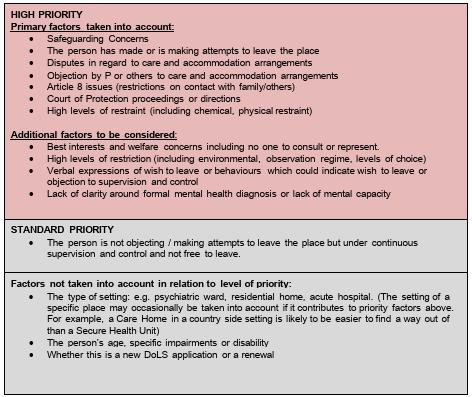
Requests are categorised into High and Standard Priority. Those identified as High Priority are allocated for assessment as soon as possible/ immediately.
Requests categorised as Standard priority, based on the information that is provided within the Referral, are allocated for an assessment chronologically (oldest referrals first).
This process will continue to be under regular review in line with case law and workforce capacity.
Appendix 2: Deprivation of Liberty Safeguards Form 4
Case ID Number:
DEPRIVATION OF LIBERTY SAFEGUARDS FORM 4
REQUEST FOR STANDARD AUTHORISATION AND URGENT AUTHORISATION
Request a Standard Authorisation only (you DO NOT need to complete pages 6 or 7)
Grant an Urgent Authorisation (please ALSO complete pages 6 and 7 if appropriate/required)
Full name of person being deprived of liberty
Date of Birth (or estimated age if unknown)
Sex
Est. Age
Relevant Medical History (including diagnosis of mental disorder if known)
Sensory Loss Communication Requirements
Name and address of the care home or hospital requesting this authorisation
Telephone Number
Person to contact at the care home or hospital, (including ward details if appropriate)
Name Telephone Email
Ward (if appropriate)
Usual address of the person, (if different to above)
Telephone Number
Name of the Supervisory Body where this form is being sent
How the care is funded Local Authority please specify NHS
Self-funded by person
REQUEST FOR STANDARD AUTHORISATION
Local Authority and NHS (jointly funded)
Funded through insurance or other
THE DATE FROM WHICH THE STANDARD AUTHORISATION IS REQUIRED:
If standard only – within 28 days
If an urgent authorisation is also attached – within 7 days
PURPOSE OF THE STANDARD AUTHORISATION
• Please describe the care and / or treatment this person is receiving or will receive day-to-day and attach a relevant care plan.
• Please give as much detail as possible about the type of care the person needs, including personal care, mobility, medication, support with behavioural issues, types of choice the person has and any medical treatment they receive.
• Explain why the person is or will not be free to leave and why they are under continuous or complete supervision and control
• Describe the proposed restrictions or the restrictions you have put in place which are necessary to ensure the person receives care and treatment. (It will be helpful if you can describe why less restrictive options are not possible including risks of harm to the person.)
• Indicate the frequency of the restrictions you have put in place.
INFORMATION ABOUT INTERESTED PERSONS AND OTHERS TO CONSULT
Family member or friend Name
Address Telephone
Anyone named by the person as someone to be consulted about their welfare Name
Address Telephone
Anyone engaged in caring for the person or interested in their welfare Name
Address Telephone
Any donee of a Lasting Power of Attorney granted by the person Name Address
Any Personal Welfare Deputy appointed for the person by the Court of Protection
Any IMENTAL CAPACITY ACT instructed in accordance with sections 37 to 39D of the Mental Capacity Act 2005
Telephone
Name
Address
Telephone
Name
Address
Telephone
WHETHER IT IS NECESSARY FOR AN INDEPENDENT MENTAL CAPACITY ADVOCATE (IMENTAL CAPACITY ACT) TO BE INSTRUCTED
Place a cross in EITHER box below
Apart from professionals and other people who are paid to provide care or treatment, this person has no-one whom it is appropriate to consult about what is in their best interests
There is someone whom it is appropriate to consult about what is in the person’s best interests who is neither a professional nor is being paid to provide care or treatment
WHETHER THERE IS A VALID AND APPLICABLE ADVANCE DECISION
Place a cross in one box below
The person has made an Advance Decision that is valid and applicable to some or all of the treatment
The Managing Authority is not aware that the person has made an Advance Decision that may be valid and applicable to some or all of the treatment
The proposed deprivation of liberty is not for the purpose of giving treatment
THE PERSON IS SUBJECT TO SOME ELEMENT OF THE MENTAL HEALTH ACT (1983)
Yes No If Yes please describe further e.g. application/order/direction, community treatment order, guardianship
OTHER RELEVANT INFORMATION
Names and contact numbers of regular visitors not detailed elsewhere on this form:
Any other relevant information including safeguarding issues:
PLEASE NOW SIGN AND DATE THIS FORM
Signature Print Name
Date Time
I HAVE INFORMED ANY INTERESTED PERSONS OF THE REQUEST FOR A Deprivation of Liberty Safeguards AUTHORISATION (Please sign to confirm)
RACIAL, ETHNIC OR NATIONAL ORIGIN
White
Asian / Asian
British
Not Stated
Other Ethnic Origin (please state)
Place a cross in one box only
Mixed / Multiple Ethnic groups
Black / Black British
Undeclared / Not Known
THE PERSON’S SEXUAL ORIENTATION
Heterosexual Homosexual
Place a cross in one box only
Bisexual
Not Known
OTHER DISABILITY
Undeclared
While the person must have a mental disorder as defined under the Mental Health Act 1983, there may be another disability that is primarily associated with the person. This is based on the primary client types used in the Adult Social Care returns.
To monitor the use of Deprivation of Liberty Safeguards, the HSCIC requests information on other disabilities associated with the individual concerned. The presence of “other disability” may be unrelated to an assessment of mental disorder or lack of capacity.Place a cross in one box only
Physical Disability: Hearing Impairment
Physical Disability: Dual Sensory Loss
Mental Health needs: Dementia
Learning Disability
No Disability
RELIGION OR BELIEF
None
Buddhist
Jewish
Sikh
Physical Disability: Visual Impairment
Physical Disability: Other
Mental Health needs: Other
Other Disability (none of the above)
Not stated
Place a cross in one box only
Hindu
Muslim
Any other religion
Christian (includes Church of Wales, Catholic, Protestant and all other Christian denominations)
ONLY COMPLETE THIS SECTION IF YOU NEED TO GRANT AN URGENT AUTHORISATION BECAUSE IT APPEARS TO YOU THAT THE DEPRIVATION OF LIBERTY IS ALREADY OCCURING, OR ABOUT TO OCCUR, AND YOU REASONABLY THINK ALL OF THE FOLLOWING CONDITIONS ARE MET URGENT AUTHORISATION
Place a cross in EACH box to confirm that the person appears to meet the particular condition
The person is aged 18 or over
The person is suffering from a mental disorder
The person is being accommodated here for the purpose of being given care or treatment. Please describe further on page 2
The person lacks capacity to make their own decision about whether to be accommodated here for care or treatment
The person has not, as far as the Managing Authority is aware, made a valid Advance Decision that prevents them from being given any proposed treatment
Accommodating the person here, and giving them the proposed care or treatment, does not, as far as the Managing Authority is aware, conflict with a valid decision made by a donee of a Lasting Power of Attorney or Personal Welfare Deputy appointed by the Court of Protection under the Mental Capacity Act 2005
It is in the person’s best interests to be accommodated here to receive care or treatment, even though they will be deprived of liberty
Depriving the person of liberty is necessary to prevent harm to them, and a proportionate response to the harm they are likely to suffer otherwise
The person concerned is not, as far as the Managing Authority is aware, subject to an application or order under the Mental Health Act 1983 or, if they are, that order or application does not prevent an Urgent Authorisation being given
The need for the person to be deprived of liberty here is so urgent that it is appropriate for that deprivation to begin immediately before the request for the Standard Authorisation is made or has been determined
AN URGENT AUTHORISATION IS NOW GRANTED
This Urgent Authorisation comes into force immediately.
It is to be in force for a period of: days
The maximum period allowed is seven days.
This Urgent Authorisation will expire at the end of the day on:
Signed Print name
Date Time
REQUEST FOR AN EXTENSION TO THE URGENT AUTHORISATION
If Supervisory Body is unable to complete the process to give a Standard Authorisation (which has been requested) before the expiry of the existing Urgent Authorisation
An Urgent Authorisation is in force and a StandardAuthorisation has been requested for this person.
The Managing Authority now requests that the duration of this Urgent Authorisation is extended for a further period of DAYS (up to a maximum of 7 days)
It is essential for the existing deprivation of liberty to continue until the request for a Standard Authorisation is completed because the person needs to continue to be deprived and exceptional reasons are as follows (please record your reasons):
Please now sign, date and send to the SUPERVISORY BODY for authorisation
Signature Date
RECORD THAT THE DURATION OF THIS URGENT AUTHORISATION HAS BEEN EXTENDED
This part of the form must be completed by the SUPERVISORY BODY if the duration of the Urgent Authorisation is extended. The Managing Authority does not complete this part of the form.
The duration of this Urgent Authorisation has been extended by the Supervisory Body.
It is now in force for a further: days
Important note: The period specified must not exceed seven days.
This Urgent Authorisation will now expire at the end of the day on:
SIGNED Signature
(on behalf of the Supervisory Body) Print Name
Date
Time
EQUALITY IMPACT ASSESSMENT TEMPLATE: Stage 1: ‘Screening’
Name of project/policy/strategy (hereafter referred to as “initiative”):
Deprivation of Liberty Safeguards Policy
Provide a brief summary (bullet points) of the aims of the initiative and main activities:
The right to Liberty is a universal right guaranteed by the European Convention on Human Rights to everyone.
A person who has been assessed as lacking mental capacity to consent to remain in a specific setting, is living under continuous supervision by an agency of the state i.e. care home or hospital and would be prevented from leaving if they wanted to is deemed to be deprived of their liberty. In order for this to be lawful they need to have a Deprivation of Liberty Safeguard put in place by the managing authority (Provide) which has been authorised by the supervisory body (Local Authority).
Project/Policy Manager: Head of Safeguarding Date: February 2025
This stage establishes whether a proposed initiative will have an impact from an equality perspective on any particular group of people or community – i.e. on the grounds of race (incl. religion/faith), gender (incl. sexual orientation), age, disability, or whether it is “equality neutral” (i.e. have no effect either positive or negative). In the case of gender, consider whether men and women are affected differently.
Q1. Who will benefit from this initiative? Is there likely to be a positive impact on specific groups/communities (whether or not they are the intended beneficiaries), and if so, how? Or is it clear at this stage that it will be equality “neutral”? i.e. will have no particular effect on any group.
This currently applies to Patients on the Community Hospital wards who have a disturbance of the mind or brain that affects their ability to make their own decisions.
Q2. Is there likely to be an adverse impact on one or more minority/under-represented or community groups as a result of this initiative? If so, who may be affected and why? Or is it clear at this stage that it will be equality “neutral”?
This policy will be Equality Neutral.
Q3. Is the impact of the initiative – whether positive or negative - significant enough to warrant a more detailed assessment (Stage 2 – see guidance)? If not, will there be monitoring and review to assess the impact over a period time? Briefly (bullet points) give reasons for your answer and any steps you are taking to address particular issues, including any consultation with staff or external groups/agencies.
This Policy does not require a more detailed assessment.
Guidelines: Things to consider

Equality impact assessments at Provide take account of relevant equality legislation and include age, (i.e. young and old,); race and ethnicity, gender, disability, religion and faith, and sexual orientation.
The initiative may have a positive, negative or neutral impact, i.e. have no particular effect on the group/community.
Where a negative (i.e. adverse) impact is identified, it may be appropriate to make a more detailed EIA (see Stage 2), or, as important, take early action to redress this – e.g. by abandoning or modifying the initiative. NB: If the initiative contravenes equality legislation, it must be abandoned or modified.
Where an initiative has a positive impact on groups/community relations, the EIA should make this explicit, to enable the outcomes to be monitored over its lifespan.
Where there is a positive impact on particular groups does this mean there could be an adverse impact on others, and if so can this be justified? - e.g. are there other existing or planned initiatives which redress this?
It may not be possible to provide detailed answers to some of these questions at the start of the initiative. The EIA may identify a lack of relevant data, and that data-gathering is a specific action required to inform the initiative as it develops, and also to form part of a continuing evaluation and review process.
It is envisaged that it will be relatively rare for full impact assessments to be carried out at Provide. Usually, where there are particular problems identified in the screening stage, it is envisaged that the approach will be amended at this stage, and/or setting up a monitoring/evaluation system to review a policy’s impact over time.
EQUALITY IMPACT ASSESSMENT
TEMPLATE: Stage 2
(To be used where the ‘screening phase has identified a substantial problem/concern) This stage examines the initiative in more detail in order to obtain further information where required about its potential adverse or positive impact from an equality perspective. It will help inform whether any action needs to be taken and may form part of a continuing assessment framework as the initiative develops.
Q1. What data/information is there on the target beneficiary groups/communities? Are any of these groups under- or over-represented? Do they have access to the same resources? What are your sources of data and are there any gaps?
Q2. Is there a potential for this initiative to have a positive impact, such as tackling discrimination, promoting equality of opportunity and good community relations? If yes, how? Which are the main groups it will have an impact on?
Q3. Will the initiative have an adverse impact on any particular group or community/community relations? If yes, in what way? Will the impact be different for different groups – e.g. men and women?
Q4. Has there been consultation/is consultation planned with stakeholders/ beneficiaries/ staff who will be affected by the initiative? Summarise (bullet points) any important issues arising from the consultation.
Q5. Given your answers to the previous questions, how will your plans be revised to reduce/eliminate negative impact or enhance positive impact? Are there specific factors which need to be taken into account?
Q6. How will the initiative continue to be monitored and evaluated, including its impact on particular groups/ improving community relations? Where appropriate, identify any additional data that will be required.
Guidelines: Things to consider
An initiative may have a positive impact on some sectors of the community but leave others excluded or feeling they are excluded. Consideration should be given to how this can be tackled or minimised. It is important to ensure that relevant groups/communities are identified who should be consulted. This may require taking positive action to engage with those groups who are traditionally less likely to respond to consultations, and could form a specific part of the initiative. The consultation process should form a meaningful part of the initiative as it develops, and help inform any future action. If the EIA shows an adverse impact, is this because it contravenes any equality legislation? If so, the initiative must be modified or abandoned. There may be another way to meet the objective(s) of the initiative.
Further information:
Useful Websites www.equalityhumanrights.com Website for new Equality agency www.employers-forum.co.uk – Employers forum on disability www.efa.org.uk – Employers forum on age
© MDA 2007 EQUALITY IMPACT ASSESSMENT TEMPLATE: Stage One: ‘Screening’