Le journal bilingue de Glendon | Glendon’s Bilingual Newspaper
Vol. 59 Issue 9 : le 17 mars 2021
In This Issue Letter from the Editor ● Page 2 VIE ÉTUDIANTE On Student Cabals and Undemocratic Governance ● Page 3 Will the York Shuttle be Shuttered? ● Page 4 EXPRESSIONS Clementine ● Page 4 Comet — Part 1 ● Page 5 ARTS & DIVERTISSEMENT Bringing Back the Art of Letter Writing ● Page 6 MÉTROPOLE COVID-19 Restriction Update in Ontario ● Page 6 City of Toronto takes Legal Action Against Carpenter for Sheltering the Homeless ● Page 7 SANTÉ ET BIEN ÊTRE I Did 30 Days of Yoga: Here’s how it went ● Page 8 Iced Matcha Latte Recipe (Better than Starbucks, I promise!) ● Page 8 ACTUALITÉ ET OPINIONS Self-Love ● Page 9 La prochaine date limite : Vendredi 31 mars 2021
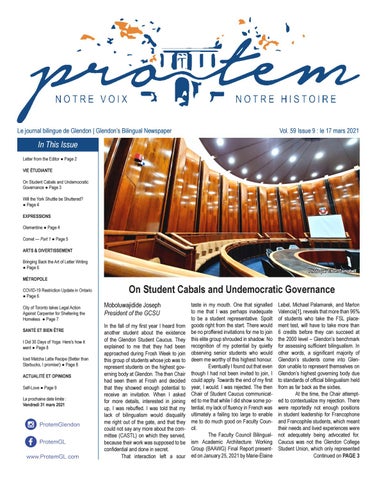
Photo par Elton Campbell
On Student Cabals and Undemocratic Governance Moboluwajidide Joseph President of the GCSU In the fall of my first year I heard from another student about the existence of the Glendon Student Caucus. They explained to me that they had been approached during Frosh Week to join this group of students whose job was to represent students on the highest governing body at Glendon. The then Chair had seen them at Frosh and decided that they showed enough potential to receive an invitation. When I asked for more details, interested in joining up, I was rebuffed. I was told that my lack of bilingualism would disqualify me right out of the gate, and that they could not say any more about the committee (CASTL) on which they served, because their work was supposed to be confidential and done in secret. That interaction left a sour
taste in my mouth. One that signalled to me that I was perhaps inadequate to be a student representative. Spoilt goods right from the start. There would be no proffered invitations for me to join this elite group shrouded in shadow. No recognition of my potential by quietly observing senior students who would deem me worthy of this highest honour. Eventually I found out that even though I had not been invited to join, I could apply. Towards the end of my first year, I would. I was rejected. The then Chair of Student Caucus communicated to me that while I did show some potential, my lack of fluency in French was ultimately a failing too large to enable me to do much good on Faculty Council. The Faculty Council Bilingualism Academic Architecture Working Group (BAAWG) Final Report presented on January 25, 2021 by Marie-Élaine
Lebel, Michael Palamarek, and Marlon Valencia[1], reveals that more than 96% of students who take the FSL placement test, will have to take more than 6 credits before they can succeed at the 2000 level – Glendon’s benchmark for assessing sufficient bilingualism. In other words, a significant majority of Glendon’s students come into Glendon unable to represent themselves on Glendon’s highest governing body due to standards of official bilingualism held from as far back as the sixties. At the time, the Chair attempted to contextualize my rejection. There were reportedly not enough positions in student leadership for Francophone and Francophile students, which meant their needs and lived experiences were not adequately being advocated for. Caucus was not the Glendon College Student Union, which only represented Continued on PAGE 3
Pro Tem Team
Letter from the Editor
Notre équipe
Salut, Glendon!
Editor in Chief | Rédactrice en chef Eden Minichiello editor@protemglendon.com Chief of Operations | Chef des opérations Natalie El-Rifai operations@protemglendon.com English Editor | Rédacteur anglais adjoint Adam Kozak englisheditor@protemglendon.com
Eden Minichiello Editor in Chief
French Editor | Rédactrice française adjointe Beatrice Bouaré frencheditor@protemglendon.com Photographer | Photographe Ruhama Varatharajan photography@protemglendon.com Layout Editor | Maquetteur Elton Campbell design@protemglendon.com
Natalie El-Rifai Chief of Operations
Section Editors | Chroniqueurs Campus Life | Vie étudiante Anna Noumtinis Issues & Ideas | Actualité et opinions Ariana Mah Metropolis | Métropole Kitty Yin Arts and Entertainment & Expressions | Arts et divertissement & Expressions Brianna Carrasco
Adam Kozak Assistant English Editor
Beatrice Bouaré Assistant French Editor
Elton Campbell Layout Designer
Ruhama Varatharajan Photographer
Health & Wellness | Santé et bien-être Josée Philips
About Us Pro Tem est le journal étudiant du collège Glendon. Publié pour la première fois en 1962, c’est la plus ancienne publication de l’Université York. Opinions published in Pro Tem are those of the individual writers, and do not reflect the views of the publication as a whole. We will not print copy deemed racist, sexist, homophobic, or otherwise oppressive. Les lettres adressées au journal peuvent être éditées au niveau de la clarté ou de contenu. All copy appearing in Pro Tem is at the discretion of the editorial team.
Anna Noumtinis Campus Life
Ariana Mah Issues and Ideas
Kitty Yin Metropolis
Feel free to respond to what you read in the pages of Pro Tem! / N’hésitez pas à réagir à ce que vouz avez lu dans Pro Tem! To see past editions of Pro Tem, please visit our website: www.protemglendon.com. Be sure to follow us on Instagram for reminders about upcoming deadlines and events: @ProtemGlendon
2 Pro Tem • www.protemgl.com • March 17, 2021
Brianna Carrasco Arts and Entertainment & Expressions
Josée Philips Health and Wellness
I hope you’re all doing well and managing to balance the stress of this busy academic season. We have an incredible issue for you this week that features an article written by Moboluwajidide Joseph, the President of the GCSU, about his personal, and rather poor experience with the Glendon Student Caucus. This article discusses the need for the reform of Glendon’s highest student-led governing body, drawing parallels with the systemically racist political institutions in Canada’s government. In light of this article, we want to remind our readers and contributors of the importance of the free press at a university. Without platforms like Pro Tem, where students are able to voice their opinions and concerns about events or institutions on campus, it becomes much more daunting to hope to effect change, and educating the student body becomes incredibly difficult. We hope this article will motivate students to stand up for what they believe in, and to use Pro Tem as a platform to do it. This issue also includes a remarkable article by our Chief of Operations, Natalie El-Rifai, about Khaleel Seivwright, a carpenter who took it upon himself to build shelters for unhoused Torontonians, and who is facing legal action from the City of Toronto. This subject has not been covered very extensively by mainstream media, so we encourage you to read the article and educate yourselves. N’oubliez pas que ce vendredi est notre dernière date limite du semestre! Envoyez vos articles à editor@protemglen don.com pour être publié dans notre dernier numéro de l’année académique. Enfin, nous embauchons ! Si vous êtes un étudiant ou une étudiant de Glendon qui a une passion pour la presse libre et des capacités fortes d’édition et de rédaction, nous vous encourageons à postuler! Nous publierons les postes pour lesquels nous recrutons ce lundi, alors gardez l’œil ouvert ! À bientôt, Eden Minichiello Editor in Chief | Rédactrice en chef
Vie étudiante
On Student Cabals and Undemocratic Governance (cont.) anglophone student voices. Who could argue with that? Even then it was clear to me that Francophones were Glendon’s political minority. Unfortunately, I have come to find at Glendon that when people say they want more French perspectives, it almost always results in what can only be described as… white. Eventually, when I ran for Glendon Director on the York Federation of Students, this same student leader told me on the floor that I would not be getting their vote because I could not speak French, and I ought to consider yielding this to my more orthodox bilingual opponent whose lived experiences could speak to Francophone issues. As President of the GCSU there are some things I can say, many that I cannot. A critique of a different student representative body such as the one I am embarking on in this personal essay would be considered quite unwise and unsupportive of the student leaders I claim to represent as their elected voice on pan-university bodies, and on provincial and federal student lobby groups. Before I am President, though, I am a student. One who feels compelled to start a public conversation on all the ways that our institutions fail student leaders and contribute to some of the battle scars we will leave Glendon with. I do not pretend to have all the answers, and at the end of the day I am only an expert on my own experiences. My criticisms are sure to be imperfect and my proposed solutions more so. However, I do believe that the work of addressing these issues can no longer be done in the shadows. It must involve dragging these problems kicking and screaming into the light of day. I eventually joined student caucus in my third year. My third year at Glendon would also be my most difficult due to constant attacks from the Student Caucus leadership for “unsatisfactory behaviour and [failing] to fulfill the fundamental obligation of a student representative on a Faculty Council committee”. This resulted in my being put on probation right in the middle of Caucus’s review of its constitution, a process in which I was one of the more passionate voices for fundamental institutional change and reform. Faculty Council, Glendon’s highest governing body on which Student Caucus has the sole privilege of being able to nominate student representatives, is composed of every single Glendon faculty
member[2]. It represents a model of direct democracy where all faculty members are, by principle, expected to have equal representation and voting privileges. Student Caucus, a club of student leaders appointed by a Chair who was not elected by the general student body, is fundamentally incompatible with the political norms and principles of Faculty Council. Hardly anyone even knows of its existence. Yet, its members claim to represent the will of the students. Which students? Although, I have pointed out repeatedly to faculty members that Student Caucus ought to not have this privilege as an undemocratic cabal of unvetted interests, Faculty Council leadership has always maintained that they cannot be involved in student politics – a position that has always struck me as being complicit in the legitimization of a group of students who are holding the political will of the student body hostage. Instead, the arguments around my criticisms of an entity that has never put forward a complement of truly diverse student representatives have always been framed as those of an anglophone GCSU student leader who merely wishes to detract from the good work done by a rival bilingual student organization. Tactics that are reminiscent of the Nigerian political elite’s divide and conquer strategy that pits religious and ethnic groups against one another, rather than addressing the very real harms being done. Student Caucus now has an anglophone Chair who is still able to function, despite barely understanding French. And yet, no one critiques their ability to represent Francophone issues. It is almost as though linguistic competency never had anything to do with understanding what minority linguistic status can look like, and what ought to be done to better address it. The arguments against moving towards elections are varied. “Elections are a popularity contest.” “The GCSU has not always had successful elections, so really elections cannot be all that great.” “Elections might discourage people from wanting to serve.” All arguments that are really just deflections from the truth. Student Caucus is not interested in moving towards elections and dismantling their colonial leadership structure (please see Canada’s Senate for an apt comparison), because its membership feels entitled to their positions and they are scared that having to actually ask for student support will reveal them to be the anachronistic organization they are. One that does not represent the will and voices of a student body, but only their private goals and agendas. One that has failed to provide students agency over real and impactful decisions that shape their
entire student experience. Their arguments can be boiled down to two digestible sentences: 1. Glendon students are apathetic about student politics, and the ones who do care are uninformed idiots who will vote based on who their friends are rather than what is actually good for Glendon; 2. Everyone is just going to have to trust that I know what is best for Glendon students because I was lucky enough to be picked by my friend. We can all agree that elections are flawed. Representative democracy has multiple failings. However, the decades long disenfranchisement of the student body that Student Caucus represents reminds me eerily of the insidious logic that underpinned granting only white men with land the right to vote. We have always understood that this was never about ensuring merit, but has always been about power. Some feel they are entitled to it and are unwilling to let go. How can we have accountability, decolonization, equity, justice, and progressive reform if only a handful are allowed to sit at the table? We cannot have an honest conversation about the direction Glendon is headed in if no one knows such a conversation is being held in the first place. One might expect such a thing at a large institution where students are just their
numbers. However, an institution as small as Glendon is the perfect environment for meaningful engagement. Students know nothing because institutions like Student Caucus cannot be held accountable by the students they purport to represent. We do not suffer from apathy. We suffer from a lack of knowledge. No one likes elections. Not the stressed-out candidates. Not the beleaguered electorate who is inundated and harassed at every turn. Yet, elections are the most effective forum for reckoning with our future. They are how we ensure viable institutions. In my fourth year, I declined to return to Student Caucus. In my exit remarks, I noted that Student Caucus made me feel alone and unsupported, alienated and devalued. I could not in good faith return to such a toxic and hostile work environment. The incoming cohort made all the right sympathy noises. They would do better. They would be better. This time would be different. I am graduating now and still waiting for change. I don’t imagine it will ever come. https://www.glendon.yorku.ca/facultycou ncil/wp-content/uploads/sites/109/BAAW G-Final-Report-Jan25-2021.pdf [1]
It should be noted here that I am not referring to contract faculty, but to faculty members who are represented by YUFA. [2]
Pro Tem • www.protemgl.com • le 17 mars 2021 3
Campus Life
Will the York Shuttle be Shuttered? Ameer Shash Contributor York University’s Transportation Services faces a barrier at the moment amidst the global pandemic. The university’s courtesy transportation service, the Campus Shuttle, has seen a decline in both ridership and fleet use. These declines are direct results of the limited presence of students on both Glendon and Keele campuses. The concern is that for the shuttle service to continue, it must safely transport students while keeping them socially distant in order to limit the spread of COVID-19. The hourly shuttle service may become a silent catalyst for transmitting the virus. Before I dive into how the service may fuel on-campus transmission, I want to first note my appreciation for our shuttle drivers, as they operate the shuttles that help students get to their cross-campus classes on time, and make the university experience a bit easier. However, I fear for the future of our transportation services, as
Expressions the buses in York’s fleet may not be able to accommodate many passengers if seats have to be restricted from use to enforce social distancing protocols. One particular concern for me is the smaller shuttles: York’s GMC and Ford accessible school buses, which seat about 15 persons at full capacity. With distancing restrictions in place, this may narrow the limit down to only 5 to 6 students per bus. Maximizing the number of users on the shuttles is critical, as students who don’t own cars, like myself, will have to travel either by bus or by subway, which is much less time effective than taking the shuttle straight to the other campus. However, York University’s Transportation Services also has two larger buses, a Thomas T-Liner and New Flyer D40LF, which are very spacious. At full capacity, they are able to accommodate 40 to 50 students at once. But with restrictions in place, only about 15 to 20 persons can fit in the bus, which is the capacity of the smaller shuttles without restrictions. Given the fact that shuttle operations are funded by students’ tuition, the YorkU Shuttle service will probably not be shuttered, but it will very likely be restructured, even in ways that disadvantage students, and these changes may last for years to come.
Clementine Eden Minichiello Editor in Chief I’ve always admired clementines. Defiant little balls of bright, fresh flavour, At their tastiest in the middle of barren winter. What boldness it is to rebel against the harvest times, To show up, unannounced, in grocery stores full of winter-bland produce in bright little packages of tangy happiness. A boldness — yet sweetness — I long to embody. Promising a ray of sunshine amidst offseason sadness. Creating simple moments of satisfaction in peeling away. The stickiness of citrus that lingers on fingertips; a scent reminiscent of summer on long winter days. In bleak, feeble February, what is your clementine? A beam of warm sunlight on a cheek in the middle of morning The unrestrained laugh of a precious loved one A little toddler toddling in a teddy bear snowsuit The notice of morning light a little earlier, dusk pushed into evening by the rays of the sun A dog’s snout covered in powdery snow. Thank you, God for these tender love notes, reminding us that we are precious to you, that you know our winter wearied hearts and that spring is but a moment away. Use my heart, my hands, my hugs as a channel for your clementine-love.
Photo par YorkU
4 Pro Tem • www.protemgl.com • March 17, 2021
Expressions
Comet — Part 1 Elton Campbell Layout Designer Comet’s heart thumped heavily like the bass of a dancehall rhythm. Anxiety rained, causing sweat to run down his smooth cocoa butter-coated face while he watched Rick and some schoolmates come towards him in the distance. They all walked past him like he was invisible. Even the trash bin got more attention from Rick. This is because he threw a textbook in the bin before exiting the building. Comet looked in the bin and saw that it was the Calculus textbook he lost a week ago. He thought, “Rick would rather dump my book in the trash bin in front of me instead of handing it to me?” He picked it up, flipped through the pages, and realized that the book was still in prime condition until he found a note between the pages that read, “Sodomite! The real war has just begun!” Comet vividly remembered when he was a student at high school. He was a short, chubby, clumsy kid who walked like Naomi Campbell on the runway. He used to trip over his own feet in almost every Physical Education class. He spoke English like the Queen of England while the other kids spoke Jamaican patois like the cultural icon, Louise Bennett-Coverley. As such, the kids perceived him as being gay and would call him “scales.” At that time, Rick was a short, scrawny kid with bulgy hazel-coloured eyes and a bony facial structure. His breath always smelled like it had never met toothpaste or mouthwash. The other kids would tease Rick by calling him “Karate Puss” because the colour of his eyes resembled those of a cat and his breath would usually karate-chop the fresh air when he spoke. His thick lips were always dry and chalky white. He also went without breakfast most mornings. Though Comet and his classmate, Rick, were bullied for different reasons, they never conversed. Eventually, Comet began secretly putting food in Ricks’s backpack or under his desk when nobody was looking. However, as the years progressed in high school, Rick, “the socalled ugly smelly duckling” transformed into a tall “handsome muscular prince.” By tenth-grade, Rick became the top “gyalis” in high school. Most of the girls were as obsessed with him as they were with Justin Bieber and Bow Wow. They would give him anything he wanted just to be around him. Before the tenth-grade academic year ended, Comet found a note under his desk on a piece of graph paper. The note read,
“Come near my backpack or me and I will beat you, Sodomite!” Comet fought the tears until he reached home that evening, he locked himself in the bathroom and sat in the shower, crying like a baby. Tears ran down his cheeks like Dunn’s River Falls. Rick became the boss of all the bullies, and he joined forces with the other bullies at making every day of Comet’s school life hell. Many times, they would douse him with water from their water bottles and shout, “fish on land!” Comet never went to his high school graduation because of rumours about Rick and the bullies planning to dump sewage on him on that day. Despite Comet reporting this to the school administration and his parents, they all told him that he deserved it because he needed to act more like a man. After this flashback, Comet crushed up the disturbing note and kicked over the bin. He was not going to allow Rick to ruin his college years, too. Like lightning, he exited the college building. Perhaps this was the first time he had truly ran without tripping clumsily. Like a hawk, he spotted Rick jumping into his golden Ferrari. Comet blazed across the parking lot towards the car. Flames of a raging phoenix rose inside of his body as he flew on the top of the bonnet and punched through the windshield moments before Rick could buckle his seatbelt. Blood rushed down Comet’s hands like lava as he grabbed his bully through the shattered windshield. A discombobulated Rick looked into Comet’s fearless red fiery eyes. “Comet! Wake up, please… Comet please…” Rick’s shaky voice beckoned like a child in crisis. “Comet please…” he continued while gently caressing Comet’s
Photo par We Heart It
swollen face with his fingers. Comet slowly opened his eyes and found a shirtless, teary-eyed Rick holding him in his muscular arms on a bench beside his car. Suddenly and aggressively, Rick pushed Comet away and exclaimed, “Let me go Sodom and Gomorrah! I should have driven away after they knocked you out and stabbed you! Fish, why were you running towards my car? You think I want a sodomite in my
car? I will not fight them for you again!” Rick slammed his car door, revved the engine, and sped away. Comet sat on the bench with Rick’s white shirt wrapped around his bloodied left hand, looking pensively at a dirty, bloody knife left by his attackers on the ground. To be continued… Part 2 in the next issue of Pro Tem
Pro Tem • www.protemgl.com • le 17 mars 2021 5
Arts and Entertainment
Bringing Back the Art of Letter Writing Brianna Carrasco Section Editor - Arts & Entertainment, Expressions The COVID-19 pandemic has forced us all to get creative when it comes to keeping in touch with our loved ones. Zoom call movie nights, WhatsApp group chats, and long email chains have been my primary forms of communication over the past year. During a time when seeing our closest friends and family is pretty much forbidden, I have clung to these methods of communication to keep myself from feeling anxious and isolated. But it also comes at a cost. Staring at classmates through tiny squares on a Zoom screen and scrolling through social media to see what my fellow friends and classmates are up to becomes draining. This constant reliance on virtual and online communication has led to headaches, bouts of insomnia, and the mind-numbing sensation that occurs when I spend two hours straight on TikTok. This is one of the main reasons that I decided to turn to old-fashioned snail
mail as a way to connect. I have always loved writing, and I also journal in my spare time, so I find peace of mind when sitting at my desk in front of my notebook, writing down my thoughts. I love adding stickers, scraps of patterned paper, and ribbons, and using beautiful gold pens to write in order to give my journal a unique and vintage look. It was at the end of 2020 that I decided to up my stationery game and think about how I could take my love for writing to the next level. I ordered a wax seal kit from Amazon that came with different colours of wax, wax stamps, cards, and envelopes, and I was ready to go! I have spent a lot of time writing and sealing letters for my friends, family, and boyfriend for special occasions. There’s something fulfilling about sitting at a desk, pulling out a card and a beautiful pen, and writing about how much I appreciate and miss my loved ones. When I finish, I pour some melted wax to seal the envelope with my initial, “B”, and decorate it with stickers and magazine cut-outs. It’s the perfect addition to a gift and will definitely be remembered! The act of letter writing itself is inefficient. First, you need a few supplies. Then, it takes about an hour to write a card, decorate the envelope, and seal it with wax. Plus, you have to send the letter a few days in advance to make sure it gets to the
recipient on time. It’s definitely way easier to pick up your phone and send a quick text. But writing letters reminds me to slow down. In a world where we have instant messaging, one-day shipping, and highspeed Internet at our fingertips, we forget that sometimes the best things in life take time and dedication. It’s relaxing to spend time writing a card and making each one unique, depending on the person I’m giving it to. And it’s rewarding to see the look on my loved one’s faces when they see how much effort I’ve put into their card. I feel the same way when my loved ones write me a
card! I have a box full of 20 years worth of cards and letters in my room, and each one holds its own specific memory. If the pandemic has taught us anything, it’s to keep our loved ones close and to work to maintain connections. One of the ways we can all slow down and share our appreciation for our friends and family is to send them a letter! May 2020 and 2021 be the years when many different forms of communication evolve — Zoom, Skype, WhatsApp, Instagram, TikTok… and letter writing!
Metropolis
COVID-19 Restriction Update in Ontario Adam Kozak Assistant English Editor After nearly two months under the stayat-home order, Toronto and Peel Public Health Units (PHUs) have moved back into the “grey” level of the province’s color-coded COVID-19 response framework as of March 8th, while North Bay Parry Sound shifted into the “red” zone. The stay-athome order was issued at the beginning of January. Ever since then, daily case numbers in Toronto have slowly shrunk, from almost 1000 a day to about 300 a day in the past week. Peel has seen a similar reduction, from about 600 a day in early January to about 200 a day the week of March 1st. Toronto and Peel will stay at this “grey” level for at least two weeks, according to the Ontario government.
Under the “grey” level restrictions, gatherings of up to 10 people outdoors are permitted, non-essential stores will be permitted to open at a maximum of 25% capacity, opening hours will no longer be restricted and shopping malls may reopen with some restrictions. However, hair salons and other personal care services, as well as indoor and outdoor dining at restaurants, will remain prohibited. More information about the provincial COVID response framework can be found at covid-19.ontario.ca. Simcoe Muskoka PHU also returned to the “red” level on March 8th from their “grey” lockdown. Greater Sudbury PHU shifted into the “red” zone from “orange”, and Timiskaming and Haldimand-Norfolk PHUs moved into “orange”. Peterborough shifted from the “yellow” to “red” zone directly. Haliburton, Kawartha, Pine Ridge PHU went from the “orange” to the “yellow” zone, while Renfrew PHU was placed in the “yellow” zone from the less restrictive “green” zone. Overall, the pandemic situation appears to be improving province-wide,
6 Pro Tem • www.protemgl.com • March 17, 2021
Photo par Frank Gunn
though the threat of COVID variants looms overhead. The 7-day average of new cases has dropped from 3546 on January 10th to 1035 on March 6th. The provincial hotspots for COVID infection, Toronto, York and Peel Regions, have all seen a drop in the number of new daily cases since January. While lockdown measures have been effective, public health officials say we must remain vigilant. They told the Toronto Star that a “medium” adherence to public
health advice and restrictions, defined as a 50-to-100% reduction in home visits with increased contact in other settings such as during leisure activities and in the workplace, could cause another spike in cases. So there you go, guys. My advice? Get all your work for the semester done now and sleep until, like, June. You’re not getting any real good news until then.
Métropole
City of Toronto takes Legal Action Against Carpenter for Sheltering the Homeless Natalie El-Rifai Chief of Operations Housing is a basic need and a fundamental right. Yet, over 10,000 people in Toronto are experiencing homelessness, and many of these individuals rely on temporary shelters to survive. With the added factor of the pandemic and the harsh Canadian winter, the increased pressure on these shelters has rendered homelessness an emergency issue. Many unhoused individuals previously relied on libraries, community centers, and coffee shops to keep warm. They simply do not have these options anymore, and congregate shelters are often riddled with COVID-19. Despite the desperate need for enhanced services to meet the pressing needs of unhoused populations, the initiatives undertaken by the City of Toronto have rarely responded with urgency, and have left thousands of Canadians waitlisted for shelter and unprotected as a result. A Torontonian recently stepped up to the plate, virtuously tasking himself with the responsibility of protecting our most vulnerable. Khaleel Seivright, a carpenter who decided to put his skills to good use, has managed to provide homes for people by building shelters. These are not ordinary shelters, however. Seivwritght ensured that they are equipped with a smoke and carbon monoxide detector as well as a fire extinguisher. They are properly insulated to provide warmth during the winter months and even contain lockable latches to ensure privacy and security, a safe space that is essential and life saving during a pandemic. These shelters not only provide physical safety, they provide unhoused individuals with a sense of dignity and community. Seivright allows the community itself to decide how to use these shelters and who to prioritize when offering them. However, On February 12th, the City of Toronto filed for legal action against Seivright at the Ontario Superior Court to shut down the shelters. City officials claim they are not attacking Seivright himself, but ensuring that he does not build on city-owned land, despite the fact that a restraining order was requested against him.
Homelessness is an issue that cannot and will not be solved without direct remedies to the underlying issues behind it. Staggering rental prices are not the only culprit: years of underinvestment in social housing from all levels of government are also a factor. It is no secret that homelessness stems from systemic and institutional neglect of impoverished populations who face serious barriers to accessing employment and safe housing. Marginalized youth are disproportionately impacted by homelessness as they are more likely to be discriminated against in terms of race, ethnicity, gender and sexuality. While the government has done little to respond to these systemic issues, a simple carpenter has managed to save lives. However, Seivwright does not regard himself as some sort of vigilante. He is simply stressing that the homeless require more urgent solutions, that they cannot be left unprotected during the winter, and that his shelters are able to act as a more appropriate temporary remedy. The City of Toronto has chosen to shut down his shelters while the fact remains that people living on welfare cannot afford housing in Toronto, and are being left to freeze to death. The homeless community, supportive community members of Toronto, and Seivwright’s legal team have begun to fight back by serving Mayor John Tory and his developers. They intend to stop them from using the courts to shut down the shelters, and from using intimidation and harassment tactics by police and other authorities to coerce them. They sim-
Photo par Anastasia Arellano
ply ask that the government consider the desperate needs of people trying to survive and prioritize this over profit. Despite the lack of media coverage, mobilized support for Seivright has led to 1100 legal notices against the municipal government as a direct demand to stop them from putting people in unnecessary danger. The case against Seivright has not been dropped, however, and the City of Toronto is still forcibly removing shelters and allegedly sending the community’s belongings away in garbage disposals. Seivwright is currently asking for donations via his GoFundMe page to help pay for his legal fees, as well as for the Encampment Support Network,
who are dedicated to supporting encampment residents. People do not choose to be homeless. They are living in encampments as they have nowhere else to go. Without proper intervention from the government to rectify underlying issues and provide people with safe housing, the most vulnerable groups will continue to suffer, and may not make it through the next couple of months. Link to donate: https://ca.gofundme.com/f/toronto-ti ny-shelters
Pro Tem • www.protemgl.com • le 17 mars 2021 7
Health and Wellness
I Did 30 Days of Yoga: Here’s how it went Josée Philips Section Editor - Health & Wellness I used to work out. I used to play a lot of sports. I used to be in shape, to say the least. I was used to highly intensive sports and workouts, since that’s how I would relax, get my mind off things, and stay fit. But since the pandemic started, the gyms closed, and I moved back home with my parents, it’s been hard to work out how I usually would. I go on walks — so many walks — but I felt like I needed something more. It was necessary for me to do something beneficial for my physical, mental and spiritual health. I have been told to try yoga by many people, and I always told myself I would one day. I got a yoga mat for Christmas, and I wanted to put it to good use. The holidays came and went, and the new semester started, I found myself feeling stressed again. I was having trouble sleeping, had neck pain from being on my computer all day long, and still wanted to get back into training my body. I thought maybe now would be the perfect time to test out that mat I got. Yoga doesn’t require much space, it takes minimal equipment, it helps relieve stress and pain, and it improves strength, balance and flexibility. Let me preface this by saying that I have only ever tried yoga a few times, and
Iced Matcha Latte Recipe (Better than Starbucks, I promise!) Nekoda Papadatos Contributor This is the best study drink I’ve ever come across and it only takes 2 minutes to make. It’s become my studying staple! My classmates can confirm I always have a matcha latte in hand. Matcha is rich in antioxidants and promotes a strong, calm focus, all while activating dopamine and serotonin receptors. It also causes less of a caffeine crash than coffee does. An essential for finals season! Ingredients ● 1 cup of cold water
it was very minimal. I thought it was too difficult and too painful since I have zero flexibility, and too boring compared to what I was used to. But I thought to myself, “Why not give it a shot, what have I got to lose?” I saw someone post about Yoga with Adrienne’s 30 days of Breath, a 30-day yoga plan for 2021, and I figured it sounded good, so that’s the one I followed; the link can be found at the bottom of this article if you’d like to try it for yourself! I sat down on my mat for day one, already expecting to feel discouraged, but it was great. I began learning how to be centered with my breath, which is something I have always found very difficult. I also learned about the basic yoga poses and how the workout plan for the next month would look. After a few days, I noticed that although some poses and stretches were harder than others, Adrienne provided options and variations for everyone, from beginner to advanced. This allowed me to start off slow. I’ve heard it takes 21 days to build a habit, and I was determined, especially since in the past I’ve had trouble following through on the routines I set for myself. Setting high expectations for yourself can be hard, because if you don’t meet them, it feels like you’re letting yourself down. I knew that I wanted to go through with this. After 10 days I actually started to notice some changes. I had more strength in my arms (where I have never had any… literally… I could never even do a push-up). I was also finding I could get into the poses better. Impressive for me, since I’ve always been clumsy and awkward when trying ● ● ● ● ●
Photo par Kike Vega
to do anything that requires coordination. Let’s just say dancing has always been out of the question for me. It also became easier to be present in the practice, centering my breath, focusing on the poses. It was important for me to learn how to be in the moment; acknowledging my thoughts, but trying to let them go. Some days were much harder than others: the poses seemed impossible, I couldn’t let go of what was going on around me, and although I saw a lot of progress in my strength, my flow, and my center, I wanted to give up. I became discouraged and frustrated. But I had to keep pushing, and I am glad I did.
The 30 days of yoga with Adrienne was one of the most beneficial things I’ve done for myself in a long time. I found I was able to sleep and focus better, as well as be in the moment. I found it very helpful to be one with my breath, body and mind. I would truly recommend this to anyone. No matter the time, place, instructor, or state of mind, yoga has a way of making you feel at peace with yourself. https://www.youtube.com/playlist?list=PLu i6Eyny-UzzJ4NSTesh4xRWg4ZWNz5s4
1 cup of milk (you can substitute cow’s milk with any alternative, such as soy or oat!) 1.5 tsp of matcha powder 1 tsp of vanilla extract 1 tbsp of agave syrup (you can use any other liquid sweetener, like honey or maple syrup) Several ice cubes
Supplies ● Sifter ● Blender Directions 1. Put water, milk, vanilla extract, and agave syrup in a blender. 2. Sift matcha into mixture. 3. Blend mixture until well combined. 4. Fill your glass with ice cubes 5. Pour your matcha over the ice and enjoy!
8 Pro Tem • www.protemgl.com • March 17, 2021
Photo par Eden Minichiello
Actualité et opinions
Self-Love Sonia Said Contributor Is it the right time to focus on this serious issue, this issue of self-love? Self-love is not a trend, nor a cliché, nor another’s issue. Self-love concerns you alone, and I am a self-love ambassador. I believe that self-love is the key to our potential, because it took me a while to get it. I have come a long way, and I wish that someone took the time to tell me about self-love too. As much as I want to say the contrary, it is sometimes the things you lacked most, that you care most about. I was always taught that “loving yourself promotes pride and vanity.” Allow me to respond efficiently to this statement: no. Self-love is simply about taking care of what is beautiful: ourselves. It is about acknowledging that we deserve respect and love, and being able to thrive in a healthy environment at all times. It is about our selftalk, body image, and daily practices, about the boundaries we set, people we interact with, and time we spend with ourselves … and also the bubble bath we take once in a while, because while self-love is lovely, our environment should be cared for as well. Self-love is not about an inflated sense of self-importance and pride; it is about humbly recognizing that you matter. The truth is that accepting and caring for ourselves and believing in our human potential can be challenging, but can impact us greatly. It may seem evident or very basic, but we often forget about this important truth. You should not accept a situation just because others do not give you the love and respect that you deserve. There is no age when one must accept this; getting older does not doom you to limiting your perception of or neglecting yourself, because there is a solution to all problems of this sort. Although there is a world order, it is our duty to make this world a better place, learn from our mistakes and enact change when needed. You are the future, and it is your responsibility to ease your burden, take the time you need and take the necessary steps to love yourself.
Self-love is fluid and ever-fluctuating, meaning that our levels of self-love can fall at times. In other words, self-love is a muscle that needs to be exercised. Even grief can lower our levels of self-love, so there is great importance in expression and self-compassion. Who would have thought that losing someone could directly impact the relationship we have with ourselves? Who would have thought that it would bring up old insecurities, making us more vulnerable? In my eyes, self-love is recognizing that I am blessed. Like you, I was created to be on this earth. I am grateful, because I believe I was chosen to be here. And if God has seen value in me, why can’t I acknowledge it? Moreover, if I am here, God has likely perceived some form of potential in me, so I strongly believe that it is my duty to love and care about myself to fulfill this gifted, latent potential within.
Pro Tem • www.protemgl.com • le 17 mars 2021 9
10 Pro Tem • www.protemgl.com • March 17, 2021