Issue Nine - Volume 53 - February 13, 2015
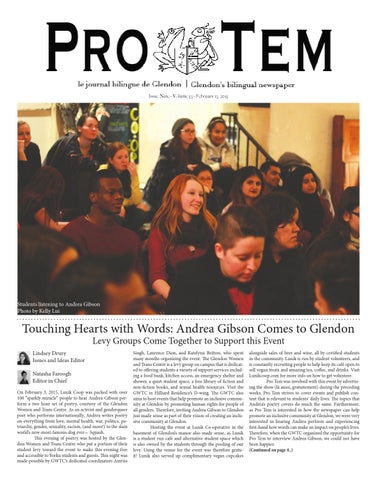
Students listening to Andrea Gibson Photo by Kelly Lui
Touching Hearts with Words: Andrea Gibson Comes to Glendon Levy Groups Come Together to Support this Event
Lindsey Drury Issues and Ideas Editor Natasha Faroogh Editor in Chief On February 3, 2015, Lunik Coop was packed with over 100 “sparkly miracle” people to hear Andrea Gibson perform a two hour set of poetry, courtesy of the Glendon Women and Trans Centre. As an activist and genderqueer poet who performs internationally, Andrea writes poetry on everything from love, mental health, war, politics, patriarchy, gender, sexuality, racism, (and more!) to the slam world’s now-most-famous-dog ever— Squash. This evening of poetry was hosted by the Glendon Women and Trans Centre who put a portion of their student levy toward the event to make this evening free and accessible to Yorku students and guests. This night was made possible by GWTC’s dedicated coordinators Amrita
Singh, Laurence Dion, and Katelynn Britton, who spent many months organizing the event. The Glendon Women and Trans Centre is a levy group on campus that is dedicated to offering students a variety of support services including a food bank, kitchen access, an emergency shelter and shower, a quiet student space, a free library of fiction and non-fiction books, and sexual health resources. Visit the GWTC in Hilliard Residence’s D-wing. The GWTC also aims to host events that help promote an inclusive community at Glendon by promoting human rights for people of all genders. Therefore, inviting Andrea Gibson to Glendon just made sense as part of their vision of creating an inclusive community at Glendon. Hosting the event at Lunik Co-operative in the basement of Glendon’s manor also made sense, as Lunik is a student run café and alternative student space which is also owned by the students through the pooling of our levy. Using the venue for the event was therefore gratuit! Lunik also served up complimentary vegan cupcakes
alongside sales of beer and wine, all by certified students in the community. Lunik is run by student volunteers, and is constantly recruiting people to help keep its café open to sell vegan treats and amazing tea, coffee, and drinks. Visit Lunikcoop.com for more info on how to get volunteer. Pro Tem was involved with this event by advertising the show (là aussi, gratuitement) during the preceding weeks. Pro Tem strives to cover events and publish content that is relevant to students’ daily lives. The topics that Andrea’s poetry covers do much the same. Furthermore, as Pro Tem is interested in how the newspaper can help promote an inclusive community at Glendon, we were very interested in hearing Andrea perform and experiencing first-hand how words can make an impact on people’s lives. Therefore, when the GWTC organized the opportunity for Pro Tem to interview Andrea Gibson, we could not have been happier. (Continued on page 4..)
Pro Tem
Editor in Chief | Rédactrice en chef Natasha Faroogh editor@protemglendon.com Assistant English Editor | Rédactrice adjointe (anglais) Stephanie Settle assistanteng@protemglendon.com Assistant French Editor | Rédactrice adjointe (français) Gervanne Bourquin assistantfr@protemglendon.com Section Editors | Les rédactrices de sections Campus Life | Vie de Campus Erika Desjardins campuslife@protemglendon.com Issues and Ideas | Enjeux et idées Lindsey Drury issuesideas@protemglendon.com Health and Wellness | Bien-être et santé Samantha Kacaba healthwellness@protemglendon.com Metropolis | Métropole Neya Abdi metropolis@protemglendon.com
Letter from the Editor
Letter from the Editor After #BellLetsTalk Day, better awareness for mental health issues is on everybody’s minds. However, what we are really hoping for is for this movement to translate into access to better services. Accessibility. It’s a word with many connotations. Some think of accessibility as making places more accessible to people with physical disabilities, such as ramps for the mobility impaired. #BellLetsTalk day has made it clear that accessibility can mean other things as well. To me, however, accessibility incorporates an even larger definition. Issues of accessibility can affect everybody; people with physical disabilities, people with mental disabilities, people of colour, people with mental health issues, women, and queer communities often find themselves marginalized because they do not have the same access to resources in society. Accessibility is providing access to places, services, and even forms of entertainment that often remain inaccessible to marginalized communities. For example, better mental health services for students can make staying in school and graduating at Glendon a much more accessible goal (See Lopez’s arti-
cle “Glendon Needs Better Mental Health Resources”). Accessibility can mean making the workplace and other professional and personal environments more accessible to women (See Bourquin’s interview of the “Lean In” exec at Glendon). It might mean access to entertainment that represents a variety of people, such as the representation of people with varying sexual identities in Lionheart Productions’ Spring Awakening. It might even mean challenging your own understanding of accessibility in yourself and the people around you (See Dion’s essay “Considering the Notion of Choice”). I hope this issue of Pro Tem makes you think about what accessibility means to you, and how you would like to see it improved at Glendon. As always, if you find something in these pages thought-provoking, send me an email to say hi at editor@ protemglendon.com. Sincerely, Natasha Faroogh Editor in Chief editor@protemglendon.com
Arts and Entertainment | Arts et divertissement Ashley Moniz artsentertainment@protemglendon.com Expressions Sienna Warecki expressions@protemglendon.com Communications Officer | Agente de communications Victoria Ramsay communications@protemglendon.com Design and Layout | Maquettiste Megan Armstrong
Pro Tem est le journal étudiant du collège Glendon. Publié pour la première fois en 1962, c'est la plus ancienne publication de l'Université York. We strive to act as an agent of social change, and will not print copy deemed racist, sexist, homophobic or otherwise oppressive. Please respond to what you read in the pages of Pro Tem/ n'hésitez pas à réagir à ce que vouz avez lu dans Pro Tem. Contact us/ Contactez-nous: protem@glendon.yorku.ca The Pro Tem Office D114 Hilliard Residence, Glendon College 2275 Bayview Avenue North York, ON M4N 3M6
Kelly Lui
The office is open by appointment only. Le bureau est ouvert sur rendez-vous seulement. Les lettres adressées au journal peuvent être éditées au niveau de la clarté ou de contenu. All copy appearing in Pro Tem is at the discretion of the editorial team. Opinions published in Pro Tem are the thoughts of individual writers, and not the publication as a whole.
2
Pro Tem Vous aimez écrire? Vous prenez des photos ou souhaitez pouvoir exprimer votre créativité? Vous avez une opinion sur …..? Ecrivez-nous à editor@protemglendon.com pour plus d’informations.
Campus Life
Kelly Lui
Wood on Fire: Recap and Reflection Ashley Moniz Arts & Entertainment Editor “If you were in a burning building,” often asked as an icebreaker, “what would you try to save?” While “burning building” is an exaggeration of the events in the early hours of January 23rd, it does not change the fact that a fire was set, lives were endangered, and Wood Residence was evacuated before 6 a.m. as the fire alarm echoed throughout the building. Around 5:40 a.m., I jumped from bed and grabbed my vest and whistle, as is my job as a trained Emergency Response Warden. I was not awoken by this alarm, as an on and off commotion outside of my room kept me up for most of the night. When I stepped into the hallway and smelled the smoke, I knew that this was the real deal. I started up and down my hallway, banging on doors and yelling “FIRE!” I then grabbed a sweater and followed my floor mates outside, where I would guide residents to a safe location. As this was after a pub night, students ranged from half asleep to wide awake; drunk to hung-over. No one was impressed. As the temperature was low, everyone went to the cafeteria, where we waited until 8 a.m. before returning to residence. As the morning went on, stories and pictures began to illuminate what had happened. We know for sure that papers were stuffed under the door of a resident and lit on fire. Some of it was put out with buckets of water. Some of it burned on until the firefighters arrived. The resident was in their room the entire time, but thankfully, neither they nor anyone else was hurt during this incident.
When allowed back, we were told to avoid the hallway where the fire occurred. I heard stories about security questionings and the ongoing police investigation. Whether it was emotional detachment from the event or just an adrenaline rush, I stayed level-headed the entire time. It was only when I returned to my room, emerged from it, and saw ashes at the foot of the door across the hall from me and burn marks where my neighbour’s name tag should have been that I began to grow anxious. How did I miss this while I was banging on doors trying to wake people up? When did this happen? I was awake in my room the entire time but wasn’t aware of a thing. I may have been flustered and mentally thrown off for the rest of the day, but there were real victims of this. Going home for that weekend, I did not have to stay in that hallway, where the smell of the smoke that irritated my eyes lingered until after I returned. I do not have to stay the rest of the year living alongside the physical damage. I do not have to go for the rest of the year being asked about this event, or having pictures of my door taken whenever someone walks by. Others have experienced more psychological reactions. One student cannot stand simple ringing sounds because it reminds them of the alarm. Another said that they’ve been sleeping with their socks on in case they need to evacuate in the middle of the night. All said and done, arson was committed last month, leaving property and psychological damage. To return to my question at the start of this article, the only item I took with me, other than those listed above, was my wallet; not in concern of my money, but because I was concerned about returning to my residence afterwards. This was my state of mind. I was more concerned for my fellow residents, praying that everyone made it out okay and doing what I could to help that cause. However, according to social media at the time, many selfishly seemed more concerned with the fact that they were
awoken in the middle of the night than the fact that there was actually a fire on residence, and I was quite appalled by some of the responses. I look back and think about those who I am thankful for. The dons and ERWs who were able to go around warning as many people as they could. The firefighters and police officers who stabilized the damage and followed their investigation through. The cafeteria workers who saw the crowd of hungry students and quickly accommodated a group in search of food. The custodian who cleaned up the ashes that remained at the foot of residents’ doors in the hours after. Amidst the juvenile acts that occurred that early morning were those who did their jobs in the time that we needed it most. While I would not end by calling Glendon a “safe” place, this event should assure the student body that whatever happens, there is the support systems in place that we need in the toughest of times.
Pro Tem Vous aimez écrire? Vous prenez des photos ou souhaitez pouvoir exprimer votre créativité? Vous avez une opinion sur …..? Ecrivez-nous à editor@protemglendon.com pour plus d’informations.
3
Campus Life Kelly Lui
Andrea Gibson Comes to Glendon - Continued from cover Here are just a few of the wonderful things Andrea spoke to us about: Do you have preferred pronouns? -I do, I prefer 'they', 'them', 'their'. I've noticed with your poetry, you often mix the political (small p) with the personal. When did you start doing that, and does it come naturally? -I think it came from when I first started writing, and I was trying to touch on these large, scoping topics from the outside. And then as I started listening to more poetry, and just paying attention to what was affecting me and what was reaching me, I noticed that I could feel into those issues a lot more if somebody was approaching it from a personal place, even if they just started telling a story about their neighbor or their mother, just some small detail, something they noticed…and then branching off. For example, when the war in Iraq started, it was the first time I started thinking about my father being a veteran, and paying attention to those details, and how that had affected his life, listening more closely to the stories he told. I might write from that perspective and just branch out from there. Mostly just because I always noticed it affecting me the most when I heard a poem come from that way.
4
How do you intake news, whether it be through television, a newspaper, or conversation?
-Great question. My primary news source is Democracy Now!. Amy Goodman runs that show, and I trust her politics immensely, and I find it to be a reliable news source. Also, and I don’t know if this is embarrassing, but I also learn a lot on facebook-- about what's happening in the world, because not only do you get the blips of your friends posting news, but also the friends who you respect, their commentary on it, and then you start to have some insight into what you think as well... I often don't know what I think until I know what the people around me think. In the past, poetry has really affected politics, do you believe that poetry can still have power to affect politics in our media-saturated society? -Absolutely. I believe that about art...particularly with spoken word, and I guess with just all poetry. There's something about spoken word-- it's sort of written as a rally cry, y'know? Almost each piece feels like something that you're writing for a rally, to rile people up and get them passionate about a particular issue...it’s a political movement. How do you perceive your own poetry? -That’s a great question. Something I’ve been thinking about a lot lately is that my family, they are very conservative, but...they were really celebratory of my art, whether I was drawing or painting or writing. So I think there is a way we are shaped by that stuff in the very beginning. It’s wild because I look around my spoken word and slam community, and its rare that I hear a poet and don’t think, "I will never be able to write like that", because we all write
differently. And it’s wild now, because I'm 39, and I hear poems come out of people who are 16 and I think that. There is so much talent and it's just constantly inspiring how many people are doing this art form so well, in a way that’s just really affecting people. So in terms of my own writing, I appreciate that I have so many feelings, and I appreciate my ability to somehow get those into a poem, and have them be able to reach people... and so I guess I'm aware that they reach people, I'm also aware that it’s rare that somebody doesn’t reach me when they're performing, so I think it's sort of just a respect for the art form itself. In the past you have said that you are not a natural performer, yet many people would say you are their favourite performer. How do you respond to this? -I'm terrified to perform every time. I'll be in a full out panic before a show and really, really anxious, but then there's also something healing about getting on stage-- sort of funneling that energy into the emotion of the piece... I read once that it's like when an animal escapes a predator in the wild, as soon as it gets free, it will take about 15 minutes and just tremble until the energy is off, and sometimes when I'm on stage I imagine that happening when I'm shaking. I can't really read a poem on paper because my hands shake so bad...so when I say I'm not a natural performer...what it is, is really feeling the poem itself and just trying to live the emotion of it authentically. So the idea of calling that performing is a little weird. You mentioned how you get into a panic before performing.
Vie de Campus Was there ever a time when you wanted to quit doing it? -Well I mean it probably crosses my mind every single time before I go on stage. But at the same time, I can't imagine anything that I would love more... And I also heard once that the amount of nervousness you have for an event, is the equivalent of the amount of respect you have for it. So sometimes I try to tell myself, "Wow, I'm feeling a lot of respect right now". You have referenced having been a teacher in the past, are you still teaching now at all, and if not, how long did that last? -I was teaching in a Montessori school for 5 years. Now what I do is I do workshops at colleges, often in high schools, and sometimes in middle schools-- but they're just writing workshops, so no, nothing like teaching teaching... And I don’t think I was ever very good at it. Do you find it easier performing now for rooms of people who love your work, than it was when you had just started out in the slam scene? -I find that it goes both ways. In rooms of people who already love you, there's this particular way you feel like you have to prove yourself. There's something comforting about knowing you have to win a group of people over, and knowing you really have to reach to connect with them. I like that feeling. And I don’t do that enough. I wish I was in more situations where I was reading poems to people who just disagreed with me, where it was more likely that folks were just gonna get up and walk out of the room. But in terms of slam, I mean the last time I did it was in 2008 for the Women's World poetry Slam. I was so nervous. I remember walking on for my last poem, and it was the final round of the finals, and I turned to my friend and said, "This is the last time I'm ever doing this!"... Think about how nervous you get just reading a poem to people, but then all of a sudden you’ve got random people who are scoring, and then the time clock! But it’s so exciting. I love slam, and I love the atmosphere. The energy of it. The absurdity of judging art. If you can get over that, then it’s sort of hysterical.
Were you writing before you started writing poetry? -Yeah, I was. I remember because I was writing stories when I was younger and my mother would tell me that she was worried about my happiness, because all my stories were sad. Everybody was always dying in my stories, I don’t know why… Then I discovered poetry I don’t know when.. high school maybe. I liked that because I had a short attention span… I think that’s probably still why I write poetry. What advice would you give to LGBTQ+ youth who are struggling today? -I think the biggest thing is to find people who adore and celebrate you for exactly who you are, and just surround yourself by those folks, so that the stuff that’s coming in is just encouraging and positive and can somehow combat the negative. It's always hard to know what to say to folks, especially when they're still living in their parents home's, but that is a primary one… I think about the town where I grew up, and I didn’t know a single other queer person for certain. I went through college, and there wasn’t a single other out person where I went to school...and I just
thought it was always going to be painful and excruciating. And I mean coming out to my family-- it was so difficult, and it was one of the hardest times of my life for years. I mean there were about 5 or 6 years where I would wake up almost every night in a full out sweat, just sobbing about their heartbreak. I just knew that I had just broken their hearts, or at least that’s what I was saying at the time… It just felt like such an immense loss, and I thought they would never come around... but they’ve come around,... and I thought they never ever would. Interviewing Andrea Gibson was an incredibly uplifting experience for us at Pro Tem learning about their life, as they related it to us in an incredibly honest and authentic way. The poetry set that followed lit a fire of hope in the already warm and glowing atmosphere at Lunik Coop that evening. Thank you again to the Glendon Women and Trans Centre for bringing Andrea Gibson to Glendon. Check Pro Tem’s website and Facebook page as we update them with pictures and video clips of the event!
Once you decided that you wanted to be a spoken word artist, where did you go from there? -Well I was living in Boulder, Colorado, and I had just gotten broken up with, and I didn’t have any friends. I heard about a poetry slam, and I didn’t really know much about what it was, and I took a bus to Denver, and I sat there in the audience by myself... I just was blown away by the fact that people were on a microphone and performing poetry, which I loved, but they were looking at me when they were reading it… There was this energetic conversation going on that I felt a part of, even though I was just in the audience. And I was looking around the room, and I was thinking, "these are my people"...Eventually I got up on the mic and did it, and it was terrifying,… I mean if I knew I was gonna go to slam on Sunday, Tuesday night I would just start hating my life, I hated it, I was just so miserable-- but the writing! I loved the writing, and then always, always it was exciting after I managed to do it, and of course it got easier… From there I tried out for the Denver slam team, and I did that for a few years...and then I ended up going on a month long tour. On that tour,... I met my current manager...and I took a big risk by leaving my job just to be available in case she booked a show that I could go perform at. So you began your career in teaching, and then moved on to poetry? -Well not really. I mean I did a number of crazy jobs before I was even at the Montessori school, I mean my list of jobs is just… --pretty awesome? -I mean, I don't know if I'd say awesome.
Kelly Lui
5
Campus Life Some Shit We Need To Talk About-The CUPE Strike: What You Need To Know Erika Desjardins Campus Life Editor Classes may be cancelled–again! York U students are at risk of having their studies interrupted. On January 26, 2015, CUPE 3903, the trade union that represents all contract faculty, teaching and graduate assistants at York University, has asked its members to vote in favour or against a strike. The strike would give them better leverage in bargaining for better contract agreements with the university. On January 31st, 79.17% of the members of CUPE 3903 who submitted a ballot voted in favour of the strike mandate. 40% of the union's members cast a vote out of a total of 3,700 members. While a strike vote has been made, CUPE 3903 is still committed to reaching an agreement with the university, which is why they are currently bargaining with the university. At the core of their demands is better job security as many workers at York U are contract workers with little job security. Since their Collective Agreement with the employer (York U) has expired on August 31st, 2014, they have been working towards receiving better accommodations from the university. The Bargaining Team, composed of 9 people, is working on their negotiations with the university. It appears they want to avoid a strike as much as everyone else does. If a strike is necessary, it will likely be announced at the end of February through a Special General Membership Meeting (SGMM) and classes might be interrupted during the strike. All facts and figures from www.3093.cupe.ca. Please visit the site for more information.
Glendon Needs Better Mental Health Resources Mental Health Awareness at Glendon Christian Lopez VP Operations, GCSU Mental health affects us all in one way or another. Here at Glendon, we have been taking important strides in mental health awareness and providing students with resources to deal with mental health issues. On Wednesday, January 28th the Glendon College Student Union (GCSU) joined the national “Bell Let’s Talk” day, a day committed to raising mental health awareness in Canada, in the hopes of improving the services offered here on campus. The GCSU has started a petition encouraging the Counselling and Disability Services to offer faster services as well as having the CDS available to students during the summer. While the CDS does provide important services, there is room for improvement in the ways in which students receive them. After talking to a diverse group of students, I found some of their responses alarming. On average these students are waiting two weeks to receive 6 any sort of counselling or aid, and in my opinion,
Kelly Lui two weeks is too long of a wait. Taking the step to ask for help is hard enough—students should not be forced to wait that long in order to receive assistance. This being said, like many other issues on campus, the people providing the service have their hands tied. In order for CDS to provide faster, more efficient services, they need more staff, and more staff requires more funding. After a very informative meeting with Glendon’s principal, I quickly realized that in order for changes to be made, we need to make it clear that students need more help. Students should feel confident that if they ask for help they will receive it. An initiative that the GCSU had on “Bell Let’s Talk” day was the “This is my stress” wall, a play on the “This is my time” campaign here at York. It is clear to see that students are dealing with extreme levels of stress ranging from academic and financial burdens to personal challenges. Personally, I am dealing with more stress this year than I have ever experienced in my life. I would like to be confident that if I ever get too bogged down by my stress, I will receive assistance when I need it. On a provincial level, we are falling behind; furthermore, compared to other universities our services are subpar. The University of Toronto's Scarborough Campus is a satellite campus, just like Glendon. From what I learned from a conversation with a student who used the counseling services at UofT Scarborough, every effort is made to accommodate students in need of support. Students who seek help are assigned one of fifteen counselors who are readily available to provide support when needed. If their specific counselor is unavailable, they are free to see any of the other counselors. This system provides students with confidence in the fact that they will get help and the flexibility required when working with students. While discussing this subject with another Glendon student, several problems were identified. The student felt like the counselor she had been seeing was following a formula. She had a hard time relating to the counselor and felt like she was just being taken through the motions of a standard counseling session.This could be due to the fact that our counselors are responsible for an entire campus of students. It is hard to connect to students when only two counselors at CDS are responsible for catering to the whole Glendon community. The system for helping students with mental health is not fair to students or to counselors responsible for providing support. There needs to be more urgency and priority given to guiding students who are struggling with
mental health issues. I am interested in hearing your stories and ideas on how we can improve this student service. Providing greater mental health awareness and support for our students is an important initiative for all of us here at the GCSU and it is personally one of my most meaningful goals. If you have any questions or concerns, please email me at vpoperations.gcsu.aecg@gmail.com.
Devenons maîtres chez nous! Éric Desrochers et Michael Wigginton Contributors Ami.e.s, Glendonoi.e.s, compatriotes, Du 10 au 13 février, en tant qu’étudiants de York, nous avons le droit de voter dans les élections de la York Fédération of Students (YFS). Comme étudiant.e.s de Glendon, nous avons souvent l’impression de ne pas être représenté.e.s par la YFS. Au lieu d’ignorer les personnes achalantes aux bureaux de votes, pourquoi ne pas voter pour du changement? On ignore souvent notre droit de vote parce qu’on croit que notre voix n’est jamais entendue, que nos besoins sont ignorés et que les candidats ne représentent que les intérêts de la bourgeoise keelienne. Mais pourquoi ne pas voter s’il existe une option qui représente vraiment les glendonoises et glendonois? That’s exactly what we at the Bloc glendonois are here to offer you. The Bloc’s main goal is to provide Glendon students an effective voice in these elections. The current discourse in YFS elections leaves the needs of Glendon as an afterthought and footnote, denying Glendon its proper status and respect. As a separate campus, faculty and college, Glendon forms a distinct and unique society within York University. As such, we Glendonites have distinct needs and desires that are not properly represented by the major federalist coalitions. The Bloc glendonois is made up of glendonois de souche, who understand what student government can do to truly benefit York’s original campus. En votant Bloc glendonois, Glendon va démonter à la YFS que nos besoins ne peuvent plus être ignorés. Ce message va forcer même les grandes coalitions fédéralistes à commencer à considérer les besoins de Glendon. Votons en bloc pour le Bloc, et tout devient possible.
Vie de Campus Kelly Lui
De rouille et d’os
Compte-rendu d’évènement de salon francophone Tina Vlahos Contributrice
Kelly Lui
Groupe de lecture le Petit Prince du Salon Francophone Tristan Castro-Pozo Contributeur C’est parfois aussi difficile pour l'étudiant intermédiaire de se rappeler d’une expression correcte que de trouver une boucle d'oreille perdue dans le sable. J’ai participé aux quatre sessions du groupe de lecture du Petit Prince d’Antoine de Saint-Exupéry au Salon Francophone. Chacune des sessions a été comme un voyage vers un astéroïde différent, grâce à la richesse de la langue et à des métaphores contenues dans le livre. Constantin était l’animateur du groupe de lecture, il a aidé à traduire et à clarifier les passages peu clairs. Par ailleurs l’auteur a ajouté des dessins et messages plus simples, appropriés pour communiquer avec un enfant. La prochaine réunion sera le lundi 23 février 2015 à 15h en B111. L'entrée est gratuite et vous pouvez ainsi rejoindre le cercle des célébrités qui aiment le Petit Prince comme James Dean, Benício del Toro, Michaël Levinas, etc.
Une semaine sur deux le salon francophone projette des films français en A100, dans le centre d'excellence. C'est une bonne idée d'y assister si vous voulez apprendre la culture et la langue française, en faisant quelque chose d'amusant et simple en français. Un de ces films était « De rouille et d'os ». Dans ce film il y avait un homme et une femme. La femme avait un accident à son travail avec des orques où elle a perdu ses jambes jusqu'aux genoux (un évènement choquant pour moi). L'homme avait une vie douloureuse aussi parce qu'il a été séparé de la mère de son jeune fils et il habitait avec sa soeur à qui il a fait perdre son travail (un bon frère bien sûr). L'homme et la femme se sont rencontrés quand il travaillait dans un club de danse à la sécurité et elle y est allée. Après cela, ils sont devenus amis et se sont réunis de temps en temps pour faire beaucoup de choses ensemble, comme de la natation et des relations sexuelles (un grand nombre de choses). Quand l’un ou l’autre disait « opé », comme “opérationnel”, l'autre venait et ils avaient un rapport sexuel (je sais, c'est bizarre, mais vous pouvez vous habituer relativement vite). L'homme pensait que c'était très libre, mais la femme pensait que ce n'était pas le cas, alors ils ont décidé de s’engager un peu. Il s’est fâché et l’a quittée une fois. Pendant qu'il n'était pas là, son fils lui a rendu visite. Malheureusement un accident catastrophique se produit et le fils doit aller à l'hôpital. À la fin, la femme a consolé l'homme et quand le fils a récupéré, tout le monde a été heureux et réuni. Alors, c'est un film...intéressant, mais c'était un bon film de voir à mon avis et un film dans lequel vous pouvez apprendre quelque chose comme tous les films du salon francophone. Un exemple était le mot « je ne sais pas », prononcé dans le film comme « jenspa ». De plus il y a des éléments culturels comme l'absence de stigmatisation au sujet du sexe (parce qu'il y avait cinq ou six scènes de sexe dans le film), que les membres des familles sont très proches et que les personnes (étranger ou ami) saluent avec des bises. Ainsi, je pense que c'était une expérience importante et amusante pour progresser en français. Je recommande que vous essayiez une fois et demandiez à vos amis de se joindre à vous !
Pro Tem Have opinions? Like to write? Like to take pictures? Like to draw comics? Email us: editor@protemglendon.com
7
Campus Life Lean In: A Group to join on Glendon Campus An Interview with Alex Dunn and Sylvie Wiseman Gervanne Bourquin Assistant French Editor Le 28 janvier, j’ai eu la chance de rencontrer les présidente et vice-présidente du groupe Lean In à Glendon, Sylvie Wiseman et Alex Dunn, pour qu’elles puissent présenter le groupe qu’elles animent. Gervanne: So... what is “Lean In”? Sylvie: The whole idea behind Lean In is based off this book by Sheryl Sandberg. She is in the tech industry, she worked for Google and now she works for Facebook, and she’s pretty high up, she is a senior authority and she found that the discrepancies between men and women in a workplace were quite large. And basically the book talks about the issues that women face today and what challenges they face, and how they can overcome them. Alex and I read this book and we loved it. At the end of the book there is a section which discusses when she started the Lean In circles. So based on the book she started circles for women around the country or around the world for women to get together and go over issues they were facing in their lives. Alex: or about their lives in general, forming a supportive community. Sylvie: It’s like a support group. It’s a very supportive and warm environment. G: So how does the group work at Glendon? Alex: We have about 10 girls here. We meet every other week, and we have an agenda for each meeting. We did one on “meaning”, basically, what your strengths are, what your weaknesses are, what makes you happy. Today we’re doing it on “framing”, so how to look at challenges [and frame them] more as opportunities. It’s about growth and development. So we all discuss our opinions on that subject, and our problems with this issue. So you have a bunch of people who are in the peer group who can say “so this my opinion” or “I have encountered something similar” , so you feel that you can relate on that level. Sylvie: Based on my understanding of the book, a lot of the themes revolve around pushing yourself, pushing your boundaries. Because a lot of the issues about which she talks about is just women not asking for promotion, not saying your opinion. So in a way, “Leaning In” it’s putting yourself out there, raising your hand to say something, and I think that it’s really part of what our group is: each week we come up with a set of goals. And the next time we work toward them, whether it’s something very very small, or something bigger, so that every individual person is working toward something. G: Do you have any examples of goals? Sylvie: It can really be anything. It can be going to Salon Francophone, practicing your French, making sure you have “Me Time”. Alex: I wanted to add that, although most of our members are female, we do have one male member. That’s very exciting. It’s for everyone. G: How about shy people, how do they like the group? Alex: Honestly, we have some members, I feel when they first come, they are very shy, but I feel that when people are being open and honest with you, it makes you want to be open and honest, and I feel that they sort of warmed up when they realised what kind of environment it is. Sylvie: Plus the same members come back, so it’s not like a big social, you actually get to know the others. You see their weaknesses and their strengths, and when you see that they are vulnerable, it makes it easier to open up. G: One last question, what does it do for you personally? Alex: I’ve always felt a drive to succeed, a need to better myself.
8
Vie de Campus And it gives me a place to do so, where people are holding me accountable, it really encourages me to be my best self. Sylvie: Je dirais un peu la même chose, parce que comme Alex j’ai une « volonté de réussir », mais parfois j’ai discours intérieur négatif, « oh non, je ne suis pas capable, je ne peux pas le faire ». Avec Lean In, ça me pousse à me dire « je dois essayer », je peux me dire que je l’ai fait. Donc pour moi, ça m’aide vraiment à me pousser à agir, à sortir de ma coquille, pas seulement socialement en général, à la fac. G : Anything you want to add ? Alex and Sylvie: you should come to our meetings! Sylvie : Once you come it’s really empowering, and you really understand how it works. Alex: It’s harder to explain, it’s easier to experience. So come! Check out their page “Lean In at York University” for updates on upcoming meetings! See you there!
Regard rétrospectif sur la conférence-débat consacrée à la crise irakienne – organisée par Glendon Mastermind
Mohamed Diaby
David Mumbere Contributeur Un philosophe oublié avait un jour eu l’inspiration de dire : « Les grands hommes parlent des idées, les moyens hommes parlent des évènements, et les petits hommes parlent des hommes ». À l’heure actuelle, nous ne voulons plus parler des hommes, mais nous cherchons plutôt à songer aux idées des grands penseurs pour comprendre le sens des évènements qui caractérisent notre époque, des engins qui nous prédisposent aux guerres mondiales et des outils dont nous disposons pour désamorcer des crises politiques et militaires. C’est pour cela que le 13 novembre 2014, Glendon Mastermind avait pris l’initiative de réunir trois professeurs de Glendon pour échanger et partager leurs observations sur la crise qui secoue l'Irak et la Syrie avec de brillants étudiants provenant d’une panoplie de disciplines. Même la tempête de neige précédemment annoncée par les services de météorologie n'a pas pu empêcher les étudiants intéressés, présents en grand nombre, d’écouter les messies du Moyen Orient prophétiser sur l’avenir du monde arabe. Pendant plus de deux heures, les arguments solides des professeurs Awalou, Miloud et Diamani ont permis aux étudiants curieux de comprendre les engins déclencheurs des conflits en Irak et en Syrie, de se forger une base de connaissances objective sur le Moyen-Orient et de poser des questions. Ces professeurs chevronnés de politique internationale n’ont pas seulement eu l’occasion d’analyser la crise irakienne dans son ensemble, mais ils ont aussi profité de ce cadre idéal pour proposer des pistes de solutions pour mettre fin à cette crise qui risque de déstabiliser la paix et la tranquillité mondiale. Quant aux intérêts des Canadiens, le professeur Miloud propose un investissement plus grand dans les
services de renseignements et l'apport davantage d’aide aux personnes qui souffrent de troubles mentaux. Celui-ci pense que les derniers incidents au Parlement du Canada auraient pu être évités si la personne impliquée avait reçu de l'assistance en temps opportun. Il a aussi ajouté que la crise irakienne et syrienne actuelle demeure la conséquence de plusieurs décisions des puissances mondiales, notamment les États-Unis. Il a conclu en disant que les attaques aériennes en cours en ce moment ne neutraliseront pas ISIS et qu'il faut absolument se envoyer des forces terrestres dans la région pour rétablir la paix. Compte tenu des grandes quantités de réserves énergétiques dans la région, les engins énergétiques dans les conflits irakien et syrien ont également été abordés par les intervenants. Le fait que les assaillants se précipitent pour assiéger les sites pétroliers n’est pas un hasard, car les informations circulent déjà que ISIS planifie de frapper sa propre monnaie. Est-ce un défi lancé contre la communauté internationale ou s’agit-il tout simplement d’une manigance pour exercer une certaine pression sur Bagdad
qui semble avoir une puissance de feu nettement inférieure à celle des protagonistes? La question concernant la détention d'un mandat légal par Ottawa pour intervenir militairement dans la crise irakienne et syrienne mérite d'être posée, tout comme la hauteur de son soutien aux populations qui, pour un grand nombre d'entre eux, ne comptent sur rien d'autre que l'assistance de la communauté internationale à tous les niveaux; politique, humanitaire, militaire et financière. Au nom de Glendon Mastermind, nous remercions tous les professeurs qui ont accepté de partager leurs connaissances et leurs observations avec les étudiants sur ce sujet d’actualité. Nous remercions également les étudiants qui se sont présentés en grand nombre et ont activement participé à cet échange.
9
Spotlight on Spring Awakening Lionheart Productions Presents Spring Awakening Asha Collins Contributor This week, Theatre Glendon's production of Spring Awakening hit the stage! Spring Awakening is a rock musical with music by Duncan Sheik and a book and lyrics by Steven Sater. It’s based on the German play Spring Awakening (1891) by Frank Wedekind. Set in late-19th century Germany, the musical tells the story of teenagers discovering their inner and outer tumult of sexuality. Let me just start off by saying, Spring Awakening is one of my all time favourite musicals. I was introduced to the show in high school when we sang "I Believe" for jazz choir. I fell in love with the song, started listening to the soundtrack and found a bootleg version of the original production with Lea Michele and Jonathan Groff on YouTube. The rest, as they say, is history. When I heard that Theatre Glendon was doing a production of the show, and my friend Ritchie was part of it, I was excited. I got to see the show on Tuesday, an advanced viewing for groups that were promoting the show. When I arrived at the theatre, many members of all of the invited teams were present. As I read the programme, I realized that I knew most of the people involved with the production, which made me even more excited for the show to start. The lights dimmed, the violin started and Wendla came on to stage. The moment the first note left her mouth was breathtaking. I admit, I teared up. The casting choices were outstanding. The actors and actresses had the passion, both in their singing and speaking voices, that really made the characters come alive. Throughout the entire show I was either laughing, crying, had shivers from their beautiful voices, or had a combination of the three. After the show, I caught up with Gillian Murphy A.K.A Director Extraordinaire, and Alexander Ritchie A.K.A Moritz Stiefel to ask them some questions about Theatre Glendon so I could share some insights with you.
Kelly Lui
10
How was Spring Awakening chosen as the show for this year? Gillian: The show was suggested for the 2013/2014 season, but was not chosen in the end. When I was in Scotland on my internship, I didn’t have any creative outlets and while listening to the Spring Awakening soundtrack I decided that it would be fun to make a plan on how I would direct the show. I realized that it was a completely doable show for LionHeart Productions and I felt that the themes and messages that are at the core of the show would be a great fit for the Glendon community. When the LionHeart Productions Executive team held their Pitch Meeting, I put forward my proposal for the show. Out of all the pitches, they chose mine and we just went from there. What's was your favourite part about directing/being in the show Gillian: I really love art and I believe that everyone is an artist at heart. Just the whole act of the cast and crew coming together and creating art is what made the process so special for me. Ritchie: My favourite part about being in the show is getting to rehearse and perform with such a great and talented cast and crew, it was really such a wonderful group of people who worked on the show and the best part is getting to spend so much time together. How much time did you spend working on the show? Did it conflict with your school or work commitments? Gillian: I’ve been working on the show since early October when the administrative process began, booking the space, getting the permissions to perform the show and auditions. We’ve been working as a full team since late November, which is a huge credit to them. I feel like it really shows the talent of the team for being able to bring the show together in such a short period of time. I’m not really good at balancing stuff, like most people, I like doing the fun stuff, the art. Thankfully, my don team was amazing and really picked up the slack for me. For academics, there was a lot of last minute things that happened, but being in my last year, I’ve figured out the tricks to get good marks so my grades aren’t suffering!
Ritchie: We spent a lot of time on the show especially in January. Chrissy, our stage manager, spent a lot of time making rehearsals work with our schedules, but it always gets a little difficult to keep up especially as you get closer to show time, I definitely could have spent more down time doing readings. How did you get involved with Theatre Glendon? Gillian: I actually came to Glendon as an International Studies Major, but two weeks in, I knew it wasn’t for me. I decided to stick out the year at Glendon and I enrolled in a bunch of Drama Studies classes. Throughout first year, I was preparing to transfer applications to the Ryerson and York (main campus) Theatre Programs. As the year went on, I started to really like the Drama Studies program and I remembered why I chose to come to Glendon. I now work in the theatre and I feel that the theatre is my home. Ritchie: I had always wanted to do a Theatre Glendon show, and I knew they were doing Spring Awakening and that the show was a really interesting one, so I guess I just thought it was time to finally audition! Do you have any advice to incoming students who want to get involved with Theatre Glendon? Gillian: TRY EVERYTHING! Theatre Glendon is such a magical place! Don’t be afraid. Go into it with an open mind. Try the backstage, try directing, try acting. Try everything. Ritchie: Just go for it, this is the first year I did a production with Theatre Glendon, and I wish I had done it earlier. I was always afraid of "Oh, it might conflict with school" or "Oh, I might not have the time" sometimes it might get a little stressful, but it is so worth it, if I could tell first year me to get involved I definitely would. Congratulations to the whole cast and crew for a fantastic production. I wish that I could have seen it every day for the whole run. I am so happy that Theatre GL decided to do a production of Spring Awakening! Seeing it was one of the highlights of my year so far.
Spring Awakening à Glendon Léa Vergnaud Contributrice En tant que spectateur on ne sait jamais vraiment à quoi s’attendre en allant voir une comédie musicale entièrement réalisée par des amateurs. Pour moi, en tant qu’étudiante francophone, l’entreprise semblait d’autant plus risquée que j’allais assister à ma première représentation en anglais et qu’il y avait de fortes chances pour que je ne comprenne pas grand-chose. Et pourtant, la première de Spring Awakening ce mercredi 28 janvier m’a laissée bouche bée. Le pitch de la pièce est simple : à la fin du XIXème siècle, au cœur d’une Allemagne conservatrice et puritaine, un groupe de jeunes découvrent dans la douleur et le combat les choses de la sexualité et de l’amour. C’est une histoire
intemporelle, que certains qualifieront de vue et revue, un challenge tant pour le metteur en scène que les comédiens car c’est ce type d’histoire qui nécessite le plus de subtilité dans le dosage entre humour et drame. Et pourtant ça fonctionne. Voici 3 raisons à cela: 1. Pour le jeu des comédiens qui montrent tous une grande finesse de jeu. J’applaudis particulièrement Alexander Ritchie, très expressif dans le rôle du torturé Moritz. Mention spéciale aussi pour Marika Kunnas et Tristan Wensley qui interprètent à eux deux tous les adultes de la pièce, les vrais méchants, et qui ont accompli la prouesse technique d’apparaître à la fois ridicules et terrifiants. 2. Pour leurs RÉELS talents de chanteurs. Et c’est sans doute ça le plus impressionnant étant donné le grand nombre de chansons que les comédiens ont réussi à assembler avec brio dans cette pièce. On remarque de très belles voix et, si les solos et duos sont très bien exécutés, j’ai été particulièrement bluffée par la technique et la passion qui se dégageaient des chants de groupes. Si on prend on compte
les chorégraphies millimétrées qui témoignent d’un grand travail, on quitte réellement le niveau amateur. 3. Enfin, pour une très belle mise en scène qui a su garder du dynamisme, de magnifiques chorégraphies de chansons et un sens du visuel et de l’esthétique toujours au rendez-vous, malgré un décor simple. En particulier les scènes de groupes, que ce soit celle de l’enterrement ou celles à l’intérieur de la salle de classe, n’ont pas besoin de mots pour porter des émotions fortes car elles utilisent un langage visuel très riche. Gillian Murphy a su nous transmettre l’essence de cette pièce en alternant vitalité et tension, humour et drame, rage et amour en utilisant tous les outils à sa disposition. Une mise en scène inventive et équilibrée, très bien interprétée. A tous, Chapeau bas.
Kelly Lui
11
Spotlight on Spring Awakening
Kelly Lui Kelly Lui
Kelly Lui
Kelly Lui
12
Kelly Lui
Kelly Lui
13
Spotlight on Spring Awakening
Asha Collins Photo in top right and photos on page 15 by Kelly Lui
14
15
Campus Life Tulip Tales! coming to an End! Aimer la Vie à Paris! Jennifer Coté Contributor The first day of school always feels like the longest. I don’t care if half of your classes end early, and if you have no homework; going from the holiday life to the school life is always such an adjustment, especially when the weather is gross. However, the great European return was a little easier for me since I was lucky enough to go to Paris for a few days before school started. Probably one of the most popular places for exchange students, my four days in Paris was nothing short of amazing. It was just enough time to walk myself into the ground, seeing all the touristy places, and even getting to do some day trips. I went to Versailles, the palace where a bunch of Louis lived back in the day. There was also the Eiffel Tower to see and go up. It’s a big metal thing; you may have heard about it. Then the Champs Elysés, the Arc de Triomphe, the Notre Dame de Paris, the Louvre . . . there’s a reason people go to Paris. It really is a lovely city. It did entice feelings of loneliness out of me; walking down the streets of Paris and seeing lovers holding hands and kissing, families playing under the Eiffel Tower, strolling along the Seine . . . experiencing a romantic city alone is a whole different kind of travel vibe. I especially noticed this when trying to find a place to eat at night. Eating alone felt very different in Paris compared to London or Stockholm. The cafes and restaurants were so crowded with friends and couples; it was almost nerve-wracking to enter that environment alone. But, a girl has got to eat. This is especially true when you spend all day walking around working up an appetite. I went to this one place on the Friday, ordered myself a glass of wine, and had a fantastic goat cheeseburger; it was phenomenal. The waiter complimented me on my French after I ordered, which was amazing considering it was Paris. “Are you waiting for a special someone here in Paris?” he asked me. He was astonished when I explained I was an exchange student and just came to Paris for a few days to see it. He asked me so many questions about my time here and how I liked Paris and Europe. He would come by in between customers with another question, and even filled up my wine once or twice with a wink. It was another amazing experience to add to my list. The street vendors were annoying, and the streets of Paris smelled in certain places, but it was not a letdown. It was amazing to start my second semester with an amazing week, making new friends in strange places and getting comfortable in my own space again. I fell into the security of companionship so easily being back home, so Paris was the perfect place to get back into Exchange Mode. I ended my trip by sealing the deal with Europe. Our relationship is symbolically immortalized on the Place du Pont Neuf in Paris, France, and I walked into this semester with a renewed sense of excitement. Merci Paris! And let the semester begin! For more information about Paris and my exchange time, check out my blog: jennifercgl.wordpress. com.
16
All photos on page by Jennifer Coté
Issues and Ideas Considering the Notion of Choice Challenging Modes of Power as they affect Sexuality and Desire Laurence Dion Contributor If no one ever challenged any of the modes of power in place (sexism, racism, ableism, transphobia, heteropatriarchy and white supremacy), logically, everyone would simply be attracted to white, cisgender, able-bodied individuals of the opposite sex. Sexuality and desire would be very one-dimensional. Obviously, though, everyday life and experience shows that this does not apply to all. Often, sexuality and sexual identity are defined and referred to as the sex and gender expression of whom one is attracted to/expresses desire for, in combination with their sex and gender expression. For some reason, the human mind needs to classify, rationalize, explain and label many things, and this happens naturally. In the context of sexual or gender identities, the categories then constructed are oversimplified and do not take into consideration the multitude of other important modes of power that are at play. Discourses of race, ability, gender identity, class and power will, in many ways, have an impact on whom one is ultimately attracted to, and that will be echoed through the relationships in which the subject engages in. Certain choices will be made. These choices, whether they are conscious or constructed, will be directly influenced by the discourses surrounding the different modes of power mentioned earlier, and the ways in which the subject confronts and challenges them. Human sexuality and desire are products of sexist, racist, ableist, heteropatriarchal, transphobic and settler modes of power. They can be resisted, because we are ultimately shaped by these same discourses, and they can be challenged. By doing so, one can challenge their sexuality as a product of these modes of power, up to a certain point. Resisting sexuality can be translated to a myriad of choices that one makes in their everyday life. It is true that sexuality and desire are usually referred to in terms of very broad categories (heterosexual, homosexual, pansexual, asexual, etc.). While dividing and labelling sexual identities does narrow down the ideas of who one is and whom they are attracted to, these labels are oblivious to a lot of facets of sexuality that are very easily overlooked. From the point of view which accepts that modes of power can be challenged, I will note that it is important to realise that they are challenged in different ways. Some of them are not as strong as others, and will vary from region to region. For example, same-sex relationships that challenge heteropatriarchy are more and more accepted in the United States and Canada, but there are anti-gay laws in a number of countries across the globe. Bi-racial relationships are far from being uncommon in multicultural cities like Toronto or Montreal, but it can hold a completely different political meaning in an Aboriginal setting or areas that are strongly populated by specific communities. Stories of open-mindedness and acceptance are very strong elements within the context of resisting dominant discourses and the principles upon which they are based. Being made aware of how one’s desires and sexuality are being influenced and shaped by the modes of power/knowledge at stake is among the first steps of effectively challenging these modes of power. Therefore, sexuality and desire as a product of modes of power can be resisted, seeing as one has some liberty to make sexual choices, and these choices are adaptive – nothing keeps them from evolving and shifting over time, through education, knowledge and significant personal experiences. In the following paper, I will base my argument on three articles that I judge relevant to my thesis. Through
Siobhan Somerville’s article, Scientific Racism and the Invention of the Homosexual Body, I will focus on the similarities of the ways we perceive “normal” versus “perverse” sexuality, and the ways in which these dominant discourses translate in everyday lives. Secondly, through Patricia Hill Collins’ article, Prisons for Our Bodies, Closets for Our Minds: Racism, Heterosexism and Black Sexuality, I will explore how sexuality is impacted by racism and how both matters have served each other and evolved together over time. Finally, referring to Lennard J. Davis’ article on disability and visuality, I will explore the ways in which the discourses surrounding ability are very similar in practice to discourses on sexism, heterosexism and racism. I am also interested in how the discourses around disability can create just as much prejudice towards disabled bodies as there exists towards non-heteronormative sexualities or coloured bodies. History of Race and Sexuality Historically, sexuality and race have often been closely linked. In times when the discourse of hysteria was valid and dominant, anything short of heteronormative sexuality was deemed perverse and was used to oppress and marginalize white women. Around the same time, considering black or native women “savages” worked just as well as a means of oppression and abuse. Somerville, in “Scientific Racism, and the Invention of the Homosexual Body”, clearly demonstrates that at the moment the notion of a “homosexual body” was created and studied, homosexuality was a condition that could be diagnosed based on physical evidence. The black body and its differences from the “normal” white body were already over-scrutinised by doctors. The implications of such research were, and still are, very much present two hundred years later. There must exist something, somewhere, that allows people to oppress others, and a system based on systemic difference to function for centuries. One of the ways to “prove” and justify such supremacy was then through case studies. Black Sexuality, Queer Identities A similar point is brought up by Hill Collins. In her article on racism, heterosexism, and black sexuality, Collins argues that all Black people are assumed to be heterosexual and, similarly, all homosexuals are white (88). The idea of a queer person of colour is still foreign and does not come naturally to someone’s mind when they picture either a person of colour or a queer individual. This shows how strong these systems of oppression are and how deeply they affect a great part of society that functions off the basis of a white, heterosexual supremacy. Heterosexism and racism don’t only have an effect on people who aren’t part of either oppressed groups, they shape virtually everyone’s ideas. Assuming that queer identity is only experienced by white people is a threat to queer Black voices within their communities, because the communities themselves reject the idea of queerness. If the idea of being a person of colour as well as a queer individual isn’t challenged, then someone who is part of both minorities becomes marginalized on many levels—in the white world at large, in the queer community through racism, and in their own community through heterosexism. A system of oppression never works on its own, but rather is deeply rooted in other systems of oppression so that all of these modes of power are able to support and validate each other (Hill Collins, 88-89).In order for anyone to engage and relate to a queer person of colour, the challenge becomes multi-faceted. The simple act of loving a person of colour who is also a person of the same gender or whose gender falls under the trans* umbrella becomes a political statement on several fronts. It is proof that at some point, heterosexist, hetero-patriarchal, and racist modes of power and oppression had to be challenged. Modes of power had to be resisted, and sexuality as a product of these very modes of power also had to be resisted.
Disability and Desire So far, I have mainly discussed the influence of racism, heterosexism and white supremacy. In the last portion of this paper, I want to touch on another very influential mode of power that is often underrepresented. The major issue that Davis touches upon in his article, to which I will now be referring, is ableism. Often, in an ableist world, disability is seen as a very negative problem. I think it is important to consider that the majority of disabilities are reinforced by the environment in which these people live. The terminology itself tends to support that idea. Utilising the past tense, “disabled body”, implies that some event or circumstance made it so; that there was a time where the referenced body was “able”. In a society based on productivity and where mobility is considered a privilege, living with disability is a quick route to marginalization and reduced possibilities. Sexually, children are taught from a very young age through their surroundings that disabled bodies are undesirable. Reinforcing behaviours that mark disabled bodies as different (per example, teaching young children not to stare at people with visible disability) serves just the opposite purpose—it stigmatises individuals who are dealing with a visible disability. The same discourses that rendered black sexuality and non-heteronormative sexuality to be deemed “perverse” also apply to desire for disabled bodies. Once again, challenging the idea that disability is necessarily bad (that it must be kept a secret, not be talked about, and be marginalised) allows for a change in the way disability is treated. One can also challenge their ideal of beauty or what is deemed appropriate in regards of sexual attraction by challenging the stigma attached to disabled bodies. Resisting ableist discourses can directly result in resisting a default, constructed sexuality and idea of desirable bodies. Conclusion Despite stating that I do think there is some notion of choice embedded in the notion of sexual attraction and desire, I will also say that it is important to be very careful about the ways in which we present such an argument. I don’t believe that sexuality has a genetic or biologic determining factor, and I don’t believe that we are necessarily born any which way, but I do think that we have some sort of ‘default setting’ that we do not choose, at least not consciously, and that can be challenged over time, through experiences and education. The assumption that sexual orientation is a choice can be extremely dangerous, and would ultimately give reason to parents of queer youth who disagree with their ‘lifestyle’, and end up disowning, beating, bullying, kicking out, or leading their children to suicide. By supporting that sexuality is a choice without having a platform, or the time, to explain that it is very hard to challenge, and what types of choices can be made, can lead people down a road of generalisation that is not desirable. No one would choose to be a target for hate crimes. No one would choose to give up heteropatriarchal privileges on a whim. No one would choose the violence that queer people of all identities (not only in terms of sexual attraction and identity) are faced with on a daily basis. I feel more comfortable presenting the notion of choice in a way that portrays it more like a shift over time, a potential evolution of attraction where everyone has an opportunity, through their personal experiences, to challenge the spectrum of whom they are naturally likely to be attracted to, and to make certain choices around these experiences and the knowledge it brings them. Davis, Lennard J. "Nude Venuses, Medusa’s body, and phantom limbs: Disability and visuality." The body and physical difference: Discourses of disability (1997): 51-70. Hill Collins, Patricia. “Prisons for Our Bodies, Closets for Our Minds: Racism, Heterosexism and Black Sexuality.”Black sexual politics: African Americans, gender, and the new racism. Routledge, 2004. 87-116. Siobhan Somerville, “Scientific Racism and the Invention of the Homosexual Body,” The Gender Sexuality Reader: culture, history, political economy. Psychology Press, 1997. 37-52.
17
Issues and Ideas How Much Is Your Mental Health Worth?
Mental Health Services in Canada Need to Improve Lindsey Drury Issues and Ideas Editor Dealing with mental health issues can be an immense burden emotionally, physically, and financially. For some people, medication or therapy are simply not an option--especially because they are not services that are not often seen as 'necessities'. Thankfully, this mentality is beginning to change. Psychologist Dr. Annette Dufresne who works with the Canadian Mental Health Association (CMHA) explains that "there’s a growing body of evidence in support of some talk therapies, such as cognitive behavioural therapy (CBT), as an efficacious adjunct in the treatment of serious mental illnesses including chronic depression, bipolar disorder, and schizophrenia." Unfortunately, the number of physicians who deal with mental illness is quite low, leading to lengthy wait lists that some patients may have to be on for 2-3 years, according to the executive director of the Mood Disorders Association of Ontario (MDAO), Karen Liberman. In fact, as stated by Elizabeth Lines in her article, "Out of Pocket", from CMHA, there are 10,641 family physicians in Ontario as of 2005, and only 436 GP psychotherapists. This means that even where free services are available, there are simply not enough professionals who are able to deal with the number of people in need of these services--leaving many people untreated. Another issue with talk-therapy treatment is the misconception that those who see therapists are 'crazy'. Although many people grow out of this misconception, the stigma still tends to linger, and many young people I have spoken to are simply opposed to the label one carries by seeing a therapist. As someone who has experienced talk-therapy for much of their life, and for many different reasons from bereavement to depression, it is something I would highly recommend. As explained in André Picard's article from The Globe and Mail, Exposing Canada's Ugly Mental-Health Secret, "An estimated 1.2 million Canadian children are affected by mental illness. Yet, only one in four gets appropriate treatment." The issue is truly astonishing, and is something many people have to deal with their entire life. I even had the misfortune of dealing with this issue twice. Once when I was denied free counselling in high school because I had just turned 18, and once again when asking to be referred to counselors who specialize in eating disorders. My doctor informed me that in my city, there were no clinics that operated outside of weekday morning and early afternoon hours, which was impossible for me as an undergrad student. More and more, I have been disappointed and let down by the Canadian health system in regards to my mental health. So what can you do about this? First of all, go read Christian Lopez's article, Glendon Needs Better Mental Health Resources, in this issue of Pro Tem, to learn more about what you can do to help those within the Glendon community. Beyond that, my urgent plea is to talk. Talk to your family, your friends, yourself even. Make the conversation heard, and show your loved ones that you care. Often we can be uncomfortable to talk about mental health issues, but showing an expressed concern for those who are suffering can make them more inclined to open up--which can be a version of therapy in itself. Moreover, do 18 not give up. Finding mental peace and stability is
a challenge, and financial burdens do not help, but stay strong. It truly does get better. If you are experiencing issues with mental health, speak to your don, a staff member at CDS, or call +1 (416) 408 4357, the Distress Centres of Toronto hotline.
You cheat! I cheat! We all cheat? Anna Russell Contributor Since it’s the month of February, a time of valentines and romance, I thought, “What better thing to talk about than infidelity?” Love comes in all shapes and sizes. What one person considers love, another may consider a strong liking; what some consider being romantic, others consider to be regular, if not strange. A lot of it has to do with cultural differences. Girls in 19th century Austria often donned an apple slice under their armpits during a night of courtship and whichever gentleman took to her liking had to eat the sweaty slice as a sign of mutual feelings. Likewise, as Ethan Trex discusses in his article, “9 Strange Courtship Rituals From Around the World” published on Mental Floss, gypsy men are well-known for physically manhandling the girl they admire to show signs of attraction. But are things as varied on the other side of the spectrum? While exploring nearly half of Europe during my exchange last year, certain events occurred that had me wondering, “Do we also think of cheating as different from one situation to the next?” For instance, during a French grammar class in France, my professor distributed to the students a list of words of endearment which included terms such as ‘amant,’ and ‘maîtresse,’ translating to ‘lover,’ and ‘mistress’. I know French people love ‘love’ but what was this woman teaching us? The professor then explained that in France, infidelity is not so uncommon—it is almost normal. Other European students in the class agreed, noting that North Americans seem to make too big a deal of it. Being the only North American in the class, I was speechless. To add to the fact, all three French movies I’ve watched in the past two weeks (Jeune et jolie, Les infidèles [that one says it all in the title], and Hors de prix), all involved main characters partaking in unfaithful acts. And the trend does not stop at the French borders: the Czech film, Muži v naději or Men in Hope (2011), depicts a father who teaches his son-in-law how to seduce other women to keep his wife interested and happy. If you can think of a North American plot line like that (where the couple remains together in the end), give me a call. So they seem to be comfortable with the topic.
Cool. But as North Americans, we don’t overreact, do we? Unfortunately, the radio is not helping my case, with every other song played being about heartbreak, disloyalty, or payback. Ever heard Taylor Swift’s ‘Blank Space’? Recently grooved to Meghan Trainor’s ‘Lips Are Moving’? Don’t forget the classic ‘IDFWU’ from Cali’s very own Big Sean. I had to get to the bottom of this, the truth. It was investigation time, so I called up some friends from the GTA and the EU to find out if what I was sensing was actually true. For starters, the varying degrees of love stood with my interviewees; still, all agreed that love is when one is absorbed enough to put the needs of another before their own. On the other hand, and opposite of my expectations, all did agree on what infidelity means to them. “To cheat on someone, it has to cross the physical threshold,” one Canadian participant said. “It has to be intimate: a kiss or anything past that. If you just think about someone, it’s okay, everybody does – it’s human.” Half of the participants interviewed had been cheated on; both were European and both felt betrayed. “I was devastated,” one commented. Not surprising. But, in the words of the English rock band, The Clash, after you’ve been cheated on, should you stay, or should you go? “There is no real logic behind getting back with the person. It’s not impossible, but it would depend on the situation,” says a participant from the Czech Republic. “Once a cheater, always a cheater,” comments a North American friend. Huh. So the difference does not seem to be as obvious as I thought. After discussing with these friends from both sides, it’s hard to make a definite statement that infidelity is perceived less strongly over in Europe than over here. It all depends, I guess.
Pro Tem
Vous aimez écrire? Vous prenez des photos ou souhaitez pouvoir exprimer votre créativité? Vous avez une opinion sur …..? Ecrivez-nous à editor@protemglendon.com pour plus d’informations.
Health and Wellness Beat The Binge Renata Matejic Contributor Winter has slowly (but surely) crept up on us. For many, this means that it is time to practice our ever so familiar hibernation patterns, such as hiding under a big blanket and watching an entire season of The Mindy Project on Netflix. Not only do we tend to become a little more sedentary during the cooler months, but we also develop poorer eating habits. “I can eat this entire chocolate bar. No one will notice—it’s winter!” Does this sound a little too familiar? If so, I am delighted to inform you that there are ways to overcome this seasonal binging slump. Here are 5 simple adjustments you can make to help increase both your mental and physical well being. 1. Drink Water If you are thirsty, your body is already dehydrated. Make it a priority to drink at least 6-8 cups of water a day. Write little sticky notes, set an alarm—whatever is most effective, make it a habit! Our bodies are composed of roughly 6070% water, which in sum, indicates that water is of utmost importance in maintaining a constant body temperature, proper digestion, blood circulation and the movement of nutrients throughout the body. If your body is deprived of water, you may experience mild to severe headaches, dry/ blemished skin, constipation, and an increased urge to consume more calories. Make it a habit to drink a glass of water upon awakening, before meals, and before bed to avoid binge eating. Your body will thank you! 2. Establish a Set Bedtime Your parents really did have a point when they forced you to go to bed by a certain time! Your body runs on a biological 24-hour sleep process, called the circadian rhythm. This rhythm has been scientifically observed and validated in many species (e.g. humans, fungi, plants etc.), and indicates when we are sleepy and awake. It is important to follow a routine sleeping pattern (e.g. go to bed by 10pm, wake up at 7am each day), in order to maintain balanced levels of melatonin, the hormone which is produced at night. Melatonin is essential for having a good night’s rest, and helps reduce the discomfort of sleeping disorders (e.g. sleep apnea). When you deprive your body of sleep, ghrelin, a peptide secreted by our stomachs, increases drastically. Ghrelin stimulates an individual’s appetite, and in turn, leads to an over consumption of foods high in fat, sugar, and carbohydrates. So, to sum it all up, do not miss out on your beauty sleep! 3. Move That Body! Once the temperatures drop, and the streets become empty, many people take this as an open invitation to lock themselves indoors. However, if you are concerned about both your mental and physical well-being, you should make it a priority to get some physical activity. Physical activity can be as diverse as to taking a brisk 30-minute walk around the block with your dog, doing a YouTube HIIT workout, or even hitting the gym for a yoga class, if you’re feeling brave enough to bear the cold. It is important to get that blood flowing to promote healthy blood circulation! 4. Skip the Diet and Just Eat Okay, so maybe you just indulged a little too much at your holiday party. Unfortunately, there is not much you can do about it, except to move on and stop dwelling on your caloric intake. Many of us become too fixated on our downfalls, and tend to obsess over them, calculating everything that went wrong. If only it were possible to invest that same amount of energy into incorporating more vegetables into
our diets, or following a regular gym regime, right? Well, it is! You control your mind, which means you control your body and how you feel at the end of the day. Stop obsessing over the past and start looking at tomorrow morning as a brand new chapter. Fad diets do not work, and they never will. Developing and maintaining healthy habits is a lifestyle, not a temporary phase you can overcome within a week. It takes time, sure. However, once you’ve mastered your mind, you will feel at peace with yourself, and your body. 5. Always Have an Alternative And by alternative, I mean having a fall back plan. If you’ve been struck with the sudden temptation for some cookies, make sure you have a plan to overcome your urges. Paint your nails, go for a walk, call a friend, or go see a movie. Do something that will keep you occupied and take your mind off of your craving. More often than not, you are not really hungry. You are really just dehydrated! Grab a cup of water and drink up. However, it is also important to note that the occasional indulgence is completely OK. I am in no way, shape or form suggesting that one should ban all treats. That is ridiculous (and quite cruel, might I add). Once you’ve established a healthy lifestyle, you will come to appreciate the few squares of dark chocolate, slice of cake, or sip of hot chocolate. Sure, carrots may be good for your daily dose of Vitamin A, but chocolate is good for your soul. Says who? Says me! Let’s welcome this year’s winter with open arms, my friends. Stay warm!
The Best Time for the Best You is Now! Ashley Moniz Arts & Entertainment Editor Around this time last year, I was coming out of a slump that lasted throughout 2013. It began with rejection from one of my best friends and ended with a minor car accident. Many things that I had once enjoyed lost their meaning, and I had lost my will to do anything good with my life. By January of 2014, I knew that this had to stop. I needed to make different choices in my life, and when I did, everything began to change. Looking back, I have achieved and taken on so much that I had never thought I could. I would like to share some key decisions and turning points in my journey in hopes of helping anyone experiencing my past struggles. Dedicate Your Time to Something You Enjoy: Towards the end of 2013, my family organized a big New Year’s Party. I worked hard in helping to bring our Great Gatsby theme to life, and the positive feedback that I received helped to boost my confidence into 2014. Here, I discovered the importance of finding a cause worth helping and dedicating yourself to it. I continued to invest myself in things that were important to me in the months to come. This included my involvement in a friend’s website and the eventual launch of my own: Entertainment Revisited. If You Find Fault or Injustice That Bothers You, Fix It: In one club that I was involved in, I was quite unhappy with the work (or lack thereof) of a particular director. This director neglected us and showed very little effort. I did not want to come back this year to the same bad experience, so I approached the executive team and was offered his position. I knew that the only way to solve problems was to get up and fix them myself. Today, I do everything that I can to ensure that this year’s group is having a fulfilling experience.
Avoid Negativity: We tend to underestimate how our pessimistic friends and colleagues really affect us. Negative messages about life, education and work weigh down on me, and others’ complaints make me find faults in my own life. I became open with my friends about those who jeopardized my mental well-being and unfollowed defeatist social media accounts. Surrounding myself with positive outlooks and affirmations helped me to be more optimistic. Don’t Be Afraid To Ask Questions: My parents have often told me that I should never be afraid to ask for something, because the worst thing that could happen is getting “no” as an answer. When I received a lower grade than I thought I deserved in a certain class, I approached my professor to ask where I could improve. As it turns out, one of my marks was not counted and including it boosted me. Here, I learned to never accept what doesn’t seem right. If you question something and you end up being wrong, the only thing lost is ignorance. Use Your Time Well: As a means of managing my busy schedule, I took on a new way of getting my work done. Instead of saving my readings for the last minute, I would do them right after class. This way, my work gets done and I spend less time worrying about it. I also began making lists of what I needed to get done. Keep Your Mind and Body Active: At the beginning of last year, I started to exercise again, which helped to boost my energy levels, clear my mind and reduce stress. This past summer, I consulted a personal trainer, who helped me to organize my workouts and eat healthier. During my second year, I spent too much time sitting idly with nothing to do. Now, being a director for GME, an editor for Pro Tem and a night porter are keeping me busy and tired, but I prefer this exhaustion to the feeling of being lost without purpose last year. Quit Waiting for Others To Solve Your Problems: I spent a lot of time thinking that someone would step in and fix my life. I soon discovered that had to be me. My personal motto became “Get off your ass and do something about it!” Crude as it may seem, it forced me up and helped me to get my life in check. It also helped me to discern good influences from bad ones. Ultimately, the best way to be the positive change in your life is to focus on what works for you. Whatever changes you want to make, start them right away. Don’t wait, because if you do, you will not succeed. Changing your life for the better is most fulfilling when you come to the conclusion that change needs to be made immediately.
19
Health and Wellness Arts and Entertainment
Strictly Sex - Vol 6.
Dear Amrita,
Yesterday I overheard a group of girls in the cafeteria talking about “Kegels”. What exactly are these? Thanks! K Hey K, This is an awesome question because Kegels are an extremely important exercise that everyone should be adding to their healthy lifestyle. You know those moments when you are watching TV and a commercial comes on for adult pads or diapers? Usually they are targeting older women who haven’t exactly lost control of their bladders completely, but who have a few leaks when they laugh or sneeze. Well this is where the importance of Kegels can be seen. Kegels help to strengthen the pelvic floor muscles—the muscles in your pelvic area that assist in urination. This muscle group, like any
in the body, becomes weaker over time if it is not regularly exercised, and things like childbirth can actually increase the weakness in this muscle area. It is for these reasons that doing your Kegels at least once a day is recommended. Here are some awesome tips about Kegels: firstly, no one will know that you are doing them, so you can do them anywhere. On the subway while you are commuting to school, or at the dentist’s office, literally anywhere, so you have no excuse for not doing them. Secondly, you only need to do 10 a day. Yeah! That’s all! Just 10! Thirdly, you will not break a sweat doing your Kegels, so don’t worry about your makeup! Lastly, you don’t need fancy gym equipment or an expensive gym membership! So now you’re probably thinking “This is awesome! How do I start?” Imagine you are on the toilet taking a little tinkle, and someone knocks on the door, and you immediately stop peeing. The muscles that constricted your pee are your pelvic floor muscles. Basically, you want to constrict those muscles at least 10 times in rapid concession. And voila! You have completed your Kegels for the day. Workout complete! Have a question? Write to me at stictlysex.gl@ gmail.com OR drop your question off anonymously in the drop box outside of the GWTC, located in Hilliard D-124. Disclaimer: By writing into Strictly Sex, you are giving Pro Tem permission to publish your question in print and various other publication forms. Questions are chosen by Amrita hence there is no guarantee all questions will be answered. Advice administered in the Strictly Sex column should not replace any professional medical, or legal advice given to you otherwise. Responses are the expressed opinions of Amrita and are not intended to diagnose or to be used as treatment. By writing in, you agree to use this advice at your own discretion taking complete responsibility for whatever consequences ensue.
Have opinions? Like to write? Like to take pictures? Like to draw comics? Email us: editor@protemglendon.com
20
The Most Anticipated Albums of 2015 Ayana Henry Radio Glendon Team Member The start of a new year is an exciting time for music lovers, as they await the release of new material from their favourite artists. If you’ve been looking for some new albums to jam out to, take a look at this list to see what these musical geniuses have in store for 2015! 1. “TBA” by Adele— She ruled the charts back in 2011 with the release of her album “21”. The big question is whether she’ll still be singing about heartbreak or if she’s found new inspiration. 2. “Views from the 6” by Drake— It will be a big year for the king of the six as he gears up to release his new album and perform as a headlining act at Coachella. 3. “American Beauty/American Psycho” by Fall Out Boy— It has been ten years since the pop rock band’s last release. Here’s to hoping they’ll be back with more rock bangers. 4. “TBA” by Frank Ocean— While it has not yet been confirmed that Frank Ocean will be releasing an album this year, it would be great to see what this talented singer-songwriter has been working on. His debut release, “Channel Orange”, was a great body of work that earned him many fans. 5. “Smoke & Mirrors” by Imagine Dragons— This will be the group’s second album and it will be interesting to see how they’ve evolved from their debut. 6. “Reality Show” by Jazmine Sullivan— After taking a three year break from music, this soulful songstress is back and ready to blow everyone away with her powerful voice. 7.”TBA” by JoJo— After being trapped in a messy music contract for years, JoJo has finally gotten a new record deal and is ready to release some new songs for her fans who have been waiting patiently! 8. “TBA” by Kanye West— We know that Kanye will be releasing a new album this year but we have no clue when! Not even Ye’ knows when he plans to drop his new album. However, he has given us a taste of what his album will be like with the release of his emotional song “Only One”. 9. “TBA” by Kendrick Lamar— Even though Kendrick stayed silent for most of 2014, he plans to release a new album this year. If you’re looking for a rap album with great lyrical content, be sure to check out this one. 10. “R8” by Rihanna— Her last album, “Unapologetic”, was released in 2012, and since then she has been pretty quiet on the music scene. It will be nice to see what this edgy pop princess has in store with her upcoming album. Check out Fuse Tv for more of this year’s anticipated albums (www.fuse.tv/2015/01/30-most-anticipated-albums-of-2015)!
Arts and Entertainment Lonely Boy Goes to a Rave How the Internet Does Well for those who Create Samantha Kacaba Health and Wellness Editor For myself and many others, January has been a very busy month. I figured that after a long frigid month working, a bit of leisure time was due. On the 29th of January, I braved the snow to see a triple bill of Deliluh, Teen Suicide, and Alex G play at the venue The Smiling Buddha on College Street. This was the second show of their east coast tour, and their only stop in Canada. The venue was a bit small, but appropriate for the 100 to 150 people attending. Though it was dimly lit and lacked seating, the standing arrangement allowed for me to work myself up to the front of the stage. Despite some technical difficulties and a few younger audience members who didn’t understand that slam dancing isn’t meant for such a cramped space, the experience was wonderful. The audience had an energy that you don’t always see at larger shows. When the music started, everyone lit up. You could tell that there was nowhere else they would have rather been in that moment. For me, this concert was also an act of discovery. Of the three acts, I was only familiar with Teen Suicide (if you got the reference of this article’s title). Though they all fall into the vague genre of low-fi rock, I had never heard of Alex G or Deliluh. Regardless, they didn’t disappoint by any means. Deliluh opened up the show, playing songs from their 2014 self-titled EP such as Hang Tight and Fester. Teen Suicide followed up, and after some equipment troubles, they launched straight into Benzo from their 2012 album Waste Yrself. Unfortunately, I had to leave the concert part way through Alex G’s set. The subways were clos-
ing soon, and there’s no chance that I would have been able to figure out how to bus all the way from College Street up to Lawrence. However, I was able to speak with Alex at the merchandise table—a brief but pleasant encounter. I managed to catch a bit of his 2011 single Sandy right as I was leaving the bar. As for the rest of his set, from all accounts, the world of social media seemed impressed. Speaking of social media, seeing these bands perform got me thinking about the relationship that the Internet has with musicians. I've always maintained that the Internet does well for those who create. Like all things, the openness of the Internet does have its downsides for artists, such as websites that easily convert the audio from YouTube videos in downloadable MP3s. With that not-soguilty pleasure of a website making piracy easy for even the most technologically inept, and large conglomerates such as Apple and iTunes monopolizing the legal music market, it seems like the Internet has its bases covered music-wise. Despite this, I think the openness of the Internet provides for a more holistic publishing process for smaller scale artists. Before the days of the Internet, musicians would have had to rely solely on record companies if they wanted their music to reach large audiences. Open-source music editing software such as Audacity and Hydrogen and self-publishing websites such as Bandcamp allow for musicians to create in the ways that they see fit, without any interference from middlemen, for better or worse. The creative integrity of their music is retained while still being available to audiences worldwide. All three of the bands that I saw are mostly self-published, with all of them having dealings with Bandcamp. On top of that, they mainly use social media to promote, which was where I had first heard of their tour. So if nothing else, the power of the World Wide Web allowed me to have a cool evening spent listening to some good music, and you can’t ask for much more than that.
Photos by Samantha Kacaba
21
Expressions “Drifting Away” VS “Parting Ways”
A response to “Drifting Away From Old Friends” Sienna Warecki Expressions Editor “I’ve heard it say that people come into our lives for a reason, bringing something we must learn, and we are lead to those who help us most to grow if we let them—and we help them in return.” These are the opening lines to “For Good”, one of the most widely-known songs out of the Broadway musical Wicked, and it’s sung at summer camps and show-and-tells across the world for a reason. It resonates with us, this message about people—about friends, and what they’re there to do. I think it serves as something of an alternative viewpoint to the one expressed in this section of the paper last issue. The piece entitled “Drifting Away From Old Friends” was an explanation of the writer’s view that friends give up too easily on one another when they begin to drift apart, and that people ought to stay friends even when they have little left in common. If a friend stops wanting the relationship to be as close as it was, ‘they’re at fault here – not us’. What I took away from this article was that friendships should be clung to no matter what, and that’s just not something I agree with. I have been on both sides of the fence. I’ve been the one to “drift away” due to other priorities, and I’ve also been the one left behind. And what I’ve learned after both
Nadja Curumthaully
22
experiences is this: with a few close exceptions, friends are meant to come and go in life. Life is transformation, and everyone grows up, and maybe apart, and that’s all right— we live in an age where we hoard our friendships like misers do gold, but to me it makes plenty more sense to learn what we can from our friends and then, when it seems your relationship has served its purpose, to part ways gracefully and with goodwill. There are billions of people in the world, and it makes just as much sense to want to go and befriend some of them as it does to cling to a friend you have nothing in common with in order to ‘learn new things’. There are some friends, of course, who just keep having things to teach us—about life, and about ourselves. My own best friend has been by my side since I was six years old, and if I met her today I don’t know if we’d even be that interested in each other. It’s time that has tied us together. But not every friendship needs to be that way, and I don’t think they should. Especially once you take into consideration that some friendships can become toxic and even abusive, which is an issue way too large to cover here. The short version is that if the reason you’re drifting away is because your friend makes you feel awful, then you are fully encouraged to split. I have broken up gracefully with long-standing friends before: we both quite literally said “live long and prosper” to each other and then never spoke again, and I think there’s something strong in that, in the ability to recognize when your time in one sort of relationship is over and a new era is beginning—perhaps just as acquaintances, or else cutting away clean. Friendships—all relationships really—are a mutual, reciprocal thing, and if it’s not working for one person, chances are it’s not really working for either. There is (paradoxically, some might think) real reassurance in parting ways with someone on good terms. It reminds you that good people will move in and out of your life constantly, and that you’ll always have room in your
schedule and in your heart for the ones that will help you most to grow.
Mal dans l’amour Nadja Curumthaully Contributrice « Il n’y a pas de mal dans l’amour » dit Gide Mais faut-il être lucide? Si m’aimer te semble ridicule Moi je n’ai pas de scrupule Je t’aime même si c’est défendu… J’ose même rêver aux histoires défendues Mes sentiments ne sont point éphémères Ils existeront toujours, comme cette rivière… Je te remets mon existence entière. De toi, objet de mes convoitises Je me suis éprise Si je ne peux t’en parler Sache au moins que tu es désiré Tu préfères cultiver l’ignorance Moi, je ne supporte point l’arrogance S’il m’est défendu de t’approcher N’espère pas que je m’éloignerai L’espoir donne du courage à la souffrance Je nourris cette espérance « L’espérance d’être soulagé donne du courage pour souffrir » C’est alors mon seul loisir Pourtant, j’ai longtemps cherché, tout essayé Rien n’y fait. À mes yeux tu miroites Mais tu es une personne droite. Alors soit…
Expressions Subconscious Calculator Club Lindsey Drury Issues and Ideas Editor I’m fucking hungry. And I can tell because my eyes are pendulum-ing to the corner of my desktop: 9:57 9:58 9:59 10pm. And I’m allowed to eat again. 527— The number of calories that slid down my gullet this morning and 345 was the three digit number that tickled my tonsils Before 12:01, An appropriate time to attempt to sustain myself with 200 or less So I guess I can afford anything between 350 and 465 tonight Or at least it better be. Or I’ll be chewing on my cheek as the numbers start bleeding into the low-calorie recipes my mother lent me. The taste of rust becomes familiar for those of us who join the number neurosis, subconscious calculator club. The one where mirrors are either revered or met with my bony knuckles and feared.
We truly, are all mad here, furious with our own priorities— longing to be one of the Dead Girls with the bloody garments, if only just to be a size 2 for a moment. Taking two mentally confused steps back when I realize that today’s numbers just didn’t add up, so the next time I see my skin, my hands slide along my stomach, trembling and convincing me to spill its contents. It’s no wonder that energy unit restriction has sucked out my conviction, and that most days my brain has me locked to my bed frame in chains. My mother says to stop being so lazy, my friends say to text them back, my teachers say start coming to class— but I can’t remember the last time I was conscious. So I nod my head, and wonder how many calories I’m burning each day I spend boxing the daylight away. Or how many gulps of water it takes to wash down the cravings— I bleed my energy into interval training to earn my right to feed, and I’ve been doing this too long to hope for any other life for me. Five— the number of years I’ve slept with my obsession Four days a week
I grind my bones into the concrete, and Three more pounds and I’ll be Too deep in depression for something as small as One pill, to ever cure me. So I refuse to mark this disease as my identity, I know that defeat comes quickly, nipping at our bare feet if we hate the calluses we acquire when running from apathy— My body has been stretched and deflated, breathing deeply from the corners of this panic room. My lungs beat like a siren, bottled and bursting, pleading me to realize that this air is too thick to be pursing my lips at my body fat percentage, and my head agrees. My eyes shake heavy, lashes licked black and sticky, I have learned to stare down my clenched jaw like the enemy, as I starve for some sort of permission to breathe. This war is just beginning, I am craving for its ending, starving for a white flag, salivating at the thought of giving these bones a break. I am licking my lips sharpening my knife, ready for the bloodshed. It’s 10pm and I’m fucking hungry.
Cartoon by Christina Nagi
23
Expressions Photos by Wendy Y.
Bryan H. (Above) On how he coordinates his outfits: “On my Pinterest I pin a lot of items. I like Forever21, H&M, Bluenotes—just mixing and matching what’s comfortable and also looks nice.” Wendi says: “Other stores that also carry great collections men include The Gap and The Bay. If you’re looking for a more indie selection, Community 54 at Parkdale and Lost & Found on Dundas West.”
Natasha R. (Above) On her style icons/inspirations: “I’m a big Kim Kardashian fan, so I love the way she dresses. I’m really into high fashion and finding unique pieces. Since the Kardashians are best friends with Olivier Rousteing, I’m really loving the Balmain collections and trends he designed.” Wendi says: “Regardless of your opinions on the Kardashians, they are incredibly fashionable. Now that Kim and Kanye have become the new faces of Balmain’s upcoming campaign, you’ll be able to see them venture deeper into the high fashion world.” Natalie I. (to the right) On her style: “I lean more towards the grunge and hipster type. I’m starting to really dig heavy bangs because I think it’s very artistic.” Wendi says: “We often forget how hairstyles can change and influence our outfits and the whole look itself. Other big hair trends this season include braids, layered waves, and adding simple accessories for a mixed-textured effect.”
24