le journal bilingue de Glendon | Glendon’s bilingual newspaper
Issue Nine - Volume 55 - March 22, 2017
In This Issue: Vie étudiante: Recent displays of discrimination on campus, interviewing the Glendon Student Caucus, the Argentina Symposium, and the demand for more creative writing courses Arts and Entertainment: Video games, sci-fi, and more sci-fi! Metropolis: The York/ Sheridan Design program showcase, creative opportunities for marginalized Toronto youth, and music venues in the city Issues and Ideas: The assimilation of Aboriginal people, sexual assault in the Canadian armed forces, and the minimalist lifestyle Health and Wellness: John Kemp’s Kitchen bread pudding recipe, the mental and physical challenges of climbing a mountain in Argentina, and in-class participation anxiety Expressions: Broken lights, vengeful angels, agave nectar and tangled limbs
Lauren Clewes
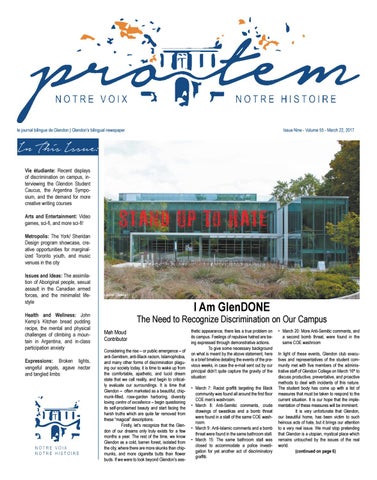
I Am GlenDONE
The Need to Recognize Discrimination on Our Campus Mah Moud Contributor Considering the rise – or public emergence – of anti-Semitism, anti-Black racism, Islamophobia, and many other forms of discrimination plaguing our society today, it is time to wake up from the comfortable, apathetic, and lucid dream state that we call reality, and begin to critically evaluate our surroundings. It is time that Glendon – often marketed as a beautiful, chipmunk-filled, rose-garden harboring, diversity loving centre of excellence – begin questioning its self-proclaimed beauty and start facing the harsh truths which are quite far removed from these “magical” descriptions. Firstly, let’s recognize that the Glendon of our dreams only truly exists for a few months a year. The rest of the time, we know Glendon as a cold, barren forest, isolated from the city, where there are more skunks than chipmunks, and more cigarette butts than flower buds. If we were to look beyond Glendon’s aes-
thetic appearance, there lies a true problem on its campus. Feelings of repulsive hatred are being expressed through demonstrative actions. To give some necessary background on what is meant by the above statement, here is a brief timeline detailing the events of the previous weeks, in case the e-mail sent out by our principal didn’t quite capture the gravity of the situation: • March 7: Racist graffiti targeting the Black community was found all around the first floor COE men’s washroom. • March 8: Anti-Semitic comments, crude drawings of swastikas and a bomb threat were found in a stall of the same COE washroom. • March 9 : Anti-Islamic comments and a bomb threat were found in the same bathroom stall. • March 15: The same bathroom stall was closed to accommodate a police investigation for yet another act of discriminatory graffiti.
• March 20: More Anti-Semitic comments, and a second bomb threat, were found in the same COE washroom In light of these events, Glendon club executives and representatives of the student community met with five members of the administrative staff of Glendon College on March 16th to discuss productive, preventative, and proactive methods to deal with incidents of this nature. The student body has come up with a list of measures that must be taken to respond to the current situation. It is our hope that the implementation of these measures will be imminent. It is very unfortunate that Glendon, our beautiful home, has been victim to such heinous acts of hate, but it brings our attention to a very real issue. We must stop pretending that Glendon is a utopian, mystical place which remains untouched by the issues of the real world. (continued on page 6)
Pro Tem Letter from The Editor Editor in Chief | Rédactrice en chef Camille Slaght editor@protemglendon.com Assistant English Editor | Rédactrice adjointe (anglais) Effie Barbalias assistanteng@protemglendon.com Assistant French Editor | Rédactrice adjointe (français) Gabriella Giordan assistantfr@protemglendon.com Communications Officer | Agente de communications Sarah Mullins comms@protemglendon.com Photography Editor | Rédactrice de photographie Lauren Clewes photography@protemglendon.com Design and Layout | Maquettiste Sienna Warecki Section Editors | Chroniqueurs Campus Life | Vie étudiante Reeda Tariq campuslife@protemglendon.com Arts and Entertainment | Arts et divertissement Bruno Da Costa arts@protemglendon.com
Hey Glendon, For as long as I can remember, I have found immense release from putting words on paper, and finding the precise way to convey an emotion or a thought. The older I get, my affinity for words only solidifies. Being the editor of Pro Tem has made me aware that no matter where I end up in life, I will always write in some capacity. Pro Tem was a great incentive for me to fine-tune my writing in both French and English. It has also given me a platform to encourage others to do the same. Over the two years that I spent on the Pro Tem team, I have seen many students’ writing abilities improve vastly. I admire the skill with which several contributors managed to express important and complex ideas over the past year. This vibrant student organization has led me to meet some of the smartest and most creative people that I know. The production of Pro Tem is a collaborative effort, and I could not have done it alone. I would like to thank all those who played a part in the newspaper process, whether you helped with a brainstorm, with a Late Night Lunik cleanup, or with a few
long hours spent editing. Sarah, your dedication and meticulous eye were crucial to the Pro Tem team this year. You are always willing to lend a helping hand, no matter how much you have on your plate. You are a true leader and a force to be reckoned with. To our amazing contributors, thank you for writing for Pro Tem, even during peak assignment periods. The student voice at Glendon is a very diverse one, and the more contributors we have, the closer we get to a having a variety of content that is representative of our vibrant student body. Aux francophones qui écrivent en français, je suis reconnaissante de votre persévérance. Il peut être difficile de trouver l’opportunité de s’exprimer en français à Toronto, mais Pro Tem vous offre l’opportunité d’appliquer cette langue qui fait partie de votre identité et je vous félicite d’en avoir profité. Aux Anglophones qui soumettent aussi des articles en français, j’admire votre courage et votre discipline. La meilleure façon de maitriser une langue est de continuer de la mettre en application, à l’orale et à l’écrit, sans être trop perfectionniste. Soyez patients et faites des erreurs. Les francophones de Glendon
apprécient vos efforts et vous encourage de continuer à pratiquer la langue qui leur tient tant à cœur. Nous partageons le même amour pour la même langue et cet amour est un des nombreux aspects qui nous rend aussi unis ici à Glendon. Le journal étudiant de Glendon est un des éléments les plus rassembleurs de notre collège. Pro Tem est un canal dont le but est de partager les idées de tous et toutes qui souhaitent exprimer les leurs. In light of recent displays of racism on campus, I am compelled to tell you all that Pro Tem values your opinion. Each and every one of you has a unique perspective to offer and Pro Tem will always welcome your ideas, while tolerating no discrimination of any sort. If you ever experience injustice in any sphere of your life while attending Glendon College, know that Pro Tem is here to help you raise your voice. Thank you for writing, Glendon. I enjoyed reading every word. With love, Camille Slaght Editor in Chief
Metropolis | Métropole Andrew Thies metropolis@protemglendon.com Issues and Ideas | Actualité et opinions Sabrina Sukhdeo issuesideas@protemglendon.com Health and Wellness | Santé et bien-être Emilia Nowicki health@protemglendon.com
Vous avez des opinions? Vous aimez écrire? Vous faites de la photographie? Vous adorez dessiner? Pro Tem vous veut!
Expressions Kaitlin Fenton expressions@protemglendon.com
Envoyez-nous un courriel à editor@protemglendon.com pour apprendre comment vous pouvez vous impliquer!
Online Content | Contenu en ligne Sam Kacaba online@protemglendon.com
pro~tem
est le journal étudiant du collège Glendon. Publié pour la première fois en 1962, c’est la plus ancienne publication de l’Université York. We strive to act as an agent of social change, and will not print copy deemed racist, sexist, homophobic or otherwise oppressive. Please respond to what you read in the pages of Pro Tem/ n’hésitez pas à réagir à ce que vouz avez lu dans Pro Tem. Contact us/ Contactez-nous: protem@glendon.yorku.ca The Pro Tem Office D114 Hilliard Residence, Glendon College 2275 Bayview Avenue North York, ON M4N 3M6 The office is open by appointment only. Le bureau est ouvert sur rendez-vous seulement. Les lettres adressées au journal peuvent être éditées au niveau de la clarté ou de contenu. All copy appearing in Pro Tem is at the discretion of the editorial team. Opinions published in Pro Tem are the thoughts of individual writers, and not the publication as a whole.
2
Nadia Edwards
Vie étudiante UNITED WE STAND The Perspective of Two Members of The Glendon Community David Ip Yam and Pascal Arseneau This opinion piece was written in response to the hate crimes which took place on Glendon Campus on March 9, 10, 14 and 15. For more details on these incidents, please see safety. yorku.ca. The views and opinions expressed in this article are those of the authors. The series of menacing, hateful, anti-Semitic, anti-black and xenophobic graffiti found recently on campus is unacceptable, hurtful, and ignorant. While it echoes similar incidents at other public institutions, its unprecedented nature accentuates our community’s need for clarity, support and resolve. Hateful acts have the power to transform some communities by potentially inciting fear, revealing apathy, and brewing distrust. We recognize issues of systemic power and priv-
Une entrevue avec Julie Lacombe, ancienne étudiante de Glendon Q : Parle-nous un peu de ce que tu as fait quand que tu étais étudiante à Glendon – ton programme d’étude, les clubs auxquels tu as participé, ton échange à Laval. R : J’ai obtenu un baccalauréat en psychologie et sociologie à Glendon en 2008. J’ai fait mes études primaires et secondaires en français à Toronto et j’ai choisi de poursuivre mes études dans une université francophone. Je suis fière d’être franco-ontarienne et continuer mes études en français était primordial pour moi. Au cours de ma troisième année d’université, j’ai choisi de faire un échange d’un an à l’Université de Laval à Québec et ça a été une expérience académique et sociale très enrichissante. Malheureusement, à Glendon, les cours de travail social s’offraient seulement en anglais à ce moment-là, alors j’ai eu l’occasion de prendre pleins de cours intéressants dans ce domaine, ainsi qu’en criminologie et en création littéraire. Cette expérience m’a aussi permis d’approfondir ma connaissance de la langue française et de me sentir vraiment à l’aise dans ma langue maternelle, surtout au niveau social. Glendon m’a aussi permis de terminer ma quatrième année à l’Université d’Ottawa, où j’avais l’intention de poursuivre mes études en enseignement l’année suivante. Ils ont été flexibles et m’ont permis d’étudier à trois universités au cours de mon baccalauréat de 4 ans. Cela m’a permis de savoir ce que je voulais faire et où je voulais vivre plus tard.
ilege and by no means aim to co-opt the narratives of those affected. That being said, we humbly suggest that we can disempower the criminal(s) who deface our property and threaten our safety by acknowledging injustice, by standing together to prevent hate speech and the expression of hateful ideas, and by acting with courage in the face of adversity. If any good can come out of these most deplorable acts, it should be a more tightly-knit community united against hate. There is strength in numbers. There is strength in solidarity. There is strength in diversity. We are calling for all members of the Glendon community—students, administrators, and faculty members -- to turn to each other as a community of concerned human beings. While we hope to bring this type of incident to an end rapidly, we may encounter similar situations again at some point in our lives. Let’s learn to challenge hate on our campus together. Some might argue that writing this piece opens one up to criticism, which we welcome. However, we felt compelled to offer both support and avenues for action in addition to the work that is currently underway with student groups, Toronto Police and Community Safety:
If you have ideas or would you like to help generate ideas, join us to develop strategies to create safer spaces on campus which prioritize dialogue, learning, and action. We will not achieve this goal without you. Contact York’s Community Safety department at any time that you become aware of graffiti or any other types of occurrences that condone or promote hate on campus at 416650-8000 extension 58000 or contact 911. Become an ambassador for humanity and educate yourself on issues of inclusivity, equity, and diversity. Take the REDI tutorial here: http://rights.info.yorku.ca/redi/ Listen to other perspectives with an open heart but be an active bystander when you witness hateful and hurtful behaviours in class, in residence, on-campus and off-campus. Learn about active bystander training by contacting Elana Shugar at eshugar@yorku.ca. Ask your peers and colleagues if they need support through these turbulent times and reach out if you need support or a sounding board. Here are great services available to you:
Q : Glendon te manque-t-il ? Y a-t-il quelque chose que tu regrettes de ne pas avoir fait pendant que tu étudiais ici ?
R : Glendon m’a d’abord aidé en offrant des cours en français. Cela m’a permis de rester dans ma ville natale près de ma famille, d’économiser beaucoup d’argent et d’explorer les domaines qui m’intéressaient dans ma langue maternelle. J’ai eu des professeurs motivés qui m’ont poussé à faire du mieux que je pouvais. Le programme d’échange m’a permis d’aller à la découverte de mon héritage francophone, d’accéder à plusieurs cours fascinants qui m’ont marqué et de gagner beaucoup de confiance et de ténacité face à la vie. En quittant Glendon, je me sentais prête à affronter le monde et à surmonter quelconques obstacles pour réaliser mes rêves.
R : Mon premier regret est de ne pas avoir vécu en résidence. Puisque je suis née à Toronto et que ma famille y vit, j’ai pu économiser beaucoup d’argent en vivant à la maison. Heureusement, l’échange que j’ai fait à l’Université Laval au cours de ma troisième année d’étude m’a permis d’avoir cette expérience. Mon deuxième regret est de ne pas avoir participé davantage aux clubs et aux activités à Glendon. J’ai quand même contribué au journal Pro Tem en y publiant quelques poèmes. De plus, grâce à des rencontres à Glendon, j’ai participé au programme Odysée qui m’a présenté au monde de l’enseignement en me permettant de travailler dans les écoles où je préparais et animais des activités. Cela a été une expérience marquante dans ma vie puisque c’est à ce moment-là que je me suis rendu compte que je voulais être enseignante.
- The Accessibility, Well-Being, and Counselling Centre (Glendon)
Q : Que conseilles-tu aux étudiants de Glendon?
- The Office of Student Affairs (Glendon) - Centre for Human Rights, Equity and Inclusion (Keele) - The Department of Community Safety (Keele) - Your Student Government, student organizations, residence dons, peer mentors, and peers - Community organizations accessible to your need Look out for an invitation to a town hall-style meeting with the Department of Community Safety to help us learn about the facts, and articulate our security and safety needs going forward. While we are all affected to varying degrees and will respond in different ways, let’s show that we can overcome fear, apathy, and distrust with the strength of our community. This is unchartered territory for some, thankfully one might add, yet there is much truth and hope in recognizing that “united we stand, divided we fall”. The French version of this piece can be found online at www.protemgl.com.
les moyens de l’obtenir. Glendon est un lieu incroyable; un lieu où l’on peut se découvrir, tisser des liens d’amitiés qui dureront longtemps et créer un réseau solide. C’est un lieu où l’on peut trouver le soutien et l’encouragement d’une équipe d’enseignants incroyables. C’est un lieu où l’on peut s’épanouir ! 2. Allez ailleurs ! Que ce soit dans une ville canadienne ou un pays étranger, voyagez ! Ça a été un grand ajustement pour moi, mais je suis devenue plus forte et plus mature grâce à mes expériences de voyage. 3. Faites partie de la vie de Glendon, participez aux clubs et aux activités de l’école, explorez divers domaines et, surtout, essayez de nouvelles choses !
R : 1. « Follow your bliss ! » C’est toujours important de savoir ce qu’on veut et de se donner
Q : Que fais-tu présentement ? R : J’entame ma huitième année en tant qu’enseignante au primaire dans une école francophone à Toronto, mais j’ai fait beaucoup de chemin depuis que j’ai quitté Glendon. Le fait d’avoir vécu dans trois différentes villes au cours de mon baccalauréat a développé en moi un sens de l’aventure, une débrouillardise et un désir d’explorer. J’ai été enseignante à Toronto pendant deux ans. Par la suite, j’ai vécu pendant quatre ans à Québec, où j’ai enseigné dans une école trilingue. J’ai voyagé au Costa Rica au cours de l’année scolaire 2015-2016, où j’ai travaillé dans une petite école privée sur le bord de la côte pacifique. Q : Comment est-ce que Glendon t’a aidé à trouver ta voie ?
Julie Lacombe
3
Campus Life Glendon’s Student Caucus Evelyn Ascencio Contributor Je m’appelle Evelyn Ascencio et je suis la présidente du Caucus étudiant de Glendon. Le Caucus étudiant est un comité d’étudiants qui se rassemblent afin de discuter de différents sujets touchant les étudiants et le personnel de Glendon. J’ai interviewé Emily Leahy, une étudiante de troisième année inscrite au programme d’études anglaises, et Lindsey Hutchins, une étudiante de quatrième année inscrite au programme d’études internationales, dans le but de connaître leurs expériences en tant que membres du Caucus étudiant.
Q: What committees do you sit on Student Caucus and what issues do you deal with? Lindsey: The committee I currently sit on is Petitions. This committee is tasked with the responsibility of reviewing, and approving or denying student-submitted academic petitions. These petitions include a range of reasons, from personal, to economic, medical, to academic misfortune. Emily: I sit on the Curriculum Committee as a student representative. We discuss and vote on new courses or changes to existing courses here at Glendon. My personal goal is to make sure that upper-year courses will be challenging and rewarding and that lower-year courses are catered to the needs of newer students. Q: Quelles compétences avez-vous acquises en faisant partie du Caucus étudiant?
Lindsey: Les compétences que j’ai acquises en étant membre du Caucus étudiant sont inestimables. J’ai appris le fonctionnement de la politique de l’Université de York, l’importance de s’exprimer, et comment suivre les protocoles lors d’une prise de décisions. Emily: J’ai acquis des connaissances précieuses sur les tenants et aboutissants du Collège Glendon. Je comprends maintenant comment une idée de cours devient un cours offert aux étudiants. Je suis plus à l’aise de discuter avec les professeurs et le personnel et de défendre les droits des étudiants. Q: Why is it important for students to remain engaged on campus?
stages of any policy, and we also have the power to send it back to the drawing board should enough of it be required. This is a powerful tool for the students to use, as it is a direct line between the students and faculty. Emily: In relation to the Curriculum Committee, it’s important that students feel they have a say in the courses being offered: this affects how we able to get our degrees (i.e. requirements versus yearly offerings), what we will be able to do with them after school (i.e. in grad school) and if we are interested in the course itself. More generally, being engaged on campus can open so many doors! You make friends, you make connections with professors and staff, and you learn about yourself.
Lindsey: Glendon is unique at York, because we have fought for, and retained student parity within the Faculty Council. We are able to have our ideas and input included at the base
Le Caucus étudiant recrute de nouveaux membres cet été. Veuillez envoyer un courriel à studentcaucusglendon@gmail.com si vous souhaitez obtenir de plus amples renseignements.
to see the concepts embraced in class reappear in the academic research and the presentations of our panelists on the day of the symposium. We were joined by distinguished scholars and specialists in their academic fields, talented tango performers, and even the Consulate General of Argentina herself! In our cultural panel, we undertook a meticulous examination of the various paths of the tango since it was introduced by West African slaves. We explored the diverse artistry of the avant-garde artist Xul Solar, and political art of Leon Ferrari. In our history panel, we uncovered the often marginalized narrative of those affected by the military dictatorship and the representation of the indigenous peoples in the Republic. We also touched on Peronism, the myth of multiculturalism, Argentina as a human rights icon and the thorny and sensationalist Nisman affair. We are incredibly honored to have had the opportunity to foster intellectual dialogue among students, academic scholars, government officials, NGOs, and members of the Argentine-Canadian community. Taking on such a prestigious project
is a humbling experience and one in which opportunities for growth arise every day. From learning to facilitate dynamic and engaging fundraising events, to organizing the logistics of the project, our team worked hard to ensure the success of this initiative. Moving forward, the symposium team members feel more prepared to tackle real world challenges both in the workplace and in their personal lives. Taking into consideration all of the lessons we have learned, we would like to extend our thanks to everyone who played a part in this process. We would like to thank the Glendon faculty, including our professors, Dr. Marco Fonseca and Dr. Kirschbaum, our incredibly dedicated team of volunteers, our partnering organizations including the GCSU, York International, the Extended Learning Office, as well as our community partners and donors such as Lorna Marsden and every one of our guests who came to the event. A special thank you to all of our esteemed panelists for your immense contribution to our project. Muchisimas gracias. Merci beaucoup à tous.
Argentina Symposium 2017 Nicole Doray and Lindsey Hutchins Contributors Thank you to all who helped make the Argentina Symposium an astounding success. Over the past two decades, Glendon has hosted and facilitated an academic and cultural celebration called the International Studies Symposium. In June of 2016, this year’s International Studies Symposium team began to take shape. Over the course of the next few months, the team started to learn about Argentina, a country known for its diverse landscapes and vibrant culture. By the beginning of the academic year, it had been decided: Argentina would be the country of choice based on the overwhelming interest of the team. We found it surprising that considering Argentina’s dynamic relationship with Canada, such a rich, diverse and captivating country remained but an exotic dream to many Canadians. Our team wanted to explore a wide array of topics for enhanced academic and cultural understanding of this nation - including Argentina’s controversial military regimes, its long history of bilateral and multilateral political relations with international organizations, countries, and institutions, as well as its historical, cultural, environmental, industrial, and economic evolution. For our team members, Glendon’s main attraction has always been its global component; its professors’ and students’ ability to look beyond the classroom and learn from an international perspective. Glendon’s Department of International Studies was the first of its kind in Canada, and it remains a unique program that offers students the opportunity to explore how governments, law, politics, business, civil society, culture, science, and the environment relate on the international stage, using a multidisciplinary approach. The program adds a unique global dimension and international flair to Glendon, which culminates in the Symposium. The Symposium is an accredited part of the International Studies curriculum and 4 is a hallmark of the program. It is a
Lindsey Hutchins
unique experience that provides an opportunity for dialogue between Glendon students and the international community on a multitude of global issues. It is the mission of the International Studies team to uphold the standard of academic excellence that was set over two decades ago during the first Symposium. We could not have done this without the help and guidance of Professor Fonseca, who spent the entire first semester teaching the Symposium students about Argentina’s colonial past, about the gaucho culture, about the myths surrounding the creation of the nation, about its history of immigration, and about Eva and Juan Peron which, as Professor Jorge Nallim rightfully noted, left a prominent mark on Argentine politics. We learned about the financial crisis of the last decade, the Kirschner government, as well as Macri’s current presidency and embrace of neoliberalism. Each of the students wrote an essay focusing on a theme from the class such as the mid to late twentieth century’s feminist movement in Argentina, to the politics of soccer, to the history of the Argentine economy. As panelist coordinator of the project, I was delighted
Vie étudiante Let’s Talk Fair Trade With WUSC Glendon Reeda Tariq Campus Life Editor WUSC Glendon is excited to end the year with an event all about the Fair Trade movement. We will be breaking down the who, what, where and how behind the concept of Fair Trade. On March 28, from 7 to 9pm, join the WUSC Glendon team in the skyroom for our first ever Uniterra Symposium: Fair Trade and Global Reach. We will discuss the ethics of consumption with WUSC Glendon, alongside Glendon professor Elaine Coburn, and Project Manager of Equifruit Inc. Michelle Gubbels. We will talk about why we should, as consumers, care about the origin of the goods that we buy, and how we can make a change in the world we live in. We will cover topics ranging from the environmental effects to the social effects of mass consumption. Some environmental issues that will be discussed include the waste that occurs on a large scale, the pollution filling the oceans, and the depletion of natural ressources for the purpose of production and manufacturing of goods. Not only is the ocean quickly filling up with our debris, but so is the land that we walk on. As for social consequences of mass
consumption, we will look at the unsafe working conditions, generally in the Global South. However, unsafe work also occurs in North America; WUSC Glendon has done work with refugees and immigrants who work in unsafe, unregulated jobs upon their arrival in a new country. Vulnerable people are more likely to be exploited due to language barriers, poverty, and their lack of awareness of the laws and regulations that are in place to protect them. These are the people who make the products that we buy, and collect the materials to build/ manufacture those products. One of our speakers, Michelle Gubbels of Equifruit, was exposed to harmful pesticides whilst working in a field, picking the fruits and vegetables that we take for granted. We may not be aware of the working circumstances of those picking our beloved avocados and bananas. We buy things mindlessly, with little concern for those who made them, little knowledge about the conditions they were made in, and the environmental impact of the whole process. If any of these concerns sound like issues you wish to see discussed more, or if you just simply want a chance to meet our speakers or the WUSC Glendon team, then join us March 28 at 7pm in the Skyroom.
La place de l’écriture dans le parcours littéraire Gabriella Giordan Rédactrice adjointe français On entend souvent parler de l’importance de maîtriser plus qu’une langue, soutenant que cela est une preuve notable d’intelligence en soi. En Ontario surtout, la connaissance du français s’avère un atout qui distingue incontestablement un bon candidat d’un excellent candidat dans le monde du travail. Néanmoins, écrire des histoires, des contes ou des poèmes, une activité qui exige d’abord et avant tout un esprit créatif, demeure peu valorisé. Il y a très peu d’options de cours centrés sur la création littéraire dans le programme de premier cycle d’études françaises à Glendon. Présentement, si l’on se fie au catalogue de cours offerts pour l’année 2016-2017, il n’y en a que deux, soit FRAN 3712 3.00 Stylistique française II : écriture d’une nouvelle et FRAN 4277 3.00 Écriture narrative. Cependant, FRAN 3712 est offert uniquement aux étudiants francophones. Cela limite les options des étudiants du programme qui ne sont pas francophones mais qui désirent tout de même suivre un cours d’écriture en français. Par ailleurs, le manque de cours d’écriture empêche aux étudiants qui s’intéressent à la littérature française et francophone de s’immerger et de se découvrir dans la littérature. La création littéraire devrait être nécessaire à l’obtention d’un baccalauréat en littérature française. Elle constitue un excellent moyen de mettre ses capacités intellectuelles et artistiques au défi, en ce qu’elle oblige les étudiants à penser non pas de manière critique, mais plutôt de manière créative et abstraite. Le fait d’écrire une nouvelle ou un poème permet aux étudiants de sortir des lieux communs, de produire un travail qui ne comporte ni introduction, développement et conclusion. De plus, la création littéraire pourvoit les étudiants d’une voix et leur fait prendre connaissance des distinctes façons de s’exprimer à l’écrit. Or, de notables enjeux empêchent que ce type de projet soit réalisable au premier cycle à Glendon, du moins pour l’instant. Malgré le fait que le département d’études françaises soit l’un des départements les plus impor-
tants de Glendon, les ressources nécessaires à ce type de projet ne suffisent pas. Par contre, l’on peut participer à des concours d’écriture ou compléter une maîtrise en création littéraire. Chaque année, le département d’études anglaises de l’Université York organise un concours d’écriture. Le prix pour la catégorie d’écriture en français s’intitule « The Lorna Marsden Prize for Creative Writing in French », et fait partie du concours de York depuis 2014. Tout étudiant de York a le droit d’y participer. Ce concours, quoique très peu médiatisé, est un concours qui permet aux étudiants d’études françaises à Glendon de se démarquer tout en pratiquant leurs compétences d’écriture. Le collège Glendon possède également un programme de maîtrise en études françaises qui offrait auparavant deux champs de spécialisation : la littérature et la linguistique. La spécialisation en littérature est structurée autour des théories et champs littéraires, des écrits de femmes et du rapport entre la littérature et la société. À partir de l’année prochaine, un programme de maîtrise en création littéraire offrira un répertoire de cours axés non seulement sur la littérature, mais également sur la création littéraire, tel que le cours 5243 3.0 Écriture poétique. Même si au premier cycle, les étudiants de Glendon n’ont pas la possibilité de suivre plusieurs cours d’écriture, lesquels seraient très utiles, voire impératifs à leur cheminement dans le domaine de la littérature, le concours d’écriture Lorna Marsden et le programme de maîtrise en création littéraire leur sont disponibles. Petit à petit, l’intérêt de l’écriture se faufile dans le parcours académique des passionnées de la littérature de Glendon, mais il faut que les cours offerts à Glendon répondent davantage aux intérêt des étudiants.
5
Campus Life The Glendon Dance Une langue, deux exTeam Invites You to périences See Them Compete! Two FSL Students Johnathan Ponce, Head Coordinator Contributor In early March, the Glendon Dance Team held its final showcases for the 2016/2017 year. There were many Glendonites, as well as family and friends in the audience supporting the dancers. We presented 25 wonderful pieces, including large group pieces, solos, and duets. The tech crew did an amazing job, and played a large role in the production of the show. This year, we added more lighting and background decor to make the production more complete and entertaining. As always, we introduced next year’s executive team. Seeing as our only returning executive member will be the Public Relations officer, almost the entire executive team leading the GDT through the 2017/2018 will be composed of new members. We are thrilled to introduce Alex Gimber as our incoming Head Coordinator, and Kaleriya Azov as our incoming Head Choreographer. Our main events for this year have come and gone, but there is still more in store for the GDT. Our competitive tier will be competing for the second year at the Rhythm Dance Competition, against other post-secondary dance teams from Ontario. It will take place at the Milton Centre for the Arts on Saturday March 18 and Sunday March 19. The competition is looking fierce this year, as there are twenty other teams attending, but we are confident that our hard work will pay off, and that the support from the Glendon community will give us the boost that we need. We invite you to come and support us on the day of the competition. Admission is free! Our first entries will go on stage at 8:30am, so we hope to see you in the audience bright and early! It has been a great year, and we hope that everyone in the Glendon community will continue to support us like they have been doing!
Aaron DeRoche
Discuss Their French Language Journey
Margaret Mendoza et Natalie Somerset Contributrices Nous nous appelons Margaret et Natalie, nous sommes au niveau FSL 1200 et nous avons écrit cet article afin de comparer et d’évaluer nos expériences personnelles quant à l’apprentissage du français. Q : Pourquoi avez-vous décidé d’apprendre le français ? Margaret : Je n’ai pas choisi de commencer à apprendre le français. Ma famille a déménagé en Belgique alors j’ai dû fréquenter une école française. Natalie : J’ai commencé à apprendre le français parce que c’était obligatoire à l’école. Toutefois, j’ai décidé de continuer à apprendre le français parce que j’aime les langues. De plus, je pense qu’il est important de maîtriser les deux langues officielles du Canada pour avoir plus d’opportunités d’emploi et pour pouvoir communiquer avec plus de gens. Q : Où avez-vous commencé à apprendre le français ? Margaret : Je suis arrivée en Belgique quand j’étais en 3e année et j’ai pris des cours privés de français jusqu’à ce que je commence à fréquenter l’école française. Pourtant, à la rentrée, je ne pouvais pas comprendre ni mes professeurs, ni mes copains de classe et il m’était très difficile de m’intégrer dans ce nouvel environnement. Je ne voulais donc pas m’appliquer dans mon apprentissage. Natalie : J’ai commencé à apprendre le français
à l’école en 4e année dans le programme « Core French ». Q : Quelles difficultés avez-vous rencontrées lorsque vous avez commencé à apprendre le français ? Margaret : Au début, c’était difficile car je ne connaissais rien à propos de la langue française. Le français oral m’était encore plus difficile car j’étais très timide et je ne voulais jamais participer aux discussions en classe. Je n’avais pas confiance en ma compréhension et mon accent alors j’évitais souvent de parler. Natalie : Il m’était difficile de m’exprimer parce que je ne possédais pas assez de vocabulaire pour pouvoir le faire. L’écriture était difficile aussi parce que mon orthographe n’était pas à un niveau très élevé. De plus, quelques-uns de mes camarades de classe ne voulaient pas apprendre le français et parlaient seulement en anglais, alors je ne pouvais pas pratiquer le français avec eux. Q : Comment avez-vous trouvé le test de placement de Glendon ? Margaret : Quand j’ai su que je devais faire un test pour évaluer mon niveau, j’ai eu confiance en moi. Pourtant, quand j’ai fait le test, je me suis rendu compte que j’avais oublié beaucoup de concepts grammaticaux et que mon vocabulaire n’était pas aussi riche que je pensais. Mais quand les cours ont commencé, j’ai compris que j’avais été placée au bon niveau. Natalie : Pour moi ça a bien été. J’ai fait du mieux que je pouvais et je pense que je suis au bon niveau maintenant. Q : Quels sont, selon vous, les défis de pratiquer le français à Toronto ? Margaret : C’est difficile de pratiquer le français à Toronto parce que je ne connais pas beaucoup d’endroits où les gens parlent en français. Le plus souvent, les gens qui maîtrisent les deux langues officielles choisissent de parler en anglais. Natalie : Je ne connais aucun endroit à Toronto où l’on peut pratiquer le français. De plus, je suis très timide et je ne suis pas très à l’aise par rapport à mes compétences de français, alors si je n’ai pas à parler le français je ne le fais pas. Je voudrais connaître des endroits où tout le monde parle en français pour que je me sente plus motivée à améliorer mes compétences. Q : Pourquoi est-ce-que c’est important pour vous de continuer à apprendre le français ? Margaret : Le français est devenu quelque chose de très important dans ma vie et j’espère ne jamais le perdre. Même si au début ce n’était pas facile d’apprendre cette langue, j’ai appris à l’apprécier et j’aime qu’elle pourra m’ouvrir plusieurs portes plus tard. Je suis heureuse d’avoir l’occasion d’apprendre et de maîtriser le français.
6
I Am GlenDONE
The Need to Recognize Discrimination on Our Campus (continued from cover) We have to know how to address these problems head on, and we need a concrete protocol in place that can be followed when such despicable acts of discrimination occur. Currently, such a protocol does not appear to exist at Glendon. If Glendon truly wants to be recognized as a beautiful, inclusive, and multicultural hub that inspires and promotes its students diversity, we must learn to celebrate each other’s differences, and welcome the ideas of others while simultaneously condemning hate. We must foster a community firmly grounded on principles of acceptance and understanding, rather than fear and ignorance. It truly does start with us, the students. The administration has shown, through their weak response, that it will be up to us to make a difference; to stand up against discrimination. It starts with acknowledging hatred for what it is, and vehemently challenging it. These events do not mean that Glendon is a place filled with hatred. It is, however, filled with apathy. Pretending these issues do not exist only succeeds in fostering an atmosphere of naïveté and indifference. The next time someone says “Glendon is such a wonderful place”, smile and recommend they try the pizza in the cafeteria. It will be the first step in revealing that even the most gorgeous of places conceals the most grotesque things. Together, we truly can “Make Glendon Great Again”. Together, we will stand united against hatred and discrimination. Students are encouraged to report any information they have regarding the incidents that have occurred. Students are also encouraged to approach security officials in future to reporting any incident that they feel is discriminatory or threatening in nature. For those affected or concerned by these events, Counseling Services (111A) are available. They can be reached at 416-487-6709 or at counselling@glendon. yorku.ca. Security Services Contact Information: General Phone: 416-650-8000 or Ex. 58000 Urgent Phone: 416-736-5333 or Ex. 33333 Email: scc@yorku.ca
Arts et divertissement Overwatching Overwatch: An Outsider’s View Kaitlin Kenny Expressions Editor
The Expanse Puts Science Back into Sci-Fi Eric Vogel Contributor For myself, science fiction as a genre is at its best when it explores the nature of our society (and how that can relate to technology). Rather than simply using lasers and space ships as a backdrop for an adventure story, good sci-fi is steeped in social commentary and analysis. From classic novels such as 1984 and The Forever War, to onscreen series such as Star Trek and Black Mirror, there is a dearth of sci-fi perspectives about humanity’s present and future. A recent such entry, that has gone criminally under the radar, is The Expanse series. First developed as a series of novels written by authors Daniel Abraham and Ty Franck (under the pen name James S.A. Corey), and later developed into a tv series for SyFy, The Expanse explores the social, political, and military implications of humanity’s colonization of the solar system. Taking place hundreds of years in the future, The Expanse presents a future in which Earth and Mars become embroiled in a cold war turned hot, and how the Belters (the peoples who toil to extract the resource wealth of the outer planets) get caught in the middle. Rather than simply acting as an allegory about neocolonialism for the sake of it, the setting of The Expanse is built upon logical conclusions about the implications of interplanetary travel and colonization. ‘Earthers’ despise Martians and Belters for their limitless access to free air and living space; due to vast overpopulation, most Earthers don’t have access to jobs and live on government assistance. Alternatively, Mars is an entirely collectivist society, bound by the single goal of terraforming its planet; Martians grow up to work as either engineers or
as military personnel. Due to the vast distances between its asteroids and moons, Belter society is loosely held together by the squabbling Outer Planetary Alliance (OPA); ranging from politicians to terrorist and criminal groups, the OPA is held together only by its mutual hatred for the inner planet. The Belter language is a patois that reflects the groups who had been desperate enough to work out in deep space in the first place; whereas a Martian from the Mariner Valley may look Indian or Chinese but will speak with an exaggerated Texan drawl because of the groups that had originally colonized the area. Beyond the human implications, The Expanse explores what the future of space travel may actually look like for technology. For instance, rather than sleek designs, ships are bulky and utilitarian because they can ignore drag; the lack of drag also means that the speed and manoeuvrability of a ship is only limited by a crew’s ability to survive thrust. Space combat resembles submarines firing their torpedoes from thousands of kilometres of distance. The distance also means that communication is limited by the speed at which light can travel between spaces. Farmers on Ganymede grow GM soybeans that thrive in the low light of the moon (assisted by orbital mirrors). These are the kinds of added touches which make the series feel so dimensionalized and well thoughtout. If you’re interested in catching up quickly, the television series is currently in its second season, roughly covering the events of the first book. The story connects the dots between a police detective working a kidnap job on Ceres station, and the surviving crew of an ice-hauler destroyed by an advanced stealth ship; it eventually unfolds to reveal political intrigue and a power struggle with system-wide implications.
I have a confession to make: I have never played the smashingly popular Overwatch. Released in May 2016 by Blizzard (known for games like Warcraft and Diablo), it has a regular playing group of 9.7 million people. Its community is known for being kind, courteous, and helpful. The reviews for this game are incredible: ranking from 88-100/100, and it has won many awards. My boyfriend, Brandon, is absolutely enamored with the game and plays it often. His favourite character is Zarya, a big pink-haired, buff Russian lady who likes to beat up bears and hates robots. Generally, I try to play games with him, but I’ve never cared to pick up the controller with him on this. That said, here is my outsider perspective of Overwatch. The game is set on a fictional Earth, years after a war waged between Omnics (human created A.I.) and humans. The Overwatch was a group dedicated to protect humans from these robots, and was eventually disbanded following a peace treaty. One day, they are called back to combat terrorism. For whatever reason, the team does so in-game by fighting each other. I’ll be honest - I cannot for the life of me comprehend this! There is no solo campaign, no story mode. It is all multiplayer in which the various characters of Overwatch fight each other. I have absolutely no clue how this combats terrorism, and whenever I ask my friends or boyfriend why, they pause, think about it, and agree that it makes no sense. Visually, I really appreciate Overwatch. The maps are set across the world. As I write, I’m watching Brandon play in a German castle. They are well designed, both aesthetically and from a gameplay perspective. It is
fair for both parties, and works well for both beginner and intermediate players. There is also a collection of shorts accompanying the characters, which helps to provide insight into the characters and adds great depth. My personal favourites are Bastion, an old fighting robot with a bird best friend who is triggered into attack modes when he hears woodpeckers (they remind him of gunshots), and Soldier 76, a well-seasoned fighter who believes that no one should be left behind. Not all of the characters are as cutesy as the aforementioned. Many female characters are overly sexualised, whether it be through their attitude or poses. Widowmaker, a blue Frenchwoman, is notorious for this. Almost all of the women’s clothing is skin-tight, and shows a ridiculous amount of skin - clearly designed by men, for men. Tracer, a gay British woman, was accused of having a post-victory pose that was deemed “too sexy”. Blizzard responded by upping the ante and making it even more provocative - evidently, there is still a long way to go for feminism in the gaming world. I will, however, admit that there is a fantastic array of different nationalities. The characters are from all over the world, from countries such as India, Brazil, and China. It is fantastic to see such great representation, especially in an industry that creates largely white male protagonists. Overall, this game looks like a good time for those interested in multiplayer games. It is well designed, with rich backgrounds and well-rounded characters. There is a player for everyone, and everyone is welcome to play. That being said, I cannot recommend the confusing storyline. Ultimately, I guess, the players are not playing for the plot, and it is evident why: the game is entertaining to play! For now, I absolutely enjoy watching it - just don’t tell my boyfriend!
7
Arts and Entertainment The Fundamentals of Alien Grammar A Review of the Movie Arrival Bruno Da Costa Arts and Entertainment Editor Finding myself without much to do on a Saturday night—ignoring deadlines—I pressed play on a movie I had long been wanting to watch, Denis Villeneuve’s 2016 science fiction masterpiece, Arrival. Starring Amy Adams, Jeremy Renner, and Forest Whitaker, the film tells the story of Dr. Louise Banks, a linguist, and how she maneuvers communication with the alien creatures inside one of twelve space-pods to make contact with Earth. The best way to introduce Arrival to an audience would be as an alien movie - for those who don’t like alien movies. The two extraterrestrial beings aboard the pod always remain partially hidden in a sea of fog behind a glass-like wall through which Dr. Louise Banks (Adams) and Dr. Ian Donnelly (Renner), a theoretical physicist, attempt to communicate with them. The plot of the film appears simple: the government enlists the help of a linguistics professor and a physicist in order to establish a rapport between the two species in order to determine the heptapod aliens’ purpose on Earth, uncovering any advanced technological knowledge they may hold along the way. How-
Des superhéros cosmiques et comiques Les Gardiens de la Galaxie sont arrivés ! Mackenzie Chopchik Contributrice Un homme enlevé de la Terre lors de son enfance, une guerrière verte, un lutteur qui cherche à se venger, un arbre colossal et un raton laveur se rencontrent tous en prison. Non, il ne s’agit pas du début d’une blague, mais plutôt du début du film Marvel intitulé Les Gardiens de la Galaxie. Capturé par un vaisseau extraterrestre après la mort de sa mère, Peter Quill devient un hors-la-loi assez malchanceux de voler un artéfact précieux. Il se retrouve emprisonné avec la guerrière Gamora, Drax le destructeur, Groot, un arbre sensible et Rocket, un raton laveur bipède. Mais lorsque le vilain Ronan l’Accusateur vole l’artéfact, envisageant la destruction de la galaxie, ces délinquants sont les seuls qui peuvent l’arrêter ! Ce qui rend le film de James Gunn, sorti en 2014, tellement comique, est le fait qu’on ne peut le prendre au sérieux, un aspect qui s’est perdu dans les films précé8 dents de Marvel. Le film se moque sans
ever, Villeneuve succeeds in using the story as a conduit to comment on how our own human-to-human communication is such a precipice. Banks and Donnelly’s attempt to learn the aliens’ logograms is paved with many barriers in understanding. Meaning is nuanced and one must be careful of what message one’s words convey. If humans still struggle to understand and relate to each other, how could we ever do so with beings not of our world? The storyline is centred around Dr. Louise Banks, who goes on to become an astute and attentive master of interspecies communication. Adams’ embodiment of this linguist was captivatingly heart-wrenching. In a world where most humans automatically take a defensive stance towards their intergalactic visitors, Dr. Banks offers herself up to the opportunity and realizes the magnitude that her actions have in her interactions with the heptapod aliens. Where her contemporaries view them as threats, Dr. Banks views them as equals and believes Earth can benefit from their knowledge and way of thinking. Adams’ role was equal parts tender and stern, leading to a convincing portrayal of a scientist who is not blinded by prestige, but rather cognizant of the honour and duty that she has in ensuring that language only be used for peace and understanding. As a linguistics student, I was amazed by the process undertaken by Banks to crack the code and understand how the heptapod language works. The aliens communicate through logograms: circular symbols that have no correlation with their spoken language. Insofar as human languages go, this is unheard of. Banks’ approach towards understanding the alien language’s grammar and lexicon by looking for
honte des autres films Marvel et des clichés liés aux films de superhéros, et cela apporte du nouveau à un genre qui peut facilement devenir éculé. Un film qui peut se moquer de lui-même tout en se moquant des films qui l’ont précédé, d’une manière qui fait rire plutôt que soupirer, c’est un film réussi ! Les mises en scène des différentes planètes et des extraterrestres démontrent la prouesse d’animation et aident le spectateur à s’immerger complètement dans la galaxie de Marvel. Les héros rencontrent une galaxie pleine d’extraterrestres intéressants et de couleur, de taille et d’origine différentes. Il vaut la peine de visionner le film simplement pour voir tous ses effets spéciaux ! Avec autant de personnages nécessaires à l’intrigue, il pourrait facilement y avoir des personnages qui se perdent dans la foule. Néanmoins, dans Les Gardiens, les personnages sont au cœur de l’histoire. Aucun personnage n’est parfait, et cela est parfait en soi-même. Ce film démontre que même les héros ne sont pas simplement des êtres humains pourvus de qualités et de défauts, mais également des êtres capables d’accomplir des exploits extraordinaires. Le film, qui se moque des clichés des films de superhéros, se retrouve désormais dans le même trou que les autres films Marvel à cause de son intrigue secondaire axée sur l’amour. Peter et Gamora ne se démontraient pas désireux de l’un et l’autre, et en ajoutant une intrigue d’amour entre eux dès le début
patterns in the written language’s symbols is similar to the real-life methods used by linguists. Banks builds a rudimentary lexicon by presenting the aliens with simple words or phrases and receiving their symbol’s interpretation of those concepts. The film does take a sizable jump from the introductory scenes in determining what the symbol for ‘human’ is, to scenes where just some short interactive exercises allow Banks to have simple question-and-answer exchanges with the aliens. Villeneuve did have to take an artistic liberty in his film to establish a level of communication, so inquisitive minds may feel as if they are grasping for an explanation when it comes to understanding how Dr. Banks learned the heptapod language. Overall, Arrival is a film unlike any other of its genre. It portrays aliens in a unique perspective, opening up what is often considered a horror trope into a vessel for critical
thinking. The film would not have touched the hearts and minds of so many people worldwide were it not for Amy Adams’ dedicated role of a linguist trying to use language to promote peace and understanding. The film is accurate in its implementation of deductive linguistic methods. While creative liberties were taken for the sake of storytelling, they do not posit outlandish ideas that completely distort the study of language. Overall, Arrival lives up to its expectations of being a film that has the ability to suspend its viewers in the magic of cinema. Linguists and language nerds rejoice: our time to be heroes has come!
de l’histoire des Gardiens, les réalisateurs ont galvaudé l’occasion de dépeindre une histoire romantique réaliste. Une demi-tasse d’humour et d’action, dix milligrammes de lieux extraordinairement beaux, trente millilitres de personnage aim-
ables ainsi que quelques gouttes de scènes émouvantes se sont combinés pour produire Les Gardiens de la Galaxie, un des meilleurs films Marvel parus au cours de la dernière décennie.
Métropole YSDN2017: Engage in the Unexpected Andrew Thies Metropolis Editor Nearly two months have passed since I visited the Toronto Design Offsite (TO DO) Festival this year, yet some of the standout exhibitions remain in my mind. Innovative and cutting-edge design practices and showcases from all over the world were on display earlier in January to compliment the local talent. One exhibition that peaked my interest due to its six degrees of separation with us at Glendon was the York/ Sheridan Program in Design’s brand launch. I contacted the program and had a chance to interview two members of the YSDN2017 team. Claudia Konopko, the Experiential Manager, and Sarah Rodgers, a copywriter, agreed to answer a few questions. The following interview consists of their answers. Q: What is YSDN2017? Tell us a bit about the project. A: YSDN2017 is the final showcase for the graduating class of the York/Sheridan Program in Design. The show commemorates the past four years of hard work and presents the graduating students’ designs to the industry and the public as a means of introduction into the working world. These showcases happen every year within the York/Sheridan Program in Design, however this year, there will be a new element to the event: a traveling showcase. Q: Your branding philosophy is “Engage in the Unexpected” - what does this mean? A: The intent of the graduation showcase this year was to present ourselves in a unique way, differentiating ourselves not only from other design students graduating from other schools but also from the years that have come before us. Past graduating classes typically held one big finale show, so we decided to do the unexpected and take our show across Toronto and the GTA. With that in mind, we created a tagline that would encompass novelty. “Engage in the Unexpected” is meant to not only entice people and to add an element of mystery, but also to portray who we are as designers: purposeful and analytical creatives.
Q: What was your experience at TO DO like? How was the audience’s reaction? A: This was the first year that our program participated in the Toronto Design Offsite Festival, and it turned out to be a great success! TO DO was an opportunity to spread the word about YSDN2017 and unveil our brand to the design community and Toronto at large. Our poster wall, which displayed a hundred different variations of our brand, was very popular. We had more than 300 visitors: everyone from members of the design community, to junior YSDN students, to high school students who were interested in seeing what makes YSDN such a strong program. Q: How do you plan to get traction for this project and where does it fit into Toronto’s design scene? A: We have strong industry and alumni support who have already started to ask where they can find our show this year. In addition to our travelling showcase, the class is also producing a book that highlights case studies and work from over 85 students. The book will be available at our travelling exhibits as well as at our industry book launch event. The format of this year’s show, travelling from Oakville to North York and across downtown, allows us to engage with a wider audience. Whereas the event has previously focused on industry members, friends and family, this year we are opening our show to the public as well. Building off the success of TO DO, we recognize the value in having design conversations in our communities, helping to broaden the understanding of what design is and where it fits into our everyday life. We invite everyone to engage with us and see what the next generation of designers has to offer! Q: Where can we find the final showcase? A: York students can expect to see the show at Vari Hall on Keele Campus on April 20th. We will be releasing other final locations throughout March on our website and social media channels. Keep in touch with the YSDN2017 team and updates about the project at www.ysdn2017. com or www.facebook.com/ysdn2017. You can also follow them on Instagram and Twitter, @ ysdn2017.
March/April Events in Toronto: What Not to Miss This Month Circus Class March 21 - 28 Sony Centre for Performing Arts
Floating Points April 11 Danforth Music Hall
ComiCon March 23 - 27 Enercare Centre
Music Documentaries: Beats, Rhymes & Life April 11 Toronto Reference Library
FKJ March 24 Velvet Underground Cinq visages pour Évelyne Frost Jusqu’à 25 mars Théâtre français de Toronto Foxygen March 27 Opera House Human of The North: The People of Canada March 30 The Great Hall Pillow Fight Toronto 2017 April 1 Ontario Science Centre Kensington Krawl Food Tour April 1 Jimmy’s Coffee (Kensington location) Bevy Brew Fest April 1 Evergreen Brickworks Francis Alÿs: A Story of Negotiation Through until April 2 Art Gallery of Ontario
Yazmin Adam
I Called Him Morgan April 7-11 Hot Docs Ted Rogers Cinema
Toronto Silent Film Festival: L’Inhumaine April 11 Innis Town Hall YSDN2017 Final Showcase April 20 Vari Hall, Keele Campus Le Bourgeois gentilhomme de Molière, présenté par la Troupe des Anciens 21 et 22 avril Théâtre George Ignatieff Vice & Virtue Through until April 30 Toronto Reference Library Canada 150: Discovery Way Through until November Ontario Science Centre NHL Centennial Exhibit Through until December Hockey Hall of Fame If you’re around Toronto and hear of an event that might be of interest to our community, write to us at: metropolis@protemglendon.com.
9
#SpeakOutGL Photos by Lauren Clewes
10
GDT Dance Show Photos by Hanna DeRoche
11
Metropolis Sketch: Bringing Hope to Toronto’s Homeless and Marginalized Youth Jessie Lou Helmkay Contributor Based in the Ossington and Queen West neighbourhood, Sketch is a local initiative which offers Toronto’s homeless and marginalized youth a creative outlet and a positive community influence. Now celebrating its 20th year, Sketch reaches out to young people, primarily aged 16-29, hoping to spread the powerful influence of art throughout Toronto. Sketch’s founders believe that traditional social services often focus on what’s wrong with troubled youth, pushing them into a place of “long-term receiving, rather than long-term developing”. Sketch does not focus on their participant’s struggles; instead, it focuses on developing their unique skills and talents, hoping to kindle a sense of purpose and ambition. Through this encouragement, Sketch’s creators believe that they can teach Toronto’s youth to build leadership skills, learn economic self-sufficiency, and cultivate the motivation they need to work towards their passions. Since opening their doors in 1996, Sketch has welcomed more than 10 000 participants into their program. Annually, over 850 youth visit the organization, many of whom go on to find employment in the arts or return to school in pursuit of their new-found passion. Sketch incorporates visual arts, music recording, dance, performance, culinary arts, industrial skills, and more in their projects. Its contributors firmly believe that prioritizing inclusion and responsibility in troubled youth will build better health and wellness, inspire literacy and
Reality Soundcheck The Disappearing Histories of Music Venues in ‘the 6ix’ Laura “Frankie” MacInnes-Rae Contributor The recent string of music venue closures across the city has left residents wondering about the effects on Toronto’s live music culture. In a time of high property value and rapid development, there are definite challenges in preserving these historic hubs for live music. These venues are anchored deep in the music history of this city, so shouldn’t we be doing more to recognize their cultural value? Soundcheck:TO aims to inform viewers of the cultural significance of live music venues in Toronto. In September 2016, a friend and fellow Ryerson Media Production peer, Bianca Tomori, approached me with a 12 thesis production idea about recog-
furtherment of education, as well as encourage self-discovery in young people who have often spent their whole lives being discouraged. Sketch aims to stop stigmas placed upon marginalized youth, celebrating them as valuable culture-makers, perception-changers, and community builders. Receiver of Toronto’s Community Foundation Vital Ideas Award, Sketch first aims to earn trust in newcomers, a vital step in building the honest expression of thoughts and new ideas. Throughout its years of service, the foundation has developed its Theory of Change: a three-step program culminating in a self-governed alternative education. The first step is to engage. Engagement in the arts is promoted to newcomers through inclusion, encouragement, and freedom to explore their strategically-planned programs. Next, Sketch aims to incubate through a variety of workshops hosted by local artists and teachers, who work alongside youth to develop their creative skills. This nizing unique Toronto music venues. Why do people rave about the sound quality of The Horseshoe? What does it feel like to step on the same stage as Canadian greats like Bob Dylan and The Tragically Hip? These were the kinds of questions we wanted to ask performers first-hand. And so, we did. Rolling with that idea, myself and eight other Ryerson Media Production students joined forces to create Soundcheck: TO. This three-part documentary series beckons to anyone interested in peering into the inner workings and histories of some of Toronto’s iconic music venues. We narrowed it down to profiling The Horseshoe Tavern, The Rex and The Silver Dollar Room in short vignettes exploring their histories and featuring a performance by a Toronto-based act. Our team matched acts with performance histories in these venues featuring rock outfit Poor Young Things at The Horseshoe Tavern, independent jazz vocalist Sammy Jackson at The Rex and punk rock up-and-comers PUP at The Silver Dollar Room. The docu-series infuses a mix of interviews with the respective venue owners, musical acts and a venue walk-through. Fast-forward to January 2017, and we’ve long since heard the news of yet anoth-
process of self-discovery takes place during four ten-week art sessions, experimenting with various disciplines of art, from textiles to interpretive movement. The final step in the Sketch program gives their participants a platform. Sketch provides youth access to their independent studio, where more established young artists can complete larger projects. They also offer ongoing support and guidance, assisting youth with continuing education and employment. They work with other local initiatives for street youth, which can provide further mentorship in the skills that participants develop during their time in the program. The most notable platform is their Community Arts Leadership Program, a paid year-long leadership training program. For nine years, this internship has given emerging artists the chance to build portfolios and refine their skills. Each year, four marginalized youth are chosen, emerging from the program with business-planning models and entrepreneurial
knowledge. Since 2007, over 80 youth have been trained in this program, many of which have since attended schools such as OCAD and George Brown College, choosing to pursue careers in their fields of choice. One of Sketch’s recent success stories is Gloria “Glowz” O’Koye. The Toronto teen is a visual artist, writer, and spoken-word performer. Gloria, one of Sketch’s artists-in-residence, has recently opened her own business. She designs, writes, and creates her own greeting cards, which sell for $5 on her namesake Facebook page. By spreading her story at spoken-word poetry events, she hopes that her work will inspire others. At a recent event, she recalls aspiring to write a book as an eight-yearold girl. Now, Gloria emphasizes the importance of having a creative outlet, crediting her writing as the primary channel which allowed her to reflect upon and deal with her depression in a positive way. She hopes to help others realize their resilience through creativity, and is now working on a book which she intends to be used by educators and mentors as a resource for helping other troubled youth. Gloria plans to donate her own time in the future as a resource to troubled youth, hoping to provide companionship and guidance to those who can resonate with her story. A shining example of the power of Sketch’s mission, Gloria deeply believes in the program which continues to provide Toronto’s marginalized youth with encouragement and support. She finishes her spoken-word performances with the summative line: “Your art will save lives even though you don’t know it”. Sketch is funded by the City of Toronto, Youth Employment Services, and contributions from independent donors. They offer orientations for those looking to participate in the program, tour the studios, or get involved on a volunteer basis. Sketch can be reached through their website, www.sketch.ca, or by searching @SKETCHToronto on Facebook, Twitter and Instagram.
Abbie Chalmers
er seedy rock club in a hot-spot location, with more stories than your gran, with its days numbered due to development. Despite its tragically dated interior, complete with electric blue diner booths and pool tables, The Silver Dollar Room still holds its edgy charm. Most recently the venue can add Toronto punk-rockers PUP to their list of successful alma mater. In an interview with Soundcheck:TO, PUP calls The Silver Dollar Room their ‘homebase,’ accrediting its legendary booker Dan Burke’s influence in
helping them gain traction as a band in Toronto. This is just one part of the much larger story that is Toronto’s live music scene. We need to ask more questions; should we be placing more emphasis on the cultural value of these music venues? Or does the monetary value of future building developments take priority? Soundcheck:TO will announce a public screening and launch party date in April. Those interested should visit Soundcheck:TO on Facebook for more details.
Métropole Actualité et opinions ACORN Toronto Andrew Thies Metropolis Editor Coming to the realization that governments do not have the resources or answers to some of our most pressing problems is like a comingof-age for citizens in a democracy. It is also a driving force behind starting advocacy groups that bring to the attention of politicians the real problems citizens face and how they are trying to fight them. One such group is ACORN Canada. The organization recently made headlines across Toronto through securing “Rent Safe”. More about that project will be discussed later in this article. The information compiled here is from a source within the organization, shared with me on the basis of anonymity. The reason being? ACORN is a membership-led, democratic organization - the members, who pay dues and run the organization, are the ones that speak to the press. My source, a community organizer, is simply an employee. ACORN, operating in more than 10 countries, is a national, independent membership organization of low- to moderate-income citizens. My source likens the organization to that of a neighbourhood union. People come together in their communities and fight for better living conditions through protests, media, and direct action. My source recalls times where, when wanting building repairs, direct action involved organizers gathering tenants in the lobby to file hundreds of complaints at a time. ACORN is based in several cities including Toronto. The main office is in East York but has neighbourhood chapters in Weston, Scarborough, and York West (Jane & Finch). ACORN is also currently expanding into Peel region. I mentioned the historic “Rent Safe” program, recently passed by Toronto’s City council. This is the first program of its kind in North America - a huge win for tenants’ rights. Like restaurants and their “Dine Safe” signs, rental apartment buildings are now required to post results of their inspections in a visible place in their lobby. Because of “Rent Safe”, landlords are also required to pay fines if they fall behind on obligatory maintenance and are not allowed to rent out new units until repairs are up to date. Other projects ACORN are working on at the moment are province and country-wide. They include advocating for affordable rent and internet access, restrictions on payday lenders, and an increase to the amount Ontario Disability Support Program recipients can earn before income clawbacks. Rallies and protests have gained traction with news outlets such as Global News, the Toronto Star, and more are starting to pick up their stories. I was personally curious to find out how the City council has received ACORN. What was their reaction to the “Rent Safe” program? Surely they must have been met with opposition from councillors who usually vote against common-sense and democratic initiatives. According to my source, ACORN has supporters sitting on council across the entire political spectrum. After doing some research,
the numbers seem to back that statement up. More than 50% of Toronto households are renters (City of Toronto, 2006), so it’ll be a hard sell for any councillor to explain to their constituents why they oppose ACORN and their “Rent Safe” program. If this organization interests you, my source mentioned the possibility of either donating or volunteering, citing the constant need
for office and outreach positions to be filled. The Toronto office is located at Greenwood station. I’m personally very excited to see the success of ACORN’s upcoming projects, fighting for the rights of their members and low-income citizens across our city.
The Assimilation of Aboriginal People Living Someone Else’s Story Anonymous Contributor Everyone has a story. The story of a professor includes being organized, on time and marking assignments. The story of a student is to get good grades, go to class, be responsible, and get a job. For the most part, we as students are stuck in this story. Is it not bizarre that our stories are so similar, seeing as we are all such different people? The problem is that this story is not ours. It is, in fact, written by society. Can someone truly live the way they want if they are, in reality, living a life that is being written by someone else? Canada also has a story — a story of colonialism. A story of forced assimilation, broken treaties, pain, and inequalities. In Maya Chacaby’s course called Aboriginal People of Canada, we were taught that the people in communities that once occupied the land we now call Canada were celebrated for who they were. Each person had a way and a right to express their talents and specialties. No one was considered abnormal. No one was forced into a story that did not fit their needs or desires. But colonization took away the idea that every single person has a place and a right to their own story; Indigenous peoples were forced into and are still stuck living the same stories as everyone else. Now, Indigenous communities are fighting the expectation that they must live the same story as everyone else. They want to celebrate their differences despite having had their beliefs and cultures supressed. We should follow their example. We must look beyond the societal expectations that we are forced to live up to, we must break out of the cultural mold we are told to comply with, and we must live our own stories; ones we are the authors of. In a society that dictates our identities, cultures, and ideas of success, we must fight together in order to get rid of this story. Being forced to assimilate is to be trapped in a story that is not your own. Losing touch of your own identity and culture can be detrimental to your mental health because your entire life can end up feeling like it is not your own. It is important be aware of the cultural norms we are expected to follow in our society. We must also take into account how these expectations affects those living around you. Once we acknowledge that, as a society, we are stuck in a story that does not celebrate the differences amongts us, we can then help others come to terms with their own identities. No one wants to be a character in someone else’s book.
Lauren Clewes
13
Issues and Ideas Sexual Assault in The Canadian Armed Forces Maggie Vernon Contributor In 2015, the Canadian Armed Forces (CAF) announced a new strategy to combat sexual assault called ‘Operation HONOUR’. They acknowledged that statistics regarding sexual assault in the military are too high to go unnoticed. Operation HONOUR was the CAF’s way of informing soldiers and the rest of Canada that they would not take this problem lightly and that they intended to reduce violence against women within their institution. However, shortly after Operation HONOUR was announced, major news outlets such as the National Post began reporting instances where service people were mocking the initiative and belittling the issue at hand. Among some circles in the CAF, Operation HONOUR became known as ‘Operation Hop-On-Her’. In late November, over a year after Operation HONOUR was announced, the CAF announced that there were 960 reported sexual assaults in the past year. Similar to most statistics, women were more likely to report sexual assault than men. However, it is important to note that this number only reflects sexual assaults that were documented; including undocumented incidence would undoubtedly worsen this statistic. The accounts of soldiers ridiculing Operation HONOUR – along with the alarmingly
Le minimalisme et le Projet 333 Marie Gomez Contributrice Ce matin, avez-vous paniqué en pensant à ce que vous vouliez porter ? Les magasins mettent en vente de nouveaux vêtements chaque semaine ; ce n’est donc pas surprenant qu’une famille normale aux États-Unis dépense 1700$ en vêtements chaque année, selon le bureau américain des statistiques du travail. Les gens achètent plusieurs vêtements dont ils n’ont pas vraiment besoin et cela cause un grand problème, étant donné que dans les pays en voie de développement, plusieurs personnes n’ont même pas les moyens de se payer une quantité suffisante de vêtements.
14
high rate of sexual assault a year after this – are concerning. Though it was launched with good intentions, Operation HONOUR has not been meeting its objectives, and as a result, the lives of women continue to be put at risk within an institution that is supposedly devoted to the welfare and security of Canadians. This is extremely concerning as a Canadian citizen and as a woman. More research must be done to determine the root causes of sexual assault against women in the CAF. It is unacceptable that, despite efforts to raise awareness, allocate public
funding, and consult with survivors, no substantial progress has been made. Safeguarding the safety and security of all Canadians, including women, is a fundamental aspect of our constitution. This issue is further complicated by the fact that the derision toward Operation HONOUR within the CAF is likely rooted in a larger culture of misogyny. It should also be noted that this is not just a Canadian issue, but an American one, as well. The CAF is attempting to create strategies; however, Canadians should be more aware of these crimes. It is important that we
educate ourselves about the injustices in our society and our institutions and voice our opposition when something concerns us. This was a concern for me, so I have since emailed the CAF outlining my worries and am waiting for a reply. For more information, visit the CAF’s webpage dedicated to Operation HONOUR.
Si vous voulez créer un impact positif dans le monde tout en restant à la mode, je vous suggère d’essayer le minimalisme. Le minimalisme n’est pas un style de vie selon lequel on ne possède que dix vêtements et on évite complètement le capitalisme. Le minimalisme est un état d’esprit qui ne comporte aucune restriction ou règle. C’est un concept selon lequel on comprend mieux la valeur de nos possessions et de notre vie. Le minimalisme encourage les gens à bien réfléchir avant d’acheter quelque chose et à comprendre ce qui importe réellement dans la vie. Le minimalisme diffère d’une personne à l’autre. Quelques personnes préfèrent avoir moins d’objets matériels, tandis que d’autres perçoivent le minimalisme comme le fait d’avoir beaucoup d’objets de valeur immense. Dans le documentaire Minimalism, les auteurs du livre Minimalism : Living a Meaningful Life, Joshua Fields Millburn et Ryan Nicodemus,
visitent plusieurs endroits des États-Unis afin de promouvoir leur livre et de présenter le type de vie que mènent les personnes minimalistes. Malgré le succès de Fields Millburn et Nicodemus, il est important de noter qu’ils sont devenus minimalistes car ils n’étaient pas satisfaits de leurs vies. Les deux affirment que le minimalisme est une sorte de liberté. Mais comment tout cela est-il lié aux vêtements ? En fait, avant, je paniquais souvent en regardant ce qu’il y avait dans mon placard. J’ai donc décidé d’essayer le Projet 333, c’està-dire ne porter que 33 articles vestimentaires pendant trois mois. Cela n’inclut pas les pyjamas, les vêtements d’entraînement et les vêtements confortables que l’on porte chez soi. J’ai entrepris ce projet avec mon copain au début de l’année et je dois dire que je m’attendais à ce que ce soit plus difficile. Mes options limitées m’obligent à créer des combinaisons créatives. J’inclus une
montre, deux ceintures et trois foulards à ces combinaisons. Le Projet 333 sera sûrement plus facile à continuer pendant le printemps et l’été parce que je pourrai remplacer les chandails épais par des chemines légères. Au début, le Projet 333 comporte quelques défis, mais comme toute chose dans la vie, il s’agit d’une expérience d’apprentissage. Mon copain et moi avons trouvé des difficultés et quelques fois nous avons un peu modifié notre choix de vêtements, mais maintenant nos placards sont plus organisés et nous ne sommes pas aussi stressés quant à nos choix vestimentaires. De plus, nous comprenons l’importance d’acheter moins de vêtements. Le concept minimaliste nous a ainsi aidé à nous concentrer sur ce qu’il y a de plus important dans la vie.
Actualité et opinions On Finishing What You Started Thoughts From A SoonEnough Graduate Sienna Warecki Layout Designer It’s almost the end of March now, meaning there’s only two weeks left of classes. Then there are exams, and then – that’s it. Graduation comes along, and I exit Glendon with my degree, and in making that exit, I remove myself from the educational system for the first time since I was three years old. It’s pretty hefty stuff. It’s making me think a lot about the nature of endings. And that’s making me think a lot about the nature of ending things. Ending projects, ending cycles, ending life phases. As a soon-to-be graduate, a recovering perfectionist, a raging multipotentialite, and someone who spooks herself with existential crises pretty much on the daily, I’m compiling all the things I’ve discovered about finishing what you started. With any luck, you can learn from my experiences. 1. Sometimes the only thing harder than starting something is finishing it. For some things – like doing the dishes – this does not hold true at all. But for big things, like finishing a degree or ending a relationship or deciding to publish that artwork of yours, it can be terrifying. The longer you’ve spent on it, the more effort you’ve put into it, the more you stake your identity on it – the harder it is to put down. To walk away from. Sometimes that’s because, once it’s done, you have to show it to people; sometimes it’s because of a deep-seated fear of success (which is even more powerful – and even more prevalent – than a fear of failure). Sometimes it’s because you just don’t know what to do with yourself afterwards. Because you don’t know where you will possibly go once it’s all over. No matter the reason, it’s worth it to give yourself that final push. Nobody should be stuck working through the same projects and lessons and mistakes for their whole lives. Novelty and change are vital to the growing process, and to having a fulfilling life. Even if they’re scary. 2. However, you don’t actually have to finish everything you start. Take it from someone who starts twelve things at once and is equally excited about all of them–it’s highly unlikely that you’ll follow through on every opportunity that you show interest in. Especially the big, long ones. We tend to change a bit too fast for that–both internally, as in our wants and needs and goals, and externally, as in the circumstances and resources we are living with at the time. Living with the assumption that you must complete every project you begin will only weigh you down– and it can be remedied either by accepting that what you have learned is valuable in and of itself and then cutting loose, or by redefining your personal notion of completion itself. By revising your idea of ‘achievement’ into something more
Santé et bien-être
personally resonant, you free yourself of the need to see everything through when you could be letting go and putting that energy into other ventures. An example: you don’t have to aim for super fluency in every language you dabble in. Sometimes “a few basic phrases” is mission complete. Choose for yourself. 3. Extremely few people will appreciate the amount of work you put into finishing a large project. In case you ever wondered why nobody seems to be celebrating your achievements with the enthusiasm you feel is appropriate, this is probably why. Here’s an example: I finished my book. Back in January. Which is freaking AWESOME, and plenty of people have been celebrating with me, but get this: it took me four years to write. The sentence ‘I finished my book’ is four words long. Every word in that sentence is representative of a full year’s worth of near-obsessive effort and imagination and creative angst. But you don’t see that when I tell you I finished my book. You see the broad strokes, the big picture. It’s going to be like that with nearly all of the large-scale ventures in your life, and it’s best to get used to it now. It’s fun to try and get people to fully appreciate the magnitude of whatever it is you’ve done, but there’s no guarantee. 4. Similarly, but conversely, you need to get used to what Tim Urban calls the “Mundane Wednesday”. While other people have the slightly-exasperating perspective that whatever you accomplish just sort of magically happened in the span of a sixty-second movie montage, you yourself have the much-more-exasperating perspective of seeing every single tiny thought and action that goes into completing anything you complete. And here’s the thing: most of those thoughts and actions are inglorious. They’re unromantic. They’re mundane. There are icky parts to doing literally anything, and boring parts, and grunt work, and you know what, sometimes even the fun parts just sort of feel like a chore. There will never come a project, or a phase in your life, where everything is fun and thrilling all of the time, no matter how much you love what you do. It would serve you best to internalize that notion as fast as possible–because then you can get on with finding ways to make the mundane enjoyable. 5. Everything ends someday, no matter how far in the future it feels. Like the Hebrew saying, “Gam Ze Ya’avor”. This too shall pass. Everything will be finished eventually, and sometimes that’s no big deal, and other times it’s the end of the only time that thing will ever happen to you. Be grateful for the chance that you had to experience it at all, and do your best to embrace it fully, because once it’s over, it’s over, and you may never do anything like it again. This is an edited version of an article originally posted on This Glorious Unknown, at siennawgl.wordpress.com.
John Kemp’s Kitchen Hugs ‘n’ Chips Bread Pudding John Kemp Contributor When I was younger, my family had many close friends. There were several people I called Aunty and Uncle although they were in no way related to me. One such Aunty was my mom’s friend from university, Anne Raos. My younger brother and I would jump for joy every time our dad announced a trip to Beamsville to go visit Anne and our “cousins”. The hours and hours we spent playing in their rather quirky three-storey house were unforgettable, and seem to have happened only yesterday. My favourite memory from Aunty Anne’s house is her famous Hugs ‘n’ Chips Bread Pudding. It was rich and decadent, and a delectable butterscotch sauce that graced the mounds of sweet chocolatey bread. We were bound to be hyperactive for hours. For the final 2016-17 issue of Pro Tem, I’ve decided to share this recipe with all of you. I hope you enjoy it as much as my family and I do, and I hope that someday it’ll create great memories for you, just as it has for me. Don’t forget to follow me on Facebook at John Kemp’s Kitchen and on Instagram @johnkempskitchen to receive updates during the summer session! Have a great summer break, Glendon!
with water, and place a medium mixing bowl on top to create a double boiler or bain-marie. Bring to a simmer. 3. In the bowl, melt all but 5 tbsp. of the chocolate chips. Then, add condensed milk, water, and eggs. Whisk together well. 4. In a large mixing bowl, pour the mixture over the bread and stir until coated evenly. Allow to soak for 1-2 minutes. 5. Spoon the mixture into a buttered 3-litre casserole. Dot the top with butter and bake for 4550 minutes or until a toothpick inserted in the centre comes out clean. 6. Sprinkle with reserved chocolate chips and serve with butterscotch sauce. Butterscotch Sauce Combine ½ cup butter, ½ cup whipping cream (35%), and ½ cup packed brown sugar. Allow to combine and thicken, stirring constantly. Serve over bread pudding.
Hugs ‘n’ Chips Bread Pudding Ingredients: 2 cups milk chocolate chips 1 can sweetened condensed milk 4 eggs 1 cup hot water 1, 9-inch loaf day-old French bread, cut into bite-size cubes 1 tbsp. butter 1 recipe Butterscotch Sauce (below) Directions: 1. Preheat the oven to 350°F. 2. Fill a medium saucepan to about 1 ½ inches
15
Health and Wellness La conquête du toit des Amériques Joanie Gaudreau Contributrice Le 4 janvier 2017, je bouclais mon sac de 85 litres, plein à craquer d’équipements de montagne. Avec des papillons dans le ventre, je partais en expédition en Argentine, à l’Aconcagua, une montagne s’élevant à 6962 mètres d’altitude, soit la plus haute en dehors de l’Asie et le point culminant des Andes. Bien que la plupart des expéditions atteignent le sommet par la route Normale, notre équipe de neuf personnes prévoyait utiliser la 360, une route qui débutait dans les pénitents de neiges et qui suivait la Valle de Vacas pour ensuite redescendre par la Normale. La montée de 43 kilomètres pour se rendre au camp de base Plaza Argentina se fait en randonnées de 12 à 16 kilomètres sur une durée de trois jours. Au cours de ces trois jours, nous avons parcouru des paysages lunaires dignes de films de science-fiction et nous avons appris à nous connaître et à travailler en équipe. Le pas était lent, le soleil brillait et l’humeur était joyeuse. Plaza Argentina, située dans un environnement ressemblant à la planète Mars, est un village de tentes débordant d’activité où l’on peut retrouver tous les conforts de chez nous (ou presque). Il y a des chaises, du vin, des dortoirs et des toilettes portatives. C’est ici que nous nous sommes reposés et où nous avons préparé l’équipement et les provisions à transporter aux camps d’altitude. C’est aussi ici qu’a débuté notre processus d’acclimatation, où nous avons grimpé en haute altitude et dormi en basse altitude. Après une journée de repos, il était temps de nous préparer à transporter nos provisions et équipements au Camp 1 avant de revenir à Plaza Argentina. Cette démarche, qui serait répétée au Camp 2, permettait à notre corps de s’adapter à la diminution d’oxygène dans l’air. La montée était longue et difficile, parsemée de talus d’éboulis à franchir, de pénitents de neige à traverser et de pentes à gravir. Cependant, l’effort en a valu le coup : un paysage surnaturel inoubliable nous récompensait. Nous nous sommes assis dans les camps d’altitude, avons mangé et dormi par terre. L’air était sec et il fallait boire énormément d’eau afin de ne pas se déshydrater et d’éviter de souffrir d’un mal d’altitude. La température a chuté rapidement à la tombée du soir. Je ne me souviens plus beaucoup de la montée vers le Camp 3, une journée qui a été plutôt difficile. Le mal d’altitude m’a atteinte autour de 15 h et je suis allée me coucher vers 18 h. Nous devions nous lever vers 3 h pour préparer notre tentative de sommet, un assaut qui devait nous prendre onze heures à accomplir. J’ai eu de la nausée le matin suivant et j’ai été incapable de manger quoi que ce soit. J’ai siroté un café tiède pendant quelques minutes avant d’enfiler quatre chandails de laine à manches longues, une veste en polar, un manteau synthétique, un manteau en duvet et un imperméable. J’ai pris mon eau pour la journée, mon sac de provisions ainsi que ma lampe frontale et j’ai 16 quitté ma tente. Plus je bougeais, plus
ma nausée s’intensifiait. J’avais de plus en plus de difficulté à me concentrer sur mes pas. Après neuf heures de marche, nous nous sommes rendus devant la Canaleta, l’obstacle final à franchir pour atteindre le sommet. Ce champ de glace et de neige très à pic ne mesure que 300 mètres de haut, mais il nous a fallu trois heures pour le gravir. Mes réserves d’énergie étaient vides depuis longtemps et pour m’aider à me concentrer, je me répétais mon adresse et mon nom, que je commençais à oublier. J’ai eu un blanc de mémoire quand j’ai essayé de me souvenir du nom de ma mère. 250 mètres avant d’arriver au sommet, j’ai décidé de rebrousser chemin. Décider de redescendre quand j’étais si près de la ligne d’arrivée a été extrêmement difficile à faire. Je me suis rendue compte que la conquête du sommet ne devrait pas être plus important que ma santé ou mon bien-être. Une fois rendu au but, il faut quand même cinq heures pour redescendre, et il faut être préparé à la fois physiquement et mentalement pour réussir à le faire. C’est lorsque nous sommes épuisés et déshydratés que nous commettons le plus d’erreurs et c’est à ce moment que les accidents se produisent. Je ne considère pas cette expérience comme un échec. J’ai vécu l’aventure de ma vie et je suis devenue encore plus passionnée des montagnes et de la randonnée. Une deuxième tentative est prévue pour 2019.
Joanie Gaudreau
Joanie Gaudreau Joanie Gaudreau
Joanie Gaudreau
Santé et bien-être Expressions L’anxiété face à la participation en classe : un problème commun Emilia Nowicki Chroniqueuse de Santé et bien-être Vous êtes rendus à la partie « séminaire » de votre cours et, comme d’habitude, le professeur mène la discussion en posant des questions. Vous savez bien que la participation compte pour la note finale et même si vous connaissez la réponse ou vous avez des commentaires à ajouter, la peur vous paralyse. Peu importe les efforts que vous y consacrez – la sueur, les larmes, les palpitations de cœur – vous êtes physiquement incapable de lever la main et de parler en classe. Il faut que vous sachiez que vous n’êtes pas seul : l’anxiété associée à la participation en classe affecte de nombreux étudiants. Je croyais pendant longtemps être la seule étudiante pour qui parler spontanément en classe était une source de stress. Depuis toujours, je répète mille fois dans ma tête ce que je veux dire avant de le communiquer oralement, afin qu’on ne me juge pas. Parfois, je répète ce que je veux dire pendant tellement longtemps que ce n’est plus le moment d’intervenir. Si j’arrive à faire un commentaire, mon cœur bat fort, ma voix tremble et je me sens étourdie. Comme c’est devenu quelque chose de normal pour moi, j’ai appris à accepter que mon style d’apprentissage est passif, ce qui n’est pas du tout une mauvaise chose ; tout le monde apprend à sa façon. Cependant, cette année, mon niveau de stress face à la participation en classe s’est accru car j’ai suivi des cours dans lesquels la participation comptait pour la note finale. N’ayant pas d’autre choix que d’essayer de participer, j’étais angoissée avant, durant et après chaque cours. Malgré tout, ces cours m’ont donné l’occasion de rencontrer beaucoup d’étudiants qui partageaient les mêmes sentiments que moi, ce qui m’a fait comprendre que je ne suis pas la seule à se sentir ainsi. Gabriella Giordan, étudiante à Glendon, m’a exprimé sa frustration : « Participer en classe me stresse énormément car je suis plutôt réservée. J’ai certainement des idées à
partager, mais pas de manière orale. Lever ma main et énoncer quelque chose que l’enseignant identifiera potentiellement comme faux provoque en moi un sentiment d’incapacité complète. À l’écrit, au moins, un ‘X’ rouge est beaucoup plus facile à accepter. » J’ai aussi parlé à une de mes camarades de mon cours d’histoire dans lequel la participation compte pour 20%. Elle a affirmé : « Tellement de progrès a été fait dans la dé-stigmatisation de la santé mentale, mais il faut accommoder les étudiants qui souffrent d’anxiété ou qui se stressent facilement. Je sais que mes notes pourraient être meilleures si seulement je participais plus en classe, mais ce n’est pas quelque chose que je peux contrôler. » Il y a plusieurs d’étudiants qui nous entourent et qui ont secrètement ce même problème. C’est pour cela qu’il faut que nous nous unissions pour sensibiliser les professeurs aux effets de l’anxiété en classe afin qu’ils puissent aider les étudiants. De nombreux étudiants sont d’accord que la participation ne devrait pas valoir un grand pourcentage. Mais où faut-il fixer des limites ? Je trouve intéressant que dans mon cours de français, la participation en classe n’est pas évaluée, alors que dans mon cours d’histoire, 20% de la note finale est consacré à la participation. Bien que la participation en classe soit importante et avantageuse pour certains étudiants, les professeurs devraient peut-être trouver une façon plus réaliste et juste de distribuer les notes selon le type de cours. Il est aussi important d’offrir des alternatives. Par exemple, quoique mon professeur d’histoire nous encourage fortement à participer en classe, il nous a précisé au début du semestre que tous ceux qui sont trop timides ou pour qui la participation est stressante peuvent lui envoyer un courriel avant le cours avec des commentaires sur les lectures. Je m’efforce de réduire mon anxiété tout en me forçant à lever la main au moins une fois par semaine, mais cela ne suffit pas pour obtenir une bonne note de participation. Ainsi, il est bénéfique de pouvoir démontrer, par courriel, que l’on a complété les lectures et que l’on est bien préparé pour le cours. Il faut alors que les professeurs prennent en compte toutes les diverses situations dans lesquelles se trouvent leurs étudiants et qu’ils fassent une distribution de notes aussi juste que possible. Grâce à la création d’une atmosphère positive et détendue en classe, tout étudiant souffrant d’anxiété aura l’occasion d’étudier dans un environnement favorable à sa réussite académique.
Blood Related
Dreamer
JFA Contributor
Dorota Biedrzycki Contributor
She is my sister, but with a crimson filter, and metallic texture. A family member, separated by a different shade on our palette. Our colours are two shades, too different. She’s moonshine soaked up on broken lights with a hint of Jager. I’m sunlight reflecting on polluted water. We’re similarly opposite. Yellow and white don’t mix to make gold, but still she’s priceless. We lack sepia but red and brown - blood... We bleed the same problems; Anemia.
The morning shade belongs to no one. The knife, the bluebird, the blood as it runs through the veins to the heart beat, living and dying.
The only iron in our veins is words stained with humility. We sketched into conversations, comfortable. Drawing on assistance and painting pictures in situations we’d call difficult. She’s been sipping alcohol the same way I’d been drunk off of love. Addiction became the muse of our small talk. A trail of footsteps traces back memories of regret, carving pathways of decisions that branched into roads not taken. My shoulders have absorbed more of her tears than umbrellas, soaked under the rain. I hold the burden when her fake smiles thunder. I can hear the word no try to climb out of her chest, but a subtle yes changes her like how autumn leaves get darker, and her innocence is tarnished. I’ve seen her change from green to yellow, and yellow to red. Her roots have drank too much jealousy and anger for her branches to withstand. I wonder when her leaves will fall, and whether I’ll be with her before her pain withers.
In the meantime, a vicious mind devours freedom on the pink sand. Lost in time and lost in invention, vengeful angels taunt the body dancing in the water beneath the golden rays. Walking through the lonely crowds, time goes painfully fast and slow. Silence fills the evening train while tangerine lights aflame in the distance. The ceiling is an ocean of colours my eyes cannot latch onto. There are too many faces and too many voices calling me back to the ordinary; the buzzing and the misery.
17
Expressions Sweet As
In Dahab, At Dusk
Andrea Brazier Contributor
Jasmin Elysia Contributor
When he thinks I’ve drifted, he sings to me; voice breaking in the hard bits – ocean on shore. Sea glass carried in his pocket, he runs his thumb over an unspoken memory. I call him back from childhood, elevating myself just to reach him.
A skirmish of sand, sea and mountain unravels in the opalescent haze of dusk. The sky’s spine arches, an inconceivable vastness, everything below it bathed in lavender and hibiscus.
Electra complex; I can’t help but see my own father in his strong upper lip. Unshaven, unconditional. He exists only in photographs, now dust-covered, subterranean. Nails bit down to the quick, I get anxious about the way he drinks (and drinks) and drives himself into the light glowing crimson. On a collision path, shamelessly green, I wonder how he doesn’t have a favourite colour… Synchronicity, more familiar than amorous. It’s not in his nature to be so gentle, wordlessly counting my intangible peripheries. A builder’s calloused hands, he deftly creates yet another home in my fleshy lopsided hips. The way he laughs and says ‘sweet as,’ I thought I lost the taste for saccharine on my last love. But he’s agave nectar, deliciously pure. An essence milked, a boy home-grown, I imagine he tastes like slow-cooked kumara; sweet and smoky, borrowed from the earth. This side of the hemisphere, we orbit. Antipodes, indefinitely just-out-of-grasp. Fourteen thousand kilometers, twelve years, and eighteen hours. I’m waiting for his sun to rise so that mine can too. “The universe is in flux,” I tell him when he asks me. An intimate whisper, intravenous. Chest heaving, slow breathing. I can hear him smile: “You’re absolutely lovely.”
18
The air thick with a heat that throbs and fades: an ancient, eternal pulse. The call to prayer pounces on the chests of all within earshot, and then curls up there. Gangs of foolhardy goats and children pick their way through broken beer bottles, fill passing pickup trucks with tangled limbs and laughter, more commandeer than stowaway. This world is theirs; the labyrinthine rubble, the grumbling of camels, the stealth of each night that creeps in as silent and sudden as sleep. The sea sighs to itself but no scar shows where Moses parted its flesh all those years ago. In the heady smoke of mint and sage, the evening unfurls and flares.
Expectations Sarah Tadjana Communications Officer These expectations of yours, will anyone ever meet them? No matter, I will try, I am trying. Trying my hardest, doing my best, being someone I am not. Never will I see myself for who I really am. It’s as though I am swimming, but no matter how far I swim, I can never reach the shore. So now, I am drowning: I will die of exhaustion if you do not release me. I beg of you, you must release me from your sea of expectations.
Ode to Dried Fungi Emily Leahy Contributor Splash! Filtered water on pungent stems and caps reinvigorated ready for new death they fall into soup.
Expressions Une minute de respect Gabriella Giordan Rédactrice adjointe français Leur histoire débuta ainsi, quand ils reçurent pour la première fois l’ordre de former avec leurs corps une espèce de vaste triangle devant la scène. Ils se réunissaient tous les premiers jeudis du mois dans le minuscule théâtre abandonné et lugubre. Le droit de parole n’était plus respecté dans la société. Julien, à l’aube de ses trente ans, avait fondé une association secrète. L’idée lui était venue en tête comme par coup de génie lors d’une querelle avec un ex collègue. Son insolence l’avait saoulé. Il n’en pouvait plus de ceux qui lui enfonçaient dans la bouche des mots qui ne lui appartenaient pas et il ne comprenait pas pourquoi ceux qui se soumettaient à un silence déchirant ne se révoltaient jamais. Ici, isolés du reste du monde, le droit de parole et d’opinion était vénéré, et tous, sans exceptions, pouvaient vider leurs âmes, leurs cœurs, leurs plaintes. Comme à chaque assemblée, les membres de l’association se levèrent et formèrent avec leurs doigts le triangle sacré. L’angle de droite du triangle représentait les formes du mal, celui de gauche toutes les formes de viol du respect, et celui du haut l’être humain qui, élevé au-dessus de ces malédictions, s’évertuait à les exposer au reste de l’humanité pour ensuite les décimer. Ils prononcèrent ensuite à l’unisson ce qui autorisait à tous les membres de se lever et de s’exprimer devant des autres membres : « Une minute de respect ». Julien se leva de sa chaise et avança vers la scène avec vigueur. – Il existe un nombre répugnant de personnes qui vivent dans la dimension des morts vivants, la dimension de l’écran de leurs appareils assassins. Un jour des âmes macabres ont entrepris la destruction lente et pénible de notre humanité. Ils ont arraché les racines de la sagesse, violé et soumis à la cruauté la simplicité et les bonnes valeurs. Ils ont donné naissance à la révolution technologique, l’ont allaitée, étranglée dans leurs bras, dorlotée comme un trésor, soutenue, appuyée, regardé grandir jusqu’à la monstruosité. Par leurs caresses, leur amour écrasant, leurs aveugles illusions, ils lui ont fait ingérer de force un excès de bien-être, l’ont presque noyée dans un océan d’arrogance– Tout à coup, un bruit assourdissant retentit. À peine quelques secondes plus tard, un groupe de manifestants jaillit de l’extérieur, brandissant des pancartes qui illustraient explicitement leur dégoût pour l’association. C’est alors que Julien l’aperçut. Julien la dévisagea. Une étrange émotion, mêlée de rage et de désir, l’envahit. Il resta bloqué, égaré, pendant quelques instants. Puis il s’avança lentement vers ses adversaires, et lança sèchement, tout en continuant de fixer de son regard perçant son ancienne amante : – Qu’est-ce que vous nous voulez ? – Nous voulons que vous nous expliquiez pourquoi vous osez vous montrer la face ici, riposta un très grand homme sur le même ton. L’association, qui se voulait secrète, dissimulée, ne l’était manifestement pas tant
que ça. Sans qu’on sache comment, leur secret s’était propagé, et il était devenu de plus en plus périlleux de se rencontrer ainsi. – On a droit au respect de parole, au respect tout court, et que vous aimiez ça ou pas que nous soyons ici ne nous importe aucunement, déclara Julien calmement. – Personne n’a besoin de vous. Vous nuisez aux générations futures ! Vous leur faites croire que le monde leur appartient. Qu’ils ont droit à tout et qu’ils peuvent proférer tout et n’importe quoi. C’était elle qui avait prononcé ces paroles. Julien tenta en vain d’éliminer de son cerveau toutes les fractions de joie qu’il avait pu ressentir en sa présence et riposta : – Isabelle. La femme qui m’a quitté pour un autre. Tes yeux fixaient perpétuellement, rêveusement, la lueur fluorescente qui émanait du Maudit, ton téléphone cellulaire. Je me tuais presque pour faire de toi ma dimension. Peu importe maintenant ! Vous avez semé l’arrogance, goulûment, et vous n’avez aucun respect à l’égard de la simple liberté de parole ! Sortez d’ici avant que nous vous détruisions. Les adversaires ne remuèrent pas. Le grand homme qui avait pris la parole plus tôt se rua vers Julien et le jeta brutalement sur le sol. Ses bras robustes vinrent l’étrangler, l’asphyxier. – Pour le bien de l’humanité, tais-toi ! hurla- t-il. Les autres manifestants répétèrent après lui et commencèrent à s’attaquer au restant des membres du groupe. Tous sauf Isabelle, qui resta là où elle était, sans bouger. Elle s’avança vers Julien et vérifia s’il avait perdu connaissance. Respirant avec peine, il leva son regard vers elle. La haine avait disparu de ses yeux. Il articula : – Tu m’as tellement manqué… Mais il ne lui avait nullement manqué. Elle le gifla de toutes ses forces. Les manifestants avaient semé le chaos et les fondements de la secte menaçaient de s’effondrer d’une minute à l’autre. Les membres tentèrent de prendre le dessus mais Julien, le noyau, le centre, n’y pouvait plus rien. Dans le théâtre étaient étalés des corps désemparés, des opinions inachevées, une ancienne amante désenchantée. Ils ne l’eurent jamais, leur minute de respect, car leur histoire se termina ainsi.
Buckwheat Sweet Kaitlin Kenny Expressions Editor My hair is like honey But I am not. Golden, it trickles down in sweet smelling waves And pools on my shoulders. But I am not. I am an unfair dichotomy, Full of sadness and love, Two things never meant to coexist and yet Here I am.
Why You Should Join Pro Tem: A Farewell Haiku Sienna Warecki Layout Designer you know, our words are the most powerful things we’ve got going for us.
My soul is the tragic moonlight and the blazing sun rests on my back, My feet are ice but my hands tremble with electricity. Have you ever snapped in half Over a minute, a minute moment in time Or seen yourself stretched thin and crumble over Weeks Months Years? I have. I am the time that grows old, and I see my own hourglass ticking by, and I wonder When will I be flipped? Will it be in a second or in the next season? I never liked the spring, anyways. I get trapped in between the mattress of boundless energy and electric work And the wall of emptiness and quiet nights. I do not wish myself on you, And I do not wish my sun and moon away. They are my penance, everything I know rests in the skies. I am not honey. But my hair is, and I invite the world to take a taste.
19
Experience GL Spring Open House
Photos by Asha Collins, Amanda Tanner, and Sienna Warecki