le journal bilingue de Glendon | Glendon’s bilingual newspaper
Issue Seven - Volume 55 - February 15, 2017
In This Issue: Vie étudiante: Q&A with Glen-
don alum, A GCSU Update & A Heartfelt Story of Glendon’s Magic
Arts and Entertainment: A Review of Heathers, Horror in Film Today, & Why Art Matters
Metropolis: Student Guides
to Fashion & Apartment Hunting, & The Low-Down on the 6God’s New Abode
Issues and Ideas: Black History Month Celebrations in Toronto, & The Eternal Female Comparison to her
Health and Wellness: Foodoscopes, A Healthy Living Guide, & John Kemp’s latest recipe
Expressions: une nouvelle en français et des poèmes sur les cauchemars et l’anxiété
Les prochaines dates limites: le 17 février le 3 mars
Lauren Clewes
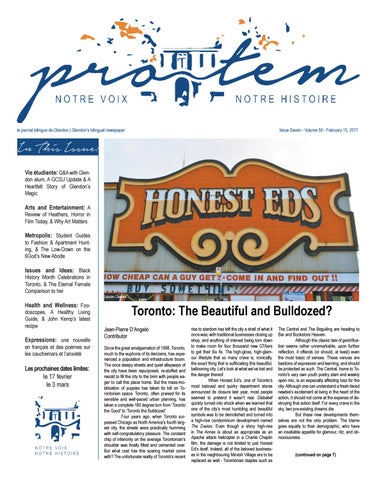
Toronto: The Beautiful and Bulldozed? Jean-Pierre D’Angelo Contributor Since the great amalgamation of 1998, Toronto, much to the euphoria of its denizens, has experienced a population and infrastructure boom. The once sleepy streets and quiet alleyways of the city have been repurposed, re-stuffed and resold to fill the city to the brim with people eager to call this place home. But the mass-mobilization of yuppies has taken its toll on Torontonian space. Toronto, often praised for its sensible and well-paced urban planning, has taken a complete 180 degree turn from ‘Toronto the Good’ to ‘Toronto the Bulldozed’. Four years ago, when Toronto surpassed Chicago as North America’s fourth largest city, the streets were practically humming with self-congratulatory pleasure. The constant chip of inferiority on the average Torontonian’s shoulder was finally filled and cemented over. But what cost has this soaring market come with? The unfortunate reality of Toronto’s recent
rise to stardom has left the city a shell of what it once was; with traditional businesses closing up shop, and anything of interest being torn down to make room for four thousand new GTAers to get their 6ix fix. The high-gloss, high-glamour lifestyle that so many crave is, ironically, the exact thing that is suffocating this beautiful, ballooning city. Let’s look at what we’ve lost and the danger thereof. When Honest Ed’s, one of Toronto’s most beloved and quirky department stores announced its closure last year, most people seemed to pretend it wasn’t real. Disbelief quickly turned into shock when we learned that one of the city’s most humbling and beautiful symbols was to be demolished and turned into a high-rise condominium development named The Davies. Even though a shiny high-rise in The Annex is about as appropriate as an Apache attack helicopter in a Charlie Chaplin film, the damage is not limited to just Honest Ed’s itself. Indeed, all of the beloved businesses in the neighbouring Mirvish Village are to be replaced as well - Torontonian staples such as
The Central and The Beguiling are heading to Bar and Bookstore Heaven. Although this classic tale of gentrification seems rather unremarkable, upon further reflection, it offends (or should, at least) even the most basic of senses. These venues are bastions of expression and learning, and should be protected as such. The Central, home to Toronto’s very own youth poetry slam and weekly open mic, is an especially affecting loss for the city. Although one can understand a fresh-faced newbie’s excitement at living in the heart of the action, it should not come at the expense of destroying that action itself. For every crane in the sky, two pre-existing dreams die. But these new developments themselves are not the only problem. The blame goes equally to their demographic, who have an insatiable appetite for glamour, ritz, and obnoxiousness. (continued on page 7)
Pro Tem Letter from The Editor Editor in Chief | Rédactrice en chef Camille Slaght editor@protemglendon.com Assistant English Editor | Rédactrice adjointe (anglais) Effie Barbalias assistanteng@protemglendon.com Assistant French Editor | Rédactrice adjointe (français) Gabriella Giordan assistantfr@protemglendon.com Communications Officer | Agente de communications Sarah Mullins comms@protemglendon.com Photography Editor | Rédactrice de photographie Lauren Clewes photography@protemglendon.com Design and Layout | Maquettiste Sienna Warecki Section Editors | Chroniqueurs Campus Life | Vie étudiante Reeda Tariq campuslife@protemglendon.com Arts and Entertainment | Arts et divertissement Bruno Da Costa arts@protemglendon.com
Hey Glendon, As we trudge through the coldest month of the year, let’s turn to each other to stay lively and motivated. Valentine’s Day has come and gone, but we need to hold on to the love and compassion it brought on and make it last until the sun comes back out in the springtime. Do not be discouraged; there is only about a month until the first official day of spring! If you’re feeling isolated as many of us often do during the winter, call an old friend you haven’t seen in a while. Remind yourself of what it’s like to be with people who really know you, people with whom you can laugh about nothing and everything, people who allow you to be yourself. Good friendships are indispensable, and those kinds of connections must not be taken for granted. If you need incentives to get out of the house, make a reservation at a restaurant you’ve had your eye on for a while, and invite a friend or two. Good food brings people together and never fails to lift spirits. There are many affordable food options on Toronto, so even if money is tight, you can enjoy a really good meal.
For only about $5, you can get an asian-fusion sandwich from Bahn Mi Boys (great vegan options), quality pizza from North of Brooklyn, and a warm bowl of pho at Spadina’s Pho Hung. If your budget allows for a it, I highly recommend pizzeria Libretto for a thin crust pizza and a glass of red, Sukhothai for spicy noodles and a light beer, and El Catrin in the Distillery for tacos and margaritas. Sortez de votre chambre et allez explorer la belle ville dans laquelle nous vivons. Essayons de ne pas trop laissez le mauvais temps nous isoler de l’un et l’autre. Saluez vos voisins comme vous le faites quand il fait chaud et donnez un coup de fil aux amis qui vous sont les plus chers. Pour une soirée relaxante entre amis, venez à notre événement le 8 mars à Lunik, où les poètes de Glendon liront leurs œuvres et prendront un verre ensemble. Contactez-nous si vous voulez participer! On March 8, Pro Tem will be having a Spoken Word event in collaboration with Late Night Lunik. There will be poetry by Glendon students and special guests, The Ragdolls. If you would be interested in performing, please get in touch with our Communications Officer by emailing comms@protemglendon.com! I look forward to a night of fun as we celebrate
the writers of the Glendon community. Lastly, we have begun our search for next year’s photographer and designer! If you are interested in layout design or photography, please get in touch with me. With love, Camille Slaght Editor in Chief
Metropolis | Métropole Andrew Thies metropolis@protemglendon.com Issues and Ideas | Actualité et opinions Sabrina Sukhdeo issuesideas@protemglendon.com Health and Wellness | Santé et bien-être Emilia Nowicki health@protemglendon.com
Vous avez des opinions? Vous aimez écrire? Vous faites de la photographie? Vous adorez dessiner? Pro Tem vous veut!
Expressions Kaitlin Fenton expressions@protemglendon.com
Envoyez-nous un courriel à editor@protemglendon.com pour apprendre comment vous pouvez vous impliquer!
Online Content | Contenu en ligne Sam Kacaba online@protemglendon.com
pro~tem
est le journal étudiant du collège Glendon. Publié pour la première fois en 1962, c’est la plus ancienne publication de l’Université York. We strive to act as an agent of social change, and will not print copy deemed racist, sexist, homophobic or otherwise oppressive. Please respond to what you read in the pages of Pro Tem/ n’hésitez pas à réagir à ce que vouz avez lu dans Pro Tem. Contact us/ Contactez-nous: protem@glendon.yorku.ca The Pro Tem Office D114 Hilliard Residence, Glendon College 2275 Bayview Avenue North York, ON M4N 3M6 The office is open by appointment only. Le bureau est ouvert sur rendez-vous seulement. Les lettres adressées au journal peuvent être éditées au niveau de la clarté ou de contenu. All copy appearing in Pro Tem is at the discretion of the editorial team. Opinions published in Pro Tem are the thoughts of individual writers, and not the publication as a whole.
2
Nadia Edwards
Vie étudiante The Healing Magic of Glendon Robyn LeLacheur Contributor It’s hard to explain why Glendon means so much to me. If you know me at all, you know that I live, breathe, eat, and sleep Glendon; someone has even referred to Glendon as my lifeline, and they are right. It would be even more difficult for someone who didn’t know me before coming to Glendon to explain why this campus has had such a huge effect on my life, and even harder for those who no longer know me well after leaving high school. When I came to Glendon, I was a shell of a person. I suffered from situation-based depression and frequent anxiety attacks; I was exhausted by the time graduation rolled around. I was surprised and extremely disappointed when my depression didn’t just disappear when I walked out the doors of my high school for the last time. I had been so looking forward to June 28, 2013; I’d had a countdown set from the day grade 12 started. Suffice it to say, high school was not a pleasant time for me so when I was finally done, I wondered why I wasn’t happier, lighter, more content. Granted, I started to feel better over the summer months before beginning my university studies, but I wasn’t as happy or as vibrant as I remember myself being in grade 9. Then August 26, 2013 came: it was my first day
Round Two with the GCSU Reeda Tariq Campus Life Editor In following with my original article from the Fall Term, I recently sat down with Seyoung Chang of the Glendon College Student Union to discuss what they have planned for the rest of the
Lauren Clewes
at Glendon. This was the day I had been anxiously awaiting for the past three years, and as wondrous as the campus may look to the common passerby, it held a special sense of magic for me. The depression I had held for years suddenly vanished. It took only 30 minutes of wandering the green grasses of our magical campus for me to realize how happy I was. I felt light and fluffy; the chains and darkness that had encased my heart had finally shattered I was free. It’s difficult for me to describe this feeling, and as time goes on, the memories of my first year are slowly fading, but that feeling of the darkness evaporating from within me is something I will never forget and will always cherish. This campus breathed the life back into me. I suddenly became that vibrant, bubbly girl I remember being in grade nine, before my world went dark. I cling to this sense of happiness that Glendon gives me. I will likely always have fear that the darkness will seep its way back into my heart, but I know that as long as Glendon stays in my heart, I have a good chance of fighting the demons that haunt me. Despite attending a school where my political opinions vary greatly from the majority of my colleagues, leading to disputes and disappointing experiences, even with professors, Glendon is a place I will find very difficult leaving once graduation comes my way. But even when that day comes, I will continue to firmly grasp the happiness that Glendon has returned to me.
semester.
Among the new and old services provided by the GCSU, they will continue to offer Cineplex and Ripley’s tickets at a greatly discounted price - $9 for Cineplex and $20 for Ripley’s. This initiative started last year in an effort to address students’ concerns about having to travel to Keele in order to purchase discounted tickets from the York Federation of Students. In addition to this, we will be seeing changes made to the Breezeway, which has already been brightened with a new coat of paint
Reeda Tariq
and the addition of a water cooler for student use. The GCSU also has plans to attach a Brita filter to the kitchenette in the near future. Perfect for those who made fitness their new year’s goal, athletics have started again for the Winter term: available sports include: ice hockey, inner tube water polo, women’s and men’s volleyball, men’s basketball, and futsal. Glendon will also be participating in intramurals this year. Be sure to visit the GCSU or the GAC for all the details! The GSCU has also been in talks
with local initiatives to try to improve the overall Glendon experience. These include looking into improving the 124 bus service. Multiple suggestions have been proposed, including the addition of an extra bus during peak times (8-9 AM and 3-5 PM), or an additional bus which would ignore the Sunnybrook Loop and be intended to specifically serve Glendon students. The GCSU will also be reaching out to the City of Toronto to improve salting on the Bayview bridge which connects the drop-off point for the 124 and Glendon as a result of numerous injuries, both of person and personal items, that have affected Glendonites over the past several winters. In February, the GCSU will kick things off with an African Diaspora Awareness event— not just in honour of Black History month, but also to bring awareness to the forefront. The Indigenous Student Association will be working with the Centre of Aboriginal Student Services (CASS) to make it available at Glendon, as well as Keele. This has been a combined effort between both the Union and Student Affairs. The Francophone student committee, in collaboration with the GCSU and Salon Francophone, are also working towards creating a report that details issues affecting Francophone students. Finally, there are two big events happening in March: on March 2nd, the LGBT+ club will be hosting an all-ages, off-campus pub night. And, on March 23rd, the GCSU will be hosting the Glendon Formal, which will be held in midtown Toronto, providing students with a more easily accessible location. Overall, it looks like the GCSU is off to an exciting start, and Pro Tem looks forward to being there for all 3 of these events!
Campus Life Interview With Glendon Alum: Jay Andrew Thies Metropolis Editor Q. 1: Tell us about your involvement at Glendon. A: I spent five wonderful years at Glendon, starting in 2011 and graduating with the class of 2016. My major was Political Science so naturally I joined the campus political association right off the bat. The amazing frosh week that I experienced led me to be a D-Frosh in my second year, hoping to give back the same exciting welcome that I received when I first came to Glendon. I also had the opportunity to go on exchange to France in my 4th year, studying at Sciences Po Grenoble, which I can confidently say was the best decision I have ever made. During the last year of my studies, I had the opportunity to become a research assistant to Professor Francis Garon, which tested the research and analytical skills I had developed during my time as an undergraduate student. I also had the privilege of representing all Political Science majors as the student member of a hiring committee which hired a new professor for the now-current academic year. It was a humbling experience to give back to Glendon students; to be able to voice the expectations students have for their professors. Q. 2: What do you miss about Glendon? Do you have any regrets about your time here? A: I really miss interacting, studying and just generally hanging out with international students at Glendon. Glendon is blessed with small class sizes and a high percentage of international students. I can say with a high degree of confidence that this is not the case for most universities. Glendon’s International students enrich the academic experience by bringing a unique perspective and they are always open to learning more about Canada and its people. Q. 3: What are you up to now? A: I am currently a graduate student at Carleton University, working towards a Master of Public Policy and Administration degree. In addition, I work three days a week as a Junior Policy Analyst at Canada Border Services Agency. Striking a good balance between work and school is hard, but moving to Ottawa has given me an opportunity to work in a field which is very relevant to my studies, while still being able to remain a full-time student. It’s a constant learning curve. Q. 4: How did Glendon help you get where you are now (or where you want to be)? A: Glendon made me who I am today. It prepared me academically to be able to face the challenges of graduate school. It also gave me a competitive edge in the job market through its excellent French language training. More importantly, the relationships I developed with professors (as a direct result of the uniquely small class sizes) were crucial. Personal relationships with professors did not just end with good reference letters for job and grad school applications, their advice and genuine care me up to logically tackle the most 4 set daunting challenge for every student.
Apart from academic and professional development, Glendon made who I am today by providing a positive environment that allowed me to grow as a mature young adult. Juggling academic responsibilities, personal setbacks, ubiquitous love and heartbreak, drama between friends, and just flat out learning to do laundry - these were just a few of the many invaluable life experiences that prepared me to become a true adult. Q. 5: What advice do you have for current Glendon students? A: Well, I have two pieces of advice for students at Glendon and that is to capitalize on the two most obvious Glendon advantages. First, take advantage of Glendon’s bilingual environment. I can’t stress enough how important French language competency is in the professional world, especially for those of you who are interested in careers in the public sector. We live in a country with two official languages, and the survival of official bilingualism rests on the shoulders of competent bilingual young professionals. Please take advantage of resources like Salon Francophone and opportunities to make francophone friends, I can tell you that the real world or universities outside of Glendon will not offer such generous opportunities to learn, speak, and interact in French. Secondly, get to know your professors. It is very uncommon in other universities for undergraduate students to be able to build strong personal relationships with professors, at any level. Glendon’s small size and the student-centered attitude of the faculty is truly a gift from God. Aside from their obvious academic expertise, Glendon professors possess a wealth of personal life experiences that can help guide your decisions regarding your next chapter. I’m sure I don’t have to remind students how crucial reference letters are for graduate school or even a job. Reference letters that can truly speak to you at a personal level can make a huge impact, especially when they’re being compared to generic letters from professors who can barely remember your name.
Jay Seo
Arts et divertissement La comédie musicale Heathers : adolescents complexés, émotions déchaînées Gabriella Giordan Assistant French Editor Cet hiver, les Productions Cœur de Lion ont mis en scène la comédie musicale Heathers, l’adaptation théâtrale du film écrit par Daniel Waters. Mise en scène par Pascale Lachance, mais fondamentalement issue d’une collaboration entre plusieurs des comédiens et d’autres membres du Théâtre Glendon, la pièce a présenté l’expérience de l’école secondaire du point de vue de divers personnages types, ainsi que leurs réactions respectives face au meurtre de plusieurs de leurs camarades, présentés comme des actes de suicide. Ce sont des thèmes angoissants et controversés, mais tout de même très présents de nos jours. Le décor était simple: trois blocs et une affiche annonçant l’évènement le plus attendu de l’année. Vu que les lieux de l’histoire se déroulaient tous au même endroit, l’éclairage seul permettait de distinguer les changements quelquefois brusques d’ambiance. L’éclairage vert, rouge et jaune au début de la pièce mettait en évidence le caractère « voyant » et exclusif des trois Heathers, tandis que l’éclairage sombre soulignait le côté obscur et imprévisible du malfaiteur, J.D. Par ailleurs, le projecteur éclairait la protagoniste de la pièce, Veronica Sawyer, à chacune de ses tirades, permettant aux spectateurs de pénétrer ses plus intimes pensées et de faire partie, pour ainsi dire, de l’histoire. La mise en scène minimaliste a véritablement donné de la place aux personnages, car, en effet, ce sont leurs vies et leurs sentiments qui importent le plus dans toute cette histoire. Les comédiens ont tous donné de la couleur et de la vie à leurs personnages. La
Infinity: A Play Review The Physics of Math and Emotion Andrew Thies Metropolis Editor A few weeks ago, I had the opportunity to watch Infinity, a play by Hannah Moskovitch that has returned as a result of popular demand from its 2014-2015 season at the Tarragon Theatre. My fellow naive, amateur theatre-goers and I assumed, based on Infinity’s description, that it would be a night similar to our last outing some six months prior at SummerWorks festival, Don’t Talk to Me Like I’m Your Wife written by Andrea Scott. That particular play touched on important social topics from femi-
Glendon Theatre
pièce Heathers n’a pas uniquement privilégié le point de vue d’un ou deux personnages principaux, mais également celui des personnages secondaires. Les comédiens se sont successivement démarqués dans leur rôle respectif d’adolescente ordinaire, de fille vénérée par tous mais profondément malheureuse, de brute sportive, de réprouvé et d’incorrigible romantique. Skye Rutherford, qui a incarné le rôle de l’héroïne de la pièce, a su transmettre aux spectateurs ses mille et une inquiétudes avec vigueur. Meghan Williams a interprété à merveille le rôle de Heather Duke, l’impitoyable boulimique qui finit par prendre la place de la Heather principale quand cette dernière meurt, empoisonnée par J.D. et Veronica. Nonobstant la démarche confiante de son personnage et sa tendance à dénigrer les autres, le jeu de Wil-
liams a astucieusement dévoilé la crue réalité: elle ne diffère pas tant que ça des élèves qu’elle essaie de rabaisser car, comme eux, la peur d’être rejetée par les autres ronge peu à peu sa conscience. Le répertoire de chansons tantôt sobres, tantôt comiques et quelque peu grossières, a d’une part renforcé la puissance des idées et des thèmes, et d’autre part appuyé le caractère satirique et comique de la pièce. De plus, quelques chansons, ainsi que quelques scènes de la pièce, ont contribué à banaliser en quelque sorte le tabou qu’est la sexualité. « Je dois avouer que je ne m’attendais absolument pas à ce que la comédie musicale Heathers soit aussi lascive », affirme Emilia Nowicki, étudiante à Glendon. Nowicki ajoute: « Les tournures satiriques des diverses situations controversées m’ont beaucoup impressionnée
et j’ai énormément ri. » Effectivement, certaines chansons, telles que « I love my dead gay son » (j’adore mon fils homosexuel décédé), ont détendu l’atmosphère et établi un équilibre entre les moments humoristiques et les moments un peu moins faciles à digérer. Heathers est une comédie musicale à la fois noire, satirique et comique, qui met en scène les problématiques contemporaines ancrées dans la réalité de l’école secondaire, des relations amoureuses et platoniques nocives, de la sexualité ainsi que du suicide. Les Productions Cœur de Lion ont ainsi bien livré leur marchandise. Ils ont monté une pièce qui a fait à la fois rire et pleurer, oscillant entre le troublant et l’hilarant; une pièce qui présente la vie telle quelle et non telle qu’elle devrait être.
nism to historical revisionism, as we thought Infinity might as well. After all, the play’s three main characters are a musical composer, a theoretical physicist, and a mathematician. The description on tarragon.com reads: “How does a new Theory of Time change everything we know about ourselves? Three brilliant minds–a musician, a mathematician, and a theoretical physicist–smash together like colliding particles in an accelerator. Together they learn that love and time are connected in ways they couldn’t have imagined. Infinity is a shocking, funny and revelatory play about love, sex, and math.” In fact, the play consulted Lee Smolin, a physics professor from the University of Toronto, to provide accuracy on subjects beyond the understanding of most attendees that would be crammed together in Tarragon’s hot, echo-y Extraspace. Over the course of the 80 minutes, we realised how wrong our assumptions had been. The use of anything intellectual (math or physics) was a mere backdrop in a
play that was, in essence, a family drama. Surprisingly, I was disappointed by the lack of theoretical physics in the play, but the raw emotions filled the disappointment rather fittingly. Vivian Endicott-Douglas, playing daughter Sarah Jean Green, toggles between a twenty-something and an 8-year-old version of herself, going back in time to revisit crucial moments in her childhood and to learn how her relationship with her parents (the physicist and musician) caused her to be emotionally stunted. The actress’ performance is particularly impressing. In mere seconds, she seemlessly switches from a child throwing a full-blown temper tantrum to a nervous college grad. Unfortunately, the other characters do not call for such praise. For instance, Elliot Green (Paul Braunstein), the character who is a father and physicist, was not developed enough, keeping the audience from sympathizing with him during moments where unfortunate incidents were supposed to tug on our heartstrings.
On the subject of strings, the dialogue was accompanied by live Njo Kong Kie compositions played by Andrea Tyniec during transitions. This, coupled with Teresa Przybylski’s elegant set, added relevant thematic layers to the performance. The wave-like set design was undoubtedly an ode to particle waves and musical notes. It was streamlined and focused, revealing how closely related we are to those we surround ourselves with, for better or for worse. The play is quite relatable, as anybody with a dysfunctional family can understand. I caught myself wondering how my parents’ displays of love and emotion shaped how I see my sexual relationships today. This play is guaranteed to resonate with those exercising the healthy practice of introspection, and those who enjoy looking at how truths about our past can explain the present.
5
Arts and Entertainment Why Art Matters Alex Freeman Contributor This semester, I was fortunate enough to receive an internship with Club Canadien de Toronto, a Francophone business club that runs monthly lunches and meetings for French speaking members of the banking, legal, and corporate community in the GTA. On Tuesday January 24, Pierre Lassonde, a businessman, investor, and philanthropist was the guest speaker. He is best known for co-founding the gold mining and trading giant Franco-Nevada Corporation in the early 1980s, and as the founder of York’s Lassonde School of Engineering via a $25 million donation in 2012. Instead of discussing world markets or the future of gold prices in a ballroom full of people, Lassonde stood at his podium and rhapsodised about the importance of art for twenty minutes. He explained that his patronage and fondness for art intensified significantly after the death of his wife of 30 years. That revelation really struck a chord with me. At that moment, I realized that art is the one and only true representation of the love and beauty that human beings search and strive for. In today’s world of fiber optic Internet, smartphones, reality television, and social media, most of us have forgotten what art truly is. I can tell you what it’s not: it’s not an Instagram post of an urban skyline with six different filters,
Not Quite Undead The Fall and Hopeful Rebirth of the Horror Genre Eric Vogel Contributor Horror is a genre of stark dichotomy. On one hand, it’s a brain-dead affair; endless romps of half-naked teens turned into red pulp at the hands of a killer, cheap thrills, and cheaper effects. Alternatively, the genre can be used as a flashlight to explore the darkest depths of human psychology and society such as Dawn of the Dead’s portrayal of mindless consumerism, The Thing’s commentary on the ‘us vs. them’ paranoia of the Cold War, the cold brutality of Patrick Bateman’s capitalism in American Psycho, and HR Giger’s darkly sexual xenomorph in Alien. Unfortunately, in recent years the quality of major horror productions has leaned closer to the former definition rather than the latter. The last decade has been dominated by lame and unimaginative jump-scare fodder. One series has particularly ground any sort of artistry and imagination in the horror genre to a halt for the past decade, that being the Paranormal Activity collection. The series spawned a litany of found footage films that have taken over theatres. Since its release in 2007, the 6 Paranormal Activity series has featured
it’s not a clever commercial for beer, it’s not a funny billboard for deodorant, and it’s definitely not an autotuned song in an Apple commercial. Art is the process by which an artist takes all their pain, suffering, emotional baggage, and environmental by-products and condenses it into a small piece of coal that becomes a diamond in the mind’s eye of the beholder. It is the transference of pure emotion from one human being to another, without the need to ever meet or speak. This is why Lassonde, a man worth hundreds of millions of dollars, felt the urge to share his story and encouraged members of the audience to join him in supporting the arts in Canada. His speech reminded me of the last few pages of Donna Tartt’s Pulitzer Prize winning novel The Goldfinch, in which the protagonist tries to define his relationship with art: “Life is catastrophe… And just as music is the space between notes, just as the stars are beautiful because of the space between them, just as the sun strikes raindrops at a certain angle and throws a prism of color across the sky–so the space where I exist, and want to keep existing, and to be quite frank I hope I die in, is exactly this middle distance: where despair struck pure otherness and created something sublime.” We need art to live almost as much as we need oxygen to breathe. Don’t forget to occasionally turn off your phone and go to a museum. It doesn’t matter if it’s Vermeer or Van Gogh. Partake in the universal experience of human emotion, and I guarantee that you will feel much better afterwards. five sequels along with a dozen or so similarly dull films, including a found footage Bigfoot movie. How did it get so bad? The answer is found in successful formula. Formulation is an inescapable aspect of the film industry. With millions of dollars, careers, and egos at stake, there is little room for error. Thus, when a movie explodes at the box office, Hollywood does its best to squeeze every last dollar it can out of the concept through sequels and copycat movies. It happened with Westerns, buddy-cop movies, attractive vampire and werewolf teen-flicks, and now with superhero and the Star Wars universe. When a formula works, producers run with it. However, no genre has experienced formulation to the extent found in horror. Disney has six planned Star Wars movies? Well, the Friday the 13th series is about to release its thirteenth film this year. There have been fourteen movies with the name ‘Amityville” attached to it. A Nightmare on Elm Street has seven movies—eight if you include Freddy vs. Jason—and there are eight titles related to The Texas Chainsaw Massacre. However, these numbers are slightly misleading. These series have existed for almost four decades alongside a number of quality releases; for every Amityville of the 1970s there was a Possession. Also, in spite of their repetitiveness, there were still a number of classic films amongst these series. The first Texas Chainsaw Massacre is a very well shot and designed affair, and the Nightmare on Elm Street series successfully explores the dark humour that can accompany terror. Neither point can be made in favour of the Paranormal decade. In part, the blame rests on a movie
that subverted the major production playbook on horror, The Blair Witch Project. The film used minimal production value, a bare bones screenplay, and amateurish acting. Thanks to a successful marketing campaign, it became a cultural phenomenon and, most importantly, a major commercial success. On a $60,000 budget, the movie pulled almost $250 million at the box office. Eight years after its release, Paranormal Activity uses the same low budget production and heavy marketing to recreate the success of Blair Witch. Thus, Hollywood began to use horror as a low risk, high return opportunity, and churned out more. Thankfully, a few recent releases have proven that filmmakers and audiences are ready to return to intelligent horror films. Amongst these, It Follows leads the way with stylishly shot story of a stalking creature that
passes between victims as a result of sex, possibly acting as a metaphor for HIV. Then, The Babadook presented the psychological power of grief through the tale of a widow terrorized by a monster in her son’s picture book. The Witch portrayed a brooding and dark take on early American settler life being overtaken by oppressive religious fervour, focusing on the oppression of women and girls who lived through it. Don’t Breath dipped its toes into the exploitation genre, weaving a violent and disgusting story about a group of thieves cornered in a blind man’s home. These films are hopeful beacons of the horror resurrection, and could give the current big name horror series a run for their money by proving that fear is multifaceted and goes far beyond making us jump in our seats.
Comment s’habiller chaudement en restant chic cet hiver! (How to look cute and stay warm this winter!) Amanda Jose Contributrice Les vitrines séduisantes affichant les dernières tendances de la mode sont toujours mal adaptées à la température canadienne. Sans trop y réfléchir, l’on achète une nouvelle minijupe et un chandail court en plein hiver. On refuse de les rapporter au magasin et on jure de les porter au cours de la saison, même si la météo locale prévoit un blizzard déchaîné. Voici donc cinq conseils à suivre afin de rester chic même pendant l’hiver!
The Student Apartment Hunting Guide Part 2: What to Look For When Viewing Apartments Sienna Warecki Layout Designer Welcome back to Part 2 of the Student Apartment Hunting Guide! Today I’m here to give you all the advice I can muster on things to check in each of the apartments you visit, as well as questions to ask a landlord to ensure you’ll be a good fit for the space. (If you missed it, Part 1 covers the basic step-by-step process of securing an apartment/living space in the Greater Toronto Area, as well as some different avenues to help you search for potential locations.) The last thing you want is to move into a space that seems to have everything you need, only to discover that your water pressure ranges between ‘spit’ and ‘dribble’, or that the cellphone reception is atrocious, or that out of the six wall sockets in the living room, only two are functional. All of these hassles are easily avoidable–you just need to be smart with your apartment viewings!
A Checklist For Inspection 1. Open all of the cupboards and cabinets. You’re looking for holes in the walls that rodents might get through, and you’re also looking for evidence of pests and bugs: poison traps, mouse turds, and bug poop (which looks like black pepper, apparently). If you find any of this, it’s safe to assume the apartment has some pest problems. 2. Turn everything on and off again. If the lights don’t work, well, that’s an obvious problem. 3. Check that all the outlets are func-
Métropole 1. Portez des sous-vêtements thermiques Votre vie n’a aucun sens si vous ne possédez pas déjà des sous-vêtements thermiques. Ces couches internes molles et légères sont nécessaires pour résister au froid. Le tee-shirt et les leggings de la technologie Heattech deviendront tes meilleurs amis (on peut les trouver à Uniqlo au centre Eaton’s ou à Yorkdale). 2. Portez deux paires de leggings N’abandonnez pas votre petite robe noire! Personne ne soupçonnera jamais que vous portez deux paires de leggings et vos jambes vous remercieront plus tard. 3. Portez deux paires de chaussettes En ajoutant des bas de laine qui montent jusqu’aux genoux, vous vous protégez les pieds et même les jambes. Assurez-vous de porter des bas minces au-dessus de bas épais pour que vos talons en suède puissent encore faire partie de votre look!
tioning. How do you do this? Bring a small thing with you to plug into each socket–a little nightlight will do, or else your phone charger. 4. Check the water pressure for EVERYTHING. Turn the faucets on and off, testing for a) water pressure and b) hot/cold water. Flush all the toilets to see how well they drain. Turn the shower on and test how strong the pressure is there, too. 5. Check the cellphone reception in every room. I’m guessing it’d be more than a minor annoyance to discover your new bedroom is a total dead zone. 6. Make sure your furniture will actually FIT. Bring a tape measure and jot down the dimensions of the rooms. If your big ol’ kingsize bed isn’t going to fit in the bedroom, you’re out of luck. (But less out of luck than if you’d waited until later to find out.) When I was apartment hunting with my roommates, we usually had one person run around and check all of these things while the other person asked questions of the landlord. That way we economized everyone’s time, and also ensured that everything was being given full attention. Incidentally, I’d recommend visiting apartments with your intended roommates, if you already know who you’re living with, or with a level-headed friend if you’re not sure yet. Either way, ProTip: always take a buddy! The list of questions you ought to ask varies depending on how much information you obtained in the preliminary search (see also: how much info was in the advertisement), but this is a good baseline. Adjust as necessary! If you’re not sure whether or not to ask a question, I’d say to err on the side of caution and ask away–there’s nothing like being informed! (You may even be complimented on your apartment-hunt savvy, like we were.)
What to Ask The Landlord
1. How long did the last tenant stay? What is the turnover rate in the building? (If the turnover rate is high, that may be a bad sign. It means
4. Portez des manteaux avec doublure Une doublure compacte gardera votre grand cœur magnifique au chaud. 5. Personnalisez vos accessoires Les accessoires permettent de rendre votre tenue impeccable. Chapeaux, écharpes et gants confondus peuvent ajouter un éclat de couleur à votre tenue au complet et ainsi embellir les jours gris. Somme toute, ajouter plusieurs couches de vêtements s’avère extrêmement important cet hiver! Si vous suivez ces conseils, vos collègues vous admireront pour votre dévouement à la mode. Peu importe le côté farfelu de la chose, car vous êtes fabuleuse. To sum up, the key to dressing to the nines during the Yuletide is layering, layering, layering! Grab a pair of thermal leggings and some thermal undershirts that can provide you the utmost warmth in the most discrete manner; the thinner the better. Which brings us to our next point, doubling up on leggings! A slinky
lightweight pair will fit perfectly underneath thicker, athletic ones. To add to the doubling, twice the pair of socks will surely make you feel as cozy and as snug as possible, especially when sporting knee-highs! Don’t want to put away that adorable, pink wool coat made for lighter weather? Tuck in a compact down jacket underneath and you’ll be walking in that snow storm with fineness. Your dainty beret and kitten-inspired mittens will be the final touch of your invincible outfit (or whatever style of winter accessories you prefer)! Now go out there and conquer the world!
Sienna Warecki
there’s a reason people keep leaving ASAP.) 2. How old is the property? Are there any scheduled renovations? Will they be complete before I move in? 3. What is the process for submitting a maintenance request? How long does it typically take for a maintenance request to be fulfilled? To whom do I direct complaints? 4. What type of people live in the complex? (This will give you a general idea of what to expect in terms of noise level, as an example.) 5. How safe is the apartment/neighbourhood? Any break-ins in the past year? 6. Am I allowed to paint the walls? 7. Which appliances come with the unit? Is there laundry on-site? In-unit? (Bless you if it’s in-unit.) 8. Are there regulated quiet hours? 9. Which utilities am I responsible for? Is the charge per apartment, or split evenly across the building? 10. How recent/efficient are the wiring, water heater, A/C unit, etc? 11. What are the internet providers in the area?
Does installation require the presence of the landlord or a maintenance person? Never worry about being bothersome or taking up too much time. If everything works out, after all, this is to be your living space. The only person who’s going to have to deal with any oversights is you. May as well take responsibi ity upfront. If you get funny looks or feel like the landlord is hedging their answers, or refusing outright to answer, then you probably want to reconsider your options. Tune in next time for the third and final installment of the Student Apartment Hunting Guide, where I share best practices for finding and keeping good, responsible roommates! This is an edited version of an article originally posted on This Glorious Unknown, at siennawgl.wordpress.com.
7
Photography: GL Spirit Day
8
Photography: Heathers: The Musical All photos by Glendon Theatre
9
Metropolis Zoning By-Laws in The 6ix Andrew Thies Metropolis Editor
February Events in Toronto: What Not to Miss This Month Toronto Black Film Festival February 15 - February 19 Multiple locations across Toronto
The Audience January 24th - February 26th Royal Alexandra Theatre
I’m Okay: Mental Health & Romance: A Toronto Epidemic? February 16th @7pm Royal Cinema
FREE Live Oscar Broadcast February 26th Hot Docs Cinema, 8:30pm
LMG Fashion Show February 17th Glendon Theatre TIFF Next Wave Film Festival February 17th - 19th 350 King Street West FREE U25 Canadian International Autoshow February 17th - 26th Metro Toronto Convention Centre
Second City Fall Revue 2016 January 24th - February 28th Second City Standing Tall: The Curious History of Men in Heels January 23rd - March 1st Bata Shoe Museum Toronto Maple Leafs Centennial Exhibit January 23rd - March 6th Hockey Hall of Fame
Toronto Symphony Youth Orches- Cinq visages pour Évelyne Frost tra Winter Concert 14 février - 25 mars February 19th Théâtre français de Toronto George Weston Recital Hall Toronto Light Festival #Pigeonsaffamés January 27th - March 19th 23 - 26 février The Distillery District Théâtre français de Toronto Canada 150: Discovery Way Bloor-Yorkville Icefest Dates through until November February 26th - 27th Ontario Science Centre Village of Yorkville Park If you’re around Toronto and hear The Magic Flute of an event that might be of interest January 28th - February 24th to our community, write to us at: Four Seasons Centre metropolis@protemglendon.com.
10
For all you Drake fans out there, you’ll be happy to know that your beloved 6God has started the preliminary phases of building a mansion in the Bridle Path; a few steps away from our campus. Drake’s real name, Aubrey Graham, is nowhere to be found on official documentation. The property on 21 Park Lane Circle was purchased for $6.7 million by a Halifax-based company whose president is Adel Nur, Drake’s DJ and friend. It is customary for celebrities not to have their own names on real estate documents, either creating subsidiary companies or entrusting the purchase to a friend or family member. The mansion, soon to be the third most impressive residence in the Bridle Path community, is to be built in the same neighbourhood as many of Canada’s rich and famous, including fellow Canadian we’re-still-unsureabout Conrad Black and renowned musician, Gordon Lightfoot. Plans for construction have already been filed with the city and are awaiting further approval. The mansion includes, but is not limited to, a rooftop terrace with a hot tub, a library, an NBA-sized basketball court, and a jersey museum. There was a potential snag in the approval process, however, which was found in the mansion’s dimensions. For example, the city only allows a driveway to be 9 metres wide, whereas the drafted plans for Drake’s driveway read 34 metres wide. Moreover, the city doesn’t allow houses to be taller than 11 metres, whereas Drake’s is planned to be 17.
The city usually allows for exceptions by way of a committee granting approval. The vast majority of cases are approved and a lot of buildings in Toronto are built despite causing building infractions, like zoning by-laws. One of the by-passing processes is that neighbours usually listen to arguments by the developer as to why they should be allowed to build against zoning by-laws. Given the fact that this new mansion will be surrounded by neighbours in their own multi-million dollar mansions who’ve also probably committed by-law infractions, there won’t be any problem concerning dimensions. But should celebrities get their way despite being in blatant disregard for by-laws? A celebrity’s influence must be curtailed so that they fall well within the law of whichever community they belong to. The city only includes neighbours in a certain distance to be present during the developer’s proposal. I’d, however, petition the city to include the entire neighbourhood. Seeing as Drake will throw extravagant and luxurious parties, the noise might even reach as far away as Glendon. And that’s a problem. Our Dons can’t give Incident Reports to Drake, so the heavy hand of the law doesn’t reach him. Therefore, I propose the developer pitch the mansion to a committee of Glendonites, seeing as Drake’s bangers might keep us up at night. His NBA-sized court might even entice the Raptors to have camp there and not at the GAC.
Actualité et opinions A Brief History of Chinese Canadians Marco Lopez Contributor On September 10, 1939, Canada entered World War II, and in an effort to aid the Second Sino-Japanese War, Chinese Canadians enlisted in the Canadian Forces. The Chinese Benevolent Association also suggested boycotting Japanese goods and purchasing Chinese and Canadian war bonds. Chinese Canadians in the Canadian Forces were specially deployed as spies to resist Japanese forces. The results of this war caused a substantial change in Canadian government policy. The Chinese Exclusion Act, which violated the United Nations Charter, was quickly repealed in 1947, and during the same year, Chinese were given the right to full citizenship. In 1949, however, with the formation of the People’s Republic of China and their support of the communist North in the Korean War, the Chinese community’s reputation in Canada was tainted. Furthermore, some Chinese immigrants falsified immigration papers to enter Canada, which prompted an amnesty period for those who confessed. But in 1967, the Canadian government eliminated the place of origin section in its immigration policy, and this began independent Chinese immigration to Canada. The 80s brought a new wave of changes to Canadian multiculturalism. At the turn of the decade, a W5 TV report unified Chinese communities across Canada to fight against anti-Chinese sentiments. According to the report, universities were declining acceptance into programs based on ethnicity–specifically the pharmacy program at the University of Toronto. After further investigation, the data presented on the TV program were proven false and CTV, the channel that aired the report, formally apologized for the error. This incident prompted the formation of the Chinese Canadian National Council to better represent Chinese Canadians at a national level. In 1988, the Canadian Multiculturalism Act was passed. Based on two fundamental principles, the act ensures that, “All citizens are equal and have the freedom to preserve, enhance and share their cultural heritage,” and that, “Multiculturalism promotes the full and equitable participation of individuals and communities of all origins in all aspects of Canadian society.” The Act suggested that racism in Canada was weakening, and the Chinese population began to move away from Chinatowns, toward suburban areas of major Canadian cities. Popular thought, on the other hand, did not follow suit as many believed the Chinese population was responsible for inflating property prices and causing White Canadians to relocate to different cities. In the late 80s and early 90s, with the Canadian recession and prosperous Chinese economy, Chinese migration was flipped. Chinese families often left their children in Canada and pursued work opportunities in China, only to visit once or twice a year. This phenomenon was coined ‘astronaut families’ and posed a growing concern for the children’s safety and
well-being. In the 20th century, Hong Kong was the source of most of Canada’s Chinese immigrants, but nowadays mainland China has surpassed Hong Kong’s number of immigrants. Since 2000, China has been responsible for an average of 15% of Canada’s immigrant population. Presently, Chinese-Canadians are becoming increasingly involved in Canadian politics, both provincially and federally. Notably, Raymond Chan led the Chinese-Canadian inauguration in Canadian politics by becoming the first ethnic Chinese to be appointed into the cabinet in 1993. Alan Lowe became the first Chinese-Canadian Mayor of Victoria, British Columbia. NDP candidate Olivia Chow was elected in 2006 to represent the riding of Trinity-Spadina. Following the Chinese Canadian National Council’s call for an address to the unfair head-tax required from 1885 to 1923, NDP leader Jack Layton pledged to issue an apology and compensation for the tax. It was only in 2006, however, that then Prime Minister Stephen Harper delivered a message of redress in the House of Commons, offering an apology and a compensation of approximately $20,000 CAD. There were 20 people who paid the head-tax who were still alive when he made his speech. All in all, the Chinese-Canadian journey has been incredibly difficult. Having suffered through years of discrimination and hardship, the Chinese-Canadian community has seen many changes in Canadian policy. Thankfully, the Canadian government recognizes their wrongs and is willing to make amends. China’s relationship with Canada is growing stronger every day, and there is a bright future for the Sino-Canadian relationship. The bond is likely to grow, stimulating even more Chinese immigration, and perhaps even more Canadian immigration into China thanks to its thriving economy.
Lauren Clewes
Toronto: The Beautiful and Bulldozed? (continued from cover) While historically significant bars and venues continue to close, (Hoxton, Silver Dollar Room, and Soybomb, among others) nothing is being done to replace the authenticity they gave the city. Dime-a-dozen clubs, preying on poor students desperate for a cool-looking snapchat at an overpriced booth have killed the chill spirit of the city. Wannabe-ism is the new black in Toronto, and it comes at a price. Aside from the huge cultural losses these closures entail, gentrification also has unfortunate consequences for our more subaltern citizens. Soaring home prices, 23% alone in the last year, have left many residents stranded in their own city. Although many see low-income Torontonians being priced out of the city as “betterment,” I can only see it as a curse. Residents of traditionally working-class
areas such as Regent Park and The Junction frequently find themselves unable to stay in the neighbourhoods they grew up in, pushing them to the corners of the GTA as newer denizens take their place. These new home-dwellers, unfamiliar with the area they live in, essentially cut the neighbourhoods off from their history: The Junction isn’t The Junction without the people who grew up there and helped shape it into what it is today. Although City Hall claims to fight for social justice in housing, it is unclear if the social benefits are as evident to city planners as the economic benefits. With construction in Toronto hitting a 25-year high, Toronto is teetering on the edge on self-destruction. Every stakeholder in the city must ask themselves this: are we what we want to be? Do we want to live for the glam and glitter of glass condos and packed subway trains, or do we want to be authentic, peaceful and productive? On paper, Toronto’s boom seems great: increased GDP, increased home value and increased business activity are all things to celebrate. But on the streets, it just isn’t quite so happy without the live music and libertine values.
11
Issues and Ideas Tout ce qu’il faut savoir sur le Mois de l’histoire des Noirs Sandrine Exil Contributrice Comme à chaque année, le mois de février est le Mois de l’histoire des Noirs. Ce mois-ci est entièrement dédié à la célébration des réussites des Noirs non seulement au Canada, mais aussi aux États-Unis. Cette commémoration de la communauté noire et de la place qu’elle occupe au sein de nos pays nous rappelle encore une fois l’égalité qui existe parmi les êtres humains. Toronto, une ville riche en cultures et en traditions diverses, est engagée à promouvoir la diversité. Ce n’est pas difficile de trouver d’intéressantes façons de se renseigner, de participer à la culture qu’offre ce mois, et d’en apprendre plus au sujet de l’histoire des Noirs tout au long du mois. Il est crucial, pour commencer, de se renseigner à propos de la contribution des Noirs au Canada. Cette notion de l’Histoire des Noirs a commencé aux États-Unis avec Carter G. Woodson, en 1926, qui a voulu donner un titre à ce mois pour rendre honneur à Abraham Lincoln ainsi qu’à Frederick Douglass. Ces deux hommes ont fait des efforts considérables pour abolir l’esclavage. À cette époque-là, au Canada, plusieurs personnes au sein de la communauté noire ont commencé à raconter eux aussi leur histoire et à fêter cet héritage très important, qui présente non seulement la fierté, mais également l’évolution de la société et de l’humanité.
Women: Reclaim Your Minds and Bodies Jessie Lou Helmkay Contributor I was three years old the first time I wondered why I couldn’t be like her. Pajama day at preschool, and my blonde, freckled innocence was contrasted by the notion that he had chosen her. The boy who had been sitting next to me during circle time was starry-eyed on the playground holding her hand. At three years old, I looked down at my Winnie the Pooh pajamas— my brand new pair, that I had been so proud to button up that morning—and wondered, if my pajamas were silky and pink like hers, maybe he would have picked me. I was three years old the first time I favoured self-imposed competition against another girl over my own self-worth; a feeling that myself, along with all other girls of my generation, are socialized to accept silently each and everyday. Can you remember the last time you opened Instagram without a her? Skinnier. Prettier. Happier. Maybe if you buy that new mascara, that push-up bra advertised at the mall, those diet pills you saw online, tighter jeans, a shorter skirt, lash extensions, hair ex12 tensions, nail extensions—maybe then.
FFCB
En 1979, des pétitions ont été soumises à la ville de Toronto pour qu’elle proclame à son tour cette fierté « le mois des Noirs». Au cours des années 80, les commémorations ayant rapport à ce mois ont commencé à prendre de l’ampleur et elles se sont ensuite répandues dans le monde entier. C’est grâce à ces initiatives qu’aujourd’hui, de plus en plus de Canadiens peuvent découvrir les histoires de ceux et celles qui composent la communauté noire du pays. Le Centre Francophone de Toronto (CFT) fête aussi le Mois de l’histoire des Noirs. Parmi les activités qu’offre le CFT ce mois-ci figurait une soirée chaleureuse au cours de
laquelle étaient servis des repas traditionnels africains, antillais et caribéennes qui ne pouvaient pas manquer à cette commémoration. Le CFT a pour sa 12e édition un thème nouveau qui s’intitule « Tradition de l’élégance afro-caribéenne, mélange de style et de couleurs». Un spectacle ayant rapport à ce thème a eu lieu le 4 février au Daniels Spectrum. Il y a plusieurs autres activités qui caractérisent ce mois historique à Toronto. Parmi ces évènements, il y a eu la projection de quelques films classiques au Festival international du film de Toronto, le 4 et le 10 février, accompagnés aussi du rappeur torontois Kardinal Offishall sur place pour présenter les films et en
But she is not real. She is imposed on you by a society that profits from your insecurity, a society that capitalizes on self-hatred. A society in which breaking free means to love yourself now. Not tomorrow when you buy that bra, or next month when you’ve gone to the gym, or next year when you have a boyfriend. Now. We live in a society where girls who love themselves are vain, and sexual harassment is a compliment. You are taught to strive for sex appeal before you know what those words mean, and then called a slut behind your back for trying to fit in. In a world where headlines are comprised of celebrity weight gain, and the top ten newest products to fix your skin, how can we accept ourselves? How can we reclaim our own minds? The change begins when you choose to love yourself. When you choose to lift yourself up, and to rekindle the light inside you that was dimmed the first time you became enemies with your own body. We raise our girls to hate the body that exists to protect them. To house souls that are so much more powerful than they are allowed to believe. From within, you radiates the energy of the sun and the strength of the moon, and you have learned to settle for pretty. Your vision has been clouded by the notion that you will never be good enough. But imagine the liberation of realizing that you already are. We have learned to confine ourselves to the shackles of “ladylike,” careful not to step on the feet of
boys who believe that we exist at their disposal. I read a quote recently that asked this: Would you treat your daughter the same way you treat yourself? Try to be kinder to yourself. Self-love is more than just a buzzword. It is the lifelong process of unlearning all the ways that women are told to look and act.
Naomi Burns
parler. Le Dylan Bar sur Danforth a aussi mis en place une soirée culinaire, qui mettait en évidence la valeur de l’histoire de la cuisine noire. La cheffe Teneile Warren a créé un repas à trois plats qui combinait les cuisines africaines, jamaïquaines et canadiennes. Participer au Mois de l’histoire des Noirs vaut énormément la peine, peu importe d’où l’on vient. Autant profiter de ce que la Ville de Toronto nous offre non seulement en tant qu’étudiants universitaires, mais également en tant qu’individus qui ont l’occasion de s’épanouir culturellement et d’en apprendre plus au sujet du monde qui les entoure.
Santé et bien-être January to April Foodoscopes: Reeda Tariq Campus Life Editor Yes, that’s right, foodoscopes. I’ve noticed that international trends, weather, social media, school schedules, and the time of year all play major roles in determining food trends, so I have created a list of my predictions of the major food trends that will take place in the first four months of 2017. January: Meat Thanks to #SaltBae, many decided to drop that cauliflower in exchange for some red meat this January. Salt Bae’s videos suddenly made everyone—even that girl who’s been running a green smoothie empire out of her dormroom— start craving kebabs after a night out. So much for Veganuary! February: Soup Midterms are kicking your butt, OSAP loans are taking their sweet time to arrive, and all of your essays are due in the same week. There is a lot to worry about during the coldest and shortest month of the year, which is why you naturally start craving something nourishing for the soul and stomach (and something easy on the wallet). Whether it’s chicken soup, minestrone or cream of brocoli, soup is easy to make and store, and is the perfect pick-me-up on those cold, dreary days when you have no choice but to lock yourself up in your bedroom and try to finish all those assignments. A useful tip is to add some coconut milk to your soup to make it even more filling. Let’s face it, you’re going to need all the energy you can get to study for those back-to-back midterms.
Lauren Clewes
March: Ugly produce You might have seen some videos pop up on your social media feed about how French supermarkets are giving away their leftover produce to shelters. Similarly, people are beginning to stop getting rid of food that doesn’t look the way it should. If you’re scratching your head over what “ugly produce” entails, it’s exactly what the name implies—vegetables that aren’t photogenic or attractive enough (think: bruised apples or pears) to be sold in supermarkets. As a result of a larger sustainability movement that has slowly been growing over the years, people are becoming less picky about the look of their fruits and veg. April: Vending machine snacks The the birds are returning, the flowers are beginning to blossom, and you can put away that thick winter parka in favour of that cute denim jacket you picked up in November. But just as the world is starting anew, the university term is coming to an end for students across the country. With this, comes the usual panic and stress associated with exams. When nothing matters other than making sure that you pass that one exam you’re dreading most, everything else falls to the side—family, friends, exercise and food. The vending machine at the end of the hallway or your residence floor suddenly becomes your new best friend, and you shamelessly shed a tear if your favourite candy bar runs out when you needed it the most. *These are only predictions. You could just as well spend the entire month of February eating nothing but Char Siu Bao in honour of the Lunar New Year, and then spend March drinking nothing but spinach smoothies to cleanse your system.
John Kemp’s Kitchen Babi’s Chicken Noodle Soup John Kemp Contributor These days, the sky is grey and it’s a miracle if you can still feel your fingers and toes when you get home. The solution? A nice hot bowl of your grandma’s chicken noodle soup, perhaps? Well, if your grandmother isn’t around to cure your February chills, John Kemp’s Kitchen is here to save the day! After returning from my recent trip to Ottawa, a lovely city where it’s so cold that your eyes freeze in place if you don’t blink often enough, I figured that it may be a good time to share my grandma Babi’s chicken noodle soup recipe. It was a staple of my childhood and continues to be the only thing I crave when I’m sick. The Vegeta I’ve called for in the recipe below are a Croatian mix of dried vegetables and spices with a salt base, so no additional salt is needed. You can add this seasoning to just about anything, and believe me, it will come in handy! I usually strain the ingredients at the end, leaving a consommé to which you just add noodles, however you can also leave whatever you’d like in the broth to give it more colour and substance. Either way, I’m sure you’ll enjoy this recipe as much as I have over the years. Stay warm, my friends, and don’t forget to follow me on Facebook at John Kemp’s Kitchen and on Instagram @johnkempskitchen!
Ingredients: 1-2 tbsp. cooking oil 1 small onion, chopped 2 cloves garlic, sliced 3 stalks celery, sliced 1 small tomato with slits cut around the edges 2 leaves green cabbage 2 small parsnips, sliced 2 carrots, sliced 2-3 tbsp. Vegeta seasoning Chicken back and neck Egg noodles (about a 1/4 cup per serving) Freshly ground black pepper to taste Directions: 1. In a large saucepan or stock pot (about 4-5 litres), heat the oil. When hot, add the onions and cook until they begin to sweat (about 5 minutes). Add the garlic and cook until it becomes aromatic. 2. Add the rest of the ingredients, omitting the egg noodles. Fill with water and cook on low heat for 45 minutes to 1 hour, covered. If the water evaporates, don’t be afraid to add more. 3. After the 45 minutes to an hour, taste the broth. If you want a stronger broth, cook longer, but make sure it’s not cooked to the point where a sweetness develops. Once the desired flavour is achieved, strain the ingredients so that you are only left with the broth. 4. In a separate saucepan, transfer the amount of soup you plan to serve and bring it to a boil (there will most likely be too much for one sitting in this recipe). Once it has come to a boil, add the egg noodles. If you prefer your soup with many noodles (“gusto”) feel free to add more. Once the noodles are al dente, remove the soup from the heat and serve. Enjoy!
13
Health and Wellness Balance and Moderation: The Key to Healthy Living Kaya Harris-Read Contributor Here is a common piece of advice: “Drink a lot of water, exercise, and eat healthy.” The first is doable. The second, not always easy, but still fairly simple. But the third? Although it may appear straight forward, many of us don’t relly know how to go about healthy eating. Where should you start? That’s a difficult question to answer because there is an overwhelming abundance of information available about healthy eating. If you walk into Chapters, you’ll find an entire section dedicated to books on how to be healthy, each containing a different thesis and various proposed diets to follow. If you search the question of how to be healthy on Google, you’ll get 49,400,000 results (I checked). If all of these sources of information are providing different answers, and often even conflicting opinions, how do you sort out who is right? Well, you might not have to. No two people are exactly the same, which makes it impossible for there to be one universal healthy lifestyle. This doesn’t mean that there aren’t things that are universally good and bad for humans to do or consume, but there room for flexibility. For instance, if you read an article that claims that the healthiest people in the world go on a run every morning, but you have bad knees, the running rule may not ap-
Lauren Clewes
ply to you. So, if there is no one true answer, how do you know if you’re living a healthy life? I strongly believe that the most useful tip for living a healthy life is balance and moderation. I have found that there are generally two extremes to healthy living. The first is what I call the “green smoothie” approach to being healthy, which encourages daily yoga, detox, and juicing kale. The other is the “happy place” approach that encourages hot baths and baking your favourite cookies. These generalizations represent two sides to healthy living that are both important, but should not be exclusive of each other. I don’t know what the absolute best approach is to healthy eating, but I think that a balance between these two extremes is a good place to start.
When creating a plan for healthy living, it’s important to leave out the words always and never. I know that sometimes it’s easier to stay on track if you make a concrete plan for yourself, but based on my experience, such strict plans tend to be unsustainable. It’s important to leave yourself some room to be human. The “always/never” plan inevitably creates the feeling of failure if a rule is “broken”. Having a healthy lifestyle set up like a pass or fail system is not healthy. As for moderation, if you’re thinking about eating healthier, the road to that is not eliminating every unhealthy food you can think of. On the other hand, I believe that it is just as possible to have too much of a bad thing as it is to have too much of a good thing. Exercising is
good for you, but too much is not. Vitamins are good for you, but you shouldn’t take too many. Balance and moderation are two things that we should apply to our lives, beyond healthy eating and exercising. Everything we do either contributes to our health or is a detriment to our well being. Sometimes, moderation isn’t always possible; sometimes you simply have to stay up all night to complete an essay. That’s where balance comes in. If you’ve had to pull an all-nighter, restore the balance by taking an evening to watch a movie and have an early night. Amid all the books and articles telling us to follow strict regimes to be healthy, it’s easy to forget that the ultimate goal of being healthy is to feel good and to enjoy life. Photos by Basit Sultani (ig_ @visualslxyer)
Available for purchase at the GCSU office:
14
Patches: $5.00 Water Bottles: $4.00 Base Ball T’s: $20.00
Sweater: $35.00 Snapback: $25.00 ($20.00 for DFrosh/Froshies) Merch Pack: $45.00 (1 Base Ball T, 1 Patch, 1 Hat)
Expressions Évasions Camille Slaght Rédactrice en chef Je ne sais toujours pas de quoi exactement mon père se fait accuser. On n’en parle pas vraiment, ma mère et moi. Et mon père en parle encore moins. Tout ce que je sais, c’est que le crime en question aurait été commis il y a une vingtaine d’années quand on habitait encore en Russie et que mon père travaillait dans une banque. L’année passée, j’ai trouvé une lettre adressée à mon père, Anton Borodov, ce qui m’intrigua puisqu’il vivait à Montréal depuis longtemps. Parfois, il vient nous visiter à Toronto – mes parents sont toujours ensemble – mais on ne reçoit pas souvent de courrier pour lui ici. Les termes défendeur, litige, et fraude me sautèrent aux yeux. J’étais trop choquée pour lire le reste de la lettre. Depuis qu’on est au Canada, mon père n’a jamais pu sortir du pays, ou même obtenir un passeport canadien. Tout commence à s’expliquer. Il doit apparaître en cour demain matin et ma mère et moi allons y être aussi. Une odeur épaisse remplit ma chambre à mon réveil. Ma mère cuit encore du poisson malgré mon allergie aux fruits de mer. Je sais qu’elle fait exprès de cuisiner des mets que je ne peux pas manger parce qu’elle ne veut pas que j’engraisse. Cent vingt livres pour une fille qui mesure cinq pieds neuf c’est beaucoup trop à son avis. Mon apparence est le seul aspect de ma vie qui semble la préoccuper. J’entre dans la cuisine à moitié endormie et je jette un coup d’œil à l’heure indiquée sur le four. Il est 13h09… vendredi, je crois? J’ai manqué mon cours à l’Université de Toronto ce matin. Évidemment, ma mère n’a pas pensé à me réveiller; les trois bouteilles de vin vides sur le comptoir m’indiquent que son état ce matin n’aurait pas pu être bien meilleur que le mien. Impossible de me coucher avant que le soleil ne se lève quand je prends de la coke en soirée. J’ai dû rentrer vers 6h ce matin. Je n’arrive jamais à refuser la poudre que Daniel m’offre depuis qu’il m’en a mis sur les gencives la veille du Nouvel An cet hiver. Il m’avait demandé de sourire et en moins d’une seconde, il avait glissé son doigt saupoudré de poudre blanche dans ma bouche. Bientôt, ses lèvres étaient sur mon cou, ses ongles dans mon dos, son odeur dans mes draps. C’est moi qu’il choisit comme porteuse de ses petits sacs de poudre. Apparemment, il y a moins de chances que je me fasse fouiller parce que je suis une fille. – Mama, encore du poisson? Tu veux que je crève de faim? dis-je en ouvrant la porte du frigo. Il y a un petit bout de fromage, des oignons au vinaigre dans un pot et un peu de sauce tomate, mais rien pour l’accompagner. – Arrête de te plaindre. Ton père arrive ce soir. Range ta chambre, dit-elle mécaniquement, en versant le reste de la bouteille de vin rouge dans son verre. Elle se retourne vers moi et un regard de dégoût envahit son visage. Je porte un grand T-shirt de Daniel, et ma dense chevelure frisée
a échappé au pauvre petit élastique inutile qui pend derrière mon cou, emmêlé à quelques cheveux tenaces. – Ça te tuerait d’essayer de ressembler à une fille parfois? ajoute-t-elle, avant d’augmenter le son du soap russe qu’elle regarde pour la troisième fois. Notre appartement est tellement petit qu’il est impossible de faire quoi que ce soit sans que les problèmes de l’une deviennent aussi les problèmes de l’autre. Ma vaisselle sale et mes joints oubliés deviennent le désordre de ma mère, et ses bouteilles d’alcool et ses mille paires de souliers deviennent aussi mon désordre. Au cours des années, elle a complètement abandonné l’idée de me discipliner. On se tolère, voilà tout. D’habitude, on passe la journée à tout ranger avant l’arrivée de mon père. Mais aujourd’hui, ma mère est distraite, sans doute nerveuse pour demain et trop saoule pour nettoyer l’appartement. Je me mets au travail malgré mon mal de tête parce que mon père ne supporte aucunement le désordre. Au fait, il ne tolère aucun objet dont il ne connaît pas l’origine ou la fonction. Toute nouveauté lui donne l’impression d’être un invité, un touriste dans sa maison. Vers 21h, mon père rentre chez nous et il me salue sans me regarder dans les yeux. Il se verse une Vodka Tonic et se met à inspecter l’appartement. À chaque visite, il jette au moins quelques trucs dont il ne voit pas l’utilité. Cette fois, les victimes de son intolérance sont mes tiges d’encens, un vernis à ongles de ma mère et la nourriture du poisson rouge, que je retire de la poubelle dès qu’il se retourne. Ayant passé une trentaine de minutes en présence de mon père sans qu’il ne se mette en colère, je décide que je mérite une récompense. Je mets rapidement un jean et j’attache mes cheveux dans un nœud au-dessus de ma tête. J’enfile un pull noir que je trouve sous mon lit et juste avant de m’évader, j’avertis mes parents: – Je vais chez Daniel, bye! – Tu sors en pyjamas? Tu te trouveras jamais un homme comme ça, se lamente ma mère en étirant chaque voyelle trop longuement. – Mila, demain, coiffe tes cheveux. Et tu ne t’habilleras pas comme ça hein? ajoute mon père, comme si son ton sérieux allait avoir plus d’influence que la voix pleurnicheuse de ma mère. – Dah, dah, dis-je avant de fermer la porte derrière moi. Dix minutes de marche et j’arrive chez Daniel. Sa chambre est située au premier étage d’une vieille maison où vivent onze autres colocataires. La seule façon d’y accéder sans devoir croiser l’un d’eux est d’entrer par une fenêtre qui donne sur la ruelle derrière la maison. Je cogne sur le verre opaque, que Daniel relève après une longue minute. Il se met déjà à m’embrasser pendant que je faufile avec difficulté mes longues jambes à l’intérieur de sa chambre sombre. Il me lance sur son lit et prépare ma première ligne pendant que je roule un joint. C’est devenu notre rituel. Daniel est déjà défoncé. Il parle très vite, de tout et de rien. Au fur et à mesure que je le rattrape, mes battements
de cœur s’accélèrent et mes pensées se multiplient. Daniel n’a jamais rencontré mes parents, mais l’envie de tout lui révéler sur eux me saisit. J’ouvre la bouche, mais rien n’en sort. Je veux pouvoir lui parler, mais je n’y arrive pas. Je ne sais pas comment. Entre-temps, il continue de me lancer des faits sur les effets étranges de diverses drogues. Mon sang coule à une vitesse incroyable dans mes veines épuisées, mes poumons n’arrivent pas à se gonfler suffisamment, l’air entre et sort de ma bouche trop vite… ou trop lentement, je ne sais plus. Assise sur le bord du lit, mes cuisses sont trop lourdes et je n’arrive plus à bouger. Daniel s’écrase sur le lit et s’endort instantanément à côté de moi. Je demeure figée, les yeux brûlants de fatigue, l’estomac vide, le dos courbé. J’ai envie de me plier en deux et de me refermer à jamais. La fenêtre est encore ouverte et le regard de la lune semble m’étudier. Elle seule entend mes pensées; elle seule a compris que je ne retournerai pas chez mes parents.
Night Terror Emily Leahy Contributor my mother comes to me in a dream tells me not to trust people who don’t have ambient butter in their kitchen she tells me tuck in your shirt the sheets on your bed she sits beside me talks me down from the night
I’ll Sleep When I’m Dead Kaitlin Kenny Expressions Editor Lazy, loamy, lovely soil, I languidly lay and rot. Fleshy, bony, clammy corpse, I’ll bask in others’ toil.
Morals Naomi Burns Contributor The codes of conduct do not exist in the minds of any; It seems as though they only do in the mind of mine.
Succulent Anguish Naomi Burns Contributor There is something so beautiful in daily life although woebegone, how to describe: petrichor. Like the anguish, a ubiquitous feeling throughout my body I want to exult from within. When I do, grateful to remedy, the torment becomes missed (a comely, rending sentiment). The devil allures me to forget; to consume it at night, to conflate with him in vice. A painful dalliance lasting for hours when daylight arises again.
terror is gone and I am alone
Naomi Burns
15