le journal bilingue de Glendon | Glendon’s bilingual newspaper
Issue Six - Volume 55 - February 1, 2017
In This Issue: Vie étudiante: Q&A with Glendon alumni, and francophones want more opportunities to speak French!
Arts and Entertainment: A film review, and a book review–about film!
Metropolis: Pop up restaurants, architecture, and tips for apartment hunting in the city.
Issues and Ideas: The urgent need for more homeless shelters in Toronto, and what ever happened to an electoral reform?
Health
and
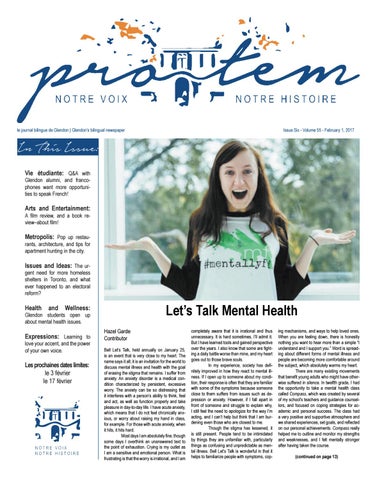
Let’s Talk Mental Health
Wellness:
Glendon students open up about mental health issues.
Expressions: Learning to
love your accent, and the power of your own voice.
Les prochaines dates limites: le 3 février le 17 février
Hazel Garde Contributor Bell Let’s Talk, held annually on January 25, is an event that is very close to my heart. The name says it all; it is an invitation for the world to discuss mental illness and health with the goal of erasing the stigma that remains. I suffer from anxiety. An anxiety disorder is a medical condition characterized by persistent, excessive worry. The anxiety can be so distressing that it interferes with a person’s ability to think, feel and act, as well as function properly and take pleasure in day-to-day life. I have acute anxiety, which means that I do not feel chronically anxious, or worry about raising my hand in class, for example. For those with acute anxiety, when it hits, it hits hard. Most days I am absolutely fine, though some days I overthink an unanswered text to the point of exhaustion. Crying is my outlet as I am a sensitive and emotional person. What is frustrating is that the worry is irrational, and I am
completely aware that it is irrational and thus unnecessary. It is hard sometimes, I’ll admit it. But I have learned tools and gained perspective over the years. I also know that some are fighting a daily battle worse than mine, and my heart goes out to those brave souls. In my experience, society has definitely improved in how they react to mental illness. If I open up to someone about my condition, their response is often that they are familiar with some of the symptoms because someone close to them suffers from issues such as depression or anxiety. However, if I fall apart in front of someone and struggle to explain why, I still feel the need to apologize for the way I’m acting, and I can’t help but think that I am burdening even those who are closest to me. Though the stigma has lessened, it is still present. People tend to be intimidated by things they are unfamiliar with, particularly things as confusing and unpredictable as mental illness. Bell Let’s Talk is wonderful in that it helps to familiarize people with symptoms, cop-
ing mechanisms, and ways to help loved ones. When you are feeling down, there is honestly nothing you want to hear more than a simple “I understand and I support you.” Word is spreading about different forms of mental illness and people are becoming more comfortable around the subject, which absolutely warms my heart. There are many existing movements that benefit young adults who might have otherwise suffered in silence. In twelfth grade, I had the opportunity to take a mental health class called Compass, which was created by several of my school’s teachers and guidance counsellors, and focused on coping strategies for academic and personal success. The class had a very positive and supportive atmosphere and we shared experiences, set goals, and reflected on our personal achievements. Compass really helped me to outline and monitor my strengths and weaknesses, and I felt mentally stronger after having taken the course. (continued on page 13)
Pro Tem Letter from The Editor Editor in Chief | Rédactrice en chef Camille Slaght editor@protemglendon.com Assistant English Editor | Rédactrice adjointe (anglais) Effie Barbalias assistanteng@protemglendon.com Assistant French Editor | Rédactrice adjointe (français) Gabriella Giordan assistantfr@protemglendon.com Communications Officer | Agente de communications Sarah Mullins comms@protemglendon.com Photography Editor | Rédactrice de photographie Lauren Clewes photography@protemglendon.com Design and Layout | Maquettiste Sienna Warecki Section Editors | Chroniqueurs Campus Life | Vie étudiante Reeda Tariq campuslife@protemglendon.com Arts and Entertainment | Arts et divertissement Bruno Da Costa arts@protemglendon.com
Dear Glendonites, In light of recent events in the United States and around the world, it is safe to say that the polarized political and social opinions have become increasingly apparent. The American election has come to a close, but the several debates related to gender and race that were sparked by the election have only just begun, and the responses have spread throughout the world. As a student in a Canadian Liberal Arts college, it is almost impossible to go through an entire day without encountering a conversation about how gender and race influence and are affected by politics. Because these topics often generate emotional reactions, it can be really difficult to have constructive conversations about them. However, we cannot choose to turn a blind eye, or shy away from discussing the reality that we live in. The American election has revealed and mobilized those who identify with the much more extreme aspects of both right and left wing politics. In situations like these, it is crucial to avoid a buildup of anger and aggression, and one of the best ways to do so is to strive for open conversation and freedom of
expression from both sides of the debate. We should all challenge ourselves to stop being afraid of what is different from ourselves. Whether you are enthusiastic about welcoming refugees or not, make a conscious effort to learn about the opposite side of the argument. There is no sense in only understanding the debate from one point of view. In fact, as many political science professors encourage their students to do, it can be very useful to purposely seek out sources that are not in line with your own beliefs. As difficult as that may be, it is the only way to get the full picture of a complex situation. This presidency is a reality; real people voted, and the issues at hand are no longer hypothetical. We have to be willing to have conversations about this, and to show compassion towards those who are unlike us. We can’t keep marching in opposite directions. We can’t turn our backs on each other. The farther we drift from each other, and the more ground each extreme of the debate gains, the more backlash will be generated from the other side. By all means, stand up for what you believe in, but in doing so, try to welcome others’ opinions and replies. Conversations go two ways, and we will not achieve any compromises if we can’t even bear the thought of listening to
one another. Any chance of progress is completely destroyed if we can’t look at someone in the eye, accept that we have different values, and respectfully voice our opinions. This presidency is testing our patience and our tolerance. Through all this, we should try our very best to not let controversial issues divide us. Compassion is stronger than fear. With love, Camille Slaght Editor in Chief
Metropolis | Métropole Andrew Thies metropolis@protemglendon.com Issues and Ideas | Actualité et opinions Sabrina Sukhdeo issuesideas@protemglendon.com Health and Wellness | Santé et bien-être Emilia Nowicki health@protemglendon.com
Vous avez des opinions? Vous aimez écrire? Vous faites de la photographie? Vous adorez dessiner? Pro Tem vous veut!
Expressions Kaitlin Fenton expressions@protemglendon.com
Envoyez-nous un courriel à editor@protemglendon.com pour apprendre comment vous pouvez vous impliquer!
Online Content | Contenu en ligne Sam Kacaba online@protemglendon.com
pro~tem
est le journal étudiant du collège Glendon. Publié pour la première fois en 1962, c’est la plus ancienne publication de l’Université York. We strive to act as an agent of social change, and will not print copy deemed racist, sexist, homophobic or otherwise oppressive. Please respond to what you read in the pages of Pro Tem/ n’hésitez pas à réagir à ce que vouz avez lu dans Pro Tem. Contact us/ Contactez-nous: protem@glendon.yorku.ca The Pro Tem Office D114 Hilliard Residence, Glendon College 2275 Bayview Avenue North York, ON M4N 3M6 The office is open by appointment only. Le bureau est ouvert sur rendez-vous seulement. Les lettres adressées au journal peuvent être éditées au niveau de la clarté ou de contenu. All copy appearing in Pro Tem is at the discretion of the editorial team. Opinions published in Pro Tem are the thoughts of individual writers, and not the publication as a whole.
2
Nadia Edwards
Vie étudiante Celebrity Q&A With Glendon Alumni Anna-Kay Russell Andrew Thies Metropolis Editor Q: Tell us about your involvement at Glendon A: I completed my four year iBA in Environmental and Health Studies and minored in Psychology at Glendon. I most definitely did an exchange while at Glendon – I went to Grenoble, a beautiful city in the alps of France, for a semester. I also completed an internship through the York International Internship Program in Costa Rica, which was beyond amazing. I was also one of the founding members of Glendon’s first ever West Indian Association! Finally, I was an assistant editor with ProTem, a Health Education mentor between campuses, and a LeaderShape alumni. Q: What do you miss about Glendon? Have any regrets about your time here? A: The number one thing I miss most about Glendon is the sense of community emitted on campus. As soon as I step off the shuttle, I feel at home, and that’s a feeling I’ve come to realize can’t be found everywhere. I’ve made some friendships at Glendon that I know will continue on. It was the perfect place to find those kinds of personalities and discover more of my own. I
Andrew Thies
GEISA Entrepreneurial Event Frank Borrelli Contributor As young business professionals wanting to become the leaders of their respected fields, GEISA took part in George Brown College’s entrepreneurial event on November 17th. It was a unique experience that gave aspiring entrepreneurs the opportunity to ask questions and listen to a panel of CEO’s explain their business journeys. Students from multiple schools gathered to learn how to stay away from the typical 9-5 work day and pursue a lifestyle and work schedule catered to you. Four companies were involved in the event: mywinecanada.com, Secret Team Games, Where2, and Safe T. These companies were created out of an interest the founders had in a particular subject matter, or out of a need to improve an existing system. The panel explained that a creative mind isn’t always necessary to build a company; it’s the ability to pay attention to the world around you and to create logical solutions that is most valuable. The panel of CEO’s illustrated the obstacles of starting a company, such as building a client base or finding warehouse space. They admitted the complexity of becoming your own boss but also the reward of managing your own income and not having to rely on someone else’s business. When you are running a company, you are more likely to develop a mean-
ingful passion for your job and it makes the many hours of work seem less strenuous. The difficulties these COE’s face never deterred them from their dream. They spoke very highly of their own accomplishments, and everyone in the audience was inspired by the stories. Today, the majority of the world’s wealth is in the hands of those who have started their own companies, such as Mark Zetterberg. Owning a company in addition to another job is a great way to boost to your income to begin, and eventually this could become your main source of cash flow.
Kelly Lui
The event also had a team building portion, which included building a freestanding structure out of marshmallows, spaghetti, and string. When faced with strict deadlines, all were forced to work as a team, and everyone’s true colours showed. Breaking off into small groups with strangers is an effective method of encouraging people to step outside of their comfort zone, and to build connections with new people. A fascinating aspect of being an entrepreneur is that people from various types of educational background create companies, which allows for
try not to regret much (as there’s no point), but one thing I would say I would have also done was get involved in student council. As a current public policy master’s student, that would have been a useful experience to draw from. Q: What are you up to now? A: As mentioned, I’m currently completing my Master of Public Policy at the University of Toronto (Glendonite at heart forever and always, don’t worry) and working on research. I also just began that quest called adulthood. Q: How did Glendon help you get to where you are now (or where you want to be)? A: For one thing, it pays to be bilingual, folks. So you’re in the right place. I also met a professor at Glendon who was really invested in my future and worked with me to help me find my path, connecting me to others who could help me get there. So, I should say it also pays to know your profs. Q: Any advice for students still at Glendon? A: My number one advice for all those at Glendon, and York University as a whole, would be to take that opportunity you’ve had on your mind and just do it. If not, go out there and look for some! Universities are swimming pools filled with opportunities and if it were not for the ones I took while at Glendon, I know I would not be where I am now. So, if you see it and you like it, then go for it.
diverse opinions and ideas when collaborating. If being an entrepreneur is in your future, we encourage you to join GEISA. You will expand your knowledge of the field and find like-minded people to share your ideas with. Overall, everyone enjoyed themselves, and GEISA will continue to participate in entrepreneurial events to better prepare graduates for the careers that await them. You can learn more about the companies mentioned in the article at http://startgbc.com/event/gbc-entrepreneurship-day-2016/.
3
Campus Life Sommes-nous vraiment bilingues à Glendon? Joanna Chung Contributrice Le Collège universitaire Glendon est considéré comme l’un des collèges les plus charmants de Toronto. Le paysage y est unique en son genre. Le manoir, par exemple, est l’édifice le plus admiré de Glendon, étant d’une valeur historique considérable. Cependant, la raison pour laquelle on fait l’éloge du collège Glendon est généralement pour son aspect « bilingue ». À Glendon, chaque étudiant doit, en principe, connaître et pratiquer la langue française. Il n’en est cependant pas tout à fait le cas. Si l’on demande à n’importe quel étudiant de ce campus ce qu’est Glendon, il répondra sans doute qu’il s’agit du campus bilingue de l’université de York. Il est donc sous-entendu qu’ici, tous les étudiants sont bilingues. Or, ayant été monitrice de langue française au Salon francophone pendant mes deux premières années à Glendon, j’ai observé que plusieurs étudiants ne maîtrisaient pas bien la langue. Il était question non seulement d’un manque de diligence, mais également d’un manque de pratique. Malgré son titre de campus bilingue, l’anglais prédomine et non le français. Les nombreux étudiants devraient profiter davantage des services d’aide gratuits tels que le Salon francophone. Cela leur fournirait l’occasion d’améliorer leur français oral, leur grammaire ainsi que leur orthographe, et de faire des progrès considérables dans leur apprentissage de la langue française. Il est vrai qu’il s’avère difficile de pratiquer son français en dehors des heures de cours. Aussi surprenant que cela puisse paraître, il existe des cliques à Glendon, et
4
elles sont divisées par les langues parlées. Les anglophones, les Canadiens français et les Français demeurent dans leurs coins respectifs. Les étudiants ont ainsi peu d’occasions pour pratiquer leur français avec d’autres étudiants. Il y a aussi le fait que plusieurs étudiants de français langue seconde trouvent leurs cours de français très compliqués et chargés. Par conséquent, ces étudiants s’éloignent le plus que possible de la langue française une fois qu’ils obtiennent leur diplôme et leur certificat de bilinguisme. Toujours est-il qu’il doit y avoir une raison pour laquelle Glendon est considéré comme étant bilingue. Dès que l’on franchit les portes de ce collège, l’on peut distinguer des panneaux où il est écrit : « Bienvenue à Glendon », « Coeur de lion » et « Le manoir Glendon ». Malgré le fait que de nombreux étudiants ici ne parlent pas aussi bien français que l’on croirait, il y a tout de même beaucoup d’étudiants qui parlent couramment le français ou qui s’efforcent sans cesse de s’améliorer. Le collège ainsi que les clubs d’étudiants organisent tout un répertoire d’activités où les étudiants peuvent pratiquer leur français, mais ils doivent trouver une façon de rendre ces évènements plus attirants pour les francophones. Il devrait être inévitable de marcher dans les couloirs du collège et d’entendre les gens discuter en français. Glendon n’est pas un collège anglophone, et nous devons donner aux étudiants la chance de pratiquer le français entre eux. On ne peut démentir que le Collège universitaire Glendon soit bilingue. Néanmoins, l’on n’y pratique assurément pas assez la langue française, sur le plan scolaire comme sur le plan social. Les francophones sont présents; il s’agit de les rassembler pour qu’ils ressentent la présence forte de la communauté francophone à Glendon. Il faut aussi les présenter aux anglophones pour les encourager à pratiquer la langue française oralement dans un environnement autre que la salle de classe.
Lauren Clewes
Arts et divertissement 100 Ideas That Changed Film A Book Review Bruno Da Costa Arts and Entertainment Editor Published in 2012 by Laurence King Publishing, 100 Ideas That Changed Film by David Parkinson details the history of the technical and thematic production of popular and independent films from the late 19th century to the present day. It covers the vast evolution of film, from the invention of the magic lanterns and its popularized use by French filmmakers such as Étienne-Gaspard Robert and the Lumière Brothers, to the use of animation by the Japanese Studio Ghibli, to CGI in Hollywood films as pioneered by John Whitney and mastered early on by David Cameron. As a novice cinema student, I found the book to be an enjoyable introductory tool that helps to understand more about the developing concepts and techniques of storytelling on the big screen. 100 Ideas That Changed Film serves as an effective educational tool that clearly highlights the technical means of production–such as camera use and editing styles–used by directors in order to tell their stories or to develop themes. This book is useful
The Invitation Movie Review: Toying with The Emotional Concepts of Grief Kaitlin Kenny Expressions Editor Tucked amidst Netflix’s cheaply made exorcism films and low rated teen screams is the independently produced psychological thriller The Invitation, directed by Karyn Kusama. The film stars Logan Marshall-Green as Will, a grief-stricken divorcee, and Tammy Blanchard as Eden, his ex-wife. The charisma between the cast creates a memorable and haunting experience told through a combination of flashbacks and present day. When Will and Eden’s son passes away, the couple files for divorce and do not speak for two long years. However, Eden returns suddenly with a new husband and a new outlook on life, inviting Will and all of their old friends over for dinner. Everyone is overjoyed to be reconnected, except Will, who suspects a more sinister intent. Is he right, or will his paranoia ruin the reunion? The Invitation is a new twist on the classic cult films, resembling the The Sacrament and the real life tragedy of the Jonestown massacre. Visually, the film is gorgeous. Set in the beautiful, dusky valleys of Hollywood Hills, a warm glow is juxtaposed with the blackness of the night. As Will goes through his old house,
there are many flashbacks, which are set in light tones of gray and blue. The stark contrast between present and past helps to create an emotional dissonance between the characters. Interestingly, the setting does very little to add to the horror/thriller genre. Rather, the responsibility rest on the characters to convey the genre. Eden and her new family are quite doll-like and, as a result, incredibly creepy. What adds to this is that no one besides Will is concerned about her strange reunion. This allows for the audience to connect with Will in his isolation and torment of being confronted with his tragic past. The slow pace of the plot does not take away from the gripping force of the film.
What keeps this story fresh is the constant inversion of what the audience suspects will happen versus what happens in the following scene. The film consistently creates a potential shock that is quickly neutralized. Everything that Will expects to happen does not materialize, creating the slow suspense needed for a climactic twist and shocking ending. It is an absolute tease, and it is absolutely worth it. The characters are very diverse; there is a variety of races, genders, personalities, and sexualities. The common trope found in horror films wherein only the virginal and pure survive is denied in The Invitation. All characters are given an equal playing field as they battle for survival. The diversity of the characters
for those who want to establish a solid foundation in cinematic knowledge so that they can be an informed critic or cinephile. An important idea that Parkinson adressed in this book is the influence that race has had in the world of cinema. There is an entire chapter dedicated to blaxploitation (black + exploitation), meaning the exploitation of black tropes and stereotypes in American movies. Parkinson demonstrates how after many years of marginalization, people of colour were able to reclaim this genre and have their voice be projected on the big screen. In time, this paved the way for daring black actors and directors to become more bold in their works, to make their cultural marks in Hollywood. This was done particularly by highlighting the aspects of “hood” culture in the USA. Thanks to this, American cinema went on to benefit from added depth, nuance, and culture. 100 Ideas That Changed Film is a good read for those that want to submerge themselves in the world of cinema and critical film appreciation. By telling the story of how filmmaking techniques have developed, thus leading film to be where it is today, Parkinson succeeds in teaching the reader how to appreciate film through a keener, more informed, and more analytical lens. The reader, then, also becomes equipped with the knowledge of how popular culture in society bleeds into the world of cinema, but also how movies have the power to challenge societal conventions.
is refreshing, especially since LGBTQ people are often excluded or stereotyped in this genre. Furthermore, all of the characters and their interactions are portrayed organically, which allows for a natural flow of events throughout the film. This is a very well executed film. It is a gem in a genre that is often subpar. While being aesthetically pleasing, it uses techniques to create specific effects, and creates a suspenseful, well thought out plot. The characters are well developed, and successfully carry the suspense and fear throughout the film. I would absolutely recommend this film to anyone looking for a thriller, and who does not mind a longer, slow burning film.
5
Metropolis
February Events in Toronto: What Not to Miss This Month “BRIDGE” by Naomi Dodds January 11th - February 4th Interaccess
The Magic Flute January 28th - February 24th Four Seasons Centre
Winterlicious January 27th - February 9th Multiple restaurants across Toronto
The Audience January 24th - February 26th Royal Alexandra Theatre
Toronto Symphony Orchestra’s Annual Chinese New Year Celebration February 4th Roy Thomson Hall
FREE Live Oscar Broadcast February 26th Hot Docs Cinema, 8:30pm
Friday Night Jazz! February 10th from 7-11pm Ripley’s Aquarium
Second City Fall Revue 2016 January 24th - February 28th Second City
Steam Whistle’s Craft Beer Festival February 11th Roundhouse Park
Standing Tall: The Curious History of Men in Heels January 23rd - March 1st Bata Shoe Museum
Toronto Black Film Festival February 15 - February 19 Multiple locations across Toronto
Toronto Maple Leafs Centennial Exhibit January 23rd - March 6th Hockey Hall of Fame
TIFF Next Wave Film Festival February 17th - 19th 350 King Street West (FREE U25)
Cinq visages pour Évelyne Frost 14 février - 25 mars Théâtre français de Toronto
Canadian International Autoshow February 17th - 26th Metro Toronto Convention Centre
Toronto Light Festival January 27th - March 19th The Distillery District
Toronto Symphony Youth Orchestra Winter Concert February 19th George Weston Recital Hall
Canada 150: Discovery Way Dates through until November Ontario Science Centre
#Pigeonsaffamés 23 - 26 février Théâtre français de Toronto Bloor-Yorkville Icefest February 26th - 27th Village of Yorkville Park
6
If you’re around Toronto and hear of an event that might be of interest to our community, write to us at: metropolis@protemglendon.com.
Pop Up City Reeda Tariq Campus Life Editor Recently Toronto managed to get a taste of a little old burger company that some of you might know. A Shake Shack pop-up store emerged Wednesday, January 18th much to the delight of Torontonians and their Instagram accounts. Combining forces with Momofuku Daisho, those who braved the cold weather could get a taste (and a picture) of Shake Shack’s signature burgers and fries. This hasn’t been the first time that a pop-up store has opened for a short time in the 6. We’ve recently seen Christmas/Winter market themed stores, as anyone who stayed in the city over the winter break would know. Art, music, and food pop ups- especially food that our neighbours down south take for granted- have all popped up, often with much fanfare and long-stretching lines of people waiting hours in ever-changing Toronto weather. Basically, Torontonians love their pop-up’s. A quick google search for Toronto pop up leads to an array of articles, websites and blogs written to cover everything you can imagine. From an artisanal chicken and waffles brunch spot that will be hitting some obscure neighbourhood for six hours some random Saturday in April, to a Chinese-Peruvian fusion cuisine stand debuting for sixteen minutes by the Fairmont Hotel next Friday, Toronto has it all. Sometimes, if the restaurant does
well in their short existence, they might even decide to stay for longer than their expected short term. A variety of factors might explain this, such as riotous people who take to their phones to let the world (or their mom) know about the injustice that has been inflicted upon their stomachs, or simply that the company knows they have a fan-base for their cuisine if they plan to take the next step towards opening a restaurant! Pop-up restaurants allow everyone who has the time and money to try something new, be it a unique cuisine that makes up a patch in the Toronto quilt of food options, or a new sugary concoction that you can devoure to satisfy that craving after work. There are numerous reasons why I love hearing about the hottest places to queue up for quick bite. Maybe one day, if you’re at the right place (hint: 85 °C Bakery Cafe), at the right time, you’ll even see me in line for a pop up, getting interviewed by CP24, or bragging about my happy taste buds.
Métropole Why We Should Care About Architecture in Toronto Andrew Thies Metropolis Editor The task of persuading the public to critically think about the buildings which surround them is a hard task. Undoubtedly, the majority of us don’t think twice about the aesthetics of our classroom or the structural dimensions of the restaurant at our next dinner date. It seems, like most things, caring about architecture isn’t a huge deal. I argue that we should care, and offer a point of view that might make us rethink what we’re building and living in. One must first come to the realization that, for better or for worse, architecture shapes our lives in ways that might not be obvious. A example many of us could relate to; our own campus’ centrepiece is a beautiful Elizabethan-style manor that resonates with our small population and proud sense of community. I’m surely not the only one who becomes if not the slightest bit happier when seeing our class being scheduled in the manor. It is also the home of Lunik, our campus community co-op. In many ways, the Glendon Manor symbolizes our campus’ sense of a home away from home. Something would be missing in our collective perception of Glendon without it. A shuttle ride to the main campus only draws out this example further. The newly-constructed Bergeron Centre at Keele is the home to the Engineering School at York, it’s design drawing inspiration from clouds and nature. It’s an ode to how the discipline in which it houses aims to harness nature by using the materials from which it came. Some argue it is the most architecturally significant building at Keele, noticeably contrasting the Brutalist, imposing monoliths of the rest of the campus that enforce the idea of education as more of a factory of mass-production rather than a personal
learning experience (an idea decidedly helped by the over 60,000 students that roam about it daily). For those in charge of giving the green light to the construction of the Bergeron Centre, their decision was surely an effort to push York into the realm of cutting-edge innovation and design, shaking off the drab, yesteryear image of their bleak and sleepy campus. Sometimes architecture’s task is to render vivid ideals of who we strive to be. We should start caring more about the structures in which we share some of our fondest memories. They hold memories and ideas of self, shaping us and our community in ways that aren’t thought about enough. I truly stand behind that last word “enough”, because I cringe at modern skyscrapers and the dense glass jungle our city has encased itself in. There’s a notable decrease in various forms of aesthetic tradition and a sharp uptick in chic, minimal, modern condos. Architecture like the Victorian revival styles in Cabbagetown and post-war cottages in Etobicoke are scarce; there’s precious little of what makes Toronto in Toronto buildings anymore. Early Modernists wet their pants with glee if they glanced our city’s way. Local styles, to them, should be phased out of architecture completely as we enter a rational age of cookie-cutter suburbs and downtown core condos. But not only are these buildings distasteful, they skewer and warp our sense of community. A downtown culture almost doesn’t exist at this rate of erecting glass offices and apartments, and thousands of people lack communal and green spaces, having to venture outside their community for a peaceful weekend. I understand we can’t have Glendon manors as the predominant style of buildings downtown (although that image warms my heart), but we shouldn’t eschew our obligation to our better nature and sense of community to allow those in power to build for big profit. For example, the Toronto Community Housing Corporation (TCHC) struggles daily with the City of Toronto to provide for better living conditions and basic rent protection to people in need of community housing, while John Tory approves project after project designed to attract foreign
Lauren Clewes
(Chinese) investors and profit. Let’s start by providing buildings for those in need, shall we? A critical analysis of buildings that surround us can perhaps shape us for the better. Supporting ideas and efforts like architect Alejandro Aravena’s, who offer inexpensive yet structurally sound public housing for the masses, will help architecture to reach it’s full potential. We can move away from big capi-
tal shaping our local communities like we see downtown and more towards a responsible, humane face of architecture that would hint at the idea of home and a sense of belonging we don’t find in a great number of buildings we populate today.
Vous avez des opinions? Vous aimez écrire? Vous f aites de la photographie? Vous adorez d essiner? Pro Tem vous veut! E n v oyez-nous un courriel à editor@protemglendon.com pour apprendre comment vous pouvez vous im pliquer!
7
Photography Feature on Naomi Burns
8
IG @naobrs naobrs.tumblr.com
Photography Feature on Charlie Weaver
9
Metropolis The Student Apartment Hunting Guide Part 1: Searching for Your New Home Sienna Warecki Layout Designer Last March, after four years in residence, I finally made the decision to spend my fifth and final year in an apartment with some roommates. It was something of a harrowing decision. For as long as I’ve had friends who have lived in apartments or houses as opposed to campus residences, I’ve heard horror stories. Intrusive and unhelpful landlords, intolerably messy roommates, cockroaches swimming in the sink–you name it, I’ve probably got a friend who’s complained about it. I was told that my first apartment was just going to suck no matter what. I was told to prepare myself for a year or two of crappy living conditions before I could find a place and some pals that would be halfway decent. Oh, my well-meaning friends, how very wrong you were. My apartment is BOSS. It’s pretty and clean and well-lit and well-heated and close to a subway station and hey, we even have a balcony. And to top it off, my roommates are two of the most level-headed, reasonable, and considerate people I know. (Not to mention uncommonly attractive.) So how did I get so lucky? Instead of being spooked by the stories of all my jaded friends and classmates, I took it as a challenge. I did my research. And I’m here to share my findings with you. Apartment hunting doesn’t have to be as stressful as it’s been made out to be: it can be exciting and fun, too! Because there’s so much to cover in order to be a useful resource, this Guide will be a three-part series. In this first installment, we’re going to talk about actually finding an apartment, and the steps that go into securing it. The second installment will be an in-depth list of things to check when viewing apartments, alongside questions to ask a landlord. The third installment will be about choosing your roommates and developing systems that keep you all happy with each other. Without further ado, let’s get hunting!
Your Step-by-Step: The Process of Securing an Apartment When I first got started, I didn’t even know about the different steps that were required to getting a place to live. In order to prevent overwhelm from the start, here’s a breakdown of all the phases you go through, from first opening Kijiji to the keys landing in your hand. (Note that this is a description of the process as it happens in Ontario, and specifically the GTA. I don’t think there will be much variation regionally, but it’s worth knowing.) First, you need to locate potential candidates for your apartment. Doing this is as easy as opening a web browser: Craigslist and Kijiji are two websites that offer tons of 10 listings on places, but there are other
Sienna Warecki
options. More on this later! Contact the landlord or property owner to inquire about a viewing. The internet can only tell you so much about a place. If you really want to know what it would feel like to live somewhere, you need to stand there. Call the folks in charge and ask when they can meet with you. See if there are any regular viewing hours or open houses you can attend, too. Some owners will prefer to be contacted by email, but if you can do it, try and get them on the phone–it means you get immediate feedback instead of nailbiting for the four days it takes for them to get to your request in their inbox. Actually view the apartment. This is arguably the most arduous part of the process, because it involves leaving the house and physically going to the location of your candidate. You also have to do it for every apartment on your Maybe list. To do it effectively and to avoid wasting your own time, you’ll want to come to a viewing armed with a basic knowledge of what to check for, as well as a list of questions to run by the landlord. If you find an apartment you like, fill out the application. This is known as the Application for Tenancy, or the pre-tenancy application. The application is intended to help landlords/owners decide whether you’d be a good fit for the property. You can expect to fill out your contact info, your renting history, employment information, and reference letters/contact info. If you’re planning on having roommates, you are also supposed to name them on the application. If the application is approved, you’ll be contacted to come in and sign the lease. There are stacks and stacks of information out there about apartment leases, so I will keep my
advice short and sweet: READ. THE DAMN. LEASE. Read every serif of that thing, and ask questions if you don’t understand something, and, most importantly, remember you have the right to negotiate the terms of the lease until you’ve arrived at something you’re comfortable with. Note that as a student with no previous renting history and–probably–a pretty slim bank account, you might be required to list a guarantor/co-signor, a person who agrees to pay your rent if you are unable to. Not all properties/ agreements will ask for this, but it’s good to be prepared! Once the lease is signed, your tenancy has begun! Or, it will, anyway, on the first day listed on the lease. On that day, you show up to the office of the property owner or landlord and receive your keys, and then it’s move-in time. Congratulations, you’re a tenant! Not too tough, huh? But where do you start looking?
Apartments in Your Area: Tips & Resources for The GTA As previously mentioned, online resources are huge for hunting. Craigslist and Kijiji are undisputably the biggest and most popular, but there are other options! For example, View It is the site that my roommates and I used to scour the Toronto Area for possible apartments; I liked that you could search by region and narrow down for price range and number of rooms. It eliminates a good 75% of the slog. Simone Garcia wrote an article on BlogTO listing a bunch of other great apartment rental websites that are Toronto-specific. Open a newspaper! While we techsavvy folks are trawling apartment renting
sites, there are classified ads sitting unread in any number of papers. The apartments listed in classifieds are usually owned by elderly people–which often means a much better deal and much more pleasant interactions! Ask your friends! While we used View It initially, in the end we got the apartment we did because my roommate had previously lived in a property with a specific owner (Pinedale, in case anyone’s wondering). I’ve also got a lot of friends at school who live in the complexes that Pinedale owns. Personal recommendations are still the most valuable thing to have when it comes to finding a fit for your personal preferences/income/etc. Use your network to see who’s got recommendations or other connections! Lastly, an important thing: check all your possible pads on The Bedbug Registry. Yup, Toronto’s got quite a few places that are infested with little crawlers, and you do not want to end up signing the lease on one of them. For every address you consider, take the twenty seconds to check it against the registry. You’ll thank yourself. From here, you should be able to whip up a sweet list of possible places to call home. Next week we’ll talk about how to separate the wheat from the real-estate-chaff when viewing your apartments! This article was originally posted on This Glorious Unknown, at siennawgl.wordpress.com.
Actualité et opinions
Homeless and Invisible How We’re Failing Homeless Torontonians Sabrina Sukhdeo Issues and Ideas Editor In our society, where wealth is surreptitiously correlated to political significance, legislators have deliberately blinded themselves to homelessness. A 2016 investigation by the Toronto Star uncovered as much: Toronto only possesses records of homeless deaths that have occurred in shelters. The result of this is a city unaware of the true scope of these tragedies and unequipped to address their underlying poverty-related issues. However, this is set to change with a new data collection program by Toronto Public Health. Starting January 1, health and social service agencies will be able to officially document statistics concerning homeless deaths like age, gender, Indigenous heritage, and cause. While a much-needed endeavour, the belatedness of its formation accents our woefully lacking response toward Toronto’s roughly 5000 homeless people. A demographic portrait of homelessness in Toronto illustrates the depth of this problem. The 2013, Street Needs Assessment (SNA) found that while only one per cent of Torontonians identify as Indigenous, they constitute a staggering 33 per cent of our outdoor homeless population. The same report concluded that more than one in five residents at homeless youth shelters identify as part of the LGBTQ2 community. The 2002 Pathways into Homelessness Project in Toronto reported that 67 per cent of the 300 shelter users they interviewed claimed a lifetime diagnosis of mental illness. Men make up 65 per cent of all homeless Torontonians and a whopping 85 per cent of our outdoor homeless, according to the SNA (it might be useful to consider how gender roles
might shape circumstances leading to homelessness). There’s a clear prevalence of homelessness among populations that are already disadvantaged. We’ve further marginalized our most marginalized peoples. The political response to this bleak reality is even more disheartening. For at least the past six years, the Mayor’s Office has championed policies of austerity, scorning many anti-poverty initiatives. The late former Mayor Rob Ford sanctioned the closure of three homeless shelters—around 100 beds— in his 2012 budget and stood as the sole vote against two significant proposals: increasing the capacity of Toronto’s overcrowded shelter system in 2013 and exploring the idea of an LGBTQ youth shelter in 2014. The election of Mayor John Tory could have signalled a less morally starved tone from senior officials, and at first, it did. In early 2015, Tory directed the city to rent motel rooms in response to jampacked shelters and expressly recognized the need to open more spaces. But between March 2015 and September 2016, the city forfeited 169 shelter beds, and budget cuts currently on the table aim to slash 20 staff positions across
Toronto’s Shelter Support and Housing Administration division. Poverty rates are surging, the worst of Canada’s winter is upon us, and still the needs of our homeless seem negligible to city politicians. At an individual level, our collective action is further stifled by the stigmatization of homelessness. There’s an ugly tendency to place the blame for destitution squarely on the shoulders of homeless people. We think they’re crazies and junkies and fail to consider the destructiveness of addiction and mental illness when untreated. We think they’re deadbeats and criminals and fail to consider the cycle of poverty, unlivable wages, and other socioeconomic handicaps. These labels actively work to dehumanize homeless people and legitimize their condition. In the end, this mindset is what drives our deficit of compassion and undermines others’ best efforts to give a voice and visibility to the homeless community. But, of course, there is power in small deeds; we can take action before political and societal improvements are made. Volunteer your time at a shelter or soup kitchen, like Good Shepherd Ministries (http://www.good-
shepherd.ca/) or Covenant House (https://www. covenanthouse.ca/). Donate your non-perishables to a food collection agency, like the Daily Bread Food Bank (http://www.dailybread.ca/) or Second Harvest (http://www.secondharvest. ca/). Gift some hygiene products and gently-used clothing to organizations that cater to specific disadvantaged communities, like Sistering (http://www.sistering.org/) or the Native Women’s Resource Centre (http://nwrct.ca/). And if you see a homeless person outdoors in need—especially during Extreme Cold Weather Alerts—call 311 to contact the city’s street outreach workers. Just being watchful of those living on our streets can lessen the homeless’ chronic invisibility; it’s a gesture of empathy in a place where society at large doesn’t see a need.
11
Issues and Ideas Health and Wellness Réforme électorale au Canada: où en sommes-nous? Eric Vogel Contributor En 2015, une des promesses de la campagne du Parti libéral était qu’ils prendraient en considération les effets d’une réforme électorale sur un système plus proportionnel. Après l’élection, un comité a été créé avec le mandat de faire des recherches sur des changements qui pourraient être créés. Lorsque le comité a proposé de soumettre la question de la réforme à un référendum, Maryam Monsef, la ministre de la réforme démocratique à l’époque, a critiqué le comité. Les recommandations faites par des membres du Parti libéral à l’intérieur du comité ont déclaré qu’il ne fallait pas trop se précipiter vers une réforme électorale. Après avoir été fortement critiqués par les autres partis et par la presse, les Libéraux ont publié un questionnaire en ligne sur la réforme électorale. On a reproché au sondage que les questions étaient trop partiales et subjectives et qu’elle d’évitaient une discussion réelle sur la représentation proportionnelle. Devant ces constats, le comportement des Libéraux est peu surprenant; un gouvernement élu grâce à un système partial est logiquement moins enclin à changer ce système. Il faudra plus de pression de la part de la population générale, des partis d’opposition, des médias et des groupes d’intérêts afin que le gouvernement tienne sa promesse sur la réforme électorale. Entretemps, il faut la peine de connaître et d’évaluer les options. Il existe une multitude d’options alternatives de vote, et chacune possède ses forces et ses faiblesses. Dans un système de scrutin préférentiel, les circonscriptions demeurent, mais les électeurs peuvent choisir de classer les candidats par ordre de préférence; un gagnant est sélectionné par un certain nombre de calculs de ruissellement jusqu’à ce qu’un gagnant avec un soutien de 50% soit trouvé. Ce système implique une réduction des bulletins de vote perdus, ce qui signifie que les électeurs peuvent se sentir plus confiants en votant pour de petits partis. Cependant, il est probable que
12
lors des votes au ralenti, un système préférentiel est encore largement avantageux pour les partis centristes. Sinon, un système de représentation proportionnelle fournirait des sièges aux partis basés simplement sur le rapport total des votes nationaux; aucun vote ne pourrait être perdu dans le cadre de ce système et le processus lui-même est encore simple. Cela aiderait les petits partis, comme les Verts, qui recueillent une bonne partie du soutien national, mais qui ne sont pas assez puissants pour gagner la majorité dans une circonscription. Un système de représentation proportionnelle à l’échelle nationale éliminerait complètement le choix d’un représentant par circonscription puisque les partis choisiraient les sièges parmi un groupe de candidats. Ceuxci ne seraient plus liés à des régions ou des communautés déterminées, ce qui rendrait la prise en compte des questions régionales difficiles lors de la création des politiques. Si les sièges étaient répartis plus uniformément entre les partis, la probabilité de former un gouvernement majoritaire serait réduite. Puisque les coalitions fédérales sont rares au Canada, la représentation proportionnelle produirait probablement des gouvernements minoritaires, qui sont souvent moins stables. Le système de représentation proportionnelle mixte est un mélange des deux systèmes mentionnés précédemment. Dans ce système, le vote d’un individu est compté à la fois pour le district et pour un plus grand nombre à l’échelle de la région. Autrement dit, les électeurs pourraient choisir de voter une fois pour leur district et une fois pour une région plus grande. Ce système présente à la fois les avantages et les inconvénients de la représentation proportionnelle, mais il est aussi beaucoup plus compliqué et donc moins probable à être accepté par la population générale. D’autres débats sur le processus électoral incluent la question du vote en ligne. Ceux en faveur du vote en ligne maintiennent que cela ferait augmenter la participation des électeurs en leur facilitant l’accès au vote et en accélérant le processus. Cependant, voter en ligne augmente le risque que les votes soient manipulés par des sources extérieures. Des révélations récentes sur les influences russes lors des élections américaines fournissent un récit de mise en garde sur la fiabilité de l’Internet quant au processus démocratique.
My Archenemy, The Gym Working on Personal Fitness with Low Self-Esteem Lauren Clewes Photographer “Why don’t you go to the gym? Come join us for Zumba tonight, it’ll be fun! Don’t you have your membership? You literally could have gotten it for free last year! What if I went with you?” These words are what I hear from my dear friends on almost a daily basis. I’m perfectly aware of the merits of going to the gym, that I could have gotten a free membership in my first year for being a Top Scholar student, and that the GAC has a myriad of activities to take advantage of. My problem is that I have absolutely no desire to go anywhere near anything remotely resembling a public gym. Why, you ask? Well, there is the issue of low self-esteem, the anxiety induced by working out or just by being around other people, the mirrors everywhere, and the general dislike of physical activity, if you must know. There was a time when I would have actually gone to the gym, believe it or not, but those potential workout days disappeared around the time of middle school when I became really self-conscious and thoroughly disliked gym class and everything it stood for. Grade 9 was bearable only because I had to take just one semester of gym class and never step foot in a gym again. But then university hit, and I had to figure out how to stay somewhat fit at a campus where everything is no more than a 5-minute walk away.
Lauren Clewes
I don’t remember exactly when my self-esteem started to plummet, because it was quite a while ago, but the reality is that it has, and can really cause a headache sometimes. I know I’m within the ‘average’ body weight range, but my problem #1 is that whenever I look in the mirror I see someone who could stand to lose a few pounds. Problem #2 is that I hate people watching me, even if I know they’re not, as well as having to look at myself in mirrors, which is why I avoid the place where both things run rampant – the gym. It’s probably irrational but I feel that in this day and age, many people will feel the same way. I don’t want to be self-conscious, and it’s a difficult thing to overcome, but I know I’m slowly chipping away at it and building up my self-esteem again. For example, there was a big period in my life when I would vehemently refuse to wear shorts above my knees. In recent years, this has proved to be a shopping nightmare and I’ve had to learn to deal with it and become comfortable in shorter summer clothing. Once in a blue moon I even wear sleeveless dresses–mainly when it’s just too hot to wear anything longer. It’s these small pebbles that I gain and turn into paving stones to build my path towards confidence. So, what do you do if you want to avoid the gym while not missing out on the benefits of exercise? I personally try to walk as much as possible, whether it be around the Eaton Centre or to Metro to pick up groceries. There are lots of trails around Glendon as well. My personal favourite runs along the Don river, past Sunnybrook Stables and a dog park, which makes for a nice combination of exercise and adventure. There is an overwhelming amount of videos on YouTube to follow, from cardio to yoga that can be done in the comfort and privacy of your own home. Maybe one day I’ll find that I’ve finally gained enough confidence to actually go to the gym, join a class or take up squash. Until then, working little by little on the mental side of this issue will be my priority.
Santé et bien-être Let’s Talk Mental Health (continued from cover)
Bell Let’s Talk Day Marie Gomez Contributor On Wednesday, January 25th, 2017, Bell Canada held their 7th national Bell Let’s Talk Day - the annual day that works towards ending the stigma against mental illness. On this day, Bell Canada donated 5 cents for every tweet and Instagram post using #BellLetsTalk as well as for every text message sent and mobile or long distance call made by Bell customers. Facebook views of the Bell Let’s Talk video and the Bell Let’s Talk geo-filter on Snapchat were also ways to garner donations. Donations from Bell Let’s Talk Day are given to mental health initiatives and programs such as the Canadian Red Cross, the Children’s Aid Foundation and the Canadian Mental Health Association among many others. Last year, the donations totaled to 6.3 million dollars with a record 126 million messages.
However, Bell believes that in addition to raising funds, raising awareness should be the focus of this day. The Bell Let’s Talk Day is known for having strong support among celebrities. This year, celebrities including Howie Mandel, Marie-Soleil Dion, Serena Ryder, Michael Landsberg, Michel Mpambara, Stefie Shock, Mary Walsh and Étienne Boulay, shared their personal stories alongside longtime feature spokesperson, Clara Hughes. This year’s campaign also featured Bruno Guévremont, a Royal Canadian Navy veteran and captain for Team Canada at the 2016 Invictus Games. While the Bell Let’s Talk Day has received overwhelming support, there are also mixed reviews from people who think that it is not enough to simply “talk” about Mental Health. Bell has been critiqued by some mental health organizations for not focusing on bigger issues like poverty and institutional violence in the workplace, which are both problems for many people who suffer from severe mental health conditions. The question of inclusion has also
arisen, as many have criticized Bell for the lack of diversity among their spokespeople, who have success stories of full recovery and thus do not represent people who are currently battling their mental health struggles. Then, there are many who view Bell Let’s Talk Day as a strategic advertising campaign and question the effectiveness of a few retweets and hashtags. Despite these criticisms, Bell Let’s Talk Day continues to be successful in that it encourages people to eliminate the stigma around mental health and sets new records each year. Last year, the #BellLetsTalk was the most used hashtag in Canada and there have been approximately 598 million interactions by Canadians on Bell Let’s Talk day over the past six years. Bell has set a goal of raising $100 million from Bell Let’s Talk by the end of 2020, and so far they have raised over $79 million.
Thérapie canine
maltraitée par ses anciens propriétaires. Nous avons fini par adopter un chiot mâle âgé de trois mois. Il était extrêmement gentil et adorable depuis le début. Même mon père n’a pas pu résister à son regard de chien battu. Ce chien a transformé ma vie. J’ai été témoin de crime plusieurs fois, même dans mon propre voisinage. Par exemple, mes voisins ont été cambriolés et quelqu’un a essayé d’entrer dans le camion de mon père par effraction, entre autres évènements. Micky est fragile, mais il est aussi un chien protecteur. S’il sent que nous ne sommes pas à l’aise ou que nous sommes en danger, il gonfle son corps et adopte le rôle de chien de garde. Une fois, des gangsters se sont approchés de moi et à la seule vue de Micky, ils sont partis. Micky me pourvoit d’un sens de sécurité qui est tout nouveau pour moi. Micky m’aide à me sentir mieux. En tant que personne bipolaire qui possède le trouble de la personnalité limite (TPL), il m’est souvent très difficile de réguler mes humeurs et de me lever le matin si je suis très déprimée. Quand je ne veux pas sortir de ma chambre, mon chien m’oblige à sortir faire une prome-
Kaitlin Kenny Expressions Editor
Kaitlin Kenny
Il existe environ 6.4 millions de chiens au Canada, et chacun d’eux est unique à sa façon. Contrairement aux chats, les chiens sont capables de comprendre les émotions des êtres humains et sont donc utilisés dans un contexte thérapeutique. Je vais vous présenter mon chien, Micky Moomer. Micky est mon chien à Thunder Bay. Il est un énorme malamute d’Alaska et husky qui pèse environ 90 livres. Ses yeux sont bleus et bruns, son poil est noir, gris et blanc, et il y a une flèche grise sur son museau. Après la mort de notre chienne Ginger il y a huit ans, ma famille et moi cherchions une chienne de taille moyenne âgée d’au moins deux ans. Mon père soutenait qu’il voulait une chienne, et non pas un chien. Selon moi, il voulait un clone de Ginger. Ginger était sa chienne et elle n’obéissait à personne d’autre que lui, comme elle était
I believe school boards should incorporate this program as a high school elective as it has huge benefits for the mental health of the student body. One of the great aspects of Bell Let’s Talk is that celebrities participate in the fight towards eliminating the stigma. Seeing celebrities and people of importance speaking out about mental health truly inspires me. Clara Hughes, a Bell Let’s Talk representative, is a true hero in my eyes, and not just because she won multiple medals in both the summer and winter Olympics. Clara suffered from severe depression, and it very nearly derailed her entire life. She now travels around the country, speaking out against the stigma of mental illness and encouraging youth to do the same. A few years ago, she organized Clara’s Big Ride, during which she biked across Canada to promote mental health awareness and inspire youth and adults alike. In participating in Bell Let’s Talk, in learning from Clara, and in fighting my own fight against anxiety, I have discovered a silver lining about my mental illness: I feel everything very deeply. While feeling negative emotions like fear, anxiety, and guilt at overwhelming degrees can be a burden, I also feel enthusiasm, optimism, passion, joy, and love just as deeply. This is a gift for which I am incredibly grateful. Despite my anxiety, I love my life and the people who are a part of it. I have discovered the profound capabilities of my spirit and just how far one can push the mind and body to do great things. While my mental condition has been accepted and supported by my peers, and I am able to be open about my anxiety, many still suffer in silence. In the future, society must continue to accept that mental illness is real and challenging. Given the right strategies and support, mental health issues can be manageable. nade et à sourire. Il n’est pas capable de me guérir, mais il essaie constamment de m’aider. C’est un fait psychologique que les chiens aident les gens qui souffrent de dépression, d’anxiété, de bipolarisme, de TPL, de schizophrénie ainsi que de problèmes liés au stress. Les chiens sont de fantastiques compagnons pour les personnes souffrant de troubles mentaux, mais ils le sont aussi pour les personnes qui n’en souffrent pas. Micky Moomer est mon chien, mon thérapeute, mon compagnon de sport et mon meilleur ami. Quand nous ne sommes pas ensemble, je me demande ce que je fais sans lui. Micky complète ma famille, et je lui en serai toujours reconnaissante.
13
Expressions Une visiteuse mystérieuse à Glendon Chapitre 5 : Le secret Stéphanie Mak Contributrice Dès que les filles se cachent dans le placard, la porte s’ouvre et elles entendent deux voix : celle d’Isabelle Dubois et celle d’un inconnu âgé. – Je me demande avec qui bavarde l’actrice, murmure Michelle. Sophie croit qu’elle reconnaît la voix de l’inconnu. Les deux filles jettent un coup d’œil dans le vide entre le mur et le placard et perçoivent immédiatement la visiteuse mystérieuse. C’est Mme Mistral, la directrice du département d’études anglaises à Glendon. Pourquoi est-elle ici?, se demandent les filles. Isabelle et Mme Mistral s’assoient sur le lit et poursuivent leur conversation. – Comment vas-tu aujourd’hui, ma fille? demande Mme Mistral. Tu te plais dans le rôle de Jane Austen? – Ça va bien, maman, répond Isabelle. J’aime vraiment ce campus. Ma fille? Maman? Mme Mistral est la mère d’Isabelle Dubois? Isabelle Dubois est la fille de Mme Mistral? pensent Michelle et Sophie, incrédules. – Alors, il faut que tu apprécies la beauté de Glendon. Tu n’as que deux jours pour terminer le tournage avant de partir, reprend la professeure. L’actrice soupire et répond: – Je sais. Heureusement que la réalisatrice m’a promis de tourner le film à Glendon. Sinon, je n’aurais pas eu l’occasion de te voir. Ça fait tellement longtemps depuis qu’on s’est vues! Michelle et Sophie écoutent attentivement depuis le placard. Tout à coup, Michelle saisit le bras de son amie. – J’ai entendu un petit couinement, murmure Michelle. J’espère que ce n’est pas une souris. Elles entendent un autre couinement et commencent à paniquer. Incapables de demeurer calmes, les filles sortent du placard. La présence des filles inconnues suscite la curiosité de l’actrice et de sa mère. Personne ne dit un mot. Les étudiantes, gênées, regardent Isabelle et sa mère. Ces dernières les fixent curieusement. Enfin, Michelle se présente: – Bonjour! Je suis Michelle et voici mon amie Sophie. Nous étudions à Glendon. – Ah, j’étais certaine que je vous avais déjà vues auparavant, dit Mme Mistral. Dites-moi, pourquoi êtes-vous ici? – Nous devons faire une présentation pour notre cours de littérature britannique, ment Sophie. Nous pensions que ce serait intéressant de connaître ce que pensait Mlle Dubois du roman Orgueil et Préjugés. Isabelle réplique en souriant : – Je peux répondre à vos questions, pourvu que vous ne mentionnez aucun 14 mot de notre secret. D’accord?
Michelle et Sophie font oui de la tête. – Merci beaucoup pour cette entrevue, Mlle Dubois, répètent les étudiantes heureusement. – C’est avec plaisir! Bonne chance pour votre présentation, souhaite l’actrice. Avant de sortir de la chambre, les filles posent une dernière question : – Est-ce qu’on pourrait obtenir votre autographe, s’il vous plaît? Les étudiantes expliquent leur histoire au fantôme de Mlle Austen dans une salle d’étude à la bibliothèque Frost le lendemain. – Et voici tout ce qui s’est passé pendant cette aventure, concluent les deux Glendoniennes. – Merci beaucoup pour cette lettre, Michelle et Sophie, dit l’écrivaine en savourant lentement une tasse de thé. Vous ne savez pas combien cette lettre m’est importante. – Je me demande quel est leur secret, dit Michelle. – L’actrice et sa mère veulent probablement garder le secret de leur relation, suggère le fantôme. Elle a répondu à vos questions sans hésiter pour que vous partiez aussitôt que possible. Vous pouvez imaginer comment ils auraient réagi si vous leur auriez mentionné ce qui s’était passé la veille. – Qu’allez-vous faire maintenant? demande Sophie. Mlle Austen soupire avant de riposter: – Je voudrais retourner en Angleterre. Mais avant de partir, il faut que je brûle cette lettre. – Quoi?! s’écrient les filles. Vous avez dit que la lettre vous était très importante. – Elle est importante parce qu’elle contient un secret qui risque de ruiner à jamais ma réputation si le monde universitaire le découvre. Personne ne doit connaître mon secret. Les filles rient de bon cœur. À ce qu’il paraît, cette aventure comporte plusieurs secrets. La fin
Madeline Della Mora
My Mom Has an Accent Ayla Sljivar Contributor My mom has an accent. Every word she says envelops you in a world of rolling valleys and mountains, and rows of flowers unfurled. Her voice, carried by the wind, follows the rhythm of the music from her homeland. Although her pauses leave gaps in conversations of the promised land, she dances and gestures with every syllable. Her English is coated in uncertainty against a language unknown. She will stop at nothing to ensure that her voice never loses its quirk. She stayed quiet for too long only to be told that her voice needed work. Her lips may struggle with this language, but my mom’s accent tells the story of her home, a home laced with anguish and happiness, a home where she used to roam.
Violet Eyes Dorota Biedrzycki Contributor A sun surrenders, far in the distance. Unsettled darkness, surfaces from beneath the water. Tangerine lights burst, slowly dying until the calling of a new day arrives. In the silence, Nobody speaks and nobody listens. Yet I feel, violet eyes are watching me, screaming before midnight comes. And when it comes, the velvet sky is soft but dark, and if you try hard enough you can hear the cries of lonely sparrows. They are like us, except we are lost in stupidity, dreams and time and expectations. What a joke.
Expressions The Man Without Light Ariba Tasnim Contributor Back and forth, back and forth. Back and forth, back and forth. I walked calmly, ever so calmly. But firmly I spoke, firmly to the night, the darkness. It could not conceivably do this. There is more than just darkness, this blinding pitch-blackness. There must be. These thoughts are type III madness. The allegory of the cave, is it true, am I insane? Inside reality, is there an outside that could be? Back and forth, back and forth, back and forth, I walked. Ponder in silence calmly. It cannot confuse me. Good will win repeatedly, none will be left in misery. Encaged, locked, kept from light, but is not darkness merely an absence of light? It will return. I am sure the sun will rise, the world soon encompassed, peering into the blackness, speaking madness I spoke to the darkness: “is there no light to harness?” Silently, I pondered, calmly with sadness. Back and forth, back and forth. Back and forth, back and forth. I walked and calmly, ever so calmly. I heard a knock, a rap, a tap. Surrounded by four walls but couldn’t conceive them. The sound was foreign, the macabre colours, dreary, made my heart weary. Anticipation of more silence. I walked back and forth, back and forth. Back and forth I walked. Calmly ever so calmly but firmly, I clutched my heart, caged in with bars. I heard a rap, a tap on the wall again, and soon a scream, and then with nails, sharp from years of idleness. There I dug, deep into my treasure chest. The sound of rap and tap grew louder, the impression of wetness, I wondered. Back and forth, back and forth. Back and forth I walked. Calmly, ever so calmly, I pulled out my own heart.
Voice Bruno Da Costa Arts and Entertainment Editor I wish I could write pretty. I wish I knew where the beautiful words were hidden so that I may expand my repertoire, to elevate it from the muddy water that has dirtied the lens through which I see life. I wish I spent more time floating in the breeze, getting to know the bird’s lexicon instead of filling myself up with sighs. I wish I hadn’t spent so much time writing myself down, penning love songs for others and suicide notes for myself. Seeing the light of our galaxy shine in the eyes of another but condemning my own as black holes. My self-perceived darkness, reflected, amplified in broken mirrors. Gossiped rumours of the voices in my head, the sirens that sank me down but sang plenty of praises for everyone else. I wish I had learned to look in the mirror without fear. To see and feel and believe that, yes! I am here and I am loud and my voice can do a lot more than just rattle my anxious bones. It can tell a joke, it can whisper affection, it can fill a room and silence you dead.
Fossils
Fault
Anonymous Contributor
Joshua Alcobendas Contributor
Speak my name into the dark like you really mean it. The night reveals naked words, too shy under the sun. They curl into the air without a care for what they’d look like in the light. your whisper clings to walls but stillness in your eyes when they meet mine is soon departing. vacant cheeks had once been flushed and pink. The Emptiness is pasted on your face one last time. Your fingerprints are on my chest; fossils of youth.
I see, therefore I judge I judge, therefore I am only human I am only human… therefore I have a choice
Conditional Love Naomi Burns Contributor Cipralex I love you, what the fuck would I do without you?
Give me walls and canyons and mountains off which to echo my voice. It spent too many years locked in a box. My voice leaves me raw and exposed and I wouldn’t have it any other way. There is beauty in nakedness; vulnerability is armor. I’ve unsheathed my sword and with it went all inhibition. I stand naked on the battlefield we call life and my battle cry will carry me through the war. Through the night when the lights are few and far apart, when the siren song becomes faint in the distance, I must scratch and tear the melodies from my throat. I will sing for myself long before I expect someone else to. My voice will carry me through. My voice will keep me alive. My voice is the elixir, the enlightener. I discovered my voice, and the rest of the beauty came with it.
Camille Slaght
15
Expressions My Apologies Chihuly Sienna Warecki Layout Designer i. For our first date in months, we went to the museum. I was short twentytwofifty and you were angry at me for finally solving the problem I couldn’t a/void. We came to see what a man with an eyepatch had made out of some glass. ‘From Sand. From Fire. Comes Beauty.’ read the sign. (She thought the French was better: du sable et du feu naît la beauté. She also thought the fullstops were poorly placed. I thought beauty wasn’t the only thing could be born of sand and fire. Other things, too. Like homesickness. And the inferiority of centuries.) It was refrigerator cold and there were plaques here and there and I swayed on my faint feet and you communicated mostly in short sharp sighs. It was nice. It was tense. We took pictures. We held hands. ii.
Sienna Warecki
The centerpiece scared six hundred years out of me, six hundred years that fled with the indignant shame of realizing you’re not the best at something after all and you never were, not even close. Nationalism punctured, I guess. The pride of a city’s glaziers crunched under the heel of one man’s Venetian dreams. ‘Laguna Torcello,’ the plaque said. Have you ever seen something so beautiful it hurt to look at, I said. Yes, you short-sharp-sighed. I wanted to say something but the words couldn’t get past all the sand stuffing my throat. (The sand, envious of art. The sand, homesick for the dunes.) It was nice. It was tense. We took pictures. We stopped holding hands.
thought you’d think I was terrible, you said. I’ve spent this whole time wondering how many pieces I’d have to smash before you’d finally look at me. I looked at you. I grabbed your hands and I looked at you. Then I looked over your shoulder at Laguna Torcello, so innocent, so harmless. Let’s do it, I whispered, and you went wide-eyed like no like you’re bad like you looked at me on the date before this one. I dragged you to the edge of the exhibit, heart beating savage sabotage beating artistic murder beating gleeful perversion, and we whispered a crime scene into existence. If anyone had stopped taking pictures and holding hands long enough to listen, it would have sounded like this:
iii. Finally I fired up the forge in my mouth and melted my melancholy down into something clear enough for you to see through. I feel like a monster, I said. It’s so mind-blowingly beautiful and all I want is to break it to pieces. You looked furious. You looked delighted. I
This one, candyfloss jungle gym for the heaviest friend we’ve got This one, plucked like a javelin reed and launched straight through This one, punch-popped like a pearlescent balloon animal This one, diaphanous, firm one-footed stomp
This one, globulous, cucumber-coloured, two hands twist and yank This one snap off spiral ends and use as golden water goblets This one, sturdy, challenging, let’s give it to our friend with the anger issues, let him make better use of it than any china set (phone book (author’s ulna)) These ones, we eat. Boiled sweets the size of boulders (What d’you suppose is in this one? You asked. We paused. Red velvet, you said. No, I said, blackberry cream. And this one? Peanut butter. This one honey rose, toffee fudge, black cherry chocolate. You’re better for tasting than I thought, you said, and looked at me in a way that made me think you’d added a word in for propriety’s sake. You pointed something out, wavery wafer, crossroads of wasp hide and scalloping seashell. I thought bath tub, then lounge chair, but you whispered This one, I’d fuck you on (so much for propriety).)
Do you have opinions? Do you love writing? Do you love photography? Do you love illustration? Pro Tem wants you! Email us at editor@protemglendon.com to find out how you can get involved!
This one, drop and shatter This one, ineffective coat hanger This one I’d leave alone, you said. Give it to the child, I think he’d like it. I think I like you, I said. You took a picture, panorama sweep, pristine and unmolested by our vandalous hands. Our vandalous hands, holding chaos ‘tween the palms. Our vandalous hands, clutching each other so tight.