le journal bilingue de Glendon | Glendon’s bilingual newspaper
Issue Four - Volume 55 - November 23, 2016
In This Issue: Vie étudiante: Q&A with a PoliSci major, and thoughts on the National Day of Action for Tuition Arts and Entertainment: reviews of The 1975s and AURORA, and a eulogy for Leonard Cohen Metropolis: a review of the ImagiNATIVE Festival, and thoughts on networking in Toronto Issues and Ideas: the US election and its aftermath Health and Wellness: Q&A with a Glendonite about the Transgender & Gender Noncomforming Awareness Week Expressions: plenty of poems (and one grocery list)
Le prochaine date limite: le 6 janvier, 2017
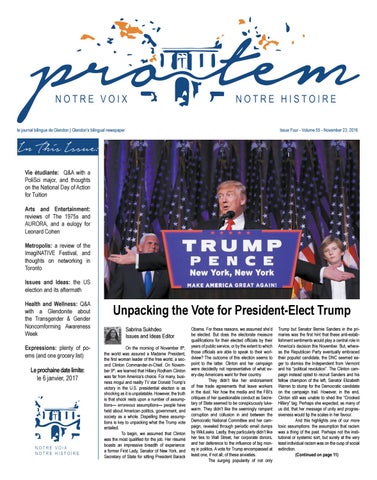
Unpacking the Vote for President-Elect Trump Sabrina Sukhdeo Issues and Ideas Editor On the morning of November 8th, the world was assured a Madame President, the first woman leader of the free world, a second Clinton Commander-in-Chief. On November 9th, we learned that Hillary Rodham Clinton was far from America’s choice. For many, business mogul and reality TV star Donald Trump’s victory in the U.S. presidential election is as shocking as it is unpalatable. However, the truth is that shock rests upon a number of assumptions— erroneous assumptions— people have held about American politics, government, and society as a whole. Dispelling these assumptions is key to unpacking what the Trump vote entailed. To begin, we assumed that Clinton was the most qualified for the job. Her résumé boasts an impressive breadth of experience: a former First Lady, Senator of New York, and Secretary of State for sitting President Barack
Obama. For these reasons, we assumed she’d be elected. But does the electorate measure qualifications for their elected officials by their years of public service, or by the extent to which those officials are able to speak to their worldview? The outcome of this election seems to point to the latter. Clinton and her campaign were decidedly not representative of what every-day Americans want for their country. They didn’t like her endorsement of free trade agreements that leave workers in the dust. Nor how the media and the FBI’s critiques of her questionable conduct as Secretary of State seemed to be conspicuously lukewarm. They didn’t like the seemingly rampant corruption and collusion in and between the Democratic National Committee and her campaign, revealed through periodic email dumps by WikiLeaks. Lastly, they particularly didn’t like her ties to Wall Street, her corporate donors, and her deference to the influence of big money in politics. A vote for Trump encompassed at least one, if not all, of these anxieties. The surging popularity of not only
Trump but Senator Bernie Sanders in the primaries was the first hint that these anti-establishment sentiments would play a central role in America’s decision this November. But, whereas the Republican Party eventually embraced their populist candidate, the DNC seemed eager to dismiss the Independent from Vermont and his “political revolution”. The Clinton campaign instead opted to recruit Sanders and his fellow champion of the left, Senator Elizabeth Warren to stump for the Democratic candidate on the campaign trail. However, in the end, Clinton still was unable to shed the “Crooked Hillary” tag. Perhaps she expected, as many of us did, that her message of unity and progressiveness would tip the scales in her favour. And this highlights one of our more toxic assumptions: the assumption that racism was a thing of the past. Perhaps not the institutional or systemic sort, but surely at the very least individual racism was on the cusp of social extinction. (Continued on page 11)
Pro Tem Letter from The Editor Editor in Chief | Rédactrice en chef Camille Slaght editor@protemglendon.com Assistant English Editor | Rédactrice adjointe (anglais) Effie Barbalias assistanteng@protemglendon.com Assistant French Editor | Rédactrice adjointe (français) Gabriella Giordan assistantfr@protemglendon.com Communications Officer | Agente de communications Sarah Mullins comms@protemglendon.com Photography Editor | Rédactrice de photographie Lauren Clewes photography@protemglendon.com Design and Layout | Maquettiste Sienna Warecki Section Editors | Chroniqueurs Campus Life | Vie étudiante Reeda Tariq campuslife@protemglendon.com Arts and Entertainment | Arts et divertissement Bruno Da Costa arts@protemglendon.com Metropolis | Métropole Andrew Thies metropolis@protemglendon.com
Hey Glendon, Do you love to write, but struggle to make time for creative outlets? If you have a passion for writing and have room for writing courses it in your degree, Glendon has a few options for you. This winter, Glendon prof and award-winning writer, Chris Dewdney, is offering a three credit course called Advanced Writing (EN 4560). The course will allow students to do advanced writing in poetry, prose, drama, media, and non-fiction (e.g. criticism). Dewdney will even host readings at Glendon in relation to this course. The authors are all professional, published novelists and poets with a national and often international profile. However, in order to run this year, the course needs more people to register. Keep in mind, the professor prefers if students have some experience in creative writing seeing as it is a fourth year course. Il y a deux autres options pour les amateurs d’écriture narrative francophones à Glendon. La première option est un cours de trois crédits nommé Stylistique française II : écrire une nouvelle (FRAN 3712). Il sera offert cet hiver par Nataliya Lenina. J’ai pris le cours l’an passé avec une autre professeure, mais peu importe l’instructeur, le but du cours est d’écrire beaucoup afin de développer son style d’écriture. C’est un cours qui se fonde beau-
coup plus sur la pratique que sur l’apprentissage de techniques, ce qui le rend très différent de la plupart des autres cours théoriques offerts à Glendon. Le travail final est la composition d’une nouvelle. L’autre cours de création littéraire à Glendon s’appelle Écriture narrative (FRAN 4277) et est enseigné par Marie-Hélène Larochelle. Le cours vient d’être offert cet automne et ne sera donc pas offert cet hiver, mais je le recommande très fortement. Marie-Hélène est une professeure passionnée et inspirante; elle veut que ses étudiants trouvent ce qui les motive à écrire afin de les diriger envers un produit final dont ils peuvent être fiers. Marie-Hélène publiera son premier roman cette année et elle n’hésite pas de partager son processus d’écriture avec ses élèves. If you are willing to commute to the Keele campus for a good writing course, I also highly recommend the course called Intro to Creative Writing (EN 2600). I took this course last year with Professor Michael Helm, and found that it completely renewed my love for creative writing. The prof is extremely clear about his expectations, and gives very relevant tips on how to create good literary fiction. At the end of the year, students hand in a writing portfolio, which encloses an entire year’s work, including descriptions, scenes, all kinds of poetry and one short story.
Many people hesitate to take creative writing courses because they don’t like to be told what or how to write. The way I look at it, all writers have editors, and students should consider their writing professor as an editor. Their honesty and expertise will guide your writing in directions you may have never thought of taking it. It is also great to have an incentive to write, seeing as many of us are so swamped with academics that we neglect creative writing. I invite you to strongly consider taking Advanced Writing with Chris Dewdney this winter. If the course has enough people registered to run, I could even work with the professor to open up the readings by guest authors to all Glendon students. If this is something you would be interested in, don’t hesitate to email me at editor@protemglendon.com. Best of luck on finals. I hope you take advantage of the winter break to do some personal reading, and to work on some writing. With love, Camille Slaght Editor in Chief
Issues and Ideas | Actualité et opinions Sabrina Sukhdeo issuesideas@protemglendon.com Health and Wellness | Santé et bien-être Emilia Nowicki health@protemglendon.com Expressions Kaitlin Fenton expressions@protemglendon.com
Vous avez des opinions? Vous aimez écrire? Vous faites de la photographie? Vous adorez dessiner? Pro Tem vous veut!
Online Content | Contenu en ligne Sam Kacaba online@protemglendon.com
Envoyez-nous un courriel à editor@protemglendon.com pour apprendre comment vous pouvez vous impliquer!
pro~tem
est le journal étudiant du collège Glendon. Publié pour la première fois en 1962, c’est la plus ancienne publication de l’Université York. We strive to act as an agent of social change, and will not print copy deemed racist, sexist, homophobic or otherwise oppressive. Please respond to what you read in the pages of Pro Tem/ n’hésitez pas à réagir à ce que vouz avez lu dans Pro Tem. Contact us/ Contactez-nous: protem@glendon.yorku.ca The Pro Tem Office D114 Hilliard Residence, Glendon College 2275 Bayview Avenue North York, ON M4N 3M6 The office is open by appointment only. Le bureau est ouvert sur rendez-vous seulement. Les lettres adressées au journal peuvent être éditées au niveau de la clarté ou de contenu. All copy appearing in Pro Tem is at the discretion of the editorial team. Opinions published in Pro Tem are the thoughts of individual writers, and not the publication as a whole.
2
Nadia Edwards
Vie étudiante GME Holiday Concert Monica Smith Contributor Bonjour Glendon, L’Ensemble Musical de Glendon aura leur premier concert de l’année le 8 décembre! Suivez-nous sur les médias sociaux pour plus d’information! Hello Glendon, The Glendon Music Ensemble will have their first concert on December 8! Follow us on social media for more information! Website: gme.info.yorku.ca Facebook: Glendon Music Ensemble – Ensemble Musical de Glendon Twitter @GMEGlendon Instagram @gmeglendon Email: gme.glendon@gmail.com
The Glendon Experience of a Political Science Major Stephanie Mak Contributor I had the opportunity to chat with Robyn LeLacheur, an interesting Glendonite who shared some insights with me on school-related topics. Q: What is Political Science? Why did you choose this major? A: Political Science is everything. There isn’t a single thing in this world that isn’t political in some small form. The way I see political science, is how to move throughout the world. History and philosophy are large components of political science, but we also study the psychology of world leaders, and the sociology of group mentality and collective action. Political science is the study of the way the world works. In grade 12, I didn’t know what I wanted to study. I had danced around with the ideas of being an accountant, a nutritionist, a lawyer, but I didn’t know what to do for an undergrad. I ended up going to my favourite teacher who taught my politics class I took in grade 11 and I mentioned my worries to her. She suggested I study political science, and since that conversation, I’ve never looked back. Q: What do you like about Glendon’s Political Science Department? A: What’s there not to like? The political science professors at Glendon are beyond exceptional. Even if there are professors I didn’t enjoy in a teaching capacity, all of them are phenomenal people and have taught me something along my journey to obtaining an undergraduate degree. Q: In which areas does the GL Political Sci-
Monica Smith
ence Department need to improve? A: When I first started at Glendon, I didn’t have a great idea of what I needed to complete to graduate. I didn’t know what an academic calendar was. Since then, Lion’s Den has incorporated peer mentors for the incoming freshmen, myself being one, and I feel as though that has really helped incoming students understand what they need to do to graduate. I would really like to see the political science department bring in more speakers and have conferences. I would really like to see workshops to help students find what their passion is within political science. There are so many fields within political science that many don’t have the chance to explore: international relations, comparative politics, political theory, public policy, law. I’d love to see workshops that help students learn about the different fields and explore their options. Q: Which student leadership roles have you had? Which was your favourite? A: I have been First Year Representative on the GCSU, a member of YGL-GIG, a volunteer at Open Houses, a member of the Glendon Conservatives, a Frosh Leader (2015 and 2016), a member of the Intramural volleyball and soccer teams, a peer mentor at the Lion’s Den, and I’ve recently joined the Foreign Affairs Council of Glendon. I’d have to say my favourite leadership role was being First Year Representative on the GCSU. I was on an incredible team of student leaders and had fantastic role models and friends on council. I was also offered opportunities to meet other First Year Reps from the Keele Colleges to coordinate cross-campus events. Q: You’ve stated to me that you have ADHD. What is ADHD and how has it affected your life? A: ADHD stands for Attention Deficit Hyperactivity Disorder. ADHD is split into three categories and I have Type A: Inattentive Type, formerly known as ADD. Essentially, ADHD makes it very hard for me to focus on
the smallest of tasks. However, it also comes with a host of benefits. I have an incredible memory, and I think much faster than the average mind. The hardest thing about ADHD is that I was diagnosed with it so late in life. I was 19, and I had already gone through my first year here at Glendon with more than a few bumps along the way. However, ADHD is what makes me so successful in my field. As I said earlier, I think much faster than the average mind, and when debating politics, it definitely comes in handy. Q: What does it mean to be a student leader with a learning disability? A: It’s not something that I see as disabling in comparison to other students, however I do have to consider that I can’t stay focused as long as my colleagues. The best thing I can do to compensate for my inattentiveness is to make sure that I schedule time to just relax and allow myself to not pay attention to anything. I allot a certain amount of time to schoolwork and extracurricular responsibilities and also time to just relax. Q: What is your favourite academic memory at Glendon. A: It was last year in my third year, in my Introduction to Comparative Politics class. I had recently written an article for Pro Tem that made the front page, and my professor actually dedicated a lecture to my article because he liked it so much. Another one would be getting an essay back from my sociology TA and I received an exceptional grade, and in his comments, he told me I helped him better understand the theory I had written about.
graduate school applications and that you are aiming for Carleton University’s International Affairs program. What tips do you have for students who want to pursue a Master’s degree? A: My biggest piece of advice I tell high school students who are applying to university is to figure out what they don’t like first. It’s hard to figure out what you’re passionate for, but it’s really easy to discover what you don’t like and that helps narrow down potential fields of study. Approach your professors, ask them which schools they recommend, talk to an academic advisor, do your research. Find the program that has everything you could possibly want and work hard to get there. Q: What legacy do you want to leave behind when you graduate Glendon in June 2018? A: These last four years at Glendon have been the best four years of my life. I’m not worried about leaving a legacy at Glendon, but rather have Glendon leave a legacy with me that I carry for the rest of my academic and professional life. But if I wanted to leave a piece of me behind at Glendon, I’d like it to be my ability to challenge many people’s way of thinking. Robyn LeLacheur
Q: Describe your favourite co-curricular memory at Glendon. A: My favourite co-curricular memories have to be from Frosh Week, as a froshie and a Frosh Leader. Frosh Week welcomed me to Glendon and I love being able to do the same for incoming students. Q: I know that you are currently preparing
3
Campus Life The Naivete of the National Day of Action for Tuition Matt Turner Contributor On November 2nd, thousands of university and college students marched to their collective provincial legislatures and to Parliament Hill to demand the Government to abolish student tuition. While the objective of the National Day of Action for Tuition is a valid one, the means that were used were weak and naive. In order for the Government to listen there would have needed to be a sustained campaign from student activists across the country. The student movement outside of Quebec has adopted a laissez-faire attitude toward tuition fees. There has been a half hearted protest and a call to arms during an election campaign, but nothing beyond that. Unfortunately, the Canadian Federation of Students (CFS) outside of Quebec works to their own interests, lining the organisation’s pockets and suing student unions who want out; as was the case in Newfoundland in 2014. If students want to see tuition fees abolished, they need to look at their student unions to campaign for it. Unfortunately for the members of York and Glendon, our student unions, the York Federation of Students (YFS) and the Glendon College Student Union (GCSU), seem more interested in keeping themselves in power, running social events and distributing agendas with poor translations. Where both student unions share messages of the CFS, their “campaigns” aspect fail to capitalise on their ability to organise their members and achieve the goal of reduced or eliminated tuition fees. Considering that both unions rarely receive greater than 70% of votes amongst their members, and that the YFS has delt with allegations of voter irregularities in their campaigns, our student unions lack legitimacy. Where does that leave the tuition movement? It’s time for the government to start leading youth into jobs where there is a demand. High schools must stop pushing so many students to go to universitiy when trades jobs are in such a high demand. We must also stop telling ourselves that the neo-liberal ideas about being all you can be are the best thing, and we must stop seeing a university degree as the fulfillment of those ideas. In the short run, the Province should be addressing how universities are funded, and how they treat students like profit centres. Students need to stop thinking like consumers, requesting universities to accommodate their every need. Part of the reason we are in this situation is due to the consumer culture we inhabit. Lastly, we must be realistic. Does it truly serve society in the long run to have so many people attend university? If everyone could afford to go to university, it would dilute the value of a degree. Instead of rooting for lower tuition fees, we should be directing people toward fields where they will be needed down the road.
4
Meet Two of the Glendon E-Ambassadors! Krysta Veneruz
Amanda Tanner
I’m Krysta, a second year student in French studies taking apart in the D-TEIL certificate! I’m from Thunder Bay, Ontario and moved to Toronto when I came to Glendon. My blog, krystavgl.wordpress.com, consists of a lot of self-reflections since university so far has consisted of trying to find out who I am, what I like, and what my goals really are. I write a lot about hardships happening in my life, since we’re all struggling to find our place and to find balance. I try to give resources and tips for those of you looking for guidance. I also write about events that I attend around the city, and since I’m still fairly new to Toronto my vlogs capture the kid in a candy store that I feel like. I try to do volunteer work and let others know how they can also get involved in their community at Glendon or in the city. I write like I talk, so by reading my blog you really get to know me, my passions, what’s going on in my life and how Glendon is leading me on my path of discovery.
My name is Amanda and I’m in my second year of the French Studies and Con. Ed program at Glendon. On my blog, amandatgl.wordpress. com, I write about many different things that I am passionate about: education, mental health, human rights, travel, videography, and photography! My vision is to cultivate a world of optimism and unity. I believe in the 3 F’s: faith, family, and friends. I’m 100% sure that love is the answer. Je m’appelle Amanda et je suis étudiante de deuxième année en études françaises et en éducation. J’écris au sujet de l’éducation, de la santé mentale, des droits humains, des voyages, de la photographie et de la vidéographie! Ma vision est de créer un monde optimiste et uni. Je crois que la foi, la famille, et les amis sont ce qui a de plus important dans la vie. Je crois aussi que l’amour est la solution à tout problème.
Lean in with Lean In!
of the many celebrities who have jumped onto the Lean In bandwagon. Lean In Glendon Campus is a great club in which you can meet new people, make new friends, network and brainstorm. Are focused on your professional future? Do you want to have a competitive resume? Lean In can help! Professional development and motivation are two of the many themes that are discussed at our weekly
Emily Allen Contributor ‘Lean In Glendon Campus’ is a part of a larger organization called ‘Lean In’ started by the COO of Facebook, Sheryl Sandberg. Beyoncé, Hugh Jackman, and Alicia Keys are only a few
Krysta Veneruz Amanda Tanner
meetings. Not sure if you want to join? You are welcome to attend one of our meetings to get an idea of what we are about. You can like our Facebook page, Lean In at York University, to stay up to date with all the great things our club has planned for the year! Meetings are every Wednesday at 11:30 in room A220. Come Lean In with us!
Arts et divertissement Love Letter to The 1975: A Review of The 1975’s Concert at The Air Canada Centre Meghan Bezzina Contributor On November 3, I was lucky enough to see my favourite band, The 1975, at the Air Canada Centre. They are currently doing a support tour for their sophomore album I like it when you sleep, for you are so beautiful yet so unaware of it. While I was excited for the show, I didn’t realize how much I would absolutely love it. It’s obvious that The 1975 are truly in love with music and play for the sheer joy of it. Members Matty Healy, Adam Hann, Ross MacDonald, and George Daniel all performed with such passion. The crowd was “dressed in black from head to toe” (a lyric from one of the band’s
Sincerely, L. Cohen Eric Vogel Contributor I first fell in love with Leonard Cohen’s music during my first and only summer in Ottawa. It was a formative and sometimes lonely time for me; I was working late exhausting hours and wasn’t really sure what I was doing with my future. Cohen’s music throughout this time was a rock. It kept me thinking about darkness, death, passion and love; it helped me realize that beauty can come from sorrow. That we can touch people and find ways to be touched even when we are at our lowest. For Cohen, pain and ugliness are part of what makes us human, as he professes in “Anthem”, There is a crack in everything. That’s how the light gets in. His deep baritone, his lust, his sadness, his wisdom, and passion were all poured into his work, making his music timeless and provoking. I’m sure it would be difficult to find someone who hasn’t heard Cohen’s sublime gospel “Hallelujah”, which apparently took him five years to write. This song was chosen by Choir! Choir! Choir! to memorialize his life in a performance at Christie Pits Wednesday, November 16th. However, personally, I have always had an affinity for “Chelsea Hotel #2”. The piece was written as a kind of memorial to Janis Joplin, and the brief affair her and Cohen had in that New York hotel. The tone and lyrics are pensive, but not sad, neither shunning nor glorifying their short relationship; it acknowledges a moment shared between two people, while accepting that moment has passed. Cohen’s warm vocals, when paired with the delicate guitar, provides an intimate feeling that I have yet to experience with any other song I’ve ever heard. Cohen’s passing should come as little surprise to anyone who has followed his
most popular singles) with flashes of pink as a nod to the aesthetic of the current album. The audience was full of energy, responding enthusiastically when Healy asked us to sing Happy Birthday to his 80 year old grandfather. As a thank you, the band gave a surprise performance of “Robbers” much to the delight of everyone present. From commenting on the US election to drinking a glass of red wine in between songs, The 1975 frontman Matty Healy was a bit of a loose cannon. He danced around the stage like a cross between an 80’s pop star and a drunk giraffe adding to the energy level of the crowd. The visuals of the show were stunning and simple; the modern vibe of the stage did not distract from the setlist. The 1975 take cues from R&B, synth-pop, and alternative rock, so it is difficult to place their sound into a genre. A number of songs are infused with 80s inspired saxophone solos, while others are instrumental and have a dreamy, orchestral feel to them. That night, the Air Canada Centre was filled with a symphony of sounds that could give Brian Wilson a run for his money. However, it’s the lyrics that I love the most. The poetic lyrics are emo in the truest sense of the word—full of latest release,You Want it Darker, the cover of which features Cohen staring from the light into the endless dark void, one arm hanging over. Much like Bowie did, Cohen drew upon his last moments on earth as inspiration for one last album. It presents a deeply religious reflection from Cohen, discussing his misgivings and enthralment with God, and declaring in the title track “Hineni, hineni. I’m ready my lord.” Hineni is the Hebrew word for ‘Here I am’. After decades of philosophizing, Cohen was ready to get his answer. Leonard Cohen is Canada’s great poet, and at a time when heroes are going missing, this one hurts. He will be dearly missed, but so long as we love, hurt, yearn, and hate, he will never be forgotten.
Embracing Your Oddities: AURORA’s Liberating Performance Bruno Da Costa Arts and Entertainment Editor Aurora Aksnes, known as AURORA, had a quiet breakout into the indie eletropop scene. Even though her first single was released in December 2012, it was not until February 2015 that she reached critical and commercial acclaim for the song “Runaway” from her first EP. Radio stations across the UK picked up the track and the then the 17-year-old soon started making appearances at music festivals like Way Out West and Green Man. The Norwegian-born singer enthralls and bewitches with her powerful yet sweet voice. Her writing is honest, dark, but still hopeful. AURORA invites the listener into her personal experiences and shows how to rise after
pure, heartbreakingly raw emotion. From commentary on celebrity culture to drug addictions, the clever lyrical content of the songs is incredibly diverse. I associate periods of my life with the music I listened to at the time, and hearing these songs performed live filled me with such nostalgia. I discovered The 1975 halfway through my first year of university and their two albums have become the soundtrack to my university
experience. In my mind, “Girls” will always be synonymous with subway rides downtown, and “Change of Heart” will remind me of wandering the streets of Bath in England. There was no single best part of the show. From screaming the lyrics to “Chocolate” with my best friend, to dancing with reckless abandon to “The Sound”, every moment was a treasure that somehow made me fall in love with The 1975 even more.
falling, to shed youth’s innocence, and how to dance your way through life even when it seems to be crumbling apart. I discovered AURORA some months following the success of “Runaway”. I spent two painfully long months waiting for the release of her debut album, All My Demons Greeting Me as a Friend, followed by two horribly uncomfortable hours waiting in the rain outside of The Opera House on November 8 for her first performance in Toronto. What most excited me about seeing one of my newly favourite singers was the chance to finally witness and experience her devotion to her art. AURORA fuels her performances with erratic, expressive dancing. She moves with the bass line, the guitar shreds, and the electronic backtrack. Her wild and free dancing is not just a quirky trait of hers. After singing the first few songs of her set, AURORA talked about how important it is to embrace everything within ourselves, and to allow the things that make us different define us. She made the assumption that if we connected with her music we had to be a little strange, just like her. This statement was met with enthusiastic cheering and whistling. The singer then went into a rendition of “I Went Too Far”, which she prefaced by saying that she admires those who celebrate their inner weirdo and stand up to those who try to knock them down. Her words were touching, changing the way I experienced the rest of the show. I was lucky enough to be standing right in front of the stage, within arms reach of this eccentric, mousy girl whose voice packed a most jarring punch. The high notes AURORA managed to reach, seemingly without effort, left all in attendance spellbound. Despite the heavy instrumentals background, her voice always rose above it. She sang from the heart and lived up to her mantra, continuing to dance along to the beat of each song. The set consisted of all her singles; the songs which most describe her restless-
ness and depict the pain of living despite the pressures of those who try to constrain her. AURORA opened with “Lucky”, a song in which she admits the harsh realities of life that make it tough. Following that was “Murder Song”, “Runaway”, “Under The Water”, and “Running With The Wolves”, songs which further depict themes of overcoming the oppressions in our lives and living unapologetically for ourselves. The show closed with “Conqueror”, and AURORA expresses the utter joy she felt when she stopped waiting for someone else to rescue her and decided to become her own hero. It seemed then that her opening words had come full circle. Her lyrics, her dancing and her encouraging words culminated in an elevation of the spirit that permeated the entire venue. The crowd danced in ecstasy, and I felt as if I finally understood what it means to listen to and trust the odd nuances of myself. Any artist that manages to free a crowd’s spirit to that extent is an important one. AURORA did not just put on a show; she used art to demonstrate the liberation that comes with embracing your inner weirdo. Bruno Da Costa
5
Atrs and Entertainment A Glance Into the Competitive World of Irish Dancing: Interviewing Pro Tem’s Editor in Chief, Camille Slaght Emilia Nowicki Health and Wellness Editor Q: When and why did you start irish dancing? A: I started dancing twelve years ago. When I was nine, I saw my friend Olivia dancing in my elementary school’s talent show. I was drawn to her quick feet and to the buckles on her shoes, so I asked my parents to sign me up for Irish dancing. I am a very competitive person, so from the beginning, I loved the discipline it required. Q: How often do you train? A: I usually train 8 to 10 hours per week. Q: Do you do other kinds of training besides dance? A: I try to go to the gym a few times a week. It’s important to do both cardio and weights. I also do yoga, which helps with flexibility. Q: What are the most prestigious placements you have achieved? A: I have placed 11th at the World Championships, 7th in North America and 1st in Eastern Canada.
Q: Which competition did you last participate in? How did it go? A: Saturday November 12th, I competed at the Eastern Canadian Irish Dance Championships. It was my first time competing in the Senior Ladies age group (21 and over), and I came 2nd, qualifying for the 2017 World Championships in Dublin, Ireland. Q: Do you also participate in non-competitive performances? A: Many dance schools do performances as well as competitions. I have performed at weddings, festivals, nursing homes, and an endless amount of Irish pubs during Saint Patrick’s Day. I have also performed twice at the Roy Thomson Hall in Toronto, alongside the Barra MacNeils, a Canadian Celtic music group. Q: What is a typical competition day like? A: I usually have to wake up at 5:30am because at major competitions I am often scheduled to start at 8:30am. I like having two hours to get ready and one hour to warm up. I start with makeup, then do my hair, and I try to eat breakfast despite the nerves. On dance day, I always eat the same thing: Vector cereal for breakfast, grapes between rounds, and a protein bar before my set. Each round is spread out throughout the day, so I have to make sure that I eat to maintain my energy. I also take sips of a Red Bull right before I dance. Once I have made my way to the venue, I say hi to my teachers and friends, and start taping my feet. I do a warm up in runners, then in my dance shoes. We perform three rounds in front of three to seven judges, depending on the competition. The first round is the hard shoe dance, then we do the soft shoe round, which is my favourite. The scores from the first two rounds are tabulated, and the top 50% are “recalled” to
do a third round called the set dance. This one is danced in hard shoe, alone, and is supposed to showcase all the things each dancer does best (if I could do my set in soft shoes, I would). At the end of the day, there is an awards ceremony where the world qualifiers are announced, and then places are announced. Recall medals are given out, and the top five dancers stand triumphantly on the podium, as friends and family cheer for them. Q: I know that your costumes are very elaborate (and expensive)! Can you tell us a bit about what you wear to compete and the costumes worn by dancers in different levels? A: There are six levels in Irish dancing, starting with Beginner and ending with Open Championship. At first, dancers wear school costumes, which are the same for everyone and usually have a school logo on them. When a dancer reaches a certain level, they get a “solo dress”. These are usually custom-made by designers in Ireland. We send them our measurements, prefered colours and designs, and wait anxiously for a big box to arrive at our doorstep. Girls wear short, colourful longsleeved dresses covered in thousands of Swarovski crystals, which we spend hours gluing on by hand. We wear white socks, and spray tan our legs to make our muscles look more defined. Boys usually wear embroidered vests (also covered in crystals) and dress pants. Girls also wear curly wigs and shiny tiaras for competitions. Our costumes are very glitzy and glamourous despite the traditional dance style.
Olivia Hynes
6
Q: How do you deal with the stress associated with training, competing, and also being a university student? A: I find that I use my time more efficiently when I am busy. Over the past four years at univer-
sity, my professors have been very supportive and have even allowed me to reschedule exams if I have a competition overseas. However, I do have to make many sacrifices to train as much as I need to achieve my goals. It’s really important for me to know that my friends and family support my dancing. Luckily, my friends all know how much dance means to me, so they also understand why I am always so busy. I dealt with a lot of performance anxiety over the years, and sought out help from sports therapists who helped me overcome my fears and perform to the best of my ability. Q: What’s the most difficult part of Irish dancing? A: Generally, the biggest setbacks for dancers are injuries. I have sprained an ankle over five times during my dance career, I have dealt with chronic hip problems, and even have osteoarthritis developing in my big toe joints. Luckily, I have a team of people who help me stay healthy, inccluding a massage therapist, a physiotherapist, a chiropractor, an acupuncturist and a sports psychologist. Every time I had to take time off due to an injury, I was reminded how important dance was to me, and came back even stronger. Q: What is your favourite thing about Irish dancing? A: Dancing the soft shoe round has always been my favourite thing about dance. There is no other feeling like it in the world. The height and lift that I get, and the swiftness with which I make my way across a stage make me feel light and graceful. Another great thing about dance is the incredible friends I have made over the years. My teachers and peers have become family to me, and each and every one of them has helped to shape the person and dancer that I am today.
Métropole ImagineNATIVE Film & Media Arts Festival Review Mary Schmitz Contributor After viewing almost two hours of successive screenings of international shorts films at the imagineNATIVE Festival this year, I felt both utterly emotionally drained and inspired. The eight short films, as with all the media showcased at the festival, are either written, produced, or acted out by indigenous and First Nations individuals. They highlight some of the difficult realities of indigenous life both currently and historically, as well as the powerful collisions of these past and present struggles. The pieces strive to celebrate diversity and dispel stereotypes. In the eight short films I had the pleasure of seeing, I was treated to stories of aliens and parallel fantasy worlds, family healing after suicide, the gritty reality of prostitution, the difficult discovery of a racist and violent familial past, the grieving of a sibling through the supportive lens of a young queer Inupiat couple, and coping with a divorce in a foreign country, to name just a few. The individual stories were incredibly powerful and flung you from one emotional reverie to the next. One of my favorite pieces, Soup For My Brother, was filmed not far from where I grew up in Western New York. As soon as the opening shot flashed on the screen I felt instantly connected. Though the abandoned backhoe, worn out house, and rural setting are practically another world compared to the concrete and
glass of downtown Toronto, the message still hits home no matter where you’re from. Simply narrated, without dialogue, and shot primarily at a picnic bench in a man’s yard, the film enthralled me and did not release me until the following film forced me to refocus. The work is a short and plain video of a middle-aged man making soup for his brother on the one-year anniversary of his unexpected passing. There’s nothing fancy about the old crock pot, the red picnic bench, or the slightly overgrown lawn. It is incredibly simple but in its simplicity it hits a deep chord. Its almost harsh ‘everyday-ness’ forces the audience to confront the uncomfortable fact that death happens in real life to average people and is not just some outcome alluded to in a glossy, edited film on the screen. Terry Jones (Seneca), who wrote, directed, produced, narrated, acted in, and edited the film, was at the screening to answer questions following the presentation. Personal touches such as these added so much to the stories told at this festival. ImagineNATIVE is more than just the film festival, though. Officially named The Centre for Aboriginal Media, imagineNATIVE is a registered charity whose vision statement explains that they are “inspiring and connecting communities through original Indigenous film and media arts.” And what better place to champion that cause than in the multicultural hub of Toronto? The festival was originally the brainchild of Cynthia Lickers-Sage and V-Tape (Kim Tomczak and Lisa Steele) in 2000. Since its conception, the festival has already won the prestigious Premier’s Award for Excellence in the Arts twice and given hundreds of aspiring and established indigenous artists an unparalleled platform to showcase their talents and have their stories told. The festival is unique both nationally
and internationally in its commitment to indigenous art and media. Being based in Toronto allows featured artists to reach a broadly diverse audience here in the city, as well as throughout Northern Canada during the video tour. The films screened at imagineNATIVE also have a higher propensity to be incorporated into the TIFF and HotDocs lineups for further screenings and exposure. In conjunction with the organization’s internal awards, the festival lets the audience give their opinions through the Audience Choice Award poll. The winner is chosen by its popular rating and is later shown as an entertainment option on Air Canada flights. While imagineNATIVE is fiercely dedicated to granting influential career opportunities to indigenous artists through exposure at the festival and beyond, the pure heartfelt messages of the films are still, without question, at the heart of the event. They are what drive the creators and collaborators and what inspired the festival in the first place. Diverse topics from diverse communities both here in Canada and abroad are afforded their rightful time in the spotlight and realities that are too often ignored
are now unapologetically brought to the surface and discussed. And while the festival focuses officially on indigenous experiences, the overarching themes are earnestly universal and mirror realities seen throughout Toronto’s highly multi-ethnic population. The motifs of tradition, racism, hope and hopelessness, family, death, acceptance, and reconciliation know no cultural bounds and help bring audiences from all backgrounds together. Which, unsurprisingly enough, perfectly fulfills imagineNATIVE’s mission statement of “inspiring and connecting communities.” My experience at the 2016 imagineNATIVE festival was nothing short of incredible, but don’t just take my word for it! Check out the imagineNATIVE website (imaginenative.org) for upcoming events, workshops, tours, and to learn more about their Tech Library. Feel free to get in touch with administrators if you are interested in contributing to the organization or the festival. But most importantly, don’t miss the 18th annual imagineNATIVE Festival next year in October 2017!
T.O Living
around it. You might think at this point I hate Toronto. You are almost right. Jokes aside, Toronto can be the best place to grow and experience culture. From Kensington Market (weed dispensaries and the best food you have ever eaten from several different cultures) to TIFF and everything in between; Toronto has a huge art, music, cuisine, and entertainment scene. This panoply of cultures will balance all of the city’s shortcomings and you will undergo a powerful awareness of what multiculturalism is all about. Canada is built on the premise of multiculturalism, and you will experience cultural clashes everywhere you go. But if you keep an open mind, you might just find yourself developing in a way you could never do in Keswick, Ontario. I believe everyone needs to live in Toronto at least for a little while during their existence because it truly represents what the world is about, and I will leave you to determine what that is.
Behrad Taaed Contributor
Lauren Clewes
Toronto: Is it real life, or is it just fantasy? Listen, the first important thing you need to know about Toronto is money. You’ll need lots of it. This means that you and your $35 bank account, part time job at Sobeys, and constant drunk nights on weekends can not afford it. However, many have found loopholes. This includes, but is not limited to, your parent’s money, OSAP, dealing ganja, and living off Mr. Noodles and tuna. Essentially, downtown Toronto is arbitrarily expensive, and you probably will not be able to survive. Do not fret! Toronto is an extremely large city, and for some odd reason, other cities including North York, Richmond Hill, Newmarket, and many more are also included in the GTA (greater Toronto area). Therefore, this means you and your non-existent bank account and impulsive Popeyes binges can get a place to live. This inevitably means commuting, but fortunately Canada has the best public transit in the world! If you live in Toronto, you know the many shortcomings of the TTC. It is a price to pay to live in Toronto, and there is no getting
7
Fall Camps Day & Rememberance Day
All photos on this page by Lauren Clewes
8
Pro Tem’s Paint Lounge
Camille Slaght
Lauren Clewes
Camille Slaght
Camille Slaght
Camille Slaght
Lauren Clewes
Lauren Clewes
Lauren Clewes
9
Metropolis Networking in Toronto: It’s About Who You Are, Not Who You Know Neya Abdi Guest Contributor, Toronto Discursive Originally published on TorontoDiscursive.com
November Events in Toronto: What Not to Miss This Month The Salon of Inclusiveness III Holiday Show Exhibition runs from November 17th - December 31st Large and inclusive group show. No medium or work will be rejected. Opening Reception #3: November 25th, 7pm-10:30pm Gallery hours: Wednesday - Saturday: 2-7pm The Black Cat (2186 Dundas W) Les Zinspirés: Cinq sur cinq Du 17 au 26 novembre Théâtre français de Toronto Cavalcade of Lights November 27th Located at Nathan Phillips Square A Third Gender: Beautiful Youths in Japanese Prints May 7th - November 27th Royal Ontario Museum One of a Kind Show & Sale November 24 - December 4 Enercare Centre, Exhibition Place Human Rights Film Festival Award winning films dealing with immigration, women’s rights, homelessness, LGBT rights and more December 9th - December 11th Hot Docs Ted Rogers Cinema 506 Bloor W
10
Toronto Christmas Market November 18th - December 22nd Distillery District Holiday Fair Winter carnival & traditional European Christmas market December 8th - December 22nd Nathan Phillips Square Superreal: Pop Art from The AGO Collection January 16th - December 31st Art Gallery of Ontario CHIHULY Exhibition September 29th - January 2nd, 2017 Royal Ontario Museum Mystical Landscapes: Masterpieces from Monet, Van Gogh and more October 22nd – January 29th, 2017 Art Gallery of Ontario
Every post-secondary program is served with a side of advice to network aggressively. “It’s about who you know, not what you know,” we’re told, “so you’d better start marathon shaking hands”. Well, not so fast. Sure, people with an extensive network boast a unique advantage when it comes to landing jobs. They can save time by sending resumes to people they know will look at them. But for the most part, if a hiring manager or executive doesn’t believe you’ll vibe with their company, chances are you’re not getting the job. Don’t believe me? Consider this: according to 67 percent of consultants surveyed by Workopolis, the top reason people don’t get the jobs they want is because they fail to set themselves apart from the competition. Let that sink in for a moment. The top reason isn’t lack of experience or a company insider’s referral: it’s a compatibility problem. The Importance of Values in the Startup Scene But what exactly does this mean? Differentiating yourself isn’t about standing out by any means necessary. If this were the case, we’d all be showing up to interviews drunk, toting a karaoke machine with every intention of using it in the name of making an impression. Clearly, companies are looking for something specific. And that something specific is: Whether your values are aligned with theirs. Nowhere is the urgency about values stronger than in the startup scene, particularly in Toronto’s flourishing tech ecosystem. Ninety percent of startups are expected to fail. With a fun statistic like that, startup founders are more interested in working towards their vision than convincing new recruits that their vision is great. Teaching you company policy takes the work of a week. Teaching you to share a company’s convictions, while not impossible, can take for-
Outdoor Skating Rinks Open November 26th Nathan Phillips Square, Christie Pits, High Park, Greenwood Park, Jimmie Simpson Park and more!
If you’re around Toronto and hear of an event that might be of interest to our community, write to us at: metropolis@protemglendon.com. Kaitlin Kenny
ever and even after that investment there’s no guarantee you’ll care. Consequently, who you are and what you value is very important to companies. Companies Are On the Lookout for People Who “Get It” The recent TechToronto Meetup powerfully drove this point home. The beauty of this monthly meetup hosted by TechToronto is the mini-presentations given by members of the tech community – just enough variety to leave you satisfied, but short enough to keep you engaged. The most recent event was a veritable smorgasbord of speakers ranging from a marketing manager in a biotech company to the married co-founders of a beauty review site to the hilariously straight-talking, potty mouthed CEO of a healthcare tech startup. While on the surface they could not be more different, what they all shared in common was a strong belief in the importance of people with shared values for the success of an organization. In each presentation, the speakers emphasized the importance of company culture and building solid teams. Of course, a shared passion for eating is not going to overcome the fact that you don’t know how to code if you are applying for a developer position at a food delivery startup. On the other hand, if you have the necessary hard skills and demonstrate a commitment to creativity, user experience, and healthy eating, it’s clear to the person doing the hiring that you get what the organization is trying to accomplish. At the end of the day, everyone’s just looking for people who “get it”. It’s why couples with seemingly opposite interests can work so well: they likely share core values about communication and personal growth. And it’s why an organization with teammates who fill different roles – technical, public relations, sales – can come together to make something greater than the sum of its parts. The TechToronto Meetup and afterparty takes place every month for those looking for a job, those looking to hire, and those who just love learning about tech. The next event takes place December 5. Early bird tickets are $12, regular tickets are $20, and you can buy them at the door for $25.
Actualité et opinions Hope: Reflections on the U.S. Consul General’s Visit to Glendon and the Presidential Election Alex Freeman Contriubutor Two days after the U.S. presidential election, my American Politics class was fortunate enough to meet and talk to Juan Alsace, the United States Consul General in Toronto. Alsace is a highly respected diplomat and senior Foreign Service officer who is subordinate only to the American Ambassador to Canada. In his 29 years of service, Mr. Alsace has worked all over the world, fulfilling a multitude of important roles. He worked in Iraq as Team Leader of an embedded Provincial Reconstruction Team (2009-2010), as Economic and Political Counsellor in Santiago in Chile (2006-2009), and as
I’m a Christian and I Don’t Hate You Tamsyn Neale Contributor I am distraught. I am frustrated. And I am sorry. I am writing this on Thursday, November 10th, after two full days of people celebrating and mourning Donald Trump’s victory in the American presidential election. In two days, social media has been flooded with heartbreaking stories of people in the United States being threatened and abused through acts of blatant racism, homophobia and misogyny. I feel sick. I am a ‘white’ person, and I recognize the privilege and safety that my ‘colour’ provides me, never taking it for granted. I’ll likely never know the level of fear Americans are now facing. People feeling they need to act or dress differently in order to be safe. People experiencing hate because of non-whiteness and additional “othering” qualities. And, at this point, it’s only been two days. I know quite a few Christians who are vocal about their support for Trump, looking past his ‘character deficiencies’, claiming that ‘nobody is perfect’. They cling to their views on abortion, and proclaim that Trump’s policies are ‘Biblical’ (sorry, but I call BS) or that he really will make America great again. I have heard people arguing at length that Trump himself is not truly racist or hateful to any group. Regardless, his rhetoric seems to have worked as a catalyst. Racism that was simmering below the surface has been legitimated and people emboldened. People are quoting him and referring to his presidency while engaging in acts of hate. The problem is bigger than a belligerent man who will soon be the face of America. It is the people themselves, who are using their false entitlement,
Consul General in Barcelona in Spain (20032006). During the class, students were given the opportunity to ask Mr. Alsace a variety of questions, most of them relating to the recent election of President-elect Donald Trump. Mr. Alsace did not dodge any questions, but remained impartial and neutral while giving his answers. He was articulate, considerate, and cordial. He adequately represented the upper echelons of American public service. I could drone on about the importance of civic duty, or the catastrophe-in-waiting that is the Trump administration, but I will not. Instead, I wanted to write about Mr. Alsace’s visit to illustrate an important yet often overlooked point: while the Electoral College may have betrayed the country this election cycle, there remain hundreds of senior elected and appointed officials in the executive, legislative, and judicial branches of American government who do not reflect the current state of affairs, and who carry themselves in a diplomatic and respectable fashion. I feel the need to be cautiously optimistic because I believe in the fortitude of American intellectualism and liberalism, and in ignorance, fear and pride to harm those they see as different. I am a white Christian and I want you to know I don’t hate you. And I am so, so sorry. I am sorry that this is happening. I don’t know if the perpetrators of the hate are also claiming to be Christian, but if they are please know they are disgustingly wrong. Please know that this is not Christianity. Jesus says “Love your neighbour as yourself,” and there is no asterisk at the end leading to a list of exceptions; there are no loopholes nor exclusions. And I believe personally that He loves you. Really. Everyone. No matter what. There is no justification for the hate. I am sure that, while reading this, you can think of examples of hate and violence or exclusion perpetrated by ‘Christians’ or ‘The Church’ from history or even your own experiences, and I want to say that I am so, so sorry. Again, that is not Christianity. I am sorry that there are people who use religion or other labels to motivate hatred and build walls (let’s hope the latter remains figurative). It seems so often that it’s the small, angry groups that get the loudest. So, I want to take the chance to give a voice to the other side. I am Christian and I do not hate you. I am sorry if you have experienced pain from people who share my religion. I love you, and I want you to hear this in the midst of all the chaos. Other than this, I am at a loss. If I witness acts of hatred I will not remain a bystander, and will do whatever I can to stand up for the victims. Canada is quite special. I’m sure many of us have strong opinions about the events happening in the U.S., but let’s also at our own country, where we are able to take action and make a difference. There is much injustice for us to end here as well. Let’s look inward, and make sure that we do what we can with the opportunities given to us. Hate may be getting louder, but we can help make sure that love, grace and protection drown it out.
Alex Freeman
the legitimacy of the U.S. Constitution. Thomas Jefferson once wrote, “the tree of liberty must be refreshed from time to time with the blood of patriots and tyrants”. The next four years will test the resilience of American political institutions, but will not demolish them. Instead, the country will recover, and this era will be seen as a hiccup on the path of greater equality, equity,
and acceptance. During this week of remembrance, lest we forget that the worst examples of human behaviour have often been followed by incredible feats of selflessness, courage and determination. The darkest hour is just before the dawn.
Unpacking the Vote for President-Elect Trump (contnued from cover)
So, what now? Defeatism is so tempting. When one fully appreciates the conflicts and injustice that might be exacerbated by Trump’s presidency, it is overwhelmingly easy to become hardened by cynicism. But Americans, and perhaps all of us watching this new political climate unfurl, need to be reminded: the democratic process does not begin and end with voting. For disadvantaged peoples, especially, it never has. Even at its most generous, the government is incapable of ever being at the forefront of progress. Active political engagement is about community organization, civil disobedience, and unending learning about issues and ideology. Though the government might pose significant challenges to these activities, it has become as important as ever to strengthen grassroots networks for women, queer people, racialized people, religious minorities, those with disabilities, and so on. Triumphs in social justice rarely start with people in office— they start with the oppressed— and the enduring relevance of this assumption has propelled the most fruitful movements toward better societies. The United States’ next president consolidates an American identity markedly different than the one espoused by those before Trump. Now that the dust is settling, a new path for the global leader will be forged— one that is ambivalently less open, one that is less tolerant. However, what is definitively clear is that, as Americans ready themselves for the Trump administration, they will have to grapple with the remnants of the world’s assumptions about the U.S. that their vote effectively shattered during this election.
After all, didn’t America elect a Black president, not once but twice? Trump’s victory is the most violent rebuke to this post-racial fantasy. There was no shortage of ugly unambiguous hate that could be attached to Trump’s name come election day. He constantly vilified Mexicans, proposed a ban on Muslim immigrants, refused to disavow the white supremacist Ku Klux Klan (who eventually endorsed the Republican candidate), and ran attack ads with anti-Semitic undertones— and that was just his campaign. Trump’s pre-politics history reveals two lawsuits filed by the Justice Department against his real estate company for anti-Black discrimination and, of course, it was Trump who spearheaded “birtherism”, a movement predicated on the conspiracy theory that President Obama was not born in the U.S. This account doesn’t even delve into the bigotry demonstrated by his supporters at rallies and in their communities, or Trump’s gendered, queerphobic, and ableist attacks. Still, Trump’s win carried 290 electoral votes, past the required 270, and 47.41% of the popular vote in America. Were those votes in spite of Trump’s racism, or because of it? And either way, how do you justify supporting a candidate that antagonizes your friends, neighbours, coworkers, and peers? This election was a blunt admonition that American society still suffers from gaping racial wounds and that, all this time, tensions merely simmered beneath a façade of tolerance. In fact, perhaps the greatest failure in all of this was assuming that history and social progress follow a linear, upward trajectory.
11
Issues and Ideas L’importance de la citoyenneté canadienne / The Importance of Canadian Citizenship Natalie Pilla Contributrice On November 3rd, I had the opportunity through my Canadian Citizenship class to attend a citizenship ceremony hosted by Glendon and organized by Professor Audrey Pyée. The ceremony gave me and my classmates an experiential learning opportunity, which was Mme. Pyée’s goal in organizing the event : « Je l’ai organisé pour que les étudiants de ‘Citoyenneté canadienne’ puissent voir comment les idées et concepts que l’on examine en classe s’appliquent dans la vie réelle. Plus précisément, je voulais qu’ils rencontrent de nouveaux Canadiens pour comprendre ce que la citoyenneté canadienne signifie pour ces gens à un niveau concret et émotionnel. » Before the ceremony, we led round table discussions with the citizenship candidates. Typically, citizenship ceremonies do not include this, but doing so in the ceremony at Glendon made the process more intimate, personal, and memorable for the candidates. It also gave the candidates an opportunity to be welcomed and included in conversations about Canada and their important place in it. « Cette cérémonie hors des bureaux du gouvernement canadien était un moyen d’accueillir chaleureusement les nouveaux Canadiens dans notre communauté citoyenne et leur signifier notre désir de les inclure », a affirmé Mme. Pyée. Il y avait des tables entourées de candidats qui discutaient de leurs expériences diverses et des raisons pour lesquelles ils sont venus au Canada. Many of the candidates said that they already felt Canadian before officially becoming a citizen. Cela m’a surpris, parce que j’imagine qu’il est très difficile de s’adapter et de développer un sentiment d’appartenance dans un nouveau pays. D’habitude, on subit un grand changement culturel quand on déménage, et l’on doit souvent commencer à accepter de nouvelles valeurs. Mais le Canada de nos jours prône la liberté de pensée et de valeurs, ce qui facilite ce processus d’intégration. In most cases, people don’t need to completely change their identities and values when they immigrate here. Instead, they can incorporate them into a new context. Because of this, many of the citizenship candidates said they immediately felt welcomed when they first arrived, quickly began to develop a Canadian identity, and felt a sense of belonging. Les gens qui étaient assis à la même table que moi ont déclaré qu’ils appréciaient énormément cet aspect particulier du Canada. Ils n’avaient pas peur de se sentir « coincés » entre les valeurs canadienne et les valeurs qui leur avait été inculquées par leur culture et leurs parents. Le fait que Glendon ait organisé une cérémonie de citoyenneté est remarquable et représente parfaitement les valeurs du Canada. Mme. Pyée a declaré : « Notre 12 collège est un des lieux importants
de la francophonie à Toronto et il est l’endroit idéal pour représenter un Canada bilingue. » De plus, la cérémonie s’est déroulée en anglais et en français. « Nous devions aussi avoir une cérémonie de bienvenue par un aîné autochtone, qui malheureusement a dû annuler à la dernière minute. La représentation autochtone en plus du bilinguisme et du multiculturalisme nous aurait permis de représenter tous les éléments clefs de ce qu’est le Canada à cet évènement. » After our discussions, the official ceremony began. The 65 citizenship candidates who had lived and worked in Canada for multiple years and passed the citizenship test were then sitting in Glendon’s YH A100 lecture hall waiting for the last part of the process to be complete. When the ceremony ended and all the candidates officially became citizens, the smiles on their faces were heartwarming, and made me feel so thankful to be Canadian. We all should be.
Natalie Pilla
Natalie Pilla
Natalie Pilla
Santé et bien-être Transgender Visibility Within Communities Emilia Nowicki Health and Wellness Editor Last week was Transgender and Gender Non-Conforming Awareness Week, and Glendon was one of many institutions to hold an entire week in celebration and awareness. Each year, the awareness week leads up to Transgender Day of Remembrance held on November 20th – a day dedicated to commemorating victims of transphobic violence. Glendon a organisé plusieurs événements tels que des sessions d’information, des soirées cinéma, Late Night Lunik et des groupes discussion afin de sensibiliser au sujet des problèmes auxquels les personnes transgenres et de genre non-conforme font face quotidiennement. During the week, I had the opportunity to speak with Alexia, a transgender woman and Glendonite, who spoke at the Trans Flag Raising during opening ceremony. In the following interview, Alexia openly discusses her story and expressed the way the issues faced on a daily basis affect her mental health.
Glendon Women and Trans Centre
Q: Tell us a little bit about yourself. A: My name is Alexia Rein Frankcom, I am a second year student at Glendon studying linguistics and languages. J’ai 22 ans et je suis une femme transgenre. J’ai commencé ma transition il y a un an, après en avoir parlé avec ma famille. I would like to take a moment to thank my mother and her side of the family for their continued support throughout my coming out and the start of my lifestyle and medical transition. They’ve all demonstrated true unconditional love to me for which I cannot possibly show enough gratitude. Glendon Women and Trans Centre
Q: Quelle est l’importance de la semaine de sensibilisation trans? R: Cette semaine, c’est la semaine de sensibilisation trans. J’ajoute à ce titre les personnes de genre non-conforme. I am a LGBTQ* community activist for rights, equality, and visibility within society. Je m’efforce d’informer tous ceux qui me posent des questions au sujet des personnes transgenres et de genre non-conforme. Q: What do you answer when someone asks you what transgender and gender non-conforming mean? A: In layman’s terms, transgender can be defined as an individual who was assigned one gender at birth but really is not that gender. This differentiates from gender non-conforming, which is when an individual feels that they do not fall into either traditional gender binary. The dysphoria a transgender individual feels tends to be much greater than that of a gender non-conforming individual. There are many types of transgendered persons: young, old, pre-op, post-op, and closeted, to name a few. Q: How have various societal issues impacted your transition and mental health? A: Every person under the LGBTQ* umbrella faces similar social struggles and issues. These
include, but aren’t limited to: social out-casting, threatening behaviour in their direction, familial issues, and romantic confusion. As a community, we have made great strides in the right direction for rights, equality, and visibility. Despite this, we still face several roadblocks. Socially unacceptable behaviour is encountered wherever we go – hateful opinions, homophobia, transphobia, discrimination, ignorance… However, I haven’t given up hope on my community. After Pulse, we came together. We came together for Stonewall, and for numerous other protests and civil rights movements to enact change. Les jeunes LGBTQ* font souvent face aux problèmes de famille. Heureusement, ma famille maternelle m’a accepté, mais ce n’est pas le cas de ma famille paternelle. Souvent, quand quelqu’un essaie de parler de son identité à sa famille, cette dernière réagit négativement. Les parents rompent leur promesse d’aimer leurs enfants tels qu’ils sont. Je connais bien cette situation, puisque je l’ai vécue. Friends and peer groups often tend to be more supportive of one another than family because they most commonly do not consist of an inter-generational group of individuals. More often than not, people come out to their
friends prior to their family. If an LGBTQ* person is fortunate enough to have found a group of like-minded friends that they can keep close and can confide in, they will speak openly about themselves. Q: Do you struggle with mental health and if so how do you deal with those struggles? A: The majority of the LGBTQ* population, not just myself, report feeling depression and anxiety. These can often be attributed to societal and home factors such as acceptance and fear of a change in behaviour directed towards them. I have dealt with numerous mental health flare-ups which vary in severity from a minor panic attack to suicidal thoughts and even attempts. During each of these times, I reached out to those closest to me for support. If it weren’t for those individuals, I am not certain of what my current state would be. Il faut toujours se rappeler que nos mots et nos actions affectent directement les autres. Offrez votre soutien à ceux qui en ont besoin, écoutez-les bien et pensez à comment vous pouvez les aider. Q: How do politics affect societal understanding as well the mental health of the LGBTQ+ community?
A: Reflect upon the actions of society as a whole within the last couple of weeks. People of colour, immigrants, Muslims, Jews, women, and the entire LGBTQ* community were watching the news coverage in sheer terror and despair. I was among these people. When I saw a Trump presidency was imminent, I started to shake, my anxiety flared, and I went into a near panicked state. Seeing society react the way it did sent me into complete shock. Even amidst all the chaos, I was happy to still see individuals who believed in unity, peace, love and acceptance spreading their messages and reassuring us that things will eventually work out (hopefully). This truly helped to restore what little faith in humanity I had. Q: How do you feel about the Glendon community? A: Glendon est un lieu très tolérant. Ici, on rencontre des étudiants dont l’origine, et la vision politique, religieuse et sociale sont très variés. Ces personnes veulent élargir leurs horizons et partager leurs opinions de manière respectueuse. Glendon est un endroit exceptionnel où l’on peut toujours s’exprimer sans soucis.
13
Health and Wellness John Kemp’s Kitchen: Christmas Bark John Kemp Contributor Greetings, everyone! I’ve been looking forward to writing this particular issue of John Kemp’s Kitchen since my column was started a few weeks ago. Seeing as this is the last Pro Tem issue before the winter break, I felt it would only be appropriate to leave you with a touch of holiday spirit. One of my favourite parts about Christmas, which is my family’s favourite holiday to celebrate, is the food. What could possibly be better than a roast turkey with fresh herbs and homemade cranberry sauce, accompanied by fluffy mashed potatoes and perhaps a Yorkshire pudding? Not much, if you ask me. It’s a time of feasting, celebration, and generosity among family and friends. One of my favourite recipes that I thought I’d share before we finish the semester and begin celebrating is my recipe for Christmas Bark. It’s a fantastic treat to whip up during the holidays and, just to warn you, it’s addicting. We start off with a base of soda crackers, covered in toffee. We then coat the crackers with milk and white chocolate, and finish it all off with a generous sprinkling of crushed candy cane. The salt from the crackers brings out a great sweet-salty flavour in the toffee, which is given a minty kick from the candy cane. Trust me, this one’s a real home-dinger. I truly hope that you and your family enjoy this true ambrosia as much as my family and I do, and that you have a Happy Hanukkah, a Happy Kwanza, a Merry Christmas, and a Happy New Year. We’ll see you in 2017! Christmas Bark Food cost: about $0.87 per serving You’ll need: - About 40 soda crackers with salted tops - 1 cup packed brown sugar
- -
1 cup unsalted butter 1 cup Merken’s milk chocolate flavoured melting wafers (available at Bulk Barn) - 1 cup Merken’s white chocolate flavoured melting wafers - 1 cup crushed peppermint candy cane Directions: 1. Preheat the oven to 400°F. Meanwhile, on a cookie sheet with sides at least one inch high (a jelly roll pan), place the crackers, salted side up. Then, in a medium saucepan, combine the brown sugar and butter. Melt on medium heat, stirring constantly until a homogeneous mixture has come together. 2. Pour and spread the toffee over the crackers evenly, being sure to spread it right to the edges of the pan. Bake in the preheated oven until the caramel bubbles. You may want to use a candy thermometer to ensure the toffee has reached the “hard crack” stage. 3. Remove the pan from the oven and immediately pour both the milk chocolate and white melting wafers over top. Allow the heat from the toffee to melt the chocolate (about 1 minute), and then spread the chocolate evenly with a spatula, once again being sure to spread right to the edges of the pan. 4. Finally, generously and evenly sprinkle the melted chocolate with the crushed candy cane. Freeze for about 1 hour or until solid, and then remove from pan onto a clean work surface. Break the bark into bitesized pieces either using your hands or a kitchen tool of sorts, such as an ice pick. Enjoy, and be sure to leave some for everyone else! John Kemp
Vous avez des opinions? Vous aimez écr ire? Vous f aites de la photographie? Vous adorez d essiner? Pro Tem vous veut! E n v oyez-nous un courriel à editor@protemglendon.com pour apprendre comment vous pouvez vous impliquer!
14
Expressions The City
Layered Dreams
Dorota Biedrzycki Contributor
Liv Kamphorst Contributor
White sky on fire Melts into a blue-black shade of loneliness, Floating in between the lights and city streets. Out here, I listen to the sounds of life, laughter, dreams and dreamers. I turn the dial and play it once more, driving deep into the night. Sometimes it seems, the city waits for me like the sea, waits for the storm.
Strolling home all alone My lips part and I try to sing But my voice is only monotone Yet I know that I’m strolling nowhere with nothing Hopping on every stepping stone I can’t help but ponder Flitty flighty things As I wander Things like people and places And collective coffees and cookies All waltz and tango through my mind as memories Startled back to reality I stoop to fix my shoelaces
The Cycle Josh Timothy Contributor With thoughts ever unique and at their peek Life anew rushes down the creek The freshest of waters the upper reaches do provide Though there, not long shall they bide Time nor gravity grace the fluid with mercy As aggressors alike thrust it forth in a hurry A force once powered by great vigor Now gradually growing much dimmer Soon, the waters have reached midstream Past experiences, they do hope to redeem But alas, the struggle still remains To escape from its bond of chains Through eddies ever circulating, the waters swirl Dreaming solely to unfurl For none know what good it holds A tragedy of a never touched story unfolds Approaching journey’s end, The waters are accustomed to the course’s trend
Once again I start a strollin’ Back through my thoughts and dreams I roll around my cranium Stitched tautly at the seams A sanctuary for me and only me Now I see that grey matter really isn’t so grey It’s my endless collection of sights and sounds And things already seen and yet to see Never within walls before could I run and jump Let myself stray far far away Now jump in your mind And open up the passageways and doors Take a good look around and see what you can find Dance on a cloud Board a flight through time I alone decide when to come to Even when the floor of my dream crumbles and falls through Or I stumble and slide And need to refasten that damn shoe I’ll just get sucked back To this sublimely surreal world Where nothing is a-matter-of-fact And I always lose track With my footing no longer in tact I lurch and jerk Front to back Left to right Without balance And just a sudden surge of gravity
Without putting up a good fight I let myself plunge Through the soft layers hugged by my skull I land in a black thorny dungeon I rise and reach for the trap latch But no matter how I twist and pull Quickly these thoughts flood to me blocking the sun They’re dark and inescapable My shoelaces down below now look and feel more like chains My life comes to a stand still These nightmares are nightmares to the core These pains are pains with the aim to kill Sensations I’ve never known or felt before But then I hear a slight creaking
Grocery List Emily Leahy Contributor lard, flour, water, salt please, please, please stop texting him check email, feed cat
I rise with a start And then an even noisier speaking Then I realize it’s none other than my own good sense and heart With a stretch of my arms I glide through immense shade And the horrors of screeching and shattering Out through the mouth of a rigid cave Back to my forlorn and familiar realm of fantasy and charm Bright colours and delicate pitter-pattering Once again feeling secure and safe I prance and soar Alternating between my street steps and internal dance floor Sharing respectively in bobbing to the surface And diving to the farthest depths Shrouded in the unknown Even I struggle to keep these curious secrets secret Still walking along On these suburban streets Wide-eyed listening to a song Taking note of the few scattered bungalows among the riches Soon to become carelessly piled rubble And dug out ditches When I unbolt and enter my own perfect decrepitude I forget all of my troubles Disrobe and fall asleep in consistent rhythm and rapture And surrender then Once again (À mes rêves), to my dreams
Lauren Clewes
They, now void of hope, See with narrow mind and narrow scope No longer are the waters fresh Polluted and dirty, now rank like rotten flesh Has the experience been for naught? To this world, what have I brought? Sadness I possess, but far too late Closed minds, I can no longer tolerate My time draws ever nigh Will now, at my end, will you stay near me ere I take to the sky?
15
Expressions Cold Despair Emilia Nowicki Health and Wellness Editor Goodbye joyful leaves, we will miss your golden glow. You wave us farewell as winter tiptoes saying “hello”. This dreary time of sadness approaches once again, Bringing loneliness into our lives, every now and then. Our skin no longer feels the hot touch of the sun, The graceful trees end their swaying one by one. A loud howl in the wind’s voice is slowly being heard, As we look into the grey sky, the world seeming so blurred. The animals stop prancing across the somber frozen field, The snow swaddles the earth, the cold is revealed. The once vivacious flowers no longer dance, What an unpleasant season, lacking romance. Ferocious blizzards swallow the town, Frightened children sit, waiting for the storm to die down. The murderous hail crashes down on the world, Tricking us, with snowflakes so impearled. We enter our homes, where the walls quiver and shake, Counting down until they snap and break. The floor below us stops breathing and turns to icy stone, It’s as if we can hear every inch of the house groan. We are hopeless, with no luck of coming upon heat, For the next few months, we will be feeling incomplete. The only comfort we find is that of our embracing bed, Which lovingly warms us up, in this disappointing cold shed. Just as we loathe winter, it must strongly dislike us in return, Can’t it see it’s hurting us, won’t it ever learn? Or perhaps winter is just envious of summer, spring, and fall? Finding life unfair, winter waits to be loved above all.
Donald Trump’s Disney Movie Kaitlin Kenny Expressions Editor If I was in a Disney movie, I would be the hero, And Trump would be my villain. If I was in a Disney movie, I would be an Irish lady, And Trump would build a goddamn wall to keep my family out. If I was in a Disney movie, I would love freely with men, women, and those far beyond, And Trump would strip me of my legal loving rights. If I was in a Disney movie, I would survive my traumas and all my haunting memories, And Trump would openly brag about committing them. If I was in a Disney movie, I would fight and live and love as strong as the boys, And Trump would put me down and grab me by the ((meow)). If I was in a Disney movie, I would sing and pray to my gods and live my life in accordance, And Trump would scream at me “HERETIC!” If I was in a Disney movie, I would work through my disadvantages and disabilities, And Trump would mock me along the way. If I was in a Disney movie, I would celebrate my lovely, colourful heritage, And Trump would turn my friends and colleagues against it. If I was in a Disney movie, I would be the biggest, baddest bitch, And Trump would pride himself in Shutting. Me. Down. I’m not in a Disney movie. And I’m no hero.
Une visiteuse mystérieuse Chapitre 3: Le premier jour de tournage Stephanie Mak Contributrice Ce jour-là, l’équipe de tournage arrive à Glendon pour se préparer à travailler. Quand Michelle et Sophie arrivent au manoir, d’autres étudiants les entourent pour voir l’actrice principale. Malheureusement, le bandeau jaune indiquant « Do Not Cross » empêche les visiteurs de dépasser les frontières du manoir. Deux étudiants assis sur un banc disent aux filles : ― Nous avons entendu parler de l’actrice. Elle est si têtue qu’elle a refusé d’accepter le rôle principal jusqu’à ce que la réalisatrice lui promette de tourner le film à Glendon. ― Pourquoi veut-elle tant le tourner sur ce campus? demande Michelle. Il y a d’autres universités dont le campus ressemble au notre. ―Je ne sais pas, répond le premier Glendonien. Peut-être parce qu’il y a moins d’étudiants à Glendon? Parfois les acteurs deviennent nerveux lorsque trop de personnes voient le tournage. Le deuxième Glendonien ajoute : ― La réalisatrice le lui a probablement concédé parce qu’elle avait vraiment besoin de cette actrice. Elle ressemble beaucoup à Jane Austen… c’est comme si elle était sa jumelle. Les deux filles se demandent si le fantôme de Jane Austen serait heureux de cette remarque. La personne qui possède sa lettre lui ressemble. C’est vraiment une drôle de coïncidence. Soudain, tout le monde devient silencieux. Dès que l’actrice sort du manoir, on entend un « wow » étonné. ― Voici Isabelle Dubois, déclare le premier Glendonien. Elle est tellement belle! Le visage radieux et le regard charmeur, Mlle Dubois prend de petits pas autour du parterre situé devant l’entrée du manoir. Elle admire les feuilles automnales tombées des arbres. Les deux filles lèvent les sourcils en regardant l’actrice. Comment est-ce possible que la ressemblance soit aussi marquante en-
But Trump is still my villain.
Madeline Della Mora
tre elle et Jane Austen? ― Où est la lettre? demande Michelle en chuchotant. Elle ne veut pas que la foule entende le moindre bruit. ― Fais attention aux gardes de sécurité, ordonne Sophie en se levant sur la pointe des pieds pour mieux voir ce qu’il se passe. Michelle se rend compte que seulement deux gardes sont présentes sur les lieux. On dirait un film: tous deux sont habillés tout en noir et portent des lunettes de soleil à technologie avancée. Ils possèdent même une montre pareille à celle de James Bond. Il faut être prudent, pense Michelle. Elle s’amuse à regarder les gardes qui observent les glendoniens. Après quelques minutes, des résidents qui se promènent avec leurs chiens essaient eux aussi de voir le tournage... Michelle soupçonne que les gardes sont allergiques aux chiens. On dirait que les propriétaires essaient de tirer la laisse de leurs chiens pour que les hommes en noir arrêtent de se moucher. Elle sent une petite tape sur l’épaule; c’est son amie qui veut attirer son attention. ― Est-ce que tu penses à la même idée que moi? sourit Sophie. ― Oui, déclare Michelle en souriant elle aussi. *** Le soir du premier jour de tournage, Michelle et Sophie suivent l’actrice à son hébergement, un manoir situé au Bridle Path. Elles attendent, appuyées contre un arbre, pendant un quart d’heure. Elles observent tout ce qui entoure le manoir pour développer leur plan d’action. L’actrice, Isabelle, s’approche de l’entrée principale pour ouvrir la porte. Avant de serrer la porte, elle regarde autour d’elle, d’un air coupable. ― De quoi a-t-elle peur? pensent les filles. ― Il n’y a pas de caméras de surveillance chez Isabelle Dubois. Ce sera plus facile d’entrer et de partir, dit Michelle une fois revenue dans sa chambre à Glendon. ― Attend! On ne sais pas s’il y a des caméras cachées dans le manoir. Après tout, c’est une énorme maison située dans un quartier riche. C’est impossible que Mlle Dubois n’ait pas de caméras de protection, explique Sophie. ― Puisque Mlle Austen est invisible, elle peut nous aider à confirmer cette hypothèse. Elle peut aussi vérifier où Isabelle garde la lettre, répond Michelle. Sophie hoche la tête. C’est une excellente idée.