le journal bilingue de Glendon | Glendon’s bilingual newspaper
Issue Nine - Volume 54 - March 9, 2016
In This Issue: Vie étudiante: reviews of Charity Ball and the Glendon Dance Team Arts and Entertainment: highlights from the 88th Academy Awards Metropolis: free ceramics at the AGO, and good Korean eats Issues and Ideas: nine things your bisexual firends don’t want to hear Health and Wellness: the Student Panic Attack Survival Guide Part 2, and a recap of SantéGL Expressions: a quaint quartet of poems
Le prochaine date limite: le 25 mars
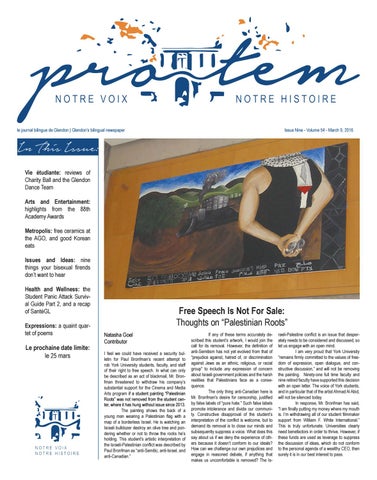
Free Speech Is Not For Sale: Thoughts on “Palestinian Roots” Natasha Goel Contributor I feel we could have received a security bulletin for Paul Bronfman’s recent attempt to rob York University students, faculty, and staff of their right to free speech. In what can only be described as an act of blackmail, Mr. Bronfman threatened to withdraw his company’s substantial support for the Cinema and Media Arts program if a student painting “Palestinian Roots” was not removed from the student center, where it has hung without issue since 2013. The painting shows the back of a young man wearing a Palestinian flag with a map of a borderless Israel. He is watching an Israeli bulldozer destroy an olive tree and pondering whether or not to throw the rocks he’s holding. This student’s artistic interpretation of the Israeli-Palestinian conflict was described by Paul Bronfman as “anti-Semitic, anti-Israel, and anti-Canadian.”
If any of these terms accurately described this student’s artwork, I would join the call for its removal. However, the definition of anti-Semitism has not yet evolved from that of “prejudice against, hatred of, or discrimination against Jews as an ethnic, religious, or racial group” to include any expression of concern about Israeli government policies and the harsh realities that Palestinians face as a consequence. The only thing anti-Canadian here is Mr. Bronfman’s desire for censorship, justified by false labels of “pure hate.” Such false labels promote intolerance and divide our community. Constructive disapproval of the student’s interpretation of the conflict is welcome, but to demand its removal is to close our minds and subsequently suppress a voice. What does this say about us if we deny the experience of others because it doesn’t conform to our ideals? How can we challenge our own prejudices and engage in reasoned debate, if anything that makes us uncomfortable is removed? The Is-
raeli-Palestine conflict is an issue that desperately needs to be considered and discussed, so let us engage with an open mind. I am very proud that York University “remains firmly committed to the values of freedom of expression, open dialogue, and constructive discussion,” and will not be removing the painting. Ninety-one full time faculty and nine retired faculty have supported this decision with an open letter. The voice of York students, and in particular that of the artist Ahmad Al Abid, will not be silenced today. In response, Mr. Bronfman has said, “I am finally putting my money where my mouth is. I’m withdrawing all of our student filmmaker support from William F. White International.” This is truly unfortunate. Universities clearly need benefactors in order to thrive. However, if these funds are used as leverage to suppress the discussion of ideas, which do not conform to the personal agenda of a wealthy CEO, then surely it is in our best interest to pass.
Pro Tem Letter from The Editor Editor in Chief | Rédactrice en chef Victoria Ramsay editor@protemglendon.com Assistant English Editor | Rédactrice adjointe (anglais) Effie Barbalias assistanteng@protemglendon.com Assistant French Editor | Rédactrice adjointe (français) Camille Slaght assistantfr@protemglendon.com Section Editors | Les rédactrices de sections Campus Life | Vie étudiante Inês Van Deuren campuslife@protemglendon.com Issues and Ideas | Actualité et opinions Neya Abdi issuesideas@protemglendon.com Health and Wellness | Santé et bien-être Amanda Merry health@protemglendon.com Metropolis | Métropole Samantha Kacaba metropolis@protemglendon.com Arts and Entertainment | Arts et divertissement Ashley Moniz arts@protemglendon.com
Salut Glendon! Written while scouring through old photos and justifying the price of graduation portraits, After a recent team meeting in the Pro Tem office, a few of us lagged behind; partially due to avoidance of penning another essay and partially due to the extreme sleep deprivation that seems to be especially grueling in the saga of a graduating student. We sluggishly started to pack up our things as we entered into a conversation about life lately. During the last stretch of the semester, regardless of your year of study, as you look back, there can be this strange feeling that creeps right into the pit of your stomach: nostalgia. A basic definition of nostalgia is the pleasure and sadness that is primarily caused by remembering something from the past and wanting to return to that time period again. Nostalgia is a yearning to recreate a irrecoverable condition. It can take many forms, both positive and negative, but for the context of our conversation that day in the office, the type of nostalgia we were bonding over focused on hashing out things we wish we would have done, skills we now realize we should have learned, and the opportunities that we could have taken ad-
vantage of. I know that not everyone reading this is looking out into the vastness of the ‘real world’ after graduation, but as students in this position, we discussed things that we wish we could tell our younger, more naïve selves. These nostalgic desires can be summed up into two simple categories. First, building a skill set that is appropriate for the career we are chasing after. There are so many workshops, conferences and volunteer opportunities that are specifically designed to help students gain real life skills. Whether this is about resiliency, online coding, communication skills or writing styles, these skills help to complement the degree you’re working on. Not everyone comes into university, or even leaves, with a clear cut vision about their career, but there are still proactive things you can be doing to help you guide yourself along the way. Reevaluating nostalgically, I encourage you to dedicate time to dreaming, letting your mind wander, and contemplating who you aspire to be. And then research what that looks like outside of the university. Confront yourself with the reality so that you can acquire the skills you will want one day. The second thing that we chatted about was the desire to take time to slow down. I know we hear it all the time, life goes by in the blink of an eye, live in the moment
and so on. These clichés lose their weight and validity after constant reiteration, but we need to reclaim those truths. Time is fleeting and the more experiences you can expose yourself to, the better. Try something new, make plans even though you’d rather be at home on the couch and jump into the opportunities around you without inhibition. Oh nostalgia, you cruel mistress. You give so much revelation but still leave lingering questions. There are so many memories that we pack up and carry with us from year to year during our university experience. During times such as anxiously awaiting graduation, we’re forced to unpack and acknowledge all the feelings that nostalgia brings. Whether you’re almost on your way into the real world or just finishing your first year, pull a few of those moments out of your suitcase and see what makes you experience nostalgia. Who knows, maybe letting it creep in for a while will result in a personal revelation. Much love, Tori Ramsay Editor in Chief
Expressions Kaitlin Fenton expressions@protemglendon.com Online Content | Contenu en ligne Ela Gach elaonline@gmail.com Communications Officer | Agente de communications Christian Lopez comms@protemglendon.com
Vous avez des opinions? Vous aimez écrire? Vous faites de la photographie? Vous adorez dessiner? Pro Tem vous veut!
Photography Editor | Rédactrice de photographie Madeline Della Mora photography@protemglendon.com
Envoyez-nous un courriel à editor@protemglendon.com pour apprendre comment vous pouvez vous impliquer!
Design and Layout | Maquettiste Sienna Warecki
pro~tem
est le journal étudiant du collège Glendon. Publié pour la première fois en 1962, c’est la plus ancienne publication de l’Université York. We strive to act as an agent of social change, and will not print copy deemed racist, sexist, homophobic or otherwise oppressive. Please respond to what you read in the pages of Pro Tem/ n’hésitez pas à réagir à ce que vouz avez lu dans Pro Tem. Contact us/ Contactez-nous: protem@glendon.yorku.ca The Pro Tem Office D114 Hilliard Residence, Glendon College 2275 Bayview Avenue North York, ON M4N 3M6 The office is open by appointment only. Le bureau est ouvert sur rendez-vous seulement. Les lettres adressées au journal peuvent être éditées au niveau de la clarté ou de contenu. All copy appearing in Pro Tem is at the discretion of the editorial team. Opinions published in Pro Tem are the thoughts of individual writers, and not the publication as a whole.
2
Kelly Lui
Vie étudiante What’s Shakin’ With the GDT Hanna DeRoche Contributor
Inês Van Deuren
Inês Van Deuren
YU Charity Ball 2016 An Evening of Fun and Fundraising Bryan Hansraj Contributor YU Charity Ball was founded in 2013 by Vice President Social Mikhaela Gray and President Gillian Wassmansdorf of the Glendon College Student Union in collaboration with the Social Council of York University. The initiative began by being dedicated to raising awareness for a prominent cause in society that affects students, with the goal to raise both awareness and funds. In its first two years, YU Charity Ball donated to the Princess Margaret’s Foundation for cancer research. YU Charity Ball has since
continued and has been hosted at Casa Loma, Steam Whistle Brewery and now, Liberty Grand Entertainment. This year, YU Charity Ball raised awareness and support for refugees internationally through the United Nations High Commissioner for Refugees (UNHCR) Canada Division. The UNHCR is a lifeline for people displaced by violence, conflict and persecution, and helps them survive, recover and build a better future through providing support. On Friday February 26th, 2016, after several months of planning, the doors at Liberty Grand Entertainment opened up for the York University Charity Ball 2016. With over 230 guests in attendance and DJ Biazik providing the amazing music for the night, the evening was filled with a series of hors d’oeuvres, dancing, photos, and raffle prizes. Our YU Charity Ball planning committee has worked for months leading up to the event,
negotiating booking agreements, signing contracts and seeking out sponsors for the event. The event is hosted solely on ticket sales revenue, funds from the GCSU, sponsorships from College Councils, Community Partners, such as Pro Tem and donations made from external members of the local community. We would like to thank everyone for their support in this event through their attendance at the Ball their sponsorships. We’re still reconciling and receiving donations, so stay tuned to facebook.com/YUCharityBall for an announcement on the contribution we will be making towards the UNHCR.
The Glendon Dance Team is still hard at work this semester preparing for our upcoming show, Loud Places. We are incredibly excited to share a variety of styles and genres of choreography this semester, from contemporary, to Bollywood and Greek dance! After our successful show during the fall semester, we would like to invite everyone to attend our winter semester show that takes place on Friday, March 18th at 7:00 PM and Sunday, March 20th at 6:00 PM in the Glendon Theatre. We have been hard at work rehearsing and getting all of the last minute details together. We really hope to see you there! Our winter auditions were successful and we are excited to announce that we have welcomed eight new members to the team this term! Currently, our team is working on large and small group numbers, where we have some new (and old) talent taking on choreographer roles. Be prepared for a show highlighting new ideas and fresh faces, as this is the largest dance team Glendon has ever had, with close to 50 members. You do not want to miss out on the experiencing first hand how Head Coordinator and Head Choreographers Cali Lopez and Camille Boucher, transformed a group of 50 students into one, cohesive team of dancers, moving together and doing what they love! This year, we also have our competitive team heading to a competition at the Richmond Hill Performing Arts Centre on Saturday, March 19th. The competition is open to the public, so if anyone wishes to come watch the dances and support the team and our school, you’re more than welcome to join us. Our competitive team has been focusing on nailing the choreography and working hard on their technique, performance, and endurance. This being the first year that the team has competed at a university-wide dance competition puts lots of pressure on the team but we will be proud no matter what happens. This group of 15 dancers have sacrificed blood, sweat, and tears to make our community proud and we are so thankful for Glendon’s support. The Glendon Dance Team would like to thank everyone who has and will support us throughout the years. Without help from constant collaboration and support with groups like La Mode Glendon, Pro Tem, and Student Affairs, our team would not be able to function in the capacity it does today! For more information about the show and ticket sales, check out our Facebook page. We can’t wait to see you all there!
3
Campus Life What I’m Leaving Behind: A Message from the Hillel Club President Cindy Seni Contributor If you have ever been the recipient of free food or have been hanging about in the breezeway for a bit too long, you have probably been a witness of Hillel members or of myself, disturbing your peace about Judaism and Israel- while you study…or at least pretend to. Although free snacks are pretty awesome, we aren’t just walking lox and bagels. Hillel was revived after a long slumber in 2013 by none other than yours truly. Since then, we have been named “the most active club on campus”. As a Jewish student, it was of utmost importance for my club, other community members, and myself to have a voice at Glendon and a safe environment where we would be able to learn and bond on campus. Alas, after 3 years of presidency, my reign is finally over; though before I leave, I want to leave you all with a couple things I have learned throughout this brilliant journey. The first advice: Do not fear greatness. Do not be afraid to stand up and fight for good. Most importantly, do not be afraid of yourself. You have tremendous power within you to fix this world, yet it will only reveal itself if you set it on fire. Jewish wisdom teaches us that we create our own realities, so let me ask you, have you created one for yourself that you are proud of? As I take my final bow, I leave you with one more thought: do not stop giving, and do not stop loving. Is that not what the world is all about? So, yalla, It’s time to heal this world.
4
All photos on this page by Glendon Hillel
Vie étudiante Les aventures d’une Canadienne française à Rouen Celeste Patenaude Contributrice Sept mois se sont déjà écoulés depuis que j’ai quitté le Canada pour aller poursuivre une année d’études à l’étranger. Je fréquente l’université de Rouen, en Normandie, France. Au cours de ces sept mois, j’ai beaucoup appris à l’université en tant qu’élève ainsi qu’à l’extérieur en tant qu’individu. Prenons un pas en arrière. Le mois de septembre fut un peu bouleversant. J’ai eu des problèmes de logement, j’ai découvert la fameuse administration française et j’ai également subi le choc culturel qui a accompagné mon déménagement dans un nouveau pays. Cependant, après ce mois tumultueux, j’ai commencé à m’ajuster, à rencontrer des amis et à m’habituer à mes cours. J’ai ressenti le choc culturel le plus fortement dans les petits moments de la vie quotidienne. Au supermarché, par exemple, je cherchais des œufs dans la section de produits laitiers et je n’ai pas réussi à les trouver. Il y avait une riche variété de fromages, de yaourts et de lait, mais pas d’œufs. Frustrée, j’ai abandonné ma quête. Quelques minutes plus tard, en marchant les allées, j’ai trouvé les œufs à côté des Kleenex et des autres produits papiers. J’ai appris que les Français ne gardent pas leurs œufs au froid, ce qui, pour moi, était étrange. C’était intéressant d’apprendre qu’une coutume qui nous semble si normale, comme garder les œufs dans le réfrigérateur, ne l’est pas dans un autre pays. En plus des examens et des travaux scolaires qui me gardent occupée, j’ai fait beaucoup de voyages. Jusqu’à présent, je suis allée à Paris à maintes reprises, à Versailles, aux jardins de Monet à Giverny, ainsi qu’à Rennes, en Bretagne. Hors de la France, je suis allée en Belgique, aux Pays-Bas, en République tchèque, en Autriche, puis en Slovaquie. C’est surtout l’architecture et l’histoire des différents pays qui me fascinent. J’aime passer mon temps à explorer les cathédrales, à visiter des musées et à suivre des tournées guidées à pied. Pendant mon temps ici, j’ai eu l’opportunité de rencontrer des étudiants d’une variété de nationalités. Lors du premier semestre, j’étais la seule Canadienne parmi mon groupe d’amis. Ma singularité m’a forcé à sortir de ma zone de confort et m’a permis d’apprendre au sujet de différentes cultures. Ces rencontres m’ont également permis de tisser des liens avec des étudiants un peu partout en Europe, ce qui facilitera des voyages futurs et donnera occasion à des retrouvailles émouvantes. Si vous pensez partir étudier à l’étranger pour un semestre ou deux, je vous le conseille vivement. L’expérience vous enrichi non seulement en tant qu’étudiant, mais en tant qu’individu. Les personnes que vous rencontrerez et les mémoires que vous créerez vous resteront chères pour le reste de votre vie. Sur ces mots, je vous laisse. Je serai de retour à Glendon en septembre 2016, prête pour d’heureuses retrouvailles et de nouvelles aventures.
Fridge Festival: Night of Talent, at Late Night Lunik All photos on this page by Lionheart Productions
5
Atrs and Entertainment My Night at the Opera Matt Turner Contributor I recently had the opportunity to take advantage of the Canadian Opera Company’s under 30 discount tickets to go see an opera that I’ve longed to see, The Marriage of Figaro, which conveniently, was just finishing its run on stage. For $22 I could get a ticket to sit in Ring 4 of the upper level and for only $12 more I could sit in the orchestra section; naturally, I took the better deal and got orchestra sectioned seating. At the start of the night there was a short “opera chat” which consisted of two debriefs from both a Western University music Professor and a former opera singer. The Professor gave an outline of the opera itself looking over the history and an overview of the characters and songs being performed; and the Opera singer discussed the outline of the opera and its story line. Upon taking my seat, which was 4 rows away from the orchestra, I took the opportunity to read through the program. It included an act by act synopsis so that there would be no surprises, even if your Italian is a little rusty. There was also a screen above the stage with the subtitles. I found the whole experience exciting. The opera was fantastic and I even recognised the overture. There wasn’t a need to even follow along with the subtitles as the action on stage was successful enough in portraying the dialogue. The run time was 3.5 hours with a 30 minute intermission between acts 2 and 3. I chose to get dressed up in a suit, but some people came in jeans and others in business casual attire. For next time, I’ll know to wear more comfortable clothes and to take advantage of the cushions they offer. If you are curious about the opera, I would highly recommend taking advantage of the COC under 30 program. The last two performances of the season will be Siegfried and, my other favourite, Carmen.
Le pouvoir culturel de la télé-réalité:
Les valeurs présentées à la télévision risquent d’être adoptées par le public Camille Slaght Rédactrice adjointe Depuis le succès de Survivor, il y a 15 ans, la télé-réalité est devenue une industrie énorme. Ces séries qui mettent en scène de vraies personnes attirent un nombre croissant de téléspectateurs. Le danger de ce genre de programme est qu’il fait croire aux gens que les comportements à l’écran sont normaux, acceptables et même souhaitables. Par contre, les personnages à l’écran sont souvent choisis pour leur mode de vie étrange et non parce représentent une norme ou un 6 qu’ils idéal.
Canadian Opera Company
Canadian Opera Company
Tous ces exemples de vraies personnes ont un effet sur les valeurs culturelles d’une société. De nombreuses séries présentent des personnes qui sont loin d’être exemplaires dans le but de divertir, et le public regarde rarement ces genres de séries avec un œil critique. Un des genres les plus populaires de télé-réalité révèle la vie privée de familles riches et de célébrités. La série Keeping up with the Kardashians, qui en est un exemple, met en scène une famille qui vit dans l’excès et le luxe. Cette famille matérialiste donne beaucoup d’importance aux apparences physiques et ces valeurs sont transmises au public. Quant à l’émission Here comes Honey Boo Boo, elle transforme l’obésité en un sujet divertissant en ridiculisant les membres d’une famille. Le public de la télé-réalité, souvent jeune et naïf, risque d’adopter le même ton moqueur que celui utilisé à la télévision envers un certain genre de personne. Ces séries atteignent un si grand public qu’elles sont devenues des parties intégrantes de la culture. Certaines séries de télé-réalité, dont American Idol et Iron Chef, menacent moins les
valeurs du public, mais il faut quand même prendre en compte qu’elles influencent les intérêts des téléspectateurs. Les chansons télévisées sur American Idol et les recettes présentées sur Iron Chef deviennent inévitablement plus populaires après leur diffusion. La télé-réalité a aussi changé la culture de la célébrité en donnant la chance aux gens ordinaires de devenir célèbres. Plusieurs séries comprennent un processus d’application qui permet à n’importe qui de se présenter et d’essayer de prouver son potentiel de divertissement. Ce processus semble n’avoir que de bonnes intentions, mais il cherche à convaincre le public que les gens à l’écran sont de vraies personnes même si la plupart d’entre eux suivent des consignes très détaillées et parfois même un dialogue prédéterminé. Malgré les éléments fictifs qui font partie de la télé-réalité, la majorité du public l’interprète comme une vraie représentation d’une certaine culture. Le public, ne sachant pas quels éléments sont fictifs ou non, reproduit certains comportements qu’il croyait être normaux lors du visionnement, mais qui ont simplement été télévisés pour ajouter au divertissement.
Malheureusement, le divertissement prend plusieurs formes qui n’adhèrent pas toujours à des critères intelligents et utiles. La télé-réalité cherche à divertir et non à informer. Elle normalise et encourage de nombreux comportements négatifs qui s’intègrent à la culture lorsque le public les reproduit en pensant qu’ils sont acceptables. La télé-réalité met en avant les qualités choquantes d’un sujet et c’est à vous de chercher plus loin.
Arts et divertissement Highlights From the 88th Academy Awards Ashley Moniz Arts & Entertainment Section Journalist The 88th Academy Awards were broadcasted on Sunday, February 28th. There was a great deal of variety: predictability and surprises, laughter and cringes, icons and newcomers, and impressive and dismissive moments. As a dedicated fan of the awards, I left the three and a half hour broadcast with mixed feelings about the issues handled and awards presented. This year’s highlights fall under three categories: Activism, Appearances, and Awards. Each, much like the night overall had its merits and pitfalls. Activism: This year’s broadcast was controversial for being the second year in a row lacking diversity in major categories. Host Chris Rock pointed at the issue for the majority of his opening monologue in a classy way by placing it in the context of history comparing racism in Hollywood to the social hierarchy of a sorority, joking about adding racialized categories alongside arbitrarily gendered ones, and making fun of celebrities boycotting. While this was a good start and efficient way to address the issue, the rest of his quips throughout the night came off poorly, evading real issues by poking fun at specific films; which included a flawed skit where he interviewed black people about the films outside of a theatre in Compton. Why was this skit flawed? For one, if the nominated films are considered “white” films which none of these interviewees saw, consider also that many of these films were not popular among white audiences either going into awards season (it is also noteworthy that he never asked those people if they saw nominated box office successes like The Martian or Mad Max: Fury Road). He also does not consider the type of films nominated.
Madeline Della Mora
Sure those he spoke with saw the mainstream success, Straight Outta Compton, but a more relevant question would have been whether or not they watched 12 Years a Slave, Selma or Precious when they were eligible and in wide release. The flaws went further when Chris Rock, amidst all of this, thought, in good taste, to make a cheap Asian joke. Big talk can be made about misrepresented Blacks, but other minorities like Asians, Hispanics and Indigenous Peoples just get swept under the rug. Other activism was present throughout the night, as issues of climate change and sexual abuse were also addressed. Appearances: This year’s broadcast
saw the inclusion of memorable characters including Star Wars’ C-3P0, R2D2 and BB-8; Minions’ Kevin, Stuart and Bob; and in honour of their 20th Anniversary, Toy Story’s Woody and Buzz Lightyear. As usual, major celebrities were there to present awards, segments and performances, with Morgan Freeman presenting Best Picture at the end. Dave Grohl had the honour of providing the backdrop for the In Memoriam segment, providing an intimate performance of “Blackbird”. For the remainder of the broadcast, the transitions, which featured iconic film music, were arranged and conducted by Harold Wheeler. This year’s ceremony featured perfor-
mances of three of the five Best Original Song nominees. This is an awkward move, basically telling the other two nominees that they are not popular enough to perform at the broadcast. Sam Smith was up first, with a simple “spotlight and backdrop” performance of “Writing’s On The Wall” from Spectre. The Weeknd followed with “Earned It” from Fifty Shades of Grey, featuring an elaborate set, classical strings, dancers and an aerialist. Rounding off the nominees was Lady GaGa, whose powerful performance of “Til It Happens To You” from The Hunting Ground featured 50 survivors of sexual abuse surrounding and emotional GaGa at the piano. Awards: Mad Max: Fury Road was the most successful film of the night, raking in six awards, almost sweeping the technical categories. It missed Best Visual Effects, which was won by Ex Machina, and Best Cinematography, which went to The Revenant. The latter went on to take two highly noteworthy awards: Best Director for Alejandro G. Inarritu, who becomes the third person to take this award for two consecutive years, and Best Actor for Leonardo DiCaprio, whose win became the most tweeted about moment in Oscar history. Spotlight took the top prize of Best Picture. Combined with its win for Best Original Screenplay, it became the second Best Picture winner in Academy history to win only two awards. Winners in other major categories included Room (Best Actress for Brie Larson), Bridge of Spies (Best Supporting Actor for Mark Rylance), The Danish Girl (Best Supporting Actress for Alicia Vikander) and The Big Short (Best Adapted Screenplay). Inside Out took Best Animated Feature and Amy won for Best Documentary - Feature.
7
YU Charity Ball All photos on this page by InĂŞs Van Deuren
8
YU Charity Ball
9
Metropolis Korean Eats on the Cheap Kaitlin Fenton Expressions Section Journalist In my first year of university, I was dragged out to dinner with several chums of mine. We were going out to eat Korean food, a type of cuisine that I had never tried. I don’t like spicy food, and I don’t like meat. I assumed that I would dislike it immensely, but begrudgingly tagged along. After taking the subway to North York Centre, we trudged down Yonge Street in the pouring rain to a small, cozy restaurant called Oh Geul Boh Geul, nestled between restaurants, butcher shops, and convenience stores at 5320 Yonge. I immediately dismissed it, as it is quite lackluster from the outside and it is tiny inside. There’s roughly 20 seats tightly cramped together, with blown images of their food covering the walls. Our group barely fit inside, but we managed to squeeze in by getting real cozy with each other. I didn’t understand the menu, as it is mostly Korean and the descriptions are quite lacking in English, so I gave the reins of my meal to my friends. Ever since then, I’ve been hooked. Oh Geul Boh Geul is now easily one of my favourite restaurants to stop at, at almost any time of the day. They are typically open from 11 am to 4 am. My favourite time to go is when the sun sets, as that is when the most customers are there. It’s an incredibly intimate restaurant, but always full of laughter and conversation. Even though I know no one there, I feel right at home. Their menu is very long, offering up a huge variety of traditional meals. The names are written in Korean, with the pronunciation below, and a small description in English right under that. Sadly, there doesn’t seem to be anything vegetarian or vegan due to cross contamination. As a gluten free food lover, I typically stick to their bi bim bap. However, even if I could eat gluten, I’d probably go with it every time. There are several types of food that they offer: standard meal style, with rice or miso soup, à la carte, or hot pot (in essence, it is a raclette, or barbeque at your table). Their prices for meals are very reasonable, typically between the 8-15$ range, with hot pot prices at roughly 30$ or more. However, the portions are quite generous, so expect leftovers! Ordering can be a bit of a struggle if you don’t understand Korean, however, the servers help with the pronunciation. Although I get a bit embarrassed, they have never made me feel foolish. If anything, it’s a good exercise in languages! Upon ordering, diners are served a cup of green tea, a carafe of water, and a seasonal array of ban chan (appetizers). The ban chan is worth making the trip, if I’m being honest. Typically, kimchi (spicy fermented cabbage), namul (treated vegetables), pajeon (a thin scallion pancake that is to die for), tofu, japchae (glass noodles), and Korean-style sweet potatoes. This is just the basic selection, as they offer seasonal ban chan as well. Luckily, servers will often replace an empty dish if asked politely! As the main courses arrive, I 10 am typically forced to ask for a fork as
they only give out chopsticks at first. I am completely inept at using chopsticks (and trust me, I have tried). With all the different food options, let me present some of the food items that I have sampled! Bi bim bap: A sizzling hot stone pot of rice, vegetables, egg, and seaweed strips, served with a savoury spicy sauce. Easily my favourite meal there. Jajangmyeon: Black bean and meat sauce over top of noodles. It is the never ending plate, but also a former favourite of mine. Beef bulgogi: Grilled and soy sauce marinated beef. A bit too tough for my liking, however, it’s a favourite for some of my friends. Pork bulgogi: Grilled pork that has been marinated in a sweet and sour sauce. So, so, so good. Perfect amount of sweet and sour. HaeMul PaJeon: A seafood “pancake” with vegetables. I’m not a big fan of seafood, so I used to get it without any. Also very tasty, and a food that I miss dearly (due to flour content).
Kaitlin Fenton
Kam Ja Tang: Pork bone and potato soup. Very filling, well spiced, and hearty soup. The pork just falls off the bone and is very flavourful. The bone is a bit hard to get around though. My partner’s absolute favourite dish there. BanGyeTang: A very mild cornish hen soup. It is incredibly delicate, with hints of garlic and mushrooms. When all the food is eaten up, and it’s time to leave, diners are given orange slices for dessert. As I walk out the exit, I get excited for the next time that I get to go back. Even though Oh Geul Boh Geul is a tiny restaurant, it is bursting at the seams with passion and heart. Anyone can tell that the dishes are made with extreme pride for Korean culture and cuisine. I am so thankful that I went out on that first night, because it’s now one of my favourite restaurants, full stop. I strongly recommend eating here, on one condition: I get to come!
Kaitlin Fenton
Kaitlin Fenton
Métropole The Mindfulness Of Making Things Jasmin Elysia Contributor Academia, for all its virtues, can take a toll on the best of us. Spending too much time inside the pages of textbooks, the theoretical, and our heads has a habit to send us running for Netflix, Vine and Youtube in search of escape. And yet, too much time behind our screens is damaging for our eyes and for our souls. Students so often burn themselves out in this way. We go from classes and study sessions, where we exist inside books and online journals, to our snatches of free time which so often take place behind a screen. So what can we do to decompress and exist in the real world? With limited time, energy and funds, you might think a student has limited options—but not in Toronto. Just one in a multitude of options is the Free After 3 program at the AGO: a series of weekly workshops that are, you guessed it, free after 3pm for people aged 14-25. From terrarium-building to silk-screening, mixtape making to breakdancing, there is no shortage of crafts to try your hand at. Curious, with brains overflowing with linguistics, a friend and I decided to drop in on the ceramics workshop with local artist Ness Lee. We were directed to the Weston Family Learning Centre (WFLC) (a section of the AGO neither of us had previously known about, that vaguely reminded us of the COE basement) where we joined the 30-40 people seated around a table, each with a lump of clay in front of them. Ness Lee was relaxed, friendly and straight-to-the-point. After a live demonstration on making coil cups, we were left to the mercy of our imaginations. Around us were several art students whose deft hand movements resulted in near-professional looking pieces, but there was no feeling of judgement or comparison. Attendees chatted, swapped tools and passed around spray bottles to preserve the rapidly dry-
Jasmin Elysia
ing clay while Ness made the rounds, offering advice and compliments. Up to my wrists in clay, I tried to remember the last time I had made physical art. It must have been around ten years ago. Suddenly, it made perfect sense that art features so heavily in our early education. Not only does art help with children’s physical, mental and imaginative development, but it allows space to
decompress and rejuvenate in between classes that demand more cognitive or academic expense. So why then, does art’s presence in students’ lives dwindle as we get older? It no longer surprises me that there is a dramatic surge in young adults’ interest in baking, gardening, sewing, knitting, and various other forms of Making Things. Perhaps the pressure of being a millennial is causing us to take a col-
Do you have opinions? Do you love writing? Do you love photography? Do you love illustration?
lective interest in creative arts as a means of simultaneous self-expression and self-care. My friend and I were struck by how peaceful and uplifting the atmosphere was, but most of all how good it felt to— literally— get our hands dirty. The experience of mindfulness without having to fidget our way through an attempt of meditation combined with the feeling of pride and accomplishment that comes from making something was extraordinary. Sam made a figurine of an octopus— his name is Jeff, and he was declared beautiful by the surrounding crafters. I made a leafshaped dish to perhaps keep keys or earrings in, and a tealight holder that looks like the sun. However, what we took from the experience more than anything was a renewal in our energy stores. We both noticed how happy a couple of hours spent making something tangible using our hands had made us. And so we left, clear-headed and calm, with clay caked around our fingernails, excited to return again soon.
Pro Tem wants you! Email us at editor@protemglendon.com to find out how you can get involved! 11
Issues and Ideas Dictating the Time for Anti-Racism Sabrina Sukhdeo Contributor Sort of like Columbus discovering the Americas, the Ontario government of 2006 discovered a revolutionary concept: institutionalized racism wouldn’t fix itself. This realization inspired Queen’s Park to pass legislation that would allow the province to hit discrimination where it hurts. Nearly ten years later, Ontarians will finally see that legislation come to pass as the government establishes an Anti-Racism Directorate. Headed by MP Michael Coteau, this office is poised to assist the government in reviewing issues through an “anti-racism lens” with the hope of facilitating justice for racialized communities. Yes, 2016 is the year, it seems! 2016 is the year our elected officials will finally start giving racism the butt-kicking it deserves. It’s natural to wonder what the hell took so long for something like this to materialize. Racism isn’t new, governments addressing issues isn’t new, so why now? In explaining her government’s initiative, Premier Kathleen Wynne described a “sharpened” focus on racism in Ontario over the last year. Concerns over the integration of Syrian refugees amidst a rise in Islamophobia. Protests against anti-Black policing and the practice of ‘carding’. Outcry over unequal access to health care in Northern Ontario First Nations communities. It certainly seems as if public anger over racism in this province has flared to new heights, and so an Anti-Racism Directorate is the obvious step forward. Except, not really. This particular anti-racism project isn’t new to Ontario. In 1992, Ontario developed an Anti-Racism Secretariat under the government of then-Premier Bob Rae. Similarly to this new proposal which aimed to target racial discrimination within the public service and to aid racial minorities and Aboriginal communities. Similarly to this new proposal, it was a response to palpably tense race relations in the province. Three years later, the new Mike Harris government scrapped the project in an attempt to streamline government services, and the idea hasn’t truly been revisited until now. What this makes clear more than ever is the reactive, not proactive, approach to racism taken by our government. Action against racism hasn’t been a series of progressive, forward steps but, instead, an exhausting hopscotch between decisions. As in 1992, the government is erecting this Anti-Racism Directorate because Ontario’s grand collection of racially-charged issues has become simply unavoidable and so has the need to do something about it. The knee-jerk nature of this response not only reveals the politicized character of anti-racism initiatives but potential areas for concern. Will the Directorate be adequately funded and engage with communities or simply sit there and look pretty? Will the Directorate be a permanent fixture to address persisting concerns or a temporary Band-Aid to remedy su12 perficial disputes? Was the creation of
this Directorate a genuine move toward equality or a grand gesture meant to pacify hostilities? At present, we can’t know for sure, but the likely motives for reinstating the Directorate at this time certainly gives pause. The desire for social justice across Ontario is a long-established and organized enterprise, and you don’t have to look very far to see that. Glendon, itself, is home to a number of age-old student organizations designed to educate and take action on all sorts of issues because, obvious as it may seem, there’s always room for improvement. At the core, there’s that recognition that problems endure, sensationally and not, and so complete and consistent attention is needed. Racism in Ontario, similarly, is not new territory. The government should stop acting like it is.
9 Things Your Bisexual Friends DON’T Want to Hear Christian Lopez Communications Officer 1. So which do you like more? For a lot of people there is no solid answer. Sexuality is fluid and not everyone’s sexuality is as concrete as others. So, why do we have to label everything so specifically? Boiling it down to just labelling it as “bisexual” is even going too far, but then you also want me to say that I am a bisexual that prefers either gender? Sure, some people do prefer one to the other - sexuality is fluid - but sometimes this just isn’t the case at all. 2. Are you sure you’re not just gay? This question is belittling to people who are bisexual. It discredits our sexuality and really, just makes you look like an idiot. Of course there are a lot of people who come out of the closet as bisexual who later say they are gay. This can stem from a feeling of comfort that the sort of heteroness that bisexuality might bring, or just from really not being sure. Either way, it is damaging to someone who is trying to figure that one out for themselves. Trying to force a bisexual into saying they are gay or straight is forcing them to deny half of themselves. 3. You’re not bisexual. You’re just slutty/a whore. Stop it. Just stop it. Making out with girls in college doesn’t make you bisexual, and being bisexual doesn’t mean you’re any more promiscuous than anyone else. It just means you have more options. 4. But if you are in a relationship, don’t you get urges to be with people of the sex opposite to your partner? Now, I never got why this one was even asked. People often ask, for example, if you are in a relationship with the same sex do you ever feel like being with the opposite, or vice versa? Those “urges” happen as often to bisexuals or as rarely to bisexuals as they do to others. If you are in a relationship, you probably should not be getting those urges with anyone else in general, regardless of gender. I mean, ideally.
There’s also no judgment if you experience that all the time. 5. Bisexuality is just a phase. Sure, bisexual experimentation is just a phase for some people. It might mean too many drinks and things get loco, but that is very different from someone who identifies as bisexual. Try telling the 70 year old, bisexual man that I know, that his whole life is “just a phase”. 6. So can you see yourself marrying a *insert gender here*? Yes. 7. Why don’t you just choose to be with one gender? I am sure if we could, we would. It would make things a lot easier. Being bisexual confuses almost everyone who isn’t bisexual. When it comes down to it, it’s how we feel and is what we know to be true. 8. How can you love someone if you love both genders? I love the person, not their gender. It is that simple. Do you love your boyfriend or girlfriend because they are male or female? I don’t think so. 9. Bisexual people can never just settle down and start a family. Personally, I dream of children, a strong marriage with someone who loves me, and an overall sense of stability. Not all bisexuals, just like not all people in general, think that marriage is for them. Trying to place everyone into this category is wrong.
This being said, I know there are circumstances where people ask questions out of genuine curiosity but most of the time it is clear when that is the case and times when it is not. There’s nothing wrong with wanting to know more, if you’re interested in learning more about bisexuality you can visit: http://www.bisexualindex.org.uk/ index.php/Bisexuality for more info.
Santé et bien-être
Madeline Della Mora
SantéGL: A Healthy Habitat for Glendonites Samantha Caldeira Slavec Contributor As a non-gym going, social justice loving, avid chip eater and busy bee, being healthy was often the last of my priorities. ‘Healthy Campus Month’ meant ‘Here’s my last chance to salvage my New Year’s resolution to go to the gym Month,’ and, with a chuckle, I was prepared to forget about Healthy Campus Month all together. Besides, extra buttery popcorn was my brain food and going to the GAC meant two hours taken away from my time of study hibernation in my room. Little did I know, with exams and assignments on the mind, Glendon’s healthy campus initiative arrived just when I needed it. The first week began with one of the ‘5 Ways to Well Being: Connect’. Now this doesn’t mean ‘connecting’ to AirYorkPlus or ‘connecting’ with Rihanna’s new song, but rather building strong and authentic relationships. It’s easy to think that Healthy Campus Month means eating better and working out, but the initiative takes on a different meaning when it includes more than our physical well-being. Being healthy is more than taking care of your body, it also requires taking care of your mind and heart. It was fitting that #BellLetsTalk also took place during Healthy Campus Month. I found myself inspired by the countless stories, statuses and positive encouragements that exploded over social media, and I couldn’t help but think, ‘this is truly connecting, in a real, authentic way.’ The second week had another theme, ‘Learn’. Internally sighing, I lamented, ‘I’m doing enough learning right now, probably too much, there’s no way I can take on something new.’ Once again, I had it all wrong. It’s healthy to have fun, to practice
self-care and try something new, away from the classroom and the ever-growing pile of textbooks in your room. My club YGLgig, The York-Glendon Global Issues Group, planned and ran a DIY Arts and Crafts Night, where my own club members showed their unique talents including knitting, tye-dye and DIY Watercolour Mugs. Learning from others helped me de-stress and laugh and in a sense, play. The final week of February concluded with ‘Be Active’. Earlier I mentioned I was a non-gym goer, but SantéGL gave me the push I needed to enroll in my first ballet class in ten years. If you’re like me, and going to the gym seems like an inconvenience, I encourage you to take a class, go for a walk or simply take the stairs instead of the elevator. To my dismay, I learned that ‘Netflix and chill’ is enjoyable but unable to adequately replace the benefits of being active, for example, going for a walk and breathing in the fresh air. At the end of SantéGL, I can add ‘beginner ballet-dancing’ and ‘arts and crafts loving,’ to describe the work in progress that I am. Healthy Campus Month is an opportunity to consider and care for every part of you: your body, your heart and your mind. I went into SantéGL thinking that what I needed to do was more important than who I was. Reflecting on this month, I see now that by making small, simple decisions, you can create a healthy habitat for yourself. Small decisions bring about great change. Glendon attracted many of us because we knew that despite its small size, it was capable of great opportunities and great connections. With this in mind, consider being an active participant in SantéGL as one small decision to lifelong healthy living. SantéGL is more than a monthly initiative, it is the beginning of a revived, refreshed and heart-warming Glendon community.
Allô, agriculteurs locaux: Une alternative durable au problème de l’abus des animaux Gabriella Giordan Contributrice Les végétariens et végétaliens choisissent de ne pas consommer de viande pour plusieurs raisons, notamment à cause de la cruauté envers les animaux. Éliminer la viande entièrement de son alimentation est une façon valable d’éviter de supporter la violence que subissent des milliards d’animaux lors de la production de masse de viande. Il existe par contre une autre solution au problème qui n’exige pas d’arrêter de consommer de la viande : soutenir les agriculteurs locaux. Les animaux élevés par ces agriculteurs mènent une meilleure vie que leurs compères en cages. La plupart du temps, ils font ce que bon leur semble : ils courent dans de vastes champs, consomment des aliments sains, n’ont pas à ingérer des hormones et ne sont ni battus, ni mutilés. Tandis que les animaux soumis à la production de masse sont « sélectionnés » et tués lorsqu’ils atteignent l’embonpoint « idéal », les agriculteurs locaux tuent tous les animaux qu’ils élèvent. Pour se procurer de la viande de qualité et anti-abus, il vaut souvent la peine d’aller en chercher loin de chez soi. Voici quelques exemples, parmi d’innombrables d’autres, d’agriculteurs locaux situés près de Toronto : 1. Beretta Organic Family Farms Inc., 80 Galaxy Blvd (Etobicoke) 2. Meadow Sweet Farms, 12102 Warden Avenue (Gormley, près de Markham)
3. Organics Family Farm, 7550 19th Avenue (Markham) 4. Greenfields Organic Farm, 10715 Guelph Line (Campbellville) 5. Uphill Farm Organics, 5113 Third Line (Erin) Certes, la majorité des végétariens et végétaliens emploient des arguments sensés afin de justifier leurs choix alimentaires. Certains d’entre eux déploient leurs efforts alimentaires afin de faire diminuer le réchauffement planétaire. Plusieurs végétariens n’ont peutêtre pas considéré que l’abus des animaux ne diminuera pas du moment qu’ils décident de ne plus manger de viande. Il diminuera plutôt grâce à l’engagement social, la démonstration par les faits, et la recherche d’autres moyens plus productifs de remédier à la situation sans entièrement couper sa consommation de viande. Si le soutien des droits des animaux se traduisait en soutien des agriculteurs locaux, les conditions de vies de plus d’animaux seraient défendues. Les pratiques anti-abus possèdent sans doute quelques inconvénients et ne garantit aucunement que la cruauté envers les animaux cessera complètement, mais elles sont tout de même une solution durable et efficace. Il est grand temps que nous soutenions les agriculteurs locaux à la place des énormes entreprises de surproduction. Il est grand temps que nous poussions nos horizons plus loin que les allées du supermarché.
13
Health and Wellness Student Panic Attack Survival Guide: Part 2 - Finding Your Coping Strategies Sienna Warecki Layout Designer What Are Coping Strategies? Coping strategies (alternatively coping skills, coping methods, etc) are the methods by which you deal with stressful situations. Broadly speaking, there are healthy coping strategies and unhealthy, ‘maladaptive’ coping strategies. (Note: I avoid using language like ‘positive’ and ‘negative’ because a) it’s not the individual’s fault that they have been taught a maladaptive coping skill like self-harm or substance abuse, and because b) it’s not okay to shame or judge people based on what gets them through another day. Our focus is on trying to adopt new, healthier coping skills as we grow!) Coping strategies are also acquired skills, meaning that they are rarely something that we just know inherently. More often than not, we need to actively seek them out. Personally, music has always been my anchor, and ever since I taught myself aromatherapy I’ve had a few essential oils onhand to calm the nervous system. Journaling is also strongly recommended: there’s something about needing to write down what you’re thinking and how you’re feeling that enables you to step back and evaluate those thoughts/feelings with more objectivity and more reason than if you were just thinking them round and round in an internal loop. But which coping strategies are best for you? As they say, different strokes for different folks--each individual will have a different way of handling their anxiety. It takes time and curiosity to learn what you respond to the best, and I encourage you to treat each panic attack like an opportunity to learn more about yourself and how you respond to different stimuli. If you have no idea where to start, here’s a list of some one-size-fits-all coping strategies, time-tested by Yours Truly (and most of her friends, if we’re being real). A First-Timer’s Coping Strategy Handbook 1. When in doubt, talk it out. If you have a person who knows/understands your panic attacks, ask them to sit with you while you verbalize what’s going on. My attacks very rarely happen when other people are around, but when they do, I ask my friends to sit with me and let me describe what’s happening my head. It’s like journaling, but faster, and with a journal that can offer support! 2. Create a sensory paradise. The body is very sensitive to external stimuli; play around with different smells, sounds, and lighting until you’ve crafted an atmosphere that feels calming and grounding. (Essential oils come in handy here, as do fairy lights or salt lamps or candles. As for sound, music or nature sounds are good choices. If you feel safer when 14 there are people nearby, Coffitivity is a
Lionheart Productions
website which generates the ambiance of a coffee shop.) Tactile props, such as modelling clay or kinetic sand, are also useful, as they help you to focus on what you’re doing with your hands instead of what’s happening in your head. 3. Pet an animal--preferably one that you own. Don’t go chasing after the neighbourhood wildlife in a fit of anxiety, please. But if you or a friend has a pet, or if there’s an animal shelter nearby, take some time to soak up the ‘uncomplicated love’ that animals have to offer. Studies have shown time and time again that animals improve mental health, and really, who doesn’t think the sound of a kitten purring is soothing? 4. See to your basic needs. When was the last time you had water? A healthy snack? Some sleep? Some movement? A lot of the time when we’re roped in by anxiety we forget to care for our basic physical needs, which exacerbates the discomfort. The website “You Feel Like Shit” (http://philome.la/jace_harr/ you-feel-like-shit-an-interactive-self-care-guide/ play) was designed as “an interactive self-care guide” to walk you through making self-care decisions in an easy and non-pressuring manner. It covers basic physical needs as well as emotional ones! 5. Remember to breathe. Seriously. It’s easy to forget about when you’re freaking out internally. As we learned last week, hyperventilation is one of the symptoms of a panic attack, so being aware of your breathing and consciously working to even out the breath can serve as a very powerful calming tool. 6. Go for a walk. Or do some yoga. Or dance in your room. Whatever you’re comfortable with, at whatever level of intensity, but move. It helps to burn off some of that excess adrenaline, and it serves as a distraction from the encroaching feeling of doom. It also helps to reconnect with your body--most of the time we tap out of being in our bodies once we hit panic mode, and some people even experience
a complete sense of detachment from their bodies during their panic attacks. Doing some gentle exercise helps to re-center you in your body. Other ideas are grounding exercises like shifting your weight from foot to foot, throwing and catching a trinket between hands, or massaging your own body. (I’ve managed to put myself to sleep mid-panic attack by rubbing some lavender oil into my tootsies.) 7. Pre-episode tip: Distract yourself! If the brain can be distracted for 5-10 minutes before a panic attack starts, there’s a very high chance that it won’t go into overdrive. Find a good story and immerse yourself in it, or grab a friend and talk about your favourite fandom, or go watch a few videos on How Stuff Works. This also works for some folks during a panic attack, but personally I find it just makes me feel like I’m hiding from something, which exacerbates the dread. 8. Post-episode tip: Re-enter the world. It can seem like the last thing you want to do after shaking it out for 20 minutes (or 7 hours), but it’s actually very effective at settling a mind/body down. When I had a vicious threeday panic attack, I didn’t go to school or see friends--I just stayed in my room and ‘rested’, and while that rest was needed for my physical body, it gave me nothing to do but to dwell on what had happened, and, less helpfully, to worry about whether/when it was going to happen again. Remember that the deciding factor in the re-occurrence of panic attacks is the mental anxiety which triggers another adrenaline release. This tip doesn’t work as well for everyone--my partner, for instance, has a very hard time being in public after a panic attack due to her social anxiety. But if you can find a way to reconnect to the outside, ‘normal’ world--calling a friend, inviting someone over for tea, going to the library and reading quietly with the sound of turning pages all around you--then you’ll feel much more ‘normal’ yourself.
All else being equal, the search for coping strategies is all about being in touch with yourself, and experimenting until you find what makes you the most comfortable. Some questions to explore: Do you prefer to be alone, or to be with people? (Note: examine why. I used to think I wanted to be alone during my panic attacks, but that was really just because I feared I would inconvenience whoever was with me. Now I don’t mind either way.) Do you want to get up and move, or to be still? Do you want to feel cocooned in safety, or do you need open space? How do you feel about people touching you--a hug, a hand to hold, nothing at all? Do you want to talk about something else, or do you need to focus on what’s happening to you? Remember: You are not going crazy. And in the whole history of humanity, a panic attack has never killed anyone. Take my word for it. I’ve been there. I did the research myself. If you can persuade yourself to accept these facts--or at least, to put your faith in them for just a couple of minutes--and if you understand what’s happening to you on a biological level, then you can start to view your experience as just that: an experience. Just as unique as any other, and just as deserving of your curiosity. In this way, it almost becomes a game. It’s a bit of a paradox, but trust me when I tell you that the less energy you spend on willing the panic attack to stop already, the less frightening the panic attack is; the more accepting you are of the processes happening in your brain and body, the more comfortable they become. And the more well-versed you are in your own personal mind-to-body language--the language of coping strategies--the more insightful and, honestly, fulfilling a conversation with your own anxiety can be. This is an abridged version of an article originally published on my blog. For online resources, see siennawgl.wordpress.com
Expressions My Life as a Rollercoaster Ride Danielle Hallam Contributor I’m high, I’m low, I sit still and life rushes past me. I am up, I am down, Everything is all around me. Bombarded by light and sound, I am tiring of this ride. It’s making me feel ill, I want off! I don’t have the controls. I feel stuck in this chair, Weighted by the speed, Crushed by the harness and the force of gravity, Speed and spontaneity, Used to thrill me, Distract me, Get me high, Now I am low. Not a quiet calm low but low under great pressure, And in a constant state of busy anxiety. Fight or flight, Yet nothing changes, I don’t move two inches. My insides compressing more and more, I fear implosion, Or worse explosion, Would the ride stop then? How do I get off? I want to ride the merry-go-round, Going in circles was an easier time, But I should not go backwards.
Detox Christian Lopez Communications Officer Removing the toxins from my life, I see the snake bite I wondered why I felt so dark, but now I see the light I am an urban day hippie looking for positive vibes But there is none to be found; please let me describe, What it feels like to give your all and in the end you get nada Silently at war my mind is the Spanish Armada I let myself be brought down by the selfishness of others, Don’t waste your time on those who were not taught by their mothers, What it means to have a heart and what it means to just be nice Stop to think about the things that will never have a price. We can only be happy if we are happy with ourselves So don’t worry about them, they will find it for themselves I have started a detox to get rid of all the venom Black boots, short shorts and too many things in denim I want to live my life the way I want to live it So now I start my detox, it feels better, I’ll admit it I suggest you do the same: get rid of unneeded baggage The longer that you wait, the more they do their damage So toss them aside, the ones who want to see you fail And when you come out on top, you’ll see that they’re right on your tail So focus on the love, and focus on the good And soon you’ll see the detox is working as it should Do it for yourself.
To the Lady in the Green Gown and Black Vans: our ABCs Kaitlin Fenton Section Journalist Ambient aristocrats have Been there and done that, made from Cast iron skillets that Don’t really work. Everything, everything is Freeing when you think about it, Goddamn! I need to get out of Here. I know I shouldn’t care, or Joke about such matters, the broken Kaleidoscope of my heart, but I still Love her, love her, love her. Mama, please don’t cry over No heartbreak from me! I just want to Open her heart and let me in, want my Princess, my love, my angel, my future Queen. And I’ll Race for her, roar for her, for she’s a rarity So I’ll take the blame and the suffering. Tonight, or tomorrow, or next year I will be Undulated, so I can meld perfectly with you. Voluptuous, vivacious, vengeful woman, Why must you attract and repel me? Do I have to X-ray myself to show my broken heart? You bring me up and tear me down with such Zeal. And yet, I wait for you, my aristocrat, my dear.
Dancers Camille Slaght Assistant French Editor Arches rise in a room full of sighs, because of the desire. No, it is too weak a word. Craving salt on our skin, drenched in the love that fills our pores, drenched in this obsession. Temperatures rise in the name of perfection and I am not alone. It is contained, held together despite the aching. Heavy breathing is our favourite song. The air is thick with exhaustion but the music is in our toes now, climbing through strings under leather skin, unpolished and torn. Laces pulled tight suffocate the aching and the mistakes. Glances glued to mirrors, it’s a fixation. Crimson stains linger on white cotton, the only vestige of our Adrenaline.
Or the paddle boats! Yes, that’s the one, The one that suits me best. In control, Relaxed and slow, I don’t know, How to stop this ride.
15
Glendon Dance Team
Inês Van Deuren
Inês Van Deuren
Inês Van Deuren