le journal bilingue de Glendon | Glendon’s bilingual newspaper
Issue Seven - Volume 54 - February 3, 2016
In This Issue: Vie étudiante: advice from Glendon’s 2016 Leadership Summit Arts and Entertainment: a Star Wars review, and thoughts on The Breakfast Club Métropole: one student’s story of being hit by a truck Issues and Ideas: thoughts on finances, vegetarianism, and Syrian refugees Health and Wellness: reconceptualizing our success, and oils for winter skin Expressions: the conclusion of Stéphanie Mak’s serial story, a monologue, and a poem!
Les prochaines dates limites: le 5 février et le 19 février
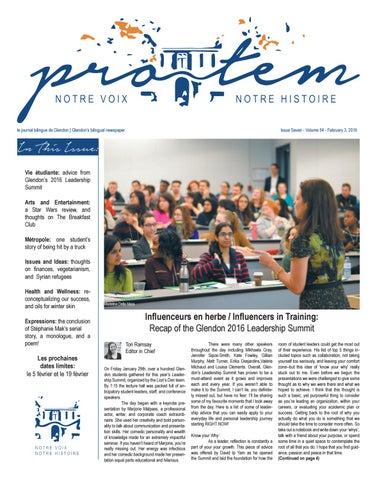
Madeline Della Mora
Influenceurs en herbe / Influencers in Training: Recap of the Glendon 2016 Leadership Summit Tori Ramsay Editor in Chief On Friday January 29th, over a hundred Glendon students gathered for this year’s Leadership Summit, organized by the Lion’s Den team. By 1:15 the lecture hall was packed full of anticipatory student leaders, staff, and conference speakers. The day began with a keynote presentation by Marjorie Malpass, a professional actor, writer, and corporate coach extraordinaire. She used her creativity and bold personality to talk about communication and presentation skills. Her comedic personality and wealth of knowledge made for an extremely impactful seminar. If you haven’t heard of Marjorie, you’re really missing out. Her energy was infectious and her comedic background made her presentation equal parts educational and hilarious.
There were many other speakers throughout the day including Mikhaela Gray, Jennifer Sipos-Smith, Kate Fowley, Gillian Murphy, Matt Turner, Erika Desjardins,Valérie Michaud and Louisa Clements. Overall, Glendon’s Leadership Summit has proven to be a must-attend event as it grows and improves each and every year. If you weren’t able to make it to the Summit, I can’t lie, you definitely missed out, but have no fear: I’ll be sharing some of my favourite moments that I took away from the day. Here is a list of some of leadership advice that you can easily apply to your everyday life and personal leadership journey starting RIGHT NOW! Know your Why: As a leader, reflection is constantly a part of your your growth. This piece of advice was offered by David Ip Yam as he opened the Summit and laid the foundation for how the
room of student leaders could get the most out of their experience. His list of top 5 things included topics such as collaboration, not taking yourself too seriously, and leaving your comfort zone--but this idea of ‘know your why’ really stuck out to me. Even before we begun the presentations we were challenged to give some thought as to why we were there and what we hoped to achieve. I think that this thought is such a basic, yet purposeful thing to consider as you’re leading an organization, within your careers, or evaluating your academic plan or success. Getting back to the root of why you actually do what you do is something that we should take the time to consider more often. So take out a notebook and write down your ‘whys’, talk with a friend about your purpose, or spend some time in a quiet space to contemplate the root of all that you do. I hope that you find guidance, passion and peace in that time. (Continued on page 4)
Pro Tem Letter from The Editor Editor in Chief | Rédactrice en chef Victoria Ramsay editor@protemglendon.com Assistant English Editor | Rédactrice adjointe (anglais) Effie Barbalias assistanteng@protemglendon.com Assistant French Editor | Rédactrice adjointe (français) Camille Slaght assistantfr@protemglendon.com Section Editors | Les rédactrices de sections Campus Life | Vie étudiante Inês Van Deuren campuslife@protemglendon.com Issues and Ideas | Actualité et opinions Neya Abdi issuesideas@protemglendon.com Health and Wellness | Santé et bien-être Amanda Merry health@protemglendon.com Metropolis | Métropole Samantha Kacaba metropolis@protemglendon.com Arts and Entertainment | Arts et divertissement Ashley Moniz arts@protemglendon.com
Salut Glendon! Written while recovering and sipping hot tea: I think that a commonality between many people during their post secondary education is that there is a presence of the unknown. Whether it’s worrying about what will happen after graduation, how you’ll nail down that summer job, or how you’re going to pay rent next month, worry is all around us. This type of worry is almost inevitable although some of us, unfortunately, are bigger worriers than others. I can be guilty of this on a daily basis, trying to put all of the pieces together before they’re ready to fit. It’s easy to let these worrisome thoughts of the unknown really get you down and take away from the present. It’s easy to let them blind you to everything there is to be grateful for Right Now. This one quote that I enjoy seeing every once in a while is, “Life happens while you are busy making other plans.” This sums it up for me and I hope it does the same for you. Life is what takes place while we’re trying to plan the next move and stressing about the future. We shouldn’t forget that the day to day is just as im-
portant as the big picture--the day to day is what makes up the big picture, stroke by stroke, pixel by pixel. Those are the times and the moments that develop our character, that mean the most to loved ones and help us to become better human beings. There is so much that happens while we’re distracted; sure, there is something to be said for looking ahead, for keeping one eye on the horizon, but there is also something to be said for looking around. Look around at all the wealth you have now, whether it’s good friends, good food, an education, or anything else. As this semester goes on, I don’t know what your summer, next semester or tomorrow holds, but if you can try to leave the worries behind and make an effort to improve your Right Now, I think you’ll see an improvement. I think you’ll enjoy your day to day just a little more. Much love, Tori Ramsay Editor in Chief
Expressions Kaitlin Fenton expressions@protemglendon.com Online Content | Contenu en ligne Ela Gach elaonline@gmail.com Communications Officer | Agente de communications Christian Lopez comms@protemglendon.com
Vous avez des opinions? Vous aimez écrire? Vous faites de la photographie? Vous adorez dessiner? Pro Tem vous veut! Envoyez-nous un courriel à editor@protemglendon.com pour apprendre comment vous pouvez vous impliquer!
Photography Editor | Rédactrice de photographie Madeline Della Mora photography@protemglendon.com Design and Layout | Maquettiste Sienna Warecki
pro~tem
est le journal étudiant du collège Glendon. Publié pour la première fois en 1962, c’est la plus ancienne publication de l’Université York. We strive to act as an agent of social change, and will not print copy deemed racist, sexist, homophobic or otherwise oppressive. Please respond to what you read in the pages of Pro Tem/ n’hésitez pas à réagir à ce que vouz avez lu dans Pro Tem. Contact us/ Contactez-nous: protem@glendon.yorku.ca The Pro Tem Office D114 Hilliard Residence, Glendon College 2275 Bayview Avenue North York, ON M4N 3M6 The office is open by appointment only. Le bureau est ouvert sur rendez-vous seulement. Les lettres adressées au journal peuvent être éditées au niveau de la clarté ou de contenu. All copy appearing in Pro Tem is at the discretion of the editorial team. Opinions published in Pro Tem are the thoughts of individual writers, and not the publication as a whole.
2
Kelly Lui
Vie étudiante GLGBTQ’s Comedy Night @ Lunik Renaud Bergeron-Touchette Contributor Last Wednesday night, GLGBTQ+ hosted a comedy event at Lunik Co-op. The performers enjoyed a big crowd that completely filled the space and fed off the performer’s contagious energy all night long. The first to take the stage was Erin Brockobitch, who started off the night by roasting some of the people in attendance. She then performed a rendition of Adele’s hit song “Hello” which was interrupted by Wanda Sykes’ voice and an obscene number of fart noises, and followed by the first line of Katy Perry’s “Firework” repeated over and over again. The second performer was Jonathan Macey, who made a few jokes about dyslexia and other funny stuff I’m having trouble remembering as I type this. The last act of the night was certainly not the least as she was the only professional comedian to perform; her name is Adrienne Fish. She had some in the audience pretty much pissing themselves by the time she was done her performance. Some of her highlights included a hilarious skit about what happens when she attempts to have drunk sex and a short, but convincing, demonstration of her break dancing skills. All in all, it was a great crowd who really enjoyed filling the night with real, genuine laughter.
Inês Van Deuren
Glendon Advice Tina Fry Contributor Hello Glendon! Have you ever had a problem or situation that you could really use some advice on? Have you ever wanted to confide said problems to your friends, but were unable to do so? Have you ever gone on a 10 minute rant to a stranger on the subway about these types of problems? Fear not! I believe that I have a solution for you! Please allow me to introduce myself. My name is Tina Fry and apart from soft baked chocolate chip cookies, there is nothing I love more than helping out my fellow Glendonites. Glendon is a great place - small, scenic, tight knit - but sometimes it can be hard to communicate about problems or ask your friends for advice. Maybe you feel as though they wouldn’t understand, and perhaps you’re right. For some reason it has always been easier for people to air their dirty laundry to strangers. The opinion of a stranger matters less than the esteemed opinion of a friend. I want to provide Glendon with a forum where you can ask questions, and I will provide helpful advice, in a completely confidential and non-judgemental way. If you need advice on anything from academics to navigating university life to your personal questions, please email me, Tina Fry, at dearglendonadvice@gmail.com. I can’t wait to hear from you! xoxo Tina Fry
Inês Van Deuren
Inês Van Deuren
3
Campus Life Toast, an Odyssey Francesca Davidson Contributor A chemical reaction takes place as a slice of bread sits comfortably between two walls of hot wires, a chemical reaction that turns an ordinary piece of bread into toast - a delicious snack. This reaction is called the Maillard reaction; named after French chemist Louis-Camille Maillard (no relation to Agathe Maillard), who first described it in 1912 while attempting to reproduce biological protein synthesis. Toasting bread not only makes it easier for us to enjoy our favourite spreadable toppings, such as butter and Nutella, but it is extremely versatile as well. Say you’re trying to stick to your New Year’s resolution and opt for a salad at lunch time, if you’re like me, you may
Bowling for Syria With The Glendon Muslim Student Association Mona Abousidou Contributor Looking for a chance to let your spirit of competition free while still supporting a good cause? If you answered yes, then consider the evening of January 28th filled in your agenda! This year, in order to raise money for Syrian refugees, the Glendon Muslim Student Association will be hosting a Bowling event for Syria. Bowling will be taking place from 5:30pm-7:30pm at Newton Bowlerama (5837 Yonge St North York ON) on Thursday, January 28, 2016. Tickets will be sold for $25 outside the cafeteria until Wednesday, January 27, 2016 from 12:00pm-6:00pm. If there are any questions or you would like more information about the event itself, please feel free to email us at gmsa475@gmail.com. We hope to see you there for a fun night of bowling!
Influenceurs en herbe / Influencers in Training (Continued from cover) Move from cute to capable: This might have been one of my favourite pieces of leadership advice: it refers to trading in bad habits and embracing your strengths. I don’t know why it resonated with me so personally, or if the alliteration just really spoke to my brain, but alas I found myself still thinking about it days later. During Marjorie’s presentation she made the comment that we need to take ourselves more seriously as millennials and the 4 leaders of tomorrow as we move into the workforce. She said, “Older people
feel as though leaves simply cannot suffice. How does one solve this problem? Croutons. How are croutons made? Toast. It is possible to turn your favourite foods into portable works of art with toast; they’re called sandwiches, duh. The crunchy outer layer of perfectly toasted toast produces superior texture and durability for sandwiches in ways that regular non-toasted bread simply cannot. It also provides a place for food juices to rest as you savour the sandwich that isn’t falling apart in your hands. Lately I’ve been dedicating some of my time to learn of all the different ways I can incorporate toast into my daily life. As I continue to explore toast’s versatility I encourage you do the same, because toast is anything but boring. Amanda Merry
will always see you as teenagers until you move from cute to capable”. Her main point during this moment was that, in order to be taken seriously and transition from flaky teenager to serious adult, we need to present ourselves in a different manner. This transition affects how we carry ourselves in many aspects of life, ranging from how we treat our friends to how we speak with our bosses and mentors. I think a common concern with young adults is how the heck are we are going to get those people who are older, wiser and more experienced than us to give us a chance and to place value on our work and efforts. Marjorie addressed this concern headon while challenging us to leave behind the cute, immature habits of adolescence and to spend time improving our skills and identifying our strengths to help us present ourselves in a professional, and ultimately capable way. The practical takeaway from this is to think about which of those cute but unprofessional traits you might still be exhibiting and to recognize how you can trade those in to better showcase your capabilities. ‘I see you, you see me’, a lesson in meaningful eye contact: I love this piece of advice that Ms. Malpass shared with us while explaining the differences between ‘creepy’ eye contact and meaningful eye contact. This is a rather simple tip to apply to your everyday life. Marjorie suggested making eye contact with your micro-relationships during your day to day, such as with the bus driver while showing your bus pass, or while encountering other students walking down the halls. The trick is to look at the other person just long enough to be able to consciously recognize their eye colour and then break eye contact. She insisted that it seems silly and simple, but you’ll be surprised how powerful this type of eye contact can be. Personally, I despise eye contact in any form because of how intrusive it can feel, which makes me feel so damn uncomfortable. This advice transforms this off-putting feeling into something that makes me feel seen and understood. Being able to just show someone that you see them and that you aren’t desperately requiring something from them is important. This applies to job endeavours where we walk into a room and try to sell ourselves
Madeline Della Mora
Madeline Della Mora
through our ‘creepy’ eye contact that communicates our internal pleading: ‘“Please hire me please I need this job pplleeaasseeee!” By learning to make eye contact a meaningful encounter instead of forced and creepy ‘plea-plea eyes’, you will be able to make people recognize you first and your desires second. Eliminate connector words: They’re hurting, not helping. We all are all guilty of using them. It’s safe to say that we do it on a daily or even hourly basis. It’s a problem, but the truth is we rarely notice how much we use them, and worse, how detrimental they are to our communication skills. Connector words include words such as but, like, so, and the infamous ‘ummmm’. Connector words even include those that we intentionally elongate like ‘aannnddddd’ to fill space and time in a conversation. We use these words in our everyday vernacular but that isn’t really the issue. The issue is that without even realizing it, we allow these flimsy words to steal our power. As millennials, we have ideas and
opinions which are both a) unique to our generation and b) immensely valuable in the workforce, but by inserting these connector words into our speech, we end up glossing over our own thoughts. Marjorie stated quite firmly that if we could take anything absolutely applicable away from the presentation, it would be this; that eliminating these words would automatically improve our communication with our peers and professors, during job interviews, and while interacting with people of power. Stop stealing your own power and diminishing your opinions; turn a ‘yes, but’ into a ‘yes, and’, and eliminate the flimsy connectors in your speech! The Leadership Summit was an amazing experience that allowed student leaders to reflect on their past, dream about their future, and collaborate together. Congratulations to the Lion’s Den Team for putting together such a wonderful and useful event. I challenge you to try and incorporate some of these tips and tricks into your communication and leadership styles. We hope to see you at this event next year!
Vie étudiante A Keele Student’s Perspective on Glendon
the professors are in on the Glendon spirit as they never pass on an opportunity to point out how everything and I mean EVERYTHING is better than it is at Keele; except at school parking and food which they have so graciously conceded to. These are just some of the many experiences that you miss out on up at the main campus. The cold concrete jungle of is replaced by old brick buildings and vines that go for days with just a simple shuttle ride. But with all the wonder that is Glendon, I cannot say that it is the most welcoming of areas. Us Keele students stick out like sore thumbs, especially when you’re a tall white male walking into the first day of a woman’s social studies class. I have never received so many death stares from complete strangers in my life, and I have done some unforgivable things. But the more time I spend at Glendon the more I realize that everyone is just as basic as I am and just wants to be your friend. It’s really easy to get lost in the shuffle up at Keele. That’s something I enjoy, but it’s always nice to come back down to reality, take your head phones out, stop texting jo shmo and chat with the lovely, and friendly Glendonites.
Spencer Wagner Contributor When I walked onto Glendon campus for the first time all I could think was, “This place reminds me of home”. I come from the relatively small city of Guelph where the entire community is built around our local university, the University of Guelph. The first time I arrived on Glendon campus I felt the same connection I do when I go back home, a connection that is drawn from a university community that expands past academia and into each person’s life which allows the university to be more than simply a place of academics and more of a home for those who enter. When you arrive on campus everything, and I mean EVERYTHING revolves around Glendon. You walk into the breezeway and all you can hear is, “OMG did you see what she wore to pub night last week?” You walk down the hall and you see the Student Government/ or should I say Union, because you know Glendon is always striving to be politically correct, and the hussle and bussle of students is almost shocking for such a small space. Even
Experiential Learning on a Global Scale Foreign Affairs Council of Glendon This winter, members of the Foreign Affairs Council of Glendon (FACG) will have the chance to step into the shoes of diplomats and foreign affairs ministers at four simulations: International Model NATO, Model NATO Carleton, London Security Exercise and Model Arab League. What does it take to be a part of these simulations? Our members can tell you: excellent preparation, public speaking and negotiating skills and a good dose of Robert’s Rules of Order. The Club will attend its first simulation of the year on February 5-7 at the London School of Economics in the UK. Project Manager Asad Rai and FACG Vice President, Communications Domina Chi are looking forward to seeing weeks of preparation unfold at the London Security Exercise Model United Nations (LSEMUN) simulation. Delegates will take on a challenging role in various crises, focusing on the American Civil War, the First Intifada and the Yellow Umbrella Movement. “I anticipate a very interactive simulation. It’s very different from traditional Model UN simulations as the committee organizers intend to surprise us with new scenarios within each crisis,” Asad exclaims. “LSEMUN thrives on fast-paced thinking and decision-making to keep the ball rolling.” One week after the International Model NATO will take place at Howard University located in Washington D.C. Project Manager and
Amanda Merry
FACG President Michelle Lee is leading this delegation consisting of her fellow colleagues from Glendon’s own Public and International Affairs Masters program. They are working hard to represent Italy on a number of committees including Political Affairs, Nuclear Committee, Emerging Security Issues and of course, the North Atlantic Council. As part of this experience, the delegation will also have the opportunity to visit the Italian Embassy in Washington and learn about Italian foreign policy. The Model NATO Carleton simulation will subsequently take place in Ottawa, Ontario. Project Manager and FACG Treasurer Hiroshi Incekol has been exposing the delegation to the process of coordinating policies and negotiating competitive strategies. The delegates are looking forward to the opportunity to debate and discuss some of the most pressing issues facing
NATO and network with prominent international affairs and military professionals in the capital city. Finally, this year will be the FACG’s third time attending the Model Arab League in Washington, D.C. The simulation is hosted by the National Council on US-Arab Relations, which is concerned with security, economic, legal, humanitarian issues, etc. within the Middle East. Returning Project Manager Yazan Alathamna and his delegation of ten members are excited to take on the challenge of representing the small Gulf country. This will be Glendon’s third year attending the conference, with successful turn outs every year. The Arab League is an organization of Arab states and concerns issues within the Middle East; from security issues, humanitarian issues, refugee, legal, and economic issues. There are several councils,
with representatives in each. This year Glendon will be representing Bahrain, a small Gulf country with strong ties through the Arab and Western countries. This is of great benefit for students as skills that you cannot learn in the classroom will be tested, all while meeting people and professionals all over the world. Who knows where this simulation will take our delegates! Want to keep up to date with our delegates as they participate in these thrilling simulations? Connect with Us: Email: facg.caeg@gmail.com Facebook: https://facebook.com/facgcaeg/ YUConnect: https://yorku.collegiatelink.net/organization/facg-caeg / Twitter: https://twitter.com/facg_caeg/
Do y o u h a v e o p i n i o n s ? Do you l ove wr i ti ng? Do y o u l o v e p h o t o g r a p h y ? Do you l ove i l l ustr ati on? P r o Te m wa n t s you! E ma i l u s a t e d i t o r @ p r o temgl endon.com t o f i n d o u t h o w y o u c an get i nvol ved!
5
Atrs and Entertainment Star Wars: Episode VII The Force Awakens
*Spoiler Alert* Nina Boban Contributor
DUNNNNNNNNN DUN DUN DUN ….. (Know the rest you do?… If not, stop reading you shall). If you have not seen it by now, you have definitely read about it, talked about it or had to listen to people rant about it endlessly; and if you’re a dedicated fan like me, you’ve seen it more than once. From the opening crawl, the film shook the audience with a wave of nostalgia as the first notes of the main theme played, following those first ten prophetic and modern Shakespearean words: “A long time ago in a galaxy far, far away….” One of the most important factors for fans in the success of Star Wars: Episode VII - The Force Awakens, was how the movie would compare to George Lucas’ original trilogy, and by extension, whether or not it would surpass the quality of Episodes I-III. Director J.J. Abrams did a stellar job of paying homage to the style of the original trilogy, but with a few added improvements. One of the first things I noticed while watching was the greatly diverse cast with the leading roles portrayed by a woman and a person of colour. Along with Luke’s long lost lightsaber, there were plenty of references to the previous movies scattered throughout; including things like the remote ball aboard the Millennium Falcon (used in Ep. IV to train Luke) and the flags from the pod race in Ep. I. Some of the more memorable and obvious references included
the scene in which Rey put on an X-Wing fighter helmet and the echoes of Obi-Wan and Yoda’s voices when she picks up the lightsaber. These references, or “Easter eggs” as some may call them, gave fans a sense of excitement as they tried to make connections as they came, and made us all feel like kids on Christmas morning. The introduction of new characters, as well as the return of old favourites, played an important part in the development of this movie. Right from the start, Rey blew audiences away with her independent and self-assured manner. Her counterpart, Fin, added humour and lightheartedness where it was needed, and the chemistry between the two set the stage for an epic getaway. As always, Han served as Chewy’s translator, making for great dialogue and showing the bond of true friendship. The unfolding story leads to the development of new characters, such as Po and Phasma, who will surely shine in later installments. And Leia…still a badass. The storyline followed very closely to that of Episode IV: a young orphan on a sandy planet? Check. Cute, emotional droid? Check. A menacing, masked villain controlled by an unknown puppeteer. A huge (and almost) indestructible planet-destroying weapon. And the older, but equally cool, Han Solo and his “big walking carpet” companion. This could be considered a criticism to the story, as some may say that it lacked originality, but on the contrary, it acts as a parallel to Ep. IV, leaving many questions yet to be answered. But fear not you will, there is still “a new hope” for Episodes VIII and IX to take this ship in a more original direction. Jar Jar Binks gives this movie 10 Death Stars /10 (in other words “Meesa like dis”) (no, but seriously, the Force is strong with Abrams).
Does I Sound Gay? A Review Matt Turner Contributor
6
Over the winter holiday, I had the opportunity to watch the documentary “Do I Sound Gay?” by David Thorpe. The documentary examines how the director addresses his inner conflict about what he feels is his “gay lisp”. The documentary also features interviews with various gay male icons, including George Takei, Dan Savage and Don Lemon. While watching the documentary, I found that some of the vocal factors that Mr. Thorpe struggles with are also things that I’ve struggled with as I’ve gotten older since, according to my friends, my voice is of a higher pitch than a guy’s voice should be. Throughout the documentary, Mr. Thorpe shows the struggle that he faces in trying to “correct” this dysfunction. In that struggle, we hear from some of his friends who are gay and some who are not, as they talk about Mr. Thorpe’s transition to a more “normal” voice. Among Mr. Thorpe’s friends are a straight male with a “gay” voice and a gay male with a “straight” voice. In other interviews, we hear from linguistic researchers who do research on the “gay voice”. We learn from them that if we were
to guess a person’s orientation based on voice alone, we would be wrong about 60% of the time. Through one researcher from the University of Toronto, we also learn about how people shape their voice. He explains that we emulate those who we grow up around. In the case of Mr. Thorpe’s straight friend who has a “gay” voice, he grew up around female members of his family, which led him to develop a higher pitched voice. The opposite was true for Mr. Thorpe’s gay friend with a “straight” voice, who grew up with a lot of men in his life. From the interview with Dan Savage, we learn about how in earlier times, people had sought out to find a way to distinguish whether or not someone was gay, which led to people policing how others spoke in order to assume whether or not they are gay. As a result, many parents would send their young boys to see speech pathologists to get their voices “fixed”. This discussion about the “gay voice” also sparks a broader discussion about our need to categorise and identify people based on their orientation without asking. Overall, I would recommend that people check out this documentary, which is available on Netflix, among other places.
Arts et divertissement Lionheart Productions’ The Breakfast Club The Experience That Reaffirmed My Love of Theatre
Inês Van Deuren
Ashley Moniz Arts & Entertainment Section Journalist Lionheart Productions produced The Breakfast Club for this year’s mainstage show. The script of the famous 80s film was adapted by Glendon students specifically for the stage. The plot is history: five students from different ends of the social spectrum meet in detention, where they discover that the commonalities that bind them are stronger than the social boundaries that separate them, even if just for a weekend. Directed by Megan St-Pierre, this production is the culmination of months of hard work, weeks of rehearsals and intense theatre setup. The verdict: it all paid off. Adapting a show like this for stage directly from the screen brings about its own challenges, as explained by St-Pierre. For one, the stage cannot feature swift shot to shot transitions in the same “cut and paste” style of movies. How do you show characters running through hallways or dancing around the school when all you have are a couple of ramps, a hallway and some stairs? Will scenes need to be rearranged in order to function? This production took some liberties in its reinterpretation that worked in its favour. Everything looked and sounded fantastic. The set was simple, but intricate with many details that deepened the atmosphere. The lighting and sound proved to be very useful in guiding the audience from scene to scene, all the way to the beautiful ending tableau as the lights go down. One element of the stage that worked to the advantage of this production was its ability to use the exposure of live theatre to its advantage. When actors are on stage during a dialogue that they are not a part of, it forces them to react as their characters, developing them even further. For example, subtle glances and reactions throughout the show helped the romantic moments at the end feel less sudden than in the film. One character in particular that benefited from this was Allison, better known as the “basketcase”, whose hilarious reactions and quirks could be explored and exposed. The Breakfast Club is driven by its lead characters. To make a show like this work, the five central actors must embody these classic archetypes and bring out what makes them special. Fortunately, this production’s elongated casting process found perfection. Each of the actors playing central characters brought them to life in their own way. Halle Leversidge nailed the “innocent by nature, stuck up by environment” side to Claire. Although she barely resembles Molly Ringwald, who played Claire in the movie, there was no difficulty in accepting her as the exact same character. Simon
Topp found his inner jock through Andy, resting directly between Brian’s innocence and Bender’s toughness and successfully contrasting both where necessary. Alex Osborne managed Brian’s nerdiness, but also highlighted his awkwardness in a funny way which allowed the audience to pity him as opposed to resent him. Arguably, the show was driven by the two characters who spent most of their time in the back row. Jordan Stal’s Bender was a bit less rough than his on-screen counterpart, but his sarcastic and whimsical side gave him an equally effective “love to hate him” vibe which made it easier to accept him in the end. By contrast, Mariana Kirkwood-Lazazze’s Allison was the liberated slob that she needed to be. While she seemed to have the fewest and shortest lines in the play, her actions stole almost every scene and her emotional development was just as clear as the others. Also noteworthy in this production is Principal Verna, played by Amrita Singh. Fans of the film will note that this character was originally male, but this production’s twist on gender called for a reinterpretation of the character in both appearance and personality. For example, in the scene from the film where Bender is violently threatened in the storage area, he is here preyed upon sexually, which is equally discomforting. For the cast and crew, this production was a learning experience which meant a lot to them. For some, this was a lesson in the arduous, but gratifying journey of the theatre. It proved what really is possible and what can and can’t be done. The cast was touched by how the process, and by extension the story, brought them all together and taught them how we are all good people on the inside who just want to get along and be loved. From chatting with the cast and crew at the end of the show, it was obvious that they grew to really enjoy spending time together and seemed more like a family than just colleagues.
For most, a great production makes its audience want to see it again. Being almost four years out of theatrical experience, I left the show with a very different feeling: I wished that I could have been a part of it. Though I’ve seen plenty of stage shows and movies since my high school acting days, and even served as lighting operator in the Fridge Festival in my second year, I have not felt the nostalgia for putting on a production that I did while watching this one at Theatre Glendon. Whether it was chatting with a cast and crew comprised mostly of friends of mine, the Simple Minds number at the end of the show reminiscent of my departure from Glendon in April or John Hughes’s touching narrative in and of itself, I can’t help but wonder if this production has had the same impression on my colleagues that it has had on me. Regardless, the cast and crew of this show should be proud of themselves and, by the time this article is published, I hope that those involved and fellow spectators alike can look back with fond memories of a dignified and entertaining production.
The Breakfast Club Nadia Edwards Contributrice Au cours des derniers mois, une équipe du Théâtre Glendon a travaillé à la production d’une pièce hommage au film The Breakfast Club. Les présentations de la pièce ont duré du 20 au 23 janvier et elle fut, selon moi un franc succès. En fait, j’ai eu la chance d’y assister pendant 2 soirs et le résultat était superbe. L’adaptation, bien qu’elle fût raccourcie, était très fidèle à sa source. La pièce en tant que telle a duré un peu plus d’une heure, mais le contenu gardé était autant accessible pour ceux qui connaissaient déjà l’histoire que pour
ceux qui ne faisaient que la découvrait. Les scènes ont d’ailleurs très peu perdu lors de leur traduction du cinéma à la scène. Par exemple, lors des nombreux débats entre Mme Vernon et Bender, pas besoin de faire un gros plan sur les personnages, leurs comédiens gardaient aisément le regard de la foule rivé sur eux. Au niveau des comédiens, les performances de Mariana et Jordan qui jouaient les rôles d’Allison et de Bender étaient parmi les meilleures (quoiqu’elles fussent toutes superbes). Mariana semblait connaitre son personnage par cœur et n’hésitait pas pour les scènes un peu plus étranges - telles la manière d’Allison de boire son coke ou bien son sandwich hors du commun. Quant à Jordan, ses gestuels et ses expressions ne faisait qu’amplifier le caractère rebelle de son personnage. Tout au long de la pièce, les comédiens ont respecté les personnages tels qu’on les connaissait déjà, tout en ajoutant leur propre caractère. Par exemple, comme l’a été dit plus tôt, les expressions de Jordan amplifiaient le caractère rebelle de Bender tandis que je l’ai trouvé moins expressif (du moins au niveau du visage) dans le film. Ne reste qu’à parler du décor. Comme le théâtre est plus petit, il n’y avait pas vraiment de changements de scène, mais la scène s’adaptait selon le besoin du moment. Par exemple, la bibliothèque qui était le lieu principal de l’histoire se transformait en corridor qui menait au casier de Bender ou au bureau de la directrice rien qu’en changeant le jeu de lumière et en ouvrant les stores. Si on voulait démontrer le passage du temps, la lumière mettait en valeur l’horloge au-dessus de la porte tandis que les aiguilles tournaient. Des changements plutôt simple, mais très efficace. L’équipe du Breakfast Club a fait un travail fantastique et je ne peux que les féliciter. Un hommage qui a très bien respecté ses origines et qui donne envie de revoir le film ou de le découvrir si on ne le connaissait pas. 7
The Breakfast Club at Glendon Theatre All photos on this page by InĂŞs Van Deuren
8
The Breakfast Club à Théâtre Glendon
9
Metropolis The “Impossible” Dangers of the Road Kaitlin Fenton Expressions Section Journalist “Ugh, I wish a car would just hit me, possibly pay off my tuition, please!” “Hey truck! Hit me! I have an exam tomorrow and I didn’t study!” These are a few of the exaggerated statements that are heard sometimes, and that I’ve even said a few times myself. Usually met with groans of approval then laughter as the conversation drifts off. It’s something that everyone knows is incredibly serious and life threatening, but not too many people take the time to assess the situation and understand the degree of seriousness that plagues getting hit by a vehicle. As university students, we tend to believe that we are invincible. Some of you may have seen me, or my post, so it will come as no shock when I say: bad things absolutely can happen to you. On December 1st, 2015, I was hit by a transport truck as I crossed the street. This is my story, and what I’ve learned. I had just left the biggest Chapters that I had ever seen. Margaret Atwood was doing a book signing, and I had made the near 2 hour commute on the TTC to make it there. I stood for nearly an hour and a half, happily live-tweeting my experience, my excitement, and how sore my foot was. I could’ve left right away, but I wanted to buy my friend a Christmas gift. I called my mom and told her of my new adventure experiencing Ms. Atwood’s presence and informed her that it was dark and I was on my way home. On that note I bought some gifts and latte, and left for my bus which I unfortunately watched drive by. I considered chasing for it right away but decided on grabbing food before I try to catch the next one. I listened to everything my parents had ever taught me; I had no headphones on, I wasn’t eating or drinking, on my phone or texting, nor was I jaywalking. I stood at the intersection of the Queensway and North Queen Street and waited for the green pedestrian signal as I felt rain gently mist my cheeks. As I watched the sign turn green I decided to wait for all the cars to turn left before proceeding across the busy intersection. I remember hearing a loud motor rumble towards me and how I turned right to stand face to face with the grill of a transport truck. They seem so innocent, until they roar over you and drown you out. Some say in crises, time slows down, others say it speeds up. For me, it was both. I was able to form several coherent thoughts and process them in a split second: “That transport is getting really close.” “Oh my god, I’m going to get hit.” “I will probably die from this. Am I okay with this? I guess so.” Thankfully, the initial impact was brief. It felt, well, like getting hit by a truck. It knocks the wind out of you and crushes you inside. Time slowed again, and I was conscious as I was tossed ten feet away. I remember the 10 horror as I realized I could, and probably
Kaitlin Fenton
would, die at any moment. I don’t remember if I screamed, but I know that I desperately wanted to be unconscious and freed from the fear and purgatory. I finally hit the ground hard and laid for a moment assessing if I was in pain, where it was, and most importantly, acknowledged that I had survived. I opened my eyes, slowly, just in case I was actually dead, and saw the transport and where it had hit me as it rested, engines running. I realized if he decided to run I’d be run over with next to no chance of survival. I desperately rolled over onto a storm drain; seeing the lights of the Chapters in the distance, and a man screaming instructions to someone. A stranger knelt in front of me, assessed that I was conscious and reassured me. I had no energy, but I somehow dragged myself up. My mind ping ponged thoughts between “I just hit by a truck” and little things, such as “Where are my glasses?” I heard a man shouting, but I couldn’t decipher what he was saying. He ran to me, gently rubbing my shoulder, presumably to confirm if I was responsive. He asked if I could sit. I remember my first aid training vaguely: if a neck or spinal injury is suspected, do not move. However, I trusted the man more than my jumbled mind. I crawled to a sitting position and watched as the man ran over to the transport, yelled some more, then ran back to me with the driver. The witness held my hand and reassured me while shouting to a nearby woman to call 911. For whatever reason I shared all my present thoughts with him; I told him about my missing glasses, my exam the next day, the book signing, how I’m not from Toronto; EVERYTHING and anything that crossed my mind all while he comforted me. The firefighters arrived first, and the men ran off to greet them. In that moment, I pulled out my phone. Amazingly enough, it had stayed in my jacket pocket. I had to tell someone, but who? My mom, who was over 16 hours away? I texted my boyfriend, slowly, shakily: “I was just hit by a truck”
It sent as the driver knelt beside me. He murmured some apologies while rubbing my right shoulder. Two thoughts invaded me: my right shoulder hurts, and this was the man who hit me with his transport! I may not have screamed as he hit me, but I screamed for him to stop touching me then. The firefighters and witness came running, separating us. His truck died down. It had been on, ready to ride the whole time. The woman who called 911 found my glasses near where I was hit, remarkably unscathed. The ambulance came wailing, and I was strapped into a gurney. My head was taped down so I wouldn’t move, in fear of a spinal injury. I could feel my phone vibrating which I would later see that it was my boyfriend desperately trying to see if I was okay. Then the ambulance wailed away, this time with me inside, and we went to the hospital. I had only been rushed into a hospital dramatically (think doctors running alongside, sirens going off) once before, from a severe kidney infection that hospitalized me for a week. I started to cry. I didn’t know where I was, I couldn’t move, and dammit, I want my mom and/or boyfriend! As doctors and nurses examined me, they determined something was definitely broken, but it wasn’t my neck, back, or head. I was so cold and wet that the nurses recoiled from touching me, so dressing me in warm pajamas was a top priority. I was so deeply in shock that I felt no pain or cold, but I wasn’t impervious to fear. I called my mom, boyfriend, and friend. All three had the same reaction: a breathless silence, then the desperate whine of fear mixed with shock. My night was spent violently shaking from the adrenaline, in CT and X-Ray rooms, and with my friend who rushed over and graciously informed me that I was just very pale and fearful. I was released after only around 4 hours, and the initial nightmare was over. It’s been several weeks since the accident and I still carry the trauma with me.
For nearly the full month of December I was in a sling and heavily drugged to reduce the pain. I had to leave residence and stay with my boyfriend. I quickly learned that being in a sling can incapacitate you in a way I had no idea of before: I had extreme difficulty sitting up, reading, writing, doing anything really. I learned that sometimes you just need to ask for help, and that’s okay. Even now my bone is still healing and I cannot lift anything above ten pounds for another 6 weeks. Nightmares plagued me nightly initially. Never being able to fully sleep I would nap off and on throughout the day, waking up when my mind would replay the accident. I also isolated myself. I refused to leave the house, or be alone for more than a few minutes. The streets scared me. How could I trust them anymore? I found security tucked into blankets, watching my boyfriend play video games. In order to help with my newest fear, I attend counselling. Although I’m able to walk outside now, I still cringe whenever a big truck roars by. I do not know when I will be able to cross the street without panic, but I hope it will be soon. I don’t think anyone should have to live with this much fear. I’m constantly reminded that I very easily could have died in a foreign, cold city. I would’ve died without telling my family, my boyfriend, my friends how much I love them. I would’ve died with some of my old friends having bitter memories of me, and with my final words being nothing important. At only 19 years old, I would have been buried by my parents, grandparents, and great grandpa. All of my hopes and dreams would have faded with me, and all of my potential wasted. We like to think that we’re invincible. I thought that too, but I was wrong. Remember to be safe when you’re crossing streets, or driving. Especially in this weather, take those few extra seconds to look both ways. Travel without distraction, but most importantly, remember to say I love you, to smile, and to enjoy life to its fullest, because I nearly had that joy stolen from me.
Actualité et opinions Manger végétarien: une solution au réchauffement planétaire Camille Slaght Rédactrice adjointe 2015 était l’année la plus chaude à ce jour et il faut agir. Plusieurs organisations ont récemment publié des rapports liant l’industrie de l’élevage du bétail au problème éminent du réchauffement planétaire. Le rapport le plus récent, publié le 24 novembre par Chatham House, affirme qu’en diminuant la consommation et donc la production de viande, le réchauffement planétaire pourrait être maintenu sous la température que la plupart des scientifiques estiment dangereuse. Par contre, aucun changement dans l’alimentation des gens autour du monde ne peut se réaliser si la plupart d’entre eux ne connaissent pas les effets néfastes que la production de la viande a sur l’environnement. D’après l’Organisation des Nations Unies pour l’alimentation et l’agriculture (FAO), l’élevage est à l’origine d’environ 15% des émissions de gaz à effet de serre causés par l’activité humaine. La production de viande cause alors autant d’émissions que les véhicules de transport. Dans le dernier rapport de l’ONU sur le réchauffement planétaire, il est indiqué que les émissions de gaz à effet de serre pourraient être diminuées de façon significative en changeant nos habitudes de consommation, mais aucun plan n’a été mis en place pour effectuer un tel changement.
Madeline Della Mora
Le groupe Compassion in World Farming a calculé que si chaque famille au Royaume-Uni diminuait de 50% sa consommation quotidienne de viande, la réduction d’émissions de gaz à effet de serre serait plus grande que si elle diminuait de 50% l’utilisation des voitures. Parmi tous les produits animaux, le bœuf et le lait causent le plus de dommages environnementaux. Plusieurs gaz sont émis lors de l’élevage de bétail, notamment le méthane, un gaz dégagé par les bovins lors de leur digestion. Ce gaz nocif a un impact beaucoup plus grave sur le réchauffement planétaire que le dioxyde de carbone (CO2), mais nous n’entendons jamais parler de l’importance de la réduction de notre empreinte de méthane. En plus de sa contribution au réchauffement planétaire, l’industrie de la production de la viande endommage l’environnement de plusieurs autres façons. Par la contamination des cours d’eau, par la diminution de la biodiversité, par la déforestation, cette industrie dévastatrice a un impact irréversible sur la planète. En Amérique latine, la déforestation est particulièrement alarmante. Près de 70% du terrain qui a été ravagé au Panama et à Costa Rica l’a été pour l’élevage de bétail. En ce qui concerne la contamination de l’eau, de nombreux additifs sont mélangés dans la nourriture du bétail et leurs selles contiennent des métaux qui pénètrent les cours d’eau. Ces métaux nocifs sont alors absorbés par les poissons, puis transmis aux humains qui consomment ces poissons. De plus, Santé Canada a prouvé qu’une alimentation végétarienne bien planifiée procure tous les nutriments nécessaires et est favorable à la bonne santé. Devant ces constats, on croirait que la demande de viande diminuerait, mais elle ne fait qu’augmenter. La consommation moyenne de viande dans les pays industrialisés corre-
Madeline Della Mora
spond à deux fois la quantité recommandée et la demande de viande en Asie augmente rapidement en fonction de sa classe moyenne croissante. Le World Ressources Institute (WRO) estime que d’ici 2050, la consommation de viande augmentera de 116% en Chine et de 138% en Inde. D’après le rapport de Chatham House, la consommation de viande au niveau global augmentera de 75% d’ici 2050. Malgré le potentiel de réduction d’émissions que représente le secteur de l’élevage, les pays qui se sont réunis à Paris pour la Conférence sur le climat cet automne n’en ont pas discuté. Le rapport de Chatham House confirme que la réduction de la consommation de viande ne faisait partie d’aucun plan national de réduction d’émissions des pays qui ont participé à la conférence de Paris. Les gouvernements hésitent à encourager des changements dans le style de vie des gens puisqu’ils veulent éviter à tout prix de contrarier l’industrie ou de perdre le support de la population. Un des points les plus importants soulignés dans le rapport de Chatham House est que les gouvernements doivent absolument faire leur part pour provoquer un changement. D’après Rob Bailey, l’auteur principal du rapport, les gouvernements et la société civile internationale hésitent à adopter des politiques pour encourager les gens à modifier leur alimentation. Les leaders et personnalités publiques interviennent néanmoins dans la vie des gens en leur conseillant d’utiliser moins d’électricité et moins d’eau, alors pourquoi hésitent-ils tant à parler de la consommation de viande? Il faut reconnaître qu’à cause du lobbying, les entreprises ont énormément de pouvoir politique, surtout aux États-Unis. D’après le
North American Meat Institute, l’industrie de la production de la viande apporte 8642 milliards de dollars à l’économie américaine chaque année. De plus, les charges salariales de cette industrie apportent 81.2 milliards de dollars au gouvernement. Si un changement se produit, il est donc très improbable qu’il soit initié par les entreprises et les gouvernements malgré l’impact important qu’il pourrait avoir. En attendant que les gouvernements cessent de céder aux intérêts des grandes corporations qui veulent continuer à vendre le plus de viande possible, le public doit se mobiliser afin d’obtenir l’attention des médias et de se faire entendre par les politiciens. Les combustibles fossiles sont une des causes principales du réchauffement planétaire et les gouvernements commencent à penser aux façons de réduire leur utilisation. Il est temps que ce même genre d’attention soit accordé au secteur de l’élevage du bétail. Le public doit reconnaître que les effets de l’industrie de l’élevage sur l’environnement sont inacceptables afin d’encourager ce secteur à participer aux efforts environnementaux tout autant que les autres secteurs émetteurs de gaz polluants. La population de la planète augmente à une vitesse incroyable et si la demande de viande continue de grandir en proportion de la population, les effets sur l’environnement seront irréversibles. Cet article a initialement été publié sur www.quebec.huffingtonpost.ca
11
Issues and Ideas Prioritizing Your Finances Frank Borrelli Contributor Personal finance plays a major role in everyone’s life, and the ability to manage your money is incredibly important. We all have personal financial goals that we wish to meet during our lifetime, for example, wanting to pay off student debt before the age 25 or even purchasing a house by 30. Regardless of what you hope to accomplish having the knowledge and confidence to do so will play a key role in finding financial stability. On January 21st, I decided to make my finances a priority by attending the Glendon Entrepreneurs and Investors Club seminar presentation at Richardson GMP. Rather than simply having a student presenting on investments and savings, the club arranged to have Rosemary Horwood, an advisor at Richardson GMP, give us her insights. Richardson GMP is an independent, leading-edge wealth management firm that is responsible for millions of dollars each year. The seminar taught me useful tips on how to reduce student debt, the purpose of stocks and bonds, the importance of mutual funds, and the long-term benefits of saving money. Upon graduating and starting your career, the foolproof plan to getting rich is through saving a fixed dollar amount each year, and through the wonders of compound interest, having a pleasant retirement at age 65. What is compound interest you may ask? To put it simply, compound interest is the interest calculated on the initial principal and also on the accumulated interest of previous periods of a deposit or loan. To put this into perspective, if you invest $5,000 annually beginning at 25 all the way to 65, your investment will be $200,000 and will grow to $998,176. That’s a million dollars you now have because you decided to save $5,000 a year instead of spending it. Thank me later when you can afford to send your grandkids to the best private school while spending the cold winter months in Hawaii. This being my first event as a member of Glendon Entrepreneurs and Investors Club, I can already see the benefits of learning new ways of managing my money. It’s clear that the club emphasizes fundamental topics, while presenting networking opportunities that can lead to career fulfillment. As a student and math tutor, I am still able to find the time to make this club work with my schedule. Also, on January 28th the club hosted Winston Meyer, a first Vice-President Portfolio manager at CIBC. He discussed portfolio management, and how to build a portfolio that is right for you. Ultimately, the level of professionalism and determination found in this club exceeded my expectations. Taking place in room A220 every Friday from 12-1pm, I personally encourage everyone give it a try!
12
Picture This: Update on Canada’s Resettlement of Syrian Refugees Sabrina Sukhdeo Contributor Crowds of happy Canadians, colourful welcome signs, and a beaming Prime Minister and Premier, to boot. Kevork Jamkossian and Georgina Zires were received with open arms on that December evening when they were among the first Syrian refugees to land in Canada under our new Liberal government. It was a picture-perfect welcome, but there was no need to tell that to the swarm of media at Pearson International. Photos of Justin Trudeau fitting twin Syrian girls with winter coats made global headlines the next day. The renewal of international discourse over the Syrian refugee crisis was swift and impassioned and Canada, they said, was teaching the rest of the world a well-needed lesson in compassion. Such is the power of a photo. There’s no mistaking that the photo op was deliberate— in foreign affairs, it’s called “soft power”— and it targeted the international community as much as it targeted Canadians. After all, it wasn’t just France that was forced to respond to the surge in safety concerns following the Paris attacks in November 2015. The government needed a true act of persuasion to convince Canadians that their plan to resettle 25,000 Syrian refugees by the New Year, that humanitarianism over fear, was not only the right course of action but the Canadian course of action. By all accounts, the photos had their intended effect. But every Kodak moment demands a harsh dose of reality: Canada hasn’t been immune to the global trend of prejudice against “the Other”. After the Paris attacks, an online petition for the government to abandon its
Julian Geddo
promise to resettle 25,000 refugees racked up over 40,000 signatures. Scrolling through social media, you wouldn’t be hard-pressed to find people who casually conflate terrorism with Islam or with Syrian refugees. In Vancouver just this month, newly-arrived Syrian refugees were attacked with pepper spray by an unknown man. Trudeau, along with the Premier of British Columbia and Mayor of Vancouver, immediately condemned the attack, but this rhetoric doesn’t dismiss the latent prejudice behind this event and the many more like it. Just because the optics of the government’s actions are positive, doesn’t mean the reality of society is. The reality in Canada is that Islamophobia and xenophobia are as rooted in the Canadian response to the Syrian refugee crisis as are empathy and goodwill. An obviously bitter pill to swallow for many Canadians, pretending as if we’re exempt from the racialized violence, discrimination, and bigotry endemic to human history is the easiest thing to do. Broadcasting
an image that so bluntly contrasts with these concepts is the easiest thing to do. After some readjustments to and delays from their original commitment, the government finally welcomed their ten-thousandth Syrian refugee on Canadian soil on January 13. As the intake of refugees has increased, so has apprehension over their integration into Canadian society. Affordable housing, access to medical care, and employment options are all valid concerns, but the harsh truth is that racism might be their greatest hurdle in their new home. If we want to be serious about helping Syrian refugees, we should start looking beyond this illusory photo of what Canada is like.
Actualité et opinions
Madeline Della Mora
Plummet at the Pump: A Sneeze Away From a Cold Effie Hope Barbalias Assistant Editor With an overflow of information and not enough explanation it’s hard to piece together exactly what is happening to our Economy. Canada’s economic state has been inevitably apparent in every aspect of our lives; from wooing us at the pumps, grinding us at the grocers, and fleeing us with our dollar decline; though it’s hard to piece together why it is all happening. Oil for one is a change that cannot be ignored, reaching a new low of 68.22 cents! The recent sanction lift against Iran by the US and UK has set the stage for a flood of oil. This 10 year sanction lift was granted after agreeance to roll back scope of nuclear activities; which is a good thing in the sense that many large and influential countries such as US, China, Russia, UK, France, and Germany claim to feel safer because of it. Also, if they hadn’t agreed to reduce nuclear activities there was an alternative suggestion of military attacks on Iran’s nuclear facilities, which could have possibly started a regional war or draw in major powers. Therefore, this sanction lift is great for a number of reasons, though not for the Canadian economy. In result to this lift, Iran is back on the oil market and eager to reclaim their position as major oil exporters. It is said they will start exporting approximately 300,000 barrels per day immediately after sanction is lifted as well as clearing numerous oil tankers floating at sea. This is more easily done as their production prices are far cheaper than many other companies in competing countries; though this may not be the case for long as they are in need of heavy investments to their out of date infrastructure due to the 10 year sanction. But with an exponential export expectancy in the next year this will still cause major impacts on the world economy! Since there is already an oversupply in the
oil market: due to a flood of oil manufacturers and not enough buyers this exporting increase will only contribute to the plummeting prices of oil for consumers worldwide. Oil prices will fall due to mass over production. This agreement between the United States and Iran has been foreseen for months now and our oil prices have already been adjusted according to this prediction. Hence, the falling prices at the pumps. It is predicted that it may not drop much farther unless a new world development arises on the economic front. This all affects our loonie! Lowered prices for oil, coal, and metals are hurting countries that heavily depend on commodity exports such as Canada; which ultimately affects our dollar. The worldly economic growth estimate has declined as a whole because of this. Through these low oil prices a new issue then arises where without new projects coming forward, supply and growth from completion of projects will come to a standstill. As these projects are completed new capital investments will fall and workers without new projects will struggle to find work. For instance, the service sector in Alberta-the largest source of direct employment for the oil and gas industry in Canada, will be left with fewer contracts to support its employees and therefore additional job cuts are inevitable. The good thing to keep note of is that, “the oil market is cyclical and oil prices will recover” (Kevin Birn). This is all important to the Canadian economy and definitely impacting where we are today, though oil isn’t our sole cause to this runt, according to TD Bank, the great impact isn’t oil but outside countries, primarily China. To fully understand what is happening to China we must first understand our relationship. Canada is one of the world largest importers of raw materials and China holds a heavy impact on global prices for commodities. Therefore, Canada is heavily dependent on China’s economy, “If China sneezes, Canada catches a cold” (Errol Anderson). China itself rather hold a bigger impact than to just Canada. China has accounted for 80 per cent of all raw metal and a third of all growth in oil for the past 5 years. So not only will Canada be affected by China if they slowdown but the entire world economy
Santé et bien-être will be dampened, and it has. This year China has been in the process of transitioning to a more consumer and service focused economy in efforts to reduce overcapacity in many of its trade sensitive manufacturing industries. In result their service and household consumption are looking up and their huge industries are getting hit hard; which is affecting the world wide economy due to our high dependence on China. Even our agricultural food industry and energy are being affected by this decline. Though this isn’t to say China is doing ‘bad’ economically either. China along with other BRIC countries such as Brazil, Russia, and India have all been growing at extreme rapid rates and now they are all significantly slowing down and therefore directly impacting and slowing down global commodity trade. Due to China growing at such rapid rates that if they don’t have an increase of 6 per cent in a year they’re considered being in a state of recession. This becomes a larger blow as a whole as China economy represents 39 per cent of the total GDP growth. You may wonder about the rest of Europe and the economic issue in Greece and their impact in the grand scheme of things. Though, everything is relative and comes down to the ultimate size of their economy, China is a much larger economy and thus affecting the world wide economy in ways Europe and Greece cannot. There’s no saying when Canada will recover from this hard hit though once China’s economy stabilizes and there become a more balances ratio between production and sales of oil we can expect a turnaround.
Unreasonable Happiness Samantha Smedley Contributor This month I have decided to set a goal for myself: discover unreasonable happiness. Happiness is a feeling, an emotion that most of us relate to at some moment in time, a person, an activity, or maybe even a thing or achievement. You’re happy when you are with someone, something happens in your
Madeline Della Mora
life to make you happy; a compliment maybe or even a funny show. You’re happy when you get an A on that test you studied forever for, or maybe the test you didn’t study for at all. Your happiness is dependent on certain variables. Without those things, are you truly happy? Think about this. Are you able to just sit and be happy? Happiness should be something that is created not by searching for more, or making things better but in the capacity of enjoying less. Enjoying the little things, or maybe just enjoying the fact that at this moment, you’re alive, you’re breathing, and you’ve made it another day. Do not let your happiness be dependent on anything. Not a person, not achievements, not a thing. “There is no need to search; achievement lead nowhere. It makes no difference at all, so just be happy now! Love is the only reality of the world, because it is all One, you see. And the only laws are paradox, humor and change. There is no problem, never was, and never will be. Release your struggle, let go of your mind, throw away your concerns, and relax into the world. No need to resist life, just do your best. Open your eyes and see that you are far more than you imagine. You are the world, you are the universe; you are yourself and everyone else, too! It’s all the marvelous Play of God. Wake up, regain your humor. Don’t worry, just be happy. You are already free!” Dan Millman – Way of the Peaceful Warrior “I’ll be happy once…” is not a real thing. You cannot wait for your happiness to be verified by people, achievements or things. If wait for happiness, you will never truly be happy. So live in the now, let things happen. Be you. Prime Example being: “If you don’t get what you want, you suffer; if you get what you don’t want, you suffer; even when you get exactly what you want, you still suffer because you can’t hold on to it forever.” So if you are able to discover that true happiness, the one that involves nothing but yourself, I can guarantee that it will be a much more relaxed happiness and it will be a much more satisfying happiness. Just some food for thought. First published on samanthasmedley. wordpress.com on October 4, 2015.
13
Health and Wellness #SuccèsGL / #GLSuccess Francette Maquito Contributrice Que veut dire le mot succès? Je trouve que les définitions d’aujourd’hui sont soit beaucoup trop vagues, soit complètement inaccessibles. Les eAmbassadeurs ont relevé le défi, et nous avons décidé ensemble de décrire ce que le mot signifie pour nous. Sur Tumblr, Instagram, Pinterest et autres médias sociaux, les gens aspirent à la vie parfaite. Mais cette vie parfaite, qui en décide les critères? Moi aussi, j’avais (et je l’avoue, j’ai encore) tout planifié. Pendant trop longtemps, j’ai essayé d’atteindre des idéaux irréels et au lieu de me retrouver heureuse et accomplie, je me suis sentie fatiguée, à plat, et insatisfaite. Succès. Ce tout petit mot qui peut en dire tant, il nous faut le redéfinir. C’est ridicule de se sentir coupable de ne pas pouvoir satisfaire des normes impossibles, et surtout superficielles. Alors, discutons-en un peu. Tout d’abord, le succès ce n’est pas : Un portefeuille plein Une éducation prestigieuse Une grande maison Une belle voiture Un emploi qui fait rêver Un « feed » instagram parfait Une vie sociale à en rendre les autres jaloux Voyager dans plein d’endroits exotiques Souvent, les apparences sont trompeuses. Les gens qui passent la majorité de leur temps à vanter leur succès sont fréquemment les plus malheureux. Je ne veux pas généraliser non plus, certaines des choses dans cette liste peuvent très bien contribuer au bonheur et au succès de quelqu’un, c’est sûr. J’essaie tout simplement de dire que trop de gens se soucient de satisfaire cette liste comme si le fait de cocher chacune de ces choses nous rapprochait un peu plus d’un sentiment de satisfaction. C’est faux! Le succès, c’est bien plus simple. Pour moi,
Amanda Merry
14
le succès a peut signifier plusieurs choses différentes. Mon succès, ce sont les petites victoires de tous les jours: Sortir du lit le matin Se rappeler de manger un petit déjeuner Préparer un repas à emmener Arriver où je dois être en avance (disons plutôt à l’heure) Ne pas avoir peur de dire ce que j’ai sur le cœur Apprendre à gérer mon stress Apprendre à gérer mon temps (j’ai fait du progrès cette année!) Passer du temps avec ma famille et mes amis Faire rire les autres (avec mes blagues stupides) Finir une dissertation le soir d’avant (et non le jour même) Faire du sport et se sentir bien dans sa peau Rire jusqu’à en pleurer Travailler sur mes bonnes habitudes Voir la vie du bon côté Rester positive face aux défis de tous les jours Cette liste change souvent, au gré de mes pensées et sentiments. En bref… le succès veut dire être la meilleure version de moi-même que possible, un peu plus, tous les jours. C’est super cheesy, je le sais, mais c’est maintenant la définition que j’ai décidé de suivre au lieu d’évaluer mon succès par rapport aux idéaux des autres. Je t’encourage à te tenir loin des définitions utopiques du mot succès. Ce mot, c’est le tien. Fais-en ce que tu veux. Si tu trouves que la vie des gens sur les médias sociaux paraît bien plus glamour que la tienne, méfie-toi. Les gens n’affichent que ce qu’ils veulent que les autres voient, et c’est normal! Nous en sommes tous coupables. Ne compare pas le début de ton parcours à celui de quelqu’un qui est rendu au milieu du sien. Crée ta propre liste de succès qui te font ressentir un sentiment d’accomplissement. Et toi, quelle est ta définition de ce mot? Lis les définitions de mes chers eAmbassadeurs en suivant #GLSuccess sur Twitter. Bises, -FM Cet article a initialement été publié sur francettemgl.wordpress.com
Madeline Della Mora
It’s Winter. My Skin Needs Some Oil. Madeline Della Mora Photography Editor Every pore on our body releases oil as our natural defense against the elements. We are able to remove that oil with sulfate based soaps, like our classic foaming shampoos and cleansers. If that original oil is not replenished on normal or dry skin, the cells will usually dry up and flake off – this is where things can get itchy. On combination-oily skin, the follicles may begin to overproduce oil after the skin is stripped, causing a shiny appearance (especially on the face). Both dryness and oiliness are undesirable consequences of showering, and our harsh winter wind/dry central heating don’t help in keeping skin happy. So instead of slathering on a thick layer of moisturizer that may contain pore-clogging ingredients, it might be time to use a natural plant oil to help balance out your skin’s oil barrier. First and foremost, I have to introduce grape seed oil. This inexpensive oil works just as wonderful on your salad as it does on your legs. It is lightweight and mildly antiseptic, since it is derived from the seeds of acidic grapes. I love to massage just a few drops of grape seed oil into my skin after taking a warm shower or bath. Just make sure that your skin is completely clean before applying – you don’t want to massage dirt and bacteria into your pores! The hype around Argan oil in the beauty industry played a huge role in the resurrection of my damaged skin back in high school. After wrongly using a plethora of harsh, drying chemicals to treat my uneven skin tone, the moderate acne only got worse. Thankfully I found natural plant alternatives including a touch of tea tree oil, which totally settled the redness and treated my mild breakouts. Argan oil can be found at Rexall or any nutrition store for around $20. Note: Most oils are packaged in glass, but some are specifically bottled in amber coloured glass to block out UV rays, which can turn oil rancid. Be wary of this when rebottling oils into something like plastic, since most formulas should be kept in their original packaging. Jojoba oil is one of the most popular “carrier oils” used in aromatherapy. It is the base to which a few drops of very potent essential oil (lavender, eucalyptus, peppermint, etc.) can be added for diluted use on the skin. It quite affordable and is proven to closely mimic the
composition of our skin’s natural oil. On the other end of the price spectrum, have you heard of Huile Prodigieuse by Nuxe? It is known as “France’s leading beauty oil. This multi-usage dry oil, made using six Precious Plant Oils (Macadamia, Hazelnut, Borrage, Almond, Camellia and St. John’s Wort), nourishes, repairs and softens skin and hair. It has a unique, non-greasy feel and a captivating fragrance.” – us.nuxe.com. This gorgeous gold liquid is the definition of divine. Not only is it offered in a convenient spray bottle, but it also smells so fancy and absorbs very quickly. It is a total luxury product at $50 but one bottle lasts for quite some time. You can use it head-to-toe, but I always avoid the face since the fragrance is pretty strong for my sensitive skin. It’s totally a #princessproduct Finally, coconut oil. The trendiest of them all. I find this one to work best on arms and legs, or as a deep conditioning hair treatment. It’s pretty thick so be wary if you have sensitive or oily skin. Coconut oil can be challenging to use (especially in the winter) since it is solid at temperatures below 23°C. Regardless, you can find oodles of uses for coconut oil online if you want to learn more. I personally love it on toast. Another Note: Unless your skin is quite dry, I wouldn’t recommend using oil as a daytime moisturizer since it could leave quite the shine, and inhibit makeup from staying put. My favourite daily moisturizer is the Nivea Sensitive Day Care. I don’t wash my skin with water in the morning since it can be very drying; instead I use Nivea Sensitive 3 In 1 Micellar Cleansing Water on a cotton pad before adding a touch of the moisturizer. It’s a very French routine, and it works like magic. If you don’t already moisturize with oils, don’t be scared. Start off with something simple and use it in moderation. I’m sure you’ll love the results. This is an abridged version of an article originally published on my blog, classicallycontemporary.com
Expressions Le stylo volé : Chapitre 5, le rendez-vous Stéphanie Mak Contributrice À huit heures du soir, les étudiants arrivent au manoir. — Êtes-vous prêtes? demande Étienne en ouvrant la porte. — J’ai déjà tout expliqué aux fantômes, chuchote Sophie sans qu’Étienne l’endende. M.Wood va être invisible dans la salle au cas où un danger se présente. Une fois entrés dans la salle, ils entendent immédiatement la voix de Mme Wood :
Avertissement de refroidissement éolien Charles Étienne Lacroix Contributeur J’ai décidé aujourd’hui d’écrire quelques lignes pour vous parler d’un des phénomènes que je préfère : la température ressentie. À chaque fois que j’entends cette expression, je jubile. Enfin, une mesure de la température qui se base non pas sur un instrument fiable comme un thermomètre, mais bien sur la perception de tous et chacun. La température ressentie combine la température réelle à la vitesse du vent afin de décrire la sensation de froid qui résulte de l’assèchement de la peau et du remplacement de la couche d’air chaud formée à la surface de la peau par une couche d’air froid amenée par le vent. Bien que ces facteurs n’affectent pas réellement la température et que la sensation varie d’un individu à l’autre, je trouve cette façon de mesurer beaucoup plus attrayante, car elle me permet de me sentir badass (je peux annoncer à tout le monde que je suis game de sortir malgré une température de -42) et d’avoir de longues et palpitantes conversations du genre « Ayoye donc Josée, i fait -75 dehors! » et « Réchauffement climatique, mon cul! » avec mes collègues de bureau. De toute façon, tout le monde sait que la façon la plus adéquate de prendre une mesure est de lui ajouter une unité subjective afin qu’elle soit plus représentative de la condition humaine. Par exemple, lorsque que je veux calculer la distance qui sépare Toronto de Buffalo, j’ajoute toujours ce que j’appelle le « Facteur Fatigue » à la distance réelle. Par exemple, si l’on mesurait de façon « conventionnelle », on constaterait que 160 kilomètres séparent ces deux villes. Or, selon moi, la fatigue peut affecter négativement la perception des distances. C’est pourquoi, lorsque je me rends à Buffalo et que je suis fatigué, je dis aux gens que je m’apprête à parcourir les 473 kilomètres ressentis qui me séparent de cette ville. Je fais la même chose pour beaucoup des unités de mesure que nous utilisons tous les jours, toujours par souci d’être plus
— Bonjour Michelle et Sophie. Bienvenue, Étienne. Ça me fait plaisir de vous rencontrer. M me Wood s’asseoit près de la cheminée en buvant son thé. — Asseyez-vous, dit-elle. Prenez des biscuits. — Alors, commence Étienne, je voudrais vous remettre votre stylo mais je ne me souviens pas lequel des deux est le vôtre. — Pas de problème. Je sais comment identifier le mien, confirme Mme Wood. Passez-les-moi. Mme Wood examine les deux stylos. Elle essaie de dévisser un stylo mais rien ne se passe. Quand elle fait la même chose avec l’autre stylo, un petit morceau de papier tombe de l’ouverture. Mme Wood lit ce qui est écrit sur le papier : Ma chère princesse, J’espère que ce style te rappellera de tous les moments spéciaux que nous avons partagé enreprésentatif des sensations humaines. Ainsi, si jamais j’assiste à un cours excessivement ennuyeux d’une durée de trois heures, je n’oublie jamais d’ajouter le « Facteur Ennui » et je dis alors à qui veut l’entendre que je viens d’endurer un cours ayant duré huit heures ressenties. De la même façon, lorsque je confie un secret à quelqu’un, je ressens une pression de moins sur les épaules et je remplis donc mes formulaires médicaux en disant que je pèse 40 kilos ressentis (ou, pour ceux qui utilisent le système impérial, 88 livres ressenties). Je remplis aussi mes formulaires d’impôt avec mon revenu ressenti et je refuse toujours de payer mes contraventions puisque, confortablement assis dans mon siège d’auto, ma vitesse ressentie est toujours de zéro. Selon moi, il ne fait aucun doute que ces unités sont plus valides que les vielles unités de type « exactes ». C’est pourquoi j’urge tous les scientifiques à maintenant faire de la science ressentie et à laisser leurs
semble. Bisous, Ton père — Mme Wood, si je comprends bien, votre père a inséré un message dans votre stylo? demande Michelle. Mme Wood fait oui de la tête et ajoute en retenant des larmes, — Ce stylo me rappelle souvent mon père. Maintenant, Étienne, vous allez nous expliquer ce mystère du début à la fin. — Eh bien…dit-il en hésitant, excusez-moi pour cette erreur. Je ne connaissais pas l’importance du stylo. La semaine passée, je suis allé au manoir prendre quelques photos pour une présentation et j’ai vu un stylo sur une table. Ma curiosité m’a dit de prendre le stylo pour mieux l’examiner pendant quelques jours. — Et l’autre stylo? demande Mme Wood. sensations les guider à travers leurs études. Par contre, si j’avais à émettre une critique face au refroidissement éolien (et croyez moi, je me force, car j’adore cette mesure), je dirais probablement qu’il ne tient pas compte de tous les autres paramètres affectant l’être humain. Par exemple, il m’arrive, lorsque j’ai à sortir de chez moi en hiver, de mettre un manteau. Ce dernier, accompagné de bottes, de pantalons, de gants, d’un foulard et d’une tuque, me permet d’isoler mon corps du vent et de contrebalancer l’effet de celui-ci. C’est pourquoi je propose l’établissement d’un nouveau facteur appelé « Facteur Manteauique » (4 voyelles de suite, problème?). Avec ce nouveau coefficient, la formule pour le calcul de la température serait maintenant la suivante : Température = Température lue sur le thermomètre (T) + Refroidissement Éolien (RÉ) + Réchauffement Manteauique (RM). Dans cette équation le Réchauffement Manteauique se calcule de la façon suivante : Réchauffement Manteauique = -1 x Refroidissement Éolien. Bref, en simplifiant : Température = Température lue sur le thermomètre + arrête de te plaindre pis mets ton maudit manteau.
—J’ai créé une copie exacte pour moi-même puisque je spécialise en histoire. Mais je pensais que le stylo appartenait à un étudiant, pas à un fantôme. — Je vois. Merci de ton honnêteté, Étienne, dit Mme Wood chaleureusement. Mais il reste une autre chose… — Oui? demande Étienne curieusement. — J’aimerais que vous ne parliez pas de notre rencontre aux autres étudiants. Je ne voudrais pas qu’ils soient effrayés. — Pas de problème, promet Étienne. En sortant du manoir, Étienne remercie les filles de l’avoir aidé à trouver la propriétaire. — Non, merci à toi, dit Michelle en souriant. La prochaine fois que tu as besoin d’aide pour résoudre un autre mystère, n’hésite pas à me contacter. La fin
// Kaitlin Fenton Expressions Section Journalist Historically Relationships Like This Are Celebrated Without Re // Strain // Ed Times Sadly Steal The Parties And History
15
Leadership Summit 2016 #GLLead
All photos on this page by Madeline Della Mora