le journal bilingue de Glendon | Glendon’s bilingual newspaper
Issue Two - Volume 55 - October 26, 2016
In This Issue: Vie étudiante: an introduction to investing, and exploring Glendon’s forest Arts and Entertainment: Adele and good/bad films Metropolis: discussion on the TTC Eglinton line Issues and Ideas: Dakota Access Pipeline and Historic Trauma in Indigenous Women Health and Wellness: Autumn Squash Soup recipe and midterm survival tips
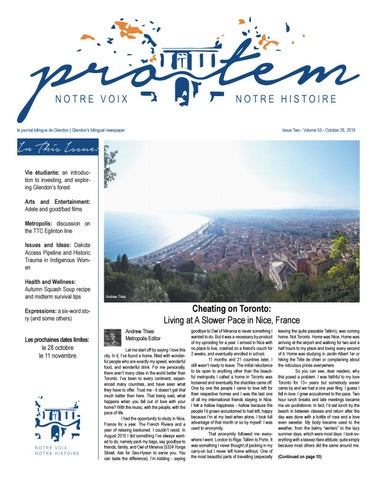
Andrew Thies
Cheating on Toronto: Living at A Slower Pace in Nice, France
Expressions: a six-word story (and some others)
Les prochaines dates limites: le 28 octobre le 11 novembre
Andrew Thies Metropolis Editor Let me start off by saying I love this city. In it, I’ve found a home, filled with wonderful people who are exactly my speed, wonderful food, and wonderful drink. For me personally, there aren’t many cities in the world better than Toronto. I’ve been to every continent, experienced many countries, and have seen what they have to offer. Trust me - it doesn’t get that much better than here. That being said, what happens when you fall out of love with your home? With the music, with the people, with the pace of life. I had the opportunity to study in Nice, France for a year. The French Riviera and a year of relaxing beckoned. I couldn’t resist. In August 2015 I did something I’ve always wanted to do; namely pack my bags, say goodbye to friends, family, and Owl of Minerva (5324 Yonge Street. Ask for Seo-Hyeon to serve you. You can taste the difference). I’m kidding - saying
goodbye to Owl of Minerva is never something I wanted to do. But it was a necessary by-product of my uprooting for a year. I arrived in Nice with no place to live, crashed on a friend’s couch for 2 weeks, and eventually enrolled in school. 11 months and 21 countries later, I still wasn’t ready to leave. The initial reluctance to be open to anything other than the beautiful metropolis I called a home in Toronto was loosened and eventually the shackles came off. One by one the people I came to love left for their respective homes and I was the last one of all my international friends staying in Nice. I felt a hollow happiness - hollow because the people I’d grown accustomed to had left, happy because I’m at my best when alone. I took full advantage of that month or so by myself. I was used to anonymity. That anonymity followed me everywhere I went. London to Riga, Tallinn to Porto. It was something I never thought of packing in my carry-on but I never left home without. One of the most beautiful parts of travelling (especially
leaving the quite passable Tallinn), was coming home. Not Toronto. Home was Nice. Home was arriving at the airport and walking for two and a half hours to my place and loving every second of it. Home was studying in Jardin Albert 1er or hiking the Tête de chien or complaining about the ridiculous prices everywhere. So you can see, dear readers, why this posed a problem. I was faithful to my love Toronto for 13+ years but somebody sexier came by and we had a one year fling. I guess I fell in love. I grew accustomed to the pace. Two hour lunch breaks and late meetings became ma vie quotidienne. In fact, I’d eat lunch by the beach in between classes and return after the day was done with a bottle of rosé and a love even sweeter. My body became used to the weather, from the balmy “winters” to the lazy summer days, which were most days. I took everything with a laissez-faire attitude, quite simply because most others did the same around me. (Continued on page 10)
Pro Tem Letter from The Editor Editor in Chief | Rédactrice en chef Camille Slaght editor@protemglendon.com Assistant English Editor | Rédactrice adjointe (anglais) Effie Barbalias assistanteng@protemglendon.com Assistant French Editor | Rédactrice adjointe (français) Gabriella Giordan assistantfr@protemglendon.com Communications Officer | Agente de communications Sarah Mullins comms@protemglendon.com Photography Editor | Rédactrice de photographie Lauren Clewes photography@protemglendon.com Design and Layout | Maquettiste Sienna Warecki Section Editors | Chroniqueurs Campus Life | Vie étudiante Reeda Tariq campuslife@protemglendon.com Arts and Entertainment | Arts et divertissement Bruno Da Costa arts@protemglendon.com
Hey Glendon, Fourth year is hard. It’s not a myth. But if you pick the right major, and you are surrounded with supportive people, you’ll find it easier to find motivation and to put in the time needed to succeed. I often heard fourth year students at Glendon talking about how exhausted they were and how much work they had to do and I always assumed they were exaggerating. How much harder could fourth year possibly be than the previous ones? Apparently, professors really do increase the level of difficulty and the amount of assignments in fourth year level classes. However, I’ve found that students also have a much higher level of interest and engagement in most of these classes. Being surrounded by other people who are passionate about similar topics as me definitely contributes to my enthusiasm towards a course. I’ve also found that having two majors and diversifying what I’m learning has been key to my success at Glendon. If a double major doesn’t seem feasible for you, maybe consider declaring a minor, or even completing a certificate in a field that you might not explore in
your major. Don’t worry about how a certificate, minor, or second major might fit in with your initial major. It could be completely unrelated to it, but if it keeps you motivated and interested in your studies, it’s worth it to explore that field. My advice is that you will only do your undergrad once, so look beyond your program requirements, and take the courses that you really want to take. Another thing first and second year students should keep in mind is that your grades will get better. I feel like my past three years at Glendon have equipped me with the skills that I need to take on the challenges of fourth year. I really have seen improvement in my grades, and more importantly in my writing process. Over time, essay writing begins to feel less forced, and more like the proper and logical way to present information. So if you have just gotten back your first paper or midterm of the year, and are disappointed with the grade, don’t worry about it too much. There is much room and time to grow, and your professors and fellow students are there to help you. Don’t forget that the Skills and Career Centre (A118) is there to answer any writing-related questions you might have.
Having a hard time focusing or finding inspiration? Try working in Lunik Co-op, in the basement of the manor. It is a cozy and welcoming space where you can purchase delicious and healthy study snacks, and more importantly, many kinds of caffeinated beverages. Do you have any favourite study spots in the city? Share them with us at metropolis@ protemglendon.com or send us a tweet at @ protemGL. Best of luck during the rest of midterm season! With love, Camille Slaght Editor in Chief
Metropolis | Métropole Andrew Thies metropolis@protemglendon.com Issues and Ideas | Actualité et opinions Sabrina Sukhdeo issuesideas@protemglendon.com Health and Wellness | Santé et bien-être Emilia Nowicki health@protemglendon.com
Vous avez des opinions? Vous aimez écrire? Vous faites de la photographie? Vous adorez dessiner? Pro Tem vous veut!
Expressions Kaitlin Fenton expressions@protemglendon.com
Envoyez-nous un courriel à editor@protemglendon.com pour apprendre comment vous pouvez vous impliquer!
Online Content | Contenu en ligne Sam Kacaba online@protemglendon.com
pro~tem
est le journal étudiant du collège Glendon. Publié pour la première fois en 1962, c’est la plus ancienne publication de l’Université York. We strive to act as an agent of social change, and will not print copy deemed racist, sexist, homophobic or otherwise oppressive. Please respond to what you read in the pages of Pro Tem/ n’hésitez pas à réagir à ce que vouz avez lu dans Pro Tem. Contact us/ Contactez-nous: protem@glendon.yorku.ca The Pro Tem Office D114 Hilliard Residence, Glendon College 2275 Bayview Avenue North York, ON M4N 3M6 The office is open by appointment only. Le bureau est ouvert sur rendez-vous seulement. Les lettres adressées au journal peuvent être éditées au niveau de la clarté ou de contenu. All copy appearing in Pro Tem is at the discretion of the editorial team. Opinions published in Pro Tem are the thoughts of individual writers, and not the publication as a whole.
2
Nadia Edwards
Vie étudiante TD - An Introduction to Investing Frank Borrelli Contributor In the Glendon Entrepreneur and Investors Student Association, there was great interest in learning how to invest from leading experts in the financial field. So on Tuesday, October 4th, Glendon partnered with four members from TD Waterhouse to host, “An Introduction to Investing”. The seminar was deeply informative, benefitting both beginner and advanced investors alike. Business Development Associate Christopher J. Black, Business Development Associate Ida Solie, Direct Investing Regional Manager Raeann Harkes and Senior Regional Manager Mark-Angelo Teoli were all on hand to share their valuable expertise and experience. “Approachable”, “talented”, and “passionate” are some words that come to mind when reflecting on their level of professionalism. Also present were notable faculty including the Dean
of Glendon, Donald Ipperciel, who warmly welcomed our guests, as well as Professor Jennifer Sipos Smith and student life coordinator David Ip Yam. These members of the Glendon community play a major role in the success of the students, and teach us all lifelong skills. The speakers covered fundamental topics that are crucial in the investing world, such as mutual funds and stocks. Those in attendance were also given the opportunity to draw upon the speakers’ vast wealth of knowledge by posing questions. The conference’s welcoming environment certainly fostered a lot of open discussion. Whether students wanted to explore the world of investment for personal growth or for a future career, the event more than satisfied their curiosity. A highlight of the conference was when the speakers presented the investing platform that TD Bank uses, WebBroker. I particularly enjoyed how easy it was to navigate; it was a rather user-friendly tool. Filters can be set to narrow the stocks in the market to pair the user with stocks suited for their personal investment needs. We were also introduced to an extensive list of webinars that allows individuals to educate themselves on difficult topics. This
Glendon Entrepreneur and Investors Student Association
was an enlightening lesson. Ultimately, the event established a great atmosphere for students and business professionals to collaborate. The knowledge students learn in the classroom paired with real life applications made this event a perfect mix
of academia and career development. Bilingual education, problem solving and written skills are preparing Glendon students for careers in the business world. Everyone who attended the event left with a higher level of investing confidence.
WUSC Glendon Raises Funds for Refugees
We believe in the values of the SRP and so, armed with our convictions, we were able to reach the lofty sum of $1480. This is thanks to the dedication of our team and the generous donations of the greater WUSC Glendon community. We were second only to WUSC Headquarters! Again, thank you to all those involved. We look forward to your continued support as we continue to raise awareness and funds for forced migrants and higher education!
Emily Leahy Contributor
Emily Leahy
To this date, WUSC Glendon is the Local Committee with the most funds raised for the World University Service of Canada (WUSC)’s Student Refugee Program (SRP) via the event Ride for Refuge. Ride for Refuge is an annual bicycling/walking event which takes places across North America and raises awareness and funds for marginalized individuals, especially forced migrants. The Student Refugee Program combines Canada’s private sponsorship of refugees with higher education in a truly unique and life-changing program. Students are resettled across Canada in colleges and universities. Local Committees pay for the living costs and tuition of sponsored students, in addition to providing social and academic support. WUSC Glendon has often had to skip years of sponsoring due to a shortage of funds, but thanks to York University’s generous waivers we will now be sponsoring one student refugee each year from now until 2020. Through this program, we have seen lives change for the better and thus were hyper motivated to raise funds to help ensure this program continues its amazing work! The funds raised go directly to WUSC Headquarters, and not to WUSC Glendon. They contribute to WUSC’s capacity to ensure that the SRP program will have enough funds without relying on unpredictable government subsidization. This independence means that regardless of the politics of governing parties, refugee resettlement and education will continue to happen across Canada.
Glendon Hispanic Club Sarah Mills Contributor Interested in learning or practicing Spanish? Voulez-vous en savoir plus sur la culture hispanique? ¡El Club hispano de Glendon es para ti! We meet Monday nights from 7-8 in York Hall A216. Come join us for dance lessons, language practice, and learning about Hispanic culture - no prior experience with Spanish necessary. Follow us on Twitter at @GLHispanicClub, like us on Facebook, or email us at glendonhispaniclub@gmail.com for more information. The Glendon Hispanic Club pub night will be on November 17. Plus d’informations vous seront fournies bientôt!
Sarah Mlls
3
Campus Life Meet Jenna: One of Your Newly Elected Councillors Reeda Tariq Campus Life Editor You may have recently seen posters around Glendon of smiling people, slogans, and the word VOTE. Vote for what? For your Councillors and your First Year Representatives. These votes were tallied on September 29th, and the following morning, I had the pleasure of sitting down with Jenna Bass, one of your newest elected Councillors, to talk about what she’s got planned for the upcoming year. Support is the word that came up the most. She is grateful for the support she received from her fellow candidates and insisted that there was great camaradere between everyone, both during the nomination and election period. She found that the entire process ran smoothly and had nothing
The Glendon Forest: Exploring Our Own Backyard Joshua Alcobendas Contributor At the top of the staircase from hell you gaze upon its many steps. You tell yourself that it’s not that big of a deal. With your sports bag slung across your shoulders, you descend into the ravine and make your way towards the Glendon Athletic Club. After a good workout, you retrieve your belongings from a locker and as you exit the building, it hits you: you should not have done leg day. Now, staring up at the summit of the stairs, all the energy is drained from your body. It is as if you are at the base of Mount Everest and the thought of reaching the top is impossible. It is only one in the afternoon, so you might as well do something else to make your trip to the bottom worthwhile. As you survey the area, you spot it. A bright sea of leaves sway in the cool autumn breeze as if a fire had been set among them and something urges you to explore the masterpiece you see before you. You beeline towards the Glendon Forest. Despite the great amount of woodland located right behind the campus, the Glendon forest is seldom talked about among students. Surprisingly enough, the Glendon Forest seems to be mostly void of explorers, but those who wish to become better acquainted with the area will not be disappointed, especially not during the fall. The canopy of trees provide a great photography opportunity seeing as the colors of the leaves have now changed. One of the great spots to snap a picture is the space by the soccer field, outside of the Proctor Field House building, where there is a clearing, calling for your Kodak moments. Two trails run parallel to the West 4 branch of the Don River: the West and
but positive things to say about her experience, so far. Jenna is thrilled to be working amongst all the other newly elected officials. She has some amazing things planned, and is hoping to work with this year’s VP Academics to better the academics within Glendon. Jenna herself is part of the Student Caucus, in addition to Faculty Council and the CSTL Committee, so she has a solid background in academics and knows how to go about improving academics at our college. Jenna is also Co-President of the Neuro-Psychological Science Association, and hopes to work closely with VP Campaigns and Advocacy to increase mental health and disability awareness, particularly issues regarding the hard of hearing community. She also intends to connect with faculty members who are well-aware of ASL, and invite them to have informative sessions with students about it. Jenna is willing to go above and beyond and understands that even the smallest actions can lead to the biggest change. It’s going to be exciting to see all that Jenna will achieve this upcoming year! Bonne chance Jenna. Glendon vous appuie! East trail. The latter can be accessed by crossing the vehicle bridge in front of the GAC. However, exercise a good amount of caution while walking on the East Trail, since it is not very well maintained. Be especially careful on the edges of the creek banks, as erosion may have chipped away at the supporting ground, thus making it hard to tell if the ground is solid. The West trail on the other hand, does not involve any bushwhacking and is therefore more accessible, making for a nice jog, or an easy paced stroll.
Lauren Clewes
Jenna Bass
For the avid Fisherman, the West Don River offers decent fishing opportunities. In the fall, Chinook salmon make their way up the river to spawn and provide a good fight when hooked. Prior to fishing, please check the fishing regulations since there are specific dates that you are allowed to fish and a particular limit as to how many you can keep. You must also be 18 years of age and carry a valid fishing license in order to fish. Please practice respectful fishing etiquette by not snagging fish intentionally, and if you
have boots, do not step on the spawning beds. The Glendon forest offers incredible sights, and can be appreciated in various ways. It is up to you to go out and explore nature’s gift for yourself. Who knows what you might discover in Glendon’s very own backyard?
Arts et divertissement My Night With Adele Bruno Da Costa Arts and Entertainment Editor On Thursday, October 6, the Adele Live 2016 tour rolled into the Air Canada Centre for its third of four installments, and I was ready. Having bought my ticket in late 2015, the nearly year-long wait had finally come to an end. I was finally sitting, waiting for the songstress to appear on stage. All in attendance were greeted by a projection of the artist’s closed eyes projected onto the screen that dominated the main stage. At around 8:30pm, the lights dimmed and the eyes opened, followed by a playing of the iconic “Hello?” greeting that reverberated through the hearts of everyone perched on their seats. Adele did not need an opening act, that was all it took to excite the crowd. The cheers and chants were interrupted by a second hello, and then a third, but this time it was her voice and not a recording. Adele rose from the ground of a smaller stage, surprising us all, and belted a rendition of Hello. The set-up and direction of the concert was the most minimalist I have ever experienced. The production was incredibly simple. Instead of focusing on pyrotechnics and choreography for entertainment value, Adele treated us to nothing but her voice and wit. By interspersing the two throughout the night, Adele created an atmosphere where it did not feel as if the audience was simply watching and listening to a performance, but rather as if we were
Diamonds of the Rough: The Art of Bad Cinema Eric Vogel Contributor Why do we create art? Certainly, there are a number of reasons: for the purpose of self-expression, to create a lasting imprint of one’s self on society, for the sake of beauty or fame. The inspiration to create art must be powerful, lest it be exhausted before completion. Creation is a gruelling, unrewarding experience, and often the mediocre and palatable are rewarded over the risk takers. Producing truly great art is an act of capturing lightning in a bottle, seeming as much equal parts skill and luck; however, the same can be said of truly bad art. In recent decades, the appreciation of works in an ironic fashion has become popularized; in particular, this phenomenon has surged around a renaissance of bad movies. The Room, Samurai Cop, and Trolls 2 have become household names in spite of their total inability to grasp basic conventions of storytelling or filmmaking. What is it about these films that sets them apart from other pieces of bad art? In Hollywood alone there are dozens of movies released each year that are both
having a conversation with a friend. In between songs, Adele joked with the crowd and talked about the song writing process of each song she was about to perform. Adele wanted the audience to understand each song, what her emotions were at the time that she wrote it, and what events inspired her to pour her heart into the music. Since 25 is a deeply personal album, Adele further gave us a tour of her life with the story behind each song. She told us about the heart-wrenching pain of growing apart from friends before singing A Million Years Ago, the joys of motherhood before serenading us with Sweetest Devotion, and the isolating loneliness that inspired the classic Someone Like You. By the end of the night, when Adele gave her final farewell after an encore performance of Rolling In The Deep, it truly felt as bittersweet as saying goodbye to an old friend. I left feeling lighter, as if I was able to share my own stories with the singer. Adele created an environment of understanding. For years her fans have found solace in her songs, but that night it was her turn to open up to us. By being present and listening to her as she tried her hardest to make us understand her artistry, we were able to give back to her the same freeing feeling she has offered us for so many years. In her simplicity, Adele created a show of utter, beautiful honesty. For the first time in a long while, I attended a show where the performance was solely focused on the vocals and the story behind each song being performed. Adele continuously demonstrates the liberating aspects of vulnerability, and how art overflows with feeling. She is a timeless performer, incomparable in her field.
critically and publicly chastised. What is the difference between a Jack and Jill and a Miami Connection? To understand this, one needs to delve into the history of bad art appreciation. The roots of the current bad movie renaissance can be found in the ‘camp’ movement, a mainstay of the 20th century LGBT community. Camp is the appreciation of art that champions bad taste in an ironic fashion. In film, the camp style was popularized in the 1960s by filmmakers such as John Waters (Pink Flamingos, Hairspray) who rejected the stifling definitions of high art and beauty and instead aimed to create lively and exaggerated pieces. The LGBT elements of camp can still be found alive and well today in shows such as Rupaul’s Drag Race. However, camp applies to not the creation of the art, but rather the act of its appreciation; in order for a work to be considered camp, it must be understood and analyzed by the audience as being such. For example, Adam West’s 1960s Batman, with its swinger style and slapstick violence, is camp without intending to be so; that is why camp can exist across any genre. Consider, for instance, the spectacle of WWE-style professional wrestling. What, at first, seems to be a haven for American conservative masculinity, has more in common with Rupaul’s Drag Race than actual sport. Both are acts in spectacle, with over the top characters and rivals, often in heavy makeup and ridiculous costume, utilizing special moves for the purpose of competition that is generally acknowledged
as scripted (though die hard fans may disagree). The love of camp is a uniting concept. So how does this apply to the bad film renaissance? Well, if we analyze the experience of watching a bad movie, rather than the movie itself, we can piece together a common theme: the communal experience of questioning. So much of what makes watching a bad movie great is being able to experience it with others. When watching bad movies with friends, a really great bad movie will spur conversation in the middle of a scene. Viewers point out plot holes, actors flubbing lines, cheap sets, bad hair, or whatever else baffles them in attempt share the experience of absurdity. A great bad movie must spurn questions from the viewer regarding not just what they’re seeing, but why they are seeing it. Why does the samurai cop have real hair in one scene, but a wig in the next? Why would someone shoot a skateboarder with a rocket launcher? What country does Tommy Wiseau come from? These questions are symptomatic of a key feature of true great-bad movies, sincerity. There is a naive optimism that permeates in any great bad movie; often the result of a ‘visionary’ producer or director with more money than sense. It can be found in Y.K. Kim’s strong anti-violence moral, Tommy Wiseau’s attempt at grand drama, or Neil Breen’s anti-government/corporation messaging. We can’t say these movies failed for lack of passion; the reasons for their failure lie in
their execution. Conversely, a patently awful Adam Sandler escapade is terrible for obvious reasons: costs are cut, product placements abound, and roles phoned in. It is far more compelling to see Icarus fly too close to the sun, rather than see him fail by not flying at all. However, this is not to say that a major production can’t be both bad and sincere; Battlefield Earth, starring John Travolta, stands out as one of the all time greatest in baffling productions. Nonetheless, the nature of the film industry means that visionaries are put under the thumb of executives, testing groups, and all manner of factors that quash an individual’s voice on a project. Thus, the best bad films are often independent or low budget productions. So, whether it is good art or bad art, what truly sets apart a work from its peers is the passion and voice put into it. Perhaps that is what draws us to bad art. The knowledge that regardless of our skill or budget, any one of us could produce works that are memorable or bring joy…just perhaps not for the reasons we had intended.
5
Atrs and Entertainment
Ghostbusters Revisited: A Decent Take on An Age Old Classic (3 / 5 Stars) Kaitlin Kenny Expressions Editor When an all-female Ghostbusters revival was announced, there were two main camps of thought: those who were appalled that it was a gender swap, and those who were ecstatic that it was all female. After its much anticipated release, the same praises and complaints were maintained from those exact groups. I, however, was quite neutral on the gender inversion. I simply did not care if it was men or women who were not scared of any ghost, I just wanted it to be well done. Preferably by respecting its source material, adding a fresh new take, and retaining enough callbacks of the first two movies in order to appeal to its original audience. The result? A decent movie. Not fantastic, but not terrible. In anticipation of Halloween, here is my take on this controversial remake. Let’s start with the positives. Visually, the movie is diverse and well coloured. The ghost-catching phasers and guns maintain the original colour scheme. There is a nice blend of dark, damp lighting, and brighter images within the New York City setting, which is fitting for a comedy with light-hearted paranormal activity. One of the more memorable scenes takes place in the deep, dark subways. It is a scene that is familiar to those who take the subway, and the blackness creates a unique 6 thrill generally unfound in PG movies.
The characters in the film are interesting and differ from their original counterparts. While they maintain some characteristics, they are lively, awkward, and sassy in their own ways. Each of the Ghostbusters brings a distinct personality and attitude to the table that is arguably even more evident than the original. Some original cast members do make an appearance in the remake, causing great cheers in the cinema audience on several occasions. To avoid spoiling their roles, I’ll limit myself to saying that they mimic their original parts via their language (both oral and body), dress, and attitudes. They fit in quite organically and are an example of a well-executed callback. The new Ghostbusters includes commentary on gender by calling out sexist double standards, and how women are often taken less seriously in the professional world. Throughout the movie, the women are forced to fight for their passion of the paranormal, against being called the more degrading Ghost “Girls”. They often aren’t taken seriously by against the predominantly male government, army, and police force. Viewers are left feeling uncomfortable as they are given a dose of reality. Another important message featured in the film is a simple cliché but one of my favourites: friendship always wins. Personally, I found that the ‘Busters had fantastic chemistry and worked very well together, making the film much more family friendly. When I was 6 years old, I watched the original and went into absolute hysterics upon viewing the infamous ghost librarian scene. The film also introduced me to the sex talk when I asked what that pretty ghost was doing to Dan Aykroyd (spoiler alert: it’s ghostly oral) and about the numerous dirty jokes littered around. Now for the not so great. I was not dazzled by the script, which I found it to be mostly cohesive, but often awkward. It is ambitious to attempt to be new while staying faithful to the
original. The film would have likely been better had it contained less forced callbacks and more original plot points. The excessive callbacks did nothing but clutter the story with feeble and unnecessary attempts to create a cutesy, nostalgic effect.. In fact, some of the callbacks were not even from Ghostbusters! There were several references to Ghost, The Shining, and even Scarface. These were definitely not a good match for a family-friendly ghost movie. It ultimately ended feeling cheap and forced, and the constant references to other films felt like a movie version of product placement. The visuals had a few downfalls as well. Anyone who knows me, knows that I rarely enjoy 3D movies. I find them excessive, flooding the movie industry with a cheap attempt to dazzle the audience. There are simply very few movies that actually deserve the 3D treatment, and sadly, Ghostbusters was not one of them. It felt like an exaggerated attempt to appeal to children. There were
many cliched 3D moments, such as spit/vomit/ectoplasm being expelled, ghosts reaching out to seemingly grab the audience, and so on. However, the scenes in which ghosts are flying out and around were quite interesting in 3D, and gave the audience the impression that they were really in New York City. Despite being made decades later with much-improved special effects and CGI, the ghosts continue to look oddly fake and are quite cheesy. In fact, I believe that the CGI ghosts in the original film fit in infinitely better than the new ones. All in all, the positives outweigh the negatives. It is a well thought out film made with care and passion but is not, in my opinion, better than the original. I would still watch this film again, and intend to do so on Halloween along with the originals. It most definitely does not deserve the intense hatred it received for being female-led, but is also probably not worthy of being frantically praised. It’s good, but not great.
Vo u s a ve z d e s o p i n i o n s ? Vo u s a i me z é c r i r e ? Vo u s fa ite s d e l a p h o t o g r a p h i e ? Vo u s a d o r e z d e s s i n e r ? P r o Te m v o u s v e u t ! Envoyez-nous un courriel à ed i t o r @p r o t e mg l e n d o n . c o m p o u r a p p re n d r e c o mme n t v o u s p o u v e z v o u s i mp l i q u e r !
Métropole Just Do It: The Saga of Transit Planning and Replanning in The GTA Brandon Gibb Contributor The TTC, GO Transit, and Metrolinx have constructophobia; the fear of building real public transportation projects instead of just drawing lines on a map. Since the 1980s, we’ve been promised time and time again massive transit expansions with only a few of the projects ever coming to fruition. From rapid transit along Sheppard and Finch, to Regional Express Rail (frequent electric train service) and a downtown east-west subway line, we’ve seen it all before. Populist transit plans proposed to garner political support have led consistently to a homeostatic rapid transit system that has not seen major expansion since the 1970’s. The greatest example of this is the Wynne government’s high profile project; Regional Express Rail (RER), which would bring fast, frequent train service across southern Ontario, including transit- starved municipalities such as Markham and Brampton. The plan however, is nothing new. In truth, it is very similar to the GO ALRT (Advance Light Rail Transit) proposal of the 1980’s which is virtually identical in technology to RER albeit with smaller trains. The plug was pulled on the ALRT plan in 1985 when Bill Davis was succeeded by David Peterson, who opted for more diesel GO Train expansion (1). The RER plan, which mirrors that of the ALRT, is strikingly similar to its
predecessor in that it has no clear construction start or end dates. Instead, Metrolinx offers a timeline by assuring that it will be built within the next 15 years. This ambiguity surrounding Toronto transit projects offers a sense of temporariness and is why a change of government usually means redrawing the transit map, as it has for the past 40 years. If we look at the Transit situation today, the same issues are being discussed; rapid transit on Sheppard and Eglinton as well as some sort of downtown relief line. But rather unsettlingly, the same mistakes are being made. The Transit City plan would have provided for transit on these corridors but following the election of Rob Ford in 2010, the entire plan was cancelled because of his proposed Sheppard subway extension to be complete by 2015. It’s 2016, and buses still provide service on the thoroughfare East of Don Mills. The LRT on Sheppard, supposed to be completed in 2014, has now been deferred until at least 2021 and has been taken off the current projects page on Metrolinx’s website (2). Mercifully, the same debate of underground vs ground-level transport that rocked Sheppard Avenue has not significantly delayed the Eglinton line, though the current project resembles more closely the original Transit City plan than that of the late ex-mayor. As for the relief line, it has been discussed since the 1960’s as a “streetcar-subway” (similar to the 510 between Union Station and the Waterfront) and since the 1980’s as a full subway line. Mayor John Tory even spoke of this as a critical piece of infrastructure right up until his candidacy for mayor, when he proposed SmartTrack as a cheaper alternative. City planners say that a line is needed, and desperately so, although no funding has been issued (3). Forty years is long enough to have a debate on transit, especially if virtually nothing
has been done since then and now. Politicians in Toronto spend too much time talking about the transit they want to build and it’s hurting everyone. Torontonians now have the longest commute times in North America, and still have the least subsidized transit operators. Torontonians need change now, as the burgeoning city pushes 3 million inhabitants in the coming years. No longer can it be afforded to draw lines on a map and hope that it gets built. Realistic transit that is both funded and comes with clear target operation and construction dates is needed if the city wishes to dislodge the congestion it is choking on.
Toronto en orange: à la découverte de l’automne torontois Gabriella Giordan Assistant French Editor Les feuilles, lassées de leur sort depuis le printemps, se métamorphosent et délaissent les arbres du centre-ville. La chaleur estivale oppressante fait ses adieux : c’est l’automne à Toronto. L’été, la saison considérée comme plus propice au tourisme, ne l’est pourtant pas nécessairement. En automne, l’immense richesse naturelle, confondue avec tout ce qu’a à offrir la métropole, séduit touristes comme résidents. L’automne jouit d’un climat plus tempéré, synonyme du mot « idéal ». C’est une saison qui est caractérisée par le déclin des jours et la chute des feuilles. La température
au mois d’octobre varie entre 5 et 14 degrés Celsius, ce qui permet aux intéressés de jouir de plusieurs activités de toute sorte, dans une température modérée. Il y a d’innombrables événements et festivaux qui n’ont lieu que durant l’automne. Certains évènements exhibent la culture, soit canadienne ou mondiale, omniprésente dans la grande ville, comme le festival international d’auteurs, dont les portes seront ouvertes aux aficionados de la lecture du 20 au 30 octobre au centre Harbourfront. Margaret Atwood et Stephen King figurent sur la liste d’auteurs qui seront présents. D’autres évènements existent depuis presque un demi-siècle, voire plus, tel que le défilé du Père Noël, lequel aura lieu le 20 novembre dans plusieurs recoins du centre-ville, et la cavalcade des lumières, laquelle illuminera la ville le 26 novembre dans la place Nathan Phillips. D’un autre côté, les évènements ayant rapport à l’Halloween constituent une catégorie en soi. À titre d’exemple, le château historique Casa Loma organise un évènement d’Halloween intitulé « Halloween adventure », de 19h à minuit tous les jours jusqu’au 31 octobre. Il s’agit d’une promenade tout spéciale à l’intérieur du château menée par « Dracula ». Il est vrai qu’il y a plus de choix de festivals et d’activités pendant l’été. Néanmoins, un vaste et riche répertoire d’activités est au programme cet automne. Que ce soit grâce aux activités culturelles, traditionnelles, ou saisonnières, la découverte de Toronto à ce temps-ci de l’année s’avère une expérience unique et agréable.
7
Photography
Gabriella Giordan
Bruno Da Costa
Gabriella Giordan
Lauren Clewes
Gabriella Giordan
8
Gabriella Giordan
Gabriella Giordan
Gabriella Giordan
Photographie
All photos on this page by Gabriella Giordan
9
Metropolis Cheating on Toronto (continued from cover)
October Events in Toronto: What Not to Miss This Month Canada Race Relations Foundation: 2016 National Conference October 26th - 27th Japanese Canadian Cultural Centre International Festival of Authors October 20th - 30th Harbourfront Centre Rocky Horror Picture Show October 28th, 29th, 31st (cost $16) Bloor Hot Docs Cinema When The Beatles Rocked Toronto June 18th - November 12th City of Toronto Archives, Market Gallery
A Third Gender: Beautiful Youths in Japanese Prints May 7th - November 27th Royal Ontario Museum Superreal: Pop Art from The AGO Collection January 16th - December 31st Art Gallery of Ontario CHIHULY Exhibition September 29th - January 2nd, 2017 Royal Ontario Museum If you’re around Toronto and hear of an event that might be of interest to our community, write to us at: metropolis@protemglendon.com.
10
No point in doing otherwise. I became rather indoctrinated to the culture of that region of France and gained a new perspective on Toronto. It was always something I knew, but never quite fully understood without this comparative view that Nice gave me. The pace of our charming city can be quite alarming. If one doesn’t stop to appreciate surroundings and be fully self-aware, life can pass by so damn quickly. Writing this, in fact, has been one of the few moments of meaningful reflection in a week or so; a week crammed with academic and work responsibilities. It seems, to put it briefly, I haven’t quite caught up to speed back here. I haven’t gotten past that reverse culture shock. Or maybe I just don’t want to. At the very least, my time abroad can be considered as a useful tool to help slow down things here. Just thinking of the afternoon sun and the busy Promenade des Anglais takes me to - as Edward Sharpe so melodically puts it - better days. The age old adage of “the grass is always greener on the other side” is, well, an age old adage for a good reason. I complained about the lack of entertainment in Nice - the unfortunate lack of a music scene, being outpriced
at bars and restaurants. I longed for a night at Owl of Minerva after dancing at Clinton’s and pre-drinking at Red Room. That doesn’t exist in a place where the average age is one of the oldest in France. But now that I’ve returned I find myself not quite at the pace everybody seems to be. I long for outdoor and adventure activity - a 20 minute bus or train from my place in centre-ville to some of the best hikes in Europe. I’d have to load up and take a 400-series highway into or even past the green belt to do something similar. I slow things down and would ideally love to work with time constraints and deadlines similar to that of Nice but school and work seem to drag me back into reality. I’m learning to deal with two different types of socialization - both inherently conflictual and opposite of each other. I’ve been welcomed back by my love, Toronto, despite cheating on her for a year. Slowly but surely I’m readjusting to life in the fast lane but I’m trying to “get the best of both worlds”, as 21st century poet and philosopher Hannah Montana so eloquently puts it. Despite this Yin and Yang, this Apollo and Dionysus, this Toronto and Nice (I don’t know how metaphors work), one page from my Niçois adventure will remain pristine and intact. I’m trying to live it every day by taking a Ferris Bueller-esque approach to life. “Life moves pretty fast. If you don’t stop and look around once in awhile, you could miss it”.
Métropole Actualité et opinions Tips for Traveling on a Budget Effie Barbalias Assistant English Editor
Devour Mini Tacos and Mint Juleps at Queen Street’s Grand Electric Neya Abdi Guest Contributor, Toronto Discursive When you think of autumn the images that come to mind are probably pumpkins, leather boots, and trench coats. Not patios, margaritas, and key lime pie. A few weeks ago my friend Paul and I made plans to meet up for brunch, but a combination of factors like a subway closure, a mini breakdown, and a dirty rug that needed to be moved meant we didn’t get around to finding a place to eat until about 4 o’clock. I live in Scarborough, which means it doesn’t matter if I get up for breakfast at 8 am or 6 pm. There will always be some dingy place where there is no wait and customer service is just a suggestion. I am fine with both of these things so long as my eggs are not runny. The Parkdale area is a little different. A google search revealed that every place he suggested was either closed or closing. “Isn’t there just an all-day breakfast place we can go to?” He started making smoothies to tide us over until we found a place to eat. “We’re in that awkward time of day where everything around here is transitioning into bars or clubs.” We finally settled on Grand Electric, a spot Paul had been to before that sold Mexican food with adorable tacos that I would apparently love. Mexican, breakfast, a basket of gourds - at that point, if it was remotely edible, I was game. We started walking down Queen Street. “Did we pass it?” I asked. “No, I would have heard the loud hip hop,” he said just as music started blaring from a door to our right. “Oh, this is it.” “Patio?” the lady at the bar asked. It was beautiful outside, and the cool, funky space looked like it could barely fit a kitchen let alone a patio, but a few steps through the back and we were standing on a nice patio with a friendly vibe. The bartender waved her hand around at all the benches. “It’s communal seat-
ing, so you can choose wherever.” We sat next to an older couple who were digging into their own food and making appreciative noises. A good sign. I was ready. The menu consists of a few share platters, but the main attraction is the long list of tacos you can buy. The server recommend starting with about three and then adding more if you’re still hungry. First up: the refried beans with egg served with soft shell tortillas. The egg was fitting; the original plan was breakfast after all. It was delicious and after we devoured it we sat waiting for the tacos. Grand Electric offers several taco options. Among their popular picks are the Beef Cheek taco with avocado salsa verde, onions, and cilantro, their Pork Carnitas with white onion and cilantro, and the Spicy Yam taco with a bunch of yummy fillings for vegetarians. On Paul’s recommendation I opted for the Crispy Cauliflower taco with pickled serrano and green onion and then for good measure I added the Spicy Chicken filled with cucumber yogurt, pickled red onion, cotija cheese, and cilantro. The food arrived. Each came with two tortillas with the fillings piled on top. “You know why it comes with two tortillas?” Paul said. “You’re supposed to make your taco with the first tortilla, eat it over the second tortilla and then use the stuff that falls out to make another taco.” Genius. The Crispy Cauliflower was fantastic. The tempura cauliflower provides the satisfaction of deep fried food without the guilt. And the Spicy Chicken taco’s cucumber yogurt provided the ideal balance between hot and cold. I was in heaven. We ended things on a sweet note by splitting a yummy key lime pie. For taco-loving students Grand Electric is a vibrant, laidback spot to get your Mexican food fix. The taco prices range from $3.75 to $4.45. Grand Electric has a fun selection of drinks, but a mint julep or a margarita will put you back about $12, so if you are trying to dine out on a budget stick to the soft serve tacos. Grand Electric is located at 1330 Queen Street West. It’s open Sundays to Wednesdays from 12PM - 12AM and Thursdays to Saturdays from 12PM - 1AM. You can check out their menu at www.grandelectrictoronto.com
Do you have the itch to travel but your piggy bank is saying otherwise? It’s hard to find the funds to travel as a student, given the cost of classes, books, loans, and everything else that comes with adulthood. But with a few helpful tips, you’ll be able to fit a getaway into your tight budget. Prioritize: If you really want to go on a trip, you are going to have to make it a priority. Remember what it is you are working towards and remind yourself of your goal often to keep yourself on track. Write reminders to yourself in your agenda and keep a pictures of your ideal destination posted where you will often look at it to keep it from slipping to the back of your mind. Finding Funds: If you are saving for a trip, you need a job. You can try creating a GoFundMe page or asking around, but the surest way to get funds is to work for it. If you are looking for employment, try sites like Indeed and LinkedIn, which have a multitude of options. Get out and look for postings in your area. If you can, hand in your resume in person. If you are already working, take the time to re-evaluate your schedule and work out the most efficient way to balance school, work and downtime. Use your savings account: Every time you get a paycheque, make sure to save at least 10%. Before you know it, you will have accumulated a good little sum. If you don’t think you can keep up with this on your own, ask one of your bank’s representatives to create an automated system that will allocate money to a desired account every paycheque. The Weekly Spend: One way to watch your weekly spending is by using a method that I call “The Cash Diet”. Give yourself a limit, set aside whatever your limit may be, and take it out in cash at the beginning of the week. If you don’t have cash for it, you shouldn’t buy it. Test yourself and see if you can make your money last through the week. A good place to start is $20, and you can play with the
Lauren Clewes
amount you think you can survive off of from there. If you need to keep your bank cards on you for emergencies, put them in a less place that makes it harder to grab out of your wallet. Point cards: An alternative to the cash diet is to use credit for everything and gather Flyer miles. Ask your bank about credit cards with traveller benefits. Keep in mind that this method takes a lot of self-discipline, as you will get in the habit of using your credit card. Keep Track of Your Money: There are a number of apps that allow you to see where your money is being spent. Here is where you can adjust your spending patterns and really see where your extra cash is going. Some good apps are Flipp, Wally, Mint, Goalkeeper and even personal banking apps like TD’s MySpend app. If apps aren’t your thing, there is a multitude of online templates that allow you to insert your spending info. I also recommend the online templates made by Canadian Gale Van-Oxlade. Her easy-to-use spreadsheets help you plan a budget on your own. Cut Back on bills: If you tend to over-spend, find out where your money is going. See if there are cheaper alternatives to some of the monthly bills you are paying. Flights: When a couple of months have gone by and you have saved an appropriate sum for a trip, you will need to find good deals. All-inclusives are always a great alternative to minimize your spending. They usually include the flight, housing, food, and entertainment. For other kinds of vacations, try searching in an incognito browser while looking for flights. You will be guaranteed to find lower prices because your browsing information will not be tracked, and the prices won’t inflate as you search. Choosing a hotel: If you’re looking for cheap accommodation, Airbnb rentals are great alternatives to hotels. The site makes it easy to book places, and the numerous reviews allow you to chose a location best suited to your needs. Affordable activities: Check sites like Groupon for deals on activities you might be able to do once you arrive at your destination. There are always coupons and great deals online. Now you’re all set for saving and planning your next trip. Safe Travels!
11
Issues and Ideas Contextualizing the Dakota Access Pipeline: DAPL’s reminders about present-day colonialism Sabrina Sukhdeo Issues and Ideas Editor The controversy over the Dakota Access Pipeline (DAPL) is somewhat of an old story. It’s not because the pipeline resembles many before it like the recently greenlit Pacific North West LNG or the infamous cross-border Keystone XL. Nor is it because DAPL has been in the works for over two years— undergoing review, acquiring permits, and attempting to sidestep critics. It’s because DAPL tells the timeworn tale of how the consequences of corporate greed intersect issues of health, the environment, and Indigenous rights. DAPL is an energy project poised to stretch over 1800 kilometres across four American states. Starting in North Dakota and passing through South Dakota and Iowa, the pipeline ends in Illinois and has been designed to transport crude oil. Proponents see the pipeline as an economic necessity for creating jobs, boosting a stagnant industry, and ending the United States’ reliance on foreign energy. However, it is this promise of financial gain that has overridden the concerns and consent of largely Indigenous communities. DAPL and the various agencies that endorse it have prioritized the short-term profit of land exploitation and forced displacement over the long-term sustainability of the land, its inhabitants, and their well-being. It’s not difficult to flip through a history textbook and find this recurring theme— you’ll see it under the section titled, “colonialism”. The disastrous costs of colonial endeavours on the natural world have been long documented. In the late 1800s, as fur hats became all the rage in Europe, the North American fur trade nearly drove the beaver to extinction, and later the bison population met a similar fate. Throughout the same century, as Europeans settled across the lands, large fields of native plants like camas and salal berries were destroyed and foreign crops of potatoes and strawberries were introduced in their place. These historical environmental adversities severely debilitated the pre-existing biosphere, and climate activists argue that DAPL would be no different. They say the pipeline poses many ecological hazards, not limited to soil erosion, water pollution, and the host of problems for flora and fauna that would follow from a leak. Opponents also assert that DAPL’s contributions to greenhouse gas emissions and climate change would harm surrounding communities by increasing the potential for drought and rising freshwater temperatures. For these reasons, biologists, conservationists, and agriculturalists alike have firmly positioned themselves in the anti-DAPL camp. They recognize 12 that there is something ostentatiously
familiar about a corporation invasively exploiting communal land with little regard for local residents and Mother Nature. But the strongest objection to DAPL has come directly from Indigenous communities who live in and around many of the region surrounding the pipeline. Their subjugation, of course, is not a new experience. Having their lands dispossessed, their consent violated, and their well-being undervalued in favour of growing imperial economies— ones from which they scarcely benefit— is a tragic pattern that spans eras and borders. This is likely why Indigenous nations from across the world— including Canada, Mexico, and Brazil— have joined the Standing Rock Sioux Tribe in North Dakota to protest DAPL’s construction. With demonstrators amassing in the thousands, some reports have stated that this is one of largest gatherings of Indigenous peoples in history. Certainly, the Standing Rock Sioux have been dealt a sympathetic injustice. It is believed that DAPL will cut through sacred burial grounds and contaminate local water resources. While the former would be a cultural offence, the latter would give rise to serious health complications for generations of Indigenous peoples. Regardless, both display a reminiscently profound disrespect toward Indigenous peoples and highlight a clear link between past and present-day colonialism. On September 9th, the U.S. federal government temporarily halted work on the pipeline pending further environmental assessment— a Band-Aid response to mounting pressure from those opposed to DAPL. Still, to this date, protesters continues to stand strong in North Dakota with many peacefully camped around the construction site. While DAPL might remind us about the persisting remnants of colonialism, it is evident that resistance to the pipeline will also show us a fairer future.
Time Does Not Heal All Wounds: Indigenous Women and Historical Trauma Gureet Kang Contributor Today in Canada, Indigenous peoples as a whole experience discrimination, over-representation in the child welfare system, and increased rates of poverty and substance abuse. However, these experiences especially burden Indigenous women because of the systemic racism and discrimination they face. Legislation such as the 1876 Indian Act and the 1990 Child and Family Services Act target them directly. For those who are unfamiliar, the purpose of the Indian Act has been to acknowledge and affirm the irreplaceable historical and constitutional relationship Indigenous people have with the Canadian government. The Child and Family Services Act, on the other hand, serves to investigate allegations of child abuse and neglect and to provide guidance, counseling and other services to families. The problem with
these acts, however, is that they do not offer extensive information on how to prevent the issues at hand, or how to approach the unique social and cultural circumstances of Indigenous women and children. The statistics of Indigenous women are worrisome with respect to cases of violence, abuse, and death. Indigenous women between the ages of 25 and 44 years old are five times more likely to die as a result of violence than non-Indigenous women in Canada. They are also more likely than non-Indigenous women to have experienced abuse. In fact, the Native Women’s Association of Canada (NWAC) recognized that over 600 Indigenous women were missing or murdered since the 1980’s. In addition, Indigenous women experience many social inequities, such as lower quality of housing, fewer employment opportunities, lower educational attainment, inadequate physical environments, and weaker social supports within communities. Understandably, these issues lead to increased rates of substance misuse, mental health challenges, suicide, poverty, lack of safe and affordable housing, and barriers to opportunities that could increase their socioeconomic standing. Historical trauma is crucial in understanding what these women are going through. It is commonly understood as the process by which stressful traumatic experiences from colonialism have been carried over from one generation of Indigenous peoples to the next. This results in the breakdown of traditional Indigenous family structures, which impact parenting across generations. This harsh reality for Indigenous women reveals a need for increasing sensitivity to the intergenerational legacy and ongoing impacts of colonialism. It is also necessary to develop a better understanding of the historical relationship between Indigenous peoples and child welfare authorities. Presently, there is a lack of trust in Indigenous people, on behalf of their families, their community, the government, and non-Indigenous people. The legacy of the Canadian government forcibly removing Indigenous children from their homes has greatly contributed
to the mistrust of Indigenous parents. A substance abuse counselor notesd that this is an issue that grows in importance with each generation. “What does it mean [for a mother] to have her children taken away as she was taken away from her mother and her mother was taken away?” An Indigenous mother explained that she never got along with Children’s Aid because her children were taken away from her on the grounds that her past was ingrained in the system. When she mentions her past, she does not speak of her own actions— she refers to what her mother did, what her grandmother did, what her great-grandmother did. Her family history has a direct impact on her current situation, regardless of her actions. In addition to awareness about the effects of historical trauma amonth Indigenous people, there needs to be improvements in services and treatments offered to them. In order to increase accessibility, a variety of services should be offered through a single source. Retaining pregnant and parenting women who are being treated for substance abuse requires collaboration between substance use treatment sectors, prenatal care, and child welfare. One study found that mothers who were able to attend treatment programs with their children, or who were even able to retain custody of their children during treatment, had higher rates of program retention than those who did not have their children. Evidently, enhancing services offered to Indigenous mothers will indeed lead to a path of reconciliation. However, historical trauma is not something that will heal with the mere passage of time. There needs to be a genuine effort on behalf of all Canadians to educate themselves about historical trauma and how it affects the every day lives of Indigenous people.
Santé et bien-être Welcome to John Kemp’s Kitchen! John Kemp Contributor Hey there, readers of Pro Tem! My name is John and my column is one of the newest additions to the newspaper. It will focus on all things food, such as learning how to cook great recipes as well as tips to help you bring out your inner chef. I started in the kitchen when I was about four years old. My dad would often wake up to the smell of my pancake creations (I couldn’t read the recipe yet) and freshly whipped cream. From there, I’ve continued developing my culinary skills (as well as literary skills), diving head-first into the world of food. I attended Liaison College for multiple summers where I was introduced to the commercial kitchen atmosphere and where I was able to learn “tricks of the trade” from trained chefs and line cooks. Today, I’m an avid home cook, creating dishes for friends and family to enjoy. Enough about me. Let’s dive into this issue’s topic: Autumn. What a great time of year to start off with! This harvest season is bountiful with the fruits of the earth which are paired beautifully with warm, “cozy” flavours like allspice, cinnamon, and nutmeg, only to name a few. The recipe I’m featuring this issue is one that I made for a soirée I recently hosted. It’s a squash soup that incorporates both the fall harvest and its complementary spices. Autumn Squash Soup Cost: about $1.86 per serving You’ll Need: 1 acorn squash (pulp and seeds removed) 2 large sweet potatoes 2 tbsp. butter 2 yellow onions, finely diced 1 ½ tsp. ground ginger 1 tsp. ground cinnamon 2 quarts chicken or vegetable stock ½ c. heavy cream (35%) 3 tbsp. pure maple syrup kosher salt and freshly ground black pepper to taste 1 lb. frozen puff pastry, thawed but cold 1 egg 1 tbsp. milk
onions and sauté just until soft. Add the squash, sweet potato, ginger, cinnamon, and stock. Bring to a boil in order to bring together the flavours. Do not overcook as the taste of the spices will weaken. 5. In a blender or food processor, purée the contents of the pot until smooth. You can also use an immersion blender (emulsifier). Pour into a clean pot. Whisk in the cream and maple syrup. If the soup is too thin, you may let it boil, uncovered, to let some water escape, but be sure to stir occasionally. If it is too thick, add more stock or water. 6. Season with salt and pepper to taste and let cool to room temperature. Plating 1. Preheat the oven to 425°F. On a lightly floured work surface, roll the puff pastry to about 1/8” thickness. Using one of the bowls prepared for serving, cut enough pastry to cover the top of the bowl and drape slightly over the edges (keep in mind that the pastry will shrink in the oven, so compensate accordingly). 2. Brush the edges of the bowls with a mixture of the egg and milk (egg wash). Fill each bowl with soup and cover with a round of the puff pastry. Brush tops with egg wash and bake for about 25 minutes or until dark golden brown. Serve and enjoy!
John Kemp
Don’t forget to check out my Facebook page (John Kemp’s Kitchen) and follow me on Instagram @johnkempskitchen!
Directions 1. Preheat the oven to 400°F. Fill a baking dish with about a ½” of water. Cut the sweet potatoes in half and place, cut side down, in the dish. Bake for about 30 minutes. 2. Place the halves of the squash, cut side down, alongside the potatoes. Bake for another 40-50 minutes, or until a small knife can easily penetrate the squash and potatoes. 3. Remove from oven and remove the squash and potatoes from the dish. Allow to cool until cool enough to handle. When ready, scoop out the flesh into a bowl. 4. In a large pot, melt the butter. Add the
John Kemp
13
Health and Wellness 10 Tips to Survive Mid-terms This Fall Emilia Nowicki Health and Wellness Editor Halloween isn’t the only scary part of October... Mid-term season has fallen upon us yet again! With tests, exams, essays, and presentations due all at the same time, il est parfois difficile de demeurer calme. Il faut trouver l’équilibre dans les études, le travail et la vie sociale, mais comment y arriver? Voici 10 tips to help you survive this stressful season! 1. Make yourself a study schedule with extra leeway. This way, if life happens (which it usually does), you’ll find that you still have enough time to complete what you had planned to do without it being left to the last minute. 2. Changez votre environnement – si vous étudiez dans votre chambre tous les jours, essayez d’aller étudier à la bibliothèque. Ce changement de lieu vous aidera à renouveler votre motivation. 3. Make sure you receive the accommodations and support you need for any physical or mental health troubles you may be experiencing by booking an appointment with the Accessibility, Well-being and Counselling Centre. They’ll provide you with emotional support, advice, and any special arrangements regarding tests and other school work. Their office hours are Monday-Friday 9-5, and they can be reached at 416-487-6709 or at councelling@glendon. yorku.ca
Why You Should Join the Glendon Athletic Club Gabriella Giordan Assistant French Editor Most students would rather catch up on sleep or get ahead on schoolwork than clear their schedules for an hour or two of exercise, claiming they don’t have the time or that they are too stressed. Ironically, going to the gym
14
Lauren Clewes
4. Prenez des pauses et trouvez du temps à consacrer à vos loisirs préférés! Que ce soit écouter de la musique, lire un roman ou regarder une émission sur Netflix, assurez-vous de ne pas négliger vos passe-temps. Il est important de se détendre et de permettre à son cerveau de se reposer de temps en temps. 5. When you’re caught up in the stress of studying, working, and going to class, it’s easy to lose your appetite or to simply no longer find the time to cook or eat a proper meal. Remember to eat regularly, bring energizing snacks with you wherever you go, and stay hydrated! I’ve personally found that meal-prepping every Sunday night for the upcoming week is what helps me best since when I become busy and exhausted, I already have food prepared that I only need to heat up ; it’s quick and easy! 6. Étudiez avec vos amis! Je trouve qu’étudier seule dans ma chambre peut devenir pénible à la longue et me rendre triste et découragée. J’en ai souvent assez de me sentir isolée, ayant seulement mes manuels et mon ordinateur comme compagnie! C’est donc une bonne idée d’organiser des sessions d’étude avec vos amis ou avec vos camarades de classe. 7. Find 30 minutes per day to exercise. If going to the gym regularly during mid-terms just isn’t doable, make sure you at least go for a daily fast-paced walk (I personally love the Glendon forest trails down by the GAC!). Not only will going for a walk clear your mind, but you’ll also get some fresh air, all while giving your body some movement! 8. Quand vous vous sentez véritablement accablés et stressés, prenez quelques minutes pour faire des exercices de respiration. Inspirez et expirez profondément – cela prend seulement is a rewarding and stress-relieving experience that is well worth sacrificing a bit of time for. All students can begin their fitness quest right on campus, for the price of only 20 dollars per year, which includes a free towel service. Though it is small, Glendon College prides itself in having its very own, 55,000 square foot fitness facility – the Glendon Athletic Club (GAC). The club is located at the Proctor field house, at the bottom of the long set of stairs leading to the Don River trails. The GAC includes a pool, a group exercise room, a gymnasium, a weight room, squash courts and tennis courts, as well as a group cycling studio, all of which are open to all members of the club. In
Lauren Clewes
deux minutes et vous pouvez le faire n’importe où. Si vous avez plus de temps, vous pouvez même transformer ces exercices respiratoires en séance de yoga! 9. Improve your sleeping habits by trying to get as much sleep as possible and by working on going to bed and on waking up at the same time everyday. I know this piece of advice is easier said than done, however lack of sleep will be the #1 trigger that will begin to affect your academic performance this month as well as impact your mental health. Your body will thank
you once you’ve created a routine for it!! 10. Pensez de manière positive et entourez-vous de personnes qui vous encouragent, tel que les membres de votre famille, vos amis et toute autre personne qui vous soutient et qui vous comprend bien. Un environnement positif vous aidera à vous détendre, à vous sentir plus énergique et à vous motiver à bien réussir!
addition to these facilities, there are two health clinics that operate within the GAC. The Cornerstone Health & Wellness Centre offers chiropractic services, and Endeavour Rehab offers sports performance and rehabilitation services. Many Glendon students take advantage of their membership at the GAC and can be seen exercising in the weight room, where attendants or personal trainers are present upon request and ready to help. A lot of students also take part in various group fitness classes on a weekly and even daily basis. Many of these classes appeal to students and community members alike. The zumba class is a student favou-
rite because of the upbeat and mood-boosting energy it creates in a welcoming, open-to-all environment. Zumba is a fast-paced workout that incorporates various styles of Latin dance routines. It is excellent for both cardiovascular and mental health. No matter how uncoordinated, or how unfamiliar one may be to dancing or exercise in general, they will surely feel a surge of energy and satisfaction after their Zumba workout. The GAC is always open to new members. Put your psychology assignments, French grammar exercises, and extracurricular commitments aside for a few hours each week, and make your overall health a priority by taking advantage of the services offered at the GAC.
Hannah Yaghmaei
Sending good vibes to every Glendonite this month, et bon courage!
Expressions My Paranormal Activity: A True Story Kaitlin Kenny Expressions Editor I have always been a firm believer in the paranormal. From a young age, I’d hang out in the library with a stack of ghost books, reading until I’d have nightmares. My dad would scold me for spooking myself. There have been a few events in my life that I simply can’t explain and that I’ve chalked up to the paranormal, but one really stands out for me. Christmas of 2010 was the last I shared with my entire family from my mom’s side. I rarely got to see my Aunt, Uncle, and Great Grandma, let alone all of them at the same time. Upon travelling in Japan, my Aunt and Uncle picked up a solar powered decoration to give to my Mom as a Christmas present. It was a little pink man sitting on the toilet that bobbed his head when placed in the sunlight. We all laughed, but my Great Grandma especially loved it. She laughed endlessly when we showed her a picture of it placed in our bathroom. Sadly, a month later, she passed away. That’s when things got strange with our pink friend. On numerous occasions, we would find it laying on the ground, knocked off the narrow windowsill. It typically happened when no one was near the washroom, and we knew it couldn’t be the cat as the sill was too high for him to reach and too narrow for him to sit on. My Mom and I were confused, but gently replaced it each time. After a few months, it got a bit more violent. The decoration would be forcibly thrown across the bathroom and the kitchen. It would sometimes happen when we were home, other times, when we were out. We could hear the toy crashing into the wall, 20 feet away. I distinctly remember being on Skype with my boyfriend and hearing it slam into the wall. I was alone and absolutely terrified. It continued to escalate. When I would go to the kitchen, do dishes, or wash my hands, I could sometimes see the toy being violently thrown. One day, it hit me hard and left a bruise. Strangely, it seemed to only happen in the presence of me or my mother. We were convinced that it had something to do with my Great Grandma, but couldn’t figure out what about her attachment to that silly toy led to these strange events. We loved her so much, her passing was peaceful, and she loved the toy. What was she trying to tell us? This routine continued for seven long months, eventually snapping the neck’s movement mechanism. It finally came to an end when we went out to Manitoba and buried my Great Grandma’s cremains with my Great Grandpa’s and cousin’s. Just as quickly as the violence began, it stopped, and we have had no problems with the decoration since. To this day, I’m still convinced it was her trying to communicate with us, potentially about her displeasure of not being buried. What I do know, however, is that those months were a seriously eerie time.
The Love Stories That Never Were, Could Have Been, and Could Be Mikaela Lucido Contributor
Une visiteuse mystérieuse à Glendon Chapitre 2: Le conflit de Jane Austen
Stéphanie Mak There isn’t really a map or formula to romantic Contributrice love as there is in movies. A chance meeting in a cliché rom-com setting, being serenaded under the dim glow of moonlight, having a library’s worth of poetry being dedicated to you – it doesn’t mean that you will be swept away into a happy ending, or that you will be covered in rose petals. Love is a great many things, including choice. And in classic human nature, love on earth is messy. It isn’t always bright, saturated with excitement and nearly ridiculous giddiness. It can be breakyour-back-heavy, swallowing down sobs, red-rimmed eyes, and the feeling that your chest has eroded thanks to a flood of failure. You will not always get The Someone you desire. You will not. It sounds so easy. But how awful it can feel when it is unrequited. How strangely beautiful of a term it is. To mouth those words feels as though you are in a fairy-tale with a guaranteed, magical solution to the pain life lugs along with it. This isn’t meant to deter you from broken yet brilliant love humans are fated not just to feel, but to choose. To do. To live. Yes, it feels awful in the middle of it all. In the middle. The middle, as you know, is not the end. The middle is when your heart feels constricted, choked by an almost familiar darkness. The middle is when that darkness pounds its fists against your heart. The darkness’ knuckles bleed poison in the very cracks it creates. In fairy-tales, the middle is the longest part, but the end hits you with force. The pain is forgotten amidst the joyous ending. The end of a love story is not so clear-cut in real life. There once was a love story that never happened. A love story that could have happened. A love story that only had an ending. Many us have been part of love stories that never were. The ending could in fact be finding The Someone you will choose to love for the rest of your stories, a Someone you will be loved by in return. The end could be waking up one morning without a crinkle between your eyebrows, without feeling like a blade is scraping against your ribcage at the thought of your loss. The end could be realizing dreams that were once as small as seeds, having been stuck in the periphery of your vision when you were in love. The end could be learning that romantic love is not the greatest achievement of a life. But I hope the end itself is learning that it hurts and choosing to love anyways. Loving without fear of being hurt is admirable, but loving despite that fear is even more powerful.
Les deux filles discutent du fantôme en étudiant au Breezeway le lendemain. ―Tu es sûre qu’on peut aider Mlle Austen? demande Michelle en chuchotant. Sophie hoche la tête avec confiance. ―Pouquoi pas? Elle n’est qu’un fantôme. Elle ne veut ni effrayer les visiteurs ni attirer l’attention. De toute façon, cette aventure sera plus intéressante que celle qu’on a eue avant. Malgré ce que dit son amie, Michelle hésite. Le fantome de l’écrivaine Jane Austen veut trouver la lettre d’amour qu’elle a écrite à Thomas Lefroy lorsqu’elle était jeune. Malheureusement, la lettre ne se trouve plus à Glendon parce qu’elle a été volée. Par coïncidence, la lettre est maintenant entre les mains du personnage principal d’un film qui sera tourné à Glendon dans l’espace de trois jours. Il s’appellera « La vie de Jane Austen ». Michelle répond finalement à son amie : ―Je suis tout à fait d’accord avec toi que cette histoire est celle la plus intéressante
Lauren Clewes
qu’on ait jamais entendue. Mais il faut qu’on se rappelle qu’il s’agit de visiteurs externes. Comment est-ce qu’on pourra s’approcher de l’actrice quand toute la population de Glendon veut voir le tournage ? Sophie lève les sourcils et Michelle continue : ―Pas tout le monde, mais presque. Le film sera tourné dans le manoir, et les professeurs ne sont pas contents de cette interruption de l’horaire habituel. Pourtant, le tournage sera une bonne occasion de vanter la beauté de notre campus. Peu importe, le tournage sera dans le manoir et… Sophie continue : ―Il va falloir prendre la lettre et la remplacer par une autre lettre préparée par Austen. ―Attend! Interrompt Michelle. Comment est-ce qu’on va pouvoir s’approcher de l’actrice et voler la lettre sans qu’elle ne s’en aperçoive? Il y aura des gardes de corps tout autour d’elle. ―On est intelligentes, répond Sophie. On va trouver la manière de le faire, tu vas voir. Michelle hoche la tête. Son amie ne pense qu’à l’aventure et jamais au danger.
15
Expressions This Ride Upturns Échec et mat More People Alex Freeman Eric Vogel Contributor Hey, bear with me for a second, but I need you to stop talking about Trump. For me, just stop. Trump’s the worst and Trump wins when people talk about Trump. So whatever you do, stop talking about Trump. No matter how outrageous Trump gets, ignore the racist or sexist things Trump says, and just stop talking about Trump. In fact, it’d be better off just to not read about Trump. If you read about Trump’s debts to Russia or Trump’s plans for walls in Mexico it means that more articles about Trump will be written. And more articles about Trump is just more free advertising for Trump. So please, just don’t read about Trump. In fact, don’t even think about Trump. That will surely prevent Trump from winning. It doesn’t matter how absurd or unpresidential Trump acts while on the Trump campaign. Even if Trump were to drop his pants on live TV, and wave his genitals for the camera, just don’t think about Trump. In fact, don’t even picture that hypothetical; Trump, waste down naked next to a podium, his pale body gyrating, jiggling from side to side for gawking onlookers and cheering supporters. Even thinking about Trump naked will help Trump win. So on the count of three, no more thinking about Trump, okay? One. Two. Three. … … … Oh shit, did you hear what Trump said now?
Contributeur
Le petit pion noir veut avancer. Il veut se balader, chanter, danser et aimer. Tous ses amis sont là aussi, prêts à se battre pour lui. Et ce pion, il veut être reine, alors il se prépare, il s’entraîne. Mais il meurt jeune, à l’adolescence, puisque c’est toujours le pion blanc qui commence.
Yellow Carrot
Six Word Story
Emily Leahy Contributor
Ayla Sljivar Contributor
That yellow carrot Bright and sweet A burst in the morning Before school Dipped in hummus In the afternoon Thought about For days to come Heirloom beauty I can’t afford you
Hearts are muscles, they get sore.