Issue Twelve - Volume 53 - April 8, 2015
Kelly Lui
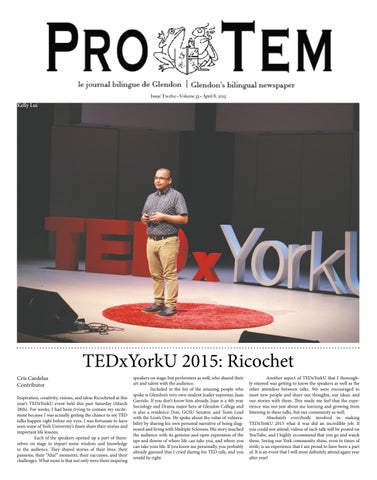
TEDxYorkU 2015: Ricochet Cris Cardelus Contributor Inspiration, creativity, visions, and ideas Ricocheted at this year’s TEDxYorkU event held this past Saturday (March 28th). For weeks, I had been trying to contain my excitement because I was actually getting the chance to see TED talks happen right before my eyes. I was fortunate to have seen some of York University’s finest share their stories and important life lessons. Each of the speakers opened up a part of themselves on stage to impart some wisdom and knowledge to the audience. They shared stories of their lives, their passions, their “Aha!” moments, their successes, and their challenges. What more is that not only were there inspiring
speakers on stage, but performers as well, who shared their art and talent with the audience. Included in the list of the amazing people who spoke is Glendon’s very own student leader superstar, Juan Garrido. If you don’t know him already, Juan is a 4th year Sociology and Drama major here at Glendon College and is also a residence Don, GCSU Senator, and Team Lead with the Lion’s Den. He spoke about the value of vulnerability by sharing his own personal narrative of being diagnosed and living with Multiple Sclerosis. His story touched the audience with its genuine and open expression of the ups and downs of where life can take you, and where you can take your life. If you know me personally, you probably already guessed that I cried during his TED talk, and you would be right.
Another aspect of TEDxYorkU that I thoroughly enjoyed was getting to know the speakers as well as the other attendees between talks. We were encouraged to meet new people and share our thoughts, our ideas, and our stories with them. This made me feel that the experience was not just about me learning and growing from listening to these talks, but our community as well. Absolutely everybody involved in making TEDxYorkU 2015 what it was did an incredible job. If you could not attend, videos of each talk will be posted on YouTube, and I highly recommend that you go and watch them. Seeing our York community shine, even in times of strife, is an experience that I am proud to have been a part of. It is an event that I will most definitely attend again year after year!
Pro Tem
Editor in Chief | Rédactrice en chef Natasha Faroogh editor@protemglendon.com Assistant English Editor | Rédactrice adjointe (anglais) Stephanie Settle assistanteng@protemglendon.com Assistant French Editor | Rédactrice adjointe (français) Gervanne Bourquin assistantfr@protemglendon.com Section Editors | Les rédactrices de sections Campus Life | Vie de Campus Erika Desjardins campuslife@protemglendon.com Issues and Ideas | Enjeux et idées Lindsey Drury issuesideas@protemglendon.com Health and Wellness | Bien-être et santé Samantha Kacaba healthwellness@protemglendon.com Metropolis | Métropole Neya Abdi metropolis@protemglendon.com Arts and Entertainment | Arts et divertissement Ashley Moniz artsentertainment@protemglendon.com Expressions Sienna Warecki expressions@protemglendon.com
Letter from the Editor
Dear Glendonites, This issue features the Japan Symposium and has articles on TEDx@Yorku and the Student Engagement and Service Awards at Glendon. All of these articles exemplify all that Glendon College students have to offer the community. I hope that after reading these articles, you are inspired to get more involved in campus life, and even on our newspaper! This issue is our last copy going to print for the academic year 2014-2015. Thank you for reading Pro Tem this year. You are a dedicated readership and you keep Pro Tem thriving and still printing in an otherwise digital media saturated world. You are the reason we print. You are the reason we have been able to revive Pro Tem and have it become a strong staple of Glendon’s identity today. As some of you may know, I have been working on the paper for the past four years. First as a Section Editor, then as an Assistant editor, and finally as Editor in Chief for the past two years. As my team teases me, Pro Tem has been my baby. I have loved it, and worried about it, and taken care of it, and given it some more love. It has been a pleasure and privilege to work on the paper during my time at Glendon. I have had the opportunity to meet great people along the way including other enthusiastic student club and levy organization execs, the ever friendly and helpful administration at Glendon, and finally, you, the readers, and the writers, who stopped and chatted with me in the halls about Pro Tem. It has been a wonderful
experience for me. Thank you very much for being a part of it. Of course, I did not mention my team in the above list, because they deserve a special mention. I would like to thank the teams that I have worked with for both 2013-2014 and 2014-2015. I had the honour of leading two groups of creative, intelligent, opinionated, and dedicated individuals who really care about Pro Tem. They came together to create two of the most hard-working teams I have ever met on campus. It was a pleasure to work with them. I will remember the long nights we spent in the office working on the constitution and finances, the wonderful afternoons with tea, the never-ending running jokes (don’t break the pen!), the hilarious comments about editing, the way we would get off schedule because we were having too much fun talking about something completely unrelated to Pro Tem (my biggest success is that the Pro Tem team are friends and enjoyed coming to the meetings), the support the team members had for each other’s work, the way everybody cared to help the team move forward, and the way people went above and beyond their expected roles to make Pro Tem what it is today. Thank you for all the memories. Always, Natasha Faroogh Editor in Chief
Kelly Lui
Communications Officer | Agente de communications Victoria Ramsay communications@protemglendon.com Design and Layout | Maquettiste Megan Armstrong
Pro Tem est le journal étudiant du collège Glendon. Publié pour la première fois en 1962, c'est la plus ancienne publication de l'Université York. We strive to act as an agent of social change, and will not print copy deemed racist, sexist, homophobic or otherwise oppressive. Please respond to what you read in the pages of Pro Tem/ n'hésitez pas à réagir à ce que vouz avez lu dans Pro Tem. Contact us/ Contactez-nous: protem@glendon.yorku.ca The Pro Tem Office D114 Hilliard Residence, Glendon College 2275 Bayview Avenue North York, ON M4N 3M6 The office is open by appointment only. Le bureau est ouvert sur rendez-vous seulement. Les lettres adressées au journal peuvent être éditées au niveau de la clarté ou de contenu. All copy appearing in Pro Tem is at the discretion of the editorial team. Opinions published in Pro Tem are the thoughts of individual writers, and not the publication as a whole.
2
Kelly Lui
Student Engagement Awards 2015
Vie de Campus
Kelly Lui
Office of Student Affairs Contributors The Student Engagement Awards evolved from the Student Service Awards, which was designed to award one or a few students for their on-campus contributions. Wanting to expand the event to the wider Glendon community and with the support of the Friends of Glendon, the GCSU, Student Financial Services, and Theatre Glendon, the Student Leadership Awards and Celebration was created to publicly celebrate a wider scope of student leadership across campus. This year, we continued to expand the concept and have introduced the Student Engagement Awards to capture the broader purpose of the celebration: to honour engagement and achievement in educationally and developmentally purposeful activities in campus life. We received close to 40 nominations. A cross-section of staff members met to review and rank the quality of the applications. Today, we’re excited to announce to you 24 award recipients. Honourable Mentions We would like to start our awards with an honourable mention for several students who have shared their passion for student activities and initiatives through their involvement at Glendon. Our first honourable mention goes out to: Tia McNeil has dedicated a lot of time and effort to her work with Glendon Roots and Shoots. As their co-chair, Tia leads events that promote sustainability. Tia is also an active Lion’s Den Peer Mentor, a member of the Residence Peer Review Board and is the Volunteer & Events Coordinator at Lunik Co-op, where she helps groups on campus organize events at Lunik. Félicitations Tia! As president of the York Glendon Global Issues Group (YGLgig) Club, Samantha Caldeira Slavec has worked hard to lead her team in fundraising community projects in Nicaragua. Her leadership has inspired others to think globally and to act locally. Félicitations Samantha! In addition to being very active in her community outside of Glendon, Shefali Jain is an active member of the Glendon South Asian Network and Glendon’s Volunteer Club. She was also a very enthusiastic D-Frosh where she helped to welcome new students into university life by leading activities during frosh week. Shefali also shares her love and passion for dance through her participation on the executive team of Frenched, Glendon’s Dance Team! Félicitations Shefali! Michelle Kearns has been involved through much of her undergraduate career at Glendon, from on-campus jobs with ITS and recruitment to being involved with many campus organizations. This year, she was the Environment and Facilities Coordinator where she has demonstrated hard work and passion for Lunik and the Glendon community. She was also been a dedicated member of the Model UN and has contributed to Radio-Glendon and Protem. You may also recognize her for her work as an eAmbassador. We wish Michelle the best of luck in her graduate studies in Urban Panning. Félicitations Michelle! Sarah Yenny Yu’s contributions to Glendon’s online presence has influenced many new Glendonites and inspired many other creatives. In addition to being an excellent eAmbassador, she has worked behind the scenes on the social media campaigns for events like Frosh Week, YU Charity Ball, and TEDxYorkU. Sarah also co-founded her
club, Crépot, a digital media group for artists to learn from one another and get connected with opportunities to exercise their talents for different campus organizations. Sarah is considered to be mentor among her peers. Through Sarah’s work in Student Recruitment, she has been able to share her creativity, dedication and talent to the Glendon Community. Félicitations Sarah! As a Lion’s Den Peer Mentor, Stephanie Mak has shared her dedication and passion for community building that many students have benefited from. Stephanie thrives at making people feel welcomed, creating personalized warm and fuzzy messages for any student, contributes to ProTem, and plays the flute for the Glendon Musical Ensemble. Stephanie is an inspiration to her peers. Félicitations Stephanie! Outstanding Contribution to Student Life The Award for Outstanding Contribution to Student Life recognizes student leaders who have had a positive impact on the student experience at Glendon. These individuals have generously donated their time and talent to the Glendon Community. Our first award for outstanding contribution to student life goes to Chrissy Bowman. Chrissy has done an exceptional job in running LionHeart Productions Coeur de Lion, the student run theatre company at Glendon. A huge supporter of the arts on campus, Chrissy always makes the effort to attend all events held at Theatre Glendon, Lunik, and the art gallery. Her peers believe that she is the very definition of "back stage" worker. She doesn't always get to be in the spotlight, but that doesn't mean her hours of hard work and dedication should go unnoticed. Félicitations Chrissy! Our second award for outstanding contribution to student life goes to Brynn Leger! As an active member of Lunik and the Lunik Logistics Coordinator, Brynn has contributed to the co-operative's stability and future vision. Her peers believe that Brynn's investment in the co-operative surpasses the time, energy and creativity required for meeting the goals of her paid position. Brynn carries the policies, visions and community values forward to by sharing these with existing and new Lunik members, Glendon staff and
new Glendon students. Félicitations Brynn! Our third award for outstanding contribution to student life goes to Jenny David! Jenny organise et participe à des activités d'autres clubs tels Glendon Political Sciences Association, Foreign Affairs Council of Glendon, etc. Elle est co-éditrice en chef de la Revue d'Études internationales de Glendon (REIG, ou en anglais GJIS) où elle dirige une équipe d'étudiants (éditeurs et réviseurs), communique avec les auteurs et collabore avec des étudiants recrutés des programmes de Traduction et d'Études Anglaises. Elle est membre du Caucus étudiant où elle siège sur deux comités et participe aux réunions du Caucus et du Conseil de la Faculté de Glendon à tous les mois. Elle est aussi la Présidente de l'Association étudiante des Études internationales (AEEI, ou en anglais ISSA). Félicitations Jenny! Outstanding Contribution to Residence Life This next award recognizes the outstanding contributions made not only to student life but to residence life as well. Our recipient for this year’s award for Outstanding Contribution to student life and residence life goes to Cristina Cardelus. Cris has made her presence known at Glendon through her participation and active involvement in the Lion’s Den, the GCSU, on Residence Council and on the Residence Peer Review Board this year. As a team leader with the Lion’s Den, Cris facilitates workshops, provides support to students, and runs events while liaising with their team of volunteers. Her leadership qualities and dedication to both campus life and residence life have helped her in being selected to serve as a Residence Don next year. Félicitations Cris! Outstanding Contribution to University Governance The Award for Outstanding Contribution to Governance recognizes student leaders who have had a positive impact on the student experience at Glendon through their work on Academic committees. This individual has generously donated his time and talent to the Glendon Community. In addition to being a well-loved don in Hilliard Residence, an active Lion’s Den Team Lead... (Continued on page 4 and 5) 3
Campus Life (Continued from page 3) ... and supporting campus life, Juan Garrido is also a Student Senator on the GCSU. His peers noted how he excels as Senator, representing the student's concerns and bringing them forward to be addressed. Félicitations Juan! Emerging Leader Awards The Emerging leader awards recognize the contributions of students who have recently become involved in student activities and life at Glendon. This year, we have four recipients who have demonstrated strong investment, commitment and dedication through their leadership at Glendon. The first recipient we would like to congratulate is Amrita Singh. Amrita is the Head Coordinator of the Glendon Women and Trans Centre (GWTC) where she makes herself available to her peers around the clock. She is also involved with Lion Heart productions and has started her own column in ProTem. Through her leadership, the GWTC has been renovated and policies have been updated, further establishing the centre, the women’s shelter and the food bank as important resources on campus. Félicitations Amrita! The second recipient we would like to congratulate is Nadia Edwards. Nadia was nominated three times by her peers who spoke about her commitment to building GL spirit and her dedication to Glendonites and to campus life. She is a councillor on the GCSU and participates in a wide variety of clubs where she not only attends, but helps to set up and clean up. She also took one of the lead roles in organizing Glendon’s events for the la Semaine de la Francophile. Félicitations Nadia!
Kelly Lui
The third recipient we would like to congratulate is Lydie Matu-Kiama. Lydie is the President of the Glendon African Network and is a hard working member of the GCSU. She is often seen going the extra mile at GCSU events and has worked tirelessly to raise the standard of the Glendon African Network’s events and initiatives. She also took one of the lead roles in organizing Glendon’s events for the la Semaine de la Francophile. Félicitations Lydie. The fourth recipient we would like to congratulate is Asha Collins. Asha does an excellent job at promoting school spirit on social media, she spearheads GlMetoWe, and works day in and day out with the GCSU, first as a councillor and then as VP Communications this year. Her peers have been inspired by her positive and professional attitude and leadership. Félicitations Asha! The following Drama Studies and Athletic awards were presented by guest speakers. Prix Molière Presenter (Gabrielle Houle): Gillian Murphy Robert Wallace Award (Drama Studies) Presenter (Gabrielle Houle): Christopher Parnell John Proctor Award Presenter (Aaron Doupe): Matt Turner Athlete of the Year Award – Ian Bingham Award Presenter (Julissa Alvarez): Kristina Luce Rookie Athlete of the Year Presenter (Julissa Alvarez): Jenna Krajinovic David McQueen Award for Outstanding Contribution to Student Life The David McQueen Award recognizes a student 4 for their outstanding contribution to student life
Kelly Lui and community development at Glendon. This year’s recipient is Gillian Wasssmansdorf. As a graduating student, Gillian has become involved and active within many areas of campus life. Throughout her time at Glendon, Gillian has served as a First year Rep, Vice President Social, President and Orientation Chair of the GCSU. She was also a distinguished member of the Glendon Liberals, was an active member of residence life, has worked at the GAC and in recruitment, and was the co-founder and co-coordinator of York University Charity Ball, a fundraising event designed to help those in need in our greater community. Since 2013, YU Charity Ball has raised $32,000 for charitable organizations in the Toronto area. Félicitations Gillian! Friends of Glendon Student Service Awards The Friends of Glendon are very generous supporters of Glendon’s Student Service awards. They fund the next two awards and helped to create and support the Margaret Wallace Award, the top honours for today. The Friends of Glendon Awards for student service recognize the high-
est level of campus engagement. This award celebrates the exceptional dedication of student leaders who have made outstanding contributions to the Glendon community and campus life. Friends of Glendon (2nd award) The recipient of our first award is Natasha Faroogh. In just a short period of time, Natasha has managed to revive ProTem, the campus newspaper. Natasha has inspired many through her leadership and energy as Editor in-Chief during the last two years with ProTem. Under her leadership, ProTem has increased the number of issues per year, has ensured a greater breadth of content, has positioned itself as a staple item in the eyes of many Glendonites, has funded a number of student led projects and has been a unifying force among student organizations. Félicitations Natasha! Friends of Glendon (top award) The final and top award for the day, The Friends of Glendon Student Service Award, goes to Kelly Lui! Kelly has made lasting contributions to our community throughout
Campus Life her time at Glendon. Having co-founded Crépot, a club for digital media, Kelly lends her talents to take pictures for countless events at Glendon and facilitates opportunities for others to contribute their creative talents. As an eAmbassador with Student Recruitment, Kelly helps to build GL spirit through her blog posts about life on campus and in residence. This year, she has been an integral part of the Japan Symposium Committee. As a residence Don, Kelly has made a strong impression and impact within the reslife community. Kelly’s strength as a leader is demonstrated by the sense of belonging and community she instils, not only in her residence house, but within residence as a whole. Kelly can be counted on to host events and activities that build community and integrate students into life on-campus. Despite her busy schedule, she has also dedicated her energy to organizations on campus including the GWTC and RadioGL. Her peers often comment on the fact that she always has a smile on her face and she's always encouraging everyone to be their best. Kelly not lives student engagement, but empowers others to do so as well. Félicitations Kelly!
All pictures on this page by Kelly Lui
Margaret Wallace Award The Margaret Wallace Award recognizes a student who has demonstrated participation and leadership in campus life and engagement in athletics. This award was created in memory of Margaret Wallace, director of the Glendon Athletic Club. The recipient of this year’s Margaret Wallace award goes to Bryan Hansraj. Bryan has been an active presence on campus and within student life at Glendon. Bryan consistently shares his enthusiasm for Glendon through his involvement with the GCSU, this year as VP Clubs. As a D-Frosh, Bryan worked as a mentor throughout orientation to help integrate incoming students to campus life. As VP Clubs on the GCSU, Bryan has created and facilitated opportunities for student and student group connection and engagement across campus. His peers recognize that in this role, he has gone far above and beyond expectations and raised the bar for future VP Clubs. He also shares his passion for Glendon through his position as an eAmbassador for Student Recruitment. Félicitations Bryan! Thanks to all the sponsors of the awards: Friends of Glendon, Office of Student Financial Services, Office of Student Affairs, Residence Life and Office of Student Services.
5
Vie de campus Who Am I? “What” Am I?
Thoughts After Japan Symposium Asuka Sugiyama Contributor “Where are you from?” “What is your cultural/ethnic background?” I think most of you have asked these questions to someone you've met for the first time. Throughout my first year at Glendon, I have heard many people’s discussions of nationality and their backgrounds. But in an extreme case, people ask you this question: “WHAT are you?” This question is exactly the one I kept asking myself for the entire year, especially last month. On Sunday, March 29th, the Japan Symposium took place. There were 5 panels you could attend to learn more about different aspects of Japan, ranging from its politics to pop culture. Attendees enjoyed Japanese cultural traditions like food and dances, and socialized with others while having wine and cheese. As someone born and raised in Japan, this symposium was one of the most special experiences I've ever had in my entire life. I came to Glendon as a transfer student last semester and had no idea about what kind of opportunities the International Studies department would provide me throughout the academic year. Of course, I didn't know anything about symposium. On the academic orientation day, I learned that, each year, several 4th-year students from the ILST department are chosen to study one country and host a symposium at the end of the year. That sounded like a great opportunity for someone like me who wants to learn “something international”! And this year, coincidentally, the country the team chose was Japan! And I got to know one of the team members during the frosh week!!! HOW EXCITING!? My friend who is also into Japan and I have been excitedly waiting for the entire year to be part of the symposium. We tried to get in touch with team members and ask them questions about it. The opportunity “to be part of the team” finally came in January, when the team was hosting an event called “Café Nihon.” That was the time when I could finally ask them what I could do as a Japanese. Then they suggested that I join it’s salon, where people could chat and ask random questions about Japan. That sounded perfect to me. I could tell people anything about my country. That could be our traditions, languages, food, music, or fun facts. This “Café Nihon” became a successful event. I could talk to more people in Glendon, including some from the team. A couple of weeks later, I could finally register to be a volunteer for the symposium. And I started to think more and more about Japan and who I am as a Japanese. So far, I felt more than happy to meet people who are interested in Japan, some of whom know more about my country than I do. While I was glad to know my friends’ passion for Japan, I was concerned about this: “What if they misunderstand our culture?” “What if they believe in stereotypes that make no sense?” Misunderstandings or misperceptions towards one culture are not uncommon. They are also some of the extreme stereotypes we have towards culture we are not familiar with. There are people who say, “oh are you Japanese? I LOVE sushi so much,” who talk about how great and inspirational anime is for them, who shows me a Chinese book and call it Japanese, or who throw random Japanese words at me and make me confused. I can laugh and correct them. That is totally acceptable. I do that too. By the way, I do not read manga nor do I watch anime. I also encounter this conversation that goes like: Someone: “Are you Japanese/Chinese/Korean?” 6 Me: “Yes?/ No, sorry, I'm Japanese.”
Someone: “That's what I thought./ Really? You look Chinese (or Korean). But how do you guys distinguish among Japanese, Chinese, and Korean? Though I don't like that people judge you and guess where you are from based on your appearance, I get it and am used to it. We also make the same mistake or misperception towards us in Eastern Asia. So as symposium was approaching, I started to feel “obligated” to correct others’ knowledge of Japan because I started to wonder if there was a misrepresentation that needed to be fixed. I can't ignore when something is wrong discussed about my country. Moreover, I was also concerned because some of the audience might be Japanese or those who are into Japan, like my friends. They could detect if something is wrong, and here I am a volunteer - it may be my responsibility to correct that as soon as possible. While correcting other volunteers or those who stopped by at the ticket booth, I felt a bit scared of knowing “what I don't know”. What if I tell people wrong facts? How can I correct wrong facts and convince people? How can I apologize to people who tell me the right thing but I deny? This was the real struggle. I did look up facts and customs I was not sure of, but still some of them did not make much sense. This whole circle of thoughts or wonders is something that you may experience when you live abroad. What people know about your country is sometimes simply wrong, and sometimes it is difficult to correct them in the right way. People tend to believe in what has been in their brain for the long time, which is why it is very hard to get rid of stereotypes. Stereotypes cannot go away unless you learn about a certain culture or you live in a different country. Then the first question popped up in my mind: “What are you?” Well, I am Japanese. My parents are Japanese. I was born and raised in a city called Osaka, the 3rd largest one in Japan. I came to Canada after graduating from high school. I am in touch with my family and friends. I do check the news. But that question became more complicated: “What am I representing?” “What is my role in the symposium?” My simplest answer was, “I am the bridge between Japan and Canada.” I found myself standing between Japanese and Canadian perspectives for the first time in my life. I have had many opportunities to teach people about Japan, but this time I found myself adopting Japanese cultures to Canadian contexts. I am not the perfect model to represent Japan. I've heard people saying that I am “not a typical Japanese”. I have adopted western ideas and I actually prefer them to eastern ones. But that is something I can do best. I can share with people what I know from both sides. I still feel a bit odd to say that I “link” Japan to Canada, but I do to some extent. Though some Japanese do not like to speak about Japan a lot, I do so on many occasions. I am also confident in representing Japan and what “I'm sure I know.” Why? Because that is where I am from! It turned out that I was the only Japanese volunteer there, so I used the full advantage of being a Japanese both in setup and on the very day. I decided to “represent” Japan. On the day of symposium, I had chances to chat with attendees. Some praised my yukata, the traditional Japanese dress I was wearing (thank you!), some talked to me in Japanese (yukata and my name tag were good indicators), some wondered if I studied at Glendon (yes I do!), and others gave me and fellow volunteers good feedback on the symposium. I learned a lot from being part of the symposium. That was one of the most important lessons I would have while studying in Canada as an international student, being a Japanese living abroad.
One of the truths I learned was that no matter what happens or no matter where I am, I cannot separate my Japanese identity from myself. I cannot pretend to be a Canadian. My Japanese identity is always attached to me. And being proud of myself as a Japanese all the time is not a terrible idea nor too nationalistic; it is the best way to express who I am in places where everything is different. If you are about to go on exchange, be prepared - you'll never know what kind of questions you are about to be asked. Finally, though for a short period of time, I appreciate that I could be close enough to the team and the symposium. Thank you very much to everyone who was involved in symposium. Thank you for providing me this opportunity. Arigatou Gozaimashita (“Thank you very much” in Japanese.)
FOOD GLORIOUS FOOD Tulip Tales! Jennifer Coté Contributor If you’re anything like me, you love food. If you love food, then Europe is the place for you! Don’t get me wrong, I love Canadian food. Poutine, beavertails, good ol’ Canadian beer and BBQ season in the summer time. The things I would do right now to taste mom’s cooking…..It’s been a while. But, the great thing about Europe is that you have so many countries all squashed together!! The food you get to try while traveling is so diverse, you can never get bored. For my past little adventure, I was in Berlin, Germany and Krakow, Poland. I ate some of the most amazing food in the entire world (I’m just guess-timating here, but I wouldn’t be surprised if it actually was the best). WARNING: you may cry reading this post, because you’ll want to reach into your screen and take the food and marry it. BERLIN Pretzels! Okay, so maybe pretzels aren’t that special, but the lessthan 1 euro pretzels bought fresh from a bakery, with the perfect amount of salt on them…They’re no joke, people. Berliner Pfannkuchen (Berliner for short) A berliner is kind of like a jelly doughnut, but not. It’s the same idea though. You can get it with powdered sugar or icing on top. I tried both because I was on vacation and YOLO. Currywurst It’s a kind of German sausage, with a curry sauce on top. Often served with a side of fries – with mayo, obviously, because it’s Europe. Paired with a local Berliner beer, you pretty much have found perfection for under 5 euros. Bratwurst and Basically all the –Wursts Being in Germany, any kind of sausage is pretty much a good call. They take it very seriously. I ordered one kind my first day in berlin, and it was WHITE. I was skeptical, but it was actually amazing. Never question a German-wurst. Schnitzel With a side of potatoes, greens, and a salsa-type topping, I swear to God, a little piece of heaven was on that plate. (Continued on next page...)
(Continued from page 6) KRAKOW Pierogis In Poland, they do pierogis right. I went into this magical basement polish restaurant in Krakow where I ate a mix of three kinds of pierogis – cheese, spinach, and a third kind I can’t remember but it was amazing. I was so full, but I couldn’t stop. They were amazing. I may be drooling just thinking about it. If you ever find yourself in Poland, pierogis are a MUST. Borscht Borscht is a polish soup made mainly from beetroot. It’s a deep red/purple colour that gives you comfort just looking at it. It’s surprisingly delicious, being made from beetroot. Barszcz Biały Also called “white borscht”, barszcz is a soup often served with a hard-boiled egg, a sausage, and a piece of bread. This sour rye soup is a DO-NOT-MISS when you hit up Poland. Polish Stew I’m not sure what the Polish name for it would be, but I ordered a Polish stew one day, and it came with rye bread. A must-try in Poland. Polish Pastry So, I can’t tell you the name of whatever it was I ate from a Polish pastry shop; I went in and asked the lady for something delicious and Polish. She gave me a knowing smile and I left the pastry shop with two treats. There was chocolate, and sugar, and carbs, and incorporated everything you could ever want in life. Travelling Europe is a great time to test your taste buds, to enjoy and let yourself go a little. You walk so much, who cares if you treat yourself. So enjoy the food, and eat up all that culture. For more information and stories from my travels, check out my blog! www.jennifercgl.wordpress.com
Pro Tem Vous aimez écrire? Vous aimez éditer? Vous adorez la photographie? Vous adorez designer? Pro Tem a besoin de vous! Envoyez-nous un mail à editor@protemglendon.com pour en savoir plus sur les procédures pour rejoindre notre équipe!
Issues and Ideas
L'internement japonais
Erika Desjardins
Erika Desjardins Editrice de la rubrique « Vie de campus » Le 29 mars 2015 à partir de 8 h 30 jusqu'à 18 h 30, a eu lieu le Symposium du Japon à Glendon. Organisé par des étudiants en études internationales, le Symposium a rassemblé des centaines de personnes intéressées par la culture, les politiques et l'histoire riche du Japon. C’était le 20e symposium annuel organisé. Chaque année, un pays différent est choisi pour le symposium. L'année dernière, c’était les États-Unis, en 2013; la péninsule coréenne, en 2012; l'Allemagne et ainsi de suite. La journée a commencé avec un petit déjeuner dans le foyer du Centre d'excellence, suivie par la cérémonie d'ouverture durant laquelle notre Principal—Donald Ipperciel—a dit « I feel like a proud father of these students », lesquels ont commencé à organiser cette magnifique journée il y a des mois. L'orateur principal (James Heron), un ancien de l'Université York et le directeur administratif du Japanese Canadian Cultural Centre s'intéresse au Japon depuis son enfance. Il souligne l'importance de la phrase « shikata ga nai » dans le cadre du principe de gaman (accepter la réalité des choses et l'endurer avec dignité et grâce). « Shikata ga nai » est l'équivalent japonais de l'expression française « C'est la vie ». Cette phrase prend tout son sens avec l’un des orateurs—Frank Moritsugu—qui a survécu à un des camps d'internement canadiens. Son discours était fort intéressant. M. Moritsugu était clairement encore fâché en conséquence de son internement et celui de sa famille. Malgré tout ce qui lui est arrivé, il a su garder un bon sens de l'humour. Quelques 22 000 personnes d'origine japonaise ont été enfermées durant la Seconde Guerre Mondiale par le gouvernement du Canada. Leurs biens ont été confisqués et vendus aux enchères sans la permission des propriétaires. La famille de Frank a été déplacée et séparée entre les années 1942 et 1949. Selon Frank, l'internement était « totally unjustified » il se demandait souvent « What the hell have we done? ». Il ne pouvait pas comprendre pourquoi toutes les personnes d'origine japonaise se faisaient interner. « People of Japanese origin could not be trusted to remain faithful to Canada. » Il s'est fait dire qu'il se faisait interner « to be protected from angry Canadians (about the Pearl Harbour attack). » Mais alors, s'ils étaient internés pour leur protection, pourquoi est-ce que les fusils étaient pointés vers l'intérieur du camp d'internement à la place de vers l'extérieur? Les Japonais ont reçu le nom de « enemy aliens » de la part du gouvernement canadien. Même si M. Mortisugu parle plutôt l'anglais et n'avait jamais visité le Japon, « I still wasn't Canadian enough ». Les Japonais ont vécu l'enfer en conséquence de la guerre et du traitement injuste de la part du gouvernement canadien. Il n'avait le droit de voter à aucune élection, ni celui d'être avocat, pharmacien, fonctionnaire. Ils devaient apporter une carte d'identité partout où ils allaient. De plus, même s'ils ont été libérés à la fin de la guerre, ils devaient recommencer leur vie. Ainsi, le symposium a pu mettre en lumière non seulement des éléments de la culture japonaise, mais aussi canadienne, remettant parfois en question notre vision de notre nation.
Dissertation:
La gratuité scolaire Isabela Eedy Contributrice Le débat au sujet de la gratuité scolaire au Québec est un processus qui continue depuis les années soixante, lorsque le parti Libéral de Québec a proposé la gratuité scolaire de la maternelle jusqu'à l'université. Au lieu de la gratuité scolaire, ils ont gelé les frais de scolarités. En 1990, les frais ont été dégelés. Ensuite, en 2007 le gouvernement a annoncé une hausse des frais de scolarité et une augmentation de $500 chaque année pendant cinq ans. En réponse, la plus grande grève des étudiants de l’histoire du Québec a lieu en 2012, le “printemps érable.” Marie-France Bazzo pose la question: est-ce qu’il faut restaurer l'éducation gratuite de la maternelle à l'université? Les arguments les plus importants en faveur de la gratuité scolaire consistent en: l'accessibilité pour tous, il y a beaucoup de façons de rendre l’université gratuite et les frais sont trop élevés pour les étudiants d’aujourd’hui. C’est vrai que l’accessibilité à l’éducation aiderait les gens à obtenir des emplois et minimiser la dette personnelle. En plus, ce n’est pas juste que les étudiants qui n’ont pas les moyens de payer pour l’éducation universitaire ne puissent pas étudier pourensuite travailler dans la carrière qui les intéresse. Actuellement, si on avait l’éducation post-secondaire gratuite, les taxes augmenteraient mais les avantages dépasseraient les inconvénients. Les arguments contre la gratuité scolaire consistent en: c’est irresponsable, c’est une injustice générationnelle et une injustice sociale. Si on augmente les impôts, nos enfants et leurs enfants vont devoir payer. En plus, ce n’est pas juste que les générations précédentes n’aient pas eu une éducation complètement gratuite. Mais je ne pense pas qu’on devrait prendre une décision basée sur ceci parce que le changement est inévitable et c’est un changement qui a été promis en 1961 qui n’a pas encore été fait. Les injustices sociales et générationnelles, qui ont été discutées par Simon Pépin, ne soutiennent pas fermement l’argument contre la gratuité scolaire. Ce n’est pas logique que les étudiants de cette génération ne puissent pas recevoir l’éducation gratuite parce que les gens qui ont étudié dans les années soixante ou soixante-dix n’ont pas pu y avoir accès. L’accessibilité pour tous est pleine de logique – pourquoi est-ce que les gens avec l’argent peuvent étudier sans problème et les autres doivent se noyer dans la dette pour le reste de leur vie pour la même éducation? Je crois que l’élimination des frais de scolarité est complètement rationnelle, particulièrement quand on regarde les pays comme la Finlande et la Suède qui ont une éducation gratuite qui fonctionne si bien pour leur société. 7
Issues and Ideas
Métropole
Erika Desjardins
Pro Tem Do you love writing? Do you love editing? Do you love photography? Do you love designing? Pro Tem wants you! Email us at editor@protemglendon.com to find out how you can apply for the team!
Est-ce que les footballeurs sont vraiment trop payés? Fatima Anjum Contributrice En 2013 les frais de transfert offerts pour le joueur de football Gareth Bale étaient de 100 millions d’euros, payés par le club de football Réal Madrid. L'année suivante, Luis Suarez a été acheté pour 81 millions d’euros par le club de football Barcelona. Lionel Messi, qui est considéré le plus meilleur joueur du monde, reçoit 20 millions de dollars par an pour jouer. La question se pose: est-ce que les joueurs de football gagnent trop d'argent? Je ne pense pas qu’ils reçoivent trop d'argent, car ils sont responsables de gagne des 8 matchs où la compétition est forte et rapportent un
important profit à leur club. De plus l’argent qu’ils gagnent est comparables à celui gagné par des gens qui réussissent dans le domaine de leur emploi. Actuellement, les joueurs de football, avec la technologie d’aujourd’hui, rivalisent à un niveau supérieur à celui des joueurs d’hier. Il y a des entraîneurs pour aider chaque joueur et pour aider avec chaque partie de leur performance athlétique. De plus, il y a beaucoup plus d’argent impliqué. Le journaliste Rémi Baldy affirme ainsi: « Pour avoir des droitsTV importants, il faut être diffusé. Pour être diffusé, il faut gagner. Pour gagner, il faut les meilleurs joueurs. Pour attirer les meilleurs joueurs, il faut proposer des salaires importants. » Les meilleurs joueurs ont un prix parce qu’ils existent en quantité limitée. Donc, c’est raisonnable que les joueurs de football gagnent ce salaire. De plus, les joueurs de football sont une source de profit pour leur club, suffisamment pour compenser leur frais de transferts. Frédéric Lassalle, spécialiste du sport, a dit que « Le transfert au Real Madrid de Cristiano Ronaldo pour 96 millions d’euros a été récupéré en 18 mois, grâce principalement aux droits à l’image. ». En dehors du contexte du jeu, il y a plusieurs choses qui produisent des bénéficie pour un club. Les choses comme les marchandises (comme les maillots), droits de télévision, et les sponsorings sportifs, représentent une bonne partie du profit pour un club et c’est les joueurs qui les font vendre. Donc, dans une perspective d’ensemble les salaires des joueurs de football ne sont pas excessifs. Effectivement, d’autres personnes qui réussissent dans leur domaine gagnent autant d’argent. Tiger Woods, qui est considéré le meilleur joueur de golf, est à 486 111 d’euros par trou du parcours. La minute de Grand Prix de Schumacher est à 46 666 d’euros. Google et Apple recrutent des chercheurs du MIT, ils les payent aussi très cher. Donc, cela n’est pas seulement le « problème » du monde de football, les hauts salaires sont autour de nous dans tous les domaines professionnels. En conclusion, les joueurs de football ne gagnent pas trop d’argent. Dans un contexte plus large, les joueurs de football jouent de manière bien plus compétitive que les anciens joueurs de football, ce qui justifient l’augmentation des salaires, même si ceux-là ne semblent pas obéir aux logiques traditionnelles du monde du travail.
Symposium du Japon : La nourriture
Erika Desjardins Editrice de la rubrique « Vie de campus » Entre la performance de trois numéros de la danse culturelle Yosakoi du groupe de danse Sakuramai et la présentation de laido de la part du dojo Mu Mon Kai s’est trouvé un repas digne de 4 étoiles. Bien que la nourriture ait refroidi, elle était quand même délicieuse. Préparé par le restaurant Edo à Toronto, le repas offrait plusieurs mets différents originaires du Japon, soit le sushi, l’edamame, le broccoli cuit à la vapeur, le riz couvert d’épices, de légumes et de poisson cru, le poulet teriyaki, la soupe miso, le takoyaki et d’autres mets dont je ne connais pas le nom. Désireuse de découvrir des mets que je n’ai jamais eu l’opportunité de découvrir, j’ai pris de chaque mets offert en petites quantités. J’ai tout aimé sauf un plat de nouilles brunes accompagné d’un sauce quasi-transparente de couleur brune—ça en dit beaucoup. J’ai aussi apprécié qu’on nous ait donné le choix entre de la sauce soja normale et avec moins de sel. Les petits détails comptent aussi et j’apprécie beaucoup plus les restaurants qui sont minutieux comme Edo a prouvé l’être! Pour ceux qui aiment les sushis succulents et le poulet tendre à point, rendez-vous à l’un des quatre restaurants Edo à Toronto (2901, avenue Bayview; 8500, avenue Warden; 484, avenue Eglinton Ouest ou 425,chemin Spadina).
Health and Wellness It's Time to Leave the Comfort Zone
Arts et divertissements
“My Dress Is My Armor”: Analyzing Pop Culture at the GL Japan Symposium
Lindsey Drury Issues & Ideas Editor I am a medicated, anxiety-prone introvert who thrives in the comfort of safe, isolated, and familiar spaces. I am the kind of girl whose palms sweat if anyone outside of her immediate circle of friends extends an invitation to participate in life. I like to feign illness and fabricate other contrived excuses to get out of any and all obligations which require my physical presence. My heart has perfected the annoying pounding that refuses to let up until these never-ending, dreaded encounters are over. It's just something about the air in crowded rooms that makes it hard to be. So this is me. I was around 10 years old when I discovered this about myself. Just like that, I dropped all extra-curricular activities like a hat. I spent my time alone in my bedroom, or with the handful of people I was able to feel completely comfortable around—to this day, it takes maximum effort to let new people in. This was the easiest way for me to get through life, with no surprises and as little anxiety as possible. The way I saw it was why make yourself do things you don't want to do? To some extent I still agree with this, but I am looking at it in a new way. All this time I wasn't just avoiding what I didn't want to do. I was also keeping myself from the things that I did want to do, but was too scared to. It took me many years to discover the difference. For a long time, I would view my anxiety like this: “If I am dreading this activity/ event so much, then I must not want to do it, and therefore I shouldn't.” The thing about anxiety though, is that it hits you at the most inconvenient times and is not always a reliable source. Anxiety is not always something you should be taking advice from. This revelation all boils down to one incredibly important realization: great things happen beyond your comfort zone. Great things happen when you push. I learned this by climbing my way into the Toronto Youth Poetry scene and leaving my mark. Every time I approach a stage, prepare for a performance, recite a poem, there are always moments where I wish I was curled up in my bed, drinking tea far away from it all. More importantly though, every time I leave a stage, finish a performance, or say the final lines of a poem, I always thank myself for fighting through this feeling. Poetry and performing just may be the most important part of my life at this point in time, and it wouldn't exist for me if I hadn't stepped onto that stage that first time, my insides screaming to go back home. The most beautiful parts of my life were found outside of my anxiety's qualms. Our comfort zones are soft, warm, and lovely places—as the summer, as the womb, as the embrace of a lover. But like all of these things, they are not meant to last, so I encourage you to leave as soon as you are ready. Or even better, when you're not.
Sienna Warecki Expressions Editor When you think of Japan, what comes to mind? Sushi, perhaps, or katana swords; maybe teenagers and twentysomethings dressed in abundantly bizarre clothing and accessories, carrying parasols and swinging purses shaped like cupcakes or crosses; certainly anime, as it’s literally everywhere in Canadian culture these days, from Astroboy to Attack on Titan. All of these are hallmarks of Japanese culture, the latter two being hallmarks of popular culture specifically—and at Glendon’s Japan Symposium, we were able to examine beneath the surface of these phenomena and dissect their impact on Japanese and global society. Anime and manga are so mainstream in North America by this point that we’ve long since been adopting the style for our own media, in shows like Avatar: The Last Airbender. When watching an anime, there is often a choice to make: dub or sub? Do we watch the official English-language version, or the original Japanese version with subtitles? Turns out, if you have the time (and the strength of otaku spirit) to do both, you might find some very interesting differences. According to Dr. Sandra Annett, who presented at the Youth and Pop Culture panel, anime is a fascinating subject when examining issues in censorship; some of us might remember the infamous “cousins” from Sailor Moon, Sailors Uranus and Neptune, who were of course lesbian lovers in the original Japanese version. That got cut out due to the political attitudes of the time, specifically in regards to what was “appropriate” for children to watch. The same goes for an episode of the original 1963 Astroboy (or “Mighty Atom”, to better paraphrase the Japanese title, Tetsuwan Atomu), entitled “Robot Circus”, which displays overt parallels to the Civil Rights movement that was happening in America at the same time. In the Australian and American versions of the show, certain scenes are removed because they too clearly critique slavery and racism. The choice to censor one or another part of an anime can tell us a lot about the sociopolitical environment the anime is being adapted for, as well as the demographic that broadcasting companies are expecting to watch it— and the choice of the original creators to “deodorize” their anime by avoiding mention of elements that would seem “too foreign”, such as Shintoism and Buddhism, is equally interesting. Dr. Annett calls this type of media “transnational”, the result of two cultures each having a hand in a text (an anime, in this case) and hybridizing it according to each of their value systems. Another element of Japanese pop culture that would benefit largely from some context is the “Lolita” subculture. A quick Google Images search will bring up countless pictures of Japanese girls in exceedingly cutesy doll-like clothing, replete with ruffles and lace trim and
bows. This might lead you to believe that Lolita is simply a fashion trend. As Akané D’Orangeville explained in her presentation at the Youth and Pop Culture panel, this is far from the truth: Lolita goes far beyond a simple choice in wardrobe. It is an entire subculture centred around themes of authenticity, gender fluidity, and empowerment. Created in the 80s, Lolita subculture actually began as a way to resist the highly suffocating model of “the Japanese woman”, an archetype that is strictly codified. Girls and women are severely critiqued for deviating from this normative archetype, and one way they have found to push back and express themselves is through the fantastical, princess-like clothing of Lolita. There is an entire community focused around this subculture, complete with special Lolita cafés where participants in the community can come to socialize and have a safe space to be who they are without question or critique. Though Lolita is mainly women-driven, there are some men or male-bodied folk who also participate, and it is a mark of Lolita culture that they are able to dress in the same hyper-girly dresses as females and no questions are asked. For many, the Lolita subculture is a way to relearn how to socialize and belong in a community after a traumatic childhood or adolescence—many have suffered from severe bullying in school, or else have dropped out of school entirely, and for these individuals, Lolita serves as a tool for recovery. “My dress is my armor,” one Lolita girl told Ms. D’Orangeville in her interviews; the choice to make themselves visible and vulnerable on their own terms through the fashion of Lolita is an attempt at standing their ground and reclaiming power over themselves and their self-expression. You could almost go so far as to say that the Lolita subculture is a sort of feminist movement—at any rate, it’s certainly representative of more than some cute dresses! These were the two aspects of Japanese pop culture that were explored in-depth, but there are some honourable mentions: over lunch, there were two cultural performances, the first being a Yosakoi dance demonstration, the second being a demonstration of Iaido, a form of martial art. The shakers used in Yosakoi dance were originally used to scare away birds from rice paddies; Iaido, which is focused on precision and discipline of movement, can seem simple, and almost boring to an observer who does not understand the context, but once it is revealed that the difference between a well-executed Iaido move and a fumble is the difference in a few centimetres’ worth of starting and stopping points for the sword, you begin to appreciate the patience and the intensity with which the practitioners swing their blades. In short, everything is more interesting with context. And that’s what Glendon’s Japan Symposium endeavoured to give us: context. Peeling back the surface of pop culture, especially of a foreign nation, allows us insight into the history and the sociocultural flavour of that nation, and in turn affords us a richer appreciation of the culture we are experiencing and consuming. Sugoi, desune?
Pro Tem
Vous aimez écrire? Vous aimez éditer? Vous adorez la photographie? Vous adorez designer? Pro Tem a besoin de vous! Envoyez-nous un mail à editor@protemglendon.com pour en savoir plus sur les procédures pour rejoindre notre équipe!
9
Expressions Letting Go Lindsey Drury Issues and Ideas Editor I have carelessly spilt dead bodies from my mouth, knowing that letting go would chap my lips. I have licked myself raw from silence. I caught my father staring out the window, opening the screen because life was too short to block out the sounds of it, to feel air that’s been conditioned instead of wind that sits on your skin, created solely by the earth and its determination to spin. These simple wonders were too beautiful to miss. I speak his name in fits of rage, and reminiscences, and before he left, he filled my pens with ink laced in his DNA, so every stanza that besets this stage has been a continuous anagram of his name. I have fed him to you, he pulses through my veins, and I plan to donate blood next month so I can share my angel with everyone. Until then, I will send him through the airwaves. Share my fiery purgatory with stories, three minute long poems that could never begin to take proper shape of the torturous place I was driven into. I throw stones at my father’s window, hoping one day he will come down and tell me he has never missed a thing. That he was pulsing through my skin the day I told my mother I had a girlfriend, that he was tucked beneath my plate when I admitted that eating meat was no longer for me, that he was buried in my doctor’s stethoscope, listening to my heartbeat, as I asked for something to assuage the darkness. But instead, I hear the window breaking, glass showering my skin, yet I cannot stop hurling pebbles. I cannot bring myself to give up on him.
10
I know we are all waiting for
someone to come home, and God knows that no teenage girl can rub out the images of her father’s heaving chest, the suffocating scratch of the surgical mask, the sound of him asking, “who are you?” My daddy forgets me. He’s the only one who gets me. I remember it clearly— I was clutching a crossword puzzle to my chest, trembling, engaging him in memories and the final stories he would ever tell me, all the while listening for key characters' names, so I could write down his pallbearer’s candidates in the boxes. There are some movements that are lost causes. I remember when bile exploded from his orifices, and my mother covers his face— like there was anything left worth protecting us from, she should not have bothered. This thing was not my father. This thing was a cadaver. Not five minutes later, we were asked for permission to harvest his skin. I have been crawling out of mine ever since. I am still trying to see darkness behind these lids, instead of his mannerisms, but I have not yet succeeded. So I sit secreting murmurs, rocking back and forth, spilling out his name in rhythmic swings, building his bones into jungle gyms, hanging off his every word, and sliding down his tongue. I know this man is dead. I know that I’ll be next. I know that without mouths there would be nothing of him left, and so I’m speaking to you gently, and your veins they are exposed. I am building me an army, of electrified minds that will hear my father’s name tonight, and taste it in their throats. Michael. Michael, I am remembering you now, and for three minutes you are allowed to resurrect, to take up residence in the bodies of this crowd, and I will take this time to say I’m sorry. I cannot speak forever, your resurrection drains me, and tomorrow blood will wake me,
dripping from my mouth. I will spend the rest of my life chapping these lips, if I have to, in order to find something new to talk about. Until now, you have hugged me like a tumour, capturing these cells. I am too lucky to hold you as my muse alone. I am too lucky to have even known you. I get to be the lifelines left over from a beautiful man, who is no longer— and what else could I ask for? Except to preserve him in your throats tonight. And now I’ll let him go.
A Deathly Lover: An Experiment with Spenserian Stanza Rachel McLean Contributor Unravish’d by time thou art as thou wait, bedeck’d in simplistic black cloth of old. Thou stand proudly with the power to sate my every need without being told. To be with thee, all my dreams I have sold; a petty price, for with it I do buy an eternity with thee to behold— a magnificence at which I do sigh with happiness. Thy for me thou canst deny nor mine for thee, as thou art my soulmate. And so we shall journey down this long road, watching the sun set as the day grows late and the night, dress’d in purple, becomes bold; this means nothing. Immort’lty we hold as life within my body does untie its claim. My skin turns pale and deathly cold as thou, my Lord Death, do claim me with thy fatal kiss. Now in thine arms, I let go and die.
Have opinions? Like to write? Like to take pictures? Like to draw comics? Email us: editor@protemglendon.com
Expressions Fear as a Lifestyle Samantha Kacaba Health & Wellness Editor I am a lot of things. I am a student, a writer, and a daughter. I am also an outpatient. For the last 4 to 5 years I have suffered from several comorbid mental illnesses. Mental illness, though, is not the topic of this article though, not exactly. Mental illness affects most, if not all aspects of my life. Despite this, I did not seek treatment until very recently. When I look back on my adolescence, I’ve realized that a lot of the trouble I got myself into could have been very easily avoided if I had only asked for help. I am not bitter, at the end of the day the past is the past and I still have the ability to shape my future into a stable one. What I am is afraid. As I said before, I am a lot of things. I am also an older sister. Watching my younger brother growing into an adolescent fills me with pride, but also sparks in me feelings of unease. When I look at him, I see many similarities to the child that I used to be. He is all fearlessness and tenacity, unaware of vulnerability. That makes me worry that his fearlessness will become pride, and that in refusing to admit defeat he won’t reach out for help when he needs it. Not unlike his big sister. I pushed forward for too long on my own, thinking that I could beat mental illness through sheer willpower. I don’t want him to have to go off the deep end when there are other options there for him; whether he be burdened by illness like me or by other issues. The way that I rationalized it was that since both of us grew up in the same household, he would undoubtedly end up having the same complexes when it comes to seeking help that I do. Despite this, for a long time I did not know how to rectify this. I wanted nothing more than to grab him by the shoulders and demand to know each and every thing that burdened him. I would listen to his words earnestly, over analyzing each and every one. The thought of him having to feel alone made me nauseous. I wanted to scream, “I’m here! Talk to me! Confide in me!” I realized two things when I reflected upon my relationship with my brother. Firstly, no one makes it out of life unscathed. Even if my brother and I were closer than two peas in a pod, there are things that I just can't protect him from. Secondly and most importantly, you can't force a relationship. I can't force trust nor can I force an emotional bond. Relationships are things that are cultivated through time, patience, dedication, and most importantly kindness. I can’t choke a relationship out of my brother. A relationship born out of my fear for him will never be healthy, not for him or for me. At the end of the day I've been doing what in retrospect is the obvious solution to my dilemma. I've shown him kindness. At the end of the day whether he trusts in me is his own decision, but I've done all I can do in providing him a kind word and a shoulder to lean on. And when it comes down to it, that’s all we can do for anyone. Life will never be easy, so we may as well lend a bit of goodness when we can.
Sor Juana’s Comedy at Glendon College Sor Juana Inés de la Cruz’s Los Empeños de una Casa, (House of Desires, 1683) will be presented at Theatre Glendon on April 10 and 11. It is a rare opportunity to see a Spanish Golden Age comedy written by Sor Juana – a Mexican nun, and a major poet and playwright of the Baroque era. The two presentations will be held at 7 pm at Glendon Theatre - Théâtre Glendon. Tickets are available by visiting the box office located at YH188, calling the box office at (416) 487-6822, or by emailing theatre@glendon.yorku.ca.
11
Expressions
To be read with tea....
ally puts cookies in a cookie jar?). She lit them round the jacuzzi, to add to the atmosphere, because as we’ve already seen, the polar bear was cool like that. A beautiful dog smelled the candles in the wind. His nose drew him to the camp. All the female animals stood! A male to join their little group? It was unheard of! Not here! Not now! Completely impossible, but could it work? The dog stood, his fur glistening in the wind. He warmed the hearts of all the animals with his loving demeanor and gorgeous good looks. The dog became a beloved member of the troupe. The dog settled down, and soon I’m told, he had the entire group in his hold, with a story he soon let unfold. The dog said there was a hole near his home. Apparently a honey badger lived there, you see. A honey badger that gave no shits, could take down a lion, could
About the 2014-2015 team Natasha Faroogh Editor in Chief
ne
uin urq o B
by G
er v an
Once upon a time, a long long time ago, there lived a dragon—a miniature dragon, I’m told. This dragon was maybe 50 centimeters high, or so she would like to think, but probably never stood taller than 1.5 feet. This little green dragon made attempts to fly, but was rarely successful with her little wings and inexperience. She blew little puffs of fire instead, and often drew attention to herself. Yet the little dragon felt very alone. Little did she know that a butterfly would follow her all through the years as she’d go. (We’ll get back to the butterfly soon.) The little dragon felt all alone until one day she met a cat. Now, cats are cute, but you knew that. This little cat, or so I’m told, was orange and black, a miniature tiger, and that’s a fact. This little cat was oh-so sweet, and climbed big trees, and liked to eat. But mostly this cat loved milk, and its fur was soft like silk. The cat sat high up in a tree, and looked down from far above, and called out to the dragon: “Little dragon! Come! Fly! You’re the best! You can do it! Higher than the rest!” So the little dragon’s ego grew, and its little wings grew too, and so it flew. The cat introduced the dragon to tea, and soon the tea was shared by three. A little spider came and sat; it sat right beside the cat. The little dragon looked at it, and saw a kindred spirit there. This spider was a dragon too—this spider also flew. It flew on beautiful silvery webs, it flew from tree to tree. An introverted spirit, or so I’m told, this spider was so free with words, and crafted them delicately. And so the tea was shared by three. Soon an elephant pondered along. This elephant knew what was right from wrong. This elephant loved to take naps, and often wore a thinking cap. This elephant was loving and kind, and always had a funny joke on her mind. This elephant just pondered along, a friend to one, a friend to all. The elephant saw the dragon puffing fire in the tree, and called up to all three: “Hey little quiet people, the world is much bigger than a tree! Come down and explore it with me!” The dragon was intrigued, and pop, flew down, (let’s be honest, she fell down), immediately. The cat followed a little reluctantly. The spider swung down effortlessly. Now the trio was set on the elephant’s back. They quarrelled all night as to where they would go. The cat insisted on somewhere with snow. And so . . . The animals headed toward the North Pole. They stopped to rest. A polar bear, as cool as cool could be sauntered along, but not the bad kind of cool you see. The other kind of cool, inviting them all to her jacuzzi for some beer, and the animals were impressed too with her pool. This polar bear had her shit together, that you could definitely see. The polar bear impressed all three animals on the elephant’s back. The elephant would have been impressed too—but it was a long journey, she was taking a nap. Once our gentle elephant was finally awake, all the animals took a drink by the lake. Then to the jacuzzi to warm up with beer. And then they were told the story of the phoenix, my dear. The phoenix, I’m told, is a rare beautiful sight. Burning up like the sun, only to reignite. The polar bear thought she had seen sightings of a phoenix. It never seemed far. Indeed, sometimes she’d find a phoenix feather, left by the cookie jar. That reminded the polar bear of the scented candles she kept in that jar (for who actu-
even spit—spit Mean Girls quotes, I mean. The dog had never seen it though, as the honey badger stayed in her hole. He wasn’t even sure it existed. Except that every week or two, there’d be a newspaper at his door. The dog was not sure how it got there. It must have been his neighbour next door. Then a little voice piped up: “I’ve seen the honey badger. We are friends. We will be friends until the very end!” Everybody turned around to see, hiding behind the dragon’s wing, a butterfly flap her wings, ever-so diligently. Oh me, oh my! The dragon jumped up in surprise! She peered at the butterfly and said: “I don’t think I know you, but yet I do! Where did you come from, please tell us, do!” “I’ve been with you all along,” the little butterfly said. “For four years we’ve lived nearby in our little forest home. First I was a caterpillar, and then a cocoon. Perhaps you didn’t realize I’m still me, now that I’m a butterfly and flutter in the breeze. Worried you would not fly alone I followed you. Now you can do it dragon. Now you are free to fly as you please!” The dragon realized the butterfly was right. She had forgotten about the little cocoon that stood by her home for months and months. And now she realized the butterfly had helped her fly, too. She flew and flew in circles all day, and puffed little sparks of fire in the night. Around midnight, the dragon’s puffs of fire attracted a lion. This lion was just passing through. He thought he’d like to see the North Pole too. He strutted right to the jacuzzi and flipped his mane back and forth. He was gorgeous. The animals paused to watch him walk, and dance, and talk. He revived the party; it continued all night long.
The cat soon had enough of the jacuzzi and beer, and whispered in the little dragon’s ear: “I’ve had fun, but now I’m done.” So the dragon, the cat, left the others to beer. After the beer, no one else wanted to go further exploring I fear. The dragon decided they’d go to Iceland next. Iceland holds a promise for the dragon. The rest of the animals don’t know what it is—though they all have a clue, of course, the dragon is horrible at keeping secrets. The cat will get it out of her soon. So to Iceland they went, and once they were there, they stood by the coast, breathed in the fresh air. And suddenly they heard a voice, to their surprise, a little voice said: “May I join you my friends? Or would you not step on my bed?” The animals looked down to the dirt, and what did they see? A little brown worm, as cute as can be! The dragon exclaimed: “Please join us, do! A little worm like you should go exploring too! And we promise that we will take good care of you!” So the worm joined the dragon and the cat, and that was that. Except . . . Iceland had no ice! And the cat loved snow! So off to Greenland they must go, where ironically there is snow! And what did they see on the coast of Greenland? A narwhal as pretty as could be, pointing its tusk like a camera toward the three. Powerful, sleek, swift, silent, the rest were enraptured just watching the narwhal swim through the waves. Yet the narwhal did not realize its own beauty. They finally ripped themselves away from the shore, and suddenly saw a poster saying: “Just under the waves! Be prepared to be moved. A sea slug can change your life you know. Poetry. Poetry now. Poetry tonight. Be there, fast as light!” “How are we going to visit the sea slug under the waves?” the dragon and cat worried, together. The worm piped up. “I have a way!” She became the hero of the day. The worm introduced the cat and the dragon to a series of tunnels where she liked to wander. They went onward and onward in the dark. The dragon puffed breaths of fire to light the way. Who knew a little worm would save the day? She certainly didn’t, but she did. And finally they found themselves in the little undersea café bar that had windows facing the water. This little bar was for the dry creatures who wished to visit the ocean on an occasional basis. The sea slug started its set of poetry just outside the bar, perched on a rock in the water, and the words wandered in and warmed their little souls as the water lapped against the windows. The cat, the dragon, and the worm sat together and sipped hot chocolate and realized they could feel. Their frozen hearts thawed and they realized the humanity that united them all. The sea slug finished its set. It decided to visit the bar as well. Although from afar through the window, the only thing attractive about the sea slug were the words coming out of her mouth, and the beautiful colours she displayed. But coming closer, the animals realized just how much of the sea slug they had not seen. What a delicate, strong, intricate, interesting personality she had. The sea slug sat alone and sipped her beer. The worm, cat, and dragon watched her, slightly in awe, hardly daring to go near. Finally the dragon fell asleep. It had overexerted itself, you see. The cold was starting to have an effect on her blood, too. The cat, of course, took care of the dragon at these times. The cat said goodbye to the worm, took one last glance at the sea slug, and then nudged the dragon onto her back, and started the long trek back to their forest home, to the warmth of their tree. It was time to get back to the forest, and have a cup of some regular yellow label tea.