Issue Eight - Volume 53 - January 27, 2015
Natasha Faroogh
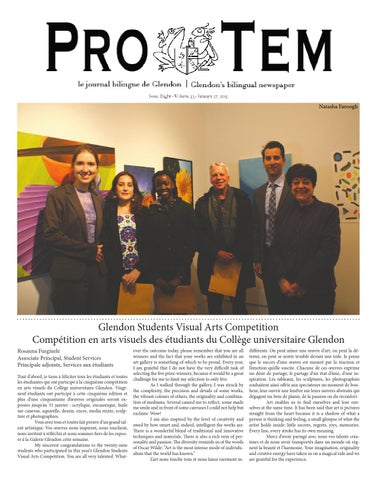
Glendon Students Visual Arts Competition Compétition en arts visuels des étudiants du Collège universitaire Glendon Rosanna Furgiuele Associate Principal, Student Services Principale adjointe, Services aux étudiants Tout d'abord, je tiens à féliciter tous les étudiants et toutes les étudiantes qui ont participé à la cinquième compétition en arts visuels du Collège universitaire Glendon. Vingtneuf étudiants ont participé à cette cinquième édition et plus d’une cinquantaine d’œuvres originales seront exposées jusqu’au 31 janvier : acrylique, encaustique, huile sur canevas, aquarelle, dessin, encre, media mixte, sculpture et photographies. Vous avez tous et toutes fait preuve d'un grand talent artistique. Vos œuvres nous inspirent, nous touchent, nous invitent à réfléchir et nous sommes fiers de les exposer à la Galerie Glendon cette semaine. My sincerest congratulations to the twenty-nine students who participated in this year’s Glendon Students Visual Arts Competition. You are all very talented. What-
ever the outcome today, please remember that you are all winners and the fact that your works are exhibited in an art gallery is something of which to be proud. Every year, I am grateful that I do not have the very difficult task of selecting the five prize-winners, because it would be a great challenge for me to limit my selection to only five. As I walked through the gallery, I was struck by the complexity, the precision and details of some works, the vibrant colours of others, the originality and combination of mediums. Several caused me to reflect, some made me smile and in front of some canvases I could not help but exclaim: Wow! I am also inspired by the level of creativity and awed by how smart and, indeed, intelligent the works are. There is a wonderful blend of traditional and innovative techniques and materials. There is also a rich vein of personality and passion. The diversity reminds us of the words of Oscar Wilde: “Art is the most intense mode of individualism that the world has known.” L’art nous touche tous et nous laisse rarement in-
différents. On peut aimer une œuvre d'art, on peut la détester, on peut se sentir troublé devant une toile. Je pense que le succès d’une œuvre est mesuré par la réaction et l’émotion qu’elle suscite. Chacune de ces œuvres exprime un désir de partage, le partage d’un état d’âme, d’une inspiration. Les tableaux, les sculptures, les photographies souhaitent ainsi offrir aux spectateurs un moment de bonheur, leur ouvrir une fenêtre sur leurs univers abstraits qui dégagent un brin de plaisir, de la passion ou du réconfort. Art enables us to find ourselves and lose ourselves at the same time. It has been said that art is pictures straight from the heart because it is a shadow of what a person is thinking and feeling, a small glimpse of what the artist holds inside: little secrets, regrets, joys, memories. Every line, every stroke has its own meaning. Merci d’avoir partagé avec nous vos talents créateurs et de nous avoir transportés dans un monde où règnent la beauté et l’harmonie. Your imagination, originality and creative energy have taken us on a magical ride and we are grateful for the experience.
Pro Tem
Editor in Chief | Rédactrice en chef Natasha Faroogh editor@protemglendon.com Assistant English Editor | Rédactrice adjointe (anglais) Stephanie Settle assistanteng@protemglendon.com Assistant French Editor | Rédactrice adjointe (français) Gervanne Bourquin assistantfr@protemglendon.com Section Editors | Les rédactrices de sections Campus Life | Vie de Campus Erika Desjardins campuslife@protemglendon.com Issues and Ideas | Enjeux et idées Lindsey Drury issuesideas@protemglendon.com Health and Wellness | Bien-être et santé Samantha Kacaba healthwellness@protemglendon.com Metropolis | Métropole Neya Abdi metropolis@protemglendon.com Arts and Entertainment | Arts et divertissement Ashley Moniz artsentertainment@protemglendon.com
Letter from the Editor
Responsibility. It’s a heavy word. Perhaps Leelah Alcorn was responsible for her own suicide— or perhaps we are responsible for tolerating the intolerant attitudes that ended in creating such a hostile environment that would lead to Alcorn’s death. Perhaps the Kouachi brothers were responsible for the terrible attacks on Charlie Hebdo’s offices— or perhaps we are responsible for holding up values such as democracy and freedom of expression while allowing other forms of institutionalized oppression continue. Perhaps The Academy is responsible for not nominating a single acting nominee of colour this year— or perhaps we are responsible for not demanding and appreciating more films that show diversity of colour. You don’t have to agree with me, but perhaps we are all responsible, in some small way, to every other human on this planet. Sometimes we’re indirectly responsible for things we didn’t even know we were a part of— such as in all of the examples above. So how do we take some responsibility and move forward in a positive way? The first step, in my opinion, is to think about the issues that make you realize that something is wrong with our world and that things must change. Whether you want to talk about it, write about it, rap, slam, or sing about it — putting some words to your feelings is
the first step toward creating a more tolerant attitude within yourself. Your words will touch at least one other person should you choose to share your thoughts. Slowly, one by one, we can all move forward to becoming a more open, caring, and inclusive community. Even if we can just improve in our own local community (hey Glendon!) that is a start. If we want to improve the lives of the people around us, we must try to move forward to becoming a community that accepts gender and sexual identities across and outside the spectrum, that accepts that freedom of speech does not mean that institutional oppression or racism is okay, and that moves toward media representing all people and not hierarchizing certain people over others. I hope this issue of Pro Tem makes you pause and think about the consequences of each action and inaction, and ultimately, the responsibility we have to each other in making this world a slightly better place to live in for all of us. Always,
Natasha Faroogh Editor in Chief editor@protemglendon.com
Expressions Sienna Warecki expressions@protemglendon.com Communications Officer | Agente de communications Victoria Ramsay communications@protemglendon.com Design and Layout | Maquettiste Megan Armstrong
Pro Tem est le journal étudiant du collège Glendon. Publié pour la première fois en 1962, c'est la plus ancienne publication de l'Université York. We strive to act as an agent of social change, and will not print copy deemed racist, sexist, homophobic or otherwise oppressive. Please respond to what you read in the pages of Pro Tem/ n'hésitez pas à réagir à ce que vouz avez lu dans Pro Tem. Contact us/ Contactez-nous: protem@glendon.yorku.ca The Pro Tem Office D114 Hilliard Residence, Glendon College 2275 Bayview Avenue North York, ON M4N 3M6 The office is open by appointment only. Le bureau est ouvert sur rendez-vous seulement. Les lettres adressées au journal peuvent être éditées au niveau de la clarté ou de contenu. All copy appearing in Pro Tem is at the discretion of the editorial team. Opinions published in Pro Tem are the thoughts of individual writers, and not the publication as a whole.
2
Féminin dédoublé réunit un corpus inédit d’œuvres soutenant une vision du féminin contemporain examinée et questionnée par huit femmes artistes de l’Ontario et du Québec. Dans le cadre de cette exposition, l’autre adopte un double sens qui traduit les préoccupations sociales actuelles: il est présenté en tant qu’entité préfigurant un idéal et comme image ambigüe, pourvue d’une identité plurielle et distincte.
Pro Tem Vous aimez écrire? Vous prenez des photos ou souhaitez pouvoir exprimer votre créativité? Vous avez une opinion sur …..? Ecrivez-nous à editor@protemglendon.com pour plus d’informations.
Vie de Campus
Glendon Women and Trans Centre Present: A Beautiful Space for Students to Visit! Katelynn Britton GWTC Coordinator Have you heard? This year, The Glendon Women and Trans Centre has undergone a few renovations to freshen up the space. We have put a fresh coat of paint on the walls to give it a brighter, more inviting atmosphere. We removed the old counter area and installed a brand new and more functional station for the students to make their food, a cup of tea and clean their dishes. Lastly and not least, our biggest renovation was redoing all the floors in the centre. Putting in new floors was made possibly by Pro Tem who made a donation to the GWTC for the project. It was a big job but so worth it since the centre now has an even more cozy and welcoming feel with the added dark hardwood floors. Come and take a look for yourself and even stay a little to have a cup of tea or coffee, we are sure you won’t want to leave. Don’t know what the GWTC is? The Glendon Women and Trans Centre is a safe space for all located in D-Wing Hilliard. The centre hosts tons of resources on sexuality, feminism, and LGBTQ* issues, as well as a food bank and an emergency shelter room should you ever need one. Feel free to drop by and say hi or to stay for a while!
A Look at the WUSC Glendon’s SRP Reeda Tariq and Clarisse Uwera Contributors WUSC Student Refugee Program provides refugee students from developing countries with the opportunity to pursue post-secondary education in Canada. Not only does the program help students succeed in education, but it also gives them the opportunity to help others with what they have learned. For the first time in four years, WUSC Glendon was able to sponsor their first student refugee from Malawi, the wonderful Clarisse Uwera. In her own words, “The program is good; it has done a lot to benefit student refugees. It has given them a chance to succeed in their dreams. When I was younger, I dreamt of being either an accountant or doing something with economics, and now, thanks to the SRP, I have a chance of making that dream actually happen. But it was different a few years ago. In 2010, I was done with secondary school. I thought I couldn’t continue with my schooling—that there were no more chances that I could ever achieve my dreams. But I still didn’t lose my drive to continue my education, so I took a long distance course in Business Management. I didn’t like it because it wasn’t what I wanted to study, so in 2013 I decided to apply for the SRP program. Nearly 200 people applied to it, however, only 20 people would be accepted. I honestly didn’t think I was going to get in, but then my name was chosen to do the test! I still couldn’t believe it—even after I passed it along with 57 other people, and we were all then interviewed as the second part of the process, I was still in disbelief that this was actually happening. But by the grace of God, I was accepted as one of the 20 students for the SRP program and now I’m here at Glendon, making my dreams come true.” Our team cannot thank the Glendon community enough. After all, you helped us increase our levy last year. As a result, we are able to sponsor new students to study at
Katelynn Britton Glendon every three years. WUSC Glendon believes that education really does change the world, and it's clear that the students at Glendon agree. Thank you again for all of your support!
Glendon Musical Ensemble Presents: Seasons of Love
Hanna DeRoche and Ashley Moniz Contributors L’ensemble musical de Glendon se prépare pour un concert qui aura lieu la première semaine de février. Les directeurs de cette année sont Ashley Moniz et Suzi Hyun. This year’s big show is the culmination of months of hard work and planning and, for the organization’s 15th Anniversary, promises to be a concert that everyone is sure to love. The concert name and theme is Seasons of Love, but prepare yourselves—Seasons of Love is not your typical love show. As opposed to focusing specifically on the perks of being in love, we will explore different types of love at different stages in life. Prepare yourselves for a journey through the ups and downs of family, friends, romance, commitment and being sure to make the best of your time for others and for yourself as well. GME is very excited to share with you our musical selections, including everything from current pop to classic show tunes. This year’s set list features the musical works of a wide variety of artists, ranging from Pharrell Williams to Simon and Garfunkel, from Nat King Cole to Corneille, from Serena Ryder to Stromae and from Coldplay to Vincent Vallières. Le concert aura lieu au théâtre de Glendon du 6 au 7 février. Vous pouvez acheter les billets pendant la semaine avant le concert et même la semaine du concert. Exclusive GME merchandise will also be available for purchase, including pens, sticky note pads, binders, and water bottles. We are working incredibly hard to deliver an amazing show this semester, and we sincerely hope to see all of you there!
Pro Tem Vous aimez écrire? Have opinions? Vous prenez des photos ou Like to write? souhaitez pouvoir exprimer Like votre to take pictures? créativité? VousLike avez to unedraw opinioncomics? sur …..? Ecrivez-nous à Email us: editor@protemglendon.com editor@protemglendon.com pour plus d’informations.
Giselle Chen
3
Issues and Ideas Oubliez Charlie, qui sommes-nous?
Cindy Seni
Updates and Responses to the Charlie Hebdo Shooting Dillon Baker Contributor “I just want to tell you that we are defenders of the Prophet. I, Chérif Kouachi, was sent by al-Qaeda in Yemen. I was over there. I was financed by Imam Anwar al-Awlaki.” These were the words spoken by one of the two Kouachi brothers responsible for the attacks at Charlie Hebdo on January 7th. Recordings of the telephone conversation between him and a BFMTV radio station host reveal him to have been calm, purposeful and clear in his justification for his actions (Lichfield). “We are not killers. We are defenders of the Prophet. We are not like you . . .We can kill. But we don’t kill women. It is you that kill the children of Muslims in Iraq, in Afghanistan, in Syria. That’s not us. We have a code of honour, us, in Islam.” Some experts, however, argue that this direct connection with al-Qaeda may be bit of a stretch. Al-Awlaki, the man they claim financed the operation, was killed in September 2011, and despite a video by a top al-Qaeda commander claiming responsibility (Michael), Barbara Bodine, the former U.S. ambassador to Yemen, thinks the video may be more “aspirational” than anything else, explaining “ . . . terrorists groups do like taking credit for events that they may or may not have actually been responsible for” (Brennen). It was shortly after that interview took place when in a small village north-east of Paris, Michel Catalano, the owner of CDT Printworks, saw the two men approaching dressed in combat clothing and carrying a Kalashnikov rifle and a rocket launcher (Gardiner, Evans). The Kouachi brothers would make their final stand against police from his warehouse, eventually allowing Catalano to go free, while unwittingly leaving his one employee hiding under a sink, texting pertinent details to the police (Gardiner, Evans). Two days later on January 11th, one of France’s largest recorded demonstrations took place, with approximately 1.6 million people gathering around the Place de la République (Paris). Many carried flags or signs which bore the now ubiquitous phrase Je Suis Charlie, while others upheld the pen, symbolic of how these attacks are being more broadly seen as an attack on “republican values” (François). Global leaders have been unanimous in their condemnation and in their likening it to an attack on free speech and the fundamental principles of “freedom-loving nations” (Francois). In a “show of solidarity”, many joined together at the demonstration to walk arm-in-arm including British Prime Minister David Cameron, German Chancellor Angela Merkel, Israeli Prime Minister Benjamin Netanyahu, Palestinian President Mahmoud Abbas and EU President Donald Tusk (Paris). It isn’t difficult to understand the need for such profound and sweeping reactions. Frustration at not being able to solve the problem of extremism, while reckoning with the realities of a seemingly uncontrollable threat to safety in a nation generally distanced from prosaic violence, has reasonably shaken many people. Much of the dialogue that has followed, along with the mobilization of so many people, is a necessary response to tragedy, and an important and valuable one in a democratic society. It is precisely at such times that we need to be wary of the line between genuine discussion and grandiose sentimentality, and of using our value statements as shovels for 4 trenching in ideological warfare.
The real threat to our society’s principles, I would argue, is not terrorism, but frantic allegiance–be it to country, flag, leader or value–anything that would be seen as so sacrosanct, so irreproachable that to be ‘done in it’s name’ is, by its own definition, intrinsically good. We cannot fight fundamentalism on one side, with fundamentalism on the other, and we cannot have a discussion about the values of the democracy, let alone use them as a rallying cry, without asking ourselves what those values mean to us today, what kind of actions they justify, and to whom these values serve. In short, what kind of society are we fighting for? Many have pointed out some of the hypocrisy of holding up Charlie Hebdo as a bastion of free speech. The magazine’s attempts at satire often skirted a fine line between satire and racism, while unequally applying such criticism amongst its targets (Samuel). For example, after taking an anti-Semitic jab at Jean Sarkozy, the son of Nicolas Sarkozy, the cartoonist known as Sine was fired from the publication in 2009 and later charged with “inciting racial hatred” (Samuel). Satire, when done well, is meant to attack and undermine the powerful and shake up systemic complacency. When used to reproduce stereotypical images of the powerless, however, it can also be racism masquerading as satire. The world is made up of fallible people, drawing important yet still arbitrary distinctions between right and wrong, and often where the line is drawn, depends upon the artist. If we want to have freedoms then we must choose them, carefully and deliberately, and be wary of easy feel-good sentimentality and subtexts of segregation; and we must ensure that we use these values as principles of action, not privileges.
Works Cited Brannen, Kate. Al Qaeda: Zawahiri Ordered ‘Charlie Hebdo’ Attack. Forgien Policy, Jan 13, 2015. Web Jan 2015. Charlie Hebdo attack: Suspects' profiles. BBC News Europe. January 12, 2015. Web Jan 2015. François Hollande condemns ‘cowardly’ attack on satirical magazine Charlie Hebdo. Euro News, New World, January 7, 2015. Web, Jan 2015. Lichfield, John. Paris attackers interview with French TV station. The Independent, January 10, 2015. Web, Jan 2015. Michael, Maggie. Yemeni al-Qaeda claims it carried out Paris attack, warns of more assaults. Globe and Mail, January 14, 2015. Web Jan 2015. Paris attacks: Millions rally for unity in France. BBC Europe Jan 11, 2015. Web Jan 2015. Samuel, Henry. French cartoonist Sine on trial on charges of anti-Semitism over Sarkozy jibe. The Telegraph, January 27 2009. Web, Jan 2015.
Enjeux et idées Leelah Alcorn Suicide and Allyship Lindsey Drury Issues and Ideas Editor
Cindy Seni
#JeSuisSeuleACrier Cindy Seni Contributor On Wednesday, January 14, I organized an activity commemorating the recent victims of terror attacks in Paris following the Charlie Hebdo tragedy. I was subsequently approached by the editor of Pro Tem to write an article on the event. My initial reaction, admittedly, was one of atrocious panic. The thought of refraining from writing such an article raced through my mind before I realized: if I don’t do it, who will? I feel a certain obligation to write since this is very personal to me. I am French. And I am Jewish. Born in Paris, I moved to Canada in 2000. Yet, the attacks that have taken place in my hometown pain me for many other reasons. When my family and I first heard about the hostages in the Kosher supermarket, I secretly and shamefully thought to myself that my family was spared because most of us had already moved to Israel. I was wrong. Yohan Cohen, said to be the first victim, was a distant cousin of mine. I personally never met him, but my sister, Eve, did. When something terrible happens, sadly, it is difficult to understand how awful it feels unless we are directly affected. We remain “compassionate”, or at least we believe we are, but I think we are often rightly indifferent. Perhaps, I dare say, that that is both a blessing and a curse. Oddly enough, this is something to be thankful for; life would be too hard if we felt everything. My problem is the following: when the Charlie Hebdo attack happened, the world came out with the solidarity hashtag: #JeSuisCharlie. But when the Kosher supermarket attack happened, only the Jewish community came out with the words #JeSuisJuif. Why? Why does the world remain silent? Why does the world remain indifferent when the victims are Jews? Why are we so selfish to care only about a certain percentage of the world (case and point for Nigeria)? Why do we filter only what we want to hear and feel? I’m here to tell you: speak the truth. And speak it loud. Bref, the reason why I was tabling in solidarity is because I am Charlie. Je Suis Juif. I Am French. Je suis Yohan. But most importantly, I am Human, et #JeSuisSeuleACrier.
It is widely known that on December 28th, 2014, a 17year old transgender woman, Leelah Alcorn, referred to by her family as Joshua, committed suicide after leaving a letter which blamed her Christian parents. The letter is long, explaining in-depth her story, and what lead her to make the decision that she did. In The Daily Mail article by Sara Malm, bluntly titled “Transgender teenager, 17, leaves heartbreaking suicide note blaming her Christian parents before walking in front of tractor trailer on highway”, Leelah's suicide letter is posted, explaining that “they wanted me to be their perfect little straight Christian boy”. As described in the letter, Leelah's parents forbade her from beginning the transition that is so important for many trans individuals to begin at the age of 16. The fear of living an entire lifetime incorrectly gendered was too devastating for her to cope with, leading to the taking of her own life. Sadly, this is not an uncommon story to hear, and is seen in the lives and deaths of countless other trans individuals. A recent study released in January of last year by the American Foundation for Suicide Prevention and the Williams Institute shows some disturbing figures, most importantly that “the prevalence of suicide attempts among respondents to the National Transgender Discrimination Survey…is 41%”. This is almost ten times as prevalent as it is for the overall U.S. population. There are many factors which have lead to this reality. One of the most damaging things a trans, or even homosexual, person can go through is mandatory conversion therapy, often forcibly endured due to parental instruction. Leelah was a victim to this treatment which, as transgender athlete Fallon Fox explains in her article “Leelah Alcorn's Suicide: Conversion Therapy is Child Abuse” featured in TIME magazine, is a “treatment whose goal is to change homosexuals to heterosexuals, and to convince transgender people to identify with the sex and gender they are born as. I cannot express how harmful
it was to my psyche, and I became suicidal when I went through it.” Luckily for Fox, she had a means of escape, as she was an adult when she went through this. For teen trans individuals, escape may not be as forthcoming. It is encouraging how far along the rights of lesbians and gays have come, but it is troubling to see that the lives of trans individuals have not improved nearly as hastily. Leelah Alcorn even referred to the “It Gets Better” movement in her suicide note, saying “but that isn't true in my case. It gets worse. Each day it gets worse.” It is understandable why a young transgendered teen in an ignorant family would feel this way, but it is certainly our job as responsible adults to make it harder and harder for young people to deny that it can get better, and it does. The responsibility lies in us, trans allies, to make sure these figures are changed. The message needs to be spread and discussed far more than it has been. At this year's Golden Globes, mentions of “Je Suis Charlie” were abundant among many celebrities, most notably George Clooney at the end of his Lifetime Achievement Award acceptance speech. As an important moment in history, this was encouraging to see, but also disheartening when considering that only one mention was given to Leelah Alcorn's tragedy, by the cast of the new TV show Transparent, which revolves around the life of a trans man. The moment was glossed over and completely forgotten almost as quickly as it appeared. Fallon Fox hits the nail on the head when she says, “the cries of tortured transgender children in this country have fallen upon deaf ears”. At the end of her letter, Leelah asks that 100% of her belongings be sold, and that the money be donated to trans support groups and movements. She pleads to us: “My death needs to mean something. My death needs to be counted in the number of transgender people who commit suicide this year. I want someone to look at that number and say 'that's fucked up' and fix it.” And so the responsibility lies with us. What are we to do from here? Are we outraged yet? In 2015, I hope Leelah's name crosses your mind, and you quote her when thinking of all the trans people who have attempted suicide—41%. That's fucked up. So let's go fix it.
Have opinions? Like to write? Like to take pictures? Like to draw comics? Email us: editor@protemglendon.com
5
Features Lindsey Drury
Andrea Gibson’s Poetry A Part of Me
Laurence Dion GWTC Coordinator I once had a friend who sent me a presentation they wanted to show their dad to come out as genderqueer. The first slide of their presentation was the lyrics to the poem “Andrew”. I didn't understand then that this poem spoke to me not only because I loved my friend so much, but also because it was me, too. The same friend had chosen the line "I hope you're smiling" as their blog title and "fear is only a verb if you let it be" as the description. When I asked them where the words came from, I was sent links to Andrea's poems “Photograph” and “I Do”. I discovered the most powerful words I had ever heard and I couldn't get enough. Now I have the words of “Photograph” permanently inked onto my skin. Andrea Gibson speaks of love, war, queer politics, peace, her dog Squash, and the human condition. Andrea Gibson speaks of my story, and hers, and yours. And she's coming to Glendon. And I want you there. And you want to be there.
Join us!
Andrea Gibson @ Glendon February 3rd, 7:30 pm Lunik Café Dinner: $2 - Beer: $5 - Wine: $5. /glass No cover - First Come First Serve - max 80 capacity An event brought to you by the GWTC and Lunik Coop.
6
Andrea Gibson To Perform At Glendon February 3 @ Lunik Café
Laurence Dion
Lindsey Drury Issues & Ideas Editor For the second time in two years, award-winning spoken word artist and activist, Andrea Gibson, will be travelling to Toronto to perform shows for students at a select few universities and colleges. On the night of Tuesday, February 3rd at 7pm, Gibson will be showcasing her world-renowned poetry pieces at a free show for students at our very own Collège Glendon! Gibson's poetry is a safe room in the midst of our lives' most devastating hardships. Touching on sexuality, privilege, feminism, love, truth, and spirituality, there are few people who wouldn't benefit from her art and its message. As described in the biography written for her website, “Gibson’s poems continue to be a rally cry for action and a welcome mat at the door of the heart’s most compassionate room,” and the statement rings true. Glendon is truly privileged to be graced with such a presence as Andrea Gibson. Gibson was the first winner of the Women's World Poetry Slam, and her poetry has shaken rooms all across America. She has created six full length albums to date, starting with Bullets & Windchimes (2003), and leading to her latest album, Truce, which was released in 2013. She has also allowed us to hold her words in our hands with her book collections—this author's favourite being Pole Dancing to Gospel Hymns. If you have any desire to forget the world for an evening,
and plunge into a reality only this kind of beauty could create, then make sure to reserve this night for Andrea Gibson's feature at Lunik Café. For more information regarding Andrea Gibson, visit her website at: www.andreagibson.com, or visit any of her social media links: Tumblr: andrewgibby.tumblr.com - Twitter: @andreagibson - Instagram: AndrewGibby
Le droit de se taire Marylise Soporan Contributrice L’ultime but du droit pénal est la diminution de la criminalité. La protection des citoyens est toutefois prodiguée en gardant à l'esprit les droits fondamentaux des prévenus et des accusés. C’est pourquoi notre système de justice canadien accorde une grande importance à la présomption d’innocence. Au cœur de cette présomption d’innocence : le droit au silence. Le mois dernier, la défense de Luka Rocco Magnotta a terminé la présentation de ses preuves. Une dizaine de témoins ont défilé sur une période de deux semaines dans l’intention de convaincre le jury que Magnotta ne peut être tenu criminellement responsable du meurtre de Jun Lin. Cette présentation s’est conclue sans témoignage de la part de l’accusé. Donc, celui-ci a maintenu son droit au silence, un privilège de ne pas être contraint de témoigner contre soi qui existe depuis longtemps en droit canadien mais qui a seulement été incorporé dans le corpus juridique en 1982. Depuis l’incorporation de cette prérogative propre aux prévenus et accusés dans la Charte canadienne des droits et libertés, le droit au silence a généré plusieurs décisions qui n’ont pas fait l’unanimité auprès des juges et des auteurs de doctrine. En 2007 et 2010, les arrêts Singh et Sinclair ont toutefois fait le point sur ce sujet et ont soulevé une question importante : quelle est la différence entre la règle des confessions de la common law et le droit au silence conféré par la Charte? L’ÉVOLUTION HISTORIQUE DE LA RÈGLE DES CONFESSIONS ET DU DROIT AU SILENCE Ayant toujours été considérée comme la preuve de culpabilité la plus forte et la plus convaincante dans le cadre d’une poursuite, la confession est la source de nombreux débats. Une des plus grandes inquiétudes soulevées à l’égard des confessions a trait à leur fiabilité. Ainsi, afin de ne pas compromettre la fiabilité des confessions obtenues et en raison du caractère contraignant de celles-ci, une première règle a été établie. Visant à écarter une déclaration survenue dans des situations où les autorités policières feraient explicitement des menaces ou des promesses à l’accusé, cette règle traditionnelle des confessions, la règle de l’arrêt Ibrahim, a été adoptée en 1914. Elle a réitéré le principe qui veut que la déclaration d’un accusé ne soit jamais utilisée comme preuve dans le cadre d’un procès sauf si la poursuite prouve qu’elle est volontaire. Ne donnant qu’un choix négatif à la personne accusée, cette règle ne tient pas compte de l’état d’esprit de l’accusé, mis à part si celui-ci croit qu’il s’adresse à une personne en situation d’autorité. Afin de pallier cette lacune, une interprétation plus large de la règle des confessions a été développée par les tribunaux dans certains arrêts canadiens tels que Horvath et Ward. Ceux-ci soulignent l’importance d’un état d’esprit conscient de l’accusé lorsqu’il fait une confession. L’exigence additionnelle impose une évaluation du caractère libre et volontaire des déclarations même lorsqu’on ne peut établir qu’il y a eu espoir d’un avantage ou une crainte d'un préjudice. D’ailleurs, dans l’arrêt Rothman, la Cour a clarifié que ce n’est pas uniquement pour des raisons de fiabilité que des confessions pourront être exclues, mais aussi dans des cas où la police utiliserait des méthodes ayant le potentiel d’offenser la société afin de soutirer une déclaration à l’accusé. Cette jurisprudence enseigne que l’interprétation large de la règle des confessions a été admise comme faisant partie des notions fondamentales d’équité procédurale
en droit canadien. En 1982, lorsque le législateur a adopté la Charte canadienne, la règle des confessions provenant de la common law a cessé d’être l’unique règle encadrant le droit au silence de l’accusé. En effet, l’article 7 de cette Charte exprime que chacun a droit à la vie, à la liberté et à la sécurité de sa personne; il ne peut être porté atteinte à ce droit qu'en conformité avec les principes de justice fondamentale. Le concept de liberté envisagé dans cet article vise l’absence de contraintes, telles qu’une contrainte physique. L’emprisonnement violerait donc ce droit à la liberté. De plus, dans Hebert, la Cour a déclaré que le droit au silence est un principe de justice fondamentale qui ne peut point être transgressé aux fins d’un procès. Cette évolution historique du droit au silence accordé aux accusés en droit criminel canadien illustre, selon certains auteurs de doctrine, les efforts des tribunaux ainsi que du législateur pour adapter le droit au silence aux réalités de la société moderne. LE FARDEAU DE LA PREUVE ET LES REPARATIONS Dans un jugement de la Cour Suprême de 1994, le juge Sopinka a déclaré que le droit au silence prend ses origines dans la common law et a été constitutionnalisé par l’article 7. En d’autres termes, il a exprimé que la Charte, en conférant un droit constitutionnel de garder le silence, subsume la règle des confessions de la common law. Toutefois, six ans plus tard, dans l’arrêt Oickle, la Cour précise que cette thèse n’est pas juste et est plutôt d’avis que le droit peut établir, soit au moyen de dispositions législatives ou de règles de common law, d’autres garanties que celles qui sont prévues par la Charte. La règle des confessions de la common law constituerait une telle garantie; la Cour arrive à cette conclusion notamment parce que le fardeau de la preuve ainsi que la réparation ne sont pas identiques dans le cas de la règle des confessions et dans celui des dispositions de la Charte. D’abord, dans le cas de la règle des confessions, il est nécessaire d’évaluer selon un critère objectif du point de vue de la personne raisonnable et selon un critère subjectif si l’accusé a des raisons de croire qu’il s’adresse à une personne en autorité lorsqu’il fait des déclarations. Le Ministère public doit ensuite établir le caractère volontaire hors de tout doute raisonnable des aveux faits lors de l’enquête. Il s’agit d’un important fardeau puisque si un seul doute est soulevé quant au libre arbitre du détenu, une réparation peut s’en suivre. La réparation consiste à exclure automatiquement tout élément de preuve obtenu en contravention à la règle des confessions. D’un autre côté, dans le cas où l’accusé se considère victime d’une atteinte à ses droits constitutionnels prévus par la Charte, c’est à lui qu’incombe le fardeau de le faire valoir selon la prépondérance des probabilités. Les réparations sont, dans ce cas, assujetties au pouvoir discrétionnaire du tribunal. Les déclarations ne seront ainsi exclues que si le tribunal évalue qu’elles ont été obtenues en violation d’un droit prévu par la Charte et seraient également susceptibles de déconsidérer l’administration de la justice.
Features cussion préalable avec son avocat, a demandé à plusieurs reprises de pouvoir communiquer de nouveau avec celuici avant de répondre aux questions des policiers. Tout en lui répétant qu’il lui appartenait de décider s’il souhaitait parler ou se taire, les policiers ont continué l’interrogatoire qui a abouti à une confession de la part de Sinclair. Selon certains auteurs, les arrêts Singh et Sinclair ont, en adoptant un critère d’admissibilité des preuves à un simple volet, inévitablement causé une augmentation du nombre des fausses confessions obtenues dans le cadre d’enquêtes policières. En effet, ils soutiennent que les accusés sont portés à faire de faux aveux dans le but d’éviter d’avoir à subir les ruses des policiers et qu’il y aura de plus en plus de confessions dont la fausseté sera établie par une preuve génétique, une confession ultérieure du véritable auteur du crime, ou par d’autres sources indépendantes de preuve. Ces auteurs soutiennent donc que le critère d’admissibilité à deux volets aurait grandement diminué l’incidence des fausses déclarations puisque l’accusé aurait été pleinement protégé par le droit au silence accordé par la common law ainsi que par la Charte. En revanche, d’autres auteurs croient fermement que l’abandon du critère d’admissibilité à deux volets ne met pas en péril la fiabilité des confessions obtenues par les policiers. Ils se basent notamment sur les propos tenus par la Cour dans Oickle, où elle émet l’opinion que la pratique courante des interrogatoires policiers ne donne que très rarement lieu à de fausses confessions et que celles-ci résultent plutôt de pratiques policières répréhensibles, de la criminalité policière, ou des deux. UN DROIT FONDAMENTAL OMNIPRÉSENT Le droit au silence est garanti par deux principes bien distincts qui prennent leurs racines dans la Charte canadienne ainsi que dans la common law. Les arrêts Singh et Sinclair forment un nouveau courant jurisprudentiel selon lequel, dans certaines circonstances, il est impossible pour l’accusé de revendiquer son droit au silence si la poursuite établit hors de tout doute raisonnable que sa déclaration est volontaire. Dans ce cas-ci, le tribunal procède à une analyse approfondie du caractère volontaire des déclarations faites par l’accusé (afin d’éviter que le droit au silence soit anéanti, diraient certains). Depuis l’élection d’un gouvernement majoritaire conservateur au Canada, un courant de réforme du Code criminel a été amorcé, ce qui inquiète plusieurs juristes. Ceux-ci craignent que les conservateurs ne tentent, par des amendements au Code criminel, de donner plus de pouvoirs aux policiers dans le cadre des enquêtes et moins de droits aux prévenus, dans le but d’une «hyperprévention» du crime. Avec les tollés soulevés par le procès de Luka Rocco Magnotta et de Guy Turcotte, le gouvernement pourrait être tenté de prendre de telles mesures afin de regagner la confiance du public.
LES ARRÊTS SINGH ET SINCLAIR Dans l’arrêt Singh, rendu en 2007 par la Cour suprême, 5 juges contre 4 ont conclu que le critère d’admissibilité à deux volets doit être écarté. En effet, la majorité a considéré que la common law, en offrant une plus grande protection à l’accusé, rend inutile de procéder à un examen distinct fondé sur l’article 7 de la Charte. Trois ans plus tard, l’arrêt Sinclair est venu confirmer ceci en rappelant qu’après qu’un accusé fait une confession et que le juge tranche qu’elle est volontaire, il devient difficile de faire valoir une violation du droit au silence conféré par la Charte. Dans la décision Sinclair, l’accusé, qui a eu une dis-
7
Métropole
Health and Wellness
“Walk Your Wheels” campaign has come to Glendon – is it justified?
Healthy Living for a New Year Glendon ResLife Challenge! Samantha Kacaba Health & Wellness Editor
Michelle Kearns Contributor You may have noticed new large, circular emblems on sidewalks depicting a cyclist surrounded with the words “Walk your Wheels”. They aren’t from some sort of guerrilla campaign assembled by some annoyed pedestrians; they’ve been installed by the city itself. The City of Toronto has implemented a new campaign called Sidewalks are for Pedestrians. It is a valid initiative, backed up by the obvious dangers that arise when a sidewalk packed with pedestrians adds a few cyclists to the mix. If you are 14 and older, you can be fined for riding on the sidewalk. Pedestrians may have hearing or visual impairments that prevent them from sensing oncoming cyclists and the consequences resulting from a collision can be severe and life altering. There is no question that the laws and reasoning behind this campaign are legitimate. However, this particular passive aggressive method of “friendly” reminders to not ride on the sidewalk is where the issue lies. If you come to Glendon from the 124 bus stop, you will have seen the new “Walk your Wheels” sticker on the bridge over Bayview Avenue. The City, however, claims to only be placing these stickers in logical areas that are already supported by cycling infrastructure (“Sidewalks are for Pedestrians”, City of Toronto). Perhaps this is the City’s way of throwing their support behind the tiny, kilometre-long bike lane on Bayview that only serves to get you up or down the bridge. The deviation from normal, under-bridge traffic requires a tricky crossing of Lawrence Avenue to continue onto Bayview southbound, that is, if you choose to assume a single painted line is a proper barrier between you and cars moving over 60km/h. Even using the lane to turn west onto Lawrence throws you onto a dense, narrow roadway. Cycling and even pedestrian infrastructure in the area immediately surrounding Glendon is in a sad state of affairs. Cyclists know it, and many design convoluted, inefficient routes to campus to avoid the major roadways where so many accidents occur. Riding on sidewalks is a symptom of poor infrastructure and hostile road networks. The prompt to walk bikes on sidewalks seems innocent and well-meaning in nature, but it serves as a constant reminder that the City lacks proper infrastructure and would rather treat the symptom than the cause. A proper bike network would fill in the major gaps between current bike lanes and provide proper means of getting around Toronto safely and directly. Separating cyclists from car traffic lessens the unpredictable movements by cyclists that are to the disdain of drivers everywhere—it’ll also stop sidewalk cyclists. I’m looking forward to a Toronto where these “Walk your Wheels” stickers aren’t needed because safe and practical infrastructure exists. We can dream. If you’re interested in getting involved, Cycle Toronto has local ward advocacy groups that could use your support! See cycleto.ca for more information.
8
Strictly Sex Vol. 5
Hey Amrita, “What’s the most commonly asked question you get about sex/sexuality?” This is actually a really difficult question for me to answer because I get a lot of really good questions about human sexuality. I would have to say one of the most common things I am asked when explaining the genitalia of DMAB (designated male at birth) people is “Where is the bone?” Yes, a lot of people still believe there is a bone within the penis. This is usually when I have to begin explaining that the penis is made hard and erect by blood vessels that fill with blood during the time of an erection. It is not actually a magical bone that grows very quickly through sexual stimulation only to shrink down again when it is not being stimulated. The term boner is the part that tends to confuse a lot of people. This coupled with a bad sex-ed system implemented in most schools is pretty much the perfect recipe for misunderstandings like these to arise. Have a question? Write to me at stictlysex. gl@gmail.com OR drop your question off anonymously in the drop box outside of the GWTC, located in Hilliard D-124. Disclaimer: By writing into Strictly Sex, you are giving Pro Tem permission to publish your question in print and various other publication forms. Questions are chosen by Amrita hence there is no guarantee all questions will be answered. Advice administered in the Strictly Sex column should not replace any professional medical, or legal advice given to you otherwise. Responses are the expressed opinions of Amrita and are not intended to diagnose or to be used as treatment. By writing in, you agree to use this advice at your own discretion taking complete responsibility for whatever consequences ensue.
I’m sure by now that any Glendonites on social media are well aware of Reslife's Healthy Living Challenge. I for one can report that my news feed has been filled with gym selfies and food photos since the winter term kicked off. For those who aren’t in the loop, let me get you up to speed. In an event being run by Glendon Residence Life, students living in both residences are being encouraged to post about the healthy lifestyle choices they’re making this chilly January. Each post, be it text or photo, earns their house a point, with the goal being to rack up as many points as you can before February 1st. As students are getting back into the swing of school life after what was hopefully a relaxing break for all, it’s far too easy to let healthy habits and fitness resolutions fall to the wayside. The Healthy Living Challenge allows for a bit of friendly competition between those in residence to encourage responsible lifestyle choices. It also drives the point home that fitness, like most other features of the human condition, is social in nature. For those who don’t live on residence, there’s still hope for you! There’s a veritable treasure trove of resources online for those who are looking to make better choices in the new year. Websites such as MyFitnessPal.com allow you to track progress you’ve made through your fitness journey and interact with others doing the same. Through EatRightOntario.ca you can get in contact with a registered dietitian free of charge. If you’re looking for offline options, you need look no further than our own humble campus. Take a visit to the GAC after class or enjoy a nature walk along the river just beyond it. Though regardless of where you go, this city has a lot to offer, and I hope that you will be out there reaping the benefits of it!
Pro Tem Vous aimez écrire? Vous prenez des photos ou souhaitez pouvoir exprimer votre créativité? Vous avez une opinion sur …..? Ecrivez-nous à editor@protemglendon.com pour plus d’informations.
Arts et divertissements The Oscar Race 2015: Nominees, Snubs, Surprises & Controversies
Ashley Moniz Arts & Entertainment Editor On January 15th, the Academy Award nominees were announced in anticipation of the big ceremony on February 22nd. As always, the list was met with both praise and criticism. Tied for the most nominations are Birdman (or The Unexpected Virtue of Ignorance) and The Grand Budapest Hotel. Each received 9 nominations, including Best Picture, Director and Original Screenplay. Birdman also picked up nominations for Best Actor, Supporting Actor and Supporting Actress. The Grand Budapest Hotel managed 6 nominations in technical categories, the most for any film this year. Following closely behind is The Imitation Game with 8 nominations, including Best Picture, Director, Adapted Screenplay, Actor and Supporting Actress. Tied for third are American Sniper and Boyhood with 6 each; both up for Best Picture and Film Editing. Boyhood leads American Sniper among the major categories with nominations for Best Director, Original Screenplay, Supporting Actor and Supporting Actress. American Sniper is also up for Best Adapted Screenplay and Actor. Four films received 5 nominations each: Foxcatcher, up for Best Director, Original Screenplay, Actor and Supporting Actor; Interstellar, which received 5 nominations in technical categories; The Theory of Everything, for Best Picture, Adapted Screenplay, Actor and Actress; and Whiplash, which contends for Best Picture, Adapted Screenplay and Supporting Actor. Rounding out the Best Picture nominees is Selma, also nominated for Original Song. Nightcrawler is up for Best Original Screenplay, and the final nominee for Adapted Screenplay is Inherent Vice, which is also nominated for Costume Design. One surprise this year is American Sniper. While the Academy tends to favour war films and biopics, the nominations came after nothing at the Golden Globes or the SAG Awards, a single BAFTA nomination and Critics’ Choice nominations only in Action categories. One of the most talked about snubs is The Lego Movie for Best Animated Feature. It is up for Best Original Song, but critics and young adults were shocked by its exclusion. Nostalgia and animation quality are typically not weighted as heavily in this category as story, and despite its well-executed satire, the risky twist ending may have cost them. Also notably snubbed was Gone Girl. One of the most critically-acclaimed and highest earning films of the year, it was nominated for Best Actress, but the film was left out of Best Picture, Director, Adapted Screenplay, Original Score and Film Editing, all of which nominations that it’s received at other award shows. A few actors were nominated for at least two other major awards, but notably not the Oscar, specifically for The Grand Budapest Hotel, Nightcrawler, Cake, Selma and Big Eyes. In the Best Original Song Category, “Glory”, from Selma, is the only song nominated for both the Golden Globe and Academy Award. The Lego Movie and Begin Again were also nominated for the Critics’ Choice Award for Best Song. Notably left out was The Hunger Games: Mockingjay - Part 1 and Big Eyes. The Academy finds itself in trouble as this year’s selection shows the least diversity in years. The only other time that all 20 of the acting nominees were Caucasian was in 1998. A similar lack of diversity can be seen in Best Director and both Screenplay categories, where all of the nominees are male and, excluding one, Caucasian. This has led to #OscarsSoWhite trending on Twitter.
The Academy consists of over 7,000 members. The majority of them are Caucasian, male and/or over the age of 60 (according to an article in the New York Post). Each category is voted for by peers in the relevant field (actors for acting, directors for directing, etc.) and everyone votes for Best Picture. According to the Academy’s president Cheryl Boone Isaacs, who is both African-American and female, many of the members, who have been a part of the Academy for a long time, consider diversity when hiring. That being said, does this mean that some nominees should be considered over others, who may be more deserving, just because they are “diverse”? Is this not more exclusive and less reflective of who they really feel is best? It is important to step back and look at the works nominated, regardless of superficial factors. President Isaacs stands by the nominees, saying in particular that all five actors up for Best Actor gave stellar performances, regardless of their
Sarah Yenny
colour. It is also important to take a look back at 2014 in film. Last year, the 20 highest-grossing films worldwide were directed by men and featured Caucasian actors in their top billing. Eleven of these went on to be nominated for Oscars, the only major nominations going to Big Hero 6 (Animated Feature) and Gone Girl (Actress). The demographics of these films match the Oscars exactly. If anything, the nomination of Selma for Best Picture shows more diversity than the movies that people actually went to see. It will be interesting to see whether more “diverse” content will be added to the show in retaliation to the backlash. Regardless, host Neil Patrick Harris is sure to make this year’s awards a fun one. And I leave with obvious irony when I say, may the best man win.
Expressions Why Do We Drift Away From Ashpond: Chapter 4 Old Friends? Stephanie Settle Is It Us, Or Them? Samantha Rosa Contributor Ever wonder what happened to that childhood best friend who did almost everything with you? All of a sudden they just disappear from your life? Friendships tend to drift apart due to lack of communication, or simply because you two no longer share the same interests. Although it makes sense to drift apart because we no longer like to do the same things, should this be a good reason to lose such a strong bond? We often give up too easily on other people – meaning that you and your so called “best friend” no longer want to hang out anymore because you’ve grown up and have nothing in common. Just because you two have nothing in common, should you just drift apart? There are plenty of things to do that two people can agree on. Why not go out for a coffee or lunch? Discuss work, school, or anything else that you’ve been up to. Friendships shouldn’t just be about having fun; they’re also about discussing the difficulties and struggles, or even the accomplishments and important moments, in life. Look at it this way: when two people don’t have much in common, conversations become more interesting. Why do some of us drift away from that? Isn’t this an indication that we get to learn new things from the other person? So what if one of us is married and has a full time job while the other is still in school? Does this mean we have to find new friends because we no longer live the same lives? Personally, it’s incredibly difficult for me to make new friends – I’m not quite the type to go up to someone and introduce myself. I liked my old friends, but unfortunately we have drifted away – but this wasn’t due to lack of communication on my side, but from theirs. For a few months I moped around wondering whether this was my fault, if I was the one that stopped sending them messages or keeping in touch, but this wasn’t the case. I had sent continuous messages to a few of my friends; I would call them and try and keep in touch. Some of them kept the conversation going, while others no longer chose to care because they had other priorities and newer friends. If you have these type of friends who are clearly too occupied to even send you one simple text saying “Hey, how’s it been?”, then it’s obviously not worth it. If they’re slowly drifting away from you, then it’s a statement that they no longer care. Sometimes, we have that one friend that made such an impact in our lives that we attempt to keep that friendship going. If we keep asking them to hang out and they keep cancelling, then they’re at fault here – not us. Friendships are incredibly difficult to keep. When we have friends who don’t make an effort, then why should we? We shouldn’t give up on those friends who try to keep in touch even though we no longer have anything in common. There is always something new and exciting to talk about. Life moves on and we grow up, things happen to change, but friends should be there through every transition in our lives, whether we go through those tough moments, or the good moments – that, to me, is friendship.
10
English Assistant Editor
“Now, let’s do the part where the knight comes to rescue the fairy princess from the evil wizard.” Gwen, in a faded pink dress, attempted in vain to direct the other children to their places using a plastic wand. “I'm bored,” whined Paul. “I want to play the knight!” “But the king is a very important role,” Gwen argued. “Without him calling the knight to adventure, there's no story.” “I don't see why that means I can't be the knight!” “Because I assigned everyone the role that I thought they could play best.” Gwen crossed her arms in exasperation, then withdrew them almost immediately when she experienced the unintended consequence of stabbing herself with her wand. “Amber has to be the evil wizard, and she isn't complaining.” “Amber likes being bad guys. I don't like being boring guys.” Jenny came to her cousin's defense. “Yeah, why can't I be the knight? I don't really mind.” Gwen threw her arms up into the air. “None of you understand, do you? Besides, we've already rehearsed things with you as the knight and him as the king, so now it will take us even longer to rehearse and we won't be ready to perform tomorrow!” “Why are you being so bossy?” Jenny asked. Paul's jaw dropped. Of course their cousins could not have known, but if there was one thing Gwen detested in the world, it was being accused of bossiness. Gwen took a deep breath, and rested her arms at her sides. “Fine,” she spoke calmly after a long pause. “If you don't like the play the way I planned it then you can do it your way. I'm going for a walk.” Wand clutched firmly in hand, she made a hasty exit. Tossing rocks over the side of the bridge into Ashpond Creek, Gwen reflected on past perceived slights from her brother. While it was of course Jenny's words that had driven her to storm out of the rehearsal, the conflict had started with Paul. Why couldn't he have been content to play the king? There was no way he would remember all of the knight's lines anyway. And it was Gwen's play. Paul was always ruining things that she planned, like when he refused to partake in her choreographed dance number during one of their annual Christmas concerts for their parents, and instead merely kicked his legs around with a goofy look on his face for the entirety of a song. And when she wanted to play that piano duet and he wouldn't stop complaining about having to practice! The more Gwen thought about these events, the angrier she became, until she was convinced that she had to find a way to get back at Paul. Could she sabotage some plans of his? No, an opportunity was unlikely to arise, as Paul was not known for putting very much forethought into any of his actions. Could she embarrass him somehow? No, he was too young to put very much stock in appearances, and especially not when the only spectators would be his grandparents or cousins. So what could Gwen do to teach her brother a lesson? Then Gwen remembered her brother's fatal flaw – one that he shared with countless other children. She would find a way to take advantage of Paul's fear of the dark.
To Have and to Hold Kabrina Duquette Contributor The birds sing as the day begins. I knew this day was coming. I just didn’t expect it to be so soon. I only had a few weeks to prepare but nothing prepared me for this day. I forced myself out of bed. There, sitting before me, was my mother. Tears rolled down her cheeks and fell onto her new dress. “It’s time. Get up, sweetheart. It will be over before you know it,” she smiled. I knew it would be over quickly, but it was still a ways away. I got up from my bed and walked over to the master bathroom. The mirror showed my morning appearance; bags hung under my eyes from a fitful nights’ sleep, and my face was very pale. I will have to fix this. I want to be presentable for him today, I thought. I stripped out of my pajamas and hopped into the shower. A blast of cold water woke me up for a second time. As the water became warmer, my mind raced over the many memories we both had. The time when he and I went to the beach, we swore to each other we wouldn’t go swimming, but the clear blue water was too tempting. His blond hair reflected the sun’s rays and made him look like an angel. But that was until he threw me into the water. I smiled at the memory. A bang on the door awoke me from my dreams. “Are you all right? Want us to come in there?” said a soft voice. I recognized it as one of my best friends. I got out of the shower and dried myself off. I stepped out to see her wild red hair entangling me. “I’m fine,” I said, showing a bright smile. She smiled back and helped me prepare for the big day. I put on my dress, special for the occasion. It fit me in all the right places and I knew he would be happy with it. I twirled, trying to grip the reality ahead of me. My two best friends were helping me apply my makeup and nail polish. I wanted to be sweet but formal. Both my friends wanted to be here for the process. I think they wanted to make sure my nerves didn’t get the better of me. Finally, I was ready. I stood before my mother, wanting to see what she said. She just looked at me; more tears flowed from her eyes. She walked over and kissed my cheek. “You look beautiful, honey,” she said, pulling me into a hug. My throat tightened at the moment between us. I hugged her back, squeezing out thanks to her. She let go and headed out the door, retreating to one of the many cars parked out front. My two friends, both wearing similar outfits, squeezed my arm and left as well. I followed them out. The bright light burned my eyes; I squinted, determined not to cry and let my makeup run. I walked to my car, where a driver was waiting for me. He opened my door, as I stepped in. After he closed it behind me, my mind began to wander again. I felt the car lurch forward on its slow march to the church. My mind brought me to another happy place. It was the day before he was deployed, sent over to enemy territory. We were sitting in a beautiful restaurant, the ambiance very mellow and romantic. He reached for my hand, and I stared into his brown eyes, the ones that made me melt every time I saw them. He slipped something into my hand. I looked down to inspect it. I saw to my surprise a ring, a beautiful diamond sat upon a silver circle. I looked up to him with a smile on my face. “I know we never really talked about it, but I love you. I want to be your one and only, as you are mine. Will you marry me?” he asked. I was so shocked, I didn’t even speak. I just nodded my head. He grabbed the ring and placed it upon my left ring finger. As we embraced that
Expressions night, he spoke softly in my ear, “I promise you I will return, my dear fiancée.” There the ring still sits, to this day. “Ma’am? We are here,” the driver said. I snapped back to reality. I waited, not wanting to leave the safety of the vehicle. Mustering whatever courage I had left, I finally exited the vehicle and walked up those familiar steps. I reached the door and froze. Was I ready for this? Ready or not, it was going to happen today. I opened the doors and stepped inside. The church was big and beautiful. The entrance was all decorated how I had wanted it to be. I smiled at the simple white rose arrangement they had done. In the entrance way, there was another set of doors that lead to the main part of the church, the sanctuary. I stood before them in bewilderment. The doors were grand, made of wood, polished to perfection. Before me in the sanctuary sat all of our friends and family, waiting for the ceremony to begin. I began the slow walk toward the front of the church. The room immediately went silent. Many people stood up as I carried a small bouquet of flowers down the aisle. I nodded to a few people, trying to encourage a smile without throwing up. I looked to the end of the aisle. I saw his face and I smiled. He looked handsome, dressed in his uniform. I hadn’t seen him in months, and for him to be here was a delight. The aisle seemed to go on and on. I couldn’t help
but notice the stained glass windows of Jesus with small children and Mary holding the baby Jesus. Light shone through, making the sanctuary even brighter. My gaze travelled back to the front of the church and I noticed a huge simple wooden cross hanging on the wall. Tears swelled in my eyes as I nodded to the cross. He knew that I wanted him home. I prayed and prayed that he would come home. He promised me he would come home. Well, God finally answered my prayers and he kept his promise. I finally reached my love. He looked perfect, calm and sweet. I put my bouquet on the table and smiled at him. His face sat emotionless in the dark oak coffin. I knelt down and kissed his cheek. A single tear rolled down my face at the realization of his death. His cold, hard cheek against my soft, warm lips made everything seem real. “Welcome home, baby,” I whispered. I stroked his army picture that knelt beside his coffin. I noticed my ring on my finger. I stared at it, feeling the eyes fixated on me. I slipped the ring off my finger and set it down upon the table, beside his picture. I left the front, sat down beside my mother and two best friends. As soon as I sat down, I cried with all the other mourners of my dear fiancé, killed for protecting us all. The priest stood at the pulpit and spoke: “Dearly beloved . . . ”
Homeward, November 24 Sienna Warecki Expressions Section Editor Kisses, I told the wind— you will have kisses and sugar from me sprinkled into westerlies fierce and tender. The plane pitched in a Van Gogh sky, afternoon orange and ultramarine and the acid-for-lunch smell of people’s planesickness permeated recycled air and I, with my ointment of almond and eucalyptus and grapefruit prepped my hands to pleat and ply the 70km/ph warning rollicking underwing, to skim the windshear off our craft like curds from whey, and aren’t you a playful rogue today, I said. I will write you a poem and tear it to pieces and litter the sky with my gratitude if only you let me win this time. Fingers full of tingles, brain of unruly rhymes— my feet are on the ground, now. I am spellwriting retroactive, now; I am keeping my end of the bargain.
Comic by Christina Nagi
11
All photos by Kelly Lui
CafĂŠ Nihon @ Lunik Coop