Issue Four - Volume 53 - October 28, 2014
Victoria Ramsay
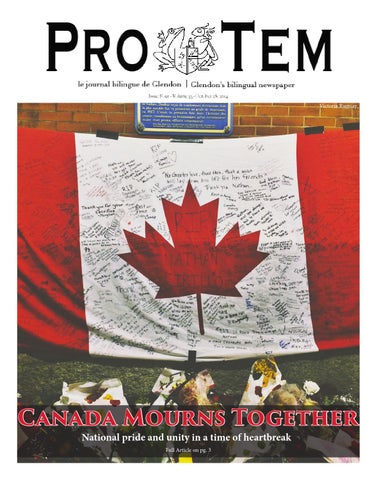
Canada Mourns Together National pride and unity in a time of heartbreak Full Article on pg. 3
Pro Tem
Editor in Chief | Rédactrice en chef Natasha Faroogh editor@protemglendon.com Assistant English Editor | Rédactrice adjointe (anglais) Stephanie Settle assistanteng@protemglendon.com Assistant French Editor | Rédactrice adjointe (français) Gervanne Bourquin assistantfr@protemglendon.com Section Editors | Les rédactrices de sections Campus Life | Vie de Campus Erika Desjardins campuslife@protemglendon.com Issues and Ideas | Enjeux et idées Lindsey Drury issuesideas@protemglendon.com Health and Wellness | Bien-être et santé Samantha Kacaba healthwellness@protemglendon.com
Letter from the Editor
Dear Glendonites, Since this issue of our paper is on stands during Halloween, Pro Tem decided to take a moment and ask the Glendon population to write in about what makes us feel afraid, about our fears. Perhaps this is a different take on a Halloween issue, but it brings up many important topics. I’m afraid of things being left unsaid. As a liberal arts newspaper, we strive to print the things that are difficult to say and to pose a critical regard on topics that feel forbidden. One such example is the anonymous article that we are printing in this issue which discusses a student’s experience of sexual assault on Glendon campus about a year back. This student has taken a brave step to write in to our paper to talk about this experience in hopes that starting a dialogue helps make us all realize that our words and even our silence can support rape culture. In facing our fears, it’s time to bring light to the fact that Glendon is no exception when it comes to rape culture. Furthermore, in painting
the picture and projecting our hopes that “Glendon is a safe campus” and that “rape doesn’t happen here”, we inadvertently oppress survivors of sexual assault. Personally, I’m afraid of not discussing the things that scare us because that allows our fears to grow in our silence. If we don’t discuss topics that make us feel uncomfortable, insecure, afraid, or ashamed, we cannot even begin to learn how to face those fears. The articles in this issue of Pro Tem discuss everything from the recent shooting in Ottawa to social anxiety to depression. Whether this is “The Year of Getting Out of the Comfort Zone” for you, or you’re going to think about “Self-Care 101”, I hope that this issue of Pro Tem encourages you to think about and tackle the things that make you feel afraid.
Yours, Natasha Faroogh
Metropolis | Métropole Neya Abdi metropolis@protemglendon.com
Pro Tem
Arts and Entertainment | Arts et divertissement Ashley Moniz artsentertainment@protemglendon.com Expressions Sienna Warecki expressions@protemglendon.com Communications Officer | Agente de communications Victoria Ramsay communications@protemglendon.com Design and Layout | Maquettiste Megan Armstrong
Vous aimez écrire? Vous prenez des photos ou souhaitez pouvoir exprimer votre créativité? Vous avez une opinion sur …..?
Pro Tem est le journal étudiant du collège Glendon. Publié pour la première fois en 1962, c'est la plus ancienne publication de l'Université York. We strive to act as an agent of social change, and will not print copy deemed racist, sexist, homophobic or otherwise oppressive. Please respond to what you read in the pages of Pro Tem/ n'hésitez pas à réagir à ce que vouz avez lu dans Pro Tem.
Ecrivez-nous à editor@protemglendon. com pour plus d’informations.
Contact us/ Contactez-nous: protem@glendon.yorku.ca The Pro Tem Office D114 Hilliard Residence, Glendon College 2275 Bayview Avenue North York, ON M4N 3M6 The office is open by appointment only. Le bureau est ouvert sur rendez-vous seulement. Les lettres adressées au journal peuvent être éditées au niveau de la clarté ou de contenu. All copy appearing in Pro Tem is at the discretion of the editorial team. Opinions published in Pro Tem are the thoughts of individual writers, and not the publication as a whole.
2
Correction Notice: It has recently come to Pro Tem’s attention that some ideas in our recent cover article ‘Student Space on Campus’ were expressed in a way that led to a misrepresentation of the facts. This is specifically in regards to the funding of the new student space being created in the A Wing Basement by the GCSU. As Pro Tem has been actively seeking groups on campus to invest in financially, with the hopes of creating a long lasting impact, the GCSU approached Pro Tem first and exclusively for funding for the new student space project. Pro Tem apologizes for the language used in the article that led to the misinterpretation of these facts.
Feature
Victoria Ramsay
Canada mourns together National pride and unity in a time of heartbreak
Victoria Ramsay Communications Officer This was one of those moments. It was one of those, life will never be the same, there’s no turning back, kind of moments. It was a moment overflowing with painful realization and a plethora of questions. It was a moment that if not handled with delicate words and rationale could send us into a whirlwind of fearful speculations. When these types of moments occur we don’t fully realize the immense scale of their significance. It isn’t until we look back a few days, months and years down the road that we realize, these are times that have made an impact. There is no question that we will able to remember exactly where we were when we first heard the news and more importantly, how we felt. On Wednesday October 22, 2014 there was a horrific shooting that occurred at Parliament Hill in Ottawa. Almost immediately after happening there were tweets, pictures, news articles and even iPhone footage uploaded online to communicate and detail the still unfolding scenario to Canadians and others around the world. The shooter, Zehaf-Bibeau began his attack by shooting Cpl. Nathan Cirillo at the National War Memorial and narrowly missing another guard. He then made his way into the Centre Block of Parliament Hill where he then fired more than thirty shots after which he was shot down and killed in a heroic effort by the Sergeant at Arms Kevin Vickers. This shooting in Ottawa was one of those histor-
ical moments that has great potential to induce panic and cripple citizens, leaders, and even an entire nation with fear. No, we can’t hide from the reality of the events that occurred but we can make the choice to not let it dictate Canada’s future. Our Prime Minister, Stephen Harper communicated this sentiment on the evening of October 22nd as he addressed Canada as a whole for the first time since the shooting. He made it clear throughout his statement that this event wouldn’t force our country to live in fear or to back down. Instead, he reiterated the phrase “we will not be intimidated”, a bold proclamation that tugged at the heart strings of Canadians across the country. We will not be terrorized into silence but rather we will use this to make our own declaration of solidarity and unity. The next morning, as Parliament resumed in the House of Commons, emotions were heightened as the Sergeant at Arms, Kevin Vickers, entered the room. A roar of applause erupted from the members of every party. He walked into the room with the same serious demeanor as he would any other day, which was a brilliant testament to his character and humility. Minutes later the national anthem was sung, again just like any other day, but this time there was a special emphasis on phrases such as ‘True north strong and free’, or ‘God keep our land glorious and free’. You couldn’t help but think of Nathan Cirillo as the final words of our anthem rang out amongst our nation’s leaders, ‘O Canada we stand on guard for thee’. These words signified an emotional realization of what had taken place and evoked a sense of unity and pride among the leaders of Canada. Somehow amongst the tears, the doubt and the fear of the future, there is something beautiful about the coming together of Canadians through tragedy. The painfully honest account given by one of the civilians that
stopped to try and save Nathan’s life, Barbara Winters, could bring you to tears. The hundreds and hundreds of Canadians that pulled over their cars and stood on bridges to pay their respects to Cpl. Cirillo as he was driven down the Highway of Heroes to be taken home for the final time, could melt the hardest of hearts. The way in which CBC reporter, Peter Mansbridge, remained collected and anti-inflammatory as he attempted to report only known facts, was an example of powerful Canadian media coverage and sensitivity. There is much to take away from this event. Yes, we cannot forget that there is heartbreak that cannot be summed up into 140 characters, a single status, news article or conversation. But there is also hope; there is a pride that has been ignited in the hearts of people from coast to coast. People across the country remember Cpl. Cirillo and Warrant Officer Patrice Vincent, who also recently died in a terror related event. This has been one of those moments. There have been many that have come before us who lived and fought through the first and second world wars. They experienced moments like this, of tragic loss and fear, but brought together by patriotism. This is an event that can connect a younger generation to the immense power of national pride. It is a grim but vital reminder of how blessed we are to live in a country of freedom and the respect that we owe to veterans and current members of the military. We live among heroes that include civilians aiding a dying soldier, Kevin Vickers, and of course, Nathan Cirillo. We pay our respects to those that put their lives on the line both past and present to protect our country. The shock will fade, the tears will dry, but the memory of your stand will never die. RIP Cpl.Nathan Cirillo and Patrice Vincent.
3
Campus Life Tulip Tales!
The Simple Pleasures of the Dutch Jennifer Cote Contributor As the end of October approaches, I am pleased – and slightly surprised – to announce that the Netherlands have begun to feel like my second home. The people here are absolutely amazing; I love my classes; the opportunities that I have to travel are fantastic. So, in honour of this lovely country, I would like to share with you some things about the Netherlands that make of it such a great place to be. The Beach: I absolutely love living a bike ride away from the beach. The Dutch really take advantage of their seasides all year round; a popular activity is to go down to the beach to walk, even in the winter. I’ll have to try that next month! Zeeland has beautiful beaches and it’s actually a really popular place for tourists, especially Germans. Coffee: I complain about the size of the coffees here (an extra small from Tim’s is a standard size), but the taste is actually…well, not good. They make their coffees with espresso and water, so it’s not really what I’m used to. But, I am a big fan of cappuccinos, which they drink a lot here. Especially in Elliott, the student bar here. One of the girls at UCR made a container of homemade Pumpkin Spice, so I often make a cappuccino and put a bit of pumpkin spice in it for a fall taste. It’s kind of like a latte from Starbz with a dash of Europe. The Pancakes: Dutch pancakes are not like our pancakes. They kind of look like crêpes but they aren’t crêpes. They put a kind of syrup on them, then usually powdered sugar and sometimes even bacon. You can actually buy them already made from the Albert Heijn. AH is the grocery store here. I’ll admit I’m not a big fan of Dutch pancakes; big, fluffy pancakes with maple syrup are just more my cup of tea. However, they’re totally worth a taste if you ever come here. Stroopwafels: Speaking of tasty things, stroopwafels are a must have if you ever come to the Netherlands. Two flat waffle type things stuck together with a layer of stroop syrup… they’re really good if you place them over your cup of tea or coffee to let the steam warm them up; definitely worth looking for a Dutch bakery in Toronto to try them. Biking: It’s amazing how easy it is to get used to biking everywhere. Bad weather doesn’t change anything: rain or shine, you’ll see people out and about on their bikes. I think I’ll bring my bike to Glendon in the fall to bike to Metro or Starbucks. It is easier here though, with the lack of hills. There’s really no such thing as a hard bike ride here. These are the kinds of little things you get to enjoy when you’re on exchange. You really get to familiarize yourself with the lifestyle of the place you’re studying in. Watching the seasons change across the ocean is pretty damn special. For more, check out www.jennifercgl.wordpress. com
4
Dean’s Honour Roll
All students with a cumulative overall average of 7.50 are eligible for inclusion in the Dean's Honour Roll.
Tableau d'honneur du doyen
Tout étudiant ayant atteint une moyenne générale cumulative de 7,50 est digne de figurer au Tableau d'honneur du doyen. Alanna Acosta Hira Ahmad Mahdi Ahmed Arunima Ahuja Viki Aizenstadt Nadeen Aksay Osama Al-Shalchi Natasha Alcalde Lawton Daniel Aleman Ortega Mylene Alotto Antoine Altese Christina Andriamampianina Feven Araya Chantelle Archambault Megan Armstrong Maria Arrieta Victoria Aviles Shivani Babuta Melissa Backhouse Anna Bandyk Elizabeth Banerd Adrienne Barber Alexandra Bazrafshan Liam Bekirsky Maria Belykh Brianna Bennett Meghan Bezzina Allison Bradfield Emil Bradley Jessica Browne Jennifer Burns Megan Burns Farzana Butt Samantha Caldeira-Slavec Sarah Campeau Marise Carlse America Carnevale Jennifer Carswell Jillian Castelltort Tristan Castro Pozo Castro Jessica Chan Adela Ching Chantalle Christoforatos Deborah Chu Jessica Chung Chai Man Jennifer Chweiri Katie Coffin Rebecca Cohen Asha Collins Kaitlyn D'Eathe Guneet Daid
Bianca Damaso Ladawn Damerino Mahreen Dasoo Marie David Brett Davis Akilah Dennis Eleanor Dennis Nico Deveber Julie Devost Danielle Dias Christina Dickinson Maya Dimitrova-Atanassova Kiera Dinsmore Laurence Dion Lucia Domingues Nicole Doray Lindsey Drury Constance Durrant Will Egan Felies Einhorn Heba El-Fayoumy Ruth Elbaz Lothlorien Farley Natasha Faroogh Matthew Farrell Jennifer Ferrara Rachel Fielding Olivia Filetti Maia Foster Daniel Friedland Grace Gabriel Gerald Gallant Aleksandar Golijanin Valeriya Goncharova Carmela Gonzales Anita Gonzalez Maria Gorelik-Sherman Michael Handrigan Krystle Hewitt Holly Hilborn Amy Hilowle Thomas Hitchens Khedidja Hmamad Ronald Hoffman Loretta Huynh Bok Eum Hyun Valerie Iao Helga Iaszay Ana-Maria Jerca Karena Johnson Amanda Jose
Katarina Jovanovic Aline Kachouh Judithe Kamayou Kamga Nawar Kamel Denise Kaplan Raffi Karamanlian Chloe Karger Raha Karimi Michelle Kearns Jessica Keller Francesca Kennedy Maria Khairoullin HaEun Kim Rebecca Kinos-Varo Tetyana Klimova Nelani Kokularajan Joanna Kotasinska Julia Kowal Dorothy Kuczynski Rachel Kunnas Jacqueline Lam Brynn Leger Adrienne Leitch Janice Liao Jennifer Light Neill Lockley Anissa Lucchitti Michelle Luk Mariah Madigan Tahreem Mahmood Stephanie Mak Marceline Makana Michael McGrath Lindsay McGregor Kathryn McGuire Fiona Mcdonald Leigh Mckye Tia Mcneil Zayd Memon Meghan Merkley Jacqueline Milroy Han-Sol Min Seyedeh Mirqeydari Danica Mohamed Ikram Mohamed Ashley Moniz Jacob Morrow Hendrik Mostert Patricia Mueller Kirsten Muller Tamsyn Neale
Jessica Ovalles Emily Pascoe Sonia Patel Celeste Patenaude Nina Pavlovic-Djokic Rocio Pena Perez Amanda Peters Esther Phua Alexia Polito Zhanna Postupaylo Clivane Previlon Alexandra Pullano Serena Quintal Alireza Raeisi Sarah Raymond Mary Reid Juliana Richniak Kate Riddell Charlotte Rimmer Khorshid Roozdar Samantha Rubino Anna-Kay Russell Sena Saidjadi Nathalia Saldarriaga Puerta Anisha Samat Mythily Satchithananthan Patria Schaubel Neena Sethi Vida Shahriar Bahrami Spencer Shevlen Leena Shoemaker Hillary Simpson Niccoh Sioco Bri-Anne Smith Odmaa Sod-Erdene Leah Somers Jessie Spasov Rhianna Speranzo Kristina Stajic Milena Stajic Daniel Steinhart Simone Stiermann Tanner Stout Christine Su Arshia Sultan Meghan Sutherland Saskia Telfort Victoria Teo Raymond Therrien Stephanie Thibodeau Korina Thomas-Reynolds
Dmitry Tolstinev Carmen Torres Genvieve Toupin Aichata Toure Gia Tran Brock Tremblay Sarah Trudell Bethany Ugpo Crystal Ulloa-Lopez Brooke Uroda Ana Vianei Jessica Viau Tiana Visconti Eric Vogel Elizabeth Wanstall Sienna Warecki Naomi Weisman Carolyn Wekerle Gerard Jay West Michael Wigginton Tyanna Williams Zachary Wilson Sylvie Wiseman Emmanuella Wonegou Anne Wynne Iris Yusupov Shayan Zahrai Rownock Zamani Yitong Zhao Recherche van Deelen Evangeline Lemieux Ganna Zhurauska Evelyn Ascencio Ana-Maria Hudea Kristina Lefave Noémie Olibera-Dorn
Vie de Campus
Lindsey Drury
Yes, it does happen here... An Experience of Sexual Assault on Campus Anonymous Contributor For every email we get from York on the latest crime drama, Glendon students shrug their shoulders and say “but that doesn’t happen here”. It was routine to say that the most dangerous things around campus are raccoons on the school tours I used to give, and that the Bridlepath somehow grants our campus immunity to the safety concerns of other Toronto institutions. Looking back, I wish I hadn’t rambled those off to every tour group I pranced around with. I helped contribute to the collective lie we’re telling ourselves: that physical and sexual assault only happens elsewhere, away from our inclusive little bubble of love and community of mutual appreciation. The problem is that it does happen here, at Glendon, on campus. It can happen in your neighbour’s res room, the one you just walked by. It can happen in the shadows behind the Glendon Manor, in the classrooms you’re taught in, beside the lecture halls you doze off in. A year ago it happened to me. Since then I’ve been questioning and doubting what exactly happened in that empty room away from pub night. According to people who apparently walked by, I was just having a conversation with a guy I had bad history with. I was desperate for his attention; I was a borderline stalker; I was so over the top emotional over the last two months that I deserved what was coming to me. If words didn’t work, the next step had to be more physical. According to York University, whatever it was that
happened did not substantiate physical or sexual assault. Having a coat rack torn off the wall could not be proven as an expression of malevolence towards me. Having furniture thrown all over the room is not conclusive that a physical altercation took place. My word was not enough to prove that I did not want him to touch me; not enough to prove that I did not want to be kissed after being thrown against tables and walls, not enough to prove that what happened wasn’t consensual. According to the people who finally found me on the floor with him over top of me, I needed to think about whether or not I should report it. “C’mon,” they said, “Do you really want to start this? Was it really an assault? Are you sure you want me to call security? You’re exaggerating it; you’re making it up out of jealousy. He assaulted you? That’s bullshit.” To me, I had just had the person I cared about most hurt me in a way I hadn’t thought was possible. Not at Glendon, not to me, not to anyone. Here was a guy that had made me feel so excited and nervous when he would walk into the same room as me. Here was someone that couldn’t sit still; that would stop my work to take selfies; that held me when I cried outside a Keele pub night; that made out with me in the bathroom of someone’s house party and wrestled me to the floor laughing. Now he’s the guy I would run into at Keele and try to change hallways before he saw me. Now he’s the guy that makes my stomach drop when mutual friends share pictures of him online. He’s the guy that I forced my friends to run away from with me at Charity Ball, the same night that he was supposed to be my date. He’s the one that made me realize that a small campus community is the first to talk and the first to judge when things like this happen. It’s the time after that hurts more. It’s walking down York Hall thinking to yourself, who knows? Does he? Has she heard yet? When will they find out? Have they heard his side of the story? Would they even believe me if I
tried to tell them mine? What if the people I think are my friends support him? It’s the triggers that come after, whenever someone laughs at the latest security bulletin for calling an ass-grab a sexual assault. It’s the cringe when someone says they’re happy they’re not at Keele because they won’t get raped coming home at Glendon. It’s the indifference of the administration that allowed him to go to the same events as me when he’s not even allowed on campus anymore, or the delay of the trial by over two months. It’s having to stand up and leave a Frosh event on consent and preventing sexual assault because you’ve started shaking and tearing up, and you don’t want to break down in front of your Froshies. The reality is that physical and sexual assault happens here every year. Telling ourselves that Glendon is safe and progressive does not stop assault from happening. We’re lucky to have so many student groups that try to take initiative on awareness and emergency programming, and we have staff that are highly trained and considerate. It’s time the entire student body makes an effort, too. That means considering the impact your words and jokes make to the people around you. It means taking security bulletins seriously, and not turning them into a running gag. It means believing people who may come to you after an assault, and not questioning their experience. It means not spreading rumours about what happened to who, and it means reporting things that seem dangerous, even if it’s your friends. It’s hard enough figuring out how to cope on your own after a physical or sexual assault. Glendon students shouldn’t make it harder for anyone in our community to find comfort and safety afterwards—and that starts by acknowledging that yes, it does happen here.
5
Campus Life Feature of Glendon Roots and Shoots
Kelly Lui
Colvin Chan, Co-chair of GRAS Contributor Greetings from GRAS! Glendon Roots and Shoots (GRAS) has been around since 2006, making this is our 8th year running, and I am proud to be co-chairing this club alongside Tia McNeil for my last year as an undergraduate at Glendon. GRAS exists to foster respect and compassion for all living things, and to inspire each individual to take action to make the world a better place for the environment, animals, and the human community within Glendon itself and beyond. Au fond, notre club se concentre sur la promotion du changement social positif et sur la poursuite des initiatives telles que le développement durable, l’éthique, les droits des animaux et la conservation. Essentially, we are a club that focuses on promoting positive social change, one that works towards sustainable development and advocating for ethical practices, animal rights and conservation. We are very proud to be affiliated with the Roots and Shoots Program of the Jane Goodall Institute (of Canada), a non-profit organization that has since inspired and mobilized a network of youth around the world to take action in their local community. “As Founder and renowned primatologist,” Dr. Jane Goodall says, “Roots spread underground and make a firm foundation. Shoots seem small and weak, but to reach the light they can break through brick walls. Imagine the brick walls are all the problems humans have inflicted on our planet. Hundreds of thousands of roots and shoots, hundreds of thousands of young people around the world, can break through these walls. You can make the world a better place.” During my time as a member and executive, I have seen a lot of growth in the club’s various events and initiatives. In addition to hosting simple campus cleanups, tabling, documentary nights, clothing swaps, and bake sales, we now also have our Annual Trick or Eat Halloween Food Drive, Smoothies-Movies Nights, Shoreline Cleanups, film festival outings, field trips, Christmas Charity Gala, Annual Spring into Sustainability party, Eco-Conference, Water Week, and Earth Hour event. All the proceeds from our fundraisers either go towards supporting JGI’s community-centered conservation or our own environmental events or projects. Furthermore, we are increasingly more active on social media sites such as Facebook, Twitter, YU Connect, and people can also follow us on YouTube and Tumblr. We also have our very own blog, for which we are constantly in need of journalists and photographers to submit environmental sustainability or animal right conscious articles and photos to. Our meetings are every Thursday from 1:00pm to 2:30pm in Room C202. Volunteers and members get extracurricular hours for everything they do, including attending meetings, writing articles, and volunteering at tablings and/or events. Hours can also be redeemed for certificates, cover letters, and environmentally-friendly merchandise such as stainless steel water bottles with built-in filters, books, movies, and ultimately a Meet and Greet with Dr. Jane Goodall herself at one of her tour dates in Toronto! If you’re ready to take action, Glendon Roots & Shoots can help you organize your thoughts, develop a plan and help you make it happen! We believe that every voice and every bit of contribution matters regardless of how big or small! Change is within you! Together, let’s make our beloved Glendon campus greener and advocate for a tomorrow for us all, humans, animals, and 6 better the environment!
Facebook: Gl Roots Shoots Twitter: @gl_roots_shoots Blog: http://greengrassrootsandshoots.wordpress.com/ YouTube: GLrootsandshoots Instagram: @gl_roots_and_shoots Tumblr: http://glendonrootsandshoots.tumblr.com/ Email: gl.roots.shoots@gmail.com Please send articles or photos to: submissions.greengrass@ gmail.com
Melissa Teo
Summary of Glendon Roots and Shoots Cleanups Every September, Glendon Roots and Shoots hosts a campus clean-up. This year, we decided to be creative and instead hosted a two-day campus shoreline cleanup on Thursday, September 25th, during which we cleaned up the quad and the grassy area outside the breezeway. We found a lot of cigarette butts and plastic water bottles. The following day we had part two of the clean-up. This time, we focused on cleaning up the shoreline of the Don River in the Glendon forest. There, we found mostly plastic waste and bags that were ingrained in the soil or caught in tree branches. Fortunately, facilities was nice enough to give us garbage bags and gloves to facilitate our clean-up. They were definitely useful to pick up dirty objects and clean up hard to reach areas. In total, the two clean-ups lasted for about four hours. We found a giant plastic swimming pool and we even crossed over to the other side and found Tim Hortons lids, foam cups, and more plastic bags. At the end of the clean-up, we ended up with five full bags of waste. The purpose of the clean-ups was to make Glendon campus greener and cleaner, and to take care of our community, as part of the Canadian annual shoreline clean up. The following are comments from members who participated in the clean-up: Gulsvert said, “It was fun and interesting. I was surprised at how much garbage was found near the Don Valley ravine.” Jenna said, “It’s great to be part of a club that not only cares about bettering community, but also doing it hands on.” Mahlaini said, “Knowing that there are like-minded people who want to do something for the greater good is refreshing.” Carmen said, “I actually did a shoreline clean-up downtown last week and I believe that everyone should do a clean-up at least once in their life.” Alessandra said, “Garbage picking is a lot more fun that I thought. You’re a great host.” Join us for our next clean up!
The Perks of Being a GRASie On Thursday, October 9th, the members of Glendon Roots and Shoots (aka The GRASies) and the general Glendon community got together to plant and weed out the garden located on the terrace of the Manor’s basement. Since we are mainly an environmental student club on campus, we jumped at the chance to make our beloved campus greener. The moment we found out that Lunik was having a gardening day and they were looking for volunteers, we got involved. It just made perfect sense for us to coincide and dedicate a good portion of our weekly Thursday meeting from 1:00pm to 2:30pm to this grass-roots endeavour. The weather that day could not have been any nicer. All of our members were supplied with gloves, shovels, shears, and/or pots and we worked in groups of two or three for an hour or so. No one minded getting their hands a bit dirty and for our contribution, Lunik coordinators offered us each a free ticket to their then upcoming Harvest Dinner on Tuesday, October 14th to celebrate Thanksgiving and the year’s harvest with good company from school. The dinner was a scrumptious buffet with a large variety of vegetarian and vegan options, from beet or potato salads to different pizzas, to pita or corn chips paired with chickpeas or hummus dips, roasted carrots, mashed sweet potato, roasted corns, butternut squash soup, baked mac and cheese and hot apple cider! While the general
Vie de Campus
Peter Poulos Glendon public paid a suggested price of $5, the GRASies got to enjoy the dinner for free just for helping them out with gardening, which brings us to the topic of this article, the benefit of being a GRASie! As a diverse and active student-run club at Glendon, GRAS likes to mix meetings and the usual tabling with hands-on activities such as this gardening event we just had or last month’s campus-shoreline cleanup with community-based charity events such as the clothing swap on Thursday, October 16th that is also organized by Lunik, which we will support as well by spreading the word and having our members donate whatever clothes they can to make this event a truly campus-wide collaborative student and faculty effort. As an affiliated group with the larger Roots and Shoots youth program, founded by the renowned primatologist Dr. Jane Goodall, GRAS also fundraises and donates most of its proceeds to community-centred chimpanzee conservation programs in Africa, which essentially empowers local people there to build sustainable livelihoods while promoting regional conservation goals such as reforestation and ending the illegal, commercial bushmeat trade (janegoodall.ca). Thus, each semester we will have a minimum of one major fundraiser and/or advocacy event, specifically for JGI Canada. For the fall term, we are proud to be bringing back our immensely popular Christmas Charity Gala (or Winter Formal) sometime in December and it will again be a collaboration with UNICEF Glendon. This will be an event you do not want to miss, because there will be special guests speakers, vendors with exclusive merchandises and/or promotions, dancing, live musical performances and a fully catered dinner with refreshments and desserts included! Tickets will be sold starting mid-November all the way to the day of the event at a higher price. The best part is that all proceeds will go towards two incredible causes. It will be a fun and sustainable party for all ages and guests are most definitely welcome! That is not all! Joining GRAS as a member not only gets you weekly chances to accumulate co-curricular hours for attending meetings, planning and/or volunteering at such events, which you can then use to build your own tailored, co-curricular record or personal resume
with, your overall experience as an undergraduate student at York University will also become more meaningful, satisfying, and rewarding, guarantee! For one, you get to go outside of your daily hustle and grind of going to classes, submitting assignments, studying for tests and working shifts to pay those bills, and recharge by taking small breaks and enjoying the great outdoors with a group of environmentally-conscious Glendonites or you can sit in the comfort of a room and express all the fears and/or concerns you may have about social inequity and/or resources scarcity with like-minded individuals and hopefully bring a solution or idea to the table. In closing, Glendon Roots and Shoots would like to promote our upcoming event: October 31st is our annual Trick or Eat Halloween Food Drive where we go around collecting canned goods around our neighbourhood for the North York Harvest Foodbank. Dressing up is highly recommended! We will be meeting in the breezeway at 6:30 pm and collecting food from 7 to 9 pm. If you cannot come out to the Trick or Eat itself, we will be handing out flyers on Thursday, October 23rd from 1 pm to 3 pm to our neighbours.
Lindsey Drury
7
Campus Life
8
Come to the Fridge Festival on November 7th - 8th Presented by Lionheart Production Coeur de Lion Amy Marie Smith Contributor Glendonites past and present, theatre-goers of all kind, Lionheart Productions Coeur de Lion would like to proudly announce that this year’s Fridge Festival is going to be amazing! From November 7th to 8th, make sure to come to Théâtre Glendon for our one of a kind Pay-What-You-Can show! This year’s line-up includes shows about a drunken uncle; how the media negatively portrays us, the consumers; a coffee shop take on Alice in Wonderland; improv; and the seven deadly sins at a funeral! The plays are about anything and everything and are very relatable as they are written by fellow Glendonites. This year’s writers include Karalina Lovkina, Carla Texeira, Elaine Cabildo, Estela Williams, and Luc Pokorn. For those of you who are wondering « Qu’estce que c'est le Fridge Festival? », it’s an annual festival of short student-written plays as well as “freezers” (short three-minute performances such as monologues, songs, dances, magic shows, and hypnotism) that are put on by Coeur de Lion Productions. Fridge is a time honoured tradition for the theatre department here at Glendon and it is always a great time! The directors of the festival, Brandon Goncalves and Marika Kunnas, have put a ton of hard work into this production and it is definitely going to pay off! So please join us at Théâtre Glendon on November 7th and 8th from 19h00-21h00. Tickets are pay-what-you-can and the experience is priceless.
Vers une université de langue française en Ontario Éric Desrochers Représentant de Glendon au CA du RÉFO Contributeur Du 3 au 5 octobre dernier, environ 150 étudiants du postsecondaire, du secondaire, des représentants d’universités bilingues et de collèges francophones, ainsi que d’autres francophones de l’Ontario se sont rencontrés aux écoles Toronto-Ouest et Saint-Frère-André pour le sommet des États généraux sur le postsecondaire en Ontario français. Ce sommet était la dernière étape d’un grand projet de consultation organisé par le Regroupement étudiant franco-ontarien (RÉFO), par l’Assemblée de la francophonie de l’Ontario (AFO) et par la Fédération de la jeunesse franco-ontarienne (FESFO). C’est dans le contexte des États généraux qu’ont eu lieu six consultations régionales (Toronto, Windsor, Ottawa, Sudbury, Timmins et Thunder Bay) ainsi que quatre consultations exclusivement pour les élèves du secondaire. Ils y ont discuté plusieurs aspects de l’avenir du postsecondaire en français en Ontario. D’après les consultations régionales, le plus important était celui d’une gouvernance par et pour les francophones, en autres mots, d’une université francophone. L’importance de ce thème avait été soulevée durant les consultations régionales. Ceci fut donc exploré de manière plus concrète durant cette consultation, notamment en parlant des piliers essentiels à la gouvernance (financière, académique, administrative, d’installations physiques et d’expérience étudiante) en parlant du mandat d’une université de langue française en
Ontario, des domaines à prioriser, ainsi que du modèle de gouvernance à adopter, parmi encore bien plus de thèmes. Quatre modèles ont été discutés, soit : 1. La création d’une nouvelle université de langue française avec des campus dans toutes les régions en procédant de manière graduelle, commençant par les régions les moins bien desservies. 2. La scission d’une université bilingue en deux établissements distincts, un francophone et un anglophone, avec chacun une charte et un sénat. 3. La création d’un réseau provincial qui prendrait en charge tous les programmes d’études universitaires en français dans les universités existantes et verrait à la création de nouveaux programmes. 4. La création d’une université francophone provinciale affiliée à une université bilingue de l’Ontario ou d’une université francophone à extérieur de l’Ontario. D’après ceux présents à la consultation, une étude de faisabilité est la meilleure façon de procéder afin de se doter d’un plan qui sera ensuite présenté au gouvernement ontarien. Cette étude passera à la loupe chaque modèle proposé et verra quels fonds seraient nécessaires pour la création de cette université, ainsi que d’où ils viendraient. Ce dont il faut se rappeler par rapport à cette lutte vers une université francophone, c’est qu’elle fait partie d’une longue progression historique. Durant le XXe siècle, les francophones de l’Ontario ont obtenu la gouvernance de leurs écoles élémentaires et secondaires, de leurs conseils scolaires, ainsi que de leurs collèges. Malgré les multiples universités et campus universitaires bilingues, il n’y a qu’une seule institution universitaire francophone en Ontario : l’Université de Hearst, qui reste affiliée à l’Université laurentienne, une université bilingue. Seuls des francophones peuvent réellement comprendre les besoins des 600 000 franco-ontariens et donc bien les servir. C’est justement ce principe qui a justifié la gouvernance francophone aux niveaux scolaire et collégial. Ce principe ne reste pas moins vrai pour l’université. En effet, les Acadiens ont leur gouvernance universitaire au Nouveau-Brunswick et en Nouvelle-Écosse avec des populations loin d’être inférieures à celle des francophones de l’Ontario. Il en est de même avec les francophones du Manitoba, qui ont l’Université de Saint-Boniface. Quant aux anglophones du Québec, avec une population semblable à celles des Franco-ontariens, ils ont trois universités. L’existence d’une université gérée entièrement par et pour les francophones de l’Ontario n’est pas seulement une question de logique, mais aussi de droit et de justice. Par contre, il ne faut pas croire qu’elle viendra seule. Toutes les victoires des Franco-ontariens ont suivi des luttes importantes. C’est d’ailleurs d’une de ces luttes qu’est née une expression qui résume l’histoire des Franco-ontariens : « L’avenir appartient à ceux qui luttent ».
Introducing Radio Glendon Ayana Henry Contributor Who are we? Radio Glendon is an organization that was created by students for students. Located in the basement of the manor, we play music and have various student run programs throughout the week (visit radioglendon.ca for the complete show schedule). Radio Glendon is an open space where all members of the York community can express themselves freely. Feel free to come hang out with your friends before, after, or in-between classes. We will be hosting a variety of events throughout the year for all Glendon students to enjoy. What can we do for you? There are many ways for you to get involved at Radio Glen-
Vie de Campus don. Don’t worry, you don’t have to be musically inclined to get involved. The only requirement necessary is a passion for music. If you’re looking for a fun way to develop your résumé, you can volunteer at the various events that we hold throughout the year or even intern at our station. Or maybe you would like to be featured as a guest and get your opinion across to a wide body of people. Whatever the case, there is a way for everyone to get involved and be a part of Radio Glendon. If you know of any new music that you would like to be heard, send it to us and we’ll play it on our station! Radio Glendon is all about giving back to the students; throughout the year we will be offering contests where listeners will be able to win a ton of cool items. Don’t forget to tune in at http://tunein.com/ radio/Radio-Glendon-s2950/ and be sure to check us out on Facebook (facebook.com/radioglendon), Twitter (twitter.com/RadioGlendon), and Instagram, (instagram.com/ radioglendon)!
Introducing the ePandemics App David Mumbere V.P. Education/Politics of the Mastermind Glendon club Contributor Fellow Glendonites, My name is David Mumbere and I am the VP Education/Politics of the Mastermind Glendon club. Our club has designed an epidemic alert mobile application to help fight Ebola and other pandemics. The mobile application is currently only available on Android devices, but it will soon be available on Apple devices. The application uses a GPS tracking system to alert users when they enter a country with an epidemic disease. The user will receive an alert with the name of the disease, its signs and symptoms, prevention methods and emergency contact numbers in real time. We believe this will be an important step to gain control over Ebola, because educating the mass population proved to be the most effective way to stop an epidemic when cure and vaccines were unavailable. The application is completely free of charge. You can download the ePandemics app at the following link: https://play.google.com/store/apps/details?id=com.pandemics.epandemics
Pro Tem Vous aimez écrire? Vous prenez des photos ou souhaitez pouvoir exprimer votre créativité? Vous avez une opinion sur …..?
Ecrivez-nous à editor@protemglendon.com pour plus d’informations.
9
Glendon’s Haunted Manor
Glendon’s Haunted Manor photos by Kelly Lui
10
Vie de Campus
11
Issues and Ideas Two Days Without My Phone
Modern Dependence on Connectivity Ashley Moniz Arts & Entertainment Editor I’ve always believed that even though I use my phone a lot, I could still get by without it. Granted, I own more than my fair share of technology, so I’m not completely disconnected without it. However, I always thought not having a phone just meant not being able to check Facebook or endlessly text friends. I never realized how much it would actually affect me. For a period of about a month and a half, there was a problem with my phone that made it very difficult to charge. My dad found a temporary solution to the problem using a cotton swab and Isopropyl alcohol, but this lasted for less than a week before I was struggling once again. On Thanksgiving morning, my phone finally refused to charge at all. I tried to use it as little as possible and at the end of the day, when it reached its last 21%, I shut it down and concluded that I needed help at the Apple Store. Unfortunately, the earliest available appointment was the following Wednesday evening. This meant that for about 48 hours, I virtually had no cell phone. At first, the prospect of going without it did not seem too bad. It was only for two days and it wasn’t the first time I had been without it. This past summer, I left my phone at home when my family went on an overseas vacation for a week. Last year, I did the same for a trip that lasted two and a half weeks. Both times, I was able to get through the entire trip without missing my phone, so two days without it did not seem like a big deal. However, I did not consider a few things this time around. For one, I was away from my family this time and my mother did not appreciate having to communicate with me through Facebook. Also, during my vacations, I was not an active executive member of student organizations which required me to be reached at all times of the week in case of emergency. In one instance, someone needed access to an office and could not reach me fast enough to get in. Another time, I could not arrange to meet with someone to whom I owed money. Legitimate issues like this came up and I could not deal with them fast enough. It became clear that not having my phone was not the issue here. I could still make calls from phones on residence. I could still access my Facebook and email accounts from my computer. I was also able to notify those who needed me that my phone was not working. Ultimately, the world kept turning, life went on, and I still completed every task that I needed to. While I knew that I could deal with all of this, I was not expecting the ensuing anxiety that at any time, someone would try to reach me or something bad would happen and I could not find out about it. Or that something would happen to me and I could not reach out for help. I realized that my phone was not just a convenient accessory, it was my connection to the rest of the world. My life has become so dependent on being able to reach other people that the thought of not being able to do so fast enough actually makes me nervous. I left the Apple Store on Wednesday evening with my phone charging like it should. I spent the rest of the evening on a phone call with my mother and responding to messages that kept my phone buzzing for over an hour after I went to bed. Just like that, everything was back to normal. This experience taught me a few lessons, but not the ones I expected to learn. I thought I’d learn to be less dependant on my phone, or realize that I’d experience life more without it. Instead, I realized that not only 12 have I committed myself to an electronic device,
but everyone else depends on me having it, and I too depend on others having technology. I now realize that human interaction has reached an impasse where people lack pure independence, not because we depend on others, but because we depend on technology.
Walking Among Monsters Pedophilia as a Mental Disorder Lindsey Drury Issues & Ideas Editor Do we walk among real life monsters? How horrific must a human be before we consider them monstrous? Globally, the human population has reached somewhat of a consensus about certain people: murderers and rapists for instance. Most people can concur that these people are monstrous, along with one other category—pedophiles. If I asked you, “What are your opinions on murderers?”, “What are your opinions on rapists?”, or “What are your opinions on pedophiles?:, would your answers be the same? At one point in time, mine would have been. Here's why they are no longer: Murderers and rapists include people who have committed the acts of murder, or committed the acts of rape. Pedophilia is defined as “a psychiatric disorder in which an adult or older adolescent experiences a primary or exclusive sexual attraction to prepubescent children”. Therefore, pedophilia is a mental illness—not an act. The act of pedophilia is monstrous, pedophiles, on the other hand, are not. Being able to distinguish between the two is huge. Our tendency to group pedophilia into one horrific category causes those affected by the illness to be completely isolated and severely stigmatized. As written by psychologist Jesse Bering in his book, Perv: The Sexual Deviant in All of Us, pedophiles “aren't living their lives in the closet; they're eternally hunkered down in a panic room”. This is especially true when considering the lack of protection pedophiles have experienced in the United States due to the exclusion of the illness in the American Disabilities Act. This act was created to “prohibit discrimination and ensure equal opportunity for persons with disabilities in employment, State and local government services, public accommodations, commercial facilities, and transportation”, as stated within the law/regulations section of the ADA website at the address ada.gov. However, statute 42 U.S. code § 12211, as seen in the ADA disability law index of the southwest ADA website, explicitly states the exclusions of “transvestism, transsexualism, pedophilia, exhibitionism, voyeurism, gender identity disorders not resulting from physical impairments, or other sexual
Lindsey Drury
behavior disorders” under this act. As a result, those with pedophilia are able to be dismissed from employment opportunities, even if they have not committed an offense. Margo Kaplan, an op-ed contributor for the New York Times, explains within her article, Pedophilia: A Disorder, Not a Crime, that “[...] without legal protection, a pedophile cannot risk seeking treatment or disclosing his status to anyone for support. He could lose his job, and future job prospects, if he is seen at a group-therapy session, asks for a reasonable accommodation to take medication or see a psychiatrist, or requests a limit in his interaction with children”. It is obvious, and unfortunately still true that some pedophiles victimize children as a result of their illness, but many do not. Inversely, many pedophiles are merely victims themselves, of discriminatory injustices, public shame, and even violent offenses. A podcast entitled This American Life published an episode recently called “Tarred and Feathered”, which discusses instances where people have been victims of public shame. Within the episode, reporter Luke Malone interviews an anonymous 18-year-old pedophile who runs a support group for pedophiles around his age. Malone describes that the young adult “felt like a monster for having viewed the [child pornography] videos, but also just for having the attractions. Some days, he thought about killing himself ”. Furthermore, the episode discusses the fact that therapists are under legal obligation to report any patient if they feel they pose a threat to a child. Unfortunately, this judgment call can be difficult to make, and those who have no intention of committing an offense are therefore carrying a risk by telling anybody at all. Professor Elizabeth Letourneau, a top researcher on sexual abuse, explains within the episode that as these mandatory reporting laws became more popular, “self-referrals for help really dried up. And people watched helplines just go silent, because folks are too afraid to reach out for help. The consequences are too high.” She goes on to say that the research of pedophilia is “a gigantic black hole in science”. I strongly recommend visiting ThisAmericanLife.org and reading the transcript of this episode, number 522, to hear more about these views. Do we walk among real-life monsters? What does it take to be monstrous? Perhaps, in place of fear, we could all use a healthy dose of empathy. For the sake of all humans, and their unlimited variances, I hope we can begin working to understand each other long before we judge. After all, in the words of German philosopher Friedrich Nietzche, “Whoever fights monsters should see to it that in the process he does not become a monster. And if you gaze long enough into an abyss, the abyss will gaze back into you.”
Enjeux et idées The Year of Getting Out of the Comfort Zone Clivane Previlon Contributor In her novel Their Eyes Were Watching God, American folklorist Zora Neale Hurston says: “There are years that ask questions, and years that answer.” It seems the manuscript of my life in 2014 has been written with incomplete sentences and subjected to strikethroughs and question marks. That is, until September, when I decided to put an end to that negative chapter and start getting some answers. Some people have the “Year of Being Single”, or the ”Year of Getting Healthy”. I’d like to share with you my year. It is the ”Year of Getting Out of the Comfort Zone”. Last year, I enrolled in SOSC 3205: Leadership, Influence, and Change—a full-year course taught by Jennifer Sipos-Smith. I can go on and on about how meaningful this course was, but it was just one valuable lesson that led to where I am now. On the first day of the course, October 12, 2013, I learned from Jennifer that “significant learning takes place at the boundary of your comfort zone”. What is the comfort zone? Jennifer explained that it is our current knowledge and experience. I like to think of it as our favourite sweater, our shadow, textbook excuses, and Sunday morning routine. It’s staying safe at second base instead of stealing third. Most importantly, the comfort zone is where great things never come from. Of course, there is always the potential to acquire more knowledge and experience. The fine print? This potential lies just on the periphery of our comfort zones. I decided to cash a reality cheque and evaluate where I was and where I wanted to be. In my professional and personal life, I realized I wasn’t growing, challenging myself, or acquiring new knowledge and experience. Yet, I wanted to be someone who was better than the day before. I wanted to invest in myself and my future. What was stopping me? Fear. La peur de l’inconnu. Feeling like I wasn’t qualified, smart, or experienced enough. Fearing I would make mistakes or not even make it at all. Marianne Williamson writers in her 1992 bestseller, A Return to Love, that “our deepest fear is that we are powerful beyond measure”. It is the nail in the coffin for keeping you in your comfort zone. But while I recognized fear as the problem to staying in the comfort zone, I could also see the possibility that lay ahead. In a blog post, I identified that the only thing that will ever hold me back is myself—my fears, my doubts, my overthinking. But the only thing that will ever propel me forward into the world of possibility is also myself. I was confident that if I was to take baby steps outside of my comfort zone that I could achieve the great things many people have envisioned me capable of doing. I could be the great person I knew I was capable of being. So it came down to, would I let fear be my failure? No. As a result, I made a working “bucket list” of short term and long term goals. They were things about which I decided that no matter how uncomfortable it would make me, I wanted them bad enough to step out of my comfort zone. It was scary. It will continue to be scary. But I’m learning and hopefully teaching others that we must do the things we are afraid to do. So where am I now? A month and a half into the “Year of Getting Out of the Comfort Zone”, I have crossed off all of my goals. I have filled out four applications and received positive results from all four. I am volunteering again and acquiring experience that involves two of my passions, girl empowerment, and communications. Getting out of my comfort zone has proved to be one hundred percent successful. But it's far from over. While the future is still terrifying, I am becoming a little more fearless and a
lot more faithful in myself. So 2014 has been a year in which I have asked questions. But I am taking control by answering questions about what I see myself doing after graduation, where I see myself in five years, what I am passionate about, and who I want to be. Perhaps I am not becoming a little more fearless each day, but rather not letting fear dictate my future. Marianne Williamson finishes her passage with: “[...] and as we let our own light shine, we unconsciously give other people permission to do the same. As we are liberated from our own fear, our presence automatically liberates others.” I hope that as I become comfortable with being uncomfortable, I can encourage others to do the same.
Pro Tem
Vous aimez écrire? Vous prenez des photos ou souhaitez pouvoir exprimer votre créativité? Vous avez une opinion sur …..? Ecrivez-nous à editor@protemglendon.com pour plus d’informations.
13
Metropolis TTC Tales Neya Abdi Metropolis Editor Bitching about the TTC is a bonding ritual among Toronto commuters. Nothing joins two strangers at a bus stop quite like a snarky comment about the system. The TTC is the third-largest transit system in North America (after New York City and Mexico City) so clearly enough people are using it. But whether those people are entirely satisfied is another matter altogether. Amil rapped, “How we gonna get around on your bus pass?” Good question. With over 150 bus and streetcar routes and a subway system comprising of 69 stops that get you from one end of the city to the other for three bucks some would say quite well, thank you very much. Yes, yes, the rest would impatiently reply, breadth is all well and good but how about speed? According to an investigation undertaken by Global News, there was an average seven hours lost per week due to subway delays in 2013 (Young, Leslie. “More trains, fewer delays” Global News). Of course, the individual delays themselves are only a few minutes or so, but when you have someplace to be, that can feel like ages. If anything, it is plenty of time for your rage to build as it did with a passenger I shared the train with a while back back who shouted “Yeah, I bet you are!” to the speaker after it apologized yet again for the inconvenience. The top ten reasons for delays included false passenger assistance alarms, an unauthorized person at track level, door problems, and disorderly passengers (Young, Leslie. “More trains, fewer delays” Global News). The number one reason: illness or injury, leaving commuters with conflicting emotions of both sympathy and frustration. And it isn’t only longer than normal travel times that have commuters asking “to ride or not to ride”. For instance, residents in certain underserviced areas like Scarborough have given up with the TTC altogether and opted to start driving instead. And with all the political back-and-forth when it comes to transit, people are losing patience. Still, it’s not all rainy days and out of service buses. Third- and fourth-year Glendon students may have noticed that more 124 Sunnybrook buses have been added to busy weekday mornings. Much better than a couple years ago when two buses were expected to service a route containing a university and a hospital during rush hour. It’s a small step, but it’s movement, and it’s a little proof that if you curse loud enough (or write an email, most likely) an administrator somewhere will feel badly for all the nurses and liberal arts students forced to bump and grind at 9AM. And then there are the glorious moments you could never get in a car. The other day a woman interrupted her conversation with herself to lean in and pick a piece of lint off my pants. And I will never forget the exhausted man with plaster all over his hands who leaned in and told me, “You smell good. You got that classy scent.” He has my heart.
14
Health and Wellness From the outside looking in: Tu n'es jamais seul A foreigner's first impressions of Toronto Kaitlin Kenny Contributor When I was little, I relied on my mother to tell me about the world. We'd sit down and she would tell me the cold, hard facts about life on “the outside”. For me, there were two places in the world: inside and out. I grew up jointly between a little town called Terrace Bay, and a bigger town called Thunder Bay. They have populations of 1600 and 100,000 respectively, both in the bitter cold of northwestern Ontario. I was supposed to grow up there, go to Lakehead University, get married to a nice 'Bay boy or girl (preferably of Finnish, Italian or Native American descent, the three largest population groups), have 2.5 grandchildren for my mother, and live happily surrounded by mountains and evergreen trees. I somehow strayed from this. Instead of having a perfect predestined life, I wound up in my most feared city to go to a school that was not Lakehead: I ended up in Toronto going to Glendon. Why am I terrified of Toronto? It is the opposite of everything I knew. I went from small town to massive city, where I know no one, and no one knows me. I used to be able to walk down the street and run into a minimum of two people with whom I am close. Now, I look in the crowd hoping to find even a vaguely familiar face. Many people travel across the ocean to be international students. I'm from another Canadian city though. How different could it be? The answer is very. It is easy to feel like you're being swallowed into a horde of people, rushing everywhere. I feared everyone would have the stereotypical big city mentality: jaded, pompous, and incredibly busy. I was partially right. Some people are like this, and some are not. The same can be said for my small town. Yes, some of Thunder Bay (okay, a lot) is very redneck and according to some, has a sort of hillbilly-esque style. I learned that poverty hits in different ways around Canada. I spent the majority of my childhood in a low income area with rundown houses, and a high crime rate, especially of theft, assault, and statistically, murder. In actuality, the murder rates are based on every 100,000 residents. As mentioned, there's only about 100,000 people living there. With only 1 or 2 killings, the stats skyrocket. I bore witness to acts of desperation from poverty. I remember when I saw a mother get arrested outside of a Walmart because she was stealing bread for her kids to eat. I figured that because Toronto was bigger, these occurrences would be more plentiful. I thought that what I saw would be multiplied, and whenever I left my room, someone would get mugged or stabbed. In some areas, this may be true. Even though I haven't seen any acts of crime, the familiar sadness of poverty follows. In both cities, I get a bitter reminder of home whenever I see someone asking for anything: food, money, prayers, or when I see someone sleeping in the cold. I still don't want to walk around late at night. I stay in well lit areas, and don't flaunt my possessions, but I know now it all comes down to common sense. The more I travel around this Behemoth city, the more I recognize certain people: a cashier, a bus driver, and if I'm lucky, someone from either of the Bays. I thought that Toronto would be incredibly different from Thunder Bay. In some ways, I'm right, but in others, its like I never left home.
Erika Desjardins Editrice de la rubrique « Vie de campus » Comme on peut facilement le constater, le mois d'octobre est un moment très stressant. Avec la première vague d'examens et d'évaluations qui nous envahit, c'est très facile d’être submergé. As a don in residence I have the power to (hopefully!) positively impact all of my resident's lives, but I want to do more than that. I want to help all of Glendon understand something crucial. Tu n'es jamais seul et tu ne le seras jamais. Peu importe ce que tu vis ou dans quelle situation tu te trouves, il y aura toujours quelqu'un qui sera là pour t'écouter ou t'aider. Don't do what I do. I bottle things up until I can't take it anymore and I explode on whichever poor person who happens to be there with me at the time. It is not fair to them to have to deal with everything in one shot. Je vous fais part de mon expérience personnelle pour éliminer la stigmatisation associée à la santé mentale. Depuis que j'ai 14 ans, je souffre de dépression. I took antidepressants for about 5 months, and I thought I had overcome my depression. Little did I know that it would creep back up on me during my first year at Glendon. Je pleurais pour des heures sans savoir pourquoi et je m'isolais dans ma chambre. Heureusement, j'avais une bonne amie, qui était aussi ma voisine, qui me rendait très souvent visite. She was my saving grace, and without her, I don't even know if I would be here. I didn't want to tell my mom just how bad it had gotten because I did not want to worry her. I should have told her from the start because she has been a huge support system for me, and telling her sooner rather than later could have saved me from a lot of situations where I was a danger to myself. Au cours de l'été 2013, ma dépression a empiré. Je venais d'apprendre que mon père, non seulement divorçait de la femme à qui il avait été marié durant environ 10 ans, mais qu'il souffrait du cancer. Mon cœur se brisait à chaque fois que je voyais l'immense tumeur sur son cou. Les mois ont passé et j'ai appris qu'il n'avait que 40% de chances à combattre son cancer, qui était maintenant rendu au 4ème stade. J'ai commencé à penser à quoi ses funérailles ressembleraient, et comme je serais triste quand ce serait sa fête. Quelques personnes ont essayé de me consoler en disant que je recevrais de l'argent du gouvernement en tant qu'orpheline, mais je ne voulais pas de l'argent. On ne peut pas mettre de prix sur la vie à quelqu'un. Je préférais avoir un père en vie que de l'argent du gouvernement. En décembre de l'année 2013, on a appris que son cancer était parti! J'étais ravie de l'apprendre et c'était le plus beau cadeau de ma vie. It was during that time period that my depression was as its worst. People see depression wrong. Yes, depression is sadness and physical pain, but there are ways to help yourself. Depression is caused by a chemical in your brain. Medications and techniques can help it. Ça m'a pris quasiment trois ans pour finalement recommencer à prendre mes antidépresseurs. Je n'aimais pas l'idée d'utiliser des substances médicales pour m'aider avec un problème que je pensais pouvoir rectifier moi-même. J'ai eu tort. J'allais m'entraîner chaque jour et je mangeais sainement, mais en vain! I needed more help. I needed outside help, so I booked an appointment with my doctor, and asked her to put me back on my antidepressant. Mon médicament antidépresseur, de l'exercice régulier, un régime sain et la vitamine D m'aident énormément à gérer ma dépression et je me sens tellement mieux maintenant qu'avant! There are things you can do to help yourself feel better and they are really simple. Vitamin D is so important to help you feel better. I know it sounds
Health and Wellness weird, but look into it; if you talk to your doctor about it they will confirm what I just said. The pharmacy sells vitamin D supplements of all kinds for between $7 to $13 and you can get over 100 tablets per bottle. Exercise and a healthy diet are also very important for everyone, not only people suffering from depression or other mental illnesses. It helps you sleep better at night and it makes you feel much better about yourself. Another funny little thing I do is whenever I am at home in front of my computer, doing homework and snacking on something, I research the health benefits of whatever I am eating, and it makes me feel just fantastic! Having a good support system can also make everything seem so much easier. This could be your friends, your family, anyone! Even your don is there to help you. They are always there to listen to you and guide you to the appropriate resource. Remember that everything you tell your Don will remain confidential. Information goes up, not out. It will not be spread around within the Don team or in your house. You are safe, we just want to help you. Si tu ne te sens pas à l'aise avec ton propre don, ou que tu es juste plus à l'aise avec un autre don, va leur parler! Nous voulons simplement que tu reçoive l'aide dont tu as besoin et que tu mérites! CCDS is also an amazing resource, free of charge for anyone working or studying at Glendon. I urge you to use it if you feel you might need it. Le service de CCDS est aussi confidentiel, unless you are a danger to yourself or others. There are also many helplines avalible to you, like Good2Talk (1(866)9255454), which is specifically designed for post-secondary students and is available 24/7 in both French and English. The SASSL sexual assault crisis line ((416)650-8056) is a great resource as well as the Toronto Distress Centre ((416) 408-HELP (4357)). On t'aime et tu n'es pas seul.
Maladie mentale et stigmatisation Gervanne Bourquin Assistante éditrice (français) Avoir peur. Et son compagnon: faire peur. Les racines de nombreux préjugés plongent dans nos peurs, en particulier en ce qui concerne les maladies mentales. Peur de l’Autre, peur du danger qu’il peut représenter. L’université de York a mis en place plusieurs stratégies pour lutter contre la stigmatisation, avec par exemple la campagne « Let’s talk about mental health » et le Rapport annuel 2013-2014 pour la Santé mentale (1) qui indiquent comme première priorité la sensibilisation aux problématiques de santé mentale sur le campus. Cependant, les méthodes à adopter pour parvenir à cette “sensibilisation” restent incertaines. Comment peut-on lutter contre les discriminations dans le domaine de la santé mentale? Deux principales tactiques sont mises en place dans ce but : la normalisation, et le recours au modèle biologique; je souhaiterais attirer l’attention à la fois sur leur utilité et sur leurs dangers, lorsqu’elles sont utilisées sans réserve. En quoi consiste la normalisation? Elle a pour but de réduire la distance et d’éviter l’essentialisation de la personne souffrant de maladie mentale comme « autre ». En disant par exemple « Chaque année, un Canadien sur cinq souffre de troubles mentaux » (2), on insiste sur la banalité, la normalité des troubles mentaux. Chacun peut les connaître, peut reconnaître des émotions connues (qui n’a pas eu le blues à un moment donné?) Réduire ainsi la différence peut être tentant . . . mais aussi dangereux : car s’il ne s’agit là « que » de l’expérience normale de tout un chacun ouvre la voie au blâme de la personne, qui, finalement, devrait trouver comment aller mieux (quel dépressif
n’a pas entendu le « mais tu peux choisir d’aller mieux? Estce que tu as essayé le yoga? »), et fait preuve de négligence dans le cas contraire. On déplace le défaut vers le caractère de la personne. Et que dire des troubles mentaux qui sont plus difficiles à assimiler à l’expérience neurotypique, pour ceux qui entendent par exemple des voix? Le modèle normatif tend à les rejeter plus encore dans l’anormalité. (3) Que faire alors? La seconde stratégie employée est celle du recours au modèle biologique: les troubles mentaux, comme les maladies physiques, peuvent être compris en termes de chimie, se soignant à l’aide des médications appropriées et comparables à un bras cassé ou une pneumonie. La personne souffrant mérite ainsi aide et soutien de la part de la communauté, n’étant plus responsable de sa maladie. Il s’agit aujourd’hui du paradigme dominant (4), cependant il est remis en cause par de nombreux chercheurs qui en pointent les défauts. En effet, en réduisant le facteur « responsabilité personnelle » dans la stigmatisation des troubles mentaux, c’est la dangerosité et imprédictibilité qui sont renforcées, comme en témoigne la fréquence des films figurant un malade mental dans le rôle du tueur. C’est aussi le futur du ‘malade’ qui est concerné, puisque le pouvoir d’aller mieux lui est retiré, le plaçant sous l’autorité, bienveillante, des bien-portants (5). Alors que faire? Les études se multiplient, et leur seul point commun est de montrer que la meilleure prévention contre la stigmatisation reste la connaissance. Elle peut être théorique qui permet de balancer les deux dimensions que nous avons explorées dans cet article mais aussi émotionnelle, comme le suggère par exemple l’entreprise de NAMI (National Alliance on Mental Illness) qui rassemble le récit de nombreux anonymes racontant leur expérience de la maladie mentale, faisant la part de la difficulté et de l’humanité de ce combat. 1 -Advancing a Mentally Healthy Campus - Annual Report 2013-2014 2 - “The Life and Economic Impact of Major Mental Illnesses in Canada: 20112041”. Smetanin et al. (2011). 3 - “Too similar, too different: the paradoxical dualism of psychiatric stigma”. Gergel TL. Psychiatric Bulletin (2014). 2014 Aug;38(4):148-51 4 - “The relationship of causal beliefs and contact with users of mental health services to attitudes to the ‘mentally ill’”. Read J., Law A. Int J Soc Psychiatry. 1999 Autumn;45(3):216-29
nearly as scary as I thought he would be. He was, however, a lot tougher than my previous teacher. Any time he noticed that something made his students uncomfortable, he would push us to continue the activity. That’s how we all ended up hugging each other. He divided us into two groups, lined us up against parallel walls, and told us that he was going to count down from five. Each time he called out a number, we’d have to take one step forward. At one, we would meet the person we were standing across from in the middle and hug them. I’m not sure how a group of “normal” people would react to this exercise, but in this class it was met with explosive anxiety. Despite this, we forged on. With each called-out number, we took a sweaty, shaking step towards our partner. Between numbers, “new guy” would banter playfully, stretching out the amount of time between each step and accordingly the amount of time we had to panic about the imminent hug. At 2, he asked us how we were feeling. To no one’s surprise, every student was terrified. All of us were thinking about how awkward the hug was going to be and how uncomfortable it would make both ourselves and our partners feel. “New guy” took this golden opportunity to educate us. He explained that there was absolutely no reason to be worried about the hug. We were only at 2, it wasn’t happening in that moment. For all we knew, he might stop the exercise right there and we wouldn’t have to do it. We were all wasting so much energy panicking about something that wasn’t real. For whatever reason, that really resonated with me. This lesson is the one I wanted to share. When you start getting anxious about the future, remember: it’s not real yet. You don’t know how things are going to play out. Sure, they might end up being as terrible as you’re imagining, but they could also be incredibly positive and happy. There’s no way to know until it actually happens, so take some deep breaths, calm yourself down and save that precious energy you’ve been devoting to worrying for something more productive! (P.S. The hug wasn’t as bad as we thought it would be.)
5 - “At issue: Stop the stigma: call mental illness a brain disease”. Corrigan PW, Watson AC. Schizophrenia Bull. 2004;30(3):477-9.
The Future Is(n’t) Now
A quick lesson in living in the moment Sarah Raymond Contributor I have social anxiety and I usually hate talking about it, but recently I learned something that might be beneficial for other anxious folks to hear. Here’s some background: Since January of this year I’ve been taking improv classes aimed specifically at people with anxiety. For the first seven months I had a calm, quiet teacher. He was incredibly sensitive to his students because he too had dealt with social anxiety for most of his life. I learned a lot about myself and what I was capable of, but after the first two levels of classes I plateaued. I was still having fun, but I wasn’t learning as much as before. At summer’s end, my teacher informed us that he would be leaving for New York. We were assured that the “new guy” replacing him would be just as helpful, but I had my doubts. I nearly skipped the first day of classes with “new guy” because I was so nervous about having a teacher that I didn’t know or feel comfortable with. Since improv day is my favourite day of the week, I pushed through the panic and went to class. As it turned out, “new guy” wasn’t
Have opinions? Like to write? Like to take pictures? Like to draw comics? Email us: editor@protemglendon.com
15
Health and Wellness Arts et divertissements Self-Care 101 Samantha Kacaba Health & Wellness Editor Throughout La Salon cœur de lion Wellness Week at Glendon, an emphasis has been put upon the idea of self-care, with various workshops and activities revolving around this theme. With midterms approaching, self-care is especially important. It’s easy to get wrapped up in academic pursuits and neglect other aspects of our lives. Looming deadlines and test dates hang over our heads, creating such an imminent feeling of dread that it can make all else seem irrelevant. Self-care can help prevent students from suffering from, for lack of a better term, academic tunnel vision. Self-care means taking the time to nurture yourself, whether it is done in a physical, emotional or spiritual manner. This definition may be a bit vague, but this is because self-care is different for every person. Reactions to stress are an individual experience, and thus the way each person works to overcome it is different from anyone else’s. The only real key is to take time for yourself away from whatever stressor is plaguing you. This can be hard given the hectic schedule of a student, but if you can find even the smallest amount of time to do something out of desire rather than obligation you will find your spirits start to lift. When life is unkind to you, the best thing you can do is to be kind to yourself. Personally, I find physical activity to be incredibly cathartic. Just being outside and walking around is a stress buster for me. With all of the trails around Glendon, I’m set for stress relief for the next four years (weather permitting of course). When the weather isn’t so nice, I can retreat back into the GAC for a workout session. Tastes differ of course; I’m sure that for some people anxieties are better relieved by spending time winding down with a book, or by channeling their feelings into an artistic medium such as writing or drawing. One of the best things that anyone can do for themselves in terms of self-care is to reach out. Spend time with people who make you feel good, be it family or friends, roommates or classmates. Talk about how you’re feeling, and more often than not you’ll find that others have gone through or are currently going through situations similar to yours. If things get too tough, you can always get in touch with Glendon Counseling Services at 416-487-6709 or walk in to book an appointment in their office at Glendon Hall, Room 111A.
Have opinions? Like to write? Like to take pictures? Like to draw comics? Email us: editor@protemglendon.com
16
Return to Twin Peaks
What to Expect from the Continuation of this Cult Classic Stephanie Settle Assistant English Editor If you hadn’t heard of Twin Peaks before, you probably have now. While the show’s original run in the early nineties was too early for most current Glendon students to have experienced it, the quirky, supernatural drama has managed to amass enough fans in the years after its cancellation to justify releasing a special edition Blu-Ray collection of the series on the 25th anniversary of the pilot episode last July. And on October 6th, Mark Frost confirmed the rumour that he and co-creator David Lynch will be getting the team back together to produce a nine-episode season that will begin in 2016, 25 years after the show’s original series finale (TVLine, “Twin Peaks on Showtime”). For those who haven’t watched the original, it’s definitely worth catching up on in anticipation of the revival. The show’s cultural impact alone makes it doubly interesting for modern viewers; it’s had a clear influence on many other series, such as the massively popular drama Supernatural and distinctive children’s cartoon Gravity Falls. Psych did an episode-long homage to it, and even the protagonist of House M.D. is undeniably similar to Twin Peaks’ misanthropic forensic scientist Albert Rosen-
field. Its influence extends beyond television as well; the award-winning horror video game Deadly Premonition is so similar to Twin Peaks that the game’s unofficial website has a page dedicated to listing the commonalities between the two. And the value of Twin Peaks lies not only in its legacy, but also in its quality. Simply put, the show is good. It has an ensemble cast full of characters with distinct motivations and personalities, from the villainous Leo Johnson to the mysterious Log Lady. It is extremely self-aware, one moment acknowledging its use of common drama tropes by mirroring the events of the main story in a soap opera within the show called Invitation to Love, and the next moment subverting the audience’s expectations completely with a bizarre and disturbing dream sequence. And at the heart of the story is eccentric FBI agent Dale Cooper, (Kyle MacLachlan) whose investigative methods stray from standard police procedure as much as possible, yet never fail to get results. I’ve introduced this show to many close friends of mine ever since it was introduced to me six years ago, and every single one of them has loved Cooper. As long as MacLachlan is returning to the show—and a post on his Twitter account (@Kyle_MacLachlan) shortly after the announcement heavily implies that he is—the return to Twin Peaks will be worth watching. So brew some black coffee, buy a slice of cherry pie, and fire up your Netflix account. That show we like is going to come back in style.
Stephanie Settle
Arts et divertissements
Expressions
Gone Girl:
Exciting, Twisted, A Must-See Neya Abdi Metropolis Editor How well do we know the person we marry? And by extension, how well do we know any of the people in our lives? These are the main questions in the film Gone Girl. Directed by David Fincher and based on the bestselling novel by Gillian Flynn, Gone Girl tells the story of Nick Dunne (played by Ben Affleck) who, on the morning of his wedding anniversary, reports his wife (Rosamund Pike) missing after finding the scene of a struggle in his living room. Did Nick kill his wife? The town’s residents and the movie’s audience spend a good portion of the film fluctuating between condemning and defending Nick. This is largely due to the story’s use of an unreliable narrator. We never know what to believe, even when we’re being told in the first person. We learn that Nick isn’t the stand-up guy we’d like to think he is, and we get a glimpse into Amy’s thoughts leading up to her disappearance in the form of her diary entries. The best part about Gone Girl is how it looks at people: who they really are and what we like to think about them. Additionally, it’s very honest, particularly in its portrayal of how inconsistent humans really are. Books and movies divvy good and bad among their characters in a very clean-cut way, so that even when characters do bad things, it’s either justified or they admit their wrongs just in time to still maintain their integrity in the eyes of both the other characters and the audience. This is illustrated by the press’s increased scrutiny of Nick as his secrets quickly become public. The tricky part about describing a movie like Gone Girl, or even telling someone why they should watch it, is that the best part about the movie, from the storyline to its commentary on personality and psychology, is tied up in the movie’s plot twist. The hype around this movie has been noteworthy and you have most likely heard about the film’s change of direction halfway through. This is also the reason why the movie is a little slow to start. The first half is meant to lay the groundwork for the later half so that what we’re given is that much more rewarding. The first half is not as much fun as the second, but it’s essential. This necessity of a foundation was the source of my only discomfort with the film. Although Gillian Flynn came up with quite the plot and there are more than enough things going on at one time to keep the audience engaged, the beauty of the story lies in understanding why the characters do what they do. As much as some of us would like puritanical reproductions of stories from paper to screen, a movie is an entirely different animal from a book. Economy of wording is important, but this exposition was what I felt was missing and incorporating that in an organic way would have been an improvement to the film. Overall, the movie is worth the watch regardless of whether or not you’ve read the book. The story is engaging, the twist is surprising, and the actors are wonderfully cast. Affleck is a great choice for Nick. He’s the guy whose side you want to be on but leaves you feeling doubtful after witnessing all his screw-ups. Pike is eerily beautiful and her almost excessive perfection is telling of deeper troubles. The quality of the film is not surprising given its terrific source material and a director like Fincher. Forgive your friends if their summaries leave you wanting more explanation: just go see Gone Girl.
Gervanne Bourquin, 2014
17
Expressions Ashpond Chapter 2
Stephanie Settle English Assistant Editor On their first morning at Ashpond, our heroes had some pressing business to attend to: a game of Capture the Flag. Many readers will be familiar with this game, or at least some variation of it, but I will describe it for the benefit of those who have not had the pleasure of playing. The playing field is split into halves. In this case, the border went through the middle of Ashpond House, separating the driveway, barn, and garage from a fielded area containing the orchard and a small shack which the children were too frightened to explore. The most important thing to remember about this delineation of the property is that the house was right in the middle of it, giving the players the opportunity to cross the border on the North side of it while their opponents were on the South, or vice versa, and then put their plans into action with some measure of secrecy. This is an element that is sadly missing when the game is played in more open areas. A flag, decorated by the children in bright colours, is hidden on each side of the playing area. Bright colours are a necessity; this was recorded in the official Jansen-Wright Family Rulebook after an incident in which a green and brown flag was deemed unreasonably difficult to find. Accordingly, flags must be at least sixty-five percent visible from their hiding places, if one is close enough. The object of each team is to discover, or “capture”, the other team’s flag and escape with it back to their own side of the border, at which point their team is named victorious. However, if they are caught by an opponent while on that opponent’s side of the field, they are sent to jail, and must wait to be rescued by their teammate, hindering their efforts considerably. The two jails were the roof of the shack, which jutted out of the side of the hill, and the back of a largely unused truck on the driveway. The teams had been Gwen and Jenny against Amber and Paul for as long as anyone could remember. Most likely this had started because Gwen had always harboured a desire to be more like Jenny, who was two years older and slightly aloof and exactly the brand of “cool” to which Gwen aspired. Amber had never been one to protest, and happily took young Paul under her wing. Before describing the game, I should add that the Wright branch of the family had a secret rule unknown to the Jansens: it was a long-standing agreement between Gwen and Paul that if they found themselves staring each other down from their respective sides of the border, with their cousins nowhere in sight, they would shake hands and slip by each other, vowing that neither one would break the truce to turn around and tag the other. This was what had recently happened when Gwen heard a rustling in the bushes behind her, and pounced upon an unsuspecting Paul, whose relatively short legs couldn’t carry him back to his side of the field quickly enough. In accordance with the rules, she escorted him to jail. Gwen had observed this occurrence from a spot at the top of an apple tree, from which she had hoped to survey the field and catch a glimpse of the flag. While she felt partially guilty for her brother’s bad luck, this also afforded her a precious opportunity to search his side of the playing field with only one guard to evade: her cousin Amber. And Amber would no doubt be torn between chasing after her, or attempting to free her teammate from prison. Gwen could not have wished to find herself in a better position. That is, until Amber turned her head upwards, spotted the tree-climber, and began sprinting towards her. Gwen leapt out of the tree, landed lithely on her feet with mini18 mal pain, and ran.
Lost and Found Sabrina Atzori Contributor Fearful girl lost Do you hear that sound? Of tears falling down her frightened face Making their way to the cold, hard ground Fearful girl lost She always seemed so content But no one knew the pain she felt Or the dark ways in which her days were spent Fearful girl lost She sees it now That there is more to this life Than the things she would once allow Fearful girl lost She no longer makes those sounds For she is no longer lost But a courageous woman found
The Road to Uncertainty Tina Vlahos Contributor The road to the future is dark, paved with questions, walled with uncertainty, curving and splitting in every direction. That speck of hopeful light lingering at the end is always just out of reach. There is no guide to show the best route, no signs to lead in the right direction, no lighted path to keep on the right track. The worries of the present only gnarl the paths further, trapping the stressed and the tired, but the worries of the future do so much worse, clouding the sky and fogging the path, making the way more unclear and ominous. Will I be good enough? Will I be loved? Will I be remembered? Do I want to be? Question by question, brick by brick, the paths to the future are choked, redirected, as fear blocks them out. What happens when it ends? Will death be peaceful? Painful? Do you feel life slip as your last breath is drawn? Is there something more than nothingness after death? Are we more than just the small stint of time we spend here? The final question, the last piece of knowledge to be gained, the most haunting of all, and the most constant fear to be had. Despite all the joys and wonder life brings, death is always lurking. The thought of it never leaves the mind, the questions surrounding it never find peace, the preconception of it is all we have to satiate the need to know. Not knowing is the greatest fear. Not knowing causes the smooth dirt paths of things yet to be, to twist and contort into sharp edges and rough stones, uplifted roots and uneven ground. Not knowing causes straight, easy steps, to become jumbled, disorganized; questioning every step before it is taken, making the journey forever longer than need be. Not knowing seizes the mind, obscures the direction and fills the world with smoke and haze. We are rational animals, but death is not rational. It is the greatest unknown and the last epiphany. There is no staunching the flow of fear surrounding the last moments we share. Having no answer to the greatest question we seek causes fits in our sleep, caution in our choices and mind numbing fear when there is too much time to think. Fear guides our path, signals the direction with least objections, lights the track to secluded safety. Fear paves the road, walls the tunnel and spider webs across
each stepping stone, sticking its sinewy fingers in each and every choice. There is no life without fear, but fear cannot be life. We must step smartly around sharp edges and rough stones and hurdle over uplifted roots and uneven ground. Life must be lived in spite of the fear that shapes it.
Nightmare Lindsey Drury Issues & Ideas Editor On the 7th of March I asked you ‘why are daddy’s eyes rolling back?’ You said ‘because that’s what happens when you die’. There are times to be blunt. There are times to bite, with your tongue of all things, but mother. That was not one of them. All the most memorable battles end in blood and sometimes I wonder where this leaves us. And sometimes I want you to fear me. It's no mystery that my least favourite memory would be the bile that exploded from his orifices at the moment of death and now everything tastes bitter. I removed the mirror from my wall last night because I didn’t want my eyeballs either. The doctor asked us if they could take his skin when that was all we had left of him. I am ashamed that I try to crawl out of mine sometimes— so unhappy with all of my health and hips and stomach. It does not make sense— this place that I am. Nobody knows what to tell me, never understanding that this disconnect is killing me. Make something up, feign a solution, prove to me that life is worth living. Even though I know it is, we all need to be reminded. Inside my brain is an army, a war on civility. Teach me how to drop the gun, bury the bullet in my bicycle basket, tassels blowing in the wind, tire trails streaked through my brains on the concrete. I am starving for a resurrection. I write a lot of words. But I don’t know what to say. I’ve been thinking a lot of the bad thoughts these days, but I can’t afford another session. I am starving for a resurrection.
Expressions
Upcoming Events: Hosted by the Glendon Women and Trans Centre Katelynn Britton Contributor Lesbians Watch Porn
A GWTC event where porn will be watched which will also feature a panel of lesbians critiquing it throughout. This event will take place on Thursday, November 13th from 7pm on. This FREE event is for women and trans* people only.
Sex on the Couch
A GWTC event where there will be an open discussion on the topic of sex, nothing is off limits. Tuesday, November 18th from 7pm on. This event is FREE and open to everyone!
Trans* Day of Remembrance
Join us on November 20th at 7PM at Lunik to commemorate Trans* Day of Remembrance with the GWTC! There will be speakers from the community and we will observe a moment of silence.
Glendon Sex Monologues
Christopher Parnell
On Thursday, January 22nd and Friday, January 23rd, the GWTC will be hosting a Sex Monologues event. The GWTC wants to hear YOUR sex stories, fantasies, etc. Please send in your sex monologues anonymously or identified to glendonwtc@gmail.com or drop them off in the green drop box outside of the Glendon Women and Trans Centre. They will then be presented by actors on stage.
19
Expressions Fashion on Campus Column by Wendi Yuan
Esther P. (below)
On trying out modeling and concerns for the industry: “Haha! Yeah, how can you say that there’s no problems in the modeling industry?! And that’s why if it works, and I don’t know at all if it will, I’ll definitely be practicing discretion in what I do.”
Constance P. (above)
On her height: “I’m 5-foot-10 (1.78 metres)… I’ve never been teased or anything, it just means that I can reach things that are higher and stand in the middle of group pictures, which is great! Finding pants is a huge pain in the ass; once I find pants that fit, I get like twenty of them. But other than that I don’t feel the troubles of being tall. I wear heels, and I’ve never had any problems with the guys I date.”
Natasha G. (right)
On statement pieces: “I don’t really have anything that I always get attracted to because I always try to mix it up. My favourite places to shop are Brandy Melville and Aritzia.”