le journal bilingue de Glendon | Glendon’s bilingual newspaper
In This Issue:
Issue #2 - Volume 56 - October 11, 2017
EXCLUSIVE UPDATE: A STATEMENT HAS BEEN RELEASED BY THE GCSU REGARDING ISSUES OF IN-HOUSE THEFT OVER THE SUMMER
GCSU STATEMENT (PG 2) Vie étudiante: A window into the struggles of Francophobia, and Messages from Friends of Glendon & SOS! Arts and Entertainment: A recap of Nuit Blanche and a reflection on what it means to be an “unsung artist”. Metropolis: A rundown of the Invictus Games, and review of the Hideout’s new location. Issues & Ideas: An exploration of Jewish identity, debunking Ontario’s free tuition, and an update on the Kurdish referendum. Health & Wellness: John Kemp’s message from abroad, and a guide to self-love in long distance relationships. Expressions: Several short poems about love and autumn and a long-short story by Ayla!
La prochaine dates limite: le 13 octobre
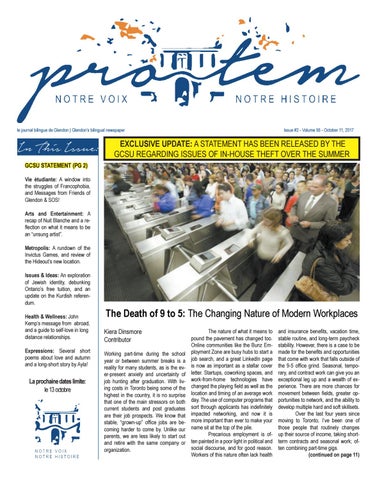
The Death of 9 to 5: The Changing Nature of Modern Workplaces Kiera Dinsmore Contributor Working part-time during the school year or between summer breaks is a reality for many students, as is the ever-present anxiety and uncertainty of job hunting after graduation. With living costs in Toronto being some of the highest in the country, it is no surprise that one of the main stressors on both current students and post graduates are their job prospects. We know that stable, “grown-up” office jobs are becoming harder to come by. Unlike our parents, we are less likely to start out and retire with the same company or organization.
The nature of what it means to pound the pavement has changed too. Online communities like the Bunz Employment Zone are busy hubs to start a job search, and a great LinkedIn page is now as important as a stellar cover letter. Startups, coworking spaces, and work-from-home technologies have changed the playing field as well as the location and timing of an average work day. The use of computer programs that sort through applicants has indefinitely impacted networking, and now it is more important than ever to make your name sit at the top of the pile. Precarious employment is often painted in a poor light in political and social discourse, and for good reason. Workers of this nature often lack health
and insurance benefits, vacation time, stable routine, and long-term paycheck stability. However, there is a case to be made for the benefits and opportunities that come with work that falls outside of the 9-5 office grind. Seasonal, temporary, and contract work can give you an exceptional leg up and a wealth of experience. There are more chances for movement between fields, greater opportunities to network, and the ability to develop multiple hard and soft skillsets. Over the last four years since moving to Toronto, I’ve been one of those people that routinely changes up their source of income, taking shortterm contracts and seasonal work; often combining part-time gigs. (continued on page 11)
Pro Tem
GCSU STATEMENT
Editor in Chief | Rédactrice en chef Bruno Da Costa editor@protemglendon.com
Dear readers, please note that this is a direct statement from the GCSU and has not been altered in any way by Pro Tem. Please direct all queries to the GCSU contact provided at the end of the statement.
Chief of Operations | Chef d’Operations Sarah Tadjana operations@protemglendon.com
Fellow Union Members,
Assistant French Editor | Rédactrice adjointe Camille Slaght assistantfr@protemglendon.com
It is with regret that the Glendon College Student Union Council inform you that we are entering the sixth month of an investigation into potential financial fraud. The 2017-2018 Council believes that between September 2016 and April 2017, approximately $20,000.00 was stolen or had attempted to be stolen from our union. The financial fraud was discovered on May 3rd, 2017 by the executive committee.
Assistant English Editor | Rédactrice adjointe Sarah Ariza-Verreault assistanteng@protemglendon.com
The individual responsible for the amounts we have thus far been able to prove with substantial evidence was a member of the executive committee from 2016-2017, having served as a member of the council in prior years.
Media Officer | Agente de media Amanda Jose media@protemglendon.com
With the help of the Glendon College and York University Offices of Community Safety, actions have been taken within the university against this individual. External to York University and Glendon College, the GCSU has pressed legal charges against this individual.
Photographer | Photographe Krysta Veneruz photography@protemglendon.com Design and Layout | Maquettiste Sam Kacaba design@protemglendon.com Section Editors | Chroniqueurs Campus Life | Vie étudiante Reeda Tariq campuslife@protemglendon.com Issues and Ideas | Actualité et opinions Alex Freeman issuesideas@protemglendon.com Metropolis | Métropole Behrad Taeed metropolis@protemglendon.com Arts and Entertainment | Arts et divertissement Sandrine Exil arts@protemglendon.com Health and Wellness | Santé et bien-être Kaya Harris-Read health@protemglendon.com Expressions | Expressions Ayla Sljivar expressions@protemglendon.com
About Us Pro Tem est le journal étudiant du collège Glendon. Publié pour la première fois en 1962, c’est la plus ancienne publication de l’Université York. Opinions published in Pro Tem are those of the individual writers, and do not reflect the views of the publication as a whole. We will not print copy deemed racist, sexist, homophobic, or otherwise oppressive. Les lettres adressées au journal peuvent être éditées au niveau de la clarté ou de contenu. All copy appearing in Pro Tem is at the discretion of the editorial team. Feel free to respond to what you read in the pages of Pro Tem! / N’hésitez pas à réagir à ce que vouz avez lu dans Pro Tem! To see past editions of Pro Tem, please visit our website: www.protemglendon.com. Be sure to follow us on Facebook and Twitter for reminders about upcoming deadlines and events: @ProtemGL
2
We are deeply ashamed by this situation, as we understand our collective responsibility in ensuring the fiscal integrity of our student union. The incumbent council has taken measures to ensure that a situation such as this does not occur again. Our priority remains to advocate and protect the interest of our fellow students, provide services for the members of our union, and ensure that funds entrusted to us are not misappropriated. We invite the entirety of the Glendon student body to our General Meeting which will be held on Wednesday, October 18th at 6:30 PM in A100. Should you have questions, concerns or wish to address the council regarding the matter, you may direct these to Brandon Cheong at president.gcsu.aecg@gmail.com. *Published with explicit permission by the executive council of the Glendon College Student Union. Chers lecteurs, veuillez noter que ce texte provient directement de l’AÉCG et n’a aucunement été modifié par Pro Tem. Veuillez donc diriger vos questions au contact de l’AÉCG fourni à la fin du texte. Cher Membres de l’Association, C’est avec regret que le conseil de l’Association Étudiante du Collège Glendon vous informe que nous entamons le sixième mois d’enquête sur une fraude financière potentielle. Le conseil 2017-2018 estime qu’entre septembre 2016 et avril 2017, environ 20 000 $ ont été volés ou ont tenté d’être volés au sein de notre association. La fraude financière a été découverte le 3 mai 2017 par le comité exécutif. La personne responsable des montants volés, que nous avons pu prouver jusqu’à présent avec des preuves substantielles, a été membre du comité exécutif de 2016-2017, ayant été également membre du conseil au cours des années précédentes. Avec l’aide des bureaux de la sécurité communautaire du Collège Glendon et l’Université York, des mesures ont été prises au sein de l’université contre cet individu. Externe à l’Université York et au Collège Glendon, l’AÉCG a engagé des poursuites contre cette personne. Nous sommes profondément honteux face à cette situation, car nous comprenons notre responsabilité collective d’assurer l’intégrité fiscale de notre association étudiante. Le conseil sortant a pris des mesures pour éviter qu’une telle situation ne se reproduise. Notre priorité demeure de défendre et de protéger l’intérêt de nos constituants, de fournir des services aux membres de notre association et de veiller à ce que les fonds qui nous sont confiés ne soient pas détournés. Nous invitons l’ensemble du corps étudiant de Glendon à notre assemblée générale qui aura lieu le mercredi 18 octobre à 18h30 dans A100. Si vous avez des questions, des préoccupations ou souhaitez vous adresser au conseil à ce sujet, vous pouvez adresser Brandon Cheong à president.gcsu.aecg@gmail.com. *Publié avec la permission explicite du conseil exécutif de l’Association Étudiante du Collège Glendon.
Looking To Get Involved On Campus? JOIN SOS!
Kelsey Charette
Coping with my ‘Francophobia’ Connor Boyd Contributor I’m a first-year student at Glendon studying in the concurrent education program to become a French teacher. In the first semester, I’m only taking two of five courses in French. Why would that be? I admit I have a fear of French. I’m not referring to all aspects of the language, but I’m on uncertain ground in writing and speaking French in a French environment. As an Anglophone, French is not my first language so I’m slightly intimidated, but I’ve put it out there, so now I can take steps to conquer that fear. I studied French for all four years of high schol, and despite this, I still struggle with the language I love but have not yet mastered. Learning a language can be rewarding, it allows you to connect with more people and encourages you to learn more about other cultures. Today, the appeal of multilingualism is more enticing than ever. In a study conducted by the polling organization ICM, 20 per cent of the over 1,000 youth surveyed between ages 14 and 24 already spoke another language at home and 70 per cent were interested in learning another language. Their motivations varied greatly: better job prospects abroad, being able to talk to more people, learning about another culture, and gaining a sense of achievement were among the top benefits provided by participants.
Our volunteers have the opportunity to see their hard work pay off. When you volunteer for Students Offering Support (SOS), you become a part of an incredible network of students and supporters across Canada – and across borders. You will have the chance to help your peers, connect with like-minded people, and develop important skills like leadership and public speaking. (Not to
Vie étudiante mention, the chance to travel abroad and get your hands dirty!) During May and August, volunteers embark on two-week trips to build the project they fundraised for that year and the projects themselves ranging from playgrounds to gardens to new classrooms in association with a local charity in the country they are visiting so they can see just how far their time and effort can go. If you have any questions or would like to know more you can email us at sosglendon@gmail.com or follow Glendon SOS on Facebook, Twitter and Instagram.
On the other hand, many people feel languages are too difficult to learn. In the study, the greatest deterrent of learning a language was difficulty with grammar and 27 per cent didn’t feel confident speaking. This is similar to my own challenges and experience. Personally, I struggle with grammar and I’m also often nervous about speaking to others in French. To help with my nervousness, I have begun to seek out new learning opportunities to improve my French. For instance, one of the students in residence is from Paris and, to my pleasant surprise, she told me she was interested in learning more English, so we could help each other. As the bilingual campus of York University, there are plenty of opportunities for students to learn French at Glendon; their Toastmasters Club is the only bilingual chapter in Toronto where members can work on their public speaking and communication skills in both French and English. I was president of my youth Toastmasters Club in high school so this is just an extension of my desire to improve my public speaking. Also located on campus is the Salon Francophone, which is an open space where students can hang out with their classmates and practice their French oral skills together. Though many students may feel insecure about their French skills, there are many resources for you to take advantage of. Whether it be joining a club or practicing with your friends and classmates, practicing every day is the best way to gain confidence in learning a new language. Krtysta Veneruz
3
Campus Life Les Amis de Glendon vous invitent à notre assemblée générale annuelle! Les Amis de Glendon cherchent des étudiants pour être directeurs sur notre conseil d’administration. Il y a quatre postes réservés aux étudiants. Notre assemblée générale annuelle aura lieu le 1 novembre à 18h dans la salle GH 102. Tous les étudiants sont des membres des Amis de Glendon, alors vous avez tous le droit de venir élire le nouveau conseil d’administration même si vous ne voulez pas présenter votre candidature aux élections du conseil d’administration. What is Friends of Glendon? In the late 1960s, students studying at Glendon reached out to the College staff, asking for financial help. Within a few years a fund for bursary and emergency loan support had been created through monthly giving from Glendon staff and faculty. Friends of Glendon was created as a registered Canadian charity in January 1971 to assist the community in their efforts. Students rallied around the organization as well, approving a levy that they would pay to help increase bursary funds each year. How do students receive support? Students receive support through scholarships, bursaries and awards. The Friends of Glendon have created over 50 awards that are managed by the university – we donate funds and set out the award criteria with the College, and they in turn manage our investments and distribute the awards to Glendon students. Scholarships are created to recognize academic excellence. Awards, in comparison to scholarships, can include non-academic and/or financial need criteria. Bursaries are primarily based on financial need (supporting students who don’t have enough resources to complete their studies). When students fill out their Student Financial Profile, they are automatically considered for bursaries offered by the Friends of Glendon. On top of these traditional forms of support, we have two 4 programs that are run through
the College as well. They provide support to students in more difficult financial circumstances. We have a small Book Voucher program that can help a student who can’t afford required textbooks. Our Board of Directors created this program in the 2000s when they learned that some students were finding it difficult to afford all of their books and were dropping courses for that reason. These vouchers are a one-time gift that a student can use at the campus bookstore. From our beginning as an organization, our Emergency Loans program that is run through the College has been there to help students in crisis. We provide funds to give interest-free short-term loans to students who meet specific criteria and must be repaid. In the last six years alone, we’ve loaned over $200,000 to Glendon students. and set out the award criteria with the College, and they in turn manage our investments and distribute the awards to Glendon students. Scholarships are created to recognize academic excellence. Awards, in comparison to scholarships, can include non-academic and/or financial need criteria. Bursaries are primarily based on financial need (supporting students who don’t have enough resources to complete their stud ies). When students fill out their Student Financial Profile, they are automatically considered for bursaries offered by the Friends of Glendon. On top of these traditional forms of support, we have two programs that are run through the College as well. They provide support to students in more difficult financial circumstances. We have a small Book Voucher program that can help a student who can’t afford required textbooks. Our Board of Directors created this program in the 2000s when they learned that some students were finding it difficult to afford all of their books and were dropping courses for that reason. These vouchers are a one-time gift that a student can use at the campus bookstore. From our beginning as an organization, our Emergency Loans program that is run through the College has been there to help students in crisis. We provide funds to give interest-free short-term loans to students who meet specific criteria and must be repaid. In the last six years alone,v we’ve loaned over $200,000 to Glendon students.
Arts et divertissement The Unsung Artist Kaya Harris-Read Health and Wellness
Amanda Jose
Nuit Blanche : Les Torontois échangent une nuit de sommeil pour une nuit d’art
persées dans la ville. En tout, 90 projets artistiques étaient dispersés dans le centre-ville de Toronto. Quelques lieux clés où se trouvait une grande masse concentrée de gens étaient Dundas Square, Nathan Phillips Square, Queens Park et ses alentours. L’Ouest du centre-ville était aussi plein d’installations, dont des sculptures, de la musique et des luSandrine Exil mières. Sur la rue Bay, une exposition Arts and Entertainment a fait hommage à la fois aux Premières Comme vous le savez très bien, le nations et à David Bowie en présentant weekend le plus attendu pour les « fans une interprétation du titre « Life of Mars » de l’art à Toronto vient d’avoir lieu. » de David Bowie dans une langue des Parmi les nombreux spectateurs qui premières nations. Le reflet d’une culont participé à l’évènement du coucher ture dans l’art a bien illustré la ville cosau lever du soleil, il est évident que très mopolite où nous habitons. De plus, certains artistes ont peu de personnes ont pris la peine de voulu rappeler, par leurs œuvres, les dormir ce samedi 30 octobre. Pendant toute la nuit, l’édition révolutions politiques de différents pays 2017 de la Nuit Blanche a transformé au cours du dernier siècle. Ils ont soules lieux emblématiques de notre ville. levé les périodes et des évènements Des artistes du monde entier se sont qui ont marqué l’histoire de certains rejoignit à Toronto pour exposer leurs pays, notamment les années 60 à Cuba projets d’art, tous concentrés sur le et les années 70 en France (surtout à thème « Many Possible Futures ». Il a Paris). Ils ont aussi soulevé des thèmes eu quatre expositions principales et de qui provoquent le débat comme l’imnombreuses petites expositions dis- migration à Toronto. Plusieurs musées
As humans, we all have talents, we all have things we’re good at. In the world we live in, however, some talents are valued over others. In the world of arts, although it seems unfair, it’s natural. The lead in a Broadway show is going to get more attention than the tech crew, and the prima ballerina is given more attention than the orchestra. Just because they are not valued in the same way, does not mean that in any way they are of lesser importance. The show simply would not happen without the tech crew. Without the orchestra, the ballet would be silent, losing the magic the music brings. Because this imbalance of valuing exists, there is an art form that I believe is undervalued, which I would like to acknowledge. Art would not exist in the same way if there weren’t people who appreciated it. This is not a new idea, but I wanted to dive into the idea that appreciating art is a form of art.
et institutions ont ouvert leurs portes jusqu’aux petites heures du matin pour présenter des expositions comme le projet « Look Forward » du Musée des beaux-arts de l’Ontario AGO. Les parties caractéristiques de l’art urbain au centre-ville n’ont pas été oubliées; il y a eu des séries de projets qui se sont développés pendant toute la nuit à Graffiti Alley. Pour les amoureux du film, Toronto a accueilli une exhibition de Netflix qui a beaucoup influencé le festival d’arts. Pour satisfaire au public qui attend avec impatience la deuxième saison de la série télévisé « Stranger Things, » le service de diffusion a recréé le monde « Upside Down ». L’expérience interactive a fait parcourir les visiteurs à travers la passerelle souterraine près de Osgoode Hall, où ils ont dû se glisser dans des vêtements de formes dangereuses pour les protéger d’une substance gluante, semblable au sirop d’érable. En tout, Nuit Blanche a présenté des installations interactives qui ont su toucher et impressionner des gens qui portent toutes sortes de bagages culturels différents.
There is always a certain amount of effort that must go into appreciating art. It can be just putting in headphones and listening to music, or walking past a mural that we enjoy, but it isn’t always this easy. People will drive for hours, sometimes crossing into different countries to hear music they love in concert. People will sit in a tattoo parlour for hours, getting continuously poked with needles to get art on their body. People will read until the early hours of the morning because of that book they refuse to put down until they know the ending. This goes further than simply what people will do to experience art, there is also the process of receiving art. Artists will often leave the meaning of their creations open-ended, leaving it up to the viewer to interpret it. This enters the viewer into a sort of partnership with the artist. It is their job, as much as it is the artist’s, to give the art meaning. There is also some risk involved with being an appreciator. It is often minimal, like purchasing a ticket for a film before you know if you’re going to enjoy it or not. However, this risk is magnetized when involving something like getting into a series of books. When we begin to read a series of books, not only are we investing our time and energy into it, we are also getting emotionally invested in the plot, the characters, and their lives. This is where the risk comes in, because as an appreciator, the art is completely out of our hands. We develop this emotional investment, and put our faith in the creator. And the creator owes us nothing. They create their art as they will, and we take it as it is. If they want to kill our favourite character, as upset as it’s going to make us feel, they have every right to do so. In every form of art there is, in one way or another, an audience, and the audience plays a very important role in art. Think of the Rocky Horror picture show, of which the best parts are created by the audience members. If you ever feel like there just isn’t an art form you’re very good at; remember, if you appreciate art, regardless of the medium, you are also an artist.
5
Pro Tem Launch Party
8
Photographie par Krysta Veneruz
9
Metropolis Sarah’s Spots: Exploring Toronto’s Live Music Venues
October Events in Toronto: What Not to Miss This Month FREE Contemporary Art Bus Tours October 15 from 12-5pm To reserve, call (905) 828-3789
Cirque du Soleil’s VOLTA Dates through until November 26 The Portlands
GCSU General Meeting October 18th, starting at 6:30pm Glendon College, A100
Migrating the Margins: Art Exhibition Through until December 3 Art Gallery of YorkU (AGYU)
Dual Light - A Series of Visual Poems showcased by Dreamwalker Dance Company October 19 - 21 from 8-11pm Harbourfront Centre Theatre
The Edge of the Earth: Climate Change in Photography & Video Through until December 4 Ryerson Image Centre
City Institute’s Global Symposium Beyond Suburbia: Panel Discussion October 20 from 4:30-5:45pm The Underground, Keele Campus Maple Leafs Centennial Exhibit Through until October 31 Hockey Hall of Fame When The Beatles Rocked Toronto Through until Nov. 12 Market Gallery (95 Front St. East) DanceWorks’ 40th Anniversary November 16 - 18, starting at 8pm Harbourfront Centre
Friends of Glendon AGM November 1st, starting at 6pm Glendon College, GH 102
bar”. Instead, it seems the new setup would be better suited to softer styles as the stage’s metal backdrop distorts the sound (what little good the tech was able to muster) to the point where all you hear are the drums once the going (should) get good. And in terms of the food, let’s just say it’s typical of a bar that doesn’t Sarah Tadjana really do food: the tacos are decent and Chief of Operations if you have time to wait, their 50 cent Wing Wednesdays are almost worth it. The Hideout, 423 College St. The way I spot it, the old lo(Formerly: 484 Queen Street W.) cation was like that favourite pair of battered up sneaks, dirtied and a little The Hideout closed its Queen West bit broken, but oh-so comfy, while the doors a little less than a year ago, but new location is that pair of pointy-toed it didn’t take them long to relocate. heels that match your outfit perfectly, Sadly, they gave up their well-loved but leave you forcing a pinched smile sidestreet patio for the noisy, dusty as you endure personalized hell all corner of College and Bathurst — a night long (shoutout to the sound guy corner which is eternally clustered with for making my ears bleed while you turnaways from neighbouring Sneaky let your girlfriend “take the [sound] Dee’s. It hardly seems a fair trade, but board for a spin”). So, while this new that is the Toronto real estate game location has potential (courtesy of nosthese days. And while the new loca- talgic memories of what it used to be), tion is aesthetically pleasing, with its it is definitely still finding its groove. edgy murals and velveteen curtains, And with its location next to Sneaks, Hideout 2.0 looks like it needs a good it’s not likely to do well until it does. breaking-in. It’s still clean and a touch too classy for its traditional clientele, My Rating: 1 star with hope for more with the trademark antlers shoved in a as it finds its [new] niche. corner over the kitchen’s open window. As far as acoustics go, this Stay in the Loop! venue is supremely disappointing, con- Facebook @HideoutLiveMusicVenue sidering the fact that they have tradi- Twitter/Instagram @hideouttoronto tionally marketed themselves as a “rock
Grease: The Musical November 1 - December 10 Elgin Winter Garden Theatre Matilda: The Musical Dates through until January 7 Ed Mirvish Theatre Chihuly Exhibit Through until January 8 Royal Ontario Musuem
If you hear of an event happening in Toronto that might be of interest to our community, let us know at: metropolis@protemglendon.com.
10
www.thehideouttoronto.com
Métropole The Death of 9 to 5 (continued from cover) I’ve held positions as a tour guide in six different cities, an elf at the Toronto Christmas Market, a youth program coordinator, a dirndl-clad photographer, a red carpet assistant, a web producer for a travel publisher, an independent communications consultant, a brand ambassador, a higher education content creator, and an office manager. These positions have widened my windows of opportunity, often allowing me to get my foot in the door for job offers down the road. My colleagues in these positions have also been some of the most diverse I’ve ever encountered, allowing me to really learn from my peers on both personal and professional levels. Precarious employment is by no means a long-term solution in a changing job market, but it will often be the reality for many millennials, particularly in the city of Toronto. The upside is that we have a revolving door of events and festivals to be staffed, a bevy of international corporations that routinely hire contract workers, a bustling tourism sector in any season, and a culture of innovation that thrives on short spurts of creativity and long-term planning. It takes a complex system of cogs and gears to keep this city running — openness to opportunities that come wrapped in non-traditional packaging may be the key to finding where your piece fits. Toronto’s job market is changing, and in order to remain here, our career strategies have to change with it.
lary Clinton, and the former President of the United States, Barack Obama. Many people may have also noticed that the news and their Facebook feeds had been taken over by news of a particular special guest in town — the notorious Prince Harry of Wales. From stalking him and his famous girlfriend, Meghan Markle (star of hit TV show, Suits), to cute videos of him giving popcorn to little children, it seems that everyone had been smitten with news of the VIP. While his day-to-day activities are fascinating, the real reason the Prince was in Toronto was for the 3rd Annual Invictus Games. Despite the Prince’s reputation as a rebellious member of the Marie Gomez Royal Family, he performed extensive Contributor services to his country by completing two tours in Afghanistan during his 10 Last week, the city was full of visitors years in the army. He was also awardfrom near and far. The beautiful and ed the Occupational Service Medal for hot weather brought out all the people Afghanistan, being the first Royal memwishing to seek out the last of summer, ber since Prince Andrew to serve in an but with many exciting events in town, active war zone. Therefore, it comes as the weather was only extra motivation. no surprise that he relates to members Some more high profile visitors who of the military, especially those who came to Toronto for events included have fought in wars. In 2014, Prince the former US Secretary of State, Hil- Harry created the Invictus Games,
Invictus is Victorious
Marie Gomez
an athletic competition, similar to the Paralympics but for injured and wounded soldiers. The first Invictus Games were held in March 2014 in London and the second games were hosted by Orlando in May of 2016. Next year, the plans are to have the Invictus Games in Sydney, Australia. This year, the Toronto Invictus Games were held from September 23rd to the 30th, kicked off by an entertaining and inspiring Opening Ceremonies held at the Air Canada Centre. Guests who spoke at the ceremony included Canadians Mike Meyers, Rick Hansen, and Prime Minister Justin Trudeau. In addition, musical guests also included Alessia Cara, Sarah McLachlan, and The Tenors! The 17 sports events were held at several venues across the city. Ryerson’s Mattamy Athletic Centre, the Pan Am centre in Scarborough and even the Nathan Phillips skating rink/pool was converted for use in the games. Our own York Lions Stadium was the venue used for track and field competitions. Many elementary school groups, families, and military members showed up to watch Monday’s track and field events at the York Lions Sta-
dium, which lasted from 9am until 6pm. The crowds cheered amicably for all the athletes, but especially for Canadian participants. Co-captain of Team Canada, Natacha Depuis, was awarded with loud applause during her medal presentations on Monday, of which she had three, winning gold in the 100, 200, and 300 metre sprint competitions. Later in the week, she also won a silver medal for the one-minute sprint in rowing. This was extremely inspiring since Natacha suffers from a post-traumatic stress injury following her last tour in Afghanistan where she witnessed the death of two fellow soldiers. Natacha’s story is only one of many. All the competitors have their own story of how they were injured in the service of their country, with many becoming physically disabled. Many of these injured service men and women competed in the Invictus Games as a way to represent their country in a different way.
11
Issues and Ideas
The Kurdish Referendum Mitchell Visser Contributor The announcement by the Kurdistan Regional Government (KRG) in June that the referendum for Iraqi-Kurdistan independence would take place on September 25, 2017 didn’t garner much international attention. However, for the Kurdish community, both in the region and across the globe, this was incredible. The referendum, which has repeatedly been cancelled due to international pressure and domestic conflict, was finally going to occur. The six-year long Syrian Civil War and the overflow of conflict across its borders have created both tribulation and opportunity for the Kurdish people. Although financially taxing on Iraqi-Kurdistan, the successes of the Peshmerga (the KRG’s regional militia) and their subsequent occupation of previously Iraqi-held territory, have emboldened the Kurds. The referendum was the culmination of centuries of oppression and resistance in the quest for statehood. Despite this, the celebration following the overwhelmingly positive 92% vote in favor didn’t feel like the celebration it should have been. Hundreds of thousands gathered in Erbil, the capital of the semi-autonomous region, waving flags in celebration of this long awaited moment — not to mention the support received from the Kurdish diaspora in cities across the globe. Yet, it comes at a time when Iraqi-Kurdistan is struggling; the cost of housing 1.8 million refugees and increased military costs, 12 coupled with falling oil revenues,
have all contributed to an ongoing financial crisis that began in 2015. The average Iraqi-Kurd is struggling. Now it seems that Iraqi-Kurds will face even more hardships. Turkey and Iran have been particularly hostile towards the vote, believing it may inspire their own Kurdish minorities to seek independence. Tehran has temporarily halted oil product shipments to the KRG and international flights to Erbil have been suspended by Baghdad following the results. Turkey has also threatened to cut off the KRG’s oil exports that travel from the landlocked region to Turkey’s port of Ceyhan. However, as of September 29th, this trade remains unaffected, as doing so would also hurt Turkish coffers. Internally, many see the referendum as a power grab by the long-term incumbent Massoud Barzani, who had ignored democratic institutions by twice extending his tenure and has repeatedly been accused of corruption and pocketing oil revenues. Many see Barzani as seizing upon the recent nationalist surge emerging from the Kurdish fight against ISIS, and using it to remove attention from the abuses of his government and the KRG’s fumbling economy, and onto the essential Kurdish quest for independence. Today, the Middle East could see the birth of another civil war as the KRG finds itself surrounded by enemies and without allies in their little landlocked nation. Whatever the outcome of this flashpoint, it is still a momentous result for the Kurdish people, who have come so far in their centuries-long fight for independence. Despite the amazing enthusiasm from the Kurds, it’s difficult to not feel cynical in these times of change. The quotidian death, destruction, and displacement occurring in Syria risks becoming the status quo in the region. The optimism for democracy and self-governance that resulted from the Arab Spring is slowly being crushed beneath the successful autocrats of the Middle East. Even if the Iraqi-Kurds are successful in their bid for independence, they may not be successful in their bid for a democratic state.
Ontario’s Free Tuition: Debunked Jacob Falardeau Contributor We are living in a golden age of education. As of this September, the poorest youth in Ontario finally have access to post-secondary education thanks to a revamped OSAP that now includes ‘free’ tuition. At least, that’s what the provincial government would have you believe. As a matter of fact, the socalled “free tuition” is anything but. The revamped program has many flaws seldom mentioned by the government. One of the biggest flaws of the new program is the lack of clarity surrounding the claim of free tuition. One could be forgiven for assuming that this means that the full cost of university would be covered. However, this is not the case. For example, the tuition and fees for a domestic student at Glendon taking a full course load are equal to $7,523 per year. The problem is, the government’s free tuition grant is only worth $6,500 per year because it doesn’t reflect the actual cost of tuition, but is instead indexed to the average cost of tuition. This means that students will still be on the hook for $1,023, and that’s before they even have time to consider things like textbooks, residence, and the cost of getting to and from school. The students who are hardest hit by this are those who are in more expensive programs, such as engineering or law, as they will be forced to seek financial aid elsewhere to bridge the funding gap. The second major flaw with this program is coverage. The most recent government statistics show that over 200,000 students will be eligible for the free tuition program and that over 170,000 students would be receiving more funding than they would have in previous years. However, this is only a fraction of the 822,465 students currently enrolled in Ontario’s 44 public universities and colleges, according to Statistics Canada. This means that almost 55% of Ontarian post-secondary students will still face the same outrageous tuition fees of previous years. Part of the reason why the percentage is so high is because the government
is only providing free tuition to students whose parents earn under $50,000. This means that even middle-class families aren’t eligible for this grant as the program doesn’t take debt loads into account. OSAP also takes your own income into account, meaning that a student who decides to be financially-independent and work a summer job will actually see less funding as a result. The third major flaw is the fact that the government removed other grants in order to pay for this so-called free tuition making it harder for many students to pay for their education. In previous years, students were able to claim the cost of tuition, textbooks and other educational expenses as a tax credit. Also, a grant given to Francophones and students from rural areas who had to travel further than 80 kilometres from their homes in order to pursue education in French has now vanished. This grant has now been amalgamated into the free tuition program. The problem with the free tuition grant is the following: instead of providing students with new and expanded financial aid, the government has instead redistributed existing funding into a single large grant. In essence, the government has merely shifted funding around in order to make it seem as if they are making a commitment to improving access to post-secondary education. It’s patently obvious that the provincial government has failed Ontario’s students and is attempting to manipulate us. Instead of offering real change and providing financial freedom we so desperately need in order to thrive after our university careers, we are given useless platitudes, further shackling us to insurmountable debt loads. It’s undeniable that the revamped OSAP will help reduce the financial burden faced by many students. However, implementing a nomenclature alluding to free tuition is a dishonest and shameful practice. For me, free tuition would involve a universal program covering all students regardless of their income, to provide us with the necessary support to achieve success. As students, we have the ability to demand lower cost education, and to force those in power to acknowledge that we will not stand for unreasonable tuition increases.
Why I am not a Jew (even though I was born Jewish) Clara Maguregui Contributor Ever since I can remember, whenever anyone asked me how I self-identified, I would answer Canadian and Jewish. The Canadian part was easy for me to understand: I’ve lived here since I was two, I went through the Ontario curriculum, English is my mother tongue, and western values dictate my moral code. To explain my Jewish side, I would an swer that I was born in Israel. And that was it. It ended there. The only person to ever dispute this is Kat, my long-time friend. We’ve known each other since we were six, and we’ve never been afraid to offend one another. We are always open to consider new perspectives. Kat firmly believes that I am not Jewish because I am not religious.
Actualité et opinions To me, Kat’s argument was logical and rock-solid. When the issue of my Jewish identity was later raised in conversation with my mother, and I informed her of Kat’s argument, she fervently disagreed with this point of view. Kat was right. I’m not religious. Not only do I not follow a single Jewish tradition or custom, but know very little about any of them. I recognize the words ‘Purim’ and ‘Rosh Hashana’, but I don’t know when they’re celebrated or why. I know that Shabbat is Saturday, but I don’t know why this specific day is considered holy. I know that religious men wear the kippah and religious women wear long skirts, but I fail to grasp their significance. Despite being born into a Jewish family, I know more about Christianity than I do about Judaism because I grew up in a western country with a culture and history steeped in the Christian tradition. My (albeit rudimentary) knowledge of Christianity was gathered in a passive way through movies, TV shows, books, etc. I understood the moral significance of biblical stories, such as Genesis, Noah’s Ark, Moses
(Prince of Egypt), Joseph (Joseph and the Amazing Technicolour Dreamcoat). I’m familiar with the Christian holidays, and I can name a handful of saints. Some might argue that Bible stories can be found in parts of the Old Testament, which is shared by the Jewish Tanakh, or Hebrew bible. Yet, I learned these stories within a Christian context, not a Jewish one. Like me, my mother is also not religious. However, having lived in Israel for nearly a decade before my birth, she accumulated a working knowledge of the Jewish religion and its traditions, even within a greater context of agnosticism. Despite her lack of religiosity, my mother was very surprised and upset by my aforementioned remarks. She reiterated that I was Jewish and that Kat was wrong. She told me that a person doesn’t need to follow the Jewish faith in order to be a Jew. She repeatedly hammered this thought into my head: I was born in Israel and into a Jewish family, so I was unequivocally Jewish. Later that night, as I went to bed, both contradictory arguments somehow made sense to me. As I woke up the
following day, the conundrum had vanished. The idea of being or not being Jewish didn’t affect my day-to-day life. Whether or not I self-identified as Jewish did not affect my schooling, friends, homework, camps, etc. Since I don’t observe any Jewish traditions, they don’t guide my life. So the question remains: how do you define a Jew, exclusively by religion or by culture too? And if by culture, then what is it? The Jewish diaspora covers multiple climates and time zones. Since every part of the world will have their own culture, how is there a common Jewish culture? If religion is not primarily used to define the “Jewish Race”, then how can different cultures accomplish this? Of course, there is always Israeli culture: most Israelis are Jewish, but Israeli culture is limited to the land of Israel and cannot include the rest of the Jewish diaspora. And besides, although Israel is known as the Jewish State, it is not entirely Jewish (20% of Israelis are listed as non-Jews). Then maybe by a language? Hebrew is known for being the dead language that was revived; a testament to the endurance of Judaism. But many Jews outside Israel don’t speak Hebrew (I, for one, do not). For quite some time, I have ceased to consider myself Jewish. Instead, I view myself as a Canadian who was born in Israel, and who has Jewish ancestry. Although I feel tied to my relatives in Israel and Skype them once a week, I speak to them in Russian, not in Hebrew. I feel tied to them because they are my family, not because they’re Jewish. Note: while I have decided on my non-Jewish identity, I am still exploring what being Jewish means. Is there really a Jewish race? What are the differences and similarities between being Jewish and being Israeli? Between Zionism and Judaism? The relationship between Jews and Palestinians? How are they different? How are they similar? If you have any ideas about these questions, or anything related (being Jewish or not) and you would like to share them with me, please feel free to contact me at: april9714@yahoo.ca.
13
Actualité et opinions À la découverte de la Nouvelle Aquitaine: Zoom sur Saint-Émilion, Bergerac et la dune du Pilat Gabriella Giordan Contributrice Cette année, j’effectue un échange à Bordeaux, une ville située dans la partie sud-ouest de la France, dans la région de la Nouvelle Aquitaine. Arrivée au début du mois de septembre, j’ai déjà eu l’occasion de découvrir certains des trésors cachés de la région, soit la dune du Pilat et les villes de Saint-Émilion et Bergerac. Il est pratique de voyager aux alentours de la région de diverses manières, plus particulièrement en train et en vélo. En prenant le train de la Gare Saint-Jean, direction ouest, pendant environ cinquante minutes, l’on arrive à Arcachon. La dune du Pilat
14
se situe à 12 kilomètres d’Arcachon. À une hauteur de 110,9 m, il s’agit de la plus haute dune d’Europe. Elle est connue en Europe et autre part dans le monde et constitue de ce fait l’un des sites naturels les plus visités de France. Malgré les nombreux avertissements indiquant aux aventuriers qu’il ne faut pas « surestimer ses capacités », voyageurs âgés comme jeunes, dotés de capacités physiques distinctes, entreprennent la montée du long escalier menant au sommet de la dune. Ce n’est pas sans raison : la dune est un vrai spectacle naturel. À l’est de la dune s’étend l’ample forêt des Landes de Gascogne, qui couvre plus d’un million d’hectares et bénéficie d’une biodiversité notable, et à l’ouest se trouve le bassin d’Arcachon. Afin de profiter pleinement d’une visite à la dune, plusieurs personnes choisissent d’y piqueniquer, voire même d’y faire de la randonnée pédestre et du parapente. En allant vers l’est à partir de Bordeaux, pendant environ quarante minutes, l’on atteint Saint-Émilion. Cette ville historique permet de se plonger en plein Moyen- ge français. En effet, la cité a conservé la grande
majorité des murs, bâtisses, monuments et chapelles datant de l’époque médiévale. Les rues étroites sont faites entièrement de pavés et sont souvent très escarpées. Il est possible d’accéder et de monter jusqu’en haut de la tour du Roy, où une vue magnifique de Saint-Émilion se dresse devant nous; l’on aperçoit l’Église monolithe de Saint-Émilion et l’ensemble rouge pâle des toits de bâtiments et de maisons. De l’autre côté de la ville apparaissent les vignobles de Saint-Émilion, lieu d’origine d’innombrables vins très connus au niveau national comme au niveau mondial. L’on ne peut pas, effectivement, présenter Saint-Émilion sans mentionner la viniculture riche et historique qui la distingue d’autres villes françaises, voire européennes. À partir de Saint-Émilion, en poursuivant le chemin vers l’est pendant une cinquantaine de minutes, l’on arrive à Bergerac. Vu la petite taille de la ville, il est tout à fait faisable de faire le tour du centre-ville en moins d’une demi-journée et de se balader librement dans ses rues historiques. Bergerac jouit à la fois d’une atmosphère de tranquillité et d’un dynamisme culturel, avec plusieurs coins à explorer et tout
un répertoire de musées à visiter. La ville possède également une importante et magnifique étendue d’eau, que l’on appelle la Dordogne. Vue de loin, cette rivière, considérée comme l’une des rivières plus propres d’Europe, sert de miroir au ciel et reflète la singularité des bâtiments bergeracois dans toute leur longueur. Bergerac est par ailleurs la patrie de Cyrano de Bergerac, personnage emblématique faisant l’objet d’une des plus renommées pièces de théâtre françaises du XIXe siècle. Cet ambassadeur fait la fierté des habitants de la ville, comme le démontrent la statue ainsi que la Maison Cyrano de Bergerac qui lui sont dédiées dans la Place Pelissière. Un spectacle naturel, une cité médiévale et une ville au cœur de la littérature française ont servi d’amorce à mon projet d’exploration de mon nouveau chez moi. La dune du Pilat, Saint-Émilion et Bergerac constituent, sans doute aucun, trois lieux de la région de la Nouvelle-Aquitaine à voir absolument pour leur immense richesse naturelle, historique et culturelle.
Photos by Gabriella Giordan
Health and Wellness
Self-love and long distance: How to make the most of a long distance relationship Christian “Cali” Lopez Alumnus Does distance really make the heart grow fonder? Before you start a long distance relationship, there are a couple of things you should know. Long distance is most likely going to be a make-it-or-break it situation, that’s just the bitter truth. Once you have realized that you can, in fact, make it, it will change your dynamic forever. The trials and tribulations that are unique to this experience will make you a stronger and more patient person. Although many people in your life will tell you that long distance is a relationship-killing, soul-sucking, tragic ordeal, I am here to tell you that this is not necessarily the case. It can be one
of the most rewarding and beneficial experiences a person could go through. If you want to know how this scary and nerve racking experience can change your character for the better, keep reading! This first aspect of long distance relationships, although cliché, is honestly so true; a long-distance relationship will make or break your future with that person. Not spending time with someone makes us insecure and unsure about our relationship. We start to doubt their loyalty and their commitment to us, which can cause us to get straight up jealous. I have spent two out of four years living on a different continent from my partner and, over time, I have learned some simple ways to combat FOMO! Keep yourself active and engaged with other people instead of sitting at home wishing bae was there. When I was living in Spain, I made sure to keep myself busy physically and mentally while making time for connecting with my S.O, too. I joined a volleyball team, rode my bike a lot, accepted people’s invitations to go out at night, and updated my blog regularly. Making sure your life continues and
that you are still growing and developing as a person is super important for what happens after the time apart is done. My boyfriend went away to do his masters in Hungary two years after I returned from Spain and I realized that the dynamic is completely different when you are the one staying in the familiar place. Everything reminded me of him, everything made me miss him, and I needed to make sure that it did not drive me crazy. To avoid the impending insanity that comes from this, I started to see time and space as relative, and not hugely important in what I wanted in the future. After we established that we both wanted this for life, and that one day in the future we would be together forever, things became way easier. Surviving a couple of months or years apart in what could be a lifetime together makes that time less daunting. Remember that this is only temporary, and one day you will be together again. Once you have accepted the relativity of time and space, you will be able to tackle any of life’s problems in a different way. It makes you realize that everything is temporary and makes
you question the importance of certain things. Personally, it has made me a kinder person towards other people, because I realized that you never know what someone else is fighting or dealing with silently. It also makes you more patient and willing to think long-term about your goals and aspirations. If you make loving yourself and others a priority, you will become more positive and promote happiness. They say that good things come to those who wait, and I never truly realized what that could mean. Sacrificing instant gratification for long term gain is easier said than done, but trust me, it is so worth it. So just remember: be patient, be kind, and choose love first.
15
Midterm Madness Solutions Reeda Tariq Campus Life
John Kemp’s Kitchen: Simply Swiss John Kemp Contributor Coucou, tout le monde! Or so I’ve learned to say here. Between the saluts, the bonjours, and the bonsoirs, I have been learning lots here in Switzerland, and more than just the many ways to say hello. In the almost month that I’ve spent here in Lausanne, I’ve had the chance to explore a plethora of different foods. Swiss cuisine has been among these many experiences. With the amount of cheese and chocolate I’ve been indulging in here, I might be looking a little different by the time I get back to Glendon next year. However, what I’ve been enjoying even more has been the somewhat hidden gem that is Swiss cuisine. It features the country’s famed cheeses, such as the Gruyère-Vacherin fondue I was treated to the other day, but also something I find to be incredibly important in food: simplicity. The delicacies I’ve enjoyed such as rösti (essentially an oversized hash brown, mineg which was topped with grilled tomato, smoked bacon, pickled onions, and a fried egg – what character!) and jarret (smoked ham hock served over sauerkraut with roasted potatoes and minced chives) have both shared that simplicity I’ve been finding to be so prevalent in Swiss food.
This is not to say that Swiss cuisine is boring or bland, but that it’s great food made from relatively simple ingredients and in a relatively simple way. Yes, there are certain nuances that can vary depending on preparation methods and whatnot, but what’s important is that in our society, where food has become something unnecessarily complex and where cooking well has become something of a niche for those who “know how to cook”, it’s refreshing to see food as good and as straightforward as in Switzerland. What we need to realise is that good food isn’t hard, although remembering that is. As a challenge, go into your fridge, cupboards, and pantries and see what you can create with what you find. Don’t be afraid to break rules and don’t be afraid to let intuition take the wheel. Once your pièce de résistance is complete, snap a photo and send it to me at either @johnkempskitchen on Instagram or John Kemp’s Kitchen on Facebook. I can’t wait to see what you come up with!
Who would have thought that October would sneak up on us that quickly? The familiar chill’s back in the air again, along with all the markers of Autumn: sweaters, pumpkins, those gorgeous colorful leaves, and midterms! And just as it’s most certain that many of us will be, or already are prepping for them. Just as many of us will also be feeling all that stress, cold weather, and lack of vitamin C. Hopefully these tips will give you some inspiration or motivation to try your best to not let the germs and stress get to you! Sleep: Something a lot of us neglect, but really just a decent night’s sleep does a body wonders. Don’t neglect all the benefits you can gain from just a nice, good eight hours of rest. Less stress, being more alert and also more focused are just some of these benefits. Food: And I don’t mean some snacks from the vending machine at the end of your floor, I mean some proper nutritious food, like a bowl of tomato soup or even just a simple bowl of pasta with some cherry tomatoes and a dash of olive oil. Cheap, easy, and filling. But if you need some more inspiration, always check out what John Kemp has sent in for his spot on “John Kemp’s Kitchen!” Exercise: Whether that means a good intense game of volleyball, sev-
eral laps around the pool or even just a simple walk in the outdoors, getting up and getting out there will be benefitial not only for your physical health, but for your mental health as well. Just like the phrase says: “Healthy Minds, Healthy Bodies!” Plus it’s a great way to also hang out with your friends, or meet some new people by dropping in on an exercise class at the GAC. If your friend has a dog, ask to walk with them, maybe even by the many trails that dot our backyard. Arts & Crafts: If you’ve ever entered the Centre of Excellence, and I’m sure we all have, then by now you’ve spotted a bunch of friendly faces right there in the middle of all the action. This is the Lion’s Den team, a group of upper year students dedicated to help you find your way around campus, and not only in the spacial sense, but also by recommending clubs and organizations and events on campus that you can go to. The Lions Den also offers colouring sessions and hot chocolate and sweets. Remember, Glendon, that stressed spelled backwards is desserts! Studying: Setting out a nice, well thought-out studying schedule with plenty of time to do your assignments and study for tests. This may be a bit hypocritical of me since I’ve also spent plenty of time trying to just hit that word count for an essay twenty minutes before it’s due and just being fine with what I’ve got. While there might be only less than three months left for 2017, that doesn’t mean it’s too late to achieve those study goals that you promised yourself back in January. After all, there’s no better time to start something than today!
Pro Tip: For all of John’s previous recipes, follow him on Facebook at John Kemp’s Kitchen or on Instagram @johnkempskitchen!
Reeda Tariq
16
Expressions I’m Right Here! Ayla Sljivar Expressions “At this rate, Mrs. Alghren, we suggest that you consider the alternatives,” said Dr. Hermann. “We have done everything that we could for Leif.” Mrs. Alghren held in her sobs as she laid her eyes on the frail body that could barely fit on the cot due to his staggering height. The sounds emanating from the heart monitor shook her brain until her vision began to blur the greyness of the hospital. She slowly advanced towards her son with a shaking, outstretched hand that grazed his cheek. She stared at his closed eyelids and longed to look into his deep, blue eyes she had fallen in love with the moment that he was born. She pressed her wrinkled forehead against his, which was was raw with lacerations from the accident, and placed a kiss on his pale cheek. “I come back later, Leif,” said Mrs. Alghren before briskly walking out I love you, Mama, Leif thought, but the oxygen mask that covered his face prevented him from saying it out loud. I should have stayed home. Why did I feel the need to go for a drive? I could have gone for a walk to get some fresh air. I should have moved to the side once I noticed that man’s driving. I should have “What’s good, ma frien’?” said a loud voice. Driss. Leif heard his friend shuffle into the room, and a familiar clinking sound followed, coming from what he presumed were cans of beer in a backpack slung over one shoulder. Driss’ smile wavered as he glanced at his friend’s lifeless body; the blue-purple veins on his arms and face were prominent against his translucent skin. The swelling in his face had subsided but there were black bruises on his body. His left arm was bandaged in a cast and lightly placed on his stomach, heavily inked with names and ‘get well soon’ wishes. He was tangled in tubes and needles, as if he was part of a laboratory experiment. Of course, his dirty blonde hair was freshly trimmed and styled by his moth17 er, while his ever-growing beard
was being taken care of by his father. “Yuh know, yuh don’t look so bad if yuh close one eye an’ squint widda othuh,” said Driss while chuckling to himself. I bet you don’t look as sharp, either. Leif was right; he distinctly smelled the gasoline that seeped from his friend’s pores as he put down his belongings. Driss gathered his black, corkscrew curls in a short pony tail while a few pieces fell in front of his face. He took an old rag out of the pocket of his mechanic shirt and attempted to wipe the grease from his face to uncover his russet skin tone. He threw the rag into the nearest garbage can and yelped in excitement from getting it in on the first shot. Driss did not miss a single visitation day; though he was probably the most disruptive visitor that the “Hôpital St. Joséphine” ever had, he came in regardless of what the cold, Québec weather had in store. Trails of empty beer cans would be left behind as he chased the young nurses down the halls, but despite his questionable behaviour, he made sure to cover all of the bases during his visits: inform Leif of what he missed from school, read the newspaper out loud, and screen films (with his explicit explanations). “By da way, I gotta show yuh someting,’” said Driss as he uncovered a folded piece of paper. “Dear Mr. Maurais, we a’ pleased to congratulate yuh on yuh success an’ on behalf of da London School of Business, we welcome yuh to our campus dis Fall…” Driss...You got in. Y-You did it. “Yuh see dat, Leif? Yuh boy is goin’ to da city a Kings and Queens! Shit man, who knew someone like me could land someting like dis?” asked Driss before crushing an empty can with his foot. I never doubted you, man. “See? Now yuh not da only one who will be studyin’ in Europe, Monsieur auteur,” If only I could accept my offer. It felt so long since Leif held a pen in his hand and wrote his deepest thoughts onto paper. He was extremely frustrated that since his accident, he hadn’t voiced his words onto paper. It always provided him a sort of solace from reality, which was something that he truly needed at this moment. “What was blessed wuh those scholarships dey handed out — did ya know dey have a scholarships fuh people wit a Moroccan background? I tank
God fuh givin’ me a Moroccan mama.” Leif attempted to move something, even a finger, to show his friend that he heard everything, but nothing would move. “I figured since yuh would be studyin’ back home in Sweden, we could always meet in da middle on da weekends, yuh know? Go to Germany? Italy?” asked Driss before glancing at his friend, “’Cause yuh will get bettuh by den, right?” I don’t know. Leif had no idea whether he would ever wake up. Three months had passed since he was admitted into the hospital. Leif was trapped in his own mind, a prisoner of the thoughts that crushed every shred of hope that Driss tried to install in him. Even if I do get better, what if I remain permanently disfigured, paralyzed? How could I live my life the way I always hoped— A long, shaky exhale emanated from his friend, followed by sniffles. Bewildered, Leif tried to scope out the exact location of the sound as it could never come out of Driss; he did not believe in crying under any circumstances. “Shit man, how’d dis happen?” asked Driss while blinking away tears, “Seniuh year was supposed to be our year. We wuh supposed to make it da best year yet. Doc said yuh wuh gonna be back by Christmas, an’ it’s already January.” Driss, I’m right here! I never left! Leif felt his lungs burn with the words that he longed for his friend to hear. He desperately wanted to let tears freely run down the curves of his cheeks and feel his throat tighten due to his sobs. He just wanted to feel something, anything, in order to prove to himself that he was still alive. He heard Driss rummage through his bag. “I’ve been avoidin’ dese tings for some time now. At first, it was ‘cause I couldn’t look back at my stupid haircuts, but now...” Your haircuts still haven’t changed, man. Driss carefully flipped through the pages of a tattered photo album and stopped at one particular picture of two young boys, their arms draped around each other’s shoulders. “I remembuh da moment yuh walked intuh da school, dressed in yuh fancy dress shirts and shiny shoes. We all tought dat yuh wuh lost o’ someting’” said Driss.
I remember. That’s when the teasing started. Leif’s father was a Swedish diplomat and was placed in a consulate in Québec, Canada. Needless to say, his first day started off as a nightmare as soon as he arrived at the school playground. “Yuh made it worse when yuh started to speak; no one knew a damn ting you said,” In my defence, I was what you called an ‘immigrant’ from Sweden! “Now yuh’d probably argue an’ play da ‘immigrant’ card again,” said Driss while letting out a sad laugh. You know me too well. He recalled the punches and kicks from the other children. He was not entirely sure if it was due to the way he dressed, his thick accent, or the fact that he preferred writing stories in his notebook to playing roughhouse with other children that made him a desirable target for torture. “But it wasn’t yuh fault. Dem kids wuh stupid to tink dat yuh didn’t know noting’. If anyting, dey should be makin’ fun a me since yuh wuh able to lose dat accent of yuh’s.” You always had my back. Driss thumbed through more pictures as he went through extreme detail of the memories that matched each photograph. Once visitation time was over, he slowly packed up his belongings while ensuring that Leif was left in the proper condition for the nurse on-call. While doing a final floor check of the room, he noticed that one of the photographs fell from the photo album. Two grinning boys stared back at him, oblivious to what was to come. He leaned the picture against a vase that contributed to Leif’s ever-growing shrine. “Imma come back tomorruh an’ bring a movie to watch,” said Driss before he turned towards Leif, “You bettuh not leave, man.” I wouldn’t dream of it, Driss.
Pathway to the Mountains
The Night Woman Eve Svetoslava Lovegood Contributor
Anonymous
The night woman travels the world And covers all the earth with darkness. She is very wise and very old, A sorrowful joy or a happy sadness?
Steep, rugged, narrow. Light streams through; Trees divide the world. Like walking through a spectrum. First red, then orange, Yellow and green.
Twice a day she sees her lover, It’s him, she chases all her days. Perhaps, one day, you might discover At sunrise and at sunset, As sir Daylight, his lover sways.
One final climb – Snow glistens on the mountain-top. Breathtaking.
New Hope
Broken Love
Eve Svetoslava Lovegood Contributor
Khalila De Grasse Contributor
Sweet forgotten history To the new self, now a mystery In my memory forevermore But life is now, not before
Unwrap my heart gently, darling, Let me lay my vulnerabilities at your feet. Naked, I stand before you, pleading, See past my bruising to the beauty within Let me show you how the broken love How we shine even through the shattered pieces So take me as I come, Crumpled and flawed
Yesterday, a friend and lover Today, a stranger to my heart Yesterday, I will discover Tomorrow, was new life apart A wind of change swept by today New hope is planted in my heart A magi of love came by today Fresh romance promised that he will start Sweet new history To the old self, then a mystery In my hopes until tomorrow I will have joy, forget old sorrow.
18