le journal bilingue de Glendon | Glendon’s bilingual newspaper
Check us out online anytime at www.protemgl.com
Issue 7 - Vol. 56 - February 13, 2018
In This Issue: Vie étudiante: An interview with YFS’ Momentum and op-eds on the need for student unions and the importance of third spaces. Arts and Entertainment: The Pro Tem Team reviews the nominees for Best Picture and David Rosen gives his top album picks from January! Métropole: Les services offerts au centre francophone, a review of Cherry Cola’s and Krysta’s tips for Valentine’s Day! Issues and Ideas: La francophonie plurielle au Canada, l’alliance belgo-canadienne, and the state of ‘public politics’. Santé et bien-être: The hypocrisy of Bell Let’s Talk, ideas on meal-planning, and John Kemp’s Moroccan experience! Expressions: Ten of GL’s worst date stories make for some welcome comic relief this Hallmark holiday season! La prochaine date limite:
le 16 février
Pitchfork
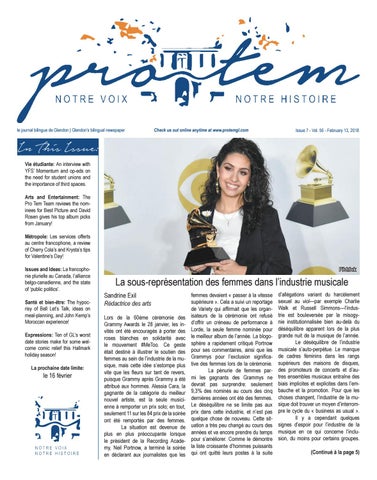
La sous-représentation des femmes dans l’industrie musicale Sandrine Exil Rédactrice des arts Lors de la 60ème cérémonie des Grammy Awards le 28 janvier, les invités ont été encouragés à porter des roses blanches en solidarité avec le mouvement #MeToo. Ce geste était destiné à illustrer le soutien des femmes au sein de l’industrie de la musique, mais cette idée s’estompe plus vite que les fleurs sur tant de revers, puisque Grammy après Grammy a été attribué aux hommes. Alessia Cara, la gagnante de la catégorie du meilleur nouvel artiste, est la seule musicienne à remporter un prix solo; en tout, seulement 11 sur les 84 prix de la soirée ont été remportés par des femmes. La situation est devenue de plus en plus préoccupante lorsque le président de la Recording Academy, Neil Portnow, a terminé la soirée en déclarant aux journalistes que les
femmes devaient « passer à la vitesse supérieure ». Cela a suivi un reportage de Variety qui affirmait que les organisateurs de la cérémonie ont refusé d’offrir un créneau de performance à Lorde, la seule femme nominée pour le meilleur album de l’année. La blogosphère a rapidement critiqué Portnow pour ses commentaires, ainsi que les Grammys pour l’exclusion significative des femmes lors de la cérémonie. La pénurie de femmes parmi les gagnants des Grammys ne devrait pas surprendre: seulement 9,3% des nominés au cours des cinq dernières années ont été des femmes. Le déséquilibre ne se limite pas aux prix dans cette industrie, et n’est pas quelque chose de nouveau. Cette situation a très peu changé au cours des années et va encore prendre du temps pour s’améliorer. Comme le démontre la liste croissante d’hommes puissants qui ont quitté leurs postes à la suite
d’allégations variant du harcèlement sexuel au viol—par exemple Charlie Walk et Russell Simmons—l’industrie est bouleversée par la misogynie institutionnalisée bien au-delà du déséquilibre apparent lors de la plus grande nuit de la musique de l’année. Le déséquilibre de l’industrie musicale s’auto-perpétue. Le manque de cadres féminins dans les rangs supérieurs des maisons de disques, des promoteurs de concerts et d’autres ensembles musicaux entraîne des biais implicites et explicites dans l’embauche et la promotion. Pour que les choses changent, l’industrie de la musique doit trouver un moyen d’interrompre le cycle du « business as usual ». Il y a cependant quelques signes d’espoir pour l’industrie de la musique en ce qui concerne l’inclusion, du moins pour certains groupes. (Continué à la page 5)
Pro Tem Letter from The Editor Notre Équipe Editor in Chief | Rédactrice en chef SarahTadjana editor@protemglendon.com Assistant EIC | Rédactrice en chef adjointe Camille Slaght assistanteic@protemglendon.com English Editor | Rédactrice d’anglais Sarah Ariza-Verreault assistanteng@protemglendon.com Media Officer | Agente dev media Amanda Jose media@protemglendon.com Photographer | Photographe Krysta Veneruz photography@protemglendon.com Layout Editor | Maquetteur Connor Boyd design@protemglendon.com Section Editors | Chroniqueurs
Salut Glendon, As the semester rapidly progresses, I’m sure many of you (like me) are finding yourselves staring at your growing to-do lists somewhat dumbfounded as to how it all piled up so fast. As a fourth year, you might think I would be accustomed to the speed at which the spring semester flies by but, trust me, my head is still spinning. In fact, I only gave in to using a binder last week after my dollar-store Grumpy Cat folder ripped apart from the growing bulk of all my handouts, and if that wasn’t enough to shake me out of my stupor, realizing that there are only 32 business days left in the semester sure did the trick! So what does all this mean? Well, for one, that we have a lot of work coming our way over the next two months. Undoubtedly, this increased workload will test our ability to keep our anxiety and personal well-being in check, as well as testing
our general stamina as we engage in some circus-worthy juggling acts courteousy of our ultra-busy modern lives where you can be roused from your slumber at 4am by (phantom) phone buzzes and fall asleep during a mid-afternoon midterm worth 25%. But this semester on speed also means that we have an added responsibility as busy students, and that, quite frankly, is to be responsible. Now, I’m not talking about going to bed before 11 or bringing your pen to class (although that would probably help, too); the sense of responsibility I’m talking about is more abstract. It’s the quality that successful jugglers possess, which sets them apart from the rest. It’s knowing when to say “Yes!” and when to say “Thanks, but I can’t tonight” — tomorrow, this week, or basically ever until April 25th. And sometimes, it’s the painful understanding that booking that last minute flight to Aruba with your BFF for Reading Week might not be the best idea ever, after
all. This responsibility lies in knowing how much you can chew, before you take a bite. So the next time an opportunity presents itself, I urge you to take a long, hard look at your schedule – not only the weekly events in your calendar but also factoring in time that will be used for homework, self-care and enjoying some semblance of a life – and be honest with yourself and others about what you can handle. Remember, we all have our limits and there’s no shame in taking small bites. With love and well wishes,
Sarah Tadjana Editor in Chief
Campus Life | Vie étudiante Reia Tariq campuslife@protemglendon.com Issues & Ideas | Actualité et opinions Alex Freeman issuesideas@protemglendon.com Metropolis | Métropole Behrad Taeed metropolis@protemglendon.com Arts & Entertainment | Arts et divertissement Sandrine Exil arts@protemglendon.com Health & Wellness | Santé et bien-être Kaya Harris-Read health@protemglendon.com
Vo u s a v e z d e s o p in io n s ? Vo u s a ime z é c rire ? Vo u s f a i t e s d e l a p h o t o g r a p h i e ? P r o Te m v o u s v e u t ! E n v o y e z -n o u s u n c o u rrie l à e d it o r @ p r o t e m g l e n d o n . c o m p o u r a p p re n d re c o mme n t v o u s p o u v e z v o u s i m p l i q u e r !
Expressions | Expressions Ayla Sljivar expressions@protemglendon.com
About Us
Pro Tem est le journal étudiant du collège Glendon. Publié pour la première fois en 1962, c’est la plus ancienne publication de l’Université York.
Sarah Tadjana Editor in Chief
Camille Slaght Assistant EIC
Sarah Ariza-Verreault English Editor
Amanda Jose Media Officer
Krysta Veneruz Photographer
Connor Boyd Designer
Reia Tariq Campus Life
Alex Freeman Issues & Ideas
Behrad Taeed Metropolis
Sandrine Exil Arts & Entertainment
Kaya Harris-Read Health & Wellness
Ayla Sljivar Expressions
Opinions published in Pro Tem are those of the individual writers, and do not reflect the views of the publication as a whole. We will not print copy deemed racist, sexist, homophobic, or otherwise oppressive. Les lettres adressées au journal peuvent être éditées au niveau de la clarté ou de contenu. All copy appearing in Pro Tem is at the discretion of the editorial team. Feel free to respond to what you read in the pages of Pro Tem! / N’hésitez pas à réagir à ce que vouz avez lu dans Pro Tem! To see past editions of Pro Tem, please visit our website: www.protemglendon.com. Be sure to follow us on Facebook for reminders about upcoming deadlines and events: @ProtemGL
2
Vie étudiante Do We Even Need Student Unions? Mitchell Visser Contributor I recently transferred to Glendon from a college in my hometown of Red Deer, Alberta. I spent both of my years there serving as a councillor on my institution’s student union (SU). During this time, I became increasingly frustrated with the lack of accountability and representation, as well as the omnipresent corruption and financial irresponsibility. I naively thought this was unique to my institution and the fault of individual mismanagement. My journey to Glendon proved this intuition wrong when I learned about the $20 000 of student money that had been stolen over the summer, as well as the recent resignations of more than half of the executive team. Friends across the country attending different institutions have reported similar experiences with their respective SUs and some quick research will show this is nothing new—it is a nationwide problem. Naturally, the members of the GCSU and the members of SUs across the country should be held accountable for what happens under their watch; however, corruption and lack of accountability are symptoms of a broken institution, something that can’t be fixed with well-meaning student leaders. Instead, it can only be fixed with structural reform or, potentially, the elimination of student unions entirely.
An Update on Pro Tem’s Spring Referendum The Pro Tem Team Did you know that Pro Tem is having a referendum next month? Well, we are, and we need your vote!
The real problem with SUs, just as with the GCSU, is that they aren’t really unions at all. A union’s primary goal is the use of collective bargaining to regulate the relationship between the worker (the student) and the employer (the university). So, if the GCSU were indeed acting as a union, the primary goal of the GCSU should be lobbying for student interests, whatever those interests might be. Instead, the GCSU—and all SUs—act as quasi-governmental vending machines, levying fees from students in return for services offered by the “union”. But we should ask ourselves: Is what we’re getting in return really worth what we’re paying? A student government (for that’s what they really are) might work if they had the accountability of a real government, but they don’t. The GCSU currently has no information on their current 2017-2018 budget, or any of their budgets from previous years available on their website. This is unacceptable considering they have control of nearly $180 000 in student money. Students not directly involved with the union have zero access to this information nor to the information on how much they contribute in student fees. According to a report by Macleans in 2011, only about 35% of student unions provide a breakdown of SU fees on their website—a disgraceful percentage in my opinion. Moreover, executives have no real incentive to actually help students; there is no “opposition party” to hold them accountable to their constituents and student apathy has always been too high for the average student to care what happens in their local SU. Even if there was active criticism,
most executive terms are one year and most executives do not seek re-election. They are not beholden to a party; they are only beholden to their own initiative(s). The institution of a student union encourages the status quo: unaccountable spending. But why are students so apathetic towards their unions? Again, it comes down to the structure of the unions themselves: student representatives do not mandate the student levy fee, they simply spend it. For students, it doesn’t matter who is elected since the same amount of their money is being taken either way. Because of this, there’s no real incentive to pick one candidate over the other; the positions simply become about who is most charismatic or who will throw the best events. This is contrary to a real governmental system where real benefits and changes are seen in terms of levying (raising or lowering of taxes), which establishes real incentive depending on who is elected. Besides, some SUs run events which are under-attended, so there is essentially zero difference in services, regardless of who is elected. Chalk this up to the transitory nature of university. Even if big changes were instigated, most current students would have graduated by the time they were implemented. This means that accomplishments are underwhelming at best, especially given the aforementioned budget. Again, this is contrary to real governmental systems, which work under a much longer time frame and as a result have the ability to drastically change the services available to their constituents. Given these two factors, apathy should be expected in this broken system. This student apathy rein-
forces the lack of accountability in student unions, and the unaccountability of student unions reinforces student apathy, creating a vicious cycle of wasted potential. But what can be done about this? SUs have become entrenched in this hierarchical governmental model and as long as it exists in its present form, the trend of corruption and crisis will continue. The only way to solve the problem is through radical reform from within the institution itself; I believe students should join the GCSU with this intention. First and foremost, a referendum should be held listing the true cost of the GCSU and how student money is spent, with the question “As a student, are you willing to pay this price for your SU?” This creates a means to gauge the true value of the GCSU is. I’m not saying the GCSU should necessarily be dissolved, but it should be radically changed to reflect its roots. Primarily, it should be a institution based on lobbying; unnecessary executive positions and spending should be cut, and student money should be returned, to students! There are many ways this can be accomplished but the best way is by focusing on taking back control of student fees and with it, the power to decide how to spend our money. I hope fellow students will join the conversation and help decide how their money is spent.
What will you be voting for if you vote ‘YES’ for Pro Tem?
Sounds good, how and when do I vote?
Hmm, I’m still not sure...
- A BIG step towards financial independence from the GCSU
- The online voting period opens Monday, March 5th at 12:00am and will continue until 11:59pm on Thursday, March 8th.
- A student-run newspaper that is able to operate in a more critical manner, without fear of financial renegotiations
- To vote, simply log in to yuvote.info.yorku. ca/ using your Passport York details, click on “Pro Tem Referendum” to cast your vote!
If you have any further questions you want answered before you make your decision, please don’t hesitate to get in touch with us directly at editor@protemglendon.com.
- A $0.10 per credit increase to the levy we receive directly from your tuition, which will offset a $0.13 per credit decrease that has already been negotiated with the GCSU
- Alternatively, you can drop by the Glendon polling station, which will be set up outside the cafeteria from 9am to 6pm, Monday through Thursday.
Pro Tip: To learn more about SU reform movements, go to: studentbeyourself.com.
Also, be sure to like us on Facebook to stay up to date with our campaign!
- Having this levy indexed to the Toronto Consumer Price Index to account for yearto-year increases in our operational costs
3
Campus Life Third Spaces: Building Community at Glendon and in Everyday Life Charlotte Crober Contributor When building a community, the third space is an alternative environment to the usual social spaces of (1) home and (2) work. Urban sociologist Ray Oldenburg provides a set of criteria for third spaces: • They must be free or inexpensive • Food and drink, while not essential, are important • They must be highly accessible and proximate for many (within walking distance) • They must involve regulars—those who habitually congregate there • They must be welcoming and comfortable • Both new friends and old should be found there
Madeleine del Mora A third space should also be a place where people come by choice, rather than obligation. There should be active conversation. Maybe it’s a home away from home... do you have a place in mind? We tend to describe Glendon as a very close-knit school, especially in comparison to the Keele campus. Although our size certainly contributes to the community feeling, it is also very much due to its spatial layout. Consider the Breezeway,
Krysta Veneruz
Glander à Glendon Kim Poti Contributrice Quand j’étais plus jeune, je pensais qu’il était impossible d’étudier en français dans une province anglophone. Plus tard, j’ai effectué un échange à Glendon et j’ai changé d’avis. Glendon est le campus bilingue de l’université York établi sur
4
la propriété historique de la famille Wood. Il accueille plus de 200 nouveaux étudiants chaque année, qui viennent de partout dans le monde. Le nom « Glendon » se prête à de nombreux jeux de mots. En effet, lorsqu’il est prononcé à la française, ce mot ressemble énormément au verbe glander conjugué au présent à la première personne du pluriel: « glandons ». Est-ce réellement possible de glander, à moins de réellement le vouloir, dans une école exigeante où les activités et les occupations ne manquent pas ?
Lunik, or Centre of Excellence’s lobby—all of these spaces have been specifically designed to encourage students to congregate for longer periods of time than we typically would in, say, the residence lobbies. Some public spaces are meant to be more transient. They may feature uncomfortable or awkward seating to discourage loitering. A space may look inviting, but actually be very uncomfortable for reasons we can’t quite put our finger Affirmer que l’on peut glander à Glendon est un peu saugrenu. Ce n’est pas un secret: quiconque glande à Glendon met son année scolaire en péril. Chaque cours exige un minimum six heures d’études par semaine, multipliez cela par cinq et vous voilà prêts à dire adieu à toute vie sociale. Prenons par exemple le cours FRAN 3710. Entre quatre tests de contrôle, deux tests de vocabulaire et un article long à rédiger sur une période de quatre mois, les étudiants n’ont vraiment pas le temps de vaquer à leurs occupations. Eh oui! Tout bon Glendonien oublie les sorties du samedi soir, car c’est le dimanche que la vraie fête commence… à la bibliothèque! Telle une marmotte en plein hiver, le Glendonien ne quitte sous aucun prétexte la bibliothèque, lieu sacré et vénéré. Il est alors évident qu’un étudiant qui glande à Glendon obtiendra des notes médiocres. Étudier à Glendon est un long voyage plein d’aventures au cours duquel il est difficile de s’ennuyer. Un étudiant qui n’a pas cours, n’a aucun travail à rendre et qui décide malgré tout de rester sur le campus a largement de quoi s’occuper. En effet, il pourra passer quelques heures au Club athlétique de Glendon, assister à un cours de yoga ou de boxe, aller se baigner, jouer au tennis, au foot ou au squash. Mais ce n’est pas tout! Il peut également se rendre aux réunions de divers clubs, participer à des débats, et exprimer librement ses opinions autour en buvant un bon café à Lunik. Enfin, il peut également se
on. This, too, is a deliberate architectural and design choice: these third spaces are not as conducive to community building. If you have a sense of Glendon as a community, you probably have a goto place in mind. Or maybe you have a third space off-campus, like the Toronto Reference Library with its open design, natural lighting, and architectural fluidity. Or perhaps you prefer a café with cozy lighting and comfy chairs? Wherever your third space is, these locales contribute to our overall sense of place. So, the next time you go to one of your third spaces, try to feel an awareness of what it means to you and to your everyday life. When we recognize the importance of these spaces, I hope we will see, too, how important it is that we work together to protect them, particularly those like Lunik and public libraries, where we have the rare opportunity to exist in public for a period of time without paying for something.
rendre au Salon francophone ou au Centre de carrière et de développement de compétences afin de pratiquer son français, de travailler son CV, ou d’améliorer une dissertation avec un peu d’aide de la part d’autres étudiants employés sur le campus. La quantité de choses à faire à Glendon est impressionnante et jamais on ne s’ennuie. Glendon est ma maison—ma Glenmaison comme j’aime l’appeler. Glander à Glendon, c’est-à-dire, perdre son temps à ne rien faire, est une mission presque impossible quand vous faites partie d’une communauté de plus de 2700 personnes si diverses. Glendon, antre du multiculturalisme, accueille 170 étudiants étrangers en provenance de plus de 100 pays différents. Sur ce campus où plus de 100 cultures différentes vivent en harmonie et plus de 40 langues différentes sont parlées, les anecdotes et les histoires racontées ne manquent pas. Un Glendonien n’est jamais seul, il suffit de marcher cinq metres pour se retrouver face à face avec une connaissance. En tant qu’étudiante internationale vivant à plus de 6000 kilomètres de mon pays natal, je suis plus qu’heureuse de ne jamais me sentir seule et de me sentir chez moi dans ma deuxième maison.
Arts et divertissement David’s Discs: What to Check Out This Month David Rosen Columnist
Grammy.com
La sous-répresentation des femmes dans l’industrie musicale (la suite) Au cours des deux dernières années, la moitié des femmes qui ont publié des chansons populaires étaient de races non-blanches. C’est une grande amélioration par rapport au niveau de représentation à Hollywood et dans d’autres industries créatives. Nous ne voyons pas les autres secteurs culturels et artistiques appuyer et inclure les femmes de couleur autant que dans le secteur de musique. Bien qu’il y ait beaucoup de travail à faire sur l’égalité des genres en musique, les femmes et les hommes de couleur ont une meilleure représentation dans ce secteur vis-à-vis aux autres types de médias. La présence des groupes sousreprésentés dans les médias encourage les jeunes qui font parti de ces groupes à garder espoir. En voyant leur reflet chez les musiciens et les acteurs influents, les artistes et les compositeurs, les agents, les gérants et les avocats, plus les membres des groupes sous-représentés auront plus d’espoir s’ils veulent faire carrière dans les arts. En somme, on voit qu’il continue d’être difficile d’atteindre l’égalité des genre dans chaque secteur de travail, que ça soit le secteur culturel, artistique, économique, politique, ou autre. Alors, croyez-vous qu’il y a une amélioration de la représentation des vfemmes dans les secteurs artistiques, ou continuons-nous réellement, en 2018, à vivre une inégalité notable dans tous les domaines?
Movie: Phantom Thread The last time director Paul Thomas Anderson and actor Daniel Day-Lewis made a film together, they gave us the greatest film of the century thus far in 2007’s There Will Be Blood. Needless to say, there was huge anticipation for Phantom Thread leading up to its release and it had a lot to live up to. The thing is, Phantom Thread is entirely unlike There Will Be Blood. Well, maybe not entirely unlike. In Phantom Thread, Day-Lewis’ superb method-acting is once again on full display as he inhabits his character, ’50s fashion designer, Reynolds Woodcock. Anderson’s electric filmmaking is apparent here too, as the film moves forward with a palpable sense of urgency and intention, a trait which can be found throughout Anderson’s work. Apart from that, Phantom Thread is a unique entry in the Anderson catalogue. For one, this is his first film set outside of the United States. Phantom Thread is a British story that takes much of its influence from the notoriously stuffy English costume
dramas. In Anderson’s hands, however, the film does not go the way of the others. As he always does, Anderson places his subjects under a magnifying glass, allowing the drama to take on a thriller-like quality. Ironically, Phantom Thread is neither thriller nor wholly drama; it is, in fact, a comedy, with a dramatic sheen. To be clear, this isn’t your standard Judd Apatow fare, but when the laughs come, they come long and hard. The comedy shows the form of a relationship between Day-Lewis’ character, Woodcock, and his determined female love interest, Alma—played by Luxembourger-newcomer, Vicky Krieps. Woodcock, because of his intense dedication to his work, likes to maintain significant distance in his relationships, which is why the tend to be numerous and short-lived. Alma, however, seems determined to change this pattern and to make herself an integral part of his life. Woodcock, shall we say, resists this intrusion. The sparks in this relationship are less like fireworks and more like Molotov cocktails, making for maximal entertainment. Overall, I found Phantom Thread to be in turn hilarious, electric and gripping - certainly never disappointing. Granted, it’s not There Will Be Blood, but it also makes no attempt to live up to that comparison. Instead, Anderson gives us a brilliant comedic take on the classic costume drama; what results is certainly the best film released in January. Score: 9/10
Album: To Infinity by Special Explosion This album was released back in the middle of December, and boy, did it almost slip by completely unnoticed. Special Explosion, a band from the Pacific Northwest, fuses indie rock with emo adding a splash of post-rock on their debut album to cre-
A re y o u o p in io n a t e d ? Do y o u lo v e t o writ e ? We wa n t y o u t o writ e f o r u s ! E mail u s a t e d it o r@p ro t e mg le n d o n . c o m t o f in d ou t m o r e !
ate a quietly stunning collection of tracks. I’ll admit, on my first time through, I didn’t really get it. The vocals of brother-sister duo Andy and Lizzy Costello are quiet and breathy, and their harmonies aren’t necessarily the most overwhelmingly beautiful you’ll ever hear. The songs don’t have the most obvious structures either and, initially, it can feel like they’re meandering. What can’t be denied, however, is the incredible musicianship and gorgeous recording, and that’s what kept me listening. Eventually, it became clear that Special Explosion’s music is extremely fragile, and after some really close listening, I found that I had come across one of the prettiest albums of 2017—and certainly one of the most overlooked. In my opinion, the devastating “Waterfalls” and the anthemic “Fire” are reason enough to listen to To Infinity. While it may take more than one listen to fully appreciate, I urge you to give this album a chance! Score: 8/10
Album: Ephorize by cupcakKe Prudes, beware! CupcakKe is a Chicago rapper whose claim to fame is the incessant delivery of as many sexually explicit, overthe-top lyrics as she can muster in a single verse. I hadn’t expected to enjoy this as much as I did, but with its combination of aggressive rapping, hilarious punchlines and on-point production, Ephorize completely won me over. “Duck Duck Goose” and “Cinnamon Toast Crunch” provide some of the most hard-hitting and comedic moments, while “Self Interview” lends an unexpectedly introspective (but extremely compelling) moment to the album. So, if you’re interested in listening to some ridiculously raunchy hip-hop, you can’t go wrong with Ephorize.
5
Arts and Entertainment The Pro Tem Team Sizes Up This Year’s... Call Me By Your Name Dunkirk Reviewed by Camille Slaght
Une critique par Sandrine Exil
Get Out
Lady Bird
Call Me by Your Name is a trilingual treasure set in Lombardy, Italy, circa 1983. Timothée Chalamet, a gifted young Franco-American, plays the role of Elio, a cultured 17-year-old who switches effortlessly from English to French to Italian throughout the film. Every summer, Elio’s academic father welcomes an American intern into their villa, and so the handsome Oliver, played by Armie Hammer, settles into the bedroom adjoining Elio’s. The sexual tension builds between the two young men as they fall in love in a social context not yet ready to accept their relationship. Both men often find themselves at odds with their desire for each other, struggling to figure out how to reconcile their homosexuality with their Jewish faith. In contrast to the typical narrative, Elio’s parents’ unwavering love for their son is beautifully portrayed, culminating in a touching monologue about love and acceptance from Elio’s father towards the end of the film. This is a movie that gets better as it goes on. In fact, I would watch it again and again just to feel the tension build to the final scene—one of the most drawn-out, authentic, and raw depictions of heartache I have ever seen on screen.
Le nouveau film de Christopher Nolan, intitulé Dunkirk, met en scène des soldats de la Belgique, de l’Empire britannique, du Canada et de la France, entourés par l’armée allemande qui ont évacués lors d’une bataille de la Seconde Guerre Mondiale. Dunkirk est un chef-d’œuvre impressionniste. C’est un film de guerre comme peu d’autres, qui transmet l’émotion à travers des plans brillamment réalisées, souvent privés de dialogue pour mettre l’emphase sur le spectacle pur de l’image. En utilisant une structure narrative risquée—voire radicale—qui divise la narration en trois chronologies entrecoupées, Dunkirk dramatise les événements catastrophiques lorsque le corps expéditionnaire britannique a tenté d’aider les forces françaises, belges et canadiennes à endiguer le passage des Allemands à travers la France. 400 000 soldats britanniques se sont retrouvés sur les plages de Dunkirk, dans le nord de la France, essayant désespérément de trouver un moyen de traverser les 26 miles de la Manche. Le film bouge profondément à des moments inattendus et les éclats d’émotion ébranle les spectateurs en évitant toute sentimentalité artificielle ou exagération héroïque.
To simply call Get Out a horror film is to
The first thing you should know about Lady Bird is that it is directed by Greta Gerwig, the fifth woman ever to be nominated for the title of Best Director. For that reason alone, Lady Bird should be on your mustwatch list. Also incredibly impressive is the degree to which enchanting Irish actress, Saoirse Ronan, nails the American accent that she adopts to play the leading role of Christine, otherwise known as “Lady Bird”. This movie tells the story of a quirky girl who wants nothing more than to get out of Sacramento to free herself from her stressful life and boring hometown. Having watched Lady Bird in theatres, it was quite special to see how different moments evoke laughter from different generations of viewers, but at some point, everyone relates to this delightful coming of age story. In Lady Bird, Gerwig finds a way to make light of the seriousness and angst of teenagehood, without belittling or reducing the protagonist’s anxieties about identity, love and family. I highly recommend it!
6
Reviewed by Sarah ArizaVerreault
unfairly pigeonhole the film’s brilliantly crafted comedic stylings and social implications, not to mention the unbelievable writing of Key & Peele’s, Jordan Peele — there is nothing like it. The film follows African-American, Chris (Daniel Kaluuya of Black Mirror) as he visits the house of his white, liberal girlfriend’s parents in a rich, secluded area in the woods. His girlfriend, Rose (Allison Williams of Girls) insists that her family is not racist, but this doesn’t stop Chris from discovering the family’s wickedly twisted secrets. Get Out is an incredibly well-crafted film that any viewer would have to see more than once in order to fully understand its complexity. The film’s plot is fraught with symbolism and foreshadowing, which is so brilliantly integrated that it can easily be missed. Get Out is by far the best film I have seen in theatres, just on the basis of audience reaction—at the exact same time at every screening, the audience will laugh, scream, jump, and even applaud—it’s easy to get invested! Even if it doesn’t win best picture, Get Out is definitely a must-watch!
Reviewed by Camille Slaght
Arts et divertissement ... Oscar Nominees for Best Picture! Three Billboards Outside Ebbing, Missouri
The Post
Darkest Hour
The Shape of Water
Hell hath no fury like a mother scorned— that much is certainly true of Mildred Hayes’ character, played by Frances Dormand in Three Billboards outside Ebbing, Missouri. In this film, Dormand epitomizes feminine rage in its most brutal form through her crazed-but-controlled portrayal of a mother hell-bent on finding her daughter’s murderer and rapist—frankly, if she doesn’t win Best Actress for this performance I would consider it a downright outrage. Since the release of Three Billboards in November 2017, director Martin McDonagh has come under considerable fire for his questionable portrayal of race, violence, and policing in the film, a public sense of outrage which is certainly understandable, although perhaps misplaced. The film itself casts the often twisted, unfair nature of justice in an uncomfortable spotlight, but it does so to underscore the uniquely human potential for change and forgiveness (however lacking in repentance it may seem). In the end, these critiques may prove insurmountable in Three Billboards’ quest for the top nod at next month’s ceremony, but they should not stop you from seeing this powerful film whose message, while neither uplifting nor inspirational, is raw and incredibly poignant.
The Post - directed by Steven Spielberg and starring Tom Hanks, Meryl Streep and Sarah Paulson—takes place in the early 1970s, and concerns the United States’ involvement in the Vietnam War. Its plot centres around the battle between Nixon’s government and the press. Tom Hanks and Meryl Streep are fantastic in this movie, but that is not altogether new or surprising. What is surprising, however, is the snoozefest that is The Post. Don’t get me wrong, the plot and the history behind The Post should have created a far more exhilarating movie. Instead, it comes across as an informative take on something that happened. In short, The Post tells an interesting story, in an uninteresting way. For that reason, this is a movie I will probably not be caught re-watching—it’s a movie to be watched at home once (or maybe twice if you really love the history behind it). All that said, The Post deserves credit for highlighting the importance of journalism at a time when the current President denounces all press that produce negative opinions about him. The Post sheds light on the importance of the press and the right to free speech in North America. In the end, this film had promise and had a chance at being a thrilling story but fell disappointingly short, opting instead for a safe, informative story. There is still hope for hardware at the Oscars for individual performances, but these were—unfortunately—the only saving graces The Post had.
Set during the early days of Winston Churchill’s first term as Prime Minister, Darkest Hour is a mélange of the great orator’s public victories as well as the private, sensitive moments of self-doubt that help turn an illustration of the inner-workings of the British government into a gripping piece of populist entertainment. Director Joe Wright did not waste time introducing Gary Oldman as Churchill, who sits in the dark with his face illuminated solely by the match he strikes to light his cigar. The film begins on May 9, 1940—just days away from the evacuation at Dunkirk—when the British Parliament is in shambles, having lost confidence in Prime Minister Neville Chamberlain (Ronald Pickup). Although Churchill was not the party’s first choice for leader, he was seen as a flexible asset and a brilliant orator. What is unique about Darkest Hour is that it takes place in an entirely different sphere of war; namely, from cabinet rooms beneath Westminster Palace and inside Churchill’s home, settings which allow the audience to understand the critical and vulnerable days faced by a Prime Minister with imminent war looming above his head. Darkest Hour is cinematic, yet eloquently theatrical and is a must-watch for history buffs or anyone wishing to delve deeper into Churchill’s state of mind amidst the bloodshed.
The latest masterpiece by acclaimed director, Guillermo del Toro, The Shape of Water is at once many things, ranging from fantasy, drama, romance and even—in a brief bit in the middle of the film—a musical shot in black and white, reminiscent of an old school Fred Astaire and Ginger Rogers movie. The Shape of Water stars Sally Hawkins as Elisa Esposito, a mute janitor working in a secret government facility in the early 1960s, alongside Octavia Spencer as her co-worker, confidante and voice, Zelda. The two women meet Colonel Richard Strickland (Michael Shannon, in one of the best performances of his career I might add) who has captured a mysterious sea creature from South America—played beautifully by frequent del Toro collaborator, Doug Jones—and brought him back to the lab to experiment on. Elisa forms a bond with the specimen and while I don’t want to spoil the ending, let’s just say if you were a fan of the Creature from the Black Lagoon and wished you could combine that with Beauty and the Beast (but with a more amphibious beast and a strong moral message on love and acceptance), then The Shape of Water is the film for you!
Reviewed by Behrad Taeed
Reviewed by Ayla Sljivar
Reviewed by Reia Tariq
Reviewed by Sarah Tadjana
Words of Warning: This film is not for the faint of heart or those who are easily offended. It is both painfully slow and sickly chaotic, set to an operatic soundtrack that grates on the ears and clashes with the small-town Southern setting. If any of these are things you’re unable to get past, don’t bother.
Pro Tip: Don’t forget Phantom Thread is also up for Best Picture at this year’s awards! Missed David’s review on page 5? Be sure to check it out before you place your bets!
All photos are courtesy of oscars.org
7
Metropolis
ClubZone
Cam’s Corner: Exploring Toronto’s Live Music Venues
on end, spilling out of tight corsets, and pouting their red lips at the music enthusiasts. I was pleasantly surprised at how well the dancers seemed to mesh with the music acts. No one seemed out of place, and every one was along for the ride.
February Events in Toronto: What Not to Miss This Month
Camille Slaght Assistant Editor in Chief
3. Burlesque shows: Fridays and Sundays host several burlesque acts. It’s free to enter but, of course, tips for the performers are always welcome.
If you’re around Toronto and hear of an event that might be of interest to our community, write to us at: metropolis@protemglendon.com.
Cherry Cola’s 200 Bathurst S After a while, Toronto’s grungy music venues all start to feel similar. For those looking to shake it up and experience something new, Cherry Cola’s is the place for you! If you find yourself frequently in the Queen and Bathurst area, you may have actually walked by it several times without having a clue of the wondrous world that exists beyond its extremely non-descript exterior. Here’s a list of all the best things about this extravagant bar: 1. Everything in there is cherry red: the decorative wallpaper, the velveteen couches, the long drapes for dramatic effect – you name it. This place is something else. 2. Go-go dancers: the walls have cut outs that almost serve as frames for professional dancers to perform for hours
4. Dim lighting: the darkness creates a mysterious ambiance, to the point that it feels like you’re on a movie set. Several grandiose chandeliers hang from the ceiling, but they aren’t there to illuminate so much as to set the mood. 5. Mirrors everywhere: This place is all about capturing the vanity of the retro boudoir vibe. Beautifully framed mirrors of all sizes cover the walls. 6. The music! Let’s not get carried away here, this is a music venue after all. Cherry Cola’s hosts a variety of amazing rock bands that never disappoint. My Rating: 4.5/5. If you can handle the gaudiness, this place really is special. If the drinks were cheaper, I’d give it five stars.
$10 Yoga Sessions The Station by Good Gorilla Every Tuesday, 5:30–6:30 PM
Church Street Comedy Pegasus Bar, 489 Church St. Sunday, February 18 from 8–10PM
Arts and Craft Beer Night Rorschach Brewing, 1001 Eastern Ave. Tuesday, February 13 from 7–10PM
Carla Bruni Queen Elizabeth Theatre Monday, February 19 @ 7PM
A Very Canadian Whisky Tasting SpiritHouse, 487 Adelaide St. W. Tuesday, February 13 from 7–9PM
Family Day at Fort York Fort York National Historic Site Monday, February 19 from 11AM–6PM
GeekFest Toronto Cinecycle Coach House, 129 Spadina Ave. Wednesday, February 14 from 5–10:30PM
Beers & Books with Michael Winter House of Anansi Press, 128 Sterling Rd. Wednesday, February 21 from 7–9PM
A Valentine’s Paint Date! Paint Lounge, 784 College St. Wednesday, February 14 from 2–11PM
Ceremony The Rhubarb Festival Buddies In Bad Times Theatre February 21 – 25
Toronto Black Film Festival Various locations across Toronto February 14–19
American Nightmare & No Warning Velvet Underground Thursday, February 22 from 7–11PM
After Work Singles Mixer Bangkok Garden, 18 Elm St. Thursday, February 15 from 7–10PM
A Night of ProgRock with Slyde The Garrison, 1197 Dundas St. W. Friday, February 23 @ 9PM
TIFF Next Wave Film Festival TIFF Bell Lightbox February 16–18
Speaker’s Corner (Uncensored) The Corner, 163 John St. Friday, February 23 from 7–11PM
Lido Pimienta The Drake Hotel, 1150 Queen St. W. Saturday, February 17 @ 7PM
Bloor-Yorkville Icefest Village of Yorkville Park Saturday, February 24 from 12–8PM Sunday, February 25 from 12–5PM
Celebrating David Bowie The Danforth Music Hall Sunday, February 18 @ 7PM
8
ClubZone
Black Boys Buddies In Bad Times Theatre February 28 – March 11
Métropole
Le Centre Francophone: des services en français dans une ville anglophone Ensuite, le jumelage jeunesse, le programme famille, les activités communautaires et les camps d’été – tous gratuits – encouragent les jeunes et les adultes à rencontrer des gens et à s’initier aux activités populaires au Canada. Finalement, depuis le mois de septembre 2017, un nouveau système de soutien pour les étudiants étrangers francophones a été mis en œuvre. Ce programme aide les étudiants à obtenir un permis de travail, un emploi et tout autre support social dont ils ont besoin.
Radio Canada
Camille Slaght Rédactrice en chef adjointe Le 16 novembre 2017, deux employés du Centre Francophone de Toronto ont donné une présentation à Glendon dans le cadre du cours de Francis Garon intitulé Politique et gestion de la diversité. Ngalula Kalunda, directrice des services aux nouveaux arrivants, et Oureye Seck, coordonnatrice du programme Connexions communautaires, ont discuté de l’intégration des immigrants francophones à Toronto, une population qui a connu une augmentation significative à Toronto au cours des derniers 20 ans. Le centre francophone de Toronto (CFT) est un centre multidisciplinaire qui offre une diversité de service à la communauté francophone de Toronto. Une grande partie de son organisation se concentre sur les besoins des nouveaux arrivants puisque ceux-ci sont souvent moins à l’aise en anglais et parce qu’il y a très peu de services en français offerts à Toronto. Le Centre francophone a 100 employés et voit 4500 à 5000 clients par année. Un grand nombre de bénévoles contribuent aussi à son succès. Une source d’orientation pour les nouveaux immigrants Dans ses six points de services différents dans la région de Toronto et Peel, le centre offre une grande gamme de services en français, tels que les soins médicaux, les services d’aide à l’emploi et les services d’aide juridique. Le type d’aide juridique offert est limité aux deux secteurs qui correspondent le plus aux besoins des clients: l’immigration et le logement, mais plusieurs autres programmes avec des buts spécifiques sont offerts pour les individus, les familles, les adultes ou les enfants francophones.
Le CFT agit d’abord et avant tout comme une platforme d’orientation pour les nouveaux arrivants francophones, peu importe leur statut d’immigration. Un agent aide son client à s’établir au Canada en le guidant dans l’obtention d’un logement, d’une carte de santé, et dans le processus d’application pour le prochain niveau de statut, par exemple si le client veut obtenir le statut de résident permanent. Une fois que ces étapes initiales ont été accomplies, les nouveaux arrivants qui cherchent à s’intégrer davantage à la vie canadienne peuvent participer à de nombreux programmes d’intégration. Jumelage et connexions communautaires Afin d’informer un plus grand nombre de familles immigrantes de l’existence des conseils scolaires francophones à Toronto, le CFT a mis en place le Programme d’intégration dans les écoles francophones (PIDEF). Ce programme aide les parents à inscrire leurs enfants dans des écoles francophones et à comprendre le système d’éducation de l’Ontario. Le CFT est impliqué dans 28 écoles francophones pour familiariser les nouveaux arrivants au contexte scolaire canadien. Les programmes de connexions communautaires sont aussi là pour favoriser l’intégration des nouveaux arrivants dans la société en jumelant deux individus ou deux familles. Il y a plusieurs formes de jumelage; le jumelage social introduit les nouveaux arrivants à des individus qui connaissent bien la ville, le programme de citoyenneté jumelle les nouveaux arrivants avec quelqu’un qui a déjà vécu le processus d’installation au Canada, et le jumelage professionnel crée une relation de mentorat entre un immigrant et un Canadien qui font le même métier.
Le manque de services en français Une des difficultés majeures pour les immigrants francophones à Toronto est la dominance des services en anglais. Il peut être très difficile de trouver des services en français dans une ville où il y a une pléthore d’organisations anglophones. « Très souvent, les nouveaux arrivants trouvent les services en anglais avant d’aboutir au Centre francophone, » dit Ngalula Kalunda. Malgré la publicité faite par le CFT, la majorité de la clientèle apprend l’existence du Centre francophone de Toronto par boucheà-oreille. Le CFT a commencé à collaborer avec quelques organisations anglophones pour que leurs clients francophones soient mis au courant de l’existence du CFT, mais aussi pour que les organisations puissent partager leurs ressources entre elles. Idéalement, le gouvernement mettrait en place un système qui signalerait aux nouveaux arrivants francophones des multiples services offerts en français à Toronto, comme l’éducation et les soins médicaux. C’est bien la responsabilité du gouvernement provincial et fédéral d’orienter les nouveaux arrivants de langue française vers les organisations francophones, et il est essentiel de financer les organisations sur le terrain afin d’identifier les immigrants de langue française. Cependant, lorsque les premiers contacts avec de nouveaux arrivant sont faits en anglais, ceux-ci ne s’attendent pas à ce que des organisations francophones existent. Ce manque de service en français proactif fait en sorte que nombreux sont ceux qui s’intègrent à la majorité de langue anglaise.
Buts et futurs enjeux Afin de pouvoir servir une plus grande population de nouveaux arrivants, le CFT aimerait continuer à décentraliser ses services dans le Grand de Toronto. Ses services sont récemment offerts dans la région de Peel, mais il serait souhaitable d’avoir une présence à Mississauga. En ce qui concerne le manque de logement abordable à Toronto, le CFT voudrait mettre en marche un processus de régionalisation de l’immigration francophone. En déménageant dans les régions voisines de Toronto, les nouveaux arrivants auraient de meilleures chances de trouver un emploi et un logement adéquat. « Il est néanmoins difficile de déménager une famille si elle s’est déjà installée à Toronto, » précise Ngalula Kalunda. Afin de s’assurer que les nouveaux arrivants aient aussi un point de repère dans leur nouvelle ville, il faudra que le CFT se connecte avec des organisations dans la région qui reçoit les immigrants de Toronto. Elle ajoute que « pour attirer la main-d’œuvre immigrante de Toronto, il faut plus que des emplois; il faut des programmes sociaux. » L’augmentation de l’immigration au Canada En 2016, le gouvernement provincial a fixé une cible de 5% d’immigration francophone en Ontario. Cependant, d’après le CFT, seulement 2.1% des immigrants en Ontario sont francophones. Le gouvernement Trudeau a aussi annoncé un plan qui augmenterait de 30 000 le nombre d’immigrants acceptés au Canada de langue française sur une période de trois ans, mais cette augmentation n’est pas encore observée dans le nombre d’immigrants francophones actuel. Afin d’assurer un système juste et équitable, si le nombre d’immigrants augmente au Canada, cette hausse devrait aussi être représentée dans le nombre d’immigrants francophones, ainsi que dans les fonds que les organisations francophones reçoivent des gouvernements provincial et fédéral.
9
LMG Fashion Show: Above Average
10
Photo credits to Johnell Ricardo Jr. Harris
LMG prĂŠsente: La semaine de mode
Photo credits to the LMG Executive Team
11
Metropolis
Issues and Ideas
Krysta’s Picks: Tips for a Non-Dreadful Valentine’s Day
Paintlounge offers free coffee and tea to accompany you and your significant other on this special day. They also sell wine and beer for a few extra bucks for those wanting an extra incentive. Make sure to book your time slot online ahead of the date because they’re already filling up! As an express bonus, Paintlounge always has an awesome music selection fitting to the evening – time to get your creative on!
Krysta Veneruz Photographer Valentine’s often goes one of three ways: 1. You have everything thoroughly planned and reserved to perfection (hurrah for you) 2. You procrastinate figuring things out until the day of and now your options are limited or non-existent and you fear the reaction from your friend/partner/beau-for-the-night 3. You’re a broke student, so you settle for a Netflix and pizza night I write this for all the above scenarios, or anyone in need of a little help getting your V-day plans on track: here are a handful of ideas that won’t dig into your OSAP! Hey Lucy Café 229 Carlton St. OR 295 King St. Hey Lucy is a great little wood-fire pizza joint, conveniently located near St. Andrew station or in Cabbagetown. The décor is funky and relaxed and the music is perfect to let loose in the early evening after work or school. Hey Lucy has a $5 martini list
Public Policy, Private Politics Alex Freeman Issues & Ideas Editor Traditionally, there have been three topics of conversation to avoid when talking to strangers, or people outside your immediate family: money, politics, and religion. Up until the 1960s, talking publicly about sex was so unthinkable that the authors of etiquette guides would only add this fourth category to their repertoire in the decades that followed. But today, one of these topics stands out among the rest. The election of Donald Trump has definitely stoked the miasma of watercooler debate, but political discussion (often leading to friendly debates, and not-so-friendly arguments) has increased significantly over the past few years, matching the growing amount of partisanship and polarization. This is happening in Canada and Europe as well. Alt-right groups are less afraid to openly parade 12 their racist and distorted ideolo-
The AGO 317 Dundas St. W. Krysta Veneruz on Wednesdays, which makes it the perfect spot for Valentine’s Day this year! The dimmed lighting and wonderfully crafted cocktails are sure to set up a solid night! I ordered the vegan antipasto tray and it featured a load of delicious Mediterranean eats including roasted garlic, olive tapenade, hummus, pita, and grilled mushrooms. It’s a great little nook on King St. that’ll keep your wallet and tummy (whether you’re veg, vegan, or neither) happy.
Light Fest is not charging admission, so you’ll have plenty of “wallet room” for some drinks or desserts after your stroll. You can also check out Cocoa 70 to indulge your sweet tooth or El Catrin for tapas and cocktails, depending on the mood! Paintlounge 784 College St. OR 1173 Queen St. E.
Didn’t get to check out the Christmas Mar ket? No problem! The Light Festival is loaded with picture-perfect scenery and of course several of the shops will open so you can explore with your partner.
Paintlounge is a super fun spot when you’re looking for a low-key, coffee shop atmosphere sans the essay-writing. For Valentine’s Day, they’re offering freestyle sessions and lessons (if you need a little help) for $40 a person, including HST. This is probably the priciest suggestion on this list, but this fee gives you access to all of their paints, brushes, and inspiration books! Along with your canvas,
gies in the streets (see: Charlottesville), and radical leftists are willing to circumvent freedom of speech/expression and even the criminal code to counter their political enemies (see: “punch a Nazi”). The reason money, politics, religion, and sex were originally considered poor topics of conversation was their close relationship with the private sphere of life. The idea was (is?) that anything you do in private is likely to embarrass or shame others (or, in the case of sex, yourself). With the exception of very rare acts of proselytizing, religion is still very much personal. While money is openly talked about in general terms, most people know to avoid talking about their salary or recent bonus to anyone they aren’t familiar with. Yet, most people feel the need to label themselves as a progressive or conservative, or as a supporter of an official political party. This is even more relevant when we take a look at personal profiles on social media platforms. This shift from private sphere to public sphere is not necessarily a good thing. It’s understandable that people feel strongly about their politics and their political representatives, but I believe that we need to allow this behaviour
to regress back into the private sphere, and spend less time fighting our political opponents, and more time learning about the intricacies of government, economics, international relations, etc… When we cast a vote come election time, the vote might be for a party or an individual politician we adhere to. But the vote itself comes from the individual, not the group. Several years ago, when comedian Jon Stewart still ran The Daily Show (arguably the most successful and ingenious televised satire programmes of all time), he appeared on FOX to debate conservative commentator, Chris Wallace. When accused of being a liberal shill and of constantly bashing the Republican Party (and the myriad of pythonesque political gaffes perpetrated by George W. Bush around that time), he informed Wallace that he was not tied to a particular political party, and that he had voted for Republican, Democratic, and Independent presidential candidates over the years. This has resonated with me since I first saw that interview, leading me to choose particular policies over specific politicians or parties. I’ve noticed that this allows me to act in a much more im-
Toronto Light Festival The Distillery District
Wednesdays are already the best day to hit up the AGO with your student card, because it’s free from 6 to 9pm. This week for Valentine’s, there will be 10 minute “on the dot” art talks, as well as “tours that include romantic tidbits to honour Valentine’s Day”. Take your artsy SO this V-day evening for something a little out of the ordinary. If you still need food (I get it you’re probably hangry after your lecture) then head to their FRANK bar, which holds drinks and shareable food portions (featuring Canadian specials like East Coast Oysters and baked brie).
Wishing you all the best, however you choose to spend this Hallmark holiday! — xoxo, Krysta
partial and pragmatic way when addressing many of these complicated issues. In short, most people (including myself) don’t have the time or expertise to know everything about politics and governance. An economist might be educated about GDP, a lawyer might better understand campaign finance reform—most of us are experts in nothing at all. So, to put all of our eggs in one basket and label ourselves as “Liberal” or “Conservative” or “NDP” within the public sphere does nothing but increase polarization. Social media exponentially worsens this dilemma. To combat this trend, I’ve decided to never tell anyone my particular political alignment. In terms of specific issues, I might be pro-choice, but I might also be against CEO salary caps. Maybe I think Brexit was a bad thing, but maybe I also believe that freedom of speech/expression is more important than the freedom to not be offended (note: not an actual freedom, at least not yet). And maybe I’m pro-decriminalization of specific drugs, but against rushed minimum wage rises. At the end of the day, I’ll talk about policy, but you’ll need to guess who I’ll be voting for next election cycle.
Actualité et opinions L’alliance belgo-canadienne Audun Brouns Contributeur En tant que belge, au sein de l’Union Européenne, nous sommes souvent considérés comme les habitants du pays du surréalisme! En effet, la Belgique, par sa complexité institutionnelle et linguistique, est souvent moquée par ses voisins. Je pensais donc être préparé aux structures de gouvernements lourdes et complexes dues à un fédéralisme centrifuge mal organisé. Et pourtant, au Canada, j’ai découvert un sérieux concurrent à notre casse-tête chinois belge! En étudiant des cours axés sur les politiques locales canadiennes, je me suis aperçu que le Canada était un concurrent de taille face à la Belgique en ce qui concerne la complication de son système politique! Comment arrivez-vous à vous retrouvez avec autant de gouvernements et de niveaux de pouvoir différents? Je crois
An Interview with Momentum: A New Face in the 2018 YFS Election Reia Tariq Campus Life Editor Earlier this month, I sat down with Sajeth Paskaran (VP Campaigns and Advocacy for Momentum) to find out more about Momentum, the newest slate to enter the running in the YFS elections, happening this week from Feb. 13-16. Be sure to get educated and cast your vote! Q. What do you feel differentiates Momentum from other parties running in this year’s YFS election? A. We are a select group of individuals who share a common vision that also aligns with our views when it comes to policies and campaign points that we want to work towards. Our main difference is that we are striving to engage more than the 13.3% of students who have voted in past elections. We want to tackle systemic issues facing students here at York, through the lens of enhanced student engagement and equitable democratic practices.
Alex Freeman qu’il faudrait passer un vie entière à essayer de comprendre qui gère réellement les transports en commun à Toronto… En parlant de transport en commun, voilà encore un autre point commun avec la Belgique! Le TTC est sans doute aussi souvent à l’heure que la TEC en Wallonie, la partie francophone de la Belgique — c’est à dire, jamais! Pour être à l’heure à Glendon, je dois toujours prévoir partir 30 minutes avant le temps prévu par Google Maps, histoire de ne pas rater les premières
minutes du cours du matin. Mais bon, le lundi à 8h30, que je sois coincé dans un bus ou une salle de classe, le résultat est le même; je suis toujours à moitié endormi! Cessons de parler des problèmes, parlons de notre plus beau point commun: la convivialité! A Toronto, comme à Liège, ma ville d’origine, je me sens comme un poisson dans l’eau! Dès mes premiers jours au Canada, j’ai été admirablement accueilli par les personnes que j’ai rencontrées. Mon adaptation
s’est déroulée très rapidement et j’ai vite réussi à m’acclimater à la manière dont les cours sont donnés ici grâce aux judicieux conseils donnés par mes collègues de classes. En dehors des cours, l’atmosphère général qui règne dans cette ville est extraordinaire, les gens sont tellement sympathiques et accueillants qu’aucune difficulté ne semble insurmontable. Un autre point commun qui nous rassemblent, nous, liégeois et torontois, c’est l’amour de la bière! Vous comptez presque autant de « beer bars » que la Belgique, pays de la bière! Seul petit bémol, vos bières sont loins d’être aussi bonnes que les nôtres, mais je vous pardonne puisque vous proposez dans presque tous vos bars une sélection de bières belge. Vous savez ce qui est bon et vous la servez avec le sourire! Alors, si vous souhaitez mieux connaitre la Belgique, ses différences et ses points communs avec le Canada, n’hésitez pas à venir me trouver si vous me croisez dans les couloirs, on ira se boire une bière en toute convivialité!
Q. What are your top three platform points you want the student body to be aware of?
Q. Do you feel that it's time to switch to online voting?
A. First, we want to approach the issue of ending student debt and ensuring that all aspects of education are truly accessible; this includes tuition fees, affordable housing, transportation costs, and food sustainability. Second, we want to enhance student engagement by having more frequent general assembly meetings, which would allow for the average York student to engage in the work of the union so that they can set the tone and direction of the YFS. This will allow effective mobilization of students to occur, which, we believe, can initiate significant systemic changes. Third, we want to take a stronger stance on accessibility on both campuses. This consists of several policy implementations that would need to occur to truly make this school accessible for all. For example, we want to advocate for an online platform for students to receive counselling services to reduce the stigma of students having to go in-person to receive such services. Furthermore, the York administration always seeks statistics when it comes to policy changes; we would like to see Admin start collecting statistics as to why people choose to drop out. Only when we do this, and are able to exhibit quantitative proof, will we be able to effectively lobby the administration to create change.
A. We do believe that looking into online voting is necessary because it is a growing trend of preference. Matters of accessibility, convenience, and student engagement are at the forefront as to why students want online voting, especially when only 7000 or so students vote, out of a total York population of over 55 000 students. As potential elected representatives, we ought to represent and adapt to the changing mindset on how the union should operate.
Pro Tip: For more information about these platform points, check out Momentum on social media @momentumforyfs
Q. What changes or policies do you have in place for Glendon, if elected? A. Given the unique relationship the YFS has with Glendon students and their local union, the GCSU, it is imperative that equitable engagement be consistent during the whole year. Two significant changes we would be advocating for include an increase in the shuttle service from both campuses, particularly between 6:45pm and 9:15pm. We believe this would enhance academic participation, as well as intramural sports inclusion across the two campuses. The second would be to lobby the university alongside Glendon students for more sustainable food options at Glendon since there is currently an Aramark monopoly there. We believe that the lack of (affordable) options is a serious matter that needs to be addressed, particularly given the current conversations around ending student debt.
Q. Tell us about Momentum team, what does each member running bring to the table and what motivated you to run? A. The entire Momentum team brings to the table a fresh, committed, and engaged approach towards advocating on behalf of York students on the various issues that are important to us. We have no reputation or expectations to fulfill—we have a clean slate this election and have everything to prove, regardless of the results. Our main goal here is to get students informed about their local unions, to make it so that they know about the various resources available to them, and to be critical about how they are being represented. We are a unique group of individuals who were motivated to see substantial change at the union level with a unique approach to implementing change and mobilizing students.
13
Issues and Ideas Help Save Our Planet Jocelyne Jeyapal Contributor Day by day, the state of our environment worsens. In an increasingly plastic-based and pollution-emitting world, being environmentally conscious is becoming more and more difficult. As we make our way through the first few months of 2018, many begin to break New Year’s resolutions regarding efforts to help fight climate change. Like most resolutions, these are quickly abandoned in the first few weeks of the new year. Many aspects of our daily lives cause unbearable amounts of pollution. More specifically, the plastic industry is slowly killing our planet. In 2018, you can find plastic in virtually anything, from water bottles to bags and packaging. Many are aware of the negative effects of plastic in the world, but this doesn’t seem to create a noticeable shift in consumer trends. For example, microbeads are small pieces of plastic usually found in face scrubs, face washes and toothpaste. Once these products are used, the beads do not break down; they simply go down the drain, and eventually end up seeping into our environment.
La francophonie plurielle: une réalité canadienne Gabriella Giordan Contributrice Glendon jouit d’un mélange tout à fait hétérogène d’étudiants et de membres du personnel anglophones, francophones, hispanophones, et venant des quatre coins du monde. Situé au sein d’une métropole, d’une province et d’un pays vastement anglophone, Glendon se démarque de par son emphase sur le bilinguisme et sur la francophonie. Cette dernière y est mise en valeur, perçue à juste titre comme un avantage pour les étudiants et non pas comme un fardeau. Mais au-delà des murs de ce havre, le concept malgré tout complexe de la « francophonie » canadienne et mondiale demeure flou, mystérieux, et ce pour de nombreuses personnes non seulement non-francophones, mais également pour celles venant de France et du Québec. En effet, plusieurs québécois et français perçoivent les canadiens francophones venant d’autres parties du Canada de manière limitée et erronée. Le français est une des langues 14 les plus parlées dans le monde;
Krysta Veneruz These beads eventually make their way into our lakes and oceans and are consumed by fish. Not only do these beads cause hormonal problems for the fish, but their bi-products end up contaminating our food. The Canadian government has announced bans on microbeads, stating that they will no longer be included in any product starting July 1st, 2018. While this is a step in the right direction, microbeads still remain in products currently on the market. They also remain in our lakes and oceans. Sadly, when it comes to plas tic, microbeads are not the only prob lem. The plastic water bottle industry
remains relatively continuous as they seem to be available to almost everyone. Not only do these mass-producing companies contribute to the world’s immense stockpile of unrecyclable plastic, but one bottle of water requires approximately 1.39 litres of water to be produced. Fortunately, there are a few things you can do if you, too, are worried about the state of our environment and are looking for ways to reduce your carbon footprint. For one, consider reducing your meat intake. The meat industry not only causes outrageous amounts of pollution but it also requires immense amounts of water to
notamment, en Europe, en Afrique, en Amérique du Nord et dans les Caraïbes. Modulé par la vaste richesse culturelle de chaque pays francophone, le français joue le rôle clé d’unir les différentes nations francophones. De là, l’idée de « francophonie ». Selon une étude menée en 2011 par Statistiques Canada, le Canada comptait 1 067 000 personnes ayant déclaré le français comme langue maternelle à l’extérieur du Québec. Effectivement, les communautés francophones néo-québécoises sont dispersées un peu partout dans les provinces et territoires et non pas uniquement au Québec. Quoique plusieurs des personnes possèdent des origines québécoises, nombreux sont ceux qui s’assument pleinement en tant que franco-ontariens, franco-manitobains, acadiens, ou autres types de francophones. Malgré tout, la perception qu’ont les québécois et les francophones d’Europe des franco-canadiens n’est pas toujours favorable. De ce fait, de nombreuses personnes ignorent qu’il existe des francophones canadiens ailleurs qu’au Québec, voire même, que la fête de la Saint-Jean Baptiste, le 24 juin, est en réalité la fête de tous les francophones au Canada. Or, le fait que l’on vienne du Canada anglais n’empêche pas que l’on puisse communiquer en français, ni que l’on soit francophone à proprement parler. De même, et ce plutôt en ce qui a trait aux interactions entre les francophones canadiens et
les francophones européens, le Canada français ne se limite aucunement à la province du Québec. En tant que québécois, francophones, mais également en tant qu’individus étudiant la langue française, il est crucial de reconnaître cette importante distinction, qui établit une différence mais non pas une barrière entre les francophonies distinctes et unies à la fois. On peut également se pencher sur la présence de la francophonie à l’école, et l’éducation francophone comme instrument de connaissance ou, au contraire, d’ignorance. Dans les écoles élémentaires et secondaires ontariennes de langue française, les élèves sont immergés et instruits sur les différentes francophonies tout au long de leur scolarité. Les enseignants viennent le plus souvent de parties différentes du monde francophone. À Toronto, le multiculturalisme joue un rôle impératif dans l’éducation francophone et bilingue des élèves étudiant le français comme langue première mais aussi comme langue seconde. Que les élèves parlent ou non en français à la maison, les influences multiples d’accents et d’expressions employées par les enseignants et les élèves façonnent leur manière de s’exprimer, et ils créent en quelque sorte leur propre français. De même, l’éducation francophone en Ontario assure la transmission par l’enseignement de divers moyens d’adopter une identité francophone ou francophile, dans un milieu non-homogène
produce its products. Another way could include offsetting the amount of carbon emitted into the atmosphere with companies like Carbonfund, allowing you to take part in projects reducing your individual carbon footprint. This is accomplished by planting trees to set up renewable energy projects in smaller communities. Students can also turn to a Google alternative: Ecosia. This search engine provides exactly the same services provided by Google; the only difference is that Ecosia allows you to plant trees with your searches. For every 40 or so searches, Ecosia plants a tree in countries such as Peru, Madagascar, Brazil, Nicaragua and Ethiopia, all from ad revenue generated on their browser. Finally, any students looking to become more involved in creating a more sustainable world can join Glendon’s chapter of Roots and Shoots, Jane Goodall’s educational conservation program. Our club works towards making student life more sustainable while allowing participants to play an active role in Jane Goodall’s global community. So, if something as simple as buying a reusable water bottle or switching search engines allows you to reduce your carbon footprint, what are you waiting for, Glendon?
où le fait d’employer un français québécois, belge, ou simplement un français différent du sien, constitue une norme. La différence faisant l’union, elle est célébrée de façon systématique. Les élèves sont amenés à s’accepter les uns les autres au niveau de leur façon de s’exprimer. Même dans les écoles ontariennes de langue anglaise, l’influence du français est nettement variée, et de manière générale, les élèves apprenant le français possèdent une ouverture d’esprit face à la francophonie. Loin d’être parfait, l’enseignement du français dans les écoles francophones comme dans les écoles d’immersion constitue pourtant un enseignement varié et inclusif. L’intolérance ou l’ignorance linguistique n’est guère bienvenue dans un tel système. Certes, la francophonie englobe d’innombrables cultures et pays, dont on ne peut pas forcément retenir chaque minuscule caractéristique. Cependant, il n’est pas impossible de s’interroger sur les diverses dimensions de cette conception langagière, sur ce qu’elle implique véritablement pour les individus qu’elle regroupe ou s’évertue à regrouper. Les francophones du Canada hors Québec possèdent bel et bien leur propre voix, que l’on doit dissocier, dans une certaine mesure, de celle des québécois et des français, sans toutefois oublier qu’ils font partie comme eux du riche patrimoine unifié de la francophonie mondiale.
Santé et bien-être John Kemp’s Kitchen: The Moroccan Experience
John Kemp
John Kemp Columnist As the semester comes back into swing, everyone is busying themselves with assignments and generally getting back into the grind leading up to the end of another school year. This year, I’m lucky enough to have several weeks before classes start up again on the 19th of February here in Lausanne, so I figured what better way to spend the free time than travelling? This thought brought myself and a friend down to the magical (and somewhat mysterious) country of Morocco. It’s pretty seldom that we hear from this North African nation, but I can assure you it’s a place I’ll never forget. Our first stop was in Marrakesh, also known as the Red City. From the moment we drove in, we were overwhelmed by the hustle and bustle that was almost suffocating, but in an oddly exciting way. As we navigated our way through the old town (known as the “medina”), the sights and sounds of scooters zipping past, ever-so-persistent merchants haggling, and street musicians setting the Moroccan mood were thrilling. Not having eaten all day, what was even more thrilling to me were the smells from the bounty of street food available. Brochettes, couscous, and the hallmark of Moroccan cuisine, tajine, were all plentiful and greeted our olfactory senses with scents of aromatic cinnamon, black pepper, and cumin. When we finally did get a chance to indulge, however, we were somewhat disappointed to find that it wasn’t quite as good as we had imagined. This theme continued throughout the first half of our journey in Morocco, during which we trekked through the Sahara Desert, staying one night in tents in a
John Kemp valley between two dunes, eventually making our way up to Fes—all with a company that specialises in desert tours. With this company, we would often stop for lunches at what seemed to be pretty standard restaurants. We switched drivers on the third day of our excursion and for whatever reason, the driver skipped the normal lunch spot on the way to Fes from Merzouga. We subsequently found ourselves in a very small town at a “public restaurant”, as the driver called it. The experience here was immediately different from other places we had eaten in Morocco, with a full half of a cow as well as a skinned lamb hanging outside the restaurant, accompanied by a flaming grill and a table of assorted tajines (pictured). After ordering outside, we went and sat down in the restaurant and quickly realised that we were probably the first tourists to have eaten at the establishment.
We were surrounded by local Moroccans, families, couples, and handball fans with eyes glued to the television positioned above a small wood burning stove, which was heating the room. Soon enough, our food came in through the front door, and instantly my opinion of Moroccan cuisine was flipped on its head. The smells we had been enticed by in Marrakesh were finally united with the incredible flavour flowing from every roasted potato, chili, eggplant, locally grown olive, and every bit of falloff-the-bone lamb gracing our taste buds. What we realised was that it was more than coincidence that the best food we had eaten was found at the restaurant where the locals ate. From there on, we committed to avoiding the white-washed tourist restaurants and only spent our dirhams at the local gems — which were always a quarter of the price, mind you. What
we took away from this experience is that it’s crucial to be able to differentiate the ‘tourist experience’ from the actual culture of the country you are visiting. Had our driver not skipped the typical lunch stop, we would have left Morocco unimpressed with their incredible cuisine. Given that tourist restaurants are usually designed with tourists’ comfort in mind, we came to the realisation that it is only when you leave that comfort zone that you can truly start to grow and gain the experience that travelling is intended to give you. I realise that this is only food, but just sitting in that restaurant and being able to get some taste of how Moroccans live, even for the relatively short duration of a meal, was by far my favourite part of the trip. If any of you have intentions to travel, I strongly encourage you to do the same: to eat, travel, and live authentically — it really does make all the difference! Until next time,
15
Health and Wellness My Journey into Meal Planning and Why I Highly Recommend You Try It Kaya Harris-Read Health and Wellness Editor
Katie Lola (via Instagram) As students, we are constantly trying to balance assignments, tests and due dates—on top of all our other responsibilites—so naturally, finding something that is going to make our lives even a little bit easier is always welcome. For me, that something was meal planning. I realize this isn’t a particularly novel idea, but it’s a bandwagon I recently jumped on and it’s helped my day to day life become far more manageable, so I thought I’d share! When I moved into an apartment this past September, I was faced with the challenge of being completely responsible for making all my own meals for the first time. In truth, it was something I was looking forward to. The problem was that although I consider my self reasonably decent at preparing food, I lack in the planning department. Planning meals in advance wasn’t something I had grown up with; there were many nights spent searching for a recipe possible with the ingredients we had left in the fridge. Unfortunately, this is a pattern I carried over into my own process but it became difficult in the evening after a long day of class, when the last thing I felt like doing was searching the web for a recipe that uses whatever sparing groceries I may have had at the time. The result typically ended up being something quick and easy that didn’t take a lot of preparation or thought, like soup or salad. While this sounds like it would be healthy, eating the same thing every day doesn’t give your body the nutrients it needs to function optimally. On the other side of the equation is my roommate, who is much more organized than I am. She plans what
16
she is going to eat for the week and bases her grocery shopping off that. For reasons I can’t quite explain to myself now, I always felt like this was just one extra thing to do on my already-hectic weekends. Basically, I felt like meal-planning would make my life more complicated, so I avoided it. At this moment, I can honestly say that I was very wrong. I’ve been giving it a try since New Year’s and I really don’t understand what took me so long to get on board! By knowing what I’m going to be eating each day of the week, and knowing that I already have the ingredients waiting in the fridge, it means that I’m eating proper meals without much additional thought. Not to mention the fact that actually buying groceries has become much easier: instead of wandering around picking up food that I think I might use or really whatever I feel like at that moment, I have a set list. This shortens the trip and also saves me from wasting food. It’s all too easy to buy produce with great intentions to use it, but then you forget about it once you get wrapped up in your busy week. When you set a menu for the week (and stick to it!) it ensures that all the food you buy gets used. It can also be kind of fun — if there’s a week when I know I’m going to have a bit of extra time, I can plan on experimenting with a new recipe. In the end, if you’re in charge of making your own food, I highly recommend you try your hand at meal-planning. As a student, it doesn’t get much better than finding something that will save you time and money (and stop you from wasting it needlessly), as well as keep you healthier and reduce last minute stress!
Santé et bien-être
Bell, Let’s Talk About the Issues with a Corporate Led Mental Health Initiative Sabrina Sukhdeo Contributor New discussions about mental health are rapidly eroding old misconceptions about well-being. We’re de-stigmatizing mental illness and de-mystifying emotional wellness. The Bell Let’s Talk initiative—which held its seventh annual fundraiser on Wednesday, January 31—stands near the forefront of this cultural shift. By donating five cents for every text and call under Bell networks and for every tweet using #BellLetsTalk, the 2018 campaign was credited with raising nearly $6.92 million for mental health initiatives and promoting public awareness. But, like many big business pursuits, ulterior motives and insincerity are in close proximity. A sludge of issues underlie the progressive veneer of this corporate act of charity, appropriately throwing its goodwill into question. As a whole, hypocrisy enshrouds the very concept of a corporate-led mental health campaign. While Bell might sell itself as a do-good organization, at the end of the day, the company is still a profit-driven media conglomerate. This fact should give us pause as it highlights the fact that Bell is a hefty cog in the machine of capitalism, which efficiently manufactures conditions that exacerbate mental illness. Throughout our lives, capitalist modes of thinking preach the belief that our worth as human beings is solely measured by our economic productivity. Society glorifies all-nighters, romanticizes workaholism, and admonishes us for exercising acts of self-
care. Notably, this worship of productivity does not extend to the ways in which work can be self-fulfilling—that is, productivity that nourishes creativity, spirituality, or community-building. This culture feeds on feelings of inadequacy, stress, and isolation and is a breeding ground for anxiety and depression. Of course, the operative idea is that people are valued insofar as they serve corporate interests — like that of Bell. And this isn’t just a theory; Bell has a sordid track record of belittling the mental wellness of its employees. A CBC investigation in 2017 exposed the disastrous health effects of the high-intensity work environment demonstrated in the company’s call centres. Former employee, Andrea Rizzo, explained that she was constantly pressured to up-sell and saddle customers with unnecessary services as a result of impossible sales targets. The looming threat of termination, as well as the dishonest nature of her work, induced frequent panic attacks and drove her to take a stress leave. Other testimonies paint a similar picture. According to a series of anonymous complaints, it is not uncommon for call centre employees to break down in tears before and during shifts. Jessica Belliveau alleged that sales targets were never adjusted for sick days and that she often suffered vomiting, diarrhea, and ulcers as a result of stress. A sales manager (also on stress leave) described how ever-mounting work-
loads led to him losing 40 pounds in just a few months. An even grimmer account: former radio host Maria McLean claimed Bell fired her after she requested a two-week mental health leave. It goes without saying that these reports do not suggest a corporation that truly cares about mental wellness. Besides a concern for their own employees, notably absent from Bell’s mental health campaign is an intersectional approach to mental health. A browse through the various ambassadors of Bell Let’s Talk reveals a legion of white, upper-class, cisgender, heterosexual, able-bodied representatives — save the token person of colour here and there. What’s more, those exceptions barely touch on how they navigate their struggles with mental health in relation to their marginalized identities. Rather than give tone and colour to a complex anthology of experiences, Bell Let’s Talk broadcasts a simplified narrative of mental health. This dangerously insinuates that encounters with mental illness are interchangeable when, in actuality, factors like race, wealth, gender, sexuality, and physical ability uniquely contour people’s paths toward mental wellness. Institutions and initiatives addressing the different ways
that stigma manifests in minority communities — and that relieve the distinct barriers facing them — are impoverished as a result. In a country that wears its multiculturalism and diversity on its sleeve, there is little excuse for a nationwide program that neglects intersectionality. In fact, no mental health strategy can claim to be complete without a sensitivity toward the social context and cultural threads of people’s lived experiences. The privileged overtones of Bell Let’s Talk indicate a sad attempt to depoliticize social justice and divulge a form of activism that is much more invested in its marketability than the communities it purports to serve. Certainly, this is not to dismiss the very real contributions Bell Let’s Talk has made in mental health advocacy. The initiative has no doubt helped fold mental wellness into society’s everyday vocabulary, and the social media campaign, by itself, successfully creates an accessible space for dialogue and crowdsourcing. However, we must not allow the corporation in charge to pretend that it is anything but an active player in preserving the structures that withhold mental wellness for all. Let’s talk about that, too.
Vou s a v e z d e s o p i n io n s? Vo u s a im e z é cr ir e ? Vo u s fa ites de l a photographi e? Pro Te m v o u s v e u t ! E n v o y e z - n o u s u n co u r r ie l à e d ito r @ p r o te m gl endon.com p o u r a p pr e n d r e co m m e n t vo u s p o u ve z vo u s i mpl i quer!
17
Expressions We asked you to share your worst date stories... We know Valentine’s doesn’t always go as planned, so if your last minute Tinder date falls through (or ends up being a total weirdo) ...
Pretty Good Posters
There Are Things Even Tequila Can’t Fix I went on a date with this one guy and we had each picked a tequila bar to sample for the night. Naturally, he was instantly named señor. We met at bar number one, and it was November so he had a pretty intense moustache. I got through the whole date staring at it only a little bit, until the end of the night when he went to kiss me and I literally burst into laughter because in my head he was “señor with a moustache” and I could not contain my laughter enough to actually kiss him that night. (It did happen when he shaved for the next date, though. Checkmate Over the summer, I dated an actual sociopath. One night, we went to Crews with our two friends (who were both gay men — we were trying to set them up). The beginning of the night began with my now-ex and his best friend buying matching rollerblades and rollerblading down Bay St. all the way to, basically, harbourfront — oh, did I mention they were only wearing underwear and knee-high socks?! My best friend and I were left holding all of their stuff (read: clothes) and following behind them, starving because we had postponed dinner for hours for this little escapade. 18
Fast forward to around midnight, we roll into Crews and Tangos. My ex, who somehow had never grasped the concept of faithfulness or loyalty or subtlety, literally chased around and drooled after this one girl in the club — all the while telling me that he wouldn’t “do anything” because he “valued our relationship”. He and I spent the whole night screaming at each other in the middle of the club; I, for obvious reasons, and he, because I was supposedly “ruining his night for him” and “spoiling his fun” (he was literally trying to convince me to leave). As we were fighting, a very large and burly gay man began to hit on my ex. My ex explained to him that he was straight. The man turned to me, as my ex left in search for that girl once again, and said, “He can’t be straight, right?” I said, “No, he’s just playing hard to get. You should go harder.” I watched the guy chase down my ex and I left them together. P.S. The girl he was after turned out to be a lesbian so the joke’s on him either way! Too Much, Too Soon I went on a tinder date with this guy, who was incredibly nice. It was already last minute. I literally just had a latte and was my talkative self. He seemed so nervous; he kept ordering more rum and cokes and he was clearly getting sweatier by the minute.
I’m really not that intimidating - I promise! Anyways, he worked in the finance industry and I found I was the one carrying the conversation, which is fine but you’d think the rum and cokes would have helped, right? I dubbed him boring guy. Fast forward to the next date, he texts me spontaneously asking to grab a coffee, I was already in a Starbucks studying so I said he could join. He brought up a Kings of Leon concert because I had one of their songs as my “tinder jam” thing. Soon after, I left Toronto for Christmas vacation and he texted me a photo of the Kings of Leon tickets he bought me for Christmas. I felt so bad and so awkward that someone would do that after just two dates so I texted him back saying I had met someone else. He told me he was upset because he saw a future for us... To this day, I wonder if ever went to see Kings of Leon. Family Affair One time, I went out with this girl on our second date and she told me we were going to meet a few friends for some pool. When I showed up, her whole family was there and it was an engagement party for her cousin. I proceeded to meet each and every family member before I was like “We’re just friends right?” I took three tequila shots and left forever.
I Feel Like There’s Something Between Us Every new year I partake in Veganuary. For those of you who haven’t heard of it, you go vegan for the month of January. Anyway, it was like day four and I was still getting used to the idea (occasionally picking up a dorito, eating it, then staring at my cheesy fingers in horror), and I went on a movie date with a guy that I had only met once before. He showed up late so I had to buy the tickets; he felt bad so he bought a large popcorn. Three kernels in, my mouth is coated with butter and I remember that I’m supposed to be vegan. We ended up spending the rest of the movie with this huge bag of popcorn awkwardly propped between us — me, salivating, and him wondering what the heck he did wrong. I explained the situation on the way out, he complained about how obnoxious vegans were, and that was the end of that. Bring Your Own Toothbrush One day, I wake up after seeing a girl for a few months and she’s ahead of me in the bathroom. So I wait, have a coffee, and get in the bathroom to find my toothbrush freshly used. When I confronted her about it, she said she had been doing it for a while and even thought it was normal and okay. I was shocked and we broke up shortly after.
Expressions
… and you delivered! ... have a read through some of these Glendonite horror stories and let’s all share a laugh in the name of love and ice cream!
The Gatorade Stalker I met a girl at Carleton when I was like 20 or something and we arranged a Mario Kart date at her place. We played, watched a movie, and began fooling around. When that was said and done, she really wanted me to sleep over but I wasn’t feeling it. Instead, I texted my friend asking them to call me saying there was an emergency, that my friend was puking really badly and I needed to go to the corner store to grab some Gatorade to take back to his place right away. I explained this to her, but she wanted to come with me. I insisted it was okay, but she insisted again, saying she wanted to buy some snacks, so I just said, “I’ve got to go right away. I don’t have time”. So I left and went to hangout with my friend (who was not sick). Later that night, she texted me asking how my friend was feeling; I said he was feeling better thanks to the Gatorade and crackers I’d picked up for him, to which she replies, “I followed you to your friend’s house and I know you didn’t stop to buy Gatorade or crackers”. (Yikes!) The Rock Climbing Mansplainer When I first started using Tinder, I met up with a guy I wasn’t sure I was into, but I was new to online dating and figured I could give him another shot.
For our second date, we went rock climbing at the gym he’d been to the week before. He then proceeded to act like a climbing expert, showing me the (wrong) way to tie in and belay—not listening long enough for me to explain that I’d been a climbing instructor’s assistant all summer. As if the mansplaining wasn’t enough, when I was climbing, he made rude critiques about my body shape and weight, even betting that I couldn’t support him because of my ‘lack of muscle’. When it was his turn to climb, I used my skills to make his harness massively uncomfortable — and it worked so well that he insisted I was a terrible climbing partner and that we should leave because he was in too much pain. He insisted that I kiss him goodbye (gross) and was later furious when I didn’t respond to his 7 calls and 13 texts. I was not about to test the third time’s the charm theory with this one. Glendon Goggles Gone Wrong Je venais d’emménager au Canada et je ne connaissais qu’une seule personne. Ma copine venait de se mettre en couple avec le chanteur d’un groupe de Rock et m’a invitée à aller les voir jouer dans un bar. J’ai accepté et j’ai fini par causer avec le joueur de guitare du groupe. Il n’était pas très beau à mes yeux, mais en première année à Glendon, le seul fait qu’il faisait partie d’un
groupe de musique me suffisait. Quelques jours passent et il m’envoie un message en me demandant si on pouvait se voir. J’accepte. Je lui propose de venir diner chez moi. J’avais tout prévu: j’ai même dit à ma famille de partir de la maison! Je suis allée acheter des fruits de mer, des pâtes, des citrons, etc. J’ai mis quatre heures à ranger ma maison, à me faire la plus belle possible et à préparer le repas. À 19h non seulement n’était-il pas arrivé, mais je n’avais aucune nouvelle. Comme une débile, je lui ai envoyé un message par heure jusqu’à ce qu’à 2h du matin, sans aucune réponse de lui. Enfin, il m’écrit « Salut, désolé j’étais en répétition, ensuite j’ai décidé d’aller courir un peu puis et après mon téléphone s’est éteint et j’ai dû secourir un pote dans la rue ». Énervée, mais déterminée, j’ai insisté qu’il vienne quand même. Il est arrivé à 3h du matin, et nous avons décidé d’aller faire une ballade en voiture. 20 minutes plus tard il se gare au beau milieu de nulle part et se lance sur moi, son corps en entier, et je me retrouve à plus pouvoir respirer, étouffée par une barbe trop longue et à texture poils pubiens. Au bout d’un moment, je me suis dit bon, on a stoppé net et il m’a ramené chez moi. Plus jamais j’attendrai un mec plus de 20 minutes!
High Five Hit and Run When I was 15, there was a rumour that my friend, Connor, liked me. We’d been family friends since we were infants, and I received the same kinds of comments about lots of boys I was friends with, so I didn’t think much of it. One Saturday, Connor suggested that we go bowling with a big group of friends, but when I arrived at the alley he said everyone had ‘bailed’. By the time he’d kicked my butt at all 10 rounds, I realized I was on a date I did not want to be on and got incredibly anxious. When it came time to say goodbye, I hastily gave him a highfive and said “See you around, buddy!” before running off. Cut to two years later when he got hired at my store and befriended all of my coworkers… I walked in on Valentine’s Day to every staff member offering me a high-five and calling me buddy! LOL
Thanks to everyone who shared their stories with us — may the love gods be in your favour this Valentine’s Day (and if not, half price chocolate never fails us!)
19
Expressions I Am a Slug
La fleur
Shelby Shapiro Contributrice
Alex Freeman Contributeur
I am a slug. I am long, I am gross, and I am small. My bed is the grass. I sit there all day. I graze and stay awake to the sounds of something bigger. I fear everything. Everything is a threat, everything is out there to get me. I am scared to die. Yet I want to die, because I am only a slug. I’ve been better, I’ve been worse. Balcony Garden Web I’ve held pens and daggers; I’ve seen trees and walls. I am small enough to hide away when the world begins to fall. I am not old. I feel old. I can see my entire life in a slimy trail behind me. No one will care. No one should care. Because I am only a slug. Just another snail without its shell, Just another snake that wasn’t scary. I am nothing in this world. I feed no ecosystem, I build no royalty. I sleep in this grassland where no one will find me, Because I am a slug.
Ma grand-mère a connu Jacques Prévert. En ’63 ils ont bu un verre sur le bord de la mer. À ma mère, il a offert un livre d’enfant, pour un enfant de cinq ans. Mais à ma grand-mère, il a offert une fleur. Une toute petite fleur en craie de couleur. Et comme son cancre, il dit oui avec le cœur. Il moque le malheur et dessine le visage du bonheur.
Clammy
The After Feeling
Shelby Shapiro Contributor
Ruth Boskovic Contributor
I don’t want to be held; It gives me a rash. I crave the quiet, I enslave the emptiness. They are mine.
After is such a long avenue. It is a party long ended; the room in chaos, full of dirty dishes and unarranged chairs. It is taking your hands from lemon dishwater and half-hearted handshakes and slipping them into your pockets. It is walking home in new heels and then walking flat on the cold kitchen floor.
My hands are constantly clammy. Looking at still ones gives me envy; Escaping the fear is my quest. I feel different all the time. Upon your touch, my throat upheld; I know it will not last.
After is nothing like abandonment. After is an empty vase in want of flowers. After is when the music has stopped playing and the silence hangs like a soft, heavy blanket. After is seeing a star fall, leaving blackness in its place. I walked into the shadow of after, prepared for it like rain on a cold, autumn night. I folded my heart gently away as a sweater grown too tight. And then after came, like a small child, waking me in the dark.