le journal bilingue de Glendon | Glendon’s bilingual newspaper
Issue #3 - Volume 56 - October 30, 2017
In This Issue: Vie étudiante: The value of a liberal arts degree and an update from GL’s inclusivity committee following yet another bomb threat
Arts and Entertainment:
A review of the intersectional Norwegian TV drama SKAM and a glowing review of a book made for bookworms!
Metropolis: A review of the
Velvet Underground and Behrad’s tip for where to get best ice cream in Toronto
Issues and Ideas: An op-ed
on gun control in the US following the terror in Vegas
Health and Wellness: A
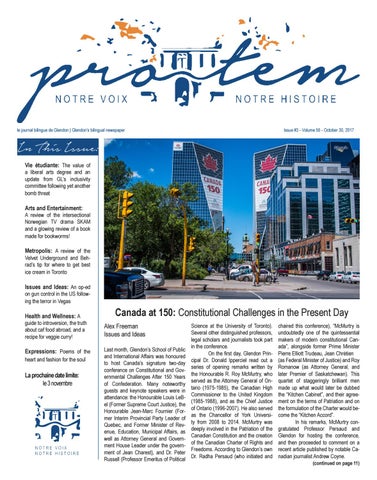
Canada at 150: Constitutional Challenges in the Present Day
guide to introversion, the truth about caf food abroad, and a recipe for veggie curry!
Alex Freeman Issues and Ideas
Expressions: Poems of the heart and fashion for the soul
Last month, Glendon’s School of Public and International Affairs was honoured to host Canada’s signature two-day conference on Constitutional and Governmental Challenges After 150 Years of Confederation. Many noteworthy guests and keynote speakers were in attendance: the Honourable Louis LeBel (Former Supreme Court Justice), the Honourable Jean-Marc Fournier (Former Interim Provincial Party Leader of Quebec, and Former Minister of Revenue, Education, Municipal Affairs, as well as Attorney General and Government House Leader under the government of Jean Charest), and Dr. Peter Russell (Professor Emeritus of Political
La prochaine date limite: le 3 novembre
Science at the University of Toronto). Several other distinguished professors, legal scholars and journalists took part in the conference. On the first day, Glendon Principal Dr. Donald Ipperciel read out a series of opening remarks written by the Honourable R. Roy McMurtry, who served as the Attorney General of Ontario (1975-1985), the Canadian High Commissioner to the United Kingdom (1985-1988), and as the Chief Justice of Ontario (1996-2007). He also served as the Chancellor of York University from 2008 to 2014. McMurtry was deeply involved in the Patriation of the Canadian Constitution and the creation of the Canadian Charter of Rights and Freedoms. According to Glendon’s own Dr. Radha Persaud (who initiated and
chaired this conference), “McMurtry is undoubtedly one of the quintessential makers of modern constitutional Canada”, alongside former Prime Minister Pierre Elliott Trudeau, Jean Chrétien (as Federal Minister of Justice) and Roy Romanow (as Attorney General, and later Premier of Saskatchewan). This quartet of staggeringly brilliant men made up what would later be dubbed the “Kitchen Cabinet”, and their agreement on the terms of Patriation and on the formulation of the Charter would become the “Kitchen Accord”. In his remarks, McMurtry congratulated Professor Persaud and Glendon for hosting the conference, and then proceeded to comment on a recent article published by notable Canadian journalist Andrew Coyne. (continued on page 11)
Pro Tem Letter from The Editor Editor in Chief | Rédactrice en chef Bruno Da Costa editor@protemglendon.com Chief of Operations | Chef d’Operations Sarah Tadjana operations@protemglendon.com Assistant French Editor | Rédactrice adjointe Camille Slaght assistantfr@protemglendon.com Assistant English Editor | Rédactrice adjointe Sarah Ariza-Verreault assistanteng@protemglendon.com Media Officer | Agente de media Amanda Jose media@protemglendon.com Photographer | Photographe Krysta Veneruz photography@protemglendon.com Design and Layout | Maquettiste Sam Kacaba design@protemglendon.com Section Editors | Chroniqueurs Campus Life | Vie étudiante Reeda Tariq campuslife@protemglendon.com
Greetings, readers! We’re thrilled to present you with this third issue of Pro Tem. It seems October is in a hurry to depart and we are all settled snuggly into the new academic school year. Oh, how those reading days came and went in a flash. It seems an easy thing to doubt ourselves and our abilities. For the most part, midterms can leave us feeling scathed; they are, after all, the first real examinations of the year. Although summer is seemingly fading into a distant memory, it feels like my heart is stuck in the lazy molasses way of August life. Finding motivation to commit to studies can be difficult, and falling into the trap of not believing in what you can accomplish can easily make you spiral.
Keep your head up, Glendon. The sun is dipping into the horizon much too quickly these days, but that doesn’t mean the lights within have to go out with it. If you’re in the tail-end of your time at Glendon, look back at how far you’ve come and know that you’re always better equipped to keep going the longer you persist on carrying through. If this is your first year, then know that keeping the fire you feel alive is going to bring out the best in you. Until next time, keep it up. Bruno Da Costa Editor in Chief
Issues and Ideas | Actualité et opinions Alex Freeman issuesideas@protemglendon.com Metropolis | Métropole Behrad Taeed metropolis@protemglendon.com Arts and Entertainment | Arts et divertissement Sandrine Exil arts@protemglendon.com
Vous avez des opinions? Vous aimez écrire? Vous faites de la photographie? Pro Tem vous veut!
Health and Wellness | Santé et bien-être Kaya Harris-Read health@protemglendon.com
Envoyez-nous un courriel à editor@protemglendon.com pour apprendre comment vous pouvez vous impliquer!
Expressions | Expressions Ayla Sljivar expressions@protemglendon.com
About Us
Pro Tem est le journal étudiant du collège Glendon. Publié pour la première fois en 1962, c’est la plus ancienne publication de l’Université York.
Bruno Da Costa Editor in Chief
Sarah Tadjana Chief of Operations
Camille Slaght Assistant French
Sarah Ariza-Verreault Assistant English
Krysta Veneruz Photographer
Sam Kacaba Designer
Reeda Tariq Campus Life
Alex Freeman Issues & Ideas
Amanda Jose Media Officer
Opinions published in Pro Tem are those of the individual writers, and do not reflect the views of the publication as a whole. We will not print copy deemed racist, sexist, homophobic, or otherwise oppressive. Les lettres adressées au journal peuvent être éditées au niveau de la clarté ou de contenu. All copy appearing in Pro Tem is at the discretion of the editorial team.
Behrad Taeed Metropolis
Feel free to respond to what you read in the pages of Pro Tem! / N’hésitez pas à réagir à ce que vouz avez lu dans Pro Tem! To see past editions of Pro Tem, please visit our website: www.protemglendon.com. Be sure to follow us on Facebook for reminders about upcoming deadlines and events: @ProtemGL
2
Sandrine Exil Arts & Entertainment
Kaya Harris-Read Health & Wellness
Ayla Sljivar Expressions
Vie étudiante The Value of a Liberal Arts Degree
others. Often, students do not pursue the liberal arts out of fear of not finding a job. The fields of study within liberal arts are very broad. It is difficult to pinAyse Koca point a specific occupation associated Contributor with a certain field of study. When looking into university Liberal arts are fields of study intendprograms, one of the first questions stued to provide students with general dents (and, often, their parents) ask is: knowledge in a wide subject area. They “what job can I get with this degree?” include subjects such as humanities, However this focus on university as job social sciences, and natural sciences. training reflects our failure to underBasically, any degree program that stand the following: doesn’t train students for one specific job falls under liberal arts. 1. The way jobs work The idea of the study of liber2. The valuable skillset developed from al arts developed in ancient Greece. a liberal arts degree These areas were considered essential 3. The purpose of higher education subjects of study for free individuals to take on active roles in society. The aim Jobs aren’t linear. Not everyone who of students of liberal arts was to gain studies psychology becomes a psyvirtue, ethics, and knowledge in a wide chologist. Most chemistry majors don’t range of fields. The students of these become chemists, and most English disciplines aimed to articulate and majors don’t become baristas. Choosshare their knowledge and take on acing a major doesn’t necessarily mean tive roles in society. choosing a career path. Careers don’t Since then, liberal arts has maindevelop in straight lines, and higher edtained its aim of producing well-rounducation is certainly meant to challenge ed individuals. These people are able the idea that there is only one thing for to look at issues from a broader pereveryone. spective, think critically, and articulate For the most part, students their thoughts clearly to those around grow into who they are during the first them. A liberal arts education provides few years of their undergraduate destudents with the broad thinking skills gree. Changing goals for the future and they need in order to lead meaningful changing one’s field of study is part of lives and contribute to the well-being of
the process of growth and self-realization. Focusing on education as training for a future job doesn’t allow much room for this growth. School becomes a chore and the looming prospect of not finding a job upon graduating grows on students. While selecting programs of study, many students write off liberal arts degrees as useless and too broad. However, employers search for candidates with the skillset of those developed through a liberal arts degree. They search for people who are able to work with others, think broadly, and challenge conventional wisdom. Some more skills developed through a liberal arts education include effective oral and written communication skills, the ability to learn and synthesize new ideas, critical and reflective reading skills, effective research skills, organization and time-management skills, information literacy skills, the ability to adapt easily to situations, ethical decision-making skills, the ability to pose meaningful questions and articulate points, self-confidence and self-understanding, foreign language skills, and cross-cultural knowledge. (source: www. topuniversities.com) Unfortunately, our focus on university as job-training reflects our misunderstanding of the purpose of higher education. We have been taught that higher education is necessary in order
to provide us with financial stability. Often it has been presented as an investment that will pay off once we graduate from an institution of higher learning and obtain a job with an annual salary. This capitalist teaching has deprived us of the long-lasting and influential reasons to pursue higher education. Higher education provides us with self-fulfillment, lifelong knowledge, and the ability to make valuable contributions to our communities Liberal arts are broad fields of study. When someone asks “what are you going to do with an English, philosophy, sociology, or history degree?” the answer can be complicated and even non-existent. However, upon graduating from a liberal arts field of study, students are equipped with a valuable skill set that will assist them in finding a job. More importantly, the knowledge and skills students obtain from a liberal arts degree will help them lead purposeful lives and obtain the leadership qualities necessary in order to make positive contributions to their communities. Adapted from aysekgl.wordpress.com
Ayse Koca
3
Campus Life Introducing GL’s Equity, Diversity and Inclusivity Committee Keesha Nurse & Mahmoud Ismail Contributors An ad hoc committee on Equity, Diversity and Inclusivity has been created at Glendon in response to the events that occurred on campus last March, where racist and discriminatory graffiti as well as bomb threats were found in the Centre of Excellence. The committee’s mandate is to improve Glendon’s approach to equity, diversity, and inclusivity, specifically in relation to pedagogy and curriculum, and to support an inclusive and safe educational culture at Glendon. This committee consists of two undergraduate students, as well as members of Glendon’s faculty and staff who will work to i) identify current strengths and areas for improvement in equity, diversity, and inclusivity; ii) develop recommendations for programs and curriculum pedagogy that promote and enhance equity, diversity and inclusivity, and iii) provide a final report to the Glendon community that reflects the committee’s findings and recommendations. To do this, the committee will review existing programs at Glendon and consult widely across the Glendon community, including soliciting feedback from students, staff, and faculty for how to make Glendon a safer space. The committee’s report will be made public and presented at Faculty Council before the end of this academic year.
4
Nature Island Donation Drive For the People of Dominica Shania John and Reeda Tariq Contributor & Campus Life Editor On September 19th, 2017 the beautiful island of Dominica was devastated by Hurricane Maria. The category five disaster containing sustained winds of over 160 mph destroyed homes, agriculture, flora, fauna, and claimed the lives of over 20 individuals with 15 persons still missing. To help, the Nature Island Donation Drive was started and has partnered with local organizations on campus to help the people of Dominica, and we’re appealing to our fellow Glendonites to step in and help out in any way that they can by dropping off the following supplies at designated boxes at either the GCSU office or in either of the two residences on campus. The people of Dominica urgently need supplies such as food and water of any kind; from crackers and biscuits to water purification tablets. Health items are also sorely needed. As of right now, electricity and water structures on the island have been impacted and are not running, alongside that Dominica is still reeling from the effects of Tropical Storm Erica just two years ago. Medical supplies; first aid kits; clothing; books; school supplies, especially textbooks; and solar lamps are sorely needed. The Drive also hopes to achieve $5,000 to help repair the roof at St. Martin Secondary School. For more information, contact us at shaniakj@gmail.com.
Reeda Tariq
Arts et divertissement Book Review: Mr. Penumbra’s 24-Hour Bookstore Lauren Clewes Contributor Are you tired of trying to decode academic papers? Do midterms increase your blood pressure? Is an escape into a bookworm’s paradise what you need? Well, look no further than the wonderful novel that is Mr. Penumbra’s 24-Hour Bookstore by Robin Sloan!
The main character and his friends are most definitely millennials (web-designers, GOOGLE employees, just general tech-savvy humans). However, the bookstore, its proprietor and regular customers have the eccentricity and essence of a period of time that belongs more to the last century, which makes it charming. I don’t think I’ve ever read anything like it; most books are either all 21st century, technology based or set in the last century or even older. This juxtaposition is coupled with mysteriously missing people, secret societies, and ancient quests that don’t really seem all that out of place in a 24-hour bookstore. Ticking off ever more boxes, this novel also has a touch of Latin, awesome character names (Rosemary Lapin is a personal favourite), and a manhunt across America for a bookstore-owner named Mr. Penumbra. Personally, I really struggled finding any faults in this novel, because the whole concept is just so fascinating! I would most definitely recommend Mr. Penumbra’s 24-Hour Bookstore to anyone and everyone, because I feel like there is something from this book that it is brought to every different kind of reader.
Synopsis: The Great Recession has shuffled Clay Jannon away from life as a San Francisco web-design drone and into the aisles of Mr. Penumbra’s 24-Hour Bookstore. But after a few days on the job, Clay discovers that the store is more curious than either its name for its gnomic owner might suggest. The customers are few, and they never seem to buy anything – instead, they “check out” large, obscure volumes from strange corners of the store. Suspicious, Clay engineers an analysis of the clientele’s behavior, seeking help from his variously talented My Rating: 5 Stars friends. But when they bring their findings to Mr. Penumbra, they discover the bookstore’s secrets extend far beyond Adapted from: theglobblog.wordpress.com its walls. Rendered with irresistible brio and dazzling intelligence, Mr. Penumbra’s 24-Hour Bookstore is exactly what it sounds like: an establishment you have to enter and will never want to leave.
Lauren Clewes
My Review: Why is this not a real thing?! Why aren’t all book stores open 24-hours?! Yes, I know that it would be a terrible thing for a bookworm’s bank account, and social life, and vitamin D needs, but details, details! Mr. Penumbra’s 24-Hour Bookstore is pretty much everything you could possibly need in a quick novel – mysterious setting, a quintessentially bookish shopkeeper, a lost protagonist who finds comfort around books, quirky and endearing characters, with secrets and adventure around every corner. I really liked the mix of old and new.
5
Arts and Entertainment SKÅM: Season Four Review Amanda Jose Media Officer This season was a breath of fresh air in comparison to your typical teen dramas and their even more archetypal teenage characters. Impervious to peer pressures, Sana is a young woman who advocates for her beliefs and defends her friends, making her an honorable lead character. Her hardships are tripled by that fact that she is a young Muslim woman from an immigrant family living in Norway. And if that’s not enough to pique your curiosity, the SKÅM series also explores topics such as sexuality, mental illness, and violence in relationships from various lenses. Below is an excerpt from the first episode of season four, where Sana establishes the mood for the entire season with this unsettling, awkward scene that had me devoted to watching and begging for a greater sense of closure:
to.” “Yeah, I’m just saying it’s okay if you get sexually frustrated” said Vilde, defensively. “I’m not sexually frustrated.” Sana confirmed. “It’s not as if I go around all the time thinking about boys and sex and feel like I’m missing out.”
In this scene, Sana stands firm on her values when she interrupts Vilde, who has been rambling on about her love life during a casual get-together between friends over some pop and pizza. Instantly, I was emotionally invested in this resilient female lead. Like a golden baguette (or havrebrød, to be true to the show’s Norwegian roots), Sana’s demeanor appears tough and her social interactions crisp, but her strong values, faith, and love for her friends soften her sensitivity. Throughout the show, viewers watch as this young Muslim girl does her best to harmonize in Nordic society, while maintaining her unique tone and sense of self. Although Sana is not surprised by the normalcy of the casual sex, partying and binge-drinking that her peers partake in, she is frequently “Do you have to share every detail of discriminated and ostracized because your sex life with Magnus?” Sana inter- she is seen as deviating from these rupted. norms by not participating herself. “I understand that it’s difficult for you to Much to her credit, Sana refuses to listen to because you can’t have sex—” succumb to these pressures to fit the “I can have sex, Vilde; I just choose not Norwegian teenage mold. But, in an act
6
to assert that she is a force to be reckoned with, Sana becomes the leader of a russebukse: a Norwegian cultural phenomenon where high school students rent a bus to party hard for the three straight weeks leading up to graduation to relieve the stress of exams (yes, this is a thing!). Controlling the russebukse gives her power and influence over those who disfavour her and she does whatever she can to keep it. Despite briefly losing sight of who she is during this period of power, Sana relies on her morals and her friends to guide her back onto the right path. Naturally, what would a teen drama series be without a love interest? In the show, the cool and collected Sana is attracted to her older brother’s kind-hearted friend, Yousef, who shares the same feelings. Unlike the relationships of her peers, their deep bond is free of sensual desire, and is instead based on spiritual and emotional connection.
Their meaningful conversations explore topics including the paradoxical nature of religion and having faith in a higher order. As a firm believer in Allah, Sana initially feels distraught to learn that Yousef is an atheist. However, she finds refuge in her brother’s words: “is believing in Allah more important than living like you believe in Allah?” Looking at the show as a whole, I am blown away that a homogenous society such as Norway has produced a television series with such progressive values that is not only adored within Norway, but also internationally. Although the series is over, the lovable and sassy Sana - played by Iman Meskini - continues her badass journey off screen — as part of Norway’s military! So I ask you, how can you not love her?!
Come Scream for this Ice Cream Behrad Taeed Metropolis Anyone who has had a conversation with me about food has undoubtedly come across my ever-expanding list of places to visit in Toronto for nourishment (in the most bourgeois kinds of places). I am not a man of simple tastes, nor do I condemn people who are. I simply happen to enjoy abstract and exciting alternatives to old concepts. I also happen to be extremely broke because of this habit. It is a habit that favours non-traditional foods and, speaking, any cuisine that creates a mischievously unorthodox mashup of styles or flavours. Dairy has always been an important part of my lifestyle, whether it be eating a solid block of cheese, enjoying several types of milk on a regular basis (disclaimer: almond milk should be illegal), and, above all, ice cream. Ice cream: the nectar of the gods, a gift from the divine, Jon Snow’s secret to revival (Yes, it’s a spoiler, but it’s been out for a long time - I feel no guilt), and the lingering sweetness that keeps me tucked in at night. Ice cream has always been at the epicenter of my contentment with life. It is the epitome of wholesome goodness. While I have been to Sweet Jesus and have had all the different brands and flavours from the local grocery store, there is one ice cream fix that has set a precedent no
Métropole other can dream of approaching. That place, my friends, is Eva’s Original Chimneys. Located at 454 Bloor St. West, Eva’s is a place where all your ice cream dreams come true. It may feel like I am grossly exaggerating, but I wouldn’t go to BuzzFeed levels unless it was seriously true. From their handmade roasted cones that taste like the love you’ve never had, to their mouth-watering selection — and don’t get me started on the portion sizes! My personal favourite from the shop is the Matcha cone, but there are so many I have yet to try that it really wouldn’t be fair to pick a favourite, yet. As if you needed another reason to check this place out, there is also a secret at the end of every single Eva’s cone which I will leave you to discover on your own. I hope you all go visit this mysterious, magical place. I hope you go forth and enjoy what you can while we’re all still undergraduate students in what can only be described as the blissful OSAP era, and not the terrifying liberal-arts-major-with-no-particular-skillset-and-$35,000-tuition-to-pay era that we are all so desperately trying to avoid thinking about. So, before you scream, why not go for some Eva’s ice cream?
7
Glendonites Abroad: Lauren Clewes
8
Glendonites Abroad: John Kemp
9
Metropolis Sarah’s Spots: Exploring Toronto’s Live Music Venues Sarah Tadjana Chief of Operations The Velvet Underground 508 Queen St. W.
November Events in Toronto: What Not to Miss This Month Halloween Block Party October 31st, starting at 6:30pm Church & Wellesley Village
When The Beatles Rocked Toronto Through until Nov. 12 Market Gallery (95 Front St. East)
Halloween Haunt Through until October 31 Canada’s Wonderland
DanceWorks’ 40th Anniversary Event November 16 - 18, starting at 8pm Harbourfront Centre
Legends of Horror Through until October 31 Casa Loma
Professional Development Conference November 18 @ 9am Accolade West Building - Keele Campus
Guillermo Del Toro - At Home with Monsters Through until January 7th Art Gallery of Ontario
Anishinaabeg: Art & Power Through until November 19 Royal Ontario Museum
Friends of Glendon AGM November 1 @ 6:30pm Glendon College, GH 102 Toronto Chocolate Festival November 1 - 30 Various locations across Toronto The Royal Agricultural Winter Fair November 3 - 12 Exhibition Place Remembrance Day Ceremony November 11 @ 10:45am Ontario Veteran’s Memorial (Queen’s Park) Remembrance Day Ceremony November 11 @ 10:45am Waterside Theatre - Toronto Zoo Free admission until 10:30am Ladies of Hip-Hop Festival November 11 Harbourfront Centre
10
Santa Claus Parade November 19 @ 12:30pm Starts at Christie Pits Park Toronto Cheesecake Factory Opens November 21 Yorkdale Mall
Located along Queen West’s entertainment avenue, Velvet is a dingy shell of a venue whose only accessories include a lone disco ball and a handrail bar that runs along the edges of the single, long room that faces the raised stage at the back. The box office is located right inside the door, and is typically heavily manned with at least two of the half dozen or so beefy security guards the Velv employs to keep the peace (overkill, I should think, for such a low-key, intimate venue but, hey, it’s their money, and it does keep out the cheap bastards that try to skirt a $5-10 cover). In spite of its dismal decor, this venue is great for seeing upbeat entertainers who love to put on an interactive show. Its wide-open space is perfect for artists that make you want to dance or rock out hard. The sound is loud but surprisingly doesn’t echo as much as one might have guessed based on the space’s set-up. Overall, the acoustics exceeded my expectations set upon walking in. That said, this is a venue where
the acoustics can easily be ruined by a measly crowd - so if you’re planning on coming out to a show, do your part to support local music and make sure it gets sweaty by bringing some friends along! Words to the Wise: 1. Bring cash! It’s a cash-only bar so unless you want to pay the exorbitant ATM fees, bring enough cash to last you through the night. 2. Watch your step! This is NOT a venue to get wobbly-drunk at: the steps to the bathrooms are steep and poorly lit and the back quarter of the main (read: only) room is raised a foot above the rest, creating the perfect opportunity for your face to get acquainted with the scuffed up, sticky floor. 3. Wear comfortable shoes! There is no seating available at Velvet, so this is not the place to try out those cute new shoes. Besides, it will be cave-like dark, no one will notice what you’re wearing unless it happens to be sparkly enough to reflect off the disco ball (in which case, I’d advise you to rethink your choice of attire anyways). My Rating: 3.5 / 5. For the right kind of show, and with the right kind of crowd, this is a great little spot to see a live set. Stay in the Loop! FB @ VelvetUndergroundToronto Twitter @thevelvetTO Instagram @thevelvetto Website: www.thevelvet.ca
Cirque du Soleil’s Volta Dates through until November 26 The Portlands The Good, The Bad, and the Ugly Sweater November 23 - January 5 The Second City Migrating the Margins : Art Exhibition Through until December 3 Art Gallery of York University (AGYU) If you hear of an event happening in Toronto that might be of interest to our community, let us know at:metropolis@ protemglendon.com thevelvet.ca
Canada at 150:
Constitutional Challenges in the Present Day (continued from cover)
In his article entitled “Confederation Derailed”, Coyne wrote that Canada can no longer call itself a nation. He writes that referring to Canada as a nation is now “politically impermissible”, and that the term has fallen out of use, like the word “dominion”. His thesis relies on former problems of Quebec sovereignty and the contemporary issues surrounding the recognition of Canada’s 600 Indigenous Nations within the Constitution. McMurtry is less of a pessimist; he undoubtedly admits that statements and practices found in the annals of Canadian political history are not representative of either modern problems or viewpoints. Yet, he adamantly believes that Canadian problems are not only federal or provincial, but also of national importance, and that the long-term effects of Patriation he helped promote are not only positive but still relevant today. He concluded his remarks by sharing common ground with Coyne, as both men agreed that “The Charter of
Rights…is one bedrock on which a civic nationalism can be built and strengthened: a pledge to protect the rights of every Canadian citizen, equally, binding upon provincial and federal governments alike and enforced by courts at every level, with the Supreme Court as the final arbiter.” Following McMurtry’s opening remarks, Jean-Marc Fournier spoke about Quebec’s intergovernmental relationship with Ontario and the rest of Canada. He set a good tone for the rest of the conference, and his remarks were well received by all in attendance. Later that afternoon, Dr. Persaud shared some of his thoughts on issues earlier raised by McMurtry by discussing some of his current work entitled “The Supreme Court of Canada and National Sovereignty”, which strongly promoted the idea that, through the past use of the judicial advisory process, “the Court has approached the problem of constitutional reform as a challenge of deep understanding of national statecraft, national values, and national historical experience.” The following day, former Supreme Court of Canada Justice Louis LeBel spoke at length about the balance of powers between provincial and federal governments, and the interplay between different rights in our Charter. He jokingly stated that while he served
Actualité et opinions on the Court, he hadn’t lost much sleep over the issue of judicial review. He was also cautiously optimistic about the reconciliation of Indigenous groups within Canada, but said in French that “le droit Canadien est une politique de petits pas”. Dr. Peter Russell followed Justice LeBel with an entertaining take on what he calls “the three pillars distinguishing Canada as a country”. These pillars are 1) French Canada, 2) Aboriginal Canada, and 3) English-speaking Canada. According to Russell, the third pillar became bigger and more powerful in the 18th and 19th centuries; it wanted to make the other two pillars disappear - not through violence, but through their amalgamation into what has become Canada. Only recently has the third pillar ceased trying to get rid of the two other pillars. A fourth character also emerges in this scenario, which Russell calls civic culture. All three pillars came to accept this fourth character, which acts as a glue to keep everything together in a reasonable way, without violence. Russell closed by saying that he is extremely optimistic about the power and legitimacy of the Truth and Reconciliation Commission, but agreed with LeBel that such developments take time, and that we should not become impatient. He also noted something of great importance: the most dangerous
Alex Freeman
thing in our country today is our ill-informed public. In this regard, Canada has fallen behind other countries; we have a serious case of constitutional illiteracy. This can only be addressed by ensuring that we write down and summarize both written and unwritten parts of our constitution for everyone to read and understand. This conference gave many people the opportunity to reflect on our nation’s development by listening to some of the most enlightened and interesting experts in the field of constitutional law. For the rest of us living and working outside the realm of law and politics, the minutiae of daily life can often prevent us from thinking about such issues in great detail. We forget about the all-encompassing nature of our constitution (both written and unwritten). Our Charter is not only unique, but also a prodigious feat of political and legal genius. When we, as a society, become complacent and take our laws, rights, and freedoms for granted, we are more prone to error and acts that contradict the values establishing these first principles many years ago. Voltaire once wrote that “History is filled with the sound of silken slippers going downstairs and wooden shoes coming up.” We still have a long way to go before we rectify the sins of our forefathers, especially involving the abhorrent treatment of indigenous populations through the use of the Residential School System. Yet, we must not throw the baby out with the bathwater. The good parts of our national identity should be cherished and used to care for and promote equality of all disenfranchised populations in the years to come. Our national identity depends on it. Special thanks to Dr. Donald Ipperciel and the members of the organizing committee, which included Dr. Radha Persaud, Ms. Annie Demirjian (Director of the Glendon School of Public and International Affairs), Dr. Francis Garon, Dr. Richard Haigh, Dr. Gregory Tardi, Dr. John Whyte, Ms. Marion Frankian, Mr. Noël Chan, Ms. Teshini Harrison, Mr. Jesse Beatson, Ms. Suzanna Alsayed, and Ms. Andréann Gosselin.
11
Issues and Ideas The Las Vegas Shooting: The Need for Gun Control in the United States Stephen Miles Contributor The recent mass shooting in Las Vegas by lone gunman, Stephen Paddock, has once again raised the controversial issue of gun control in the United States. On Sunday, October 1st at the “Life is Beautiful” country music festival, 58 attendees lost their lives and another 500 people were wounded, in what is being described as the worst mass shooting in modern US history. There are substantive lessons regarding gun control to be learned from such a high-profile attack, but the partisan nature of American politics will likely have a negligible impact on the prevention of future acts of mass murder. The Second Amendment of the US Constitution (a part of what is known as the Bill of Rights) explicitly expresses that “…the right of the people to keep and bear arms shall not be infringed.” Firearms activists use this section to derive their arguments in favour of a deregulated system of gun control. The current wording of the Second Amendment makes it impossible to impose the kind of gun reform legislation required to prevent these attacks from occurring. The only way to enact this kind of legislation would be to amend the US Constitution. True gun reform is therefore unlikely because the
12
amendment process is an uphill battle of gargantuan proportions. Article Five of the Constitution outlines the Amending Formula, which requires a two-thirds majority from both Houses of Congress (House of Representatives and Senate) or two-thirds of state legislature support for a proposed amendment. Given the current climate of hyper-partisanship in American politics, the possibility of achieving the supermajority necessary to amend the Constitution appears to be unlikely, if not impossible. In fact, since the creation of the Bill of Rights, only 17 amendments have been ratified into law, with the last one occurring 25 years ago, in 1992. Another problem with the Second Amendment is the ambiguous nature of the text. No definition of an “arm” is provided which makes regulation extremely problematic. Is an “arm” a single shot musket like those used during the 18TH century, or does it include fully automatic assault rifles that can fire six-hundred rounds per minute? In the current context, it appears that the Second Amendment protects virtually all types of firearms and ammunition. Had the Framers of the Constitution foreseen the future evolution of the military industrial complex and the firearms industry, I strongly believe the Second Amendment (in its current form) would have never come to fruition. In this regard, I intend to put forth a rudimentary outline of a reasonable and efficacious piece of gun legislation. The first and most important change involves fully automatic weapons, which can be owned by civilians in the United States who make a small ($200) tax payment to the ATF (Bureau
of Alcohol, Tobacco, Firearms and Explosives) and pass a complete criminal background check. I see no reason for civilians to own weapons of this calibre as they have little utility in activities such as hunting or target shooting. I condemn the government of the United States for failing to do something about this and I implore them to address this glaring gap in their national security policy. Second, weapons designed primarily for military applications have no place in the hands of civilians. These pieces of equipment were designed with the express purpose of killing other human beings in combat. I fail to comprehend how an assault rifle can be used for self-defense purposes; these weapons belong to a class of firearms that should be restricted exclusively to military and law enforcement agencies. Finally, I believe that a more stringent application procedure should be enacted to ensure that deadly weapons do not end up in the hands of individuals with nefarious intentions. More detailed background checks with longer wait times for license validation could potentially reduce the frequency of attacks. Sadly, what happened in Vegas is not likely be a contained occurrence until the time when such reforms are put in place, and that time does not appear to be anywhere on the near horizon.
Introversion in an Extroverted World Kaya Harris-Read Health and Wellness
doing and enjoying things as an extrovert would. As someone who is very definitely introverted, this wasn’t all that fun. To try and live as an extrovert when you’re introverted, in my experience, is to feel constantly overwhelmed and worn out without understanding why. I felt strange for wanting alone time, not knowing at the time that I needed it. I feel that “introverted” and “extroverted” are words that are thrown around quite a lot without a full understanding of what it is to be one or the other. The reason why this matters is because introverts and extroverts will take care of themselves in different ways. The be an introvert trying to live life as an extrovert will mean that you will not have your needs properly met. Even as I became familiar with the terms, I still did not have a full understanding of what they meant. My idea of them was that introverts enjoy being on their own, and extroverts enjoy being around other people. Although this is often true, it is not what defines the two Most everyone in the world enjoys both alone time and time around others, regardless of whether they are introverted or extroverted. I realized this confusion existed as I discussed the topic with other people. In most cases, people weren’t sure if they were one or the other because, as they said, while they liked being around people, they also enjoyed being alone. A simple Google search could have solved this confusion; however, at the time, it didn’t seem that important. It is only looking back that I’ve realized the importance of understanding the true differentiation between the two. What sets introverts and extroverts apart goes deeper than being based on a person’s preference for social or alone time. It has more to do with how they take care of themselves. The difference between introverts and extroverts will be most plainly seen at the end of a tiring or stressful day in which your energy feels completely sapped. At this point, an extrovert is going to feel more inclined to be around other people, while an introvert is going to prefer to be by themselves. The other difference between the two is seen depending on which scenario will give you energy. Extroverts are going to feel energized by being around other people,
Growing up, it wasn’t until I was about 12 or 13 when I was first introduced to the idea of introversion and extroversion. It was in English class in middle school, and for reasons I can’t remember, we were doing personality quizzes, similar to the kind you see pop up on Facebook now and again. When the quiz asked me if I was an introvert or an extrovert, I was familiar enough with the words, but not with their true meanings. I said I was an extrovert because I thought that it would seem as though I didn’t like people if I said I was an introvert. This idea stuck with me, and for a while I was convinced I was an extrovert, and that I should be (continued on page 13)
Santé et bien-être while introverts are going to feel energized by alone time. This is what leads to the misconception that introverts don’t like being around people. At a party or similar event, an extrovert is like a street car, and an introvert is like a bus. A strange comparison, but bear with me. The extroverted street car drives along, having a continual energy source provided. The introverted bus drives along just the same way, but after a while it is going to need to stop to refuel. While both have the same capability, they have different energy sources. Even though it is not their source of energy, an introvert can still enjoy a party. The world we live in generally caters towards extroverts, making it difficult for introverts to have their needs
met. From the time we begin school, we are put into large classroom settings and given activity-filled days. We are encouraged to be around people, we are taught how to be social. My point is not that this is a bad thing, but that it should be paired with an equal importance put on the value of solitary activities and quality alone time. As someone who grew up not knowing they were an introvert, there was a time in which I thought I just didn’t like people all that much. It was an important day for me when I realized that it wasn’t that I didn’t like people, but that I didn’t like being around them all the time. Although this doesn’t seem like a big revelation, it is important to know how to take care of yourself.
John Kemp’s Kitchen: Caf Cuisine
with orange infused gravy over new potatoes and roasted root vegetables, topped with a dash of fine herbs and alfalfa sprouts. Don’t like that? Well, you could opt for the grilled cedar salmon with lemon-butter sauce, wild rice, sautéed garlic broccoli, and a sprinkling of minced chives instead. Still not your thing? Then you’ll love the butternut squash ravioli with white wine cream sauce and prawns. What I’m getting at here is that this isn’t just good food; this is restaurantquality food. Just have a look at how they plate it up. What I believe this is, is an extension of what I wrote about in my first article of this year: food is important in Europe. It’s not about the business of mandatory meal plans, increasing profit margins, or signing a contract with the school to run the cafeteria for the next twenty years. It’s about good food for students, making sure that food is affordable, and keeping production of it in-house so that the quality can be controlled, (the university owns and runs all the cafeterias). It’s not expensive (about eleven Canadian dollars per meal), and it’s great food. It’s made me reflect on what eleven dollars gets you at the Glendon cafeteria. For the caf to improve, the culture surrounding it has to change. If they’re going to make meal plans mandatory and limit kitchen use in res, then that food had better be just as good if not better than what I’d make myself. , or whatever the scheme is now. What we need is real, good food. We need that eleven dollars to be worth it.
John Kemp Columnist If there’s one thing I don’t miss about Glendon, it’s the caf. I don’t miss the limp lettuce at the salad bar, I don’t miss the not-so-Indian Indian food, the soggy sandwiches, the oddly sweet pasta sauces, or the mind-boggling prices. I certainly don’t miss the conditional passes from health inspectors. I remember in first year, checking the Keele shuttle schedule every day so that I could make it there in time to eat dinner, just to avoid the Glendon cafeteria. I knew that if I got stuck eating in the caf, I would get sick of my meal before I was even close to being full. It is for this reason that the cafeterias at my exchange university here in Switzerland, at the University of Lausanne (UNIL), have been so wonderfully refreshing. At UNIL, there are four cafeterias and one full restaurant which is a little higher-end. The cafeterias all work in generally the same way, being that you take your tray and utensils, and then help yourself to whatever dishes are being served that day that catch your eye, as well as a variety of drinks (including wine and beer, for those extra-stressful lectures). What was incredible though, was that the meals available aren’t not-so-Indian Indian food, soggy sandwiches, or even limp lettuce. No, what’s on the menu is herb-crusted prime rib
Until next time,
John Kemp
13
Health and Wellness À chacun son rythme: La patience
envers soi-même comme fondement du bien-être personnel Gabriella Giordan Contributrice Quand on entend le mot patience, plusieurs images nous viennent en tête : des gestes qui témoignent de notre compréhension et notre soutien envers autrui, l’action de se défaire parfois très difficilement d’une idée ou d’une attente à laquelle on était fortement attachés. Cependant, un autre type de patience, souvent négligé, est la patience envers soi-même, et par extension, le besoin fondamental de faire preuve d’ouverture d’esprit face à l’échec et aux imprévus. Être patient envers soi-même Janine Cash signifie tout d’abord assumer ses déContributor fauts et accepter que la perfection est impossible à atteindre, voire illusoire. Ingredients: Le progrès, en revanche, est atteign1 onion, chopped able. Pour pouvoir progresser, il faut 1 zucchini savoir prendre son temps. Cela s’appli1 red pepper (any colour works but red is the nicest) que dans n’importe quel domaine, que 1 can coconut milk (*Note: do not use low fat, it will ruin the overall taste) ce soit dans les études, la santé phy1 tbsp curry paste sique, la santé mentale, les finances, 2-3 cans of chickpeas (depending how much curry you want) et la liste continue. Si l’on ne sait pas A handful of whichever vegetables you want, chopped cuisiner, par exemple, mais que l’on (suggestions: cauliflower, broccoli, carrots) redouble sans cesse d’efforts en commençant par ce qu’il y a de plus rudiDirections: mentaire, on apprend de nos échecs et Turn heat to medium (adjust to be hotter or cooler depending on your stove). In a on persévère. Les échecs et les situalarge, deep frying pan, put a little vegetable oil and sautée the onion, zucchini and tions imprévues se transforment alors red pepper. Stir occasionally, making sure they don’t stick to the pan. en objet d’apprentissage. Chaque minuscule victoire en constitue en fait une Once the vegetables are fried and the onions are clear, lower the heat a touch and grande. En effet, lorsque l’on progresse add the coconut milk and any other vegetables you are using; put a lid on the pan. After five minutes, add the chickpeas and curry paste. Stir the mixture well, making sure the curry paste melts and is completely combined.
A Recipe for Vegetable Chickpea Curry
Put the lid back on and let it sit for 15 minutes. Once you’ve let it sit, give it a taste test; adding more curry paste, if needed (again, remember to stir it in well). Put the lid back on and let the curry simmer, stirring occasionally. It is up to you how long to let it simmer, but remember, the longer it sits, the better it tastes because all the flavours have a chance to mix together! I usually serve this curry over rice, with chicken and naan on the side. It freezes well and makes a delicious lunch, but remember it gets spicier the longer it sits so if you do freeze it, be aware that it will be much spicier when it thaws. This is a very versatile recipe, so feel free to add any vegetables you like. This is an easy recipe that is equal parts healthy and tasty! Serve it hot, and enjoy!
14
même un peu, il faut s’en réjouir sans gêne. Afin de faire véritablement preuve de patience personnelle, il ne faut jamais se comparer aux autres et se contenter de ce que l’on possède déjà. De nos jours, les médias sociaux rendent cette tâche difficile en ne montrant qu’une partie embellie et retouchée de la vie et en négligeant souvent les moments de faiblesse. En voyant les photos des autres, en découvrant leurs exploits et leurs projets futurs, on a l’impression qu’il faut se comparer à eux. Or, chacun possède un bagage de connaissances, d’expériences et de moyens financiers qui lui est propre ; il n’est écrit nulle part que l’on doit tous voyager aux mêmes endroits dans notre jeunesse, compléter notre Baccalauréat en quatre ans, posséder les mêmes objets matériaux et rencontrer le même nombre de personnes en chemin. Se comparer aux autres engendre une panoplie de sentiments, dont l’inadéquation, la jalousie et le stress. L’idée de progrès refait surface : il vaut mieux se comparer à soi-même et envisager sa propre évolution personnelle que s’imposer des idéaux appartenant à quelqu’un d’autre. Le bien-être personnel implique la capacité à assumer ses défauts un par un et à s’évertuer à surmonter les obstacles qui se présentent en cours de route. Il implique également une prise de conscience par rapport au fait que chaque difficulté peut se convertir en réussite si l’on se permet de prendre son temps et de se laisser guider non pas par une envie d’être supérieur aux autres, mais plutôt par le désir du progrès individuel. À chacun ses passions, ses besoins et surtout, son rythme.
Expressions Home Ayla Sljivar Expressions To leave one’s own country, Can be a wondrous, hopeful adventure. To be chased out of one’s own country Now, that’s a harsh reality. It was a harsh reality for my parents, And, yet, it still is. I find my Mother searching for her home in songs, And my Father looking for words in English that remind him of his Mother tongue. Becoming refugees was the equivalent of grasping at straws, When there weren’t any straws to begin with. It’s like putting on a life vest and being packed onto a boat, That couldn’t possibly carry this much despair and anguish to shore. It was when my parents took me to their once beautiful home, That I realized that the search for their home in everyday life was worthless, Because the home that they once knew, was not the home that I saw. And I hope that they realize one day that their home is not in any of those objects, But in the home that they cultivated for me.
The Colour of Life
Sailing
‘Mikun ‘Molade Contributor
Camille Slaght Assistant French Editor
If life was fair, the gods would have been dead, pre-embryo. It would have been, the pill swallowed, when the sun Arrives. Yet justice is blind, to us, Sisyphus. Not deaf to our cries, only unable to see the tears. Her hands too busy to hold Our burdens. And we dare not soil the hem Of the sterile white robes pooled just to relieve our backs of the hefty shit strapped. if, the point on which all else was balanced was not faulty, seesawing would hurt less and the world might stop spinning. But, Life is not fair, there is too much darkness for that.
I am the north and you are the wind, sifting through the pores of my skin. Warm breeze breaks the flat surface. Cold water deflects my vacant stare; I am elsewhere. Fingers are tough from pulling. You’re not close enough until I can feel your tired breath on my shoulder. Release the knot, currents draw the path we take. No matter how far we drift from shore, there will always be a faint line floating, trailing under heavy skies. We are each other’s destinations anyway.
15
GL’s Fashion Icons as spotted by Krysta Veneruz