Issue Eleven - Volume 53 - March 31, 2015 CUPE 3903 still
Natasha Faroogh
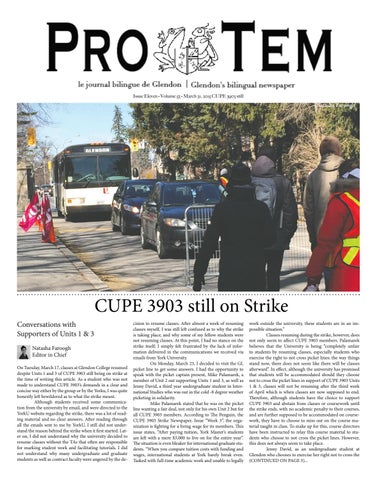
CUPE 3903 still on Strike Conversations with Supporters of Units 1 & 3 Natasha Faroogh Editor in Chief On Tuesday, March 17, classes at Glendon College resumed despite Units 1 and 3 of CUPE 3903 still being on strike at the time of writing this article. As a student who was not made to understand CUPE 3903’s demands in a clear and concise way either by the group or by the Yorku, I was quite honestly left bewildered as to what the strike meant. Although students received some communication from the university by email, and were directed to the YorkU website regarding the strike, there was a lot of reading material and no clear answers. After reading through all the emails sent to me by YorkU, I still did not understand the reason behind the strike when it first started. Later on, I did not understand why the university decided to resume classes without the TAs that often are responsible for marking student work and facilitating tutorials. I did not understand why many undergraduate and graduate students as well as contract faculty were angered by the de-
cision to resume classes. After almost a week of resuming classes myself, I was still left confused as to why the strike is taking place, and why some of my fellow students were not resuming classes. At this point, I had no stance on the strike itself; I simply felt frustrated by the lack of information delivered in the communications we received via emails from York University. On Monday, March 23, I decided to visit the GL picket line to get some answers. I had the opportunity to speak with the picket captain present, Mike Palamarek, a member of Unit 2 out supporting Units 1 and 3, as well as Jenny David, a third year undergraduate student in International Studies who was out in the cold -8 degree weather picketing in solidarity. Mike Palamarek stated that he was on the picket line wanting a fair deal, not only for his own Unit 2 but for all CUPE 3903 members. According to The Penguin, the CUPE 3903 Strike Newspaper, Issue “Week 3”, the organization is fighting for a living wage for its members. This issue states, “After paying tuition, York Master’s students are left with a mere $3,000 to live on for the entire year”. The situation is even bleaker for international graduate students. “When you compare tuition costs with funding and wages, international students at York barely break even. Tasked with full-time academic work and unable to legally
work outside the university, these students are in an impossible situation.” Classes resuming during the strike, however, does not only seem to affect CUPE 3903 members. Palamarek believes that the University is being “completely unfair to students by resuming classes, especially students who exercise the right to not cross picket lines; the way things stand now, there does not seem like there will be classes afterward”. In effect, although the university has promised that students will be accommodated should they choose not to cross the picket lines in support of CUPE 3903 Units 1 & 3, classes will not be resuming after the third week of April which is when classes are now supposed to end. Therefore, although students have the choice to support CUPE 3903 and abstain from classes or coursework until the strike ends, with no academic penalty to their courses, and are further supposed to be accommodated on coursework, they have to choose to miss out on the course material taught in class. To make up for this, course directors have been instructed to relay this course material to students who choose to not cross the picket lines. However, this does not always seem to take place. Jenny David, as an undergraduate student at Glendon who chooses to exercise her right not to cross the (CONTINUED ON PAGE 3)...
Pro Tem
Editor in Chief | Rédactrice en chef Natasha Faroogh editor@protemglendon.com Assistant English Editor | Rédactrice adjointe (anglais) Stephanie Settle assistanteng@protemglendon.com Assistant French Editor | Rédactrice adjointe (français) Gervanne Bourquin assistantfr@protemglendon.com Section Editors | Les rédactrices de sections Campus Life | Vie de Campus Erika Desjardins campuslife@protemglendon.com Issues and Ideas | Enjeux et idées Lindsey Drury issuesideas@protemglendon.com Health and Wellness | Bien-être et santé Samantha Kacaba healthwellness@protemglendon.com Metropolis | Métropole Neya Abdi metropolis@protemglendon.com Arts and Entertainment | Arts et divertissement Ashley Moniz artsentertainment@protemglendon.com Expressions Sienna Warecki expressions@protemglendon.com Communications Officer | Agente de communications Victoria Ramsay communications@protemglendon.com Design and Layout | Maquettiste Megan Armstrong
Pro Tem est le journal étudiant du collège Glendon. Publié pour la première fois en 1962, c'est la plus ancienne publication de l'Université York. We strive to act as an agent of social change, and will not print copy deemed racist, sexist, homophobic or otherwise oppressive. Please respond to what you read in the pages of Pro Tem/ n'hésitez pas à réagir à ce que vouz avez lu dans Pro Tem. Contact us/ Contactez-nous: protem@glendon.yorku.ca The Pro Tem Office D114 Hilliard Residence, Glendon College 2275 Bayview Avenue North York, ON M4N 3M6 The office is open by appointment only. Le bureau est ouvert sur rendez-vous seulement. Les lettres adressées au journal peuvent être éditées au niveau de la clarté ou de contenu. All copy appearing in Pro Tem is at the discretion of the editorial team. Opinions published in Pro Tem are the thoughts of individual writers, and not the publication as a whole.
2
Letter from the Editor
It’s been a more political kind of month here at Glendon and for good reason. Classes at Glendon have resumed and so has the publishing of Pro Tem. Nevertheless, CUPE 3903 Units 1 and 3 remain on strike. Many students are marching in solidarity. Despite the strike, students keep going, and we’ve had many cultural events take place at Glendon. Some theatre events include Lionheart Productions 24 Hour Theatre Festival as well as Frenched’s final dance recital. We’ve had pub nights, and GCSU’s Glendon Winter Formal, as well as the Japan Symposium take place. Glendon has not stopped showing its school spirit. Perhaps because, in the end, it’s not always what you learn inside the classrooms that has the most impact on your education. I encourage you to take interest in the GCSU as well as all the different levy organizations and clubs on campus as they recruit new members for their councils and group. Furthermore, many groups are looking for new leaders for exec positions in September. Keep your eyes peeled for new opportunities! I encourage you to also email Pro Tem should you be interested in applying for any of the positions on the team. We will probably have the following positions available for applicants to apply to: one or two designers, a photo editor, a communications officer, two assistant editors and six section editors. Applicants should send in (in either English or French) a cover letter, resume, a writing sample of 500 words in either English or French, a second writing sample in the other language if you can, or a design/photography/communications portfolio. We will post further details as to deadlines for the hiring process as soon as we have them on Pro Tem’s Facebook page.
C’est un mois politique ici à Glendon, et pour de bonnes raisons. Les cours ont repris, et la publication de Pro Tem aussi. Cependant, les Unités 1 et 3 de CUPE 3903 sont encore en grève et de nombreux étudiants manifestent en signe de soutien. En dépit de la grève, les étudiants continuent de venir et de nombreux évènements culturels ont lieu à Glendon, y compris le Festival de Théâtre de 24 Heures Coeur de Lion et le récital de danse final de Frenched. Il y a eu des pub nights, le Bal d’Hiver de Glendon de l’AÉCG, ainsi que le Symposium Japon. Glendon n’a pas cessé de faire preuve de l’esprit de l’école. Peut-être parce qu’au final, ce n’est pas ce que l’on apprend dans les salles de classe qui a le plus d’impact sur notre éducation. Je vous encourage à vous intéresser à l’AÉCG et aux autres organisations et clubs sur le campus lorsqu’ils recrutent de nouveaux membres. De plus de nombreux groupes cherchent de nouveaux leaders pour leur équipe exécutive pour septembre. Gardez l’oeil sur les opportunités! Je vous encourage aussi à envoyer un email à Pro Tem, si l’un des postes de l’équipe vous intéresse. Nous aurons sans doute les postes suivants disponibles: un ou deux designer, un éditeur photo, un responsable des communications, deux assistants rédacteurs et six rédacteurs de section. Les candidats devraient envoyer (en français ou anglais) une lettre de motivation, un CV, un exemple d’écriture de 500 mots en français ou anglais, un deuxième exemple dans l’autre langue si vous le pouvez. Nous posterons davantage de détails sur la page Facebook de Pro Tem dès que possible.
All the best,
Meilleurs voeux,
Natasha Faroogh Editor in Chief
Natasha Faroogh Rédactrice en chef
Natasha Faroogh
(Continued from cover) CUPE 3903 still on Strike
...picket line in solidarity with CUPE 3903 is an example of Palamarek’s aforementioned remarks about the unfairness of the situation to students. David states that: “The decision to resume classes put me in conflict with my core values, having to choose between crossing the picket line and attending the classes I’ve paid for and need for my education, or I don’t cross picket lines and I’m penalized for my education. In the sense that I can finish my classwork but not get the quality education should I support CUPE 3903.” David further stated that she personally contacted all her profs through email to try to receive the material taught in courses as well as receive accommodations for not being in class and in order to complete coursework. However, only half of her course professors chose to send her the course material. In other words, by choosing to picket in solidarity with the strikers, David feels like she loses the quality of education YorkU promised. Although course directors have been instructed to maintain the academic integrity of courses, Palamarek, a contract faculty member himself, does not believe the same standard can be maintained: “I would go so far as to say that academic integrity is being severely compromised. The university is choosing to make bad decisions as far as academic integrity is concerned rather than negotiating.” Furthermore, Palamarek indicated his concerns as to whether the University was properly following its own
Vie de Campus
policies and procedures: “I would go so far as to say that the university is violating its own senate regulations.” Perhaps what is most frustrating to me and other students is that despite the emails sent out by the university, there seems to be a lack of clear communication and students don’t really seem to understand the implications of the strike. Indeed David states that: “a lot of students come to me from different backgrounds: grads, exchange students, supporters—all have questions unanswered.” Glendon students were not only at the picket lines on our campus. Some made the trek to Yorku’s main campus at Keele to support CUPE 3903 members in a way that might be more visible on the main campus. Laurence Dion, a student at Glendon, sent in this message to Pro Tem to put forward her stance on the matter: “I have been active on several activities with different undergrad groups since the strike started at the beginning of March. One thing that we realized, since we've been marching, is that students are afraid. Afraid about their terms. Afraid about their grades. Afraid of their profs . . . And this is what the University is trying to do. They're trying to bully the students into going back to class—into supporting poverty wages that will affect the big majority of us as we become graduate students who work for our masters or doctorate degrees. We need to be able to recognize the real enemy here. TAs and GAs are not our enemies. They are fighting for our future. The administration is the enemy. Together, we can show them that we care, and that they
are nothing without their undergrads. What is a university without students? Nothing. We want the Administration to go back to the bargaining table. We want a fair deal. We want to fight austerity, just like our brothers and sisters in Québec right now. And we want all classes to be suspended until the dispute is solved. We are not getting what we paid for if we don't have our TAs. I stand in solidarity with student workers on strike right now. Their working conditions are my learning conditions, and my future working conditions. I will not accept that the university is bullying me into going back to class like the TAs don't matter, like everything is fine.” After talking to the members on the picket line at Glendon, and talking with fellow students, I’ve come to the realization that the way this strike is being handled may be detrimental to all parties concerned, whether it be the people on strike, the contract faculty who miss their TAs, or the students who no longer have tutorials to attend or TAs to help mark and return their assignments in a timely manner. Academic integrity is at risk of being compromised even if students are able to complete their classes despite the strike. We have to ask ourselves if we choose to return to classes—is YorkU indeed putting students first by resuming classes, especially with the summer months and holidays booked on the horizon? But is this the standard of education we are willing to accept from Yorku as students? And are we indeed being “bullied back to class” as Dion stated? You decide.
Laurence Dion
Pro Tem Vous aimez écrire? Vous prenez des photos ou souhaitez pouvoir exprimer votre créativité? Vous avez une opinion sur …..? Ecrivez-nous à editor@protemglendon.com pour plus d’informations. Natasha Faroogh
3
Glendon Abroad Zeeland
Tulip Tales! Jennifer Coté Contributor While the Netherlands is a small country, it contains incredibly diverse cultures. The Netherlands has 12 provinces, including North Holland, South Holland, Flevoland, Limburg, Utrecht, and Zealand – which is where Middelburg is. Half of the Netherlands actually sits below sea level. 17% of the country should actually be underwater, but the Dutch used their famous windmills and dams to dry out land to make the country bigger. All provinces are known for something. Friesland (pronounced freeze-land) is known for its cows. All of the Netherlands is very flat, but Friesland has all the cows. FUN FACT: All black-and-white cows originate from this part of the Netherlands! Limburg is known as that part of the Netherlands which doesn’t really belong to the Netherlands. Zeeland, my province, is something very special. Zeeland is on the south-western tip of the country, just north of Belgium. Zeeland translates into SeaLand. Throughout the Netherlands, Zeeland has a reputation for one thing: its beaches. One of the most appealing parts about living in Middelburg and attending UCR is the 40 minute bike ride along a gorgeous canal to the beach. Vlissingen is the closest beach down, although not known for being the best beach. Domburg is another town within biking distance with a really nice beach. It’s a bit further though, so Vlissingen has been my beach-of-choice this past week. I hate to break it to you in Canada, but we have been having a gorgeous spring here in Holland. The winter was incredibly mild and it’s lead to a beautiful spring. I’ve been getting the best of both worlds – exchange student heading to the beach and just a student who studies at the beach. I put my feet in the water and let me tell you, having nice weather is not equivalent to having swimming weather. The beach is a part of Zeeland culture. Even in the dead of winter, families walk along the beach with dogs, kicking a soccer ball around. Couples walk hand in hand, and fishers cast off from the beach into the water. All the while, giant shipping vessels sail past, leaving the inner sea-arm from Rotterdam off to other parts of Europe to trade off Dutch commodities (probably bikes, cheese and tulips). With exams and planning trips creating a whirlwind life with lots of coffee and lack of sleep, it’s nice to sit in the sand, a blanket keeping you warm, enjoying the smell of the salt even if it is quite brisk. Participating in these little cultural habits is what has made me feel like a Dutchie. Biking to the beach on a sunny spring day, passing ladies with bouquets of tulips in their bike baskets, and watching little blonde children play soccer… These little things are what stick with you after the trip is over. To read more about my exchange adventures, check out my blog! www.jennifercgl.wordpress.com
4
All photos on page by Jennifer Coté
Campus Life Lionheart Production’s 24Hour Theatre Festival A Firsthand Account of a Play in a Day Sienna Warecki Expressions Editor What did I expect to be doing the evening of March 19, 2015? Studying for the eventual resumption of classes, perhaps, or cleaning my room in preparation for the arrival of my long-distance girlfriend that Saturday. Certainly not what I ended up doing, which was to sit in a room with just over half a dozen other writers from dusk ‘till dawn—3 a.m. pizza-call included—and watch the gestation period of a play sped up like a timelapse video on Youtube. Fully-formed plays usually take weeks, months, even years to create, but this was Glendon’s 24-Hour Theatre Festival, and time was of the essence. Here is the general premise: starting from 7 p.m. Thursday night, a bunch of writers write plays from scratch, taking their creations from nonexistent to completed manuscripts in twelve hours. Then, from 7 a.m. onward, those plays are workshopped and rehearsed, props and costumes and set are chosen and arranged, sound and lighting is cued, and a complete practice runthrough is done, all before the official performance at about 7 p.m. Friday evening. If successful, the 24-Hour Theatre Festival showcases the life of a play in a day, from conception to creation to production to performance. I was originally asked to write a crash course on
playwriting (and writing in general) as a resource for the event. After I handed the finished product over to Marika Kunnas, one of the organizers, I asked about participating more fully. She encouraged me to sign up as an actor for the plays, as they were short on talent. This was how I made the snap-decision to commit a full day to an intensive creative project in a medium I usually consign to my girlfriend. (I suppose in a way, then, I was preparing for her visit.) At the beginning of the night, Marika and Brandon Goncalves opened the event by handing out my crash course and having a brainstorming session with the writers. After that, the group spread out to various nooks and corners in the Lunik Co-op Café to type furiously away at their manuscripts; every hour and a half to two hours, the group would reconvene to share their progress and to help each other overcome any obstacles or snags in plot, characterization, dialogue, and so on. Of course, the idea of an all-nighter is always more scintillating than the real thing, and somewhere around 3:30 a.m. the whole group devolved into temporary chaos, but after some food and perhaps a brief nap or two the writers were back at it. By 7 a.m. the next morning, the 24-Hour Theatre Festival had five skits completely written and ready to be performed. Over a pancake breakfast, we sorted out who would be acting in what skit. Because of the surprising number of completed plays, and the shortage of actors, many people were doublecast—just one more challenge to add to the day! Once we had agreed on roles, Marika and Brandon organized a rehearsal schedule: a four-hour block divided into two, each play garnering two hours. We split up and got to it. Yours truly played a Cecil-esque narrator (any Night Vale fans out there?) for a gluten-centric saga of Marika’s play called Wheat Town, and one half of an aspiring comedienne duo trying to advertise their com-
edy website on Omegle (and receiving predictably pervy results) in Chris Parnell’s play LOL Funny. Other writers included Elaine Cabildo, Natasha Faroogh, and Léa Vergnaud; among the actors were Dominic Di Iorio, Amy Marie Smith, Nadia Vanker, Jess Wareing, Natasha, Marika, and myself. Runthroughs were swift, and as we didn’t have much time to spend on memorizing each line, we kept scripts in-hand. Then came props and costumes. For the first time, I got to see where Lionheart Productions keeps their treasure trove of bizarre objects and items of clothing (NB: the answer is EVERYWHERE around campus.) We gathered what we needed, lugged it back to the theatre, and then began what I not-so-jokingly called ‘tech hour’ (which is only funny/terrifying if you understand that usually, the period of time reserved for cueing a play is called Tech Week.) Massive props to Brandon for handling lighting, and to Emily Wolstenholme for being a patient Assistant Stage Manager. Even with simple cues, we just barely managed to scrape everything together on-time to run through the plays one last time, and then it was time to open the doors to the Glendon populous. If I remember correctly, people were allowed into the theatre at about 7:15 p.m., which means our 24-Hour Theatre Festival was technically a 24-Hour-and-FifteenMinute Theatre Festival—but looking at the high quality of the work we put together in that time, I think fifteen minutes is a fine price to pay. The performances were hugely funny—perhaps helped along by the fact that we were all about as hyper as toddlers given six bags of Pop Rocks by this point—and the Festival closed off as a total success. Was it what I expected to do with my Thursday and Friday? Definitely not. Will I do it again next year? Absolutely.
Kelly Lui
5
24-Hour Theatre Festival
6
All photos by Kelly Lui
7
Issues and Ideas Let's Talk About Sex… To Everybody
Sexual Education to be Taught to First Graders Lindsey Drury Issues & Ideas Editor As many concerned parents have been buzzing about for weeks now, the newly official Ontario Health & Physical Education Curriculum, effective September of this year, has been released to the public. The decision to include sexual education within the first grade curriculum has created polarity among parents, although this is not unexpected. In 2010, when the idea was first introduced by Ontario Premier, Kathleen Wynne, it was immediately tucked away after three days of public outcry. Now, it has finally been re-introduced, and is here to stay starting this fall. Countless parents and other onlookers have not been quiet in their disapproval of the new curriculum, and argue that parents should be the first teachers of sexual education to their children, not school systems. A petition is even circulating to “Stop Graphic Revisions to Ontario's Sex Education Curriculum”, found at the website of Parents As First Educators. The petition currently has 55,220 signatures. The authors of this initiative claim that the Liberals are “trying to push information on children at ages when they are not mature enough to handle it”, and that increased sexual education leads to “increasing—not decreasing—levels of pregnancy and STIs”. As is the reason for the refined curriculum, extensive research shows just the opposite. A composite of 1993 studies across different cultures, entitled Does Sex Education Lead to Earlier or Increased Sexual Activity in Youth?, conducted by researchers Baldo, M., Aggleton, P., and Slutkin, G., displayed some interesting findings. Six of the studies showed that sexual education “either caused a delay in the onset of sexual activity or a reduction in overall sexual activity”. Ten studies showed that sexually active youth would adopt safer sex practices after having attended sexual education courses. Most importantly though, “none of the studies indicated that sexual education contributed to earlier or increased sexual activity in youth”. The author even states that the programs were most effective when taught to youth before they became sexually active. Perhaps the most positive aspect of the new curriculum is not just who it is being taught to, but what subject matters will be broached within it. One interesting addition is the increased effort to focus on mental health. The curriculum publication stresses that mental health is “much more than the absence of mental illness”, and that by including a more comprehensive discussion in this regard, they aim to “reduce stigma associated with mental illness”. As for the sexual health section of the new curriculum, some new concepts are being introduced that were likely missed when today's university students were in public school. These topics include “sexual development,
reproductive health, choice and sexual readiness, consent, abstinence, and protection, to interpersonal relationships, sexual orientation, gender identity and gender expression, affection and pleasure, body image, and gender roles and expectations”. The publication explains that objectivity and sensitivity will be promoted for educators in charge of classrooms, and discussions will progress developmentally at each stage of learning. The new curriculum stresses that “students should have the knowledge and skills needed to make sound decisions about matters affecting their health and well-being before they experience real-life situations in which decisions have to be made”, a concept that many outraged parents are just not convinced by. As a member of the LGBT+ community, it is a momentous day to finally see that gender expression and identity will be taught to Ontario's youth, as well as anatomical discussions of same-sex relations. This author is confident that the sexual education curriculum changes are long overdue and will help to assuage the mind-boggling taboo of sexuality that has existed with nothing but perilous consequences. Is first grade too young to be introduced to these topics? And more importantly, can we afford to think so? Before taking a firm stance, I urge all readers to view the full publication by visiting the Ministry of Education's website at www.ontario.ca/edu, and deeply consider what is being proposed, but more importantly, ask yourself why you think that way—perhaps it's because you were taught to.
A Student’s Perspective on the Strike Matt Turner Contributor As many of you are aware, York University is currently experiencing a strike, or as York so eloquently refers to it, a “Labour Disruption”. Classes have resumed as per a Senate vote. However, there are some caveats to that decision, in that it is left to each individual course instructor’s discretion to choose to resume classes if they feel that the academic integrity of their respective course has been compromised. With some classes resuming, each student has now been left with their own important decision to make— to attend class, or respect the picket line and abstain from attending. I for one, have chosen to abstain from attending class, as well as all academic work for the duration of the strike, my reasons for which I will elaborate on. Just like many students, I am eager to return to class and finish my year. I have work and personal plans for the summer which I would like to attend. However, I have weighed the options, and looked ahead to the potential strikes that could occur in the future, namely the collective agreement with YUFA and the university this spring, and the agreement with CUPE which will happen when I am expected to matriculate in 2018. Bearing both of those in mind as well as my personal history as a former NDP candidate and labour activist, I decided I couldn’t cross the
Pro Tem
8
Vous aimez écrire? Vous prenez des photos ou souhaitez pouvoir exprimer votre créativité? Vous avez une opinion sur …..? Ecrivez-nous à editor@protemglendon.com pour plus d’informations.
line. As well, I am expecting to attend graduate school and the gains that CUPE is currently fighting for will have a direct benefit to me at that time. While the Administration of York has largely played the “return of classes” as a benefit to students, I don’t buy that argument in its entirety. In my case, I have two classes suspended for the duration of the strike with one of my instructors in Unit 1 currently on strike and my department making the principled decision to cancel my other class. I have three of my classes currently running, albeit in reduced attendance and severely reduced quality. Since the Senate has largely left it up to the individual department and instructor to decide what to do with classes, it is not as “business as usual” at York as much as the administration would like us to believe. While I disagree wholeheartedly with the decision of the Administration of York to resume classes, I support students’ decision to cross the line, even though the quality of those classes will not be the same as they were prior to the strike. We all have to make our own decisions, though they should be made with our own values and not based on our own self interests. I feel that by allowing students to “choose” what to do isn’t necessarily a choice, as many students will no doubt face pressure to return to class even if they personally support the strike, but feel they have to or else they’ll face a delayed finish compared to their peers. Time will tell when the strike will end but I, like many others, hope it is resolved to the benefit of all parties. Nous sommes fiers de publier le résultat d’une collaboration entre l’enseignement du français à Glendon et le journal de Pro Tem, visant à une pratique plus courante du français sur le campus. Cela n’aurait pas pu être possible sans l’aide et le soutien de l’enseignante de FSL 1200, Usha Viswanathan. Merci à tous les étudiants qui ont participé.
Le Consentement Luci (Margaret) Belknap Contributrice L’année dernière (2014) au Québec, un adjudant dans les forces armées canadiennes, André Gagnon, a été accusé d’agression sexuelle. Il a insisté que le consentement de l’ex-caporal Stéphanie Raymond avait été tacite. En septembre, la Californie a promulgué la loi « yes means yes », qui exige d’obtenir le consentement verbal sur les campus universitaires. La semaine dernière, l’animateur de CBC, Jian Ghomeshi a été renvoyé pour avoir eu des relations sexuelles agressives avec ses partenaires; Ghomeshi a indiqué qu’elles étaient consentantes, mais apparemment ces femmes n’ont pas consenti aux actes brutaux. Est-ce que dire oui c’est consentir? On pourrait dire qu’en principe oui, mais il y a parfois des circonstances à considérer. Dire oui, c’est consentir parce que le « oui » peut être retiré à tout moment et que dire « oui » ce n’est pas consentir à tout ce que l’autre personne désire. C’est la responsiblité de chaque personne d’obtenir le consentement à nouveau pour chaque étape ainsi que d’être précis. D’autre part, on pourrait dire qu’il ne suffit pas d’obtenir seulement un « oui ». Si la personne n’est pas consciente ou est en état d’ébriété, ce n’est pas possible de donner son consentement. De plus, dans certains cas, le consentement ne peut suffir. Par exemple, au sujet du sadomasochisme, la loi ne permet pas de consentir d’être battu. Dire « oui » peut être consentir, si certaines exigences sont remplies : les personnes doivent être conscientes et sobre et dire « oui » pour les bonnes raisons ; il faut envisager les relations de pouvoir. De plus c’est très important que le consentement soit clair : il est essentiel qu’on communique tout. Et le « oui » devrait être toujours enthousiaste!
Métropole I Miss My Pre-Internet Brain Douglas Coupland’s two-part exhibit, ‘Everywhere is Anywhere is Everything is Anything’ Victoria Ramsay Communications Officer I miss my pre-internet brain. History is no longer a tool to help us understand the present. I miss doing nothing. The downside of being connected is that you’re always connected. Hundreds of phrases like these are displayed on brightly coloured backgrounds and cover an entire wall as part of a new and captivating exhibit at the Royal Ontario Museum (ROM). The Canadian author, designer, and artist, Douglas Coupland, is the mastermind behind the installations entitled Everywhere is Anywhere is Everything is Anything. The exhibit is composed of over 100 pieces of work that are housed in two locations in Toronto, the ROM and the Museum of Contemporary Canadian Art (MOCCA). Recently, I visited the Coupland exhibition at the ROM after being intrigued by the images I had seen in various Toronto publications. Upon arrival at the exhibit I was mesmerized by the creativity of Coupland’s works as they provided a social commentary on the 21st century condition through a variety of mediums. As you enter the space you are immediately sucked into the complex mind of Coupland as you experience bright colours, strange structures, intricate paintings and the massive wall covered from floor to ceiling in blocks of colour with short, yet captivating thoughts written on each. Once you have stepped into this world, it is easy to get lost in thought, at least for a little while. I know I sure did. The official press release regarding the installation reads, “Coupland’s exhibition is the first major survey of his work and looks at what defines Canadian culture through the exploration of popular culture, cultural identity, and technology’s ubiquity, raising provocative questions about the 21st century condition. Through diverse media ranging from Lego to found materials, painting to installation, Coupland probes the way that the things, images and process of contemporary life affect our understanding of the world around us.” This is an adequate description of the basis for the exhibition, although it is presented in a way that fosters the constant curiosity of anyone that comes into contact with Coupland’s work. He uses materials that range from blocks and children’s toys to googly eyes, yearbook pictures and wigs, which create a space in which someone can evaluate the change that has transpired in our society throughout the 21st century thus far. By presenting his thoughts in this fun form he is able to lighten the mood,
Arts et divertissements enabling us to enter into his complex commentary on technology and society that is conveyed by his pieces. The pops of bright colours and unique use of materials make the exhibit approachable for a wide audience that ranges from children to adults. The exhibition sparks a conversation among people as they comment on the pieces and make their own discoveries. Coupland makes the space interactive in various ways. One way in which he does this is through the use of technology as attendees view a set of three abstract paintings. They appear abstract to the naked eye, but when viewed through the camera of an iPhone somehow transform into something else, like the silhouette of Osama Bin Laden. The basis of the entire exhibit is the effect of technology, so what better way to communicate this than through incorporating that technology. Many pieces such as these paintings encourage the museum attendees to take out and use their smartphones to experience the art in a new way, and thus consequently making Coupland’s point evident and personable; technology truly has changed things. Once you view the word through the lens of a smartphone or the Internet, your outlook is never quite the same again. Photos are not only allowed in the space but are openly welcomed. Douglas Coupland explains the inspiration behind his exhibit in his own words by saying, “I look back at myself two decades ago, and I think of how different me and my brain were back then—and how differently I looked at the world and communicated with others. The essential ‘me’ is still here . . . it just relates to the universe much differently . . . What will the world look like when anywhere becomes everywhere becomes everything becomes anything? We’re almost there.” These are powerful words that provoke a self-evaluation of how we connect with people in our daily lives, how technology has changed how our brains process and what the future of our society looks like in this post-internet phenomenon. Are we too free? Are we too connected that we actually are incapable of thinking like we used to? The exhibition will be at the ROM until April 26th, 2015 and at MOCCA until April 19th, 2015. I highly recommend going to check out Coupland’s indescribable works at either location, or even better, both!
Pentatonix Brings the Sound Academy to Life Ashley Moniz Arts & Entertainment Editor On March 11 and 12, a cappella quintet Pentatonix brought their unique and always impressive musical stylings to the Sound Academy during their On My Way Home Tour. After they released 4 EPs (3 in the Billboard 200 Top 10) and a platinum-selling Christmas album; won The Sing-Off, a Streamy Award, a YouTube Music Award and a Grammy; and amassed over 7.8 million subscribers and more than 880 million views on YouTube, it seemed like the right time to attend their latest concert. Pentatonix originates in Arlington, Texas, where the three lead singers, Scott Hoying, Mitch Grassi and Kirstie Maldonado, put a group together to enter NBC’s The Sing-Off. They found bass singer Avi Kaplan and beatboxer Kevin Olusola and, having rehearsed for the first time as a quintet the day before their audition, went on to win the show. Their influences of R&B and reggae set them apart from their competition, but their incorporation of what sounded like electronica and dubstep using only their voices blew the judges away. After redefining what once may have seemed impossible, they were dropped from their record label and went on to cultivate a massive online following. Early covers of contemporary hits went
viral, showcasing their talent and creativity. As they went on, they grew from a novelty viral hit with medleys and collaborations with Lindsay Sterling and Todrick Hall to mainstream contenders topping charts and making major primetime appearances. While their first few EPs featured some decent tracks, it was not until PTX: Vol. III that they started developing a signature sound. They began to ground their recordings with more full vocal bass and percussion, but still left more room for their musicianship to grow. Having seen them in concert back in 2012 and missing out on their show last year, I was excited to see how their live performance has evolved since their first tour. They went from filling Phoenix Concert Theatre to two sold out shows at the Sound Academy. The venue itself was not the greatest; the stage is huge and not very high up, so anyone below six feet tall in general admission found themselves struggling to see the performers. Fortunately, the group used risers on stage for many numbers, so being able to see the performers was not too much of an issue. Since they last performed, the group has since gone from singing downstage with only a lit backdrop to stagehands and mic stands, smoke and lighting effects, multi-leveled risers, and a huge screen at the back with graphics and photographs. While these were visually stunning effects, they took focus away from the big sound that filled my ears and blew my mind at Phoneix years ago. This aside, the show overall was an incredible spectacle. With Pentatonix, seeing truly is believing. It is one thing to watch their videos on YouTube or listen to their music and be impressed, but on stage, they are unrefined and a little more breathy, but equally impressive and an experience of their own. They have performed songs like Problem and La La Latch on television before, but watching them do their Evolution medleys and Grammy-winning Daft Punk arrangement live are truly astonishing. A few of the songs seemed to drag a bit in comparison to their recorded versions, but for a group taking this many risks, a little lag only makes the moment last longer. There were many other great moments in the show. Kevin brought out his cello and performed his celloboxing (cello and beatboxing at the same time) version of Julie-O from his recent EP The Renegade. The rest of the group then joined him for Papaoutai with his accompaniment on the cello. They introduced an exclusive cover of FourFiveSeconds just for this tour, which featured a typically unseen lead duet from Kevin and Avi. They divided the audience into sections and invited them to sing along with each part during On My Way Home. They did their staple performance of Let’s Get It On, where they serenade a member of the audience on stage. But perhaps the most shocking moment was when they performed their original holiday tune That’s Christmas to Me, but told the audience that they would like to perform it without microphones. When the audience finally settled, their unfiltered voices filled the theatre and made us wish that the whole show had been done like this. As long as they keep making music and performing together, Pentatonix will continue to shock, amaze and impress fans around the world. As the group moves from novelty YouTube stars to mainstream pop artists, it is important that they stay grounded and remember what makes them special. On many occasions they have expressed that they have no interest in adding additional guitars or percussion to their music because of how it degrades the art of what they do. And after they finish this tour, they hit the road with Kelly Clarkson on her Piece by Piece Tour, make an appearance in the highly anticipated Pitch Perfect 2 and plan to release their first full-length album of original music. These guys show no signs of slowing down anytime soon and will only grow from here. Still not convinced? Search Pentatonix on YouTube and see what comes up. You’ll be surprised as to how good they are.
9
Arts and Entertainment Expressions Xavier Dolan’s “Heartbeats” A Dreamlike Realism Camille Slaght Contributor Québécois producer, director and actor Xavier Dolan has been making a name for himself in the world of cinema ever since his debut movie, “I Killed My Mother” in 2009. Since then, he has continued to make movies that are both stylish and relatable. At the age of 25, Dolan is an accomplished filmmaker, but his early and more experimental works must not be overshadowed by his recent successes. In particular, “Heartbearts”, a French-language comedic drama from 2010, is lighter than his usual emotionally draining and turbulent films, and pairs humour with intensity to candidly recreate the awkwardness that often arises in circumstances of unrequited love. Two close friends, Marie (Monia Chokri) and Francis (Xavier Dolan), meet a handsome young man, Nicolas (Niels Schneider), and both fall devastatingly in love with him. They become madly jealous of each other; every hint of affection that Nico displays towards each of them compromises their friendship even more. Dolan creates a believable portrayal of the fragility of friendship and the power of love in a story drenched in ambiguity, leaving much up to interpretation. The way he chooses to represent young love balances on the brink between cliché and relatable, but is ultimately done tastefully. The mysterious Nicolas gladly runs the show, knowing that his affection only adds oil to the fire, but carrying on without a care in the world. He finally gets frustrated when Marie and Francis’ jealous games escalate into a wrestling match in the forest of his mother’s country home, and stops all communication with his two admirers for some time. Even in this troubling situation, the dialogue remains quite superficial seeing as no one dares to reveal their true feelings. Instead, the three of them settle on quaint discussions about Audrey Hepburn and French literature, while hiding behind facades of vintage clothing and vanity. We only find out Nico’s stance on the whole ordeal at the very end of the film, when the first real conversations finally materialize. Moments of over the top, melodramatic lovesickness are supported by slow-motion scenes, boldly coloured filters and retro songs as to convey, and maybe even to mock, the despair felt when one loves, and wishes more than anything, to be loved in return. Dolan almost ridicules this kind of intense desire by revealing the daydreams of Marie and Francis. They picture their beloved Nico surrounded by marshmallows falling from the sky, Greek statues that look like him, ancient erotic drawings, each fantasy always accompanied by a haunting melody of tragic strings that hypnotizes the viewer and makes him feel as though he is in the dream too. The story is occasionally interrupted by monologues of external characters telling their own stories of unfulfilled desire. Their reflections are vulnerable and add to the movie’s palpable realism. Dolan’s film skillfully reproduces the doubt and uncertainty that always seems to arise during the pursuit of the one we love. Any display of affection is in fact subject to interpretation until love is confirmed to be, or not, at the root of it. It is during this interpretation that certain speculations can start to feel like reality, thus creating false hopes and expectations. If the entire film had to be reduced to one quote, it would have to be the one that Nico reads to Marie and Francis in a bookstore: “In love when I ask for a look, what is deeply unsatisfying and always futile, is that you never look at me from where I see you.”
10
The Chair Lindsey Drury Issues & Ideas Editor They upped my dosage when I said I wasn’t ready to die. And again when I said I couldn’t stand to look at my thighs. Then I was nauseous at night. Uncontrollable shakes, but in hindsight, I could’ve been dancing beneath a floodlight. Keeping time with each staggering inhalation, holding a skull in my hand, speaking in tongues as I pondered my fate. Now I bat my eyelashes in crowded spaces. We’ve done enough acting beyond our better judgment to constantly feel like we have an audience. My mouth has never been naive enough to spout the word flawless, even if that’s what the exercise called for. I am not the best patient. I am not a success story, a trophy, a diploma, but another girl who cried at her last session, and then never showed up again. Sometimes I act as if my therapist isn’t human. At the same time she tells me to pretend that he’s sitting in that chair again. His living, breathing self now invisible across from me, filling out the room. She says, "If he were here, what would you say?" I say, "It hurts to heal." It hurts to take time out of your day just to feel. When feeling too much is the reason I am stuck here. I go to reach out my hand but he's not there, so I touch my face, "I miss you", I claw my palms, "You left me" I close my eyes, "I'm failing". I have been shaving my willpower thin and limbless. These words are my goodbye kiss. This place is my two-headed basilisk. I cannot forget all the terrible things that have happened, but I am trying to let them float. Like a pool of flat soda, and melted ice cream. There are times when it feels
too late for recovery, too late for bandages on bruises. On bruises, the blood never drips, it just floats. A door without a lock, a castle without a moat, a noose without a suicide note, our mistakes just keep flowing as I sit strapped to this mattress, lighting matches with my teeth that extinguish on my gums. I have been licked by flames since the day I was cradled in your arms, preparing for the gasoline tsunami on my 15th birthday, poured in all my organs, everything becoming wound, my skin now taut and tough like Braille, all orifices sharp like steel, like paper cutter sliced across Achilles' heel. So father, if you are listening— It hurts to heal. And in this moment, among this sallow imagery, this caustic role play, I see cement and dead flowers, and between your name and mine at the bottom of your tombstone, I can almost hear you say, "I know. But it hurts so much more not to". This is the part where the room bursts to flames. The chair legs break, acting as kindling, like the kind I created by chopping off the parts of me that refused to recover. I bite hangnails 'til they bleed so my chest isn't the only thing that's heaving. This exercise becomes bonfire in front of me, as this vacant chair sings songs to me, and tells stories into the night. I breathe across the flame, and the oxygen I create keeps the fire stoked, keeps the flickers bouncing off my face, lighting up this nowhere place, so I just keep breathing. I just keep going, and I know then, that he's right. So maybe nostalgia doesn't shake you like a thunderstorm, but drips like an IV. Maybe a little help is all we really need. So as I am sitting with his memory, feeling radiating heat from an empty chair, I say, "I'd like to change my answer". I say, "Like kisses to my sliced Achilles' heel— Father, it feels good to heal".
India Lindsey Drury Issues & Ideas Editor I was born into an outstretched hand. One that had been kissed by friction from applauding the passing of a storm, it was never difficult to keep warm, when gentle fists doubled as caresses, and thumb pads smoothed furrowed brow until I couldn’t remember what this blood was built on, anymore than I could remember the look in my mother’s eyes when she first sang lullaby into these bones. There are times when our pasts are just stories. And there are times when they are so much more. My girlfriend tells me that she craves to go back to India. That though her feet would practice broiling beneath her as the sun hung low, rippling waves as if affected by wind above her, it was nice to become something beyond a shiver— the body’s last resort before shutting down completely in winter— she never wants to be another falling temperature. It was something about the way the burns cauterized her soles to the ground so her soul could be found by touching forehead to shadowed temple— a scar on the enemy’s eye that says “I was here. And now you’ll see me forever”. I tell her, “this place that you love so much— it sounds uncomfortable. I do better in lukewarm temperatures, with socks, and hot water, and crouching above a hole in the ground to relieve myself sounds frankly barbaric, so maybe your desire, I just don’t get it.” Thank God that I met her. Now that our lives have synced up, I appreciate weather. Knowing that at the most basic level, our particles are moving faster or slower than one another’s, but if you’re across oceans and I am at home, your six o’clock dinner is my 10am brunch and
our tongues may be tasting the air and absorbing different flavours but we salivate the same chemicals. There, is only there, if I choose to stay here, in my once suffocating mind. She taught me that freedom is not defined by your government’s wings, and though the soil beneath my cold feet is deemed “land of the free”, she can see for miles across wastelands and suffering, and feel that she could do anything. Her family alone brings joy no borders ever could. And she has moments where safety is an emotional word, and not a requirement for comfort, but a state of being. And I can believe it, because I feel the most safe, when she holds me. And in this moment, our skin cells shift like tectonic plates, mirroring evolution and fitness in seconds, blinks, and eye lashes. We are translucent. We see organs and heart beats, the pigment dissolving above us like condensation. Her teeth become glaciers and I float on my back, knowing our body heat alone could melt us at any moment but we don’t. And perhaps the most important thing she taught me, was that crouching above a hole in the ground to relieve yourself is actually beneficial for your health. And now I can’t look at North America’s inefficient toilet system the same, and maybe give-and-take is not always romantic, but it sure is the perfect way to become something beyond a shiver. I think of her when I look in the mirror. Pigmentless, fiery, freezing, and better than I’ve ever been. This has been the beauty of letting someone in.
Expressions
Have opinions? Like to write? Like to take pictures? Like to draw comics? Email us: editor@protemglendon.com
11
Campus Events
GWIA Cultural Gala Photo by Kelly Lui
GWIA Cultural Gala Photo by Kelly Lui GWIA Cultural Gala Photo by Kelly Lui
Japan Consul General Yasunori Nakayama Photo by Kelly Lui
GMUNxJapan Symposium Photo by Kelly Lui