Issue Ten - Volume 53 - March 4, 2015
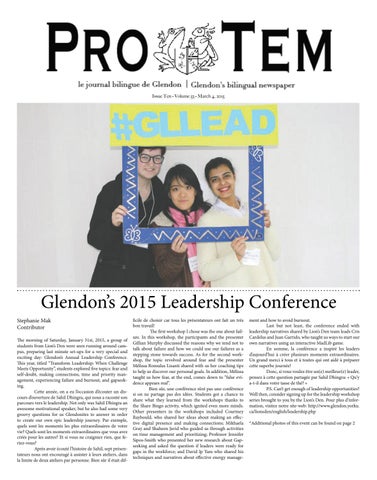
Glendon’s 2015 Leadership Conference Stephanie Mak Contributor
The morning of Saturday, January 31st, 2015, a group of students from Lion’s Den were seen running around campus, preparing last minute set-ups for a very special and exciting day: Glendon’s Annual Leadership Conference. This year, titled “Transform Leadership: When Challenge Meets Opportunity”, students explored five topics: fear and self-doubt, making connections, time and priority management, experiencing failure and burnout, and gapseeking. Cette année, on a eu l’occasion d’écouter un discours d’ouverture de Sahil Dhingra, qui nous a raconté son parcours vers le leadership. Not only was Sahil Dhingra an awesome motivational speaker, but he also had some very groovy questions for us Glendonites to answer in order to create our own epic leadership journey. Par exemple, quels sont les moments les plus extraordinaires de votre vie? Quels sont les moments extraordinaires que vous avez créés pour les autres? Et si vous ne craigniez rien, que feriez-vous? Après avoir écouté l’histoire de Sahil, sept présentateurs nous ont encouragé à assister à leurs ateliers, dans la limite de deux ateliers par personne. Bien sûr il était dif-
ficile de choisir car tous les présentateurs ont fait un très bon travail! The first workshop I chose was the one about failure. In this workshop, the participants and the presenter Gillian Murphy discussed the reasons why we tend not to talk about failure and how we could use our failures as a stepping stone towards success. As for the second workshop, the topic revolved around fear and the presenter Mélissa Romulus Lisanti shared with us her coaching tips to help us discover our personal goals. In addition, Mélissa taught us how fear, at the end, comes down to “false evidence appears real”. Bien sûr, une conférence n’est pas une conférence si on ne partage pas des idées. Students got a chance to share what they learned from the workshops thanks to the Share Bingo activity, which ignited even more minds. Other presenters in the workshops included Courtney Raybould, who shared her ideas about making an effective digital presence and making connections; Mikhaela Gray and Shaheen Javid who guided us through activities on time management and prioritizing; Professor Jennifer Sipos-Smith who presented her new research about Gapseeking and asked the question if leaders were ready for gaps in the workforce; and David Ip Yam who shared his techniques and narratives about effective energy manage-
ment and how to avoid burnout. Last but not least, the conference ended with leadership narratives shared by Lion’s Den team leads Cris Cardelus and Juan Garrido, who taught us ways to start our own narratives using an interactive MadLib game. En somme, la conférence a inspiré les leaders d’aujourd’hui à créer plusieurs moments extraordinaires. Un grand merci à tous et à toutes qui ont aidé à préparer cette superbe journée! Donc, si vous voulez être un(e) meilleur(e) leader, pensez à cette question partagée par Sahil Dhingra: « Qu’y a-t-il dans votre tasse de thé? » P.S. Can’t get enough of leadership opportunities? Well then, consider signing up for the leadership workshop series brought to you by the Lion’s Den. Pour plus d’information, visitez notre site-web: http://www.glendon.yorku. ca/lionsden/english/leadership.php *Additional photos of this event can be found on page 2
Pro Tem Editor in Chief | Rédactrice en chef Natasha Faroogh editor@protemglendon.com Assistant English Editor | Rédactrice adjointe (anglais) Stephanie Settle assistanteng@protemglendon.com Assistant French Editor | Rédactrice adjointe (français) Gervanne Bourquin assistantfr@protemglendon.com Section Editors | Les rédactrices de sections Campus Life | Vie de Campus Erika Desjardins campuslife@protemglendon.com Issues and Ideas | Enjeux et idées Lindsey Drury issuesideas@protemglendon.com Health and Wellness | Bien-être et santé Samantha Kacaba healthwellness@protemglendon.com Metropolis | Métropole Neya Abdi metropolis@protemglendon.com Arts and Entertainment | Arts et divertissement Ashley Moniz artsentertainment@protemglendon.com Expressions Sienna Warecki expressions@protemglendon.com Communications Officer | Agente de communications Victoria Ramsay communications@protemglendon.com Design and Layout | Maquettiste Megan Armstrong
Pro Tem est le journal étudiant du collège Glendon. Publié pour la première fois en 1962, c'est la plus ancienne publication de l'Université York. We strive to act as an agent of social change, and will not print copy deemed racist, sexist, homophobic or otherwise oppressive. Please respond to what you read in the pages of Pro Tem/ n'hésitez pas à réagir à ce que vouz avez lu dans Pro Tem. Contact us/ Contactez-nous: protem@glendon.yorku.ca The Pro Tem Office D114 Hilliard Residence, Glendon College 2275 Bayview Avenue North York, ON M4N 3M6 The office is open by appointment only. Le bureau est ouvert sur rendez-vous seulement. Les lettres adressées au journal peuvent être éditées au niveau de la clarté ou de contenu. All copy appearing in Pro Tem is at the discretion of the editorial team. Opinions published in Pro Tem are the thoughts of individual writers, and not the publication as a whole.
2
GL Leadership Conference
The Glendon Musical Ensemble considers... the Seasons of Love Neya Abdi Metropolis Editor If music be the food of love, play on! On February 6th and 7th, the Glendon Musical Ensemble held its “Seasons of Love” concert at the Glendon Theatre. Under the warm red lighting, the talented vocalists and instrumentalists performed a variety of love songs and familiar favourites. Not only did the songs vary in popularity but also in the moods they conveyed. The pieces cleverly attached associations to particular points in relationships. The fun, quirky piece “L-O-V-E” performed by the instrumentalists reflected the initial happiness and butterflies of getting to know someone new while “Somewhere” and “Gold” reflected the sadness and melancholia that can accompany heartbreak or falling out of love. Of course, love is not limited to the romantic, a sentiment that was carried across by choices like “Bridge Over Troubled Water” (performed by the GME Executives) that could be about support you receive from family or friends. The dynamic singers and lively band members kept it upbeat with crowd pleasers included the energetic Pharrell hit, “Happy”. Sprinkled throughout the evening were fun facts about members of the Ensemble shared by the show’s MC and GME’s General Manager, Lea Leung. The selection of French language numbers was fitting not only because Glendon is a bilingual college but also because with such a theme, how could one not include the language of love? As a lovely wrap up to the evening, the Ensemble performed “Seasons of Love” from Rent, engaging the audience in a goodbye sing-a-long. My only suggestion would have been to include “Lady Marmalade” from the Moulin Rouge soundtrack. A hit song from a movie about a prostitute who can’t fall in love, in a show about love? Talk about subversive. Talk about fabulous.
Pro Tem Vous aimez écrire? Vous prenez des photos ou souhaitez pouvoir exprimer votre créativité? Vous avez une opinion sur …..? Ecrivez-nous à editor@protemglendon.com pour plus d’informations.
Ignoring Exchange Students: York International and YFS Disappoint Jennifer Coté Contributor We will be taking a break from our regular scheduled European Adventure article to bring you some issues which have been weighing heavily on the hearts and minds of exchange students this past month. This article comes not only from Holland but from Mexico, Spain, and numerous cities in France. York and Glendon like to highlight their international side; we have international students coming to Glendon, and Glendon students travel internationally. They promote exchange, heck they even offer degrees revolving around exchange. However this past year, a majority of – if not all – exchange students from Glendon have felt overlooked and let down by York. Communication between York International – who deals with the York International Mobility Awards, a scholarship which all students going on exchange are eligible for, as well as exchange students, has been basically non-existent. Every exchange student has had major issues with getting a simple email reply from York International. Emails go unanswered and deadlines are being passed without any updates; we have been left hanging, sending email after email since that’s all we can do from across the ocean. Last semester I actually wrote a letter about the issues of communication between York International and the exchange students, expressing our frustration of getting no replies or support. I send the email to York International, our Senators, and Glendon’s Exchange office. In the one reply I got back, I was told the issue would be looked into. However, this semester, there are still a number of exchange students who have heard nothing back, are still getting no replies, and are currently waiting on information. While it may seem like a simple thing; waiting for email replies or answers to questions, the mutual feeling overseas is that we are being let down by our school. One exchange student writes: “I understand they have a huge number of students on exchange all across the globe but considering I’m still paying my astronomical amount of tuition to THEM I feel we’re owed some level of acknowledgement” – Anon This student is still waiting on a reply from an email they sent a month ago. The second major issue that has ignited some anger amongst exchange students is the YFS Election. Glendon’s elections are done online. Even Canadian federal elections can be done online. For some reason, YFS insists on doing a paper ballot. I asked Jamie Basian, a student currently studying in France her position on the YFS paper ballot issue: “On the YFS website, it says that they work to ‘advocate for students and aim to empower you to take action on issues related to you’. Despite being on an exchange, we are still York students—our tuition fees are paid to York University, our concerns remained centered around York, and decisions made by the YFS will impact us. Throughout my time at Glendon, YFS elections have always been overwhelmed by controversy and complaints, and the incapability for students studying abroad to partake in these elections simply adds to the illegitimacy and inflexibility of the student government. They are silencing us more than they are empowering us.” – Jamie Basian This is not the first year there has been complaints either. Gillian Wassmansdorf, a fifth year student at Glendon and former GCSU President, launched a serious complaint about YFS last year when she was made aware of her lack of voting rights as an exchange student while in Brussels, Belgium; they are aware that exchange students feel that this is incredibly unfair.
Vie de Campus York University has exchange partnerships with over 250 universities across the globe, according to their “About York” International page. With so many partnerships and so many students literally across the world, it would make sense that the York Federation of Students would make sure the thoughts of travelling Lions were heard in elections. I emailed YFS to ask why they haven’t switched to electronic ballets, like so many of our other elections, and I have yet to receive a reply. We are on exchange but we are still a part of this school. Our voices deserved to be heard. For more information about my Exchange in the Netherlands, check out my blog: www.jennifercgl.wordpress.com
Lunik’s Legacy:
A look at where we’ve come and where we’re going. Victoria Ramsay Communications Officer I had the pleasure of sitting down with two of Lunik’s coordinators, Michelle and Brynn, to chat over some coffee about Lunik. In the candid interview below, we’ll hear their thoughts on the security issues at Glendon, the turnover of coordinators for next year and what they hope Lunik’s legacy will look like as they move on with life and prepare for graduation. Tori: Firstly, hello to you both. Before we get started with questions could you just introduce yourselves and your positions at Lunik. Michelle: Hi, I’m Michelle Kearns and I’m the Environment and Facilities Coordinator. Brynn: Hi, I’m Brynn Leger, and I’m the General Logistics Coordinator. T: And for the readers, I’m Tori (or Victoria) and I’m the Communications Officer at Pro Tem. So, let’s start with the basics. How would you describe what Lunik is to Glendon students who have never been in the space before? B: Well, Lunik is a student-run cooperative café on campus. What that means is it functions primarily as a social space but we also do events. We serve tea and coffee which is priced as PWYC (pay what you can). We also have food options from Sweets from the Earth and Zara’s Kitchen. Basically, we are called a cooperative because Glendon students pay into Lunik via their tuition. The Glendon student community funds us and therefore each student is an equal owner. That means that you can come and have a say in our meetings and tell us how to run it and really get involved in the organization. It’s also just a great place to hang out and study and talk with friends. M: All of our food is sold at cost to students so we don’t make any profit off of it. That’s one thing that is unique about Lunik because buying food on campus can be really expensive for students but we try to offer an alternative. B: We also have a lot of vegan and gluten free options as well. T: You mentioned that students fund Lunik. Why do you think students should care about the difference between a club and a levy organization? How does it impact them? (Continued on page 4)
3
Campus Life
Kelly Lui (Continued from page 3)
M: Yeah, it’s a two way street for sure.
B: The main reason is because it’s their money that is going into it. A lot of students don’t know, this is something that you are paying into so you should be able to get the most out of your money. You should be able to have a say in where your money is going. It’s also kinda cool that it’s funded by students, for students and that part of our tuition goes towards bettering the student experience.
T: Alright, so we’ll move onto another question here. What was Lunik, or this space, used for before the cooperative café existed??
M: I think people [students] need to care because they need to push for transparency. There are a lot of levy orgs, not so much at Glendon, that get away with a lot of things. We try to be as transparent as possible with our meetings and ordering and we also have a board of directors but students should be aware so that they can keep these things and people in check. We welcome people coming up to us and asking, “Hey, how much are you spending on this?” or “How much of a profit are you making?” We are totally open to going over that with people. B: We get a lot of questions about the paid positions, which I’m sure you guys [Pro Tem] do as well. T: We do for sure; people care about who is getting paid and how much. B: And they should care. M: We [student leaders] should be accountable to the students for what we are doing and how much we’re making. B: I also think it’s important to provide a work environment for students on campus where they’re contributing to the student experience and getting paid decently for But other students also need to be ensuring that 4 it. we’re doing what we say we’re doing.
B: This space is a part of the original structure. I’m pretty sure it was originally their theatre when it was used as a house. Then before it was Lunik it was ‘Café la Terrasse’ which was a pub.
T: What are some misconceptions that people have about Lunik?? M: I think that there is this idea, especially when we first opened, that Lunik is this very a exclusive, hipster-y type place, which is ironic because we have so many policies that try to make it as inclusive as possible for everyone and to ensure that it is a safe space. But there is an idea that a certain type of people hangs out at Lunik. I’ve heard stories from people saying, some guy yelled at me for having Starbucks in here once.
M: I’ve had many alumni ask me, is the pub still there?
T: Starbucks is just too mainstream, eh?
B: Me too!
B: For the record I have totally had Starbucks in here multiple times, why not?
M: I always tell them, not quite, now it’s a café but it’s cool I promise. B: So, it was a pub and then it was closed down eventually due to issues with management, leadership, funding and all of that sort of stuff. Then it was closed down for a while and even used as a classroom in the summer time. It had these awful pink stucco walls and was very run down. There are still pictures of how it looked at that time up on our website but I assure you, it was not pretty. Then there was a referendum for the levy to be reinstated and for it to become a cooperative café. Then it was a long process of gaining approval but we officially opened in October 2011 and then we gradually started establishing more services. T: Yeah, I think it reopened during my first year at Glendon. B: Learning the politics of how long it took to get where we are is really empowering especially in terms of student voice.
M: That’s a silly misconception. There is also a misconception that because we sell vegan and gluten free that we’re a little bit weird and that we don’t sell ‘real’ food. B: Or that we disapprove of dairy or meat. M : When it comes down to it with that misconception, it’s just a storage issue. We don’t have the space to store ham sandwiches, for example. We don’t have the facilities to keep it stored and fresh. B: Also, it’s more expensive once you get into all of those options. We also try to provide things that maybe you can’t get at the Caf. The presence of these options makes it seem like we’re not open to mainstream things, that is such a shitty word… T: For a lack of a better word. B: Exactly. But we completely are open to that. That is the whole point, we don’t want to close the space off to people
Vie de campus who can’t eat meat or dairy, but if you can or want to, that is completely your prerogative. It is so hard to change that misconception.
have had on the Glendon community. You can come here and hang out and purchase food, but we can’t provide you any change. It’s just inconvenient.
T: It’s a hard thing to communicate to the whole student body. How exactly can you go about doing that?
B: It’s important to emphasize that these services and items are purchased with your money. Especially with Radio Glendon’s computer, that was funded by students.
B: You can write articles in Pro Tem. T: You sure can, something exactly like this. B: I think it’s just a process and Lunik is still in its infancy. It is still being redefined into what it is, who it’s for, and so the more people break down those barriers and come down with their ham sandwich and their Starbucks, the more it contributes to a different image. It’s so exciting that every year there is a new community that can define it for themselves. B: We are both part of the first generation of Lunik and now we’re beginning to move on and graduate. There will be a whole new batch of students that will come in and make it their own. It has a lot of opportunity for redefinition of what it means. T: I really like that word, redefinition, it works for this space. Now, we’re going to shift topics just a bit here. A hot topic this year in Pro Tem and a hot topic among Levy funded orgs has been that of security. There have been a number of different thefts on campus; you experienced that first hand at the beginning of the year. And then more recently, Radio Glendon’s computer was stolen. What advice would you give to the students at Glendon to communicate the negative impact this has on our community? M: That’s tough. It’s been terrible this year, it’s increased so much. I don’t know if it’s just a group of disgruntled students, I have no idea. T: Students know that this is happening but do they fully realize the impact that it is having on the spaces and resources that they currently have full access to? How do you communicate the impact to them? B: I think it’s hit or miss. It has been kind of a rallying moment for the wider Glendon community. When we had our cash box stolen a couple of times at the beginning of the year the support was really overwhelming. Even people that don’t normally come here were like, that is not cool. It’s your money; it’s the students’ money. M: And now we can’t give change to anyone we simply can’t have a cash box out. B: On the negative side, there are practical repercussions for these actions, such as just not having a cash box. That is not ideal and it is negative for the students that use the space. T: So there is no cash box at all. B: No, so now we have a donation box that might occasionally have change but we can’t provide a float with change because it wasn’t sustainable because it was being stolen. This is temporary; obviously this isn’t an ideal solution either. We need to find a better way to provide people with change. But also, if you’re going to keep taking it, we can’t provide it. It seems juvenile. I don’t feel like we need to slap people on the wrist for this. Also, the wrong people are being punished. T: That’s a great example of the negative impact the thefts
M: And at this point we can’t have Radio Glendon anymore. B: Wait, really? T: It’s true, they cannot broadcast. B: Now, that is so sad. M: When our cash box was stolen we we’re out of x amount of dollars and such, but with Radio Glendon, it indefinitely stops what they’re doing. Like, thanks for taking that from the students. T: To go off of that, there can be positives to these situations such as supporting each other and rallying together for one cause, but do you guys worry that this is a significant change in Glendon’s culture? Looking forward, could this be something that is embedded into our future as a student body? B: That is a scary thought. I don’t want to generalize this to an entire incoming class, but whoever is doing this doesn’t have the connection or respect for the Glendon community. Whether or not that is indicative of a generational change or an isolated group that is particularly rowdy this year, I’m not sure. M: It’s sad because you think of someone going to a university and paying tuition, wanting to improve their lives but then choosing to wreck it at the same time? T: That’s counterproductive. M: It’s such a weird concept to me. But, I know at Glendon our enrolment is constantly going up from year to year, which is great, but there could be a higher percentage of people who want to create trouble. I think we’ve just thrived off of having a really tiny community of people who know each other. B: That’s scary though. I hope that it’s not signaling some sort of shift. It is true though that many of the people that are outraged by this are from our class [2011] and have been here for a long time and been ingrained in the community and know what it means to take from a levy org.
T: Then it can’t be appreciated. B: It’s all student generated, we pour a lot into these spaces. It could be either a lack of awareness or a lack of respect. Maybe it’s just ignorance and not malice. Maybe they just don’t know. M: I think that’s a bit of a stretch, it’s malicious to steal things. Anyways, it’s just really frustrating and we might need to revamp some policies here in order to combat this. T: It’s frustrating that you even have to do that. M: For sure but we can’t stick our heads in the sand and hide from it anymore because it’s not stopping. T: That’s kind of what this issue of Pro Tem is about. The fact of the matter is that student leaders like you are leaving and graduating, we can’t expect the next people to just magically fix it. Before the year is over, we can already be thinking of ways to help it so that when the responsibility is placed in other people’s hands they have a fighting chance to maintain it. B: We’re being very reactive at this point as things are happening. T: Looking forward, what are some events that are being held in Lunik that students can look forward to? M: We have a garden out back and I’m excited to get out there once the snow thaws. Towards the end of the semester I hope to start seeding, we’ll get a group of students in here and have an event where they can help plant some seeds. I want to people involved in the garden in a way that they can benefit from it themselves. It’s okay if you don’t know what you’re doing, we’ll teach you. B: We had a harvest dinner in the fall and we do one in the spring as well called the Solstice Dinner, so look out for that. It’s a big meal, it’s pay what you can. There are also a couple other late night events that are in the works. If any groups have big events that they want to do, there is still availability so let us know. B: This isn’t an event but students can also look forward to seeing student art in the space. We are starting a rotating art exhibit. M: We already have submissions from a few different artists. They will be up soon and there will be biographies up on our website of the artists. B: People can continue to send that in if they have art that they want showcased at Lunik.
T: Lunik wasn’t open for a number of years; Pro Tem went dead for 2-3 years ….
T: So we’re nearing the end of the semester, it’s February already…
B: Same with Radio Glendon.
B: I’m in denial.
T: These negative instances could affect these organizations. Flat out, if we don’t have the resources to do it, or we don’t have the money to keep it going because you are stealing it, things could go extinct very quickly.
T: Me too. There is a commonality between levy orgs and that is the idea of a turnover of student leaders. It is coming up very quickly. Can you talk about the positions that need to be filled for next year?
B: Some student are more new and don’t know the struggle that was fought to establish these things.
B: This is so great; we just met about this today, this morning! The applications will be available before reading week and the deadline just after, on Februray 27th. We want enough time to interview, hire and train.
T: And even re-establishing. B: Yes, Pro Tem, Radio Glendon and Lunik became revitalized within our time here. We were able to see the transformation. If you don’t see the transformation it looked like an established thing.
(Continued on page 8)
5
Spotlight on Fashion
LMG Fashion Show Photos by Wendi Y.
6
Campus Style
Campus Style Photos taken by Wendi Y. Top Photo of Sabrina L. Middle Photo of Franncette M. Botton Photo of Nico D.
7
Campus Life M: Five out of six of us are graduating so we want to be able to bring in the new hires and have them tag along with us so we can train them. B: We want to have some shadowing component to the turnover process. It’s scary because we all saw this place open but we aren’t going to be here anymore so there won’t be that continuity.
I feel more invested in my education because I care about this place so much. And you’re more knowledgeable about Glendon and networking with other groups and it becomes this big community instead of just this building that I take classes in. M: I just applied to grad school and it was for urban planning and in all my statements of interest I mentioned Lunik and the policies that I have tried to implement it’s been so applicable to, hopefully, what I will study in grad school.
B: So, we have six coordinator positions: Social Space Coordinator: This is more on the policy side of things to help in fostering a welcoming, safe space.
T: That’s something unique to add to an application. Not everyone can say that they helped run this co-op café.
Logistics Coordinator: This is the behind the scenes job. It’s very practical and deals with the ordering process and making sure that things behind the scenes run smoothly.
T: So, what do you want to say to the students that read this and think six hours a week, or all the responsibility is too much for me, but I want to be involved but just volunteer?
M: Then we have Communications after that. We’re really looking for people with experience managing Facebook and Twitter accounts and are able to put together a coherent strategy for communications. This job is about 6 hours a week.
B: I’d say, do it!
Environmental Coordinator is my position now and we’re adding a bit more to that now. It’s about promoting sustainability more, managing the garden, which is always tough because the school year is mainly in the winter, and just to make the space a more sustainable place in general. B: Financial Coordinator is next and deals with exactly what it’s name sounds like which includes counting the cash, making sure inventory is done etc. Then we have an Outreach Coordinator M: That’s a new one. B: Which includes promoting and recruiting members and getting the wider Glendon community involved in the space and reaching out to the groups on campus. B: We should also mention that to apply, you should have demonstrated some sort of involvement with Lunik in the past so you know what we’re about. You also have to be a Glendon student. M: We will also look favourably on people that have their G license and/or their smart serve. Oh, and also bilingualism for those applying for communications because that’s something we’ve struggled with in the past. T: Yes, that can always be a hard thing to come by. Where are the francophones at?
M: Send us an email and our coordinator Tia, she’s lovely, will get into contact with you. B: People assume that volunteering is being in the kitchen making coffee and putting away the dishes, that stuff needs to be done and we need people to do it, but it’s also about things like coming to events and helping with the garden. Also, if you have a project that you want to see implemented in the space, let us know; come to the meetings and communicate that. M: We’ve had some really solid volunteers this year. Also, if you’ve volunteered and in the coming years you have some time and want to apply to be a coordinator, having that experiences makes you a step ahead. T: What drew you both to being involved here over the past few years? M: When I came here I was a transfer student and I wasn’t really involved, I just went to classes and then went home. When I came to Glendon I thought, “Okay, I need to make an effort”. I started volunteering and everyone was great and welcoming. When you’re volunteering, yes there’s work involved, but it’s also casual and doesn’t stress you out it’s something that is fun and you get to meet a lot of people. B: There’s really nothing like this place on campus. When I started here I lived in res and was just like, “Yup, this is where I’m gonna hang out” you know, and it was really cool to shape what it looked like. I think we’re still in that phase where we can mold it to the kind of community that you would want to see on our campus.
M: The changes you’ve made are just this huge legacy like now the bar is gone, and there’s new furniture. It’s exciting. B: It’s crazy. T: That’s a good lead into my final question. As we talk about the future, what type of legacy at Lunik are you hoping to leave behind? M: I really hope that Lunik maintains its policies and the constitution; all of those underlying philosophies that we have that make the space what it is. I really hope that’s carried out as we go forward. I hope that more improvements continue to be made. I also would like to see more programming, connecting with the community and the GCSU a little more. Other than that, I don’t know, it’s just exciting. B: I guess our theme this year was ownership but I really want to leave a legacy of making this a space that students feel like they’re actively a part of and the Glendon community feel like they own it, because quite literally they do, they own the space. We also revamped the finances a lot and a lot goes into the behind-the-scenes work. Setting that up was a big job so I want the next group to continue it so that they don’t get into the same spot of disorganization where we had to start from. M: There are also some really cool infrastructure improvements that could be made. B: Looking forward, I have no idea how this could happen, but we need to make this space accessible, physically. It’s just so physically inaccessible. That would be a great project thing to implement especially because we’re supposed to be this anti-oppressive, safe space, inclusive, against all of these –isms, but if you have any physical impairment, you can’t access this place. That just doesn’t make sense. This is a historical space so it wasn’t created with that in mind. M: I want to come back for an alumni event down the road and see the changes that have been made. T: Thank you both so much for your time and insight into all of these issues. I hope that Glendon students are able to learn a lot about the space from this interview and choose to get involved somewhere. For volunteering, general questions, or if you have student art for the space. Please send an email to: lunik.cooperative@gmail.com
B: Yeah, seriously, please apply! M: It’s also nice that you can take these positions and shape them to reflect what you’re interested in. Then when you apply of other jobs you can use it and say, I had this really cool experience organizing this or implementing that. B: We’re looking people who are invested in Glendon, want to make a difference and are passionate about our mandate and what we’re all about. T: A lot of students don’t realize that their extra curricular can actually complement the degree that they’re completing. I look at you [Michelle] and your position and then the program you applied to for postgrad studies and I can see similarities. It’s not just about our degree, you can get involved in things that will give you experience in a place of interest and give you examples that you can speak about when applying for grad school or for another job.
8
B: It’s great for school involvement and investment.
Kelly Lui
The Chapel Hill Shooting and Media Coverage Or lack thereof . . . Lindsey Drury Issues & Ideas Editor For most of us, stories of racially-motivated violence, hate crimes, and all tragedies with minority victims find their way into our consciences in faint, fleeting whispers. Michael Brown, Eric Garner, Leelah Acorn, and now Deah Barakat, and Yusor and Razan Abu Salha are all names that have flitted through our attention spans in casual conversation or in splashes from social media outlets. In today's information-based society, it doesn't take long to put together all these separate pieces into one fully formed picture of the country's most recent plight. Except the picture you create is no Claude Monet--it's more like Picasso, and even that's generous. In light of recent events, i.e. the Chapel Hill shooting that occurred on February 10th where three Muslim students were killed in what is assumed to have been a hate-motivated crime, it is important to discuss the implications of the responding media coverage—or lack thereof. Kevin Barrett, the founding member of the Muslim-Jewish-Christian Alliance, to PressTV on February 11th in the appropriately named article, “US Media ‘Complicit in mass murder of Muslims’: says Kevin Barrett”, expressed his concern about how little attention the story was getting compared to the Charlie Hebdo attacks. He is quoted saying that “the mainstream media as well as the extremist media here in the United States are both complicit in genocide against Muslims and the religion of Islam”. Kevin Barrett isn't the only one who thinks this way. Carlos Latuff, a famous caricature artist, posted a cartoon the day after the attack which depicted a man yawning while holding a TV camera and wearing a shirt that read “MAINSTREAM MEDIA”, his speech bubble saying, “three young Muslims killed by a lone gunner? No breaking news here!” And arguably even worse than no coverage at all is the bigoted and biased coverage the West has included in various media sources. A researcher for INRS Culture, Denise Helly, has written an article titled “Are Muslims Discriminated Against in Canada since 2001?”, in which she discusses the state of Canadian media coverage, expressing that Canada and the west have done nothing but to spread negative images surrounding the Islamic culture, and “the view of Islam as an intolerant, even violent, religion that is a source of conflicts and women oppression”. She goes on to iterate that “Canadian media coverage of events concerning or implying countries or people of Muslim heritage since September 2001 constitutes one of the most significant subjects of criticism by Canadian Muslim organizations. The main critique is the constant reference to Islam to qualify positions and political actions. We hear about ‘Muslim extremists’ or ‘Islamic militants’ whereas any religious qualification is omitted when similar positions or actions by people of other religions are treated”. It may be also important to note that in Helly's 2004 study, it was found that “The National post [was] rated as the most hostile daily newspaper towards Islam and Muslims”. Beyond discussion regarding media coverage thus far, it is important to look at those victims who, as Kevin Barnett stated, “are simply the latest victims of anti-Muslim genocide”. In CBC's coverage of the story, “Chapel Hill shooting victims mourned by thousands at funeral prayers”, the victims are humanized with details about their lives: Deah Barakat was 23 years old, and was a
dental student attending the University of North Carolina. He had just been married to a fellow victim, newlywed Yusor Abu-Salha, who was 21 years old. Her sister Razan was 19 and also a student. The Huffington Post article, “Friend Of Slain Muslim Student Deah Barakat: ‘He Was Safer In The Conflict Zones’”, muses about Deah's pastime of playing basketball, as well as his passion as a volunteer dentist for children with special needs. He also craved having a beard as voluptuous as his best friend's. The Guardian published the article “Remember Yusor Abu-Salha as more than just a victim of the Chapel Hill shooting”, written by Rana Odeh, which describes Yusor as being incredibly witty, the funniest of all her friends. Like her husband, her philanthropy started at an early age and continued until the day she died. Her sister, Razan, was generous, loving, and a talented artist. Yusor was quoted for something she said just last year in an NPR article called “Chapel Hill Shooting Victims were ‘Radiant’, teacher says”, in which she discussed her feelings about being a visible Canadian minority. Above all others, this quote going unheard would arguably be the greatest injustice of all: “Growing up in America has been such a blessing, and you know, although in some ways I do stand out, such as the hijab I wear on my head, the head covering . . . there's still so many ways that I feel so embedded in the fabric that is, you know, our culture. And that's the beautiful thing here, is that it doesn't matter where you come from. There's so many different people from so many different places of different backgrounds and religions, but here we're all one, one culture.”
Copenhagen Attacks:
Violence unfolds in Europe again Dillon Baker Contributor Attendees of a talk entitled Art Blasphemy and Freedom and Expression were attacked with automatic weapon fire in Copenhagen on Valentine’s Day around 4:00pm CET (Oslen, Ritter) wounding five police officers and killing one man, 55 year-old Danish filmmaker Finn Noergaard. The gunman fled the scene in a vehicle which police later recovered about 8 km northwest of the scene of the shooting. Later in the early morning hours of Sunday, February 15th, the attacker carried out another shooting at a synagogue where one security guard was also killed. Again he was able to flee the scene and remain on the run until attempting to return to an address the police had under surveillance and was shot dead outside the home (Olsen, Ritter). While the suspect’s motivation remains technically unclear, it is widely reported that it was most likely inspired by the shooting at Charlie Hebdo in Paris last month and that his target was likely Lars Vilks, a Swedish satirical cartoonist and sculptor (Simonsson, Waeschenbach). Vilks is no stranger to this kind of threat, after all he was one of the first to publish a caricature of the prophet Mohammed in 2007. The carton landed Vilks a fatwa from al-Qaeda in Iraq which included a six-figure reward. While Vilks condemned the violent act, he brazenly told the Associated Press that he was also unfazed by the incident. "I'm not shaken at all by this incident. Not the least” (Copenhagen). The suspect of these gruesome attacks was a 22-year-old Danish citizen, Omar El-Hussein, who had a history of violence and weapons charges (Simonsson, Waeschenbach). While it is still believed that he acted alone and no known extremist group has claimed responsibility for the attack, this has not deterred strong language from Danish Prime Minister Helle Thorning-Schmidt; “We feel certain now that it was a politically motivated
Enjeux et idées attack, and thereby it was a terrorist attack” (Zawadzki), adding, “there are forces that want to harm Denmark, that want to crush our freedom of expression, our belief in liberty” (Simonsson, Waeschenbach). Condemnations also came from many Western leaders following suit including Françaois Hollande, German Chancellor Angela Merkel, and our own Prime Minister Stephen Harper who tweeted: “Horrified by the act of terror in Copenhagen. Our thoughts and prayers are w/ Denmark. We stand strong w/our allies against such atrocities” (Harper). The parallels between the Charlie Hebdo attack and this most recent one are almost unbelievable. Both attacks consisted of two shootings, one which aimed to attack an ideological precept, namely free speech, and the other an attack on the Jewish community. Both initial shootings in broad daylight with automatic weapons, both with targets of satirical cartoonists, both end in bloodshed for victims and suspect(s). Both were followed by sweeping ideological responses from powerful heads-of-state and calls from Israeli PM Benjamin Netanyahu for a “massive immigration of Jews from Europe” (Olsen, Ritter). While for a variety of reasons the Copenhagen shooting isn’t going to elicit the same kind of response that the Charlie Hebdo shooting did, the frustration and anger that mounted in its wake now seems to have broken into exasperation. How do we respond? As David Cameron did, for example, “the shootings in Copenhagen are an appalling attack on free speech and religious freedom. Two innocent people have been murdered simply for their beliefs . . .” The problem though, is it really? And what are the dangers in claiming it as one? Realistically this young man was a 22 year-old Danish national, he had never travelled to a conflict zone and there are no connections yet to support radicalization (Simonsson, Waeschenbach). So what is a terrorist act? If an attack is ideologically motivated? Does it have to be planned or orchestrated by a known terrorist group? Can an individual acting on his own be considered a terrorist–versus a criminal–simply on the basis of the target of his crime? Furthermore, what kind of response is appropriate? At what point does an attack warrant a grandiose ideological response and when is it simply criminal mimicry? While Danish police have still not finished their forensic investigation, at this time it appears as though the suspect had no accomplices and no overtly declared motivation except what can be inferred from his target. Does this merit a response which places this act of violence in opposition to the constructs of Western society itself? In essence, all violence is conducted from the same mixture of righteousness and desperation–even our own. Terrorism as violence works because it speaks to the possibility for violence that is innate within all of us. Violence cannot literally attack an abstract ideal. It cannot damage something held in the heart of a person or society, it can only slowly erode its integrity until they believe that’s all they are. Works Cited “Copenhagen attacks : Danish police kill suspect following fatal shootings.” CBC News, 14 Feb 2015. Associated Press. Web 15 Feb 2015. Harper, Steven (pmharper) “Horrified by the act of terror in Copenhagen. Our thoughts and prayers are w/Denmark. We stand strong w/our allies against such atrocities.” 14 Feb 2015 4L47 p.m. Tweet. Olsen, Jan, Ritter, Karl. “Police identify Copenhagen shooter as Danish-born man with criminal record” Global News, 14 Feb 2015. Associated Press. Web 16 Feb 2015. Simonsson, Lennart, Waeschenbach, Julia. “Copenhagen gunman likely ‘inpsired’ by Paris attacks” The Toronto Star. 15 Feb 2015. Web, 16 Feb 2015. Zawadzki, Sabina. “Denmark on edge after Copenhagen shootings.” Globe and Mail, 14 Feb 2015. Web 15 Feb 2015.
9
Issues and Ideas
Metropolis
Homosexuality in the Baltics Samantha Kacaba Health & Wellness Editor As we pass the one-year mark since the world celebrated the 2014 Sochi Winter Olympics, any news of LGBT rights in Eastern Europe have all but ceased to appear in the mainstream media. The enthusiasm and energy of Western activists has moved elsewhere as the press coverage from the area has become primarily focused on the crisis in Ukraine. A country that has been entirely overlooked by Western media is Lithuania. The largest of the Baltic states, bordering Poland, Belarus, Latvia and the Kaliningrad Oblast; Lithuania has an LGBT-rights track record on par with Russia, something not many North Americans are aware of. In Lithuania, sexual activity between adults of the same sex was made legal in 1993, but since then little ground has been broken. In 2005, the Law on Equal Treatment was established, and made discrimination based on sexual orientation illegal in the areas of employment, education and access to goods and services. Same-sex marriage remains under a constitutional ban, and adoption rights have not been granted. A majority of 84% the population seeks to keep same-sex marriage banned. Since 2010, a controversial “Protection of Minors” law has been in force, strikingly similar to the Russian anti-gay legislation that made news during the Sochi Olympics. It struck me to address this issue after a remark was made by a member of the Lithuanian Parliament in the wake of the terrorist attacks in Paris this January. At the beginning of 2015, Lithuania switched their currency from the Litas to the Euro. In an interview televised by LNK TV, Vladimir Simonko suggested in jest that 10 litas notes be kept as souvenirs by queer Lithuanians. The 10 litas note features Steponas Darius and Stasys Girėnas, two early-twentieth-century pilots who flew over the Atlantic in 1933 in a self-made aircraft, standing sideby-side in uniform. Simonko, the head of the Lithuanian Gay League, Lithuania’s largest LGBT organization, made the implication that the two men featured on the currency could be seen as "good friends sharing more than friendship”. In response to this interview, MP Algirdas Vaclovas Patackas, had this to say: “This piece of news (. . .) is not playful, it threatens with no less miserable consequences as the recent massacre in Paris. Everything there also began in a playful manner but ended with dead bodies, because words hurt like a knife. Will there be another attempt to “expand the boundaries of freedom of speech?” We say in advance – it will fail. Lithuania is not France where in the Parisian Bastille and the communes the heads of Marie Antoinette and Robespierre Marije were chopped (…). Because in Lithuania (…) not everyone turns the left cheek; there are many, who believe in the principle “an eye for an eye”, i.e. the main cause of what has happened in Paris. And hardly anyone in Lithuania would bear an inscription “I am Simonko”. Patackas’ harsh words were condemned by members of the European parliament, who noted that they
may even breach the country’s own hate speech laws. This statement, published originally on the right-wing website alkas.lt and translated from Lithuanian to English, is not shocking given its context. Though in bad taste given the reference to the tragedies of Paris, these views are not unique to Mr. Patackas. There are very few in the Lithuanian parliament who openly support the advancement of LGBT rights. Patackas himself was the author of a proposed amendment to the Lithuanian Criminal Code that looked to remove criminal liability for homophobic hate speech. The LGBT website atviri.lt documented the statements of Members of Parliament who were asked to give their opinion of the Lithuanian Catholic Church’s position that “homosexuality is a perversion”. On the topic, Petras Gražulis, an MP from the Klaipėda region notorious for his extreme anti-gay views said “I support the position of the Church, there is no doubt about it. These people are indeed sick and perverted. They pose a threat to society because they molest children”. A majority of the answers found on the site followed the same trend, and were very disheartening to read. In an interview with the BBC, Tomas Vytautas Raskevicius, project assistant at the Lithuanian Gay League, attributed the country’s high suicide rate of 34.1 people per 100,000 (as of 2012) in part to hostile attitudes towards LGBT people. Whether this is true or not has yet to be proven statistically, but Raskevicius did make a poignant remark about the troubling atmosphere on the streets.“The authorities don't talk about it out loud, and the daily harassment and remarks in the streets and public places is very widespread." Despite the sense of gloom that the views of the parliament seem to cast, change is coming to Lithuania. As change so often is, it is being perpetuated by the youth of the country. Romas Zabarauskas, a young filmmaker, has been working since 2009 to combat homophobia within Lithuanian society. A rare openly gay public figure, his short films address homophobia and other social ills directly related, such as sexism, suicide, and lack of access to education. In 2011, he spearheaded the LGBT draugiškas Vilnius (EN: LGBT Friendly Vilnius) campaign. Accessible online through the business-sharing website Foursquare, LGBT Friendly Vilnius is a map of the country’s capital city that lays out LGBT friendly businesses. The registered businesses display stickers to let potential patrons know that they are entering a safe environment. Another young activist, Kristina Kunsteinaite, looked to inspire change with her “Invisible People” project. In this project, she invited queer Lithuanians to come out on video, to be published on YouTube. With this she hoped to help inspire others like her, allowing them to see themselves reflected within the films. She stated “by making myself “visible”, I will be that openly gay person for others that I did not have when I was going through a difficult time.” Watching young people like Zabarauskas and Kunsteinaite put themselves out in a hostile environment in the name of change is inspiring. It is a sure example of that trite old saying, “the youth is the hope of our future”. Though overused, it proves itself right time and time again.
Scarborough haters: Do you even live here? Neya Abdi Metropolis Editor In a variation on the Lion King meme, Mufasa says to his son, “Look Simba. Everything the light touches is Toronto.” “Wow,” says Simba. “But what about that shadowy place?” “That is Scarborough,” Mufasa says. “You must never go there.” Scarborough: the misunderstood district to the east. With nicknames like Scarberia and Scarlem denouncing the distance and supposed crime rate of the place, it’s no wonder such a negative reputation of the area has been perpetuated. If the stereotypes are to be believed, the east end is a roiling mass of women with bad attitudes, young men roaming the streets looking for trouble, and bitter residents who dream of the day they can live west of Victoria Park Avenue. But is this reputation really fair? In 2007, city councillors Norm Kelly and Michael Thompson requested that the media not mention “Scarborough” in crime reports. Instead they proposed a protocol for reporters to only reference the intersection where the crime was committed. The tendency among media outlets was to headline the crime as happening “in Scarborough” even though Scarborough is quite a large place. “If there is a shooting at Jane and Finch, it is at Jane and Finch,” Kelly said. “If there is a shooting at Neilson and Finch, it is in Scarborough” (“Leave Scarborough Out of News Reports”, Globe and Mail). The proposal didn’t go through, but Kelly and Thompson brought up a good point: there is a particular interest in portraying Scarborough as more dangerous than it is. Interestingly enough, the loudest people on the supposed dangers of Scarborough are very often people who don’t live in Scarborough. Granted, Scarborough residents enjoy expounding on the supposedly shady reputation of the area for giggles. For instance: “Have you heard about the recent thefts in the area?” says Person 1. “I used to be able to leave my things unattended but now . . .” “Oh ha ha,” says Person 2. “I’m from Scarborough so I’m used to it. I always take my things with me. It’s ingrained.” End scene. As with any area, there are things to complain about, like the tricky buses or the funky smell at Midland station. Yet if you’ve never lived here, worked here, or had any experience with the area outside of an experimental trip to Scarborough Town Centre, why are you talking? To put it best, allow me to shamelessly modify author Kathryn Stockett’s words about Mississippi: “Scarborough is like my mother. I am allowed to complain about her all I want, but God help the person who raises an ill word about her around me, unless she is their mother too.”
Pro Tem 10
Vous aimez écrire? Vous prenez des photos ou souhaitez pouvoir exprimer votre créativité? Vous avez une opinion sur …..? Ecrivez-nous à editor@protemglendon.com pour plus d’informations.
Health and Wellness Arts and Entertainment What We Need to Realize About Glendon Erika Desjardins Campus Life Editor
Dear Amrita, My new boyfriend is not circumcised and I have never been with a guy who has an intact penis. I’m not really sure how to have sex with him and I worry about the cleanliness of his penis, HELP! Thanks, H. Hey H, Thanks so much for writing in. Before answering your question I sat down with a group of my male friends to talk about their man bits and get their perspective on the matter. (Don’t worry my friends are used to these types of questions). Circumcision is a practise in which the foreskin of a male’s penis is removed. It has been common place for hundreds of years and practised for a variety of reasons including both religious and aesthetic. The technicalities of bathing and sex are pretty much the same for all men except that uncircumcised men need to provide a little extra care to their penis. For men with an uncut penis, especially sexually active men, it is important to remember that while cleaning the penis, you must first pull the skin back and wash around the penis. My male friends have suggested not using harsh soaps as it may irritate the sensitive area around the penis. If the penis is not washed properly it can have a particular smell and the foreskin will have a tendency to stick to skin around the penis, which can be painful. After washing, the foreskin should be returned to its original position. Before sex the foreskin should be pulled back before putting a condom on. My male friends have also suggested putting lubricant around the penis before applying the condom. This will help the condom glide down the penis. If your boyfriend understands this information there is no increased risk in having sex with him. If you feel really uncomfortable with it, you may consider talking with him before engaging in any sexual activity. Have a question? Write to me at stictlysex.gl@gmail.com or drop your question off anonymously in the drop box outside of the GWTC, located in Hilliard D-124. Disclaimer: By writing into Strictly Sex, you are giving Pro Tem permission to publish your question in print and various other publication forms. Questions are chosen by Amrita hence there is no guarantee all questions will be answered. Advice administered in the Strictly Sex column should not replace any professional, medical, or legal advice given to you otherwise. Responses are the expressed opinions of Amrita and are not intended to diagnose or to be used as treatment. By writing in, you agree to use this advice at your own discretion, taking complete responsibility for whatever consequences ensue.
Ever since my first year, I have been hearing the phrase, “It’s Glendon, that won’t happen here”; people are putting too much trust in students and it is coming back to bite them. Thefts, sexual and physical assaults, and vandalism happen everywhere, including Glendon. What people don’t realise when they say things like this is how much they are hurting the victims of such crimes. Saying that certain things simply don’t happen at Glendon validates the victims’ feeling of being unsupported by Glendon, which is supposed to be a “big family”, as we all like to say. When we say, “that doesn’t happen here”, it’s like saying the victims of these crimes are wrong to believe what they are thinking and feeling simply because they come to Glendon. Some might even feel guilty while reporting such events because they feel they are ruining peoples’ positive view of Glendon and its good reputation. It is extremely important to me that every single person at Glendon knows that there are people who are ready to support them and understand that Glendon is not exempt from crime. Every single don is ready to listen to residents, even if they are not your don, and you feel comfortable with them, they will absolutely never turn you away. CDS (right beside the manor) is also open to help. If you are a victim of rape or any other kind of sexual assault or harassment, York actually has a centre for that. It is called SASSL and if you need to speak to someone right away, they have a crisis line that is free of charge and available 24/7 at 1-416-650-8056. There is also Good2Talk, which is a line that is also free of charge, available 24/7 and designed specifically for post-secondary students: 1-866925-5454. Il y a aussi une ligne Good2Talk en français nommée Allô J’écoute (1-866-925-5454). Please do not be afraid to reach out to any of these resources, or even find your own that you like better! Glendon, let`s get together and deal with these issues. The first step is accepting that Glendon is not perfect. If you know of someone in need, do not be afraid to guide them to a don, to CDS, or to any of the hotlines listed above.
Throwing Shade at Fifty Shades of Grey Lindsey Drury Issues & Ideas Editor As many a Valentine's couple did the night of February 14th, I eagerly set out and settled in to watch Fifty Shades of Grey on the big screen. Like most of those around me, I attended the soirée ironically, but with a touch of real excitement to see the movie everyone had been talking about. Having read the book, I was constantly asking myself, "how are the filmmakers going to possibly maintain the explicit nature of the book without turning the movie into an X-rated venture?" The answer? They didn't. Instead of finding ways to allude to the most explicit parts of the book without physically showing them, they simply cut them out altogether, leaving the film a washed-out, drab version of the otherwise fiery storyline. All that remained was blindfolding, wrist-tying, light spanking, and at its kinkiest, a whip--definitely not what the Fifty Shades fans signed up for. Then again, who would
ever expect a good movie to come from a bad book, and it's true--the book was bad. That said, the novel had its moments, and it clearly was able to entice a following of readers for the simple components it contained--the connection between the two characters and the various kinky sex scenes--both of which were absent from the movie adaptation. To put it bluntly, the acting that sprouted from Dakota Johnson and Jamie Dornan was, well, KristenStewart-and-Robert-Pattinson-Circa-2008-like. The same awkward, rushed, faux connection between the two characters was cringingly similar to the first Twilight movie-quite expected as Fifty Shades was originally written as a Twilight fan fiction. The script was painful to listen to; it was as if we were watching a 2 hour long porno except less nudity and, truthfully, tamer sex. The one thing I expected to be a shining feature was the music--much of which was scored by Danny Elfman, a renowned film music composer. Again though, I was disappointed. The instrumentals just never seemed to fit with the scenes, leaving the audience with a somewhat uncomfortable feeling. The strange music choices were distracting to a fault, deepening the feeling of watching a home-made virgin-lusting sex film. Then again, the book was somewhat of a home-made, virgin-lusting sex novel-so perhaps the adaptation was better than I thought. Want to find out for yourself? I don't recommend buying a ticket, but if you must, go right ahead-- Mr. Grey will see you now.
Have opinions? Like to write? Like to take pictures? Like to draw comics? Email us: editor@protemglendon.com
11
Arts and Entertainment Award Show Activism: Heartfelt of Selfish? Ashley Moniz Contributor It’s no surprise that there are a lot of messed up things going on in the world, and even less of a surprise that celebrities and producers have felt the need to use their platform to speak out against these atrocities. While there is no doubt that many genuinely feel attached to a certain cause, it is undeniable that the attention and admiration that a celebrity or network receives for standing up against injustice can be motivation in and of itself to take a stand. In recent months, awards shows have become a popular venue for these battle cries, but perhaps they have not always been the most thought out in their execution. Most notably, these calls to action have made waves in the form of the Golden Globes defending freedom of speech and Katy Perry making a statement about violence against women at the Grammy Awards. This year’s Golden Globes took place at the height of the social backlash against the mass shooting in Paris, where the attack on the satire publishing company Charlie Hebdo sparked a movement fighting for free speech. The Golden Globes had their fair share of statements, ranging from Helen Mirren (among others) wearing a brooch shaped like a pen to George Clooney and Jared Leto using the phrase “Je Suis Charlie” on stage. The incident in Paris was a tragic one, but what people often dismiss is that this platform is sometimes used to spread discrimination, specifically xenophobia, islamophobia and homophobia guised as satire. If this work went viral before the attack, celebrities would have spoken out against discrimination. Instead, they chose to honour the magazine. Interestingly, in the same broadcast, the Hollywood Foreign Press Association nominated Pride, a movie about gay activists, for Best Motion Picture - Comedy or Musical. They also gave the award for Best Supporting Actor - Series, Miniseries or Television Film to Matt Bomer, a gay actor who played a gay character in a film about a major issue in the gay community. On top of that, Transparent, about a father who comes out as transgender, took the awards for Best Series Musical or Comedy and Best Actor. While the Globes tried hard to satisfy everyone this year, they ended up falling into a moral double standard. The Grammy’s this year saw a surprise pre-recorded message from U.S. President Barack Obama, making a statement about the importance of ending violence against women. This message was followed by some powerful words by activist and survivor Brooke Axtell, who shared her story and challenged viewers to join the fight. All of this led up to Katy Perry’s performance of By The Grace of God. There were two major flaws behind this attempt at social justice. The first comes from the performance itself. Even though the lyrics of the track tell a message similar to Axtell’s story, without Obama’s and Axtell’s words preceding it, it would have been just Katy Perry singing an arguably abstract song off key with irrelevant dancers in silhouette in the background. Other than the beauty of the shadows on stage, Perry’s performance of an unknown song was sung so badly that the lyrics, and by extension the message, were completely lost. It was almost as if she attempted to repeat Macklemore & Ryan Lewis’s performance from last year without the starkly obvious lyrics and on stage action. The second problem came from her timing. The Grammy’s brought in a record low viewership, with 25.3 million Americans tuning in for the broadcast*. Had she performed this medley at the Superbowl one week earlier, she would have presented to an audience of 114.5 million, more than 4 times as many people and, probably, mostly male. If Katy Perry truly wanted to fight for a cause,
perhaps she would have saved Lenny Kravitz and Missy Elliott for the Grammys and taken Obama and Axtell to a larger, more unsuspecting venue. While the battles that many celebrities fight often seem to be in the best interests of society, it is important to recognize that the media is still an industry. When we sit down and watch a show on television, a lot of people were paid to put it there and hope to make something of their hard work. Ultimately, people will do what sells: this is the core of everything. Today, activism and standing up for popular causes sells, so this is what celebrities will do. *Ratings according to Deadline.com
Bleeding With the Moon Lindsey Drury Issues and Ideas Editor It could be true, that nearly one quarter of the women in this room right now are bleeding with the moon— so who says this time of the month can’t be pretty? I have bled through brand new jeans in October, and at that exact moment, felt the crunch of leaves, sighed to cinnamon air, and fell in love beneath the wisdom of pine trees. When you’re lighter than air, you’ll find there is no trouble in shrugging off the weight of this cycle, of this holy roulette. I am oh so lucky that the most blood I have ever spilt from my own body has been from my own uterus, unlike the few of us that have used surface wounds and bullet holes to plan their own funerals. The ones who cried tears of “I’ll never be grown up enough to deal with this on my own”. I was 12 years old when I bled in a way that marked me woman. I am 20 today and struggle just to call myself adult. When I learned what a period was, I wondered how any girl could ever go through it. Yet here I am. And maybe this is how life will always be— never knowing what kind of treasures we could become until we finally stop beating our sunken chests, ruby red, and take out the keys instead. I am a hummingbird princess, I am striptease, I am savage. I am the bull fight’s catalyst when my red stops hiding in my bottom half. When it rushes to my cheeks,
Expressions when it fuels my beating heart, when it turns my brain pink. I never thought that blood could be such a beautiful thing. And here I am on cupid’s wing, knowing damn well that even blood sinks, and sometimes white cells have bad days too and can’t quite unclog our immune systems, yet today my fertility is chiming. Reminding me that innocence is a myth. We are all born from naked bloodlines, and soiled roots, crowding our safe rooms with curse words and jungle gyms, and other unusual mixes. I am just about ready to hike up my skirt, sit my butt down on the swing set, and laugh uncontrollably the higher I get screaming “fuck yes!” This never gets old. So maybe not every piece of us has to grow up. And maybe bleeding is not always a sign of pain, or dying, but one of trust. Of understanding that living must be really worth it if it hurts this much. And to every girl who straightened themselves up one day, telling themselves that their childhood was over, you are wrong. If anything, my period has simply reminded me that the day it stops coming, the day it sits quietly in my stomach, feeding my someday baby daughter, I will make damn sure that they know that on days the air is cinnamon, and in times they fall in love, the nights that they reminisce about the time they cried the first day they got their period, and how it’s not so bad any more— they have my total and complete blessing to forget that they are ageing, or that they’d ever bled before.