le journal bilingue de Glendon | Glendon’s bilingual newspaper
Issue 5 - Volume 56 - November 29, 2017
In This Issue: Vie étudiante: An update on the
Thailand symposium, a Francophone’s musings on variations in the French language, and tips for life after uni.
Arts and Entertainment: Anticipating Yayoi Kusama’s art exposition & the Trixie & Katya Show.
Metropolis: TO Hotspots to get you through exam season: the best cafés, all-you-can-eat BBQ, and Poetry Jazz Café.
Issues and Ideas: The politics
of youth voting and musings on the cybernetic revolution.
Health and Wellness: John
tours us through European Christmas traditions and Krysta shares her delicious pumpkin gnocchi recipe!
Expressions: Poems about win-
ter, love, media, dawn, and family ties - no two the same!
La prochaine date limite: 19th
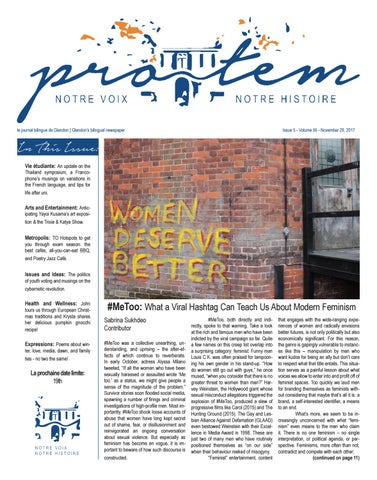
#MeToo: What a Viral Hashtag Can Teach Us About Modern Feminism Sabrina Sukhdeo Contributor #MeToo was a collective unearthing, understanding, and uprising – the after-effects of which continue to reverberate. In early October, actress Alyssa Milano tweeted, “If all the women who have been sexually harassed or assaulted wrote ‘Me too.’ as a status, we might give people a sense of the magnitude of the problem.” Survivor stories soon flooded social media, spawning a number of firings and criminal investigations of high-profile men. Most importantly, #MeToo shook loose accounts of abuse that women have long kept secret out of shame, fear, or disillusionment and reinvigorated an ongoing conversation about sexual violence. But especially as feminism has become en vogue, it is important to beware of how such discourse is constructed.
#MeToo, both directly and indirectly, spoke to that warning. Take a look at the rich and famous men who have been indicted by the viral campaign so far. Quite a few names on this creep list overlap into a surprising category: feminist. Funny man Louis C.K. was often praised for lampooning his own gender in his stand-up. “How do women still go out with guys,” he once mused, “when you consider that there is no greater threat to women than men?” Harvey Weinstein, the Hollywood giant whose sexual misconduct allegations triggered the explosion of #MeToo, produced a slew of progressive films like Carol (2015) and The Hunting Ground (2015). The Gay and Lesbian Alliance Against Defamation (GLAAD) even bestowed Weinstein with their Excellence in Media Award in 1998. These are just two of many men who have routinely positioned themselves as “on our side” when their behaviour reeked of misogyny. “Feminist” entertainment, content
that engages with the wide-ranging experiences of women and radically envisions better futures, is not only politically but also economically significant. For this reason, the genre is gapingly vulnerable to instances like this – manipulation by men who want kudos for being an ally but don’t care to respect what that title entails. This situation serves as a painful lesson about what voices we allow to enter into and profit off of feminist spaces. Too quickly we laud men for branding themselves as feminists without considering that maybe that’s all it is: a brand, a self-interested identifier, a means to an end. What’s more, we seem to be increasingly unconcerned with what “feminism” even means to the men who claim it. There is no one feminism – no single interpretation, or political agenda, or perspective. Feminisms, more often than not, contradict and compete with each other; (continued on page 11)
Pro Tem Letter from The Editor Editor in Chief | Rédacteur en chef Bruno Da Costa editor@protemglendon.com Chief of Operations | Chef d’Operations Sarah Tadjana operations@protemglendon.com Assistant French Editor | Rédactrice adjointe Camille Slaght assistantfr@protemglendon.com Assistant English Editor | Rédactrice adjointe Sarah Ariza-Verreault assistanteng@protemglendon.com Media Officer | Agente de media Amanda Jose media@protemglendon.com Photographer | Photographe Krysta Veneruz photography@protemglendon.com Design and Layout | Maquettiste Sam Kacaba design@protemglendon.com Section Editors | Chroniqueurs Campus Life | Vie étudiante Reia Tariq campuslife@protemglendon.com
Hello Glendon, Welcome to our final issue of the Fall 2017 term. These past months have been filled with so many interesting and thought provoking articles, it has been an honour to edit the work of all Pro Tem contributors. It is also with a heavy heart that I announce my resignation as Editor in Chief. I have had nothing but positive experiences with the team and this experience is one that I treasure greatly. Pro Tem is an important tool of self-expression at Glendon, so to have lent my time for the sake of art and writing was an important milestone in my journey as a Glendonite. The amount of time that stands between the genesis of your undergraduate degree to that final step off the stage at convocation will feel like a small eternity. A good amount of years will have passed, and one thing is for sure: none of us will be the same person when we leave as we were when we got here.
So enjoy this time, Glendon. Take it to figure out what you are and who you would like to be. If fear stands in the way of a passion, follow it. Look for what terrifies you and then do it anyway. Say ‘yes’ if it’s what you want. But also, know when to say ‘no’, and don’t apologize for it. Predetermined molds for successful archetypes can seem enticing, but there’s nothing better (and easier!) than being an original. Thank you, Glendon, from the bottom of my heart. Yours sincerely, Bruno Da Costa
Issues and Ideas | Actualité et opinions Alex Freeman issuesideas@protemglendon.com Metropolis | Métropole Behrad Taeed metropolis@protemglendon.com Arts and Entertainment | Arts et divertissement Sandrine Exil arts@protemglendon.com
Vous avez des opinions? Vous aimez écrire? Vous faites de la photographie? Pro Tem vous veut!
Health and Wellness | Santé et bien-être Kaya Harris-Read health@protemglendon.com
Envoyez-nous un courriel à editor@protemglendon.com pour apprendre comment vous pouvez vous impliquer!
Expressions | Expressions Ayla Sljivar expressions@protemglendon.com
About Us
Pro Tem est le journal étudiant du collège Glendon. Publié pour la première fois en 1962, c’est la plus ancienne publication de l’Université York.
Bruno Da Costa Editor in Chief
Sarah Tadjana Chief of Operations
Camille Slaght Assistant French
Sarah Ariza-Verreault Assistant English
Krysta Veneruz Photographer
Sam Kacaba Designer
Reia Tariq Campus Life
Alex Freeman Issues & Ideas
Amanda Jose Media Officer
Opinions published in Pro Tem are those of the individual writers, and do not reflect the views of the publication as a whole. We will not print copy deemed racist, sexist, homophobic, or otherwise oppressive. Les lettres adressées au journal peuvent être éditées au niveau de la clarté ou de contenu. All copy appearing in Pro Tem is at the discretion of the editorial team.
Behrad Taeed Metropolis
Feel free to respond to what you read in the pages of Pro Tem! / N’hésitez pas à réagir à ce que vouz avez lu dans Pro Tem! To see past editions of Pro Tem, please visit our website: www.protemglendon.com. Be sure to follow us on Facebook for reminders about upcoming deadlines and events: @ProtemGL
2
Sandrine Exil Arts & Entertainment
Kaya Harris-Read Health & Wellness
Ayla Sljivar Expressions
Vie étudiante
This Year’s Int’l Studies Symposium: Thailand! The Thailand Symposium Team The International Studies Thailand Symposium Team is excited to finally introduce itself to the Glendon community! You may have seen us around campus already (a.k.a. that group that held a huge book sale around campus near the end of October, or the ones who held the delicious bake sale & fancy raffle in the COE just a few weeks ago), but you may have not known then who we are. As a result, we decided it’s about time y’all get to know more about us (who we are, what we do, and all that jazz!) For those of you who are unaware, Glendon’s International Studies Symposium is a student-run project, organized and managed in its entirety by a group of eight highly motivated and professional undergraduates as part of their honours specialization. In the first semester, our team studied a country of our choice through in-class sessions, and in the second semester we create, manage, and finance a symposium. This year, the team has chosen Thailand as the focus of their colloquium and will be showcasing all that we have learned during our Thailand Symposium date on Saturday, March 10th, 2018 (Mark your calendars Glendon! Come one, come all)! The aim of this symposium is to bring the dynamic state of Thailand into the public and academic spotlight, and to provide a setting for stimulating discussions surrounding the nation’s history, society,
economics, environment, politics and culture, among other topics. Our team chose Thailand as our focus because we wanted to more deeply understand a Southeast Asian nation. While previous symposiums have provided insight into Southeast Asia, they have not yet explored a specific nation in the region. As the only country in the region not to have been formally colonized, Thailand’s complex engagement with colonialism sets the stage for nuanced and important discussions about history, politics, economics, culture and social relations that extend into the contemporary moment. Just to give you a glimpse of all that you may be able to learn about if you choose to volunteer at or attend our Symposium (which you absolutely should!), in the past few months, some of what we have focused on and learned in class is the following: Thailand’s semi-colonial identity, gender norms and sexuality, Buddhism and how it’s entangled with Thai society, performance arts and how Thai culture and identity is understood through these, and many other interesting aspects of which the Thai nation is comprised. In the upcoming term, among other outreach and fundraising events (watch out for another grand book sale, a launch party and more!), the Thailand Symposium team will be offering all kinds of information about the country leading up to the actual day of the event. You will be able to learn all about the Symposium and Thailand via our Facebook (@ThailandSymposium) and our website (which is currently in the making and will be launched in the new year)! In the meantime, we will end off with a quick PSA: we are SEEKING VOLUNTEERS & sponsors! To any and all who may be interested, please contact us at thailandsymposium@gmail.com. We greatly appreciate any support!
3
Campus Life
Wikimedia
Les variations de la langue française: une étudiante en échange partage ses observations linguistiques Gabriella Giordan Contributrice Il faut se rendre à l’évidence : la distance qui sépare le français canadien du français de France est plus que géographique. D’un côté de l’océan à l’autre, d’importantes différences historiques et culturelles façonnent cette langue internationale. De ce fait, certaines expressions qu’utilisent les Français ainsi que les bordelais - habitants de Bordeaux - valent la peine d’être soulignées et comparées aux expressions canadiennes. Quoique l’on attribue souvent au français québécois et canadien une très forte influence anglophone, 4 le français de France emprunte lui
aussi lourdement de l’anglais. Au Canada, l’anglais détient une place considérable dans la langue française pour de nombreuses raisons, telles que notamment le Traité de Paris de 1763 et la proximité du pays aux États-Unis. Le mélange anglo-français est donc inévitable, voire naturel, mais pas toujours perçu de façon positive par autrui. Pourtant, l’anglais est à la mode en France, surtout chez les jeunes. Les Français emploient de nombreuses expressions anglicisées dans leur langage parlé et écrit. En effet, « weekend » remplace « fin de semaine », car « fin de semaine » renvoie supposément au jour de vendredi. De même, « parking » prend la place de « stationnement » et la maîtrise à l’université devient le « master ». Les traces du français s’effacent, voire se mélangent à l’anglais dans le domaine technologique. Le « mail » ou « mél » ainsi que le fait de « chatter » rendent compte de cette hybridation linguistique distinctive. Les français emploient souvent l’anglais mais insistent d’autant plus sur la soudaineté des circonstances par le biais de l’expression « du coup ». Ayant en quelque sorte le sens de « dans ces conditions » et « en conséquence », cette expression est utilisée de manière constante et de façon tout à fait naturelle par les
Français de tout âge. Selon Elodie Xiong, étudiante française en Master 1 à l’Université Bordeaux Montaigne, ce tic verbal est employé extrêmement souvent dans le langage oral pour dire « du coup par ci », « du coup par-là ». Xiong ajoute : « Cette expression paraît contagieuse, et l’utiliser est inévitable! En ce qui me concerne, j’utilise ces termes comme connecteur logique. » L’équivalent canadien de ce lien logique, s’il a lieu, est « donc », ou encore au Québec « pis ». Mais ni l’un ni l’autre ne réussit à traduire parfaitement le sens exact, voire la portée sociale de cette expression typiquement française. Il existe d’innombrables autres expressions courantes propres aux Français que l’on apprend peu à peu à intégrer à notre propre français parlé à force de les entendre régulièrement. Par exemple, les Français déclarent parfois qu’ils « ont la flemme » pour indiquer qu’ils se sentent las, et qu’ils sont à la « fac », soit sur le campus universitaire. Les bordelais, quant à eux, emploient le mot « poche » au lieu de « sac en plastique », « gavé » au lieu de « trop », et « chocolatine » au lieu de « pain au chocolat ». Il existe cependant beaucoup d’expressions françaises que l’on ne réussira peut-être jamais à accepter malgré nous, surtout par rapport à la gastronomie.
Les Français qualifient leurs repas de « petit déjeuner, déjeuner, goûter, dîner », et non de « déjeuner, dîner, collation, souper » comme au Canada. Et en général, ils consomment des « pommes de terre » et non des « patates ». Les Canadiens et les Français peuvent se comprendre de façon réciproque et décider d’emprunter les expressions de l’autre, ou au contraire trouver absolument insolite les choix linguistiques de l’autre. En tant que franco-torontoise et Canadienne française, vivre et étudier en France constitue pour moi une véritable expérience linguistique et identitaire à la fois. Ayant grandi à Toronto, un milieu majoritairement anglophone, je me retrouve à présent dans un milieu complètement francophone où l’on suppose souvent que je suis anglophone en raison des expressions que j’emploie ou de la construction de certaines de mes phrases. Je choisis donc d’exhiber ma francophonie canadienne avec fierté, tout en gardant une ouverture d’esprit face aux différentes expressions que j’entends. J’emprunte de ce français, je l’incorpore volontiers au mien, en restant cependant fidèle à mes origines et à qui je suis.
Vie étudiante The Long and Winding Road: Tips and Tricks for Life After School
Arts et Divertissement
For most fourth and fifth-year undergraduate students at Glendon, November is a month of angst and anxiety in preparation for final exams, as well as applications for graduate programs, teacher’s college, law school, and medical school. Many of you will work very hard over the next few years and achieve success, regardless of what this may entail. Having come to university myself as a mature student after working full-time for several years performing stressful yet financially rewarding work, I’d like to share a few thoughts that might help those who aren’t sure about their future.
career in this field. Instead, discover your domain(s) of proficiency. As most children grow up, their parents (including my own) tell them that the greatest aspiration in life is to find a job they love, because this will make the work not feel like work. This is simply not true, at least in the long-term. There will come a day when the job becomes mundane or overly difficult, and you will resent the notion that you are meant to love it forever. Instead, try to find a job (and hopefully a career) that you will be able to dominate as a result of your intelligence or specific set of skills and prowess. Your ability to shine in an environment will offset any of the disagreeableness associated with the challenging nature of your chosen work. Work will always (eventually) feel like work, but being better at it than anyone in your environment will increase your self-esteem and sense of personal value to the organization/industry/field. If you happen to find a career that you are passionate about while simultaneously being highly skilled and competitive within the domain, this is extremely rare, but also a wonderful proposition to be cherished.
1. Don’t confuse passion and strength. In other words, you might be very passionate about a specific subject, but this doesn’t necessarily mean you are well-suited for a
2. Don’t follow money, but don’t reject it. During my old job, I came into contact with some of the wealthiest and most successful people in Toronto on a daily basis. I’ve had
conversations about life, love, happiness, and success with hundreds of millionaires, and even a handful of billionaires. I can absolutely guarantee that money, on its own, will not make you a happier person. Money amplifies your individual traits; it doesn’t give you new ones. In other words, if you are a happy, stable individual, you will most likely become happier with newfound wealth. However, if you are prone to bouts of unhappiness, low self-esteem, or have any other problems in your life that you haven’t been able to properly address, more wealth will only help maximize these negative traits and characteristics. Therefore, I would suggest that addressing any issues you currently face in your life, whether it be family, health, or happiness, is going to pay more dividends in the long-term. What’s the point of being wealthy if you can’t enjoy it? The flip side of this coin is the following: don’t reject the importance of money within our society. You may not wish to drive a Ferrari or own a yacht one day, but I can also guarantee that a lack of money will reduce your happiness. This is especially true if you want to start a family, and you can’t afford basic necessities, such as healthy food and transportation. Therefore, find a job/career that pays enough to keep the lights on and the fridge full, even if you aren’t enamored by said chosen work. A
Yayoi Kusama expose à Toronto
ses hallucinations comme enfant, qu’elle a décidé de se consacrer à l’art. Ses œuvres sont composées de motifs à pois ou de miroirs qu’elle répète obsessionnellement à l’infini. Cette folie créatrice est la seule façon dont Yayoi Kusama se libère de ses peurs. Son art est cathartique: en exprimant ses peurs, son angoisse et son désespoir, elle s’en détache. L’artiste habite dans un asile psychiatrique près de son atelier d’art, où elle continue de peindre ses symboles préférés: des points et des pois multicolores. Dans plusieurs entretiens, elle confirme que les médicaments qu’elle prend ne limitent pas sa créativité et ne l’empêchent pas de peindre. Dans un livre publié en 2001, elle révèle une des hallucinations qui a eu lieu lorsqu’elle travaillait son exposition Dots Obsession. « Mon pinceau a quitté, en dehors de ma volonté, les limites de la toile, et a commencé à recouvrir de pois la table, puis le sol et la pièce entière. Cet incident m’a conduit à suivre le chemin de la sculpture et de la performance ». Kusama veut que chacun de nous puissent entrer dans son monde et ressentir des émotions fortes. Elle transforme sa souffrance, son désespoir, et ses peurs en une forme d’art très plaisante et fascinante. Pour entrer dans un monde parallèle dont peu d’humains ont la chance d’être témoin, allez visiter l’exposition de Yayoi Kusuma au mois de mars à Toronto.
Sandrine Exil
Alex Freeman Issues & Ideas
Sandrine Exil Arts et Divertissement Séduction ou répulsion? Le travail de Yayoi Kusama ne peut laisser personne indifférent. Ceux ayant eu l’occasion de visiter ses expositions vous le diront : on se retrouve soit rebuté par un aspect inquiétant ou enchanté par le charme de son univers. Yayoi Kusama est une légende vivante de l’avant-garde internationale qui a évité les catégorisations de l’art moderne. Son œuvre couvre toute une gamme de chefs-d’œuvre jusqu’à la création de produits issus de la culture pop. Sa carrière protéiforme s’étend sur plus de soixante ans. Née en 1929 au Japon, elle vit et travaille aujourd’hui à Tokyo. Elle a fait l’objet de nombreuses grandes expositions internationales et sera bientôt à Toronto. Du 3 au 28 Mars 2018, Kusama fera paraître sa première exposition en Amérique du Nord à la Galerie d’Art d’Ontario. L’exposition Infinity Mirrors traitent des thèmes de l’infini et le vide. Le travail de Yayoi Kusama est régi par ses peurs. C’est, dit-elle, suite à
tremendously large majority of people in our society work jobs they dislike but would be much worse off if they didn’t do these jobs in the first place. Furthermore, many jobs are vital to the functioning of society – if everyone finds the job they love, who’s going to pick up your garbage or clean your windows? 3. Find some hobbies. After having discovered your strengths and weaknesses, find hobbies to satisfy your passions. If you are good at playing guitar, I would not recommend dropping out of school or quitting your job to start a band. nstead, turn your interests into hobbies. Not only can this help with maintaining good mental health and overall happiness, but it will also help surmount periods of stress at work. The next few years will prove to be the most challenging and interesting of your lives. If you still don’t know what path to walk as you finish your undergraduate degree, remember that most of us are in the same boat. Yet, don’t be flustered by the idea of having to choose a particular path. Better to do this now than in 10-20 years, when the number of choices at your disposal are severely limited, and the bias associated with your age becomes detrimental to your career prospects.
5
Arts and Entertainment The Trixie & Katya Show Will Make You Go UNHhhh Bruno Da Costa Editor in Chief Mark your calendars and set the time, The Trixie & Katya Show has just landed into Viceland’s Wednesday night, 10pm time slot! The RuPaul’s Drag Race fan favourites took the notoriety gained from the reality TV show limelight and used it as fodder for their careers. After 68 episodes of the popular web series UNHhhh, Trixie Mattel and Katya Zamolodchikova are proving that the real race begins after you’re asked to sashay away. The premise of the show is simple, Trixie and Katya pick a topic to dissect and discuss in profound, unrelenting detail. It is an exercise in stream of consciousness dialogue with no holds barred and no limits on sense or sanity. This recipe for disaster could not be in safer hands than these two dark-sided comedy queens. No one else could master what is nothing short of second nature for Trixie and Katya: the art of self-deprecation. In the first episode of The Trixie & Katya Show, the queens talk about hooking up. The discussion always flows easily between the two because of their symbiotic chemistry. Trixie and Katya are always in step with each other, setting up jokes with layers of puns and outrageous one-liners. Appealing to the other’s humour keeps the conversation going, even if it means derailing it completely off the predetermined course. The viewer is easily drawn in without caring that point B is nowhere near point A. Once Trixie and Katya grab a hold of your attention, you are along for the entire ride. A good comic can make people laugh, but a great comic can laugh at themselves. In all aspects of their discussions — be it hooking up, death, or porn — the biggest jokes easily come at their own expense, and no one is more in on the joke than Trixie and Katya. The two queens speak from the heart and are well aware that laughter is the best medicine when it comes to talking about very real topics. The Trixie & Katya Show is by no means made just for those who enjoy drag, and it is not intended to only draw in a queer audience. Humour is universal and drag is but a subversive art form. For decades, drag culture has been intimately rooted in protest and civil disobedience, it can mock and it can make people think.
6
By having conversations and making people laugh, Trixie Mattel and Katya are able to continue this legacy of thought and carry drag into the future. What makes Trixie and Katya such endearing television hostesses is that they are the main focus of their program, and they are both incredibly engaging, interesting subject matter. In an era where visibility and relatability are at such a forefront in media, it is refreshing to see two drag queens hosting a television show on a major network, something that had not been done since the late 90s by RuPaul herself. With its ecstatic hostesses; hilariously thought provoking dialogue; running segments such as Male Bag, Whore Drawer, and Asking For A Friend; viewers of The Trixie & Katya Show can expect to be hooked in by these two queens who have staked a major claim in late night primetime. Viceland
Taylor Miller
Métropole
Did Someone Say All You Can Eat? The Best Way to Treat Yo’self During Stress Season
Don’t let your stomach die. Give your stomach that much needed break from $0.25 tuna cans, monster energy drinks, one slice of leftover bread in your fridge (God knows how long it’s been there), and trips to McDonald’s (even though you told yourself last friday would be the last time you got drunk and had 5 McDoubles). It is time to scrape up whatever is left of your dignity and treat yourself.
Behrad Taeed Metropolis
Your Body is an Island
November is here, and mostly all of us are suffering. This month has been known to brutally extinguish any remaining flame that might have been resonating in us from the beginning of the school year. We are all tired, sick, sad, sleepy, and, most of all, hungry. The combination of several exams and papers will make even the most powerful of stomachs a fragile and shattered remnant of its former self.
Start giving it the treatment it deserves. I recommend giving yourself one full day for this activity to recover. “A full day to recover from eating?” you might say. To which I would respond, “Yes.” You need a full day to recover from any all-you-can-eat restaurant. True masters of the “eating until you cannot move” artform are always on the lookout for new spots to satisfy their stomachs. Although I am a fan of Mandarin, that restaurant is now overpriced and their
quality has been on a steady decline. What you need is a restaurant with quality food, a wide variety, and entertainment. My Proposition Chako Barbeque, located at 163 York Blvd in Richmond Hill, is that light in the darkness. If you know what Korean BBQ is then I applaud you. If you still have not witnessed its beauty and wholesome fun for the whole family, then I say “welcome.” This is a place where you are able to choose from a wide variety of food, whether it is raw ribs or raw pork; as well as an impressive array of vegetables and, of course, rice. Reader: “But Behrad, won’t I catch Salmonella from eating raw food?”. Behrad: “No, my child. Shhhhh. On your respective tables, there is a grill that you can use to cook.”
Reader: “But what if I am too lazy, or I lack culinary skills?” Behrad: “You can ask them to cook it for you.” Reader’s pupils dilate, and thus begins the early stages of enlightenment. Back to why you need to go to Chako’s: aside from the huge selection of food that is always marinated to perfection, the restaurant’s post-modern decor is perfect for all of you who enjoy a bit of ambiance with your food. A striking array of black, red, and gold was chosen as the primary colour scheme for Chako’s — and it fits perfectly. Finally, it’s only $25.99 after 8pm, which is relatively cheap for what you are getting, by comparison to other allyou-can-eat restaurants in the city. So give yourself a much needed treat, and thank me later!
7
Pro Tem Paint Lounge 2017, Photography by Krysta Veneruz
8
Pro Tem Salon de Peinture 2017
9
Metropolis Sarah’s Spots: Exploring Toronto’s Live Music Venues
the stage is limited (so try to get there early-ish; poetry performances usually start around 7pm, whereas jazz performances usually start around 10pm). Performances are usually very intimate so you should feel very lucky if you get a good spot!
Sarah Ariza-Verreault Assistant English Editor
2. The atmosphere is everything: As soon as you walk in, you will be greeted by a multitude of action shots of Muhammad Ali — he’s even on the menu! If that’s not enough, his neighbours that decorate the walls include Amy Winehouse, Nina Simone, and Louis Armstrong, amongst others. The menus are all bookmarks inside various classic novels that can be found on every table — it’s adorable. If the book at your table isn’t to your taste, you can have your choosing from the gigantic bookshelf in the back. Yes, Poetry Jazz Cafe is where intellectuals go to get hammered.
POETRY JAZZ CAFE 224 Augusta Ave
December Events in Toronto: What Not to Miss This Month Antique & Vintage Glass Holiday Event November 29 - December 2 Lawrence Park Community Church
Holiday Crafting December 17 from 12-4pm Bata Shoe Museum
Holiday Fair December 1 - 23 Nathan Phillips Square
Festival of Smalls - Afforable Art Gallery Exhibition Through until December 24 Art Interiors (446 Spadina Rd. #203)
Evergreen’s Winter Village December 2 - 31 Evergreen Brickworks One of a Kind Christmas Show & Sale Through until December 3 ENERCare Centre (100 Princes’ Blvd) Migrating the Margins: Art Exhibition Through until December 3 Art Gallery of York University (AGYU) Toronto Art Crawl December 3 only - $8-10 admission Great Hall, 1087 Queen St. West The Edge of the Earth: Climate Change in Photography & Video Through until December 4 Ryerson Image Centre (33 Gould St.) City of Craft December 8 - 10 The Theatre Centre The Faraway Nearby: Explore Canada’s History Through Photographs Through until December 10 Ryerson Image Centre Toronto Etsy Street Team Christmas Marketplace December 16 103 Bellevue Ave.
10
Voices: Artists on Art Through until December 24 Harbourfront Centre #ROMNYE - New Year’s Eve Bash December 31, 2017 Royal Ontario Museum HERE: Locating Contemporary Canadian Artists Through until January 1 Aga Khan Museum The Good, The Bad, and the Ugly Sweater Through until January 5 The Second City
Everyone has had those nights where you decide to “go out” and you don’t really have a plan on where you’re going. I found Poetry Jazz Café in — quite literally — a hole in the wall in Kensington Market about a year ago on one of those nights. I, like many Torontonians, have walked down Augusta probably a million times in my lifetime, and in all those times, I had totally walked past one of the most underrated spots in Toronto To a layman’s eye, Poetry Jazz Café looks like any other boarded-up shop clad with a garage door that has lain uninhabited for years — and this is totally on purpose! In true speakeasy fashion, Poetry is only found by people who are looking for it. As a disclaimer, I have to confess, I am a bit of a freak of nature — not in the sense that I live some wild double life, but that I’m quite the opposite of wild. Many people who have met me tell me that I am just a very old soul in a very young body — a 20-year old who does not like going out and getting trashed! Case in point, a great night for me is a small bar with good vibes and even better music. Poetry Jazz was created for people like me! To avoid my over-enthusiastic gushing, here is a list of the reasons why this place is the bee’s knees: 1. Live music. Every. Single. Night: You probably won’t know any of the performers, but that doesn’t mean they won’t impress you. The stage is small, and seating near
3. The drinks are strong: I’m quite the wine mom on most nights; however, whenever I go to Poetry Jazz, I really take advantage of their cocktail menu. They all cost $11.50 and they ALL have 3 oz of alcohol in them. Need I say more? (I highly recommend the Poetry Dark and Stormy, it’s spicy and STRONG!) 4.The staff is incredible: The bouncer is a giant teddy bear, say hi to him for me! (There is a $10 cover) And the bartenders are very quick — a blessing. 5. There’s a patio: If the bar-area is packed and it’s summer and your Instagram needs some love, there is a patio out back! However, I really recommend seeing their live performances inside! My Rating: 5 out of 5. If you go there and hate it, I’m sorry. I love it. Stay in the Loop! Facebook @poetryjazzcafe Instagram @poetryjazzcafe
The Evidence Room: Exploring Auschwitz Architecture Through until January 28 Royal Ontario Museum Party Today, Panic Tomorrow: Comedy Sketch Show Through until February 3 The Second City
If you hear of an event happening in Toronto that might be of interest to our community, let us know at: metropolis@protemglendon.com. thestoneandthestar.blogspot.ca
Métropole Actualité et opinions A Review of TO Coffee Houses: The Time Before Your 3pm Class Is About To Get A Whole Lot Better Krysta Veneruz Photographer I always find myself desperately trying to stay awake between classes, whether it is early morning online English lessons or extracurriculars. If there’s one thing I have learned, it’s that listening to people who tell you to go to bed earlier is an absolute waste of time. At this point that’s not an option, so like any student, I turn to calorie-dense caffeinated beverages to keep myself afloat. Before I mention a few of my favourites, I should note that not all these cafés were created alike, so the environment from one to the other might differ significantly. fika CAFE 28 Kensington Ave. Fika’s quiet but charming atmosphere is perfect for getting work done. The back room has an uber-inspirational book wall that can only motivate you to do your French lit. readings, and it also includes a work space style table, where you might
possibly make a friend or two. Although small, the area feels open and vibrant with white walls and furniture, and the staff is really pleasant when it comes to explaining what is offered at the cafe. They always have plenty of Scandinavian treats to help with your Tuesday morning blues. My Recommendation: Lavender white hot chocolate with an espresso shot. de mello palheta coffee roasters 2489 Yonge St. or 273 Richmond St. W. Two locations means two times the fun! De Mello is great for individual study/cramming, especially since their Uptown location is a quick-ish 10 minute walk from Lawrence Station. They have an extremely wide menu, from teas and matcha specialties to Latin American coffee blends; you have a boatload of options to keep you focused. The back room at the uptown location is big and fairly quiet, and in the summer months there’s a patio for when you’re sad about your summer school classes and need to trick yourself into having terrasse time. My Recommendation: Double shot latte. hula girl coffee 456 Ossington Ave. or 2473 Dundas St. W. Just off College & Ossington hides this little place, and with only three tables you’ve better get there quickly after its opening to snag a seat! They also have a larger, but still quaint location in The Junction if you are looking for solitude. The upside to the small size is its quiet atmosphere, making it a perfect environment to get your paper fin-
ished and edited. The retro/circus themed décor is incredibly unique compared to the minimalist feel of most places in the city these days, which may spark some much needed creativity. They have some unique snacks, including mini bahn-mi’s and mini pork buns which gives this cafe its uniqueness. Hula Girl was actually featured at the CNE this year with their butter coffee — a creamy, salty and different take on espresso. My Recommendation: Butter coffee (of course). Istanbul café 174 Eglinton East I’ve never been so excited to find Turkish coffee, especially when I was able to have it accompanied by Baklava. This café serves some great lunch options, classic Turkish deserts and even better coffee. There are plenty of coffee choices, including a rose latte which was as delicious as the name suggests. The ambiance here is lovely; the lighting is dimmed perfectly, there is plenty of room for studying with lots of seating options, and it’s never too busy. The walls are made of wood which gives it a super cozy feel, perfect for spending all morning and then afternoon skipping class! They also have an alcohol licence for the evening if you need an extra dose of motivation, and they’re often open until 10pm in case you get caught up in the moment and procrastinate away! My Recommendation: Turkish coffee and pistachio sekarpare.
Yelp.ca
#MeToo (continued from cover) Hillary Clinton’s feminism is worlds away from Audre Lorde’s feminism. So why do we assume we know the character of male feminists? Men who are self-proclaimed feminists ought to show us how they interrogate masculinity, how they elevate women and their causes, how they work to dismantle repressive power structures. #MeToo is a glaring reminder that, before we see evidence of these actions, men who call themselves “feminists” should be treated at the very least with learned wariness. Compounding this issue is the reality that, while some men easily wedge themselves in, important voices remain at the margins of feminist discussions. Particularly in the area of sexual harassment and assault, a more complex network of stories exists in silence. #MeToo offered a platform for women to come forward and have their words taken seriously, but failed to relieve the barriers preventing many women from doing so in the first place – even to an online community. Racialized women, women in poverty, lesbian and bisexual women, trans women, incarcerated women, undocumented women, and sex workers endure unique layers of stigmatization when it comes to sexual violence, so participating in a campaign like #MeToo can feel unwise. Men who have suffered forms of sexual violence face a similar issue in that their experiences are rarely taken seriously and speaking about their trauma is discouraged by toxic masculinity. This inability to accommodate those who aren’t able to go public with their stories – and who would lack access to resources and support even if they did – constitutes a key weakness of #MeToo. Broadly applied, it also paints a shortcoming of ftoday’s mainstream feminism. This fresh surge of discourse clearly affirms #MeToo as a meaningful moment in feminist activism, but it must be more than renewed discussion – #MeToo must be a turning point. Feminism should no longer be in the possession of whoever can get their hands on it; in fact, it especially belongs to those who cannot. Unless we take #MeToo’s lessons to heart, feminist discourse will continue to be couched in elitism that invites and protects predators but not the most disadvantaged.
11
Issues and Ideas Cybernetics Connor Boyd Contributor From evil computers such as HAL 9000 in Stanley Kubrick’s 2001: A Space Odyssey (1968), to romantic creations like Samantha in Spike Jonze’s film Her (2013), artificial intelligence has gained popularity in today’s film and entertainment industry. With developments in modern cybernetics — the understanding of how information signals and messages work within systematic boundaries — society’s fear of domination by machines has grown significantly. Many people are concerned about how much influence computers and artificial intelligence will have on future society, as our current levels of reliance are growing exponentially. There are many reasons why humans feel threatened by the rise of com-
Youth Voting and the Democratic Character of Canada Stephen Miles & Amanda Sears Contributors In the 2015 Canadian federal election, 57.1% of persons between the ages of 18 and 24 fulfilled their civic duty to vote - a dramatic increase from 38.8% in the 2011 election. This increased participation in the electoral process suggests that youth are becoming more civically engaged in the political sphere of Canadian society. Now the question must be asked: is it worth revisiting the debate regarding lowering the voting age? Earlier this year, the New Democratic Party (NDP) announced their stance on lowering the voting age to 16, which was met with plenty of controversy. Many argue that the maturity of 16-year-olds falls short of that which is required to participate in the voting process, and that opening the door to younger voters would fail to engage an already apathetic subset of society. One of the major problems with the current voting system is a widespread lack of awareness among young people with regards to their civic obligations within the existing Canadian political structure. While this includes straightforward issues like registering to vote, it also encompasses factors such as understanding party platforms, keeping up to date with 12 current political issues, and under-
puters. This fear became intertwined with the backlash against the rise of corporate culture and business interests as well as post-war industrialization. This came to prominence in the 1960s when many people began to adopt countercultural lifestyles in reaction to world conflicts, such as the Vietnam War. “Cybernation” became a popular term used to describe the growing control of management over workers in the sixties. This loss of power among workers is analogous to how machines displaced factory workers during the first industrial revolution from 1760 to 1840. While the introduction of mechanical labour during this period devalued manual labour, the increasing sophistication of computers in our modern industrial revolution is threatening to replace human intelligence. Mathematician Norbert Wiener predicted this shift in his seminal book entitled Cybernetics: Or Control and Communication in the Animal and the Machine. The modern industrial revolution is similarly bound to devalue the human brain (at least involving simple and
routine decision making). There is a shared fear of machines taking over human jobs. In a study sponsored by the Pew Research Center, 48 percent of over 2,500 experts – individuals who identified themselves as builders of the online world and those who closely followed technology trends — envisioned a future in which robots and digital agents displace significant numbers of workers. One of the panel’s main concerns was the effect of automated workforces on unemployment. With robots beginning to replace humans in the workplace, there are many ethical implications to consider. If a worker is replaced by a machine, will there be financial compensation for them? Will they be relocated to a new position or left to find a new job elsewhere? Wiener also wants to know when computers will be able to replace white-collar jobs, such as doctors, lawyers, or other professionals. The reality of an automated workforce is fast-approaching. Foxconn — the world’s largest electronics contract manu-
facturer — has employed over one million workers in China. In 2011, the company installed 10,000 robots — called “Foxbots” — to spray down, weld and assemble electronics in their factories. In a 2013 interview with Foxconn CEO Terry Gou, he claimed the company would be adding one million robot workers in the future. This practice has been adopted by companies worldwide, including Amazon, Tesla, and many others as businesses shift towards more efficient methods of assembly and automation. Our society is already heavily reliant on automated systems, from reminder systems on business networks to health-tracking apps on our phones and wearable technologies. The worry of being rendered useless by computers stems from the fear of losing control; with robots and other automated systems replacing jobs and controlling every aspect of our lives, humans will be no longer be in control. This future may not be too far away.
standing how to express individual political views effectively within the confines of a working governmental structure (as opposed to external action, such as protesting). Furthermore, as youth are increasingly able to exercise their political voice, a rise in political engagement and voter turnout could realistically occur in the near future. Reducing the voting age would also encourage families to introduce their children to the civic responsibility of voting. This would potentially lead to the habitualization of voting amongst youth and establish a culture of greater political participation in Canadian society. The crux of the argument here is that young people are more likely to follow in the footsteps of their parents vis-à-vis political involvement and interest. The seasoned, adult voter would act as a mentor to the young and inexperienced; this would facilitate access to voting centers and the registration process come election time. Lowering the voting age to 16 may have the positive effect of raising voter turnout within the general age bracket, given that life can often become increasingly chaotic around the age of 18 (as a result of higher education or employment). Alternatively, most 16-year-olds are sharing a house paid for by their parents or guardians, and attending high school on a regular basis. Ultimately, lowering the voting age would hopefully enhance the democratic character of the Canadian political system by engaging this demographic. Taking a look at other democratic countries might shed some valuable light on this conundrum. Austria, having lowered the voting age to 16 in 2007, enjoyed a boost in youth political engagement after-
wards. 16-year-old and 17- year-old voter turnout was effectively higher than turnout for the 18 to 20-year-old cohort. This is compelling evidence in favour of reducing the voting age to 16 as it appears that this would theoretically lead to a net increase in political participation. To determine whether or not youth are prepared for the responsibilities that come with voting, we need only to look at the many responsibilities already afforded to them in our province and across Canada. By the age of 16, youth may already consent to sex (and potentially start a family), drive a vehicle, emancipate themselves from parents or guardians, work, and pay taxes (if yearly income is over the $6,300 deduction threshold for dependents under the age of 18). The responsibility to pay taxes is one that caught the attention of NDP Member of Parliament Don Davies, who subscribes to the American revolutionary slogan, “no taxation without representation”. Davies has a point: is it democratic
to tax a segment of the population without granting them a voice in determining how their taxes are put to use? Democracy is no stranger to resistance. We saw resistance throughout the First World War and during the suffragist movement. Similar resistance was also observed over time as ethnic minorities fought for voting rights, and when indigenous peoples were finally granted the right to vote in the 1960s while maintaining their treaty rights and status. Each of these groups faced similar criticisms questioning their maturity, capacity, and ability to handle the responsibility of voting. In each instance, a more inclusive form of democracy emerged and eventually prevailed. Do we believe that 16-year-olds will eventually be granted the right to vote? Absolutely. But as public opinion changes slowly and incrementally, democracy will persist relentlessly, awaiting for a window of opportunity to make the next leap.
Santé et bien-être
John Kemp’s Kitchen:
Christmas — European Style John Kemp Columnist
Hello again, everyone! I hope you’re all fairing well with the semester wrapping up and exams on the horizon. I know it can be a busy time of year and believe me — I’ve been feeling the pressure here in Switzerland, too. What’s been getting me through the most arduous of assignments however, has been that wave of relief after the whirlwind of first semester — Christmas break. I was excited when I heard this was the last issue of Pro Tem before the break, not because I don’t like writing my column, but because that meant I could write the article I’ve been waiting to write since I got here: Christmas — European Style. Europe has been around for a long time, giving it a chance to develop some pretty fantastic Christmas traditions including innumerable Christmas delicacies. To give a quick snapshot of what traditional Christmas fare looks like in Europe, I thought I’d take us through five European countries to see how they do it up here. SPAIN : The Spanish start their feasting late on Christmas Eve, eating either before or after midnight mass. The party continues late into the night, sometimes as late as 6:00 AM the next day. Christmas dinner, the next day, usually consists of a boun-
ty of seafood dishes such as Mariscos y Pescado. Turkey has also made its way into Spanish Christmas cuisine in the form of the bird with truffles and serrano ham known as Pavo Trufado de Navidad. To follow is a selection of desserts such as different iterations of marzipan, polvorones (dense nut-flavoured shortbreads), and turrón which comes in both a brittle-like variety (Alicante) and a nougat-like variety (Jijona). The fun doesn’t stop there, though. The alimentary indulgence continues on the 6th of January, when Spaniards will cut into a cake known as Rosca de Reyes. This cake is eaten to commemorate the search of the wise men for Jesus back in the day. Within the cake there is a trinket of sorts, whether it be a tiny figure of Jesus or a small toy, as well as a dried bean. Whatever person finds the trinket in their slice is considered the king or queen of the celebration. Whatever poor soul finds the bean, however, is expected to pay for the next year’s celebrations.
POLAND : Poland, with a strong Catholic tradition, also fasts during the day of Christmas Eve, though the suspense for the Poles is somewhat greater as it is only at the sight of the first star that the meal can begin. The meal, like the Germans’, contains no red meat, but instead fish. What is interesting about the Polish Christmas dining table is that there is usually straw under the tablecloth to represent Jesus’ birthplace as well as an empty place setting in the event that the baby Jesus should make an appearance or that a deceased relative or lonely wanderer who may be in need of food should show up. The meal begins with the breaking of opłatek (a wafer made of water and wheat flour), symbolising each family member’s unity with Christ. To follow, barszcz (a beetroot soup) with uszka (a sort of ravioli) is usually served alongside pierogi and herring dishes. To finish off the meal, kluski z makiem is the traditional dessert, a combination of poppy seeds with egg noodles, nuts, and raisins.
GERMANY : For Catholic Germany, fasting during the day of Christmas Eve is traditional. That’s why having fish such as salmon or hake as opposed to meat on Christmas Eve is standard. Carnivorous indulgences, however, have managed to establish other customs, usually in the form of sausages over potato salad accompanied by sauerkraut and Kartoffelpuffer, a sort of potato fritter. The struggle of fasting is soon forgotten the next day when German dining tables are filled with roast goose, turkey, or duck, served alongside Serviettenknödel (a large dumpling made of bread, eggs, and onions), braised red cabbage or stewed kale.
NORWAY : Having visited Norway just a week ago, I couldn’t help but include this fabulous country in my culinary Christmas snapshot. On Christmas Eve, Norwegians enjoy risengrynsgrøt, a type of rice pudding in which a skinned almond is hidden. Whoever finds this almond in their portion becomes the lucky winner of a marzipan pig. The food of Christmas Day varies greatly in Norway, with meat-based dishes such as pinnenkjøtt (salted mutton ribs, smoked and steamed) in most of Norway and Lutefisk in the South. Lutefisk is made of a variety of aged white fish, soaked in water for five to six days before being soaked in a lye solution which causes it to
lose about 50% of its protein, resulting in a gelatinous texture. It is then cooked in the oven, afterwards being served with potatoes, peas, and white sauce. This particular dish has somewhat mysteriously made its way to the U.S. where it’s also quite popular. Norwegian breweries are also heavily involved in Christmas traditions, as Christmas beer being stronger and darker than standard Norwegian lagers is customary. For the minors, julebrus, a reddish-brown soft drink is the substitute which I had the joy of trying in Oslo. CROATIA : Being part Croatian myself, I can confirm that the incredible amounts of food eaten at Christmas are a reality. Christmas Eve starts with fasting during the day, leading to a modest meal of bakalar (dried cod) in most of Croatia. To follow is mass, and then a night of celebration in bars and cafés. On Christmas day, the real feasting begins with ambrosiae such as sarma (the greatest cabbage rolls you’ll ever have), peppers stuffed with ground pork, roasted pig (yes, the whole pig), lamb, and turkey. After all, if you don’t put on 20 pounds by December 26th, is it really Christmas?
13
Health and Wellness Pumpkin Gnocchi Krysta Veneruz Photographer Gnocchi is something that every Italian has grown up with. Being a student, I’ve learned that it’s actually an extremely inexpensive pasta to make from scratch! The only materials you’ll need are a fork, a knife, and your hands! My pumpkin gnocchi is a twist on the typical potato gnocchi, and it’s the perfect dish for the upcoming holiday season. Ingredients for the Pasta: 1 can of pumpkin or a 2 lb cooked pumpkin pie 4 ½ cups of flour 1 egg Sea salt, pepper, and nutmeg - to taste. Ingredients for the Sauce: ½ cup of butter ¼ cup of parmesan or asiago cheese Sage Salt and pepper, to taste.
Maintaining Balance During Exam Season
Preparation Instructions: 1. Mix the pumpkin, egg, and spices. Once combined, slowly add the flour. 2. Knead heavily until the dough is no longer sticky. 3. Roll into snakes and cut with a block knife. (Pro Tip: If you don’t have a block knife, make sure to cut and bevel your knife so it becomes a clean cut). 4. Use a fork and glide each cut piece across the fork to give it texture. 5. Set all your pasta on cookie sheets and freeze for 5 hours. 6. Once frozen, put them into freezer bags for safe-keeping.
Kaya Harris-Read Health and Wellness With exams times approaching, hard work and stress are inevitable. However, this needs to be balanced with self care. Everyone is different, so there is unfortunately no one good solution for tackling exam stress. However, here are some reminders that will hopefully help your study sessions and exam preparation go smoothly. No matter how busy you may be, it is important to get outside at least once a day. This could be going to a cafe to study, or simply walking around the block. Especially with the cold weather, it becomes very tempting to stay inside curled under blankets with a hot cup of tea. While this is not a bad thing, it can make us feel lethargic, making it harder to find the motivation to study. The combination of some fresh air and a bit of exercise helps us to be more productive. Something I try to do when I know I’m going to have to be studying all day is instead of eating while I study, I will use food as an excuse for a break. When we have a lot to do, it becomes easy to feel like we don’t have time for breaks, and instead power through until we’re finished. Take twenty minutes to prepare a healthy, filling meal and don’t think about your notes while eating. This way, once you’re done, you’ll feel like you’ve actually had a break. If you feel that you don’t have time to prepare food, then do something quick and 14 easy like heating up soup.
On the topic of breaks, make sure you take them! While this may seem like study time you’re wasting, on the contrary, it makes the time you are studying more valuable. During your break, if you can, leave the space you’re studying in. This will give you the feeling that you have had a proper break. This being said, it is important to not get distracted, extending your break longer than you intended. The best thing to do to stop this from happening is to set a timer, and commit to returning to your work once the timer is up. Taking a short break every hour is what I find to work the best for myself. Finally, something I believe you should have with you while you’re studying is something to drink. Whether it be water, coffee, tea, or juice, hydration is extremely important to keep you alert. This being said, I would avoid energy drinks, as tempting as they are. Yes, they will spike your energy, but you’re going to have the crash later, which will ultimately slow you down. In the end, the most important thing to remember is to give yourself permission to take care of yourself. This can be easy to forget in the frenzy of exam season, when you feel that your to-do list is neverending. Yes, maintaining your grades and getting assignments finished is important, but looking after yourself and your well-being always needs to take the front seat. Best of luck to all!
Cooking Instructions: 1. Bring a large pot of water to boil and add your homemade gnocchi. 2. Once each piece floats to the top, they should be ready to individually take out of the pot, do a taste test first to see if they have become soft enough. 3. Once the pasta is cooked, melt butter in a large saucepan with some sage and slowly mix in the pasta. 4. Add your desired cheese, as well as salt and pepper to taste. 5. Serve! Buon appetito!
Expressions Your Name Chloe Brandon Contributor I’m in love with the way you say my name You fit into my cosmic frame An image of love I can’t quite tame – Two lovers playing a familiar game. Who is to blame when the words No longer sound the same. When words are no longer Self-contained - how unsettling. Unraveling our pasts, Like outcasts, On a search for closeness. Fugitives running away from shame. Who is to blame for a shared disdain? Maybe we are constantly An evolving frame? Clinging to meaningless experiences, Dogs eagerly chasing their tails, In a frantic search for meaning, Belonging. A simple kiss, As waves of laughter , Forever disturb every inch of our Fragile existence. We avoid meaning, And tidy our suitcases, hoping That there will be space for our secrets. Or else there Will be beauty amongst the Nothingness. But where nothing was, Is where nothing remains . And hastily our present fades, Giving way to her more faded gaze, As she tries to reframe, This evolving movie Of blues and greys.
Anti-Social Media Tract Eve Svetoslava Lovegood Contributor S ocial media paranoia. T witter, Facebook, Instagram O verposting, oversharing mania P ressure of a million kilograms G oodness, people, have you forgotten? E verything private now is rotten N o more real people, sugarcoated lives E asy to comment, words are knives R obbing ourselves of our own time A nd not responding is a crime T alking to strangers but texting while with friends I sn’t this how communication ends? O ne minute, one hour, one day, one life N o, friend, there is no social media in the afterlife M aybe everything can still be reversed? E very human bond, can it be preserved?
The Polhamus Family
I Don’t Hate Winter Javaria Singh Contributor I’ll tell you, “I hate waiting for the bus as the cold creeps up my coat,” I’ll tell you, “I don’t like the evils of black ice and the fear of slipping on the road,” I’ll tell you, “I despise the early dark skies and how the sun leaves so soon,” But, I have not forgotten about the glowing moon. How the moonlight reflects back up above off the fresh bed of white snow, And how the world illuminates even at midnight giving off the serene winter glow, How wonderful it looks the first snow fall as the flakes dance their way down, And the peaceful silence at the time of night as they twinkle from the ground, When the fireplaces are lit and electric heaters come in as we cuddle in our cozy blankets, How the essence of hot chocolate is felt in this season and let’s not forget the marshmallows and cinnamon, How the snow becomes our sand box in the days we used to play, Making snow angels and watching TV all day, It’s game on when the snowball fights commence, Build your forts, Quick! Take cover! It’s time to take revenge. And the challenge to build the best snowman, searching for a carrot nose and sticks for hands, Hoping that it doesn’t rain, or all the hard work will be swept away, Tubing and sledding on the largest snow hills in town, Laughing with excitement on each trip down, So, no, I don’t like being cold or getting my fingers frozen But it’s Canada, It snows, I’m not complaining.
15
6:45
Black Sheep
Dorota Biedrzycki Contibutor
Chloe Brandon Contributor
Violet twilight, peaches and lavender are scattered across the skies. Burning at the bottom is orange fire, flowing like lava — a poet’s dream Setting the sun to sleep, fading lower, downwards until tomorrow. Yellow lights flick on one by one, above the cars which line the street, emerging are sound waves of the city. I watch from the window, putting on the diamonds you gave me. Silk is soft, fingers are caught in the laces under ultramarine moonlight, scent of magenta and rose perfume.
When generations of a family Ascend into heaven, one by one, Across years, decades, And centuries, One must not believe, That they will reunite, With lost loved ones, Who have waited for them amongst the skies Over all this time. For family is only an earthly construct – Families bound together. Like a tower created out of toothpicks And marshmallows – Unsteady. And frail. The true weakness of the familial tower Lies in its likelihood in tumbling down – For wherever black sheep roam, Toothpicks are vigorously extracted. Plucked. From the supposed family tree.
Krysta Veneruz
Vous avez des opinions? Vous aimez écrire? Vous faites de la photographie? Pro Tem vous veut! Envoyez-nous un courriel à editor@protemglendon.com pour apprendre comment vous pouvez vous impliquer!