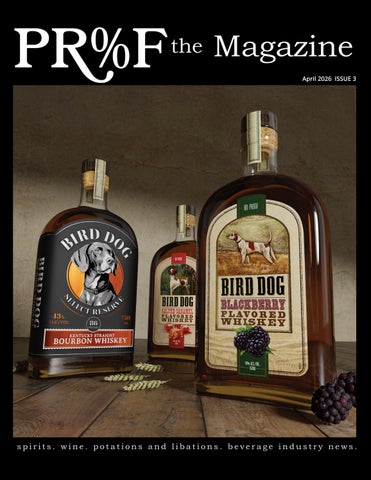
Pr%F Magazine - April 2026

Page 1


THE TEAM:

MICHAEL POLITZ Publisher Michael.Politz@fbmagazine.com

MICHELE TELL Founder, Executive Director/Publisher Michele@proofawrds.com

COLLEEN BANKS Director of Business Development Director of PR%F and CPG Competitions Colleen@proofawards.com

MARGIT BOWN Director of Graphics

JACK FINN Senior Corresponent

LARA STONE Trade Show Editor

BRIDGET SLEAZAK Competition Coodinator

CONTRIBUTORS: Contact the Team: news@proofawards.com

George Manska Matthew-Lorèn Lindsey Mia Lavana

Brittney Agoncillo

Devin Woodrow

Hala Shamas

PR%F the Magazine is owned and published electronically by The Original Brand, LLC. Copyright 2019 PR%F Awards and distinctive logo are trademarks and owned by The Original Brand, LLC. All Rights Reserved. No part of this electronic magazine may be reproduced without the written consent of PR%F the Magazine. Requests for permission should be directed to: ProofMagazineInfo@gmail.com. The information contained has been provided by such individual, even organizers or organizations. The opinion expressed in each article is the opinion of its author, organization or public relation firm.

Dear Readers,

Letter from the Editor

Hello Readers…

Great news! We’ve moved the PR%F Awards to the summer—and that change is all about you.

By shifting the timing earlier in the year, you now could earn recognition, credibility, and medals when they matter most for your brand’s growth and sales cycle. And with that said, we are bringing all forms of beverage under one.

And with that, makes our deadline just around the corner on June 26, 2026. www. proofawards.com - it’s as easy as clicking on to our website to enter.

But here’s what really sets the PR%F Awards apart: every single judge is a buyer. These aren’t just critics or industry observers—they’re the very people who decide what gets placed on shelves, featured in stores, and ultimately discovered by customers. If your product isn’t entered, it simply won’t be tasted by the decision-makers who shape the market.

That’s the opportunity—and the risk. Missing out means missing visibility where it counts most.

When you enter, you’re not just submitting for one competition—you’re automatically considered in two: taste and design. This dual evaluation reflects how buyers make decisions. It’s not just about how your product tastes (though that’s critical); it’s also about how it presents. Does it stand out? Does it catch the eye? Does it belong on a premium shelf?

Our judges are actively looking for products that deliver on both fronts. They’re searching for brands that taste exceptional and look compelling products they can confidently bring into their portfolios and put in front of customers.

That’s why the PR%F Awards are more than just a competition. They’re a direct line to the people who can elevate your brand’s presence in the market.

Enter once, and you gain exposure in two essential categories. More importantly, you put your product directly in front of buyers who are ready to discover what’s next.

Don’t let your brand be the one that gets overlooked. Secure your place, get in front of decision-makers, and make sure your product is part of the conversation this summer. www.proofawards.com

CPG AWARDS BY

And for those of you who also dabble into the food sector, we are pleased to announce our sister competition - CPG Awards by Food & Beverage Magazine. CPG Awards by Food & Beverage Magazine recognizes standout shelf-stable consumer packaged goods across more than 300 categories, including foods, baby foods, pet foods, and supplements. The program is designed to spotlight products with strong taste, quality, packaging, nutrition, and market appeal, giving brands a chance to stand out in a crowded marketplace.

What makes the awards especially valuable is the judging panel: all judges are experienced retail buyers and decision-makers from across the United States, so entries are reviewed by the people who help decide what reaches store shelves.

Winners also receive the Food & Beverage Magazine seal of approval, adding a trusted mark of recognition that can support sales, credibility, and retail interest.

The awards are open for brands looking to gain national exposure and connect directly with buyers who are actively seeking innovative new products.

Enter here: www.cpgawards.com

Cheers & Namaste! Michele Tell

PR%F Awards 2024 • Michele and E-40 at Bar & Restaurant Expo 2026 • PR%F Award Medals

BAR AND RESTAURANT EXPO LAS VEGAS 2026

Bar & Restaurant Expo 2026 in Las Vegas was a major celebration of hospitality innovation, bringing more than 10,000 professionals to the Las Vegas Convention Center for its 40th anniversary. Under the theme “Every Moment Counts,” the event spotlighted how every part of the guest experience, from drink design to service execution, can shape business success. A major attraction was the celebrity-led programming. Chef Roy Choi and actress-entrepreneur Aisha Tyler took part in a featured conversation

about creativity and the evolving role of hospitality in modern food and beverage culture. Their presence gave the expo broader cultural appeal while reinforcing the idea that bars and restaurants are now as much about storytelling and identity as they are about service. Mike Cessario, founder of Liquid Death, also stood out as a speaker, offering a disruptive brand perspective that connected strongly with operators looking for new ways to stand out in a crowded market. The beverage trends on display were equally

important. Premium craft cocktails, low- and no-alcohol drinks, and bold flavor combinations were central themes. Operators were also paying close attention to functional beverages, wellness positioning, and cleaner ingredient lists, showing how consumers continue to value drinks that feel both indulgent and purposeful. Another major trend-setting element was the rise of culturally inspired beverage experiences. Agave-forward drinks, Latin flavor profiles, fresh citrus, spice, and house-made mixers reflected a larger shift toward authenticity and global

influence in bar programs. At the same time, experiential presentation, sensory details, and social-media-friendly visuals remained essential to winning attention.

Overall, Bar & Restaurant Expo 2026 showed that the beverage industry is moving toward more premium, more personal, and more wellness-aware offerings. The event’s celebrity participation helped amplify those ideas, while the product showcases and education sessions gave operators practical direction for the year ahead.

Visit: https://www.barandrestaurantexpo.com

ENTER THE CPG AWARDS OR RISK BEING OVERLOOKED BY 200+ RETAIL BUYERS AND 15 MILLION CONSUMERS

The consumer packaged goods industry is a multimillion-dollar powerhouse—but in a market this saturated, even exceptional products risk being overlooked without the right platform. The CPG Awards, presented in partnership with Food & Beverage Magazine, are now accepting entries, delivering a high-impact opportunity for shelf-stable food, pet food, supplements, and baby food brands to break through the noise and secure national attention.

Spanning more than 300 distinct categories, the CPG Awards are designed to reflect the full spectrum of today’s evolving consumer demand—from functional beverages and fortified pantry staples to premium pet nutrition and next-generation infant products. This expansive category reach ensures that every product is evaluated within its proper competitive set, while giving brands the chance to stand out where it matters most.

Participants gain direct exposure to more than 200 retail buyers from across the United States, alongside amplification through Food & Beverage Magazine’s powerful network of over 15 million monthly readers. This is not passive recognition—it is active placement opportunity. Brands that fail to enter are, quite simply, removing themselves from consideration at a time when buyers are actively searching for new products to bring to shelves.

“The growth trajectory of shelf-stable foods has been both rapid and transformative,” said Michael S. Politz, Publisher of Food & Beverage Magazine “We are witnessing a category that has evolved far beyond

convenience, now driven by sophisticated nutritional science, functional ingredients, and heightened consumer expectations. Many of today’s shelf-stable products incorporate advanced nutritional components that rival fresh offerings, making this one of the most dynamic and competitive segments in the industry.”

In an industry defined by visibility and velocity, participation is no longer optional for brands serious about growth. The combination of category depth, buyer access, and media reach positions the CPG Awards as a decisive advantage in an increasingly crowded field.

Michele Tell, Executive Director of the CPG Awards, emphasized the dual focus behind the program: ‘Today’s most successful CPG brands understand that winning at shelf requires excellence in both product and presentation. That’s why we designed the CPG Awards as a unique “enter once, compete twice” platform—where every submission is evaluated for both taste and package design. We award each independently, because true innovation lives at the intersection of flavor, function, and visual impact. Brands shouldn’t have to choose which strength to showcase—they deserve recognition for both,” she said.

The CPG Awards provide a critical for these innovations to be seen, evaluated, and ultimately embraced by the marketplace. If your product is not entered, it is not being considered.

Submit now at www.cpgawards.com.

CPG Awards® is the ultimate competition where your products are evaluated, tasted, and rated by real retail buyers - the experts who put brands on shelves and into carts. CPG Awards highlights nutritional, health, and wellness badges. We are aligned with Food & Beverage Magazine - the leading online magazine resource for the food and beverage industry now in its 25th year and distributed to 15 million readers online, monthly.

REGISTRATION TO ENTER IS NOW OPEN

DEADLINE: JUNE 10, 2026

All shelf-stable products must be received by June 10, 2026, by 5 pm – PST All products must have an expiration date at least August 30, 2026

COMPETITION WEEK: JUNE 15-19, 2026

ENTRY FEE: $275 PER ENTRY

SAMPLES:

• We request 24 samples per entry

MAIL SAMPLES TO:

CPG AWARDS

11700 W. Charleston Blvd. Suite 170, PMB 5, Las Vegas NV 89135

MEDALS:

Each SKU entered has a chance to win (2) separate medals in both Taste and Design.

SPECIAL AWARDS:

CLICK HERE TO REGISTER FOR CPG AWARDS 2026

• Every Women-owned and Veteran-owned business receives an automatic accolade medal to highlight this special accomplishment

• Best of Shows for overall brand, spirits, wine, design, and more will also be crowned.

**When entering, please upload a PRODUCT PHOTO showcasing a single unit of your CPG. This will be used in future advertising and in the winner graphics, so it is best if you submit a full product shot on a white or transparent background.

**SPECIAL BRAND PROMO OFFER**

Enter 4 (Four) or more SKUs & receive a complimentary full page ad in Food & Beverage Magazine

A disciplined team in Bowling Green, Kentucky, has quietly assembled a true house of brands.

Each brand serves a distinct consumer, occupies a specific tier, and fulfills a clear role. Bird Dog opens doors. Calumet Farm Bourbon commands the premium shelf and collectables. Sam Houston speaks to enthusiasts. Twenty Grand reaches demographics that traditional whiskey never touches.

A loyalty earned, not manufactured.

There’s a reason Bird Dog Whiskey keeps winning. Year after year, competition after competition, this brand collects hardware that would make most distilleries jealous. Not because of marketing spend or celebrity partnerships, but because the liquid consistently outperforms.

More awards than any other flavored whiskey in America. And in a category crowded with artificial shortcuts, Bird Dog’s approach remains genuine to its roots. Start with real Kentucky bourbon. Finish with carefully crafted flavors. Let the whiskey do the work.

That pioneer spirit built a category. While others were still skeptical, Bird Dog was already expanding: Peach and Hot Cinnamon in 2012. Apple and Chocolate by 2014. Each flavor validated the vision. By 2015, the awards started piling up, and they haven’t stopped since.

Today, six flagship flavors anchor the lineup. Three fruits: Blackberry, Peach, and Black Cherry. Three decadent: Salted Caramel, Peanut Butter, and Hot Cinnamon. Each delivers exactly what the bottle promises, whether sipped on the rocks or splashed into a simple one-ingredient cocktail. No bartender required. Consumers eagerly anticipate the seasonal release of Pumpkin Spice and Gingerbread.

And now, Bird Dog is going back to its roots. The brand’s new Select Reserve Kentucky Straight Bourbon is a genuine sipping whiskey designed for fans who fell in love with the flavor lineup and want to explore what’s underneath.

The Bird Dog community runs deep. Social feeds overflow with Blackberry Lemonades, Peach Teas, and Peanut Butter shots around backyard barbecues, tailgates, and fishing trips. The brand’s partnership with Ducks Unlimited reinforces that connection, aligning with the outdoor lifestyle its fans already live.

Calumet Farm: Honoring a Century of Greatness

Before it was a bourbon, Calumet Farm was a legend.

The Lexington, Kentucky, thoroughbred operation has produced eight Kentucky Derby winners and two Triple Crown champions, more than any other farm in history. For a century, the name has stood for patience, pedigree, and excellence. Calumet Farm recently celebrated its 100th anniversary, a milestone few American institutions can claim.

To honor that centennial, Calumet released a collection worthy of the milestone: a hand-painted ceramic decanter shaped like the historic farm, limited commemorative bottles, and a crowning

release: the 18-Year-Old. When influencers and enthusiasts started calling it their Whiskey of the Year, the tribute felt complete. A hundred years of legacy, honored by nearly two decades in barrel.

The 18-Year-Old represents the pinnacle of Calumet’s age-stated lineup: depth, complexity, and a finish that only extended maturation can deliver. Whiskey influencers, collectors, and serious enthusiasts have embraced Calumet as a legitimate player in the ultra-premium space. Blind tastings consistently place it among bourbons twice its price.

The premium lineup runs deep: age-stated bourbons from 8 to 16 years, a Bottled-in-Bond, a Rye. Each release reflects the farm’s philosophy: the long view, the careful selection, the belief that greatness takes time.

Calumet 18YO: W

hiskey of the Year

Forbes called it the World’s Best Bourbon Whiskey. Blind tastings place it among bottles twice its price. That’s not marketing. That’s the liquid.

Sam Houston: A Legacy Reborn

Sam Houston Kentucky Straight Bourbon has always been an enthusiast’s whiskey. The latest chapter takes exclusivity further.

Short-run releases of just three barrels at a time. No two batches alike. Each carries its own character, its own profile, its own story. Every bottle individually numbered. More than a dozen

The demand for state batches signals something bigger. People want something special and unique, a whiskey with a story behind.

“ “
Luis Cabrera, EVP Corporate

states have ordered their own state-exclusive batches, with some already on their third. Sam Houston has become something approaching a custom bourbon program.

Looking ahead, Sam Houston will release Texas Bourbon and Tennessee Bourbon, a tribute to the two states most closely associated with Sam Houston’s legacy. A natural evolution for a brand built on American history and small-batch craftsmanship.

Twenty Grand: Evolving with Consumers

Twenty Grand doesn’t look like anything else in the Western Spirits portfolio.

Another early innovation: vodka infused with cognac. The brand built a following by defying the norms and delivering a product smoother than vodka, more accessible than sipping cognac, and calibrated for special occasions. Premium taste. Approachable price. Unmistakable presence.

Then came 20G. The launch of Twenty Grand’s ready-to-drink line caught

We’re going where consumers are going, but we’re not making another seltzer. This RTD is something bolder, urban, extravagant, and actually fun to drink

the industry off guard. A vodkacognac brand moving into RTD was unexpected. It was also exactly right. Consumers are shifting toward convenience without sacrificing quality, and 20G meets them there, carrying all the brand’s swagger in a format built for the moment.

At the PR%F Awards, 20G earned Best in Show and the Century Award for a perfect 100-point score. That’s blind judging validating what the brand already knew: the liquid delivers.

Whether it’s pregame, parties, or the moments in-between, 20G meets consumers where they gather. A socialready brand built for a generation that shares what they drink.

Luis Cabrera, EVP Corporate Strategy

Why the Glass Matters More Than Most Buyers Think

Most distributor buyers are not trained sensory scientists. That is not an insult. It is simply reality. They are expected to taste fast, compare many products, make sound decisions, and choose brands that will succeed in the market. The difficulty in accomplishing that task increases substantially when the glass itself gets in the way.

Many buyers have been taught that a tulip glass is the proper way to smell whiskey. The reasoning sounds good at first: a narrow opening concentrates aromas and sends more to the nose, not to mention “Everyone else uses it.” But that is where the problem begins. A tulip glass does not separate the good aromas from the bad effects of alcohol. Tulips concentrate everything, including abundant ethanol vapor. In spirits, ethanol is

not just part of the drink. It can interfere with the detection of the spirit’s true aromas. A glass that increases nasal impact does not necessarily improve sensory accuracy; instead, it reduces access to the information needed for sound commercial judgment by masking the subtleties that influence flavor.

That matters because the first job of a buyer or judge is not to survive the alcohol. It is to detect the product’s character. If the glass throws too much alcohol to the nose, the buyer gets a sting, burn, sharpness, and pungent blast that feels powerful but actually hides detail. One may think, “This is aromatic,” when what they are really getting is the pungent impact of alcohol. The ethanol itself does not determine quality.

NEAT Reduces Errors in Judgment

The value of NEAT is not fashion, tradition, or theater. Its value is functional. It significantly reduces the direct alcohol assault at the rim, the point where the nose is trying to detect aroma. NEAT exposes the buyer to less alcohol-dominant vapor and more access to characterdefining aroma compounds. That means the buyer has a better chance of finding the fruit, grain, oak, floral, honey, spice, smoke, or ester notes that actually define the spirit. Rather than rewarding the bottle that shouts the loudest, the evaluator can choose the bottle that says the most.

Detecting Details Matters in Distribution

A distributor buyer is not simply picking favorites for personal enjoyment. The buyer is making commercial judgments. Which product has the best real quality? Which one has the clearest style identity? Which one deserves support? Which one will gain repeat sales because

it actually delivers what its category promises? Those decisions are better when they are based on clearer sensory information rather than on ethanol shock or poor tasting habits.

Wrong Glass, Wrong Quality Assessment

Don’t be fooled into believing that intensity equals quality. Overlooking those subtle aroma notes hidden behind alcohol misguides quality assessment. You can be fooled into favoring products that hit hard with pungency over products that are genuinely balanced, layered, or distinctive. Over time, those errors affect buying choices, portfolio strength, credibility, and trust.

NEAT removes the major obstacle to accurate judgment. It does not magically make a bad spirit good. It does not invent aromas that are not there. It simply gives the evaluator the best shot at detecting the truth.

Rewarding Pungency Misleads Consumers

When distributor buyers serve as judges, they are not just handing out medals. They are shaping market attention. Awarding a medal can influence placement, sell-through, account interest, and follow-up orders. If the judging process favors glasses that over-deliver alcohol and underdeliver nuance, then the judging outcome drifts away from actual sensory merit, eventually adversely affecting judges’ capabilities and reputations, as well as solid-quality product lines and the spirits market in general.

Sensory Vessel Improves Accuracy

Good judging is not only about palate talent. It is also about procedure. It means using a glass that does not distort the

sample’s aroma profile. It means paying attention to the fundamentals of tasting, and understanding that sensory work is a skill, not a stunt. Buyers who learn this become more reliable. Reliable buyers make informed decisions. Informed decisions build stronger portfolios and improve the buyers’ reputations inside their organizations.

A buyer who consistently makes wise selections is known for truly separating noise from quality. That person is more valuable to a distributor than someone who merely has opinions. Sound sensory method leads to better conversations with suppliers, better internal recommendations, stronger confidence in line reviews, and fewer mistakes caused by excitement, label bias, or alcoholdriven confusion. In a competitive field, disciplined tasting is not academic fluff. It is job performance.

Working Tools Improve Sensory Judgment

NEAT is not a gimmick for enthusiasts, nor is it a novelty item. It is a practical aid for people whose professional choices depend on what they can actually smell. If a glass reduces ethanol interference and reveals more of the product’s true aromatic character, it gives the evaluator an operational advantage. In business, operational advantages matter.

Sensory misclassification produces concrete commercial errors. For example: choosing hot, shallow spirits that impress in a quick judging pass but disappoint in repeat purchase; overlooking structurally sound products that build brand loyalty; confusing aromatic force with category typicity; and recommending brands that create sales friction because the spirit does not live up to “first-blast” promise.

Strong Sensory Judgment Equals Strong Buyers

They are the ones who can say, “This spirit has real structure,” or “This one is hot but shallow,” or “This product will perform because it has authentic sensory value, not just packaging and hype.” Those judgments do not come from ritual. They come from clearer perception, and that is why the glass matters.

Using NEAT and following a sound tasting procedure improves how buyers decide. Better decisions, made consistently, are exactly what build well-earned award results, higher-quality distributor product-line choices, and improved buyer reputations.

Summary

Glass choice is not a matter of tradition. It is a matter of sensory accuracy. Buyers who evaluate spirits in glasses that concentrate alcohol at the nose risk confusing pungency with quality, missing the aroma details that define style and structure, and making weaker portfolio decisions. Buyers who use functional sensory vessels and a disciplined tasting procedures gain clearer access to the spirit’s true character, make more informed judgments, and build stronger product lines through more accurate sensory evaluation.

For 40%+ ABV, tulips create a nose-bomb of pungent, anesthetic ethanol. As a result, most tulip users mistakenly believe pungency is unavoidable, equate it with quality, and even deem pungency as a desirable attribute to validate any spirit.

Ethanol masks aromas, prevents detection, and hinders accurate identification of all true flavors. Even worse, ethanol is an anesthetic.

Glass enhances delicate flavors of creative cuisine and displays the spirit for complete appreciation of a pairing without overpowering alcohol aromas”

Dressed to Impress: Why

Garnishes and Color Turn Drinks into Bestsellers

Cocktails are no longer just about taste—they are a full sensory experience. Garnishes, specialty salts, colored sugars, decorative straws, and other accoutrements play a major role in elevating that experience, ultimately helping drinks sell better. These visual and tactile elements transform a simple beverage into something memorable, shareable, and worth a premium price.

First, presentation strongly influences perception. People often “drink with their eyes” before taking a sip. A cocktail adorned with a vibrant citrus twist, a sugared rim, or a colorful straw immediately signals quality and care. These details make the drink appear more sophisticated and intentional, which can justify higher pricing. For example, a margarita served with a plain rim feels standard, but one with a bright pink salt rim and a dehydrated lime wheel feels crafted and upscale, even if the core ingredients are similar.

Second, garnishes and decorative elements enhance the overall sensory experience. Texture, aroma, and even sound contribute to how enjoyable a drink feels. A sprig of mint releases aroma with each sip, while a sugar or salt rim adds a contrasting texture that complements the liquid. These small enhancements make the cocktail more engaging and dynamic, encouraging customers to savor it rather than drink it quickly. The longer a guest enjoys a drink, the more likely they are to order another or recommend it to others.

Another important factor is social media appeal. In today’s digital culture, visually striking cocktails are highly shareable. Bright colors, layered sugars, or unique straws make drinks “Instagram-worthy,” turning customers into free marketers. A welldesigned cocktail can attract attention online, bringing in new customers who want to experience the same visually appealing product. Bars and restaurants benefit from this organic promotion, especially when their drinks stand out in photos.

Accoutrements also help establish brand identity and differentiation. In a competitive market, unique presentation can set a venue apart. For instance, a bar known for using bold colored sugars or elaborate garnishes creates a recognizable style. Customers begin to associate those visual cues with the brand, increasing loyalty and repeat visits. Without these distinguishing features, drinks risk blending into the competition.

Additionally, these elements create a sense of occasion and indulgence. Customers are often willing to spend more when a product feels special or celebratory. A cocktail with thoughtful embellishments feels like a treat rather than just a drink. This perception encourages upselling, whether through premium pricing or add-ons. Even simple additions, like a decorative straw or a flavored salt rim, can make the experience feel elevated.

Finally, customization plays a role. Offering different salts, sugars, or garnishes allows customers to personalize their drinks. This sense of choice increases satisfaction and gives guests a feeling of control over their experience. When customers feel involved in the creation of their drink, they are more likely to value it highly.

Garnishes and decorative elements are not just aesthetic extras—they are strategic tools. By enhancing visual appeal, sensory experience, social media presence, brand identity, and perceived value, these details significantly boost cocktail sales.

PR%F Awards offers full categories for all garnish, spirited fruits/vegetables, salts, sugars, rimmers, shimmers and other elements that enhance cocktails aesthetics.

Enter here: www.proofawards.com

BCB BROOKLYN 2026 EXPANDS ITS EDUCATION PROGRAM WITH NEW STAGES,  DEEPER SKILL-BUILDING AND INDUSTRY-LEADING VOICES

AMulti-Stage Program Focused on Practical Skills, Technical Development and ForwardLooking Industry Conversations

Bar Convent Brooklyn (BCB Brooklyn), the leading gathering for the global bar and beverage industry, continues to expand its 2026 education program. Returning to Industry City on June 9 and 10, this year’s event will feature 14 Main Stage sessions alongside expanded programming across the Park Street University Stage, Liquid Lounge Stages, VIP Lounge and the new Workshop Stage. A continuously evolving

lineup of sessions will be available on the official BCB Brooklyn website here.

The Main Stage program is curated by Head of Education Lynnette Marrero in collaboration with the BCB Brooklyn Education Committee, including Erick Castro, Meaghan Dorman, Erika Flowers, Tracie Franklin, Natasha Sofia and Christian Suzuki-Orellana. Together, they bring perspectives from across bars, brands and advocacy to shape a program grounded in real industry experience and reflective of the evolving hospitality landscape.

“Our goal with this year’s program was to create something that feels both immediately useful and forward-looking,” says Marrero. “We’re building conversations that reflect how people are actually working today, while also pushing ideas that will shape where the industry goes next.”

Designed to balance practical insight with future-focused conversation, the Main Stage will cover a broad spectrum of topics shaping today’s bar world. Sessions like “Why the Forest is the Next Frontier for Flavor” and “Border

Crossings: Bringing Latin American Spirits to Bar & Feed” highlight emerging ingredients and global perspectives, while others address inflation-driven pricing, ownership pathways and building teams without burnout, alongside drink development through fermentation, flavor layering and menu engineering. The program also explores hospitality beyond the bar through immersive concepts, including music-driven experiences and evolving guest expectations. Additional sessions, such as “Standardized Drink Recipes and Costing,” reinforce the focus on

actionable strategies that bartenders can apply to improve both creativity and profitability.

Beyond the Main Stage, BCB Brooklyn continues to expand how education is delivered across the show. The Park Street University Stage returns with a focus on the business of beverage, offering sessions for brand builders and entrepreneurs navigating a complex market. Programming will explore route-tomarket strategy across direct-to-consumer, on-premise and off-premise channels, alongside conversations with top distributors, the state of the spirits industry and the role of technology and AI in driving growth. A standout session, “Generational Consumer Breakdown: From Gen-Z to Boomers,” will unpack the behaviors, values and purchasing drivers shaping each generation, with strategies to better align product development, messaging and distribution. The Liquid Lounge Stages will complement this with spirits-led sessions focused on technique, category exploration and storytelling through guided tastings and expert-led conversations, highlighting products, traditions and emerging trends shaping the global drinks landscape.

New for 2026, the Workshop Stage introduces a hands-on environment focused on practical skillbuilding and real-world application. Designed to be interactive and technical, sessions will cover areas ranging from content creation and AI-driven tools to flavor development and advanced beverage techniques. Programming includes sessions such as “The Bartender’s Content Kit: Mastering Cocktail Photo & Video Content,” which explores how to create highquality visual assets for digital platforms, “An Army of Bots,” focused on leveraging automation and AI for operations and marketing and “Building Better Boilermakers: The Art of Beer & Spirit Pairing,” which examines balance, flavor interplay and pairing strategy. Together, these sessions offer actionable insights across a range of key topics, with takeaways that can be applied behind the bar or within day-to-day operations.

Available exclusively to VIP Club, VIP+ and Premium VIP badge holders, the VIP Lounge will host more intimate, discussion-driven sessions focused on leadership, creativity and team dynamics. Programming will include The Organization as a Place of Healing: Trauma-

Informed Leadership,” “Creating ‘Brand Moments’: A Discussion on Experiential Cocktails” and “The FRINGE BENEFIT”, offering frameworks for building stronger teams, more impactful beverage programs and more resilient workplace cultures.

On Monday, BCB Brooklyn will offer two exclusive sessions for exhibitors and Premium VIP badge holders designed to provide added value for brand partners ahead of the main show days. One session will focus on sustainability and environmental, social and governance (ESG) practices, while the other will explore ecommerce and evolving digital strategy, together addressing how brands can future-proof their businesses in a shifting market. Designed for a more intimate setting, the discussions will encourage peer exchange, practical insight and forward-thinking strategies.

“There’s a clear intention behind how this program has been built,” says Jackie Williams, Event Vice President of BCB Brooklyn. “We’re not just expanding the number of sessions. We’re thinking about how people learn, how they apply that learning and how we can create an environment that supports both.”

As the industry continues to evolve, BCB Brooklyn remains a platform for discovery, connection and growth. With thousands of professionals expected across two days, the education program remains central to what makes the event a must-attend for beverage professionals across the globe.

Tickets for BCB Brooklyn 2026 are now available, with one-day, two-day, VIP+ and Premium VIP options offered. Standard advance pricing ranges from $100 to $155, with onsite rates increasing to $135 and $200 pending availability. VIP+ badges are priced at $325 and Premium VIP at $475, with on-site pricing increasing to $350 and $500, respectively. Advance registration is encouraged as select badge tiers and curated programming experiences are expected to sell out.

For more information about attending or exhibiting at BCB Brooklyn 2026, visit BarConventBrooklyn.com. To learn more about sponsorship and exhibition opportunities, contact Event Vice President Jackie Williams at Jacqueline.Williams@rxglobal.com.

From the North Carolina Woods to the Vineyards of California

Many wine brands are built in boardrooms, but theoleo wasn’t built inside any buildings.

A brand built on conservation, California terroir, and the belief that every bottle should give something back

wines

Co-founders

Charles Dick and Jonathan Campbell grew up as avid outdoorsmen in North Carolina, tracking deer, fishing rivers, climbing trees, and learning early that the natural world is worth protecting. Their shared upbringing and reverence for the outdoors planted the seed for a wine brand unlike most on the market.

The name theoleo is a nod to Theodore Roosevelt and Aldo Leopold, two of the most consequential conservation figures in American history and the forefathers of modern wildlife management. For Dick and Campbell, naming their brand after these giants was a tip of the cap and a declaration of intent. Through their membership in 1% for the Planet, theoleo dedicates one percent of all proceeds to conservation, and each varietal in the lineup supports a specific

environmental nonprofit within the 1% for the Planet network. This ensures every purchase directly contributes to making an impact.

The wines are all sourced from some of California’s most respected and upand-coming appellations. The Cabernet Sauvignon hails from Paso Robles, for a taste that’s bold and structured, with dark fruit, toasted oak, and an earthy finish. The Pinot Noir comes from Santa Barbara, offering a more refined expression of vibrant red fruits,

velvety tannins, and a silky finish that pairs beautifully across a range of menu pairings. The Chardonnay draws from the emerging Arroyo Seco region, delivering richness and balance with notes of golden apple and citrus. Lastly, the Sauvignon Blanc from Lake County on California’s North Coast is bright and expressive with notes of honeydew, lime peel, and white florals for a clean, mineral-driven finish that moves fast in any environment.

Accompanying these wines are four unmistakable labels inspired by the natural world. Each bottle features a North American animal rendered alongside the flora, fauna, and terrain of its ecosystem, woven into the artwork like an easter egg hunt for curious eyes. This differentiator earns a second look on the shelf and starts conversations

at the table, giving buyers artwork worth noticing and a brand story worth telling.

For restaurant and retail buyers looking to add a California wine with a compelling backstory, accessible price point, and genuine conservation commitment, theoleo belongs on your list. Reach the team at theoleowine.com or info@theoleowine.com to explore placement opportunities.

For the collectors in the room: If the philosophy behind theoleo resonates, Charles and Jonathan go even deeper with their limited-production, single-vineyard offerings at nomdecellars.com — offering small-batch, terroir-driven wines built for the serious enthusiast. Sign up and use code PR%F for automatic admission to the club. First come, first served.

Click here to visit us

Natural Products Expo West 2026 transformed the Anaheim Convention Center into a massive hub for the future of natural, organic, and functional food, beverage, and supplement innovation, drawing over 60,000 industry professionals and 3,000+ exhibitors from March 3–6. The 45thanniversary edition positioned Expo West as the world’s largest gathering of conscious consumerpackaged goods, blending tradeshow education with product discovery across thousands of booths.

Food and beverage highlights

Food at Expo West 2026 leaned heavily “betterforyou,” with proteinforward snacks, wholefood ingredients, and cleaner labels dominating the aisles. Brands introduced highprotein reinventions in traditionally indulgent categories— proteinpacked cookies, savory snacks, and pantry staples— playing to growing demand for satisfying, metabolismsupportive options, especially among GLP1aware consumers. Fiber also emerged as a costar, with fiberrich baked goods, gutforward snack bars, and prebioticenhanced readytoeat meals signaling a shift toward digestive and microbiome wellness.

Beverages showcased a wave of functional formats, from proteininfused shakes and clearprotein drinks to mushroombased mylks and adaptogenic lattes. Tropical flavors—coconut, mango, pineapple, and yuzu—rippled across waters, kombuchas, RTD teas, and even dairybased drinks, reflecting a global palate for bright, refreshing profiles. Hard seltzers, kombuchas, and lowalcohol functional beverages continued to evolve, with brands emphasizing botanicals, nootropics, and moodsupport blends.

Supplements and active nutrition

Supplements at Expo West 2026 blurred the line between pillbased vitamins and everyday foodlike formats. Coffee, tea, and hot cocoa appeared as mainstream delivery vehicles for cognitive, immune, and relaxation support, with gummies, powders, and functional shots now framed as “ritual” products rather than clinicallooking supplements. Active nutrition expanded beyond hardcore sportsbrand aesthetics, branching into hydrationfocused powders, moodsupport blends, and agingwell formulas that target joint health, focus, and recovery.

Sustainability, regenerative practices, and indulgence

Regenerative organic certifications and farmercentric storytelling gained visibility, with brands spotlighting soil health, ethical sourcing, and climatefriendly practices directly on packaging. At the same time, indulgence remained frontandcenter: chocolatecovered snacks, plantbased desserts, and “funfirst” treats with clean labels reflected a consumer desire for treats that feel both pleasurable and align with their values.

Live entertainment and afterhours scene

Expo West 2026 extended beyond the convention floor with a dynamic afterhours lineup led by entertainment partner House of Blues. Formerly of the House of Blues chain, the “House of Blues Whalers” concept hosted a curated mix of live music and brand activations, turning postshow hours into a networkingmeetsfestival experience. California rock band Spin Doctors returned as a featured act, bringing highenergy nostalgia to the expo’s evening events and drawing crowds eager to unwind after long days of trendspotting and meetings.

Emerging trends to watch Core 2026 trends pinpointed at Expo West include proteineverywhere innovation, fiberforward wellness, moodasfoundation health, and functional beverages that double as daily rituals. Tropical, globally inspired flavors, cleaner labels, and regenerative sourcing round out a picture of an industry that increasingly marries indulgence with purposedriven nutrition. For full details, schedules, and exhibitor information, visit the official event hub:  CLICK HERE

CPG Awards® is the ultimate competition where your products are evaluated, tasted, and rated by real retail buyers - the experts who put brands on shelves and into carts. CPG Awards highlights nutritional, health, and wellness badges. We are aligned with Food & Beverage Magazine - the leading online magazine resource for the food and beverage industry now in its 25th year and distributed to 15 million readers online, monthly.

REGISTRATION TO ENTER IS NOW OPEN

DEADLINE: JUNE 10, 2026

All shelf-stable products must be received by June 10, 2026, by 5 pm – PST All products must have an expiration date at least August 30, 2026

COMPETITION WEEK: JUNE 15-19, 2026

SAMPLES:

• We request 24 samples per entry

ENTRY FEE: $275 PER ENTRY CLICK HERE TO REGISTER FOR CPG AWARDS 2026

MAIL SAMPLES TO:

CPG AWARDS

11700 W. Charleston Blvd. Suite 170, PMB 5, Las Vegas NV 89135

MEDALS:

Each SKU entered has a chance to win (2) separate medals in both Taste and Design.

SPECIAL AWARDS:

• Every Women-owned and Veteran-owned business receives an automatic accolade medal to highlight this special accomplishment

• Best of Shows for overall brand, spirits, wine, design, and more will also be crowned.

**When entering, please upload a PRODUCT PHOTO showcasing a single unit of your CPG. This will be used in future advertising and in the winner graphics, so it is best if you submit a full product shot on a white or transparent background.

**SPECIAL BRAND PROMO OFFER**

Enter 4 (Four) or more SKUs & receive a complimentary full page ad in Food & Beverage Magazine

The beverage side of Natural Products Expo West.

Natural Products Expo West 2026 in Anaheim was a huge showcase for the naturalfoods world, but beverages clearly stole a lot of the spotlight. The show highlighted a flood of CPG drink launches, especially functional beverages, healthy smoothies, coffees, waters, and ready-to-drink products built around wellness, energy, hydration, mood, and gut health. What stood out most was how many beverage brands leaned into health-conscious positioning rather than just flavor. Across the floor, new products emphasized prebiotics, postbiotics, probiotics, protein, clean labels, mushroom ingredients, matcha, fiber, and lower-sugar formulations, showing that beverage innovation is increasingly about function as much as taste.

The beverage mix also reflected broader consumer demand for drinks that feel refreshing but still deliver a benefit. Coverage from the event noted everything from non-alcoholic mixers and betterfor-you cocktails to mushroom drinks and adaptogenic formats, alongside more familiar categories like coffees, waters, and smoothiestyle beverages.

In scale, the event was massive: reporting put attendance at more than 60,000 to roughly 70,000plus industry professionals, with over 3,000 exhibiting brands and around 3,200 brands cited in event coverage.  The show also drew major brands and highprofile names, including celebritybacked beverage launches and other headline-making product debuts that added buzz to the aisles.

Beyond products, Expo West remained a networking hub for founders, retailers, investors, and industry insiders, with plenty of education sessions and afterhours events layered on top of the show floor activity. That mix helped make the beverage surge feel less like a trend and more like a full category shift within natural and organic CPG. For full details, schedules, and exhibitor information, visit the official event hub:

APRIL RESET: SUSTAINABILITY BECOMES A BUYING BEHAVIOR

Sustainability has been part of the spirits conversation for years. But for most consumers, it stayed abstract. April makes it tangible.

Around Earth Day, attention sharpens and behavior follows. Shoppers are looking closer at how products are made, where ingredients come from, and what impact they leave behind. This is no longer about messaging. It is about decision-making.

Sustainability is becoming part of the same filter that already guides how people drink. Here are six bottles that reflect how that shift is showing up in real time.

Parole Whiskey

Whiskey has traditionally been one of the most resource-intensive categories. Years of aging, heavy barrel usage, and long production timelines all contribute to its footprint.

That model is starting to change.

Parole represents a new approach.

Using accelerated aging technology, the whiskey is produced in approximately 24 hours rather than years. The result is a dramatic reduction in emissions, material use, and overall resource demand.

The appeal is not just speed. It is efficiency.

Consumers are becoming more open to rethinking tradition when innovation delivers both quality and a lighter footprint. In that context, modern production is not a compromise. It is an evolution.

Tinto Amorio ‘23 Monje

Wine has long been a leader in sustainability conversations, especially around farming and intervention.

Tinto Amorio reflects a continued shift toward minimal-intervention winemaking. Less manipulation, fewer additives, and a closer expression of vineyard and vintage.

This approach is not positioned as overtly sustainable. It aligns with a broader preference for restraint.

Less processing. Fewer inputs. More trust in the raw material.

That restraint is increasingly read as quality.

Barr Hill Gin

Sustainability does not always begin inside the distillery. Sometimes it begins in the ecosystem.

Barr Hill builds its production around honey, connecting the spirit directly to pollinator health and agricultural balance. That relationship extends beyond the bottle through initiatives like Bee’s Knees Week, which supports habitat restoration for endangered pollinators.

At the production level, the distillery runs on 100 percent solar power and captures excess heat from distillation to reuse across its facility.

The model is layered.

Agriculture, energy, and advocacy working together in a way that feels integrated rather than performative.

Flying Embers Hard Kombucha

Not all sustainability shifts happen in production. Some happen in behavior.

Flying Embers sits at the intersection of alcohol and function. Fermented, lower in sugar, and positioned as a lighter alternative to traditional formats. This reflects a broader shift in how consumers define drinking occasions. There is more openness to balance, moderation, and variety.

Lighter formats often require fewer inputs and less processing, creating a different kind of efficiency. In this case, sustainability is tied to choice.

Alma del Jaguar Blanco

In tequila, sustainability starts with agave.

As demand continues to grow, land use, harvesting practices, and biodiversity have become central to the conversation. Brands that engage with those realities directly are beginning to stand out.

Alma del Jaguar connects production with conservation, supporting wildlife protection while maintaining an additive-free, agave-forward profile.

Blanco tequila offers clarity. With no barrel influence, what is in the glass reflects the raw material and the process behind it. For consumers paying closer attention, that transparency matters.

Flor de Caña 7 Year Gran reserva

For some brands, sustainability is built into the system.

Flor de Caña operates with a long-term approach that includes renewable energy, carbon neutrality, and Fair Trade certification across production and sourcing.

These are not always front-facing details. They do not change how the spirit is poured.

But they do change how it is understood.

As consumers look deeper into what they are buying, full lifecycle accountability is becoming more relevant.

Taste

GARRISON BROTHERS

Single Barrel Cask Strength

WHISKEY

BAREFOOT

Single

Rodeo Red Blend

D’USSÉ

COGNAC

EL TEQUILEÑO

Tequila Añejo Gran Reserva

TEQUILA

GIESEN 0% Riesling

BALDY’S MIXED-DRINKS

Horchata

WINTER RTD

WHIPPED FUSION

NOVELTY

Espresso Martini

GIRL WALKS INTO A BAR Bloody Mary Mix

Food & Beverage Magazine Guide to Restaurant Success

Even with all of the economic changes and new hospitality business models, anyone wanting to open a restaurant can read this book and learn how to open one for $25,000 anywhere in the country. Potential customers have demonstrated that they want to eat out, try new cuisines (with delivery and takeout), enjoy different menu items, and socialize with others over a meal. With this guide, restaurateurs make any necessary adjustments and find a way to make their dreams happen. Anyone with a passion and goal to open a restaurant (or keep one open) will be guided by the clear steps to becoming part of the food and beverage industry.

Each month, countless new restaurants open their doors as others fail. Despite continuing industry growth, many new restaurants need help to succeed. Even established restaurants are challenged to stay open. These businesses may have great food and amazing service, yet some still need more certainty in their futures. Help has arrived with this book.

This restaurant success guide provides vital information on protecting the significant investment—sometimes ranging from $250,000 to $425,000—required to open and keep a restaurant running during the first six months. Michael started his career with an ice cream business and founded several restaurants, a frozen food distribution business, a restaurant consulting service, and

a respected online magazine for the food and beverage industry with over 14 million readers. Michael shares his extensive knowledge gained through both success and failure. With his indispensable guide, you can easily doublecheck to ensure the readers are doing things right.

• Get guidance from a restaurant owner’s handbook of what to do and not do

• Refer to handy tips and checklists that help you launch your business

• Discover insight into the triumphs of Wolfgang Puck, Bobby Flay, Emeril Lagasse, and more

• Gain food industry knowledge with a comprehensive restaurant how-to guide

Whether opening a burger joint or a fine dining restaurant, this advice-filled resource will help the readers cover all the details that make a difference.

Photo courtesy of Wiley

Turn static files into dynamic content formats.

Create a flipbook