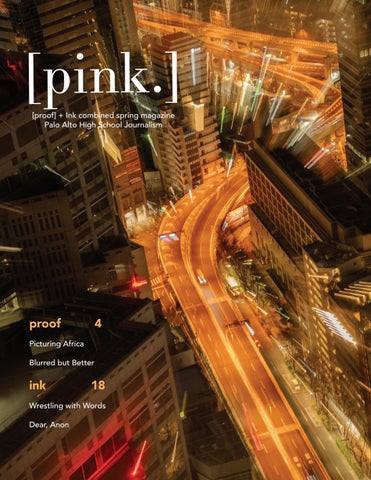
Published three times anually, [proof] is Palo Alto High School’s photography magazine, working to showcase the Paly community’s photographic talent and tell stories about our world through pictures. Also published three times anually is Ink, Paly’s literary magazine dedicated to providing a platform for diverse student voices. [proof] and Ink are proud to present a special combined issue published for a third time [pink.] magazine.
from the editors
Hello readers! In our spring issue of [pink.], our focus is on highlighting the incredible photographers and authors in the Paly student body. In the realm of photography, photographer Tarika Pilay captures senior life as graduation nears. [proof] also highlights Paly’s Art + Tech club’s latest installation “Words We Live By.” Reporting on the literary world, staff writer Julia Curtis reports on the purchase of Books Inc by Barnes and Noble and how it affects our local bookstores. In our student poetry section, we have a poem and behind the scenes feature of student-poet Brian Miller. This issue of [pink.] would not be possible without our advertisers , the Mac Boosters, or the guidance and support of our adviser, Paul Kandell. Thank you, and we can’t wait for you to read and enjoy our latest issue of [pink.]!
— alexander lawson and xander yap
outside cover by jonathan chen
ivy lee
proof editor-in-chief
alexander lawson
ink editor-in-chief
xander yap
featured writers
johnny gu
motoko iwata
brian j. miller jr. miles miller
alex qin-truong
julia walsh
featured artists
johnathan chen
charlie germain
doreen hou
ivy lee
dorian luo
hudson press
liana zhu
staff
julia curtis
noah espinoza
doreen hou
joyce ma
tarika pilay
william xue
adviser
paul kandell — journalism adviser, palo alto high school
advertising
The staff publishes advertisements with signed contracts when deemed appropriate for publication by editors. For more information on advertising with [proof] or Ink, email palyjournalismincubator @gmail. com or visit https://tinyurl.com/2vtj7cae.
printing & distribution
[proof] and Ink magazines print three times, with issues seasonally (winter, spring, and summer) by aPrintis in Pleasanton, CA. Issues are handed out to students by Incubator staff during school. Issues are available online at https://issuu.com/proofpaly.
mission statement
[pink.] magazine, Palo Alto High School’s studentrun fine arts, photography, and literary magazine, is dedicated to showcasing student artwork, literature, and facilitating creative discussions about arts and literature.
letters to the editors
The [pink.] staff welcomes letters to the editors, but reserves the right to edit all letters for grammar, length; potential libel, invasion of privacy, and obcenity. Send all letters to proof.paly@gmail.com or 50 Embarcadero Road, Palo Alto, California, 94301.
liana zhu
Growing together
Gamble Garden nurtures a connection with the community and encourages student involvement
Gamble Garden is a nonprofit organization located at 1431 Waverley St. The historical property and surrounding gardens have been open to the public “for free, every day, for over 35 years,” according to the organization’s website.
When I went on a Saturday morning, I saw people taking family pictures, eating lunch, meeting friends and tending to the garden beds. Because of its accessible public spaces, Gamble Garden serves as a center for community connection.
Text and photo by NOAH
Garden Programs Coordinator Nia Combs said she is working on increasing community outreach and getting high school students involved casually.
“I want this space to be a place where you guys [students] can do homework, sit on the picnic benches and talk to each other,” Combs said. “I just want it to be utilized more, so come. Just come.”
Combs said she believes the garden can contribute meaningfully to student wellbeing.
“The garden is a space to just be in, but it is also a mental health oasis. We have spaces where you can sit next to a fountain and just listen to the fountain and contemplate. We have spaces where you can see bees buzzing around and [watch] microorganisms of this area. You can see so much community in different ways here.”
Combs said there are also opportunities for students to be more involved with supporting the nonprofit.
“We have different craft activities and educational activities like a story time in the house and garden tours and all this different stuff,” Combs said. “If you’re looking for volunteer hours, this is a great place to do that.”
ON A ROLL A girl rides a plastic tricycle between garden beds with her parent.
STROLLING BY Two community members walk through the garden.
“You can see so much community in different ways here.”
— nia combs, garden programs coordinator
“The garden is a space to just be in, but it is also a mental health oasis.”
— nia combs, garden programs coordinator
FURRY COMPANION A dog sits with its owner who rests on a bench.
REACHING FOR THE SUN A tulip stretches towards the sky.
GAZEBOES AND GARDEN BEDS A gazebo provides a spot of shade in
Picturing
Africa
Discovering my great-grandfather’s wartime photo album, filled with African Adventures before his capture
The photographs were faded, the newspaper clippings brittle with age. But as I turned the pages of my great-grandfather’s album, a story began to unfold — one that stretched across Africa during World War I.
While looking through photos of my grandparents for a school project, I stumbled upon a detailed photo album belonging to my great-grandfather, Bernhard Jensen, who died in 1985. The photo album — with a brown leather cover, textured with stamped patterns — consisted of dozens of photographs, newspaper clippings, and a short, typed and stapled memoir explaining his five years in Africa while serving in World War I titled “Some remembrances about my years in Africa.”
small town on the German-Danish border. That month, news spread quickly of the assassination of the Grand Duke Ferdinand of Austria in Serbia, sparking conflict that would result in the first World War.
“At that time Radio and T.V. were unknown, just newspapers, and the excitement was high,” he wrote.
On the inside cover, a small card detailed — in creative English spelling — how he obtained the photos.
“Having lost all my fotographic equipment etc. during the campaign (1914-18) in Afrika I was fortunate to obtain these pictures from a friend who was a professional photographer in Tanganyka from April 1908 and thru (sic.) the campaign,” the card wrote.
Turning page after page, I dove into the whole story.
His account starts in June 1914, two years after he moved to Berlin from a
Before the war broke out, he already had his sights set on Africa, having accepted a position with the East-African Railroad Company in German East Africa — present-day Tanzania and Rwanda. He left in 1914 from Marseille, France, hearing rumors that the Austrian conflict was becoming ever more serious.
“My father, who was well versed in politics … made this remark to me:” he wrote. “‘I am afraid our alliance with Austria will some day cost us very dearly.’ How right he was proved to be.”
He told accounts of bustling marketplaces in Naples, Italy, of visiting a camel-powered palm oil mill in Mombasa, Kenya, and of buying a sack of precisely six cats by the Suez Canal.
“After some haggeling, a man was waiting with 6 cats in a sack. During the night, however, 2 cats escaped, [and] started a commotion among the lady passengers, and my friend was ordered to dispose of the cats,” he wrote.
After an unexpected, war-caused layover in a Tanzanian port, he finally reached what was then called British East Africa through the “most beautiful harbor in Africa,” the Dar Es Salam, Arabic for the “Harbor of Peace.”
Upon arrival for his job at the railroad company, he hired a young valet named Selemani, learning Swahili to communicate with him.
“He [Selemani] was a fairly good teacher,” he wrote, “and slowly I learned this strange language of which in later years I became quite efficient.”
Promptly after he arrived in Africa, he was drafted into the German forces there in August 1914. If he hadn’t already been in Africa at the time, he would have been sent to the Western Front in Germany, where his brother died in battle. As the food imports from Europe slowed due to the ongoing war, he learned to live off the land with his fellow officers. He was generously taught by local native soldiers known as Askaris.
out of my only blanket,” he wrote. “But first I had to make the thread out of tree bark, then I had to whittle a needle out of a piece of hardwood with my pocketknife, just an example of how good a teacher’s necessity can be.”
After traveling once more for a fortnight through a lush African Rhodesian countryside, the men marched by Lake Rugwa, known for being filled with hippopotamuses. His proficient Swahili also helped him during his time by the Ulanga river in 1917, where the men stayed in straw huts built by natives.
“For one month we camped near the Kilimanjaro. The highest peak was a beautiful sight seen from the hot plane below.”
“I remember once, camping with some Askaris in a rather cold, high altitude, I decided to make a sleeping bag
often on the go.
“We sailed without lights, just candles in the diningroom, because it had been rumored that French cruisers had left Madagaskar.”
“Short on medical doctors and supplies, frequently the wounded and sick were left behind to be picked up by the pursuing enemy troops, whoever they were,” he wrote. “Well, during the first half of Nov. 1917 it was my turn. I was again down with malaria and had to be left behind.”
He was met by the English a few days later and subsequently captured.
“I still remember my first breakfast: English porridge with California canned peaches, something we had often dreamed about,” he wrote.
“I was attached to the staff of a small detachment, and sometimes dealt with the natives regarding supplies to be delivered,” he wrote. “Sometimes they looked at me as a kind of judge, and I remember one time a couple came to me for a divorce.”
During the last few years of his time in Africa, he and his troops were
He was sent to Egypt later that year as a prisoner of war and returned to Germany in 1919.
Two years later, he met his brother’s sister-in-law, my great-grandmother, Minne. To get married in America, he followed her to San Francisco in 1923 through Angel Island. They started a family that would stay in the Bay Area for generations.
I tucked the memoir into the front album cover and closed it as my great-grandfather’s distant tale became a little more tangible.
Seniors signing off
Our experience in living our last year at Paly
After the organized events, side quests and general chaos of senior year, 12th graders have one major challenge ahead of them: Dealing with the stress of knowing they have six weeks left at Paly. Senior bonfires, hanging out with your friends as much as you possibly can, and living it up at Prom — that’s what’s left. Knowing that when that last bell rings and you leave to go enjoy summer, it’s going to feel different because you won’t be returning to the same campus in the fall, or seeing the same people. Starting a new chapter is scary, but the least we can do is make the ending of this chapter sweeter.
SIGNING OUT: Seniors Woody Chehadeh, Emmett Stewart and Alexander Fersman leaving their mark on Paly (left)
SENIOR NIGHT: Liam Li celebrating his last night on the Paly football team with his family (top)
WALL OF REJECTION: Senior Nusaybah Mohsin points to Paly’s wall of rejections (left top)
SLEEPOVER: Teenagers bundled up waiting for senior sunrise (bottom left)
BLURRED but BETTER
In a world of advanced cameras, why are students choosing to use old digital cameras?
At a school where nearly every student has a smartphone with a quality camera, students are choosing to bring a secondary device. However, on paper, this camera takes arguably “worse” photos. This comeback of digital cameras is caused by students’ desires for a “Y2K” nostalgia, favoring grainy resolutions and imperfections over polished smartphone photos.
For sophomore Derek Chen, the obsession with digital cameras came last year when he and others jumped on the trend.
“I would say I started using them around a year ago,” Chen said. “I myself don’t use them much, but I definitely see a ton of my friends do. A lot of my friends have accounts where they literally have their name and then ‘digital’... and
Text by WILLIAM XUE
they post a lot of aesthetic photos that are taken with their digital camera.”
Through these social media platforms, accounts like these have been increasingly common. Photos taken from digital cameras often have distinctive features and “look.”
“You can kind of tell based on the colors if it’s taken from a digital camera or not,” Chen said. “It often ends up turning out very vibrant, and I think that’s a big reason as to why this trend started.”
Outside of the visual result of these photos, some students also feel that the process itself plays a role in why using digital cameras is preferred. According to Chen, carrying a separate camera changes the process of taking photos, where they now feel more intentional instead of just opening the camera app on a cell phone.
“I think there’s definitely a big physical aspect to it,” Chen said. “Taking photos with a physical camera is always going to feel more professional, almost more aesthetic than taking a photo with your phone.”
However, for senior Emily Tang, the appeal a digital camera offers goes even deeper. Having grown up around them, she feels that the meaning of the cameras goes beyond the aesthetic and, more importantly, is a way to express her creativity.
“I think the photos turn out a lot better, and you have a lot more control while you’re taking the photo,” Tang said. “I also just like the physical ‘click’ sound, so it feels more like I’m actually doing the work and taking the photo.”
Additionally, for Tang, who has been using digital cameras since she was young, the recent trend has only brought a spotlight onto her hobby.
“My dad has always really liked digital cameras, so I’ve been using them since I was younger,” Tang said. “I’m really glad that people are starting to use them more… it’s just a fun hobby to go out and take photos of whatever you see.”
In an era of increasingly advanced camera technology, students are still leaning toward these devices that produce lower-quality photos, which almost contradicts the point of a camera.
“I think a lot of it has to do with…a nostalgic aesthetic,” Chen said. “Now there are $5,000 cameras everywhere, and our phones are literally built in with another amazing camera, yet we choose to use these cheap $100 cameras because it reminds you of…something better from a long time ago.”
Ultimately, the trend of digital cameras has taken over students and their ways of engaging with photography through creativity and emotion.
“It [digital cameras] is kind of just a fun hobby to have,” Tang said. “...It’s an easy artsy thing to do.”
holiday
TOP LEFT: After finishing their car painting decorations before the first day of school, seniors pose for a photo in front of a Canon PowerShot SD1000 IS. Photo: Emily Tang
TOP RIGHT: ASB seniors on “Generations” day of Spirit Week dressed in “Y2K” theme pose for photo in front of a Canon PowerShot ELPH 190. Photo: William Xue
MIDDLE RIGHT: During a
party, students pose for a photo in front of a Canon PowerShot SD770 IS. Photo: William Xue
BOTTOM LEFT: Seniors dressed on “Salad Dressing” day of Spirit Week dressed in “Caesar” theme pose for a photo in front of a Canon PowerShot SD770 IS. Photo: Emily Tang
Text by ALEXANDER LAWSON
Art and tech hand in hand
Paly club’s latest project highlights values shared by
students
Palo Alto High School’s Art + Tech club unveiled their latest project — “Words We Live By,” on Jan. 14, a 3d-printed art composition placed just outside of the Wellness Center. Made up of 26 words with varying colors and sizing, the installation displays the words most prominent in the lives of Paly students, intending to help those who see the words remember what they should strive for in their daily lives.
According to club president Selim Uyan, “Art + Tech is a collaborative design club built on one core idea — every voice matters.” The objective of the club is to expand on the appealing, creative elements of art using mathematics and technology. When it came to translating these ideals into Words We Live By, Selim first explains the artistic side of the project.
“First, we selected a team of students from Art + Tech to go out in our Paly community and interview students on words that they live by. Throughout 200 student interviews, we took the most profound and deep messages that our stu-
dents took within their lives, including the most popular ones, and we turned them into value tiles.”
When it came to integrating technology into the composition, club member Andrew Walker explains the process of creating a word — referred to as a “value tile” — for the design.
“I made love here in black. We started where we put a sketch and we typed out our word, and then we raised it up, and then gave that to Selim, and then he made it, put it in the 3d printers, and then we made our individual value tiles.”
Club member Evan Lu was also involved in the technological aspects of the project, having been inspired to join the club due to his previous experience with computer aided design and a general interest in engineering.
“Not only do the words that we choose to look at not only dwell in us, but they can transcribe outwards, and they can shape our community as a whole.”
— Selim Uyan, Club President
“I was mostly interested in the tech part. I'm big in tech and engineering, so I thought it would be really interesting to see what it was about. It turned out to be a great experience for me.”
Getting a large club to unify their
efforts and work together on a significant project comes with challenges. Uyan expands on the difficulties involved with the Words We Live By installation.
“When we made this project, we had the challenge of picking what the size of the project was, or picking what font to use. Every single detail. When all of the club members are involved, it really matters. And what we try to do is make something using all perspectives, that can be perfect in almost every single aspect.”
For Lu, one highlight of the project
Andrew Walker, Evan Lu, and Selim Uyan proudly surround
Photo by ALEXANDER LAWSON
is being able to see the time and effort invested by club members to put everything together.
“There's certainly life behind the artwork, because everyone had to take their own time and energy to engineer these and make important decisions. And the way it came together was really amazing.”
To Walker, the project is significant because it steps out of the boundaries of the club and reaches out to the broader school community.
“It’s more than just our club, because a lot of club projects, they're
kind of like they stay in the club and they're just with the other people in the club. But this project really steps out of that and involves everybody in Paly. So it's just a really good representation of what our entire school is about.”
Regarding the artistic meaning of Words We Live By, Uyan sees the installation as something that can help people understand the values that shape the Paly community as a whole and the way they think as individuals.
“Well, this installation, for me, means something that takes what people's lives are built from and places it
in one project. It really combines all of people's words and essence that they live by and shares that the words that we choose to live by are not merely spoken, but practiced, carried, and built. So not only do the words that we choose to look at not only dwell in us, but they can transcribe outwards, and they can shape our community as a whole. So it's really important to be transparent about what we choose to live by and how we're choosing to live our lives for our community.”
Art + Tech’s latest project “Words we Live By”.
art by hudson press
roots in the city
Local author John Doll highlights the nuanced history of San Jose in his new book, “St. James Park”
Orchards filled with blooming fruit trees is not what most people associate with San Jose. However, the city was an agricultural paradise for much of the 19th and into the early 20th centuries. This is the setting of “St. James Park”, a novel set in the 1930s and written by 3rd-generation San Josean John Doll. In an interview with Ink, Doll said this book highlights a side of San Jose that Bay Area residents may be unaware of.
“If you’ve grown up in Santa Clara County or Palo Alto and you drive by [San Jose] on [Highway] 280 or 101, it is hard to imagine what it was like,”
Koehler Books Publishing
Doll said. “A hundred years ago, the entire county was filled with orchards with a ring of vineyards around the hillsides.”
Doll first learned about the history of San Jose through his mother, who shared stories from growing up in the area.
“She said every spring, the white blossoms from apricot trees and from the fruit orchards were very beautiful,” Doll said. “You could smell the blossoms from downtown San Jose.”
It was these stories that inspired Doll to write “St. James Park”.
“When I was thinking about retiring, I went back to my passion, which was to write,” Doll said. “I came back to a story that my mother and my grandmother first told me.”
“St. James Park” is based on real events that took place in 1933, including the lynching of an immigrant grocer. According to Doll, the darker parts of the story are just as important as drawing attention to the beauty of the time.
“Santa Clara County was bucolic, but
there were some awful things that did happen,” Doll said. “[The] mob violence in “St. James Park” was very similar to [the events of] January 6.”
The novel explores themes of bigotry, hatred and civil corruption. Doll said these topics remain relevant almost 100 years after the events the book details.
“People should know about their history, and know that some of the things that are happening in today’s political world have happened before,” Doll said. The same agents of the status quo are still here.”
St. James Park is the first book in Doll’s trilogy set in San Jose, spanning from the 1920s to the present day. Doll has finished writing the second book, “Escape If You Can”, and hopes to have it published this year, despite the hurdles that he faced with the first book.
“You have to be halfway insane to try to get published these days,” Doll said. “If you are determined and stubborn, like I am, you just keep on going. … The most difficult challenge in life is to work the system to your favor.”
BOOKSTORE
Bookstores, where thousands of stories live and thrive, come in all shapes and sizes. From Little Free Libraries in front yards to small independent bookstores to used bookstores with tattered pages and covers to international franchised companies, you’re never too far from finding a story.
Right across the street from Palo Alto High School, the beloved Books Inc. bookstore — one of nine, all in California — allows booklovers of all
can also be found at Town and Country.
Many readers feel uncomfortable having their local bookstore suddenly owned by a massive international business. Paly junior Fiona O’Neill thinks literature shouldn't be monopolized.
“It [Barnes and Noble] is already a multi-million dollar company that dominates smaller companies,” O’Neill said. “Having smaller book stores is important so that not every store is controlled by the same company, like
Despite the unease of many Books Inc. lovers, preserving its own community-centered atmosphere was important, according to Daunt, above the financial expansion.
“These [Books Inc. stores] are very storied and rather remarkable bookstore chains,” Daunt said in a December 2025 interview with Modern Retail. “Which, for all sorts of reasons, have gone bankrupt and are closing — literally closing their doors and disappearing — and we [Barnes and Noble]
SAVER
a safe harbor, which we think is a worthwhile and important thing to do.”
Palo Alto Books Inc. employee Eric Polgar appreciates how Barnes and Noble allows each location to keep its own independent feel.
“I know when Barnes first acquired us [Books Inc.], they [wanted to do] a hands-off approach where they're more or less just giving us the money to survive, but not doing a hostile takeover,” Polgar said. “I know the CEO also acquired
Barnes & Noble: the business that saved Books Inc. from bankruptcy
there, he's trying to do a lot more of the hands-off approach since he knows what draws people in is the independent feel. They want to remain available and homely for the local people.”
According to Polgar, after the transfer of ownership, Books Inc. has seen more customers and more sales.
“We [Books Inc.] are definitely getting a ton more books than
Noble’s increasing presence, O’Neill prefers independent bookstores not only for the ethics, but also for their selection of books and more quaint atmosphere.
“I feel like independent stores are more fun to shop at because there are more unique books and a wider variety of authors,” O’Neill said. “They have more niche authors to explore that We [Books Inc] quite literally wouldn’t have made it to 2026
text by joyce ma and doreen hou
Wrestling with Words
Junior wrestling team captain Brian Miller uses poetry to make an impact
Every day after school, junior Brian Miller zooms across campus on his trusty electric scooter and makes his way to the Paly wrestling room. While Miller speaks, legs dangled over the legs of a round wooden stool, his eyes are focused, with a warm earnest gaze. To Miller, finding time to slow and simply exist in the movement is key to understanding yourself.
Miller started his writing journey around the end of seventh grade, the same time he began wrestling. He expressed his gratitude toward the ability to create poetry and how it shaped his life.
“Once I learned certain techniques behind it [writing poetry], I was able to really kind of make it my own, which was something that I was very grateful for,” Miller said. “Poetry has always kind of been in the peripheral of my life, and so whenever there’s a moment where I’m either feeling intense emotions or there’s a lot of thoughts, it always feels best to get it out in poetry
Miller said. “I don’t understand that at all. I can’t stand for that, because if we become a society of people who lack empathy or who don’t care or lack basic compassion, we will not be able to grow and support those that need it.”
According to Miller, his writing process can be split into four parts: think, build, write, and revise. Every poem begins with Miller sitting with himself, either spending time with his thoughts alone in silence or immersed in the midst of an experience. He then uses this time to organize his building emotions and ideas. Once his mind reached a tipping point, he recorded himself onto a blank document followed by final revisions.
According to Miller, poetry is more free than other forms of writing, and that freedom can also be found in wrestling.
Miller said his middle school English teacher Craig Bark helped shape his work and his growth as a writer.
“He [Bark] forced creativity out of you in a way where he allowed for new and different ideas to come out, and for you to feel comfortable expressing that,” Miller said. “By creating a classroom environment that was so open and expressive, you’re really able to kind of stretch that muscle of creativity, to stretch that muscle of like going out of the norm, to create true feelings and true emotions and to form it into a whole concept, like a Miller said that he wants to spread positivity with his
“I think we’ve gotten to the point where it’s almost cringy to be positive, or it’s cringy to care,”
“In wrestling, there’s a whole bunch of different styles, but at the end of the day, you’re going to go up against whoever lines up across from you, and so each battle is you versus you,” Miller said. “With poetry, you’re fighting a lot of those internal battles, and you’re getting it out for other people to view and interpret. I’ve always found it very, very adapwtable and very just freeing.”
Miller said writers and other creatives shouldn’t feel discouraged from pursuing their art when they see other “better works” and to never stop trying.
“Take that risk of being out there, and to take that risk of being creative means there is inevitably going to be human error, there’s going to be people that don’t like it,” Miller said. That’s a part of being human. The arts, especially literature, is not measured in better or worse, because ... there’s so many ways to express yourself.”
Junior Brian Miller talks about how he finds inspiration for his writing. “I’m best able to organize the emotions that I’m experiencing,” Miller said. “And then taking from that the ieas, and, boom, it’s all on.”
photo by joyce ma
It’s Hard to Hate Someone You Understand
But I find it to be true and grand, You can’t hate someone, You understand.
Now believe me when I say, The Hate will not just go away.
“Hate is a strong word” they all rejoice, But Hate is not an emotion, but a feeling, and a choice.
I would say hate is a double-edged sword, but that would be a lie, Hate is all the risk with no reward, Let me tell you why:
You take two strangers, Who have nothing but hate in their hearts, Put them in the same room, They’ll tear each other apart.
You take those same strangers at different points in life, Before the sorrow, before the anger, Before the hate and the strife, You make them know each other, Hoping that’ll do them right, Then they don’t even think about a fight.
See the hate they felt wasn’t at each other, The hate they felt was, A burden of pain they had to muster.
Hate is a single edged sword, And it’s pointed at the wielder
So when you feel hate, Lend out a hand Because it’s hard to hate Someone you understand.
The Person You Replaced
“I don’t get it,” I said. “Why not just open it?”
“You’re not supposed to,” Mira said, not looking up from her cup of coffee. “It’s protocol.”
“That’s not a reason.”
Shrugging, she finished her coffee, tossed the cup, and stood with a heavy sigh. “Neither is working in a cubicle for 40 years, but here we are. Welcome to corporate.”
I eyed the envelope, sitting in the center of my desk. Across the front a small note was printed in a thin black font: To be opened only upon reassignment or termination.
“Pretend it’s part of the furniture,” Mira shouted from across the hall, as though she knew where my eyes had landed. “You’ll get used to it.”
Every employee got one. It was the first thing you would see when you walked in your new cubicle, even before your login credentials and awkward prerecorded HR introductions. Everyone knew what it was, but nobody talked about it.
The idea was simple. When someone resigned, retired, or vanished into other opportunities, they wrote a letter to their replacement. Not about how to do the job, but what the job did to them. They’d seal it, leave it, and walk away.
The catch? You weren’t allowed to read the one you re-
ceived but merely to destroy it when you left, leaving your own in its place. Read nothing. Say nothing. Just keep the chain going.
Officially it was “emotional offboarding” or a “clean handoff.”
Unofficially, it was a test. And everyone knew it.
Can you spend your entire career with a sealed confession staring at you without ever breaking the seal?
Most people could. They’d joke about it at happy hour, and some even claimed to have forgotten about it. But during difficult days, people would stare at the envelope like it blinked back at them.
I made it three hours and seven minutes into my third day on the job.
The breakroom was empty. Just a humming fridge and a wilting plant in a chipped ceramic pot. I looked around. Nobody. I broke the seal.
Inside was one neat handwritten page.
Hello. If you’re reading this, congratulations on making it through orientation. You’re already doing better than I ever hoped to do.
I looked around. Still alone. I kept reading.
You’re probably happy. That new job shine hasn’t worn off yet. You’re proud of that ID badge you wear around your neck.
I had caught myself admiring
it in the elevator mirror.
That goes away. Fast. Soon, you’ll stop noticing what day it is. Your calendar will be flooded with meetings that go absolutely nowhere. Your ideas will go unnoticed, prompting you to write frustrated, brave emails, just to delete them and send a “sounds good!” instead.
I shifted in my chair.
One day, you’ll realize that you aren’t the same person. Maybe you’d laugh at a strange time or realize you haven’t written a sentence that wasn’t corporate-safe for weeks. You’ll stop asking what happened to your creativity. You’ll think the job is broken. It’s not. It’s working exactly as designed.
I folded the paper, thinking about tossing it. But I kept reading.
They don’t need your spark. They need your silence. And they won’t fire you. That’s not how this place works. They’ll promote you until you’re too exhausted to ask why, and they’ll reward you with titles that mean less the longer you wear them. After you’ve had enough, you’ll quit, leaving nothing behind except a note, in which you’ll need to say something before you forget how.
But if you’re reading this, maybe it’s already happening. Maybe you’re already like me.
I stared at the final sentence. Read it back three times. No signature. Just a quiet accusation, like a Slack ping at 2 a.m.
I slipped the letter back into the envelope, pressing the seal closed before hiding it under a stack of onboarding papers, knowing it was useless. I would not just forget what I’d read. It was one of those things you can’t unsee.
They don’t need your spark. They need your silence.
I checked the clock. 3:07 p.m. I was already late for my first weekly team sync up. I stepped out of the breakroom. The hallway lights buzzed faint ly, blinking as I passed beneath them.
There were twelve of us in the conference room. Martha from DevOps was there, eyes staring blankly above her mug. Greg, wearing a perfect 15 degree smile, adjusted his tie for the third time in a minute. A person al best. Everyone else sat quiet ly, nodding on cue. Like dolls on a shelf, arranged for symmetry, running on an unstable amount of caffeine and deadlines that hit too soon.
As I looked around the room, a question rooted itself in my chest, so firmly that I struggled to breathe.
Who else had opened theirs?
The meeting droned on. Q3 projections. Workflow optimiza tions. We all aged five years as our manager rambled.
I mimicked their movements. Nodded when they nodded. Wrote when they wrote. But inside, I was still staring at the words on the letter.
I no longer knew what the company wanted. Maybe the company didn’t care if we read the letter. Maybe it cared
Wrath of Winter: Ode to Silent Shadows
Oh, Frigid Storm, you disrupt my sleep
Frigid temperatures pierce as the winds streak across the city,
Cold air hollows out my soul, awakening my presence
Shadows dance in my sleep, striking me with limbo
Oh, mysterious terror, drown me with as much darkness as you can bear
The glimmer of hope within me cannot fade away
Shadows streak into the frigid forest, impaling me with mysterious fear
Chills, straight to the bone, now that I’m alone
Come hit me with all your might, I still can survive the night
The forest welcomes my demise
Does it matter? All I do is rise
You can freeze my soul, and awaken the light inside of me
I awake all of a sudden, light glimmers into the open space
Just as hope comes in, shadows come in with disgrace
Dark energy drifts me into deep sleep
Where the ringing inside my head, continues to beep
Delicate
With wings of white I fly
Winds attempt to deter me but I brave the unknown path
Adventure is my friend, fear only a faded scar
Nothing can stop me
Even as cracks run down my body, I do not pause to rest A grave mistake
I fall
A does a scarlet leaf in fall
Like water rushes down, a fall
With shattered wings I cannot fly
Tender hands hold the remains And make new wings
With these I soar
Higher, higher than ever before
Free at last in the ever blue sky
A path, my own, finally known
Dear, Anon
I write to you with this breath clinging inside my chest
For I’ve been traveling a hard road, in which I’m sure you know best I came from the heavens, fell a thousand feet to see you smile
But my wings have sunk within the tar, and I haven’t seen the moon in a while
For the light I yearn for, that will break these chains
Sunk beneath the surface, alongside your veins
‘Cause the pulsating is restarting my heart, and all of its remains
And this quill with which I’m writing, is starting to smell like death again
‘Cause the pulsating is restarting my heart, and all of its remains
Sunk beneath the surface, alongside your twisted veins
For the light I yearn for, doesn’t exist in the light of day
Perhaps the feathers that one day you’ll see in your dreams
Will show you the tears up in heaven, amongst the gates that fail to believe
In the stars, designed for creating a tar pit in the midst of the rivers drowned in eternity
It’s hard to say, dear anon, that I can tell you that there’s a heaven up there with certainty.
But to see you smile, might just be the death of me-
“Ling Ling”
They’re just words, right?
I hear ‘em on the regular, Getting thrown around at me without second thought, People always making light.
But when I reallyyy stop and think… It ain’t so funny anymore.
These words and “jokes”, Pushing me to the very brink, Calling me “chink”.
My eyes, my hair, my background and my skin, I can’t control it all,
But I can be thin.
Maybe they’ll like me then.
I can change my clothes, my personality,
But this is reality, And they only see one thing. Yellow.
Or rather, a yellow-ish coloring.
Words stick to me like glue, Turning my demeanor blue.
But when I call them out, They say I’m the one in the wrong and it makes me doubt.
“You’re being sensitive”, “it’s just a joke”,
“Oh my god calm down”, “you’re being too woke”.
Maybe I am sensitive or weak, But their words cut deep as it affects my physique.
Affecting my mind as they tell me not to mind.
I don’t understand the cruelty of some teens, Saying it’s not racist despite mocking my genes.
And I do have a strong dislike
Towards people who make a joke, all alike,
About my skin, my eyes, my race. I will give no grace.
My name isn’t “Ling Ling”.
I’m not a “dog eater” or a “cat eater”.
My eyes aren’t “small”. I am Korean.
Not Chinese, not Japanese, not Filipino or any other Asian. They’re not “all the same thing”.
Your racism isn’t excusable as a joke, I’m not too sensitive or too woke. You being called out just isn’t the norm,