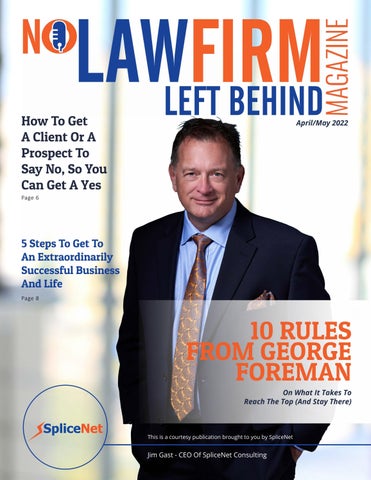
How To Get A Client Or A Prospect To Say No, So You Can Get A Yes
April/May 2022
Page 6
5 Steps To Get To An Extraordinarily Successful Business And Life Page 8
10 RULES FROM GEORGE FOREMAN On What It Takes To Reach The Top (And Stay There)
This is a courtesy publication brought to you by SpliceNet
Jim Gast - CEO Of SpliceNet Consulting
Contents
April/May 2022
3
16
Letter From The Editor
Screw SEO The Biggest Mistake On Your Website
5
19
Be Inspired
6
Hot Tech
20
How To Get A Client Or Prospect To Say No, So You Can Get To Yes
5 Free Ways To Get More Clients
8
If You're Selling Your Business, Which Employees Should You Tell?
5 Steps To Get To An Extraordinarily Successful Business And Life
12 10 Rules from George Foreman On What It Takes To Reach The Top (And Stay There)
2 WWW.SPLICE.NET
22
24 10 Reasons Why You Should Be Using Direct Mail Now
Letter from the Editor
Where Do You Go When You Have Questions About Building A Better Law Firm?
T
here’s a popular phrase in business: “If you’re not growing, you’re dying.” Many people, like business guru Tony Robbins and writer William S. Burroughs, have said it in different ways, but the truth remains the same: The minute your business stops growing is when it starts dying. That moment between life and death became viscerally clear for many law firms in the height of the COVID-19 pandemic. Firms were called on by clients to help them adjust and answer questions about the future. Some firms struggled to build and maintain virtual relationships with clients and employees — they didn’t have a plan, they faltered, and some closed their doors. Lawyers are seen as experts, thought-leaders, and doers. You are. That’s why you know that building trust with your clients is the key to your business. If you help them feel safe, secure, and prepared, they’ll stick around for decades. You get to know their families, you have dinner, you go to funerals. When people have questions about big decisions in business or life, they call a lawyer. But if you don’t have answers, can’t figure out how to get on the virtual call, or manage workflows with your team from afar, clients will walk away and find someone else who does it better. Clients look to you, but firms like yours need resources to look to when you have questions or when you need answers. During the pandemic, resources likes that didn’t exist for many of my clients. When I started SpliceNet in the early 1990s, I had a single law firm client who begged me to help him install Timeslips, a billing software designed for attorneys. I got him set up, and soon I had a line of law firms out the door that needed help. Law firms like yours helped me start my business, and today, after I’ve worked for 25 years with over 200 law firms, you continue to be the lifeblood of my work. So, when the pandemic hit and I saw
my clients struggling to adapt, I stepped in and founded No Law Firm Left Behind. Through livestreams, podcasts, and now this magazine, No Law Firm Left Behind reaches law firms wherever they are. As your business adapts during a post-COVID-19 world, think about how you’ll take advantage of some of the best aspects of remote work and apply them to your firm. You won’t stay out of the office forever; you may already be reading this in the leather chair of your quiet workspace. Perhaps this next phase of growth will bring you more flexibility, a greater understanding of client needs, and a fresh outlook on how technology and space impact your relationship with your clients and employees. In No Law Firm Left Behind, you’ll hear from business experts on topics that will keep the business of your law firm thriving: marketing and sales strategies, leadership advice from multimillionaires, and digital trends that will change the way you work for the better. Not only will you and your law firm not be left behind, but these resources will also slingshot you into next-level success and growth.
Jim Gast
Jim Gast CEO Of SpliceNet Consulting
WWW.SPLICE.NET | 3
FR EE
Web Class For Business Owners Who Want An Automatic & Profitable Way To Get New Customers, Clients, or Patients…
THE
WEBINAR MARKETING
MACHINE
Get Better Leads and More Clients In Just One Hour Per Month Go to: www.UltimateWebinarSystem.com
•
How to use webinars to get high-quality prospects who are ready, willing, and able to pay your fees, to schedule consultations with you. (Yes, that sounds like “hype,” but when you see the complete model, you’ll understand why it’s true.)
•
Why the old model of attracting clients is dead and what you need to do immediately instead. (This is mission-critical information, especially with what is happening right now.)
•
How using George Costanza’s marketing secret will leapfrog you over your competitors. (This principle is shockingly simple, but only the bravest of the brave will ever use it. See if that’s you when you tune in.)
•
The ONE THING that will make you the preeminent authority and go-to professional in your target market. (Do this, and you’ll immediately escape the commodity trap. Again, this is more important than ever for thriving now and in the future.)
•
The three biggest mistakes that kill webinar results and what to do instead. (Almost everyone makes these mistakes. Fix them, and the number of appointments you get will skyrocket.)
•
How “psychic selling” will increase the number of qualified prospects who schedule appointments with you. (This is the most controversial part of the training, but if you use it ethically, more people will say “yes” to you.) •
Plus so much more!
Reserve your spot now: www.ultimatewebinarsystem.com About Your Host: Dave Dee has been helping entrepreneurs sell more of their products and services for the past 25 years. Known as “The King Of One-To-Many Selling,” Dave is a master of showing business owners how to craft and deliver group presentations that convert. Tim Piccirillo, a marketing consultant says, “Your stuff as basically tripled my business and my income. Anyone not using your material should have their head examined.” During this one-of-a-kind web class, Dave will show you a new and unique way to attract a consistent, reliable, and predictable flow of new customers, clients, or patients every month like clockwork using webinars.
BE INSPIRED
“There are far better things ahead than any we leave behind.”
“The brave may not live forever — but the cautious do not live at all.” –Richard Branson
–C.S. Lewis
“If all you can do is crawl, start crawling.” –Rumi
“Whatever you do or dream you can do — begin it. Boldness has genius and power and magic in it.” “What is not started today is never finished tomorrow.” –Johann Wolfgang von Goethe
“When I dare to be powerful, to use my strength in the service of my vision, then it becomes less and less important whether I am afraid.”
“The difference between successful people and others is how long they spend time feeling sorry for themselves.” –Barbara Corcoran
“Whatever it is that you think you want to do, and whatever it is that you think stands between you and that, stop making excuses. You can do anything.” –Katia Beauchamp
–Audre Lorde
“I have always been delighted at the prospect of a new day, a fresh try, one more start, with perhaps a bit of magic waiting somewhere behind the morning.” –J.B. Priestly WWW.SPLICE.NET | 5
How To Get A Client Or Prospect To Say 'NO' So You Can Get To 'Yes!' By Chris Voss, CEO Of The Black Swan Group
D
oes yes really always mean yes? Absolutely not. When we say yes, we’re committing to something. And immediately after we’ve committed, we begin worrying about what we’ve just signed up for. This means that, at best, every yes is a conditional yes. And oftentimes, it’s even worse: a counterfeit yes that’s uttered simply to get the other side to shut up. Would it be ridiculous to find out that getting the other side to say no is actually what you should be gunning for when you sit down at the table?
The Beauty Of Saying No Whereas yes is a commitment, no is protection. There isn’t any shaky ground here, either. When we say no, we mean it. No is always no. Why not use these three ways to make no work for you? 1. To break an impasse 2. To get someone’s attention, especially if they’ve stopped responding to you 3. To help someone think clearly
6 WWW.SPLICE.NET
Getting someone to say no is easy. It’s one of the best communication skills you can possess. Just flip your yes-oriented questions into no-oriented questions. Instead of asking the maître d’, “Is it okay if we sit in the reserved section of the restaurant?” ask them, “Would it be horrible if we sat there?” Pretty much every yes-oriented question you ask can be flipped around by adding phrases like these to your statement: • Have you given up on ... ? • Is it ridiculous ... ? • Would it be horrible ... ? • Is it a bad idea ... ?
Have You Given Up On This Project? When you ask the other side whether they’ve given up on the project — or whatever the issue at hand might be — it triggers the safety of no. At the same time, it also taps into prospect theory, the Nobel Prize-winning concept that loss aversion drives action more than the desire for gain. Did you know people are twice as likely to take an action to avoid a loss than they are to accomplish a gain? Use this knowledge to your advantage. Our clients swear by this question. In fact, it’s one of the top email subject lines that produces results. There’s one caveat here: Make sure you’re ready for a quick answer and are prepared to deliver a “That’s Right” Summary™ before you move any further. Check out these scenarios and think about how you can apply them to your business negotiations.
Would It Be Ridiculous For You To Come Speak At The Negotiation Course I Teach At USC? I asked Jack Welch, the legendary CEO of General Electric (rest in peace), this question when I approached him cold at a book signing once. He stopped dead in his tracks and gave me his personal assistant’s contact information so we could try to make our calendars sync. Unfortunately, the timing didn’t work. But how many people can get digits like that? Think about how many questions someone like Jack Welch is asked every day, and how almost all of them are yes-oriented questions: Would you sign this autograph? Being able to say no and feel protected makes us more open to other ideas. I also got “Shark Tank’s” Robert Herjavec to buy tickets to The Black Swan Group’s one-day negotiation training master class using this same kind of question.
Would It Be Horrible If We Sat In This Section? One day, a couple of colleagues and I had just come out of a conference. We were a bit thirsty, so we headed into a restaurant in search of a happy hour cocktail — just one. There was a problem: There weren’t any seats at the bar. But there were seats in a roped-off section of the restaurant.
So, I asked the waitress the above question, and she told us that it would be perfectly fine to sit there as long as we were out by 6. We were, and I left her a great tip.
Is It A Bad Idea To Cut A Deal? One of our clients used this during a break in a recent training session to cut a deal back home. She left the room during the break and used it to suggest an alternative solution that her colleague had been resisting. His reply was straightforward: No, it wouldn’t be. And the deal was made.
The Power Of No-Oriented Questions I actually ask everyone who works with me to only use no-oriented questions™ with me late in the day. Science tells us we’re only capable of making a certain number of decisions every day, and by the end of the day, our brains start to wear out. This is why people like Mark Zuckerberg and Steve Jobs have been notorious for wearing the same thing every day. They’re not interested in burning up mental decision power on what shirt to wear when the decisions they make every day are worth millions of dollars. When someone asks me a Calibrated Question™ that begins with what or how and I’m fatigued, I likely won’t answer until the next day. If they give me a Is this a bad idea? type of question, I actually find myself quickly focusing — and even getting a little bit of energy — and being able to answer. Practice makes perfect. Use these communication skills in low-stakes scenarios, like the next time you’re checking out with a clerk or on the phone with your cable company. (Think: Would it be ridiculous for you to give a loyal customer like me the same deal you give new subscribers?) Is it a bad idea to leverage the natural human inclination to say no to get things done? Well, what do you think? n
Chris Voss is the CEO of The Black Swan Group, a firm that solves business negotiation problems with hostage negotiation strategies. Chris is also an Adjunct Professor at the University of Southern California (USC) Marshall School of Business and Georgetown University’s McDonough School of Business, where he teaches business negotiation in both MBA programs. Chris is the internationally acclaimed bestselling author of “Never Split The Difference.” Find out more at BlackSwanLTD.com WWW.SPLICE.NET | 7
SUCCESS FAC TORS
5 Steps To Building An
‘Extraordinarily’ Successful Business And Life “98% of America would rather be comfortable than be excellent; isn’t that sad?”
A
–Dr. Nido Qubein
mid a sea of sameness and ordinary, Dr. Nido Qubein, President of High Point University (HPU) gives the call to action: “Choose to be extraordinary.” Advocating this guiding principle to students and entrepreneurs, Dr. Qubein believes whether you have an ordinary life or an extraordinary one is a choice you make each day. Dr. Qubein exemplifies what it means to transcend the ordinary. He transformed HPU from a small mediocre college into an explosively growing, vibrant university, leading the pack in academic excellence, innovation, and creativity. No obstacle holds him back. During the Great Recession from 2007–2009, HPU experienced tremendous growth. Philanthropic investors generously and eagerly provided funding and resources, with gifts over $300 million. This wasn’t a stroke of luck, either. In
8 WWW.SPLICE.NET
2020, while navigating the pandemic amid one of the worst economic disruptions in history (college enrollment was down double digits nationwide), HPU had their largest enrollment ever and was up 6%. Being extraordinary isn’t just something Dr. Qubein preaches to others. It’s a decision he makes for himself every single day. And what an extraordinary life he’s led. After his father died when he was 6, he was raised by his single mother who had a fourth-grade education and “a degree in common sense.” When he was 17 years old, he came to the U.S. from Lebanon with $50 in his pocket and little command of the English language. He supported himself with numerous entrepreneurial endeavors while attending college. His business ventures include growing a bank and Fortune 500 companies, serving as chairman of an international consulting firm, and serving on and chairing boards of national companies. He’s authored a dozen books and delivered more than 7,500 speeches. As a philanthropist, he’s served as director or chairman of many organizations. His awards, accolades, and accomplishments are far too many to list. But he doesn’t strive for excellence and to be extraordinary for recognition or to impress anyone. “I want to be best in class, not because I want to prove anything, but because I want to lay my head on the pillow that day feeling I gave it my very best,” Dr. Qubein said.
Here are five ways to strive for excellence and choose to be extraordinary.
Think Vertically.
“Don’t you dare think horizontally,” Dr. Qubein says. “If you want to strive for excellence, at a minimum, you’ve got to think vertically.” Horizontal thinking, the way average people think, is when people don’t think about why something is the way it is. While touring the HPU campus, a horizontal thinker will observe, “Wow that’s so cool that they play classical music on the promenade.” Vertical thinkers demonstrate curiosity about why things exist. A vertical thinker would say, “I wonder why they play classical music?” Vertical thinking forces you to think beyond the surface, to dig deeper, and it helps you improve. To take it a step further, diagonal thinking is when you connect the dots in such a way that you truly understand why something works or is successful. Diagonal thinkers “know so much in-depth stuff that it makes this perfect jigsaw puzzle,” Dr. Qubein said. “That makes it hard for someone to imitate what you do.”
Don’t Seek Ideas; Seek Wisdom.
The biggest mistake anyone can make in today’s environment is to focus on gaining more knowledge. “If all you have is information, people will use you and discard you,” Dr. Qubein said. “If all you have is knowledge, people will only call upon you when they need you. But if you have wisdom, they will always respect you. And if they respect you, they’ll always do business with you.” At HPU, Dr. Qubein heavily promotes that every student has a success coach and a four-year development of Life Skills plan. “Knowledge does not equal understanding,” Dr. Qubein said. “The reason we all need to be coached, the reason we need heroes, role models, and mentors, is because we have to take knowledge — that is sometimes raw data — and turn it into understanding.” Whereas you gain knowledge and skills from a book, a speaker, or a bootcamp, using a system such as a mastermind helps you gain wisdom. “What you don’t get today, you get tomorrow,” Dr. Qubein explained. “It’s a continuum. It begins to penetrate your soul.”
children’s museum project. “This museum will serve as a beacon of hope for our city and for children to look forward to when we emerge from the pandemic.” Dr. Qubein stated. Dr. Qubein and his wife are the lead donors for the project, named the Nido and Mariana Qubein Children’s Museum in their honor. “What’s so special about you?” he asks. You must constantly ask the question and constantly be changing. “If you don’t do it fast enough, you become old,” Dr. Qubein said. “You start making excuses. You stop taking risks.”
Always Be Better Than You Were Last Year.
If, today, the thing you are selling is the latest, the finest, and the best, then tomorrow, it may not be because things are continually changing. Aiming to be the best in technology, Dr. Qubein spent $90 million on technology for the HPU campus. To stay ahead of other universities, he invests in new technology every year. “It’s a continuum,” Dr. Qubein explained. “I know I have to spend $5–$10 million every year, just to stay even. If you are just as good today as you were a year ago, you’re worse off. You must be better than you were a year ago, just to stay even. That’s the way the world really works.” That is also why, despite the threats posed by the COVID-19 pandemic, he pushed forward with a $170-million basketball arena and conference center. “This is unique,” Dr. Qubein said. “ I don’t know of another [university] that has a hotel and a conference center and a basketball arena all together in one building. The arena is set to open this year. Always better your best and you’ll never look back with regret.”
Ask Yourself Every Day, ‘What’s So Special About Me And My Company?’
Prompted by the fact that there are a million people in the world who can do your job, Dr. Qubein asks himself every day how he can be more extraordinary, inspiring, and caring in each area of his life. Last year, in an effort to spur the revitalization of downtown High Point, North Carolina, he forged ahead with the construction of a nearly 60,000-square-foot WWW.SPLICE.NET | 9
Develop A Growth Mindset.
Part of the HPU mission is that every student graduates with a growth and entrepreneurial mindset so they will have the confidence to overcome any obstacle and be willing to adapt. When schools started shutting down during the pandemic, HPU figured out how to overcome this challenge. Knowing students are educated best in the classroom with live faculty, HPU didn’t merely shut down and go online. They adapted by booking hotel rooms and put safety measures in place, such as changing the way their food operation worked to keep students safe. They prepared to quarantine and isolate students if they became sick. They built a new health services area and had separate entrances for people who thought they might be sick with COVID-19. There were challenges, but they persevered. Families responded positively and loved it. “This is a time for us to inform our clients, to involve our clients, to inspire our clients,” Dr. Qubein said. “But mostly, it’s a time to be agile, flexible, and resilient.” Extraordinary doesn’t just happen. You must be vigilant, be obsessed, and accept no excuses. You must relentlessly focus on being better and striving for excellence every day. You can’t think horizontally and expect to get the best the world has to offer. You must decide to think vertically, adapt, and continually seek to understand. You must control your mindset despite the obstacles in your way. Dr. Qubein says, “You must raise the standards and choose to be extraordinary.” n
Check out this invaluable advice from Dr. Qubein in this video clip from his interview with Robin Robins.
MSPSuccessMagazine.com/Nido
10 WWW.SPLICE.NET
If you are just as good today as you were a year ago, you’re worse off. You must be better than you were a year ago, just to stay even.
M A X I M I Z E RE L AT I O N S H I P S MAXIMIZE RETENTION MAXIMIZE REFERRALS M A X I M I Z E RE L AT I O N S H I P S MDon’t AXIMIZE R E T E N T I O N Miss M Out!A X I M I Z E Are you ready to take your marketing game to the next level and set your business up for long-term, sustainable growth? Are you interested in engaging your audience in a unique, personal way that will set you apart from the competition?
As a full-service content marketing company with over a decade of experience, we have had the opportunity to set thousands of businesses just like yours up for success. We have proven marketing strategies that can guarantee better retention rates, more referrals, and more reactivations for any business - and we are willing to share our expert knowledge with you for FREE.
REFERRALS Set your business up for success with an expert content marketing strategy…
Ready to get started?
Scan the QR Code
To download a FREE copy of “Your Guide to Building a WWW.SPLICE.NET Winning Content Marketing Strategy”
| 11
10 R
From
On What It
G
eorge Foreman, the second wealthiest boxer of all time, is a household name today, but he didn’t become one easily. To truly understand and appreciate his resilience, you must look back at his life and the obstacles he’s faced. The two-time heavyweight champion, Olympic gold medalist, record-busting salesman, author, and serial entrepreneur had a troubled youth in Texas. Foreman’s father abandoned him, his mother, and his six siblings when Foreman was only 5 years old. Often roaming the streets as a youth, he got into trouble and didn’t like school. Bigger and stronger than most kids his age, he got into fights, lived in abandoned houses, and robbed people. At 15, he dropped out of school. He was street smart, but he could barely read and write. After being chased by police, he awakened to the truth about the destructive path he was headed down. The next day he signed up for the Job Corps. “I’d heard a commercial with Jimmy Brown and Johnny Unitas,” Foreman said. “They were great football players, and they said, ‘If you’re looking for a second chance, join the Job Corps.’” There he learned bricklaying, forestry, and carpentry as well as how to read and write. He sent money to his mom each month to help support his family. He took up boxing as a challenge after listening on the radio to the heavyweight title match when Cassius Clay fought against Floyd Patterson. “I
12 WWW.SPLICE.NET
was always trying to be a tough guy and kept getting into fights,” Foreman said. “All the guys in the day room (at Job Corps) said, ‘George, you’re always picking on people, bullying people; if you’re so tough, why don’t you become a boxer?’” He moved to California, met a boxing coach for the first time, and started learning how to box at the gym. After a couple of weeks, the coach matched him up with a light heavyweight. “The guy was so skinny, and I told every friend I had to please come down and watch me,” Foreman said. Expecting to win, instead, he was humiliated and decided to quit boxing. “The kids at the gym just laughed me out,” Foreman said. A few weeks later, the trainer ran into Foreman on the street, asking him where he’d been. Not wanting to admit the real reason, he made up an excuse that he didn’t have shoes to box in. After the trainer gave him a pair of boxing shoes, Foreman had no more excuses and returned to the boxing gym. Only 20 months after his first boxing match, Foreman won a gold medal at the 1968 Olympic Games in Mexico City. He caused controversy among African American civil rights activists after winning when he waved an American flag around the ring. The activists saw this as a way of appeasing the oppressive, white-run society. Foreman told Ebony’s Hans Massaquoi, “I was so proud that I had won. I wanted the world to know that I was from America.” Hurt by the reaction, Foreman adopted a surly, tough-guy image and became known for his mean facial expressions, which made him unpopular and rejected by the public. Foreman fought
Rules
m George Foreman
t Takes To Reach The Top (And Stay There) his way through the ranks, and in January 1973, he became the heavyweight champion of the world when he knocked out the undefeated Smokin’ Joe Frazier in two rounds. In 1974, he experienced his most humiliating and famous fight. After a 19-month reign in which he was undefeated (40 and 0), he lost to Muhammad Ali in the eighth round of the fight known as the “Rumble in the Jungle.” “I lost the most wonderful position I’d had — the heavyweight title,” Foreman said. “I was devastated. I couldn’t live with myself, so I had to start fighting again to be a champion.” He fought his way back to the top and once again was a No. 1 contender. But then one night in 1977, after losing a 12-round brutal fight against Jimmy Young, Foreman experienced a profound religious experience and became a bornagain Christian. He retired from boxing as a changed man. He got rid of his luxury cars, several houses, and his pet tiger and lion and started living more of a “regular guy” lifestyle. He preached on street corners, co-founded a small church, and found–George ed the George Foreman Youth and Community Development Center in Houston with his brother, Reid. “For 10 years, I never even made a fist,” George said. “I became an evangelist with the church of the Lord Jesus Christ and never fought anybody.” But by 1987, because of a series of terrible investments and his former extravagant lifestyle, George was broke. Without enough funding, his youth center faced getting closed, so he made the difficult decision to come out of retirement. When he returned to boxing, reporters made disparaging remarks and accused him of staging a publicity stunt, partly because he’d become a pitchman for products to supplement his income. Despite looking out of shape and past his prime, he began beating younger, fitter boxers. He also displayed his new persona — a pleasant, likable guy with a sense of humor. After 24 wins, including 23
knockouts, he once again contended to regain the heavyweight title and was scheduled to fight Michael Moorer for the World Boxing Association (WBA) and International Boxing Federation (IBF) heavyweight titles. However, the fight almost didn’t take place because the WBA didn’t have Foreman ranked on its list of contenders and remained unwilling to sanction the bout. The promoters even canceled the fight. But Foreman took it to court and won. The presiding judge said the WBA acted “capriciously” in not sanctioning the fight, and as long as Foreman obtained medical clearance from Nevada doctors, he was eligible to fight for the WBA title. In 1994, George Foreman shocked the world when he became the oldest heavyweight champion, winning back his title after losing it to Muhammad Ali 20 years earlier. Foreman was 45 years old and spent most of the match getting beat by the 26-year-old, undefeated Michael Moorer, who had physicality and youthful energy on his Foreman side. But in the 10th round, Foreman used his power to knock out Moorer in one of the most memorable moments in sports history. Foreman defended his title three more times. Out of his 81 career fights, Foreman posted 76 wins and 68 knockouts. He’s been inducted into the World Boxing Hall of Fame and International Boxing Hall of Fame and is rated the eighth greatest boxer of all time. As a result of winning the heavyweight championship a second time, Foreman received countless endorsement offers and became a successful entrepreneur, building an empire outside of the ring. He became a brand ambassador for several multinational companies, including McDonald’s, Doritos, Nike, and KFC. He spent over a decade promoting Meineke Car Care Centers and grew the business to over 1,000 franchises. Considered one of the most successful pitchmen of all time, Foreman
"I think you have a major advantage when you start from the bottom because you have nowhere else to go but up. And I started from the bottom."
WWW.SPLICE.NET | 13
made a deal that solidified him as a household name outside of boxing. After Salton Inc. approached Foreman to sell their grill, he made a deal to put his name on it and become their spokesperson. The George Foreman Lean Mean Fat-Reducing Grilling Machine earned him 40% of sales and later, a staggering $138 million to buy the rights to use his name on the grill in perpetuity. Selling over 120 million units, 1 out of every 10 people in the U.S. owns his grill. Between royalties and the buyout, Foreman pocketed a minimum of $250 million from the grill, making it one of the most successful endorsement deals in sports history. In a private Technology Marketing Toolkit Producer’s Club Meeting, George Foreman shared his biggest lessons learned and how you can become more resilient in the face of adversity.
Look for the positive. Even in
#1
the lowest moments, there are advantages. Foreman looked at being at the bottom as an opportunity. “I think you have a major advantage when you start from the bottom because you have nowhere else to go but up,” Foreman said. “And I started from the bottom.”
Create guiding principles. Principles are the foun-
#2
dation of our beliefs and values and guide our actions. Foreman’s life changed positively when he found his principles one night after robbing someone. Being chased by the police and dogs, he climbed under a house where he covered himself from head to toe with sewage water from busted pipes under the house so the dogs couldn’t smell his scent. While hiding, he thought about a speech his mom had made about not having a thief in the family. “I was so scared,” Foreman recalled. “I realized for the first time I was a thief. I thought to myself if I can get from underneath this house and the police don’t grab me, I’m never going to steal anything from anyone again. After a while, the sirens passed, and I crawled from under that house and said, ‘That’s it.’ … I had been on the journey of my life, and I never stole anything again because I had something I’d never had before: principles. I had a badge of principles, and I knew if I could come from that bottom, I can make it all the way to the top.”
#3
Fight through the tough times. Real champions fight hardest
when faced with adversity, and they never give up. Foreman learned this lesson after returning to the gym following his first loss. This time, Foreman learned how to box extremely well, so his trainer entered him in the Golden Glove fight. When the bell rang in the second fight, his opponent, Winters, hit Foreman so hard that he went down and became dizzy enough that one woman appeared to look like eight women wearing the same outfit. As he heard the referee count down, one or two of the women would disappear with each count. “I remember there were only two left, so I thought I should get up before they all left,” Foreman said. “I jumped up, and I thought I’m going to put this boxing and bobbing and weaving down for a moment and just fight this guy … I turned into a windmill and the next thing you know, I won the boxing match. I learned that sometimes you just gotta fight. All the rules you’ve got to play 14 WWW.SPLICE.NET
with, and your skills are nothing. You’ve just got to come out and swing and fight.”
#4
Always stick to your convictions. Your convictions are
what matter to you the most and signify to the world what kind of person you are. When Foreman became a boxer the first time, he did it for glory and fame. Declaring his convictions changed his motivations and his life. After losing the fight against Jimmy Young, Foreman found himself in the fight of his life. In the dressing room, bleeding from his forehead, hands, and feet, Foreman began having a conversation with himself, justifying that he didn’t need to worry about the match. During his internal conversation, he reviewed all he had — a big television contract, a home, horses, a RollsRoyce, and all the money he needed. Telling himself he could retire, he heard an unexplained voice that said, “and die.” “After a while, death multiplied in my conversation,” Foreman recalled. “I realized I was about to die, and I didn’t know what to do … I was in this dark space. Over my head, under my feet, and around me, was absolutely nothing. If you multiply every sad thought you ever had in your life, that’s where I was in this dump yard of nothing. I got mad … I said, I don’t care if this is death, I still believe in God … that’s when someone grabbed me, a hand pulled me out of nothing. I was alive in that dressing room … and I wasn’t afraid anymore. I saw blood on my hand and my forehead, and I was screaming, ‘Jesus Christ is coming alive in me.’” Foreman quit boxing, became an ordained minister, and began sharing his experience. “The lesson I learned was conviction,” Foreman said. “You’ve got to believe in something. It doesn’t matter how powerful and wealthy you are if there’s no guide.”
Be humble. Foreman recalled being
overconfident when heading into his fight with Muhammad Ali. He’d expected to knock Ali out in one or two rounds and didn’t study Ali’s fighting strategies. He never looked at a newspaper or watched an interview that Ali did. If he had, he would have heard Ali explain exactly how he planned to beat Foreman and could have adjusted his own boxing strategy.
#5
#6
Give people something they want. Don’t be discouraged if
people don’t buy from you. Figure out what they want and give it to them. When George became an ordained minister, he began preaching on street corners at a friend’s suggestion. But nobody would stop to listen to him. “This broke my heart,” Foreman said. “After a while, I realized I’m going to make these people stop and pay attention to me.” He began telling his boxing story about beating Joe Frazier, which brought people in droves. “I learned how to sell myself on that street corner,” Foreman said. “You can’t be shy. You can’t let it break your heart, you just got to say the next one will stop. I found out it’s not easy to make someone stop on the street and listen to you unless you’ve got something for them, and I had something — that story.”
Be proud of yourself. Don’t
#7
let ego get in your way. Foreman learned not to shy away from his beliefs. If someone rejected him, he said a kind word. “I didn’t want anyone to know that George Foreman
was on the street corner preaching,” Foreman said. “I decided I’m going to be proud of this.”
Learn to sell.
When Foreman went back into boxing, he was getting a lot of criticism in the newspaper and on TV. Reporters were making jokes about his age and weight and talking badly about him. Foreman investigated buying newspaper ads to promote himself, but when he discovered a full-page ad in USA Today was almost $100,000, he decided he needed to learn to appreciate the criticism. “I learned to play with it,” Foreman said. “I’d talk my head off when I’d get on television. I learned to sell George Foreman, the boxer, and Madison Avenue started to pay attention.” Foreman did commercials for Pepsi-Cola, Doritos, hotels, Meineke, and so on. After selling a lot of products for other people, a friend suggested he get his own product to sell. This is how he came to partner with Salton, Inc. for the George Foreman grill. “We did an infomercial and talked about how it worked,” Foreman said. “I’d see people at the airport, and they’d yell, ‘We love you, George.’ … They loved the grill and it started to sell. I would mention it everywhere. I was a favorite of Jay Leno, David Letterman, and all those guys. They’d invite me over and want to make fun of the grill. I’d bring one over, and I’d cook on their show. It became the talk of the town because I sold it.”
#8
#9
Don’t destroy someone else to make yourself look better.
Foreman refuses to tear down another person. When shooting the first infomercial for the George Foreman grill, the script put down competing products. “I looked at the script and said, ‘Nah, I’m not going to do that,’” Foreman said. “I’m not going to tear up someone else’s product just to make mine good. We’re going to make it good.
We’re not going to destroy anything that someone else is working on to make my products the best. It’s got to be the best because it is. They took my advice and said, 'You were right,' and I said, ‘No, THAT is right.’”
Be kind.
Foreman was inspired to change to a likable person after observing how kind people were to him. “They didn’t care about money,” Foreman said. “They just liked me … and they treated me so nice. You don’t have to be the champion of the world. You don’t have to be rich or have a nice custom car. People are kind to you. I wish I would have known that when I was champion of the world; I would have treated people so much better.” Experience taught Foreman that people buy you, not your product or service. “It doesn’t matter what you have,” Foreman said. “People buy you. So don’t hurt anybody. Don’t disappoint everybody. If you meet that expectation of yourself, then they’ll buy your product because they feel like they’re buying you. Be the nicest human being in the world, not the second nicest. Find out who’s the nicest and see what he’s doing so you can ‘out nice’ him — and you can sell anything.” Foreman’s journey has taken him from poverty to being a multimillionaire to being broke and back to where he now has a $330 million net worth. He’s displayed courage and resilience and says without principles, fight, and conviction, “You’re not fit. No one is going to give you anything. I never let anything discourage me. As long as I had my principles, my fight, and my conviction, I can succeed.” His positive attitude and belief that the best is yet to come reminds him to be thankful and that bad times don’t last forever. “Every day I put my feet on the ground and be thankful for that day and happy I’m alive,” Foreman said. “Because there’s a possibility of me doing great things if I can just stay alive this day.” Check out this inspirational clip from Robin Robins' interview with George at one of our 2021 Producer’s Club meetings at MSPSuccessMagazine.com/george. n
#10
FREE REPORT REVEALS
How To Close More Sales In A Virtual Environment
Download your free copy of the most powerful, six-step Virtual Selling System that has generated millions of dollars in new business for attorneys, financial advisors, consultants, doctors, and other professionals who sell via consultations. It’s simple to use and will instantly increase your sales. Get instant access at:
www.davedee.com/report WWW.SPLICE.NET | 15
w e r c S
SEO By Mike Stodola
B
The Biggest Mistake On Your Website That’s Costing You Clients Now
Images
ack when I was a real estate agent, before you ever put a home on the market, you “staged” it. This basically consisted of decluttering, depersonalizing, and rearranging furniture to make the spaces appear larger and more open and finally getting rid of that floral print wallpaper in the bathroom. The point is that, before you started bringing prospective buyers through the home, you wanted the home to look its best. A few days of work and maybe a couple thousand dollars spent on paint, carpet cleaning, minor repairs, and a storage unit could yield 10 times that in return in the offers you received or be the difference between getting and offer or not. You get this. Heck, you’ve probably done this, and it makes good sense. What’s arguably as important as your home is your company’s website. It’s your “home” online. It’s the place you want prospective clients to see you, hopefully schedule an appointment, and hire you. But so many people worry more about getting more traffic, SEO, paid ads, website ranking, etc. that they ignore the first step: making sure their site is attractive to their ideal client! So, even if they get people to come to the site, it’s a mess or looks like every other site that’s out then and is generic and bland. Let’s look at the single quickest way to fix that and get you started down the right path. Are you ready? What I’m about to tell you is super easy to change, and I will even give you an exact formula you can use to fix things in about five minutes. When an ideal prospect comes to your website, they should immediately know that they are in the right place for you to help them.
16 WWW.SPLICE.NET
Videos
More
If I went to your website right now, just looking at the main page and without scrolling down, would I know the following three things:
WHAT Do You Do? WHO Do You Do It For? WHERE Do You Do It? Let me give you two examples. (I’ve excluded company info to protect the innocent.) I did a Google search for “small-business IT support near me” and clicked through some of the websites I found. Check Out This First One: When clicking on that page, I really don’t know what they do. Sure, I can read “Infrastructure – Network – Security – Automate – Cloud,” and if I were a contestant on the “$100,000 Pyramid” game show, this may be okay. But that’d be like someone coming into a home I’m trying to sell to them and me saying, “Rooms, appliances, stairs, space.” Not exactly compelling. Furthermore, to even get to the fine print, I’ve got to get past the headline: “We are passionate about delivering on our promises.” Well, I should hope so. You mean if you promise something to me, you’ll actually deliver on it?! If we put them through the three-question test, how do they do? Do we instantly know what they do? Nope. Do we instantly know who they do it for? Nope. Do we instantly know where they do it? Nope. I think we can do better. Let’s Look At Example Two: Same search as before — vast difference. I’ve again excluded the header and the company info, but this all
showed up without me needing to scroll down. Do we instantly know what they do? “Managed IT Services” Do we instantly know who they do it for? “Servicing Nashville Businesses” Do we instantly know where they do it? “Nashville” Now, in all honesty, I think this site could use a little bit of a cosmetic makeover, but I’ll take CLEAR over CLEVER any day of the week. Furthermore, they go on to hit on a
pain point many people have with their current “IT guy.” Here’s Another Great Example: They are even MORE specific on WHO they do business with “NYC Law Firms.” If you were the office manager for a law firm tasked with finding an IT company and hit this page, you’d know you found a real option.
The Simple Headline Formula: We help (WHO) in (WHERE) with all of their (WHAT).
Example: We help manufacturers in Dallas/Fort Worth with all of their IT, tech, and ERP needs.
If You Really Want To Get Advanced, Do A Slight Add-On: We help (WHO) in (WHERE) with all of their (WHAT), so that you can (2–3 things they hate dealing with).
Example: We help manufacturers in
Dallas/Fort Worth with all of their IT, tech, and ERP needs so that you can eliminate downtime, streamline siloed systems that don’t communicate, and avoid ever needing to worry about “tech” again. I know this is a big departure from headlines like “Cloud, Infrastructure,
Expertise,” but that’s the point! Make sure your headline can answer those three questions, and you’re in good shape. “What? What’s that, you say?” I think I heard someone saying, “But I have multiple markets and serve multiple types of clients, so how do I do this?” Easy! If you have multiple markets or multiple niches, just make a different page for each. I made this same mistake when I first got into real estate before the marketing gods bestowed their wisdom on me. In fact, I remember being proud of my very first ad headline that encompassed EVERYONE. Ready to be amazed? “Helping everyone in Chicagoland from first-time buyers to seasoned real estate investors.”
This ad (that I prepaid for 24 months) generated a grand total of ZERO inquires … ZERO leads … ZERO anything. I guess less than zero, really, because I spent thousands on it. Within a short period of time, I had a lot of websites, marketing materials, reports, etc. with headlines like “Helping Libertyville’s Heritage Area Home Owners Sell Fast.” I also had “The First-Time Buyer Specialist For Mundelein” and “Gurnee” and “Grayslake” and many others. It was rinse and repeat. I even targeted “Buffalo Grove Homeowners Who Back To High-Tension Lines Sell For Top Dollar!” I “specialized” in 47 different things and had webpages (not whole sites, just a page on my site) that targeted each one specifically. And you can do the same. As a bonus, having multiple pages, each with a different location or market segment, will also help your SEO and attract more people to your page, and that’s really what you were trying to do in the first place. Not sure? Google “Washington, D.C., IT support” and see who comes up first after ads. For the last several months (and maybe longer), it’s been this site: Intelice.com/washington-dc-it-support. Notice it’s NOT Intelice.com.
Intelice.com is their general site, so it doesn’t rank anywhere when I look for “Washington, D.C., IT support.” Looking for IT services in Columbia, Maryland? Then you’re likely to find Intelice.com/managed-it-services-columbia. They have several other areas they service, all with similar webpages that you’ll be directed to in a search. So that’s it. Change your website headline using the formula I shared to answer the three questions: What, Who, and Where. Then, for extra credit, build other pages to increase your SEO juice and attract the right people. Until next time! n Mike Stodola is the Chief Marketing Officer at Technology Marketing Toolkit, where he brings his passion for marketing and sales to its members and customers. Mike founded, grew, and sold two of his own service businesses outside of Chicago before seeking to take his experience to thousands of other entrepreneurs by working with companies that focus on them. In his free time, you’ll probably find him eating his way through his new home of Nashville and posting photos of his food journey on Instagram.
Get A Daily Shot Of Sales Boosting Advice The only daily email that makes sales training entertaining. Sell more and have more fun…for free. Try it here:
Bam! That should be golden, as there are about 10 million people in “Chicagoland,” and I had just announced I could help them all!
www.salesespresso.com WWW.SPLICE.NET | 17
HAVE A LAUGH
18 WWW.SPLICE.NET
HOT HOT TECH TECH TOOLS TOOLS
Top Tech Tips To Help Prove Your Value We're a few months into 2022, which means it's time to check in on how much you've stuck to your New Year's resolutions. If one of your resolutions for 2022 is to demonstrate increased value to your clients (and we’re sure it must be), we’ve gathered our top five suggestions for how you can hit the ground running.
Help Your Clients Transition To A Hybrid Work Environment.
1
Organizations are desperately looking to their MSP to help them transition to a hybrid environment. According to a McKinsey survey, 9 in 10 organizations plan on combining remote and on-site work going forward. Different clients will have different expectations of what a hybrid work model looks like, which is why it is important you consult with each client to develop a common understanding and regularly assess any changes.
2
Dust Off Your Clients’ BCDR Plans.
3
It is crucial to regularly update your clients’ business continuity and disaster recovery (BCDR) plans, especially for customers who have adjusted their data protection strategies to accommodate the new hybrid work environment of 2022. Share user-friendly “runbooks” with clients that include procedures and protocols for departments, teams, and individuals that need to be followed during a disaster.
Backup Is One Thing; Restoration Is Everything. According to Kaseya’s MSP Benchmark Survey, fewer MSPs are testing their disaster recovery programs weekly or monthly. More are relying on annual testing when compared to the previous year — 30% in 2020 versus 17% in 2019. This is a disaster waiting to happen. Use your sandbox to test disaster recovery (DR): Partition client virtual machines and perform tests without affecting production servers. This assures clients that their hybrid workforce can access systems (either on-premises or in the cloud) and everyone, including remote employees, can access data in case an actual disaster occurs.
4
5
Select The Right BCDR Partner. Look for unified BCDR solutions that are hardened against malware and use artificial intelligence (AI) and machine learning to detect suspicious patterns and alert administrators to ransomware before it wreaks havoc. Solutions with anti-phishing defense capabilities empower end users and provide another layer of protection from credential compromise, ensuring that phishing attacks are stopped before an account takeover occurs.
Be Prepared. Schedule A Technology Alignment Review TODAY For This Summer. Pre-schedule alignment reviews and be sure there’s a calendar invite sent promptly that includes the technical point of contact. Set an agenda for the review and include a pre-review and post-review check with a point of contact to begin and end the proactive engagement. Make your presence known: If you’re on-site, take a little bit of time to talk with end users. If you’re remote, use Slack, Microsoft Teams, or email to notify end users about the review and offer technical tips and tricks.
WWW.SPLICE.NET | 19
5
FREE Ways To Get More Clients By Mike Michalowicz
On the day I launched my first book, “The Toilet Paper Entrepreneur,” no one bought it — not even my own mother. Feeling defeated, I had two choices: Learn how to market effectively or abandon my dream. I knew it was a good book. I knew it could help other entrepreneurs succeed. This led me to an epiphany that has resonated with me every day for my entire career: I have a responsibility to market. The lack of good, effective marketing is the reason for small-business mediocrity and stunted growth. It cannot be overstated enough: You have a responsibility to market effectively. It’s that simple. You became a business owner because you saw the impact you could have on the world with your offering, and you thought it could serve better than the rest. With the numerous responsibilities that come with business ownership, your main focus should land on marketing your offering in a way that makes you shine among your competition so you can serve your community of customers. It’s natural for fear and adversity to arise when running a business. It’s a strange time, to say the least. The idea of getting back to “normal” is obscure for some. Others may realize that “normal” wasn’t that great. Added to that, many of us are wondering what’s going to happen next in the current economy, which leads to trepidation when developing business strategies. The one strategy that is paramount to the survival of your business is in marketing. There will always be a reason (I like to call these excuses) not to market. You may think now isn’t the time. Perhaps you’re revamping your product. Maybe you’re an introvert. Maybe a health crisis, politics, or social justice issues are creating a sensitive time in the world (in which case, yes, time your messaging accordingly). Whatever the reason, you must find a way to get over the fear of failure and market your offering so it cuts through the static and gets noticed. Your business and your livelihood, and those of your family and employees, depend on it. Mike mi-KAL-o-wits is the author of “Profit First,” “Clockwork,” “Surge,” “The Pumpkin Plan,” and his newest release “Fix This Next.” By his 35th birthday, Mike had founded and sold two companies — one to private equity and another to a Fortune 500. Today he is running his third multi-million dollar venture, Profit First Professionals. Mike is a former small-business columnist for The Wall Street Journal and the former business makeover specialist on MSNBC. Over the years, Mike has traveled the globe speaking with thousands of entrepreneurs and is here today to share the best of what he has learned.
1
Reimagine Your Business Is it pivoting right for you? We know the pandemic changed the way many small businesses survive. We never heard the word “pivot” so much since Ross tried to get a couch up the stairs with Chandler and Rachel on “Friends.” When COVID-19 resulted in global shutdowns, small-business owners, especially those with storefronts, were left with two options: Wait it out and hope for better days, or create better days. If you want to create better days (because I know you’re not going to just sit there, right?), you need to reimagine your business. You’ll have to reassess your offers, how you market, what your customer base is, and what those customers need from you now. As business owners, we need to recognize that sometimes, no amount of marketing is enough. Your business should always be evolving because the rest of the world is. But is pivoting your offering right for you? Chapter 10 of “Get Different” provides you with a blueprint to reimagine your business for emergencies and for plain old revamps. Don’t worry, you won’t have to start from scratch. Here are a few simple steps to start: Look at what you already have in place, know your customer profile that you’re offering to, and know if your product truly solves the problem or serves the needs your prospective customers have. Jacob Limmer of Cottonwood Coffee found that pivoting his business was the only thing that was going to save it. When the shutdown occurred, people weren’t exactly running out to their local coffee shops. Most storefront owners were forced to temporarily close, which left them wondering, “What do we do now? And for how long? Is this the end of my business?” What did people need in that moment of a global health crisis that Jacob could provide? He decided to send a survey out to his mailing list. The survey said Cottonwood knew it must serve their customers in a new way and asked what would be the most beneficial thing Cottonwood could do for them. The resounding answer was “Immunity.” The Immune Booster Cold Brew was born. Infused with high quality D3, customers could still enjoy their coffee ritual while getting the added benefit of a healthy supplement. Online sales of the brew soared, and customers saw that Cottonwood cared enough about them to create something new that they needed. As for Limmer, he says, “I feel more in control of my business than I ever have before. I know now that I don’t have to sacrifice my life for my business ever again. I can adapt to whatever happens and whatever I will need by reimagining it.” Isn’t that what we all want?
2
Differentiate And Get Uncomfortable Because Very Little Is Created Via Comfort Zones Let’s cut to the chase. Do not rely on word of mouth for marketing. That’s just lazy. By doing that, you are forgoing your marketing methods
and leaving it in the hands of people who have no skin in your game. Don’t cross your fingers and hope people hear about you. Marketing is one of the things in your business you can actually control. If you want to get noticed and get results in a crowded market, follow the DAD methodology in “Get Different.” Based on years of marketing research and experiments, “Get Different” contains a blueprint for engaging and converting your prospects into leads. DAD stands for Differentiate, Attract, and Direct. The first step, differentiate, is quite literal. To stand out in the constant hum of marketing, you must get different. You must identify a marketing approach intrinsic to you that stands out in a sea of sameness. What will make your prospect’s minds stop and pay attention? How can you engage them during the marketing milliseconds? What is your “est”? Are you the smartest or the funniest? How is your business the best? Use that quality in your marketing to stand out among the others. Now, I’m not saying dress up in tight, shiny clothes and create a book release video (like we did), but you can use your unique qualities, the ones authentic to who you are and what your service offers, to market the heck out of your product. Get creative, or no one is going to see you. Don’t be afraid to stand out. It’s not natural for everyone, and you may have to leave your ego at the door and take a risk — one that will be worth it. “Different isn’t doing more of what everyone else does, it’s doing more of what you do.” –Mike Michalowicz
3
Attract For Engagement You have their attention. Now what? Next, ensure that your approach will appeal to the people you want to serve, not turn them off. How will you establish your marketing as an opportunity they will consider instead of a threat they will avoid? Attraction is what holds that attention you garnered from being different. You can show a shiny object and get attention, but that’s not the same as attracting, at least not successfully. Successful attraction engages your prospects for the long term. After years of research, I can say that gimmicks and talking without doing the walk will only work for the short term. How will you keep customers engaged in your marketing? The biggest component of attracting your customers is to establish attraction influencers. (No, not social
media influencers, though there’s a similar idea here.) Attraction influencers are the key attributes your business needs to attract and influence your audience for the long term. Authority: First, you want to be sure your customers see you as the authority in your niche. This increases their trust in you because they see you as the expert who can serve them best. And, it’s human nature for people to want to be associated with the top dog. Trust: Speaking of trust, if you are already a trusted source in your field, people will have established confidence in you. Repetition: Here is an interesting fact: The more something is repeated, the more likely it will ring true for people. So if you know your offering is life-changing, yell it from the rooftops over and over. Social Significance: Even the most humble people want to feel they’re doing something important to serve their community (business or otherwise). Some prospects will be attracted to the idea of being elevated through association with you and/or your service. Alignment: Alignment validates us. When we relate to something, we are more likely to want to stay connected in that space. Letting your customers know your priorities are aligned with theirs creates familiarity and comfort.
4
Direct Toward Your Call To Arms Your strategy must compel your ideal prospects to take a specific action you desire. Now that you have the prospect’s attention and they are engaged, you need to tell them what the heck to do. Marketing guru Jeff Walker says that marketing is every step you take to get the customer to the buying decision, and the sale is the final action on their decision to buy. So your clear, singular directive should get them to the next step. With every marketing offer, provide very clear, concise, and short directions. If the directions are too wordy or involved, you’re going to lose that prospective client. The easier the better — it ensures you will get more responses. Be someone your prospects aspire to. If they see you as an authority in your field, they are more likely to take your directive. Similarly, if you’re seen as an equal, or a
peer, they will trust you. But, if they see you or your product as inferior, well, go back to Step 1.
5
Nurturing Is Marketing It may seem inauthentic, but it’s true. No one wants to be sold to in every email they receive from you or every social media post that pops up on their feed. Customers need to know you get them. They also like a window into the day in the life of you. When you nurture your audience and customers, you’re letting them know you’re on their level and that you can connect with them when they need you. Nurture techniques are also a great way to measure your progress. Sending out a survey to your customers is an excellent resource to find out what your customers need and if what you’ve been providing them actually serves them. Be ready for feedback and to find a way to combine the overarching message in your offering so you can serve them better than anyone else can. Remember, if you mirror your competition, you are doing the one thing that guarantees invisibility. A prospective customer or client’s first impression of you is your marketing. Is yours easy to ignore, or does it send the message that you care about getting your service to them to help with their pain points and get them what they need? Does it tell them exactly what to do after you grab their attention? We have an innate fear of standing out. And that is what you need to overcome. That’s the adversity in marketing. Please don’t fear adversity. Adversity fosters growth and draws out our strengths. We become more adaptable, a survival skill every business requires. Reimagining your business will feel daunting, maybe even risky. But you didn’t come this far to only go this far. Once you start thinking outside of the box, you will be more equipped to manage the detours the world chucks at your business because you will have practiced and succeeded at getting different. Oh, and that first book I mentioned? I didn’t slump into defeat and walk away from my dreams. I marketed it like never before by following these steps. I ended up selling every copy. And then I sold 100,000 more. The world needs you. Market accordingly. You’ve got this. n WWW.SPLICE.NET | 21
If You’re S e l l i n g Your Com p a n y Which Em , ployees S
By John Ra t
liff
22 WWW.SPLICE.NET
hould You
g Tell?
O
nce upon a time, I helped a good friend through a transaction to sell his closely held public company to a larger S&P 500 size public company. We involved the traditional group of employees you would expect: CFO, COO, and CMO. About two-thirds of the way through the process, it became clear that the CFO would not have an ongoing role after the transaction. Despite the fact that he was up for a sizable bonus to get the transaction done, he put his own interests ahead of the company and tried to scuttle the deal. He then put together an alternative bidder group to try and buy the company. Totally distracted and at odds with his future, he both overtly and indirectly caused major problems. In the end, he held the transaction up by at least six months, added multiple millions in legal fees and other expenses, and was subsequently terminated and received nothing for his efforts. It was a miracle the deal ever got done! So here’s the lesson: Once you’ve decided to go through the process of bringing your company to market, it’s common to wonder who, if anyone, should know within the business. How you handle this communication challenge is critically important because if done incorrectly, it can create massive problems and wreck value. It’s critical that anyone on your team who will be involved in the process in any way has a stake in the outcome. It doesn’t have to be a major stake, but it’s a terrible idea to go to your senior team and say, “Hey, we’re going to take this asset that we’ve all built together to market and sell it. You’re going to help me with the process, and I’m going to make a bunch of money and not share any of that with you.” Even if you’re not comfortable committing to a dollar amount, it’s perfectly acceptable just to let the small group know that they’ll be taken care of to some extent. So how many people should you tell? The short answer is as few as absolutely neces-
sary. When you go to market and you’re working with your exit team and interacting with multiple buyers, it is a huge distraction. Your senior team needs to pick up the slack created by your lack of focus on the business and ensure that productivity and profitability don’t fall off. The process of selling your business takes longer than many people expect. That last thing you want is to get deep into negotiations and have the buyer find out that your numbers declined the last quarter. That decrease can dramatically affect your valuation as well as the confidence the buyer has going forward. It can even, in some cases, kill a deal. Chances are it was due to the fact that your senior team didn’t have their collective eye on the ball. That buyer will have zero pity for you and certainly won’t accept the excuse that the only reason for the dip was because of the pending sale. It’s also important to acknowledge the fact that human beings are wired to jump to conclusions. So, when you say that you’re going to sell the company, your employees immediately assume that means they’ll lose their jobs. They have little faith that the new buyers are going to want to retain them, or they may be concerned about whether their current position will still exist when ownership changes hands. Often times, you’ll start to lose some of your “A” players while you’re in the process simply because they’re afraid. If the buyer gets wind of the mass exodus of critical talent, that can blow up a deal. You also can, unfortunately, give employees a little too much leverage to put their interests ahead of yours, whether overtly or subconsciously. Outside of work, I don’t recommend telling your friends or your extended family. You probably need to tell your spouse or partner because it’s an emotional process, and they’ll likely know that something is weighing on you. But you want to keep a possible sale as confidential as possible because there’s a good chance you go through the process but decide not to exit for one of several possible reasons. Treat the sale of your company as a highly confidential, delicate negotiation that could be impacted by many different issues and do all you can to minimize the likelihood of those issues — employees and confidentiality being huge ones! If you want to learn more about getting ready to exit, please visit Align5.com. n
John Ratliff is a serial entrepreneur with over 25 years of experience. He is currently the founder of align5, a strategic consultancy based out of a professional clubhouse (alignSpace) in West Chester, Pennsylvania. John co-founded align5 in 2013 to advise growthcompany entrepreneurs and family enterprises on a variety of strategic issues, including sell-side and buy-side M&A. WWW.SPLICE.NET | 23
MARKETING INSIGHTS
10
Reasons Why You Should Be Using Direct Mail Now
In 1923, advertising pioneer Claude Hopkins wrote the perennial bestseller “Scientific Advertising,” putting forth the radical concept that advertising should be measured and evaluated with facts, mathematics, and reason over emotion and opinions. This is the very foundation of all the marketing and sales strategies I teach: The ultimate measure of success for any campaign is based on sales generated and the ROI, not on fans, followers, likes, hashtags, SEO rankings, clicks, or what is cheap and easy. I always have been, and will continue to be, media-agnostic and believe you actually need a combination of both online and offline strategies to get the highest and best response and results. So, when I start talking about direct mail, I know a lot of ears flop over. It doesn’t work in my area, with my clients. It’s too expensive. It’s too slow, too difficult. But if you’re a serious student and a “scientific” advertiser, you’d be foolish to not incorporate it into your marketing arsenal. Here are 10 reasons why.
1.
Direct mail is the only opt-OUT media. This is a very important point, given that most MSPs do not have a good list of qualified prospects when they first seek out our advice on marketing. Unlike email and text messages, you can freely and legally mail someone until they tell you to stop. Yes, many of you ignore this and spam people anyway, but that rarely leads to happy, productive new clients, and it usually does more damage than good. In addition to this, most people aren’t as grumpy about getting an advertiser’s postcard or letter as they are about getting a text message or email that’s trying to sell them something when they haven’t given direct permission.
2.
You can direct 100% of your efforts and marketing dollars to only the prospects you truly want to get access to. When I send a letter, I can decide in advance who I want as a client, then send a message directly to them. If I run a radio ad, invest in SEO, pay-per-click, trade shows, or generic social media advertising (not custom audiences), I cannot always control who sees my message; therefore, a lot of my advertising dollars are wasted on people who are not qualified.
24 WWW.SPLICE.NET
3.
Getting someone’s accurate mailing address is far easier than getting their email address. Yes, privacy is dead and there are countless nefarious ways to get someone’s personal email and cellphone number. But most companies have their mailing address directly displayed on their websites, making it easy to find.
4.
Studies from the Direct Marketing Institute and the Direct Mail Association all point to direct mail delivering more qualified leads and higher ROI than digital lead generation marketing. I believe that’s for a few reasons. First, anyone doing direct mail consistently is paying far more attention to copy, offers, and list segmentation because of the cost. For this reason, direct mail marketers are far more careful about what they put in the mail than what they put in an email. Second, it’s more “difficult” to respond to direct mail than it is to click on a link. Because of that, the person tends to be a more serious buyer. Yes, you may get fewer leads, but those you get will be more qualified, allowing you to avoid the work of sifting and sorting through a bunch of semi- to nonqualified leads to find the one that is good.
5.
Direct mail lives on far longer than email or other digital campaigns. It’s very common for a prospect to tell me they kept one of my mail pieces on their desk for a few months (even years!) before they called. This is also a common situation for my MSP clients who send out the unusual direct mail campaigns I give them in our toolkit (ToolkitLive.com). I have not had that happen with an email or a Facebook post.
6.
Direct mail is more memorable and has a greater impact than digital marketing. Online media is overwhelming, from a dumpster-size load of emails to thousands of sites, apps, and communications. Standing out in all of that digital noise causes it to be extremely difficult to make an impression. However, if I mail you a letter with a real dollar bill stapled to the top (one of our control pieces) or some other “lumpy” or “object” mail, like a rubber duck in a box (another one of our campaigns for selling cybersecurity), you’ll take note and remember it. If you then follow up with a phone call, the person is far more likely to recall the “duck in a box” you sent when your sales rep calls. They most likely will not remember an email or LinkedIn message you sent, even if the message and offer is exactly the same.
7.
You can reach nearly 100% of your audience with direct mail. When selling IT services, most MSPs will tell you their sweet-spot client is a CEO of a successful, profitable company with 20 or more employees; they can afford IT services and have enough employees that professional IT is a necessity. Those CEOs tend to skew older (45-plus years old) and are not as technologically savvy as the younger CEOs. These CEOs are not always glued to Facebook and LinkedIn, and many don’t use any type of social media at all (the marketing team of their company might, but they don’t have personal accounts they actively use). Even in our company, where our audience is very technologically savvy, we can only match 65% of our clients to Facebook and 87% to LinkedIn. Therefore, if I only used social media, I’d be missing out on a big chunk of our potential market that is not actively on those sites.
8.
Direct mail is a more trusted media. I don’t need to tell you how most people are suspicious of emails coming from people they don’t know. Many are hesitant to respond to or click on an email from someone they don’t know. (Yes, clearly not enough or you all wouldn’t exist!) However, if someone takes time to mail a letter, prospects are far more likely to trust them to be an honest, real company instead of a hacker.
9.
Direct mail is a way to build your email list. I often hear people saying they don’t use direct mail because they use email. But the question is this: How do you get someone to be on your email list (legitimately) if they have not subscribed or opted in? If you don’t have permission to email or text someone, using direct mail can help you build that permission-based list, as will other offline marketing campaigns, such as trade shows, canvassing, networking events, telemarketing, etc.
10.
It’s a way to stay in touch with prospects and clients who have opted out of your email list. The majority of messages sent via email are blocked, bounced, or ignored (unopened). A 20% open rate is considered a success — but that means 80% of the people you emailed never saw your communication. Over time, you will have clients and prospects opt out of your email broadcasts, so how do you communicate with them then? Direct mail has a higher delivery rate than email. Think about that for a minute. Yes, email is faster. Yes, email is cheaper, and you can measure it. But if only 20% of your list is getting the message, you have to send out five times the total number to get the same message delivery as direct mail. Here's the point: I recently consulted with a client who is getting poor and rapidly declining response rates from his email marketing campaigns. He wanted me to give him some ideas for changing his approach so he could get the response (appointments, leads) he wanted. I offered a few suggestions and recommended that he incorporate direct mail and telemarketing to the mix to reach the unresponsive prospects on the list and/ or those who opted out. He said, “I can’t. It’s too expensive.” I asked him what he was comparing that too. He replied, “Well, to sending out emails.” My response was simple. I asked him if he meant the email that was failing to produce any results? I sent him packing with this advice: 1) Learn to think in terms of ROI, not just the expense or cost. There are hundreds of companies that use direct mail very successfully, including many of the MSPs in our community. Of course, as with any media, you have to do it right to make it work, but it absolutely can deliver a fantastic ROI. 2) If it truly is too expensive (and I doubt it if you’re selling IT services), find a way to make the economics work by raising your rates, offering an “A/B” option with “B” being a higher-priced, more profitable option (usually 10%–20% will take that option if packed and presented properly), or implementing upsells and making every client worth more by selling additional services (cross-selling). If restaurants with tiny margins and small, single sales can make direct mail deliver an ROI, an IT services company should be able to do it all day long. ■
WWW.SPLICE.NET | 25
Customer Retention Guide Unlock the Secrets to Building Strong and Prosperous Relationships With Your Clients
Did you know that it costs 5 times more to attract a new customer than to retain an old one? it’s estimated that an increase in customer retention of just 5% can result in a profit increase of between 25 and 95%!
Just think of what that kind of increase could mean for your business… it can be hard to know where to start when it comes to improving customer loyalty. We can help. Newsletter Pro has proven marketing strategies that can guarantee better retention rates, more referrals, and more reactivations for any business and we are willing to share our expert knowledge with you for FREE!
Scan the QR Code to download a FREE copy of our “Retention Guide” today
Scan Now to Download!
88%
of SMBs are vulnerable to a payments data breach. With Secure Payments by ConnectBooster, you proactively reduce your customers' risk while simultaneously building new revenue streams.
Learn more at www.connectbooster.com/securepayments 26 WWW.SPLICE.NET
No Law Firm Left Behind Podcast Live on LinkedIn, YouTube and Facebook Available on Apple Podcast, Spotify, iHeart Radio, Pandora and more Every Tuesday 10:30am EST
April
Upcoming Guests Include 3/1
Damon Hacker, Post-Data Breach Expert
3/8
Sasha Naiman, Exec. Dir, Northern Kentucky Children’s Law Center
3/15
Christa Carter, Dir of Marketing, Strauss Troy
3/22
Mike Brown, 5 Marketing Secrets Your Competition Ignores
3/29
Dimity Orlet, Exec. Dir, Pro Seniors
4/5
Peggy Gruenke, Founder CPN Legal
4/12
David Lefton, OSBA President
4/19
Robert Ziegler, NKBA President
4/26
Brian Redden, COO/Shareholder, BHMK
Coming In May Influential Women In Legal 5/3
Coming In June In-House Law Firm IT Pros
5/10 5/17
Deifilia Diaz, Co-Owner, Law Offices of Valencia and Diaz Claire Parsons, Partner/Owner, Adams Law Erin Rhinehart, Co-Managing Partner, Faruki WWW.SPLICE.NET
| 27
Call us
513.252.0212
99% of our Law Firm customers experience 100% up-time Your Law Firm applications AND computer systems
WILL WORK BETTER than ever.
200+ Law Firms over 25 years trust SpliceNet Consulting because we are the
MOST EXPERIENCED LAW PRACTICE PROFESSIONALS around. We know and support NetDocuments, Cosmolex, Centerbase, Time Matters, PCLaw, Amicus Attorney, Timeslips, Clio, eDocs, iManage, Worldox, LegalFiles, BestCase and many more.
Managed IT Support Managed IT services encompass operational, technical, and staff management aspects. It provides less reactive service delivery and focuses more on delivering value to internal and external customers.
IT Consulting Microsoft 365 Migrations, Server upgrades, Cloud Migrations and more, SpliceNet Consulting will deliver your IT Project on time and without downtime or surprises.
28 WWW.SPLICE.NET
info@splice.net
Cybersecurity Don't assume your law firm is not a target for a cyberattack. SpliceNet Protects You Against Ransomware, Spyware, Viruses and Other Cyber Threats
VoIP Phones Save money, fire the phone company and see what a VoIP phone system can do to help your firm work from anywhere.
www.splice.net/contact