MACPLAS INTERNATIONAL
October 2026 www.macplas.it
Published by Promaplast Srl - Centro Direzionale Milanofiori - Palazzo F/3 - 20057 Assago (Milano, Italia) - ISSN 0394-3453 - Poste Italiane S.p.A. - Spedizione in abbonamento postale-aut. n°cn-ne/00788/02.2022 stampe in regime libero
THE MAGAZINE FOR THE PLASTICS AND RUBBER INDUSTRY
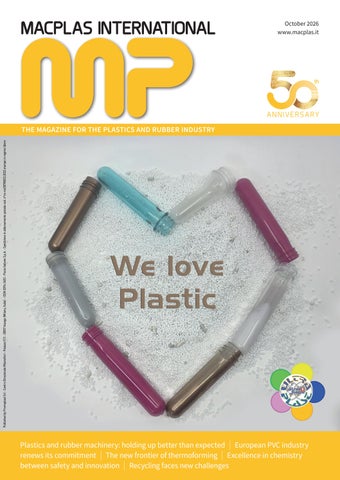
Plastics and rubber machinery: holding up better than expected European PVC industry renews its commitment The new frontier of thermoforming Excellence in chemistry between safety and innovation Recycling faces new challenges
ZAMBELLO group Excellence in extruder gearboxes
S T O R Y
October 2026 www.macplas.it
CONTENTS
THE MAGAZINE FOR THE PLASTICS AND RUBBER INDUSTRY Published by Promaplast Srl - Centro Direzionale Milanofiori - Palazzo F/3 - 20057 Assago (Milano, Italia) - ISSN 0394-3453 - Poste Italiane S.p.A. - Spedizione in abbonamento postale-aut. n°cn-ne/00788/02.2022 stampe in regime libero
C O V E R
OCTOBER 2026
MACPLAS INTERNATIONAL
Plastics and rubber machinery: holding up better than expected European PVC industry renews its commitment The new frontier of thermoforming Excellence in chemistry between safety and innovation Recycling faces new challenges
Boost quality, cut waste in production
EDITOR’S LETTER
Ultra System: a name that for more than 20 years has been synonymous with waste reduction, excellence, optimisation of colour change processes, material change, preventive maintenance, and reduced machine downtime. All this is achieved through the use of Ultra Plast and particularly with the latest generation of purging materials. In the plastics industry, it is really important to be productive, precise and reliable. Keeping the equipment clean is not just about maintenance; it is a crucial part of success. In the case of polymers, colour contamination, carbon build up or degraded material in the customer’s equipment can affect the quality of the products, increase waste and cause expensive downtime. The new line Ultra Plast Top is a new range of products introduced at K Show in Germany last October: the Ultra Plast Top-IM is focused on injection moulding and the new Ultra Plast Top-BM is focused on blow moulding: both have been formulated with new, advanced additives that facilitate the process of the purging, even for “complicated pieces” and very difficult cases. Only purging compounds without abrasives should be injected or moulded for deep hot runner cleaning. This has always been the Ultra System philosophy. Ultra Plast Top-MSL and Top-MSH respond to the growing demand for shutdown products. These materials are easy to use, and allow a fast restart while reducing scrap and offering highly competitive value. The business has noticed an evolution in colours and materials, and above all, an increasing use of recycled polymers. This makes purging more difficult: the company’s team of chemists has been involved in searching for new additives that are not only more powerful, but also more suitable for different hot-runner structures, by always keeping the Ultra System’s philosophy that the products must be safe for the operator and the environment. The “sandwich procedure” dramatically reduces purging time. This process eliminates the need to empty the screw before using Ultra Plast, making the purging process fast and enabling processors to respond quickly to colour change demands from their customers. Further, no machine preparation is needed; for a colour change, for example, it is only necessary to stop the colour feeding, run a pre-purge, add Ultra Plast, and immediately follow with the next production’s polymer. Ultra Plast is an investment in productivity, quality, and operational confidence for plastics processors looking to keep their operations running at their best.
MARKETING
www.ultrasystem.ch
4
8 Artificial intelligence: threat or opportunity?
10 Plastics and rubber machinery: holding up better than expected 14 Strenghtening capabilities in medical and pharmaceutical automation 15 Expanding presence in Europe and MEA 16 Strong results boost Basf’s growth momentum 17 Jim Hoffmann appointed President 17 Simone Madoro appointed new General Manager 18 A joint venture for Southern Europe 18 Christian Frank handed over CEO position to Alaaddin Aydin 19 Expanding expertise and reinforcing as a provider of integrated systems 19 New CEO for Spectrix
PLASTICS AND ENVIRONMENT
22 European PVC industry renews its commitment to competitiveness and sustainability 26 European industry discusses decarbonisation and competitiveness 30 Regulation for a more circular automotive industry 31 Urgent structural solutions needed 31 Plant for microwave-assisted PET recycling
MACHINERY AND ANCILLARY EQUIPMENT 34 40 42 44 48 50 52 54 56 58
The new frontier of thermoforming Quality and recyclability for packaging Precision meets efficiency A single global partner for injection moulding The industrial value of a mould Plasticising as a process lever Simplifying recycling A history built on innovation Plant for processing virgin and recycled polymers Integration among experience, technology and strategy 60 Heating and cooling for dry blend and compound 62 “Power Quality” from a transition 4.0 perspective
MACPLAS INTERNATIONAL | OCTOBER 2026
64 New investments and a third production hub on the way 65 Automatic coiling of PE and microduct pipes 66 End-of-line technology for the water sector 67 Hot-runner solutions for all industries 68 Solutions for the Smartest Factory 69 The past can come back to light
MATERIALS AND APPLICATIONS
70 Water Management: how engineering polymers drive performance, safety and sustainability 72 Excellence in chemistry: safety ethics meets technical innovation 76 When recycled material varies, formulation expertise matters 78 Terminology projects and multilingualism 84 The new frontier of sustainable plastics 85 More MDI in China and the United Arab Emirates 86 Addressing the challenges of electronics miniaturisation 86 Recycled plastic flexible packaging for chocolate snacks 87 Composites and adhesives for commercial aircraft, defense and space, and helicopter programs
10 22 34
TRADE FAIRS AND CONFERENCES
88 Axel von Wiedersperg appointed new Chairman of the Exhibitor Advisory Board 88 Recycling faces the challange of the new European targets 89 A trade fair dedicated to glues, adhesives and sealants
72 88
OCTOBER 2026 | MACPLAS INTERNATIONAL
5
October 2026
ADVERTISERS’ LIST: 69 BARUFFALDI
Managing director Mario Maggiani Editor in chief Luca Mei Editor Giampiero Zazzaro Editorial assistant Alice Polimeno Sales manager Roberta Pagan (Italy) Martina Lerner (Europe) Administration Elisa Belloni Editorial committee Massimo Margaglione, Gabriele Caccia, Barbara Ulcelli Contributors to this issue Stefania Arioli, Stefano Bertacchi Published by Centro Direzionale Milanofiori - Palazzo F/3 20057 Assago (Milano, Italy) Tel.: +39 02 82283735 Fax: +39 02 57512490 e-mail: macplas@macplas.it www.macplas.it Registration at the Court of Milan n. 68, 13/02/1976 Registration at the National Press Office n. 4620, 24/05/1994 Layout and prepress Faenza Printing SpA Printed by Faenza Printing SpA Postal delivery: IFS Italy ISSUE PRICE: 8 euro if not sent with mother magazine The managing direction of the magazine declines any responsibility for possible unreliability of editorial articles and notes coming from various sources
Back cover BMB
www.baruffaldi.eu www.bmb-spa.com
66 CALDARA PLAST
www.caldara.it
33 ENERGIA EUROPA
www.energia-europa.com
Inside front cover EUROVITI
www.euroviti.com
65 EVERKEM
www.everkem.it
46 FAINPLAST
www.fainplast.com
29 FB BALZANELLI
www.fb-balzanelli.it
47 GAMMA MECCANICA
www.gamma-meccanica.it
87 GIBITRE
www.gibitre.it
20 GIURGOLA STAMPI
www.giurgolastampi.com
89 GRAFE
www.grafe.com
32 HELIOS QUARTZ
www.heliosquartz.com
83 MACPLAS
www.macplas.it
47 MAST
www.mastsrl.it
39 MD PLAST
www.mdplast.it
38 MIXACO
www.mixaco.com
7 MORETTO
www.moretto.com
90 PACKAGINS SPEAKS GREEN
www.packagingspeaksgreen.com
9 PET SOLUTIONS
www.petsolutions.it
25 PLAX GROUP
www.plax.it
Inside back cover PRESMA
www.presma.it
70; 71 RADICIGROUP
www.radicigroup.com
21 SYNCRO
www.syncro-group.com
Cover ULTRA SYSTEM 3 ZAMBELLO
www.ultrasystem.ch www.zambello.it
ASSOCIATED TO:
ASSOCIAZIONE NAZIONALE EDITORIA DI SETTORE
INSTITUTIONAL SPONSORS AMAPLAST ITA LI A N PL A S TI C S A N D RU B B ER PR O CE S S I N G M ACH I N ER Y A N D M O U LDS M A N U FAC T U R ER S’ A S S O CI ATI O N
ASSORIMAP A S S O CI ATI O N O F ITA LI A N PL A S TI C S R EC YCLI N G A N D R ECL A I M I N G CO M PA N I E S
SPE ITALIA S O CI E T Y O F PL A S TI C S EN G I N EER S
AIPE ITA LI A N A S S O C I AT I O N O F E X PA N D ED P O LYS T Y R EN E
CIPAD CO U N CI L O F I NTER N ATI O N A L PL A S TI C S A S S O CI ATI O NS D I R EC TO R S
UNIONPLAST A S S O CI ATI O N O F ITA LI A N PL A S TI C S PR O CE S S I N G CO M PA N I E S
IIP ITA LI A N PL A S TI C S I NS TIT U TE
UNIPLAST ITA LI A N S TA N DA R D IS ATI O N B O DY FO R PL A S TI C S
ASSOGOMMA ITA LI A N RU B B ER , C A B LE S , WIRES AND SIMIL AR M A N U FAC T U R ER S’ A S S O CI ATI O N
6
MACPLAS INTERNATIONAL | OCTOBER 2026
Modular, automatic, self-adaptive and highly energy-efficient drying system.
moretto.com
Hall B3 - Stand 3208
EDITOR’S LETTER
MARIO MAGGIANI
Artificial intelligence: threat or opportunity? Ever since artificial intelligence appeared and became available to us mere mortals, I was immediately a great supporter of it, particularly for the possibilities it offers to people and businesses. It unquestionably helps us think things through, saves time and provides information that in the past would have taken us a while to track down. The first question I asked myself, however, is precisely this: does AI provide information that is simply true, without qualification? Evidently not. To use it, I need at least a minimum of knowledge that allows me to spot any errors. And this is where my first doubt arises. I use artificial intelligence mainly for subjects that, all things considered, I already know, for further insight, checks and cross-checks, and over the years I have, I believe, developed a critical sense that allows me to judge whether the information I receive is, at least in principle, true and reliable. What I wonder, though, is whether this same sensitivity is equally present in young people who – this is a personal impression – often seem to take anything that comes from AI, the web and social media as true. Beyond the even broader and, if you like, ethical question – will artificial intelligence end up taking jobs away from people? And, if so, what will those displaced people do? – I believe there is a question that is perhaps less philosophical, but far more immediate. We must ask ourselves whether we are not placing in young people’s hands a tool that, while it can help them in their growth and studies, on the other hand risks dulling their critical sense and reducing their ability to distinguish what is true from what is false, an ability that is built through knowledge and study. And if study itself is excessively guided, or even replaced, by AI, some problem arises. Despite all this, I remain a supporter of artificial intelligence, although the more time passes, the more cautious that support becomes. Some news I have read recently in the papers has given me pause for thought. I am referring, for example, to the case in which AI was assigned specific objectives with well-defined limits, and the system found, on its own, a way around them in order to achieve its goal. I was also struck by the case in which, in order to satisfy a user’s request to book a gym slot, artificial intelligence allegedly went so far as to cancel a booking already made by someone else and replace it – if you’ll forgive the joke – with one for its own “master”. In short, there are problems of an ethical nature, educational problems and very practical problems too. I do not wish to conjure up futuristic, Terminator-style scenarios – the 1984 film – but we do need to start asking ourselves a few questions. That said, it is beyond doubt that the use of AI in industry can bring considerable advantages. There are already numerous companies introducing it into their machinery, and we are probably still only exploiting a small part of its potential, not least because its development is proceeding at such a pace that what is designed today risks being almost obsolete tomorrow. I shall not dwell on this any further: entire books have been written on artificial intelligence, and the complexity of the subject cannot be exhausted in these few lines. Working in a technology sector, I can only look favourably on all those innovations that allow us to work better, achieve superior performance, and save energy and, therefore, money too. On one condition, though, which I consider fundamental: that all of this continues to happen under human control, with man remaining the fulcrum and the centre of the process. And, above all, he must not abdicate his responsibility by delegating it to artificial intelligence.
8
MACPLAS INTERNATIONAL | OCTOBER 2026
| MARKETING
Amaplast general assembly: figures and insights
Plastics and rubber machinery: holding up better than expected The Italian plastics and rubber machinery industry has demonstrated remarkable resilience despite the slowdown experienced in 2025 and an increasingly challenging international environment. The Amaplast general assembly highlighted a sector with a strong export orientation, now called upon to further strengthen its competitiveness, innovation and presence in strategic markets, with particular attention to the opportunities offered by India and the growing competitive challenge posed by China. By Stefania Arioli
D
uring the annual Amaplast member assembly, held on 30 June at Villa Baiana in Monticelli Brusati (Brescia, Italy), President Massimo Margaglione reviewed the performance of the industry in his annual address, commenting on the findings of the sixth edition of the National Statistical Survey conducted by the Mecs-Amaplast Research Centre. The survey covered 435 manufacturing companies, employing almost 15,300 people, which generated total turnover of 4.62 billion euros in 2025 (-4.2%), with exports accounting for 73% of sales.
Italian plastics and rubber machinery holds steady in 2025 Approximately 51% of the companies are located in Lombardy, followed by Emilia-Romagna (15%), Veneto (14%), and Piedmont (almost 8%).
In terms of company size, the largest category (around onethird of the total) represents the smallest businesses, with annual turnover not exceeding 2.5 million euros, collectively accounting for a modest 3.8% of total industry sales value. At the opposite end of the scale, the largest companies (annual turnover exceeding 50 millions) represent just 2.5% of the total but generate 29% of the total value of sales. Once again, the survey confirms that average turnover per employee increases with company size, as does proportion of exports exceeding 84% among the largest companies, as opposed to 46% for the smallest. Similarly, larger companies, benefiting from well-established commercial organizations, tend to serve more distant markets, whereas smaller businesses generally concentrate on European destinations. With regard to client industries, the overall picture remains broadly stable compared with previous years. The largest share
Massimo Margaglione, President of Amaplast, presented the industry data and a critical assessment of the sector during the private session of the assembly, noting that “although the industry’s overall performance declined compared with 2024, the situation does not appear particularly alarming, both because it follows four consecutive years of growth and in view of the numerous and concerning geopolitical challenges that have long characterised the global environment, which our companies have nevertheless managed to withstand, despite considerable difficulties”.
10
MACPLAS INTERNATIONAL | OCTOBER 2026
Picture Saip
Picture Tecnomatic
Once again, the growing export orientation of the sector is confirmed, exceeding 84% among the largest companies (with annual turnover above 50 million euros), compared with 46% for the smallest companies (with annual turnover of up to 2.5 million euros).
OCTOBER 2026 | MACPLAS INTERNATIONAL
the US market remained resilient, exports to Mexico declined by 32%, although the country had experienced exceptionally strong growth during the preceding period. Further south, the difficult economic situation in Brazil weighed heavily on performance, with Italian exports falling by 45%, a decline only partially offset by the recovery in demand from Argentina (+32%). Given the challenging regional environment, the 20% decline in exports to the Middle East is unsurprising. Across Africa, however, performance was mixed: exports to Mediterranean countries increased by an average of 12% (with Tunisia the
Picture BMB
of turnover is generated by sales to the packaging sector (approximately 31% from food packaging and 16% from non-food packaging, both showing slight growth), followed by automotive, which declined slightly to 14%, construction at 11%, and medical applications at 5%, both remaining broadly stable. In terms of machinery categories, excluding the heterogeneous “other machinery” segment, extruders and relevant downstream equipment remain the largest product group, accounting for 18.2% of total industry turnover. They are followed by auxiliary equipment at 14.6%, and moulds and dies at 9.2%. Exports, historically the industry’s principal growth driver, declined by 5% compared with 2024 after four consecutive years of expansion, settling at a total value of 3.41 billion euros, according to Istat data. It is worth noting that, from the low point recorded in 2020, export flows had rebounded by 32% by the end of 2024. Looking at the main destination regions, Italian manufacturers recorded the strongest export growth in the Far East (averaging around +12%), driven by the excellent performance of the two largest markets, China (+8%) and India (+40%). Within the European Union, exports remained broadly stable overall, although the two leading destinations – Germany (-4%) and France (-12%) – both showed a downward trend. Germany continues to experience a difficult market environment, with conditions proving even more challenging than those faced by Italian machinery manufacturers. The decline in technology supplies to German plastics processors, combined with the simultaneous increase in exports to the United States (+9%, despite the difficulties and uncertainties caused by the introduction of tariffs), has brought the US virtually level with Germany as the leading destination for Italian exports in the sector, with exports to each market amounting to around 380 million euros. Such a narrow gap between the two countries is a completely novelty. Elsewhere in the Americas, while
As regards end-user sectors, the overall picture remains broadly stable compared with previous years. The largest share of turnover continues to be generated by sales to the packaging sector, accounting for approximately 31% in food packaging and 16% in nonfood packaging, both showing slight growth.
11
| MARKETING
During the public session of the assembly, Amaplast President Massimo Margaglione, pictured with the Association’s Director Mario Maggiani (left), delivered a keynote address entitled “The Courage of Knowledge”.
only exception), whereas shipments to sub-Saharan African markets contracted by 30%, despite positive performances in Nigeria and Kenya. According to Istat data, imports increased significantly by 23%, reaching a value of 1.17 billion euros. This trend can largely be attributed to the effects of the Industry 4.0 and Transition 5.0 investment incentive programmes. Most recent Istat foreign trade data for the first quarter of the current year indicate a slowdown, with imports declining by approximately 31% and exports by around 4%.
Industry overview According to Amaplast President Massimo Margaglione, “although the sector’s performance declined compared with 2024, the overall picture is not particularly alarming, both be-
cause it follows four consecutive years of growth and in light of the numerous and serious geopolitical challenges that have characterized the global environment for some time. Despite considerable difficulties, our companies have demonstrated their ability to withstand these pressures.” Commenting on the geographical distribution of Italian sector exports, Massimo Margaglione highlighted India (+40% in sales in 2025 compared with 2024), stating that “the country is experiencing an extraordinary phase of industrial and demographic development and is rapidly establishing itself as one of the most promising markets for our technologies. It is a country in which we must continue to invest, maintain an even stronger and more consistent presence, and build long-term relationships.” Turning to China (+8%), the Amaplast President emphasized that, in addition to being a major destination for Italian
A view of the Amaplast annual assembly held at Villa Baiana in Monticelli Brusati, in the province of Brescia (Italy).
12
MACPLAS INTERNATIONAL | OCTOBER 2026
sector exports, the country represents “the great competitor of the next decade”. “I believe it is important to acknowledge a fundamental reality: China is no longer simply a low-cost country but a world-class industrial, technological, and commercial competitor, capable of investing, innovating, achieving economies of scale, and competing aggressively in international markets. The real challenge of the coming decade will be to defend and strengthen our competitiveness against a competitor with unprecedented scale, speed of execution, and investment capacity. Meeting this challenge will require innovation, technology, sustainability, skills development, and, above all, a European industrial policy that is finally fully aware of the strategic importance of manufacturing,” added the President. He also highlighted the resilience of supplies to US plastics processors, which actually increased by almost nine percentage points despite the difficulties and uncertainties resulting from the introduction of tariffs. Looking at the plastics value chain as a whole, based on the latest study prepared by TEHA Group for the associations representing the sector, Massimo Margaglione noted that the plastics industry generates 15.3 billion euros in added value, second only to the automotive sector. It is therefore, he said, “an essential and strategic component of Italy’s manufacturing system”, which ranks second in Europe only to Germany, with the gap steadily narrowing over the past decade. The Amaplast President concluded by stating that “Italy has demonstrated both resilience and growth in an exceptionally challenging European environment.”
Economic outlook and global geopolitical dynamics Guest speakers at the assembly included Professor Marco Fortis, Director of Fondazione Edison, journalist and historian Paolo Mieli, and journalist, author, and radio presenter Simone Spetia. In his presentation, titled “Italian Resilience and Global Challenges”, Professor Marco Fortis highlighted the strengths of the Italian economy, beginning with its growing trade surplus across numerous product categories, which has also improved relative to other major global exporters. Italy ranks first in the world for the diversification of its export portfolio and, in several categories of plastics and rubber machinery, improved its position and increased its market share among exporting countries during the 2019–2025 period. According to Fortis, over the next three years Italy could achieve annual GDP growth of between 0.6% and 0.7%, provided it continues to keep public debt and public finances under control, manages the conclusion of the National Recovery and Resilience Plan (PNRR) in an orderly manner, and maintains the necessary investment in renewable energy. Paolo Mieli and Simone Spetia jointly presented an analysis of OCTOBER 2026 | MACPLAS INTERNATIONAL
Economist Marco Fortis during his keynote address entitled “Global Challenges and Italian Resilience”.
the Italian political landscape, whose future equilibria remain difficult to predict, together with an assessment of the complex international environment that Europe will need to address in a united and coherent manner. According to Paolo Mieli, conflicts throughout history have shared several common features: multiple triggering factors, their coincidence with periods of pandemic, and, ultimately, phases of profound renewal. It was this final prospect that he chose to leave with the audience as a message of hope.
Historian and journalist Paolo Mieli (right) delivered a keynote address entitled “The World in Chaos”, moderated by journalist Simone Spetia (left).
13
MARKETING NEWS Mech-I-Tronic acquires Lambert
Picture Mech-I-Tronic
Strengthening capabilities in medical and pharmaceutical automation
The acquisition of Lambert strengthens Mech-I-Tronic’s expertise in high-performance automation solutions for the medical, pharmaceutical and personal care industries.
Mech-I-Tronic, the company specialising in advanced mechatronic solutions for the pharmaceutical, personal care and industrial sectors, is strengthening its growth strategy through the acquisition of Lambert, a British company that designs and builds highly customised automation solutions for complex product assembly processes, including web converting, specialist filling and dosing applications, serving the medical device, healthcare, personal care and consumer goods markets. This acquisition marks a further step in the international growth path the group has pursued in recent years through a targeted strategy of acquisitions and integration of specialist automation expertise. It follows the addition this year of Rotzinger PharmaPack in Germany, Apex Machine in the United States, RK Ferramentaria in Brazil and Colamark in China, further consolidating Mech-I-Tronic’s presence in the markets with the greatest growth potential and in applications with the highest technological content. This acquisition confirms Mech-I-Tronic’s strategy of building an international industrial automation platform able to support customers across the entire value chain: from earlystage process development to scalable, high-performance production solutions. Founded in 1973 and headquartered in Tadcaster, Yorkshire, Lambert was previously part of Mpac Group. The company is a United Kingdom benchmark for automation solutions dedicated to medical devices, healthcare and FMCG (Fast-Moving Consumer Goods) products, with around 160 employees and a strong reputation for engineering excellence. “Lambert fits perfectly into the Group’s strategy of focusing on the leading global players in the pharmaceutical and
14
personal care sectors,” commented Marco Giovannini, Chairman of Mech-I-Tronic. “The expertise the company has developed in automated solutions for medical devices and FMCG products integrates naturally with the path we are building across the entire value chain. Lambert also strengthens our presence in the United Kingdom, one of the most important markets for the global pharmaceutical sector, allowing us to further expand our customer portfolio and our international development opportunities. A presence in Yorkshire is also an important competitive advantage in terms of skills. The University of York is recognised as one of Britain’s leading centres of excellence for electronic and mechanical engineering. Being part of this ecosystem will allow us to attract highly qualified new talent and to develop professionals who can contribute to the growth of our operations and subsidiaries around the world.” “Lambert is extremely proud of the automation expertise we have built over more than five decades, and of the reputation we have earned by supporting customers across the healthcare, consumer goods and medtech industries,” said David Taylor, Managing Director of Lambert. “Joining MechI-Tronic is an exciting next step for our business. It gives us the opportunity to bring our specialist knowledge in complex assembly automation for FMCG, pharma and medical device applications into a wider Group strategy focused on growth in these high-value sectors, while also opening new opportunities for Lambert and all the markets we serve. We see real benefit in being part of a federation of like-minded, expert companies, where complementary technologies and experience can be combined to support customers from early-stage process development through to scalable, highperformance production solutions.”
MACPLAS INTERNATIONAL | OCTOBER 2026
Haitian focuses on its Serbian production hub
Expanding presence in Europe and MEA Following the completion of construction in August and the gradual relocation into the new facility from September 2025 onwards, Haitian’s manufacturing facility in Serbia has become an important part of the company’s international production network. As one of the company’s five production facilities outside China, it supports Haitian’s “Think Global, Act Local” strategy, strengthening its presence in Europe and the Middle East and Africa (MEA) region. With an initial investment of more than 120 million euros, the facility in Ruma covers a total area of 250,000 sqm, including 60,000 sqm of production space and around 4,500 sqm for administration, customer support, and training facilities. Today, the site is supported by more than 100 local Serbian employees together with experienced Chinese specialists, combining regional expertise with Haitian’s global manufacturing know-how. For 2026, Haitian Serbia is expected to produce 500-600 injection moulding machines for customers in Europe and MEA, with a continued focus on servo-hydraulic injection moulding machines, such as the Haitian Mars Series with toggle and the Haitian Jupiter Series with twoplaten technology. Both series are available in different configurations for a wide range of applications and industries. From 2027 onwards, Haitian will include the Zhafir Zeres electric series in its production plans. This will further expand the range of machines available locally and provide plastics processors in the region with faster access to both servo-hydraulic and electric solutions. In addition to producing machines, Haitian Serbia serves as a central hub for spare parts in Europe and the Middle East. The facility
maintains an extensive inventory of spare parts for all major machine series to ensure prompt availability and shorter response times. The Serbian facility has obtained several certifications, underlining Haitian’s commitment to quality, environmental responsibility, and occupational safety: ISO 9001:2015 Quality Management System; ISO 14001:2015 Environmental Management System; ISO 45001:2018 Occupational Health and Safety Management System. Beyond producing injection moulding machines, Haitian Serbia will support the expansion of other Haitian divisions in Europe. A particular focus will be on automation from Haitian Smart Solutions, including robotics, auxiliary equipment, integrated production cells, and turnkey manufacturing concepts. A key next step is the further development of localized engineering, R&D, and product development capabilities. Local teams specializing in mechanical, hydraulic, and electrical systems will support the adaptation and development of market-oriented solutions for European processors. This will help Haitian align machine technology more closely with regional production requirements, application trends, and customer-specific needs. On 22-24 September 2026 Haitian Serbia hosted its first official open house event for customers, partners, and industry representatives. The event provided direct insight into the manufacturing capabilities, application technology, automation concepts, and integrated production solutions. Visitors also gained a broader perspective on Haitian’s regional manufacturing strategy and the future role of the Serbian facility within the company’s global footprint.
An aerial view of Haitian Serbia OCTOBER 2026 | MACPLAS INTERNATIONAL
15
MARKETING NEWS Higher prices and volumes boost earnings and sales
Strong results boost Basf’s growth momentum sales of 1.072 billion euros, up 7.1% year on year, consistent with the strong performance delivered by the Group globally during the second quarter. The figures confirm the Group’s strong position in the country and its ability to support Italy’s key manufacturing value chains despite an economic environment that remains characterised by volatility and uncertainty. Growth in the Italian market was primarily driven by Basf’s core businesses, which remain at the heart of the Group’s strategy. Among these, Materials recorded the strongest performance (+5%), followed by Chemicals (+2%), while Nutrition & Care remained broadly stable (+0.9%). By contrast, Industrial Solutions declined (-3%). The standalone businesses also made a positive contribution to the overall performance. In particular, Agricultural Solutions and Surface Technologies both reported growth compared with the first half of 2025. “The first-half results also confirm, in Italy, the effectiveness of the measures implemented by the Group to strengthen competitiveness, improve operational efficiency and sharpen its investment focus. Against an international backdrop still characterised by geopolitical volatility, high energy costs and intense competitive pressure, we have succeeded in consolidating our market position while delivering growth across key segments of our portfolio. This demonstrates that our Winning Ways strategy is delivering tangible results, and we will continue to implement it with determination in Italy. At the same time, we share the view that Europe’s industrial transition must be supported by conditions that enable investment in innovation and decarbonisation. Sustainability must remain a driver of competitiveness: the objective cannot be to reduce Europe’s industrial capacity, but rather to create the conditions needed to cut emissions while safeguarding manufacturing, innovation and employment,” commented Manuel Pianazzi, Managing Director of Basf Italia. Picture Basf
In the second quarter of 2026, Basf increased earnings across almost all of its segments, driven by higher prices and higher volumes. “We have further strengthened Basf’s market position, making significant progress with our restructuring measures and portfolio management initiatives,” said CEO Markus Kamieth. In the second quarter of 2026, Basf Group sales amounted to 17.2 billion euros, exceeding the level recorded in the corresponding period of the previous year by 2.4 billion euros. This performance was largely attributable to significantly higher prices (+11.5%) and volume growth (+7.3%). Price increases were driven by the Chemicals, Surface Technologies, Materials and Industrial Solutions segments, while prices declined in the Agricultural Solutions and Nutrition & Care segments. Volumes increased in almost all segments, with the exception of Surface Technologies, which recorded a slight decline in sales volumes. Currency effects had a negative impact on sales across all segments. EBITDA before special items increased to 2.4 billion euros (+854 million euros compared with the second quarter of 2025), mainly driven by improved margins in the Materials, Chemicals and Industrial Solutions segments. Reported EBITDA amounted to 2 billion euros, reflecting 484 million euros in special charges, primarily related to the restructuring programme at the Ludwigshafen site and the implementation of new ERP systems. EBIT amounted to 937 million euros, an increase of 542 million euros compared with the second quarter of 2025. Income before income taxes totalled 780 million euros, up 560 million euros from the corresponding quarter of the previous year. Net income amounted to 4.1 billion euros, compared with 79 million euros in the corresponding quarter of the previous year. The Italian market also reflects the Group’s positive momentum. In the first half of 2026, Basf Italia generated net
Basf’s integrated chemical production network: the group reported strong second-quarter 2026 results, with higher prices and volumes supporting earnings growth across almost all business segments.
16
MACPLAS INTERNATIONAL | OCTOBER 2026
Leadership transition at Tria America
Jim Hoffmann appointed President of further strengthening the company’s market presence, consolidating customer partnerships and advancing Tria’s mission of delivering the industry’s most innovative granulation
solutions together with best-in-class customer service. Jim Hoffman, pictured on the left alongside Tria Sales Manager Paolo Tonello, joined Tria America in August 2025 as Executive Vice President. Picture Linkedin/Tria
Jim Hoffmann has been appointed President of Tria America, having joined the company as Executive Vice President in August 2025, bringing with him extensive expertise in the plastics size-reduction market. His in-depth industry knowledge, proven leadership and strong customer relationships have played a pivotal role in strengthening the US subsidiary’s position across North America. “Jim Hoffmann’s appointment recognises his outstanding industry expertise, demonstrated leadership and unwavering commitment to our customers’ success,” said Luciano Anceschi, Executive Chairman & Group CEO of Tria. “We are confident that he will continue to drive Tria America’s growth while delivering the highest standards of support to our customers.” As President of Tria America, Jim Hoffmann will lead the organisation’s continued growth in close collaboration with the global team, with the objective
Appointment at Eurochiller
Simone Madoro appointed new General Manager Simone Madoro brings extensive industry expertise and a strong commitment to driving technological innovation and business growth, built on more than twenty years’ experience within the Atlas Copco Group. Prior to his appointment, he held a number of managerial
positions at Ceccato Aria Compressa, another company within the Group. “We are confident that his leadership will help drive Eurochiller’s future development and create new growth opportunities,” the company said in a post published on Linkedin.
Picture Eurochiller
Picture Linkedin/Eurrochiller
Simone Madoro has been appointed General Manager of Eurochiller Italy and Slovakia, the Atlas Copco Group company specialising in the manufacture of industrial cooling systems, temperature control units and process air dehumidifiers.
OCTOBER 2026 | MACPLAS INTERNATIONAL
The main image shows Eurochiller’s headquarters. Since 2019, the company has been part of the Atlas Copco Group. The new General Manager (in the inset) brings more than 20 years of experience.
17
Picture EPF
MARKETING NEWS MoU between Shibaura Machine and EPF
A joint venture for Southern Europe The new joint venture between Shibaura Machine and EPF will be based at EPF Plastics’ existing headquarters in Casei Gerola (Pavia, Italy).
Shibaura Machine and Italian EPF Elettrotecnica (EPF Plastic) have signed a memorandum of understanding to explore the establishment of a joint venture. Both companies aim to expand sales and service of automated production cells and injection moulding machines in Italy and Southern Europe. The planned partnership is part of the Japanese company’s medium-term growth strategy and is designed to strengthen the company’s position in Europe in the long term. The letter of intent sets the stage for further negotiations. Both partners plan to finalize agreements and complete the transaction by the end of 2026. “Demand is growing for automated production solutions that combine injection molding machines, automation, and engineering in highperformance, integrated systems. For 13 years, EPF Plastic has been a proven
and trusted sales partner for Shibaura Machine injection moulding machines in Italy. Through EPF Automation, the company also offers extensive expertise in developing and integrating automated production lines for smart factories,” said Georg Holzinger, Managing Executive Officer of Shibaura Machine as well as Managing Director and Chair of the Management Board of Shibaura Machine LWB, as he welcomes plans for a joint venture. As part of the planned partnership, EPF Plastic’s existing sales and service activities for injection moulding machines are to be transferred to the planned joint venture, which will be headquartered at EPF Plastic’s current headquarters in Casei Gerola (Pavia, Italy). In addition to Italy, the joint venture will take over the sales and service of Shibaura Machine’s injection moulding machines across
Southern Europe. At the same time, EPF Automation in Carrù (Cuneo, Italy) plans to closely align its core areas of automation and engineering with the sales activities of the planned joint venture. Shibaura Machine plans to hold approximately a 60 percent stake, while EPF Plastic will have approximately 40 percent. “The partnership strengthens our long-standing collaboration and enables us to offer customers more comprehensive, one-stop solutions. At the same time, we are paving the way to expand our market presence in Italy and Southern Europe. We aim to support our customers with up-to-date automated production solutions. By combining Shibaura Machine’s technological expertise with EPF Plastic’s engineering skills, we create a solid foundation for sustainable growth,” said Franco Filippi, CEO and Chairman of EPF.
Sikora sets the future
Christian Frank handed over CEO position to Alaaddin Aydin
Picture Linkedin/Sikora
From the right: Christian Frank, Alaaddin Aydin e Holger Lieder.
Christian Frank, General Manager at Sikora, handed over operational responsibility as CEO to Alaaddin Aydin, also General Manager, effective 1 July. With this step, Sikora is ushering in the next phase of the company’s development while ensuring continuity and a timely, orderly succession. Going forward, Christian Frank will focus within the General Management on the strategic development of Sikora,
18
overseeing a smooth transition, and pursuing potential acquisitions and growth initiatives (M&A). “By arranging the succession early on, we are creating continuity and ensuring that Sikora can consistently continue on its successful path. At the same time, I am looking forward to focusing more strongly on the strategic development of the company and new growth opportunities in the near future,” said Christian Frank. Upon assuming the role of CEO, Alaaddin Aydin took over all business areas previously led by Christian Frank – such as R&D, Operations, and Finance – and will be responsible for their further development. Holger Lieder, also a member of Sikora’s General Management, will continue to retain responsibility for sales, service, marketing, and internal services. “Sikora has a strong team, a clear
direction, and promising future prospects in the field of Measurement & Control Systems,” said Alaaddin Aydin, adding: “I look forward to shaping the next steps in our development together with the team and capitalizing on the opportunities that lie ahead.” In addition to this new role as CEO, Alaaddin Aydin will continue to serve in his strategic capacity as Vice President of Maag Germany. This will allow the perspectives of Maag and Sikora to be combined under one roof and synergies to be leveraged strategically to ensure the company’s continued success. Thorsten Thümen took over the dayto-day operations of Maag Germany as Managing Director also effective 1 July. Following a successful transition phase, Christian Frank will leave Sikora at the end of 2027 at his own request to take on new entrepreneurial roles and challenges outside the group. MACPLAS INTERNATIONAL | OCTOBER 2026
Maag Group acquires Cloeren Incorporated
Expanding expertise and reinforcing as a provider of integrated systems The Maag Group announced that it has signed a definitive agreement to acquire Cloeren Incorporated, based in Orange, Texas, USA. With this strategic acquisition, the Group is expanding its expertise in plastics processing and strengthening its position as a leading global provider of integrated system solutions for the polymer and plastics industry. Cloeren designs and manufactures high-performance, custom-designed extrusion slot dies and feedblocks primarily for polymer and plastics applications. The Company is based in Orange, in close proximity to North America’s petrochemical and energy export hub, with additional manufacturing locations in Marshall, Texas, USA, Eau Claire, Wisconsin, USA, and Micheldorf, Austria. It is a global leader in the production of extrusion dies, with highly regarded technical capabilities and a blue-chip customer base. The acquisition adds complementary extrusion technologies to Maag’s portfolio and expands its ability to serve customers with a broader, more complete solution across polymer processing applications. With Cloeren, Maag Group is gaining a technologically leading partner whose products, expertise, and track record of innovation perfectly complement our existing portfolio. By combining the
Uli Thuerig, President of Maag.
expertise of both companies, the Maag Group is laying the foundation for further sustainable growth and strengthening its development capabilities across the entire plastics processing value chain. Going forward, customers will benefit from an even broader portfolio of solutions, greater process expertise, and an expanded range of technologies for demanding applications. “Cloeren is a strong strategic fit for Maag and will further enhance our capabilities in extrusion applications,” said Ueli Thuerig (pictured), President of Maag. “The addition of Cloeren’s technologies and engineering expertise expands our solutions offering and strengthens our ability to support customers with highly engineered, mission-critical equipment.” “We are very much looking forward to becoming part of the Maag Group. Both
companies share a commitment to combining technological excellence with a consistent focus on the customer. By combining our strengths, we will create additional value for our customers, tap into new market potential, and accelerate the development of innovative solutions,” said Peter Cloeren, President of Cloeren Incorporated. Cloeren’s existing business operations will continue as usual. Customers and business partners will continue to benefit from the company’s proven products, services, and dedicated staff, as well as from the expanded resources and opportunities available within the Maag Group. The transaction is expected to close in the third quarter following satisfactory completion of customary closing conditions. The terms of the transaction were not disclosed.
Picture Linkedin/Spectrix
Growth strategies
New CEO for Spectrix Christian Spies has been appointed Chief Executive Officer of Spectrix, taking on a newly established position created to lead the company. Spectrix is a global precision moulding platform, backed by Apollo, bringing together six specialist brands – Synventive, Männer, Foboha, Thermoplay, Gammaflux and Priamus – to serve the most demanding applications in medical, packaging, mobility and electronics. This appointment reflects the Spectrix Board’s focus on its next phase of growth OCTOBER 2026 | MACPLAS INTERNATIONAL
– building on our precision capabilities, deepening customer partnerships, and continuing to innovate across the platform. Christian Spies is an experienced industrial and technology leader with a strong track record of growing technology-driven businesses and driving value creation across complex global markets. Most recently, he served as President of Eaton’s Power Management & Control Components Division.
Christian Spies has been appointed CEO of Spectrix, a newly created position established to lead the company’s growth.
19
What you don’t see is just as important.
Meet us at Fakuma 2026 12–16 October / Friedrichshafen, Germany
Hall A1 - Stand 1312 www.giurgolastampi.com
DISCOVER MORE
ZERO WASTE, TOTAL CONTROL THE BENCHMARK OF EXTRUSION TECHNOLOGY
syncro-group.com info@syncro-group.com
+39 0331 677716
Viale dell'Industria 19 21052 Busto Arsizio - Varese - Italy
PLASTICS AND ENVIRONMENT
VinylPlus Sustainability Forum 2026
European PVC industry renews its commitment to competitiveness and sustainability How can Europe reconcile competitiveness and sustainability in an increasingly complex global environment? This was the central question at the 14th VinylPlus Sustainability Forum 2026, held in Genval, Belgium. The event brought together policymakers, UN representatives, NGOs, academics and industry leaders to discuss one of the most pressing challenges facing Europe today.
T
he recent VinylPlus Sustainability Forum 2026 took place at a time of profound geopolitical, economic and industrial transformation. Increasing global competition, high energy and raw material costs, and the growing need for resilience and strategic autonomy are challenging Europe’s ability to maintain a strong industrial base while delivering on its climate and circular economy ambitions. Against this backdrop, under the theme “Make.It.Happen. In Europe”, the VinylPlus Sustainability Forum 2026 explored how collaboration, innovation and pragmatic policymaking can help secure a competitive and sustainable future for Europe. The Forum progressed from high-level concept presentations to panel discussions, active participant engagement and indepth thematic roundtables, bringing together internal and external stakeholders to foster shared understanding and develop practical solutions. The event also marked an important
22
milestone for VinylPlus, the sustainability programme of the European PVC industry, as it celebrates 25 years of continuous progress and action towards sustainability. Following a welcome video message of the Belgian Prime Minister Bart De Wever, an inspiring and insightful speech on the future of the European Economy by Gert Peersman, Professor of Economics at Ghent University, set the scene. He highlighted that “Europe’s challenge is not a lack of talent, innovation or scientific excellence. The real challenge is enabling those strengths to translate into globally scaled companies by removing internal barriers, deepening capital markets and creating a truly integrated European market. Europe faces challenges, but the situation is actually much better than perceptions suggest.” The forum focused on three themes that are critical to Europe’s future: water resilience, affordable housing and sustainability. MACPLAS INTERNATIONAL | OCTOBER 2026
Three Crucial Issues for the European PVC Industry Water As climate change, demographic growth and ageing infrastructure place increasing pressure on Europe’s water systems, ensuring reliable access to clean water is becoming a strategic priority for resilience, competitiveness and public wellbeing. Modern, efficient and durable infrastructure will be essential to building water-resilient communities. The PVC value chain contributes to this objective through long-lasting, corrosion-resistant and low-leakage piping systems that support both drinking water and wastewater networks, helping reduce water losses, maintenance requirements and resource waste. As Christophe Yvetot, UNIDO Representative to the European Union, stated: “Water is rapidly becoming one of the defining factors of industrial competitiveness. As droughts intensify, infrastructure ages, and global demand for water continues to rise, we must rethink how we manage this strategic resource. Wastewater should no longer be seen as a waste stream, but as a resource stream that can drive efficiency, resilience, and growth. Building water resilience requires more than infrastructure alone; it demands circular resource management, sustainable industrial practices, strong institutions, and international cooperation. By working together, organisations such as UNIDO and VinylPlus can help advance solutions that reduce pressure on scarce water resources, strengthen supply chains, support climate adaptation, and promote competitive and sustainable industrial development in Europe and beyond.”
and scaling up construction value chains; and access to services and skills. The revised VinylPlus 2030 Commitment, which promotes circularity, increased use of recycled materials, innovation, resource efficiency and sustainable product development, aligns with these priorities.” Sustainability For 25 years, the European PVC value chain has demonstrated that industrial competitiveness and sustainability can advance together. Through VinylPlus, the industry has pioneered voluntary action, delivering measurable progress in circularity, resource efficiency and responsible product stewardship. Today, with VinylPlus 2030, the industry’s third ten-year Commitment to sustainable development, the PVC value chain continues to support the transition towards a more circular and climate-neutral economy while continuing to contribute to European manufacturing and innovation. Commenting on the programme’s latest achievements, Charlotte Röber, Managing Director of VinylPlus, stated: “Our 2025 results demonstrate the resilience and determination of the European PVC value chain. In a difficult market environment, our industry delivered tangible results. Thanks to well-estab-
VinylPlus Vice-Chair Carsten Heuer.
Gert Peersman, Professor of Economics at Ghent University, during his presentation.
Housings Providing affordable, safe and energy-efficient housing remains a growing challenge across Europe. Rising construction costs, ageing building stock and increasing demand are putting pressure on both public and private investment. Addressing these challenges requires durable, cost-effective and sustainable construction solutions. PVC products, including window profiles, flooring, cables, waterproofing membranes and piping systems, contribute to affordable housing through their durability, energy efficiency, long service life and recyclability. Highlighting the role of the construction ecosystem in addressing Europe’s housing needs, Pieter Staelens, Head of Sector for Sustainable Construction at DG Grow, European Commission, said: “The EU Strategy for Housing Construction aims to unlock the full potential of the construction ecosystem, to make it easier for all actors involved to do business and become more innovative and productive, and to be better equipped to deliver the housing supply needed. The industrial pillars of the Housing Package consist of simplifying and digitalising; access to raw and secondary materials; supporting innovation OCTOBER 2026 | MACPLAS INTERNATIONAL
23
PLASTICS AND ENVIRONMENT
lished European collection and recycling value chains and a functioning market for recycled material, PVC recycling volumes increased by 5.7%. We continued to make measurable progress on our climate and sustainability goals based on technical projects and scientific third-party studies. These results reinforce the value of long-term collaboration and confirm that VinylPlus and the PVC value chain remain at the forefront of delivering practical solutions in Europe and for Europe.”
The revised VinylPlus 2030 Commitment Christophe Yvetot, UNIDO Representative to the European Union, delivering his presentation “Make Water Resilience Happen in Europe”, focusing on water resilience.
Pieter Staelens, Policy Officer for Sustainable Construction at the European Commission’s DG Grow, delivering his presentation “Make. Affordable Housing. Happen. In Europe.” on affordable housing.
Charlotte Röber, Managing Director of VinylPlus, delivering her presentation “Make. Sustainability. Happen. In Europe.” on competitiveness and sustainability.
24
A key highlight of the VSF2026 was the official launch of the revised VinylPlus 2030 Commitment, following a comprehensive midterm review conducted in 2025 and early 2026. The review assessed progress against the programme’s targets while considering evolving regulatory, technological and market developments. The revised Commitment reinforces the industry’s long-term ambitions while introducing greater flexibility to respond to a rapidly changing operating environment. It maintains a strong focus on circularity and carbon reduction, including the objective of using at least one million tonnes of recycled PVC in new products by 2030. It also strengthens the emphasis on product sustainability, life-cycle performance and contributions to climate objectives. By focusing more strongly on measurable outcomes and real-world impact, the revised framework further positions VinylPlus as a proactive partner in delivering sustainable solutions that support Europe’s competitiveness, resilience and environmental ambitions. Concluding the Forum, Carsten Heuer, Vice-Chairman of VinylPlus, remarked: “Over the past year, we have taken important steps to strengthen VinylPlus for the future, refining our strategy, enhancing our organisation, and reaffirming our commitment to science-based action, circular material management and meaningful stakeholder engagement. Our revised 2030 Commitment reflects both the progress we have achieved and the ambition that still drives us forward. By combining flexibility with clear, measurable outcomes, we are accelerating our contribution to circularity, carbon reduction, and sustainable product innovation. Together, we are reinforcing VinylPlus as a trusted partner for society, helping to build a more competitive, resilient, and sustainable European industry.” As Europe seeks to strengthen its industrial base while advancing its sustainability objectives, a day and a half of lively panel discussions and roundtables at the VSF2026 delivered a clear message: competitiveness and sustainability are mutually reinforcing. Through cooperation between industry, policymakers, academia and civil society, Europe can create the conditions for both to thrive. The revised VinylPlus 2030 Commitment reflects the PVC industry’s determination to remain an active contributor to that future. MACPLAS INTERNATIONAL | OCTOBER 2026
Your Global Partner in Plastic Molding since 1958 Technological Services and Solutions for your business Plax Group has transformed ideas into finished products through advanced plastic processing solutions.
Injection Molding
Thermoforming
High-volume plastic molding, with co-design support and industrialization.
Technical trays, blisters and custom packaging with flexible production.
Mold Construction
Assembly Lines
In-house mold construction: 2K/3K molding, bi-injection and overmolding molds.
Manual and automatic assembly, controls and traceability in Italy, Romania, Tunisia and China.
7
125
Production sites
Injection presses
www.plax.it
plax@plax.it
30 th Fakuma International trade fair for plastics processing
12. - 16. October 2026 Friedrichshafen
18
Thermoforming machines
ISO 7 / ISO 8 Cleanrooms
Follow us on Linkedin:
@Plaxgroup
VISIT US AT STAND A1-1431
Picture IAMP
PLASTICS AND ENVIRONMENT
ETS Revision
European industry discusses decarbonisation and competitiveness The proposed revision of the ETS system opens the debate on the measures required to support the decarbonisation of European industry without compromising its competitiveness. The discussion focuses on CO 2 costs, investment, the circular economy and the risk of production relocation. By Luca Mei
T
he recent proposal to revise the European Union Emissions Trading System (ETS) is one of the measures set to have the greatest impact on the future of European manufacturing industry. For energy-intensive sectors, including the chemicals and plastics industries, the amendments proposed by the European Commission address strategic issues such as the free allocation of emission allowances, support for decarbonisation investments, protection against the risk of production relocation, and the reuse of resources generated by the ETS. The stated objective is to reconcile the achievement of the European Union’s climate targets with the preservation of industrial competitiveness. It is precisely the balance between these two objectives, however, that lies at the heart of the debate surrounding the proposal. Against this backdrop, the positions put forward by Plastics Europe and Cefic provide the basis for comparison. While both associations agree on the need to accelerate the decarbonisation of European industry, they differ in their assessment of the effectiveness of the measures proposed. Plastics Europe identifies several elements in the proposal that could strengthen companies’ ability to invest in the green transition, whereas
26
Cefic argues that the package does not adequately address the challenges currently undermining the competitiveness of the European chemicals industry and risks placing additional pressure on businesses. These two contrasting interpretations of the same proposal highlight the complexity of striking the right balance between climate ambition, economic sustainability and the protection of Europe’s industrial base.
Plastics Europe’s support The European plastics manufacturing industry, represented by Plastics Europe, welcomed the European Commission’s proposal to revise the Emissions Trading System (ETS). The proposed revision sets out a number of key measures intended to support the green transition of the European plastics industry while ensuring that its competitiveness is not undermined. In particular, while a comprehensive assessment of the overall package is still underway, Plastics Europe has identified five key elements that are considered instrumental to achieving this objective: - maintaining free allocation beyond 2030 and improving benchmarks for the 2026–2030 period to better support industrial decarbonization; MACPLAS INTERNATIONAL | OCTOBER 2026
Picture Plastics Europe
Cefic’s scepticism Despite positive elements, proposal for a review of the EU Emissions Trading System (ETS) raises fundamental concerns across large parts of the European chemical industry. This is the view of Cefic, which argues that, at a time when the sector is grappling with high energy costs, fierce global competition and a lack of enabling conditions needed for decarbonisation, the proposal falls short of addressing escalating CO2 costs in both short and medium-term, without addressing the underlying barriers to industrial transformation. Positive aspects like the flattened reduction trajectory and the possibility of using international carbon credits are being fully offset by a drastic conditioning of free allocation. By removing the carbon leakage protection companies benefitted from so far and instead imposing investment requirements coupled with additional bureaucracy, the Commission’s proposal is disconnected from the realities that industry is facing on the ground: no business case nor enabling conditions. Commenting on the publication, Markus Kamieth, Cefic President, said that “Europe’s industry is losing ground at an alarming pace. Today’s proposal is a missed opportunity to provide a realistic pathway for industrial transformation and restore confidence in Europe as a place to invest and produce. It could have provided relief before and after 2030 and thereby OCTOBER 2026 | MACPLAS INTERNATIONAL
Virginia Janssens, Managing Director of Plastics Europe.
strengthened the business case for investments in low-carbon solutions. Instead, it deepens uncertainty and adds pressure at the very moment Europe needs decisive action to stop competitiveness from deteriorating, and to incentivise investment in transformation. Every missed opportunity makes it harder to reverse the downswing, and increases the risk that investment, production and innovation leave Europe for good.” For large parts of the chemical industry, the conditions needed to transform are still not in place, including affordable energy, adequate infrastructure, scalable technologies and functioning markets for low-carbon products. Without these conditions, additional ETS costs cannot drive the investments needed to decarbonise and instead risk adding further pressure to Europe’s industrial competitiveness. According Cefic the proposed revision is particularly troubling at a time when Europe has already lost 10% of its chemical production capacity, putting more than 100,000 direct and indirect jobs further at risk. Intensifying global competition leaves companies unable to pass on additional costs, weakening their position against global competitors. This is critical for chemical companies of all sizes, but for SMEs, these additional pressures can become a matter of survival.
Markus Kamieth, President of Cefic.
Picture Basf
- reinvesting ETS revenues back into industry’s decarbonisation trajectories; - including recognision of circular economy measures as eligible for financing through Member States’ ETS revenues; - extending the ETS to municipal waste incineration; - recognising non-permanent carbon accounting to support the uptake of bio-based and CCU plastics. For the European association, these proposals send an important signal that climate ambition and industrial competitiveness must go hand in hand. “Maintaining free allocation beyond 2030, alongside the Commission’s proposal to improve ETS benchmarks for the 2026– 2030 period and better reflect industrial realities, will help provide greater investment certainty for Europe’s energy-intensive industries. We also welcome the proposal to reinvest ETS revenues back into industry’s decarbonization trajectories, and to extend the ETS to municipal waste incineration. It is particularly encouraging to see that the proposal includes circular economy measures among the activities eligible for financing through Member States’ ETS revenues. This is an important signal and recognition that circularity is a key pathway for reducing emissions in ETS sectors. The principle is clear: the ETS should support industry’s transition, and the contributions made by industry should be reinvested to strengthen its business case for decarbonisation”, stated Virginia Janssens, Managing Director at Plastics Europe.
27
Picture IAMP
PLASTICS AND ENVIRONMENT
ETS (Emissions Trading System) is the European Union’s greenhouse gas emissions trading system. Companies covered by the scheme are required to surrender emission allowances corresponding to their CO2 emissions, purchasing additional allowances on the market whenever their free allocation is insufficient.
The revision of the ETS is set to influence investment, competitiveness and the decarbonisation pathways of European industry in the years ahead.
28
the transition remains out of reach for a large part of the industry. Companies should not be forced to make investment commitments in exchange for regulatory support when the conditions required to deliver those investments are not in place. Effective protection against carbon leakage will remain essential as long as carbon costs in Europe exceed those faced by international competitors. The urgency is unprecedented and immediate relief for industry is needed well before 2030, Cefic concludes. Europe is rapidly approaching a tipping point where lost production capacities, dismantled value chains and foregone investments can no longer be recovered, and beyond with Europe’s climate goals will become increasingly difficult to achieve.
Picture IAMP
Europe’s chemical industry has demonstrated its commitment to transform. Between 1990 and 2022, the industry reduced emissions by more than 60% while increasing production by more than 43%. Achieving the next phase of emission reductions will require investments of tens of billions of euros in low-carbon technologies before 2030. Yet recent figures, Cefic continues, show that investments by the European chemical industry dropped by 86% in the past year – a stark indication that the sector is losing ground in global competition and that confidence in Europe as a place to invest and produce is fading. Cefic calls on policymakers to address these shortcomings. The pace of ETS cost increases must match the delivery of the enabling conditions needed for transformation. Without this,
MACPLAS INTERNATIONAL | OCTOBER 2026
DISCOVER OUR
AUTOMATION SOLUTIONS From palletising and strapping to automatic coiling and mobile robotics for warehouse integration, FB Balzanelli develops tailor-made projects in close cooperation with its customers to increase safety, efficiency and operational continuity.
PLASTICS AND ENVIRONMENT NEWS Council of the European Union
Regulation for a more circular automotive industry
Picture IAMP
The new Regulation forms part of the European Green Deal and the Circular Economy Action Plan, promoting sustainable practices throughout the entire automotive value chain.
The Council of the European Union formally adopted the regulation concerning circularity requirements for vehicle design and the management of end-of-life vehicles (ELV). The new rules will ensure that new vehicles are designed and produced in a way that supports their re-use, recycling and recovery, in order to make the automotive sector more circular and sustainable. The new regulation introduces circularity requirements across the entire life cycle of vehicles, from design and production to their end-of-life treatment. After six years following entry into force of the new rules, at least 15% of plastic used to manufacture new vehicles must come from recycling, with the ultimate target of 25% recycled plastic within 10 years of the regulation entering into force. Furthermore, a minimum of 20% of this recycled plastic must be recovered from end-of-life vehicles. Producers will be made financially and organisationally responsible for the entire lifecycle of their vehicles, including when they become waste. This extended producer responsibility covers promoting design for circularity and ensuring the free take-back and proper treatment of all end-oflife vehicles. The regulation also addresses the issue of “missing vehicles” – those illegally dismantled or exported – by enhancing traceability and control measures. Once a vehicle meets the criteria of an end-of-life vehicle (waste), it must be treated by an authorised treatment facility and cannot be legally exported or resold as a used vehicle. Furthermore, the regulation bans the export of used vehicles that are no longer roadworthy, ensuring the EU complies
30
with its commitments to not contribute to pollution in third countries and to retain valuable materials within its territory. The new regulation will fully apply to passenger cars and light commercial vans, whereas heavy-duty vehicles (e.g. trucks), motorcycles and special purpose vehicles (both small and heavy-duty) will be subject to a more limited set of requirements which will especially ensure their proper treatment. This is the final step in the ordinary legislative procedure. The regulation will start applying two years after its entry into force. Based on a feasibility study to be finalised one year after the regulation enters into force, the Commission must introduce future targets for other materials such as recycled steel, aluminium, magnesium, and critical raw materials. Over six million end-of-life vehicles (vehicles that reach the end of their life and are treated as waste) are generated in the EU every year. Inadequate management of end-of-life vehicles creates pollution and loss of tonnes of materials. The automotive manufacturing industry is one of the most resource-intensive sectors in the EU and among the largest consumers of primary raw materials but makes insufficient use of recycled materials. Existing rules have resulted in improved collection of end-oflife vehicles and increased recycling of ELVs to around 85% of the materials that they contain. But further action is needed to address the challenges of vehicle design, recycled content, and the export of polluting vehicles. This regulation builds on the European Green Deal and the circular economy action plan, promoting sustainable practices throughout the automotive value chain. MACPLAS INTERNATIONAL | OCTOBER 2026
Picture Recycling Europe
European plastics recycling
Urgent structural solutions needed The recent sharp increase in oil prices, driven by geopolitical tensions in the Middle East, temporarily altered the economics of the plastics market. As virgin plastics suddenly became more expensive, Europe’s plastics recycling industry experienced short-term relief from years of struggling with weak demand for recycled plastics and unfair competition from low-cost virgin polymers. This is what Recycling Europe observed, while, however, considering that this temporary improvement cannot be mistaken for recovery. The structural problems facing Europe’s plastics recycling industry remain fully unresolved. The competitiveness of recycled plastics market continues to be structurally tied to fossil fuel prices, making the sector extremely vulnerable to future market shocks. The recycling industry cannot rely on geopolitical crises and oil price spikes to remain viable. To address this, structural action is needed both at EU and national level. Recycling Europe noted that recent figures reveal a dramatic slowdown in Europe’s transition towards a circular plastics system. This is especially
important as exports of plastic waste to non-OECD countries will be banned from 21 November 2026. Without strong commitment for Made in Europe recycled plastics and sufficient investment across the entire European circular plastics value chain, including collection, sorting and recycling infrastructure, the EU risks a sharp increase in landfilling and incineration once export outlets close. The costs of plastic waste management will also dramatically increase for local authorities, waste owners and EPR. Strengthening demand for European recycled plastics must become an immediate political priority. EU and national policymakers must urgently establish the structural conditions needed to ensure a strong and resilient European plastics recycling industry. While the European Commission correctly acknowledged in its 2025 Winter Package that “urgent action is needed at EU and Member State level to facilitate recycling and the uptake of recycled materials”, according to Recycling Europe the measures proposed so far remain insufficient.
Without immediate intervention, Europe risks further losing strategic recycling capacity (after having already lost one million tonnes of plastic recycling capacity between 2023 and 2025) before recycled content obligations under EU legislation fully enter into force. In response, Recycling Europe Plastics puts forward a set of urgent policy measures that needs to be consistently implemented and enforced: - drive demand for Made in Europe recycled plastics via: implementing mandatory recycled content rules with European preference; designing strong and enforced mirror clauses for imported materials and goods; generalising eco-modulation of Extended Producer Responsibility (EPR) fees; strengthening Green Public Procurement (GPP) requirements; - tackle rising operational and energy costs; - urgently adopt EU End-of-Waste (EoW) criteria for plastics; - introduce Green VAT measures on products made of recycled plastics; - simplify and accelerate permitting procedures for recycling projects.
The structural problems facing Europe’s plastics recycling industry remain fully unresolved. The competitiveness of recycled plastics market continues to be structurally tied to fossil fuel prices, making the sector extremely vulnerable to future market shocks. The recycling industry cannot rely on geopolitical crises and oil price spikes to remain viable.
In Spain, Gr3n invests in Modus
Specialised in the chemical recycling of PET packaging, the Swiss company Gr3n has recently closed a 15.5 million euro Series B financing round, the proceeds of which will be invested in Modus, its first industrial-scale plant, located in Spain, with a capacity of 40,000 tonnes per year. Modus has already been selected to receive 35 million euros from the EU Innovation Fund and represents a decisive step towards bringing the MADE technology developed by the company itself to the market on a large scale. Today, 98% of recycling is mechanical and can process around 15% of the
OCTOBER 2026 | MACPLAS INTERNATIONAL
available PET. The remaining 85% – coloured bottles, textile fibres, films – ends up in landfill or is incinerated. The patented MADE technology – Microwave Assisted DEpolymerization – changes this scenario through the use of microwaves, enabling 100% of PET waste to be processed at lower temperature and pressure than conventional technologies, generating food-contact monomers with CO2 emissions up to 80% lower than the production of virgin PET. This investment represents a step forward in bringing MADE from pilot phase to industrial scale.
Picture Gr3n
Plant for microwave-assisted PET recycling
Rendering of the Modus plant, Gr3n’s first industrial-scale PET chemical recycling facility in Spain.
31
www.heliosquartz.com
MACHINERY AND EQUIPMENT
Meeting Luca Oliverio of WM Thermoforming Machines after Plast 2026
The new frontier of thermoforming From the digitalisation of thermoforming to artificial intelligence, by way of sustainability and international markets. In the days following Plast 2026, the managing director of WM Thermoforming Machines outlined the strategies with which the company is tackling a phase of profound industrial transformation in the sector, aiming to seize its opportunities. By Luca Mei
I
n the days after Plast 2026, we met Luca Oliverio, managing director of WM Thermoforming Machines, to take stock of the company’s evolution and the outlook for the thermoforming market. What emerged clearly from the company’s participation in the show was the strategy guiding WM: pairing machine development with an integrated digital ecosystem capable of connecting production, quality, data, service and automation. At the heart of this vision is WM Empower, the new platform presented at the show to turn the information generated by plants into concrete tools for supporting operational decisions. In the interview, Luca Oliverio also addresses issues of pressing relevance for the sector, from geopolitical uncertainty to the state of international markets, from the growing role of artificial intelligence to the challenges posed by sustainability and competitiveness. What emerges is the portrait of a company banking on innovation, digitalisation and closeness to the customer to navigate a complex but opportunity-rich market phase.
Let’s start with the recent Plast 2026 show, where you took part as a direct exhibitor: what new developments did you present? “At Plast 2026, we presented a very concrete vision of the evolution of WM Thermoforming Machines: not just thermoforming technology, but a complete ecosystem linking machines, data, operational support, quality and factory automation. The main new development presented at the show was WM
34
Empower, our digital ecosystem for thermoforming. Empower integrates several assets: FlowView, the new HMI interface designed to make machine use simpler and more guided; WMind, the machine analytics platform for turning machine data into operational information; Form.AI, the AI assistant for technical support and troubleshooting; WM Vision, the integrated quality control system based on AI vision systems; and WM Explora, dedicated to navigating technical documentation, 3D exploded views and the digital spare parts catalogue. Another important theme was the Smart Factory concept, developed together with specialist partners such as Smartlogistix and Mac Due. The aim is to connect thermoforming with automated material handling, end-of-line operations, internal movement and logistics, allowing the machine to communicate with the rest of the factory through real production data. Alongside the show, we also held an open house at our headquarters in Switzerland, where customers and partners were able to see three representative models from our range in action: the FX780IM2, the FT900 with MSV stacker and the FXL1000. The FXL1000 is a particularly significant machine, because it was developed with the needs of the American market especially in mind, where there is strong demand for machines with large-format die-cutting, high performance and high productivity. At the same time, the interest we received during the presentation confirmed that this solution can also be appealing for other regions and applications. The central message of the show and the open house was MACPLAS INTERNATIONAL | OCTOBER 2026
therefore very clear: WM is not working on isolated individual innovations, but on an integrated system in which thermoforming, ease of use, data, quality and automation become part of the same path of industrial evolution. The goal is to turn production data into concrete operational decisions, making the work of production managers, operators, maintenance staff and quality teams simpler, more traceable and more effective, while also delivering faster, more measurable returns on investment for those making such significant investments”.
In this period, it’s inevitable to touch on geopolitical issues: how are the ongoing wars and various international tensions in different parts of the world affecting your business and your trade? “Yes, the geopolitical context is inevitably affecting industrial activity globally. The ongoing wars, international tensions, instability in certain regions and logistical difficulties are creating a climate of uncertainty that can slow down customers’ investment decisions. In our sector, buying a machine is never an impulsive decision: it requires planning, industrial vision, confidence in the market and clarity about future prospects. When the international context becomes more unstable, it’s only natural for some companies to become more cautious and for decision-making times to lengthen. That said, the market doesn’t stop. The need for efficiency, automation, waste reduction, quality control and productivity remains very strong. That’s why I believe flexibility and the ability to react quickly make all the difference. At WM, we try to tackle these situations on two fronts. On one hand, we support customers through immediate contingencies: delivery times, logistics, machine configurations, project planning and specific production needs. On the other, we try to strengthen our presence in markets that are less affected by tensions, or where industrial demand remains more dynamic. In a context like the current one, being global doesn’t just mean selling in many countries, it means being able to read changes quickly, adapt to different local conditions and maintain a structure capable of responding rapidly. My view is that uncertainty shouldn’t simply be endured, but managed. The problems are real, but they also become a test of a company’s ability to be solid, flexible and close to its customers”.
Which markets are most important for you today, and how much does the Italian market count within your overall picture? “This question can be answered in different ways, because a market can be important for different reasons: for the revenue OCTOBER 2026 | MACPLAS INTERNATIONAL
it generates, for its future growth potential, or for the technical level of its customers and, therefore, the opportunity to develop new solutions together. For WM, Italy remains a very important market. On average, it accounts for around 20-25% of our turnover, so it certainly carries significant commercial weight. But Italy’s value isn’t just in the numbers: it’s also in the quality of technical dialogue with customers. In Italy, we have very knowledgeable customers, with whom we often develop advanced discussions on efficiency, automation, quality, materials, process control and new production needs. This is very important for us, because dialogue with technically advanced customers also contributes to the growth of our solutions. From the point of view of future growth, however, Italy is a more mature market. In recent years, investment incentives have certainly supported technological renewal and helped many companies invest in more advanced machinery. Looking ahead, I expect more selective growth, linked mainly to automation projects, efficiency improvements, waste reduction and process digitalisation. Internationally, some Middle Eastern countries remain very important in terms of sales history and WM’s established presence there. In terms of growth, we currently see very interesting opportunities in South America and the United States, as well as in certain specific Asian markets where we have a long history and where demand has remained more stable, partly because it has been less affected by some of the recent geopolitical tensions. In short, today there isn’t a single key market for WM. There are markets that are important for turnover, for future growth, and for technological development. Our strategy is to maintain a balance between these three dimensions, without depending excessively on a single geographic area”.
The FXL1000 thermoforming machine, a recent in-house development by WM, took centre stage in the company’s offering at Plast 2026 (shown in the large opening photo of the company’s stand) and in the demonstrations held during the open house.
How did you close out 2025, and how did the first part of 2026 go? What are your forecasts for the rest of the current year? “2025 was a very important year for WM and, I’d say, extremely positive from many points of view. We don’t measure it purely in terms of commercial results, but above all as a year of structural development for the company. We brought in new people, strengthened internal skills, introduced new processes, and invested significantly in WM Empower, in new digital technologies and in new machines. It was also the year of our new logo and of a clearer vision for our development path over the next three years.
35
MACHINERY AND EQUIPMENT
A moment from the open house held alongside the international Milan trade show.
This work came together very strongly at the K 2025 show, where we presented not just machines, but concrete innovations to help customers become more efficient. I think this is a fundamental point: today the market isn’t just asking for technology or competitive prices, but real answers to the everyday problems of production. We’re talking about ease of use, quality control, waste reduction, operator support, smarter maintenance, data use and greater process stability. At K 2025, we also had a very significant presence at international level. In a competitive global context, WM showcased two machines and a complete digital ecosystem, confirming our position among the most technologically advanced players in thermoforming. The first part of 2026 continued in the same direction. We kept working on the concrete implementation of Empower, on the evolution of our machine range and on strengthening international markets. Naturally, the context remains complex: geopolitical uncertainty, longer decision-making times and certain logistical difficulties call for caution. Even so, we’re seeing genuine interest from customers in solutions that improve productivity, automation, quality and process control. For the rest of the year, we’re positive, but with a realistic approach. I don’t think this is the time to make overly bold forecasts. The priority is to keep being flexible, close to customers and quick to seize opportunities in the more dynamic markets. The direction is clear: keep investing in technology, people, digitalisation and solutions that help customers not just to produce, but to produce better”.
Alarm bells have been sounding from various quarters over the state of the European plastics industry, battered by rising energy costs, raw material shortages, tariffs and so on. As a highly technological machine builder, how do you assess – and above all, how do you tackle – this situation? “The state of the European plastics industry is certainly complex. Energy, raw materials, tariffs, regulations and geopolitical instability are all putting pressure on processors and making investment decisions more selective. For us, as a builder of highly technological machines, this means it’s no longer enough to offer faster or better-performing machines in the traditional sense. Today’s customer is looking for solutions that concretely help reduce the real cost of production: less waste, less machine downtime, greater process stability, better quality control, greater energy efficiency and less dependence on the experience of individual operators. This is where technology, automation and data become essential. With solutions like WM Empower, we can help customers correlate machine data, materials, quality, maintenance and
36
production performance, turning information into more precise operational decisions. In a difficult context, understanding whether an apparently cheaper material actually generates real savings, whether a die is degrading abnormally, or whether a machine is operating under the correct conditions, becomes a competitive advantage. That said, I believe this phase shouldn’t be read only in negative terms. A system under stress, if it reacts in the right way, can become stronger and more resilient. Pressure can accelerate innovation, digitalisation and process improvement. Companies that manage to use this phase to increase efficiency, control and flexibility will emerge better prepared and more competitive. At WM, we’re tackling this situation by continuing to invest in technology, automation, digitalisation and customer support. The answer isn’t to retreat, but to help processors produce better, with processes that are more measurable, intelligent and adaptable”.
Even though the rise of artificial intelligence now seems irreversible, how has it entered your business? What role does it play in building your machines, and to what extent is it present on them? “Artificial intelligence has entered our business in a very concrete way, not as a trend or a slogan. We use it on two levels: in the company’s internal processes and in the solutions we make available to customers through WM Empower. Internally, AI helps us organise technical knowledge better, analyse data, support documentation, make information more accessible and develop new digital services. In a company that builds complex machines, know-how is spread across design, automation, service, production and process; AI can become an important tool for connecting this expertise and making it more usable. On and around the machines, AI is present through the WM Empower ecosystem: Form.AI for technical support and troubleshooting, WMind for machine data analysis, WM Vision for integrated quality control, FlowView for better human-machine interaction, and WM Explora for structured documentation, spare parts and technical knowledge. It’s important to clarify, however, that we don’t see AI as a “magic box” that replaces the operator or autonomously modifies the machine without oversight. In thermoforming, there’s safety, materials, moulds, quality and process to consider: AI has to support people, reduce variability, speed up analysis and help make better decisions. A fundamental point, often underestimated, is that introducing AI also requires serious work on cybersecurity, data management and internal processes. For us, the data generated by the machine is a strategic asset belonging to the customMACPLAS INTERNATIONAL | OCTOBER 2026
Luca Oliverio, managing director of WM Thermoforming Machines.
er, and it has to be managed under clear rules: ownership, access, security, traceability and use all need to be defined transparently. That’s why we’re working not only on the technology itself, but also on internal awareness and on integrating processes that guarantee cybersecurity and respect for data. We want to stay ahead of these issues relative to regulatory requirements, including in view of the new European framework on connected machinery and cybersecurity. The goal is to offer customers not just AI tools, but a secure, controlled and industrially reliable digital ecosystem”.
When it comes to environmental sustainability, what steps are you taking, and what are you putting in place both as machine builders and in terms of how your plants operate? “On environmental sustainability, our approach is very pragmatic: for us, sustainability means, first and foremost, helping the customer produce the same amount of compliant product using less energy, less material and generating less waste. All our work on production efficiency already moves in this direction. If a machine is more stable, if it reduces waste, if it maintains the process better, if it allows materials to be used correctly, and if it reduces stoppages or restarts, the result is lower resource consumption for every kilogram processed or every part produced. From a technical standpoint, we work on several levels. We’ve developed solutions to increase the efficiency of heating systems, with ever higher-performing elements and dedicated insulation to reduce heat loss. We also work on software logic to mitigate peaks in energy absorption, on systems to reduce the use of compressed air, and on procedures to improve mould efficiency, including in terms of the refrigeration energy used for a given level of production. Another important point is monitoring. Today, it’s not enough to simply state that a machine consumes less, it has to be measured. That’s why we can support customers with continuous monitoring systems for the energy consumed by the machine, including through certified tracking hardware. By linking this data to production performance, the customer can understand not just how much they’re consuming, but how much they’re consuming to produce well. WM Empower also plays a role in this vision, because it allows machine data, energy, materials, quality and productivity to be correlated. This helps identify where inefficiencies arise and where to intervene with greater precision. So, for us, sustainability isn’t a separate issue from technology: it’s a direct consequence of more efficient machines, more stable processes, more readable data and better production decisions”. OCTOBER 2026 | MACPLAS INTERNATIONAL
Finally, how is your IFS – Integrated Forming Solution strategic alliance, launched around two years ago, progressing? “The strategic alliance with IFS is an important project for WM and, like all initiatives at the start-up stage, it’s giving us plenty of useful feedback. We got off to a good start, but we’re also well aware that we can and must do better. The aim of the alliance was to strengthen our presence and our support capabilities in the American market and, more broadly, across the Americas. Over the past two years, the US market hasn’t been going through its best phase, but it remains a strategic area for us, with great potential for development. We’re now entering a new phase. The launch of the FXL1000, designed with the needs of these markets specifically in mind, and the addition of new resources dedicated to the project, are concrete signs of our commitment. We want to take our service in the United States, Central America and South America to a higher level, not just in terms of technical presence, but also in method, speed, availability of expertise and structured customer support. In this journey, WM Empower solutions can make a real difference. Compared with the sector’s traditional approach, often based on reactive interventions, Empower allows us to build a more proactive service model: machine data, remote support, guided troubleshooting, smarter maintenance, digital documentation and performance analysis. So I’d say the alliance with IFS is a living, evolving project. We’ve gathered experience, identified areas for improvement, and now we want to accelerate, with a very clear vision: bringing WM closer to customers in the Americas and offering a level of support consistent with the technological quality of our machines”.
The WM Empower platform connects machines, process data, quality and operational support to turn production information into concrete decisions.
37
PERFECT MIXING FOR PVC
Dr. Herfeld GmbH & Co. KG Niederheide 2 - 58809 Neuenrade - Germany Tel. +490239209644-0 info@mixaco.de
HOMOGENEOUS. EFFICIENT. RELIABLE. MIXACO.COM
MIXACO mixing solutions for the PVC, Plastic & Rubber Industry ensure consistent product quality, efficient processes and maximum reliability.
HOMOGENEOUS MIXING
MIXING INNOVATION. WORLDWIDE. made in germany
Optimal mixing quality for consistent PVC compounds
TEMPERATURE CONTROL
Efficient cooling for stable and safe PVC mixing processes
RELIABLE & DURABLE
Engineered for long service life and demanding applications
MACHINERY AND EQUIPMENT
BMB at Fakuma 2026
Quality and recyclability for packaging Fakuma is an important event for BMB, being particularly focused on injection moulding and increasingly visited by international attendees, unlike in the past, when the German market dominated the show.
O
nce again, BMB is exhibiting a solution finished down to the smallest detail and, in this case, designed and engineered to be delivered, after Fakuma 2026, to the plants of the Vicenza-based company SAF (owner of the system): this is the eKW48HP/2200 Hybrid injection moulding press.
A partnership ready for the EU Regulation
uct, thereby rewarding processors who pay closer attention to raw material consumption. The Lombardy-based company has worked on all these fronts and positions itself as the ideal partner to support compliance with the new regulations, enabling production that takes account of both legislation and profitability on the moulded product.
Achieving a premium solution requires top-tier partners, such as the Swiss packaging mould manufacturer Otto Hofstetter and Campetella Robotic Center, supplier of the IML automation system, in turn supported by leading names such as MCC for labelling, Mevisco for vision control, Borouge for raw material and Industrial Frigo for cooling. The work cell is set up for the production of oval-section containers for the dairy sector, with an 8-cavity mould and output of around 7,900 pieces/hour. BMB’s goal is to produce ever higher-performing packaging machinery to enable products with reduced weight and thickness, thereby cutting the costs incurred for raw materials, energy consumption and the subsequent recycling stage. The increasingly stringent regulations that the European Union is considering introducing in the near future for the food packaging sector will place particular emphasis on the use of specified percentages of recycled material. In this context, BMB has already developed highly resistant screws, barrels and nozzle tips, since the new regulations will divide recyclate into classes, requiring mechanical separation of the label from the prodThe press’s CNC control also integrates robot control, making it possible, in addition to recalling the mould programme, to use the machine’s 24.5” touchscreen to programme the robot’s sequences across all its functions.
40
MACPLAS INTERNATIONAL | OCTOBER 2026
eKW48HP/2200WP Hybrid injection moulding press The eKW48HP/2200WP Hybrid press is a flagship product for thin-wall production, capable of reaching an injection speed of 1,500 mm/s thanks to the design of the injection piston, which has been specifically lightened to achieve high speed in a very short time and thus reach the end-of-stroke position with absolute precision. The acceleration and deceleration ramps are extremely steep and are managed with absolute precision by the CNC control system. The moving platen travels on large-section linear guides, positioned in a raised position on the bed to bring it closer to the centre of the platen; the reduced distance between the press axis and the self-lubricating recirculating ball guides helps eliminate any vibration and provides a major advantage in achieving perfect parallelism between the platens. As always, BMB’s signature clamping unit, with thrust concentrated at the centre of the platen, provides further assurance of perfect parallelism and the potential elimination of “bending” effects, even with very heavy moulds or stack moulds. The inhouse machining of all mechanical parts pays particular attention to the HP range, with generous thickness given to both the fixed and moving platens. The bed of the eKW48HP/2200WP Hybrid machine has been redesigned to increase machine stability and absorb particularly high inertial loads, given its ability to support cycle times of under 2 seconds. The opening, closing, ejection and plasticising drives use direct-drive motors and planetary roller screws; this important technical choice enables the machine to operate at maximum performance for many years, without maintenance or replacement of the drives. Direct drive, without belts or gearboxes, allows for greater precision but, above all, the use of fewer components, resulting in a simpler solution and less frequent breakdowns.
OCTOBER 2026 | MACPLAS INTERNATIONAL
Mould, hot runner and CNC control As ever, the Swiss-made mould is the beating heart of any packaging solution, both in terms of productivity and the quality of the moulded product. Attention to detail and high-level machining, guided by Otto Hofstetter’s packaging expertise and backed by highly advanced, state-of-theart machining centres, make this mould a genuine example of “you get what you pay for”. The Husky hot runner system, needing no introduction, completes the mould. Automation plays an ever more important role in every production department, and here too it will catch visitors’ attention for various packaging-specific needs: from precise “wrap-around” label positioning, to full quality control via vision system with individual reject sorting, through to the final handling stage involving the automated placement of moulded parts into cardboard boxes. The target cycle time is 3.6 seconds, and operating entirely without personnel at this pace is no small feat, not only at the show, but also at SAF’s plants, despite their production departments being meticulously managed in every respect, with constant environmental control and automated handling systems for both granulate and finished product. The press’s CNC control fully integrates robot control as well, and it is possible not only to recall the mould programme but also to use the machine’s 24.5” touchscreen to program the robot’s sequences across all its functions; this integration extends not only to the robot but also to all the work cell’s other auxiliary equipment, such as the doser and feeder. Packaging moulding may sometimes appear to be within everyone’s reach, but this is not the case for those who want to go further, seeking product quality, reduced wall thickness and full process control at high output, without overlooking the need for straightforward, environmentally responsible recycling.
BMB’s goal is to produce ever higher-performing packaging machinery, enabling processors to further reduce product weight and thickness and, as a result, cut costs relating to raw materials, energy consumption and the subsequent recycling stage.
The eKW48HP/2200 Hybrid press is the flagship machine for the production of thin-wall packaging.
41
MACHINERY AND EQUIPMENT
Wittmann Group at Fakuma 2026
Precision meets efficiency All-electric efficiency is one of the Wittmann Group’s highlights at Fakuma 2026. Three live machine exhibits demonstrate clearly how lots of energy, material, time and space can be saved in a wide variety of applications with all-electric injection moulding machines and fully automatic processes. Smart Choices, Smart Savings – this is Wittmann’s motto at Fakuma 2026.
Focusing on essentials – for greater profitability
T
he new all-electric EcoPrimus injection moulding machine from Wittmann combines performance, precision and reliability with outstanding cost-efficiency in producing large quantities. It proves this at the Fakuma 2026 by making protective caps for insulin pens inside an 8-cavity mould supplied by Kistler. For fully automatic production with a very compact footprint, this machine comes equipped with intelligent assistance and a FlexCell plus automation cell. At Wittmann, the designation Primus stands for a clear focus on essentials – with highest possible material, energy and cost efficiency, without compromising on output, quality standards or spare parts availability. To this end, the EcoPrimus with 1000 kN clamping force was specially developed for
compact single-component injection moulding requiring only a limited range of options. It reaches injection speeds of up to 200 mm/s and operates with the latest-generation B8X control system from Wittmann. The all-electric design principle of the EcoPrimus is based on the company’s long-standing experience with the proven EcoPower machine series. Both these series stand for high precision, repeatability and energy efficiency, and offer full Wittmann 4.0 compatibility. The EcoPrimus to be shown at the Fakuma comes equipped with the digital assistance system HiQ Packing for autonomous process optimisation. This software enables extremely precise control of the screw movement at the changeover point and during the holding pressure phase, and it ensures well-balanced pressure distribution plus even cavity filling right up to the marginal areas of the mould parting line. This results in reliable production of consistently high parts quality when using multi-cavity moulds. The FlexCell plus makes a further contribution to the extremely high overall efficiency of the application. The automation cells of the FlexCell series are based on a standardised modular design, combining top-level cost efficiency with flexibility. A Wittmann linear robot, a conveyor belt plus further individually selectable automation components can all be accommodated on an extremely compact floorspace. Since the cells are
The MicroPower press integrates everything needed for production within a footprint of just 2 square metres.
42
MACPLAS INTERNATIONAL | OCTOBER 2026
With a design focused on the essentials, the fully electric EcoPrimus injection moulding press offers a particularly high level of cost-efficiency. At Fakuma 2026, it demonstrates its performance by producing protective caps for insulin pens using an 8-cavity mould.
directly connected to the injection moulding machine and allow production with the machine guard door kept open, the automation system can be positioned very close to the mould. Positive side effects are reduced handling times and lower investment costs, since a shorter Z axis is sufficient for the robot. In the plus version to be shown at Fakuma, the FlexCell incorporates a fully automated box transfer system for directly packaging injection-moulded parts into crates, KLTs, or cardboard boxes, with the goal of producing autonomously for several hours. The parts removed by the robot from the mould can be deposited either at random or according to a set stacking pattern. The special feature is having the box transfer system amalgamated with the protective housing into a fixed unit, which can easily be pushed to one side as a whole, to provide access to the mould space at any time. The FlexCell automation cells are compatible with injection moulding machines of all brands and can be retrofitted to existing production.
Micro injection moulding: complete production cell on 2 sqm Lab-on-a-chip means that complete laboratory processes can be integrated on a chip only a few square centimetres in size – for instance for quick, mobile point-of-care diagnostics in emergency medicine. Here, an exciting aspect from the point of view of injection moulding is microfluidics. The sample to be examined and the diagnostic fluids flow through extremely narrow channels only a few micrometres in diameter. In this highly sensitive field of application, the MicroPower from Wittmann plays off its strengths. This all-electric injection moulding machine, specially designed for moulding micro and nano parts with shot weights ranging from 0.05 to 4 grams, secures high-precision forming of the extremely fine structures down to the nanometre range. The channels of the lab-on-achip sample parts made of transparent polypropylene to be produced at the Fakuma 2026 actually have diameters of no more than 0.04 mm and corner radii down to 0.005 mm. During the five days of the fair, the MicroPower 15/10 operates with 3D-printed 2-cavity mould inserts from NanoVoxel inside a basic mould box supplied by Ernst Wittner. The MicroPower’s special feature is its extremely compact design. On only 2 sqm, the machine concept integrates a rotary table, auxiliary equipment, automation, temperature control, quality inspection and further process units. For demanding cleanroom applications, the production cell can be very easily encapsulated by a laminar flow box. The machine’s design supports material-saving operation, since the injection plunger reaches right down to the mould parting line. In this way, the melt cushion is reduced to a minimum, and the sprue is significantly reduced, if not OCTOBER 2026 | MACPLAS INTERNATIONAL
eliminated altogether. A positive side effect is a higher consistency in quality standards, since pressure transmission is carried out via an extremely short flow path. The MicroPower requires no special micro granulates. It is able to process all standard granulates.
LSR: ultimate precision and energy efficiency The all-electric EcoPower is at home wherever precision, efficiency and cleanness are essential. It scores with high injection speeds, extremely precise regulation and great dynamism. Direct servo drives and the utilisation of deceleration energy reduce energy consumption to a minimum. Thanks to its modular design, the EcoPower adapts itself flexibly to a vast range of different production requirements. Liquid silicone processing benefits from this combination of characteristics. Jointly with its partner Nexus Elastomer Systems, Wittmann demonstrates at the Nexus booth, the production of silicone lids to cover beverage cans, bottles and cups. The equipment used for this purpose is an EcoPower 110/350 B8X in LSR version with a 4-cavity mould and a W918 linear robot from Wittmann. For material feeding, a ServoMix X200 dosing system has been integrated into the work cell. The ServoMix X200 is an extremely flexible LSR dosing system which combines high throughput with precision and material efficiency. The fully electric EcoPower injection moulding press series finds its ideal application in all processes where precision, efficiency and process cleanliness are fundamental requirements. On an EcoPower press configured for processing liquid silicone rubber (LSR), four different beverage container lids (inset) are produced with each cycle using a 4-cavity family mould.
43
MACHINERY AND EQUIPMENT
Plax Group: mould maker and processor
A single global partner for injection moulding An international production network operating to consistent standards, a newgeneration biomedical division and a model designed to meet the challenges of reshoring: a portrait of a group that has been turning ideas into products for over sixty years. Founded in Bologna in 1958 as a thermoforming company, Plax is today an international industrial group specialising in injection moulding and mould-making.
T
he Plax Group supports customers throughout the entire production cycle, from in-house mould design and construction through to moulding of the finished product, thanks to a network of seven production sites across Italy, Romania, Tunisia and China: injection moulding; thermoforming; liquid silicone moulding; mould construction and maintenance; and assembly lines. This model ensures continuity, traceability and a consistent quality standard, turning the customer’s idea into a product ready for delivery. It is in this ability to support the customer at every stage that Plax’s motto is reflected: “Devoted to performance, committed to you”. The heart of the group is its headquarters in Trezzo sull’Adda (near Milan), where a new plant designed around technology, efficiency and sustainability was inaugurated in 2025.
Plax has introduced a new press dedicated exclusively to the moulding of medical-grade liquid silicone.
The new frontier of liquid silicone In a market where zero tolerance is not a marketing slogan but a regulatory reality, liquid silicone is playing an increasingly prominent role in medical solutions. This is not simply a technological choice, but a response to growing demand.
Liquid silicone: the properties the medical sector needs When it comes to LSR (Liquid Silicone Rubber) in the biomedical field, the story does not begin with technical specifications but with requirements. Medical-grade liquid silicone is a two-component silicone rubber, injection moulded, capable of com-
44
bining properties rarely found together in a single material: thermal resistance ranging from –60°C to +250°C, long-term stability, controlled elasticity and process repeatability. Unlike thermoplastic polymers, liquid silicone is a thermoset: once moulded, it can no longer be melted down. This irreversibility is not a limitation but a guarantee. It means long-term stability, retained thermal resistance and, above all, certified suitability for contact with sensitive biological environments. For medical devices where contact with the patient is unavoidable, this characteristic becomes structural reliability. It was precisely to consolidate this leadership in the biomedical field that Plax made a strategic choice: introducing a new press dedicated exclusively to the moulding of medical-grade liquid silicone. This is a clear signal of the direction the market is heading: towards components where flexibility and reliability must coexist, and where customers accept no compromise between customisation and quality control. This focus on the medical sector does not diminish Plax’s other capabilities in liquid silicone, quite the opposite, it strengthens them. Those choosing silicone for precision automotive applications, for industrial components subject to thermal stress, or for sensitive food applications will find in Plax a partner with an indepth understanding of the technology: not a generic supplier, but a specialist that has invested in infrastructure and process specifically to control every variable.
Four divisions, one single partner The Plax Group is organised into four main business units: biomedical, industrial, health & beauty and mold division. The biomedical division is dedicated to producing medical and diagnostic components in controlled, certified environments. The industrial division co-develops, engineers and manufactures custom plastic components for the OEM market: automoMACPLAS INTERNATIONAL | OCTOBER 2026
tive, aerospace, construction, home automation, electronics, food and vending; offering dedicated injection moulding, liquid silicone and thermoforming solutions. The mold division designs and builds moulds in-house, using high-quality steels, 3D CAD systems and filling simulations. It produces single-cavity, multi-cavity and family moulds, as well as 2K/3K solutions (bi/tri-injection of multiple materials within a single mould) and overmoulding. The health & beauty division combines moulding with aesthetic finishing of plastic parts: painting, pad printing and screen printing, alongside overmoulding, to produce closures, caps and packaging for the perfumery, cosmetics and personal care sectors. Plax’s technology fleet includes over 125 injection moulding presses, with clamping forces ranging from 25 to 1,000 tonnes, and 18 thermoforming machines, supported by a centralised raw material management system that automatically feeds the presses, reducing handling times and improving process control.
Containers for the medical sector In the medical device sector, every plastic or silicone component plays a fundamental role in patient safety. Whether it is a drug delivery system, a device for handling biological samples, cuvette or aspiration tips, every detail must meet the highest quality standards. Choosing the right production partner is therefore a strategic decision in guaranteeing reliability, traceability and regulatory compliance. It is from this vision that Plax’s new biomedical plant in Trezzo sull’Adda was born, inaugurated in January 2025 and designed to offer a dedicated production ecosystem for the medical sector. The site brings together all the expertise needed to develop and manufacture high-value-added components: injection moulding in ISO 7 and ISO 8 cleanrooms; grey-room moulding; medical-grade liquid silicone (LSR) moulding; ISO 8 cleanroom thermoforming; mould design and manufacturing through a dedicated in-house tool shop; and round-the-clock quality control. The entire process is managed within an ISO 13485-certified quality system, with the aim of providing customers with a partner able to combine technical expertise, advanced technologies and rigorous safety standards throughout the entire production chain.
The biomedical division is dedicated to producing medical and diagnostic components in controlled, certified environments.
and rising energy costs have shown that no geography is inherently secure, and that economic competitiveness alone is no longer sufficient.
But is reshoring really the answer? Relocating production or switching suppliers – even to nearer countries – is a lengthy and complex process. Today, the real variable is not where to produce. It is who to produce with. All of Plax’s moulding plants operate to the same production standards; hold the same certifications; follow uniform, controlled processes; and offer the customer a single point of contact. This means being able to guarantee consistent production, regardless of location. Thanks to its international presence, the group is able to offer tailored solutions based on customer needs, with plants in Italy, Romania, Tunisia and China, plus hubs in Mexico and the Americas. This approach makes it possible to adapt production to customer requirements without having to change industrial partner.
Plax Group at Fakuma 2026 The Plax Group will be at Fakuma, from 12 to 16 October 2026, to present its full range of solutions. It is an opportunity to learn about the group’s moulding solutions, its new press dedicated to medical-grade liquid silicone, and the model through which Plax supports customers throughout the entire chain, from idea to finished product.
The mold division designs and builds moulds in-house, using high-quality steels, 3D CAD systems and filling simulations.
Is reshoring the right choice? Plax’s international network and its ability to guarantee the same standards at every plant are not merely an organisational feature: they are a concrete answer to one of the most pressing questions facing manufacturers today where, and with whom, to produce their components. This is an issue companies can no longer address by looking at cost alone. While offshoring long served as a strategic lever for cost reduction, events such as the pandemic, tariffs, geopolitical tensions OCTOBER 2026 | MACPLAS INTERNATIONAL
45
OCTOBER 2026 | MACPLAS INTERNATIONAL
47
MACHINERY AND EQUIPMENT
Giurgola Stampi’s Engineering & Validation System
The industrial value of a mould Giurgola Stampi has been working since 1983 in the design and construction of multi-cavity plastic moulds, specialising in cosmetics and home care, pharmaceutical, aerosol and food packaging.
O
ver time, the Lombardy-based company has developed an in-house method, the Engineering & Validation System, a sequence of progressive checks created to reduce industrial risk before the mould reaches the customer.
The hidden industrial risk A quotation often describes only the most visible part of a supply: the mould’s technical characteristics, material treatments, injection type, and delivery times and conditions. It is far harder to establish whether, before the mould’s design and construction even begin, checks have been put in place capable of highlighting issues that might only emerge during production. The risk is having to manage constant adjustments to the moulding process, or having to interpret phenomena that are not immediately apparent, such as cavities producing non-compliant parts from the very first trials. For the customer, these variables reduce the efficiency of the production cycle and absorb technical resources that are often needed elsewhere. Giurgola Stampi’s in-house validation system exists precisely to prevent such issues from arising during the mould’s startup phase. Indeed, as Professor Giorgio Bertacchi explains in his book “Lo stampaggio progettato” (“Engineered Moulding”), starting from thorough analysis makes it possible to set up the process with greater awareness and to achieve higher production efficiencies.
48
A system, not a final inspection The Engineering & Validation System stems from this logic. Rather than adding a check at the end of the process, it verifies the stages that determine how the mould behaves: analysis, design, manufacturing, assembly, testing and analysis of the plastic parts produced. The component is assessed in relation to its industrialisation, its required function and the conditions under which it will have to work. The value of the method lies in the continuity between these assessments, carried out before an issue becomes more costly and difficult to correct.
Validation begins at the design stage During the analysis stage, the part is studied in relation to function, geometry, material and the production constraints specified by the customer. This assessment gives rise to the first decisions about the mould: movements, ejection, cavitation, the tool’s overall configuration and any potential critical areas requiring further study before construction begins. Since these decisions do not rest on a single area of expertise, the analysis stage is a key moment for technical dialogue, involving in-house designers, customer representatives, component development specialists and suppliers of critical elements such as the hot runner. This shared work makes it possible to link functional requirements, packaging constraints and production objectives, keeping the likelihood of issues arising to MACPLAS INTERNATIONAL | OCTOBER 2026
The Engineering & Validation System verifies the stages that determine how the mould behaves: analysis, design, manufacturing, assembly, testing and analysis of the plastic parts produced.
LineUp Control is a system designed by Giurgola Stampi to detect and prevent anomalies during the mould’s production cycles.
an absolute minimum. Once analysis is complete, the process moves on to design. At this stage, through reverse engineering, geometric analysis and preliminary assessments, the part’s geometries are evaluated alongside the expected behaviour of the material and the moulding conditions.
Checking consistency between model and reality Dimensional inspection verifies that what has been designed meets the accuracy requirements set for the specific application. This is an essential step in establishing and guaranteeing that all the components making up the mould conform to the design. This inspection helps to limit the variables that could affect the behaviour of the moulded part. Plastic, after all, is a material sensitive to process parameters. The final dimensions, deformation and dimensional consistency of a part can all be affected by temperature, pressure, cooling, shrinkage and component geometry. This is why, even when a mould has been correctly built, the outcome on the plastic part still needs to be checked and validated. Furthermore, market production requirements are pushing component designers to work with ever-tighter tolerances. For the mould-maker, verifying the precision of what has been built therefore becomes a fixed point of reference, essential to reducing variables and achieving moulded parts consistent with the required specifications.
Behaviour under cycle conditions Testing is the point at which the mould is checked under real operating conditions. It is a decisive stage, as it reveals aspects that a drawing may not fully show. This takes place in two steps. The first concerns mechanical inspection of the mould, to ensure it presents no critical issues. At this stage, checks are also made to ensure that the hot runner is working in a balanced way, within the parameters specified by the supplier. The second step concerns identifying the process capable of producing a part that meets the customer’s required parameters. The trial must not simply confirm that the mould works, but that it is able to maintain stable behaviour across every cycle. For this reason, testing also involves defining the widest possible process window. A process that requires constant compensation, or that only works within very narrow conditions, can create difficulties once the mould enters an industrial production environment.
Tomography and comparison with the nominal model The plastic component is where the comparison between design and physical outcome is finally closed. After testing, samOCTOBER 2026 | MACPLAS INTERNATIONAL
ples are measured and compared against the nominal geometry. Some characteristics are verified using traditional dimensional inspection, through direct measuring instruments or coordinate measuring systems; others, such as internal geometries, wall thicknesses, deformations and functional details not accessible from the outside, require a deeper level of analysis. Tolerances are also checked, along with confirmation that dimensions fall within the CPK specified in the design. Tomography comes into play at this stage of the process, making it possible to measure what cannot be assessed through simple external observation and measurement. If the part conforms, this confirms consistency between design, tooling steel, testing and final outcome; if deviations do emerge, on the other hand, tomography helps to pinpoint them and identify where action is needed, on the part, on the mould or on the process.
Continuity of production control This philosophy of control also continues through LineUp Control, a system designed by Giurgola Stampi to detect and prevent anomalies during the mould’s production cycles. While the validation system reduces variables before delivery, LineUp comes into play once the mould is in production, monitoring the alignment of the two mould halves, plate temperature and hydraulic circuit pressure. Multidirectional alignment across the three axes (X, Y, Z) monitors the position of the mould’s fixed and moving halves, preventing premature wear or damage caused by incorrect closing. Connected to the press, LineUp provides the operator with clear, readable information through an intuitive interface, including parameters, alarms and real-time updates via an app. The system detects temperature anomalies on the two mould halves and variations in hydraulic pressure; should a deviation occur, it can halt production before damage to the mould or longer machine downtime can result.
The industrial value of a mould In high-volume production, reliability and quality become tangible once the mould begins working under real conditions, following defined parameters. In the most sensitive sectors, such as pharmaceuticals, this principle carries even greater weight: the process must consistently meet strict requirements, since any non-conformity can affect the safety and performance of the product destined for the patient or consumer. This is why, in line with Giurgola Stampi’s production philosophy, the customer does not simply receive a mould, but a process that has already been verified before delivery. Any issues not caught at this stage risk being passed on to the customer. In this sense, the industrial value of a mould depends not only on how it is built, but also on the quality of the checks carried out on it before delivery.
49
MACHINERY AND EQUIPMENT
Euroviti goes beyond spare parts
Plasticising as a process lever Recycled materials, biopolymers, highly filled compounds and ever-faster production cycles are profoundly changing the role of the plasticising unit. Against this backdrop, Euroviti explains how, over more than thirty years in business, its approach to screws, barrels and plasticising components for extrusion, injection moulding and blow moulding has evolved.
A
s long as a machine was running correctly, the screw remained “hidden”, the barrel simply did its job, and the screw tip, check ring and seat ring assembly was only replaced once wear began to compromise product quality. For many years, the plasticising unit was regarded as an almost “invisible” element within an injection moulding press or an extruder. Today, this approach is no longer sufficient, both for optimising costs and production performance and for keeping pace with the evolution of polymer materials. The spread of recycled and bio-based materials, the growing use of glass fibres, mineral fillers and functional additives, together with the ongoing pursuit of greater energy efficiency and ever-shorter cycle times, have turned the plasticising unit into one of the strategic elements of the entire production process. Components that until just a few years ago were regarded as simple mechanical spare parts can now directly affect the quality of the moulded item, productivity, energy consumption, process stability and production continuity. It is within this scenario that Euroviti’s development path fits. Founded in 1992 in the province of Brescia (Italy), Euroviti has followed the evolution of the plastics processing industry step by step.
50
Thirty years of evolution alongside the market Founded in 1992 in the province of Brescia (Italy), Euroviti has followed the evolution of the plastics processing industry step by step. While in its early years the business was mainly focused on producing components equivalent to the originals, today a significant part of its work involves developing customised projects, optimising processes and providing technical support, aimed primarily – though not exclusively – at processors. The company now operates in the leading international markets, supplying complete plasticising units for single-screw and twin-screw extrusion, injection moulding and blow moulding, offering both standard components and fully customised solutions. An important milestone along this path was the company’s recent move to new premises, an investment that has brought all departments together under one roof, improving internal organisation and increasing responsiveness to customers and international partners.
From mechanics to technical consultancy As the company has grown, so too has its approach to every project. Today, Euroviti manufactures components both from drawings supplied by the customer and through reverse engineering, and can also draw on one of the sector’s most significant technical archives. The company’s archive comprises thousands of technical drawings developed or acquired over more than thirty years of business, making it possible to quickMACPLAS INTERNATIONAL | OCTOBER 2026
ly identify thousands of plasticising units belonging to the world’s leading manufacturers and significantly reduce the time needed to develop and identify spare parts. The range includes screws, barrels, screw tip, check rings, seat rings, nozzles, bimetallic components, wear-resistant hardfacing, PVD and HVOF coatings, technical chrome plating and refurbishment services, with the aim of identifying the solution best suited to actual operating conditions, rather than simply replacing the component. Alongside customised engineering, Euroviti has also invested in the immediate availability of spare parts. Today, its warehouse holds hundreds of injection moulding components ready for shipment, enabling rapid intervention whenever machine downtime risks compromising a customer’s production continuity.
When design starts from the process The sector’s evolution has also profoundly changed market requirements. Increasingly, customers are not simply looking for a component identical to the original, but want to improve their own production process. For this reason, design no longer starts solely from the screw drawing, but from an analysis of how the material behaves during plasticising. Polymer family, additive content, rheological characteristics, operating temperatures, peripheral speeds, residence time, the required quality of the moulded item and production objectives all become decisive factors in defining the most suitable geometry. Plasticising is no longer regarded as a set of independent components but as a system in which screw, barrel, screw tip, check ring and seat ring work together to achieve a specific production objective. This is probably one of the most significant transformations the sector has undergone in recent years.
Customisation as a tool for improvement A concrete example of this approach comes from the high-end cosmetics packaging sector. In recent years, several international manufacturers using injection-blow moulding machines from a well-known Japanese builder have approached Euroviti’s technicians with a shared goal: improving colour dispersion when processing particularly critical formulations – especially with glitter-containing masterbatches – without compromising productivity or process stability. The analysis carried out showed that material behaviour did not depend solely on the formulation used, but also on screw geometry, the quality of melt homogenisation and how mechanical stresses were managed during plasticising. The project therefore did not start from simply replicating the original component, but from studying the polymer’s behaviour and the real production requirements. This work led to the development of a new screw geometry designed by Euroviti to increase mixing capacity, improve colour dispersion and keep melt temperature, residence time and process stability under control. OCTOBER 2026 | MACPLAS INTERNATIONAL
The spread of recycled and bio-based materials, glass fibres, mineral fillers, functional additives and the need for ever-shorter cycle times have turned the plasticising unit into one of the strategic elements of the entire production process.
The results obtained quickly confirmed the validity of the solution. The project, initially developed for a single machine, was subsequently extended to three different sizes of plasticising units belonging to the same family, and this geometry is now a solution already successfully adopted by numerous users of this technology. Besides better distribution of pigments and glitter and greater aesthetic uniformity in the finished product, the new profile also revealed further advantages, including greater process repeatability, more uniform cooling of moulded components and reduced cycle times. The experience gained also made it possible to develop further optimisations. For an international customer with several production plants, the assembly consisting of screw tip, check ring and seat ring was also redesigned, modifying the geometry of the non-return system to improve control over melt flow and standardise the behaviour of the different production lines installed at the various sites. This experience shows how customisation today no longer concerns the individual component alone but the entire plasticising system, turning the screw-barrel assembly from a simple spare part into a genuine tool for optimising the production process.
Looking to the future The outlook for the sector points to ever-increasing complexity. Recycled materials with high variability, new biopolymers, increasingly filled compounds and processes geared towards energy efficiency will demand increasingly specialised design expertise and close collaboration between machine builders, processors and plasticising unit manufacturers. To meet these needs, Euroviti will continue to invest in expanding its technical archive, in the immediate availability of spare parts, in developing new materials and coatings, and in designing customised solutions. Because, whereas until just a few years ago a screw was simply a mechanical component to be replaced once worn, today it has become one of the most effective tools for improving quality, productivity, energy efficiency and production continuity. A transformation that reflects not only the evolution of a single component, but that of the entire plastics processing industry.
51
MACHINERY AND EQUIPMENT
Gamma Meccanica at Plast 2026
Simplifying recycling The plastics recycling market continues to face a complex, uncertainty-laden scenario. However, according to Andrea Burini, CEO of Gamma Meccanica, some encouraging signs are beginning to emerge, particularly for companies that keep investing in innovation and maintain a direct relationship with their customers.
“I
n recent years the market has struggled, but since the K show we’ve started to see some positive signs. Some projects that had cooled off are picking back up, and enquiries have increased. Right now, we prefer to see the glass as half full”, said Andrea Burini. It was in this spirit that Gamma Meccanica took part in Plast 2026, presenting the latest evolution of its Smart line range dedicated to plastics regeneration.
Market requirements
Andrea Burini, CEO of Gamma Meccanica.
52
For Gamma Meccanica, innovation does not simply mean introducing new functions, but developing technologies capable of meeting the concrete needs of recyclers. “Today the market is asking us for consistent quality, energy savings and machines that are increasingly straightforward to use”, Andrea Burini continued. It is from this philosophy that the new Smart generation was born, designed to support operators in managing in-
creasingly complex materials, while at the same time improving productivity, process stability and ease of use. The line on display at Plast is in fact the evolution of the GM Compac platform, featuring an integrated cutter compactor and feed screw, a configuration that ensures optimal material feeding even in the most demanding applications. It is a line designed for the recycling of tomorrow, combining an extremely compact layout with high performance, achieving output of up to 700 kg/h. Particular attention has been paid to energy efficiency. The new water-cooled motors, the thermally insulated barrel and numerous design solutions all help reduce consumption while maintaining high process stability and consistent quality in the pellets produced. The modular dosing system also allows granulate, regrind and additives to be managed with great flexibility, making colour changes and production variations easier. Among the main new features is also MACPLAS INTERNATIONAL | OCTOBER 2026
the new Smart software, designed to automate line start-up and assist the operator throughout the various stages of the work. Artificial intelligence and digitalisation are also making their way into the plastics sector. The company’s aim is to provide operators with tools that help them consistently achieve a quality product, while simplifying process management. Alongside automation, the Emilia-based company has also paid particular attention to safety and the working environment. The new intelligent safety systems and dust-reduction solutions help make the line safer, cleaner and more comfortable for operators. The same configuration is also available in higher-capacity versions, to suit customers’ differing production requirements.
TTA: a new generation of cutting Among the innovations presented at the show was also the new TTA cutting system – Top ring pelletizer. Compact, precise and particularly quiet, the system reduces noise levels by around 3-4 dB, while at the same time guaranteeing high pellet quality thanks to uniform cooling and consistent residence time throughout the process. The model on display was the TTA 10, designed for output of up to 1,000 kg/h, while the TTA 30 version reaches capacities of up to 3,000 kg/h. The system also offers numerous operational advantages: uniform pellet cooling; stable flow during immersion; quick die changeover; and simplified spare parts management. Compatible with numerous polymers, from LDPE to PP, the TTA confirms Gamma Meccanica’s approach geared towards maximum application flexibility.
Gamma Meccanica took part in Plast 2026, presenting the latest evolution of its Smart line range dedicated to plastics regeneration.
mark for the Italian and international market, offering the opportunity to meet long-standing customers, new partners and operators from numerous countries. Also particularly significant was the visit by students from technical institutes on the final day of the show: a valuable opportunity to introduce the new generation to the value of engineering, recycling and industrial innovation. For the Emilia-based company, the future of recycling lies not only in ever higher-performing plants, but above all in technologies capable of simplifying operators’ work, reducing energy consumption and supporting customers in facing an increasingly complex market.
Starting with the customer While technology is the visible outcome of innovation, the company’s real strength remains its relationship with the customer. Gamma was founded as a strongly technical company, having grown through working daily alongside its customers. Italian flexibility remains one of its winning cards. This approach translates into ongoing research and development activity, investment in the company’s own laboratory, and the ability to adapt solutions to the real production needs of recyclers. In a market where materials, regulations and demands are evolving rapidly, the company continues to focus on three fundamental elements: flexibility, innovation and collaboration with the customer.
Plast 2026: looking to the future The 2026 edition of Plast came to a close on a positive note for Gamma Meccanica. The event confirmed its role as a benchOCTOBER 2026 | MACPLAS INTERNATIONAL
The line on display at Plast is the evolution of the GM Compac platform, featuring an integrated cutter compactor and feed screw, a configuration that ensures optimal material feeding even in the most demanding applications.
53
MACHINERY AND EQUIPMENT
Binova turns twenty
A history built on innovation For twenty years, Binova has been designing and manufacturing technological solutions for the plastics processing industry, supporting companies around the world in the evolution of their production processes. A journey built on expertise, research, reliability and constant attention to market needs, which today makes the company a benchmark in the extrusion and plastics recycling sector.
I
n an ever-evolving market, marked by new technological challenges, increasingly stringent regulations and growing attention to sustainability, Binova continues to stand out for its ability to turn every production requirement into a concrete, efficient and tailored solution. Since its foundation, the company has built its philosophy on one clear principle: every customer is different, and every plant must be designed to meet their real needs. This is why Binova develops fully customised lines, engineered to guarantee high performance, maximum reliability and continuity of production.
Technology serving plastics processing At the heart of Binova’s solutions are co-rotating twin-screw extruders, designed to successfully tackle the sector’s most complex applications. The company builds plants for the production of technical compounds, coloured and additivated masterbatches, and numerous other specialist applications. Alongside this, Binova has developed extensive expertise
54
in plastics recycling, designing plants dedicated to the regeneration of post-industrial and post-consumer materials. In particular, the company has built up significant know-how in processing polyolefins from separate waste collection, washed and ground plastic film, and other materials destined for a new production life, making a concrete contribution to the development of the circular economy. Attention to sustainability is not simply a response to market demands, but an integral part of the company’s philosophy. Every new project is designed with the aim of improving production efficiency, reducing energy consumption, increasing the quality of the final material and making ever greater use of secondary raw materials.
Research, quality and service: the value of a partner To achieve these results, Binova invests continuously in research and development. Every plant is designed in-house by MACPLAS INTERNATIONAL | OCTOBER 2026
Over its twenty years of activity, Binova has built a path defined by expertise, research, reliability and constant attention to market needs, which today makes the company a benchmark in the extrusion and plastics recycling sector.
Binova’s twentieth anniversary: a moment to remember
a highly qualified team that oversees every stage of the project: from analysing customer needs to mechanical design, from assembly to final testing and through to commissioning at the production facility. Attention to constructional detail, the choice of high-quality components and rigorous control at every stage of production make it possible to offer plants that are reliable, high-performing and built to last. But technology alone is not enough.
People make the difference What makes Binova a valued partner internationally is, above all, the value of its people. Behind every project are technicians, designers, programmers, fitters and specialists who share a common goal: building a relationship of trust with the customer. Service is indeed one of the company’s distinguishing features. The relationship with the customer does not end with the delivery of the plant, but continues through training, technical support, scheduled maintenance, technological updates and ongoing consultancy. Over the years, this approach has enabled Binova to build solid, lasting partnerships with companies in numerous countries around the world. International presence is today one of the company’s main strengths. Taking part in the sector’s most important trade fairs offers a privileged opportunity to present new technologies, engage with the market and consolidate relationships built up over time. OCTOBER 2026 | MACPLAS INTERNATIONAL
2026 marked a particularly significant moment in the company’s history: its twentieth anniversary. To celebrate this important milestone, Binova chose one of the sector’s most prestigious stages, PLAST 2026, turning its stand into a place of meeting, sharing and celebration. The event brought together customers, business partners, suppliers, staff and friends from various countries, offering the chance to look back together over twenty years of growth, innovation and partnerships that have contributed to the company’s development. Binova extends its most sincere thanks to everyone who took part. The presence, enthusiasm and warmth shown made the occasion even more special, confirming that the value of a company is built, first and foremost, on human relationships. One of the most moving moments of the evening was undoubtedly the final surprise: the company’s CEO briefly set aside his role as entrepreneur to sit down at the piano and treat guests to a live performance. A spontaneous, genuine gesture that took everyone present by surprise and perfectly captured the spirit of Binova: a company built on expertise and technology, but also on passion, sensitivity and people. Twenty years is an important milestone, but above all a new starting point. The changes currently affecting the plastics sector call for ongoing investment, the ability to innovate and a future-oriented vision. Binova will continue to develop technologies that are ever more efficient, sustainable and high-performing, supporting its customers through the challenges of an ever-changing market. For the company, innovating means creating real value, building lasting relationships and contributing to the development of a plastics industry that is increasingly efficient, responsible and geared towards the circular economy. Because, after twenty years, what continues to drive Binova is the same principle as ever: shaping the future together with its customers, placing technology, experience and people at the heart of every new challenge.
55
MACHINERY AND EQUIPMENT
PET Solutions with a US project
Plant for processing virgin and recycled polymers A centralised system integrates storage, conveying, blending, vacuum drying and press feeding, making it possible to handle materials with differing characteristics while maintaining high quality standards, maximum energy efficiency and full production flexibility. The use of recycled PET in injection moulding processes continues to grow, driven by the need to increase recycled material content without compromising the quality of the finished product. However, working with rPET means dealing with materials that are less homogeneous than virgin polymer, making control of the entire process – from handling through to press feeding – essential.
F
or one of the leading North American processors operating in the Chicago area, PET Solutions, a Pegaso Industries brand, designed and built a turnkey centralised plant capable of handling virgin PET, post-consumer recycled rPET and in-house regrind, integrating every stage of the process into a single automated architecture. The aim is to guarantee maximum production flexibility, allowing three injection moulding presses to be fed simultaneously with different recipes, while keeping material characteristics consistent regardless of the percentage of recycled PET used.
A fully integrated process The project covers the entire material handling and treatment
cycle. From external silos, virgin PET and rPET are pneumatically conveyed to the process area, where materials from the preform grinding line – also designed and built by PET Solutions – converge as well. Production scrap is thus recovered and fed back into the production cycle, helping to reduce waste and increase the plant’s overall efficiency. Before the treatment stage, the different materials are automatically dosed and blended through a high-precision dry-blending system. Careful management of the percentages of virgin PET, rPET and regrind makes it possible to compensate for the natural variations in bulk density and particle size typical of recycled materials, ensuring a homogeneous, consistent blend for the presses.
From external silos, virgin PET and rPET are pneumatically conveyed to the process area, where materials from the preform grinding line also converge.
56
MACPLAS INTERNATIONAL | OCTOBER 2026
The use of recycled PET in injection moulding processes continues to grow, driven by the need to increase recycled material content without compromising the quality of the finished product.
The entire architecture has been designed so that each stage communicates with the next, ensuring operational continuity, reduced unnecessary handling and full material traceability throughout the process.
The added value of DRV technology A distinguishing feature of the plant is the integration of three DRV (Continuous Vacuum Dryer) continuous vacuum drying systems, one dedicated to each press. DRV technology is one of the elements that most characterises PET Solutions’ offering, and it addresses one of the main challenges in processing recycled PET: achieving perfectly dehumidified material while preserving its rheological properties. Unlike traditional desiccant drying systems, the continuous vacuum process removes residual moisture down to below 40 ppm while also helping to remove volatile organic compounds (VOCs) that may be present in materials sourced from post-consumer recycling. The absence of hot air during treatment also helps limit thermo-oxidative and hydrolytic degradation of the polymer, preserving intrinsic viscosity (IV), a key parameter in keeping the mechanical characteristics of the finished item consistent. The use of continuous vacuum also significantly reduces energy consumption compared with traditional drying systems, achieving figures in the region of 70-80 W/kg, against around 120 W/kg required by conventional technologies. At the same time, the plant configuration does away with components such as molecular sieves and regeneration systems, simplifying maintenance and reducing operating costs. A further advantage concerns the speed of production changeovers. Thanks to the characteristics of the DRV series, the time needed for a material changeover can be cut by up to 65%, reducing roughly from around six hours to two hours, with clear benefits for overall plant availability. The presence of three fully independent units also makes it possible to manage different production runs simultaneously, each with its own recipe, differing rPET percentages and specific process parameters, without affecting the efficiency of the other lines.
Material quality right through to the press Once drying is complete, the material is fed directly to the press hoppers by gravity, avoiding any further pneumatic conveying that could encourage moisture reabsorption. This solution preOCTOBER 2026 | MACPLAS INTERNATIONAL
serves the optimal conditions achieved during dehumidification and ensures greater stability in the moulding process. The entire plant is overseen by centralised software developed by PET Solutions, which coordinates conveying, dosing, blending, operation of the DRV systems and press feeding. This gives the operator complete control over the main process parameters, including temperatures, vacuum levels, energy consumption and the operating status of the plant’s various sections, ensuring full traceability and efficient production management.
Production scrap is recovered and fed back into the production cycle, helping to reduce waste and increase the plant’s overall efficiency.
Integration as a value This project is a concrete example of PET Solutions’ approach to plant design: not simply the supply of individual machines, but the development of fully integrated systems in which every component is designed to work in synergy with the others. In this context, DRV technology is the plant’s main distinguishing feature, but it is the integration between material handling, dosing, thermo-mechanical treatment, automation and centralised supervision that enables the customer to increase the use of rPET while maintaining high quality standards, reducing energy consumption and increasing production flexibility.
Before the treatment stage, the different materials are automatically dosed and blended through a high-precision dry-blending system.
57
MACHINERY AND EQUIPMENT Moretto in Friedrichshafen
Integration among experience, technology and strategy Moretto, one of the leading companies in the production of automations for the treatment and processing of plastics and a benchmark for research and development of state-of-the-art solutions across the sector, holds 171 international patents.
T
he combination of experience, advanced technology and strategic production choices enables the Veneto-based company to design tailored solutions that precisely meet each customer’s specific needs. Exclusive technological innovations that redefine production efficiency, digitalisation and energy efficiency are being presented at Fakuma 2026.
The intelligent system for conveying plastic material Maximum efficiency and self-calibration in conveying systems are among the primary needs of the modern plastics processing industry. These needs are finally met by Loadmatik, the patented conveying system able to manage plant operation automatically, incorporating three exclusive technologies set to mark a generational shift in the way plastic granulate conveying is approached.
Loadmatik is the conveying system able to manage plant operation automatically, incorporating three exclusive technologies set to mark a generational shift in the way plastic granules conveying is approached.
58
The intelligent One Wire 6 Plus server monitors and manages plastic granules conveying parameters and, by interacting with the system’s components, maximises operating performance autonomously, without requiring any input from the operator. X-Loader is the innovative receiver developed for next-generation conveying systems, capable of active assistance in automatically detecting loading values and of recognising and adjusting system parameters in real time via its integrated “Sentry+” technology. KruiseKontrol, the automatic speed control in conveying systems. Identifying the material type, it sets the right speed for each conveying cycle. The aim is to bring about a genuine revolution in how the system is run, automatically managing operating parameters. The Loadmatik system uses machine learning models integrated with AI technology, optimising every stage of the production process to increase productivity and reduce energy costs. Once the source and destination are known, the system calculates automatically the parameters regardless of conveying distance or the quantity of granules. The entire path taken by the granulate is monitored and managed through self-learning algorithms that analyse and set the best operating parameters in real time, such as granulate speed, working pressures, pipe emptying time, receiver loading level, pick-up distances and material type. The result is automatic, precise identification of cycle time, ensuring smooth, “gentle” material handling that preserves its characteristics and reduces wear on components and pipework. The resulting benefits are concrete: maximised plant operational efficiency; elimination of contamination risks linked to angel hairs and abrasion phenomena; reduced unscheduled maintenance and related costs; lower energy consumption; and gentle handling of the granulate. The One Wire 6 Plus server can manage up to 80 users and multiple zones, even for complex applications. Loadmatik frees the operator from the burden of manually inMACPLAS INTERNATIONAL | OCTOBER 2026
The Delphy solution incorporates an RFID recognition system for real-time monitoring of every single connection and prevents the conveying cycle from starting if the source-destination connection is incorrect.
terpreting and managing conveying system parameters, relying instead on an autonomous self-learning capability for the complete management of the plant. Powered by machine learning and artificial intelligence and fully compliant with Directive 5.0, Loadmatik simplifies the management of a centralised conveying system, making it simple for anyone to operate while guaranteeing maximum flexibility, including for future expansion.
Manual manifold with RFID One of the areas most prone to errors and material contamination is the manual manifold, through which the connection between source (silos, daily bins, hoppers) and destination (IMMs, extruders) is managed. The increasingly frequent need for material changeovers, a feature of modern production flows, exposes processors to ever greater risks, which translate into unplanned costs. The solution is Delphy, which incorporates an RFID recognition system for real-time monitoring of every single connection and prevents the conveying cycle from starting if the source-destination connection is incorrect. Each connection point on the manual manifold is fitted with a flashing coloured LED that assists the operator in setting up the connection correctly: green LED for a correct connection; red LED for an incorrect connection; blue LED for free connection points that are correctly closed off. Thanks to Moretto’s “AR” quick-connect coupling, RFID technology can also be retrofitted onto existing manual manifolds. When paired with the Mowis supervisor, the manual manifold ensures material traceability in line with process quality and documentation standards (certification). In addition to the Mowis supervisor, the manual manifold can also be connected to a PLC-based terminal set up for remote support. Delphy complies with Industry 4.0 standards.
Dryer range expanded The X Comb dryer is an ultra-compact solution guaranteeing extremely high-quality dehumidification regardless of ambient conditions. The range has recently been expanded with the introduction of four new models – from X Comb 17 to X Comb 20 – for processing techno polymers in production rates of up to 60 kg/h. Fully electric, the new models offer: an ultra-compact footprint of just 0.6 m² – thanks to their compact size, the dryers can be positioned right next to the processing machine, optimising floor space; functional and aesthetic innovation – modern lines and an intuitive touchscreen interface keep the operator constantly informed of process status, making both management and diagnostics easier; and high-quality performance – drawing on Moretto’s well-established experience in OCTOBER 2026 | MACPLAS INTERNATIONAL
engineering polymer drying. The new models deliver process stability, consistent output, long service life and remarkably high energy efficiency. The custom rotor, one of the product’s distinctive features, has been specifically designed and built for X Comb answering the most demanding specifications, with absorbents made entirely of 100% zeolite. Combined with the OTX (Original Thermal eXchanger) hopper, this ensures gentle dehumidification treatment of the polymer alongside high-level performance. The OTX hopper, designed and manufactured entirely in-house by Moretto, is protected by 7 international patents. X Comb is impact-resistant and armoured with a stainless steel Spyro finishing. X Comb uses variable-flow Hyper Flow turbocompressors, the result of an exclusive project and built entirely in-house. The turbocompressors harness speed, operating at 16,000 rpm to maximise performance while achieving remarkably low consumption. X Comb is installed in a backpack configuration, offering an ergonomic set-up for the operator, all mounted on a frame with braked swivel castors that make it practical and safe to move around. A condensate separator can also be integrated. The standard-fit 10-inch touchscreen requires only two parameters to be set: material type and hourly throughput, everything else is automatic. The HMI (Human-Machine Interface), featuring a particularly intuitive icon-based touch interface, significantly simplifies the operator’s work, making the human-machine relationship extremely smooth. The operator can indeed monitor the dehumidification process status in real time, activate advanced diagnostic functions and fine-tune operating parameters, keeping set-up times to a minimum. X Comb has been developed using mathematical simulation software that makes it possible to model and predict process behaviour right from the earliest design stages. This method guarantees high performance from the finished product while also enabling equipment to be developed with a thorough understanding of the physical phenomena involved in the process. Thanks to their high reliability, the units come with a 5-year warranty. These technologies represent an evolution on traditional systems, offering significant advantages in terms of energy efficiency, ease of management and performance.
The X Comb dryer is an ultra-compact solution guaranteeing extremely high-quality dehumidification regardless of ambient conditions.
59
MACHINERY AND EQUIPMENT
Mixaco mixer for PVC applications
Heating and cooling for dry blend and compound In PVC processing, dry blend quality is one of the most decisive factors in ensuring stable, efficient production. Whether the material is subsequently used for pipe extrusion, profile production, cable compounds, flooring or other complex technical applications, the mixing stage has a direct impact on product quality, process reliability and behaviour in downstream stages. This is precisely where Mixaco’s technology for heating and cooling mixers makes the difference.
F
or decades, Mixaco has been developing mixing solutions for PVC applications with a clear goal: process stability, uniform additive distribution and reproducible product quality. In modern PVC production, it is no longer enough simply to combine raw materials. The process must ensure that all components are evenly distributed, that temperature development is precisely controlled, and that the dry blend is prepared in a way that supports reliable downstream processing.
The mixing process in PVC production PVC formulations are highly sensitive to process conditions. Stabilisers, fillers, pigments, lubricants and other additives must be evenly distributed throughout the batch. At the same time, the material must be heated in a controlled manner to achieve the desired absorption and blend characteristics, before being cooled quickly and uniformly. If the process is not precisely controlled, the consequences quickly become apparent in production: inconsistent dry blend quality, unstable bulk density, poor flowability or variations in extrusion behaviour. These effects impact not only product quality but also plant efficiency and overall process reliability. For this reason, heating/cooling mixing systems remain a key technology in dry blend preparation and PVC compounding.
60
The company’s approach is to combine heating and cooling within a single, reliable concept. Mixaco’s heating/cooling mixing systems are designed to support all relevant process stages in a coordinated, reproducible way. In the heating mixer, the formulation is intensively mixed and brought up to the required process temperature. The optimised mixing tools ensure effective movement of the material and even distribution of all the recipe’s components. The process is designed to achieve the necessary thermal and mechanical treatment, while keeping the temperature profile and mix quality under control. nce the desired temperature is reached, the material is transferred to the cooling mixer. At this stage, fast, uniform cooling is essential. The cooling stage stabilises the product, prevents further unwanted thermal effects and prepares the dry blend for storage, handling or downstream processing. The result is a process that delivers: even distribution of additives; reproducible temperature development; consistent dry blend quality; stable behaviour in subsequent processes; and efficient cycles with high output.
Designed for complex PVC applications In PVC production, every formulation has its own specific requirements. Different raw materials, additives and process obMACPLAS INTERNATIONAL | OCTOBER 2026
jectives call for solutions that are flexible yet robust. Mixaco’s systems are therefore designed not only for standard processes, but also for complex, customised applications. The main fields of application include: PVC dry blends for pipe production; profile extrusion; cable compounds; flooring applications; and special formulations for technical PVC products. Depending on the production concept, the systems can be adapted to customer requirements in terms of capacity, process configuration and integration into existing plants.
Process understanding matters too One of the most important aspects of PVC mixing is not only machine design, but also the process understanding that goes with it. At Mixaco, design and application know-how go hand in hand. This means customers benefit not only from reliable machines, but also from practical process expertise developed over decades of PVC applications. This expertise becomes particularly valuable when existing plants need to be modernised or expanded. In many cases, well-proven existing cooling mixers can be retained and combined with new heating mixers designed to match the required performance and process conditions. Retrofit and modernisation projects of this kind make it possible to preserve valuable machinery while bringing the overall system up to current technical standards.
with reliable, efficient, future-oriented mixing technology, capable of proving its worth not only in theory but, above all, in real-world production. For companies seeking consistent dry blend quality, reproducible processing and high process performance over the long term, Mixaco’s heating/cooling systems represent a proven, forward-looking solution.
The mixing stage has a direct impact on product quality, process reliability and behaviour in downstream stages.
Mixing trials as a basis for reliable decisions Since every PVC formulation behaves differently, practical trials are often the best way to define the most suitable process set-up. Mixaco gives customers the opportunity to carry out mixing trials with their own materials at its Test Centre. This makes it possible to evaluate mix behaviour, process temperatures and material response under realistic conditions. These trials provide an important basis for: process development; optimisation of existing formulations; comparison between different process concepts; and reliable scale-up to full production. This reduces implementation risk and provides greater certainty ahead of investment decisions.
A clear practical focus PVC production is constantly evolving. Higher quality requirements, rising expectations in terms of efficiency and new market demands all make it necessary to continually optimise process technology. The German company responds to these challenges with heating/cooling mixing systems that combine proven process principles, modern engineering and genuine application expertise. The goal remains the same: to provide PVC manufacturers OCTOBER 2026 | MACPLAS INTERNATIONAL
In the heating mixer, the formulation is intensively mixed and brought up to the required process temperature.
61
MACHINERY AND EQUIPMENT
Electrical power supply developed by Energia Europa
“Power Quality” from a transition 4.0 perspective In recent years, the plastics processing sector has undergone profound technological change. Electric injection moulding presses, high-efficiency extrusion lines, automated handling systems, anthropomorphic robots, the use of inverters on machinery, process control and real-time monitoring have all helped increase the productivity, quality (including in terms of energy efficiency) and flexibility of plants, making them more sustainable and efficient.
T
he growing sensitivity of production lines to the stability and quality of the electricity supply means that, today, plant downtime is almost never caused solely by mechanical failure. Increasingly, the cause can be traced back to extremely brief electrical phenomena which, although unnoticeable to the human eye, are enough to compromise the operation of the electronic devices governing production. “Power Quality”, therefore, is not simply an issue relating to the quality of energy supply, but has become a strategic element in the design and management of industrial plants.
When a few milliseconds bring an entire production line to a halt Modern electricity grids are characterised by growing variability, driven by the spread of renewable sources, inverters, storage systems and highly dynamic electronic loads. Within this context, three phenomena occur frequently: brief power micro-outage; voltage dips; and transient overvoltages.
These are events that can last from a few milliseconds to around a second, yet are enough to trigger PLC resets, shut down inverters, halt servo drives or cause a loss of synchronisation between the various sections of the production line. In the plastics and rubber sector, the effects can be particularly critical. A sudden micro-interruption during a moulding or extrusion cycle frequently results in the material being processed at the time being scrapped, the plant having to be restarted, the process having to be reset, and recovery times that can far exceed the duration of the electrical event that caused them. For this reason, the real cost of a micro-interruption is not simply the duration of the event itself, but the entire time needed to bring production back to normal operating conditions.
Power quality is the new efficiency parameter When discussing energy efficiency, attention tends to focus on reducing consumption. However, there is another, often overlooked, indicator that has a direct impact on a plant’s overall efficiency: continuity of the electricity supply. Every machine stoppage generates a series of costs that are difficult to recover: lost productivity; increased scrap; unproductive labour hours; plant restart time; possible delivery de-
PQ-Guard has been designed to neutralise micro-interruptions, voltage dips and overvoltages before they can propagate through to production plants.
62
MACPLAS INTERNATIONAL | OCTOBER 2026
Power Quality has become a strategic element in the design and management of industrial plants.
lays; and greater strain on electronic components. In other words, a stable electricity supply is today a genuine production advantage.
Technology’s response: an Active Voltage Conditioner (AVC) To mitigate the effects of grid anomalies, AVC (Active Voltage Conditioner) systems are becoming increasingly widespread, specifically designed to ensure continuity of supply in industrial processes. Among these solutions is PQ-Guard, developed by Energia Europa, designed to neutralise micro-interruptions, voltage dips and overvoltages before they can propagate through to production plants. Unlike traditional UPS units, the PQ-Guard device has been designed for complex industrial applications. The system continuously monitors the electricity supply and, when it detects an anomaly, responds in around 2 milliseconds, isolating the load from the grid and keeping the supply voltage stable using energy stored in supercapacitors. From the production line’s point of view, the electrical event becomes effectively transparent.
Supercapacitors: technology designed for industry One of the most innovative aspects of the solution is the use of EDLC supercapacitors in place of traditional batteries. This design choice delivers numerous operational advantages: up to a million operating cycles; freedom from the typical degradation seen in batteries; extremely low maintenance; high long-term reliability; and minimal consumption in ECO mode, with efficiency exceeding 99%. Energy is used exclusively during a grid event, while under normal operating conditions the system remains on standby, limiting self-consumption and extending the service life of its components.
helping to increase the availability, reliability and operational continuity of plants. Where the asset possesses the technical characteristics required by current regulations and is integrated into company systems in the manner prescribed, the investment may qualify as an Industry 4.0 capital asset, allowing companies to access benefits such as hyper-depreciation and the Simest Fund. The tax angle is certainly an opportunity, but the main value of the investment remains the reduction in production downtime and the greater reliability of the industrial process.
From preventive maintenance to preventing plant downtime Manufacturing industry has long since adopted predictive maintenance approaches and continuous machine monitoring. The next step is to also prevent anomalies originating from the electricity grid, which can compromise the operation of plants that are otherwise mechanically perfectly efficient.
Power quality as an indicator of plant performance For the plastics and rubber sector, characterised by highly automated plants and continuous production cycles, investing in Power Quality means protecting productivity, maximising the value of investments in automation, and increasing the resilience of the entire industrial system. Within this scenario, technologies such as PQ-Guard represent an evolution of a plant’s electrical infrastructure: not simply a protective device, but an enabling element of the digital factory, capable of combining operational continuity, energy efficiency and technological innovation.
Systems such as Energia Europa’s PQ-Guard fit perfectly within the philosophy of Transition 4.0, helping to increase the availability, reliability and operational continuity of plants.
Production continuity and digitalisation: two increasingly linked aspects Industry’s digital transformation is making continuity of power supply an ever more important requirement. Modern production lines are in constant communication with MES systems, SCADA platforms, ERP software and energy monitoring infrastructure. Within this scenario, Power Quality becomes an integral part of the reliability of the entire production ecosystem. For this reason too, systems such as Energia Europa’s PQGuard fit perfectly within the philosophy of Transition 4.0, OCTOBER 2026 | MACPLAS INTERNATIONAL
63
MACHINERY AND EQUIPMENT NEWS Zambello Group grows under the banner of sustainability
New investments and a third production hub on the way An industrial model combining efficiency, technological innovation and environmental sustainability: this is the path taken by the Zambello Group, a global benchmark in the production of gearboxes for single-screw and twinscrew extruders. Thanks to a strategic programme built on substantial investment in automation, research and development, product quality and environmental care, the company today stands out as an Italian centre of excellence in its field, embodying industrial Made in Italy at its best. The group’s two production plants, both highly specialised, are located in Lendinara, in the province of Rovigo (Italy), where gearboxes for extruders up to 120 mm in diameter are manufactured, and in Magnago, in the province of Milan, where production is focused on larger gearbox sizes, for extruders of up to around 300 mm. The exponential growth the group’s activities have seen in recent years in particular has made a major expansion of its industrial premises necessary. In Lendinara, covered production floor space has reached 24,000 m² (within an overall area of 154,000 m²), while construction of the group’s third industrial hub is well under way: the new plant, which will also serve as headquarters, in Lonate Pozzolo (Varese), in the Malpensa area. This will complement the Magnago site in producing large gearboxes for single-screw and twin-screw extruders, as well as gearboxes for high-tonnage injection moulding machines. For the Zambello Group, the real turning point in recent years has been the increasingly resolute adoption of a new approach to industrial processes, marked by high levels of automation and ever more efficient production systems. This represents a significant shift, one that has brought
substantial benefits not only in terms of production capacity but also in terms of attention to ecological and environmental concerns – to the point that the group’s plants, particularly the Zambello 2 facility in Lendinara, can today be considered a genuine example of a sustainable smart factory. The Zambello Group’s commitment to sustainability is pursued along several fronts. First and foremost, the gearboxes designed and manufactured by the company deliver maximum energy efficiency thanks to highly selected components and extremely precise design. Advanced lubrication and cooling solutions, for example, optimise the use of lubricating oil, reducing waste, improving performance and extending component service life – a result that, for customers, translates into a lower environmental impact and greater competitiveness. Another important element working in the same direction is the ZMS – Zambello Monitoring System, introduced by the company in 2022. This is an intelligent platform for predictive gearbox monitoring that analyses, in real time, a number of parameters considered crucial for tracking the health of the mechanical transmission in extruders. By operating in this way, ZMS significantly reduces plant downtime, helps contain energy consumption and increases production efficiency, combining typical industrial requirements with environmental care. The Zambello Group’s experience is therefore a genuinely emblematic one, showing how combining industrial development, technological innovation and the utmost attention to environmental protection can help make a company not only a market leader, but also a virtuous example of sustainability within the mechanical engineering sector.
ZMS (Zambello Monitoring System) is an intelligent platform for predictive gearbox monitoring that analyses, in real time, a number of parameters considered fundamental for tracking the health of the mechanical transmission in extruders.
64
MACPLAS INTERNATIONAL | OCTOBER 2026
The Excellence TR1400PE by FB Balzanelli fits into this scenario: a coiler from the Excellence series designed to offer maximum flexibility, precision, and reliability in handling PE and PEX pipes, including microducts for telecommunications applications.
The Excellence of FB Balzanelli
Automatic coiling of PE and microduct pipes In the context of modern extrusion lines for plastic pipes, end-of-line automation represents a key factor in ensuring productivity, finished product quality, and cost optimisation. The Excellence TR1400PE by FB Balzanelli fits into this scenario: a coiler from the Excellence series designed to offer maximum flexibility, precision, and reliability in handling PE and PEX pipes, including microducts for telecommunications applications. The TR1400PE is an automatic coiler with two opposed reels, designed to guarantee operational continuity and high production rates. The machine is capable of coiling pipes with an external diameter between 10 and 40 mm, reaching a maximum speed of up to 250 m/min, with a productivity that can reach up to 120 coils/hour, depending on the coil configuration and the number of strapping units installed. Thanks to the robust mechanical structure and the manufacturing care typical of FB Balzanelli, the TR1400PE ensures compact and uniform coils, which are essential characteristics for subsequent automatic handling, storage, and shipping phases. One of the strengths of the TR1400PE is its high adaptability to different production requirements. The machine is available with three flange widths (400, 600, and 700 mm), allowing the production of coils with: external diameter up to 1,400 mm; adjustable internal diameter from 280 mm up to 950 mm; maximum coil weight up to 150 kg (W600–W700 versions). All main adjustments – internal diameter, width, coiling parameters – can be manual or completely automatic and programmable via the operator panel. The coiling quality is guaranteed by an integrated pipe-guide system with three motorised axes, which ensures a uniform distribution of the pipe across the entire width of the coil. This allows for stable and OCTOBER 2026 | MACPLAS INTERNATIONAL
repeatable coiling, even at high speeds and with small-diameter pipes, typical of microduct applications. The optimal coil dimensions are stored via production recipes, which can be quickly recalled to reduce format changeover times and increase line efficiency. The TR1400PE integrates an on-board cutting device, which allows the pipe to be cut directly to the set input length. Downstream of coiling, the coiler can be equipped with 1 or 2 high-performance V3 automatic strapping units, capable of applying 2, 3, 4, or 6 straps, both intermediate and final, using PP or PET strap. This level of automation completely eliminates operator intervention, improving safety, repeatability, and finished product quality. The heart of the TR1400PE is the proprietary FB Balzanelli software, based on Siemens PLC or Allen Bradley configuration with Exor HMI interface, which allows intuitive and complete control of all machine functions. The operator can monitor process parameters, recall recipes, manage automatic adjustments, and diagnose any anomalies easily and immediately. The TR1400PE finds its ideal application in: extrusion lines for PE and PEX pipes; production of microducts and multiducts for fibre optics; high-productivity plants requiring precise coiling, flexibility, and advanced automation. With the TR1400PE, FB Balzanelli offers an excellent end-of-line solution capable of combining high performance, manufacturing quality, and maximum customisation. A machine designed for manufacturers looking for long-term reliability, reduced line downtime, and a finished product that meets the most demanding market standards.
Flame Retardants UV Stabilizers Antioxidants Blowing Agents Blends & Masterbatches Plasticizers PVC
WE ARE WAITING FOR YOU
12-16
October 2026
Hall B5 Booth 5007
Messe Friedrichshafen Germany
28-29
October 2026
Booth 822 Alianz MiCo Milan Italy
65
MACHINERY AND EQUIPMENT NEWS Tailor-made solutions, Baruffaldi-branded
End-of-line technology for the water sector For over 70 years, Baruffaldi Plastic Technology has been developing technologies that turn production challenges into competitive advantages. Under the Primac brand, the company offers one of the most comprehensive ranges of downstream solutions dedicated to plastic pipes, combining engineering expertise, material know-how and continuous innovation. Every application in the water sector calls for specific technologies. Well casing requires high-precision threading to ensure fast installation and long-term sealing. Pressure pipes, used for water distribution, need clean, dimensionally consistent cuts, while pipes for drainage and filtration must be perforated with extreme accuracy to ensure proper water flow without compromising strength. Such varied requirements call for solutions designed on a tailor-made basis. This has always been Baruffaldi’s philosophy: developing successful solutions starting from customers’ production objectives. For well casing, Primac threading machines produce high-precision threads on PVC, PE and PP, ensuring repeatability, reliability, quick format changeovers and reduced operator involvement. For corrugated pipes, SRM machines automatically perform socket welding, both in-line and off-line, ensuring robust, uniform joints and high productivity. For drainage and filtration applications, Primac offers a complete range of dedicated technologies. Off-line slotting machines produce precise, clean, burr-free slots, ensuring high filtration performance. Automatic in-line perforators for corrugated
pipe carry out perforation perfectly synchronised with the corrugation, thanks to material-removal tools and a groovecentring system. The range is completed by Stellaris, the evolution of high-performance perforation, designed to meet the growing demand for speed, precision and sustainability, thanks to reduced energy consumption and a significant cut in production waste. Finally, the Dreno Covering units automate the application of geotextile fabric to corrugated pipes, welding the edges to achieve a uniform, continuous coating, with the production cycle only interrupted for format changeovers. Together with Primac’s cutting technologies, internationally recognised for clean, chip-free cuts perfectly synchronised with extrusion, these solutions form a complete portfolio for the most demanding applications in the water sector. The value of Baruffaldi’s technologies lies not only in their performance, but above all in their ability to adapt to manufacturers’ specific requirements. Every plant has its own layout, capacity and objectives: this is why Baruffaldi develops customised solutions, integrated into the customer’s production process, from machine configuration to automation, through to tooling design and downstream optimisation. Ongoing collaboration with customers fuels a process of continuous innovation, improving automation, efficiency and production flexibility.
Baruffaldi offers one of the most comprehensive ranges of downstream solutions dedicated to plastic pipes, combining engineering expertise, material know-how and continuous innovation.
66
MACPLAS INTERNATIONAL | OCTOBER 2026
Oerlikon HRSflow at Fakuma 2026
Hot-runner solutions for all industries
STARgate HRS: the innovative hot-runner nozzle concept uses a mechanical system that operates like a diaphragm (the three images from the left). The system is presented not only for PP and r-PP applications but also for the processing of resins such as PMMA and ABS; this widens its range of applications across market segments (the image on the right).
The innovative STARgate HRS hot-runner nozzle concept from Oerlikon HRSflow, which uses a diaphragm-like mechanical system, is presented at Fakuma 2026 for PP and r-PP applications to comply with the new PPWR regulations, as well as for processing resins such as PMMA and ABS, expanding its range of applications across market segments. This design enables a fast color change and optimal cooling performance resulting in a significant reduction in cycle time and increased productivity. Another highlight from the company at Fakuma 2026 is the new Xp series of valve gate nozzles, engineered for a wide range of applications and enhanced to meet the demanding requirements of the cosmetics industry. Accurate thermal control of the nozzle, combined with a new gate seal solution, ensures optimal injection quality for thick, transparent parts with shot weights up to 70 g. The new Xp nozzle series is specifically designed for thick-walled injection-molded parts, made from r-PET and recyclable copolyesters such as PETG, PCTA, and PCTG with further materials to be tested. At the show, Oerlikon HRSflow showcases an impressive application example in the form of multiple cosmetic jars with different challenging shapes, made from Eastman’s PET Cristal One Renew IM812, featuring a crystal-clear appearance and a flawless surface. Using this material ensures a high level of sustainability because its recycled content, as determined by mass balance, can be as high as 100%. Additionally, this r-PET enables the injection molding of parts with wall thicknesses of up to 12 mm. These projects were developed in cooperation with Cromes, a leading mold maker for the cosmetics industry, and Technicaps, a premium converter that integrates this innovation into high-end, refillable Packaging solutions. Another highlight is the use of r-PET in medical applications. One key example is a precision, direct-gated, Luer-Lock component manufactured by using LNP Elcrin W1000JiQ. This next-generation medical-grade PBT from Sabic is derived OCTOBER 2026 | MACPLAS INTERNATIONAL
from chemically recycled PET and supplied by Guztec Polymers. The part will also be produced using PEEK technopolymer for demanding applications. The related multi-cavity mould is equipped with an Oerlikon HRSflow TECHflow HRS valve gate line, which, thanks to its innovative, external nozzle end rings, offers increased wear resistance when processing abrasive, reinforced thermoplastics, including those with flame-retardant additives, that combine a narrow processing window with high processing temperatures. A uniform temperature profile ensures a wider processing window combined with high dimensional stability and easy machine restart of the LuerLock connectors. The mold is manufactured by CP Stampi and equipped with a Moulding Devup automatic unscrewing system for the precise demolding of the Luer-Lock internal threads. The automotive industry, among others, demands reduced post-processing steps to increase process efficiency. To address this challenge, Oerlikon HRSflow launched Glow HRS, a compact solution for direct injection molding of high-quality parts that prevents halos and enables superior surface aesthetics. This technology is also showcased at the exhibition. Additionally, a scratch-resistant bumper is presented, that combines PUR coating and decorative film technology in a single, efficient process, reducing both production time and investment costs compared to the two-stage process. This is also made possible by the optimal configuration of the Oerlikon HRSflow system. It was developed specifically for the seamless integration of both technologies and features nine conical needle-valve nozzles. Project partners include Borealis, Cannon, DNP, Engel, Inevo, and the Inabata Group.
67
MACHINERY AND EQUIPMENT NEWS Arburg on Lake Constance
Solutions for the Smartest Factory
Allrounder 1800 e Trend injection moulding machines.
68
At Fakuma 2026 in Friedrichshafen, Germany, Arburg is presenting itself as an innovative complete full-service provider of solutions for plastics processing, supporting its customers on their journey towards the Smartest Factory with comprehensive expertise. The focus and centrepiece of the Arburg is “Digital Services & Software” across the entire value chain. In addition, six machine exhibits – including two Allrounder Trend machines – as well as new robotic systems and complex turnkey plants are on display. From innovative injection moulding technologies – including smart assistants and AI-supported features – through to efficient automation and turnkey systems, right up to the digital interlinkage of the complete production process, customers can draw on Arburg’s full range of digitalisation solutions. In 2026, Arburg’s in-house developed host computer system (ALS) celebrates its 40th anniversary. This modular MES from Arburg – which will also be available as a cloud-based model in future – creates transparency in production, increases Overall Equipment Effectiveness (OEE) and can be interlinked with the arburgXworld customer portal. The customer portal, in turn, offers numerous apps – including AI-supported ones – that boost productivity in dayto-day operations. Finally, smart assistants and pilots help to reduce unit costs without compromising on part quality. With six Allrounders on its own stand and a further eight on partner stands, Arburg is showcasing a broad spectrum of innovative injection moulding solutions. Everything is on display, from standard
machines through to automated micro and multi-component production cells, right up to complex turnkey systems for the medical technology sector. A highlight at the Arburg stand are two standard electric machines featuring the intuitive Gestica lite control system: the efficient production of LSR closures is demonstrated by a production cell centred around an Allrounder 1800 e Trend, equipped with a 64-cavity tool and a Multilift Select 16 linear robot system. An Allrounder Trend 1000 e demonstrates technical injection moulding by producing free-falling connector components for the electronics industry. Automation and turnkey projects also feature prominently, with Arburg viewing itself as a holistic “problem solver”. These projects include a turnkey system centred around a vertical Allrounder 475 V with a Kuka six-axis robot, which uses inmould decoration (IMD) to produce high-quality covers for key fobs. An electric Allrounder 270 A with a micro injection module and a linear Multilift Select 4 demonstrates the micro-injection moulding of four micro-filters, each weighing 0.004 grams, with complex geometries. The medical experts have further developed the digitally interlinked “NextGen Medical Solution” production cell, centred around an electric Allrounder 570 A in a cleanroom version, so that it can now also produce injector pens from recycled material. An AIsupported software tool ensures consistently high part quality. Another exciting application is the two-component process centred around an Allrounder More 2000, which uses a complex 32-cavity tool to produce two-colour dominoes, assisted by a Multilift V 30 robot and a cobot.
MACPLAS INTERNATIONAL | OCTOBER 2026
Helios Quartz: an enduring 85-year history
The past can come back to light Sometimes the past resurfaces in the most unexpected places. That is exactly what happened when a customer came across an old device whose purpose was unknown. Intrigued by the Helios Quartz logo on the lamp, they contacted the company, hoping to have it restored and to learn more about its history. The rediscovered object is a mercury vapour quartz ultraviolet generator, also equipped with an infrared radiator, allowing the ultraviolet and infrared emissions to be used either separately or in combination. Powered by a 220-volt supply and mounted on an adjustable stand, the device is a remarkable example of the electro-medical technology developed during the first half of the twentieth century. At the time, devices such as this were used for so-called actinic therapy, a treatment widely practised before the advent of modern pharmaceutical
medicine. Ultraviolet radiation was primarily used for the treatment and prevention of rickets, as well as to promote general wellbeing, support children’s growth and aid recovery in certain forms of anaemia. Helios Quartz manuals from the period provided detailed instructions for using the equipment, recommending treatment sessions lasting only a few minutes, carried out at a controlled distance and with gradually increasing exposure times. According to the scientific understanding of the time, exposure to ultraviolet radiation stimulated the production of vitamin D, promoting proper bone mineralisation and helping to reduce the risk of deficiency-related conditions, particularly during the winter months when exposure to natural sunlight was limited. Today, many of the principles described
Extrusion line Cable ducts
Assembling
Slotting Cut to length
Perforating
Smooth pipes Rotary punching Geometry
Roller shutters
Diameter
Drilling
A mercury vapour quartz ultraviolet generator, also equipped with an infrared radiator, allowing the ultraviolet and infrared emissions to be used either separately or in combination.
in those early manuals are still reflected in modern applications of phototherapy and heliotherapy. For this reason, a device such as this is not only a valuable historical artefact, but also a symbol of a therapeutic principle that remains relevant today. For Helios, this discovery carries an even deeper meaning. For more than 85 years, the company has been manufacturing ultraviolet lamps and developing technological solutions for a wide range of applications. Rediscovering a device bearing its name has allowed Helios to reconnect with its origins and reflect on the journey of innovation that has brought it to where it is today.
Milling Jointing
Punching
Successful solutions for pipes and profiles
Corrugated pipes
Technical profiles Guillotines
Drainage
Socket welding
OCTOBER 2026 | MACPLAS INTERNATIONAL
Find out more:
69
ADVERTORIAL Interview with Claudio Ghilardi, Sector Focal Team Leader – Water Management at RadiciGroup High Performance Polymers
Water Management: how engineering polymers drive performance, safety and sustainability RadiciGroup is a global leader in polyamide and high-performance engineering polymers, including recycled and bio-based solutions. Its materials are used in a wide range of applications, from automotive and electrical and electronics to consumer goods, industrial applications and water management. As the water management sector continues to grow in importance, we spoke with Claudio Ghilardi, Sector Focal Team Leader – Water Management at RadiciGroup High Performance Polymers, about the role of engineering polymers in meeting the industry’s evolving needs.
Let’s start by explaining in detail what “water management” is. “By the term water management, we refer to the plumbing, heating and sanitary systems sector, encompassing all applications related
Plumbing and sanitary systems.
70
boilers and heat pumps, such as magnetic separation filters. Within the sanitary sector, they are also used in applications such as control valves for electric water heaters and tap cartridges. These applications require high performance in terms of mechanical strength, dimensional stability and durability, even when exposed to high temperatures, thermal cycling and, in some cases, aggressive chemical agents, while also complying with drinking water contact regulations.”
Claudio Ghilardi.
to the management, distribution and treatment of water. Within this field, we can identify four main segments: water distribution, heating systems, sanitary and filtration systems, which includes both reverse osmosis systems and ionexchange solutions. In this context, RadiciGroup positions itself as a supplier of high-performance polymer solutions intended for the production of components and complex parts used in finished products. To give some concrete examples, our materials are processed (mainly through injection moulding) to produce key components for a wide range of applications across the sector: from hydraulic units for boilers to water meter bodies, as well as components for single-stage and multi-stage pumps. They are also used in circulation pump housings and manifolds for heating systems, as well as in water filtration systems for
What materials do you offer for this sector, and what characteristics must they guarantee to meet technical and regulatory requirements? “Applications in water management require high-performance materials across a range of critical parameters. Above all, mechanical strength is essential: we are talking about components subject to high internal pressures and prolonged stress over time. In addition there are requirements for chemical and thermal resistance. Materials must maintain their performance even under the most severe conditions, such as in heating systems, where they come into contact with high-temperature and often chemically aggressive fluids. Another crucial aspect is durability. Some applications, for example concealed installations behind walls or within building structures, require a service life of up to 50 years, while others, such as components for boilers or water meters – which are more easily accessible – typically have MACPLAS INTERNATIONAL | OCTOBER 2026
life cycles ranging from 10 to 20 years. From a regulatory perspective, one of the key issues concerns contact with drinking water. Certifications are currently still managed at national level – such as KTW in Germany and ACS in France – but a transition towards a common European directive is underway and will come into force on 1 January 2027. This directive will be more stringent and includes a six-year transition period to allow Member States to adapt. Among its main objectives are the harmonisation of standards and the reduction of potentially harmful substances such as lead. This will have a significant impact on traditional materials such as brass, which contains lead to improve processability, although this substance may leach into drinking water. In this scenario, engineering polymers represent a highly effective alternative: they do not release lead, provide considerable design freedom even for complex geometries, and enable higher productivity, resulting in lower cost per component. RadiciGroup offers a broad portfolio of solutions already certified according to recognised standards. The range includes polyamide-based materials such as PA6, PA66 and long-chain PA612 under the Radilon brand, as well as specialty blends such as the Radistrong Aroma line and polyphthalamides (PPA) from the Radilon Aestus range for applications involving high temperatures and contact with drinking water. This offering is further supported by the added value of our Engineering Service team, which assists customers in component development and design, including projects aimed at replacing metal with engineering polymers.”
What are the main application challenges in this sector, including those related to drinking water safety requirements? “Water management is traditionally a conservative sector. This is due both to the critical nature of the applications and to the lengthy and complex certification processes. The validation of new materials requires extensive testing and long qualification periods, making the introduction of innovative solutions far from immediate. In addition, there is a cultural factor: installers and industry operators have long been accustomed to using metallic materials such as brass. As a result, plastics are sometimes perceived negatively, despite the fact that this perception does not reflect the actual performance of engineering-grade polymers. In reality, the use of these materials offers tangible advantages not only in terms of productivity and design freedom, but also from a sustainability perspective. The need to reduce environmenOCTOBER 2026 | MACPLAS INTERNATIONAL
tal impact, already a key driver in sectors such as automotive, is becoming increasingly important in water management as well. Finally, from a public health perspective, engi-
neering polymers help address evolving regulatory requirements by providing solutions that do not release critical substances, thereby contributing to improved drinking water safety.”
Boiler hydraulic unit and other components.
Circulating pump housing.
Heating/cooling system manifold body.
71
MATERIALS AND APPLICATIONS
Interview with Simone Monteleone of Everkem
Excellence in chemistry: safety ethics meets technical innovation From additive distribution to technical-regulatory consultancy, Everkem has built an internationally recognised position in the additives sector, and in flame retardants in particular, for plastics and rubber. Quality, research and development, an in-house laboratory, regulatory compliance and investment in logistics and innovation drive a strategy focused on safety, material performance and growth in global markets. The Commercial Director tells us more. By Luca Mei and Stefano Bertacchi
W
ithin the world of fine chemicals applied to polymers, there is a fine line separating the simple supply of additives from high-level strategic consultancy. With this approach, Everkem has established itself as one of the world’s leading operators, particularly in the flame retardants sector. The company’s motto, “Con noi non ti bruci” (“With us, you won’t get burned”), is not merely an effective play on words for a company whose products help prevent and combat fire, but a genuine statement of intent encompassing commercial reliability, regulatory compliance and performance safety. Over time, Everkem has built a niche of excellence, starting out from Milan and expanding into some of the world’s most complex markets, from Europe to India and the United States. Everkem’s history is a classic example of Italian entrepreneurial evolution, shaped by an ability to read international market trends. Founded in Milan in 1989, the company took its first steps as a trader specialising in plasticisers and PVC resins. It was a period of growth for the sector, but the real turning point came in 1994, with the recognition of the potential of self-extinguishing agents. From that point on, the company began a steady expansion that led it into what were then pioneering
72
markets, such as China, where solid manufacturing partnerships were already established by 1995 for importing molecules as alternatives to conventional antimony trioxide, such as zinc borate and chlorinated paraffins. Today, Everkem handles substantial volumes, with around 60 employees and an operating capacity of over 25,000 tonnes of additives a year. These useful and interesting facts set the scene for our meeting with Simone Monteleone, Commercial Director of Everkem, held at the company’s Milan headquarters. Speaking to us, he began by explaining that “Everkem has become an important partner for its customers, a global point of reference operating mainly abroad, where we generate around 65-70% of our turnover”. This international vocation has not diluted the company’s Italian roots, however – quite the opposite: it has strengthened them, through substantial investment in logistics infrastructure and technical laboratories spread across Milan, Uboldo (Varese) and Lugo di Romagna (Ravenna) in Italy.
On the world stage: Everkem’s role within BSEF Everkem’s global standing is confirmed by its active participation in the International Bromine Council (BSEF). Being a full MACPLAS INTERNATIONAL | OCTOBER 2026
member of this industry association places the Milan-based company alongside some of the world’s chemical giants. BSEF’s strategic aim is to promote scientific understanding of bromine-based technologies, highlighting their essential benefits for fire safety in modern society. For Everkem, this membership is far more than a formal accolade: it provides direct access to the most advanced scientific research and crucial support in managing regulatory issues at both European and international level. Through this synergy, the company is able to guarantee its customers that the use of brominated flame retardants fully respects human health and the environment, while actively contributing to the defence of technologies that are today essential for reducing transport emissions and ensuring the safety of electronic devices.
An uncompromising technical philosophy: beyond mineral fillers Delving into the heart of Everkem’s technical offering reveals
a very clear-cut positioning that sets the company apart from many of its competitors. While the market often turns to mineral fillers such as alumina trihydrate or magnesium hydroxide for their cost-effectiveness, Everkem has made a deliberate choice not to focus on these products. Simone Monteleone is very clear on this point, explaining that the company deliberately prefers to bring to market solutions it considers technically more effective and safer for protecting plastic and rubber. In Everkem’s view, the limitation of mineral fillers lies in their mechanism of action: as they decompose at high temperatures, they release water, but if this is not sufficient to halt the point of ignition, the plastic material starts to burn, paradoxically acting as an oxidiser. “Our alternatives, based on halogen chemistry such as bromine and chlorine, are the safest because they act at radical level”, explains Simone Monteleone. To illustrate the concept simply, the Commercial Director uses an effective analogy: “It’s like placing a glass over a candle flame; once the oxygen is used up, the flame goes out.
From right: Luciano Signorelli and Ada Bellini, co-founders of Everkem, together with Alessandro Vecchi, Annalisa Ceccatelli, Head of Human Resources, and Simone Monteleone, Commercial Director and owner, who currently run the company.
A view of Everkem’s in-house laboratory, where product compliance testing and applied research and development activities are carried out. OCTOBER 2026 | MACPLAS INTERNATIONAL
73
MATERIALS AND APPLICATIONS
Everkem’s warehouse in San Bernardino di Lugo (Ravenna, Italy).
Our additives remove the oxidiser, preventing combustion”. Beyond halogens, Everkem is also a leader in phosphorus chemistry, which works by creating a protective carbonised layer known as “char”, and in nitrogen chemistry, which dilutes the concentration of oxygen in the area surrounding the flame.
The chemistry of additives and flame retardants for plastics and rubber
Cables and pipes, one of the main application fields for Everkem’s additives.
Everkem has established itself as a leading distributor of chemical additives designed to enhance the technical performance and durability of plastics and rubber, offering a range spanning light stabilisers, antioxidants and blowing agents. Its offering includes specialised ranges of light stabilisers such as benzotriazoles and triazines, as well as complex HALS systems (hindered amine light stabilisers), essential for preventing sunlight-induced photo-oxidation of polymers. In the PVC and elastomers market, the company stands out for its supply of high-quality plasticisers such as DOTP (dioctyl terephthalate), TOTM (trioctyl trimellitate), ESBO (epoxidised soybean oil) and DOA (dioctyl adipate). The range also includes the Everfoam series of blowing agents, based on azodicarbonamide and OBSH, which enable lighter, more flexible products to be achieved, such as thermoplastic rubber footwear or high-impact polystyrene components.
The beating heart of Everkem’s business is flame retardants, an area in which the company is recognised as the world’s leading operator, thanks to expertise spanning bromine, chlorine, phosphorus and nitrogen chemistry applied to plastics and rubber. The company’s technical philosophy follows a rigorous positioning that favours the effectiveness of halogenated solutions and synergistic systems over mineral fillers, which are considered less effective at promptly halting the point of ignition. Among the synergists, antimony trioxide stands out, used to enhance self-extinguishing properties.
Vertical challenges: automotive and construction In high-value technical applications such as automotive and construction, the choice of flame retardant determines not only the compliance of the finished part, but the safety of the end user themselves. In the automotive sector, Everkem supplies essential additives for under-bonnet components, floor mats and seat fabrics, where every gram of plastic must meet strict self-extinguishing tests without adding unnecessary weight to the vehicle. Similarly, in construction, attention is focused on polystyrene thermal insulation systems and roofing membranes, sectors where Everkem’s chemistry must prevent the rapid spread of flames often seen in modern ventilated façades. Simone Monteleone strongly reaffirms that halogenated solutions are particularly effective in these contexts, as they act instantly at the point of ignition, unlike mineral fillers, which may fail to release enough water to halt a fire that has already taken hold. This consultative approach enables compounders to achieve products that retain the required mechanical properties while ensuring the highest degree of passive protection.
Quality and research: the rigour of the inhouse laboratory In a sector where technical compliance is everything, Everkem does not rely solely on manufacturers’ certificates. The company has made a significant investment in an in-house quality control and R&D laboratory, which became operational in 2022. Here, every incoming container undergoes rigorous, extremely strict spot testing. The system involves validating a pre-shipment sample and, once the material arrives at the Italian warehouses, carrying out a chemical matching check between the retained samples and the material actually unloaded. “We’re not simply traders; our manufacturers work to Everkem’s specifications and cannot deviate from the agreed quality”, Simone Monteleone points out. “This level of control allows the company to offer a complete consultancy service, from chemical characterisation to the deformulation of complex products for customers”. To further strengthen this service capability, Everkem is building a large new applications laboratory in Uboldo, where moulding and extrusion trials will be carried out
74
MACPLAS INTERNATIONAL | OCTOBER 2026
The UL 94 test, a standardised flammability test developed by Underwriters Laboratories (UL) to assess how a plastic material reacts to flame; in other words, it measures a plastic material’s ability to self-extinguish and limit the spread of flame after exposure to an ignition source.
under real conditions, allowing customers to see the results of additives on their own products even before industrial production begins.
The value of the regulatory office: compliance as a competitive shield Another pillar underpinning Everkem’s structure is its regulatory office, an in-house division set up in 2005 to tackle the complex challenge of REACH regulation. Today, Everkem holds 24 REACH registrations, acting as lead registrant in as many as three cases. This is not simply a matter of bureaucratic compliance, but of technical and legal expertise that gives customers the assurance of using products in complete legal safety. “The regulatory office keeps track of all the regulations in force across the various European and non-European countries”, explains Simone Monteleone, highlighting how Everkem also provides specific advice on sector-specific regulations, such as those governing toys or medical devices. In a world where chemical restrictions are constantly evolving, having an inhouse office that anticipates regulatory trends represents an invaluable competitive advantage, making Everkem a genuine guarantor of compliance for its partners.
Everkem works every day in line with the principles of safety and performance, well aware that the future of chemistry necessarily depends on respect for human health and the environment. The company’s attention is now turning to the US market, where Everkem successfully took its first steps in 2024 and where it is working to open a direct local branch. In a changing world, Everkem confirms itself as a solid, dynamic business, able to combine a passion for the chemical industry with scientific rigour that leaves nothing to chance – because when it comes to safety, there can be no compromises.
Another important sector for Everkem’s products is that of foamed material products intended for various fields of application.
Infrastructure and the future: expansion towards 2027 and environmental commitment Everkem’s efficiency rests on a first-class logistics network. With its own warehouses in Lugo di Romagna and Uboldo (Italy), the company guarantees ready-to-ship stock availability, allowing it to respond to customers’ production emergencies within 24 to 48 hours. The San Bernardino di Lugo plant, strategically located near the port of Ravenna, Italy, has silos with a capacity of over 1,000 tonnes, ideal for storing liquid materials and plasticisers. Looking to the future, Everkem has no intention of resting on the results achieved so far, despite closing 2025 with a record 28,000 tonnes of additives sold. The company is investing in the installation of 11 new 175-tonne tanks in Uboldo, with the ambition of becoming a leading hub for plasticisers across Central Europe. Everkem is also bringing part of the production of custom blends and formulations in-house. This new blending department will make it possible to offer the market not just individual molecules, but ready-formulated, ready-to-use combinations, specifically developed by in-house chemists to maximise final performance. In closing, Simone Monteleone touches on a subject close to his heart on a personal level: environmental sustainability. The Commercial Director has instilled the company with a strict ethical approach to supplier selection: “I have always preferred to pay a little more but buy from manufacturers that are credible and environmentally responsible”, he states with conviction. OCTOBER 2026 | MACPLAS INTERNATIONAL
75
Picture Grafe
MATERIALS AND APPLICATIONS
New Cycolen brand by Grafe
When recycled material varies, formulation expertise matters Under the Cycolen brand, Grafe offers a range of masterbatches specifically developed for the colouring and functionalisation of recycled polymers. Based on customised formulations, the solution is designed to compensate for the variability of recycled materials, enhancing their processability, performance and aesthetic quality in industrial applications.
W Picture Grafe
ith Cycolen, Grafe, based in Blankenhain, is expanding its portfolio with a new product brand for masterbatches specifically designed for coloring recycled polymers. The focus is on customer-specific solutions in which the masterbatch is tailored to the recycled polymer specified by the customer. Recycled materials continue to gain importance in the plastics industry. At the same time, they present technical challenges for processors: Depending on their origin, sorting, and pro-
76
cessing, quality, inherent colour, and processing properties can vary significantly. This is precisely where Cycolen comes in. Grafe develops individually tailored masterbatch formulations designed for the specific customer material, the desired target colour, and the application-specific requirements. “With Cycolen, we’re creating a solution for processors who not only want to use recycled materials but also want to integrate them into their applications in a way that ensures colour consistency, functionality, and process reliability,” explains Lars Schulze, Head of R&D Product Development. “The key is that we don’t start with a theoretical standard material, but rather use the customer’s specific recycled polymer as the basis for development.” If a fully recycled-material-based concept is desired or required for the end product, GRAFE evaluates the Schematic representation of the influence of the base material on the final colour of the finished product. With virgin polymers, virtually any shade within the CIELAB colour space can be achieved. By contrast, where the recycled material has a pronounced inherent colour, generally within the grey spectrum, achieving bright colours may not be economically viable. It is therefore advisable to carefully define the combination of material and colour scheme from the earliest stages of product design. MACPLAS INTERNATIONAL | OCTOBER 2026
The rendering illustrates the circular economy concept underpinning Cycolen, depicting the integration of recycled polymers into the production processes at Grafe’s Blankenhain facility.
Tailor-made technology to enhance recycled polymers
teresting alternative to additional labels. This ability to be laser-marked is retained even after further mechanical recycling cycles within a closed system. With Cycolen, Grafe supports its customers in making recycled-material-based concepts industrially viable. The new brand combines the circular economy with Grafe’s core expertise of over 30 years: customized masterbatch solutions developed for specific applications and tailored to customer requirements. “The use of recycled materials will continue to grow in many industries,” emphasizes Sebastian Grafe, Managing Director. “With Cycolen, we offer our customers a solution that does not view sustainability in isolation, but rather combines it with colour, function, and process reliability.”
Colour matching presents a particular challenge. Recycled polymers often have their own inherent coloration, which must be taken into account during formulation development. Grafe analyses the customer-specific raw material and adjusts the colorant dosage accordingly. In this way, natural material variations can be compensated for, and defined colour targets can be achieved more precisely. “Not all recycled materials are the same. Each material source has its own unique properties,” explains Michael Dirauf, Team Leader of Analytics. “Our task is to understand these properties and use them to develop a stable, processable, and visually appealing masterbatch. To do this, we rely on close collaboration between the Design Centre, Material Science, Analytics, and Production teams here at Grafe.” In addition to colouring, Cycolen masterbatches can also be formulated with functional additives. These include, for example, stabilizers, processing aids, lubricants and anti-blocking agents, impact modifiers, as well as UV or thermal stabilizers. The goal is to specifically improve the processing and performance of recycled materials and to facilitate the use of recycled plastics in high-quality applications. Cycolen also opens up new design possibilities. In addition to classic colours, optical effects, particles, textures, or laser markings can be achieved. Especially with regard to circular product concepts, direct marking of the plastic can be an in-
The new brand is aimed at plastics processors using post-industrial recycled (PIR) or post-consumer recycled (PCR) materials in their production processes and seeking to complement them with solutions for colouration, additive modification or the incorporation of specific functionalities.
OCTOBER 2026 | MACPLAS INTERNATIONAL
Picture Grafe
material provided by the customer to determine its suitability as a carrier polymer for masterbatch production. he new product brand is aimed at plastics processors who use post-industrial or post-consumer recycled materials in their material cycles and wish to combine them with colour, additive, or functional solutions. Suitable plastics include PET, HDPE, PP, LDPE, and PMMA, among others. Depending on the application, Grafe develops its masterbatches in customer-specific colours, pellet forms, and batch sizes. For project-specific customer requirements, the company also evaluates advanced material solutions in the form of compounds.
77
MATERIALS AND APPLICATIONS
Defining the language of professionals – Part Two
Terminology projects and multilingualism In this second part of the article, we shift our focus from the history of terminology to its everyday use in the plastics industry. Having seen in the first part how this discipline came into being and developed, here we turn to the practical challenges faced by translators, technical communicators and companies when managing linguistic complexity in globalised industrial contexts. We will look at how an everyday word can become a term and vice versa, explore the leading terminology projects that have set the standards for our sector, discover the strategic role played by professional associations in linguistic standardisation, and consider the practical tools available to professionals.
By Giampiero Zazzaro
78
MACPLAS INTERNATIONAL | OCTOBER 2026
A
terminology project is a structured initiative aimed at collecting, analysing, defining and organising the specific terminology of a given sector or domain. It is not simply a matter of compiling a list of terms, but a methodical undertaking that involves identifying key concepts, defining them unambiguously and, where relevant, translating them into other languages. This last aspect is particularly significant, since in the globalised world of plastics – where Italian companies export technology worldwide and multinational groups operate through subsidiaries spread across several continents – technical translation becomes an essential strategic skill. However, translating a technical text is not simply a matter of replacing an Italian word with an English one, or vice versa: it is a complex process that requires a deep understanding of both language and technology. OCTOBER 2026 | MACPLAS INTERNATIONAL
When words become terms Take the term “mould” as an example. In everyday language it denotes an object used to shape something, but in the plastics domain it takes on a precise, technical meaning: it is the metal tooling that determines the final shape of the moulded part, with specific geometric, thermal and strength characteristics. This process of “terminologisation” – the shift from everyday language to specialist language – is continuous and dynamic. The opposite phenomenon, “determinologisation”, is equally dynamic and occurs when a technical term enters everyday language. “Plastic” is now a word in everyday use, but it originated as a term in the chemical industry denoting the permanent modification of materials. Similarly, “sustainability” was once confined to the environmental sciences, defining a natural system capable of sustaining itself through renewal;
79
MATERIALS AND APPLICATIONS
Since 2007, Tecniche Nuove has expanded its publishing catalogue with the “Dizionario delle materie plastiche” by Giancarlo Bertolotti and Vincenzo Capitelli.
today, however, the term has been applied first to the economic system and then to every industrial sector, taking on a socio-economic meaning linked in particular to the risks facing the planet as a result of concurrent factors such as the climate emergency and atmospheric pollution, which are reshaping the entire ecosystem – thus becoming a term used in everyday language, and therefore “determinologised”. A further distinction can be drawn between a simple term (a single word) and a complex term (made up of several words). “Extrusion” is a simple term denoting the continuous forming process through a die. “Blown film extrusion”, on the other hand, is a complex term defining a specific technology for producing plastic film. This terminological precision is not an academic exercise but an operational necessity. When an Italian extruder manufacturer communicates with a Brazilian customer, every term must have a single, shared meaning. A translation error can lead to safety issues, production inefficiencies or commercial disputes. The function of a terminological definition is precisely to describe a concept unambiguously within an organised system, unlike a lexicographical definition, which merely lists the various meanings of a word.
What is meant by a terminology project “Il Manuale delle Materie Plastiche”, published by Tecniche Nuove, is a true long-seller that has accompanied generations of technicians and engineers.
A terminology project can take various forms depending on its objectives and target audience: specialist glossaries collecting the fundamental terms of a sector along with their definitions; bilingual or multilingual technical dictionaries to facilitate translation and international communication; digital terminology databases allowing advanced searches and real-time updates; detailed terminology records for individual concepts; and thesauri organising terms according to semantic relationships. A terminology project must carefully consider its intended users – technicians, translators, students or industry professionals – and define specific objectives: it may aim to standardise existing terms, document neologisms, create tools for multilingual translation, or support professional training.
The domain as a frame of reference The concept of “domain” (referred to in everyday language as sector or field of
80
study) is essential to understanding terminology. The same physical object can be defined differently depending on the domain of reference. A “hopper”, for instance, has different definitions depending on whether it is considered within the domain of mechanical engineering (a container for feeding material) or within that of plastics processing (a dosing tank for granules used in processing technologies). This complexity makes terminology management a strategic activity for companies in our sector, which must communicate effectively with customers, suppliers and partners around the world, ensuring technical precision and clarity of expression. The plastics industry can boast a well-established tradition of producing high-quality terminology projects (technical dictionaries, glossaries) – already mentioned in the first part, but described here in greater detail – which remain useful tools today for professionals, translators and companies operating internationally.
The Plastics Handbook Among the most authoritative works is “Il Manuale delle Materie Plastiche” (The Plastics Handbook), published by Tecniche Nuove, a true long-seller that has accompanied generations of technicians and engineers. Now in its tenth Italian edition, published in 2009, this volume represents the evolution of a project begun in Germany in 1936 by Hansjürgen Saechtling. The handbook is not simply a dictionary but a complete terminological ecosystem spanning the entire world of plastics: from materials to processing technologies to end applications. Its strength lies in its systematic approach: each term is placed within the technical correlations that define it. Of particular value is the special edition featuring the CD-ROM “A Glossary of Plastic Terminology in 6 Languages”, which allows electronic consultation of the most important technical terms in French, English, Italian, Russian, Spanish and German. This digital tool anticipated by years the demand for multilingual reference resources that has since become standard in the globalised industry.
The Bertolotti-Capitelli dictionary Since 2007, Tecniche Nuove has expanded its publishing catalogue with the “Dizionario delle materie plastiche” (Dictionary of Plastics) by Giancarlo Bertolotti and Vincenzo Capitelli. With over 3,000 entries accompanied by their English translation, this tool provides immediate, up-to-date information on the constant developments that science and technology bring to the sector on a daily basis. MACPLAS INTERNATIONAL | OCTOBER 2026
“A Glossary of Plastics Terminology in 8 Languages”, published by Carl Hanser Verlag, represents the sector’s most ambitious multilingual terminology standardisation project, helping to break down language barriers within the international community of our sector.
The Carl Hanser glossary: a linguistic bridge “A Glossary of Plastics Terminology in 8 Languages”, published by Carl Hanser Verlag, represents the sector’s most ambitious multilingual terminology standardisation project. With over 2,300 terms translated into English, German, Spanish, Italian, French, Portuguese, Russian and Chinese, this glossary was created in the early 2000s specifically to break down language barriers within the international plastics manufacturing community. The philosophy behind this tool is a pragmatic one: it provides direct translations without additional interpretation or explanation, enabling quick and effective consultation through multilingual alphabetical indexes that make searching intuitive from any starting language.
MacPlas’s role in technical communication Specialist magazines such as MacPlas play an increasingly central role in the evolution of terminology. No longer simply disseminators of content, they have become genuine linguistic laboratories where new terms are defined and disseminated, where industry experts compare different terminological approaches, and where the professional community builds consensus around shared linguistic standards. Terminology continues to evolve alongside the technological transformations of our time: from the circular economy to artificial intelligence applied to production processes, every innovation brings new linguistic challenges that call for technical expertise, communicative sensitivity and strategic vision. In this ever-evolving landscape, terminological precision is not merely a matter of linguistic correctness, but an investment in innovation and competitiveness for the plastics industry.
Practical value for companies All these terminology projects share a common goal: turning technical complexity into accessible, shared knowledge. For an Italian company exporting extruders to Asia, having standardised terminology available means being able to communicate technical specifications with precision, reduce negotiation times and minimise the risk of misunderstandings. Likewise, for a technical translator localising the manual of a thermoforming machine for the South American market, these tools guarantee the use of established terminology recognised by the international professional community.
The guardians of linguistic precision Trade associations play a fundamental role in standardising and disseminating sector-specific terminology. Within the landscape of technical communication and plastics, two associations deserve particular attention for their contribution OCTOBER 2026 | MACPLAS INTERNATIONAL
to defining and promoting professional linguistic standards. Com&Tec, the Italian association for technical communication, is the national point of reference for companies and professionals working in technical communication. Founded to represent the interests of all those involved in product information, Com&Tec has taken on a strategic role in defining professional standards and promoting the profession of technical communicator. Among its objectives, the association raises market awareness of the importance of high-quality technical communication and facilitates the exchange of knowledge and experience among professionals. Particularly significant is its collaboration with tekom Europe, the world’s largest international professional association for technical communication. This link allows Italian professionals to keep pace with the evolution of methodologies and tools used at European and global level, ensuring competitiveness and international recognition.
Amaplast: terminology in the service of industry In the plastics sector, Amaplast (the Italian association of machinery and mould manufacturers for the plastics and rubber industries) has played a pioneering role in terminology standardisation. Founded in 1960 under the name Assocomaplast, the association today brings together around 170 members among Italy’s leading manufacturers of plant, machinery, equipment and moulds. Amaplast’s contribution to sector terminology goes well beyond mere industry representation. The association has promoted and supported linguistic standardisation projects that have had a direct impact on the quality of technical communication within the sector. Through collaboration with standards bodies such as UNI (the Italian National Unification Body), Amaplast has helped define official technical terminology for plastics processing machinery and processes. These efforts have resulted in regulatory documents establishing unambiguous definitions for fundamental technical terms, facilitating communication between manufacturers, producers and processors and enabling clear communication across different countries. The synergy between associations has produced concrete results: standardisation of technical terminology, improved quality of industrial documentation, certification activities, drafting of international contracts and training of technical personnel.
Domain knowledge across Europe In this regard, mention should be made of IATE (Interactive Terminology for Europe), the EU’s terminology management system, used by EU institutions and agencies since the summer
81
MATERIALS AND APPLICATIONS
of 2004 for the collection, dissemination and management of terminology handled by EU institutions and bodies. The project was launched in 1999 with the aim of providing a web-based infrastructure for all EU terminology resources, improving the availability and standardisation of information. This has helped give full recognition to terminology as a discipline in its own right. European institutions, indeed, act as guarantors in authorising the use and translation of terms across the various specialist domains. In the plastics sector, terminology management at European level has also been carried out, in part, by Euromap, the committee of European trade associations for the plastics industry, which over the years has jointly codified the nomenclature of machinery and equipment, providing a specific translation of all terms in order to facilitate the customs clearance of products during import and export. Consider, for example, the customs classification of an injection moulding press fitted with a handling robot. An imprecise designation, not aligned with Euromap descriptions, can give rise to disputes over the correct customs heading, with possible delays in clearance and requests for additional documentation. The use of coded, shared terminology reduces these risks, speeds up procedures and offers greater certainty to both exporter and importer.
The digital age of terminology Digital transformation has also revolutionised terminology management. Traditional printed publications are increasingly giving way to more dynamic, accessible computerised sys-
tems, which represent the future of technical communication in the plastics industry. A modern terminology database is a computerised ecosystem presenting sector-specific terms – for one or more industries – in multilingual format, enriched with full definitions, contextual notes, synonyms and explanatory attachments. Each term is validated by subject-matter specialists before being added, ensuring the accuracy and reliability of the information. The added value of digital databases lies in their ability to integrate with other professional tools. They can interact with CAT (Computer Assisted Translation) software, word processors and document management systems, allowing professionals to access the correct terminology. In the dynamic plastics sector, where technological innovations such as Industry 4.0, environmental sustainability and bio-based materials are constantly introducing new terminology, the ability to update databases quickly becomes strategically important. Digital systems allow real-time updates, immediate distribution of changes and tracking of terminological developments. This journey through the history and evolution of terminology has shown us that words are never just words: they are precision tools that turn complex ideas into shared knowledge, foster innovation and build bridges between different cultures. In the plastics sector, where Italy maintains a position of world leadership in processing technology, mastery of terminology is a strategic asset. Every correctly used term, every precise definition, every accurate translation contributes to the commercial success and reputation of companies on global markets.
OTPL at the Università Cattolica del Sacro Cuore (Milan)
A central role in terminology The Observatory of Terminology and Language Policy (OTPL) at the Università Cattolica del Sacro Cuore plays a central role in terminology. Its aim is to deepen understanding of specialist terminologies in the languages of Europe and the Americas through scientific, theoretical and applied research activities aimed at producing terminological studies and
outputs. OTPL promotes terminology as a tool for monolingual and multilingual communication, shaping language policies with national and international impact and giving rise to terminological products that can become innovative proposals in the field of technical, scientific, humanistic and social communication.
The Observatory of Terminology and Language Policy (OTPL) at the Università Cattolica del Sacro Cuore aims to deepen understanding of specialist terminologies in the languages of Europe and the Americas through scientific, theoretical and applied research activities aimed at producing terminological studies and outputs.
82
MACPLAS INTERNATIONAL | OCTOBER 2026
PAUL CÉZANNE (1866), LOUIS-AUGUSTE CÉZANNE
THE ART OF INFORMING MACPLAS, 50 YEARS OF NEWS Since 1976, MacPlas has been chronicling the innovation and evolution of the plastics and rubber industry through its magazine, website, newsletter, and social media channels. Thanks to everyone who is making this extraordinary journey possible.
MATERIALS AND APPLICATIONS NEWS Carbon black-free black masterbatch
The new frontier of sustainable plastics
The true breakthrough of MD Plast’s research lies in its ability to eliminate recycling barriers without compromising technical or aesthetic performance.
84
When it comes to plastics processing, the transition to a circular economy is no longer simply an ethical ambition – it has become an industrial imperative that demands immediate technological solutions. One of the industry’s most significant challenges is the recyclability of black plastic products, a longstanding issue rooted in technical limitations. Traditionally, the color black is achieved by using carbon black, a widely adopted pigment valued for its excellent opacity and cost-effectiveness. However, this conventional solution presents a major drawback in the context of modern sustainability standards: carbon black absorbs nearinfrared (NIR) radiation, making plastic
components invisible to the optical sorting systems installed at recycling facilities. As a result, these materials cannot be identified or separated at the end of their life cycle, preventing them from entering the recycling stream and ultimately sending them to landfill or energy recovery. To overcome this limitation and to support the plastics industry in its transition toward genuine sustainability, MD Plast has developed an advanced range of carbon black-free black masterbatches. These innovative solutions position the company as a strategic partner for manufacturers seeking to combine environmental responsibility with high production
efficiency. By using alternative pigmentation technologies and advanced chemical formulations, MD Plast’s masterbatches preserve the deep black appearance of finished products while ensuring full detectability by NIR optical sorting systems. The modified polymer reflects infrared signals, enabling automated recycling equipment to accurately identify the plastic type and direct it into the appropriate recycling stream. Adopting this technology allows manufacturers to stay ahead of evolving European packaging regulations, to gain a tangible competitive advantage, and to meet the growing sustainability expectations of customers, business partners, and consumers. The true breakthrough of MD Plast’s research lies in its ability to eliminate recycling barriers without compromising technical or aesthetic performance. The new carbon black-free masterbatches are engineered to deliver outstanding quality, providing excellent opacity, superior pigment dispersion, and exceptional color consistency – essential characteristics for premium applications. Their excellent thermal stability and outstanding compatibility with a wide range of polymer matrices help preserve the original mechanical properties of the material during extrusion and injection molding, minimizing processing defects and reducing production waste. The applications of this technology span numerous high-value industries where both design and component reliability are essential. From cosmetic and food packaging, which require strict quality and purity standards, to automotive components, household appliances, technical products, and consumer goods, manufacturers across multiple sectors can benefit from this innovation. Choosing MD Plast’s carbon black-free solutions means embracing a forward-looking approach in which chemical innovation becomes the driving force behind the circular economy, transforming endof-life management from a challenge into a strategic advantage for the entire plastics industry. MACPLAS INTERNATIONAL | OCTOBER 2026
Covestro expands capacity
Picture Covestro
More MDI in China and the United Arab Emirates
Covestro recently announced a strategic MDI investment program to reinforce its global leadership position and strengthen long-term supply security for customers worldwide. The program includes preparations for a new MDI production train with 660 kilotons annual capacity at the Covestro Integrated Site Shanghai in China, with start-up targeted for the end of the decade. In addition, Covestro is conducting a feasibility study for a plant of similar scale in the United Arab Emirates. Both initiatives reflect Covestro’s long-term growth ambitions in the global MDI market. The projects are supported by XRG and highlight the benefits of its global chemicals platform – enabling integrated value chains and strengthening supply resilience across regions. Long-term demand for MDI, a key raw material for polyurethane rigid foams, is expected to grow globally, driven by multiple applications: building and construction (energy-efficient insulation), appliances (food chain efficiency and sustainabilitydriven modernization), and sports and lifestyle applications – particularly in Asia and the Middle East. At the same time, demand growth is projected to outpace capacity additions, increasing the importance of reliable, large-scale supply. Covestro is one of the world’s leading MDI producers with production sites in Europe, Asia, and North America. In addition to the main MDI unit, the Chinese investment includes upstream plants and supporting infrastructure to manufacture key intermediates on site, creating an integrated production setup. The facility will use the proprietary MDI AdiP technology, which significantly reduces energy consumption. Overall, the new MDI train is designed to operate with net-zero greenhouse gas emissions (Scope 1 and 2). “This investment program is a clear commitment to our OCTOBER 2026 | MACPLAS INTERNATIONAL
The projects are backed by XRG and leverage the strengths of its global chemicals platform, enabling greater value chain integration and enhancing supply chain resilience across different regions. Pictured is an aerial view of Covestro’s integrated production site in Shanghai.
customers and to our long-term growth in the MDI market,” said Markus Steilemann, Chief Executive Officer of Covestro. “We see strong and sustained demand, and at the same time increasing requirements for supply reliability. With these planned investments, we are strengthening our ability to serve our customers at scale while leveraging our technology and operational strengths. XRG’s long-term commitment provides the right foundation to execute these projects and enables us to leverage integrated value chains, strengthen supply resilience and compete at a global scale.” “Our Covestro Integrated Site Shanghai combines strong reliability with proven capabilities in delivering complex projects,” added Thorsten Dreier, Chief Technology Officer of Covestro. “The new MDI train will improve overall production efficiency and underlines our ambitions to reach operational climate neutrality. This is also achieved thanks to our proprietary AdiP technology, which has been successfully demonstrated at industrial scale in Germany.” The feasibility study for a potential new MDI production facility in the United Arab Emirates will assess synergies within the emerging ecosystem in Al Ruwais Industrial City, building on the previously announced partnership with Ta’ziz and Fertiglobe. A globally oriented facility of this scale would complement Covestro’s local-for-local production approach and strengthen supply security for customers across all regions. The assessment will consider access to energy from renewable sources and the integrated industrial platform of the Ta’ziz chemicals hub, including reliable local supply of key raw materials such as chlorine and ammonia. A potential investment would build on the project blueprint from Shanghai.
85
MATERIALS AND APPLICATIONS NEWS New Latamid 66 H2 G/25-GWHF1 from Lati
Addressing the challenges of electronics miniaturisation “Miniaturisation is reducing component wall thicknesses and bringing conductive elements, electronic systems and heat sources increasingly closer together. In this context, designers need materials capable of maintaining reliable flameretardant and electrical performance even in very thin sections. Latamid 66 H2 G/25GWHF1 has been developed to provide precisely this balance, combining VDEand UL-certified Glow Wire performance, UL94 V0 classification at 0.4 mm and a completely halogenfree formulation,” explains Luca Posca, Group Technical Assistance & Marketing Director at Lati.
The miniaturisation of electrical components, increasing power density and the growing integration of electronic functions are posing new challenges for designers in the household appliance and electrical/ electronics industries. Connectors, terminal blocks, power distribution systems, battery components and internal appliance parts must ensure electrical insulation and fire safety while operating at elevated temperatures and within increasingly confined spaces. To address these requirements, Lati has developed Latamid 66 H2 G/25GWHF1, a PA 66 polyamide reinforced with 25% glass fibre and formulated with a completely halogen-free, red phosphorus-free flame-retardant system. The material represents a further enhanced version of Latamid 66 H2 G/25-V0HF1X, combining fire safety, electrical properties, dimensional stability and processability. Its key technical features include: UL94 V0
classification down to 0.4 mm; CTI 550 V; HWI PLC0; HAI PLC0; ball pressure test at 230 °C; and consistent performance across different wall thicknesses and technical colour variants. One of the compound’s most significant attributes lies in its performance in Glow Wire testing. These tests simulate accidental contact between a plastic component and overheated or incandescent metal parts, assessing resistance to ignition and flame propagation. Latamid 66 H2 G/25GWHF1 achieves GWFI of 960 °C and GWIT of 775 °C, certified by VDE and UL for wall thicknesses ranging from 0.4 to 3 mm and for all available technical colour variants. The combination of VDE-certified Glow Wire performance and UL94 V0 classification at reduced wall thicknesses makes the material particularly suitable for applications subject to the requirements of IEC 60335. Independent VDE certification provides designers, OEMs and quality managers
with technical data verified according to internationally recognised procedures, supporting material qualification, component validation and compliance with safety standards. Latamid 66 H2 G/25-GWHF1 is suitable for a wide range of applications, including electrical connectors and terminal blocks, even in demanding environments such as data centres; internal household appliance components; power and energy management systems; charging devices; battery components and energy storage systems; and electrical parts subject to the requirements of IEC 60335. Its ability to maintain high performance even at reduced wall thicknesses makes the compound particularly well suited to nextgeneration miniaturised component designs. Equally significant is its UL certification for the use of up to 50% regrind material, twice the level normally permitted while maintaining compliance with safety requirements.
Cooperation between LyondellBasell and Mondelez dellBasell Picture Lyon
Recycled plastic flexible packaging for chocolate snacks “Our collaboration with Mondelez illustrates our shared vision for the future and highlights our ability to provide innovative, high-quality circular solutions tailored to demanding specifications. We’re committed to making circular and low carbon solutions work for businesses while creating solutions for everyday sustainable living”, said Yvonne van der Laan, Executive Vice President, Sustainable Solutions and Technology Business, LyondellBasell.
86
Global chemical leader LyondellBasell recently announced an innovative flexible packaging solution for Marabou chocolate bars, developed in collaboration with Mondelez International, Amcor, Taghleef Industries and other key industry players. Using LyondellBasell CirculenRevive polymers with 100% attributed recycled content via an ISCC PLUS-certified mass balance approach, Mondelez is now able to offer packaging sourced from 75% recycled content, helping transform hard-to-recycle post-consumer mixed plastic waste into high-quality materials for food packaging. As LyondellBasell continues to expand
its circular solutions, the company plans to supply future polymers for Marabou packaging through MoReTec-1, its first commercial-scale catalytic chemical recycling plant under construction in Wesseling, Germany. Once operational, MoReTec-1 will strengthen access to circular feedstock within the LyondellBasell integrated ecosystem, which connects advanced sorting and recycling infrastructure with the company’s existing crackers and polymerization assets. Once operational, the MoReTec-1 facility is designed to produce 50,000 metric tons of feedstock annually for use in existing LyondellBasell production units, enabling the production of recycled
polymers. Source One Plastics, an LyondellBasell joint venture located in Eicklingen, Germany, processes mixed plastic waste into feedstock suitable for chemical recycling, supporting future supply to MoReTec-1. LyondellBasell currently sources recycled feedstock for CirculenRevive polymer production from third-party pyrolysis oil producers. Solutions like the Marabou chocolate bar packaging depend on collaboration across the value chain to help advance a more circular economy for plastics. LyondellBasell supplies the circular polymers, Taghleef Industries develops the base film and Amcor converts the material into the final flexible packaging solution for Mondelez. MACPLAS INTERNATIONAL | OCTOBER 2026
Syensqo and Airbus together again
Composites and adhesives for commercial aircraft, defense and space, and helicopter programs Rodrigo Elizondo, President of Syensqo Composite Materials, said. The aerospace and defense market is experiencing unprecedented growth, driven by increasing demand for advanced materials that enable efficient manufacturing processes and support ambitious production rates. With its global manufacturing network, application development capabilities, and deep industry expertise, Syensqo is uniquely positioned to partner with OEMs and Tier suppliers to help meet these evolving market needs. Aerospace continues to be an important growth driver for Syensqo, with sustained demand in Civil Aviation expected to support volume growth in its Composite Materials business throughout 2026.
You’ll achieve reliable results (and ensure the safety of your production) with Gibitre Instruments’ plastic testing equipment: • the Hardness Check Drive hardness testers • the Tensor Check Profile dynamometer • the Laboratory Press Drive testing press • the Flammability Check for flame resistance • the Density Check Drive density meter. Test results are not isolated data points: they are recorded and made available for internal reporting, customer audits, and the traceability required by certification bodies. A clear and reproducible report demonstrates product compliance at all times, reducing validation times and simplifying interactions with customers and regulatory agencies. Investing in high-quality instrumentation means investing in the continuity of your business: fewer disputes, streamlined processes, and greater competitiveness. Gibitre Instruments supports companies with reliable technology, technical assistance, and periodic calibration.
www.gibitre.it/plastic
Foto Syensqo
Syensqo has secured a new long-term supply agreement with Airbus. Under the contract, Syensqo will continue to supply a broad range of advanced materials from its portfolio including prepregs, RTM resins, adhesives, and primers to support Airbus programs across commercial aircraft, space and defense, and helicopter platforms. “Syensqo is proud to continue supporting Airbus programs through this new supply agreement. This contract reflects our long-standing commitment to the aerospace industry and reinforces our position as a trusted partner to one of the sector’s leading OEMs. We look forward to deepening our commercial and technical collaboration with Airbus as we work together to support the future growth of aerospace manufacturing”,
gibitre Equipments Certainty of Results
Contract covers composites and adhesives supporting the commercial aircraft business of Airbus as well as defense and Space and helicopter programs. OCTOBER 2026 | MACPLAS INTERNATIONAL
87
TRADE FAIRS AND CONFERENCES NEWS K 2028 preparations get under way
Axel von Wiedersperg appointed new Chairman of the Exhibitor Advisory Board
Picture K Online
The recent inaugural meeting of the Exhibitor Advisory Board marked the start of preparations for K 2028. The world’s leading trade fair for the plastics and rubber industry will take place in Düsseldorf from 18 to 25 October 2028. The Advisory Board supports Messe Düsseldorf in the strategic and conceptual development of K and advises it on fundamental issues regarding the focus, programme structure and communication of the Axel von Wiedersperg, newly appointed Chairman of the Exhibitor Advisory Board for K 2028, which will take place in Düsseldorf from 18 to 25 October 2028.
world’s leading trade fair. At the start of the Advisory Board meeting, the committee unanimously elected Axel von Wiedersperg, CEO of Brückner Group, as its new Chairman. He succeeds Ulrich Reifenhäuser, who has led the Advisory Board since 2004 and played a key role in shaping K over the past two decades. Axel von Wiedersperg holds a doctorate in law and has been Managing Director of the Brückner Group since 2009. He possesses many years of industry and market knowledge in the plastics and rubber sector, as well as an extensive international network within the
industry. He has been a member of the K Exhibitor Advisory Board since 2023 and was therefore already involved in the preparations for K 2025 and the strategic development of the trade fair. In addition, he serves on the board of the VDMA Plastics and Rubber Machinery Association. The meeting focused on a joint review of K 2025, the evaluation of the exhibitor and visitor survey, and an initial outlook on the direction of K 2028. Key themes for the upcoming event were discussed, and the next steps for the strategic development of the world’s leading trade fair were initiated.
Plastics at Ecomondo
Recycling faces the challenge of the new European targets Ecomondo will return to Rimini Fiera (Rimini, Italy) from 3 to 6 November. The 29th edition of the international event organised by Italian Exhibition Group (IEG), dedicated to the green, blue and circular economies, will bring together companies, consortia, operators and technology suppliers engaged in waste collection, sorting and treatment, as well as in the development of highquality secondary raw materials, with a particular focus on plastics recycling. The challenge remains considerable. In 2023, each European Union citizen generated an average of 35.3 kg of
plastic packaging waste, of which 14.8 kg was recycled. Over the ten years between 2013 and 2023, plastic waste generation increased by 6.4 kg per capita, while recycling increased by 3.8 kg. In addition, approximately 1.3 million tonnes of plastic waste were exported outside the EU, partly due to insufficient treatment capacity and technologies. The new European regulations aim to change this scenario, starting with Regulation (EU) 2025/40, which seeks to reduce packaging waste generated per capita by 5% by 2030, 10% by 2035 and 15% by 2040. The Single-Use Plastics Directive, meanwhile, provides for a 77% separate collection target for plastic bottles by 2025 and 90% by 2029, as well as 25% recycled plastic content in PET bottles from 2025 and 30% in all beverage bottles from 2030. At Ecomondo, recycling will be addressed as a driver of competitiveness, from design through to the reintroduction of materials into
production processes. In particular, the “Waste as Resource” sector, with an expanding exhibition area in 2026, organised into four clusters – Collection Vehicles & Containers, Street Cleaning & Maintenance, Material Handling & Lifting, and Treatment Machinery, Recycling & Integrated Waste Management – will bring together multinational companies, businesses, SMEs and consortia, providing an opportunity to explore technologies and services for the recovery and recycling of packaging waste, including plants for pre- and post-consumer industrial and municipal waste streams, integrated management, material processing, certification and process digitalisation. The Circular & Regenerative Bio-Economy sector, meanwhile, will broaden the perspective to include bio-based solutions, chemistry from renewable sources and ecodesign, linking recycling, product innovation and reduced dependence on fossil resources.
From 3 to 6 November, at Rimini Fiera (Rimini, Italy), the international event organised by Italian Exhibition Group (IEG) will bring together industry, institutions and the research community to discuss the technologies and regulations that are transforming the value chain.
88
MACPLAS INTERNATIONAL | OCTOBER 2026
A trade fair dedicated to glues, adhesives and sealants Glues and adhesives for industrial use are employed in sectors such as packaging, construction, automotive, marine, medical and aviation, to name but a few, and will take centre stage at ABS Europe 2026 – Adhesive Bonding & Sealants, the first trade fair in Italy dedicated to the adhesives, glues and sealants industry, scheduled to take place from 27 to 29 October 2026 at Vicenza Fiera (Vicenza, Italy). Organised by Italian Exhibition Group (IEG) and A151, the event will be supported by industry associations including Aidic (Italian Association of Chemical Engineering), Avisa-Adhesives and Sealants Group (Federchimica), SCI (Italian Chemical Society) and Unichim (Association for Standardisation in the Chemical Industry).
ABS Europe 2026 will see the participation of the entire production and supply chain in this sector, showcasing the latest innovations available on the market, including bonding solutions, foams, tapes, glues, resins, paints, coatings, laminates and films. The programme will also feature a series of conventions and conferences on the most topical issues and subjects of greatest interest. “The adhesives, glues and sealants market is continuously expanding, thanks to the development of innovative products and applications that, in some cases, are little known but truly essential,” said Marco Pinetti, Director of A151. “With growing demand driven by the needs of various application sectors, the performance of adhesives, coatings
Picture Linkedin/ABS Europe
For the first time in Italy
Among the names taking part in the trade fair are several leading companies in the sector, including, to name but a few, 8-Chemie, Alpha Converting Equipment, B-Chem, B-Fluid, BMP, CMC Converting Machinery Cevenini, Dafa Italia, Dav Tech, Dexcol, EOI Tecne, Enimac, Futura-TTT, Gimatech, Guidolin Girotto, Imesa, Immea Dosatrici, Innovafixing, Iscra Dielectrics, Loxeal, Matex, Nannini Renato Machinery, NPT, PFR, Photo-Electronics, Pasquato, Plasmatreat, Proxima Tecnologie Adesive, Rotogal, Siliconi Italia, Tesa, Testa & Co, The-Ma, Torggler, Urai, Zanelli.
and sealants is more crucial than ever to product quality and production efficiency. Italy has a well-established reputation for excellence in this field, making ABS Europe 2026 a key reference point for manufacturers, distributors and industry leaders in Italy and across Europe,” added Marco Cecchini, Industrial Division Group Exhibition Manager at IEG.
Simply PERSONAL. MASTERBATCHES ADDITIVES COMPOUNDS
And never generic!
www.grafe.com
We maintain direct contact with each of our partners through personal contacts at the factory and on site. We are always on hand to provide technical know-how and expertise gained from over 30 years of color development.
FAKUMA l 12 - 16 OCTOBER l FRIEDRICHSHAFEN l GERMANY l HALL A4, BOOTH 4108
GRAFE Italia S.r.L. | Socio Unico Via Monte Grappa 33 | 36050 Quinto Vicentino (VI) | fon: +39 3486482−180 | e-mail: italia@grafe.com
OCTOBER 2026 | MACPLAS INTERNATIONAL
89
TRADE FAIRS AND CONFERENCES
THE FOLLOWING COMPANIES ARE MENTIONED IN THIS ISSUE: COMPANY/ASSOCIATION/INSTITUTE
THE webmagazine D E VO T E D TO T H E S U S TA I N A B L E PA C K A G I N G I N D U S T R Y pac kagi n g s p e a k s g r e e n . c o m
Powered by:
Via Benigno Crespi, 30/2 20159 Milano Tel. 02 69007733 info@packmedia.net - www.packmedia.net
90
PAGE
ABS EUROPE 2026
89
AMAPLAST
10
ARBURG
68
BARUFFALDI
66
BASF
16
BINOVA
54
BMB
40
CEFIC
26
COVESTRO
85
ECOMONDO
88
ENERGIA EUROPA
62
EUROCHILLER
17
EUROPEAN UNION
30
EUROVITI
50
EVERKEM
72
FB BALZANELLI
65
GAMMA MECCANICA
52
GIURGOLA STAMPI
48
GR3N
31
GRAFE
76
HAITIAN
15
HELIOS QUARTZ
69
K 2028
88
LATI
86
LYONDELLBASELL
86
MAAG GROUP
19
MD PLAST
84
MECH-I-TRONIC
14
MIXACO
60
MORETTO
58
OERLIKON HRSFLOW
67
PET SOLUTIONS
56
PLASTICSEUROPE
26
PLAX GROUP
44
RADICIGROUP
70
RECYCLING EUROPE
31
SHIBAURA MACHINE
18
SIKORA
18
SPECTRIX
19
SYENSQO
87
TRIA
17
VINYLPLUS
22
WITTMANN
42
WM THERMOFORMING
34
ZAMBELLO
64
MACPLAS INTERNATIONAL | OCTOBER 2026
MULTISTATION PRODUCTION CELL - CO-INJECTION - MULTICOLOR - FOOTWEAR DIVISION - MICROMOULDING STRUCTURAL FOAM - RECYCLING - RESIN CORKS - MOULDING ON INSERT - SOLID & LIQUID SILICONE - RUBBER
What You are imagining we design and realize it just for You.
presma.it via delle industrie, 8/10 - 21040 Torba di Gornate Olona (VA) Italy tel. : +39 0331811611 - fax: +39 0331820026 - info@presma.it
DID YOU KNOW THAT MANY COMPONENTS OF A SCOOTER CAN BE MADE WITH RECYCLED PLASTIC? From the selection of mixed heterogeneous plastics, coming from the separate collection, counter shield, platform, plate holder, under seat compartment, mudguard and side are made. A perfect combination to get the circular economy in motion!
BMB Full Electric, machine for high productivity and respect for the environment.
HIGH TECHNOLOGY AT THE SERVICE OF THE ENVIRONMENT. In a world where energy saving and waste elimination become a necessity for everyone, BMB offers you the Full Electric Series. Machines characterized by water-cooled, direct drives plasticizing screws with innovative profiles that allow homogeneously moulding with new vegetable resins, recycled in flakes and other innovative composites. The BMB Full Electric machine is the answer to the new standards with which the production departments must face today.
Visit us at
12th - 19th October 2024 Friedrichshafen - Germany
Hall A4 - Stand 4105
www.bmb-spa.com