Everything you ever wanted to know about AI -- but were afraid to ask
RHBTV hosted a panel session at PM Springfest on the use of AI in the property management industry.
Latest amendments to Ontario's Residential Tenancies Act receive approval Updates to the RTA will take place on July 1 and September 21.
Canadian renters are raising the bar for rental operations
Renter search behaviour is changing as quickly as market conditions.
EDITOR’S NOTES
Have you read the Spring Economic Update?
In case you were not aware, on April 28, Finance Minister François-Philippe Champagne tabled the federal government’s 2026 Spring Economic Update. It provided a mid-year checkup on Canada’s financial health, the country’s economic performance, fiscal projections following the Federal Budget, and targeted investments for growth. “Affordability” was the key word, as it appeared more than 100 times in the document. There was also significant focus on what the federal government would be doing to increase housing supply and make it more affordable. There’s a lot to unpack and the document (or a good summary of it) is worth reading.
This issue of RHB Magazine features a summary of the International Women’s Day event. RHBTV hosted several panel discussions, moderated by Vanessa Topple, Jillian Katzenback, and Jessica Green, with women in leadership roles within the rental housing industry. Sessions included women’s personal stories and their different paths to growth, safety and gender-based violence in the workplace, the impact of technology and women’s roles in shaping the future, developing leadership roles, and Gen-Z women breaking into the workplace.
The second article provides a summary of an RHBTV hosted panel at PM Springfest entitled “Everything you ever wanted to know about AI – but were afraid to ask.” The panelists discussed how to use AI to streamline workflows, support staff, and drive real results, while also considering the associated risks and legal considerations. The third article described the latest amendments to be implemented to Ontario’s Residential Tenancies Act .
Don't forget to read RHC’s newsletter, National Outlook , as well as the Regional Association Voice. FRPO provided an update on its Let’s Build Ontario campaign. Yardi Canada concludes the magazine with an article on shifting renter demand and what rental housing operators can do about it.
We enjoy hearing from our readers, and we want to support twoway communication. If you have any comments or questions, send them to david@rentalhousingbusiness.ca. I look forward to your emails.
Publisher Marc Côté
marc@rentalhousingbusiness.ca
Editorial David Gargaro
david@rentalhousingbusiness.ca
Creative Director / Designer Scott Clark
National Director, Sales and Marketing
Melissa Valentini
melissa@rentalhousingbusiness.ca
Sales Executive
Justin Kreslin
justink@rentalhousingbusiness.ca
Office Manager
Geeta Lokhram
the issue!
David Gargaro Senior Editor
Subscriptions
One year $49.99 Cdn
Two years $79.99 Cdn
Single copy sales $9.99 Cdn
Opinions expressed in articles are those of the authors and do not necessarily reflect the views and opinions of the RHC Board or management. RHC and RHB Inc. accept no liability for information contained herein. All rights reserved. Contents may not be reproduced without the written permission from the publisher. P.O. Box 696, Maple, ON L6A 1S7 416-236-7473
Pest B Gone , provides structural pest management programs developed exclusively for condominiums, apartments, and high-density residential properties, where operational discipline, compliance, and resident con dence are essential.
PRESIDENT’S CORNER
This issue of National Outlook includes an editorial on what a federal Liberal majority means for Canada’s rental housing industry. It also discusses the Government of Canada’s Spring Economic Update 2026, as well as recent data on rent growth and average asking rents.
Following the sweep of three federal by-elections, and the crossing of the floor by five Opposition MPs, the federal Liberal government has secured a majority. As a result, the federal Liberals can pass legislation and approve budgets without needing support from other parties.
On the positive side, this means more policy certainty. That matters for the rental housing industry because purpose-built rental projects are planned, financed, and built over many years. The sector needs a stable policy environment to make long-term decisions. It is also helpful for investor confidence because it reduces policy risk. Investors are more likely to commit capital when they believe government policy will be consistent and durable.
While there is always a risk the federal government could move further into rent regulation and tenant protection rules, which are primarily provincial responsibilities, the biggest impact the federal government can have is in areas it directly controls, including tax policy, financing, infrastructure funding, labour force measures, and coordination across governments. If federal policy starts to increase regulatory uncertainty without improving project economics, that could discourage new investment in rental housing.
On April 28, Finance Minister François-Philippe Champagne tabled the 2026 Spring Economic Update, which gives a mid-year checkup on Canada’s financial health, provides transparency on the country’s economic performance, updates fiscal projections following the Federal Budget, and introduces targeted investments for growth. It includes investments, initiatives, and directives related to building more housing and making housing more affordable for Canadians. See pages 37-38 to learn more about the 2026 Spring Economic Update.
Renter search patterns are shifting geographically. What does that signal to operators? According to Yardi's Q4 2025 Canadian National Multifamily Report, online search behaviour can help answer that question. See pages 39-40 to learn more about their findings.
If you are not already a member of Rental Housing Canada, please consider joining us!
Visit www.rentalhousingcanada.ca or email admin@rentalhousingcanada.ca for more information.
Tony Irwin President and CEO, RHC
One Partner. Every Project.
From daily maintenance to unit renovations and capital projects, RONAPRO helps property management teams keep buildings running effectively.
Everything you need to maintain and improve your properties — all in one place:
Dedicated Pro Support
Expert support in-store and on-site.
Specialized Project Support
Special orders, construction take-off services, and estimating support are just a call away.
Reliable, On-Site Delivery
Powered by specialized fleet and an extensive distribution center network.
Charge Account For Pros
Manage authorized buyers with ease. Upon credit approval*.
*Upon credit approval. Certain conditions apply. For businesses only. In participating stores only. **Certain conditions apply.
Partner with RONAPRO and simplify the way you source, manage, and complete your projects.
In this issue of... NATIONAL OUTLOOK
35. What does a federal Liberal majority mean for the rental housing industry?
37. What's of interest for the rental housing industry in the 2026 Spring Economic Update?
39. How are renter search patterns shifting geographically, and what does that signal to operators?
To subscribe to RHC’s e-Newsletter, please send your email address to admin@rentalhousingcanada.ca.
Rental Housing Canada (RHC) (formerly the Canadian Federation of Apartment Associations (CFAA)) is the leading national voice for Canada’s rental housing sector representing owners, managers and builders of nearly one million residential rental units across Canada.
RHC advocates for policies that enable our members to grow, invest, manage and build purpose built rental housing which provides quality rental homes for more than 10 million Canadians. For more information about RHC itself, see www.rentalhousingcanada.ca or telephone 613-235-0101.
RHC Member Associations
Corporation des Propriétaires Immobiliers du Québec (CORPIQ) www.corpiq.com P: 514-748-1921
Federation of Rental-housing Providers of Ontario (FRPO) www.frpo.org P: 416-385-1100, 1-877-688-1960
Greater Toronto Apartment Association (GTAA) www.gtaaonline.com P: 416-385-3435
Hamilton & District Apartment Association (HDAA) www.hamiltonapartmentassociation.ca P: 905-632-4435
Investment Property Owners Association of Nova Scotia (IPOANS) www.ipoans.ns.ca P: 902-425-3572
LandlordBC www.landlordbc.ca P: 1-604-733-9440
Vancouver Office P: 604-733-9440
Victoria Office P: 250-382-6324
London Property Management Association (LPMA) www.lpma.ca P: 519-672-6999
New Brunswick Apartment Owners Association (NBAOA) www.nbaoa.ca jbrealsetate@nb.aibn.com
Manufactured Home Park Owners Alliance of British Columbia (MHPOA) www.mhpo.com P: 1-877-222-4560
Professional Property Managers’ Association (of Manitoba) (PPMA) www.ppmamanitoba.com
P: 204-957-1224
Saskatchewan Landlord Association Inc. (SKLA) www.skla.ca P: 306-653-7149
Waterloo Regional Apartment Management Association (WRAMA) www.wrama.com P: 519-748-0703
Laundry from your Phone!day.
Experience our laundry payment solution that allows residents to pay using a mobile app.
One App Does It All
More than just app payment, the mobile app makes the chore of laundry easier for residents. Depending on your specific tech bundle, you can select different modules for:
• Remote Monitoring
• Cycle Countdowns & Alerts
• Service Requests
• Laundry Education
• Refund Management
Enhanced User Experience
The ultimate benefit of a modern, digital laundry room is convenience with a variety of tools at your residents’ fingertips.
For more information contact us at:
MULTI-RESIDENTIAL SUPPLY PARTNER
Supporting maintenance, repairs, renovations, and day-to-day building operations.
H&S Building Supplies Ltd serves Ontario’s multi-residential sector with MRO and renovation products across electrical, plumbing, HVAC, hardware, janitorial, and building materials. We support property managers, maintenance teams, and contractors with the inventory, delivery, and supply solutions required to keep operations running efficiently.
1,700+ Properties Served 240,000+ Rental Units Supported
8,500+ SKUs Across 10 Product Categories
200+ Canadian Suppliers
33+ Years Supporting Multi-Residential Operations
As Ontario property owners and managers scale their portfolio of multi-residential properties, back-end procurement excellence becomes mission-critical. H&S provides institutional-grade supply infrastructure to support maintenance operations, renovations, and day-to-day building requirements.
Proactive inventory management ensures the right products are available when needed.
EXPANDED COVERAGE VISIBILITY & CONTROL
Now supporting more properties across Ontario. Full procurement visibility, spend tracking, and operational support.
International Women’s
International Women’s Day (IWD) was held on Sunday, March 8 this year. And for the sixth year in a row, RHB Inc. dedicated a full month of events to celebrate IWD. This includes RHBTV hosting a number of panel discussions with women who are leaders in the rental housing industry.
The “Risky Moves” panel, moderated by Vanessa Topple, Anchor and Producer of RHBTV, involved a discussion of the women’s personal stories and their different paths to growth. The panelists included:
Rebecca Askew, Vice President Legal, Cadillac Fairview
Ashley Sindall, National Account Manager, Triumph Group of Companies
Marianne O’leary, Vice President Operations, SmartCentres REIT
Shannon Adams, Senior Director, Construction, Canderel Group
The “Creating Safe Spaces” panel, moderated by Vanessa, focused on safety, violence, and the reality of what too many women in Canada encounter in private and in the workplace. The panelists included:
Charlotte Gummesson, President and Cofounder, IRestify
Linda Nuzzo, Director, Residential Property Operations, Minto Apartment REIT
The “Future Unscripted” panel, moderated by Vanessa, discussed how technology and women’s roles are reshaping the future. The panelists included:
Kristin Schulz, Senior Director, Human Resources, Park Property Management Inc.
Brooke Powell, Head of Merchandising, HD Supply
Berfu Celtek, Project Manager, Zgemi Inc.
Paula Gasparro, VP, Real Estate, Finance, CMLS Financial
Women’s Day 2026
By David Gargaro
The “Give to Gain” panel, moderated by Jessica Green, Vice President of Communications for Greenwin, discussed what the women built, what it required, and what changed for them. The panelists included:
Sarah Segal, CEO and Co-founder, Simply DBS
Naama Blonder, Architect and Urban Designer, Co-founder, Smart Density
Fay Yachetti, Director, Optimization and Sustainability, Skyline Group of Companies
Michelle Collins, Senior Director, Professional Services, RONA
The “Breaking In” panel, moderated by Jillian Katzenback, Anchor and Director of Photography for RHBTV, involved a panel of Gen Z women discussing their experiences with breaking into the rental housing industry. The panelists included:
Jagjot Kaur Sohal, Resident Relations Manager, Signet Group
Parnian Davoodi, Associate, Investments, CAPREIT
Jessica Reeves, Human Resources, Skyline Group of Companies
Vanessa Topple Anchor and Producer, BoldTV/ RHBTV
Jessica Green Director of Communications, Greenwin
Photography, RHBTV/BoldTV
Risky Moves: Unconventional and personal paths to success
The panelists discussed the personal journeys they took on the way to reaching where they are today. Although they followed different paths, they agreed you should always say “Yes” to opportunities when they arise. When these moments happen, you can choose to either jump or be pushed by other people. Get the experience even if you don’t have confidence in your capabilities. Take the opportunity, sink or swim, so you can say you tried.
In addition to doing the work when opportunities arise, it’s essential to build relationships along the way. Hard work alone is not enough, as it won’t guarantee you get ahead. Make connections, both internally and externally, and let them know you have other ambitions. All things being equal, people with relationships and connections are more likely to get ahead. Strong relationships are more important than resumes.
As opposed to “faking it until you make it,” being honest about your experience (or lack thereof) can be a great strategy to building your career. Show you’re willing to learn and you’re not afraid of trying new things. You will have to take risks and make mistakes, but it is necessary for creating your own opportunities. This is how you learn and grow.
The willingness to take risks was a common theme for the women on the panel. Fear could have held them back, but they used that fear to motivate them into moving forward. They all had to face failure at some point; in fact, one of them made a $1 million error! However, how you deal with failure is more important than failing itself. They used failure to learn and grow, and it enabled them to try new things. You must fail before you succeed. Life goes on, as most mistakes in business are not fatal. Work on fixing your own mistakes; it teaches you responsibility, accountability, character, and strength. Mentorship was also part of their journeys. It can come in many forms and can happen through different parts of your life. Some panelists mentioned their parents’ influence; family members, friends, co-workers, and colleagues also served as mentors in their lives. Others pointed to finding inspiration in the stories of people who have overcome challenges. Mentorship can include showing you what not to do in different situations. The panelists also discussed sponsorship, which is different than mentorship but still valuable. However, in the end, you don’t need mentorship; you can motivate yourself.
The panelists concluded by providing advice to people starting their careers:
Stacey: Do not worry as much and do not let fear define the moment.
Rebecca: Work hard to develop your credibility and build relationships along the way.
Ashley: Stop trying to be perfect, as everyone fails at some point; it’s how you deal with failure that matters.
Marianne: Ask for what you want and keep asking until you get it.
Shannon: You can do anything you want; when you lead with honesty and compassion, people will see it.
Creating Safe Spaces: Ensuring women’s safety and security
The discussion began with asking the panelists why many assaults go unreported. The consensus was that fear was the most common reason: fear of losing one’s job, of reprisals, of being stigmatized, and of being seen differently by one’s peers. Shame was another common factor in not wanting to report an assault.
The panelists discussed working with staff to recognize signs of abuse among their residents. Education was the primary tool, which involves training staff on different scenarios, as well as providing staff and residents with resources to help address concerns. Ensuring the individual’s privacy was a key element to help people be more comfortable coming forward. Conducting wellness checks and recognizing the signs of elder abuse were deemed to be important parts of addressing issues. The panelists noted financial abuse is increasingly more common, which can affect residents’ payment of rent, and that resources exist to help staff and residents.
Vanessa brought up the role of leadership and having an open door policy with respect to addressing safety and security. The panelists concurred having this policy was more than a description, but part of establishing and implementing an action plan to create an open environment for staff and residents. Leaders are responsible for normalizing the conversation and ensuring policies get implemented. This tied into establishing and maintaining a resident code of conduct, which includes calling out detrimental behaviours and enforcing rules that protect all parties.
This led to a discussion of the Employee Assistance Program (EAP), which provides employees with crisis counselling support and other services that can aid with getting help. Knowing about EAP resources should be part of educating employees on finding assistance for different personal and workplace situations. The panelists also discussed WomanACT, a charitable
Q&A with the moderators
Q&A RHB: What was different about this year’s panels compared to previous years?
Vanessa: We covered newer ground like AI and its impact on the industry, alongside some tough yet important conversations around assault and gender-based violence. We also brought a mix of perspectives, combining Gen Z voices with someone like Kris Boyce, who has seen the industry evolve over decades.
Jillian: I loved what we did differently with the Gen-Z panel. It felt a lot more intentional in how we structured the conversations. We went more one-on-one, which gave each person the space to open up and go deeper.
Jessica: This year felt really grounded in honesty and candour. The conversation moved beyond ideas into how decisions get made, and what it takes to get them adopted. There was less abstraction and more operational honesty.
RHB: What were the key takeaways from this year’s panels?
Vanessa: Women are an incredible force in this industry, and in how they show up for each other, motivating, encouraging, and supporting one another every step of the way.
Jillian: There isn’t one right way into this industry, and that’s a good thing. A lot of the panelists talked about figuring things out as they go, and how important it is to stay open to opportunities.
Jessica: Influence has to be built before it’s recognized. Across roles, from founders to operators, the common thread was investing credibility early and letting results do the work. Also, leadership today is being shaped as much by life realities as by business strategy.
RHB: What was your goal as moderator, and how did it work out?
Vanessa: My goal with these panels every year is to bring real, authentic conversations to the forefront. This year, we tackled some sensitive topics and the level of honesty and openness from the panelists was refreshing. It’s what makes these discussions memorable.
Jillian: I wanted people to feel comfortable enough to say what they think, especially because the audience for this kind of panel is often people who are in the same stage. I like to
think it worked out well, the conversations felt natural, and we got a lot of thoughtful answers.
Jessica: My goal was to move the conversation away from surface-level insights and into real decision-making: what was built, what it cost, and what changed. It worked because the panelists were willing to go there and speak honestly.
RHB: What most impressed you this year about the panelists?
Vanessa: What stands out is how the connections don’t end when the panel does. You can see the panelists continue to bond afterward; we’re bringing a community of women closer together.
Jillian: What stood out most was their honesty. They didn’t try to over-polish their experiences or simplify the challenges. That level of openness takes confidence, and it makes their insights more impactful.
Jessica: The range of perspectives, but a shared clarity in how they think. No one relied on corporate language. They spoke directly about trade-offs, constraints, and how they navigate them.
RHB: What topics would you like to address with future panels?
Vanessa: Next year, I would love to explore expectations through the lens of the “Barbie” monologue, for anyone who has seen the movie, and what it says about how women are seen, what’s expected of them, and the gap between performance and reality in life and leadership.
Jillian: I’d be interested in exploring the idea of long-term career sustainability, not just how to get into the industry but how to stay in it and continue growing. Things like evolving your skills set, handling setbacks, and redefining success over time.
Jessica: I’d like to go deeper on institutional design: how policies, compensation structures, and operational systems either accelerate or stall progress. And more candid conversations around scale: what works in theory versus what actually holds up.
Visit https://www.rhbtv.ca/iwd to watch the videos of the IWD panels and learn more from the incredible women in the real estate industry.
organization that advocates for ending genderbased violence through research, education and advocacy. They provide strategies, training, and coaching geared toward addressing gender-based workplace violence.
The panelists discussed building safety and what can be done to help reduce the risk of physical harm in the workplace. Other than addressing design elements, particularly in new builds, recommendations included strengthening WiFi capabilities throughout the building, installing emergency call buttons, improving interior and exterior lighting, installing surveillance cameras with long-term storage, and hiring security personnel. Taking additional measures, such as posting signs and ensuring people know which units are occupied in newer builds, would also help make buildings more secure.
The panelists provided advice for young women entering the industry to help keep them safe in the workplace, as they all had experience with being in unsafe situations. One tip was to maintain situational awareness and to trust your gut when things don’t feel right. They also said you should understand you don’t know what you don’t know; align yourself with more experienced personnel to better educate yourself. Mentorship is valuable for more than learning how to perform your role; it can help you to stay safe.
Give to Gain: Building credibility to establish influence
Jessica asked the panelists how their organizations implemented sustainability. There was consensus in the importance of connecting sustainability to strategies and processes across the organization. They all sought to fill gaps overlooked in their industry.
This led to a discussion on converting proximity to power into real authority and influence. One key factor was having confidence in voicing your opinions and bringing ideas forward. This would build momentum and lead to making more contributions. This will also help to set precedent for the next generation of women coming into the industry. It is important to note the difference between recommending change and securing institutional buy-in. This requires understanding when to “throw away the rulebook” and when to listen to others’ input. Patience is essential, as you cannot always make quick decisions.
Communication and advocacy are keys to building credibility and establishing influence. This requires knowing how to speak in front of others, backing up what you’re saying with facts and data, and presenting information concisely and effectively. Doing research and collecting data will help to demonstrate understanding of the situation and
convince others through fact-based decisionmaking. Another key point was to be visible to ensure others above and around you see and acknowledge you and your contributions. To be visible, you must stand up in the workplace and step out at conferences and public events, which can mean going outside your comfort zone.
Jessica asked the panelists how they built leadership systems around their specific realities as women, as mothers, and as part of a different generation.
Kellie’s philosophy as a leader was the same as being a parent, in that she did not say “No” unless she had to. This helped to empower her team to do what they needed to do.
Michelle spoke about “invisible labour” (i.e., the work done above and beyond your actual role). She noted women often took on tasks outside their duties or obligations. This is happening less, thanks to women standing up for themselves and refusing to take on more than men in similar roles. Sarah sought flexibility by forging her own path outside of a large organization. This enabled her, and those who work with her, to engage in more dynamic and flexible work.
Naama discussed redesigning maternity and work systems. She believed women should be as involved as they wanted in the business as mothers. Everyone should have the flexibility to maintain your role and still be a mother to the degree you wanted.
The panelists concluded with a discussion on structural change and women making meaningful progress. They mentioned the importance of pay transparency laws, which would support meaningful salary negotiations, being able to advance without sacrificing parenthood and worklife balance, the importance of flexibility and different measures of success, and the willingness to acknowledge institutional design as something that can be shaped.
Future Unscripted: The impact of technology and women’s roles
The panel began with a discussion of how they lean into their unique strengths in the face of AI impacting all areas of business. Empathy is essential to ensuring all stakeholders have a voice in making decisions. AI lacks situational awareness, particularly within the HR function, and human involvement is essential to maintain authenticity and ensure team fit.
The discussion moved into how women lead today, which is more common than it used to be. They have learned to be good observers, which contributes to being leaders. It’s important to
lead by example, with honesty and integrity. AI does not have these capabilities; it can provide data and an answer to a question, but it’s not always reliable. The panelists concurred AI can be incredibly useful in accomplishing specific tasks, but you had to verify the results.
Vanessa asked the panelists about their definition of success in 2026, given how times and their roles have changed over the last 50 years. They spoke about dealing with the challenge of ensuring equality for women in a male-dominated position.
This led into a discussion on self-care and the importance of balance in the workplace. It was noted companies are leaning into this approach and offering healthier ways for employees to work, enabling them to work remotely and providing amenities to maintain healthy lifestyles. They also discussed the values that shaped their careers, which included giving back through mentorship, being ethical in your decision-making, and recognizing female trailblazers.
This led to a discussion on cybersecurity and the ethical dilemmas associated with overreliance on AI. They stated the importance of implementing boundaries and ensuring AI is used properly. AI tools are commonly used on both sides of the HR equation, and it can be overused. Some people rely on AI to think for them, which is a detriment to development. While AI can help with finding efficiencies, it can take away from safety or have longer-term consequences.
Gender-related biases came up during the discussion. All the women have had to deal with biases in different forms, which affected their career development and growth. They emphasized the need to be assertive and confident, and were appreciative of the women before them who helped to form the foundation.
The discussion concluded with advice for younger generations of women entering the industry:
Kristin: Be a good listener, as there are many strong voices in the room.
Brooke: Be fearlessly authentic and true to who you are.
Berfu: Lean into your empathy and intuition.
Paula: Be honest and maintain your integrity.
Breaking In: Growing your career
The panelists shared their early personal, professional, and structural career barriers. Jagjot described the difficulty of entering the workforce as an immigrant, facing language barriers and bias. She credited her manager’s support and personal determination in helping to improve her communication skills. Jessica highlighted the complexity of the real estate
industry, noting it extends far beyond transactions to include regulations, finance, human impact, and operations. Parnian was surprised by the importance of having strong communication and interpersonal skills, since she initially focused on technical competencies. Kaitlin’s primary difficulty involved transitioning from a different discipline into (and then across) different fields within the multifamily industry, emphasizing the need to prove herself and step outside her comfort zones. Kris reflected on her early career struggles, reinforcing that lack of experience, navigating workplace personalities, and adjusting to professional responsibility are universal challenges across generations. She underscored the importance of authenticity, resilience, and learning how to manage relationships in a workplace setting. Long hours, commuting, and the realities of responsibility also shaped her early experiences. A major theme was the importance of mentorship and curiosity. Panelists repeatedly stressed the value of asking questions, seeking guidance, and embracing discomfort as part of the learning process. Kris stated mentors can come in many forms, including supervisors, co-workers, vendors, and others who interact with you in your career.
The panelists offered practical advice for those starting out. Key takeaways included being comfortable with discomfort, staying curious, actively building relationships, and taking initiative in learning about different aspects of the industry. They reinforced the idea that mistakes are an essential part of growth.
The conversation shifted to the unique strengths Gen Z brings to the workforce. Panelists pointed to their fluency with technology, adaptability, and ability to navigate rapid change, particularly as many began their careers during COVID-19. They emphasized their openness to questioning traditional processes, willingness to speak up, and strong focus on building relationships. Additionally, as renters and future homeowners, they brought a contemporary perspective on housing needs.
Kris acknowledged these strengths, noting Gen Z’s energy, adaptability, and technological fluency are reshaping the industry. She suggested younger professionals are not only learners but also mentors to more experienced colleagues, particularly when it comes to new tools and ways of working.
Finally, the discussion touched on confidence and self-belief. Kris encouraged young professionals to recognize their value, remain authentic, and support one another. Reflecting on her own journey, she highlighted the importance of perseverance, learning from criticism, and always having a “plan B.”
Everything you ever wanted to know about AI — but were afraid to ask
By David Gargaro
On Thursday, April 23, RHBTV hosted a panel session at PM Springfest entitled “Everything You Ever Wanted to Know About AI… But Were Afraid to Ask.” The panelists discussed the use of artificial intelligence (AI) in the property management industry. They spoke about using AI to streamline workflows, support staff, and drive real results, as well as the importance of understanding the risks, legal considerations, and strategies to implement AI responsibly. This session cut through the hype, addressed the fears, and gave attendees actionable insights to use AI safely, confidently, and effectively in their own organizations.
Vanessa Topple, Anchor and Producer of RHBTV, moderated the session. The panel members included:
Transitioning from theory to application
For many people involved in the real estate industry, AI has moved from experimentation into practical, day-to-day use. However, implementing AI in property management is not a one-sizefits-all tool, as it is highly specialized. Many organizations are looking for guidance on what to do with AI and how to integrate it into the business.
“There’s a lot of hype around AI,” said Altobelli. “AI, as it relates to real estate, is very purposebuilt. It is designed to accomplish certain tasks and automate certain goals that have never been automated in the way they have now.”
AI as a solution for the property management industry is not theoretical. It’s in the real estate space across all asset classes. Rather than existing as a standalone tool, AI is increasingly embedded into core software systems. This shift is enabling a wide range of applications across property management, from leasing and maintenance to accounting and customer service.
Peter Altobelli, Vice President, Yardi
Kristin Schulz, Senior Director, Human Resources, Park Property Management
Gurbir Sidhu, Lawyer, Smart & Biggar
SUPERHERO
WIFIPLEX delivers turnkey WIFI;
Internet WIFI Across the Property Cameras
Smart Intercoms
EV Chargers
IP Phones
High Quality TV Entertainment
Smart Thermostats
Door Locks
Leak Detection Systems
Discover today how WIFIPLEX can transform your buildings. It’s not just WIFI — it’s WIFIPLEX.
Many companies are researching the use of AI and what it would mean for their business. However, others are facing specific challenges with adopting AI. Some large real estate companies in Canada are still trying to figure out what they want to do with respect to AI and how they want to proceed with integrating it into their processes and existing technologies.
Current AI applications in property management
One of the most immediate impacts of AI is the automation of routine, time-consuming tasks. In leasing, for example, AI-powered chatbots can now handle the entire process from initial inquiry to application without requiring human intervention. Premium agents can automate specific tasks across the organization and can be configured to work how you want.
Companies in different industries can modify agents to do what they need them to do. Software products with embedded agents can be adapted to work for different asset classes, from commercial and multifamily to condominium management and senior housing. It’s the same AI system but it can be applied in different ways across the real estate space.
“These systems are so sophisticated now, they will do a lease-to-lease without a person touching it at all,” said Altobelli. “You’ll be able to text, email, or speak to the agent and not know you’re speaking to a chatbot.”
Similarly, in commercial real estate, AI is transforming lease abstraction. Instead of manually entering data from lengthy documents, systems can now read leases and automatically input the information. There will be no need for someone to scan a PDF themselves. An email will come in with a PDF attachment, the system will read it, and the AI does all the data entry on your behalf. All an employee has to do is verify the content.
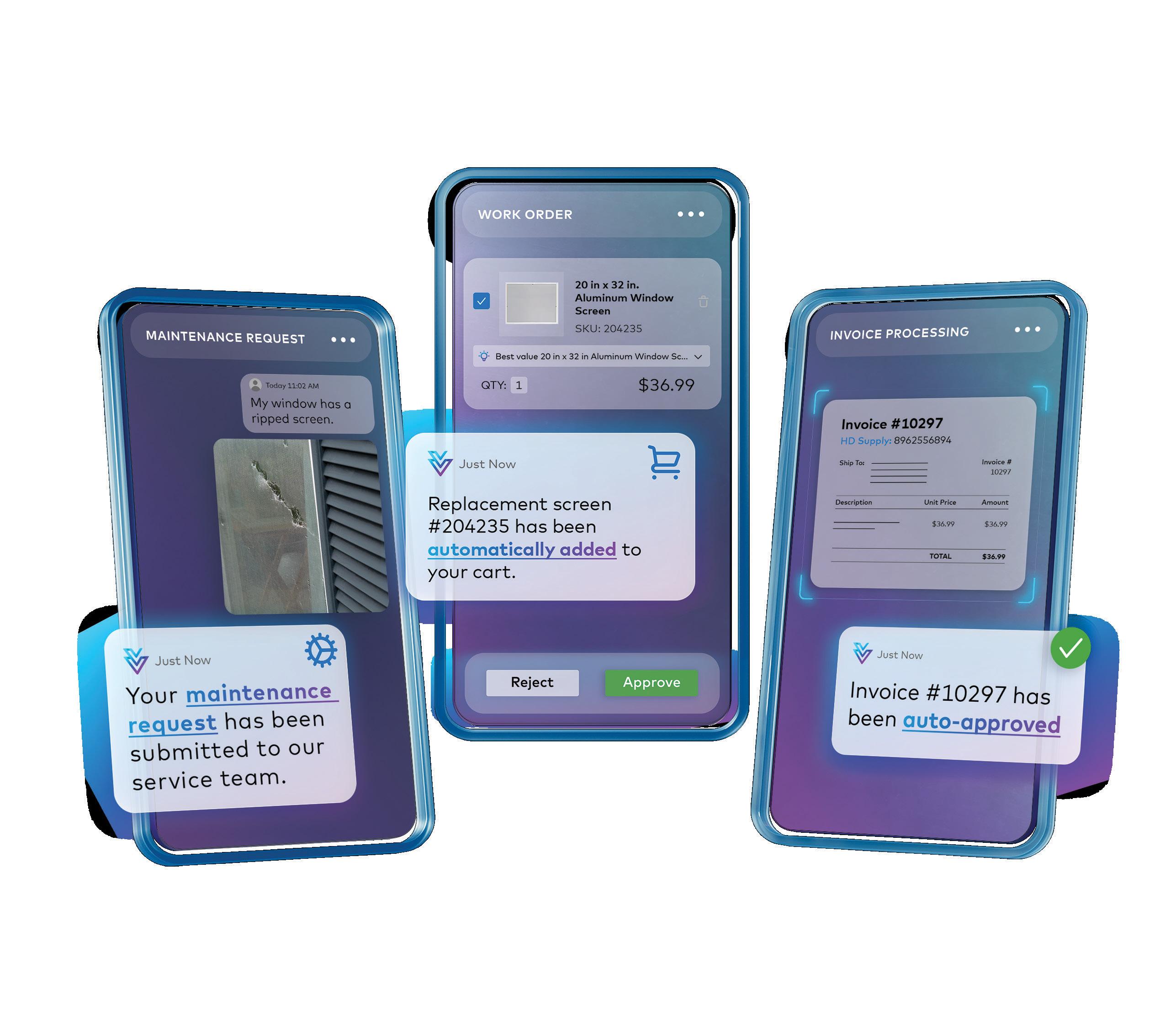
Maintenance workflows are also being streamlined. A technician can record a video of an issue, describe it verbally, and the AI system will generate a work order, identify required materials, and initiate procurement. Even accounting processes, such as invoice approvals, are being automated. After analyzing user behaviour, most approvals involve minimal review. Rather than involving multiple people and approvals, the AIpowered solution can do all the work in much less time.
Improving efficiency without replacing people
Due to advancements in technology, there are concerns that job displacement is inevitable. However, the panelists stressed that AI should help to augment human work rather than replace
it. Of course, employees have had mixed reactions to the implementation of AI in the workplace. There is both excitement and anxiety around AI, which is normal, and what it means for them. The key is to focus on adaptability.
“At the end of the day, all of us own our own careers,” said Schulz. “You can invest in reskilling if you think your role might be impacted by advancements in technology.”
AI should be viewed as a tool for improving productivity rather than cutting staff. The intent should be to solve business problems, and to drive efficiencies and results, not to let people go. It is the responsibility of ownership and management to make it clear that their staff are more important than automation.
In fact, new roles are already emerging with the implementation of new technologies. The concept of a prompt engineer (i.e., someone skilled at interacting with AI tools) highlights how job functions are evolving. This role requires sophistication as the quality of the output depends on the quality of the input.
“Garbage in to ChatGPT or Claude will give garbage out,” said Schulz. “You need to be skilled at how you prompt the AI engines to deliver the results you’re looking for.”
Understanding the legal and ethical risks
There are clear benefits to making AI part of the workflow in property management. However, AI adoption comes with significant legal and ethical considerations. One of the most important points is that responsibility does not shift to the technology.
“When things are getting automated, it does not transfer the responsibility, even if there is a gap in the law,” said Sidhu. “Whoever is at the front end becomes responsible.”
There are three primary risk areas for property management companies to consider:
1. Hallucinations and inaccuracies: AI systems can generate incorrect information, yet organizations are still liable for those outputs.
2. Bias and discrimination: AI learns from historical data and picks up on patterns, which may contain biases. This is particularly concerning in tenant screening and leasing decisions, where human rights laws apply.
3. Privacy and data protection: Handling sensitive tenant data requires strict compliance with privacy laws. The company is responsible for protecting clients’ data.
Companies should also understand copyright and intellectual property laws with respect to AIcreated work. If you use AI to generate marketing materials or a script, you cannot copyright it and
have legal protection. You need some form of human involvement to claim copyright.
“If you are involved in some sort of content generation, having some form of human involvement supplemented by these AI tools, which can enhance your creativity, is the best combination for the content you have,” said Sidhu. Make sure to learn about and understand your legal obligations. Property management can be a high-risk field due to the legal responsibilities related to providing fair housing, as there can be privacy, bias, and discrimination issues. Make use of the available online resources or speak to a lawyer before using or incorporating AI into your services.
Governance is behind technological progress
Although there has been rapid technological progress, governance frameworks are still developing. Organizations are at different stages of maturity.
“Some people are early adopters and some people are late adopters,” said Schulz. “It’s at different phases within organizations. Many people feel they’re progressive, but they’re also learning lessons as they go through this journey.”
This uneven adoption extends to risk management practices. Many companies are still learning how to vet AI vendors, manage data, and establish internal policies. They often fail to properly evaluate AI providers. Without adequate due diligence, companies risk exposing sensitive information to hackers and criminals.
Taking a practical approach to AI adoption
Given both the opportunities and risks, how should organizations move forward? The panel’s consensus was to start small and be strategic. Companies should focus on specific business problems rather than trying to implement AI across the board.
“Pick your problem or priority,” said Altobelli. “Is it cost savings? Is it leasing? Don’t try to do them all at one time, especially because it is brand new to the industry and it’s evolving.”
Many organizations are beginning with accounts payable automation, which offers quick wins with relatively low risk. Others are focusing on marketing and leasing workflows to improve tenant acquisition and retention. Equally important is establishing governance alongside implementation. Taking a phased approach is a prudent strategy.
“When incorporating these items, start with a smaller set of employees when coming up with policies first,” said Sidhu. “Differentiate the data that you are authorized to enter into these tools.”
Make sure to have conversations with your vendor to protect your company and data. Ask about their certifications, data retention methodologies, training policies, and the process of integrating into your existing technologies. AI adoption must be also paired with a people strategy. This includes training, communication, and change management.
“It’s not a one-time thing,” said Schulz. “It’s a shift that happens over time.”
Although companies should move forward with caution, the panelists were clear: standing still is not an option. It is essential to move forward at a sufficient pace with AI adoption. At the same, moving too quickly without a plan is not the right approach.
Organizations that take a measured approach, learning to balance innovation with risk management, will be best positioned to succeed.
The future of work in property management
Looking ahead, AI is expected to become even more autonomous. Today’s systems primarily provide recommendations, but future iterations will make decisions and take actions independently. At the same time, human skills will become more valuable, not less. Communication, critical thinking, and the ability to work alongside AI will define success in the industry.
Altobelli provided university students with the following advice: “Your world and your experience working will be so much different than mine. Learn one thing and learn it well: the ability to communicate effectively with everyone you’re working with.”
Conclusion
AI is transforming property management, automating routine tasks, improving efficiency, and enabling better decision-making. But it is also introducing new challenges around workforce adaptation, legal risk, and governance. The key takeaway for organizations is clear: embrace AI but do so deliberately. Start with targeted use cases, invest in people, and build strong policies around data and ethics.
As the panellists stated: Be specific and know what you want to accomplish.
Full-Service
Laundry Room Management! Let us take the hassle out of laundry for your Multifamily, Campus or Hospitality property, with no upfront costs.
CCL
- Commercial Machine Sales! From machine and parts sales to installation and service,
Latest amendments to Ontario’s Residential Tenancies Act receive approval
By David Gargaro
On April 27, the Ontario provincial government announced that the Lieutenant Governor in Council has approved an Order to bring into effect some amendments to the Residential Tenancies Act, 2006 (RTA). The amendments were made through two bills: Bill 97, Helping Homebuyers, Protecting Tenants Act, 2023, and Bill 60, Fighting Delays, Building Faster Act, 2025.
Although the two bills had been proclaimed in force some time ago, some of the RTA elements had yet to be put into effect. The provincial government is now taking steps to implement the changes across both bills. Some of those amendments will go into effect on July 1 and September 21 of this year (as outlined below). Until then, existing legislation and procedures set out under the Landlord and Tenant Board (LTB) will continue to apply. The dates to apply the remaining amendments to the RTA listed in Bills 67 and 90 have yet to be determined.
Bill 97: Helping Homebuyers, Protecting Tenants Act, 2023
Bill 97 is aimed at supporting the construction of 1.5 million homes in Ontario by 2031. It amends several statutes to help speed up development, increase the housing supply, and strengthen tenants’ rights with respect to air conditioning and renovations.
Key components of Bill 97 include:
• Stronger rules to protect tenants against badfaith evictions for renovations
• Changes to the Planning Act to support the housing supply action plan, which includes increasing the number of residential units allowed on a parcel of land without the need to get full development approval
• Narrower definitions for the term “area of employment” with the focus on manufacturing and warehousing restricting commercial and institutional uses
• Higher fines for illegal evictions under the RTA
The following amendments will come into effect on July 1, 2026:
• Tenants are explicitly allowed to install window or portable air conditioning units if the landlord does not provide air conditioning; this permission is subject to certain conditions
• When the landlord is required under the tenancy agreement to supply electricity to the rental unit, they may charge the tenant a seasonal rent increase, subject to certain rules
• The landlord and tenants must use the LTB’s approved form for rent arrears payment agreements between the two parties
• The maximum fines for offences under the RTA will increase from $50,000 to $100,000 for individuals and from $250,000 to $500,000 for corporations
The following amendments will come into effect on September 21, 2026:
• Landlords who want to end a tenancy due to repairs or renovations must provide the tenant with the following:
Written notifications about the estimated completion date of the renovations, any changes to the estimated completion date, and the final date that the unit is ready for re-occupancy
A period of at least 60 days to reoccupy the unit following completion of renovations
• Tenants can apply to the LTB for a remedy for “failure to afford a right of first refusal” if the landlord does not provide the tenant with the required notifications and/or 60 days to reoccupy the unit
• If the tenant is denied their right of first refusal, then the timeline to apply to the LTB for a remedy will be extended to the later of two years from the date they vacated the unit or six months after completion of the renovations
Refer to Schedule 7 of Bill 97 for more information on the amendments coming into effect.
Bill 60: Fighting Delays, Building Faster Act, 2025
Bill 60 is an omnibus bill that amends 16 laws with the goal of accelerating housing development and streamlining rental disputes. It makes several amendments to the RTA, as well as municipal housing and development charges.
Key components of Bill 60 include:
• Reductions in the timeline to file for evictions for non-payment
• Requiring the tenant (in some cases) to pay 50 per cent of the disputed amount before an LTB hearing
• Shorter timeline to review LTB decisions
• Changes to compensation requirements for landlord personal-use evictions
• Faster approvals for building permits
• Standardization of calculations for development charges and greater transparency for developers in disputes
The following amendments come into effect on September 21, 2026:
• Landlords who provide the tenant with at least 120 days’ notice to end the tenancy for personal use of the rental unit (rather than the minimum 60 days’ notice) will no longer be required to compensate the tenant or offer another acceptable unit for rent
• The notice period for evictions due to nonpayment of rent for either fixed-term or month-to-month tenancies will be reduced from 14 days to seven days
Refer to Schedule 12 of Bill 60 for more information on the amendments coming into effect.
Let’s talk about your property goals.
What does a federal Liberal majority mean for Canada’s rental housing industry?
By Tony Irwin, President and CEO, RHC
A majority government would bring more policy certainty. For the rental housing industry, that matters because purpose-built rental projects are planned, financed, and built over many years. The sector needs a stable policy environment to make long-term decisions. In practical terms, a majority government is better placed to move from announcements to implementation. It reduces the risk that key housing measures are delayed or weakened by political instability.
Political stability is generally helpful for investor confidence because it reduces policy risk. Investors are more likely to commit capital when they believe government policy will be consistent and durable. That said, stability by itself will not unlock investment. Capital will still flow to projects that are financially viable. Governments also need to address the core issues affecting feasibility, including development charges, taxes, construction costs, approval timelines, and access to financing.
The policies most likely to move first are the ones the government has already signalled and can advance through the budget or existing programs. That would likely include development charge relief, tax measures for purpose-built rental, changes to federal financing programs, and continued work on Build Canada Homes. From our perspective, the key near-term measures are clear: lower development charges, make the accelerated capital cost allowance permanent, move ahead with a modernized MURB incentive, and improve the way CMHC programs work for rental housing providers. Those are practical measures that could make a real difference.
The next budget will be important because it will show whether the government is focused on the real barriers to new supply. We will be looking closely at three areas: cost relief, tax policy, and financing. More specifically, we will be watching for meaningful action on development charges, long-term tax measures that improve project viability, and clear direction to make CMHC programs more accessible, more predictable, and better suited to rental housing development.
NATIONAL OUTLOOK
A majority government would have more room to attach affordability and other policy conditions to federal funding. The issue is whether those requirements are designed in a way that still allows projects to move forward. If the conditions are too rigid or too costly, they can reduce participation and limit overall supply.
The main risk is that the federal government moves further into areas that are primarily provincial responsibilities. Rent regulation and most tenant protection rules are set by provinces, and overlap can create uncertainty without doing much to increase supply. If federal policy starts to increase regulatory uncertainty without improving project economics, that could discourage new investment in rental housing.
Under a majority mandate, the federal government could take a stronger leadership role on housing. The sector benefits most when governments are working toward the same goal: making it faster, less costly, and more predictable to build rental housing.
The biggest risk is that policy goals become disconnected from the economics of getting housing built. If governments add more requirements without addressing costs, delays, and financing challenges, fewer projects will be viable.
A majority government can accelerate rental housing development, but that will depend on the policy choices it makes. If the government focuses on reducing barriers, improving tax and financing tools, and working with provinces and municipalities to lower costs and speed up approvals, it can make a meaningful difference. If it adds more conditions without improving project economics, it could instead constrain new development.
Government of Canada releases Spring Economic Update 2026
On April 28, Finance Minister François-Philippe Champagne tabled the 2026 Spring Economic Update, which gives a mid-year checkup on Canada’s financial health, provides transparency on the country’s economic performance, updates fiscal projections following the Federal Budget, and introduces targeted investments for growth.
Some of the key measures and initiatives from the Spring Economic Update include:
• The Canada Strong Fund, the country’s first national sovereign wealth fund, which will invest in strategic Canadian projects and companies and enable Canadians to receive financial returns through investments in the fund
• Investing more than $125 billion in 21 nation-building initiatives that will support 60,000 jobs during construction
• A whole-of-government approach to redevelop and support Canada’s defence industry
• Launching an initiative to recruit, train, and hire 80,000 to 100,000 new skilled trade workers by 2030-31
• Reducing the contribution rate of the base Canada Pension Plan from 9.9 per cent to 9.5 per cent, effective January 1, 2027
• Pausing the Fuel Excise Tax until Labour Day, reducing fuel costs by 10 cents/L on gasoline and 4 cents/L on diesel
• Investing $755 million to expand access to sport, which includes providing more support for worldclass athletes
• Providing $4.3 billion in funding for essential services for Indigenous Canadians
• Investing about $1 billion to maintain small craft harbours and modernize critical infrastructure for fishers across the country
The Spring Economic Update 2026 also includes investments, initiatives, and directives related to building more housing and making housing more affordable for Canadians. Some of these measures include:
• Reducing development charges and providing targeted GST relief to lower the cost of purchasing new homes
APRIL / MAY 2026
• Partnering with provinces and municipalities to streamline rules and modernize building codes, which includes factory-built and modular housing, to build homes faster
• Supporting innovation in construction through investments in construction technology
• Accelerating more than $7 billion in low-cost financing to CMHC to help move construction projects forward and increase the rental housing supply
• Providing housing supports for people experiencing homelessness, including safe housing options for victims of gender-based violence
To read the whole document, visit https://www.budget.canada.ca/update-miseajour/2026/report-rapport/ pdf/update-miseajour2026-eng.pdf.
Federal Liberals moving to take control of House of Commons committees
According to a recent announcement from House of Commons leader Steven MacKinnon, the federal Liberal government will seek to change the standing orders (i.e., the rules governing the House of Commons) to ensure they have the most votes on standing committees. This is common practice for majority governments.
When the Liberals won a minority government in the previous election, the Members of Parliament (MPs) agreed to form committees with four Liberals, four Conservatives, and one Bloq Quebecois. Due to winning three byelections and having five opposition MPs cross the floor to join the Liberals, they now have 175 seats in the House of Commons, which means it has a majority government. MacKinnon has since proposed committees to consist of seven Liberals, four Conservatives, and one Bloc member. This proposed change will require a vote in the House of Commons.
What does this mean for the rental housing industry?
A Liberal majority would make it easier for the federal government to pass housing legislation. Taking majority positions on committees would also reduce the opposition’s ability to delay or amend those bills in detail. For the housing industry, that usually means faster movement on federal housing initiatives. However, it could also mean less committee-level pushback from builders, rental property owners, municipalities, and advocacy groups.
Having a Liberal majority in committees should mean:
• Faster legislation: House committees study bills clause by clause and can amend them. A Liberal majority on committees would enable the government to move housing bills through more quickly.
• More policy continuity: The Liberal housing agenda includes Build Canada Homes, more financing and grants for affordable housing, cuts to development charges, and measures to speed approvals. Committees could pass additional legislation to support these initiatives.
• Greater pressure to build: Proposals would likely increase incentives for new supply, especially purpose-built rental, modular, and affordable housing projects.
• Less room for opposition amendments: With Liberal control over committees, Conservatives and Bloc MPs would have fewer chances to stall or reshape bills. This could make policy more stable but less negotiated.
Members of the rental housing industry, including builders and developers, could benefit from clearer federal direction, more financing support, and faster approval pathways based on the directives in the Liberals’ current housing platform. That could help project pipelines and reduce some uncertainty around federal programs, especially for non-market and higher-density housing. However, if the Liberals use committee control to advance their rules more quickly, industry groups would have fewer opportunities to slow down potentially costly or time-consuming measures.
The provinces and municipalities are still heavily involved in implementing housing development, especially zoning, permits, and development charges. A Liberal federal majority will not fix supply
NATIONAL OUTLOOK
shortages. Strong federal bills require Senate approval and the involvement of other levels of government to implement policies. There is likely to be greater speed and certainty at the federal level, but it will not have an immediate impact on home prices or supply.
From the perspective of the rental housing industry, having a majority on committees is generally positive with respect to activity, supply, and speed. However, this means there will be fewer checks on the government’s housing agenda. Projects aligned with federal priorities will be fast tracked, while groups that rely on committee scrutiny to slow or reshape bills will have less power to do so.
Where renter demand is shifting in Canada & what operators should do about it
By Peter Altobelli, VP and General Manager, Yardi Canada Ltd.
How are renter search patterns shifting geographically, and what does that signal to operators? In a market where conditions are easing but still active, online search behaviour can help answer that question. It should not replace core operating metrics, but it adds valuable real-time context. In Q1 2026, Canada’s average in-place rent reached $1,761, vacancy rose to 5.1% and annual turnover climbed to 25.8%, pointing to a more balanced environment than a year earlier, according to Yardi’s Q4 2025 Canadian National Multifamily Report. Against that backdrop, renter-interest data helps show where demand is strengthening, where urgency is fading and where operators may need to adapt faster.
Mid-sized markets are rising
The strongest gains came from mid-sized and secondary markets. Based on renter activity on apartments listed on RentCafe.com in the previous quarter (Q4 2025), Moncton held the #1 national position, Hamilton jumped 10 spots to #2, Halifax ranked #3 and Saskatoon climbed to #4, according to the Q4 2025 Canada Renter Interest Report. The ranking is based on listing activity such as how many available apartments renters could browse, how often listings were viewed, how many listings were favourited and how many apartment searches were saved. Together, those actions help show where renters are actively exploring options and where interest is building.
The market-level details make that shift even clearer. In Moncton, listing views rose 34% year over year while available listings fell 33% year over year, suggesting renters were looking closely at fewer options and making decisions faster. Hamilton posted the quarter’s biggest jump, climbing 10 spots to #2, while favourited listings increased by more than 200% year over year and saved searches rose 72% year over year. That points to stronger intent from renters who wanted to keep track of listings and monitor the market. Saskatoon also stood out, with favourited listings up 46% year over year, another sign that renters were actively identifying properties they may want to return to or act on. For operators, these cities are not just interesting outliers. They are early signs of where online apartment demand may be strengthening ahead of other market indicators.
Large markets are cooling or rebalancing
Some of the country’s larger markets showed a different pattern. Vancouver climbed to #7 nationally, but Calgary dropped to #15 and Montréal fell to #24 as renter activity softened, according to the Q4 2025 Canada Renter Interest Report. That does not mean large markets are losing relevance. It more likely points to a market reset. In several major centres, renters may be facing more choice, taking more time to compare options or feeling less pressure to act immediately.
That lines up with broader multifamily trends. Higher vacancy, slower rent growth and rising turnover all point to a more balanced market, according to Yardi’s Q1 2026 Canadian National Multifamily Report. For operators, online renter activity should be viewed alongside core operating metrics such as rents, vacancy and mobility. Together, those indicators can help show whether demand is accelerating, stabilizing or becoming more selective.
APRIL / MAY 2026
What this means for operators
Renter-interest data has practical value. It can help inform market expansion, pricing and incentives, leasing coverage and marketing allocation. It can also help operators understand where visibility matters most. When renters are comparing more options online, communities need to be easy to find across listing sites, property websites and corporate websites. In a more competitive environment, digital visibility is not optional. It is a core part of capturing demand.
See how housing providers are improving visibility, responding faster to renter demand and supporting leasing performance at www.yardi.com.
Average asking rents fall to nearly three-year low
According to the Rentals.ca April 2026 Rent Report, average asking rent in Canada fell to a 35-month low in March. The average asking rent currently sits at $2,006, which is a 5.3 per cent ($112) decline, the largest amount in almost five years. This represents 18 consecutive months of falling rents. Average asking rents have fallen by 1.1 per cent from February and by 2.5 per cent since the start of 2026. Vancouver, Ottawa, and Montreal had modest month-over-month increases, although rents remained down year-over-year.
Purpose-built rents were the most stable on an annual basis, declining 3.9 per cent ($2,005), but experienced the largest decrease on a month-over-month basis, with a 1.2 decrease from February. Average rents for all unit types have fallen 5.4 per cent in Ontario, 5.1 per cent in British Columbia, 4.4 per cent in Alberta, and 2.1 per cent in Quebec. Nova Scotia (3.3%), Saskatchewan (2.7%), and Manitoba (2.1%) all had increases.
Average rent per square foot decreased to $2.49, compared to $2.52 in March 2025, and is down from $2.66 year over year. The average unit size for available listings decreased to 831 square feet, down from 855 square feet in March 2025 and 867 square feet year over year.
To read the full report, visit https://rentals.ca/national-rent-report#national-overview.
Federal government approves eight rental housing projects in Ottawa
On April 23, the federal government announced it had approved eight rental projects under the Build Canada Homes program, which will add more than 1,100 units to the City of Ottawa. The announcement is part of a $400 million federal-municipal partnership that expects to add up to 3,000 mixed-income homes on public land through the City of Ottawa’s affordable housing pipeline. Gregor Robertson, Minister of Housing and Infrastructure, stated the Ottawa project should serve as a template for other cities.
The following sites are scheduled to begin construction between 2026 and 2027:
• 200–201 Beausoleil Drive – 159 units (non-profit)
• Geyser Place (formerly 3380 Jockvale Road) – 118 units (non-profit)
• 1770 Heatherington Road (Phase 1) – 90 units (non-profit)
• 58 Capilano Drive – 20 units (non-profit)
• 240 Presland Road – 64 units (non-profit)
• 100 block of Hickory Street – 110 units (non-profit)
• 2475 Regina Street (Parkway House) – 266 units (private and non-profit)
• 384 Arlington Avenue (Korean Church) – 296 units (private and non-profit)
According to CMHC, Ottawa housing starts are up about 7 per cent in the first quarter of 2026 compared to the previous year, with rental apartments driving most of the growth. However, CMHC and industry analysts stated that 2025’s national lift in starts, which includes a 12 per cent increase in Ottawa–Gatineau, reflects a weak base in construction starts.
While rental building has reached record levels, these statistics mask significant construction declines
SHAPING THE FUTURE OF RENTAL HOUSING TOGETHER
Rental Housing Canada (formerly CFAA) is the leading national association representing Canada’s rental housing sector, directly serving owners, managers and builders of nearly one million residential rental suites nationwide.
As the most comprehensive voice for rental housing providers, RHC has a proven track record of advancing practical solutions through decades of dedicated advocacy, strategic government relations, and active industry engagement with federal policymakers.
Our strength is rooted in collaboration and deep industry expertise. Members benefit from expert consulting, influential policy advocacy, valuable networking opportunities, and strategic partnerships all aimed at addressing Canada’s housing and affordability challenges by supporting the growth and sustainability of the rental housing sector.
Rental Housing Canada brings together the entire rental housing sector - owners, managers, investors, builders, and suppliers to advocate with one strong, united voice. Join RHC and be part of a national network driving smart policies and accelerating the development of much-needed rental housing across Canada. Your Membership Powers Our Advocacy
OWNERS/MANAGERS: Annual dues are $250 plus $0.50 per rental unit you own or manage, an investment in protecting your business and shaping the future of rental housing in Canada.
SUPPLIERS COUNCIL: Industry Suppliers are an important part of the rental housing industry as we work together to bring more housing to Canadians Corporate membership is $2500 per year or $1250 for Associate
in Toronto and Vancouver, underscoring the gap between current output and the volume needed to restore affordability. The Ottawa project addresses the gaps by focusing on building rental supply on public land, removing local fees, and aiming for faster delivery of developed properties.
Ottawa mayor Mark Sutcliffe said the City’s decision to waive development and planning charges on Build Canada Homes projects, in addition to its Housing Action Plan, demonstrates that it is doing its part to address the affordable housing crisis for Ottawa residents.
RHC Conference coming to Ottawa this month
The RHC Conference takes place on May 26–28, 2026 at the Rogers Centre in Ottawa. It brings together Canada’s rental housing community to share ideas, tackle challenges, and move the sector forward.
Our Building Momentum conference is all about turning vision into action. From accelerating development to leveraging smarter technology, the program spotlights practical solutions to deliver the homes Canadians need, today and into the future. Over two dynamic days, owners, developers, operators, and partners will exchange real-world strategies, build meaningful connections, and leave inspired to keep pushing the industry forward.
The 2026 Co-Chairs are Michelle Calloway, Senior Vice President, Operations, Minto Group and Christian Szpilfogel, Chief Investment Officer, Aliferous Group.
8:00 am Breakfast 9:00 am – 2:15 pm Educational Sessions
Sign-up for RHC’s National Outlook e-newsletter to receive up-to-date news on what is happening across Canada, as well as industry insights and insider information on RHC happenings. Email admin@rentalhousingcanada.ca to start receiving RHC’s e-Newsletter today! WANT TO STAY UP TO DATE WITH NATIONAL OUTLOOK?
| / May 2026
The complete market perspective for the rental housing industry
Tenants get insured in minutes online - instant policy activation, 24/7, at lease signing. API integration
Syncs with Yardi & HappyCo. Auto-enroll tenants, track compliance in real time - zero manual work.
COl verification via Bramble
Every lease clause read, every certificate verified - 12x faster than manual review, automatically.
Back to Queen’s Park
Following the return of the Ontario government to the provincial legislature, FRPO is ready for a busy and productive few months. The start of the building cycle is always a natural time to focus on our goals, and this year our priority is ensuring the professional rental sector remains a central part of the conversation on Ontario’s future.
A major focus of our work this quarter involves engaging with the government on key legislative files. We continue to work closely with the Ministry of Municipal Affairs and Housing and the Ministry of the Attorney General on the regulations for Bill 60, ensuring that the voice of professional housing providers is reflected as these important changes move forward.
We have also been active in our response to the proposed regulations under Bill 10. Our message to the government is clear: while we share the objective of ensuring our communities are safe, any new framework must recognize the practical and legal limitations faced by housing providers. We are advocating for a balanced approach that focuses accountability on criminal activity rather than imposing duplicative risks on good-faith landlords who are already working hard to maintain safe environments for their residents.
Our advocacy continues to be rooted in a commitment to high standards and constructive partnership. We are working hard to ensure policymakers understand the reality of our industry – one that provides stable, high-quality homes for millions of Ontarians. By leading with evidence and sharing the true experiences of our sector, we are making it clear that professional housing providers are essential to a healthy, functioning housing market.
As we continue our engagement with the provincial government this spring, we remain focused on the fundamentals. We are championing the practical, supply-side solutions that are needed to address affordability for the long term. Whether it is unlocking new infill potential on existing sites or streamlining the processes that get homes built, we are providing the roadmap needed to keep Ontario moving forward.
I want to thank our members for the professionalism you show every day. Your dedication to your residents and your communities is what gives our association its strength. I look forward to working alongside you as we continue to make a positive impact across the province.
Tony Irwin, President and CEO
LBO campaign update: “Proud to Rent” gaining momentum
The launch of our Proud to Rent initiative has marked an energetic start to the year for the Let’s Build Ontario campaign. This project was designed to challenge outdated stigmas about rental living, and we are already seeing our core messages resonate with a broad audience across the province.
Reflecting on what our community values
The feedback we are receiving from our community highlights a significant shift in how Ontarians view their housing choices. Our early survey work indicates that for many, renting is a proactive and smart decision. The themes of flexibility, financial freedom, and the modern lifestyle that professional rental housing enables are being reflected to us by residents from all walks of life. By amplifying these voices, we are building a visible community of supporters who take pride in where they live and support a balanced rental market.
A call for your stories: Showing our impact
While we celebrate the resident experience, the heart of this campaign remains the initiatives and dedication of our members. We are issuing a renewed call for you to submit your stories. We specifically want to highlight the ways your teams are engaging with your residents and the communities you serve.
Whether it is a unique resident wellness program, a local charity partnership or a major community event, these stories are our most powerful tool for showing the public the positive impact of professional management. We want to show Ontario that our members are not just housing providers. They are community pillars. Get involved
We invite all members to follow the campaign on social media and share our content with your onsite staff and residents. Together, we can continue to change the narrative and build a housing system that offers more choice and more opportunity for everyone.
Visit letsbuildontario.ca to see the latest stories and submit your own.
Take control of your energy costs for FRPO’s energy program
By Elliott Jones, Business Development Executive, ECNG Energy Group
Rising energy costs and unpredictable markets can be a real headache for property owners. Last year, Ontario saw natural gas prices swing dramatically, and electricity costs jumped nearly
30%. For FRPO members, these fluctuations can make budgeting difficult and put pressure on operating costs. That’s where the FRPO Energy Program comes in. We help you save money, plan, and reduce exposure to market volatility energy surprises don’t disrupt your business.
Stabilize your budget
Unexpected spikes in natural gas or electricity bills can throw your operating budget off track. ECNG works with you to create predictable energy costs. By analyzing your usage patterns and past bills, we help you plan with confidence, making sure you can focus on running your properties without worrying about sudden price jumps.
Manage market volatility
Energy markets move fast. Last year’s swings showed just how unpredictable both natural gas and electricity can be. ECNG helps FRPO members reduce risk with strategies like fixed-price contracts and risk-management tools. This means your energy costs are less tied to market ups and downs, giving you peace of mind throughout the year.
Maximize savings opportunities
Stability is important, but so is saving wherever possible. ECNG identifies ways to reduce your energy spend without sacrificing service or comfort. From reviewing your contracts to monitoring market trends, our team provides practical advice to make your energy dollars go further.
Expert guidance you can trust
Navigating energy markets can be confusing, but you don’t have to do it alone. ECNG’s team has years of experience helping property owners like you. We provide advice that’s clear, practical, and results focused. Our goal is simple: help you save, plan, and avoid volatility so your energy costs are predictable and manageable.
Why partner with ECNG?
For FRPO members, ECNG is more than an energy service provider we’re a partner. We help you take control of your natural gas and electricity costs, so you can budget with confidence, avoid surprises, and make better financial decisions for your properties.
Don’t let energy market uncertainty control your budget. Partner with ECNG Energy Group and turn unpredictability into opportunity.
Navigating natural gas and electricity markets can be both unpredictable and complex, creating ongoing challenges for property owners. For more than 20 years, FRPO has partnered with ECNG Energy Group to support its members in managing these markets effectively. Read on for an overview of the natural gas and electricity
programs available to FRPO members, along with additional services ECNG provides.
Natural gas program
ECNG currently manages more than 20 million cubic metres of natural gas annually on behalf of the FRPO program, supporting many members with multiple accounts across the province. The program is designed to help members stabilize their energy costs through fixed - price options available for short, medium or long -term periods, helping protect budgets from market volatility. ECNG also provides members with a wide range of reports including, but not limited to, budgets, forecasts, cost analysis, and consumption comparisons, available in both reader-friendly formats and editable spreadsheets.
Electricity program
The FRPO electricity program shares similarities with the natural gas program but is also structured to respond to the unique dynamics of the electricity market. While fixed - price options are available, ECNG strategically aggregates member volumes and secures pricing only when market conditions are favourable, especially important given the extreme volatility seen over the past year. Similar to natural gas, members also have access to various cost and consumption reports either upon request or through a secure online portal.
Additional services for FRPO members
In addition to the natural gas and electricity programs, FRPO members can take advantage of several additional ECNG services. Leveraging decades of experience in the energy sector, ECNG offers expertise in such energy related fields as carbon management, grants, rebates, and audits and assessments. Furthermore, ECNG has extensive experience working with multiple
utilities across the province, supporting members with resolving consumption discrepancies and optimizing rate classifications for their accounts. For members with slightly more specialized needs and requirements, ECNG also provides solutions for global adjustment cost analysis and invoice management services, allowing property owners to shift their focus to other aspects of their business while ECNG handles these specific and time-consuming responsibilities.
Upcoming events
Annual Charity Golf Classic
Date and Time: July 21, 2026 | 8:00 am – 6:30 pm
Save the date for our beloved annual FRPO Charity Golf Classic in support of Interval House. We will hit the greens at Lionhead Golf Club for a great day of golf in support of an important cause. Visit frpo.org for more details.
Member Early Bird Price – Register via email to events@frpo.org by Friday, July 3.
Foursome: $1,800.00
Individual: $475.00
Dinner only: $150.00
Kosher meal upgrade: $100.00
Raffle tickets: $20.00
Women in Rental Housing Luncheon
Date and Time: August 13, 2026 | 11:00 am – 2:30 pm
We’re thrilled to welcome back the Women in Rental Housing Luncheon for 2026, which brings together women from across the industry to exchange ideas, build meaningful connections, and celebrate the impact women make in our sector. More details coming soon.
Ontario’s leading advocate for strong and stable rental housing.
FRPO is the largest association in Ontario representing those who own, manage, build and finance residential rental properties.
Save time and money with customizable e-Procurement solutions built for your business needs.
EXPERT CUSTOMER SERVICE
Whether it’s routine maintenance and repairs, property upgrades, or suite turn renovations, our dedicated team is committed to delivering a seamless experience every step of the way.
EXTENSIVE PRODUCT OFFERING
Thousands of products in stock every day, plus access to thousands more we can source on your behalf. Essential categories available, including:
• Appliances
• Plumbing
• Tools
• Flooring
• Paint & Sundries
• Cleaning & Janitorial
• Grounds Maintenance
• Fire Safety
• Hardware
• Electrical
• Cabinetry
• HVAC
• Lighting
• Personal Protective Equipment
• And MORE!
Plus, Exclusive Brands that deliver quality, style & value.
Executive Director’s message
Nominations opened May 1 for Ottawa’s municipal election, with housing, transit, affordability, safety, traffic, taxes, and major City projects already defining the race. Four candidates are in the field: incumbent Mayor Mark Sutcliffe; Kitchissippi Councillor Jeff Leiper, Chair of Planning and Housing; homebuilder Alex Lawson, a former Kanata-Carleton Conservative Association board member; and Neil Saravanamuttoo, Executive Director of CitySHAPES. Abacus Data polling suggests cost of living, housing affordability, and unreliable transit are top voter concerns, with nearly half of voters undecided. Lawson’s conservative leanings could complicate Sutcliffe’s path to re-election by drawing right-leaning voters away from him, while Leiper’s progressive profile gives left-leaning voters a clear alternative. That combination could make votesplitting or strategic voting an important factor in the election.
- Jeremy Newman, EOLO Executive Director
Rental housing issues in the City election
Background
First, a few words about EOLO’s usual actions. Our top priority is to represent rental housing providers in dealings with the City of Ottawa. That starts with keeping track of what the City is considering or planning to do in policy areas that affect residential landlords. We keep in close touch with numerous members of City staff and several councillors (out of the 24), as well as the Mayor’s office.
When issues arise, we consult with EOLO members (usually informally), and communicate with City staff, politicians, our allies, and members of the media. If issues proceed, we will engage EOLO members and allies, and consult more formally with City staff, and at appropriate times with the Mayor’s office and City councillors. We will also make public presentations at City consultations and committees, although commenting on the staff reports is usually too late to have the most effective influence on City decisions.
All those steps are efforts to achieve the best City decisions and the best public impression of rental providers. EOLO seeks win-win-win solutions for landlords, tenants, and members of the public, and we have a reputation for doing that consistently.
Here are two recent examples. In the two years before the pandemic, EOLO’s work replaced proposed landlord licensing (with annual fees)
with the Rental Housing Property Management By-law (with no fees), a much better outcome for everyone, unlike the outcomes in other Ontario cities.
Our work with many allies, over the last 30 years, has resulted in Ottawa’s multi-residential property tax ratio being reduced from 2.38 to 1.2, with a plan to reduce it to 1.0, far lower than the ratios in most other cities in Ontario, both large and small. To achieve that, we worked with tenant leaders in Ottawa, including Fran Going and Jerome Goytom, with advocates for tenants, including former Councillors Alex Cullen and Jacques Legendre, and many politicians across the political spectrum, including former Mayor Bob Chiarelli and current Mayor Mark Sutcliffe.
While we seek to maintain respectful and open communications with all members of City council, some are naturally more aligned with the views that EOLO and our members support. The rest of this section addresses some of those views and issues.
Property taxes
On the multi-residential property tax issue, history repeated itself over the last two years. As before, when the left wing of council understood the implications of the inequitable multi-residential property tax ratio, those members voted with the centre and right-wing councillors to move toward tax fairness for tenants (in moderate steps to minimize the annual impact on homeowners). Two years ago, Councillor Menard moved a motion to have City staff review the issue and consider a plan to move to a 1.0 ratio over time.
Jeremy Newman
EOLO had long worked with City Finance staff about the issue and so they were well familiar with it. Staff recommended a four-year plan, and Councillor Menard encouraged support for it among councillors on the left. EOLO advocated for the plan with Mayor Sutcliffe and councillors in the centre and on the right, and the plan was carried without dissent.
The plan began in 2025 but ran into a hiccup; while it reduced taxes on multi-tenant buildings, other City moves increased the solid waste charges on all buildings, largely offsetting the tax decreases and interfering with the rent reductions. EOLO explained what had happened to the media (to educate tenants) and to the councillors.
EOLO advocated for the tax decrease plan to continue in 2026, and succeeded in having it continue. On December 31, 2026, there will be an offset for a small increase in the solid waste charges, but the impact should be much less than the impact was in 2025. As was the case for the 2025 tax decrease, any landlord (of a building of seven or more units) who wants to reduce the rent reduction below the amount found in the City’s notice of rent reduction must apply to the Landlord and Tenant Board for approval to do that.
To date, the position of all the current councillors supports both tenants and landlords.
Important dates for the 2026 City Election
May 1, 2026 is the first date on which a candidate could file nomination papers for the office of Mayor, Councillor, or School Board Trustee. After filing the nomination papers, candidates can accept contributions and spend money on their campaign. The same date, fundraising, and spending rule applies to an individual, corporation, or trade union to file a notice of registration as a third-party advertiser. Candidates have until 2 pm on August 21 to file, to file for a different office, or to withdraw. Candidates for Mayor or City Councillor have until that date and time to register to participate in the Contribution Rebate Program.
September 11 is the first day for placing election signs on private or public property. (They must be removed by October 29.)
Advance polling is to be available on October 1, 2, 3, 4, and 16. Election Day is to be Monday, October 26, generally from 10 am to 8 pm.
Vacant unit tax
The position is quite different on the vacant unit tax (VUT), where the councillors divided ideologically, and EOLO members are not happy with the current state of affairs.
Due to provincial law, the VUT can only apply to the residential property class (with six units or fewer on a tax roll number), not the multi-residential property class. However, the VUT still affects numerous EOLO members because it applies to rental buildings held in condominium title and to small properties bought for redevelopment. In fact, the VUT would often affect redevelopments because properties are sometimes held vacant so that the developer can be sure to be able to proceed when ready, rather than risking being held up at the Landlord and Tenant Board by a tenant who will not vacate.
The VUT was enacted in 2022 (with a tax rate of 1 per cent of assessed value). Effective in 2025, it was made more onerous, with a tax rate that increases by 1 per cent for each year the property is vacant (up to 5 per cent of assessed value, which is about six times as much as a normal property tax bill).
Numerous EOLO members would very much like to see the VUT repealed entirely, and close to one-third of the current councillors agree.
Based on their voting records, the following councillors oppose the renewal of the VUT:
• David Hill, Barrhaven West
• Laura Dudas, Orleans West - Innes
• Matthew Luloff, Orleans East - Cumberland
• Wilson Lo, Barrhaven East
• Steve Desroches, Riverside South - Findlay Creek
• David Brown, Rideau - Jock
• Allan Hubley, Kanata South
Based on what they have said in Council debates, the following councillors may well decide, or be persuaded, to oppose the renewal of the VUT:
• Riley Brockington, River
• Clarke Kelly, West Carleton - March
• Catherine Kitts, Orleans South - Navan
• Tim Tierney, Beacon Hill - Cyrville
• Cathy Curry, Kanata North
The following two councillors seem to support the VUT, but may not be re-elected:
• Jessica Bradley, Gloucester - Southgate
• Sean Devine, Knoxdale - Merivale
EOLO hopes to persuade Mayor Sutcliffe and Councillors Skalski (Osgoode) and Carr (Alta Vista) that the VUT is a bad idea and should be repealed. Thirteen votes are needed for repeal, so each vote counts.
The bubble zone by-law
Ottawa readers may have followed the debate and vote on the bubble zone prohibiting demonstrations within 50 metres of schools, hospitals, long-term care centres, and community health facilities.
The by-law was proposed and promoted by Councillor Hill. As usual, the by-law policy staff did excellent detailed work about the various issues involved. We can be sure they also did significant internal consultations with the Mayor’s office and interested councillors, both in favour and opposed.
During the debate, Councillor Bradley moved an amendment that failed by a vote of 14 to 10.
Councillor Devine moved an amendment that failed by a vote of 18 to 6. The final vote on the staff report as a whole saw it adopted by a vote of 20 to 4. The only councillors voting against adoption were Councillors Menard (Capital), Devine, Bradley, and Troster (Somerset).
Important rules for rental owners and managers
Candidates and their representatives are allowed access to apartments, condominiums, non-profit housing cooperatives, and gated communities for the purpose of canvassing and distributing election material.
The Ontario Municipal Elections Act outlines the following rules around campaigning in these locations:
• Candidates and their representatives are permitted access between the hours of 9 am to 9 pm.
• No landlord of residential premises can prevent a tenant from displaying campaign signs on their rented premises.
• No condominium corporation can prevent an owner or tenant from displaying campaign signs on their unit.
• The landlord or condo corporation can place reasonable limits on the size or type of sign that may be displayed, and can prohibit signs in common areas.
EOLO did not take action on the bubble zone issue since it does not relate to rental housing, but the voting is an indication of how the councillors line up on issues that reflect an ideological divide. The strength of the win also gives some confidence in Councillor Hill’s ability to read the will of Council. Ottawa’s rental providers are fortunate that he largely aligns with us on landlord-tenant regulation, the anti-renoviction by-law issue, and the VUT.
Watch for more communications on what EOLO is doing to enhance the position of rental housing providers in the upcoming City election.
BECOME AN EOLO MEMBER NOW!
EOLO invites Ottawa area landlords to join the organization. Have your interests and concerns heard, and benefit from EOLO’s support. As an EOLO member, you will be able to:
• Receive prompt emails of relevant City rule changes
• Attend two networking receptions a year
• Attend two free education events a year
• Receive all 6 annual issues of RHB Magazine with current developments, City and provincial funding programs, and landlord-tenant laws.
To apply for membership, go to www.eolo.ca, download the membership application form and send it to us at the contact info on that website.
We’ll keep your systems top of mind, so you don’t have to!
With over 65 years of industry experience, our team is dedicated to ensuring optimal performance, resident comfort, and budget control.
Work with Enercare for reliable home services tailored to your property’s unique needs, with dedicated support from your Client Success Manager. We offer energyefficient upgrades for multi-residential properties, servicing low, mid, and high-rise dwellings to enhance comfort and sustainability. Our expert team ensures seamless installations that meet manufacturer standards, regulations and safety codes, along with comprehensive maintenance and repair services for all systems, including:
Why choose the Enercare Advantage® Program?
Enercare Advantage® offers a hassle-free, convenient solution for residents, eliminating concerns when it comes to upfront payments, costly repair service calls, and equipment replacement.* Below are additional benefits the Enercare Advantage® program provides to you and your residents:
Design
& Install
Industry leading products.
NEW energy efficient equipment to offset your carbon footprint.
Quality installations done right the first time.
Service & Maintenance
HVAC maintenance to keep your equipment operating efficiently.*
Service performed by fully licensed and insured technicians.
Added Benefit
Potential utility rebates on eligible equipment.
Invest in other improvement projects.
Potential welcome incentive on eligible equipment.
Tenant direct billing.
EXECUTIVE DIRECTOR’S MESSAGE
As we move into the second quarter of 2026, the ARLA office is busy sending our Membership Renewal Packages, putting together the Spring Rental Gazette in print to be taken to our Upcoming Landlord Resource Trade Show, and getting ready for our Landlord Resource Trade Show & ARLA Achievement Awards. Alongside that, we continue to hold webinars and seminars with educational and informational sessions.
We look forward to connecting with both old and new members in 2026. We also held our first of many Bowling Networking events and played five-pin, ate pizza, and just had a lot of fun.
We continue working on the waste issues within the City of Edmonton and had done a survey of the issues with waste removal with our membership. Those results were analyzed and sent to the City Mayor and Council, Waste Administration, and City Manager. We were able to present our issues to the City on March 9, 2026 at the Utility Committee meeting, and it was a very positive outcome, with the Council asking administration to look at the recommendations brought forward by these groups and come back with some recommendations to repair these issues. This was great news for us! This report should be brought forward in June 2026. We will be watching.
We continue to work on our 2026 Market Research document that we will share with the membership once we have completed it. This will highlight past and present issues and what is happening in the industry. We will also share our findings with all levels of government as well as making it open to the public.
The ARLA office is also working on our new website, which we are very excited about and hope to be launching before summer 2026.
We remain focused on delivering value in 2026 for our membership.
- Donna Monkhouse, Executive Director
Donna Monkhouse
What’s happening in Edmonton?
Waste removal in Edmonton was on the Council agenda and once again we were there to present with a favourable outcome. We will continue to monitor and see what happens next.
We advocated the City with respect to property tax assessments for the multifamily industry and did receive a response; however, it was not positive.
We attended the annual Pest Advisory committee meeting to ensure our industry is represented with respect to rules and guidelines for pest eradication, including chemicals and process for tenants.
What’s happening in Calgary?
City Council recently approved Calgary’s 2026 Budget, which included a 8.1 per cent property tax increase on residential properties. However, there is a significant difference between the municipal and provincial portions of the tax increase. The municipal portion of the residential property tax increase is 1.8 per cent, while the provincial portion increased by 21 per cent. The municipal government is lobbying the Province for more funding from higher oil revenues to help offset the difference between provincial property tax hikes and the municipal tax increase.
City Council also made key investments in public safety, transit, infrastructure, and housing to help support the City’s growth. It plans to spend $106 million on expanding affordable housing, which includes a 260-unit project in Southview, downtown office-toresidential conversions, and infrastructure to support the Glacier A North Growth Application.
CMHC updates
CMHC reports a “filtering effect” where some renters move from older units into newer ones, freeing up older units and putting downward pressure on turnover rents. As renters move upward, older buildings may need to adjust pricing, offer modest incentives, or reinvest in cosmetic upgrades to remain competitive. Overall, older buildings remain an important source of affordability, but they face growing competitive pressure from new amenity rich developments.
Edmonton
Housing starts hit another record high due mostly to government incentives, rezoning, and relative affordability. Edmonton experienced significant growth in the rental housing and homeownership markets, including condominium starts. There is an increasing shift toward more housing density; high completions and an increase in resale listings have increased overall market inventory.
Calgary
Calgary experienced another home construction record high in 2025, surpassing both Toronto and Vancouver in housing starts. Rental housing construction led growth, due mostly to favourable financing and zoning reforms. However, there are growing issues with labour and building capacity pressures, which is leading to longer construction timelines and increased risk for future supply.
Investing in Alberta's rental properties: Join ARLA for unmatched benefits
If you invest in rental properties in Alberta, consider joining ARLA for numerous compelling reasons. Your membership supports advocacy for the Alberta multifamily housing industry, education, and much more.
Alberta is one of three provinces in Canada without rent controls, and ARLA is dedicated to maintaining this status. We consistently advocate to ensure our voices on issues and solutions
are heard. The absence of rent controls provides choices for tenants and keeps rents affordable.
ARLA recently met with RHB Magazine and sat down to discuss the current market conditions in Alberta. Across Alberta, rent growth is clearly moderating, especially compared to the sharp increases seen in 2022–2024. Rents are not dropping broadly, but the pace of increases has eased marking a shift from overheated growth to early-stage stabilization. All of this is due to the record levels of new rental supply outpacing the demand, creating vacancies and more competition. Landlords continue to offer incentives to assist with renting due to the competition.
What landlords should expect next year
• Continued upward pressure on vacancies as thousands of new purpose built units deliver
• More competition for tenants, particularly in buildings without modern amenities
• Moderate rent increases at most, with incentives likely to remain common through 2026, especially for new units
ARLA is a non-profit, membership-based association that educates and advocates for housing providers in Alberta. Established in 1994, we have a strong and growing membership.
We provide all forms required to satisfy the Residential Tenancies Act (RTA) in Alberta. Our monthly seminars, webinars, and luncheons cover a range of relevant topics. We also have a network of reliable service providers for our landlord community.
Our networking events, such as the member appreciation BBQ and lawn bowling, offer many opportunities for connection. Members benefit from discounts on forms and services, including insurance, credit checks, and RTDRS representatives. We also offer an RTA workshop webinar three times a year and an online RTA course called SuiteSmarts.
We provide monthly updates on government issues, industry news, and market trends. We stay actively involved with government activities to ensure our voice is heard.
ARLA welcomes members from single-unit landlords to large-scale landlords and REITs, as well as not-for-profit groups. If your company is a member, all employees can participate in ARLA events and activities.
Discover the many benefits of ARLA membership by visiting our website at www.albertalandlord. org or contact us to learn how you can benefit from becoming a member.
For more information about becoming a member of the Alberta Residential Landlord Association (ARLA) please feel free to email donna@ albertalandlord.org or you can call our office directly and speak to us at 780 413 9773. Visit our website at www.albertalandlord.org to learn more about us!
ARLA proudly sponsored and participated as a route sponsor in the CNOY walk on February 28, 2026, to support individuals and families facing adversity in our community
Our heartfelt thanks go out to everyone who donated and joined us on this meaningful journey!
#WalkForBissell
OneVoice,OneMessage,OneMagazine!
International Women’s
PRESIDENT’S MESSAGE
LPMA welcomes Nathan Caranci as executive director
Spring has arrived and, with it, the familiar sound of robins returning—a fitting backdrop for an exciting new chapter at LPMA. Our board of directors is pleased to announce the appointment of Nathan Caranci as LPMA’s executive director.
Day 2026
Nathan is experienced in advocacy, fundraising, and membership growth. His background includes working with the London Police Association, the Ontario Minister of Housing and Municipal Affairs, and various city councillors. In these roles, he has developed a clear understanding of government relations and strategic growth initiatives.
Nathan is also skilled in digital marketing and networking. His expertise aligns with LPMA’s goals to expand our membership, enhance educational opportunities, and collaborate with similar associations. These efforts aim to strengthen the collective voice of the industry and drive impactful advocacy.
Nathan is eager to connect with LPMA members and will be attending our annual general meeting on May 12. Members are encouraged to join in welcoming Nathan to his new role.
Best regards,
- Tracy Norman, President, LPMA
ONTARIO FIRE CODE UPDATES EMPHASIZE KEY TENANT PROTECTION MEASURES
James Hind admits to feeling frustrated when landlords don’t know what they need in their buildings to protect tenants from fire. During inspections, many say they’ll wait for inspectors to tell them what’s wrong instead of actively seeking out the information.
Hind, acting assistant chief, fire prevention for the London Fire Department, likens that stance to getting into a vehicle and hoping for the best.
“And then when you get pulled over, saying, ‘Oh, what did I need in order to drive my vehicle, officer? A driver’s licence? I did not need to be drunk?’ You should know this stuff. It’s in a book and there are tons of resources out there for landlords to understand what their responsibilities are,” he said.
Hind particularly encourages landlords who are expanding their portfolios to be aware of the existing fire safety measures in their buildings, as well as their maintenance schedule. They should also be aware that they can have their buildings audited to determine what they need by calling the fire department or a fire protection contractor.
Hind said the latest updates to the Ontario Fire Code, which took effect on January 1, are of particular relevance to landlords. All doors, regardless of whether there is an exit sign above, must be fully operational and no doors can be blocked or wedged open.
Residents tend to prop open doors to try to improve air circulation in older buildings that lack an adequate HVAC system or while they’re carrying heavy packages up the stairs to their units, Hind
Tracy Norman
Nathan Caranci
said. However, a door provides tenants with a safe means of egress since it prevents smoke and fire from infiltrating a stairwell and blocking the way out.
“If a building can function the way it needs to in a fire, the chances of the individuals exiting and getting out safely are dramatically increased,” Hind said. “But it’s those selfish little acts of propping open doors or removing a smoke alarm that put other people at risk.”
To get around the problem, building owners can erect signs and install cameras near stairwell doors, indicating that the door must remain closed by order of the fire department.
Unit doors with self-closing devices, which prevent the spread of fire, can be problematic for elderly or disabled tenants who use walkers or wheelchairs, Hind said. Many are apt to tamper with the devices to make it easier to enter or exit. As a result, landlords may be required to install an automatic door opener that keeps them in compliance with the Fire Code.
London lawyer Kristin Ley said only when tenants make requests under the Ontario Human Rights Code do landlords generally install automatic door openers due to the expense.
“It could be something that a landlord might consider including in their budget or phase in certain doors over time. . . . That would address door closers that have been disabled but those, too, need to be inspected regularly.”
Another change to the Fire Code centres on the need for a carbon monoxide (CO) alarm to be installed outside each bedroom and on every level without a bedroom in buildings with a forced-air gasfired heating appliance. Common hallways in apartment buildings also need CO alarms if they are heated by a forced-air gas-fired system.
Smoke alarms must continue to be installed on every level and outside bedrooms.
Known as a silent killer, carbon monoxide is an invisible, odourless toxic gas that can cause poisoning and death, according to www. ontario.ca. About 300 deaths a year are recorded in Canada. Malfunctioning fuel-burning appliances are a common source of CO.
Hind discourages landlords from buying devices, such as fire and CO alarms and fire extinguishers, online to save money. The products don’t meet the Underwriters Laboratories of Canada (ULC) standard for use or sale in Canada, which means that landlords have to replace them if the fire department finds them during an inspection. He recommends buying devices from Canadian-owned hardware stores to ensure their compliance.
Hind recalls a landlord who purchased CO alarms online last year that didn’t sound until the carbon monoxide level was almost 300 parts per million (ppm). By contrast, an equivalent ULC-listed device alerts at under 57 ppm.
“It’s a huge difference,” Hind said. “With anything over 57 ppm, you’re going to suffer some effects. By the time this one they got online would activate, the chances of you succumbing to the carbon monoxide are very high.”
Landlords should replace smoke and CO alarms regularly whether they are battery operated or hardwired into a building’s electrical system, Hind said. Expired alarms, often discovered during routine inspections, are a chargeable offence and a Fire Code infraction. He recommends that landlords track the maintenance schedule and expiry date using a computer program or notebook. Lack of maintenance in keeping smoke and CO alarms functional is one of the top reasons in Ontario for landlords being cited for Fire Code infractions, he notes.
If landlords habitually find smoke alarms without batteries in a unit, they need to record the date and time when they discovered the problem. They should also consider relocating the alarm, Hind said. The kitchen is the most common area for a fire to start, but it’s also one of the worst places to install a smoke alarm because it can be triggered by cooking. If tenants habitually remove the battery, Hind suggests that landlords buy an alarm with a tamper-proof internal 10-year lithium-ion battery.
The fire department can charge the tenant with disabling the smoke alarm and write an order to stop the behaviour if there is evidence. However, the landlord is responsible for ensuring on an ongoing basis that the smoke alarm is working, Hind said.
If landlords realize that some tenants remove the batteries from their smoke alarms, “the expectation is that they (landlords) increase the inspections to prevent it from happening,” Ley said.
She also advises landlords to check smoke alarms in common areas and when they’re in a unit carrying out repairs or maintenance and then documenting their actions. (Checking alarms in other units requires 24 hours’ notice.)
If a problem is identified, landlords can pinpoint the last time they were there.
“The shorter that time is between the last inspection and whatever event identifies a problem with a smoke alarm, then the landlord is able to show due diligence, that they’re closing that gap of time,” Ley said. “And that’s really the idea. Are you taking reasonable steps to prevent an issue?”
The LPMA lease requires tenants to notify the landlord of any maintenance issues as well as problems with fire and life safety equipment so the landlord can address them. It also stipulates that tenants not engage in activities that increase the
risk of fire, Ley said. Landlords should encourage tenants to submit work orders if smoke alarms and doors aren’t working properly.
“I think communication with the residents is important,” Ley observes.
Hind said that fire inspectors investigating an infraction interview the property manager and tenant, and request records, which can help clear a landlord of involvement. If the records indicate that the landlord changed the fire alarm batteries in the last year, that evidence indicates tampering by the tenant if there is no battery in the smoke alarm when the unit is inspected.
And if a tenant doesn’t inform the landlord that the smoke alarm or CO alarm has stopped functioning, or needs replacement or repair, the tenant can be charged, according to the Fire Code.
Documenting evidence gleaned from checking smoke and CO alarms in units, fire extinguishers, door closers, fire-rated doors, and tenants’ belongings stored in a hallway ultimately aids landlords, Hind said.
“The more you check stuff, the more evidence you have to show that you are being diligent and the easier it will be if something happens in your building if you have these records.”
The onus is stronger than ever on members of the fire service because of the requirements to have proper documented evidence of Fire Code violations, Hind said.
“The more information that we can have, the more successful we’re going to be in court and the more successful we’ll be on your behalf at the Landlord and Tenant Board.”
London Property Management Association (LPMA) is a non-profit organization, located in London, Ontario, Canada, that provides information and education to landlords.
LPMA represents the interests of both large and small property owners. The association has more than 400 landlord members representing approximately 35,000 rental units. Membership is open to landlords and property management professionals who own or manage one or more residential rental units. Ph: 519-672-6999 Web: www.LPMA.ca
Sign up online or call Ayden Pearson.
EXECUTIVE DIRECTOR’S MESSAGE
Advocacy is not optional
Advocacy has become one of the most important, and often most misunderstood, functions within our industry. Across Canada, rental housing providers are operating in an environment defined by increasing regulation, rising costs, and growing public policy pressure. At the same time, expectations on our sector continue to evolve, often without a full understanding of the operational realities behind them.
Kevin Russell, Executive Director,
What has become clear is this: advocacy is no longer optional. It is essential to ensuring that the voices of rental housing providers are heard, understood, and reflected in policy decisions. This article explores why advocacy must be viewed as a shared responsibility, the importance of engaging both elected officials and the professionals who shape policy behind the scenes, and how expanding our advocacy efforts beyond the industry is critical to long-term success.
Kevin Russell, Executive Director
Advocacy is not optional: Why rental housing needs a broader, stronger voice
In today’s rental housing environment, advocacy is no longer a “nice to have”; it is a core business function. Across Canada, rental housing providers are operating in an increasingly complex landscape shaped by rent regulations, rising operating costs, taxation pressures, and rapidly evolving public policy. Yet despite the scale and importance of the industry, many operators remain underrepresented in the very conversations that define their future. If there is one lesson that has emerged clearly over the past several years, it is this: those who are not at the table are often on the menu.
The advocacy gap
Within the rental housing sector, a small but committed group of owners, managers, and organizations consistently step forward to support advocacy efforts through time, expertise, and financial contributions. These individuals and companies understand that effective advocacy requires sustained investment, and understand the return on investment of a well-managed advocacy campaign.
However, there is a growing imbalance. Too often, the same contributors are asked to carry the weight, while others who benefit equally from advocacy wins remain on the sidelines. This creates a form of “advocacy fatigue,” where core supporters begin to feel the strain of repeated asks and, over time, question the fairness of the model.
The reality is straightforward: policy outcomes do not distinguish between contributors and noncontributors. When a government introduces rent control, increases property taxes, or implements new compliance requirements, the impact is felt across the entire sector.
Advocacy, therefore, must be viewed as a shared responsibility, not a voluntary add-on for a select few.
Beyond politicians: Engaging the professionals who provide continuity
When people think about advocacy, they often think about elected officials, and for good reason. Politicians make the final decisions on legislation, taxation, and regulation.
But there is another group that plays an equally critical role: the public service professionals who design, implement, and administer policy.
Unlike elected officials, who may change with each election cycle, these professionals provide continuity. They carry institutional knowledge, shape policy options, and influence how regulations are interpreted and applied over time.
Building respectful, informed relationships with these professionals is essential.
This doesn’t mean lobbying in the traditional sense. It means engaging early, sharing data, providing operational insight, and helping ensure that policy decisions are grounded in real-world experience. When housing providers are seen as credible, solutions-oriented partners, the quality of policy improves.
And in a sector as complex as rental housing, better policy benefits everyone.
Expanding the advocacy base
One of the most effective ways to strengthen advocacy is to broaden participation, both within the industry and beyond it.
The experience of Rental Housing Providers Nova Scotia (RHPNS) offers a clear example.
In response to proposed increases in property taxes and water rates, RHPNS launched the “Stop the Rate Hike” campaign. While the issue was directly tied to rental housing operations, the messaging was intentionally expanded to connect with a broader audience: residents, voters, and the general public.
The result was significant.
More than 7,000 supporters engaged with the campaign, individuals who may not have previously identified with rental housing advocacy, but who understood the direct impact of rising costs on affordability, rents, and their communities.
This shift is important.
When advocacy is framed solely as an industry issue, it can be easier for decision-makers to dismiss or deprioritize. But when it becomes a voter issue—when constituents understand how policies affect their daily lives—it changes the dynamic.
It creates political accountability.
Making advocacy relevant to voters
For advocacy to resonate beyond the industry, it must connect to issues that matter to people.
Property taxes and utility costs are a perfect example. While these may appear to be operational concerns for housing providers, they ultimately flow through to tenants in the form of higher rents or reduced investment in building quality and maintenance.
By clearly communicating this connection, advocacy efforts can move from abstract policy discussions to tangible, real-world impacts. This approach also helps counter a persistent narrative: that rental housing providers and tenants have opposing interests. In reality, both groups are affected by many of the same pressures, particularly when it comes to affordability and supply.
Effective advocacy highlights these shared interests.
Building a sustainable advocacy
model
To address advocacy fatigue and ensure long-term effectiveness, the industry must move toward a more sustainable model of engagement.
This includes:
• Broadening financial participation so that the cost of advocacy is shared more equitably across the sector
• Encouraging member involvement at all levels, from grassroots outreach to strategic leadership
• Recognizing and communicating the value of advocacy wins, so contributors see the return on their investment
• Creating accessible entry points for those who may be new to advocacy, reducing barriers to participation
Importantly, this is not about imposing obligations; it is about building a culture where advocacy is understood as part of doing business in the rental housing sector.
From reactive to proactive
Historically, much of the industry’s advocacy has been reactive: responding to proposed regulations, tax increases, or legislative changes. While this will always be necessary, there is a growing need to shift toward a more proactive approach.
This means identifying emerging issues early, engaging with policymakers before positions harden, and helping shape the conversation rather than simply responding to it. It is important to get ahead of natural opponents of rental housing. As Wayne Gretzky famously said, “I skate to where the puck is going to be, not where it has been.”
When the industry speaks with a unified, informed voice, it has far greater influence, earns respect, and becomes the recognized voice of its members.
A call to action
The challenges facing the rental housing sector are not unique to any one province or municipality. Across Canada, providers are navigating similar pressures and facing similar questions about how best to respond.
Advocacy is the common thread.
It is the mechanism through which the industry can ensure its voice is heard, its perspective is understood, and its contributions are recognized. But for advocacy to be effective, it must be inclusive, well-supported, and forward-looking. It requires engagement not only with elected officials, but also with the professionals who provide continuity in government. It requires a broader base of contributors to sustain the effort. And it requires a willingness to connect industry issues to the concerns of voters and communities.
The success of campaigns like “Stop the Rate Hike” demonstrates what is possible when these elements come together.
More importantly, it demonstrates that there is an appetite for engagement, both within the industry and beyond it.
The opportunity now is to build on that momentum.
Because in today’s environment, advocacy is not optional. It is essential.
Upcoming event
May 19, 2026: RHPNS Awards Gala Dinner and Trade Show
Join us for a night of celebration at the Westin Nova Scotian in Halifax. The RHPNS Innovation and Excellence Awards recognize Nova Scotia’s best rental housing providers and their staff, as well as recent graduates of the 2025 Residential Property Management Course.
The Trade Show and Networking reception includes 30 vendors displaying innovative products, programs, and services designed to save money and increase efficiency and productivity. Keynote speakers for the dinner and awards gala include John White, the Minister of Housing, Halifax Mayor Andy Filmore, and RHPNS President and Board Chair, Jeremy Jackson.
To register for the event, please visit https://rhpns. ca/events/registrations
RHPNS is committed to being the Positive Voice of Landlords providing members Advocacy, Education and Membership Services Programs. RHPNS lobbies all levels of government and industry stakeholders to ensure a balanced and competitive rental market. RHPNS believes there is strength in numbers, when RHPNS speaks on industry issues stakeholders listen.
168 Hobsons Lake Drive, Suite 301, Halifax, Nova Scotia, B3S 0G4
Executive Director: Kevin Russell, Email: kevin@rhpns.ca T: 902-425-3572
PRESIDENT’S MESSAGE
The HDAA has had a strong and active start to 2026, with excellent engagement from our membership and the broader rental housing community. We held our first two dinner meetings of the year in January and March, both drawing a full house of housing providers, industry professionals, and suppliers to the industry. These meetings continue to serve as an important opportunity for members to stay informed on the rapidly changing regulatory environment in Hamilton, exchange ideas with fellow housing providers, and hear directly from industry experts on the issues impacting rental housing today.
We are now looking ahead to one of our most anticipated events of the year, the HDAA Annual Golf Tournament, taking place on June 10 at Century Pines Golf Club. We are incredibly appreciative of the tremendous support from our supplier community, with all 18 holes once again sponsored by valued industry partners. This year’s tournament will feature exciting additions and enhancements, and we look forward to another outstanding day of networking, industry collaboration, and camaraderie among Hamilton’s rental housing community. Members are encouraged to keep an eye on our emails and website for additional event details and announcements as we get closer to the tournament day.
Beyond our events, advocacy continues to remain a major focus for the HDAA in 2026. With the volume of new rental housing regulations being introduced and explored in Hamilton, it is more important than ever that housing providers remain engaged and involved in the municipal process. We firmly believe that meaningful change begins with leadership at City Hall and with ensuring that elected officials understand the real-world impacts municipal policies have on housing providers, investment, affordability, and rental supply. The HDAA will continue working to ensure that the voice of the rental housing industry is heard clearly and consistently throughout policy discussions and future election conversations.
We have already seen the rollout of the new Safe Apartments Program, which introduced significant registration requirements, operational plans, compliance obligations, and administrative challenges for many housing providers across the city. At the same time, we continue to closely monitor the City’s proposed Maximum/Adequate Temperature By-law, which could carry substantial financial and operational implications for rental housing providers, particularly those operating older buildings. A staff report on the proposal is expected to come forward to the Planning Committee in June, and we anticipate this will become another major discussion point for the industry moving forward.
- Daniel Chin, President, HDAA
A market showing signs of stabilization, but new challenges for housing providers
For the first time in several years, Hamilton’s rental market is showing meaningful signs of softening, creating a very different environment for housing providers than the one experienced during the post-pandemic rental surge. According to CMHC’s Fall 2025 Rental Market Report, the vacancy rate in the Hamilton CMA rose to 3.6 per cent in 2025, the highest level since the pandemic and a notable increase from roughly 2 per cent the previous year. Hamilton is not alone in this trend, as vacancy rates have increased nationally as well, reflecting a broader market correction.
For many landlords, particularly those who have operated in Hamilton for years, this shift has been noticeable. Units that previously rented within days are now sitting vacant for weeks, and pricing strategies that worked in 2022 and 2023 are no longer producing results. Housing providers who became accustomed to extremely competitive rental conditions are now facing a more pricesensitive market with increased competition between available units. Many landlords are being forced to adjust asking rents, offer incentives, or absorb longer vacancy periods to secure qualified tenants.
Several factors are contributing to this shift. Hamilton has seen a significant increase in condominium rental supply, particularly in the downtown core, alongside a slowdown in international student demand. In addition, approximately 4,200 purpose-built rental units are currently under construction in Hamilton, with roughly 1,400 expected to come online in 2026. While additional supply is needed in the long term, the short-term effect is increased competition for tenants, particularly in certain segments of the market. Vacancy pressures are not uniform across the city. Newer downtown condominium rentals and some older walk-up apartment buildings are experiencing much higher vacancy rates, while premium rental markets such as Ancaster, Dundas, and Waterdown continue to remain relatively tight.
At the same time, operating rental housing has become more challenging and expensive for housing providers. Many landlords are now facing the difficult combination of moderating rents alongside rapidly rising operating costs. Insurance premiums, property taxes, utilities, financing costs, maintenance expenses, and capital repair obligations have all increased substantially over the past several years. On top of these economic pressures, housing providers in Hamilton are also navigating growing layers of municipal regulation, licensing requirements, inspections, and compliance obligations.
This changing environment is especially difficult for smaller and independent landlords who may not have the financial flexibility to absorb prolonged vacancies or increasing operational costs. Many housing providers are now being forced to think more strategically about pricing, tenant retention, incentives, and overall building operations. The reality is that the market conditions of the past several years created expectations that rents would continue rising indefinitely, but today’s market is demanding a more balanced and competitive approach.
Importantly, while the market is correcting, Hamilton’s long-term rental fundamentals remain strong. Continued migration from the GTA, growth in the healthcare and education sectors, and ongoing population growth continue to support long-term demand for rental housing. However, the current environment highlights how quickly market conditions can shift, and why policy decisions that add further financial or regulatory pressure onto housing providers must be approached carefully. At a time when many landlords are already adjusting to rising vacancies and softer rental conditions, additional costs and uncertainty risk discouraging reinvestment and reducing future rental supply.
Hamilton continues to become a testing ground for rental regulation
While housing providers are adjusting to softer rental conditions and rising vacancies, Hamilton continues to position itself as one of the most aggressively regulated rental markets in Ontario. Over the past several years, the City has either introduced or explored a growing number of rental housing by-laws and regulatory programs that are fundamentally changing the operating environment for landlords and property managers.
Among the most significant initiatives are the Rental Housing Licensing Program, the new Safe Apartments Program, the Renovation Licence and Relocation By-law, the Vacant Unit Tax, and the proposed Maximum/Adequate Temperature By-law. While each policy has been introduced independently and with its own stated rationale, housing providers are increasingly concerned about the cumulative effect these measures are having on the rental industry.
The Rental Housing Licensing Program, which has now been made permanent in portions of Hamilton with discussions already underway regarding city-wide expansion, imposes additional licensing fees, inspections, reporting obligations, and compliance requirements on smaller housing providers. The Safe Apartments Program, which officially launched this year, adds another layer of annual registration, operational plans, maintenance protocols, evaluations, audits, and administrative oversight for larger apartment buildings. The Renovation Licence and Relocation By-law introduces significant new requirements and costs
surrounding renovations and tenant relocations, while the Vacant Unit Tax adds additional financial and administrative obligations on property owners across the city.
Most recently, the City has also been exploring a potential Maximum/Adequate Temperature By-law that could require landlords to maintain rental units below 26°C during summer months. While the intent is framed around public health and climate concerns, many housing providers are concerned about the potentially enormous retrofit costs associated with aging buildings that were never designed for modern central cooling systems. Electrical capacity upgrades, HVAC retrofits, and ongoing operating costs could represent substantial financial burdens, particularly for older purpose-built rental stock. Individually, each by-law may appear manageable. Collectively, however, Hamilton is creating an increasingly difficult environment in which to own, maintain, and invest in rental housing. Rising taxes, insurance premiums, utilities, financing costs, maintenance expenses, and capital repair obligations are already placing enormous pressure on housing providers. Adding multiple new layers of municipal regulation, fees, inspections, and compliance obligations only compounds those pressures further.
The long-term concern is not simply about the increased administrative burden; it is about the unintended consequences these policies may create for the broader rental market. As operating costs rise and regulatory complexity increases, there is growing risk of reduced reinvestment into aging housing stock, additional Above Guideline Increase applications, landlords exiting the market, slower development of new rental housing, and ultimately upward pressure on rents for tenants across the city. Smaller and independent housing providers are particularly vulnerable, as many lack the financial and administrative resources available to larger institutional operators. Hamilton’s approach is also being closely watched by municipalities across Ontario and beyond. In
several instances, Hamilton has become one of the first municipalities in Canada to pursue certain forms of rental regulation. Other municipalities look to Hamilton when exploring similar policy ideas, meaning decisions made locally today could become models adopted elsewhere tomorrow. This is concerning for housing providers given that some of these initiatives, including the proposed Maximum/Adequate Temperature Bylaw, could become precedent-setting policies nationally if implemented.
For these reasons, advocacy and industry participation have never been more important. Housing providers bring practical, real-world experience that is essential to developing balanced and effective housing policy. Without that perspective, there is significant risk that wellintentioned regulations will ultimately reduce housing supply, discourage investment, and worsen affordability challenges for tenants. It is critical that housing providers remain engaged, organized, and vocal. We encourage members, and all housing providers to participate in consultations, speak directly with councillors, support industry associations, and continue advocating for policies that recognize both tenant needs and the economic realities of operating rental housing. What happens in Hamilton will not necessarily stay in Hamilton, and ensuring balanced policy today may help prevent harmful precedents from spreading across other municipalities tomorrow.
Upcoming event
June 10, 2026 – Golf Tournament
The HDAA is excited to be hosting our Annual Golf Tournament on June 10 at the Century Pines Golf Club. As in previous years, you can look forward to a great day of golfing, great company, and great prizes. We will be bringing back our 50/50 draw as well as our greatly anticipated wine cellar prize. This year’s tournament will also feature some exciting additions. Keep an eye out for our emails and on our website for more details.
Hamilton & District Apartment Association
Since 1960, the Hamilton & District Apartment Association has grown significantly. Our members manage over 30,000 units throughout Hamilton, Burlington, Brantford, Guelph, Mississauga, Oakville, St. Catharines and into the Niagara Peninsula. The association is a highly respected organization, sought out regularly by government, industry, media and the public.
Interested? Call us or join online! Ph: 905-616-2058 Web: www.hamiltonapartmentassociation.ca
CEO’S MESSAGE
2026 has been a year to be proud of. RHSK crossed 1,000 members, welcomed new staff, and showed up in rooms that matter. From Regina's legislative reception to national conversations on housing policy. We've taken a clear stand against rent control, championed Saskatchewan's affordability advantage, and started building the governance foundation this organization needs for the long term. Landlord Summer School is coming this June, Conference 2026 is taking shape, and the best is still ahead. Thank you for being part of it.
- Landon Field, CEO
Rental
Housing Saskatchewan: Advancing the industry through advocacy, education, and connection
Rental Housing Saskatchewan (RHSK) continues to serve as the leading voice for rental housing providers across the province. Our mission is to deliver knowledge, promote best practices, and advocate for a strong and resilient rental housing industry. We represent a dynamic and growing community of professionals who are committed to providing safe, high-quality rental homes for the people of Saskatchewan.
Through strategic partnerships, educational programming, and a steadfast commitment to advocacy, RHSK has become a trusted resource for housing providers seeking to navigate the complexities of the rental market. Our work ensures that landlords, property managers, and investors are equipped with the tools and support they need to succeed in a rapidly evolving housing landscape.
Saskatchewan introduces Henry’s
Law, strengthening carbon monoxide detection standards in the province
On May 5, the Government of Saskatchewan announced changes to the carbon monoxide (CO) alarm requirements in residential buildings. The changes will strengthen the current regulations, requiring CO alarms in all residential suites regardless of location in the building.
“The tragic death of Henry Losco highlighted the
need to strengthen the existing regulations to ensure the safety of all Saskatchewan residents,” said Eric Schmalz, Government Relations Minister. “We wanted to act quickly, using existing regulatory authorities to strengthen regulations to protect against carbon monoxide exposure in residential buildings. To honour Henry and at the wishes of the family, the regulatory changes will be referred to as Henry’s Law.”
Saskatchewan previously updated the regulations in 2022 to be among the most stringent in Canada following a carbon monoxide incident in a Saskatoon apartment complex in 2020. These amendments required every residential building with sleeping quarters to have both a CO and a smoke alarm or a combined device, ensuring consistent protection for families and residents. Henry’s parents, Marina Hills and Sergio Losco and Rental Housing Saskatchewan (RHSK) have voiced their support for these changes.
“On behalf of the Rental Housing Saskatchewan, I want to extend our deepest condolences to the Losco family,” said Landon Field, CEO, RHSK. “The loss of a child is something no family should ever face, and we hold them in our thoughts. The safety of residents is something every housing provider takes seriously. RHSK will be there to help our members understand what these changes mean, how to comply effectively and ensure residents feel safe at home. At the end of the day, our members are in the business of providing good homes and that is a responsibility we do not take lightly.”
The Regina Fire and Protection Services (RFPS) released initial findings into the carbon monoxide death at a residential housing building in late April with the final report still to come.
Landon Field, CEO
2026 Board election candidates
RHSK will be holding elections for its Board members. Voting will close on May 22; secure voting links will be sent out to the main candidate of your membership. Board election candidates are listed below.
Kyle Barth
Kyle Barth is a Regina-based housing provider, entrepreneur, and founder of KD Properties Inc., with hands-on experience across the full spectrum of rental housing, from leasing, tenant relations, and renovations to portfolio growth, systems development, and strategic operations. Over the past nine years, he has grown from managing his own early rental properties personally to operating a mid-sized portfolio and, has become subject matter expert in developing innovative Rent-to-Own housing solutions that help create pathways to homeownership. Kyle brings practical industry knowledge, an owner’s perspective, and a strong commitment to ethical, sustainable housing. He is passionate about advocacy, professional standards, and helping RHSK support Saskatchewan housing providers of all sizes. Kyle would be honoured to serve on the RHSK board to help serve you, the members, and contribute to your successes in the rental housing industry.
Jenn Kapronczai
Jenn Kapronczai is a seasoned rental housing professional and Community Coordinator with Boardwalk REIT, where she oversees the operations of a multifamily portfolio exceeding 600 residential units. With over 17 years of hands-on experience in large-scale rental housing, Jenn has developed deep expertise in tenant relations, capital project oversight, health and safety advocacy, and community engagement. Her practical, solutions-oriented approach has enabled her to successfully navigate the evolving dynamics of the rental market while maintaining a strong focus on operational excellence. A skilled communicator and team leader, Jenn is recognized for her ability to build collaborative relationships across stakeholders, resolve complex issues, and champion positive change. She is committed to fostering strong member engagement, supporting the development of educational initiatives, and promoting best practices that drive financial success, environmental sustainability, and high-quality housing outcomes. A passionate industry advocate – Jenn also aims to enhance transparency, challenge outdated perceptions of rental housing providers, and contribute to the development of responsible, forwardlooking governance.
Donna Singbeil
Donna Singbeil has been involved with Rental Housing Saskatchewan for 14 years, including the past 10 years as a Board Member. During this time, she has contributed extensively to the Advocacy, Governance, and Government Relations committees and continues to serve in these capacities. She is strongly committed to the principles and objectives of RHSK and to the support it provides to both landlords and tenants across Saskatchewan. With more than 25 years of experience in residential and commercial property management, Donna also holds paralegal qualifications in real estate and corporate practice. She has developed educational materials for tenants, property owners, and service providers and has served on advisory committees to the Provincial Government, including work on revisions to the Condominium Property Act. Donna believes ongoing education, strong advocacy, and a unified industry voice are essential to addressing economic pressures, supporting members, and ensuring informed policy decisions that encourage a sustainable and balanced rental housing sector.
Ray Tarnes
Ray Tarnes has over 20 years of experience in the construction and property management industries, bringing a lot of hands-on expertise to his leadership role. Starting his career in the trades and completing the Journeyperson Carpenter program at SIAST, Ray has held progressive roles, including foreman, site superintendent and project manager. After a year at Broadstreet Properties in the Construction Project Manager role (2017-18), he joined Avenue Living in 2019 as a Construction Project Manager before transitioning into operations, where he now oversees almost 4400 units as Senior VP of Operations for Saskatchewan and Manitoba. Ray prides myself on a strong work ethic and leading by example while collaborating with others to continue refining strategies and his problem-solving abilities serve me well coming from his technical background. As Senior VP, he leads a diverse team focused on delivering exceptional service to residents while optimizing key performance metrics, including occupancy and retention. Ray is also passionate about volunteering and have partnered with various nonprofit organizations on behalf of Avenue Living, including the YWCA and Canadian Blood Services, as well as some other volunteer opportunities of his own.
Jeff Trapp
Jeff Trapp has proudly served on the Rental Housing Saskatchewan Board of Directors since 2013, bringing over a decade of leadership and more than 20 years of experience in real estate, property operations, and building maintenance. Through Journeypoint Properties, he owns and manages single-family rental homes in Regina, giving him practical, hands-on insight into the challenges facing housing providers. In 2026, Jeff launched Pathway Property Management, brokered by Boyes Group Realty Inc., delivering
licensed property management services focused on strong systems, communication, and results. He also holds the Certified Associate in Project Management (CAPM) designation from the Project Management Institute. Jeff is passionate about membership growth and marketing, and is proud to have contributed to RHSK’s expansion in education and member-focused initiatives that help deliver real value.
Upcoming event
Women in Rental Housing: Leadership, Connection, and Community
Date & Time: May 21, 2026 | 11:00 am – 1:00 pm RHSK Provincial Office, 1705 McKercher Drive, Saskatoon SK, S7H5N6
Join us for an empowering gathering celebrating the women who shape and strengthen the rental housing sector. This year’s event features keynote speaker Laura Mc Nern (North Prairie Rentals), whose insights on leadership, resilience, and industry transformation will set the tone for an inspiring afternoon.
Following the keynote, Jolene Watson (Professional Speaker) will lead an interactive networking session designed to help attendees build meaningful professional connections. Participants are encouraged to bring business cards to make the most of this highenergy, relationshipbuilding experience.
This event brings together professionals from across the rental housing community to learn, share, and grow.
When you purchase a ticket for this event you will be offered a complimentary ticket to bring a friend along with you. We want to bring together as many women in rental housing as we can!
Visit https://www.rentalhousingsk.ca/event/ women-in-rental-housing/ for the registration details.
As the voice of landlords in Saskatchewan, we deliver knowledge, promote best practices, and advocate for a healthy and resilient rental housing industry. We are the leading community of industry professionals who are proud to provide safe, high-quality rental homes for the people of Saskatchewan.
We work to ensure Saskatchewan’s rental housing industry meets the needs of renters, owners, and managers. Our team is dedicating to serving our members in any way that we can.
Landon Field, Chief Executive Officer
1705 McKercher Dr, Saskatoon, SK S7H 5N6
eo@skla.ca
Final Take Away Final Take Away
Canadian renters are raising the bar for rental operations
By Peter Altobelli, Vice President and General Manager, Yardi Canada Ltd.
Brought
Canada’s multifamily market is still supported by long-term housing need, but conditions are becoming more balanced. In Q1 2026, average in-place rent reached $1,761 and vacancy rose to 5.1%, according to the Yardi Canadian Multifamily Report.
That shift matters because renter search behaviour is changing just as quickly as market conditions. Today’s prospects are finding apartments through listing sites, property websites, search engines and social media, then comparing options across multiple channels. For housing providers, that means leasing and marketing strategies cannot stay static. They need to keep evolving to meet renter expectations, protect occupancy, reduce wasted marketing spend and avoid operational drag caused by outdated listings, weak visibility or slow follow-up. As renters become more informed and more selective, stronger structure behind marketing, leasing and communication is no longer a nice-to-have.
Renters are researching before they reach out
Today’s apartment search starts online. Renters compare listings across platforms, review photos and videos, check floor plans and evaluate communities based on price, availability, amenities and overall presentation before deciding whether a property is worth visiting. In a RentCafe.com survey of 1,019 Canadian respondents, 83% said virtual tours are important or very important, while 73% said interior apartment photos are the most influential media in their decision-making.
The takeaway is simple: many prospects are not just discovering properties online and the first leasing experience touchpoint is often no longer a phone call or an on-site visit. It is the listing page, the property website, the social post or the digital tour. If those touchpoints do not deliver clear information and a strong visual experience, operators may lose qualified renters before the leasing team ever has a chance to engage.
Structured operations are becoming the baseline What once felt like a differentiator now feels essential: accurate availability, transparent pricing, strong visuals, unit-specific details, professional websites and fast, consistent follow-up.
That is not just a marketing issue. It is an operational one. If renters are comparing multiple communities before making contact, housing providers need reliable processes behind the scenes to keep information current and inquiries moving. In a more competitive market, small gaps can have an outsized impact. An outdated price, missing floor plan or delayed response can cost a lease before a conversation even begins.
Better digital experiences can improve performance
Data shows that better digital merchandising is tied to better operational outcomes. LCP Media reported that in North America lease-up communities using unit-level virtual tours generated about $174,904 in additional annual rent revenue per community. In a Greystar case study, properties using both property-level and unit-level virtual tours reduced average days vacant by five days, which translated into about $37,895 in annual vacancy savings per property. Digital channels are proving their value in lead quality: an LCP Media year-long study of 239,611 tours across 1,400 multifamily properties found that 50% of prospects from social media booked a tour, across both paid and organic traffic.
The new standard for housing providers
The broader lesson is clear. Digital visibility and operational consistency are no longer optional upgrades. They are now part of the foundation of modern leasing. As renters shop more strategically, housing providers of every size need strong visibility across listing channels, reliable information, quality visuals and streamlined leasing workflows.
The operators who adapt fast will be better positioned not only to attract attention, but to convert it and protect performance.
Learn how housing providers are strengthening digital visibility, improving leasing efficiency and adapting to today’s renter expectations at www.yardibreeze.ca