Canada’s rental housing deficit
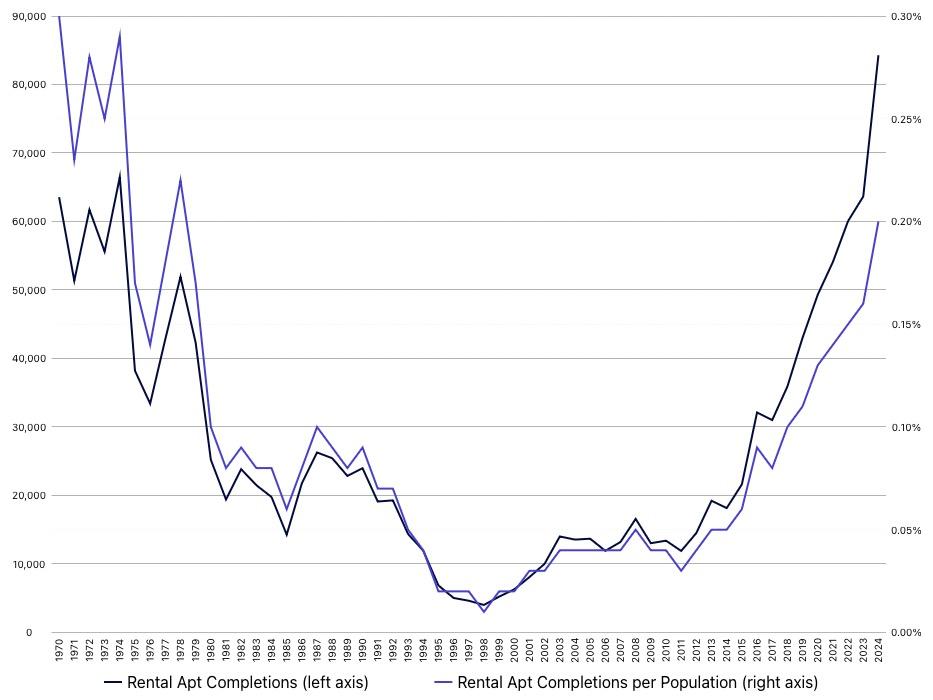
Over the last decade, rental housing construction has increased to approach levels achieved during the 1970s. This is a positive trend, as rental housing development rates had declined significantly, particularly during the late 1990s (see Figure 1). However, adjusting the data for population paints a different picture: the rate of rental construction is only half the rate achieved in the 1970s.
Note: Rental completions are based on privately initiated apartment structures in census metropolitan areas only; population is for all of Canada.
Sources: CMHC, Statistics Canada
Federal and provincial governments have attempted to increase Canada’s housing supply. However, the gap is much too large for the government to build enough housing to meet the country’s growing needs. According to CMHC data, Canada must build 3.5 million additional housing units on top of current projections to restore housing affordability by 2030. This means building an additional 500,000 new homes per year, on top of the 230,000 units currently projected. The government cannot achieve this goal alone. Private investment is required to make up the shortfall. However, encouraging the private sector to build more multifamily housing has been a challenge.
“Many projects are not viable due to high upfront costs and municipal development fees,” said Tony Irwin, President and CEO, Rental Housing Canada. “Due to prolonged construction timelines and ambiguous approvals, lenders and investors demand higher returns. Institutional investors will not commit to new projects in the absence of a stable, multi-year tax and regulatory environment, and small private owners will withdraw capital during downturns.”
Historically, private sector investment has been essential for meeting rental housing demand.
Over a 10-year period, the federal government has invested approximately $43 billion in building purpose-built rentals across the entire country. In the Toronto market alone, Statistics Canada estimates the value of condominiums owned by small investors to be approximately $40 billion in 2021. It is evident private investment exceeds the government’s investment in rental housing.
“Long-term capital is the only thing that can deliver housing at real scale,” said Adrian Rocca, CEO and Founder, Fitzrovia. “Institutional investors, such as pension funds, think in decades, not quarters. That’s what this sector needs. Purpose-built rental aligns perfectly with their mandates: stable, inflation-linked income and strong social impact.”
There’s a direct relationship between low construction levels and the lack of large real estate investors. Small investors have filled some of the rental housing supply in large Canadian cities. Toronto’s condo boom, which extended over two decades from the late 1990s, filled a significant portion of the city’s rental housing need. CMHC data indicates the share of condo apartments being rented approximately doubled over the last 15 years.
Figure 1: Canada’s rental apartment completions and supply per capita, 1970-2024
There is now an oversupply of condo rental units, primarily due to declining demand. Between 2022 and 2025, total condo apartment sales dropped by 75 and 37 per cent in Toronto and Vancouver, respectively. Even though many projects have been cancelled over this time, there is still a large inventory of condos for sale and rent. This oversupply will help rental affordability in the short term, but it will impede incentives to build new purpose-built rental and affordable condo apartments over the long term. The decline in new construction means higher housing costs when population growth increases and the economy recovers.
“It typically takes at least 10 years for a rental development to become profitable, as opposed to traditional real estate, which can capture the full investment and profit upon the point of sale,” said Irwin. “Programs that pay by unit without checking whether a project can cover ongoing operating costs leave buildings with no money for maintenance.”
The government must make long-term plans to ensure consistent rental housing supply meets current housing needs and future demand. This means incentivizing large investors to develop rental housing and condo apartments.
“The single biggest lever is reducing soft costs,” said Rocca. “Today, about 30 per cent of every project in Toronto is made up of government fees, levies, and development charges. A full waiver of development charges for two years and a 20-year property tax abatement for purpose-built rental would make hundreds of projects immediately viable. Other complementary policies that would truly move the needle include expanded CMHC programs like the Apartment Construction Loan Program and housing-focused municipal bonds to fund infrastructure.”
Addressing concerns about private rental housing development
Some housing advocates have voiced concerns about private rental housing development and the financialization of housing (i.e., private ownership of rental buildings). The most cited issues include:
• Affordability: Tenants must have other affordable units available to choose from to deal with changes in their income or family status, as well as control rent increases in their own units.
• Stability: Affordable units are only desirable when there is no risk of being evicted to charge future tenants higher rents.
• Quality: Rental housing must be livable and in a good state of repair, which is not possible when private owners under-invest in their buildings. One way to prevent unscrupulous investors from charging higher-than-market rents and taking advantage of tenants is to increase supply. More housing means more competition for tenants,
which will keep rental rates competitive. Having more rental housing options also provides tenants with more choices when their situation changes and provides people with more affordable housing options.
“Unaffordability began decades ago with chronic underbuilding, restrictive zoning, and a tax system that penalized rental supply,” said Rocca. “Corporate landlords didn’t create that problem; we’re one of the few still building through it. If we want to tackle affordability, we need to make building viable again, not vilify those still doing it.
Incentives like full development charge waivers, property tax abatements, and faster approvals reward productivity and get shovels in the ground. When purpose-built rental becomes economically viable at scale, supply will follow and that will bring rents down over time.”
Other countries can serve as models of what happens when there is balance (or lack of balance) in the rental housing market. For example, Sweden has tight rent controls but long waiting lists for rental apartments. Conversely, Tokyo has limited rent control but more than sufficient rental housing supply and strong tenant protections.
Impacts of rent control and financialization of rental housing
Are the concerns about the private rental housing system legitimate? CHMC examined the evidence to determine what policy tools should be implemented to help protect tenants while encouraging increased development of rental housing. It’s also vital to avoid undermining incentives that would encourage investors to get involved in building more affordable housing.
“Tenant protections and supply aren’t opposing forces; they need to work in tandem,” said Rocca. “The issue isn’t protecting tenants from unfair treatment; it’s making sure protection doesn’t choke off new housing entirely. Data has shown that rent control exacerbates housing affordability. You don’t fix a housing shortage by punishing those still building homes.”
Rent control is one of the most cited policy tools to help prevent excessive rent increases. The goal is to ensure people can afford to purchase or rent housing and live where they need. Advocates often claim rent control is essential. But is it truly effective?
There is research that claims rent control does not achieve this purpose. For example, according to research on San Francisco’s rent control policies, the supply of rental units decreased by 15 per cent and city-wide rents increased by five per cent. Tenants were also more likely (20 per cent) to remain in their units in the medium term. While this helped to prevent displacement of low-income tenants, it also prevented some tenants from moving to units better suited to their needs or closer to their workplace.
This is one example of how rent control made the situation worse for tenants. However, CMHC conducted significant research on the impact of rent control, which examined the results of dozens of papers on rent control. As per their publication, “Rent control and the affordability of rental housing in Canada,” rent control reduces housing quality, decreases the overall supply, leads to less maintenance, and is of greater benefit to higher income households.
There are exceptions where rent control benefitted tenants. Rent control worked well when it maintained the incentives that support a healthy rental housing market. Quebec has this type of rent control environment, which has been able to balance tenant protections with the ability to increase rent supply. Rental housing in Quebec is as affordable as it is in Edmonton, which has no rent control.
The financialization of rental housing has been unfairly demonized, as far as the research goes. CMHC researched the relationship between REITs and rental prices, which they published in the report, “Are REITs behind higher rent prices?”
According to their findings, there is no direct relationship between REIT ownership of rental housing and rent prices. Rent prices in Montreal, Toronto, and Vancouver were essentially the same for REIT-owned and other types of rental properties. When rents were higher, they were tied to specific financial factors (e.g., newer buildings, larger rental units, utilities included in rent, more amenities).
Some rental housing advocates claim that private rental ownership leads to higher rates of eviction. According to data in the 2021 and 2022 Canadian Housing Surveys, the annual rate of evictions is one to three per cent. This range probably does not capture the total number of evictions. Illegal and improper evictions should be investigated. While evictions tend to capture significant media attention, the number of evictions is lower than some rental housing advocates suggest.
Different rental structures have different risks
Not all rental property owners and properties are the same. Even though they all operate within the same environment, there are differences in how they provide services.
To evaluate the rental housing system, consider the differences between “primary” and “secondary” rental structures:
• Primary refers to purpose-built rental properties. Units are designed with the goal of being rented. Rental structures are typically financed and owned by large investors.
• Secondary refers to condo apartments, townhouses, basement units, and other spaces rented out and owned (and often financed) by individual investors.
Condos are usually more affordable than homes and sometimes cost less to rent. As a result, renters often choose condo apartment as their first steps toward home ownership. This enables new tenants to rent more affordable properties. Both structures help to add density to cities, making more effective use of available land and infrastructure. However, as seen in many condos within the GTA, they don’t typically provide enough space to house large families.
According to CMHC’s research, the secondary rental system provides tenants with less tenure stability. As per the 2021 Canadian Housing Survey, almost two-thirds of evictions were due to the landlord either selling the property or wanting the space for their own purposes. These types of evictions do not happen in the primary rental system. The fear of evictions is more of an issue in the secondary rental system.
However, the government should not implement policies that interfere with a landlord’s right to evict tenants for failing to pay rent. Legislation must find a balance between protecting tenants against unwarranted evictions in the secondary rental market with the landlord’s right to an efficient eviction process when it is justified.
“RHC supports real, practical resident safeguards and agrees public funds should not go to bad actors,” said Irwin. “RHC is a partner between our members and government, not just an advocate. That means expanding and promoting standards that promote good management and resident care, so projects that meet those standards get priority for public programs.”
Conclusion
The federal government cannot build enough rental housing to meet demand. Private sector investment is necessary to help address Canada’s affordable housing shortage. Small investors are exiting the market, removing critical funding required for new construction. This also means the condo development model needs reconfiguration. Large-scale private and institutional investors are needed to help fill the gaps in the rental housing supply system. They will help to meet long-term housing needs while avoiding the fluctuations that affect smaller investors who depend on short-term capital gains.
The government should protect tenants against unscrupulous landlords. However, this can be achieved by strengthening tenant protections rather than implementing rent control and other policies that prevent private investors from building more purpose-built rentals. They can also incentivize landlords to improve their services and compete in serving tenants.