NOVEMBER 2025
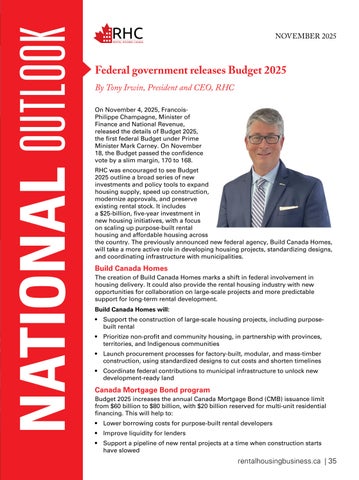
Federal government releases Budget 2025 By Tony Irwin, President and CEO, RHC On November 4, 2025, FrancoisPhilippe Champagne, Minister of Finance and National Revenue, released the details of Budget 2025, the first federal Budget under Prime Minister Mark Carney. On November 18, the Budget passed the confidence vote by a slim margin, 170 to 168. RHC was encouraged to see Budget 2025 outline a broad series of new investments and policy tools to expand housing supply, speed up construction, modernize approvals, and preserve existing rental stock. It includes a $25-billion, five-year investment in new housing initiatives, with a focus on scaling up purpose-built rental housing and affordable housing across the country. The previously announced new federal agency, Build Canada Homes, will take a more active role in developing housing projects, standardizing designs, and coordinating infrastructure with municipalities.
Build Canada Homes The creation of Build Canada Homes marks a shift in federal involvement in housing delivery. It could also provide the rental housing industry with new opportunities for collaboration on large-scale projects and more predictable support for long-term rental development. Build Canada Homes will: • Support the construction of large-scale housing projects, including purposebuilt rental • Prioritize non-profit and community housing, in partnership with provinces, territories, and Indigenous communities • Launch procurement processes for factory-built, modular, and mass-timber construction, using standardized designs to cut costs and shorten timelines • Coordinate federal contributions to municipal infrastructure to unlock new development-ready land
Canada Mortgage Bond program Budget 2025 increases the annual Canada Mortgage Bond (CMB) issuance limit from $60 billion to $80 billion, with $20 billion reserved for multi-unit residential financing. This will help to: • Lower borrowing costs for purpose-built rental developers • Improve liquidity for lenders • Support a pipeline of new rental projects at a time when construction starts have slowed
rentalhousingbusiness.ca | 35
NATIONAL OUTLOOK The federal government will continue purchasing up to $30 billion annually in CMBs to stabilize the market. For rental housing providers, the expansion helps address high financing costs, which have stalled many projects in the last two years.
Canada Rental Protection Fund Budget 2025 reinforces the Canada Rental Protection Fund (CRPF), a $1.47-billion initiative that enables non-profit and co-operative housing providers to acquire aging rental buildings. Funding includes $470 million in contributions and $1 billion in low-interest loans. The CRPF aims to prevent the loss of affordable rental units due to redevelopment, financial distress or conversion. This will help to maintain stability in communities with aging rental supply. Private owners can also divest older buildings while reinvesting into new housing.
Canada Housing Infrastructure Fund The Canada Housing Infrastructure Fund (CHFI) reinforces the focus on housing-enabling infrastructure, which includes water, sewer, transportation links, and servicing required to support density. The government has committed to: • Increasing investments through the CHFI • Work directly with municipalities to identify catalytic infrastructure projects that unlock new housing supply • Coordinating Build Canada Homes and other federal agencies to align infrastructure funding with major development areas
Accelerated Capital Cost Allowance The new Accelerated Capital Cost Allowance (ACCA) increases depreciation rates for eligible purposebuilt rental projects from 4 per cent to 10 per cent. This improves after-tax project returns, offsets higher construction and financing costs, and may help restart stalled rental developments that have been sidelined by economic conditions. The government is also introducing accelerated depreciation for modular and prefabrication equipment, supporting factory-based production and complementing Build Canada Homes’ procurement of modular and mass-timber units.
Updates to Housing Accelerator Fund Budget 2025 enhances the Housing Accelerator Fund (HAF) to reward municipalities that remove zoning barriers and accelerate approvals. Funding will help to shorten the municipal approval cycle and support: • As-of-right zoning for fourplexes and missing-middle housing • Pre-zoning for density near transit • Municipal performance targets tied to approval timelines and housing outcomes
Union Training and Innovation Program To support the increased development of housing, the federal government proposes $75 million over three years for the Union Training and Innovation Program, which will focus on: • Red Seal apprenticeships • Upskilling workers in modern construction methods • Increasing labour supply in residential construction Increasing the number of employees in this specialized workforce will help deliver the volume and speed of construction needed to meet Canada’s housing targets.
Standardized design catalogue Following pilot initiatives in 2024, the federal government will expand access to standardized design catalogues for rowhouses, multiplexes, and mid-rise buildings. This will help to reduce the time and costs for early-stage development, streamline development approvals, and support the mass adoption of
rentalhousingbusiness.ca | 37
NOVEMBER 2025 modular and prefabricated housing. Rental housing providers can use these designs to help reduce the risks of development and shorten pre-construction timelines. These design packages include: • Full architectural drawings • Engineering reports • Energy and climate resiliency assessments • Costing templates and user guides
GST rebate for first-time homebuyers Budget 2025 confirms elimination of the GST on new homes priced up to $1 million, and a reduced GST rate for homes priced between $1 million and $1.5 million. This measure may have secondary impacts on rental markets, including shifts in demand and the overall housing mix.
Desjardins: Rent inflation easing across Canada
According to the Desjardins Rental Market Outlook, published in November 2025, rent inflation is on the decline across Canada. The primary causes are the increase in rental housing supply, particularly purposebuilt rental, combined with slowing population growth due to reductions in immigration levels. However, the pause in rent hikes may be temporary, especially if construction levels decline. Desjardins’ report shows that Canada is building purpose-built rental (PBR) units at the fastest pace in decades. Rental stock under construction increased by more than 25 per cent in the first half of 2025, with Quebec leading the way. In 2024, the total number of PBR units rose by 4.1 per cent, which was the fastest annual growth in over 30 years. In Toronto and Vancouver, condominium apartments are increasingly being used to absorb demand, which is adding supply to the rental pool. Government support has helped to drive the boom. Incentives such as GST/HST rebates, accelerated capital cost allowances, and more favourable financing are funding these new rental projects. The increased rental housing supply is being pushed by declining demand. Population growth has slowed, as Ottawa has reduced non-permanent resident (NPR) inflows. Since temporary residents (e.g., students) are among the most likely to rent, this shift is reducing rental demand, especially in cities like Toronto and Vancouver. This demographic shift will further reduce rent inflation. If current immigration targets hold, Desjardins expects some notable dynamics (e.g., Calgary could see rent declines, growth in Toronto and Vancouver may flatten). Quebec has looser rent-setting rules and strong local demand, so rent levels may remain more buoyant. Desjardins forecasts national rent inflation will continue to slow into mid-2026 before stabilizing. However, rents may begin to increase if trends change. Construction costs are still very high. Rising costs for land, labour, and materials (as well as regulatory red tape) could make future rental projects less viable. Despite the positive construction numbers, purpose-built rentals make up a small percentage of Canada’s total housing stock; as a result, vacancy rates are improving gradually.
PwC: Purpose-built rental forming the cornerstone of real estate strategy
According to PwC and the Urban Land Institute’s report, Emerging Trends in Canadian Real Estate, purpose-built rental (PBR) housing is emerging as a cornerstone of real estate strategy, especially as developers and institutional investors evaluate their strategies in a more volatile market. Key factors driving the trend include: • Condo market pressures are shifting capital: With the pre-construction condo market under strain, many developers are redirecting stalled or unprofitable condo projects into rental developments. • Long-term growth story over short-term yield: PwC ranks PBR as a “best bet” for investors, especially those willing to accept lower returns today in exchange for steady, long-term growth.
38 | November 2025
NATIONAL OUTLOOK • Strong demand tailwinds: Even with a tighter immigration policy, household formation continues to drive rental demand. Much of Canada’s current rental stock is aging, which is creating opportunities for modern, higher-quality PBR units. Public policy is helping to push purpose-built rental developments forward. Programs like Build Canada Homes are accelerating PBR development. Developers are tapping into local incentives (e.g., development-charge relief) and partnering with non-profits to make PBR more financially viable. Some investors are also optimistic about revived tax credits (e.g., for multi-unit residential buildings) and favourable financing structures that support rental builds. PwC has noted increasing supply in Toronto and Vancouver has led to softer rental rates. While PBR development is accelerating, there’s concern about how quickly new units can be absorbed, especially in higher-end or luxury segments. Some developers are using land originally intended for condos to build rental instead. However, land costs, zoning, and development rules can make conversions challenging. PwC also noted the following outlook and potential strategic opportunities: • Institutional capital: Pension funds, family offices, REITs, and other institutional players are increasingly viewing Canadian PBR as scalable, impact-driven, and long-term. • Modular construction: Prefab and modular methods can help to lower costs, speed up development, and reduce risk. • Regional differentiation: Some markets are more favourable than others (e.g., Calgary has affordable land, investor-friendly policies, and growing rental demand).
Deloitte: Canada’s building boom won’t happen without more labour resources
The federal government is planning to ramp up construction to build more homes. This includes fasttracking nation-building infrastructure and doubling home construction to achieve these goals. However, according to recent analysis by Deloitte’s Future of Canada Centre, we have a significant labour shortage that will interfere with these plans. Deloitte’s report estimates that we will need an additional 410,000 to 520,000 construction workers by 2030. In August, Canada’s construction workforce consisted of about 1.7 million people. This means we would need to scale up by one-third of this figure in just five years. Construction demand comes from three major fronts: • Housing: Doubling the number of housing starts could require up to 290,000 more workers by 2030, based on current productivity. Even with a 10 per cent productivity boost, the need is still around 264,000. • Public infrastructure: If public investment returns to its previous peak (about 5.1 per cent of GDP), as many as 87,000 additional workers may be needed. • Private investment: Deloitte’s models assume the government’s target of catalyzing $500 billion in private capital could drive demand for another 128,000–140,000 workers by 2030. Deloitte’s numbers represent net demand, which assumes no retirements. However, the construction sector is facing a wave of exits. According to BuildForce Canada, more than 270,000 workers will retire between 2025 and 2034, which would mean gross hiring needs must exceed 800,000 new people. Construction productivity is also down. According to Deloitte, over the past 10 years, output per worker has decreased by around 7 per cent. This is especially concerning because every new worker costs money to train and integrate. The federal government is planning to spend a lot of money to address the skilled labour shortage, However, the labour issue is not just a money problem. Deloitte suggests Canada needs a parallel humanresources strategy that involves government, industry, unions, training institutions, and immigration systems.
rentalhousingbusiness.ca | 39
NOVEMBER 2025 Deloitte suggests the following approach to address the labour shortage: • Coordinated action between federal and provincial governments, colleges and training bodies, unions, employers, and Indigenous partners • Inclusive recruitment of women, youth, racialized Canadians, and underemployed workers to make use of untapped potential (e.g., women make up around 13 per cent of the construction workforce) • Recalibration of Canada’s immigration system to bring in trade-skilled newcomers; this means adjusting admissions to prioritize construction trades • Faster recognition of immigrants’ credentials to reduce the time to contribute • Encourage employers to absorb apprentices using targeted financial incentives and policies to make work more flexible and family-friendly • Invest in modular construction, robotics, prefabrication, and other productivity-enhancing technologies; a 10 per cent productivity gain could cut labour demand by about 50,000 workers by 2030 • The new Major Projects Office could help sequence projects to prevent spiking of demand for trades in localized “hot spots”
Slowing momentum, rising costs: Canada’s multifamily market adjusts in 2025
Canada’s multifamily housing market entered 2025 in a slower gear. With the Bank of Canada lowering its
policy rate to 2.5%, housing providers are seeing early signs of easing, but uncertainty remains. Economic pressure from tariffs, now averaging 12%, and weaker exports have led to a 1.6% annualized contraction in second-quarter GDP. Job creation has also cooled, with monthly gains averaging 8,000 compared to the long-term average of 18,000. Population growth increased by only 0.1% in the second quarter, the slowest pace since 1946, driven by a notable decline in non-permanent residents. Combined, these factors have softened demand just as operational costs continue to climb. Vacancy reached 4.3% nationally in the third quarter, up 20 basis points from last quarter and 110 basis points year over year. Rent growth decelerated for the sixth consecutive quarter, now at 3.9% compared to 6.2% a year earlier. With new completions landing just as employment and population growth cool, vacancy pressure is likely to persist into early 2026, keeping rent growth subdued. At the same time, annual turnover rose to 25%, the highest level in three years, while tenants’ average stay shortened to 36 months, reflecting growing mobility among renters.
Regional standouts: mixed signals across Canada Two-bedroom markets across the country are responding differently to these shifting dynamics. Halifax (5.9%), Edmonton (4.9%) and Saskatoon (4.7%) led the nation in new lease rent growth, fuelled by job creation and local sector strength. Halifax’s booming tech scene, supported by Dalhousie University and Nova Scotia Community College, continues to attract new talent and demand for rental housing. Montreal experienced a sharp rise in vacancy, up 5.6%, largely due to the delivery of more than 2,300 new purpose-built units earlier this year. Calgary maintains the highest vacancy rate at 5.8%, with strong completions pushing new lease rent growth into negative territory at -3.0% after a period of overbuilding. In contrast, Winnipeg (2.4%) and Halifax (2.8%) remain among Canada’s tightest markets, underscoring the regional divide in rental conditions.
The cost side of growth New this quarter, the report introduces national metrics that highlight the rising monthly cost of operating rental properties. These benchmarks help housing providers forecast budgets, detect cost overruns early and better understand the financial health of their portfolios. Even as rent growth slows, monthly expenses continue to climb. Repairs and maintenance expenses reached a monthly average of $183 per unit in Ontario, the highest in the country. Monthly controllable expenses neared $500 per unit in Ontario and Alberta, while total monthly operating costs rose to roughly $700 per unit in Ontario, exceeding the national average of $671.
40 | November 2025
NATIONAL OUTLOOK Still, efficiency improvements are visible. Digital prospect conversion rates hit 8.7% nationally, showing leasing teams are securing more leases from fewer inquiries. While resilient, this rate highlights room to refine digital follow-up and lead nurturing. Operators focusing on retention are also stabilizing performance, as longer resident stays reduce turnover costs and support predictability in an uncertain market.
What housing providers can do next As 2026 approaches, housing providers should prioritize efficiency over aggressive rent increases. Reviewing vendor contracts, optimizing maintenance schedules and adopting preventative maintenance programs can help control rising expenses. Data insights such as turnover percentage, average stay and per-unit costs provide valuable benchmarks for operational decisions. Retention will be key. Flexible renewals, resident incentives and consistent service quality can help extend tenancy durations and balance rising costs. Those who focus on efficiency, sustainability and resident experience will be best positioned to succeed as Canada’s multifamily market continues to recalibrate. Read the full Q4 2025 Canadian Multifamily Report for more insights: https://yardi.com/ cndmultifamilyreport
RHC Conference coming to Ottawa in 2026
The RHC Conference is heading to Ottawa in 2026. Mark your calendars for the conference, which will take place on May 26 – 28, 2026 at the Rogers Centre. This national event will bring together industry leaders, policymakers, and service providers for three dynamic days of innovation, insight, and connection. With a future-focused agenda covering sustainability, leadership, market trends, and housing policy, expect impactful keynotes, expert panels, and powerful networking, all aimed at shaping the future of rental housing in Canada. Visit www.rentalhousingcanada.ca to stay informed.
rentalhousingbusiness.ca | 41