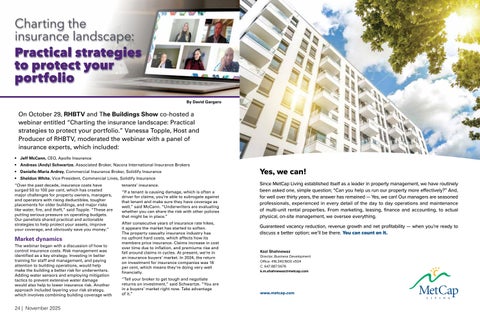
Charting the insurance landscape: Practical strategies to protect your portfolio By David Gargaro
On October 29, RHBTV and The Buildings Show co-hosted a webinar entitled “Charting the insurance landscape: Practical strategies to protect your portfolio.” Vanessa Topple, Host and Producer of RHBTV, moderated the webinar with a panel of insurance experts, which included: • Jeff McCann, CEO, Apollo Insurance • Andreas (Andy) Schwartze, Associated Broker, Nacora International Insurance Brokers • Danielle-Maria Ardrey, Commercial Insurance Broker, Solidify Insurance • Sheldon White, Vice President, Commercial Lines, Solidify Insurance “Over the past decade, insurance costs have surged 50 to 100 per cent, which has created major challenges for property owners, managers, and operators with rising deductibles, tougher placements for older buildings, and major risks like water, fire, and theft,” said Topple. “These are putting serious pressure on operating budgets. Our panelists shared practical and actionable strategies to help protect your assets, improve your coverage, and obviously save you money.”
Market dynamics The webinar began with a discussion of how to control insurance costs. Risk management was identified as a key strategy. Investing in better training for staff and management, and paying attention to building operations, would help make the building a better risk for underwriters. Adding water sensors and employing mitigation tactics to prevent extensive water damage would also help to lower insurance risk. Another approach included layering your risk strategy, which involves combining building coverage with
24 | November 2025
tenants’ insurance. “If a tenant is causing damage, which is often a driver for claims, you’re able to subrogate against that tenant and make sure they have coverage as well,” said McCann. “Underwriters are evaluating whether you can share the risk with other policies that might be in place.” After consecutive years of insurance rate hikes, it appears the market has started to soften. The property casualty insurance industry has no upfront hard costs, which affects how its members price insurance. Claims increase in cost over time due to inflation, and premiums rise and fall around claims in cycles. At present, we’re in an insurance buyers’ market. In 2024, the return on investment for insurance companies was 16 per cent, which means they’re doing very well financially. “Tell your broker to get tough and negotiate returns on investment,” said Schwartze. “You are in a buyers’ market right now. Take advantage of it.”
Yes, we can! Since MetCap Living established itself as a leader in property management, we have routinely been asked one, simple question; “Can you help us run our property more effectively?” And, for well over thirty years, the answer has remained — Yes, we can! Our managers are seasoned professionals, experienced in every detail of the day to day operations and maintenance of multi-unit rental properties. From marketing, leasing, finance and accounting, to actual physical, on-site management, we oversee everything. Guaranteed vacancy reduction, revenue growth and net profitability — when you’re ready to discuss a better option; we’ll be there. You can count on it. Kazi Shahnewaz Director, Business Development Office: 416.340.1600 x504 C. 647.887.5676 k.m.shahnewaz@metcap.com
www.metcap.com
While it sounds like the right time to chase lower premiums, this is not always the case. There may be better ways for rental property owners to balance insurance costs against real value and protection. Building owners often equate cost to value, but insurance does not always follow this logic. Getting the most value from insurance involves getting the right protection for the most competitive price. Brokers should help clients by examining their full portfolio to maximize value. Examine insurance through the lens of risk management rather than as a retail product. Insurance is not to be bought in exchange for instant gratification, other than knowing there is peace of mind in being properly protected. “But you are going to look at it in terms of a long-term investment,” said Ardrey. “If you’re managing your risk properly and lowering your overall risk profile, insurance companies will reward you by lowering your premiums and giving you more favourable renewal terms.”
Shifting premiums and underwriting standards Premiums and underwriting standards are going through significant changes. Various factors are driving these shifts, and rental property owners must adapt going into 2026 if they want to control their insurance costs. COVID-19 changed the employment landscape, as many people worked from home. Employers had to monitor employees to ensure they were doing the work. This led to what’s referred as “template underwriting,” which involves checking boxes to answer questions. Underwriters can match the answers to the appropriate risk and price for that risk. This is different from the traditional approach of personally meeting clients and evaluating a host of factors (e.g., wiring, windows, roof, individuals) on a case-by-case basis. “Insurance has become a box-checking environment,” said Schwartze. “It’s become like that in banking and in life insurance. I don’t think it’s going to change.” Everyone has access to the same markets and information. The value of your insurance depends on the broker’s ability to interpret your risk and structure your policy to protect your entire portfolio. They can get better rates and terms by negotiating with the underwriters on your behalf, and selling your story and experience. Many brokers can (and will) simply email your insurance form, which is where value is lost.
26 | November 2025
“Just because we’re not going into boardrooms anymore to have these negotiations, some clients feel as though it’s no longer part of the process,” said Ardrey. “For a lot of people, it still is. That’s why you want to get the right balance between the cost and the coverage, as well as the client’s risk tolerance.”
Water events and catastrophic losses Broad factors, such as catastrophic events (e.g., forest fires, tornadoes, ice storms, flooding), have a significant impact on insurance premiums. This year, Canada has been virtually unaffected by natural disasters, whereas 2024 was a record year in terms of catastrophic losses. These events drove insurance pricing up for the whole market. Except for the recent hurricanes, there have been fewer catastrophic losses globally, which has led to some relief in premiums. Water damage is one of the main causes of damage to buildings and portfolio management, and not all of it is insurable. Water damage accounts for 50 per cent of overall owner claims, 70 per cent of real estate claims, and millions of dollars in uninsured repairs.
Adding to your multi residential portfolio by taking advantage of existing land. Join RHB and a panel of land use experts who will break down the strategies that work and don’t work! From family owned to large developers, join Jason Birnboim, Greg Jones, and special guest Adrian Rocca, for a unique conference session on Thursday, December 4th as they show how to turn risk into opportunity. Understand the potential and optimize your properties land value as you navigate evolving industry policies for long-term success.
“The deductible on your property used to be the same as the water damage,” said White. “Now it’s completely different. Depending on the area you’re in, [the insurance company] could raise it. You could have a $5,000 deductible on water but everything else could be $1,000.” Water-related damage falls into four categories: 1. Unmonitored leaks: These are ongoing, not sudden, issues and often uninsured. These types of leaks eventually lead to more significant events and larger bursts. Installing water detection sensors is a data-driven, digital method of tracking individual leaks in units, bathrooms, kitchens, and other common areas. Leak and pressure detection can also be used to monitor mainline pipes, respond to changes to water pressure more quickly, and protect assets. “How you operate your buildings, your risk management and your risk management culture, the training and the operational diligence with your teams on site to be able to educate the tenant [will] enable you to report these things more quickly and mediate these things more quickly,” added McCann. 2. Natural disasters (e.g., hail, overland water): It’s unusual for multifamily buildings to be so exposed to these types of events, but claims happen. Ensure that coverage limits reflect the current replacement cost value for each type of
Adrian Rocca CEO, Fitzovia
Jason Birnboim President, Beaux Properties International Inc.
Greg Jones President, SkyDev
The conference session is Sponsored by Kingsgate Restoration and is part of the Buildings Week events.
Register for your spot today or make it part of your All Access Pass at PM Expo!
The conference session is Thursday, December 4th, 10:30 AM to 12:00 PM. at the Metro Toronto Convention Centre. Early bird pricing ends November 7th so be sure to register now!
Vanessa Topple Moderator
coverage. They should consider tariffs, labour costs, and other inflationary expenses. Beware of special limits that reduce coverage, especially for overland water and other specific events.
be grouped either independently or together. Looking at it from a risk perspective, you would look at each of the moving parts of the portfolio individually and how they fit collectively.”
3. Sudden and accidental pipe bursts: Early detection, staff and tenant training, and a practical response plan are the keys to mitigating the damage from these events. Conduct water drills (like fire drills) to check on tenants and units when leaks are detected. Implement proper building maintenance procedures to check pipes. Having the proper coverage for your building is important. It’s also essential for tenants to have insurance to recover claims for damaged belongings (either in their unit or in storage), as well as pay for a hotel while their unit is being repaired.
The deductible is another consideration. Every rental property owner has different standards for how much damage they are willing to cover financially before they decide to contact the insurance company to put in a claim. For example, if their threshold is $10,000 in damages, then the insurance broker should not put the deductible at $1,000, as this would be a missed opportunity to lower the upfront premium.
4. Negligent tenants: Cooking accidents are a major driver of tenant-driven insurance claims. While fires are a problem, fire sprinklers can cause even more damage, spraying 75 to 150 litres per minute. The water will soak that unit and the one below. Other issues include candle-caused fires, frozen pipes due to windows being left open in the winter, toilets clogged with kitty litter, and sprinkler heads damaged when tenants move out. “These all come out of your building insurance portfolio and against your claims if you can’t claim against the tenant,” said McCann. “Make sure the tenant has a policy and ensure you’re having these conversations and educating your tenants.”
Portfolio and placement challenges Rental property owners with multiple buildings in their portfolio have different insurance concerns and risks than single-building owners. Ensuring you have a healthy risk portfolio involves achieving balance across all properties and exposures, not minimizing risk or maximizing profit. For example, a rental property owner may have a mix of units with varying levels of value and risk (i.e., high-income and low-income units). Some insurers may enable them to put all the units on one policy for a fixed minimum premium. This policy may seem desirable due to its low upfront cost. However, one loss on any unit could affect the entire portfolio. At the same time, it’s not necessary to purchase individual policies for each unit because this prevents you from grouping similar units together strategically. “A healthy portfolio would look at each of the units individually and bundle the nicer units, the newer buildings, the AAA tenants together on one policy, as their relative risk is pretty low,” said Ardrey. “Units in older buildings, ones that have had claims before, student rentals, etc., might
28 | November 2025
When evaluating older buildings for potential issues, underwriters focus on what the tenants cannot see (e.g., risers, electrical systems, plumbing). For the most part, aesthetic in-unit improvements don’t affect insurance costs. Underwriters care about replacing galvanized plumbing and fused wiring, which can lead to higher and more frequent claims.
Saving money on your insurance policy The webinar concluded with the panelists providing advice on how to save money on your insurance policy while strengthening your insurance position. Some of their recommendations included: • Choose a specialized insurance broker with deep experience in your specific niche, as they will have a better understanding of your risks, negotiate stronger coverage, and help you to avoid unnecessary premiums and potentially costly gaps • Conduct annual policy reviews (rather than renewing automatically) to identify potential coverage gaps and savings opportunities • Add a tenant liability insurance mandate to leases and track compliance to protect against small or preventable claims • Add rental income coverage to your policy for when units become uninhabitable after a loss (e.g., fire or water damage) “Make sure income replacement or rental income coverage is on your policy,” said White. “It's bone cheap but it will save you money in the long run because now somebody else, the insurance company, is paying that rent for you while that person is displaced.” To watch the whole webinar, please visit https://www.boldtv.ca/events.