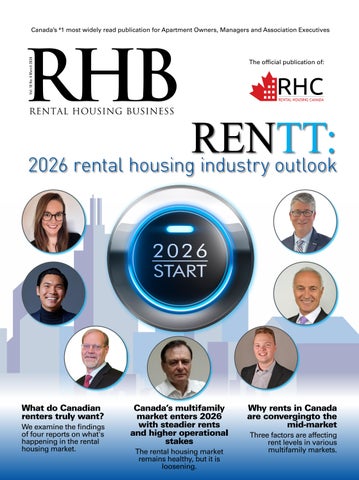
outlook





What do Canadian renters truly want?
We examine the findings of four reports on what's happening in the rental housing market.
Canada’s multifamily market enters 2026 with steadier rents and higher operational stakes
The rental housing market remains healthy, but it is loosening.



Why rents in Canada are convergingto the mid-market
Three factors are affecting rent levels in various multifamily markets.

















EDITOR’S NOTES
Beware the Ides of March
If you’ve ever read William Shakespeare in school, then you’re probably familiar with the play Julius Caesar and the line “Beware the Ides of March.” Apparently, this day (March 15) is associated with misfortune and doom. It was a bad day for Julius Caesar, for sure, as he was assassinated on this day. But why should anyone else fear this day? Spring is almost here, which means the weather will get better (although it will get worse first). Students are in spring break. Easter is around the corner. It’s closing in on tax time… ah, now it makes sense.
This issue of RHB Magazine features a RENTT panel with several rental housing association leaders from across Canada. We asked them to weigh in on their regional and national housing concerns, including what policy, funding or regulatory changes they would be advocating for most strongly this year, what would have the greatest impact on their region, and what regional issues are being overlooked on a national level
The second article summarizes the findings from four reports on what is happening in the Canadian rental housing market from renters’ point of view. These reports include the RentCafe.com Canada Renter Interest Report (Q4 2025), the simplydbs.com 2025 Canadian Multi-Residential Satisfaction Study, the Rentals.ca Winter 2025 Renter Feedback Survey, and the liv.rent 2026 Canada Rental Market Trend Report. Some of the topics include top trending cities for renters, moving intention, preferred amenities, affordability concerns, landlord profitability, and the use of AI and technology.
Make sure to read RHC’s newsletter, National Outlook, as well as the Regional Association Voice (we have an online version with more content). FRPO announces its new “Proud to Rent” campaign and explains why rents are converging to the mid-market. Yardi Canada wraps up this issue with an analysis of the multifamily market entering 2026.
We enjoy hearing from our readers, and we want to support twoway communication. If you have any comments or questions, send them to david@rentalhousingbusiness.ca. I look forward to your emails.

Publisher Marc Côté
marc@rentalhousingbusiness.ca
Editorial David Gargaro
david@rentalhousingbusiness.ca
Creative Director / Designer
Scott Clark
National Director, Sales and Marketing
Melissa Valentini
melissa@rentalhousingbusiness.ca
Sales Executive
Justin Kreslin
justink@rentalhousingbusiness.ca
Office Manager
Geeta Lokhram
David Gargaro Senior Editor
Subscriptions
One year $49.99 Cdn
Two years $79.99 Cdn
Single copy sales $9.99 Cdn
Opinions expressed in articles are those of the authors and do not necessarily reflect the views and opinions of the RHC Board or management. RHC and RHB Inc. accept no liability for information contained herein. All rights reserved. Contents may not be reproduced without the written permission from the publisher. P.O. Box 696, Maple, ON L6A 1S7 416-236-7473
Produced in Canada
All contents copyright © RHB Inc. Canadian Publications Mail Product Sales Agreement No. 42652516






RENTT: 2026 rental housing industry outlook
Canada’s rental housing association leaders weigh in on regional and national housing concerns.

What do Canadian renters truly want?
We examined the findings in four reports to learn more about what’s happening in the rental housing market.
FRPO provides an update on the LBO campaign and explains why



RAV features the latest industry news from four member associations.
Canada's multifamily market enters 2026 with steadier rents and higher operational stakes
The rental housing market remains healthy but it is loosening.





STRUCTURAL PEST CONTROL
ALIGNED WITH APARTMENT OPERATIONS
Proactive exterior rodent management
Targeted insect and bed bug remediation
Preventative monthly maintenance programs
Minimal-disruption treatment methodologies
Building-speci c planning and execution
Clear, board-ready reporting and documentation
Pest B Gone , provides structural pest management programs developed exclusively for condominiums, apartments, and high-density residential properties, where operational discipline, compliance, and resident con dence are essential.




PRESIDENT’S CORNER
This issue of National Outlook examines the impact of Canada’s real GDP contracting in the fourth quarter of 2025. It also discusses a recent Bank of Canada report of how mortgage rates affect housing prices and rents, as well as the importance of having a website that builds trust in prospective renters.
Canada's real gross domestic product (GDP) contracted unexpectedly at an annualized rate of 0.6% in the fourth quarter of 2025, the slowest annual growth rate since 2020. The overall growth rate for 2025 was 1.7%, which is in line with Bank of Canada expectations. The main reason for this contraction was that manufacturers dipped more heavily into their inventories rather than producing new goods. Looking ahead, the Bank of Canada projects Canada’s real GDP to grow by just 1.1% in 2026.
What does this mean for interest rates, the overall housing market, and the rental housing industry? It appears the Bank of Canada will hold the policy interest rate at 2.25% for the foreseeable future. The GDP slowdown feeds directly into housing demand and construction in several ways, while purpose-built rental construction is expected to slow in the second half of 2026. Combined with the increase in the national vacancy rate and the decline in immigration, demand for rental housing is expected to decline. See pages 35-37 to read more what the GDP contraction means for the rental housing industry.
The Bank of Canada recently published a staff analytical paper entitled “Channels of Transmission: How Mortgage Rates Affect House Prices and Rents in Canada.” It investigates how monetary policy affects both house prices and rental prices in Canada, examining the transmission channels through which changes in mortgage interest rates flow into these two housing markets. It is well known that changes in the interest rate will affect mortgage rates, which influences the affordability of homes. However, rents behave differently due to the pull of three different forces, and where you live in Canada is an influencing factor as well. See pages 37-40 to read more on how interest rate changes affect rents across Canada.
According to the latest Yardi Canadian National Multifamily Report, the national average apartment vacancy rose to 4.5% in Q4 2025, while national average annual turnover climbed to 25.5%. Housing providers are competing harder for every qualified lead, and renters are more mobile, often searching from outside your local market. Prospects will move on if your website doesn’t build trust quickly. See pages 40-42 to read more on what questions your website should answer for prospective renters.
If you are not already a direct member of CFAA, please consider joining CFAA as a Direct Rental Housing Provider Member, or a Suppliers Council Member. Visit www.cfaa-fcapi.org or email admin@cfaa-fcapi.org today.

Tony Irwin President and CEO, RHC
Built to meet the everyday needs of rental housing professionals
Your one-stop source for maintenance, repair, and operations essentials, from cleaning supplies and tools to paints and finishing products, plus the expert services that keep your properties running smoothly.

Dedicated support
• External sales reps who know your business
• In-store Pro Desk associates with trade expertise
Preferential pricing
• Exclusive pricing program
• Price lists and bulk rates
• Access to tiered discounts depending on your annual spend
Built around professionals
• Charge accounts for business owners*
• Special orders from leading manufacturers
Reliable delivery
• Fleet of flatbeds, boom trucks, and third party logistics
• 5 distribution centers and 27 HUB stores across Canada
• Nationwide jobsite delivery
*Upon credit approval. Minimum annual purchase of $5000 required. Other conditions apply. In participating stores only. Learn more at rona.ca/en/pro
In this issue of... NATIONAL OUTLOOK


35. Canada's real GDP contracted unexpectedly at an annualized rate of 0.6% in the fourth quarter of 2025. What does this mean for interest rates and the rental housing industry?
37. How does monetary policy affect both house prices and rental prices in Canada, and how do changes in mortgage interest rates flow into these two housing markets?

40. What questions should your website answer for prospective renters?
To subscribe to RHC’s e-Newsletter, please send your email address to admin@rentalhousingcanada.ca.
Rental Housing Canada (RHC) (formerly the Canadian Federation of Apartment Associations (CFAA)) is the leading national voice for Canada’s rental housing sector representing owners, managers and builders of nearly one million residential rental units across Canada.
RHC advocates for policies that enable our members to grow, invest, manage and build purpose built rental housing which provides quality rental homes for more than 10 million Canadians. For more information about RHC itself, see www.rentalhousingcanada.ca or telephone 613-235-0101.
RHC Member Associations
Corporation des Propriétaires Immobiliers du Québec (CORPIQ) www.corpiq.com P: 514-748-1921
Eastern Ontario Landlord Organization (EOLO) www.eolo.ca P: 613-235-9792
Federation of Rental-housing Providers of Ontario (FRPO) www.frpo.org P: 416-385-1100, 1-877-688-1960
Greater Toronto Apartment Association (GTAA) www.gtaaonline.com P: 416-385-3435
Hamilton & District Apartment Association (HDAA) www.hamiltonapartmentassociation.ca P: 905-632-4435
Investment Property Owners Association of Nova Scotia (IPOANS) www.ipoans.ns.ca P: 902-425-3572
LandlordBC www.landlordbc.ca P: 1-604-733-9440
Vancouver Office P: 604-733-9440
Victoria Office P: 250-382-6324
London Property Management Association (LPMA) www.lpma.ca P: 519-672-6999
New Brunswick Apartment Owners Association (NBAOA) www.nbaoa.ca jbrealsetate@nb.aibn.com
Manufactured Home Park Owners Alliance of British Columbia (MHPOA) www.mhpo.com P: 1-877-222-4560
Professional Property Managers’ Association (of Manitoba) (PPMA) www.ppmamanitoba.com P: 204-957-1224
Saskatchewan Landlord Association Inc. (SKLA) www.skla.ca P: 306-653-7149
Waterloo Regional Apartment Management Association (WRAMA) www.wrama.com P: 519-748-0703
your Laundry from your Phone!day.
our laundry payment solution that allows residents to pay using a mobile app.
One App Does It All
More than just app payment, the mobile app makes the chore of laundry easier for residents. Depending on your specific tech bundle, you can select different modules for:
• Remote Monitoring
• Cycle Countdowns & Alerts
• Service Requests
• Laundry Education
• Refund Management
Enhanced User Experience
The ultimate benefit of a modern, digital laundry room is convenience with a variety of tools at your residents’ fingertips.

For more information contact us at:

6 Ottawa - 85,424 7 Winnipeg - 76,818
Calgary - 61,359
Halifax - 61,055
London - 52,607
Stock Up. Fix Up. Stay Ready.
H&S Building Supplies Ltd. is a specialized distributor serving Ontario’s multi-unit residential rental sector. We provide a full range of MRO (Maintenance, Repair, and Operations) and renovation products, including electrical, plumbing, HVAC, hardware, janitorial, and general building materials. Supporting property managers and contractors with reliable supply and efficient solutions.
Serving commercial, multi-unit rental properties — year-round.






8,500+
RENTT:
By David Gargaro
Canada’s rental housing association leaders weigh in on regional and national housing concerns
Over the last year, the federal government has implemented policies and regulations that directly affected the rental housing industry. Some of these measures included launching Build Canada Homes to increase the pace of construction, removing the GST and federal component of the HST from new purpose-built rental housing, expanding financing options for rental housing construction, and instituting the Canada Rental Protection Fund to help protect existing rental stock.
Other measures have had varying impacts on different Canadian regions. The Bank of Canada reduced the policy interest rate four times in 2025 but has held the line during the most recent announcement periods. This stability should make financing new rental developments more predictable for the immediate future, although not cutting interest rates to help reduce inflation could affect housing demand in other segments. Canada’s immigration policy shift has helped to reduce demand for rental housing, which has negatively affected asking rents for parts of BC and Ontario where there are higher concentrations of temporary workers and students.
In this month’s issue, we asked our esteemed RENTT (Rental Executives National Think Tank) panellists, who are leaders of rental housing associations across Canada, to state what policy, funding or regulatory changes they would be advocating for most strongly this year and what would have the greatest impact on their region. We also asked them about regional issues that are being overlooked on a national level.
2026 rental housing industry outlook
RENTT experts:
Tony Irwin, President and CEO, Rental Housing Canada (RHC)
Marielle Hossack, Director, Policy & Regulatory Affairs, Federation of Rentalhousing Providers of Ontario (FRPO)
David Hutniak, CEO, LandlordBC
Daniel P. Chin, President, Hamilton and District Apartment Association (HDAA)
John Dickie, Chair, Eastern Ontario Landlord Organization (EOLO)
Landon Field, CEO, Rental Housing Saskatchewan
Kevin Russell, Executive Director, IPOANS
RHB: Welcome to RHB Magazine ’s RENTT panel. We appreciate the time and effort involved in participating in today’s discussion and sharing your experience. Our readers will benefit from your input. Today we’d like to discuss some of the issues affecting rental property owners at the regional and national level. What policy change, funding priority, or regulatory reform will your association be advocating for most strongly this year and why?
Tony Irwin: Our top priority for 2026 is Development Charge (DC) reform. In some regions, DCs have increased by over 900 per cent since 2004. These rising charges, combined with slow approvals and high costs, make it difficult for projects to meet investor and lender requirements. Measures introduced in Budget 2025, including the Build Communities Strong Fund, ensure that infrastructure typically funded through DCs like water and wastewater systems is covered by the federal and provincial governments. We urge the federal government to work with all levels of government to ensure this critical measure is implemented.
David Hutniak: LandlordBC will continue to advocate for a balanced legislative environment, noting the BC NDP’s actions since taking power in 2017 have included some measures that have made it difficult to operate and improve existing purpose-built rental housing in BC. The most notable change was the September 2018 illconceived measure to change the RTA’s Annual Allowable Maximum Rent Increase formula from 2% + CPI to CPI only. We continue to argue for the return to the pre-September 2018 formula. We also continue to pursue tax policy that recognizes the importance of the service we provide. Ideas we’ve broached with the Province include limiting utility cost increases to CPI to align with the RTA maximum, creating an insurance pool, ending the elevator industry monopoly, and stopping municipal scope creep into residential tenancies. We will continue to reinforce that vacancy control would spell the death-knell of the sector. Fortunately, the BC NDP to date have understood this dynamic. We are appreciative the Province continues to make timely access to justice a top priority by properly funding the Residential Tenancy Branch and implementing positive operational changes. The RTB is still not perfect, but we are pleased with the progress they’ve made. We continue to keep the pressure on for future funding.
Landon Field: This year, Rental Housing Saskatchewan continues to advocate for policies
that support a steady and sustainable increase in rental housing supply. More supply means more choice and improved affordability for families, and we remain focused on solutions that make this possible. At the same time, we will continue to push back against measures such as rent control that restrict new development, limit available housing, and worsen long-term affordability. A central priority for us this year is securing the long-term continuation of Saskatchewan’s Secondary Suite Incentive Program. By reducing the upfront cost of building a legal secondary suite by 35 per cent, the program makes it far more attainable for homeowners, first-time buyers, and renovators to create new rental units within existing neighbourhoods. These suites make productive use of space already available in homes across the province, add much needed rental options without changing community character, and help improve affordability for both renters and homeowners through the added income they generate. We are advocating for this program’s continuation because it has proven to be one of the most efficient and practical ways to add new rental housing quickly. Saskatchewan’s large stock of single detached homes with basements and other areas well suited for conversion creates an ideal environment for this type of gentle and cost-effective growth. Given that planning, permitting, and contractor timelines can stretch over many months, a stable and predictable incentive is essential for giving homeowners the confidence to move ahead. Extending and protecting this program will help ensure Saskatchewan maintains a healthy pipeline of new rental supply and continues moving toward better affordability for everyone.
Marielle Hossack : Solving Ontario’s housing shortage requires policies that both accelerate the construction of new rental homes and ensure those homes can be managed responsibly within a fair, functional regulatory framework. One of our top priorities this year is ensuring the effective implementation of Bill 60 reforms to the Landlord and Tenant Board (LTB) that were passed but are not yet in force. The Ontario government has taken important steps to improve timeliness and fairness at the LTB, particularly by addressing delays and limiting abuse of the system by bad actors, while respecting the rights of responsible tenants and housing providers. As of February 2026, those measures have not yet been implemented. We’re working closely with the government to ensure the regulatory framework delivers real, on-the-ground improvements that restore confidence in the system and support the delivery of much-needed rental housing.









Q&A on national housing issues
RHB: What would you like the federal government to focus on to support rental housing and rental property owners / developers across Canada?
Tony Irwin: The federal government should modernize tax policy to encourage long-term reinvestment in the rental sector. One of the most impactful changes would be adopting a “like-kind exchange” model similar to Section 1031 in the U.S. Internal Revenue Code. In the U.S., developers can defer capital gains taxes if they reinvest the proceeds from a sale into a new
RHB: What one systemic barrier in limiting rental housing supply nationwide, and what could the government do to help overcome those barriers?
Tony Irwin: The most significant systemic barrier is the lack of coordination between all three levels of government. Even with federal low-cost financing, municipal red tape and provincial tax structures keep many projects stalled. To fix this, the federal government should use infrastructure funding as a lever. Transfers should be tied directly to municipal performance, requiring cities to adopt as-of-right zoning, faster



Daniel Chin: In 2026, our primary focus is on protecting and extending the life of Hamilton’s existing rental housing stock through policies that support reinvestment rather than unintentionally discouraging it. Much of the region’s rental housing, particularly mid- and high-rise buildings constructed decades ago, continues to house thousands of residents affordably, but it now faces growing pressure from aging infrastructure, climate impacts, and rising operating costs. Ensuring these buildings remain safe, resilient, and livable requires sustained capital investment. We are advocating for incentive-based, outcomefocused policies that encourage upgrades related to energy efficiency, climate resilience, and building performance. When governments align regulatory goals with practical investment pathways, housing providers are better positioned to improve tenant outcomes while preserving long-term affordability and supply. Protecting what already exists is one of the fastest and most cost-effective ways to address housing challenges in our region.
John Dickie: Having the City of Ottawa stay the course in cutting back on regulations on rental property and housing development. The City has just adopted a 50-point plan to become the most housing-friendly city in Canada. That has included rolling back numerous restrictions on development. It has also included an expansion of the property sizes and types that can be built in many areas of the City. For example, many properties that were limited to three units can now be improved with up to six units. Larger developers can build property for ancillary uses along street fronts, on land that also serves new and existing larger apartment buildings. As-ofright zoning is allowing faster development, which makes development less costly.
Kevin Russell: Both the Nova Scotia Residential Tenancies Program and the Nova Scotia Small Claims Court process require meaningful reform. These systems were originally designed to provide a straightforward, efficient mechanism to resolve landlord-tenant disputes. Over time, however, they have become increasingly overburdened, slow, and inconsistent. There is growing concern within our membership about uneven decisionmaking and a lack of procedural consistency, which undermines confidence in the system. A dispute resolution framework must be predictable, timely, and balanced to maintain fairness for both housing providers and tenants. The government’s perception that dissatisfaction on both sides means the system is “working” is misguided. When both parties lose confidence in the process,
it signals structural problems that require reform, not validation. Our focus this year will be on restoring efficiency, consistency, and procedural fairness to both systems.
RHB: If you could make it a reality, what regulatory change would be most impactful on your region?
Tony Irwin: Purpose-built rental developments are multi-year projects that require predictable financial planning. Our goal is to lower these costs and modernize the regulatory environment to ensure more rental projects can move forward. Current Canada Mortgage and Housing Corporation (CMHC) regulations can make progress challenging. Some RHC members describe MLI Select as a “loan of last resort” because of onerous requirements, such as having to submit two-year project budgets in an uncertain economic climate. We encourage the government to streamline the application process and remove redundant submission requirements. We are also calling for a reduction in the affordability criteria within MLI Select to make the program more accessible for both new construction and refinancing.
"Purpose-built rental developments are multi-year projects that require predictable financial planning."
Daniel Chin: The most impactful regulatory change for the Hamilton region would be the introduction of mandatory cumulative impact assessments for new rental housing by-laws, combined with regular, evidence-based review of existing programs. Rental housing is increasingly governed by multiple layers of municipal, provincial, and federal rules. While each initiative may be well-intentioned, their combined effect can create significant administrative burden and cost without always improving outcomes for tenants. Evaluating new regulations in isolation no longer reflects how housing actually operates on the ground. Requiring municipalities to assess overlap, cost, and real-world impact before introducing additional by-laws would improve policy effectiveness, strengthen compliance, and help ensure that limited public resources are directed toward measures that genuinely improve housing quality, reinvestment, and supply. Good regulation should be coordinated, measurable, and accountable.
John Dickie: The Province of Ontario appears to be willing to roll back inclusionary zoning, having come to the realization that making





















developers include below-market units for rental or sale effectively drives up the costs of the market-level units, and will reduce development. Blocking inclusionary zoning should lead to more development, which in turn should moderate the market price of new units of any given size and quality. In turn, that should impact the price of new housing across the housing market, allowing more renters to buy housing to move into, thus making more rental units available to households who need them.
Marielle Hossack: The most impactful regulatory change would be meaningful reform to development charges, and alternative municipal financing tools for growth-related infrastructure. Today, development charges have become one of the single largest cost drivers for new rental housing, often adding tens of thousands of dollars per unit before construction even begins. These costs ultimately reduce feasibility, delay projects, and limit the supply of purpose-built rental housing, especially in high-growth regions. FRPO supports efforts to streamline and modernize the development charge framework, including limiting eligible costs, improving transparency in how charges are calculated, and removing infrastructure costs that are better financed through long-term tools like municipal bonds rather than upfront charges on new housing. When infrastructure is financed more fairly over time, instead of front-loaded onto new homes, municipalities can still fund growth while enabling rental housing to be built faster, at scale, and at more attainable rents. This is one of the most immediate levers governments have to unlock supply without compromising tenant protections or municipal fiscal health.
Kevin Russell: The most impactful regulatory change would be to make Residential Tenancies decisions related to non-payment of rent final and not subject to appeal to Small Claims Court. In Nova Scotia, non-payment decisions can currently be appealed to Small Claims Court, which often results in additional delays. During this period, tenants may remain in the unit without paying rent for several more months. This undermines the purpose of having a streamlined administrative tribunal process in the first place. A non-payment of rent matter is typically a straightforward issue of fact: either rent was paid or it was not. Removing the appeal layer for non-payment decisions would improve efficiency, reduce financial harm to housing providers, and restore confidence in the integrity of the system.
RHB: What issue, which is being overlooked at the national level, will have the most significant impact in your region in 2026?
Tony Irwin: Solving the housing crisis requires more than just economic measures. The critical shortage of skilled construction labour is being overlooked in the national conversation on housing. We cannot build the homes Canada needs without the people to build them. To hit our supply targets, the federal government must prioritize newcomers who are equipped to work in construction and the skilled trades. CMHC has already cited labour shortages as a primary driver of longer construction timelines, and the data bears this out. While the construction industry represents eight per cent of total employment in Canada, only two to three per cent of new immigrants and temporary foreign workers are entering the trades. RHC is calling for a realignment of immigration and non-permanent resident programs to specifically target these essential sectors.
"Today, development charges have become one of the single largest cost drivers for new rental housing, often adding tens of thousands of dollars per unit before construction even begins."
David Hutniak : Housing policy in general remains somewhat opaque. While there’s clearly a commitment by the federal government to new supply, it’s now a matter of translating it to results. I should add while we agree with the need for new supply, we would also like to see the federal government support existing rental, purpose-built in particular. One area where they should immediately do so would be to provide meaningful financial incentive programming for energy retrofits including cooling. Our Rental Apartment Retrofit Accelerator Program (RARA) is a sector-leading initiative in energy retrofits and has advocated to the federal government directly for more retrofit support for our sector. The other area that needs attention is immigration. Our sector has faced significant disruption and uncertainty because of the pendulum shifting immigration policy that has had negative impacts on both the operation of existing rental housing and creation of new rental housing.
Landon Field: One of the most overlooked issues at the national level is the degree to which Saskatchewan’s housing market is outperforming



the rest of the country on key fundamentals, including housing starts, affordability, and rental market stability. While national forecasts warn of slowing construction and weakening demand, Saskatchewan is moving in the opposite direction. CMHC data shows the province led the nation in year-to-date housing start growth in 2025, with starts up 50.8 per cent in the first ten months of the year, and urban housing starts rising 71 per cent year over year in October alone. The provincial dashboard further confirms this trend, reporting a 41.8 per cent increase in total housing starts in 2025 and ranking Saskatchewan first among all provinces for percentage growth. At the same time, new home prices in Regina and Saskatoon continue to rise modestly, defying the national cooling seen in many cities and underscoring the strength of local demand. What is being missed nationally is how this sustained construction pace, paired with relative affordability, positions Saskatchewan for continued economic and population growth in 2026. CMHC’s 2026 Housing Market Outlook notes that while new home construction is expected to slow nationally due to higher costs and weaker demand, the Prairies are projected to remain above their historical averages, an important distinction not widely recognized in national narratives. Saskatoon’s June 2025 CMHC report also showed stable rental conditions, including a 2.5 per cent vacancy rate, healthy rent growth, and 500 new provincial housing starts contributing to supply stability. These indicators point to a market that is not only resilient but expanding at a pace unmatched elsewhere in Canada. In short, the biggest overlooked issue is that Saskatchewan is quietly emerging as a national leader in balanced growth, delivering affordability, strong construction performance, and market stability.
Daniel Chin: One of the most overlooked national housing issues, yet one with significant consequences for regions like Hamilton, is the gradual erosion of small and mid-sized rental housing providers. Much of Canada’s rental housing is owned and operated by local, noninstitutional providers who maintain older buildings and serve diverse communities. Increasing regulatory complexity, rising costs, and limited access to capital are making it harder for these providers to reinvest or even remain in the sector. When they exit, the loss of housing is often incremental and largely invisible, but the cumulative impact on supply and affordability is substantial. National housing policy increasingly focuses on large-scale development and institutional investment, but preserving existing rental housing depends just
as much on the viability of smaller providers. Recognizing and supporting this segment is essential to maintaining stable, affordable housing in communities across the country.
"One of the most overlooked national housing issues... is the gradual erosion of small and midsized rental housing providers."
John Dickie: Continuing or increasing funding for the Canada Housing Benefit. Plans are afoot to cut back on the Housing Benefit program funding because the federal government is funding more affordable housing construction than it did, through the new Build Canada Homes agency. While the federal government’s finances are under a lot of pressure due to the trade issues with the United States and the plan to increase military spending, transferring spending from housing benefits to construction subsidies will adversely affect many renters. Construction spending only produces new rental units four to six years in the future, whereas housing benefit spending helps needy renters now. Construction spending produces far fewer affordable rental units than the number of units that are made affordable each year through the housing benefits. In the very long term, construction subsidies can reduce the need for housing benefits, but Canada is nowhere close to the stage at which the housing benefits are not still desperately needed.
Marielle Hossack: The growing gap between housing policy goals and the real-world cost of delivering rental housing is being underestimated at the national level. Construction costs, development charges, financing pressures, and regulatory delays are quietly eroding the feasibility of new rental projects, even in communities that urgently need housing. Without coordinated action across all levels of government to align taxes, fees, and approvals with housing outcomes, projects will continue to stall. Housing delivery is not just a social issue; it’s an economic one. If investment continues to retreat, Ontario risks losing jobs, supply, and longterm affordability. What’s needed now is a shared focus on delivery: lowering barriers, restoring confidence, and enabling the private sector to build rental homes at the scale Canadians need.
RHB: Thank you for your time.

What do Canadian renters truly want?

By David Gargaro
Knowing what renters want and need is an integral part of owning and managing rental properties. After all, renters are the lifeblood of your business. It’s essential to attract and retain good tenants who pay the rent consistently. This is even more important given the current state of Canada’s rental housing market. National vacancy rates are on the rise. Average asking rents are on the decline across the country, falling for the 17th consecutive month (as per Rentals.ca). The condo rental market is oversaturated because real estate investors cannot sell their units; a lot of this inventory have become rentals, creating more competition for tenants. Immigration has fallen 18 per cent year over year, negatively impacting demand for rental housing in some markets.
What’s going on with Canadian renters? And what do they truly want when looking for a place to live? Their preferences and choices can drive rental housing business decisions (as well as asking rents). RHB Magazine examined the findings in four reports to learn more about what’s happening in the rental housing market from renters’ point of view.
RentCafe.com Canada Renter Interest Report (Q4 2025)
To identify Canada’s top-trending rental markets, RentCafe.com analyzed millions of interactions on its website across 25 cities. Their analysis focused on four key indicators from Canadian properties listed on the platform: available listings, listing views, apartments saved as favourites, and saved personalized searches. The cities were scored and then ranked according to which ones attracted the highest level of interest from apartment-seekers.
Top cities
Canada’s top 10 trending cities for renter interest in the fourth quarter of 2025 were:
1. Moncton, NB
2. Hamilton, ON
3. Halifax, NS
4. Saskatoon, SK
5. Regina, SK
6. Victoria, BC
7. Vancouver, BC
8. Winnipeg, MB
9. Ottawa, ON
10. Edmonton, AB
“Several smaller and mid-sized cities attracted more renter interest in the fourth quarter than their population size might suggest,”
said Meherzad Bakht, Senior Sales Manager, Yardi Systems. “With steady engagement and continued visibility in the rankings, these markets remain strong alternatives to Canada’s largest urban centres, especially for renters focused on affordability and availability.”
Moncton led the rental rankings with a perfect score, due to increased interest in Atlantic Canada, affordability, quality of life, and increased economic momentum. Rental properties attracted interest from locals, as well as renters from Halifax, Montreal, and Toronto. Other smaller and mid-sized cities, like Saskatoon and Victoria, attracted more renter searches due to affordability and availability of rental properties. Hamilton saw the biggest jump in rankings (moving up 10 spots to 2nd on the list), due primarily to spillover demand from renters priced out of Toronto and the surrounding area.
Toronto improved in the rankings, rising to 12th on the list. Calgary fell out of the top 10 list to 15th. Montreal ranked 24th, putting it near the bottom of the list.
To read the full report, visit https://www.rentcafe. com/blog/rental-market/market-snapshots/canadarenter-interest-report .
simplydbs.com 2025 Canadian
Multi-Residential Satisfaction Study
The 2025 CMRS Study collected insights into residents’ living experiences, preferences, and satisfaction levels. Surveys were distributed to more than 300,000 residents across Canada through institutional, private, and REIT housing providers.
Reasons for renting
More than three-quarters (77%) of renters said they are actively choosing to rent rather than becoming homeowners. Location is the primary driver, as renting provided either the only or best opportunity to live in their preferred area. The other reasons were affordability, convenience of rental living due to access to maintenance and services, and lifestyle factors (e.g., recent relocation, transitioning from homeownership, reduced financial commitment).
Moving intention
Nearly one-half of renters (47%) plan to stay in their current units, which is a notable decrease from 2024 (59%). About one-fifth (21%) of respondents plan to relocate within the next 12 months, up from 14 per cent in 2024, while 32 per cent expect to move within one to two years. The primary reasons for moving include rental affordability and pricing, the intention to purchase a home, and relocations related to school, work or family circumstances. Residents living in newer buildings (less than 10 years old) are more likely to move in the coming years compared to those in older buildings (60% vs. 49%).
Most renters (89%) said rent incentives affected their decision to sign a lease; however, only 42 per cent received an incentive upon move-in. The most sought-after incentives were free parking, free storage, and rent discounts (e.g., 50 per cent off first two months).
Private spaces
Having access to private outdoor space (e.g., balconies) was the most desired feature among renters, with 94 per cent rating it as either essential or nice to have. Of those surveyed, approximately one-half said a balcony was essential. However, 22 per cent of respondents who initially rated a balcony as essential said they would reconsider and be open to shared outdoor space under certain conditions (e.g., lower rent). Unit size was another key consideration. There was a relatively equal divide between renters who would prefer a smaller suite in a newer building with a modern kitchen and bathroom versus a larger suite in an older building with more dated finishes. Younger renters (e.g., under 24, full-time students) declared a preference for small modern suites in a newer building.
Preferred amenities
In-suite laundry was one of the most indemand amenities, with over 90 per cent of respondents rating it as either essential or nice to have. Other highly ranked features included en-suite bathrooms, walk-in closets, entrance halls or closets, and bedrooms large enough to accommodate a king-size bed.
As a lot of people work from home, reliable high-speed wireless internet and strong cellphone service throughout the building ranked high among respondents. Nearly one-half of respondents said these were essential, with the majority expressing a strong preference for these amenities. Most respondents were also willing to pay more for these services. Other highly ranked amenities included shared workspaces, guest parking, and on-site property managers.
“Understanding who lives in your buildings, and what they value, need, and want, adds a critical layer of intelligence that helps guide decisionmaking about what to invest in and how to prioritize property improvements,” said Sarah Segal, CEO and Co-founder, simplydbs.
Technology preferences
The study found strong resident openness to technology in their buildings. Most residents reported being comfortable with AI-powered technologies, such as package delivery management and personalized notifications related to renting.
Respondents clearly identified their top technology priorities, led by controlled access for lobby and parking entrances (86%), non-key secure access such as digital entry systems (81%), and a property app for communications and maintenance requests (79%). Additional priorities include systems that allow rent payments to build credit (76%) and video doorbells for individual suites (74%), highlighting a demand for technology that improves both security and convenience in rental properties.
“There is clear demand for clean, well-run, and technology-forward properties. The key question is which technologies, amenities, operating models, and designs matter most, and for which residents. That’s where data helps drive smarter decisions and priorities for owners, managers, and developers,” said Segal.
To read the full report, visit https://simplydbs.com/ cmrs
Rentals.ca Winter 2025 Renter
Feedback Survey
Rentals.ca collected survey results from 503 renters across Canada. The survey examined how conditions in the rental market are evolving, covering topics including affordability, the impact of rent increases, the effectiveness of incentives, and difficulties faced during the home search.






CONGRATULATIONS
TO THE WINNERS OF THE

2025 FRPO MAC AWARDS

The FRPO MAC Awards celebrate innovation, excellence, and leadership across Ontario’s dynamic rental housing industry. Each year, FRPO members showcase their commitment to delivering high-quality housing and exceptional service for residents. We’re inspired by our community’s dedication and can’t wait to see what they accomplish in 2026.

by Fitzrovia Sloane

Minto Apartments Minto Apartments At 88 Beechwood, At 88 Beechwood, people are welcome, too people are welcome, too

sloanelife.ca sloanelife.ca Sloane by Fitzrovia Sloane by Fitzrovia
Best Lobby Best Lobby Renovation of the Year Renovation of the
177 St George, Toronto 177 St George, Toronto Contractor: Sky Group Contractor: Group of Companies of Companies Minto Yorkville Minto Yorkville Contractor: Sky Group Contractor: Sky Group of Companies of Companies Contractor:


Best
Best Amenities - Best AmenitiesRenovation Renovation
Maddox by Fitzrovia Maddox by Fitzrovia Maddox Cabbagetown, Maddox Cabbagetown, Toronto Maddox
Rental Development of the Rental Development of the Year - 200 Units or Less Year - 200 Units or Development of Units or
The Rose Corporation The Rose Corporation
The Bakerfield II, Newmarket II, Newmarket Newmarket

Rental Development of the Rental Development of the Year - Secondary Market Year Secondary Market Development Year Market
Homestead Land Holdings Ltd. Holdings Ltd.
The Shipman II, St. Catherines Shipman II, St. Catherines Shipman

Property Manager
Property Manager Property Manager of the Year of Year
Leasing Professional Leasing Professional of the Year of the Professional




Best Amenities - Best AmenitiesNew Development New Development
Best New Sloane by Fitzrovia by Fitzrovia South Tower - Sloane, South Tower - Sloane, Toronto Toronto -
Rental Development of the Rental Development of the Year - Over 200 Units Year Over 200 Units
Rental of Over Dream Asset Management Corp, Dream Asset Management Corp, Kilmer Group & Tricon Residential Kilmer Group & Tricon Residential Birch House at Canary Landing Birch House at Canary Landing Management Residential Birch House at


Skyline Skyline
Climate Leadership Award Climate Leadership Award
Marios Proniaris Marios Proniaris Park Property Management Property Management Marios Adam McGuin Adam McGuin Equiton Living Equiton Living Living Skyline Skyline
Resident Manager Resident Manager of the Year of Year Manager
Marlene Canadian Properties
Marlene MacFarlane Marlene MacFarlane Canadian Apartment Canadian Properties REIT Properties
Customer Service Award Customer Service Award of Excellence of
Tricon Residential Tricon Residential

Company Culture Award Company Culture Award of Excellence of Excellence Culture
Community Service Award Community Service Award of Excellence - of Excellence
Community of
Supplier Member Supplier
Community Service Community Service Award of Excellence - Award ExcellenceRental Housing Provider Rental Housing Provider Rental Environmental Environmental Excellence Excellence





Affordability
Affordability is a primary concern for Canadian renters. Almost two-thirds (62%) of renters said that more than 30 per cent of their net income goes toward rent, while one-third (33%) spend more than one-half of their net income on rent. It’s a more significant issue in large urban markets, such as Toronto, where 70 per cent of renters spend more than 30 per cent of their net income on rent. Even though average asking rents have declined, 63 per cent of renters said their rent increased since the summer.
Not surprisingly, high rent price is the primary challenge for most renters (69%) in their search for a place live. The other challenges were poorquality listings (11%), the low supply of available rentals (9%), and scams (4%).
“High rents are a challenge across the country, which reinforces the fact that affordability is a national issue, not just a concern for those looking to live in a large city,” said Giacomo Ladas, Associate Director, Communications, Rentals. ca. “Rent increases are being felt across both large cities and smaller markets, compounding affordability challenges for renters already dedicating a significant share of their income to housing.”
When asked about what they wanted to spend for their next rental, renters reported price ranges that were below the prevailing asking rents. The majority (70%) said their budget was less than $2,000 per month. However, there were regional variations: Toronto renters were more likely seek rent in the $1,500 to $3,000 range, as compared to Vancouver renters reporting a budget well below asking rents.
Move-in incentives
Move-in incentives are an important factor in renters’ decision-making. Three-quarters (75%) of renters state that move-in incentives (e.g., free rent period) are either very important or somewhat important; only 11 per cent said incentives are not important. In higher-cost markets such as Toronto, renters are more likely to view incentives as essential to making a move more financially feasible.
To read the full report, visit https://rentals.ca/ blog/winter-2025-renter-feedback-survey-whatcanadians-are-facing-in-todays-rental-market liv.rent
2026
Canada Rental Market Trend Report
The report collected data from liv.rent listings, as well as data manually collected from other rental listing platforms. They also surveyed more than 750 renters and landlords to get their opinions.
Landlord profitability
There is a significant divide in renters’ perception and reality with respect to landlords deriving profits from their business. According to the
survey, 87 per cent of renters believe that landlords are profitable. However, only 34 per cent of landlords say they are making a profit. The percentage of renters who believe landlords are making substantial profits has declined since the previous survey (from 57 per cent to 47 per cent), so there is recalibration in how renters perceive landlords, but there is still a significant gap. There is alignment between renters and landlords on the competitiveness of the rental housing market. The percentage of renters who believe the rental housing market is “extremely competitive” has declined from 67 per cent in 2024 to 22 per cent in 2025 (47 per cent currently describe the conditions as manageable). Landlords are closely aligned, with 73 per cent reporting lower-thanexpected application volume or insufficient demand.
“The sense of extreme competition among renters has eased, with more now seeing viable options in the market,” said Matisse Yiu, Marketing Manager, liv.rent. “Meanwhile, landlords are reporting a slowdown in applications, pointing to a cooling market.”
Rent levels
There has been a shift in renter sentiment about rent levels, possibly because the leverage has shifted to tenants. Most renters (79%) view rents as fair or reasonable, which is an increase from 50 per cent in 2024. The percentage of renters who think rents are too high has fallen significantly from 43 per cent in 2024 to 16 per cent in 2025. In contrast, as landlords increasingly rely on incentives, 43 per cent report that current rents do not cover expenses.
Using AI
Although AI seems to have infiltrated every industry, it has not been widely adopted in the rental housing industry. Over the last 12 months, only 15 per cent of renters have used AI tools during their rental search over the last 12 months, while only 17 per cent of landlords have used AI tools to create or manage their listings.
For renters who have used AI, the top three uses are finding or filtering listing results, reading or summarizing lease documents, and checking or comparing rental prices. However, only 45 per cent of renters said AI shortened the time to secure a rental property. In fact, 40 per cent of renters felt that AI made the process longer. Conversely, 74 per cent of landlords said AI made their work more efficient, compared to only four per cent who said using AI to create rental listings took longer. Landlords primarily use AI to streamline operations, with 36 per cent leveraging it for listing descriptions, 17 per cent for pricing guidance, and 14 per cent for photo editing. To read the full report, visit https://liv.rent/blog/ rent-reports/2026-canada-rental-market-trendreport/.


Why Portfolio Averages Are No Longer Enough for 2026 Marketing Strategy
Insights from The 2026 Rental Market Resilience Playbook
As 2026 planning moves forward, rental housing teams across Canada are working with signals that feel less uniform than in previous cycles. In more stable markets, portfolio-level trends offered clear guidance. If the portfolio softened, incentives expanded. If rates strengthened, marketing spend adjusted accordingly. That clarity is becoming harder to maintain. In late 2025, properties that would traditionally have been considered insulated were showing rate declines, while others that appeared more exposed were appreciating under the same broader market conditions. At a high level, the market looked relatively steady. At the property level, performance was diverging. When performance moves unevenly within the same city or portfolio, aggregated reporting becomes more difficult to translate into proportionate action.
The Limits of Portfolio-Level Signals
Portfolio summaries still provide context, but they no longer resolve cleanly into confident decisions. A slight softening across the portfolio may reflect concentrated pressure in one segment rather than broad-based weakness. A stable average may conceal emerging exposure
The full 2026 Rental Market Resilience Playbook explores this shift in greater depth, outlining how ownership and executive teams are reassessing exposure and aligning strategy in a more fragmented rental environment.
within a specific unit mix or pricing tier. For marketing managers, this creates a practical tension. Campaign allocation and incentive decisions are often influenced by portfolio dashboards. Yet when exposure builds unevenly, broad adjustments can miss the underlying issue.
Why Broad Adjustments Carry Risk
When signals feel inconsistent, the instinct is often to respond quickly. Expand concessions. Increase campaign spend. Adjust positioning. In a fragmented environment, those broad responses can introduce unintended pressure elsewhere in the portfolio. What appears proportionate at the aggregate level may be disproportionate at the property level. Precision becomes more valuable than speed.
From Aggregation to Interpretation
Portfolio averages still matter, but they cannot stand alone. Granular assessment of exposure within segments is becoming central to effective strategy. For marketing leaders, this means looking beyond summary trends before reallocating budget or modifying incentives. The question is not simply whether performance is moving, but where and why.
Download the Full Playbook
Access the executive summary and download the complete 2026 Rental Market Resilience Playbook

Full-Service Laundry Room Management!
CCL - Commercial Machine Sales!

Canada’s GDP declines in fourth quarter of 2025
By Tony Irwin, President and CEO, RHC
Canada’s real gross domestic product (GDP) contracted unexpectedly at an annualized rate of 0.6% in the fourth quarter of 2025, the slowest annual growth rate since 2020. The overall growth rate for 2025 was 1.7%, which is in line with Bank of Canada expectations. According to Statistics Canada data, the main reason for this contraction was that manufacturers dipped more heavily into their inventories rather than producing new goods. Exports (particularly to the U.S.) also declined during this period. Looking ahead, the Bank of Canada projects Canada’s real GDP to grow by just 1.1% in 2026, which would make it one of the weakest years in recent decades outside of a recession.
Will interest rates rise or fall?

In the short term, it appears the Bank of Canada will hold the policy interest rate at 2.25%. There are no expectations to change the interest rate in the short term. Modest increases of 0.25% per year are expected starting in 2025, although this may change should there be significant shifts in inflation or other factors.
On March 3, the Standing Committee on Finance launched its pre-budget consultations in advance of the 2026 budget. Written submissions can be submitted to the committee until Thursday, April 30, 2026, at 11:59 p.m. (ET). RHC will consult with the membership to ensure our submission accurately reflects current concerns and recommendations that will support the rental housing industry.
How will this affect the housing market?
The GDP slowdown feeds directly into housing demand and construction in several ways:
• The CMHC expects buyer demand to remain below historical averages, due to higher price-to-income ratios, high carrying costs, and job uncertainty preventing homebuyers from entering the market.
• The national average home price fell to $652,941 in January 2026, down 2.6% year-over-year; the national benchmark fell for the eighth consecutive month. Home sales were down 12.5% compared to the previous year. Annual benchmark price declines fell the most in Ontario (-7.0%) and British Columbia (-4.9%), while Atlantic Canada, Quebec, and Saskatchewan experienced gains.



NATIONAL OUTLOOK
• New home construction is expected to fall through 2028 due to high construction costs, lower demand, and more unsold homes. Condominium construction will continue to remain weak. Residential structure investment fell by an annualized 4.4% in Q4 2025, and is expected to carry into 2026.
• In Toronto, there is a large and growing inventory of completed condo units. Many buyers who bought these units pre-construction are now having difficulty selling, even at a loss, due to interest rates being higher when they bought and condo values declining.
• National home sales are projected to pick up in 2026, particularly in Ontario and British Columbia. However, the main reason is that these provinces had some of the weakest sales in decades, and demand is finally releasing.
What does this mean for the rental housing market?
A lot of things are happening in the rental housing market, and the falling GDP will have an additional impact.
Canada’s national purpose-built rental vacancy rate rose to 3.1% in 2025, a significant increase from 2.2% in 2024. Immigration also declined 18% year over year, which led to reduced population growth and fewer international students. Combined with high construction completions, rental housing supply increased, leading to lower demand.
However, purpose-built rental construction is expected to slow in the second half of 2026, as developers react to higher vacancy rates and slower rent growth. There are projects in the pipeline, which will contribute to housing starts in 2026, but a continuous slowdown in project proposals is expected to extend into 2028. This slowdown could create a supply shortfall within the next two to three years, which means the current supply will not be enough to meet future demand.
According to Rentals.ca, average asking rents in Canada have fallen 2.0% year over year, the lowest level in 31 months. Average asking rents have also declined for 16 consecutive months, although the decline has slowed over the last three months. Lower rents mean less cash flow for investor-owned rental properties, which could reduce investor demand in the overall housing market. Some rental property owners are offering more incentives to attract and retain tenants, which has also reduced income in the short term.
Conclusion
Canada’s GDP weakness at the end of 2025, and extending into 2026, is dragging down the housing market by suppressing buyer confidence, cooling construction activity, and softening the rental housing market. Renters will have more choice and more negotiating power, while purpose-built rental developers and investors will face more economic challenges. If the Canadian economy continues to face challenges, driven by the U.S. trade war, the CMHC warns that Canada could face a mild recession driven by severe reductions in investment.
Bank of Canada publishes report on how mortgage rates affect housing prices and rents
On February 18, the Bank of Canada published a staff analytical paper entitled “Channels of Transmission: How Mortgage Rates Affect House Prices and Rents in Canada” by economists Nishaad Rao and Tao Wang. The paper investigates how monetary policy affects both house prices and rental prices in Canada, examining the transmission channels through which changes in mortgage interest rates flow into these two housing markets. According to the paper, these two markets must be studied at the same time and the impacts of monetary policy are highly specific to local conditions. The study analyzes national data from 1997 to 2023 and city-level data for 24 Canadian cities from 2005 to 2023.
MARCH 2026
Basic premise
Mortgage rates are tied to the Bank of Canada’s key interest rates: when the interest rate rises (or falls), mortgage rates follow. Higher mortgage rates make it more costly to borrow money, which means fewer people can afford to purchase a home. As a result, demand for homes decreases, which leads to declining housing prices.
Some experts expect rents to fall as well, as there are still fewer people with money to spend. However, according to the research, rents do the opposite: they go up. According to the paper, there are three forces (or channels) pulling in different directions that affect rents.
The three channels
The paper uses a standard investment model wherein an investor would be indifferent to investing money (in a stock, fund, etc.) and purchasing rental property. There are three distinct channels through which higher mortgage rates affect rents:
• User cost channel: Many landlords own rental properties with mortgages. Higher interest rates increase their borrowing costs. Because their operating costs increase with higher interest rates, landlords will pass those costs onto tenants by charging higher rents.
• Ownership choice channel: As mortgage rates rise, the number of renters who can afford to transition into homeownership will decrease (i.e., they cannot afford the higher monthly payments). Therefore, renters who would have purchased a home stay in the rental market. This increases both the relative demand for rental housing (as there is more competition for rental units) and increases rent levels due to greater demand for limited supply.
• Income channel: Higher interest rates slow down the overall economy. A tighter monetary policy can lead to overall job losses and lower household incomes. Because people have less to spend on housing, this puts downward pressure on housing demand, which pushes down both home prices and rents.
National impact
At the national level, research determined that the first two forces (i.e., landlords passing on higher costs and potential homebuyers staying put as renters) have a greater impact than the income effect. According to the data, a 1% (100-basis-point) increase in mortgage rates will cause house prices to decline by approximately 5% after one year and 10% after two years. Conversely, rents will increase by approximately 2–3% after one year and 5–6% after two years, though the results are less statistically precise. The rent-to-price ratio increases by approximately 18% after one year and 28% after two years, which shows there is a meaningful shift in the relative cost of renting versus owning.
Including consumer expectations of future house price growth into the model makes the results even more pronounced. Both current prices and price growth expectations decrease after a mortgage rate shock. Therefore, rental property owners face higher current costs as well as lower anticipated capital gains, which increases their incentive to raise rents.
Regional variations
The effects of these forces vary significantly depending on where you live in Canada. House prices decrease at a much greater rate in cities where it is expensive and difficult to build new homes (e.g., Vancouver, Toronto). When demand drops due to higher borrowing costs, it is difficult to increase supply, so there are wider swings in housing prices and rents. Conversely, cities in which it is easier and less expensive to build (e.g., Winnipeg, Saskatoon) will experience more modest price swings. However, rents do not vary at the same rate according to city type. Rent increases are driven more by ownership choice channel. Cities that experienced greater declines in first-time homebuyers due to higher mortgage rates also had the highest increases in rents. This makes sense, as higher demand for rental housing leads to higher rents due to lower supply. Cities that had fewer renters moving into the homeownership market experienced less of this effect.






MARCH 2026
The expectations factor
The research also determined that future expectations affect results. When mortgage rates increase, home prices decrease today, and people expect home prices to continue falling in the future. This creates a double dose of bad news for landlords, as their costs increase and their property value does not grow as quickly. As a result, landlords increase rents to make up for the shortfall. Therefore, long periods of high interest rates can have a stronger effect on raising rents than a short-term increase in the interest rate.
Conclusion
Using interest rates to slow down the housing market is not as cut and dry as it seems. Higher interest rates will bring home prices down, which can help homebuyers in the long run. However, in the short and medium term, higher interest rates also means higher rents, which affects those who tend to rent the most. The effect of interest rate swings is felt more sharply at the local level, as it depends more greatly on local housing supply conditions. While the Bank of Canada’s decision to increase or decrease interest rates will affect the rental housing market, the effects are not always evenly distributed, as they will depend on where the property is located.
Visit https://www.bankofcanada.ca/wp-content/uploads/2026/02/sap2026-2.pdf to read the full staff analytical paper.
Renter interest is rising. Does your website build trust fast enough?
By Peter Altobelli, VP and General Manager, Yardi Canada Ltd.
The Canadian market is rebalancing
The latest Yardi Canadian National Multifamily Report shows a shift that makes speed and trust more important than ever. National average apartment vacancy rose to 4.5% in Q4 2025, the highest level since 2020, while national average annual turnover climbed to 25.5%, signalling more resident movement and more unit turns.
That mix means housing providers are competing harder for every qualified lead, while leasing teams are under pressure to do more with less. Renters are also more mobile, and many are searching from outside your local market. If your website doesn’t build trust quickly, prospects will move on.
Your website is the first leasing conversation
For renters relocating across provinces or cities, your property website is often the first and most influential touchpoint. RentCafe.com’s Q4 2025 Canada Renter Interest Report shows renters are actively looking beyond major hubs, with Moncton, Hamilton and Halifax ranking as the top three cities for renter interest, making that first impression even more important.
In today’s market, speed matters, but trust determines whether a renter takes the next step or keeps scrolling.
When a website is vague, outdated or hard to navigate, leasing teams pay the price through repetitive inquiries, missed tours and incomplete applications. A strong, search-friendly website reduces friction by answering core questions early and guiding qualified prospects forward.
The FAQs your apartment website should answer up front
To support faster leasing and better lead quality, make these answers easy to find:
1) What’s available and what does it cost?
Show real-time availability, floor plans, photos, unit types and rent ranges so prospects can self-qualify. Clearly outline what’s included (such as heat, internet/cable, in-suite laundry, etc.), detail parking options and state pet policies up front.
Trusted Advisors

Providing Expertise in Building Science and Structural Restoration
Garage & Balcony Assessment & Restoration
Building Cladding Design, Assessment & Remediation
Roofing System Design, Assessment & Remediation
Building Condition Assessments
Capital Planning
Building Renewal
Energy Audits and Modelling
Philip Sarvinis | Bill Gladu | Jeremy Horst | Michael Pond | Duncan Rowe | Jack Albert Beau Gaudreau | James Cooper | Nigel Parker | Paul Fritze | Sohrab Karkhel
MARCH 2026
2) Where is the property and what’s nearby?
Mobile renters won’t know local shorthand. Add a neighbourhood score with practical local context, including transit, walkability, commute anchors, nearby schools, parking and everyday essentials.
3) What amenities and policies matter day to day?
List what’s on-site and what has restrictions or fees, including pet rules, smoking policies, storage, laundry, package handling and security.
4) Is this property legitimate and safe to apply to?
Renters searching from a distance are alert for fraud. Build trust with current photos, 3D tours, videos and maps, plus clear contact details, office hours and an easy way to book a tour.
5) What happens after I apply?
Outline the post-application process, including required documents, timelines and next steps. Clear expectations reduce uncertainty and limit status-check emails.Top of FormBottom of Form
Build trust early with user-friendly sites and automated screening
Trust starts before the application. A user-friendly, search-friendly website helps renters find answers fast with clear headings, plain-language messaging and pages that match how people search. That reduces confusion and unnecessary inquiries, so leasing teams can focus on qualified prospects.
Screening and verification can also happen early. Identity verification (including biometrics) and background checks before a tour help reduce fraud and confirm serious prospects, especially from out of market.
Automation should be practical: instant FAQ replies, tour confirmations and reminders, application status updates, document requests and next-step emails. The goal isn’t to replace your leasing team. It’s to remove busywork so your people can focus on higher-value conversations.
The bottom line
People are on the move, and decision windows are shrinking. Housing providers that treat their websites as a trust-building tool, not just a digital brochure, will reduce friction, improve lead quality and lease faster in a changing Canadian market.
Learn how Yardi Breeze Premier can help housing providers market smarter, build trust faster and lease more efficiently at yardibreeze.ca.
RHC Conference coming to Ottawa in 2026
The RHC Conference is heading to Ottawa in 2026. Mark your calendars for the conference, which will take place on May 26 – 28, 2026 at the Rogers Centre in Ottawa. This national event will bring together industry leaders, policymakers, and service providers for three dynamic days of innovation, insight, and connection. With a future-focused agenda covering sustainability, leadership, market trends, and housing policy, expect impactful keynotes, expert panels, and powerful networking, all aimed at shaping the future of rental housing in Canada. Visit www.rentalhousingcanada.ca to stay informed.
Sign-up for RHC’s National Outlook e-newsletter to receive up-to-date news on what is happening across Canada, as well as industry insights and insider information on RHC happenings. Email admin@rentalhousingcanada.ca to start receiving RHC’s e-Newsletter today! WANT TO STAY UP TO DATE WITH NATIONAL OUTLOOK?





JOIN CANADA’S RENTAL HOUSING LEADERS IN OTTAWA FOR THE RHC NATIONAL CONFERENCE
The rental housing sector is evolving and the conversations shaping its future matter more than ever.
This May in Ottawa, Rental Housing Canada’s national conference brings together the leaders shaping what comes next Building Momentum is about accelerating new development, unlocking innovation, and using technology to build, operate, and scale rental housing that meets the needs of Canadians—now and into the future
Over two dynamic days, owners, developers, operators, and industry partners will dive into the ideas, tools, and strategies driving progress across the sector. Expect forward-looking conversations, practical insights, and connections that move beyond talk and toward action turning innovation into housing, and momentum into impact.

OTTAWA MAY 26-28

President’s message: Setting the pace for a stronger 2026
As we step into a new year, I find myself reflecting on the incredible resilience and dedication that defines our sector. The start of a new year is always a natural time for renewal, but for FRPO, it is also a moment to double down on our commitment to creating a rental housing system that works for every Ontarian.

The challenges we face—supply gaps, rising operational costs, and an uncertain economic outlook—are well known to all of us. However, I believe 2026 offers a unique opportunity to shift the conversation. Our goal for the coming year is clear: we will continue to be the leading voice for professional rental housing, advocating for the supply-side solutions and streamlined processes that our province desperately needs.
Our strength lies in our collective expertise and our unwavering focus on our residents. By continuing to work as a trusted partner with government and stakeholders, we can ensure that rental housing remains a high-quality, stable, and respected choice. We are not just building and managing units; we are building the foundation of Ontario’s future.
I want to thank our members for their continued engagement and professionalism. Your work provides homes for millions of people, and together we will continue to make a lasting impact. Let’s make 2026 a year of progress, partnership, and pride in everything we do.
Tony Irwin, President and CEO
LBO campaign update
The new year marks an exciting new chapter for the Let’s Build Ontario initiative with the official launch of our latest campaign: Proud to Rent.
Reshaping the narrative
For too long, public discourse has treated renting as a "last resort" or a temporary stopgap. We know the reality is different. Millions of Ontarians
choose to rent for the financial freedom, unparalleled flexibility, and vibrant community perks it provides. Proud to Rent is a digital movement designed to celebrate those choices and challenge outdated stigmas. Through social media content and authentic storytelling, we are reframing rental living as a smart, empowered, and modern lifestyle choice.
Driving advocacy through awareness
By building a more positive and balanced public perception of the rental sector, we are creating a stronger environment for our advocacy efforts. Proud to Rent isn't just about awareness; it's about mobilizing a community of supporters who want to see a fairer housing system with more supply and more choice. We are inviting residents to join us in saying they are proud to call a rental their home.
A renewed call for member stories
While we celebrate the resident experience, our campaign’s heart remains the incredible work of our members. As we look ahead to 2026, we are issuing a renewed call for Member Stories. Whether it is a "day in the life" of your onsite staff, a major sustainability upgrade, or a community initiative that made a difference, your stories are the best tool we have to counter misinformation. We invite you to get involved. Follow the campaign on our social channels, share our content with your teams, and help us show the province why we should all be proud of Ontario’s professional rental sector.
Visit letsbuildontario.ca to learn more and submit your stories.
Together, let’s build an Ontario we can be proud of.
Why rents in Canada are converging to the mid-market
By Rentals.ca
For the past 18 months, headlines about the rental market in Canada have focused on the declining national average rent. Since peaking in mid-2024, Canada’s national average asking rent has fallen by approximately 6%, or roughly $125 per month. However, as housing providers know, the aggregate price of all unit types doesn’t reflect everything going on in the market. Different local markets have seen varying trends, along with different unit types, buildings, and so on. A deeper dive into the data does reveal one consistent trend, though - rents are converging toward the mid-market.
This trend can be seen across different geographies, market price segments, and ownership types. As renters are more focused on affordability and vacancy rates increase, there has been downward price pressure on the highestpremium rental units, but also upward price pressure on the most affordable ones.
Driving factors
The past five years have been a period of rapid changes in Canada’s rental market. Various incentive programs, particularly CMHC’s MLI Select, created a boom in new rental unit construction, with over 180,000 units under construction as of Q3 2025. According to the
latest data, purpose-built rental apartments now comprise nearly half of all housing units under construction, compared to just one fifth in 2015. Combined with the rising cost of living, this has created competitive forces at opposite ends of the market - with renters seeking greater affordability, there is increased competition to rent the most affordable units. In fact, 69% of renters identified high rent prices as their greatest obstacle when searching for a rental, according to the latest survey from Rentals.ca. On the other end of the spectrum, with more new-build apartment and condo stock coming to market, there is more competition between property owners to lease up new builds and retain quality tenants.
In addition, the population boom that fuelled rapid rent increases has receded. According to the latest data from Statistics Canada, net international migration is now negative, with Canada posting the first significant negative quarterly population growth on record.
These factors are driving rents toward the midmarket in three key ways:
• Geographic convergence: The decrease in national average rents has been driven primarily by large, expensive markets, particularly Toronto and Vancouver. Meanwhile, more affordable cities such as Saskatoon, Winnipeg and Edmonton have seen sustained rent growth, leading to an overall narrowing in the range of rents across major cities. In mid2023, the difference in average rent between Saskatoon and Vancouver was over $2,100 per month. As of November 2025, the difference is less than $1,100.
• Price segment convergence: The same trend holds for different price segments in the rental market. Although asking rents have dropped substantially at the top end, units at the more affordable end of the market continue to see price growth. This reflects the opposing market forces being experienced at each end of the market as renters continue to prioritize affordability.
• Primary-secondary market convergence: Traditionally, condos have rented at a higher price point than purpose-built apartments. However, as more high-quality new construction comes to the primary market, and condos struggle to find buyers and are pushed onto the secondary rental market, the gap is narrowing. In November of 2022, the average condo unit was 23.9% more expensive than a 2-bedroom purpose-built apartment ($2,280 vs $1,840), but as of November 2025, that gap has narrowed to just 4.7% ($2,060 vs $2,157). As more new supply comes to market, these two segments are likely to engage in greater direct competition with each other, further reducing the price distinction between these unit types.
What’s next for 2026?
While the future remains uncertain, most indicators point to a continuation of the trends we’ve seen in 2025 for the near term. The government’s immigration levels plan indicates continued reduction in population for 2026, while the rental stock under construction will continue to come to market. If so, there will be upward pressure on vacancy rates and continued downward pressure on rents.
A key consideration during this inflection point will be attracting and retaining quality tenants, particularly for buildings that are not subject to rent control. With pricing being a top priority for renters and lease-up becoming more challenging, there will be significantly more competition on the property management side for tenants. Understanding local market trends and responding quickly to minimize unnecessary turnover and vacancies will be critical during this time.
Upcoming events
Rulebook Ready: A Play-by-Play of the RTA
Dates and Times:
Webinars –
Part 1: April 8, 2026 | 9:30 am – 11:30 am
Part 2: April 14, 2026 | 9:30 am – 11:30 am
Part 1: April 16, 2026 | 9:30 am – 11:30 am
Part 2: April 20, 2026 | 2:00 pm – 3:00 pm
In-person seminar – April 21, 2026 | 8:00 am –12:00 pm
Cost:
• Webinar only sessions – $85 + HST (FRPO member) | $175 + HST (non-member) | $125 + HST (FRPO-recognized regional association member)
• In-person seminar (includes parts one and two and full breakfast; location TBA) – $115 + HST (FRPO member) | $200 + HST (non-member) | $150 + HST (FRPO-recognized regional association member)
Join us for an essential legal series designed to help rental housing providers build their rulebook and navigate the Residential Tenancies Act (RTA) with confidence. Rulebook Ready: A Play-byPlay of the RTA will break down key legislative and policy developments, including recent amendments, updates at the Landlord and Tenant Board in 2026, and why these changes matter for day-to-day operations. We’ll also cover critical areas such as Above Guideline Increases (AGIs) and the guidelines around ending a tenancy for safety using the 28-day notice, giving you the insights and strategies to stay ahead on the field. We’ll walk through practical plays for managing complex situations, including lease frustration after disasters, exit strategies, and scenarios where tenants exploit the system. Our experts will clarify who’s who in a rental unit, including tenants, occupants, spouses, and trespassers, and guide you on handling harassment of staff, from in-person encounters to online conduct. You’ll also learn how to apply rent discounts and incentives legally and review key “fair play” considerations under the Human Rights Code. We’ll wrap up with an “instant replay” of recent case law, highlighting important decisions from the Landlord and Tenant Board and the Divisional Court that have shaped residential tenancy law over the past year. Don’t miss this opportunity to strengthen your game plan, stay informed, and take a proactive approach in an evolving regulatory environment.
FRPO Annual General Meeting
Date and Time: May 14, 2026 | 8:00 am – 10:00 am
Please join us for our 2026 Annual General Meeting, held in person over breakfast. This meeting will include an overview of the past year, updates from our Chair of the Board and President, approval of the financials, appointment of auditors and election of Directors. More details and registration information will be shared soon.
Ontario’s leading advocate for strong and stable rental housing.
FRPO is the largest association in Ontario representing those who own, manage, build and finance residential rental properties.
For membership inquiries please contact Lynzi Michal, Director, Membership & Marketing
Federation of Rental-housing Providers of Ontario
801-67 Yonge Street, Toronto, Ontario M5E 1J8 416-309-8744
lmichal@frpo.org www.frpo.org

















Hot Topics:
HDAA discusses the City's move forward with permanent rental licensing, and the proposed Maximum/Adequate Temperature By-law. pg. 51
EOLO discusses the City of Ottawa's latest action on an anti-renoviction bylaw, as well as the Spring Education and Networking event. pg. 55
RHPNS provides an update on the Halifax Water file, and discusses its advocacy and education services. pg. 59
RHSK introduces a new team member, discusses upcoming events, and provides an overview of the Saskatchewan multifamily market. pg. 63
Check out the digital version of RHB Magazine for news from ARLA and LPMA .
The Member Associations




BUILDING BEYOND BUILDINGS
Affordable Housing. Long-Term Care. Hospitality Specialist. Built with discipline. Delivered with reliability.

ZGEMI is a Canadian general contractor delivering complex, high-impact projects nationwide. We provide end-to-end construction solutions, executing with precision, efficiency, and uncompromising standards. Through fully integrated coordination, we deliver on time, on budget, and without compromise.

PRESIDENT’S MESSAGE
We hope everyone has had a positive start to 2026. Reflecting on the past year, 2025 was an active and demanding one for the HDAA. Alongside our dinner meetings, Annual Golf Tournament, and Trade Show, we dedicated significant time to advocacy efforts in Hamilton as the regulatory environment for rental housing continued to intensify.
Council’s decision to permanently proceed with the Rental Licensing program marked a disappointing outcome after years of engagement and opposition from housing providers. Looking ahead, 2026 presents its own set of challenges with the rollout of the Safe Apartments By-law and the continued discussion of a potential Maximum Temperature By-law. These measures reinforce our long-standing concern that an increasingly heavy by-law framework risks creating unintended consequences that will strain the rental housing sector, not only for landlords, but for tenants as well.
The HDAA remains committed to advocating for balanced policy. We will continue to emphasize housing providers are essential partners in addressing affordability and supply, not adversaries. As we enter the year ahead, we encourage members to stay engaged, unified, and vocal so we can collectively work to prevent further policies that may reduce supply, increase costs, and make housing more difficult to provide in Hamilton.
- Daniel Chin, President, HDAA
Hamilton moves forward with permanent rental licensing
Hamilton’s Rental Housing Licensing Pilot Project, launched in 2022 in Wards 1, 8, and parts of Ward 14, imposed a new regulatory framework on smallscale housing providers operating properties with five or fewer units. Under the program, landlords must obtain a license and comply with an expanded set of safety, maintenance, and administrative requirements. While the stated objective was to improve housing conditions and tenant safety, the program introduced an additional layer of cost, inspection, and bureaucracy onto a segment of the market that already operates under provincial legislation and existing property standards enforcement.
The pilot was scheduled to conclude on December 31, 2025, with City staff presenting a final evaluation to the Planning Committee on December 2, 2025. Despite extensive delegations from the HDAA and numerous housing providers outlining concerns about administrative burden, compliance costs, and the risk of discouraging investment in rental housing, the Planning Committee voted 9–2 to make the program permanent in the pilot wards. Council subsequently approved the recommendation on December 10, confirming permanent licensing effective January 1, 2026, and signaling an intention to revisit expansion to other wards following a two-year review period.
The decision carries significant implications for Hamilton’s rental ecosystem. Licensing regimes of this nature increase operating costs and introduce uncertainty for current and prospective investors. In a market already struggling with supply constraints, higher financing costs, and rising construction expenses, additional regulatory pressure risks pushing smaller landlords out of the sector, discouraging new rental investment, and accelerating the conversion or sale of rental units. These pressures inevitably translate into tighter supply and upward pressure on rents, affecting everyday residents as much as housing providers. Programs intended to improve housing outcomes can, if not carefully considered, contribute to the very affordability challenges they seek to address.
Continued engagement is not optional; it is essential. With the City openly considering expansion of licensing city-wide, Hamilton’s housing providers must remain organized, vocal, and visible in discussions with councillors and staff. Decisions of this magnitude are shaped by those who show up, speak out, and consistently reinforce the real-world impacts of policy. Every housing provider has a stake in this conversation, and silence risks allowing misconceptions about our industry to define the narrative.
We encourage members to actively connect with their local representatives, participate in

consultations, submit feedback, and support collective advocacy efforts. A unified industry voice is far more powerful than isolated concerns. Policies affecting housing must be grounded in measurable outcomes, economic realities, and a shared goal of increasing safe, stable rental supply. Sustainable housing solutions require partnership with the rental industry, not measures that unintentionally shrink it. The strength of our advocacy depends on participation, and now is the time to make that participation impossible to ignore.
Proposed Maximum/Adequate Temperature By-law
The City of Hamilton is exploring the introduction of a Maximum/Adequate Temperature By-law that would establish a maximum indoor temperature standard for rental housing. In May 2023, City Council directed Licensing and By-law Services staff to examine options for a by-law that would impose a 26°C maximum indoor temperature in rental units. The proposal is being considered in response to increasingly frequent extreme heat events and projections that heat waves will intensify due to climate change. Research cited by the City links higher indoor temperatures to increased health risks and temperature-related deaths, prompting calls for preventative action. Depending on the final framework, property owners could be required to install or provide cooling equipment in buildings that exceed the threshold. City staff are expected to deliver a report in Q2 outlining recommendations and implementation options.
While the goal of addressing extreme heat risks is understood, the practical implications for Hamilton’s rental housing stock are significant. Much of the city’s purpose-built rental inventory, particularly pre-1980 high-rises and walk-ups, was not designed with modern central air systems or the electrical capacity to support widespread cooling installation. Retrofitting these buildings would require complex mechanical and electrical upgrades that are often structurally difficult and financially prohibitive without major public subsidy and may require Above Guideline Increases. At the same time, Hamilton’s electrical grid was not built to accommodate simultaneous large-scale adoption of building-wide cooling systems, and capacity upgrades can take years. Mandating upgrades without a realistic funding and infrastructure framework risks creating compliance scenarios that are technically infeasible for many properties.
The financial burden of such a requirement would fall disproportionately on small and mid-sized housing providers already facing rising taxes, insurance, financing costs, and regulatory expenses. An unfunded mandate of this scale could push some operators to exit the rental market, shrinking supply and accelerating upward pressure on rents across the city. Policies that unintentionally remove providers or deter reinvestment ultimately undermine affordability and availability, outcomes that run counter to the City’s broader housing goals.
Air conditioning is already widely permitted in most rental buildings through portable or tenant-installed units, which remain among the most accessible and affordable cooling solutions. Education on safe installation, paired with targeted energy assistance programs, can achieve many of the same public health objectives without imposing rigid retrofit mandates on aging buildings. Jurisdictions across Canada have demonstrated that strategies such as subsidized cooling equipment, electricity credits for low-income households, and community cooling infrastructure can reduce heat risk while preserving rental stability. Hamilton has already begun a subsidy program to offset portable AC costs, yet uptake was lower than anticipated, suggesting that broad mandatory requirements may not reflect widespread need and that targeted supports for medically vulnerable residents may be a more proportionate response.
Continued engagement from housing providers is essential as this discussion moves forward. Decisions of this scale will shape not only the future of rental housing in our city, but may influence policy directions across Ontario and beyond. Municipalities routinely look to one another when developing new by-laws, and a proposal of this kind, a first of its kind in Canada, risks setting a precedent that could spread quickly if left unchallenged. It is critical that policymakers
hear directly from those who operate and sustain rental housing every day. We encourage members to stay informed, participate in consultations, speak with councillors, and work collectively alongside other housing associations to advocate for solutions that protect tenant safety without undermining rental supply. A healthy rental market is a shared public interest, and preserving it requires a unified, coordinated voice from the housing community.
Past event
January 14, 2026 – Dinner meeting
Our January 14 dinner meeting saw strong attendance from members, housing providers, and industry suppliers, with City staff presenting on the new Safe Apartment Buildings Program, which came into effect January 1. Staff from Rental Compliance, Licensing & By-law Services outlined the program framework, registration requirements, and compliance expectations.
The by-law applies to buildings with six or more units over two or more storeys and focuses on safety, maintenance, and accountability in multiresidential buildings. Registration is mandatory, with fees of $60 per unit plus HST and a $2,123 audit administration fee if an audit is triggered. Providers must submit ownership information, insurance, and six required operational plans, with records maintained for 30 months. The operational plans include:
1. Integrated Pest Management Plan – quarterly preventative inspections, 72-hour complaint response timelines, defined treatment and follow-up schedules, and detailed record keeping
2. Waste Management Plan – proper signage, bin placement and collection schedules, bulk waste procedures, and tenant education
3. Cleaning Plan – regular inspections of common areas, defined cleaning schedules, hazard response protocols, and documentation
4. State of Good Repair Plan – a five-year repair and replacement strategy covering structural

and mechanical systems, balconies, exits, and common areas
5. Electrical Maintenance Plan – regular inspections and maintenance by licensed contractors, outage notification protocols, and records
6. Vital Service Disruption Plan – procedures to restore vital services quickly, tenant notification standards, and tracking of incidents. Requires tenants be notified of an unplanned disruptions within 24 hours and planned disruptions with at least 24-hour notice
Buildings will undergo evaluations of maintenance and safety, with future review timelines determined by evaluation scores. Lower-scoring buildings may trigger full audits, including unit inspections and tenant interviews. While evaluation scores cannot be appealed, providers may appeal any resulting Property Standards orders.
The program also requires Tenant Notification Boards and formal Tenant Service Request processes with posted response timelines. While City staff have indicated a review will occur after the first year, the immediate impact for many providers is increased administrative workload and operating costs. These pressures may lead to more Above Guideline Increase applications as providers attempt to recover mandatory expenses, which will ultimately flow back to tenants.
Ongoing advocacy remains critical. Housing providers must stay engaged, communicate impacts clearly, and work collectively to advocate for balanced policies that protect tenants while sustaining rental supply.
Upcoming event
June 10, 2026 - Golf Tournament
The HDAA is excited to be hosting our Annual Golf Tournament at the Century Pines Golf Club.
Registration is now open with early bird rates ending March 31.
Hamilton & District Apartment Association
Since 1960, the Hamilton & District Apartment Association has grown significantly. Our members manage over 30,000 units throughout Hamilton, Burlington, Brantford, Guelph, Mississauga, Oakville, St. Catharines and into the Niagara Peninsula. The association is a highly respected organization, sought out regularly by government, industry, media and the public.

Interested? Call us or join online! Ph: 905-616-2058 Web: www.hamiltonapartmentassociation.ca
We Are Legends


Executive Director’s message
This spring marks a transition for EOLO. I am pleased to be stepping into the role of Executive Director. John Dickie will continue his vital political work with EOLO, leading our government relations and policy efforts and providing ongoing strategic guidance.
The EOLO Board has every confidence in Jeremy and John going forward. Geoff Younghusband, Chair of the Transition Committee, said, “I and the EOLO Board are thrilled to establish this new collaborative arrangement, ensuring seamless continuity in the conduct of EOLO’s affairs.”


It has been a privilege to work under John’s leadership for more than 10 years, observing firsthand his proactive and disciplined approach to housing policy and advocacy. That experience has shaped my understanding of how to engage with decision-makers while keeping members’ practical realities front of mind.
I am looking forward to continuing our work together in the run-up to the 2026 municipal elections and beyond. The coming cycle will bring renewed debate about housing supply, regulation, and the balance between tenant protection and the practical realities of operating and maintaining rental housing.
My priority will be to strengthen EOLO’s organizational foundations, deepen member engagement, and ensure we remain credible, practical, and solutions-oriented. I look forward to working closely with EOLO’s members. Your experience and perspective will help shape how we strengthen and refine our work in the years ahead.
- Jeremy Newman, EOLO Executive Director
Spring Education & Networking Event
EOLO’s Spring 2026 Education and Networking Event will follow a similar format to previous years, combining policy updates with time for discussion and networking. We are currently exploring new venue options for mid- to late April.
Topics are likely to include developments related to the City’s proposed “anti-renoviction” by-law, the status of the provincial Bill 97 reforms, waste management, and practical considerations for compliance and risk management.
Members and interested housing providers are encouraged to sign up for EOLO’s e-newsletter for event details and updates at admin@eolo.ca
Latest City of Ottawa action on an anti-renoviction by-law
Close to 16 months ago, the City of Ottawa began considering an anti-renoviction by-law to impose conditions on Ottawa landlords who terminate tenancies for renovations. Twelve months ago, City Council voted to have City staff proceed with the consideration of a by-law.
As staff and the Councilors recognize, the City cannot overrule provincial law. Whatever conditions the City adds, the Landlord and Tenant Board (LTB) will still decide on terminations and evictions. If the City were to try to require so much that the conditions amounted to banning terminations for renovations, such rules would be invalid.
Jeremy Newman

However, the goal is to prevent inappropriate terminations. EOLO agrees with the Federation of Rental-housing Providers of Ontario (FRPO), and provincial law, that N13 notices should not be used in bad faith. However, we are concerned about the unintended consequences of a City by-law and the risk of overreach. A number of Councilors were sympathetic to EOLO’s concerns both about unintended consequences and jurisdictional overreach.
City staff have issued two interim reports on their findings to date: one is a report on the data from the LTB, and the other is a “What We Learned Report.” Both are available on Engage Ottawa, the City’s consultation platform.
The Bill 97 reforms
The Province has already enacted rules to regulate renovations more strictly, but they have not been brought into force, and no timeline has been announced. When they are brought into force, the Bill 97 rules will require additional steps by landlords besides what they need to do now. Those additional steps are to:
• Include with the N13 notice a report from a person with prescribed qualifications confirming that renovations are so extensive that they require vacant possession of the rental unit
• Without delay, provide tenants who intend to return after renovations with written updates on the estimated completion date of the renovations and any changes in that date
• Provide such tenants with written notice that the unit is available for occupancy
• Give such tenants at least 60 days after the unit is ready to occupy the unit again
As a practical matter, the Bill 97 rules will discourage major repairs and renovations because they will make it more difficult for landlords to obtain a higher rent to pay for the repairs or renovations.
Now, what rules have other cities enacted?
The Hamilton by-law
The City of Hamilton enacted Ontario’s first “anti-renoviction bylaw,” which came into force on January 1, 2025. It includes these provisions:
• A landlord must submit an application to the city within seven days of serving an N13 for repairs or renovations, paying a fee of $715 per building (if all the N13s are issued at the same time under the same building permit).
• The landlord must provide the City with their building permit and a report prepared by an engineer or architect certifying that the repair or renovation requires vacant possession.
• The City is to inform a legal clinic or housing help agency of the N13, for them to reach out to the tenant(s) to educate them as to their rights.
• The landlord must provide the tenant(s) an information package prepared by the City and the tenant advocacy agencies.
• The landlord must provide a Tenant Accommodation or Compensation Plan to provide tenants who choose to return to their units with temporary, comparable housing at similar rents to their current rents, or to provide monthly rent-gap payments to cover the rent difference between their current rent and the Hamilton-wide average market rent per CMHC, with tenants finding their own temporary housing.
• Where the tenant chooses not to return to the unit after the renovation or repair work is complete, the landlord must provide the tenant with a prescribed severance compensation package.
• Units must be rented to returning tenants at the same rent as if the tenancy had not been interrupted (which is also current provincial law).
Apparently, since the enactment of the bylaw, virtually no one has applied to perform renovations in Hamilton.
Past City of Ottawa consideration
In his remarks at the Ottawa Committee, which considered whether to study an anti-renoviction by-law, Ottawa Councilor David Hill said the following:
This motion gives no consideration to the second and third order impacts of a municipal policy that would add cost and time to a rental market that is already overheated and bogged down in process.
The simplest and most effective way to [reduce rents] is through increasing supply. Looking at N13 notifications as a ‘bad thing’ is an oversimplification of a complex ecosystem. There are very legitimate times that an older building needs intrusive maintenance for health and safety reasons. … Surge maintenance cycles are important to ensuring that buildings don’t turn into slums –and adding regulations that restrict landlords from these processes will cause building degradation.

Opportunities to turn a duplex into a triplex – that gradual intensification that our new official plan espouses – will be usurped.
What City staff have found so far
Between January 2022 and June 2025 an annual average of 30 N13 eviction notices were filed at the LTB in Ottawa, a total of about 115 over the 3.5 years. Of that 115, the landlords withdrew 42 before the hearing, and abandoned 11 more at the hearing for a total of 53 withdrawals.
In nine cases, the tenant did not attend the hearing. In seven cases, the application was mediated, and in 25 cases, the application was decided at a hearing. However, who succeeded at the hearing is not clear.
City staff have learned of about 50 more “undocumented evictions” for renovations or repairs since 2020, or about ten per year.
Considering that there are 140,000 rental units in Ottawa, the reported number of evictions for renovations or repairs seems like a very small percentage of units.
Conclusion
By the time you read this, EOLO’s leadership will have met with City staff to provide our input on what the City should do. By May or June, the Staff report should come to Committee and Council for decisions on whether to adopt an anti-renoviction by-law, and what to include in it.
BECOME AN EOLO MEMBER NOW!
EOLO invites Ottawa area landlords to join the organization. Have your interests and concerns heard, and benefit from EOLO’s support. As an EOLO member, you will be able to:
• Receive prompt emails of relevant City rule changes
• Attend two networking receptions a year
• Attend two free education events a year
• Receive all 6 annual issues of RHB Magazine with current developments, City and provincial funding programs, and landlord-tenant laws.
To apply for membership, go to www.eolo.ca, download the membership application form and send it to us at the contact info on that website.
OneVoice,OneMessage,OneMagazine!


EXECUTIVE DIRECTOR’S MESSAGE
Rising operating costs continue to reshape the rental housing landscape in Halifax and across Nova Scotia. Recent decisions affecting utility rates, municipal taxation, and property assessments underscore how public policy choices are increasingly intersecting with the financial realities of providing rental housing. This article examines the cumulative impact of these pressures, outlines why they matter for housing providers and renters alike, and highlights how Rental Housing Providers Nova Scotia (RHPNS) is responding through advocacy, education, and member services.
- Kevin Russell, Executive Director
From water rates to property taxes: Compounding cost pressures on Halifax’s rental housing sector
Over the past year, Halifax’s rental housing sector has been navigating a succession of cost pressures that extend well beyond the operating margins of individual buildings. Two issues, in particular—the Halifax Water General Rate Application and Halifax Regional Municipality’s emerging property tax outlook—now sit at the centre of a broader affordability conversation. While these issues are often discussed separately, their cumulative impact on multi-unit residential housing is increasingly difficult to ignore.
Closing the Halifax Water file: A partial course correction
The Halifax Water General Rate Application began with a proposed 36.6 per cent increase spread over three years, a figure that immediately raised alarms across the rental housing sector. For apartment operators and rental housing providers, particularly those with master-metered buildings, the proposed increase represented a sharp and unavoidable escalation in operating costs, disconnected from tenant consumption behaviour and largely unrecoverable under Nova Scotia’s rent control framework.

RentNS
Kevin Russell, Executive Director,
Following an extensive regulatory review, the Nova Scotia Utility and Review Board ultimately required Halifax Water to revise its application. The final approved increase was 18.1 per cent after compliance filings were reviewed. While this outcome represented a material improvement of roughly 50 per cent over the original proposal, it did not eliminate the underlying concern: utility costs for rental housing continue to rise faster than regulated rent growth.
From an advocacy perspective, this distinction matters. The Board’s decision confirmed that regulatory oversight can moderate the most extreme proposals, but it also underscored the limits of that process. A 36 per cent increase represents a rate shock; an 18.1 per cent increase does not. Even at the reduced level, the increase compounds existing cost pressures related to energy, insurance, maintenance, and labour, all within a rent-controlled environment where cost recovery is constrained.
Why the decision still matters
It would be a mistake to view the Halifax Water decision as a closed chapter. In its public statements, Halifax Water has already indicated that it intends to seek another general rate increase in September 2026. The current decision therefore sets an important precedent for how

future infrastructure and operating costs may be allocated across customer classes. It reinforces a growing reality: multi-unit residential buildings are increasingly treated as stable, absorbent revenue sources within public utility frameworks.
The next pressure point: HRM property taxes
As the Halifax Water file winds down, attention has shifted to Halifax Regional Municipality’s multi-year fiscal outlook. Staff reports and budget deliberations now point toward annual municipal tax rate increases in the range of 10 to 12 per cent, not as a one-time adjustment, but as a normalized trend extending over multiple years.
Building on the more than 4,000 supporters mobilized through the Stop the Water Rate Hike campaign, RHPNS is now taking the lead in mobilizing property taxpayers through its Stop the Property Tax Hike campaign.
Why property assessments are the silent multiplier
Property tax discussions often focus on tax rates, but assessments quietly determine who bears the cost of municipal spending. In Nova Scotia, assessed values are determined by the Property Valuation Services Corporation, while municipal councils set tax rates to meet budget targets. Property assessments for multi-unit residential buildings with four or more units are compounded by their exclusion from the Province’s Capped Assessment Program, which limits homeowner assessment increases to CPI while leaving the shortfall to be absorbed by commercial properties, including multi-unit residential buildings.
Advocacy
In addition to its work on Halifax Water and HRM property tax increases, RHPNS continues to advance evidence-based advocacy focused on building constructive, long-term relationships with governments and regulators. This work emphasizes fact-driven analysis, practical outcomes, and sustained engagement rather than short-term advocacy tactics.
A key component of this effort is ongoing investment in independent research examining how housing policy decisions affect both rental housing providers and renters. RHPNS’s most recent research on Nova Scotia’s Capped Assessment Program (CAP) found that while CAP limits assessment growth for many owner-occupied homes, it also shifts a disproportionate share of municipal tax burden onto uncapped properties, including apartment buildings. As capped residential assessments constrain revenue growth, municipalities increasingly rely on uncapped classes to fund budgets, compounding tax pressure on multi-unit residential housing within a rent-regulated environment.
RHPNS continues to counter misinformation through coordinated media engagement, including news releases, opinion editorials, interviews, social media outreach, and its weekly newsletter, which is approaching 1,400 subscribers. Together, these efforts position RHPNS as a credible, researchdriven voice in Nova Scotia’s housing policy discussions, focused on practical solutions that support both housing providers and long-term housing affordability.
Education
Demand for RHPNS education programming continues to grow, reflecting the increasing complexity of operating rental housing in a more regulated and cost-constrained environment. Enrollment waitlists are already forming for the Building Service Excellence Course and the
Residential Property Management Course, signalling strong interest from front-line building staff, resident managers, and small family-owned housing providers.
These programs focus on practical, operational competencies, including regulatory compliance, tenant relations, building operations, maintenance coordination, and professional standards. As cost pressures intensify and regulatory expectations continue to evolve, access to structured, industryspecific education has become an essential tool for improving outcomes across the rental housing system.
Education is expected to remain a strong pillar of RHPNS activity in 2026, supporting workforce development while helping housing providers adapt to an increasingly complex operating environment.
Membership services
RHPNS membership services will continue to focus on connection, information sharing, and practical engagement across the rental housing sector in 2026. A full slate of premium networking, education, and policy-focused events is planned, providing members with opportunities to exchange insight, stay informed on regulatory developments, and engage directly with industry peers and stakeholders.
Signature events include the Awards Gala, Dinner and Trade Show, which brings together rental housing providers, the not-for-profit housing sector, government representatives, suppliers, and industry partners to recognize professional excellence and innovation across the rental housing industry.
The Annual Golf Tournament remains a longstanding networking event, providing an

informal setting for housing providers, suppliers, and industry partners to connect and build relationships across the sector.
The Residential Tenancies Forum has become a key networking and knowledge-sharing event, bringing together both large and small rental housing providers to discuss shared issues and concerns related to the residential tenancies process, including emerging procedural challenges and increasingly concerning trends in hearing outcomes.
In addition, Residential Tenancies Program sessions, delivered in conjunction with program staff, will continue to provide members with timely updates and practical guidance on navigating Nova Scotia’s evolving tenancy framework from a government administration perspective. These sessions offer direct insight into program operations, compliance expectations, and emerging dispute trends, helping housing providers better manage risk and respond effectively to regulatory change.
Attendees can alsoengage directly with key Residential Tenancies Program executives, policymakers, and senior staff, providing valuable insight into program administration, decisionmaking processes, and emerging policy direction. Together, these education and membership services reinforce RHPNS’s role as both an advocate and a service provider, supporting members as they operate in an increasingly complex and highly regulated housing environment.
Anyone wanting to learn more about Rental Housing Providers Nova Scotia or becoming a member can contact Kevin Russell at 902-425-3572 or by email at kevin@rhpns.ca.
RHPNS is committed to being the Positive Voice of Landlords providing members Advocacy, Education and Membership Services Programs. RHPNS lobbies all levels of government and industry stakeholders to ensure a balanced and competitive rental market. RHPNS believes there is strength in numbers, when RHPNS speaks on industry issues stakeholders listen.
168 Hobsons Lake Drive, Suite 301, Halifax, Nova Scotia, B3S 0G4
Executive Director: Kevin Russell, Email: kevin@rhpns.ca T: 902-425-3572

CEO’S MESSAGE
Rental Housing Saskatchewan: Advancing the industry through advocacy, education, and connection
Rental Housing Saskatchewan (RHSK) continues to serve as the leading voice for rental housing providers across the province. Our mission continues to be supporting landlords, property managers, and housing professionals by providing housing resources, education, and advocacy that strengthens Saskatchewan’s housing industry.


Heading into 2026 in a market that continues to shift and adapt, RHSK works closely with stakeholders and policymakers to ensure a fair, sustainable environment for both providers and renters. Through events, research, and collaboration, we help members stay informed on trends, regulations, and opportunities that shape the future of housing in our communities.
- Landon Field,
CEO
Exciting addition to our team in 2026
We’re starting this year with a new and exciting change! We are thrilled to welcome McKenna as our new Co-op student from the Edwards School of Business. McKenna is a third-year Marketing major, and she will be completing her work term with RHSK. She brings creativity, enthusiasm, and a fresh perspective that will help us continue to grow and innovate.
In her role, McKenna will assist with member services, communications, and event planning, ensuring our members receive exceptional support and engaging experiences throughout the year. Her passion for marketing and community engagement will be an asset as we work to strengthen connections within Saskatchewan’s rental housing industry.
Stay tuned for updates on McKenna’s contributions and the exciting initiatives we have planned for 2026. We’re confident her energy and ideas will help us deliver even greater value to our members and parters.
Upcoming events
As we step into 2026, RHSK is focused on driving value for our members and strengthening Saskatchewan’s rental housing industry. This year’s annual State of the Rental Market Luncheon is your opportunity to gain critical insights, connect with industry leaders, and prepare for what’s ahead in a rapidly evolving market. With rising demand, limited supply, and evolving regulations shaping the market, this year’s luncheon offers timely insights to help you navigate these challenges and seize new opportunities.
RHSK invites you to join us across Saskatchewan for the annual CMHC Rental Market Luncheon in Regina and virtually for a comprehensive analysis of rental market trends, vacancy rates, and forecasts.
CMHC’s 2026 Rental Market Report provides a detailed look at Saskatoon, Regina, and the province. Taylor Pardy, Lead Economist for Prairies & Territories, will review key findings on average rents and vacancy rates over the past year and explore the trends shaping the outlook for the year ahead. The event will start with an
Landon Field, CEO

introduction from Landon Field, CEO of RHSK. He will share strategic perspectives on adapting to market changes, positioning for growth, and understanding how the regulatory and political environment directly and indirectly impacts market conditions.
This luncheon offers a clear snapshot of where the industry stands today and expert forecasts on where rental rates and vacancy trends may be heading in 2026 and beyond. Register today for only $45! Your ticket includes lunch and presentation materials. Don’t miss this opportunity to stay informed and connected. Tickets and details can be found on our website rentalhousingsk.ca.
Earlier this month, RHSK hosted the Saskatoon event, and it was a resounding success. Industry leaders, property managers, and housing professionals came together to explore market trends, discuss challenges, and share strategies for the year ahead. Attendees left with valuable insights and connections to help navigate Saskatchewan’s evolving rental landscape.
We are excited to share that RHSK is planning two valuable events for this spring, both designed to provide practical insights and strengthen your operations.
In March, we’ll be partnering with Crime Free Multi-Family Housing (CFMH) to deliver an informative session focused on safety and security in your communities. This event will cover best practices for crime prevention, tenant engagement, and keeping living environments safe for everyone.
Then in April, we’ll host our ABC Pest Control Event, where experts will share strategies for proactive pest management, seasonal prevention tips, and cost-effective solutions to protect your properties.
This is going to be an exciting year for RHSK. Follow us on Instagram, LinkedIn, and Facebook @rentalhousingsask to stay up to date on all our upcoming events.
Saskatchewan multifamily stays competitive as national growth cools
By Peter Altobelli, VP and General Manager, Yardi Canada Ltd.
Saskatchewan’s in-place rent growth is about 4.7 per cent based on two-bedroom units, which puts the province in third place nationally behind Nova Scotia and Quebec. That is a strong result in a year when many markets are adjusting to slower household formation. Vacancy has risen, but it remains low enough to support new inventory without putting housing providers into a discounting cycle.
Saskatoon is the main driver. In-place rents in Saskatoon grew 4.7 per cent year over year, which is above the 3.9 per cent national figure. New lease over lease growth is 2.4 per cent. That tells us renters are still willing to pay more for the right unit even as economic headwinds build. Saskatoon’s vacancy rate is 4.4 per cent. That is slightly higher than the national rate, but it is also one of the more stable readings in the Prairies.
Renter mobility is the one area where Saskatchewan looks more like Alberta. Annual turnover in Saskatoon is 40.7 per cent, the second highest level in Canada after Calgary, which creates more leasing opportunities but also more work for site teams and higher turn costs. That puts added pressure on digital marketing, yet Saskatoon’s digital prospect conversion remains below the national average and has struggled to rise above 9 per cent since 2022. As digital channels continue to gain momentum, housing providers that invest in stronger websites, better listings, and smoother inquiry application workflows will be best positioned to convert interest into leases in this higher mobility market. Check out our website rentalhousingsk.ca for the full story.
LEAP Program – Equipping our members with the right tools
The Landlord LEAP (Legal Education Assistance Program) is our new education course designed to support landlords with valuable knowledge and best practices. You can complete this course while working at your own pace and understand the legal environment of landlording in Saskatchewan. Once you complete the course, you will be eligible for a Rental Housing Provider Legal Education Certificate from our office.
Program overview:
• Understanding the Residential Tenancies Act, including landlord obligations and tenant rights
• Navigating the eviction process, with guidance on dispute resolution and enforcement
• Managing a rental property in Saskatchewan, covering compliance, communication, and operational best practices
This program reflects RHSK’s dedication to raising the bar for professionalism in the industry and ensuring housing providers are equipped to operate with integrity and confidence.
Exclusive member benefits
Being a member of RHSK sets you apart as a leader in Saskatchewan’s rental housing industry. Membership gives you access to exclusive resources, advocacy support, and educational opportunities that help you stay informed and competitive. We are more than a network; we are a community committed to raising standards, sharing knowledge, and shaping the future of rental housing together.
As a professional general member, you receive:
• In-depth professional assistance
• Member-only pricing
• Exclusive discounts
• Member resources
A membership with RHSK isn’t just about benefits; it’s about belonging to a community that sets the standard for Saskatchewan’s rental housing industry. By joining, you gain access to exclusive tools, resources, and advocacy that help you stay competitive and informed. More importantly, you become part of a network committed to professionalism, collaboration, and shaping the future of rental housing.
Looking ahead
As we reflect on a successful 2025, RHSK continues with our goal of supporting Saskatchewan’s rental housing community. Through advocacy, education, and community, we continue to build a stronger, more resilient industry that meets the needs of both housing providers and tenants.
RHSK is your trusted resource for industry support and guidance. We are committed to hosting educational events throughout the year, giving our members opportunities to connect, share insights, and learn about emerging trends in the rental housing sector. These events allow us to better understand your needs and explore new ways to support you.
Stay engaged and make the most of your membership! Follow us on social media @ rentalhousingsask, or check out our website rentalhousingsk.ca, and watch out for upcoming event announcements. Join us in shaping the future of Saskatchewan’s rental housing industry. Your participation helps build a stronger, more informed community.
As the voice of landlords in Saskatchewan, we deliver knowledge, promote best practices, and advocate for a healthy and resilient rental housing industry. We are the leading community of industry professionals who are proud to provide safe, high-quality rental homes for the people of Saskatchewan.
We work to ensure Saskatchewan’s rental housing industry meets the needs of renters, owners, and managers. Our team is dedicating to serving our members in any way that we can.
Landon Field, Chief Executive Officer
1705 McKercher Dr, Saskatoon, SK S7H 5N6
eo@skla.ca






EXECUTIVE DIRECTOR’S MESSAGE
Welcome to 2026! As we move into this year, we look forward to connecting with both old and new members. We have set our 2026 event calendar and it has many great networking events, educational events, and information.
We continue working on the waste issues within the City of Edmonton and will be submitting our concerns to the new City Council with what our members are saying.
ARLA is working on a 2026 Market Research document that we will share with the membership once we have completed it. This will highlight past and present issues and what is happening in the industry. We will also share our findings with all levels of government.

We are already in full force on the Landlord Resource Trade Show & ARLA Achievement Awards. Nominations have gone out and we look forward to a successful event. Save the date: May 8, 2026.
We remain focused on delivering value in 2026 for our membership.
- Donna Monkhouse, Executive Director
Thank You To The Members Who Have Already Renewed For 2026!
What’s happening in Edmonton?
ARLA is continuing its efforts to improve the waste removal system with the City. We will keep on advocating to have waste removal put back into property managers’ hands. We will be bringing the issue forward once a new City of Edmonton council is in place.
Edmonton City council approved the fall budget adjustments, resulting in a 6.9 per cent property tax increase for 2026, addressing challenges like inflation and rapid population growth (as per a release from the City of Edmonton). Operating adjustments include increased user fees for services such as animal care and transit, $11 million in ongoing funding for Explore Edmonton, and $5.8 million for more peace officers to enhance traffic safety. Council also approved $123.4 million in capital adjustments for projects like new fire stations, 25 new buses, neighbourhood renewal, and new school sites. An additional $12.7 million will restore the Financial Stabilization Reserve. Some councillors said council failed to show enough restraint after rejecting proposed cuts and approving spending that pushed the tax increase higher.
What’s happening in Calgary?
The City of Calgary approved the municipal budget in December, which included a 1.6 per cent property tax increase. This means homeowners
will pay about $4.50 more per month in property taxes. This is significantly lower than the initially proposed 3.6 per cent increase to property taxes. The City redirected $50 million from its operating budget to help reduce the property tax hike. Utility rates will increase by 3.9 per cent, which will mean the average residence will pay $5.29 more per month.
CMHC 2025 Rental Market Report
CMHC’s 2025 Rental Market Report provides insights on the rental market in major Canadian cities. To read the full report, visit https://www. cmhc-schl.gc.ca/professionals/housing-marketsdata-and-research/market-reports/rental-marketreports-major-centres.
Edmonton
Edmonton’s rental market softened in 2025, as strong supply growth outpaced slowing demand. The vacancy rate for purpose-built rentals increased to 3.8 per cent. More rental completions (primarily mid-rise, one-, and twobedroom units) combined with weaker household formation and higher youth unemployment led to slower absorption, especially in newer and higher-rent units; areas with less new supply had lower vacancies. Average rent growth moderated as increased choice and competitive pressures constrained further increases, despite rents remaining near record levels.
Donna Monkhouse

Turnover rose to 28.8 per cent as renters took advantage of greater availability, prompting some landlords to offer incentives and narrowing the gap between new and existing rents. Rental condo apartments played a larger role in meeting demand, with more units entering the longterm rental pool (especially in suburban areas) while condo vacancy rates remained low at 1.7 per cent, reflecting sustained demand for newer, well-located units.
Calgary
Calgary’s rental market remained balanced in 2025, holding steady at 5.0 per cent, despite record growth in new purpose-built supply. Healthy employment and population growth absorbed much of the new inventory, although it was slowed by reduced migration and higher youth unemployment. Vacancy increases were concentrated in zones with large new projects and in higher-rent, amenity-rich buildings; larger buildings proved more resilient than smaller ones.
Rental supply was up 11 per cent, largely in higher-end segments, providing more choice for renters and easing market conditions. Average rent growth stabilized as landlords of existing buildings held rents steady to remain competitive with newer developments. Turnover remained stable with growing competition, while condominium rentals faced higher vacancies (2.2 per cent) and flat rents as renters chose purpose-built units with similar amenities.
State of the Edmonton rental housing market
To follow is an excerpt from Donna Monkhouse’s interview with the Edmonton Journal on the state of the rental housing market in Edmonton.
Donna Monkhouse is the executive director of the Alberta Residential Landlord Association. She said that pullbacks in rental rates are expected in the winter months, as this isn’t a popular time for move-ins and move-outs. She said landlords go out of their way to not have leases expire in the winter months because it can lead to suites being unoccupied.
But that being said, there is indeed a large supply of rental units on the market, and it’s putting downward pressure on rents.
“There are a lot of new rentals in the market right now,” Monkhouse wrote in an email. “As well, new builds are going up all over Edmonton. Edmonton added thousands of new rental units in 2024, creating more choices for renters.”
And while Edmonton’s population was rising at breakneck speed, that growth is expected to slow. But landlords are also aware that inflation is squeezing renters, and the rising cost of food, utilities and gas means that there isn’t a lot of room to charge more in rent.
“Migration to the city has declined now as well, this has also softened demand as compared to the supply growth,” wrote Monkhouse. “Affordability for many has become an issue and tenants are being pushed to their affordability limit, and landlords are offering incentives to be competitive or maintain a tenant.”
Upcoming changes to the RTA
The Alberta Law Reform Institute (ALRI) continues to work on issues with the Residential Tenancies Act (RTA) and Clarity.
ARLA recently sent another letter to the Minister with respect to the use of electronic service, not as a last resort but as a first option for delivery.
Upcoming events
April 10, 2026: RTA Fundamentals Workshop
May 8, 2026: Trade Show

Investing in Alberta's rental properties: Join ARLA for unmatched benefits
If you invest in rental properties in Alberta, consider joining ARLA for numerous compelling reasons. Your membership supports advocacy for the Alberta multifamily housing industry, education, and much more.
Alberta is one of three provinces in Canada without rent controls, and ARLA is dedicated to maintaining this status. We consistently advocate to ensure our voices on issues and solutions are heard. The absence of rent controls provides choices for tenants and keeps rents affordable. Despite Alberta experiencing one of the highest percentage rental increases in 2024, rents remain more affordable than in many other provinces, offering competitive rental prices.
In 2024, ARLA published a research document on Alberta’s rental market dynamics and policy landscape, which is available on our website. Increased migration and demographic trends in Alberta have impacted rent prices due to supply constraints. Housing providers face higher costs for mortgages, utilities, property taxes, and

maintenance, affecting profitability. Over the past decade, Edmonton has led with some of the lowest rent prices and smallest increases. Average rents in Alberta saw little to no increase from 2013 to late 2024. We invite you to read the report to learn more about Alberta’s rental market. We are currently working on an update to this for distribution mid-2026.
ARLA is a non-profit, membership-based association that educates and advocates for housing providers in Alberta. Established in 1994, we have a strong and growing membership. We provide all forms required to satisfy the Residential Tenancies Act (RTA) in Alberta. Our monthly seminars, webinars, and luncheons cover a range of relevant topics. We also have a network of reliable service providers for our landlord community.
Our networking events, such as the member appreciation BBQ and lawn bowling, offer many opportunities for connection. Members benefit from discounts on forms and services, including insurance, credit checks, and RTDRS representatives. We also offer an RTA workshop webinar three times a year and an online RTA course called SuiteSmarts.
We provide monthly updates on government issues, industry news, and market trends. With Edmonton’s municipal election approaching, we are preparing our issues for the candidates to help our members make informed decisions. We are collaborating with other associations on waste management issues in Edmonton to control contractor costs. We stay actively involved with government activities to ensure our voice is heard. ARLA welcomes members from single-unit landlords to large-scale landlords and REITs, as well as not-for-profit groups. If your company is a member, all employees can participate in ARLA events and activities.
Discover the many benefits of ARLA membership by visiting our website at www.albertalandlord. org or contact us to learn how you can benefit from becoming a member.
For more information about becoming a member of the Alberta Residential Landlord Association (ARLA) please feel free to email donna@ albertalandlord.org or you can call our office directly and speak to us at 780 413 9773.
Visit our website at www.albertalandlord.org to learn more about us!

PRESIDENT’S MESSAGE
Positive changes are coming to LPMA
Happy 2026 to all our members and supplier partners! It is shaping up to be an exciting year as we prepare to introduce a new Executive Director to oversee LPMA’s advocacy efforts, enhance our member experience, and expand our reach into southwestern Ontario.
It has been wonderful to see so many members and suppliers attend our first two dinner meetings of 2026. The renewed interest and commitment from our membership is exciting and appreciated.

We now turn our attention to the LPMA Trade Show taking place on April 14. In response to member feedback, we are pleased to announce that the event is being held at the Best Western Lamplighter Inn this year. We are also introducing a Keynote speaker in addition to the contractor and supplier showcase. Please check our Facebook page and watch for email updates as more details are announced. Showcase tables/booth location assignments are selling quickly, so please email info@lpma.ca to reserve your space. We look forward to seeing everyone there.
Best regards,
- Tracy Norman, President, LPMA
HOW TO AVOID HAVING A CASE DISMISSED AT AN LTB HEARING
Winning a case at the Landlord and Tenant Board (LTB) hinges on several factors, from completing forms and submitting evidence correctly to ensuring that witnesses are ready to testify. As straightforward as it may seem, the process frequently trips up inexperienced landlords and can result in their cases being dismissed.

Robert Rose, LL.B.
London lawyer Robert Rose said the process can be risky if landlords are unprepared.
“There can be some pitfalls in that they make it sound like it’s so easy that anyone can do it and then suddenly they apply these reasonably strict standards.”
Arrears, damage, and behaviour issues are the most common reasons for landlords to file an
application with the LTB. Rose said it’s critical for landlords to submit evidence they intend to rely on during the hearing to the LTB portal and serve it directly to the tenant at least seven days in advance. Evidence includes documents, videotapes, recordings of noise, and photos.
It’s a common mistake for both parties to upload their documents without providing them to the other side, Rose said. For example, when tenants claim they made rent payments that were unaccounted for, they often haven’t submitted the evidence to the portal or to the landlord. Landlords, for their part, refer to video evidence of damage the tenant has caused without having correctly submitted it.
“If it’s something you would want the LTB to know about and you have a video, recording or document, make sure it’s in everyone’s hands seven days before. Do not just appear and say, ‘I have them.’ I’ve seen it sink so many people,” Rose said.
Tracy Norman

Even when the individuals refer to evidence, the adjudicator refuses to admit it because it wasn’t submitted seven days in advance. Rose said landlords also fail to have witnesses attend the hearing, saying instead that they can arrange for them to appear in the future.
In the event the party does have evidence that they didn’t disclose, and the adjudicator is particularly accommodating, the hearing might be adjourned and another will be scheduled. If the adjudicator doesn’t have time, they will insist on proceeding with only the evidence that was already properly submitted.
“If you don’t actually have any properly submitted evidence, they’ll dismiss (the case),” Rose said. “If it’s dismissed for lack of evidence, you’ve lost and you’ve lost on the merits. And once you’ve lost on the merits, you cannot refile on the same incident.”
For example, if a landlord claims that a tenant habitually makes noise at 3 a.m. and has recordings but doesn’t provide them, the adjudicator could insist on proceeding based on the landlord’s oral testimony. If the tenant denies making noise, the adjudicator could dismiss the case.
“You cannot refile on those same noise incidents because it (the case) has been heard and dismissed,” Rose said. “If there’s new noise, you can file on that. It doesn’t stop you from continuing the issue; it stops you from reapplying on the same specific incidents.”
When landlords are preparing an N5 notice of termination, the details they provide must be specific. The tenant and the LTB need to know the dates and times when the behaviour occurred and whether it involved loud music or fighting, for example. The information should also be laid out chronologically.
Dates and times are important because tenants can prove, using an airline ticket, for example, that they were in a different country when the landlord alleged the noise occurred.
“It doesn’t happen very often but it has happened, even to me. You need to provide specific details as to date and time, and if you don’t the Board will throw out your application.”
Rose points to case law from the Divisional Court that states a notice is flawed and cannot proceed if it lacks specific details such as dates, times, and details of the incident.
Another legal principle states that a claim must be in the N5 notice with enough detail that the tenant understands the kind of proof they need to fight it.
One common mistake centres on landlords claiming that people habitually come and go at night, which can indicate drug dealing. Landlords need to refer to camera or eyewitness evidence, which could include people being admitted to a building after buzzing in the occupant, knocking on a specific door, and being handed a package and leaving. Landlords also need to show how the situation is interfering with other residents.
“The answer is, again, get some specific times if you have a video camera,” Rose notes.
Landlords who have made an L1 or L9 application (to evict tenants for nonpayment of rent and recover the rent they owe) should also be aware that they need to complete an update form and should provide it to the LTB and the tenant at least seven days before the hearing. It documents any changes, such as new rent payments made by the tenant, since the landlord filed their application. Otherwise, the adjudicator might delay holding the hearing.
Rose advises small landlords to hire a legal professional unless they have experience at the LTB. He also suggests that landlords attend hearings, which take place on Zoom, as an observer
and consult the LTB’s brochures, as well as landlordselfhelp.com.
LANDLORDS CAN NOW SUE FOR LARGER AMOUNTS IN SMALL CLAIMS COURT AND THE LTB
An increase to the monetary limit at the LTB and Ontario Small Claims Court is expected to expand landlords’ access to justice, experts say.
As of October 1, the monetary cap was raised from $35,000 to $50,000. Before that date, landlords had to waive their entitlement to sums greater than $35,000 for claims such as rent arrears or damage to units, or to pursue those damages before the Superior Court of Justice at an increased cost.
Considering the backlog in cases at the LTB, it’s been challenging for small landlords to undergo a lengthy legal process and then not be able to seek restitution for more than $35,000, said London paralegal Megan Alexander, particularly in situations where tenants severely damage a unit.

“Likely it (the amount) will still be over $50,000, depending on the amount of damage, but it certainly alleviates some of that stress and gains more of that entitlement, which I think landlords can appreciate.”
The Small Claims Court is commonly used for resolving disputes involving contracts, property damage, and unpaid bills. It can enforce orders issued by the LTB, including through remedies such as wage garnishment and the seizure and sale of property. Landlords can also proceed with a judgment debtor examination, a court-ordered hearing in which a creditor questions a debtor to find a way to enforce a debt.

Modernizations to the Small Claims Court discourage an extensive backlog and the online portal helps to make the process friendlier to individuals, Alexander said.
Another advantage is the cost. It’s more expensive and takes longer to sue in Superior Court than it does in Small Claims Court, which is seen as a viable venue for individuals and small landlords who are representing themselves. However, before October 1, landlords were compelled to sue in Superior Court for amounts greater than $35,000.
Under the Residential Tenancies Act, the LTB and Small Claims Court monetary limits are tied.
Alexander said she hopes there will be more pressure on tenants to settle a case earlier in the process.
“These amounts are quite high and $50,000 is obviously a very large amount… It really does come down to individual respondents and individual debtors, and how they intend to deal with an order against them.”
If landlords currently have a matter before Superior Court that is $50,000 or less, they can transfer it to Small Claims Court.
Landlords can also amend an existing claim in Small Claims Court up to 30 days before the initial trial date without seeking court approval or consent from other parties.
“If a claim was previously reduced to meet the old Small Claims Court limit, the ability to amend it under the new limit allows claimants to seek full recovery and access stronger enforcement options for larger amounts,” Alexander said.
She cautions that the increased monetary limit means that tenants may also seek greater damages against landlords before the LTB and/or the Small Claims Court. Due to their increased liability, she recommends that landlords engage legal representation where necessary.
London Property Management Association (LPMA) is a non-profit organization, located in London, Ontario, Canada, that provides information and education to landlords.
LPMA represents the interests of both large and small property owners. The association has more than 400 landlord members representing approximately 35,000 rental units. Membership is open to landlords and property management professionals who own or manage one or more residential rental units. Ph: 519-672-6999 Web: www.LPMA.ca
Sign up online or call Ayden Pearson.
Megan Alexander
Final Take Away Final Take Away
Brought to you by Yardi Canada Ltd
Canada’s multifamily market enters 2026 with steadier rents and higher operational stakes
By Peter Altobelli, Vice President and General Manager, Yardi Canada Ltd.
Canada’s multifamily market remains healthy, but it is loosening. In Q4 2025, the average national in-place rent rose just $9 to $1,746, the smallest quarterly increase in more than four years, and annual in-place rent growth slowed to 3.2%. At the same time, new-lease rent growth nearly disappeared, dropping to 0.7% nationally (down from 2.4% in Q3 2025 and 6.4% in Q4 2024).
Vacancy is telling a similar story. The national apartment vacancy rate rose to 4.5% in Q4 2025, a post-pandemic high and the highest level since tracking began in 2020. Higher vacancy is arriving alongside moderating population growth. Statistics Canada estimates the country’s population will grow by only 81,000 in 2025 after shrinking by 76,000 in Q4, and the 2026 target for admitting non-permanent residents was reduced to 385,000.
Regional standouts: Resilience, divergence and pressure in the big CMAs
The headline numbers hide meaningful regional divergence. Halifax (6.1%), Montreal (4.1%) and Ottawa–Gatineau (3.9%) posted the strongest year-over-year in-place rent growth, while Calgary (-1.3%) was the only major market in negative territory.
New-lease trends highlight where competition is showing up fastest. Ontario’s major apartment markets moved into negative new-lease territory in Q4 2025, including Kitchener–Cambridge–Waterloo (-2.7%), Toronto (-1.0%) and Hamilton (-0.2%). Vancouver (-2.0%) and Calgary (-4.2%) also recorded declines, even as other markets still saw modest gains.
The cost side of growth: Operating metrics that change the playbook
For housing providers, softer rent growth makes expense control and resident retention more valuable. National annual turnover rose to 25.5% in Q4 2025 (from 25.0% in Q3 2025), while the average resident length of stay increased to 39 months.
On the cost side, annual expenses per unit averaged $8,004 nationally in Q4 2025 (down $75 year over year), with declines in Ontario ($8,822) and Alberta ($8,044). The report breaks expenses into three practical layers: repairs and maintenance (day-to-day property upkeep
and turnover work), controllable expenses (operating costs like administration, payroll, utilities, marketing and management fees, which also include repairs and maintenance), and total expenses per unit (controllable expenses plus costs like taxes and insurance).
What this means for housing providers: Where the numbers point next
Entering 2026, the market is signalling a shift from “ride the rent wave” to “win on operations.” Vacancy is higher, rent growth is calmer, and demand is more sensitive to affordability and job conditions. Consensus GDP growth forecasts sit in the 1.0% – 1.5% range for 2026, reinforcing the case for data-driven decisions.
Housing providers that stay close to market signals can move faster on pricing, leasing strategy and retention. That means tracking new-lease rent momentum (often the earliest indicator of tightening or loosening), watching turnover and length of stay by market, and stresstesting budgets where expense pressure is most persistent. It also means using credible reporting to separate short-term noise from true trend shifts, especially when regional performance can move in opposite directions inside the same province.
Learn more about how technology can support your property management strategy at www.yardibreeze.ca.