AUGUST 2025
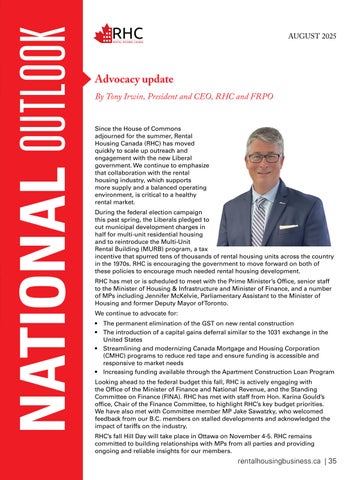
Advocacy update By Tony Irwin, President and CEO, RHC and FRPO Since the House of Commons adjourned for the summer, Rental Housing Canada (RHC) has moved quickly to scale up outreach and engagement with the new Liberal government. We continue to emphasize that collaboration with the rental housing industry, which supports more supply and a balanced operating environment, is critical to a healthy rental market. During the federal election campaign this past spring, the Liberals pledged to cut municipal development charges in half for multi-unit residential housing and to reintroduce the Multi-Unit Rental Building (MURB) program, a tax incentive that spurred tens of thousands of rental housing units across the country in the 1970s. RHC is encouraging the government to move forward on both of these policies to encourage much needed rental housing development. RHC has met or is scheduled to meet with the Prime Minister’s Office, senior staff to the Minister of Housing & Infrastructure and Minister of Finance, and a number of MPs including Jennifer McKelvie, Parliamentary Assistant to the Minister of Housing and former Deputy Mayor of Toronto. We continue to advocate for: • • •
•
The permanent elimination of the GST on new rental construction The introduction of a capital gains deferral similar to the 1031 exchange in the United States Streamlining and modernizing Canada Mortgage and Housing Corporation (CMHC) programs to reduce red tape and ensure funding is accessible and responsive to market needs Increasing funding available through the Apartment Construction Loan Program
Looking ahead to the federal budget this fall, RHC is actively engaging with the Office of the Minister of Finance and National Revenue, and the Standing Committee on Finance (FINA). RHC has met with staff from Hon. Karina Gould’s office, Chair of the Finance Committee, to highlight RHC’s key budget priorities. We have also met with Committee member MP Jake Sawatzky, who welcomed feedback from our B.C. members on stalled developments and acknowledged the impact of tariffs on the industry. RHC’s fall Hill Day will take place in Ottawa on November 4-5. RHC remains committed to building relationships with MPs from all parties and providing ongoing and reliable insights for our members.
rentalhousingbusiness.ca | 35
NATIONAL OUTLOOK Written submission in advance of the upcoming 2025 Federal Budget RHC was pleased to see the Liberal Party commit to a number of forward-thinking actions on housing such as halving development charges over five years and reintroducing the Multiple Unit Rental Building (MURB) cost allowance. We urge the government to implement these important policies as soon as possible.
To continue in a policy direction that achieves greater supply while ensuring affordability, RHC encourages the government to adopt the recommendations outlined below. RHC thanks the Department of Finance for the opportunity to participate in the 2025 Budget Consultations and looks forward to engaging with the office further.
Development charge reform The 2025 Liberal Party Platform includes a commitment to reduce municipal development charges by half for multi-unit residential housing over a five-year period, in partnership with provinces and territories to ensure municipalities remain financially whole. In Ontario, development charges have increased by over 900% since 2004, averaging 14.3% growth per year compared to a 2% annual increase in property taxes. These rising charges, combined with additional fees, taxes, regulatory barriers, slow approval processes, and declining rents, have made it increasingly difficult for purpose-built rental projects to meet investor expectations and lender requirements. The 2025 Liberal Platform costing stated the program would begin in the 2025-26 and estimated the program would require $6 billion in annual spending. This initiative is designed to be revenue neutral for municipalities, with reduced revenues offset by increased federal investment in housing-related infrastructure such as water, power lines, and wastewater systems. RHC calls on the Government of Canada to undertake the following: •
At minimum, halve municipal development charges for five years through a coordinated approach to infrastructure funding programs, as promised in the 2025 Liberal Party Platform
Multi-unit rebate (MURB) / capital cost allowance (CCA) In 2024, the federal government introduced the Accelerated Capital Cost Allowance (CCA) to stimulate investment in new purpose-built rental (PBR) housing. This measure allowed builders to claim a larger first-year tax deduction for depreciation, thereby encouraging new rental housing construction. RHC calls on the government to make this crucial program fully permanent. Additionally, the government has also indicated interest in reintroducing a tax incentive similar to the Multi-Unit Rental Building (MURB) program from the 1970s, which was highly effective in increasing the supply of rental housing. Addressing this technical barrier and aligning the incentive with a modernized MURB program would significantly improve the effectiveness of these measures and support new rental housing development. RHC calls on the Government of Canada to undertake the following: •
Make the accelerated CCA permanent to provide certainty for rental housing providers
•
Coordinate this change with the introduction of a modernized Multi-Unit Rebate (MURB) federal tax tool to further incentivize equity investment in purpose-built rental, as promised in the 2025 Liberal Party Platform
rentalhousingbusiness.ca | 37
AUGUST 2025 Capital gains deferral RHC recognizes that the Government of Canada has delayed the implementation date for the two-thirds capital gains increase from June 25, 2024, to January 1, 2026. However, rising interest rates, combined with double-digit increases in insurance, property taxes, utilities, and maintenance, far exceed what rental housing providers can recoup through rents. The increase should be officially abandoned, so focus can shift to finding a more suitable alternative. Unlike the United States, Canada does not allow real estate investors to defer capital gains taxes when reinvesting in another property. Under Section 1031 of the U.S. Internal Revenue Code, proceeds from the sale of an investment property can be reinvested into property of equal or greater value. This provides a sustained source of investment for new housing and incentivizes continued growth of housing stock. RHC calls on the Government of Canada to undertake the following: •
Direct the Canada Revenue Agency to review Section 1031 exemptions (like-kind exchanges) used in the U.S. to defer capital gains taxes for PBR projects
•
Introduce a similar or equivalent program for Canadian developers, provided the proceeds are reinvested in new housing construction
Enhance and extend the GST/HST rebate for rental construction: When the GST was introduced in 1991, Parliament ensured that renters would not be directly taxed on residential housing by shifting the tax liability to rental housing providers. RHC applauded the government’s initiative to incentivize new builds through the removal of GST on new purpose-built rentals through Bill C-56. However, the sunset provisions for the rebate require construction to begin before December 31, 2030 and end before December 31, 2035. Given the extent and severity of the housing crisis in Canada, RHC encourages further action on this by making the rebate permanently available, so long as the GST savings are reinvested into new builds. This would further incentivize purpose-built rentals, accelerating Canada’s response to the housing shortage. RHC calls on the Government of Canada to undertake the following: •
Work with the provinces to eliminate their tax on purpose-built rental housing, ensuring federalprovincial alignment on housing growth
•
Eliminate the sunset clause and make the GST/HST rebate for PBR construction permanent to provide long-term market stability for ongoing development
•
Work with the provinces to eliminate their tax on purpose-built rental housing, ensuring federalprovincial alignment on housing growth
Canada Mortgage and Housing Corporation (CMHC) reform PBR developments are multi-year projects, which require careful financial planning. The Apartment Construction Loan Program is a government initiative that offers low-interest, long-term loans to developers for building new rental apartment buildings. This program plays an important role in addressing the shortage of rental housing by making it more financially feasible for builders to start new projects. CMHC funding approval often requires developers to submit two-year financial plans, which is difficult to calculate given the current uncertainty. Government risks hindering progress if it does not reconsider the impacts of its policies on the development pipeline. Additionally, CMHC funding is often difficult to access. Many RHC members have described MLI Select as a “loan of last resort” due to its onerous requirements, which require applicants to submit a two-
38 | August 2025
NATIONAL OUTLOOK year project budget as part of their application. To ensure rental housing programs are properly funded, accessible, and easier to navigate, RHC urges the government to streamline its approach. RHC calls on the Government of Canada to undertake the following: •
Direct CMHC to conduct a thorough program review to ensure funding seamlessly integrates with the needs of rental housing providers
•
The review should focus on: o Streamlining application processes o Improving accessibility o Removing unnecessary submission requirements o Ensuring programs are fully funded and available
•
Reduce the affordability requirements in the MLI Select program to increase utilization of the program for both new construction and refinancing
•
Increase funding through the Apartment Construction Loan Program (ACLP)
Reorienting priorities in immigration and NPRs Solving the housing crisis cannot be done with investment and economic measures alone. One of the greatest barriers to new construction today is critical construction labour shortage. In fact, the growing construction labour shortage was cited by the CMHC as one of three factors contributing to longer construction times. Employment in the construction industry amounts to 8% of total employment in Canada. However, the share of construction workers among new immigrants and temporary foreign workers varies between 2% and 3%. RHC calls on the Government of Canada to undertake the following: •
Adjust immigration and non-permanent-resident (NPR) programs to address workforce shortages in construction and trades
Summer update: CMHC’s 2025 Housing Market Outlook
On July 24, 2025, the Canada Mortgage and Housing Corporation (CMHC) released the summer update to its 2025 Housing Market Outlook, which explores trends, supply, and other key issues in Canada’s major markets. The update finds Canada’s housing market is still in a period of adjustment. The combination of weaker economic growth, reduced population inflows, and ongoing trade- related uncertainty is creating a softer market environment.
A softer housing market in 2025 will start to recover next year Canada’s housing market has slowed since January, with many buyers and developers adopting a “wait and see” approach amid weak economic growth and ongoing trade uncertainty. Resale activity has declined, particularly in Ontario, British Columbia, and Alberta, while Quebec has shown more resilience due to stronger market momentum and buyer confidence. Overall, current conditions are tracking closer to the low-end scenario of the Housing Market Outlook, signaling increased downside risks. Home prices are slipping in areas with weaker demand and more listings. The national average home price is expected to fall by about 2% in 2025, with larger declines in Ontario and BC due to reduced investor interest and elevated prices. A recovery is anticipated in 2026 as confidence and economic fundamentals improve, though new construction will likely be slower to respond due to ongoing financing challenges and developer caution.
rentalhousingbusiness.ca | 39
AUGUST 2025 Multi-unit construction remains historically high but varies by region. Activity will stay strong in Atlantic Canada, the Prairies, and Quebec, while dropping sharply in Ontario and BC, where high costs and low investor confidence are delaying or canceling many condo projects. Unsold inventory is rising, and developers are increasingly converting condos to rentals, adding further risk for buyers. Low-rise construction is facing similar pressures, particularly in Ontario. However, Quebec, Manitoba, and Alberta are expected to see modest gains. Semi-detached and row housing types are proving more resilient in parts of BC. Rental market conditions are gradually easing. New rental and condo completions are pushing up vacancy rates in major cities. Although rents are still rising, the pace has slowed due to softer demand from slower household formation, lower immigration, and weaker job markets. Affordability remains a major challenge, especially in expensive markets. Despite modest rate cuts, mortgage costs remain high as spreads return to historical norms. Tariffs on building materials are keeping construction costs elevated, discouraging new supply and pricing many buyers out of the market. Overall, Canada’s housing sector is undergoing a period of adjustment. Slower growth, tighter credit, and reduced population inflows are weighing on demand in 2025. However, as trade tensions ease and borrowing conditions improve, the market is expected to stabilize and return to a more balanced path by 2026.
Forecast summary: Rental markets Vacancy rates (%)
Average rent – 2-bedroom (CAD)
City
2023
2024
2025 (Forecast)
City
2023
2024
2025 (Forecast)
Vancouver
0.9
1.6
2.1
Vancouver
2,181
2,314
2,450
Calgary
1.4
4.8
6.3
Calgary
1,695
1,882
1,918
Edmonton
2.4
3.1
4.6
Edmonton
1,398
1,536
1,637
Toronto
1.4
2.5
3.5
Toronto
1,961
1,974
2,050
Ottawa
2.1
2.6
2.9
Ottawa
1,698
1,880
1,960
Montréal
1.5
2.1
2.5
Montréal
1,096
1,176
1,255
Sources: CREA, CMHC
Sources: CREA, CMHC
CMHC mid-year Rental Market Update report On July 8, CMHC published the mid-year Rental Market Update report, which provides an update on rental market conditions across Canada building. It builds on insights from the 2024 Rental Market Report, using alternative data sources, and includes insights obtained through market intelligence from industry experts. Highlights: •
Since October 2024, advertised rents are declining due to increased supply, while rents for occupied dwellings continue to rise at a slower pace than a year ago.
•
Sluggish job markets and decelerating migration are creating challenging environments for landlords and property managers.
•
Purpose-built rental supply is growing. CMHC construction financing programs and products supported an estimated 88% of Canada’s new purpose-built rental apartment starts in 2024.
•
Vacancy rates are expected to rise in most major markets this year.
•
Despite easing rent growth and increasing supply, rental affordability isn’t improving, especially in Vancouver and Toronto, as turnover rents are driving increases. Calgary, however, has shown a slight improvement.
40 | August 2025
NATIONAL OUTLOOK Figure 1: Year-over-year change in asking rents for a 2-bedroom purpose-built rental apartment Vancouver Edmonton
Calgary
Ottawa
Toronto
Montréal
Halifax
Year-over-year change (Q1 2024 vs. Q1 2023)
4.50%
13.90%
17.00%
3.90%
3.80%
8.40%
8.70%
Year-over-year change (Q1 2025 vs. Q1 2024)
-4.90%
3.90%
-3.50%
2.10%
-3.70%
2.00%
-4.20%
Figure 2: Year-over-year change in rents for a 2-bedroom occupied rental unit Vancouver Edmonton
Calgary
Ottawa
Toronto
Montréal
Halifax
Year-over-year change (Q1 2024 vs. Q1 2023)
6.10%
4.30%
12.00%
9.40%
9.50%
11.70%
7.00%
Year-over-year change (Q1 2025 vs. Q1 2024)
7.10%
6.80%
7.90%
8.80%
10.70%
7.70%
17.10%
rentalhousingbusiness.ca | 41