Professional Accountant Magazine | Summer 2026 TABLE OF CONTENTS
INSIDE THIS ISSUE
The Engine Is Stalling
By Zubair CHOUDHRY, RPA, APA
Welcoming Canada’s New Commissioner of the CRA
A Seat at the Table: RPA Canada Brings the Voice of Small Business Accounting to Queen’s Park
By Joseph MORGADO, RPA
Advocacy Day: Highlighting the Role of Professional Accountants Supporting Small Businesses
A Fast Track Earns Its Name: Pro ACHIEVE 2026 Concludes at U of T Mississauga
Predicting Corporate Failure: Lessons from Global Business Failures
By Deepak GUPTA , FCA (India), RPA
The Impending AI Revolution in Accounting: Threatening or Thriving?
By Taslima NASREEN, MBA, PhD, RPA.
Submission Deadline for the Fall Issue of
ACCOUNTANT Magazine: September 10, 2026
Looking Ahead: The Small Business Week Edition
Beyond the Balance Sheet: Why Human Connection Is Becoming Business’s Most Valuable Asset
By Umar CHOUDHRY, CPA, LPA, RPA
Addressing the Unmet Needs of Our Clients: The Real Promise of Emerging Technology
By James GREEN, RPA
City Hall’s Open Door: Ontario Mayors on Why Small Business Is Everyone’s Business
Canada’s EV Tariff Quota: A Strategic Pivot with Far‑Reaching Implications
By William WEI, PhD, MBA, RPA
Why CRA reviews are taking more time than accounting firms expect.
By James NOONAN
Strengthening the Accounting Profession. Empowering Canadian Small Business.
The Fall Issue, Professional Accountant Magazine celebrates Small Business Week, connecting accounting professionals with Canada’s small and medium-sized businesses through insights, innovation, entrepreneurship, and success stories.
Be part of our Fall Edition.
We invite writers, thought leaders, advertisers, entrepreneurs, technology companies, and business leaders to contribute articles, share success stories, showcase innovative solutions, and connect their brands with the accounting and small business community.
Share your voice. Showcase your success. Reach the professionals who help businesses grow.
PUBLISHER:
Zubair CHOUDHRY, RPA, APA president@rpacanada.org
EDITOR: Michael SANIGA, MBA, CPA, RPA engagement@rpacanada.org
EDITORIAL TEAM:
Umar CHOUDHRY, CPA, LPA, RPA
William WEI, PhD, MBA, RPA
Bruce MANION, FCMA, FCPA
James GREEN, RPA
Taslima NASREEN, MBA, PhD, RPA
Joseph MOHANTHAS, RPA, APA
Deepak GUPTA, FCA (INDIA), RPA
Joseph MORGADO, RPA
DESIGN & LAYOUT: GCE Pink
Oly CALDERON
Tatiana TORRES
Ingrid ANGUIANO
Jorge MARIN
Valeria RODRÍGUEZ www.gce.pink
ADMINISTRATION: Alejandro VELEZ Info@rpacanada.org
MARKETING: Mariz DELA ROSA marketing@rpacanada.org
PHOTOGRAPHER: Olga HUTSUL
PUBLICATION COORDINATOR: Olga HUTSUL Publication@rpacanada.org
PRINTING & DISTRIBUTION: The Printing Team www.theprintingteam.ca
48 Village Centre Place, Suite 100, Mississauga, Ontario L4Z 1V9 416-350-8145
Website: www.professionalaccountant.org
LinkedIn Profile: https://www.linkedin.com/company/ professional-accountant-magazine/ FACEBOOK: Professional Accountant Magazine X: @ProfAcctMag Youtube: www.youtube.com/@rpa.canada
© 2026. ISSN 2819-716X
The Society of Professional Accountants of Canada (RPA Canada).
All rights reserved. This publication and all associated content, including text, images, graphics, trademarks, and marketing materials, are the intellectual property of RPA Canada. No part of this publication may be reproduced, distributed, or used for commercial, promotional, or advertising purposes without prior written permission of RPA Canada. Advertising content, comments, views, and opinions expressed herein are those of contributors and do not necessarily constitute endorsement by RPA Canada.

The Engine Is Stalling
Canada Calls Small Business the Engine of the Economy. So Why Is It Running on Empty?
Canada’s small-business sector is under growing strain, and the gap between political rhetoric and practical support is widening. Politicians are quick to call small businesses the “engine of the Canadian economy”- the source of jobs, innovation, and most of the private-sector growth.
Yet despite representing 98 percent of all Canadian enterprises, small businesses face barriers that make entry, survival, and long-term success increasingly difficult.
Operating costs are climbing, inflation remains persistent, labour shortages are deepening, and technological disruption - particularly artificial intelligence - is advancing faster than most small firms can adapt. At the same time, access to credit is constrained, regulatory processes remain fragmented, and compliance demands grow more complex each year.
Too often, the Canada Revenue Agency’s audit practices feel punitive rather than supportive, especially for owners without formal training in accounting, finance, or tax. Rather than encouraging entrepreneurship, these pressures deter new entrants and overwhelm those already in business.
Through years of working closely with entrepreneurs, tradespeople, professionals, and international firms establishing operations in Canada, I have seen firsthand the remarkable potential within our small-business community.
That potential is unlocked when owners receive practical guidance, clear direction, and accessible advisory support. This is precisely where Registered Professional Accountants (RPAs) play a vital role.
RPAs help small businesses navigate compliance, cash-flow management, financing, and marketing strategy, as well as emerging fields such as cybersecurity, blockchain, and artificial intelligence.
They deliver expertise that is affordable, accessible, and accountable support that has never been more essential as small businesses confront rapid economic and technological change.
Canada’s diversity gives us a distinct advantage. As global markets raise barriers, Canada can position itself as a welcoming, stable, and innovative destination for entrepreneurship and international investment. But seizing that opportunity demands more than political slogans.
It requires modernized policy, reduced barriers to entry, and genuine recognition of the indispensable role professional accountants play in strengthening the backbone of Canadian prosperity. If Canada wants small businesses to remain the engine of our economy, governments must act decisively to support the entrepreneurs who keep that engine running.
- Zubair Choudhry, Publisher


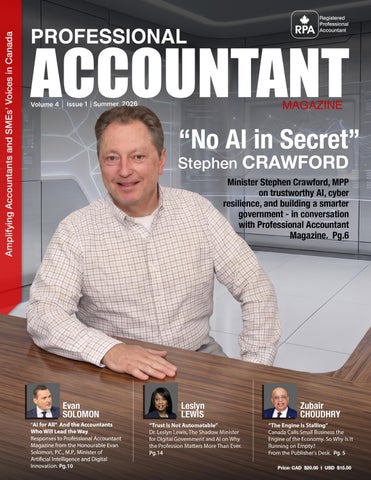
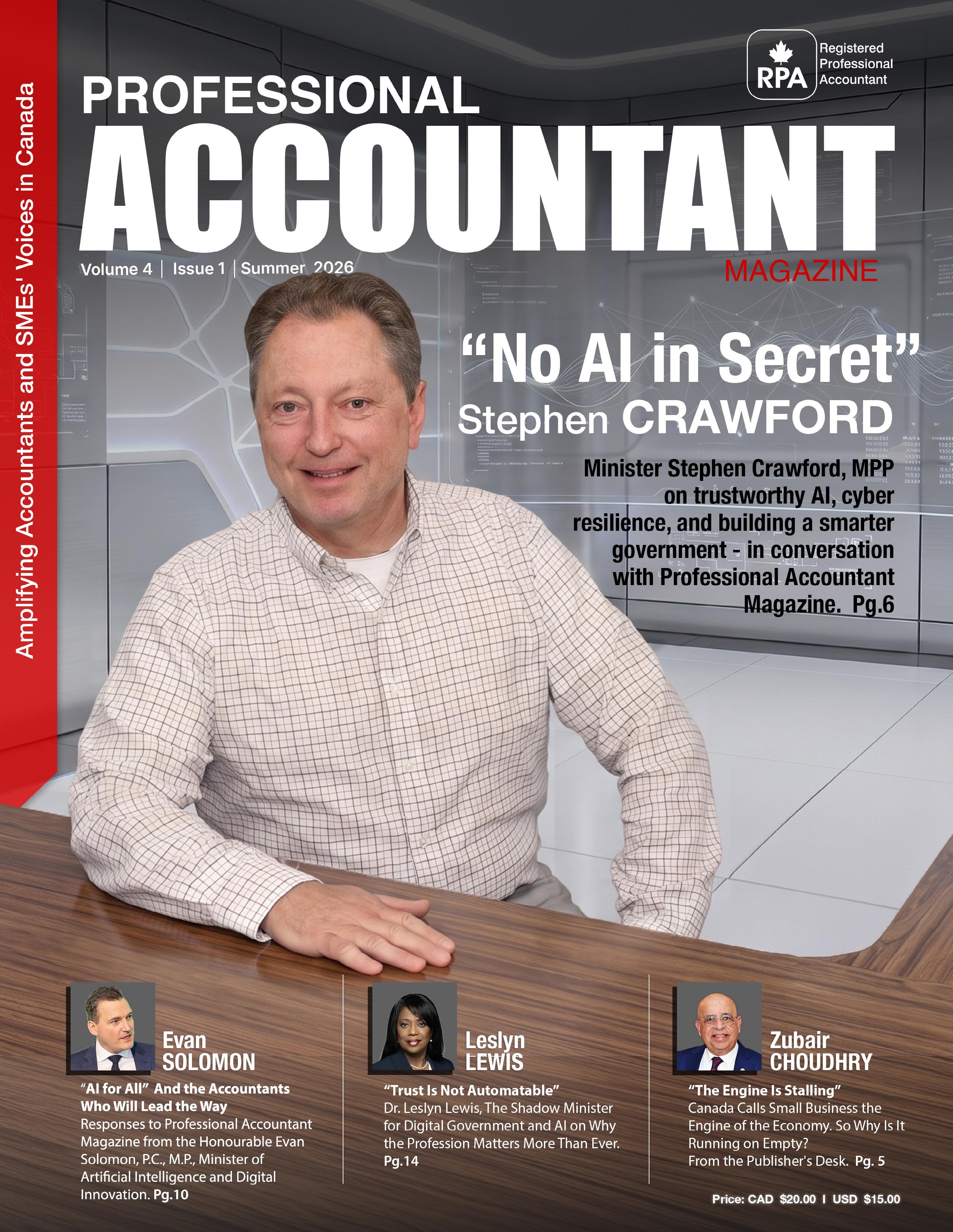
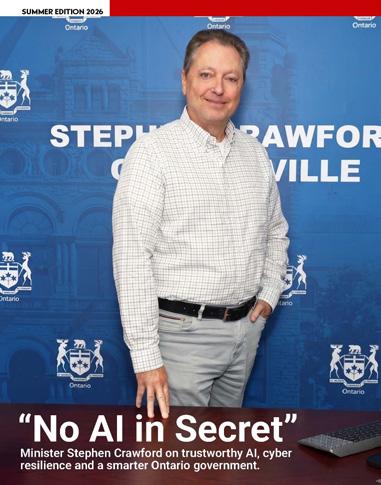
“No AI in Secret”
Minister Stephen Crawford on trustworthy AI, cyber resilience and a smarter Ontario government.
Trustworthy AI, Cyber Resilience, and a Smarter Government
Artificial intelligence is no longer a distant frontier; it is actively reshaping how governments serve citizens, how businesses compete, and how our profession delivers value. In Ontario, this transformation is especially visible as the provincial government modernizes service delivery while emphasizing transparency, accountability, and public trust.
For this special summer issue on AI and technology, Publisher Zubair Choudhry and Editor Mike Saniga sat down with the Hon. Stephen Crawford, MPP, Ontario’s Minister of Public and Business Service Delivery and Procurement. His portfolio sits at the intersection of issues central to our readers: responsible AI adoption, cybersecurity, procurement integrity, red tape reduction, and the digital services relied on by accountants and their clients.
The conversation delivered a clear message: Ontario views accounting professionals not as observers of digital change, but as essential partners. As advisors on governance, risk, and technology, accountants will help ensure innovation is matched with accountability. We trust you will find the Minister’s insights both encouraging and instructive.
Mike: Ontario is rapidly embracing artificial intelligence across government operations. What is your long-term vision for responsible AI adoption, and how can Ontario become a leader in trustworthy AI while protecting privacy and public confidence?
Minister Crawford: Ontario is embracing the opportunities that artificial intelligence presents, but we’re doing so responsibly. Our focus is on building public trust by ensuring AI is used transparently, accountably, and in a way that serves the people of Ontario.
That’s why we’re implementing Ontario’s Trustworthy AI Framework, built on a simple principle: no AI in secret. Ontarians should understand how AI is being used, what the risks are, and what safeguards are in place.
The framework is supported by a range of policies and guidance, including the Enhancing Digital Security and Trust Act (EDSTA), 2024, the Responsible Use of AI Directive, and internal guidance for the Ontario Public Service on the use of generative AI. The EDSTA also lays the foundation for potential future regulation of AI within select public sector organizations.
As this technology evolves, we’ll continue strengthening our skills, policies, and oversight so we can improve services while protecting privacy and maintaining public confidence.
Mike: Cybersecurity has become one of the most significant risks facing both the public and private sectors. What practical steps is Ontario taking to strengthen cyber resilience, and what should accounting firms handling sensitive financial data anticipate?
Minister Crawford: Cyber security remains one of our highest priorities. Every day, government systems are facing increasingly sophisticated threats, and that’s why we’re continuously strengthening our cyber security practices, investing in modern detection and response tools, and embedding security by design into our digital services.
We’re also working closely with municipalities and broader public-sector partners to improve cyber resilience across Ontario through training, guidance, and information sharing.
For accounting firms handling sensitive financial data, the reality is that cyber threats are becoming more sophisticated, particularly as bad actors begin using AI to improve their tactics.
Organizations should focus on building a strong culture of cyber awareness through employee training, phishing simulations, role-based security education, and ongoing vigilance. Cyber security is no longer just an IT issue—it’s a business issue.

Zubair: Public procurement represents billions of dollars in annual spending. How is your ministry improving transparency, efficiency, and fairness, particularly for SMEs seeking to participate in government contracts?
Minister Crawford: Ontario’s procurement system is built on transparency, fairness, efficiency, and value for money.
We’re making procurement opportunities more accessible by publicly posting opportunities, clearly outlining evaluation criteria, and ensuring suppliers have access to debriefings and formal dispute processes.
Evaluation teams are also required to complete conflict-ofinterest declarations to help ensure decisions are fair, open, and accountable.
Supply Ontario is supporting this work by centralizing and modernizing purchasing across more than 6,000 public sector organizations that collectively procure approximately $30 billion in goods and services each year.
To further support small and medium-sized businesses, our Building Ontario Businesses Initiative (BOBI) is reducing barriers to participation by requiring public-sector buyers to consider Ontario and Canadian businesses in procurement evaluations where appropriate.
That helps local companies—including those in the technology and manufacturing sectors—compete for contracts, grow their operations, and create jobs in communities across the province.
Zubair: Many small and medium-sized businesses continue to face administrative and regulatory burdens. What additional initiatives is your ministry considering simplifying government interactions and make Ontario more competitive?
Minister Crawford: Reducing red tape and making government easier to work with remains a key priority. We regularly engage with business owners, industry stakeholders, and professional partners to understand where barriers exist and how services can be improved.
One example is the Ontario Business Registry Partner Portal, which allows accounting firms and legal professionals to file directly on behalf of their clients, saving time, reducing costs, and making it easier to do business in Ontario.
Ontario has become a national leader in red tape reduction. Through 16 Red Tape Reduction Packages, we’ve saved businesses and families nearly $1.3 billion and 1.8 million hours in administrative burden.
Our work has earned Ontario the highest red tape reduction grade in our history from the Canadian Federation of Independent Business.
Zubair: The OBR has modernized corporate filings online. What improvements have you seen since launch, what’s next, and is your ministry exploring AI to further simplify registration and service delivery?
Minister Crawford: Since launching the Ontario Business Registry, we’ve made it faster and easier for businesses to interact with government.

What once required paper forms and weeks of processing can now often be completed online in minutes. Businesses can access more than 90 services online, 24 hours a day, 365 days a year.
Looking ahead, our focus is on further simplifying and integrating services so that interacting with government becomes even more seamless.
Zubair: Ontario continues to modernize ServiceOntario and other digital services. What major improvements can businesses and professionals expect over the next few years?
Minister Crawford: Our goal is to make government services more convenient, efficient, and accessible for businesses and professionals. A great example is the modernization of Ontario’s land registration system through digital certification.
Transactions that once took an average of 15 days can now be processed in seconds while maintaining the same legislative and quality standards. As of July 2026, digital certification supports approximately 60 per cent of Ontario’s 1.8 million annual land registration transactions, improving service for businesses, legal professionals, financial institutions, and property owners.
These are the kinds of improvements businesses can expect as we continue modernizing ServiceOntario and other digital services. Looking ahead, we’ll continue to streamline service delivery, improve the customer experience, and make it easier for Ontarians and businesses to access the services they need.
Zubair: Interoperability between ministries remains a challenge for businesses interacting with multiple government systems. What progress is being made toward integration, and how will this reduce administrative burden?
Minister Crawford: Businesses shouldn’t have to navigate multiple systems to access government services. That’s why we’re focused on creating more integrated, user-centred experiences that reduce duplication and administrative burden.
The Ontario Business Account provides single-window access to multiple government services, allowing businesses to review transactions, file annual returns, and complete applications through one secure account.
We’re also modernizing permitting through a centralized digital system that makes approvals faster and more transparent.
Since the Building a More Competitive Economy Act was introduced in fall 2025, more than 150 business-facing permits have been completed or are currently under review, and we’re on track to eliminate or streamline at least 35 per cent of all business-facing permits by the end of 2028.
Ultimately, we’re making it easier for businesses to interact with government so they can spend less time on paperwork and more time growing and investing.
Mike: Service delivery must balance efficiency with accountability. How do you ensure modernization efforts don’t compromise oversight, auditability, or financial controls?
Minister Crawford: Modernization and accountability go hand in hand. As we adopt new digital technologies, data tools, and artificial intelligence, we’re strengthening—not weakening— oversight.
We are embedding safeguards directly into our systems through strong governance, monitoring, risk management, and appropriate human oversight. Our objective is to deliver better services while maintaining the transparency, accountability, and financial stewardship that Ontarians expect from their government.
Mike: Accountants are increasingly trusted advisors on governance, risk, and digital transformation. What role should the profession play in supporting Ontario’s digital economy and responsible AI adoption?
Minister Crawford: Accountants have an increasingly important role to play in Ontario’s digital economy. As trusted advisors, they help organizations manage risk, strengthen governance, improve transparency, and build public confidence as new technologies, including AI, are adopted. Their expertise will be critical in ensuring innovation is paired with accountability and responsible decision-making.
Zubair: What do you see as the greatest challenge facing your ministry over the next three to five years, and what message would you like to share with Ontario’s accountants and business leaders about the province’s economic future?
Minister Crawford: Over the next several years, one of our biggest challenges will be sustaining innovation while maintaining economic competitiveness and fiscal responsibility in an increasingly uncertain global environment.
Success will require us to remain agile, invest in technology and talent, strengthen partnerships, and continue modernizing the services Ontarians depend on.
My message to Ontario’s accountants and business leaders is simple: your expertise will play a vital role in helping businesses navigate change, adopt new technologies, and remain competitive. By working together, we can build a stronger, more resilient economy and ensure Ontario remains one of the best places in the world to live, work, and invest.
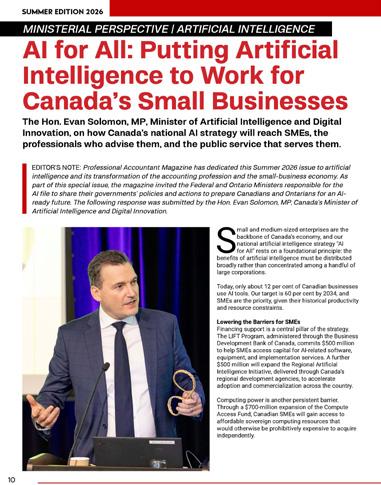
AI for All: Putting Artificial Intelligence to Work for Canada’s Small Businesses
The Hon. Evan Solomon, MP, Minister of Artificial Intelligence and Digital Innovation, on how Canada’s national AI strategy will reach SMEs, the professionals who advise them, and the public service that serves them.
EDITOR’S NOTE: Professional Accountant Magazine has dedicated this Summer 2026 issue to artificial intelligence and its transformation of the accounting profession and the small-business economy. As part of this special issue, the magazine invited the Federal and Ontario Ministers responsible for the AI file to share their governments’ policies and actions to prepare Canadians and Ontarians for an AIready future. The following response was submitted by the Hon. Evan Solomon, MP, Canada’s Minister of Artificial Intelligence and Digital Innovation.

Small and medium-sized enterprises are the backbone of Canada’s economy, and our national artificial intelligence strategy “AI for All” rests on a foundational principle: the benefits of artificial intelligence must be distributed broadly rather than concentrated among a handful of large corporations.
Today, only about 12 per cent of Canadian businesses use AI tools. Our target is 60 per cent by 2034, and SMEs are the priority, given their historical productivity and resource constraints.
Lowering the Barriers for SMEs
Financing support is a central pillar of the strategy. The LIFT Program, administered through the Business Development Bank of Canada, commits $500 million to help SMEs access capital for AI-related software, equipment, and implementation services. A further $500 million will expand the Regional Artificial Intelligence Initiative, delivered through Canada’s regional development agencies, to accelerate adoption and commercialization across the country.
Computing power is another persistent barrier. Through a $700-million expansion of the Compute Access Fund, Canadian SMEs will gain access to affordable sovereign computing resources that would otherwise be prohibitively expensive to acquire independently.
“The benefits of artificial intelligence must be distributed broadly — not concentrated among a handful of large corporations.
Equipping the Trusted Advisors
Professional accountants are often the first advisors SME owners turn to when evaluating technology investments, which makes AI fluency across the profession a priority. Our government will create a National AI Literacy Initiative offering free, accessible, and sector-relevant training, and will support the development of an AI Literacy and Adoption Assessment tool to help businesses evaluate their readiness before committing resources.
Canada also led the development of the G7 SME AI Adoption Blueprint, which recommends flexible, modular learning and the use of trusted intermediaries — chambers of commerce, industry associations, and professional advisors to guide businesses through each stage of adoption. On the tax front, the Scientific Research and Experimental Development credit and the Productivity Super-Deduction announced in Budget
2025 will make qualifying innovation investments more affordable. When accountants can confidently advise clients on the risks, costs, and compliance requirements of an AI initiative, adoption becomes safer and more efficient across the entire SME ecosystem.
A Modern, Trusted Public Service Government must lead by example. In December 2025, we signed a five-year Memorandum of Understanding with Coveo Solutions Inc., a Montréal-headquartered AI company, to improve federal services and reduce administrative burden. In June 2026, we introduced Bill C-36 – Canada’s most significant privacy-law update in more than 25 years – and committed $50 million to expand the Canadian AI Safety Institute. We are building a world-leading public supercomputer by 2031, with partnerships proposing 850 megawatts of compute capacity by 2030.
Canada’s AI research legacy – the foundational work of Geoffrey Hinton, Yoshua Bengio, and Richard Sutton –positions us to lead responsibly. Our goal is simple: a public service that is faster, fairer, and more accountable, and an economy where the benefits of AI reach all Canadians.
The Hon. Evan Solomon, MP, is Canada’s Minister of Artificial Intelligence and Digital Innovation.

National Birthdays, Odd Anniversaries and the Brave New World
Twenty-five years after Canada flipped the switch on accrual accounting, a veteran of the trenches looks back on the project that dragged the federal books out of the Dark Ages on time and under budget.

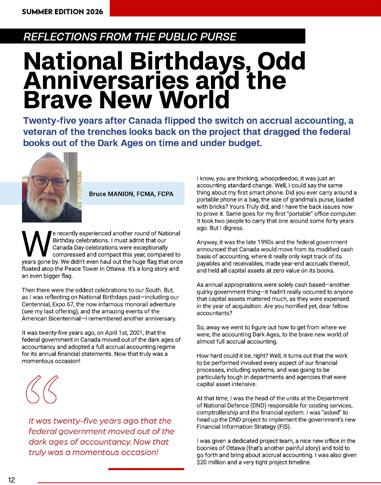
WBruce MANION, FCMA, FCPA
e recently experienced another round of National Birthday celebrations. I must admit that our Canada Day celebrations were exceptionally compressed and compact this year, compared to years gone by. We didn’t even haul out the huge flag that once floated atop the Peace Tower in Ottawa. It’s a long story and an even bigger flag.
Then there were the oddest celebrations to our South. But, as I was reflecting on National Birthdays past—including our Centennial, Expo 67, the now infamous monorail adventure (see my last offering), and the amazing events of the American Bicentennial—I remembered another anniversary.
It was twenty-five years ago, on April 1st, 2001, that the federal government in Canada moved out of the dark ages of accountancy and adopted a full accrual accounting regime for its annual financial statements. Now that truly was a momentous occasion!
I know, you are thinking, whoopdeedoo, it was just an accounting standard change. Well, I could say the same thing about my first smart phone. Did you ever carry around a portable phone in a bag, the size of grandma’s purse, loaded with bricks? Yours Truly did, and I have the back issues now to prove it. Same goes for my first “portable” office computer. It took two people to carry that one around some forty years ago. But I digress.
Anyway, it was the late 1990s and the federal government announced that Canada would move from its modified cash basis of accounting, where it really only kept track of its payables and receivables, made year-end accruals thereof, and held all capital assets at zero value on its books.
As annual appropriations were solely cash based—another quirky government thing—it hadn’t really occurred to anyone that capital assets mattered much, as they were expensed in the year of acquisition. Are you horrified yet, dear fellow accountants?
So, away we went to figure out how to get from where we were, the accounting Dark Ages, to the brave new world of almost full accrual accounting.
How hard could it be, right? Well, it turns out that the work to be performed involved every aspect of our financial processes, including systems, and was going to be particularly tough in departments and agencies that were capital asset intensive.
It was twenty-five years ago that the federal government moved out of the dark ages of accountancy. Now that truly was a momentous occasion!
At that time, I was the head of the units at the Department of National Defence (DND) responsible for costing services, comptrollership and the financial system. I was “asked” to head up the DND project to implement the government’s new Financial Information Strategy (FIS).
I was given a dedicated project team, a nice new office in the boonies of Ottawa (that’s another painful story) and told to go forth and bring about accrual accounting. I was also given $20 million and a very tight project timeline.
So I did what all good public servants do when tasked with a novel challenge... I went Walk-About!
So I did what all good public servants do when tasked with a novel challenge... I went Walk-About! By that, I mean that I went around to all of the major Defence departments that were friendly (USA, UK, France, New Zealand, Australia...) and asked if they had done this successfully and what tips they might have for us folks in Canada.
The responses ranged from a diplomatic shrug, to sighs of exasperation, to stern warnings not to follow in their footsteps. It was the latter that really got my attention. So off I went to the UK, Australia and New Zealand!
I actually caught a break in that the fellow who had completed this very task for the UK MoD was giving a talk in Ottawa. I attended the talk and, at the end of same, rushed up to introduce myself to the good Colonel, hand him my business card and ask him to tea and a chat with my project team and some of the main players in DND.
He accepted, and the information he provided proved to be extremely important and very timely. In essence, he described the very resource-intensive process that the UK MoD had completed, one that cost well over 80 million euros and resulted in significant concerns being expressed by their legislative auditor.
The advice from the UK was to go light and go small on this project. That was exactly the same advice I received from my counterparts in Australia and New Zealand. In the case of Australia, the advice was even more direct, blunt and delivered after a lovely dinner and a few libations.
“The bottom line was to do this smart, not intensive; keep the initiative to the strict minimum of key individuals involved in the accounting processes.
In other words, don’t follow the direction from the all-knowing and all-powerful central agencies that called for the FIS to support everyday budget managers’ decision making, thus requiring them to be fully versed in all things pertaining to accrual accounting.
We took that advice very much to heart in our project design. We also heeded the words of the then Deputy Minister at DND, who threatened very dire consequences if he had to be turned into an accounting expert.
It should be noted that the previously mentioned gurus at the Department of Finance and Treasury Board Secretariat had a much grander vision for the FIS and its ramifications.
We even heard that carrying our capital assets on our balance sheet would wipe out the federal debt, and that the tracking of depreciation would ensure effective capital asset management and eliminate asset rust-out.
As someone who had to take a ride in a VERY old Sea King helicopter, I can tell you that the latter concept did not ring true.
After many, many efforts on systems, financial coding, solving the cash appropriation versus capitalization of assets dilemma, and massive amounts of communication and training, we flipped the switch on April 1st, 2001... and it worked! We were on time and under budget.
“
We flipped the switch on April 1st, 2001... and it worked! We were on time and under budget.
As part of their communications and motivational strategy, the Project Office at Treasury Board decided to give anyone who received FIS training a rather cheap plastic desk clock, probably worth $2 or $3. I silently took possession of just over a thousand clocks for all the DND folks we trained.
Ironically, the clocks given out to the thousands of people who had to be trained under the Financial Information Strategy had no numbers on them! You just can’t make this sort of thing up!
Until next time...
The bottom line was to do this smart, not intensive. In their experience, it was better to keep the initiative to only the strict minimum of key individuals involved in the accounting processes, especially capital assets.
CAREER IN ACCOUNTING
NOT AN ACCOUNTING GRADUATE? YOU CAN STILL START. Your degree gave you transferable skills. Now turn it into an accounting designation

Artificial Intelligence, Trust, and the Future of the Accounting Profession

Artificial intelligence is no longer a future possibility; it is already transforming government, businesses, and the professions that support them. Just as previous generations built the physical infrastructure of Canada’s economy (railways, highways, ports, electricity grids, and communications networks), this generation is building the digital infrastructure of the AI economy, including data centres, cloud computing, broadband networks, and cybersecurity systems. As that transformation unfolds, accountants will play an increasingly important role in helping businesses adopt AI responsibly while preserving the trust, accountability, and integrity upon which our economy depends.
Small and medium-sized businesses are the backbone of Canada’s economy. For many entrepreneurs, however, artificial intelligence represents not simply another business tool, but another layer of complexity in an already demanding regulatory and operating environment. While AI can improve efficiency, business owners must still determine when to, or not to, rely on it. That reality reinforces the enduring importance of trusted professional advisors like accountants.
For generations, accountants have provided independent assurance over the financial information upon which businesses, investors, and governments rely. As organizations adopt AI-enabled tools, accountants will continue to provide financial expertise while also helping businesses strengthen governance, manage risk, evaluate internal controls, and implement AI responsibly. Their value
“
Accountants will play an increasingly important role in helping businesses adopt AI responsibly.
- Leslyn Lewis, MP
will increasingly lie not in performing routine tasks that technology can automate, but in helping clients understand, question, and confidently rely on AI-generated information.
Artificial intelligence can automate processes. It cannot automate trust.
AI cannot exercise independent professional judgment, uphold integrity, assume ethical responsibility, or discharge fiduciary obligations. Those remain inherently human responsibilities and are the qualities that give the accounting profession its enduring value. As more financial information is generated or influenced by intelligent systems, independent assurance will become even more important to maintaining confidence in our economy.
The same principles apply to government. Canadians are entitled to know when artificial intelligence is used to support decisions that affect them, how those systems operate, what safeguards protect their personal information, and what recourse exists when automated decisions produce unintended consequences. Meaningful human oversight must remain an essential safeguard, and significant automated decisions should always be capable of independent review.
This transformation also has important implications for professional education. Tomorrow’s accountants will require not only mastery of their profession but also a practical understanding of the digital systems that increasingly support it. They must be equipped to question AI systems, identify failures, challenge automated outcomes, and provide independent oversight where those systems affect financial decisions or the public interest.
Technology may reshape how we work, but trust remains the foundation upon which every successful economy is built.
If the accounting profession remains committed to transparency, accountability, professional integrity, and independent judgment, it will not simply adapt to the AI economy; it will help shape it in a way that strengthens businesses, reinforces public confidence, and serves Canadians well into the future.
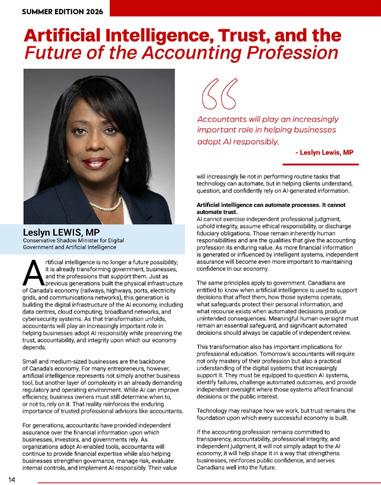
Leslyn LEWIS , MP
Conservative Shadow Minister for Digital Government and Artificial Intelligence

Welcoming Canada’s New Commissioner of the CRA
Professional Accountant magazine congratulates Heather Evans on her appointment to lead the Canada Revenue Agency
Professional Accountant magazine warmly welcomes Heather Evans as Canada’s new Commissioner of Revenue, appointed by Prime Minister Mark Carney effective July 13, 2026. Ms. Evans takes the helm of the Canada Revenue Agency as one of the country’s most respected tax professionals.
Her career spans more than three decades across private practice, professional services, and tax policy including senior leadership at Deloitte Canada, where she served as National Managing Partner for Tax, and most recently as Executive Director and CEO of the Canadian Tax Foundation, Canada’s leading independent organization for tax research, education, and public policy. A longtime educator at Western University and Osgoode Hall Law School, she has also helped shape the next generation of tax professionals.
Few leaders understand as deeply the realities faced by taxpayers, businesses, and the practitioners who serve them. Ms. Evans has long championed simplification of Canada’s increasingly complex tax system, recognizing that excessive compliance burdens divert resources from innovation, investment, and growth for taxpayers and the CRA alike.
For Canada’s accounting professionals, her appointment signals a promising new chapter. We are optimistic that under her leadership, the CRA will continue its transformation toward greater clarity, efficiency, and a truly taxpayer-focused approach with smoother, more transparent interactions between the Agency and the practitioners who serve Canadians every day.
On behalf of our readers and the entire RPA Canada community, we wish Commissioner Evans every success as she leads the CRA into its next chapter.
Publisher, Professional Accountant Magazine

A Seat at the Table: RPA Canada Brings the Voice of Small Business Accounting to Queen’s Park

Joseph MORGADO, RPA
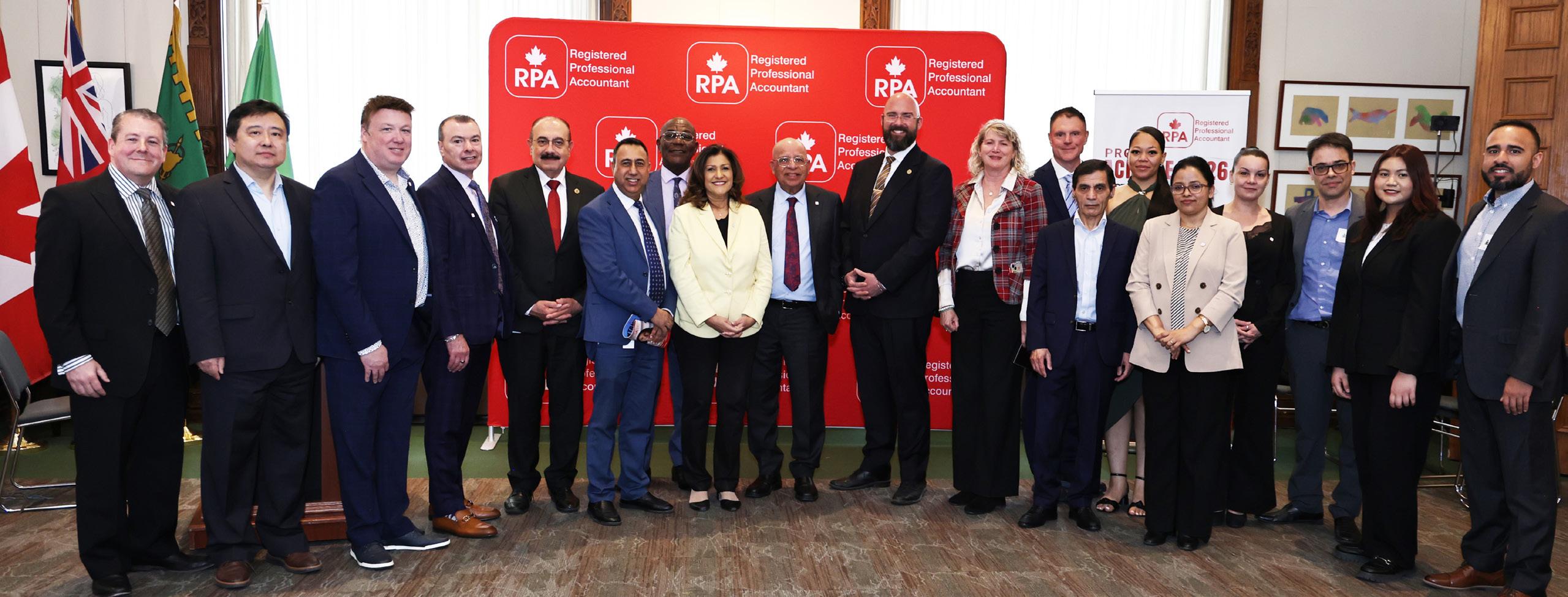
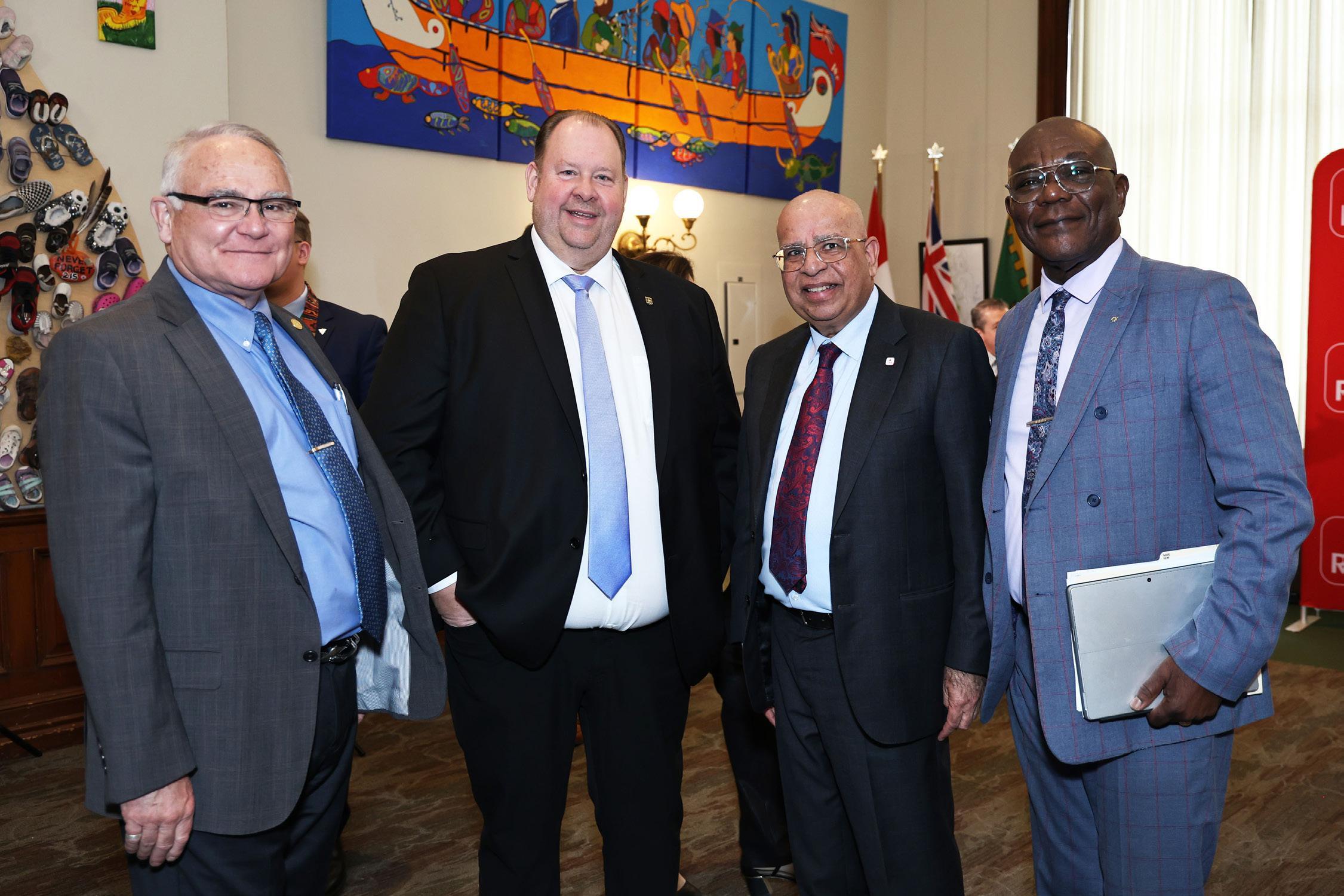
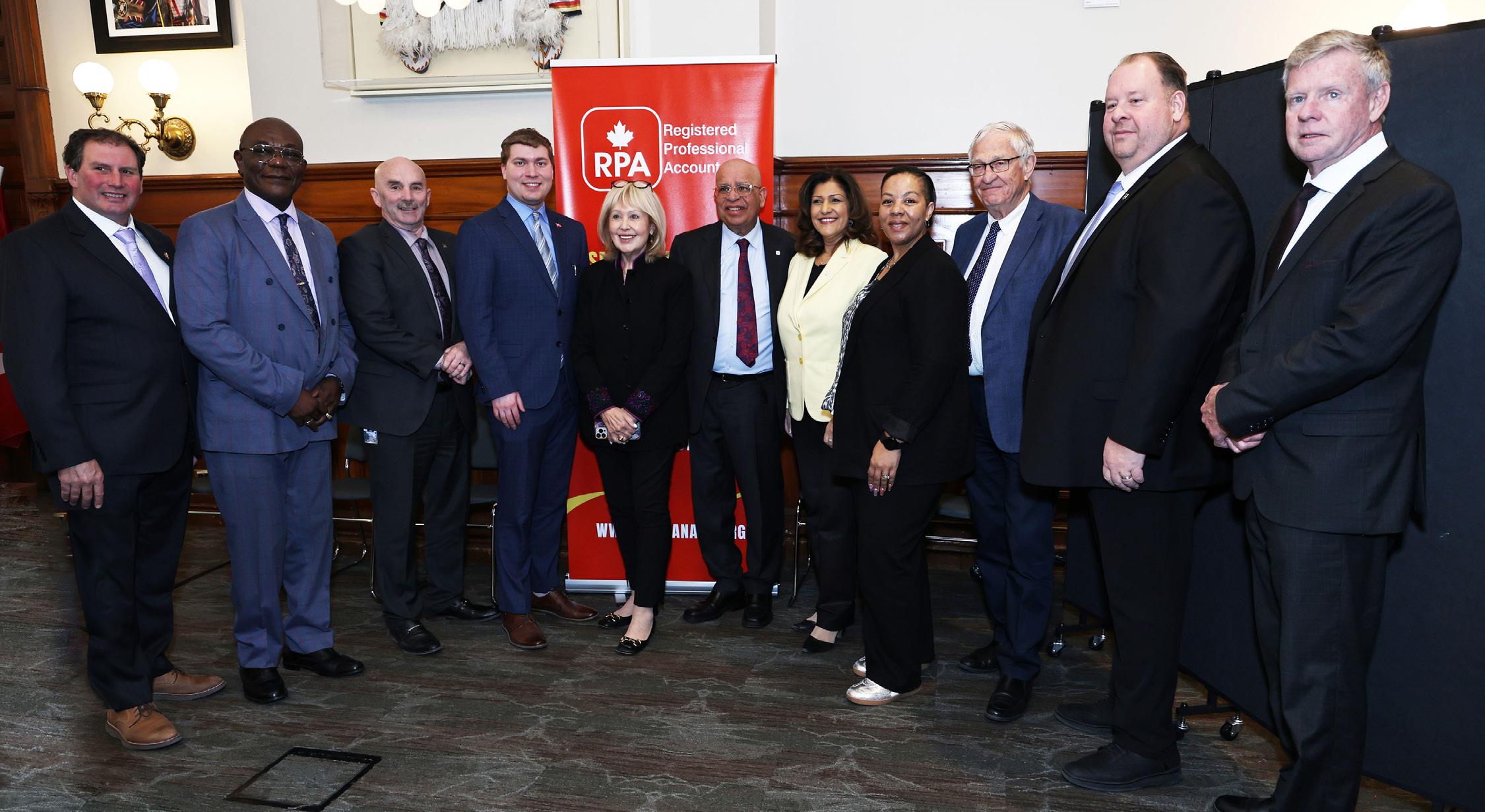
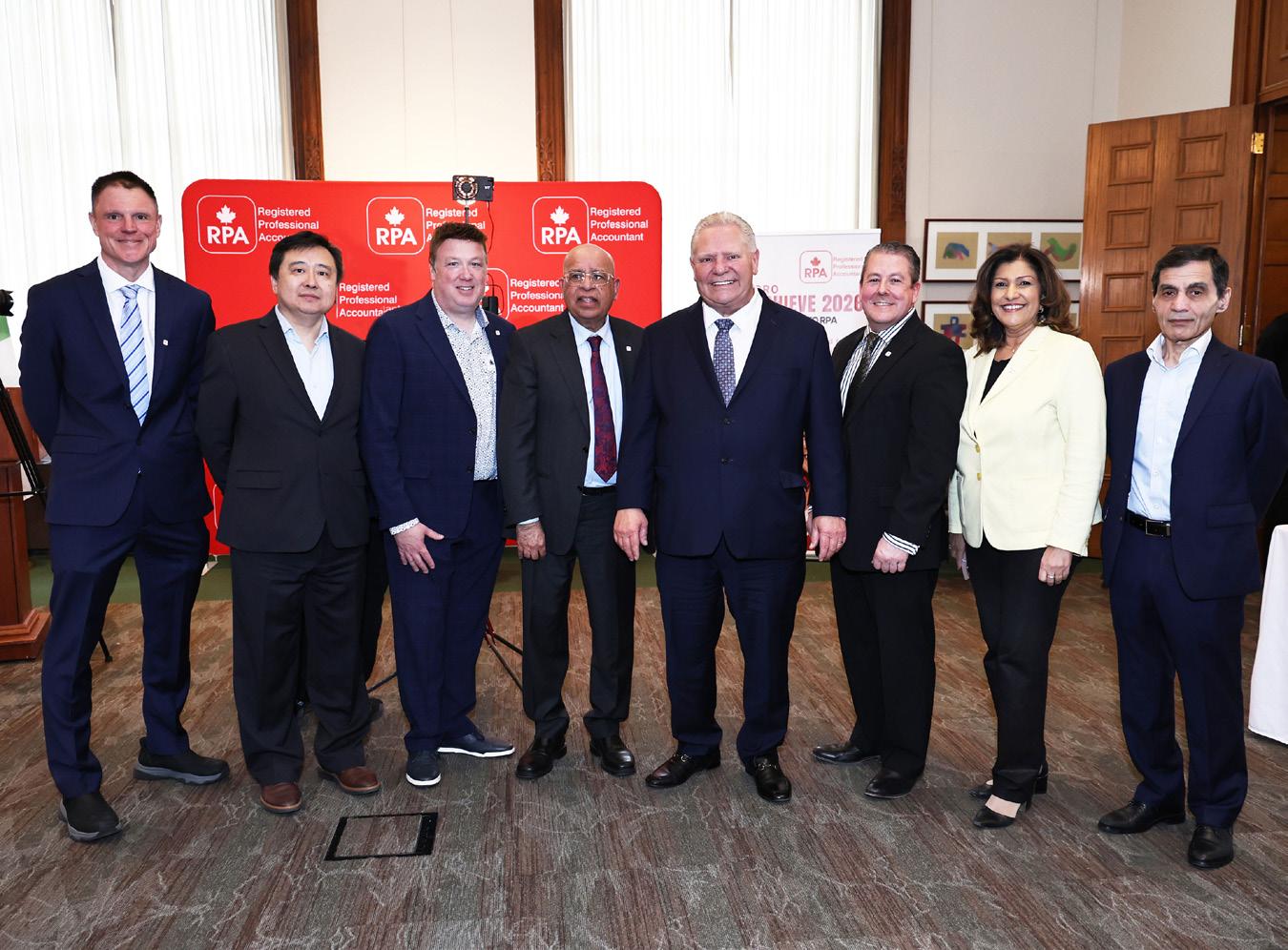
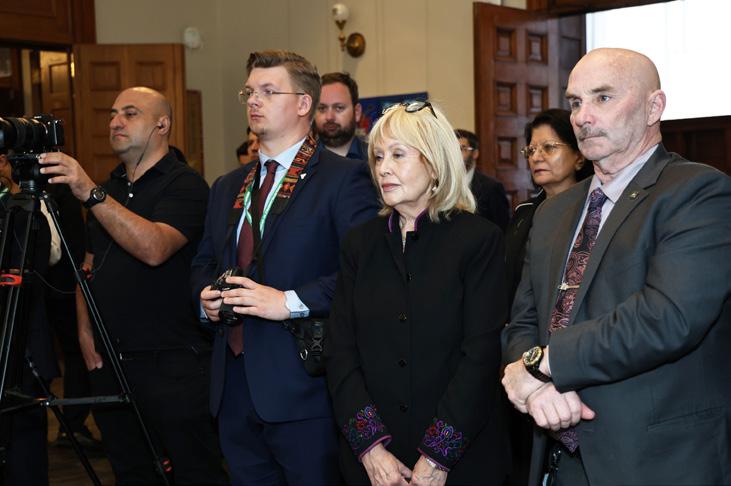
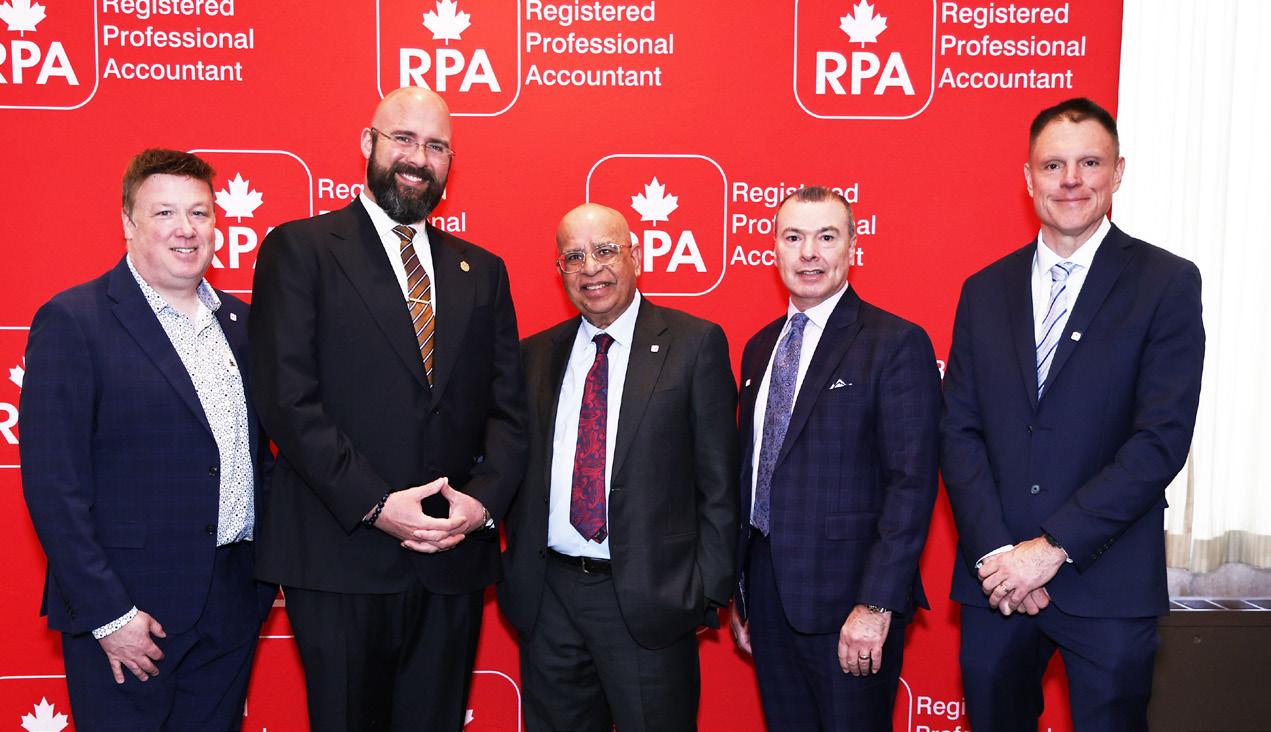
More than half of Ontario’s legislators, representing all three political parties, including Premier Doug Ford, attended RPA Canada’s advocacy luncheon in support of discussions on recognition for Registered Professional Accountants services to small businesses.
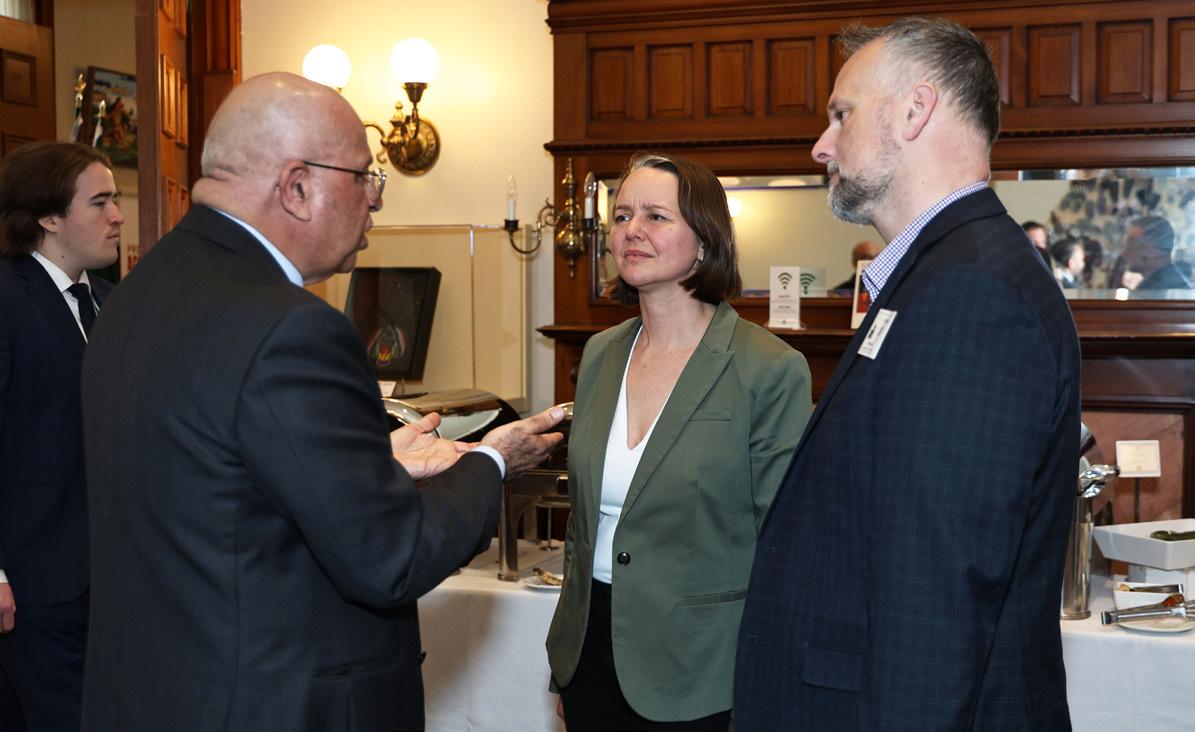
TORONTO - The conversation about who serves Ontario’s small businesses came to the heart of the province’s democracy this spring, as RPA Canada hosted an advocacy luncheon at Queen’s Park attended by members of provincial parliament from across the political spectrum, distinguished guests, and accounting professionals from every corner of Ontario.
Master of ceremonies Michael Saniga, RPA Canada’s Director of Engagement and Learning Innovation, opened the gathering with a land acknowledgement and framed the afternoon as

“A conversation that is long overdue”
one about the community-based accounting professionals who keep the books, file the taxes, and fuel the growth of Ontario’s more than 1.2 million small businesses, yet who have “for too long operated in the shadows of a credentialing conversation that didn’t always include them.”
Clear Call for Recognition
In his opening address, RPA Canada President and CEO Zubair Choudhry, RPA, APA, highlighted the essential role Registered Professional Accountants play in supporting Canada’s small and medium-sized businesses. He emphasized that while the non-assurance accounting sector does not require additional regulation, it does require competent, ethical, and well-trained professionals who can provide reliable accounting, taxation, and business advisory services.
He noted that today’s Advocacy Day at Queen’s Park is focused on promoting and strengthening small businesses,
which are a vital part of Ontario’s economy. Registered Professional Accountants are well prepared to serve this sector because of their specialized education, practical experience, professional standards, and commitment to ongoing professional development.
Through education, training, and ethical oversight, RPA Canada prepares accounting practitioners with the knowledge and skills required to serve businesses and taxpayers across Ontario and Canada. Mr. Choudhry emphasized that strengthening professional competency helps entrepreneurs make informed decisions, improves financial reporting, and contributes to a stronger and more resilient economy.

“We are not competing with audit and assurance,” Mr. Choudhry said. “We are complementing the system by professionalizing the segment that supports small businesses every day.”
Mr. Choudhry was careful to clarify precisely what RPA Canada is and is not asking for. As the oldest Canadian accounting organization, RPA Canada is advocating for recognition of the RPA designation. It is not proposing any new regulation, nor any government funding. The Society already manages its own membership, sets competency standards, and establishes the ethical and educational standards for its practicing members and student members and will continue to do so under its own resources.
He also pointed to concrete action already underway, including Pro Achieve 2026, RPA Canada’s pathway for experienced, undesignated practitioners to earn the RPA designation, and the acceptance of RPA compilation
engagement reports by Canadian banks and credit unions for small business financing. What remains, he argued, is a cost-neutral broader recognition of the value of Registered Professional Accountants that establishes competency, accountability, and public protection.
“This is not about creating overlap. It is about creating clarity.”
Support from All Sides of the House
The luncheon drew speakers from all three major parties, a testament, as Mr. Saniga noted, to the fact that small business and accessible professional services are Ontario issues, not partisan ones.
Speaking on behalf of the Ontario Liberal Party, Lucille Collard, MPP for Ottawa-Vanier, praised the brief’s comparison of the RPA role to that of paralegals and nurse practitioners as “very helpful and accessible,” noting that such models improve access to services, reduce bottlenecks, and let highly specialized practitioners focus on complex cases. At a time of economic uncertainty, she said, access to reliable and affordable financial expertise matters more than ever and she urged members not to underestimate the value of showing up at Queen’s Park to make their case.

“At a time of economic uncertainty, she said, access to reliable and affordable financial expertise matters more than ever.”

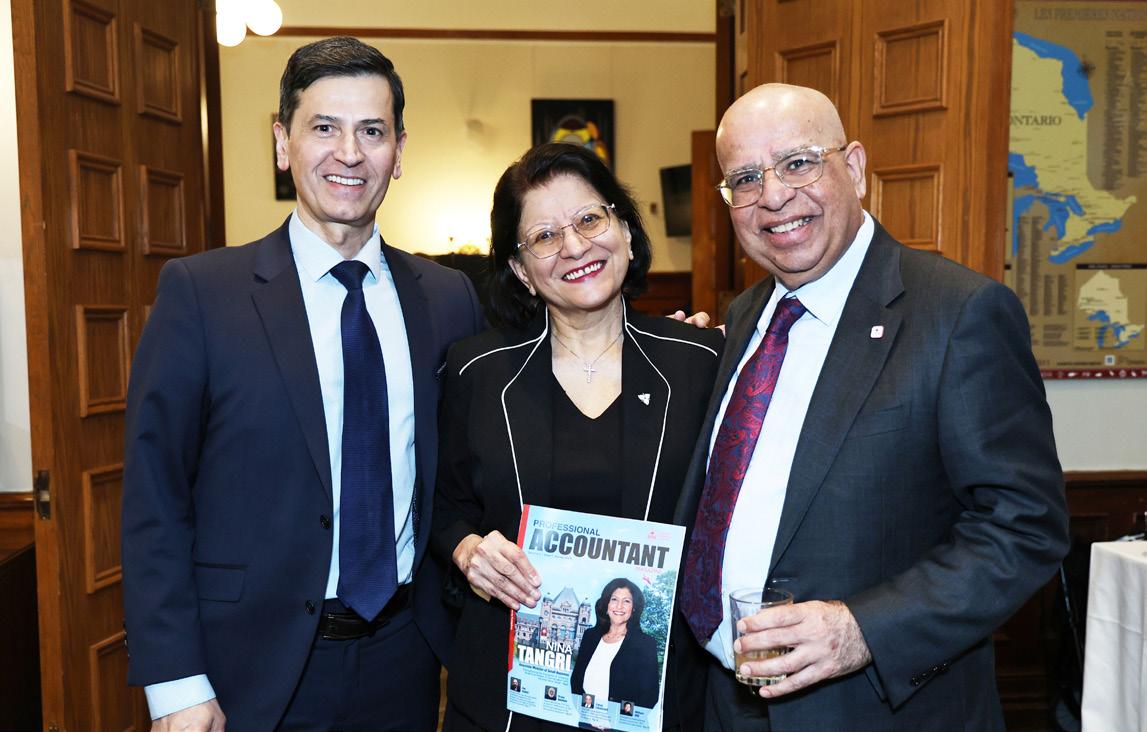
Closing the remarks, the Honourable Nina Tangri, MPP for Mississauga–Streetsville and Associate Minister of Small Business, representing PC Party of Ontario, brought the perspective of a 35-year small business owner.
“Sometimes you learn the hard way that it’s often good to hire a professional,”
she said, recognizing the critical bookkeeping, tax planning, and cash flow services accountants provide to the small businesses that account for some 2.5 million jobs and 98 per cent of employer businesses in Ontario. She congratulated RPA Canada for helping newcomers, students, and professionals earn their designations and singled out the annual Women Entrepreneurship Awards gala as “second to none.”

Terence Kernaghan, MPP for London North Centre and the official opposition’s shadow minister for small business, called Pro Achieve 2026 “phenomenal” for tapping into the skills people already have and confirmed that NDP Leader Marit Stiles and the official opposition are willing partners in developing the clarity within the accounting profession
“Accountants are more than just numbers’ experts,” he said. “They’re partners in business growth, community success, and economic resilience.”

Showing Up Matters
Acknowledgements were delivered by Dr. William Wei, RPA, who marked a personal milestone 20 years to the day since he first landed in Canada as a new immigrant while thanking the RPA Canada team, the speakers, and the assembled MPPs.
He closed with a reminder that captured the spirit of the event:
“Policy is shaped by conversations, and conversations are shaped by those who show up to have them”
On this day, Ontario’s Registered Professional Accountants showed up, and Queen’s Park was listening.
October 2 - 3, 2026 - 9:00am to 5:00pm University of Toronto (UTM) registration open

The RPA Professional Practice Certificate is valid for five years, and renewal requires successful completion of the PPC Education Program before the certificate expires. This two-day PPC Education Program updates participants' technical knowledge, strengthens professional skills, and reinforces best practices. Successful completion qualifies eligible members to obtain or renew their Certificate of Accounting Practice (CAP), demonstrating their ongoing commitment to professional excellence and high-quality client service.

















Competition, Barriers, and the Future of the Accounting Profession in Canada
Canada’s accounting profession stands at a crossroads. As regulatory structures evolve and market needs shift, the Competition Bureau of Canada’s guidance on self-regulated professions offers a critical framework for evaluating how regulation can protect the public interest without unintentionally restricting competition. The Bureau cautions that when a single regulatory body controls entry, advertising, and scope of practice, it may, despite good intentions, create barriers that raise prices, limit access, and stifle innovation.
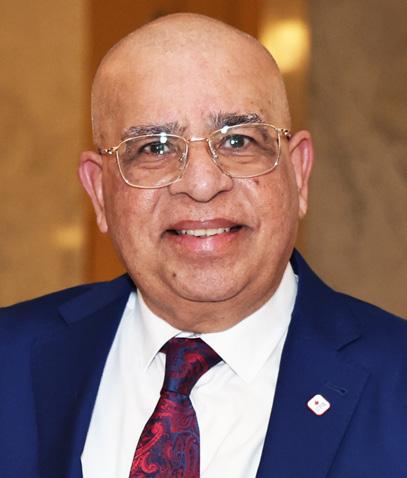
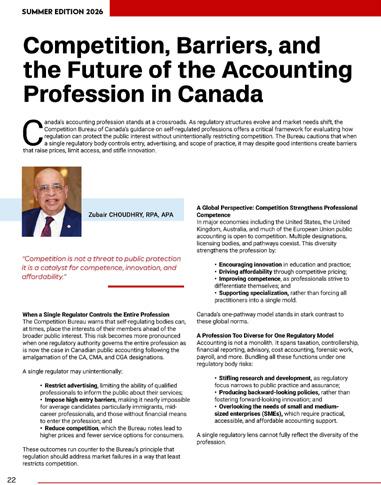
Zubair CHOUDHRY, RPA, APA
“Competition is not a threat to public protection; it is a catalyst for competence, innovation, and affordability.”
When a Single Regulator Controls the Entire Profession
The Competition Bureau warns that self-regulating bodies can, at times, place the interests of their members ahead of the broader public interest. This risk becomes more pronounced when one regulatory authority governs the entire profession, as is now the case in Canadian public accounting, following the amalgamation of the CA, CMA, and CGA designations.
A single regulator may unintentionally:
• Restrict advertising, limiting the ability of qualified professionals to inform the public about their services;
• Impose high entry barriers, making it nearly impossible for average candidates – particularly immigrants, mid-career professionals, and those without financial means to enter the profession; and
• Reduce competition, which the Bureau notes leads to higher prices and fewer service options for consumers.
These outcomes run counter to the Bureau’s principle that regulation should address market failures in a way that least restricts competition.
A Global Perspective: Competition Strengthens Professional Competence
In major economies including the United States, the United Kingdom, Australia, and much of the European Union, public accounting is open to competition. Multiple designations, licensing bodies, and pathways coexist. This diversity strengthens the profession by:
• Encouraging innovation in education and practice;
• Driving affordability through competitive pricing;
• Improving competence, as professionals strive to differentiate themselves; and
• Supporting specialization, rather than forcing all practitioners into a single mold.
Canada’s one-pathway model stands in stark contrast to these global norms.
A Profession Too Diverse for One Regulatory Model
Accounting is not a monolith. It spans taxation, controllership, financial reporting, advisory, cost accounting, forensic work, payroll, and more. Bundling all these functions under one regulatory body risks:
• Stifling research and development, as regulatory focus narrows to public practice and assurance;
• Producing backward-looking policies, rather than fostering forward-looking innovation; and
• Overlooking the needs of small and mediumsized enterprises (SMEs), which require practical, accessible, and affordable accounting support.
A single regulatory lens cannot fully reflect the diversity of the profession.
“
“When one regulatory body controls the entire profession, the risk of overreach grows and consumer choice shrinks.”
The RPA Designation: A Balanced, Pro-Competitive Alternative
The Registered Professional Accountant (RPA) designation, Canada’s oldest homegrown accounting credential, offers a model that aligns with the Competition Bureau’s principles. RPAs operate outside the provincial public accounting assurance framework, focusing on the real-world needs of SMEs.
RPA practitioners provide:
• Taxation and compliance services;
• Controllership and advisory support;
• Bookkeeping and financial reporting; and
• Financial statement compilation engagements essential for banking, financing, and credit applications.
This pathway is competency-based, affordable, and accessible expanding consumer choice and increasing competition in a way that serves the public.
Canada’s economic resilience depends on a diverse, competitive, and forward-looking accounting profession. The Competition Bureau’s guidance is clear: reduce unnecessary barriers, encourage competition, and ensure that regulation serves rather than restricts the public interest. The RPA designation demonstrates how multiple pathways can coexist to strengthen the profession, support SMEs, and promote innovation.
EDUCATION & DESIGNATION
A Fast Track Earns Its Name: Pro ACHIEVE 2026 Concludes at U of T-Mississauga
Twenty-five experienced practitioners. Four immersive days. One pathway to the recognition they deserve.
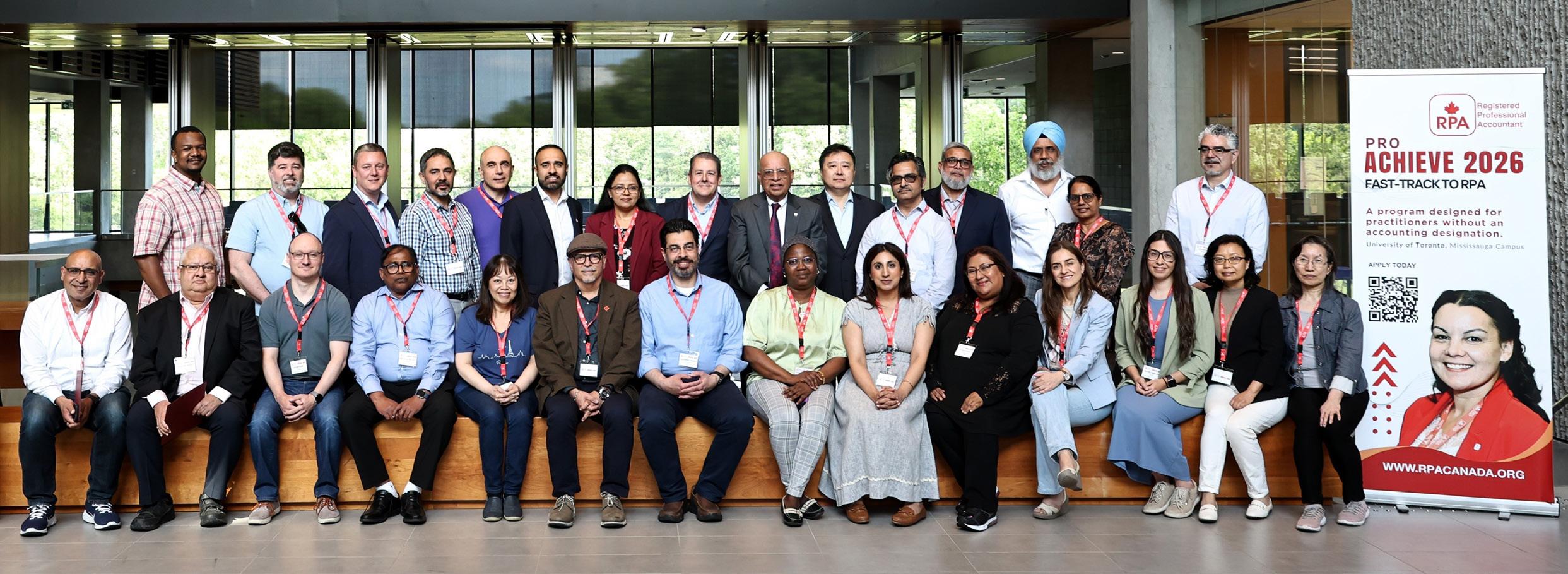
For four days in early June, a lecture hall at the University of Toronto Mississauga campus became the proving ground for a new idea in Canadian professional education. Pro ACHIEVE 2026, RPA Canada’s first fast-track, in-person pathway to the Registered Professional Accountant designation, ran June 3–6 and concluded with sustained demand, sold-out registration, and an unmistakable message from participants: do it again.
The program, whose name is shorthand for “professional achievement,” was conceived to address what RPA Canada President and CEO Zubair Choudhry describes as a blind spot in the profession. Across Canada, and particularly in Ontario, thousands of practitioners provide tax preparation, bookkeeping, accounting and advisory services to small businesses and individual taxpayers without formal training or a professional designation. They are experienced, trusted by their clients and unrecognized.
“I am very pleased with the Pro ACHIEVE 2026 offering,” Mr. Choudhry said while presenting completion certificates to participants. “This program is designed by RPA Canada to provide a fast-track pathway for experienced individuals serving SMEs and Canadian taxpayers who lack formal education or a professional designation. A trained and designated accounting professional can better serve
By
Professional Accountant Staff | Toronto, June 2026
Canadian businesses and help protect the public interest.”
From Vancouver to Ontario, a Room Full of Energy
The inaugural cohort of some 25 practitioners reflected the breadth of the profession itself: mature practitioners from diverse demographic backgrounds, travelling from Vancouver, Calgary, and communities across Ontario. What united them was experience without recognition, and a determination to close that gap.
The faculty matched the ambition. Case-study sessions led by Dr. William Wei, an accomplished academic who is also an RPA, brought accounting principles to life through practical application, with participants themselves presenting case studies - a format singled out repeatedly in post-program feedback. Sessions in management accounting, delivered by Dr. Taslima Nasreen, a professor deeply versed in the field, connected cost accounting to the daily realities of SME advisory work. Taxation instruction proved the program’s most immediately practical component, alongside sessions on analytics and the integration of artificial intelligence into modern practice. Mike Saniga, RPA Canada’s Director of Engagement and Learning Innovation, contributed hands-on practitioner perspective throughout.
The experience I had is priceless — I wouldn’t compare it to anything else.
September: The Second Run
Originally planned as a one-time offering, Pro ACHIEVE sold out and pent-up demand has already compelled an encore. A second run is scheduled for September 2026, with preregistration now open. Given the pace at which the June session filled, prospective participants are advised to register early.
Pro ACHIEVE 2026 participant
Participant reaction was emphatic. One attendee praised the program’s specific focus on small and medium-sized business rather than an “everything at every level” approach. Another, a practitioner originally from Colombia, described the designation as the fulfilment of a long-held dream: “Since I’m in Canada, I’ve always dreamed about having a designation in my accounting.” A third was already acting on the material: “I’m looking at changing contracts, services, reaching out to clients. I’ve learned so much, especially through taxation.”
What Comes After the Certificate
Completion of Pro ACHIEVE qualifies participants for the RPA designation, but for those in public practice, it is the first phase of a larger commitment. Graduates entering practice proceed to RPA Canada’s professional accounting certification, covering the public interest, the code of professional conduct, accountability, and practice management. Errors-and-omissions assurance and mandatory continuing professional development complete the framework, ensuring practitioner knowledge remains current.
That layered structure, Mr. Choudhry noted, answers precisely what small businesses, Canadians, and governments at every level have been asking of the profession: protection, competency, ethics, accountability, and transparency. “This area was a blind spot for the profession,” he said. “The RPA is filling the gap and providing to the country what it needs.”
A trained and designated accounting professional can better serve Canadian businesses and help protect the public interest. “ “
Zubair Choudhry, President & CEO
For a profession and a country grappling with rapid economic and technological change, Pro ACHIEVE 2026 offered a timely proof of concept: that experienced practitioners, given a rigorous pathway, will step forward for the education, recognition, and designation they deserve.
For pre-registration details for the September 2026 session, visit rpacanada.org.

Predicting Corporate Failure: Lessons from Global Business Failures

Deepak GUPTA, FCA (India), RPA
Corporate Failure
Corporate failure refers to a company’s inability to continue its operations due to insolvency, illiquidity, mismanagement, fraud, or strategic collapse. However, corporate failure is rarely a sudden event; rather, it is typically preceded by a series of financial, strategic, operational, and governance-related warning signals that can often be identified well in advance. Early identification of these signals enables management, investors, lenders, regulators, and auditors to initiate timely corrective actions before the situation becomes irreversible. These warning signals usually stem from underlying organisational weaknesses, the causes of which may vary across businesses. Corporate failure can arise from a combination of financial, strategic, operational, ethical, and governance-related factors. High financial leverage, macroeconomic disruptions, loss of competitive advantage, unsustainable business models, strategic drift, fraud and financial misreporting, and weak corporate governance are among the principal drivers of corporate failure.
Preventing Corporate Failure
Preventing corporate failure therefore depends largely on an organisation’s ability to detect, interpret, and respond to these early warning signs. To facilitate this process, organisations rely on structured prediction models and analytical frameworks that systematically evaluate indicators of financial distress and organisational weakness. These models enable stakeholders to evaluate the probability of corporate failure and facilitate informed decision-making.
Corporate failure prediction models can broadly be classified into quantitative and qualitative approaches. Quantitative models rely primarily on financial data and accounting ratios to assess the probability of failure. Among the earliest and most influential is Altman’s Z-Score Model (1968), developed by Professor Edward I. Altman, which combines multiple
financial ratios into a single composite score to predict corporate distress. In contrast, Qualitative models evaluate non-financial factors such as management quality, corporate governance, strategic decisions, organisational structure, and operational practices. One of the most widely recognised qualitative approaches is Argenti’s A-Score Model (1976), developed by John Argenti, which focuses on management deficiencies, strategic and operational mistakes, and early warning signs that may ultimately lead to corporate failure.
Combining quantitative and qualitative approaches generally provides a more comprehensive assessment of an organisation’s financial health and its risk of corporate failure.
Altman’s Z-Score
Since there can be more than one factor causing failure, hence plain regression lines can’t do much or have limited application. There is a need for some strong statistical tool for analysis which can handle multiple factors in one go. Multiple Discriminant Analysis (MDA), suggested by Ronald A. Fisher in 1936, is a statistical technique in which multiple factors can be incorporated by assigning weights to each factor to classify observations into groups.
In 1968, Edward I. Altman applied MDA to study 66 publicly traded manufacturing firms with assets over $1 million, half of which had already gone bankrupt. He identified financial ratios that strongly differentiated healthy firms from failing ones and developed a weighted formula, known as the Altman Z-Score, combining liquidity, profitability, efficiency, leverage, and productivity metrics.
Basic Model (1968) for Public Manufacturers (e.g., General Motors, Boeing, Caterpillar, Magna)
Z = 1.2 X₁ + 1.4 X₂ + 3.3 X₃ + 0.6 X₄ + 1.0 X₅
Wherein 1.2, 1.4, 3.3, 0.6, and 1.0 are weights to the respective factors.
X 1 Working Capital / Total Assets X1 is measure of ‘Liquidity’ which shows how much of a firm’s assets are in short-term form, indicating its ability to cover immediate debts.
X 2 Retained Earnings / Total Assets
X 3 EBIT / Total Assets
X 4 Market Value of Equity / Total Liabilities
X 5 Sales / Total Assets
X2 measures the extent to which a company may rely on debts to finance its investments. The lower ratio, the more company relies on debts to fund its assets, thereby increasing the risk of financial distress.
X3 is measure of ‘Operating Efficiency’ which measures how effectively the company generates earnings from its assets, regardless of financing or taxes.
X4 is measure of ‘Leverage’ or ‘Solvency’ which indicates financial leverage and the cushion available to creditors before equity holders are wiped out.
X5 is measure of ‘Asset Productivity’ or ‘Turnover’ which measures how efficiently a company uses its assets to generate sales.
These ratios are combined with specific weights to calculate the Z-Score, providing a single number to gauge bankruptcy risk, with lower scores indicating higher distress.
Z-Score Model for Private Manufacturers (e.g., Kruger Inc., Sleeman Breweries Ltd.)
The original Altman Z-Score model (1968) was developed for publicly traded manufacturing firms, as it requires the market value of equity in the X₄ variable. Since the market value of equity is generally unavailable for private companies, Altman re-estimated the model in 1983 by replacing the market value of equity with the book value of equity. The revised model, known as the Z′-Score, was estimated using the original dataset with modified coefficients.
Z’ = 0.717X₁ + 0.847X₂ + 3.107X₃ + 0.420X₄ + 0.998X₅
It is to be noted that due to the lack of a comprehensive database of private firms, the revised model has less utility.
Z” - Score Model for Non-Manufacturers (e.g., Apple Inc., Meta Platforms Inc.)
In 1995, Altman further revised the Z-Score model by eliminating the sales-to-total-assets ratio (X₅) to reduce industry-specific effects. The resulting model, known as the Z’’-Score, is suitable for non-manufacturing firms and service organisations operating in developed markets.
Z″ = 6.56X₁ + 3.26X₂ + 6.72X₃ + 1.05X₄
The Sales-to-Total Assets ratio (X₅) is removed from the model, while the fourth variable (X₄) continues to use the Book Value of Equity to Book Value of Total Liabilities ratio.
Emerging Market Score (EM-Score) (e.g., Infosys Limited, Tata Consultancy Services Limited)
This model is specifically designed for firms operating in emerging economies (e.g., India, Brazil, and Mexico).
Z_EM = 3.25 + 6.56X₁ + 3.26X₂ + 6.72X₃ + 1.05X₄
The EM-Score uses the same four financial ratios and corresponding coefficients as the Z’’-Score model; the only change is the addition of a constant value of 3.25 to improve its applicability to firms operating in emerging markets.
Interpretation Rule
Companies with score in this range are considered in financial distress and have a high likelihood of bankruptcy.
Companies with score in this range require further investigation, as their financial condition is uncertain.
Companies with score in this range are considered financially sound and are unlikely to face bankruptcy in the near term.
Argenti’s A-Score Model
Argenti’s A-Score Model analyses corporate failure through three dimensions, namely defects, mistakes, and symptoms of failure. Each dimension is further broken down into specific negative indicators (such as high gearing, autocratic leadership, weak accounting systems, etc.).
Management assigns negative scores to each identified weakness. These scores are then aggregated to arrive at the overall A-Score. If the total score exceeds 25, the firm is considered to be at risk of failure, indicating the need for immediate corrective action.
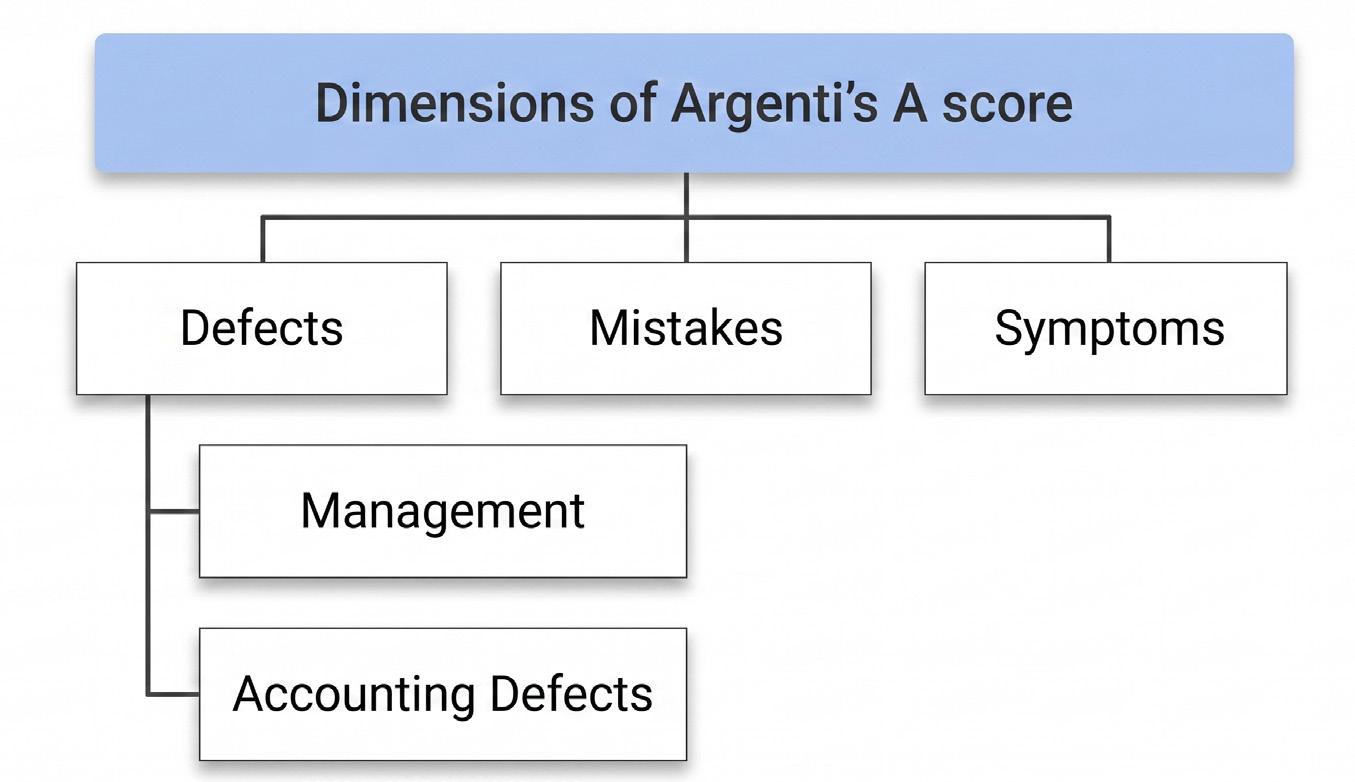
Dimensions of Argenti’s A-Score
Defects represent fundamental weaknesses within the organisation and include:
• Management defects such as faulty organisational structure, autocratic chief executive, concentration of power (e.g., Chairman also acting as CEO).
• Accounting defects such as lack of budgetary control, absence of costing systems, weak financial reporting.
Mistakes
Mistakes arise over time as a consequence of underlying defects. Defects and mistakes are therefore interrelated. For example, weak management and accounting systems inevitably lead to strategic errors such as high gearing, overtrading, or failure of major projects.
Symptoms of Failure
If mistakes persist, symptoms of failure inevitably become visible. These are outward warning signs such as:
• Deteriorating financial ratios
• Liquidity stress
• Creative accounting practices
In addition to the overall A-Score, the individual scores of each dimension are also analysed. Group-wise scores help identify the root cause of failure, thereby facilitating more effective corrective measures. For instance, a high score in the mistakes category typically indicates poor strategic decision-making by management.
How the A-Score Works?
Under Argenti’s A-Score Model, acceptable score limits are prescribed for each dimension. The Defects score should not exceed 10, and the Mistakes score should not exceed 15. In the Symptoms dimension, any score itself is an indicator of financial distress.
For a firm to be considered financially healthy, the overall A-Score must remain below the maximum acceptable threshold of 25.
Accordingly, a firm is considered at risk of failure if any one or more of the following conditions exist:
• The overall A-Score exceeds 25, and/or
• The Defects score exceeds 10, and/or
• The Mistakes score exceeds 15, and/or
• There is any score recorded under the Symptoms category
Altman’s Z-Score remains a simple, reliable, and powerful tool for the early prediction of corporate distress, providing managers, auditors, investors, and regulators with a forwardlooking view of a company’s financial health. When combined with qualitative factors such as industry outlook, governance quality, and competitive dynamics, it helps prevent major failures, as demonstrated by case studies. Argenti’s A-Score complements this by serving as an early-warning system, encouraging organisations to look beyond ratios, evaluate leadership and strategic decisions, detect governance lapses, and take corrective action before failures become irreversible.
The key lesson is clear: “corporate failure is largely predictable and preventable if warning signs are identified and addressed in time.”
The Impending AI Revolution in Accounting: Threatening or Thriving?

Taslima NASREEN , MBA, PhD, RPA, Assistant Professor
AQuestion That Stopped Me in My Tracks
At the 2025 Ontario University Fair at the Metro Toronto Convention Centre, where I was representing Algoma University’s Faculty of Business and Professional Studies a sharp, unexpected question from a Grade 12 student made me pause. “Why should I aim for a career in accounting if it will eventually be taken over by AI?”
The question was sincere, intelligent, and reflective of a generation raised with information at their fingertips. Generation Alpha is not waiting for the future; they are already interrogating it. And their concerns deserve thoughtful answers.
AI Is Transforming Accounting, But Not Replacing It
Artificial intelligence is undeniably reshaping the accounting profession. Automated bookkeeping, advanced analytics, fraud detection, compliance monitoring, and real-time financial forecasting are no longer futuristic; concepts they are present realities.
AI’s greatest contribution is precision. By reducing human error in reconciliation, reporting, and forecasting, AI strengthens the reliability of financial information. It processes vast datasets in seconds, enabling accountants to deliver real-time insights that support faster, more informed decision-making.
Yet, this evolution is not a takeover. It is an upgrade.
The Risks We Cannot Ignore
While the benefits are substantial, responsible adoption requires acknowledging the risks:
• Data privacy and security vulnerabilities
• Opaque decision making algorithms
• Ethical and regulatory complexities AI cannot interpret independently
Accounting is fundamentally a profession of judgment. It requires interpretation of laws, ethical reasoning, and contextual decision-making – areas where AI remains limited.
“Accounting is a profession of judgment, ethics, and trust – none of which can be automated.
And then there is trust. Client relationships, professional skepticism, and ethical stewardship cannot be automated. These human elements are central to the profession’s credibility.
AI as a Tool for Upskilling, Not Replacement
AI should be viewed as an extension of the accountant’s toolkit much like spreadsheets, Power BI, and Tableau. It enhances capacity, improves efficiency, and frees professionals to focus on higher-value advisory work.
The question “Will AI replace accountants?” deserves a clear, evidence-based answer:
No AI will not replace accountants. But it will replace many accounting tasks and reshape the role. This is not a threat. It is an invitation to evolve.
Professional Bodies Must Lead the Way
Organizations such as CPA and RPA have a critical responsibility: to guide the profession through ethical, responsible, and transparent AI integration.
This includes:
• Developing standards for AI use
• Providing training and certification pathways
• Ensuring public trust in AI-supported accounting practices
By leading proactively, professional bodies can ensure that AI strengthens not destabilizes the profession.
Thriving?
Professional bodies like CPA & RPA must lead the charge in ensuring ethical and responsible AI adoption.
A Future Where Accountants Thrive AI will automate routine tasks and amplify analytical capabilities, but it will not erase the core nature of accounting. The profession’s foundation judgment, ethics, trust, and strategic insight remain firmly human.
Accountants who embrace AI with curiosity and courage will deliver greater value, perform more meaningful work, and contribute to the profession’s evolution.
As I said that Grade 12 student: AI is not the end of accounting. It is the beginning of a more empowered version of it.
“ “ Threatening or
Generation Alpha isn’t afraid of the future they’re already questioning it. And we must be ready to answer.
So, let’s pat ourselves on the back and get ready to adapt.


Beyond the Balance Sheet: Why Human Connection Is Becoming Business’s Most Valuable Asset

Umar CHOUDHRY, CPA, LPA, RPA
Artificial intelligence is transforming the accounting profession at an unprecedented pace. Cloud computing has revolutionized financial reporting. Automation has simplified bookkeeping, payroll, tax compliance, and audit procedures. Businesses can now communicate with clients around the world without leaving their offices, and many professionals spend their entire workday interacting through email, instant messaging, and video conferencing.
From a productivity perspective, the modern workplace has never been more efficient.
Yet beneath this remarkable technological progress lies a growing challenge that deserves the attention of business leaders, employers, and professional accountants alike. Across Canada and around the world, people are becoming increasingly disconnected from one another. While technology has made communication easier than ever, meaningful human relationships are becoming more difficult to establish and maintain.
This growing disconnect is not merely a social concern; it is an economic one.
Organizations thrive on trust. Successful businesses are built on collaboration. Entrepreneurs rely on relationships. Professional accountants earn their reputations through credibility and confidence. Every one of these qualities depends upon genuine human connection.
As technology continues to reshape our profession, we must ensure that efficiency does not come at the expense of empathy and that innovation does not replace the relationships that have always been fundamental to business success.
The Hidden Cost of Disconnection
Recent research from the Leadership & Happiness Laboratory at Harvard Kennedy School highlights a troubling trend described as a “friendship recession.” Despite living in an era of constant digital communication, many individuals report having fewer close friendships and spending less time engaged in meaningful social interaction. Similar concerns have been echoed by researchers across North America and Europe, who have observed increasing levels of loneliness, workplace isolation, and declining community engagement.
The most successful accountants of the future will not simply master technology – they will master the human skills that technology can never replace.
Although these issues are often discussed from a health or psychological perspective, they have significant implications for business.
When employees feel disconnected from their colleagues, organizations experience lower engagement, reduced creativity, weaker collaboration, and higher turnover. Teams communicate less effectively. Innovation slows. Trust declines.
For employers, these consequences eventually appear where every accountant notices them first in the financial statements.
Higher recruitment costs, increased absenteeism, declining productivity, and employee burnout all carry measurable financial consequences.
Human connection, therefore, is not simply a personal matter. It has become an important business asset.
“ “
Strong financial statements are important, but strong relationships are what sustain organizations through uncertainty
Technology Has Changed the Workplace Forever
Few professions have embraced digital transformation as rapidly as accounting.
Twenty years ago, accountants relied heavily on paper files, face-to-face meetings, printed financial statements, and physical signatures. Today, cloud-based accounting platforms, electronic documentation, artificial intelligence, robotic process automation, and digital collaboration tools have fundamentally changed how accounting services are delivered.
These advancements have created enormous value.
Routine calculations that once required hours can now be completed within seconds. Financial reports can be generated instantly. Artificial intelligence can identify unusual transactions, summarize financial data, detect fraud indicators, and assist with forecasting.
These innovations should be celebrated.
“Artificial Intelligence can process information in seconds. Trust, integrity, and meaningful relationships are built one conversation at a time.
Professional accountants are no longer viewed solely as financial record keepers or tax preparers. Increasingly, they serve as trusted advisors helping organizations navigate uncertainty, manage risk, improve governance, evaluate investments, implement technology, and develop long-term business strategies.
This evolution makes interpersonal skills more valuable than ever.
Artificial intelligence may eventually perform many routine accounting functions more accurately and efficiently than humans. However, it cannot replace professional judgment developed through experience. Nor can it replicate empathy, ethical reasoning, leadership, negotiation, or the confidence clients place in professionals they know personally.
These qualities remain distinctly human. For this reason, tomorrow’s most successful accountants will combine technical expertise with exceptional relationship-building skills. The profession’s future will not belong exclusively to those who understand artificial intelligence. It will belong to those who understand people.
Trust Is the Foundation of Every Business Relationship
Every successful business transaction begins with trust. Investors trust financial information prepared according to professional standards. Banks trust financial statements when extending credit. Governments trust businesses to comply with tax legislation. Clients trust accountants to protect confidential information and provide objective advice. Without trust, commerce becomes significantly more expensive.
Organizations invest more heavily in oversight, legal protections, monitoring systems, and compliance procedures when trust declines. Conversely, organizations characterized by high levels of trust often make decisions more quickly, collaborate more effectively, and resolve conflicts more constructively.
At RPA Canada, we strongly support responsible innovation and the adoption of technologies that improve efficiency, strengthen professional judgment, and enable accountants to provide greater value to businesses.
• However, technology remains a tool, not a substitute for relationships.
• Clients rarely remember the software their accountant used.
• They remember whether their accountant answered the phone during difficult times.
• They remember thoughtful advice during periods of uncertainty.
• They remember honesty, integrity, responsiveness, and genuine concern for their success.
• Technology can process information, but People build trust.
The Evolving Role of Professional Accountants
The accounting profession has changed dramatically over the past decade.
This principle extends well beyond accounting.
• A manufacturing company depends on trust between suppliers and customers.
• A family-owned business depends on trust between generations.
• A nonprofit organization depends on trust from donors.
• A professional association depends on trust from its members.
Trust is, in many respects, the invisible infrastructure supporting every successful economy.
Small Businesses Understand This Better Than Anyone
Canada’s small and medium-sized enterprises contribute significantly to employment, innovation, and economic growth. Many of these businesses operate within communities where personal relationships remain central to commercial success.
Consider the local accounting firm that has served several generations of the same family.
The independent retailer who knows customers by name. The financial advisor whose referrals come almost entirely through satisfied clients. The entrepreneur who secures new opportunities because of relationships established years earlier.
These businesses compete successfully not because they possess the largest advertising budgets but because they have earned something far more valuable confidence.
Relationships often become their greatest competitive advantage. Even as artificial intelligence automates routine administrative functions, personal credibility continues to differentiate exceptional professionals from average ones. Technology may help businesses scale.
Trust helps businesses endure.
Leadership Requires More Than Technical Competence
Throughout history, successful leaders have understood that organizations are ultimately collections of people rather than collections of processes.
Leadership is often associated with strategic planning, operational efficiency, financial performance, and organizational growth. While these remain essential responsibilities, today’s leaders face an additional challenge: maintaining meaningful human connection within increasingly digital workplaces.
Employees who feel respected, heard, and supported are generally more engaged with their work. Teams characterized by open communication tend to solve problems more effectively. Organizations that encourage collaboration often adapt more quickly to changing market conditions.
The best leaders recognize that relationships require intentional investment.
Simple practices – mentoring younger professionals, recognizing employee contributions, encouraging collaboration across departments, and creating opportunities for face-to-face interaction – can significantly strengthen organizational culture.
These initiatives require relatively little financial investment. Their returns, however, can be substantial.
Research consistently shows that engaged employees are more productive, remain with organizations longer, and contribute more actively to innovation and customer satisfaction.
As accountants, we frequently evaluate return on investment in financial terms.
Perhaps it is time to recognize that investments in people often produce the highest long-term returns of all.
“As artificial intelligence continues to reshape the accounting profession, the value of authentic human relationships will only increase. The future belongs not to those who choose between technology and people, but to those who use technology to strengthen the relationships that make businesses and communities thrive.
References
• Harvard Kennedy School Leadership & Happiness Laboratory. (2025). The Friendship Recession: The Lost Art of Connecting.
• Gallup. (2024). State of the Global Workplace Report.
• World Health Organization. (2023). Commission on Social Connection. Organisation for Economic Co-operation and Development. How’s Life? Measuring Well-being.
• Statistics Canada. Quality of Life Framework and Social Connectedness Indicators.
• World Economic Forum. The Future of Jobs Report.
• Deloitte. Global Human Capital Trends.
Addressing the Unmet Needs of Our Clients:
The Real Promise of Emerging Technology

James GREEN, RPA
“Nearly four years after OpenAI released ChatGPT – an event that drew one million users in five days and one hundred million in two months – the accounting profession remains very much intact.
and he acknowledged underestimating the human element in knowledge work.
That admission matters. The people building the technology substantially overestimated its disruptive power. Four years on, accountants remain employed, demand has grown, and the profession continues evolving the way it always has gradually, practically, and one software update at a time.
For those still convinced a job apocalypse is imminent, the goalposts have already moved and will likely move again. It is time to set that conversation aside.
What These Tools Actually Are
Public discourse often frames AI systems as digital employees – autonomous agents capable of judgment, accountability, and professional decision-making. This framing is misleading. The tools entering accounting workflows are better understood as sophisticated software plugins.
They identify patterns, automate routine tasks, and accelerate work previously done manually.
Early commentary predicted either mass displacement of white-collar workers or the end of knowledge work altogether. Neither occurred. With several years of practical experience now behind us, it is worth examining what actually changed, what did not, and where the real opportunity lies.
Lowering the Temperature
The dire predictions came from credible voices. In 2023, OpenAI CEO Sam Altman warned that “jobs are definitely going to go away.” Anthropic CEO Dario Amodei suggested half of entry-level white-collar roles could disappear within five years. McKinsey projected hundreds of millions of displaced workers globally by 2030.
Yet last month, Altman publicly reversed course, telling a Commonwealth Bank of Australia summit that he was “delighted to be wrong.” The impact on white-collar employment had been far less dramatic than anticipated,
They do not exercise judgment, apply ethics, assume liability, or replace the professional relationship between accountant and client.
They are power tools. And like any power tool, their value depends entirely on the skill of the person using them. A carpenter with a nail gun does not become ten carpenters; he becomes a more capable one. The same is true for accountants. AI amplifies professional capability it does not substitute for it.
Platforms such as QuickBooks, Xero, Dext, Karbon, and Microsoft have already embedded AI into core workflows. Transaction coding, document extraction, reconciliation, research, communication, and workflow management are now faster and more efficient.
The profession has absorbed these improvements the same way it absorbed every major software advancement over the
past several decades. The tools are better. The professionals are more capable. The clients still need professionals.
Nearly four years after OpenAI released ChatGPT an event that drew one million users in five days and one hundred million in two months the accounting profession remains very much intact.
We Were Already Doing Advisory Work
Yet real-world evidence shows the opposite: demand expands as professionals become capable of delivering more and better services.
“ “
A common narrative suggests compliance firms are now “evolving into advisory firms,” as though technology unlocked a capability that did not previously exist. In reality, most compliance-focused practices have always provided advisory services: financing questions, pricing discussions, hiring decisions, cash-flow concerns, expansion plans, and succession issues. The limitation was never expertise. It was capacity.
Compliance deadlines are fixed. Year-ends must be prepared. When routine work consumes available hours, advisory conversations get compressed or deferred. Every practitioner has experienced the moment when the client’s most important question surfaces just as the meeting is ending.
Meet Sandra
Sandra, a catering company owner and long-standing client, illustrates the opportunity.
Automation through Dext freed enough time to prepare a simple break-even analysis segmented by event type. The findings revealed that her corporate catering work produced stronger margins than weddings and private events. She had sensed this but had never seen it clearly.
A forty-five-minute meeting turned into a meaningful advisory conversation: scenario planning, margin analysis, and strategic direction.
Sandra left saying she finally felt someone was helping her build the business, not just keep it filed. Technology didn’t have that conversation. It created the time for it.
The Opportunity Is Capacity
The dominant productivity narrative argues that if one professional becomes ten times more efficient, nine become redundant.
Small business owners make consequential decisions daily. Many receive less financial insight than they need, not because accountants lack expertise, but because they lack hours.
Automation creates room: for planning, forecasting, scenario analysis, and genuine financial partnership. Technology is not the story. Capacity is. And the question for every firm remains unchanged: what are we going to do with the time we have?
There is no shortage of answers waiting in the client base.
Nearly four years after OpenAI released ChatGPT an event that drew one million users in five days and one hundred million in two months the accounting profession remains very much intact.


City Hall’s Open Door: Ontario Mayors on
Why Small Business Is Everyone’s Business
From Oakville to Oshawa, municipal leaders are reinventing local government as partner, connector, and champion for the entrepreneurs who anchor their communities.
Small businesses are the backbone of our communities. The phrase is familiar, but behind it are real people navigating rising costs, labour shortages, shifting regulations, and an increasingly competitive marketplace. And while many of these pressures are national or even global in scope, it is local government that hears about them first, often across a counter or at a community event, and local government that is expected to respond first.
To understand how Ontario’s municipalities are answering that call, Professional Accountant asked mayors from across the province to reflect on the toughest small business challenges of their terms and the solutions that have worked. Their answers reveal a striking consensus: cities that treat businesses as partners, not merely ratepayers, are the cities that thrive.

From Regulator to Partner
In Oakville, Mayor Rob Burton describes a deliberate change in posture. The smallest operators, he notes, rarely have the time or connections to find the support that already exists so rather than wait for businesses to come to town hall, Oakville brings help to them. The town stood up a Tariff Task Force with a dedicated resource hub, connected owners directly with Export
Development Canada and the federal Trade Commissioner Service, and endorsed a new committee to help local firms reach international markets.
The philosophy crystallized in October 2025 with the launch of Branches to Business, a program offering companies oneon-one support on funding, workforce, scaling, and cutting through municipal red tape. The results speak for themselves: Oakville has been named one of Canada’s best places to invest by Site Selection Magazine for seven consecutive years, and its commercial sector now contributes nearly 20 per cent of town taxes from just 13 per cent of the assessment base, easing the load on residents. “When government acts as a partner rather than only a regulator,” Mayor Burton says, “businesses thrive.”

Building a Connected Ecosystem
In Mississauga, Mayor Carolyn Parrish points to access to capital and ongoing market uncertainty – including trade and supply chain disruptions – as the most persistent barriers, alongside limited marketing reach, aging buildings, and constrained internal capacity among growing firms. Her prescription is what she calls a connected ecosystem model: advisory services, mentorship, access to funds, and targeted scale-up programming, delivered in concert with post-secondary and regional partners.
Through IDEA powered by Invest Mississauga, the city connects entrepreneurs to investors, partners, and specialized expertise while running hands-on programs like Starter Company Plus and Step Up helping businesses commercialize, secure funding, and scale within a coordinated network that strengthens long-term economic resilience.
Creating the Conditions to Thrive
Hamilton Mayor Andrea Horwath frames the challenge as one of navigating relentless change: rising costs, labour shortages, shifting consumer habits, and tariff impacts on major infrastructure and construction projects. Her answer is to create the conditions in which businesses can succeed – investing in complete communities, improving

transportation and infrastructure, streamlining processes, and ensuring entrepreneurs can access advice through the Hamilton Business Centre at every stage from start-up to expansion.
Hamilton’s recently approved 10-Year Downtown Revitalization Strategy reflects the same conviction. Vibrant main streets and a strong downtown, Mayor Horwath argues, benefit the entire city. “When local businesses succeed, Hamiltonians succeed.”

Data, Incentives, and a Concierge at City Hall
Few communities weathered more uncertainty than Oshawa, where Mayor Dan Carter recalls the pandemic’s disruption of supply chains, customer demand, and workforce availability followed by international trade volatility that raised costs and complicated export planning. Oshawa’s response has been proactive, informationdriven, and incentive-based: a real-time economic data dashboard to inform site selection and investment decisions, expanded Community Improvement Plans, zero city development charges for industrial projects, a partnership with Fundica connecting entrepreneurs to grants and financing, and a concierge-style service that streamlines approvals. A Business Retention and Expansion program keeps relationships strong, while local post-secondary institutions supply student talent and research partnerships.
Why It Matters to the Profession
Four cities, four distinct approaches and one shared conclusion. Small businesses create jobs, foster innovation, and define the character of the communities they serve. For accounting professionals, the message is equally clear: the entrepreneurs who rely on accessible, competent, and affordable accounting services are the same entrepreneurs Ontario’s mayors are working hard to keep. When the professionals who keep their books and the governments that shape their conditions pull in the same direction, small businesses and communities win.

Canada’s EV Tariff Quota: A Strategic Pivot with Far‑Reaching Implications

IWilliam WEI, PhD, MBA, RPA
n January 2026, Canada reached a preliminary agreement with China establishing a tariff rate quota (TRQ) for Chinese-built electric vehicles. Up to 49,000 EVs may now enter annually at the 6.1% most-favoured-nation rate, replacing the 100% surtax in place since October 2024. This is more than a technical trade adjustment; it is a calculated balancing of consumer affordability, industrial policy credibility and geopolitical risk.
The tariff arithmetic
The change is dramatic. A Chinese EV previously faced a combined 106.1% tariff; within the quota, that falls to 6.1%. On a C$35,000 landed cost, duty drops from roughly C$37,000 to just over C$2,000 a reduction of more than 90% that fundamentally alters importers’ cost structures and could lower retail prices in the affordability-constrained entrylevel segment.
Yet the quota is modest: under 3% of Canada’s annual new-vehicle market and roughly 20% of the battery-electric and plug-in hybrid segment. Administered first-come, firstserved in two tranches, uptake has been slow; only 2,910 vehicles, about 12% of the first tranche, had entered by early June 2026. Immediate disruption is limited, but competitive pressure will build as distribution channels and consumer awareness mature.
Quota rents and allocation
The economic value of a TRQ lies in the quota rent gap between the in-quota and over-quota tariffs. Who captures it depends entirely on allocation. Licences are restricted
to Canadian-resident original equipment manufacturers, with non-residents permitted to appoint a Canadian agent. Transparent, predictable rules on eligibility, transferability, monitoring and enforcement will determine whether benefits flow to consumers through lower prices or are retained by importers and intermediaries.
The canola connection
Legally unrelated, politically inseparable. As part of the January package, China cut tariffs on Canadian canola exports worth roughly C$4 billion annually from about 85% to roughly 15%. Any future EV dispute could spill into agricultural trade, making the quota a barometer of the broader bilateral relationship.
Industrial policy and investor confidence
Having courted billions in EV and battery investment between 2020 and 2024, Ottawa risks signalling policy uncertainty; even a small import channel can shift capital allocators’ expectations at the margin. One mitigation is mandatory joint ventures under Canadian control; Chinese partners cannot consolidate revenues, so profits appear as investment income rather than top-line sales, a structure with clear financial-reporting implications.
What to watch
With the U.S. having sharply raised its own tariffs on Chinese EVs, Canada is weighing end-use and re-export rules, anti-circumvention monitoring and consultations with Washington. Design choices on duration, allocation method, unused quota and compliance will determine whether the 49,000-unit quota becomes a stable rule of the game or a tactical episode. The answer lies not in the headline number, but in the administrative detail, transparency and enforcement that follow.
Why CRA reviews are taking more time than accounting firms expect.

James NOONAN Audit Shield, Marketing Manager.
For many accounting professionals, Canada Revenue Agency (CRA) review activity is not necessarily appearing in new areas. What is changing is the experience of that activity. Reviews are becoming more consistent, more data-driven, and more operationally disruptive to firms than many practitioners remember.
The CRA has been open about its commitment to expanding the use of artificial intelligence, machine learning, automation, and advanced analytics within its compliance activities. Recent departmental plans reference the growing use of technology to detect non-compliance, support compliance programs, and enhance collection activities.
For practitioners, this modernization appears to be changing how review activity is initiated and managed. Traditional reviews are increasingly being supported by automated data matching, expanded access to third-party information, pattern-based risk scoring, and greater cross-referencing between different CRA systems. In practice, this means reviews are often triggered by data signals rather than random selection.
The result is an environment where firms may find more client files being touched, more reviews running concurrently, and more files remaining open for longer periods of time. As review activity becomes increasingly systematic, accounting firms must consider not only the technical aspects of compliance but also the operational impact on their practices. Claims data reviewed by Accountancy Insurance for Audit Shield claims activity indicates that CRA review activity continues to occur across a broad range of familiar areas, including personal tax reviews, corporate tax reviews, GST/HST reviews, payroll examinations, trust reviews, and matching programs. While individual review categories may rise and fall throughout the year, the overall level of activity has remained remarkably persistent.
How Audit Shield claims reflected CRA review activity in 2025*
What often receives less attention is the amount of professional time these matters consume once initiated. A review may begin with a relatively simple request for information but can evolve into months of correspondence, document gathering, reconciliations, and explanations. Audit Shield claims data indicates that some review types can consume significant professional hours before resolution,
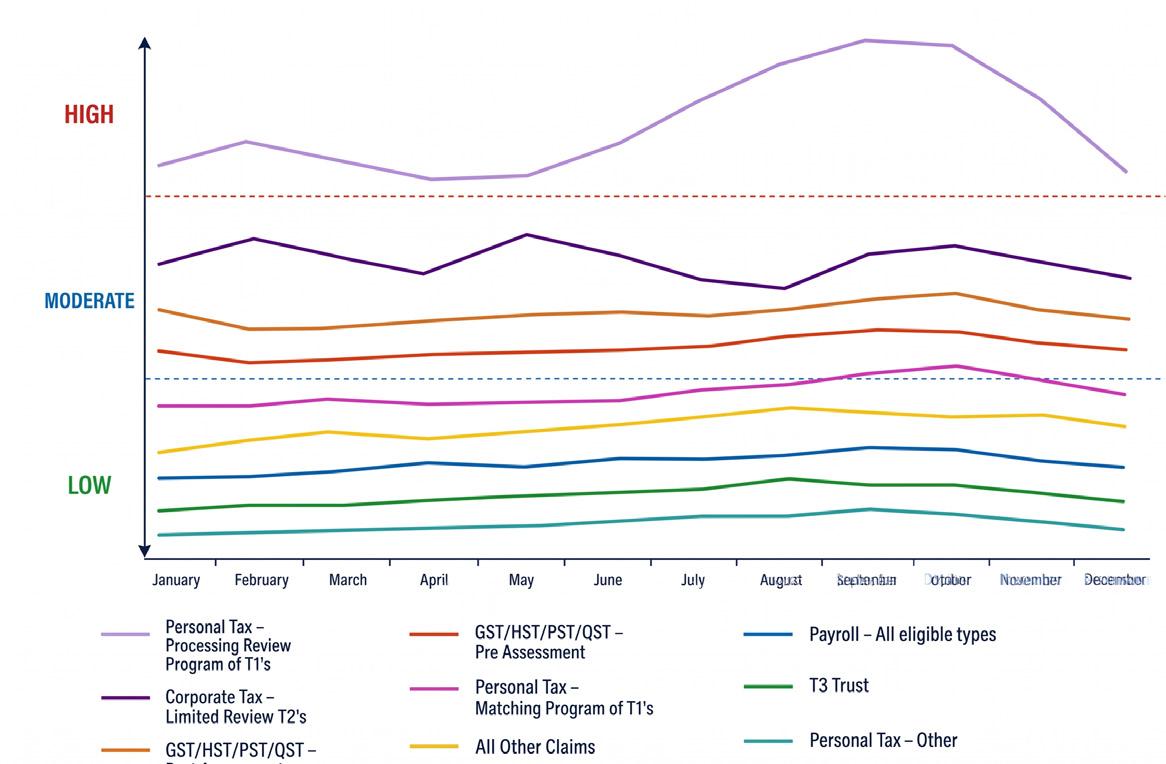
*Data based on aggregate Audit Shield claims from 1 January 2025 to 31 December 2025 and correct as at 1 March 2026.
particularly corporate audits, employer compliance reviews, payroll examinations, GST/HST reviews, and trust reviews. This creates a hidden economic challenge for firms. Partner and staff time is diverted from advisory, growth, and clientservice activities toward reactive review management. Some firms absorb time to preserve client relationships, while others face difficult billing conversations when review work extends beyond original expectations. Capacity constraints are particularly noticeable during already demanding periods of the year.
The firms managing this environment most effectively tend to approach CRA reviews as an operational reality rather than an occasional interruption. Common practices include establishing clear processes for handling reviews, documenting tax positions with future review activity in mind, identifying higher-risk client profiles, setting expectations with clients early, and determining in advance how CRA related professional time will be billed and managed.
The key takeaway is not that CRA reviews are new. Rather, firms are operating in an environment where review activity appears increasingly scalable, pattern-driven, and continuous. As technology continues to reshape the compliance landscape, firms that proactively manage the operational impact of CRA reviews will be better positioned to protect capacity, maintain client relationships, and focus their professionals on higher-value work.
ACHIEVE 2026
September 23-26
University of Toronto, Mississauga Campus
Maanjiwe Nendamowinan Building




A new way to learn is shaping the future of accounting. This immersive four-day program delivers expert-led learning, hands-on exercises, and the essential content practitioners need to advance with confidence.
Fast-Track Your Way to the RPA Designation. "Four days of learning. A lifetime of recognition."