
Professional Driver March 2026 issue

Page 1


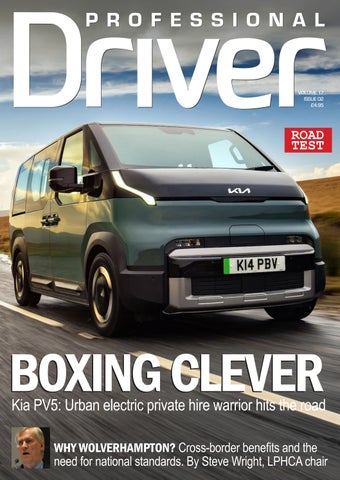
BOXING CLEVER BOXING CLEVER

Kia PV5: Urban electric private hire warrior hits the road

WHY WOLVERHAMPTON? Cross-border benefits and the need for national standards. By Steve Wright, LPHCA chair
EDITORIAL DIRECTOR

Mark Bursa

07813 320044

markbursa@prodrivermags.com

COMMERCIAL DIRECTOR

Paul Webb 07807 133527

paulwebb@prodrivermags.com

CONTRIBUTORS

Gary Jacobs, Kevin Willis, Tim Barnes-Clay, Dr Mike Galvin, Kwabena Dennot Nyack

COMPANY ADDRESS

50 Beechcroft Manor, Oatlands, Weybridge, KT13 9NZ WEBSITE

Martin Coombes PageHub Design

martin@pagehubdesign.co.uk SUBSCRIPTIONS

Curwood CMS Ltd, The Barn, Abbey Mews, Robertsbridge, TN32 5AD 01580 883844

subs@prodrivermags.com

Registered in England No. 7086172 © 2026 All contents copyright of ProDriver Media Ltd

Make your voice heard on licensing

Mark Bursa

April 1 is a day for pranks and jolly japes, but it is an important date for our industry. A government consultation into private hire licensing closes at midnight on April 1, and it’s vital that we get our voice heard.

The link to the consultation is at the end of this article – please participate and help to safeguard rules and regulations that are there to help us, and stop bad decicions being made.

Why is this so important? Because a lack of political understanding of the realities of private hire licensing risks plunging us back into the bad old days before the Deregulation Act of 2015, when all journeys had to start or finish within the council borders in which the car is licensed - the dreaded "ABBA principle".

industry. You can read it on page 14. If you take this to its obvious conclusion, there is only one logical course of action. Full national standards for PHVs, using Wolverhampton as the model, with common standards for vehicles, drivers and fees. There could easily be leeway within these rules for local authorities to insist on colour variations and signage requirements, or in-cab CCTV, while getting rid of ridiculous situations about, say, window tints, as these would be part of the national standard.

There are a number of shrill voices who oppose this because either they don’t understand what’s going on (that means you, Andy Burnham) or they are basically wrongly using safety as an issue (Sharon Graham of Unite, step forward).

The government is in danger of making some very bad decisions over licensing. Complete the consultation and make sure that retrogressive moves are consigned to the bin ”

This ridiculous state of affairs meant thousands of cars were running back to base empty while vulnerable customers were left waiting on the street. It was dangerous, stupid and environmentally idiotic. The Deregulation Act changed that – but once the genie was out of the bottle, the landscape changed completely.

Two main factors came to play. One was the growth of app-based ride hailing operators such as Uber and Bolt, which basically ignored the local rules and operated wherever there was demand.

And secondly, some councils, notably Wolverhampton, saw an opportunity to raise money by offering a better and faster service to drivers all across the country. Don’t wait 10 months to get your Manchester license – come to Wolverhampton and you’ll get it in 10 days. And it’ll be cheaper.

At a time when operators are struggling to find and retain drivers, anything that speeds up the process is good – so long as the checks and balances are in place.

And there is no evidence that Wolverhampton is any less rigorous in its checks than anywhere else – quite the opposite, in fact. There is generally no difference between a Wolverhampton license and one issued any other city.

And this is the point. In this issue of Professional Driver, Steve Wright of the LPHCA has contributed an excellent and succinct article explaining why Wolverhampton licensing is positive for the

Graham falsely claims “passenger safety” is compromised by cross-border hiring. The implication form Unite is that crossborder hiring is somehow to blame for the Rotherham grooming gangs scandal – which took place several years before the Deregulation Act became law. The drivers involved were locally licensed in Rotherham, and to claim otherwise is a utterly wrong.

We do not need a return to the bad old days. We need national standards, which can be enforced by any council, regardless of where the vehicle was registered.There should be no need for Wolverhampton officials to be in Manchester to check a vehicle’s roadworthiness or a driver’s badge. Local Manchester officials could do that, regardless of which council issued the license.

In fact why would you even need to have a local council logo on a plate? They’re only there for historical reasons. The passenger doesn’t care – or even look at the rear bumper. Buses don’t have them, and nor do trucks. These vehicles have been nationally licensed for decades. It’s time the same rules applied to private hire.

The government is in danger of making some very bad decisions over licensing. Reducing the number of authorities is a step in the right direction but it is not enough. Complete the consultation and make sure that backwards-looking moves such as the reintroduction of the ABBA principle are consigned to the bin, where they belong.

Follow the link to complete the consultation. www.gov.uk/government/consultations/ local-transport-authorities-and-the-licensing-of-taxis-and-private-hire-vehicles

Veezu expands in East Anglia with two Ipswich acquisitions

Veezu has moved into Ipswich with two acquisitions, including QSi Award-winning private hire operator CabsSmart.

Avenue Taxis, Ipswich’s longestestablished taxi company, has also joined the UK’s largest private hire operator, and both operators are rebranding as Veezu.

The moves are part of Veezu’s goal to develop transport networks outside London and deliver more sustainable transport services across East Anglia. Both companies have long been key players in Ipswich’s transport scene.

Avenue Taxis, founded in 1955, has supported everyday journeys, airport transfers and group travel

for nearly 70 years. CabsSmart, meanwhile, has built a strong reputation for its reliable service and support of local initiatives.

CabsSmart won two Gold Awards in the 2021 Professional Driver QSi Awards, in the Private Hire Operator (1-80 vehicles) and Community categorie, alongside a Bronze award for Business Diversification. The company was rewarded for its support for local char-

ities and the launch of an electric on-demand minibus service called Katch, which is now operated by East Suffolk County Council. Together, the acquisitions further strengthen Veezu’s East Anglia footprint, complementing its established presence in Cambridge and Norwich. Ipswich connects coastal communities, market towns and key economic hubs, and reliable private hire services play a

vital role in supporting access to work, healthcare, education and leisure.

The acquisitions give Veezu access to communities including Kesgrave, Woodbridge, Felixstowe and surrounding areas as well as Ipswich.

Nathan Bowles, CEO of Veezu, said:

“CabsSmart and Avenue Taxis are highly respected local operators with deep community ties and a reputation for quality service. These acquisitions represent our commitment to investing in a stronger regional network that supports seamless travel across East Anglia. Veezu’s expansion in this area reflects our long-term commitment to building a truly national network of local hubs across the UK.”

Little’s adds two Mercedes-Benz Sprinters to fleet

Mark Bursa

Little’s Chauffeur Drive has added two Mercedes-Benz Grand Tourer Sprinter coaches to its fleet. The investment comes as the Glasgow-based chauffeur operator celebrates 60 years in business.

The Sprinters were converted to luxury specification by specialist company EVM UK and finished in Little’s traditional burgundy livery. The vehicles each have 16 luxury seats in bespoke leather, seven of them around two tables. They will enhance the Little’s offer for corporate groups, touring parties and VIP transfers.

of luggage capacity. There are USB ports at every seat; fold-down tables; magazine pockets and a small vanity fridge stocked with canned water and a full onboard PA system. The Sprinters are available for full-day and half-day reservations, with a professional meet-and-greet service provided as standard when customers arrive at an airport or rail station.

“This significant upgrade reflects our commitment to innovation, exceptional client care, and an unwavering commitment to delivering refined, sustainable, seamless transport,” Little’s said in a statement.

Founded in 1966, Little’s has become one of Scotland’s leading chauffeur firms. “This fleet expansion is a testament to the company’s forward-looking vision: combining advanced, eco-efficient technology with the same attention to detail, professionalism and client experience that have defined the business since day one,” Little's said.

The Sprinters also have full-length luggage racks and almost 3,000 litres

“Celebrating 60 years is a proud moment for our team,” said Heather Matthews, managing director of Little’s Chauffeur Drive.

“The new Grand Tourer Sprinters represent both our heritage and our future, expanding our fleet capacity while helping us operate more sustainably. As we step into our next decade of service, our commitment to quality, safety, and client experience has never been stronger.”

GMB welcomes Derby decision to extend PHV age

Derby City Council has voted to scrap a controversial policy limiting the age of licensable taxi vehicles in the city to just five years old. The council’s Licensing Committee has now voted to allow vehicles up to nine years old, after a year-long campaign by drivers and unions.

GMB Union welcomed the news. GMB organiser Craig Thomson said: “Nine years is better than the disastrous limits being imposed on drivers. This is an important step and a welcome sign that the council’s leadership have listened to drivers across Derby.”

He added: “There are however still

important questions to be answered about how these plans will be rolled out, and what protections will be in place for drivers. That will be our union’s focus over the coming months.”

Derby City Council had introduced the five-year age policy in April 2025. The rule was intended to help maintain vehicle quality, improve safety and support emissions goals. But the local private hire trade requested a review soon after the rule took effect, arguing that advances in vehicle technology and the rising cost of replacement vehicles had made such a strict age threshold irrelevant.

A consultation held between December 2025 and January 2026 generated 833 responses, with 59.2% favouring the removal of the age limit entirely. Around 29.5% supported replacing the five year rule with a higher limit, while only 11% backed retaining the current policy.

Derby’s five-year rule was out of step with other neighbouring councils. Nottingham has a 10-year age limit rule, while councils in Erewash, South Derbyshire and Gedling have a seven-year rule in force. Wolverhampton City Council’s age limit for first-time licenses is 11 years and six months.

Government rejects SMMT call for review of EV sales targets

The Government has rejected calls to bring forward its review of UK electric vehicle sales targets, after the SMMT called current targets “over-optimistic” in a scathing report.

SMMT chief executive Mike Hawes (pictured), backed by automakers including Ford, JLR, Stellantis and Volvo, had called for the Government to pull forward the review, as accelerating EV sales quotas were leading to “unsustainable” levels of discounting.

But speaking at the SMMT’s Electrified event, minister for aviation, maritime and decarbonisation Keir Mather said the Government’s review, set to be conducted this year and published in early 2027, would not be brought forward.

He said: “Early 2027, we feel, is the right point to make sure that we can test properly where the pressure points lie in the ZEV mandate and make sure that it continues to work for manufacturers. The government is

incredibly clear that the EV transition is something that we stand resolutely behind.”

Hawes said the Government should look again at the targets, but confirmed the industry was committed to the overall targets of an end to ICE sales in 2035 and Net Zero by 2050. He said: “For the avoidance of any doubt, this industry remains totally committed to net zero, that destination has not changed and will not change,” he said. ”Sometimes, to reach your destination, your satnav reroutes you, sometimes a diversion is necessary to avoid a roadblock. When

the facts change, we change our minds, but not our goal.”

A new report from the SMMT, titled ‘Same Destination, Smarter Route’, said there was a gap between 2021 expectations and the 2025 reality. The study found that battery prices were 31% higher than expected, EV prices were 17% higher than expected and industrial energy prices were 80% higher than was predicted in 2021.

Meanwhile consumer demand for electric cars was lower than expected despite regulation and incentives. It also identified that public charging costs are more than double those predicted in 2021 and EV charging point availability is behind target.

“The UK’s EV transition pathway was conceived with the best of intentions –but the assumptions behind it have proved over-am-

bitious,” Hawes said. “A landscape which once looked solid has turned out to be quicksand. Recognising the world of 2026 is not the one envisaged five years ago is not a retreat from ambition; it is a necessary step to achieving it. We need an urgent review that reflects today’s realities, that delivers decarbonisation not deindustrialisation and offers consumers the choice they have always expected.”

Hawes said other regions such as the EU and Canada were rolling back on EV targets, and claimed manufacturers have funded compliance with the UK EV mandate at an average £11,000 per vehicle to ensure targets are met. That is compared with the potential £12,000 per car cost of fines should the level not be met.

“We know the gap between ambition and demand is too great,” said Hawes. “I don’t know anyone in the industry who thinks we will get to 80% EVs by 2030”, he said. “The assumptions behind the regulations have proven to be wrong.”

Uber pilots chauffeur service in California and plans to go global

Uber has launched a new invite-only chauffeur service in two Californian cities, with plans to roll the service out in major cities worldwide.

The service is called Uber Elite, and Uber said it was aimed at “executives, frequent travelers, and riders looking for a more elevated experience”, which would pitch it against established global chauffeur platforms such as Blacklane and Wheely.

be extended to frequent Uber Black and Uber for Business users, before the service is eventually made available to all customers.

Uber Elite is launching first in Los Angeles and San Francisco, with New York to follow in the next few months, then other cities in the US and internationally. Invitations will first

Uber claims that a ride booked through Uber Elite will be operated by a professional chauffeur driving a new-model luxury vehicle less than three years old. An Elite-only “meet and

greet” feature allows riders to arrange to be picked up in the airport terminal when they arrive by air.

Uber said the Elite service would include phone chargers, bottled water, mints and premium hand wipes. Customers can also request sparkling water or champagne in the app ahead of their ride, and Uber says

it’ll work with its partners to accommodate them “where feasible”. Uber Elite trips also offer roundthe-clock phone support. Journeys can be booked one hour in advance or up to 90 days ahead.

Pradeep Parameswaran, Uber’s global head of mobility, said: “Uber Elite is a new offering that blends the unmatched scale of our platform with the precision and polish of a professional chauffeur service.” He added that the service represents “a meaningful step forward in how we serve premium commuters and global travellers and raises the bar for luxury mobility on Uber”.

Uber to invest up to $1.25bn in Rivian electric

Uber is to invest up to $1.25 billion in US-based electric car maker Rivian in a deal that could see the ride-hailing firm buy up to 50,000 autonomous vehicles from the automaker.

Uber is making an initial $300m upfront investment, including an initial order for 10,000 robotaxi versions of Rivian’s R2 SUV (pictured). Uber and its fleet partners have the option to purchase a further 40,000 vehicles from 2030. This would see the total investment rise to $1.25bn in equity by 2031 if Rivian hits milestones linked to its self-driving technology, Uber said in a statement.

robotaxis

vised service in San Francisco and Miami in 2028. The rollout is expected to expand to 25 cities in the US, Canada and Europe by the end of 2031.

Rivian founder and CEO RJ Scaringe said: “We couldn’t be more excited about this partnership with Uber – it will help accelerate our path to level 4 autonomy to create one of the safest and most convenient autonomous platforms in the world.”

Uber CEO Dara Khosrowshahi: “We’re big believers in Rivian’s approach – designing the vehicle, computer platform, and software stack

together, while maintaining end-to-end control of scaled manufacturing and supply in the US. That vertical integration, combined with data from their growing consumer vehicle base and experience managing the complexities of commercial fleets, gives us conviction to set these ambitious but achievable targets.”

The vehicles would start unsuper-

The Rivian deal follows other recent robotaxi-related announcements from Uber. The company said it would partner with Amazon’s Zoox on robotaxi services starting in Las Vegas this summer, with an expansion to Los Angeles next year.

Last year, Uber took a $300mn stake in another US automaker, Lucid, and agreed to buy 20,000 Gravity EV SUVs.

Freenow marks Women’s Day with female driver bonus

Taxi app Freenow by Lyft is marking International Women’s Day 2026 with a new £500 incentive for female London taxi drivers who join the platform this month.

The initiative aims to encourage more women to enter the black cab trade and help create a more representative and inclusive taxi industry across the capital.

Female taxi drivers in London who complete their registration with Freenow by Lyft by March 31, 2026 will receive a £500 bonus and benefit from 0% commission for their first six weeks on the app.

drivers with flexible and competitive earning opportunities.

To receive the bonus, drivers must complete 35 rides in their first 30 days for £250, and another 35 rides in the next 30 days for an additional £250.

The incentive forms part of the company’s wider commitment to supporting

In addition to commission-free start periods, partner drivers have access to accident and sickness insurance, parental and compassionate leave, and exclusive discounts, including EV charging savings through partnerships with OVO, BP Pulse, and Octopus Electroverse.

Danny O’Gorman, UK General Manager at Freenow by Lyft, said: “Being a black cab driver can be a rewarding and fulfilling career. International Women’s Day serves as a vital reminder of the need for greater representation across the entire transport sector.

To support this mission, we are proud to help more women enter the taxi industry by offering meaningful financial incentives alongside the unique flexibility and essential protections provided through our platform.”

“As of February 2026, there were more than 16,000 licensed cabs in London, and women account for just under 3% of London’s licensed black cab drivers. It’s vital the industry works together to make the profession more accessible and attractive to a broader range of people.”

Addison Lee partners with Think Pink to boost female driver levels

Addison Lee has joined forces with Think Pink, the female-led private hire and taxi drivers’ initiative in a bid to attract more women into the London private hire and taxi trade.

With women representing less than 7% of all private hire and taxi drivers in the UK, and less than 2.5% in London, the industry faces a significant gender imbalance. Through this partnership, Addison Lee will actively support more women into the profession through dedicated training and mentorship programmes, helping them gain the skills, confidence and industry knowledge required to become licensed drivers. The initiative seeks not only to diversify the profession, but also to create flexible, sustainable career opportunities.

Addison Lee and Think Pink marked the launch of the partnership with an event at Addison Lee’s West Drayton fleet hub. The event highlighted a shared commitment to raising awareness and driving meaningful action to support women drivers and deliver lasting change.

Patrick Gallagher, interim CEO at Addison Lee, said: “The private hire profession

needs to become more accessible for everyone. This partnership with Think Pink will build on the community of female drivers already working with Addison Lee by widening access to coaching, networking and practical support to help more women join – and thrive – on the road.”

Xhejsi Xhony, a female driver at Addison Lee, commented: “Becoming a

private hire driver has given me a career that works around my life, not the other way around. Stepping into this profession can feel daunting at first, particularly when you don’t see many women doing it, but Addison Lee has always been incredibly supportive. The partnership with Think Pink reinforces a clear message that there is room for more of us and that we’ll be supported along the way.”

Think Pink CEO Mary Storrie said: “Through this partnership with Addison Lee, we aim not only to empower more women to become professional drivers in London, but to embed long-term change across the transport sector by reinforcing supportive pathways, dismantling historical gender barriers and creating a stronger community within private hire driving.”

Mary Storrie (left) and Graham Storrie (right) of Think Pink celebrate the deal with Addison Lee’s Patrick Gallagher

Court rules VAT on public EV charging should be cut to 5%

The Government could be forced to cut VAT on public electric vehicle chargers after a court ruled that EV owners using the public charging network should only pay 5% VAT, bringing the tax on public charging into line with home charging.

The First-Tier Tribunal Tax Chamber’s landmark decision came after community charge point operator Charge My Street challenged the 20% VAT rate, arguing it puts those without access to home charging at a cost disadvantage.

Charge My Street’s legal representative Oliver Jarratt said: “Existing VAT law already says that the provision of less than 1,000 kWh per month of electricity to a person at any particular premises counts as “domestic” so we believed the 5% rate should already apply to public EV charging, provided it was under that limit.”

The case was heard last October, but the decision was only handed down this week. The court rejected arguments by

HMRC that the reduced rate for electricity supplies applied only to domestic supplies of electricity to a person’s home or other “premises”, and occasional electricity supplied at public charge points was not an extension of this.

HMRC could seek permission to appeal, but Jarratt questioned whether this permission would be granted, based on how strongly the Tribunal rejected HMRC’s arguments on what the terms “premises” and “rate” meant.

An HMRC spokesperson said: “We are

carefully considering the decision and our next steps.”

Charge My Street director Daniel Heery said: “This is a hugely important outcome for communities across the UK who rely on affordable, local EV charging. Our mission has always been to make neighbourhood charging accessible to everyone, and today’s ruling supports that mission.”

“Lower VAT on charging improves fairness and helps accelerate the shift to cleaner transport for all,” Heery added.

Matt Waller, general manager of The Charge Scheme, said: “For too long, driv ers without a driveway have been penal ised by a VAT system that charges them four times more than homeowners for exactly the same electricity. This ruling confirms what the industry has argued for years, and HMRC must now apply the five per cent rate across all public charging without delay.”

No change for fuel duty or EV charge VAT in Chancellor Reeves’ Spring Statement

Chancellor Rachel Reeves has rejected calls from motoring groups to reverse rises in fuel duty and cut VAT on public EV charging.

The Chancellor (pictured) announced there would be no U-turn on either of the previously-announced policies, despite fears that US and Israeli attacks on Iran would force up petrol prices.

Announcing a Spring Statement focusing on stability and economic growth, Chancellor Reeves said her Autumn Budget announcement that the 5p per litre fuel duty cut would remain in place until August 31, 2026, but made no further comment about whether or not the cut would be extended beyond that date.

Pressure groups had been clamouring for a further cut, with FairFuelUK claiming it was a “missed economic

growth opportunity”. FairFuelUK founder Howard Cox said: “With refineries, oil tankers and the Straits of Hormuz being targeted, oil prices will continue to climb relentlessly.”

The Petrol Retailers Association also called for the Chancellor to abandon any fuel duty increases. Executive director Gordon Balmer said: “The conflict in the Middle East has increased the wholesale cost of petrol and diesel, which will mean pump prices will have to go up. Rising fuel prices hurt the economy in the form of higher inflation, impacting

already hard-pressed household budgets.” However, the RAC said drivers really should not see a shock jump in prices at the pumps as wholesale fuel costs had only been rising gradually in recent weeks. Simon Williams, head of policy, said: “Even though the price of dated Brent crude rose by $5 a barrel yesterday to $78, the impact of this shouldn’t be felt for over a week. But knowing the tendency for price increases to be passed on far more quickly than cuts, on behalf of drivers we urge retailers not to put up the price of fuel they’ve already got in forecourt tanks and reflect any increases in wholesale fuel fairly on the forecourt.”

The Chancellor had been predicted to cut the 20% VAT rate on public charging to match the 5% domestic

VAT rate for electricity, which would without access to home charging. Last week, a UK tax tribunal ruled that VAT on public vehicle EV charging should be cut from 20% to 5%. However, the Government is currently consulting with the EV charging industry, which could see the 20% VAT rate on public charging cut to 5% later in the year.

Sue Robinson, chief executive of the National Franchised Dealers Associ ation (NFDA), bemoaned the lack of new incentives for car buyers. “The Spring Statement was largely an update on the UK’s eco nomic outlook, rather than a package of new measures for businesses,” she said. “There was again no announcement of targeted measures to support con sumer incentives for pur chasing new vehicles."

Uber rewrites driver contracts to avoid paying 20% VAT on fares outside London

Uber has restructured its operations outside London in a bid to sidestep the imposition of 20% VAT on all fares.

The ride-hailing giant has changed its contractual arrangements with drivers outside London, so it now no longer acts as the “principal” in the transaction with the customer. Instead, Uber now claims it is operating as an agent – in the same way as most private hire firms.

The change means Uber has effectively transferred VAT liability from the company to individual drivers. Under the revised terms issued to drivers from January 2026, drivers now contract directly with passengers rather than through Uber.

Chancellor Rachel Reeves introduced new rules for VAT on private hire fees in the November autumn statement. These took effect this month. The new rules

require operators to account for 20% VAT on the entire passenger fare when acting as principal. Operators acting as an agent are only required to account for VAT on the proportion of the far paid to them (the margin), which typically is between 10% and 20% of the total fare – though Uber’s revised contract reveals that the company retains the right to take commission of up to 49% on fares.

As most drivers do not earn enough money to reach

the £90,000 VAT threshold, the driver’s portion of the fare is not subject to VAT. Previously operators used the Tour Operators Margin Scheme, and although the Budget ruled that this can no longer be used, operators using the Agency model can still reduce their VAT liability to the margin only.

In November, Reeves told the Commons the changes would end up “protecting around £700m of tax revenue each year”. However, Uber’s move could significantly reduce that amount.

Recent court rulings clarified that ride-hailing platforms function as suppliers rather than intermediaries. However, there could be further legal challenges to Uber on this issue, as the self-employment status of private hire drivers is complex and open to challenge.

The restructured contracts cannot be applied in London, where Transport for London licensing rules

require private hire operators to contract directly with passengers.

Consequently, Uber passengers in the capital will pay VAT on their fares under the new rules, creating a divergence in pricing between London and the rest of England and Wales.

Andrew Brem (pictured), Uber’s regional general manager for the UK, had earlier criticised the new rules. In November, he said: “The government’s action to change the rules will mean higher prices for passengers in London, and less work for drivers, when people are already struggling with the cost of living.”

He continued: “The courts have twice ruled that the Tour Operators’ Margin Scheme applied to operators like Uber. This decision also establishes the absurd situation where a trip in London will be taxed at a different rate than a trip anywhere else in the UK.”

Lancaster Council grants operator’s license to Uber

Lancaster City Council has granted a private hire operator’s license to Uber Britannia, meaning that the company along with its drivers and vehicles will now fall under local regulation and enforcement powers.

The council said the decision had been made after the company fulfilled all criteria required for a private hire operator’s license.

Until now, Uber drivers operating in and around Lancaster were licensed by other local authorities, as per the terms of the Deregulation Act, 2015, which allows private hire drivers to work anywhere in England and Wales, regardless of where they are licensed.

By issuing Uber with a new license,

Lancaster City Council will be able to directly monitor, regulate and inspect Uber-licensed drivers, providing clearer accountability.

Cllr Paul Tynan, chair of licensing at Lancaster City Council, said: “There has been understandable concern about Uber drivers operating in the district

while licensed elsewhere.

This situation meant the council had limited ability to regulate or intervene locally when issues arose.”

“By granting the licence, we now gain the local oversight and control we did not previously have. Uber applied for the licence, and when an applicant meets all application requirements, the council has a statutory duty to issue it.

“We recognise the concerns raised by existing local taxi and private hire drivers, but this decision ensures Uber is regulated in the same way as the other 52 private hire operators currently licensed in the district.”

way you drive

With more chauffeurs working through app-based platforms like Blacklane and Wheely, we’ve expanded our offering to reflect how the industry is evolving. Our advice is built around understanding your world – giving you cover that supports the way you work today. At Howden, we get you. Speak to a specialist who understands your business.

Cameron Scott

T: 020 8036 3968

E: cameron.scott@howdeninsurance.co.uk

Howden UK Brokers Limited is authorised and regulated by the Financial Conduct Authority No. 307663. Registered in England and Wales under company registration number 02831010. Registered Office: One Creechurch Place, London, EC3A 5AF. Calls may be monitored and recorded for quality assurance purposes. HUBL-CS-CH-035-0326 howdengroup.com/uk-en/blacklane-wheely Your contact for independent drivers and fleets under six vehicles: Your contact for fleets of six or more vehicles:

Ricky Chivers T: 020 8256 4916

E: ricky.chivers@howdeninsurance.co.uk

CMAC Group acquires taxi and PH comparison service Minicabit

Ground transport management specialist CMAC Group has acquired taxi comparison platform Minicabit for an undisclosed sum.

The deal brings Minicabit’s taxi and private hire comparison technology into CMAC, allowing users to access and compare licensed taxi and private hire options through a single platform.

CMAC said the move strengthens its ability to deliver flexible, multi-supplier transport solutions for both consumer and corporate travel needs, particularly across the UK market.

Minicabit was one of the first app-based private hire platforms, having come to prominence when founder Amir Hasan secured funding for the concept on the

TV show “Dragons’ Den”. CMAC Group said Minicabit had built a strong reputation over more than a decade, connecting passengers with licensed taxi and private hire operators while offering transparent fare comparisons. CMAC Group CEO Peter Slater said the deal would “enhance our ability to provide aggregated services to customers and clients.”

Minicabit founder and

CEO Amer Hasan, who is staying with the business, said: “I’m excited that after over a decade since we launched, Minicabit is now a part of CMAC, unlocking more opportunities for our platform, suppliers, travel partners and customers.”

Simon Hill, CMAC’s head of UK ground trans port supply, said around 2,000 private hire operators regularly used the Minicabit platform, and a number of

Slough operators face ‘excessive’ three-fold fee hike

Private hire operators in Slough are facing a three-fold increase in licensing fees after councillors approved a proposed rise.

A new one-year license for private hire operators in Slough will increase from £153 to £600 – a 292% hike.

And the cost of renewing a license for an operator with one vehicle will increase from £153 to £548.

In the neighbouring Royal Borough of Windsor and Maidenhead, a private hire operator’s license costs £318 for both a new one-year license and a one-year renewal.

Some councillors described the proposal as “excessive” and a disincentive to operate in the town. Cllr Waqas Sabah (Lib Dem, Farnham) said: “Surely, we’d want the town to thrive,

and we’d want more operators in the town. Not to discourage them by charging them fees which are double what our neighbours are charging.”

He continued: “Considering the taxi trade in this town and currently what’s being offered to drivers or operators, the work is not there. We don’t have

the high street; we don’t have those sorts of facilities.”

Russell Denney-Clarke, Slough’s trading standards and licensing manager, said drivers could go elsewhere if they thought the fees in Slough were too high. He said: “Everyone’s got freedom of choice and if they decide they wanted to go

WHY WOLVERHAMPTON?

Licensed Private Hire Car Association Chair

Steve Wright

MBE explains why Wolverhampton licensing is not only a positive thing, but in many cases essential for the private hire industry’s wellbeing and survival

Many years in the private hire industry have taught me a couple of important things. Firstly, you absolutely cannot please everybody, and secondly, that there is an awful lot of misinformation out there. Once upon a time this was delivered by Chinese whispers, but nowadays it’s spread via the internet.

Regarding pleasing everybody, in my view, it’s a fool that tries to do so. CCTV, signage, and now where and when you are able to license, have become the topics with the biggest differing views that LPHCA Members speak to me about.

For this reason, while I have very strong views as a former driver, operator and nowadays elected trade representative, the bottom line is that I will always put forward the majority view of LPHCA members. Currently, that view is that Wolverhampton licensing - and

out of area licensing in general - is not only a positive thing, but in many cases essential for the Private Hire Industry’s well-being.

As for my second point about misinformation, in my opinion Wolverhampton Licensing is, by a country mile, subject to the most unprecedented misinformation, usually from persons and organisations with vested interests well outside of the private hire trade.

The primary source of misinformation comes from the hackney carriage trade and their representatives, who I believe for protectionist reasons, wish to preserve their operating areas and traditional sources of income. This of course is out of kilter with the modern world, good environmental policy, fair competition and public safety.

The ABBA proposal

In 2018, a proposal was put forward called the “ABBA rule”, which if intro-

duced would have taken the private hire vehicle industry back to the dark ages via ridiculous, environmentally unfriendly and supply-choking restrictions, that would in my view, compromise public safety and put prices in private hire through the roof.

Fortunately, the LPHCA’s Platinum Executive Members, including Greg Mendoza of Carey, Jimmy Lazarou of Crawfords, Andy Mahoney MBE of 24x7 and the late Eddie Townson of Carlton Cars, joined me over three separate meetings hosted by the Department for Transport (DfT) to help prevent this potty proposal going forward.

The defeated ABBA rule proposal advocated that every private hire journey must either start or end in the driver/operator’s home licensing authority.

Fortunately, the proposal was rejected. However, that hasn’t stopped vested interests trying to restrict where and when you can be licensed, no matter how inef-

news analysis: national licensing

WOLVERHAMPTON?

ficient or expensive your local licensing authority may be, or however over-zealous, expensive and often unnecessary local requirements may be.

The prominent advocators of the ABBA proposal regularly cited poor standards of licensing authorities. However, they generally failed to name and shame such authorities and the alleged poor standards. If there was any evidence that there were very poor regulatory standards in a local authority, surely it would be a matter for the Local Government Ombudsman and others to deal with, and not something that should be wrongly dealt with via restrictive practices and anti-competitive, commercially-founded regulations.

National Licensing

If you are a truck or bus driver, you can obtain a license that is issued by the DVLA and valid throughout the entire United Kingdom. PSV and HGV licensing is not tied to where you live or where your operator is based.

The standards are national, so it does not matter where you meet the requirements. Costs are competitive and widely consistent.

National Licensing with regional enforcement would of course solve many issues. However, the LPHCA is absolutely opposed to minimum national licensing standards, because that is what we have now. And that is the primary cause of inconsistent UK-wide regulation.

Misinformation and facts

Before answering Why Wolverhampton? I will dispel some of the swathes of misinformation surrounding Wolverhampton Licensing.

It is often wrongly said that Wolverhampton has low standards. However, the requirements are stringent and often far higher than many other Licensing Authorities.

It is also erroneously stated that Wolverhampton compliance and enforcement nationally is poor. But evidence shows that their compliance and enforcement is probably the best in England, with more late-night compliance officers and operations nationally than any other licensing authority.

It is wrongly claimed that Wolverhampton-licensed drivers are driving

from Wolverhampton daily to all parts of the country, which is not the case.

The biggest piece of misinformation however, is the inaccurate allegation that “out of area licensed” drivers were involved in the Rotherham child sexual exploitation scandal. As this happened before the Deregulation Act was passed in 2015, all taxi drivers involved were licensed locally – the option of going elsewhere was not available to them.

More and more licensing authorities are doing joint compliance and enforcement with Wolverhampton, which has reduced costs, enabled better outcomes and improved public safety.

Why Wolverhampton?

The majority of the LPHCA’s operator-based membership operates nationally, unlike the hackney carriage trade, which tends to work in locally defined zones, where they are permitted to rank up or ply for hire on the streets where they are licensed.

Private Hire does not work this way, working over a far wider area, unlimited by artificial restrictions that were put in place back when the distance of the last watering trough for horses determined the limit of an operating area.

LPHCA members have always operated in multiple licensing areas, and we have many members who are licensed out of necessity in dozens of licensing areas.During a trip to Manchester 5 or 6 years ago, I learned first-hand from LPHCA members of the difficulties they were having getting themselves, their drivers and their vehicles licensed.

I learned that in some cases it was taking 10 months to get drivers licensed. Impossible waiting times for vehicle testing and extreme difficulties with renewals, often exacerbated by problems communicating with their licensing authorities and non-responses to emails and telephone calls.

During the Covid pandemic, Private Hire Vehicle owners, operators and drivers found it increasingly difficult to get licensed, with many licensing authorities simply shutting up shop or providing a much reduced ‘ghost service’.

As an industry which needed to work through the pandemic to keep essential services like the NHS, Special Education Needs and Disability (SEND) and ambulance and non-ambulant transportation running, being unable to license was a catastrophe for all concerned.

To stay operational, licensees had no alternative other than to look elsewhere for their licenses. Wolverhampton and other efficient licensing authorities enabled an industry that could have collapsed to be licensed lawfully and efficiently, meeting the highest standards of safety and service, often at very reasonable cost, due to scale of economy.

Most recently Transport for London had a catastrophic cyber security breach, alongside the introduction of new technology for licensing, which to be frank was not fit for purpose.

The TfL system failings brought licensing to a standstill, with licensing on an emergency service basis. There were periods when no new drivers were being licensed and existing PHV drivers were unable to renew.

Without out-of-area licensing such as Wolverhampton being lawful and efficient, many drivers would have faced ruin, with operators facing the collapse of their businesses.

Delays were so bad that TfL Taxi and Private Hire (TPH) to their credit have introduced a “goodwill payment” of up to £500 to taxi and PHV drivers affected by the licensing delays. This is very welcome but no substitute for being able to get licensed elsewhere, holding on to your business, vehicle and even home, so Wolverhampton and other out of area licensing authorities provided a much-needed lawful service.

So ‘Why Wolverhampton?’ There’s your answer.

SCHOOL FOR CHAUFFEURS

What makes a top chauffeur? A lot of drivers have found out the hard way that there’s a lot more to it than buying a big black car and a charcoal suit. The chauffeur may be a skilled driver, but there’s a whole raft of skills that have to be brought together in order to satisfy a demanding clientele.

As one of the leading London chauffeur operators – as the impressive array of QSi Awards in the company’s boardroom attests – Belgraves of London insists on the highest standards

Multiple QSi Award-winning Belgraves of London is undoubtedly one of the UK's top chauffeur companies. Now it is passing its skills on to aspiring chauffeurs via its own Chauffeur Academy. Mark Bursa reports

for its drivers.So last year it decided to set up its own dedicated Chauffeur Academy, based at its offices in Sutton, Surrey, with the first course running in February 2026.

And the course is not just for Belgraves’ own drivers. Independent chauffeurs can also sign up for the courses. On the first course, three

independents joined two full-time Belgraves drivers. A sixth driver had to cancel. It costs £2,700 for seven days of training, which at less than £400 per day represents good value for advanced training.

The Academy, run by Guild of Professional Chauffeurs (GoPC) founder Steve Sommerfeld, offers a 7-day

training: belgraves academy

Jason Ikpedjian: "We wanted to focus on practicalities"

CHAUFFEURS

intensive course designed to equip the professional chauffeur with technical proficiency and soft skills. The curriculum includes:

• RoSPA advanced driver training

• Chauffeur professional duties and responsibilities

• Security, vigilance, and preparedness

• Aviation and airside protocols

• First aid for professional drivers

Successful candidates will receive a RoSPA Advanced Driving certificate, membership to the GoPC and a First Aid certificate, as well as a Belgraves Award for Excellence.

Courses are held over two weeks, and up to six drivers take part in each course. The course is arranged so busy days – Fridays, for example – are not included. The first week is a three-day driving course, advanced-level driving tuition in real-world conditions, under the guidance of former Metropolitan Police instructors to the Royalty and Specialist Protection division. This is based on the RoSPA course which uses the Police driving handbook Roadcraft as its training manual.

“The focus is to get them to a level where they are able to pass an advanced driving exam,” says Belgraves

managing director Jason Ikpedjian. Of the five who attended the initial Belgraves course, all five passed the driving element, three to gold standard and two achieving silver passes. “According to the instructor, they were a whisker away from gold,” Jason said.

The RoSPA advanced driving course is one of the two main courses available in the UK (the other is the Institute of Advanced Motorists’ course) “Both are very similar in curriculum and what’s required,” Jason says. “The primarily focus is teaching students

CONTINUED ON PAGE 18

The Belgraves course combines driving assignments with classroom work

training: belgraves academy

CONTINUED FROM PAGE 17

the system of car control as per the Roadcraft book.

The course uses two of Belgraves’ BMW i7s, with an instructor and up to three trainees in each car. The course takes in all kinds of roads, including rural roads, A-roads, town centres and motorways, and all conditions.

The chauffeurs learn about defensive driving, tactical driving and chauffeur-specific skills such as maintaining contact with other vehicles in convoy – not to the extreme level of a close protection course, but some elements of this are included.

“On one day we combine convoy driving and security driving along with visiting airports. So they’re going to be doing a field trip to Heathrow,

and also at a private jet base. Airside driving etiquette is included.

Night driving is also part of the course, along with training that helps drivers understand circadian rhythms and why they might feel tired at certain times. Which also leads on to the need for proper nutrition and hydration during the day – which can sometimes be a challenge.

The final part of the driving involves a trip to central London, where drivers are taught how to stay close to another vehicle in heavy traffic. “I think it’s so much better to do this in real conditions rather than using a test track,” Jason says.

“We wanted to focus on practicalities and things that they would probably use several times throughout a year on their day-to-day job. We’ve

seen it with the diplomatic work we do - heads of state and so on - when the drivers need to know how to do convoy driving. Not just coming in from the airport, but even going from hotel to restaurant in Central London.”

Jason continues: “This is one of the elements that I really wanted on this course, to show a chauffeur has an element of security driving. So, although we consider this as quite an advanced course, I consider it a basic requirement for anyone who would call themselves a professional chauffeur.”

The second week of the course is classroom-based and focuses on “soft skills”. This starts with personal presentation, grooming and clothes –right down to how to tie your tie with a windsor knot. “We got everyone to turn up in how they how they represent themselves at work,” Jason said. “And they all passed. The level of presentation was very good, as on this course the attendees were all seasoned chauffeurs just wanting to improve.”

But even the most experienced drivers can be surprised at the level of depth and detail within the course. “We were talking about greetings and handshakes. For a variety of reasons – perhaps a result of Covid – some clients might be unwilling to shake hands. So rather than being embarrassed if an extended hand is refused simply turn the handshake into a gesture and ask ‘may I take your luggage?’ It was a nice, clever way to avoid embarrassment.”

How to present your car is another part of the curriculum, explaining how just a simple hand car wash is nowhere near good enough. Chauffeurs learn how to get the details right when valeting the car. How detailed is the detailing? Seats with air conditioning have small holes in the leather for the airflow. These need to be kept open by using a toothpick to push through anything that gets stuck the holes.

To illustrate the point about detail, two BMW i7s were used. One was cleaned at a commercial hand car wash. The other was fully cleaned and detailed by Belgraves. “We showed them the difference. I said both these cars are clean, but his one’s now ready to be presented to a client. This one isn’t,” Jason says.

“And when you see them together, they can see the there’s a huge difference between those two vehicles. And

Gurpreet Bhangra: "Even the best professionals have more to learn"

one vehicle was two years older than the other. I got the older car detailed, to highlight how proper detailing can make the older car look better than the newer one.”

A final, and vital, element of the course involves first aid. Drivers are trained to handle medical emergencies, including planning the route to make note of where the nearest hospitals are, so any diversion can be as quick and efficient as possible.

Jason has even fitted his cars with portable defibrillators, which are leased on a rolling basis and replaced after two years even if they have not been used. Drivers are trained in how to use these devices, along with other first aid skills.

So how’s the course being received by its participants? We asked two of them – a Belgraves employee and am independent contractor – what they thought.

Wesley Antwi has worked for Belgraves since December 2024. Jason Ikpedjian personally recommended he took the course, explaining that it was designed to elevate his skills to the next level.

“I’ve gained valuable skills, including increased situational awareness and advanced planning techniques. I’ve learned to anticipate and prepare for various scenarios, such as reading the road more thoroughly and considering the safety of guests and others while driving,” he says, adding that this has made him feel more competent and confident in his abilities and improved his driving skills.

Wesley highlighted several practical aspects of the training, such as detailed week planning and conducting reconnaissance trips or “recces”. “I learned you should have both primary and secondary routes for journeys, the primary route being the fastest and most direct, and the secondary serving as an alternative if the main route becomes compromised or obstructed,” he says.

“The course environment is supportive and reassuring, especially from the trainers who helped ease my initial nerves. I feel the training has made me a better professional and I’m eager to continue growing and contributing to the team.”

Gurpreet Bhangra, known as “G” to his colleagues, is an independent chauffeur with more than 12 years’ ex-

perience and a background as a Close Protection Officer (CPO). Gurpreet signed up as he was seeking ways to elevate his service and stay competitive in the industry.

“After researching various options and coming across Belgraves through social media, I was impressed by the company’s professional image, detailed website, awards, and transparent communication,” he said.

Although Gurpreet had received prior training as a CPO and had extensive experience as a chauffeur, he recognised the value of continuous learning.

“I believe that even the best professionals have more to learn and that ongoing training only enhances the

quality of service provided to clients,” he said. He found the training both intense and transformative, bridging the gap between theory and practical application, introducing concepts and approaches he hadn’t encountered before.

Gurpreet enjoyed the thoroughness and intensity of the training, and he successfully passed the driving assessments. He noted that the course encouraged him to drive more precisely and proactively, increasing his situational awareness and smoothness behind the wheel.

“I wholeheartedly recommend the course to others in the chauffeuring and security driving industry who wish to excel,” he adds.

Wesley Antwi: "I've gained valuable skills and I feel more confident now"

KIA BOXES KIA BOXES

Kia’s rise in the car market in the past few years has been spectacular. The Korean brand was the fourth-largest brand in 2025 in terms of UK sales, with more than 113,000 cars registered. Now Kia is planning to make the same level of impact on the light commercial vehicle market with a range of electric vans.

It sees Kia return to the light van market for the first time in 30 years – a van version of the Kia Pride hatchback was briefly sold here in the early 1990s.

The first of the new vans is the PV5, and it’s now on sale. And Kia is keen to target the private hire sector with passenger-carrying versions of the PV5. The initial version is this five-seater crew bus model, with two rows of seats and a voluminous load area.

But a seven-seater version is on its way, and Kia is working on other derivatives too, including a more luxurious model called PV5 Prime, with individual seats rather than benches, and it has shown a wheelchair-accessible version too. All good news for operators looking for practical and electric-powered people-movers.

The Kia PV5 has a contemporary design that emphasises flexibility and customisation through a modular approach. All Kia PBV models, including the PV5, will be built on Kia’s E-GMP.S platform, a dedicated battery-electric “skateboard” architecture that allows for flexible combinations of various vehicle bodies.

It’s certainly a distinctive vehicle, and you can’t accuse Kia’s designers of being conventional. The PV5 is a futuristic box on wheels – it makes maximum use of interior space in a compact footprint. The PV5 is about 200mm shorter than a typical van such as a Vauxhall Vivaro or Ford Transit Custom, but its EV packaging means it can match them for interior space – in van form, the PV5 can take about 5cu m of cargo.

Huge windows, made possible by a low waistline give excellent visibility all round. Black geometric wheel arch claddings and rocker panels give continuity with Kia’s SUV lineup and suggest an off-road character, linking the hightech upper cabin with the more rugged lower body.

The bodywork is also designed to be easy to repair –smart thinking form Kia, and recognizing that these vehicles are likely to be worked hard as private hire or ride-hail vehicles. Exterior trim is modular so damaged parts can be replaced and repaired cheaply, simply and quickly. This CONTINUED ON PAGE 22

BOXES CLEVER BOXES CLEVER

Mark Bursa Mark Bursa

road test: Kia PV5 Passenger Plus

CONTINUED FROM PAGE 21 means less cost and less downtime to keep PV5 Passenger working.

For example, the front and rear bumpers are in three pieces so individual sections can be replaced independently. The corner bumper panels can also be removed and interchanged, along with the wheel arch cladding.

The PV5 also features sliding side doors and a single lift-up tailgateCargo Van versions have more conventional twin rear doors.

The PV5 uses a front-drive electric motor producing up to 120kW and 250Nm of torque. There is a choice of 51.5kWh or 71.2kWh battery – the larger battery gives a range of 256 miles and a fast-charging time from 10% to 80% of 30 minutes. The 51kWh battery offers 183 miles of range.

PV5 Passenger is offered in two trim levels in the UK, entry-level Essential and range-topping Plus, and with the choice of 51.5kWh or 71.2kWh battery pack on Essential, and only the 71.2kWh battery on Plus trim.

All PV5 Passenger variants can be DC fast-charged on chargers up to 150kW, which allows a 10-80% recharge in less than 30 minutes. Using an 11kW AC charger, the standard-range battery charges from 10-100% in 4hr 45 min, while the long-range variant takes 6hr 30min. The charging socket is in the nose, in order to leave the rear body free from electrical gubbins.

The driver’s view is similar to most of Kia’s other EV offerings: a 7in instrument cluster and a large 12.9in central navigation screen, ensuring the driver is kept well informed with access to crucial information and vehicle functions.

The PV5’s touchscreen navigation system runs Android Automotive OS, the first time Kia has used this software in a vehicle. It is designed to be familiar and easy to understand, with minimal driver distraction.

The dashboard features a clean layout with intuitive control placement which keeps operation simple and intuitive. Hard-wearing, eco-conscious materials, including TPO flooring, are

used in the cabin. There are plenty of storage areas in the cabin too, both in the driver’s compartment and in the rear.

The second-row cabin includes a footrest and USB ports for passengers, located on the sides of the driver’s seat back cushion.

On the road, the PV5 is smooth and quiet – it feels surprisingly car-like: more like an SUV than a van. The driving position is good, and the low side windows are especially useful when manoeuvring. It handles bumpy roads well thanks to relatively small wheels and tall tyres.

The clincher is the price. PV5 Standard Range starts at £32,995 and the Long Range at £35,995 - roughly half the price of a Volkswagen ID.Buzz.

The top-spec Long-Range Plus version trim costs £38,295. The PV5 Passenger qualifies for the Government’s EV subsidy, bringing the price down by a further £1,500. And of course the vans come with Kia’s seven-year, 100,000 mile warranty.

road test: Kia PV5 Passenger

VERDICT

There’s a definite MPV revival in the air, with a lot of manufacturers offering new “monospace” designs. Kia hasn’t been in this market before in Europe, and its first effort, the PV5 Passenger Van, is as good as it looked when we saw it last year.

It’s not a luxury “mobile boardroom” (though there is a posh version under development), but as an urban seven-seater for taxi and private hire work, it’s on the money. Pricing is good – it’s a lot of vehicle for well under £40,000, and its futuristic looks should give it lots of customer appeal.

We’d advise you to wait until the versions with the third row of seats arrives, though. And it remains to be seen how much that will compromise luggage space – quite a bit, we suspect. And the forthcoming factory-made WAV version is bound to go down well with taxi and PHV fleets.

DATA

Price as tested £38,295 PV5 qualifies for £1,500 EV grant

SPECIFICATION

Powertrain Single EV motor

Transmission Single-speed auto, front-wheel drive

Battery pack 71.2kWh Li-Ion

Power 160hp

Torque 250Nm

Top speed 84mph

0-62mph 10.6sec

Electric range 256 miles (WLTP combined)

Charging time 6hr 30min AC (11kW 3-phase, 10-100%) 30min DC (150kWh rapid, 10-80%)

Max charge rate 150kW

CO2 emissions 0g/km (WLTP)

Charge port CCS2

Length 4,695mm

Width 2,100mm

Height 1,923mm

Wheelbase 2,995mm

Loadspace 1,300 litres (5-seater)

Turning circle 5.5m

Vehicle warr'y 7 years /100,000 miles

Insurance Gp 30D

VED Band A

BYD SEALS BYD SEALS

BYD is on a roll. The Chinese upstart ended 2025 with a total of 51,422 vehicle registrations in the UK, placing it 17 th in the league table of brands. It has taken less than three years to hit this level – the first BYDs were sold here in March 2023. By comparison, it took Kia, one of the biggest success stories in the car market, 18 years from the start of UK sales to hit a similar level.

Kia is now number four in the market – but BYD is heading up the table. In December 2025, it was placed sixth, making it the biggest seller of EVs and hybrids, with a 12% share in the “new energy vehicle” sector.

As BYD grows, so does its model range. There are now nine distinct models in the BYD line-up, mainly carrying a somewhat confusing array of aquatic nameplates: Seals, Sealions and Dolphins, plus a few ATTOs just to add to the branding melee.

And thankfully, not all its cars are SUVs. The Seal saloon was our 2025 Professional Driver Car of the Year, and now BYD has launched another Seal-branded car – the Seal 6 DM-i, which comes not only as a saloon, but also as an estate – a first for BYD.

The Seal 6 DM-I saloon looks similar in terms of side profile to the slightly larger Seal, but the two cars are really very different. For a start, while Seal is only available as an EV, Seal 6 DM-I only comes as a plug-in hybrid. This is largely because it shares its underpinnings with the Seal-U DM-i, BYD’s midsized hybrid SUV – which as well as being BYD’s best-selling model is the 2026 Professional Driver Private Hire Car of the Year. BYD is certainly hitting the spot with private hire operators, and there’s every reason to suggest that they’ll warm to the charms of the Seal 6 DM-i too, especially the Touring estate version we’re testing here.

While there are similarities between Seal and Seal 6, there are also a lot of differences, not least the price. While the Seal starts at £44,990, the cheapest Seal 6 Touring is a whopping ten grand cheaper - £34,990, rising to £38,015 for top-line Comfort trim.

The Seal 6 is slightly smaller, and a little more basic in subtle ways. While the Seal has flush-closing electric door handles, the Seal 6 has more conventional recessed manual handles – no bad thing from a safety point of view.

Inside, the Seal 6 is a little less minimal and Tesla-like – again, no bad thing – with a few more buttons, so there’s less of a need to poke at a touch screen all the time.

The dashboard layout is more conventional than the Seal. The central screen is still there, and the dash panel resembes a small tablet, just as it does on the larger Seal model. There are simpler CONTINUED ON PAGE 26

CONTINUED FROM PAGE 25

manual air vents too, unlike the ones on the Seal that have to be controlled via the screen.

Seats are comfortable and access is easy thanks to the slightly higher floor. The driving position is typical of modern non-SUV electric cars: slightly higher than an ICE saloon and a good balance of accessibility and a good view for the driver.

In the rear the headroom and legroom are as good as market-leading estates such as the VW Passat. And the Seal 6 Touring has a very practical 500 litres of flexible boot space up to the level of the parcel shelf, just 10 litres shy of the bigger Skoda Superb estate’s 510 litres. The car can take 675 litres of luggage if you load up to the roof. A powered tailgate is standard on all trim levels.

It’s clear there’s still a demand for plug-in hybrids, as range anxiety hasn’t completely gone away, and the price and availability of commer-

cial charge points is still off-putting. Chinese manufacturers are continuing to develop hybrid systems separately from ICE powertrains.

The engine in the Seal 6 DM-i is designed specially for use in hybrid systems, a 1.5-litre naturally aspirated unit that uses the Atkinson combustion cycle, which is well suited to lower-powered engines that are used in tandem with electric drive. The Seal 6 DM-i’s engine is only a 98hp unit, coupled to a 160kW electric motor. Combined, the petrol and electric units give an overall power output of 209hp, with peak torque of 300Nm.

DM stands for Dual Mode – which means EV or hybrid mode. In EV mode the wheels are driven solely by the electric motor; in hybrid mode the petrol engine is supplying charge to the battery and electric motor via an inverter, and the car has the driving response of a pure EV. When additional power is required, the hybrid system can switch from series to parallel,

where the petrol engine directly drives the wheels.

The more expensive Comfort trim level on test here features a larger battery (19kWh). This gives a 62-mile electric range, and a WLTP combined range of 839 miles on a full battery and a tank of petrol. DC fast chargng is possible at 150kW, and a 30-80% recharge takes 23 minutes.

The cheaper entry-level Boost trim version comes with a smaller 10kWh battery, offering 31 miles of EV range.

On the road, the Seal 6 DM-I feels more like an EV than a petrol car thanks to the brisk, electric-assisted acceleration. The engine noise is noticeable when it kicks in, though it’s a low drone that isn’t too unpleasant.

The ride is typical for a modern car – a little too firm for maximum rear occupant comfort. The car feels manoeuvrable around town, though the steering is very light on the open road and could probably do with a bit more feel.

first drive: BYD Seal 6 DM-i

VERDICT

BYD’s first estate model hits the spot. It’s comfortable and roomy and feels like a slightly scaled-down version of the well-liked Seal electric saloon.

Unlike the Seal, it’s a plug-in hybrid rather than an EV, with a clever powertrain that uses the petrol engine to recharge the battery as well as provide extra boost. It makes the Seal 6 DM-i very suitable for longer distances, and with luggage room that almost matches the Skoda Superb, it makes the car ideal for airport runs.

As a drive it’s competent and smooth, if unlikely to set your pulse racing. But it’s a comfortable car to drive and with prices below £40,000, it’s bound to find a lot of fans.

We like the more traditional feel to the cockpit too, with more buttons, and not all functions contolled via touch screen. There’s an all-electric Seal 6 in China, and hopefully the EV estate option will become available in future, especially in London, where it’s EV or bust for PHVs.

DATA

Price (Comfort trim level) £38,015

SPECIFICATION

Powertrain 1.5-litre petrol engine, 140kW electric motor

Transmission Single-speed eCVT, front-wheel drive

Battery 19kWh LFP Blad

System power 209hp

Torque 320Nm

Top speed 108mph

0-62mph 7.8sec

EV range 62 miles (WLTP)

Hybrid range 839 miles (WLTP)

DC Charging time 23 min (150kW, 30-80%)

AC Charging time 2hr 42min (7kW, 15-100%)

Fuel economy 56.5mpg (WLTP)

CO2 emissions 38g/km

Length 4,840mm

Width 1,875mm

Height 1,505mm

Wheelbase 2,790mm

Loadspace 500 litres

Fuel tank 65 litres

Warranty 6 years/93,750miles

Insurance Group 36

VED Band B

RANGE EXTENDER RANGE EXTENDER

Mercedes has revealed its next-generation MPV, which will replace the EQV and V-class later this year, and will be available with both electric drive and combustion engines.

The first model to roll out will be the VLE 300 electric, followed by the VLE 400 4MATIC electric. The VLE 300 offers 272hp and front-wheel drive, while VLE 400 has a 409hp electric motor and all-wheel drive, giving 0-62mph acceleration in 6.5sec.

Both models feature a new NMC battery technology with a usable energy content of 115 kWh. Next year, two models with lithium-iron-phosphate (LFP) batteries will follow, delivering a usable energy content of 80kWh.

The VLE offers a sizeable increase in range over the EQV, though in a slightly smaller and purpose-designed body. There will however be two wheelbase lengths: a 3,342mm standard wheelbase (with 5,309mm total length) and a 3,517mm long-wheelbase version (with a 5,484mm length).

The major improvement is new 800volt technology and high-performance charging, offering a range of around 440 miles – almost twice that of EQV.

Fast-charging allows the VLE to be recharged for a range of up to 222 miles within 15 minutes, thanks to 800v technology and a new battery with usable energy content of 115kWh. VLE is based on Mercedes’ new modular, scaleable van architecture, which will produce replacements

for Vito and Sprinter in the future.

ICE versions will follow, and Mercedes promises a broad range encompassing family-oriented vehicles and executive shuttle versions.

Features include air suspension and rear-wheel steering to assist manoeuvrability. VLE has a curb-to-curb turning circle of just 10.9m.

It has a lower silhouette than the EQV which results in improved aerodynamics, with a cD of just 0.25.

The car has flexible seating for up to eight people. Manually operated seats feature four integrated wheels and can be effortlessly moved back and forth, locked in any position, or easily removed and rolled into the garage. Optional electrically adjustable seats can be moved via an app or via

Mark Bursa Mark Bursa

EXTENDER EXTENDER

Mercedes-Benz VLE Mercedes-Benz VLE

the head unit. Individual seats and benches can be configured in multiple different ways. These include an electric “grand comfort seat” with an additional pillow, wireless charging, lumbar support, massage function and calf support.

Hidden in the headliner above the front seats is a retractable, 31.3in panoramic screen with 8K resolution and split-screen function. There’s a glass roof with electric sunblind.

The VLE has an electric sliding door on either side with optional hands-free access. This is especially helpful in narrow lanes. The sliding doors feature a fully retractable window, and the rear tailgate has a separately opening rear window, for easy loading and unloading.

Bursa Bursa

Gigzzee gigzzee.com

Gary Jacobs

ASSET FINANCE SOLUTIONS FOR BUSINESS

We provide bespoke packages funding and sourcing of vehicles for the chauffeur network.

We have access to multiple funder options for vehicles finance.

We provide support and guidance throughout the entire process

We have access to competitive interest rates. Efficient payouts to support delivery and target needs.

WHY CHOOSE ETHOS?

Here at Ethos Asset Finance, we understand the demands of the professional chauffeur services industry inside and out. We can provide you with specialised chauffeur finance solutions to support you with securing the vehicles you need

With an extensive understanding of chauffeur specs and industry standards, we are more than equipped to finance vehicles that will help you make a lasting impression

the knowledge

Theme of the year: optimism

The Chinese name each year after an animal. I understand that the birth rate soars in the years of the dragon and is not so great in the year of the rat.

We’re not as expressive as the Chinese – far from it – and if we in the taxi industry were giving years names, 2025 would almost certainly have been the year of the consultation, while 2026 may well transpire to be the year of legislation. As for next year, is it too optimistic to imagine the year of contentment with everyone in the industry happy?

Are We Getting It Right?

Sorting out the taxi and private hire industry has turned from background noise to a full-throttle speeding train, albeit a train with separate carriages, but to follow the metaphor, mainly on the same track.

The various groups who have exhaustively consulted, interviewed and sought to make sense of a fairly fragmented industry have certainly put their heart and soul into the process. The outcomes have yet to be seen but the inevitable leaks and indications are that a general tightening up, consolidation of licensing authorities and standardisation is on the horizon.

The recent Institute of Licensing conference had nothing particularly good to say about the consolidation of licensing authorities. This was mainly due to a lack of any specific funding to ease the pains of integrating disparate authorities and areas, which seems a fair point.

Mobility Services Ltd mobilityserviceslimited.com

borders actually lead to less cross-border hiring? It’s a little like an exam question. Maybe in a place like Greater Manchester (don’t shoot me, it’s only an example!), where ten councils that license under often very different rules are to be combined into one authority. If every vehicle and driver then worked under the same rules, would that stop license shopping and cross-bordering? Probably.

But would Wolverhampton-licensed drivers still work in Manchester? Probably. Therefore, in my statistically imperfect example, maybe any local argy bargy stops but the national picture is unchanged.

The next big fracture is always national minimum standards vs national mandatory standards. In Manchester terms, do you support United or City? I lean towards minimum standards. Please note, not minimalist standards.

The IoL also pointed to the lack of evidence, risk assessment and so on as to whether the goals that were set out as the rationale behind consolidation would actually be achieved.

A particular example was everybody’s friend: cross-border hiring. Would bigger areas with bigger

I believe that licensing authorities should be able to exercise some local differences. We don’t yet live in a state where we all have to have the same haircuts and wear the same clothes so why not allow Nottingham’s cabs to be green or Southampton to insist on CCTV in every vehicle? Whether the need is based on enhancing tourism or improving safety, giving licensing authorities some discretion appears reasonable.

The ‘too difficult’ pile seems relatively small and the protagonists for change should be commended for tackling many of the sacred cows of the industry, but adequate provision of wheelchair-accessible vehicles appears to be a step too far for many.

I understand that one political party is intending to remove the Equality

Act from statute if they find themselves in power. They would simply hand the problem to local authorities. Councils would have to decide if wheelchair accessible provision is adequate and address it. This is a copout. It is a ticking bomb that will bite the industry hard if ignored and the disabled community even harder.

Wheelchair provision in London, while never good enough, worked fairly well. All buses are wheelchair accessible and all taxis were required to be wheelchair accessible. There was a provision in the taxi fares to fund the wheelchair-accessible aspect of the vehicle. We can argue about its adequacy, but the principle was important.

But probably the most important thing was that the local government provided £6-8m per annum (depending on the year) on subsiding older and disabled people to use taxis. So rather than just a virtuous policy of “all taxis must be wheelchair accessible”, money was put in place to assist people to actually use them. So are we getting it right? Kind of.

Cheaper licensing or better licensing?

A theme that is often raised at trade events is that licensing is too expensive and this is a key reason why people shop around. As the Chinese say…. careful what you wish for.

Personally, I wish for better licensing with national enforcement, so every enforcement officer can stop every licensed vehicle no matter where they are licensed. Paying a little more for licensing and enforcement could be the best investment you make.

Now the arguments begin

Passing legislation, albeit a bit piecemeal, with a clause tacked on here and another on there, is an important step that we should welcome. We are an important industry worth £13bn a year. The real work starts when legislation needs to be made operational through regulation. I don’t know if it is a Chinese saying or not but... “nothing worthwhile was ever easy”. If you are involved I wish you wisdom, energy and success.

There’s always a write time

Some drivers watch Netflix, others doom-scroll endlessly on Instagram, while some of you, and I hate that I do not possess this particular gift, put the seat back and sleep for hours. Me? I write.

Sitting waiting for clients, whether in the car park at the Cheltenham racecourse, plotted up at Reading station taxi rank or when hiding behind a Back Lot in Leavesden studios, we drivers are constantly faced with the age old conundrum of killing time.

Also, believe me, I am not averse to a little bit of ‘me time’ on the socials, (though I can never understand why when I hit the search button a chequerboard montage of Margot Robbie videos appears? Strange).

Doing the research

So I took to writing. For the record, I shall never consider myself a “writer” until someone is prepared to pay ten quid to read my efforts, and can assure you that penning this monthly Insider column for the past ten years is yet to grant me “writer” status.

Nothing of my work, outside of this magazine, has ever been published, but I enjoy doing the research when needed (mostly, I just make stuff up) and the whole process of having my brain function outside of Google maps and flight numbers.

Many a wise sage (Instagram clips) advise me to “trust the process”, “just start writing” and “believe in yourself”. All worthy sentiments plucked from a fridge magnet philosophy until they suggest that I “write about what you know about”. Hmm, interesting!

So, having taken the difficult decision to halt the work in progress, an erotic novel, entitled “Margot meets a Geordie lad”, all focus is now fixed on a TV series called, simply, “Chauffeurs”.

The unrealistic dream

How this topic has not been covered before is beyond me, top of the range motors that are the unrealistic dream of most working/middle class, cruising the greatest, most photogenic city in the world.

The characters? Wow! Once I started laying down thirty years of stories the whole thing just flowed, though the names have been changed to protect the guilty. Honestly, six episodes down and I can honestly say that around 80% of what is written is absolutely true! And, I have at least three more series as and when required.

Now a lot of you are reading this shaking your head, tutting about NDAs before trotting out your website strap line of “confidentiality and discretion assured”.

Come on, I am better than that! Our industry can be a sexy business to exist within. Admittedly it can also at times be as tedious as Trump giving a speech at the United Nations, but even those uneventful stories can be entertaining.

Tabloid rumours

Of course I do not want to get ahead of myself, but can confirm some tabloid rumours are not far short of the mark when they claim a first draft has already been pencilled in for my BAFTA Award speech. My driver waiting outside in the limo will receive a hearty tip.

Will success change me? Absolutely it will. I won’t have to get up at four thirty in the morning (unless the bladder is calling) and won’t fret if I miss an international number calling ever again. My wife and I can book a week’s holiday without saying “Yeah, but August is always busy”.

Woke by default

My WhatsApp groups will be woke by default, and I will never have to give a thumbs up emoji to some racist/ sexist or ‘Starmer Out’ sketch again, just to keep me toeing my community’s line. It is important we all find a way to exercise both mind and body, while enduring the insufferable long hours we do. Not always easy when most clients treat us like some sort of taxi-cab…Oh, wait! So I choose to write and so could you. A chronicle to your grandchildren, a short story or even an Insider column to this magazine.

I would be happy to skip a month or two in order to hear your musings. After all, we drivers are never normally short of things to say.

Tuesday, August 11, 2026, Epsom Racecourse

Tuesday, August 19, 2025, Epsom Racecourse

Join our Car of the Year 2027 judging panel

e’ll be judging next year’s Cars of the Year - yes, the 2027 winners - on Tuesday, August 11, 2026, at our regular venue, Epsom Racecourse in Surrey. It’s a fun day where you will have the chance to drive up to 50 of the latest cars suitablefor private hire and chauffeur work.

We’d love it if you could join us for the day and help us choose our winners. Put the date in your diary and let us know by emailing editor@prodrivermags.com and we’ll be in touch. See you there!

Turn static files into dynamic content formats.

Create a flipbook
Professional Driver March 2026 issue by Professional Driver Magazine - Issuu