P R O F E S S I O N A L
VOLUME 17 ISSUE 06 £4.95
FIRST DRIVE
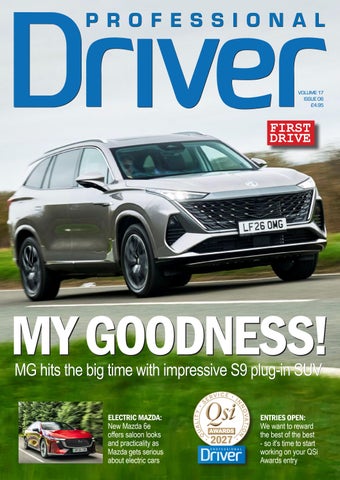
MY GOODNESS! MG hits the big time with impressive S9 plug-in SUV ELECTRIC MAZDA: New Mazda 6e offers saloon looks and practicality as Mazda gets serious about electric cars
ENTRIES OPEN: We want to reward the best of the best - so it's time to start working on your QSi Awards entry
contents
18
26 22
18 4 8
28
12
16
14 16 22 26 28 30 34
34 EDITORIAL DIRECTOR
Mark Bursa 07813 320044 markbursa@prodrivermags.com
COMMERCIAL DIRECTOR
Paul Webb 07807 133527 paulwebb@prodrivermags.com
CONTRIBUTORS
Gary Jacobs, Kevin Willis, Tim Barnes-Clay, Dr Mike Galvin, Kwabena Dennot Nyack
Cover Story: MG S9 PHEV SUV on test News: TfL licenses Wayve robotaxis News: Veezu in major Midlands deal News:Consultation on ZEV mandate launched News Analysis: New PHV and taxi data CoTY Judging Day: fun in the sun at Epsom Road Test: Mazda6e electric saloon First Look: Denza D9 MPV First Look: Genesis GV90 Running Report: Volvo ES90 QSi Awards 2027:Entries are now open!
Regular features 31 32 33
The Advisor The Knowledge The Insider
COMPANY ADDRESS
50 Beechcroft Manor, Oatlands, Weybridge, KT13 9NZ
WEBSITE
Martin Coombes PageHub Design martin@pagehubdesign.co.uk
SUBSCRIPTIONS
Curwood CMS Ltd, The Barn, Abbey Mews, Robertsbridge, TN32 5AD 01580 883844 subs@prodrivermags.com
Registered in England No. 7086172 © 2026 All contents copyright of ProDriver Media Ltd
2
PROFESSIONAL DRIVER
opinion
Autonomous taxis are a bad idea
L
Mark Bursa
“
Perhaps, with various major reviews of the taxi market in place, it might be time to press the pause button on AV taxis? Let’s have a proper, rigorous look at the sector
”
ast year, Transport for London sounded a note of caution about the arrival of autonomous taxis on the streets of London. Christina Calderato, TfL director of transport strategy and policy, said: “These would not be taxi or PHV services and so they are different offerings and the public can expect different things from them. The AV offering as we understand at the moment would be outside of that kind of taxi or bus regulation.” And Helen Chapman, TfL’s director of licensing, regulation and charging, suggested AV operations may require some kind of permit, but admitted nothing could be done until the government passes legislation. Well, some rather lame legislation has been passed in draft form, and lo and behold, Uber’s robotaxi partner Wayve has duly been issued with a license. No doubt the lure of US tech giants hurling money at AV taxis was enough for TfL to throw caution to the wind. What a surprise. TfL argues that there will still be a “safety driver” at the wheel to intervene if things go wrong. Well guess what. Things are going wrong. Wayve’s main AV rival Waymo – part of Google – has been testing its own robotaxis for some time. And in the past few weeks, one has been in a crash and another has driven into a crime scene, ignoring a police cordon. Both cars had a safety driver at the wheel. OK, the crash was not the Waymo car’s fault. It was hit by a car travelling at over 90mph in a 50mph zone, and the safety driver’s intervention was insufficient to avoid the impact. Whether or not the car’s own systems would have done so is not known. But given the significant record of crashes and other incidents in the US, we must again question why we are rushing headlong into this brave new AV world, where the only people who are likely to benefit are American, Trump-supporting, billionaire “Tech Bros”. Have you ever met anyone who thinks this is a real great idea? Who really wants to be going home late at night in a driverless car through bleak suburbs, in terrible weather? At least in a regular cab, the driver is there to sort out any problems. If
PROFESSIONAL DRIVER
there’s nobody there but the passenger, who solves the problem? There are so many issues it’s hard to accommodate them in one 700-word column. Just because technology allows something it doesn’t mean it’s a good idea. AI has its uses, but it mainly seems to be used to generate ludicrous graphics on social media, complete with six-fingered people. Robotaxis are a fundamentally bad idea. Like Betamax videos, Minidiscs, Plasma screens and the Amstrad E-mailer, they seemed like great ideas at the time, but soon enough ended up in the dustbin of redundant technology. Governments get excited about the creation of a few thousand coding jobs in the AV sector. But they don’t consider the hundreds of thousands of driving jobs that would be lost. And please leave out the bullshit about “upskilling” former drivers. Driving is a skilled occupation carried out by professional people. It’s why this magazine is called Professional Driver. If you get rid of the driver from the taxi, where do you create the need for employment? Not in the skilled tech sector. No, you effectively “downskill” those drivers into being car marshalls, checking over the cars not in use, or worse, cleaners, mopping the vomit and discarded kebabs out of the back of the car. A robotaxi might drive itself, but it sure can’t clean itself. And while a driver might perceive that a passenger looks the worse for wear and be able to pull over before the technicolour yawn, that is outside the scope of the robotaxi’s expensive Lidar system. Not exactly the white heat of technology, is it? And we haven’t even touched on the complexities of insurance and liability relating to algorithms. Do you really want a driverless machine running on computer code programmed in California to decide whether you live or die? Perhaps, with various major reviews of the taxi market in place, it might be time to press the pause button on AV taxis? Let’s have a proper, rigorous look at the sector, and decide whether or not we really want to give even more of our market to a handful of American tech companies, and the unsavoury billionaires that run them.
3
business news
TfL grants license to Uber AV taxi partner Wayve despite union fears Mark Bursa
Transport for London has granted autonomous taxi operator Wayve a license despite earlier claiming that it would require Government legislation in order to let “robotaxis” operate in the capital. However, TfL has granted Wayve a license to operate up to 15 vehicles via partner Uber’s operating license – providing a “safety driver” is present in the car at all times. Nevertheless, the granting of a licence is a significant step forward for autonomous ride sharing services, which large US technology companies are pushing in the UK. Passengers will be able to travel under the Government’s AV Trialling Code of Practice. Wayve’s autonomous Ford Mustang Mach-e vehicles are equipped with surround cameras and radar. They are designed to operate autonomously, but a licenced private hire driver
will oversee the trip and provide support or take over driving if needed. Sarah Gates, Wayve’s VP global affairs & assurance, said: “This licence is an important step towards giving Londoners the chance to experience autonomous driving technology. The responsible deployment of these vehicles will bring us safer, cleaner and quieter streets, and we’re proud to continue working alongside regulators, communities, and the public as we take the next steps towards making autonomous rides a reality in the capital.”
The licencing of the vehicles completes the “triple-lock” requirement for Private Hire trips, where the operator, driver and vehicle must all hold licences with the same licencing authority. However the plan is strongly opposed by the GMB Union, which represents thousands of private hire drivers in London. Matthew Wright, GMB regional organiser, said: “This is a worrying development for our private hire driver members. We can’t go charging ahead with new technologies without considering the implications of autonomous vehicles on
all parties. For drivers; how will they be supported to reskill and redeploy if their jobs go? How will society cope with the lost tax revenue and potential increases in unemployment? For the public, how will their safety be impacted? Who is liable for accidents? What implications are there for disabled passengers?” “And for passengers, driverless cars cannot replace the knowledge, experience, and human connection that a skilled driver offers. GMB urges TfL to proceed with extreme caution.” London Assembly Transport Committee chair Caroline Russell AM said: “The approval for up to 15 vehicles on a trial basis for a year, is not entirely unexpected.” “The Committee still has many questions about the safeguarding of passengers, so we would not be expecting TfL to give consent at this stage for full autonomous operation.”
TfL’s licence renewal chaos to be subject of judicial review
Mark Bursa
TfL’s disastrous 2025 license renewal crisis will be the subject of a judicial review after the High Court backed a driver’s action against the regulator. TfL failed to approve renewal applications before existing licenses expired, resulting in thousands of drivers being unable to work through no fault of their own, with some exhausting savings, falling into debt and struggling to pay their bills. As a result, the High Court has granted permission for judicial review to proceed in Mugabo v Transport for London, a landmark challenge concerning TfL’s duty when determining private hire drivers’ renewal applications. In a judgment, Mr Justice Sweeting granted permission on two grounds,
4
recognising that the claim raises “an issue of general importance” concerning the nature and scope of TfL’s duties under the statutory licensing scheme. Julius Mugabo, a licensed private hire driver whose livelihood depended on his license, brought a judicial review against TfL after his license expired before a decision had been made on his renewal application, despite him applying in advance. The failure to determine his renewal application before his existing license expired left Mugabo unable to work for approximately five months. Although TfL granted his renewed license in August 2025 after proceedings were issued, Mugabo continued the claim to challenge the wider systemic issues highlighted by his case. The case asks: does TfL have a duty to operate its licensing system in a way that
prevents drivers who have complied with the renewal process from losing their entitlement to work while awaiting a decision? Permission was also granted on a second ground concerning legitimate expectation. The Court held it arguable that TfL’s published policies and guidance may give rise to an expectation that renewal applications submitted with sufficient time and supporting information will be determined before license expiry. Evidence from the Independent Workers’ Union of Great Britain (IWGB), suggests that Mugabo’s experience is far from unique. IWGB claims at least 17,000 drivers were left unable to work after their licenses expired while renewal applications remained outstanding. The claim will now proceed to a substantive hearing before the High Court.
PROFESSIONAL DRIVER
Insurance protection that fits the way you drive With more chauffeurs working through app-based platforms like Blacklane and Wheely, we’ve expanded our offering to reflect how the industry is evolving. Our advice is built around understanding your world – giving you cover that supports the way you work today. At Howden, we get you. Speak to a specialist who understands your business.
Your contact for independent drivers and fleets under six vehicles:
Your contact for fleets of six or more vehicles:
Cameron Scott T: 020 8036 3968 E: cameron.scott@howdeninsurance.co.uk
Ricky Chivers T: 020 8256 4916 E: ricky.chivers@howdeninsurance.co.uk
howdengroup.com/uk-en/blacklane-wheely Howden UK Brokers Limited is authorised and regulated by the Financial Conduct Authority No. 307663. Registered in England and Wales under company registration number 02831010. Registered Office: One Creechurch Place, London, EC3A 5AF. Calls may be monitored and recorded for quality assurance purposes. HUBL-CS-CH-035-0326
PROFESSIONAL DRIVER
5
business news
Drivers angry as Liverpool Airport hikes drop-off charges Mark Bursa Liverpool taxi drivers are considering a boycott of Liverpool John Lennon Airport in protest at new parking and taxi charges. The airport’s minimum Express Drop Off and Pick Up charge increased from £6 to £7 for up to ten minutes from Tuesday, September 1. The same £7 minimum charge will also apply to hackney carriage drivers using the official taxi rank outside the terminal. Some Liverpool black cab drivers are now considering not working from the airport rank in protest at the increase. Liverpool John Lennon Airport confirmed that it was aware of the potential protest but says it did not expect widespread disruption for passengers. The airport says taxi drivers using the rank pass the charge on to passengers as part of the fare, in the same way that private hire drivers using the Express Drop
Off and Pick Up car park can pass airport access costs through to customers. The airport’s tariff is £7 for up to 10 minutes in the Express area, rising to £10 for up to 20 minutes. A free alternative remains available at Drop Off 2, where drivers can currently stay for up to 20 minutes without charge. The car park is a short walk from the terminal, although it is subject to restrictions including a two-
hour no-return rule. Liverpool Airport says the increase is necessary because of rising operating costs, including business rates, energy prices, National Insurance and minimum wage increases. It also says income from parking is an important part of funding airport operations and investment, and the £7 charge is broadly in line with prices at a number of other UK airports.
Take Me adds Hertfordshire operator STS to Associated Mark Bursa
Take Me Group has bolstered its presence in Hertfordshire with the acquisition of STS, a taxi firm serving the communities of Sawbridgeworth, Sheering, The Rodings and High Wych. The move results from the decision of STS founder Colin Ellis to take retirement, and this has allowed Take Me to step in and add the STS business to its existing Associated Taxis business, based in nearby Bishop’s Stortford and also serving Stansted Airport. Take Me acquired Associated Taxis last October and plans to rebrand both this
6
and STS as Take Me. One of the biggest advantages is that both businesses now operate on the iCabbi platform. Following Associated’s successful migration from Cab9 to iCabbi, active driver numbers have already
increased by 20%, demonstrating the positive impact that the technology can have on both operators and drivers. STS customers now have access to the TakeMe app. Take Me CEO David Hunter said: “By bringing
the two businesses together, we’ll create a stronger, more efficient local network, delivering improved availability, faster response times and an even better experience for customers, while creating more earning opportunities for drivers. STS has built an excellent reputation over many years for providing dependable, high-quality local transport.” “Following the retirement of previous owner Colin Ellis, the acquisition ensures the long-term future of the business while creating new opportunities for investment, innovation and growth.”
PROFESSIONAL DRIVER
Elevate your driving. Advance your career.
Belgraves of London Chauffeur Training Academy RoSPA Advanced driver training and qualification Guild of Professional Chauffeurs (GoPC) criteria qualification & membership Master the art of chauffeur etiquette at Diplomatic/Royalty level Learn from former Met Police RaSP Instructors and industry leading professionals. Level 3 First Aid Qualification
Applications Open for October 2026 - Please contact us for more information +44 20 3355 3333
Member of the ‘Society of the Golden Keys of Great Britain and the Commonwealth
Member of the National Association of Jewellers
PROFESSIONAL DRIVER
training@belgravesoflondon.com
‘Chauffeur company of the year’ for the last 7 consecutive years
Member of the National Limousine Association
Proud founding member of the Ops Con
Member of the Licenced Private Hire Car Association
7
business news
Veezu strengthens in Midlands with Triple 20 Taxis acquisition Mark Bursa
Veezu has added further capacity to its West Midlands operations with the acquisition of Triple 20 Taxi Cars, which has 270 drivers in Dudley and Sandwell. Triple 20 Taxi Cars operates under the Triple 20 Taxis and Brookfleet Cars brands. Brookfleet Cars is a long-running operator established in 1973. The acquisition builds on Veezu’s existing network throughout Birmingham, Solihull, Wolverhampton, Shrewsbury and Telford. Veezu managing director Jon Martin said: “Triple 20 Taxis and Brookfleet Cars are highly respected local brands with strong ties to communities across Dudley and Sandwell. We are delighted
to welcome them into our West Midlands network as we continue to expand our series of local transport hubs across the UK.” Veezu recently changed its driver commission structure, replacing previous capped commission and acceptance-rate thresholds with a flat 20% commission. Many of Veezu’s
self-employed drivers are unhappy about the change, and hundreds of Veezu drivers operating under the platform across Liverpool, St Helens, and Wigan staged a 24-hour strike in July. Drivers have called on Veezu management to return to the negotiating table to implement a lower commission rate, citing rising costs
of fuel and other items. The Triple 20 Taxis deal is Veezu’s second major acquisition this year, following the purchase of Go Cars, the largest private hire operator in Bedfordshire. The move added 600 cars to the Veezu fleet and gives Veezu access to Luton and surrounding commuter towns including Dunstable. The Go Cars deal also included subsidiary Spearhead Cars, based at Leagrave to the north of Luton. Cardiff-based Veezu also recently acquired a stake in London-based booking and dispatch technology provider Cab9. Founded in 2013, Veezu has grown into the UK’s largest private hire business, licensed by 63 local authorities in England and Wales.
Ionity opens first London charge hub in Greenwich Mark Bursa
Ionity has opened its first urban charging site in London, a new 12-bay ultra-rapid charging hub at Greenwich Shopping Park offering DC charging speeds of up to 400kW. The opening marks the expansion of Ionity’s partnership with Uber, and the next phase of the company’s UK expansion beyond motorway corridors and into urban areas, with further sites planned across London and other UK cities. Open to all electric vehicles, the new Greenwich site features 12 charging bays delivering up to 400 kW, providing convenient, high-power EV charging in minutes. Located on Bugsby’s Way, close to the O2, Greenwich Peninsula and the A206, Greenwich Shopping Park is busy retail destination, surrounded by
8
supermarkets, high-street stores and restaurants. Ionity CEO Jeroen van Tilburg said: “Our expansion goes beyond long-distance travel to enable reliable charging where demand is growing fastest: in urban areas. We must meet drivers where they need us, and in cities like London the next stage of electrification is now taking place.” “It is vital that the supply of ultra-fast chargers is rapidly scaled up. We’re bringing up to 400kW into urban areas,
giving drivers the speed and reliability they expect, closer to where they live and work." The new hub also supports Ionity’s partnership with Uber. through which Ionity offers reduced charging prices to Uber drivers and uses real-world data to help identify where future locations can have the most impact. In return, Uber commits to utilisation targets in order to provide the confidence needed to invest in new charging infrastructure where it will deliver the greatest benefit. The opening follows the launch of Ionity’s urban sites in Aston, Birmingham in February 2026, with many more urban sites under development across London, Birmingham, Manchester, Glasgow and Edinburgh. By 2030, around 30% of IONITY’s network is planned to be located in dense urban environments.
PROFESSIONAL DRIVER
Insure your fleet with the flexibility you need Taxi Commercial Self-Drive Hire Credit Hire Visit acorninsure.co.uk
Rated Excellent 16K+ reviews
January 2026
Acorn Insurance is a trading name of Acorn Insurance and Financial Services Ltd. who is authorised and regulated by the Financial Conduct Authority (FCA). Firm reference number 311873. Registered address: 98 Liverpool Road, Formby, Liverpool, L37 6BS, No. 01636368
PROFESSIONAL DRIVER
9
business news
Leap24 opens 4-bay fast charge hub near Heathrow
Charge point operator Leap24 has opened a new rapid charging hub near Heathrow airport. The new four-bay, 200kW charging hub is situated on New Road, just off the A4 Bath Road, close to the Heathrow Marriott and Radisson Blu Hotels. It is just minutes from Heathrow Terminals 2 and 3, will help serve high-mileage taxi, private-hire and commercial drivers. The move adds a Heathrow charge hub to Leap24’s existing hub close to London City Airport in London’s Docklands. Leap24 said its focus was on supporting London’s taxi and private-hire industry, with a growing network across the capital designed to put fast, competitively priced charging closer to the journeys
these drivers make every day. Leap24 has also worked directly with Uber to have the site added to its Heath-
row waiting area, helping drivers using the platform fit charging more naturally into their working day. Through the Leap24 Partner Card, drivers can charge for 54p/kWh during the day and 45p/kWh between 10pm and 7am, compared with the standard tariff of 69p/kWh. John Leddin, Leap24UK Country Head, said: “Living and working in London, I see every day how important taxi and private-hire drivers are to keeping the city moving. We understand what matters to drivers who rely on their vehicles for their livelihood; convenient locations, fast charging and fair, transparent pricing. That’s what we’re working to deliver across London.”
Government consultation launched in review of ZEV mandate targets Mark Bursa
The Government has launched a consultation on the Zero Emission Vehicle (ZEV) Mandate. The move seeks opinions as to into whether the annual targets for EV sales between now and 2035 should be reviewed. The UK’s transition to cleaner transport continues to gather pace, with strong demand for EVs driving the July new car market back to pre-Covid levels. More than one in four new cars sold are now electric, and EV sales were up 45% on July last year. More than 2 million electric vehicles are now registered on UK roads. But the annual targets for EV sales within the mandate are problematic for automakers, many of which are struggling to hit the required quota of EVs each year. The SMMT has been calling for a review – and it has got its wish. However, the review only
10
considers the interim targets under the ZEV mandate. The objectives of phasing out pure new petrol and diesel cars by 2030, and only selling new cars and vans that have zero emissions by 2035 remains in place. Transport Secretary Heidi Alexander said: “It’s right we keep targets under review to ensure they’re practical and back British industry. The end goal hasn’t changed – but we need to take business with us on the journey, and that’s exactly what we’re doing today, by making sure industry has the chance to shape how we get there.”
Business, Innovation, Science and Trade Secretary Jonathan Reynolds added: “The UK’s automotive sector is vital to our economy and future growth, and we’re determined to keep it that way as we get on with reindustrialising Britain.” “This consultation is about listening to industry, examining the evidence and making sure the Mandate continues supporting investment, innovation and competitiveness, so Britain’s car sector can thrive.” Mike Hawes, SMMT Chief Executive, said: “We welcome government’s consultation on the ZEV
Mandate and how it should change to better support the UK’s transition. Industry remains fully committed to a zero-emission future, investing billions in new technologies, products and, along with government, consumer incentives.” “The regulation was conceived, however, under very different conditions – cheaper energy, rapidly declining production costs, and more optimistic global demand expectations. Regulatory targets are now running ahead of current consumer demand, so this review is a timely opportunity to optimise the pace of change.” “This is a regulation that increasingly dictates consumer choice – and therefore automotive companies’ future strategies and viability – so it must work for all involved.” The consultation will run until October 23, 2026. https://www.gov.uk/ government/consultations/ zero-emission-vehicle-mandate-review
PROFESSIONAL DRIVER
EXPERTS IN CHAUFFEUR AND PRIVATE HIRE FINANCE
ASSET FINANCE SOLUTIONS FOR BUSINESS We provide bespoke packages funding and sourcing of vehicles for the chauffeur network. We have access to multiple funder options for vehicles finance. We provide support and guidance throughout the entire process
WHY CHOOSE ETHOS?
Here at Ethos Asset Finance, we understand the demands of the professional chauffeur services industry inside and out. We can provide you with specialised chauffeur finance solutions to support you with securing the vehicles you need.
Efficient payouts to support delivery and target needs.
With an extensive understanding of chauffeur specs and industry standards, we are more than equipped to finance vehicles that will help you make a lasting impression.
01423 608666
#WhatCantWeFund
We have access to competitive interest rates.
WWW.ETHOSFINANCE.CO.UK
Regional Agricultural Centre, Railway Road, Harrogate, North Yorkshire HG2 8NZ. Registered in England and Wales Registered No: 09843819 Ethos Asset Finance Limited is Authorised and Regulated by the Financial Conduct Authority for Full Permission Credit Broking under FRN 723779. Ethos PROFESSIONAL DRIVER Asset Finance Limited is a Broker and not a Lender.
11
business news
Gett adds private hire service, but says London black cabs remain its priority Mark Bursa
Gett by Lyft has added a private hire vehicle option to its app this week as the taxi platform prepares for integration with Freenow by Lyft. But in order to avert a backlash from black cab drivers, Gett UK messaged its drivers to say that London taxis would remain its priority and continue to appear as the primary option presented to app users. Access to the new PHV service will initially be restricted to a limited group of customers, allowing Gett to monitor the impact on black cab bookings. And all private hire journeys via the Gett app are being fulfilled by drivers operating on the Freenow platform, so Gett drivers are not expected to handle the PHV bookings. Gett said the decision to add a PHV option was intended to protect daily ride
volumes, keep the platform competitive and prepare its systems for closer integration with Freenow. Gett said corporate customers were increasingly using their business travel accounts for personal journeys and asking for access to more than one vehicle type. It warned that customers who could not find the required option on Gett were moving to rival booking
platforms. Gett believes that retaining those passengers within its app should also preserve future taxi demand, with customers continuing to book black cabs for journeys where that vehicle type remains their preferred option. Uber’s biggest rival Lyft took over Gett in a £40.7 million takeover earlier this year. The move followed Lyft’s acquisition of Free-
Now in July 2025, and this means the majority of London’s black cabs are now signed up to a Lyft-owned app – either Gett or FreeNow, which Lyft bought last July. Gett adds a different client base to FreeNow, as it has a stronger corporate and public sector organisation user base. The takeover will nearly double the number of rides on the Lyft platform in London. Jeremy Bird, EVP of global growth at Lyft, said: “Adding Gett to Lyft’s ecosystem positions Lyft as the leading app for London black cabs.” Lyft appears to be developing a multi-brand approach to London. As well as Lyft and Gett, it recently acquired major chauffeur operator TBR Global, and it is planning to enter the autonomous taxi sector later in the year through a partnership with robotaxi-operator Baidu.
Bolt launches in Liverpool with new Flex service Mark Bursa
Bolt has launched its ride-hailing service in Liverpool including its Bolt Flex service which allows passengers and private-hire drivers to agree a set fare through the app before the journey is accepted. The move adds private hire journeys to Bolt’s existing presence in Liverpool. The company already operates e-scooter and e-bike schemes in partnership with Liverpool City Council and the Liverpool City Region Combined Authority. Bolt’s Liverpool ride-hail service offers users a choice of Flex, Flex XL, Comfort and Premium categories. Liverpool is the tenth UK city to offer the Flex option. In the Bolt Flex service, Bolt initially suggests a starting price for the job and allows the passenger and driver to reach an agreement. Passengers can submit a lower offer if they are willing to wait longer for
12
a match. They can also propose a higher amount to increase the likelihood of securing a quicker pickup. Drivers are free to accept the passenger’s offers or respond with a different price. The booking is confirmed only after both parties agree to the fare. According to Bolt, drivers can earn more than 25% extra per trip and complete 14% more orders per hour by using Flex in cities
where Flex is already available. Bolt also said Flex operates with a flat commission structure, which drivers prefer. Research conducted by Bolt across its Flex pilot markets found that 77% of surveyed drivers cited transparency as a reason for recommending the model. A further 74% highlighted having the freedom to set their own prices. Bolt UK and Ireland senior general manager Kimberly Hurd said: “Liverpool is an important next step in the expansion of our UK ride-hailing business. We’re bringing a model that gives riders and drivers more control over fares. Flex has shown us there’s demand for a different approach to ride-hailing pricing, one where the app can suggest a price, but the rider and driver have the final say.”
PROFESSIONAL DRIVER
PROFESSIONAL DRIVER
13
news analysis
PRIVATE HIRE NUMB P rivate hire vehicle numbers have grown by 13% in the past two years, while licensed hackney carriage taxi numbers fell 7% in the same period.These are the headline figures from new Government statistics covering vehicle numbers in the sector. Vehicle and driver numbers are continuing to grow, having surpassed pre-Covid levels in 2024 (compared to 2019 data). As of April 1, 2026, in England, there was a total of 290,000 licensed PHVs and 52,300 licensed taxis. And the total of 417,300 taxi and PHV driver licences was an increase of 9% compared with 2024. Also in decline was the number of wheelchair-accessible licensed taxis and PHVs, a decrease of 4% to 34,500 compared with 2024. There were 263 licensing authorities in England as at April 1,2026, as well as four licensing authorities which did not have any licensed taxis. Some drivers may be licensed in more than one authority, so the number of driver licenses does not equate directly to the number of licensed drivers. Under the current licensing system in England, taxi and private hire vehicle (PHV) drivers may obtain a license from a licensing authority outside the area in which they operate. This practice, commonly referred to as out-of-area working, means that the number of licensed vehicles recorded for a licensing authority does not necessarily reflect the number of vehicles operating within that authority’s area. Some authorities license a disproportionately large number of vehicles compared with their resident population, and users should exercise caution when comparing licensing rates between authorities.
Long-term growth Over a longer timeframe, growth has been significant. The 2026 total of 342,300 taxis and PHVs in England is an 85% increase on 2005 levels and a 9% increase from 2024. There were 417,300 taxi and private
14
hire vehicle driver licences in 2026, a 9% increase over 2024 and a 72% increase on 2005 PHV numbers are growing more quickly outside London, where overall numbers are relatively static. As at April 1, 2026, there were approximately 196,600 licensed PHVs in England outside London, an increase of 20% since 2024, but 93,300 licensed PHVs in London, up just 1% since 2024.
However hackney taxi numbers are decreasing both inside and outside the capital. In 2026 there were just 13,700 licensed “black cabs” in London, a decrease of 7% since 2024. This is also a remarkable decline since 2005, when there were in excess of 22,000 black cabs in the capital. In the rest of England, the total of 38,600 licensed taxis represented a decrease of 7% since 2024.
PROFESSIONAL DRIVER
news analysis
BERS STILL RISING Private hire numbers in England are rising while the taxi population continues to fall, according to new Government data. And most of the growth is coming from outside London. Mark Bursa reports The data gives numbers of licensed taxis and PHVs per 1,000 of the population across the 263 licensing authorities in England – data that highlights how out-of-area licensing in places such as Wolverhampton has distorted the data.
Impact of Wolverhampton Of the 263 licensing authorities in England, Wolverhampton is a notable
PROFESSIONAL DRIVER
outlier, with 135.4 licensed vehicles per 1,000 population. This is more than four times greater than the authority with the second highest number of licensed vehicles per 1,000 population, which is Knowsley (31.5 licensed vehicles per 1,000 population). The vast majority of these Wolverhampton-licensed vehicles are PHVs, with around 38,000 PHVs compared with approximately 100 taxis. Indeed,
Wolverhampton has licensed 13.1% of all PHVs in England. Of the 417,300 in England as at 1 April 2026, only 7% of driver licenses were taxi-only licenses, compared with 9% in 2024. By contrast, 71% of driver licenses were PHV-only licenses, compared with 69% in 2024, while 20% of driver licenses were dual taxi and PHV licenses, which was unchanged from 2024. Only 1% of licenses were issued to an individual who held both taxi and PHV licenses, compared with 2% in 2024. Overall, the number of taxi driver licenses fell slightly since 2024, while the number of PHV driver licenses rose.
Operator numbers rising As of April 1, 2026 there were 19,000 licensed PHV operators in England, a substantial rise of 17% over the 16,300 operators in 2024. The figures relate to PHV operator licenses on issue rather than individual operators. Some operators may hold licenses in more than one licensing authority, so the number of licenses does not necessarily equal the number of unique PHV operators. The number of applications received by licensing authorities for new PHV operators in England was 3,700, which is similar to the 3,600 new PHV operator applications in 2024. Wheelchair accessibility remains a challenging issue in many areas. In England, the 2026 figures show that 10% of all licensed taxis and PHVs were wheelchair accessible, Most of the WAVs are taxis, with 54% of all licensed taxis being WAVs. However, only 2% of all licensed PHVs were wheelchair accessible. These percentages are similar to 2024 levels. The data shows that 7 licensing authorities had no wheelchair-accessible taxis or PHVs, while others had a high proportion of WAVs. The licensing authority with the greatest percentage of wheelchair-accessible vehicles was Worcester with 71.3%. There were 57 licensing authorities in which 100% of hackney taxis were wheelchair accessible, compared with 52 in 2024.
15
PASSING THE TE news analysis: karhoo
Spons
A
ugust 11 was the day – and more than 120 of you answered the call. The task was judging the 2027 Professional Driver Car of the Year awards at Epsom racecourse – driving and testing more than 50 cars in 6 categories, to choose our winners. And what a great day it was, with all the cars out on test, all day long. It’s a fun event where you get to network with colleagues and suppliers as well as driving the latest cars. We’ll announce the winners in each of the six categories: Chauffeur Car, Executive Car, Private Hire Vehicle, Luxury SUV, Estate Car and MPV at our QSi Awards event on January 22, 2027 at the Hilton Metropole Hotel in Brighton. Find out more on page 36 of this issue. This picture gallery gives a flavour of the day as our judges got stuck in to the task of evaluating the cars, including some exclusives on the day - including the latest versions of both the BMW i7 and the Mercedes-Benz S-Class. There are more photos on our website – to see them, simply follow the link to: www.prodrivermags.com/car-of-the-year-home/
16
PROFESSIONAL DRIVER
EST
C a r o f t h e Ye a r 2 0 2 7
sored by
PROFESSIONAL DRIVER
17
road test
MAXIMUM G
MG S9 PHEV Premium Mark Bursa
18
PROFESSIONAL DRIVER
road test
GOODNESS T
he recent history of MG has been something of a rollercoaster ride – but now, 20 years on from its rescue from the ashes of Rover, the direction of travel is very much upwards. After a tussle between two Chinese automakers over the ownership of the brand and its assets, China’s number one automaker, Shanghai Automotive (SAIC) took control, and set about the slow process of restoring the brand. There were some bumps on the road – the early Chinese MGs were some way short of the quality European markets expect. And no, MG does not stand for “modern gentleman”. But by 2020, MG was making very decent electric and hybrid cars that were gaining traction in the UK. In the private hire sector, the MG5 estate won many friends, providing an all-electric alternative to the likes of the Toyota Corolla Sports Tourer. Now, as Chinese brands capture more than 20% of the UK market, MG is one of the pace-setters. In the first half of 2026, it sold almost 50,000 cars, making it number 8 in the UK sales league with a market share of more than 4.5%. Serious progress. And this new car is perhaps the best “new MG” yet. The MG S9 is a seven-seater plug-in hybrid SUV, similar in size to the likes of BMW X7, Skoda Kodiaq and Volvo XC90. It’s well-built and comfortable, and certainly doesn’t look like a low-budget alternative to any of those rivals. But get this – S9 prices start below £35,000. There is a choice of two trim levels, Comfort and Premium, each providing an extensive list of luxury features as standard, such as 20in alloy wheels, ambient lighting, heated seats, a panoramic roof and 12.3in infotainment and 12.3in driver displays. Even the Premium trim model we’re testing here only weighs in at £36,945. That’s a lot of bang for not a lot of buck. The MG s9 looks like a 4x4, but it isn’t. It’s a two-wheel drive vehicle, with the petrol engine and the electric motor both driving the front wheels. As a plus point, this means there is no transmission tunnel, hence a completely flat floor in the rear. It’s a good-looking car, and it’s ideal for long-distance journeys that involve city driving at each end, thanks to a combination of a relatively large PHEV battery and a large fuel tank – giving the car an overall range of well over 600 miles. The PHEV element including a 24.7kWh battery giving electric-only range of up to 62 miles (WLTP)
CONTINUED ON PAGE 20
PROFESSIONAL DRIVER
19
road test: MG S9 PHEV Premium
CONTINUED FROM PAGE 19
means the car has plenty of electric range to cope with most daily driving needs as an EV. We took the car from Surrey to Newcastle-upon-Tyne, where we had access to overnight 7kW AC charging. This meant the car was topped up to more than 60 miles of EV range every night, which was more than enough for local motoring. Over a four-day stay, the petrol engine was never engaged, as the car was driven in “EV first” mode, which keeps it in EV mode until the battery is depleted. Switch back to petrol mode if you want to retain some EV juice, say, for a low-emissions zone later in your journey. The MG S9 is MG’s first large 7-seater SUV. It’s a large vehicle with plenty of interior head, leg and shoulder room inside its 4.98m long, 1.96m wide and 1.78m tall body, The third-row seats are just about usable, though it’s not really a seven-seater PHV. Instead, the third row can be folded away flat, and there is still a reasonable amount of boot space as a five-seater, with an impressive
20
1,026-litres of bootspace. In seven-seater mode, you still get a reasonable 332 litres of luggage room though. The plug-in hybrid powertrain combines a 1.5-litre turbocharged petrol engine and a long-range 24.7kWh battery. A large, 65-litre petrol tank means range is not compromised. Official CO2 emissions are just 18g/ km, though the rather risible WLTP bench-test mpg figure of 353mpg is some way short of true expectations. However our round trip to Newcastle, using EV mode for our urban motoring and some of the long-distance work, gave an mpg figure of 46.8mpg over more than 900 miles of driving. The S9 is a very relaxing drive, too. On the motorway it’s extremely comfortable, with a compliant ride and very comfortable seats, making it ideal for non-stop stretches of more than 200 miles. Around town it’s surprisingly nimble for a big car with a good turning circle and good manoeuvrablity. If we have a complaint, it’s the same as can be leveraged at most modern “electrified” cars – over-intrusive warning systems with too many
bings and bongs, and adaptive cruise systems that seem frankly worse than those of 10 years ago, with overstrong lane-keeping interventions and deceleration that kicks in rather too rigorously a very long way from the car in front. Fortunately there is the ability within the MG Pilot ADAS system to turn off most of the intrusive noises and set personal preferences with just a few jabs at the touch screen. You’ll still need to choose your personal settings each time you restart the engine, which is annoying, but less so than having to go through several menus and turn off more than 10 features that a professional driver really doesn’t want or need. Road safety is not enhance by random bings and bongs that distract the driver from driving. Our other complaint was that the car was sometimes unable to recognise Apple CarPlay, which can be frustrating. The resident satnav system was somewhat odd, and surely we’re reaching the point where a built-in nav system should be a delete option, as Car Play (which allows a choice of your favourite navigation app) is so much more competent.
PROFESSIONAL DRIVER
road test: MG S9 PHEV Premium
VERDICT
The MG S9 is certainly the most impressive model yet to wear the reborn MG octagon. And it’s one of the most impressive of the new Chinese SUVs that are increasingly dominating the sector. Fit and finish are of premium standard, and the car is a brilliant, long-distance cruiser. It has sufficient EV range to handle most daily urban needs, and enough petrol range for long-haul inter-city work. It’s nominally a seven-seater, but it’s more useful as a comfortable four-seater with a huge boot. It looks good, and our only real complaint is the somewhat intrusive nature of the safety features, with too many warning bells and buzzers – though it is fairly easy to turn the worst ones off. The clincher is the price – for a shade under £37,000 this is a lot of car. A Skoda Kodiaq with similar spec would cost at least £10,000 more, while a Volvo XC90 – a much older design – weighs in at around £73,000. And there is hardly any discernible difference in build quality.
DATA Price
£37,945
SPECIFICATION
Powertrain 1.5-litre turbo GDi with electric motor Transmission Single-speed auto, front-drive Battery 27.55kWh LFP System power 294bhp System torque 390Nm Top speed 124mph 0-62mph 9.3sec Range 603 miles (WLTP) EV range 62 miles (WLTP) AC Charging time 4hr 0min (11kW, 0-100%) CO2 emissions 18g/km (WLTP) Length 4,983mm Width 2,237mm Height 1,780mm Wheelbase 2,915mm Loadspace 332 litres (7 seats) Turning circle 11.0m Warranty 7 years / 80,000 miles Insurance Group 44 VED Band B
PROFESSIONAL DRIVER
21
MAZDA’S SI
road test
I
n the private hire market, there’s still a demand for saloons and estates. Not all passengers want to clamber into a taller SUV-shaped car. Fortunately, automakers seem to be starting to recognise this, and there’s new life in the mid-sized saloon sector, a part of the market that had been all-but abandoned by volume brands. Having axed its IC-engined saloons, Volvo has now launched the ES90 electric saloon. Lexus also has a new ES model, while Chinese automakers are certainly not overlooking the saloon sector – BYD’s Seal has proved popular. Into this mini-revival comes Mazda, which stuck around with a saloon longer than most. UK sales of the Mazda6 only finished after a 20-year run in early 2023, by which time sales were low and Mazda, like many rivals, had switched its focus to SUVs. In its last full year (2022) just 721 Mazda6s were sold, a sharp drop from its peak years, such as 2014, when 4,439 were sold in the UK. Initial reports suggested Mazda might not return to the sector, but three years after the last Mazda6 left the showrooms, here comes a successor – and this one’s fully electric. Mazda has in the past seemed a little reluctant to go down the EV route. Indeed, its only EV to date, the MX-30 EV, only offered a 120-mile range and has been axed in favour of a range-extender hybrid version. But thanks to its partnership with China’s Changan, it has conveniently been able to source a decent EV platform and access Chinese battery technology, and crucially, Chinese manufacturing in a plant geared up for EVs. Changan has, for the past 30 years, been the assembler of Mazda cars in China, so the companies have a solid relationship. The Mazda6e is an impressive bit of kit. UK specification has just a single 78kWh battery specification and two trim levels - £38,995 for Takumi and £39,995 for Takumi Plus. The car has a hatchback body, with a slightly taller stance thanks to the underfloor batteries. The 78kWh LFP battery delivers a combined WLTP range of 348 miles, while 10-80% charging on a 200kW DC charger takes just 24 minutes. With a 258PS power output and 290Nm of torque, the rear-drive Mazda6e will reach 62mph in 7.3 seconds. Takumi models feature beige or black artificial leather, while Takumi Plus, on test here, offers premium tan Nappa leather. Aside from rear sunshades, this appears to be the main difference between the two trim levels. Interior screens are the same size (14.6in for the main touchscreen; 10.2in for the dash panel) and all cars come with the same suite of safety features. It’s something of a culture shock to drive a Mazda without a manual data input device, but it’s not all touch screen – a
CONTINUED ON PAGE 24
22
PROFESSIONAL DRIVER
IXTH SENSE
road test
Mazda6e Takumi Plus
Mark Bursa PROFESSIONAL DRIVER
23
r o a d t e s t : M a z d a 6 e Ta k u m i P l u s
CONTINUED FROM PAGE 23
lot of the functions can be controlled via the steering wheel, and there are programmable buttons below the screen so you can configure certain screens at a touch of a button. Inside, the Mazda6e’s cabin is light and airy thanks to a panoramic glass roof. There’s plenty of rear passenger space, while a 466-litre boot, and 70-litre front boot offer decent luggage space. The car is recognisably a continuation Mazda6, with the grille and roof line especially echoing its predecessor. Another nice feature is a floating electric rear spoiler, which is designed to help with aerodynamics and downforce. So when the car reaches a speed of 56mph, it opens automatically. It’s a cool trick, as are the light sequences that the LED lights make when you’re recharging the car, which actually tell you what state of charge you have reached just by looking at the car. On the road, the 6e feels like a large car. The electric powertrain is smooth and quiet, the car is well engineered and well screwed together, and it feels pretty classy. It feels like a Mazda.
24
So, if this is sleight of hand, it is very good sleight of hand. It feels like a real Mazda, not like a rebodied Chinese model. There is very little noise of any sort, just a tiny bit of road rumble. Almost no motor noise. Indeed, the loudest noise is the air-conditioning fan. Front seats are nice and soft, ventilated and heated, and electric as well. The driving position is quite high and the seat is dropped right the way down. This is, again, a function of electric saloons: you are always going to be a little higher up. I still had a good bit of headroom between me and the large glass panoramic roof. We have steering-wheel programmable buttons and two hot keys and controls, so a lot of the input is steering-wheel based. There are two phone-charging pads in the central console, and two cupholders in the middle as well. There is also a central storage cubby, which is quite deep and has a chilled function. It has a head-up display, which includes directions, speed and adaptive cruise instructions, and gives an idea of how your power and regeneration
are going on. It is roomy in the back, with plenty of legroom and obviously decent headroom. The rear seats are at the same height as the front seats, or maybe a little bit lower. The roofline is parabolic, but over the rear passengers it is not too low. There is a big boot, with a capacity of more than 400 litres, and it has a frunk, which is quite large. So you can stick your charging cables, car-cleaning gubbins and other bits and pieces in the front. Some things are a little bit irritating. The way the cameras pop up on your screen, over the map, when you approach a junction is very annoying. I need the map, not an image of what I can see through the windscreen! The door mirrors are controllable by pressing a little button on the bottom of the infotainment screen and then using the steering-wheel controls to adjust the mirror, rather than having a little mirror-control panel on the door. It feels like false economy to delete that little manual mirror control for a bit of integrated software, but it is where we are with car design at the moment.
PROFESSIONAL DRIVER
r o a d t e s t : M a z d a 6 e Ta k u m i P l u s
VERDICT
Rather than reinventing the electric wheel, Mazda has leveraged EV tech from its partner in China, Changan, which has recently started UK sales. Changan’s EV technology is state-ofthe-art, so it makes sense for Mazda to cut out the basic development work and instead concentrate on making a distinctive design. It’s certainly achieved this, and you’d not guess from the look and feel of the car both inside and out that the Mazda6e didn’t really start off as a Mazda at all. Good use of strong colours such as a rich metallic red – always a Mazda6 staple – and a tan leather interior help with the “Mazdaness”. Mazda6e certainly behaves like a very capable car for top-end, business-oriented private hire work. And when new brands are popping up on a regular basis, why shouldn’t Mazda have a slice of the cake? It’s roomy, the boot is a good shape and the useful “frunk” can accommodate cables and cleaning products. With a price tag below £40,000, the Mazda 6e falls inside the new £50,000 threshhold for ‘expensive car VED’, which will save you £600 a year from the second year.
DATA Price
£39,995
SPECIFICATION Powertrain Single electric motor Transmission Single-speed, rear-wheel drive Battery 78kWh LFP Power 258PS Torque 290Nm Top speed 109mph 0-62mph 7.3sec Range 343 miles (WLTP combined) DC Charging time 24 min (2000kW, 10-80%) CO2 emissions 0g/km Length 4,921mm Width 1,890mm Height 1,491mm Wheelbase 2,895mm Loadspace 337litres Warranty 6 years/100,000 miles Insurance Group 44 VED Band A
PROFESSIONAL DRIVER
25
first look
I
t was only a matter of time before Chinese automakers turned their attention to the MVV sector. They already produce seven-seater minivans for the domestic market, and retooling production for export is straightforward. BYD has recently launched its up-market Denza brand in the UK, and one of the first models to be sold will be this MPV, the Denza D9. It’s a plug-in hybrid – Denza rather grandly calls this a Super Hybrid Dual Mode Intelligent and AllWheel Drive (DM-i AWD) powertrain. There is an all-electric version in China but Denza has not decided whether or not to bring it over at this point. This is perhaps because the D9 has exceptional all-electric range for a PHEV – 130 miles - and it comes with BYD’s new Flash charging technology, which means a 10%-70% charge of its 58.5kWh battery takes just five minutes on a suitable Flash charger. A 20-97% charge, even at -30deg C, takes just 12 minutes. Combined petrol and EV range is a whopping 590 miles. The powertrain itself consists of two electric motors: a front-mounted unit produces 231PS, while a rear motor provides a further 61PS. In most situations, these two motors drive the wheels alone, but during greater torque demands, they are backed up by a 1.5-litre turbocharged petrol engine. However, in most driving situations, this 120PS four-cylinder engine serves as a generator for the battery and electric motors. The D9 can accelerate from 0-62mph in 8.6 seconds. Prices start from £75,000 for the Elegance trim, and £85,000 MRRP for the more upscale Ultimate trim. It’s available to order now, and the first deliveries should take place before the end of the year. Inside, all seats are trimmed in leather, and there is a panoramic glass roof with an electric sunshade. An LCD armrest in each of the second-row seats allows their occupants to control climate and infotainment functions with ease. There is a cooling and heating compartment for storing food and drinks. Front seats come with heating, ventilation and a 10-point massage function. A heated steering wheel is also included, and all versions have a 15.6in touchscreen infotainment system, complete with built-in Google, and a 10.25in instrument panel. Ultimate trim adds a head-up display. The Ultimate trim adds “zero gravity” second row seats, which have 14-way adjustment, 16-point massaging and can recline up to 152 degrees. There are 12.8in entertainment screens mounted to the back of the seats ahead. All seven seats are finished in a high grade of Nappa leather, while seat heating and ventilation is available to all occupants. With all seven seats in place – and depending on their position – boot capacity ranges from 430 to 570 litres, while maximum load capacity in four seat mode is up to 2,310 litres.
26
CLOUD Denza D9 Mark Bursa
PROFESSIONAL DRIVER
D NINE
PROFESSIONAL DRIVER
27
first look
Gen
Mark
SUPERSIZE
G
enesis has unveiled its new GV90 flagship SUV model in the US – and it will be coming here in 2027. The Korean brand say the car is designed to showcase the brand’s capabilities, and could pose a serious threat to the likes of Range Rover and Mercedes EQS SUV at the top end of the SUV sector. The fully electric GV90 includes a large-capacity 123.5 kWh battery, high-performance motors, dual Electronic Limited Slip Differential, and multi-chamber air suspension. On a single charge, GV90 achieves an estimated range of 311 miles. When using a 350kW fast charger, the battery charges from 10% to 80% in just 22 minutes. GV90 comes with a combined maximum output of 657hp
28
and 800Nm of torque from the front and rear motors. Built on an exclusive Genesis platform, GV90 will be available in two variants: the GV90 Neolun and the standard GV90 with conventional doors. The range topping GV90 Neolun can be specified with just four seats – like the LWB Range-Rover, and it is expected to carry a six-figure price tag when launched. It introduces a pillarless coach door, which Genesis calls the Neolun Arch Gate. The car has no B-pillar, allowing the front and rear doors to open in unison, providing very easy entry and exit. Genesis used a new dual-motion hinge mechanism for the rear doors, optimised for the vehicle’s hidden
B-pillar body structure which enables the rear doors to open and close independently without impeding the front doors. This mechanism works by first sliding the rear door slightly outward, then smoothly rotating it open. The door also includes an aluminium frame designed to protect occupants by increasing body rigidity while reducing weight. Safety features include a 12-airbag system including the world’s first roof airbag. Additionally, replacing the conventional B-pillar, high-strength dual steel beams have been integrated for rigidity. And a concealed roll cage is created by reinforcing the passenger cabin with a frame 1.5 times thicker than conventional vehicles and fortifying it with integrated high-strength steel tubes and structural foam.
PROFESSIONAL DRIVER
first look
enesis GV90
k Bursa
EG
The GV90 is equipped with a total of 12 airbags, including the roof airbag, which is designed to cope with rollovers. There is also an in-cabin Monitoring System and an enhanced safety battery with Thermal Runaway Protection (TRP) technology to prevent thermal propagation between cells. The battery system is engineered for effective heat dissipation, separating each battery cell to suppress the spread of heat to adjacent cells. With a 3,245mm wheelbase and an overall length of 5,285mm, the spacious interior features a flat floor and slim cockpit design, delivering passengers a more comfortable and relaxed back-seat experience. The GV90 Neolun introduces motorised swivelling front seats that rotate a full 180 degrees.
PROFESSIONAL DRIVER
29
running report
Stylish Swede does the business
O
ur Vapour Grey Volvo ES90 has had a busy few weeks, including an appearance at our Car of the Year judging day and a visit to an award-winning QSi operator. Both proved useful opportunities to look beyond the usual new-car impressions and consider what really matters to private hire and chauffeur operators. We’re still impressed by the ES90’s looks. We loved it when it made its exclusive appearance at last year’s CotY event as a static display. Now, surrounded by plenty of new metal at this year’s judging day, the Volvo still stood out. You’re struck by its size - at around 5 metres long, it has genuine presence, and its clean Scandinavian styling suits the subtle solid pale grey paintwork. And people notice it. I’ve had plenty of unsolicited comments, including from a supermarket security guard who admitted he’d been waiting to see who owned the “gorgeous” Volvo. For chauffeurs, that kerb appeal matters. The vehicle is part of the service you’re selling, after all.
30
Volvo ES90 Price £65,060 EV Range 432 miles DC charge 350kW (10-80%) 22 mins
Rear accommodation is an obvious priority. Sitting in the back of the ES90, it certainly feels like a chauffeur car. The long 3,102mm wheelbase creates a properly spacious rear compartment, while the minimalist cabin and panoramic roof add to the feeling of space. There’s a generous, usefully shaped luggage area and a large hatchback opening that makes loading bulky suitcases considerably easier than with a conventional saloon boot. For airport work, that practicality counts. The ES90’s rear-mounted electric motor produces 333hp, but Volvo hasn’t chased neck-snapping acceleration. Instead, performance arrives in a smooth, progressive surge. There’s ample pace for joining a motorway or overtaking, without giving the client in the back an unwanted demonstration of EV acceleration. The light steering and excellent
360-degree cameras also make it manageable around town. You still know it’s big when faced with a tight car park, while limited rearward visibility means you become heavily reliant on those cameras. One indulgence fitted to our car deserves a mention: the Bowers & Wilkins audio system. With 25 speakers and 1,610 watts, including speakers in the headrests and ceiling, it’s an extraordinary setup. It’s not an option many operators would consider essential, but it is, frankly, amazing. What I like most about the ES90 is the fact that it isn’t trying match the Germans. Instead, it concentrates on refinement, comfort and effortless progress in a very Swedish way. Operators can now find out for themselves. Volvo has a licensed ES90 available for operators to test in real-world working conditions (subject to licensing area), giving you the opportunity not only to experience the car from behind the wheel, but also to put clients in the back and get their feedback. To arrange a test drive, contact Tosh Crompton at tosh.crompton@volvocars.com
PROFESSIONAL DRIVER
the advisor
Right to work: what every operator needs to know
F
or years, right-to-work checks in the taxi and private hire trade have felt like a box ticked once, at the licensing office, and then forgotten. A driver applies for a licence, the local authority verifies their immigration status under the Immigration Act 2016, and that’s that. But from October 1, 2026, a much bigger change lands — one that could pull operators directly into the right to work regime for the first time, regardless of what happens at the council counter.
Where we are now Licensing authorities already have a legal duty to confirm that anyone holding a taxi or private hire driver license has the right to work in the UK before a license is issued or renewed. That check currently sits with the council, not the operator. It’s a sound system as far as it goes, but it was built around drivers as self-employed individuals contracting directly with passengers, not around the tech model that now dominates the industry.
What changes on October 1? Section 48 of the Border Security, Asylum and Immigration Act 2025, which received Royal Assent in December 2025, widens who counts as an “employer” for right-to-work purposes. The new regime, set out in a Home Office draft code of practice, extends beyond conventional employees to cover worker’s contracts, individual sub-contractors, and, critically for this industry, businesses that operate an online matching service: any operator that uses tech to keep a register of service providers and connects them with customers for a fee or commission. That description sits uncomfortably close to how many private hire
PROFESSIONAL DRIVER
Gary Jacobs
Gigzzee gigzzee.com
operators already work. Where a firm charges commission for matching drivers with fares through an app or booking system, it may now be treated as the driver’s “employer” for right-to-work purposes — on top of, not instead of, the council’s licensing check.
Extended liability Alongside this, the Act introduces “extended liability”. A business further up a contractual chain such as a larger operator using owner-drivers through intermediaries, or a firm that subcontracts overflow work to another fleet, can become liable for illegal working even without a direct contract with the driver concerned, if the immediate employer cannot be identified or has not met the prescribed requirements. The penalties are not trivial: up to £45,000 per worker for a first breach and £60,000 for a repeat one.
Why self-employment won’t save you The instinct in this industry has always been that drivers are self-employed, so employer-style obligations don’t apply. The draft code pushes back on that assumption. A “self-employed” or “contractor” label in a contract will not be decisive if, in practice, the driver doesn’t run an independent business, has to do
the work personally, is integrated into the operator’s booking system, and reaches customers only through the platform rather than under their own steam. Drivers who only get fares through an app will very likely be within scope of this obligation.
What operators should do now z Map the fleet. Work out which drivers may be seen as contracting directly with customers, or which come through intermediary arrangements, and which are matched purely through your booking platform. z Review contracts and terms of service with drivers, and any subcontracted fleets, checking they meet the code’s requirements around checks, subcontracting consent, audit rights and cooperation with Home Office enquiries. z Don’t rely solely on the council’s licensing check. It protects the licence, not necessarily the operator’s own statutory excuse under the new regime. z Keep records consistent and non-discriminatory. Checks must be applied uniformly, never targeted by nationality, accent or appearance. z Get ahead of it. The Code is still in draft, but the commencement date is fixed. Firms that wait until October to work out where they stand will be doing so under real financial exposure. For an industry already navigating fare platforms, licensing reform and Making Tax Digital, this is one more compliance shift worth getting right early, not after the first penalty notice arrives.
31
the knowledge
London misses out on growth
T
he London taxi and private hire industry (or the cab universe) appears to have aligned with the trend of levelling up set by both the recent governments. London’s cab population grew by only 1% over the past two years, whereas the rest of England grew by 20% over the same period. But what are the reasons behind these impressive statistics?
London has changed There has been massive change in London over the past decade and a half, and it probably should come as no surprise that there is a flattening of growth in licensed vehicle numbers. Much-improved public transport with a much broader geographical footprint thanks to the Docklands Light Railway and the Elizabeth Line, which has brought significant growth in capacity. Add to this night tube and night buses and the ever-present congestion on London’s roads and it should be no surprise that substitute services (such as buses and tubes) have now overtaken private cars as the main competition to cabs. But what else has changed? Several things. The seemingly insatiable demand of the mighty corporate market is a shadow of its former self thanks to working from home, lack of business travel and greater use of video conferencing such as Zoom and Teams.
Economics squeezed The economics have been squeezed with the removal of the congestion charge exemption for PHVs meaning every PHV driver who wishes to drive in Central London is now paying £18 per day. The ZEC regulations have started to bite, and drivers need to drive newer, hybrid or electric cars. Ride hailers appear to have plateaued and are up against a great transport system, a more expensive driver/vehicle and a flat economy with potential passengers who have reduced disposable incomes as their mortgages and rental
32
Dr Michael Galvin Mobility Services Ltd mobilityserviceslimited.com
costs rise. The mad scramble for market share appears to have waned as the imperative to make money has come to the fore.
What has happened outside London? Many of the issues affecting London don’t impact the rest of the country to the same extent. For example, house prices are lower. And many corporates use fewer cabs. So why has there been such growth in supply outside of London and has that supply growth been matched or even exceeded by demand growth? The 2026 statistics are not much help as the passenger information provided relates to 2024 - before the 20% increase in supply. Intuitively one would reasonably expect a depressed London to have adverse ramifications for the rest of England. One could assume that less business travel and less commuting would at least affect cabs operating to and from stations in the commuter belt. Car ownership has retained its steady 1% or so growth per annum over the period, so where is demand coming from? Or is the rest of the country merely seeing a significant reduction in per-driver earnings?
Inflation has played its part London has contracted but fares have generally increased with inflation, so earnings have compensated for lack of volume. Outside London, where transport is not so prevalent in most areas and corporate usage was never a factor, we have seen volumes remain steady or steadier than London. Could the 20% increase in driver
numbers and therefore sales have been possible through fare increases, as I don’t believe any of them are working for nothing? It seems a stretch. Could ride hailers who are prevalent outside London be drumming up new demand as they did in London?
Is growth coming from ride-hailers? London was able to credibly call the supply numbers after the transition to PH licensing as 85,000 licensed cabs (25,000 taxis and 60,000 PHVs). More recently, since Uber et al arrived, those numbers have moved to 108,500 cabs (13,500 taxis and 95,000 PHVs), a rise of approximately 30%. Yes, the ride hailers took people off public transport (estimated at 4% of bus and tube travellers) but they also generated their own market through marketing, pricing (including surge pricing and promo codes), availability, capacity (especially at peak times), footprint and technology.They also took share from existing taxi and PHV drivers. Could the same factors be at play outside London? There do not appear to be many other reasons. Most factors are fairly constant or have deteriorated; disposable income has reduced, mortgage costs have and are rising, transport remains largely poor. My money would be on ride-hailers repeating what they did in London and appealing to people who don’t normally take cabs. Even if correct, ride hailers will not account for all of the growth the rest I suggest is from inflation and maybe the benefit of the aging population who have seen their pensions steadily increase over the last few years. Wherever the growth has come from, and assuming it does not regress, there will be many industries who wished theirs had grown at a 10% annual rate. I look forward to the next statistics in a year’s time (or maybe it will be two years again) to see whether the industry is still in growth and at this impressive rate.
PROFESSIONAL DRIVER
the insider
Ding dong! all those warnings are driving me to distraction
H
onestly, I’ve never been a massive fan of the motor car. I’m not excited by any nought-to-60 boasts or brake horse power stats. New shapes and facelifts pass me by without so much as a sidewards glance. My vehicle, a Mercedes V-Class, is merely a tool of work, there to earn my living and put food on the table. To fit with my peers I decided that, when invariably asked, the Aston Martin DB9 would be my answer to the perennial chauffeur question of “what car would you buy if you won the lottery?” After all it's a “British” classic so I was sure to satisfy most with my choice. Colour? British racing green of course!
Shaken and stirred Then, a few years back, a client asked me to drive that very same car for a job to launch the James Bond movie Skyfall. Amazing! And I had the pleasure of having the car for the whole weekend as the job started early on the following Monday. Yippee!! It was a nightmare! A noisy, hard ride that had every prairie punk slowing down to eyeball me into racing them and their VW Golf. No one lets you out into traffic because they are jealous, and don’t get me started on how one is supposed to accommodate grandchildren and dogs to any park or dance recital (for the record my dog is a great dancer).
Auntie Carole's wagon So, with my virtual lottery wealth saved, I gladly returned to the good old faithful V-Class. A trade van to the S-Class drivers and a “wagon” when described by my Auntie Carole. Over the past 30 years, the V-Class has kept me in work. I have driven them in their various incarnations from day one of my chauffeur existence. For a solo client or group of seven with luggage the V-Class has never let me down. Until now.
PROFESSIONAL DRIVER
Kevin Willis
Chirton Grange contact@chirtongrange.co.uk
Having deliberated for weeks over whether to chop in my four-yearold V, I finally took the plunge and invested just over £70,000 for a sleek new model. The salesman was aghast that I didn't want to test drive or even view my newest pride and joy. Why? I know the car better than he does, all I needed was the reliability of the three year warranty that comes with the motor and the reassurance my clients weren’t put off by an older vehicle. Biggest mistake I've made this year. There was nothing wrong with my old car mechanically, it had never let me down and, part of my deliberation, with the alloys re-cut and a little body work I had a perfect, reliable car. The price was stupid - a full thirty thousand pounds more than my last purchase - but this is not the reason for my dissatisfaction.
Ear-bursting grind Mercedes have installed more alarms than Prince Andrew in a girls school. It beeps at me if I venture over the speed limit, then again when any one of my seven passengers fails to clunk-click. The bloody thing warns me when a car is overtaking me and rumbles like an earthquake if I move lanes without indication. The worst piece of nanny state is when the car brakes for me when anything comes within a five mile radius of the ceramic coated paintwork (not included in retail price). The vehicle doesn’t slow gracefully but more slams to an ear bursting grind at the same time as the seat belt grabs me, then yanks me back as hard as any rollercoaster I have ridden on. Mercedes will no doubt argue that this is all for my, and my passengers safety but, come on. I am the driver, if
I fail in any manoeuvre required then take my license away. Chauffeurs drive with care and consideration because that keeps us in work, I certainly don't need some sensor camera scaring the crap out of paying punters when it decides I am too close to a hazard. These gimmicks are obviously the reason cars are so much more expensive as they guide us kicking and screaming towards a driver-less society. They do not work for what we do, they do not work in major, busy, towns and cities.
Take a test drive! If I hadn’t been so lazy and test driven the new model I would be sitting happily in my older model, seventy grand the richer and in total control. You can disable these “perks” but must remember to do so every time you start the engine. Painful. Ironically, I did do a day testing for this magazine’s Car of the Year judging event earlier this month. Forget worrying about the advent of Christmas when the QSi Awards will be upon us once again in January. Most of the traditional brands were either no-shows or limited to what they sent. One insider told me that Mercedes are trying to distance themselves from the chauffeur industry, they want to produce a more exclusive product where by they build fewer cars yet charge more money for them. Interesting and brave decision. Fear not, manufacturers such as BYD, Jaecoo and MG are filling the gap with some beautiful, high tech and efficient motors at practically half the cost. Please, don’t start with any rant of the Chinese flooding the market as the British no longer own any brand where the money stays in the country. Do what is right for you and your business,. We are less of a slave to the badge than times gone by. Move with the times, be bold, inventive but please, I am begging you, take a test drive first!
33
ENTER NOW! DEADLINE
Friday, October 30, 2026
Friday, January 22, 2027 Hilton Metropole Hotel, Brighton
M
ake sure you get your new year off to a bang by collecting a prestigious Professional Driver QSi Award! We’re back in again Brighton on Friday, January 22, 2027 to celebrate the best operators and drivers in the taxi, provate hire anc chauffeur sector. Same venue as last year, the Hilton Metropole Hotel. Our winners will carry their Gold, Silver and Bronze titles throughout the year. And
because January is a quieter month in the taxi, private hire and chauffeur world, companies will be able to bring more staff members to celebrate their success. We’ll also be revealing our Cars of the Year at the event, which is renowned as being the biggest and best in the industry. So please get your entries in so you can have a chance of adding that prestigious QSi rosette to your brand. Follow the link below to enter.
AWARDS CATEGORIES Private Hire Group Private Hire Operator, 1-80 cars Private Hire Operator, 81+ cars New-Start Operator Award Community Award Marketing Award Environmental Award Chauffeur Operator, 1-10 cars Chauffeur Operator, 10+ cars Business Diversification Award Professional Driver of the Year
www.prodrivermags.com/qsi-awards-home/qsi-enter/