The New Era of Deal Sourcing_ How AI Is Redefining Growth for M&A Advisory Firms
The New Era of Deal Sourcing: How AI Is Redefining Growth for M&A Advisory Firms
For decades, mergers and acquisitions have been built on relationships, industry expertise, and strategic negotiations While these fundamentals remain unchanged, the way advisory firms identify new opportunities is undergoing a major transformation Traditional business development methods such as referrals, networking events, email campaigns, and purchased lead lists still play a role, but they often fail to provide the consistency firms need in an increasingly competitive marketplace
Today's advisory firms face a common challenge They invest substantial time and resources into finding business owners who may not be ready to sell, whose companies fall outside their preferred transaction size, or whose industries do not align with the firm's expertise As competition continues to rise, firms need a more intelligent way to discover opportunities that are actually worth pursuing
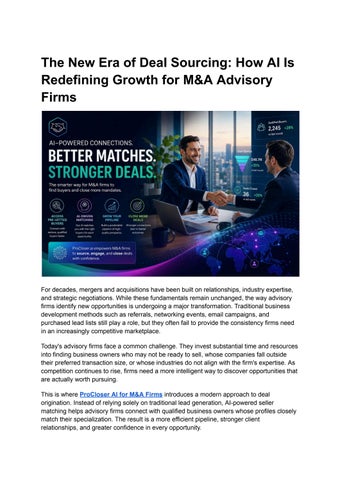
This is where ProCloser AI for M&A Firms introduces a modern approach to deal origination. Instead of relying solely on traditional lead generation, AI-powered seller matching helps advisory firms connect with qualified business owners whose profiles closely match their specialization The result is a more efficient pipeline, stronger client relationships, and greater confidence in every opportunity.
The Changing Nature of M&A Business Development
Business owners today are better informed than ever before Before speaking with an advisor, many spend weeks researching valuation methods, exit strategies, market conditions, and potential buyers. They compare advisory firms online, read reviews, consume educational content, and seek recommendations from trusted sources
At the same time, advisory firms are competing in an increasingly crowded marketplace. Standing out requires far more than an impressive transaction history Firms must demonstrate expertise, build credibility, and engage with sellers at exactly the right moment
Unfortunately, many traditional prospecting methods were never designed for this level of competition
A purchased database cannot determine whether a business owner is actively preparing for a sale. Cold outreach cannot reveal whether a company aligns with an advisor's preferred deal size Marketing campaigns may generate inquiries, but they often attract business owners who are still years away from selling
This creates an inefficient business development cycle where advisors spend more time filtering opportunities than building meaningful client relationships
Why More Leads Don't Always Mean More Deals
Many firms measure success by the number of leads entering the pipeline. However, experienced advisors understand that volume alone rarely produces better outcomes
Imagine receiving one hundred inquiries in a single month
At first glance, that may seem like a successful marketing campaign Yet after reviewing each opportunity, perhaps only ten businesses fit the firm's industry focus Of those ten, only three owners may actually be ready to begin a transaction within the next year.
The remaining ninety-seven conversations consume valuable time without creating meaningful progress
This illustrates one of the biggest challenges facing advisory firms today
Time is limited
Every hour spent qualifying unsuitable prospects is an hour that cannot be invested in valuation analysis, buyer outreach, negotiations, or supporting active clients
The goal should not be generating more inquiries.
The goal should be generating better opportunities
The Rise of Intelligent Seller Matching
Artificial intelligence has transformed countless industries by improving efficiency, reducing repetitive work, and helping professionals make better decisions
Within M&A advisory, AI is creating a smarter approach to identifying opportunities.
Rather than presenting every inquiry equally, intelligent matching systems analyze multiple data points before recommending introductions.
These factors may include:
● Industry sector
● Annual revenue
● EBITDA range
● Geographic location
● Growth stage
● Ownership structure
● Exit timeline
● Transaction objectives
● Preferred deal size
● Advisory specialization
Instead of asking advisors to sort through hundreds of unrelated opportunities, AI identifies businesses that are significantly more aligned with the firm's capabilities
The result is higher-quality conversations from the very first meeting
Why Industry Alignment Matters
Every advisory firm develops unique expertise over time
Some firms become recognized leaders within manufacturing. Others focus on healthcare, software, logistics, construction, engineering, consumer products, or professional services
This specialization creates enormous value.
An advisor who understands the operational challenges, valuation drivers, buyer landscape, and regulatory environment within a particular industry can provide significantly more strategic guidance than someone approaching the business for the first time.
Industry familiarity also improves buyer identification
Instead of beginning every engagement from scratch, experienced advisors often know which buyers are actively pursuing acquisitions within that market, allowing transactions to move more efficiently
Matching business owners with advisors who understand their industry creates better outcomes for everyone involved
Building Stronger Relationships From Day One
Trust is one of the most important elements of every successful M&A engagement.
Business owners are making one of the largest financial decisions of their lives They want confidence that their advisor understands not only financial modeling and negotiations but also the unique characteristics of their business.
When an advisor immediately demonstrates knowledge of industry trends, buyer expectations, operational challenges, and market valuations, confidence develops much faster
Instead of spending early meetings explaining industry fundamentals, conversations can focus on strategy, growth opportunities, valuation expectations, and transaction planning.
That stronger relationship often becomes the foundation for a smoother and more successful transaction
Reducing Administrative Work
One of the hidden costs of traditional deal sourcing is administration
Before an engagement even begins, advisory firms invest hours researching prospects, scheduling introductory calls, reviewing financial information, qualifying opportunities, and determining whether a seller fits the firm's ideal profile
These repetitive tasks consume valuable resources.
By improving seller qualification before introductions occur, intelligent matching significantly reduces this workload.
Advisors spend less time investigating unsuitable opportunities and more time performing the high-value work clients actually hire them to do
That shift alone can dramatically improve productivity across an advisory firm
Improving the Experience for Business Owners
Intelligent seller matching is not only beneficial for advisory firms Business owners also gain a more personalized and efficient experience.
Many owners begin their exit journey without knowing which advisor is the right fit They may speak with multiple firms before finding one that understands their industry, company size, and long-term objectives This process can be frustrating and time-consuming
A more targeted matching approach changes that experience Instead of starting with broad conversations, sellers are introduced to advisors whose expertise aligns with their business from the outset These early discussions become more productive because both parties share similar expectations and understand the market in which the business operates
When sellers feel understood from the first meeting, they are more likely to build trust, engage openly, and move confidently through the transaction process
Smarter Technology Supports Better Decisions
Artificial intelligence is often misunderstood as a replacement for professional expertise. In reality, it serves as a powerful decision-support tool
Technology can quickly process information, identify patterns, and evaluate compatibility across thousands of data points. Advisors, however, contribute strategic thinking, negotiation skills, relationship management, and deep industry knowledge that technology cannot replace
The strongest firms combine both strengths.
Technology handles repetitive tasks such as qualification and matching, while experienced professionals focus on valuation, buyer outreach, negotiations, due diligence, and closing successful transactions
This combination creates a more efficient advisory model without sacrificing the personal relationships that define the M&A industry.
Moving From Reactive to Predictable Growth
One of the biggest advantages of intelligent seller matching is predictability
Many advisory firms experience periods of strong activity followed by months where new opportunities become scarce. This inconsistency makes forecasting revenue, allocating resources, and planning future growth increasingly difficult.
Building a healthier pipeline is not simply about finding more prospects It is about creating a steady flow of opportunities that closely align with the firm's capabilities.
When advisors consistently engage with qualified business owners, the sales cycle becomes more manageable Resources can be allocated more effectively, teams remain productive, and firms gain greater confidence in future growth.
Predictable deal flow ultimately creates a more resilient business
Supporting Industry Specialization
Specialization has become a major competitive advantage within the M&A industry
Business owners increasingly seek advisors who understand the challenges unique to their sector rather than generalists who work across every industry.
Advisors with specialized experience can provide better insights into valuation drivers, market demand, competitive positioning, operational improvements, and buyer expectations
Intelligent seller matching naturally supports this trend by connecting firms with opportunities that align with their proven expertise
Rather than stretching resources across unfamiliar industries, advisory firms can strengthen their reputation within the markets they know best
This focused approach often leads to stronger client satisfaction and increased referral opportunities
Improving Operational Efficiency
Growth is not only measured by the number of transactions completed It is also influenced by how efficiently those transactions are sourced.
Instead of spending hours identifying prospects, advisors can focus on:
● Preparing detailed valuations
● Developing buyer outreach strategies
● Supporting due diligence
● Negotiating favorable transaction terms
● Strengthening client relationships
● Expanding industry expertise
● Growing strategic partnerships
These activities directly contribute to better client outcomes while strengthening the firm's long-term position in the marketplace
Preparing for the Next Generation of M&A
Digital transformation is influencing every stage of the transaction lifecycle.
Business owners now expect faster communication, personalized experiences, data-driven insights, and advisors who understand both technology and market dynamics
As these expectations continue to evolve, advisory firms must modernize the way they generate opportunities
AI-powered seller matching represents one of the most practical ways to accomplish this objective
Rather than replacing existing business development strategies, it complements referrals, networking, thought leadership, and relationship building by introducing a smarter qualification process
This balanced approach enables firms to maintain the personal connections that have always defined successful advisory work while embracing technology that improves efficiency
Looking Beyond Lead Generation
The future of deal origination is unlikely to be defined by larger databases or more outbound emails
Instead, success will depend on delivering the right opportunity to the right advisor at the right time
Firms that prioritize compatibility over lead volume are likely to build stronger pipelines, improve conversion rates, and create better experiences for business owners.
The emphasis is shifting from generating more conversations to creating more meaningful conversations.
That distinction has the potential to reshape how advisory firms approach business development for years to come
Conclusion
The M&A industry continues to evolve, and firms that embrace smarter approaches to business development will be better positioned for sustainable growth While traditional prospecting methods remain valuable, combining them with intelligent seller matching allows
advisors to spend less time searching for opportunities and more time helping business owners achieve successful exits.
By leveraging solutions like ProCloser AI for M&A Firms, advisory firms can build stronger pipelines, improve operational efficiency, develop deeper client relationships, and create a more predictable path to long-term success. As technology becomes an increasingly important part of the M&A landscape, firms that adapt early will be well equipped to thrive in the years ahead