As we close the first quarter of 2026, the conversationisevolving.
In the early months of the year, our focus was necessarily inward on recovery, rebuilding,andstrengtheningourcapacity intheaftermathofHurricaneMelissa.That workremainscritical.
For small, open economies like Jamaica, thesedevelopmentsrarelyremaindistant forlong.
At the same time, closer to home, there are subtle but important shifts taking place within our own region differences in perspective, evolving alliances, and a testing of long-standing relationships. These are natural in any dynamic geopolitical environment, but they serve as a reminder that regional cohesion cannotbetakenforgranted.
Fortheprivatesector,thisraisesadeeper consideration: How do we operate and grow—within a global and regional environmentthatisbecominglesssettled andmorefluid?
From Stability to Strategy
Against this backdrop, the tabling of Jamaica’s national budget this month takesonaddedsignificance.
Jamaica has built a strong foundation of fiscal discipline and macroeconomic stability an achievement that continues toserveuswell.Butinaworlddefinedby external shocks and shifting alignments, stabilitymustnowbepairedwithstrategic intent.
Thequestionforusisnotsimplyhowwell the economy is performing. It is how deliberately we are positioning for what liesahead.
It is in that spirit that the PSOJ, in partnershipwithtaxleadersPwCandwith thesupportofVMWealth,willonceagain conveneourannualPost-BudgetReview an important forum through which we seektounpack,interpret,andbringclarity to the policy direction for businesses acrossJamaica.
Thisengagementhasbecomeastaplenot because of tradition, but because of necessity. In an increasingly complex environment, understanding policy is no longer optional it is a strategic advantage.
Telling Our Own Story of Enterprise
March also offered an opportunity for reflection ofa different kind. OnMarch 8, we launched the PSOJ Titans of Industry docuseries, celebrating the journeys, contributions,andenduringimpactofour HallofFameinductees.
These are not just stories of individual success. They are stories of vision, resilience, and nation-building of enterprises that have navigated uncertainty, adapted to change, and helpedtoshapetheeconomiclandscape weoperateintoday.
At a time when the future can feel uncertain, there is value in grounding ourselvesintheseexamples.Theyremind us that Jamaican enterprise has never beenpassiveinthefaceofchange ithas evolved,expanded,andled.
What This Moment Requires of Us
Taken together, the signals are clear. We areoperatinginaworldwhere:
• Global events are more quickly transmittedintolocalrealities
• Regionaldynamicsarebecomingmore nuanced
• And economic policy must do more thanpreservestability itmustenable growthandresilience
• A renewed focus on building businesses that can withstand and adapttoexternalshocks
A Final Reflection
If the first quarter of 2026 has taught us anything, it is this: We must become as deliberateabouthowwereadtheworldas we are about how we operate within it. Because in times like these, success will notbedefinedonlybyperformance,butby preparedness.
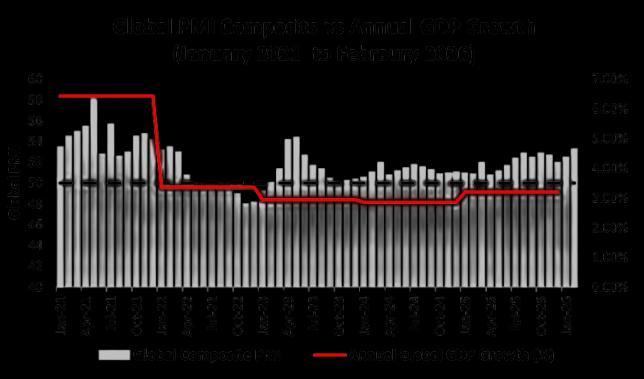
J.P.MorganGlobalCompositePMI,which rose to 53.3 its highest level in 21 months signalling broad-based expansion across major sectors and regions. Asia, led by India, China, and Japan, remained the primary driver of global growth, while the United States experienced a temporary softening in outputduetoadverseweatherconditions.
However, inflationary pressures re emerged. Input costs and output chargesrecordedtheirfastestincreasesin several months, partly driven by a sharp rise in global energy prices following the outbreak of conflict in the Middle East. BrentcrudesurpassedUS$100perbarrel, andtheIMFestimatesthattheassociated 50% rise in energy prices could add approximately 40 basis points to global inflation.OECDdataindicatethat,despite some easing, average price levels remain significantly above pre pandemic norms, underscoring persistent inflation challenges.
Despite improved activity and the first increaseinglobaltradeflowssinceMarch 2025, labour demand showed little change, with employment growth effectivelyflat.
Geopolitical tensions, new U.S. tariffs, and a weaker U.S. dollar have further complicated the global disinflation process. Research from S&P Global and J.P.Morgansuggeststhatinflationislikely to remain above central bank targets at
leastthroughmid‑2026.Asaresult,major central banks including the Federal ReserveandtheEuropeanCentralBank— have shifted toward a more hawkish stance, with earlier expectations for rate cuts largely withdrawn. These pressures are compounded by rising manufacturing input costs and potential disruptions to global food supply chains, increasing the riskofrenewedpricevolatility.
UNITED STATES OF AMERICA
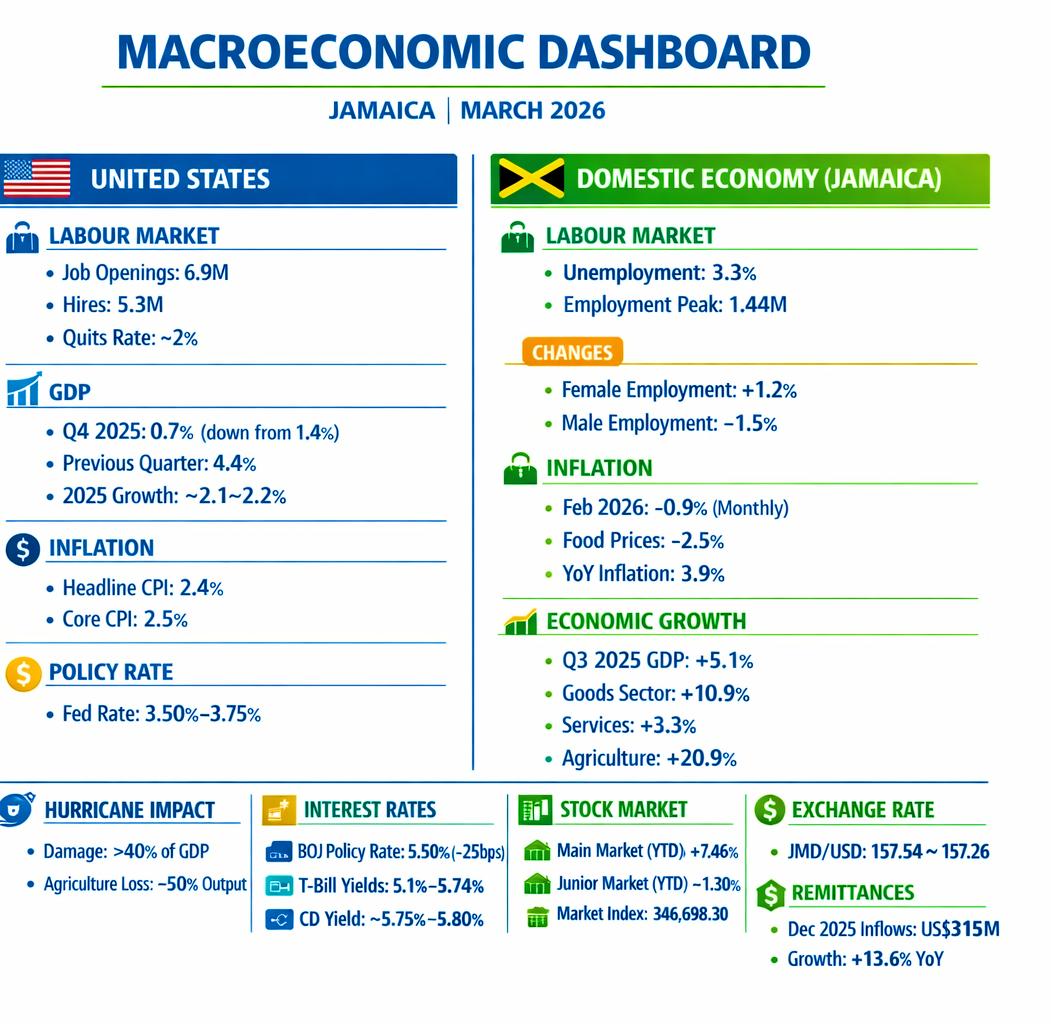
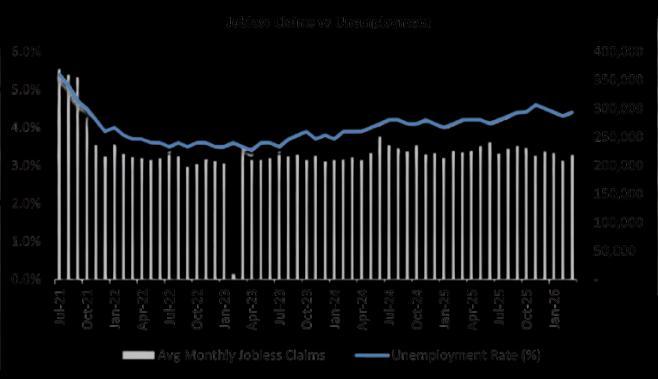
Recent U.S. economic data point to a gradually cooling but orderly labour market. Job openings remain near 6.9 million, hires are steady at approximately
demand, lower mobility, and a “low‑hire, low fire”dynamic.
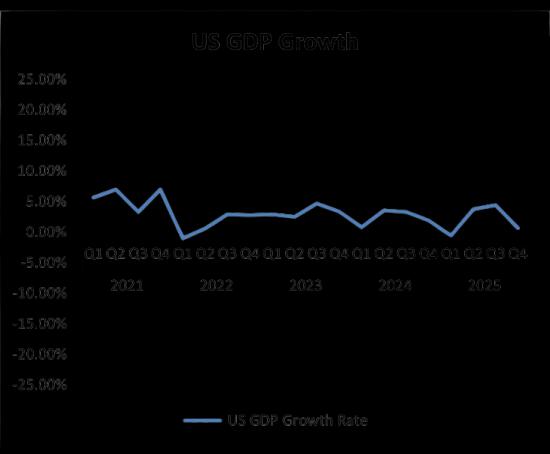
Economic growth moderated sharply toward the end of 2025. The Bureau of Economic Analysis revised fourth quarter GDP growth down to 0.7% from 1.4%, a notable slowdown from the 4.4% expansion recorded in the prior quarter. Full‑year growth is estimated at 2.1%–2.2%,slightlybelowthe2024outturn.The Federal Reserve projects medium‑term GDP growth in the 2.0%–2.4% range, reflecting the impact of tighter financial conditions, softer demand, and elevated geopoliticalrisks.
5.3million,andthe quitsrate atroughly 2% continues to signal subdued worker confidence.Layoffsremainlow,indicating that firms are slowing hiring rather than accelerating separations. Overall, labour conditions reflect a late cycle environment characterized by easing
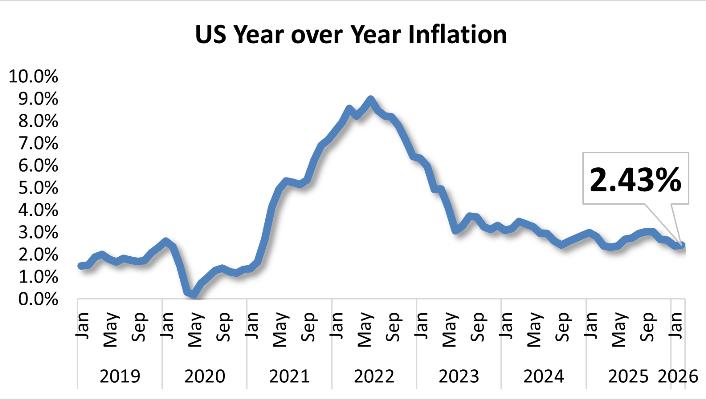
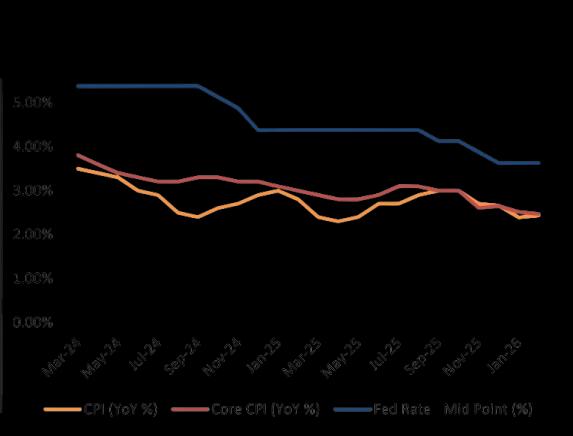
Inflation indicators show temporary stabilization but growing upside risks. Headline CPI held at 2.4% year over year in February 2026, with core inflation at 2.5%.Whilemonthlypricegrowthremains moderate, the recent surge in oil prices linked to geopolitical tensions—including
the U.S.–Iran conflict—is expected to place renewed upward pressure on inflation.Persistentservices‑sectorcosts, tariff related goods inflation, and rising producer pricemeasuresfurtherreinforce thisriskprofile.
Monetarypolicyhasshiftedtowardamore cautious stance. At its March 2026 meeting, the Federal Open Market Committee kept the federal funds rate unchangedat3.50%–3.75%,emphasizing a data dependent posture amid heightenedinflationuncertainty.Updated projections suggest only one 25 basis point rate cut for 2026, as policymakersassessthebalancebetween softeninglabourconditionsandpersistent inflation pressures. The Committee also
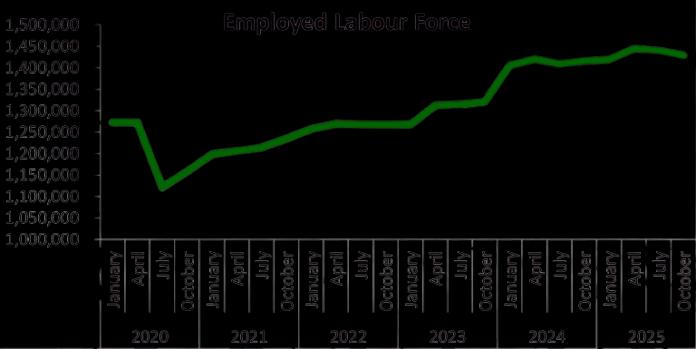
Jamaica’s labour market remained resilient heading into late 2025, with the unemploymentrateholdingat3.3%forthe October quarter unchanged from April and July, and below both January 2025 (3.7%)andOctober2024(3.5%).Although the labour force contracted by roughly 28,000, this decline partly reflects
business confidence and expanding sectoralactivity.
Across occupational groups, the most notable increases occurred among Managers and Technicians and Associate Professionals,withthelatteraddingmore than 94,000 individuals compared to the previousyear.Incontrast,employmentfell among Clerical Support Workers, declining by 11.2%, alongside reductions in Craft and Related Trades, Real Estate and Other Business Services, and Arts, Entertainment,andRecreation.
disruptions to data collection caused by HurricaneMelissa.
Employment continued to trend upward throughout 2025, reaching a record 1.44 million prior to the hurricane. The strongest gains emerged in Manufacturing, Education, and Health and Social Work, reflecting improved
By industry, the largest employment decreaseinOctober2025wasrecordedin Real Estate andOther Business Services, down 10,400 persons, whereas Accommodation and Food Service Activities saw the strongest expansion, adding 7,900 positions. Employment shifts were gender-differentiated: male employment fell 1.5%, while female
employment increased 1.2% over the period.
Following the widespread destruction caused by Hurricane Melissa, unemployment is expected to rise in the nearterm,particularlyinwesternJamaica where business activity suffered significant setbacks. The resulting loss of income is likely to weigh on household consumption and may create short-term pressures on the financial sector including reduced savings, slower investment activity, and anincreased risk of loan-repayment challenges. Nonetheless, reconstruction efforts present new opportunities, particularly in housing development and related financing, offering potential areas for strategicexpansion.
Inflation
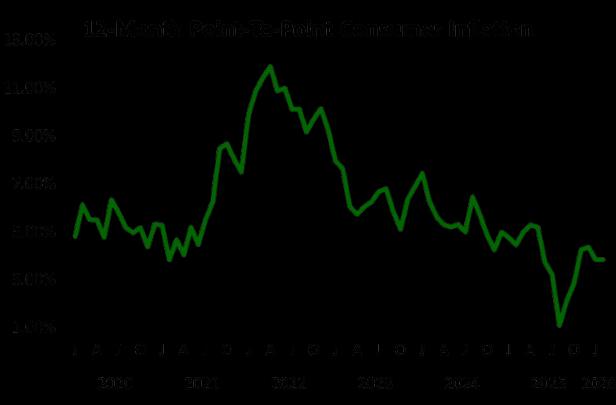
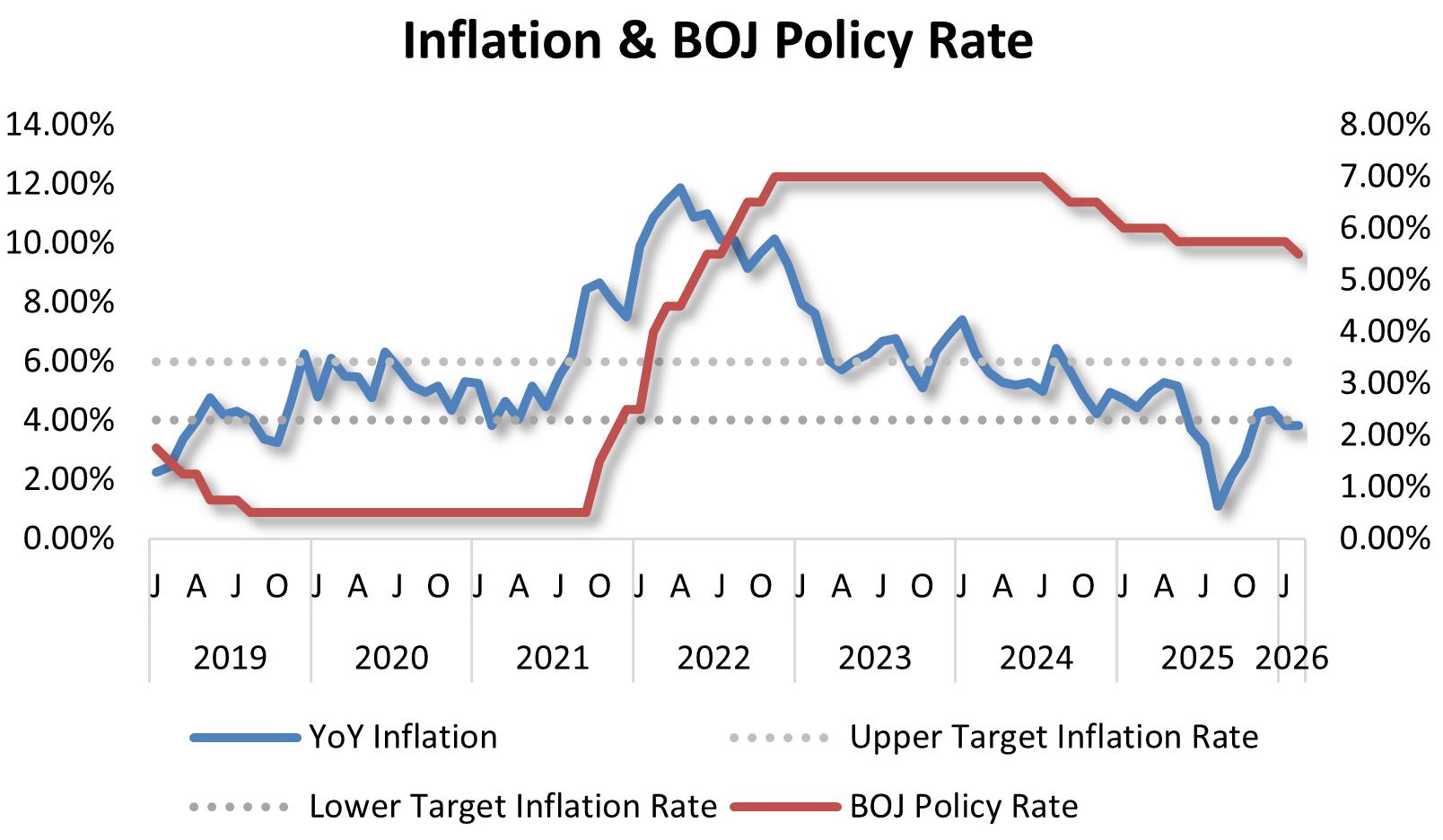
Jamaica’s inflation profile in early 2026 reflects a period of temporary easing following the sharp, hurricane-related price increases at the end of 2025. Headline inflation declined by 0.9% in February2026,driven primarilybya 2.5% fall in food and non-alcoholic beverages, as improved agricultural supply helped reverse earlier storm-induced shortages. Despitethismonthlydecline,year-on-year inflation remained elevated at 3.9%, supported by persistent pressures in housing, utilities, and personal care categories.
The initial inflation surge following Hurricane Melissa—with headline CPI rising 2.4% in November and 1.3% in
December—unwound more rapidly than expected once agricultural markets stabilized. January 2026 recorded a 0.8% decline in the CPI, confirming a faster-than-anticipated normalization in foodprices.
The broader inflation outlook, however, remains uncertain. Global developments particularly the surge in oil prices stemming from the U.S.–Iran conflict and disruptions near the Strait of Hormuz pose a renewed inflationary threat for Jamaica, given the country’s dependence onimported fuel andenergy inputs. These pressures risk feeding into transportation, electricity, and broader consumerpricesinthemonthsahead.
Inresponsetomoderatinginflationandan improving near-term price outlook, the Bank of Jamaica began cautiously normalizingmonetarypolicy,deliveringits firstratecutinalmostayear.Evenso,the BOJnotesthattemporarybreachesofthe 4–6%targetrangemayoccurlaterin2026 duetoreconstructionspendingandglobal energypricevolatility.
Overall, while short-term inflation pressures have eased, underlying risks including energy-price instability and post-hurricane demand suggest that monetarypolicywillremainvigilantasthe economy transitions through reconstruction.
Economic Activity
Jamaica’s economic performance strengthened notably in the third quarter of2025,withrealGDPexpandingby5.1% year-over-year,thestrongestoutturnsince the post-pandemic rebound in 2021. Growth was broad-based: Goods-Producing Industries rose 10.9%, whileServicesIndustriesincreased3.3%.
The Agriculture, Forestry & Fishing industrywasakeycontributor,rebounding by 20.9% due to improved weather conditions and enhanced production capacity. Seasonally adjusted data also indicate a 1.1% increase relative to the previous quarter, marking the third consecutivequarterofexpansion.
This positive trajectory was subsequently interruptedbythesevereeconomicfallout from Hurricane Melissa, which struck in late 2025. The storm caused extensive infrastructure damage estimated at more than 40% of GDP and delivered a major setback to the agriculture sector, whichlostroughly50%ofits2024output.
As a result, the Bank of Jamaica now projects real GDP for FY2025/26 to contract between 1.0% and 3.0%, a revision upward from earlier, more pessimisticestimates.
Looking ahead, economic activity is expected to gradually recover as reconstruction progresses. For FY2026/27, real GDP is forecast to return to growth in the 1.0% to 3.0% range, supported by improved agricultural
output, stabilization in tourism and services,andongoingrebuildingactivities. Over the medium term, growth is projected to remain modest, reflecting both lingering post-storm effects and external risks such as global demand uncertainty and weather-related disruptions.
Money Market Interest Rates
Money‑market conditions remained stable and well supported throughout early 2026. Following the temporary inflation spike associated with Hurricane Melissa, price pressures eased more rapidly than expected, driven by a sharp correction in food prices—particularly vegetables,tubers,plantains,andpulses. As a result, headline inflation slowed meaningfully in January, falling 0.8%
month‑over‑month, and continued to moderateintoFebruary.
Inresponsetothiseasinginflationprofile, the Bank of Jamaica (BOJ) reduced its policy rate by 25 basis points to 5.50% at its February 19–20, 2026 meeting the first rate cut since May 2025. The BOJ noted that the inflation impact of Hurricane Melissa was less severe than initially anticipated and projected that inflation would remain broadly within the 4%–6% target range, with only temporary breachesexpectedinmid-2026.
Market liquidity remained ample, and investor demand for short-term instruments was strong. Treasury-bill auctionsforboththe 91-dayand182-day tenorsattractedhealthyoversubscription, withclearingyieldsrangingbetween5.1% and5.74%,broadlyalignedwiththepolicy
ratecorridor.ParticipationinBOJ’s30-day CertificatesofDeposit(CDs)wassimilarly robust;theFebruary11operationreceived J$40.19 billion in bids for J$24 billion offered, clearing at an average yield of 5.80%.AsubsequentJ$40billionCDwas announcedata5.75%coupon.
While inflation has moderated, the BOJ remainsattentivetorisksassociatedwith reconstruction-driven demand and elevated global energy prices, both of which could introduce temporary upward price pressures later in 2026. The overall policy stance therefore remains supportive but cautious, balancing economic recovery with the need to maintainpricestability.
Stock Market
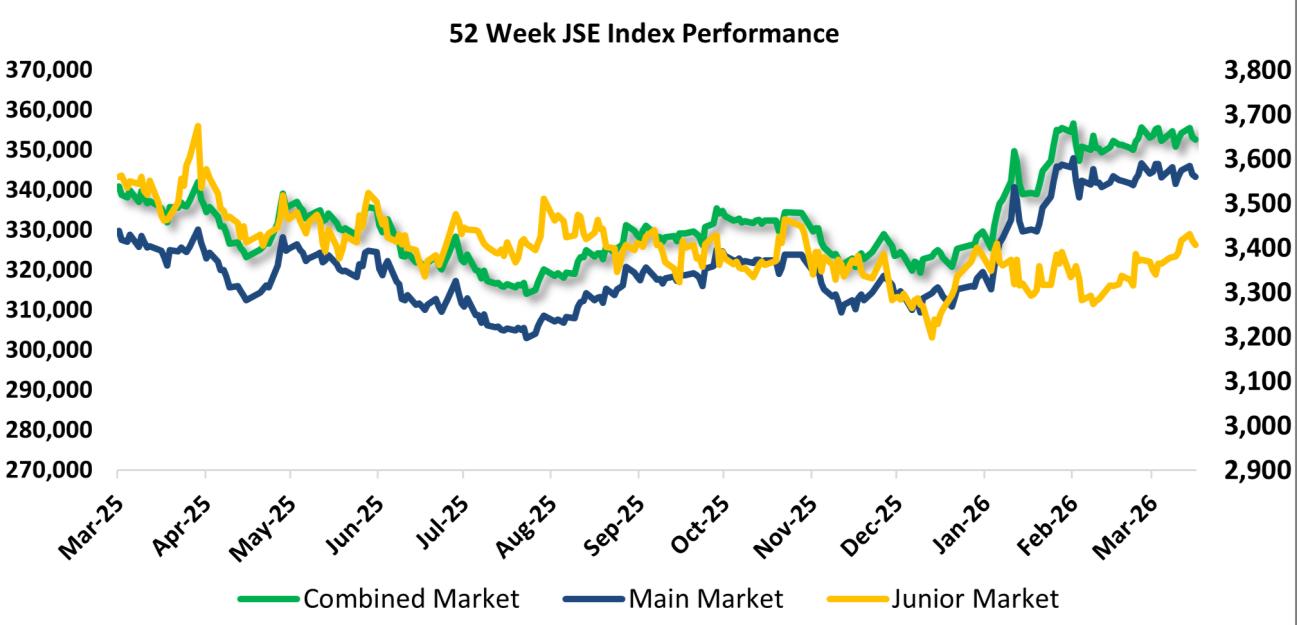
The Jamaica Stock Exchange (JSE) began 2026 with a measured but positive rebound.TheMainMarketIndexposteda modest 0.08% increase for February and
delivered a solid 7.46% year-to-date performance, while the Junior Market Indexrecorded0.5%growthforthemonth butremaineddown1.30%year-to-date.
Market activity was led by TransJamaican Highway Limited (TJH), Radio Jamaica Limited (RJR), and Kintyre Holding (JA) Limited (KNTYR), which together accountedforasignificantshareofoverall trading at 17.37%, 10.57%, and 8.59%, respectively.
Index performance metrics reflected a cautiously improving environment. The JSE Market Index closed at 346,698.30, supported by a 9.78% daily gain, 1.26% weekly increase, and 9.03% year-to-date growth, despite a 5.30% decline over the past year. The JSE Select Index rose 11.71% year-to-date, while the All JamaicanCompositeIndexgained10.70% year-to-date.
Despite the positive momentum, the outlook remains tempered by external risks. Concerns surrounding inflation particularly from global geopolitical tensions and potential second-round effectsofHurricaneMelissa continueto shape investor sentiment. As a result, marketparticipationisexpectedtoremain selective, with investors favouring fundamentally strong and resilient companies.
EXTERNAL SECTORS
Exchange Rates
reinforced confidence in FX conditions headingintoMarch.
While February’s movements indicate an improvement in FX-market balance, the outlookremainscautious.Reconstruction activity is expected to sustain elevated foreign-currency demand, making continued prudent FX liquidity management essential as the economy transitions from stabilisation to early recovery.
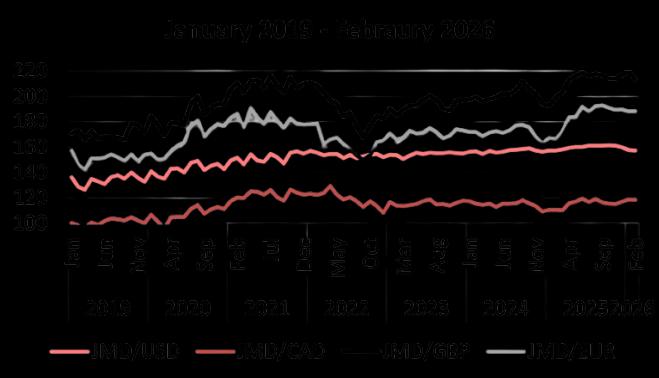
The Jamaican dollar experienced slight appreciation during February, stabilizing afterthevolatilitythatfollowedHurricane Melissa. The JMD/USD rate strengthened from J$157.54 to J$157.26, reflecting a 0.18% month-over-month gain as FX pressures eased and post-hurricane importdemandnormalised.
Throughout the period, the Bank of Jamaica maintained an active but measured presence in the foreign exchange market, conducting a single B-FXITT sale of USD 15 million tosupport market stability. These interventions, supported by strong reserve buffers,
Remittances
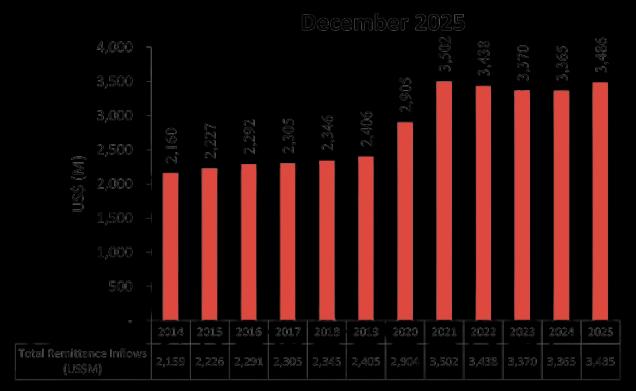
Remittance inflows continued to strengthen toward the end of 2025, with net inflows reaching US$315 million in December,representinga13.6%increase over December 2024. This improvement was driven primarily by a US$36.2 million (12.1%)riseintotalinflows,supportedby a7.2%declineinoutflows.
Forthefiscalyeartodate,netremittances grew by 4%, reflecting a gain of US$96 millionrelativetothecorresponding2024 period. The United States remained the dominant source market, accounting for 66.6% of total inflows, followed by the United Kingdom (12.5%), Canada (8.9%), and the Cayman Islands (6.9%). On a calendar-year basis, Jamaica recorded a 3.8% increase in inflows, outperforming markets such as Mexico, which saw a decline, though still trailing the strong double-digit growth recorded in GuatemalaandElSalvador.
institutions should continue to monitor shifts in source-market economic conditions particularlyU.S.employment trends and policy developments as these factors will heavily influence future remittanceperformance.Additionally,the continuedexpansionofdigitalremittance channels presents opportunities for serviceproviderstoincreasemarketshare andimproveefficiency.
Net International Reserves (NIR)
Given the widespread economic disruption caused by Hurricane Melissa, remittance volumes are expected to rise further as households receive additional financial support from overseas relatives during the recovery process. Financial
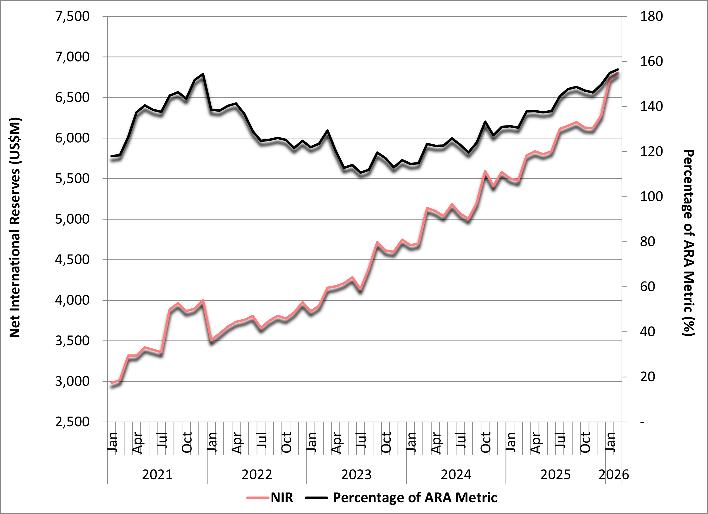
Jamaica’sNetInternationalReserves(NIR) continued to strengthen in early 2026, rising to US$6.80 billion in February, an increase of US$72.51 million compared with January. At this level, the reserves providecoverageof55.92weeksofgoods imports and 36.20 weeks of goods and services imports, while the IMF’s ARA
The February increase was driven by higher foreign-asset holdings, while foreign liabilities limited to obligations owed to the IMF declined modestly by US$0.7 million. This strong reserve position reinforces Jamaica’s external resilience and enhances the Bank of Jamaica’s capacity to maintain orderly conditionsintheforeignexchangemarket.
Overall,thesustainedimprovementinNIR provides a critical buffer as the economy navigates post-hurricane recovery, elevated reconstruction-related import demand, and ongoing global uncertainties.
KEY GLOBAL EVENTS
Escalating Middle East conflict and global energy shock
A significant driver of economic uncertainty in 2026 has been the
deepening conflict involving the United States, Iran, and Israel, including disruptionsaroundtheStraitofHormuz a critical chokepoint for roughly 20% of globaloilflows.Thishaspushedcrudeoil andenergypricessharplyhigher,sparking inflationary pressures, volatility in commodity markets, and heightened global economic risk. International agencies have warned this energy crisis could be one of the most severe supply disruptions since the 1970s, with broad implications for inflation, growth, and monetarypolicyglobally.
Surging Energy Prices and U.S. Inflation Risks
The Middle East tensions translated directlyintoU.S.marketeffects,including diesel prices rising above $5 per gallon amid supply disruptions, slower freight and manufacturing activity, and renewed inflationpressuresthathavecomplicated monetarypolicyexpectations.
Volatility in Financial Markets and Policy Expectations
Thesegeopoliticalshocks,combinedwith persistent inflation concerns, have led to significant volatility in equity, bond, and commodity markets, shaking investor confidence and altering expectations for futureinterestratecuts,particularlyinthe U.S.FederalReserve’spolicypath.
SPECIAL REPORT: Caribbean Innovation Ecosystem Assessment
The Caribbean’s Startup Moment: From scattered islands to an integrated innovation sea
Following the just-concluded IDBsponsored Empower JA forum hosted by the PSOJ on Unleashing SME Digital Success, the CARIBEquity report was launched.
The Caribbean’s tech entrepreneurs are building against the odds. The CARIBEquity report, a new regional assessment co-founded by IDB Lab and theEuropeanUnion,explainswhythenext 24 months could define whether this energycompounds ordissipates.
The Activation Reality
Across 15 Caribbean economies from Antigua&BarbudatoTrinidad&Tobago— every startup community sits squarely in what ecosystem researchers call the Activation Phase:lowstartupoutput,thin pools of experienced mentors and investors, and persistent resource constraints. The assignment at this stage is simple but not easy: create more startups,mobiliseearly-stagecapital,and wire the community together. Until that flywheelspins,scaleremainselusive,and valuecreationunderwhelms.
The assessment, commissioned under theCARIBEquityinitiativeanddeliveredby Startup Genome with McIntyre Consulting, maps the region’s tech entrepreneurship as it is not as many hopeittobe.Itsverdictisunromanticyet optimistic: momentum is real, but fundamentalsmustbefixed.
Why Size Still Matters
The report identifies 154 validated tech startupsacrosstheregion.Onaper-capita basis,startupdensityrangesfrom~0.03to 6.23 per 100,000 people, well below the ~12.1 observed in comparable Activation-phase peers globally. That matters because ecosystem value scales non-linearly with absolute startup numbers the more founders you have, the faster networks, mentorship, and financingreachcriticalmass.Translation: “bigger is better”, and in small island markets,regionalintegrationisthefastest routeto“big.”
The Community Deficit
Caribbeanfoundersdoknoweachother but the sense of community and the quality of expert networks lag global benchmarks. Interviews surfaced a familiar, corrosive triad: mistrust (“someone will steal my idea”), scarcity (few visible exits, few investors giving back), and short-lived programs that couldn’t prove impact fast enough to survive. The result is a Local Connectedness Index below global averages despite geographic proximity
that, paradoxically, should make connectivetissuecheapertobuild.
Startup Genome’s global evidence links strong local connectedness to more than doubletherevenuegrowthforstartups a high-ROIleverinacapital-scarcecontext. The report’s remedy: fund “Ecosystem Keystone Teams” to curate relationships, normalize pay-it-forward behavior, and keepalong-termcommunityheartbeat.
Talent: Plenty of Code, Not Enough Growth
Onthetechnicalside,theregionpunches closetoitsweight:accesstoexperienced software engineers is roughly in line with Activation-phase averages, helped by higher-education pipelines and diaspora experience. The sharper deficit is growth talent business development and go-to-market skills that turn code into customers. Scalable fixes exist: regional growth academies, investor-readiness clinics, and embedded commercial mentorsinsideaccelerators.
Founders themselves aren’t inexperienced. The average age is 36.4, with~78%aged30+and~65%bringingat least two years of relevant industry experience. Team composition trends positive too: most founding teams combine business and technical skills, and women represent ~35% of founders, morethantwicetheglobalpeeraverage— an inclusion edge the region should defendandextend.
Still, incentives lag. Only ~8% of startups offer employee stock options (ESOPs); legal uncertainty, tax ambiguity, and a cultural preference for cash deter adoption. Where risk capital is scarce, equity instruments are the currency of ambition. Modernising ESOP rules and giving founders templates and advisors— would help startups hire and retain the seniortalenttheycan’taffordincash.
Funding: Bootstrapped and Boxed In Ifthereisasinglebottleneck,itismoney. Bootstrapping savings, friends, and family remains the dominant funding route. Strong accelerator graduates often stall post-program for lack of follow-on capital.Angelnetworksarenascent,seed funds thin, and both founders and local investors admit a learning curve on term sheets, cap tables, and staged financing discipline. Meanwhile, friction in incorporation, labor, and tax regimes nudges startups to register abroad, bleedinglocalvaluecapture.
Not all capital is stuck. The region’s diaspora sends billions in remittances annually,yetfewregulatedchannelsexist to convert those flows into equity co-investment in vetted local deals. Blended finance public-private vehicles with de-risking features could crowd in local private money; resource-rich Guyana could pilot sovereign innovation windows to seed Entrepreneur Support Organization (ESOs) and early-stage funds. But the sequencing is critical:
pre-seed and seed first; Series A+ later, whenthepipelinecansustainit.
Where Momentum Lives
Theassessmentcarvestheregionintofour clusters:
• Most Active / Most Developed: Jamaica, Dominican Republic, Trinidad & Tobago, Barbados the densest ESOs and clearest policy engagement. Still Activation-phase, but best positioned to professionalise capital, modernize legal stacks, and experimentwithsectorspecializations thatbuildonlocalstrengths.
• Unique Emerging: Bahamas, Guyana, Haiti each an outlier. Bahamas has financial-services depth and cross-border connectivity; Guyana’s oil era couldunderwrite aninnovation window; Haiti’s fragile macro belies active ESOs and community reliance, making diaspora vehicles especially relevant.
• OECS: St. Lucia, Antigua & Barbuda, Grenada, St. Vincent & the Grenadines, St. Kitts & Nevis, Dominica early-stage individually, potent collectively if they integrate markets, share ESOs, and align rules, withSt.Luciaaplausiblehub.
• Nascent & Underserved: Belize, Suriname foundation first: definitions that separate MSMEs from innovation startups, ESO seeding, legalclean-up,andpublicawareness.
A Jamaica Sidebar: Proof of What’s Possible
Jamaica sits in the Developing tier within Activation one of the region’s larger poolsofvalidatedstartups anditstands out for something subtle but powerful: awarenessofthird partyfunding.~43%of founders report knowing where to find grants and loans, far above the regional average. The weak spot? Expert networks founders report relatively low ties to legal, regulatory, and commercial specialists exactlytheconnectivetissue a Keystone Team can cultivate fast. Add ESOP clarity, a national pre seed/seed co‑investment window, and a diaspora Special Purpose Vehicle (SPV) pilot, and Jamaica could set a regional reference casewithin12–24months.
The Diaspora Dividend
If Caribbean founders feel isolated, their diaspora does not. The report points to a strategicmiss:remittancesremainlargely consumptive, not investive. Formal, transparentco-investmentvehicles—with sound governance, sensible ticket sizes, and tax clarity could redirect a sliver of that flow into home-grown innovation. Done right, diaspora capital brings more thanmoney:mentors,marketaccess,and credibilityinforeignhubs.
The 24-Month Playbook
1) Wire the community. Fund Keystone Teams that orchestrate mentorship, founder meetups, expert councils, and a
shared calendar of showcases. Measure mentorshiphoursandfounder-to-founder assistsasseriouslyasinvestmenttotals.
2) Build a tiered early-stage ladder. Link pre-seed/seed accelerators to co-investment funds and regional dealflow platforms with standardised terms.Makeitpossibletomovefromidea toseedwithoutleavingtheregion.
3) Unlock diaspora and blended capital. Roll out regulated diaspora SPVs and use first-loss/guaranteemechanismstopullin local private money. Start small, iterate governance,thenscale.
4) Modernise the legal stack. Clarify ESOP rules and taxation, streamline incorporation, update IP, and—where possible harmonize cross-border business norms so founders can scale across islands as if they were provinces, notcountries.
5) Close the growth-talent gap. Deploy region-wide, low-cost growth academies, embed commercial mentors in accelerators, and reward ESOs for downstream revenue traction not just cohortgraduations.
The Takeaway
TheCaribbean’sstartupstoryisnotastory of absence. It’s a story of activation—of founders who are older, steadier, and more diverse than global peers; of engineeringdepththatneedscommercial wings; of communities that can become morethanthesumoftheirislands.Witha
handful of concrete moves—better connectedness, early-stage finance, diaspora channels, modern legal plumbing, and growth skills the region can turn scattered sparks into compounding fire. The window is open. The question is whether we move fast enoughtoclimbthrough.