




The global economy is entering another periodofuncertainty,andforJamaica,the implications are immediate and deeply personal. Around the world, economic activity showed modest improvement in early 2026, with manufacturing and business output recovering in several major economies. However, beneath these encouraging headlines lies a far more fragile reality: rising energy costs, supply chain disruptions, geopolitical tensions, and slowing consumer confidence are once again threatening global stability. For a small, importdependent country like Jamaica, these developments are not distant internationalevents theydirectlyaffect the prices of food, fuel, electricity, and transportation,aswell as theoverallcost ofliving.
Global data indicate that economic growth is continuing, but unevenly. Countries such as India and China have maintained relatively stronger production levels, while parts of Europe have experienced contraction. Manufacturing activity globally has improved, especially as businesses attempt to secure goods and raw materials ahead of anticipated
shortages and price increases. Yet this recovery is being driven less by strong long-term demand and more by shortterm survival strategies. Businesses worldwide are stockpiling inventory, adjustingsupplychains,andpreparingfor prolongeduncertainty.
Oneofthemostpressingconcernsisthe continued disruption in global energy markets linked to tensions in the Middle East and instability surrounding key shipping routes such as the Strait of Hormuz. The Strait remains one of the mostcriticaloiltransitpointsintheworld, carrying roughly one-fifth of global petroleum supplies. When instability affects this corridor, the consequences ripple rapidly across international markets. Oil prices rise, shipping costs increase,andcountriesthatrelyheavilyon importedfuel includingJamaica face immediateinflationarypressure.
Theworldhasseenthisbefore.Duringthe 1973 oil crisis, global oil prices quadrupled after geopolitical conflict disrupted supply from the Middle East. The shock triggered inflation, recession, and widespread economic hardship across both developed and developing economies. More recently, the COVID-19 pandemic demonstrated how fragile global supply chains can disrupt everything from food availability to shipping schedules and energy prices. Jamaica experienced those effects directly through rising transportation costs, higher imported inflation, and
increased pressure on household budgets. Today’s environment carries similarwarningsigns.
The International Monetary Fund (IMF) projects global growth of approximately 3.1% in 2026. However, international institutions have warned that if geopolitical tensions intensify further, growth could slow significantly while inflationaccelerates.Insimpleterms,the world risks entering a period where economiesgrowmoreslowlywhilepeople simultaneously pay more for everyday goods and services a condition economistsdescribeasstagflation.Thisis especially dangerous for developing economies because it weakens business investment, increases borrowing costs, andreducesconsumerpurchasingpower allatonce.
For Jamaica, the risks are particularly seriousbecausethecountryimportsmost of its fuel, many food products, and a significant share of its production inputs. Higherglobaloilpricesaffectalmostevery aspect of domestic economic life. When fuel prices rise internationally, electricity generation becomes more expensive, transportation costs increase, shipping charges rise, and businesses face higher operating expenses. These costs are eventually passed on to consumers through higher prices at supermarkets, gasstations,restaurants,andutilitybills.
The tourism industry — one of Jamaica’s largest economic pillars is also vulnerable to global instability. Rising jet fuelpricescanincreaseairfarecostsand discourage travel, particularly from major sourcemarketssuchastheUnitedStates, Canada,andtheUnitedKingdom.Similar patterns emerged following the 2008 global financial crisis, when international travel demand weakened sharply and Caribbean economies experienced significantdeclinesintourismrevenues.If current global tensions persist, Jamaica could again face pressure on visitor arrivals, foreign exchange earnings, and employmentintourism-linkedsectors.
At the same time, global inflationary pressures are affecting international interest rates. Central banks in major economies, including the United States and Europe, have remained cautious about cutting interest rates because inflation risks remain elevated. This matters greatly for Jamaica because higher international interest rates often increase borrowing costs globally, including for developing economies. Countries with high debt levels or heavy financingneedscanfinditmoreexpensive toaccesscapitalmarkets.Businessesand households also face tighter financial conditions as commercial lending rates remainelevated.
These developments reinforce the urgent needforJamaicatostrengtheneconomic
resilience and accelerate structural reforms.Theprivatesector,labourgroups, and policymakers must work together to reducethecountry’sexposuretoexternal shocks. Greater investment in renewable energy, agriculture, logistics infrastructure, local manufacturing, and digitaltransformationisnolongeroptional it is essential for long-term economic security.
Jamaica has already demonstrated that resilience is possible. Following years of economic reforms after the debt crisis of the 2010s, the country achieved stronger fiscal discipline, lower unemployment, improvedinvestorconfidence,andgreater macroeconomic stability. However, the global environment is changing rapidly, and new risks require a new phase of nationalaction.
This moment calls for stronger partnershipsbetweengovernmentandthe productive private sector to expand local production capacity, strengthen supply chains, improve workforce productivity, and support innovation-driven industries. Jamaicamustalsodeepeninvestmentsin energy diversification and climate resilience so that global oil shocks and natural disasters do not repeatedly destabiliseeconomicprogress.
The current global environment should serve as a warning, but also as an opportunity. Countries that adapt early, invest strategically, and build resilient institutions will be better positioned to
withstand future global disruptions. Jamaicacannotcontrolglobalconflictsor internationalcommodityprices,butitcan strengthen its ability to respond effectively. Economic resilience, productivity growth, and strategic investment must now become national priorities—notonlytoprotectbusinesses and jobs, but to safeguard the long-term well-being of Jamaican households and futuregenerations.
Economic developments in the United States continue to have major implications for Jamaica, given the U.S.’s roleasourlargesttradingpartner,tourism market, and source of remittances. Changes in U.S. inflation, employment, andinterestratesdirectlyaffectJamaica’s cost of living, foreign exchange market, business activity, and overall economic stability.
Recent data show that the U.S. economy remainsresilientbutisbeginningtoslow.
InApril2026,theU.S.added115,000jobs while unemployment held at 4.3%, signalling continued growth but weaker labour-market momentum. Employment gainswere concentrated mainly in health care, transportation, and retail services, whilemoreinterest-sensitivesectorssuch asconstructionremainedsubdued.
This matters for Jamaica because strong U.S. employment has historically supportedremittanceinflowsandtourism demand.Between2021and2023, robust U.S. labour conditions contributed to record remittance inflows exceeding US$3.4 billion annually, helping many Jamaicanhouseholdsmanagerisingliving costs.However,anyprolongedweakening in U.S. employment could eventually reduce disposable income among members of the diaspora and slow remittancegrowth.
At the same time, inflation in the United States accelerated to 3.8% in April 2026,
driven largely by higher fuel, food, and housing costs. Gasoline prices increased by 28.4% year-over-year, reflecting the growing impact of global geopolitical tensions and disruptions in energy markets. These pressures are especially important for Jamaica, which remains heavily dependent on imported oil and vulnerable to rising shipping and transportationcosts.
Jamaica experienced a similar external shock following the Russia-Ukraine conflict in 2022, when surging global oil prices contributed to higher electricity bills, transportation costs, inflation, and increased pressure on the Jamaican dollar. The current Middle East conflict risks producing comparable effects if elevatedenergypricespersist.
Against this backdrop, the U.S. Federal Reserve maintained interest rates at 3.50%–3.75% in April 2026, signalling caution as it balances slower growth against persistent inflation risks. Historically, periods of high U.S. interest rates have created challenges for developing economies by increasing borrowing costs, strengthening the U.S. dollar,andreducinginvestmentflowsinto smallermarkets.
For Jamaica, these developments reinforce the need to strengthen economic resilience. Businesses and households remain vulnerable to importedinflation,highenergycosts,and global financial uncertainty. Small and
medium-sized enterprises, particularly those dependent on imported inputs and fuel, may continue to face pressure on operatingcostsandprofitability.
The current environment, therefore, highlights the urgency of accelerating investments in renewable energy, domestic food production, productivity improvements,andexportdiversification. Jamaica’s dependence on imported energycontinuestoexposethecountryto external shocks beyond its control. Expanding renewable energy infrastructure and strengthening highervalue industries such as digital services, logistics,andtechnologycanhelpreduce long-termeconomicvulnerability.
The evolving U.S. economic outlook should serve as both a warning and an opportunity for Jamaica. While global uncertainty poses risks to inflation, growth, and financial stability, it also reinforces the importance of building a more competitive, productive, and selfreliant economy capable of withstanding futureexternalshocks.
Jamaica’s economy is at an important turningpoint.Whilethecountrycontinues to show signs of resilience after years of fiscal reform and economic stabilisation, recent events particularly Hurricane Melissa, rising global energy costs, and ongoing geopolitical uncertainty have exposed structural weaknesses that continue to affect businesses, workers, andhouseholdsacrosstheisland.
The latest economic indicators reveal a country that has made progress in reducing unemployment and maintaining inflation within the Bank of Jamaica’s targetrange,butonethatisstillvulnerable to external shocks, climate events, and uneven economic participation. These realities demand not only sound economic managementbutalsodecisive national action aimed at strengthening productivity, protecting livelihoods, improving resilience, and accelerating inclusivegrowth.
The private sector, government, labour groups, and civil society must now work together to transition Jamaica from a period of recovery into a period of sustainableexpansion.
Jamaica’s unemployment rate remained relativelylowat3.6%inJanuary2026.On the surface, this reflects a labour market that continues to outperform historical trends.However,adeeperexaminationof thedatatellsamoreconcerningstory.
Althoughunemploymentimprovedslightly compared to the previous year, total employment actually declined by more than 30,000 persons, while labour-force participation also fell significantly. In practical terms, this means fewer Jamaicansareactivelyparticipatinginthe workforce.Manyindividuals particularly inhurricane-affectedcommunities may have stopped seeking employment altogether due to disruption, discouragement,displacement,orlimited economicopportunities.
The sectors hardest hit included agriculture, tourism, manufacturing, and accommodation services. Agriculture alonelostapproximately9,000jobs,while accommodation and food services declined by over 14,000 jobs. These industries remain among the most importantemployersinruralJamaicaand tourism-dependentcommunities.
Thissituationhighlightsacriticalnational challenge: Jamaica cannot rely solely on headline unemployment figures to measure economic health. The country
mustnowfocusonlabour-forcerecovery, workforce resilience, and productivity growth.
AstrongexamplecanbeseeninBarbados after Hurricane Elsa in 2021. The Barbadiangovernmentpartneredwiththe private sector to fast-track temporary employment programmes linked to reconstruction, tourism restoration, and community infrastructure projects. This helpedacceleratelabour-marketrecovery while improving resilience against future climateevents.
Jamaicacanpursuesimilarapproachesby expanding public-private partnerships that support disaster recovery employment, technical training, digital skills development, and youth entrepreneurship. Greater investment is also needed in rural economic diversification so that communities are lessdependentonasingleindustry,such astourismoragriculture.
The decline in youth unemployment is encouraging, but sustaining this progress will require stronger alignment between education, training, and the evolving needsofthelabourmarket.Jamaicamust urgently prepare its workforce for emerging sectors such as logistics, renewable energy, business process outsourcing, digital services, agroprocessing,andadvancedmanufacturing.
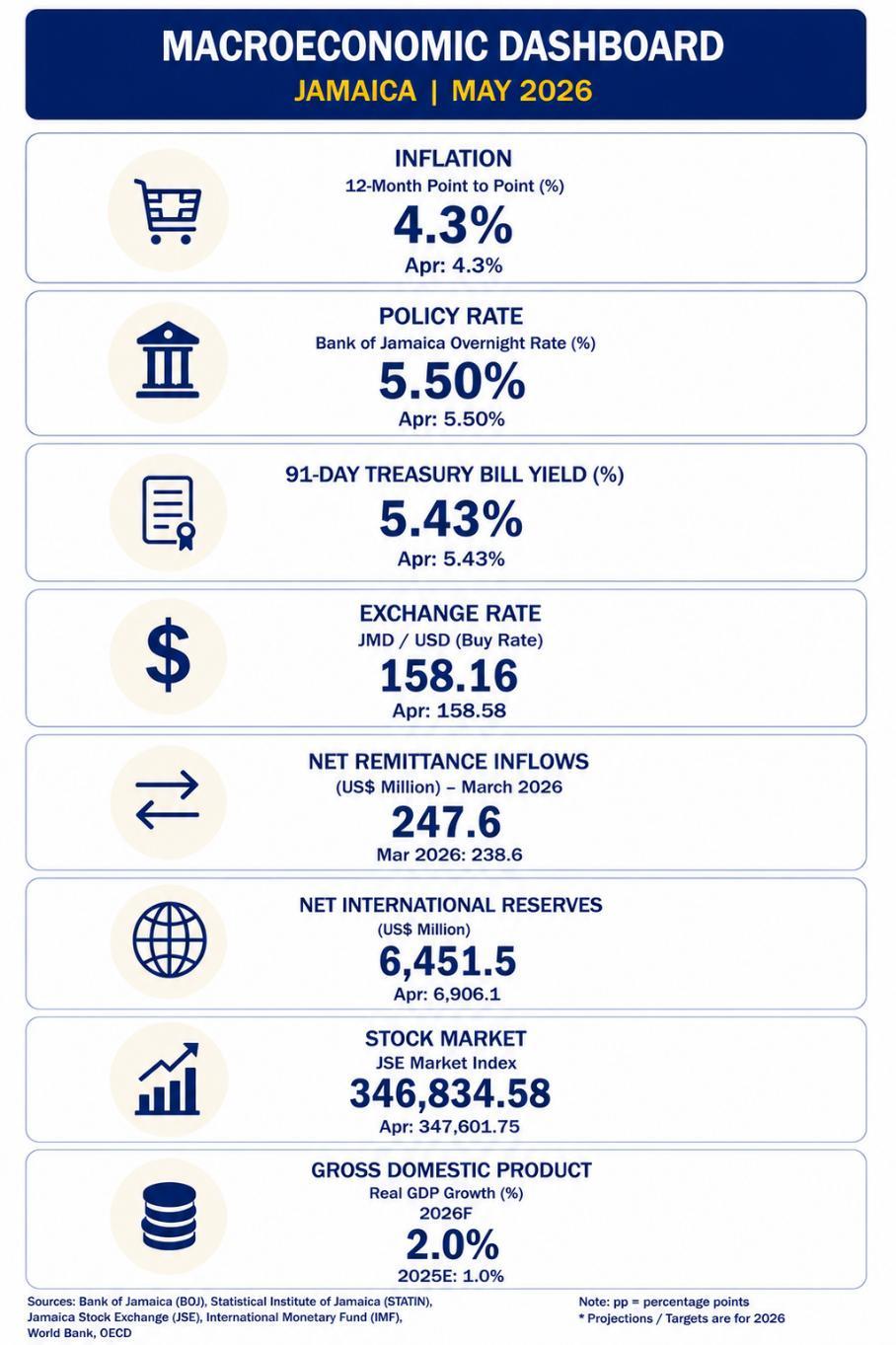
Inflation moderated slightly in April 2026, with lower electricity costs helping to reduceoverallconsumerprices.However, this temporary relief has not eliminated thepressurefacingJamaicanhouseholds.
Food prices remain elevated, transport costs continue to rise, and fuel prices remain volatile due to global oil market disruptions linked to the ongoing Middle East conflict. For ordinary Jamaicans, theseincreasescontinuetoaffectgrocery bills, transportation expenses, school costs,andoverallpurchasingpower.
Therealityisthatinflationisnolongeronly aneconomicstatistic itisasocialissue. Rising living costs disproportionately affect lower-income households, small businesses, pensioners, and informal workers who already operate with limited financialbuffers.
Recent fuel-price increases by Petrojam demonstrate how vulnerable Jamaica remains to imported inflation. Because Jamaica imports the majority of its fuel and many production inputs, external shocks quickly translate into higher domesticcosts.
Countries such as Costa Rica have responded to similar vulnerabilities by aggressively expanding renewable energy investmentsandreducingdependenceon importedoil.Today,CostaRicagenerates
the majority of its electricity from renewablesources,significantlyreducing exposure to global energy shocks over time.
Jamaicahasmadeprogress inrenewable energy development through solar and wind projects, but the pace of transition must accelerate. The country needs stronger incentives for renewable energy adoption, energy-efficient transportation, localfood production, andclimate-smart agriculture.
Reducing inflationary vulnerability requiresmorethanmonetarypolicyalone. Itrequiresacoordinatednationalstrategy focused on food security, energy diversification, logistics efficiency, and supply-chainresilience.
There is also a growing need for financial literacy and household resilience programmes that help Jamaicans better manage savings, debt, and long-term financial planning during periods of economicuncertainty.
Jamaica’s economy contracted sharply duringtheJanuarytoMarch2026quarter, largely due to the lingering impact of Hurricane Melissa. Nearly all major industries recorded declines, with agriculture, mining, manufacturing, transport,andtourismamongthehardest hit.
This contraction demonstrates the growing economic cost of climate vulnerability. Hurricanes and severe weather events are no longer isolated disruptions; they are recurring economic threats capable of reversing growth, disrupting employment, and weakening investor confidence. The tourism sector was particularly affected, with reduced visitor arrivals and lower activity across accommodation and food services. Agriculture also suffered extensive damage to crops, livestock, and infrastructure.
However, periods of disruption can also create opportunities for national transformation. After Hurricane Maria devastatedDominicain2017,thecountry launched a national resilience agenda focused on climate-proof infrastructure, renewable energy, digital government services, and disaster preparedness. While recovery was difficult, the crisis accelerated reforms that positioned the countryforstrongerlong-termresilience.
Jamaica now faces a similar opportunity. The country must move beyond simply rebuilding damaged infrastructure and instead focus on building smarter, stronger, and more climate-resilient systems. This includes resilient road networks, improved drainage systems, modern agricultural irrigation, hurricaneresistant housing, upgraded ports, and strongerdigitalinfrastructure.
Theprivatesectoralsohasacriticalroleto play. Businesses must increasingly incorporate disaster preparedness, business continuity planning, supply chain diversification, and climate risk managementintotheiroperations.
At the same time, government policy should prioritise investments that stimulate productivity growth. Greater emphasis is needed on technology adoption, innovation financing, export development, and support for micro, small, and medium-sized enterprises (MSMEs), which remain the backbone of theJamaicaneconomy.
Economicrecoveryshouldnotsimplyaim to restore previous levels of activity. It should aim to create a more productive, competitive, inclusive, and resilient economy.
TheBankofJamaicamaintaineditspolicy interest rate at 5.50% as inflation risks remain elevated. While this has helped preserve macroeconomic stability and confidence in the Jamaican dollar, it also means borrowing costs remain relatively highforbusinessesandconsumers.
Higherinterestratescanslowinvestment, discourage borrowing, and increase financial pressure on households already managing rising living costs. Small businesses, in particular, often face
difficulty accessing affordable credit during periods of tighter monetary conditions. At the same time, stable interest rates have helped maintain investor confidence and preserve orderly financialmarketconditions.Thechallenge now is to improve the transmission of monetarypolicysothatlowerpolicyrates eventually translate into more affordable lending for productive sectors of the economy.
Countries such as Singapore and South Koreahavedemonstratedtheimportance of pairing macroeconomic stability with targeted industrial financing programmes that support innovation, exports, and productivity growth. Jamaica can strengthen development financing initiatives aimed at agriculture, manufacturing, renewable energy, digital businesses,andMSMEs.
There is also a need to expand financial inclusion. Many Jamaicans still operate outsidetheformalfinancialsystemorface limitedaccesstoaffordablefinancingand investment opportunities. Greater use of digital banking, microfinance, and financial technology solutions can help bridgethesegaps.
The Jamaica Stock Exchange recorded mixed performance during April 2026. Whilesomemajorstocksperformedwell,
broader investor participation remained weak, particularly among smaller companies listed on the Junior Market. This reflects a cautious investment environment where investors are increasingly selective and focused on companies with strong balance sheets, stableearnings,andresiliencetoexternal shocks.
ForJamaicatodeepenitscapitalmarkets, the country must encourage broader participation in investing and entrepreneurship. Many MSMEs still face barriers to accessing long-term growth capital. Regional examples such as Trinidad and Tobago demonstrate how pensionfunds,privateequitymarkets,and localinvestmentvehiclescanplayalarger role in supporting domestic enterprise development. Jamaica should continue strengthening policies that encourage entrepreneurship, local investment, innovation financing, and public confidenceinthecapitalmarket.
A stronger investment culture can help mobilisedomesticsavingsintoproductive economic activity, reducing reliance on external borrowing while supporting job creationandbusinessexpansion.
The Jamaican dollar remained relatively stable during April 2026, supported by interventions from the Bank of Jamaica and strong remittance inflows. Remittances continue to serve as one of Jamaica’s most important economic lifelines, providing critical support for families, education, housing, and small businesses. The continued growth in remittance inflows reflects the resilience of the Jamaican diaspora and the importance of maintaining strong economictieswithoverseasmarkets.
However,Jamaicaremainshighlyexposed to external shocks because of its dependence on imported fuel, imported goods, and overseas economic conditions. Higher global oil prices, shipping disruptions, and geopolitical instability continue to increase demand forforeigncurrencyandplacepressureon the country’s external accounts. This reinforcestheurgencyofexpandingexport capacity, strengthening local production, increasing energy independence, and improving foreign exchange earning industriesbeyondtourism.
Countries such as Guyana have aggressively pursued export diversificationstrategieswhileinvestingin infrastructure and productive capacity. Jamaica mustsimilarly identifyandscale high-growth export industries such as agro-processing, logistics, digital
services, creative industries, and renewable energy technology. The country’s strong Net International Reserves provide an important buffer against external shocks, but long-term resilience will depend on reducing structural vulnerabilities rather than relyingsolelyonreserveaccumulation.
Thelatesteconomicindicatorsmakeone thing clear: Jamaica has demonstrated resilience, but resilience alone is not enough. The country must now move decisivelytowardamodelofgrowththatis more productive, climate-resilient, inclusive, and globally competitive. This will require coordinated national leadership and stronger collaboration between government, the private sector, labour organisations, academia, and civil society.
Keyprioritiesshouldinclude:
▪ Acceleratingclimate-resilient infrastructuredevelopment.
▪ Expandingrenewableenergyand reducingfueldependence.
▪ Strengtheningagricultureandfood security.
▪ SupportingMSMEsand entrepreneurship.
▪ Investinginworkforcedevelopment anddigitalskills.
▪ Improvingproductivityandexport competitiveness.
▪ Expandingfinancialinclusionand affordablefinancing.
▪ Modernisinglogistics,ports,and supplychains.
▪ Deepeninglocalcapitalmarketsand investmentparticipation.
Jamaica has already demonstrated that disciplined economic reform is possible. Thenextphasemustfocusonbuildingan economy that not only survives external shocks but also creates sustainable prosperity for all Jamaicans. The time for strategicactionisnow.
Recent increases in global oil prices triggered by escalating geopolitical tensions in the Middle East have renewedattentiononthestructureoffuel taxation in import-dependent economies suchasJamaica.Whiletherehasbeenno introduction of new fuel-specific taxes, rising pump prices have sharpened concerns among businesses and consumersaboutwhetherexistingandthe new Special Consumption Tax (SCT) arrangementscouldamplifytheimpactof externalshocksondomesticcosts.
This article examines the current global and Jamaican context, focusing on the interactionbetweeninternationaloilprice volatility, domestic fuel pricing mechanisms,andthedesignoftheSCT.
The conflict involving Iran and its implications for shipping routes particularly the Strait of Hormuz has reintroduced a significant risk premium into global oil markets. This chokepoint handles a large share of global oil and liquefied natural gas flows, and disruptions have led to sharp price increasesandheightenedvolatility.
MultilateralinstitutionssuchastheWorld BankandtheInternationalMonetaryFund (IMF)identifyenergypricesastheprimary transmission channel through which the conflict is affecting the global economy. Their assessments point to three key effects:
1. Higher global inflation, driven by fuel andtransportcosts;
2. Weaker growth prospects, especially fornetenergy importingeconomies;
3. Increased volatility, complicating macroeconomic management and businessplanning.
For small, open economies without domestic oil production, these dynamics translate rapidly into higher import bills anddomesticpricepressures.
Jamaica’s Fuel Pricing Dynamics: What Has Changed?
Jamaica’s fuel prices are largely determined by international market movements, transmitted through Petrojam’s ex refinerypricing mechanism and passed on via marketing and retail margins. Petrojam’s publishedex refinery prices show a clear run‑up through April
(e.g.,E‑1087increasedfrom$172.3828/L (April 2) to $185.6328/L (April 30); auto diesel from $184.7503/L (Apr 2) to $193.2503/L(April30)).JamaicaObserver reporting also indicates fuel costs rose materially over a short period and notes that taxes are a significant share of the pump build up; it cites Petrojam’s April 1 pricing showing 87 gasoline at $172.3828/Lwith$37.7761relatedtoSCT plus $15.6712 as ad valorem SCT (about 31% of the final price). In parallel, reporting indicates the Government intendstoremovethe$4.50weeklycapon fuel price movements, which would increase pass through of international volatilitytolocalprices.
Two domestic policy features are particularlyrelevantatthisjuncture:
1. TheStructureofFuelTaxation
FuelsoldinJamaicaattractsSCT,madeup of both a specific component (fixed amount per litre) and an ad valorem component(apercentageoftheprice).As international oil prices rise, the ad valorem portion increases automatically,meaningthattaxpayments risealongsidethebasefuelcost.Ineffect, this can magnify the impact of external priceshocksonthefinalpumpprice,even in the absence of any discretionary tax increase.
2. IncreasedPricePass Through
TheGovernment’sdecisiontoremovethe weekly cap on fuel price movements
means that changes in international prices are now transmitted more quickly and fully to local consumers and firms. While this improves transparency and reduces fiscal risks to the refinery, it also increases short term exposure to volatility. Together, these factors have increased the sensitivity of domestic fuel pricestoexternalshocks.
Fuelisakeyintermediateinputacrossthe economy.Risingpricesaffect:
▪ Transport and logistics, with direct implicationsfordistributioncosts;
▪ Electricitygeneration,givenfuelinputs andpass throughintotariffs;
▪ Food and manufactured goods, as highertransportandenergycostsfeed intoprices;
▪ Household budgets, contributing to broadercost of livingpressures.
Fromabusinessperspective,energyprice volatility undermines cost predictability and can weaken competitiveness, particularly for firms operating with tight marginsorinexport exposedsectors.
Importantly, the current discussion does notcentreonintroducingnewfueltaxesor permanently reducing government revenue. Rather, it raises a structural policy question: Is the current design of
fueltaxationsufficientlyresponsiveduring periodsofexceptionalexternalshocks?
Fromaneconomicpolicystandpoint, thereisscopetoexaminewhetherthe SCTframeworkcouldincorporate temporary,rules basedshock absorbing featureswithoutundermininglong term fiscalsustainability.Potential approaches usedinvariousforms internationally couldinclude:
▪ Time‑boundadjustmentstothe ad valoremcomponentduringclearly definedshockperiods;
▪ Trigger basedsmoothingmechanisms linkedtointernationalprice thresholds;
▪ Automaticsunsetprovisionstoensure fullreversiononceconditions normalise.
Suchmeasureswouldaimtomoderate volatilityratherthansuppressprices artificially,andwouldneedtobecarefully calibratedtopreservefiscaldiscipline.
In conclusion, the recent fuel price increases highlight Jamaica’s continued exposuretoglobalenergyshocksandthe importance of tax design in shaping how these shocks are transmitted domestically. As international volatility persists,thereisacrediblecaseforpolicy dialogueonwhetherexistingfueltaxation structures strike the right balance betweenrevenueneeds,competitiveness, andeconomicresilience.
Framed carefully, this discussion can remain evidence based, fiscally responsible, and aligned with broader objectives around productivity, cost competitiveness, and ease of doing business without reopening settled questions about fuel taxation levels themselves.