Modernising Jamaica’s Regulatory Framework: Advancing Technical Regulations for Competitiveness and Compliance
Balancing Accountability and Crime Reduction: Advancing Body-Worn Camera Reform in Jamaica’s Security Framework
Strengthening Accountability: A Foundation for Sustainable Growth
Third-Country Nationals and Jamaica: Balancing Economic Prudence, Security, and Transparency
Executive Director's Message
Preparedness: The New Competitive Advantage
Economic leadership is no longer measured solely by how we respond to crises,butbyhowdeliberatelyweprepare forthenext.
Ifthepastseveralmonthshavetaughtus anything,itisthatuncertaintyisnolonger aninterruptiontodoingbusiness—itisthe operating environment itself. From geopolitical tensions reshaping global trade and energy markets to Jamaica’s ongoingrecoveryfromHurricaneMelissa, businessesarenavigatinganincreasingly complex landscape where resilience alone is insufficient. The organisations thatwillthriveintheyearsaheadwillnot necessarilybethelargestorstrongest,but those that are most prepared, agile and forward-thinking.
This month’s Economic Bulletin reflects that reality. While global growth remains modest, persistent inflation, elevated energycostsandgeopoliticaluncertainty continue to cloud the outlook. Here in Jamaica, the economy is on a gradual recovery path following one of the most significant disruptions in recent years. Encouragingly,inflationremainswithinthe Bank of Jamaica’s target range and reconstruction activity is expected to support renewed growth. Yet sustainable recoverywillrequiremorethanrebuilding
That is why this edition explores issues beyond traditional economic indicators. Whether examining the modernisation of Jamaica’s Technical Regulations framework, strengthening public accountability, or the national conversation on body worn cameras and
institutions. Investors seek predictability. Businessesflourishwheretheruleoflaw is respected, regulation is transparent, andpublicconfidencecontinuestogrow.
Accountability is therefore not just a governance objective it is an economic imperativeanddriverofcompetitiveness.
The recent decline in major crimes is a welcome development and reflects the impact of focused law enforcement strategies. Equally important, however, is sustainingthesegainsthroughcontinued institutional reform and public trust. Measures such as the effective implementation of body-worn cameras are not simply matters of policing they reinforce accountability, strengthen confidence in the rule of law and contribute to the stable environment businesses need to invest, expand and createjobs
The same principle underpins another important development highlighted this month. The launch of the Private Sector MSME Resilience Grant a collaboration betweenthePSOJ,theJamaicaChamber of Commerce and the Jamaica Manufacturers and Exporters Association—demonstrates how collective action can deliver meaningful support. Established through private sector contributions following Hurricane Melissa, the initiative recognises that recovery must go beyond restoring what was lost. It must help businesses strengthen operational continuity, improve energy resilience and build
capacity to withstand future shocks. In doing so, it invests not only in individual enterprisesbutinthelong-termresilience and competitiveness of Jamaica’s economy.
AsthevoiceofJamaica’sorganisedprivate sector, the PSOJ remains committed to championing policies that strengthen competitiveness, foster innovation and reinforce the institutional foundations of sustainable growth. We will continue working with Government, private sector partners, development agencies andcivil society to advance reforms that improve the business environment, encourage investmentandpositionJamaicaforlongtermprosperity.
Thechallengesbeforeusarecomplex,but not insurmountable. Time and again, Jamaica has shown that progress is possiblewhengovernment,businessand civil society work together with shared purpose. Whether rebuilding after disasters, modernising regulation, strengthening accountability or investing in MSME resilience, each effort contributes to the same objective a stronger, more competitive and resilient Jamaica.
Preparedness is no longer simply a measureofresilience itisthefoundation of competitiveness and national prosperity.
GLOBAL MACROECONOMIC
INDICATORS
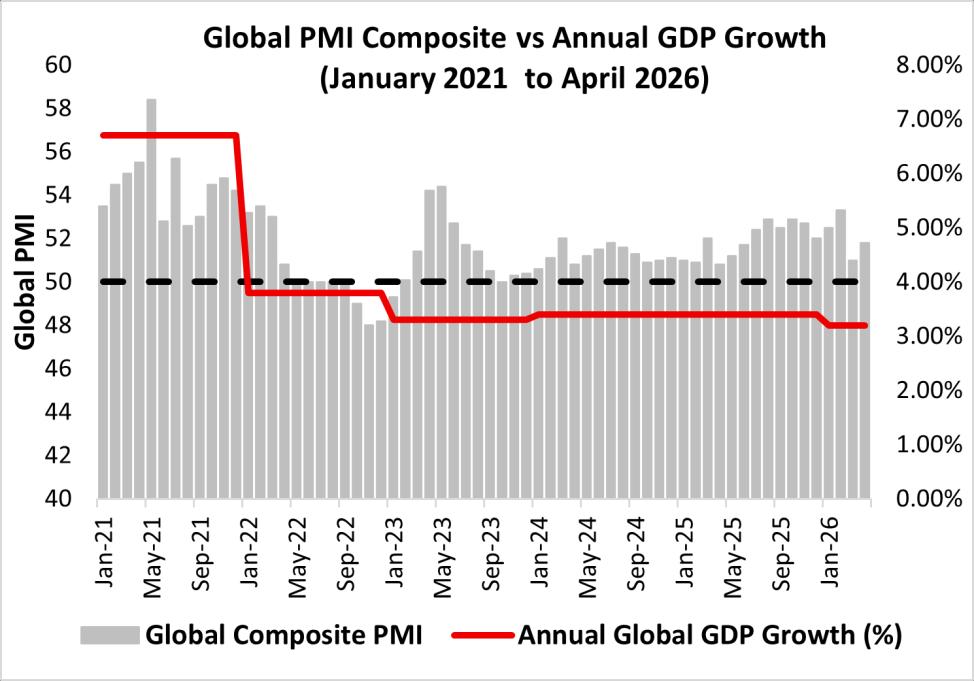
The global macroeconomic environment inearly2026showedsignsofmodestbut uneven expansion, supported by strengthening private-sector activity. The J.P.MorganGlobalCompositePMIroseto 51.8inApril2026,upfrom51.0inMarch, marking the 39th consecutive month above the neutral 50 threshold, which signals continued global expansion. Growthwasdrivenbystrongerneworders and stabilising business sentiment, with manufacturingoutperformingservicesfor a second straight month and reaching a near five year high in output, indicating improvedmomentumingoods-producing sectors. However, this expansion
remained geographically uneven, concentratedineconomiessuchasIndia, China, and the UK, while the euro area experiencedcontraction.
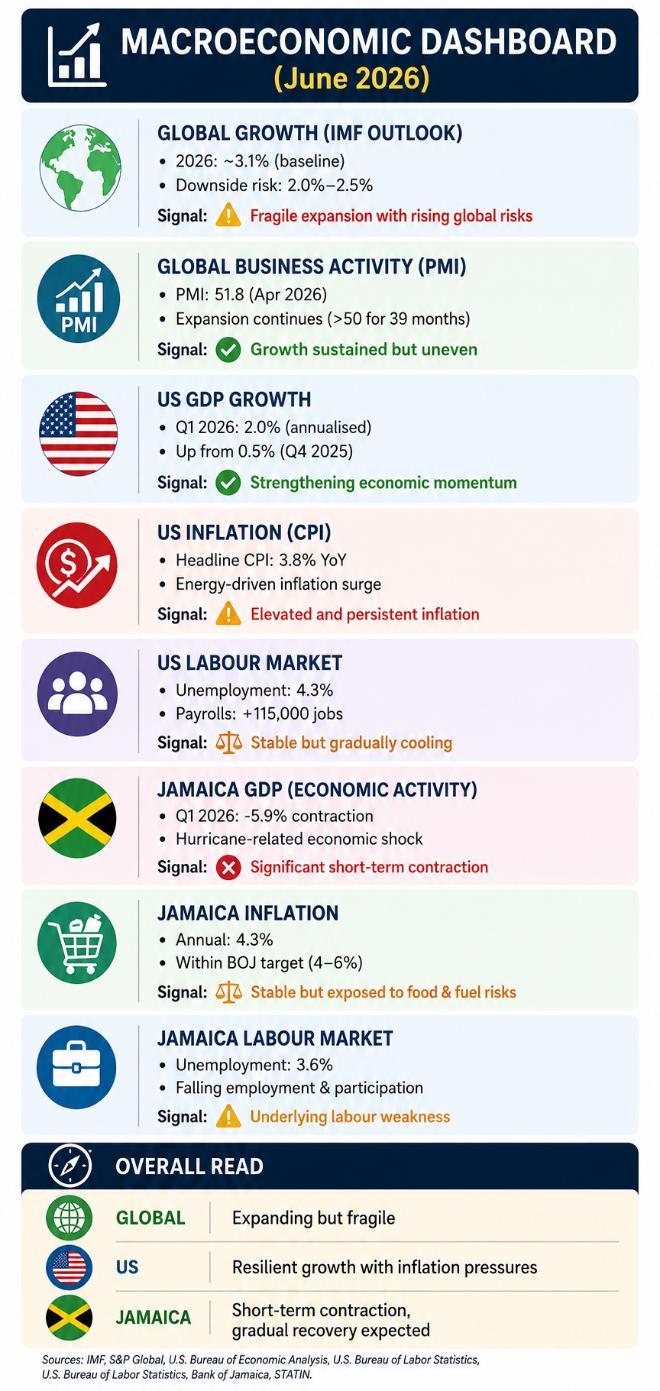
In terms of global growth outlook, the IMF projects 3.1% growth in 2026 and 3.2% in 2027 under itsbaselinescenario.
However, risks have intensified, and the global economy appearstobeshifting closer to a downside scenario. Under these conditions, growth could slow to around 2.5% in 2026
and,inamoresevereescalation,toaslow as 2.0%, with inflation exceeding 6%. Thesedownsiderisksareprimarilydriven bypersistentgeopoliticaltensions,tighter financial conditions, andelevated energy prices, indicating growing vulnerability in theglobaloutlook.
Additional evidence from the OECD highlights the impact of energy market disruptions, particularly from reduced shipments through the Strait of Hormuz, which has contributed to surging energy prices and constrained supply of key
commodities such as fertilisers. This shock is especially severe for energyimporting economies (e.g., Japan and Korea, where imports exceed 80% of energyuse).Asaresult,centralbanksare expected to remain cautious, potentially delaying or avoiding interest-rate cuts if inflation pressures persist. Overall, the disinflation trend observed in late 2025 has been interrupted, raising concerns about stagflation risks slower growth combinedwithrisinginflation.
THE UNITED STATES OF AMERICA
The U.S. macroeconomic environment reflectsacombinationofresilientgrowth, moderatinglabourmarketconditions,and persistentinflationarypressures,shaping a cautious policy outlook. The labour market remained stable but softened slightly, with nonfarm payrolls rising by 115,000 in April 2026 and the unemployment rate holding at 4.3%. Job gains were concentrated in services particularly health care (+37,000), transportation and warehousing (+30,000), and retail trade (+22,000) while more cyclical sectors like constructionshowed minimalexpansion. Thisindicatesthatemploymentgrowthis becoming increasingly sector-specific, consistentwithagradualcoolinginlabour demand rather than a broad-based slowdown.
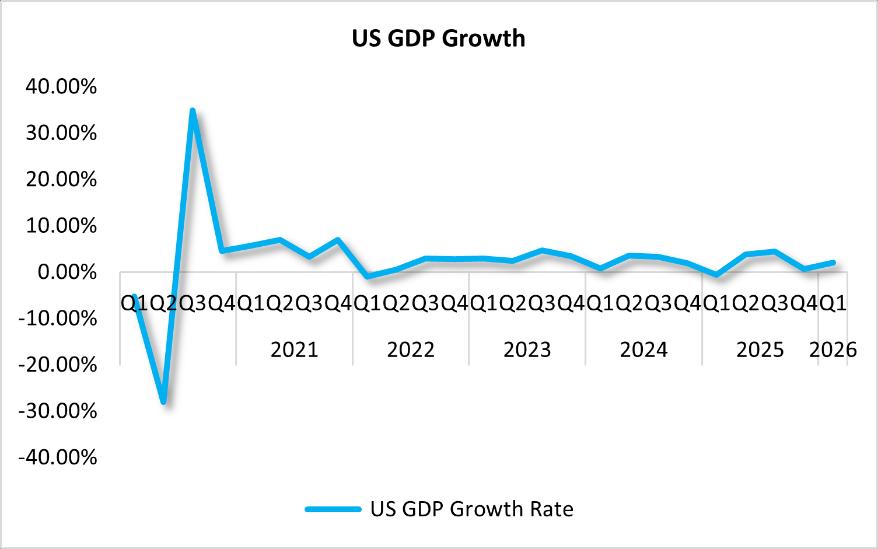
Economic activity strengthened in early 2026, with real GDP growing at an annualised rate of 2.0% in Q1, up from 0.5% in Q4 2025. The expansion was driven by higher investment, exports, consumer spending, and government expenditure, with government spending and exports contributing significantly to the acceleration. Underlying domestic demand remained relatively firm, as real finalsalestoprivatedomesticpurchasers increased by 2.5%, indicating solid private-sector momentum. However, inflationarypressuresremainedelevated, with headline PCE inflation at 4.5% and core PCE at 4.3%, highlighting ongoing challenges in achieving price stability despiteimprovedgrowth.
The medium-term outlook remains moderately positive but increasingly uncertain. The IMF projects U.S. GDP growth of approximately 2.3%–2.4% in 2026, supported by productivity gains, expansionary fiscal policy, and the lagged effects of earlier rate cuts. However, significant downside risks persist, includinggeopoliticaltensions,especially in the Middle East, elevated energy and commodity prices, trade policy uncertainty, slower employment growth, and large fiscal and external imbalances. At the same time, inflation risks are skewed to the upside, particularly if energy prices remain high, complicating the balance between sustaining growth and controlling inflation.
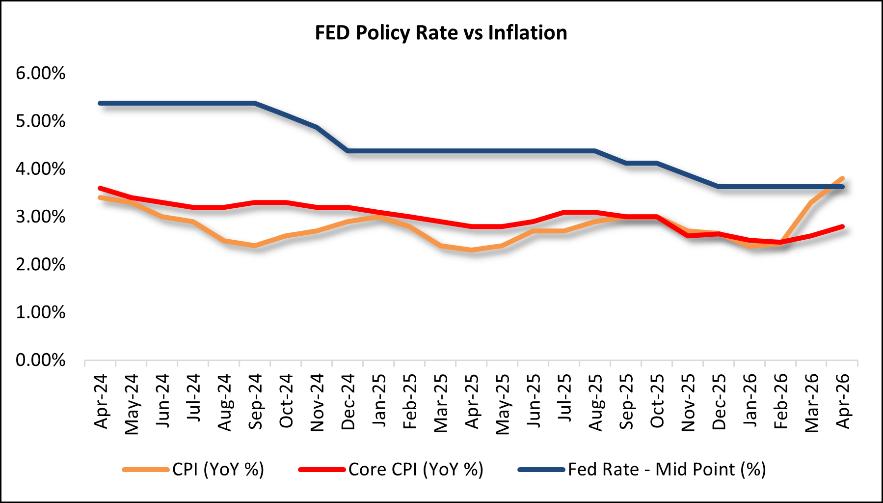
month-over-month.Therisewasprimarily driven by energy prices, which increased 3.8% in the month and 17.9% annually, with sharp gains in gasoline (+28.4%) and fuel oil (+54.3%).
Additional upward pressure came from shelter costs (+0.6%) and food prices (+0.5%), indicating broad-based inflation. Core inflationalsofirmed,withcoreCPIat2.8% year-over-year, reflecting sustained increases in services, particularly housingrelatedcosts.
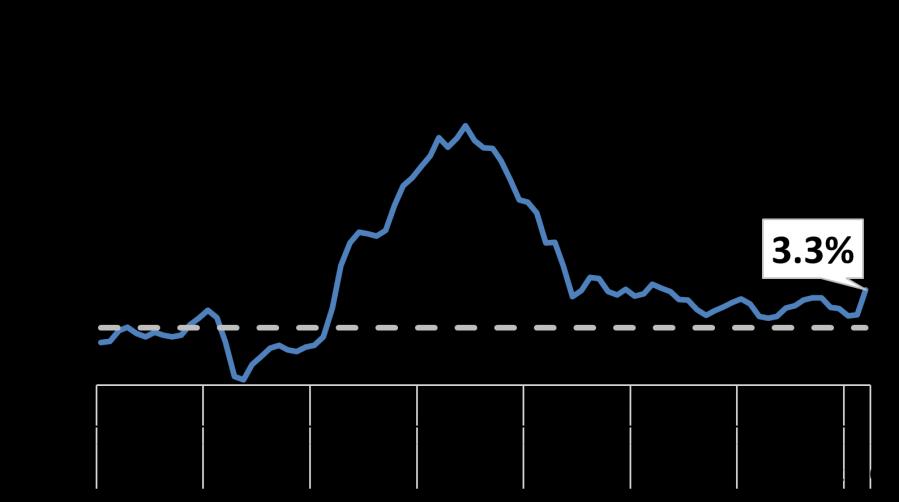
Inflation data for April 2026 underscore renewed price pressures, with headline CPIrisingto3.8%year-over-year(upfrom 3.3% in March) and increasing 0.6%
Monetary policy remains cautious and data-driven, reflecting the complex economic backdrop. The Federal Reserve held the policy rate at 3.50%–3.75% in April 2026, maintaining a“waitand-see” stance amid solid growth, persistent inflation, and heightened geopolitical uncertainty. Notably, there was increased disagreement within the FederalOpenMarketCommittee,withone membersupportingaratecutwhileothers
resisted signalling future easing. This divergence highlights uncertainty around theappropriatepolicypath.Withinflation still elevated and risks from energy markets and global conditions remaining prominent, the Fed is likely tomaintain a cautious stance, with future decisions dependentonincomingdataoninflation, employment,andfinancialconditions
Implications & Opportunities
Persistently higher oil and fuel costs can increase market volatility and keep inflation expectations elevated. In equities, this environment often favours more defensive, energy-linked and productivity-driven sectors, where companies have strong balance sheets, pricing power, and resilient earnings. In fixed income, A cautious Fed and uncertain rate path support a preference for short-duration, high-quality fixed income, which can capture attractive yieldswhilelimitingdurationandmark-tomarketrisk.
For financial institutions, elevated inflationandinterestratesmaymoderate credit demand and increase delinquency risk particularlyformore price-sensitive householdsandSMEs.FortheVMGroup, the current U.S. macro environment presents opportunities to deepen client relationships by offering short-duration income products, FX hedging, USD liquidity solutions, selective equity strategies, and inflationaware investments. With U.S. rates likely to remain uncertain, clients may value high-quality shortterm fixed income that provides yield while limiting duration risk. At the same time, FX volatility and imported inflation risks createdemandforcurrencyhedging,USD cashmanagement,andtreasuryadvisory services. Selective equity portfolios focused on quality, defensive, energylinked, and productivity-driven sectors mayalsoappealtoclientsseekinggrowth without excessive cyclical exposure. For thefirm,thesesolutionscansupportAUM growth,tradingactivity,FXspreadincome, advisory fees, product innovation, and stronger client retention, while helping clients manage interest-rate, inflation, currency,andmarketrisks.
DOMESTIC ECONOMIC
INDICATORS
The domestic economic environment in Jamaica reflects a combination of labour market resilience, moderating inflation, and significant economic disruption, largely influenced by the aftermath of Hurricane Melissaand evolving global conditions. While headline indicators such as unemployment remain relatively strong, underlying trends point to weaker labour force participation and declining employment,alongsidebroaderpressures oneconomicactivity.
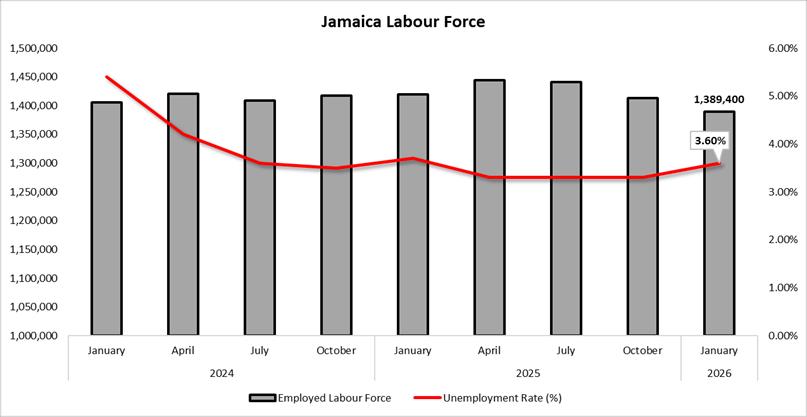
shifts indicate reduced participation and lingering post-hurricane disruptions. Sectoral data show mixed trends, with employment gains in areas such as wholesaleandretailtrade(+3,700),public administration (+8,000), and education and health (+6,300), while significant losses were recorded in accommodation and food services (-14,500), real estate and business services (-12,600), and agriculture (-9,000), reflecting uneven recovery across industries.
The labour market remained relatively tight,withtheunemploymentrateat3.6% in January 2026, slightly improved from 3.7%ayearearlier,thoughhigherthanthe 3.3%recordedinOctober2025.However, this improvement was not driven by job creation, but rather by a contraction in labour supply. The labour force declined by 32,900 persons to 1,441,000, while employment fell by 30,100 to 1,389,400, and the number of persons outside the labourforce increased to714,800. These
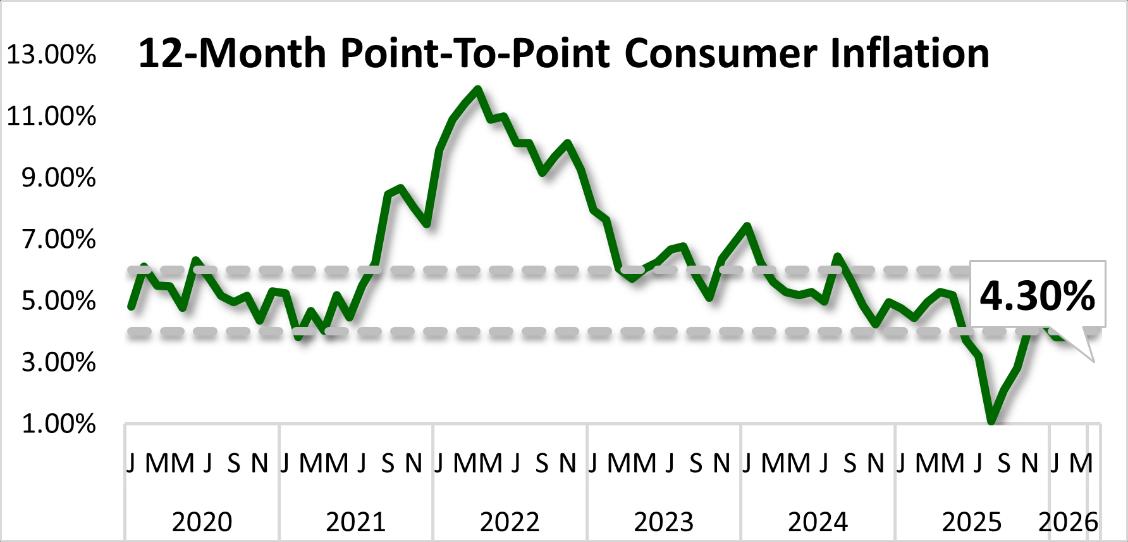
Inflation developmentsin 2026 showed short-term easing but persistent underlying pressures. In April 2026, the Consumer Price Index declined by 0.3% month-over-month, followinga0.3%increaseinMarch,largely driven by a 4.3% decline in housing, utilities, andelectricity costs, includinga sharp 12.5% drop in electricity-related prices. However, this relief was partly offsetbyincreasesinfoodprices(+0.6%) and transport costs (+1.1%), indicating continued cost pressures in essential household categories. On an annual basis, inflation remained unchanged at 4.3%,withintheBankofJamaica’s4%–6% target range, but still influenced by rising food(+6.8%)andtransport(+2.3%)costs. The inflation outlook remains uncertain,
with upside risks stemming from global commodity prices, fuel costs, and exchange rate pressures, reinforced by recentincreasesinlocalgasolineprices.
Economic activity weakened significantly inearly2026.Theeconomyisestimatedto have contracted by 5.9% in the January–March
improving. The economy is projected to contract by 3.0%–4.0% in the April–June 2026quarter,beforereturningtogrowthof 1.0%–3.0% for the full FY2026/27, supported by reconstruction activity and recovery in key sectors. However, downside risks remain significant, including elevated global energy and
quarter, reflecting widespread disruption from Hurricane Melissa, which affected production, employment, and business confidence. The contraction was broadbased across industries, with the goodsproducing sector declining by 11.2%, driven by sharp falls in agriculture (20.3%), mining (-26.6%), and manufacturing (-7.7%). The services sectoralsodeclinedby4.1%,withnotable contractionsinaccommodationandfood services (-20.4%), transport (-5.4%), and wholesale and retail trade (-1.6%), partly due to reduced tourism activity. These trendshighlightthedepthoftheshockand the slow recovery process across key economicsectors.
Looking ahead, the near-term outlook remains challenging but gradually
commodity prices, geopolitical tensions, supply chain disruptions, and weatherrelatedrisks,allofwhichcouldconstrain recovery. Overall, the domestic economy remains in a fragile recovery phase, with growth prospects hinging on external conditions,tourismperformance,andthe paceofpost-hurricanerebuilding.
Money market conditions reflect a cautious but stable monetary policy environment. The Bank of Jamaica maintained its policy rate at 5.50%, with inflation at 4.3% within the target range, though risks are skewed to the upside. Liquidityinthefinancialsystemremained adequate but slightly tighter, with evidence of excess liquidity reflected in oversubscription of short-term instruments, particularly BOJ certificates
of deposit. Treasury bill yields remained relatively stable in the range of approximately5.2%–6.5%,indicatingwellanchored short-term interest rates. Overall, the monetary environment
SPECIAL FEATURE
MODERNISING JAMAICA’S REGULATORY FRAMEWORK: ADVANCING TECHNICAL REGULATIONS FOR COMPETITIVENESS AND COMPLIANCE
OnMay28,2026,theBureauofStandards, Jamaica (BSJ) hosted a technical briefing on Jamaica's transition to a Technical Regulations (TR)regime. The session, led by the Ministry of Industry's Technical Regulations Unit, outlined the modernisation of Jamaica's regulatory framework to align with the World Trade Organisation'sTechnicalBarrierstoTrade (TBT) Agreement and strengthen national qualityinfrastructure.
Jamaicaisadvancingamajoroverhaulof its regulatory framework by transitioning from compulsory standards to a modern TechnicalRegulations(TR)regimealigned with the WTO Technical Barriers to Trade (TBT)Agreement.Thisreformreplacesthe legacy Standards Act (1969) approach withadualsystemofvoluntarystandards and enforceable TRs, strengthening regulatory clarity, transparency, and international competitiveness. The conversion of 137 compulsory standards
suggests a “higher-for-longer” interestratestance,balancingtheneedtocontain inflation with the need to support economicrecovery.
into Technical Regulations signals a decisive shift toward a more structured and enforceable compliance environment.
Acentralfeatureofthenewregimeisthe application of a rigorous Regulatory Impact Assessment (RIA) process, ensuringthatallTechnicalRegulationsare evidence-based, proportionate, and informed by stakeholder consultation. At the same time, regulatory consolidation, most notably the merger of 21 labelling standards into a single framework demonstrates a clear policy intent to reduce fragmentation and lower compliance costs while maintaining robustsafetyandqualityrequirements.
For the private sector, the transition introduces mandatory conformity assessment procedures, including registration, inspections, and certification, under the oversight of the National Compliance and Regulatory Authority (NCRA). While this enhances predictability and enforcement, it also requires businesses to proactively strengthen internal compliance systems and align operations with the new requirements. The commitment to free publicaccesstoTechnicalRegulationsis
Key regulations under development, including those for processed foods, labelling, medical devices, electrical products,andconstructionmaterials,will comeintoeffectbeginningJanuary2027, with a six-month transition period before fullenforcement.However,thereremains scope for sector-specific flexibility based on industry readiness, which will be criticalforminimisingdisruption.
Againstthisbackdrop,thePSOJadvocates ensuringthatthereformisimplementedin apractical,growth-orientedmanner.This includes mobilising robust private sector participationin theconsultationprocess, advocating for phased and sectorsensitive transition timelines,
BALANCING ACCOUNTABILITY AND CRIME
REDUCTION: ADVANCING BODY-WORN
CAMERA REFORM IN JAMAICA’S SECURITY
FRAMEWORK
ThedeliberationsofthePSOJSecurityand JusticeCommitteeacrossreinforceadual narrative within Jamaica’s national securitylandscape: measurable progress in crime reduction alongside persistent structural gaps in accountability and oversight.Centraltothesediscussionsis the urgent need to operationalise bodyworncamera(BWC)usageasamandatory featureoflawenforcement,particularlyin
strengthening collaboration with regulators to ensure transparent and predictable enforcement, and supporting capacity-building initiatives to ease compliance burdens particularly for SMEs.
Overall, the TR regime represents a necessary and forward-looking reform thatpositionsJamaicaasaregionalleader in regulatory modernisation. Its success, however,willdependonsustainedpublicprivate engagement, realistic implementation timelines, and targeted support mechanisms to ensure that enhanced regulation translates into improved competitiveness rather than unintended constraints on business activity.
high-risk, planned operations. Data presented by INDECOM highlights a troubling disconnect between resource availability and operational practice despite the deployment of approximately 1,500 cameras, there have been virtually no recorded instances of BWC usage in fatalpoliceencountersoverthe pasttwo years.Thisraisesseriousconcernsabout transparency, evidentiary integrity, and publictrustintheuseofforce.
Fromapolicystandpoint,theabsenceofa compulsorylegislativeframeworkforBWC activation remains a critical weakness.
The current discretionary approach, compounded by inconsistent enforcement of discipline, undermines both accountabilitymechanisms andthe protections such technologies afford compliant officers. The Committee’s advocacy position is therefore appropriately aligned toward legislative reform, institutional enforcement, and culturaltransformationwithintheJamaica Constabulary Force. Reframing policing froma“force”toa“service”orientationis not merely symbolic but reflects a necessary shift toward citizen-centric, rights-basedlawenforcement.
At the same time, the Committee acknowledged notable gains in crime reduction,witha16.1%decreaseinmajor crimes in the first half of 2026. Intelligence-led policing and targeted interventions in hotspot areas have demonstrated effectiveness, suggesting that strategic operational reforms can yield tangible public safety outcomes. However, localised increases in violence andthepersistentprevalenceofdomestic abuse signal that these gains are uneven and require sustained, targeted
responses—particularly through community-based interventions and socialpreventionframeworks.
ThemainpolicytakeawayisthatJamaica’s security strategy should strike a balance between effective enforcement and the maintenance of accountability and legitimacy. While investments in infrastructure, digital systems, and community programs like the STAR initiativearevaluableadditionstopolicing efforts, they shouldnotreplace the need for strong oversight. Ensuring mandatory BWC use, strengthening compliance regimes, and enhancing transparency in use-of-force incidents are essential to consolidating recent gains in crime reduction while safeguarding civil liberties.
The convergence ofdecliningcrime rates andheightenedscrutinyofpoliceconduct presents a pivotal moment for reform one that requires decisive policy leadership and coordinated advocacy from both public- and private-sector stakeholders.
STRENGTHENING ACCOUNTABILITY: A FOUNDATION FOR SUSTAINABLE GROWTH
Jamaica’s long-term economic resilience dependsnotonlyonfiscaldisciplineand investmentflows,butalsoonthestrength of its governance architecture. Recent initiatives led by the Jamaica Accountability Meter Portal (JAMP), in partnership with the PSOJ and international stakeholders, underscore the critical link between transparency, accountability, and sustainable development.
The launch of the Public Bodies Tracker andSectoralCommitmentTrackeronMay 29, 2026. marks a significant advancement in Jamaica’s institutional framework. These tools enhance access to data on public sector performance, enabling citizens, businesses, and policymakers to monitor government commitments, expenditure patterns, and compliance with established governance standards. By translating complex public financeandadministrativedataintouserfriendly formats, the initiative reduces information asymmetry a persistent constraint on effective civic participation andprivatesectorconfidence.
From a private sector perspective, improved accountability mechanisms directlyinfluencetheinvestmentclimate. Transparent institutions reduce uncertainty, lower transaction costs, and strengtheninvestorconfidence.ThePSOJ has consistently advocated for data-
driven decision-making, recognising that measurable outcomes and credible oversight are essential for productivity growthandglobalcompetitiveness.
Importantly, the initiative reflects a maturing governance ecosystem. Rather than introducing parallel standards, the trackers assess adherence to existing legal and regulatory frameworks, reinforcing institutional integrity. This approach promotes constructive engagement over adversarial critique, fostering a collaborative environment betweenpublicandprivatestakeholders.
However,theeffectivenessofthesetools will depend on adoption and sustained engagement. Low civic participation— evidenced by declining voter turnout signalsabroaderchallengeofpublictrust andcitizeninvolvement.Bridgingthisgap requires not only access to information but also active utilisation of such platformstoholdinstitutionsaccountable betweenelectoralcycles.
For Jamaica to achieve its Vision 2030 objectives, governance reform must remain central to the economic agenda. Initiatives like JAMP’s trackers represent practical steps toward strengthening public sector performance, enhancing transparency, and building trust key pillars for inclusive and sustained economicgrowth.
The PSOJ remains committed to supporting partnerships that advance accountability, improve service delivery,
and reinforce Jamaica’s position as a competitiveandwell-governedeconomy.
THIRD-COUNTRY NATIONALS AND JAMAICA: BALANCING ECONOMIC PRUDENCE, SECURITY, AND TRANSPARENCY
Jamaica’s recent Memorandum of Understanding (MOU) with the United States to facilitate the transit of thirdcountry nationals (TCNs) has generated significant public debate. While the arrangementisframedasacontrolledand temporary transit mechanism, it raises important economic, governance, and security considerations that warrant careful evaluation. From a private-sector perspective, the central issue is not the movement of non-Jamaicans through Jamaicanterritoryperse,butwhetherthe agreement is transparently structured, operationally sound, and aligned with Jamaica’s national and economic interests.Assuch,thediscussionshould move beyond public anxiety toward evidence-based scrutiny of the policy’s implications.
Third-country nationals are persons who areneithercitizensofthecountryinitiating removal nor of the country of transit or destination. In Jamaica’s case, the agreement allows forthe transfer ofnonJamaican individuals from the United States through Jamaica en route to other jurisdictions. This classification is
administrative rather than indicative of criminalityorrisk.Nevertheless,because these transfers originate within the U.S. immigration enforcement system, they raise legitimate questions regarding due process, human rights obligations, and nationalsecuritymanagement.
According to official statements, the MOU signed on June 10, 2026 establishes a structured and limited framework. The arrangement allows for a maximum of 25 individuals every two weeksandincludesacapmechanismthat pauses transfers if more than 10 individualsremaininJamaicawithina30day period. Jamaica retains the right to refuse any individual proposed for transfer. Screening protocols reportedly include health checks, identity verification, criminal background checks, andclearancebytheNationalIntelligence Bureau. The Government has also indicatedthattheUnitedStateswillcover the initial costs of accommodation and logistics, and that the programme is not intended to serve as a resettlement initiative.
Despite these safeguards, the arrangement raises several considerations regarding economic management and institutional capacity.
Even with U.S. financial support, uncertainties remain regarding indirect public-sector costs, including administrative oversight, security, legal processing, and contingencies when individuals remain longer than expected. Without clearly defined cost-sharing arrangements and contingency frameworks, there is a risk of unanticipatedfiscalburdens.Additionally, effective implementation will depend on stronginter-agencycoordination,efficient processing systems, and adequate infrastructuretomanagetemporarystays. Any failure in execution could lead to prolonged stays, increasing both fiscal andsocialpressures.
There are also reputational considerations. As a small, globally integrated economy, Jamaica must safeguard its international standing. Participation in third-country transfer arrangements places the country within complex migration and geopolitical frameworks. Poorly managed implementation particularly in relation to human rights standards could undermine confidence in Jamaica’s governance systems and expose the country to reputational risk. For businesses and investors, perceptions of institutional reliability and policy clarity are critical components of a stable economicenvironment.
Public concern has been driven in large part by limited information about the agreement'sfullterms.Stakeholdershave
raised questions regarding the MOU's legal structure, long-term financial implications, protocols governing asylum or humanitarian claims, and oversight mechanisms. These concerns have been amplified by external commentary from U.S. officials using strong language to describe certain deportees. Although Jamaican authorities have stated that individualswithcriminalantecedentswill not be accepted, such statements heighten the demand for transparent screening processes and clear public communication.
Humanrightsconsiderationsalsoremain central.Evenasatransitcountry,Jamaica is bound by international obligations to ensurehumanetreatmentandprocedural fairness. Global experience with thirdcountrytransferssuggestsrisksrelatedto limited access to due process, potential exposure to unsafe onward destinations, and practical barriers such as language and access to legal support. Addressing theserisksrequiresclearlegalprotocols, especiallyincaseswhereindividualsmay seek asylum or are unable to leave Jamaicaasplanned.
The Government has outlined several safeguards, including strict vetting procedures,numericallimits,andtheright to refuse individuals. While these measures are important, their effectiveness depends on transparency, consistent application, and independent oversight. For the private sector, predictabilityandclarityofgovernanceare
essential. Any ambiguity in the implementation of such a policy can translate into broader uncertainty, with potential implications for investor confidenceandeconomicstability.
Ultimately, the third-country nationals arrangementrepresentsapolicyinitiative withrealbutmanageablerisks.Itisneither animmediateeconomicthreatnoratrivial administrative measure. Jamaicans should approach the issue with cautious scrutiny,notfear.Theindividualsinvolved areentitledtohumanetreatment,andthe arrangement’s success depends on disciplined execution. Confidence will requiretheGovernmenttoclearlyoutline MOU terms, define cost-sharing and contingency measures, establish transparent oversight, and clarify procedures for asylum and extended stays. Aligning with sound economic management, institutional integrity, and the national interest will be critical to maintainingpublictrustandstability.
Submitted by: Giovanni McKenzie MSc, International Public and Development Management (IPDM), UWI PSOJ Intern